
Pecos City Zoning Code
ARTICLE 2
- Purpose
WHEREAS, all conditions precedent required by law for the adoption of a zoning ordinance and map have been fully complied with and notice was duly published on the 8th day of June, 2012, in the Pecos Enterprise of Pecos, Texas, by publishing the proposed zoning ordinance and by posting copies of the proposed zoning map in public places for public study, and the public hearing, according to said notice, was held at 5:30 o'clock p.m. on the 12th day of July, 2012, in the Community Center of Pecos City, Texas, at which time every person was afforded and given the opportunity for a full and fair hearing and given the opportunity to be heard, and persons appeared to be heard, and persons appeared in support of the proposed ordinance and maps and after said hearing, it is determined by the town council that it would be in the public interest that a zoning ordinance together with an official zoning map be enacted in substantial compliance with the recommendation of the planning and zoning commission;
NOW THEREFORE, BE IT ORDAINED BY THE TOWN COUNCIL OF THE TOWN OF PECOS CITY, TEXAS:
That an amendment to the zoning ordinance and an official zoning map is hereby enacted and adopted which shall hereafter provide as follows:
Sec. 1. - Purpose and compliance.
The purpose of this ordinance is to zone the entire area within the corporate limits of the Town of Pecos City into districts as authorized within Chapter 211 of the Texas Local Government Code and in accordance with a comprehensive plan for the purpose of promoting health, safety, morals and the general welfare of the public. These regulations have been designed to lessen congestion in the streets; to provide safety from fire, panic and other dangers; to provide adequate light and air, to prevent the overcrowding of land, to avoid undue concentration of population, to provide and facilitate adequate provisions for transportation, water, sewerage, schools, parks and other public requirements. Said districts have been created with a fair reasonable consideration, among other things of the character of each particular district and its peculiar suitability for particular uses and thereby conserve the value of land and buildings in each particular district; and with a view of ensuring the harmonious and appropriate use of all property and to prohibit the inharmonious and inappropriate use of all property and thereby promote the general good and welfare of the public.
All land, buildings, structures located within the Town of Pecos City, Texas, which are hereafter occupied, used, erected, altered, removed, placed, demolished or converted shall be in conformance with the zoning regulations prescribed for the zoning district in which such land or building is located as hereinafter provided.
Sec. 2. - Definitions.
For the purpose of this ordinance certain terms and words herein [are] defined as follows:
The words "used for" include "designated for" and vice versa: words used in the present tense include the future; words in singular number include the plural number and vice versa; the word "building" includes the word "structure"; the word "dwelling" includes the word "residence"; the word "lot" includes the word " plot" and the word "shall" is mandatory and not directory.
2.1
Abutting property: Property abutting upon a street shall also be understood as abutting property on the other side of the street.
2.2
Accessory building: Same as "Building, accessory." See 2.18.
2.3
Accessory dwelling unit: Small apartments, dwellings or houses that share the same lot as a larger dwelling; oftentimes accessed by alleyways.
2.4
Airport or aircraft landing field: Any landing area, runway or other facility designated, used or intended to be used either publicly or by any person or persons for the landing and taking off of aircraft including all necessary buildings and open spaces.
2.5
Alley: A public way which permits secondary means of access to abutting property.
2.6
Alley flat: An accessory dwelling unit accessed by an alley.
2.7
Alteration, structural: Any change, in a supporting member of a building or structure, such as bearing walls, columns, beams, girders, or roof pitch.
2.8
Amusement park: Any lot, tract or parcel of land or any improvement thereon either temporary or permanent used in whole or in part for the operation and maintenance of any game of skill or chance, circus, carnival, and riding devices or devices, stationary or movable, or any combination thereof.
2.9
Apartments: A suite of rooms within one or more buildings consisting of five (5) or more, arranged, designed or occupied as the residence of an individual or family.
2.10
Automobile service station: Any premises used for supplying gasoline, oil, diesel and/or liquefied petroleum gases, at retail direct to the customer, including minor accessories and services for vehicles.
2.11
Automobile repair major: General repair or reconditioning of engines, air-conditioning systems and transmissions for motor vehicles; wrecker service; collision services including body, frame or fender straightening or repair; customizing; painting; vehicle steam cleaning; undercoating and rust proofing; and other similar use.
2.12
Automobile and trailer sales area: An open area, other than a street or required automobile parking space used for the display or sale of new or used automobiles or trailers, and where no repair work is done except minor incidental repair of automobiles or trailers to be displayed and sold on the premises.
2.13
Automobile wrecking yard: An open area used for the dismantling or wrecking of any type of used vehicles or the storage, sale or dumping of dismounted or wrecked vehicles or their parts and accessories.
2.14
Basement: A story partly or wholly underground. For purposes of height measurement a basement shall be counted as a story where more than one-half of its height is above the average level of the adjoining ground.
2.15
Billboard or poster panel: Any sign of advertisement used as an outdoor display for the purpose of making anything known, the origin or point of sale of which is remote from said display.
2. 16
Boarding house: A building other than an apartment or hotel where lodging is provided, with or without meals, for five or more unrelated persons for compensation.
2.17
Building: A structure having a roof supported by columns or walls.
2.18
Building, accessory: A detached subordinate building the use of which is clearly incidental to that of the main building or to the use of the land.
2.19
Building, community: A building for social, educational, and recreational activities of a neighborhood or community provided any such use is not operated primarily for commercial gain.
2.20
Building, main: A building in which is conducted the principal use of the lot on which it is situated.
2.21
Building unit group: Two or more buildings, (other than dwellings) grouped upon a lot and held under single ownership, such as universities, hospitals, and institutions.
2.22
Building line: A line located a minimum horizontal distance from the front or side property line or rear property line and parallel thereto, beyond which no part of a building shall extend.
2.23
Building, front: The side of a building most nearly parallel with and adjacent to the front of the lot on which it is situated.
2.24
Café or restaurant: A building or portion of a building not operated as a dining room in connection with a hotel or boardinghouse where food is served for pay and for consumption in the building, and where provisions may be made for serving food on the premises outside the building and where full compliance has been made with all state and city health and sanitary laws and regulations.
2.25
Carport: A roofed space open on two sides, one story in height, covered with a flat or hipped roof and ordinarily used as a shelter under which vehicles are temporarily parked.
2.26
Car wash: A facility for the washing or steam cleaning of passenger vehicles. A car wash may be:
A single unit type which has a single bay or a group of single bays with each bay to accommodate one vehicle only; or
A tunnel unit type which allows washing of multiple vehicles in a tandem arrangement while moving through the structure
Attended car wash—the vehicle is left and later picked up, or owner waits in a designated area while employees of the car wash facility vacuum, wash, dry, wax and/or detail the vehicle for a fee.
Unattended car wash—Automated self-service wash bays and apparatus in which the vehicle owner inserts money or tokens into a machine, drives the vehicle into the wash bay, and waits in the vehicle while it is being washed. A wand-type self-service (open) wash bays in which the vehicle owner drives the vehicle into the wash bay, gets out of the vehicle, and hand washes the vehicle with a wand-type apparatus by depositing coins or tokens into a machine.
To be allowed as a listed use under C-1 District.
2.27
Clinic, medical: An institution or station for the examination and treatment of ill and affected outpatients by a physician or group of physicians.
2.28
Commission, planning: Shall mean the City Planning and Zoning Commission of the Town of Pecos City, Texas.
2.29
Comprehensive city plan: A Town Council adopted document based upon a study of the existing conditions, and upon an analysis of the most probable and most likely type and extent of development in the future.
2.30
Court: an open, unoccupied space, other than a yard, on the same lot with a building or group of buildings and which is bounded on two (2) or more sides by such building or buildings.
2.31
Curb grade: The elevation of the established curb in front of the building measured at the center of such front. Where no curb grade has been established, the city engineer shall establish such curb grade or its equivalent for the purpose of this ordinance.
2.32
Customary home occupations: Occupations ordinarily carried on in a home that are not detrimental or injurious to adjoining property. These may include serving meals or renting rooms to not more than five (5) persons not members of the household, dressmaking, millinery, washing, ironing, the office of a physician, dentist, surgeon, architect, lawyer, engineer, musician or artist, provided that such uses are located in the dwelling used by such a person as his or her private residence and provided that no assistant not a member of the family residing on the premises is employed. Said incidental use shall never be permitted as a principal use, but only as a secondary use, when indispensably necessary to the enjoyment of the premises, and cannot involve the conduct of retail business. Customary home occupations shall not include barbershops, beauty shops, carpenter's shops, electrician's shops, plumbers shops, radio shops, transfer or moving van offices, auto repairing, auto panting, furniture repairing or sign painting, or other similar uses.
2.33
Dance hall: Any place open to the public in which persons move with either backward, forward or side steps, leaps or jumps regulated or accompanied by music.
2.34
Dance, private: The term "private dance" shall mean and include any dance given at any home or any dance given or held by a bona fide club, admission to which is granted to members and their invited guests and from which the general public is excluded.
2.35
Day nursery or day care center: A place where children are left for care between 7:00 o'clock a.m. and 12:00 o'clock midnight.
2.36
Depth of lot: The mean horizontal distance between the front and rear lot lines.
2.37
Depth of rear yard: The horizontal distance between the rears lines of the main building nearest the rear property line, otherwise the rear lot line.
2.38
District: A section of the Town of Pecos City, Texas, for which the regulations governing the areas, heights or uses of buildings or lots are uniform.
2.39
Dwelling: See residence 2.99.
2.40
Dwelling, single family: A detached building designed exclusively for occupancy by one (1) family.
2.41
Dwelling, two-family: A building designed exclusively for occupancy by two (2) families living independently of each other, including a duplex or a semidetached dwelling.
2.42
Dwelling, duplex: A two-family dwelling with one dwelling unit above the other, having a single front entrance or one (1) front and one (1) side entrance on the first floor level and all exterior characteristics of a one-family dwelling; provided, an outside, enclosed stairway located parallel and adjacent to the rear of the dwelling shall be permitted for direct access to the second floor level. Or a two-family dwelling with one dwelling unit beside the other, separated by a common party wall without openings.
2.43
Dwelling, multi-family:
2.44
Dwelling, row: One of a series of three or more attached one-family dwellings under a common roof with common exterior wall, and separated from one another by single partition walls, without openings, extending from basement to roof.
2.45
Educational institution: Same as "School, Elementary and High", public or private.
2.46
Family: Any number of individuals living together as a single housekeeping unit, in which no more than four (4) individuals are unrelated by blood, marriage or adoption.
2.47
Farming or truck gardening: A tract of land exceeding one acre cultivated by an owner or tenant for the purpose of supplying provisions and/or food, primarily for his own use.
2.48
Front lot line: The line of the lot adjacent to the street on interior lots. On corner lots it is the prolongation of the front lot line of an interior lot. On a fractional lot it is the line of the lot adjacent to the street.
2.49
Front street line: It is the front lot line.
2.50
Front yard: An open unoccupied space on the same lot with a building between the building and the front lot line and extending the width of the lot.
2.51
Garage, private: A detached accessory building or portion of a main building for the parking or temporary storage of automobiles of the occupants of the premises.
2.52
Garage, public: A building other than a private garage where vehicles are parked or stored for remuneration, hire or sale.
2.53
Green house: A building consisting of glazed frames or sashes, often artificially heated, used for the purpose of cultivating plants to tender to endure open air.
2.54
Group house: Same as "Dwelling Group". See 2.46
2.55
Gross floor area (GFA): The gross floor area of a building shall be measured by taking outside dimensions of the apartment building at each floor level excluding however, the floor area of basements of attics when not occupied as living quarters.
2.56
Height: The height of a building or portion of a building shall be measured from the average established grade at the street lot line or from the average natural ground level, if higher or if no street grade has been established to the highest point of the roof's surface if a flat surface; to the deck line of mansard roofs; and to the mean height level between eaves and ridge for hip or gable roofs. In measuring the height of a building the following structures shall be excluded: chimneys, cooling towers, radio towers, ornamental cupolas, domes, or spires, elevator bulkheads, penthouses, tanks, water towers, and parapet walls not exceeding four (4) feet in height.
2.57
Home occupation: Same as "Customary Home Occupations."
2.58
Hospital An institution or place where sick or injured patients are given medical or surgical care, whether a public or private.
2.59
Hotel or Motel: A building serving as the temporary abiding place of individuals and providing six or more room units with customary services such as linen, maid service, telephone and furniture.
2.60
Intermodal Shipping (Cargo) Container: A metal standardized re-sealable transportation box used for utilized freight handling with standardized equipment that are commonly referred to as a "sea container" and that does not have a stamp of approval as industrialized housing or industrialized building structure from the Texas Department of Licensing and Regulation.
Intermodal shipping (Cargo) Container. Means a standardized, reusable vessel maximum forty feet (40') in length, 8 feet (8') in width, and 8 feet, six inches (8'6") in height that is or appears to be:
(1)
Originally, specifically or formerly designed for or used in the parking, shipping, movement, transportation or storage of freight, articles, goods or commodities; or
(2)
Designed for or capable of being mounted or moved on a rail car; or
(3)
Designed for or capable of being mounted on a chassis or bogie for movement by truck trailer or loaded on a ship.
2.61
Kennel: Any lot or premises on which four (4) or more dogs, more than four (4) months of age, are kept.
2.62
Loading space: An off-street space or berth on the same lot with a building, or contiguous to a group of buildings, for the temporary parking of a commercial vehicle while loading or unloading merchandise or materials, and which abuts upon a street of appropriate means of access.
2.63
Lot: A parcels of land under one (1) ownership having access to a street. Said parcel of land is designated as a separate and distinct tract and is identified by a tract or lot number or symbol in a duly approved subdivision plat of public record.
2.64
Lot area: The total horizontal area within the lot lines of a lot.
2.65
Lot, corner: A lot, situated at the intersection of two (2) or more streets.
2.66
Lot, depths: The horizontal distance between the front and rear lot lines measured along the median between the two (2) side lot lines.
2.67
Lot, front: The front of a lot shall be considered to be that side of the lot, which fronts on a street. In the case of a corner lot, the narrowest side fronting on the street shall be considered to be the front of the lot. In case the corner lot has equal frontage on two (2) or more streets, the lot shall be considered to front on that street which the greatest number of lots front.
2.68
Lot interior: A lot other than a corner lot.
2.69
Lot lines: The lines bounding a lot as defined herein.
2.70
Lot width: The horizontal distance between the side lot lines measured at right angles to the depth at a point midway between the front and rear lot lines.
2.71
Manufactured Home (HUD Code): One single-family dwelling unit constructed in a factory and built to the federal Manufactured Home Construction and Safety Standards. A manufactured home may be moved again after its initial installation on the home site or in a manufactured home park. A Manufactured Home may not be used in a manner other than for residential use. Only one manufactured home per lot is allowed unless multiple manufactured homes are located within a manufactured home park (see below). No manufactured home may be used for occupancy by more than one family.
2.72
Manufactured Home Park: A tract or parcel of land exceeding three acres used to accommodate more than one manufactured home unit and accessory structures as a semi-permanent place of residence.
2.73
Mobile Home: Means a structure constructed prior to June 15, 1976, according to the rules of the United States Department of Housing and Urban Development, transportable in one or more sections, which, in the traveling mode, is eight (8) body feet or more in width or 40 (forty) body feet or more in length, or when erected on site, is 320 or more square feet, and which is built on a permanent chassis and designed to be used as a dwelling with or without a permanent foundation when connected to the required utilities, and includes the plumbing, heating, air conditioning and electrical systems.
2.74
Natural or artificial barrier: Means any river, pond, canal, railroad, levee, embankment, or fence or hedge which prohibits a view of the use from the outside.
2.75
Nonconforming building: A use which lawfully occupied a building or land at the time this ordinance became effective, which was designed, erected, or structurally altered for a use that does not conform to the use regulations of the district in which it is located.
2.76
Nonconforming use: A use which lawfully occupied a building or land at the time this ordinance became effective and which does not conform with the use regulations of the district in which it is located.
2.77
Nurseries: A place where trees, shrubs, or flowering plants are raised from seed or otherwise in order to be transplanted or propagated.
2.78
Open space: area included in any side, rear or front yard or any unoccupied space on a lot that is open and unobstructed to the sky except for the ordinary projection of cornices, eaves or porches.
2.79
Parking area, private: An open area, other than a street or alley used for the parking of the automobiles or occupants of a dwelling.
2.80
Parking area, public or customer: an open area, other than a private parking area, street or alley used for the parking of automobiles and available for public or quasi-public use.
2.81
Parking Space, automobile: Space within a building or a private or public parking area for the parking of one (1) automobile.
2.82
Person: The word "person" when used in the ordinance, means every natural person, firm, co-partnership, association, partnership, corporation or society; and the term "person" shall include both singular and plural, and the masculine shall embrace the feminine gender.
2.83
Pet shop: A place of a business where animals or birds are kept for the purpose of selling same to the general public for a profit.
2.84
Planned Use Development: A type of development and the regulatory process that permits a developer to meet overall community density and land use goals without being bound by existing zoning requirements.
2.85
Private club: A place where meals, lunches, drinks and entertainment are furnished in bona fide organizations and groups on a private basis by agreement between the proprietor and such groups and which is not open for service to the public generally.
2.86
Professional person: A doctor, dentist, musician, artist, lawyer, architect, or engineer.
2.87
Rear yard: A space unoccupied except by a building or accessory use as hereinafter permitted, extending the full width of the lot between the main building and the rear lot line. The rear yard is [to] be measured from the property line.
2.88
Recreational Vehicle: A vehicular, portable structure designed to be transported over the high-ways, and containing living or sleeping accommodations, such structure being designed and actually used as a temporary dwelling during travel for recreation and pleasure purposes, and not exceeding twelve feet in width, less side pull outs.
2.89
Recreational Vehicle Park or RV Park: Any lot, tract or parcel of land upon which accommodation is provided for two or more recreational vehicles used as living or sleeping quarters by the day, week or month, whether a charge is or is not made. A Recreational Vehicle Park is a unified development of recreational vehicle spaces provided for recreational vehicle use with community facilities and permitted permanent buildings.
2.90
Residence: A building used as the abiding place of one (1) or more persons in which the use and management of sleeping quarters, all appliances for cooking, ventilating, heating, or lighting are under one (1) control and which shall include one (1) and two (2) family dwellings, apartments, houses and boarding houses and which shall be the principal building on an lot in a R-1, R-2, residential district.
Same as boarding house.
2.91
Setback: Same as "Front Yard". See section 2.56.
2.92
School, elementary and high: An institution which offers instructions in the several branches of learning and study required to be taught in the public schools by the Education Code of the State of Texas. High schools include junior or senior.
2.93
Self contained portable toilets: One or more commercially manufactured or assemble self-contained toilet facility that is portable and is not designed or intended for connection to a sewer system with a standard connection.
To be allowed as a listed use under I-1 District.
2.94
Side line: Any lot line not a front line or a rear line.
2.95
Side yard: An open unoccupied space on the same lot with a building between the building and the side line of the lot and extending from a street line to the rear lot line
2.96
Sign: Any words, numbers, figures, devices, designs, or trademarks by which anything is made known, such as are used to designate an individual, a firm, profession, business, or a commodity and which are visible from any public street.
2.97
Stables, private: A stable with a capacity for not more than four (4) horses, mules, or other domestic animals.
2.98
Stables, public: A stable with a capacity for more than four (4) horses, mules, or other domestic animals.
2.99
Story: That portion of a building included between the surface of any floor and the surface of the next floor above it, or if there be no floor above it, then the space between such floor and ceiling next above it.
2.100
Story, half: A story under a gable, hip or gambrel roof, the wall plates of which at least two (2) opposite exterior walls are not more than two (2) feet above the floor of such story and which has an average height of not more than eight (8) feet and covering a floor area of not more than seventy-five (75) percent of the area of the floor on the story next below.
2.101
Street: A public way which extends primary means of access to abutting properties.
2.102
Street line: Same as "Front Lot Line". See section 2.54.
2.103
Street width: The horizontal distance between the side lines of a street measured at right angles to the side lines.
2.104
Structure: Anything constructed or erected which requires location on the ground or attached to something having a location on the ground.
2.105
Studio: The work room of an artist or of one engaged in any field of artistic work.
2.106
Temporary Non-Conforming Use Permit: Procedure for the location of temporary housing in certain zoning districts and under specific conditions by special permit administratively granted by the City in times of housing shortage.
2.107
Tourist home: A building in which board or rooming, or both, are offered to the traveling public for compensation open to transient guests, in contra-distinction to a boarding house or rooming house.
2.108
Townhome: Units sharing at least one common wall, where the units are owned by individual tenants, with no units above or below.
2.109
Tract of land: Any plot or parcel of land within the corporate limits of the Town of Pecos City, Texas, which has not been divided into blocks according to a map or plat of record in the office of the County Clerk of Reeves County, Texas.
2.110
Trailer: Any portable or mobile vehicle on wheels, skids, or rollers not structurally anchored to a foundation, either self-propelled by attached vehicle, animal, person or other propelling apparatus, which is used or may be used for commercial hauling or storage purposes, and herein referred to as a trailer. A trailer is not suitable for human occupancy.
See Recreational Vehicle.
See Dwelling Duplex.
2.111
Truck car wash: A facility for the washing or steam cleaning of trucks-a motor vehicle as defined in V.T.C.A., Transportation Code § 541.
To be allowed as a listed use under C-2 and I-1 District
2.112
Uncovered public parking lots: Any premises used for the purpose of parking vehicles for remuneration. No repairs or sales will be permitted on the premises.
2.113
Upper-story residential: Dwellings units located on the second or higher floor in a building with ground-level non-residential uses.
2.114
Use: The purpose for which land or a building is arranged, designed or intended, or for which either land or a building is or may be occupied or maintained.
2.115
Used car sales area: An area used for the display and sale of used automobiles in operating condition and where no repair work is done except the minor adjustments of the cars to be displayed or sold on the premises.
2.116
Washaterias: A building or place where clothes and linens are washed and dried and where the operation of washing and/or drying machine is done exclusively by the customer on the self-service basis.
2.117
Width of side yard: The horizontal distance between that portion of the main building nearest the side property line and the side line of the lot, or the centerline of the street on corner lots in certain specified cases.
2.118
Yard: An open space other than a court on the same lot between a building or group of buildings and the nearest lot line and is unoccupied and unobstructed from the ground upward.
2.119
Yard, front: A yard extending across the full width of the lot, between the nearest main building and the front lot line. The depth of the required front yard shall be measured horizontally from the nearest part of the main building to the nearest point of the front lot line, said line being the property line.
2.120
Yard, side: An open unoccupied space between the main building and the side line of the lot extending from the front yard to the rear yard. No part of an alley shall be used as part of the side yard, however, in certain specified cases an adjoining street to its centerline shall be used as a part of the side yard.
2.120
Zero Lot Lines: A property where a home or building has at least one wall placed on the boundary line of the property, leaving virtually no room between the building and the boundary line.
(Ord. No. 13-06-02, 7-11-2013; Ord. No. 13-12-06, § 1, 12-23-2013; Ord. No. 16-11-02, 2-9-2017; Ord. No. 18-01-01, 1-25-2018; Ord. No. 19-09-03, Pt. 1, 10-7-2019)
Sec. 3. - Districts.
3.1
The Town of Pecos City, Texas, is hereby divided into six (6) districts termed respectively:
3.2
The following overlay and special districts are established in the Town of Pecos City:
(Ord. No. 17-07-03, 8-10-2017; Ord. No. 18-01-01, 1-25-2018; Ord. No. 18-08-01, 8-23-2018; Ord. No. 18-10-01, 10-8-2018; Ord. No. 18-11-01A, 12-13-2018; Ord. No. 18-11-01B, 12-13-2018)
Sec. 4. - Zoning Maps and Zoning Boundaries.
4.1
Adopted. Boundaries of the districts as enumerated in Section 3 of this ordinance are hereby established and adopted on the zoning maps of the Town of Pecos City, Texas, which are made a part of this ordinance as fully as if the same were set forth herein in detail, and such maps shall be in duplicate originals and the same are hereby adopted in duplicate, each of which shall bear the signature of the mayor and attestation of the town secretary for identification and authentication; one of said duplicate originals shall be permanently sealed for the purpose of preservation, and is never to be changed in any manner and shall be hung in some convenient place in the town hall and shall be used to reflect any changes of the districts enumerated in Section 3 of this ordinance after such changes have been made in due compliance with the laws regulating such changes, and shall also be displayed for the use and benefit of the town secretary, planning and zoning commission, the building inspector or designee and the general public.
4.2
Duty of town secretary. It shall be the duty of the town secretary, in compliance with the official action of the town council and of the planning and zoning commission, the building inspector or designee as well as the general public, to show all the changes, amendments or additions thereto, and noting on one of the official zoning maps noted in 4.1 above the ordinance number and the date of passage of each such change, amendment or addition. Nothing, in this paragraph, however, shall authorize at any time any change in the permanent zoning map described in paragraph 4.1 above.
4.3
Distances. When definite distances in feet are not shown on the zoning maps, the district boundaries are intended to be along existing street, alley or platted lot lines, or an extension of same.
4.4
Vacation of streets, alleys. Whenever any street or alley is vacated, the particular zoning applying to the property fronting and/or abutting on any such street or alley shall upon such vacation be extended to the centerline of such vacated street or alley.
Sec. 5. - Regulations for all districts.
5.1
Use. No buildings or structures shall be erected, raised, moved, placed, extended, enlarged, converted, constructed, reconstructed, or structurally altered, except in conformity with the regulations herein prescribed for the district in which such building or structure in situated; nor shall any building, structure or land be used or occupied or designed to be used or occupied for any purpose other than is permitted in the district in which such building, structure or land is situated.
5.2
Area. No lot shall be reduced or diminished so that the yards or other open spaces are smaller than prescribed in this ordinance, nor shall the density of population be increased in any manner except inconformity with the area regulations established herein. Side yard areas, used to comply with minimum requirements of this ordinance, for a building, shall not be included as a part of the required areas of any other building. No parking area, parking space or loading space which existed at the time this ordinance became effective or which subsequent thereto is provided for the purpose of complying with the provisions of this ordinance, shall thereafter be relinquished or reduced in any manner below the requirements established by this ordinance; and every building hereafter erected shall be located on a lot as herein defined and in no case shall there be more than one (1) building on one (1) lot, except as hereinafter provided.
[5.3]
New and unlisted uses. Any use not indicated as a listed use within these regulations may be permitted if the building inspector or designee determines that the unlisted use is similar in nature to a listed. If the unlisted use is not similar to a listed use the building inspector or designee shall seek the recommendation of the Planning and Zoning Commission and if so directed by the Commission shall begin the process of inserting the new and unlisted use into these regulations. Said procedure shall be treated as if it were a change in zoning with appropriate public hearings prior to adoption.
5.4
Reserved.
(Ord. No. 17-03-03, 4-27-2017; Ord. No. 22-08-02, 9-22-2022)
Sec. 6. - "R-1" Low-Density family residence district.
The following regulations shall apply in the all "R-1" districts:
6.1.
Uses permitted.
6.1-1
Up to four family dwellings;
6.1-2
Public parks, playgrounds, tennis courts, swimming pools, wading pools, museums, art galleries, libraries, and any other uses that are owned and operated by the Town of Pecos City;
6.1-3
Nurseries and truck gardens on tracts of land exceeding one (1) acre, provided no retail or wholesale business is conducted on the premises;
6.1-4
Tool house and construction shed to be used for construction purposes only, and which shall be removed upon completion or abandonment of construction work. Field offices for the sale of real estate which shall be removed upon request of the building inspector or designee;
6.1-5
Customary home occupations;
6.1-6
Accessory buildings, pool and pool house, tool shed, gazebo;
6.1-7
Modular (industrialized) home.
6.2.
Area requirements.
6.2-1
Lot area: The minimum area of a lot shall be 6,000 square feet plus 1,000 square feet per additional residence.
6.2-2
Building area: The minimum square footage of a residence shall be; Single-family residence, 1,400 square feet; duplex, 1,200 square feet per residence; triplex, 1,100 square feet per residence; fourplex, 900 square feet per residence.
6.2-3
Front yard: There shall be a front yard for every structure in the "R-1" district, excepting fences, measured from the front property line to the front of the structure. The minimum required front yard shall in no case be less than 25 feet.
6.2-4
Rear yard: There shall be a rear yard along the rear lot line of any lot in the "R-1" district. The minimum depth of such rear yard for residential purposes shall be 20 percent of the lot depth provided such rear yard need not exceed 25 feet from the center of the alley, or rear lot line where there is no alley, and provided further that on a corner lot, an attached garage may extend to within five feet of the property line.
6.2-5
Accessory buildings and private garages are permitted; provided such buildings, if detached from the main buildings, shall not be located nearer than 80 feet from the front lot line nor less than five feet from any other street line, nor less than three feet from the inside lot line, save and except that carports having at least three sides open may be erected and constructed not less than one foot from the said inside lot line provided same are constructed in such a manner that water draining from the roof or eaves thereof shall not flow upon, injure or damage adjacent land or property. In no case shall an accessory building, whether attached or detached, be built nearer five feet from the rear lot line, nor in any case shall the building be constructed with an eave or protrusion of any kind extending beyond this point.
6.2-6
Lot width: The average width of each lot of the "R-1" district shall be not less than 50 feet except where a subdivision heretofore duly approved and filed has lots of lesser width.
6.2-7
Side yards: There shall be two side yards for every structure, excepting fences, in the "R-1" district, one on each side of the building, and in no case shall either side yard be less than five feet except where carports may be constructed in accordance with the provisions contained herein.
6.2-8
Lot coverage: The combined area of the main buildings and accessory buildings shall not in any case cover more than 50 percent of the total area of any lot.
6.2-9
Building height shall not exceed 35 feet.
6.3.
Replatting. Prior to issuance of a certificate of occupancy for a residence, a subdivision plat (replat) and legal description showing and describing common walls of duplexes, triplexes and four-plexes as new lot lines shall be completed by a licensed surveyor, submitted to the City and filed by the City at the Reeves County Courthouse.
(Ord. No. 17-03-03, 4-27-2017; Ord. No. 17-07-03, 8-10-2017; Ord. No. 19-08-06, 9-12-2019; Ord. No. 22-08-02, 9-22-2022)
Sec. 7. - "R-2" Medium-Density family residence district.
The following regulations shall apply in the "R-2" district:
7.1.
Uses permitted.
7.1-1
Any use unconditionally permitted in the "R-1" district;
7.1-2
Five-plexes, six-plexes, seven-plexes, and eight-plexes;
7.1-3
Churches and other places of public worship, including parish houses and Sunday schools, but excluding rescue missions or temporary revivals;
7.1-4
Fire stations;
7.1-5
Public utilities' rights-of-way and tracts, transformer stations, transmission lines, telephone exchanges, lift stations, and pumping stations, but excluding office buildings, garages, shops and warehouses;
7.1-6
Municipally owned golf courses (minimum 20 acres);
7.1-7
Country club;
7.1-8
Schools (private, elementary and high);
7.1-9
Single Family Manufactured Homes; however, parking of unoccupied manufactured homes is prohibited, and all manufactured homes shall be parked in conformance with setback requirements and shall be required to be properly anchored and permitted. Such manufactured homes shall not be utilized as an accessory building;
7.1-10
Nonprofit religious, educational philanthropic organizations;
7.1-11
Private clubs, lodges, fraternities and sororities.
7.2.
Area requirements.
7.2-1
Lot area: The minimum area of any lot in the "R-2" district shall be five thousand (5,000) square feet for a one-family dwelling plus one thousand (1,000) square feet for each additional dwelling.
7.2-2
Building area: The minimum square footage of a residence shall be;
7.2-3
Front yard: There shall be a front yard for every structure in the "R-2" district, excepting fences, measured from the front lot line to the front of the structure. The minimum required front yard shall in no case be less than 25 feet measured from the front lot line or front property line to the front of the structure.
7.2-4
Rear yard: There shall be a rear yard along the rear lot line of the lots in the "R-2" district. The minimum depth of such rear yard for residential purposes shall be 20 percent of the lot depth provided such rear yard need not exceed 25 feet from the center of the alley, and provided further that on a corner lot an attached garage may extend to within ten feet of the centerline of the alley or rear lot line where there is no alley. For structures to be used for other than dwelling purposes, the rear yard shall not be less than ten feet to the centerline of the alley or rear lot line where there is no alley. In no case shall any eave or protrusion of any kind extend beyond this point.
7.2-5
Side yards. There shall be two side yards for every structure, excepting fences, in the "R-2" district, one on each side of the building, and in no case shall either side yard be less than five feet, save and except where carports may be constructed in accordance with the provisions contained in subsection 7.2-5 below.
7.2-6
Accessory buildings and private garage are permitted; provided such buildings, if detached from the main building, shall not be located nearer than 80 feet from the front lot line nor less than five feet from any other street line, nor less than three feet from the inside lot line. Said carport may be erected and constructed not less than one foot from the inside lot line provided same are constructed in such a manner that water draining from the roof or eaves thereof shall not flow upon, injure or damage adjacent land or property. In no case shall an accessory building, whether attached or detached, be built nearer than five feet from the rear lot line, nor in any case shall the building be constructed with an eave or protrusion of any kind extending beyond this point.
7.2-7
Lot width: The average width of each lot of the "R-2" district shall be not less than 50 feet except where a subdivision heretofore duly approved and filed has lots of lesser width.
7.2-8
Lot coverage: The combined area of the main buildings shall not in any case cover more than 50 percent of the total area of any lot.
7.2-9
Height: Building height shall not exceed 35 feet.
7.3.
Replatting. Prior to issuance of a certificate of occupancy for a residence, a subdivision plat (replat) and legal description showing and describing common walls of five-plexes, six-plexes, seven-plexes and eight-plexes as new lot lines shall be completed by a licensed surveyor, submitted to the City and filed by the City at the Reeves County Courthouse.
No mobile homes shall be permitted after the passage of this ordinance.
(Ord. No. 17-07-03, 8-10-2017; Ord. No. 19-09-03, Pt. 2, 10-7-2019; Ord. No. 22-08-02, 9-22-2022)
Sec. 8. - "C-1" Local Retail District.
The following regulations shall apply in all "C-1" districts:
8.1
Uses permitted.
8-1.1.
Any non-residential use permitted in any "R" district;
8-1.2.
Apartments;
8-1.3.
Automobile service station and/or repair garage;
8-1.4.
Bakery;
8-1.5.
Bank;
8-1.6.
Barbershops and beauty shops;
8-1.7.
Bowling alley, billiard hall, indoor theater, game room;
8-1.8.
Car wash;
8-1.9.
Catering establishment;
8-1.10.
Cemetery;
8-1.11.
Cleaning, pressing and dyeing shops-retail only;
8-1.12.
Day nursery;
8-1.13.
Feed and seed stores, florist shops, and greenhouses;
8-1.14.
Florist shop;
8-1.15.
Funeral homes and mortuaries;
8-1.16.
Grocery Stores;
8-1.17.
Hotel or motel;
8-1.18.
Job printing;
8-1.19.
Lumber yards;
8-1.20.
Movie theater or similar indoor type only;
8-1.21.
Newspaper printing;
8-1.22.
Office: Professional, medical clinic, insurance, real estate, etc.;
8-1.23.
Photographers studio;
8-1.24.
Public parking lots;
8-1.25.
Radio repair shop;
8-1.26.
Restaurants and cafe;
8-1.27.
Retail ice station;
8-1.28.
Retail store, including beer and liquor with no on-premise consumption (no secondhand goods);
8-1.39.
Rodeo grounds, provided, however, off street parking is provided and such rodeo grounds are not operated for private gain or profit;
8-1.30.
Shoe repair shop;
8-1.31.
Studio: Artist, dancing, music, etc.;
8-1.32.
Washateria.
8.2
Area requirements: None provided setbacks and parking standards are met.
8.2-1
No minimum area requirements are made for commercial uses.
8.2-2
Front Yard: There shall be a front yard for every structure in the "C-1" district which shall be determined as follows:
Where property on both sides of the street is in the "C-1" district or a less restrictive district, the minimum front yard required shall not be less than 20 feet from the front lot line or front property line nor less than 50 feet from the center of such street.
Where the property across the street from the "C-1" district is in any "R" district, and the lots in such "R" district face such street, buildings located in such "C-1" district shall not be located within 100 feet of the property line of such "C-1" district along such street.
Where the property across the street from any "C-1" district is in any "R" district and the side of the lots in such "R" district abut such street, or the property in such "R" district is used for public purposes (schools, parks, fire stations, etc.), all buildings located in such "C-1" district shall not be less than 20 feet from the property line of such "C-1" district along such street nor less than 50 feet from the centerline of such street.
Where any "C-1" district fronts on the same street as any "R" district property located in the same block, the front yard requirement of all buildings located on such "C-1" district property shall be the same as that required in such "R" district.
These requirements for front yards shall be determined by the relation of the "R" district property to the "C-1" district and not by the facing of buildings in the "C-1" district.
8.2-3
Rear yard: Where lots are being devoted to commercial uses, there shall be a rear yard along the rear lot line of the lots in the "C-1" district of not less than 20 feet from the rear lot line or ten feet from the rear lot line for lots adjacent to an alley.
Where lots are being devoted to dwelling purposes-apartment only, the rear yard requirements in a "C-1" district shall be the same as the less restrictive adjacent "R" district.
8.2-4
Side yards: Where lots in a "C-1" district are being devoted to commercial uses, no side yards are required for interior lots. Side yards under other conditions shall be determined as follows:
Where a "C-1" district abuts any "R" district on the side in the same block, a side yard of five feet shall be provided on that side abutting such "R" district.
On corner lots, a side yard shall be required and shall be such that the building line is not less than 20 feet from the side lot line nor less than 50 feet from the centerline of such street.
Where "C-1" district property is located in the same block with any "R" district property, and such "R" district front yards face the same street as do such "C-1" district side yards, such "C-1" district side yard shall be the same as such "R" district front yard.
8.2-5
Lot coverage:
(a)
Commercial uses. There shall be no maximum lot coverage restriction on any lot in the "C-1" district devoted to commercial uses except that imposed by front, side and rear yard requirements.
(Ord. No. 13-06-02, 7-11-2013; Ord. No. 17-07-03, 8-10-2017; Ord. No. 19-09-01, Pts. 1, 2, 9-26-2019)
Sec. 9. - "C-2" Commercial district.
The following regulations shall apply to all "C-2" districts:
9.1.
Permitted uses.
9.1-1
Any non-residential use permitted in any "R" district and/or any "C-1" district, except that apartments are a permitted use;
9.1-2
Advertising signs, bulletins and billboards;
9.1-3
Agricultural employment sales and service, no outside storage;
9.1-4
Amusement places, theater, indoor movie picture shows;
9.1-5
Automobile sales and repair;
9.1-6
Beer and liquor retail store, including on premise consumption;
9.1-7
Business or commercial school, dancing or music academy;
9.1-8
Builder's supplies, new materials only;
9.1-9
Bus station;
9.1-10
Candy manufacturer;
9.1-11
Electrical shop electro-plating, galvanizing, armature winding;
9.1-12
Feed store-no manufacturing or grinding or mixing permitted;
9.1-13
Automobile repair, major;
9.1-14
Hospital, public or private;
9.1-15
Laundry, dyeing and cleaning plants;
9.1-16
Monument sales-retail (outside display permitted);
9.1-17
Paint shops;
9.1-18
Pet shops;
9.1-19
Pest control service;
9.1-20
Plumbing shop;
9.1-21
Produce market, retail;
9.1-22
Sales and show rooms;
9.1-23
Skating rink;
9.1-24
Storage units containing typical household items and/or large items including RVs;
9.1-25
Tire repair shop;
9.1-26
Tine shop;
9.1-27
Secondhand goods store (sales and storage required to be entirely indoors);
9.1-28
Trailer sales and service—outside storage permitted;
9.1-29
Used automobile sales—no wrecking yard or used parts;
9.1-30
Locker plants, not including slaughtering of animals;
9.1-31
Storage warehouses (all truck loading and unloading must be done off any adjacent street);
9.1-32
Wholesale houses (all truck loading and unloading must be done off any adjacent Street);
9.1-33
Bag cleaning (all work must be done inside building);
9.1-34
Billboard;
9.1-35
Blacksmith shop;
9.1-36
Building materials storage;
9.1-37
Baseball park;
9.1-38
Cabinet or carpentry shop;
9.1-39
Commercial amusement parks;
9.1-40
Clothing manufacture;
9.1-41
Contractor's storage, open;
9.1-42
Ice manufacture;
9.1-43
Kennel, public or private;
9.1-44
Machine shop;
9.1-45
Produce market (wholesale);
9.1-46
Sash and door manufacture;
9.1-47
Steel and steel products fabrication and storage;
9.1-48
Vegetable packing plant;
9.1-49
Veterinary hospital;
9.1-50
Welding equipment and supplies;
9.1-51
Welding shop;
9.1-52
Dance halls and nightclubs;
9.1-53
Truck car wash.
9.2.
Area requirements.
9.2-1
Lot area:
(a)
Residential uses: apartment only. The minimum lot area requirements on all lots in any "C-2" district devoted to apartment use shall be five thousand (5,000) square feet plus seven hundred fifty (750) square feet per unit for each unit in excess of four (4).
9.2-2
Front yard: Regardless of whether any lot located in any "C-2" district be devoted to commercial or apartment use, all lots located in such "C-2" district shall have a front yard of not less than twenty (20) feet measured from the front lot line to the front of the structure.
9.2-3
Side yards.
(a)
Commercial use. No side yard is required on any lot in a "C-2" district where such lot is devoted to commercial use except those corner lots within any "C-2" district that abut any "R" district. In such instances, a side yard on the side adjacent to such "R" district property of not less than five (5) feet from each side lot line shall be required.
(b)
Residential use; apartment only. In all instances where any lot located in a "C-2" district is devoted to apartment use, a side yard on each side of the building not less than thirty feet from the side lot line of said lot shall be required.
9.2-4
Rear yard.
(a)
Commercial uses: There shall be a rear yard along the rear lot line of the lots in the "C-2" district where such property is devoted to commercial use. The minimum depth of such rear yard shall be not less than twenty (20) feet from the rear lot line or ten (10) feet from the rear lot line where such lot abuts an alley.
Where lots are being devoted to dwelling purposes—apartments only, the rear yard requirements in a C-2" district shall be the same as the less restrictive adjacent "R" district.
9.2-5
Lot coverage:
(a)
Commercial uses. There shall be no maximum lot coverage restriction on any lot in the "C-2" district devoted to commercial uses except that imposed by front, side and rear yard requirements.
(b)
Residential uses—apartments only. The minimum requirements for all lots in the "C-2" district devoted to apartment use shall be the same as is required for the less restrictive adjacent "R" district.
(Ord. No. 13-06-02, 7-11-2013; Ord. No. 17-07-03, 8-10-2017)
Sec. 10. - "I-1" Industrial district.
The following regulations shall apply in all "I-1" districts:
10.1.
Uses permitted.
10.1-1
All those uses permitted in any "C" district, except that residential use in not permitted;
10.1-2
Amusement park;
10.1-3
Asphalt storage;
10.1-4
Automobile wrecking yard (6 foot solid fence required);
10.1-5
Brick, tile, pottery or terra cotta manufacture;
10.1-6
Canning plant (cans or bottles);
10.1-7
Central mixing plant, concrete or paving materials (permitted so long as obnoxious dust or fumes do not accompany mixing);
10.1-8
Concrete block manufacture;
10.1-9
Cheese manufacture;
10.1-10
Coal storage plant;
10.1-11
Contractor's plant and storage;
10.1-12
Creamery and dairy products manufacture;
10.1-13
Freight terminal (motor or rail);
10.1-14
Grain elevator;
10.1-15
Hatchery;
10.1-16
Livestock loading pens (permitted only so long as there is no holding or feeding);
10.1-17
Mattress manufacture;
10.1-18
Monument manufacture;
10.1-19
Oil well equipment, service and supplies;
10.1-20
Pharmaceutical manufacture;
10.1-21
Paper products manufacture;
10.1-22
Petroleum bulk storage (wholesale permitted);
10.1-23
Planing mill;
10.1-24
Poultry raising, cleaning, dressing, and packing (permitted only so long as all operations are conducted inside building);
10.1-25
Prefabricated house manufacture;
10.1-26
Railroad shops;
10.1-27
Roofing contractors shop;
10.1-28
Warehouse, cotton;
10.1-29
Commercial truck parking;
10.1-30
"Intermodal (Cargo) Container" Allowed as an accessory building in industrial areas (see sec. 2.17, Building, accessory):
The following standards apply to use of all intermodal (cargo) containers:
(1)
The cargo container(s) shall not be used for human habitation or commercial business 1-30 purposes;
(2)
The cargo container(s) shall not be used to store hazardous materials;
(3)
Refuse and debris shall not be stored in, against, on, or under the cargo container(s);
10.1-31
Truck car wash;
10.1-32
Self-contained portable toilets;
10.1-33
Asphaltic concrete manufacture;
10.1-34
Gravel or rock crushing, screening and washing;
10.1-35
Septic tank service;
10.2.
Area requirements.
10.2-1
Lot area:
(a)
Industrial or commercial uses. No minimum lot area is required when property is devoted to industrial or commercial uses.
10.2-2
Front yard:
(a)
Industrial or commercial uses. No front yard is required on any lot in an "I-1" district where such lot is devoted to industrial or commercial uses, provided, however, that no structure located upon such lot shall be located less than thirty (30) feet from the front property line.
10.2-3
Side yard:
(a)
Industrial or commercial uses. No side yard is required on any lot in any "I-1" district where such lot is devoted to industrial or commercial uses except where an "I-1" district abuts any "R" district on the side or where a corner lot in such "I-1" district abuts any "R" district on the rear. In such instances, a side yard of twenty (20) feet is required.
10.2-4
Rear yard:
(a)
Industrial or commercial uses. There shall be a rear yard along the rear lot line of the lots in any "I-1" district where such property is devoted to industrial or commercial use. The minimum depth of such rear yard should be not less than twenty (20) feet from the rear lot line or ten (10) feet from the rear lot line where such lot abuts an alley.
10.2-5
Lot coverage:
(a)
Industrial or commercial uses. There shall be no maximum lot coverage restriction on any lot in any "I-1" district devoted to industrial or commercial uses except that imposed by front, side and rear yard requirements.
10.2-6
Buffer areas. Where industrial uses abut a residential district, an adequate buffer or screen shall be provided to visually screen the industrial use from the residential area. The buffer shall consist of an opaque fence or planting screen of shrubbery maintained at a minimum height of eight feet, located within the required eight feet wide side yard. Screening material shall be approved by city staff prior to installation.
(Ord. No. 13-06-02, 7-11-2013; Ord. No. 13-12-06, § 2, 12-23-2013; Ord. No. 17-07-03, 8-10-2017)
Sec. 10-A. - "MU" Mixed use district.
10-A.1.
Intent. This section is intended to provide for and encourage development and redevelopment that contains a compatible mix of residential, commercial, and institutional uses within close proximity to each other, rather than separating uses. The mixed use provisions define the uses of land and the siting and character of the improvements and structures allowed on the land in a manner that encourages a balanced and sustainable mix of uses. They promote an efficient pedestrian-access network that connects the nonresidential and residential uses and transit facilities. Redevelopment of underutilized parcels and infill development of vacant parcels should foster pedestrian-oriented residential and mixed use development.
Commentary: Mixed Use Development in Pecos Generally
The Town of Pecos City allows and encourages the development of mixed use projects. Mixed use development integrates two or more land uses, such as residential and commercial, with a strong pedestrian orientation. Requirements and standards for mixed use development appear in various places throughout the Pecos City Code.
Zoning districts in which Mixed Use is Allowed and Encouraged:
Downtown Neighborhood Overlay District
Planned Unit Developments
Types of Mixed Use Development:
Within the districts that allow mixed use development, uses may be combined either vertically in the same building, or horizontally in multiple buildings, or through a combination of the two, depending on the standards of the district.
Horizontal mixed use is the mixing of uses in a development project, though not necessarily in the same building. Horizontal mixed use is allowed and encouraged in Pecos so long as each of the proposed uses is allowed within the applicable zoning district and the development meets all applicable requirements of the Pecos Code.
10-A.2.
Mixed use zoning districts.
10-A.2.1.
Mixed use combining district.
A.
Purpose. The purpose of a mixed use (MU) combining district is to allow office, retail, commercial, and residential uses to be combined in a single development.
B.
SUPs. A mixed use (MU) combining district may be combined with special use permits.
C.
Uses allowed. In the MU combining district, the following uses are permitted:
1.
Vertical mixed use buildings, subject to compliance with subsection 10-A.3. of this subsection;
2.
Commercial uses that are permitted within an SUP;
3.
Civic uses that are permitted within an SUP;
4.
Townhouse residential;
5.
Multifamily residential;
6.
Single-family residential;
7.
Single-family attached residential;
8.
Small lot single-family residential;
9.
Two-family residential;
10.
Condominium residential;
11.
Duplex residential;
12.
Group residential;
13.
Group home, class I (limited);
14.
Group home, class I (general);
15.
Group home, class II; and
16.
Short-term rental.
D.
District standards.
1.
Development must comply with the site development regulations prescribed by Appendix A, Zoning and Appendix B, Subdivisions of this Code of Ordinances.
2.
This subsection applies to a multifamily residential use, a townhouse residential use, a condominium residential use, a group residential use, or a group home use.
a.
Reserved.
10-A.2.2.
Vertical mixed use.
A.
Purpose. The purpose of vertical mixed use (VMU) is to allow the development of vertical mixed use (VMU) buildings, subject to compliance with the standards in section 10-A.3.
B.
Applicability. In areas that have not obtained a special use permit, designated as a planned unit development or within the Downtown Neighborhood Overlay District, the VMU is limited to commercially zoned properties.
C.
Uses allowed. In a VMU overlay district, the following uses are permitted:
1.
Uses that are permitted in the base district; and
2.
Vertical mixed use buildings, subject to compliance with subsection 10-A.3. of this section.
10-A.3.
Standards.
A VMU building shall meet the following requirements:
A.
Pre-application conference. Prior to filing any application for a development that will contain a VMU building, the developer shall request in writing a pre-application conference with the public works director. The purpose of a pre-application conference is to provide an opportunity for an informal evaluation of the applicant's proposal and to familiarize the applicant and the city staff with the applicable provisions of this section and other issues that may affect the applicant's proposal (e.g., accessibility requirements). The informal evaluation of the public works director and staff provided at the conference are not binding upon the applicant or the city, but are intended to serve as a guide to the applicant in making the application.
B.
Mix of uses. A use on the ground floor must be different from a use on an upper floor. The second floor may be designed to have the same use as the ground floor so long as there is at least one more floor above the second floor that has a different use from the first two floors. At least one of the floors shall contain residential dwelling units.
C.
Pedestrian-oriented commercial spaces. Along at least 75 percent of the building frontage along the principal street, the building must be designed for commercial uses in ground-floor spaces that meet the following standards. A lobby serving another use in the VMU building shall not count as a pedestrian-oriented commercial space for purposes of this section.
1.
Dimensional requirements. Each ground-floor commercial space must have:
a.
A customer entrance that opens directly onto the sidewalk;
b.
A depth of not less than 24 feet;
c.
A height of not less than 12 feet, measured from the finished floor to the bottom of the structural members of the ceiling; and
2.
Ground-floor commercial uses allowed. Any commercial uses allowed in the base zoning district may be allowed at the ground-floor level in VMU buildings. The following additional uses may be allowed:
a.
Consumer convenience services;
b.
Food sales;
c.
General retail sales (convenience or general);
d.
Restaurant (limited or general) without drive-in service.
Neighborhood Design Standards
In addition a VMU building subject to this subsection must comply with at least one of the following neighborhood design standards:
E.
Dimensional and parking requirements.
1.
For all uses in a VMU building, the minimum off-street parking requirement shall be 60 percent of that prescribed by Appendix A, Zoning, section 20, Parking. This reduction may not be used in combination with any other parking reduction.
10-A.3.1.
Individual neighborhood consideration of VMU requirements ("Opt-in/Opt-out Process").
A.
Purpose. The purpose of this subsection is to establish a one-time process, which will begin following the adoption of this section, whereby individual neighborhoods may consider certain development characteristics of VMU buildings within their boundaries and communicate their preferences to the city council. No property is eligible for an exemption from the dimensional standards or for the parking reduction or for the additional ground-floor uses otherwise authorized by this section until the conclusion of the opt-in and opt-out processes described in this section.
B.
Procedure.
1.
Initiation. Upon the adoption date of this section, the director shall identify neighborhood areas and notify each neighborhood planning team that the VMU neighborhood consideration process shall be initiated. If there is no neighborhood planning team, the applicable neighborhood associations in a neighborhood shall work together to develop an opt-in/opt-out application for the purposes of this section.
2.
Application. Each neighborhood planning team or neighborhood association shall review the VMU standards. The planning team or applicable neighborhood association may, no later than 90 days after receiving written notice from the director of this subsection's adoption, submit an opt-in/opt-out application to the city manager concerning any of the items listed in subsection C. below.
3.
Planning commission recommendation. The city manager shall forward any opt-in/opt-out applications received to the planning commission, which shall review and make recommendations on all such applications to the city council.
4.
City council decision. After considering the planning commission's recommendations, the council may by resolution approve, approve with conditions, or deny each opt-in/opt-out request. The council may concurrently amend the appropriate neighborhood plan.
5.
Effect of approval. Following completion of this one-time opt-in/opt-out process:
a.
The director shall indicate on the zoning map with map code "E" each property receiving an exemption.
b.
Any subsequent amendments to the VMU standards in a neighborhood shall require amendment of the applicable neighborhood plan and neighborhood plan combining district.
c.
Any property owner or neighborhood association may submit an application to change the VMU rules on a specific property or properties by amending the applicable neighborhood plan and neighborhood plan combining district to opt-in to the exemption from the dimensional standards, for the parking reduction and/or the additional ground-floor uses identified in this section.
d.
Any property owner may file a zoning application for vertical mixed use (VMU) or mixed use (MU) combining district, regardless of whether a neighborhood plan combining district has been adopted.
C.
Types of Opt-in/opt-out applications. Only the following types of opt-in/opt-out applications may be submitted:
1.
VMU Overlay District: Opt-out.
a.
A neighborhood with properties in the VMU overlay district may request that the neighborhood "opt-out" of the dimensional and/or parking standards exemptions and/or the ground-floor commercial uses allowed for some or all of the properties within the VMU overlay district. If such an opt-out application is submitted and approved, the applicable standards shall not apply to affected VMU buildings within that neighborhood; instead, such buildings shall be required to comply with all dimensional and/or parking and/or use standards applicable to the base zoning district.
b.
If no opt-out application is submitted on a property, or an opt-out application is submitted and denied, the dimensional and parking standard exemptions and ground-floor commercial use provisions shall apply to all VMU buildings on that property.
2.
MU-designated properties: Opt-in.
a.
A neighborhood with properties with the MU zoning designation may request to "opt-in" to the dimensional and/or parking standards exemptions and/or the ground floor commercial uses allowed for some or all of the properties with the MU zoning designation. If such an opt-in application is submitted and approved, the dimensional and/or parking and/or use standards shall apply to VMU buildings on sites with the MU zoning designation within the applicable neighborhood boundaries.
b.
If no opt-in application is submitted for a property, or an opt-in application is submitted and denied, VMU buildings on a property designated MU shall comply with all dimensional and parking and use standards applicable to the base zoning district and the MU combining district.
3.
Properties not in VMU Overlay District and without MU designation: Opt-in to VMU. Any neighborhood that desires to allow VMU buildings within its boundaries on commercially zoned properties that are not otherwise eligible for VMU buildings under this section may submit an "opt-in" application to allow such development. The application shall specify the properties on which the neighborhood wishes to allow VMU buildings, whether the ground-floor commercial listed should be allowed, and whether the dimensional standard exemptions should apply.
4.
All properties that allow VMU buildings: Affordability standards. Also as part of the opt-in/opt-out process, for each neighborhood in which VMU buildings are allowed, the neighborhood association or neighborhood planning team may request that the affordable rental units be available for renters earning a lower percentage of the area median family income, to as low as 60 percent of the median family income.
5.
VMU Overlay District: Residential opt-in. A neighborhood that desires to allow VMU buildings within its boundaries on property in a VMU overlay district that is used exclusively for residential use and that is not designated as a MU combining district may submit an application to allow the development. The application shall specify the properties on which the neighborhood wishes to allow VMU buildings, whether ground-floor commercial listed should be allowed, and whether the dimensional and parking standards should apply.
6.
Removal from the VMU Overlay District. A neighborhood may request that the council amend the boundaries of the VMU overlay district to remove a property from the overlay district.
(Ord. No. 18-11-01A, 12-13-2018; Ord. No. 18-11-01B, 12-13-2018)
Editor's note— Ord. No. 18-11-01A, adopted December 13, 2018 and Ord. No. 18-11-01B, adopted December 13, 2018 set out provisions intended for use as § 11. For purposes of classification, and at the editor's discretion, these provisions have been included as § 10-A.
Sec. 11. - Planned unit developments.
11.1.
Principles of planned unit development.
The planned unit development is a permitted use designed to provide for development which may incorporate residential, commercial and related land uses that are planned and developed as a unit. Such developments may consist of individual lots or common building sites. Usable open space must be an essential and important element of the plan related to affecting the long-term value of the entire development.
11.2.
Voluntary alternate procedure.
The use of the planned unit development procedures contained herein is not mandatory for the development of any parcel of land. The procedural process contained herein is to provide a voluntary alternate method which maximizes the utilization of land, including open space and common recreational areas for the benefit, use, and enjoyment of the future residents of that development and the residents of the city.
11.3.
Definition.
A planned unit development (PUD): (a) is land under unified control, planned and developed as a whole in a single development operation or approved programed series of development operations for dwelling units and related uses and facilities; (b) is a plan which, when adopted, becomes the zoning regulations for the land to which it is applied; (c) includes principal and accessory structures substantially related to the character of the development itself and the surrounding area of which it is a part; and (d) is developed according to comprehensive and detailed plans which include not only streets, utilities, building sites, and the like, but also site plans and elevations for all buildings as intended to be located, constructed, used, and related to each other, and detailed plans for other uses and improvements on the land as related to the buildings.
11.4.
Standards and criteria.
1.
Permitted districts. Planned unit developments shall be permitted to locate in any residential zoning district.
2.
Area. Any other planned development shall be five acres or more.
3.
Unified control. All land included for the purpose of development shall be under control of the applicant, whether that applicant be an individual, partnership, or corporation or a group of individuals, partnerships or corporations. The applicant shall state agreement to (a) proceed with the proposed development according to the provisions of these zoning regulations and such conditions as may be attached to the rezoning of the land to PUD; (b) provide agreements, contracts, deed restrictions, or sureties acceptable to the city for completion of the development according to the plans approved at the time of the PUD, final approval, and facilities as are not to be provided, operated or maintained at public expense; and (c) bind their successors in title to any commitment made under (a) and (b) preceding. All such agreements and evidence of unified control shall be examined by the city attorney that such agreements and evidence of unified control meet the requirements of these zoning regulations.
4.
Permitted uses. In planned unit developments, all structures, land or water shall be used only for the following purposes:
a.
All residential building types;
b.
Nonresidential, noncommercial uses of a religious, educational, or recreational nature shall be permitted provided such uses are designed or intended primarily for the use of the residents of the proposed developments;
c.
Nonresidential uses:
(1)
Nonresidential uses, as permitted in a local retail commercial district, shall be permitted provided such uses are primarily for the service and convenience of the residents of the proposed development, and further provided that:
a.
No single nonresidential use shall occupy more than 40,000 square feet of gross building area.
(2)
An applicant may request a percentage increase in the amount of nonresidential area permitted, as well as a difference in the type of nonresidential facilities permitted provided that said applicant prepares, at his expense, and submits to the planning and zoning commission, a comprehensive market analysis. The market analysis shall be prepared and signed by a market analyst and shall be submitted to the building inspector for review and comment to later be submitted to the commission.
(3)
The market analysis shall demonstrate what the additional amount of nonresidential land and/or facilities proposed are needed for, and can realistically be supported in such usage. Elements of the analysis shall include:
(a)
Determination of the trade area of the proposed nonresidential facilities;
(b)
Determination of the trade area population, present and prospective;
(c)
Determination of the effective buying power in such trade area;
(d)
Determination of net potential customer buying power for uses in the proposed nonresidential facilities and, on such basis, the recommended store types and store floor areas;
(e)
Determination of the residual amount of buying power in the trade area and how it may be expected to expand.
5.
Location standards for PUD. In reaching recommendations and decisions as to rezoning land to a planned unit development classification and the density rating of such classification, the commission and the city council shall apply the following locational standards in addition to the requirements of those zoning regulations applicable to the rezoning of land generally:
a.
Relation to use areas. During the planning process, the planned unit development shall be divided into use areas wherein it is graphically delineated where the following land uses shall be located:
(1)
Single-family, detached residential;
(2)
Single-family, attached residential;
(3)
Multiple-family, residential, by dwelling type and number of stories;
(4)
Nonresidential, noncommercial uses;
(5)
Commercial uses.
b.
Relation to major transportation facilities. Planned unit developments shall be located with respect to major streets and highways or other transportation facilities as to provide direct access to such developments without creating traffic along minor streets in residential neighborhoods outside such developments.
c.
Relation to physical character of the site. The site shall be suitable for development in the manner proposed without hazards to persons or property, on other dangers, annoyances, or inconveniences. Condition of soil, groundwater level, drainage, and topography shall all be appropriate to both kind and pattern of use intended.
6.
Density. In consideration of (a) the amount, location, and proposed use of usable open space, exclusive of the building area for recreation and natural areas not necessarily contiguous; (b) the location and existing physical characteristics of the site of the proposed development; and (c) the location, design, and type of residential uses and other uses, the densities may be varied.
7.
Buffering regulations. To protect (a) existing or anticipated future development adjacent to a proposed planned unit development from potentially adverse influences generated by it; (b) the proposed planned development unit from any potentially adverse surrounding influences; and (c) proposed land uses within the planned unit development from adversely influencing each other, the following requirements shall be applied:
1.
Where the proposed planned unit development abuts or is across the street from any single-family, detached residential zoning district, the following buffer regulations for each planned unit development structure or use shall apply:
a.
Single-family, detached residential structures shall comply with the appropriate minimum setback requirement of such zoning district;
b.
Single-family, attached residential structures shall be set back a distance equal to the structure's height from the planned development unit boundary or shall comply with the appropriate minimum setback requirement of such zoning district, whichever is greater;
c.
Multiple-family, residential structures shall be set back a distance equaling three feet for every one foot of structure height from the planned unit development boundary.
2.
Intensive recreational or commercial uses shall be set back a distance of at least 100 feet from the planned unit development boundary when such development abuts or is across the street from any residential zoning district and no structures, off-street parking or loading facilities, or driveways except direct access streets to such development or pedestrian walkways shall be permitted in said setback. Said setback of buffer strip shall be properly maintained and consist of natural features or areas landscaped with grass and/or ground cover, shrubs and trees.
8.
Usable open space.
A.
Conveyance and maintenance of usable open space.
1.
All land shown on the final development plan as usable open space shall be set aside for the permanent use and benefit of the residents of the proposed planned unit development. Such land shall therefore be conveyed under one of the following options:
a.
It may be conveyed to trustees provided in an indenture establishing an association or similar organization for the maintenance of the proposed planned unit development. The usable open space shall be conveyed to the trustees subject to covenants, to be approved by the city council, which restrict the usable open space to the uses specified on the final development plan, and which provides for the maintenance of the usable open space in a manner which assures its continuing use for intended purpose;
b.
It may be conveyed to the city, provided that the city council shall find that such space is of a size, location, and general character as to warrant consideration as a neighborhood park, or that the open space is necessary to maintain the continuity of existing open space adjacent to the property in question if such continuity is outlined in the comprehensive plan of the city or where the cost of maintenance and upkeep of such open space may be assessed to the property owners of the development; provided, however, that space in small enclosed courts; space of less than two acres in size in one relatively compact area; space without direct access to a publicly dedicated right-of-way; and space located within 50 feet of any building of the proposed development will not normally be considered for dedications;
c.
In the event that the organization established to own and maintain usable open space, shall at any time after establishment of the proposed planned unit development fail to maintain the usable open space in reasonable order and condition in accordance with the final development plan, the city shall serve written notice upon such organization or upon the residents of the proposed planned unit development setting forth the manner in which the organization has failed to maintain the usable open space in reasonable condition, and said notice shall include a request that such deficiencies of maintenance be cured within 30 days thereof, and shall state the date and place of a hearing thereon which shall be held within 14 days of the notice. At such hearing, the city council may modify the terms of the original notice as to the deficiencies and may give an extension of time within which they shall be cured. If the deficiencies set forth in the original notice or in the modifications thereof have not been cured within said 30 days or any extension thereon, the city, in order to preserve the taxable value of the properties within the planned unit development and to prevent the usable open space from becoming a public nuisance, may enter upon said usable open space and maintain the same for a period of one year. Before the expiration of said year, the city shall, upon its initiative or upon the request of the organization theretofore responsible for the maintenance of the usable open space, call a public hearing upon notice to such organization or the residents of the planned unit development, to be held by the city council, at which hearing such organization or the residents of the planned unit development shall show cause why such maintenance by the city shall not, at the election of the city, continue for a succeeding year. If the city council shall determine that such organization is ready and able to maintain said usable open space in reasonable condition, the city shall cease to maintain said usable open space at the end of said year. If the city council shall determine such organization is not ready and able to maintain said usable open space in a reasonable condition, the city council may, in its discretion, continue to maintain said usable open space during the next succeeding year and subject to a similar hearing and determination in each year thereafter. The city shall assess the cost of such maintenance against the property owners and the cost shall become a tax lien on said properties. The municipality, at the time of entering upon said usable open space for maintenance purposes, shall file a notice of such lien in the office of the county clerk upon the properties affected by such liens within the planned unit development;
d.
No usable open space may be put to any use not specified in the final development plan unless the final development plan has been amended to permit that use under section 13.10 of this ordinance. However, no change of use authorized under section 13.10 may be considered as a waiver of any of the covenants limiting the use of usable open space area, and all rights to enforce these covenants against any use permitted under section 13.10 are expressly reserved.
9.
Pedestrian circulation. The pedestrian circulation system and its related walkways shall be separated completely and as reasonably as possible from the vehicular street system in order to provide separation of pedestrian and vehicular movement.
10.
Vehicular circulation. All internal thoroughfares and/or major collector streets of a proposed planned unit development to be dedicated to the city shall be designed in accordance with the regulations stated in the subdivision ordinance of the City. However, in designing any proposed street system for a planned unit development, the following additional criteria shall also be taken into consideration:
a.
Internal street systems shall be coordinated with existing external systems, providing for the efficient flow of traffic into and out of the proposed planned unit development;
b.
Principal vehicular access points shall be designed to permit smooth traffic flow with controlled turning movements and minimum hazards to vehicular and pedestrian traffic. Minor streets within the proposed planned unit development shall not be connected to streets outside the development in such a way as to encourage their use by through traffic;
c.
All use areas shall have adequate access to minor and primary streets within the proposed planned unit development. The number of dwelling units, number of streets to which access is available, number of spacing of access points, types of streets, and general use area shall be considerations in determining the quality of access.
11.
Off-street parking and loading facilities. Regulations governing off-street parking and loading facilities shall be the same as are required under article 17.
11.5.
Coordination with subdivision regulation ordinance.
It is the intent of this article that subdivision review under the subdivision regulation ordinance be carried out simultaneously with the review of any proposed planned unit development; provided, the planned unit development plan phase, or phases requiring plan approval will be started within 12 months after final approval. However, if such plan phase, or phases, do not require any plat approval, simultaneous review of such documents shall not be required.
1.
The development plans submitted under section 13.8 and section 13.10 shall be submitted in a form, when required, which will satisfy the requirements of the subdivision ordinance for preliminary and final plats.
2.
The requirements for both of the development plan sections of this article and those of the subdivision regulation ordinance shall apply to all planned unit developments.
11.6.
Preapplication conference.
1.
Each applicant shall confer with the building inspector in connection with the preparation of the proposed planned unit development application prior to submission of the formal, preliminary development plan application (conceptual plan). The applicant shall submit a tentative land use sketch for review and obtain information on any projected plans, programs, or other matters that may affect the proposed development. The information to be discussed should include, but not be limited to the following:
a.
Discuss the relationship between the proposed development and surrounding uses, and the effect of the plan upon the comprehensive development plan of the City;
b.
Discuss the existing and proposed streets, utilities and other public facilities and services within the proposed planned unit development;
c.
Discuss the character, design, and appropriateness of the proposed plan and its adequacy to encourage desirable living conditions, to provide separation and screening between uses and use areas where desirable, and to preserve the natural amenities of streams, wooded areas, and similar natural features;
d.
Discuss the open space and recreation areas existing and proposed, to serve the needs of the development.
11.7.
PUD preliminary development plan (conceptual plan).
1.
Legal description of site. A legal description of the proposed planned unit development shall be submitted.
2.
Site condition map. This map or series of maps shall be drawn to an acceptable scale, but in no instances shall a scale smaller than one inch equals 100 feet be accepted, and shall indicate:
a.
Title of the proposed planned unit development and name(s) of the applicant(s);
b.
Scale, date, north arrow, and general location which may show relationship of the site to such external facilities as streets, dwelling units (labeled differently for various types) commercial facilities (if any) recreation and open space areas and the like;
c.
Boundaries of the subject property, all existing streets, buildings, watercourses, easements, section lines, and any other important physical features within the proposed project. Additional information on physical features affecting the proposed project may be required;
d.
Existing topography at one inch equals 100 feet with five-foot contour lines;
e.
The location and size of all existing drainage, water, sewer, electrical and utility provisions;
f.
Information about existing vegetative cover and general soil types;
g.
The location and function of all other existing public facilities which would serve the site such as schools, parks, fire stations, and the like. Notation of this information on a scaled map is acceptable.
3.
Preliminary development plan. This plan shall be prepared at the same scale as the site conditions map(s) and shall include:
a.
A plan for pedestrian and vehicular circulation showing the general location and rights-of-way widths and general design capacity of the system, as well as access points to the major thoroughfare system. A diagrammatic flow chart demonstrating the pattern of vehicular traffic movement to, within, and through the proposed planned unit development shall be included as a supplement to this plan;
b.
A general plan for the use of all lands within the proposed planned unit development. Among other things, such plan(s) shall indicate the general location, function, and extent of all use areas or units of the plan, including low, medium, and high density, residential use areas (indicating the proposed density for each category); commercial facilities, if any; open space provisions (golf courses, parks, passive or scenic areas, and the like); community-serving recreation or leisure time facilities; and areas for such public or semipublic institutional uses such as schools, churches, libraries, public safety facilities, and the like;
c.
A utility plan shall be submitted for the proposed planned unit development. Such plan shall include water supply sources, storm drainage collection and disposal points, electric power, gas, sewage collection points and communications (telephone, cable TV, etc.).
4.
Additional information. An additional report shall be prepared in conjunction with the above material and shall include:
a.
A general description of the proposed development including:
1.
The total acreage involved in the project;
2.
The total number of acres devoted to the various use area categories, as well as:
a.
Number of acres devoted to each land use;
b.
Percentage of the total acreage devoted to each land use and use area category;
c.
Itemized list of land uses proposed for each use area category by use area.
3.
The number and type (number of bedrooms) of residential uses involved for the overall development and for its use areas;
4.
A description of the size of the nonresidential uses, if any, for the proposed development.
b.
A statement indicating the minimum design standards which shall govern the proposed development such as internal streets and pedestrian ways, open space provisions, off-street parking and loading demands, general buffers, and landscaped areas.
c.
A proposed development plan component approval procedure which shall contain the following information:
1.
Delineation of the use areas in map form along with the order in which they shall be submitted for final development plan approval;
2.
The approximate dates for filing final development plan applications;
3.
The approximate schedule for construction of required or permitted improvements of usable open space within each use area, including any complimentary buildings;
4.
The proposed schedule for dedication of improvement of public rights-of-way, easements, and properties;
5.
The proposed phasing schedule outlining the development sequences of the various proposed land uses and the approximate dates of starting and finishing of each phase after final development plan approval.
d.
A statement and/or map indicating which streets or roads (and pedestrian ways as appropriate) are proposed for public ownership and maintenance and whether approval is sought as part of the preliminary development plan for private roads, if any, within the development.
e.
A statement and/or map on drainage which generally shows existing conditions, wet weather areas, areas of frequent flooding, points of discharge from the project, and anticipated quantities of water generated from the proposed development. Where conditions dictate, a statement may be requested on the proposed methods of discharge of runoff within and from the development.
11.8.
Procedure for PUD preliminary development plan approval.
1.
Administrative processing.
a.
Building inspector review. The applicant shall submit ten copies of his preliminary development plan for formal review to the building inspector. The building inspector shall distribute nine of the ten copies to various offices or departments for comments and notations relevant to the submitted plan on any aspects of the plan pertinent to the particular office's or department's realm of concern. Said inspector shall then place the findings on the commission's agenda within 30 days from receipt of application, when practical.
b.
Planning and zoning commission hearing. The commission shall hold a public hearing to consider the proposed planned unit development plan and determine whether it meets the intent of this article. The commission shall then submit its recommendations in writing to the city council.
c.
Action by city council. The city council shall consider all the material and comments submitted in a public hearing. The action of the council may be conditional and entered as part of the standards and restrictions for the development of the planned unit development.
11.9.
Notice and authority to proceed.
1.
Upon approval by the city council of the planned unit development preliminary development plan application, the building inspector shall furnish the applicant with written notice of such approval and the authority to proceed with the final development plan within 12 months.
2.
If the applicant fails to apply for final approval as outlined above, the commission shall serve written notice to said applicant stating that 30 days from the date of such notice, the commission shall hold a public hearing to initiate action to rezone the planned unit development district back to its original zoning classification(s).
11.10.
Procedure for PUD final development plan application approval.
Except as permitted under the preliminary development plan approval, the applicant shall submit a final development plan application and a final subdivision plan for the phase or phases concerning the initial development prior to commencing such development on the property zoned PUD.
Approval of components of the final development plans shall be according to the development schedule approved under the preliminary development plan in the following process:
1.
Pre-application conference. Prior to submitting the formal application for final development plan approval, each applicant shall confer with the building inspector in the review and processing of the application. The applicant shall submit a final land use sketch and any material requiring revision from the preliminary development plan for review and to obtain information on additional projected plans, programs or other matters developed or instituted since the preliminary development plan was approved that might affect the proposed planning unit development.
2.
Required information. The following data and information is required in addition to the material submitted under the preliminary development plan:
a.
Site condition map: Drawn to an appropriate scale sufficient to show detail, it shall show the location of the existing property lines both for private property and for public property, existing contours shown at a contour interval of five feet, streets, buildings, watercourses, transmission lines, sewers, bridges, culverts, and drain pipes, water mains, public utility easements, wood areas, streams, lakes, marshes, and any other physical conditions affecting the area.
b.
Final development plan: Such plans shall be drawn and submitted at a scale of not smaller than one inch equals 100 feet. In any case, such plan shall show:
1.
The boundaries of the site, topography, and proposed grading plan;
2.
The width, location, typical sections, and names of proposed streets;
3.
The width, location, and names of surrounding streets and surrounding land uses;
4.
The use, size, location, and height of all proposed buildings and other structures;
5.
The location and size of usable open spaces in public or semipublic areas.
c.
Statistical information including:
1.
Total acreage of the site;
2.
Maximum building coverage expressed as a percentage of the site area;
3.
The area of land devoted to landscaping and/or open space usable for recreation purposes expressed as a percent of the total site area;
4.
The calculated density for the project;
5.
The exact number of dwelling units and density in each residential use area, including the platting of lots to be offered for sale;
6.
The specific size of each use area.
d.
Utility service plan showing:
1.
Existing drainage and sewer lines;
2.
The disposition of sanitary waste and stormwater;
3.
The source of potable water;
4.
The location and width of all utility easements or rights-of-way.
e.
Development schedule: The development schedule shall contain the following information.
1.
The order of construction of the proposed land uses by use area delineated in the final development plans;
2.
The proposed date for the beginning of construction on said land use by use area;
3.
The proposed date for the completion of construction on said land use by use area;
4.
The proposed schedule for the construction and improvement of the usable open space within said use areas, including any complementary buildings.
f.
Definitive covenants, grants, easements, dedications, and restrictions to be imposed on the land, buildings, and structures, including proposed easements for public utilities and instruments relating to the use and maintenance of usable open spaces and private streets. Such instruments shall give consideration to access requirements of public vehicles for maintenance purposes.
g.
Association or nonprofit corporation: If the applicant elects this method of administering usable open space, the proposed bylaws of the association or the certificate of incorporation and the corporate bylaws of the nonprofit corporation shall be submitted to the commission for their files.
h.
Additional information: May be required by the commission to ensure the compliance of the final development plan application with the provisions of this ordinance and other applicable regulations and guidelines. This information may include, but not be limited to:
1.
An off-street parking and loading plan;
2.
A circulation diagram indicating the proposed movements of vehicles, goods and pedestrians within the proposed planned unit development and to and from existing thoroughfares and any special engineering features and traffic regulation devices needed to facilitate or ensure the safety of this circulation pattern must be shown;
3.
Drawings indicating the general architectural theme, appearance, and representative building types except for detached single-family dwellings and accessory structures.
3.
Administrative processing.
a.
Building inspector review. The applicant shall submit ten copies of his final development plan phase or phases to be developed to the building inspector for formal review. The building inspector shall distribute nine of the ten copies to various offices or departments for comments and notations relevant to the submitted plan on any aspect of the plan pertinent to the particular office's or department's realm of concern. Said inspector shall then place the findings on the commission's agenda within 30 days of receipt of application, when practical.
b.
Planning and zoning commission hearing. The commission shall hold a public hearing to consider the final development plan and subdivision plat and determine whether they meet the intent of this article and subdivision regulations. The commission shall have 75 days after their receipt of said plan and plat in which to review and give their approval. The commission shall then submit its recommendations concerning only the final subdivision plat in writing to the city council. If, at the end of 75 days, the commission shall be unable to give approval of all or part of the plan and/or plat, the applicant may request in writing, that the city council review those specific portions of the plan and/or plat for which approval has not been granted. Said written request shall also contain the applicant's reasons for making such a request. The commission shall submit in writing, their justifications and reasons for not granting approval of the total plan and/or plat or the specific portion or portions of the plan and/or plat which do not meet with their approval.
c.
Action by city council. The city council shall consider all the material and comments submitted in a public hearing.
4.
Recording. Upon final approval of the planned unit development final plans, the building inspector shall notify the applicant, in writing, and by certified mail, that such plans have been approved. If such plans have been disapproved for any reason(s) the building inspector shall notify the applicant through said means and stating the reason(s) for such denial. If approval for such plans have been given with modifications, the applicant shall cause such modifications to be made. The city secretary shall file all maps and other related documents in the office of the county clerk of Reeves County.
5.
Construction procedures. The establishment of usable open spaces and construction of public or common recreational facilities shown on the recorded planned unit development plans together with the construction of other nonresidential structures shall proceed substantially. After general construction commences, the building inspector shall review, at least once every six months, all building permits issued and compare them to the overall development program.
6.
Amendments to the approved final development plan.
a.
Minor changes in the location, siting, and character of buildings and structures may be authorized by the building inspector, if required, by engineering or other circumstances not foreseen at the time the final plans were approved. No change authorized by this subsection may cause any of the following:
1.
A change in the overall density of the development;
2.
An increase in overall coverage of structures;
3.
An increase in the intensity of any use;
4.
An increase in the problems of traffic circulation and public utilities;
5.
A reduction in approved open space;
6.
A reduction in off-street parking and loading spaces;
7.
A reduction in required pavement widths.
b.
All other changes in use or arrangement of lots, blocks, and use areas, or any changes in the provision of usable open spaces and changes other than listed above, must be made by the commission after reviewing written recommendations from the building inspector. Any changes which are approved or by changes in community policy in the final plans must be recorded as amendments in accordance with the procedures established for the recording of the initial final plans.
11.11.
Failure to begin planned unit development.
If no construction has begun in the planned unit development within one year from the approval of the planned unit development final plans and recording of documents, said approval shall lapse and be of no further effect. The city council, upon showing of good cause by the developer, may extend for periods of one year, the time for beginning construction. If an approved planned unit development application shall lapse, as provided herein, notice of such lapse shall be recorded by the commission in the office of the county clerk of Reeves County, and thereafter such approval shall be considered as having been voided. Written notification of such lapse shall be forwarded to the developer by certified mail, and the commission shall attach a copy of such notification to the recorded final plans or plats.
11.12.
Violation.
Whenever the commission shall find, in the case of any approved planned unit development, that any of the terms, conditions, or restrictions upon which such approval was granted are not being complied with, the commission shall serve written notice to the developer stating that 30 days from the date of such notice, the commission shall hold a public hearing to initiate action to rescind such approval and to rezone the planned unit development district, where possible, back to its original zoning classification(s). Violation of a planned unit development, as approved, shall constitute a violation of the zoning ordinance.
11.13.
Special regulations.
In addition to the regulations stated herein, the following regulations shall be applied to proposed planned unit developments where required:
1.
Town of Pecos City Code of Ordinances, Appendix B Subdivisions.
(Ord. No. 17-07-03, 8-10-2017)
Sec. 12. - Zero lot lines.
12.1.
Purpose. The purpose of the zero lot line regulations is to provide for single-family attached (up to and including duplexes only) or detached residential structures with one zero side setback area and reduced setbacks for the remaining sides of the structure. The intent is to allow a single-family structure to be placed on a side lot line in order to provide a more usable side yard on the other side.
12.2.
Zero Lot Line Regulations.
(1)
Zero lot lines will not be considered for individual lots, but must be either part of a planned unit development, and subject to the terms of the Planned Unit Developments section of this ordinance, or placed in an "R-2" Zone.
(2)
Lot Area. The minimum lot area shall be 3,000 square feet.
(3)
Lot Width. The minimum lot width shall be 40 feet.
(4)
Building Coverage. The maximum building coverage shall be 80 percent of the lot area.
(5)
Height. The maximum height of a structure shall be 35 feet.
(6)
Common Open Space When the average lot area is less than 5,000 square feet, at least 15 percent of the net site area shall be provided for common open space.
(7)
Additional Structures. Additional or accessory structures will be prohibited on lots with zero lot lines.
(8)
Structural Considerations. All exteriors and common walls of a zero lot line residence shall have the same or greater fire rating as provided for in an apartment complex as set forth in the City's latest adopted fire code.
(9)
Side Setback Structures shall be constructed on the side lot line on one side of the lot and a side setback shall be provided on the other side of the said lot subject to the following conditions:
A.
The minimum width of the side setback shall be ten feet.
B.
A zero setback shall not be permitted when such lot abuts a non-zero lot line development, in which case, a minimum side setback of five feet shall be required.
C.
An exterior side setback of at least 15 feet shall be required for corner lots.
D.
No openings for access, light or air shall be permitted in the wall on the zero setback side.
E.
The side setback shall be shown by building limit lines on the subdivision plat. Easements for maintenance, drainage and roof overhangs shall be established by notation on the plat.
F.
Front Setback. The minimum front setback requirements shall be 25 feet, except for rear access subdivision where the reduced setback shall be 10 feet.
G.
Rear Setback. The minimum rear setback for single-family and duplex dwellings shall be five feet minimum from common lot line or one foot minimum from an alley.
H.
Parking Requirements. The minimum off-street parking requirements for the site shall be determined at the rate of two off-street parking spaces for each dwelling unit, of which at least one space per dwelling unit must be provided on each lot. The remaining parking spaces must be provided in off-street parking lots. The areas required for such lots shall be in addition to the common open space requirements.
I.
Rear Access. All residences with zero lot lines shall have a rear access suitable for firefighting apparatus maneuverability; commonly a platted alleyway or public access easement as approved by city staff.
(Ord. No. 17-07-03, 8-10-2017)
Sec. 13. - Townhomes.
13.1
Purpose. The purposes of the townhome regulations is to permit a greater intensity of land use while at the same time provide for areas of open space and degrees of privacy comparable to those qualities inherent in conventional single-family detached housing.
13.2
Townhome Regulations.
(1)
Townhomes, but must be either part of a planned unit development, and subject to the terms of the Planned Unit Developments section of this ordinance, or placed in an "C-2" Zone.
(2)
Lot area. The minimum lot area shall be 2,000 square feet.
(3)
Lot width. The minimum lot width shall be 20 feet.
(4)
Structure separation. The minimum separation of structures shall be ten feet.
(5)
Dwelling units per structure. There shall be at least three dwelling units and not more than ten dwelling units per structure.
(6)
Height. The maximum height of a structure shall be 35 feet.
(7)
Front setback. A minimum front setback shall be determined by city staff based on the following:
A.
Front or rear lot access.
B.
On-street parking capabilities.
C.
Number of parking spaces on each lot.
D.
Number of overflow off-street parking spaces.
E.
Where townhouse lots and dwelling units are designed to face upon a common open space courtyard rather than a public street, a rear setback will be required.
(8)
Common Open Space When the average lot area is less than 4,000 square feet, at least 10 percent (10%) of the net site area shall be provided for common open space.
(9)
Additional Structures. Additional or accessory structures, except for parking structures, will be prohibited on townhome lots.
(Ord. No. 17-07-03, 8-10-2017)
Sec. 14. - "A" Airport district.
The following regulations shall apply in the "A" Airport district:
14.1
Uses permitted.
14.1-1
The only uses permitted in the airport district are those directly connected with the operation of the airport such as terminal buildings, hangars, shops and accessory buildings. No building or structure of any nature shall be placed on the airfield side of the rear apron line.
Sec. 15. - "DNO" Downtown Neighborhood Overlay [district].
15.1
District Purpose. The DNO district is intended to aid in the implementation of recommendations found in the City's Comprehensive Plan, which includes providing for infill housing and revitalizing the downtown. Typically this need is met within this zone by providing a commercial business within the ground floor of the building with dwelling units located on the upper floors. Mixed-use developments are encouraged within the boundaries of the overlay. As an overlay district, the DNO is applied in conjunction with the underlying zoning districts, but where applicable, supersedes the requirements of those zoning districts.
15.2
Zone Designation. The boundaries of the zone shall be determined by the City Council and modified by ordinance as necessary to meet the needs of the City.
15.3
Allowed Uses. By virtue of being within the overlay, the following uses are allowed by right and require no additional permitting beyond what is necessary to comply with the City's building and fire codes:
• Upper-Story Residential.
• Accessory Dwelling Units.
• Alley Flats.
• Alley Access to residential units.
• Off-alley parking.
• Zero lot lines.
15.4
Special Requirements. Residences within the DNO must comply with the following:
• Off-street parking shall be provided whenever possible or feasible. Parking must be provided for in the construction or new buildings.
• Dwelling units shall be provided with their own bathroom facilities to include a sink, toilet, shower and/or tub, as well as a kitchen with a dedicated sink.
• Dwelling units shall have a minimum of 200 square foot minimum for a single tenant plus additional 100 square feet for each additional tenant. Each dwelling unit shall have a sleeping area designated as a sleeping unit with a minimum of 70 square feet per tenant.
• A fire alarm system common to (i.e., shared between) all rooms shall be provided.
• Two points of ingress/egress shall be provided per floor.
• Construction must meet all requirements of the City's current building and fire codes.
• Complex shall make provisions for one-half (0.5) Cubic Yards of trash disposal container per dwelling unit, rounded up to the nearest cubic yard container provided by the trash disposal company.
• Street level frontage shall remain viable for commercial/retail or other business use.
• Windows, doors and façade shall remain in good repair.
15.5
Restrictions. The following will not be allowed in the Downtown Neighborhood Overlay area:
• Communal living areas.
• Man-camp style dwellings.
• Boarding houses.
• Transient housing.
• Parking within the alleyway.
• Game Rooms.
• Storage space or facilities at/on street level frontage/footage.
• Unfinished window treatments such as newspapers, sheets or blankets.
15.6
Exceptions to existing zoning.
• Landscaping requirements will be waived.
(Ord. No. 17-07-03, 8-10-2017; Ord. No. 18-01-01, 1-25-2018)
Editor's note— Ord. No. 18-01-01, adopted Jan. 25, 2018 states that the boundaries of the Downtown Neighborhood Overlay District are shown in the Boundary Map attached [to Ord. No. 18-01-01] as Exhibit A, which is hereby incorporated into and made part of this section and the Official Zoning Map of Pecos.
Sec. 16. - Reserved.
Editor's note— Ord. No. 18-10-01, adopted October 8, 2018, repealed § 16, which pertained to the Corridor Overlay (CO) district and derived from Ord. No. 17-07-03, 8-10-2017; Ord. No. 18-08-01, 8-23-2018.
Sec. 17. - Prohibited uses.
The following uses will not be permitted on any property located within the City Limits of the Town of Pecos City, Texas:
17.1
Abattoir or slaughterhouse;
17.2 Acetylene manufacture and storage;
17.3
Acid manufacture;
17.4
Alcohol manufacture and storage;
17.5
Ammonia manufacture and storage;
17.6
Asphalt manufacture and refining;
17.7
Butane and propane manufacture and storage;
17.8
Chemical plants emitting toxic odors;
17.9
Cotton ginning, baling, compressing;
17.10
Cotton seed products manufacture;
17.11
Creosote treatment plant;
17.12
Curing, tanning, storage of hides;
17.13
Distillation of boxes, coal or wood;
17.14
Explosive manufacture and storage;
17.15
Fat rendering;
17.16
Feed grinding and processing;
17.17
Fertilizer manufacture and storage;
17.18
Junk yard;
17.19
Liquefied petroleum gas sales and storage (wholesale);
17.20
Mobile Home(s);
17.21
Petroleum refining;
17.22
Slaughterhouse;
17.23
Wool scouring plants;
17.24
Drive-in theater.
(Ord. No. 16-11-02, 2-9-2017; Ord. No. 17-07-03, 8-10-2017; Ord. No. 18-01-01, 1-25-2018; Ord. No. 18-08-01, 8-23-2018)
Editor's note— Per Ords. No. 18-01-01 and 18-08-01, the former § 15 has been renumbered as § 17.
Sec. 18. - Temporary Land Uses Permits.
18.1-1
Purpose. Certain temporary uses of land are essential to the full development and utilization of the land for its lawful purpose. The temporary uses hereinafter enumerated shall not be deemed violations of this ordinance when made under the conditions herein provided. Other temporary uses may be permitted by the Town Council that are not listed below, examples include a carnival, open air farmers market, musical event, and more:
Permitted Uses
18.1-2
Application for Temporary Land Use Permit.
The applicant for a Temporary Land Use permit must present a request in writing to the building inspector or designee who shall place the request on the agenda for Town Council consideration. Said application shall be processed in a similar manner as if it were a change in zoning except that due to its temporary nature, a recommendation from the Planning and Zoning Commission is not required. An official notice mailed to property owners within 20 feet of the requested temporary land use area indicating the time and place of a public hearing and mailed not less than ten days prior [to] said hearing is required.
Application fee. An application fee in the amount of $250.00 shall be paid by the applicant seeking a temporary land use permit, except for applications related to housing following and as a result of a disaster, in which case no application fee will be charged.
(Ord. No. 17-07-03, 8-10-2017; Ord. No. 18-01-01, 1-25-2018; Ord. No. 18-08-01, 8-23-2018)
Editor's note— Per Ords. No. 18-01-01 and 18-08-01, the former § 16 has been renumbered as § 18.
Sec. 19. - Specific Use Permits ("SUP").
19.1
Purpose. The purpose of this section is to provide a procedure for administrative exceptions, as well for the location of certain uses in certain zoning districts and under specific conditions by special permit administratively granted by city staff/city manager. Administrative exceptions to often uses in one location in the city would be objectionable, while the same use in another location would be acceptable, especially if the applicant agrees to comply with specific, unique requirements designed to overcome objectionable features. This provision gives the ordinance flexibility and facilitates the most efficient use of land without excess red-tape or bureaucratic burden on the landowner, provided the proposed use is consistent and in harmony with existing neighborhood appearance, character and expected traffic.
19.2
Application Fee. An application fee which can be found in the master fee schedule in appendix G shall be paid to the city at the time of application. An appeal of an adverse decision against a special permit request shall carry the required fee of which can be found in the master fee schedule in appendix G to be paid by the applicant to cover city costs of legal notices, advertising, and required notice letters to all property owners within 200 feet.
19.3
Criteria for granting a specific use permit.
In reaching a decision on any application for a SUP, the city planning staff and/or city manager shall determine:
That the effect of such proposed use and any anticipated increased vehicular traffic will not be detrimental to the neighborhood and the specific use permit will be compatible with the use and permitted development of adjacent properties either as filed or subject to such requirements or special conditions as the city manager, after review by city planning staff, may find necessary to protect and maintain the stability of adjacent properties. Written findings, photographs of all surrounding and adjacent existing land uses, and specific conditions to be placed on the proposed use, shall be filed in support of the favorable or adverse decision rendered.
19.4
Expiration of specific use permit. A SUP shall be deemed to have expired one year from the date of granting thereof unless the premises covered thereby are being used according to the permit and all requirements of the permit have been fulfilled. Whenever the specified use is terminated for 180 consecutive days or more, the SUP shall be deemed to have expired. The city manager may grant a SUP for a specified period of time less than a year.
19.5
Appeals for denied Specific Use Permits. Denied applicants for a SUP must present a written request for appeal. After public notice and hearing, in the same manner prescribed for a zone change as described in section 19, the planning and zoning commission may grant the permit including the imposition of conditions of use which it may deem essential to ensure that the specific use is consistent with the spirit, purpose and intent of this ordinance, will not substantially and permanently injure the appropriate use of neighboring property, and will substantially serve the public interest.
19.6
Types of specific use permit. The following uses may be permitted by the city manager after review by city staff under these provisions:
o
"R-2" uses in "R-1" Districts.
o
A second detached dwelling unit on a given lot, provided a minimum lot size of 8,000 square feet.
o
Up to 25 percent reduction in yard setbacks.
o
Up to 25 percent increase in maximum allowed lot coverage.
o
Up to 10 foot increase in building height.
o
"C-2" uses in "C-1" Districts.
o
"I-1" industrial uses in C-1" and "C-2" Districts.
o
Apartments in the "R-1", "R-2" and "C-1" Districts.
o
Day nursery in the "R-2" District.
19.7
All requirements set forth in a specific use permit shall be completed within the timeframe set forth by the city manager. All requests for extended time for compliance shall be submitted to the city, in writing, as part of the permit application process. Consideration for extensions to this timeframe will not be given after the permit is issued. Failure to comply with the timeframe set forth in the permit shall result in immediate nullification of the permit.
(Ord. No. 15-02-01, 2-26-2015; Ord. No. 17-07-03, 8-10-2017; Ord. No. 18-01-01, 1-25-2018; Ord. No. 18-08-01, 8-23-2018; Ord. No. 22-08-02, 9-22-2022; Ord. No. 22-10-01, 10-7-2022; Ord. No. 24-09-07, § 2, 10-17-2024)
Editor's note— Per Ords. No. 18-01-01 and 18-08-01, the former § 17 has been renumbered as § 19.
Sec. 20. - Parking.
20.1
Purpose: The purpose of this section is to provide a minimum standard for off-street parking and to establish a ratio of parking directly related to the use of the property and to establish parking lot (non-residential) design standards and construction materials, designed to overcome objectionable features.
20.2
Calculation of Ratios:
20.2-1
Mixed Uses: Developments containing more than one use shall provide parking spaces in an amount equal to the total of the requirements for all uses.
20.2-2
Fractional measurements: Where fractional spaces result, the parking spaces required shall be rounded up to the next highest whole number.
20.2-3
Minimum: The following minimum parking ratios apply to all zoning districts. The applicant may provide an alternative parking plan with data submitted in support of higher or lower ratios.
20.2-4
Maximum: No use shall provide more than 150 percent of the required parking shown in the table below.
20.2-5
Unlisted uses: The parking space requirements for a use not specifically listed in the table shall be the same as for the listed use deemed most similar to the proposed use by the building inspector or designee.
20.2-6
Credit for on-street spaces: On-street parking spaces located immediately abutting the subject parcel, lying entirely within the extension of the side lot lines into the roadway and not within any required clear sight distance, may be counted toward meeting these parking requirements.
PARKING RATIOS
* GFA = Gross Floor Area
20.3
Parking Space and Lot Design: Parking Space Dimensions. Required off-street parking spaces shall meet the following dimensions:
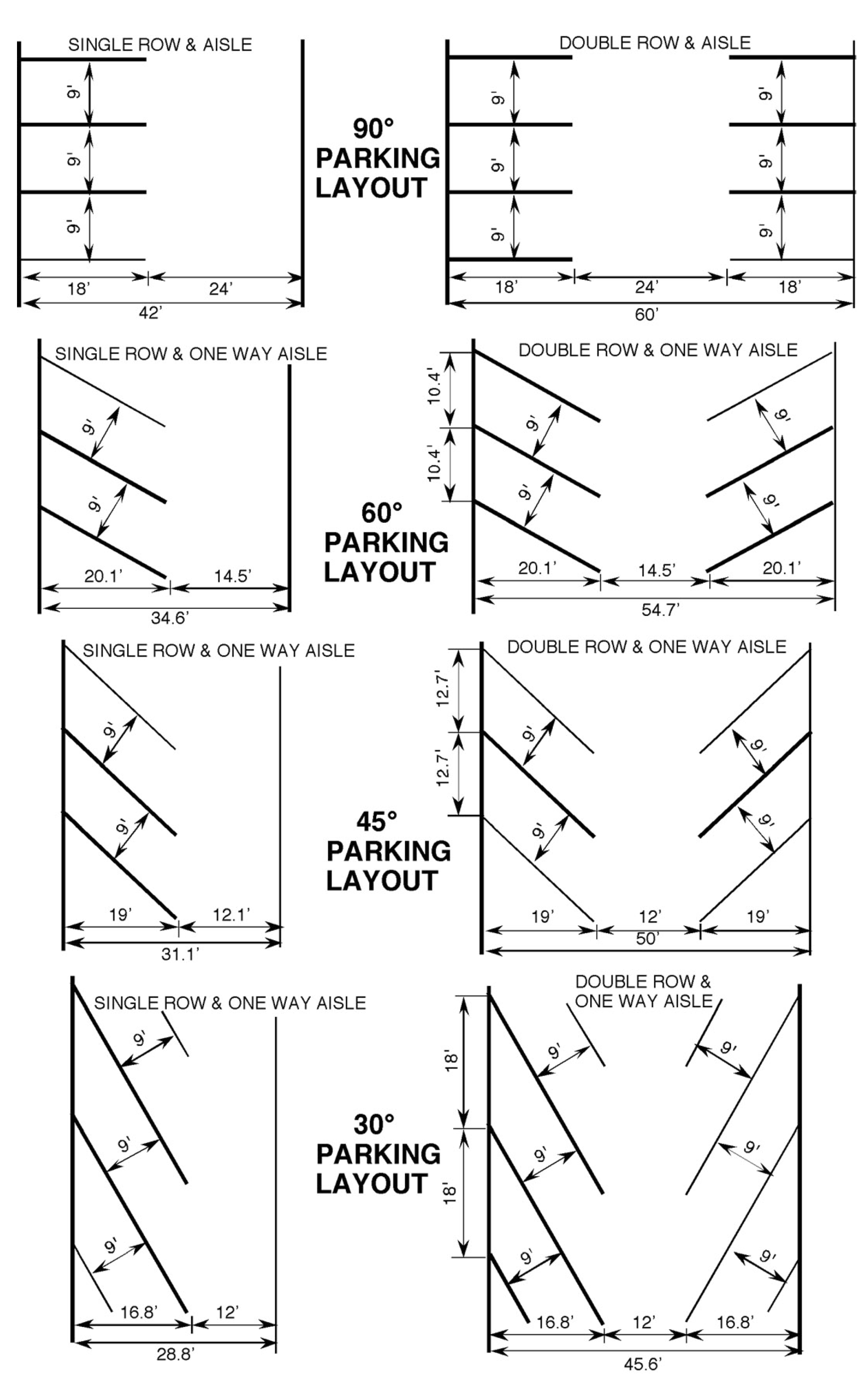
20.4
Markings: Each required off-street parking space and off-street parking area shall be identified by surface markings at least four (4) inches in width. Markings shall be visible at all times. Such markings shall be arranged to provide for orderly and safe loading, unloading, parking and storage of vehicles. One-way and two-way accesses into required parking facilities shall be identified by directional arrows.
20.5
Surfacing and Maintenance: Drives, parking lots, and loading areas shall be paved with concrete or asphalt in commercial and industrial areas. Concrete, asphalt, crushed limestone, compacted gravel, or equal substitute is required on all residential or multiple-family sites. All off-street parking areas drive aisles, internal roadways, and loading areas for all uses shall be paved at all times.
20.6
Alternative Parking Plan: An alternative-parking plan may be approved by the City Council for specific developments that are deemed to require a different amount of parking than shown above. The chief building official shall establish conditions necessary to ensure the adequacy of future on-site parking when approving an alternate parking plan.
(Ord. No. 18-01-01, 1-25-2018; Ord. No. 18-08-01, 8-23-2018; Ord. No. 19-08-01, 8-8-2019; Ord. No. 22-08-02, 9-22-2022)
Editor's note— Per Ords. No. 18-01-01 and 18-08-01, the former § 18 has been renumbered as § 20.
Sec. 21. - Nonconforming buildings and uses.
The lawful use of any building, structure or land existing at the time of the enactment of this ordinance may be continued although such use does not conform with the provisions of this ordinance, provided, however, the right to continue such nonconforming uses shall be subject to regulations prohibiting the creation of a nuisance and shall terminate when inappropriate use of the premises produces a condition which constitutes a nuisance, and further, the right of nonconforming uses to continue shall be subject to such regulations as the maintenance of the premises and conditions of operations as may in the judgment of the board of adjustment be reasonably required for protection of adjacent property and further, the right of nonconforming uses to continue shall be subject to the specific regulations herein contained.
21.1
Nonconforming buildings.
21.1-1
Occupancy permitted: A nonconforming building or structure may be occupied except as herein otherwise provided.
21.1-2
Repairs or alterations: Repairs and alterations may be made to a nonconforming building or structure, provided that no structural alteration shall be made except those required by law or ordinance, and further provided these regulations shall never be construed to allow an addition to a nonconforming building.
21.1-3
Additions, enlargements, moving:
(a)
A nonconforming building or structure shall not be added to or enlarged in any manner unless such addition and enlargements are made to conform to all requirements of the district in which such building or structure is located.
(b)
No nonconforming building or structure shall be moved in whole or in part to any other location on the lot, or on any other lot, unless every portion of such building or structure is made to conform to all the regulations of the district in which such lot is located.
21.1-4
Restoration of damaged buildings: A nonconforming building or structure which is damaged or partially destroyed by fire, flood, wind, explosion, earthquake, or other calamity or act of God, shall not be again restored or used for such purpose if the expense of such restoration exceeds 50 percent of the replacement cost of the building or structure at the time such damage occurred. Any nonconforming building or structure partially destroyed may be restored provided restoration is started within six months of the date of partial destruction and is diligently prosecuted to completion. Whenever a nonconforming building or structure is damaged in excess of 50 percent of its replacement cost at that time, the repair or reconstruction of such building or structure shall conform to all the regulations of the district in which it is located, and it shall be treated as a new building.
21.2
Nonconforming uses of buildings or structures.
21.2-1
Continuation: Except as otherwise provided in this ordinance, the nonconforming use of the building or structure lawfully existing at the time of the effective date of this ordinance, may be continued. In those cases where such use is dependent upon the renewal of any license or permit, nothing in this ordinance shall be deemed as a bar or prohibition of the renewal of such license or permit provided, however, that such continued use does not constitute or create a nuisance, and further provided that the right of such nonconforming use so dependent upon the renewal of such license or permit to continue shall be subject to such regulations as in the maintenance of the premises and conditions of operations as may, in the judgment of the board of adjustment, be reasonably required for the protection of adjacent property, and such right to so continue shall be subject to the specific regulations herein contained. Nothing in this ordinance however shall be construed to permit the issuance of a new license or permit to any other person or persons or the sale, transfer, or assignment of any existing license or permit to another person or persons.
21.2-2
The use of a nonconforming building or structure may be changed to a use of the same, or more restricted classification, but where the use of a nonconforming building or structure is hereafter changed to a use of a more restricted classification, it shall not thereafter be changed to a use of less restricted classification.
21.2-3
A vacant, nonconforming building or structure lawfully constructed may be occupied by use for which the building or structure was designated or intended, if so occupied within a period of six months after the effective date of this ordinance, and the use of a nonconforming building or structure lawfully constructed which becomes vacant after the effective date of this ordinance, may also be occupied by the use for which the building or structure was designated or intended, if so occupied within a period of six months after the building becomes vacant.
Covered under 21.1-3 above
21.3
Nonconforming use of land.
21.3-1
Continuation of use. The nonconforming use of land existing at the time of the effective date of this ordinance, may be continued, and provided:
21.3-1-1
That no such nonconforming use of land shall in any way be expanded or extended either on the same or adjoining property.
21.3-1-2
That if such nonconforming use of land or any portion thereof is discontinued or changed, any future use of such land or portion thereof shall be in conformity with the provisions of this ordinance.
21.3-1-3
That any sign, billboard, poster panel, storage yard, or manufactured home and/or RV park which is lawfully existing and maintained at the time of the effective date of this ordinance, may be continued, although such use does not conform with the provisions hereof, provided however, that no structural alterations are to be made thereto.
21.4
Abandonment. A nonconforming use of any building, structure or land which has been abandoned shall not thereafter be returned to such nonconforming use. A nonconforming use shall be considered abandoned when the intention of the owner to discontinue the use is apparent, or when the characteristic equipment and furnishings of the nonconforming use have been removed from the premises and have not been replaced by similar equipment within six months, or when a nonconforming building, structure or land or portion thereof which is or hereafter becomes vacant and remains unoccupied or out of use for a continuous period of six months or when it has been replaced by a conforming use.
21.5
District changes. Whenever the boundaries of a zoning district shall be changed so as to transfer an area from one district to another district of a different classification or when boundaries or districts are changed as a result of annexation of new territory or changes in the regulations or restrictions of this ordinance, the foregoing provisions shall also apply to any nonconforming uses existing therein which may so become nonconforming.
21.6
Temporary Nonconforming Use Permit ("TNCUP")
21.6.1
Purpose. The purpose of this section is to provide a procedure for the location of temporary housing in certain zoning districts and under specific conditions by special permit administratively granted by City Staff/City Manager in times of housing shortage. The use of a TNCUP should be used when an immediate housing need is present, and permanent housing cannot be established in time to meet the need. Additional conditions may be required by the City Manager as part of the permit to reduce conflicts, to reduce the objectionability of or improve the aesthetics of the temporary housing.
21.6.2
Application fee. An application fee in the amount of $100.00 (one hundred dollars) per temporary residence shall be paid to the city at the time of application. An application fee in the amount of $250.00 per boarding house permit shall be paid to the city at the time of application. An appeal of an adverse decision against a special permit requests shall carry the required fee of $250.00 to be paid by the applicant to cover city costs of legal notices, advertising, and required notice letters to all property owners within 200 feet.
21.6.3
Criteria for granting a Temporary Nonconforming Use Permit.
In reaching a decision on any application for a TNCUP, the city planning staff and/or city manager shall determine:
That the effect of such proposed use and any anticipated increased vehicular traffic will not be detrimental to the neighborhood and the Temporary Nonconforming Use Permit will be compatible with the use and permitted development of adjacent properties either as filed or subject to such requirements or special conditions as the city manager, after review by city planning staff, may find necessary to protect and maintain the stability of adjacent properties. Written findings, photographs of all surrounding and adjacent existing land uses, and specific conditions to be placed on the proposed use, shall be filed in support of the favorable or adverse decision rendered.
21.6.4
Expiration of Temporary Nonconforming Use Permit. A TNCUP shall terminate annually on January 1st of each year and must be renewed before or within 180 days of expiration thereof. Whenever the specified use is terminated for 180 consecutive days or more, the TNCUP shall be deemed to have expired. The city manager may specify that a TNCUP expire in less than a year. Renewals shall be subject to approval based on compliance with permit requirements.
21.6.5
Appeals for denied Temporary Nonconforming Use Permit. Denied applicants for a TNCUP must present a written request for appeal. After public notice and hearing, in the same manner prescribed for a zone change as described in section 21, the planning and zoning commission may grant the permit including the imposition of conditions of use which it may deem essential to ensure that the specific use is consistent with the spirit, purpose and intent of this ordinance, will not substantially and permanently injure the appropriate use of neighboring property, and will substantially serve the public interest.
21.6.6
Types of Temporary Nonconforming Use Permit. The following uses may be permitted by the city manager after review by city staff under these provisions:
o
RV parks or manufactured home park in the "R-2" "C-2" or "I-1" Districts
o
Manufactured home or RV for use as an employee, caretaker's, manager's, or guard's residence/living quarters in the "C-1", "C-2", "I-1" Industrial District, or temporarily for construction crews for on-site construction projects in all zones.
o
No more than four manufactured homes or RV's per lot. Manufactured home/RVs shall be located not less than 30 feet from any other structures or from any property line of an adjacent lot or parcel of land.
o
Manufactured home/RVs shall be tied in to public water and sewer systems through permits and inspections completed by the Town; such utility services shall be provided using service lines and no permanent easement shall be established for the purpose of providing such utilities. Up to four RVs may be connected to a single water and sewer service, separate from any primary dwelling structure. Construction-related temporary RV's/manufactured homes shall be removed immediately upon completion of the on-site project without exception. Upon expiration of a TNCUP, utilities shall be capped and/or abandoned to the City's satisfaction.
o
Boarding houses in the "R-1", "R-2", and "C-1" Districts.
21.6.6.1
Standards for boarding houses. The following standards shall apply to all boarding houses within the Town of Pecos City:
21.6.6.1.1
Construction and remodeling standards.
A.
Interior doors to living spaces, bedrooms, bathrooms, and toilet rooms must fit the openings in which they are hung, be properly equipped with hardware, and be maintained in good working conditions. Doors with locking devices must be provided where necessary to provide privacy and protection to the resident.
1.
Every closet door latch will be such that it can be readily opened from the inside in case of an emergency.
2.
Every bathroom door or door lock must permit the opening of the locked door in case of an emergency.
B.
Public pathways and stairways in buildings must maintain a minimum unobstructed width concurrent with federal fire codes and must be provided with convenient light switches controlling an adequate lighting system.
C.
Boarding houses must be supplied with electric service and fixtures that are properly installed and maintained in safe working condition and connected to a source of electric power. The building must comply with the current electrical codes adopted by the city.
D.
Boarding houses must have heating and cooling equipment that are properly installed, vented, and maintained in a safe good working condition. The temperature of rooms intended for human occupancy will remain at a temperature between 68 and 82 degrees Fahrenheit.
E.
Boarding houses must have water heating facilities that are properly installed, vented, in good working condition, and are properly connected with hot and cold water lines. The temperature of hot water drawn at every require sink, lavatory basin, bathtub, or shower will remain at a temperature between 110 and 120 degrees Fahrenheit.
F.
Every habitable room must have at least one window that can be easily opened. Locks that can easily opened manually from the inside must be provided on all exterior doors. All windows must be openable without tools. The window opening must meet local codes for emergency egress. The bottom of the window opening must not be more than 44 inches above the floor.
G.
Every room intended for sleeping must have at least 70 square feet of floor space in single-occupancy rooms and at least 60 square feet of floor space for each occupant in multi-occupancy rooms. Each sleeping room must have access to emergency exits without passing through another sleeping room.
H.
Water closets, lavatories, and bathtubs or showers must be:
1.
Available on each floor when not provided in each individual room;
2.
Provided in the ration of one toilet and one lavatory, and one bathtub or shower for every six residents; and
3.
Accessible to the residents without going outside of the building or without going through a sleeping room of another resident.
I.
A telephone must be available, 24 hours per day, must be easily accessible, and must afford privacy for use by residents.
21.6.6.1.2
Fire safety standards.
A.
Fire precautions must include:
1.
Provision of suitable fire escapes/exits that must be kept in good repair and accessible at all times;
2.
Have a written fire and evacuation plan that sets forth the responsibilities and steps to be taken by residents in the event of a fire or other emergency;
3.
Posting of an emergency evacuation plan; and
4.
No storage of gasoline operated maintenance equipment, lawn care equipment, fuel, or other flammable supplies inside of the boarding house.
B.
Alarm precautions must include the following:
1.
Appropriate fire extinguishers must be sufficiently provided, accessible, checked, and recharged by a certified service provider.
2.
All fire protection measures must be in accordance with the requirements of the local fire authority.
3.
Smoke detectors must at a minimum be working and equipped in each sleeping room, in corridors or hallways on each floor, and in kitchen areas.
4.
If the boarding house has a resident that is hearing impaired, the owner/operator of the boarding house must install a visual smoke detector that is capable of alerting the impaired resident of the presence of fire and/or smoke.
5.
Carbon monoxide detectors must be working and equipped close to sleeping areas.
21.6.6.1.3
Inspection standards.
A.
The boarding house must pass all required inspections and the owner/operator must keep a current file of reports and other documentation on-site necessary to demonstrate compliance with applicable laws and regulations. The inspections must be signed, dated, and free of any outstanding corrective actions. The following inspections are required:
1.
Annual inspection by the local fire authority or the State Fire Marshal.
2.
Annual inspection of the alarm systems and fire extinguishers by the local fire authority or an inspector authorized to install and inspect such systems.
3.
Annual kitchen inspection by the local health authority.
4.
If applicable, gas pipe pressure test once every three years by the local gas company or a licensed plumber.
21.6.6.1.4
Sanitary and related standards.
A.
Each owner/operator of a boarding house is responsible for maintaining the dwelling and premises in a clean and sanitary condition.
B.
Each facility must be kept in good repair, and so maintained as to promote the health, comfort, safety, and well-being of the residents.
C.
Interior walls, ceilings, and floors must be capable of affording privacy and must be maintained free of holes, cracks, loose, or deteriorate material, and any other condition that constitutes a hazard to the residents or is a harborage for insects, pests, or vermin.
D.
Every window and exterior door must be weather tight, watertight, insect and rodent-proof and must be kept in good working condition.
E.
The water supply must be safe, sanitary quality, suitable for use, and adequate in quantity and pressure.
F.
Every plumbing fixture, water pipe, and waste pipe must be properly installed and maintained in good sanitary working condition, free from defects, leaks and obstruction and properly connected to an approved sewage disposal system.
G.
All garbage and refuse must be kept in watertight, covered containers. The garbage and refuse area must be kept in clean and sanitary condition. A sufficient number of garbage receptacles must be provided, and all garbage, trash, and refuse must be removed from the premises frequently to prevent nuisance and unsightly conditions.
H.
Each boarding house facility will be considered a commercial account by the city and will have its own dumpster so as to minimize the impact on the surrounding neighborhood.
I.
Each owner/operator must be responsible for the extermination of any insects, rodents, or other pests in the facility, storage areas, and yard.
J.
Each kitchen in a boarding house must:
1.
Be kept in a clean and sanitary condition.
2.
Have a food preparation area with a surface area that is smooth, impermeable, free of cracks and easily cleanable, that shall not be used for eating.
3.
Have a refrigerator that is maintained in an operational, clean and sanitary condition that is adequate to maintain foods at the required temperature.
K.
Each boarding house shall be equipped with a first aid kit as recommended by the American Red Cross.
21.6.6.1.5
Parking standards: Each boarding house shall comply with the following parking restrictions and standards in order to provide for the safe use of streets, sidewalks, and alleys as well as to provide for the safe and effective ingress and egress of first responders and emergency service vehicles and staff.
A.
Vehicles may not be parked in a manner which blocks any sidewalks, driveways, alleys, or access to a neighboring property.
B.
Vehicles may not be parked on the street or alley in a manner that prevents safe and effective ingress and egress to first responders and emergency service vehicles.
C.
Each vehicle that is parked at a boarding house must have a dedicated space of at least 18 feet by 20 feet that does not violate any of the previous standards.
D.
Any damage to the curb, gutter, or sidewalk that occurs from vehicles parked at the boarding house must be replaced at the expense of the owner/operator.
21.6.7
Area requirements for recreational vehicles and manufactured homes shall be regulated by Chapter 39 of this Code of Ordinances, "Manufactured Housing and Recreational Vehicle Parks."
21.6.8
All requirements set forth in a Temporary Nonconforming Use Permit shall be completed within 90 calendar days of issuance of permit, unless an extension is specifically granted, in writing, by the city manager as part of the original specific use permit. All requests for extended time for compliance shall be submitted to the city, in writing, as part of the original permit application process. Consideration for extensions to this timeframe will not be given after the permit is issued. Failure to comply with the timeframe set forth in the permit shall result in immediate nullification of the permit. Denial of time extensions shall not be subject to appeal.
(Ord. No. 17-07-03, 8-10-2017; Ord. No. 18-01-01, 1-25-2018; Ord. No. 18-04-01, 4-26-2018; Ord. No. 18-08-01, 8-23-2018; Ord. No. 19-09-03, Pt. 3, 10-7-2019)
Editor's note— Per Ords. No. 18-01-01 and 18-08-01, the former § 19 has been renumbered as § 21.
Sec. 22. - Zoning board of adjustment.
22.1
Provision for:
22.1-1
There is hereby created a zoning board of adjustment consisting of five (5) members and two (2) alternates, each to be appointed by a majority of the town council of the Town of Pecos City, Texas. The alternates will serve in the absence of the regular members. The zoning board of adjustment shall, by a vote of two-thirds [percent] of its members, select its own chairman who shall preside at all meetings and who shall continue in this capacity throughout the two-year term of such zoning board of adjustment unless removed from the zoning board of adjustment in the manner hereinafter provided, or unless this office becomes vacant for any cause, in which event a new chairman shall be selected by the members of the zoning board of adjustment who shall preside as chairman for the remainder of said two-year term. In the event the chairman is unable to attend any meeting of the zoning board of adjustment, an acting chairman may be appointed to preside in his absence. Three (3) members of the zoning board of adjustment shall constitute a quorum and no action may be taken by the zoning board of adjustment unless a quorum of the members thereof are in attendance. In the event the zoning board of adjustment, by vote of two-thirds [percent] of its members, fails to select its chairman, then, in that event, the chairman of the zoning board of adjustment shall be appointed by a majority vote of the town council of the Town of Pecos City, Texas.
22.1-2
Members of the zoning board of adjustment shall be appointed for a term of two (2) years and removable for cause by the town council upon written charges. Vacancies shall be filled by appointment by the town council of a suitable person to serve out the unexpired term of any member whose place on the board has become vacant for any cause. Attendance at board meetings is required; board members are expected to attend seventy five (75) percent of board meetings.
22.1-3
The town secretary of the Town of Pecos City, Texas shall set up and maintain a separate file for each application for appeal, special exception and variance received, and shall record therein the names and addresses of all persons, firms and corporations to whom notices are mailed including the date of mailing, and further keep a record of all notices published as required herein. All records and files herein provided for shall be permanent and official files and records of the Town of Pecos City, Texas.
22.1-4
The zoning board of adjustment shall adopt rules to govern its proceedings, provided, however that such rules are not inconsistent with this ordinance.
22.1-5
Meetings of the zoning board of adjustment shall be held at the call of the chairman and at such other times as the board may determine. All meetings of the board shall be open to the public and are subject to the provisions of the Texas Open Meetings Act.
22.1-6
The board shall keep minutes of its proceedings, showing the vote of each member upon each question, or, if absent or failing to vote, indicating such fact, and shall keep records of its examinations and other official actions and every decision of the board of adjustment shall be in writing and shall contain a full record of the findings of the board of adjustment in each case, all of which shall be immediately filed in the office of the town secretary and shall be of public record.
22.1-7
The secretary of the Town of Pecos City, Texas, shall forthwith notify in writing the town council, the planning and zoning commission, and the building inspector or designee of each decision, interpretation, special exception and variance considered under the provisions of this ordinance.
22.1-8
The chairman of the zoning board of adjustment, or in his absence, the acting chairman, may administer oaths or compel the attendance of witnesses.
22.2
Powers.
22.2-1
The zoning board of adjustment may hear and decide appeals where it is alleged there is error in any order, requirement, decision or determination made by the building inspector or designee in the enforcement of this ordinance and may also decide any questions involving the interpretation of any of the provisions of this ordinance including determination of the location of any district boundary, if there is uncertainty in respect thereto.
22.2-2
The zoning board of adjustment may, in appropriate cases and subject to appropriate conditions and safeguards, make special exceptions to the terms of this ordinance in harmony with its general purpose and intent and in accordance with the general and specific rules herein contained.
22.2-3
The zoning board of adjustment may authorize, upon appeal, in specific cases such variance from the terms of this ordinance as will not be contrary to the public interest, where, owing to such condition, a literal enforcement of the provisions of this ordinance will result in unnecessary hardship, and so that the spirit of this ordinance shall be observed and substantial justice done.
22.3
Procedure covering special exceptions, appeals and granting of variances.
22.3-1
Appeals and variances:
22.3-1-1
Appeals and requests for variance to the zoning board of adjustment may be taken by any person aggrieved or by any officer, department of the Town of Pecos City affected by any decision of the town building inspector or designee. Such appeal or request for variance shall be taken within fifteen (15) days' time after the decision has been rendered by the town building inspector or designee by filing with the town secretary a notice of appeal specifying the grounds thereof. The town secretary shall forthwith have made for the use of the zoning board of adjustment all of the papers constituting the record upon which the action appealed from was taken.
22.3-1-2
Such notice of appeal, properly filed as herein provided, shall stay all proceedings in furtherance of the action appealed from, unless the town secretary certifies to the zoning board of adjustment, after the notice of appeal shall have been filed with him, that by reason of facts stated in such certificate, a stay would in his opinion, cause imminent peril to life and property. In such case, proceedings shall not be stayed otherwise than by a restraining order which may be granted by the board of adjustment or by a court of record on due cause shown.
22.3-1-3
Upon notice of appeal being given to the town secretary, before such appeal shall be construed as having been perfected the applicant must file with such notice of appeal to the board of adjustment, an amount of money sufficient to mail and publish all notices required herein, such amount in no case to be less than one hundred dollars ($100.00).
22.3-2
Special exceptions:
22.3-2-1
Applications for special exceptions to the terms of this ordinance shall be made in writing in duplicate on forms provided in the office of the town secretary by the prospective occupant and/or owner of the property. One such application shall be accompanied by an amount of money sufficient to mail and publish all notices required herein, such amount in no case to be less than one hundred dollars ($100.00).
22.3-2-2
One duplicate original of such application shall be forthwith forwarded by the town secretary to the office of the town building inspector or designee.
22.3-3
Notice: The zoning board of adjustment shall hold a public hearing on all special exceptions, granting of variances and appeals and written notice of all such public hearings shall be sent by the town secretary, on forms approved by the city attorney's office, to the applicant and all other persons deemed by the board to be affected thereby, and all owners of real property lying within two hundred (200) feet of the property on which the special exception, grant of variance or appeal is proposed, such notice to be given not less than ten (10) days before the date set for hearing to all such owners who have rendered their said property for town taxes as the ownership appears on the last approved town tax roll. Such notice may be served by depositing the same properly addressed and postage paid in the town post office. Notice shall also be given by publishing the same in a newspaper of general circulation in the Town of Pecos City at least fifteen (15) days prior to the date set for hearing, which notice shall state the time and place of such hearing, provided however, all provisions contained herein with respect to the mailing and publishing of notices of hearing shall be deemed sufficient upon substantial compliance with this section and is to be construed as directory and not mandatory.
22.4
The Hearing.
22.4-1
Upon the hearing any interested party may appear in person or by agent or by attorney.
22.4-2
The burden of proof shall be on the applicant to establish the facts necessary which the zoning board of adjustment must find before granting any special exception, variance or appeal as herein contained.
22.4-3
In exercising the powers herein granted, the board may, in conformity with the provisions of this ordinance reverse or affirm wholly or partly or may modify the order, requirement, decision or determination appealed from and may make such order, requirement, decision or determination as ought to be made and to that end shall have all the powers of the town building inspector or designee on whom the appeal is taken.
22.4-4
The concurring vote of four (4) members of the board shall be necessary to reverse any order, requirement, decision or determination of the town building inspector or designee, or to decide in favor of the applicant on any matter upon which it is required to pass under this ordinance or to effect any variation of this ordinance or grant any special exception hereto.
22.4-5
No appeal, request or application to the board of adjustment shall be allowed on the same piece of property prior to the expiration of six (6) months from the ruling of the board of adjustment on any appeal, request or application to such body unless other property abutting or adjoining such property shall have within such six (6) months' period been altered or changed by a ruling of the board of adjustment, in which case such change of circumstances shall permit the allowance of an appeal, request or application but shall in no way have any force in law to compel the board of adjustment, after a hearing, to grant such subsequent appeal, request or application but such hearing shall be considered on its own merits as in all other cases.
22.4-6
Any special exception, variances or appeals authorized or granted by the board of adjustment under the provisions of this ordinance or under the authority granted to the board of adjustment under the statutes of the State of Texas shall authorize the issuance of a building permit, or a certificate of occupancy, as the case may be, for a period of ninety (90) days from the date of the favorable action on the part of the board of adjustment, unless said board of adjustment in its minutes shall, at the same time, grant a longer period. If the building permit and/or certificate of occupancy shall have not been issued within said ninety (90) day period, or such extended period as the board may specifically grant, then the special exception, variance or favorable appeal shall be deemed waived and all right thereunder terminated. Such terminating and waiver shall be without prejudice to a subsequent appeal to say board in accordance with the rules and regulations herein contained.
22.5
Exceptions and variances distinguished.
22.5-1
Special exception is a permission given by the board properly authorized by this ordinance in specific cases for an applicant to use his property in a manner contrary to the provisions of this ordinance provided such use serves the general welfare and preserves the community interest.
22.5-2
A variance on the other hand, is an authorization of the board granting relief and doing substantial justice in the use of the applicant's property by a property owner where, owing to special conditions a literal enforcement of the provisions of the ordinance will result in unnecessary hardship.
22.6
Special Exceptions.
[22.6-1]
A special exception may be granted an applicant when the board finds:
That the granting of such exception will not be injurious or otherwise detrimental to the public health, safety, morals and the general welfare of the general public, and; that the granting of such exception will not be substantially or permanently injurious to the property or improvement in such zone or neighborhood in which the property is located, and; that the granting of such exception will be in harmony with the general purpose and intent of this ordinance.
In determining its finding, the board shall take into account the character and use of adjoining buildings and those in the vicinity, the number of persons residing or working in such building or upon such land and traffic conditions in the vicinity.
22.6-2
The board of adjustment may after public notice and hearing and subject to the conditions and safeguards herein contained, authorize special exceptions to this ordinance as follows:
22.6-2-1
Permit the reconstruction, extension and/or enlargement of a building and/or lot occupied as a nonconforming use;
22.6-2-2
Permit such modification of a yard, lot area, or lot width requirement as may be necessary to secure appropriate improvement of a parcel of land where such parcel was separately owned on the effective date of this ordinance, and is not adjacent to another parcel of the same ownership and where such parcel is of such size that it cannot be improved without such modification or of such restricted area that it cannot be appropriately improved without such modification.
22.6-3
In granting any special exceptions under the provisions of this ordinance, the board may designate such conditions in connection therewith which, in its opinion, will secure substantially the purpose and intent of this ordinance.
22.7
Variances.
A variance may be granted to an applicant when the board of adjustment finds:
That there are special circumstances or conditions applying to the land or building for which the variance is sought, which circumstances or conditions are peculiar to such land or building and do not apply generally to lands or buildings in the same zone or neighborhood, and that said circumstances or conditions are such that the strict application of the provisions of this ordinance would deprive the applicant of the reasonable use of such land or building, and; that the granting of such variance will not be detrimental to the public welfare or substantially or permanently injurious to the property or improvements in such zone or neighborhood in which the property is located, and; that the granting of the variance is necessary for the reasonable use of the land or building and that the variance as granted by the board is the minimum variance that will accomplish this purpose, and; that the literal enforcement and strict application of the provisions of this ordinance will result in an unnecessary hardship inconsistent with the general provisions and intent of this ordinance and that in granting such variance the spirit of the ordinance will be preserved and substantial justice done.
In addition to considering the character and use of adjoining buildings and those in the vicinity, the board, in determining its findings shall take into account the number of persons residing or working in such buildings or upon such land and traffic conditions in the vicinity. The board of adjustment may, after public notice and hearing and subject to the conditions and safeguards herein contained, vary or adopt the strict application of any of the terms of this ordinance under the powers and authority herein granted. In granting any variance under the provisions of this ordinance, the board may designate such conditions in connection therewith, which, in its opinion, will secure substantially the purpose and intent of this ordinance.
22.8
Appeal of a zoning board of adjustment decision:
22.8-1
Any person or persons, jointly or severally, aggrieved by any decision of the board of adjustment, or any taxpayer, may present to a court of record a petition, duly verified, setting forth that such decision is illegal, in whole or in part, specifying the grounds of the illegality. Such petition shall be presented to the court within ten (10) days after the filing of the decision in the office of the board.
22.8-2
Upon the presentation of such petition the court may allow a writ of certiorari directed to the board of adjustment and shall prescribe therein the time within which a return thereto must be made and served upon the realtor's attorney, which shall not be less than ten (10) days after the filing of the decision in the office of the board.
22.8-3
The board of adjustment shall not be required to return the original papers acted upon by it, but it shall be sufficient to return certified or sworn copies thereof or of such portions thereof as may be called for by such writ. The return shall concisely set forth such other facts as may be pertinent and material to show the grounds of the decision appealed from and shall be verified.
22.8-4
If, upon the hearing, it shall appear to the court that testimony is necessary for the proper disposition of the matter, it may take evidence or appoint a referee to take such evidence as it may direct and report the same to the court with his findings of fact and conclusions of law, which shall constitute a part of the proceedings upon which the determination of the court shall be made. The court may reverse or affirm, wholly or partly, or may modify the decision brought up for review.
22.8-5
Costs shall not be allowed against the board unless it shall appear to the court that it acted with gross negligence, or in bad faith, or with malice in making the decision appealed from.
22.8-6
All issues in any proceedings under this section shall have preference over all other civil actions and proceedings.
(Ord. No. 18-01-01, 1-25-2018; Ord. No. 18-08-01, 8-23-2018)
Editor's note— Per Ords. No. 18-01-01 and 18-08-01, the former § 20 has been renumbered as § 22.
Sec. 23. - Changes and amendments.
23.1-1
The town council may from time to time by ordinance amend, supplement, change, modify or repeal the boundaries of the districts or the regulations herein established. Before taking any such action, the town council shall submit the same to the planning and zoning commission for its recommendation and report.
Cross reference— Planning and zoning commission, § 2-91 et seq.
23.1-2
Upon submission of any proposed change in classification the applicant will be required to deposit with the town secretary an amount of money sufficient to mail and publish all notices before both the planning and zoning commission and the town council required by law, such amount in no event to be less than two hundred fifty dollars ($250).
23.2
Reserved.
23.3
Procedures before the planning and zoning commission.
23.3-1
The planning and zoning commission shall hold a public hearing on all proposed changes in classification and written notices of all such public hearings shall be sent by the town secretary on forms approved by the city attorney's office to all owners of real property lying within 200' (two hundred feet) of the property on which the change in classification is proposed, such notices to be given, not less than ten (10) days before the day set for hearing to all such owners who have rendered their said property for town taxes as the ownership appears on the last approved town tax roll. Such notice may be served by depositing the same properly addressed and postage paid in the town post office. Where property lying within two hundred (200) feet of the property proposed to be changed is located in territory which was annexed to the town after the final date for making renditions which are included on the last approved town tax roll, notice to such owners shall be given by publication on forms approved by the city attorney's office by publishing the same once in a newspaper of general circulation in the Town of Pecos City at least fifteen (15) days prior to the date set for hearing, which notice shall state the time and place of such hearing.
23.3-2
After such hearing, the planning and zoning commission may, within its discretion, make one of the following recommendations in connection with each proposed change in zoning classification:
23.3-2-1
Recommend against the change in zoning;
23.3-2-2
Recommend a change in zoning;
23.3-2-3
Recommend a change in zoning for such area together, with its recommendations as to requirements for the paving of streets, alleys and sidewalks, means of ingress and egress to the public streets, provisions for drainage, parking spaces and street layouts and protective screening and open spaces and any other requirements, which, within the discretion of the planning and zoning commission, will protect adjacent property and secure substantially the purpose and intent of the zoning ordinance.
23.3-3
Each such recommendation made by the planning and zoning commission shall be reported by the town secretary to the town council in writing and the applicant notified of the action of the planning and zoning commission.
23.3-4
The town secretary shall set up and maintain a separate file for each application received and shall record therein the names and addresses of all persons, firms and corporations to whom notices are mailed, including the date of mailing and all records and files herein provided shall be permanent and official files of the Town of Pecos City, Texas.
23.4
Procedure before town council.
23.4-1
A public hearing shall be held by the town council before adopting any proposed amendment, supplement or change, at which parties in interest and citizens shall have an opportunity to be heard. At least fifteen (15) days' notice of the time and place of such hearing shall be published once in a newspaper of general circulation in the Town of Pecos City, Texas; and after receiving the recommendation of the planning and zoning commission that the zone be changed, or upon written request to the town secretary by the applicant when a recommendation has been made against such change in zoning district, the town secretary is hereby authorized and directed to publish such notices on forms approved by the city attorney's office and set the date for hearing before the town council at the earliest practical time, consistent with the time necessary for giving such notices as provided by law.
23.4-2
When the planning and zoning commission has recommended for or against a change in zoning together with recommendations as to requirements, the town council shall be at liberty to either accept, reject or make other or additional requirements; and any such requirements, in the discretion of the town council, to be made shall become a part of the ordinance changing the zoning classification of such property; and such requirements shall be considered as an amendment to the zoning ordinance as applicable to such property. Such requirements shall not be considered conditions precedent to the granting of the change in zoning or the granting of building permits on such property but shall be construed as conditions precedent to the granting of a certificate of occupancy and compliance; and such requirements shall be complied with before a certificate of occupancy, and compliance may be issued by the town building inspector or designee of the use or occupancy of the building, land or structure on such property.
(Ord. No. 18-01-01, 1-25-2018; Ord. No. 18-08-01, 8-23-2018)
Editor's note— Per Ords. No. 18-01-01 and 18-08-01, the former § 21 has been renumbered as § 23.
Sec. 24. - Enforcement and administration.
24.1
Administrative officials. Except as otherwise provided in this ordinance, the building inspector or designee for the Town of Pecos City shall administer and enforce this ordinance, including the receiving of applications, the inspection of premises, and the issuing of building permits. No building permit or certificate of occupancy shall be issued by the building inspector or designee except where the provisions of this ordinance have been complied with.
24.2
Building permit. No person shall erect or construct or proceed with the erection or construction of any building or structure nor add to, enlarge, move, improve, alter, repair, convert, extend, or demolish any building or structure or cause the same to be done in any zone district of the Town of Pecos City, Texas, without first applying for and obtaining a building permit from the building inspector or designee. All applications for such permits shall be in accordance with the requirements of this ordinance and the building code of the Town of Pecos City, Texas, and unless upon written order of the board of adjustment, no such building permit or certificate of occupancy shall be issued for any building where said construction, addition, alteration or use thereof would be in violation of any of the provisions of this ordinance.
24.3
Powers and duties of building inspector or designee.
24.3-1
Whenever any building work is being done contrary to the provisions of this ordinance, the building inspector or designee may order the work stopped and also revoke the building permit theretofore issued by notice in writing served on any person owning such property or their agent or on any person engaged in the doing or causing of such work to be done and any such persons shall forthwith stop and cause to be stopped such work until authorized by the building inspector or designee to recommence and proceed with the work or upon issuance of a building permit in those cases in which the building permit has been revoked and further, such stop work order and revocation of permit shall be posted on the work being done in violation of this ordinance.
24.3-2
Whenever any building or portion thereof is being used or occupied contrary to the provisions of this ordinance, the building inspector or designee shall order such use or occupancy discontinued and the building or portion thereof vacated by notice served on any person using or causing such use or occupancy to be continued and such person shall vacate such building or portion thereof within ten (10) days after receipt of such notice or make the building or portion thereof comply with the requirements of this ordinance. The building inspector or designee shall have the authority to require immediate discontinuation of use or occupancy of any building when it is determined that there exists an immediate threat to life or property.
24.4
In newly annexed territory.
[24.4-1]
No person shall erect, excavate, construct, or proceed or continue with the erection or construction of any building or structure or add to, enlarge, move, improve, alter, repair, convert, insulate or extend or demolish any building or structure or cause the same to be done in newly annexed territory to the Town of Pecos City without first applying for and obtaining a building permit from the building inspector or designee or the town council as may be required herewith.
24.4-2
Permits issued by building inspector or designee: In a territory newly annexed to the Town of Pecos City, Texas no permit for the construction of a building shall be issued by the building inspector or designee other than a permit which will allow the construction of a building permitted in the "R-1" district unless and until such territory has been classified in a zoning district other than "R-1" district by the town council in the manner prescribed in section 18 of this ordinance. The town council may, at its discretion, establish the initial zoning of newly annexed property into a district deemed appropriate by the council. If "R-1" is not established as the initial zoning then the building inspector or designee may issue any required permit for a use permitted in the newly zoned area.
24.4-3
Permits required for buildings under construction: The owner, lessee, or any other person, firm or corporation owning, controlling, constructing, supervising or directing the construction of any building or structure in the process of construction and which is incomplete at the time the land upon which it is situated is annexed to the Town of Pecos City before proceeding any further with the construction, alteration or completion thereof shall apply to the building inspector or designee of the Town of Pecos City for a permit authorizing further work on said building or structure and shall attach to said application for such permit, plans and specifications relating to the construction of said building or structure, which said application for building permit shall be promptly referred to the town planning and zoning commission for consideration and said planning and zoning commission shall promptly thereafter file with the town council its recommendation as to granting, modifying rejecting said permit, the said recommendation to be advisory in its nature and the town council shall be at liberty to affirm it or allow such construction as the facts in their opinion may justify. Said construction work shall be suspended until the permit provided for herein has been issued or until final zoning regulations have been adopted, which permit the construction, use and occupancy of the structure or building.
24.5
Certificate of occupancy and compliance.
24.5-1
No land shall be occupied or used and no building hereafter erected, altered or extended shall be used or changed in use until a certificate of occupancy and compliance shall have been issued by the building official or designee stating that the building or proposed use thereof complies with the provisions of this ordinance.
24.5-2
No nonconforming use shall be maintained, renewed, changed or extended without certificate of occupancy and compliance having first been issued by the zoning board of adjustment therefor.
24.5-3
Application for a certificate of occupancy and compliance shall be made with the application for a building permit or may be directly applied for where no building permit is necessary and shall be issued or refused by the zoning board of adjustment in writing at their next regular meeting or within a reasonable time thereafter after the zoning board of adjustment has been notified in writing that the building or premises is ready for occupancy.
24.5-4
The zoning board of adjustment shall maintain a record of all certificates and copies thereof shall be furnished upon request to any person having a propriety or tenancy interest in the building affected.
24.5-5
No permit for excavation for or the erection or alteration of or repairs to any building shall be issued until an application has been made for a certificate of occupancy and compliance.
24.5-6
No permanent water, sewer, electrical or gas utility connections shall be made to the land; building or structure, until and after a certificate of occupancy and compliance has been issued by the zoning board of adjustment of the Town of Pecos City, Texas.
24.5-7
Upon request of the owner or authorized representative, the building inspector or designee may issue a temporary certificate of occupancy for the temporary use and occupancy of a portion of the building prior to the completion and occupancy of the entire building provided such temporary occupancy or use will not in any way or manner jeopardize life or property. Such temporary certificate of occupancy shall state the period of time the temporary use and occupancy of such portion of a building may continue and upon the expiration of said period, such temporary use shall be discontinued.
24.5-8
The zoning board of adjustment shall issue a certificate of occupancy upon application of any person for the continuance of lawful nonconforming uses.
(Ord. No. 18-01-01, 1-25-2018; Ord. No. 18-08-01, 8-23-2018)
Editor's note— Per Ords. No. 18-01-01 and 18-08-01, the former § 22 has been renumbered as § 24.
Sec. 25. - Penalties for violation.
25.1.
Amount of penalty. Any person who shall violate any of the provisions of this ordinance or who shall fail to comply with any of the provisions or this ordinance or who shall build, alter or occupy any building, structure or land in violation of any statement or plan submitted and approved hereunder shall be guilty of a misdemeanor and upon conviction thereof shall be fined in any sum not to exceed two thousand ($2,000) dollars. Each day such violation is committed or permitted to continue, shall constitute a separate offense, and shall be punishable as such hereunder.
25.2
Liability of persons in interest. The owner or owners of any building or property or part thereof where anything in violation of this ordinance shall be placed or shall exist and any architect, building contractor, agent, attorney, person, firm or corporation employed in connection therewith and who have assisted in the commission of such violation shall be guilty of a separate offense, and upon conviction thereof, shall be fined in any amount not to exceed two thousand ($2,000) dollars.
25.3
Termination of Utility Services. In addition to the remedies provided for in paragraphs [22.1] and [22.2] of this ordinance, the building inspector or designee shall, in case any buildings or structures are erected, constructed, reconstructed, altered, repaired, converted, or maintained, or any building, structure or land is used in violation of this ordinance, immediately report such violation to the town secretary of the Town of Pecos City and the town secretary may thereafter discontinue all water and sewer service to the premises where said violation exists to restrain, correct or abate such violation as long as such violation continues.
[25.4]
Abatement of violating structure. In addition to the remedies provided for in paragraphs [22.1, 22.2 and 22.3] of this ordinance, the building inspector or designee shall, in case any buildings or structures are erected, constructed, reconstructed, altered, repaired, converted, or maintained, or any building, structure or land is used in violation of this ordinance, institute on behalf of the Town of Pecos City any appropriate action or proceedings to prevent such unlawful erection, construction, reconstruction, alteration, maintenance, or use, to restrain, correct, or abate such violation, to prevent occupancy of said building, structure or land, or to prevent any illegal act, conduct, business or use in or about such premises.
(Ord. No. 18-01-01, 1-25-2018; Ord. No. 18-08-01, 8-23-2018)
Editor's note— Per Ords. No. 18-01-01 and 18-08-01, the former § 23 has been renumbered as § 25.
Sec. 26. - Effect of passage on existing buildings.
By the passage of this ordinance no presently illegal use shall be deemed to have been legalized, unless specifically such use falls within a use district where the actual use is a conforming use. Otherwise, such uses shall remain nonconforming uses, where recognized, or an illegal use, as the case may be. It is further the intent and declared purpose of this ordinance that no offense committed and no liability, penalty, or forfeiture, either civil or criminal, incurred prior to the time the zoning ordinance and map were repealed and the present zoning ordinance and map adopted, shall be discharged or affected by such repeal; but prosecutions and suits for such offenses, liabilities, penalties, or forfeitures may be instituted or causes presently pending proceeded with in all respects as if such prior ordinances had not been repealed.
(Ord. No. 18-01-01, 1-25-2018; Ord. No. 18-08-01, 8-23-2018)
Editor's note— Per Ords. No. 18-01-01 and 18-08-01, the former § 24 has been renumbered as § 26.
Sec. 27. - Separability.
If any section, subsection, sentence, clause, phrase, or portion of this ordinance is for any reason held invalid or unconstitutional by any court of competent jurisdiction, such portion shall be deemed a separate, distinct, and independent provision and such holding shall not affect the remaining portions hereof.
(Ord. No. 18-01-01, 1-25-2018; Ord. No. 18-08-01, 8-23-2018)
Editor's note— Per Ords. No. 18-01-01 and 18-08-01, the former § 25 has been renumbered as § 27.
Sec. 28. - Effective Date.
26.1
The town secretary is hereby directed to publish the caption and penalty clause hereof as an alternative method of publication as provided by law, once a week for two (2) consecutive weeks in some newspaper regularly published in the Town of Pecos City and this ordinance shall become effective ten (10) days after the date of its last publication.
(Ord. No. 18-01-01, 1-25-2018; Ord. No. 18-08-01, 8-23-2018)
Editor's note— Per Ords. No. 18-01-01 and 18-08-01, the former § 26 has been renumbered as § 28.

