
Piedmont City Zoning Code
CHAPTER 1
6. - General Provisions
Section 1-6-1. - Existing Lots of Record.
A.
On any such lot or parcel the side yard requirements of these Regulations shall not operate to reduce the net buildable width of such lot below thirty-eight (38) feet, provided however, that the application of this exception shall not be permitted to reduce:
1.
Any interior side yard below ten percent (10%) of the width of the lot, or
2.
Any exterior side yard below twenty percent (20%) of the width of the lot or eight (8) feet, whichever is greater.
B.
On any such lot or parcel, no combination of the following requirements shall operate to reduce the net buildable depth of such lot below seventy (70) feet:
1.
Front and rear yard,
2.
Front and/or rear building setback,
Provided however, that the application of this exception shall not be permitted to reduce:
3.
Any front yard below ten percent (10%) of the depth of the lot, or
4.
Any rear yard below fifteen percent (15%) of the depth of the lot, or ten (10) feet, whichever is greater.
Section 1-6-2. - Nonconforming Uses.
A.
Continuing Existing Nonconforming Uses. Except as hereinafter specified, any use, building, or structure existing on July, 1987, may be continued, even though such use, building, or structure may not conform with provisions hereof for the district in which it is located, provided, however, that this section does not apply to any use, building or structure established in violation of any zoning regulation previously in effect in Piedmont unless said use, building, or structure now conforms with these Regulations.
B.
Limitations on Nonconforming Uses.
1.
No nonconforming use of a building or land shall be enlarged, extended, reconstructed, substituted, or structurally altered, unless:
i.
Such change is required by law, or order, or
ii.
The use thereof is changed to a use permitted in the district in which such building or land is located, or
iii.
Authority is granted by the Board of Adjustment to extend a nonconforming use or substitute another nonconforming use for a nonconforming use, or
iv.
Authority is granted by the Board of Adjustment to enlarge or complete a building devoted to a nonconforming use upon a lot occupied by such building where such extension is necessary and incidental to the existing use of such building, or
v.
Authority has been granted by the Board of Adjustment to extend a nonconforming use throughout those parts of a building which were manifestly designed or arranged for such use prior to the date when such use or building becomes nonconforming, if no structural alterations, except those required by law, are made therein.
2.
Whenever a nonconforming use has been changed to a conforming use, such use shall not thereafter be changed to a nonconforming use.
C.
Cessation of Use of Building or Land.
1.
A lawful nonconforming use of a building or structure that has been voluntarily discontinued for a period of one (1) year shall not thereafter be resumed.
2.
A lawful nonconforming use of land that does not involve improvements with an assessed value in excess of one thousand dollars ($1,000.00). Any such nonconforming use of land which becomes nonconforming by reason of subsequent amendments to these Regulations shall also be discontinued within one (1) year from the date of such amendment.
D.
Replacement of Damaged or Destroyed Nonconforming Uses.
Any nonconforming building or structure damaged more than fifty percent (50%) of its appraised value for tax purposes, exclusive of foundations, by fire, flood, explosion, wind, earthquake, war, riot, or other calamity or Act of God, shall not be restored or reconstructed and used as before such happening; but if less than fifty percent (50%) damaged above the foundation, it may be restored, reconstructed, or used as before, provided that restoration or reconstruction be completed within twelve (12) months of such happening.
Any building which is prohibited from reconstruction by this provision shall be either:
1.
Converted to a building suitable for a use which is appropriate for the zoning district, or
2.
Demolished and the property cleared suitable for construction of a conforming building or use.
E.
Repairs to a Nonconforming Uses, Limitation.
Such repairs and maintenance work as are required to keep it in sound condition may be made to a nonconforming building or structure, provided that no structural alterations shall be made except such as are required by law or ordinance. Except as otherwise provided elsewhere herein, the total structural repairs or alterations that may be made in a nonconforming building or structure shall not, during its life subsequent to the date of its becoming a nonconforming use, exceed fifty percent (50%) of its then assessed value for tax purposes at such time, unless such building or structure is changed to a conforming use.
Section 1-6-3. - Height and Density.
No building shall hereafter be erected or altered which will exceed the height limit nor shall any building or land be used or occupied hereafter in excess of the density regulations for that district; no building shall hereafter be erected or altered to accommodate a greater number of families than those specified for that district; no building shall be erected or altered to exceed the specifications or required lot size, maximum coverage, yard requirements, height limitations, or bulk limitations for that district as defined.
Section 1-6-4. - Annexation Clause.
All new additions and annexations of land to the City shall be in the agricultural district, unless otherwise classified by the City for a period of time not to exceed one (1) year from the effective date of the Ordinance annexing the addition. Within this one (1) year period of time the City Council shall instruct the City Planning Commission to study and make recommendations concerning the use of land within the annexation to promote the general welfare, and in accordance with the comprehensive City plan and hearing as required by law, establish the district classification of the annexation; provided, however, that this shall not be construed as preventing the City Council from holding public hearings prior to annexation and establishing the district classification at the time of annexation.
Section 1-6-5. - Fences, Walls and Hedges.
A.
Fences, walls and hedges may be located in required yards as follows:
1.
In areas of required rear yards, not exceeding eight (8) feet high.
2.
In areas of required side yards, not exceeding six (6) feet high.
3.
In areas of required front yards, not exceeding four (4) feet high, except in areas of vision triangles.
B.
On any corner lot, no fence may restrict sight vision through the fence by more than twenty percent (20%); no hedge, sign or other structure or planting more than two (2) feet in height above the curb shall be erected, placed or maintained within the triangular area (site triangle) formed by measuring from the point of intersection of two (2) lot lines a distance of twenty-five (25) feet along each lot line and connecting the points so established to create a triangle with sides abutting street right-of-way.
Section 1-6-6. - Planting in Parkways.
No hedge, tree, shrub, or other growth shall be planted in the area known as the "parkway," when such planting would create a traffic hazard by obstructing the view or when such planting would obstruct or hinder future development or use of said parkway.
Section 1-6-7. - Obstructions Around Fire Hydrants.
No person shall place or cause to be placed upon or about any fire hydrant any rubbish, plants, building material, fence, or other obstruction of any character whatsoever, nor shall any person fasten to a fire hydrant any guy rope, cable, or brace, nor park any vehicle nearer than fifteen (15) feet to a fire hydrant.
Section 1-6-8. - Minimum Landscape Requirements (Commercial Use).
Any commercial development shall be required to provide the following minimum landscaping: Two (2) trees with a minimum caliper of one and one-half inches (1½") each, and four (4) shrubs (or flowering plants) for each commercial property. The landscaping plan will be submitted as part of the application for building permit, and no occupancy permit shall be issued until the landscaping is planted. The owner of the property shall maintain the landscaping plants in a good condition and replace any dead or diseased plants so long as the property is being used for commercial purposes.
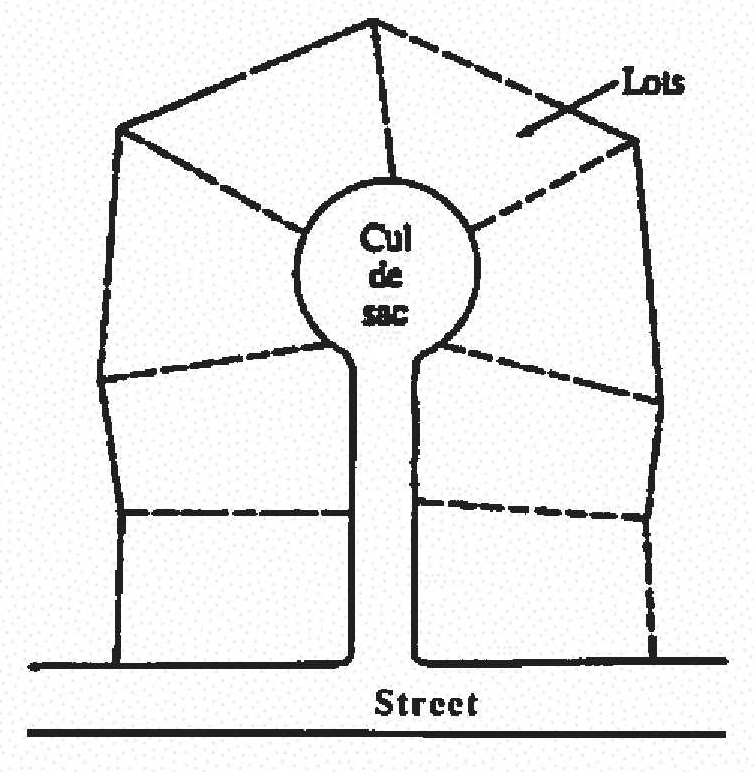
Section 1-6-9. - Design of Cul-de-Sac Streets.
A.
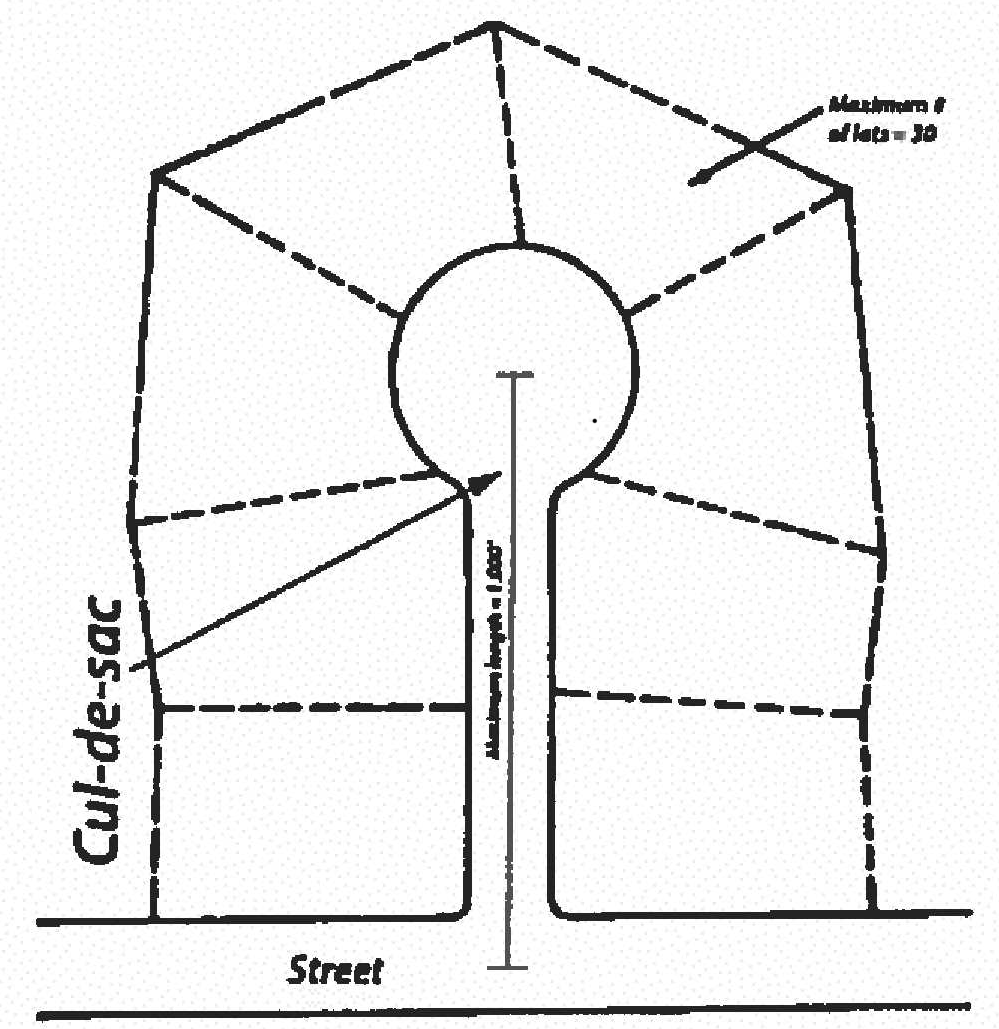
Definition. A dead end street created to limit through-traffic in a residential area. While some cul-de-sac streets provide no possible passage except in and out of their road entry, others allow cyclists, pedestrians or other non-automotive traffic to pass through connecting easements or paths. Culs-de-sac shall be measured utilizing total length, as measured from the centerline of the nearest intersection with more than one outlet, at the time of development, to the center point of the cul-de-sac; or, by maximum number of residential units located along the cul-de-sac street. An "outlet" is defined as a secondary means of egress from the development to an adjacent development, dedicated road or section line road.
B.
Design. Culs-de-sac shall contain a maximum of 30 residential lots or be a maximum of one thousand (1,000) feet. No cul-de-sac longer than one thousand (1,000) feet shall serve more than thirty (30) residential lots without a secondary means of egress. The radius of all cul-de-sac streets shall be a minimum of sixty (60) feet of paved surface within the cul-de-sac.
(Ord. No. 618, § 1, 2-22-2016)

