
Pierson City Zoning Code
SECTION 5
5 - DISTRICT REGULATIONS
The following district classifications and their included regulations are established:
5.5.1 - C, Conservation Classification
A.
Purpose and Intent:
The purpose and intent of the C classification is to encourage and promote the conservation of the wetlands ecological communities, and to preserve those conditions and characteristics which promote water quality maintenance, wildlife resource habitats, and flood storage. Additionally, it is intended to discourage and prevent urban development on lands that are unsafe for such use because of a potential for flooding, inadequate accessibility, ground instability, or other conditions.
B.
Permitted Principal Uses and Structures:
In the C classification, only the following uses and structures are permitted, notwithstanding applicable regulations of the County, State or Federal governments:
Single-family dwellings constructed on pilings or column footings where necessary to elevate floor level above the applicable regulatory flood elevation.
Essential utility services.
Access drives for single-family residences.
Elevated boardwalks.
Aquatic preserves.
Fishing, hunting and wildlife management areas.
Historical sites and structures.
Nature preserves and passive recreational activities and facilities.
Facilities for the study of historic and ecological sites.
Silviculture activities, on privately owned lands only, meeting the requirements set forth in Section 5.6.8.
Publicly owned lands that lie within any Conservation district shall be used only for resource-based, passive recreation and open space uses such as walkways, piers and docks elevated on pilings.
C.
Permitted Special Exceptions:
Public utility uses and structures (Refer to Section 5.6.6, C).
D.
Prohibited Uses:
The following uses are prohibited in any C district:
Land uses requiring the generation, use or storage of toxic or hazardous materials or waste shall be prohibited in any Conservation district.
E.
Dimensional Requirements:
1.
Minimum Lot Size for Single-Family Dwellings:
a.
Area — twenty (20) acres; however, the minimum lot area may be as small as one (1) acre when development is clustered and the maximum density set for in Section 5.5.1, F is not exceeded.
b.
Width — one hundred fifty (150) feet
2.
Minimum Yard Size:
a.
Front — thirty (30) feet
b.
Rear — fifty (50) feet
c.
Side — twenty-five (25) feet
d.
Waterfront — fifty (50) feet
3.
Maximum Building Height — thirty-five (35) feet
4.
Maximum Lot Coverage: While it is intended that lands in this classification be maintained to the greatest degree possible in a natural, undisturbed condition, no maximum lot coverage requirement is specified.
5.
Minimum Floor Area — None.
F.
Maximum Density: one (1) dwelling unit per twenty (20) acres.
G.
Off-Street Parking and Loading Requirements: Off-street parking and loading space meeting the requirements of Sections 6.4.10 and 5.6.5, C. shall be constructed.
H.
Development Plan Review: A development plan shall be submitted and reviewed pursuant to the requirements of Section 3.3.
I.
Development Plan Review Standards: In addition to the standards listed in Section 3.3, the Town Council shall consider the following standards in determining whether a site plan for development in a C district shall be approved:
1.
Clustering of development on upland portions of lots shall be required when wetland areas exist on a site.
2.
For privately owned lots of record on August 27, 1991 that lie entirely within wetlands or do not contain sufficient uplands to permit use of the property without developing in the wetlands, then the amount of development shall be limited to the minimum amount necessary to permit construction of a dwelling on pilings. The Town may vary setback requirements to allow transfer of the density from the wetlands to the upland portion of the site; however, when setback reductions cannot accommodate the location of the dwelling, compensatory mitigation of wetlands of the same type, form and function shall be required. Creation of new wetlands as mitigation shall avoid ecologically valuable uplands including, but not limited to bird nesting colonies, migratory wildlife corridors and rare or endangered ecosystems.
3.
The development does not involve the unnecessary removal or destruction of any natural vegetation. Clearing of vegetation may occur anywhere within twenty-five (25) feet of the area actually covered by the principal building and within the area used for vehicular access to the building site, not exceeding twenty (20) feet in width.
4.
A minimum twenty-five (25) feet wide upland buffer of native vegetation has been maintained adjacent to wetlands and water bodies.
5.
The flood storage capacity of the site is not reduced by the addition of fill material to the site.
6.
The natural drainage patterns are maintained to the greatest extent possible.
7.
Adequate erosion control measures are put into effect.
8.
Sanitary sewer systems, including septic tanks, are designed so that they can continue to function during flood conditions without discharging inadequately treated effluent.
9.
Any structures erected, placed or constructed on the site are likely to withstand the flood depth, pressure, velocity, impact and uplift forces associated with the regulatory flood.
5.5.2 - ELD, Environmentally Limited Development Area Classification
A.
Purpose and Intent:
The purpose and intent of the ELD classification is to promote an approach to the development and use of lands that is sensitive to certain inherent environmental constraints including, but not limited to, poor soil conditions, high erosion potential, flood hazards, wildlife habitat suitability, etc. Creative development techniques, including cluster development, which fulfill this purpose and intent should be encouraged.
B.
Permitted Principal Uses and Structures:
In any ELD district, no premises shall be used except for the following uses and structures:
Single-family dwellings, and their customary accessory uses or structures.
Nature preserves and passive recreational activities and facilities.
Facilities for the study of historic and ecological sites.
Silviculture activities, on privately owned lands only, meeting the requirements set forth in Section 5.6.8.
C.
Permitted Special Exceptions:
Residential cluster subdivisions not exceeding 0.8 dwelling units per acre (1 dwelling unit per 1¼ acres) of usable land in the project area may be permitted as a Special Exception provided the requirements set forth below and in Section 5.6.6, I. are met. (See the definition of "Density").
1.
Sixty percent (60%) or more of the total project area shall be retained as common open space. All such area shall be permanently dedicated to the residents of the project area or to the general public for environmental preservation or recreational use, whichever is determined by the Town Council to be most appropriately related to the purpose and intent of this zoning classification and the goals and objectives of the Town's Comprehensive Plan. The method of dedication and the provisions for maintenance of the common open space shall be approved by the Council upon recommendation of the Town Attorney.
2.
The application for Special Exception clearly demonstrates with appropriate engineering data and other documentation that the proposed development will better serve the purpose and intent of this zoning classification.
3.
The increased residential density permitted by this Special Exception does not place an undue burden on roads, utilities and other public facilities.
4.
Dimensional requirements for any dwelling type developed under this Special Exception provision shall be the same as the dimensional requirements for similar dwelling types in the R-4 districts.
D.
Dimensional Requirements:
1.
Minimum Lot Size:
a.
Area — two and one-half (2½) acres.
b.
Width — one hundred fifty (150) feet
2.
Minimum Yard Size:
b.
Front — thirty (30) feet
c.
Rear — fifty (50) feet
d.
Side — twenty (20) feet
e.
Waterfront — fifty (50) feet
3.
Maximum Building Height — thirty-five (35) feet
4.
Maximum Lot Coverage: The total lot area covered with principal and accessory buildings shall not exceed fifteen percent (15%).
5.
Minimum Floor Area — one thousand (1,000) square feet
E.
Off-Street Parking and Loading Requirements: Off-street parking and loading space meeting the requirements of Sections 6.4.10 and 5.6.5, C. shall be constructed.
F.
Development Plan Review: A development plan shall be submitted and reviewed pursuant to the requirements of Section 3.3.
5.5.3 - A-1, Agricultural Classification
A.
Purpose and Intent:
The purpose and intent of the A-1 classification is to promote and protect agricultural and horticultural production in areas where soils are particularly well suited for such uses, and where such uses are already well established. Low density residential development consistent with the character of proposed and existing A-1 zoned areas is also appropriate.
B.
Permitted Principal Uses and Structures:
In any A-1 district, no premises shall be used except for the following uses and their customary accessory uses or structures:
Commercial agricultural and horticultural production.
Single-family dwellings and customary accessory buildings incidental thereto.
Ferneries and horticultural nurseries.
Family business offices.
Parks and recreation areas and facilities accessory to residential developments.
Essential utility services.
Silviculture activities, on privately owned lands only, meeting the requirements set forth in Section 5.6.8.
C.
Permitted Special Exceptions:
Home Occupations.
Public Uses.
Public Utility Uses and Structures (refer to Section 5.6.6, C).
Recreation Areas, e.g., golf courses, country clubs, swim clubs, tennis clubs, etc. (refer to Section 5.6.6, D).
Residential Cluster Subdivisions (refer to Section 5.6.6, H).
Accessory Mobile Homes for Farmworkers or Security Personnel (refer to Section 5.6.6, L).
Community Residential Homes (refer to Section 5.6.6, K).
Child care centers (refer to Section 5.6.6, A).
Fern packing house (refer to Section 5.6.6, M).
Bed and Breakfast Homestays (refer to Section 5.6.6, O) 1
Accessory Dwelling Units (refer to Section 5.6.6, P).
D.
Dimensional Requirements:
1.
Minimum Lot Size:
a.
Area — five (5) acres
b.
Width — three hundred (300) feet
c.
Depth — None
2.
Minimum Yard Size:
a.
Front — thirty (30) feet
b.
Rear — thirty (30) feet
c.
Side — twenty (20) feet
d.
Waterfront — twenty-five (25) feet
3.
Maximum Building Height — thirty-five (35) feet
4.
Maximum Lot Coverage: The total lot area covered with principal and accessory buildings shall not exceed twenty percent (20%).
5.
Minimum Floor Area — None.
E.
Off-Street Parking and Loading Requirements: Off-street parking and loading space meeting the requirements of Sections 6.4.10 and 5.6.5, C. shall be constructed.
( 1 As amended by Ordinance 96-1, February 13, 1996)
5.5.4 - RR, Rural Residential Development Classification
A.
Purpose and Intent:
The purpose and intent of the RR classification is to provide low density residential developments, preserving the character of existing or rural residential neighborhoods.
B.
Permitted Principal Uses and Structures:
In any RR district, no premises shall be used except for the following uses and their customary accessory uses or structures:
Single-family dwellings and customary accessory buildings incidental thereto.
Ferneries and horticultural nurseries
Family business offices.
Parks and recreation areas and facilities accessory to residential developments.
Essential utility services.
Silviculture activities, on privately owned lands only, meeting the requirements set forth in Section 5.6.8.
C.
Permitted Special Exceptions:
Home Occupations.
Public Uses.
Public Utility Uses and Structures (refer to Section 5.6.6, C).
Recreation Areas, e.g., golf courses, country clubs, swim clubs, tennis clubs, etc. (refer to Section 5.6.6, D).
Residential Cluster Subdivisions (refer to Section 5.6.6, H).
Keeping of livestock or fowl for commercial breeding, food production, or sale (refer to Section 5.6.6, I).
Community Residential Homes (refer to Section 5.6.6, K).
Houses of worship (refer to Section 5.6.6, B).
Child care centers (refer to Section 5.6.6, A).
Fern packing house (refer to Section 5.6.6, M).
Bed Breakfast Homestays (refer to Section 5.6.6, O). 1
Accessory Dwelling Units (refer to Section 5.6.6, P).
D.
Dimensional Requirements:
1.
Minimum Lot Size:
a.
Area — one (1) acre
b.
Width — two hundred (200) feet
c.
Depth — two hundred (200) feet
2.
Minimum Yard Size:
a.
Front — thirty (30) feet
b.
Rear — thirty (30) feet
c.
Side — twenty (20) feet
d.
Waterfront — twenty-five (25) feet
3.
Maximum Building Height — thirty-five (35) feet
4.
Maximum Lot Coverage: The total lot area covered with principal and accessory buildings shall not exceed twenty percent (20%).
5.
Minimum Floor Area — one thousand five hundred (1,500) square feet 2
E.
Off-Street Parking and Loading Requirements: Off-street parking and loading space meeting the requirements of Sections 6.4.10 and 5.6.5, C. shall be constructed.
( 1 As amended by Ordinance 96-1 on February 13, 1996; 2 amended per Ordinance 08-06, October 14, 2008)
5.5.5-A - R-E, Low Density Single-Family Estate Development Classification
A.
Purpose and Intent:
The purpose and intent of the R-E classification is to provide areas within the Town for new low density single-family residential estate development with larger minimum floor area requirements and to encourage developers to create and enforce covenants and restrictions for architectural/design standards and property maintenance.
B.
Permitted Principal Uses and Structures:
In any R-E district, no premises shall be used except for the following uses and their customary accessory uses or structures:
Single-family dwellings and customary accessory buildings incidental thereto.
Parks and recreation areas and facilities accessory to residential developments.
Essential utility services.
C.
Permitted Special Exceptions:
Home Occupations.
Public Uses.
Public Utility Uses and Structures (refer to Section 5.6.6, C).
Recreation Areas, e.g., golf courses, country clubs, swim clubs, tennis clubs, etc. (refer to Section 5.6.6, D).
Residential Cluster Subdivisions (refer to Section 5.6.6, H).
Community Residential Homes (refer to Section 5.6.6, K).
Houses of worship (refer to Section 5.6.6, B).
Accessory Dwelling Units (refer to Section 5.6.6, P).
D.
Dimensional Requirements:
1.
Minimum Lot Size:
a.
Area — twenty-two thousand (22,000) square feet
b.
Width — one hundred (100) feet
c.
Depth — one hundred (100) feet
2.
Minimum Yard Size:
a.
Front — thirty (30) feet
b.
Rear — thirty (30) feet
c.
Side — ten (10) feet
d.
Waterfront — twenty-five (25) feet
3.
Maximum Building Height — thirty-five (35) feet
4.
Maximum Lot Coverage: The total lot area covered with principal and accessory buildings shall not exceed thirty percent (30%).
5.
Minimum Floor Area — one thousand eight hundred (1,800) square feet
E.
Off-Street Parking and Loading Requirements: Off-street parking and loading space meeting the requirements of Sections 6.4.10 and 5.6.5, C. shall be constructed.
(As amended per Ordinance 07-08, October 23, 2007)
5.5.5 - R-1, Low Density Single-Family Residential Development Classification
A.
Purpose and Intent:
The purpose and intent of the R-1 classification is to provide low density residential developments, preserving the character of existing or proposed residential neighborhoods.
B.
Permitted Principal Uses and Structures:
In any R-1 district, no premises shall be used except for the following uses and their customary accessory uses or structures:
Single-family dwellings and customary accessory buildings incidental thereto.
Ferneries and horticultural nurseries.
Family business offices.
Parks and recreation areas and facilities accessory to residential developments.
Essential utility services.
C.
Permitted Special Exceptions:
Home Occupations.
Public Uses.
Public Utility Uses and Structures (refer to Section 5.6.6, C).
Recreation Areas, e.g., golf courses, country clubs, swim clubs, tennis clubs, etc. (refer to Section 5.6.6, D).
Residential Cluster Subdivisions (refer to Section 5.6.6, H).
Community Residential Homes (refer to Section 5.6.6, K).
Houses of worship (refer to Section 5.6.6, B).
Child care centers (refer to Section 5.6.6, A).
Fern packing house (refer to Section 5.6.6, M).
Bed and Breakfast Homestays (refer to Section 5.6.6, O). 1
Accessory Dwelling Units (refer to Section 5.6.6, P).
D.
Dimensional Requirements:
1.
Minimum Lot Size:
a.
Area — twenty-two thousand (22,000) square feet
b.
Width — one hundred (100) feet
c.
Depth — one hundred (100) feet
2.
Minimum Yard Size:
a.
Front — thirty (30) feet
b.
Rear — thirty (30) feet
c.
Side — ten (10) feet
d.
Waterfront — twenty-five (25) feet
3.
Maximum Building Height — thirty-five (35) feet
4.
Maximum Lot Coverage: The total lot area covered with principal and accessory buildings shall not exceed thirty percent (30%)
5.
Minimum Floor Area — one thousand two hundred (1,200) square feet
E.
Off-Street Parking and Loading Requirements: Off-street parking and loading space meeting the requirements of Sections 6.4.10 and 5.6.5, C, shall be constructed.
( 1 As amended by Ordinance 96-1 on February 13, 1996)
5.5.6 - R-2, Low-Medium Density Single-Family Residential Development Classification
A.
Purpose and Intent:
The purpose and intent of the R-2 classification is to provide low-medium density residential developments, preserving the character of existing or proposed residential neighborhoods.
B.
Permitted Principal Uses and Structures:
In any R-2 district, no premises shall be used except for the following uses and their customary accessory uses or structures:
Single-family dwellings and customary accessory buildings incidental thereto.
Ferneries and horticultural nurseries.
Family business offices.
Parks and recreation areas and facilities accessory to residential developments.
Essential Utility Services.
C.
Permitted Special Exceptions:
Home Occupations.
Public Uses.
Public utility uses and structures (refer to Section 5.6.6, C).
Recreational Areas, e.g., golf courses, country clubs, swim clubs, tennis clubs, etc., (refer to Section 5.6.6, D).
Residential cluster subdivisions (refer to Section 5.6.6, H).
Community Residential Homes (refer to Section 5.6.6, K).
Houses of worship (refer to Section 5.6.6, B).
Child care centers (refer to Section 5.6.6, A).
Fern packing house (refer to Section 5.6.6, M).
Bed and Breakfast Homestays (refer to Section 5.6.6, O). 1
Accessory Dwelling Units (refer to Section 5.6.6, P).
D.
Dimensional Requirements:
1.
Minimum Lot Size:
a.
Area — sixteen thousand five hundred (16,500) square feet
b.
Width — one hundred (100) feet
c.
Depth — one hundred (100) feet
2.
Minimum Yard Size:
a.
Front — thirty (30) feet
b.
Rear — twenty-five (25) feet
c.
Side — ten (10) feet
d.
Waterfront — twenty-five (25) feet
3.
Maximum Building Height — thirty-five (35) feet
4.
Maximum Lot Coverage: The total lot area covered with principal and accessory buildings shall not exceed thirty-five percent (35%).
5.
Minimum Floor Area — one thousand two hundred (1,200) square feet
E.
Off-Street Parking and Loading Requirements: Off-street parking and loading space meeting the requirements of Sections 6.4.10 and 5.6.5, C. shall be constructed.
( 1 As amended by Ordinance 96-1 on February 13, 1996)
5.5.7 - R-3, Medium Density Single-Family Residential Development Classification
A.
Purpose and Intent:
The purpose and intent of the R-3 classification is to provide medium density residential development, preserving the character of existing or proposed residential neighborhoods.
B.
Permitted Principal Uses and Structures:
In any R-3 district, no premises shall be used except for the following uses and their customary accessory uses or structures:
Single-family dwellings and customary accessory buildings incidental thereto.
Ferneries and horticultural nurseries
Family business offices.
Parks and recreation areas and facilities accessory to residential developments.
Essential utility services.
C.
Permitted Special Exceptions:
Home Occupations.
Public uses.
Public utility uses and structures (refer to Section 5.6.6, C).
Recreational areas, e.g., golf courses, country clubs, swim clubs, tennis clubs, etc. (refer to Section 5.6.6, D).
Community Residential Homes (refer to Section 5.6.6, K).
Houses of worship (refer to Section 5.6.6, B).
Child care centers (refer to Section 5.6.6, A).
Fern packing house (refer to Section 5.6.6, M).
Bed and Breakfast Homestays (refer to Section 5.6.6, O). 1
Accessory Dwelling Units (refer to Section 5.6.6, P).
D.
Dimensional Requirements:
1.
Minimum Lot Size:
a.
Area — fourteen thousand five hundred twenty (14,520) square feet
b.
Width — eighty-five (85) feet
c.
Depth — one hundred (100) feet
2.
Minimum Yard Size:
a.
Front — thirty (30) feet
b.
Rear — twenty-five (25) feet
c.
Side — twenty (20) feet combined; minimum of eight (8) feet on any one side
d.
Waterfront — twenty-five (25) feet
3.
Maximum Building Height — thirty-five (35) feet
4.
Maximum Lot Coverage: The total lot area covered with principal and accessory buildings shall not exceed thirty-five percent (35%).
5.
Minimum Floor Area — one thousand (1,000) square feet
E.
Off-Street Parking and Loading Requirements: Off-street parking and loading space meeting the requirements of Sections 6.4.10 and 5.6.5, C. shall be constructed.
( 1 As amended by Ordinance 96-1 on February 13, 1996)
5.5.8 - MH-1, Medium Density Mobile Home Classification
A.
Purpose and Intent:
The intent of this classification is to provide for the development of mobile home parks and subdivisions.
B.
Permitted Principal Uses and Structures:
Mobile home subdivisions.
Parks and recreation areas and facilities accessory to residential developments.
Essential utility services.
C.
Permitted Accessory Uses and Structures:
Uses customarily associated with, dependent on and incidental to, the permitted principal use.
Mobile home community management offices.
Mobile home community service facilities, including laundries, recreation halls, swimming pools, tennis courts, cabanas, maintenance and utility buildings, carports and garages.
D.
Special Exceptions:
Public utility uses and structures (refer to Section 5.6.6, C).
Recreation areas, e.g., golf courses, country clubs, swim clubs, tennis clubs, etc. (refer to Section 5.6.6, D).
Schools (parochial or private) (refer to Section 5.6.6, E).
Nursing homes, boarding houses and adult congregate living facilities approved and licensed by the appropriate state agency (refer to Section 5.6.6, F).
E.
Dimensional Requirements:
1.
Minimum Lot Size:
a.
Area — fourteen thousand five hundred twenty (14,520) square feet
b.
Width — eighty-five (85) feet
c.
Depth — one hundred (100) feet
2.
Minimum Yard Size:
a.
Front — twenty-five (25) feet
b.
Rear — twenty-five (25) feet
c.
Side — twenty (20) feet combined; minimum of eight (8) feet on any one side.
d.
Waterfront — fifty (50) feet
3.
Maximum Building Height — thirty-five (35) feet
4.
Maximum Lot Coverage: The total lot area covered with principal and accessory buildings shall not exceed thirty-five percent (35%).
5.
Minimum Floor Area — six hundred (600) square feet
F.
Off-Street Parking and Loading Requirements: Off-street parking and loading space meeting the requirements of Sections 6.4.10 and 5.6.5, C. shall be constructed.
G.
Landscape Buffer Requirements: A landscaped buffer area meeting the requirements of Section 5.6.5 shall be constructed.
H.
Development Plan Review: A development plan shall be submitted and reviewed pursuant to the requirements of Section 3.3.
5.5.9 - MH-2, Medium Density Mixed Residential Development Classification
A.
Purpose and Intent:
The intent of this classification is to provide for the development of residential areas with a mixture of mobile homes, conventional, site built single-family dwellings, and factory-built single-family dwellings.
B.
Permitted Principal Uses and Structures:
Mobile homes.
Site-built, single-family dwellings.
Factory-built, single-family dwellings.
Parks and recreation areas and facilities accessory to residential developments.
Essential utility services.
C.
Permitted Accessory Uses and Structures:
Uses customarily associated with, dependent on and incidental to, the permitted principal use.
Mobile home community management offices.
Mobile home community service facilities, including laundries, recreation halls, swimming pools, tennis courts, cabanas, maintenance and utility buildings, carports and garages.
D.
Permitted Special Exceptions:
Public utility uses and structures (refer to Section 5.6.6, C).
Recreation areas, e.g., golf courses, country clubs, swim clubs, tennis clubs, etc. (refer to Section 5.6.6, D).
Schools (parochial or private) (refer to Section 5.6.6, E).
Nursing homes, boarding houses and adult congregate living facilities approved and licensed by the appropriate state agency (refer to Section 5.6.6, F).
Accessory Dwelling Units (refer to Section 5.6.6, P).
E.
Dimensional Requirements:
1.
Minimum Lot Size:
a.
Area — fourteen thousand five hundred twenty (14,520) square feet
b.
Width — eighty-five (85) feet
c.
Depth — one hundred (100) feet
2.
Minimum Yard Size:
a.
Front — twenty-five (25) feet
b.
Rear — twenty-five (25) feet
c.
Side — twenty (20) feet combined; minimum of eight (8) feet on any one side.
d.
Waterfront — fifty (50) feet
3.
Maximum Building Height — thirty-five (35) feet
4.
Maximum Lot Coverage: The total lot area covered with principal and accessory buildings shall not exceed thirty-five percent (35%).
5.
Minimum Floor Area — six hundred (600) square feet
F.
Off-Street Parking and Loading Requirements: Off-street parking and loading space meeting the requirements of Sections 6.4.10 and 5.6.5, C. shall be constructed.
G.
Landscape Buffer Requirements: A landscaped buffer area meeting the requirements of Section 5.6.5 shall be constructed.
H.
Development Plan Review: A development plan shall be submitted and reviewed pursuant to the requirements of Section 3.3.
5.5.10-A - B-1A, General Retail Commercial (Low Intensity) Development Classification
A.
Purpose and Intent:
The purpose and intent of the B-1A classification is to provide areas for business, retail, office and other commercial enterprises which support the resident and transient populations of the Town and surrounding areas at relatively low intensity. This land use classification is most appropriately applied outside the central areas of the Town.
B.
Permitted Principal Uses and Structures:
In any B-1A district, no premises shall be used except for the following uses and their customary accessory uses or structures:
Automobile service stations (Type A & C).
Business and personal services.
Clinic, medial or dental.
Community facilities.
Essential utility services.
Financial institutions.
Hotel, motels and similar lodgings.
Offices and business uses.
Parks, recreation and open space.
Restaurants (Type A & B).
Retail sales and services.
C.
Prohibited Uses:
The following uses are prohibited in any B-1A district:
Manufacturing or refining of ammonia, bleaching powder, chlorine, asphalt, brick, terra-cotta, tile or pottery (except handicrafts), cement, gypsum, lime, plaster of Paris, coke creosote, dextrin, glucose, starch, dye, explosives or fireworks (or storage of explosives or fireworks), fertilizer, gas (fuel or illuminating), in excess of one thousand (1,000) cubic feet per day or storage in excess of ten thousand (10,000) cubic feet, except in a municipal or public service plant, gelatin or glue or size from fish or animal refuse or offal, hair hydrochloric, nitric, picric, sulfuric or sulfurous acid, lamp black, linoleum or oilcloth, match, pyroxylin or articles thereof or storage in excess of five hundred (500) pounds, rubber, or treatment thereof involving offensive odor, tar, turpentine or varnish; blast furnace, coal, junk or wood yard; distillation of bones, coal, wood or tar or manufacture of any of their products; drop forge, fat, grease, lard, or tallow manufacture, refining or rendering; flour or gristmill; hot rolling mill; incineration, reduction or dumping of dead animals, garbage, offal or refuse except by the Town or its agents or when accumulated and consumed on the same premises without the emission of odor; lumber yard or mill; petroleum or other inflammable liquids — production or refining of or storage above ground in excess of one thousand (1,000) gallons; slaughtering or stock yards; tanning, curing or storage of raw hides or skins; tire recapping.
Sale and storage of explosives and fireworks.
Also prohibited are any other uses detrimental to a neighborhood because of odor, smoke, dust fumes, fire, vibration, or hazardous because of danger of fire or explosion.
D.
Permitted Special Exceptions:
Child care centers (refer to Section 5.6.6, A).
Commercial recreational uses and structures.
Houses of worship (refer to Section 5.6.6, B).
Only one (1) single-family dwelling for the owner or manager of a permitted principal use.
Utility, transportation and communication facilities (refer to Section 5.6.6, C).
Schools, public or private
E.
Dimensional Requirements:
1.
Minimum Lot Size:
a.
Area — ten thousand (10,000) square feet
b.
Width — one hundred (100) feet
2.
Minimum Yard Size:
a.
Front — thirty-five (35) feet
b.
Side and Rear — ten (10) feet unless abutting any residentially zoned property, then thirty-five (35) feet
c.
Waterfront — twenty-five (25) feet
3.
Maximum Building Height — thirty-five (35) feet
4.
Maximum Floor Area Ratio (F.A.R.): The F.A.R. shall not exceed 0.35.
F.
Off-Street Parking and Loading Requirements: Off-street parking and loading space meeting the requirements of Sections 6.4.10 and 5.6.5, C. shall be constructed.
G.
Landscape Buffer Requirement: Landscaped buffers meeting the requirements of Section 5.6.5 shall be constructed.
H.
Development Plan Review: A development plan shall be submitted and reviewed pursuant to the requirements of Section 3.3.
I.
Parcels located in the US Highway 17 corridor Overlay District as shown on Exhibit "A," Ordinance 09-01, are required to meet the requirements of Section 5.6.11.
(As amended per Ordinance 07-09, November 27, 2007; Ordinance 08-09, October 14, 2008)
5.5.10 - B-1, General Commercial Development Classification
A.
Purpose and Intent:
The purpose and intent of the B-1 classification is to provide areas for a broad range of retail commercial and business establishments which meet the frequent needs of the residents of Pierson.
B.
Permitted Principal Uses and Structures:
In any B-1 district, no premises shall be used except for the following uses and their customary accessory uses or structures:
Automobile service stations (Type A & C).
Business and personal services.
Car washes.
Essential utility services.
Financial institutions.
General offices.
Laundry and dry cleaning establishments.
Restaurants (Type A & B).
Retail sales and services.
Any dwelling existing on or before March 28, 2006. 1
Automobile sales and repair. 2
Veterinary Clinic 3
C.
Prohibited Uses:
The following uses are prohibited in any B-1 district:
Manufacturing or refining of ammonia, bleaching powder, chlorine, asphalt, brick, terra-cotta, tile or pottery (except handicrafts), cement, gypsum, lime, plaster of Paris, coke creosote, dextrin, glucose, starch, dye, explosives or fireworks (or storage of explosives or fireworks), fertilizer, gas (fuel or illuminating), in excess of one thousand (1,000) cubic feet per day or storage in excess of ten thousand (10,000) cubic feet, except in a municipal or public service plant, gelatin or glue or size from fish or animal refuse or offal, hair hydrochloric, nitric, picric, sulphuric or sulfurous acid, lamp black, linoleum or oilcloth, match, pyroxylin or articles thereof or storage in excess of five hundred (500) pounds, rubber, or treatment thereof involving offensive odor, tar, turpentine or varnish; blast furnace, coal, junk or wood yard; distillation of bones, coal, wood or tar or manufacture of any of their products; drop forge, fat, grease, lard, or tallow manufacture, refining or rendering; flour or gristmill; hot rolling mill; incineration, reduction or dumping of dead animals, garbage, offal or refuse except by the Town or its agents or when accumulated and consumed on the same premises without the emission of odor; lumber yard or mill; petroleum or other inflammable liquids — production or refining of or storage above ground in excess of one thousand (1,000) gallons; slaughtering or stock yards; tanning, curing or storage of raw hides or skins; tire recapping.
Sale and storage of explosives and fireworks.
Also prohibited are any other uses detrimental to a neighborhood because of odor, smoke, dust fumes, fire, vibration, or hazardous because of danger of fire or explosion.
D.
Permitted Accessory Uses and Structures:
Any accessory use customarily incidental to a permitted principal use.
One (1) detached single-family dwelling (a "standard dwelling" or "manufactured residential building") or one (1) dwelling unit within or attached to a permitted principal building. 1
E.
Permitted Special Exceptions: 1
Child care centers (refer to Section 5.6.6, A).
Clinic, medical or dental.
Entertainment and recreational uses and structures.
Houses of worship (refer to Section 5.6.6, B).
Mini-warehouses (refer to Section 5.6.6, G).
Nursing homes and adult congregate living facilities (refer to Section 5.6.6, F).
Public uses.
Public utility uses and structures (refer to Section 5.6.6, C).
Schools (parochial or private) (refer to Section 5.6.6, E).
F.
Dimensional Requirements:
1.
Minimum Lot Size:
a.
Area — ten thousand (10,000) square feet
b.
Width — one hundred (100) feet
2.
Minimum Yard Size:
a.
Front — thirty-five (35) feet
b.
Side & Rear — ten (10) feet unless abutting any residentially zoned property, then thirty-five (35) feet
c.
Waterfront — twenty-five (25) feet
3.
Maximum Building Height — thirty-five (35) feet
4.
Maximum Lot Coverage: The total lot area covered with principal and accessory buildings shall not exceed thirty-five percent (35%).
G.
Off-Street Parking and Loading Requirements: Off-street parking and loading space meeting the requirements of Sections 6.4.10 and 5.6.5, C. shall be constructed.
H.
Landscape Buffer Requirement: Landscaped buffers meeting the requirements of Section 5.6.5 shall be constructed.
I.
Development Plan Review: A development plan shall be submitted and reviewed pursuant to the requirements of Section 3.3.
J.
Parcels located in the US Highway 17 corridor Overlay District as shown on Exhibit "A," Ordinance 09-01, are required to meet the requirements of Section 5.6.11. 4
( 1 As amended by Ordinance 06-06, March 28, 2006; 2 amended by Ordinance 06-09, July 25, 2006; 3 amended by Ordinance 07-12, November 27, 2007; 4 amended by Ordinance 09-01, January 13, 2009)
5.5.11 - B-2, Heavy Commercial and Industrial Development Classification
A.
Purpose and Intent:
The purpose and intent of the B-2 classification is to provide areas for the operation of heavy commercial, manufacturing, processing, storage, wholesaling, and distribution uses. The regulations are intended to prevent frictions between uses within the districts and to protect nearby residential areas, schools and other incompatible uses from the potentially harmful or annoying effects of uses permitted in the B-2 districts.
B.
Permitted Principal Uses and Structures: 1
In any B-2 district, no premises shall be used except for the following uses and their customary accessory uses or structures:
Automobile service stations (Type A & C).
Building material sales for buildings and yards.
Cold storage and freezer locker plants.
Contractor and construction offices and equipment storage.
Farm machinery, sales and service.
Food and beverage processing and distribution, except the slaughter of animals.
Printing, engraving and publishing establishments.
Paint and body shops.
Open storage of non-combustible materials.
Sale and storage of guns, firearms, ammunition, explosives, fireworks and gunpowder.
Wholesale sales.
Warehousing and distribution.
Light manufacturing and assembly.
Essential utility services.
Any dwelling existing on or before March 28, 2006. 2
Automobile sales and repair. 3
C.
Prohibited Uses:
The following uses are prohibited in any B-2 district:
Manufacturing or refining of ammonia, bleaching powder, chlorine, asphalt, brick, terra-cotta, tile or pottery (except handicrafts), cement, gypsum, lime, plaster of Paris, coke creosote, dextrin, glucose, starch, dye, explosives or fireworks (or storage of explosives or fireworks), fertilizer, gas (fuel or illuminating), in excess of one thousand (1,000) cubic feet per day or storage in excess of ten thousand (10,000) cubic feet, except in a municipal or public service plant, gelatin or glue or size from fish or animal refuse or offal, hair hydrochloric, nitric, picric, sulphuric or sulfurous acid, lamp black, linoleum or oilcloth, match, pyroxylin or articles thereof or storage in excess of five hundred (500) pounds, rubber, or treatment thereof involving offensive odor, tar, turpentine or varnish; blast furnace, coal, junk or wood yard; distillation of bones, coal, wood or tar or manufacture of any of their products; drop forge, fat, grease, lard, or tallow manufacture, refining or rendering; flour or gristmill; hot rolling mill; incineration, reduction or dumping of dead animals, garbage, offal or refuse except by the Town or its agents or when accumulated and consumed on the same premises without the emission of odor; lumber yard or mill; petroleum or other inflammable liquids — production or refining of or storage above ground in excess of one thousand (1,000) gallons; slaughtering or stock yards; tanning, curing or storage of raw hides or skins; tire recapping.
Also prohibited are any other uses detrimental to a neighborhood because of odor, smoke, dust fumes, fire, vibration, or hazardous because of danger of fire or explosion.
D.
Permitted Accessory Uses and Structures:
Any accessory use customarily incidental to a permitted principal use.
Storage yards, provided such areas are enclosed by a fence at least six (6) feet high, which screens the storage yard from vision.
One (1) detached single-family dwelling (a "standard dwelling" or "manufactured residential building") or one (1) dwelling unit within or attached to a permitted principal building. 2
E.
Permitted Special Exceptions:
Animal hospitals (refer to Section 5.6.6, J).
F.
Dimensional Requirements:
1.
Minimum Lot Size:
a.
Area — thirty thousand (30,000) square feet
b.
Width — one hundred fifty (150) feet
c.
Depth — one hundred fifty (150) feet
2.
Minimum Yard Size:
a.
Front Yard — twenty-five (25) feet
b.
Side Yard — ten (10) feet unless abutting any residentially zoned property; then thirty-five (35) feet
c.
Rear Yard twenty (20) feet unless abutting any residentially zoned property; then thirty-five (35) feet
d.
Waterfront Yard — None.
3.
Maximum Building Height — thirty-five (35) feet
4.
Maximum Floor Area Ratio (F.A.R.): The F.A.R. shall not exceed 0.35.
5.
Maximum Lot Coverage: The total lot area covered with principal and accessory buildings shall not exceed thirty-five percent (35%).
G.
Off-Street Parking and Loading Requirements: Off-street parking and loading requirements meeting the requirements of Sections 6.4.10 and 5.6.5, C. shall be constructed.
H.
Landscape Buffer Requirements: A landscaped buffer area meeting the requirements of Section 5.6.5 shall be constructed.
I.
Development Plan Review: A development plan shall be submitted and reviewed pursuant to the requirements of Section 3.3.
J.
Parcels located in the US Highway 17 corridor Overlay District as shown on Exhibit "A," Ordinance 09-01, are required to meet the requirements of Section 5.6.11. 4
( 1 As amended per Ordinance 97-1, January 14, 1997; 2 amended by Ordinance 06-06, March 28, 2006; 3 amended by Ordinance 06-09, July 25, 2006; 4 amended by Ordinance 09-01, January 13, 2009)
5.5.12 - NIO, Neighborhood Infill Overlay Zone
A.
Purpose and Intent:
The purpose of the Neighborhood Infill Overlay Zone is to preserve neighborhood character by providing for the compatible infill development within existing neighborhoods and to encourage the infill of vacant lots with housing that is similar in height, scale, and placement with existing housing. No permit for an infill residential home shall be granted except in compliance with this section.
B.
Permitted Uses and Structures:
Only those uses and structures authorized by the underlying zoning classification shall be permitted in the Neighborhood Infill Overlay Zone.
C.
Lot Requirements:
1.
Residential infill development shall not have lots smaller than the minimum permitted for the underlying zoning classification in which the property to be developed is located, except as permitted in this code section.
2.
Minimum Lot Area: The minimum allowable lot area of infill residential development is equal to the average area of the lots containing dwellings within the same block and facing the same street as the proposed infill development.
3.
Minimum Lot Width: The minimum allowable lot width of infill residential development is equal to the average width of the lots containing dwellings within the same block and facing the same street as the proposed infill development.
4.
Minimum Lot Depth: The minimum allowable lot depth of infill residential development is equal to the average depth of the lots containing dwellings within the same block and facing the same street as the proposed infill development.
5.
Minimum Floor Area: The minimum allowable floor area of infill residential development is equal to the smallest existing dwelling unit within the same block and facing the same street as the proposed infill development.
6.
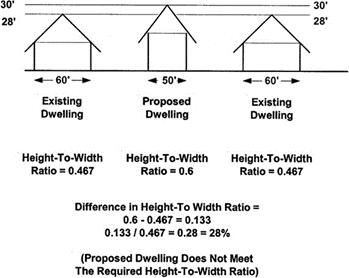
Building Height: No new residential dwelling within the residential infill development overlay zone shall be constructed which is more than twenty-five percent (25%) above or below the average height-to-width ratio of existing residences abutting the lot to be developed on the same block. If only one (1) residence abuts the lot to be developed, that residence shall be used to determine the allowable height-to-width ratio. In no case shall a home exceed the height established in the underlying zoning district. The height-to-width ratio shall be calculated shown in the illustration below.
7.
Yard Sizes:
a.
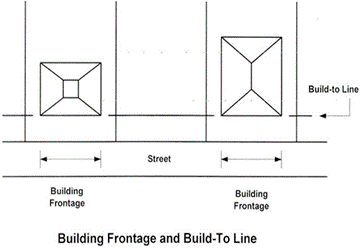
Front Yards — The front yards of infill development will be established by building-to the existing continuous building frontage line established along the street as shown in the illustration below. In the case of residential infill development on a corner lot, the prevailing principal building setbacks along the side street shall establish the build-to line along the side street. When the front setbacks of principal buildings (dwellings) in the vicinity of the proposed residential infill development vary in terms of distance from the right-of-way in a manner that does not result in a consistent street edge, the average front building setback for dwellings in the same block facing the same street shall establish the build-to line.
b.
Side Yard Minimum — six (6) feet
c.
Rear Yard Minimum — twenty (20) feet
5.5.13 - Planned Development Classification
A.
Intent:
This district is intended to provide a flexible approach for unique or innovative development proposals which would not otherwise be permitted by this code. Residential development that occurs pursuant to these standards shall be designated "PD-R" on the Town of Pierson Official Zoning Map. Commercial development that occurs pursuant to these standards shall be designated "PD-C" on the Town of Pierson Official Zoning Map. Notwithstanding the specific criteria identified herein, proposals shall accomplish the following purposes to the greatest extent reasonably possible.
1.
Provide for the efficient use of land resulting in smaller networks of utilities and streets and thereby lowering development and housing costs.
2.
Provide a high-quality design that preserves open space and protects environmentally sensitive natural areas.
3.
Provide for a visually attractive physical environment through the coordination and consistent use of architectural styles, landscaping designs and other elements of the built environment; and
4.
Provide for other limitations, restrictions, and requirements as deemed necessary by the Town to ensure compatibility with adjacent neighborhoods and effectively reduce potential adverse impacts.
B.
Uses:
The uses allowed in a PD district shall be set forth in the Master Development Agreement and shall be consistent with the subject property's Future Land Use Map designation as established in the Town of Pierson's Comprehensive Plan. The maximum intensity and density of such uses allowed within any Planned District shall be consistent with the Comprehensive Plan.
C.
Unified Ownership:
All land within the Planned Development shall be under the ownership or control of the applicant at the time of execution of the Master Development Agreement whether the applicant is an individual, partnership, corporation, or any other legal entity.
D.
Minimum Parcel Size:
The minimum size of any property proposed for residential development shall be five (5) acres in size. There shall no minimum parcel size for commercial development. Smaller residential parcel sizes may be allowed if the applicant can show that the following conditions exist:
1.
The proposal planned development better adapts itself to the physical and aesthetic setting of the site than could be developed using the provisions allowed in the standard zoning classifications; and
2.
The proposed planned development would benefit the area surrounding the project to a greater degree than development allowed in the standard zoning classifications.
E.
Dimensional Standards:
The dimensional standards in each Planned Development district shall be as established in the Master Development Agreement, and shall be appropriate for the particular type of development that is proposed by the applicant. The Master Development Agreement shall include at a minimum the following types of dimensional standards:
1.
Maximum dwelling units per acre or maximum floor area ratio;
2.
Minimum lot areas;
3.
Minimum lot widths;
4.
Maximum building heights;
5.
Minimum and/or maximum setbacks;
6.
Minimum open space to be provided; and
7.
Minimum perimeter landscape buffers;
8.
Minimum buffers provided for the compatibility of the planned development with adjoining residential development or residential zoning districts.
F.
Overall Development Plan:
Each application for a Planned Development zoning classification shall include an Overall Development Plan (ODP) for the property. Before approving a new Planned Development district classification, the Town Council shall find that the ODP complies with the following standards:
1.
Identifies the general location and size of individual development areas,
2.
Identifies the specific type of development and the density or intensity allowed in each development area;
3.
Identifies the on-site transportation circulation system, including the general location of all public and private streets, pedestrian/bicycle pathways, and how they will connect with the existing or planned transportation system;
4.
Identifies the general location of all buffers;
5.
Identifies the general location of on-site potable water and wastewater facilities, and how they will connect to existing or planned systems;
6.
Identifies the general location of on-site stormwater management facilities, and how they will connect to existing or planned systems;
7.
Identifies the general location, amount, and type (whether active or passive) of all open space on the property;
8.
Identifies the location of all environmentally sensitive lands, wildlife habitat, and water bodies existing on the property.
Notwithstanding the minimum requirements for the ODP outlined herein, an applicant may elect to provide a more detailed set of site plan and/or subdivision documents that meet the applicable requirements of the Unified Land Development Code in order to bundle those approvals with the adoption of the Planned Development District.
G.
Master Development Agreement:
Each application for a Planned Development zoning classification shall include a Master Development Agreement (MDA) for the property. Before approving a new PD zoning district classification, the Town Council shall find that the MDA complies with the following standards:
1.
Includes a statement of objectives for the Planned Development;
2.
Includes any conditions related to the form and design of development;
3.
Includes a description of all uses by type authorized within the Planned Development;
4.
Includes provisions addressing how transportation, potable water, wastewater, stormwater management, and other public facilities or infrastructure will be provided to accommodate the proposed development;
5.
Includes provisions related to the protection and maintenance of any environmentally sensitive lands on the property;
6.
Includes provisions that provide for the perpetual maintenance of all common areas and open space on the property;
7.
Includes an explanation of any phasing of the project or other relevant timing considerations;
8.
Includes a list of any subsequent approvals that may be necessary to implement the planned development;
9.
Includes the dimensional standards and any other provisions such as landscape requirements or architectural standards the Town Council determines are relevant and necessary to the ensure the quality and compatibility of the development illustrated the ODP.
10.
Includes provisions for modifications to the ODP.
11.
Includes provisions for the term, expiration date and amendment of the MDA.
H.
Application Review Process:
The application forms and approval process shall be the same as that followed for any amendment to the official zoning map of the Town of Pierson. Prior to the second reading of the ordinance classifying any property as a Planned Development, the applicant shall provide a fully executed copy of the Master Development Agreement to the Town Clerk. The signed document shall be a fully corrected copy addressing all the issues discussed prior to the scheduled second reading.

