
Pleasant Hill City Zoning Code
SECTION 24003
APPLICATIONS AND GENERAL PROCEDURES
Sec. 24003.1.- Application process and official filing date.
a.
Standardized forms. Requests for any development approvals required by the UDC shall be made on applications provided by the city. The city may promulgate submittal requirements, instructions for completing forms, internal procedures for acceptance and filing of applications, and provisions for waiver by establishing administrative guidelines. Additional information may be required for particular applications.
b.
Submission and determination of complete application. All development applications shall be submitted to the director, who shall review the application for completeness. No application shall be considered complete until all items required by the applicable sections of the UDC to be submitted in support of the application have been submitted. Incomplete applications shall be returned to the applicant and no action taken until any deficiencies are remedied. Complete applications shall be processed according to this section. Failure by the director to make a determination of completeness within 14 days of the submission of the application shall result in the application being deemed complete. A determination of completeness, shall not constitute a determination of compliance with the substantive requirements of this chapter.
c.
Processing of application and report. Following the determination that a development application is complete or is deemed complete under this section, the director shall review the application, forward the application for review to applicable advisory bodies, and prepare a report, if any, to the planning commission or city council, as may be required, within 30 days. Upon filing of the report with the secretary of the commission or city clerk, the director shall schedule the matter for public hearing and/or decision within the time and in the manner required by this chapter.
d.
Official filing date. The time for processing applications for development permits or acting on such applications established by Revised Statutes of Missouri or by the UDC shall commence on the date that a complete application has been filed, together with all required reports thereon, with the secretary of the approval body. Modification of any application by the applicant following the filing of the application and prior to the expiration of the period during which the city is required to act shall extend the period for a like time following the director's determination that the modified application is complete and the application is re-filed.
(Ord. No. 1794, § 3, 7-23-2018)
Sec. 24003.2. - Planning commission.
a.
Establishment. The Pleasant Hill Planning Commission is hereby established in accordance with RSMo 89.320.
b.
Membership. The members of the planning commission shall be appointed by the mayor and approved by the city council.
c.
Number. The planning commission of the city shall consist of seven members, including a member of the city council selected by the council annually at its first organizational meeting, and six citizens appointed by the mayor and approved by the council.
d.
Residency. All citizen members of the commission shall serve without compensation. The term of each of the citizen members shall be for four years, except that the terms of the citizen members first appointed shall be for varying periods, so that the succeeding terms will be staggered.
e.
Membership on another city board or commission prohibited. No member of the planning commission shall serve on any other Pleasant Hill board or commission during that member's term of office. Those currently serving on one or more shall be grandfathered.
f.
Secretary. The director shall serve as secretary to the planning commission.
g.
Holding office.
1.
Term of office. The terms of the members shall be four years or until their successors take office.
2.
Removal from the commission. Members may be removed for cause on written charges by a majority of the city council. Further, whenever a member shall be absent without excuse from more than two consecutive regularly scheduled meetings or more than three such meetings in one year, the chair shall forthwith notify the city manager. Acting upon such notification, the city manager shall remove said member from the commission. A new member shall then be appointed by the mayor to fill the unexpired term in accordance with the regular method of making appointments to the commission. An absence is "excused" when the chair, with the concurrence of a majority of the commission members present, shall note such excused absence in the minutes of the meeting at which the member is not in attendance, or at the meeting immediately following.
3.
Vacancies. Vacancies may be filled by the mayor, subject to the approval of the city council for the unexpired term of any member whose seat becomes vacant.
4.
Compensation. The members shall serve without compensation but shall be reimbursed for expenses they incur while on commission business.
h.
Administration.
1.
Powers and duties. The planning commission shall have all of the powers and duties specifically assigned in this chapter.
2.
Rules of procedure. The planning commission may adopt rules of procedure consistent with the provisions of this chapter.
3.
Chairperson administers oaths. The chairperson, or in the absence of the chairperson, the acting chairperson, shall administer oaths.
4.
Meetings. All meetings of the planning commission shall be open to the public.
5.
Notice of meetings. Public notice of meetings of the planning commission shall be given in at least one publication in a newspaper of general circulation in the city.
6.
Time of notice. Planning commission shall be posted no less than 15 days before the date of the hearing.
7.
Notice to news media. The planning commission shall notify all local news media when requested to be notified of all meetings of the commission.
8.
Contents of notice. The notice of the meetings of the planning commission shall include the following:
(a)
The time and place of the meetings.
(b)
The official docket of the planning commission.
(c)
The place where the specific requests will be accessible for examination by interested parties.
9.
Minutes. The minutes of the meeting shall be filed in the office of the director.
10.
Public record. The minutes shall be a public record.
i.
Public hearing and recommendation by planning commission. Whenever the planning commission is required by the Revised Statutes of Missouri or these regulations to make a recommendation to the city council concerning a development application, the commission shall conduct a public hearing, if required by this section. The public hearing shall be held within the time frame established by this title. If no specific time frame is established by this title for such hearing, the hearing shall be held within 30 days from the day the completed application is filed with the secretary of the commission by the director. If no public hearing is required, the commission shall consider the matter at a regularly scheduled public meeting. The commission's written recommendations, if any, together with the staff report and recommendation, if any, shall be filed with the clerk of the city within ten days of the date the commission's recommendation is made.
j.
Decision by planning commission. If the planning commission has been delegated final decision-making authority for a development application pursuant to these regulations, whether by original jurisdiction or upon appeal, it shall decide whether to approve, conditionally approve or deny the application at a public meeting, following receipt of the report and recommendation of the director. If a public hearing is required by these regulations prior to decision, the hearing shall be conducted in the manner provided in section 24003.6. The commission shall prepare a written statement setting forth the basis for its decision.
k.
Notification and appeal from decision by planning commission. The director shall notify the applicant of the decision of the planning commission within ten days of such decision in the manner provided in section 24003.6. The applicant may appeal the decision of the planning commission in the manner provided in section 24003.7.
(Ord. No. 1794, § 3, 7-23-2018)
Sec. 24003.3. - Review and decision by city council.
a.
Public hearing by city council. Whenever the council is required by the Revised Statutes of Missouri or these regulations to review and decide upon a development application, the council shall conduct a public hearing, if required by these regulations, in accordance with the provisions of section 24003.6. The public hearing shall be held within the time frame established by these regulations. If no specific time frame is established for such hearing, the hearing shall be held within 30 days from the day the application is filed with the city council. If no public hearing is required, the city council shall consider the matter at a regularly scheduled public meeting.
b.
Decision by the city council. If the city council is the final decision-making authority for a development application pursuant to these regulations, whether by original jurisdiction or on appeal, it shall decide whether to approve, conditionally approve or deny the application at a public hearing, following the receipt of the recommendation of the planning commission. If a public hearing is required by these regulations prior to a decision, the hearing shall be conducted in the manner provided in section 24003.6. If the city council denies the application, a written statement setting forth the basis for the decision to deny shall be prepared.
c.
Notification and appeal from the decision of the city council. The director shall notify the applicant of the decision within ten working days of such decision in the manner provided in section 24003.7. The applicant may appeal the decision of the city council in the manner provided in section 24003.7.
(Ord. No. 1794, § 3, 7-23-2018)
Sec. 24003.4. - Conditional approval.
a.
Authority to condition development approvals. The director, the planning commission, the city council or board of zoning adjustment may impose conditions as are reasonably necessary to assure compliance with applicable general or specific standards stated in these regulations after review of the application and other pertinent documents and any evidence made part of the public record. Any conditions imposed by recommendation of the director or planning commission may be modified subsequently by the city council.
b.
Record and notification of conditions. The director shall include a copy of the conditions attached to approval of the development application with the record of the decision which is filed with the secretary of the final decision-maker or the clerk of the city. The applicant shall be notified of any conditions proposed or imposed on the application in the manner provided in section 24003.5.
(Ord. No. 1794, § 3, 7-23-2018)
Sec. 24003.5. - Notice provisions.
a.
Published notice. When required and except as otherwise specifically provided in these regulations, in any instance in which a public hearing is required, a published notice setting forth the date, time, place and purpose of such hearing, the name of the applicant, and identification of the subject property must be posted in compliance with city and state regulations. The notice shall be prepared by the city.
b.
Posted sign notice. The director shall post, in a designated locations in city hall and on applicable media sites, notification described in the preceding paragraphs, the director shall post distinctive signs giving notice of the hearing and of the action requested. The director shall post at least one sign at least 15 days prior to the hearing in conspicuous places visible from every street along the frontage of the subject property. The signs shall remain posted on the property until after the public hearing.
c.
Notification following decision. Within ten days of the date of the final decision-maker's determination on the development application, written notification of such action shall be mailed to the applicant, stating the action taken and including all conditions imposed and times established for satisfaction of such conditions, if any. If the final decision-maker denies the application, a written statement setting forth the basis for the decision to deny the application also shall be included. Record of such notification shall be filed with the secretary of the planning commission or city clerk.
d.
Notification of appeal or revocation. Whenever appeal is taken from a final decision on a development application following a public hearing pursuant to section 24003.6, or whenever the city determines to revoke a development permit which was obtained following a public hearing, personal notice of the appeal or revocation shall be prepared and made in the manner prescribed by this section. If no public hearing was held prior to obtaining the development permit, personal notice of revocation shall be given only to the holder of the permit.
e.
Costs of notice. All actual costs incurred by the city in preparing and publishing the notice required by this chapter shall be paid by the applicant prior to publication or mailing of such notice according to a schedule of fees established by the city council.
(Ord. No. 1794, § 3, 7-23-2018)
Sec. 24003.6. - Public hearings procedures.
a.
Setting of the hearing. When the director determines that a development permit application is complete and that a public hearing is required by this title, the director shall consult with the secretary of the body required to conduct the hearing and shall select a place and a time certain for the required hearing, and shall cause notice of such hearing to be prepared and made pursuant to section 24003.5.
b.
Examination of and copying of documents. At any time upon reasonable request, any person may examine the application and materials submitted in support of or in opposition to an application for a development permit. Copies of such material shall be made available at a cost determined by the city council.
c.
Conduct of hearing.
1.
Any person or persons may appear at a public hearing and submit evidence, either individually or as a representative of an organization. Each person who appears at a public hearing shall state his or her name, address, and if appearing on behalf of an organization, the name and mailing address of the organization for the record.
2.
The body conducting the hearing shall exclude testimony or evidence that it finds to be irrelevant, immaterial or unduly repetitious. Any person appearing as a witness may ask relevant questions of other persons appearing as witnesses, but shall do so only through the chairperson of the body conducting the hearing at the chairperson's discretion. The order of proceedings shall be as follows:
(a)
The director shall present a description of the proposed development and a written or oral recommendation, if required. This recommendation shall address each factor required by the UDC to be considered prior to approval of the development permit. The staff's written recommendation shall be made available to the applicant at least five days prior to the hearing;
(b)
The applicant shall present any information that the applicant deems appropriate;
(c)
Public testimony shall be heard first in favor of the proposal, then in opposition to it;
(d)
The director may respond to any statement made by the applicant or any public comment; and
(e)
The applicant may respond to any testimony or evidence presented by the staff or public.
d.
Record of proceedings.
1.
The body conducting the hearing shall record the proceedings by any appropriate means and according to such procedures as the city council may, from time to time, prescribe by rule. Such record shall be provided at the request of any person upon application to the secretary of the body conducting the hearing and payment of a fee set by the city council to cover the cost of duplication of the audio record or tape.
2.
The tapes of all proceedings, including testimony and statements of personal opinions, the minutes of the secretary, all applications, exhibits and papers submitted and any proceeding before the body, all staff and advisory body or commission reports and recommendations, and the decision and report(s) of the body before which the hearing is heard shall constitute the record.
3.
All records of the body shall be public records, open for inspection at reasonable times and upon reasonable notice.
e.
Continuance of proceedings. The body conducting the hearing may, on its own motion or at the request of any person, for good cause, continue the hearing to a fixed date, time and place. No renotification shall be required if a hearing is continued to a date certain. An applicant shall have the right to request and be granted one continuance; however, all subsequent continuances shall be granted at the discretion of the body conducting the hearing only upon good cause shown.
f.
Additional rules. Where appropriate, additional rules governing the public hearing may be applicable. This includes other provisions of the City Code applicable to the body conducting the hearing and any of the body's adopted rules or procedures as long as the same are not in conflict with this chapter. The body conducting the hearing may adopt rules of procedure to limit the number of applications for development approval which may be considered per meeting and the time for each presentation.
(Ord. No. 1794, § 3, 7-23-2018)
Sec. 24003.7. - Post-decision proceedings.
a.
Reapplication following denial. Whenever any development application is denied for failure to meet the substantive requirements of this title, an application for development permit for all or a part of the same property shall not be considered for a period of one year from the date of denial unless the subsequent application involves a proposal that is materially different from the previously denied proposal or unless four members of the body charged with conducting the initial public hearing determine that the prior denial was based upon the material mistake of fact. The body charged with conducting the initial public hearing under such successive application shall resolve any questions concerning the similarity of the second application or other questions which may develop under this section.
b.
Appeals to city.
1.
Any person, including any officer or agency of Pleasant Hill, aggrieved by a final determination on a development permit by the director or final decision-maker may appeal such final determination to the appellate body designated by this chapter, if any, in the manner provided in this section.
2.
A written appeal must be filed with the secretary or clerk of the body hearing the appeal within 14 days after notification of the final decision. The appeal shall contain a written statement of the reasons why the final decision is erroneous, and shall be accompanied by the fee established by the city council.
3.
The appellate body shall hear the appeal within 30 days after the filing of the statement of reasons. The hearing shall be conducted in accordance with the provisions of section 24003.6.
4.
The appellate body may affirm, reverse or modify the decision from which appeal was taken within 30 days after the date the hearing is closed. The appellate body may attach such conditions as are reasonably necessary, as provided in section 24003.5.
c.
Judicial appeals. No action or proceeding shall be commenced for the purposes of seeking judicial relief or review with respect to any final decision made pursuant to the UDC, unless such action or proceeding is commenced within the time limits specified in RSMo chs. 49 and/or 536, as applicable.
(Ord. No. 1794, § 3, 7-23-2018)
Sec. 24003.8. - Expiration of development approval.
a.
Time of expiration. Unless otherwise specifically provided for in this chapter, development applications shall automatically expire and become null or void, and all activities pursuant to such approval thereafter shall be deemed in violation of the UDC, if: 1) the applicant fails to satisfy any condition that was imposed as part of the original or revised approval of the development application, or that was made pursuant to the terms of any development agreement within the time limits established therein for satisfaction of such condition or term; or 2) if the applicant fails to present a subsequent development application required by this title within the time so required or as may be required by Revised Statutes of Missouri. If no time limit for satisfaction of conditions is specified in the original or revised approval of the development application, the time shall be presumed to be one year from the date such approval was filed with the secretary of the final decision-maker or the city clerk.
b.
Extension procedures. Unless otherwise prohibited by Missouri law or this chapter, the director may extend the time for expiration of development permit for a period not to exceed one year upon a showing of good cause by the applicant, if application for extension is made in writing within the original period of validity. An extension for a period in excess of one year shall be granted only by the original final decision-maker. A determination by the final decision-maker on whether to extend such development permit for a period exceeding one year shall be made in accordance with procedures set forth in the UDC for original approval of the particular development permit for which extension is requested. No extension may be granted by the director or by the final decision-maker for a period exceeding any time limits established by Revised Statutes of Missouri.
(Ord. No. 1794, § 3, 7-23-2018)
Sec. 24003.9. - Revocation of permit.
a.
Duties of director. If the director determines, based on inspection by city staff, that there are reasonable grounds for revocation of a development permit authorized by this chapter, the director shall set a hearing before the original decision-maker. If the decision was made by the director, the hearing shall be conducted by the BZA. If the city council was the original decision-maker, it may refer the proposed revocation to the planning commission for its report and recommendation prior to such hearing.
b.
Notice and public hearing. Notice shall be given in the same manner provided in section 24003.5. The public hearing shall be conducted in accordance with the procedures established in section 24003.6.
c.
Decision and notice. Within 14 days from the conclusion of the hearing, the decision-maker shall render a decision, and shall notify the holder of the permit and any other person who has filed a written request for such notice in the manner provided in section 24003.6.
d.
Effect and appeals. A decision to revoke a development permit shall become final 14 days after the date notice of the decision was given, unless appealed. After such effective date, all activities pursuant to such permit thereafter shall be deemed in violation of the UDC. Appeal from the decision to revoke the permit shall be to the city clerk and shall conform to the procedures established in section 24003.7.
e.
Right cumulative. The city's right to revoke a development permit, as provided in this section, shall be cumulative to any other remedy allowed by law.
(Ord. No. 1794, § 3, 7-23-2018)
Sec. 24003.10. - Subdivision approval—Generally.
a.
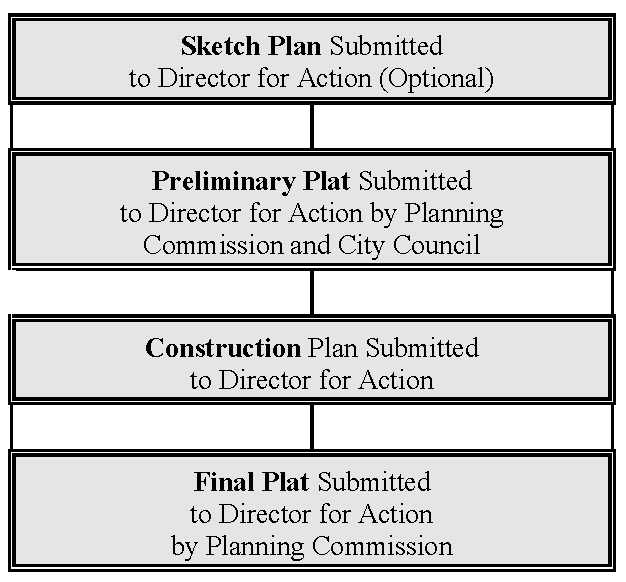
Major subdivisions. Major subdivisions (four or more lots) are subject to the following four-step approval process:
b.
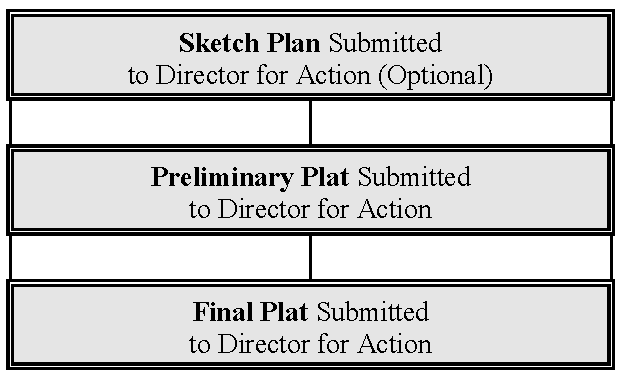
Minor subdivisions. Minor subdivisions (three lots or less) are subject to the following three-step process:
c.
Prohibited subdivisions. No person may subdivide land except in accordance with all of the provisions of this chapter. Except as exempted in this chapter, the following acts are prohibited:
1.
Parcel creation. Creation of parcels without subdividing, except those exceeding 20 acres and intended for agricultural use, is prohibited.
2.
Selling land prior to approved final plat. No owner or agent of the owner of any land subject to these regulations shall transfer title to any lot or tract before a final plat has been approved in accordance with the provisions of these regulations and recorded with the county department of records.
3.
Subdivision by metes and bounds. Subdivision by metes and bounds is prohibited. It shall be unlawful to subdivide any lot or any parcel of land by the use of metes and bounds description for the purpose of sale, transfer or lease with the intent of evading these regulations.
d.
Exemptions. The following divisions of land shall be exempt from these subdivision requirements:
1.
The public acquisition of land for improvements to public right-of-way.
2.
Any lot, parcel or tract of land located within the area governed by these regulations which has been legally subdivided or resubdivided by plat or deed prior to the adoption of these regulations.
3.
A division of property through inheritance, the probate of an estate, or by order of a court of law.
4.
A division of property where all new lots or parcels will be greater than 20 acres and all parcels abut a public street.
5.
The creation of a leasehold for a space within a multi-occupant building or a commercial building site, provided that the property is a part of an approved subdivision or addition and regulated in accordance with the site plan requirements of the county.
6.
The creation of a leasehold for agricultural use of the subject property, provided that the use does not involve the construction of a building(s) to be used as a residence or for any purpose not directly related to agricultural use of the land or crops or livestock raised thereon.
7.
The acquisition of land for regulated rail use. The public acquisition of land for improvements to public right-of-way.
(Ord. No. 1794, § 3, 7-23-2018)
Sec. 24003.11. - Pre-application procedures—Sketch plan.
a.
Sketch plan. Before any application is made pursuant to these regulations, the owner, the owner's agent, the applicant and/or the owner's surveyor, engineer or land planning consultant (collectively "applicant") may, at the applicant's discretion, confer with the director to discuss, in general, the procedures and requirements for subdivision and/or site plan approval pursuant to these regulations, and more specifically, the tentative development plans of the applicant.
b.
Sketch plan contents. In preparation for this meeting, the applicant shall prepare a sketch plan. The following information will be required for a thorough administrative review of the sketch plan:
1.
Name of the proposed subdivision;
2.
Date, scale, north arrow;
3.
Property owner's name and address;
4.
Description of all existing covenants, liens and encumbrances;
5.
Location of property lines;
6.
Existing or platted easements, rights-of-way, streets or other public ways;
7.
Location, sizes and elevations of existing sewers, water mains, culverts, and other underground structures within the boundaries of the proposed subdivision and adjacent thereto;
8.
Existing permanent buildings;
9.
Utility poles and utility rights-of-way on or immediately adjacent to the property proposed to be subdivided;
10.
Approximate topography based on USGS or NAVD datum at ten feet contour intervals;
11.
Approximate location and width of all proposed streets within and abutting the proposed subdivision;
12.
Preliminary proposals for connections with existing water supply and sanitary sewerage systems, and preliminary proposals for collecting and discharging surface water drainage;
13.
Approximate location, dimensions and area of all proposed and existing lots;
14.
Approximate location, dimensions and area of all parcels of land proposed to be set aside for park or playground use or other public use;
15.
Vicinity map showing all streets and the general development pattern and land uses of the surrounding area;
16.
If the sketch plan covers only a part of the applicant's contiguous holdings, the applicant shall show the extent of adjacent land holdings.
c.
Sketch plan review.
1.
Sketch plan review shall focus on applicable provisions of these regulations, physical features of the proposed development, the availability of public facilities and services, the timing and placement of public improvements and any comprehensive plan, official map and/or major street plan requirements.
2.
The director shall forward copies of the sketch plan to appropriate departments and agencies, assemble comments, and coordinate recommendations from all public service providers.
3.
The director shall determine whether the proposed development will be classified as a minor subdivision or a major subdivision as defined in this chapter.
4.
The director shall send the applicant written comments regarding the proposed subdivision to assist the applicant in completing the subdivision process.
(Ord. No. 1794, § 3, 7-23-2018)
Sec. 24003.12. - Concept plan.
a.
Purpose. The purpose of the concept plan is to demonstrate conformance with the comprehensive plan, compatibility of land use and coordination of improvements within and among individually platted parcels, sections, or phases of a development prior to approval of a preliminary plat.
b.
Applicability. A concept plan shall be required when an applicant is applying for the subdivision of less than the entire, contiguous land area held in common ownership. The concept plan shall illustrate future development of the entire area under common ownership. Where a concept plan is required, no further development applications shall be approved until a concept plan has been submitted and approved.
c.
Contents.
1.
A concept plan shall be printed on 22" x 33" paper at a scale of one inch = 100 feet with all dimensions measured accurately to the nearest foot provided, however, that a different scale may be used if approved in writing by the director prior to submittal.
2.
The concept plan shall contain or have attached thereto:
(a)
Name and addresses of the developer, record owner, land Planner, and engineer.
(b)
Proposed name of the subdivision, date revised and/or prepared, north indicator, scale.
(c)
Location map drawn at a scale of 2,000 feet per inch showing the area within a one mile radius of the proposed subdivision. Use of the latest USGS 7.4 minute quadrangle map is recommended.
(d)
A layout of the entire tract and its relationship to adjacent property, existing development and recorded plats.
(e)
Topographic contours based on USGS or NAVD Datum at ten-foot intervals based on USGS or NAVD Datum unless otherwise approved by the director.
(f)
Proposed major categories of land use showing compatibility with the comprehensive plan.
(g)
Proposed number of dwelling units and gross density of each type of residence and proposed floor area ratio for all non-residential land uses.
(h)
Proposed and existing arterial and collector streets to serve the general area.
(i)
Location of sites for parks, schools and other public uses, and all areas of common ownership.
(j)
Significant drainage features and structures including any 100-year floodplains.
(k)
Significant man-made features such as railroads, buildings, utilities and drainage structures.
(l)
Approximate boundaries and timing of proposed phases of development.
(m)
Identification of known exceptional topographical, cultural, historical, archaeological, hydrological or any other physical conditions of the property to be developed or within 100 feet on an adjacent tract exist which will require the establishment of reasonable design standards in excess of the established minimum standards or require a variance from minimum standards.
e.
Procedure.
1.
A concept plan, prepared by a registered land surveyor or land planner together with a completed application form and filing fee shall be submitted to the planning commission for approval. A concept plan may be submitted for review and approval simultaneously with a preliminary plat provided, however, that the plat shall not be approved until the concept plan has been approved. If the concept plan and the preliminary plat are to be reviewed simultaneously, the plat and plan must be submitted to the director simultaneously. An approved concept plan shall be kept on file as a public record in the office of the director. If the remainder of an applicant's land holdings are intended to remain in agricultural production for the foreseeable future, the director may act on the plan without consulting the commission and may waive concept plan content requirements as appropriate.
2.
Legible prints, as indicated on the application form, shall be submitted at least 30 days prior to the regular meeting of the commission along with the following:
(a)
Completed application forms and the payment of all applicable fees.
(b)
A proposed phasing plan for the development of future sections.
(c)
Any attendant documents needed to supplement the information provided on the plat.
(d)
A complete preliminary plat submittal if submitted for review and approval in conjunction with the concept plan.
3.
Prior to the commission meeting at which the concept plan is heard, city staff shall review the plan for consistency with city codes, policies and plans, and return written comments to the director. The director shall prepare a report analyzing the subdivision submittal as well as any comments received concerning the plan, and recommend the approval, conditional approval or disapproval of the plan. Said report shall be available at least seven days prior to the commission meeting.
e.
Approval.
1.
If the remainder of an applicant's land holdings are intended to remain in agricultural production for the foreseeable future, the director may approve the concept plan. If the director does not approve the concept plan, the applicant may submit the plan to the commission to appeal the director's decision.
2.
The planning commission shall approve the concept plan if it finds that the following criteria are satisfied:
(a)
The concept plan conforms to all applicable provisions of the unified development code (UDC).
(b)
The concept plan represents an overall development pattern that is consistent with the goals and policies of the city comprehensive plan, official zoning map, capital improvements program, and any other applicable planning documents adopted by the city.
(c)
The proposed development is located in an area of the city that is appropriate for current and future development activity and which will not contribute to sprawl and leapfrog development patterns nor to the need for inefficient extensions and expansions of public facilities, utilities and services.
f.
Effect of approval. Approval of a concept plan constitutes acceptance of the type, density and intensity of land use indicated on the plan; the classification and arrangement of streets indicated; the proposed phasing plan; and the nature of utility service proposed. The commission shall notify the applicant of any design requirements in excess of the established minimum standards or of any deviations from those established minimum standards or of any deviations from those established minimum standards set forth in the UDC. The approval of the concept plan shall not expire as long as the development proceeds in accordance with the phasing plan. At such time as the development lags one year behind the approved phasing plan, the approval shall expire if the applicant does not submit a written request for the extension and continuance of the concept plan as approved by the city prior to expiration. Approval of any such extension request shall be automatic one time only for a period of 12 months. Subsequent to this extension, the concept plan shall be considered valid so long as the plan remains consistent with the comprehensive plan. Concept plan approval does not ensure approval of a preliminary plat involving a substantially different concept or failing to meet specific requirements of these regulations, and approval does not comprise any vesting of development rights or any assurance that permits of any kind will be issued.
g.
Denial and appeal. If the planning commission finds that the concept plan fails to meet the criteria established in the section, it shall deny the concept plan application. The applicant may appeal such denial to the city council.
(Ord. No. 1794, § 3, 7-23-2018)
Sec. 24003.13. - Preliminary plats.
a.
Submittal requirements. Applicants for major subdivision approval shall submit an application and preliminary plat to the director. The preliminary plat shall be in sufficient detail to convey the applicant's ideas and intentions in platting the proposed subdivision. It shall contain a written description of the existing conditions on the tract and the necessary drawings and sketches as required by this section to convey the applicant's plan of development. The plat shall be signed by a registered surveyor.
b.
Filing procedure. The applicant shall file the following with the director, at least 30 days prior to the regular planning commission meeting at which the preliminary plat is to be considered:
1.
A reproducible original and a sufficient number of copies of the proposed preliminary plat as specified on the application;
2.
Copies of all other information required by this section as specified on the application;
3.
The applicable plat review fee; and
4.
A complete list of the names and mailing addresses of all owners of record of all land within the appropriate perimeter boundaries of the proposed subdivision.
c.
Contents. Preliminary plats for major subdivisions shall include the following:
1.
Tract boundaries (traverse bearings and distances of the boundaries).
2.
North point, date and scale on each page. The scale shall be one inch equals one hundred feet (1" = 100') unless specifically waived by the director.
3.
Location by section, township, range, city, county and state, including descriptive boundaries of the subdivision.
4.
Name of the proposed subdivision. This name shall neither duplicate nor too closely resemble the name of any existing subdivision.
5.
A location map showing the tract in relation to the surrounding area.
6.
Names and addresses of the applicant, developer(s), owners(s) of record, and the name, address and seal of the engineer, land surveyor, architect or land Planner responsible for subdivision layout.
7.
The following information for land located within 200 feet of the proposed subdivision: topography based on USGS or NAVD Datum at five-foot contour intervals; names of adjacent subdivisions; layout of streets (with names) and including an indication of road surface locations whether such streets are paved or unpaved; dedicated rights-of-way with widths; connections with adjoining platted streets; widths and locations of alleys; easements, and public walkways adjacent to or connecting with the tract; location, size and rights-of-way widths of all existing sanitary sewer, storm sewer, and water supply facilities; parks and other open spaces; and permanent buildings.
8.
Existing topography with contours at a maximum of five-foot intervals. All topographic data shall relate to USGS or NAVD Datum. In areas where grades are gentle, the Director may require a lesser contour interval. The location of water courses, limits of floodplains, floodways, ravines, bridges, lakes, wooded areas, approximate acreage and such other existing features as may be pertinent to the subdivision shall be shown.
9.
Existing and proposed deed restrictions and protective covenants.
10.
Location of proposed culverts and bridges.
11.
Layout and width of right-of-way and cross sections showing surfacing of all existing and proposed streets and public ways proposed for the subdivision, and proposed street names.
12.
Lot layout, lot number, approximate dimensions, approximate lot areas, easements, setback requirements with dimensions, and the number or letter of each block.
13.
All parcels of land to be dedicated or reserved for public use or for use in common by property owners in the subdivision and any conditions of such dedication or reservation.
14.
Preliminary plans showing the locations and sizes of all existing and proposed sanitary sewerage lines, on site systems and facilities, the locations and sizes of all existing and proposed water distribution system lines and facilities, the location of the closest existing water and sewer mains, and the location and character of all other existing and proposed public utility lines, including gas and power lines. These plans shall be accompanied by a written and signed statement explaining how the applicant proposes to provide sewage treatment facilities or other disposal of sanitary wastes. When the applicant intends to use existing sewage treatment facilities, a letter from the proper authority accepting responsibility for treatment of sanitary wastes from the proposed subdivision is required to be provided by the applicant.
15.
Stormwater management plan pursuant to section 24006.5, calculations, and proposed size, nature and location of all proposed storm drainage improvements.
16.
Identification, location and nature of all existing and proposed zoning districts and land uses to be included within the subdivision and the zoning district and status of adjacent properties within 200 feet of the subdivision.
17.
Existing building footprints and pavement boundaries.
18.
Proposed use of lots.
d.
Application date.
1.
The director shall review the plat and other information and documentation submitted by the applicant and, within ten working days, determine if the application as submitted is complete.
2.
If the application is determined to be complete, the director shall so notify the applicant and forward the application to the commission for review at its next regularly scheduled meeting.
3.
If the application is determined to be incomplete, the director shall return the application to the applicant with a written explanation specifying the additional information required to be submitted to complete the application.
4.
For the purposes of these regulations, the date of the regular meeting of the commission at which time a complete preliminary plat is reviewed shall constitute the official submittal date of the plat. The 30-day period for formal approval or disapproval of the plat will commence from the official submittal date of the preliminary plat.
e.
Action on the preliminary plat—Meeting. Within 30 days after the submittal of a complete preliminary plat application for a major subdivision to the commission, the commission shall hold a meeting on the application. Notice of the meeting shall be posted at least one time.
f.
Commission decision. Following the hearing, but still within 30 days of submission of the complete preliminary plat, the commission shall recommend approval, disapproval, or approval with conditions. The commission, with the consent of the applicant, may extend the 30-day period. Notice of the commission's decision shall be forwarded to the applicant in writing within ten days after the commission's action on the application.
g.
Guidelines for commission decision. The commission shall consider the following criteria in making a recommendation on the preliminary plat.
1.
The plat conforms to all applicable provisions of the UDC.
2.
The plat represents an overall development pattern that is consistent with the goals and policies of the comprehensive plan, the official map, the capital improvements program, and any other applicable planning documents adopted by the city.
3.
The location, spacing and design of proposed streets, curb cuts and intersections are consistent with good traffic engineering design principles.
4.
The plat is served, or will be served at the time of development, with all necessary public utilities, including, but not limited to, water, sewer, gas, electric, and telephone service.
5.
Each lot in the plat of a residential development has adequate and safe access to/from a local street. If lot access is to/from a collector or arterial street, the commission shall expressly find that such access is safe and that no other lot access or subdivision configuration is feasible.
6.
The plat will be laid out and developed in a manner that is sensitive to environmental features and/or characteristics of the tract or parcel including, but not limited to, topography, slope, soils, geology, hydrology, floodplains, wetlands, vegetation and trees.
7.
The plat is located in an area of the city that is appropriate for current development activity and which will not contribute to the need for inefficient extensions and expansions of public facilities, utilities and services.
8.
The applicant agrees to dedicate land, right-of-way and easements, as may be determined to be needed to effectuate the purposes of these regulations and the standards and requirements incorporated herein.
9
All relevant and applicable submission requirements have been satisfied in a timely manner.
h.
City council. Following action by the commission, the city council shall review the application and the recommendation of the commission and either approve, conditionally approve, or disapprove the preliminary plat.
1.
If the preliminary plat is approved or approved with conditions, the applicant shall meet or arrange to meet the conditions and then proceed with the construction plan and final plat approval processes.
2.
If the preliminary plat is disapproved, the city clerk shall, within ten days of the council's action, record the reasons for disapproval in the journal of the city council's meeting, notify the applicant in writing of the action and the reasons therefore and return the preliminary plat to the applicant.
i.
Effect of preliminary plat approval. Preliminary plat approval shall confer upon the applicant, for a period of one year from the date of approval by the city council, the right to proceed to final plat approval and to develop the subject tract or parcel pursuant to the terms and conditions pursuant to which the preliminary plat approval was granted by the city council. The one-year period may only be extended by the commission and only if the applicant has applied in writing for an extension and the commission determines that a longer period should be granted. If no final plat on any portion of a subdivision for which preliminary approval has been granted is approved within said one-year period, or such longer period as the commission may expressly allow, a re-submission of the preliminary plat (or a revised preliminary plat) shall be required pursuant to the then current subdivision regulations and any other applicable land use regulations or requirements. After approval of the preliminary plat, the applicant shall prepare and file construction plans as required for all public facilities and utilities to be provided.
(Ord. No. 1794, § 3, 7-23-2018)
Sec. 24003.14. - Construction plans/construction of improvements.
a.
Construction plans.
1.
Following approval of the preliminary plat, the applicant shall have prepared by a professional engineer registered in the State of Missouri construction plans, consisting of complete construction drawings and specifications of all easements, streets, traffic control devices, street lights, sanitary sewers, storm water facilities, water system facilities, sidewalks and other improvements required by the UDC. Construction plans shall be submitted to the director for review and approval.
2.
All improvements required pursuant to these regulations shall be constructed in accordance with the design standards and plan requirements of the UDC, the standards and specifications of the city, and, where applicable, the requirements and authorization of the appropriate state agency, utility company or local franchisee.
b.
Construction plan requirements.
1.
General. The construction plan shall be sealed by a professional engineer. Five copies of the construction plans shall be submitted to the director for review. The construction plans shall be at any scale from one inch equals ten feet (1" = 10') through one inch equals one hundred feet (1" = 100'), so long as the scale is an increment of ten feet and is sufficiently clear in reflecting details of the proposed construction. construction plans shall be prepared on 22" x 34" sheets. The preliminary plat or title page shall be used as the cover sheet for the construction plans. The plans shall include the following information, shown on separate sheets:
(a)
The preliminary plat for the project drawn on the existing topographic survey of the property.
(b)
Roadway, sidewalk, bikeway and traffic control construction plans, profiles and detail sheets.
(c)
Sanitary sewer system construction plans, profiles and detail sheets.
(d)
Storm water management plan showing plan and profile of proposed storm sewer and drainage facilities, detail sheets, hydrological and hydraulic calculations and other information as required by the director.
(e)
Proposed grading cross sections and final contours in critical drainage areas.
(f)
Water distribution system construction plans and details.
(g)
Locations of electric, telecommunications and other utility improvements.
(h)
A general schedule of the timing and sequence of construction for all required improvements.
(i)
Roadway construction detail sheets. All construction details pertaining to the roadway improvements (e.g., pavement details, pavement width, curbing, sidewalk, unpaved areas, entrances, lighting, etc.) shall be shown on typical section, in plan and profile. Specific details shall include, but not be limited to:
(1)
Pavement installation, widening, or resurfacing improvements dimensioned and developed in accordance with city improvement standards.
(2)
Pavement widening and resurfacing improvements in the right-of-way as measured from the centerline.
(3)
Mathematical profile grade and elevations at 25 feet intervals on vertical curves and 50 feet intervals on tangent sections for all roadway construction. Elevations at quarter point intervals along pavement edge at street intersection corners.
(4)
Resurfacing profile grade elevations on existing centerline and edges of pavement at 25-foot intervals and breaks in grade (i.e., irregularities in pavement).
(5)
Jointing plan and details for portland cement concrete pavement.
(6)
Type and location of entrance construction.
(7)
Proposed traffic control devices and signs to be used during construction and upon completion of the project.
(j)
Sanitary sewer, storm drainage, and water line plans and profile sheets. All construction details pertaining to the sanitary sewerage, storm drainage and water distribution system improvements shall be prepared in accordance with all requirements of these regulations and other pertinent city and or state regulations and standards and shall be shown in plan and profile. With the approval of the director, profiles may be omitted from water distribution system drawings. Specific details shall include, but shall not be limited to:
(1)
Existing ground and finished grade shown and designated.
(2)
Methods to be used in repairing open trenching of pavement.
(3)
Limits of backfill and pavement replacement at all crossings of existing roadway surfaces not bored.
(4)
Location of all utilities to be encountered in construction. Sufficient copies of plans must be submitted for utility providers.
(5)
Proof of plan approval by any other political subdivisions having jurisdiction over any aspect of the proposed development must be received prior to construction plan approval.
(k)
Grading plan and cross section sheets. A grading plan for the entire tract within the preliminary plat boundaries shall be provided. All grading details pertaining to site development shall be shown in plan or on cross section sheets. Specific details shall include, but shall not be limited to:
(1)
Existing and proposed contours, normally at two-foot intervals, in critical drainage areas. Contour intervals for grading plans greater than two feet will require the director's approval.
(2)
Site grading shall be compatible with ultimate roadway elevations.
(3)
Where required by the director, cross sections showing existing ground and finished grades plotted at a scale of not less than one inch equals one hundred feet (1" = 100') horizontal and one inch equals ten feet (1" = 10') vertical.
(4)
Erosion control plan, as applicable, showing compliance with state requirements.
c.
Public agency reviews. Prior to approving the construction plans, the director shall submit the construction plans to all applicable local reviewing agencies and public utility companies that will service the subdivision. The director shall forward comments from those agencies to the applicant along with the city's comments.
d.
Timing of improvements. Except upon the written approval of the director, no grading, removal of trees or other vegetation, land filling, construction of improvements, or other material change, except for purposes of aiding in preparation of final engineering drawings or plans, shall commence on the subject property until the applicant has:
1.
Entered into a subdivision improvement agreement with the city or otherwise arranged for completion of all required improvements;
2.
Received approval of the construction plans and all necessary permits from the director; and
3.
Obtained necessary approvals and permits from other affected, city or state agencies.
e.
Modification of construction plans. All installations of improvements and all construction shall conform to the approved construction plans. If the applicant chooses to make minor modifications in design and/or specifications during construction, such changes shall be made at the applicant's own risk, but only with the written approval of the director. It shall be the responsibility of the applicant to notify the director in advance of any changes to be made from the approved drawings. In the event that actual construction work deviates from that shown on the approved construction plans and such deviation was not approved in advance by the director, the applicant may be required to correct the installed improvements to conform to the approved construction plans. In addition, the city may take such other actions as may be deemed appropriate including, but not limited to, revocation of plat approval and/or permits already issued and/or withholding of future approvals and permits.
f.
As-built drawings.
1.
Prior to final inspection of the required improvements, the applicant shall submit to the director one reproducible copy, two prints and one electronic copy of as-built engineering drawings for each of the required improvements that have been completed. Each set of drawings shall be recertified by the applicant's engineer indicating the date when the as-built survey was made.
2.
Sewer and storm drainage. As-built drawings shall show the constructed vertical elevation, horizontal location and size of all sanitary and storm sewers, manholes, inlets, junction boxes, detention basins and other appurtenances or elements of the sewerage and storm drainage systems constructed to serve the subdivision.
3.
Streets and street lights. Unless otherwise required by the director, as-built drawings for roadways or street improvements shall be limited to a survey of the street centerline, with final profile elevations recorded on the drawings at 100-foot intervals, plus the notation of changes in horizontal alignment or intersection geometrics which may have been made during construction, and the location of street lights.
4.
Water. As-built drawings for water lines, valves, fire hydrants and other appurtenances or elements of the water distribution system constructed to serve the project shall be limited to horizontal location and size of water lines and location and description of valves with dimensional ties as may be required by the director of public works.
5.
Sidewalks. As-built drawings showing location with respect to the street right-of-way, width and vertical elevation.
6.
Control points. As-built drawings shall show all control points and monumentation.
g.
Inspection and acceptance of improvements.
1.
Inspection required. All improvements required by these regulations shall be inspected by the director, except for improvements made under the jurisdiction of other public agencies, in which case engineers or inspectors of such agency will make the necessary inspections. Where inspections are made by other agencies, the applicant shall provide the city with written reports of each final inspection.
2.
Inspection schedule. It shall be the responsibility of the applicant to notify the director of the commencement of construction of improvements 24 hours prior thereto.
3.
Compliance with standards. The applicant or the bonded construction contractor shall bear full and final responsibility for the installation and construction of all required improvements according to the provisions of these regulations and the standards and specifications of other public agencies.
4.
Acceptance.
(a)
Approval of the installation and construction of improvements by the director shall constitute acceptance by the city of the improvement for dedication purposes.
(b)
The city shall not have any responsibility with respect to any street, or other improvement, notwithstanding the use of the same by the public, unless the street or other improvements shall have been accepted by the director.
(c)
When improvements have been constructed in accordance with the requirements and conditions of these regulations and the specifications of the city, and the applicant has submitted as-built reproducibles to the director, the director shall accept the improvements for maintenance by the city, except that this shall not apply to improvements maintained by another entity.
5.
Site cleanup. The applicant shall be responsible for removal of all equipment, material, and general construction debris from the subdivision and from any lot, street, public way or property therein or adjacent thereto. Dumping of such debris into sewers, onto adjacent property or onto other land in the city is prohibited.
h.
Failure to complete improvements. If no subdivision improvement agreement has been executed and no security has been posted, the failure to complete all required public improvements within the period specified by the city shall result in expiration of plat approval. If a subdivision improvement agreement has been executed and security has been posted and required public improvements are not installed pursuant to the terms of the agreement, the city may:
1.
Declare the subdivision improvement agreement to be in default and require that all public improvements be installed regardless of the extent of completion of the development at the time the agreement is declared to be in default;
2.
Suspend final plat approval until the public improvements are completed and record a document to that effect with the county department of records for the purpose of public notice;
3.
Obtain funds pursuant to the surety and complete the public improvements by itself or through a third party;
4.
Assign its right to receive funds pursuant to the surety in whole or in part to any third party, including a subsequent owner of the subdivision or addition for whom the public improvements were not constructed, in exchange for the subsequent owner's agreement to complete the required public improvements; and/or
5.
Exercise any other rights available under the law.
(Ord. No. 1794, § 3, 7-23-2018)
Sec. 24003.15. - Completion of improvements/improvement agreements.
a.
Completion of improvements.
1.
Except as provided below, before the plat is signed as final by the director, all applicants shall be required to complete, to the satisfaction of the director, all street, sanitary, and other public improvements, as well as lot improvements on the individual residential lots of the subdivision or addition as required by these regulations. The required improvements shall be those specified in the approved preliminary or final plat.
2.
As a condition of final plat approval, the city council may require the applicant to deposit in escrow a deed describing by metes and bounds and conveying to the city all street rights-of-way, easements and public land required by these regulations, pending acceptance of improvements by the city and recordation of the final plat. In the event the applicant is unable to complete the required improvements, and such improvements are deemed necessary for the preservation of the public health and safety, the city may compel the delivery of the deed in order to complete the improvements as required.
b.
Improvement agreement and guarantee of completion of public improvements.
1.
Subdivision improvement agreement. The director may waive the requirement for the completion of required improvements if the applicant enters into a subdivision improvement agreement by which the applicant covenants and agrees to complete all required public improvements no later than two years following the date upon which the final plat is signed. Such two-year period may be extended for up to an additional two years upon its expiration at the discretion of the director. The director may require the applicant to complete and dedicate some required public improvements prior to approval of the final plat and to enter into a subdivision improvement agreement for completion of the remainder of the required improvements during such two-year period. The city attorney shall approve any subdivision improvement agreement as to form.
2.
Covenants to run with the land. The subdivision improvement agreement shall provide that the covenants contained therein shall run with the land and bind all successors, heirs and assignees of the applicant. The subdivision improvement agreement shall be recorded with the county department of records. All existing lienholders shall be required to subordinate their liens to the covenants contained in the subdivision improvement agreement.
3.
Performance security.
(a)
Whenever the director permits an applicant to enter into a subdivision improvement agreement, the applicant shall be required to provide sufficient security to ensure completion of the required public improvements. The security shall be in the form of a cash escrow or a surety bond.
(b)
The cash escrow or surety bond shall be in an amount estimated by the director as reflecting 120 percent of the cost of the improvements in the approved construction plan and shall be sufficient to cover all promises and conditions contained in the subdivision improvement agreement.
(c)
In addition to all other security, when the city participates in the cost of an improvement, the applicant shall provide a performance bond from the contractor, with the city as a co-obligee.
(d)
The issuer of any surety bond shall be subject to the approval of the city attorney.
4.
Escrow agent. If security is provided in the form of a cash escrow, the applicant shall deposit same with the city, as a cash amount or certified check endorsed to the escrow agent for a face value in an amount not less than the amount specified by the director.
5.
Accrual. The surety bond or cash escrow account shall accrue to the city for administering the construction, operation and maintenance of the improvements.
6.
Reimbursement. Where oversized facilities are required by the city, the city and applicant shall specify a reimbursement procedure in the subdivision improvement agreement.
c.
Maintenance bond.
1.
The applicant shall guarantee the improvements against defects in workmanship and materials for a period of three years from the date of city acceptance of such improvements. The maintenance guarantee shall be secured by a surety bond or cash escrow in an amount reflecting 50 percent of the cost of the completed improvements.
2.
If the applicant has entered into a subdivision improvement agreement for the completion of required improvements, an appropriate percentage of the performance bond or cash escrow may be retained by the city in-lieu of a maintenance bond.
3.
If the applicant has not entered into a subdivision improvement agreement, the applicant shall guarantee the improvements as required by this section. A surety bond or cash escrow totaling 50 percent of the costs of the completed improvements shall be provided by the applicant.
d.
Temporary improvements. The applicant shall construct and pay for all costs of temporary improvements required by the city and shall maintain said temporary improvements for the period specified.
e.
Governmental units. Governmental units to which these improvement and security provisions apply may file, in lieu of the agreement and security, a certified resolution or ordinance by the officers or directors authorized to act on their behalf, agreeing to comply fully with all applicable provisions of these regulations.
(Ord. No. 1794, § 3, 7-23-2018)
Sec. 24003.16. - Final plat.
a.
Filing procedure. Following approval and prior to the expiration of the preliminary plat, the applicant may continue the subdivision process by filing a final plat. The final plat application shall be filed with the director 30 days prior to the commission meeting at which the application is to be reviewed and shall contain:
1.
One reproducible original and a sufficient number of copies of the proposed final plat as specified on the application;
2.
Copies of the additional information required pursuant to subsection 24003.16.b hereunder as specified on the application;
3.
A completed application form;
4.
The applicable fees for filing and recording the plat, and for review of the construction plans; and
5.
An agreement in writing on a form provided by the city attorney that the developer will install all of the improvements required herein. A final plat shall not be accepted for review after the expiration of the preliminary plat.
b.
Information required. The final plat shall be prepared on tracing cloth, Mylar or similar quality material at a scale of one inch equals one hundred feet (1" = 100' or larger), unless specifically waived by the director, in a size that is a multiple of eight and one-half inches by eleven inches (8½" x 11"), with a maximum size of 22" x 34". Where a proposed subdivision does not fit on a single sheet, the final plat shall be submitted on two or more sheets of the same dimensions along with an index sheet showing the entire development at a smaller scale. The Final Plat shall show or have attached the following information:
1.
Name of the subdivision which shall neither duplicate nor too closely resemble the name of any existing subdivision;
2.
Date, scale and north arrow, on each page. The scale shall be one inch equals one hundred feet (1" = 100') unless specifically waived by the director, and shall be shown graphically and in feet-per-inch;
3.
Total acreage of the proposed subdivision;
4.
The location of the boundary in reference to existing official monuments or the nearest established street lines, including the angles and distances to such reference points or monuments, shall be furnished. The plat shall show all monumentation which shall be installed as required by the director in a manner that meets or exceeds current minimum standards for property boundary surveys;
5.
The location by section, township, range, city, county and state, including descriptive boundaries of the subdivision based on an accurate traverse giving angular and linear dimensions which shall mathematically close and which shall be tied into the state grid system. Bearings and distances of all exterior boundary lines and along the center lines of streets shall be furnished;
6.
The legal description of the entire tract to be subdivided. The registered surveyor shall determine the coordinates of each and every controlling corner of the boundary of the tract of land being surveyed or subdivided. The procedures and the coordinate values shall meet or exceed the current minimum standards for property boundary surveys of the department of natural resources, 10 CRS 30-2.010. These coordinate values will be shown on the final plats;
7.
Any ¼-¼ corner that is referenced on a subdivision plat shall be referenced to the proper controlling corners of the section (any two of the nine corners recognized by the government land office);
8.
The names, lines, three-line profiles, typical sections and grades of all proposed streets and their widths, right-of-way widths, and names;
9.
An accurate by metes and bounds description of any property offered for dedication to the city or another public entity for public use;
10.
The boundary lines of all adjoining lands for a distance of 100 feet and showing (with dotted lines) the right-of-way lines and adjacent streets and alleys with their widths and names;
11.
Building lines and easements for rights-of-way provided for public use, services or utilities, including navigation easements, with figures showing their dimensions and listing uses that are being provided;
12.
All dimensions and bearings, both linear and angular, radii and arcs, necessary for locating the boundaries of the subdivision, blocks, lots, streets, easements, building lines, and other areas to be dedicated for public or private use. The linear dimensions are to be expressed in feet and decimals of a foot;
13.
Area in square feet for each lot or parcel, which shall equal or exceed applicable zoning ordinance requirements;
14.
Building setback lines with dimensions;
15.
An accurate drawing of the proposed subdivision with the lots clearly numbered. If the blocks are to be numbered or lettered, these should be shown clearly in the center of the block;
16.
Approved construction plans conforming with the requirements of these regulations, for all roadway, grading, sanitary sewerage system, storm drainage facilities, water distribution system, and other pertinent site improvements. Two sets of such construction plans shall be submitted with the final plat;
17.
Boundary lines and description of the boundary lines of any areas other than streets and alleys which are to be dedicated or reserved for public use;
18.
Two copies of all deed restrictions and/or protective covenants and, if applicable, articles of incorporation and bylaws of a homeowner's association for the proposed subdivision;
19.
A statement dedicating all easements, streets, alleys and other public areas not previously dedicated;
20.
Certification by a registered land surveyor that all details of the plat are correct;
21.
Other certifications as required to comply with the UDC;
22.
Two copies of a sanitary sewer construction permit issued by the state, DNR which includes the approval of all lines and necessary appurtenances intended to serve the proposed lots as shown on the final plat;
23.
Other information pertaining to the proposed development as may be determined to be necessary from time to time by the commission to facilitate review of the final plat;
c.
Review procedures. The final plat shall conform as closely as possible to the approved preliminary plat. All improvements and facilities to be provided by the developer shall be approved by the director and installed prior to the issuance of an occupancy permit, or adequate security in lieu of making improvements shall be provided in accordance with section 24003.15 of these regulations. All required dedications and easements shall be offered for dedication on the final plat by the applicant before the commission shall approve the final plat; however, approval of the final plat shall not itself constitute acceptance of land for dedication. Acceptance of land dedication requires separate, written approval by the director.
d.
Substantial compliance with preliminary plat. Prior to submitting the final plat to the commission, the director shall review the plat for substantial compliance with the approved or conditionally approved preliminary plat. If the final plat for a subdivision is found to deviate substantially from the approved preliminary plat, the applicant will be required to submit a new final plat if the deviations are eliminated, or a new preliminary plat if the deviations are retained. If a new preliminary plat is required, the applicant must comply with other applicable land development regulations at the time of resubmittal. Substantial deviations shall include, but are not necessarily limited to, the following:
1.
A change in the location or design of a public street;
2.
A change in the layout of lots or blocks;
3.
A change in access to lots;
4.
A change in areas, streets or rights-of-way to be reserved or dedicated;
5.
A change in the drainage plan which increases the runoff from the tract;
6.
A change in the public utilities and facilities to be provided; and
7.
A change in the extent of buffering between the proposed subdivision and adjacent areas and/or land uses.
e.
Guidelines for decision. The commission shall consider the following criteria in making a decision on the final plat:
1.
The final plat substantially conforms to the approved preliminary plat and any conditions and exceptions granted pursuant thereto.
2.
The final plat conforms to all applicable requirements of these regulations, the zoning ordinance and other applicable land development regulations.
3.
All submission requirements of these regulations have been satisfied.
f.
Final plat approval.
1.
The commission shall, within 30 days following its consideration, approve, disapprove or approve with conditions the final plat and shall transmit written notice of its decision to the applicant.
2.
Pursuant to RSMo 445.030, the final plat shall not be recorded until it has been submitted to and approved by the city council by ordinance, duly passed and approved by the mayor, and such approval is endorsed upon the plat.
3.
The applicant may then file and record the plat. If the proposed final plat is disapproved, the secretary of the commission shall, within ten days of the commission action, record the reasons for disapproval in the minutes of the commission meeting, notify the applicant in writing of the action and the reasons therefore, and return the final plat to the applicant.
g.
Effect of final plat approval. Final plat approval shall confer upon the applicant the right to apply for building permits and to develop the subject tract or parcel pursuant to the terms and conditions pursuant to which the final plat approval was granted by the commission; provided, however, that no final plat shall be filed and recorded unless and until approval by the director. No lot in the subdivision may be sold until the final plat has been officially recorded. If the final plat is not recorded within 90 days after approval by the commission, the commission shall formally request the applicant to explain the extenuating circumstances preventing recordation of the final plat. The commission shall then determine whether provision of an extension would serve the best interests of the city. If these findings are negative, the commission shall revoke approval of the final plat and shall so notify the applicant, the city clerk.
h.
Requirements after approval.
1.
The applicant shall submit prints of the final plat on cloth and prints on paper for certification as specified by the director.
2.
The applicant shall submit on the final plat a certificate consenting to the recordation of the plat as submitted. This certificate shall be signed and acknowledged by all parties having any title interest in the land subdivided. The cloth copies shall carry the original signatures of the owners and a notary public.
3.
The final plat shall carry a certification by a registered surveyor that the details of the plat are correct.
4.
Certificates of approval shall be filled in by the signature and seal of the director.
i.
Filing and recordation. Within 90 days following final plat approval by the commission and signature of the director, the city shall file an approved plat with the county department of records. The applicant shall pay the city for all expenses in connection with the filing of the final plat. If the fees are not paid, and if the final plat is, therefore, not filed within 90 days of approval by the commission, the final plat shall be placed on the commission agenda for further action including, but not limited to, revocation of approval and/or imposition of additional conditions. Prior to recordation, the applicant must submit a certificate from the director indicating that there are no outstanding delinquent taxes, assessments or fees with respect to the property proposed for subdivision and/or the property owner, and that all taxes and encumbrances have been satisfied of record on the land to be dedicated as streets, alleys or for other public purposes shall be provided prior to plat recordation.
j.
Improvements to precede building permits. Building permits shall not be issued for any structure within the boundaries of the subdivision until all of the required improvements have been constructed, are available to each lot in the subdivision, and have been inspected and approved by the director unless subject to a subdivision improvement agreement or bond, or specifically authorized by the commission in conjunction with plat approval.
(Ord. No. 1794, § 3, 7-23-2018)
Sec. 24003.17. - Minor subdivisions.
a.
Purpose. The provision of adequate data concerning land use, utility requirements, traffic impact, streets, easements and dedications is vital to ensure the continued health, safety and welfare of the city's residents. Recognizing that the significance of this data is reduced for the small scale projects that are most heavily impacted by cost of producing this data, the city allows alternate procedures for simple resubdivisions, lot splits, and the platting of existing development and of land proposed for site development where public improvements are not required.
b.
Application. Applicants for subdivisions or resubdivisions creating no more than three new lots for which no new public improvements are needed may follow the procedure set forth below provided that the subdivision meets all of the following criteria:
1.
The director shall certify that the proposed subdivision meets all the requirements of the minor subdivision;
2.
No new public street shall be necessary for each lot to access a public street;
3.
Each of the lots is contiguous with at least one of the other lots in the subdivision for a distance of at least 50 feet;
4.
No off-site improvements to the city's infrastructure are determined to be necessary by the director; and
5.
No off-site drainage improvements are determined to be necessary by the director.
The commission and/or the city council may require the major subdivision procedure if they determine that the plat is inconsistent with any element of the comprehensive plan or any established city codes or policies.
c.
Exemptions. Any division of land that is exempt from major subdivision regulation pursuant to section 24003.10 shall also be exempt from minor subdivision regulation.
d.
Application process.
1.
Applicants for the subdivision of land, whether major or minor pursuant to these regulations, may schedule a pre-application conference with the director pursuant to section 24003.11.
2.
Following the pre-application conference, applicants for minor subdivision approval may submit prints of a preliminary plat, as described in section 24003.13 to the director, together with an application for approval. The director shall review the preliminary plat for completeness and inform the applicant of any necessary changes or corrections to ensure that the application conforms with these regulations, all other applicable ordinances and plans of the city and all other applicable state regulations. The director may waive informational requirements specified in section 24003.16 upon finding that such waiver will not reduce the city's ability to review the proposed subdivision for compliance with the UDC.
3.
When the application has been determined to be complete, the director shall approve, disapprove, or conditionally approve the preliminary plat. If the director disapproves the preliminary plat, the grounds for such decision shall be forwarded in written form within ten working days to the applicant.
4.
Preliminary plats of minor subdivisions that have been approved or conditionally approved may proceed directly to final plat.
5.
The content of the final plat for a minor subdivision shall correspond with the content for all final plats as required by section 24003.16 except that construction plans may not be required.
6.
The director may approve the final plat, approve the final plat with conditions or disapprove the final plat.
g.
Filing and recordation. Within 30 days following final plat approval by the director, the city shall record the final plat with the county recorder's office. The applicant shall reimburse the city of all expenses in connection with the filing of the final plat. No other permits or construction activities shall be permitted until shall costs have been paid by the applicant.
(Ord. No. 1794, § 3, 7-23-2018)
Sec. 24003.18. - Planned development.
a.
Purpose. The intent of planned development is to encourage flexibility of design that will enable the applicant to take advantage of the most desirable site areas of the parcel in ways that would be prohibited in the district development standards the overall densities of the entire tract conform to the minimum requirements described in the underlying district. This technique is intended to reduce the cost of infrastructure necessary to serve new development while better promoting land use efficiency and environmental protection. Design and use flexibility granted in a planned development is granted for designs while enhancing the quality of life in the planned development and on adjacent properties.
b.
Spot zoning and contract zoning prohibited. It is not the intent of these regulations to permit spot zoning, or to permit contract zoning, and these regulations shall not be applied to such ends. In adopting these regulations, the city council intends to allow applicants to submit development plans to which the applicants unilaterally agree to be restricted, subject to city approval. These regulations shall be construed consistently with the comprehensive plan and other portions of the UDC, and do not alter the general standards and procedures under which land uses are regulated, except as expressly set forth in these regulations.
c.
Application for planned development. Any party wishing to change the zoning district for a given parcel of land may, as an alternative to rezoning under the City Code, apply for a planned development as set forth in these regulations.
d.
Contents of application. An applicant for a planned development under the provisions of these regulations shall submit an application to the director, containing the following information:
1.
Application for rezoning, consistent with the requirements of section 24003.19 as may be required;
2.
Application for subdivision approval, consistent with the requirements of section 24003.10, as may be required;
3.
Site development plan, as provided in the following subsection; and
4.
Signed statement by applicant that applicant understands and agrees that rezoning granted under this section may be revoked should actual use of the property deviate materially from any planned development granted by the city council.
e.
Site development plan. An application for a planned development district shall be accompanied by the following supporting documents:
1.
A statement of development objectives, including a description of the character of the proposed development and the rationale behind the basic assumptions and choices made by the applicant;
2.
A development schedule indicating the approximate date of initiation of construction and the phases of development;
3.
Sufficient information to show the relationships between proposed land uses, natural features, roads, utilities and recreational amenities. The director shall determine the information required to be shown on the development plan based in part on the degree to which the proposed development deviates from the UDC. The information shown on the development plan may be presented on separate sheets to improve clarity, provided that plan drawings are presented at the same scale on each sheet. At a minimum, the site development plan shall include the following information:
(a)
Existing site conditions including soils analysis and a drainage plan to include contours at two-foot intervals, provided that additional spot elevations or contours may be required on flat sites.
(b)
A master site plan of the development concept indicating land use relationships, densities, phasing areas and basic design arrangements. The site plan shall include, but not be limited to, the following:
(1)
Proposed circulation system identifying arterials, collectors, and local streets, off-street parking areas, service areas, loading areas, and points of access to public rights-of-way;
(2)
Existing and proposed utility systems;
(3)
Screening and buffer areas, open space and other amenities; and
(4)
Proposed building and lot arrangements.
(c)
A site plan including all of the information required in section 24003.22 shall be required for planned districts consisting of 25 acres or less.
f.
Planning commission to review.
1.
Standards of review. In reviewing applications, the planning commission shall apply the same substantive standards that apply to other rezoning and subdivision applications.
2.
Recommendation. The planning commission shall hold a public hearing on the application, and shall make a recommendation on whether the subdivision and/or rezoning applications and site development plan should be approved. The recommendation shall be forwarded to the city council.
3.
Adjustments in site development plan. If the applicant makes adjustments to the site development plan prior to submission of the plan to the city council, applicant shall provide a copy of the adjusted plan to the director at least seven days before the city council's consideration of the plan. If the director finds that the site development plan is substantially different from the plan acted on by the planning commission, the director may remand the plan to the commission for review.
g.
City council to make final determination. After the planning commission has made its recommendation, the applicant may seek approval by the city council, of the preliminary plat in accordance with section 24003.13 and the rezoning to the planned district in accordance with section 24003.19. The site development plan shall be incorporated into the ordinance adopting the change to planned zoning. If subdivision is required for the planned development, the rezoning shall not be effective until a plat, which is consistent with the approved site development plan, is recorded.
h.
Conformance to site development plan. For planned zonings approved under these regulations, the final site development plan controls all construction and other development on property within the site development plan's area. No construction or other development shall be permitted on the affected property that is not consistent with the final site development plan approved by the city council.
1.
Exceptions. The director may, without prior approval of the planning commission or city council, allow the following changes in the approved site development plan as a result of reasonably unforeseeable engineering or construction problems:
(a)
Move private streets and driveways by not more than 20 feet.
(b)
Move the location of structures by not more than ten feet, provided that the relocation shall not violate setback requirements.
(c)
Move the location of any parking area by not more than 20 feet, provided that the parking area shall not be relocated closer than 20 feet to any residential structure or ten feet to any street or right-of-way lines.
(d)
Change the configuration of any parking area, provided that the number of spaces is not reduced.
(e)
Change the location of sidewalks and pathways, provided that continuity of pedestrian circulation remains.
(f)
Change the building size by a total of not more than 100 square feet for a residential structure and by a total of not more than five percent for a commercial structure, provided that the change shall not violate setback requirements and any building may be reduced in size.
i.
Designation of planned zoning. A planned development zoning district approved by the city council by ordinance shall be designated by the letter "P" following the district classification. For example, rezoning to a district "A" with a planned zoning shall be designated "AP."
(Ord. No. 1794, § 3, 7-23-2018)
Sec. 24003.19. - Zoning amendments.
a.
Zoning amendments authorized. The text of these zoning regulations or the zoning map that establishes the boundaries of zoning districts may be amended, consistent with the adopted comprehensive plan, from time to time by ordinance of the city council, in the manner provided in this section.
b.
Initiation of application. An owner of real property within the city, or that owner's authorized representative, may, upon proof of ownership, apply for amendment of the text of the zoning regulations or a change in zoning district boundaries for that landowner's property. Such amendment also may be initiated by the city planning commission, city staff or the city council.
c.
Application. When the owner of the affected property initiates an amendment to the regulations or the district boundaries, an application for such amendment shall be obtained from the director. Said application shall be completed in its entirety and filed with the director who will establish a public hearing date before the planning commission.
d.
Information required in amendment application. When the application involves a change in the zoning district map, the applicant shall submit the following information:
1.
A legal description of the property;
2.
A scaled map of the property, correlating with the legal description, and clearly showing the property's location;
3.
The name, address, and phone number of the applicant and property owner.
4.
A description of the present use of the property and existing zoning;
5.
A description of the proposed use of the property and requested zoning;
6.
The area of the property in square feet and/or acres;
7.
The proposed time schedule for development;
8.
The source/method for providing utility/infrastructure services to the property;
9.
A description of existing road conditions and any new roads to be included in the development and of the effect the proposed development will have on existing road and traffic conditions;
10.
Declaration of the property's status relative to floodplain information provided by FEMA;
11.
A list of any state, federal, or other public agencies' approvals or permits required for the proposed development;
12.
The effect the proposed development may have on surrounding properties;
13.
Additional exhibits as may be required by the director such as a site plan showing elevations of property, location and size of all existing and proposed structures, roadways, easements, and parking areas, and the location of present and proposed points of access of the property;
14.
The signatures(s) of the applicant(s) and owners(s) certifying the accuracy of the required information.
e.
Public hearing.
1.
The planning commission shall hold a public hearing on each proposed zoning amendment that is referred to, filed with or initiated by it. Such hearing shall be held in any place in the city designated by the planning commission regardless of the location of the land affected by such amendment or amendments.
2.
An applicant for zoning amendment may request a postponement of a scheduled public hearing on such request not less than ten days prior to the scheduled public hearing. In the event that any publication or notification has been made by the city of the public hearing prior to such request for postponement, such applicant shall include with the request payment to the city of such fee for postponement as may be set by ordinance by the city council.
f.
Special notice requirements.
1.
In advance of any public hearing required by this section, notice shall be posted pursuant to section 24003.5, except such hearings as may have been continued. If such continuance of a public hearing is to a specific date and a time no later than 60 days from the first hearing for which required notice was given, the announcement of the continuance at the originally scheduled hearing time and location is sufficient notice of the continued public hearing and no additional notice is required.
2.
Posted notice of a zoning amendment shall contain, in addition to all of the requirements of section 24003.5, a statement describing the proposed change in regulations or restrictions, or the zoning classification or zoning district boundaries of the property. If the proposed amendment would change the zoning classification of any property, or the boundaries of any zoning district, such notice shall contain the address or general location of such property, its present zoning classification, and the proposed classification.
3.
For a change in zoning district boundaries or other zoning map amendment, the director, at applicant's cost, shall give notice at least 15 days prior to the hearing by certified mail, return receipt requested, to property owners as provided in section 24003.5.
g.
Report and recommendation by commission.
1.
Upon conclusion of the public hearing, the planning commission shall forward to the city council a summary of all evidence taken in the hearing, together with its recommendations for any change to zoning district boundaries and/or regulations. Said recommendation may be for approval, disapproval, or approval in part, and the reasons for the recommendations shall be included. The planning commission also shall forward drafts of any ordinances necessary to effect the amendment or change which may then be introduced in accordance with the city regulations.
2.
Amendments to text. When a proposed amendment would result in a change in the text of these regulations but would not result in a change of zoning classification of any specific property, the recommendation of the planning commission shall describe:
(a)
Whether such change is consistent with the intent and the purpose of this chapter and the goals and policies of the comprehensive plan;
(b)
The areas that are most likely to be directly affected by such change and the likely effects; and
(c)
Whether the proposed amendment is made necessary because of changed or changing social values, new plan concepts, or other social or economic conditions in the areas and zoning districts affected.
h.
Decision by city council.
1.
Upon the receipt of the recommendation of the planning commission and written public input, the city council shall consider the application and may approve the recommendation of the planning commission or take whatever other action it deems appropriate. If an ordinance granting any application for amendment or supplement to the zoning district classification is not introduced in the city council within 90 days after the report of the planning commission is received by the city council, the application shall be deemed denied.
2.
Protest of proposed zoning amendment. If a written protest against a proposed amendment is signed by the owners of 30 percent or more of the land area (exclusive of streets and alleys) either:
(a)
Included in such proposed amendment; or
(b)
Within an area determined by lines drawn parallel to and in accordance with the notification distance outlined from the boundaries of the district proposed to be changed; and
(c)
Is filed with the city clerk, such amendment may not be adopted except by the favorable vote of two-thirds of all members of the city council.
i.
Public hearing. On introduction of an ordinance granting or denying an application for amendment or supplement to the zoning district classifications, the city council shall hold a public hearing on the proposed ordinance.
j.
Public hearing notice. Notice of the time and place of the public hearing before the planning commission shall be posted at least 15 days before the date of said hearing. The planning commission shall forward a recommendation to the city council.
k.
Approved action. If the city council approves an application, it shall adopt an ordinance to that effect. The amending ordinance shall define the change or boundary as amended and order the official zoning map to be changed to reflect such amendment.
(Ord. No. 1794, § 3, 7-23-2018)
Sec. 24003.20. - Comprehensive plan amendments.
a.
Procedures for amending comprehensive plan text. The text of the adopted comprehensive plan may be amended from time to time. Amendments to the comprehensive plan text may be initiated by the director, by the planning commission, by the city council or by petition of a property owner or owner of a business located in the city. Proposed text amendments by property owners or business owners shall be reviewed as set forth in the comprehensive plan. The city council may establish by resolution schedules during which comprehensive plan text amendments will be considered.
b.
Procedures for amending land use diagram. The planning commission, the city council, a property owner or the owner of a business located in the city may initiate a request for amendment of the land use diagram of the comprehensive plan. The application for amendment of the land use diagram may be accompanied by an application for a zoning amendment. The city council may establish by resolution schedules during which comprehensive plan text amendments will be considered.
c.
Recommendation on amendments by planning commission. Amendments shall be in compliance with RSMo 89.360. Prior to adoption of any comprehensive plan amendment, the commission shall hold a public hearing in accordance with the procedures in section 24003.6, after receiving the report and recommendation of the director. The director shall cause notice of the hearing to be posted. Following its decision on the application, the commission shall adopt the amendment by resolution expressly referencing the same and shall certify the amendment with the signatures of the chair and secretary of the commission.
d.
Decision on amendment by city council.
1.
Following receipt of the commission recommendations, the city council shall schedule a public hearing to decide whether to adopt the amendment. The public hearing shall be conducted in accordance with section 24003.6. The director shall cause notice of the hearing to be posted in the manner provided in section 24003.5.
2.
The city council shall consider the proposed amendment to the comprehensive plan and shall render a decision thereon. Thereafter, the zoning regulations and zoning map shall be rendered consistent with the approved comprehensive plan amendment.
Once approved by the city council and city clerk shall certify the amendment and then send a copy to the county recorder of deeds.
(Ord. No. 1794, § 3, 7-23-2018)
Sec. 24003.21. - Conditional use permits.
a.
Purpose and intent. Conditional uses are those uses which generally are compatible with the permitted land uses in a given zoning district, but which require individual review of their location, design and configuration and the imposition of conditions in order to ensure the appropriateness of the use at a particular location within a given zoning district.
b.
Status of conditional permitted uses.
1.
The designation of a use in a zoning district as a conditional use does not constitute an authorization or assurance that such use will be approved.
2.
Approval of a conditional use permit shall be deemed to authorize only the particular use for which the permit is issued.
3.
No use authorized by a conditional use permit shall be enlarged, extended, increased in intensity or relocated unless an application is made for a new conditional use permit in accordance with the procedures set forth in this chapter.
4.
Development of the use shall not be carried out until the applicant has secured all the permits and approvals required by these regulations, other appropriate provisions of the City Code, or any permits required by regional, state or federal agencies.
c.
Application for conditional use permit.
1.
An application for a conditional use permit may be submitted by the property owner or by the property owner's designated representative.
2.
The application shall be submitted to the director for a determination of completeness. The application shall be accompanied by a site plan prepared in accordance with all the requirements of section 24003.22. If a zoning amendment is required or requested, such application shall accompany the application for a conditional use permit.
3.
Once the director has determined that the application is complete, the director shall forward the application to the planning commission.
d.
Public hearing.
1.
The planning commission shall hold a public hearing on the application pursuant to section 24003.6. At the completion of the hearing, the commission shall make a report and recommendation on the application and forward the same to the city council.
2.
The city council shall hold a public hearing on the application pursuant to section 24003.6 at a regularly scheduled meeting. At the completion of the hearing, the city council may grant permission for the conditional use permit if the proposed use meets the following conditions:
(a)
The proposed use at the specified location is consistent with the policies embodied in the adopted comprehensive plan;
(b)
The proposed use is consistent with the general purpose and intent of the applicable zoning district regulations and complies with requirements of the UDC, particularly those described in section 24004;
(c)
The proposed conditional use is not materially detrimental to the public health, safety, convenience and welfare, or results in material damage or prejudice to other property in the vicinity;
(d)
The proposed use is compatible with and preserves the character and integrity of adjacent development and neighborhoods and includes improvements or modifications either on-site or within the public rights-of-way to mitigate development related adverse impacts, such as traffic, noise, odors, visual nuisances, or other similar adverse effects to adjacent development and neighborhoods. These improvements or modifications may include, but shall not be limited to the placement or orientation of buildings and entryways, parking areas, buffer yards, and the addition of landscaping, walls, or both, to ameliorate such impacts;
(e)
The proposed use does not generate pedestrian and vehicular traffic which will be hazardous to the existing and anticipated traffic in the neighborhood.
3.
If the proposed use requires a division of land, an application for a subdivision or other land division shall be submitted in conjunction with the application for a conditional use permit. Approval of the conditional use permit shall not become effective until final approval of the subdivision application; provided, that if the land is to be divided in phases, the approval of the conditional use permit shall take effect upon final approval of the phase of the subdivision containing the property on which the conditional use is to be located.
e.
Decision on conditional use permit and appeal. The city council shall render its decision on the conditional use permit application, and may impose conditions in accordance with section 24003.4. The permit shall set out regulations, restrictions; limitations and termination date so that reasonable control may be exercised over the use. If the appropriateness of the use cannot be assured at the location, the application for conditional use permit shall be denied as being incompatible with existing uses or uses permitted by right in the district.
f.
When application denied. No application will be approved or permit granted that is in violation of or in conflict with any laws of the state.
g.
Revocation of conditional use permits.
1.
Reasons for revocation. Any conditional use permit granted under the authority of this chapter is subject to revocation for any or all of the following reasons:
(a)
Non-compliance with any special conditions imposed by the UDC or by the city council at the time of approval of the conditional permit.
(b)
Violation of any provisions of the Code pertaining to the use of the land, construction or uses of buildings or structures or activities conducted on the premises by the permittee or agents of the permittee.
(c)
Violation of any other applicable Code provisions or any state or federal law or regulation by the permittee or agents of the permittee, provided that such violations relate to the conduct or activity authorized by the conditional use permit or the qualifications of the permittee or its agents to engage in such conduct or activity.
2.
Investigation of a complaint. Should the city receive a complaint in reference to the conditional use permit, the city shall investigate the complaint. If it is determined that a violation of the conditions of the permit or other City Code violations exists, the director shall bring the conditional use permit back in front of the commission, follow the section 24003.6.
3.
Where planning commission revokes a conditional use permit, the applicant may appeal to the city council.
(Ord. No. 1794, § 3, 7-23-2018)
Sec. 24003.22. - Site plan review.
a.
Purpose. The purpose of requiring site plan review is to ensure that proposed development conforms with the UDC and includes a compatible arrangement of buildings, off-street parking, lighting, signage, landscaping, vehicle and pedestrian circulation, site drainage, and open spaces. Site review shall consider the siting of proposed construction and its impact upon the existing topography and natural vegetation, and the relationship of proposed construction to existing public and private improvements in the immediate area and its conformance to the policies and standards of the comprehensive planning. The design shall encourage the elimination of unnecessary grading, and endeavor to retain the natural character of the site including the preservation of trees and other natural features.
b.
Applicability. A site plan shall be required for all new construction, exterior additions or changes in use to any structure used for multi-family, commercial, industrial or public use, whether such use is a permitted use in the district, authorized by conditional use permit or allowed as a planned development. No building permit shall be issued for a development subject to site plan review until such site plan has been approved in accordance with this chapter.
c.
Application and processing. The applicant may initiate the site plan review by filing an application with the director. If more than one use in a project or more than one use located on a single tract of land is subject to such review, site plan applications may be submitted in phases.
d.
Contents. All site plans shall contain the following information:
1.
Name and address of record of landowner, architect/engineer/surveyor and contractor;
2.
Date, north arrow and scale;
3.
Location of existing and proposed rights-of-way, easements and infrastructure (streets, sewers, water lines, etc.);
4.
Size, use and location of existing and proposed structures and drives on the subject property, and existing structures and drives adjacent to the property;
5.
Location of floodplain areas subject to flooding, centerlines of drainage courses, and finished floor elevations of proposed buildings;
6.
Location of proposed drives and parking areas;
7.
Property lines, platted setback lines, and lot dimensions;
8.
Location, number and dimensions of existing and proposed parking spaces;
9.
Final grades;
10.
Location of existing trees greater than 12 inches in diameter and proposed landscaping; and
11.
Drainage information sufficient to demonstrate compliance with section 24006.5.
e.
Review. The director shall approve or conditionally approve the site plan if it determines that the following criteria are satisfied:
1.
The site is capable of accommodating the buildings(s), parking areas and drives with appropriate open spaces in compliance with the UDC.
2.
The plan provides for safe and easy ingress, egress and internal traffic circulation.
3.
The plan is consistent with accepted land plan and site engineering design principles.
4.
The plan represents an overall development pattern that is consistent with the comprehensive plan and other adopted planning policies.
f.
Approval.
1.
Site plan approval by the director shall be evidenced by the director on the site plan. Approval shall become effective immediately.
2.
Unless a longer time shall be specifically established as a condition of approval, site plan approval shall lapse and become void 12 months following the date on which such approval became effective, unless prior to the expiration a building permit is issued and construction is commenced and diligently pursued toward completion.
3.
Site plan approval may be extended upon the applicant's written request for extension and continuance of the plan as approved by the director prior to expiration. Approval of any such extension request shall be automatic one time only for a period of 12 months. Subsequent to this extension, the site plan shall be considered valid so long as the plan remains consistent with all applicable city codes and the comprehensive plan.
4.
Upon violation of any applicable provision of this section or, if granted subject to conditions, upon failure to comply with conditions, site plan approval shall be suspended upon notification to the owner of a use or property subject to the site plan.
5.
A site plan approval pursuant to these provisions shall run with the land and shall continue to be valid upon a change of ownership of the site or structure which was the subject of the application.
g.
Appeal. Director denial of the site plan may be appealed to the BZA.
(Ord. No. 1794, § 3, 7-23-2018)
Sec. 24003.23. - Board of zoning adjustment/variances.
a.
Establishment. The board of zoning adjustment ("BZA") is hereby established in accordance with RSMo 89.080. The BZA shall have the supervisory and appellate powers made and provided by law.
b.
Membership. The members of the board of zoning adjustment shall be appointed by the mayor subject to the power of the city council to disapprove.
c.
Number. The board of zoning adjustment shall consist of five members.
d.
Residency. All members shall be residents of the city.
e.
Membership on another city board or commission prohibited. No member shall serve on any other city board or commission during the term of that member on the board of zoning adjustment. Those serving at the time of adoption, on one or more boards or commissions shall be grandfathered.
f.
Secretary. The director shall serve as secretary to the board of zoning adjustment.
g.
Terms and reimbursement.
1.
Term of office. The terms of the members shall be five years or until their successors take office.
2.
Removal from the board. Members may be removed for cause on written charges by a majority of the city council and after a public hearing. Further, whenever a member shall be absent without excuse from more than two consecutive, regularly scheduled meetings or more than three such meetings in one year, the chair shall forthwith notify the mayor. Acting upon such notification, the mayor shall remove said member from the board. A new member shall then be appointed by the mayor to fill the unexpired term in accordance with the regular method of making appointments to the board. An absence is "excused" when the chair, with the concurrence of a majority of the board members present, shall note such excused absence in the minutes of the meeting at which the member is not in attendance, or at the meeting immediately following.
3.
Compensation. The members shall serve without compensation but shall be reimbursed for expenses they incur while on commission business.
4.
Vacancies. Vacancies may be filled by the mayor, subject to the power of the city council to disapprove, for the unexpired term of any member whose term becomes vacant, or until a successor takes office.
h.
Functions.
1.
Rules of procedure. The board of zoning adjustment shall adopt rules of procedure consistent with the provisions of the zoning regulations of Pleasant Hill.
2.
Chairperson administers oaths. The chairperson, or in the absence of the chairperson, the acting chairperson, shall administer oaths.
3.
Chairperson can compel attendance. The chairperson or, in the absence of the chairperson, the acting chairperson, shall compel the attendance of witnesses.
4.
Service of process. The city clerk or a properly designated deputy shall be responsible for service of any process issued to compel the attendance of witnesses.
5.
Meetings. All meetings of the board of zoning adjustment shall be open to the public.
6.
Notice of meetings. In accordance with Missouri Sunshine law, public notice of meetings of the board of zoning adjustment shall be posted no less than 24 hours prior to the scheduled meeting.
7.
Contents of notice. The notice of the hearings of the BZA shall include the following:
(a)
The notice shall state the time and place of the hearing.
(b)
The notice shall state the official docket of the BZA.
(c)
The notice shall state the place where the specific requests will be accessible for examination by interested parties.
8.
Minutes. The minutes shall be filed in the office of the city clerk.
9.
Public record. The minutes shall be a public record.
i.
Powers and duties.
1.
Hear and decide appeals. The board of zoning adjustment shall hear and decide appeals where it is alleged there is error of law in any order, requirement, decision or determination made by an administrative official in the enforcement of the city zoning regulations.
(a)
Appeals to the BZA may be taken by the person aggrieved, or by any officer, department, board or bureau of the government affected by any decision of the director. Such appeal shall be filed with the director within three months of the decision or action. The director shall transmit to the BZA all papers constituting the record upon which the action appealed from is taken.
(b)
An appeal stays all proceedings in furtherance of the action appealed from, unless the director certifies to the BZA, after the notice of appeal shall have been filed, that by reason of facts stated in the certificate, a stay would, in the director's opinion, cause imminent peril to life or property. In such case, proceedings shall not be stayed otherwise than by a restraining order which may be granted by the board, or by a court of record on application or notice to the director on good cause shown.
(c)
Discretion on appeals. In passing on appeals where there are practical difficulties or unnecessary hardship in the way of carrying out the strict letter of the order, requirement, decision or determination and those difficulties or hardships constitute an unreasonable deprivation of use as distinguished from merely granting a privilege, the BZA may vary or modify the application of any of the regulations or provisions so the intended purpose of the regulations shall be strictly observed, public safety and welfare secured and substantial justice done.
(d)
Action on appeals. In exercising the powers set forth in these sections, the board of zoning adjustment may in conformity with the provisions of the Pleasant Hill zoning regulations or ordinances, reverse or affirm wholly or partly, or may modify the order, requirement, decision or determination appealed from and may make that order, requirement, decision or determination as ought be made, and to that end shall have all the powers of the officer from whom the appeal is taken.
2.
Variances. The board of zoning adjustment may authorize in specific cases a variance from the specific terms of this development code which will not be contrary to the public interest and where, owing to special conditions, a literal enforcement of the provisions of this development code will, in an individual case, result in unnecessary hardship in the case of a use variance or practical difficulties in the case of a non-use variance, provided that the spirit of this development code shall be observed, public safety and welfare secured and substantial justice done.
(a)
An application for a variance may only be granted upon a finding by the BZA that the applicant has shown by clear and convincing evidence that all of the following conditions have been met:
(1)
With respect to a use variance, that
a)
The strict application of the provisions of this Code would constitute unnecessary hardship upon the applicant;
b)
The granting of the variance will not alter the essential character of the locality; and
c)
The land in question cannot yield a reasonable return if used only for the purposes allowed in the district.
(2)
With respect to a non-use variance, that practical difficulties exist that would make it impossible to carry out the strict letter of this Code. In making such finding the BZA shall consider:
a)
How substantial the variation is, in relation to the requirement;
b)
If the variance is allowed, the effect of increased population density, if any, on available public facilities and services;
c)
Whether a substantial change will be produced in the character of the neighborhood or a substantial detriment to adjoining properties is created
d)
Whether the difficulty can be obviated by some method, feasible for the applicant to pursue, other than a variance;
e)
Whether, in view of the manner in which the difficulty arose and considering all of the above factors, the interests of justice will be served by allowing the variance; and
f)
Conditions of the land in question, and not conditions personal to the landowner. The BZA shall not consider evidence of applicant's personal financial hardship unrelated to any economic impact upon the land.
(3)
With respect to all variances, that:
a)
The granting of the variance will not adversely affect the rights of adjacent landowners of residents;
b)
Granting the variance will not be opposed to the spirit and intent of this Code;
c)
The variance desired will not adversely affect the public health, safety or general welfare;
d)
The variance requested arises from a condition that is unique to the property in question, is not ordinarily found in the same zoning district, and is not created by an action or actions of the landowner or the applicant; and
e)
Substantial justice will be done.
(b)
In granting a variance, the BZA may impose such conditions, safeguards and restrictions upon the premises benefitted by the variance as may be necessary to reduce or minimize any potentially injurious effect of such variance upon other property in the neighborhood, and to carry out the general purpose and intent of these regulations.
j.
Procedure.
1.
The applicant for appeal, variance or other procedure before the board of zoning adjustment shall complete and file the appropriate application form(s) with the director.
2.
The director shall determine if the application is complete. Complete applications shall be scheduled for review by the board at the next regularly scheduled meeting of the board, following the publication of the appropriate notices.
3.
Notice.
(a)
Notice of appeal shall be posted pursuant to section 24003.5.
(b)
Notice of variance application shall be posted. Personal notice shall be provided and notice posted pursuant to section 24003.5.
k.
Appeals. Pursuant to RSMo 89.110, appeals to the city council from board of zoning adjustment decisions. Any person aggrieved by any decision of the board of zoning adjustment may appeal.
(Ord. No. 1794, § 3, 7-23-2018)
Sec. 24003.24. - Vacation of streets and reservations.
a.
Vacation generally. When deemed to be in the public interest, and where no private rights will be injured or endangered and the public will suffer no loss or inconvenience thereby, all or a portion of any street, alley or public reservation, including, but not limited to, public utility or drainage easements, dedicated building setback lines and access control, may be vacated. Applications for vacation of any street, alley or a public reservation may be made by the city or by any owner of property on which the street, alley or public reservation lies or adjoins.
b.
Vacation by platting or replatting. Any street, alley or public reservation, or portion thereof, but not including certain public roads as governed by RSMo 228.010 et seq., may be vacated by a plat approved in accordance with the provisions of the UDC. Provided, that whenever a street, alley or public reservation has been vacated by platting or replatting, the following language, or language substantially similar to the following language, shall appear on the face of the plat:
The undersigned proprietor of said property shown on this plat does hereby dedicate for public use and public ways and thoroughfares, all parcels and parts of land indicated on said plat as streets, terraces, places, roads, drives, lanes, avenues and alleys not heretofore dedicated. Where prior easement rights have been granted to any person, utility or corporation on said parts of the land so dedicated, and any pipes, lines, poles and wires, conduits, ducts or cables theretofore installed thereupon and therein are required to be relocated, in accordance with proposed improvements as now set forth, the undersigned proprietor hereby absolves and agrees to indemnify Pleasant Hill, Missouri from any expense incident to the relocation of any such existing utility installations within said prior easement.
c.
Vacation by ordinance. Any street, certain public roads, alley, public reservation, or portion thereof, as governed by RSMo 228.010 et seq., may be vacated by means of an adopted ordinance by the city council, following public notice and hearing as provided for in this chapter. Any application for vacation by ordinance shall be filed the director. Following the adoption of any ordinance vacating any street, alley or public reservation, or portion thereof, the city clerk shall file it as certified as a true and correct copy, in the city records.
d.
Reservation of easements. In vacating any street, alley or public reservation, or portion thereof, either by plat or by ordinance, the city council may reserve the city and public utilities such rights-of-way and other easements as in the judgment of the city council are necessary or desirable for public service.
e.
Reversion of land vacated. Streets, alleys or other public reservations which have been vacated shall revert to the owners of adjoining properties as provided by state law, and any amendments thereto.
(Ord. No. 1794, § 3, 7-23-2018)
Sec. 24003.25. - Administrative permits.
a.
Purpose. The purpose of this section is to provide for the administration and enforcement of the technical codes adopted by the city.
b.
Applicability. This section applies to all properties located within the city's land use regulation jurisdiction except as specifically exempted herein or the UDC as adopted by city council. The director may waive permit requirements for minor repairs and maintenance. Unless specifically exempted, it shall be unlawful for any person, firm, partnership or corporation to cause or allow the following:
1.
Erect, construct, enlarge, alter, repair, move, improve, remove, convert, demolish, use or occupy any building or structure without first obtaining a valid building permit.
2.
Install any plumbing or gas fitting pipes, fixtures or equipment within or on any building, structure or premises, or make any alteration, changes, or repairs or otherwise perform the plumbing or gas fitting work without first obtaining a valid building permit.
3.
Install any electrical wiring, fixtures, or equipment within or on any building, structure, or premises, or otherwise make any alteration, addition, changes, or repairs to electrical wiring, fixtures, or equipment, without first obtaining a valid building permit.
4.
Install any heating, ventilating, cooling, refrigeration equipment, or duct work, or make any alteration, addition, changes, or repairs to heating, ventilating, cooling, refrigeration equipment, or duct work, without first obtaining a valid building permit.
5.
Install any residential roofing, reroofing, or make any alteration, addition, changes, or repairs to roofing structure, without first obtaining a valid building permit.
6.
Locate, construct, alter, place, replace, pave or surface any driveway approach without first obtaining a valid driveway permit.
7.
Install or repair any wastewater systems or part thereof without first obtaining a valid permit.
8.
Construct or structurally alter any street, road, sidewalk, curb, gutter, public utility, construction improvement or public facility or cut, grade, clear or fill any property without first obtaining a valid construction permit.
c.
Application and processing. The applicant may initiate the administrative permitting by completing and filing the appropriate permit application form with the director. The application form shall be accompanied by all necessary information as listed therein.
d.
Permit issuance.
1.
The application, plans, specifications and other data filed by the applicant for a permit shall be reviewed by the director. The plans shall be distributed to and reviewed by other city departments and other applicable agencies to certify compliance with applicable ordinance requirements enforced by other departments. If the director determines that the work described in an application and the required plans, specifications, and other data comply with this UDC and other applicable rules, laws and ordinances, and that all fees have been paid, the director shall issue the permit to the applicant.
2.
When the director issues a permit where plans are required, the approved plans and specifications shall be endorsed or stamped "APPROVED." The approved plans and specifications shall not be changed, modified, or altered without authorization from the director. All work shall be done in accordance with the approved plans.
3.
All permitted work being accomplished on city right-of-way or easements shall be covered by a performance bond in the amount set by the director and be covered by insurance in the categories and amounts set by the director.
e.
Review. Director shall provide expedient review and then approve or disapprove the following types of permits:
Type of Permit
f.
Validity of permit. The issuance of a permit and the approval of plans and specifications is not a permit for, or an approval of, any violation of any provision of the UDC or any other city ordinance. Issuance of a permit based on plans, specifications, and other data shall not prevent the city from thereafter requiring the correction of errors in the plans, specifications, and other data, or from preventing building operations being carried on there under when in violation of this UDC or other applicable city ordinances. No permit presuming to give authority to violate or cancel any requirement or provisions of this UDC is valid.
g.
Expiration and extension of permit.
1.
An administrative permit expires if work authorized by the permit is not commenced within 180 days of issuance of the permit. Extensions of up to 180 days may be granted by the director for good cause. Extensions must be requested before the permit expires.
2.
An administrative permit expires if work authorized by the permit is not completed within 18 months of the issuance date. A single extension of up to 180 days may be granted by the director for good cause. The extension must be requested before the permit expires.
3.
After an administrative permit has expired, no work shall be recommenced until a new permit has been issued by the director.
(Ord. No. 1794, § 3, 7-23-2018; Ord. No. 1904, § 1, 1-23-2023)
Sec. 24003.26. - Non-conforming uses and vested rights.
a.
Continuation of nonconformities and completion of nonconforming projects. Unless otherwise provided in the City Code, and subject to the qualifications set forth herein, nonconformities that were otherwise lawful on the effective date of the UDC may be considered grandfather clause. Such nonconformities, however, are hereby declared to be incompatible with permitted uses in the districts involved. The burden shall be on the landowner or developer to establish an entitlement to continue a nonconformity or to complete a nonconforming development. This provision shall not alter the city's ability to amortize specific uses to protect public health, safety or welfare.
b.
Nonconforming lots.
1.
This section applies only to undeveloped nonconforming lots. A lot is undeveloped if it has no substantial structures upon it. For purposes of this section, a substantial structure shall include any structure in excess of 600 square feet of floor area which was constructed as a principal use permitted in the zoning district at the time of construction. A change in use of a developed nonconforming lot may be accomplished only in accordance with this section.
2.
When a nonconforming lot can be used in conformity with all of the regulations applicable to the intended use, except that the lot is smaller than the required minimum lot area applicable to that zoning district, the lot may be used as proposed just as if it were conforming. However, no use that requires a greater lot size than the established minimum lot size for a particular district is permissible on a nonconforming lot.
3.
Notwithstanding any other provision of the UDC, the owner of a lot of record located in any single-family residentially zoned district may construct one single-family detached dwelling unit on such lot, provided that the development conforms to the appropriate dimensional standards of the UDC to the maximum extent possible.
4.
When the use proposed for a nonconforming lot is one that is conforming in all other respects but the applicable setback requirements, the board of zoning adjustment may allow variance from the applicable setback requirements if it finds that:
(a)
Development of the property is not reasonably possible for the use proposed without such variance;
(b)
The variances are necessitated by the size or shape of the nonconforming lot; and
(c)
The property can be developed as proposed without any significant adverse impact on surrounding properties or the public health or safety.
5.
Upon consideration of a request for a variance for an undeveloped non-conforming lot by the board of zoning adjustment, mere financial hardship does not constitute grounds for finding that compliance is not reasonably possible.
c.
Extension or enlargement of nonconformities.
1.
Except as specifically provided in this section, no person may engage in any activity that causes an increase in the extent of an existing nonconformity. Physical alteration of structures or the placement of new structures on open land is unlawful if such activity results in:
(a)
An increase in the total amount of space or building area devoted to a nonconforming use; or
(b)
Greater nonconformity of dimensional restrictions such as setback requirements, height limitations, density requirements, or any other requirements prescribed in the UDC.
2.
A nonconforming use may be extended throughout any portion of completed building that, when the use was made nonconforming by this section, was manifestly designed or arranged to accommodate such use. A nonconforming use may not be extended to additional buildings or to land outside the original building.
3.
A nonconforming use of open land may not be extended to cover more land than was occupied by that use when it became nonconforming.
4.
The volume, intensity, or frequency of use of property where a nonconforming situation exists may be increased and the equipment or processes used at a location where a nonconforming situation exists may be changed if these or similar changes amount only to changes in the degree of activity rather than changes in kind, and no violations of other provisions of this section occur.
5.
Any structure used only as a family dwelling and maintained as a nonconforming use may be enlarged or replaced with a similar structure of a larger size, so long as the enlargement or replacement does not create new nonconformities or increase the extent of the existing nonconformities of dimensional restrictions, density requirements or any other requirements prescribed in the UDC.
d.
Repair, maintenance and restoration.
1.
Minor repairs to and routine maintenance of nonconforming structures and property are permitted and encouraged. Major renovation, i.e., work estimated to cost more than 50 percent of the appraised value of the structure, shall not be permitted.
2.
If a nonconforming structure is damaged by fire, explosion, act of God, or the public enemy to an extent that the costs of repair or restoration will not exceed 50 percent of its appraised value of the structure, the damaged structure may be repaired or restored only in accordance with a nonconformity permit issued by the director pursuant to this section. This subsection does not apply to structures used for single-family units, which structures may be reconstructed pursuant to a building permit just as they may be enlarged or replaced as provided by subsection 24003.26.c.
3.
Any repairs, renovation or restoration of a structure pursuant to this section which requires the issuance of any permit pursuant to city regulations shall also require the issuance of a nonconformity permit by the director. In support of the application for such permit, the applicant shall submit such information as may be required to demonstrate that the cost of the proposed repairs, renovation or restoration would not exceed 50 percent of the value of the structure.
4.
For purposes of this section.
(a)
The "cost" of renovation or repair or restoration shall mean the fair market value of the materials and services necessary to accomplish such renovation, repair or restoration, including services to be provided by the owner of the property and others at no cost to the owner;
(b)
The "appraised value" of a structure or improvement shall mean the fair market value of the structure or improvement.
e.
Change in use of property where a nonconformity exists.
1.
A change in the use of property where a nonconformity exists may not be made except in accordance with this section. However, this requirement shall not apply if only a sign permit is needed.
2.
If the intended change in use is to a principal use that is permissible in the zoning district in which the property is located, and all other requirements of the UDC applicable to that use are satisfied, permission to make the change must be obtained in the same manner as permission to make the initial use of a vacant lot. Once conformity with this title is achieved, the property may not revert to its nonconforming status.
3.
If the intended change in use is to a principal use that is permissible in the zoning district where the property is located, but all of the requirements of the UDC applicable to that use cannot reasonably be satisfied, the change is permissible only if the planning commission issues a nonconformity permit authorizing the change. This permit may be issued if the planning commission finds that the intended change will not result in a violation of subsection 24003.26.c., and that all of the applicable requirements of the UDC that are reasonably possible to be satisfied will be met.
4.
Compliance with the UDC is not reasonably possible if compliance cannot be achieved without adding additional land to the lot where the nonconformity is found or without moving a substantial structure that is on a permanent foundation. Mere financial hardship caused by the cost of meeting such requirements as paved parking does not constitute grounds for finding that compliance is not reasonably possible. Further, in no case may an applicant be given permission pursuant to this subsection to construct a building, or add to an existing building, if additional nonconformities would thereby be created.
5.
The proposed use shall not be regarded by the planning commission as resulting in an impermissible extension or enlargement of a nonconformity in violation of subsection 24003.26.c., if:
(a)
There exists a lot with one or more structures on it;
(b)
A proposed change in use that does not involve any enlargement of a structure is proposed for such lot; and
(c)
The parking or loading requirements that would be applicable as a result of the proposed change cannot be satisfied on such lots because there is not sufficient area available on the lot that can practicably be used for parking or loading.
6.
If the proposed use is approved, the applicant shall be required to comply with all applicable parking and loading requirements that can be satisfied without acquiring additional land, and shall also be required to obtain off-site parking if parking requirements cannot be satisfied on the subject lot and such off-site parking is reasonably available. If such off-site parking is not reasonably available at the time the nonconformity permit is granted, then the permit recipient shall be required to obtain it if and when it does become reasonably available. This requirement shall be a continuing condition of the nonconforming situation permit.
f.
Nonconforming site improvements.
1.
On lots with nonconforming site improvements, no additions to, or repairs or renovations of, any structure or site improvement may be made without first either bringing the nonconforming site improvements into complete conformity with the regulations applicable to the zoning district in which the lot is located or obtaining a nonconformity permit pursuant to this section. Provided, however, that this section shall not apply to the following circumstances:
(a)
Repairs or restoration of a structure pursuant to subsection 24003.26.d.; or
(b)
Minor repairs or renovation of a structure or site improvement.
2.
For purposes of this section, "minor repairs or renovation" shall mean repairs or renovation costs which do not exceed ten percent of the value of a structure or site improvement.
3.
When repair or renovation of any structure or site improvement is proposed on a lot with a nonconforming site improvement, the board of zoning adjustments may approve a nonconformity permit allowing such addition, repairs or renovation if it finds that:
(a)
The nonconforming site improvement(s) is the only nonconformity on the property;
(b)
Compliance with the site improvement requirements applicable to the zoning district in which the property is located is not reasonably possible; and
(c)
The property can be developed as proposed without any significant adverse impact on surrounding properties or the public health or safety.
4.
For purposes of this section, mere financial hardship does not constitute grounds for finding that compliance with the site improvement requirements is not reasonably possible.
g.
Abandonment and discontinuance of a nonconforming use.
1.
When a nonconforming use is discontinued for a consecutive period of 180 days, the property involved may thereafter be used only for conforming purposes.
2.
For purposes of determining whether a right to continue a nonconformity is lost pursuant to this section, all buildings, activities, and operations maintained on a lot are generally to be considered as a whole. But if a nonconforming use is maintained in conjunction with a conforming use, discontinuance of a nonconforming use for the required period shall terminate the right to maintain it thereafter.
3.
When a structure or operation made nonconforming by the UDC, is vacant or discontinued on the effective date of adoption of the UDC, the 180-day period for purposes of this section begins to run on the effective date of the UDC.
h.
Nonconforming signs.
1.
Subject to the restrictions of this section, nonconforming signs that were otherwise lawful on the effective date of the UDC may be continued.
2.
No person may engage in any activity that causes an increase in the extent of nonconformity of a nonconforming sign. Nonconforming signs may not be enlarged or altered in such a manner as to aggravate the nonconforming condition, nor may illumination be added to any nonconforming sign.
3.
A nonconforming sign may not be structurally altered except to bring the sign into complete conformity with the UDC.
4.
Nonconforming signs may be maintained and repaired so long as the cost of such work within any 12-month period does not exceed 50 percent of the value of such sign. No such work shall be done without the person proposing to do such work first submitting such information as may be required to satisfy the director that the cost of such work would not exceed 50 percent of the value of the sign.
5.
If a nonconforming sign other than a billboard advertises a business, service, commodity, accommodation, attraction, or other enterprise or activity that is no longer operating or being offered or conducted, that sign shall be deemed abandoned and shall be removed within 60 days after such abandonment by the sign owner, owner of the property where the sign is located, or other person having control over such sign.
6.
If a nonconforming billboard remains blank for a continuous period of 180 days, that billboard shall be deemed abandoned and shall, 30 days after such abandonment, be altered to comply with the UDC or be removed by the sign owner, the owner of the property where the sign is located, or other person having control over such sign. For purposes of this section, a sign is "blank" if:
(a)
It advertises a business, service, commodity, accommodation, attraction, or other enterprise or activity that is no longer operating or being offered or conducted;
(b)
The advertising message it displays becomes illegible in whole or substantial part; or
(c)
The advertising copy paid for by a person other than the sign owner or promoting an interest other than the rental of the sign has been removed.
i.
Certification of nonconforming uses.
1.
A certificate of legal nonconformance shall be issued by the director for all nonconformities lawfully established under the provisions of this UDC.
2.
The owner of any existing structure, building, or use made nonconforming as to bulk or use by any amendment to this chapter after the effective date of this chapter may apply to the director for a certificate of legal nonconformance pursuant to this section.
3.
A certificate of legal nonconformance shall be issued by the director upon satisfactory proof being submitted by the applicant that the nonconformity was legally established prior to the effective date of this chapter or any amendment thereto which created the nonconformity as to bulk or use. The director shall review all evidence submitted, shall inspect the structure, building, or use which is the subject of the application, and shall grant or deny the certificate.
4.
If no appeal is taken within 45 days from the date the decision of the director is issued, the decision shall become final and any certificate of legal nonconformance issued or not issued shall establish the legality of the nonconforming structure, building or use.
5.
Any structure, building, or use made nonconforming by any amendment to this chapter on or after the effective date of this UDC for which the owner fails to obtain the required certificate of legal nonconformance as provided in this section, shall be an illegal nonconforming structure, building, or use and as such shall be in violation of this UDC and shall be prohibited.
(Ord. No. 1794, § 3, 7-23-2018)
Sec. 24003.27. - Historic preservation commission.
a.
Establishment. The historic preservation commission ("HPC") is hereby established in accordance with RSMo 253.415. The HPC shall have the supervisory and appellate powers made and provided by law.
b.
Membership. The members of the historic preservation commission be appointed by the mayor subject to the power of the city council to disapprove.
c.
Number. The historic preservation commission shall consist of five members.
d.
Residency. All members shall be shall be residents of the city or a property owner within the historic preservation district.
e.
Membership on another city board or commission prohibited. No member shall serve on any other city board or commission during the term of that member on the historic preservation commission. Those serving at the time of adoption, on one or more boards-commissions shall be grandfathered.
f.
Secretary. The director shall serve as secretary to the historic preservation commission.
g.
Terms and reimbursement.
1.
Term of office. The terms of the members shall be two years or until their successors take office.
2.
Removal from the board. Members may be removed for cause on written charges by a majority of the city council. Further, whenever a member shall be absent without excuse from more than two consecutive, regularly scheduled meetings or more than three such meetings in one year, the chair shall forthwith notify the mayor. Acting upon such notification, the mayor shall remove said member from the commission. A new member shall then be appointed by the mayor to fill the unexpired term in accordance with the regular method of making appointments to the commission. An absence is "excused" when the chair, with the concurrence of a majority of the commission members present, shall note such excused absence in the minutes of the meeting at which the member is not in attendance, or at the meeting immediately following.
3.
Vacancies. Vacancies may be filled by the mayor, subject to the power of the city council to disapprove, for the unexpired term of any member whose term becomes vacant, or until a successor takes office.
h.
Functions.
1.
Rules of procedure. The historic preservation commission shall adopt rules of procedure consistent with the provisions of the historic preservation district regulations of Pleasant Hill.
2.
Chairperson administers oaths. The chairperson, or in the absence of the chairperson, the acting chairperson, shall administer oaths.
3.
Meetings. All meetings of the historic preservation commission shall be open to the public.
4.
Reserved.
5.
Reserved.
6.
Notice of meetings. Public notice of meetings of the historic preservation commission shall be in conformance with section 24003.5 and RSMo 610.020.
7.
Time of notice. Public notice shall be given at least 15 days before the date of the meeting.
8.
Contents of notice. The notice of the hearings of the HPC shall include the following:
(a)
The notice shall state the time and place of the hearing.
(b)
The notice shall state the official docket of the HPC.
(c)
The notice shall state the place where the specific requests will be accessible for examination by interested parties.
9.
Minutes. The minutes shall be filed in the office of the city clerk.
10.
Public record. The minutes shall be a public record.
11.
Funding. The city council shall annually appropriate funds, within the budget limitations, for the operation of the HPC. The HPC may, with the consent of the city council, apply for, receive, or expend any federal, state or private grant, grant-in-aid, gift or bequest, in furtherance of the general purposes of this division.
12.
Compensation. The members shall serve without compensation but shall be reimbursed for expenses they incur while on commission business.
i.
Powers and duties.
1.
Hear and decide historic preservation appropriateness. The historic preservation committee shall hear applications concerning historic properties, sites, preservation, and decide if such applications are appropriate and meet the requirements as set forth in the historic preservation district. Issue approval or denial of certificate of appropriateness.
(a)
To conduct ongoing survey and research to identify and document buildings, structures, objects, sites and districts that are of historic, archaeological, architectural, engineering, cultural or scenic significance to the locality, the state or the nation;
(b)
To recommend to the city council a designation of significant historic properties as historic landmarks and historic districts, to prepare documentation supporting such nomination, and to maintain a register of designated landmarks and districts, and of significant historical, architectural and archaeological properties;
(c)
To recommend to the city council the establishment of regulations, guidelines and policies to preserve the integrity and ambience of designated landmarks and districts. The commission shall have the authority to review ordinary maintenance as deemed appropriate, new construction, alterations, removals, and demolitions proposed within the boundaries of a landmark or district, including review of plans for vacant lots and non-historic buildings and structures;
(d)
To provide technical assistance to owners of older and historic, architectural, archaeological, cultural and scenic properties concerning the preservation and maintenance of the property;
(e)
To recommend to the programs and policies and economic incentives to encourage the preservation of significant historic landmarks and districts;
(f)
To prepare a comprehensive historic preservation plan, or a preservation element to the historic district a master plan, to integrate the preservation program into the local government for planning and zoning for land use, building and fire codes, special-use permits, community revitalization, and heritage tourism;
(g)
To participate in the conduct of land use, urban renewal and other city activities affecting landmarks and districts; and
(h)
To acquire by purchase, gift, or bequest, fee title or lesser interest, including preservation restriction or easements, in designated properties and adjacent or associated lands which are important for the preservation and use of the designated properties.
(i)
Commission members shall, to the extent available, be persons with demonstrated interest or expertise in historic preservation. Representatives of historical societies and residents of historic districts are encouraged as members.
j.
Procedure.
1.
The applicant for appeal, variance or other procedure before the historic preservation committee shall complete and file the appropriate application form(s) with the director.
2.
The director shall determine if the application is complete. Complete applications shall be scheduled for review by the commission at the next regularly scheduled meeting of the board, following the publication of the appropriate notices.
3.
Notice.
(a)
Notice of appeal shall be posted pursuant to section 24003.5.
(b)
Notice of variance application shall be posted. Personal notice shall be provided and notice posted pursuant to section 24003.5.
k.
Appeals. If the HPC denies an application for a certificate of appropriateness, the applicant may appeal to the board of zoning adjustments.
(Ord. No. 1794, § 3, 7-23-2018)

