
Pointe Coupee Parish
City Zoning Code
City Zoning Code
DIVISION 2
ADMINISTRATION AND ENFORCEMENT
Sec. 17-29.- In general.
(a)
Planning director to enforce this chapter. It shall be the duty of the planning director, or their designee, to enforce the provisions of this chapter.
(b)
Written complaints. Whenever a violation of any provision of this chapter occurs or is alleged to have occurred, any person may file a complaint. Such complaints stating fully the causes and basis thereof, shall be filed with the Planning Department. The Department shall record properly such complaint, investigate in a timely manner and take action thereon as provided for herein.
(c)
Fees. All fees for development approvals are maintained in appendix A; supplemental fees for incurred by the parish for outside professional services shall be the responsibility of the applicant at the discretion of the parish president or planning director.
(Ord. of 8-10-21(2); Ord. of 6-10-2025(1))
Sec. 17-30. - Measurement and exceptions.
(Ord. of 6-10-2025(1))
Sec. 17-30.1. - Building and impervious coverage.
(a)
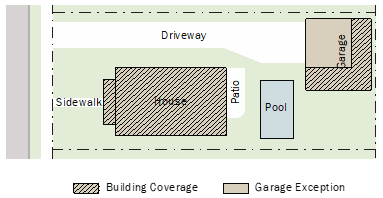
Purpose and intent. The maximum area of the lot that is permitted to be covered by buildings, including both principal structures, structured parking and roofed accessory structures.
(b)
Building coverage does not include paved areas such as driveways, uncovered porches or patios, decks, swimming pools, porte cochere, or roof overhangs of two (2) feet or less.
(c)
A residential garage up to four hundred fifty (450) square feet associated with a single-family house, attached house, or row house is not included the calculation of lot coverage.
(d)
Impervious coverage includes any type of human-made surface that doesn't absorb rainfall, including: rooftops, patios, driveways, sidewalks, roadways, and parking lots.
(Ord. of 6-10-2025(1))
Sec. 17-30.2. - Lot width.
The minimum lot width of all lots shall be measured from side property line to side property line along the front setback line.
(Ord. of 6-10-2025(1))
Sec. 17-30.3. - Setbacks.
(a)
In general.
(1)
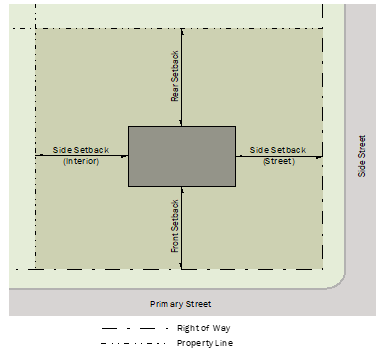
No part of a setback or other open space required for any structure or use for the purpose of complying with the provisions of this development code may be included as a part of a setback or other open space similarly required for another structure or use.
(2)
Setbacks are measured from the property line.
(b)
Setback encroachments allowed. The following allowed encroachments apply to all required setbacks unless otherwise stated, so long as they do not extend into any easements. Structures below and covered by the ground may extend into any required setback.
(1)
A step, stoop, open porch, awnings or other appurtenances may extend into the front or side setback, provided such features do not impede pedestrian circulation or extend more than twenty-five (25) percent into the minimum front setback and maintain a minimum five (5) foot side setback.
(2)
Open or lattice-enclosed fire escapes, fireproof outside stairways, and balconies opening upon fire towers, and the ordinary projection of chimneys and flues may extend into a rear setback for not more than five (5) feet from the property line if such items are placed to avoid obstructing light and ventilation.
(3)
Ordinary projections of sills, belt courses, cornices and ornamental features may project beyond any structure into a required setback.
(4)
A roof, gutter or eaves may into a required front, rear, and side yard, if a minimum distance of one foot remains open to the sky between the farthest projection of the roof, gutter or eaves and the side property line.
(5)
Retractable shading devices may extend into side or rear setback areas if they do not extend within five (5) feet of any property line.
(6)
Mechanical equipment may be in a side or rear setback area.
(Ord. of 8-10-21(2); Ord. of 6-10-2025(1))
Sec. 17-30.4. - Height.
(a)
Structure height.
(1)
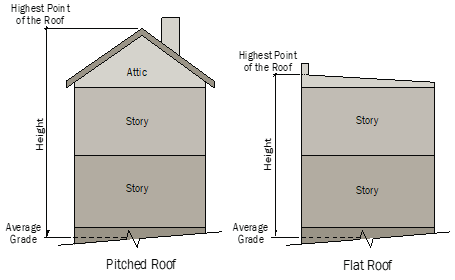
Structure height is measured in both number of stories and feet from the average grade to the top of the highest point of the roof.
(2)
Average grade is determined by calculating the average of the highest and lowest elevation along natural or improved grade (whichever is more restrictive) along the front of the building parallel to the setback line.
(3)
A basement with fifty (50) percent or more of its perimeter wall area surrounded by natural grade is not considered a story.
(4)
An attic is not a story where fifty (50) percent or more of the attic floor area has a clear height of less than 7 1/2 feet; measured from the finished floor to the finished ceiling.
(b)
Sloping lots. Where a lot slopes downward from the front property line, one story that is additional to the specified maximum number of stories may be built on the lower, rear portion of the lot.
(c)
Height exceptions allowed. Maximum height requirements shall not apply to the following:
(1)
Belfries, cupolas, domes, and monuments, water towers, transmission towers, steeples, windmills, chimneys, smokestacks, radio towers, masts and aerials, conveyors, fire towers, and oil derricks.
(2)
Bulkheads, elevator penthouses, water tanks, cooling towers, scenery lofts and similar structures provided that such structures shall cover not more than twenty-five (25) percent of the total roof area of the building on which such structure is located.
(3)
Heating and air conditioning equipment, solar collectors and similar equipment, fixtures and devices are exempt, if they are set back from the edge of the roof a minimum distance of one foot for every foot the feature extends above the roof surface. Screen or parapet walls shall be constructed to the height of any fixture taller than three (3) feet in height that would be visible from a street or residential property abutting the property.
(Ord. of 8-10-21(2); Ord. of 6-10-2025(1))
Sec. 17-30.5. - Relief to standards on neighborhood norm basis.
(a)
Allowed relief. Setbacks, lot area, lot dimensions and lot coverage standards set forth in this code are intended to affect a built environment typical of a rural setting. In some instances, these standards may not be practical, or generate appropriate, context sensitive design outcomes. The administrative adjustment procedure allows the planning director to approve modest variations from the standards of this zoning code. Administrative adjustment is allowed for the following:
(1)
Reduction of an interior side yard setback provided that at least a five (5) foot minimum setback is maintained.
(2)
Reduction in lot area for property zoned R-SF provided that at least a six thousand (6,000) square foot lot area is maintained.
(3)
Reduction in lot area for property less than seven thousand five hundred (7,500) square feet for all mixed use and commercial uses and structures.
(b)
Review criteria. The planning director shall consider the following criteria in approving or denying an administrative adjustment:
(1)
The proposed adjustment is consistent with the pertinent elements of the parish's comprehensive plan and any other adopted plans;
(2)
The proposed development meets the requirements of this zoning code;
(3)
The proposed development is in compliance with any prior approvals; and
(4)
The proposed development matches the massing, patterning, density, and orientation of a majority of the development on the existing block face or opposing block face.
(Ord. of 8-10-21(2); Ord. of 6-10-2025(1))
Sec. 17-31. - Nonconformities.
(Ord. of 6-10-2025(1))
Sec. 17-31.1. - Purpose.
(a)
The purpose of this article is to protect the rights of property owners who have lawfully established, and continuously maintained in a lawful manner — a use, lot, site or structure — prior to the adoption of this zoning code or prior to any amendment to this article that renders a non-conforming status to any development condition.
(b)
A non-conforming use, lot, site or structure that was lawfully established prior to the adoption or amendment of this zoning code shall be allowed to continue subject to the provisions of this zoning code.
(Ord. of 8-10-21(2); Ord. of 6-10-2025(1))
Sec. 17-31.2. - Applicability.
(Ord. of 6-10-2025(1))
Sec. 17-31.2.1. - Types of nonconformity.
(a)
Non-conforming use. A use that was lawfully established but no longer complies with the use regulations applicable to the use or the zoning district established in this zoning code.
(b)
Non-conforming lot or site. A lot, parcel or development site that was lawfully created but no longer complies with the dimensional or area standards established in this zoning code.
(c)
Non-conforming structure. A structure that was lawfully established but no longer complies with the height, setback or design standards established in this zoning code.
(d)
Non-conforming signs. Reserved.
(Ord. of 8-10-21(2); Ord. of 6-10-2025(1))
Sec. 17-31.2.2. - Evidence of status.
(a)
Evidence of the status of a nonconformity shall be supplied by the owner of the property upon request of the planning director.
(b)
The status of a non-conformity is not affected by changes of tenancy, ownership or management.
(Ord. of 8-10-21(2); Ord. of 6-10-2025(1))
Sec. 17-31.3. - Repairs and maintenance.
(a)
Incidental repairs and normal maintenance of non-conforming uses, lots, sites or structures shall be permitted unless such repairs increase the extent of non-conformity or are otherwise prohibited by this zoning code.
(b)
Nothing in this zoning code shall be construed to prevent structures from being structurally strengthened or restored to a safe condition, in accordance with an official order of a public official.
(c)
Any repair or renovation that exceeds fifty (50) percent of the replacement value of the structure being repaired or renovated is deemed to be a major repair and shall require the property to be brought into conformity unless the parish council approves a special use permit. Any special use permit issued under this provision shall demonstrably improve the existing development condition and support the intent of this article and the Point Coupee Parish Comprehensive Plan.
(Ord. of 8-10-21(2); Ord. of 6-10-2025(1))
Sec. 17-31.4. - Non-conforming uses.
(Ord. of 6-10-2025(1))
Sec. 17-31.4.1. - Continuance, change expansion and reestablishment.
(a)
A use may be continued and extended throughout the structure, provided that no structural alterations or additions to the structure, except those made in conformance with law or ordinance.
(b)
This section shall not be construed as prohibiting additions to or reconstruction of any single-family dwelling regardless of the zoning district in which such dwelling is located, nor shall any provision of this article be construed as prohibiting the construction of any use that is accessory to a dwelling unit regardless of the zoning district in which the dwelling is located.
(c)
A non-conforming use may be continued, expanded, or reintroduced if a property is rezoned to allow for the use or if the parish grants a special use permit that results in a substantial betterment to a development condition that is in closer conformance with the intent of the Point Coupee Parish Comprehensive Plan and this zoning code, subject to the following:
a.
Reestablishment of a non-conforming uses. If a non-conforming use has been terminated, the parish may approve the reuse of a structure for a non-conforming use with the issuance of a special use permit provided that the structure is not a nuisance, the structure cannot be reasonably be used for a conforming use, and the proposed adaptive reuse of the structure and associated site improvements are a betterment to the existing situation.
(Ord. of 8-10-21(2); Ord. of 6-10-2025(1))
Sec. 17-31.4.2. - Change of use.
No use shall be changed to a conforming use until the planning director has determined that the requirements of the applicable district will be met. The Board of Adjustment may approve a different nonconforming use, provided such use is deemed by the Board to be substantially similar or less intense than the existing use in its operational characteristics, including, but not limited to the intensity of activity, traffic generation or parking demand. No change to a more intense nonconforming use is allowed.
(Ord. of 6-10-2025(1))
Sec. 17-31.4.3. - Abandonment.
A nonconforming use that has been discontinued for any one hundred eighty (180) day period for whatever reason shall be considered to be abandoned and shall not be reestablished. Any use on the property after that time shall conform with all provisions of this zoning code. Evidence of intent to abandon the use is not required.
(Ord. of 6-10-2025(1))
Sec. 17-31.4.4. - Destruction.
Except as provided in section 17-31.3 Repairs and Maintenance, a nonconforming use that is damaged may be rebuilt following approval by the Board of Adjustment in accordance with the following:
(a)
A nonconforming use may only be reestablished within a conforming structure.
(b)
All restorative and other work must be within adopted building codes.
(c)
A building permit must be issued within one year from the date of the damage.
(d)
The certificate of occupancy (or other final inspection) must be issued as provided by adopted codes.
(Ord. of 6-10-2025(1))
Sec. 17-31.5. - Non-conforming lot or site.
(Ord. of 6-10-2025(1))
Sec. 17-31.5.1. - Generally.
A non-conforming lot or site includes any lot or site that fails to comply with the buffer and dimensional, regulations of the zoning district. This section does not require the replatting or combination of platted lots under same ownership that is protected by state vested rights law.
(Ord. of 8-10-21(2); Ord. of 6-10-2025(1))
Sec. 17-31.5.2. - Uses for non-conforming lots or sites.
(a)
A nonconforming lot or site existing as of the effective date of this zoning code may be used for any purposes permitted in the district provided the use is in conformance with the provisions of this section and meets all other regulations prescribed for the zoning district.
(b)
All undeveloped lots of record, except those in R-LI or T-HI zoning districts, that were recorded prior to the effective date of this zoning code that do not meet the minimum zoning district lot standards shall be allowed one single family house and accessory structures, provided that such development complies with applicable use requirements of this zoning code.
(c)
Prohibition on reduction in size. A non-conforming lot may not be further reduced in size unless the planning director determines that a lot line adjustment or other minor subdivision will result in a net reduction in the level of non-conformity for the affected lots or the reduction improves the functionality of the affected properties.
(Ord. of 8-10-21(2); Ord. of 12-14-21(5); Ord. of 6-10-2025(1))
Sec. 17-31.5.3. - Expansion.
(a)
Additions to structures, additional paving, or parking on nonconforming sites shall require correction of existing nonconforming parking, landscaping and screening.
(b)
Complete redevelopment or expansions that result in a twenty-five (25) percent or greater increase of the gross square footage of the existing structure require the entire property to meet all of the landscaping and screening requirements of this zoning code.
(c)
Expansions that result in less than a twenty-five (25) percent increase of the gross square footage of the existing structure require a corresponding percentage increase in compliance for landscaping and screening requirements of this zoning code until the site achieves one hundred (100) percent compliance.
(d)
Expansions that require an increase in the number of parking spaces shall be required to provide one hundred (100) percent of the required parking spaces for the additional floor area in accordance with this zoning code. The additional parking area shall comply with all associated landscaping and drainage requirements of this zoning code.
(e)
Properties that are physically constrained from complying with these provisions shall comply to the maximum extent practicable as determined by the planning director.
(Ord. of 6-10-2025(1))
Sec. 17-31.5.4. - Change of use.
Where parking is required, changes of use that require an increase in the number of parking spaces shall be required to provide the difference between the required parking for the prior use and that required for the proposed use in accordance this zoning code. Where this calculation results in the addition of less than five (5) spaces, no additional spaces shall be required.
(Ord. of 6-10-2025(1))
Sec. 17-31.6. - Non-conforming structures.
(Ord. of 6-10-2025(1))
Sec. 17-31.6.1. - Continuance and expansion.
(a)
A lawful structure existing as of the effective date of this zoning code or any amendment to this zoning code may continue to be used for any purposes permitted in the district provided it is in conformance with the provisions of this section.
(b)
A non-conforming structure may be maintained or restored provided no expansion of the nonconformity occurs.
(c)
A non-conforming structure may be expanded, provided that no increase in the nonconformity occurs.
(Ord. of 8-10-21(2); Ord. of 6-10-2025(1))
Sec. 17-31.6.2. - Termination of non-conforming structures.
(a)
Damage to a structures. The right to operate and maintain any non-conforming structure except a detached single-family structure shall terminate whenever the non-conforming structure is damaged in any manner, and the cost of repairing such damage exceeds fifty (50) percent of the replacement cost of such structure on the date of such damage.
(b)
Obsolescence of a structure. The right to operate and maintain any non-conforming structure shall terminate whenever the non-conforming structure becomes obsolete or substandard under any applicable ordinance of the parish, and the cost of placing such structure in lawful compliance with the applicable ordinance exceeds fifty (50) percent of the replacement cost of such structure on the date that the proper official of the parish determines that such structure is obsolete or substandard.
(c)
Determination of replacement cost. In determining the replacement cost of any non-conforming structure, the cost of land or any factors other than the non-conforming structure itself shall not be included.
(Ord. of 8-10-21(2); Ord. of 6-10-2025(1))
Sec. 17-31.6.3. - Change of use.
Where parking is required, changes of use that require an increase in the number of parking spaces shall be required to provide the difference between the required parking for the prior use and that required for the proposed use in accordance this zoning code. Where this calculation results in the addition of less than five (5) spaces, no additional spaces shall be required.
(Ord. of 6-10-2025(1))
Sec. 17-31.7. - Non-conforming signs.
Reserved.
(Ord. of 8-10-21(2); Ord. of 6-10-2025(1))
Sec. 17-32. - Procedures.
(Ord. of 6-10-2025(1))
Sec. 17-32.1. - Roles and responsibilities.
(a)
Planning director. The planning director shall be responsible for all submittal completeness review, assessment of approval type(s) required under this zoning code, minor site plan decisions, exercise of administrative relief provisions and recommendations to planning commission and parish council. The planning director shall serve by appointment of the parish president. The planning director may be any parish employee jointly appointed to another position by the parish president or parish council.
(b)
Planning commission. The planning commission shall be an uncompensated commission of eight (8) citizen members appointed by the parish council. Planning commission members shall primarily serve as a review and recommendation board for approvals granted under this zoning code.
(c)
Parish council. The parish council shall serve as the final decision authority for most approval types requiring public hearings under this zoning code. Additionally, the parish council shall serve as the parish's Board of Adjustment.
(Ord. of 8-10-21(2); Ord. of 6-10-2025(1))
Sec. 17-32.2. - Procedural requirements.
No development is permitted unless all applicable approvals are issued in accordance with this article and the applicant does not owe any unpaid fines. Development approvals are required for all development, unless otherwise exempted, to ensure compliance with adopted codes, standards, and laws, and to ensure consistency with the comprehensive plan. This part describes procedural elements common to all applications. The specific procedures followed in reviewing various applications for development approval differ. Subsequent sections of this chapter address the procedures and requirements for applications. Generally, the procedures for all applications have five (5) common elements:
(a)
Submittal of a complete application, including required fee payments and appropriate information and studies;
(b)
Review of the submittal by appropriate staff, agencies, commissions, committees, and boards, which may require public notice and hearings;
(c)
A decision to approve, approve with conditions, or deny, together with the description of the actions authorized and the time period for exercising rights;
(d)
Options to amend or appeal the decision; and
(e)
Documenting the decision.
(Ord. of 8-10-21(2); Ord. of 6-10-2025(1))
Sec. 17-32.3. - Approvals required.
Except as specifically exempted by state law or this zoning code, the use of property may not be substantially changed; substantial clearing, grading, or excavation may not be commenced; and buildings or other substantial structures may not be constructed, erected, moved, or substantially altered except in accordance with and pursuant to this zoning code. The tables in this section and section 17-32.5 Development Review Process Summary Table list the types of development approvals required pursuant to this zoning code, identifies the entities involved in review and action for each type of development, and provides a reference to the applicable sections that describe each process in more detail.
(Ord. of 8-10-21(2); Ord. of 12-14-21(5); Ord. of 6-10-2025(1))
Sec. 17-32.4. - Conditional development approvals.
The planning director, the planning commission and the parish council may impose conditions as are reasonably necessary to assure compliance with applicable general or specific standards identified in this article after review of the application and other pertinent documents and any evidence made part of the public record. Any conditions imposed by recommendation of the planning director or planning commission may be modified subsequently by the parish council.
(Ord. of 8-10-21(2); Ord. of 6-10-2025(1))
Sec. 17-32.5. - Development review process summary table.
(Ord. of 8-10-21(2); Ord. of 12-14-21(5); Ord. of 6-10-2025(1))
Sec. 17-32.6. - Pre-application conference.
Optional. Before submitting an application for development approval, an applicant may schedule a pre-application conference with the planning director or their designee to discuss the procedures, standards and regulations required for approval. A pre-application conference is optional, except as otherwise provided in the procedures listed below.
(Ord. of 8-10-21(2); Ord. of 6-10-2025(1))
Sec. 17-32.7. - Submittal requirements.
(a)
Application forms. Applications, containing all information requested on the application, must be submitted on forms and in such numbers as required by the planning director.
(b)
Prior to review of an application, all associated fees must be paid in full. Where the parish council, Board of Adjustment or planning commission initiates an application, no fees shall be required.
(c)
Complete applications.
(1)
All applications shall be complete and sufficient for processing before the planning director is required to review the application.
(2)
An application is complete when it contains all of the information necessary to decide whether or not the development as proposed will comply with all of the requirements of this zoning code.
(3)
The presumption is that all of the information required in the application forms is necessary to satisfy the requirements of this zoning code. However, it is recognized that each application is unique, and more or less information may be required according to the needs of the particular case. The applicant may rely on the determination of the planning director as to whether more or less information may be submitted.
(d)
Concurrent applications.
(1)
Applications may be filed and reviewed concurrently, at the option of the applicant.
(2)
Any application that also requires a variance shall not be eligible for final approval until the variance has been granted.
(3)
Applications submitted concurrently are subject to approval of all other related applications; denial of any concurrently submitted application shall stop consideration of any related applications until the denied application is resolved.
(e)
Modification of application. An application may be modified at the applicant's request following approval of the planning director. Any modification after a hearing but prior to a final decision shall require a new hearing and associated notice.
(Ord. of 8-10-21(2); Ord. of 6-10-2025(1))
Sec. 17-32.8. - Notice requirements.
(a)
Public notice required. Required public notices are summarized below.
(b)
Written notice of public hearing. At least fifteen (15) days prior to the hearing, a good faith attempt to notify the owner of record of all adjacent property shall be made by sending an official notice by certified mail of the time, place and subject matter of the hearing. Where more than ten (10) parcels are to be initially zoned or rezoned, no written notice is required.
(c)
Posted notice of public hearing. Notice shall be posted for at least fifteen (15) days prior to the hearing. A posted notice shall be a minimum thirty-six (36) inches by thirty-six (36) inches in size and shall, comply with the number, location and content as prescribed by the planning director, and shall indicate the time and place of the public hearing and any other information prescribed by the planning director. Posted notices shall be removed from the subject area within fifteen (15) days after the public hearing has been held.
(d)
Published notice of public hearing. Notice of the time and place of a public hearing shall be published three (3) times in the official journal, if designated, or a newspaper of general circulation in the area, and at least ten (10) days shall elapse between the first publication and date of the hearing.
(Ord. of 8-10-21(2); Ord. of 6-10-2025(1))
Sec. 17-32.9. - Administrative development approvals.
Administrative development approvals are those which do not require any public hearing.
(Ord. of 8-10-21(2); Ord. of 6-10-2025(1))
Sec. 17-32.9.1. - Minor site plans.
Minor site plans include all development approvals that do not meet thresholds for approvals requiring a public hearing. This could include new single-family home construction, minor commercial building alterations, and the establishment of site features such as signage, screening, small parking areas and other non-substantial work commercial and industrial properties.
(Ord. of 8-10-21(2); Ord. of 6-10-2025(1))
Sec. 17-32.9.2. - Minor subdivisions.
See Pointe Coupee Parish Code of Ordinances, chapter 22.
(Ord. of 12-14-21(5); Ord. of 6-10-2025(1))
Sec. 17-32.9.3. - Standard subdivisions.
See Pointe Coupee Parish Code of Ordinances, chapter 22.
(Ord. of 12-14-21(5); Ord. of 6-10-2025(1))
Sec. 17-32.10. - Development approvals requiring public hearings.
Development approval requiring public hearings must be presented before either or both planning commission and parish council.
(Ord. of 8-10-21(2); Ord. of 6-10-2025(1))
Sec. 17-32.10.1. - Major site plans.
Major site plan approvals are required for all new construction, substantial improvement, and building expansions of more than five thousand (5,000) square feet for all uses excluding than single-family residential and rural. Major site plans require presentation before both planning commission and parish council.
(Ord. of 8-10-21(2); Ord. of 6-10-2025(1))
Sec. 17-32.10.2. - Special use permits.
(a)
When required. Uses requiring Special Use Permits are noted in the Allowed Use Table.
(b)
Application.
(1)
A pre-application conference with the planning director may be required.
(2)
All applications for a special use permit shall be filed in writing with the planning director.
(c)
Review by planning director
(1)
The planning director may refer the application to other affected or interested agencies for review and comment.
(2)
The planning director shall provide notice as set out in this chapter.
(d)
Review by planning commission.
(1)
Following notice and a public hearing as required in this chapter, the planning commission shall recommend approval or denial of the Special use Permit.
(2)
In recommending, the planning commission shall consider the recommendation of the planning director, relevant comments of all interested parties and the review criteria below.
(e)
Public hearing and decision by parish council.
(1)
Following notice and a public hearing as required in this chapter, the parish council shall approve, approve with conditions or deny the special use permit.
(2)
In deciding, the parish council shall consider the recommendations of the planning director, planning commission, and relevant comments of all interested parties and the review criteria below.
(3)
The parish council may attach any condition to the site plan necessary to protect the health, safety and welfare of parish and minimize adverse impacts on adjacent properties. Such conditions may include but are not limited to: additional screening or buffering, or limitation in scale, intensity or hours of operation.
(f)
Review criteria.
(1)
The parish council shall consider the following criteria in approving or denying a special use permit:
a.
The proposed special use permit is consistent with the pertinent elements of the parish comprehensive plan and any other adopted plans;
b.
The proposed development meets the requirements of this chapter;
c.
The proposed special use permit will reinforce the existing or planned character of the neighborhood;
d.
The special use permit complies with any specific use standards or limitations in Division 5 of this chapter; and
e.
The special use permit will not substantially or permanently injure the appropriate use of adjacent conforming properties.
(g)
Effect of denial. The denial of a special use permit application shall ban the subsequent application for the same or similar use for a period of twelve (12) months.
(h)
Expiration. A special use permit shall expire after one year if a building permit application has not been filed. Once the use is constructed, the special use permit runs with the land and does not expire.
(i)
Revocation of special use permit. If any conditions of a special use permit or other requirements of this chapter are violated, the special use permit may be revoked by the parish council.
(Ord. of 6-10-2025(1))
Sec. 17-32.10.3. - Major subdivisions.
Major subdivisions are all other subdivisions of land within the parish that are not considered minor subdivisions or standard subdivisions, as defined in the Pointe Coupee Parish Code Ordinances, chapter 22. All major subdivisions must be preceded by a map amendment (rezoning) to rural-planned development. See the requirements for rural-planned development in this article for approval standards and processes associated with subdivision development.
(Ord. of 8-10-21(2); Ord. of 12-14-21(5); Ord. of 6-10-2025(1))
Sec. 17-32.10.4. - Map amendments (rezonings).
(a)
When allowed. The boundaries of zoning districts as shown on the zoning map may, from time to time, be amended or modified, as determined by the parish council.
(b)
Application.
(1)
A pre-application conference with the planning director may be required.
(2)
All applications for a zoning map amendment shall be filed in writing with the planning director.
(c)
Review by planning director.
(1)
The planning director may refer the application to other affected or interested agencies for review and comment.
(2)
The planning director shall provide notice as set out in section 17-32.8 Notice Requirements.
(d)
Review by planning commission.
(1)
Following notice as required in section 17-32.8 Notice Requirements and a public hearing the planning commission shall recommend approval or denial of the zoning map amendment.
(2)
In recommending, the planning commission shall consider the recommendation of the planning director, relevant comments of all interested parties and the review criteria below.
(e)
Public hearing and decision by parish council.
(1)
Following notice as required in section 17-32.8 Notice Requirements and a public hearing, the parish council shall approve or deny the zoning map amendment.
(2)
In deciding, the parish council shall consider the recommendations of the planning director and planning commission, relevant comments of all interested parties and the review criteria below.
(f)
Review criteria. The parish council shall consider the following criteria in approving or denying a zoning map amendment:
(1)
The proposed zoning map amendment is consistent with the pertinent elements of the parish's comprehensive plan and any other adopted plans;
(2)
The proposed zoning map amendment will reinforce the existing or planned character of the neighborhood;
(3)
The site is appropriate for the development allowed in the proposed district;
(4)
There are substantial reasons why the property cannot be used according to the existing zoning;
(5)
Public facilities and services including but not limited to schools, roads, recreation facilities, wastewater treatment, water supply and stormwater facilities, police, fire and emergency medical services are adequate for the development allowed in the proposed district; and
(6)
The zoning map amendment will not substantially or permanently injure the appropriate use of adjacent conforming properties.
(g)
Effect of denial. The denial of a zoning map amendment application shall ban the subsequent application for the same or similar district for a period of twelve (12) months.
(h)
Expiration. A zoning map amendment does not expire.
(Ord. of 8-10-21(2); Ord. of 6-10-2025(1))
Sec. 17-32.10.5. - Rural planned development districts.
(a)
Rural planned development (R-PD). A planned development is a zoning district that allows for deviation from the standards of this article in exchange for higher quality development. A planned development provides a streamlined process for the development of a tract of land. Rather than rezoning the tract in individual applications, a package of use districts may be applied to the tract and certain deviations from this chapter granted by the parish council through one approval process.
(b)
Components of a R-PD approval. A R-PD approval consists of two (2) separate steps:
(1)
Approval of a rezoning and concept plan by the parish council; and
(2)
Approval of subsequent subdivision plats and site plans consistent with the R-PD concept plan.
(c)
When allowed.
(1)
A R-PD is intended for projects that demonstrate a higher quality of building and site design that is more sensitive to the existing context, both built and natural, than is possible under other available zoning districts.
(2)
A R-PD district may not be smaller than 2.5 acres.
(d)
Application.
(1)
A pre-application conference with the planning director is required.
(2)
All applications for a R-PD shall be filed in writing with the planning director. See subsection (a) of this section.
(3)
The application shall include the following additional materials:
a.
A narrative explaining and tabulating the land uses by net acre, number of dwelling units by housing type, residential density and square footage of non-residential uses per net acre, open space acreage, the relationship of the proposed development to existing development in the area and other related development features.
b.
A concept plan establishing the following aspects of the proposed R-PD:
1.
The location of all streets and alleys, major utilities, access to existing streets, and conceptual drainage plan;
2.
The perimeter and block face length of all blocks;
3.
The layout and size of all lots with anticipated land use;
4.
The location and type of any open space; and
5.
Standards such as setbacks, lot coverage and other features identified by the director during the pre-application conference.
c.
A specific list of all requested deviations from the provisions of this article.
(4)
The applicant may provide concurrent applications for site plan or subdivision review.
(e)
Rezoning and concept plan review by planning director.
(1)
The planning director may refer the application to other affected or interested agencies for review and comment.
(2)
The planning director shall provide notice as set out in section 17-32.8 Notice Requirements.
(f)
Rezoning and concept plan review by planning commission.
(1)
Following notice and a public hearing as required in section 17-32.8 Notice Requirements, the planning commission shall recommend approval with conditions, or denial of the R-PD rezoning and concept plan.
(2)
In recommending, the planning commission shall consider the recommendation of the planning director, relevant comments of all interested parties and the review criteria in section 17-32.10.5(h) Review Criteria.
(g)
Public hearing and decision by the parish council.
(1)
Following notice and a public hearing as required in section 17-32.8 Notice Requirements, the parish council shall approve, approve with conditions, or deny the R-PD rezoning and concept plan.
(2)
In deciding, the parish council shall consider the recommendations of the planning director, planning commission, relevant comments of all interested parties and the review criteria in section 17-32.10.5(h) Review Criteria.
(h)
Review criteria. The following review criteria shall be considered in reviewing, approving, approving with conditions or denying a R-PD rezoning and concept plan:
(1)
The proposed R-PD is consistent with the pertinent elements of the comprehensive plan;
(2)
The proposed R-PD meets the requirements of this article;
(3)
The proposed R-PD will reinforce the existing or planned character of the neighborhood;
(4)
The site is appropriate for the development allowed in the proposed R-PD;
(5)
The PUD demonstrates a higher quality of site design that is more sensitive to the existing context, both built and natural, than is possible under other available zoning districts;
(6)
Public facilities and services including but not limited to schools, roads, recreation facilities, wastewater treatment, water supply and stormwater facilities are adequate for the development allowed in the proposed R-PD; and
(7)
The R-PD will not substantially or permanently injure the appropriate use of adjacent conforming properties.
(i)
Allowed deviations. Unless otherwise expressly approved by the parish council as part of the approved rezoning and concept plan, all planned developments shall be subject to all applicable standards of this article. In order to approve modifications of otherwise applicable standards, the parish council must find that:
(1)
Requested deviations from applicable requirements, permitted uses, or other development standards that otherwise would apply are justified by the compensating benefits of the planned development; and
(2)
The requested deviations do not detract from the established character of any surrounding conforming properties.
(j)
Action following approval. Approval of a R-PD rezoning and concept authorizes the submission of subdivision plats and site plans consistent with the R-PD approval.
(k)
Modification of adopted concept plan. The planning director is authorized to approve minor modifications to an approved concept plan. All modifications not listed as minor below shall be considered by the parish council consistent with the original approval of the R-PD. The following modifications shall be considered minor:
(1)
Up to a ten (10) percent increase or any decrease in gross floor area of a single building.
(2)
Up to a ten (10) percent reduction or any increase in the approved setbacks from exterior property lines.
(3)
Relocation of parking areas, internal streets or structures where such relocation occurs more than one hundred (100) feet from exterior property lines.
(l)
Effect of denial. The denial of a R-PD application shall ban the subsequent application for the same or similar use for a period of twelve (12) months.
(m)
Expiration. A R-PD rezoning does not expire. A R-PD concept plan approval expires after two (2) years if no construction or building permit has been filed. A single two-year extension to this expiration date may be granted by the parish council.
(Ord. of 6-10-2025(1))
Sec. 17-32.10.6. - Variances.
(a)
When allowed. The Board of Adjustment shall have the authority to authorize such variances from the terms of this zoning code, subject to terms and conditions fixed by the Board, as will not be contrary to the public interest where, owing to exceptional and extraordinary circumstances, literal enforcement of the provisions of this zoning code will result in practical difficulties or unnecessary hardship.
(b)
Application and fees.
(1)
No pre-application conference is necessary.
(2)
All applications for administrative review shall be filed in writing with the planning director.
(c)
Review by the planning director. The planning director may refer the application to other affected or interested agencies for review and comment.
(d)
Public hearing and decision by board of adjustment.
(1)
Following notice and a public hearing as required by this article, the Board of Adjustment shall approve, approve with conditions or deny the variance request based on the recommendation of the planning director and the review criteria below.
(2)
The Board of Adjustment may attach any condition to the permit necessary to protect the health, safety and welfare of the community and minimize adverse impacts on adjacent properties.
(e)
Review criteria. No variance shall be authorized unless the Board of Adjustment finds that all of the following conditions exist:
(1)
Special conditions and circumstances exist which are peculiar to the land, structure, or building involved and which are not applicable to other lands, structures, or buildings in the same zoning district.
(2)
Literal interpretation of the provisions of this Ordinance would deprive the applicant of rights commonly enjoyed by other properties in the same district under the terms of this Ordinance.
(3)
The special conditions and circumstances do not result from the actions of the applicant or any other person who may have or had interest in the property.
(4)
Granting the variance requested will not confer on the applicant any special any special privilege which is denied by this Ordinance to other lands, structures, or buildings in the same district or similarly situated.
(5)
The variance, if granted, will not alter the essential character of the locality.
(6)
Strict adherence to the regulation for the property would result in a demonstrable hardship upon the owner, as distinguished from mere inconvenience.
(7)
The purpose of the variance is not based exclusively upon a desire to serve the convenience or profit of the property owner or other interested parties).
(8)
The granting of the variance will not be detrimental to the public welfare or injurious to other property or improvements in the neighborhood in which the property is located.
(9)
The proposed variance will not impair an adequate supply of light and air to adjacent property, or increase substantially the congestion.
(Ord. of 8-10-21(2); Ord. of 12-14-21(5); Ord. of 6-10-2025(1))
Sec. 17-32.11. - Enforcement and appeals.
(a)
Enforcement.
(1)
Violations. In case any building or structure is erected, structurally altered, or maintained, or any building, structure or land is used in violation of this zoning code, the proper local authorities of the parish, in addition to other remedies, may institute any appropriate action or proceedings to prevent such unlawful erection, structural alteration, maintenance, or use, to restrain, correct, or abate such violation, to prevent the occupancy of the building, structure, or land, or to prevent any illegal act, conduct, business, or use in or about such premises.
(2)
Enforcement powers. This zoning code shall be enforced by the planning director, who is empowered to:
a.
Cause any building, structure, place or premises to be inspected and examined; and
b.
Order in writing the remedying of any condition found to exist in violation of any provision of this zoning code.
(3)
Notice of violation. If the planning director finds that any of the provisions of this zoning code are being violated, the planning director shall notify in writing the person responsible for such violations, indicating the nature of the violation and ordering the action necessary to correct it.
(4)
Enforcement actions. The planning director shall order discontinuance of illegal use of land, buildings or structures; removal of illegal buildings or structures or of illegal additions, alterations or structural changes; discontinuance of any illegal work being done; or shall take any other action authorized by this statute to ensure compliance with or to prevent violation of its provisions.
(5)
Penalties. Whenever in this zoning code or in any ordinance or resolution of the parish any act or omission is prohibited or is made or declared to be unlawful or a misdemeanor, or whenever in such code or ordinance the doing of any act or the failure to do any act is declared to be unlawful or a misdemeanor or is prohibited, and no specific penalty is provided therefor, and state law does not provide otherwise or for a greater penalty, the violation of any such provision of this zoning code or any ordinance shall be a misdemeanor punishable by a term of imprisonment of up to thirty (30) days in the Parish jail or a fine of up to five hundred dollars ($500.00), or both. Unless specifically provided otherwise, or the context thereof so dictates, each day any violation of any provision of this zoning code or any ordinance shall continue shall constitute a separate offense.
(b)
Appeals. Applicants and affected parties may file appeals to staff decisions and planning commission decisions. Appeals to staff decisions shall be presented before the Board of Adjustment. Appeals to planning commission decisions shall be presented before the parish council. The parish council shall have the authority to review any appeal prior to district court. '
(1)
Appeals to staff decisions.
a.
The appeal shall be filed within fifteen (15) days of the approval or disapproval.
b.
The appeal shall be on a form promulgated by the planning director.
c.
The appeal shall state the reasons for the appeal.
d.
The commission shall consider an appeal in a regular or special meeting.
e.
The commission shall uphold the decision of the planning director unless the commission determines that the planning director's decision was arbitrary or capricious, or if the commission determines that the application lacks a mandatory element.
f.
The decision by the commission on an appeal shall be final and unappealable.
(2)
Appeals to planning commission decisions.
a.
The appeal shall be filed within fifteen (15) days of the approval or disapproval.
b.
The appeal shall be on a form promulgated by the planning director.
c.
The appeal shall state the reasons for the appeal.
d.
The council shall consider an appeal in a regular or special meeting.
e.
The council shall uphold the decision of the commission unless the council determines that the commission's decision was arbitrary or capricious, or if the council determines that the application lacks a mandatory element.
f.
The decision by the parish council on an appeal shall be final and unappealable.
(Ord. of 8-10-21(2); Ord. of 12-14-21(5); Ord. of 6-10-2025(1))

