
Poquoson City Zoning Code
ARTICLE I
- GENERAL PROVISIONS
Section 1-1.- Title.
This ordinance shall be known and may be cited as the Zoning Ordinance of the City of Poquoson, Virginia, "appendix A" or "this ordinance."
(Ord. No. 1796, § 1, 11-12-2024)
Section 1-2. - Purpose.
This ordinance is adopted, pursuant to Code of Virginia, § 15.2-2283, as amended, for the general purpose of promoting the health, safety or general welfare of the public and of further accomplishing the objectives of Code of Virginia, § 15.2-2200, as amended. To these ends, this ordinance has been designed:
(a)
To provide for adequate light, air, convenience of access, and safety from fire, flood, impounding structure failure, crime and other dangers;
(b)
To reduce or prevent congestion in the public streets;
(c)
To facilitate the creation of a convenient, attractive and harmonious community;
(d)
To facilitate the provision of adequate police and fire protection, disaster evacuation, civil defense, transportation, water, sewerage, flood protection, schools, parks, forests, playgrounds, recreational facilities, airports and other public requirements;
(e)
To protect against destruction of or encroachment upon historic areas and working waterfront development areas;
(f)
To protect against one or more of the following: overcrowding of land, undue density of population in relation to the community facilities existing or available, obstruction of light and air, danger and congestion in travel and transportation, or loss of life, health, or property from fire, flood, impounding structure failure, panic or other dangers;
(g)
To encourage economic development activities that provide desirable employment and enlarge the tax base;
(h)
To provide for the preservation of agricultural and forestal lands and other lands of significance for the protection of the natural environment:
(i)
To protect approach slopes and other safety areas of licensed airports, including United States government and military air facilities;
(j)
To promote the creation and preservation of affordable housing suitable for meeting the current and future needs of the locality as well as a reasonable proportion of the current and future needs of the planning district within which the locality is situated;
(k)
To provide reasonable protection against encroachment upon military bases, military installations, and military airports and their adjacent safety areas, excluding armories operated by the Virginia National Guard; and
(l)
To provide reasonable modifications in accordance with the Americans with Disabilities Act of 1990 (42 U.S.C. § 12131 et seq.) or state and federal fair housing laws, as applicable. Such ordinance may also include reasonable provisions, not inconsistent with applicable state water quality standards, to protect surface water and ground water as defined in Code of Virginia, § 62.1-255.
(Ord. No. 1796, § 1, 11-12-2024)
Section 1-3. - Definitions.
Unless clearly indicated to the contrary, the following words, terms and phrases, when used in this ordinance, shall have the meanings ascribed to them in this section:
Accessory building: A subordinate building whose function is incidental to and located on the same lot as the principal building. Accessory buildings shall not be utilized as living quarters.
Accessory use: A use of land customarily incidental to the principal use of the land and located on the same lot as such principal use.
Administrator, zoning: The official or official's designated and/or authorized representative charged with the enforcement of this ordinance by the city council. In the absence of an appointed official, the city manager of Poquoson or such city manager's authorized representative shall serve as the zoning administrator.
Age restricted residential: Housing of all dwelling types, restricted for use by persons of 55 years of age or older. Housing provided shall be in accordance with the Federal Fair Housing Act, Virginia Fair Housing Law and Code of Virginia, § 36-96.7, as amended.
Agriculture: The cultivation of the soil for the purpose of raising crops, horticulture and forestry, to include the keeping of animals as authorized in this ordinance.
Alley: A travel way which affords secondary access to abutting property.
Apartment house: A building used or intended to be used as a dwelling by three or more families living independently of each other and who do their cooking therein.
Automated teller machine (ATM): Computerized, self-service machines used by banking customers for financial transactions without contact with financial institution personnel. The machines may be located at or within banks, or in other locations in accordance with the provisions of this ordinance. Structures supporting and/or housing ATMs are a separately designated and regulated component.
Automobile service station: A building used or intended to be used for the retail sale of fuels, lubricants and other operating commodities for motor vehicles to include the space and facilities for the installation of such commodities and, in addition, the space for facilities for the storage, minor repair and servicing of said vehicles, but not to do body repair, painting, steam cleaning, rust-proofing and refinishing.
Basement: A story wholly underground and having at least one-half of its height above ground (curb level).
Block: The property bounded on all sides by one side of street or a combination of street line, railroad right-of-way, unsubdivided land, river, live stream or any other barrier to the continuity of development.
Boardinghouse: A dwelling where, for compensation, lodging and meals are provided for five to 14 persons. A boardinghouse is to be distinguished from a hotel.
Breezeway: A covered walkway that is open to the atmosphere and traverses from building to building.
Brewpub: A craft/micro brewery that operates in conjunction with a retail tavern or pub/restaurant on the premises.
Buffer: An area in which no buildings or paved surfaces are present which separates a development from adjoining properties consisting of trees, shrubs, woody groundcover and open areas/meadows.
Buffer, naturally wooded: A buffer consisting of preserved trees, shrubs and other woody groundcover.
Buildable area: The buildable area of a lot is the space remaining after the minimum yard and setback requirements of this ordinance have been complied with.
Building: A structure having a roof, supported by columns or by walls, and intended for the shelter, housing or enclosure of any person, animal or chattel.
Building line: A line established, in general, parallel to the front street line between which and the front street line no part of a building shall project, except as otherwise provided by this ordinance. (Also see Setback.)
Cellar: A portion of a building having more than one-half of its height below ground (curb level).
Chesapeake Bay Preservation Area (CBPA): Any land designated by the city pursuant to the Code of Virginia, § 62.1-44.15:67 et seq. The Chesapeake Bay Preservation Area consists of a resource protection area and a resource management area.
City council: The City Council of Poquoson, Virginia.
Common plan of development or sale: means a contiguous area where separate and distinct construction activities may be taking place at different times on different schedules.
Comprehensive plan: Any plan or part thereof officially adopted pursuant to Code of Virginia, § 15.2-2223 et seq., as amended, for the physical development of the City of Poquoson or any territory within its jurisdiction showing the long-range proposals for the general development of the city and including but not necessarily limited to:
(a)
A land use plan designating areas for various types of public and private development and use;
(b)
A major thoroughfare and transportation plan designating a comprehensive system of transportation facilities;
(c)
A community facilities plan designating a comprehensive system of community facilities such as parks and recreational areas; schools, public buildings, community centers, waterworks, sewage disposal, refuse disposal and the like;
Court: An open unoccupied space other than a yard on the same lot with a building or group of buildings and which is bounded on two or more sides by such building or buildings.
Coverage: See lot coverage.
Covered boat slips: An open sided structure having a gable, gambrel, or hip style shingled roof with a minimum pitch of four to 12 and measuring no larger than 700 square feet in size unless specifically permitted by VMRC. The maximum height of the structure shall be no higher than 15 feet above mean high water. Occupancy or storage above the ceiling joists shall be prohibited.
Covered pier: A structure that is open-sided or sided with a transparent insect screen having a gable, gambrel, or hip style shingled roof with a minimum pitch of four to 12 and measuring no larger than 400 square feet in size. The maximum height of the structure shall be no higher than 15 feet above mean high water. Occupancy or storage above the ceiling joists shall be prohibited.
Craft/micro brewery: A facility that produces and sells no more than 15,000 barrels of beer or other malt liquors per year and which requires a license from the Virginia Department of Alcoholic Beverage Control. For the purposes of this definition, a barrel shall mean a container designed to hold 31 gallons. Permitted accessory uses shall include retail sales, tasting rooms for beverages produced on-site, restaurants, reception halls, and live entertainment.
Deck: An unroofed platform, either freestanding or attached to a building, that is supported by pillars or posts.
Developed: An area that has been altered for residential, commercial, industrial, institutional, recreation, transportation, or utility facilities or structures.
Development: The construction or substantial alteration of residential, commercial, industrial, institutional, recreation, transportation, or utility facilities or structures.
Development review process: The process for site plan or subdivision review and building permit review to ensure compliance with the Code of Virginia, and the Poquoson City Code prior to any clearing or grading of a site or the issuance of a building permit.
District: A portion of the city within which, on a uniform basis, certain uses of land and buildings are permitted and certain other uses of land and buildings are not permitted, as set forth in this ordinance, and within which certain lot areas are established or within which a combination of such aforesaid conditions are applied.
Divide: To apportion a tract or parcel of land into three or less lots where the parent parcel is on a public street or two lots where the parent parcel is on a private street for the purpose, whether immediate or future, of purpose of transfer of ownership or building development. For the purposes of this ordinance, the number of lots into which a parcel will be divided shall be computed cumulatively, including all divisions occurring after September 1, 1990.
Divider: An individual, corporation or partnership, owning any tract, lot or parcel of land to be divided as defined under the definition of "division" herein, or a group of two or more persons owning any tract, lot or parcel of land to be divided, who have given their power of attorney to one of their group or to another individual to act on their behalf in planning, negotiating, in representing, or executing the legal requirements of the division.
Division: The division of a tract or parcel of land into no more than three lots where the parent parcel is on a public street or two lots where the parent parcel is on a private street for the purpose, whether immediate or future, of purpose of transfer of ownership or building development. For the purposes of this definition, the number of lots into which a parcel will be divided shall be computed cumulatively, including all divisions occurring after September 1, 1990. A plat of such division shall be submitted for approval in accordance with this ordinance.
Dwelling: A building or portion thereof which is used or intended to be used exclusively for residential purposes and which contains one or more dwelling units.
Dwelling, accessory: A secondary self-contained dwelling unit, either contained in the principal dwelling structure or separate from the principal dwelling structure, whose purpose is for residential occupation by related family members.
Dwelling, attached: A dwelling having any portion of each of two walls in common with adjoining dwelling.
Dwelling, detached: A dwelling which is entirely freestanding on the same lot.
Dwelling, semidetached: A dwelling having any portion of one wall in common with an adjoining dwelling.
Dwelling, group: An arrangement of two or more detached dwellings occupying a zoning lot.
Dwelling, multiple: A dwelling having three or more dwelling units.
Dwelling, single-family: A dwelling used or intended to be used exclusively for one dwelling unit.
Dwelling, two-family: A dwelling having two dwelling units, one above the other, or a dwelling having two units side by side, both using a common wall or floor.
Dwelling unit: One room or a suite of two or more rooms used or intended to be used by one family for living and sleeping purposes, and having only one kitchen or kitchenette.
Enhanced state: A landscaped or meadow area installed and not natural pre-development.
Environmental/development plan review committee (EDPRC): A group, appointed by the zoning administrator, charged with the review of waiver applications and development plans, including but not limited to subdivision and commercial development.
Family: An individual, or two or more persons related by blood, marriage, adoption or guardianship or a group of not more than four unrelated persons occupying a single dwelling unit.
Fence: A barrier, usually made of posts and wire or boards, intended to prevent escape or intrusion or to mark a boundary. Trees, shrubbery or other foliage does not constitute a fence under this definition.
Financial institution: The retail offices of traditional banks, savings and loan offices and other financial service institutions, with or without automatic teller machines, providing walk-in service to customers. Services include but are not limited to accepting deposits, cashing checks and offering loans, and does not include pay day loans, title loans, money lending associated with a pawn shop-type establishment and/or similar uses. Drive through facilities are a separately designated and regulated component.
Floor area: The floor area of a building or buildings is the sum of the gross horizontal areas of the several floors of all buildings on the lot measured from the exterior faces of exterior walls. Floor area shall include the areas of basements when used for residential, commercial or industrial purposes, but shall not include a basement or portion of a basement used for storage or housing of mechanical or central heating equipment.
Garage, communal: A garage used for the storage of vehicles for occupants of lots in the same or adjacent block or blocks.
Garage, private: An accessory building used for the storage of vehicles by the occupants of a lot on which such building is located.
Garage, public: An accessory building, portion of a principal building, or principal buildings, used only for the storage of four or more vehicles by other than occupants of a lot, on which such building is located.
Green area: See landscaping, and/or landscaping, enhanced and/or meadow.
Health official: The legally designated health authority of the state board of health for the City of Poquoson or his authorized representative.
Height of building: The vertical distance from the established pre-development grade, or from the grade at base-flood elevation (BFE) where a parcel, pre-development, is lower than BFE, of the center of the front of the building to the highest point of the roof surface of a flat roof, to the deckline for a mansard roof, to mean height level between the eaves and ridge for hip, gable and gambrel roofs.
Home occupation: Any occupation or activity which is clearly incidental to the use of the premises for dwelling purposes, and which is carried on wholly within a main building or accessory building only by a member of a family residing on the premises in connection therewith. There is no group instruction or advertising on the premises, except where specifically authorized by the zoning district regulations and no display or storage of materials visible from outside the building.
Hotel: A building designed or occupied as the more or less temporary abiding place for 14 or more individuals who are, for compensation, lodged, with or without meals, and in which provision is not made for cooking in individual rooms or suites.
Landscaping: A combination of both trees and shrubs, with grass or other nonwoody plants interspersed between the trees and shrubs. The term "landscaping" shall include the words "landscape" and "landscaped."
Landscaping, enhanced: Landscaping that exceeds the requirements of landscaping as prescribed in this ordinance. An equal mixture of grasses and flowering plants are utilized between plantings. The term "landscaping, enhanced" shall include the word "landscape, enhanced" and "landscaped, enhanced."
Lot: A parcel of land occupied, or intended for occupancy, by a use permitted by the provisions and requirements of this ordinance, which has a frontage on a street or an officially approved private means of ingress and egress
Lot, corner: A lot abutting upon two or more streets at their intersection. For address purposes, the shortest side fronting upon a street shall be considered the front of the lot, and the longest side fronting upon a street shall be considered the side of the lot. Otherwise, a corner lot is any parcel on which two or more contiguous property lines abut one or more public or private street(s).
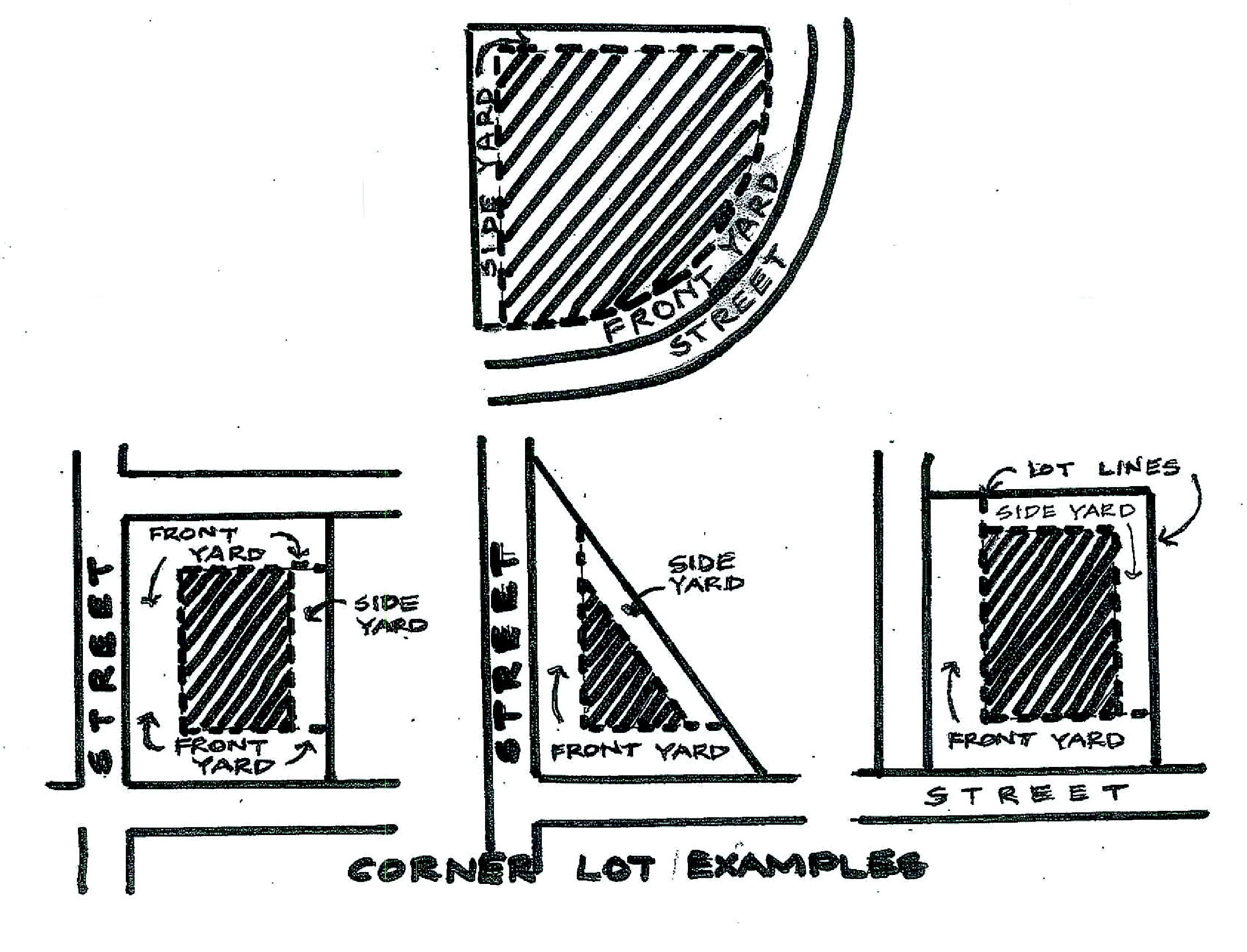
Lot, depth: The average of the horizontal distances between front and rear lines of a lot measured perpendicular to the street line.
Lot, through (double frontage): A lot, other than a corner lot, which has a frontage on two streets.
Lot, interior: Any lot other than a corner lot.
Lot, width of: The horizontal distance between the side lines of a lot measured along the building setback line.
Lot coverage: The part or percentage of the lot occupied by buildings or structures including accessory buildings or structures.
Lot of record: A lot which has been recorded in the clerk's office of the Circuit Court of York-Poquoson.
Manufacturing, high-tech: A subset of the manufacturing industry that focuses on products comprising of advanced technologies including circuit boards, semiconductors, fiber optic cables and capacitors.
Marina: A facility designed for docking, storing, servicing, berthing, fueling or repairing of boats (recreational or commercial) and which the site may include accessory restaurants, lodging and service/retail facilities. Marinas may include in-water berths/slips which are covered or uncovered, dry berths/slips for boat storage on land, either indoors or outdoors, and provisions for transfer of boats to and from the water by means of ramps or mechanical equipment.
Meadow: Open habitat or field that is covered or mostly covered with native grass, wildflowers, herbs and other nonwoody plants. Meadows may be sparsely covered with trees or shrubs, as long as they maintain an open character. They are naturally occurring or artificially created and are not for agricultural or commercial purposes.
Mobile home: A mobile home is a single-family dwelling designed for transportation, after fabrication, on streets and highways on its own wheels or on flatbed or other trailers, and arriving at the site where it is to be occupied as a dwelling complete and ready for occupancy, except for minor and incidental unpacking and assembly operations, location on jacks or permanent foundations and connection to utilities.
Motel: One or more buildings containing individual sleeping rooms designed for or used by automobile tourists or transients, with parking space conveniently located to each unit; and provided, less than 50 percent of the living and sleeping accommodations may be occupied or designed for occupancy by persons other than automobile tourists or transients.
Nonconforming activity (use): The otherwise legal use of a building, structure or tract of land that does not conform to the use regulations of this ordinance for the district in which it is located, either at the effective date of this ordinance or as a result of subsequent amendments to the ordinance. This definition is subject to the provisions of Code of Virginia, as amended.
Nonconforming lot: An otherwise legally platted lot that does not conform to the minimum area or width requirements of this ordinance for the district in which it is located at the effective date of this ordinance or as a result of subsequent amendments to the ordinance. This definition is subject to the provisions of Code of Virginia, as amended.
Nonconforming structure: An otherwise legal building or structure that does not conform with the lot area, yard, height, lot coverage or other area regulations of this ordinance, or is designed or intended for a use that does not conform to the use regulations of this ordinance for the district in which it is located, either at the effective date of this ordinance or as a result of subsequent amendment to the ordinance. This definition is subject to the provisions of Code of Virginia, as amended.
Nonwoody plants: Plants that do not have hard stems.
Office building: A structure wherein are employed a number of people greater than that allowed in professional offices and where there are no goods offered for sale.
Off-street parking area: Space provided for vehicular parking outside the dedicated street right-of-way.
Open space, usable landscaped: That space on the same lot and contiguous to the principal building or buildings which is either landscaped with shrubs, planted with grass or developed and maintained for recreation purposes, and excludes that portion of the lot which is utilized for off-street parking purposes.
Open-air market: An occasional or periodic market where temporary stalls or tables are erected in an open area and where one or more individuals offer goods for sale to the public, including farmed produce, seafood, handicrafts, antiques, and other retail goods. This definition shall not be construed to include sidewalk sales by retail merchants, bake sales, or garage/yard sales held in conjunction with and incidental to residential uses or sponsored and conducted by religious, civic, or charitable organizations on their own developed property.
Overhang: Any projection, either roof, bay window or similar cantilevered construction, which extends beyond the foundation of a structure. No such construction shall project into any required yard more than three feet and no such projection shall have a vertical surface whose area is more than 25 percent of the area obtained by multiplying the mean height of the structure by the length of the structure along the yard which is violated.
Path, Multi-use: That area of a public street designated by the city for pedestrian travel and the use of unicycles, bicycles, or tricycles, golf carts may be allowed in accordance with chapter 78 of the city Code.
Path, Bike: That area of a public street designated by the city for the use of unicycles, bicycles, or tricycles,
Planning commission: The Planning Commission of Poquoson, Virginia.
Porch: An open, unenclosed stoop or paved terrace which may project into a front yard for a distance not exceeding ten feet, but this shall not be interpreted to include porches which may be enclosed by removable windows or fixed canopies. A one-story bay window may project not more than three feet beyond the front line of the building.
Professional office: The office, studio or occupational room of a doctor, architect, artist, musician, lawyer or similar professional person or of a person engaged in the real estate or insurance business, excepting any mortuary or any establishment where goods are offered for sale, provided no other persons are engaged in the occupation except not to exceed two employees of the principal practitioner (or in the case of two doctors with offices in the same structure, not exceeding two employees for each practitioner); and provided such use is conducted within a building retaining the residential character of the neighborhood.
Property line: A line of record bounding a lot that divides one lot from another lot or from a public or private street or any other public space.
Public utility: Any person, firm, corporation, municipal department or board duly authorized to furnish, and furnishing under federal, state or municipal regulations, to the public electricity, gas, steam, communications, telegraph, transportation or water.
Redevelopment: The process of developing land that is or has been previously developed.
Resource management area (RMA): All other land outside of the Resource Protection Area in the City of Poquoson.
Resource protection area (RPA): Area including tidal wetlands, tidal shores, nontidal wetlands connected by surface flow and contiguous to tidal wetlands or water bodies with perennial flow and a buffer area of not less than 100 feet located on both sides of any water bodies with perennial flow and adjacent to the landward side of the other components listed herein.
Resource protection area feature: Area including tidal wetlands, tidal shores, nontidal wetlands connected by surface flow and contiguous to tidal wetlands or water bodies with perennial flow.
Restaurant: Any building in which, for compensation, food or beverages are dispensed for consumption on the premises, including among other establishments, cafes, tea rooms, or confectionery shops, including catering in conjunction therewith.
Restaurant, take-out and/or drive-through: An establishment where food is prepared and served in a form ready for consumption. Where all or a significant part of the consumption takes place outside the confines of the restaurant, and where ordering and pickup of food may take place from an automobile.
Resubdivision: A change in a map of an approved or recorded subdivision or resubdivision if such change (a) affects any street layout shown on such map, (b) affects any area reserved thereon for public use or (c) diminishes the size of any lot shown thereon, if any of the lots shown thereon have been conveyed after the approval or recording of such map.
Roominghouse (lodginghouse): A building, other than a hotel, where lodging is provided for three or more persons for compensation pursuant to previous arrangement, but not open to the public or transients.
Satellite earth stations: A combination of (1) antenna or dish antenna whose purpose is to receive communication or other signals from orbiting satellites and/or other extraterrestrial sources; (2) a low noise amplifier which is situated at the focal point of the receiving component and whole purpose is to magnify and transfer signals; (3) a coaxial cable whose purpose is to carry the signals into the interior of the building. For the purpose of the zoning ordinance, satellite earth stations shall be considered to be a structure. (For purposes of administration of the zoning ordinance, the terms "satellite earth station" and "dish antennas" shall be deemed synonymous.)
Screening: The use of a fence or wall to create a visual separation between two properties where landscaping cannot be utilized.
Seasonal item: Items such as Christmas trees, seafood, or perishable produce, flowers and/or plants.
Setback: The minimum distance by which any building or structure must be separated from the front, side and rear lot line.
Shed located on a vacant lot: A structure, not to exceed 250 square feet in area, located on a lot absent of a principal structure, used for the primary purpose of storing miscellaneous household items and garden tools and equipment. These structures shall meet the front yard setback established for their zoning district as well as all height and setback requirements established for accessory structures. No more than one structure shall be permitted per vacant lot. These structures are permitted to be served by electrical utilities, however, shall not be serviced by sewer utilities. Water utilities may service the structure on the exterior only.
Shrub: A woody plant that can reach between 18 inches up to 12 feet of height at maturity, whether evergreen or deciduous.
Sidewalk: Any portion of a street between the curbline, or the lateral lines of a roadway where there is no curb, and the adjacent property line intended for the use of pedestrians.
Sign: Any outdoor sign, display, device, figure, painting, drawing, message, placard, poster, billboard, or other thing which is designed, intended, or used to advertise or inform.
Solar panel, residential: Smaller and more affordable system adequate for the energy needs of a typical household and further regulated by the Virginia Uniform Statewide Building Code.
Storage yard: A yard area in which materials, equipment and/or vehicles used for construction, excavating, freight or similar activities are stored or kept. Storage yards may operate as a primary or an accessory use.
Story: That portion of a building, other than an unheated cellar, basement or attic, included between the surface of any floor and the surface of the floor next above it; or if there is no floor above it, then the space between the floor and the ceiling next above it.
Story, half: A heated space under a sloping roof, which has the line of intersection of roof decking and wall face not more than three feet above the top floor level and in which space the finished floor area does not exceed two-thirds of the floor area immediately below it, and does not contain an independent dwelling unit.
Street (road): A public thoroughfare established by right-of-way dedication or easement conveyance or a private thoroughfare serving more than one parcel established by right-of-way dedication or easement conveyance, except an alley or driveway, which affords vehicular traffic circulation and principal means of access to abutting property. This term is synonymous with road, lane, drive, avenue, right-of-way, highway, or any other thoroughfare.
Street, class of: A type of street classified in accordance with the Functional Classification Comprehensive Guide provided by the Virginia Department of Transportation (VDOT), as amended.
Street line: The dividing line between a street or road right-of-way and the contiguous property.
Structural alteration: Any change in the supporting members of a building or structure, such as bearing walls, partitions, columns, beams or girders, or any change in the width or number of exits, or any substantial change in the roof.
Structure: Anything constructed or erected, the use of which requires permanent location on the ground or attachment to something having a permanent location on the ground.
Structure, outdoor advertising: Any structure of any kind or character erected or maintained for outdoor advertising purposes, upon which any outdoor advertising sign may be placed, including outdoor advertising statuary.
Subdivide: To divide a tract or parcel of land into more than three lots where the parent parcel is on a public street or more than two lots where the parent parcel is on a private street for the purpose, whether immediate or future, of purpose of transfer of ownership or building development. The term includes resubdivision and, when appropriate to the context, shall relate to the process of subdividing or to the land subdivided.
Subdivider: An individual, corporation or partnership, owning any tract, lot or parcel of land to be subdivided, or a group of two or more persons owning any tract, lot or parcel of land to be subdivided, who have given their power of attorney to one of their group or to another individual to act on their behalf in planning, negotiating, in representing, or executing the legal requirements of the subdivision.
Subdivision: The land subdivided as defined under this section, and, when appropriate to the context, the process of subdividing or resubdividing.
Surface cover, impervious: A surface composed of any material that significantly impedes or prevents natural infiltration of water into the soil. Impervious surfaces include roofs, buildings, streets, parking areas, and any concrete, asphalt or compacted gravel surface.
Surface cover, pervious: The area of land within a lot occupied by trees, lawn, mulch or other materials that permit rainwater to permeate into the subsurface.
Townhouse: At least three and not more than ten attached dwelling units forming a continuous structure, each being separated by common or party walls or masonry construction void of fenestration or means of ingress or egress from the basement to the roof with individual exterior entrances at grade and with not more than three abutting townhouses or dwelling units having the same front yard setback.
Travel trailer: A vehicular, portable structure standing on wheels, towed, or hauled by another vehicle and, as a temporary dwelling for travel, recreation and vacation or used for carrying of goods, or objects, or as a temporary office.
Tree: A wooded plant that either is a deciduous or evergreen understory tree or a deciduous or evergreen canopy tree.
Tree, canopy: A tree that reaches 35 feet in height or larger when mature.
Tree, deciduous: A tree that sheds its leaves each fall.
Tree, evergreen: A tree having foliage that remains green and functional through more than one growing season.
Tree, understory: A tree that matures to a height of 12 feet to 35 feet. For purposes of this ordinance an understory tree shall include a shrub of 12 feet or greater in height at maturity.
Use: The purpose or activity for which land or a building thereon is designed, arranged, or intended, or for which it is occupied or maintained, and shall include any manner of performance of such activity with respect to the performance standards of this ordinance.
Variance: A reasonable deviation from those provisions regulating the shape, size, or area of a lot or parcel of land, or the size, height, area, bulk, or location of a building or structure when the strict application of the ordinance would unreasonably restrict the utilization of the property, and such need for a variance would not be shared generally by other properties, and provided such variance is not contrary to the purpose of the ordinance. It shall not include a change in use, which change shall be accomplished by a rezoning or by a conditional zoning.
Wetlands: Both vegetated and nonvegetated wetlands as defined in article IV, chapter 34 of this Code of Ordinances.
Wireless telecommunications tower: A structure used for the purpose of supporting one or more antennas or microwave dishes, including self-supporting lattice towers, guy towers, or monopole towers, the term includes radio and television transmission towers alternative antenna support structures such as buildings and rooftops and other existing support structures.
Woody groundcover: A woody, spreading plant that remains close to the ground, up to 18 inches high.
Woody plants: Plants that have hard stems and buds that survive above ground in winter.
Yard: An open space of a generally uniform width or depth on the same lot with a building or group of buildings, which open space lies between the building or group of buildings and the nearest lot line and is unoccupied and unobstructed from the ground upward, except as otherwise provided herein. Wetlands as defined in article IV, chapter 34 of this Code shall not be utilized in calculating the minimum yard area, width or depth required by this ordinance.
Yard, front: A yard extending across the full width of the lot and lying between the street line or lines adjacent to the lot and the nearest line of the principal building.
Yard, rear: A yard extending across the full width of the lot and lying between the rear property line of the lot and the nearest line of the principal building except that a corner lot shall have no rear yard.
Yard, side: A yard between a property line and the nearest line of the principal building and extending from the front yard to the rear yard except that on a corner lot all yards not adjacent to a street shall be side yards.
Yards, waterfront: A waterfront yard is a yard required on water front property. The depth shall be measured from the bulkhead or mean low waterline for nonbulkheaded lots. Waterfront property is hereby defined as property abutting on open water, bays, creeks, manmade canals and similar navigable waterways. Any use infringing on the waterfront yard must be approved through the appropriate board or committee.
Zoning district, conservation: Land zoned to conservation (C-1) in accordance with section 1-11 of this ordinance.
Zoning district, residential: Land zoned to RS, R-1, R-2, or R-3 in accordance with section 1-11 of this ordinance.
Zoning district, business: Land zoned to B-2, B-1. G-C, R&D, or VC in accordance with section 1-11 of this ordinance.
Zoning district, overlay: A zoning district in which the requirements of the overlay district must be complied with, as well as the requirements of the underlying "base" zoning district. There are five overlay districts in the City of Poquoson in accordance with section 1-11.
Zoning permit: A permit issued by the zoning administrator to the applicant before the applicant may proceed with any work affected by any provision of this ordinance.
(Ord. No. 504, §§ 1, 2, 6-28-1983; Ord. No. 567, § 1, 10-23-1984; Ord. No. 612, § 1, 1-28-1986; Ord. No. 616, § 1, 4-23-1986; Ord. No. 659, §§ 1, 2, 1-12-1987; Ord. No. 817, § 1, 2-10-1992; Ord. No. 876, § 1, 4-11-1994; Ord. No. 1014, § 1, 6-29-1998; Ord. No. 1052, § 1, 12-13-1999; Ord. No. 1129, § 1, 3-12-2002; Ord. No. 1274, § 1, 5-29-2007; Ord. No. 1357, § 1, 3-8-2010; Ord. No. 1362, § 1, 4-12-2010; Ord. No. 1396, § 1, 6-27-2011; Ord. No. 1406, § 1, 10-11-2011; Ord. No. 1430, § 1, 6-25-2012; Ord. No. 1451, § 1, 2-11-2013; Ord. No. 1456, § 1, 4-22-2013; Ord. No. 1492, § 1, 6-23-2014; Ord. No. 1493, § 1, 6-23-2014; Ord. No. 1508, § 1, 10-14-2014; Ord. No. 1539, § 1, 4-11-2016; Ord. No. 1577, § 1, 12-11-2017; Ord. No. 1581, § 1, 1-8-2018; Ord. No. 1611, § 1, 3-25-2019; Ord. No. 1614, 5-13-2019; Ord. No. 1684, § 1, 5-24-2021; Ord. No. 1690, § 1, 9-13-2021; Ord. No. 1796, § 1, 11-12-2024; Ord. No. 1811, § 1, 4-14-2025; Ord. No. 1812, § 1, 4-14-2025)
Section 1-4. - Board of zoning appeals.
(a)
There is hereby established a board of zoning appeals consisting of no more than seven and no less than five residents of the city, but shall always be an odd number, appointed and renewable, removable as provided by the city charter and Code of Virginia, § 15.2-2308, as amended. Three alternates shall be provided as set forth in Code of Virginia, § 15.2-2308, as amended.
(b)
The board of zoning appeals shall have the powers and duties and shall follow the procedures prescribed in Code of Virginia, § 15.2-2309, as amended and as follows:
(1)
The non-legal staff of the governing body may have ex parte communications with a member of the board prior to the hearing but may not discuss the facts or law relative to a particular case. The applicant, landowner or his agent or attorney may have ex parte communications with a member of the board prior to the hearing but may not discuss the facts or law relative to a particular case. If any ex parte discussion of facts or law in fact occurs, the party engaging in such communication shall inform the other party as soon as practicable and advise the other party of the substance of such communication. For purposes of this section, regardless of whether all parties participate, ex parte communications shall not include (i) discussions as part of a public meeting or (ii) discussions prior to a public meeting to which staff of the governing body, the applicant, landowner or his agent or attorney are all invited.
(2)
Any materials relating to a particular case, including a staff recommendation or report furnished to a member of the board, shall be made available without cost to such applicant, appellant or other person aggrieved under the Code of Virginia § 15.2-2314, as soon as practicable thereafter, but in no event more than three business days of providing such materials to a member of the board. If the applicant, appellant or other person aggrieved under the Code of Virginia § 15.2-2314 requests additional documents or materials be provided by the locality other than those materials provided to the board, such request shall be made pursuant to the Code of Virginia § 2.2-3704. Any such materials furnished to a member of the board shall also be made available for public inspection pursuant to the Code of Virginia § 2.2-3707.F.
(3)
For the purposes of this section, "non-legal staff of the governing body" means any staff who is not in the office of the attorney for the locality, or the board, or who is appointed by special law or pursuant to the Code of Virginia § 15.2-1542. Nothing in this section shall preclude the board from having ex parte communications with any attorney or staff of any attorney where such communication is protected by the attorney-client privilege or other similar privilege or protection of confidentiality.
(4)
This section shall not apply to cases where an application for a special exception has been filed pursuant to subdivision 6 of the Code of Virginia § 15.2-2309.
(c)
The board of zoning appeals shall have the powers and duties and shall follow the procedures prescribed in Code of Virginia, § 15.2-2309, as amended and as follows:
(1)
Hear and decide appeals from any order, requirement, decision, or determination made by an administrative official in enforcing or administering the zoning ordinance. The decision on such appeal shall be based on the board's judgment of whether the administrative officer was correct. The determination of the administrative officer shall be presumed to be correct. At a hearing on an appeal, the administrative officer shall explain the basis for his determination after which the appellant has the burden of proof to rebut such presumption of correctness by a preponderance of the evidence. The board shall consider any applicable ordinances, laws, and regulations in making its decision. For purposes of this section, determination means any order, requirement, decision or determination made by an administrative officer. Any appeal of a determination to the board shall be in compliance with this section, notwithstanding any other provision of law, general or special.
(2)
Notwithstanding any other provision of law, general or special, to grant upon appeal or original application in specific cases a variance as defined in the Code of Virginia, § 15.2-2201 provided that the burden of proof shall be on the applicant for a variance to prove by a preponderance of the evidence that his application meets the standard for a variance as defined in Code of Virginia, § 15.2-2201 and the criteria set out in this section.
Notwithstanding any other provision of law, general or special, a variance shall be granted if the evidence shows that the strict application of the terms of the ordinance would unreasonably restrict the utilization of the property or that the granting of the variance would alleviate a hardship due to a physical condition relating to the property or improvements thereon at the time of the effective date of the ordinance, and;
a.
The property interest for which the variance is being requested was acquired in good faith and any hardship was not created by the applicant for the variance;
b.
The granting of the variance will not be of substantial detriment to adjacent property and nearby properties in the proximity of that geographical area;
c.
The condition or situation of the property concerned is not of so general or recurring a nature as to make reasonably practicable the formulation of a general regulation to be adopted as an amendment to the ordinance;
d.
The granting of the variance does not result in a use that is not otherwise permitted on such property or a change in the zoning classification of the property;
e.
The relief or remedy sought by the variance application is not available through a conditional use process that is authorized in the ordinance pursuant to subdivision 6 of the Code of Virginia, § 15.2-2309 or the process for modification of a zoning ordinance pursuant to subdivision A4 of the Code of Virginia, § 15.2-2286 at the time of the filing of the variance application. Any variance granted to provide a reasonable modification to a property or improvements thereon requested by, or on behalf of, a person with a disability shall expire when the person benefited by it is no longer in need of the modification to such property or improvements provided by the variance, subject to the provisions of state and federal fair housing laws, or the Americans with Disabilities Act of 1990 (42 U.S.C. § 12131 et seq.), as applicable. If a request for a reasonable modification is made to a locality and is appropriate under the provisions of state and federal fair housing laws, or the Americans with Disabilities Act of 1990 (42 U.S.C. § 12131 et seq.), as applicable, such request shall be granted by the locality unless a variance from the board of zoning appeals under this section is required in order for such request to be granted;
f.
Exceptions to the Environmental Management Area Overlay District (EMAOD) Special Performance Standards (article XI.IV EMA Overlay District, section 11.4-6) or RPA Buffer Requirements (article XI.IV, EMA Overlay District, section 11.4-12) shall be the minimum necessary to afford relief; and
g.
Reasonable and appropriate conditions shall be imposed upon any exception to the EMAOD so that the purpose and intent of the Chesapeake Bay Preservation Act is preserved.
Additional exception criteria are provided for in section 11.4-13 of article XLIV, EMA Overlay District.
Any request for a variance, exception or appeal shall be accompanied by a processing fee of $589.00. Beginning July 1, 2025, the application fee will be adjusted annually, if necessary, to reflect the consumer price index as determined by the Federal Government rounded to the next dollar.
No variance shall be considered except after notice and hearing as required by Code of Virginia, § 15.2-2204. However, when giving any required notice to the owners, their agents or the occupants of abutting property and property immediately across the street or road from the property affected, the board may give such notice by first-class mail rather than by registered or certified mail.
In granting a variance, the board may impose such conditions regarding the location, character, and other features of the proposed structure or use as it may deem necessary in the public interest, and may require a guarantee or bond to ensure that the conditions imposed are being and will continue to be complied with. Notwithstanding any other provision of law, general or special, the property upon which a property owner has been granted a variance shall be treated as conforming for all purposes under state law and local ordinance; however, the structure permitted by the variance may not be expanded unless the expansion is within an area of the site or part of the structure for which no variance is required under the ordinance. Where the expansion is proposed within an area of the site or part of the structure for which a variance is required, the approval of an additional variance shall be required.
(3)
To hear and decide appeals from the decision of the zoning administrator after notice and hearing as provided by Code of Virginia, § 15.2-2204. However, when giving any required notice to the owners, their agents or the occupants of abutting property and property immediately across the street or road from the property affected, the board may give such notice by first-class mail rather than by registered or certified mail.
(4)
To hear and decide applications for interpretation of the district map where there is any uncertainty as to the location of a district boundary. After notice to the owners of the property affected by the question, and after public hearing with notice as required by Code of Virginia, § 15.2-2204, the board may interpret the map in such a way as to carry out the intent and purpose of the ordinance for the particular section or district in question. However, when giving any required notice to the owners, their agents or the occupants of abutting property and property immediately across the street or road from the property affected, the board may give such notice by first-class mail rather than by registered or certified mail. The board shall not have the power to change substantially the locations of district boundaries as established by ordinance.
(5)
No provision of this section shall be construed as granting any board the power to rezone property or to base board decisions on the merits of the purpose and intent of local ordinances duly adopted by the governing body.
(6)
[Reserved.]
(7)
[Reserved.]
(8)
The board by resolution may fix a schedule of regular meetings, and may also fix the day or days to which any meeting shall be continued if the chairman, or vice-chairman if the chairman is unable to act, finds and declares that weather or other conditions are such that it is hazardous for members to attend the meeting. Such finding shall be communicated to the members and the press as promptly as possible. All hearings and other matters previously advertised for such meeting in accordance with Code of Virginia, § 15.2-2312 shall be conducted at the continued meeting and no further advertisement is required.
(Ord. No. 760, §§ 1, 2, 10-10-1989; Ord. No. 906, § 1, 11-28-1994; Ord. No. 1052, § 2, 12-13-1999; Ord. No. 1075, § 1, 6-26-2000; Ord. No. 1092, § 1(1-4), 2-12-2001; Ord. No. 1345, § 1, 11-9-2009; Ord. No. 1539, § 1, 4-11-2016; Ord. No. 1651, § 1, 8-10-2020; Ord. No. 1796, § 1, 11-12-2024)
Section 1-5. - Building and zoning permits.
(a)
Buildings or structures shall be started, reconstructed, enlarged or altered only after a building permit has been obtained from the building official.
(b)
Each application for a building permit shall be accompanied by three copies of a scale drawing. The drawing shall show the size and shape of the parcel of land on which the proposed building is to be constructed, the nature of the proposed use of the building or land, the location of such building or use with respect to the property lines of said parcel of land to the right-of-way of any street or highway adjoining said parcel of land and the location of proposed utility installations and off-street parking spaces. Any other information which the zoning administrator may deem necessary for consideration of the application may be required. If the proposed building or use is in conformity with the provisions of this ordinance, a permit shall be issued to the applicant by the zoning administrator. One copy of the drawing shall be returned to the applicant with the permit.
(c)
No building, plumbing, mechanical or electrical permit shall be issued to an applicant that is not served by public water and either public sewer or an approved on-site sewage treatment system.
(d)
All unfinished structures and/or unfinished buildings, including open foundations, shall be under the governance of a building permit at all times and the structure and/or building shall be completed and/or receive a certificate of occupancy no later than three years from the date of issuance of the initial building permit. The date of adoption of this ordinance shall serve as the start date for this provision.
(Ord. No. 1052, § 3, 12-13-1999; Ord. No. 1796, § 1, 11-12-2024)
Section 1-6. - Certificate of occupancy (use permit).
Land may be used or occupied and buildings structurally altered or erected may be used or changed in use only after a certificate of occupancy (use permit) has been issued by the zoning administrator. Such a certificate shall state that the building or the proposed use, or the use of the land, complies with the provisions of this ordinance. A similar certificate shall be issued for the purpose of maintaining, renewing, changing or extending a nonconforming use. A certificate of occupancy, either for the whole or a part of a building, shall be applied for simultaneously with the application for a building permit. The use permit shall be issued within ten days after the erection or structural alteration of such building or part has conformed with the provision of this ordinance and the building code.
Section 1-7. - Conditional use permits.
(a)
Application for use not specifically permitted. If, within a particular zoning district established under this ordinance, a use is not specifically permitted and an application for a minor conditional use permit is made by a property owner to the zoning administrator for such use, the zoning administrator shall refer the application to the planning commission which shall make its recommendations to the city council within 60 days. Major conditional use permits shall only be applied for in commercial districts in accordance with this section, with the exception of a property where a conditional use permit has been granted in the past. Such application shall not be made if the use is explicitly forbidden in the district for which the use is proposed. Unless enabled at time of master plan approval, application for a conditional use permit in overlay districts shall not be allowed
Conditional use permits shall be considered as either minor or major; the difference being, generally, that a major conditional use permit (CUP) involves:
(1)
A new principle commercial building to be constructed, and/or
(2)
Required submittal of a conceptual plan, including but not limited to all of the following:
i.
Ingress/egress,
ii.
Property lines,
iii.
Building orientation and dimensions (inclusive of all phases),
iv.
The parking lot,
v.
Landscaping,
vi.
Location of stormwater best management practices.
(3)
Required approval by the architectural review board for a new building or an exterior refurbishment of an existing building, and/or
(4)
A traffic study required by section 1-7(c) of this ordinance, and/or
(5)
Unique impacts concerning noise, dust, and/or odor requiring certified professional assessment and/or environmental concerns as determined by the zoning administrator.
(b)
All requirements stated herein for a conditional use permit shall comply with the following procedures.
(1)
Application for a conditional use permit as required by any provision of this ordinance shall be made to the city council and filed with the zoning administrator. The application shall not be deemed as "officially submitted" by the zoning administrator until all required information is provided by the deadlines established for submittal of conditional use permits (generally 30—35 days prior to the next planning commission hearing). After the deadline has passed for the planning commission, additional or modified materials shall not be allowed. Should additional or modified materials be submitted to city council, the application shall be remanded to the planning commission for recommendation prior to the additional or modified materials being considered by the city council. Once deemed officially submitted and not before, the application shall be advertised for public hearing before the planning commission in the manner prescribed by the city."
(2)
Any application for a conditional use permit shall be accompanied by a fee of $711.00 to cover the cost of processing. Beginning July 1, 2025, this permit fee will be adjusted annually, if necessary, to reflect the consumer price index as determined by the Federal Government rounded to the next dollar.
(c)
All applications for a conditional use permit shall include a traffic impact analysis for a new development or redevelopment that is projected to generate 100 or more additional peak hour trips based off the Institute of Transportation Engineers (ITE) Trip Generation Manual. The traffic impact study shall be prepared by a qualified transportation engineering firm by an engineer licensed to do such work by the Commonwealth of Virginia. This report is to include the following:
(1)
Introduction and summary.
(2)
Background information: (proposed development (site and nearby)).
(3)
Analysis of existing conditions.
(4)
Analysis of future conditions without the development.
(5)
Trip generation per ITE rates.
(6)
Site traffic distribution and assignment.
(7)
Analysis of future conditions with the development.
(8)
Recommended improvements.
(9)
Conclusions.
The city engineer has the right to request traffic impact statements and safety studies for locations with less than 100 peak hour trips. The city engineer may also require additional materials, as needed, to evaluate the traffic impact statement.
(Ord. No. 770, § 1, 3-12-1990; Ord. No. 906, § 2, 11-28-1994; Ord. No. 1092, § 2, 2-12-2001; Ord. No. 1345, § 2, 11-9-2009; Ord. No. 1796, § 1, 11-12-2024; Ord. No. 1826, § 1, 8-11-2025)
Section 1-8. - Reserved.
Editor's note— Ord. No. 1796, § 1, adopted Nov. 12, 2024, repealed § 1-8, which pertained to application for use not specifically permitted and derived from Ord. No. 1610, § 1, adopted March 25, 2019.
Section 1-9. - Application of ordinance to building or structure for which permit was granted prior to effective date.
Nothing contained in this ordinance shall require any change in the plans or construction of any building or structure for which a permit was granted prior to the effective date of this ordinance and nothing in this article shall be construed to authorize the impairment of any vested right. Without limiting the time when rights might otherwise vest, a landowner's rights shall be deemed vested in a land use and such vesting shall not be affected by a subsequent amendment to the zoning ordinance when the landowner (i) obtains or is the beneficiary of a significant affirmative governmental act which remains in effect allowing development of a specific project, (ii) relies in good faith on the significant affirmative governmental act, and (iii) incurs extensive obligations or substantial expenses in diligent pursuit of the specific project in reliance on the significant affirmative governmental act and in accordance with all other provisions of Code of Virginia, § 15.2-2307, as amended.
(Ord. No. 1796, § 1, 11-12-2024)
Section 1-10. - Compliance with ordinance when issuing permits.
All departments, official and employees of this city vested with the duty or authority to issue permits or licenses shall conform to the provisions of this ordinance. They shall issue permits for uses, buildings or purposes only when they are in harmony with the provisions of this ordinance. Any such permit, if issued in conflict with the provisions of this ordinance, shall be null and void.
Section 1-11. - Districts established; zoning map adopted.
For the purpose of this ordinance, the city is hereby divided into ten zoning districts as follows:
Conservation C-1
Residential R-S
Residential R-1
Residential R-2
Residential R-3
Business B-1
Business B-2
Village Commercial VC
General Commercial GC
Research and Development R&D
Five overlay districts shall be supplements to the requirements of the primary underlying zoning district. These are as follows:
EMA Environmental Management Overlay District
FMA Floodplain Management Overlay District
CBPA Chesapeake Bay Preservation Area District
Technology Zone Overlay District
PUD(W) Planned Unit Development (Waterfront) Overlay District
The location and boundaries of these districts are shown on the zoning map of the city, which map is hereby adopted and made a part of this ordinance to the same extent as if set out herein at length.
(Ord. No. 1052, § 4, 12-13-1999; Ord. No. 1152, § 1, 11-25-2002; Ord. No. 1796, § 1, 11-12-2024; Ord. No. 1811, § 1, 4-14-2025)
Editor's note— Ord. No. 1152, § 1, adopted November 25, 2002, adopted the zoning map adopted in 1988 as amended to include all rezonings to date as the official zoning map of the city.
Section 1-12. - Interpretation of district boundaries.
Unless district boundary lines are fixed by dimensions or otherwise clearly shown or described, and where uncertainty exists with respect to the boundaries of any of the districts as shown on the zoning map, the following rules shall apply:
(1)
Where district boundaries are indicated as approximately following or being at right angles to the center lines of streets, highways, alleys or railroad main tracks, such center lines, or lines at right angles to such center lines, shall be construed to be such boundaries, as the case may be.
(2)
Where a district boundary is indicated to follow a river, creek or branch or other body of water, said boundary shall be construed to follow the center line at low water or at the limits of the jurisdiction, and in the event of change in the shoreline such boundary shall be construed as moving with the actual shoreline.
(3)
If no distance, angle, curvature, description or other means is given to determine a boundary line accurately and the foregoing provisions do not apply, the same shall be determined by the use of the scale shown on the zoning map. In case of subsequent dispute, the matter shall be referred to the board of zoning appeals which shall determine the boundary.
Section 1-13. - Compliance with site plan ordinance in certain districts.
Before a building permit shall be issued or construction commenced on any permitted use in a B-1, B-2, VC, GC or R&D district, and before a use permit shall be issued for a new use in such a district, the applicant shall comply with the city's site plan ordinance, as amended, and the zoning requirements set forth in said B-1, B-2, VC, GC or R&D districts as set forth in articles IX, X and XI of this ordinance, as amended.
(Ord. No. 1796, § 1, 11-12-2024)
Cross reference— Site plan ordinance, app. C.
Section 1-14. - Setback requirements with respect to streets to be widened or altered.
Whenever there shall be plans in existence, approved by city council, for the widening or alteration of any street, the setback, as prescribed in this ordinance, for any new construction or alterations of buildings shall be applied to the new street right-of-way line, as shown on such approved plans, except that this shall not apply to a building or buildings already in existence.
Section 1-15. - Temporary placement of portable storage containers.
Portable storage containers: Notwithstanding any contrary provision of this ordinance, portable storage containers located outside of a fully-enclosed building or structure shall be allowed only in residential and commercial districts.
(a)
In residential districts, no more than one portable storage container shall be allowed on a zoning lot, and for no longer than a total of 30 days in any consecutive six-month period, provided, however, that during bona fide construction activity on such lot, one storage container shall be allowed once a building permit for the lot has been issued, a storage container may remain in place when used in conjunction with bona-fide permitted construction, however a certificate of occupancy shall not be issued for the property prior to removal of any portable storage containers. No such container may be allowed for a period exceeding 12 months without authorization by the zoning administrator.
(b)
In business zoning districts, portable storage containers shall be allowed only pursuant to a conditional use permit for bulk storage where such use is permitted: however, portable storage containers shall be permitted without a conditional use permit: (i) when used in connection with bona-fide construction activity on the site, and for an additional period of 24 hours before and after such construction: or (ii) for a period of no more than ten days when used in connection with the moving or relocation of an establishment located, or to be located, on the site.
(c)
Unless allowed by conditional use permit, no portable storage container shall have dimensions greater than 30 feet in length, eight feet in width or eight and one-half feet in height.
(d)
In business districts no portable storage container shall be located in any required parking area.
(e)
In residential districts, a portable storage container shall be located on a driveway, no closer than ten feet to the paved portion of any street and ten feet from a side property line; provided, however, that for a maximum, period of 72 hours a portable storage container may be placed within ten feet of the paved portion of a street. These setbacks may be modified by the zoning administrator if deemed necessary due to site conditions.
(f)
All portable storage containers in use shall be maintained in a condition free from rust, peeling paint and other visible forms of deterioration.
(g)
Portable storage containers shall be allowed only upon issuance of a permit by the zoning administrator. Permits shall be displayed on the outside of the container in such manner as to be plainly visible for the nearest street. The fee for permits shall be $15.00, except that there shall be no fee if a portable storage container is to be located on a site for no more than 30 days. Beginning July 1, 2025, this permit fee will be adjusted annually, if necessary, to reflect the consumer price index as determined by the Federal Government rounded to the next dollar.
(Ord. No. 1396, § 2, 6-27-2011; Ord. No. 1796, § 1, 11-12-2024)
Section 1-16. - Reserved.
Editor's note— Ord. No. 758, § 2, adopted Oct. 10, 1989, repealed App. A, §§ 1-15, 1-16, which pertained to off-street parking requirements generally and surfacing, lighting, etc., of public parking areas, and derived from Ord. No. 634, § 1, adopted Aug. 11, 1986.
Section 1-17. - Keeping of farm animals.
(a)
Farm animals are defined as animals typically kept on farms (e.g. horses, cattle, sheep, goats, swine, poultry, and bees) for productive uses or commodities such as eggs, meat, milk or wool. Up to two farm animals smaller than 300 pounds, excluding roosters and goats, which are not kept for commercial or productive use, may be kept in single-family residential areas without a use permit. All other farm animals may be kept in the city, subject to obtaining a use permit and subject to the following conditions:
(1)
Farm animals will be allowed only in conservation districts and in single-family residential districts. They will not be allowed in any other districts.
(2)
The following shall apply to hooved animals, i.e., horses, cows, goats, etc., except pigs:
a.
There shall be required a minimum of two acres, for one animal, and one acre, per each additional animal, of open space (pasture) in addition to the lot size requirements of the residential zone in which the animals will be kept. Properties belonging to another party cannot be used in meeting area and setback requirements, unless a copy of a written agreement, valid for the duration of the time the animal will be kept, is presented at the time of application for issuance or renewal of a use permit.
b.
All stables and pastures shall be kept in a sanitary condition. No storage or accumulation of manure shall be kept on the premises except in completely enclosed and screened structures. Stables and pasture areas must be kept in a dry and well drained condition in order to prevent bog or muddy areas.
c.
Stables adequate as to size and physical condition must be provided for all animals. Stables must not be allowed to fall into disrepair or to become unsightly. All stables shall be at least 300 feet from any residence belonging to a person other than an applicant and at least 50 feet from any adjoining property line. Pasture fencing shall be at least 50 feet from any property line (other than city right-of-way) and at least 100 feet from any residence. No stable shall be nearer than 200 feet to any public right-of-way or thoroughfare. All stables and fencing must be completed prior to an animal being placed on the property.
(3)
The following shall apply to pigs:
a.
Pigs shall be maintained in pens with 36-inch high perimeter fences enclosed with wire mesh or wooden boards close enough to prevent small animals from escaping according to the following footage allowances:
Sows:
25—40 pounds: 12 square foot allowance per animal
40—100 pounds: 16 square foot allowance per animal
100—150 pounds: 25 square foot allowance per animal
150—200 pounds: 68 square foot allowance per animal
Boars require the same footage per animal until 150 pounds
150—210 pounds: 32 square foot allowance per animal
Boars with sows: 100 square foot allowance per animal
Pigs per pen while weaning: 75 pounds: 16 animals maximum; 16 square foot allowance per animal
Pigs per pen from weaning to market: Over 75 pounds: 8 animals maximum; 24 square foot allowance per animal
b.
All pens and yards shall be kept in a sanitary condition. No storage or accumulation of manure shall be kept on the premises, except in completely enclosed and screened structures. Pens and yard areas must be kept in a dry and well drained condition in order to prevent bog or muddy areas.
c.
Pens shall not be allowed to fall into disrepair or to become unsightly. All such pens shall be at least 300 feet from any residence belonging to a person other than the applicant and at least 50 feet from any adjoining property line. Fencing for such pens shall be at least 50 feet from any property line (other than city right-of-way) and 100 feet from any residence. No pen shall be nearer than 200 feet to any public right-of-way or thoroughfare. All pens and fencing shall be completed prior to an animal being placed on the property. If concrete is used in the pens, it should slope one-half inch per foot and include bedding.
(4)
The following shall apply to chickens or fowl:
a.
For the keeping of chickens or other fowl the application and renewal procedures and sanitary conditions used for keeping hooved animals will be followed.
b.
No roosters are allowed to be kept in the city, excepting estates of three acres or more. For properties less than three acres a conditional use permit would be required for the keeping of rooster(s).
(5)
The following shall apply to beekeeping:
a.
In no case shall a hive be placed closer than three feet from a property line.
b.
A beekeeper who places hives less than 25 feet from a property line, with the entrance facing said property line, shall do so only if there is a barrier between the hive and the property line, or if the hive is elevated with its entrance no less than six feet above the ground. Barriers should be of sufficient density, length, and height to establish bee flyways six feet or higher above ground level at the property line and may include dense vegetation, an accessory structure, or a privacy fence.
c.
Beekeepers shall maintain a water source within 50 feet of a hive or less than one-half the distance to the nearest unnatural source of water which is not on their property, whichever is closest. Unnatural sources of water include swimming pools and pet or livestock watering receptacles.
d.
The public works department shall maintain a list of contact information for beekeepers who wish to be notified of insect control measures performed by government entities which are harmful to bees. Listed beekeepers shall be notified at least 48 hours prior to aerial application of control measures. The public works department shall exercise prudence near known hive locations when performing ground-based control measures.
e.
In cases where beehives are located more than 40 feet from a public right-of-way, enforcement of beekeeping regulations shall only be initiated based on complaints of an affected adjacent property owner.
(b)
All use permits for the keeping of farm animals shall be issued for a period of one year from January 1 to December 31. All farm animal use permits shall be subject to revocation upon violation of any of the conditions set forth in the permit. The granting of a farm animal permit shall not vest in the recipient an unqualified right of renewal for the permit. Renewal of all farm animal use permits issued shall be subject to the imposition of additional restrictions as land uses in the area change. Individuals wishing to keep farm animals shall make application for a farm animal permit on such forms as the zoning administrator may require. A nonrefundable fee of $15.00 shall accompany the initial application, with an additional $15.00 fee for annual renewals, if applicable Beginning July 1, 2025, this permit fee will be adjusted annually, if necessary, to reflect the consumer price index as determined by the Federal Government, rounded to the next dollar.
(c)
For the keeping of farm animals, the zoning administrator shall establish appropriate setbacks and other stipulations as necessary to preserve the residential nature and tranquility of the neighborhood.
(Ord. No. 583, § 1, 4-23-1985; Ord. No. 1381, § 1, 2-28-2011; Ord. No. 1582, § 1, 1-8-2018; Ord. No. 1796, § 1, 11-12-2024)
Section 1-18. - Temporary storage of mobile homes.
No mobile home shall be located in the city for temporary storage outside an approved mobile home park without a special storage permit issued by the city council. Such storage permit shall be for a limited 30-day period and shall be renewable upon application to the city council for an additional 30-day period. Temporary storage of any mobile home shall not exceed 60 days, and no such mobile home being temporarily stored shall be occupied as a dwelling.
Section 1-19. - Lot and yard area, width and depth requirements generally.
It is the intent of this section to establish criteria for determining the portion of a parcel or lot which may be counted in the computation of minimum area. The areas excluded from computation of minimum lot area, width and depth should, however, be included as a part of the ownership of the lots or in the ownership of a property owners association. For the purposes of this ordinance [appendix], the following areas shall not be counted toward fulfillment of the specified minimum lot area, width or depth requirements nor be counted in the computation of developable area for density calculations in the case of conventional development of land, unless specifically specified otherwise in this ordinance:
(a)
That portion of land properly characterized as "wetlands."
(b)
The area within existing or proposed public or private street or highway rights-of-way established by easements or dedication.
(c)
The area of ponds, lakes or other impounded water bodies and associated wetlands to be determined based on the mean high-water level at the natural outfall or the invert elevation of the emergency spillway.
(d)
The area of any drainage ditch or course or any area separated by such a ditch or course from the buildable portion of the lot which due to the depth or width of the ditch or steepness of the ditch banks renders the area unusable for the permitted uses within the applicable zoning district.
(Ord. No. 504, § 3, 6-28-1983; Ord. No. 692, §§ 1, 2, 7-28-1987; Ord. No. 1796, § 1, 11-12-2024)
Section 1-20. - Temporary administrative permits for uses accessory to building construction.
The zoning administrator may authorize the temporary use of construction trailers, buildings and other temporary structures by issuance of an administrative permit. Such permits, however, shall be subject to the following conditions:
(a)
The placement of the construction trailer, building or other temporary structure shall be allowed only in conjunction with a bona fide construction project for which all necessary federal, state and local permits have been obtained.
(b)
An industrialized building unit defined as a "mobile home" by this ordinance may be authorized solely for the office or storage purposes. The unit shall not be utilized for residential purposes.
(c)
The placement and occupancy of the trailer, building or other temporary structure shall be subject to all permits and inspections required by the Virginia Uniform Statewide Building Code.
(d)
The permit established by this section, shall be issued for a period not to exceed one year. A 90-day extension may be granted twice upon the determination of the zoning administrator, in writing, that extenuating circumstances warrant such extension.
(e)
Prior to issuance of the permit authorized by this section, the applicant shall post a cash escrow or letter of credit in the amount of $1,000.00 to guarantee the removal of the temporary trailer, building or other structure by the expiration date of the permit. The zoning official may waive the posting of the above-referenced security if the construction project is governed by a permit issued under the Virginia Uniform Statewide Building Code.
(f)
In the event that the construction trailer, building or other structure is not removed from the premises by the expiration date of the permit, the zoning administrator may proceed to utilize the security funds to remove the construction trailer from the site and store the same at the applicant's expense.
(g)
No certificate of occupancy shall be issued by the zoning administrator until the temporary construction trailer, building or other structure has been recovered from the site.
(h)
Failure to remove the trailer, building or other structure authorized by the permit, by the date specified in the permit, shall constitute as class 4 misdemeanor. Each day the temporary trailer, building or other structure remains upon the premises after expiration of its permit shall constitute a separate and distinct offense.
(Ord. No. 556, § 1, 8-28-1984; Ord. No. 1796, § 1, 11-12-2024)
Section 1-21. - Living quarters in business establishments.
A business establishment may provide living quarters for a proprietor or storekeeper and his/her family. Living quarters may also be provided for a watchman or custodian involved with a business operation. Such quarters must be located in the same building as the business operation. No more than one living area shall be permitted per establishment, however.
(Ord. No. 591, § 1, 7-8-1985; Ord. No. 1796, § 1, 11-12-2024)
Section 1-22. - Use restrictions on satellite earth stations.
Satellite earth stations may be permitted in any zoning district upon approval of the zoning administrator. The zoning administrator shall review the plans for location and screening prior to the issuance of a building permit for a station. Prior to approval of a request to utilize a satellite earth station, the zoning administrator shall ensure that the following conditions are met:
(a)
The height of any such earth station shall not exceed 12 feet. For the purposes of this ordinance [section], the height shall be measured vertically from the highest point of the antenna or dish, when positioned for operation, to the bottom of the base which supports the antenna. The diameter of the station shall not exceed 12 feet.
(b)
Satellite earth stations shall not be located between any public right-of-way and the principal structure on a lot. They shall not be located closer to any rear or side lot line than the height of the dish or the required accessory building setback, whichever is the greater of the two distances.
(c)
Satellite earth stations shall not be located on the roof of any structure.
(d)
Satellite earth stations shall be permanently affixed in accordance with the requirements of the city's building code. No station may be installed on a portable or movable structure such as a trailer.
(e)
Satellite earth stations shall be screened from adjacent properties and public rights-of-way with fences, berms, and/or landscaping. The zoning administrator shall review the adequacy of the screening treatment shown on a submitted plan. Where possible, existing features such as shrubs, fences, trees and buildings should be used for screening. If new screening is required, the following methods, or a combination of them, may be used:
(1)
A solid decorative masonry wall, solid wood fence, or chainlink fence with slats, having a minimum height of six feet;
(2)
An earthen berm having a minimum height of six feet;
(3)
Shrubs, which when mature shall form a visual barrier with a minimum height of six feet and which retain foliage year-round. Redleaf photinia (Photinia frazieri), with a minimum container size of three gallons, planted at a maximum of five feet on center, are specified. However, a shrub having similar screening abilities may be used if approved by the zoning administrator.
The fence, berm and/or landscaping shall be installed within six months from the day that the building permit is issued and shall be maintained for as long as the station is in place. Landscaping requirements related to satellite earth stations are exclusive of other green area and landscaping requirements contained in this and other City of Poquoson codes and ordinances.
(Ord. No. 612, § 3, 1-28-1986; Ord. No. 1796, § 1, 11-12-2024)
Section 1-23. - Accessory buildings, private garages and allowed connections for living area.
The following requirements apply to the height, location and size, and permit the construction of accessory buildings and private garages in the R-S, R-1 and R-2 zoning districts:
(a)
For structures measuring less than 25 feet in height, accessory buildings or private garages may be constructed up to 1.25 times the height of the principal building, not to exceed 25 feet in height. For all other structures, no accessory building or private garage may be constructed to a height greater than the height of the principal building on the same parcel or lot except as permitted in subsection (e) of this section.
(b)
Accessory buildings or private garages less than 13 feet in height shall be set back 7.5 feet from the property line and ten feet from the principal building. Accessory buildings or private garages greater than 13 feet in height shall be set back 15 feet from the property line and principal building. An accessory building may be connected to the primary dwelling by an uncovered deck serving as a walkway. The connecting deck must meet the principal dwelling setback requirements for the zoning district or setbacks established by a legal nonconforming dwelling. Accessory buildings shall not be used for residential purpose except as specified in section 1-23(g) below.
(c)
The total combined floor area of any accessory building or private garage shall not exceed 50 percent of the floor area, including nonheated space, of the principal building on the lot or parcel.
(d)
In order to build an accessory building or private garage, there must be a dwelling unit or other permitted principal building on the parcel or lot provided, however, that if an owner wishes to construct a permitted principal building and building at the same time, he may do so if building permits are obtained for the principal and accessory buildings at the same time or except as permitted in subsection (e) of this section or in section 1-3, definitions (shed on a vacant lot). No final electric hookup will be permitted or certificate of occupancy issued until the principal building is approved for issuance of a certificate of occupancy.
(e)
On lots or parcels of three acres or more in size, accessory buildings or private garages may be built prior to a dwelling unit or other permitted principal building being built or permitted. The following standards shall be met:
(1)
Front, side, and rear setbacks shall be at least 40 feet.
(2)
The height of the building shall not exceed 35 feet.
(3)
No residential use of the building shall be permitted.
(4)
No business activity except as a bona fide agricultural operation shall be permitted.
(f)
On lots or parcels where 50 percent or more of the rear yard is within a designated resource protection area, accessory structures may be placed in the side yard in accordance with subsections (a) through (e) of this section.
(g)
Buildings or garages, or portions of the same to be used for residential use shall be connected with a breezeway, as defined in this ordinance, to the principal building for the purpose of creating one primary residence.
(1)
Such breezeway shall extend no more than 50 feet.
(2)
All setbacks for principal uses shall be met for the zoning district.
(Ord. No. 679, § 1, 5-11-1987; Ord. No. 855, § 1, 5-9-1994; Ord. No. 1563, § 1, 4-24-2017; Ord. No. 1580, § 1, 1-8-2018; Ord. No. 1796, § 1, 11-12-2024)
Section 1-24. - Compliance with chapter 66, solid waste.
All properties in every zoning district in the city must comply with the requirements of chapter 66 of the Code of Ordinances of the City of Poquoson, Virginia.
(Ord. No. 929, § 1, 10-10-1995)
Section 1-25. - Compliance with article III, chapter 46 of the city Code, inoperable vehicles.
All properties in every zoning district in the city must comply with the requirements of article III, chapter 46, inoperable vehicles, of the Code of Ordinances of the City of Poquoson, Virginia.
(Ord. No. 929, § 1, 10-10-1995)
Section 1-26. - Compliance with article III, chapter 34 of the city Code, erosion and sediment control.
All properties in every zoning district in the city must comply with the requirements of article III, chapter 34, erosion and sediment control, of the Code of Ordinances of the City of Poquoson, Virginia.
(Ord. No. 929, § 1, 10-10-1995)

