
Port Aransas City Zoning Code
ARTICLE IV
SUPPLEMENTAL DISTRICT DEVELOPMENT AND USE REGULATIONS4
The following general development standards shall apply to all zoning districts, except where expressly stated to apply to, or exclude, specific districts.
Editor's note— Ord. No. 2010-5, § 1, adopted Mar. 18, 2010, amended the former Art. IV, §§ 25-146, 25-147, 25-161, 25-176—25-179, 25-191—25-193, 25-195—25-197, 25-211—25-213, 25-226—25-228, and enacted a new Art. IV as set out herein. The former Art. IV pertained to supplemental district regulations. For complete derivation see the Code Comparative Table at the end of this volume.
Cross reference— Buildings and building regulations, Ch. 5.
DIVISION 6. - ACCESS AND DRIVEWAYS
See chapter 20 streets, sidewalks and other public ways.
(Ord. No. 2010-05, § 1, 3-18-10)
DIVISION 7. - SIGNS
See chapter 19 signs.
(Ord. No. 2010-05, § 1, 3-18-10)
DIVISION 8. - LANDSCAPING
See chapter 16 planning and development.
(Ord. No. 2010-05, § 1, 3-18-10)
DIVISION 9. - SOLID WASTE
See chapter 9 sanitation
(Ord. No. 2010-05, § 1, 3-18-10)
Sec. 25-146. - Environmental controls established.
(a)
Screening. Open storage and loading or service areas shall be screened from any adjacent residence or public way by six-foot, opaque fencing, junk, trash or debris shall be confined out of sight.
(b)
Green space. In any multifamily dwelling development there shall be three hundred twenty-five (325) square feet of green space per dwelling unit average.
(c)
No machine, process, or procedure shall be employed on any property in the city, in which:
(1)
Emission of smoke, dust, or noxious, toxic or lethal gases that are deemed "excessive" above normal operations that produce such emissions, and that are detectable beyond the perimeter of the property that causes material distress, discomfort or injury to persons of ordinary sensibilities in the immediate vicinity;
(2)
Materials are stored or accumulated in such a way that they may be carried by rainwater in natural drainage channels beyond the limits of the property, which are noxious, toxic, radioactive, contain oil or grease, wood, cellulose fibers, hair, feathers, or plastic, or have a pH factor greater than nine (9) or less than six (6);
(3)
Vibration is discernible beyond the property line.
(d)
Septic systems. In the absence of public water or public sewer, no building permit shall be issued until the lot meets all applicable requirements of this chapter, and a septic system meeting State regulations has been approved by Nueces County Water Control District No. 4.
(e)
Drainage and stormwater management. If a development project is not directly associated with a building permit or subdivision development a development permit shall be required for any manmade change in improved and unimproved real estate, said development including but not limited to excavation or fill of material, mining, grading, or paving. If the development is associated with a building permit or subdivision, the required development information shall be included with the submitted construction plans.
For drainage and stormwater design, all development within the city shall utilize the policies and technical information standards as set forth in the latest edition of the City of Port Aransas "Storm Drainage Design manual." (For more information, see also: Chapter 8, flood damage prevention, and/or the development permit on file with the building department).
Exemptions from development permit.
(1)
The project is solely for the blanket filling of a residential or commercial property with a fill depth less than one (1) foot in depth.
(2)
The project consist of filling isolated portions of a residential or commercial property that exceed one (1) foot in depth and are determined by the building official to be inconsequential in regards to its effect on the properties drainage or impacts to adjacent properties.
(f)
Wetlands. It is the sole responsibility of the property owner to determine whether or not their proposed development activity impacts wetlands that are under the jurisdiction of the U.S. Army Corps of Engineers. For any platting activity on sites greater than one-half (½) acre, notice of such activity must be provided to the most proximal U.S. Army Corps of Engineers (USACOE) business office in a manner and on such form(s) as prescribed by the city department responsible for development services. At a minimum this required notice shall provide a narrative of proposed activities describing scope and timeline, an aerial map or other documentation clearly identifying the impacted area (including any known wetlands).
(Ord. No. 2010-05, § 1, 3-18-10; Ord. No. 2018-14, § 1, 10-18-18)
Sec. 25-147. - Lot area and density requirements.
Neighborhood unit developments (N.U.D.) and planned unit developments (P.U.D.) shall have densities as allowed in their respective divisions.
A dwelling unit requires five thousand (5,000) square feet of lot size (the addition of an ADU does not require additional lot square footage).
In connection with an existing developed property, contiguous property owned by the developer at the time of the development's commencement may be added to the existing development and may expand under the density guidelines in place on January l, 2021.
In connection with the replat of an existing developed property, in which no additional lots are being created, the minimum lot area/size shall not apply so long as the number of square feet per lot is not being reduced.
In connection with the replat of an existing developed property, the developed portion of the property may be platted separately from the undeveloped portion provided that proper access is provided for each of the developed units and the minimum lot a rea in place at the time of the development's initial approval is not reduced.
In connection with the replat of an existing developed property, contiguous property owned by the developer may be added to an existing approved development and developed under current density guidelines provided that no new dwelling units are being created in the existing portion of the development.
For the purposes of this section, lot size is calculated exclusive of streets and/or driveways whether public or private (parking spaces are not included in this calculation).
Additionally, no multifamily dwelling/townhouse development shall exceed the number of dwelling units per acre of land within the development, exclusive of streets and/or driveways whether public or private (parking spaces are not included in this calculation), hereinafter set forth with respect to each: townhouse/low rise multifamily (attached or detached) five thousand (5,000) square feet per dwelling unit; high rise building greater than three (3) stories to be approved as a planned unit development (PUD).
Lots that are created for the specific use of utility and drainage facilities shall be exempt from the minimum lot area standards.
(Ord. No. 2010-05, § 1, 3-18-10; Ord. No. 2021-05, § 1, 8-9-21; Ord. No. 2024-06, § 1, 8-12-24)
Sec. 25-148. - Yard requirements.
The following rules apply to all buildings:
(1)
A building setback from the front lot line shall be a minimum of twenty (20) feet;
(2)
A building setback from the side lot line shall be a minimum of five (5) feet;
(3)
On the side of a corner lot which abuts a street, the minimum building setback from the side lot line adjacent to such street shall be fifteen (15) feet;
(4)
A building setback from the rear lot line shall be a minimum of ten (10) feet; provided however, that a detached garage may be a minimum of three (3) feet from the rear lot line. On lots where the rear lot line abuts on a street (double frontage), the rear setback shall be twenty (20) feet, if through a plat note, the rear of a double frontage property prohibits driveway access then the rear setback shall be fifteen (15) feet. On lots where the rear lot line abuts an alley, the setback shall be ten (10) feet for buildings and one (1) foot for detached garages that may contain an ADU;
(5)
Interior side and rear building setback requirements on a lot in a commercial district shall not be less than five (5) feet and ten (10) feet respectively when the lot is adjacent to a residential district (not a residential use). Rear building setback requirements on a lot in a commercial district adjacent to a dedicated alley may be one (1) foot. In all other cases rear setbacks shall be ten (10) feet. Lots located in a commercial district shall have no minimum building setback requirements from interior side lot lines and buildings shall be located thereon with reference to the interior side lot lines in any manner authorized by the building code.
(6)
Exterior walls of commercial buildings located within five (5) feet of a lot line must provide a minimum of two (2) hour fire protection.
(7)
Notwithstanding the above, in a townhouse development, the above and foregoing rules are modified in order to allow for zero (0) foot lot lines and common walls. NUDs, and PUDs shall have setbacks as allowed in their respective divisions.
(8)
Setbacks are measured from the property line;
(Ord. No. 2010-05, § 1, 3-18-10; Ord. No. 2012-05, § 1, 8-16-12; Ord. No. 2021-05, § 1, 8-9-21)
Sec. 25-149. - Features allowed within required yard setback areas.
The following features may be located within a required yard but may be subject to additional regulations applied herein: None of the following features shall cause rain water or ground water to be diverted onto the adjacent property.
(1)
Trees, shrubbery, or other landscape features, excluding gazebos or other similar structures that require a building permit;
(2)
Fences and walls;
(3)
Driveways and parking spaces;
(4)
Sidewalks;
(5)
Utility lines, wires, and associated structures, such as power poles;
(6)
Mechanical equipment such as air conditioning units, pool pumps, and similar equipment;
(7)
Uncovered porches, uncovered steps to building entrances, and uncovered patio decks that do not exceed thirty (30) inches in height from the average ground grade;
(8)
Sills, belt courses, cornices, garden windows, buttresses, chimneys, flues, roof eaves, or extensions may extend up to twenty-four (24) inches into any required side yard and four (4) feet into front and rear yard;
(9)
Cantilevered balconies or decks located more than eight (8) feet from the ground may project up to fifty (50) percent into the required yard rear and side setbacks, and up to twenty-five (25) percent into the required front yard setback;
(10)
Accessory structures that do not require building permits in accordance with the International Building Code (IBC) and International Residential Building Code (IRC);
(11)
Bus stops that offer shelter from the elements. Such shelters may be located within a front or side street yard. Shelters may be located within a public right-of-way if a private improvement in public right-of-way permit has been duly issued; and
(12)
Swimming pools and hot tubs without overhead shelters or structures.
(Ord. No. 2010-05, § 1, 3-18-10)
Sec. 25-150. - Corner clearance.
On any corner lot, within the lots boundaries, nothing shall be erected or placed or plants allowed to grow higher than two and one-half (2½) feet above the centerline grade of the intersecting streets within fifteen (15) feet of the intersection of the property lines (the corner of the lot). Any repairs or alterations done on existing fences must be done in compliance with the requirements of this section. Existing plantings which are nonconforming must be kept trimmed in such a manner as to allow adequate visibility of stop signs, street name signs or other traffic control or informational devices.
(Ord. No. 2010-05, § 1, 3-18-10)
Sec. 25-151. - Fences/walls.
Fences of wood, chain-link, or similar material, and less than eight (8) feet in height, and walls of brick, stone, concrete, or similar material, and less than six (6) feet in height, shall not be construed to be structures, nor shall they require a building permit or engineering. Fences shall not protrude into the public right-of-way.
(Ord. No. 2010-05, § 1, 3-18-10)
Sec. 25-152. - Height.
(a)
Building height refers to the vertical distance measured from the average building site elevation, or the base flood elevation where applicable, and the following points:
(1)
The mean height level between the eaves and ridge for a hip and gable, hip, or gambrel roof;
(2)
The deck line of a mansard roof; or
(3)
The highest point of the coping of a flat roof.
Note: Elevator/stair cupolas providing access to rooftops are excluded in the determination of the height calculation, but shall be sized to the smallest possible dimensions as determined by the administrator, and shall not contain any additional storage areas, living space, utility space or the like.
(Ord. No. 2010-05, § 1, 3-18-10)
Sec. 25-153. - Height and additional side yard requirements for multistory buildings and structures.
(a)
The yard requirement for all multistory buildings up to thirty-five (35) feet in height is defined in section 25-148.
(b)
Single-family, duplex, triplex and fourplex residential buildings and related structures which exceed thirty-five (35) feet in height, in addition to the sideyard setback required under subsection (a) above, must provide an additional one and one-half (1½) feet of sideyard setback on each side for each additional one (1) foot of height above thirty-five (35) feet.
(c)
No structures on any property located north of Beach Access Road 1A shall exceed thirty-five (35) feet in height.
(d)
All buildings and structures located on a parcel/lot whose parcel/lot is less than five thousand (5,000) square feet, shall not exceed twenty-seven (27) feet in height.
(e)
All buildings and structures which exceed thirty-five (35) feet in height, except those covered under subsection (b) above, must provide a minimum sideyard setback of forty (40) feet on each side, and, in addition to the forty (40) feet on each side, those buildings and structures which exceed sixty (60) feet in height must provide an additional one and one-half (1½) feet of total sideyard setback for each foot of additional height above sixty (60) feet (the additional footage can be provided in any proportion on either or both sides). Structures are permitted within the additional setback area but may not exceed twenty-five (25) feet in height. For properties with structures exceeding thirty-five (35) feet in height, the required setbacks shall not encompass the entire property but shall be extended parallel from lot side to lot side from the furthest apart two (2) points of a structure (see figures below).
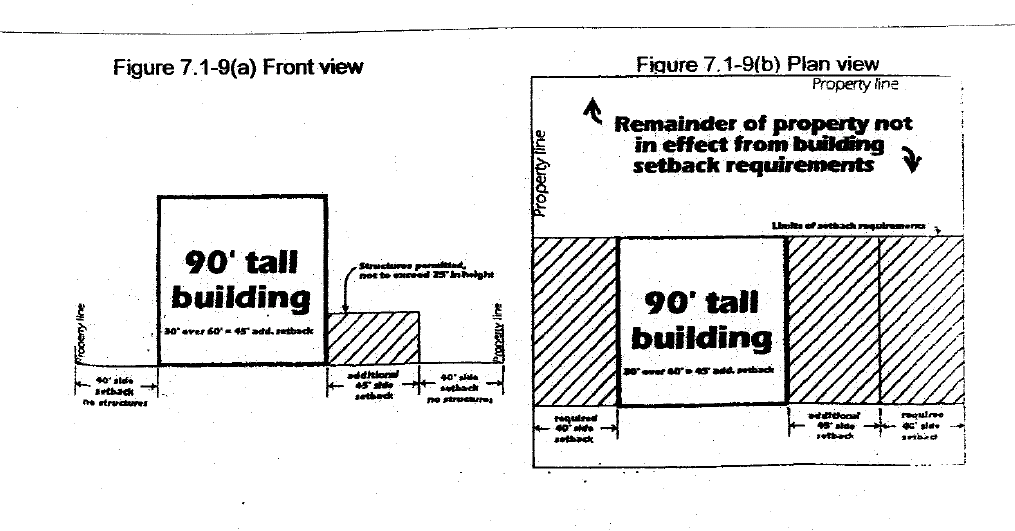
(Ord. No. 2010-05, § 1, 3-18-10; Ord. No. 2021-05, § 1, 8-9-21)
Sec. 25-154. - Dwelling unit minimum and single retail store maximum floor areas established.
(a)
Dwelling unit minimum floor area. The minimum floor area for a dwelling unit shall be at least six hundred (600) square feet as determined by measurements of the exterior dimensions of the unit exclusive of accessory buildings and detached or attached garages. Except that an accessory dwelling unit, as approved in Division V of this chapter may have a minimum floor area of three hundred (300) square feet.
(b)
Single retail store maximum floor area. No single retail store whether located in a single building, a combination of buildings, single tenant space, and/or combination of tenant spaces shall exceed twenty-five (25,000) thousand gross square feet of floor area in the aggregate. This size restriction shall apply to new retail stores and expansion of existing retail stores.
(Ord. No. 2010-05, § 1, 3-18-10; Ord. No. 2014-10, § 1, 7-7-14)
Sec. 25-155. - Mobile homes.
Mobile homes will be allowed in mobile home parks which conform to section 25-161. Mobile homes may be occupied on a separate lot in any district only if permanently attached to the ground as required in section 14-1 and in compliance with applicable sections of this chapter for single-family dwellings. Temporary, transient rental of mobile homes is prohibited.
(Ord. No. 2010-05, § 1, 3-18-10; Ord. No. 2021-05, § 1, 8-9-21)
Sec. 25-156. - Recreational vehicles.
Recreational vehicles will be allowed in recreational vehicle parks and recreational vehicle subdivisions which conform to chapter 14 and chapter 21 of the Port Aransas Code. Recreational vehicles may be stored or occupied outside of recreational vehicle parks and recreational vehicle subdivisions only in accordance with chapter 14.
(Ord. No. 2010-05, § 1, 3-18-10)
Sec. 25-157. - Special area regulations.
(a)
The planting of ornamental palms or trees along the property line is permitted for highway beautification purposes provided such planting will not constitute a traffic hazard or interfere with adjoining businesses.
(b)
Wreckage, debris resulting from hurricanes, windstorms, high water, wave action or storm damage shall be cleared up, removed from the property to prevent littering the surrounding area within four (4) months following the cause of damage. Failure to clean the premises is hereby declared a nuisance.
(Ord. No. 2010-05, § 1, 3-18-10)
Sec. 25-158. - Off-street parking facilities required.
Off-street parking facilities required. Off-street parking facilities shall be provided for all development within the city pursuant to the requirements of this Code. The facilities shall be maintained as long as the use exists that the facilities were designed to serve. It shall be unlawful for any owner or operator of any building or land use affected by the code to cause or permit the discontinuance or reduction of required parking or loading facilities without the establishment of alternative parking or loading facilities which meet the requirements of and are in compliance with this article and approved by the city manager or his or her designee. It shall be unlawful to discontinue or dispense with, or cause the discontinuance or reduction of, the required parking facilities apart from the discontinuance of the building, use, or structure without establishing alternative off-street parking facilities that meet these requirements.
(Ord. No. 2010-05, § 1, 3-18-10)
Sec. 25-159. - Surfacing standards.
All parking areas shall have durable surfaces for vehicle use areas, shall be properly drained and shall be designed with regard to pedestrian safety. A durable surface shall consist of an improved surface, including concrete, asphalt, stone, compacted shell and other permanent surfaces. Each parking space shall be accessible from a driveway.
(Ord. No. 2010-05, § 1, 3-18-10)
Sec. 25-160. - General standards.
(a)
Each off-street parking space for automobiles shall have an area of not less than nine (9) by eighteen (18) feet and for commercial uses each stall shall be striped or marked with a parking bumper (wheel stop). This standard size shall apply for off-street parking for all uses including single-family residential, duplexes, multifamily, townhouses, and detached single-family uses. Single-family structures and duplexes are not required to stripe parking spaces or place parking bumpers.
(b)
A sixteen (16) foot paved space (ninety (90) degree only) may be utilized where the space abuts a low profile landscaped island in which the front of the vehicle can protrude two (2) feet over the island. A sixteen (16) foot space may also be used when adjacent to a sidewalk in which the front of the vehicle can protrude two (2) feet over the sidewalk provided that the minimum width of the sidewalk is six (6) feet.
(c)
Each parking space intended for use by the handicapped shall be designed in accordance with the standards of the Texas Architectural Barriers Act (TABA) administered by the Texas Department of License and Regulation.
(d)
Each parking space and the maneuvering area thereto shall be located entirely within the boundaries of the building plot except where shared parking is approved by the city.
(e)
All parking spaces, aisles, and modules shall meet the minimum requirements, as shown in the following table. All dimensions are measured from wall to wall.
(f)
If the required parking for all the combined uses of a lot exceed ten (10) spaces or more, the following shall apply:
(1)
Only nine (9) spaces (per street frontage) shall be permitted to back into a public way;
(2)
Only one (1) driveway is allowed for lots with up to fifty (50) feet of frontage. Corner lots are allowed one (1) entrance and one (1) exit on each abutting street. If necessary to meet this requirement, uses shall arrange for shared egress;
(3)
Such parking lots shall be screened from any abutting residential use;
(4)
Facilities shall be so sized and arranged that no vehicles need back onto or off of a public way or be parked on a public way while loading, unloading or waiting to do so. (See also subsection (g) below).
(g)
If internal parking conditions are possible, then backing out onto the major arterials of Alister Street, Highway 361, Eleventh Street between Avenue G and Beach Access Road 1A, Avenue G, Cut-Off Road, and Cotter Ave. west of Station Street is prohibited.
(Ord. No. 2010-05, § 1, 3-18-10)
Sec. 25-161. - Number of off-street parking spaces required.
In computing the number of parking spaces required, the following rules shall govern:
(1)
Off-street parking spaces shall be provided upon the erection of any building or structure. Whenever a building or use constructed or established after the effective date of this section is changed or enlarged in floor area, number of employees, number of dwelling units, seating capacity, floor area or otherwise, parking requirements shall be met on the basis of the enlargement or change. Whenever a building or use existing prior to the effective date of this section is enlarged, the enlarged building or increased use shall then and thereafter comply with the parking requirements set forth herein;
(2)
In all zoning districts off-street parking requirements are exclusive of individually owned/assigned enclosed garages. Common use covered garage spaces (example: a parking garage) in multi-family uses shall be counted towards parking requirements;
(3)
The parking space requirements for a use not specifically listed shall be the same as those for the most similar to the proposed use, as determined by the administrator;
(4)
Where fractional spaces result when computing required parking spaces, the required number of spaces must be increased to the nearest whole number;
(5)
In the case of mixed uses, the parking spaces required shall equal the sum of the requirements of the various uses computed separately;
(6)
When a developer presents an alternative development plan (i.e., PUD, NUD) and can demonstrate that such development will require fewer parking spaces than required by the standards of this section without endangering the health, safety and general welfare of the public, the administrator may permit a reduction in the number of required parking spaces for the development. Such a reduction in parking spaces shall be justified through the development of a parking study prepared by a professional engineer or transportation planner and submitted to the administrator. The balance of the land necessary to meet these requirements may be held in reserve as an undeveloped area, to meet any future needs generated by an expansion of the business, a change in land use, or underestimated parking demand;
(7)
Stacked parking shall be permitted for residential dwelling units only, where the required parking can be assigned to a particular dwelling unit. The stacking of parking for a commercial use shall be prohibited except where expressly allowed. Additional parking approved in a separately designated area or by an approved alternative parking plan as described in this division, must be within two hundred fifty (250) feet of the lot or property for which the parking is being required;
(8)
Parking is expressing prohibited in any location that results in a safety issue or obstructs visibility from adjacent driveways or street corners; and
(9)
Parking requirements based on square footage shall be based upon the gross floor area, unless otherwise stated. Service areas such as mechanical rooms, restrooms, and closets shall be included in the calculation of "gross floor area" for determining required parking spaces; Where requirements are established on the basis of the number of seats, such requirements shall be based on the seating capacity as determined by the administrator or building official; Where the basis for parking requirements are the number of bedrooms/sleeping rooms, such requirements shall be based on a determination by the administrator or building official.
Minimum Off-Street Parking Requirements: SR - Sleeping Room; DU - Dwelling Unit
(Ord. No. 2010-05, § 1, 3-18-10; Ord. No. 2015-04, § 2, 5-21-15; Ord. No. 2021-05, § 1, 8-9-21)
Sec. 25-162. - Alternative parking plans.
(a)
Scope. An alternative parking plan represents a proposal to meet vehicle parking and transportation access needs by means other than providing parking spaces on-site in accordance with the ratios established in section 25-159, number of off-street parking spaces required.
(b)
Applicability. Applicants who wish to provide fewer on site parking spaces than allowed above shall be required to secure approval of an alternative parking plan, in accordance with the standards of this section. The administrator may require that an alternative parking plan be submitted in cases where the administrator deems the listed standard to be inappropriate based on the unique nature of the use or in cases where the applicable standard is unclear.
(c)
Contents. Alternative parking plans shall be submitted in a form established by the administrator and made available to the public. At a minimum, such plans shall detail the type of alternative proposed and the rational for such a proposal.
(d)
Review and approval procedure. The city council, upon recommendation of the planning and zoning shall be authorized to approve alternative parking plans.
(e)
Recording. An attested copy of an approved alternative parking plan shall be submitted to the county clerk's office for recordation on forms made available in the department of planning and projects. Proof of recordation of the agreement shall be presented to the administrator prior to issuance of a building permit. Minor amendments an approved alternative parking plan may be approved by the administrator.
(f)
Eligible alternatives. A number of specific parking and access alternative are described below. The city council shall, however, be authorized to consider and approve any alternative to providing off-street parking spaces on the site of the subject development if the applicant demonstrates that the proposed plan shall result in a better situation with respect to surrounding neighborhoods, city-wide traffic circulation, and urban design than would strict compliance with otherwise applicable off-street parking standards.
(1)
Shared parking. The city council may authorize a reduction in the number of required off-street parking spaces for multiple-use developments or for uses that are located near one another and that have different peak parking demands or different operating hours. Shared parking shall be subject to the following standards:
a.
Location. Shared off-street parking spaces shall be located no farther than two hundred fifty (250) feet from the building site. The city council may waive this distance limitation, if adequate assurances are offered that van or shuttle service shall be operated between the shared lot and the principal use;
b.
Zoning classification. Shared-parking areas shall be considered accessory uses of principal uses that the parking spaces are intended to serve. Shared parking areas shall require the same or a more intensive zoning classification than that required for the most intensive of the uses served by the shared parking area;
c.
Required study and analysis. The applicant shall submit a shared parking analysis to the city council that clearly demonstrates the feasibility of shared parking. The study shall be provided in a form established by the administrator and made available to the public. It shall address, at a minimum, the size and type of the proposed development, the composition of tenants, the anticipated rate of parking turnover, and the anticipated peak parking and traffic loads for all uses that shall be sharing off-street parking spaces. The city council shall have the authority to require a revised study and analysis should conditions change that may result in a change in site parking conditions;
d.
Shared parking agreement. A shared parking plan shall be enforced through written agreement among the owners of record. An attested copy of the agreement shall be submitted to the county clerk's office for recreation on forms made available in the planning and projects department. Proof of recordation of the agreement shall be presented to the administrator prior to issuance of a building permit. A shared parking agreement may be revoked by the parties to the agreement only if off-street parking is provided pursuant to this section, or if an alternative parking plan is approved by the administrator;
e.
Revocation. Failure to comply with the shared parking provisions of this section shall constitute a violation of this chapter and shall specifically be cause for revocation of a certificate of occupancy or building permit.
(2)
Off-site parking. The administrator may permit a portion of the required off-street parking spaces to be located on a remote and separate lot from the lot on which the principal use is located, subject to the standards of this section. No more than fifty (50) percent of the required parking shall be allowed off-site.
a.
Location. Shared off-street parking spaces shall be located no farther than two hundred fifty (250) feet from the building site. The city council may waive this distance limitation, if adequate assurances are offered that van or shuttle service shall be operated between the shared lot and the principal use;
b.
Zoning classification. Off-site parking areas shall be considered accessory uses of principal uses that the parking spaces are intended to serve. Off-site parking areas shall require the same or a more intensive zoning classification than that required for the use served;
c.
Off-site parking agreement. In the event that an off-site parking area is not under the same ownership as the principal use served, a written agreement among the owners of record shall be required. An attested copy of the agreement between the owners of record shall be submitted to the county clerk's office for recreation on forms made available in the office of the administrator. Proof of recordation of the agreement shall be presented to the administrator prior to issuance of a building permit. An off-site parking agreement may be revoked by the parties to the agreement only if off-street parking is provided on-site pursuant to section 25-159, off-street parking standards or if an alternative access and parking plan is approved by the city council.
(3)
Bicycle parking. The city council may authorize a reduction in the number of required off-street parking spaces for developments or uses that make special provisions to accommodate bicyclists. Examples of accommodations include bicycle lockers, employee shower facilities, and dressing areas for employees.
(Ord. No. 2010-05, § 1, 3-18-10)
Sec. 25-163. - Lighting and glare standards.
(a)
Lighting limited. Any light fixture shall be operated so as not to produce an obnoxious and intense glare or direct illumination across the bounding property line, and shall not be of such intensity as to create a nuisance or detract from the use or enjoyment of adjacent property. All lights projecting light to any exterior area shall be made up of a light source and reflector so selected that acting together, the light beam is controlled and not directed across any bounding property line above a height of three (3) feet (See section 25-166, nuisance declared).
(b)
Lighting that illuminates any outdoor area shall conform to the definition for "full shielded light fixtures" and be designed, arranged and screened so that the point light source shall not be visible from adjoining lots or streets.
(Ord. No. 2010-05, § 1, 3-18-10)
Sec. 25-164. - Luminaries.
Light sources shall be of a down-light type, indirect, diffused, or shielded type luminaries installed and maintained so as to reduce glare effect and consequent interference with use of adjacent properties and boundary streets.
(Ord. No. 2010-05, § 1, 3-18-10)
Sec. 25-165. - Temporary holiday lighting.
Strings of bulbs and strings of lamps are prohibited except for low wattage temporary lighting used for holidays and decorative seasons are permitted for a maximum time period of thirty (30) days before each holiday use and must be removed fifteen (15) days after the holiday ends.
The list of holidays shall be established and kept by the administrator.
(Ord. No. 2010-05, § 1, 3-18-10)
Sec. 25-166. - Specific lighting requirements.
(a)
Facade and flagpole lighting must be directed only toward the facade or flag and shall not interfere with the night-visibility on nearby thoroughfares or shine directly at any adjacent residential use.
(b)
All lighting fixtures incorporated into non-enclosed structures (i.e., gas pump canopies, car washes, etc.) shall be fully recessed into the underside of such structures and shall meet section 25-161 of this division.
(c)
No flashing lights of any type, except for temporary holiday lighting.
(Ord. No. 2010-05, § 1, 3-18-10)
Sec. 25-167. - Exempt lighting.
(a)
Public recreation facilities lighting used on a temporary or seasonal basis is exempt from the standards of this chapter.
(b)
Public street lights are exempt except that all replacement lights for any public street light shall be of the "Cut-off refractor" lighting type.
(c)
Traffic control lighting is exempt.
(d)
Federal Aviation Administration required lighting for the airport.
(e)
Lighting in swimming pools and other water features governed by Article 680 of the National Electrical Code.
(f)
Exit signs and other illumination required by building codes.
(g)
Lighting for stairs and pedestrian ramps, as required by the building code.
(h)
Signs are regulated by the sign code, but externally lit signs and displays must be shielded so as not to create obtrusive light.
(i)
Low voltage landscape lighting, but such lighting shall be shielded or directed in such a way as to eliminate obtrusive light.
(j)
Low intensity gas lighting in residential areas.
(k)
Low intensity "ambiance" lighting, such as "rope" lighting and frosted globe lighting.
(Ord. No. 2010-05, § 1, 3-18-10)
Sec. 25-168. - Nuisance declared.
The shining of light produced by a luminaire beyond the boundaries of the property on which the luminaire is located and onto another property under circumstances where the lighting element of the luminaire is visible from such other property and in such a manner and with such intensity as to disturb and annoy the reasonable sensibilities of a person living on and using such other property in a reasonable and customary manner as a residence is declared to be a nuisance and is prohibited. Street lights, traffic control lights, and public facility lighting are exempt from this chapter.
(Ord. No. 2010-05, § 1, 3-18-10)
Sec. 25-169. - Filing of complaint; unlawful noncompliance; fines.
Any person may complain to the city in regards to lighting that does not comply with the standards set forth in this division. The complaint must be filed in writing to the city code enforcement officer. It shall be unlawful for the owner or tenant within the city to fail to comply with the standards set forth in this section within fifteen (15) days after notice is mailed or published, directing that such standards be met; the code compliance office or any other individual assigned such duties may, whenever a violation is found, file a complaint with the municipal court and/or issue citations.
(Ord. No. 2010-05, § 1, 3-18-10)
Sec. 25-170. - General.
Outdoor storage and display is allowed in nonresidential uses in according with this section. Any merchandise, material, or equipment situated outdoors and visible from the public right-of-way or adjacent properties shall be subject to the requirements of this section. No outdoor storage or display shall be allowed to occur in required parking areas. (Also see: chapter 10, health and sanitation and chapter 12 licenses and business regulations for additional requirements of outdoor storage and display)
(Ord. No. 2010-05, § 1, 3-18-10)
Sec. 25-171. - Permanent structure required for commercial activities; exceptions.
(a)
It shall be unlawful for any person to sell, lease, rent, barter or exchange any goods, wares, merchandise or services on a commercial, retail basis or to offer to do so except out of a permanent structure complying with all construction codes, ordinances and regulations of the city applicable thereto, including, but not limited to, parking requirements. However, notwithstanding the general prohibition of this subsection, a person who engages in any of the hereinabove described activities out of a permanent structure complying with the hereinabove set forth requirements can engage in the like activities outside of his permanent structure so long as he does so on the same premises as his permanent structure is located.
Examples of like activities: An approved food service establishment can engage in the outdoor sale of same menu food service items. A T-shirt store can engage in the outdoor sale of T-shirts and other same store items. A T-shirt store cannot engage in outdoor food sales and a food service store cannot engage in outdoor T-shirt sales.
(b)
This section is not applicable to the following:
(1)
Peddlers as defined and regulated by other provisions of this Code;
(2)
Activities upon the public beach which are regulated by other provisions of this Code;
(3)
A sale of used, consumer, household goods by an individual who is not regularly engaged in the business of such sales, the sale being commonly known as a garage sale;
(4)
A nonprofit, charitable or fund-raising event for a charitable purpose;
(5)
Coin-operated vending machines, including newspaper type racks, located on the same property as a permanent structure which complies with the requirements of subsection (a) above; and
(6)
The sale of fuel and other goods and services customarily provided by a gasoline or automobile service station, so long as the sales are made on the same property as a permanent structure which complies with the requirements of subsection (a) above is located.
(7)
Activities upon public places permitted, licensed or otherwise allowed by the city for specific purposes regulated by other provisions of this Code.
(8)
Activities in the public harbors and marinas which are regulated by other provisions of this Code.
(9)
Any existing commercial activity approved by the city prior to January 14, 2015 may continue operating in non-conforming fashion under the same terms and conditions of their earlier approval until such time they are no longer able to meet those terms and conditions. Should the non-conforming commercial activity cease for a period greater than twelve (12) months, compliance with all current requirements will be required to resume said activity.
(Ord. No. 2010-05, § 1, 3-18-10; Ord. No. 2015-01, § 1, 1-15-2015)
Sec. 25-172. - Categories of outdoor storage and display.
(a)
Outdoor display. Outdoor display is display of items actively for sale. Such storage shall not be permitted to block windows, entrances, or exists, and shall not impair the ability of pedestrians to use the building or sidewalk.
(b)
Permanent outdoor sales areas. Merchandise may be stored or displayed for sale to customers in areas contiguous to the principle building. Permanent outdoor sales areas must comply with district setback requirements. Such areas may not interfere with parking and parking lot requirements. Permanent areas open to the public for the display and/or sale of merchandise shall be shown on a site plan and will be included in parking requirement calculations and approved by the administrator.
(c)
Temporary outdoor sales and storage. Temporary outdoor sales areas, including sales tents, may be displayed for a two-week period in a calendar year as approved by the administrator. Such areas shall be clearly defined and shall not interfere with parking lot requirements. Christmas trees and associated sales tents may be displayed for sale from November 15 to December 31 on any commercial use property and do not count towards the two-week allotment.
(d)
General outdoor storage. Outdoor storage consists of all remaining forms of outdoor storage not classified above. Outdoor storage visible to the public right-of-way or adjacent properties is allowed so long as it is completely screened from view outside the site by a solid wall or solid fence at least six (6) feet but not more than eight (8) feet in height. Outdoor storage shall not be allowed within a required front setback.
(Ord. No. 2010-05, § 1, 3-18-10)
Sec. 25-173. - Exceptions.
(a)
Vehicles for sale as part of a properly permitted vehicle sales use (including boats and manufactured housing) shall not be considered merchandise, material, or equipment subject to the restricts of this section.
(b)
Waste generated on-site and deposited in ordinary refuse containers shall not be considered outdoor display or storage.
(Ord. No. 2010-05, § 1, 3-18-10)
Sec. 25-174. - Purpose and intent.
It is the policy of the City of Port Aransas to promote and encourage the creation of legal ADUs in a manner that enhances residential neighborhoods and helps residents meet their housing needs and realize the benefits of ADUs.
(Ord. No. 2010-05, § 1, 3-18-10)
Sec. 25-175. - Eligibility.
An ADU may be permitted as an accessory use to a single-family home under the following conditions:
(1)
ADU's shall not be allowed on a lot with two (2) or more dwelling units.
(2)
Only one (1) ADU is permitted per single-family residence (SFR). The ADU may be located in the same building as the principal dwelling unit or in a directly adjacent building accessory to the principal dwelling unit, or directly adjacent to the principal dwelling unit as a separate stand-alone structure.
(3)
ADUs are allowed in any zoning district where there is an existing SFR or may be built in conjunction with a newly permitted SFR.
(Ord. No. 2010-05, § 1, 3-18-10)
Sec. 25-176. - General requirements.
All ADUs shall meet the following requirements:
(1)
An ADU shall be constructed only through the issuance of a building permit.
(2)
ADUs are allowed on any legally platted lot.
(3)
ADUs shall meet all setback requirements.
(4)
An ADU may not be sold separately from the sale of the entire property, including the primary dwelling unit, and shall not be rented or leased unless separate utility meters have been installed.
(5)
The square footage of an ADU shall be no less than three hundred (300) square feet and less than six hundred (600) square feet measured in air-conditioned living space (excludes air-conditioned garages and the like).
(6)
A minimum of one (1) additional parking space shall be provided for each bedroom that the ADU contains.
(7)
Regardless of zoning district, temporary, transient rentals of an ADU is prohibited unless the property owner permanently lives on site and the property is designated the owner's homestead residence with the Nueces County appraisal district. Additionally, temporary, transient rentals of an ADU is allowed only if rentals of the ADU, upon which occupancy taxes are or were lawfully due, took place in 2021 before August 5, 2021 and occupancy tax reports were or are timely filed with the appropriate state and city authorities applicable to such rentals and taxes. A qualified ADU may be used for temporary, transient rentals until the earlier to occur of (1) August 5, 2026 or (2) sale, conveyance, transfer or assignment of legal title to the property occurs after August 5, 2021, at which time temporary, transient rentals of said ADU shall cease.
(8)
Properties must be in compliance with existing density regulations before an ADU is permitted.
(9)
RV, campers, mobile homes, modified container van or any similar structure are not allowed as an ADU.
(10)
On lots sized for multifamily development, and where there exists a SFR with an ADU if the owner of such lot wishes to build an additional dwelling unit(s), the ADU must be sized to at least six hundred (600) square feet at which point it will be considered a "second" dwelling unit and not an ADU.
(Ord. No. 2010-05, § 1, 3-18-10; Ord. No. 2021-05, § 1, 8-9-21)
Sec. 25-211. - Definitions.
The following words, terms and phrases, when used in this division, shall have the meanings ascribed to them in this section, except where the context clearly indicates a different meaning:
Adult book store means an establishment having as a substantial or significant portion of its stock in trade, books, magazines, and other periodicals which are distinguished or characterized by their emphasis on matter depicting, describing or relating to specified sexual activities or specified anatomical areas as herein defined or an establishment with a segment or section devoted to the sale or display of such material.
Adult motion picture theater means an enclosed building used for presenting material distinguished or characterized by an emphasis on matter depicting, describing or relating to specified sexual activities or specified anatomical areas as herein defined for observation by patrons therein.
Church includes the primary church building where worship services are conducted and the grounds and structures surrounding or in close proximity thereto and used in connection there-with.
Commercial sexual exhibition means a commercial establishment where any goods or services are provided to customers or patrons on a commercial basis and where, for observation by customers or patrons while the customers or patrons are buying or consuming the goods or services, there is provided a live, human exhibition, including by way of illustration and not limitation, dancing, modeling, plays and other displays, which are distinguished or characterized by their emphasis on matters depicting, describing or relating to specified sexual activities or specified anatomical areas as herein defined.
School means preschool, primary and secondary schools and colleges and the structures and grounds surrounding same or in close proximity thereto and used in connection therewith or which are used in connection therewith although not in close proximity thereto, including, but not limited to, playgrounds, stadiums, tract and field areas, etc.
Specified sexual activities means:
(1)
Human genitals in a state of sexual stimulation or arousal;
(2)
Acts of human masturbation, sexual intercourse or sodomy;
(3)
Fondling or other erotic touching of human genitals, pubic region, buttock or female breasts.
Specified anatomical area means:
(1)
Less than completely and opaquely covered: (a) human genitals, pubic region, (b) buttock, and (c) female breast below a point immediately above the top of the areola; and
(2)
Human male genitals in a discernible turgid state, even if completely and opaquely covered.
(Ord. No. 2010-05, § 1, 3-18-10)
Sec. 25-212. - Prohibition.
All adult motion picture theaters, adult book stores, and commercial sexual exhibitions are prohibited, except in the commercial and industrial districts. Within any such districts such businesses, activities, and uses are prohibited within one thousand three hundred twenty (1,320) feet of any church; one thousand three hundred twenty (1,320) feet of any areas zoned exclusively for residential use; two thousand six hundred forty (2,640) feet of any school; one thousand three hundred twenty (1,320) feet of any city park or public building; two thousand six hundred forty (2,640) feet of the public beach as measured from the natural vegetation line; one thousand three hundred twenty (1,320) feet of any other adult book store, adult motion picture theater, or commercial sexual exhibition and one thousand three hundred twenty (1,320) feet of any sexually oriented commercial activity as defined by section 25-226.
(Ord. No. 2010-05, § 1, 3-18-10; Ord. No. 2010-08, § 1, 7-15-10)
Sec. 25-213. - Measurement of distances.
(a)
For the purpose of measuring the distance from a church, school, city park, public building, public beach, or an area zoned exclusively for residential use to an adult book store, adult motion picture theater, or a commercial sexual exhibition, the measurement shall be taken along a straight line starting from that point of the building in which such business, activity or use is or is proposed to be conducted which is closest to the church, school, city park, public building, public beach, or boundary line of such area zoned exclusively for residential use.
(b)
For the purpose of measuring the distance from an adult motion picture theater, adult book store or commercial sexual exhibition (the regulated use) to another adult motion picture theater, adult book store or commercial sexual exhibition or to a sexually oriented commercial activity as defined by section 25-226 (another regulated use), the measurement shall be taken along a straight line, starting at that point of the building where the regulated use is or is proposed to be conducted which is closed to a point of the building where another regulated use is conducted and ending at such latter point.
(Ord. No. 2010-05, § 1, 3-18-10; Ord. No. 2010-08, § 1, 7-15-10)
Sec. 25-226. - Definitions.
The following words, terms and phrases, when used in this division, shall have the meanings ascribed to them in this section, except where the context clearly indicates a different meaning:
Church include the primary church building where worship services are conducted and the grounds and structures surrounding or in close proximity thereto and used in connection therewith.
School means preschool, primary, and secondary schools and colleges and the structures and grounds surrounding same or in close proximity thereto and used in connection therewith or which are used in connection therewith although not in close proximity thereto, including, but not limited to, playgrounds, stadiums, track and field areas, etc.
Sexually oriented commercial activities means massage parlors, nude studios, modeling studios, love parlors, and other similar commercial enterprises whose major business is the offering of a service which is intended to provide sexual stimulation or sexual gratification to the customer. Sexually oriented commercial activities, as used herein, does not include bookstores, movie theaters, or any business:
(1)
Operated by or employing licensed psychologists, licensed physical therapists, licensed athletic trainers, licensed cosmetologists, or licensed barbers engaged in performing functions authorized under the license held; or
(2)
Operated by or employing licensed physicians or licensed chiropractors engaged in practicing the healing arts.
(Ord. No. 2010-05, § 1, 3-18-10)
Sec. 25-227. - Prohibition.
All sexually oriented commercial activities as herein defined are prohibited, except in commercial and industrial districts, and within any such district such activities are prohibited within one thousand three hundred twenty (1,320) feet of any church, one thousand three hundred twenty (1,320) feet of any areas zoned exclusively for residential use, two thousand six hundred forty (2,640) feet of any school, one thousand three hundred twenty (1,320) feet of any city park or public building, two thousand six hundred forty (2,640) feet of the public beach as measured from the natural vegetation line, one thousand three hundred twenty (1,320) feet of any other sexually oriented commercial activity, and one thousand three hundred twenty (1,320) feet of any adult motion picture theater, adult book store, or commercial sexual exhibition as defined by section 25-211.
(Ord. No. 2010-05, § 1, 3-18-10; Ord. No. 2010-08, § 2, 7-15-10)
Sec. 25-228. - Measurement of distances.
(a)
For the purpose of measuring the distance from a church, school, city park, public building, public beach, or an area zoned exclusively for residential use to a sexually oriented commercial activity, the measurement shall be taken along a straight line starting from that point of the building in which such activity is or is proposed to be conducted which is closed to the church, school, city park, public building, public beach, or boundary line of such area zoned exclusively for residential use.
(b)
For the purpose of measuring the distance from a sexually oriented commercial activity (the regulated use) to another sexually oriented commercial activity, an adult motion picture theater, an adult book store or a commercial sexual exhibition as defined by section 25-211 (another regulated use), the measurement shall be taken along a straight line, starting at that point of the building where the regulated use is or is proposed to be conducted which is closed to a point of the building where another regulated use is conducted and ending at such latter point.
(Ord. No. 2010-05, § 1, 3-18-10; Ord. No. 2010-08, § 2, 7-15-10)

