
Port Saint Lucie City Zoning Code
ARTICLE XI
SUPPLEMENTARY USE REGULATIONS
Sec. 158.201. - Base Building Line Requirements.
In order to provide for necessary street improvements and extensions to streets, certain base building lines may be established from time to time by the City Council. Where any base building line has been so established, all required setbacks shall be measured from that line, and in no case shall any part of a building, structure, parking area, or other site improvement of a permanent nature be constructed or extended streetward beyond the line.
(Ord. No. 98-84, § 1, 3-22-99)
Sec. 158.202. - Setback Required from Natural Body of Water.
No buildings or structures within any single-family residential zoning district shall be erected closer than fifty (50) feet to the mean high water line of any natural and public body of water; no building or structure within a zoning district other than a single-family district shall be erected closer than seventy-five (75) feet to the mean high water line; except that the restriction shall not apply in the case of a boat dock, board walks, marina, or marina-associated structures. The lots listed below (noninclusive) shall meet the requirements of this section:
(Ord. No. 98-84, § 1, 3-22-99)
Sec. 158.203. - Setback Requirement for Corner Lot in Single-Family Residential District.
(A)
Any corner lot having a width of less than ninety (90) feet at its front property line shall have a side setback requirement of fifteen (15) feet adjacent to the side street.
(B)
Any corner lot having a width between ninety (90) feet and one hundred (100) feet at its front property line shall have a side setback requirement of twenty (20) feet adjacent to the side street.
(C)
Any corner lot having a width exceeding one hundred (100) feet at its front property line shall have a side setback requirement of twenty-five (25) feet adjacent to the side street.
(D)
In applying these requirements, the front property line shall be that most consistent with frontages established by platting or development patterns containing the subject property.
(Ord. No. 98-84, § 1, 3-22-99)
Sec. 158.204. - Visibility at Intersections in Zoning Districts.
No fence, wall, hedge, or shrub planting which obstructs sight lines and elevations between two (2) and six (6) feet above the crown of the road shall be placed or permitted to remain on any corner lot in any zoning district within the triangular area formed by the street property lines and a line connecting them at points twenty-five (25) feet from the intersection of the street lines, or in the case of a rounded property corner from the intersection of the street property lines extended. The same sight line limitations shall apply on any lot within ten (10) feet from the edge of a driveway or alley. No tree shall be permitted to remain within the above described limits of intersections unless the foliage line is maintained at or above six (6) feet above the roadway intersection elevation to prevent obstruction of sight lines.
(Ord. No. 98-84, § 1, 3-22-99)
Sec. 158.206. - Special Design Requirements for Single-Family Residences.
At the time the certificate of occupancy is issued, each single-family residence shall have either a garage or a carport containing a minimum of two hundred (200) square feet and an enclosed storage area with a minimum of eighty (80) square feet which shall be accessible from the outside, garage, or carport.
(Ord. No. 98-84, § 1, 3-22-99)
Sec. 158.208. - Moving of Buildings or Structures.
(A)
No building or structure shall be moved from one (1) location to another nor shall be raised, jacked up, or prepared to be moved until a special permit for the same shall have been issued by the Building Official, and all approvals and releases from all required agencies concerned have been executed and approved.
(B)
Any special moving permit shall be conditioned upon the posting of a bond in an amount to be determined by the Building Official.
(C)
Once a special moving permit has been issued the building or structure shall be moved within fourteen (14) days of issuance of the special permit and all necessary improvements required in order for said building or structure to comply with the requirements of the building code shall be completed within ninety (90) days from the date of issuance of the moving permit unless said timeframes are extended by the Building Official upon the showing of delay caused by matters beyond the control of the owner or the house mover.
(D)
A special moving permit is separate from the building permit required to construct the foundation where the building or structure is to be placed.
(E)
No special moving permit shall be issued that would result in a non-conforming use under the City's zoning code, including, but not limited to, compliance with minimum house sizes.
(F)
Moved buildings or structures shall comply with all applicable landscape codes.
(G)
Should the move or completion of necessary improvements not occur in the timeframe allotted, the bond posted as a condition of the special moving permit shall be forfeited to the City.
(Ord. No. 98-84, § 1, 3-22-99; Ord. No. 04-51, § 1, 4-12-04)
Sec. 158.209. - Public Services and Facilities.
Essential services as herein defined shall be permitted in any zoning district. Streets and roads shall be permitted in all zoning districts consistent with all City, County, State, or Federal rules and regulations. Public services and facilities involving buildings, distribution substations, generating plants, or treatment plants shall be permitted within zoning districts only when specifically listed as permitted or special exception uses.
(Ord. No. 98-84, § 1, 3-22-99)
Sec. 158.211. - Storage or Accumulation of Materials, Refuse, and Waste Materials Prohibited.
Except as may be expressly permitted within this chapter, no materials, refuse, and waste materials (including inoperable equipment and vehicles) shall be stored or accumulated outside of a fully-enclosed building within any zoning district. This requirement shall not apply to patio furniture, grills, and other household items specifically designed for outdoor use in residential areas or materials stored in an approved open/outside storage area within Industrial or Service Commercial zoning districts. This requirement also shall not apply to materials related to new construction, provided that all required permits have been obtained for that construction, and that all surplus materials and waste products shall be removed from the premises promptly upon completion of that construction. Inoperable vehicles may be parked in parking lots at vehicle repair businesses in the Service Commercial and Warehouse Industrial zoning districts for no longer than two weeks, provided the businesses have a current work order for the vehicle(s).
(Ord. No. 98-84, § 1, 3-22-99; Ord. No. 00-11, § 1, 2-14-00; Ord. No. 15-85, § 1, 12-7-15)
Sec. 158.212. - Virtual Auto Sales.
(A)
In General. Retail sales of motor vehicles are allowed only within enclosed buildings, subject to the following regulations.
(B)
Supplementary Use Regulations.
1.
Indoor Operations Only. All vehicle storage, sales transactions, and customer interactions must occur entirely within an enclosed structure. No exterior storage, or advertising of vehicles is permitted.
2.
No Ancillary Sales or Services. The sale of vehicle parts, accessories, or related services, including repairs, maintenance, or washing, is prohibited.
3.
Test Drives. Test drives must be pre-scheduled and conducted off-site. Vehicles must remain enclosed until a customer appointment, with no on-site browsing or staging.
4.
Compliance with Licensing Requirements. The business must maintain an office and display space in compliance with Florida Administrative Code R. 15C-7.003.
(Ord. No. 25-24, § 2(Exh. F), 5-12-25)
Sec. 158.213. - Wireless Communication Antennas and Towers.
Wireless communication antennas and towers shall comply with all applicable structural and safety standards of the Federal Communications Commission (FCC), Edison Electrical Institute (EEI) and/or Electronic Industries Association (EIA), and Federal Aviation Authority (FAA). Commercial wireless communication antennas and towers are considered structures and shall be installed in accordance with all applicable provisions of the building code, plus all conditions of this section.
(A)
Monopole Towers. Monopole towers are single upright poles, engineered to be self-supporting and do not require lateral cross supports or guys.
(B)
Guyed Towers and Antennas. Guyed towers and antennas shall be set back from all property lines a minimum distance of the break points as verified by a certified engineer on the site plan or a distance equal to one-half its height to allow for proper guying and maintenance. All tower supports and peripheral anchors shall be located entirely within the boundary of the property.
(C)
Self-Supporting Towers and Antennas. Self-supporting towers and antennas shall meet the setback requirements of the applicable zoning district.
(D)
Special Exception Use. Wireless communication antennas and towers shall be considered a special exception use in the following zoning districts and shall meet all requirements of sections 158.255 through 158.262:
(1)
GU (General Use);
(2)
OSR (Open Space Recreational);
(3)
OSC (Open Space Conservation);
(4)
I (Institutional);
(5)
CS (Service Commercial);
(6)
WI (Warehouse Industrial);
(7)
IN (Industrial);
(8)
U (Utility);
(9)
Neighborhood Village/Commercial, Town Center, Resort, Employment Center, Regional Business Center, Mixed Use and designated park or school sites within Residential land use sub-categories in MPUDs (Master Planned Unit Development) in NCD (New Community Development District) future land use areas.
(E)
Wind Load. Certification from a Florida-registered professional engineer stating that the tower would collapse within the designed and specified fall radius depicted in the plans is required. Further, the engineer shall certify that it is documented that the tower shown in the plan can withstand winds of a Category 3 hurricane intensity.
(F)
Height Limits.
(1)
Wireless communication towers:
(a)
Located in CS, WI, IN, GU, and U zoning districts; Mixed Use, Regional Business Center, and Employment Center Sub-Districts in MPUDs in NCD future land use areas: up to three hundred (300) feet.
(b)
Located in OSR, OSC, and I zoning districts, and Town Center Sub-District in MPUDs in NCD future land use areas, and greater than five (5) acres: up to two hundred (200) feet.
(c)
Located in OSR, and OSC zoning districts; and Neighborhood Village/Commercial Areas, and Resort, Sub-Districts in MPUDs in NCD future land use areas, and less than five acres: up to one hundred (100) feet.
(d)
Not permitted in residential land use areas.
(2)
A waiver to these height limits can be requested as a part of the special exception review. The applicant must provide documentation as to why the height limits are inappropriate to the proposed site.
(G)
Co-Location. To discourage the proliferation of communication towers, shared use of tower structures is both permitted and encouraged. As part of special exception applications, applicants shall be required to verify that they have attempted to co-locate any proposed antenna on an existing tower within the proposed service area prior to approval of new towers. Applicants shall also provide evidence that they have mailed a "notice of intent" letter to all known telecommunication providers within the city to determine if any providers can co-locate on the proposed tower.
(H)
Fencing. A chain-link fence, with or without barbed wire, or solid wood or masonry wall at least six (6) feet in height, shall be constructed and maintained around the perimeter of the tower and associated structures and equipment. Access shall be through a locked gate.
(I)
Landscaping. Landscaping for sites either in or adjacent to residential land use areas shall be as follows: a row of trees a minimum of eight (8) feet tall set twenty (20) feet apart shall be planted around the outside perimeter of the fence, plus a hedge a minimum of three (3) feet in height and spaced three (3) feet apart shall be planted on the outside of the fence and tree row. Plantings shall be from the approved list in the landscaping code. Landscaping for sites in commercial and industrial areas shall follow the city's landscaping code for those land uses.
(J)
Signs. No advertising signage of any type is permitted on a wireless communication antenna, tower, or equipment storage area. Safety and cautionary signs shall be attached to the fence or structure for those facilities using more than 220 voltage. The following signage shall be in large bold letters: "HIGH VOLTAGE - DANGER."
(K)
Lighting. For the placement and use of any lights on such towers or antennas, the applicant shall submit a lighting plan which includes methods for shielding adjacent properties from glare.
(L)
Site Plan Review. All proposals for towers are required to follow the site plan review regulations set forth under sections 158.235 through 158.245. Site plan reviews are to be processed as a part of the special exception application.
(M)
Obsolete and Unused Towers.
(1)
Any obsolete or unused tower shall be removed after twelve (12) months of non-use. A removal bond or irrevocable letter of credit equal to the following shall be required prior to obtaining final site development permits:
(a)
Towers up to (150) feet in height: Fifteen thousand dollars ($15,000.00).
(b)
Towers one hundred fifty-one (151) to two hundred (200) feet in height: twenty thousand dollars ($20,000.00).
(c)
Towers two hundred one (201) to three hundred (300) feet in height: twenty-five thousand dollars ($25,000.00).
(d)
Towers three hundred (300) feet and above: Thirty thousand dollars ($30,000.00).
(2)
Tower height shall be measured from the base of the structure.
(N)
Separation.
(1)
Separation distance guidelines between towers shall be as follows:
(a)
Towers less than one hundred (100) feet in height shall locate a minimum of one thousand (1,000) feet apart;
(b)
Towers greater than one hundred (100) feet in height shall locate a minimum of one thousand five hundred (1,500.00) feet apart;
(c)
Guyed and self-supporting towers shall locate at least two thousand (2,000) feet away from other guyed or self-supporting towers.
(2)
Applicants shall provide documentation of the distance of the nearest tower to the proposed site as part of the application.
(3)
No separation is required for towers located in CS (Service Commercial), WI (Warehouse Industrial), LI (Light Industrial), and HI (Heavy Industrial) zoning districts.
(4)
A waiver to separation distance requirements may be considered as a part of the application, provided that the applicant can sufficiently justify why such separation is not appropriate.
(O)
Interference (Bleed Over).
(1)
As a condition of approval, any proposed tower or antennae shall not cause interference with the use of radio, television, or telephone broadcasting and reception.
(2)
Interference as a result of any approved tower or antennae shall be considered a violation of the special exception approving the tower and may result in the revocation of the special exception. Such interference may further be considered a public nuisance, and the city may order abatement of the same, including, but not limited to, requiring removal of the tower.
(P)
Lease Agreements. For city-owned property, a lease agreement shall be included as a part of the special exception application.
(Ord. No. 98-84, § 1, 3-22-99; Ord. No. 09-28, § 1, 3-9-09; Ord. No. 12-39, § 1(Exh. A), 8-13-12; Ord. No. 24-46, § 2(Exh. A), 9-9-24)
Sec. 158.214. - Yard Encroachments.
Every part of a required yard shall be open and unobstructed from the ground to the sky except as hereinafter provided or as otherwise permitted by this chapter:
(A)
Sills or belt courses may project not over twelve (12) inches into a required yard;
(B)
Cornices, eaves, gutters, movable awnings or outside utilities may project not over three (3) feet into a required yard;
(C)
Chimneys, fireplaces, or pilasters may project not over two (2) feet into a required yard;
(D)
Hoods, canopies, or marquees may project not over three (3) feet into a required yard, but shall not extend closer than one (1) foot to any lot line;
(E)
Parking may be located in the required building setback line, subject to all applicable landscaping and buffering requirements of Chapter 154.
(F)
Flag poles may be located no closer than ten (10) feet to the property lines.
(Ord. No. 98-84, § 1, 3-22-99; Ord. No. 15-85, § 1, 12-7-15)
Sec. 158.215. - Exclusions from Height Limits.
(A)
Permitted Exclusions from Height Limits. Utility penthouses, scenery lofts, towers, cupolas, steeples, domes, flag poles, airplane beacons, broadcasting towers, antennas, chimneys, stacks, tanks, roof mounted solar energy systems, non-roof installed solar energy devices integrated into the architecture of the building, and roof structures used only for ornamental or mechanical purposes may exceed the permissible height limit in any district by not more than twenty-five (25) percent. (Refer to building height definition). Parapet walls may extend not more than five (5) feet above the allowable height of a building. In addition, essential services shall be exempted from the height limit provisions of this chapter. Wireless communication antennas and towers may exceed the height limit, as set forth in section 158.213, only to the extent as approved in a special exception application.
(B)
Exclusion from Height Limits for Church Steeples. An applicant may request a special exception to the exclusions from height limits for church steeples or other ornamental worship structures, provided the request is in accordance with the criteria cited below:
(1)
Minimum church building size of one thousand two hundred (1,200) square feet of gross floor area;
(2)
Maximum overall height of the building and ornamental worship structure shall not exceed sixty (60) feet from the ground level;
(3)
That part of the structure exceeding the permissible height limit shall not be used for human occupancy or storage; and
(4)
The applicant shall submit a conceptual site development plan for the property along with detailed elevation plans upon application for special exception.
(C)
Exclusion from height limits for roads, bridges, and their accessory structures. Roads, bridges, and their accessory structures shall be exempt from height limits.
(Ord. No. 98-84, § 1, 3-22-99; Ord. No. 11-14, § 1, 3-14-11; Ord. No. 15-85, § 1, 12-7-15)
Sec. 158.216. - Fences and Privacy Walls.
(A)
Construction. All fences placed on property with residential zoning designation shall consist of the following materials:
1.
Chain Link steel wire (6-9 gauge), aluminum, vinyl coated steel, polyester powder steel, Cedar, White Oak, Cypress, Redwood, or pressure treated lumber.
a.
Ornamental designs are permitted.
b.
Imitation wood fences are permitted if the material is:
i
Vinyl, composite, or other similar plastic fencing material.
ii
Masonry material and/or any material comparable to masonry are permitted if it follows regulations listed in section 158.216(A)(2).
c.
Lattice design is permitted on top of fencing if it is less than two (2) feet in height and the overall height of the fence and lattice work does not exceed the permitted fence height.
2.
Masonry, any material comparable to masonry, or stone walls are:
a.
Required to meet all Florida Building Code requirements including structural integrity.
b.
Prohibited in that area extending from the front building line to the front property line, unless used as landscape material and in compliance with the requirements of section 158.216 (H).
3.
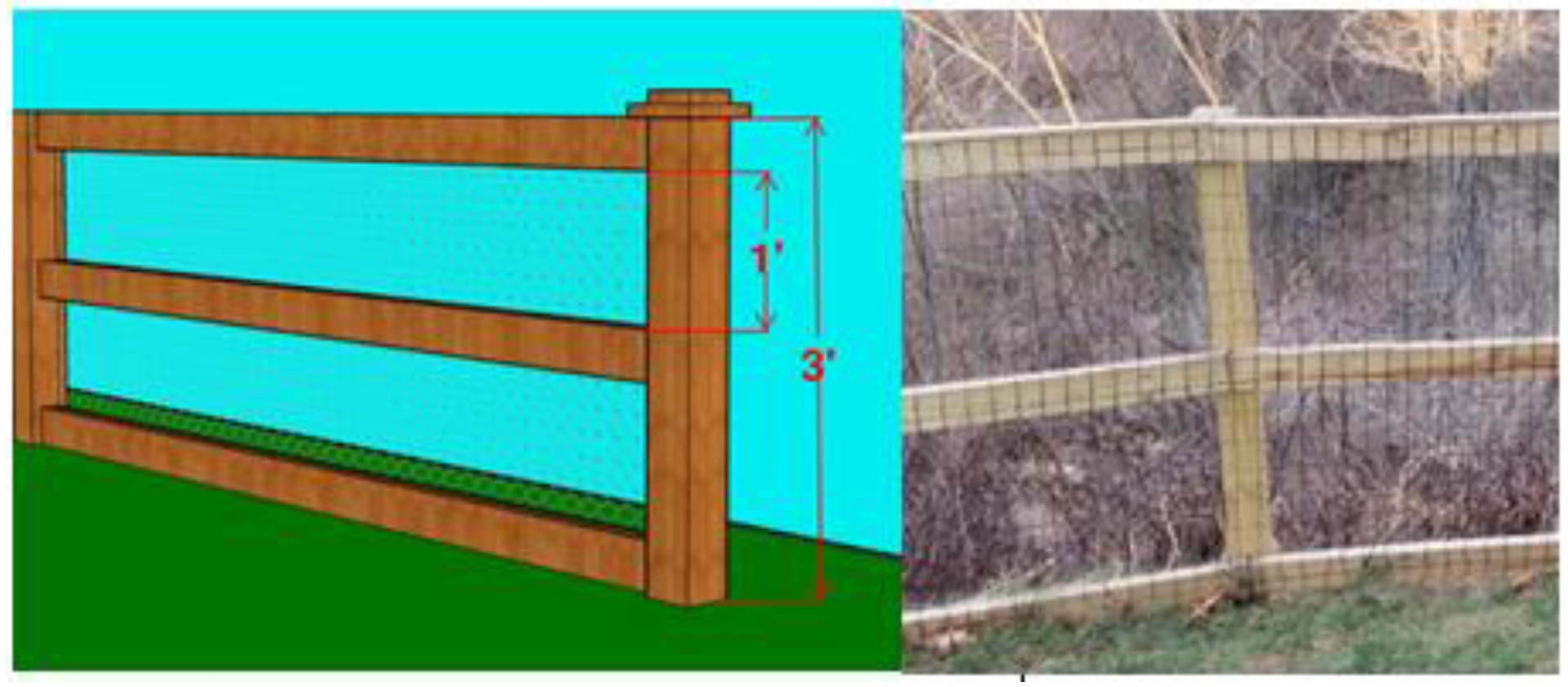
Vinyl coated welded wire may be used as an interface to a wooded fence when and only when:
a.
The top, sides, and bottom of the wire (cut edge of wire) is hidden by the wooden fence.
b.
The wood fence has a maximum height of three (3) feet. Post caps may be in addition to the three (3) feet but be limited to three (3) inches maximum.
c.
A post and rail fence has a top and bottom rail hiding the edges of the wire and the rails are no more than one (1) foot apart.
4.
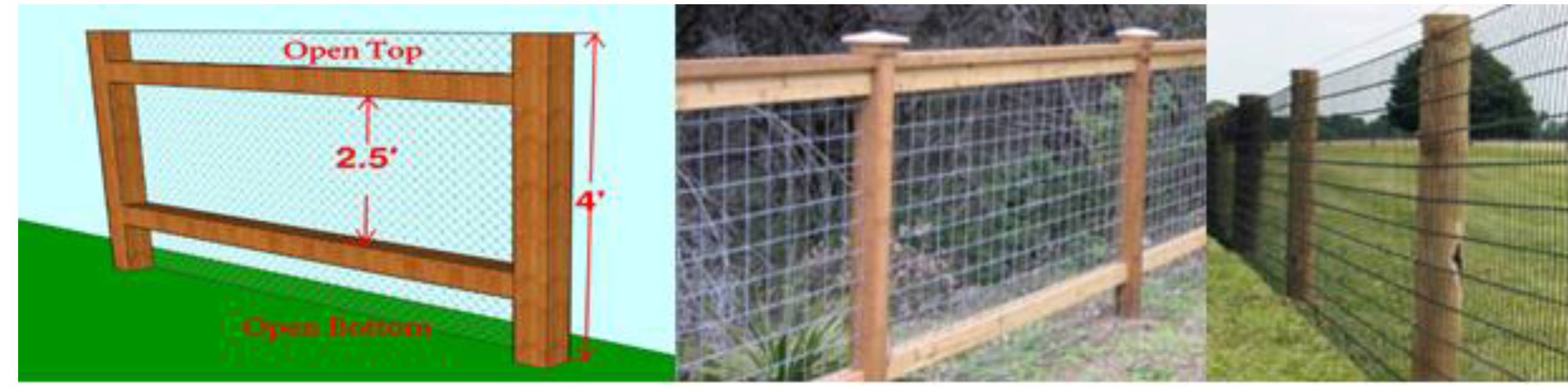
Chicken wire and barbed wire material in residential zoning districts are not permitted.
a.
EXAMPLES OF PERMITTED (above):
b.
EXAMPLES OF PROHIBITED (below):
5.
Upon request from the City, the property owner shall remove permitted or unpermitted alterations or improvements within City drainage and utility easements.
a.
The cost of removing permitted or unpermitted alterations or improvements within City drainage and utility easements shall be that of the property owner.
b.
The City will not be held responsible for any and all claims, loss, damage, or expense which may arise as a result of the placement or removal of any permitted or unpermitted alterations or improvements within a City drainage and utility easements.
c.
If a property owner fails to remove and restore the easement areas as required by Chapter 55 of this Code, the city shall take any actions deemed necessary and appropriate to remove and restore the easement area and may collect the costs of such removal and restoration from the owner of the property.
(B)
Height. No residential fence shall be of a height greater than eight (8) feet measured from the finished grade at the fence location. This height limitation is not intended to apply to enclosures surrounding, or part of, recreational or sporting facilities. Fences permitted for, or enclosures surrounding recreational or sporting facilities, will be evaluated by the Zoning Administrator on an individual basis.
(C)
Distance from the Front Yard Property Line. All fences on property zoned single-family residential shall be located at least twenty-five (25) feet from the front yard property line or even with the outside front corners of the building, whichever distance from the front yard property line is greater.
(D)
Distance from the Rear Yard Property Line when abutting a Public Road Right-Of-Way. All fences on property zoned single-family residential shall be located at least (25) twenty-five feet from the rear yard property line, when the rear yard property line abuts a public road right-of-way. The Zoning Administrator may waive this requirement if special circumstances exist.
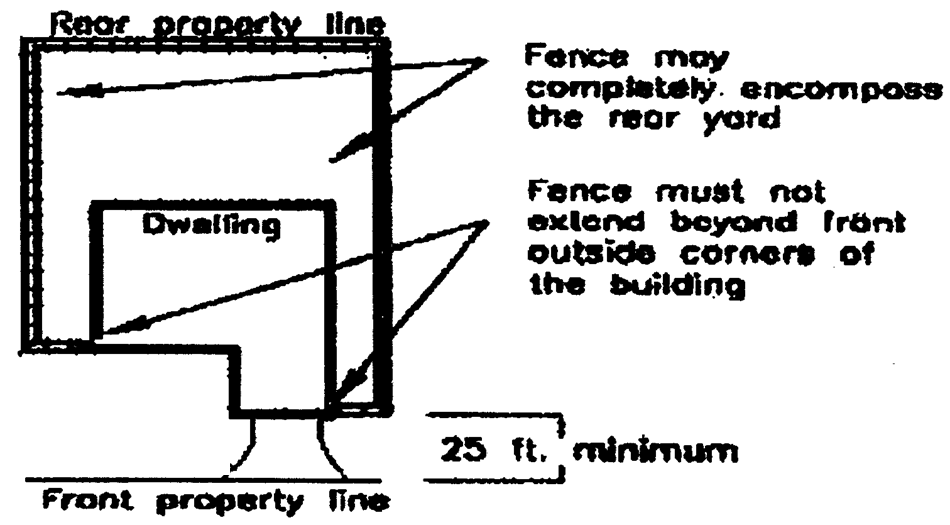
Front Property Line
(E)
Distance from the Side Yard Property Line for Corner Lots. On corner lots zoned single family residential, fences may be erected inside and adjacent to the side yard property line abutting a street right-of-way if the fence will not encroach into the sight triangle. The sight triangle shall be the triangular area formed by the street property lines and a line connecting them at points 25 feet from the intersection of street lines, or in case of a rounded property corner from the intersection of street property lines extended.
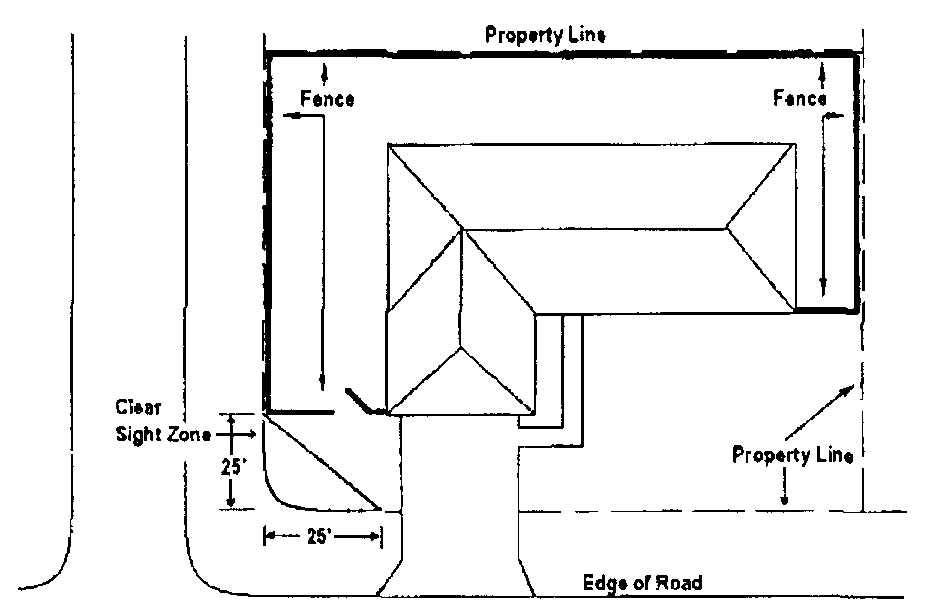
Corner Lots
(F)
Fences to be Inside Property Line, Maintenance Responsibility. All fences shall be erected inside the property line as set out on the plat adopted by the City. The maintenance of the property on both sides of the fence shall be the responsibility of the property owner.
(G)
Enclosures for Swimming Pools.
(1)
Shall meet all Florida Building Code requirements.
(H)
Fences and privacy walls used as Landscape Material. On property zoned single-family residential, segments of fencing including gates, may be utilized as landscaped treatment in that area extending from the front building line to the front property line provided that no property is enclosed. Fence material, including gates, shall not exceed four (4) feet in height. A two-foot break is required for each twenty feet in length. Fence material shall be regulated as in Section 158.216 (A). No gates or structure may be placed in the two-foot break.
(I)
Nonresidential Fences. Fences adjacent to residential property shall conform to the requirements of subsections (B) through (F) above, and Chapter 154, as well as other applicable codes and regulations of the City.
(J)
Fences on vacant residential lots. Fences shall only be permitted on a vacant residential lot/s when the following criteria have been met:
(1)
The vacant lot/s shall be adjacent to a lot that has an existing primary use.
(2)
Both the vacant lot/s and the adjacent lot with a primary use shall be in common ownership.
(3)
All lots must be located in the same zoning district and in the same future land use designation.
(4)
The proposed fence shall meet the side, front, and/or rear setback requirements when abutting a public right-of-way as defined in subsections (C), (D) and (E)
(5)
In the event that the abutting street to the subject property has a predominant fence setback that is greater than the requirements of this chapter, all proposed fences on that street shall be located to conform to that setback.
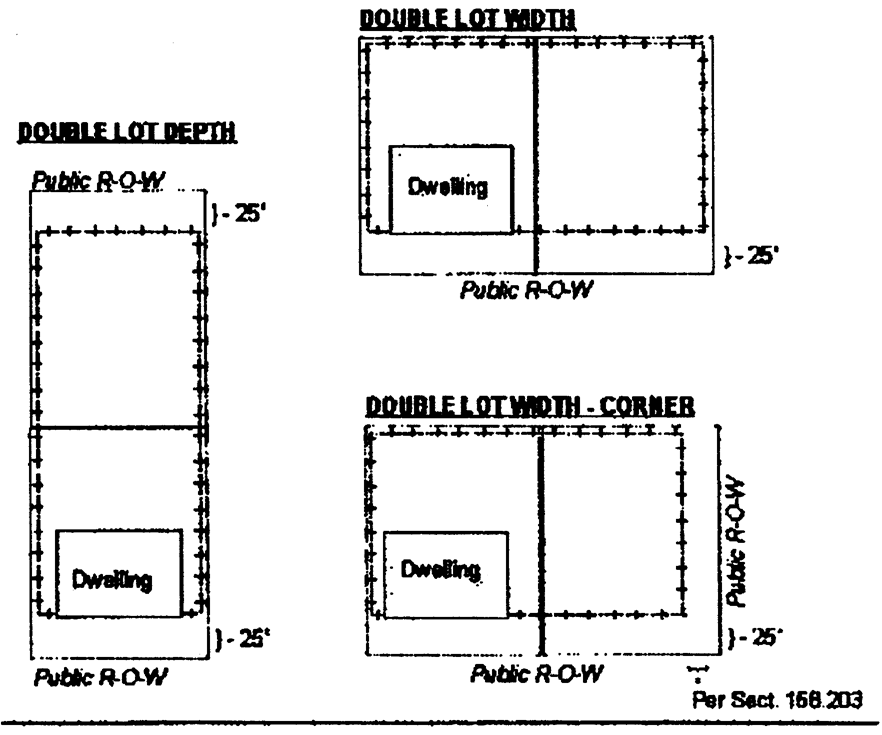
Double Lots
(Ord. No. 98-84, § 1, 3-22-99; Ord. No. 04-127, § 1, 11-22-04; Ord. No. 08-70, § 1, 8-11-08; Ord. No. 09-55, § 1, 6-22-09; Ord. No. 15-85, § 1, 12-7-15; Ord. No. 19-40, § 2, 7-8-19; Ord. No. 22-09, § 2, 2-14-22)
Editor's note— Ord. No. 22-09, § 2, adopted Feb. 14, 2022, amended § 158.216 and in doing so changed the title of said section from "Fences and Walls" to "Fences and Privacy Walls," as set out herein.
Sec. 158.217. - Accessory Uses and Structures.
(A)
General Provisions. Accessory structures and uses are permitted in any zoning district in connection with any principal lawfully existing permitted use within that district, provided that all accessory structures or uses are in full compliance with all setback, height, building coverage, and other requirements of the zoning district, and all other requirements of this section. In no case shall accessory uses, either separately or in combination, exceed more than twenty (20%) percent of the total floor area of the principal building or ground area of any lot, whichever is more restrictive unless as otherwise noted for specific uses under section C as follows. Accessory uses are not considered a part of building coverage standards. Detached garages and storage buildings are also subject to size and standards as listed in subsection (C)(2)h. and (C)(2)i. Any proposed accessory use that exceeds the size limitations must be approved through application of a variance unless as stipulated within a Planned Unit Development zoning ordinance. Accessory structures on sites other than single-family lots must meet requirements of Section 158.237. Accessory nonresidential structures under 300 square feet in size are exempt from the Citywide Design Standards.
(B)
Private Boathouse and Docks. Private boathouses and docks are permitted on canal or waterway lots, but not to protrude more than five (5) feet into the canal or waterway. Private hoist facilities may extend into the canal or waterway by no more than ten (10) feet beyond the dock if the canal or waterway is sixty (60) feet or more in width. However, if the canal or waterway is one hundred (100) feet or more in width, a dock with or without private hoist facilities may protrude to a distance which is the minimum needed to provide a water depth of minus four (4) feet (mean high water) for the dock with the maximum length not to exceed one hundred (100) feet beyond the mean high water line or not more than forty (40) feet or twenty (20%) percent of the canal or waterway, whichever is the more restrictive, into the canal or waterway. The canal width shall be measured from mean high water line to mean high water line. No permit shall be issued for the construction of a structure into a canal or waterway until it has been approved by any State or Federal regulatory agency having jurisdiction. In no event, shall more than six hundred (600) square feet of a boathouse be placed in a required rear yard, and no persons shall be permitted to use a boat or a boathouse as a residence.
(C)
Accessory Uses in Single-Family Residential Districts.
(1)
Accessory uses or structures shall not be located in that area extending from the front corners of the principal structure to the front property line, unless otherwise specifically provided. Accessory uses or structures shall be located a minimum often (10) feet from the rear property line. The minimum setback from side property lines shall be those set forth in the applicable zoning district.
Temporary structures and fences are allowed as an accessory use on the same lot or on a contiguous lot in the same ownership. Any contiguous lot under the same ownership with a permanent structure requiring a building permit, other than a fence, is required to join the lots through a unity of title.
(2)
The following accessory uses are allowed in the RE, RS-1 through RS-3 single-family residential zoning districts. All other accessory uses are prohibited, with the exception of the provisions for amateur radio antennas and amateur radio support structures outlined in Section (C)(3) below.
a.
Customary yard structures such as clothes lines, communication antennas (excluding commercial transmission towers), children's playground equipment, and other similar equipment.
b.
Swimming pools and related decks, patios, detached roofed patios, and screen enclosures. Maximum size = based on allowable setbacks.
c.
Tennis and pickle ball courts with fence enclosures and similar installations including basketball, volleyball, badminton, and shuffleboard courts. A basketball backboard and goal may be located in that area extending from the front corners of the principal structure and on driveways or in swale areas as long as they are portable and a minimum of two (2) feet off the edge of the pavement and not on a collector or arterial road. The City reserves the right to move them for maintenance purposes.
d.
Skateboard ramps.
e.
Garden structures, including gazebos, pergolas, and well houses may be located in that area extending from the front building line.
f.
Hot tubs, saunas, free standing cabanas and bath houses, and other similar recreational structures.
g.
Fences or screening walls; shall meet the requirements of section 158.216.
h.
Unattached accessory building for storage, home workshops, children's playhouses. Maximum size = 500 square feet cumulative. These uses shall conform in appearance and design of the principal structure (house) if over 300 square feet in size.
i.
Garages. Maximum size = 900 square feet for detached or attached garages and limited in height so that it is not higher than the principal building's roof line or 22 feet in height, whichever is more restrictive for lots less than 18,500 square feet. Lots 18,500 square feet or greater shall be allowed a maximum of 1,600 square feet of total garage area (detached or attached) and limited in height so that it is not higher than the principal building's roof line or 22 feet in height, whichever is more restrictive.
A detached garage over 300 square feet shall conform in appearance and design to the principal structure (house). The garage door must be designed to be an integral part of the building's architecture with trim, detailing and fenestrations. All residential garage doors for garages shall consist of articulated panels and all garages shall incorporate at least two of the following features: decorative banding or moldings, multiple panel door designs or other architectural detailing with larger decorative brackets, windows/openings on garage doors, arches, decorative shutters, dormers, horizontal or vertical articulation, decorative vent covers on gable just above garage and/or sconce lighting.
j.
Solar energy systems, windmills, and other energy devices based on renewable resources. Solar ground and pole mounted energy systems may be located no closer than six (6) feet to any side lot line and ten feet to any rear lot line.
k.
Outdoor fireplaces, outdoor kitchen (not enclosed), and barbecue pits.
l.
Doghouse with a size not to exceed four (4) feet in height by four (4) feet in depth by six (6) feet wide.
m.
Noncommercial greenhouses.
n.
Concrete, stone, and wood driveways, patios, decks, and walks may be located in that area extending from the front corners of the principal structure, provided those structures do not extend any closer than six (6) feet to any side lot line or ten (10) feet to any rear lot line.
o.
Dish antennas provided they meet the above and following requirements:
1.
Only one (1) dish antenna per residence shall be permitted; and
2.
Dish antennas shall not exceed twelve (12) feet in diameter, nor shall the dish in any position exceed a height of fifteen (15) feet.
p.
Carports - Maximum size = 200 square feet and limited in height so that it is not higher than the principal building's roof line or 22 feet in height, whichever is more restrictive for lots less than 18,500 square feet. Lots 18,500 square feet or greater shall be allowed a maximum of 400 square feet of total carport area and limited in height so that it is not higher than the principal building's roof line or 22 feet in height whichever is more restrictive.
(3)
Amateur radio service.
a.
Intent and purpose. This section is intended (1) to provide reasonable accommodation for amateur radio antennas and amateur radio antenna support structures in residential zoning districts within the City of Port St. Lucie and (2) to constitute minimum practicable regulation to accomplish the City's legitimate purposes consistent with state and federal laws including Federal Communication Commission regulations pertaining to amateur radio services, as noted in PRB-1 (1985), as amended and reconsidered. Legitimate purposes include, but are not limited to, preserving residential areas as livable neighborhoods and preserving public health, safety, and welfare.
b.
General Requirements:
1.
a.
Amateur radio antennas and amateur radio antenna support structures having an overall height of forty-three and one-half (43½) feet or less are permitted in all zoning districts for amateur radio operators who hold a current amateur radio license issued by the Federal Communications Commission. An amateur radio operator who installs an amateur radio antenna or amateur radio antenna support structure shall, upon request by an employee of the City's building department or code compliance division, show his/her current FCC-issued amateur radio license to that employee.
b.
Amateur radio antennas and amateur radio antenna support structures having an overall height of forty-three and one-half (43½) feet, but less than seventy (70) feet are permitted in all zoning districts for amateur radio operators who hold a current amateur radio license issued by the Federal Communications Commission subject to the permitting requirements of the Florida Building Code and payment of applicable permit fees. An amateur radio operator who installs an amateur radio antenna or amateur radio antenna support structure shall, upon request by an employee of the City's building department or code compliance division, show his/her current FCC-issued amateur radio license to that employee.
2.
In residential zoning districts, amateur radio antenna support structures shall not be used for co-location of commercial antennas. In non-residential districts, co-location of commercial antennas must comply with Zoning Ordinance requirements applicable to wireless communication towers. Otherwise, lawful amateur radio antennas may be installed on commercial antenna structures by agreement with the owner of such commercial antenna structures.
c.
Maximum height of amateur radio antennas and antenna support structures. An amateur radio antenna and its support structure located in residential zoning districts may not exceed a combined height of seventy (70) feet above ground level.
d.
Other Provisions.
1.
Ground-mounted amateur radio antennas and amateur radio antenna support structures shall be so located and installed as to be safe and to create minimum impact to the surrounding properties. Antennas and their antenna support structures shall not be located within the side and rear property setback areas or within 25 feet from the front property line. Guy wires may be permitted in the side and rear setback areas provided no part of the anchors and/or their foundations shall encroach within one (1) foot of any side or rear lot line.
2.
Climbable ground-mounted antenna support structures shall have appropriate anti-climb devices or wire mesh fabric attached up to a height of five (5) feet or more.
3.
All retractable and non-retractable ground-mounted amateur radio antenna support structures shall be structurally sound and so designed and installed as to meet the manufacturer's specifications on assembly, construction and erection, in order to conform to § 102.2 of the Florida Building Code.
4.
Amateur radio antennas and amateur radio support structures shall be erected within six months of the issuance of their installation permit. In the event of the failure on the part of the applicant to complete the installation within six months. A renewal of the permit shall be required.
5.
The building department shall maintain a separate database of relevant information as to all approvals of installation permits issued under this provision.
6.
Section (C) of this ordinance, which concerns the amateur radio service and amateur radio antennas and amateur radio antenna support structures in residential zoning districts, shall not apply to temporary installations, as defined above.
7.
Amateur radio antennas and amateur radio antenna structures existing on the effective date of this ordinance shall be grandfathered and not subject hereto, provided, however any modifications thereto shall be subject to the provisions of this Section.
(D)
Storage of a Commercial Vehicle or Equipment in a Residential District. Storage of a commercial vehicle or equipment in a residential district is prohibited; unless any vehicle or equipment is placed within a fully enclosed building or structure in accordance with the provisions of section 72.03.
(E)
Major Recreation Equipment. Major recreation equipment is hereby defined as including boats and boat trailers, recreational vehicles, motorized dwellings, houseboats and the like. No major recreation equipment shall be used for living, sleeping, or housekeeping purposes when parked or stored on a residentially zoned lot, or in any other location not approved for that use. Major recreation equipment may be parked or stored within a residential area only in accordance with the provisions of subsection 73.04(B).
(F)
Home Occupation. A home occupation as defined herein shall be permitted within an area zoned residential, subject to the following provisions:
(1)
The holder of the home occupation may have employees engaged in the business provided that not more than two (2) employees or independent contractors, may work at the home-based business but not reside there. Employees who work remotely are permitted.
(2)
The use of the dwelling for the home occupation shall be clearly incidental and secondary to its use for dwelling purposes. The occupation shall not change the character of the dwelling or reveal from the exterior that the dwelling is being utilized for use other than dwelling purposes. There shall be no display of stock for sale or trade located upon the premises, and no article shall be sold or offered for sale except such as may be produced on the premises or is utilized in conjunction with the home occupation. The manufacturing of a product for resale shall not be produced with mechanical or electrical equipment which is not normally found in a dwelling and considered as purely a domestic implement.
(3)
Any use of a dwelling contrary to these provisions or which creates or may create objectionable noises, fumes, odors, dust, electrical interference, or greater than normal residential traffic shall be expressly prohibited.
(4)
Any individual who promotes or solicits a home occupation by displaying, advertising, or using in any fashion his home address or telephone; who provides or conducts a home occupation as defined herein; or who proffers home occupation services as defined herein shall be required to obtain a business tax receipt, therefore. The offering of articles for sale in isolated situations shall not be considered as a home occupation or require permit and tax receipt.
(5)
Application for a home business tax receipt shall be made to the city, setting forth the address of the subject premises, [and] the type of home occupation desired. The City may inspect the subject premises to verify full compliance of the proposed home occupation usage with the provisions of the ordinance. Upon approval of the application, the City shall issue a tax receipt for the home occupation.
(6)
Real estate brokers licensed pursuant to Chapter 475, Florida Statutes, may conduct their business as a home occupation and place their broker's license at their place of residence. In addition to a single employee, a real estate broker is permitted to have two (2) real estate sales associates licensed pursuant to Chapter 475, Florida Statutes. The associates may place their license with a real estate broker conducting business as a home occupation provided the real estate broker home occupation shall be conducted in accordance with and conform to all of the above conditions and restrictions as otherwise established for home occupations.
(7)
Vehicles and trailers used in connection with the business must be parked in legal parking spaces that are not located within the right-of-way, on or over a sidewalk, or on any unimproved surfaces at the residence.
(G)
Mobile Vending Sales. Mobile Vending Sales shall be allowed under the following standards:
(1)
Permitted locations. May only operate in general commercial (CG), or planned unit development (PUD) zoning districts where Mobile Vending Sales is listed as a permitted use.
(2)
Prohibited locations. Except as otherwise provided for in this subsection, Mobile Vending Sales are prohibited in all the following:
a.
Within any street, right-of-way, drainage right-of-way, or City easement.
b.
Within any required preserve or landscape buffer.
c.
On unimproved property.
d.
Within driveway aisles, no parking zones, loading areas, parking lanes, nor impede the on-site circulation of motor vehicles while operating on any permitted location.
(3)
General operation requirements and regulations.
a.
Mobile Vending Sales shall:
i.
Be associated with an existing business and obtain the written and notarized permission of the property owner prior to operation;
ii.
Be located on a sidewalk in front of the business which has granted permission, provided adequate passage is maintained;
iii.
Be located on and over an impervious surface;
iv.
Be the only Mobile Vending Sales on the lot;
v.
Be self-contained and portable so as to be removed from the site each night and not exceed two (200) square feet in size; and
vi.
Limit signage to ten (10) square feet. Freestanding signs, banners, pennants, balloons or flags shall be prohibited.
(H)
Stand-Alone ATMs are a permitted use in P, CN, CG, CS, LMD, and PUD zoning districts. A stand-alone ATM shall be allowed in compliance with the following standards:
(1)
Two stand-alone ATM are allowed per site plan.
(2)
Walk up ATMs shall not be located adjacent to a required drive aisle.
(3)
For walk up ATMs, two parking spaces (one handicap space and one standard parking space) shall be provided and be located adjacent to the ATM. When parking is also provided for other uses on the site, the ATM parking space shall be signed as short-term ATM parking.
(4)
For drive-through ATMs, stacking lanes shall accommodate stacking for at least two (2) vehicles.
(5)
Drive-through lanes or aisles shall be situated so as to not block any other drive aisle or parking.
(6)
Impacts to adjacent residential property from sound, lighting and idling vehicles and visibility of the ATM shall be mitigated by the developer with landscaping and/or other methods subject to the approval of the Zoning Administrator or Site Plan Review Committee.
(7)
ATMs are exempt from the Citywide Design Standards.
(I)
Mobile Food Dispensing Vehicles and Temporary Commercial Kitchens. Mobile Food Dispensing Vehicles ("MFDVs") and Temporary Commercial Kitchens ("TCKs") shall be allowed on any lot within the neighborhood commercial (CN), commercial general (CG), service commercial (CS), warehouse industrial (WI), and industrial zoning district (IN), subject to the standards set forth in Chapter 121 of the City's Code of Ordinances.
(Ord. No. 98-84, § 1, 3-22-99; Ord. No. 02-10, § 1, 2-11-02; Ord. No. 07-142, § 1, 10-8-07; Ord. No. 08-41, § 1, 5-27-08; Ord. No. 10-01. § 1, 1-25-10; Ord. No. 11-14, § 1, 3-14-11; Ord. No. 11-39, § 1, 6-27-11; Ord. No. 12-51, § 2, 9-24-12; Ord. No. 15-85, § 1, 12-7-15; Ord. No. 21-114, § 2, 12-6-21; Ord. No. 24-82, § 2, 1-13-25; Ord. No. 25-06, § 2(Exh. B), 1-27-25)
Sec. 158.218. - Townhouse Development Requirements.
(A)
The minimum gross lot area shall be twenty thousand (20,000) square feet and the minimum gross lot width shall be one hundred (100) feet.
(B)
Each townhouse dwelling shall have a minimum lot area of one thousand eight hundred (1,800) square feet of usable land and a minimum width of twenty (20) feet.
(C)
Each townhouse dwelling shall have a front yard with a minimum depth of ten (10) feet and a rear yard with a minimum depth of ten (10) feet. Screened enclosures shall be set back a minimum of three (3) feet from the rear property line.
(D)
No less than three (3) townhouse dwellings and no more than eight (8) townhouse dwellings shall be contiguous. No more than two (2) contiguous townhouse dwellings shall be built in a row with a common front building line, and the minimum difference in building line setback to provide variation shall be five (5) feet. No contiguous group of dwellings shall exceed two hundred forty (240) feet in length.
(E)
No portion of a townhouse or accessory structure in or related to one (1) group of contiguous townhouses shall be closer than twenty (20) feet to any portion of a townhouse or accessory structure related to another group, or shall be closer than thirty (30) feet to a property line adjoining the side yard of an adjacent lot not included within the townhouse development. A side yard having a minimum depth of twenty (20) feet shall be provided between the side of any townhouse dwelling and a private or public street or right-of-way.
(F)
Townhouse developments shall have a common open area suitably developed for recreation purposes equal to five hundred (500) square feet of open area per dwelling unit. Satisfactory provision for the development and perpetual maintenance of that open area shall be submitted to and approved by the Planning and Zoning Board.
(G)
Before the building official shall be authorized to issue a building permit for construction, a subdivision plat complying with all requirements of this chapter and all appropriate requirements of the subdivision regulations of the City shall have been approved by the City Council and recorded within the records of the county. A site plan or a PUD concept plan, showing all proposed development, shall be included with the application for subdivision plat approval.
(H)
Unless otherwise specifically provided in the above divisions, all provisions and development standards of this chapter for the applicable zoning district shall apply to townhouse development.
(Ord. No. 98-84, § 1, 3-22-99; Ord. No. 07-04, § 1, 1-22-07; Ord. No. 15-85, § 1, 12-7-15)
Sec. 158.219. - Garage Sales and Estate Sales.
(A)
Garage Sales. Garage sales are permitted in accordance with the following criteria.
(1)
No person shall conduct a garage sale in the City without first completing and filing an application with the code compliance division and receiving a permit to conduct said sale.
(2)
No more than three (3) garage sale licenses shall be issued to any one residence within any calendar year, unless said residence has been sold or newly rented within that time.
(3)
No permit shall be issue for more than three (3) consecutive days and said permit shall be prominently displayed upon the on-premises garage sale sign. See Section 155.03(I) for garage sale signage requirements.
(B)
Estate Sales. Estate sales are permitted in accordance with the following criteria:
(1)
No person or business shall conduct an estate sale in the City without first completing and filing an application with the code compliance division.
(2)
Code compliance division will issue a permit to conduct said sale. No permit shall be issued for more than three (3) consecutive days.
(3)
The fee for an estate sale permit shall be one hundred dollars ($100.00). The fee shall include registration, free listing on the City website, TV channel and the City's e-newsletter.
(4)
No external merchandise may be brought to the registered residential property before or during the estate sale.
(Ord. No. 15-85, § 1, 12-7-15)
Sec. 158.220. - Mobile Home Parks; Special Requirements.
(A)
Application Requirements. Any person or organization proposing the development and operation of a mobile home park shall be required to submit a site plan of the proposed development for review and consideration in accordance with the provisions of sections 158.235 through 158.245. The site plan shall be submitted in such number of copies as may be required and shall contain the following information:
(1)
The legal description and boundary data of the entire area for which approval is sought;
(2)
A scaled designed drawing of the entire park as proposed, showing the location, size, and configuration of all proposed mobile home sites, including the size and configuration of all concrete slabs, vehicular parking spaces, utility connection, and other improvements as may be proposed for individual sites; the driveway or road system showing access to all mobile home site and activity areas within the proposed park; the type and location of all proposed community facilities or services proposed; the location and proposed development of all recreation and open space areas proposed; the location, type and extent of all proposed buffering and landscaping; the location and type of all other buildings, or structures proposed, such as owner's residence, office, and storage buildings; the location and nature of facilities for the collection and removal of garbage and trash from the park; and the location and nature of any special facilities or improvements which may be required, such as drainage retention areas, water treatment and distribution facilities, and sewage disposal facilities;
(3)
The name, address, and telephone number of the owner or his agent, who may be contacted concerning information relative to the proposed application and operation of the mobile home park.
(B)
Minimum Site Requirements.
(1)
Each mobile home park shall be located upon a lot having an area of not less than ten (10) acres and a minimum frontage of one hundred seventy-five (175) feet upon a public street or highway.
(2)
Each mobile home site shall have a minimum area of five thousand (5,000) square feet and a minimum width of fifty (50) feet.
(3)
There shall be two (2) parking spaces per mobile home unit.
(4)
Each mobile home site shall have proper connection for water, sewerage, and electrical service.
(5)
A minimum of ten (10%) percent of the gross land area of the park shall be developed for recreation purposes. No mobile home site, required buffer strip, or utility easement shall be counted as recreation area in meeting this requirement. Recreation areas and facilities shall be properly maintained and operated by the park management.
(6)
Where appropriate, a utility easement shall be provided along the rear of each mobile home site. The easement shall not be less than ten (10) feet in width. No permanent structures other than pedestrian ways, benches, recreation facilities, picnic areas, and lighting systems shall be located in that utility easement, and permitted structures shall be located so as not to impede maintenance of underground utility facilities. All utilities shall be located within these easements, if provided, or in easements adjacent to roadway pavements or in buffer areas.
(7)
Each mobile home park shall be provided with central facilities for washing and drying of clothes, unless otherwise provided.
(8)
A central storage area shall be provided for the storage of major recreation equipment, such as travel trailers, camping equipment, and the like. Any equipment shall be permitted only in that designated area of the mobile home park. No piece of major recreation equipment parked in the storage area shall be used for human habitation. The storage area shall be adequately buffered with a six-foot high opaque fence and/or plant material so as to screen its view from all adjacent streets and from the mobile home sites within the park.
(9)
A landscape buffer not less than twenty-five (25) feet in depth shall be provided along public streets or highways and along all boundaries of a mobile home park. The landscape buffer shall meet all applicable provisions of Chapter 154.
(C)
Sanitation Requirements. Each mobile home site shall be provided with at least one (1) garbage container of not less than 20-gallon capacity, so located as to be obstructed from view from the roadways within and without the park.
(D)
Park Design. Designers of mobile home parks shall utilize contemporary design practices and shall avoid monotonous and obsolete rectilinear or herringbone design for layout of mobile home sites.
(E)
Procedure for Development and Operation. Upon receiving approval of the site plan, the applicant or owner may proceed with development of the mobile home park subject to all permit requirements of the City and other governmental units having jurisdiction. After all required improvements have been completed for a park or an approved construction unit of a park, the building official shall conduct a final inspection and confirm in writing to the zoning administrator that the improvements have been completed. The zoning administrator shall then approve the mobile home park for occupancy and issue an appropriate occupancy permit to the owner or operator.
(F)
Installation and Occupancy of Mobile Homes. No mobile home shall be installed or occupied within a mobile home park until and unless there has been full compliance with the provisions of all applicable ordinances and regulations of the City.
(Ord. No. 98-84, § 1, 3-22-99; Ord. No. 15-85, § 1, 12-7-15)
Sec. 158.221. - Off-Street Parking and Lighting; Handicapped Parking Spaces.
(A)
General Requirements.
(1)
Each building use, or structure instituted or erected after the effective date of this ordinance shall be provided with off-street parking and service facilities in accordance with the provisions set forth herein.
(2)
Where a building or use existed at the effective date of the ordinance from which this chapter is derived, said building may be modernized, altered, or repaired without providing additional off-street parking or service facilities, provided there is no increase in floor area or capacity and there is no change in occupancy.
(3)
Where a building or use which existed at the effective date of the ordinance from which this chapter is derived is enlarged in floor area, volume, capacity, space occupied and/or is changed in use or occupancy, off-street parking and service facilities shall be provided for the total floor area, volume, capacity, space or occupancy so created.
(4)
Where a building or use which existed at the effective date of the ordinance from which this chapter is derived is changed in use or occupancy, additional off-street parking as may be required by this ordinance for the use or occupancy shall be provided.
(5)
It shall be unlawful for an owner or operator of any building, structure, or use affected by this chapter to discontinue, change or reduce the required parking and service facilities, other than through a corresponding discontinuance or reduction in size of building, structure, or use, without establishing alternative vehicular parking or service facilities.
(B)
Design and Use Requirements. Wherever, in any zoning district, off-street facilities are provided for the parking of any and all types of vehicles, these off-street facilities and land shall conform to the following design and use requirements:
(1)
Facilities used intermittently, of a noncommercial nature, such as churches, cultural facilities, recreation facilities, clubs and lodges, or civic centers, shall not be required to pave all parking spaces. These uses may reduce the amount of paved parking spaces by as much as seventy-five (75%) percent, subject to site plan approval by City Council. Spaces not paved shall be provided with a stabilized base and sodded with grass. Sodded areas shall be maintained by the applicant according to the landscaping requirements of Chapter 154.
(2)
Unpaved parking areas may be requested for large commercial development. These must be over twenty thousand (20,000) square feet in size. Spaces not paved shall be provided with a stabilized base and sodded with grass. The unpaved portion of the parking shall be considered impervious area. Sodded areas shall be maintained by the applicant according to the landscaping requirements of Chapter 154. The following guidelines shall apply for commercial buildings:
Approval shall be based on a demonstration that adequate parking, traffic circulation, and access is provided for within the proposed development.
(3)
All off-street facilities shall be designed so as to have adequate access to a public street or alley and, in the case of parking facilities, adequate access to interior maneuvering areas. Except for parking serving single-family residences, parking facilities shall be arranged so that no vehicle shall be required to back from those facilities directly onto public streets.
(4)
Where off-street parking is required, such parking areas shall be used for vehicular parking only with no sales, dead storage, repair work, dismantling, or servicing of any kind.
(5)
Where off-street parking is required, parking shall be provided on the same lot or premises with the business or office which is being served, unless otherwise specifically approved by the City Council.
(6)
Single-family residential dwelling units on designated arterial or collector streets which are two lanes or greater shall be required to construct a circular drive. If the Public Works Department determines that a circular drive is not viable, a ten-foot by 20-foot paved turn-around area adjacent to the drive is required.
(7)
Where artificial outdoor lighting is provided, it shall be designed and arranged so that no source of the lighting will be a visible nuisance to adjoining property used or zoned for a residential purpose. In addition, the lighting shall be designed and arranged so as to shield public streets and highways and all adjacent properties from direct glare or hazardous interference of any kind. The maximum allowable mounting height of all outdoor lighting fixtures shall not exceed 25 feet above grade or pavement. For commercial properties that abut property used or zoned for a residential purpose to the rear, or side, the following shall apply:
a.
For properties with a depth in excess of two hundred (200) feet:
1.
The maximum allowable mounting height of all outdoor light fixtures within fifty (50) feet from the front property line is twenty-five (25) feet, provided that such fixtures shall be shielded from public streets and highways to prevent direct glare or hazardous interference of any kind.
2.
The maximum allowable mounting height of all outdoor light fixtures between fifty (50) feet from the front property line and seventy-five (75) feet from the rear property line is twenty (20) feet provided that such fixtures shall be shielded from all adjacent properties to prevent direct glare or hazardous interference of any kind.
3.
The maximum allowable mounting height of all outdoor light fixtures within seventy-five (75) feet from the rear property line is six (6) feet, or not to extend above the height of the buffer wall.
b.
For properties with a depth less than two hundred (200) feet:
1.
The maximum allowable mounting height of all outdoor light fixtures within twenty-five (25) feet from the front property line is twenty-five (25) feet, provided that such fixtures shall be shielded from public streets and highways to prevent direct glare or hazardous interference of any kind.
2.
The maximum allowable mounting height of all outdoor light fixtures between twenty-five (25) feet from the front property line and twenty-five (25) feet from the rear property line is twenty (20) feet provided that such fixtures shall be shielded from all adjacent properties to prevent direct glare or hazardous interference of any kind.
3.
The maximum allowable mounting height of all outdoor light fixtures within twenty-five (25) feet from the rear property line is six (6) feet, or not to extend above the height of the buffer wall.
c.
All outdoor lighting installations shall use concealed source fixtures. These shall be cut-off type fixtures in which the lenses do not project below the opaque section of the fixture. All lighting fixtures shall be mounted with a zero (0) degree tilt. Ground mounted flood and spot light fixtures that are used to illuminate the building facade are exempt from this requirement. Fixture styles shall be consistent throughout the site.
d.
Ground mounted flood and spot lights, if used, shall be placed on standards pointing toward the building or wall and positioned so as to prevent light from glaring onto residential areas, rather than the buildings or walls and directed outward which creates dark shadows adjacent to the buildings.
e.
Building mounted outdoor lighting fixtures, other than those required by ordinances and regulations of the city, are prohibited on the rear or sides of buildings adjacent to residential zoning. All other building mounted outdoor lighting fixtures required by ordinances and regulations of the City shall be shielded to prevent light from glaring on residential areas.
f.
All outdoor lighting fixtures in place prior to the effective date of this ordinance shall be permitted to continue operation. However, any outdoor lighting fixture that replaces an existing fixture, or any existing fixture that is moved, must meet the standards of this chapter. Existing fixtures that direct light toward streets, and are determined to be a traffic hazard, or existing fixtures that direct light toward adjoining property used or zoned for a residential purpose shall be either shielded or redirected within ninety (90) days of notification.
g.
Parks and recreational uses are exempt from the above requirements.
(8)
When units or measurements determining the number of off-street parking spaces result in the requirement of a fractional space, any fractional space equal to or greater than one-half (½) shall require a full off-street parking space.
(9)
In the case where two (2) or more uses occupy or are proposed to occupy a land parcel, the total requirements for off-street parking shall be the same as the requirements of the individual uses computed separately.
(10)
Irrespective of any other requirements of section 158.221, each and every separate and individual store, office, or other business shall be provided with at least one (1) off-street parking space.
(11)
All required off-street parking areas shall be provided in compliance with the Landscape Code.
(12)
Combined aisle and stall width:
a.
Parking areas with eighteen foot long parking stalls with one or two-way drive aisles shall be constructed with the following minimum dimensions:
b.
When an aisle serves parking stalls at angles not indicated in the previous tables, the width required for the next largest angle may be used or provide calculations for other aisle and parking widths.
(13)
Each standard parking stall shall have a minimum width of nine and one-half (9.50) feet and a minimum length of eighteen (18) feet. A minimum stall of sixteen (16) feet is acceptable provided that the stall is adjacent to a curb that abuts a landscape area or sidewalk which has a minimum width of six (6) feet, a two (2) foot clear overhang area, and the two foot overhang area is not included as part of the required landscape area.
(14)
All off-street parking spaces shall be and maintained in good condition.
(15)
Paving block may be utilized in single-family residential districts and through the site plan review process in other zoning districts.
(16)
Shellrock, limerock and coquina may be utilized in lieu of pavement for storage areas with vehicular uses which exclude the general public upon approval of the site plan review committee.
(17)
Special requirements for resort housing, such as hotels and other similar uses:
a.
Where the principal use, resort housing, has accessory commercial uses (such as restaurant, bar, retail sales, and recreational facilities) which are not limited to the exclusive use of the owners, tenants, and guests, off-street parking shall be calculated on the principal use and off-street parking for the accessory commercial uses shall be calculated on one-half (½) the number required by the principal use.
(C)
Amount of Off-Street Parking Required. Off-street parking shall be provided and maintained on the basis of the following minimum requirements:
(1)
Animal hospital or veterinarian clinic: One (1) space for each two hundred (200) square feet of gross floor area.
(2)
Assisted living facility:
a.
One-half (½) space per dwelling unit, plus one space per each employee per shift.
b.
One parking space per independent living unit
(3)
Brewpub: One space for each two hundred (200) square feet of floor area devoted to restaurant, pub, and kitchen. Brewpubs free standing and outparcels: One (1) space per seventy-five (75) square feet of floor area devoted to restaurant, pub, and kitchen.
(4)
Community colleges, colleges and universities: Fifteen (15) spaces for each classroom.
(5)
Convenience store: One (1) space for each two hundred (200) square feet of gross floor area.
(6)
Day care center, facility-based day treatment program: One (1) space per each three hundred (300) square feet of gross floor area.
(7)
Dwelling, multiple family: (Duplexes, townhouses, garden style flats, apartments or condominiums).
a.
Dwelling with one-car garage: Two (2) exterior parking spaces. Dwelling with two-car (or more) garage: One (1) exterior parking space. Dwelling with no garage: Two (2) spaces per dwelling unit with two (2) or more bedrooms. One and one-half (½) spaces per dwelling unit for one (1) bedroom or efficiency apartments.
b.
Guest parking: At least one (1) guest parking space shall be provided for every five (5) units.
c.
On-street parking: On-street parking shall be counted toward the required number of parking spaces provided that the distance between driveways is at least twenty-five (25) feet and provided the that appropriate right-of-way width for on-street parking is provided. On-street parking must be approved by the engineering department.
(8)
Dwelling, single-family:
a.
Dwelling with one-car garage: Two (2) exterior parking spaces. Dwelling with two-car (or more) garage: One (1) exterior parking space. Dwelling with no garage: Two (2) spaces.
b.
Guest parking: For lots less than fifty (50) feet in width, at least one (1) guest parking space shall be provided for every five (5) units.
c.
On-street parking: On-street parking shall be counted toward the required number of spaces provided that the distance between driveways is at least twenty-five (25) feet and provided that the appropriate right-of-way width for on-street parking is provided. On-street parking must be approved by the engineering department.
(9)
Enclosed assembly area not including day care center and recreational facility: One (1) space for each forty (40) square feet of assembly area or one (1) space for each two hundred (200) square feet of gross floor area, whichever requirement is greater. See § 158.221(C)(16) for parking requirements for recreational facility.
(10)
Hospital and nursing home: Two and one-half (½) spaces for each patient bed, excluding bassinets.
(11)
Hotel or motel: One (1) space for each guest room or rental unit, plus one (1) space for each ten (10) guest rooms or rental units.
(12)
Manufacturing and industrial activities: One (1) space for each five hundred (500) square feet of gross floor area.
(13)
Microbrewery: One space for each five hundred (500) square feet of gross floor area for manufacturing and assembly.
(14)
Office (administrative, business, medical, or professional. retail shops, personal service establishments, household repair or equipment shops): One (1) space for each two hundred (200) square feet of gross floor area for buildings under thirty thousand (30,000) square feet. One space for each two hundred fifty (250) square feet of gross floor area for buildings thirty thousand (30,000) square feet and greater.
(15)
Restaurants, cocktail lounges, and bars: One (1) space for each two hundred (200) square feet of gross floor area. Restaurants free standing and outparcels: One (1) space per seventy-five (75) square feet of gross floor area.
(16)
Restaurants, drive- through: One (1) space for each two hundred (200) square feet of gross floor area, with a minimum of twenty (20) spaces. Restaurants with drive- through free standing and outparcels one (1) space per seventy-five (75) square feet of gross floor area.
(17)
Recreational Facility: One (1) space per two hundred (200) square feet of gross floor area.
(18)
School, elementary and junior high: Two (2) spaces for each classroom.
(19)
School, senior high: Eight (8) spaces for each classroom or office room.
(20)
Self-storage facility: Refer to § 158.227
(21)
Service establishments, repair facilities and wholesale trade: One (1) space per three hundred (300) square feet of gross floor area.
(22)
Shopping center: One (1) space for each two hundred (200) square feet of gross floor area for buildings under thirty thousand (30,000) square feet. One space for each two hundred fifty (250) square feet of gross floor area for buildings thirty thousand (30,000) square feet and greater.
(23)
Technical or vocational schools, or indoor group-oriented training facilities (massage, real estate, bartending, hair styling, and similar): One (1) space for each two hundred (200) square feet of gross floor area for uses less than thirty thousand (30,000) square feet. Fifteen (15) spaces for each classroom for uses thirty thousand (30,000) square feet or greater.
(24)
Vehicle service and repair: Three (3) spaces per service area.
(25)
Warehousing: One space for each five hundred (500) square feet of gross floor area up to ten thousand (10,000) square feet, and one additional space for each additional two thousand (2,000) square feet. This applies individually to each business in a warehousing complex.
(26)
Uses not specifically mentioned: The requirements for off-street parking for any uses not specifically mentioned shall be the same as provided in § 158.221(C) for the use most similar in nature. Where there is any question regarding the number of off-street parking spaces to be provided, the number shall be determined and fixed by the Site Plan Review Committee.
(D)
Combined/Shared Off-Street Parking. Owners of two (2) or more adjoining uses, structures, or parcels of land may utilize jointly the same parking area, when approved by the zoning administrator, upon finding that the hours of operation do not overlap and provided satisfactory legal evidence is presented to the planning and zoning department in the form of a shared parking agreement, deed, lease, contract or similar document, securing full access to such parking areas for all parties jointly using them.
(E)
Requirements for Nonconforming Uses. In the case of a building occupied by a use which is not permitted as a principal use in the zoning district in which the building is located, where major repairs, substantial alterations, or extensions of the use are to be made, no alteration of use shall be permitted unless the off-street parking requirements of section 158.221 are fully provided.
(F)
Special Provision. The Planning and Zoning Board may, but need not, permit any development to have fewer parking spaces than required, if it finds that:
(1)
The developer has demonstrated, by clear and convincing evidence, that the required number of parking spaces will not be reasonably necessary for the proposed use in the foreseeable future;
(2)
The proposed development includes sufficient open space reserved for all the required parking spaces to be later provided, if deemed necessary by the Planning and Zoning Board, in conformance with all requirements and limitations of this Code; and
(3)
The site plan approval is conditioned upon the property owner providing all required parking spaces within one hundred twenty (120) days after they are deemed to be necessary by the Planning and Zoning Board.
(G)
Off-Street Loading and Service Facilities. Off-street loading and service facilities shall be provided in accordance with the following standards and specifications:
(1)
On the same lot with every structure or use erected or created, there shall be provided and maintained adequate space for loading and unloading of materials, goods or things, garbage or trash, and for delivery and shipping so that vehicles for the service may use this space without encroaching on or interfering with the public use of sidewalks, streets, and alleys by pedestrians and vehicles.
(2)
Where the use of a structure or land or any part thereof is changed to a use requiring off-street loading space, the full amount of off-street loading space shall be supplied and maintained to comply with section 158.215.
(3)
An off-street loading space shall be an area at the grade level at least twelve (12) feet wide, twenty-five (25) feet long, and having twelve (12) feet of vertical clearance. Each off-street loading space shall be accessible from a public street or alley without crossing or entering any other required off-street loading space, and shall be arranged for convenient and safe ingress and egress by motor truck or trailer combinations. No off-street loading space shall be designated or utilized as off-street parking space. Each off-street loading space shall be accessible from the interior of any building it is intended to serve.
(4)
Off-street loading spaces shall be provided and maintained in accordance with the following schedule:
a.
For each retail store, restaurant, laundry, dry cleaning establishment, service establishment or repair facility, warehousing or industrial use or similar use which has an aggregate gross floor area of:
1.
Over five thousand (5,000) square feet but not over twenty-five thousand (25,000) square feet, one (1) space;
2.
Over twenty-five thousand (25,000) square feet but not over sixty thousand (60,000) square feet, two (2) spaces;
3.
Over sixty thousand (60,000) square feet but not over one hundred twenty thousand (120,000) square feet, three (3) spaces;
4.
Over one hundred twenty thousand (120,000) square feet but not over two hundred thousand (200,000) square feet, four (4) spaces;
5.
Over two hundred thousand (200,000) square feet but not over two hundred ninety thousand (290,000) square feet or major fraction thereof, one (1) space for every fifty thousand (50,000) square feet.
b.
For each auditorium, exhibition hall, museum, hotel or motel, office building, or similar use, which has an aggregate gross floor area of over ten thousand (10,000) square feet but not over forty thousand (40,000) square feet, one (1) space; plus one (1) space for each additional sixty thousand (60,000) square feet over forty thousand (40,000) square feet or major fraction thereof.
c.
Where there is any question as to the off-street loading requirements, a similar use shall be used for comparison, which shall be determined and fixed by the site plan review committee.
(5)
Off-street loading facilities supplied to meet the needs of one (1) use shall not be considered as meeting the off-street loading needs of any other use.
(6)
Owners of two (2) or more adjoining uses, structures, or parcels of land may utilize jointly the same parking or loading area, when approved by the zoning administrator, upon finding that the hours of operation do not overlap and provided satisfactory legal evidence is presented to the planning and zoning department in the form of a deed, lease, contract or similar document, securing full access to such parking or loading areas for all parties jointly using them.
(H)
Requirements for Handicapped Parking.
(1)
Pursuant to Section 553.5041, Florida Statutes, the minimum required number of parking spaces for disabled persons shall be as follows:
(2)
Design requirements for such parking spaces shall be as set forth in F.S. Section 553.5041. The spaces shall also be posted with a permanent above-grade sign bearing the international symbol of accessibility and the caption "PARKING BY DISABLED PERMIT ONLY." Beneath this sign shall be another sign with the caption "$250 FINE."
(I)
STACKING REQUIREMENTS. The locations and lengths of vehicular stacking areas for facilities including, but not limited to, schools, day care, car washes, and drive-up windows, shall be provided in accordance with standards that promote the general safety and welfare of the public.
(1)
The stacking areas shall have direct access to the service window, station, or pick-up/drop-off location.
(2)
The stacking area shall not included space for any other circulation driveway, parking space, or maneuvering area.
(3)
An escape route from the stacking area for drive-ups is required.
(4)
An escape route for schools and day care facilities is highly recommended.
(5)
The stacking area shall be located and of sufficient length so that it will not block traffic circulation within the development during peak queuing periods.
(6)
An analysis showing the estimated normal peak queue lengths shall be provided with the site plan. The analysis shall be signed and sealed by a professional engineer registered in Florida.
(7)
Adequate stacking storage to accommodate normal peak queues shall be provided on-site and shall not overflow onto adjacent streets.
(8)
Due to the great variability of the site conditions and the facility, the stacking location and length shall be reviewed and accepted by the Site Plan Review Committee.
(Ord. No. 98-84, § 1, 3-22-99; Ord. No. 04-139, § 1(Exh. A), 1-10-05; Ord. No. 05-138, 10-10-05; Ord. No. 06-81, § 1, 8-14-06; Ord. No. 06-133, § 1, 12-11-06; Ord. No. 10-92, § 1, 12-6-10; Ord. No. 12-39, § 1(Exh. A), 8-13-12; Ord. No. 15-85, § 1, 12-7-15; Ord. No. 22-11, § 2, 2-28-22)
Sec. 158.222. - Access Standards, Sidewalks, and Bikepaths.
(A)
General Requirements.
(1)
All new development or redevelopment will be provided with the appropriate access and traffic facilities to serve the transportation needs of the development in a safe and efficient manner while simultaneously preserving the flow of traffic on the surrounding public road system. The minimum number of residential development access points shall be determined per the National Fire Protection Association 1141 Standard for Fire Protection Infrastructure for Land Development in Wildland, Rural, and Suburban Areas, 2017 Edition (NFPA 1141); or as determined by a traffic study or the Fire Marshal, whichever is more stringent.
a)
The secondary access point shall be located on a different public roadway than the primary access and on different sides of the development where feasible. When the public roadway is not yet constructed to the secondary access point, installation of the secondary access point shall include construction of the public roadway up to the secondary access point at a minimum; and which shall be constructed in conformance with the City's Engineering Standards for Land Development.
b)
When an access point is provided as an emergency use only, per the NFPA 1141, the access point must utilize a stabilized, pervious surface approved by the City Engineer and Fire Marshal.
(2)
It is intended that access be restricted on arterial and collector streets in order to limit traffic conflicts and to preserve the capacity of these roads.
(3)
All new development shall be required to dedicate to the public, or a private maintenance entity, the necessary rights-of-way for all new streets and roads within the development. Additional rights-of-way shall be dedicated on existing roads to bring that road to the necessary right-of-way indicated in the functional classification system contained in the transportation element of the Comprehensive Plan. All new development shall be required to construct or contribute towards off-site road improvements necessary to serve the development, unless otherwise addressed by the City Council. Necessary road improvements may include road construction, road widening, left and right turn lanes, traffic signals, regulatory signs and pavement markings. A traffic study may be required by the Zoning Administrator in order to properly identify the traffic impacts of the new development and measures needed to mitigate the impact of the new development.
(4)
Every building, structure, or use hereafter erected, moved, or established shall be on a lot adjacent to a public street by means of an approved private street, and all buildings, structures, and uses shall be so located on lots so as to provide safe and convenient access for servicing, fire protection, and required off-street parking and loading. No building, structure, or use shall be erected on, moved onto, or established upon a lot which does not abut on at least one (1) public street or approved private street for a distance of at least twenty (20) feet.
(5)
No lot which is residentially zoned shall be used for driveway, walkway, or access purposes to any lot which is zoned nonresidential or used for any purpose not permitted within the applicable residential zoning district except for ingress and egress to and from an existing use which does not abut a street.
(6)
All new development shall be required to provide a traffic analysis appropriate to the magnitude of the new development including impacts to affected roadway facilities and construct or contribute towards off-site road improvements necessary to serve the development, unless otherwise addressed by the City Council. Necessary road improvements may include, but are not limited to, road construction, road widening, left and right turn lanes, traffic signals, regulatory signs and pavement markings.
(7)
Internal circulation systems, interconnected parking lots, and/or frontage roads shall be utilized wherever possible.
(8)
Temporary driveway permits may be issued as an interim measure until interconnected parking lots or frontage roads can be feasibly developed.
(B)
Design Requirements. General design standards for the drive width, allowable number of driveways, and driveway spacing are provided below. Traffic generators with volumes of one thousand (1,000) plus trips per day, shall have driveways designed as a street intersection. Refer to the City's Engineering Standards for Land Development for additional information on requirements for pavement design, driveway profile, driveway radius, throat lengths, medians, median openings, and turn lanes.
(1)
Driveway Surface. All driveways shall be paved with concrete, asphalt, or comparable hard surfacing and shall be in accordance with the City's Engineering Standards for Land Development.
(2)
Driveway Width. The minimum and maximum driveway widths shall be as follows:
(3)
Number of Driveways. Driveways shall be limited to the minimum necessary to provide access to the land uses. The following standards for the number of driveways are a guideline for the City to utilize in the review of specific development projects. Standards in excess of the guideline are preferable and may be required for driveways located within the functional area of an intersection or areas where access restrictions are necessary to reduce conflicts, preserve the safety of the traveling public, or to preserve the function of the adjacent roadway. These guidelines may not always apply to conversion areas. Approval from the owner of the roadway is required for driveway connections to roads that are not owned by the City. Access restrictions shall be more severe for projects located on arterial or collector roads, especially for areas of strip commercial development.
(4)
Driveway Spacing from Intersections. Driveway spacing from intersections shall be measured from the right-of-way line of the intersecting street to the midpoint of the driveway. Spacing between driveways shall be measured from the midpoint of each driveway. Standards in excess of these requirements are preferable and may be required for driveways located within the functional area of an intersection or areas where access restrictions are necessary to reduce conflicts, preserve the safety of the traveling public, or to preserve the function of the adjacent roadway. The spacing requirements are shown in the following table:
(5)
Driveway Spacing Between Driveways. The spacing requirements are shown in the following table where the spacing between driveways shall be measured from the midpoint of each driveway.
(C)
Exceptions. The Site Plan Review Committee may exempt utilities, cellular towers, billboards, and other similar uses from the aforementioned requirements for access standards provided sufficient access to the facility is provided and the facility is not accessible for the benefit of the general public.
(D)
Drive-Throughs. No drive-through windows located between the right-of-way of a primary collector/arterial roadway and a building are permitted. If there is no viable location, the entire drive-through lane must be completely screened from adjacent view using a continuous planting of vegetation at a height of six (6) feet at time of planting. Vegetation shall be maintained at a height of at least six (6) feet.
(E)
Sidewalks and Bikepaths. Minimum design and construction standards
(1)
New development located along existing streets. New development located along an existing street right-of-way that is 60 feet in width or greater shall provide a sidewalk that is at least 5 feet in width, typically along the property line and within the street right-of-way. However, in such case where the Engineering Department determines that a sidewalk located within a right-of-way is not appropriate or will be in conflict with other public works, the Engineering Department may require that the sidewalk be located on the subject property to be developed, typically along the property line. Location and design shall be subject to review by the Site Plan Review Committee. In areas where the City plans to install and finance the construction of a sidewalk, the developer shall not be required to install the sidewalk. However, the developer shall be required to pay the current bid price for the installation of the proposed sidewalk for the length of the subject property unless previous agreement or ordinance indicates otherwise. In areas where a design plan for sidewalks and/or bikepaths has been adopted or established, the design plan shall take precedence as to the location, size, and other features of the sidewalk and/or bikepath. Sidewalks shall not encroach into landscape strips.
(2)
Existing development located along existing streets. Existing development located along an existing street right-of-way that is 60 feet in width or greater seeking major revisions of a site plan pursuant to Section 158.237(D) of the Zoning Code, shall provide a sidewalk that is at least 5 feet in width, typically along the property line and within the street right-of-way. However, in such case where the Engineering Department determines that a sidewalk located within a right-of-way is not appropriate or will be in conflict with other public works, the Engineering Department may require that the sidewalk be located on the subject property to be developed, typically along the property line. Location and design shall be subject to review by the Site Plan Review Committee. In areas where the City plans to install and finance the construction of a sidewalk, the developer shall be required to pay the current bid price for the installation of the proposed sidewalk for the length of the subject property unless previous agreement or ordinance indicates otherwise. In areas where a design plan for sidewalks and/or bikepaths has been adopted or established, the design plan shall take precedence as to the location, size, and other features of the sidewalk and/or bikepath. Sidewalks shall not encroach into landscape strips. Existing development seeking minor revisions of a site plan pursuant to Section 158.237(C) shall not be subject to the sidewalk requirement.
(F)
Public and Private Streets or Driveways. A sidewalk that is at least 5 feet in width shall be located along the side or sides of the following proposed street rights-of-way or main access routes:
(1)
A public or private street right-of-way located adjacent to a non-residential use. A sidewalk shall be located along the side of the street located adjacent to the non-residential use.
(2)
A public or private street right-of-way or driveway that serves as a main access route to a residential development having 400 units or more. Sidewalks shall be located on both sides.
(3)
All collector or arterial roads. Sidewalks shall be located on both sides.
(G)
Whenever possible, a sidewalk shall be located along the edge of the street right-of-way, leaving a green space located between the street pavement and the sidewalk. See Subdivision Regulations, Chapter 156, for additional requirements concerning sidewalks for subdivisions. Where there is conflict, the more stringent code requirement shall take precedence.
(H)
All sidewalks shall comply with the Americans with Disabilities Act, the Florida Accessibility Code for Construction and the Engineering Department's Standards Book.
(I)
In order to avoid installing a sidewalk that will lead nowhere nor have a functional purpose, where developed properties located along both sides of the subject property do not have sidewalks and it is unlikely that in the near future that sidewalks will be installed, the installation of a sidewalk shall not be required.
(Ord. No. 98-84, § 1, 3-22-99; Ord. No. 11-69, § 1, 9-12-11; Ord. No. 15-85, § 1, 12-7-15; Ord. No. 22-11, § 3, 2-28-22; Ord. No. 23-53, § 4, 11-27-23; Ord. No. 25-06, § 2(Exh. D), 1-27-25)
Editor's note— Ord. No. 15-85, § 1, adopted December 7, 2015, amended § 158.222, to read as set out herein. Previously § 158.222 was titled "Access Standards."
Sec. 158.223. - Telecommunication Switching Facilities.
(A)
Telecommunication Switching Facilities as a permitted use. Telecommunication switching facilities are allowed in all zoning districts as a permitted use, except for the open space recreation (OSR) district.
(B)
Requirements.
(1)
All building setbacks shall be a minimum of five (5) feet from all property lines except where adjacent to public road rights-of-way. Setbacks shall be a minimum of ten (10) feet from the rights-of-way.
(2)
Architecture will be consistent with the surrounding area.
(3)
The maximum building height as measured from the finished grade shall be fifteen (15) feet on all telecommunication switching facility buildings.
(C)
Landscaping. In addition to the landscaping provisions of Chapter 154 the following will be required:
(1)
A minimum five-foot landscape buffer shall be provided on all property lines consistent with Chapter 154. In no case will fewer than eight (8) trees be planted on the property.
(2)
Hedging and other landscaping shall be required as determined by the site plan review committee.
(Ord. No. 98-84, § 1, 3-22-99; Ord. No. 15-85, § 1, 12-7-15)
Sec. 158.224. - Community Residential Homes, and Group Care Homes.
(A)
Community Residential Homes with six or fewer residents. Homes of six or fewer residents which otherwise meet the definition of a Community Residential Home shall be deemed a single-family unit and a noncommercial residential use for the purpose of this section. Homes of six or fewer residents which otherwise meet the definition of a Community Residential Home shall be allowed in single-family or multifamily zoning districts, provided that such homes shall not be located within a radius of 1,000 feet of another existing such home with six or fewer residents.
Prior to licensure, the sponsoring agency shall provide the City Manager or her/his designee with the most recently published data compiled from the licensing entities that identifies all Community Residential Homes within the City limits in which the proposed home is to be located in order to show that there is not a home of six or fewer residents which otherwise meets the definition of a Community Residential Home is within a radius of 1,000 feet and not a Community Residential Home within a radius of 1,200 feet of the proposed home. At the time of home occupancy, the sponsoring agency must notify the City that the home is licensed by the licensing entity in accordance with Florida Statute Section 419.001(2).
(B)
Community Residential Homes with seven to fourteen residents. When a site selection for a proposed Community Residential Home has been selected in an area zoned for multifamily or a multifamily PUD, the sponsoring agency and/or the licensing entity shall notify the City Manager or her/his designee in writing and include in such notice the proposed Community Residential Home's address, the residential licensing category, the number of residents and the community support requirements of the program. The notice shall also include a statement from the licensing entity indicating the licensing status of the proposed Community Residential Home and specifying how the home meets the applicable licensing criteria for the safe care and supervision of the residents in the home. The sponsoring agency shall also provide the City Manager or her/his designee with the most recently published data compiled from the licensing entities that identifies all Community Residential Homes within the City limits in which the proposed Community Residential Home is to be located.
(1)
Review. The City Manager or her/his designee shall review the notification of the sponsoring agency within sixty (60) days of submission. Pursuant to the said review, the City Manager or her/his designee may: (a) determine that the siting of the home is in accordance with the City's applicable zoning and approve the siting; (b) fail to respond within sixty (60) days (if the City Manager or her/his designee fails to respond within such time, the sponsoring agency may establish the home at the site selected); (c) deny the siting of the home.
(2)
Denial. The City Manager or her/his designee may deny the siting of the proposed Community Residential Home if:
(a)
The home is located within a radius of 1,200 feet of another Community Residential Home or within 500 feet of existing areas of single- family zoning;
(b)
Does not conform with existing zoning regulations applicable to other multifamily uses in the area; and
(c)
Does not comply with the applicable licensing criteria established by the licensing entity, including the requirements that the home be located to assure the safe care and supervision of all residents in the home.
(3)
Notice of Denial. If the City Manager or her/his designee has reasonable cause to believe that there are grounds to deny a permit applied for the City Manager or her/his designee shall provide written notice of the denial, including the grounds for the denial. Written notice shall be by United States Certified Mail with return receipt requested.
(C)
Planned Residential Communities. Community Residential Homes, including homes of six or fewer residents which would otherwise meet the definition of a Community Residential Home, which are located within a planned residential community are not subject to the proximity requirements of this section and may be contiguous to each other. However, planned residential communities must comply with the City's land development code and other applicable ordinances.
(D)
Distance Requirements. All distance requirements for Community Residential Homes shall be measured from the nearest point of the existing home or area of single-family zoning to the nearest point of the proposed home.
(E)
Application Required. All individuals and/or entities ("Applicant") wishing to operate a Community Residential Home and/or homes of six or fewer residents which otherwise meet the definition of a Community Residential Home in the City limits, shall submit an application to the Director of Neighborhood Services prior to licensure by the licensing entity. By submitting an application, the Applicant is agreeing to allow the City, in the City's sole discretion, to conduct an inspection to determine compliance with the Florida Building Code. Within ten (10) days of receipt of a completed application, the Director of Neighborhood Services shall determine whether the site complies with the zoning and spacing regulations. If the site complies, the Director of Neighborhood Services shall issue a letter indicating the aforementioned and will reserve the site for a period of six (6) months.
(F)
Application Renewal. Prior to the expiration of the six month timeframe noted above but not prior to the last day of the fifth month, an Applicant may request that the Director of Neighborhood Services extend the reservation for a period of an additional six (6) months for good cause. Within ten (10) days of a request for an extension of a reservation, the Director of Neighborhood Services shall determine if good cause exists and issue a letter indicating her/his decision. Reservations can be renewed every six (6) months thereafter for a maximum of eighteen (18) months.
(G)
Application Renewal Upon Licensure. Once a Community Residential or a home of six or fewer residents which otherwise meets the definition of a Community Residential Home has been licensed by the licensing entity, an application must be renewed with the City annually thereafter. By submitting a renewal, the Applicant is agreeing to allow the City, in the City's sole discretion, to conduct an inspection to determine compliance with the Florida Building Code.
(H)
Assisted Living Facility. An assisted living facility (ALF) shall comply with the requirements of Chapter 429, pt. I., Florida Statutes.
(I)
Group Care Homes. All group care homes shall be licensed by or registered with the State. Group care homes must be separated by a minimum distance of one thousand (1,000) feet as measured from the closest property line of each facility or dwelling unit.
(Ord. No. 98-84, § 1, 3-22-99; Ord. No. 15-85, § 1, 12-7-15; Ord. No. 17-16, § 3, 3-13-17)
Editor's note— Ord. No. 15-85, § 1, adopted December 7, 2015, amended § 158.224, to read as set out herein. Previously § 158.224 was titled "Foster Care Homes, Congregate Living Facilities and Group Care Homes."
Sec. 158.225. - Outdoor Sales and Special Events.
An event which would require a permit under this section is any temporary outdoor special event or outdoor sales, which is not one of the permitted uses of a property and not included as a customary primary or ancillary use. Any use of the property already included in the business tax receipt as a use for a property will not require a separate temporary event permit. Except where noted, outdoor special events and temporary outdoor sales events under this section require a special event permit. Permits are not required for church festivities when held on church property, for events held at City parks or recreation facilities, for the display of merchandise at the entry to retail establishments as set forth in § 158.225(A)(2)(b), or for community days annual events as set forth in § 158.225(A)(2)(g).
(A)
The applicant applying to the Code Compliance Division of the Building Department for such outdoor or temporary event permit in the City shall be the owner or its agent of the land upon which the event is intended to be held. Applications must be complete and submitted with the following documentation, to be processed:
(1)
The area utilized shall be cleaned daily and following any special event shall in all respects be restored to its former condition within twenty-four (24) hours after the close of the event. A refundable security deposit in the amount of five hundred dollars ($500.00) plus one hundred dollars ($100.00) for each day of the event payable in advance, shall be required as security to guarantee that the premises will be cleaned of all rubbish and debris after use by the applicant. Covered dumpsters and trash containers must be provided on the event site and emptied daily.
(2)
A written statement from the St. Lucie County Fire District that the tents or temporary structures under which the event is to be held are of fireproof material and will not constitute a fire or egress hazard.
(3)
Police services will review the application to determine if off-duty officers are required for traffic/crowd control or for security at the event site. If off-duty police officers are required/requested, payment for their services must be made at least fifteen (15) days prior to the first day of the event.
(4)
The owner shall provide a list of all employees, which shall include names, and dates of birth.
(5)
A copy of the inspection report from the Department of Agriculture for mechanical rides, prior to opening.
(6)
If food is being prepared and/or sold on the site, or if any sanitary facilities and/or sewage disposal is involved, the applicant must contact St. Lucie County Health Department to determine if an inspection is required. The food safety inspection report must be submitted prior to opening.
(7)
The City reserves the right to request indemnification and insurance be provided to protect the City for any event using public property.
(8)
A concept plan showing the location of the special event, all structures to be utilized in the event including tents, booths, exhibits, width of aisles, means of ingress and egress, concession areas, waste removal facilities, sanitary facilities, and utilities such as electrical and telephone facilities.
(B)
An application shall be denied if:
(1)
The applicant has made any misrepresentations in the application.
(2)
The applicant fails to provide any of the items or information required.
(3)
The special event will substantially interfere with any other special event for which a permit has already been granted or with the provision of public safety or other city services needed to support of such other previously scheduled events.
(4)
The special event will have an un-mitigatable adverse impact upon residential or business access and traffic circulation in the area in which it is to be conducted.
(C)
Outdoor Special Events.
(1)
Outdoor events under this section, include but are not limited to circuses, carnivals, tent revivals, outdoor exhibitions, road festivals, and organized competitive events, which shall be permitted on developed property zoned open space recreation, institutional, general commercial and planned unit development/master planned unit development. The event shall not be permitted to exceed seven (7) consecutive days and no more than four (4) such events per year shall be permitted on the same property. The limitation of four (4) events per year may be waived by affirmative vote of the City Council.
(2)
The fees for outdoor events are as follows: A one hundred dollar ($100.00) non-refundable application fee; two hundred dollars ($200.00) for the first day, one hundred fifty dollars ($150.00) for each succeeding day, and twenty dollars ($20.00) per day, per concession stand, booth, or individuals carrying items on their person for the purposes of sale. The fee(s) shall be paid in full before any equipment is brought upon the location where the outdoor event will take place.
(3)
All events containing an animal show shall make application with, and receive approval from, the City's animal control division before a permit will be issued.
(4)
All events requiring public street closures shall make application for a street closure permit per Chapter 99 of the City of Port St. Lucie Code of Ordinances with the City's Police Department prior to issuance of a permit.
(5)
The area utilized shall be cleaned daily and following any special event shall in all respects be restored to its former condition within twenty-four (24) hours after the close of the event.
(D)
Temporary outdoor sales.
(1)
Recreational vehicles and boat sales. The sales of recreational vehicles and boats shall be permitted on developed property zoned general commercial, open space recreation, and planned unit development/master planned unit development. The sale shall not be permitted to exceed seven (7) days. If the event is located in a parking lot, the sale shall not use more than fifteen (15) percent of the total required parking spaces of the project. Only one (1) applicant may apply per site at any time. A temporary sales permit shall be required for each event with a cost of one hundred dollars ($100.00) for the first day, fifty dollars ($50.00) each additional day. A letter from the property owner or its agent stating its consent shall be provided at the time of application. Temporary tent and parking lot sales of automobiles are prohibited except on property licensed and zoned for the use.
(2)
A permit is not required for the display of merchandise at the entry to retail establishments. Merchandise displays may be located at the entry of each business. Displays shall be limited to one half (½) the business' store frontage. Stores with more than one (1) entry shall be limited to the same total by any combination. In no case shall a display extend into the parking lot or fire lane.
(3)
Temporary tent and parking lot sales. The outdoor sales of merchandise other than automobiles, RV's, motorized vehicles and boats shall be permitted on developed property zoned institutional, open space recreation, general commercial, and planned unit development/master planned unit development. The temporary outdoor sales event shall be limited to two (2) one-week sales events per calendar year, either by a locally licensed business or sponsored by a locally licensed business on the same property. The limitation to two (2) one-week sales events per calendar year shall apply unless otherwise specified in this chapter. If the event is located in a parking lot, the sale shall not use more than fifteen (15) percent of the total required parking spaces, as defined by its site plan. A temporary sales permit shall be required for each event with a fee of two hundred dollars ($200.00). Only one (1) applicant may apply per site at any given time.
(4)
Crafter/vendor annual permit. The outdoor sales of merchandise shall be permitted on developed property zoned open space recreation, institutional, general commercial, and planned unit development/master planned unit development. The number of outdoor sales events, pursuant to this subsection, shall be limited to twelve (12) two-day sales events per calendar year. If the event is located in a parking lot, the sale shall not use more than fifteen (15) percent of the total required parking spaces. A fee of five hundred dollars ($500.00) is required for a crafter/vendor annual permit. Only one (1) applicant may apply per site at any scheduled event. A schedule of event dates and a letter from the property owner stating its consent shall be provided at the time of application. One (1) on-site sign per event is included with the permit fee.
(5)
Christmas tree sales. The sale of Christmas trees shall be permitted on property zoned institutional, general commercial, and planned unit development/master planned unit development for a maximum of forty-five (45) days. A temporary sales permit shall be required with a fee of twenty dollars ($20.00) per day, up to a maximum fee of two hundred dollars ($200.00).
(6)
Farmer's market annual permit. Outdoor farmer's markets shall be permitted on developed property zoned institutional, general commercial, and planned unit development/master planned unit development. The number of outdoor sales events, pursuant to this subsection, shall be limited to twenty-four (24) two-day sales events per calendar year. If the event is located in a parking lot, the sale shall not use more than fifteen (15) percent of the total required parking spaces. A fee of five hundred dollars ($500.00) is required for a farmer's market annual permit. Only one (1) applicant may apply per site at any scheduled event. A schedule of event dates and a letter from the property owner stating its consent shall be provided at the time of application. One (1) on-site sign per event is included with the permit fee.
(7)
An annual event, Community Days, held on Veteran's Day weekend allowing that local businesses, holding a current business tax receipt, in a commercially zoned location, may engage in a three-day special event. One professionally made banner may be placed on the building as regulated by section 155.07(F). Said event shall not count as part of the aforementioned limit of two one-week sales events per calendar year. There are no permit fees for the event or banner. All event activity shall be in compliance with Chapter 155 and this chapter.
(E)
Any violation of any city ordinance shall result in the permit being revoked immediately and the violator being banned from holding an event in the city for a period of not less than twenty-four (24) months.
(F)
Fee Exemption.
(1)
Legally recognized 501(C)(3) non-profit and charitable organizations sponsored by a local business having a current business tax receipt are exempt from the fees. The non-profit or charitable organization must; however, provide proof of non-profit/charitable status and shall obtain a permit under the above mentioned regulations.
(2)
Requests for exemption from fees must be made in writing to the City Manager's office to be placed on a City Council agenda.
(Ord. No. 98-84, § 1, 3-22-99; Ord. No. 03-39, § 1, 7-28-03; Ord. No. 07-23, § 1, 3-12-07; Ord. No. 12-51, § 1, 9-24-12; Ord. No. 13-55, 10-14-13; Ord. No. 15-85, § 1, 12-7-15)
Sec. 158.226. - Temporary Sales Offices, and Temporary Buildings and Construction Offices, in Connection with Land Development in New Developments.
(A)
Temporary sales offices may be placed in new residential developments or subdivisions upon submittal of a site plan and approval in accordance with the provisions of sections 158.235 through 158.245, subject to the following conditions:
(1)
The proposed sales office shall be identified on the site plan/plat approved by the site plan. The temporary office shall be located on the site of the specific, proposed development;
(2)
The structure must comply with the current approved edition of the Florida Building Code, meet the requirements of the zoning district and the parking area must be landscaped in accordance with the landscape regulations;
(3)
The office may not be utilized to conduct sales of any product or service other than lots and/or dwellings, including interior finishes, within the specific development; and
(4)
A temporary sales office permit will be required. A permit will be issued for one (1) year with annual renewals until all the units are constructed. The area used as the temporary sales office shall be converted back to its intended use within six (6) months of the termination of the temporary permit.
(B)
Temporary construction offices, in connection with land development or construction projects, may be erected or placed within any zoning district for occupancy other than as dwelling or lodging units.
(1)
Any temporary construction office shall require a permit from the building department. This permit is to specify location, type of construction, maintenance requirements, and time period of utilization of any temporary building or structure.
(2)
No permit shall be for a period of more than six (6) months, subject to renewal upon approval of the building department. Failure to obtain a permit, or violation of any conditions specified therein, shall be a violation of this chapter.
(Ord. No. 98-84, § 1, 3-22-99; Ord. No. 06-31, § 1, 4-10-06)
Sec. 158.227. - Self-Service Storage Facilities.
(A)
In General. The only commercial activities permitted on the site of self-service storage facility shall be rental of storage bays and pickup and deposit of goods and/or property in dead storage. Storage bays shall not be used to: manufacture, fabricate or process goods; service or repair vehicles, boats, small engines or electrical equipment, or to conduct similar repair activities; conduct garage sales or retail sales of any kind; or conduct any other commercial or industrial activity on the site.
(B)
Security Quarters Permitted. Residential quarters for security purposes may be established on the site, subject to the requirements of all applicable zoning districts.
(C)
Bays Have No Legal Address. Individual storage bays or private postal boxes within a self-service storage facility shall not be considered a premises for the purpose of assigning a legal address in order to obtain an occupational license or other governmental permit or license to do business.
(D)
Outside Storage.
(1)
Except as provided in this subsection (D), all property stored on site shall be entirely within enclosed buildings.
(2)
Open storage of recreational vehicles and dry storage of pleasure boats of the type customarily maintained by private individuals for their personal use shall be permitted within a self-service storage facility provided that the following conditions are met:
a.
Such storage shall take place only within a designated area. The area so designated shall be clearly delineated upon the approved site plan;
b.
The open storage area shall not exceed twenty-five (25%) percent of the buildable area of the site;
c.
The open storage area shall be entirely screened from view from adjacent residential areas and street rights-of-way by a solid building wall, an eight foot high opaque fence, or a masonry wall with a minimum height of eight (8) feet;
d.
Vehicles shall not be stored within the area set aside for minimum building setbacks; and
e.
No vehicle maintenance, washing or repair shall be permitted on site. Pleasure boats stored on the site shall be placed and maintained upon wheeled trailers. No dry stacking of boats shall be permitted on site.
(E)
Maximum and Minimum Lot Size and Building Coverage. Please see all applicable zoning districts.
(F)
Separation Between Storage Buildings. If separate buildings are constructed, there shall be a minimum ten (10) foot separation between individual buildings within the facility.
(G)
Maximum Bay Size. The maximum size of a storage bay shall be five hundred (500) square feet.
(H)
Maximum Building Height. For maximum height, please reference the applicable zoning district. In addition, a parapet wall shall be constructed to screen roof-mounted air conditioning and other equipment, if any.
(I)
Supplemental Parking Requirements. A minimum number of parking spaces shall be provided upon the site as follows:
(1)
Employee and Customer Parking. Two (2) parking spaces for the residential quarters, and one (1) parking space for each two hundred (200) square feet of gross floor area used as an office in the rental of storage bays.
a.
One (1) additional customer parking space for every one hundred (100), or fraction thereof, storage bays.
(2)
Interior Parking. Interior parking shall be provided in the form of aisles adjacent to the storage bays. These aisles may be used both for circulation and temporary customer parking while using storage bays. The minimum width of these aisles shall be as follows:
a.
If aisles permit two-way traffic, thirty (30) feet; and
b.
If aisles permit only one-way traffic, twenty-one (21) feet.
(J)
Supplemental Landscape Requirements; Perimeter Landscape Buffers. A self-service storage facility may dispense with the wall which is required to be erected within the required perimeter where all of the following conditions are met:
(1)
The exterior facades of storage buildings present an unbroken, wall like appearance when seen from adjacent lots and rights-of-way; this shall not prevent the installation of fire access doors, if mandated by law;
(2)
The exterior facades of separate storage buildings area joined by walls to give the appearance of structural continuity;
(3)
The resulting area between the outer face of the buildings and the property line or right-of-way is maintained and appropriately planted as a landscape buffer;
(4)
There are no aisles or other vehicle entry ways located in the area between the building and adjacent lot boundary or the right-of-way; and
(5)
Either landscaping is installed in the perimeter landscape buffer or the area is maintained for vegetation preservation, provided the minimum requirements of Chapter 154 are met.
(K)
Miscellaneous Requirements.
(1)
Outdoor Lighting. All outdoor lighting shall be shielded away from adjacent property. Lights shall be low-intensity and the minimum necessary to discourage vandalism and theft. If a facility abuts a residential zone, outdoor lighting fixtures shall meet the requirements of subsection 158.221(B)(7).
(2)
No Loudspeakers. Exterior loudspeakers or paging equipment shall not be permitted on the site.
(3)
Orientation of Storage Bay Doors. Storage bay doors shall not face any abutting property which is residentially zoned, nor shall they be visible from any adjacent residential property or any street right-of-way.
(4)
No Barbed Wire Visible from Streets. Barbed or similar wire may be used for security purposes, but it shall not be visible from any adjacent residential property or any street right-of-way.
(5)
Uniform Exterior Architectural Treatment. The exterior facades of all structures shall receive uniform architectural treatment, including stucco and painting of surfaces. All structures adjacent to properties designated with a residential land use shall have a pitched roof or other treatment comparable to the adjacent residential development.
(Ord. No. 98-84, § 1, 3-22-99; Ord. No. 15-85, § 1, 12-7-15)
Sec. 158.228. - Overlay Zoning Design Standards for Port St. Lucie.
(A)
City of Port St. Lucie Citywide Design Standards. New development and redevelopment in designated areas shall be subject to the site plan design and architectural requirements contained in the "City of Port St. Lucie Citywide Design Standards" manual. The designated areas are set forth in the City of Port St. Lucie Citywide Design Standards manual. Said manual is available at the Planning and Zoning department and on the City's website.
(B)
Becker Road Overlay District Design Standards. New development and redevelopment located in the Becker Road Corridor, shall be subject to the site design and architectural design standards contained in the "Becker Road Overlay District Design Standards" manual. The property within the Becker Road Corridor is set forth in the Becker Road Overlay District Design Standards manual. Said manual is adopted and incorporated herein by reference and available at the Planning and Zoning Department and on the City's website.
(Ord. No. 98-84, § 1, 3-22-99; Ord. No. 15-85, § 1, 12-7-15; Ord. No. 18-26, § 3, 5-29-18)
Sec. 158.229. - Domestic Animal Restrictions.
The number of domestic animals (pets) shall be restricted to five (5) within residential zoning districts. Vietnamese potbellied pigs are restricted to one. Keeping of domestic animals shall be consistent with the provisions of Chapter 92 (Animals), Chapter 94 (Noise), and Chapter 95 (Nuisances, Littering) of the City's Code of Ordinances.
(Ord. No. 98-84, § 1, 3-22-99)
Sec. 158.230. - Solar Energy.
The following provisions are intended to facilitate the commercial generation and distribution of solar power and the use of on-site solar energy systems to meet the energy demands of buildings and support facilities in the City. All solar equipment and devices shall comply with Florida Statutes and shall be certified by the Florida Solar Energy Commission.
(A)
Solar Generation Station. In addition to other applicable sections of this Code, a solar generation station shall be subject to the following provisions:
(1)
Solar generation stations shall require submittal of a site plan application concurrent with a special exception use application. The development shall be subject to the following supplemental criteria:
a.
Physical access to a solar generation station shall be restricted by fencing or walls. Razor wire is prohibited. All fencing and wall details shall be shown on the required site plan.
b.
The devices that capture energy and convert it to electricity shall not be placed in wetlands, environmentally sensitive resources or habitats, imperiled and critically imperiled habitats as defined by the Florida Natural Areas Inventory, and buffers. The development shall comply with the requirements of Chapter 157: Natural Resource Protection of the City Code.
c.
All devices that capture and convert energy to electricity shall be located at least fifty (50) feet from any lot line under separate ownership, unless otherwise approved by the City Council.
d.
All solar generation station sites must comply with the landscaping requirements of Chapter 154: Landscaping and Land Clearing of the City Code.
e.
On-site power lines shall be placed underground to the maximum extent possible.
(B)
Solar Energy System. In addition to other applicable sections of this Code, a solar energy system shall be subject to the following provisions:
(1)
All solar panels and devices are considered structures and subject to the requirements for such, together with all other applicable building codes and ordinances, unless otherwise provided for in this Code. Solar panels installed on roofs are exempt from the building height requirements. Solar panels installed on rooftops shall be located two (2) feet from the roof edge.
(2)
Ground or pole mounted systems shall be limited to a height of ten (10) feet above the finished floor elevation of the principle structure.
(3)
Solar energy systems shall not be located in front or side corner yards of any parcel unless the following are met: 1) the conditions of the side and back yards prohibit the installation of a system, and 2) adequate buffering along the adjacent roadway is provided and 3) the location is approved by the Director of Planning and Zoning.
(4)
Solar ground and pole mounted systems may be located no closer than six (6) feet to any side lot line and ten feet to any rear lot line.
(5)
Solar collectors may be co-located on communication towers, and parking lot and street light poles, in which case the height and setback requirements for said tower/pole shall apply.
(6)
All new exterior electrical lines and utility wires connecting a ground or pole mounted solar system to the building it serves shall be buried underground.
(7)
The City Council may allow for modification of these accessory use provisions when the solar energy system will serve buildings within a planned unit development project. The modification shall be identified in the PUD Document adopted by the ordinance granting approval to the planned unit development.
(8)
Waiver. In the event any of the provisions in section 158.230 have the effect of prohibiting the installation of a solar energy system, the applicant shall have the right to apply for a waiver from these provisions to the Director of Planning and Zoning. The Director may grant a waiver upon determining that a strict application of the Code would result in prohibiting the installation of a solar energy system.
(9)
Any approval of a solar energy system does not create any actual or inferred solar energy system easement against adjacent property and/or structures. The owner and/or property owner of a solar energy system shall not infer or claim any rights to protective writs to any caused shadows or operating ineffectiveness against future development adjacent to or higher than the property location of the solar energy system. The approval of any solar energy system granted by the City of Port St. Lucie shall not create any future liability or infer any vested rights to the owner and/or property owner of the solar energy system on the part of the City for any future claims against said issuance of approval of the solar energy system that result from reliance on this section or any administrative decision lawfully made thereunder.
(Ord. No. 11-14, § 1, 3-14-11; Ord. No. 15-85, § 1, 12-7-15)
Sec. 158.231. - Pain Management Standards.
(A)
Measure of Distance. The distance from a proposed or existing pain management clinic to another pain management clinic, pharmacy, real property comprising a residence, child care facility, public or private elementary, middle or secondary school, park, community center or public recreation facility, church or religious facility shall be a minimum of five hundred (500) feet, and shall be measured by drawing a straight line between the closest property line of the proposed or existing pain management clinic and the property line of the restricted use. In the case of a multi-use building located upon a single tract of land, the distance shall be measured by drawing a straight line between the outermost exterior wall of the unit within the multi-use building intended for use as a pain management clinic and the outermost wall of the unit of the restricted use.
(B)
Variance from Distance Requirements. Upon proper petition, variances from the distance requirements of this Code may be granted by the Planning and Zoning Board, in accordance with the provisions of section 158.297 of this Code.
(Ord. No. 11-37, § 3, 6-13-11; Ord. No. 15-85, § 1, 12-7-15)
Sec. 158.232. - Refuse Collection and Recycling Areas.
(A)
Location and Number. Refuse and recycling dumpsters utilized at multi-family residential complexes, commercial, industrial, office, and institutional facilities shall be located in areas that minimize public view. Gates shall not face a street, whenever possible. All uses, excluding single-family residential uses, that generate refuse shall provide one or more locations for enclosed and gated refuse and recycling dumpsters even if curbside pick-up is utilized, unless indicated otherwise. Multi-family development that is less than 5 units per acre shall be exempt from providing locations for refuse and recycling dumpsters provided that the waste service provider agrees to provide curbside pick-up service. An applicant can request to utilize a specialized waste management program (such as compactors) in a defined and visually screened area as part of the site plan review process in lieu of providing the typical refuse and recycling dumpsters.
(B)
Screening. Refuse and recycling dumpsters shall be screened from view on all sides and shall be gated. The enclosure shall consist of a five-foot high masonry wall. Gate facing shall be constructed of a solid material with the option of using wood, metal or other "solid" material and shall have a sign attached indicating "recycle." Gate framework shall be constructed of metal. Gates may be left open only on scheduled pick up days and must be closed following pick-up.
(C)
Size. Each dumpster enclosure shall measure at least 12-foot by 12-foot in area to accommodate refuse and recycling dumpsters. The Zoning Administrator or the Site Plan Review Committee may modify the size required for the recycling dumpster enclosure after reviewing and considering the size of the site and type of use. For those properties with a P (Professional) zoning designation, a 6 foot by 12 foot recycling dumpster is permitted.
(D)
Shared Enclosures. For site plans involving less than 10,000 square feet of gross floor area for nonresidential developments or less than 50 dwelling units, dumpster enclosures may be located along or across adjoining property lines and serve two adjacent properties. The affected property owners must enter into a recorded agreement providing for perpetual joint use and maintenance of the enclosure.
(Ord. No. 12-01, § 2, 1-23-12; Ord. No. 15-85, § 1, 12-7-15; Ord. No. 25-06, § 2(Exh. E), 1-27-25)
Sec. 158.233. - Reasonable accommodation procedures.
(A)
Purpose and Applicability: It shall be the policy of the City of Port St. Lucie to provide reasonable accommodation in the application of its ordinances, rules, policies, and procedures for persons with disabilities as provided by the federal Fair Housing Amendments Act (42 U.S.C. 3601, et seq.) ("FHA") and Title II of the Americans with Disabilities Act (42 U.S.C. Section 12131, et seq.) ("ADA"). For purposes of this section, a "disabled" individual or person is an individual that qualifies as disabled and/or handicapped under the FHA and/or ADA.
(B)
Requirements for Filing a Reasonable Accommodation Request:
(1)
Any person who is disabled (or qualifying entity) (collectively "Applicant") may request a reasonable accommodation with respect to the City's land use or zoning laws, rules, policies, practices and/or procedures as provided by the FHA and the ADA pursuant to the procedures set forth in this section. It is the obligation of the Applicant to establish that they, or those on whose behalf the request is made, are protected under the FHA and/or ADA by demonstrating that they, or those on whose behalf the request is made, are disabled/handicapped as defined by the FHA and/or ADA and that the proposed accommodation is both reasonable and necessary to afford the Applicant, or those on whose behalf the request is made, an equal opportunity to use and enjoy the residential dwelling.
(2)
A request by an Applicant for a reasonable accommodation under this section shall be in writing by completion of a reasonable accommodation request form, which form is maintained by (and shall be submitted to) the City Attorney's Office. The reasonable accommodation request form shall contain such questions and requests for information as are necessary for processing the reasonable accommodation request.
(3)
If the request for a reasonable accommodation is made by a qualifying entity on behalf of disabled individuals: (i) it is the continuing obligation of the qualifying entity to submit Verification of Disability Status forms on behalf of each of the disabled individuals. The Verification of Disability Status Form is maintained by (and shall be submitted to) the City Attorney's Office and (ii) the reasonable accommodation request form must be signed by both the owner and the Applicant of the residential dwelling (if different individuals).
(4)
Should the information provided by the disabled individual(s) or qualifying entity to the City include medical information or records, including records indicating the medical condition, diagnosis or medical history of the disabled individual(s), such individual(s) may, at the time of submitting such medical information, request that the City, to the extent allowed by law, treat such medical information as confidential information of the disabled individual(s). The City shall thereafter endeavor to provide written notice to the disabled individual(s) and/or their representative, of any request received by the City for disclosure of the medical information or documentation, which the disabled individual(s) has previously requested be treated as confidential by the City. The City will cooperate with the disabled individual(s), to the extent allowed by law, in actions initiated by such individual(s) to oppose the disclosure of such medical information or documentation, but the City shall have no obligation to initiate, prosecute or pursue any such action, or to incur any legal or other expenses (whether by retention of outside counsel or allocation of internal resources) in connection therewith, and may comply with any judicial order without prior notice to the disabled individual(s) or qualifying entity.
(C)
Spatial Considerations: If the clustering of Recovery Residences would occur by the granting of an Applicant's reasonable accommodation request, it shall be the obligation of the Applicant to establish that such clustering would not create a fundamental alteration of a residential neighborhood and will best meet the needs of the Applicant.
(D)
Reasonable Accommodation Decision Making Process:
(1)
The City Manager, or his/her designee, shall have the authority to consider and act on requests for reasonable accommodation. When a reasonable accommodation request form has been completed and submitted to the City Attorney, it will be referred to the City Manager, or designee, for review and consideration. The City Manager, or designee, shall issue a written determination within thirty (30) days of the date of receipt of a completed application and may, in accordance with federal law:
(i)
Grant the accommodation request;
(ii)
Grant a portion of the request and deny a portion of the request, and/or impose conditions upon the grant of the request; or
(iii)
Deny the request, in accordance with federal law.
Any such denial shall be in writing and shall state the grounds therefor. All written determinations shall give notice of the right to appeal. The notice of determination shall be sent to the Applicant by certified mail, return receipt requested. If reasonably necessary to reach a determination on the request for reasonable accommodation, the City Manager, or designee, may, prior to the end of said thirty (30) day period, request additional information from the Applicant, specifying in sufficient detail what information is required. The Applicant shall have fifteen (15) days after the date of the request for additional information to provide the requested information. In the event a request for additional information is made, the thirty (30) day period to issue a written determination shall no longer be applicable, and the City Manager, or designee, shall issue a written determination within thirty (30) days after receipt of the additional information. If the Applicant fails to provide the requested additional information with said fifteen (15) day period, the City Manager, or designee, shall issue a written notice advising that the Applicant had failed to timely submit the additional information and therefore the request for reasonable accommodation shall be deemed abandoned and/or withdrawn and no further action by the City with regard to said reasonable accommodation request shall be required.
(2)
Within thirty (30) days after the City Manager's, or designee's, determination on a reasonable accommodation request is mailed to the Applicant, such Applicant may appeal the decision. All appeals shall contain a statement containing sufficient detail of the grounds for the appeal. Appeals shall be to the Special Magistrate who shall, after public notice and a quasi-judicial public hearing, render a determination as soon as reasonably practicable, but in no event later than thirty (30) days after an appeal has been filed. An appeal of a decision by the Special Magistrate shall be handled exclusively in the Nineteenth Judicial Circuit in and for St. Lucie County, Florida. Such appeal shall be taken by filing a petition for writ of certiorari within thirty (30) days from the date of filing of the written order by the City Clerk.
(E)
Reapplication after Denial of a Reasonable Accommodation Request: No reasonable accommodation request shall be considered by the City if the Applicant's same or substantially similar reasonable accommodation request was denied, and not overturned by subsequent order, within the previous twelve (12) months absent a material and substantial change in circumstances from the date of the denial. It shall be in the City Attorney's sole discretion to determine whether a material and substantial change in circumstances has occurred.
(F)
Revocation of an Approved Reasonable Accommodation Request:
(1)
Grounds for Revocation. The City Manager, or designee, may initiate an action to revoke an approval for a reasonable accommodation request, when he or she finds by competent and substantial evidence that:
(i)
The Applicant provided false or misleading information on the reasonable accommodation request;
(ii)
The property subject to the reasonable accommodation request has been found to be in violation the conditions of approval of the reasonable accommodation request;
(iii)
Any applicable state or federal certification has expired or been revoked; or
(iv)
Since the granting of the reasonable accommodation request, the reasonable accommodation has become injurious to the health, safety or welfare of the public.
(2)
Revocation Procedures.
(i)
Notice of Intent to Revoke. If the City Manager, or designee, finds cause exists to revoke a reasonable accommodation, he or she shall cause to be served upon the Applicant a written notice of intent to revoke which shall contain the grounds upon which such revocation is proposed. The applicant shall have ten (10) days in which to respond.
(ii)
Notice of Hearing. If the Applicant fails to show compliance with the order approving the reasonable accommodation request, City Manager, or designee, shall schedule a publicly noticed quasi-judicial hearing to occur no later than thirty (30) days from the date the Notice of Intent to Revoke was served upon the Applicant before the Special Magistrate and shall cause to be served upon the Applicant a Notice of Hearing.
(iii)
The Special Magistrate shall, after public notice and a quasi-judicial public hearing, render a determination as soon as reasonably practicable, but in no event later than thirty (30) days after the Notice of Hearing has been filed. An appeal of a decision by the Special Magistrate shall be handled exclusively in the Nineteenth Judicial Circuit in and for St. Lucie County, Florida. Such appeal shall be taken by filing a petition for writ of certiorari within thirty (30) days from the date of filing of the written order by the City Clerk.
(G)
Annual Renewal: An approval of a reasonable accommodation request shall be valid for twelve (12) months. An Applicant may renew the reasonable accommodation request approval by completion of a renewal reasonable accommodation request form, which form is maintained by (and shall be submitted to) the City Attorney's Office. The renewal reasonable accommodation request form shall contain such questions and requests for information as are necessary for processing the reasonable accommodation renewal request. Said form must be received by the City Attorney no later than the last day of the eleventh month from when the last approval was granted. All forms submitted after that date shall result in a denial.
(H)
Fees: There shall be no fee imposed by the City in connection with a request for reasonable accommodation under this section or an appeal of a determination of such request to the Special Magistrate, and the City shall have no obligation to pay an Applicant's (or an appealing party's, as applicable) attorneys' fees or costs in connection with the request, or an appeal.
(I)
Pending Application or Appeal and Enforcement of Zoning Code: While an application for reasonable accommodation, or appeal of a determination of same, is pending before the City, the City will not enforce the subject zoning ordinance, rules, policies, and procedures against the Applicant.
(J)
General Provisions:
(1)
The City shall display a notice on the City's webpage (and shall maintain copies available for review in P&Z, the Building/Permitting Division, and the City Clerk's Office), advising the public disabled individuals (and qualifying entities) may request reasonable accommodation as provided herein.
(2)
A disabled individual may apply for a reasonable accommodation on his/her own behalf or may be represented at all stages of the reasonable accommodation process by a person designated by the disabled individual.
(3)
The City shall provide such assistance and accommodation as is required pursuant to FHA and ADA in connection with a disabled person's request for reasonable accommodation, including without limitation, assistance with reading application questions, responding to questions, completing the form, filing an appeal, and appearing at a hearing, etc., to ensure the process is accessible.
(Am. Ord. 13-04, § 1, passed 1-22-13; Ord. No. 17-79, § 3, 11-27-17)
Secs. 158.234. - Cat Cafés.
(A)
In General. To protect the welfare and well-being of the surrounding properties and the resident cats, the use will be subject to the following supplementary use regulations.
(B)
Supplementary Use Regulations.
1.
Keeping of domestic animals shall be consistent with the provisions of Chapter 92 (Animals), Chapter 94 (Noise), and Chapter 95 (Nuisances, Littering) of the City's Code of Ordinances.
2.
Limited to cats (felines) only.
3.
Maximum capacity of twenty (20) cats at any one time.
4.
The parking requirement shall be one space for each two hundred (200) square feet of gross floor area as set forth in Section 158.221(A)(C)(15) of the Zoning Code.
5.
The facility must meet all applicable state and/or local health inspection standards.
6.
The cats shall always be kept separate from food preparation areas.
7.
The two locations (cat roaming rooms and dining rooms) must be completely separated by a floor-to ceiling wall or walls.
8.
Refuse from the animal shelter is not permitted to pass through the food preparation areas.
9.
The boarding of cats shall take place entirely indoors.
10.
The proponent must provide written evidence of partnership with a 501 (c)(3) animal rescue organization including, but not limited to, the Humane Society or the SPCA that will be providing the adoptable cats to the Cat Café as part of the application materials. In addition, all cats housed at the cat café must be current on all required vaccinations, spayed/neutered, receive monthly flea treatment and be micro-chipped prior to arrival.
11.
Cats shall enter and exit the cafe in a carrier.
12.
A sign indicating a 24-hour emergency phone number and contact person shall be kept current and posted on the site in a place clearly visible from the exterior.
(Ord. No. 23-17, § 2, 2-27-23)
Editor's note— Ord. No. 23-17, § 2, adopted Feb. 27, 2023, set out provisions intended for use as § 158.235. Inasmuch as there were already provisions so designated, said section has been codified herein as § 158.234 at the discretion of the editor.

