
Racine City Zoning Code
ARTICLE XI
OFF-STREET PARKING AND LOADING REQUIREMENTS30
Cross reference— Transit and parking commission, § 2-291 et seq.
Sec. 114-1131. - Scope of article.
The off-street parking and loading provisions of this chapter shall apply as follows:
(1)
For all buildings and structures erected and all uses of land established after the effective date of the ordinance from which this article derives, accessory parking and loading facilities shall be provided as required by the regulations of the districts in which such buildings or uses are located. However, where a building permit has been issued prior to the effective date of the ordinance from which this article derives and provided that construction is begun within six months of such effective date and diligently prosecuted to completion, parking and loading facilities in the amounts required for the issuance of such building permit may be provided in lieu of any different amounts required by this article.
(2)
When the intensity of use of any building, structure or premises is to be increased through the addition of dwelling units, gross floor area, seating capacity, or other units of measurement specified in this article for required parking or loading facilities, parking and loading facilities as required in this article shall be provided for such increase in intensity of use and for at least 50 percent of any existing deficiency in parking or loading facilities.
(3)
Whenever the existing use of a building or structure shall be changed to a new use, parking or loading facilities shall be provided as required for such new use. However, if such building or structure was erected prior to the effective date of the ordinance from which this article derives, additional parking or loading facilities are mandatory only in the amount by which the requirements for the new use would exceed those for the existing use, if the latter were subject to the parking and loading provisions of this article.
(Code 1973, § 16.11.010(a))
Sec. 114-1132. - Existing parking and loading facilities.
Accessory off-street parking and loading facilities in existence on the effective date of the ordinance from which this article derives and located on the same lot as the building or use served shall not be reduced below, or if already less than, shall not be further reduced below, the requirements for a similar new building or use under the provisions of this article.
(Code 1973, § 16.11.010(b))
Sec. 114-1133. - Permissible parking and loading facilities.
Nothing in this article shall be deemed to prevent the voluntary establishment of off-street parking or loading facilities to serve any existing use of land or buildings, provided that all regulations in this article governing the location, design, and operation of such facilities are adhered to.
(Code 1973, § 16.11.010(c))
Sec. 114-1134. - Damage or destruction.
For any conforming or legally nonconforming building or use which is in existence on the effective date of the ordinance from which this article derives, which subsequently thereto is damaged or destroyed by fire, collapse, explosion, or other cause, and which is reconstructed, reestablished, or repaired, off-street parking or loading facilities need not be provided, except that parking or loading facilities equivalent to any maintained at the time of such damage or destruction shall be restored or continued in operation. However, in no case shall it be necessary to restore or maintain parking or loading facilities in excess of those required by this article for equivalent new uses or construction.
(Code 1973, § 16.11.010(d))
Sec. 114-1135. - Submission of plot plan.
Any application for a building permit, or for an occupancy certificate where no building permit is required, shall include therewith a plot plan, drawn to scale and fully dimensioned, showing any off-street parking or loading facilities, as well as all structures, to be provided in compliance with this article.
(Code 1973, § 16.11.010(e))
Sec. 114-1146. - Exemption.
When the application of the off-street parking provisions specified in this division results in a requirement of not more than three spaces on a single zoning lot in any business or industrial district, such parking spaces need not be provided; however, where two or more uses are located on a single zoning lot, only one of those uses shall be eligible for the above exemption.
(Code 1973, § 16.11.020(a)(1))
Sec. 114-1147. - Central area parking regulations.
In the B4 central business district, for the purpose of minimizing disruptive curb cuts and driveways and to encourage the consolidation of parking space in appropriate locations, accessory off-street parking is not required.
(Code 1973, § 16.11.020(a)(2))
Sec. 114-1148. - Location.
(a)
All parking spaces required to serve buildings or uses erected or established after the effective date of the ordinance from which this article derives shall be located on the same zoning lot as the building or use served, except that parking spaces to serve business or industrial buildings or uses may be located within 500 feet of such use if such spaces are located in a business or industrial district. Buildings or uses existing on the effective date of the ordinance from which this article derives which are subsequently altered or enlarged so as to require the provision of parking spaces under this article may be served by parking facilities located on land other than the zoning lot on which the building or use served is located, provided such facilities are within 500 feet walking distance of a main entrance to the use served. Owners of property, nonconforming as to parking, who elect to provide parking and become conforming may locate such parking on land other than the zoning lot on which the building or use is located, as allowed in this division.
(b)
Off-street parking spaces open to the sky may be located in any yard except the required front yard or corner side yard in a residential, restricted office, office/institutional, or industrial district, except that in a residential district, automobile parking is permitted in the required front yard or corner side yard provided the following conditions are met:
(1)
Automobiles shall be parked on a driveway as specified in section 114-1167, provided all portions of the driveway lead directly to a garage or parking space located outside the required front or corner side yard. Parked vehicles shall not project beyond the property lines. This subsection shall not apply to a circular drive as defined in subsection 114-1(2).
(2)
In the case of an attached garage, a parking space may be created adjacent to the driveway, not to exceed 20 feet in width. This space shall be surfaced as specified in section 114-1167 and shall not be located directly in front of the residence. Parked vehicles shall not project beyond the property lines.
(3)
No vehicular vision clearance area shall be obstructed by a motor vehicle.
(Code 1973, § 16.11.020(a)(3); Ord. No. 19-99, pt. 2, 1-18-00; Ord. No. 5-01, pt. 2, 2-21-01)
Sec. 114-1149. - Control of off-site parking facilities.
All off-site parking facilities, except those which are conditional uses or parts of conditional uses, shall be subject to the approval of the zoning board of appeals. In cases where parking facilities are permitted on land other than the zoning lot on which the building or use served is located, such facilities shall be in the same possession as the zoning lot occupied by the building or use to which the parking facilities are accessory. Such possession may be either by deed or long-term lease, the term of such lease to be determined by the zoning board of appeals; and such deed or lease shall be filed with the zoning administrator. The deed or lease shall require such owner or his heirs and assigns to maintain the required number of parking facilities for the duration of the use served or the deed or lease, whichever shall terminate sooner.
(Code 1973, § 16.11.020(a)(4))
Sec. 114-1150. - Size of parking spaces.
(a)
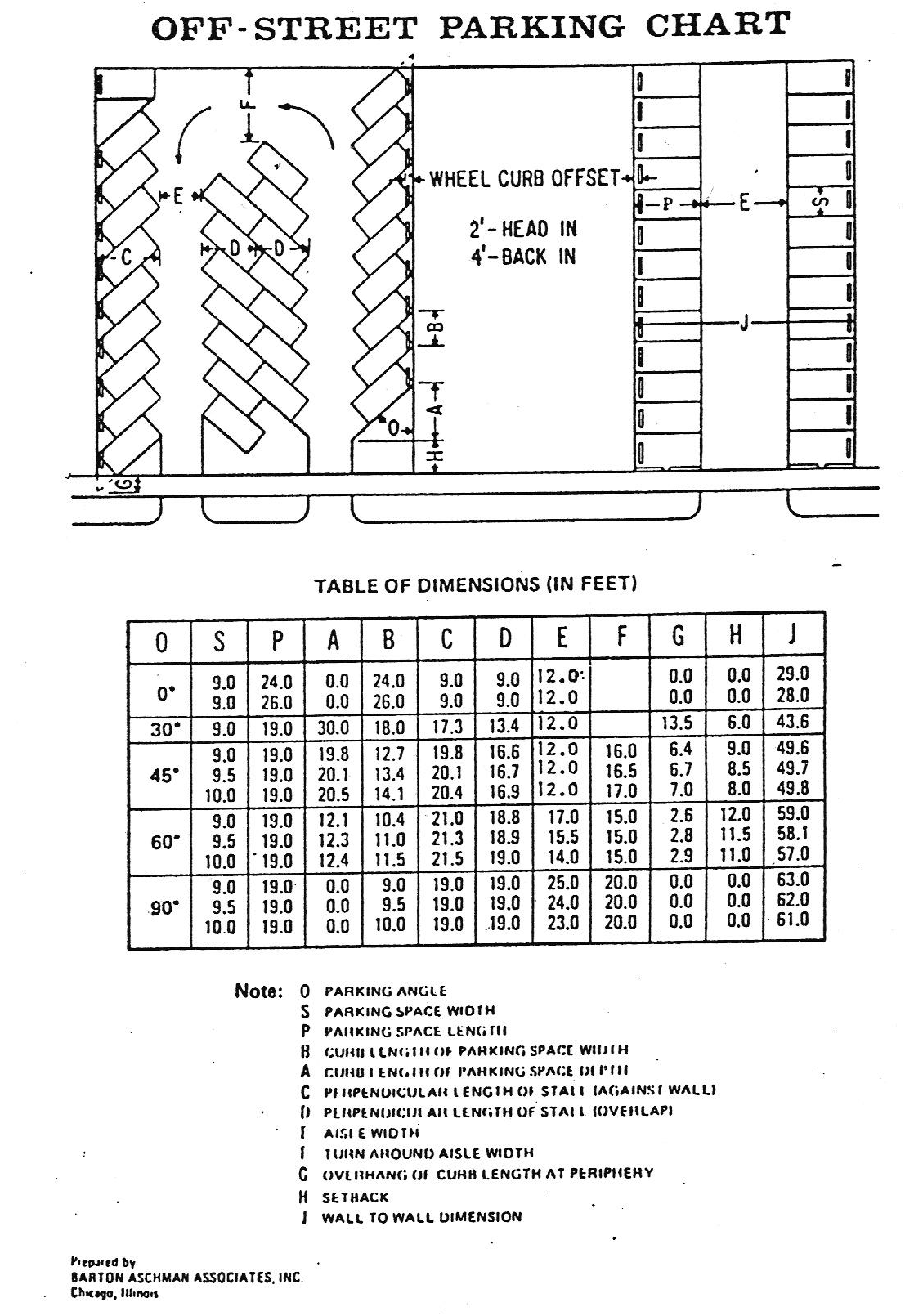
Except for parallel parking spaces, each required off-street parking space shall be at least nine feet in width and at least 19 feet in length, exclusive of access drives or aisles, ramps, columns, or office or work areas. Such space shall have a vertical clearance of at least seven feet, and shall be measured at right angles to the axis of the vehicle. For parallel parking, the length of the parking space shall be increased to 24 feet. All other requirements as to size shall be as set forth in the off-street parking chart included in this division.
(b)
To allow for conversion of parking to small car parking spaces in the future, the following alternative to the size requirements set forth in the off-street parking chart of this division may be used. Parking facilities may be designed with a 50-foot modular width, which will accommodate two rows of parked cars and the intervening central access aisle (wall to wall dimension). This 50-foot modular width will allow nine-foot-wide, 50-degree angle parking spaces for standard size cars and 7½-foot wide, 75-degree angle parking spaces for small cars. A maximum of ten percent of the parking spaces required by this subsection may be striped for small cars, provided that these spaces are conveniently located and suitably controlled for use by only small cars. The location and control of small car parking spaces shall be approved by the zoning administrator.
(Code 1973, § 16.11.020(a)(5))
Sec. 114-1151. - Access.
Except on residential lots, each off-street parking space shall open directly upon an aisle or driveway at least 12 feet wide or such additional width and design as to provide safe and efficient means of vehicular access to such parking space. All off-street parking facilities shall be designed with appropriate means of vehicular access to a street or alley in a manner which will least interfere with traffic movement. In any event, all driveways shall conform to all applicable driveway specifications adopted by the city.
(Code 1973, § 16.11.020(a)(6))
Sec. 114-1152. - Collective facilities for separate uses.
(a)
Off-street parking facilities for separate uses may be provided collectively if the total number of spaces so provided is not less than the sum of the separate requirements governing location of accessory parking spaces in relation to the use served. Further, no parking space or portion thereof shall serve as a required space for more than one use unless otherwise authorized by the zoning board of appeals.
(b)
In business areas where a portion of the available parking is being provided in municipal parking lots (not including the B-4 central business zoning district), new or expanding uses located within 500 feet of a municipal parking lot shall provide required parking, or in instances where poor lot layout, existing development, etc., make the provision of required parking difficult, such new or expanding uses may apply for a conditional use permit for counting a portion of parking in the municipal parking lot as required parking.
(Code 1973, § 16.11.020(a)(7))
Sec. 114-1153. - Computation of fractional spaces.
When determination of the number of off-street parking spaces required by this chapter results in a requirement of a fractional space, any fraction of less than one-half may be disregarded, while a fraction of one-half or more shall be counted as one parking space. Parking spaces required on an employee basis shall be based on the maximum number of employees on duty or residing, or both, on the premises at any one time.
(Code 1973, § 16.11.020(a)(8))
Sec. 114-1154. - Utilization.
Except as may otherwise be provided for the parking of trucks in the granting of conditional uses, required accessory off-street parking facilities provided for uses listed in this division shall be solely for the parking of passenger automobiles of patrons, occupants, or employees of such uses.
(Code 1973, § 16.11.020(a)(9))
Sec. 114-1166. - Approval of design.
The design of parking lots or areas shall be subject to the approval of the zoning administrator, in accordance with standards approved by the planning, heritage, and design commission and common council. In addition, they shall meet all applicable development standards.
(Code 1973, § 16.11.020(a)(10)a; Ord. No. 0026-19, pt. 108, 11-12-19)
Sec. 114-1167. - Character; surfacing.
(a)
Accessory parking spaces may be open to the sky, or enclosed in a building.
(b)
All open off-street parking areas and driveways shall, at a minimum, be surfaced with two inches of asphalt pavement over a crushed stone base. Parking areas and driveways not in compliance as of the effective date of the ordinance adopting the requirement may remain in noncompliance, excepting if eroding of soils, tracking of sediment and debris, or airborne dust resulting from the noncomplying parking area or driveway creates a nuisance to the general public as determined by the chief building inspector, then the surfacing requirement shall apply. Appeal of such determination shall be to the zoning board of appeals.
(c)
The ingress and egress of vehicles from an off-street parking area or driveway shall not result in the tracking of mud or debris onto sidewalks or streets, and proper drainage shall be provided.
(Code 1973, § 16.11.020(a)(10)b, c; Ord. No. 19-99, pt. 3, 1-18-00; Ord. No. 25-03, pt. 1, 11-18-03)
Sec. 114-1168. - Screening and landscaping.
All open vehicle parking areas containing more than four parking spaces shall be effectively screened on each side adjoining or fronting on property situated in a residence district or any institutional premises by a wall, fence, or densely planted compact hedge not less than five feet nor more than eight feet in height.
(Code 1973, § 16.11.020(a)(10)d)
Sec. 114-1169. - Lighting.
Any lighting used to illuminate off-street parking areas shall be aimed directly away from residential properties and public streets in such a way as not to create a nuisance. However, in no case shall such lighting exceed three footcandles measured at the lot line. Loudspeaker systems are not permitted.
(Code 1973, § 16.11.020(a)(10)e)
Sec. 114-1170. - Cleaning and maintenance.
Except in the B3, I-1 and I-2 districts, no cleaning or maintenance of parking lots utilizing motorized equipment may be performed between 11:30 p.m. and 6:00 a.m. each day, except for the removal of snow.
(Code 1973, § 16.11.020(a)(10)f)
Sec. 114-1171. - Wheel stops.
All parking lots shall be provided with wheel stops or bumper guards so located on the periphery of parking lots that no part of parked vehicles shall extend beyond the property line. Such stops or guards shall be properly anchored or secured.
(Code 1973, § 16.11.020(a)(10)g)
Sec. 114-1172. - Shelter building.
No parking lot for accessory off-street parking shall have more than one attendant shelter building, which shall conform to all setback requirements for structures in the district.
(Code 1973, § 16.11.020(a)(10)h)
Sec. 114-1173. - Signs.
Accessory signs shall be permitted on parking areas in accordance with the provisions specified in article X, signs, of this chapter.
(Code 1973, § 16.11.020(a)(10)i)
Sec. 114-1186. - Compliance required.
All off-street parking spaces required by this article, except those required for one- and two-family dwellings, shall be designed in accordance with one of the formulas set forth in the off-street parking chart, which chart is included herein. Off-street parking spaces shall be provided in accordance with the specific parking classes as set forth in the off-street parking table (parking classes), except within the B4 central business district. Parking spaces for accessory uses not specifically enumerated within a parking class shall be assumed to be included in the principal (permitted or conditional) use requirement. If, for any reason, the classification of any use, for the purpose of determining the amount of off-street parking or the number of spaces to be provided by such use, is not readily determinable hereunder, the parking class of such use shall be fixed by the zoning administrator.
(Code 1973, § 16.11.020(b))
Sec. 114-1187. - Vehicle repair and service.
(a)
Residence districts. Except as otherwise provided, no motor vehicle repair work or service of any kind shall be permitted in association with parking facilities provided in residence districts, with the exception of emergency service required to start vehicles, fixing or replacing tires, jump starting the vehicle, and adding or changing fluids. All such work shall be completed in a 24-hour period. Other repairs may be performed in a closed garage if the vehicle is owned by the owner or tenant of the residence, the repair work is conducted only between the hours of 8:00 a.m. and 9:00 p.m., excepting that the following work is prohibited: body work involving hammering or grinding, spray painting, and sand blasting.
(b)
Business districts. No motor vehicle repair work or service of any kind shall be permitted in conjunction with parking facilities in a B1, O, or O-I district, with the exception of emergency service required to start vehicles.
(c)
Industrial districts. No motor vehicle repair work or service of any kind shall be permitted in conjunction with any open accessory parking facilities provided in an industrial district if such parking facilities are within 200 feet of a residence district. Washing of accessory vehicles and emergency service required to start vehicles shall be permitted.
(Code 1973, § 16.11.020(a)(10)j; Ord. No. 19-05, pt. 2, 9-20-05)
_____
Sec. 114-1188. - Off-street parking table (parking classes).
Uses listed in this section shall provide the required parking spaces under each parking class listed, as follows:
(Code 1973, § 16.11.020; Ord. No. 0018-19, pt. 4, 8-7-19; Ord. No. 0026-19, pt. 109, 11-12-19)
Sec. 114-1201. - Location.
All required loading berths shall be located on the same zoning lot as the use served. All loading berths which abut a residence, office, or office/institutional district or an intervening alley separating such districts from a business or industrial district shall be completely screened therefrom by building walls, or by a uniformly painted solid fence, wall or door, or densely planted mature shrubbery, or any combination thereof, not less than four feet in height. No permitted or required loading berth shall be located within 30 feet of the nearest point of intersection of any two streets. No loading berth shall be located in a required front yard, and any loading berth located in a required side or rear yard may be open to the sky.
(Code 1973, § 16.11.030(a)(1))
Sec. 114-1202. - Size.
Unless otherwise specified, a required off-street loading berth shall be at least 12 feet in width by at least 30 feet in length, exclusive of aisle and maneuvering space, and shall have a vertical clearance of at least 15 feet.
(Code 1973, § 16.11.030(a)(2))
Sec. 114-1203. - Access; approval.
Each required off-street loading berth shall be designed with appropriate means of vehicular access to a street or alley in a manner which will least interfere with traffic movement, and shall be subject to approval by the zoning administrator.
(Code 1973, § 16.11.030(a)(3))
Sec. 114-1204. - Surfacing.
All open off-street loading berths shall be surfaced with a dustless all-weather material capable of bearing a minimum live load of 200 pounds per square foot.
(Code 1973, § 16.11.030(a)(4))
Sec. 114-1205. - Utilization.
Space allocated to any off-street loading use shall not, while so allocated, be used to satisfy the space requirements for any off-street parking facilities or portions thereof.
(Code 1973, § 16.11.030(a)(6))
Sec. 114-1206. - Central loading.
Central loading facilities may be substituted for loading berths on the individual zoning lots provided the following conditions are fulfilled:
(1)
Each zoning lot served shall have direct access to the central loading area without crossing streets or alleys at grade.
(2)
Total off-street loading berths provided shall meet the minimum requirements specified in this division, based on the sum of the several types of uses served. (Area of types of uses may be totaled before computing number of loading berths.)
(3)
No zoning lot served shall be more than 500 feet removed from the central loading area.
(4)
The tunnel or ramp connecting the central loading area with the zoning lot served shall be not less than seven feet in width and have a clearance of not less than seven feet.
(Code 1973, § 16.11.030(a)(7))
Sec. 114-1207. - Minimum facilities.
Uses for which off-street loading facilities are required in this division, but which are located in buildings of less floor area than the minimum prescribed for such required facilities, shall be provided with adequate receiving facilities, accessible by motor vehicle off any adjacent alley, service drive, or open space on the same zoning lot.
(Code 1973, § 16.11.030(a)(8))
Sec. 114-1221. - Repair and service.
(a)
Residence districts. No motor vehicle repair work or service of any kind shall be permitted in conjunction with loading facilities provided in any residence district.
(b)
Business districts. No motor vehicle repair work or service of any kind shall be permitted in conjunction with loading facilities provided in business districts except emergency repair service necessary to start vehicles.
(c)
Industrial districts. No motor vehicle repair work or service of any kind shall be permitted in conjunction with loading facilities provided in an industrial district if such loading facilities are within 200 feet of a residence or office/institutional district. Washing of accessory vehicles and emergency service required to start vehicles shall be permitted.
(Code 1973, § 16.11.030(a)(5))
Sec. 114-1222. - Residence districts.
Off-street loading facilities accessory to uses allowed in the several residence districts shall be provided in accordance with the following minimum requirements:
(1)
Health and medical institutions: One loading berth shall be provided for buildings containing 10,000 to 100,000 square feet of gross floor area, plus one additional loading berth for each additional 100,000 square feet of gross floor area or fraction thereof. Each such loading berth for buildings in excess of 200,000 square feet in gross floor area shall be not less than 12 feet in width by 55 feet in length.
(2)
For the uses listed under this subsection, one loading berth shall be provided for buildings containing 10,000 to 100,000 square feet of gross floor area, plus one additional loading berth for each additional 100,000 square feet of gross floor area or fraction thereof:
a.
Educational and cultural institutions.
b.
Philanthropic and charitable institutions.
c.
Religious institutions.
(3)
Planned development, residential: Loading berths shall be provided on the basis of the required berths for each individual use.
(4)
Recreational and social facilities: For buildings containing 10,000 to 100,000 square feet of gross floor area, one loading berth shall be provided, and for each additional 100,000 square feet of gross floor area up to 500,000 square feet, one additional loading berth shall be provided, plus one additional loading berth for each additional 500,000 square feet of gross floor area or fraction thereof in excess of 500,000 square feet.
(5)
For all other nonresidential uses, loading facilities shall be provided in accordance with the following requirements:
a.
For buildings containing less than 10,000 square feet of gross floor area, there shall be provided on the same zoning lot adequate receiving facilities, accessible by motor vehicle, off any adjacent alley, service drive, or open space.
b.
For buildings containing 10,000 to 100,000 square feet of gross floor area, one off-street loading berth shall be provided.
c.
For buildings containing over 100,000 square feet of gross floor area, there shall be provided one loading berth for each 100,000 square feet of gross floor area or fraction thereof.
(6)
Multiple-family dwellings and roominghouses: For buildings containing 20,000 to 200,000 square feet of gross floor area, one off-street loading berth shall be provided, plus one additional loading berth for each additional 200,000 square feet of gross floor area or fraction thereof.
(Code 1973, § 16.11.030(b)(1); Ord. No. 0018-19, pt. 4, 8-7-19)
Sec. 114-1223. - Business districts.
Off-street loading spaces accessory to uses permitted in the several business districts shall be provided in accordance with the following minimum requirements:
(1)
Any use listed in a residence district that also is permitted in any of the several business districts shall provide loading spaces as established for that use in the preceding section for residence districts.
(2)
Establishments containing less than 7,000 square feet of gross floor area shall be provided with adequate facilities, accessible by motor vehicle off any adjacent alley, service drive, or open space on the same zoning lot.
(3)
For the uses listed under this subsection, one loading berth shall be provided for buildings containing 7,000 to 40,000 square feet of gross floor area. For buildings containing 40,000 to 100,000 square feet of gross floor area, two loading berths shall be provided, plus one additional loading berth for each additional 100,000 square feet of gross floor area or fraction thereof. Each such loading berth for buildings in excess of 100,000 square feet of gross floor area shall be not less than 12 feet in width by 55 feet in length.
a.
Convention halls.
b.
Exhibition halls.
c.
Cartage and express facilities.
d.
Mail order houses.
e.
Printing and publishing.
f.
Restricted production and repair.
g.
Warehousing, storage, and wholesale establishments.
(4)
For the uses listed under this subsection (4), one loading berth shall be provided for buildings containing 7,000 to 100,000 square feet of gross floor area; for each additional 100,000 square feet of gross floor area up to 500,000 square feet, one additional loading berth shall be provided, plus one additional loading berth for each additional 500,000 square feet of gross floor area or fraction thereof in excess of 500,000 square feet.
a.
Banks and financial institutions.
b.
Medical and dental clinics.
c.
Offices, business, professional and governmental.
d.
Recreation buildings and community centers, noncommercial.
(5)
For the uses listed under this subsection (5), one loading berth shall be provided for buildings containing 7,000 to 100,000 square feet of gross floor area, plus one additional loading berth for each additional 150,000 square feet of gross floor area or fraction thereof. Each such loading berth for buildings in excess of 20,000 square feet of gross floor area shall be not less than 12 feet in width by 55 feet in length.
a.
Clubs and lodges (not-for-profit) containing retail shops, convention halls, auditoriums, exhibition halls, or business or professional offices (other than accessory).
b.
Radio and television stations and studios.
c.
Recording studios.
d.
Hotels and motels containing retail shops, convention halls, auditoriums, exhibition halls, or business or professional offices.
e.
Stadiums, auditoriums, and arenas.
(6)
For the uses listed under this subsection (6), one loading berth shall be provided for buildings containing 7,000 to 150,000 square feet of gross floor area, plus one additional loading berth for each additional 200,000 square feet of gross floor area or fraction thereof.
a.
Clubs and lodges (not-for-profit) containing no retail shops, convention halls, or auditoriums, exhibition halls, or business or professional offices (other than accessory).
b.
Hotels and motels containing no retail shops, convention halls, auditoriums, exhibition halls, or business or professional offices.
c.
Meeting halls.
d.
Schools, music, dance, business and trade.
e.
Theaters, indoor.
(7)
Amusement establishments: bowling alleys, swimming pools, and skating rinks. For buildings containing 7,000 to 100,000 square feet of gross floor area, one loading berth shall be provided, plus one additional loading berth for each additional 100,000 square feet of gross floor area or fraction thereof.
(8)
Parking lots and garages: There shall be no requirements for off-street loading.
(9)
Planned developments: Loading berths shall be provided on the basis of the required berths for each individual use.
(10)
Funeral establishments: For buildings containing 7,000 to 100,000 square feet of gross floor area, one loading berth shall be provided, plus one additional loading berth for each additional 100,000 square feet of gross floor area or fraction thereof.
(11)
For all other uses not listed in this section, loading facilities shall be provided in accordance with the following schedule:
For each additional 200,000 square feet in gross floor area or fraction thereof over 100,000 square feet of gross floor area, one additional loading berth shall be provided, such additional berth to be at least 12 feet in width by 55 feet in length.
(Code 1973, § 16.11.030(b)(2))
Sec. 114-1224. - Industrial districts.
(a)
Generally. Off-street loading facilities accessory to uses allowed in the several industrial districts shall be provided in accordance with the following minimum requirements:
(1)
Any production, processing, cleaning, servicing, testing, repair, or storage of materials, goods or products. For buildings containing 7,000 to 40,000 square feet of gross floor area, one loading berth shall be provided. For buildings containing 40,000 to 100,000 square feet of gross floor area, two loading berths shall be provided, plus one additional loading berth for each additional 100,000 square feet of gross floor area or fraction thereof. Each such loading berth for buildings in excess of 10,000 square feet of gross floor area shall be not less than 12 feet in width by 55 feet in length.
(2)
For uses listed under this subsection (a)(2), one loading berth shall be provided for buildings containing 7,000 to 100,000 square feet of gross floor area. For each additional 100,000 square feet of gross floor area up to 500,000 square feet, one additional loading berth shall be provided, plus one additional loading berth for each additional 500,000 square feet of gross floor area or fraction thereof in excess of 500,000 square feet.
a.
Medical and dental clinics.
b.
Recreation buildings or community centers.
(3)
For the uses listed under this subsection (a)(3), one loading berth shall be provided for buildings containing 7,000 to 100,000 square feet of gross floor area, plus one additional loading berth for each additional 100,000 square feet of gross floor area or fraction thereof. Each such loading berth for buildings in excess of 20,000 square feet of gross floor area shall be not less than 12 feet in width by 55 feet in length.
a.
Airports and commercial heliports.
b.
Air and railroad freight terminals, railroad switching and classification yards, repair shops, and roundhouses.
c.
Radio and television stations and studios.
d.
Sewage treatment plants, municipal.
e.
Stadium, auditoriums, and arenas.
(4)
For the uses listed under this subsection (a)(4), one loading berth shall be provided for buildings containing 7,000 to 200,000 square feet of gross floor area, plus one additional loading berth for each additional 200,000 square feet of gross floor area or fraction thereof: Trade schools.
(5)
For the uses listed under this subsection (a)(5), there shall be no requirements for off-street loading.
a.
Parking lots.
b.
Weighing stations.
(6)
Motor freight terminals. For buildings containing 5,000 to 40,000 square feet of gross floor area, one loading berth shall be provided. For buildings containing 40,000 to 100,000 square feet of gross floor area, two loading berths shall be provided, plus one additional loading berth for each additional 100,000 square feet of gross floor area or fraction thereof. Each such loading berth for buildings in excess of 100,000 square feet of gross floor area shall be not less than 12 feet in width by 55 feet in length.
(b)
Planned developments, industrial. Loading berths for planned developments in industrial districts shall be provided on the basis of the required berths for each individual use.
(c)
Other. For all other uses in industrial districts, loading facilities shall be provided in accordance with the following schedule:
For each additional 200,000 square feet of gross floor area or fraction thereof over 100,000 square feet of gross floor area, one additional loading berth shall be provided, such additional berth to be at least 12 feet in width by 55 feet in length.
(Code 1973, § 16.11.030(b)(3))

