
Red Bank City Zoning Code
CHAPTER 3
RESIDENTIAL ZONES
Sec. 14-301.- R-1 residential zone.
301.01(A)
Permitted uses.
(A)
Single-family dwellings, except factory manufactured homes constructed as a self-contained unit and mounted on single chassis.
(B)
Schools.
(C)
Parks, playgrounds and community buildings.
(D)
Golf courses, except driving ranges, miniature courses, and Par 3 golf courses and other similar commercial operations.
(E)
Fire halls and other public buildings.
(F)
Churches.
(G)
Accessory uses and buildings customarily incident and subordinate to the above.
(H)
Kindergartens operated by governmental units or religious organizations.
(I)
Home occupations.
(J)
Day care homes.
(K)
Group homes operated on a noncommercial basis for persons with intellectual and developmental disabilities or persons who are mentally or physically handicapped. Such uses are exempt from local zoning and permitting requirements by T.C.A. § 13-24-101 and should be allowed in any zone where single-family dwellings are permitted subject to the following:
1)
Home is operated on a noncommercial basis.
2)
Residents must meet the diagnosis requirements as required and defined by state law.
3)
The home may house up to eight persons so diagnosed plus up to three persons to act as house parents or guardians.
(L)
Keeping limited numbers of female chickens subject to all of the terms, provisions, conditions, requirements and exceptions of Ordinance Nos. 21-1195 and 23-1224 as now existing or hereafter amended.
301.01(B)
Prohibited uses.
(1)
Uses expressly permitted in any other zoning district unless also expressly permitted in this zoning district.
(2)
Any commercial or quasi-commercial use or usages except as expressly permitted herein.
(3)
Any industrial uses.
(4)
Any use not closely similar in character and impact as the above specified and allowed/permitted uses including, but not limited to the prohibited uses specified below, provided that the final interpretation of this subsection, if necessary, shall be by the Red Bank City Commission upon recommendation of the Red Bank Planning Commission.
(5)
Short-term residential rental units, with the exception of duly permitted and previously legally existing "grandfathered short-term rental units" as defined herein and as required by T.C.A. § 13-7-601 et seq.
301.02
Height and area regulations.
(A)
No building shall exceed two and one-half stories or 35 feet in height, except that a building may exceed these height regulations provided that for every one-foot of additional height over 35 feet, the building shall be setback one additional foot from all property lines.
(B)
The minimum lot size shall be 7,500 square feet, and a minimum frontage of 60 feet on central sewer. If lot is on septic, minimum lot size shall be determined by the Chattanooga-Hamilton County Health Department.
(C)
There shall be a front yard of not less than 25 feet.
(D)
There shall be a side yard on each side of the building of not less than ten feet; 25 feet if at an intersection.
(E)
There shall be a rear yard of not less than 25 feet.
(F)
The minimum amount of heated living space/square footage for any newly constructed house shall be 1,400 square feet.
(G)
Reserved.
301.03
Off-street parking regulations. Off-street parking shall be provided on the same lot as or on a lot adjacent to the building in accordance with the following requirements:
(A)
There shall be two spaces for every dwelling unit.
(B)
There shall be one space for every four seats in the main auditorium of churches and other public buildings.
(C)
Parking space for all other uses shall be in an amount satisfactory to the city manager or his/her designee
301.04
Access control. As regulated in section 14-204.07 of this title.
301.05
Uses permitted as special exceptions (through permit by the Red Bank City Commission upon recommendation by the Red Bank Planning Commission).
(A)
Day care centers.
(B)
Kindergartens not operated by governmental units or religious organizations.
(C)
Assisted living facility for no more than eight residents including two additional persons (plus their dependents) acting as house parents or guardians.
(D)
Communication towers (See chapter 11 for requirements).
(E)
Horses for personal use.
(F)
Cemeteries.
(G)
Residential homes for handicapped and/or aged persons operated on a commercial basis for no more than eight persons.
(H)
Group homes for intellectually and developmentally disabled persons or persons who are mentally or physically handicapped operated on a commercial basis subject to the same requirements for exempt group homes defined in T.C.A. § 13-24-101. See section 14-301.01(K).
301.06
Additional use permitted as special exceptions (through permit by the Red Bank City Commission upon recommendation by the Red Bank Planning Commission). Special exceptions permit for a two-family or multi-family dwelling in the R-1 residential zone:
(A)
Intent. The City of Red Bank has rezoned property in several neighborhoods from the R-2 and R-3 residential zones to the R-1 and R-1A residential zones. This special exceptions permit would allow structures that were constructed as two-family or multi-family dwellings to be able to continue such use after the loss of legal nonconforming status. The purpose of this permit is to provide relief, if deemed appropriate, to property owners of certain two-family and multi-family dwellings, which under R-1 zoning could only be used as single-family residences. It is not the intent of this permit to encourage multiple requests in any area, but to consider each individual request on it's own merit.
(B)
Applies to:
1)
One structure for each special exceptions permit, not multiple structures.
2)
Structures constructed with a building permit and/or constructed on a lot of record.
3)
Dwellings that lost nonconforming status due to a re-zoning to R-1 or R-1A through a rezoning study process by the City of Red Bank.
(C)
Does not apply to:
1)
New construction.
2)
Multiple structures on one lot.
(D)
A special exceptions permit may be granted by the Red Bank City Commission upon recommendation by the Red Bank Planning Commission if it is determined that:
1)
The request is consistent with the adopted plans for the area.
2)
The request is consistent with the zoning study that rezoned the subject property from R-2 or R-3 to R-1 or R-1A.
3)
Issuance of the permit will not be detrimental to surrounding properties and could benefit the neighborhood by encouraging an increase in investment in the property.
(E)
Special conditions. The Red Bank City Commission upon recommendation by the Red Bank Planning Commission may issue a special exceptions permit with special conditions to be met by the applicant if deemed necessary and appropriate by the board. The board may also allow exceptions in minimum lot area requirements and off-street parking requirements if appropriate.
301.07
Communications towers. See chapter 11, communications towers.
(Ord. No. 21-1196, § 1, 7-20-2021; Ord. No. 23-1225, § 1, 3-7-2023)
Sec. 14-302. - R-1A residential zone.
302.01
Permitted uses.
(A)
Single-family dwellings, excluding factory manufactured homes constructed as a self-contained unit and mounted on a single chassis.
(B)
Schools.
(C)
Parks, playgrounds, and community buildings.
(D)
Golf courses, except driving ranges, miniature courses, and Par 3 golf courses and other similar commercial operations.
(E)
Fire halls and other public buildings.
(F)
Churches.
(G)
Accessory uses and buildings customarily incident and subordinate to the above.
(H)
Kindergartens operated by governmental units or religious organizations.
(I)
Home occupations.
(J)
Day care home.
(K)
Group homes for intellectually and developmentally disabled persons and persons who are mentally or physically handicapped operated on a noncommercial basis. See section 14-301.01(K).
(L)
Keeping limited numbers of female chickens subject to all of the terms, provisions, conditions, requirements and exceptions of Ordinance Nos. 21-1195 and 23-1224 as now existing or hereafter amended.
302.02
Height and area regulations.
(A)
No building shall exceed two and one-half stories or 35 feet in height, except that a building may exceed these height regulations provided that for every foot of additional height over 35 feet the building shall be setback one additional foot from all property lines.
(B)
The minimum lot size shall be 7,500 square feet square feet on central sewer system, and a minimum frontage of 60 feet. If lot is on septic tank, the minimum lot size shall be determined by the health department.
(C)
There shall be a front yard of not less than 25 feet.
(D)
There shall be a side yard on each side of the building of not less than ten feet; 25 feet at the side street if at an intersection.
(E)
There shall be a rear yard of not less than 25 feet.
302.03
Floor area regulations.
(A)
The minimum amount of heated living space/square footage for any newly constructed house shall be 2,000 square feet.
(B)
Reserved.
302.04
Off-street parking regulations. Off-street parking shall be provided on the same lot as the building or on a lot adjacent to the building in accordance with the following requirements:
(A)
There shall be two spaces for every dwelling unit.
(B)
There shall be one space for every four seats in the main auditorium of churches and other public buildings.
(C)
Parking space for all other uses shall be in an amount satisfactory to the city manager or his/her designee.
302.05
Access control. As regulated in section 14-204.07 of this title.
302.06
Uses permitted as special exceptions (through permit by the Red Bank City Commission upon recommendation by the Red Bank Planning Commission). Same as in sections 14-301.06 and 14-301.07.
302.07
Communications towers. See chapter 11, communications towers.
(Ord. No. 21-1196, § 2, 7-20-2021; Ord. No. 23-1225, § 2, 3-7-2023)
Sec. 14-303. - R-1 open space residential zone.
303.01
Intent. It is the intent of this section to provide an alternative standard for development of single-family residential neighborhoods in the R-1 residential zone. This development standard is designed to encourage open space design combined with a traditional or connected street network. In addition to a subdivision plat, all developments proposed under these standards require site plan review in order to determine their appropriateness in each instance. These standards are considered minimum standards and do not prevent the development from exceeding these requirements in terms of open space, landscaping, and lot and frontage standards.
303.02
Site design principles.
(A)
Development should be encouraged where adequate services are available.
(B)
Site design and intensity should be sensitive to environmental constraints resulting from the existing land features and strive to preserve and maintain deciduous woodlands, floodplains, wetlands and steep slopes from clearing, grading, filling or unwarranted construction.
(C)
The development should provide open space that is reasonably contiguous, and whose configuration does not fragment the open space into remnant parcels which are not usable for social activity and recreation. Where applicable, the open space should be connected to similar facilities off site.
(D)
The development should provide quality public spaces such as streets, sidewalks, parks and squares where citizens come to know each other and promote collective security.
(E)
House lots should be grouped closely together in order to reduce road lengths and to preserve open space.
(F)
Roads should be designed as networks, with interconnecting links and with minimal use of cul-de-sacs or dead ends. Road systems should be designed to connect with adjacent development or provide for the possible connection to abutting property if development occurs. In a like manner, trails and sidewalks should interconnect with existing or proposed facilities.
(G)
Access should be provided from individual house lots to open space areas to the maximum extent possible.
303.03
Site design process. The site designer should design the open space subdivision utilizing the following suggested process:
(A)
The site should be examined for special features and natural characteristics or resources. This entails mapping environmental elements of the site including the slopes, floodplains, sinkholes, utility recharge areas, historic features, streams, watercourses, and deciduous woodlands.
(B)
The designer should locate open spaces, meadows, shoreline borders and special scenic vistas and add these features to the site elements previously mapped.
(C)
Third, select house sites that in large measure avoid the identified limitations and take advantage of the site's special characteristics. Fourth, based on these house site locations, configure the road alignments and pedestrian connections. Finally, add lot lines based on the required road frontage and lot square footage standards.
303.04(A)
Permitted uses. All uses permitted in the R-1 residential zone as specified by section 14-301.01 and all uses permitted in the R-1A residential zone as specified by section 14-302.01.
303.04
Height and area regulations, open space.
(A)
The minimum development site area for a project developed under these standards is ten acres.
(B)
All property developed under these standards must be served by public sanitary sewers.
(C)
No building shall exceed two and one-half stories or 35 feet in height, except that a building may exceed these height regulations provided that for every one-foot of additional height over 35 feet the building shall be setback one additional foot from all property lines.
(D)
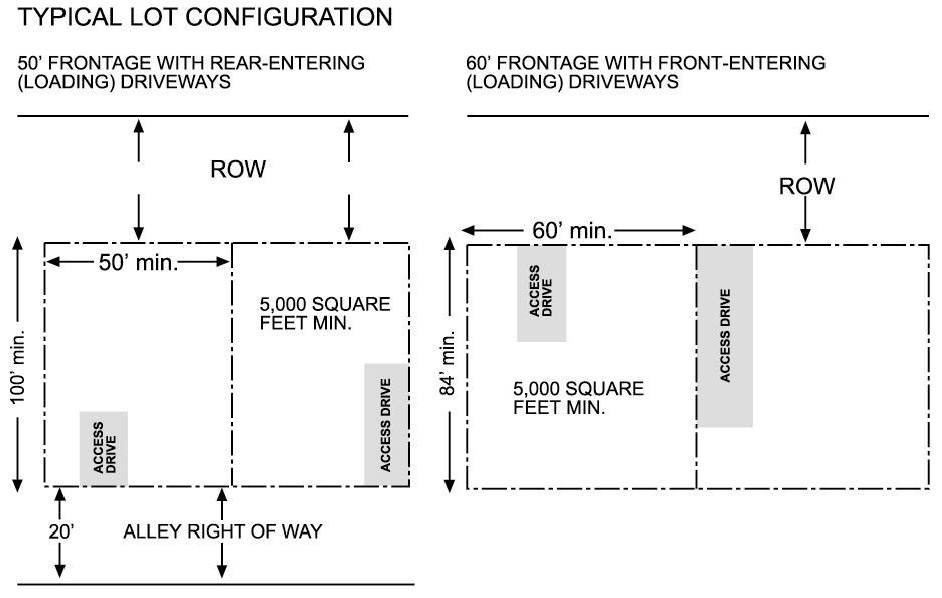
The minimum lot size shall be 5,000 square feet.
(E)
The minimum lot frontage with front-entering (loading) driveways and garages is 60 feet. For rear loading driveways and garages, the minimum lot frontage is 50 feet.
(F)
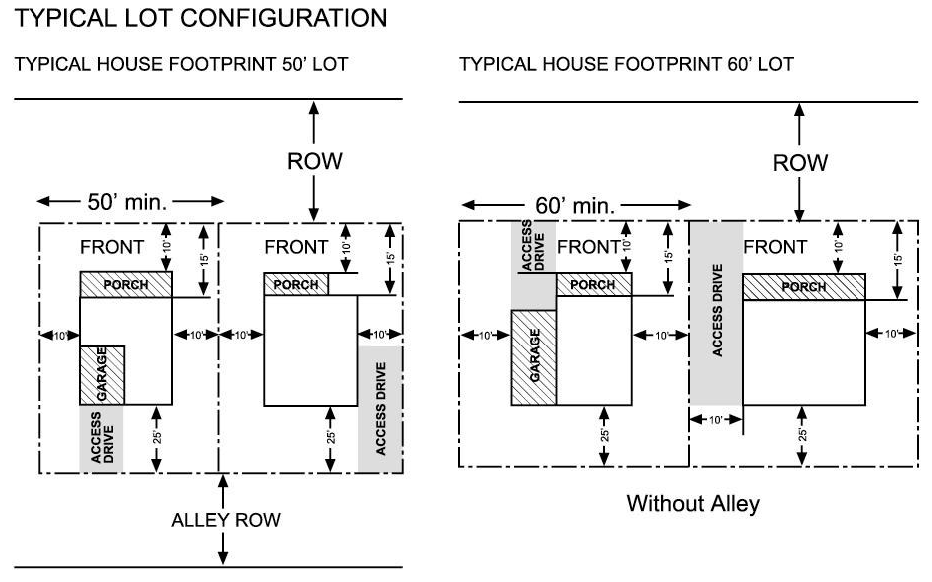
There shall be a front yard of not less than 15 feet except that a permanently unenclosed porch, portico, entry landing or similar structure may extend into the required front yard setback area no more than five feet.
(G)
There shall be a side yard on each side of the building of not less than ten feet except that a bay window, entry landing, portico or chimney may extend into the required side yard no more than five feet.
As an alternative to the ten-foot side yard requirement, a five-foot side yard may be utilized under the condition that no permitted element of the building structure other than the allowable eaves overhang is permitted in the five-foot yard setback, including, but not limited to heating, ventilation and air conditioning systems (HVAC), porches, decks, porticoes, entry landings or similar structures. For corner lot side yard requirements, see section 14-301.02(D).
(H)
There shall be a rear yard of not less than 25 feet for lots with front-entering driveways, except that permanently unenclosed porch, portico, entry landing or similar structure five feet in width may extend into the required rear yard no more than five feet. For lots with rear entering driveways and using alleys for access, there shall be a rear yard of not less than 18 feet except that a permanently unenclosed porch, portico, entry landing or similar structure five feet in width may extend into the required rear yard no more than five feet.
(I)
For residential structures with front-entering (loading) driveways and garages, the garage door must be setback from the front face of the structure eight feet or more.
(J)
Sidewalks are to be constructed on both sides of any new rights-of-way which are shown on the required subdivision plat/site development plan or along any existing streets which provide direct access to houses built under the terms and standards of these regulations. These sidewalks are to be built to standards as specified in the subdivision regulations.
(K)
Street trees are to be incorporated along all public streets on lots developed under these provisions at a maximum planting interval of 25 feet. These trees should have an expected mature height of at least 35 feet and are to be installed at a minimum height of 12 feet. All plantings must be trees. Plants that are commonly identified as a shrub are not acceptable. In planting the street trees, it is preferable to plant any required tree behind the outside edge of the sidewalk if the planting strip between the sidewalk and the curb is less than six feet wide.
(L)
Detached accessory buildings are permitted subject to site plan review for type and location.
(M)
A minimum of 30 percent of the gross site area must be set aside as open space (as shown on the site plan). This open space set aside is in addition to areas that are in a designated floodway zone. Fragmentation of open space should be minimized and therefore no parcel of open space should be less than one acre in size, except for areas specifically designed as village greens, ball fields, buffers, and trail links. The open space should be immediately accessible to the maximum number of house lots on adjacent parcels or through pedestrian linkages to these open areas. The open space shall remain undivided and may be owned and managed by a homeowners' association, the City of Red Bank, or a recognized land trust or conservancy. The ownership will be specified on the subdivision plat. Any ownership by the City of Red Bank must be approved by the City of Red Bank through resolution or ordinance of its board of commissioners.
(N)
Where required, public or private alley rights-of-way or easements shall be a minimum of 20 feet in width. These alleys are to be built according to specifications of the city manager or his/her designee.
(O)
Rights-of-way shall be designed to maximize the connections between streets. The use of cul-de-sacs should be minimized and are only allowed where there are topographic or environmental constraints on the land. Future connections to abutting land will be required as deemed necessary or where future development is anticipated.
303.04(B)
Prohibited uses.
(1)
Uses expressly permitted in any other zoning district unless also expressly permitted in this zoning district.
(2)
Any commercial or quasi-commercial use or usages except as expressly permitted herein.
(3)
Any industrial uses.
(4)
Any use not closely similar in character and impact as the above specified and allowed/permitted uses including, but not limited to the prohibited uses specified below, provided that the final interpretation of this subsection, if necessary, shall the Red Bank City Commission upon recommendation of the Red Bank Planning Commission.
(5)
Short-term residential rental units, with the exception of duly permitted and previously legally existing "grandfathered short-term rental units" as defined herein and as required by T.C.A. § 13-7-601 et seq.
303.05
Site plan requirements and review process. The developer utilizing an open space subdivision option shall adhere to the following steps in processing a design: first, the developer shall review the conceptual layout plan and the existing site conditions map with the Red Bank Planning Commission; second, based on approved design, the developer shall submit a preliminary plat for review and consideration by the planning commission and by the Red Bank City Manager or his/her designee; third, following approval by the planning commission, the developer shall submit a final subdivision plat and a final site plan for review and approval by the staff and the planning commission; and fourth, the approved subdivision plat and final site plan is recorded in the Registrar's Office of Hamilton County. In accordance with the Red Bank Subdivision Regulations.
(A)
Existing site conditions map and conceptual layout plan review process. The developer shall review the proposed site development plan with the Red Bank City Manager or his/her designee prior to the submittal of the preliminary plat. The purpose of this review is to evaluate existing site characteristics and to review the proposed design of the subdivision. At this mandatory review meeting, the developer is required to furnish the city manager or his/her designee with an existing conditions map and a scaled conceptual layout plan of the proposed development. Although not mandatory, an on-site visit should be held in conjunction with this initial site design review.
The conceptual layout plan and the existing site conditions map shall be submitted to the Red Bank City Manager or his/her designee. As required, staff members of other public agencies will be consulted prior to conceptual layout plan approval. The submittal of this plan shall not be construed to be submission of a subdivision plat.
(B)
Existing site conditions map. The following are the required elements that must be portrayed on the existing site conditions map:
1)
Minimum scale of one inch equals 50 feet, with graphic scale and north arrow.
2)
Topographic features depicted at a maximum five-foot contour interval.
3)
Historic features (i.e. structures or sites listed or eligible for inclusion on the National Register of Historic Places, state recognized historic structures or sites).
4)
Areas of flood hazard, including designated flood hazard district and floodways.
5)
Generalized type and location of existing vegetation.
6)
Existing utility easements.
7)
Property lines.
(C)
Conceptual layout plan. The following are required elements that must be portrayed on the conceptual layout plan:
1)
Minimum scale: One inch equals 50 feet;
2)
Depict vehicular access including proposed rights-of-ways, alleys, common drives and easements;
3)
Depict any pedestrian circulation, easements or trails other than those sidewalks required by these regulations;
4)
Depict or list the lots which are permitted to have front parking access;
5)
Depict common open space(s) and by note on the final plat, show proposed ownership of the common open space;
6)
Depict recreation facilities or other similar community design features, such as gazebos;
7)
Depict street and landscaping design features;
8)
Depict the lot layout showing the proposed lot scheme. This layout is designed to display the general lot configuration and does not require surveyed dimensional data.
(D)
Subdivision plat/development plan review process. Based on evaluation and approval by the city manager or his/her designee, the developer must submit a preliminary plat for review. The preliminary plat must conform to the requirements of the jurisdictional subdivision regulations and the design and layout of the approved conceptual layout plan. After submission to and approval of the preliminary plat by the planning commission and the Red Bank City Manager or his/her designee, the final plat must be submitted, reviewed and approved by the city manager or his/her designee. In addition, the site developer shall prepare a scaled final site plan for attachment to the final plat. If the desired design elements can be depicted on the final subdivision plat, a separate site plan is not required. If a separate document is attached to the subdivision plat as an addendum, its format will conform to subdivision plat standards and it will be referenced on the subdivision plat as an addendum or attachment.
(E)
Final site plan. The final site plan shall depict the final subdivision design and include the following elements:
1)
Minimum scale: One inch equals 50 feet.
2)
Proposed building and accessory structures.
3)
Required landscaping, including streetscape details.
4)
Location of open space, public parks and recreation facilities.
5)
Street and alley layout.
6)
Pedestrian circulation system.
7)
Additional details and design features which are required by ordinance or as required by the planning agency review staff.
(F)
Recordation of the final plat and site plan. Following review and approval by the planning commission and the Red Bank City Commission, the final plat and site plan shall be recorded by the developer in accordance with the Red Bank Subdivision Regulations.
303.07
Communications towers. See Chapter 11, communications towers.
Sec. 14-304. - R-2 residential zone.
304.01(A)
Permitted uses.
(A)
Single-family dwellings, excluding factory manufactured homes constructed as a single, self-contained unit and mounted on a single chassis.
(B)
Two-family dwellings.
(C)
Schools.
(D)
Parks, playgrounds, and community buildings.
(E)
Golf courses, except driving ranges, miniature courses, and other similar commercial operations.
(F)
Fire halls and other public buildings.
(G)
Churches.
(H)
Accessory uses and buildings.
(I)
Day care homes.
(F)
Kindergartens operated by governmental units or by religious organizations.
(G)
Home occupations.
(H)
Day care centers, except that such uses shall require a special exceptions permit to be issued by the Red Bank City Commission upon recommendation by the Red Bank Planning Commission.
(I)
Group homes for intellectually and developmentally disabled persons or persons who are mentally or physically handicapped operated on a noncommercial basis. See section 14-301.01 (K).
304.01(B)
Prohibited uses.
(1)
Uses expressly permitted in any other zoning district unless also expressly permitted in this zoning district.
(2)
Any commercial or quasi-commercial use or usages except as expressly permitted herein.
(3)
Any industrial uses.
(4)
Any use not closely similar in character and impact as the above specified and allowed/permitted uses including, but not limited to the prohibited uses specified below, provided that the final interpretation of this subsection, if necessary, shall be by the Red Bank City Commission upon recommendation of the Red Bank Planning Commission.
(5)
Short-term residential rental units, with the exception of duly permitted and previously legally existing "grandfathered short-term rental units" as defined herein and as required by T.C.A. § 13-7-106 et seq.
304.02
Height and area regulations.
(A)
No building shall exceed two and one-half stories or 35 feet in height, except that a building may exceed these requirements provided that for every foot of additional height over 35 feet, the building shall be setback one additional foot from all property lines.
(B)
The minimum lot size shall be 7,500 square feet for a single-family dwelling unit and 9,500 square feet for a two-family dwelling unit. The minimum frontage shall be 60 feet. All other uses shall have a minimum lot size of 10,000 square feet.
(C)
There shall be a front yard of not less than 25 feet.
(D)
There shall be a side yard on each side of the building of not less than ten feet; 25 feet at the side street if on an intersection.
(E)
There shall be a rear yard of not less than 25 feet.
304.03
Floor area regulations.
(A)
For a single-family structure, at least 1,200 square feet.
(B)
For a duplex, at least 1,800 square feet.
304.04
Off-street parking regulations. Off-street parking shall be provided on the same lot as the building or on a lot adjacent to the building in accordance with the following requirements:
(A)
Two spaces for every dwelling unit.
(B)
One space for every four seats in a main auditorium of churches, schools, and other public buildings.
(C)
Off-street parking on lots in the R-2 residential zone shall be permitted when such lots are adjacent to a C-1, L-1, or M-1 zone, provided plans for such off-street parking are approved by the city manager his/her designee, and a special exceptions permit is issued by the Red Bank City Commission upon recommendation by the Red Bank Planning Commission. Such plan shall also provide for the paving of all driveways and parking areas and adequate draining of the lots. In each case, it shall find that the use where proposed will be in harmony with general intent and purpose of the zoning ordinance and shall require such yard requirements, screening, landscaping, ingress and egress controls, sign controls, as may be needed to assure reasonable controls so as to make the conditional property be compatible with surrounding uses.
(D)
Parking space for all other uses shall be in the amount satisfactory to the city manager or his/her designee.
304.05
Special exceptions for planned unit development. Flexibility in the arrangement of residential uses may be permitted by the city commission as special exceptions in any R-2 residential zone, provided that the minimum size of any tract of land sought to be used for the planned unit shall be five acres and that a desirable environment through the use of good design procedures is assured, allowing flexibility in individual yard requirements to provide for multiple dwelling units, townhouses, and two-family units, except that such use or uses shall require a special permit under the terms of section 14-307 of this title.
304.06
Access control. As regulated in section 14-204.07 of this title.
304.07
Uses permitted as special exceptions permit by the Red Bank City Commission upon recommendation by the Red Bank Planning Commission are the same as in section 14-301.06.
304.08
Communications towers. See chapter 11, communications towers.
Sec. 14-305. - R-3 residential zone.
305.01(A)
Permitted uses.
(A)
Single-family dwellings, excluding factory manufactured homes constructed as a self-contained unit and mounted on a single chassis.
(B)
Two-family dwellings when part of a mixed-use residential development where at least 50 percent of all developable land must be used for detached single-family dwellings. Two-family dwellings not part of a mixed-use residential development are permitted only by special exceptions permit from the Red Bank City Commission upon recommendation by the Red Bank Planning Commission.
(C)
Multi-family dwellings when part of a mixed-use residential development where 50 percent of all developable land must be used for detached single-family dwellings. Multi-family dwellings not a part of a mixed-use residential development are permitted only by special exceptions permit from the Red Bank City Commission upon recommendation by the Red Bank Planning Commission.
(D)
Parks, playgrounds, and community buildings.
(E)
Golf courses, except driving ranges, miniature courses, and Par 3 golf courses.
(F)
Fire halls and other public buildings.
(G)
Churches.
(H)
Schools.
(I)
Home occupations.
(J)
Short-term residential rental units, subject to certification and issuance and maintenance of current short-term residential rental permit.
(K)
Accessory uses and buildings.
(L)
Day care homes, except that such uses shall require a special exceptions permit to be issued by the Red Bank City Commission upon recommendation by the Red Bank Planning Commission.
(M)
Kindergartens operated by governmental units or by religious organizations.
(N)
Day care centers, except that such uses shall require a special permit to be issued by the board of appeals.
(O)
Group homes (in single-family detached residence only) for intellectually and developmentally disabled persons or mentally or physically handicapped persons operated on a noncommercial basis (See section 14-301.01(K).
305.01(B)
Prohibited uses.
(1)
Uses expressly permitted in any other zoning district unless also expressly permitted in this zoning district.
(2)
Any commercial or quasi-commercial use or usages except as expressly permitted herein.
(3)
Any industrial uses.
(4)
Any use not closely similar in character and impact as the above specified and allowed/permitted uses including, but not limited to the prohibited uses specified below, provided that the final interpretation of this subsection, if necessary, shall be by the Red Bank City Commission upon recommendation of the Red Bank Planning Commission.
305.02
Height and area regulations.
(A)
No building shall exceed two and one-half stories or 35 feet in height, except that a building may exceed these height requirements provided that for every one-foot of additional height over 35 feet the building shall be setback one additional foot from all property lines.
(B)
The minimum lot size for dwellings shall be one lot or parcel of 7,500 square feet plus 2,000 square feet of lot area for each additional unit.
(C)
The minimum size for lodging or boarding houses shall be 7,500 square feet, plus 500 square feet for each lodger in excess of two.
(D)
The minimum size for all other permitted uses shall be 10,000 square feet.
(E)
The minimum lot frontage shall be 60 feet.
(F)
There shall be a front yard of not less than 25 feet.
(G)
There shall be a side yard on each side of the building of not less than ten feet, 25 feet at the side street if at an intersection.
(H)
There shall be a rear yard of not less than 25 feet.
305.03
Floor area regulations.
(A)
For a single-family dwelling when part of a mixed-used residential development there shall be a minimum of 2,000 square feet of floor area or a minimum of 1,200 square feet if not part of a mixed-use residential development.
305.04
Off-street parking regulations. Off-street parking shall be provided on the same lot as or on a lot adjacent to the building in accordance with the following requirements:
(A)
There shall be at least two spaces per dwelling unit for duplexes and single-family dwellings. There shall be three spaces for units with four or more bedrooms.
(B)
There shall be at least one and one-quarter spaces per dwelling unit for apartments. Units with two or more bedrooms shall have one and three-quarter spaces per dwelling unit.
(C)
One space for every two lodgers in a boarding house.
(D)
One space for every four seats in a main auditorium for churches, schools, and other public buildings.
(E)
For all other permitted uses, one space for every 200 square feet usable floor area, excluding all service areas, such as halls and stairways.
305.05
Special exceptions for planned unit development. Flexibility in the arrangement of residential uses may be permitted by the city commission as special exceptions in any R-3 residential zone, provided that the minimum size of any tract of land sought to be used for the planned unit shall be five acres and that a desirable environment through the use of good design procedures is assured, allowing flexibility in individual yard requirements to provide for multiple dwelling units, townhouses, and two-family units, except that such uses shall require a special permit under the terms of section 14-307 of this title.
305.06
Access control. As regulated in section 14-204.07 of this title.
305.07
Uses permitted by special exceptions permit by the Red Bank City Commission upon recommendation by the Red Bank Planning Commission. Same as in section 14-301.06.
305.08
Screening requirements. See chapter 9, screening requirements.
305.09
Design review requirements. See chapter 10, design review requirements.
Applies only to nonresidential uses and multi-family uses.
305.10
Communications towers. See chapter 11, communications towers.
Sec. 14-306. - R-4 special zone.
306.01(A)
Permitted uses.
(A)
Single-family, two-family, and multiple family dwelling. Single-family dwellings exclude factory manufactured homes constructed as a self-contained unit and mounted on a single chassis. Two-family and multi-family dwellings are permitted only by special exceptions permit from the Red Bank City Commission upon recommendation by the Red Bank Planning Commission.
(B)
Lodging, rooming, and boarding houses and short-term residential rental units, subject to issuance and maintenance of a short-term rental permit, or a "grandfathered short-term rental unit permit" as required by T.C.A. § 13-7-601 et seq.
(C)
Colleges, schools, and libraries.
(D)
Churches.
(E)
Social agencies and other noncommercial public and semi-public uses subject to special exceptions permit for social agencies if determined necessary by Red Bank City Commission upon recommendation by the Red Bank Planning Commission.
(F)
Dormitories.
(G)
Commercial parking lots except that such uses shall require a special exceptions permit to be issued by the Red Bank City Commission upon recommendation by the Red Bank Planning Commission.
(H)
Professional, medical or dental office, and clinics, but expressly excluding plasma collection centers, which are only permitted by special exceptions permit in the R-4 special zone.
(I)
Laboratories and research centers not objectionable because of odor, dust, noise, or vibration.
(J)
Offices.
(K)
Parks and playgrounds.
(L)
Home occupations.
(M)
Drug stores or restaurants in office buildings.
(N)
Short-term rental units, subject to certification and issuance and maintenance of a current short-term rental permit.
(O)
Hospitals and nursing homes, except that such uses shall require a special exceptions permit to be issued by the Red Bank City Commission upon recommendation by the Red Bank Planning Commission.
(P)
Mortuaries, except that such uses shall require a special exceptions permit to be issued by the Red Bank City Commission upon recommendation by the Red Bank Planning Commission.
(Q)
Accessory uses and buildings.
(R)
Day care homes.
(S)
Kindergartens operated by governmental units or by religious organizations.
(T)
Day care centers, except that such uses shall require a special exceptions permit to be issued by the Red Bank City Commission upon recommendation by the Red Bank Planning Commission.
(U)
Kindergartens, except for those operated by governmental units or by religious organizations, except that such uses shall require a special exceptions permit from the Red Bank City Commission upon recommendation by the Red Bank Planning Commission.
(V)
Banks and branch banks.
(W)
Animal hospitals and pet cemeteries and associated crematory subject to special exceptions permit from the Red Bank City Commission upon recommendation by the Red Bank Planning Commission.
(X)
Radio, television and motion picture communication towers subject to special exceptions permit from the Red Bank City Commission upon recommendation by the Red Bank Planning Commission. See chapter 11, communications towers.
(Y)
Drug or alcohol, penal or correctional halfway houses or rehabilitation centers and other uses similar in character and impact subject to special exceptions permit by the Red Bank City Commission upon recommendation by the Red Bank Planning Commission. See chapter 10, design review requirements.
(Z)
Beauty shops, barbershops and hair salons by special exceptions permit from the Red Bank City Commission upon recommendation by the Red Bank Planning Commission.
(AA)
Assisted and medically assisted living facilities by special exceptions permit from the Red Bank City Commission upon recommendation by the Red Bank Planning Commission.
(BB)
Group homes for intellectually and developmentally disabled persons and persons who are mentally or physically handicapped operated on a noncommercial basis. Group homes are to located in detached single-family residences only. See section 14-301.01(K).
(CC)
Group homes for intellectually and developmentally disabled persons or persons who are mentally or physically handicapped operated on a commercial basis subject to issuance of a special exception permit by the Red Bank City Commission upon recommendation by the Red Bank Planning Commission and subject to the same requirements as for the exempt group homes. See section 14-301.01(K).
(DD)
Plasma collection centers subject to a special exceptions permit, and which shall also be required to meet the following conditions:
(1)
The gross square footage of heated and cooled building space shall be no larger than 5,000 square feet.
(2)
The property must have frontage along Morrison Springs Road and be located west of U.S. Highway 27.
(4)
The property shall not be located within 1,000 feet of nearest blood collection center.
(5)
A planted type C buffer must be installed between the structure and any abutting residential properties.
306.01(B)
Prohibited uses.
(1)
Uses expressly permitted in any other zoning district unless also Expressly permitted in this zoning district.
(2)
Any commercial or quasi-commercial use or usages except as expressly permitted herein.
(3)
Any industrial uses.
(4)
Any use not closely similar in character and impact as the above specified and allowed/permitted uses including, but not limited to the prohibited uses specified below, provided that the final interpretation of this subsection, if necessary, shall be by the Red Bank City Commission upon recommendation of the Red Bank Planning Commission.
306.01(C)
Uses permitted by special exceptions permit by the Red Bank City Commission upon recommendation by the Red Bank Planning Commission:
(A)
Studios/galleries.
(B)
Specialty shops and stores.
(C)
Taverns, wine and cocktail bars, brew pubs, microbreweries, and similar uses.
(D)
Bed and breakfast establishments.
(E)
Restaurants and other establishments serving food and alcoholic beverages.
(F)
Indoor movie or performance theaters.
(G)
Indoor special event venues.
(H)
Small outdoor stages or performance venues provided they meet the following conditions:
a.
The stage and sound amplification equipment shall not be oriented toward any residentially zoned properties located within 300 feet of the portion of the property line upon which the small outdoor music or performance event is to be held. Further, sound amplification equipment shall be oriented so that sound is directed away from the closest residential property. For purposes of this subsection, "sound amplification equipment" means any sound amplification equipment, speakers including small portable sound systems, microphones, and amplified acoustic musical instruments of any sort.
b.
A maximum noise level of 75 decibels on the A-weighted scale shall be permitted to occur at the boundary line of the nearest residential property.
c.
Small outdoor music or performance events shall be limited to a maximum audience of no more than 150 people if the lot size is less than 20,000 square feet in size.
d.
Adequate off-street parking shall be provided.
e.
Primary street access for the event shall be from a nonresidential collector street.
f.
All light and glare shall be directed and deflected downward and on-site and away from adjoining residential properties and streets such that direct lighting sources are not visible from adjoining residential properties on-site to ensure surrounding properties are not adversely impacted by increases in direct or indirect ambient lighting levels.
306.02
Height and area regulations.
(A)
No building shall exceed two and one-half stories or 35 feet in height, except that a building may exceed these requirements provided that for every foot of additional height over 35 feet the building shall be setback one additional foot from all property lines.
(B)
The minimum lot size shall be 7,500 square feet, plus 2,000 square feet for each dwelling unit over one. Boarding houses, dormitories, fraternity, and sorority houses shall have a minimum of 10,000 square feet. The minimum frontage shall be 60 feet.
(C)
There shall be a front yard of not less than 25 feet.
(D)
There shall be a side yard on each side of the building of not less than ten feet; 25 feet on the side street if at an intersection.
(E)
There shall be a rear yard of not less than 25 feet.
(F)
If not part of a mixed-use residential development, a single-family dwelling shall be at least 1,200 square feet.
306.03
Off-street parking regulations. Off-street parking shall be provided on the same lot as, or on a lot adjacent to, the building and in accordance with the following:
(A)
There shall be at least two spaces per dwelling unit for duplexes and single-family dwellings. There shall be three spaces for units with four or more bedrooms.
(B)
There shall be at least one and one-quarter spaces per dwelling unit for apartment. Units with two or more bedrooms shall have one and three-quarter spaces per dwelling unit.
(C)
For fraternity, society, or boarding houses, one space for every two lodgers or fraction thereof.
(D)
For public uses or other uses with a chapel or auditorium, one space for every four seats in the main auditorium.
(E)
For hospitals and nursing homes, one space for every three beds.
(F)
For all other permitted uses, one space for every 200 square feet of usable floor area, excluding all service areas, such as halls and stairways.
306.04
Access control. As regulated in section 14-204.07 of this title.
306.05
Screening requirements. See chapter 9, screening regulations.
306.06
Design review requirements. See chapter 10, design review requirements.
Applies only to nonresidential uses and multi-family uses.
306.07
Communications towers. See chapter 11, communications towers.
(Ord. No. 20-1179, §§ 3, 4, 1-5-2021; Ord. No. 23-1238, § 1, 8-1-2023)
Sec. 14-307. - PUD planned unit development.
307.01
Purpose. The purpose of the planned unit development (sometimes hereinafter referred to as PUD) is to provide the opportunities to create more desirable environments through the application of flexible and diversified land development standards under a comprehensive plan and program professionally prepared. The planned unit development is intended to be used to encourage the application of new techniques and technology to community development that will result in superior living or development arrangements with lasting values. It is further intended to achieve economies in land development, maintenance, street systems, and utility networks while providing building groupings for privacy, usable and attractive open spaces, safe circulation, and the general well-being of the inhabitants.
307.02
Zoning classifications. There shall be two classifications of a planned unit development. A PUD may be located in R-2 or R-3 residential zone.
The zoning regulations for planned unit developments in each of the zones are as follows:
(A)
Permitted uses in all PUD's.
1)
Single-family dwellings, excluding manufactured homes.
2)
Two-family dwellings.
3)
Townhouses.
4)
Apartment houses when part of mixed-use residential development.
5)
Schools.
6)
Parks, playgrounds, and community buildings.
7)
Golf courses, except driving ranges, miniature courses, and Par 3 courses.
8)
Fire halls and other public buildings.
9)
Churches.
10)
Accessory uses and buildings customarily incident and subordinate to the above.
11)
Home occupations.
12)
Group homes as defined in section 14-201.01(K).
307.02(B)
Prohibited uses.
(1)
Uses expressly permitted in any other zoning district unless also expressly permitted in this zoning district.
(2)
Any commercial or quasi-commercial use or usages except as expressly permitted herein.
(3)
Any industrial uses.
(4)
Any use not closely similar in character and impact as the above specified and allowed/permitted uses including, but not limited to the prohibited uses specified below, provided that the final interpretation of this subsection, if necessary, shall be by the Red Bank City Commission upon recommendation of the Red Bank Planning Commission.
(5)
Short-term residential rental units, with the exception of duly permitted and previously legally existing "grandfathered short-term rental units" as defined herein and as required by T.C.A. § 13-7-601 et seq.
307.04
Height and area regulations.
(A)
No building shall exceed two and one-half stories or 35 feet in height, except that a building may exceed these height regulations provided for every one-foot of additional height over 35 feet, the building shall be setback one additional foot from all property and/or building lot lines.
(B)
The minimum development site for PUD, located in an R-2 or R-3 residential zone, shall be at least five acres.
(C)
No free-standing building shall be closer than ten feet to any other free-standing building and no closer than 25 feet to the exterior property line.
307.05
Off-street parking regulations. Off-street parking shall be provided on a site adjacent to the building in accordance with the following requirements:
(A)
There shall be at least two spaces per dwelling unit for townhouses, duplexes, and single-family dwellings.
(B)
There shall be at least one and one-half spaces per dwelling unit for apartment houses.
(C)
There shall be at least one space for every three seats in the main auditorium of churches and other public buildings.
(D)
Parking spaces for parks, playgrounds, and community buildings in the development may be required according to the design of the planned unit development.
307.06
Access control. As regulated in section 14-204.07 of this title.
307.07
General provisions.
(A)
A PUD will be shown on the zoning map when the final PUD plan has been approved by the planning commission. A PUD may be located within an area zoned R-2 or R-3 as delineated on the zoning maps of the City of Red Bank.
(B)
In addition, a PUD to be located in an R-3 residential zone shall be located along, or within, 500 feet of a major street at least collector status as shown on major street plan as adopted by the planning commission, provided access to said street is approved by the city manager his/her designee.
307.08
Development standards.
(A)
All planned unit developments shall conform to the requirements of chapter 6, flood damage prevention, of this title.
(B)
Streets may be at an elevation equal to one-foot below flood level.
(C)
Due to the special nature of planned unit development (PUD) housing developments and zoning uses allowed by these regulations, the planning commission may recommend, with or without application or approval of an owner or developer, and subject to subsequent approval or rejection by the city commission, special considerations, variances, easements or other arrangements due to topography and/or other considerations unique to the land itself contemplated to be developed exclusive of the convenience of the developer, in order to provide for adequate circulation of traffic, parking and servicing of the structures even though such considerations, variances, easements, and provisions might not normally be allowed or specified in the Red Bank Subdivision Ordinance, the Red Bank Zoning Ordinance or regulations pertinent to either of them. More particularly, strict adherence to any other provisions of this zoning ordinance now or in the hereafter enacted, or to any other provisions of the Red Bank City Code as relates to separation distances or configurations of "flag "lots" may be, inappropriate circumstances and whether or not recommended by the planning commission waived or varied as necessary or appropriate in the judgement of the planning commission and affirmed or rejected by the city commission. Such accommodations, variances, considerations, easements or other arrangements may be recommended by the planning commission and/or approved by the city commission shall not recommend same.
307.09
Site improvements.
(A)
All dedicated public streets shall be constructed in accordance with plans and specifications furnished by the city manager or his/her designee on right-of-way having a minimum width of 50 feet.
(B)
There shall be constructed sidewalks, or an equivalent paved internal pedestrian circulation system. The minimum width of such sidewalks shall be four feet.
(C)
Curbs and gutters shall be constructed in accordance with standard plans and specifications furnished by the city manager or his/her designee.
(D)
Storm drainage structures shall be constructed in accordance with standard plans and specifications furnished by the city manager or his/her designee.
(E)
Fire hydrants in a location approved by the Red Bank Fire Department.
(F)
A sanitary sewer system, or a package sewage treatment plant, spray irrigation system, septic tank, etc., approved by the Chattanooga-Hamilton County Regional Health Department and the City Manager.
307.10
Computation of density.
(A)
The maximum number of dwelling units of a PUD to be located in an R-2 residential zone shall be computed by multiplying the gross acreage to be developed by seven and one-half, excluding any area to be developed as a church or school.
(B)
The maximum number of dwelling units of a PUD to be located in an R-3 residential zone and connected to a municipal sewer system, shall be computed by multiplying the gross acreage to be developed by 24, excluding any area to be developed as a church or school. For those PUD's not connected to a municipal sewer system in an R-3 residential zone, the maximum number of dwelling units shall be computed by multiplying the gross acreage to be developed by seven and one-half.
(C)
Where zone boundaries for two or more residential zones divide one tract of land proposed for a PUD, the maximum number of dwelling units shall be computed by multiplying the gross acreage within each zone by densities given above, and adding the numbers for the whole tract. The allowed maximum number of dwelling units may be located anywhere within the tract, in accordance with the regulations of this title.
307.11
Open space requirements.
(A)
On-site usable recreation and open space shall be provided. Such area shall be set aside for open space or recreation purposes only. It is intended to serve the residents of the PUD, and should therefore be easily accessible to them. If the PUD is to be of individually owned units, then this space shall be maintained in common ownership, established in the appropriate legal manner.
(B)
Said open space shall be maintained in one of the following methods:
1)
By the developer of management authority of the PUD;
2)
By a home owner's association established by deed restrictions;
3)
By the City of Red Bank upon approval of the dedication to the city, as public open space.
307.12
Staging.
(A)
The applicant may elect to develop the site in successive stages in a manner indicated in the planned unit development plan; however, each such stage shall be substantially complete within itself.
(B)
The planning commission may recommend that the city commission require that development be done in stages if public facilities are not adequate to service the entire development initially.
307.13
Changes and modifications.
(A)
Major changes in the planned unit development after it has been adopted shall be considered the same as a new petition and shall be made in accordance with the procedures specified in this section.
(B)
Minor changes:
1)
Minor changes in the planned unit development plan may be approved by the planning commission provided that such changes:
a)
Do not increase the densities;
b)
Do not change the outside (exterior) boundaries;
c)
Do not change any use;
d)
Do not materially change the location or amount of land devoted to specific land uses;
e)
Do not significantly change the exterior appearance from those shown on any plans that may be submitted or presented by the developer.
2)
Minor changes may include, but are not limited to: minor shifting of the location of buildings, proposed streets, public or private ways, utility easements, parks or other public open spaces, or other features of the plan.
307.14
Application procedure for planned unit development.
(A)
To obtain a special exceptions permit to develop a planned unit development, the developer shall submit a preliminary planned unit development plan to the planning commission for its review and recommendation to the city commission of the City of Red Bank. The preliminary PUD plan shall be drawn at a minimum scale of one inch equals 100 feet, and shall:
1)
Define the location, size, accessibility, and existing zoning of the proposed site;
2)
Indicate the surrounding type of development and land use;
3)
Set forth the type of development proposed, the density of the proposed development, and the location of all structures, parking areas, and open space;
4)
Show a plan for streets, thoroughfares, public utilities, school, and other public or community uses;
5)
In addition to the above, the planning commission or city commission may require such other additional information as may be determined necessary to adequately review the proposed development.
(B)
The planning commission shall hold a public hearing on the proposed preliminary PUD plan. Notice and publication of such public hearing shall conform to the procedures prescribed in section 14-209 of this title.
(C)
Upon the approval or disapproval of the planning commission, the preliminary PUD plan shall be submitted to the city commission for consideration, public hearing and action. The recommendation of the planning commission shall be accompanied by a report stating the reasons for the approval or disapproval of the preliminary PUD plan, with specific reference to, but not limited to, the following conditions:
1)
The property adjacent to the area included in the plan will not be adversely effected;
2)
The plan is consistent with the intent and purpose of this title to promote public health, safety, morals, and general welfare.
3)
That the buildings shall be used only for single-family dwellings, two-family dwellings, or multiple-family dwellings, and the usual accessory uses such as private or storage garages, storage space, and for community activities, including school and/or churches.
4)
There is a need for such development in the proposed location.
5)
There is a reasonable assurance that development will proceed according to the spirit and letter of the approved plans.
(D)
Upon approval by the city commission (after recommendation from the planning commission), of the preliminary PUD plan, the city commission shall direct the issuance of a special exceptions permit to develop a planned unit development to the owner-developer, subject to the approval of the final PUD plan by the planning commission.
(E)
No building permits shall be issued until after approval of the final PUD plan by the planning commission. The building inspector shall revoke any permit issued in reliance upon said plan as finally approved at such times as it becomes obvious such plan is not being complied with.
(F)
No preliminary PUD plan shall be approved by the city commission unless it is first submitted to and approved by the planning commission, or if disapproved, shall receive the favorable vote of a majority of the entire membership of the Red Bank City Commission.
(G)
Upon approval of the city commission, the developer shall then complete a final PUD plan for review by the planning commission. The preliminary and the final PUD plan shall meet the requirements of the Red Bank Subdivision Regulations and be processed and recorded in accordance with those regulations as applicable.
(H)
Any special exception permit shall expire 12 months from and after its issuance if the development as planned has not been adhered to, provided, however, that for good cause shown said special exceptions permit may be extended by the city commission for additional periods not to exceed one year.
307.15
Screening requirements. See chapter 9, screening regulations.
307.16
Design review requirements. See chapter 10, design review requirements.
Applies only to nonresidential uses and multi-family uses.
307.17
Communications towers. See chapter 11, communications towers.
Sec. 14-308. - RT-1 residential townhouse zone.
308.01
Intent. It is for the intent of this section to provide regulations for the development of single-family townhouses (also called row houses and "attached" homes) in a manner that is attractive, efficient, and compatible with surrounding development. It is also the intent of these regulations that the underlying real estate may be divided into small lots so that each unit can be individually sold and owned on a "fee simple" basis. It is further intended as a policy that any townhouse development of more than eight units should be located within 500 feet of a major arterial or collector street.
308.02(A)
Permitted uses.
(A)
Single-family townhouse dwellings, excluding manufactured homes.
(B)
Parks, playgrounds, schools, churches, and community buildings that are complimentary to the immediate neighborhood.
(C)
Accessory uses and buildings.
(D)
Home occupations.
(E)
Communications towers subject to issuance of a special exceptions permit by the Red Bank City Commission upon recommendation by the Red Bank Planning Commission.
308.02(B)
Prohibited uses.
(1)
Uses expressly permitted in any other zoning district unless also expressly permitted in this zoning district.
(2)
Any commercial or quasi-commercial use or usages except as expressly permitted herein.
(3)
Any industrial uses.
(4)
Any use not closely similar in character and impact as the above specified and allowed/permitted uses including, but not limited to the prohibited uses specified below, provided that the final interpretation of this subsection, if necessary, shall be by the Red Bank City Commission upon recommendation of the Red Bank Planning Commission.
(5)
Short-term residential rental units, with the exception of duly permitted and previously legally existing "grandfathered short-term rental units" as required by T.C.A. § 13-7-601 et seq.
308.03
Height and area regulations.
(A)
No building shall exceed 35 feet in height, except that a building may exceed those height regulations provided that for every one-foot of additional height over 35 feet, the building shall be setback one additional foot from all nonzero lot line property lines.
(B)
A minimum building size for townhouse dwellings shall be 1,350 square feet.
(C)
The minimum lot width shall be 18 feet.
(D)
All buildings must be setback at least 25 feet from any dedicated public street.
(E)
Townhouse buildings (a continuous row of townhouse units) shall be separated by not less than 40 feet, front-to-end; or 40 feet front-to-front.
(F)
No building shall be located less than 25 feet from any boundary of the RT-1 residential townhouse zone, except on side yards where an RT-1 zone abuts the RZ-1, R-T/Z R-4, R-3 or any industrial and commercial zone, the minimum side yard requirement is 15 feet.
(G)
Except as provided above, there are no minimum front, side, or rear yard setback requirements.
308.04
Off-street parking regulations.
(A)
Off-street parking shall be provided on the same lot or on a lot adjacent to the structure it serves at a rate of two spaces per dwelling unit. Units with four bedrooms or more shall be required to have three parking spaces.
(B)
There shall be one space for every three seats in the main auditorium of churches and other public buildings.
308.05
Provisions for special access and utility easements. Due to the special nature of residential townhouses and other types of "attached" housing allowed by these regulations which apply to the approval and processing of the plans for the RT-1 development, the planning commission may insist on special access easements and other arrangements to provide for adequate servicing of the structures even though such easements and provisions might not normally be specified in the Red Bank Subdivision Ordinance. In addition, deed restrictions or other provisions may be required to assure that any remodeling or reconstruction of destroyed units will be accomplished in a fashion which will be compatible with the remaining units of the existing development, or for off-street parking of vehicles, and for any other reasonable design criteria deemed appropriate by the planning commission or Red Bank City Commission.
308.06
Access control. As regulated in section 14-204.07 of this title.
308.07
Screening requirements. See chapter 9, screening regulations.
308.08
Design review requirements. See chapter 10, design review regulations.
Applies only to nonresidential uses and multi-family uses.
308.09
Communications towers. See chapter 11, communications towers.
Sec. 14-309. - RZ-1 zero lot line residential zone.
309.01
Intent. It is the intent of this section to provide regulations for the development of single-family zero lot-line dwellings (also called patio homes) in a manner that is attractive, efficient, and compatible with surrounding development. It is also the intent of these regulations that the underlying real estate may be divided into small lots so that each unit can be individually sold and owned on a fee simple basis.
309.02(A)
Permitted uses.
(A)
Single-family zero lot-line dwellings, excluding mobile homes, including single-family detached homes as long as there is a minimum side setback of at least six feet and at least 12 feet between the vertical building surfaces of detached homes on adjacent lots.
(B)
Parks, playgrounds, schools, churches and community buildings that are complimentary to the immediate neighborhood.
(C)
Accessory uses and buildings.
(D)
Home occupations.
(E)
Communications towers subject to issuance of a special exceptions permit by the Red Bank City Commission upon recommendation by the Red Bank Planning Commission.
309.02(B)
Prohibited uses.
(1)
Uses expressly permitted in any other zoning district unless also expressly permitted in this zoning district.
(2)
Any commercial or quasi-commercial use or usages except as expressly permitted herein.
(3)
Any industrial uses.
(4)
Any use not closely similar in character and impact as the above specified and allowed/permitted uses including, but not limited to the prohibited uses specified below, provided that the final interpretation of this subsection, if necessary, shall be by the Red Bank City Commission upon recommendation of the Red Bank Planning Commission.
(5)
Short-term residential rental units, with the exception of duly permitted and previously legally existing "grandfathered short-term rental units" as defined herein and as required by T.C.A. § 13-7-601 et seq.
309.03
Height, area and building regulations.
(A)
No building shall exceed 35 feet in height, except that a building may exceed those height regulations provided that for every one-foot of additional height over 35 feet, the building shall be setback one additional foot from all exterior property lines of the RZ-1 district.
(B)
A minimum lot size area for zero lot-line and patio homes shall be 2,625 feet.
(C)
The minimum lot width shall be 35 feet.
(D)
All buildings must be setback at least 25 feet from any dedicated public streets.
(E)
The side yard setback of the adjacent lot must be from zero to a tenth of a foot (1.2 inches) or a minimum of ten feet except in the instance of adjacent lots with separated family detached homes on adjacent lots and provided that both side setbacks of any such adjacent detached single-family dwellings shall be at least six feet and such detached single-family dwellings must be separated by a minimum of at least 12 feet. See chapter 11, communications towers.
(F)
The opposite side yard setback of not less than ten feet must be kept perpetually free of permanent obstructions (such as an accessory building).
(G)
The wall on the zero-foot yard setback must be constructed of maintenance-free, solid, decorative masonry and no portion can project over any property line.
(H)
Similar zero lot-line exceptions can be made for the rear yard, but not for both the side and rear yards of the same lot.
(I)
No building shall be located less than 25 feet from any boundary of the RZ-1 residential district, except on side yards where an RZ-1 residential zone abuts the RT-1, R-4, R-3, R-T/Z zone or any industrial and commercial zone, the minimum side yard requirement is 15 feet.
(J)
To assure security and privacy within a development, no windows, doors or other openings are permitted on the zero lot line of structures, except that the use of translucent glass shall be permitted to allow natural light to enter the building without significantly compromising privacy.
309.04
Off-Street parking regulations.
(A)
Off-street parking shall be provided on the same lot or on a lot adjacent to the structure it serves at a rate of two spaces per dwelling unit. Units with four bedrooms or more shall be required to have three parking spaces.
(B)
There shall be one space for every three seats in the main auditorium of churches or other public buildings.
309.05
Provision for special access and utility easements. Due to the special nature of these housing types, the Red Bank Planning Commission may insist on special access easements and other arrangements to provide for adequate servicing and maintenance of the structures even though such easements and provisions might not normally be specified in the Red Bank Subdivision Regulations. These easements and special covenants are to be shown on the subdivision plat at the time of its recording. In addition deed restrictions or other provisions may be required to assure that any remodeling or reconstruction of destroyed units will be accomplished in a fashion that will be compatible with the remaining units.
309.06
Access control. As regulated in section 14-204.07 of this title.
309.07
Screening requirements. See chapter 9, screening regulations.
309.08
Design review requirements. See chapter 10, design review regulations.
Applies only to nonresidential uses and multi-family uses.
309.09
Communications towers. See chapter 11, communications towers.
Sec. 14-310. - R-T/Z residential townhouse/zero lot line zone.
310.01
Intent. It is the intent of this section to provide regulations for the development of Townhouses, single-family zero lot line dwellings (also called patio homes), and/or mixed-use moderate density residential development in a manner which is attractive, provides for efficient use of land, and is compatible with surrounding development. It is further intended that these regulations provide for standards that will foster compatibility between R-T/Z development and lower density, standard single-family uses. It is also intended that R-T/Z development be sold in fee simple to encourage owner occupancy. For purposes of the R-T/Z Zone, the term "exterior street refers to any public, dedicated and accepted street existing prior to the R-T/Z development. The term "interior street" refers to any street built as part of the R-T/Z development, both sides of which are zoned R-T/Z.
310.02(A)
Permitted uses.
(A)
Single-family detached dwellings, excluding manufactured homes or mobile homes constructed as a single self-contained unit and mounted on a single chassis.
(B)
Townhouses.
(C)
Zero lot line single-family detached dwellings excluding manufactured or mobile homes.
(D)
Parks, playgrounds, schools, churches and community owned not-for-profit buildings which are complimentary to the immediate neighborhood.
(E)
Golf courses, except driving ranges, miniature golf courses and other similar commercial operations.
(F)
Accessory uses and buildings.
(G)
Home occupations.
(H)
Kindergartens, operated by governmental units or religious organizations.
310.02(B)
Prohibited Uses.
(1)
Uses expressly permitted in any other zoning district unless also expressly permitted in this zoning district.
(2)
Any commercial or quasi-commercial use or usages except as expressly permitted herein.
(3)
Any industrial uses.
(4)
Any use not closely similar in character and impact as the above specified and allowed/permitted uses including, but not limited to the prohibited uses specified below, provided that the final interpretation of this subsection, if necessary, shall be by the Red Bank City Commission upon recommendation of the Red Bank Planning Commission, with the exception of duly permitted and previously existing "grandfathered short-term rental units" as defined herein and as required by T.C.A. § 13-7-601 et seq.
(5)
Short-term residential rental units, with the exception of duly permitted and previously legally existing "grandfathered short-term rental units" as defined herein and as required by T.C.A. § 13-7-601 et seq.
310.03
Uses permitted by special exceptions permit by the Red Bank City Commission upon recommendation by the Red Bank Planning Commission.
(A)
Kindergartens not operated by governmental units or religious organizations.
(B)
Day care centers.
(C)
Communication towers: See chapter 11.
310.04
Height, area and building regulations.
(A)
Maximum density: eight units per acre.
(B)
Minimum lot width:
1)
Single-family detached units: 35 feet.
2)
Zero lot line units: 35 feet.
3)
Townhouse units: 24 feet.
(C)
Minimum front yard setback (from any exterior public street):
1)
Single-family detached units: 25 feet.
2)
All other buildings: 40 feet; may be reduced to 25 feet if type C landscaping or equivalent (see chapter 9) is provided along the exterior street(s).
(D)
Minimum front yard setback (from any interior public street):
1)
Fifteen feet.
2)
Ten feet if rear parking and loading is provided.
(E)
Minimum rear yard setback: 25 feet.
(F)
Minimum side yard setback:
1)
Single-family detached units: ten feet.
2)
Zero lot line units: From zero to one and a half feet, or a minimum of ten feet from the adjacent property line if buildings are to be separated over one-tenth of a foot. The eave overhang is the only permitted element of the building structure allowed in the one and a half feet setback. The opposite side yard must be at least ten feet and must be kept perpetually free of permanent obstructions (such as accessory buildings).
3)
Townhouse units (when a side yard exists): 25 feet; ten feet if abutting R-T/Z, RZ-1, R-3, R-4, O-1 or any commercial or industrial zone.
4)
Building separation:
a)
Single-family detached dwellings: Shall be separated by not less than 40 feet, except 12 feet from side to side.
b)
Three or more unit townhouses: Shall be separated by not less than 40 feet, except 12 feet end to end or end to the side of other permitted housing types.
310.05
Requirements applicable to all R-T/Z development.
(A)
Security and privacy: To assure security within a development, no windows, doors, or other openings are permitted on the zero lot line of structures except that the use of translucent glass shall be permitted to allow natural light to enter the building without significantly compromising privacy.
(B)
Maximum building height: 35 feet or two and one-half stories.
(C)
Sidewalks: Sidewalks, if provided, are to be built according to standards provided by the city manager or his/her designee.
(D)
Landscape requirements:
1)
All property lines abutting R-1 or R-1A zoned property must have type C landscaping or equivalent (see landscaping regulations, chapter 9).
2)
Townhouse development which fronts on exterior public streets must have front yards which are at least 65 percent grass/landscaping with any driveway and/or sidewalk to be composed of concrete or pavers. Landscaping along all property lines fronting exterior streets must be provided subject to review and approval of a site-specific landscape plan.
(E)
Site plan requirement: A site sketch plan shall be submitted with the rezoning application and shall show the following:
1)
Site access and preliminary street layout.
2)
Type of off street parking.
3)
Preliminary lot design.
4)
Range of lot sizes.
5)
Number of lots.
6)
Acreage.
7)
Open space/recreation areas if provided.
8)
All buffer, landscape and screen areas including site specific landscape design.
310.06
Provisions for special access and utility easements. Due to the special nature of these housing types, the planning commission may insist on special access easements and other arrangements to provide for adequate servicing and maintenance of the structures even though such easements and provisions might not normally be specified in the Red Bank Zoning Regulations. These easements and special covenants are to be shown on the subdivision plans that are to be processed and recorded in accordance with the Red Bank Subdivision Regulations. In addition, deed restrictions or other provisions may be required to assure that any remodeling or reconstruction of destroyed units will be accomplished in a fashion that will be compatible with the remaining units.
310.07
Screening requirements. See chapter 9, screening requirements.
310.08
Design review requirements. See chapter 10, design review requirements.
310.09
Communications towers. See chapter 11, communications towers.
Sec. 14-311. - R-5 residential zone.
311.01(A)
Permitted uses.
(A)
Single-family dwellings including manufactured or mobile homes.
(B)
Two-family dwellings.
(C)
Schools.
(D)
Parks, playgrounds and community owned not-for-profit buildings.
(E)
Golf courses, except driving ranges, miniature courses and other similar commercial operations.
(F)
Fire stations and other publicly owned buildings.
(G)
Churches.
(H)
Accessory uses and buildings.
(I)
Home occupations.
(J)
Day care homes.
(K)
Kindergartens operated by governmental units or religious organizations.
(L)
Group homes as defined in section 14-301.01(K).
(M)
Short-term rental units, subject to certification and issuance and maintenance of current short-term rental permit as:
311.01(B)
Prohibited uses.
(1)
Uses expressly permitted in any other zoning district unless also expressly permitted in this zoning district.
(2)
Any commercial or quasi-commercial use or usages except as expressly permitted herein.
(3)
Any industrial uses.
(4)
Any use not closely similar in character and impact as the above specified and allowed/permitted uses including, but not limited to the prohibited uses specified below, provided that the final interpretation of this subsection, if necessary, shall be by the Red Bank City Commission upon recommendation of the Red Bank Planning Commission.
311.02
Uses permitted by special exceptions permit by the Red Bank City Commission upon recommendation by the Red Bank Planning Commission.
(A)
Day care centers.
(B)
Kindergartens not operated by governmental units or religious organizations.
(C)
Communications towers. See chapter 11, communications towers.
311.03
Height and area regulations.
(A)
No buildings shall exceed two and one-half stories or 35 feet in height, except that building may exceed these requirements provided that for every foot of additional height over 35 feet the building shall be setback one additional foot from all property lines.
(B)
Minimum lot area and frontage: The minimum area requirement is 7,500 square feet for a single-family dwelling and 9,500 for a two-family dwelling. If the lot is on a septic system the minimum lot size shall be determined by Chattanooga-Hamilton County Health Department.
(C)
There shall be a front yard of not less than 25 feet, and a back yard of not less than 25 feet.
(D)
There shall be a side yard on each side of a building of ten feet, except for corner lots where the side facing the street shall have a setback of 25 feet.
311.04
General provisions. All manufactured homes shall be tied down in a manner meeting safety and performance requirements of any governmental agency covering tie-down and the city manager or his/her designee.

