
Rexburg City Zoning Code
3.2 ZONING
STANDARDS
3.02.010 Applicability
The regulations of this chapter qualify or supplement the regulation within zones appearing elsewhere in this Ordinance.
3.02.020 Sale Of Lots Below Minimum Space Requirements
- A parcel of land which has less than the minimum width or area requirements for the zone in which it is located shall not be separated from a larger parcel of land for the purpose of immediate or future building or development as a lot, easement, or for the purpose of sale, unless easements are provided and reviewed by the Zoning Administrator and the City Attorney. If an existing lot or parcel is substandard in size by the current zoning ordinance, a portion of that lot or parcel may not be sold or be allowed to be used by another entity by easement.
- Projects that contain multiple buildings that meet code compliance as one property may be divided into separate lots through a Planned Unit Development (PUD) process, a Condominium Plat, or by providing the necessary recorded easements to address substandard lot area, lot width and setbacks.
3.02.030 Yard Space For One Principal Building
No two (2) principal buildings may claim the same, or portions of the same, lot area or width or required yard for the purposes of compliance with this Ordinance.
3.02.040 Access To Public Street Required
- All principal buildings shall be served by a public street. Access to a principal building only from an alley is prohibited.
- All principal buildings must have adequate access and frontage for police, fire, and emergency services.
- The City of Rexburg right of way width is dictated by City Engineering Standards.
3.02.050 Clear View Of Intersecting Streets; Sight Triangle
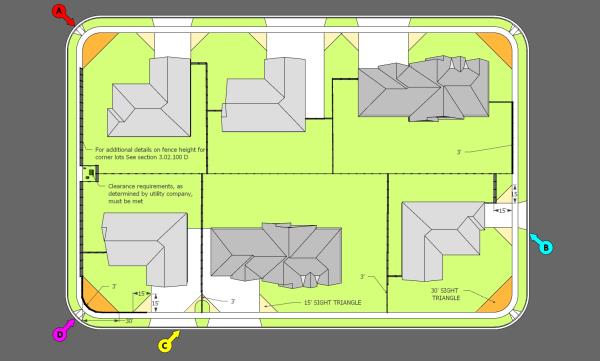
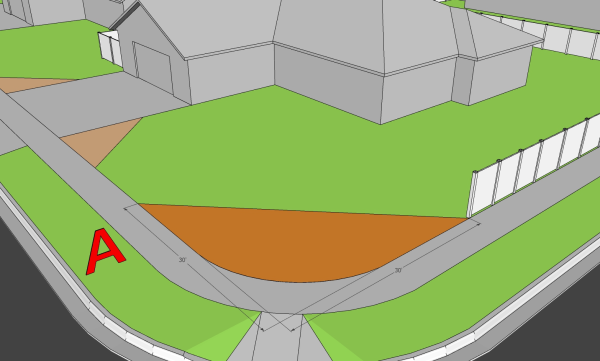
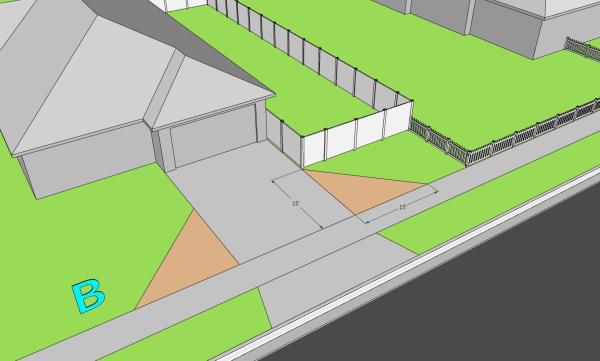
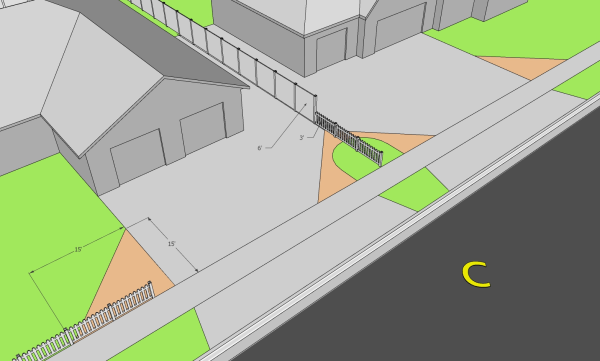
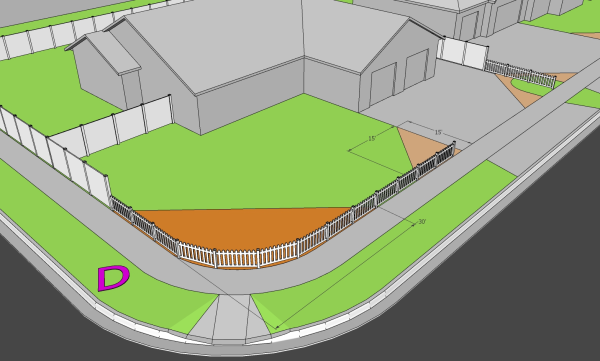
To ensure reasonable visibility and safety in residential zones and other zones which require buildings to be set back from the lot line, the triangle of land formed on any corner lot by drawing a line between points on the lot lines which are thirty feet (30’) from the intersection, or fifteen (15') feet for driveways and alleyways, of such lot lines shall be free from any sight obscuring structure or obstruction except as permitted below. (See Sight Triangle definition.)
- Trees in such triangles shall be trimmed to at least ten (10’) feet above the centerline grades of the intersecting streets.
- Shrubs, fences, and walls shall not be higher than three (3’) feet above the centerline grades of the intersecting streets.
Recorded by Ord. 358 Section 11 Establish Sight Triangle on 2/19/1947
Amended by Ord. 1298 Chapter 3 Standards for All Zones - April 2023 on 6/7/2023
Amended by Ord. Ord 1320 Fencing Dec 2023 on 9/18/2024
3.02.060 Accessory
Accessory structures are permitted in all zones, provided they are incidental to, and do not substantially alter the character of the permitted principal use or structure. Such permitted accessory uses and structures include, but are not limited to the following: detached garages, carports, equipment storage buildings, supply storage buildings, and temporary construction storage and offices.
Accessory Building Requirements.
- All Accessory buildings shall:
- Comply with all lot configuration requirements in the existing zone.
- Comply with the Building Codes adopted by the City of Rexburg.
- Be an accessory to an existing primary structure or residence.
- Have facilities for the discharge of all roof drainage on to the lot or parcel on which it is erected.
- Residential Accessory Buildings.
- Require a building permit if more than two hundred (200) square feet.
- Front Yard. May not be placed in the front yard.
- Side Setback. Must meet the same side setback requirements as a principal building if larger than five hundred (500) square feet or taller than ten (10') feet in height.
- If between two hundred (200 sq ft) square feet and five hundred (500 sq ft) square feet, a six (6') feet side setback is required.
- If less than two hundred (200) square feet, may be placed on the property line.
- Rear Setback. Must be a minimum of five (5') feet from property line if larger than two hundred (200) square feet, unless the accessory building is a garage with doors opening into a City-owned alley. Such garages shall be a minimum of fifteen (15') feet from the alley.
- If less than two hundred (200) square feet, may be placed on the property line.
- If less than two hundred (200) square feet, may be placed on the property line.
- Commercial & Industrial Accessory Buildings.
- Require a building permit if larger than one-hundred-twenty (120) square feet.
- Front Yard. May not be placed in the front yard.
- Side Setback. Must meet the same side setback requirements as a principal building if larger than one-hundred-twenty (120) square feet or taller than ten (10’) feet in height.
- If less than one-hundred-twenty (120) square feet, must be a minimum of five (5’) feet from property line.
- Rear Setback. Must meet the same rear setback requirements as a principal building.
- Exception: University District (UD)
Amended by Ord. 983 Amended Ord. 926 Accessory Buildings drainage on 5/2/2007
Amended by Ord. 1055 Amended Ord. 1026; Required Accessory Buildings larger than 200 sq.ft. or taller than 10' to meet the Same Side Yard Requirements as Principal Buildings on 11/3/2010
Amended by Ord. 1298 Chapter 3 Standards for All Zones - April 2023 on 6/7/2023
Amended by Ord. 1308 - Accessory Buildings - September 2023 on 2/21/2024
Amended by Ord. Ord 1337 Accessory Side Setbacks May 2025 on 10/1/2025
3.02.070 Transitional Development Standards
- Transitional Development Standards. Where a lot in any business, commercial, manufacturing, industrial, or public facilities zone borders a residential zone or use, the standards of the residential zone shall apply in regards to setbacks and building heights.
- No drainage shall be diverted into said public right-of-way. Run-off must be contained on own lot.
Recorded by Ord. 358 Section 11 Building Setbacks on 2/19/1947
Amended by Ord. 388 Amending Building Setbacks on 8/18/1954
Recorded by Ord. 390 Section VIII & IX. Exception to Building Height and Setbacks for certain buildings on 3/16/1955
Amended by Ord. 413 Distance from eves of building and property line on 1/15/1958
Amended by Ord. 1157 Amended Ord. 1115; Runoff contained on your own lot on 3/1/2017
3.02.080 Exception To Setback Requirements
- When fifty (50%) percent or more of the lots on the same side of the street have been built, all buildings erected, established, or rebuilt shall be in conformity with the averaged setback of such buildings.
- Parking and maneuvering areas are not included in the calculation of this exception nor shall these areas be granted an exception to the required front yard setbacks.
- The following structures may be erected on or projected into any required setback or right-of-way:
- Fences and walls in conformance with the Rexburg City Code and Ordinances.
- Landscape elements including trees, shrubs, agricultural crops and other plants.
- Necessary appurtenances for utility.
- Permitted Building Projections with Conditions. The structures listed below may project into a minimum front or rear yard not more than four (4’) feet, and into a minimum side yard not more than two (2’) feet.
- Cornices, eaves, belt courses, sills, buttresses, or other similar architectural features.
- Stairways, balconies, door stoops, fire escapes, fireplaces, awnings and planter boxes or other similar structures.
- Provided they do not exceed thirty (30”) inches in height from the natural grade.
- Provided they are not wider than eight (8’) feet and are generally parallel to the wall of which they are a part.
- Uncovered steps or a deck may not extend into the front setback more than one-third of the required setback.
- Underground Structures. Underground structures may be projected into any required setback if the structure is covered by landscaping or grass and does not raise the grade of the yard by more than two (2’) feet.
- Public Utility Easements. Building structures shall not encroach in Public Utility Easements.
- Carports or Loading Dock. Carports and loading docks are allowed in a side yard or rear yard, provided that such a structure is not more than one (1) story in height and twenty-four (24’) feet in length and is entirely open on at least three (3) sides, except for necessary supporting columns and customary architectural features.
Recorded by Ord. 390 Section IX.d. Unobstructed Projections on 3/16/1955
Amended by Ord. 802 Amend Ord. 725; Section A (see above) on 4/15/1998
Amended by Ord. 855 Repealed Ord. 478 and Ord. 685; Amended Ord. 725; Repeated Section "A" (see above) on 6/6/2001
Amended by Ord. 1132 Amended Ord. 1115; Cornices, eaves belt courses, sills, buttresses, "foundation extension under 3' in height" or other similar architectural features; Fireplace structures, bays "and other similar structures" provided they are not wider than 8' and part of the wall of which they are a part. on 6/3/2015
Amended by Ord. 1188 Amended Ord. 1115 50% or more of lots on same side of street in Residential zones, built in conformity with the average setback of such buildings; Sidewalks to be placed as per current City Engineering Standards. on 7/18/2018
Amended by Ord. 1308 - Lot Config/Density/Setbacks - August 2023 on 2/21/2024
3.02.90 Screening And Landscaping
The following are minimum standards. Additional landscaping elements may be allowed by the Zoning Administrator or Designee. Screening, landscaping, and fences within the City shall be constructed and maintained in conformance with the following standards:
- Landscaping. Landscaping and all applicable irrigation systems shall be maintained by the property owner, or in cases of a right-of-way the adjacent property owner, as in their original purpose.
- Landscape Strip. In all zones, the area between the curb and gutter and the sidewalk is to be landscaped with a pervious surface, by the adjacent property owner.
- Sight Triangle. The sight triangle must be clear of obstructions. See Sight Triangle.
- Columnar and Evergreen trees are not allowed in the landscape strip.
- Overhead Powerlines. In the event of overhead powerlines, alternative landscaping may be approved by the Zoning Administrator.
- Projects within Medium Density Residential (MDR1 & MDR2), High Density Residential (HDR1 & HDR2), Mixed Use (MU), Community Business Center (CBC), Regional Business Center (RBC), University District (UD) or Industrial (LI & HI) zones shall include in the landscape strip trees and shrubs that meet the following criteria:
- Tree and Shrub Requirements.
- Deciduous trees with a minimum caliper of two (2") inches and a maximum spacing of thirty (30') feet.
- As trees mature, they shall be trimmed to at least ten (10’) feet above the curb.
- A minimum of five (5), five (5) gallon containers of shrubs within every thirty (30’) foot section.
- Tree and Shrub Requirements.
- Parking Areas. (See subsection 3.04.060.A.)
- Projects within Medium Density Residential (MDR1 & MDR2), High Density Residential (HDR1 & HDR2), Mixed Use (MU), Community Business Center (CBC), Regional Business Center (RBC), University District (UD) or Industrial (LI & HI) zones that are adjacent to a lower density residential zone, shall have a ten (10’) feet wide landscaped buffer on the abutting property line, where the buffer is planted with a combination of trees, shrubs, and ground cover and/or a suitable fence of sufficient height and density to buffer the two parcels. At a minimum, two (2”) inch caliper trees with a maximum spacing of thirty (30’) feet and five (5), five (5) gallon containers of shrubs between trees are required within the buffer.
- Highway 20 Corridor. All development adjacent to the Highway 20 right-of-way must submit a Landscape Plan to the Zoning Administrator or designee to be approved for design prior to obtaining a building permit.
- Commercial/Industrial Standards. Buildings adjacent to the Highway 20 right-of-way shall provide a buffer at least ten (10') feet in width consisting of two (2”) inch caliper trees with an average spacing of fifty (50’) feet and eight (8), five (5) gallon containers of shrubs.
- Front Yard Display. Commercial uses with a display facing the Highway 20 right-of-way may use alternate landscaping with the approval of the Zoning Administrator.
- Front Yard Display. Commercial uses with a display facing the Highway 20 right-of-way may use alternate landscaping with the approval of the Zoning Administrator.
- Setback. A minimum setback of twenty-five (25’) feet is required from any building to the Highway 20 right-of-way or a one-to-one setback to height requirement, whichever is greater.
- Commercial/Industrial Standards. Buildings adjacent to the Highway 20 right-of-way shall provide a buffer at least ten (10') feet in width consisting of two (2”) inch caliper trees with an average spacing of fifty (50’) feet and eight (8), five (5) gallon containers of shrubs.
- Open Storage Area. Open storage area in commercial and industrial zones shall be screened from view of the streets by structures or by a landscaped buffer at least ten (10') feet in width and planted with a combination of trees, shrubs, and ground cover and/or a suitable fence of sufficient height and density to obstruct the view of the storage area.
- No front yard storage. Open storage shall not be located within a required front yard.
- Front Yard Display. Commercial uses with a front yard display may use alternate landscaping with the approval of the Zoning Administrator.
- Utility yards. Utility yards in zones other than Industrial or adjacent to any residential zone or commercial zone are required to be screened with a seven (7') foot tall decorative masonry wall or privacy fence as approved by the Zoning Administrator.
- Setbacks.
- Front Setback. The wall or fence must be set back at least ten (10’) feet from the front property line. The area between the right-of-way and the wall or fence shall consist of pervious landscaping and be planted with one two (2”) inch caliper deciduous tree and five (5), five (5) gallon containers of shrubs within every thirty (30’) foot section.
- Side and Rear Setbacks. The fence may be on the side and/or rear property line.
- Water Tanks. Water tanks are not required to be screened.
- Pumps and other equipment associated with water tanks will be in below-grade vaults, in buildings or shall be screened as utility yards.
- Setbacks.
Amended by Ord. 753 Amended Ord. 725 Sect.4.7.A.1 & 2 and 4.8A Commercial or Industrial use adjoins residential zone or Comprehensive Plan designation, along abutting property line a yard equal in width to residential zone. Landscaping requirements. on 10/20/1993
Repealed & Reenacted by Ord. 1115 Repealed Ord. 548, 642, 658, 915, 1021, 1027, 1095 and 1026; Development Code; Added Highway 20 Corridor Site Plan Requirements on 6/25/2014
Amended by Ord. 1181 Amended Ord. 1181; All development adjacent to Highway 20 right-of-way must submit a Site Plan meeting city requirements prior to obtaining a Building Permit. on 2/21/2018
Amended by Ord. 1188 Amended Ord. 1115; Utility Yard Definition and Requirements in zones other than Industrial or adjacent to any Residential or Commercial Zone. on 7/18/2018
Amended by Ord. 1237 on 11/4/2020
Amended by Ord. 1251 on 2/17/2021
Amended by Ord. 1298 Chapter 3 Standards for All Zones - April 2023 on 6/7/2023
Amended by Ord. 1308 - Lot Config/Density/Setbacks - August 2023 on 2/21/2024
Amended by Ord. Ord 1337 Landscaping March 2025 on 10/1/2025
3.02.100 Fences
No fence, wall, hedge or other material serving as a fence shall create an obstruction of vision within sight triangles. (See subsection 3.02.050)
- Application Required. All fencing must obtain administrative review and approval by the Planning & Zoning Administrator or designee.
- Building Permit. Fences over seven (7') feet in height must obtain a building permit.
- Floodplain. No fence shall be constructed in the floodplain without administrative approval.
- Barbed Wire/Electric. Barbed wire and electric fences shall only be allowed for agricultural use in Transitional Agriculture (TAG).
- Security Fences. Barbed or razor wire located at the top of security fences requires administrative approval.
- Sight Triangle. Fencing shall not create an obstruction of vision and must observe all sight triangle requirements. (See Sight Triangle definition and subsection 3.02.050).
- Utilities. Fencing shall not obstruct access to utility apparatuses (fire hydrants, utility boxes, transformers, fiber hand holes, etc.) and must adhere to the utility company clearance requirements.
- Fence Height. The height of any fence, wall, or sight-obscuring objects within fifteen (15’) feet of the right-of-way shall be a maximum of three (3’) feet in height measured from the natural grade of the property on which it is located.
- Exception for Corner or Double Frontage Lots. When a parcel is a Corner Lot or a Double Frontage Lot and a written prohibition of street access for the entirety of the block exists, a fence greater than three (3') feet can be located adjacent to the sidewalk, outside of the site triangle.
- Rear Yard. In a rear yard, walls and fences may be between three and six feet (3'-6'). A fence may be built along the property line in a rear yard.
- Dog Runs. Dog runs shall be placed in rear yards only and shall be a minimum of ten (10') feet from another residence.
- Dog Runs. Dog runs shall be placed in rear yards only and shall be a minimum of ten (10') feet from another residence.
- Exception for Corner or Double Frontage Lots. When a parcel is a Corner Lot or a Double Frontage Lot and a written prohibition of street access for the entirety of the block exists, a fence greater than three (3') feet can be located adjacent to the sidewalk, outside of the site triangle.
- Maintenance. Fences shall be maintained in a good state of repair.
- Fence Adjacent to Public Sidewalk or Bicycle Path.
- Pedestrian Gates. Pedestrian access gates shall swing inward when adjacent to a public sidewalk or bicycle path. (See subsection 3.02.170.)
- Commercial/Industrial Adjacent to Residential. A vinyl or masonry fence of at least six (6’) feet in height shall be erected along all property lines which lie adjacent to a residential zone or use, except front yards, where the height of the fence shall not exceed thirty-six (36”) inches within fifteen (15’) feet of the right-of-way.
- Exception. Modifications may be requested if there is a mutual agreement between the adjacent property owners of both zones. Administrator approval is required.
- Exceptions.
- The provisions of this section shall not apply to sport containment fences as approved by the Zoning Administrator.
- Schools, Churches, Universities, Colleges, Hospitals, Nursing Homes, City and County. The height, location and placement of fences by the foregoing entities may be altered, subject to prior written approval of the Zoning Administrator. However, sight triangles at any intersection must be maintained pursuant to Section 3.02.050. of this Ordinance. (See Sight Triangle definition.)
- Retaining Walls. Where a retaining wall protects a cut below or a fill above the natural grade and is located on the line separating lots or properties, such retaining wall may be topped by a fence, wall or hedge of the same height that would otherwise be permitted at the location if no retaining wall existed only after approval by the Zoning Administrator.
- All other exceptions must obtain administrative approval.
The following illustrations are for demonstration only and do not represent any existing lots.
Recorded by Ord. 390 Section VIII. c-d. Fence Height and Location on 3/16/1955
Amended by Ord. 778 Amended Ord. 725; Establishing F (see above); New Section 4.A.8 HBD, CBD, NCD and I zones no fence higher than 36" extend beyond the line of existing builidngs, No setback requirements for a building, then no setback requirements for a fence and Setback bordering a street, fence no taller than 36" within the front setback from the property line of the building. on 12/6/1995
Amended by Ord. 802 Amend Fencing Height and 50% see through fence rules on 4/15/1998
Reenacted by Ord. 1095 Fencing height readopted on 12/19/2012
Amended by Ord. 1095 Amended Ord. 1026; Fencing within 15' of public right-of-way shall be 3'; Fences allowed 3'-6' if constructed out of rigid materials that are 50% see through per lineal foot. Fences no taller than 8' unless approved by P&Z Commission. on 12/19/2012
Amended by Ord. 1279 on 4/6/2022
Amended by Ord. 1298 Chapter 3 Standards for All Zones - April 2023 on 6/7/2023
Amended by Ord. Ord 1320 Fencing Dec 2023 on 9/18/2024
3.02.110 Trash Storage
Areas for outdoor storage, truck parking, trash collection or compaction, loading, or other such uses shall not be visible from public or private rights-of-way.
- Trash shall be stored in screened areas.
- No trash containment device shall be placed in such a location as to be visible from the public right-of-way unless in preparation for pickup, and under no circumstance for any period greater than twenty-four (24) hours prior to and subsequent to the regularly scheduled pickup for trash.
- Materials and location of the screened areas shall be reviewed and approved by the Zoning Administrator or designee prior to installation.
- No areas for outdoor storage, trash collection or compaction, loading, or other such uses shall be located within the required setback.
- Screened enclosures shall be allowed in the front yard setback with the Public Works Director approval.
Recorded by Ord. 392 Provide control, regulation, collection, removal and disposal of all garbage, waste, refuse and rubbish and established charges for those services on 6/1/1955
Amended by Ord. 426 Amended Sect.IX of Ord. 392; Adjusted garbage pick-up rates on 8/2/1961
Repealed & Reenacted by Ord. 559 Providing for control of garbage, waste, refuse removal; Amended garbage pick-up schedule and fees; Repealed Ord. 392 & Ord. 426 on 2/19/1975
Amended by Ord. 599 Amended Sect.XXII, XXIV and XXVI of Ord. 559; Amends Fee Schedule, Violations are a Misdemeanor on 1/17/1979
Amended by Ord. 625 Amend Ord. 599 Monthly Charges for Garbage Removal on 9/3/1980
Amended by Ord. 635 Amended Ord. 625 Sect.1 for Monthly Charges for Garbage Removal on 9/16/1981
Amended by Ord. 640 Amended Ord. 599 Sect.1 Monthly Garbage Removal Charges for Non-Residential on 10/7/1981
Amended by Ord. 650 Amend Ord. 635 Sect.1 Monthly Charges for Garbage Removal for Residential; Amend Ord. 640 Sect.1 for Non-Residential Charges on 2/17/1982
Amended by Ord. 711 Amends Ord. 650 Sect.I, Amends Ord. 650 Sect.II Garbage Removal Monthly Charges for Residential and Non-Residential; Feees to be set by Resolution on 9/19/1990
Recorded by Ord. 765 Prohibits unauthorized deposit of refuse in garbage container belonging to someone else; Defines garbage that is not allowed in any city container; Obstructing dumping of City Garbage Containers; Prohibits disposing solid waste on public or private property; No burning material in container; Frequency of Collection and Charges for Collection Service on 8/2/1994
3.02.120 Project Plan Approval
All projects constructed in any zone must submit, prior to beginning construction:
- An Infrastructure Plan (including a Drainage and Landscape Plan) for review and approval by City of Rexburg Building Department. (See section 10.4.)
- Drainage on to an adjacent lot not owned by applicant is not allowed.
- Commercial Projects. All project plans and engineering specifications in the Community Business Center (CBC) Zone must be prepared and engineered by A/E professionals. These professional engineered plans will be submitted for review and approval from conception by the Development Review Committee.
Amended by Ord. 1248 on 2/17/2021
Amended by Ord. 1298 Chapter 3 Standards for All Zones - April 2023 on 6/7/2023
3.02.130 Addressing
- All buildings shall have a permanently posted address placed in a position that is plainly legible and visible from the street or road fronting the property.
- Addresses will be assigned by the City of Rexburg.
- Lots, blocks, and/or units shown on a plat may not be representative of the parcel's address.
- Address Markers.
- Numbers shall be a color that is distinct from the background color.
- Street numbers must be a minimum of four (4”) inches high and a minimum stroke width of one-half (0.5”) inch.
- Building numbers shall be twelve (12”) inches in height.
- Font shall be a block type font that is easy to read.
- Driveway Markers. (15.07.250 Address Identification)
- Addresses shall be placed at each driveway entrance and be visible from both directions of travel along the road on which the address is located.
- Multiple Addresses. Where multiple addresses are required at a single driveway, they shall be mounted on a single post and additional signs shall be posted at locations where driveways divide.
- Time Frame. In all cases the address shall be posted at the beginning of construction and maintained thereafter.
- See Sight Triangle.
- See Right-of-Way.
- Addresses shall be placed at each driveway entrance and be visible from both directions of travel along the road on which the address is located.
- Residential Address.
- The assigned address of any City residence must be posted on the structure within ten (10’) feet of the primary entrance door that faces the street side. Said numbers must be readable from the street as determined by City Emergency Services.
- Name and Address. Signs or name plates shall not exceed two (2) square feet in area and display only the name and address of the occupant.
- The assigned address of any City residence must be posted on the structure within ten (10’) feet of the primary entrance door that faces the street side. Said numbers must be readable from the street as determined by City Emergency Services.
- Multi-Family Dwelling Address.
- When individual apartment, condominium, or town house structures within a common complex are designated with separate addresses, individual unit numbers shall be assigned so there is no duplication of unit designations within a building.
- Multiple Floors. The first floor shall be 100 series, second floor 200 series and so on for each successive floor. Basements shall be 10 series if the next higher floor is designated the first floor, or basements shall be designated 100 series if the next level is called the second floor.
- When apartment, condominium, or town house complexes (more than one structure) have been assigned one address, each individual building shall also be assigned a number.
- Building Number. The building number shall be posted in a conspicuous location with the number being a minimum of twelve (12”) inches in height in a contrasting color to the background.
- Unit or Apartment Numbers. Unit or apartment numbers shall then be assigned in the 10, 100, 200, 300, etc. series per floor.
- Commercial. When a building is commercial, these numbers are referred to as commercial “suites” instead of residential “units”.
- Commercial. When a building is commercial, these numbers are referred to as commercial “suites” instead of residential “units”.
Amended by Ord. 1308 - Addressing - October 2023 on 2/21/2024
3.02.140 Dormitory
Dormitory is subject to Commercial Design Standards in Mixed Use (See section 7.0), but in the High Density Residential and Medium Density Residential zones, the Residential Design Standards apply (See subsection 4.00.050).
3.02.160 Sidewalks
- In all zones, all buildings erected, established, or rebuilt shall be required to place sidewalks per the current City Engineering Standards. (See Appendix.B.)
- Exempt in Transitional Agriculture (TAG) and Rural Residential 1 (RR1) zones.
- Mixed Use. Sidewalks parallel to any city street within a Mixed Use (MU) zone shall be a minimum of eight (8') feet wide.
- Sidewalk Access. Projects located within Medium Density Residential (MDR), High Density Residential (HDR) or Mixed Use (MU) zones are required to demonstrate sidewalk access to the BYU-I campus and to the nearest Substantial Commercial Cluster (See definition in Chapter 2).
- Parking Lots.
- Sidewalks. The sidewalk shall be no less than six (6') feet wide where parked vehicles overhang the sidewalk.
- Drainage. Parking lots shall provide adequate drainage which shall not run across or cover a public sidewalk.
- Sidewalks. The sidewalk shall be no less than six (6') feet wide where parked vehicles overhang the sidewalk.
- When a fence is placed adjacent to a public sidewalk in residential zones and no driveway access exists, a one (1') foot landscape strip shall be maintained between the standard sidewalk and the fence.
- Exempt in Mixed Use (MU)
Amended by Ord. 1188 Amended Ord. 1115; In all Residential zones, buildings erected or rebuilt are required to place sidewalks as per City Engineering Standards. on 7/18/2018
Amended by Ord. 1298 Chapter 3 Standards for All Zones - April 2023 on 6/7/2023
Amended by Ord. 1308 - Lot Config/Density/Setbacks - August 2023 on 2/21/2024
Amended by Ord. Ord 1320 Fencing Dec 2023 on 9/18/2024
3.02.170 Flag Poles
- Flag poles that serve a non-advertising purpose are permitted, provided they can be erected without creating any safety issues.
- Residential. The flag pole shall not exceed the maximum allowed building height in the residential zone.
- Commercial. The flag pole shall not exceed eighty (80') feet.
- Residential. The flag pole shall not exceed the maximum allowed building height in the residential zone.
Adopted by Ord. 1298 Chapter 3 Standards for All Zones - April 2023 on 6/7/2023
3.02.180 Special Flood Hazard Development
The floodplain area is an area of special flood hazard identified by the Federal Insurance Administration in a scientific and engineering report entitled “The Flood Insurance Study for Madison County and its incorporated cities,” dated January 17, 1990, as amended with accompanying Flood Insurance Maps and is hereby adopted by reference and declared to be a part of this ordinance (Ord. 1129).
- Purpose and objectives.
- Purposes. It is the purpose of this Section to promote the public health, safety, and general welfare, and to minimize public and private losses due to flood conditions in specific areas by provisions designed:
- To protect human life and health
- To minimize expenditure of public money and costly flood control projects;
- To minimize the need for rescue and relief efforts associated with flooding and generally undertaken at the expense of the general public;
- To minimize prolonged business interruptions;
- To minimize damage to public facilities and utilities such as water and gas mains, electric, telephone and sewer lines, streets, and bridges located in areas of special flood hazard;
- To help maintain a stable tax base by providing for the sound use and development of areas of special flood hazard so as to minimize future flood blight areas;
- To ensure that potential buyers are notified that property is in an area of special flood hazard; and
- To ensure that those who occupy the area of special flood hazard assume responsibility for their actions.
- Objectives.
- Restrict or prohibit uses which are dangerous to health, safety, and property due to water or erosion hazards, or which result in damaging increases in erosion or in flood heights or velocities.
- Require that uses vulnerable to floods, including facilities which serve such uses, be protected against flood damage at the time of initial construction.
- Control filling, grading, dredging, and other development which may increase flood damage;
- Prevent or regulate the construction of flood barriers which will unnaturally divert flood waters or may increase flood hazards in other areas.
- Purposes. It is the purpose of this Section to promote the public health, safety, and general welfare, and to minimize public and private losses due to flood conditions in specific areas by provisions designed:
- Permit Required. A Building Permit shall be obtained before construction or development begins for all structures with any area of special flood hazard.
- Information Required. Plans in duplicate drawn to scale shall show the nature, location, dimensions, and elevations of the area in question; existing or proposed structures, fill storage of materials, drainage facilities, and the location of the foregoing.
- Elevation in relation to mean sea level, of the lowest floor (including Basement) of all structures;
- Elevation in relation to mean sea level to which any structures has been flood proofed;
- Certification by a registered professional engineer or architect that the flood-proofing methods for any nonresidential structure meet the flood-proofing criteria;
- Description of the extent to which a watercourse will be altered or relocated as a result of proposed development.
- Permit Review. The Building Official shall review the permit submittal for the following:
- To determine the permit requirements of this Ordinance have been satisfied.
- To determine that all necessary permits have been obtained from those Federal, State, or local governmental agencies from which prior approval is required.
- To determine if the proposed development is located in the floodway. If located in the floodway, to assure that the encroachment provisions are met.
- Information to be Obtained and Amended. The Building Official shall obtain and record the actual elevation (in relation to mean sea level) of the lowest floor (including basement) of all new or substantially improved structures, and whether or not the structure contains a basement.
- Maintain the flood-proofing certifications required.
- Maintain records for public inspection related to this Subsection 3.02.180.
- Alterations of Watercourses.
- Notify adjacent communities and the Idaho Department of Water Resources in Boise, Idaho, prior to any alteration or relocation of a watercourse, and submit evidence of such notification to the Federal Insurance Administration.
- Require that maintenance is provided within the altered or relocated portion of said watercourse so that the flood carrying capacity is not diminished.
- Interpretation of F.I.R.M. boundaries. The Building Official will make interpretations where needed, as to exact location of the boundaries of the areas of special flood hazards (for example, where there appears to be a conflict between a mapped boundary and actual field conditions).
- The person contesting the location of the boundary shall be given a reasonable opportunity to appeal the interpretation.
- When base flood elevation data has not been provided, the City Building Official shall obtain, review, and reasonably utilize any base flood elevation and floodway data from a federal, State or other source to administer this Section.
- Applications for building permits shall be reviewed to assure that proposed construction will be reasonably safe from flooding.
- Test of Reasonableness. The test of reasonableness is a local judgment and includes use of historical data, high water marks, photographs of past flooding, etc., where available.
- Failure to elevate at least two (2’) feet above grade in these zones may result in higher insurance rates.
- Information for flooding shall be generated for subdivision proposals and other proposed developments which contain at least fifty (50) lots or five (5) acres.
- Building Requirements
- Anchoring. All new construction and substantial improvements shall be anchored to prevent flotation, collapse, or lateral movement of the structure.
- All manufactured homes must be anchored and installed using methods and practices that minimize flood damage. Anchoring methods may include, but are not limited to; use of over-the-top or frame ties to ground anchors (See FEMA’s “Manufactured Home Installation in Flood Hazard Area” guidebook for additional techniques).
- Construction Materials and Methods. All new construction and substantial improvements shall be constructed with materials and utility equipment resistant to flood damage.
- All new construction and substantial improvements shall be constructed using methods and practices that minimize flood damage.
- Electrical, heating, ventilation, plumbing, and air-conditioning equipment and other service facilities shall be designed and/or otherwise elevated or located so as to prevent water from entering or accumulating within the components during conditions of flooding.
- Utilities.
- All new and replacement water supply systems shall be designed to minimized or eliminate infiltration of flood waters into the system.
- New and replacement sanitary sewage systems shall be designed to minimize or eliminate infiltration of flood waters into the systems and discharge from the systems into flood waters.
- On-site waste disposal systems shall be located to avoid impairment to them or contamination from them during flooding.
- Residential Construction
- New construction and substantial improvement of any residential structure shall have the lowest floor, including basement, elevated to or above the flood protection elevation.
- Fully enclosed areas below the lowest floor that are subject to flooding are prohibited, or shall be designed to automatically equalize hydrostatic flood forces on exterior walls by allowing for the entry and exit of floodwaters. Designs for meeting this requirement must either be certified by a registered professional engineer or architect or must meet or exceed the following criteria:
- A minimum of two (2) openings having a total net area of not less than one (1) square inch for every (1) square foot of enclosed area subject to flooding shall be provided.
- The bottom of all opening shall be no higher than one (1’) foot above grade.
- Openings may be equipped with screens, louvers, or other coverings or devices provided that they permit the automatic entry and exit of floodwaters.
- Nonresidential Construction. New construction and substantial improvement of any commercial, industrial or other non-residential structure shall either have the lowest floor, including basement, elevated to the level of the flood protection elevation; or together with attendant utility and sanitary facilities shall:
- be flood-proofed so that below the base flood level the structure is watertight with walls substantially impermeable to the passage of water;
- have structural components capable of resisting hydrostatic and hydrodynamic loads and effects of buoyancy;
- Be certified by a registered professional engineer or architect that the design and methods of construction are in accordance with accepted standards of practice for meeting provisions of this subsection based on their development and/or review of the structural design, specifications and plans. Such certifications shall be provided to the Building Official.
- Nonresidential structure that are elevated, not flood-proofed, must meet the same standards for space below the lowest floor as described.
- Applicants flood-proofing nonresidential buildings shall be notified that flood insurance premiums will be rated as one (1’) foot below that level (e.g. a building constructed to the base flood level will be rated as one (1’) foot below that level).
- Manufactured Homes. All manufactured homes to be placed or substantially improved with Zones AG and AE shall be elevated on a permanent foundation such that the lowest floor of the manufactured home is at or above the base flood elevation and be securely anchored to an adequately anchored foundation system in accordance with provisions of this Section.
- All development (residential/nonresidential) needs to have the first floor elevated at or above the Flood Protection Elevation (FPE).
- Anchoring. All new construction and substantial improvements shall be anchored to prevent flotation, collapse, or lateral movement of the structure.
- Subdivision Proposals (See subsection 10.4.)
- Subdivision proposals shall have public utilities and facilities such as sewer, gas, electrical, and water systems located and constructed to minimize flood damage.
- Subdivision proposals shall have adequate drainage provided to reduce exposure to flood damage.
- Recreational Vehicles (Federal Code 60.3(c)(14))
- Recreational vehicles place on sites within Zones AH and AE on the community’s FIRM are required to either:
- Be on site for fewer than 180 consecutive days,
- Be fully licensed and ready for highway use, or
- The recreational vehicle must meet all the requirements for “New Construction,” including the anchoring and elevation requirements found in this section.
- A recreational vehicle is ready for highway use if it is on its wheels or jacking system, is attached to the site only by quick disconnect type utilities and security devices, and has no permanently attached additions.
- Recreational vehicles place on sites within Zones AH and AE on the community’s FIRM are required to either:
- Floodways. Located within areas of special flood hazard are areas designated as floodways. Since the floodway is an extremely hazardous area due to the velocity of flood waters which carry debris, potential projectiles, and erosion potential, the following provisions apply:
- Prohibit encroachments, including fill, new construction, substantial improvements, and other development unless certification by a registered professional engineer or architect is provided demonstrating that encroachments shall not result in any increase in flood levels during the occurrence of the base flood discharge.
- Appeal Board & Variance Procedures see Ordinance 1129.
Recorded by Ord. 627 Flood Damage Prevention; Requirements for Areas of Special Flood Hazard, Provisions for Floodways; Specific Standards for Construction in Flood Areas on 10/8/1980
Recorded by Ord. 717 Established areas of Special Flood Hazard identified by the Federal Insurance Administration; Permit before construction or Development in Areas of Special Flood Hazard; Flood Hazard Reduction Provisions; Enforcement on 4/17/1991
Approved by Ord. 1129 Flood Standards - Repealed Ord. 717 on 4/15/2015
Repealed & Reenacted by Ord. 1200 Replaced Ord. 1115 with Amendments; Special Flood Hazard Development added on 2/6/2019
3.02.190 Fire Standards
This section applies to all new buildings. The provisions of this section shall apply to existing buildings constructed prior to the adoption of this code and only if in the opinion of the Fire Code Official, they constitute a distinct hazard to life or property.
- Authority. The Fire Chief is authorized to enforce the provisions of this code and shall have the authority to render interpretations of this code, and to adopt policies, procedures, rules, and regulations in order to clarify the application of its provisions. Such interpretations, policies, procedures, rules, and regulations shall be in compliance with the intent and purpose of this code and shall not have the effect of waiving requirements specifically provided for in this code. Under the Chief’s directions, the fire department is authorized to enforce all ordinances of the jurisdiction pertaining to:
- The prevention of fires
- The suppression or extinguishment of dangerous or hazardous fires
- The storage, use and handling of hazardous materials
- The installation and maintenance of automatic, manual and other private fire alarm systems and fire-extinguishing equipment
- The maintenance and regulation of fire escapes
- The maintenance of fire protection and elimination of fire hazards on land and in buildings, and other property, including those under construction
- The maintenance of means of egress
- Investigation of the cause, origin and circumstances of fire and unauthorized releases of hazardous materials, for authority related to control and investigation of emergency scenes.
(See Adopted Fire Code in Rexburg Municipal Code Book.)
Recorded by Ord. 157 Defined Buildings erected within Fire Limits on 6/18/1912
Amended by Ord. 195 Amended Sect.34 & 35 of Chapter X: Person erecting building in fire limits, shall make application. on 4/22/1916
Amended by Ord. 209 Amend Sect.30, Establishing Fire Limits as amended by Sect.1 of Ord. 157 on 5/23/1917
Amended by Ord. 299 Amended Fire Limits of City on 9/19/1929
Amended by Ord. 340 Amended Fire Limit Boundaries and required Fire-proof Roof Material on 8/16/1939
Repealed & Reenacted by Ord. 540 Establish Fire zones and Repeal Ord. 157, 195, 209, 299, 340 on 9/19/1973
Adopted by Ord. 654 Adopted Uniform Fire Code 1982 Edition with Amendment and Revisions including Appendices on 5/18/1983
Repealed & Reenacted by Ord. 672 Repealed Ord. 654 Sect.I; Adopted Uniform Fire Code 1985 Edition on 2/18/1987
Repealed & Reenacted by Ord. 689 Repealed Ord. 672 Sect.II; Adopted Uniform Fire Code 1988 Edition on 2/15/1989
Repealed & Reenacted by Ord. 718 Repealed Ord. 689 Sect.II; Adopted Uniform Fire Code 1991 Edition on 6/5/1991
Repealed & Reenacted by Ord. 784 Repealed Ord. 718 Sect.II; Adopted Uniform Fire Code 1994 Edition on 12/20/1995
Repealed & Reenacted by Ord. 828 Repealed Ord. 784; Adopted Uniform Fire Code 1997 Edition on 9/7/2000
Repealed & Reenacted by Ord. 873 Repealed Ord. 827 Sect.II; Adopted International Fire Code 2000 Edition on 5/15/2002
Recorded by Ord. 918 Requires structures to have a Key Lock Box installed on the Exterior of the structure for Fire Safety, eliminating forced entries. on 3/17/2004
Repealed & Reenacted by Ord. 933 Repealed Ord. 873 Sect.II; Adopted the International Fire Code 2003 Edition on 12/15/2005
Repealed & Reenacted by Ord. 997 Repealed Ord. 933 Sect.II; Adopted the 2006 Edition of the International Fire Code on 7/19/2007
Amended by Ord. 1042 Amended Ord. 918 Requiring Multiple Key Lock Boxes for Structures in Excess of 20,000 sq.ft.; Requiring the Location of the Key Lock Boxes on the Exterior of the Structure on 3/17/2010
Repealed & Reenacted by Ord. 1063 Repealed Ord. 918, Ord. 997, and Ord. 1042; Adopted the International Fire Code 2009 Edition on 6/1/2011
Amended by Ord. 1096 Amended Ord. 1063; Adopted 2009 Edition of International Fire Code on 12/19/2012
Approved by Ord. 1109 Fire Standards - Repeals 1063 & 1092, Adopted Fire Code 2012 on 5/28/2014
Amended by Ord. 1174 Amended Ord. 1109; Adopted the 2015 International Fire Code including the State Fire Marshall Amendments (IDAPA 18.01.50) on 1/17/2018
Repealed & Reenacted by Ord. 1200 Replaced Ord. 1115 with Amendments; Added Fire Standards on 2/6/2019
3.02.200 Code Standards
- Building Code. All structures shall follow the City of Rexburg adopted Building Code Standards.
- Engineering Standards. All roads, water supply, sewage, storm water, and streets shall comply with City of Rexburg adopted City Engineering Standards.
- Fire Code Standards. Some Fire Code Standards apply to streets, as far as turning radius and clearances, and driveway specifications. Some Fire Code Standards apply to addressing requirements and water supply systems. All fire alarms, fire extinguishing systems, and hydrants are regulated by the Fire Code.
- Lighting Standards. All lighting shall comply with City of Rexburg Section 3.6 Lighting Standards. Factors such as location of housing and commercial land uses shall direct what standards are applicable.
(See Adopted Building Code in Rexburg Municipal Code Book.)
Recorded by Ord. 353 Adopted 1943 Edition of the Building Code on 2/12/1946
Recorded by Ord. 358 Establishing a Building Code on 2/19/1947
Repealed & Reenacted by Ord. 459 Repealed some sections of 358 and adopted Uniform Building Code 1964 on 10/20/1965
Repealed & Reenacted by Ord. 473 Repealed Ord. 459 and some sections of Ord. 358; Adopted Uniform Building Code 1967 Edition on 3/20/1968
Repealed & Reenacted by Ord. 527 Repealed Sect.7 of Ord. 358 and all amendments to Sect. 7; Repealed Sect.2 of Ord. 473 and Adopted Volume 1 of Unified Building Code 1970 Edition with certain amendments; amending Building Permit Fees on 4/5/1972
Repealed & Reenacted by Ord. 652 Repealed Ord. 527 Sect.II & III; Adopted Uniform Building Code 1982 Edition with Amendment and Revision including Appendices; Fees on 5/15/1983
Repealed & Reenacted by Ord. 670 Repealed Ord. 652 Sect.II Adopting Building Code, 1985 Edition with Amendments, Revisions and Appendices on 2/18/1987
Repealed & Reenacted by Ord. 688 Repeal Ord. 670 Sect.II; Adopted Uniform Building Code 1988 Edition on 2/15/1989
Repealed & Reenacted by Ord. 722 Repealed Ord. 688 Sect.II; Adopted Uniform Building Code 1991 Edition on 8/20/1991
Repealed & Reenacted by Ord. 782 Repealed Ord. 722; Adopted Uniform Building Code 1994 Edition on 12/20/1995
Repealed & Reenacted by Ord. 827 Repealed Ord. 782; Adopt Uniform Building Code 1997 Edition, 1998 International One and Two Family Dwelling Code; 1997 Uniform Mechanical Code; and 1999 National Electrical Code on 9/6/2000
Repealed & Reenacted by Ord. 888 Repealed Ord. 827; Adopted 2000 Edition of International Building Code with Appendices A, B & E and Supplement, the 2000 Residential Code with Appendix E, 2000 International Mechanical Code, 2000 International Fuel Gas Code, 2000 Uniform Plumbing Code, 2000 International Energy Conservation Code, 2000 National Electric Code on 12/18/2002
Repealed & Reenacted by Ord. 932 Repealed Ord. 888; Adopted 2003 Editions of the international Building Code, the International Residential Code including Appendices E & J, the Uniform Plumbing Code, the International Mechanical Code, the International Fuel Gas Coe and the International Energy Conservation Code with Revisions on 12/15/2005
Repealed & Reenacted by Ord. 995 Repealed Ord. 932; Adopted 2006 Editions of the International Building Code, the International Residential Code including appendices E & J, the Uniform Plumbing Code, the International Mechanical Code, the International Fueld Gas Code and the International Energy Conservation Code on 12/19/2007
Repealed & Reenacted by Ord. 1059 Repealed Ord. 995; Adopted 2009 Editions of the International Building Code, The International Residential Code including Appendix E & J, The International Mechanical Code, the International Fuel Gas Code and the International Energy Conservation Code on 12/15/2010
Repealed & Reenacted by Ord. 1108 Repealed of 1059 as it pertains to the 2009 International Building Code; Adopted the 2012 Edition of the International Building Code; Permit required for Installation of a Mobile/Manufactured Home; Adopted the 2012 International Existing Building Code; Amended International Residential Code and Energy Conservation Code 2009 Editions on 1/8/2014
Repealed & Reenacted by Ord. 1125 Amended Ord. 1108 and Ord. 1059; Repealed 2009 Editions; Adopted 2012 Editions with Amendments of International Residential Code, International Energy Conservation Code and Building Code. on 12/17/2014
Repealed & Reenacted by Ord. 1174 Amended Ord. 1108 and Ord. 1059; Amended the 2012 Edition of the International Energy Conservation Code and the Idaho Residential Code; Adopted the 2015 International Building Code, 2012 International Residential Code Including Appendix F Radon Control Methods, Adopted 2017 Idaho State Uniform Plumbing Code, 2015 IECC with 2012 Amendments for the Residential portion; 2017 National Electrical Code; 2015 Mechanical Code; or Division of Building Safety currently adopted edition as amended on 1/17/2018

