
Rhinelander City City Zoning Code
PART I
- GENERAL ZONING
APPENDIX A. - MODEL RESTRICTIVE COVENANTS APPLICABLE TO ZERO LOT LINE DWELLINGS
Article I. Definitions.
For the purpose of this declaration, the following terms shall have the meaning here ascribed to them.
(1)
"Dwelling unit" shall mean and refer to a room or group of rooms providing or intended to provide permanent living quarters for not more than one family.
(2)
"Lot" shall mean and refer to any portion of land in the properties, upon which a dwelling unit is situated, whether or not the same is a platted lot.
(3)
"Owner" shall mean and refer to the owner of record of fee simple title to any lot that is a part of properties, including contract sellers and vendees, but excluding those having such interest merely as security for the performance of an obligation, and excluding those who have a lien upon the property by provision or operation of law.
(4)
"Properties" shall mean and refer to the real property hereinbefore described.
(5)
"Zero lot line dwelling" shall mean and refer to a side-by-side attached dwelling where the lot line and common party fire between the dwelling units are coterminous.
Article II. Party walls.
(1)
General rules of law apply. Each wall that is built as part of the general construction of any dwelling unit upon the properties and placed on the dividing line between two dwelling units shall constitute a party wall and to the extent not inconsistent with the provisions of this Article, the general rules of law regarding party walls and of liability for property damage due to negligent or willful acts or omission shall apply thereto. Whenever improvements abut on the common boundary line between adjoining units, there shall be a two hour firewall running from the lowest floor level, including the basement if it is the common wall, to the underside of the roof sheathing.
(2)
Shares of repair and maintenance. The cost of reasonable repair and maintenance of each party wall shall be shared by the owners who make use of the wall in proportion to the use.
(3)
Destruction by fire or other casualty. If a party wall is destroyed or damaged by fire or other casualty or by physical deterioration, any owner who has used the wall may restore it, and shall have an easement over the adjoining dwelling unit for the purposes of making such restoration, and if other owners thereafter make use of the wall, they shall contribute to the cost of restoration thereof in proportion to such use without prejudice, however, to the right of any such owner to call for a larger contribution from other owners under any rule of law regarding liability for negligent or willful acts or omission.
(4)
Weatherproofing. Notwithstanding any other provision of this Article, any owner who, by his negligent or willful acts, shall cause any party wall to be exposed to the elements or excessive heat or cold shall bear the whole cost of furnishing the necessary protection against elements or heat or cold, and of repairing the party wall from damages caused by such exposure.
(5)
Right of contribution runs with land. The right of any owner to contribution from any other owner shall be appurtenant to the lot and shall pass to such owner's successors in title.
(6)
Encroachment. If any portions of a dwelling unit or any lot shall actually encroach upon any other lot within the properties, or if any such encroachment shall hereafter arise because of settling or shifting of the building or other cause, there shall be deemed to be an easement in favor of the owner of the encroaching dwelling unit to the extent of such encroachment so long as the same shall exist.
(7)
Mechanics' liens. Each owner of a dwelling unit agrees to indemnify and hold harmless the owner of an adjoining dwelling unit for any mechanics' liens arising from work done or material supplied to make repairs or replacements for which the defaulting owner is responsible.
Article III. Other provisions governing relationship among owners of adjoining dwelling units.
(1)
Insurance—Replacement/construction. Each owner shall maintain fire and extended coverage insurance on their dwelling unit to the full replacement value/construction cost thereof, and, in the event of damage to or destruction of their dwelling unit, shall restore it to the condition in which it was prior to the damage or destruction.
(2)
Maintenance. Each owner of a dwelling unit shall maintain their lot and the exterior of their dwelling unit in good condition and repair and in a neat and clean condition.
(3)
Architectural control. The owner of a dwelling unit may replace exterior components of the owner's dwelling unit with similar components of the same design and color, and may paint the exterior of the owner's dwelling unit with paint of the existing color of the exterior, but the owner may not, either in the course of ordinary replacement or remodeling or restoration after damage or destruction, employ different siding or roofing material or a different color scheme, without the written consent of the owner of the adjoining dwelling unit.
Article IV. General provisions.
(1)
Enforcement. The owner of a dwelling unit shall have a right to enforce, by any proceeding at law or in equity, or both, all of the terms and provisions of this declaration. Enforcement shall be by proceedings at law or in equity against any person or persons violating or attempting to violate any covenant, and said proceedings may be either to restrain violation or to recover damages.
(2)
Arbitration. In the event of any dispute arising concerning the provisions of Articles II and III, the parties shall agree upon a single arbitrator. If the parties are unable to agree on a single arbitrator, each party shall choose one arbitrator and such arbitrators shall choose one additional arbitrator, and the decision of a majority of all the arbitrators shall be final and conclusive of the question involved. If either party refuses or fails to promptly appoint an arbitrator, the same may be appointed by any court of competent jurisdiction. Arbitration shall be in accordance with the rules of the American Arbitration Association.
(3)
Severability. Invalidation of any of these covenants by judgment or court order shall in no way affect any of the other provisions, which shall remain in full force and effect.
(4)
Amendments. These covenants are to run with the land and shall be binding on all parties and all persons claiming under them in perpetuity unless an instrument signed by a majority of the then owners of the lots and the City of Rhinelander has been recorded, agreeing to change said covenants in whole or in part.
(5)
City. Notwithstanding the fact that this declaration was made a condition of various approvals from the City, the owners, their assignees, or heirs absolve the City of Rhinelander of any and all liability. Further, the owners, their assignees, or heirs understand the City is not an enforcing agency of any portion of this document, although it retains the discretion to enforce violations of the covenants set forth herein as violations of the zoning code of the City of Rhinelander. Any other type of relief or remedies sought by any owner remains a private civil matter between the parties.
(Ord. No. 2021-04, § 1, 5-10-2021)
5.07.1.01.- Title.
This Chapter shall be known, cited, and referred to as the City of Rhinelander Zoning Ordinance except as referred to herein, where it shall be known as "this Chapter."
(Ord. No. 2021-04, § 1, 5-10-2021)
5.07.1.02. - Authority.
This Chapter is enacted pursuant to the authority granted by the State of Wisconsin Statutes. Specific statutory references are provided within the body of this Chapter solely as a means of assisting the reader. Such references are not to be considered as all inclusive, may not always be up to date, and shall in no manner be construed so as to limit the application or interpretation of this Chapter.
(Ord. No. 2021-04, § 1, 5-10-2021)
5.07.1.03. - Purpose.
This Chapter is adopted for the following purposes:
(1)
Protecting the public health, safety, morals, comfort, convenience, and general welfare;
(2)
Implementing the Comprehensive Plan to the extent possible under zoning;
(3)
Controlling and lessening congestion in the streets;
(4)
Securing safety from fire, panic, and other dangers;
(5)
Promoting adequate light and air;
(6)
Encouraging the protection of natural resources;
(7)
Preventing the overcrowding of land and undue concentration of population;
(8)
Preserving and enhancing property values;
(9)
Facilitating adequate transportation, water, sewage disposal, parks, and other public facilities;
(10)
Promoting high quality and lasting urban design; and
(11)
Managing growth and the impacts of land development.
(Ord. No. 2021-04, § 1, 5-10-2021)
5.07.1.04. - Severability and non-liability.
The provisions of this Chapter are separable in accordance with the following:
(1)
If any court of competent jurisdiction shall adjudge any provision of this Chapter to be invalid, such judgment shall not affect any other provisions of this Chapter not specifically included in said judgment.
(2)
If any court of competent jurisdiction shall adjudge invalid the application of any portion of this Chapter to a particular property, water, building, or structure, such judgment shall not affect the application of said provision to any other property, water, building, or structure not specifically included in said judgment.
(3)
If any requirement or limitation attached to an authorization given under this Chapter is found invalid, it shall be presumed that the authorization would not have been granted without the requirement or limitation and, therefore, said authorization shall also be invalid.
(Ord. No. 2021-04, § 1, 5-10-2021)
5.07.1.05. - Abrogation.
It is not intended that this Chapter abrogate or interfere with any constitutionally protected vested right or abrogate, repeal, annul, impair, or interfere with any existing easements, covenants, deed restrictions, agreements, rules, regulations, or permits previously adopted or issued pursuant to law.
(Ord. No. 2021-04, § 1, 5-10-2021)
5.07.1.06. - Rules of interpretation.
(1)
In their interpretation and application, the provisions of this Chapter shall be held to be the minimum requirements for the promotion of the public health, safety, morals, and welfare, shall be liberally construed in favor of the City, and shall not be construed to be a limitation or repeal of any other power now possessed by the City.
(2)
Where property is affected by the regulations imposed by any provision of this Chapter and by other governmental regulations, the regulations that are more restrictive or that impose higher standards or requirements shall prevail. Where there are conflicts between or among regulations within this Chapter, the regulations that are more restrictive or that impose higher standards or requirements shall prevail. A regulation imposed by this Chapter is more restrictive than another if it prohibits or limits development to a greater extent or by means of more detailed specifications.
(3)
Nothing herein contained shall require any changes in plans, construction, size, or designated use of any building or part thereof, for which a building permit has been issued before May 18, 2021 and the construction of which shall have been started within one year from the date of such permit.
(4)
All plans approved under predecessor Title 5, Chapter 5.07 shall be valid and may be used to obtain a building permit for a period of not more than one year after May 18, 2021, except where otherwise subject to developer's agreement provisions or approval conditions that provide further limitations.
(5)
Except as provided in this Chapter under provisions for substandard lots, nonconforming uses, nonconforming structures, and nonconforming sites in Article 11, no building, structure, development, or premises shall be hereinafter used or occupied and no applicable permit granted that does not conform to the requirements of this Chapter.
(6)
In cases of mixed-occupancy or mixed-use structures or land use, the regulations for each land use shall apply to the portion of the structure or land so occupied or so used.
(7)
No yard or other open space shall be considered as providing a yard or open space for a building or structure on any other lot, except for outlots specifically designated and legally restricted for that purpose.
(Ord. No. 2021-04, § 1, 5-10-2021)
5.07.1.07. - Jurisdiction.
This Chapter is applicable to all territory located within the corporate limits of the City of Rhinelander.
(Ord. No. 2021-04, § 1, 5-10-2021)
5.07.1.08. - Effective date.
This Chapter became effective upon passage and posting according to law, on the date of repeal and re-enactment of this Chapter (May 18, 2021). The re-enactment of this Chapter shall not adversely affect the City's right to prosecute any violation of the predecessor Title 5, Chapter 5.07, provided that the violation occurred while that predecessor ordinance was in effect.
(Ord. No. 2021-04, § 1, 5-10-2021)
5.07.2.01.- Purpose.
The jurisdiction of this Chapter is hereby divided into zoning districts of such number and location as necessary to achieve compatibility of land uses within each district and achieve the purposes of this Chapter. This Article addresses standard zoning districts. Overlay zoning districts are addressed in Article 6 and the Planned Development (PD) Zoning District is addressed in Article 7.
(Ord. No. 2021-04, § 1, 5-10-2021)
5.07.2.02. - Primarily residential and open space zoning districts.
(1)
R-1 Single-Family Residential. The R-1 District is intended to accommodate single-family detached homes and uses accessory to and compatible with single-family homes. This district is applied to areas where the only intended residential use is a single-family detached residence.
(2)
R-2 Single- and Two-Family Residential. The R-2 District is intended to primarily accommodate single-family residences and two-family residences, such as duplexes and two-flats, along with uses accessory to and compatible with such residential uses. This district is intended to be the most commonly applied residential zoning district in Rhinelander.
(3)
R-3 Mixed Residential. The R-3 District is intended to accommodate a range of housing types including single-, two-, and multi-family residences (e.g., townhouses, apartment buildings, multiplexes), and mobile home communities, along with uses accessory to and compatible with such residential uses.
(4)
C-R Conservation and Recreation. The C-R District is intended to accommodate parks, public recreational areas, public open spaces, and conservation areas.
(Ord. No. 2021-04, § 1, 5-10-2021)
5.07.2.03. - Primarily nonresidential zoning districts.
(1)
B-1 Neighborhood Business. The B-1 District is primarily intended to accommodate office, retail, and commercial service uses, with scale, design, impacts, and location compatible with nearby residential neighborhoods. This district is primarily intended for mapping outside both the historic downtown area and major highway corridors like Highway 8.
(2)
B-2 Central Business. The B-2 District is intended to accommodate a range of office, retail, commercial service, governmental, lodging, residential (mainly upper story), and mixed uses in a manner that preserves and promotes the varied land uses, historic character, and pedestrian-friendly environment of the City's downtown area.
(3)
B-3 General Business. The B-3 District is intended to accommodate the widest range of office, retail, commercial service, restaurant, and lodging uses of any of the City's business districts. This district is primarily intended for mapping along major transportation corridors, such as Highway 8, outside of the City's downtown and relatively distant from residential neighborhoods wherever practical.
(4)
C-B Community Building. The C-B District is intended for existing buildings and developed sites located in or near residential neighborhoods and originally developed for a purpose they no longer fulfill. Such buildings and sites may have originally been developed as hospitals, churches, or schools, but such uses are no longer present or viable. This district facilitates the reuse of such buildings and sites to retain or restore their economically viability, while retaining historic character and neighborhood compatibility.
(5)
I-1 Light Industrial. The I-1 District is intended to accommodate light industrial, indoor manufacturing, office, storage, and transportation uses. Such uses may include outdoor storage that is screened from the public and from more sensitive uses, do not create significant nuisances or hazards, and thrive in an industrial/business park environment.
(6)
I-2 General Industrial. The I-2 District is intended to accommodate a range of manufacturing, industrial, office, storage, and transportation uses. Such uses may include outdoor storage, freight handling, and other operations and may have moderate potential nuisance, hazard, and/or heavy traffic generation.
(7)
INT Institutional. The INT District is intended enable a range of public, semi-public, educational, religious, and other "gathering" type uses generally intended for non-commercial purposes, with standards to achieve compatibility between such institutional uses and surrounding uses and zoning districts (which are often residential).
(Ord. No. 2021-04, § 1, 5-10-2021)
5.07.2.04. - Map of standard zoning districts.
Standard zoning districts established by this Chapter are shown on the official zoning map, which together with all explanatory materials thereon, is hereby made part of this Chapter.
(Ord. No. 2021-04, § 1, 5-10-2021)
5.07.2.05. - Interpretation of zoning district boundaries on official zoning map.
(1)
Zoning district boundaries shown as following or approximately following the limits of any municipal boundary shall be construed as following such limits.
(2)
Zoning district boundaries shown as following or approximately following streets or railroad lines shall be construed as following the nearest right-of-way line of such streets or railroad lines.
(3)
Zoning district boundary lines shown as following or approximately following platted lot lines or other property lines as shown on parcel maps shall be construed as following such lines.
(4)
Zoning district boundaries shown as following or approximately following the centerlines of streams, rivers, or other continuously flowing watercourses shall be construed as following the then-current channel centerlines of such watercourses.
(5)
Zoning district boundaries shown as separated from any of the features listed in paragraphs (1) through (4) above shall be construed to be at such distances therefrom as are shown on the official zoning map.
(6)
Where any uncertainty exists as to the exact location of a zoning district boundary line, as shown on the official zoning map, the location of the line shall be determined by the Zoning Administrator.
(Ord. No. 2021-04, § 1, 5-10-2021)
5.07.2.06. - Zoning upon annexation.
(1)
Procedure for annexation. The annexation of land from an adjoining Town to the City shall proceed in accordance with Wis. Stats. § 66.0217. The City has no separate application process or form associated with the annexation of land.
(2)
Procedure for zoning of annexed land. Per Wis. Stats. § 66.0217(8)(a), all land annexed to the City after May 18, 2021 shall be temporarily zoned R-1 Single-Family Residential, unless the Common Council approves a different temporary zoning district by ordinance. The City shall not provide any building or zoning permit within such annexed land until a permanent zoning designation is assigned per the procedure and criteria in Section 5.07.12.03.
(Ord. No. 2021-04, § 1, 5-10-2021)
5.07.3.01.- Purpose.
The purpose of this Article is to indicate which land uses may locate in each standard zoning district and under what procedures and general regulations.
(Ord. No. 2021-04, § 1, 5-10-2021)
5.07.3.02. - Regulation of allowable uses.
The allowable land uses for each standard zoning district established in Article 2 are listed in Figures 5.07.3.04 and 5.07.3.05. Detailed descriptions and performance standards each land use listed in these figures are found in Article 4. No land use is permitted or permissible on a property unless it can be located or implemented on that property in full compliance with all of the applicable standards and regulations of this Chapter, or unless an appropriate variance has been granted pursuant to Section 5.07.12.11.
(1)
Land uses permitted by right. Land uses listed as permitted uses (designated by the letter "P" in Figures 5.07.3.04 and 5.07.3.05) are permitted by right, subject to all applicable requirements of this Chapter and all other applicable regulations of the City and other units of government. The applicability of an overlay zoning district to a property, per Article 6 and the official zoning map, may affect whether a use listed as permitted ("P") in Figures 5.07.3.04 and 5.07.3.05 is in fact a permitted use for that property.
(2)
Land uses listed as conditional uses. Land uses listed as conditional uses (designated by the letter "C" in Figures 5.07.3.04 and 5.07.3.05) are allowed only with a conditional use permit, subject to all applicable requirements of this Chapter and all other applicable regulations of the City and other units of government. The applicability of an overlay zoning district to a property, per Article 6 and the official zoning map, may affect whether a use listed as conditional ("C") in Figures 5.07.3.04 and 5.07.3.05 is in fact a conditional use for that property.
(3)
Temporary land uses. Temporary land uses (designated by the letter "T" in Figures 5.07.3.04 and 5.07.3.05) are allowed on a temporary basis subject to temporary use approval requirements in Section 5.07.12.09, and any applicable overlay district limitations in Article 6.
(4)
Unlisted land uses. Proposed land uses that do not appear to be encompassed by one of the land uses listed in Figures 5.07.3.04 and 5.07.3.05 are not necessarily excluded from locating within any given zoning district. If the Zoning Administrator determines that a proposed use is not encompassed by a use that is listed in those figures and described more fully in Article 4, he or she is authorized to determine that such an "unlisted" land use is similar enough to one of the land uses listed in these figures to have the same permitted-by-right, conditional, temporary, or prohibited status of that listed use. All such determinations shall be in writing, kept on file by the Zoning Administrator, and based on evaluation of how the unlisted use compares to a listed use using the following factors:
(a)
The relative characteristics of the unlisted land use, including materials, equipment, processes, and employment density for business uses and population density and scale for residential uses.
(b)
The relative amount of site or building area devoted to the unlisted land use, and the relative size, scale, and density of the use.
(c)
For nonresidential uses, the relative type and amounts of activity, as measured by traffic, loading, sales, customer type, products or services produced or sold, hours of operation, and other reasonably objective factors.
(d)
The relative performance of the land use against different standards in this Chapter, such as noise, odors, lighting, signage, and other factors which tend to have impacts beyond property lines.
(Ord. No. 2021-04, § 1, 5-10-2021)
5.07.3.03. - Regulations applicable to all land uses.
(1)
General requirements. All land uses and associated structures, lots, sites, and development shall comply with this Section and all applicable requirements of this Chapter pertaining to the following:
(a)
Use-specific performance standards in Article 4.
(b)
Maximum permitted density, intensity, and bulk standards in Article 5.
(c)
Overlay zoning district requirements in Article 6, if the property is within an overlay zoning district per that article and the official zoning map.
(d)
Building, site, and landscaping design standards in Article 8, to the extent made applicable under that article.
(e)
General performance standards in Article 9, to the extent made applicable to the development under that article.
(f)
Signage regulations in Article 10.
(g)
Nonconforming uses, structure, lot, and site requirements in Article 11, if one or more of those characteristics was legally established but not conforming to one or more requirements of this Chapter.
(h)
All applicable requirements of Article 12, pertaining to the procedures to secure approval of the land use, structure, lot, site, and/or development. Even uses that are listed as permitted ("P") in Figures 5.07.3.04 and 5.07.3.05 almost always require some sort of City approval prior to being established, such as site and building plan approval, a building permit, and/or a certificate of occupancy.
(2)
Number of principal buildings per lot. More than one principal building is allowed on any one lot, except that more than one principal building on any lot within the R-1 and R-2 districts shall require a special exception under Section 5.07.12.08 unless within an approved condominium development.
(3)
Principal use to precede accessory use or structure. No accessory structure or use shall be constructed on any lot prior to establishment of a principal use on that same lot, unless otherwise allowed in this Chapter.
(4)
Utility connections to principal buildings for human habitation. All principal buildings used for human habitation shall be provided at all times with functional connections to water, sanitary sewer, and electrical utilities. Where public water utility service is not available to an area in the determination of the Public Works Director, connection to a functioning private well in accordance with Wis. Admin. Code NR § 812 shall suffice. Where sanitary sewer service is not available to an area in the determination of the Public Works Director, connection to a functioning private onsite wastewater treatment system approved by Oneida County shall suffice. The installation of holding tanks in the City shall not be permitted, except in one of the following circumstances:
(a)
As a replacement on a property where there was a legal holding tank as of May 18, 2021.
(b)
As a replacement system for a private on-site wastewater treatment system only if the Oneida County Environmental Services Division determines that the property is unsuitable for any other type of private on-site wastewater treatment system, including any conventional or mound system.
(c)
If otherwise a special exception is applied for and granted under Section 5.07.12.08.
(Ord. No. 2021-04, § 1, 5-10-2021)
5.07.3.04. - Allowable uses in residential and open space zoning districts.
Figure 5.07.3.04: Allowable Uses in Residential and Open Space Zoning Districts
(Ord. No. 2021-04, § 1, 5-10-2021; Ord. No. 2022-08, § 2, 7-11-2022)
5.07.3.05. - Allowable uses in primarily nonresidential zoning districts.
Figure 5.07.3.05: Allowable Uses in Primarily Nonresidential Zoning Districts
(Ord. No. 2021-04, § 1, 5-10-2021; Ord. No. 2022-08, § 2, 7-11-2022)
5.07.4.01.- Purpose.
(1)
Article 4 includes descriptions and performance standards for the land use types listed in Figures 5.07.3.04 and 5.07.3.05 as permitted, conditional, or temporary uses in at least one standard zoning district. Where provided, performance standards shall be met as part of new and expanded land uses within the corresponding land use type after May 18, 2021, but generally not to pre-existing land uses of that type except where indicated.
(2)
The minimum number of off-street parking spaces for each land use type is provided in this Article. Other specifications for parking lots and spaces are provided in Section 5.07.9.07, including potential reductions or exemptions to minimum parking space requirements in this Article 4 in certain circumstances and zoning districts.
(3)
All other applicable sections of the Rhinelander Code of Ordinances shall apply, including, but not limited to, the building, electrical, plumbing, and housing codes.
(Ord. No. 2021-04, § 1, 5-10-2021)
5.07.4.02. - Residential land use types.
(1)
Single-family detached residence. A dwelling unit designed for and occupied by not more than one family and having no roof, wall, or floor in common with any other dwelling unit, and located on an individual lot. The dwelling unit must be a site built structure built in compliance with the State of Wisconsin Uniform Dwelling Code (UDC), a manufactured dwelling (modular home) as permitted by the UDC, or a manufactured home that has received a Federal Manufactured Housing Certificate label.
Performance standards:
1.
The minimum gross floor area shall be 750 square feet, exclusive of an attached garage, carport, or open deck.
2.
The dwelling unit must be attached to a finished, permanent foundation, such as a poured concrete slab or basement meeting UDC requirements.
3.
The dwelling unit roof shall have a pitch of at least four feet in rise for every 12 feet in run and a minimum overhang of 12 inches.
4.
This dwelling unit type may not be split into two or more dwelling units, except for "in-home suites" meeting the requirements of this Section.
5.
Minimum required off-street parking: two spaces, which may be provided within a driveway, garage, or both and may be tandem or side-by-side.
(2)
Two-family residence. A single building containing two separate dwelling units, each unit having a private individual exterior access, and with no shared internal access within the building. Two-family residences may be attached side-by-side units each with a ground floor and roof (duplex) or two-story buildings with one unit above the other (flats).
Performance standards:
1.
The structure must comply with the State of Wisconsin Uniform Dwelling Code (UDC), including that the common wall between the units shall meet UDC requirements from the basement floor to the top of the roof.
2.
Where side by side, a building code-required, fire rated wall must separate the two dwelling units from the lowest level to flush against the underside of the roof.
3.
Individual sanitary sewer and public water laterals and utility meters are required for each dwelling unit.
4.
The minimum gross floor area of each dwelling unit shall be 600 square feet, exclusive of attached garages, carports, and open decks.
5.
If the two-family residence is classified as a "zero lot line duplex," as defined in Section 5.07.13.04, the following additional performance standards apply:
a.
The building shall meet the front, side, and rear setbacks required for the applicable zoning district in which the duplex is located, except that the yard with the shared wall shall have no minimum setback requirement.
b.
The common wall between the units shall meet UDC requirements from the basement floor to the top of the roof.
c.
A two-foot eave protrusion shall be installed along the shared wall into the yard of the lot containing the other duplex unit.
d.
The restrictive covenants included in Appendix A shall be required upon the establishment of any zero lot line duplex, recorded against both lots prior to occupancy of the duplex, and construed as zoning regulations.
6.
Minimum required off-street parking: two spaces per dwelling unit, which may be provided within a driveway, garage, or both and may be tandem or side-by-side.
(3)
Townhouse. A single building containing three to eight horizontally attached dwelling units, each having a private, individual exterior access and sharing at least one common wall with an adjacent dwelling unit. Also referred to as a rowhouse.
Performance standards:
1.
A building code-required, fire rated wall must separate each dwelling unit from adjacent dwelling units from the lowest level to flush against the underside of the roof.
2.
Individual sanitary sewer and public water laterals and utility meters are required for each dwelling unit, except where otherwise permitted by the Public Works Director.
3.
The minimum gross floor area of each dwelling unit shall be 600 square feet, exclusive of attached garages, carports, and open decks.
4.
Shall meet the design standards for multi-family residences in Section 5.07.8.02, and is subject to site and building plan approval as established in Section 5.07.12.10.
5.
Townhouses proposed to be built as or converted to zero-lot line structures, as defined in Section 5.07.13.04, shall meet all standards for zero lot line duplexes in Section 5.07.4.02.
6.
Minimum required off-street parking: two spaces per dwelling unit, which may be provided within a driveway, garage, or both and may be tandem or side-by-side.
(4)
Multi-family residence. A single building containing three or more individual attached dwelling units that take access from a shared entrance or indoor hallway. "Townhouses," "institutional residential uses" including age-restricted senior housing, and "rooming houses" are regulated separately.
Performance standards:
1.
The minimum gross floor area of each dwelling unit shall be 300 square feet, exclusive of attached garages, carports, and open decks.
2.
Shall meet the design standards for multi-family residences in Section 5.07.8.02, and is subject to site and building plan approval as established in Section 5.07.12.10.
3.
Minimum required off-street parking: one space per efficiency or one-bedroom dwelling unit; two spaces per dwelling unit with two or more bedrooms.
(5)
Manufactured/mobile home community. A form of residential development that is exclusively reserved for individually sold or rented pads or sites containing mobile homes and/or manufactured homes, as defined in Section 5.07.13.04.
Performance standards:
1.
All new and expanded manufactured/mobile home communities shall be subject to site and building plan approval under Section 5.07.12.10.
2.
All manufactured/mobile home communities shall be subject to licensing and monthly parking permit fee requirements in Section 4.05.08 of the Code.
3.
Before any mobile home may be located within a manufactured/mobile home community, its placement shall be approved via building permit per Section 5.01.04 of the Code.
4.
Movable footing slabs of reinforced concrete or other suitable means of supporting the mobile home shall be provided.
5.
Within 30 days of occupancy, the owner shall remove the axle, and, within 60 days, install a fire and weather resistant, pre finished material surrounding the entire perimeter of the home and completely enclosing a space between the exterior wall of such home and the ground. Such foundation siding shall be properly vented, harmonious, and compatible with the home.
6.
Attachments to a mobile home unit, such as a sun porch or windbreak, shall not be wider than eight feet or longer than 24 feet.
7.
Each mobile home shall be used as a residence for one household. No mobile or manufactured home may be split into two or more residences.
8.
No mobile home shall be used primarily as a storage unit. Storage under mobile homes is prohibited.
9.
No mobile or manufactured home site shall be rented for a period of less than 30 days.
10.
See Figures 5.07.5.02(1) and 5.07.5.02(2) for minimum total area, setback, and other dimensional requirements.
11.
No building shall be installed, stored, or kept within any power, pipeline, utility, or drainage/stormwater easement.
12.
Each vacant manufactured or mobile home space or site shall be properly secured, maintained in a neat condition free from debris and properly mowed, and have all ground openings safely and securely covered or sealed.
13.
No less than ten percent of the total area of any manufactured/mobile home community shall be devoted to common recreational areas and facilities, such as playgrounds, community swimming pools, community buildings, and off-street recreation trails. Areas included in the calculation of common recreational facilities shall not include streets or parking areas.
14.
A buffer yard meeting the requirements of Section 5.07.8.04(3)(d) shall be provided and continuously maintained along all property borders abutting external public rights-of-way and land that is zoned R-1 or R-2.
15.
Vehicular entrances to a manufactured/mobile home community (but not any one mobile or manufactured home) shall only be provided on external collector streets or arterial streets.
16.
Vehicular entrances to each mobile or manufactured home shall be from a shared private street or dedicated public street internal to the manufactured/mobile home community.
17.
Internal streets shall be arranged so as to provide clear, unfettered access to residents, visitors, and emergency service providers, but to discourage outside traffic from traversing through the community. The owner of each new or expanded manufactured/mobile home community shall, prior to site and building plan approval, verify that the City's largest fire truck can efficiently navigate the community.
18.
Access for pedestrians and cyclists entering or leaving the community shall be by safe and convenient routes. Pedestrian and bicycle crossings shall be safely located, marked, and controlled.
19.
Each new and expanded community shall include safe, efficient, convenient, and harmonious groupings of structures, uses, and facilities.
20.
Pedestrian walkways shall form a logical, safe, and convenient system for pedestrian access to all dwellings, project facilities, and principal off street pedestrian destinations. Maximum walking distance between dwelling units and related parking spaces and garbage storage areas intended for use of occupants shall not exceed 200 feet.
21.
All new and expanded manufactured/mobile home communities shall make available or install one or more storm shelters for use by residents during severe weather, meeting all applicable FEMA design standards.
22.
The Zoning Administrator, Building Inspector, or their lawful agents or employees are authorized to inspect each manufactured/mobile home community on an annual basis, or when they have identified particular issues requiring more immediate attention, to determine the health, safety, and welfare of the occupants of the park and inhabitants as affected thereby and the compliance of structures and activities therein with this Chapter and all other applicable laws. This standard shall apply to all manufactured/mobile home communities, regardless of when established.
23.
Wrecked, damaged, or dilapidated mobile homes shall not be kept or stored upon any premises. The Building Inspector shall determine if a mobile home is abandoned, wrecked, damaged, or dilapidated to a point that makes it unfit for human occupancy without an investment in the mobile or manufactured home that is greater than 50 percent of its assessed value. Such mobile homes are hereby declared to be a public nuisance. Whenever the Building Inspector so determines, he or she shall notify the licensee or landowner and owner of the mobile home in writing that such public nuisance exists, giving the findings upon which his or her determination is based and shall order such home removed or repaired to a safe and sanitary condition of occupancy within a reasonable time, but not less than 30 days. This standard shall apply to all manufactured/mobile home communities, regardless of when established.
24.
Minimum required off-street parking: one off-street space per mobile home plus parking necessary for other on-site uses, including, but not limited to, rental offices, community centers, or recreation facilities.
(6)
Mixed use dwelling unit. A dwelling unit located within the same building as another land use type, generally above the ground floor of a building used for an office, retail, commercial service, or institutional land use.
Performance standards:
1.
Mixed use dwelling units located on the ground floor may not be located within the first 24 feet of the ground floor as measured from the front of the building, in order to maintain a primarily nonresidential ground floor appearance.
2.
Exterior entrances shall be to the side or rear of the building wherever the City's site and building plan approval authority determines practical, but shall be connected via walkway or driveway to a public street.
3.
The minimum gross floor area of each dwelling unit shall be 300 square feet, exclusive of attached garages, carports, and open decks.
4.
New buildings including mixed use dwelling units shall, to the extent practical, meet the design standards for "multi-family residences" established in Section 5.07.8.02.
5.
Prior to occupancy of the mixed use dwelling unit, the applicant shall provide evidence of covenants specifying the obligations with respect to common structures, such as the shared wall, roof, and other inseparable improvements.
6.
Minimum required parking: one space per efficiency or one-bedroom dwelling unit; two spaces per dwelling unit with two or more bedrooms.
(Ord. No. 2021-04, § 1, 5-10-2021)
5.07.4.03. - Agricultural land use types.
(1)
Agricultural or forestry use. Any of the following activities conducted for the purpose of producing an income or livelihood: crop or forage production; beekeeping; nursery, sod, or Christmas tree production; floriculture; forest management; enrolling land in a federal agricultural commodity payment program or a federal or state agricultural land and conservation payment program; the sale of agricultural products grown on the site or on an adjacent property in common ownership. Does not include the keeping of livestock (e.g., bovine animals, equine animals, goats, bison, elk, poultry, sheep, swine, farm raised deer, farm raised game birds, camelids, ratites) or any uses of land otherwise defined under the "agricultural-related use" land use category.
Performance standards:
1.
The sale of products that are grown or otherwise produced on non-adjacent property under the same ownership, or on property under different ownership, shall be prohibited.
2.
The maximum total gross floor area of a structure or a combination of structures devoted primarily to the retail sales of products grown on site shall be 1,000 square feet in area.
3.
Setbacks, including from residential zoning districts, are per Figures 5.07.5.02(2) and 5.07.5.03(2).
4.
Minimum required off-street parking: one space per 200 square feet of indoor and outdoor sales areas plus one space per employee on the largest work shift.
(2)
Agricultural- or forestry-related use. An area or facility that has at least one of the following as a primary and not merely incidental purpose: providing agricultural supplies, agricultural equipment, agricultural inputs or agricultural services directly to farms; providing for the care, treatment, grooming, and/or boarding of farm and other large animals; storing, processing, or handling raw commodities obtained directly from farms or forestry operations; slaughtering livestock; marketing livestock to or from farms; processing agricultural or forestry by-products or wastes received directly from farms or forestry operations. Agricultural- or forestry-related uses include, but are not limited to, agricultural or forestry implement sales, storage, and/or repair operations; feed and seed stores and storage facilities (except those accessory to an "agricultural use"); commercial raising of fish; fur farms; commercial stables; licensed farm auction operations; greenhouses and garden centers; orchard stores; agricultural waste and by-product disposal facilities (except those accessory to an "agricultural use"); commercial stables, grooming shops, animal shelters, and animal veterinary facilities serving farm and other animals larger than dogs and/or including any outdoor kenneling; boarding kennels where dogs, cats, horses, or other animals are kept for 24 hours or more for boarding, training or similar purposes for compensation; game farms or hunt clubs, excluding clubhouses with food and/or beverage services; lumber mills; de-barking operations; chipping facilities; farms regularly open for tours, demonstrations, hayrides, corn mazes, farm breakfasts, and other similar events. Not included within the "agricultural- or forestry-related use" land use category for purposes of this Chapter are facilities intended to convert agricultural or forestry products to energy as a principal use and primarily serving entities outside the premises (e.g., ethanol plants); agricultural chemical dealers and/or storage facilities; commercial food processing facilities; and canning and other food packaging facilities, which are instead classified as industrial uses.
Performance standards:
1.
As part of the conditional use permit approval, the City may establish a limit on the number of animals that are serviced or boarded.
2.
Exercise yards, fields, training areas, and trails associated with such land uses are considered accessory to such land uses and do not require separate approvals.
3.
Special events such as shows, exhibitions, and contests shall only be permitted when a temporary use permit or special event permit has been secured.
4.
Setbacks, including from residential zoning districts, are per Figures 5.07.5.02(2) and 5.07.5.03(2).
5.
A buffer yard meeting the requirements of Section 5.07.8.04(3)(d) shall be provided along all property borders abutting residentially zoned property.
6.
Shall meet all performance standards in Article 9, including, but not limited to, odor standards in Section 5.07.9.13.
7.
Commercial kennels and animal boarding facilities are subject to the requirements set forth in Chapters 3.06.06 of the Code.
8.
Minimum required off-street parking: one space per every 1,000 square feet of indoor gross floor area.
(Ord. No. 2021-04, § 1, 5-10-2021)
5.07.4.04. - Institutional and recreational land use types.
(1)
Passive outdoor public recreation. Includes all recreational land uses located on public property or a public easement that involves passive recreational activities. Such land uses include arboretums, natural areas, wildlife areas, hiking trails, bike trails, cross country ski trails, horse trails, open grassed areas not associated with any particular "active outdoor public recreation" land use, picnic areas, picnic shelters, gardens, fishing areas, and public hunting grounds. Also includes community gardens, as defined in Section 5.07.13.03, regardless of whether on public or private land.
Performance standards:
1.
Fences shall comply with the regulations in Section 5.07.9.03, except that chicken wire, woven wire, and related garden fencing shall be permitted without restriction around and within cultivated areas of a community garden.
2.
All community gardens shall require issuance of a Zoning Permit per Section 5.07.12.04 prior to their establishment. The application shall include a plan that demonstrates consideration for and indicates locations of structures, materials storage, equipment storage, access for deliveries and pickups, water availability, and availability of parking.
3.
The following structures are permitted within community gardens: tool sheds, shade pavilions, barns with approval of the Plan Commission, restroom facilities, planting preparation houses, hoop houses, benches, bike racks, raised/accessible planting beds, compost bins, picnic tables, seasonal farm stands, fences, garden art, rain barrel systems, beehives, and children's play areas.
4.
Seasonal stands to sell cultivated products from a community garden are subject to the approval of the Plan Commission, and shall be removed from the premises or stored inside a building on the premises during that time of the year when the garden is not open for public use.
5.
Minimum required off-street parking: one space per five expected patrons at maximum capacity for any use requiring over five spaces by this standard.
(2)
Active outdoor public recreation. Includes all land uses located on public property (including school athletic fields) or public easement that accommodate active recreational activities. Such land uses and activities include play courts (such as tennis courts and basketball courts), playfields (such as ball diamonds, football fields, and soccer fields), playgrounds, outdoor swimming pools, swimming beach areas, fitness courses, public golf courses, and similar land uses.
Performance standards:
1.
Minimum required off-street parking: one space per five expected patrons at maximum capacity for any use requiring over five spaces by this standard.
(3)
Indoor institutional—General. Indoor community facilities that include 25,000 square feet in indoor gross floor area or less, such as libraries, museums, funeral homes, community centers, schools, churches, nonprofit clubs, nonprofit fraternal organizations, medical offices and clinics, and similar land uses that meet this size requirement, but not including any fitness center, arena, auditorium, convention center, hospital, jail, prison, or similar use of a size and character that typically serve the needs of the whole community and region (regardless of whether over or under 25,000 square feet).
Performance standards:
1.
Any crematory associated with a funeral home use shall meet all performance standards in Article 9, including, but not limited to, emission and odor standards, and shall provide evidence of valid state and/or federal license before commencing operations or at any time upon the request of the Zoning Administrator.
2.
Minimum required off-street parking: per Figure 5.07.4.04(1).
Figure 5.07.4.04(1): Institutional Use Parking Requirements
(4)
Indoor institutional—Large. Indoor community facilities that (a) include over 25,000 square feet of indoor gross floor area, such as libraries, museums, funeral homes, community centers, schools, churches, nonprofit clubs, nonprofit fraternal organizations, medical offices or clinics, and similar land uses that that exceed this size threshold, and (b) all arenas, auditoriums, convention centers, hospitals, jails, prisons, and similar land uses.
Performance standards:
1.
Parking, access, and site circulation shall meet the requirements of Sections 5.07.9.06 and 5.07.9.07. In addition:
a.
All such projects shall have direct access to an arterial or collector street, and direct vehicular connections to adjacent land uses if required by the Plan Commission.
b.
Vehicle access shall be designed to accommodate peak on-site traffic volumes without disrupting traffic on public streets or impairing pedestrian safety. This shall be accomplished through adequate parking lot design and capacity; access drive entry throat length, width, design, location, and number; and traffic control devices.
c.
The development shall provide for safe pedestrian and bicycle access to all uses, and connections to existing and planned public pedestrian and bicycle facilities and adjacent properties.
d.
Landscaped islands or peninsulas shall be spaced within parking lots at intervals no greater than one island per every 20 spaces in that aisle. Each landscaped island or peninsula shall contain a minimum of 300 square feet in landscaped area.
2.
Prior to conditional use permit or site and building plan approval, the City may require a traffic impact analysis. Impact analysis shall be completed by a consultant approved by the City and holding appropriate experience and in accordance with the most current revision of the Traffic Impact Analysis Guidelines published by the State of Wisconsin DOT, except as otherwise approved by the Public Works Director. Where the traffic impact analysis indicates that a project may cause off-site public roads, intersections, or interchanges to function below level of service (LOS) C, the City may deny the application, may require a size reduction in the proposed development, and/or may require the developer to construct and/or pay for required off-site improvements to achieve LOS C for a planning horizon of a minimum of ten years assuming full build-out of the development.
3.
Where the buildings are proposed to be distant from a public street, as determined by the Plan Commission, the overall development design shall include smaller buildings on pads or secondary lots closer to the street. Placement and orientation shall be made with reference to neighboring buildings and sites.
4.
Building design and materials shall meet the requirements of Section 5.07.8.02. In addition:
a.
Exterior building materials shall be of comparable aesthetic quality on all sides.
b.
Building materials such as glass, brick, tinted and decorative concrete block, wood, stucco, and exterior insulation and finish systems (EIFS) shall be used, as determined appropriate by the Plan Commission. Decorative architectural metal with concealed fasteners or decorative tilt-up concrete panels may be approved if incorporated into the overall design of the building.
c.
The building shall employ varying setbacks, heights, roof treatments, doorways, window openings, and other structural or decorative elements to reduce apparent building size and scale. No building façade shall be without such features for a distance of greater than 100 horizontal feet.
d.
Public building entryways shall be clearly defined, highly visible on the building's exterior design, include clear doors and windows, and be emphasized by on-site traffic flow patterns.
5.
A buffer yard meeting the requirements of Section 5.07.8.04(3)(d) shall be provided along all property borders abutting residentially zoned land.
6.
Stadiums and grandstands for athletic fields must be set back at least 200 feet from the nearest residentially zoned land.
7.
Air domes may be allowed to house all or part of the indoor institutional use by special exception under Section 5.07.12.08.
8.
Minimum required off-street parking: per Figure 5.07.4.04(1).
(5)
Outdoor institutional. Includes cemeteries, country clubs, and similar land uses.
Performance standards:
1.
Minimum required off-street parking: per Figure 5.07.4.04(1):
(6)
Public service or utility. Includes all municipal, county, state and federal facilities (except those separately addressed in this Section, like libraries); emergency service facilities such as fire departments and rescue operations; wastewater treatment plants; public and/or private utility substations; water towers; utility and public service related distribution facilities; and similar land uses. Facilities that generate power that is primarily for off-site distribution and use, including solar fields and wind farms, shall be regulated as "light industrial" uses, to the extent allowed under applicable state and federal law.
Performance standards:
1.
A buffer yard meeting the requirements of Section 5.07.8.04(3)(d) shall be provided along all property borders abutting residentially zoned property.
2.
All buildings shall meet the standards for nonresidential structures in Section 5.07.8.02.
3.
Setbacks, including from residential zoning districts, are per Figures 5.07.5.02(2) and 5.07.5.03(2).
4.
Minimum required off-street parking: one space per employee on the largest work shift.
(7)
Institutional residential. Includes age-restricted senior housing, retirement homes, assisted living facilities, nursing homes, hospices, group homes, convents, monasteries, dormitories, convalescent homes, limited care facilities, rehabilitation centers, and similar land uses not considered to be community living arrangements under Wis. Stats. § 62.23.
Performance standards:
1.
There shall be a minimum of 1,000 square feet of site area for each dwelling unit within the development.
2.
An off-street passenger loading area shall be provided at a minimum of one location within the development.
3.
Minimum required off-street parking: per Figure 5.07.4.04(2).
Figure 5.07.4.04(2): Institutional Residential Parking Requirements
(8)
Community living arrangement. Includes community living arrangements for adults, as defined in Wis. Stats. § 46.03(22); community living arrangements for children, as defined in Wis. Stats. § 48.743(1); foster homes, as defined in Wis. Stats. § 48.02(6); or adult family homes, as defined in Wis. Stats. § 50.01(1)(a) or (b). Community living arrangements do not include "group day care centers" (see separate listing); nursing homes or other "institutional residential" land uses; or hospitals, prisons, or jails (all "indoor institutional" land uses). Community living arrangements are regulated depending upon their capacity as provided for in Wis. Stats. §§ 61.35 and 62.23(7)(i), provided any such regulations do not violate federal or state housing or anti-discrimination laws.
Performance standards:
1.
Except as provided in subsections 3. and 4. below, no community living arrangement shall be established within 2,500 feet of any other such facility regardless of its capacity unless the Plan Commission and City Council agree to a reduction in spacing. Two community living arrangements may be adjacent if the City authorizes that arrangement and if both facilities comprise essential components of a single program.
2.
Except as provided in subsection 3. below, the total combined capacity of all community living arrangements (of all capacities) in the City shall not exceed one percent of the combined population of the City (unless specifically authorized by the City Council following a public hearing). The applicant shall be responsible for providing information on the total, combined capacity of all community living arrangements within the City.
3.
A foster home that is the primary domicile of a foster parent and that is licensed under Wis. Stats. § 48.62, or an adult family home certified under Wis. Stats. § 50.032 (1m)(b) shall be a permitted use in all residentially zoned areas and are not subject to subsections 1. and 2. above except that foster homes operated by corporations, child welfare agencies, churches, associations, or public agencies shall be subject to subsections 1. and 2.
4.
No adult family home described in Wis. Stats. § 50.01(1)(b) may be established within 2,500 feet, or any lesser distance established by an ordinance of the City, of any other adult family home described in Wis. Stats. § 50.01(1)(b), or any community living arrangement. An agent of an adult family home described in Wis. Stats. § 50.01(1)(b) may apply for an exception to this requirement, and the exception may be granted at the discretion of the City.
5.
Minimum required off-street parking: three spaces, plus one space for every three residents except for those residents under 16 years of age or otherwise without the ability to drive.
(Ord. No. 2021-04, § 1, 5-10-2021)
5.07.4.05. - Commercial land use types.
(1)
Office. Includes all exclusively indoor land uses whose primary functions are the handling of information, administrative services, or both, generally with little direct service to customers on-site. Office uses that are accessory to a principal residential use of a property are not considered "personal or professional service" uses, but are instead regulated as home occupations under this chapter.
Performance standards:
1.
Minimum required off-street parking: one space per 300 square feet of gross floor area.
(2)
Personal or professional service. Exclusively indoor land uses whose primary function is the provision of services directly to an individual on a walk-in or on-appointment basis. Examples include professional services, banks, insurance or financial services, realty offices, barber shops, beauty shops, and small animal veterinary clinics. Veterinary clinics catering to animals larger than domestic dogs and/or requiring outdoor kennels shall be regulated as "agricultural- and forestry-related uses." Service uses that are accessory to a principal residential use of a property are not considered "personal or professional service" uses, but are instead regulated as home occupations.
Performance standards:
1.
Minimum required off-street parking: one space per 300 square feet of gross floor area.
(3)
Artisan studio. A building or portion thereof used for the preparation, display, and sale of individually crafted artwork, photography, jewelry, furniture, sculpture, pottery, leathercraft, hand-woven sections, and related items, and occupied by no more than five artists or artisans. Uses occupied by more than five artists or artisans shall be considered a "light industrial" use under Section 5.07.4.08(1). Studios that are accessory to a principal residential use of a property are not considered "artisan studio" uses, but are instead regulated as home occupations.
Performance standards:
1.
Minimum required off-street parking: one space per 300 square feet of gross floor area.
(4)
Group day care center. A land use in which licensed persons and facilities provide child care services for nine or more children, such as day care centers, pre-schools, and nursery schools. Such land uses may be operated in conjunction with another principal land use on the same site, such as a church, primary school, business, or civic organization.
Performance standards:
1.
Group day care centers shall not be located within a building that is also occupied as a residence.
2.
Minimum required off-street parking: one space per five students, plus one space for each employee on the largest work shift.
(5)
Indoor sales or service—General. Includes all land uses, except as otherwise separately listed in this Section, that occupy a building less than 25,000 square feet in area and conduct or display sales or rental merchandise or equipment, or that conduct non-personal or non-professional services, entirely within an enclosed building. This includes a wide variety of retail stores and commercial service uses not otherwise listed in this Chapter, along with self-service facilities such as coin-operated laundromats. Display of products outside of an enclosed building shall be considered an "outdoor display incidental to indoor sales" accessory use, or, if outdoor sales exceed 15 percent of the total sales area of the building(s) on the property, an "outdoor display" second principal land use of the property. Sales or service uses that are accessory to a principal residential use of a property are not considered "indoor sales or service" uses, but are instead regulated as home occupations.
Performance standards:
1.
Outdoor display areas shall be permitted only where clearly depicted on the approved site plan, and shall meet other requirements for outdoor display in this Chapter (either per Section 5.07.4.05(7) or 5.07.4.09(19). All exterior display areas shall be separated from motor vehicle routes by a physical barrier visible to drivers and pedestrians, and by a minimum of ten feet.
2.
Outdoor storage structures or uses, including the parking or storage of service vehicles, trailers, equipment, containers, crates, pallets, merchandise, materials, fork lifts, trash, recyclables, and all other items, shall be permitted only where clearly depicted and labeled on the approved site plan. Such outdoor storage uses and areas shall be appropriately screened per Section 5.07.9.05.
3.
All pawn and similar resale shops shall be subject to licensure requirements in Section 4.05.4 of the Code.
4.
Minimum required off-street parking: one space per 300 square feet of gross floor area.
(6)
Indoor sales or service—Large. Includes all land uses, except as otherwise separately listed in this Section, that occupy a building of 25,000 square feet or greater in area and conduct or display sales or rental merchandise or equipment, or that conduct non-personal or non-professional services, entirely within an enclosed building. This includes a wide variety of retail stores and commercial service uses not otherwise listed in this Chapter, along with self-service facilities such as coin-operated laundromats. Display of products outside of an enclosed building shall be considered an "outdoor display incidental to indoor sales" accessory use, or, if outdoor sales exceed 15 percent of the total sales area of the building(s) on the property, an "outdoor display" second principal land use of the property.
Performance standards:
1.
Parking, access, and site circulation shall meet the requirements of Sections 5.07.9.06 and 5.07.9.07. In addition:
a.
All such projects shall have direct access to an arterial or collector street, and direct vehicular connections to adjacent land uses if required by the Plan Commission.
b.
Vehicle access shall be designed to accommodate peak on-site traffic volumes without disrupting traffic on public streets or impairing pedestrian safety. This shall be accomplished through adequate parking lot design and capacity; access drive entry throat length, width, design, location, and number; and traffic control devices.
c.
The development shall provide for safe pedestrian and bicycle access to all uses, and connections to existing and planned public pedestrian and bicycle facilities and adjacent properties.
d.
Landscaped islands or peninsulas shall be spaced within parking lots at intervals no greater than one island per every 20 spaces in that aisle. Each landscaped island or peninsula shall contain a minimum of 300 square feet in landscaped area.
2.
Prior to conditional use permit or site and building plan approval, the City may require a traffic impact analysis, complete impact analysis shall be completed by a consultant approved by the City and holding appropriate experience and in accordance with the most current revision of the Traffic Impact Analysis Guidelines published by the State of Wisconsin DOT, except as otherwise approved by the City Engineer. Where the traffic impact analysis indicates that a project may cause off-site public roads, intersections, or interchanges to function below level of service (LOS) C, the City may deny the application, may require a size reduction in the proposed development, and/or may require the developer to construct and/or pay for required off-site improvements to achieve LOS C for a planning horizon of a minimum of ten years assuming full build-out of the development.
3.
Where the buildings are proposed to be distant from a public street, as determined by the Plan Commission, the overall development design shall include smaller buildings on pads or secondary lots closer to the street. Placement and orientation shall be made with reference to neighboring buildings and sites.
4.
Building design and materials shall meet the requirements of Section 5.07.8.02. In addition:
a.
Exterior building materials shall be of comparable aesthetic quality on all sides.
b.
Building materials such as glass, brick, tinted and decorative concrete block, wood, stucco, and exterior insulation and finish systems (EIFS) shall be used, as determined appropriate by the Plan Commission. Decorative architectural metal with concealed fasteners or decorative tilt-up concrete panels may be approved if incorporated into the overall design of the building.
c.
The building shall employ varying setbacks, heights, roof treatments, doorways, window openings, and other structural or decorative elements to reduce apparent building size and scale. No building façade shall be without such features for a distance of greater than 100 horizontal feet.
d.
Public building entryways shall be clearly defined, highly visible on the building's exterior design, include clear doors and windows, and be emphasized by on-site traffic flow patterns.
5.
A buffer yard meeting the requirements of Section 5.07.8.04(3)(d) shall be provided along all property borders abutting residentially zoned land.
6.
Outdoor display areas shall be permitted only where clearly depicted on the approved site plan, and shall meet other requirements for outdoor display in this Chapter (either per Section 5.07.4.05(7) or 5.07.4.09(19). All exterior display areas shall be separated from motor vehicle routes by a physical barrier visible to drivers and pedestrians, and by a minimum of ten feet.
7.
Outdoor storage structures or uses, including the parking or storage of service vehicles, trailers, equipment, containers, crates, pallets, merchandise, materials, fork lifts, trash, recyclables, and all other items, shall be permitted only where clearly depicted and labeled on the approved site plan. Such outdoor storage uses and areas shall be appropriately screened per Section 5.07.9.05.
8.
Where such a building is proposed as a replacement location for a business already located within the City, the City prohibits any privately imposed limits on the type or reuse of the previously occupied building through conditions of sale or lease.
9.
The developer may be required to enter into a development agreement with the City, which may address fees, off-site improvements, and other matters to assure compliance with conditional use permit approval conditions.
10.
Minimum required off-street parking: one space per 300 square feet of gross floor area.
(7)
Outdoor display. Includes all land uses, except as otherwise separately listed in this Article, that conduct sales or display sales or rental merchandise or equipment outside of an enclosed building. Examples include outdoor vehicle sales, outdoor vehicle rental, manufactured home sales, monument sales, and outdoor sales yards associated with a retail use that exceed the size threshold below (as a second principal use on the property). Such land uses do not include the storage or display of inoperative vehicles or equipment, or other materials typically associated with a "junkyard or salvage yard" use. If only a limited amount of outdoor area (less than 15 percent of the total gross floor area of the building(s) on the property) is used for display of product outside of an enclosed building, such use shall instead be considered an accessory use under "outdoor display incidental to indoor sales" accessory use listing below.
Performance standards:
1.
The display of items shall not be permitted in required landscaped areas, required buffer yards, or required setback areas for the principal structure.
2.
All exterior display areas shall be separated from motor vehicle routes by a physical barrier visible to drivers and pedestrians, and by a minimum of ten feet.
3.
Items being displayed shall not interfere with motor vehicle, pedestrian, and bicycle traffic visibility.
4.
A buffer yard meeting the requirements of Section 5.07.8.03(2)(d) shall be provided along all property borders abutting residentially zoned property.
5.
The display of items outdoors shall be permitted during the entire calendar year; however, if items are removed from the display area, all support fixtures used to display the items shall be removed.
6.
Minimum required off-street parking: one space per 300 square feet of gross floor area. In no event shall the display of items reduce or inhibit the use or number of parking stalls provided on the property below what is required in this Section. If the number of provided parking stalls on the property is already less than the requirement, such display area shall not further reduce the number of parking stalls already present.
(8)
Indoor repair and maintenance. Includes all land uses, except as separately listed, that perform repair and maintenance services for consumer products and contain all operations (except loading) entirely within an enclosed building, including electronics, mechanical, and small engine repair service businesses. Because of outdoor vehicle storage requirements, all vehicle repair and maintenance uses shall instead be regulated as "outdoor and vehicle repair and maintenance" uses.
Performance standards:
1.
Minimum required off-street parking: one space per 300 square feet of gross floor area.
(9)
Outdoor and vehicle repair and maintenance. Includes all land uses, except as separately listed in this Section, that perform maintenance services (including repair) and have all, or any portion (beyond simply loading) of their operations located outside of an enclosed building. Also includes all businesses that repair or maintain motor vehicles designed for road use and brought in from off-site.
Performance standards:
1.
No motor vehicle wrecking is permitted.
2.
All motor vehicle repair work shall be done within completely enclosed buildings.
3.
Outdoor storage of vehicle parts and abandoned, unlicensed, and inoperable vehicles is prohibited, except that each inoperable vehicle being serviced may be kept outdoors for a period not exceeding 30 days.
4.
All outdoor activity areas shall be completely enclosed by an opaque fence, wall, or building section, set back from any residentially zoned property per Figure 5.07.5.03(2).
5.
A buffer yard meeting the requirements of Section 5.07.8.04(3)(d) shall be provided along all property borders abutting residentially zoned property.
6.
Minimum required off-street parking: one space per 300 square feet of gross floor area, or one space per each employee on the largest shift, whichever is less.
(10)
Drive-through and drive-in sales or service. Includes all land uses that perform sales and/or services to persons in vehicles, or to vehicles that may or may not be occupied at the time of such activity (except "outdoor and vehicle repair and maintenance" land uses, which are separately listed and regulated). Also includes land uses that conduct sales from a vehicle such as a food truck or trailer (or any other structure for an outdoor food vendor) in one place for more than 120 consecutive days. Such uses often have traffic volumes that exhibit their highest levels concurrent with peak traffic flows on adjacent roads. Examples include drive-in, drive-up, and drive-through facilities in conjunction with another principal use (like a bank or restaurant), vehicular fuel stations, food trucks/trailers, and all forms of car washes.
Performance standards:
1.
Each drive-up lane shall have minimum on-site stacking lengths of 50 feet both behind and beyond the pass through window.
2.
The drive-through facility shall be designed so as to not impede or impair vehicular and pedestrian traffic movement, or exacerbate the potential for pedestrian/vehicular conflicts.
3.
Clearly marked pedestrian crosswalks shall be provided for each walk-in customer access to the facility adjacent to drive-through lane(s).
4.
All vehicular areas of the facility shall provide a surface paved with concrete or bituminous material that is designed to meet the requirements of a minimum four ton axle load.
5.
A buffer yard meeting the requirements of Section 5.07.8.04(3)(d) shall be provided along all property borders abutting residentially zoned property.
6.
Concrete curbs shall be used to separate driving areas from exterior fixtures such as fuel pumps, vacuums, menu boards, canopy supports, and landscaped islands.
7.
Any text or logo larger than one square foot per side on an overhead canopy or other accessory structure shall be considered a freestanding ground sign subject to regulation under Article 10.
8.
Minimum require off-street parking: refer to the parking requirements of the other land uses on the site, such as "indoor sales and service" land uses for a gas station/convenience store.
(11)
Indoor commercial entertainment and dining. Includes all uses that provide dining, drinking, and/or entertainment services within an enclosed building. Such land uses include restaurants; cafes; coffee shops; taverns; brewpubs; theaters; health or fitness centers; indoor swimming pools (not including those in schools); dance, art, martial arts, and other forms of training studios; bowling alleys; arcades; roller rinks; indoor shooting ranges; and pool halls. May include an outdoor service area not exceeding 25 percent of indoor floor area. Uses that serve alcohol outdoors must also meet requirements associated with the "outdoor alcohol area" land use. Does not include any "microbeverage production facility" or "sexually-oriented business," which instead are listed and regulated separately.
Performance standards:
1.
A buffer yard meeting the requirements of Section 5.07.8.04(3)(d) shall be provided along all property borders abutting residentially zoned property.
2.
Air domes may be allowed to house all or part of the indoor commercial entertainment use by special exception under Section 5.07.12.08.
3.
Minimum required off-street parking: one space per every 300 square feet for restaurants, cafes, coffee shops, taverns and brewpubs; one space per every three patrons at maximum capacity for all other indoor commercial entertainment uses.
(12)
Outdoor commercial entertainment. Includes all uses that provide entertainment services partially or wholly outside of an enclosed building. Such activities often have the potential to be associated with nuisances related to noise, lighting, dust, trash, and late operating hours. Examples include outdoor commercial swimming pools, driving ranges, miniature golf facilities, amusement parks, drive-in theaters, go-cart tracks, racetracks, and shooting ranges. Uses that serve alcohol outdoors are classified and regulated as an "outdoor alcohol area accessory to indoor commercial establishments." Does not include any "sexually-oriented business," which instead are listed and regulated separately.
Performance standards:
1.
A buffer yard meeting the requirements of Section 5.07.8.04(3)(d) shall be provided along all property borders abutting residentially zoned property.
2.
Activity areas (including movie screens) shall not be visible from any residentially zoned property.
3.
Minimum required off-street parking: one space for every three persons at the maximum capacity of the establishment.
(13)
Bed and breakfast. Exclusively indoor lodging facilities that provide meals only to paying lodgers, and in which the operator is also a resident of the premises. Such land uses may provide indoor recreational facilities for the exclusive use of their customers.
Performance standards:
1.
The dwelling unit in which the bed and breakfast takes place shall be the principal residence of the operator/owner and said operator/owner shall live on the premises when the bed and breakfast establishment is active.
2.
Shall meet all requirements of the Wisconsin Administrative Code.
3.
The maximum stay for any occupants of a bed and breakfast establishment shall be 14 days.
4.
Each operator shall keep a list of names of all persons staying at the bed and breakfast establishment. This list shall be kept on file for a period of one year. Such list shall be available for inspection by the Zoning Administrator at any time.
5.
Only the meal of breakfast shall be served to overnight guests.
6.
If alcoholic beverages of any kind are to be served on the premises, the owner of the establishment shall first obtain the appropriate license in accordance with city and state regulations.
7.
Prior to opening for business, every bed and breakfast establishment shall obtain a permit from the City Clerk by application made upon a form furnished by said officer. Such permit shall be void upon the sale or transfer of the property ownership. The Plan Commission shall review and conditionally approve or disapprove an application submitted by a person anticipating the purchase of premises for such use. A bed and breakfast permit shall be valid until terminated by action of the City Clerk for violation of the provisions of this Chapter or of state regulations.
8.
Minimum required off-street parking: one space per each bedroom in addition to standard requirements for principal residential use.
(14)
Rooming house. Any dwelling, or that part of any dwelling containing one or more rooming units, in which space is let by the owner or operator to three or more persons who are not husband or wife, son or daughter, mother or father, or sister or brother of the owner or operator. Also commonly referred to as a "boarding house." Does not include any "multi-family residence," "community living arrangement," "institutional residential," or "bed and breakfast" uses, which are separately classified and regulated.
Performance standards:
1.
A buffer yard meeting the requirements of Section 5.07.8.04(3)(d) shall be provided along all property borders abutting residentially zoned property.
2.
The rooming house must meet all design standards applicable to multi-family residences in Section 5.07.8.02.
3.
The rooming house (regardless of when established) shall meet all applicable permitting and requirements of Section 5.04.10 of the Code, and other applicable requirements of Section 5.04.
4.
Minimum required off-street parking: one space per room for rent, plus one space per each employee on the largest work shift.
(15)
Campground. A parcel of land designed, maintained, intended, or used for the purposes of providing a location for two or more camping units and designed and approved for overnight accommodation. A campground may be the sole principal use of a property, or part of a range of principal uses on a property (e.g., a component of a park, school forest, or other recreational facility).
Performance standards:
1.
The application for a conditional use permit shall include the following information:
a.
A written description of the proposed operation, including proposed months of operation; desired types of camping units; other ancillary uses proposed for the site; and assurances that the campground will be developed and operated in accordance with all approved plans.
b.
A campground plan map(s), drawn to scale, and including the proposed layout; location of camp sites, roads, parking areas, site boundaries; topography lines; minimum required yards; existing and proposed buildings and other structures; common recreational facilities; water supplies; sanitary waste disposal systems; grading plan and stormwater management system meeting the requirements of this Chapter; covered refuse storage areas; existing natural features including waterways, wetlands, floodplains, and shoreland areas; existing and proposed vegetation and recreation areas, and any other information the Zoning Administrator shall deem necessary. Professional engineering assistance is encouraged in such design, especially of access roadways, camping unit siting, site grading and stormwater management, and utility placement.
2.
Any subsequent expansion beyond its approved number of sites and units or density of site or units, and construction of new or expanded recreational or service facilities shall require a new conditional use permit. Any modification of an approved plan which only moves sites and units or accessory buildings or recreational facilities shall only require site and building plan approval.
3.
No single camping unit shall be occupied by the same party for a period of time longer than six continuous months in any 12-month period, except as may be further limited by state statutes or administrative rules.
4.
Campground shall have direct access to a public road, with no more than two camp road access points to each abutting public road for the first 100 camp sites, plus one additional access for each 100 sites thereafter.
5.
Camp sites and access roads shall be located, graded, and maintained so as to provide each site with positive site drainage.
6.
Minimum lot size for any campground established after May 18, 2021 shall be ten acres.
7.
Maximum density shall be eight individual camp sites or camping units per acre of active camping area. Active camping area consists of camp sites and land supporting the camp sites including access roads, recreational facilities, and other permanent campground infrastructure.
8.
Individual camp sites shall be at least 1,200 square feet in area. Each camp site shall be clearly marked with an alpha or numeric symbol on a sign which is clearly visible from an access road.
9.
There shall be a minimum separation of ten feet between camping units. Any accessory structure on the campsite, such as but not limited to, a deck, porch, awning, or storage structure shall be considered part of the camping unit for purposes of this separation requirement. The total footprint of these accessory structures plus the camping unit shall not exceed 400 square feet.
10.
Separate areas may be designated as a campground for group camping in tents. Within each group camping area, no more than 20 tents containing no more than 80 persons per acre shall be permitted. The group camping area must be provided with proper sanitary service as required by state statutes.
11.
Each campground may have up to two single-family dwellings for the private use and occupation of the owners and caretakers of the campground.
12.
Each campground may, for only those persons camping on site, registered as guests or visitors or persons making a bona fide visit to check out the campground, or otherwise paying for the use of the campground, provide for purchases of sundry supplies, cooked meals, and drinks including alcoholic beverages, if so licensed.
13.
Each campground may accommodate common recreational facilities and amenities such as swimming pools, tennis courts, and other similar facilities. These facilities shall be considered a part of the active camping area.
14.
A buffer yard meeting the requirements of Section 5.07.8.04(3)(d) shall be provided along all property borders abutting residentially zoned property and public roads.
15.
Each campground established after May 18, 2021 shall provide a minimum of 200 square feet per camping unit or one continuous acre of common recreation open space, whichever is greater. Yard areas within minimum required setbacks around the perimeter of the campground and land within landscaped transitional yards may not be counted towards meeting this requirement.
16.
Each campground or camping resort shall be maintained under a single management so that responsibility can be easily placed for cleaning of common facilities such as water supply, sewage disposal station, toilet, laundry, and washrooms, and refuse areas, and for enforcement of camp site cleanliness.
17.
The number of camping cabins within a campground shall not exceed 15 percent of the total number of camping units in the campground.
18.
Each campground shall comply with all state regulations applicable to campgrounds, except as may be permitted through other licenses or approvals from the state.
19.
Minimum required off-street parking: one and one-half spaces per campsite.
(16)
Commercial indoor lodging. Includes land uses that provide overnight housing in more than one individual room or suite of rooms, each room or suite having a private bathroom, including hotels and motels. Such land uses may provide in-room or in-suite kitchens, and may also provide indoor recreational facilities for the exclusive use of their customers. Restaurants, arcades, fitness centers, and other on-site facilities available to non-lodgers are not considered accessory uses and therefore require review as a separate principal land use. This land use category does not include "bed and breakfast" or "tourist house" uses, which are instead listed and regulated separately.
Performance standards:
1.
A buffer yard meeting the requirements of Section 5.07.8.04(3)(d) shall be provided along all property borders abutting residentially zoned property.
2.
To the extent applicable by law, each commercial indoor lodging use (regardless of when established) shall meet all applicable permitting and requirements of Section 5.04.10 of the Code.
3.
Minimum required off-street parking: one space per room, plus one space for each employee on the largest work shift.
(17)
Tourist house. A permanent dwelling unit where sleeping accommodations are offered for pay to tourists or transients for periods of time of seven days or fewer. Commercial lodgings consisting of structures with rentable rooms or suites shall instead be regulated as a "commercial indoor lodging" use (or if a room in a residence operated by the primary resident, a "bed and breakfast"). Also, does not include any "rooming house," which is described and regulated separately. Any restaurant, arcade, fitness center, and other on-site facility available to non-lodgers is not considered an accessory use and therefore requires review as a separate principal land use.
Performance standards:
1.
The use must meet all performance standards associated with the type of dwelling in which it is located.
2.
Occupancy shall be limited to two persons per bedroom, plus an additional two persons. At no time may the number of guests exceed eight regardless of the number of bedrooms in the unit. Two exits are required for each bedroom.
3.
The appearance of use of the tourist house shall not be altered in a manner that would cause the premises to differ from its residential character either by the use of colors, materials, construction, lighting, signs, or excessive noise.
4.
No recreational vehicle may be used for living or sleeping purposes as part of a tourist house.
5.
Prior to commencing operations, each tourist house must obtain a license from the State of Wisconsin and be registered with the City Clerk. Each tourist house is subject to room tax under Chapter 2.01 of the Municipal Code.
6.
Minimum required off-street parking: one space per bedroom.
(18)
Sexually-oriented business. Any exhibition of any motion pictures, live performance, display or dance of any type, which has as its dominant theme, or is distinguished or characterized by an emphasis on, any actual or simulated specific sexual activities or specified anatomical areas, or the removal of articles of clothing to appear totally nude or to display a nude genital area or female nude breasts. Also, an adult bookstore having as its stock in trade, for sale, rent, lease, inspection or viewing, books, films, videocassettes, CDs, SD cards, flash drives, internet connection, magazines or other periodicals that are distinguished or characterized by their emphasis on matters depicting, describing or relating to specific sexual activities or specific anatomical areas, and in conjunction therewith have facilities for the presentation of adult-oriented films, movies or live performances, for observation by patrons.
Performance standards:
1.
All sexually-oriented businesses shall be located a minimum of 1,000 feet from any residentially zoned property; and a minimum of 1,000 feet from any existing school, church, public library, "institutional residential" land use, "active outdoor public recreation" land use, or another sexually-oriented business. For the purpose of measuring setbacks, said measurement shall be made on a straight line, without regard to intervening structures or objects, from the nearest portion of the building or structure used as part of the premises where a sexually oriented business is conducted, to the nearest property line of the premises of a use from which they must be set back. The presence of a city, county, or other political subdivision boundary shall be relevant for the purposes of calculating and applying the distance requirements of this standard.
2.
Exterior signage shall be in accordance with that permitted for the zoning district within which it is located. One additional exterior wall sign with an area of two square feet that reads "admittance to adults only" shall be placed near or on the customer entrance, along with hours of operation.
3.
The establishment shall not admit minors on the premises and shall comply with all applicable federal, state, and City laws and ordinances regulating alcoholic beverages and obscenity.
4.
No sexually oriented business may remain open at any time between the hours of 1:00 a.m. and 8:00 a.m. on weekdays and Saturdays and 1:00 a.m. and 12:00 noon on Sundays.
5.
Minimum required off-street parking: one space per 300 square feet of gross floor area, or one space per person at the maximum capacity of the establishment (whichever is greater).
(19)
Microbeverage production facility. A type of beer, wine, spirits, or coffee production facility that produces limited amounts of product per year, and often includes a tasting or tap room and on-site purchase of beer and related products, including gifts and food. Includes microbreweries, microdistilleries, microwineries/small wineries, and microroasteries/small batch roasters that meet the following performance standards. In the event such a use exceeds one or more of the following performance standards, either at time of commencement or via growth, it shall instead be considered a "light industrial" land use. As defined in Article 17, brewpubs are regulated separately as an "indoor commercial entertainment and dining" use.
Performance standards:
1.
Shall not exceed the following production quantities per year: microbrewery, 15,000 barrels or equivalent; microdistillery, 10,000 gallons or equivalent; microwinery, 15,000 gallons or equivalent; microroastery, 15,000 pounds or equivalent.
2.
A buffer yard meeting the requirements of Section 5.07.8.04(3)(d) shall be provided along all property borders abutting residentially zoned property.
3.
Shall meet all performance standards in Article 9, including, but not limited to, odor standards in Section 5.07.9.13.
4.
Must provide evidence of valid state and/or federal license before commencing operations or at any time upon the request of the Zoning Administrator.
5.
If located outside of an industrial district, the following standards apply:
a.
The area used for production may not exceed 10,000 square feet.
b.
The operation must install odor-reducing filters or other equipment to minimize the impact on nearby properties.
c.
No outdoor growing of product used in the operation. Outdoor storage shall be limited to grain silos designed to be compatible with the principal building materials and colors. No other materials or equipment shall be stored outdoors.
6.
Minimum required off-street parking: one space per every three patron seats, or the maximum capacity of the establishment (whichever is greater), plus one space for every employee engaged in production.
(Ord. No. 2021-04, § 1, 5-10-2021; Ord. No. 2022-08, § 2, 7-11-2022)
5.07.4.06. - Storage or disposal land use types.
(1)
Indoor storage or wholesaling. Uses primarily oriented to the receiving, holding, and shipping of packaged materials for a single business or a single group of businesses. With the exception of loading berths and parking spaces, such land uses are contained entirely within an enclosed building. Examples include warehouse facilities, long-term indoor storage facilities, and joint warehouse and storage facilities. Retail outlets associated with this use shall be considered accessory uses, which are separately listed and regulated.
Performance standards:
1.
A buffer yard meeting the requirements of Section 5.07.8.04(3)(d) shall be provided along all property borders abutting residentially zoned property.
2.
Minimum required off-street parking: one space for each employee on the largest work shift.
(2)
Outdoor storage or wholesaling. Uses primarily oriented to the receiving, holding, and shipping of packaged materials for a single business or a single group of businesses, and where any activity beyond loading and parking is located outdoors. Examples of include contractors' outdoor storage yards, equipment yards, lumber yards, coal yards, landscaping materials yards, construction materials yards, and shipping materials yards. Such land uses do not include the storage of inoperative vehicles or equipment, or other materials typically associated with a "junkyard or salvage yard" use, which is separately listed and regulated.
Performance standards:
1.
Setbacks, including from residential zoning districts, are per Figure 5.07.5.03(2).
2.
A buffer yard meeting the requirements of Section 5.07.8.04(3)(d) shall be provided along all property borders abutting residentially zoned property.
3.
All outdoor storage areas shall be completely enclosed by any permitted combination of buildings, structures, walls, and/or fencing. Such walls or fencing shall be designed to completely screen all stored materials from view from non-industrialized areas at an elevation of five feet above grade.
4.
The storage of items shall not be permitted in the minimum required front yard.
5.
Minimum required off-street parking: one space for each employee on the largest work shift.
(3)
Personal storage facility. Includes indoor storage of items entirely within partitioned buildings with individual access to each partitioned area. Such storage areas may be available on either a condominium or rental basis. Also known as "mini-warehouses."
Performance standards:
1.
In addition to the building design standards in Section 5.07.8.02, buildings and facility shall be designed to minimize adverse visual impacts on nearby developments.
2.
A buffer yard meeting the requirements of Section 5.07.8.04(3)(d) shall be provided along all property borders abutting residentially zoned property.
3.
The Plan Commission may restrict or limit unit doors facing a public street right-of-way or property not in an industrial zoning district, or may otherwise require that any such doors be screened from view with berms, landscaping, and/or opaque fencing.
4.
Facility shall be limited to indoor storage of household items and similar durable goods. No live animals, perishable items, odor producing materials (see Section 5.07.9.13), flammable or explosive materials (see Section 5.07.9.15), toxic or noxious materials (see Section 5.07.9.12), or hazardous materials (see Section 5.07.9.15) shall be stored on site.
5.
No storage unit may have any other function aside from storage, including, but not limited to, any retail, wholesale, workshop, hobby shop, manufacturing, residential, lodging, or service use.
6.
No outdoor storage of materials shall be permitted on site, with the exception of an outdoor trash or recycling receptacle, if proposed and approved as part of the site plan and screened in accordance with Section 5.07.12.10.
7.
To prevent unauthorized access, each storage unit shall be outfitted with quality commercial locks and the Plan Commission may require gated access to the facility and/or security fencing.
8.
The Plan Commission may require that the project be equipped with a digital security camera(s) that records site activity, with footage made available to the Rhinelander Police Department upon suspicion of criminal activity.
9.
All storage units shall gain access from the interior of the building or site, as opposed to direct access from units to public streets.
10.
The Plan Commission may deny or limit a conditional use permit, where required, if it determines that the location, size, quantity, job or tax base creation, or other applicable characteristics of the proposed facility are incompatible with the economic development goals and objectives of the City, including those within the Comprehensive Plan and any approved tax incremental district project plan.
11.
Minimum required off-street parking: one space for each employee on the largest work shift.
(4)
Junkyard or salvage yard. Any land or structures used for a salvaging operation including, but not limited to, the storage, purchase, sale, exchange, baling, packing, recycling, and/or disassembling of waste paper, rags, scrap metal, tires, bottles, and any other discarded materials; and/or the collection, dismantlement, storage, or salvage of two or more unlicensed and/or inoperative vehicles. Facilities involving on-site outdoor storage of salvage materials and auto wrecking yards are included in this land use. A "junk yard" is an open area where waste or scrap materials are, or handled, including, but not limited to, scrap iron and other metals, paper, rags, rubber tires, and bottles.
Performance standards:
1.
The applicant shall obtain all required Federal, County, and State permits and licenses, as well as any other City permits and/or licenses, necessary to operate the facility. The applicant shall maintain requirements set forth by these permits and licenses, and abide by any standards set therein, as well as any other ordinances and statutes applicable to the operation. The applicant shall provide a copy of all required permits and licenses, and inspections and reports thereunder, to the City Zoning Administrator immediately upon applicant receipt or in another timeframe specified by the conditional use permit.
2.
Setbacks, including from residential zoning districts, are per Figure 5.07.5.03(2).
3.
All outdoor storage areas shall be completely enclosed by any permitted combination of buildings, structures, walls, and/or fencing. Such walls or fencing shall be designed to completely screen all stored materials from view from non-industrialized areas at an elevation of five feet above grade.
4.
A buffer yard meeting the requirements of Section 5.07.8.04(3)(d) shall be provided along all property borders abutting residentially zoned property and public street rights-of-way.
5.
Activity and storage areas shall not be permitted in the minimum required front yard.
6.
Operations shall not involve the on-site holding, storage, processing or disposal of hazardous materials, food scraps, or other vermin-attracting materials.
7.
Outdoor material stockpiles shall be limited to no more than 30 feet in height, except as may be specifically prescribed by the Plan Commission by the conditional use permit.
8.
All performance standards in Article 9 shall be met.
9.
The use shall be established and maintained so as to not create a fire hazard as determined by the Fire Inspector.
10.
Minimum required off-street parking: one space for every 20,000 square feet of gross storage area, plus one space for each employee on the largest work shift.
(5)
Solid waste disposal, composting, and/or recycling facility. Any use devoted to the collection and disposal of solid wastes, organic materials for composting, and recycled materials, including those solid wastes as defined by Wis. Stats. § 289.01(33).
Performance standards:
1.
In addition to the information normally required for conditional use permit applications, the application shall include the following information:
a.
A written description of the proposed operation, including the types and quantities of the materials that would be kept, stored, or processed; the proposed date to begin operations; existing natural features on and adjacent to the site; where materials would be hauled from and to and over what roads; types, quantities, and frequency of use of equipment to move, process, and haul materials within and to and from the site; whether, which, and how frequently sorting, burning, processing, and other activities would be performed on site; description and elevations of all temporary and permanent structures; proposed hours and days of operation; any special measures that will be used for spill prevention and control, dust control, and environmental protection; methods to keep all public roads free of all mud, debris, and dust; assurances that the site will be developed and operated in accordance with all approved plans and all city, county, state, and federal regulations; and a listing of all applicable regulations, licenses, and permits required.
b.
A site or operations plan map, drawn to scale by a qualified professional, and including site boundaries; existing contour lines; existing roads, driveways, entrances, and utilities; existing natural features including lakes, streams, floodplains, wetlands, and shoreland areas; all dwellings and private and municipal wells within 1,000 feet; location of the proposed staging areas, fueling, fuel storage, and material and equipment storage areas; proposed location and surfacing of roads, driveways, and site access points; proposed phasing plan, if any; proposed fencing of property and gating of access points; proposed locations of stockpiles; proposed location and types of buffer yards, screening berms, and landscaping; and proposed temporary and permanent structures, including scales and offices.
c.
An erosion control plan, drawn to scale by a professional engineer, meeting all applicable City, state, and county requirements.
d.
A reclamation plan clearly depicting proposed stages of restoration, proposed contours following restoration, and proposed land use.
2.
The applicant shall obtain all required federal, county, and state permits and licenses, as well as any other City permits and/or licenses, necessary to operate the facility. The applicant shall maintain requirements set forth by these permits and licenses, and abide any standards set therein, as well as any other ordinances and statutes applicable to the operation. The applicant shall provide a copy of all required permits and licenses, and inspections and reports thereunder, to the Zoning Administrator immediately upon applicant receipt or in another timeframe specified by the conditional use permit.
3.
Setbacks, including from residential zoning districts, are per Figures 5.07.5.02(2) and 5.07.5.03(2).
4.
A buffer yard meeting the requirements of Section 5.07.8.04(3)(d) shall be provided along all property borders.
5.
Operations shall not involve the on-site holding, storage, processing or disposal of hazardous materials, food scraps, or other vermin-attracting materials.
6.
Outdoor material stockpiles shall be limited to no more than 30 feet in height, except as may be specifically prescribed by the Plan Commission by the conditional use permit.
7.
All performance standards in Article 9 shall be met.
8.
The use shall be established and maintained so as to not create a fire hazard as determined by the Fire Inspector.
9.
Trucking activity shall be limited to a maximum number of trips per day as indicated in the Plan Commission approved operational plan. A written request to exceed the maximum number of trips for a specific limited period of time not to exceed 30 days may be approved in advance by the Zoning Administrator, where he or she determines that exceptional circumstances are present. Exceptions exceeding 30 days must first be approved by the Plan Commission.
10.
All public roads to all such uses shall be kept free of all mud, debris, and dust by sweeping or other means. To prevent tracking of mud onto public roads, access driveways for all new and expanded uses shall be paved with a hard, all-weather surface within 50 feet of public roads.
11.
Access to the site shall only be through points designated as entrances on the site or operations plan. Such access points shall be secured when the site is not in operation.
12.
The conditional use permit may include provisions for the upgrade, repair, and maintenance of public roads serving the use, which shall depend on the intensity of the operation and the existing condition and capacity of such roads. A bond or other performance guarantee for such work may be required as part of the conditional use permit provided that a clear relationship is established between the operation and the need for road upgrades, repair, and maintenance.
13.
If any public road is damaged or destroyed as a result of any such use, the owner shall restore or pay for the restoration of the same to an acceptable condition and value. The owner shall have the right to show and bear the burden of proof in showing that the indicated damage was not the result of its operation.
14.
Noise levels shall be kept at or below allowable limits under Section 5.07.9.11. The owner may be required to verify, through use of appropriate equipment and an analysis technique approved by the Zoning Administrator, that such limits are met.
15.
Minimum required off-street parking: one space for each employee on the largest work shift, plus parking spaces for expected patrons of the facility as indicated in the approved conditional use permit.
(Ord. No. 2021-04, § 1, 5-10-2021)
5.07.4.07. - Transportation land use types.
(1)
Off-site parking. Includes any areas used for the temporary parking of vehicles that are fully registered, licensed, and operative.
(2)
Airport or heliport. A facility providing takeoff, landing, servicing, storage, and other services for air transportation vehicles. The operation of any type of air transportation vehicle (including ultralight aircraft, hang gliders, parasails, and related equipment, but excepting model aircraft) within the jurisdiction of this Chapter shall occur only in conjunction with an approved airport or heliport land use. Does not include helipads that are accessory to certain uses, such as hospitals.
Performance standards:
1.
See Figure 5.07.5.03(2) for minimum setbacks from all lot lines for the initial establishment or extension of improvements after May 18, 2021.
2.
Where any improvement described in subsection 1. is proposed within 200 feet of a lot line abutting residentially zoned land, the owner shall install and continually maintain a landscaped buffer yard per Section 5.07.8.04(3)(d).
3.
All crops, trees, structures, fences, storage areas, and parking areas shall be located and setback from all runways in accordance an airport master plan developed by the owner in accordance with FAA guidelines, or similar plan, provided to the City before the issuance of the associated City permit.
4.
Minimum required parking: one space per each employee on the largest work shift, plus one space per every leasable hangar space plus sufficient parking required for any other approved on-site use.
(3)
Freight terminal, commodity trucking or distribution center. Lands and buildings representing (a) either end of one or more truck carrier line(s) principally serving several or many businesses, (b) a farm or forestry commodity trucking operation, which is a type of freight service devoted primarily to movement of locally produced agricultural or forestry products principally serving one or more farms or lumber operations, or (c) short-term indoor storage and possible repackaging and reshipment of the materials and products of a single user. Such uses typically have frequent and heavy trucking operations, large yards, extensive docks, indoor and outdoor storage, large buildings, freight stations, and/or on-site truck maintenance, repair, and weighing facilities.
Performance standards:
1.
A buffer yard meeting the requirements of Section 5.07.8.04(3)(d) shall be provided along all property borders abutting residentially zoned property.
2.
Setbacks, including from residential zoning districts, are per Figure 5.07.5.03(2).
3.
All outdoor storage areas shall be completely enclosed by any permitted combination of buildings, structures, walls, and/or fencing. Such walls or fencing shall be designed to completely screen all stored materials from view from non-industrialized areas at an elevation of five feet above grade.
4.
Activity and storage areas shall not be permitted in the minimum required front yard.
5.
Minimum required off-street parking: one space per each employee on the largest work shift.
(Ord. No. 2021-04, § 1, 5-10-2021)
5.07.4.08. - Industrial land use types.
(1)
Light industrial. Industrial facilities and contractor shops at which all operations (with the exception of fully screened outdoor storage and loading operations) are conducted entirely within an enclosed building or via a permanent structure such as a solar panel or wind turbine; are not potentially associated with nuisances such as odor, noise, heat, vibration, and radiation detectable at the property line (except for a smokehouse); do not pose a significant safety hazard (such as danger of explosion); and comply with all of the performance standards listed for potential nuisances in Article 9. A "light industrial" land use may conduct retail sales activity as an accessory use in accordance with the requirements of Section 5.07.4.09(18).
Breweries, distilleries, wineries, and coffee roasters that fail to meet one or more performance standards of the "microbeverage production facility" land use are considered "light industrial" uses. Indoor aquaculture uses, which include the farming of aquatic organisms (plants and animals) under controlled conditions that utilize recirculating (closed) system technology (including aquaponics), are considered "light industrial" uses. Facilities that generate power that is primarily for off-site distribution and use, including solar and wind farms, are considered "light industrial" uses, to the extent allowed under applicable state and federal law. Crematoriums shall be considered "heavy industrial" uses, except where accessory to a funeral home. Primary food processing activities involving the processing of cabbage, fish and fish products, and meat products shall be considered and regulated as "heavy industrial" land uses; smokehouses not also involving these activities shall be regulated as "light industrial" uses.
Performance standards:
1.
All activities, except loading and unloading and screened outdoor storage, shall be conducted entirely within the confines of a building or via a permanent structure such as a solar field or wind turbine.
2.
A buffer yard meeting the requirements of Section 5.07.8.04(3)(d) shall be provided along all property borders abutting residentially zoned property.
3.
All outdoor storage areas shall be completely enclosed by any permitted combination of buildings, structures, walls, and/or fencing. Such walls or fencing shall be designed to completely screen all stored materials from view from non-industrialized areas at an elevation of five feet above grade.
4.
Activity and storage areas shall not be permitted in the minimum required front yard.
5.
Setbacks, including from residential zoning districts, are per Figure 5.07.5.03(2).
6.
For indoor aquaculture uses, the following additional performance standards shall apply:
a.
Indoor aquaculture operations shall be connected to the municipal water and sanitary sewer system and all wastewater shall be discharged to the municipal sanitary sewer system.
b.
Applicants wishing to establish indoor aquaculture operations shall prepare and submit a report outlining the estimated average daily water usage and quantity of wastewater discharge.
c.
On-site processing of seafood is permitted, provided the activity is conducted entirely within an enclosed building and no odors are detectable from the property line.
d.
The on-site retail sale of seafood or vegetables shall be considered an "indoor sales incidental to storage or light industrial land use" subject to the provisions of Section 5.07.4.09(20).
e.
On-site composting shall be permitted, provided compost areas are fully screened on all four sides and comply with all county, state, and federal rules, regulations, and permitting requirements.
7.
Minimum required off-street parking: one space per each employee on the largest work shift.
(2)
Heavy industrial. Industrial facilities at which operations have one or more of the following characteristics: conducted partially or wholly outside of an enclosed building (not including loading/unloading operations or solar or wind farms); associated with nuisances such as odor, noise, heat, vibration, and radiation detectable at the property line; and/or involving materials that pose a significant safety hazard (such as danger of explosion). Examples of "heavy industrial" land uses include slaughter houses; tanneries; primary meat processing and fish processing; cabbage processing; alcoholic beverage producers other than breweries and wineries; paper, pulp, or paperboard producers; chemical and allied product producers (except drug producers); petroleum and coal product producers; asphalt, concrete, or cement producers; stone, clay, or glass product producers; primary metal producers; heavy machinery producers; electrical distribution equipment producers; electrical industrial apparatus producers; transportation vehicle producers; commercial sanitary sewage treatment plants; railroad switching yards; auction yards; and recycling facilities not involving the on-site storage of salvage materials.
Performance standards:
1.
A buffer yard meeting the requirements of Section 5.07.8.04(3)(d) shall be provided along all property borders abutting residentially zoned property.
2.
Setbacks, including from residential zoning districts, are per Figure 5.07.5.03(2).
3.
Minimum required off-street parking: one space per each employee on the largest work shift.
4.
Minimum required off-street parking: one space for each employee on the largest work shift, plus additional on-site parking in suitable quantity and location to accommodate projected and actual traffic.
(3)
Communications tower. Includes all free-standing broadcasting, receiving, or relay structures, and similar principal land uses; and any office, studio, or other land uses directly related to the function of the tower. See land use descriptions and regulations associated with "exterior communication devices" regulated as accessory uses later in this Section, where, unlike communications towers, the communications use is clearly incidental to the principal use on the site.
Performance standards:
1.
The application for conditional use permit and site and building plan approval under this Section shall include the requirements of Wis. Stats. § 66.0404(2)(b).
2.
Each communication tower shall be erected and installed in accordance with the state electrical code adopted by reference in the National Electrical Safety Code, Federal Communications Commission and the instructions of the manufacturer. In cases of conflict, the stricter requirements shall govern.
3.
If an application is to construct a new communications tower, the application must include an explanation as to why the applicant chose the proposed location and why the applicant did not choose collocation, including a sworn statement from an individual who has responsibility over the placement of the communications tower attesting that collocation within the applicant's search ring would not result in the same mobile service functionality, coverage, and capacity; is technically infeasible; or is economically burdensome to the mobile service provider. If the City determines it is necessary to consult with a third party in considering factors listed above, all reasonable costs and expenses associated with such consultation shall be borne by the applicant.
4.
Each permitted communication tower shall be placed or constructed so they may be utilized for the collocation of antenna arrays to the extent technologically and economically feasible. The City shall, unless it is shown to be unreasonable, condition the granting of the conditional use permit upon the applicant placing or constructing the communication tower to accommodate, at a minimum height of 150 feet, the collocation of two additional antenna arrays similar in size and function to that placed on the tower by the applicant. Collocation sites need not be available on the tower as initially placed or constructed, provided that the tower will support at the specified minimum height the later addition of the required number of collocation sites. The holder of a permit under this Section shall make the collocation sites required hereunder available for the placement of technologically compatible antenna arrays and equipment upon contractual provisions that are standard in the industry and at prevailing market rates allowing the permit holder to recoup the cost of providing the collocation sites and a fair return on investment.
5.
Communication towers and associated equipment shall, to the extent possible, match the color of existing facilities and be installed in a fashion to lessen the visual impacts of such installation. Accessory buildings, if required, shall be constructed to be compatible with the surrounding or adjacent buildings by virtue of their design, materials, textures, and colors.
6.
A new or amended conditional use permit and site plan shall be required for "substantial modifications" to an existing communication tower, as that term is defined in Wis. Stats. § 66.0404(1)(s). Neither a conditional use permit nor site and building plan approval shall be required for any modification that is not defined as a "substantial modification," but a building permit is required.
7.
A conditional use permit shall not be required for collocation on a proposed or existing communications tower, provided the collocation does not result in a "substantial modification," as that term is defined in Wis. Stats. § 66.0404(1)(s).
8.
The applicant shall provide a written agreement stating that if the communications tower, antennas, or transmitters are unused for a period exceeding 12 months, the applicant shall remove the tower, antennas, or transmitters upon written request from the Zoning Administrator at no cost to the City within 60 days of such request. If such listed items are not removed within 60 days of such notification, the City may remove the items at the expense of the holder of the conditional use permit. Within 30 days of the date on which the tower use ceases, the permit holder shall provide the City with written notice of the cessation of use. A performance bond of $20,000.00 shall be required to ensure compliance with all applicable requirements for removal of the communications tower and equipment.
9.
The owner of any communications tower shall maintain insurance against liability for personal injury, death, or property damage caused by the maintenance and/or operation of the communications tower and accessory structures with a single combined limit of not less than $1,000,000.00 per occurrence. The policy shall contain a provision that it may not be canceled or materially modified without the approval of the City. The owner shall provide the City with a certificate of such insurance upon issuance of the initial policy and upon each renewal.
10.
Upon written inquiry by the City, the recipient of a conditional use permit under this Section shall have the burden of presenting credible evidence establishing to a reasonable certainty the continued compliance with all conditions placed upon the conditional use permit. Failure to establish compliance with all conditions placed upon the conditional use permit shall be grounds for revocation of the permit. If the City determines that it is necessary to consult with a third party to ascertain compliance with conditions on a conditional use permit, all reasonable costs and expenses associated with such consultation shall be borne by the holder of subject conditional use permit. Failure to pay such costs and expenses or provide information requested by the City shall be grounds for revocation of the conditional use permit.
11.
A buffer yard meeting the requirements of Section 5.07.8.04(3)(d) shall be provided along all property borders abutting residentially zoned property.
12.
In its evaluation of any conditional use permit or site and building plan approval application for a Communications Tower, the limitations under the applicable Wis. Stats. §§ 66.0404(4) and 66.0406(2) shall apply.
13.
Minimum required off-street parking: one space per each employee vehicle needed for ongoing maintenance.
(4)
Non-metallic mineral extraction. Any land uses involving the removal of soil, clay, sand, gravel, rock, minerals, peat, or other material in excess of that required for approved on-site development or agricultural activities. Wisconsin Statutes may limit City regulation of non-metallic mineral extraction operations associated with projects completed by the Wisconsin Department of Transportation.
Performance standards:
1.
No non-metallic mineral extraction operation shall be permitted for a period greater than ten years.
2.
A buffer yard meeting the requirements of Section 5.07.8.04(3)(d) shall be provided along all property borders abutting residentially zoned property.
3.
Setbacks, including from residential zoning districts, are per Figure 5.07.5.03(2).
4.
The applicant shall receive reclamation approval from Oneida County prior to action by the City, and shall comply with all applicable county, state and federal regulations.
5.
Minimum required off-street parking: one space per each employee on the largest work shift.
(Ord. No. 2021-04, § 1, 5-10-2021)
5.07.4.09. - Accessory and miscellaneous land use types.
(1)
Detached accessory structure (for nonresidential use). Includes detached garages, carports, hoop sheds, utility sheds, and similar structures serving a nonresidential principal land use.
Performance standards:
1.
No detached accessory structure (for nonresidential use) shall be constructed or placed on any lot prior to establishment of a principal use on that same lot, unless otherwise stated in this Chapter.
2.
See Figures 5.07.5.03(1) and 5.07.5.03(2) for setback, floor area, and coverage standards associated with detached accessory structures in primarily nonresidential zoning districts.
3.
Floor area shall not exceed the first-floor square footage of the smallest principal building on the lot.
4.
No detached accessory structure (for nonresidential use) shall exceed the elevation of the principal building's height.
5.
No detached accessory structure (for nonresidential use) shall be occupied as a dwelling unit or otherwise used for human habitation, unless it has first been approved for such use by the Building Inspector and meets all applicable code requirements for a dwelling.
6.
A structure historically or typically used as a shipping container may be used as a detached accessory structure (for nonresidential use), but only within the B-3, General Business Zoning District and Industrial Zoned Districts. This type of container is subject to all other applicable standards for detached accessory structures (for nonresidential use) to include the following:
a.
Shall be fully screened from public rights-of-way and adjacent properties by an opaque fence or wall. Regardless of zoning district, all such containers shall be so screened from residentially zoned property, placed on hard, all-weather surface, subject to the accessory structure rear setbacks in Figures 5.07.5.03(2).
b.
Post purchase modifications and attachments to the shipping container are prohibited.
c.
Any proposal involving the use of more than one shipping container shall require Site Plan Approval by Plan Commission in accordance with Section 5.07.12 (10) of the Municipal Code.
7.
All accessory structures shall be securely anchored to prevent displacement or collapse due to wind, flooding, or other environmental forces with an exception to shipping containers. Accessory structures shall be anchored to a permanent foundation or secured with an approved anchoring system designed to resist lateral movement and uplift forces. The anchoring method shall comply with the applicable provisions of the international Building Code (IBC), International Residential Code (IRC), or other adopted local building codes.
8.
No detached accessory structure (for nonresidential use) may be placed or constructed on or within a utility easement.
(2)
Detached accessory structure (for residential use). An accessory structure serving a residential principal land use and building (e.g., a house), but not attached to the principal building. Includes detached residential garages designed primarily to shelter parked passenger vehicles; utility sheds used primarily to store residential maintenance equipment for the same property; private recreation structures such as gazebos, and detached elevated decks or walkways associated with residential uses.
Performance standards:
1.
No greater than two detached accessory structures (for residential use) are permitted on each lot, except by site and building plan approval under Section 5.07.12.10.
2.
No detached accessory structure (for residential use) shall be constructed or placed on any lot prior to establishment of a principal use on that same lot, unless otherwise stated in this Chapter.
3.
A detached accessory structure (for residential use) may only be located forward of the principal building on the lot if provided site and building plan approval under Section 5.07.12.10.
4.
Where any portion of a detached accessory structure (for residential use) is located forward of the rear building line of the principal building, it shall meet the minimum required side yard setback for principal structures in the zoning district where it is located, per Figure 5.07.5.02(2).
5.
See Figures 5.07.5.02(1) and 5.07.5.02(2) for setback, floor area, square footage, building height, and other standards associated with detached accessory structures in residential zoning districts.
6.
Floor area shall not exceed the first-floor square footage of the smallest principal building on the lot.
7.
No detached accessory structure (for residential use) shall exceed the elevation of the principal building's heights.
8.
No detached accessory structure (for residential use) shall involve or include the conduct of any business, trade, or industry, except for home occupations as described and limited elsewhere in this Article 4.
9.
No detached accessory structure (for residential use) shall be occupied as a dwelling unit or otherwise used for human habitation, unless it has first been approved for such use by the Building Inspector and meets all applicable code requirements for a dwelling.
10.
Garages accessory to single- and two-family residences shall meet the construction standards in Section 5.01.135 of the Code.
11.
All accessory buildings or structures of 100—200 square feet shall be aesthetically/cosmetically compatible in appearance and mode of construction with the principal structure on the lot.
12.
Accessory buildings or structures more than 200 square feet shall be architecturally and aesthetically/cosmetically compatible in appearance and mode of construction with the principal structure on the lot.
13.
Accessory buildings or structures of more than 200 square feet shall have similar roofing material and color to the roof surface of the principal structure.
14.
All accessory buildings or structures shall be anchored to a permanent foundation or secured with an approved anchoring system designed to resist lateral movement and uplift forces due to wind, flooding, or other environmental forces. The anchoring method shall comply with the applicable provisions of the international Building Code (IBC), International Residential Code (IRC), or other adopted local building codes.
15.
No detached accessory structure (for residential use) may be placed or constructed in a utility easement.
(3)
Family day care home (four to eight children). An occupied residence in which a qualified person(s) provides child care for four to eight children. Does not include a child provided care by his or her legal guardian or his or her parent, grandparent, great-grandparent, stepparent, brother, sister, first cousin, nephew, niece, uncle, or aunt of a child, whether by blood, marriage, or legal adoption. Family day care homes shall not be considered home occupations for purposes of this Chapter. The care of fewer than four children is not subject to the regulations of this Chapter.
Performance standards:
1.
Facility must be licensed by the state and follow rules and procedures in Wis. Stats. § 48.65 and 66.1017(1)(a) and DCF 202, Wis. Admin. Code, including, but not limited to, physical plant, equipment, and open space requirements.
2.
Each family day care home must be conducted by one or more members of the immediate family residing on the premises, with no outside employees conducting care on site.
3.
The use must meet all performance standards associated with the type of dwelling in which it is located.
4.
There shall be no exterior alterations to the dwelling that change the character thereof as a dwelling.
(4)
Intermediate day care home (nine to 15 children). An occupied residence in which a qualified person(s) provides child care for nine to 15 children. Does not include a child provided care by his or her legal guardian or his or her parent, grandparent, great-grandparent, stepparent, brother, sister, first cousin, nephew, niece, uncle, or aunt of a child, whether by blood, marriage, or legal adoption. Intermediate day care homes shall not be considered home occupations for purposes of this Chapter.
Performance standards:
1.
Facility must be licensed by the state and follow rules and procedures in Wis. Stats. § 48.65 and DCF 202 and 251, Wis. Admin. Code, as applicable, including, but not limited to, physical plant, equipment, and open space requirements.
2.
Each intermediate day care home must be conducted by one or more members of the immediate family residing on the premises.
3.
Subject to Plan Commission approval, an intermediate day care home may employ up to one employee living off-site.
4.
The Plan Commission may impose additional limitations on the percentage of the property and/or buildings that may be devoted to the use.
5.
The use must meet all performance standards associated with the type of dwelling in which it is located.
6.
There shall be no exterior alterations to the dwelling that change the character thereof as a dwelling, except that signage shall be as permitted for intermediate day care homes in Article 10.
7.
Each intermediate day care home shall provide for drop-off and pick-up of children in a manner that the Plan Commission determines is safe and not impactful to traffic movement and the character of the neighborhood.
8.
No dwelling unit in a two-family residence or multi-family residence, and no mobile or manufactured home, may serve as an intermediate day care home.
9.
No intermediate day care home shall endanger the public health and safety or interfere with the enjoyment of other parcels in the neighborhood.
10.
No residence may serve as both an intermediate day care home and a home occupation.
11.
Each conditional use permit for an intermediate day care home shall run with the applicant and not with the land.
(5)
Home Occupation. A low-impact economic activity performed within a dwelling unit and/or its attached garage, where the principal use of the lot remains the residence of the person conducting the economic activity.
Performance standards:
1.
The home occupation shall be conducted only within the dwelling and/or an attached garage.
2.
The area used to conduct the home occupation shall not exceed 25 percent of the gross floor area of the dwelling unit and 50 percent of the gross floor area of any floor.
3.
A home occupation shall be undertaken only by a member of the immediate family residing on the premises.
4.
There shall be no exterior alterations to the dwelling that change the character thereof as a dwelling, except for signage as permitted in Article 10.
5.
No home occupation may include on-site sales or lease of any commodity.
6.
Appointments shall be limited to infrequent consultation, emergency treatment, or performance of religious rites, but not for the general practice of a profession (e.g., no medical or personal service appointments).
7.
No activity, materials, goods, or equipment incidental to the home occupation shall be externally visible, except for one licensed car, van, or light duty truck used for the home occupation and external storage normally allowed for the principal residential use.
8.
The use shall not involve the use of commercial vehicles for more than the occasional delivery of materials to or from the premises.
9.
No home occupation, combined with the principal residential use of the property, shall generate more than 15 vehicle trips per day.
10.
No home occupation shall endanger the public health and safety or interfere with the enjoyment of other parcels in the neighborhood.
11.
No mechanical or electrical equipment may be used other than such as is customarily incidental to domestic use.
12.
No noise, dust, odor, or electrical disturbance detectable at the property line.
13.
No occupied residence may serve as both a home occupation and an intermediate day care home.
(6)
In-home suite. An area within a "single-family detached residence" dwelling unit that may contain separate kitchen, dining, bathroom, laundry, living, sleeping, and recreation areas. A permanent interior, non-locking access way between the habitable area of the principal dwelling and the in-home suite is required. A separate outdoor access to a shared garage may be provided. Distinguished from an "accessory dwelling unit," which is a separately listed and regulated land use.
Performance standards:
1.
Each in-home suite shall be considered a part of the principal "single-family detached residence" for purposes of this Chapter.
2.
The principal dwelling unit and the in-home suite shall together appear from the outside as one single-family detached residence.
3.
A separate address and utility connection or meters for the in-home suite is not permitted.
4.
An all-weather interior access between the main habitable area of the principal dwelling and the in-home suite shall be maintained at all times. Connections through attics, basements, garages, porches, or non-living areas shall not be sufficient to meet the requirement for connected interior access. A connecting door may be used to separate the in-home suite from the rest of the dwelling provided that it is a non-locking door. Doors to bedrooms and bathrooms are exempt from the non-locking requirement.
5.
A separate driveway, garage, or walled garage area shall not be permitted. A separate connecting door between the in-home suite and the garage may be provided.
6.
Direct incidental access to the in-home suite from the building exterior may be provided via exterior porches, patios, and decks, but external stairs providing principal access to a second story in-home suite shall be prohibited.
7.
When an application is submitted for a building permit to accommodate what is explicitly listed as, or could possibly serve as, an in-home suite, the building plan shall be marked as "Not a separate dwelling unit nor apartment," and a signed letter from the applicant stating agreement with the conditions in this section shall be filed with the Zoning Administrator.
(7)
Accessory dwelling unit. A residential dwelling unit located on the same lot as a "single-family detached residence," either as part of the same building as the "single-family detached residence" or in a detached building. One form of accessory dwelling unit is commonly called a granny flat. An accessory dwelling unit is different from an "in-home suite" in that an interior physical connection between the accessory dwelling unit and primary "single-family detached residence" is not required for the former. Also, the single-family detached residence/accessory dwelling unit combination is different from a "two-family residence" because the former may be in separate buildings and because they are subject to different performance standards.
Performance standards:
1.
The gross floor area of the accessory dwelling unit shall not exceed 50 percent of the principal dwelling's gross floor area, or 1,500 square feet, whichever is less.
2.
The appearance or character of the "single-family detached residence" must not be significantly altered so that its appearance is no longer that of a single-family dwelling.
3.
The accessory dwelling unit shall not be sold separately from the "single-family detached residence," or the land under the accessory dwelling unit divided from the land occupied by the "single-family detached residence."
4.
Attached accessory dwelling units shall adhere to the setback requirements and standards applicable to principal structures in the applicable zoning district. Detached accessory dwelling units shall adhere to the setback requirements and standards applicable to accessory structures in the applicable zoning district. See Figure 5.07.5.02(2) for minimum setback requirements and standards.
5.
The occupants of the accessory dwelling unit shall not exceed one family plus one unrelated person or two unrelated individuals.
(8)
Keeping of chickens. With a permit, per Section 3.06.07 of the Code.
(9)
Small exterior communication device. Includes roof top antennas 15 feet in height or less as measured from the highest part of the roof to the top of the antenna and satellite dishes with a diameter of 20 inches or less, generally used for television, radio, telephone, or internet reception, but allowable for other forms of transmission or reception (except for cellular and digital communication facilities).
Performance standards:
1.
No small exterior communication device shall be erected or installed within the front yard or street yard. In the rear and interior side yards, the device shall be set back a distance equal to the minimum setback requirements for principal structures within the zoning district.
2.
Small exterior communication devices shall be erected and installed in accordance with the state electrical code adopted by reference in the National Electrical Safety Code, Federal Communications Commission, and the instructions of the manufacturer.
(10)
Large exterior communication device. Includes any apparatus capable of sending and/or receiving communications from a transmitter or a transmitter relay, and consisting of satellite dishes with a diameter greater than 20 inches; antennas greater than 15 feet in height as measured from highest part of the roof to the top of the antenna; and/or ground-mounted antenna arrays. Does not includes commercial cellular and digital communication facilities that are mounted on a "communications tower," which is described and regulated as a principal use earlier in this Article.
Performance standards:
1.
No large exterior communication device shall be erected or installed within the front yard or street side yard. In primarily nonresidential zoning districts, if reasonable reception of signals is not possible within an interior side or rear yard placement due to the physical characteristics of the lot and area, such facility may be placed in the front yard or street side yard, or on the roof of structures on the property. Any ground-mounted device and its supporting structure shall be located a minimum of ten feet from any interior side or rear property line.
2.
There shall be not more than one large exterior communication device per residentially zoned lot. On residentially zoned lands, large exterior communication devices shall not be allowed on rooftops, and the total height of ground-mounted signal receiving devices and any platform or structure upon which said device is mounted or affixed shall not exceed 12 feet in height as measured from the ground to the highest point of the device.
3.
Signal receiving antennas attached to any structure shall be permitted only if the structure is properly constructed to carry all imposed loading and complies with applicable state and local building code requirements. The Zoning Administrator may require engineering calculations.
4.
The signal receiving antenna shall not exceed 15 feet in diameter, except for systems used to provide community antenna television services or cellular transmission.
5.
In primarily nonresidential zoning districts, ground-mounted signal receiving devices, including any platform or structure upon which said device is mounted or affixed, may not exceed 18 feet in height.
6.
All such devices shall be permanently mounted in accordance with the manufacturer's specifications for installation. All such installations shall meet a minimum wind load design velocity of 80 MPH.
7.
Large exterior communication devices shall be erected and installed in accordance with the Wisconsin State electrical code adopted by reference in the National Electrical Safety Code, Federal Communications Commission, and the instructions of the manufacturer. In cases of conflict, the stricter requirements shall govern. All cable used to conduct current or signals from the signal receiving antenna to the receivers shall be installed underground unless installation site conditions preclude underground installation. If a signal receiving antenna is to be used by two or more residential property owners, all interconnecting electrical connections, cables, and conduits must also be underground. The location of all such underground lines, cables, and conduits shall be shown on the application for a permit. All signal receiving antennas shall be grounded against direct lightning strikes.
8.
No form of advertising or identification sign or mural is allowed on the any part of the device other than the customary manufacturer's identification and warning plates.
9.
Communications devices shall be filtered, positioned, and/or shielded so as to prevent the emission and reflection of any electromagnetic radiation that would cause any harmful interference with the radio and/or television broadcasting or reception on the same or adjacent properties. In the event that harmful interference is caused subsequent to its installation, the owner of the communications device shall promptly take steps to eliminate the harmful interference in accordance with Federal Communications Commission regulations.
10.
Supporting structures and equipment for antennas and satellite dishes shall be screened with foundation landscaping, decorative fencing, or placement within a building.
11.
The installation and use of all signal receiving antennas shall be in conformity with the Federal Cable Communications Policy Act of 1984 and regulations adopted thereunder.
12.
In making a recommendation on each conditional use permit application for an amateur radio antenna that exceeds the one or more thresholds for a "small exterior communication device," the Plan Commission shall make reasonable efforts to formulate reasonable conditions and the minimal practical restrictions that will allow for the approval of such facilities and shall deny such application only if it finds that the requested use, if installed and operated in accordance with all reasonable conditions and restrictions, will cause a significant danger to the public safety or welfare. It shall be a condition to each conditional use permit for an amateur radio antenna that the operation of the amateur radio service using such antennae shall at all times be maintained in compliance with the applicable regulations and permit conditions issued by the Federal Communications Commission.
(11)
Small solar or wind energy system. A small solar energy system is an energy system that converts solar energy to usable thermal, mechanical, chemical, or electrical energy, where such solar energy system is accessory to the principal use of the lot (such as a solar panel system providing energy for a dwelling on the same lot), and primarily supplies energy to such principal use. A small wind energy system is an energy system that converts wind energy to usable thermal, mechanical, chemical, or electrical energy, where such wind energy system is accessory to the principal use of the lot (such as a wind turbine system providing energy for a dwelling on the same lot), primarily supplies energy to such principal use, and does not exceed a rated capacity of 60 kilowatts.
Performance standards:
1.
Each small solar or wind energy system shall meet all detached accessory building setbacks in the applicable zoning district, except where mounted to the principal building they shall meet principal building setbacks.
2.
Except by special exception under Section 5.07.12.08, no small wind or solar energy system shall be:
a.
Located in any front yard or side yard having frontage on a public street.
b.
Set back by a distance of not less than 1.1 times the total height of the small wind energy system from the nearest property line, public road right-of-way, nearest inhabited building other than the principal inhabitable structure served by the small wind energy system, and public communication and electrical lines.
c.
Greater than 50 feet in height.
3.
No small wind energy system shall be sited or operated in a manner that causes permanent or material interference with television or other communication signals. All electrical connections shall be located underground or within a building.
4.
The minimum height of the lowest extent of a turbine blade of a small wind energy system shall be 20 feet above the ground and 20 feet above the maximum allowable height of any structure or obstacle within 100 feet of the small wind energy system, except where deliberately designed as part of the structure.
5.
Sound emanating from a small solar or wind energy system shall not exceed 70 dBA as measured at all property lines.
6.
Each small solar or wind energy system structure shall be finished in a rust-resistant, non-obtrusive finish and color that is non-reflective. Freestanding small wind energy systems shall be designed without use of guy wires. No small solar or wind energy system shall be lighted unless required by the Federal Aviation Administration. Clearing of natural vegetation for the purposes of installing a small wind or solar energy system shall be limited to that which is necessary for the construction, operation and maintenance of the small wind or solar energy system and as otherwise prescribed by applicable laws, regulations, and ordinances. No signs of any kind or nature whatsoever shall be permitted on any small wind or solar energy system, except that the manufacturer's identification and appropriate warning signs are allowed.
7.
All access doors or access ways to any required towers and electrical equipment shall be lockable. Every small solar or wind energy system shall be equipped with both manual and automatic overspeed controls.
8.
Each small solar or wind energy system shall require a building permit before installation, which may be included with the general building permit for the principal structure. Building permit applications shall include the following information in addition to that required by the Building Code:
a.
A site plan drawn to scale showing the location of the proposed small solar or wind energy system and the locations of all existing buildings, structures, public rights-of-way, and property lines. All distances shall be measured and labeled on the site plan.
b.
Elevations of the site drawn to scale showing the height, design, and configuration of the small solar or wind energy system and the heights of all existing structures, buildings and electrical lines in relation to property lines and their distance from the small wind or solar energy system.
c.
Standard drawings and an engineering analysis of any wind energy system tower, including load-bearing and wind-bearing capacity.
d.
A standard foundation design along with specifications for the soil conditions at the site.
e.
Specific information on the type, size, rotor material, rated power output, performance, safety, and noise characteristics of the system including the name and address of the manufacturer, model, and serial number.
f.
A description of emergency and normal shutdown procedures.
g.
A line drawing of the electrical components of the system in sufficient detail to establish that the installation conforms to all applicable electrical codes and this Section.
h.
Evidence that the provider of electrical service to the property has been notified of the intent to install an interconnected electricity generator, except in cases where the system will not be connected to the electricity grid.
i.
A sound level analysis prepared by the wind turbine manufacturer or other qualified engineer, of sufficient detail and focus to determine compliance with the noise standard in this section.
j.
Evidence of compliance with or non-applicability with Federal Aviation Administration requirements.
k.
If required to obtain a special exception under this section, evidence that a special exception has been granted and all associated conditions have been met.
(12)
Outdoor solid fuel furnace. An outdoor accessory structure designed to heat air or water through a fire and then transmit that heated air or liquid to a different structure for direct use and/or structural heating.
Performance standards:
1.
See Figures 5.07.5.02(1) and 5.07.5.02(2) for setback requirements for outdoor solid fuel furnaces.
2.
If less than 200 feet from any dwelling unit on an adjacent property, the smoke stack shall be required to be raised to the height of the roofline of the dwelling that the furnace serves, except where the device has met all U.S. EPA guidelines for Phase 2 Qualifications and that produce less than 32 EPA Phase 2 Emissions Level.
3.
Fuel shall only be natural wood (not painted, stained, or treated), wood pellets, corn products, biomass pellets or other listed fuels specifically permitted by the manufacturer's instructions, such as fuel oil, coal, natural gas or propane backup.
4.
Shall be required to have a spark arrestor if the manufacture's specifications allow such spark arrestor.
5.
Shall comply with SPS 323.045, Wis. Adm. Code, and the Uniform Dwelling Code. Design shall also be laboratory tested and listed to comply with appropriate safety standards, such as Underwriters Laboratories or American National Standards Institute standards.
6.
Shall be constructed, established, installed, operated, and maintained in conformance with the manufacturer's instructions and the requirements of this Chapter. In the event of a conflict, the requirements of this Chapter shall apply unless the manufacturer's instructions are stricter, in which case the manufacturer's instructions shall apply.
7.
Any and all violations of the above-mentioned requirements shall result in abatement procedures as outlined in Rhinelander City Code Section 4.04.01(n) Public nuisance prohibited, and [Section] 4.04.03 Abatement of public nuisances.
(13)
Geothermal energy system (GES). A geothermal energy system (GES) is a central heating and/or cooling system that uses the moderate temperatures of subsurface ground or a body of water to assist with the heating or cooling of a building or a building's water. A GES requires an underground heat exchanger, in the form of a network of underground or underwater pipes or tubes filled with a liquid medium (refrigerant, water mixed with anti-freeze, or water). The liquid medium within the heat exchanger is transferred between a structure and the heat exchanger via pumps. In an open loop GES, ground or surface water is continuously drawn from an outside source through the heat exchanger pipes and discharged after use. In a closed loop GES, the system is designed so that heat exchanger fluid does not come in direct contact with soils, groundwater, or surface water.
Performance standards:
1.
Mechanical pumps used to move water between heat exchangers and structures shall be located entirely within principal or accessory structures.
2.
Underground GESs shall comply with state requirements regarding setbacks from private or public water wells.
3.
Earth moving or drilling activities associated with installation or maintenance of the underground element of GES heat exchangers shall comply with applicable erosion control requirements.
4.
See Figures 5.07.5.02(1) and 5.07.5.02(2) for setback requirements for underground GES pipes or tubes.
5.
All activities, materials, structures, and products associated with the installation and maintenance of a GES shall comply with applicable state-approved standards and drilling permit procedures and shall meet the certification standards established by the IGSHPA or other professional geothermal system accreditation association recognized by the State of Wisconsin. Materials shall be able to withstand long-term exposure to the levels of moisture and/or acidity of soils of the site.
6.
Open loop GESs using only water as the heat exchange fluid shall be permitted. GESs may not be installed directly in a navigable body of water, and discharged water shall meet the state requirements for thermal and other water pollutants. Discharged water shall not be directed onto adjacent property or interfere with the function of on-site or off-site stormwater management structures.
7.
In closed loop GESs, only heat exchange fluids certified by the State of Wisconsin for use with underground heat exchangers may be utilized. Heat exchange fluids shall not pose a contamination hazard to ground water quality. Fluids removed from closed loop heat exchangers shall be disposed of in accordance with state and federal requirements and shall not be discharged onto neighboring properties.
(14)
Vehicle course or track. Any privately-operated track, course, circuit, strip, or loop designed for use by motorized vehicles such as automobiles, trucks, ATVs, motorcycles, motocross bikes, "dirt bikes," snowmobiles, go-carts, or boats, where an accessory use. Such uses occasionally are operated for recreational purposes for family use. This use shall meet the following performance standards:
Performance standards:
1.
Minimum lot size shall be five acres.
2.
If such use abuts any residentially zoned or used property, all track facilities shall be located a minimum of 200 feet from such property and such use shall not be permitted to have night lighting nor operate between 8:00 p.m. and 8:00 a.m.
3.
Such uses may be subject to enforcement actions under nuisance law and Article 9 for noise, dust, or other impacts.
(15)
Donation drop-off box or vending machine. A free-standing receptacle located outside of a building that is used either to (a) automatically dispense small consumer goods, such as beverages, candy, and DVDs, when money is inserted, or (b) collect clothing, shoes, or other contributions, generally collected from persons not occupying the premises on which the receptacle is located and with such contributions generally intended for reuse elsewhere. The term does not include a trash container or recycling bin designed to contain waste from a household, business, or other land use on the same premises.
Performance standards:
1.
Shall require issuance of a zoning permit prior to installation, which shall be issued only upon evidence of compliance with this subsection and receipt of written authorization by the property owner, or his legal representative.
2.
Shall be set back from property lines a distance equal to accessory buildings in the district.
3.
Must be placed on a hard, all-weather surface.
4.
Shall not obstruct pedestrian or vehicular circulation nor be located in a public right-of-way or approved parking space.
5.
Shall not be placed in a fire lane, loading berth, or any other location that may cause hazardous conditions, constitute a threat to the public safety, or create a condition detrimental to surrounding land uses and developments.
6.
May be constructed of painted metal, rubber, wood, or plastic and shall be properly maintained in a safe and good condition.
7.
Shall not be accompanied by any items stored or left outside of the container that houses the donation drop-off box or vending machine. The area around each donation drop-off box or vending machine shall be maintained by the property owner, free of litter and any other undesirable materials. All donated items must be collected and stored in the donation drop-off box.
8.
Each donation drop-off box shall:
a.
Have a firmly closing lid.
b.
Have a capacity no greater than six cubic yards.
c.
Not exceed seven feet in height.
d.
Be clearly marked to identify the specific items and materials requested to be left for donation, the name of the operator or owners of the donation container, and a telephone number where the owner, operator or agent of the owner or operator may be reached at any time.
e.
Display a notice stating that no items or materials shall be left outside of the donation drop-off box.
9.
Each donation drop-off box or vending machine not located or maintained in compliance with this Article shall be subject to revocation of the zoning permit or other enforcement actions under this Chapter.
(16)
Outdoor alcohol area. Outdoor alcohol areas are those that serve or allow for the consumption of alcohol outside of the principal structure, generally associated with an approved "indoor commercial entertainment and dining" use such as a restaurant, tavern, bar, and/or live music venue, but possibly also certain "indoor institutional" uses and other land uses. Examples of outdoor alcohol areas include, but are not limited to, beer gardens, and outdoor dining and recreational areas (e.g., volleyball courts) that allow the consumption of alcohol.
Performance standards:
1.
Non-temporary outdoor alcohol areas shall be set back a minimum of 50 feet from any residential zoning district and provide a buffer yard meeting the requirements of Section 5.07.8.04(3)(d) along all property borders abutting residentially zoned property.
2.
The maximum allowable area for an outdoor alcohol area shall not exceed 50 percent of the indoor gross floor area where accessory to a principal "indoor commercial entertainment" use.
3.
As may be limited by state statute or rule, the exterior of the outdoor alcohol area shall be enclosed with a fence or wall, which shall be decorative except for temporary areas as determined by the Zoning Administrator. Emergency exits shall be provided in accordance with applicable fire and building codes.
4.
Except where otherwise specified by conditional use permit, outdoor alcohol areas shall not open earlier than 7:00 a.m. or remain open later than 11:00 p.m. on any day.
5.
Outdoor alcohol areas may play amplified music, whether live or recorded and may have speakers, microphones, televisions, or other audio or video devices provided all noise standards established in Section 5.07.9.11 are met.
6.
Outdoor alcohol areas shall at all times comply with all applicable regulations concerning accessibility and nondiscrimination in the providing of service.
7.
All applications for approval for an outdoor alcohol area shall include operational details and site plan details addressing each of the requirements above in addition to the requirements for site and building plan approval in Section 5.07.12.10. Any application for this use directly abutting a public right-of-way, parking lot, or driveway shall include details regarding the specific location of street, parking lot, or driveway improvements, and how the activity will be kept off of the street, parking lot, or driveway.
8.
Each outdoor alcohol area shall meet all state and local permit and license requirements before commencing operations and at all times during operation, including, but not limited to, a local liquor license and a Wisconsin Department of Health and Family Services to operate said establishment pursuant to Wis. Stats. ch. 254.
9.
Minimum parking off-street requirements: one space for every three persons at the maximum capacity of the outdoor alcohol area. No conversion of space formally utilized for parking spaces to the outdoor alcohol area shall reduce the number of parking spaces serving all uses on the premises below, or further below, the minimums under this chapter.
(17)
Company provided on-site amenities. An accessory use on the same site as a principal land use, with such accessory use providing an amenity or benefit reserved solely for the use of company employees, their families, and their occasional guests. Such accessory uses may be devoted to food service operations, recreation, health, wellness, childcare, training, and other similar employee and guest support activities as determined by the Zoning Administrator. The Zoning Administrator may also apply to a "company provided on-site amenities" use those performance standards in this Article that are normally applicable when such use is a principal use of a premises. All food service operations must meet state food service requirements. Such other uses may require further licensing by the state.
(18)
Light industrial activities incidental to indoor sales or services. Any "light industrial" use conducted exclusively indoors that is incidental to another principal land use such as "indoor sales or service" land use on the same site.
Performance standards:
1.
Must be conducted exclusively indoors and with doors and windows to the building closed.
2.
Floor area devoted to light industrial use must not exceed 20 percent of the total floor area of the buildings in the property, or 5,000 square feet, whichever is less.
3.
Must be physically separated by a wall from other activity areas that are available for public access.
4.
Must not generate any noise, odor, or vibration at any property line.
5.
May only operate between the hours of 7:00 a.m. and 6:00 p.m., Monday through Friday.
(19)
Outdoor display incidental to indoor sales or service. Any "outdoor display" use as defined in Section 5.07.4.05(7) that does not exceed 15 percent of the total sales area of the principal building on the site, or 15 percent of the gross floor area of the principal use(s) with which it is associated, whichever is less.
Performance standards:
1.
Shall comply with all conditions applicable to a "outdoor display" principal use.
(20)
Indoor sales incidental to storage or light industrial land use. Includes any retail sales activity conducted exclusively indoors that is incidental to a principal land use such as warehousing, wholesaling, or any "light industrial" land use on the same site.
Performance standards:
1.
The total gross floor area (GFA) devoted to sales activity shall not exceed 25 percent of the total GFA of the buildings on the property. Areas devoted to "artisan studio" uses such as custom ceramics, glass, wood, paper, fabric, and similar crafts may exceed 5,000 square feet with the granting of a special exception.
2.
The indoor sales area shall by physically separated by a wall from other activity areas.
3.
Parking requirement: Adequate parking, per the requirements for "indoor sales or service" land uses, shall be provided for customers. Said parking shall be in addition to that required for the "light industrial" or other uses on the lot.
(Ord. No. 2021-04, § 1, 5-10-2021; Ord. No. 2022-08, § 2, 7-11-2022; Ord. No. 2025-11, 6-23-2025)
5.07.4.10. - Temporary land use types.
(1)
General temporary outdoor sales. Includes the short-term display and/or sale of any items outside the confines of a building. Examples of this land use include but are not limited to seasonal garden shops, tent sales, flea markets, and church sales, seasonal roadside stands, farmers' markets, Christmas tree lots, and fireworks stands. Does not include "garage, yard, estate, and in-home sales," "drive-in or drive-through sales or service" uses, or permanent farm product sales uses (which are separately regulated as "agriculture- and forestry-related uses").
Performance standards:
1.
The applicant or operator shall provide a general layout of the activities and additional details if requested by the Zoning Administrator.
2.
Each such use shall not exceed 120 days in any calendar year.
3.
The display of products shall not obstruct pedestrian or vehicular circulation, including vehicular sight distances.
4.
If subject property is located adjacent to residentially zoned property, sales and display activities shall be limited to daylight hours.
5.
The applicant shall comply with temporary use review and approval procedures in Section 5.07.12.09.
(2)
Garage, yard, estate, and in-home sales. Includes the short-term display and sales of household products in a residence, residential garage, driveway, or yard, whether for one or multiple families.
Performance standards:
1.
Shall be limited to properties in residential use.
2.
May only be conducted by the occupants of the residence.
3.
Shall be limited to a maximum of six sales per year, with a maximum duration of three days per sale.
4.
Shall not require a temporary use review and approval under Section 5.07.12.09.
5.
No sign shall be placed in the public right-of-way, except with the express consent of the Zoning Administrator.
(3)
Outdoor assembly or special event. Includes any organized assembly of more than 200 persons, outdoors, including church festivals, community events, and other similar activities open to the public, but excluding one-time and occasional auctions, weddings, funerals, family reunions, and other similar private events.
Performance standards:
1.
Activities shall not obstruct pedestrian or vehicular circulation, including vehicular sight distances.
2.
Adequate parking, drinking water, toilet facilities, and crowd control shall be provided.
3.
If the subject property is located within or adjacent to a residentially zoned area, activities shall be limited to daylight hours, unless licensed for longer hours.
4.
Each such use or activity shall not exceed 14 days per quarter.
5.
Event sponsors shall comply with temporary use review and approval procedures in Section 5.07.12.09.
(4)
Development project contractors office, sales office, or storage facility. Includes any building or facility associated with an active real estate development project that contains an on-site construction management office, serves as an on-site sales office, or provides storage (including outdoors) for construction equipment and/or materials being used on-site.
Performance standards:
1.
Facility may be installed no sooner than ten days before construction commences, and shall be removed (or converted to a permanent building like a residence) within ten days of issuance of an occupancy permit for all structures on the construction site.
2.
The applicant shall comply with temporary use review and approval procedures in Section 5.07.12.09.
(5)
Temporary portable storage container or dumpster. Either a portable storage container (also known as a "pod") designed and used primarily for temporary storage of household goods and other such materials for use on a limited basis on residential property, or a temporary dumpster associated with a construction, demolition, cleaning, moving, or similar project of limited duration. For regulations associated with permanent dumpsters, see Section 5.07.9.05(3).
Performance standards:
1.
The container or dumpster shall be permitted for up to 30 days.
2.
The container or dumpster cannot encroach on neighboring property or public sidewalk, and if located in the street may only be placed where parking is permitted by ordinance and not impeding traffic movement.
3.
The container or dumpster must be sited on asphalt, concrete, gravel, or hard paved surface.
4.
Shall comply with temporary use review and approval procedures in Section 5.07.12.09 and a City right-of-way permit if proposed for placement in the public street.
(6)
Temporary shelter. Shelters that are typically supported by poles, have a fabric roof and/or sides, and are usually used to shelter automobiles, boats, recreational vehicles, or firewood on a temporary or permanent basis. These structures are not designed for the snow loading that can occur during the winter months.
Performance standards:
1.
These types of structures are not permitted in City.
2.
This subsection shall not be interpreted to disallow use of tents and similar fabric structures in association with a permitted camping, temporary sales use, or temporary outdoor assembly use such as an outdoor wedding, or other special events as may be permitted in the City.
(7)
Relocatable building. Includes any manufactured building that serves as a temporary building, supplementing permanent buildings on the site, and not including other temporary uses included in this Section. Examples include temporary classrooms and temporary manufacturing buildings.
Performance standards:
1.
The building shall conform to all setback regulations for principal buildings in the associated zoning district, as provided in Figures 5.07.5.02(2) and 5.07.5.03(2).
2.
The building shall conform to all building code regulations.
3.
Each such building shall not be placed on a site more than 120 days in any calendar year, except by special exception.
4.
The applicant shall comply with temporary use review and approval procedures in Section 5.07.12.09.
(8)
Temporary unscreened outdoor storage accessory to an industrial use. The temporary unscreened or marginally screened outdoor storage of products, equipment, or supplies used by a principal "light industrial" or "heavy industrial" use on the same property, intended to address one-time and rare occasions of heavy activity in the business.
Performance standards:
1.
Shall be a permitted as a temporary use only, for a maximum of 120 days.
2.
Must be sited on a hard, all-weather surface or gravel surface.
3.
Shall not obstruct pedestrian or vehicular circulation, including vehicular sight distances.
4.
The Zoning Administrator may require measures to screen or buffer the storage area, or direct the placement to a location that minimizes visual impact, to the extent practical.
5.
Shall comply with temporary use review and approval procedures in Section 5.07.12.09.
(Ord. No. 2021-04, § 1, 5-10-2021)
5.07.5.01.- Purpose and applicability.
(1)
The purpose of this Article is to establish base density, intensity, and dimensional requirements for each standard zoning district.
(2)
Except where otherwise expressly stated, all lots and improvements within the residential and open space and standard zoning districts shall comply with the regulations prescribed in the figures in Sections 5.07.5.02 and 5.07.5.03.
(3)
Allowable yard setback adjustments, intrusions into required yards, and exceptions to maximum height are found in Section 5.07.5.04. Substandard lots, nonconforming uses, nonconforming structures, and nonconforming sites legally created before establishment of these requirements are addressed in Article 11.
(Ord. No. 2021-04, § 1, 5-10-2021)
5.07.5.02. - Residential and open space district density, intensity, and bulk regulations.
Figure 5.07.5.02(1): Residential and Open Space District Lot Dimension Standards
Figure 5.07.5.02(2): Residential and Open Space District Setback and Height Standards
(Ord. No. 2021-04, § 1, 5-10-2021)
Figure 5.07.5.02(3): Lot Dimension and Setback Requirements Where Each Principal Building on Single Lot
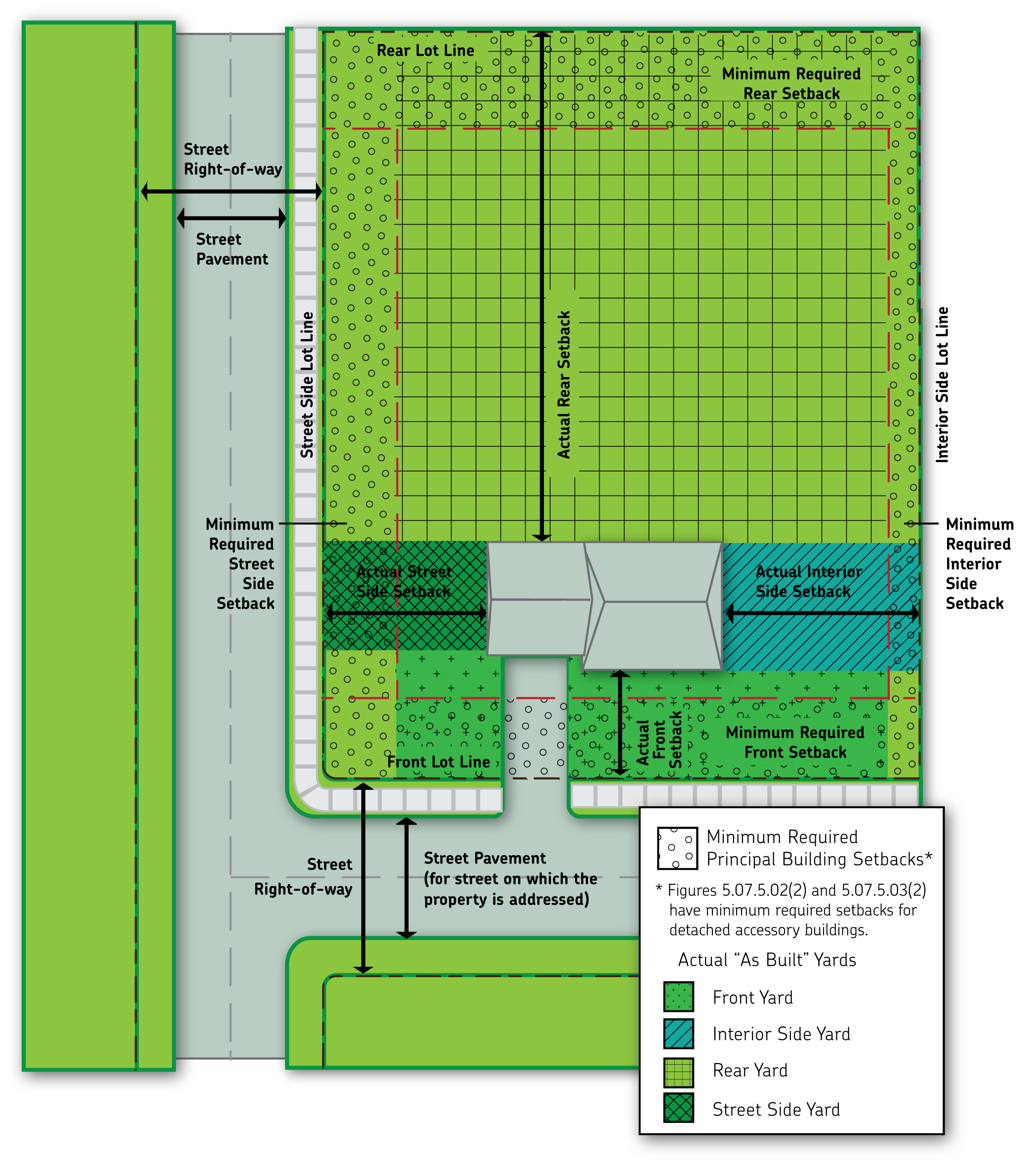
Figure 5.07.5.02(4): Lot Dimension and Setback Requirements for Zero Lot Line Structures
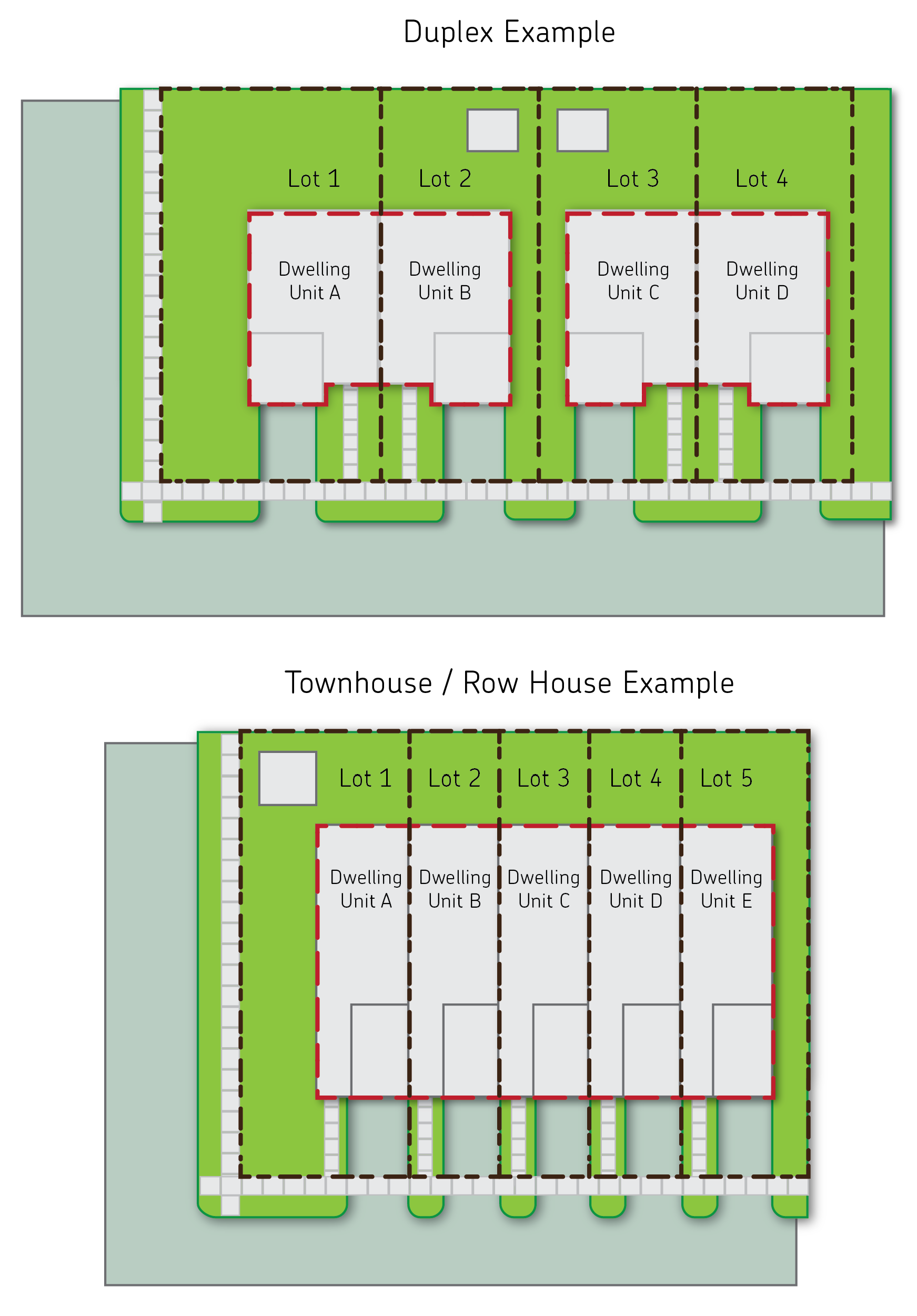
Figure 5.07.5.02(5): Different Yard and Setback Areas for a Variety of Different Lot Configurations
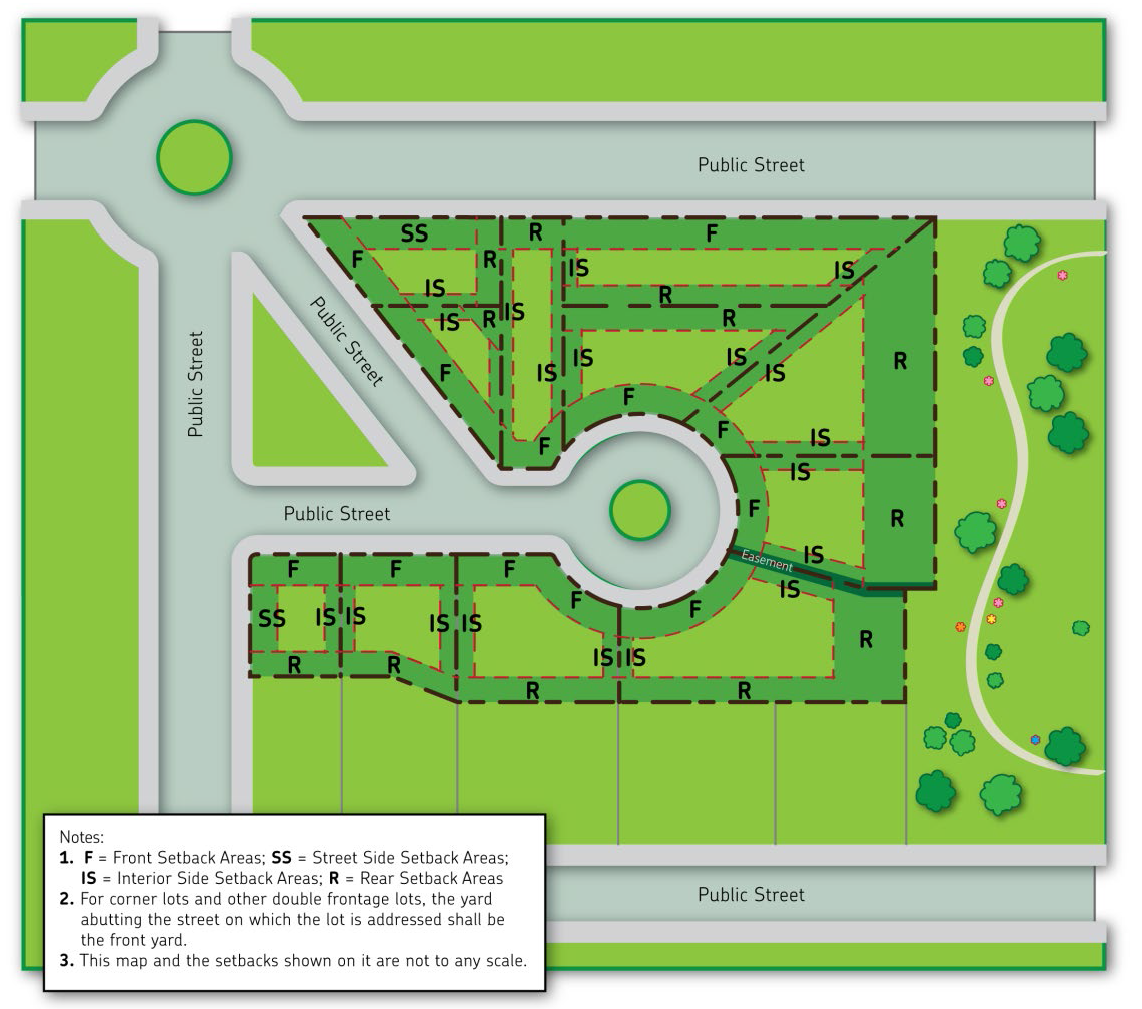
5.07.5.03. - Primarily nonresidential zoning district density, intensity, and bulk regulations.
Figure 5.07.5.03(1): Primarily Nonresidential Zoning District Lot Dimension Standards
Figure 5.07.5.03(2): Primarily Nonresidential Zoning District Setback and Height Standards
(Ord. No. 2021-04, § 1, 5-10-2021)
5.07.5.04. - Adjustments and exceptions.
(1)
Yard setback adjustments.
(a)
No yard shall be reduced in area or dimension so as to make such yard less than the minimum required by this Chapter. If an existing yard is less than the minimum required, it shall not be reduced further, except where exempted by the provisions of this Section.
(b)
In instances where a required buffer yard under this Chapter exceeds the minimum required setback width, the minimum required buffer yard width shall prevail. No intrusions by a structure, outdoor storage, or paved motor vehicle accommodation areas are permitted within any required buffer yard.
(2)
Encroachments into required yards. The following encroachments by buildings and structures are permitted into the specified required yards:
(a)
Permitted encroachments into required front or street side yards.
1.
Chimneys, flues, sills, pilasters, lintels, ornamental features, cornices, eaves, gutters, and satellite dishes with a diameter of 20 inches or less, provided they do not extend more than two and one-half feet into the required yard.
2.
Yard lights, ornamental lights, and nameplate signs for residential lots, provided they comply with applicable illumination requirements of Section 5.07.9.09.
3.
Terraces, steps, uncovered porches, decks, stoops, or similar appurtenances to residential buildings that do not extend above the floor level of the adjacent building entrance, which may encroach up to five feet into the required yard.
4.
Fences, in accordance with Section 5.07.9.03.
5.
Lawn ornaments such as statuary, bird baths, sundials, and flag poles.
(b)
Permitted encroachments into required rear or interior side yards.
1.
Sills, pilasters, lintels, ornamental features, cornices, eaves, gutters, and satellite dishes with a diameter of 20 inches or less, provided they do not extend more than two and one-half feet into the required yard.
2.
Fences in accordance with Section 5.07.9.03.
3.
Fire escapes (on residential buildings) that do not extend more than three feet into the required yard.
4.
Lawn accessories or ornaments such as ornamental statuary, bird baths, sundials, and flag poles.
(c)
Permitted intrusions into required rear yards.
1.
Terraces, steps, uncovered porches, decks, stoops, or similar appurtenances to residential buildings that do not extend above the floor level of the adjacent building entrance, which may encroach up to five feet into the required yard.
(3)
Exceptions to maximum height regulations. The maximum height regulations listed in each zoning district are the maximum permitted heights for all buildings and structures, except those exempted below:
(a)
Church spires; belfries; cupolas and domes that do not contain useable space; public monuments; water towers; telecommunication towers; fire and hose towers; flag poles; and farm structures such as barns, silos, and grain elevators.
(b)
Any building or structure not otherwise accounted for above may exceed maximum height regulations with the granting of a special exception under Section 5.07.12.08 that specifically states the maximum permitted height of the proposed building or structure.
(4)
Landscape surface area inclusions and exclusions.
(a)
In all districts, except as allowed in subsection (b), no impervious surfaces, including gravel, shall count toward the calculation of landscape surface area.
(b)
Minor or temporary impervious surfaces such as landscaping retaining walls, planters, bird baths, lawn statues, seasonal decorative displays, poles for clothes drying, flag poles, portable play structures such as swing sets and trampolines, stormwater management basins and swales, and grass roofs shall count toward the calculation of landscape surface area.
(Ord. No. 2021-04, § 1, 5-10-2021)
5.07.6.01.- Purpose.
The purpose of this Article is to establish and convey overlay zoning districts wherein certain additional requirements are in addition to the underlying, standard zoning districts set forth in Article 2 of this Chapter. Each overlay district is intended to address a special land use circumstance beyond those addressed by the underlying, standard zoning district. Except where otherwise stated, the overlay zoning districts described in this Article are represented on the official zoning map (or on a separate official overlap zoning map, or as otherwise indicated in this Article), adopted and from time to time amended by the City.
(Ord. No. 2021-04, § 1, 5-10-2021)
5.07.6.02. - A-H Airport Height Limitation.
The A-H Airport Height Limitation Overlay District is intended to regulate the height of structures relative to air travel associated with the Rhinelander-Oneida County Airport, in order to protect the public health, safety, and welfare of airport users and residents and employees within the airport and the surrounding area. The A-H District extends over the entire City, and is mapped per Section 3.05.06 of the Code and the airport height limitations zoning map. Requirements are per Title 3, Article III—Airport Height Limitation Zoning of the Code.
(Ord. No. 2021-04, § 1, 5-10-2021)
5.07.6.03. - H Historic.
The H Historic Overlay District is intended to preserve the architectural and historic character any areas where it is indicated on the official zoning map, and otherwise has the purpose indicated in Section 5.01.20(1) of the Code. The boundaries of the H Historic Overlay District are as depicted on the official zoning map. As of May 18, 2021, no land was zoned H Historic Overlay District in the City. If and when any H District is mapped, requirements are per Section 5.01.20(4) of the Code.
(Ord. No. 2021-04, § 1, 5-10-2021)
5.07.6.04. - Shoreland.
The Oneida County Shoreland Protection Ordinance fulfills Wisconsin shoreland protection mandates through its Shoreland District. Pursuant to Wisconsin Statutes, all territory annexed by the City after May 7, 1982 is subject to the Oneida County Shoreland Protection Ordinance as it existed at the time of annexation, unless the City were to adopt a shoreland protection ordinance as restrictive or more restrictive. The City has elected not to adopt a separate ordinance. Therefore, over applicable lands annexed after May 7, 1982, the City enforces the provisions of the Oneida County Shoreland Protection Ordinance that existed at the time of annexation.
(Ord. No. 2021-04, § 1, 5-10-2021)
5.07.6.05. - Shoreland-Wetland.
The Shoreland-Wetland Zoning District includes all wetlands that are five acres or more and that are within 1,000 feet of the ordinary high-water mark of navigable lakes, ponds, or flowages or 300 feet of the ordinary high-water mark of navigable rivers and streams or the landward side of the floodplain of such rivers and streams, whichever is greater. Land within the Shoreland-Wetland zoning district shall be subject to the requirements of Chapter 5.07, Part II, in addition to requirements of the underlying standard zoning district, any other applicable overlay district, and other requirements of this Chapter.
(Ord. No. 2021-04, § 1, 5-10-2021)
5.07.6.06. - Floodplain.
The Floodplain Overlay Zoning District includes all territory within the Floodway District, Floodfringe District, and General Floodplain Districts, as depicted on the official floodplain zoning map as defined and adopted in Chapter 5.07, Part III. Land within the City Floodway, Floodfringe, and/or General Floodplain shall be subject to the requirements of Chapter 5.07, Part III in addition to requirements of the underlying standard zoning district, any other applicable overlay district, and other requirements of this Chapter.
(Ord. No. 2021-04, § 1, 5-10-2021)
5.07.6.07. - GP Groundwater Protection.
The purpose of the GP Groundwater Protection District is to institute land use regulations and restrictions to protect the City municipal water supply and well fields, and to promote the public health, safety and general welfare of the residents of the City. The boundaries of the GP district are as depicted on associated wellhead protection plans, and as described in Section 3.07.17(3)(a) of the Code. Requirements are per Section 3.07.17 of the Code.
(Ord. No. 2021-04, § 1, 5-10-2021)
5.07.7.01.- Purpose.
(1)
The Planned Development (PD) District is intended to encourage and promote improved environmental design by allowing for greater freedom, imagination and flexibility in land developments so zoned while assuring compliance to the purpose of the zoning ordinance and this Article, and with the City's Comprehensive Plan. Such developments shall be characterized by:
(a)
Coordinated, professional, unified, and creative site and building planning and design.
(b)
The thoughtful mixing of compatible uses within the context of a unified project, and/or the blending of uses in the development with surrounding existing and planned uses.
(c)
Coordination of architectural styles, building forms and relationships, graphics, and other improvements.
(d)
Preservation of natural landscape features and utilization of such features in a harmonious fashion.
(e)
Attractive recreational or other development- or community-enhancing spaces and features.
(f)
A safe, efficient, convenient, and integrated system for pedestrian and vehicular access and movement.
(g)
Efficient use of land resulting in cost effective networks of utilities, streets and other facilities.
(h)
Environmental sustainability and energy efficiency.
(2)
The greater freedom, imagination and flexibility allowed under PD zoning shall not be used to circumvent or diminish high-quality land use planning and site and building design. Instead, PD zoning shall be used only to achieve results that are superior to those possible under standard zoning districts.
(Ord. No. 2021-04, § 1, 5-10-2021)
5.07.7.02. - Potential modifications and exemptions.
The following modifications and exemptions to normal requirements of the zoning ordinance may be proposed and approved within each PD, subject to the allowances and limitations herein. All such modifications and exemptions, plus any further conditions, shall be as specified and limited within the approved specific implementation plan and enforced as part of this title. In the event that such requirements are not, in the determination of the Zoning Administrator, adequately specified in an approved specific implementation plan, the normal requirements of this title associated the affected categorical areas or most similar standard zoning district(s) shall prevail and be enforced within the PD.
(1)
Land use. Any land use, or combination of uses, may be permitted and shall be as specified in the approved specific implementation plan. Such specification may consist of references to permitted and conditional uses in one or more standard zoning districts.
(2)
Dimensional, setback, and building height standards. Flexibility in lot area, lot width, setback, height, yard, landscaped surface area requirements, and other dimensional and density standards may be permitted.
(3)
Parking and loading. Flexibility in the design, number of spaces, and location of off-street parking, loading, and vehicular circulation areas may be permitted. In no case shall gravel parking, loading, or circulation areas be permitted within a PD. Flexibility in number of parking or loading spaces may require detailed information indicating that demand does not warrant more spaces and/or the reservation of sufficient open space within the PD to fully comply with the normal ordinance requirement.
(4)
Signage. Flexibility in the design, location, area, height, and number of signs may be permitted.
(5)
Site, building, and landscape design. Flexibility in site and building design may be permitted including, but not limited to, landscaping, lighting, and building architecture and materials.
(6)
Engineering design. Flexibility in design standards for public rights-of-way and infrastructure pursuant Titles 3 and 4 of the Code may be permitted, based upon a determination by the Public Works Director that appropriate standards are applied to implement the specific function in the specific situation and to assure the public safety and welfare is protected.
(7)
Subdivision standards. Flexibility in any requirements under Chapter 5.06 of the Code may be permitted, but only where the procedure in Section 5.06.11 is utilized.
(Ord. No. 2021-04, § 1, 5-10-2021)
5.07.7.03. - Criteria for approval of a PD.
As a basis for determining the acceptability of each PD application (i.e., general development plan (GDP) and specific implementation plan (SIP) submittals), the following criteria shall be utilized by the Plan Commission and City Council.
(1)
Consistency. The proposed PD shall be consistent with:
(a)
The purposes of this title and this Chapter.
(b)
The comprehensive plan, other adopted City plans, and official map of the City.
(c)
For each SIP, the approved GDP and any required modifications and conditions of GDP approval.
(d)
To the extent not waived or modified, all applicable zoning and other ordinance requirements.
(2)
Community benefits. The proposed PD shall produce significant benefits to the City of Rhinelander as a whole, in addition to the area being proposed for development.
(3)
Character and intensity of land use. The proposed uses and the density, intensity, and layout within the PD shall:
(a)
Be arranged and designed in accordance with sound land planning principles and development techniques and be properly and compatibly related to each other, nearby land uses, the surrounding community, the transportation system, and other public facilities, parks, schools and utilities.
(b)
Be compatible with the physical nature of the site; where possible, natural features and trees shall be preserved.
(c)
Create an attractive environment of sustained aesthetic and ecologic desirability, energy efficiency, economic stability and functional practicality compatible with the City's plans for the area.
(d)
Not adversely affect the anticipated provision for school or municipal services, such as fire and police protection, street maintenance, water, sanitary sewer, storm water management, and public parks and open spaces.
(e)
Not create traffic or parking demand incompatible with the existing or proposed facilities to serve it.
(f)
Not unduly increase the density of population or intensity of use, create traffic congestion, or restrict access to light and air to the detriment of areas outside the PD.
(4)
Preservation and maintenance of open space. Adequate provision is made for the permanent preservation, improvement, and maintenance of common open space, and the care and maintenance shall be assured by establishment of appropriate management organization for the PD.
(5)
Implementation schedule. A schedule for the implementation of the PD shall be proposed and reasonably assured, including suitable provisions for assurance that each phase shall be brought to completion in a manner that would not result in an adverse effect upon the City as a result of termination at that point.
(Ord. No. 2021-04, § 1, 5-10-2021)
5.07.7.04. - Procedural requirements for the PD District.
(1)
General Development Plan (GDP) Review Process.
(a)
Pre-application conference. Prior to the filing of a rezoning petition and GDP, the applicant shall attend a pre-application conference with City staff, arranged through the Zoning Administrator or designee, to discuss the scope and nature of the proposed development. A preliminary sketch and a narrative description shall be submitted in advance of the pre-application conference. The Zoning Administrator may refer the matter to the Plan Commission for its input prior to the submittal of a GDP.
(b)
Rezoning and general development plan (GDP) filing. After the pre-application conference including Plan Commission input where required, the applicant may file an application with the Zoning Administrator for approval of a zoning change to the PD District. The procedure for rezoning to a PD District shall be as required for any other zoning district change as set forth under Section 5.07.12.03, except that, in addition thereto, a digital copy of a GDP meeting the requirements of subsection (2) below, plus any paper copies required by the Zoning Administrator, shall be filed with the application for rezoning. The rezoning and GDP application shall be accompanied by a filing fee in in the amount established by resolution, a completed application form provided by the Zoning Administrator, and all items listed in Section 5.07.12.03(3) except as waived or modified in writing by the Zoning Administrator. Such application shall be signed by the property owner(s) of the proposed PD.
(c)
Rezoning and general development plan (GDP) review.
1.
Plan Commission hearing and recommendation. No sooner than 30 days after the filing of an application for rezoning and GDP approval that the Zoning Administrator determines is complete, the Plan Commission shall hold a public hearing on the GDP and shall forward to the City Council a written report recommending that the rezoning and GDP be approved, approved with modifications and/or conditions, or rejected, and giving the reasons for any recommendation to reject. In making its recommendation, the Plan Commission shall utilize criteria set forth in Sections 5.07.7.03 and 5.07.12.03(7). The public hearing shall be preceded by a Class 2 notice under Chapter 985, Wis. Stats.
2.
City Council action. Except where the applicant grants an extension in writing, within 30 days after the Plan Commission recommendation, but not later than 120 days after the public hearing, the City Council will consider the rezoning. Following such consideration, the Council shall approve, approve with modifications and/or conditions, or reject the rezoning and GDP; or shall instead refer the rezoning and GDP back to the Plan Commission for further report. In taking action, the Council shall utilize criteria set forth in Sections 5.07.7.03 and 5.07.12.03(7).
3.
Recording. Following its approval, each GDP shall be recorded by the developer with the County Register of Deeds' office, including any and all required modifications. Within 30 days of its recording, the applicant shall provide the Zoning Administrator with a digital copy of the recorded GDP along with evidence of its recording.
4.
Effect of GDP approval. Approval of the rezoning and GDP, and GDP recording, shall entitle the applicant to prepare the specific implementation plan (SIP) in accord with the approved and recorded version of the GDP and all conditions of its approval. Such GDP approval shall become null and void if the SIP has not been submitted within five years of the date of City Council approval of the GDP. The rezoning to PD shall take effect only once the events listed in subsection (3)(b)2. have occurred.
(2)
General development plan (GDP) requirements. The GDP shall include the following information and materials, except as waived or modified in writing by the Zoning Administrator.
(a)
A narrative description and accompanying table(s) of the proposed development including, at minimum, the following information in MS Word format:
1.
A cover letter summarizing the request, including the project vision, objectives, themes, and images; general development design and uses; economic feasibility and financing; target market(s); and relationship to surrounding land uses.
2.
A list of any proposed waivers and modifications from normal ordinance standards, as generally enabled under Section 5.07.7.02, and including rationale relative to the purpose in Section 5.07.7.01 and approval criteria in Section 5.07.7.03.
3.
Total area in acres of the proposed PD as well as total acres expected to be devoted to each land use, including public and open space uses and rights-of-way.
4.
Description of areas to be reserved or dedicated for public and recreational uses.
5.
Proposed mix and maximum total number of dwelling units desired, and/or proposed mix and maximum nonresidential square footage or other appropriate measure.
6.
All proposed dimensional standards paralleling the types normally listed within standard zoning districts of the City.
7.
Anticipated population (including school children) and number of employees in the entire development and in each proposed phase.
8.
A general outline of the intended organizational structure related to property owner's association, deed restrictions and private provision for common services.
9.
A timeline for the staging of development including project commencement, anticipated completion, and phasing.
10.
Any other pertinent data determined necessary by the Zoning Administrator or Plan Commission for a comprehensive evaluation of the proposed development.
(b)
An existing conditions map of the PD and the area within 300 feet depicting the following information:
1.
Existing topography at two-foot intervals.
2.
PD site area, property boundaries, easements and dimensions.
3.
Existing buildings (including overhangs), driveways, parking areas and dimensions.
4.
Streams, lakes, wetlands, floodplains, hydric soils, mature trees and wooded areas, slopes greater than 12 percent, and any other significant environmental features.
5.
Private and public facilities, including, but not limited to, utilities, streets, parks, and historic resources.
6.
Existing small utilities (i.e., phone, cable, gas).
(c)
Conceptual plan maps and graphics of the project depicting:
1.
The proposed land uses, lot layout, street configuration, utilities, open space, landscape areas.
2.
Location of different types and densities (e.g., units per acre) of any proposed dwelling units.
3.
Location of different types and intensities (e.g., floor area ratio, height) of any proposed nonresidential and mixed-use development.
4.
General locations of proposed public street, open space, and utility connections, and anticipated upgrades of public infrastructure to serve the project.
5.
A conceptual landscape plan showing general locations and types of proposed landscaping, including maintenance of existing vegetation where appropriate.
6.
Schematic architectural plans showing the character of the proposed buildings, along with a generalized program of proposed signage.
(3)
Specific implementation plan (SIP) review process.
(a)
Specific implementation plan (SIP) filing. The applicant shall file digital copies of a SIP with the Zoning Administrator, along with any paper copies that the Administrator may require. Normally, a SIP may be filed only after a GDP has been approved by the City Council, modified as may be required by such approval, and recorded. However, with prior authorization of the Zoning Administrator for PDs of limited complexity, the applicant may submit a SIP concurrent with a GDP application associated with all or part of the same land. Regardless of sequence, the SIP may cover only a portion of the GDP area, except as may have been restricted by GDP approval. The SIP application shall be accompanied by a filing fee in the amount established by resolution, a completed application form provided by the Zoning Administrator, and all items listed in subsection (4) below except as waived or modified in writing by the Zoning Administrator. Such application shall be signed by the property owner(s) of the proposed PD.
(b)
Specific implementation plan (SIP) review.
1.
Plan Commission action. No sooner than 14 days after the filing of an application for SIP approval that the Zoning Administrator determines is complete, the Plan Commission will consider the SIP. Following such consideration, the Plan Commission shall approve, approve with modifications and/or conditions, or reject the SIP, providing the reasons for any rejection. In taking any such action, the Plan Commission shall utilize criteria set forth in Section 5.07.7.03.
2.
Recording of SIP; rezoning of lands. The applicant shall record the approved SIP, including any required modifications, with the County Register of Deeds. The rezoning of the SIP area to PD shall become effective and the Zoning Administrator shall cause the official zoning map to reflect the rezoning, once the following have occurred:
a.
The applicant has provided the Zoning Administrator with a digital copy of the recorded SIP along with evidence of recording.
b.
Any subdivision plat or certified survey map associated with the SIP has been recorded, or an application for a building permit within the SIP area for an authorized use has been submitted, whichever comes first.
3.
Lapse of SIP approval. Final SIP approval shall terminate and the SIP shall be deemed null and void for any undeveloped part of the SIP area in one or both of the following circumstances:
a.
If a SIP is granted final approval and thereafter five years have lapsed without the applicant or owner applying for a building permit within the SIP area for an authorized use.
b.
If the approved SIP includes a phased implementation program, and five years have lapsed between (i) the acceptance of public infrastructure or initial occupancy of a building in a phase preceding the final phase and (ii) commencement of construction of the next phase.
c.
In the event the land affected by either such circumstance has been rezoned to the PD District, the Zoning Administrator shall initiate an application to rezone the undeveloped land in the PD area from the PD District back to the zoning district over the land before PD, or the nearest comparable zoning district.
(4)
Specific implementation plan (SIP) requirements. The SIP shall include the following documents and schedules, except as waived or modified in writing by the Zoning Administrator:
(a)
An updated and more detailed narrative description and accompanying table(s) of the proposed development including, at a minimum, all information listed under subsection (2)(a) above and determined sufficient by the Zoning Administrator to enable effective zoning administration over the SIP area in perpetuity. Such information shall include but not be limited to specific densities and dimensional standards for residential and nonresidential uses paralleling those types of standards typically required within non-PD zoning districts.
(b)
Specific enumeration of all requested modifications and exemptions to normal zoning ordinance requirements, as generally enabled under Section 5.07.7.02, and including rationale relative to the purpose in Section 5.07.7.01 and approval criteria in Section 5.07.7.03.
(c)
A legal description of the boundaries of lands included in the proposed SIP area.
(d)
A specific list of proposed permitted and conditional uses within the SIP area, which may consist of references to permitted and conditional uses in one or more standard zoning districts.
(e)
For all SIP areas that are proposed to include five or more lots, a detailed neighborhood development plan showing the precise horizontal and vertical mix of land uses; densities of use areas and development sites; building setbacks and massing; main driveways and parking areas; parks, squares, and other common open spaces; civic buildings; street trees and other natural elements; the street and block structure; and paths and other pedestrian ways.
(f)
A complete set of development plans including the following sheets, prepared to a recognized scale and include a date, graphic scale, and north arrow.
1.
Cover sheet indicating:
a.
The name of the proposed PD, the name and address of the owner, engineer, land surveyor, and/or land planner.
b.
Vicinity map depicting the location of the proposed PD in relation to surrounding development.
2.
Demolition plan depicting any demolition to occur on the site (if applicable).
3.
Site and building plans meeting requirements in Section 5.07.12.10(4). For single- and two-family dwellings, the SIP may instead include site and architectural design guidelines contained within a declaration of covenants, deed restrictions, or other similar document, in lieu of detailed plans for each individual dwelling.
(g)
Phasing plan, if the SIP is to be executed in phases, indicating:
1.
The approximate date when construction of the project can be expected to begin.
2.
The stages in which the project will be built and the approximate date when construction of each stage can be expected to begin.
3.
The anticipated rate of development.
4.
The approximate date when the development of each of the stages will be completed.
5.
The area and location of common open space that will be provided at each stage.
(h)
Agreements, bylaws, provisions or covenants which govern the organizational structure, use, maintenance and continued protection of the PD and any of its common services, common open areas or other facilities.
(i)
Proof of financing capability to complete the SIP.
(j)
All conditions agreed to by the applicant which are not included in the written documentation required by this section shall be part of the development plan.
(k)
If the site has any environmental contamination, a plan of remediation.
(l)
Any other plans, documents or schedules requested by the Zoning Administrator or the Plan Commission.
(Ord. No. 2021-04, § 1, 5-10-2021)
5.07.7.05. - Development agreement.
Before any building permit shall be issued in a PD District, at the City's discretion, the applicant and/or the owner shall enter into an appropriate agreement with the City to guarantee the implementation of the PD according to the terms and conditions established as a part of the GDP and SIP. The City shall have the right, if deemed appropriate, to require the inclusion of performance bonds or other security deemed satisfactory to the City Attorney.
(Ord. No. 2021-04, § 1, 5-10-2021)
5.07.7.06. - Subdivision review.
The applicable subdivision or land division review under Chapter 5.06 of the Municipal Code, where necessary, shall be carried out as an integral part of the review of a PD. Subdivision applications may be submitted for the whole or parts of the overall PD as indicated by any identified phases.
(Ord. No. 2021-04, § 1, 5-10-2021)
5.07.7.07. - Amendment of GDPs and SIPs.
(1)
Minor amendments. The Zoning Administrator may authorize a minor amendment to a previously approved GDP or SIP, upon application and review under the applicable subsection(s) of Section 5.07.7.04. A minor amendment shall be classified as an amendment to an approved GDP and/or SIP required by engineering, topographic, lot configuration, or other circumstances not foreseen at the time such plan(s) was approved, provided that the amendment does not result in any of the following:
(a)
Change in the approved use, character, or vision of the development.
(b)
Conflict with the intent of the City Council or Plan Commission in approval of the GDP and/or SIP.
(c)
Change the overall coverage of structures and/or the density or intensity of use by more than ten percent.
(d)
Reduce the approved open space, off-street parking or loading spaces, minimum lot area, minimum floor area, and/or other dimensional requirement by more than ten percent.
(e)
Any other amendment specifically listed in the approved GDP and/or SIP as requiring subsequent Plan Commission or City Council approval.
(2)
Major amendments.
(a)
Each amendment to the GDP not classified as a minor amendment under subsection (1) shall instead be classified as a major amendment, and must be approved by the City Council, following a recommendation from the Plan Commission, per Section 5.07.7.04(1).
(b)
Each amendment to the SIP not classified as a minor amendment under subsection (1) must be approved by the Plan Commission, per Section 5.07.7.04(3).
(3)
Recording and development agreement. Each approved amendment to a GDP or SIP shall be recorded before the City will issue a building permit or enable recording of a subdivision plat or certified survey map authorized under the approved amendment. The City may also require an amendment to any development agreement under Section 5.07.7.05.
(Ord. No. 2021-04, § 1, 5-10-2021)
5.07.7.08. - Planned unit developments under prior zoning ordinance.
Prior to May 18, 2021, the City enabled planned (unit) developments by conditional use permit within various standard zoning districts (e.g., R-3, B-3). Each such approved planned unit development remained dependent, at least in part, on rules applicable within the standard zoning district that continued to apply to the parcel. Therefore, no parcel with a planned unit development approved by conditional use permit under the prior zoning ordinance was rezoned to the PD District at the time of the May 18, 2021 zoning ordinance update. Instead, each such parcel retained the same standard zoning classification as before, but was also marked "PUD" on the official zoning map. Following May 18, 2021, new planned developments and amendments to planned unit developments approved under the prior zoning ordinance shall require rezoning to the PD District, per the procedures and standards in this Article.
(Ord. No. 2021-04, § 1, 5-10-2021)
5.07.8.01.- Generally.
(1)
Purpose. The purpose of this Article is to address the exterior design and appearance of multi-family residential and nonresidential buildings and sites to promote the City's goals with respect to land use compatibility, property value, aesthetics, tourism, and public health.
(2)
Applicability. All buildings and developments for which site and building plan approval is required under Section 5.07.12.10(1) shall meet the design requirements in this Section, except as may waived or modified by the Plan Commission under Section 5.07.8.04. See exemptions in Section 5.07.12.10(1), which include agricultural and single- and two-family residential land uses and structures.
(3)
Required plans. Each applicant for site and building plan approval under Section 5.07.12.10 shall provide building elevations, a site layout plan, a landscape plan, and other materials as necessary to demonstrate compliance with the following applicable standards in this Section.
(4)
Other design standards. In addition to the standards in this Article, the City's site and building plan approval authority a shall refer to the comprehensive plan for any design recommendations for specific neighborhoods, districts, or building types in its review and approval of site and building plans.
(Ord. No. 2021-04, § 1, 5-10-2021)
5.07.8.02. - Building and site design standards.
(1)
Building floor area and mass. The floor area and mass of each applicable building under Section 5.07.8.01(2) shall be designed in favorable—but not necessarily identical—proportion to the size and mass of existing on-site and neighboring buildings. See Figure 5.07.8.02(1) for examples.
Figure 5.07.8.02(1): Examples of Favorable Building Floor Area and Mass Proportionality
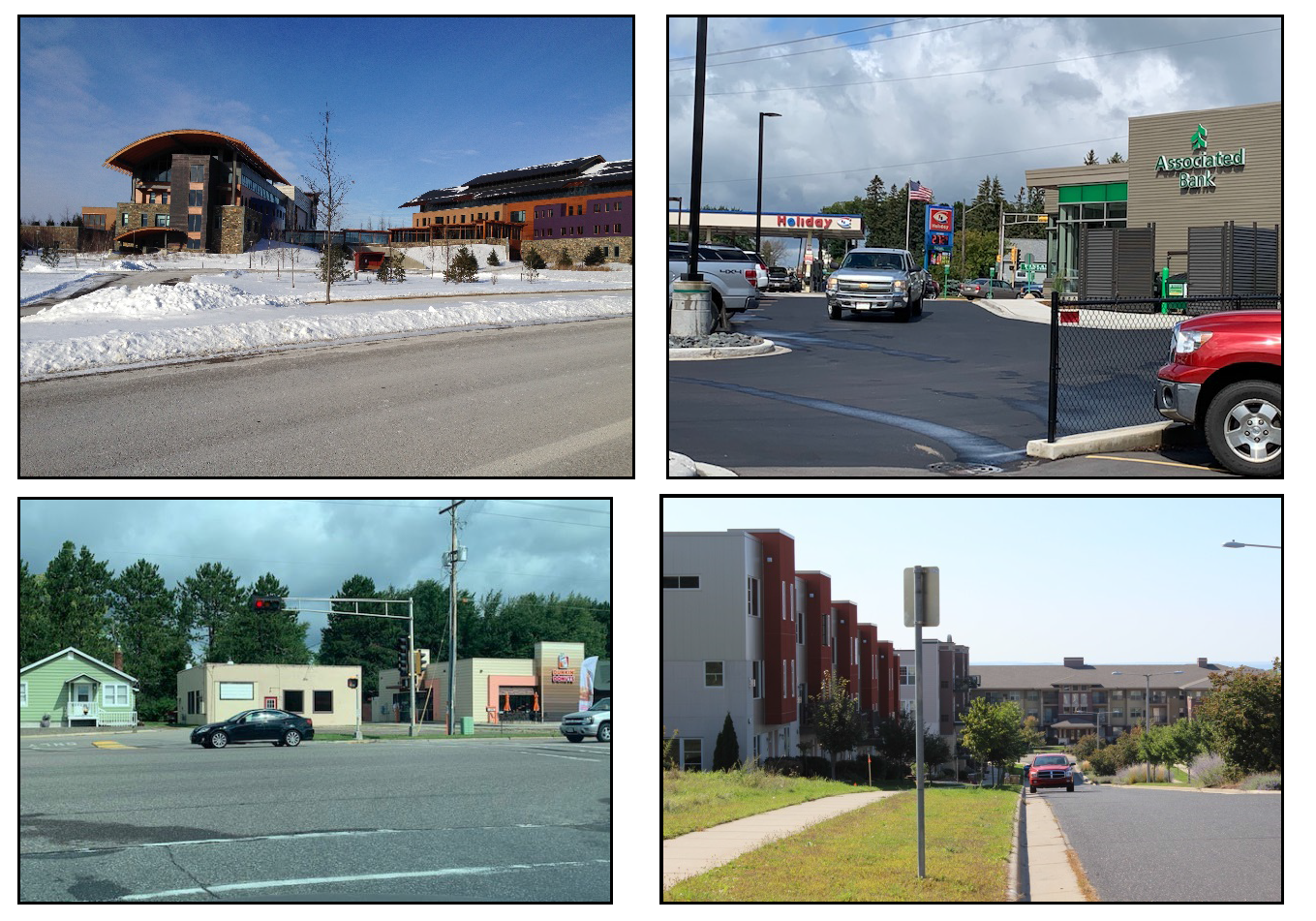
(2)
Architectural features. The relationship of the following architectural features shall be visually compatible with such features on existing on-site and neighboring buildings: width to height of windows, solids to voids on the front façade, building entrances, vertical or horizontal directional character. See Figure 5.07.8.02(2) for example.
Figure 5.07.8.02(2): Downtown Example of Favorable Architectural Feature Relationship
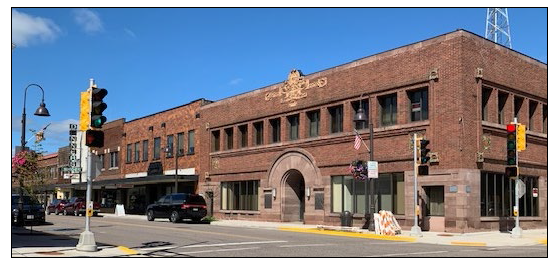
(3)
Materials. All building facades shall present a finished appearance to the public and surrounding properties. Except within industrial zoning districts and for interior side or rear facades in the B-3 General Business District, the following exterior construction materials shall not be used on front or street side facades: non-decorative concrete block or cinder block, non-decorative concrete foundation walls or panels, non-decorative plywood, asphaltic siding, or metal panels with exposed exterior fasteners.
(4)
Vents and mechanical units. All chimney and fireplace vents shall be enclosed in a chase constructed of materials similar to those materials used on the building elevations, or metal housings designed by the vent manufacturer. All building-mounted heating, ventilating, and air-conditioning equipment shall be designed to be integral with the building architecture or screened from view from public rights-of-way and residentially zoned property.
(5)
Canopies. All permanent canopies and similar building appurtenances shall have electrical wiring that will accommodate one or more heating cables in the event they are needed for icy conditions.
(6)
Loading docks and doors. Except within industrial zoning districts, loading docks and doors shall be designed as integral elements to the building and site, shall not be the dominant visual element from public rights-of-way, and shall be screened from view from public rights-of-way. Regardless of zoning district, all loading docks and doors shall be screened from residentially zoned property.
(7)
Outdoor waste/recycling materials and containers. See standards in Section 5.07.9.05(2).
(8)
Additional standards for applicable buildings and sites in the B-2 Central Business District. In its review of plans for applicable sites and buildings under this Section and Section 5.07.12.10, the Plan Commission may also utilize the "Rhinelander Downtown Façade Design Guidelines" available from the office of the Zoning Administrator.
(9)
Additional standards for large retail and commercial service developments. Each large retail and commercial service development, as defined in Section 5.07.13.04, shall meet the following additional standards:
(a)
Each building of over 50,000 gross square feet shall employ varying setbacks, heights, roof treatments, non-service doorways, window openings, and/or other structural or decorative elements to reduce apparent building size and scale. No facade that does not include any such element shall extend more than 100 feet.
(b)
Where a building of over 50,000 gross square feet is proposed to be distant from a public street, the overall development design shall include smaller buildings on pads or secondary lots closer to the street.
(c)
All smaller buildings on secondary pads or secondary lots shall be of architectural quality comparable to or exceeding that of the building(s) that are over 50,000 gross square feet.
(d)
Each ground floor facade of each building that faces the primary public street or parking lot shall have outdoor spaces located under a roof or overhang, display windows, decorative entry areas, and/or other features desired to bring a sense of life and human scale to that facade.
(e)
Public building entryways shall be clearly defined and highly visible on the building's exterior design, and shall be emphasized by on-site traffic flow patterns.
(f)
Any outdoor storage or product display area shall be depicted on the approved site plan and be separated from motor vehicle routes by a physical barrier visible to drivers and pedestrians.
(g)
All mechanical equipment, refuse containers, loading docks, and any permitted outdoor storage shall be screened with materials complementing those used on the building exterior, fully opaque landscaping at time of planting, or some combination, so as to not be visible from public streets or residentially zoned land.
(h)
Within parking lots, landscaped islands or peninsulas shall be spaced at intervals no greater than one island per every 20 spaces in that aisle. Each landscaped island or peninsula shall contain a minimum of 180 square feet in landscaped area.
(i)
The development shall provide for safe and efficient access, circulation, and parking for motor vehicles, pedestrians, bicycles, and shopping carts.
(j)
Where a building is proposed as a replacement location for a business already located within the City, the City prohibits any privately imposed limits on the type or reuse of the previously occupied building through conditions of sale or lease.
(Ord. No. 2021-04, § 1, 5-10-2021)
5.07.8.03. - Landscaping standards.
(1)
Generally. Site landscaping shall be designed and implemented to present an attractive street and community appearance (particularly in highly visible and traveled areas), complement existing uses and site development on nearby lands, and buffer lower density and/or residential uses nearby.
(2)
Landscape planting requirements. Landscaping shall be provided based on the following requirements for street frontages, paved areas, building foundations, buffer yards, and general yard areas. These requirements are additive to each other. By approval of the Plan Commission, required landscaping points may be shifted between areas (e.g., paved areas to building foundations). The point system is described in greater detail in subsection (3) below.
(a)
Street frontages. Notwithstanding Section 3.01.07, the applicant shall plant trees within or near street terraces/boulevards per Section 3.04.08(8) and Figure 5.07.8.03(1).
Figure 5.07.8.03(1): Street Terrace/Boulevard Planting Example
(Not Intended to Represent Minimum Requirements)
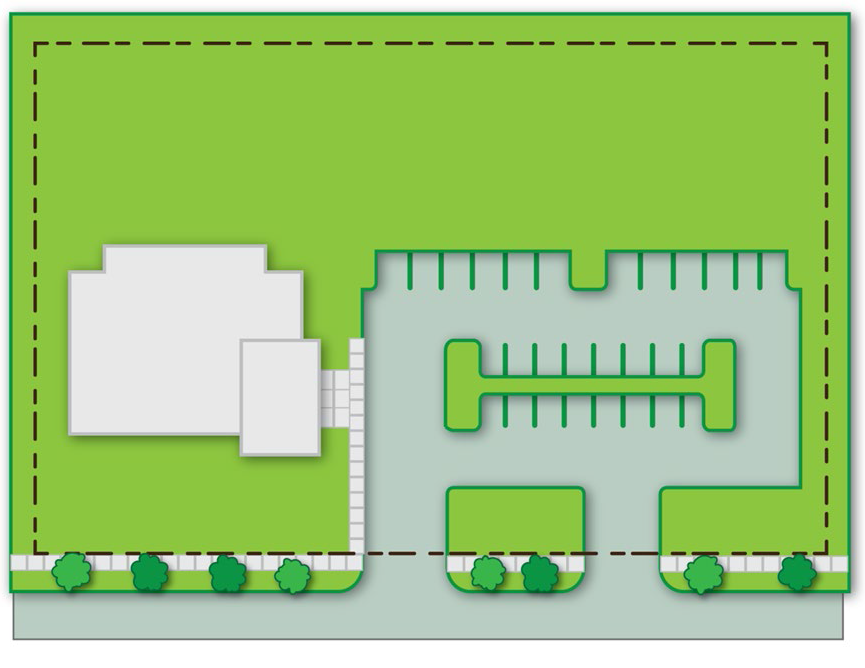
(b)
Hard or gravel surfaced areas. Within industrial zoning districts, 100 points of landscaping shall be planted for each 2,500 square feet of all areas covered with a hard, all-weather surface and gravel surface. Within all other zoning districts, 100 points of landscaping shall be planted for each 1,500 square feet of such surfaces. For purposes of this standard, such surfaces do not include rooftops or any airport runway or taxiway area. Such plants shall be installed within landscaped islands or peninsulas within the hard or gravel surfaced area or near its edges.
Figure 5.07.8.03(2): Paved Area Landscaping Example
(Not Intended to Represent Minimum Requirements)
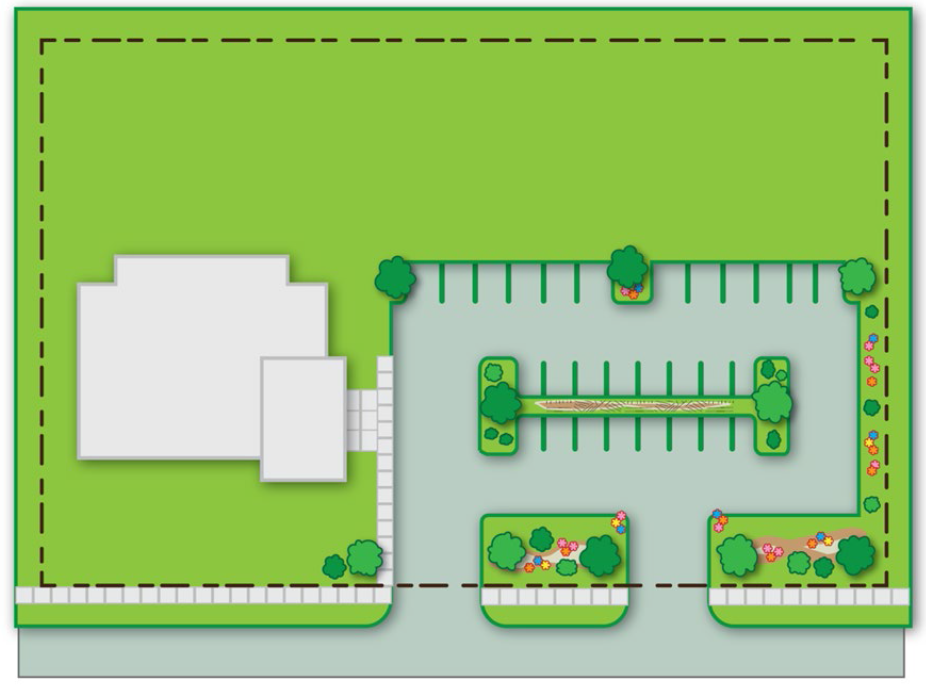
(c)
Building foundations. Within industrial zoning districts, 100 points of landscaping shall be planted for each 75 lineal feet of exterior building wall that is visible from a public right-of-way or residentially zoned property. Within all other zoning districts, 100 points of landscaping shall be planted for each 75 lineal feet of all exterior building walls.
Figure 5.07.8.03(3): Building Foundation Landscaping Example
(Not Intended to Represent Minimum Requirements)
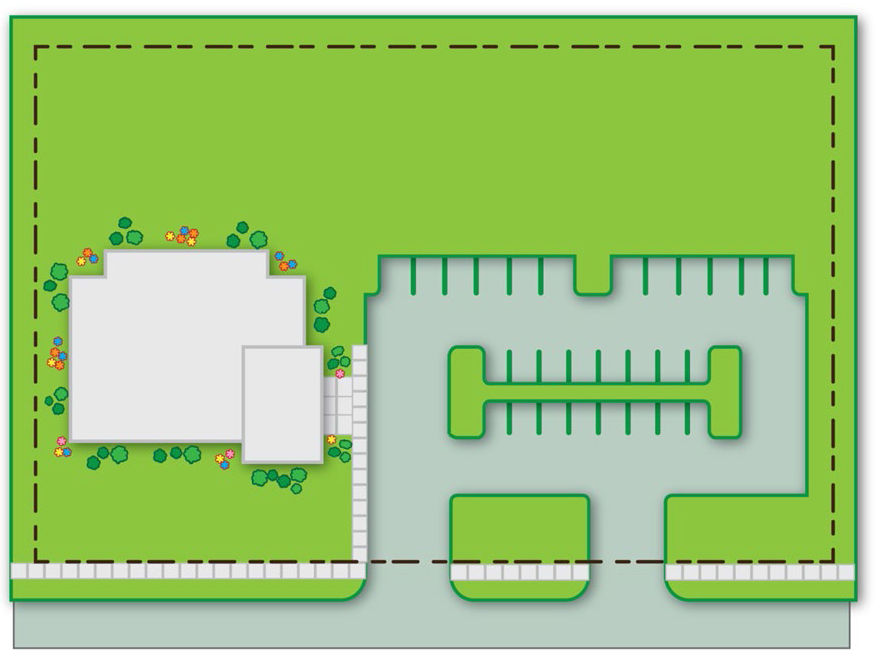
(d)
Buffer yards. A buffer yard, as defined in Section 5.07.13.04, shall be provided if required for a particular land use listed in Article 4. Where required, buffer yards shall comply with the following:
1.
The minimum width shall be 25 feet, unless reduced by the site and building plan approval authority if it determines that a lesser width is both adequate to separate incompatible uses/activities and necessary owing to site constraints.
2.
No building, vehicle accommodation area other than a bike/pedestrian way, trash storage area, light fixture, sign, or outdoor storage area or structure shall be permitted in a required buffer yard.
3.
Landscaping shall be selected, positioned, and planted in sufficient quantities to provide an all-season screen within five years of planting and have a minimum height of three feet at time of planting. Such landscaping shall not count towards any street frontage, hard or gravel surfaced area, building foundation, or general yard area planting requirement of this Section.
4.
The use of a decorative opaque fence or wall, and/or a berm, in lieu of or in addition to the landscaping may be approved, provided the slope of any berm is less than 4:1 and the berm, fence or wall does not interfere with access, utilities, or stormwater management.
Figure 5.07.8.03(4): Buffer Yard Landscaping Example
(Not Intended to Represent Minimum Requirements)
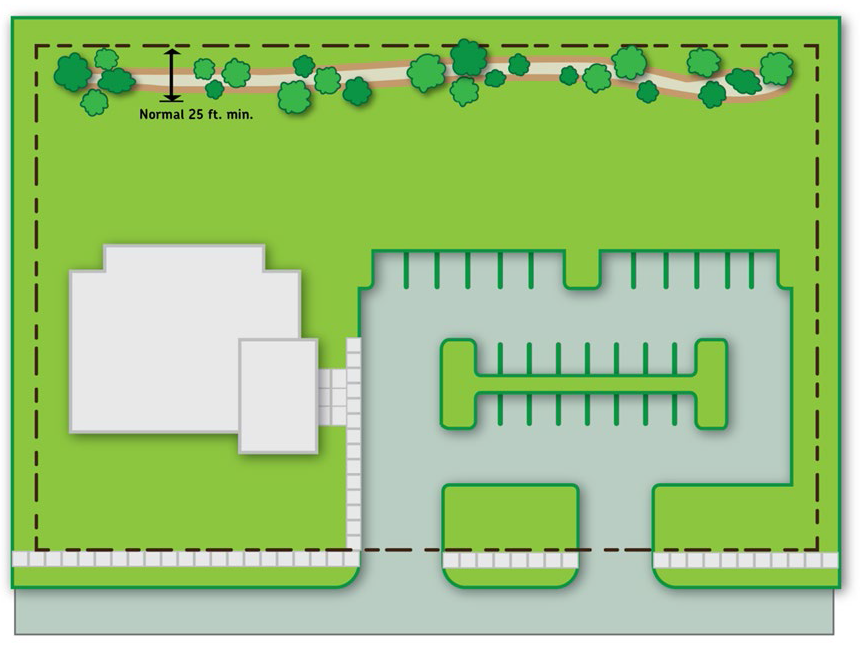
(e)
General yard areas. Within industrial zoning districts, 100 points of landscaping shall be planted for each 5,000 square feet of total lot area, excluding those areas in a terrace/boulevard, under a rooftop, within hard and gravel surfaced areas, in a required buffer yard, or being reserved for a future phase of development. Within all other zoning districts, 100 points of landscaping shall be planted for each 3,000 square feet of total lot area, with the same exclusions.
Figure 5.07.8.03(5): General Yard Landscaping Example
(Not Intended to Represent Minimum Requirements)
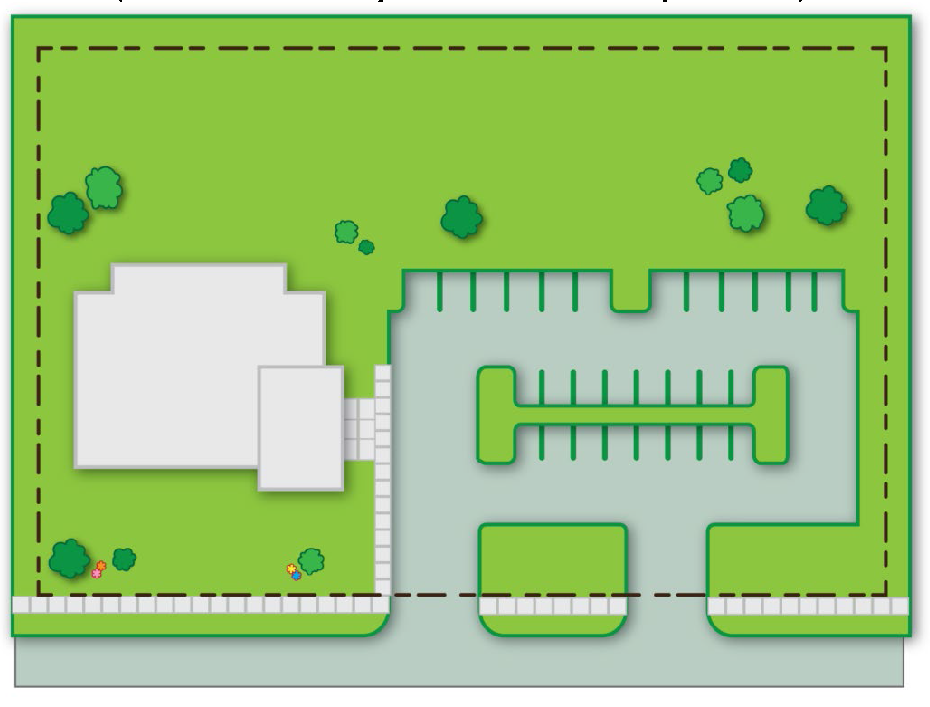
(f)
Other green space areas. Green space areas not used for landscape plantings, other than natural resource protection areas, shall be graded and sodded or seeded with a maintainable seed mix.
(3)
Landscaping points and minimum installation sizes. Most of the above landscaping requirements are expressed in terms of landscape points. Each plant type, below, is worth a certain number of landscape points that can be used to fulfill the landscaping requirements, as provided in Figure 5.07.8.03(6). Minimum permitted installation sizes for each plant category are provided to ensure that landscaping provides its aesthetic and screening functions at the time of installation and to improve survival rates.
Figure 5.07.8.03(6): Landscaping Points, Minimum Installation Size, and Species Examples
(4)
Credit for existing plantings and other landscape design elements. The applicant shall be afforded credit towards minimum landscape point standards for:
(a)
Existing, non-invasive landscape plantings to be retained and protected with the development of the site, and restoration or reestablishment of native flora, based on the landscape points afforded to each type of existing planting in Figure 5.07.8.03(6).
(b)
Other proposed landscape features, such as sculpture, fountains, or outdoor seating or recreational aesthetically pleasing facilities, with landscape points afforded by the site and building plan approval authority based generally on the cost of such features relative to landscape planting costs.
(5)
Prohibited species. The species listed in Section 3.04.08(8)(h) are prohibited for use as landscaping plants in all locations.
(6)
Installation. All landscaping required under this Section shall be installed consistent with industry accepted standards and shall be guaranteed by the applicant or the applicant's contractor for at least one year. Installation shall occur prior to occupancy or commencement of operations, unless doing so would result in unsatisfactory plant survival. In this case, landscaping shall be installed within six months of occupancy or commencement of operations, and the City may require a performance guarantee, such as a letter of credit, before a certificate of occupancy is granted and until such landscaping is installed according to plan.
(7)
Maintenance. Landscaping required by this Section is intended to be a permanent site improvement. As such, all landscaping shall be continually maintained in a live, healthy, safe, and aesthetically pleasing state. Recognizing that over time plants may mature and die or otherwise expire because of natural or unnatural causes, maintenance shall include the removal and replacement of dead or dying plants. Landscaping shall also be subject to applicable maintenance standards with Section 5.01.145.
(8)
Landscaping in easements and public lands. Planting in utility or other easements is at the risk of the property owner. Any plants that must be removed because of utility work within such easements shall be replaced by the property owner at his or her cost. Planting in any public right-of-way or on any public land in the City shall be governed by Section 3.04.08.
(9)
Minimum landscape surface percentage. Shall meet the requirements in Figures 5.07.5.02(1) and 5.07.5.03(1).
(Ord. No. 2021-04, § 1, 5-10-2021)
5.07.8.04. - Waiver or modification of standards.
The Plan Commission may waive or modify any of the standards within this Article 8, utilizing the site and building plan approval process in Section 5.07.12.10, provided that it first finds that at least one of the following criteria are met:
(1)
Supplemental design elements or improvements are incorporated into the project to compensate for the waiver or modification of the particular standard.
(2)
Where pre-existing buildings, site improvements, and/or site area render full compliance with the standard impractical or disproportionate to the extent of an addition, expansion, exterior remodeling, or redevelopment project.
(3)
Where, due to unique circumstances associated with the site or project, the strict application of the standard would negatively affect the safety or functionality of the site or project.
(Ord. No. 2021-04, § 1, 5-10-2021)
5.07.9.01.- Purpose and applicability.
(1)
Purpose. The purpose of this Article is to indicate requirements for fences, drainage structures, earth filling/excavating, fences, swimming pools, vehicle access, parking and circulation, off street loading, exterior storage, exterior lighting, exterior communications equipment, exterior energy generation systems, vibration, noise, air pollution, odors, electromagnetic radiation, glare, heat, fire and explosion, toxic and noxious materials, waste materials, drainage, exterior construction materials, and hazardous materials.
(2)
Non-applicability to agricultural and single and two-family residential land uses. Except where a performance standard in this Article is specifically made applicable to agricultural and single- and two-family residential land uses or structures in this Article, such uses and structures are exempt from these requirements (but subdivisions intended for future residential use are not exempt).
(Ord. No. 2021-04, § 1, 5-10-2021)
5.07.9.02. - Stormwater management, earth filling, and excavating.
All stormwater management, erosion control, and earth filling and excavating activities and improvements shall comply with all applicable City, County, State, and Federal standards, including Chapter 3.08, and with the City's stormwater management plan. Further, no such activities shall exacerbate drainage into other properties, impair natural drainage from other properties, or impede on-site drainage.
(Ord. No. 2021-04, § 1, 5-10-2021)
5.07.9.03. - Fences, walls, and hedges.
(1)
Purpose. The purpose of this Section is to regulate the materials, location, height, and maintenance of fencing, walls, decorative posts, and hedges to prevent nuisances; ensure proper visibility, screening, and/or security as the situation demands; and promote the public welfare.
(2)
Applicability. The requirements of this Section apply to all permanent fencing, walls, decorative posts, and hedges in the City, except for agricultural fences, walls, posts, and hedges. Fences, walls, and hedges permitted, built, or installed before May 18, 2021 shall be allowed to be maintained per the provisions for nonconforming structures under Section 5.07.11.04.
(3)
Permit required. Before work is commenced on the construction, erection, or structural alteration of a fence or wall, an application for a fence building permit to construct, erect, alter, remodel, or add thereto must be submitted in writing to the Building Inspector. Plans and specifications and pertinent explanatory data shall be submitted to the Building Inspector at the time of application. No work or any part of the work shall be commenced until a written permit for such work is obtained by the applicant. The required fee shall accompany such application. No permit shall be required for a temporary fence.
(4)
Standards.
(a)
Traffic visibility. All fences, walls, and hedges must comply with the vision clearance requirements of Section 5.07.9.06(15), in addition to the standards listed below.
(b)
For all residentially zoned land and residential land uses, as also represented in Figure 5.07.9.03:
1.
Fences, walls, and hedges within the minimum front or street side yard setback, as prescribed in Figure 5.07.9.03, shall not exceed four feet in height; shall allow for passage of air, light, and visibility; and shall be decorative in design such as picket, weaved lattice, or wrought metal bars (no wire or chain link).
2.
Fences, walls, and hedges within the minimum interior side yard setback as prescribed in Figure 5.07.9.03, or within ten feet from the rear lot line, shall not exceed six feet in height.
3.
All other fences, walls, and hedges shall not exceed eight feet in height.
4.
Thorny hedges and exposed/reflective solid metal fencing are not permitted.
5.
For each fence with a more finished or more decorative side, such side shall face toward the adjoining property or right-of-way.
Figure 5.07.9.03: Maximum Fence Height in Residential Districts and for Residential Uses
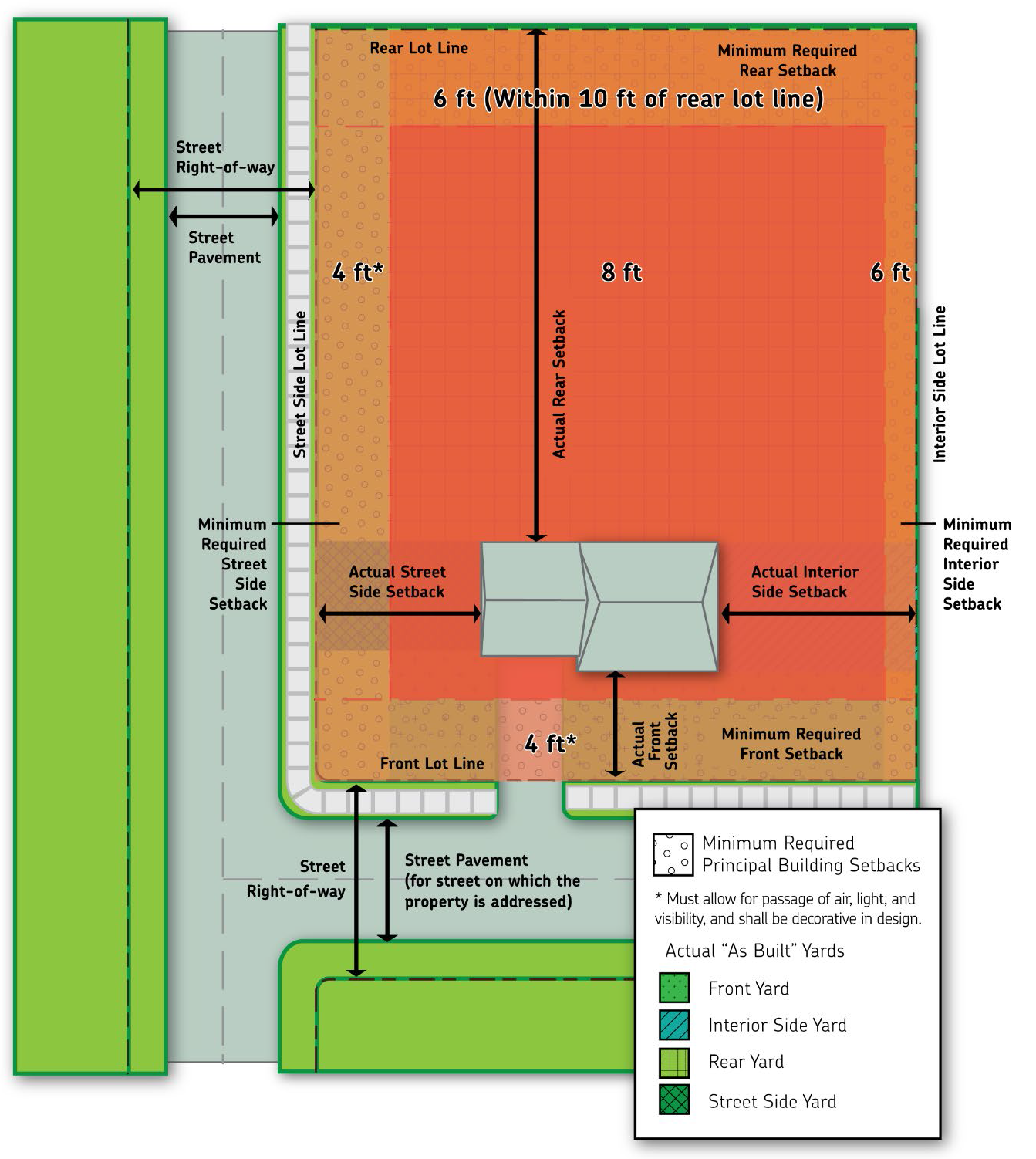
(c)
For all land in a primarily nonresidential zoning district, aside from residential land uses within such zoning district, fences, walls, and hedges shall not exceed eight feet in height. A greater height may be allowed by special exception under Section 5.07.12.08, where the fence is not adjacent to a residential zoning district.
(d)
Fence placement. Each fence, wall, and hedge shall be placed within the property it is intended to serve. The Zoning Administrator or Building Inspector may require a plat of survey to verify the exact location of the fence relative to the property line.
(e)
Temporary fences. Temporary fences may be installed and maintained for a period not exceeding the term of construction, or 180 days if not associated with a construction project. Snow fences shall be removed by May 15. Snow fences and other fences designed for temporary use shall not be used in a permanent application.
(f)
Construction and maintenance. All fences, walls, and decorative posts shall be constructed and maintained in a manner that is structurally sound, good repair, and neat in appearance. Living hedges serving a similar function shall be trimmed as may be necessary so that that all limbs remain entirely within the property on which they are planted and below the maximum height in this Section.
(g)
Prohibited fences.
1.
The use of a fence that delivers an electric shock is prohibited, not including invisible fences intended to manage pets.
2.
The use of barbed wire, razor wire, or similar cutting wire is prohibited, except on top of a security fence in any primarily nonresidential zoning district where the fence does not abut a residential zoning district, the wire is a minimum of six feet above ground level, and the wire section is directed inward toward the property on which it is placed.
(Ord. No. 2021-04, § 1, 5-10-2021)
5.07.9.04. - Swimming pools.
(1)
Applicability. This Section applies to all swimming pools as defined in Section 5.07.13.04, but excludes pools and other artificial water bodies exempted by that definition, except that any pool placed within the minimum front or street side yard setback area shall be enclosed per subsection (5) below.
(2)
Permit required. Before work is commenced on the construction or erection of a swimming pool or on any alterations, additions, remodeling, or other improvements, an application for a swimming pool building permit to construct, erect, alter, remodel, or add thereto must be submitted in writing to the Building Inspector. Plans and specifications and pertinent explanatory data shall be submitted to the Building Inspector at the time of application. No work or any part of the work shall be commenced until a written permit for such work is obtained by the applicant. The required fee shall accompany such application.
(3)
Construction and drainage requirements.
(a)
All materials and methods of construction in the construction, alteration, addition, remodeling, plumbing, electrical, and other improvements and pool installation shall be in accord with all applicable State regulations and City ordinances.
(b)
Every swimming pool shall be provided with a suitable draining method. No swimming pool shall drain into any sanitary sewer nor to overflow upon or cause damage to any adjoining property. Draining a swimming pool into public streets, other public property, or the storm sewer system may occur only with the prior approval of the City's Public Works Director.
(4)
Placement and setbacks.
(a)
Each swimming pool must be located on a lot occupied by a principal building, or on an adjacent lot in the same ownership.
(b)
All swimming pools shall be constructed to meet front and street side yard setback requirements applicable to principal buildings, and interior side and rear setback requirements applicable to accessory buildings, as included and referenced in Figures 5.07.5.02(2) and 5.07.5.03(2).
(5)
Enclosure.
(a)
Each swimming pool as defined in Section 5.07.13.04, including swimming pools constructed before May 18, 2021, shall be completely enclosed by a fence, wall, cover, or other protective device of sufficient strength to prevent access to the pool by a person weighing 250 pounds or less.
(b)
If a fence or wall is used for the required enclosure, such fence or wall shall not be less than four feet in height; located not less than six feet from the pool edge; be made of a non-corrosive material; and designed and constructed to not be easily climbable or have voids, holes, or openings larger than four inches in one dimension including from bottom of fence to surface.
(c)
All fence openings or points of entry into a pool enclosure shall be equipped with gates or doors. Gates or doors shall be equipped with self-closing and self-latching devices located at the top of the gate or door on the pool side of the enclosure, except the door of any building that forms a part of the enclosure.
(d)
If a cover or other protective advice is used for the required enclosure, such cover or other protective device shall have a strength, design, and material that meets the requirements of this Section and is securely fastened in place when the swimming pool is not in use.
(6)
Filter system required. All swimming pools must have, in connection therewith, some filtration system to ensure proper circulation of the water therein and maintenance of the proper bacterial quality thereof.
(7)
Finishing. All swimming pools shall have the sides and bottom of a smooth finish, and no sand or dirt bottom shall be permitted.
(Ord. No. 2021-04, § 1, 5-10-2021)
5.07.9.05. - Outdoor storage.
(1)
Purpose. The purpose of this Section is to regulate the use of property for outdoor storage so as to promote the safety and general welfare of the public. Additional standards for outdoor storage applicable to specific land uses as specified in Article 4 and elsewhere in this Chapter shall also apply.
(2)
Firewood.
(a)
Permitted yards for storage. Within residential zoning districts and on any property in residential use, no firewood shall be stored in the front yard, except for a period not longer than 14 days from the date of its delivery, and not more than 20 percent of any other yard may be used for storage of firewood at any one time.
(b)
Stacking. Firewood shall be neatly stacked in a stable condition, above grade, with proper drainage, and no closer than one foot to any lot line. and no higher than five feet above grade, except where under a roof and/or adjacent to a fence or wall. If adjacent to a fence or wall, firewood may be stacked against the fence or wall as high as the fence or wall. Fences and walls as used in this Section shall not include hedges and other vegetation, and shall otherwise meet the fence requirements in Section 5.07.9.03.
(c)
Processing. All brush, debris, and refuse from processing of firewood shall be promptly and properly disposed of and shall not be allowed to remain on the premises.
(d)
Avoidance of nuisances. Woodpiles that contain diseased wood that is capable of transmitting disease to healthy trees and woodpiles that harbor or are infested or inhabited by mice, rats, insects, or other vermin are prohibited.
(3)
Waste/recycling materials and containers. For all land uses where residential collection is not provided under Section 3.06.15 and except within the B-2 and Industrial Zoning Districts, all solid waste/recycling materials, containers (i.e., dumpsters), and stacks (e.g., palates awaiting pick-up) shall be fully screened from public rights-of-way and adjacent properties by an opaque fence or wall. Regardless of zoning district, all such containers and stacks shall be so screened from residentially zoned property, placed on a hard, all-weather surface, subject to the accessory structure setbacks in Figures 5.07.5.02(2) and 5.07.5.03(2), and not placed within minimum required front or street side yards in those figures. The provisions of this subsection do not apply to temporary dumpsters as described and regulated in Section 5.07.4.10(5).
(4)
Recreational vehicle storage.
This section shall apply only to the regulation of the storage of any recreational vehicles including RV campers, travel trailers, pop-up campers, tents, or similar devices used as temporary housing in the pursuit of recreational activities. (see definitions in section 5.07.13.04 and 4.05.13 (1) (a)).
(a)
All recreational vehicles must be operable, have current registration, and be in good repair to be parked outdoors.
(b)
Recreational vehicles shall not be stored on or extend into the public street right-of-way, including, but not limited to, on a public roadway or over a public sidewalk or path.
(c)
Outdoor storage of recreational vehicles shall be set back from the associated property line a distance equal to the parking setback in the associated zoning district under figures 5.07.5.02(2) and 5.07.5.03(2).
(d)
No recreational vehicle shall be occupied, used a temporary dwelling, or camping facility except upon issuance of a temporary use permit pursuant to section 4.05.13 of the Rhinelander Municipal Code.
(e)
No recreational vehicle shall be classified or used as an accessory building for storage of other than camping equipment.
(f)
No recreational vehicle shall be connected to municipal water, sanitary sewer, or a private on-site wastewater treatment system at any time, except for maintenance and then for no longer than one day.
(g)
Outside storage of recreational vehicles associated with an allowed vehicle retail sale, service, or repair land use, or commercial storage of recreational vehicles, shall be regulated as an "outdoor display" land use under section 5.07.4.05(7).
(h)
Outdoor storage of recreational vehicles in residential zoning districts shall be permitted in the front or street side yard only if on hard, all-weather surface, or on a gravel surface that was in existence as of May 18, 2021. Such hard or gravel surface shall be a component to or attached to the driveway that connects to the public roadway.
(i)
Outdoor storage of a recreational vehicle in nonresidential districts on a vegetative surface will require the proper maintenance of the area including keeping the area free of weeds and tall grass per applicable requirements of section 5.01.145.
(5)
Outdoor vehicle storage—Generally.
(a)
A maximum of four recreational vehicles and other motor vehicles may be stored outdoors on each residentially zoned lot, except the Zoning Administrator may allow more by zoning permit where appropriate locations have been determined and the additional vehicles are stored in an area screened from view of other residential properties and public rights-of-way.
(b)
Parking and storage of licensed and operable motor vehicles that are not recreational vehicles shall be allowed only if on a hard, all-weather surface, except between December 1 and April 1. All such storage and associated hard surface shall be set back in accordance with the pavement setback requirements in the associated zoning district under Figures 5.07.5.02(2) and 5.07.5.03(2).
(c)
Within residentially zoned property, only cars and trucks with a rated gross vehicle weight of 26,000 pounds or less shall be stored, parked, or kept in parking areas or any other exterior location, except any such vehicle owned by a person serving in the armed forces during his or her tenure of service.
(d)
Except for vehicles owned by persons serving on active duty in the Armed Forces and vehicles used for hunting and fishing purposes as per Section 4.03.05(2).
(6)
Inoperable vehicles and junk. The outside storage of inoperable or unlicensed vehicles, appliances, and other junk or trash shall be prohibited, except as described within the "junkyard or salvage yard" and "outdoor and vehicle repair and maintenance" land use performance standards and for those uses approved in accordance with the requirements of this Chapter. The storage of inoperable vehicles is also subject to the regulations set forth in Chapters 4.03 and 4.04 of the Code.
(Ord. No. 2021-04, § 1, 5-10-2021; Ord. No. 2022-08, § 2, 7-11-2022; Ord. No. 2022-20, 12-27-2022)
5.07.9.06. - Access and visibility (driveways).
(1)
Purpose and applicability. The purpose of this Section is to alleviate or prevent congestion of public rights-of-way so as to promote the safety and general welfare of the public by establishing minimum requirements for the provision of access to public rights-of-way in accordance with the utilization of various sites. The provisions in this Section apply to all uses other than agricultural uses.
(2)
Permit required. Each access point onto a City street or right-of-way shall have a driveway permit issued by the Building Inspector per Wis. Stats. § 86.07(2). Such driveway permit may be issued as part of or in conjunction with a building permit.
(3)
Number of vehicular access points.
(a)
Each lot shall not have more than one vehicular access point on any one street if its frontage on said street is less than 60 linear feet as measured along the right-of-way line.
(b)
For lots with greater than 60 linear feet of frontage on any one street, a second vehicular access point on said street may be approved by the Public Works Director upon satisfactory evidence that a second access point will not negatively affect traffic movement, traffic safety, parking, snow storage, utilities, or other public functions.
(c)
On arterial streets and in certain areas experiencing, or expected to experience, congestion and/or safety problems, access to a lot may be required to be via an access point on an adjacent property or another street frontage.
(d)
Exceptions to these access point standards may be approved by special exception under Section 5.07.12.08.
(4)
Residential uses. Residential uses shall not have access points onto a collector street primarily serving a commercial area or an arterial street, unless such street has the only available frontage.
(5)
Nonresidential uses. Nonresidential, non-agricultural uses shall not have access points onto a residential street, unless such street has the only available frontage.
(6)
Access near street intersections. At its intersection with the street right-of-way line on an arterial or residential collector street primarily serving a nonresidential area, no access point shall be located closer than 100 feet from the intersection of any two street rights-of-way, except by site and building plan approval under Section 5.07.12.10 where access points are located as far from an intersection as practical. Nonconforming driveways may be replaced in their current location, except where required to be relocated as part of a site and building plan approval.
(7)
Distance between access drives. The minimum distance between access drives serving the same property shall be 25 feet (edge to edge), as measured at the property line.
(8)
Distance from property lines. See Figures 5.07.5.02(2) and 5.07.5.03(2).
(9)
Width of driveways. All access drives shall have a minimum width of eight feet for single-family and two-family dwellings and for designated one-way routes for other uses, and 20 feet for two-way routes and all other land uses to which this Section is made applicable. All curb openings for access drives shall have a maximum width of 30 feet for all single-family dwellings, and 40 feet for all other land uses. Access drives may be flared between the right-of-way line and the roadway up to a maximum of ten additional feet. Wider driveway widths may be authorized by site and building plan approval under Section 5.07.12.10.
(10)
Intersection with public streets. All access drives serving nonresidential uses and multi-family dwellings shall:
(a)
Have no parking spaces within the first 25 feet from the public street edge, except as modified by the Plan Commission based on unique site conditions or suitable assurance that traffic will not back up into the public street.
(b)
Intersect with the public street at an angle of not less than 75 degrees.
(11)
Traffic control. The traffic generated by any use shall be channelized and controlled in a manner that minimizes congestion on public streets and/or other safety hazards. Traffic into and out of all off street parking, loading, and traffic circulation areas serving six or more parking spaces shall be forward moving, with no backing into streets or pedestrian ways.
(12)
Surfacing. See Section 5.07.9.07(6)(a).
(13)
Installation timing. No residential driveway shall be constructed until the owner has been issued a building permit for the residence. Each driveway shall be constructed prior to occupancy of the associated building, except in cases when construction of the dwelling is completed in the month of December, January, February, or March. In such cases, driveways must be installed no later than May 15 following occupancy.
(14)
Provision for sidewalk. Except where the Zoning Administrator determines that sidewalks are not or will likely not be installed, driveways shall include a concrete sidewalk section within the public right-of-way, built to City sidewalk standards, to maintain connection with existing sidewalks or to allow for the connection of future sidewalks on either side of the driveway.
(15)
Vision clearance standards. In order to provide a clear view of intersecting streets to motorists, there shall be a triangular area of clear vision formed by (a) the two lines formed by the boundaries of any two intersecting street rights-of-way (or by the boundaries of a site access driveway and an intersecting street right-of-way) and (2) a third straight line connecting the first two lines per the standards in Figures 5.07.9.06(1) and 5.07.9.06(2).
Figure 5.07.9.06(1): Vision Clearance Triangle Standards
Within said triangular area, no signs, structures, earthwork, vegetation, or other obstructions between 30 inches and eight feet in height (measured above either of the centerline elevations of said two streets) shall be permitted, except for tree trunks and sign poles.
Figure 5.07.9.06(2): Minimum Dimensional Requirements Affecting Vehicular Access and Parking
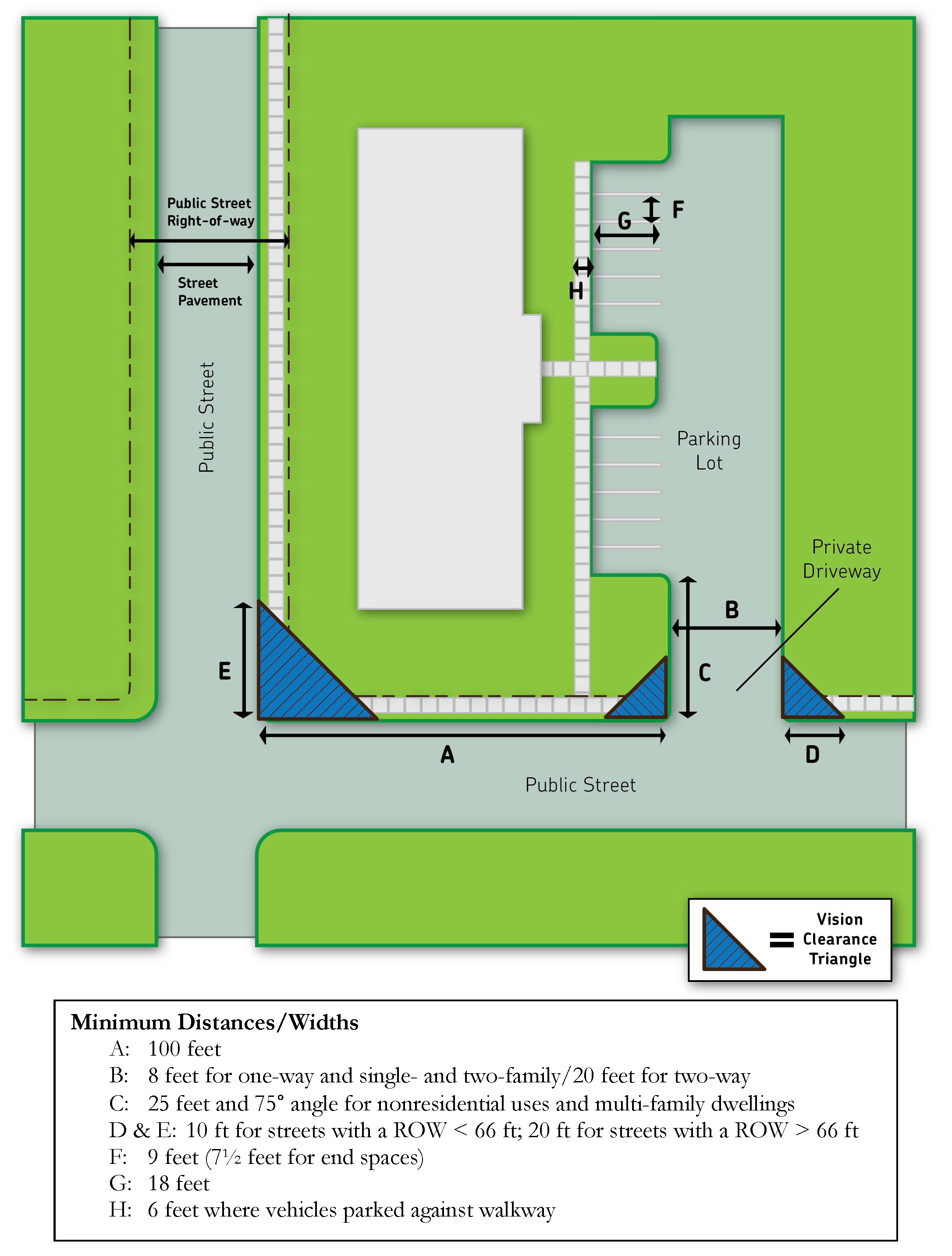
(Ord. No. 2021-04, § 1, 5-10-2021; Ord. No. 2022-08, § 2, 7-11-2022)
5.07.9.07. - Off-street parking and traffic circulation.
(1)
Purpose and applicability. The purpose of this Section is to alleviate or prevent congestion of public rights-of-way so as to promote the safety and general welfare of the public by establishing minimum requirements for the provision of off-street parking and circulation. The requirements of this Section shall apply to all uses, except for agricultural uses and as limited in Section 5.07.9.07(6).
(2)
Depiction on required site plan. All parking and traffic circulation areas proposed to be located on a property shall be depicted as to their location and configuration on the site plan, if required under Section 5.07.12.10(1) for the development of the property.
(3)
Use of off-street parking areas; snow storage. The use of all required off-street parking areas shall be limited to the parking of licensed and operable vehicles not for lease, rent, or sale. See also Section 5.07.9.05(5). The use of parking spaces and their circulation areas for purposes such as seasonal sales and snow storage shall be permitted only if sufficient parking spaces remain available to meet the parking requirements of this Chapter and normal traffic and pedestrian movement and safety is not impeded.
(4)
Traffic circulation. Site circulation shall be designed to provide for the safe and efficient movement of all traffic entering, exiting, and on the site. Circulation shall be provided to meet the individual needs of the site with specific mixing of access and through movements. Circulation patterns and traffic control measures shall conform to the general rules of the road and the requirements of the Manual of Uniform Traffic Control Devices.
(5)
Installation and maintenance of off-street parking and traffic circulation areas. All off-street parking and traffic circulation areas shall be completed prior to building occupancy and shall be maintained in a dust-free condition at all times.
(6)
Design and dimensional standards.
(a)
Surfacing. Except as indicated below, all off-street parking and traffic circulation areas (including residential driveways) shall be paved and continuously maintained with a hard, all-weather surface. Except within residential zoning districts, all such surfaces shall be designed to carrying a wheel load of at least 6,000 pounds. Gravel, crushed stone, or a similar material is permitted for agricultural uses, locations where the intersecting road is gravel, emergency access driveways where required or approved by the Zoning Administrator, and lightly traveled service drives where included as part of an approved site plan under Section 5.07.12.10.
(b)
Marking. All hard, all-surface parking areas that are off-street and intended for to serve non-residential and multi-family residential uses shall be striped in a manner that clearly indicates the boundaries of required parking spaces.
(c)
Curbing or tire bumper. All off-street parking areas designed to have head-in parking within five feet of any lot line or walkway shall provide a tire bumper or curb of adequate height that is properly located to ensure that no part of any vehicle will project beyond the pavement edge or substantially into the walkway. All such walkways shall be at least six feet in width to ensure wide enough pedestrian passage. Curbing or other adequate barriers may also be required as part of an approved site and building plan to direct stormwater flows, facilitate safe pedestrian movement, protect landscaped areas, or direct vehicular traffic.
(d)
Lighting. All off-street parking and traffic circulation areas serving non-residential and multi-family residential uses shall be lit so as to ensure the safe and efficient use of said areas during the hours of use, with said illumination level shall not exceed the standards of Section 5.07.9.09.
(e)
Access. Each required off-street parking space shall open directly upon an aisle or driveway that is wide enough and designed to provide a safe and efficient means of vehicular access to the parking space without directly backing or maneuvering a vehicle into a public right-of-way. All off-street parking and traffic circulation facilities shall be designed with an appropriate means of vehicular access to a street or alley, in a manner that least interferes with traffic movements.
(f)
Handicapped parking spaces. Parking for the handicapped shall be provided at a size, number, location, and with signage as specified by State and Federal regulations.
(g)
Dimensional standards.
1.
Other than parking required to serve the handicapped, the minimum required length of parking spaces shall be 18 feet and the minimum required width is nine feet (seven and one-half feet for end spaces).
2.
All parking spaces shall have a minimum vertical clearance of at least seven feet.
3.
Drive aisles serving parking spaces have the minimum width prescribed under Section 5.07.9.06(10).
(h)
Distance from property lines. See Figures 5.07.5.02(2) and 5.07.5.03(2).
(i)
Landscaping. See Section 5.07.8.03(2)(b).
(7)
Minimum required parking spaces. The minimum number of required parking spaces are stated for each land use in Article 4, except that the designated site and building plan approval authority may approve a decrease in the required number by up to 25 percent for joint parking facilities and/or based upon technical documentation furnished by the applicant that indicates that actual off-street parking demand for that particular use is less than the normally required minimum. Further, the applicant for any development may seek permission to not install a portion of its required parking at time of site and building plan approval; however, said site plan shall depict the minimum number of required parking spaces to be available for future construction and the Zoning Administrator may direct its installation when he or she determines it is required to serve the needs of the development or use.
(8)
Parking and loading within historic sections of the B-2 Central Business District. No off-street parking or loading spaces shall be required for any property that is both zoned B-2 Central Business and addressed in the North 10, 100, or 200 blocks of Brown Street; South 10 or 100 blocks of Brown Street; West 10, 100 or blocks of Rives Street; 10 or 100 block of Davenport Street; West 10 block of King Street; South 100 block of Anderson Street; South 100 block of Stevens Street; west side of 10 block of South Stevens Street.
(9)
Garage and tandem parking spaces. A garage stall shall be considered a parking space. Off-street parking spaces for residential uses may be stacked or in front of one-another for the same dwelling unit.
(10)
Joint parking facilities. A legally binding instrument, approved by the City Attorney, shall be executed by any and all parties to be served each joint parking facility serving users on more than one lot. This instrument shall be recorded with the Register of Deeds Office and filed with the City Clerk.
(11)
Bicycle parking. All commercial land uses under Section 5.07.4.05, institutional uses, and multi-family residential uses requiring site and building plan approval shall provide secure, off-street bicycle parking within 50 feet of building entrances, or in other locations where bicyclists would naturally and safely transition to pedestrian mode.
(Ord. No. 2021-04, § 1, 5-10-2021; Ord. No. 2022-08, § 2, 7-11-2022)
5.07.9.08. - Off-street loading.
(1)
Purpose. The purpose of this Section is to prevent congestion of public rights-of-way and private lots so as to promote the safety and general welfare of the public by establishing minimum requirements for the provision of loading berths.
(2)
Applicability. Any new nonresidential building that has a gross floor area of 5,000 square feet or more and that requires regular deliveries, or makes regular shipments from semi-trucks and trailers, shall provide off-street loading berths in accordance with the regulations of this Section, except within the B-2 District and for agricultural uses.
(3)
Location.
(a)
Loading berths shall not be located within any minimum required front yard or street side building setback, and shall meet minimum required pavement setbacks, both per Figures 5.07.5.02(2) and 5.07.5.03(2)
(b)
All loading berths shall be located 30 feet or more from the intersection of two street right-of-way lines.
(c)
Each loading berth shall be located so as to facilitate access to a public street or alley, shall not interfere with other vehicular or pedestrian traffic, and shall not interfere with the function of parking areas. In no instance shall loading areas rely on backing movements into public rights-of-way.
(4)
Size of loading berths. All required loading berths shall be a minimum of 50 feet in length and ten feet in width. All required loading berths shall have a minimum vertical clearance of 15 feet.
(5)
Surfacing and marking. All required loading areas shall be paved with a hard, all-weather surface capable of bearing a live load of 200 pounds per square foot and maintained in a dust-free condition at all times. Said surface shall be marked in a manner that clearly indicates required loading areas.
(6)
Minimum required loading berths. One loading berth shall be required for each applicable building having a gross floor area of 5,000 square feet to 49,999 square feet. Two loading berths shall be required for each applicable building having a gross floor area of 50,000 to 99,999 square feet. The minimum required number of loading berths for all buildings of 100,000 square feet or greater shall be established by the designated site and building plan approval authority, but shall not be less than three or the anticipated demand for the use, whichever is greater.
(7)
Use of required loading areas. The use of all required loading areas shall be limited to the loading and unloading of vehicles. Said area shall not be used to provide minimum required parking spaces, snow storage, outdoor storage or display, or any other function.
(8)
Depiction on required site plan. All proposed loading berths shall be depicted as to their location and configuration on any required site plan.
(Ord. No. 2021-04, § 1, 5-10-2021)
5.07.9.09. - Exterior lighting.
(1)
Purpose. The purpose of this Section is to regulate the spill-over of light and glare on operators of motor vehicles, pedestrians, and land uses in the vicinity of a light source in order to promote traffic safety and to prevent the creation of nuisances.
(2)
Applicability. The requirements of this Section apply to all exterior lighting and all interior light visible from the exterior on private property within the jurisdiction of this Chapter, except for lighting within public rights-of-way, lighting located on public property, and/or lighting on communications towers or airports, heliports, helipads, or other similar facilities where required to meet Federal and State safety regulations.
(3)
Depiction on required site plan. All exterior lighting shall be depicted as to its location, orientation, and configuration on any site plan, if required under Section 5.07.12.10(1).
(4)
Orientation of fixture. In no instance shall an exterior lighting fixture be oriented so that the lighting element (or a clear shield) is visible from a residentially zoned property or allowed to direct light skyward. Shielded light fixtures and careful fixture placement shall be used to ensure that exterior lighting prevents direct lighting above the horizontal, except that architectural lighting that focuses all light below the roof line may exceed the horizontal. Search lights are prohibited except for any search light deemed necessary by the FAA.
Figure 5.07.9.09: Illustration of Required Pole Lighting Orientation and Height
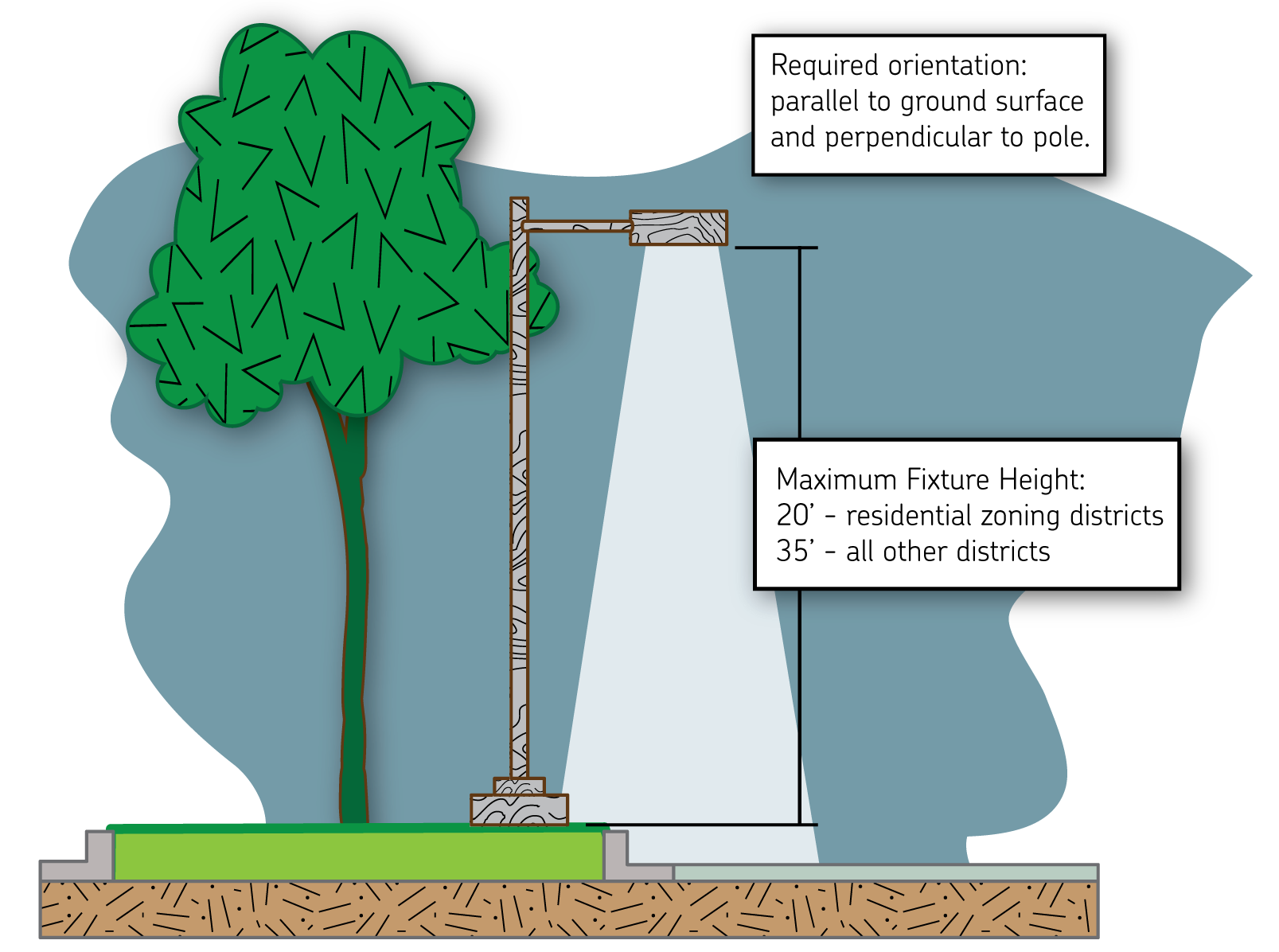
(5)
Intensity of illumination.
(a)
In no instance shall the amount of illumination attributable to exterior lighting, as measured at the property line, exceed 1.0 footcandle above ambient lighting conditions on a cloudless night within or adjacent to a residential zoning district, and 2.0 footcandles at another other property line.
(b)
The maximum average on-site lighting shall be 4.0 footcandles within or adjacent to residential zoning districts and 8.0 footcandles in all other locations.
(6)
Fixture heights. The maximum fixture height shall be per Figure 5.07.9.09, whether pole or building mounted. The height of foundation, pole, and fixture housing shall be included.
(7)
Exceptions to intensity of illumination and fixture height requirements. The designated site and building plan approval authority may grant exceptions to the above intensity of illumination and/or fixture height requirements in one or more of the following circumstances:
(a)
Outdoor recreation use and assembly areas such as athletic fields.
(b)
Gas station pump islands and other uses in which motor vehicles and pedestrians routinely operate in close proximity with one another. Use of recessed canopy lighting to minimize off-site impacts may be required.
(8)
Flashing, flickering and other distracting lighting. Flashing, flickering, moving (such as search spot or search lights), and/or other lighting that may distract motorists is prohibited.
(9)
Nonconforming lighting. All lighting fixtures existing prior to May 18, 2021 shall be considered as legal conforming structures (see Article 11).
(10)
Special events lighting. Any temporary use using exterior lighting that is not in complete compliance with the requirements of this Section shall secure a temporary use approval per Section 5.07.12.09.
(Ord. No. 2021-04, § 1, 5-10-2021; Ord. No. 2022-08, § 2, 7-11-2022)
5.07.9.10. - Vibrations.
(1)
Purpose. The purpose of this Section is to regulate the creation of vibration that adversely affects adjoining properties in order to prevent the creation of nuisances and to promote the general welfare of the public.
(2)
Applicability. The requirements of this Section apply to all uses and activities that create detectable vibrations, except that these standards shall not apply to vibrations created during the construction of the principal use on a property. Section 4.04.02 may also be applicable.
(3)
Depiction on required site plan. Any activity or equipment that creates detectable vibrations outside the confines of a building shall be depicted as to its location on the site plan, if required for the development of a property.
(4)
Standards in industrial zoning districts. No activity or operation shall cause or create earthborn vibrations in excess of the displacement values given below. In the industrial zoning districts, the maximum earth displacement permitted at the points described below shall be determined by use of the formula above and the appropriate K constant shown in the Figure 5.07.9.10(1) below.
Figure 5.07.9.10(1): Maximum Vibration Levels, Industrial Districts
(5)
Standards in all other zoning districts. In all other zoning districts aside from the industrial zoning districts, the maximum earth displacement permitted at the points described below shall be determined by use of the formula above and the appropriate K constant shown in Figure 5.07.9.10(2) below.
Figure 5.07.9.10(2): Maximum Vibration Levels, All Other Zoning Districts
(6)
Method of measurement. Measurements shall be made at or beyond the adjacent lot line or the nearest residential district boundary line, as described below. Vibration displacements shall be measured with an instrument capable of simultaneously measuring in three mutually perpendicular directions. The maximum permitted displacements shall be determined in each zoning district by the following formula:
D = K/f, where D = displacement in inches
K = a constant to be determined by reference to the tables below
f = the frequency of vibration transmitted through the ground, cycles per second
(Ord. No. 2021-04, § 1, 5-10-2021)
5.07.9.11. - Noise.
(1)
Purpose. The purpose of this Section is to regulate the creation of noise that adversely affects adjoining properties in order to prevent the creation of nuisances and to promote the general welfare of the public.
(2)
Applicability. The standards in this Section apply to all uses and activities that create detectable noise, except these standards shall not apply to incidental traffic, parking, loading, maintenance, or agricultural operations. Noises that were in effect as of May 18, 2021 shall be considered legal nonconforming noises. The burden of proof to demonstrate that said noises were in effect prior to that date shall be the responsibility of the noise producer. See Section 4.03.03 for noise standards associated with motor vehicle use.
(3)
Depiction on required site plan. Any activity or equipment that creates detectable noise outside the confines of a building shall be depicted as to its location on the site plan, if required for the development of a property.
(4)
Standards. All noise shall be muffled so as not to be objectionable due to intermittence, beat frequency, or shrillness. In no event shall the sound-pressure level of noise radiated continuously from a facility exceed at the lot line of a property the values given in Figure 5.07.9.11(1) as measured by, at the minimum, a Type 2 sound meter that is in compliance with ANSI standard S1.4-1983, where said lot abuts another property or public right-of-way.
Figure 5.07.9.11(1): Maximum Permitted Noise Level at Lot Line For Noise Radiated Continuously*
Figure 5.07.9.11(2): Adjustment Factors for Maximum Noise Levels
(Ord. No. 2021-04, § 1, 5-10-2021)
5.07.9.12. - Air pollution.
(1)
Purpose. The purpose of this Section is to regulate the creation of air pollution that adversely affects adjoining properties and the general welfare of the public.
(2)
Applicability. The standards in this Section apply to all land uses and activities, except that these standards shall not apply to air pollution created during the construction of the principal use on a property, or by incidental traffic, parking, loading, maintenance, or agricultural operations.
(3)
Standards.
(a)
The emission, from all sources within any lot, of particulate matter containing a section diameter larger than 44 microns is prohibited.
(b)
Emission of smoke or particulate matter of density equal to or greater than Number 2 on the Ringelmann Chart (US Bureau of Mines) is prohibited at all times.
(c)
Dust and other types of air pollution borne by the wind from such sources as storage areas, yards, and roads within the boundaries of any lot shall be kept to a minimum by appropriate landscaping, paving, oiling, or other acceptable means.
(d)
All uses shall comply with all applicable State and Federal standards.
(Ord. No. 2021-04, § 1, 5-10-2021)
5.07.9.13. - Odor.
(1)
Purpose. The purpose of this Section is to regulate the creation of odors that adversely affects adjoining properties and the general welfare of the public.
(2)
Applicability. The standards in this Section apply to all land uses and activities, except for odors associated with allowable agricultural uses; food preparation and cooking odors emanating from residential land uses and permitted smokehouses; property development and maintenance (such as construction, lawn care, and painting or roofing); fertilizer application, traffic, parking, loading, or maintenance operations; public landfills and sanitary sewage treatment plants; and the normal operations of any use established before May 18, 2021.
(3)
Standards. No odor shall be created for periods exceeding a total of 15 minutes per any day that are detectable by the Zoning Administrator or a designee who is unaffected by background odors such as tobacco or food at the boundary of a property, where said lot abuts or is immediately across a public street from property within any residential zoning district.
(Ord. No. 2021-04, § 1, 5-10-2021)
5.07.9.14. - Glare and heat.
(1)
Purpose. The purpose of this Section is to regulate the creation of glare and heat that adversely affects adjoining properties and the general welfare of the public.
(2)
Applicability. The standards in this Section apply to all land uses and activities, except for glare and heat created through property development and maintenance (such as construction, lawn care, and painting or roofing); or by incidental traffic, parking, loading, maintenance, or agricultural operations.
(3)
Standards. No direct or sky-reflected glare, whether from floodlights or from temperature processes such as combustion or welding or otherwise, so as to be visible at any lot line shall be permitted. Furthermore, there shall be no transmission of heat or heated air so as to be discernible by a Zoning Administrator at the lot line. Solar energy systems regulated by Wis. Stats. § 66.0401 shall be entitled to the protection of its provisions.
(Ord. No. 2021-04, § 1, 5-10-2021)
5.07.9.15. - Explosive and hazardous materials.
(1)
Purpose. The purpose of this Section is to regulate the creation of use and storage of materials so as to not adversely affect adjoining properties and the general welfare of the public.
(2)
Applicability. The standards in this Section apply to all land uses and activities in the City.
(3)
Depiction on site plan. All land uses involving explosive or hazardous materials, except for agricultural uses, shall submit a written description of such materials and the operations involving such materials conducted on their property as part of any required site plan submittal.
(4)
Standards.
(a)
Any use involving materials that could decompose by detonation shall locate such materials not less than 400 feet from any residentially zoned property, except that this standard shall not apply to the storage or usage of liquefied petroleum or natural gas for normal on-site residential or business purposes. All activities and storage of flammable and explosive materials at any point shall be provided with adequate safety and firefighting devices in accordance with all fire prevention codes of the State.
(b)
No use shall discharge across the boundaries of any property, or through percolation into the subsoil, toxic or noxious material in such concentration as to be detrimental to, or endanger, the public health, safety, comfort, or welfare, or cause injury or damage to the property or business.
(c)
No use shall discharge at any point into any public or private sewage disposal system or stream, or into the ground, any liquid or solid materials except in accordance with the regulations of the State.
(d)
All hazardous materials shall be regulated in accordance with the relevant Wisconsin Statutes.
(Ord. No. 2021-04, § 1, 5-10-2021)
5.07.10.01.- Purpose.
The purpose of this Article is to establish standards for the location, type, size, quantity, and height of signage based on the finding that such standards further the following compelling governmental interests, while still being narrowly defined so as to limit any prohibitions on commercial speech on exterior signage:
(1)
To promote the public welfare, health, and safety of all persons using the public thoroughfares and rights-of-way as to the signage displayed thereon, or overhanging, or projecting into, or otherwise affecting safe use of such public spaces;
(2)
To aid in the proper development and promotion of business and industry;
(3)
To ensure effectiveness and flexibility in the design and creativity of signage without creating detriment to the general public;
(4)
To recognize that different zoning districts and different geographic areas of the City have different characteristics, and that sign regulations should vary based in part on those differences; and
(5)
To implement the community vision, goals and objectives, and aesthetic and signage recommendations in the comprehensive plan.
(Ord. No. 2021-04, § 1, 5-10-2021)
5.07.10.02. - Sign permits.
(1)
Permit requirements. Each sign located, erected, moved, reconstructed, extended, enlarged, converted, or structurally altered shall require a sign permit following application for said permit and in advance of such action, subject to the following allowances and exceptions:
(a)
No sign permit shall be required for the cleaning, repainting, replacing with the same sign copy and area, repair to previous condition, maintenance of a sign or sign structure, or replacement of a sign face within a previously permitted and conforming sign structure where the sign structure was deliberately designed to allow such sign face replacement and does not require alteration as part of the replacement of the sign face.
(b)
No sign permit shall be required for types and configurations of signs indicated as not requiring a sign permit in Figures 5.07.10.05 and 5.07.10.06.
(c)
Any sign permit granted hereunder may not be assigned or transferred to any other sign.
(d)
All signs at one premises may be included under one sign permit, if applied for at the same time.
(2)
Application procedure. Each application for a sign permit shall be filed with the Zoning Administrator on a form provided by that office, and shall include all of the following except where modified by the Zoning Administrator:
(a)
The name and address of the permit applicant.
(b)
The approved site and building plan for the subject property, per Section 5.07.12.10, or if not previously approved, a scaled and dimensioned plan showing, at a minimum, the location of the proposed sign on the subject property; the location of all existing signs on the subject property; all property lines and buildings in the subject property; and parking areas, driveways, public roads, and buildings within 50 feet of the proposed sign.
(c)
A diagram of the proposed sign, drawn to a recognized scale, and listing and depicting the height, width, total square footage of the sign, square footage of each sign component, method of attachment, structural support including footings, method of illumination, and sign materials, colors, and message.
(d)
The subject property's zoning designation and lineal footage on each abutting public street.
(e)
A summary of existing signage on the subject property, including quantity, location, type, and area of all signs before installation of the proposed sign(s).
(f)
Evidence that the structural design requirements of Section 5.07.10.09 will be met.
(g)
The appropriate sign permit fee, per the City's fee schedule.
(h)
Any other item reasonably required by the Zoning Administrator for the purpose of evaluation.
(3)
Granting and issuance.
(a)
The Zoning Administrator shall review the submitted application for compliance with the requirements of Section 5.07.10.02(2). The application shall not be considered complete until all materials required under Section 5.07.10.02(2) have been submitted.
(b)
Upon the receipt of a complete application, in cases where the requested sign does not require an approval or recommendation from another body under this Chapter, the Zoning Administrator shall review said application and shall, in writing, approve or deny a sign permit within ten working days of the acceptance of the complete application.
(c)
Upon the receipt of a complete application, and in cases where the requested sign requires an approval from another body under this Chapter, such as a special exception, the Zoning Administrator shall within ten working days of the acceptance of the complete application notify the applicant of such additional action and schedule the item on appropriate meeting agenda(s). Following all necessary approvals, the Zoning Administrator shall then, in writing, approve or deny a sign permit based on the submitted application and such additional body's action within five working days of action by the body with approval authority.
(d)
Denial of a sign permit shall not result in total or partial reimbursement of permit fees paid.
(4)
Enforcement and revocation.
(a)
Any sign permit may be revoked by the Zoning Administrator in the event that the applicant has failed to comply with the provisions of this Chapter, the submitted sign permit application, or any conditions that may have accompanied the permit at the time of granting.
(b)
Any sign permit granted by the Zoning Administrator shall be null and void and automatically revoked in the event that construction, installation, or manufacture of the sign has not been commenced within 180 days from the date of the issuance of such permit. If work authorized by such permit is suspended or abandoned for a period of 90 days any time after the work is commenced, the original permit shall become null and void and automatically revoked. A new permit shall first be obtained to complete the work, and a new permit fee shall be required.
(c)
A sign subject to any revoked permit shall be removed by the licensee, sign owner, or property owner within ten working days of such revocation, or shall be subject to enforcement under Section 5.07.12.16.
(d)
Revocation shall not result in total or partial reimbursement of permit fees paid.
(5)
Special exceptions. Following submittal of a complete special exception application, the Plan Commission may under Section 5.07.12.08 grant a special exception to any requirement within Sections 5.07.10.04 through 5.07.10.06, including the figures therein.
(6)
Appeals. Any person affected by a decision of the Zoning Administrator under this Article may petition for a hearing before the Zoning Board of Appeals under the provisions of Section 5.07.12.13. The filing of such petition automatically stays removal of any sign involved and already legally erected until the Zoning Board of Appeals decides whether to sustain, modify, or withdraw the decision.
(Ord. No. 2021-04, § 1, 5-10-2021)
5.07.10.03. - General signage standards.
(1)
Definitions. In addition to the general definition of a sign provided in Section 5.07.13.04, the following are definitions of the different purposes, types, and configurations of signs regulated under this Article:
(a)
Abandoned sign means a sign that is no longer being used in connection with an ongoing business or other activity on the premises; a sign that is no longer being used because the business is discontinued; and/or a sign that has not been maintained in a manner that renders it legible.
(b)
Advertising vehicle sign means a vehicle or truck trailer parked on public rights-of-way or on private property so as to be seen from a public right-of-way, which attached to or located on is any sign or advertising device for the purpose of providing advertisement of products or directing people to a business activity or event. Not considered advertising vehicle signs are mobile signs or business vehicles that contain typical business signage; are actively used for business purposes; and are parked in an approved parking space that either serves the advertised business or on another property where actively receiving or providing goods or services.
(c)
Arm/post sign means a type of small-scale freestanding sign mounted on a post or posts, either with a bracket extending outward to support a hanging sign, with the sign attached directly to the side of the post, or with the sign mounted between two posts.
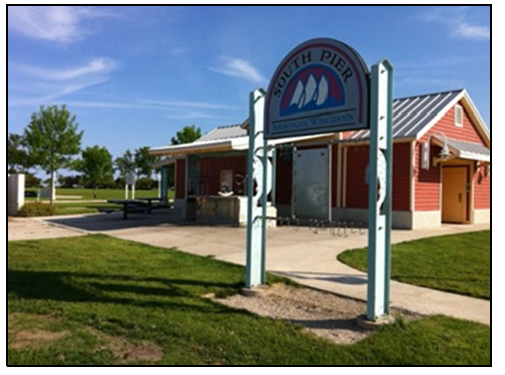
Example of arm/post sign
(d)
Auxiliary sign means a sign that provides special information such as price, hours of operation, parking rules, or warnings. Examples of such signs include parking lot entrance signs, parking lot rules signs, "no trespassing" signs, menu boards, drive-through ordering stations, and signs that list fuel prices of gasoline and/or are mounted to (but not above) fuel canopies.
(e)
Awning or canopy sign means a sign that is directly affixed via sewing, painting, or similar method to an awning or canopy which is legally mounted to the facade of a building.
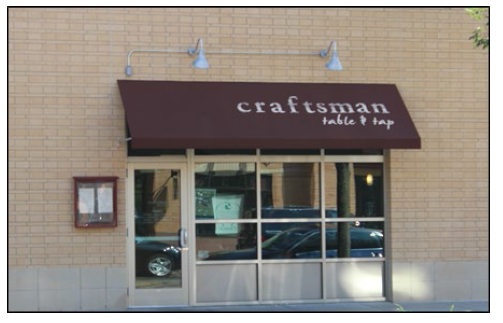
Example of awning sign
(f)
Banner means a sign made of fabric or any non-rigid material with no enclosing framework.
(g)
Community information sign means a type of a permanent, seasonal, or limited-time event sign, located either on-premises or off-premises, that displays information of interest to the general public not directly tied to a private use; serves as an identification, entrance, or wayfinding sign for the community; or is located on public lands and advertises sponsors of public events, activities, or facilities thereon.
(h)
Flashing sign means a directly or indirectly illuminated sign on which artificial light is not maintained stationary and constant in intensity and color at all times when in use.
(i)
Freestanding sign means a self-supporting sign resting on or supported by means of poles, standards, or any other type of base on the ground. Freestanding signs include arm/post signs, monument signs, and pylon signs.
(j)
Individual business sign means a sign assigned to a single nonresidential use operating on the premises, not including any nameplate and identification, auxiliary, community information, limited-time event, political message, regulatory, required or historic, sandwich board/pedestal, or unified business center sign, as otherwise defined in this section or Wis. Stats. § 12.04.
(k)
Limited-time event sign means a sign or advertising display (including festoons, pennants, banners, flags, and similar devices) intended to be displayed for a certain limited period of time as specified in this Article. Included are retailers' signs temporarily displayed for the purpose of informing the public of a "sale" or special offer, garage sale signs, signs greater than 11 square feet each with a political message as defined in Wis. Stats. § 12.04, and personal greeting or congratulatory signs. If a sign display area is permanent but the message displayed is subject to periodic changes, that sign shall not be considered a limited-time event sign. Also does not include any sandwich board/pedestal signs.
(l)
Marquee sign means a type of sign that is often, but not necessarily, a projecting, on-building sign sheltering the entrance and/or entrance approaches of a theater, auditorium, fairground, museum or other use, and may include only manually changeable letters or messages. For the purposes of this Section, all non-electronic/non-digital signs with manually changeable letters or messages shall be considered marquee signs.
(m)
Mobile sign means a sign mounted on a frame or chassis designed to be easily relocated, including vehicles and/or trailers which have a principal commercial use for signage, including portable message board signs. Does not include any advertising vehicle signs or sandwich board/pedestal signs.
(n)
Monument sign means a type of freestanding sign with a bottom edge located within one foot of a ground-mounted pedestal or the ground surface.
Example of monument sign
(o)
Nameplate and identification sign means an accessory sign containing only the address or other basic identifying information of the premises on which it is located, but not including any individual business sign as defined above.
(p)
Off-premises advertising sign means a sign that directs attention to a business, commodity, service, or entertainment conducted, sold, or offered on a premises other than the premises where the sign is displayed. Off-premises advertising signs include off-premises "billboards," but do not include community information signs or unified business center signs described elsewhere in this Section.
(q)
On-building sign means a type of sign permanently affixed to an outside wall of a building. On-building signs include awning and canopy signs, marquee signs, projecting signs, and wall signs, but not window signs.
(r)
On-premises sign means a sign that directs attention to an activity, business, commodity, service, or entertainment conducted, sold, offered, or manufactured on the premises where the sign is located.
(s)
Pennant means a sign made of fabric, plastic, or similar material, which may or may not contain distinctive colors, patterns or symbols of a corporation or business, often in series, and usually mounted without a frame and hung from poles and structures to allow movement by air. Such attention-getting displays not specifically defined as a flag or banner are considered pennants.
(t)
Projecting sign means a type of on-building sign which is attached directly to a building wall, projects greater than 18 inches from the building wall, and is typically mounted perpendicular to the building wall.
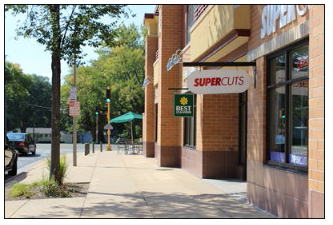
Examples of projecting signs
(u)
Pylon sign means a type of freestanding sign erected upon one or more pylons, poles, or posts, generally of a scale that is larger than an arm/post sign.
(v)
Regulatory, required, or historic sign means a sign used to indicate or reinforce traffic and other regulations, including stop, yield, speed limit, "do not enter," handicapped parking, and one-way signs, plus any other sign required by government rule or designation except for any fuel price sign.
(w)
Sandwich board/pedestal sign means a non-illuminated, movable sign placed by hand outside the building while the business is open and designed to be durable and self-supporting in all weather conditions. Does not include mobile or limited-time event signs as described above.
Example of sandwich board sign
(x)
Unified business center sign means a sign displaying the collective name of a group of uses within a unified business center as defined in Section 5.07.13.04 and/or the names and/or logos of the individual occupants of a unified business center.
(y)
Wall sign means a type of on-building sign mounted parallel to and directly on a building façade or other vertical building surface, projecting not more than 18 inches beyond the edge of any wall or other surface to which they are mounted, generally mounted flush to the wall, and extending no higher than the roof above the nearest portion of the building to which it is mounted.
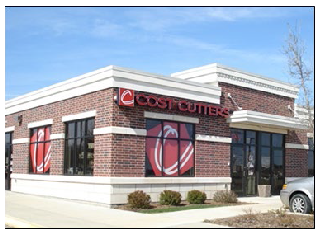
Examples of wall and window signs
(z)
Window sign means a type of sign mounted on or within an exterior window; confined within the transparent glazed area of the window; not encroaching upon the frame, mullions, or other supporting features of the glass; and visible from the exterior with a primary intent to advertise a business conducted or product available within the premises. All permanent window signs that have their lettering or graphic elements directly on the glazing shall be painted, metal leafed, vinyl transferred, or in some other manner permanently applied to the window.
(aa)
Variable message sign (VMS) means an electronic or digital sign which displays words, lines, logos, graphic images, or symbols that can change automatically or by computer program change to provide different information, and which includes computer signs, LED and other video display signs, and time and temperature signs.
(2)
Sign measurement.
(a)
Sign height. The height of a freestanding sign shall be measured from the average ground level adjacent to the sign to the top of the sign or from the centerline grade of the nearest adjacent public road, if such information is supplied with the permit application and confirmed by the Zoning Administrator, whichever is higher. The average ground level is defined as the average elevation of the ground upon which the sign supports are placed, except when the sign supports rest upon a berm or other area elevated above the surrounding ground. In such cases, the average elevation of the base of such berm or other area shall be considered as the ground level.
(b)
Sign area. Sign area shall be measured in the following manner:
1.
Where a freestanding sign has two or more display faces, the total area of all of the display faces shall be considered the sign area.
2.
In the case of a sign placed within a frame, a marquee sign, or other structure, sign area consists of the entire surface area of the sign on which copy could be placed. The supporting structure or bracing of a sign, including the supports of monument signs not used for copy, shall not be counted as a part of the sign area unless such structure or bracing is made a part of the sign's message.
3.
In the case of a sign on which the message is fabricated together with the background which borders or frames that message, sign area shall be the total area of the entire background.
4.
In the case of a sign on which message is applied to a background which provides no border or frame (such as individual letters to a building face or awning), sign area shall be the combined areas of the smallest rectangles which can encompass each word, letter, figure, emblem, and other element of the sign message.
(c)
Setback. Sign setback shall be the shortest distance between the vertical plane extending from the property line (or other specified basis for the setback point) to the nearest structural element of the sign, whether said sign element is attached to the ground or suspended above ground.
(d)
Clearance. The bottom of every awning, canopy, projecting, marquee, and pylon sign shall be not less than eight feet above the surface directly beneath the sign.
(Ord. No. 2021-04, § 1, 5-10-2021)
5.07.10.04. - General signage regulations applicable to all zoning districts.
(1)
Sign prohibitions and limitations.
(a)
No sign shall be erected at any location where it may, by reason of its position, shape, color or design, interfere with, obstruct the view of, or be confused with any authorized traffic sign, signal or device, nor shall such sign make use of words such as "stop," "look," "drive-in," "danger," or any other word, phrase, symbol, or character in such manner as to interfere with, mislead or confuse users of streets or highways.
(b)
No sign shall be erected, relocated, or maintained so as to prevent free ingress to or egress from any door, window, or fire escape, and no sign shall be attached to a standpipe or fire escape.
(c)
No sign may be located within required vision clearance triangle under Section 5.07.9.06(15), nor otherwise impede traffic or pedestrian visibility or mobility in the determination of the Zoning Administrator.
(d)
No private sign shall be attached to or painted on any public utility or light pole or traffic regulatory structure, natural feature (e.g., tree or rock), or fence or wall, except where such feature was deliberately placed and designed for private signage in the determination of the Zoning Administrator.
(e)
No flashing, undulating, swinging, rotating, or otherwise moving signs shall be allowed or permitted, except for flags, pennants, and feather banners.
(f)
No sign attached to a building which is permitted to project away from the building wall shall be designed and constructed in which the attachment to such wall extends above a point of bearing with the roof rafters, except that roof parapets and roof-mounted mechanical equipment screening walls may be used as sign installation areas if integral to the architectural design of the building as determined by the Zoning Administrator.
(g)
No sign, other than a regulatory or government erected sign, shall be allowed or permitted within or extending into a public right-of-way, except as follows:
1.
Projecting, awning, canopy, and marquee signs in the B-2 District, provided that no such sign may extend closer than two feet from any vehicle circulation area or public street curb line.
2.
Temporary private signs or community information signs, provided they are first approved by the Zoning Administrator in consideration of the advice of the Public Works Director or County or State with highway jurisdiction, and based on the relationship to pedestrian and vehicular traffic movement and safety, the City's adopted aesthetic standards for the area, and City and utility use and operations within the right-of-way.
(h)
Any sign illegally placed in a public right-of-way or public property shall be subject to immediate removal and confiscation without notice by the Zoning Administrator, and without any payment or return of the sign to its installer or owner.
(i)
No illuminated sign shall be allowed or permitted where the lighting element/bulb (except for neon signs) is visible from any property within a residential zoning district.
(j)
No mobile, advertising vehicle, inflatable signs, or flashing signs shall be allowed or permitted. Variable message signs meeting the definition and requirements of Section 5.07.10.04(3) shall not be considered illuminated flashing signs.
(k)
No signs that advertises an activity, business product, or service no longer conducted or available on the premises shall be permitted, except for "ghost signs" on older buildings in the City determined by the Zoning Administrator to add historic value to the City. Permitted "ghost signs" shall not count against signage maximums for the property.
(l)
No off-premises advertising signs or structure supporting such sign(s) shall be permitted to be installed or expanded in area or number of signs after May 18, 2021. This restriction does not prohibit the use of community information signs under Section 5.07.10.04(2), unified business center signs under Figure 5.07.10.06, or on-premises signs allowed under Figures 5.07.10.05 or 5.07.10.06 that are accessory to established on-premises principal uses for constitutionally protected free speech, provided all messages are in accordance with the time, place, and manner requirements of this Article and other provisions of this Chapter, other chapters of the City Municipal Code, and other applicable laws. Off-premises advertising signs legally installed before May 18, 2021 but made nonconforming by this Article shall be permitted to continue as legal, nonconforming structures, subject to the requirements of Section 5.07.10.09, except that such signs legally installed before May 18, 2021 may be upgraded and/or replaced as new technologies become available, provided that the sign area, number, and height at each installation are not increased and other applicable provisions of this Chapter are satisfied.
(2)
Community information signs. Community information signs, as defined in Section 5.07.10.03(1)(g), shall be allowed subject to the following regulations:
(a)
May be located in any zoning district by permission of the land owner, or on public property or rights-of-way if approved by the Zoning Administrator under Section 5.07.10.04(1)(g).
(b)
If associated with a limited-time event, shall be allowed up to 48 hours before the event and up to 24 hours after the event.
(c)
May have changeable copy and/or be a variable message sign.
(d)
Shall conform to the visibility requirements of this Article and of Section 5.07.9.06(15).
(e)
Shall not be counted as adding to the area of signage on the property on which it is placed for the purposes of regulating sign area under Figures 5.07.10.05 and 5.07.10.06.
(f)
May be subject to restrictions on lighting, color, duration of placement (e.g., seasonal limitations) as part of sign permit approval, provided that such restrictions are consistent with the purposes of this Article and Chapter.
(3)
Variable message signs (VMS). Variable message signs, as defined in Section 5.07.10.03(1)(aa), shall be allowed subject to the following regulations:
(a)
The total length of the scrolling time from start to finish of message of a VMS shall not be longer than 12 seconds.
(b)
Items of information may not be repeated at intervals that are short enough to cause a VMS to have the effect of a flashing sign.
(c)
A maximum of four lines of textual electronic message shall be allowed per sign face.
(d)
Operation of the sign, including changes in illumination or message, shall in no way interfere with any driver's operation of a motor vehicle or with any traffic control devices.
(e)
All VMS shall be equipped with and shall utilize photosensitive equipment which automatically adjusts the brightness and contrast of the sign in direct relation to the ambient outdoor illumination. Illumination levels shall not exceed those permitted under Section 5.07.9.09(5).
(f)
All VMS shall be maintained so as to be able to display messages in a complete and legible manner.
(g)
Except by special exception, no VMS shall be allowed on any residential lot regardless of zoning district, within the B-1 or C-B Districts, and/or positioned to be visible and within 200 feet from any exclusively residential building.
(h)
The illuminated or message display area of the VMS is subject to the same height and area requirements as other on-premises business signs in the zoning district. All variable message signs shall be included in the calculation of permitted sign area for the business or lot per Figure 5.07.10.05 or 5.07.10.06.
(Ord. No. 2021-04, § 1, 5-10-2021)
5.07.10.05. - Regulations for residential zoning districts and uses.
In residential zoning districts and for residential land uses regardless of district, signage shall be permitted per the requirements of Figure 5.07.10.05 and the remainder of this Article excluding Figure 5.07.10.06.
(Ord. No. 2021-04, § 1, 5-10-2021)
5.07.10.06. - Regulations for primarily nonresidential and PD Zoning Districts.
(1)
In all primarily nonresidential zoning districts, except for residential uses in such districts, signage shall be permitted per the requirements of Figures 5.07.10.06, and the remainder of this Article excluding Figure 5.07.10.05.
(2)
Within PD Planned Development Zoning Districts, permitted sign types, number, area, location and other characteristics shall be per an approved final development plan (FDP) for each individual PD. No signage excluded from an approved FDP shall be located within that particular PD.
Figure 5.07.10.05: Sign Regulations Applicable to Residential and Open Space Zoning Districts (R-1, R-2, R-3, C-R) and to Residential Uses
Figure 5.07.10.06: Sign Regulations Applicable to All Primarily Nonresidential Zoning Districts (B-1, B-2, B-3, C-B, I-1, I-2, INT) Except for Residential Uses
(Ord. No. 2021-04, § 1, 5-10-2021)
5.07.10.07. - Structural requirements.
(1)
No obstructions. No sign or any part thereof, anchor, brace or guide rod shall be attached, erected, or maintained that may cover or obstruct any door, doorway, or window of any building that may hinder or prevent ingress or egress through such door, doorway, or window, or which may hinder or prevent the raising or placing of ladders against such building in the event of fire. No sign or any part thereof, anchor, brace, or guide rod shall be attached, fastened, or anchored to any fire escape, fire ladder, or standpipe.
(2)
Construction and mounting. All signs shall be constructed and mounted so as to comply with applicable City and State building and electrical codes. All free-standing illuminated signs shall be supplied power only by underground wiring or internal batteries. All limited-time event signs and other temporary signs shall be anchored and supported in a manner that reasonably prevents the possibility of the signs becoming hazards to public health and safety.
(3)
Storm design. All signs shall be designed and constructed to withstand winds during typical Wisconsin storm events. For all pylon signs greater than 20 feet in height or located a distance from the nearest lot line that is less than its height, such stand requires verification from a structural engineer licensed in Wisconsin that the sign will sustain a design wind speed of 90 mph with no additional load, and a design wind speed of 40 mph with a three-fourths-inch thick surface ice load.
(4)
Footings. Except for regulatory signs, all freestanding signs shall be designed and constructed with footings for support of such sign that extend not less than 42 inches below the existing ground level. The base or support(s) shall be securely anchored to a concrete base or footing, except for signs legally installed in public rights-of-way. The footing and related supporting structure of each freestanding sign including bolts, flanges, and brackets shall be concealed by the sign exterior or shall be surrounded by landscaping per Section 5.07.8.04.
(Ord. No. 2021-04, § 1, 5-10-2021)
5.07.10.08. - Maintenance requirements.
(1)
Generally. All signs and structures appurtenant thereto shall be maintained in a neat and proper state of appearance. Signs shall also be maintained in accordance with Section 4.04.02(4). Proper maintenance shall include the absence of loose materials (including peeling paint, paper or other material), the lack of excessive rust, the lack of excessive vibration or shaking, and the presence of the original structural integrity of the sign, its frame and other supports, its mounting, and all components thereof.
(2)
Dangerous, defective, and abandoned signs. If the Zoning Administrator determines that any sign is defective, dangerous, abandoned, in poor repair, or other exists in violation of this Section, then the Zoning Administrator shall notify the sign permit holder or the owner of the property on which the sign is located that such violation must be corrected within ten working days of receipt of receipt of such notice on penalty of automatic revocation of any sign permit previously granted and summary removal of the sign by the City at the expense of the owner of the property. If the Zoning Administrator causes such notice to be sent and the violation is not corrected within ten working days, the Zoning Administrator shall revoke any sign permit for the defective or dangerous sign and may initiate other enforcement actions under Section 5.07.12.16.
(Ord. No. 2021-04, § 1, 5-10-2021)
5.07.10.09. - Nonconforming signs.
(1)
Continuance of nonconforming signs. Each sign lawfully existing at the time of the adoption or amendment of this Section may be continued although it does not fully conform with the provisions of this Section. Such sign shall be deemed a nonconforming structure, and the provisions of Article 11 and this Section 5.07.10.11 shall apply, whichever are stricter.
(2)
Limited replacement permitted. No nonconforming sign (including its frame, supporting structure, lighting, material, and height) shall be altered, extended, enlarged, converted, or moved to a new location without being brought into compliance with the requirements of this Section. Each nonconforming sign may be maintained, which includes maintaining the existing appearance of the sign; replacing the supporting structure with identical materials; changing the sign message without increasing its area.
(3)
Signs associated with nonconforming uses. Business signs on the premises of a nonconforming use may be continued, but new signs for such uses shall not be allowed, nor shall expand in number, area, height, or illumination.
(Ord. No. 2021-04, § 1, 5-10-2021)
5.07.11.01.- Purpose.
The purpose of this Article is to establish requirements for nonconforming and substandard lots, nonconforming uses, nonconforming structures, and nonconforming sites created legally prior to May 18, 2021. Nonconforming signs are also addressed in Section 5.07.10.09.
(Ord. No. 2021-04, § 1, 5-10-2021)
5.07.11.02. - Nonconforming and substandard lots.
(1)
New lots meet new lot standards. On or after May 18, 2021, no lot shall be created that does not meet the lot dimensional (density, intensity, and bulk) requirements of the associated zoning district, per Article 5.
(2)
Development of substandard lots. A lot of record existing on May 18, 2021, but not meeting the lot dimensional (density, intensity, and bulk) requirements of the associated zoning district per Article 5, may be utilized as a building site for a permitted use (but not for a conditional use) in the associated zoning district, if all of the following apply:
(a)
Such lot has never been developed with one or more of its structures placed partly on an adjacent lot or parcel.
(b)
Such lot is developed to comply with this Chapter and other applicable chapters of the Municipal Code.
(Ord. No. 2021-04, § 1, 5-10-2021)
5.07.11.03. - Nonconforming uses.
(1)
Continuance of a nonconforming use.
(a)
Any nonconforming use lawfully existing upon May 18, 2021 or any amendment to it may be continued at the size and in a manner of operation existing upon such date, except as specified in this Article.
(b)
A use regulated as a conditional use that was approved as a legal land use—either permitted by right or as a conditional use—prior to May 18, 2021 shall be considered a legal, conforming land use so long as any previously approved permit or conditions are followed. Any modification of the use or previously approved conditions of use shall require a new conditional use permit.
(c)
Any prior legal use made nonconforming by a modification to the official zoning map after May 18, 2021 may be granted legal conforming use status by changing the zoning district of the affected property to an appropriate district through a zoning map amendment, or by amending this Chapter in a manner that first allows such use within the then-current zoning district. Any such requested amendment shall be subject to the appropriate standards and procedures prescribed by Section 5.07.12.02.
(2)
Modification of a nonconforming use.
(a)
A nonconforming use shall not be expanded, enlarged, extended, or reconstructed unless the use is first changed to a use allowed in the district in which the use is located, or otherwise qualifies under subsection (4).
(b)
Substitution of new equipment, or of a new similar nonconforming use for a nonconforming use already operating on the premises, may be permitted by Plan Commission under the special exception process in Section 5.07.12.08.
(3)
Discontinuance of a nonconforming use. When any nonconforming use of any structure or land is discontinued for a period of 12 consecutive months, or is changed into a conforming use, any future use of said structure or land shall be in complete conformity with the provisions of this Chapter.
(4)
Maintenance and repair of a nonconforming use.
(a)
The ordinary maintenance and repair of a nonconforming use is permitted, including necessary repairs and incidental alterations that do not exacerbate the adverse impacts of the nonconforming use in relation to the purpose of this Chapter. For the purpose of this Article, "ordinary maintenance and repair" shall include the replacement of storage tanks where the safety of operation of the installation requires such replacement; other replacements of, or substitutions for, machinery or equipment not involving structural alterations to the building or structure; painting, decorating, paneling, the addition of acoustical ceilings, the installation of heating, electricity, plumbing (including fixtures), insulation; the replacement of doors, windows, and other non-structural components; and construction of a conforming detached garage on the property.
(b)
Except as otherwise provided in this Article, whenever a nonconforming use is damaged to the extent of more than 50 percent of the then-current equalized assessed value of the use and associated structure, such use shall not be restored except in conformity with the regulations of the district in which it is located. Notwithstanding the previous sentence, the structural repairs or alterations in a conforming structure containing a nonconforming use shall not during its lifetime exceed 50 percent of the equalized assessed value of said structure at the time of the first known structural repair or alteration, unless the use within said structure is permanently changed to a conforming use.
(Ord. No. 2021-04, § 1, 5-10-2021)
5.07.11.04. - Nonconforming structures.
(1)
Continuance of a nonconforming structure. Any structure lawfully existing upon May 18, 2021 may be continued at the size and in a manner of operation existing upon such date, including necessary repairs and incidental alterations that do not exacerbate the adverse impacts of the nonconforming structure in relation to the purpose of this Chapter.
(2)
Expansion of a nonconforming structure. Any lawful nonconforming structure may be allowed to be extended, enlarged, reconstructed, moved, or structurally altered, provided that said extension, enlargement, reconstruction, movement, or alteration complies with the setback and building requirements of the zoning district, except for the existing nonconformance. However, the nonconforming feature of a lawful nonconforming structure shall not be allowed to become more nonconforming by being extended, enlarged, reconstructed, moved, or structurally altered except as:
(a)
Permitted under subsection (3),
(b)
Required to do so by law or order,
(c)
Required to comply with the provisions of this Chapter, or
(d)
Provided approval by the Zoning Board of Appeals.
(3)
Damaged or destroyed nonconforming structure. A damaged or destroyed nonconforming structure may be restored to the size, location, and use that it had immediately before the damage or destruction occurred, without any limits on the costs of the repair, reconstruction, or improvement, if all of the following apply:
(a)
The nonconforming structure was damaged or destroyed on or after March 2, 2006.
(b)
The damage or destruction was caused by violent wind, vandalism, fire, flood, ice, snow, mold, or infestation.
(4)
Unsafe structures. Nothing in this Chapter shall preclude the Zoning Administrator from initiating remedial or enforcement actions when a lawful nonconforming structure is declared unsafe or presents a danger to the public health, safety, or welfare.
(5)
Future modification. When any lawful nonconforming structure in any district is modified so as to be in conformance with the provisions of this Chapter, any future modification of said structure shall be in conformance with the provisions of this Chapter.
(6)
Relationship to Wisconsin Law. To the extent that provisions within this Section conflict with related provisions in Wis. Stats. § 62.23(7)(hb), such § 62.23.(7)(hb) shall govern and control.
(Ord. No. 2021-04, § 1, 5-10-2021)
5.07.11.05. - Nonconforming site.
(1)
Definition. A nonconforming site is one on which a principal use has been established prior to May 18, 2021 and on which one or more site development standards, such as minimum landscape surfaces, buffer yards, plantings, or minimum parking, have not been met or cannot be met owing to the configuration of the site or existing structures whether conforming or nonconforming.
(2)
Blanket variance. A blanket variance for any and all requirements of this Chapter is hereby automatically granted to all development sites in their configuration existing or as finally approved as of May 18, 2021. The "blanket variance" provision of this Section is intended to prevent the creation of certain nonconforming sites subject to the requirements of this Chapter. This Section is intended to ensure that sites approved prior to the adoption of this Chapter do not encounter difficulty in transferring ownership because they would otherwise be considered nonconforming.
(3)
Proposed enlargements generally require compliance. After the May 18, 2021, additional site development that results in enlargement, expansion, or extension of uses or structures may require the site to be brought into full or partial compliance with all nonconforming site development standards, to the extent practical and proportional without removal of lawful structures, in the determination of the site and building plan approval authority and requirements and allowances of this Chapter.
(Ord. No. 2021-04, § 1, 5-10-2021)
5.07.12.01.- Purpose.
The purpose of this Article is to establish the administrative and enforcement framework for the application of this Chapter.
(Ord. No. 2021-04, § 1, 5-10-2021)
5.07.12.02. - Amendments to zoning regulations (text amendments).
(1)
Authority. Whenever the public necessity, convenience, general welfare, or good zoning practice require, the City Council may, by ordinance, amend the zoning regulations of this Chapter. All such amendments shall first be subject to the review and recommendation of the Plan Commission.
(2)
Initiation. An amendment to the zoning regulations may be initiated by the City Council, Plan Commission, the Zoning Administrator, or any member of the general public.
(3)
Application requirements for amendment to the zoning regulations. No application for amendment to the zoning regulations shall be placed on any agenda as an item to be acted upon unless the Zoning Administrator has certified acceptance of a complete application. Prior to publication of the required notice of public hearing, the applicant shall provide the Zoning Administrator with a digital copy plus a sufficient number of hard copies of the complete application as determined by the Zoning Administrator. Said complete application shall be comprised of all of the following:
(a)
A copy of the portion of the current provisions of this Chapter that are proposed to be amended, with said provisions clearly indicated in a manner that is clearly reproducible with a photocopier.
(b)
A copy of the text that is proposed to replace the current text.
(c)
Written justification for the proposed text amendment, consisting of the reasons why the applicant believes the proposed text amendment is in harmony with the comprehensive plan.
(d)
Any required fee as stated in Section 2.07.07.
(4)
Zoning Administrator review and recommendation.
(a)
The Zoning Administrator shall determine whether the application is complete and fulfills the requirements of this Chapter. The Zoning Administrator or designee shall inform the applicant if the application is incomplete.
(b)
If complete, the Zoning Administrator or designee shall prepare a written evaluation of the application based on the criteria for amending the zoning regulations in subsection (7). The Zoning Administrator or designee shall forward a copy of the evaluation to the Plan Commission, City Council, and applicant.
(5)
Notice of public hearing. Following acceptance of a complete application, the City Clerk shall schedule a public hearing before the Plan Commission, to be held within 45 days after acceptance of a complete application. Notice of the time, place, and purpose of such hearing shall be given by publication as a Class 2 notice in conformance with the requirements of Wis. Stats. § 62.23 (7)(d). The City Clerk shall also send said notice to the applicant and the clerk of any municipality whose boundaries are within 1,000 feet of any portion of the jurisdiction of this Chapter at least ten days prior to the date of such public hearing. Failure to mail said notice or failure to meet the time requirements herein, provided it is unintentional, shall not invalidate proceedings under this Section.
(6)
Public hearing and recommendation. The Plan Commission shall hold a public hearing on all proposed amendments to the zoning regulations. Following the public hearing, and after consideration of comments provided therein, the Plan Commission shall review the proposed amendments to the zoning regulations and shall within 75 days of submittal of a complete application make a recommendation to the City Council that the application be granted as requested, modified, or denied. If the Commission fails to make a recommendation within this timeframe, the proposed amendment shall be forwarded to the City Council without recommendation.
(7)
Review criteria for amendments to the zoning regulations. The Plan Commission and City Council shall consider the following criteria when reviewing an application to amend the zoning regulations of this Chapter:
(a)
Is the proposed text amendment to this Chapter consistent with the Comprehensive Plan, as is required by Wis. Stats. § 66.1001(3)?
(b)
Does the proposed text amendment further the purposes and intent of this Chapter and Section to which the amendment is proposed?
(c)
Does the amendment address any of the following deficiencies or omissions as compared to the current language of this Chapter?
1.
A change has occurred in the land market, or other factors have arisen that require a new form of development, a new type of land use, or a new procedure to meet said change(s).
2.
New methods of development or providing infrastructure make it necessary to alter this Chapter to meet these new factors.
3.
Changing governmental finances require amending this Chapter in order to meet the needs of the government in terms of providing and affording public services.
4.
There is an error or internal inconsistency in this Chapter.
(d)
Does the proposed amendment maintain the desired compatibility with allowable land uses, land use intensities, and impact on resources of the affected zoning district(s)?
(8)
City Council action.
(a)
The Zoning Administrator shall schedule the proposed amendment for potential City Council action. The City Council shall within 90 days of submittal of a complete application act to approve or reject the proposed amendment. Failure of the Council to act within such timeframe (unless said deadline is extended by written agreement of the applicant) shall constitute approval of the application as presented.
(b)
The City Council may approve an amendment by a simple majority of at voting quorum.
(9)
Effect of denial. No application that has been denied (either wholly or in part) shall be resubmitted for a period of 12 months from the date of said order of denial, except on grounds of new evidence or proof of change of factors found valid by the Zoning Administrator.
(10)
Fee. A fee may be required for this procedure, per Section 2.07.07.
(Ord. No. 2021-04, § 1, 5-10-2021)
5.07.12.03. - Amendments to the official zoning map (rezonings).
(1)
Authority. Whenever the public necessity, convenience, general welfare, or good zoning practice require, the City Council may, by ordinance, amend the official zoning map of this Chapter. Such amendments, often called "rezonings" or "zoning map amendments," shall first be subject to the review and recommendation of the Plan Commission.
(2)
Initiation. An amendment to the official zoning map may be initiated by any member of the City Council or Plan Commission, the Zoning Administrator, or by an application by the owner(s) of property proposed for rezoning.
(3)
Applications for amendment to the official zoning map. No application for amendment to the official zoning map shall be placed on any agenda as an item to be acted upon unless the Zoning Administrator has certified acceptance of a complete application. Prior to publication of the required notice of public hearing, the applicant shall provide the Zoning Administrator with a digital copy plus hard copies of the complete application as determined by the Zoning Administrator. Said complete application shall be comprised of all of the following:
(a)
A map with a graphic scale and a north arrow showing the entire subject property included in the proposed map amendment including lot boundaries and dimensions of the subject property, and all other lands within 300 feet of the boundaries of the subject property. Said map shall clearly indicate the current zoning of the subject property, the current zoning of all property within 300 feet of the boundaries of the subject property, and the jurisdiction(s) in which the subject and adjacent properties lie.
(b)
A list of the names and addresses of the owners of all property within 300 feet of the subject property as they appear on the current tax records shall be provided by the applicant, though the Zoning Administrator or City Clerk may at their discretion instead provide this list.
(c)
Written justification for the proposed map amendment, consisting of the reasons why the applicant believes the proposed map amendment is in harmony with recommendations of the comprehensive plan and other review criteria of this Section.
(d)
Any required fee as stated in Section 2.07.07.
(4)
Zoning Administrator review and recommendation.
(a)
The Zoning Administrator shall determine whether the application is complete and fulfills the requirements of this Chapter. The Zoning Administrator shall inform the applicant if the application is incomplete.
(b)
If complete, the Zoning Administrator or designee shall prepare a written evaluation of the application based on the criteria for amending the official zoning map in subsection (7). The Zoning Administrator or designee shall forward a copy of the evaluation to the Plan Commission, City Council, and applicant.
(5)
Notice of public hearing. Following acceptance of a complete application, the City Clerk shall schedule a public hearing before the Plan Commission to be held within 45 days after acceptance of a complete application. Notice of the time, place, and purpose of such hearing shall be given by publication as a Class 2 notice in conformance with the requirements of Wis. Stats. § 62.23 (7)(d). The City Clerk shall also send said notice to the applicant, owners of record of all lands within 100 feet of the boundaries of the subject property, and the clerk of any municipality whose boundaries are within 1,000 feet of any portion of the jurisdiction of this Chapter at least ten days prior to the date of such public hearing. Failure to mail said notice or failure to meet the time requirements herein, provided it is unintentional, shall not invalidate proceedings under this Section.
(6)
Public hearing and recommendation. The Plan Commission shall hold a public hearing on all proposed amendments to the official zoning map. Following the public hearing, and after consideration of comments provided therein, the Plan Commission shall review the proposed amendment to the official zoning map and shall within 75 days of submittal of a complete application make a recommendation to the City Council that the application be granted as requested, modified, or denied. If the Commission fails to make a recommendation within this timeframe, the proposed amendment shall be forwarded to the City Council without recommendation. The Plan Commission may request additional information from outside experts, the applicant, or any other source they deem necessary to allow evaluation of the amendment against the criteria of subsection (7).
(7)
Review criteria for amendments to the official zoning map. The Plan Commission and City Council shall consider the following criteria when reviewing an application to amend the official zoning map:
(a)
Is the proposed amendment to the official zoning map consistent with the comprehensive plan, as required by Wis. Stats. § 66.1001?
(b)
Does the proposed official zoning map amendment further the purpose and intent of this Chapter?
(c)
Does the proposed official zoning map amendment address any of the following that are not properly addressed on the current official zoning map?
1.
A mistake was made in mapping on the official zoning map. That is, an area is or has developed in a manner and purpose different from that for which it is mapped. If this reason is cited, it must be demonstrated that the discussed inconsistency between actual land use and designated zoning is not intended, as the City may intend to stop an undesirable land use pattern from being perpetuated.
2.
Factors have changed, such as the availability of new data, the presence of new roads or other infrastructure, additional development, annexation, or other zoning changes, making the subject property more appropriate for a different zoning district.
3.
Growth patterns or rates have changed, thereby creating the need for an amendment to the official zoning map.
(d)
Does the proposed amendment to the official zoning map maintain the desired consistency of land uses, land use intensities, and land use impacts as related to the environs of the subject property?
(8)
City Council action.
(a)
The Zoning Administrator shall schedule the proposed amendment for potential City Council action. After careful consideration of all comments, the City Council shall within 90 days of submittal of a complete application, act to approve or reject the proposed amendment. Failure of the Council to act within 90 days of submittal of a complete application (unless said deadline is extended by written agreement of the applicant) shall constitute approval of the application as presented.
(b)
The City Council may approve an amendment by a simple majority of a voting quorum, but if the amendment is defined as a down zoning under Wis. Stats. § 66.10015(1)(as), the amendment shall require a two-thirds vote of the full City Council unless requested or agreed to by each person who owns the land(s) affected by the proposed down zoning.
(9)
Effect of denial. No application that has been denied (either wholly or in part) shall be resubmitted for a period of 12 months from the date of said order of denial, except on grounds of new evidence or proof of change of factors found valid by the Zoning Administrator.
(10)
Fee. The City may require a fee may for this procedure, per Section 2.07.07.
(Ord. No. 2021-04, § 1, 5-10-2021)
5.07.12.04. - Zoning permits.
(1)
Applicability. No structure shall hereafter be located, erected, moved, reconstructed, extended, enlarged, structurally repaired, or structurally altered, and no other action requiring a zoning permit under this Chapter shall occur, until after the owner or his agent has secured a zoning permit or building permit.
(2)
Application. Each application for a zoning permit shall include the following:
(a)
Name, address, phone number, and email address of the applicant, owner of the site, architect, professional engineer, and contractor.
(b)
Description of the subject site by lot, block, and recorded subdivision, or by metes and bounds; address of the subject site; type of structure; existing and proposed operation or use of the structure or site; number of employees; and the zoning district within which the subject site lies.
(c)
The Zoning Administrator may require a site plan of the subject property. Said site plan shall conform to those requirements of Section 5.07.12.10 deemed necessary by the Zoning Administrator.
(d)
Additional information as may be required by the Zoning Administrator.
(e)
Any required fee as stated in Section 2.07.07.
(3)
Granting of zoning permit. A zoning permit shall be granted or denied by the Zoning Administrator (or Building Inspector if the City combines the zoning permit and building permit under subsection (4)) in writing within 30 days of a complete application, and the applicant shall post such permit in a conspicuous place at the site. The permit shall expire within six months of issuance unless work equal to ten percent of the dollar amount of the permit has been completed or within 18 months after the issuance of the permit if the structure for which a permit issued is not 75 percent completed as measured by the dollar amount of the permit. The applicant shall reapply for a zoning permit before recommencing work on the structure. Any permit issued in conflict with the provisions of the Chapter shall be null and void.
(4)
Relationship to building permit. Where a building permit is also required for the project per Chapter 5.01, the building permit and zoning permit shall be combined into a single application and a single approval.
(5)
Fees. The City may require a fee for a zoning permit, per Section 2.07.07. A double fee may be charged if work is started before a permit is applied for and issued. Such double fee shall not release the applicant from full compliance with this Chapter nor from prosecution for violation of this Chapter.
(Ord. No. 2021-04, § 1, 5-10-2021)
5.07.12.05. - Building permits.
No building shall be erected, structurally altered, or relocated until a building permit has been issued by the Building Inspector certifying that such building, as proposed, would be in compliance with the provisions of this Chapter and with Chapter 5.01.
(Ord. No. 2021-04, § 1, 5-10-2021)
5.07.12.06. - Certificates of occupancy.
(1)
Certificates required. No building or addition hereafter constructed or structurally altered shall be used for any purpose, and no addition to a previously existing building shall be occupied, no land (except land used for garden or public recreation purposes and land without buildings or structures), and no change in a use shall occur until a certificate of occupancy has been issued by the Building Inspector. Every certificate of occupancy shall state that the use of occupancy complies with all of the provisions of this Chapter.
(2)
Application for certificate of occupancy. Every application for a zoning permit or building permit shall be deemed to be an application for a certificate of occupancy. Every application for a certificate of occupancy for a new use or change in use of land or building shall be made directly to the Building Inspector.
(3)
Issuance of certificate of occupancy. No certificate of occupancy for a building or portion thereof hereafter constructed or structurally altered shall be issued until construction has been substantially completed and the premises inspected and certified by the Building Inspector to be in conformity with the plans and specifications upon which the zoning certificate was based. The certificate of occupancy shall be issued within ten days after notification of the completion of the work, providing the building or premises and proposed use thereof conforms with all the provisions of this Article and any City development approval.
(4)
Temporary occupancy. The Building Inspector may issue a temporary certificate of occupancy for a building, premises or part thereof, pursuant to rules and regulations established by the City Council, with a deadline to achieve a full certificate of occupancy and complete all outstanding work required under this Article and any City development approval.
(5)
Termination of a certificate of occupancy. It shall constitute a violation of this Chapter for any person, firm, corporation, or voluntary association, either owner or agent, to occupy a building in the City without having first obtained a certificate of occupancy. Any certificate issued upon a false statement of any fact that is material to the issuance thereof shall be void. Whenever the fact of such false statement shall be established to the satisfaction of the Building Administrator, he shall forthwith revoke the certificate of occupancy by notice in writing to be delivered by him to the holder of the void certificate upon the premises where the violation has occurred, or if such holder be not found there, by mailing said notice of revocation by certified letter to his last known address. Any person who shall proceed thereafter with such work or use without having obtained a new certificate of occupancy shall be deemed guilty of violation of this Chapter.
(6)
Certificates for existing occupancies. Upon a written request from the owner, the Building Inspector may issue a certificate of occupancy for any building or premises existing on May 18, 2021, certifying after inspection the extent and type of use made of the building or premises and whether or not such use conforms to the provisions of this Article.
(7)
Fee. A fee may be required for this procedure per Section 2.07.07.
(Ord. No. 2021-04, § 1, 5-10-2021)
5.07.12.07. - Conditional use permits.
(1)
Initiation of conditional use permit. Any person, firm, corporation, or organization having a freehold interest or a possessory interest entitled to exclusive possession, or a contractual interest that may become a freehold interest or an exclusive possessory interest, and that is specifically enforceable on the land for which a conditional use is sought, may file an application to use such land for one or more of the conditional uses in the zoning district in which such land is located.
(2)
Application for conditional use permit. No application for a conditional use permit shall be placed on any agenda as an item to be acted upon unless the Zoning Administrator has certified acceptance of a complete application. A proposed conditional use permit may be placed on any agenda as a discussion-only item, with the permission of the Zoning Administrator, without an application or a complete application. Prior to publication of the required notice of public hearing, the applicant shall provide the Zoning Administrator with a digital copy plus sufficient hard copies of the complete application as determined by the Zoning Administrator. Said complete application shall be comprised of all of the following:
(a)
A completed conditional use permit application form furnished by the Zoning Administrator, including names and addresses of the applicant, owner of the site, and professionals involved with the application.
(b)
A map of the subject property showing all lands for which the conditional use permit is proposed, and all other lands within 300 feet of the boundaries of the subject property, together with the names and addresses of the owners of all lands on said map as the same appear on the current records of the Register of Deeds. Said map shall clearly indicate the current zoning of the subject property and its environs, and the jurisdiction(s) that maintains that control. All lot dimensions of the subject property, a graphic scale, and a north arrow shall be provided.
(c)
A written description of the proposed conditional use describing the type, duration, and density of activities, buildings, and structures proposed for the subject property and their general locations.
(d)
A site plan of the subject property, with any alterations as may be proposed to accommodate the conditional use. Said site plan shall conform to any applicable requirements of Section 5.07.12.10. If the conditional use will make use of existing site improvements only, a site plan need only be of sufficient detail to confirm the portion of the site used by the conditional use.
(e)
Written justification for the proposed conditional use consisting of the reasons why the applicant believes the proposed conditional use is appropriate, particularly as evidenced by compliance with the approval criteria set forth in this Section. The applicant must demonstrate that all applicable requirements of this Section will be satisfied.
(f)
Any other plans and information deemed necessary by the Zoning Administrator or the Plan Commission to ensure that the requirements of this Chapter are fulfilled.
(g)
Any required fee as stated in Section 2.07.07.
(3)
Zoning Administrator review and recommendation.
(a)
The Zoning Administrator shall determine whether the application is complete and fulfills the requirements of this Chapter. The Zoning Administrator shall inform the applicant if the application is incomplete.
(b)
If complete, the Zoning Administrator or City Planner shall prepare a written evaluation of the application based on the criteria for evaluating conditional use permits in subsection (6) below. The Zoning Administrator shall forward a copy of the evaluation to the Plan Commission.
(4)
Public hearing. Following acceptance of a complete application, the City Clerk shall schedule a public hearing before the Plan Commission to be held within 45 days after acceptance of a complete application. Notice of the time, place, and purpose of such hearing shall be given by publication as a Class 2 notice in conformance with the requirements of Wis. Stats. § 62.23(7)(d) and (de). The City Clerk shall also send said notice to the applicant, owners of record of all lands within 100 feet of the boundaries of the subject property, and the clerk of any municipality whose boundaries are within 1,000 feet of any portion of the jurisdiction of this Chapter at least ten days prior to the date of such public hearing. Failure to mail said notice or failure to meet the time requirements herein, provided it is unintentional, shall not invalidate proceedings under this Section.
(5)
Review and action by the Plan Commission.
(a)
Within 90 days after acceptance of a complete application (or within an extension of said period requested in writing by the applicant and granted by the Plan Commission), the Plan Commission shall take final action on the conditional use permit application. Any action to grant the proposed conditional use permit, with or without conditions, requires Plan Commission approval of a resolution by majority vote of the members in attendance.
(b)
The Plan Commission may grant the conditional use permit as originally proposed, may grant the conditional use permit with conditions or modifications, or may deny approval of the conditional use permit and include reasons for denial. The Commission (or City Council upon any appeal) may impose conditions on the conditional use permit's duration or include a transfer limitation.
(6)
Appeal to the City Council. An appeal of a decision under subsection (5) may be taken to the City Council by any person, firm or corporation or any officer, department, board, commission or agency of the City who is aggrieved by the decision. Such appeal shall be made in writing to the Zoning Administrator within ten days after the date of the Plan Commission action. In the case of an appeal:
(a)
The Zoning Administrator and Building Inspector shall issue no permits to enable commencement or continuation of building and other activities authorized by the conditional use permit, and shall issue a "stop work" order for any such activities already commenced.
(b)
The Zoning Administrator shall immediately notify the applicant and property owner of the appeal in writing, and shall schedule the appeal for City Council consideration.
(c)
The City Council shall, by resolution, make a final action to grant, with or without conditions, or to deny each application for a conditional use permit. The City Council's determination shall be final and subject to appeal to the circuit court under any procedure authorized by statute.
(7)
Review criteria for conditional use permit.
(a)
If the applicant meets, or agrees to meet, all of the applicable requirements specified in this Chapter and conditions imposed by the Plan Commission, or the City Council upon appeal, the Commission or Board shall under Wis. Stats. § 62.23(7)(de)2.a. grant the conditional use permit. The City may require written agreement from the applicant in a form prescribed by the City Attorney.
(b)
Any decision to grant or deny the permit must be supported by substantial evidence, as that term is defined in Wis. Stats. § 62.23(7)(de)1.b. Any condition or modification must be related to the purpose of this Chapter, reasonable, measurable to the extent practicable, and based on substantial evidence.
(c)
To the extent consisted with subsections (a) and (b), no conditional use permit shall be granted unless the Plan Commission, or the City Council upon appeal, finds that the use authorized thereby meets the following standards:
1.
Proposed use is consistent with the comprehensive plan and this Chapter.
2.
Proposed use, in its proposed location and as depicted on the required site plan, will not result in a substantial or undue adverse impact on nearby property, the character of the neighborhood, environmental factors, traffic, parking, public improvements, public property or rights-of-way, or other matters affecting the public health, safety, or general welfare.
3.
Proposed use maintains compatibility among land uses, land use intensities, and land use impacts as related to the environs of the subject property.
4.
Proposed use is located in an area that will be adequately served by, and will not impose an undue burden on, any of the improvements, facilities, utilities, or services provided by public agencies serving the subject property.
5.
The potential public benefits of the proposed conditional use outweigh potential adverse impacts of the proposed conditional use, after taking into consideration the applicant's proposal and any requirements recommended by the applicant to ameliorate such impacts.
(8)
Issuance, recording, and notice of conditional use permit or denial. Except for conditional use permit approvals for temporary uses, the Zoning Administrator shall record and issue to the applicant a written conditional use permit within five business days following the granting of a conditional use permit. Said permit shall containing identifiable description of the use and subject property, and any specific requirements or conditions of approval. The City shall assign all costs thereof to the applicant, and notation of the conditional use permit may be placed on or attached to the official zoning map. In the case of denial of a conditional use permit, the Zoning Administrator shall provide written notification to the applicant that the conditional use permit was denied, including the reasons for denial.
(9)
Effect of denial. No conditional use permit application that has been denied (either wholly or in part) shall be resubmitted for a period of 12 months from the date of said order of denial, except on grounds of new evidence or proof of change of factors relative to the review criteria in subsection (7) that are found valid by the Zoning Administrator.
(10)
Termination of an approved conditional use permit.
(a)
A conditional use permit shall be automatically revoked if the conditional use authorized thereunder is not established and maintained two years following its granting.
(b)
Any conditional use found not to be in compliance with the terms of this Chapter or the approved conditional use permit shall be considered in violation of this Chapter and shall be subject to all applicable procedures and penalties. A conditional use permit may be revoked or modified for such a violation by the Plan Commission, following the procedures outlined for original granting of a conditional use permit.
(11)
Change of ownership. Unless the Commission approved a conditional use permit with a transfer limitation, all requirements of the approved conditional use permit shall be continued regardless of ownership or operation of the subject property or use and shall run with the land, except as otherwise limited by this Chapter or by a specific condition attached to the conditional use permit. Modification, alteration, or expansion of any conditional use in violation of the approved conditional use permit, without approval by the Plan Commission, shall be considered a violation of this Chapter and shall be grounds for revocation or modification of said conditional use permit.
(12)
Uses now regulated as conditional uses that were approved as legal land uses (permitted-by-right or as conditional uses) prior to the effective date of this Chapter. A use now regulated as a conditional use that was approved as a legal land use—either permitted-by-right or as a conditional use—prior to May 18, 2021 shall be considered as a legal, conforming land use so long as the previously approved conditions of use and site plan are followed. Any modification of the previously approved conditions of use shall require application and City consideration as a conditional use under this Section.
(Ord. No. 2021-04, § 1, 5-10-2021)
5.07.12.08. - Special exceptions.
(1)
Initiation of special exception. Any person, firm, corporation, or organization having a freehold interest or a possessory interest entitled to exclusive possession, or a contractual interest that may become a freehold interest or an exclusive possessory interest, and that is specifically enforceable on the land for which a special exception is sought, may file an application for a special exception to use the land in a manner that may be allowed by special exception under this Chapter.
(2)
Applicability and procedure. The procedure for noticing, hearing, recommending, granting or denying, recording, and terminating a special exception shall be the same as those for conditional use permits under Section 5.07.12.07, with the exception of the review criteria in Section 5.07.12.07(7).
(3)
Review criteria for special exceptions. No special exception shall be granted unless the Plan Commission (or City Council on appeal) finds that the exception(s) authorized thereby, as limited by any enforceable conditions, will meet all of the following criteria:
(a)
Will be consistent with the purpose and intent of this Chapter and this Section.
(b)
Will be consistent with the comprehensive plan including any applicable guidelines therein.
(c)
Will not negatively affect the reasonable use and development of nearby properties or the community.
(d)
Will be compatible with existing uses, structures, and other improvements visible from the subject site.
(e)
Will not be hazardous, harmful, or otherwise adverse to the natural environment and aesthetic value of the site, nearby properties, and the community.
(f)
Will not negatively affect the safe and efficient installation, use, and maintenance of public facilities serving the area, including, but not limited to, roadways, sidewalks and paths, and utilities.
(g)
Is supported by evidence that normally applicable requirements do not sufficiently provide for the function of the proposed improvements, such as a highway visibility study for freestanding signage that exceeds normally applicable height or area requirements.
(Ord. No. 2021-04, § 1, 5-10-2021)
5.07.12.09. - Temporary use reviews.
(1)
Purpose.
(a)
The purpose of this Section is to provide regulations that govern the procedure and requirements for the review and approval, or denial, of proposed temporary uses, as described in this Chapter.
(b)
Temporary uses are those uses that have the potential to create undesirable impacts on nearby properties if allowed on a permanent basis under the general requirements of this Chapter. Owing to their varied nature, temporary uses also have the potential to create undesirable impacts on nearby properties that potentially cannot be determined except on a case-by-case basis. In order to prevent undesirable outcomes, all temporary uses are required to meet certain procedural requirements of this Section in addition to the general requirements of Article 4 and the requirements of the zoning district in which the subject property is located.
(c)
Allowable temporary uses permitted within each zoning district are listed in Article 3 of this Chapter.
(2)
Regulations applicable to all temporary uses. No public hearing is required to review a temporary use that is permitted by right in the zoning district, however, a demonstration that the applicant proposes to meet all temporary use requirements of this Section must be made at time of application. Any temporary use found not to be in compliance with the terms of this Chapter shall be considered in violation of this Chapter and shall be subject to all applicable procedures and penalties.
(3)
Application requirements. All applications for proposed temporary uses shall be approved as complete by the Zoning Administrator prior to certification of the proposed temporary use. Said complete application shall be comprised of all of the following:
(a)
A scale map of the subject property showing all lands for which the temporary use is proposed, and all other lands within 300 feet of the boundaries of the subject property. Said map shall clearly indicate the current zoning of the subject property and its environs, and the jurisdiction(s) that maintains that control. All lot dimensions of the subject property, a graphic scale, and a north arrow shall be provided.
(b)
A written description of the proposed temporary use describing the type of activities, buildings, and structures proposed for the subject property and their general locations.
(c)
The Zoning Administrator may require a site plan of the subject property. Said site plan shall conform to those requirements of Section 5.07.12.10 deemed necessary by the Zoning Administrator.
(d)
Any required fee per Section 2.07.07.
(4)
Action on requested temporary use. Except for those temporary uses that require a conditional use permit under Article 3, action on an allowable temporary use shall be taken by the Zoning Administrator within five days of a complete application. Such action may include approval, conditional approval to meet the requirements of this Chapter, or denial if compliance with this Chapter cannot be achieved. If the temporary use is approved, the Zoning Administrator shall issue a written permit enumerating the details of the temporary use permit, including what temporary land use(s) and/or development was approved and any conditions of approval. For those temporary uses that are listed as conditional uses under Article 3, a conditional use permit shall first be required.
(5)
Fee. A temporary use fee may be required under Section 2.07.07.
(Ord. No. 2021-04, § 1, 5-10-2021)
5.07.12.10. - Site and building plan review.
(1)
Applicability. All development activities or uses of land that result in construction, reconstruction, exterior remodeling, or expansion of structures, parking lots, loading berths, or outdoor storage areas are subject to site and building plan review and approval in accordance with this Section, except for the following:
(a)
"Single-family detached residence" and "two-family residence" structures and their associated improvements. Before a "community living arrangement" land use may be established in any residence, site and building plan approval shall be required.
(b)
Agricultural uses and structures associated with them, such as barns and silos.
(c)
Accessory structures or minor building and site improvements which, in the opinion of the Zoning Administrator, do not warrant site and building plan approval due to their insignificance on the landscape and to surrounding properties.
(2)
Pre-application conference. Prior to the official submission of an application for site and building plan approval, the applicant shall confer with the Zoning Administrator or designee. The purpose of this conference will be to discuss the proposed nature of the contemplated development project. The Zoning Administrator or designee may also refer the matter to the Plan Commission for concept plan review prior to submittal of a formal application.
(3)
Application completeness. The applicant shall submit a site and building plan approval application to the Zoning Administrator. The application shall not be considered for action until verified as complete by the Zoning Administrator. Review of the application for completeness shall occur within ten days of application submittal, or else the application shall be considered complete. The Zoning Administrator shall notify the applicant of the date and time of the applicable Plan Commission meeting, if Commission action is required under subsection (7). Complete applications must be submitted at least 14 days in advance of a Plan Commission meeting to be scheduled for action at such meeting (as opposed to the subsequent meeting), except under exceptional circumstances as determined by the Zoning Administrator.
(4)
Application contents. The applicant shall submit a digital copy plus hard copies of submitted plans as determined sufficient in size and quantity by the Zoning Administrator. Except as otherwise allowed below or with the express approval of the Zoning Administrator, the application shall include the following information to be complete:
(a)
A completed application on a form provided by the Zoning Administrator.
(b)
A title block that indicates the name, address, and phone/fax number(s) of the current property owner and/or agent(s) (developer, architect, engineer, planner) for project.
(c)
The date of the original plan and the latest date of revision to the plan.
(d)
A north arrow and a graphic scale. Said scale shall not be smaller than one inch equals 50 feet; except where the Zoning Administrator allows reduced scales.
(e)
A legal description of the subject property.
(f)
All property lines and existing and proposed right-of-way lines with bearings and dimensions clearly labeled.
(g)
Delineation of floodplains, shoreland-wetlands, steep slopes, mature trees, and woodlands, with labels and descriptions.
(h)
All existing and proposed easement lines and dimensions with a key provided and explained on the margins of the plan as to ownership and purpose.
(i)
All required building setback lines/minimum yards applicable to the zoning district(s), including setbacks from natural resources.
(j)
A grading and erosion control plan at the same scale as the main plan showing existing and proposed grades, including retention walls and related devices, and erosion control measures.
(k)
The location of existing and proposed stormwater management facilities and structures, along with any technical data required by the Public Works Director to determine the adequacy of the proposed facilities.
(l)
Proposed land use or uses, with projected number of employees, residents, and maximum customer capacity.
(m)
All existing and proposed buildings, structures, and paved areas, including building entrances, walks, drives, decks, patios, fences, utility poles, drainage facilities, and walls.
(n)
The location and dimension of all access points onto public streets.
(o)
The location and dimension of all on-site parking (and, if applicable, off-site parking), including a summary of the number of parking stalls provided versus required by this Chapter.
(p)
The location and dimension of all loading berths and service areas on the subject property and labels indicating the dimension of such areas.
(q)
The location of all outdoor storage areas including dumpsters and the design of all screening fences.
(r)
The location, type, height, fixture design, and cut-off angle of all exterior lighting, including a detailed photometric plan showing the distribution of light output across the property to the property lines. Depiction of illumination on the photometric plan shall be shown rounded to the nearest 0.10 foot candles. Exterior lighting shall comply with the requirements of Section 5.07.9.09.
(s)
A landscape plan for the subject property complying with the requirements of Article 8.
(t)
Elevation drawings, drawn to a recognized architectural scale, of proposed buildings or proposed remodeling of existing buildings to include exterior or roof mechanical equipment and showing finished exterior treatment, with adequate labels provided to clearly depict exterior materials, texture, color, and overall appearance.
(u)
The location, type, height, size and lighting of all existing signage on the subject property, and for proposed signage to the extent practical at the time.
(v)
In the site plan map legend, the following additional data for the subject property:
1.
Proposed zoning (or existing zoning if no change)
2.
Lot area
3.
Total number and type of residential dwelling units (if applicable)
4.
Total gross floor area (GFA)
5.
Landscape surface area (square feet)
6.
Landscape surface ratio
7.
Building height
(w)
Any required fee per Section 2.07.07.
(5)
Review by other city staff. Promptly upon his or her verification of a complete site and building plan application, the Zoning Administrator shall forward the application and all associated materials to the following: City Administrator, Building Inspector, Public Works Director, City Engineer, City Parks and Recreation Director, Police Chief, Fire Inspector, and Plan Commission members. Such persons may review the site plan application, and if so may provide advice and recommendations to the Zoning Administrator.
(6)
Action by Zoning Administrator; appeal procedure.
(a)
Except as provided in subsection (7), the Zoning Administrator shall, within 20 days of a complete submittal, approve the site and building plan as presented, approve the plan with conditions, or reject the plan indicating reasons for rejection. Such deadline may be extended by written or electronic agreement from the applicant. The Zoning Administrator shall notify the applicant of such action in writing on a form designed for that purpose.
(b)
Within 20 days of such Zoning Administrator action, the applicant may appeal in writing all or part of the Zoning Administrator's decision to the Plan Commission. During the appeal process, the Zoning Administrator and Building Inspector are authorized to hold the issuance of permits to enable commencement or continuation of building and other activities authorized by the Zoning Administrator's decision, and to issue a "stop work" order for any such activities already commenced.
(c)
The Zoning Administrator shall inform the Commission of all site plans submitted, reviewed, approved, and rejected under this subsection (6) during each meeting.
(7)
Action by Plan Commission. The Zoning Administrator shall not act on a submitted site and building plan application, but instead shall forward the complete site plan application or components thereof, all associated materials, and a report and recommendation to the Plan Commission, in all cases where at least one of the following conditions is present:
(a)
The applicant has indicated on the application form a desire for Commission action instead of Zoning Administrator action.
(b)
The site and building plan approval application is filed concurrently with a rezoning application, conditional use permit application, or both for the same site.
(c)
The site and building plan is for a large retail and commercial service development as defined in Section 5.07.13.04.
(d)
The site and building plan propose public improvements other than driveway connections to public streets and sanitary sewer or water lateral connections to existing public mains, or in the opinion of the Zoning Administrator requires such improvements.
(e)
The Zoning Administrator is unable to determine whether one or more of the applicable requirements of this Chapter are met.
(f)
Review under subsection (6) reveals differences that cannot be resolved by the Zoning Administrator.
(g)
A written agreement between the City and applicant requires Plan Commission approval of the site plan.
When one or more of the above conditions is present, the Commission shall, within 45 days of submittal of a complete application, approve the site and building plan as presented, approve the plan with conditions, or reject the plan including reasons for rejection. This timeframe may be extended by written or electronic agreement of the applicant. The Zoning Administrator shall notify the applicant of such action in writing on a form designed for this purpose.
(8)
When public infrastructure required. Should additional public infrastructure be needed to serve the proposed site, such as new public roads or utility mains, the Plan Commission shall forward its recommendation on such infrastructure to the City Council and Commission site and building plan approval shall not take effect until the City has entered into an agreement with the applicant regarding the development of such facilities, unless waived by the Council.
(9)
Modification of an approved site plan. Except for changes approved by the Zoning Administrator under subsection (1)(c), changes between development and/or land use activity on the subject property and the approved site and building plan set is a violation of this Chapter. To void such violation, an approved site and building plan shall be revised and approved via the procedures for original approval above, so as to clearly and completely depict proposed modifications to the previously approved site and building plan, prior to the initiation of said modifications.
(10)
Sunset clause. The site and building plan approval shall expire in cases where all buildings and other improvements authorized thereunder are not fully developed within two years of approval. In such case, no additional site development shall be permitted on undeveloped portions of the subject property. The designated site and building plan approval authority may extend this period, as requested by the applicant.
(11)
Fee. A fee may be required for this procedure per Section 2.07.07.
(Ord. No. 2021-04, § 1, 5-10-2021)
5.07.12.11. - Variances.
(1)
Purpose. The purpose of this Section is to provide regulations that enable a hearing and decision on requests for permitted variation from the terms of this Chapter as will not be contrary to the public interest, where owing to special factors a literal enforcement of the provisions of this Chapter would result in practical difficulty or unnecessary hardship so that the spirit of this Chapter shall be observed, public safety and welfare secured, and substantial justice done, as provided for by Wis. Stats. § 62.23(7)(e)(7).
(2)
Initiation of request for approval of a variance. Proceedings for approval of a requested variance shall be initiated by an application of the owner(s) or their authorized agent of the subject property.
(3)
Application requirements. All applications for requested variances shall be approved as complete by the Zoning Administrator a minimum of 14 days prior to the initiation of this procedure. The Zoning Administrator shall determine whether the application is complete and fulfills the requirements of this Chapter. If the Zoning Administrator determines that the application is not complete or does not fulfill the requirements of this Chapter, he shall return the application to the applicant. If the Zoning Administrator determines that the application is complete, he shall so notify applicant. No placement of the application on any agenda, as an item to be acted upon, shall occur unless said certification has occurred. The item may be placed on any agenda as a discussion-only item, with the permission of the Zoning Administrator, without an application. Prior to the submittal of the official notice regarding the application to the newspaper by the City, the applicant shall provide the City a digital copy plus hard copies of the complete application as determined by the Zoning Administrator. Said complete application shall be comprised of all of the following:
(a)
A scale map of the subject property showing all lands for which the variance is proposed, and all other lands within 100 feet of the boundaries of the subject property, together with the names and addresses of the owners of all lands on said map as the same appear on the current records of the Register of Deeds. Said map shall clearly indicate the current zoning of the subject property and its environs, and the jurisdiction(s) that maintains that control. Said map and all its parts and attachments shall be submitted in a form that is clearly reproducible with a photocopier, and shall be at a scale that is not less than one inch equals 800 feet. All lot dimensions of the subject property, a graphic scale, and a north arrow shall be provided.
(b)
A written description of the proposed variance describing the type of specific requirements of the variance proposed for the subject property.
(c)
A site plan of the subject property, including existing conditions and proposed changes. Said site plan shall conform to those requirements of Section 5.07.12.10 deemed necessary by the Zoning Administrator.
(d)
Written justification for the requested variance consisting of the reasons why the applicant believes the proposed variance is appropriate, particularly as evidenced by compliance with the criteria set out in subsection (6) below.
(e)
Any fee as may be required under Section 2.07.07.
(4)
Review by the Zoning Administrator.
(a)
The Zoning Administrator shall determine whether the application is complete and fulfills the requirements of this Chapter.
(b)
When complete, the Zoning Administrator shall review the application and evaluate and comment on the written justification for the proposed variance based on the application and the criteria for variance approval.
(c)
The Zoning Administrator shall forward the application and evaluation report to the Zoning Board of Appeals for that Board's review and action.
(5)
Review and determination.
(a)
Within 90 days after filing of the complete application as determined by the Zoning Administrator, the Zoning Board of Appeals shall hold a public hearing. Notice of the requested variance and the public hearing shall conform to the requirements of Wis. Stats. § 62.23(7)(d). Said notice shall contain a description of the subject property and the proposed variance. In addition, at least ten days before said public hearing, the City Clerk shall mail an identical notice to the applicant of the proposed variance to the clerk of any municipality whose boundaries are within 1,000 feet of any portion of the subject property, and to all property owners within 100 feet of the boundaries of the subject property. Failure to mail said notice, provided it is unintentional, shall not invalidate proceedings under this Section.
(b)
Within 30 days after the holding of the public hearing or, within an extension of said period approved by the applicant and granted by the Zoning Board of Appeals, that Board shall make its findings based on the criteria in subsection (6), and its determination regarding the application as a whole. The Board may request further information and/or additional reports from the Zoning Administrator and/or the applicant. The Board may take final action on said request for approval of the requested variance at time of its initial meeting, or said proceedings may be continued from time-to-time for further consideration. The Board shall make a written report of its findings and determinations following its decision.
(6)
Criteria for grant of a variance. The Zoning Board of Appeals shall determine that all of the following criteria have been met before granting a variance:
(a)
An exceptional or extraordinary circumstance or special factors are present on the subject property, which are not present on most other properties in the same zoning district. Specifically:
1.
The hardship or difficulty shall be peculiar to the subject property and different from that of other properties, and not one that affects all properties similarly. Such a hardship or difficulty shall have arisen because of the unusual shape of the original acreage parcel, unusual topography or elevation, or because the property was created before the passage of the current applicable zoning regulations, and is not economically suitable for a permitted use or will not accommodate a structure of reasonable design for a permitted use if all area, yard, green space, and setback requirements are observed.
2.
Loss of profit or pecuniary hardship shall not, in and of itself, be grounds for a variance.
3.
Self-imposed hardship shall not be grounds for a variance. Reductions resulting from the sale of portions of a property reducing the remainder of said property below buildable size or cutting-off existing access to a public right-of-way or deed restrictions imposed by the owner's predecessor in title are considered to be such self-imposed hardships.
4.
Violations by, or variances granted to, neighboring properties shall not justify a variance.
5.
The alleged hardship shall not be one that would have existed in the absence of a zoning ordinance. (For example, if a lot were unbuildable because of topography in the absence of any or all setback requirements.)
(b)
The above factors would unreasonably prevent the property owner from using the subject property for a permitted purpose, or would render conformity with this Chapter unnecessarily burdensome.
(c)
The proposed variance would make the subject property developable so that property rights enjoyed by the owners of similar properties can be enjoyed by the owners of the subject property.
(d)
The granting of the proposed variance shall not impose a substantial detriment to adjacent properties.
(e)
The granting of the proposed variance would not result in a substantial or undue adverse impact on the character of the neighborhood, environmental factors, traffic factors, parking, public improvements, public property or rights-of-way, or other matters affecting the public health, safety, or general welfare, either as they now exist or as they may in the future be developed as a result of the implementation of the intent, provisions, and policies of this Chapter and the City's Comprehensive Plan.
(f)
The factors that present the reason for the proposed variance have not been created by the actions of the applicant or previous property owner (for example, previous development decisions such as building placement, floor plan, or orientation, lot configurations, or grading).
(g)
The proposed variance does not involve or result in a land use that is not allowed in the zoning district under Article 3 of this Chapter.
(7)
Effect of denial. No application for a variance that has been denied (either wholly or in part) shall be resubmitted for a period of 12 months from the date of said order of denial, except on grounds of new evidence or proof of change of factors found valid by the Zoning Administrator.
(8)
Limited effect of a variance. Where the Zoning Board of Appeals has granted a variance, such approval shall neither change the use classification of the building or premises, nor give it any status as a nonconforming use other than that which it has as a result of the variance. Granting of a variance shall be considered unique to the variance granted, and shall not be construed as precedent for any other proposed variance.
(9)
Stay of proceedings. An application for a variance shall stay all legal proceedings furthering enforcement of any provisions of this Chapter from which the applicant is requesting a variance, unless the Zoning Administrator certifies to the Zoning Board of Appeals after the request for the variance has been filed, that by reason of the facts stated in the certificate a stay would, in his opinion, cause imminent peril to life or property. In such case, proceedings shall not be stayed otherwise than by a restraining order, which may be granted by the Zoning Board of Appeals, or by a court of record on application, on notice to the Zoning Administrator, and on due cause shown. State Law Reference: Wis. Stats. § 62.23(7)(e)5.
(10)
Fee. A fee may be required for this procedure per Section 2.07.07.
(Ord. No. 2021-04, § 1, 5-10-2021)
5.07.12.12. - Interpretations.
(1)
Purpose. The purpose of this Section is to assign responsibility for the official interpretation of the provisions of this Chapter, and to describe the required procedure for securing such interpretation. For determinations on the permissibility in a particular zoning district for an unlisted land use, see Section 5.07.3.02(4).
(2)
General considerations. Interpretations of this Chapter range from those that can be made with satisfactory accuracy by a reasonable person using normal senses and no mechanical equipment, to those requiring great technical competence and complex equipment for precise measurement. It is the intent of this Chapter that:
(a)
Where determinations can be made by the Zoning Administrator using equipment normally available to the City or obtainable without extraordinary expense, such determinations shall be so made before notice of violations is issued.
(b)
Where technical complexity or extraordinary expense makes it unreasonable for the City to maintain the personnel or equipment necessary for making difficult or unusual determinations, procedures shall be available for causing corrections or apparent violations of performance standards; for protecting individuals from arbitrary, capricious, and unreasonable administration and enforcement of performance standard regulations; and for protecting the general public from unnecessary costs for administration and enforcement.
(3)
Initiation of request for an interpretation. Proceedings for an interpretation may be initiated by the City Council, Plan Commission, any member thereof, or by application from an owner or leaseholder of property within the City.
(4)
Application requirements. Each complete application for an interpretation shall be comprised of the following:
(a)
Indication of the part of the text of this Chapter for which the interpretation is requested and the specific questions the applicant has regarding said text.
(b)
If the requested interpretation relates to the application of this Chapter to a specific property:
1.
A scaled and dimensioned map or site or building plan for the subject property, which accurately reflects the current conditions of the property, along with any proposed changes, with sufficient details relevant to the interpretation.
2.
A written description of the reason for the requested interpretation and how the proposed interpretation relates to type of activities, buildings, and structures currently located on, and proposed for, the subject property.
(5)
Action by zoning administrator. Within 30 days of the filing of an application verified as complete by the Zoning Administrator, he or she shall issue an interpretation in writing, and shall promptly provide such interpretation to the applicant and keep it on file.
(6)
Standards for review of requested interpretations. In making his or her interpretations, the Zoning Administrator shall evaluate the application against the following standards:
(a)
Consistent with the purpose of this Chapter, other chapters of the Municipal Code, and comprehensive plan.
(b)
Shall not reduce protections or increase potential harm to the public.
(c)
Provides a just balance between the rights of the applicant and all others who may be affected by interpretation.
(d)
Shall not substitute his or her own judgments for the legislative acts of the City Council.
(e)
Shall allow the establishment of any land use or development that was previously considered and rejected by the designated City approval authority.
(7)
Limited effect of an interpretation. An interpretation may merely authorize the preparation, filing, and processing of applications for any permits and approvals that may be required by this Chapter. Such permits and approvals include, but are not limited to, required site and building plans, conditional use permits, and certificates of occupancy.
(8)
Fee. An interpretation fee may be required if provided under Section 2.07.07.
(Ord. No. 2021-04, § 1, 5-10-2021)
5.07.12.13. - Appeals.
(1)
Scope and manner of appeals. Appeals to the Zoning Board of Appeals may be taken by any person aggrieved by any order, requirement, decision, determination, or interpretation of the Zoning Administrator or designee under this Chapter. Such appeal shall be taken within 30 days of the order, requirement, decision, determination, or interpretation in question. Such appeal shall be a notice in writing and filed with the Zoning Administrator and Zoning Board of Appeals. The notice of appeal shall specify the grounds of such appeal.
(2)
Stay of proceedings. An appeal shall stay all legal proceedings in furtherance of the action appealed from, unless the Zoning Administrator certifies to the Zoning Board of Appeals that by reason of facts stated in the certificate a stay would, in his or her opinion, cause immediate peril to life or property. In such cases, proceedings shall not be stayed otherwise than by a restraining order that may be granted by the Board of Appeals, or by a court of record on application, on notice to the officer from whom the appeal is taken, and on due cause shown.
(3)
Public hearing for appeals. The Board of Appeals shall conduct at least one public hearing on the proposed appeal. Notice of such hearing shall be given not more than 30 days and not less than ten days before the hearing in one or more of the newspapers in general circulation in the City to the parties in interest. At the hearing, the applicant may appear in person, by agent, or by attorney. The Board shall thereafter reach its decision within 30 days after the hearing and shall transmit a written copy of its decision to the applicant and the Zoning Administrator.
(4)
Concurring vote and decision. The concurring vote of four members of the Board of Appeals shall be necessary to reverse any order, requirement, decision, determination, or interpretation of the Zoning Administrator or designee.
(Ord. No. 2021-04, § 1, 5-10-2021)
5.07.12.14. - Roles and responsibilities.
(1)
Zoning administrator.
(a)
Designation. The City Council shall designate the Zoning Administrator. As permitted by law, the Zoning Administrator may designate another employee or contractor of the City to perform the duties of the Zoning Administrator, on a recurring, occasional, or case-by-case basis. Where a duty in this Chapter is assigned to the Zoning Administrator, it shall be assumed that his or her designee may also permit such duty except where otherwise restricted by law.
(b)
Duties. The general responsibility of the Zoning Administrator is to interpret and administer this Chapter and to issue permits required by this Chapter, who in addition thereto and in furtherance of said authority shall:
1.
Determine that all detailed plans and supporting materials comply with all provisions of this Chapter, except where that role is assigned to the Building Inspector.
2.
Conduct inspections and review plans determine compliance with all provisions of this Chapter.
3.
Be permitted access to premises and structures during reasonable hours to make those inspections as deemed necessary by him to ensure compliance with this Chapter. If, however he or she is refused entry after presentations of his identification, he or she may procure a special inspection warrant in accordance with Wis. Stats. § 66.0119(2).
4.
Maintain permanent and current records of this Chapter, including, but not limited to, all maps, amendments, conditional uses, temporary uses, sign permits, site plans, occupancy permits, variances, appeals, interpretations, and applications therefore.
5.
Receive, file, and forward all applications, plus his or her report and recommendation, for all procedures governed by this Chapter to the designated official bodies.
6.
Investigate all complaints made relating to the location of structures and the use of structures and lands, give notice of all violations of this Chapter to the owner, resident, agent, or occupant of the premises, and report uncorrected violations to the Police Department or City Attorney.
7.
Institute, in the name of the City of Rhinelander, any appropriate actions or proceedings against a violator of this Chapter, as provided by law.
8.
Request assistance and cooperation from the City Police Department, City Attorney, City Clerk, Public Works Director, and other City staff and consultants as he or she deems necessary, either as a designee or advisor.
9.
Make available to the public, to the fullest extent possible, all reports and documents concerning the City's Comprehensive Plan, this Chapter, and actions thereunder. The City Council may set fees necessary to recover the cost of providing such information to the public.
10.
Review and grant final site and building plan approval as provided in this Chapter, except where such function is assigned to the Plan Commission.
11.
Make determinations of which land uses that are not listed in Figures 5.07.3.04 and 5.07.3.05 shall be allowed in a zoning district, per Section 5.07.3.02(4).
12.
Make interpretations regarding the provisions of this Chapter per Section 5.07.12.12.
(2)
City Plan Commission. The City Plan Commission, together with its other statutory duties, shall with reference to this Chapter:
(a)
Review and grant final site and building plan approval as provided in this Chapter, except where such function is assigned to the Zoning Administrator.
(b)
Conduct public hearings for applications to amend the provisions of this Chapter, including the text and the official zoning map, and for certain development approval applications thereunder.
(c)
Approve or deny conditional use permit and special exception applications.
(d)
Review and make recommendations to the City Council regarding approval of any planned development general development plan, and approve or deny specific implementation plans.
(e)
Review and advise the City Council on all applications for text amendments to the zoning regulations, and to all amendments to the official zoning map.
(f)
Assist the Zoning Administrator in the performance of his or her duties as specified in this Chapter.
(g)
Review and advise on conceptual development plans for potential future applications under this Chapter.
(3)
Zoning Board of Appeals. The Zoning Board of Appeals, together with its other statutory duties, shall with reference to this Chapter:
(a)
Hear, grant, or deny requests for variances to this Chapter.
(b)
Hear, grant, or deny appeals where it is alleged there is error in any interpretation pertaining to the order, requirement, decision, determination, or interpretation made by the Zoning Administrator or designee under this Chapter.
(c)
Reverse, affirm wholly or partly, modify the requirements appealed from, and issue or direct the issue of a permit or consent, all as authorized pursuant to Wis. Stats. § 62.23(7)(e)8.
(d)
Hold hearings and meetings at the call of the Board chairperson and at such other times as the Board may determine, which shall be open to the public except as otherwise required by law.
(e)
Keep minutes of its proceedings, showing the vote of each member upon each question, or, if absent or failing to vote, indicating such fact.
(f)
Keep records of its examination and other official actions, all of which shall be immediately filed with the Zoning Administrator and shall be public record.
(g)
If desired by the Board, adopt its own rules of procedure not in conflict with this Municipal Code or with the applicable Wisconsin Statutes.
(Ord. No. 2021-04, § 1, 5-10-2021)
5.07.12.15. - Fees.
(1)
Payment of fees for procedures. The fees for the procedures and permits established by this Chapter are established under Section 2.07.07.
(2)
Fees for procedures requested by the City of Rhinelander. There shall be no fee in the case of applications filed in the public interest by the City Council, Plan Commission, or other agency or official of the City of Rhinelander.
(3)
Payment of fees. Fees shall be payable at the time applications are filed with the appropriate officer of the City (per the requirements of this Chapter) and are not refundable.
(4)
Reimbursable costs. The Zoning Administrator, Public Works Director, City Administrator, and other City staff and consultants may expend time in the investigation and processing of procedures regulated by this Chapter. The City may also retain the services of other professional consultants including, but not limited to, attorneys, planners, engineers, landscape architects, architects, environmental specialists, and recreation specialists in the administration, investigation, and processing of such matters. Any person, firm, or corporation requesting action by the City on matters under this Chapter may be required to reimburse the City for staff time expended in the administration, investigation, and processing of applications for such permits or amendments and the cost to the City charged by any professional consultant retained by the City on any such matter.
(5)
Fee Waiver. The Common Council may waive any permit fee related to a special event, parade, block party or other assembly ("Special event") if the Council after weighing different criteria determine that a waiver of such permit fee would be in order based upon the criteria listed below. Once a fee has been waived for any special event any subsequent special event by the same group that is substantially similar to the original special event shall have its fee waived also. The City Administrator shall be responsible for determining if the subsequent event is substantially similar. Considerations for a waiver shall include:
(a)
The special event's benefit to the quality of life to the City as a whole;
(b)
The special event's financial benefit to the City as a whole;
(c)
The special event's impact on s smaller segment of the City's population which the City seeks to encourage;
(d)
The tradition of the event in the history of the City;
(e)
The cultural and/or historical significance of the special event;
(f)
The effect of the special event on the neighborhood(s) surrounding the site of the event;
(g)
The efforts of the special event organizers to minimize health, safety, and welfare concerns of the community and to minimize the need for City services and workers;
(h)
The financial burden the special event places on the City's taxpayers as a whole;
(i)
The financial condition of the event organizer(s).
(Ord. No. 2021-04, § 1, 5-10-2021; Ord. No. 2023-7, § 1, 10-9-2023)
5.07.12.16. - Violations and penalties.
(1)
Violations. It shall be unlawful to construct or use any structure, land, or water anywhere within the City in violation of any of the provisions of this Chapter. In case of any violation, the City Council, Plan Commission, Zoning Administrator, or any person who would be specifically damaged by such violation may institute appropriate action or proceeding to enjoin a violation of this Chapter.
(2)
Penalties. Any person, firm, or corporation who fails to comply with the provisions of this Chapter shall be subject Section 1.01.07, plus the costs of prosecution for each violation, and in default of payment of such forfeiture and costs shall be imprisoned in the county jail until payment thereof, but not exceeding 30 days.
(3)
City promulgated correction of violation. In addition to any other penalty imposed by this Section or by Section 1.01.07 for a violation of the provisions of this Chapter, the City reserves and maintains the continued right to abate violations of this Chapter.
(a)
Hazardous condition caused by violation of this Chapter. If the Zoning Administrator determines that a violation of this Chapter exists, and further determines that the nature of such violation poses a great and immediate danger to the public health, safety, peace, morals, or decency, the Zoning Administrator shall cause the violation to be abated immediately, impose penalty per this Section and Section 1.07.07, or both.
(b)
Non-hazardous condition caused by violation of this Chapter. If the Zoning Administrator determines that a violation of this Chapter exists, and further determines that the nature of such violation is not such as to pose great and immediate danger to the public health, safety, peace, morals, or decency, the Zoning Administrator shall serve written notice by registered mail on the current owner of the property (as indicated by current tax records) on which said violation is occurring to remove said violation within a reasonable timeframe specified in the notice. The notice shall describe the particulars of the alleged violation and the reasons why the Zoning Administrator believes there is a violation in fact, and shall require an answer or correction of the alleged violation to the satisfaction of the Zoning Administrator within the indicated timeframe. If such violation is not removed or otherwise resolved to the satisfaction of the Zoning Administrator in the indicated timeframe, the Zoning Administrator may cause the violation to be abated, impose penalty per this Section and Section 1.07.07, or both.
(c)
Cost of abatement. In addition to any other penalty imposed by this Section or by Section 1.07.07 for a violation of this Chapter, the cost of abating a violation of this Chapter shall be collected as a debt from the owner of the property on which said violation has occurred. An account of the expenses incurred by the City to abate the violation shall be kept and such expenses shall be charged to and paid by the property owner. Notice of the bill for abatement of the violation shall be mailed to the last known address of said property owner by registered mail, and shall be payable within 30 calendar days from the receipt thereof. Within 60 days after such costs and expenses are incurred and remain unpaid, the City Clerk shall enter such charges onto the tax roll as a special tax as provided by Wis. Stats. § 66.615(5).
(Ord. No. 2021-04, § 1, 5-10-2021)
5.07.13.01.- Introduction to word usage, abbreviations and definitions.
The purpose of this Article is to define words, terms, and phrases contained in this Chapter that are essential to the understanding, administration, and enforcement of this Chapter, and that may not be part of common English usage or may have a different definition for purposes of this Chapter than common English usage suggests.
(Ord. No. 2021-04, § 1, 5-10-2021)
5.07.13.02. - Word usage.
The interpretation of this Chapter shall abide by the provisions and rules of this Section, except where the context clearly requires otherwise, or where the result would clearly be inconsistent with the apparent intent of this Chapter.
(1)
Words used or defined in one tense or form shall include other tenses and derivative forms.
(2)
Words in the singular number shall include the plural number, and words in the plural number shall include the single number.
(3)
The masculine gender shall include the feminine, and vice versa.
(4)
The words "shall," "must," and "will" are mandatory.
(5)
The words "may," "can," "should," and "might" are permissive.
(6)
The word "person" includes individuals, firms, corporations, partnerships, associations, trusts, and any other legal entity.
(7)
If there is any ambiguity between the text of this Chapter and any caption, illustration, or table, the text shall control.
(Ord. No. 2021-04, § 1, 5-10-2021)
5.07.13.03. - Abbreviations.
The following abbreviations in this Chapter are intended to have the following meanings:
(Ord. No. 2021-04, § 1, 5-10-2021)
5.07.13.04. - Definitions.
The following words, terms and phrases, wherever they occur in this Chapter, shall have the meanings ascribed to them by this Section.
Abut or abutting means having a common border with, or being separated from such common border by an alley or easement.
Access means a means of providing vehicular or non-vehicular egress from or ingress to a property, highway, or private roadway.
Access standards. See Section 5.07.9.06.
Accessory dwelling unit (land use). See Section 5.07.4.09.
Accessory land use or structure means a use or structure subordinate to, and serving, the principal use or structure on the same lot and customarily incidental thereto.
Accessory residential use or dwelling unit means, for purposes of this Chapter, a dwelling unit that is accessory to one or more principal land uses. Includes "in-home suites," "accessory dwelling units," and similar uses.
Active outdoor public recreation (land use). See Section 5.07.4.04.
Addition means any walled and roofed expansion to the perimeter and/or height of a building in which the addition is connected by a common load bearing wall.
Adjacent means directly abutting, but not across a public right-of-way from, a particular property.
Agricultural- or forestry-related use (land use). See Section 5.07.4.03.
Agricultural use (land use). See Section 5.07.4.03.
Air pollution standards. See Section 5.07.9.12.
Airport or heliport (land use). See Section 5.07.4.07.
Alley means a public right-of-way which normally affords a secondary means of access to the side or rear of an abutting property, and which is not intended for through traffic.
Amateur radio antenna means any combination of materials or equipment located outside of a principal structure on a premises used exclusively for the purpose of sending and/or receiving electromagnetic waves for amateur radio service, including any towers, support structures, guy wires, foundations or similar components of a support structure.
Amateur radio service means the transmission and reception of electromagnetic signals for non-commercial purposes, by an amateur radio operator licensed by the Federal Communications Commission.
Apartment means a type of multi-family residence, commonly understood to include individual dwelling units for lease and served by a common hallway.
Appeal means a means for obtaining review of a decision, determination, interpretation, order, or failure to act pursuant to the terms of this Chapter as expressly authorized by the provisions of Section 5.07.12.13.
Arterial street. See "street, arterial."
Artisan studio (land use). See Section 5.07.4.05.
Auction yard. means a type of "heavy industrial" land use devoted to the regular auctioning of products, generally produced at another location and transported to the site for the auction.
Awning means a shelter projecting from and supported by the exterior wall of a building, constructed of non-rigid materials on a supporting framework.
Basement means a portion of a building located partly underground, but having one-half or less of its floor to ceiling height below the average grade of the adjoining ground. Also known as a cellar.
Bed and breakfast (land use). See Section 5.07.4.05.
Bedroom means a room in a residence marketed, designed, or otherwise likely to function primarily for sleeping.
Blanket variance means a variance that is automatically granted by a provision of this Chapter in order to reduce the creation of legal nonconforming sites (see Section 5.07.11.05).
Brewpub means a use that is accessory to a restaurant or tavern use, produces less than 10,000 barrels of beer per year, is permitted under Wis. Stats. § 125.295, and where beer is primarily produced for on-site consumption.
Buffer yard means any permitted combination of distance, vegetation, fencing, and/or berming that results in a reduction of visual and other interaction with an adjoining property, as required for certain land uses and activities and specified in Section 5.07.8.03(3)(d).
Building means a structure having a roof and intended for the shelter, housing, or enclosure of persons, animals or chattels.
Building, accessory means a building that is subordinate to, incidental to, and serves a principal building and/or principal use, but is not physically attached to a principal building, and is located on the same lot as the principal building or use served except as otherwise expressly authorized under this Chapter.
Building front means that exterior wall of a building that faces the front lot line of the lot.
Building height means the vertical distance from the average curb level in front of the lot or the finished grade at the building line, whichever is higher, to the highest point of the coping of a flat roof; the deck line of a mansard roof; or to the average height of the highest gable of an umbral, hip, or pitched roof.
Building inspector means the employee or contractor of the City officially designated to administer the Building Code.
Building, principal means a building in which is conducted, or in which is intended to be conducted, the main or principal use of the lot on which it is located.
Building separation means the narrowest distance between two buildings. See minimum building separation.
Bulk (of a building) means the combination of building height, size, and location on a lot.
Campground (land use). See Section 5.07.4.05.
Canopy means a rigid multisided and roofed structure covered with fabric, metal, or other material and supported by a building at one or more points and/or by columns or posts embedded in the ground.
Certificate of occupancy. See Section 5.07.12.10.
City means the City of Rhinelander, Wisconsin.
City council means the City Council of the City of Rhinelander, Wisconsin.
Collector street. See street, collector.
Commercial indoor lodging (land use). See Section 5.07.4.05.
Commercial land use(s). See Section 5.07.4.05.
Communications tower (land use). See Section 5.07.4.08.
Community garden means a type of "passive outdoor recreation" land use intended for cultivation and related activities divided into one or more plots to be cultivated by more than one operator or member, as a principal land use of a property. A community garden may be the sole principal use of the property, or may be a second principal use on a property with a residence. Does not include gardens for cultivation of crops primarily for consumption on the same premises.
Community living arrangement (land use). See Section 5.07.4.04.
Company provided on-site amenities (land use). See Section 5.07.4.09.
Comprehensive plan means the adopted comprehensive plan of the City of Rhinelander, as may be from time to time amended.
Conditional use means a land use that requires a conditional use permit in order to develop, expand, or be modified.
Contractor's on-site equipment storage facility (land use). See Section 5.07.4.10.
Contractor's project office (land use). See Section 5.07.4.10.
County means Oneida County, Wisconsin.
Cul-de-sac means a local street having one end open to traffic and the other end permanently terminated in a vehicular turnaround meeting City standards.
Day care. See "family day care home," "intermediate day care home," or "group day care center."
Deck means a platform, either freestanding or part of a building, that has no roof or walls and is supported by pillars or posts. Where attached to a building, a deck is considered part of the building for setback and other standards. Where freestanding, it is considered an accessory structure.
Dedication or dedicated means the transfer of property interest from private to public ownership for a public purpose.
Density means a term used to describe the number of dwelling units per acre.
Detached accessory structure (for nonresidential use) (land use). See Section 5.07.4.09.
Detached accessory structure (for residential use) (land use). See Section 5.07.4.09.
Developer means the legal or beneficial owner(s) of a lot or parcel of any land proposed for inclusion in a development, including an option or contract purchaser.
Development means the construction, reconstruction, conversion, structural alteration, relocation, or enlargement of any buildings; any use or change in use of any buildings or land; any extension of any use of land; or any clearing, grading, or other movement of land, for which permission may be required pursuant to this Chapter.
Disposal land use(s). See Section 5.07.4.06.
Drainage means the removal of surface water or groundwater from land by drains, grading, or other means. Drainage includes the control of runoff, to minimize erosion and sedimentation during and after development, and the means necessary for water supply preservation or prevention or alleviation of flooding.
Drive-in or drive-through sales or service (land use). See Section 5.07.4.05.
Dwelling means a building or one or more portions thereof, containing one or more dwelling units, but not including habitations provided in nonresidential uses such as lodging uses and campgrounds.
Dwelling unit, attached means a dwelling joined to another dwelling at one or more sides by a shared wall or walls.
Dwelling, detached means a single-family dwelling entirely surrounded by open space on the same lot.
Dwelling unit means a room or group of rooms providing or intended to provide permanent living quarters for not more than one family.
Earth filling/excavating. See Section 5.07.9.02.
Easement means written authorization, recorded in the Register of Deeds' office, from a landowner authorizing another party to use any designated part of the landowner's property for a specified purpose.
Encroachment means any fill, structure, building, use, or development that advances beyond proper limits.
Erosion means the detachment and movement of soil or rock fragments by water, wind, ice, and/or gravity.
Explosion standards. See Section 5.07.9.15.
Façade means the entire building front including the parapet.
Family means an individual or two or more persons, each related by blood, marriage, adoption, or guardianship, living together as a single housekeeping unit; or a group of not more than four persons not so related, maintaining a common household in which bathrooms, kitchen facilities, and living quarters are shared.
Family day care home (land use). See Section 5.07.4.09.
Fencing standards. See Section 5.07.9.03.
Fire standards. See Section 5.07.9.15.
Flag means any fabric, plastic, or similar material containing distinctive colors, patterns, or symbols used as a symbol or emblem of any corporation, nation, organization of nations, state, City, or religious, fraternal, educational or civic organization displayed for noncommercial purposes.
Flicker means the moving shadow created by sun shining on the rotating blades of the wind turbine.
Floor area means the sum of the gross horizontal areas of the several floors of a building including interior balconies, mezzanines, basements, attached accessory buildings, fitting rooms, stairs, escalators, unenclosed porches, detached accessory buildings utilized as dead storage, heating and utility rooms, inside off-street parking space or loading berth (decks are not included in this measurement). Measurements shall be made from the inside of the exterior walls and to the center of interior walls.
Footcandle means a unit of illumination produced on a surface, all points of which are one foot from a uniform point source of one candle.
Freight terminal, commodity trucking or distribution center (land use). See Section 5.07.4.07.
Gas station. See "drive-in or drive-through sales or service."
General floor plans means a graphic representation of the anticipated utilization of the floor area within a building or structure, but not necessarily as detailed as construction plans.
General temporary outdoor sales (land use). See Section 5.07.4.10.
Geothermal energy system (GES) (land use). See Section 5.07.4.09.
Glare means the brightness of a light source that causes eye discomfort.
Glare standards. See Section 5.07.9.14.
Green space includes all landscape surfaces, in ground stormwater management facilities, woodlands, and permanently protected natural resource areas that allow ground water infiltration.
Gross floor area (GFA) means the total floor area on all levels of a building.
Group day care center (land use). See Section 5.07.4.05.
Habitable building means any building, or portion thereof, used for human habitation.
Hard, all-weather surface includes concrete, asphalt paving, pervious pavement, paving stones commercially designed and manufactured for the proposed purpose, or any combination of these materials or another similar material specifically approved by the Plan Commission. Gravel or crushed stone is not considered a hard, all-weather surface for purposes of this Chapter.
Hazardous materials. See Section 5.07.9.15.
Heat standards. See Section 5.07.9.14.
Heavy industrial (land use). See Section 5.07.4.08.
Home occupation (land use). See Section 5.07.4.09.
Hotel means a type of "commercial indoor lodging" land use.
Impervious surface means areas designed and installed to prohibit infiltration of stormwater. Homes, buildings, and other structures, as well as concrete, brick, asphalt, and similar paved surfaces are considered impervious. For the purposes of this Chapter, gravel areas and areas with "landscaped pavers" and "pervious pavement" that are intended for vehicular traffic shall be considered impervious.
In-home suite (land use). See Section 5.07.4.09.
Indirectly (externally) illuminated sign means a sign that is illuminated from a source outside of the actual sign.
Indoor commercial entertainment and dining (land use). See Section 5.07.4.05.
Indoor institutional—General (land use). See Section 5.07.4.04.
Indoor institutional—Large (land use). See Section 5.07.4.04.
Indoor repair and maintenance (land use). See Section 5.07.4.05.
Indoor sales incidental to storage or light industrial land use (land use). See Section 5.07.4.09.
Indoor sales or service (land use). See Section 5.07.4.05.
Indoor storage or wholesaling (land use). See Section 5.07.4.06.
Institutional and recreational land use(s). See Section 5.07.4.04.
Institutional residential (land use). See Section 5.07.4.04.
Intensity means a term used to describe the amount of gross floor area or landscaped area, on a lot or site, compared to the gross area of the lot or site.
Intermediate day care home (land use). See Section 5.07.4.09.
Internally illuminated sign means a sign designed to give any artificial light directly through any transparent or translucent material from a source of light originating within such sign.
Interpretations. See Section 5.07.12.12.
Junkyard or salvage yard (land use). See Section 5.07.4.08.
Landscaped area means the area of a site that is planted and continually maintained in vegetation, including grasses, flowers, herbs, garden plants, native or introduced groundcovers, shrubs, bushes, and trees. Landscaped area includes the area located within planted and continually maintained landscaped planters. Landscaped areas do not include stormwater detention ponds unless the Plan Commission deems that the design of the facility also meets the aesthetic, screening, or other open space requirement applicable to the use or site.
Landscaping means a deliberately designed collection of living plants installed and maintained on a lot, generally including a combination of trees, shrubs, and perennial plantings.
Land use means the type of development and/or activity occurring on a piece of property.
Large exterior communication device (land use). See Section 5.07.4.09.
Large retail and commercial service development means any development comprised of one or more contiguous lots or building sites for a single retail or commercial service enterprise or multiple such enterprises, within which the gross floor area of at least one principal building is proposed to exceed 50,000 square feet. Does not include any developments primarily intended for office, industrial, or recreational land uses.
Lawn care means any activity involving the preparation, installation, and maintenance of vegetative ground cover, including, but not limited to, grass.
Light industrial (land use). See Section 5.07.4.08.
Light industrial activities incidental to indoor sales or service (land use). See Section 5.07.4.09.
Lighting standards, exterior. See Section 5.07.9.09.
Loading berth means a designated space within a building or on a premises that provides for the loading and/or unloading of materials from trucks on a regular basis. Includes but not limited to loading dock space.
Loading standards. See Section 5.07.9.08.
Local collector street. See "street, collector."
Local street. See "street, local."
Lot means a parcel of land that: (a) is undivided by any street or private road; and (b) has frontage on a public street or other officially approved means of access, occupied or intended to be occupied by a principal structure or use and sufficient in size to meet the lot width, lot frontage, lot area, yard, parking area and other provisions of this Chapter and the land division and subdivision ordinance.
Lot area means the area contained within the exterior boundaries of a recorded lot, excluding public streets and land under bodies of water.
Lot, corner means a lot situated at the junction of and abutting two or more intersecting streets, or a lot at the point of deflection in alignment of a continuous street, the interior angle of which does not exceed 135 degrees.
Lot depth means the average distance between the front lot line and the rear lot line of a lot.
Lot frontage means lot width measured at the front lot line.
Lot interior means a lot other than a corner lot.
Lot line means a lot line is a property line bounding a lot, except that where any portion of a lot extends into the public right-of-way or a proposed public right-of-way, the line of such public right-of-way shall be the lot line for purposes of this Chapter.
Lot line, front means a lot line that abuts a public or private street right-of-way. For corner lots, the lot line along the street from which the house is addressed shall be the front lot line. (See also lot line, street side).
Lot line, interior side means any boundary of a lot that is not a front lot line, a street side lot line, or a rear lot line.
Lot line, rear means in the case of rectangular or most trapezoidal shaped lots, the lot line that is opposite and most distant from the front lot line of the lot is the rear lot line. In the case of an irregular, triangular, or gore shaped lot, a line 20 feet in length, entirely within the lot, parallel to and at the maximum possible distance from the front line shall be considered to be the rear lot line. In the case of a double frontage lot, there shall be no rear lot line
Lot line, street side means, for corner lots, the lot line that abuts a public or private street right-of-way but that is not the front lot line.
Lot of record means a platted lot or lot described in a certified survey map or in a metes and bounds description that has been approved by the City or by Oneida County; and has been recorded in the office of the Register of Deeds prior to April 15, 1966.
Lot, through means a lot that has a pair of opposite lot lines abutting two substantially parallel streets (one or more of which may be a portion of a cul-de-sac).
Lot width means the maximum horizontal distance between the side lot lines of a lot, measured at a location of the lot that is (a) parallel to the front lot line and at (b) at the minimum required front yard. Such minimum required front yard shall be per this Chapter for the associated zoning district, or further towards the rear lot line if so delineated on an approved subdivision plat or certified survey map. See also "minimum lot width."
Lowest floor means the lowest enclosed floor (including basement). Any unfinished or flood resistant enclosure, usable solely for parking vehicles, building access, or storage, in an area other than a basement area, is not considered a building's lowest floor, provided that such enclosed area is not built so as to render the structure in violation of the applicable non elevation design requirements of this Chapter.
Manufactured home means a home built entirely in the factory under a federal building code administered by the U.S. Department of Housing and Urban Development (HUD). The Federal Manufactured Home Construction and Safety Standards (commonly known as the HUD Code) went into effect June 15, 1976. A manufactured home may be constructed of single or multiple sections.
Manufactured/mobile home community (land use). See Section 5.07.4.02.
Maximum capacity means the maximum number of people a building or land use can accommodate by law, typically the fire code, often used to calculate minimum required parking spaces in this Chapter.
Maximum height means the maximum height of the highest portion of any structure. See also "height."
Microbeverage production facility (land use). See Section 5.07.4.05.
Minimum building separation means the narrowest permitted building separation for buildings on the same building lot or site.
Minimum lot width means the smallest permissible lot width within the applicable zoning district, as measured at the minimum front building setback line in the associated standard zoning district or some other line as may be approved by subdivision plat or certified survey map.
Minimum setback means the narrowest distance permitted from a front, street side, interior side, or rear property line to a building or structure as specified in this Chapter.
Mixed use means some combination of residential, commercial, industrial, office, institutional, or other land uses within a district or development.
Mixed use dwelling unit (land use). See Section 5.07.4.02.
Modular home includes homes that are built to State, County, and City building code standards and consist of one or more modules, panels, and pre-cut sections that are manufactured off-site and are transported to the site for final assembly.
Multi-family residence (land use). See Section 5.07.4.02.
Navigable water means all natural lakes, rivers, streams, ponds, sloughs, flowages, and other waters that are navigable under the laws of this State. The Wisconsin Supreme Court has declared navigable all bodies of water with a bed differentiated from adjacent uplands and with levels of flow sufficient to support navigation by a recreational craft of the shallowest draft on an annually recurring basis. [Muench v. Public Service Commission, 261 Wis. 492 (1952), and DeGaynor and Co., Inc. v. Department of Natural Resources, 70 Wis. 2d 936 (1975)]. For the purposes of this Chapter, rivers and streams will be presumed to be navigable if they are designated as either continuous or intermittent waterways on the United States Geological Survey quadrangle maps until such time that the Wisconsin Department of Natural Resources has made a determination that the waterway is not, in fact, navigable.
Noise standards. See Section 5.07.9.11.
Non-metallic mineral extraction (land use). See Section 5.07.4.08.
Nonconforming lot. See "substandard lot."
Nonconforming sign means a sign that was legally constructed under the regulations in place at the time, but does not conform to the regulations of this Chapter.
Nonconforming site means any development that was lawfully established prior to April 15, 1966 or subsequent amendments thereto, but that would not conform to one or more current site, building, landscape, lighting, or other design regulations within this Chapter. See Section 5.07.11.05.
Nonconforming structure means any building, or other structure, that was lawfully established prior to April 15, 1966 or subsequent amendments thereto, but that would not conform to one or more current density, intensity, or bulk regulations within this Chapter. See Section 5.07.11.04.
Nonconforming use means an active and actual use of land, building(s), or structure(s) that was lawfully established prior to April 15, 1966 or subsequent amendments thereto, that has continued as the same use to the present, and that does not comply with all the applicable use regulations of this Chapter. See Section 5.07.11.03.
Nonresidential district(s), primarily means the B-1, B-2, B-3, C-B, I-1, I-2, and INT Zoning Districts.
Nonresidential land use(s) means all uses that are not intended for long term or permanent use as a dwelling unit. Commercial lodging and similar land uses intended for short-term occupancy are considered nonresidential land uses.
Noxious matter or materials means material capable of causing injury to living organisms by chemical reaction, or capable of causing detrimental effects on the physical or economic well being of individuals.
Noxious materials standards. See Section 5.07.9.12.
Odor standards. See Section 5.07.9.13.
Office (land use). See Section 5.07.4.05.
Official map means a map adopted and designated by the City as being the "official map," pursuant to Wis. Stats. § 66.23(6), that shows current and proposed municipal sites and rights-of-way.
Official zoning map means the map adopted and designated by the City as being the "official zoning map" that includes all lands within the City municipal limits, and that visually represents the location of zoning districts under this Chapter.
On site means located on the lot in question, except in the context of on site detention, when the term means within the boundaries of the development site as a whole.
On-site agricultural retail (land use). See Section 5.07.4.03.
On-site real estate sales office (land use). See Section 5.07.4.10.
Outdoor and vehicle repair and maintenance (land use). See Section 5.07.4.05.
Outdoor assembly (land use). See Section 5.07.4.10.
Outdoor commercial entertainment (land use). See Section 5.07.4.05.
Outdoor display (land use). See Section 5.07.4.05.
Outdoor institutional (land use). See Section 5.07.4.04.
Outdoor storage of firewood standards. See Section 5.07.4.05.
Outdoor storage or wholesaling (land use). See Section 5.07.4.06.
Overlay zoning district means a zoning district that imposes uniform restrictions on all properties within its area that are in addition to the restrictions specific to standard zoning districts and the general restrictions of this Chapter. See Article 6.
Owner means the person, persons, or other legal entity having the right of legal title to a lot or parcel of land.
Parapet means the extension of a false front or wall above the roofline.
Parcel means the area within the boundary lines of a lot.
Parking requirements. For minimum parking requirements associated with individual land uses refer to Article 4. For parking space and lot design standards, see Section 5.07.9.07.
Passive outdoor public recreation (land use). See Section 5.07.4.04.
Penalty. See Section 5.07.12.16.
Performance guarantee means a financial guarantee to ensure that all improvements, facilities, or work required by this Chapter will be completed in compliance with the Chapter regulations and the approved plans and specifications of a development.
Performance standard means criterion established to control and limit the impacts generated by, or inherent in, uses of land or buildings.
Permitted by right, use means a particular type of land use that is allowed as a matter of right within an associated zoning district, provided that all other requirements of this Chapter are met.
Personal or professional service (land use). See Section 5.07.4.05.
Personal storage facility (land use). See Section 5.07.4.06.
Plan commission means the Plan Commission of the City of Rhinelander, also commonly referred to as the Plan Commission. See Section 5.07.12.14.
Planned development means a tract of land which contains or will contain two or more principal buildings developed under single ownership or control, the development of which is unique and of a substantially different character than that of surrounding areas. Such development shall be based on a plan that allows for flexibility of design not available under normal zoning district requirements.
Porch means a covered platform, usually having a separate roof, at an entrance to a dwelling, or an open or enclosed gallery or room, which is not heated or cooled, that is attached to the outside of a building.
Principal building. See "building, principal."
Principal use means any and all of the primary uses of a property, treated as a use permitted by right or as a conditional use (rather than as an accessory use or a temporary use).
Public improvement means any improvement, facility, or service, together with customary improvements and appurtenances thereto, necessary to provide for public needs such as streets, roads, alleys, pedestrian walks or paths, storm sewers, flood control improvements, water supply and distribution facilities, sanitary sewage disposal and treatment, public utility and energy services.
Public sanitary sewer includes the City of Rhinelander sanitary sewer system and other forms of sanitary sewer systems approved by the State Department of Natural Resources and maintained by a public agency authorized to operate such systems.
Public service or utility (land use). See Section 5.07.4.04.
Recorded lot. See "lot of record."
Recreational vehicle means, for purposes of this Chapter, includes any of the following: all-terrain motorized vehicles; snowmobiles; water craft; towed, motorized, or truck-mounted campers; motor homes; roof mounted cargo carriers; any trailer whether flat-bed or with a chassis-mounted container; or any vehicle or vehicle trailer similar to the above. A trailer with other recreational vehicle(s) mounted on it shall count as one recreational vehicle.
Relocatable building (land use). See Section 5.07.4.10.
Residential zoning district(s) means the R-1, R-2, and R-3 Zoning Districts.
Residential land use(s) means a land use intended for use as a long-term residence or dwelling, whether owner or renter occupied, including "institutional residential" and "community living arrangement" land uses in any district and accessory residential land uses. Excludes commercial lodging, tourist lodgings, and campgrounds.
Residentially zoned means land located in the R-1, R-2, R-3, or within any portion of a PD District approved exclusively for a residential use.
Restaurant means a type of "indoor commercial entertainment and dining" land use in which food and beverages are sold to paying customers for on-site consumption.
Restaurant, fast food means a type of "drive-in or drive-through sales or service" use in which food and beverages are sold to customers ordering and/or picking up such food or beverages in vehicles, with or without an option or eat and drink in the premises instead.
Rooming house (land use). See Section 5.07.4.05.
Scale (of development) means a term used to describe the gross floor area, height, or volume of a single structure or group of structures.
Sedimentation means the deposition of soil that has been transported from its site of origin by water, ice, wind, gravity, or other natural means as a result of erosion.
Septic systems means State enabled and County approved private on-site waste treatment systems.
Setback means the shortest distance between a building's or structure's exterior and the nearest point on the referenced lot line. See also "minimum setback."
Sexually-oriented business (land use). See Section 5.07.4.05.
Shadow means the outline created on the surrounding area by the sun shining on the wind energy system.
Shrub means a low lying deciduous or evergreen plant.
Sign means an emblem, name, identification, description, or illustration that is affixed to or appears directly or indirectly upon a building, structure, or piece of land and that directs attention to an object, product, place, activity, person, institution, organization, or business. Definitions, descriptions, and regulations for various types and configurations of signs are found in Article 10.
Signal receiving antenna (satellite dishes) standards. See "small exterior communication device" and "large exterior communication device."
Single-family detached residence (land use). See Section 5.07.4.02.
Site plan. See Section 5.07.12.10.
Small exterior communication device (land use). See Section 5.07.4.09.
Small solar or wind energy system (land use). See Section 5.07.4.09.
Solar farm means a collection of solar panels and associated equipment and structures that converts solar energy to usable thermal, mechanical, chemical, or electrical energy, where such energy is primarily distributed and used outside of the premises where it is converted.
Solid waste disposal, composting, and/or facility (land use). See Section 5.07.4.06.
Special exception means a type of development approval that affords a degree of flexibility from normal standards within this Chapter, without having to obtain a variance.
Standard zoning districts means zoning districts that primarily regulate the use of land and intensity or density of such use, as opposed to overlay zoning districts or special zoning districts like the PD district.
State means the State of Wisconsin.
Steep slope means steep slopes are areas that contain a gradient of 12 percent or greater.
Storage standards. See Section 5.07.9.05.
Stormwater management structure/facility includes in ground detention/retention ponds, basins, swales, ditches, stormwater drains, and similar site features or structures. See Section 5.07.9.02.
Story means that portion of a building included between the surface of any floor and the surface of the floor next above; or if there is no floor above, the space between the floor and the ceiling next above. Neither a basement nor a cellar shall be counted as a story.
Street means, unless specifically designated otherwise by the City, any public or private way that is dedicated or permanently open to pedestrian and vehicular use.
Street, arterial means a public street that serves longer intra-urban trips and traffic traveling through the City, has limited to no direct access for abutting land uses, and has measured or projected traffic volume of over 3,000 vehicles per day; or as otherwise may be designated as an arterial street within the City's Comprehensive Plan or by the City Council.
Street, collector means a public street that collects and distributes internal traffic within the City (such as within a residential neighborhood), provides access between local and arterial streets and limited access for abutting land uses, and has a measured or projected traffic volume of between 750 and 3,000 vehicles per day; or as otherwise may be designated as a collector street within the City's Comprehensive Plan or by the City Council.
Street side lot line. See "lot line, street side."
Street, local means a street designed to provide access to abutting land uses and leading into a collector or occasionally into an arterial street, but which is not designed to carry through traffic from outside the neighborhood where it is located. Not an arterial street or a collector street.
Substandard lot means a lot of record that lawfully existed prior to this Chapter that would not conform to the applicable regulations if the lot were to be created under the current provisions of this Chapter. See Section 5.07.11.02.
Structure means anything constructed or erected, the use of which requires a more or less permanent location on the ground, or attached to something having a permanent location on the ground, excepting public utility fixtures and appurtenances.
Swale means a linear depression in land running downhill or having a marked change in contour direction in which sheet runoff would collect and form a temporary watercourse.
Swimming pool means either an above ground or in-ground outdoor structure that contains a body of water in a receptacle or other container having a depth for water at any point greater than 18 inches below the adjacent ground or deck elevation; used or intended to be used solely by the owner, operator, or lessee thereof and his family and invitees; and including all structural facilities, appliances, appurtenances, equipment, and other items intended to be used for the operation and maintenance of the swimming pool. Includes hot tubs, spas and any other structure meeting the above definition. For the purposes of the associated regulations in Section 5.07.9.04, except where indicated therein, a swimming pool does not include any pool that is designed to be readily and/or seasonally disassembled, stored, and reassembled to its original integrity, provided that pool wall height does not exceed 48 inches.
Temporary portable storage container or dumpster (land use). See Section 5.07.4.10.
Temporary shelter (land use). See Section 5.07.4.10.
Temporary vehicle shelter means these structures are typically supported by poles, have a fabric roof and/or sides and are usually used to cover automobiles, boats, or recreational vehicles. See Section 5.07.4.10.
Temporary use means a land use that is present on a property for a limited and specified period of time. See Section 5.07.4.10 for temporary uses, and Section 5.07.12.09 for applicable procedures.
Terrace area means the land within a public street right-of-way between the street curbing and the sidewalk on the same side of the street. Where no sidewalk exists, the area within six feet from the street pavement edge (or within six feet from curb if curb exists) shall be deemed to be a terrace area for the purpose of this Chapter.
Total height (for wind turbine) means the distance measured from ground level to the blade extended at its highest point.
Tourist house (land use). See Section 5.07.4.05.
Tower means the monopole or freestanding structure on which a cellular communication device, wind turbine, and accessory equipment are mounted.
Townhouse (land use). See Section 5.07.4.02.
Two-family residence (land use). See Section 5.07.4.02.
Unified business center means any unified nonresidential or mixed-use development that consists of two or more separated, individual business spaces within one or more principal buildings and separate business entrances and support facilities, or a collection of principal buildings and businesses on separate lots or building pads developed as a unified project, including business parks, health care complexes with multiple principal buildings, and multitenant and multibuilding shopping centers.
Unnecessary hardship means the circumstance where special conditions affecting a particular property, which were not self-created, have made strict conformity with restrictions governing areas, setbacks, frontage, height, or density unnecessarily burdensome or unreasonable in light of the purposes of the Chapter.
Urban development means development that is connected to public sanitary sewer and water services.
Use means the purpose or activity for which land or any building thereon is designed, arranged, or intended, or for which it is occupied or maintained.
Use, accessory. See "accessory use."
Use, conditional. See "conditional use."
Use, principal. See "principal use."
Variance means permission to depart from the literal requirements of this Chapter granted pursuant to Section 5.07.12.11.
Vibration standards. See Section 5.07.9.10.
Visibility and vision clearance standards. See Section 5.07.9.06(15).
Violation. See Section 5.07.12.16.
Well field means a piece of land used primarily for the purpose of locating wells to supply a municipal water system.
Wetland means an area where water is at, near, or above the land surface long enough to be capable of supporting aquatic or hydrophytic vegetation and which has soils indicative of wet conditions.
Wind farm means a collection of wind turbines and associated equipment and structures that converts wind energy to usable thermal, mechanical, chemical, or electrical energy, where such energy is primarily distributed and used outside of the premises where it is converted.
Wind turbine means the blades and associated mechanical and electrical conversion components mounted on top of a tower that together has a purpose or converting the kinetic energy of the wind into rotational energy used to generate electricity.
Written approval means an approval reflected in a written letter, email, meeting minutes, resolution, ordinance, or other means of written, legible, and easily traceable communication (not a text).
Working days means Monday, Tuesday, Wednesday, Thursday, or Friday; excluding holidays recognized by the City of Rhinelander.
Yard means a required open space on a lot that is unoccupied and unobstructed by a structure from its lowest ground level to the sky, except as expressly permitted in this Chapter. A yard shall extend along a lot line and at right angles to such lot line to a depth or width specified in the yard regulations for the district in which such lot is located.
Yard, front means the land area between the side lot lines extending from the front lot line to the nearest part of the nearest principal building. For corner lots and other double frontage lots, the yard on which the property is addressed is the front yard.
Yard, interior side means the land area between the front yard and rear yard extending from an interior (non-street) side lot line to the nearest part of the nearest principal building on that lot.
Yard, rear means the land area between the side lot lines extending from the rear lot line to the nearest part of the nearest principal building on the lot. For corner lots and other double frontage lots:
(1)
The yard opposite from the yard on which the property is addressed is the rear yard.
(2)
No area defined as being within the street side yard in this Section is also within the rear yard, except that both street side yard and rear yard setbacks in this Chapter shall apply in each such area.
Yard, street side means, for corner lots, the land area between the front and rear lot line extending from a street side lot line to the nearest part of the nearest principal building on the lot.
Zero lot line duplex means a type of duplex building and zero lot line structure containing two separate dwelling units constructed side-by-side, with each unit located on a separate lot, having a private individual exterior access, and no shared internal access within the building.
Zero lot line structure means a structure that is built over the property line, where walls separating occupancy units follow lot lines, such as a zero-lot-line duplex or townhouse.
Zoning Administrator means the person authorized and charged by the City with the administration of this Chapter. See Section 5.07.12.14.
Zoning Board of Appeals. See Section 5.07.12.14. Also commonly referred to as "Board of Zoning Appeals" or "Board of Appeals."
Zoning District means a designation for a portion of the community designated for certain types of land uses and/or with certain standards for land development that are different than other portions.
Zoning map. See "official zoning map."
(Ord. No. 2021-04, § 1, 5-10-2021)

