
Roanoke City Zoning Code
ARTICLE 6
- DEVELOPMENT STANDARDS
Sec. 36.2-600.- Applicability.
This article applies to any application for a zoning permit or development plan approval.
DIVISION 5. - PARKING AND LOADING[3]
Editor's note— Section 1 of Ord. No. 39495, adopted Sept. 4, 2012, retitled Div. 5, Off-Street Parking and Loading, to read as herein set out.
Sec. 36.2-610. - Utilities.
In all zoning districts, all utility service laterals or service lines associated with a basic or comprehensive development plan shall be located underground; however, utility service laterals or service lines may be located aboveground to the point of connection when routed directly to the rear of the structure by way of an alley or utility easement where there are existing overhead distribution lines. All transformers required to serve a development and located on the property associated with a basic or comprehensive development plan may be located aboveground but shall be surface-mounted on pads on the ground.
(Ord. No. 38237, § 5, 9-15-08; Ord. No. 39495, § 1, 9-4-12)
Sec. 36.2-620. - Purpose.
The purpose of this division is to promote the general welfare by controlling light trespass and to protect the public safety through the prevention of glare by regulating the size, height, and placement of outdoor lighting in a manner that:
(a)
Is consistent with the City's Comprehensive Plan policy of reducing light pollution, particularly in residential neighborhoods;
(b)
Permits the reasonable use of outdoor lighting for safety, utility, commerce, and security;
(c)
Minimizes glare and obtrusive light on streets and adjacent properties by limiting outdoor lighting that is misdirected; and
(d)
Protects residential neighborhoods by limiting light trespass.
(Ord. No. 38423, § 1, 4-20-09)
Sec. 36.2-621. - Applicability.
(a)
The regulations of this division shall apply to the installation or replacement of any outdoor lighting, including any change in the lighting fixture type, change in the mounting height, or change in the location of the fixture, in association with:
(1)
A basic development plan;
(2)
A comprehensive development plan;
(3)
The erection of a new light support structure exceeding eight (8) feet in height in any zoning district;
(4)
New flood lights or spot lights attached to existing structures in residentially zoned districts; or
(5)
New lighting fixtures attached to existing structures in nonresidentially zoned districts.
(b)
The routine maintenance of any existing outdoor lighting fixture, such as changing lamps or light bulbs, ballast, starter, photo control, housing, lenses and other similar components, does not constitute replacement and shall not be subject to the requirements of this division.
(Ord. No. 37984, § 6, 12-17-07; Ord. No. 39122, § 1, 5-16-11)
Sec. 36.2-622. - Exempt lighting.
The following outdoor lighting shall be exempt from the requirements of this division:
(a)
Illuminated signs subject to Section 36.2-666;
(b)
Landscape lighting two (2) feet or less in height;
(c)
Accent directional lighting to emphasize the façade of a building or other architectural elements, provided such lighting is aimed so as to preclude light projection beyond the immediate objects intended to be illuminated;
(d)
Security lighting controlled by motion sensors which provides illumination for fifteen (15) minutes or less;
(e)
Outdoor recreation facility or sports stadium lighting subject to Sections 36.2-315, 36.2-322, 36.2-327, and 36.2-403(f);
(f)
Temporary lighting such as holiday decorative lighting, construction lighting, or emergency lighting used by or at the direction of police, firefighting, or medical personnel;
(g)
Lighting of the United States of America or Commonwealth of Virginia flags and other noncommercial flags expressing constitutionally protected speech;
(h)
Submerged lighting in swimming pools;
(i)
Code-required lighting for exterior stairs and ramps and exterior exit doors at grade level; and
(j)
Lighting required and regulated by the Federal Aviation Administration.
(k)
Lighting required for servicing or repair of equipment, provided that such lighting is normally off, only used during infrequent emergency conditions, and that lighting is aimed, directed or shielded to provide illumination only of the area requiring the lighting. Such lighting shall be mounted on the equipment or structure that requires the lighting.
(l)
Floodlights mounted on buildings containing one (1) to eight (8) dwellings, provided that the lighting is mounted to the structure below the eaves or parapet, is designed to provide light in a concentrated distribution rather than a broad distribution of light in all directions, and is aimed, directed or shielded so as not to present glare on abutting lots or streets and to minimize spill light trespassing upward or across lot lines.
(m)
Festoon lighting; and
(n)
Decorative neon lighting in a multiple purpose district limited to two (2) linear feet of neon tube per linear foot of building facade on which the neon is placed. Decorative neon is not permitted on the side of a building facing an abutting residential district.
(Ord. No. 37984, § 6, 12-17-07; Ord. No. 39495, § 1, 9-4-12; Ord. No. 40710, § 1, 12-5-16; Ord. No. 41173, § 1, 6-18-18; Ord. No. 42902, § 1, 3-18-24; Ord. No. 43049, § 1, 9-16-24)
Sec. 36.2-623. - Definitions.
The words, terms, and phrases used in this division shall be defined as set forth in this section and in Appendix A. For the purposes of this division, to the extent of any inconsistency between Appendix A and this section, the definitions provided in this section shall control.
Decorative neon: Neon lighting tubes or similar lighting elements, such as light emitting diode, that are not part of a sign and is intended for general decoration on a building or similar structure.
Festoon lighting: A string of low-intensity lights intended for accent or decorative lighting, over a small and discrete area, including, but not limited to a patio, seating area, outdoor dining area, or walkway, that does not produce glare on abutting lots or streets, and not broad area lighting.
Light trespass: Light emitted by an outdoor lighting fixture that falls beyond the lot lines of the property on which the fixture is located and spills over and shines onto adjacent properties and rights-of-way.
Lighting fixture: A complete lighting unit consisting of one (1) or more lamps, together with the components designed to distribute the light (such as a reflector or refractor), to position and protect the lamps, and to connect the lamps to the electrical power supply.
Outdoor lighting: Any lighting fixture which is installed outdoors, whether attached to a building, pole, or self-supported.
(Ord. No. 37984, § 6, 12-17-07; Ord. No. 39122, § 1, 5-16-11; Ord. No. 41173, § 1, 6-18-18)
Sec. 36.2-624. - Lighting plan.
The applicant for any basic or comprehensive development plan, or the applicant for a permit associated with the erection or installation of any light support structure exceeding eight (8) feet in height or any lighting fixture as set forth in Section 36.2-621(a)(4) and (a)(5), shall submit as part of the application evidence that the proposed work will comply with the outdoor lighting requirements of this division. The plans, profiles, and descriptions as required in subsections (a), (b), (c), (d), and (e) below, shall be sufficiently complete to enable the Zoning Administrator to readily determine whether the proposed outdoor lighting complies with the requirements of this division. If such plans, profiles, and descriptions cannot enable this ready determination, the applicant shall submit additional evidence of compliance. A required lighting plan shall contain, but shall not necessarily be limited to, all of the following, all or part of which may be part or in addition to the information required by other applicable regulations of the City upon application for the required permit.
(a)
Site plan, drawn to scale, indicating the location on the lot of all outdoor lighting fixtures, freestanding, building-mounted, and canopy lighting;
(b)
The mounting heights of all proposed outdoor lighting fixtures, pole-mounted, building-mounted, and canopy lighting, and the heights of any support structures;
(c)
Manufacturer's specifications and details for all proposed outdoor lighting fixtures, poles or other supports, and shielding devices, which description shall include manufacturer and model number and manufacturer's catalog cut sheets, specifications, and illustrations which clearly describe and illustrate the fixture and any pole or support, provide a section of the fixture illustrating the lamp, socket, and reflector locations, provide a description of any shielding devices, and illustrate the angle of cut-off of light emissions;
(d)
A profile showing the angle at which the proposed outdoor lighting fixture will be mounted to the support structure; and
(e)
Drawings of all relevant building elevations showing the location and mounting heights of any building-mounted lighting fixtures.
(Ord. No. 37633, § 13, 11-20-06; Ord. No. 37984, § 6, 12-17-07)
Sec. 36.2-625. - Outdoor lighting standards.
(a)
Generally.
(1)
All outdoor lighting shall be fully shielded or located, aimed, and shielded so as not to present glare on abutting lots or streets and to minimize spill light trespassing upward or across lot lines.
(2)
No outdoor lighting shall be permitted which shines directly into abutting residential dwelling units, buildings on adjacent lots, or abutting streets, or for which the point source of illumination (arc tube) is visible at the property line.
(3)
Electrical feeds to lighting standards shall run underground, not overhead.
(4)
Building-mounted uplighting is permitted only if the light distribution from the fixture is effectively contained by an overhanging architectural element which can functionally contain or limit illumination beyond the roof of the building.
(b)
Mounting heights.
(1)
Pole-mounted lighting: Lighting fixtures mounted onto a pole or any structure intended primarily for the mounting of lighting shall be subject to the following height regulations:
(A)
In all residential districts, the MX, Mixed Use District, and the IN, Institutional District, pole-mounted lighting shall be located no closer than ten (10) feet to any lot line and shall not exceed eighteen (18) feet in height, measured from the lowest light-emitting part of the fixture to the adjacent grade.
(B)
In all zoning districts, other than those set forth in subsection (A) above, pole-mounted lighting shall not exceed thirty-five (35) feet in height, measured from the lowest light-emitting part of the fixture to the adjacent grade. Pole-mounted lighting within thirty (30) feet of an abutting lot line of a residentially zoned property shall be equipped with a house shield which side shields the light fixture on the side of the residentially zoned lot.
(2)
Any building-mounted light shall be mounted below the roof line.
(Ord. No. 37633, § 13, 11-20-06; Ord. No. 37984, § 6, 12-17-07; Ord. No. 39122, § 1, 5-16-11; Ord. No. 43434, § 1, 7-6-2026)
Sec. 36.2-630. - General development standards.
The provision and location of all pedestrian and vehicular traffic related facilities, including sidewalks, curbs and gutters, bicycle facilities, street trees, street lighting, frontage roads, and acceleration and deceleration lanes as required by the Agent to the Planning Commission. Likewise, the Agent to the Planning Commission may require removal or replacement of such facilities when new development necessitates or no longer requires such facilities, including removal of unused or excessive vehicular entrances. The Agent to the Planning Commission may require such improvements, provided that the property's development directly generates the need for such infrastructure and provided further that the infrastructure required is in proportion to the level of need generated by the development. Such determination by the Agent shall be based upon a quantifiable need documented by analysis of existing and post-development conditions, such as traffic or drainage studies.
(Ord. No. 40088, § 1, 10-20-14; Ord. No. 41817, § 1, 7-20-20)
Sec. 36.2-640. - Purpose.
The purpose of this division is to protect the public health, safety, and general welfare by incorporating landscaping, screening, and tree canopy preservation requirements into the development process. This Division establishes minimum requirements for the installation, preservation, and maintenance of planting and screening materials intended to:
(a)
Ensure development consistent with the goals of the Comprehensive Plan;
(b)
Reduce soil erosion;
(c)
Increase infiltration in permeable land areas to improve stormwater management and aquifer recharge;
(d)
Mitigate air, dust, noise, and chemical pollution;
(e)
Reduce the heat island effect of impervious surfaces;
(f)
Preserve existing native vegetation as an integral part of the community;
(g)
Promote planting techniques that ensure the long-term health of landscaping materials;
(h)
Reduce public costs to taxpayers for stormwater management, air pollution controls, and related infrastructure;
(i)
Protect property values by requiring site appropriate landscaping; and
(j)
Mitigate the impacts of intense development on less intense uses.
Sec. 36.2-641. - Applicability.
(a)
The provisions of this division shall apply to any construction or other development requiring a basic development plan or a comprehensive development plan pursuant to Sections 36.2-552 and 36.2-553.
(b)
When a development plan is submitted to expand an existing building or for other site improvements, the requirements of this division shall apply only to those portions of the site that are affected by the proposed improvements.
(c)
When a property abuts an adjacent jurisdiction, the Zoning Administrator shall determine the specific buffer yard and screening requirements along the boundary after consideration of the zoning designation of the adjacent property. Requirements shall not exceed those that would be required between similarly zoned properties within the City.
Sec. 36.2-642. - General landscaping and screening standards.
(a)
General requirements.
(1)
All portions of a lot which are not included in the calculation of impervious surface ratio shall be landscaped. Landscaping shall include plant materials as may be required by this division as well as open areas covered with grass or other vegetative groundcover.
(2)
Landscaping within a sight distance triangle shall not include any evergreen tree and, furthermore, shall not include shrubs or ground cover exceeding thirty (30) inches in height above the graded ground level.
(3)
When a determination of the number of required trees or shrubs, as set forth in this division, results in a fraction, any fraction shall be counted as one (1) tree or shrub.
(4)
If the development of any portion of a lot includes the creation of a slope of two to one (2:1), horizontal to vertical, or greater, such slope shall be planted with vegetative cover, subject to determination of the Zoning Administrator that the methods of planting will hold the soil in place and that the proposed vegetative cover and rate of planting will ensure stabilization of the slope.
(b)
Planting materials. Where landscaping is required by this division, the following standards shall apply:
(1)
Trees used to meet the requirements of this division shall be selected from the current list of landscape trees approved and published by the zoning administrator (Tree List). Such list shall specify minimum height or minimum caliper at planting, the 20-year canopy of trees in square feet, and the suitability of each species for parking areas, site canopy, or buffer yards.
(2)
Where evergreen or deciduous shrubs are required by this division, such shrubs shall have a minimum height of eighteen (18) inches at the time of planting.
(3)
Existing vegetation which meets the standards prescribed by this division, as determined by the Zoning Administrator, may be preserved and may be used to meet some or all of the landscaping requirements.
(4)
All required landscaping materials shall meet the specifications and standards of the AmicanHort, previously the American Nursery and Landscape Association.
(5)
Where the planting of trees that have a height at twenty-year maturity, which would interfere with utilities, the Zoning Administrator may, as a part of development plan approval:
(A)
Permit the substitution of trees with a lesser height at maturity, provided the substitute trees shall be provided at a rate that will result in the same amount of total tree canopy.
(B)
Require that trees not be located within ten (10) feet of sewer lines and lateral unless the tree species is determined to be suitable for planting in proximity to such utilities.
(c)
Screening. Where screening is required by this division, the following standards shall apply:
(1)
Screening shall be visually opaque and constructed of a durable material. Where specified, open space may be permitted in the screen materials to allow for air circulation with the open spaces to be distributed throughout the screen structure (e.g., space between louvers or gaps in mesh).
(2)
Screening shall be maintained by the owner of the property so as to meet the requirements of this division.
(3)
Acceptable screening materials shall include stockade fences, decorative masonry walls, brick walls, earth berms, and perforated or louvered metal panels. The Zoning Administrator may approve alternative materials where their characteristics and design meet the intent and standards of this division.
(d)
Landscape plan. For development plans subject to the requirements of this division, the following landscaping information shall be required as part of development plan approval:
(1)
For a basic development plan, the landscaping information as set forth in Section B-1, Appendix B, shall be submitted; or
(2)
For a comprehensive development plan, a Landscape Plan as set forth in Section B-3, Appendix B, shall be submitted.
(e)
Installation. The installation of required tree canopies, landscaping, buffering, and screening shall meet the following requirements:
(1)
Only healthy planting materials shall be used for required plantings.
(2)
The planting of trees shall be done in accordance with either the standardized landscape specifications jointly adopted by the Virginia Nurserymen's Association, the Virginia Society of Landscape Designers, and the Virginia Chapter of the American Society of Landscape Architects, or the road and bridge specifications of the Virginia Department of Transportation.
(3)
No temporary Certificate of Occupancy shall be issued until either the required landscaping is completed in accordance with an approved development plan or the property owner or developer provides a guarantee in a form acceptable to the City Attorney that ensures installation.
(A)
A guarantee for required landscaping shall be an amount equal to one hundred ten (110) percent of the cost of the plants, related materials, and installation.
(B)
All required landscaping shall be installed, inspected, and approved within three (3) months of acceptance of the guarantee.
(C)
During any water emergency declared by the governing body in which the use of water is restricted, the Zoning Administrator may permit the delayed installation of required trees, plants, or screening materials. In this event, the property owner shall be required to maintain the guarantee. After a declaration of water emergency ends, the property owner shall install the required plants within thirty (30) days.
(4)
No permanent Certificate of Occupancy shall be issued until the required landscaping is completed in accordance with an approved development plan.
(f)
Maintenance. After approval by the Zoning Administrator that all landscaping required by this chapter is complete and in healthy condition, the property owner shall be responsible for the ongoing protection and maintenance of all required landscaping in a manner that complies with the requirements of this chapter and in conformance with the approved development plan. Where necessary to comply with the requirements of this chapter and the approved development plan, dead or damaged landscaping materials shall be replaced by the property owner within six (6) months of notification by the City.
(g)
Modification of landscaping requirements. The Zoning Administrator may approve in writing a development plan subject to, in whole or in part, alternative landscaping, screening, or buffer yard standards if the Zoning Administrator finds that any of the following circumstances exist on the proposed development site, or surrounding properties, provided any such alternative plan shall provide the equivalent quantity of required vegetative material and shall have no additional adverse visual impact on adjacent properties or public areas or otherwise be inconsistent with the stated purposes of this division:
(1)
Natural land characteristics, such as topography or existing vegetation, on the proposed development site would achieve the same intent of this division;
(2)
Innovative landscaping or architectural design is employed on the development site to achieve an equivalent tree canopy, landscaping, screening, or buffering effect;
(3)
The screening and landscaping for a required buffer would be ineffective because of the proposed topography of the site or the location of the improvements on the site; or
(4)
The topography of adjacent and surrounding sites would render required screening ineffective.
(Ord. No. 37633, § 14, 11-20-06; Ord. No. 37984, § 6, 12-17-07; Ord. No. 38423, § 1, 4-20-09; Ord. No. 39495, § 1, 9-4-12; Ord. No. 41173, § 1, 6-18-18; Ord. No. 41370, § 1, 1-22-19; Ord. No. 41817, § 1, 7-20-20)
Sec. 36.2-643. - Preservation of existing landscape features.
(a)
Generally.
(1)
During development, the property owner shall demonstrate reasonable efforts, in light of the proposed development and topography of a particular site, to preserve, replenish, protect, and utilize the following types of landscape features: trees of six (6) inch caliper or larger; ornamental trees of any size; trees within required yards, along property boundaries, or within twenty (20) feet of streams or lakes, unless necessary to remove for access, tree health, traffic circulation, utilities, or drainage; and streams in their natural condition.
(2)
The Zoning Administrator shall have the authority to require the replacement of trees destroyed during site development, particularly as delineated in subparagraph (1) above.
(3)
With the approval of the Zoning Administrator, any existing tree, of six (6) inch caliper or greater, determined to be in healthy condition and of a species permitted and suitable for the requirement of this division for which credit is requested, as established in the Tree List, and preserved on the site in accordance with Section 36.2-643(b), may receive a tree preservation bonus. For purposes of this subsection, a tree preservation bonus shall provide credit as follows for purposes of satisfying tree canopy requirements:
(A)
Existing approved tree of at least six (6) inch caliper shall receive a canopy credit of two (2) trees of the same species;
(B)
Existing approved tree of at least nine (9) inch caliper shall receive a canopy credit of three (3) trees of the same species; or
(C)
Existing approved tree of at least twelve (12) inch caliper shall receive a canopy credit of four (4) trees of the same species.
(D)
The Zoning Administrator may establish an appropriate credit for preservation of trees not listed in the city's Tree List subject to the Zoning Administrator's determination that the height, caliper, canopy, and suitability characteristics of such alternative trees are consistent with the intent and standards of this Division. The resource for such determination shall be based on the published reference text, Manual of Woody Landscape Plants, fifth edition, 1998, by Michael A. Dirr.
(b)
Tree protection during construction. Where, at the option of the developer, existing trees, of at least six (6) inch caliper, or wooded areas, are to be preserved in lieu of planting new materials in order to satisfy the tree canopy, landscaping, buffer yard, or screening requirements of this division, subject to determination of the Zoning Administrator that such trees or wooded areas to be preserved will serve the purposes of this division, and as a condition of any approval pursuant to Section 36.2-643(a)(3), the following requirements shall apply:
(1)
Groups of trees and individual trees that will be retained on a development site shall be accurately located on a basic development plan (see Section B-1, Appendix B) or on the Landscape Plan of a comprehensive development plan (see Section B-3, Appendix B) and designated as "Tree Protection Areas," and shall be clearly marked on the development site prior to any land disturbance. Grading, clearing, storage of materials, dumping of materials, and parking or transporting vehicles and equipment shall be prohibited inside any "Tree Protection Areas."
(2)
Tree protection devices as specified in "STD & SPEC 3.38, Tree Preservation and Protection," in the 1992 edition of the Virginia Erosion and Sediment Control Handbook, shall be used to protect trees in any "Tree Protection Areas."
(3)
Applicable diagrams of tree protection devices shall be provided as part of any development plan (see Appendix B). Such tree protection devices shall be installed prior to any cleaning or grading on the site, shall be maintained during construction, and shall remain in place until completion of all guaranteed improvements shown on the development plan and final release on all requirements by the City.
(4)
The Zoning Administrator shall make a determination concerning the degree of damage to any tree, whether replacement of any damaged tree is required, or the corrective measures to be taken to ensure the survival of damaged trees. The Zoning Administrator shall notify the property owner if any trees must be repaired or replaced because of the damage caused by the stress of construction.
(Ord. No. 41817, § 1, 7-20-20)
Sec. 36.2-644. - Overall tree canopy requirements.
(a)
Definition of tree canopy. For purposes of this section, "tree canopy" shall include all areas of coverage by existing plant materials exceeding five (5) feet in height, and the extent of planted tree canopy at maturity shall be based on the "canopy at 20 years" as set forth in the current list of landscape trees referenced above in Section 36.2-642(b)(1).
(b)
Applicability.
(1)
This section shall apply to any development that requires submission of a comprehensive development plan or a basic development plan, except that:
(A)
Dedicated school sites, playing fields, and other nonwooded recreation areas, and other facilities and uses of a similar nature, shall be exempt from the requirements of this section.
(B)
Construction of an addition to or accessory structure associated with an existing one (1) or two (2) dwelling building, provided that no required trees are removed as part of the project, shall be exempt from the requirements of this section.
(c)
Tree canopy requirements.
(1)
The planting or replacement of trees on a development site shall be required to the extent that, at twenty (20) years, minimum tree canopies will be provided as specified in the dimensional regulations in Article 3 of this chapter.
(2)
Existing trees which are to be preserved may be included to meet all or part of the canopy requirements of subsection (1), above, provided such preservation is in accordance with the standards set forth in Section 36.2-643.
(3)
Existing trees infested with disease or insects or structurally damaged to the extent that they pose a hazard to persons or property, or to the health of other trees on site, shall not be included to meet the tree canopy requirements.
(4)
This section does not replace, or negate full compliance with, the requirements of any other section of this chapter or other chapters of this Code. However, if the trees provided to satisfy the requirements of street yard trees (Section 31.1-400), buffer yards (Section 36.2-647) and parking areas (Section 36.2-648) equal or exceed the tree canopy required by this section, no further planting of trees or tree replacement is required in order to comply with the requirements of this section.
(5)
New trees planted in a right-of-way adjacent to the frontage of the development site may be credited toward meeting minimum overall tree canopy requirements.
(Ord. No. 39122, § 1, 5-16-11; Ord. No. 40088, § 1, 10-20-14; Ord. No. 40296, § 1, 7-6-15; Ord. No. 41370, § 1, 1-22-19; Ord. No. 42902, § 1, 3-18-24; Ord. No. 43049, § 1, 9-16-24; Ord. No. 43434, § 1, 7-6-2026)
Sec. 36.2-645. - Reserved.
Editor's note— Ord. No. 40296, § 1, adopted July 6, 2015, repealed § 36.2-645, which pertained to street yard trees and derived from Ord. No. 37984, § 6, 12-17-07; Ord. No. 40088, § 1, 10-20-14.
Sec. 36.2-646. - Façade planting.
Buildings containing dwellings, except for buildings where a zero (0) foot setback is utilized, shall be subject to the following landscaping requirements:
(a)
A minimum of one (1) deciduous or evergreen shrub for each four (4) linear feet of building foundation that fronts on a street shall be planted in the area between the street right-of-way and the principal building.
(b)
For through lots, the regulations of this section shall apply only to the façade of the building that contains the principal entrance(s) to the structure.
(Ord. No. 37633, § 14, 11-20-06; Ord. No. 37984, § 6, 12-17-07; Ord. No. 42902, § 1, 3-18-24; Ord. No. 43049, § 1, 9-16-24; Ord. No. 43434, § 1, 7-6-2026)
Sec. 36.2-647. - Buffering and screening.
(a)
Buffering or screening shall be provided for certain activities and uses as specified in Table 647-1 except for parking areas which is contained in Section 36.2-648. The required buffering and screening materials shall be provided in accordance with Section 36.2-649.
(b)
Buffering and screening shall be located in such a manner that it reduces or eliminates visual impact of the activity or use to adjacent properties and streets.
(c)
Where Table 647-1 below specifies the location of buffering or screening between an activity or use and an abutting zoning district, the specified zoning district shall mean any abutting lot or any lot directly across a street which lies within the specified zoning district, regardless of the zoning of the property on which the activity or use is to be conducted.
Table 647-1. Buffering and Screening of Certain Uses and Activities
(Ord. No. 37984, § 6, 12-17-07; Ord. No. 38423, § 1, 4-20-09; Ord. No. 38424, § 1, 4-20-09; Ord. No. 39495, § 1, 9-4-12; Ord. No. 40088, § 1, 10-20-14; Ord. No. 40710, § 1, 12-5-16; Ord. No. 41173, § 1, 6-18-18; Ord. No. 41918, § 1, 11-16-20; Ord. No. 42902, § 1, 3-18-24; Ord. No. 43049, § 1, 9-16-24)
Sec. 36.2-648. - Parking area landscaping.
(a)
Parking areas shall be subject to the following buffering and screening standards:
(1)
Wheel stops, curbing, or other barriers shall protect landscaping from damage by motor vehicles.
(2)
Interior planting areas shall be at least eight (8) feet by eighteen (18) feet, with a minimum soil depth of two (2) feet, and shall include surface landscaping, mulch, grass or other vegetative ground cover, or river rock. Interior planting areas shall be located in one or more of the following locations:
(A)
Within an otherwise continuous row of parking spaces so as to provide separation between groups of parking spaces within a row;
(B)
At the end of a row of parking spaces so as to provide separation between parking spaces and an access aisle, driveway, street, alley or other paved area;
(C)
At the end of a row of parking spaces so as to provide a corner between rows of parking spaces that are arranged at an angle to one another; or
(D)
Between opposing rows of parking spaces or between a row of parking spaces and an access aisle, driveway, street, alley or other paved area.
(3)
Trees required by this section shall be selected from the Tree List.
(b)
Parking areas shall be landscaped according to the standards set forth in the Table 648-1.
(c)
The landscaping and screening materials shall be provided in accordance with Section 36.2-649.
Table 648-1. Parking Area Landscaping Standards
(Ord. No. 37633, § 14, 11-20-06; Ord. No. 38237, § 5, 9-15-08; Ord. No. 38423, § 1, 4-20-09; Ord. No. 39495, § 1, 9-4-12; Ord. No. 40710, § 1, 12-5-16; Ord. No. 41817, § 1, 7-20-20)
Sec. 36.2-649. - Standards for buffering, screening, and parking area landscaping materials.
Materials used to meet requirements of Sections 36.2-647 and 36.2-648 shall meet the standards of Table 649-1.
Table 649-1. Buffering, Screening and Landscaping
Materials
(Ord. No. 37984, § 6, 12-17-07; Ord. No. 38423, § 1, 4-20-09; Ord. No. 39495, § 1, 9-4-12; Ord. No. 40088, § 1, 10-20-14; Ord. No. 40710, § 1, 12-5-16)
Sec. 36.2-650. - Purpose.
The purpose of this division is to set forth off-street parking and loading requirements for permitted and special exception land uses, in accordance with the intensity of such uses, in a manner that:
(a)
Reduces traffic hazards and excessive levels of congestion on surrounding streets;
(b)
Minimizes impact of driveways on the street system;
(c)
Reduces conflict between motor vehicles and other forms of transportation;
(d)
Encourages pedestrian access and alternative modes of transportation;
(e)
Addresses motor vehicle parking, loading, and access issues;
(f)
Provides options for the provision of adequate parking; and
(g)
Is consistent with environmental goals such as stormwater management, clean air, and reduction of the heat island effect of expansive impervious surfaces.
(Ord. No. 38423, § 1, 4-20-09)
Sec. 36.2-651. - Applicability.
The off-street parking and loading requirements of this division shall apply to any new structure or use, any increase in intensity of use, including an addition to or enlargement of an existing structure, or a change of existing use. No Certificate of Occupancy shall be issued until required off-street parking and loading spaces have been established in accordance with the requirements of this division. The repetitive parking of a vehicle or vehicles in a turf grass area or landscaped area that results in denuded or partially denuded soil shall constitute the establishment of a parking area that does not meet the construction standards of this section.
(Ord. No. 40710, § 1, 12-5-16)
Sec. 36.2-652. - Minimum parking.
(a)
For the purposes of this chapter, off-site, off-street parking provided in accordance with this section shall not be subject to the definition of, or supplementary regulations for, accessory uses or structures.
(1)
Off-site, off-street parking shall be located within three hundred (300) feet of the lot of the use or structure served. For the purpose of this requirement, the distance from off-street parking spaces to the lot served shall be measured in a straight line from the nearest parking space to the lot of the use served;
(2)
Off-site, off-street parking shall either (i) be located on land in the same ownership as that of the use or structure served, or (ii) be subject to an Off-Site Parking Agreement as set forth in Appendix C, which agreement shall be recorded by the property owner with the Clerk of the Circuit Court and a copy filed with the Zoning Administrator. Should the legal agreement terminate, the use for which off-site parking was provided shall be considered nonconforming and any and all approvals, including special exceptions, shall be subject to revocation. Continuation or expansion of the use shall be prohibited unless the use is brought into compliance with the parking regulations of this chapter.
(Ord. No. 37633, § 15, 11-20-06; Ord. No. 38237, § 5, 9-15-08; Ord. No. 38423, § 1, 4-20-09; Ord. No. 38424, § 1, 4-20-09; Ord. No. 39122, § 1, 5-16-11; Ord. No. 39495, § 1, 9-4-12; Ord. No. 40296, § 1, 7-6-15; Ord. No. 40710, § 1, 12-5-16; Ord. No. 41370, § 1, 1-22-19; Ord. No. 41817, § 1, 7-20-20; Ord. No. 41918, § 1, 11-16-20; Ord. No. 42205, § 1, 11-15-21)
Sec. 36.2-653. - Maximum parking.
(a)
Applicability.
(1)
Where maximum parking is required pursuant to Table 653-1, or as specified on the development plan for a planned unit development district.
(2)
Spaces allocated to a fleet or accessory vehicles necessary for and directly associated with the operation of a business or service establishment shall not count toward any maximum parking standard. A fleet shall mean a group of motor vehicles, such as taxicabs, vans, or trucks, operated as a unit in association with a business or service establishment.
(b)
Calculation methods.
(1)
When a determination of the maximum number of off-street parking spaces, as set forth in Table 653-1, results in the calculation of a fractional space, it shall be counted as one (1) space.
(2)
When computing maximum off-street parking spaces, the total number of spaces shall be based on the use(s) of the zoning lot, or portion thereof. In those instances where there are clearly identified multiple uses on a zoning lot, the maximum parking space requirements of Table 653-1 shall apply to each use, resulting in a total maximum parking requirement when summed.
(c)
The following maximum off-street parking provisions shall apply in all zoning districts and to all uses, except where maximum parking is delineated as not applicable in Table 653-1, or as established in Section 36.2-653(e). For uses subject to maximum parking standards, the provision of off-street parking spaces shall not exceed the following amounts:
(1)
If the total number of calculated parking spaces is fifty (50) or less, as set forth in Table 653-1, the maximum number of off-street parking spaces permitted shall not exceed one hundred fifty (150) percent of the calculated spaces required; or
(2)
If the total number of calculated parking spaces is fifty-one (51) or more, as set forth in Table 653-1, the maximum number of off-street parking spaces permitted shall not exceed one hundred forty (140) percent of the calculated spaces required.
(d)
The maximum number of off-street parking spaces permitted, as established in Section 36.2-653(c), shall not include required handicapped accessible spaces.
(e)
The maximum number of off-street parking spaces permitted, as established in Section 36.2-653(c), shall not apply to parking areas utilizing permeable pavement systems or to parking structures.
(f)
Maximum parking standards may be exceeded with the approval of the Board of Zoning Appeals, subject to the following provisions:
(1)
Such increase in the number of parking spaces shall be approved by the Board of Zoning Appeals by special exception, pursuant to the provisions set forth in Section 36.2-560;
(2)
Such increase in the number of parking spaces shall be permitted only upon the same lot as the principal use which the parking is intended to serve;
(3)
The total number of parking spaces created for any use shall be established by the Board, but in no case shall the total number of parking spaces provided exceed two hundred (200) percent of the calculated spaces ; and
(4)
The approval of such increase shall be based on findings related to unique peak parking demands created by the operational nature of the use, intensity of building utilization unique to the use, or overlapping shifts or demand. Such documentation shall be provided by the applicant.
Table 653-1. Parking Calculation
(Ord. No. 37984, § 6, 12-17-07; Ord. No. 38424, § 1, 4-20-09; Ord. No. 39495, § 1, 9-4-12; Ord. No. 40296, § 1, 7-6-15; Ord. No. 40710, § 1, 12-5-16; Ord. No. 42205, § 1, 11-15-21)
Sec. 36.2-654. - Parking and loading area standards.
(a)
General standards. Parking and loading areas shall be subject to the following general requirements:
(1)
All off-street parking areas shall be limited to improved surfaces as defined in Section 36.2-654(b)(1).
(2)
Unobstructed access shall be provided to and from a street or an alley.
(3)
Off-street parking areas shall be so designed as not to require or permit the parking of any motor vehicle across a sidewalk.
(4)
Parking and loading areas shall be so designed as not to require or permit maneuvering to and from a street to access or exit a parking space, except such maneuvering to and from a street shall be permitted on a lot containing buildings with eight (8) or fewer dwellings.
(5)
For lots under common ownership or an otherwise agreed to unified development, the joint use of driveways, frontage roads, and parking areas for nonresidential uses may be required by the Zoning Administrator along collector and arterial streets. "Joint use" means a cross-access easement or other enforceable restriction that provides access between abutting properties.
(6)
Screening and landscaping of off-street parking areas shall be provided pursuant to the requirements of Section 36.2-648.
(b)
Construction and location standards. Parking and loading areas shall comply with the construction standards listed below and as shown in Table 654.1:
(1)
All parking areas and loading areas shall be graded for drainage and have an improved surface, except where an alternative surface is permitted in Table 654-1. Improved surface shall mean concrete, asphalt, bituminous pavement, brick or stone pavers, or a permeable pavement system.
(2)
Where gravel or a similar surface is permitted in Table 654-1, the Zoning Administrator may require a development plan including satisfactory specifications for a sub-base and the size, tamping, and containment of gravel and documentation that dust will not be generated in an amount in excess of that which would be generated by a paved surface or permeable pavement system prior to approval.
(3)
Parking areas and loading areas shall be bordered by a curb of concrete, asphalt, or other material acceptable to the Zoning Administrator, as indicated in Table 654-1. Curbing shall not be required if the applicant incorporates low-impact stormwater design practices consistent with the United States Environmental Protection Agency, Low-Impact Development Design Strategies: An Integrated Design Approach (June 1999) and Low-Impact Development Hydrologic Analysis (July 1999).
(4)
When a curb is not provided pursuant to item (3) above, wheel or bumper guards shall be provided, located, and arranged so that no part of any parked motor vehicle will extend beyond the boundaries of the parking area and so that they preclude motor vehicles from driving onto landscaped areas.
(5)
In any PUD District, the parking and loading area standards will be established on the development plan.
Table 654-1. Parking and Loading Area Standards
(c)
Pedestrian access. In the CG and CLS Districts, designated, clearly identified pedestrian access shall be provided between off-street parking areas and public entrances of a building or use which is required to provide fifty (50) or more parking spaces, as set forth in Table 652-2, or which provides fifty (50) or more parking spaces. Such pedestrian access shall consist of sidewalks or other walkways of a minimum unobstructed width of five (5) feet which are surfaced with concrete, asphalt, bituminous pavement, brick or stone pavers, or a permeable pavement system, are handicapped accessible, and are separated from vehicular traffic by landscaping, berms, barriers, grade separation or other means to protect pedestrians from vehicular traffic. At all points where such pedestrian access crosses the lane of motor vehicle travel, raised crosswalks shall be provided.
(d)
Maximum driveway widths as set forth in Table 654-1 may be exceeded in accordance with the following provisions:
(1)
In any district that has a maximum width of thirty (30) feet for a two-way driveway, the maximum width of a driveway with a center median shall be forty-five (45) feet, provided the center median is a minimum width of five (5) feet and is covered with grass or other vegetative ground cover.
(2)
The Zoning Administrator may approve, in writing, an increase in the width of a driveway based on the following criteria:
(A)
Such increase in the width of a driveway shall be permitted only upon the same lot as the principal use which the driveway is intended to serve;
(B)
The permitted increase in maximum width of a driveway shall be limited to the required width as clearly demonstrated by the applicant as set forth in subsection (C) below; and
(C)
The approval of such increase in the width of a driveway shall be based on findings related to the configuration and width of the street being accessed, the turning radii of motor vehicles used due to the operational nature of the use as demonstrated through vehicle wheel path templates, and frequency of such use. Documentation shall be provided by the applicant in a form acceptable to the Zoning Administrator.
(3)
For lots containing a one (1) dwelling building with a garage, an increase in the maximum driveway width shall be permitted to allow the required flaring for motor vehicles to enter the driveway.
(A)
In no case shall the width of the flare be greater than the width of the garage entrance plus two (2) feet;
(B)
The length of the flare shall be the minimum of the width of the garage entrance and the distance between the driveway and the right-of-way; and
(C)
The flare shall be an even taper and/or curve between the main portion of the driveway and the garage entrance.
(e)
Parking space and aisle dimensional standards. Parking areas for the provision of the minimum number of required parking spaces shall be subject to the requirements for size of parking spaces, aisle dimensions, and wheel curb offsets as set forth in Table 654-2. Parking structures shall be exempt from the dimensional standards set forth in Table 654-2.
Table 654-2. Parking Dimensions
(Minimum Values in Feet)
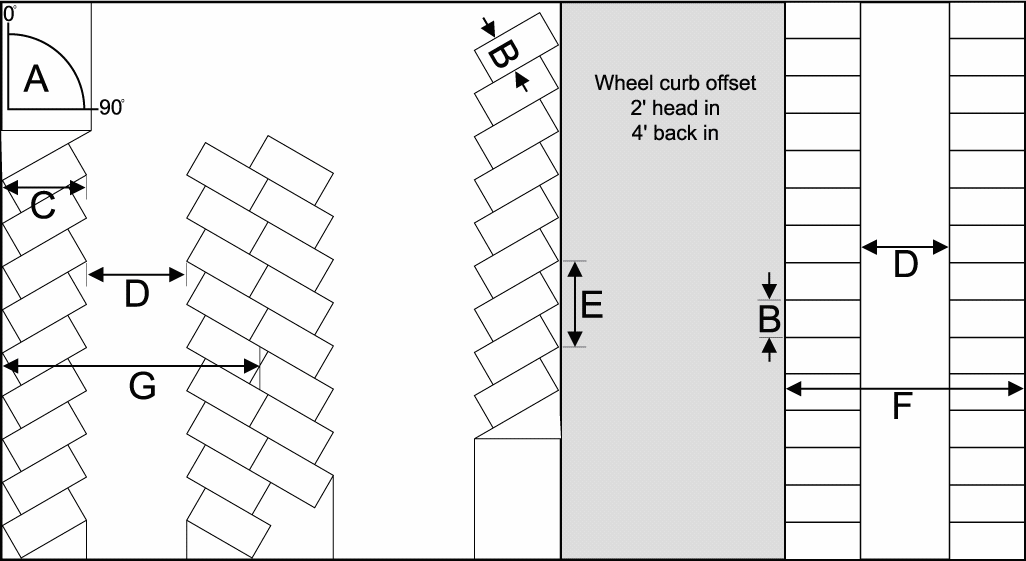
Parking Dimensions
Key for Table 654-2:
A — Parking Angle
B — Stall Width
C — Stall to Curb
D — Aisle Width
E — Curb Length per Car
F—G — Total Width of a Double-Loaded Aisle
(Ord. No. 37633, § 15, 11-20-06; Ord. No. 37984, § 6, 12-17-07; Ord. No. 38237, § 5, 9-15-08; Ord. No. 38423, § 1, 4-20-09; Ord. No. 38424, § 1, 4-20-09; Ord. No. 39122, § 1, 5-16-11; Ord. No. 39495, § 1, 9-4-12; Ord. No. 40088, § 1, 10-20-14; Ord. No. 40296, § 1, 7-6-15; Ord. No. 40710, § 1, 12-5-16; Ord. No. 41370, § 1, 1-22-19; Ord. No. 42902, § 1, 3-18-24; Ord. No. 43049, § 1, 9-16-24)
Sec. 36.2-655. - Reserved.
Editor's note— Section 1 of Ord. No. 39495, adopted Sept. 4, 2012, deleted § 36.2-655, which pertained to off-street loading, and derived from Ord. No. 38423, adopted April 20, 2009; and Ord. No. 38424, adopted April 20, 2009.
Sec. 36.2-660. - Purpose.
The purpose of this division is to permit the use of publicly visible signs in a manner that protects the public health, safety, and welfare. It is not the intent of this division to suppress any activities protected under the First Amendment or to regulate the content of signs, but to enact a content-neutral ordinance which will address the secondary effects of signs. The specific objective of this division is to establish effective, consistent, and equitable regulations pertaining to the time, location, and manner in which publicly visible signs may be erected and maintained, in order to:
(a)
Promote the general health, safety, and welfare of the citizens of the City of Roanoke;
(b)
Implement the community's goals and policies as set forth in the City's Comprehensive Plan as they relate to the scale, numbers, and sizes of signs and the goal of quality, orderly, and harmonious development;
(c)
Enhance opportunities for the efficient and effective visual communication of information, direction, and business identification;
(d)
Protect the public investment in the creation, maintenance, and appearance of its streets, highways, and other public areas;
(e)
Reduce the distractions, obstructions, and hazards to pedestrians and vehicular traffic caused by the number, size, height, and placement of signs;
(f)
Promote an attractive, healthy economic and business climate by providing for the placement, size, and number of signs in a manner that promotes visibility, legibility, and visually unified commercial areas;
(g)
Protect and enhance the appearance of the City to residents, tourists, and other visitors as sources of economic development, including the protection of views of the river and surrounding mountains and forests;
(h)
Preserve the residential character of residential neighborhoods; and
(i)
Protect property values by improving the quality of the built environment and eliminating nuisances to the use of other properties because of sign brightness, size, height, or movement.
Sec. 36.2-661. - Applicability.
(a)
Generally. The provisions of this division shall apply to any new sign or sign structure and to the modification or alteration of any existing sign which is visible from any street, sidewalk, or public or private outdoor common space. For the purposes of this division, changing the message or content of an approved marquee, or other approved changeable copy sign, electronic readerboard, or public service message board, or approved outdoor advertising sign, shall not be deemed an alteration or modification of such sign.
(b)
No content restriction. No sign is subject to any limitation based on the content of the message contained on such sign. This subsection supersedes any other requirement of this division to the extent of any inconsistency.
A sign bearing a non-commercial message shall not be restricted or otherwise regulated to any greater extent than a sign bearing a commercial message. The intent of this Division is to regulate similar sign types equitably, regardless of the message.
(c)
Exemptions. The provisions of this division, including the requirements for a zoning permit, shall not apply to the following signs, provided that no such sign shall be placed within the public right-of-way or within any sight distance triangle. Exempted signs shall not be included in the maximum permissible number of signs or maximum permissible sign area. Any exempted sign that is to be located in the Historic Downtown Overlay District (H-1) or the Historic Neighborhood Overlay District (H-2) shall be subject to the requirements of Section 36.2-530 if applicable.
(1)
Decorative home flags or national, state, or other governmental flags and insignias.
(2)
Legal notice, identification, informational, or directional signs erected by a government body or required to be erected by a government body.
(3)
Decorative banners attached to light poles, and secured at the top and bottom, which bear no advertising or commercial images.
(4)
Directional signs not exceeding four (4) square feet in sign area, and four (4) feet in height for freestanding directional signs.
(5)
Signs displaying only the word "open" or "closed," or the hours of operation, illuminated or otherwise, provided such signs do not exceed one per lot and do not exceed four (4) square feet in sign area.
(6)
Commemorative plaques, historical markers, and signs which have special historical value or significance to the community, provided such signs are erected by a government body and do not exceed fifteen (15) square feet in sign area.
(7)
Nameplates not exceeding two (2) square feet in sign area.
(8)
Neighborhood identification signs, displaying only the name of the neighborhood and not exceeding fifteen (15) square feet in sign area.
(9)
Address sign not exceeding four (4) square feet in sign area.
(10)
Murals.
(11)
Temporary signs not exceeding twelve (12) square feet in cumulative sign area in a residential district.
(12)
Temporary real estate signs which advertise for sale, rent, or lease the land or building upon which such signs are located. Such signs shall be limited to one (1) sign per frontage and shall not exceed twelve (12) square feet in any RA, R-12, R-7, R-5, R-3, RM-1, or RM-2 district and shall not thirty-two (32) square feet in any RMF, multiple purpose district, industrial district, or planned unit development district.
(13)
Temporary off-site directional real estate signs, provided such signs do not exceed twelve (12) square feet in sign area and written permission is obtained from the property owner on which the off-premises directional real estate sign is located.
(14)
Memorial plaques.
(15)
Temporary safety signs placed on temporary structures, fences, and barricades placed around excavations or building projects, whether on public or private property, which are related to safety considerations with the construction.
(16)
Construction signs erected on property where construction is underway or is proposed. Such signs shall be limited to one (1) sign per frontage and shall not exceed twelve (12) square feet in any RA, R-12, R-7, R-5, R-3, RM-1, or RM-2 district and shall not exceed thirty-two (32) square feet in any RMF, multiple purpose district, industrial district, or planned unit development district.
(17)
Signs associated with an outdoor recreational facility, amphitheater, stadium or similar facility, where such signs are not legible from the public right-of-way.
(18)
A single sandwich board or "A" frame sign per storefront in multiple purpose districts.
(19)
Window covers placed on the inside of a window or windows of a vacant storefront to shield the interior of the building from view. Window covers shall not be subject to the maximum window coverage requirements of Section 36.2-671 (b).
(Ord. No. 37633, § 16, 11-20-06; Ord. No. 38424, § 1, 4-20-09; Ord. No. 39122, § 1, 5-16-11; Ord. No. 39495, § 1, 9-4-12; Ord. No. 40088, § 1, 10-20-14; Ord. No. 41173, § 1, 6-18-18; Ord. No. 41817, § 1, 7-20-20)
Sec. 36.2-662. - Definitions.
Signs and their characteristics, as used in this division, shall be defined as set forth in this section and in Appendix A. For the purposes of this division, to the extent of any inconsistency between Appendix A and this division, the definitions provided in this division shall control.
Address sign: A sign displaying only the assigned address of a property or building that is attached to a building or sign structure or part thereof.
Animated sign: Any sign or part of a sign that changes physical position by any movement, oscillation, or rotation by natural or artificial means or that imitates or gives the visual appearance of such movement. A flashing sign and a sign that indicates only the time, temperature, or date shall not be considered an animated or moving sign.
Awning: A structure made of fabric or similar nonrigid material supported by and projecting from the exterior wall of a building and designed to be raised, folded, retracted, or collapsed to a flat position against the face of the supporting building.
Awning sign: A sign that is painted on, printed on, or attached to the face of an awning and not projecting vertically above or horizontally beyond the physical dimensions of such awning.
Banner: A sign consisting of plastic, canvas, cloth, paper, or fabric of any kind temporarily secured at one (1) or more edges to a pole or other structure, excluding national, state, and municipal flags and official flags of professional, institutional, or educational organizations.
Billboard: See "Outdoor advertising sign."
Building-mounted sign: A sign erected on, attached to, or painted on the wall, window, or door of a building, or attached to, printed on, or painted on an appurtenance of the building such as a canopy or awning or other accessory structure not otherwise designed or constructed to support signage. For the purpose of calculating the total maximum permitted sign area for building-mounted signs as provided in this division, building-mounted signs shall include awning signs, canopy signs, hanging canopy signs, marquee signs, projecting signs, street level wall signs, but shall not include window signs.
Canopy sign: A sign that is painted on, printed on, or attached to a canopy. No such sign shall project vertically above or horizontally beyond the physical dimensions of such canopy.
Changeable copy sign: A sign, or part of a sign, that is designed so that letters or numbers attached to the sign can be changed manually, or mechanically, to display a different copy or message.
Construction sign: A temporary sign that notifies the public of a specific building or development under construction or reconstruction or proposed to be constructed or reconstructed. The sign may also identify the architect, engineer, contractor, subcontractor, or lending institution engaged in the project on the property on which the sign is located, or the suppliers of materials used thereon.
Development identification sign: A sign used to display only the name, address, crest, or trademark of a business or organization, or to display the name of a subdivision, church, school, park, or multifamily housing development.
Directional sign: An on-premises sign designed to guide pedestrian or vehicular traffic on the site by using words such as "Entrance," "Exit," "Parking," "One-Way," or other similar directional language and which sign may contain the name of the establishment or its commercial logo in addition to the directional language.
Double-decker or multi-stacked outdoor advertising sign: An outdoor advertising sign that contains two (2) or more signs stacked on top of each other.
Double-faced sign: A sign with two (2) sign faces attached to a common support structure and constructed to display the same copy or message on the outer surfaces of two (2) identical and opposite parallel planes not more than thirty-six (36) inches apart or not separated by an interior angle of more than forty-five (45) degrees.
Electronic readerboard: A computer-generated sign which displays messages with letters, pictographic, or symbolic informational content which can be changed or altered on a fixed display screen by electrically illuminated segments. A sign that contains only a static electronic display of numerals, such as gas prices, shall not be classified as an electronic readerboard.
Embellishment: Letters, numerals, figures, images, emblems, logos, or other features extending from within and projecting beyond the framing of the normal sign face of an outdoor advertising sign as a part of a commercial advertising message.
Feather sign: Any piece of flexible fabric, resembling a feather in shape, with an upright support on one side, designed to allow the fabric to oscillate with the wind.
Flag: A single piece of canvas, plastic, cloth, paper, or other fabric or any other material which has been attached along one (1) side or edge of a support.
Flashing sign: A sign that uses intermittent or sequential flashing or running lights, or lights creating an illusion of movement, to attract attention. Electronic readerboards shall not be considered flashing signs.
Freestanding sign: A sign supported by one (1) or more upright poles, columns, or braces placed exclusively in or on the ground. This term shall include pole and monument signs. For purposes of the regulations of this division, outdoor advertising signs and public service message boards shall not be considered freestanding signs.
Government sign: Any temporary or permanent sign erected and maintained for any official governmental purpose.
Graphic: Any logo, emblem, insignia, or text formed by writing, drawing, painting, or engraving.
Hanging canopy sign: A small, pedestrian-oriented sign that is suspended beneath a canopy by means of brackets, hooks or chains, and the like, and which face is generally perpendicular or parallel to the building element to which the canopy is attached.
Historical marker: A memorial sign limited in content to the identification of a historical building or structure or the site of a historical event.
Identification sign: A sign which is limited to the name, trademark or other readily recognized symbol, street address and number, or any combination thereof, of a building, institution, business, organization, or establishment and to the activity carried on in the building, institution, business, or establishment on the premises where the sign is located, or announcing the name of a subdivision, shopping center, church, school, park, or multifamily housing development. Identification signs shall also include nameplates.
Illuminated sign: A sign with an artificial light source, incorporated internally or externally, for the purpose of illuminating the sign. A neon sign shall be considered an illuminated sign.
Inflatable sign: One (1) or more moored balloons, or any other type of tethered object that is capable of being expanded by air or other gas, water, or other means, that exceeds twenty-four (24) inches in diameter and is used as a means of directing attention to any business, profession, service, product, goods, promotion, activity, or special event.
Laser light or image projection sign: The projection of light or a laser beam onto a solid surface, or projected into the sky, in order to project an image.
Logo: Any emblem used as the symbol of an organization or residential or nonresidential community. A logo may include a graphic, text, or both.
Marquee: A fixed hood located at the main entrance of a building, constructed of metal or other permanent material, which is projecting from and supported only by the building to which it is attached and which includes a sign or advertising announcement.
Marquee sign: A sign attached to or painted on a marquee.
Memorial plaque: A plaque, measuring no more than four (4) square feet in area, designating the name of a building or date of erection and other similar information such as the architect, contractors, or others involved in the building's creation, with such information carved into stone or cast in bronze or similar material and made an integral part of the structure.
Monument sign: A type of freestanding sign with the entire bottom of the sign mounted or affixed to a base or pedestal or directly to the ground, in which the sign and support structure are an integral part of one another.
Mural: A picture painted on or affixed to the exterior wall or window of a building, generally for the purpose of decoration or artistic expression, and which includes no words, graphics, or logos that advertise existing products or services of any entity. A mural may contain words, graphics, or logos that depict products that are no longer available or services or entities that no longer exist.
Nameplate: A sign affixed to the wall of a building in such a manner as to become an integral part thereof, and which provides only the name or address, or both, of the owner or occupant of a building or premises.
Off-site directional sign: A sign that directs traffic to a site other than the lot on which the sign is located.
Off-premises sign: A sign or sign structure or portion thereof which directs attention to a business, activity, commodity, service, product, entertainment, or attraction not conducted, sold, or offered on the lot where the sign is located. Such sign may also be known as a billboard or outdoor advertising sign.
On-premises sign: A sign or sign structure that is not an off-premises sign.
Outdoor advertising sign: An off-premises sign or sign structure, commonly referred to as a "billboard," with display space available for lease and designed so that the copy or poster on the sign can be changed frequently. For purposes of this chapter, an "outdoor advertising sign" shall be regulated as a principal use.
Pennant: Any lightweight plastic, fabric, or other similar material, whether or not containing a message or copy of any kind, suspended from a rope, wire, or string, usually in a series, designed to move in the wind.
Pole sign: A type of freestanding sign which is mounted on and supported by one (1) or more freestanding stationary poles.
Portable sign: A self-supported sign which is movable without involving any structural or support changes, and which is not affixed to a building or building appendage, including but not limited to portable changeable message cabinets and sandwich board signs. Portable signs include signs with wheels or with wheels removed, signs with chassis or support constructed without wheels, and signs mounted on a motor vehicle, or portion thereof, for the express purpose of advertising a business establishment, product, service, or entertainment when that motor vehicle is parked so to attract the attention of vehicular or pedestrian traffic. Portable signs shall not include bumper stickers or identification signs directly applied to or painted on motor vehicles identifying the owner of the vehicle, a business name, logo, or emblem.
Projecting sign: A sign which is attached to, supported by, and extending more than twelve (12) inches from a building face or wall, in whole or in part. Such sign shall extend no more than six (6) feet from the building to which it is affixed. An awning, canopy, or marquee sign shall not be considered a projecting sign.
Public service announcement: A message intended to raise awareness or provide information on an issue of a noncommercial nature to the public. Such issues may include health warnings or advisories, safety messages, or educational information.
Public service message board: An electronic readerboard which displays public service messages. Public service messages shall mean the promotion of public events at public facilities (such as festivals, concerts, and sporting events), promotion of events at public facilities (such as in parks, sports/amphitheatre complex, or civic center), information about tourist attractions in the city or conventions in the City, public safety messages (such as weather or traffic warnings), and other similar types of public service messages.
Real estate sign: A sign which advertises for sale, lease, or rent the lot or structure, or portion thereof, upon which the sign is located.
Refacing: The replacement of a sign face, regardless of change in copy, of equal size to the original, without altering the sign cabinet, sign frame, or sign support structure. The introduction of a different sign characteristic, such as illumination, electronic readerboard, or changeable copy, shall not be considered a refacing.
Roof sign: A sign that is mounted on the roof of a building, or any appurtenances thereto, such as a parapet wall, mechanical penthouse, or elevator house, and extending vertically above any portion of the roof or appurtenances thereto. A sign that is mounted to or painted on a parapet wall that is an extension of the façade of the building shall not be considered a roof sign, provided such sign does not extend vertically above the parapet wall to which it is attached.
Sandwich board or "A" frame sign: A double-faced sign which is not secured or attached to the ground, is readily moved from place to place, and is constructed in such a manner as to form an "A" or a tent-like shape, hinged or not hinged at the top, with each angular face held at an appropriate distance by a supporting member. A sandwich board or "A" frame sign shall not exceed four (4) feet in height and two and one-half (2½) feet in width.
Searchlight or beacon sign: A searchlight or beacon that utilizes stationary or revolving light that flashes or projects illumination, single color or multicolored, to announce, attract attention, or advertise a business or special event.
Sign: Any object, device, structure, or fixture, or portion thereof, which is used to announce, advertise, identify, display, or direct or attract attention to an object, person, institution, organization, business, product, goods, service, special promotion, activity, event, or location. The means used to direct or attract attention include, without limitation, objects, devices, fixtures, words, letters, numerals, graphics, figures, emblems, designs, illustration, decoration, symbols, logos, trademarks, colors, or projected illumination or images.
Sign area: The entire sign face within a single continuous perimeter, enclosing the extreme limits of sign display, including all words, letters, numerals, graphics, figures, designs, symbols, fixtures, logos, emblems, insignias, or other drawings or images used to create a sign, together with any background or surrounding material, panel, frame, border, trim, molding or ornamentation, or color that differentiates the sign from the structure, backdrop surface, or object upon or against which it is placed. For purposes of this division, sign area shall not include any portion of the sign support structure, provided that no message, logo, emblem, or other symbol or any other element of a sign or sign area, as defined in this chapter, is placed on or designed as a part of the sign support structure.
Sign cabinet: A structure that frames and supports the sign face(s). A sign cabinet may enclose internal illumination.
Sign face: The area or display surface that is used or can be used to identify, advertise, or communicate information or for visual representation that attracts the attention of the public for any purpose. Sign face shall not include the sign cabinet or sign structure.
Sign height: The vertical distance measured from and perpendicular to the average ground level on all sides of the sign support structure to the level of the highest point of the sign or sign structure, whichever is higher.
Sign support structure: Any structure that supports or is capable of supporting a sign, including uprights on which the sign is placed or bracing or the decorative wall or fence to which a sign is attached. A decorative pole cover shall be considered part of the sign support structure.
Snipe sign: Any sign attached to a tree, cliff, utility pole or support utility tower, radio or television tower, telecommunications tower, vehicular or pedestrian traffic control sign or structure, street name sign, fence or retaining wall, and other similar structures, and which does not apply to the activity on the lot on which it is located, or any sign placed in a public right-of-way without authorization by a government body.
Streamer: Any long, narrow strip of cloth, paper, plastic, or other material.
Temporary sign: A sign designed to be easily displayed and easily removed by a person, and designed to be displayed for a limited time period by virtue of the non-durable materials used for the sign and the non-permanent means of support for the sign. Such signs may be pushed, staked, or hammered into the ground, stand freely on the ground, or be tied or strapped to a structure.
Wall sign, street level: A sign painted directly on the outside wall of a building, or attached to and erected parallel to the face of a building and supported throughout its length by such wall of the building. Such sign shall project no more than one (1) foot outward from the façade of the building to which it is attached and shall be located or erected with the highest portion of the sign at or below a height of twenty-five (25) feet above adjacent ground level.
Wall sign, upper-story: A sign painted directly on the outside wall of a building, or attached to and erected parallel to the face of a building and supported through its length by such wall of the building. Such sign shall project no more than sixteen (16) inches outward from the façade of the building to which it is attached and shall be located or erected with the lowest portion of the sign above a height of twenty-five (25) feet above adjacent ground level.
Window area: The total square footage of the glass area within a frame upon which a window sign is applied, attached, suspended from, or through which it is displayed. Such glass area may include glass windows, doors, sidelights, and transoms, fixed or operable.
Window sign: A sign that is applied or attached directly to the interior or exterior of a window, or that is suspended from or located within twelve (12) inches of a window or door, so that it is visible from any street, sidewalk, or public or private outdoor common space. This term shall not include merchandise located in a window.
Window sign area: The total area of the imaginary rectangles contiguous to and surrounding each word, picture, logo, logotype, symbol, banding, or graphic.
(Ord. No. 37633, § 16, 11-20-06; Ord. No. 39495, § 1, 9-4-12; Ord. No. 41173, § 1, 6-18-18; Ord. No. 41817, § 1, 7-20-20)
Sec. 36.2-663. - Prohibited signs.
The following signs and sign characteristics shall be prohibited in all zoning districts:
(a)
Animated signs including feather signs.
(b)
Flashing signs, provided that theatre marquees shall be exempt from the prohibition of flashing signs.
(c)
Inflatable signs, except as a temporary sign under the provisions of Section 36.2-673.
(d)
Laser light or image projection signs, except as a temporary sign under the provisions of Section 36.2-673.
(e)
Off-site directional signs, except for off-site directional real estate signs as provided for in Section 36.2-661(c)(13).
(f)
Pennants or streamers.
(g)
Portable signs, except for sandwich board signs as expressly permitted in this chapter.
(h)
Projecting signs erected with their lowest portions above a height of twenty-five (25) feet above adjacent ground level.
(i)
Roof signs, except for existing roof signs located in, or such signs located and relocated within, the Historic Downtown Overlay District (H-1).
(j)
Searchlight or beacon signs, except as a temporary sign under the provisions of Section 36.2-673.
(k)
Snipe signs.
(l)
Any sign located within or over a public right-of-way, or public property, except for government signs or signs erected under the provisions set forth in Chapter 27.1 of this Code.
(m)
Any sign that contains beacons of light resembling or simulating any emergency service vehicle or equipment.
(n)
Any sign using traffic symbols or colors of red, amber, and green in such combination of shape or color as to be confused with traffic control devices.
(o)
Any sign attached partially or wholly to the pitched or flat roof of a building, or any sign which projects horizontally or vertically beyond any part of the building to which it is attached.
(p)
Any sign that produces sound, odor, or visible matter such as smoke or vapor.
(Ord. No. 41173, § 1, 6-18-18; Ord. No. 41817, § 1, 7-20-20)
Sec. 36.2-664. - Zoning permits for signs.
(a)
It shall be unlawful for any person to erect, install, structurally alter, modify, relocate, or replace any sign or sign structure, except for those exempted signs set forth in Section 36.2-661(c) and those exempted from the permit requirements as set forth in Section 363.2-673(a), without first obtaining a zoning permit pursuant to this section. The refacing of a sign shall not require a zoning permit.
(b)
A completed application for a zoning permit for a sign shall be submitted to the Zoning Administrator, shall be accompanied by the required application fee as set forth within the most recent fee schedule approved by City Council, and shall include the following:
(1)
For all signs, specifications regarding the type of sign to be constructed, sign height, sign face dimensions, source of illumination, the location of such sign on any wall or property, the official tax map number of the lot on which the sign is to be located, and the zoning district of the subject lot;
(2)
For building-mounted signs, dimensions of the building wall or appurtenance on which the sign is to be affixed and the dimensions and locations of the proposed building-mounted signs;
(3)
For freestanding signs, a scaled drawing showing the location of any proposed freestanding sign, the relationship of the proposed sign to sight distance triangles if applicable, and the relationship of the proposed sign to any other freestanding sign on the lot or to the lot line; and
(4)
In addition to the general requirements for applications for zoning permits for signs as set forth above, applications for zoning permits for outdoor advertising signs shall include additional information as set forth in Section 36.2-675(f).
(c)
In addition to the requirements of subsections (a) and (b) above, an application for a zoning permit for any sign located in the Historic Downtown Overlay District (H-1) or the Historic Neighborhood Overlay District (H-2), excluding temporary signs, shall include a copy of a Certificate of Appropriateness issued by the Architectural Review Board or its Agent for the proposed sign, accompanied by renderings.
(d)
In addition to the requirements of subsections (a), (b), and (c) above, an application for a zoning permit for any sign to be placed on, or project over, any sidewalk, street, alley, or other public property shall include documentation of meeting, and having received approval for, the requirements of Chapter 27.1 of this Code, regarding encroachments, liability insurance, and an indemnification and hold harmless agreement.
(e)
A zoning permit for a sign shall become null and void if the sign is not erected within six (6) months after the date the zoning permit is issued. Upon written request and for good cause shown, the Zoning Administrator may grant one (1) six-month extension.
(Ord. No. 41817, § 1, 7-20-20)
Sec. 36.2-665. - Removal of abandoned nonconforming signs.
The Zoning Administrator may order the removal of any nonconforming sign that has been abandoned. For purposes of this section, a sign shall be considered abandoned if the business or use for which the sign was erected has not been in operation for a period of at least two (2) years. Such nonconforming sign(s) and its supporting structure shall be removed by the owner of the property on which the sign is located, or the agent for the property owner, or tenant or lessee of the property having beneficial use of the property upon which the sign(s) is located, within thirty (30) days of written notice by the Zoning Administrator.
Sec. 36.2-666. - Illuminated signs.
When any sign is illuminated, such lights shall be enclosed in the sign, or if external, such external light source shall be located, shielded, or directed so as to concentrate the illumination upon the area of the sign face and so that the point source of the light is not visible from any adjacent street or lot. If ground lighting is used to illuminate a sign, and the point source of the light is not equipped with shielding to prevent its visibility from any adjacent street or lot, such ground lighting shall be fully screened from view by landscaping material.
Sec. 36.2-667. - Calculation of sign area and number of on-premises signs.
(a)
The calculation of the number of on-premises signs and sign area allotment shall be based on the applicable lot frontage for freestanding signs and the applicable building frontage or storefront for building-mounted signs.
(1)
Any freestanding sign shall be located along the lot frontage from which the allotment for the freestanding sign is computed.
(2)
Any building-mounted sign shall be located on the building façade from which the allotment for the building-mounted sign is computed. For purposes of a building-mounted sign which is attached to an appurtenance of the building or to an accessory structure not otherwise designed or constructed to support signage, such sign shall be located between the building line of the façade from which the building-mounted sign allotment is computed and the public right-of-way which it faces or, where applicable, within the parking lot which abuts the building façade from which the allotment is computed.
(b)
The following method shall be utilized in the calculation of sign area for on-premises signs:
(1)
Sign area for freestanding signs and building-mounted signs shall be calculated separately;
(2)
Each sign face shall count in calculating total sign area, except that in the case of a double-faced sign, only one (1) sign face shall be used in the calculation of sign area;
(3)
For signs composed of individually attached letters, numerals, pictures, logos, symbols, or figures, the sign area shall be calculated using the area of up to three abutting or overlapping geometric shapes to encompass all lettering, numerals, figures, designs, symbols, fixtures, logos, emblems, insignias, or other drawings or images. Geometric shapes used shall be limited to square, rectangle, triangle, circle, and ellipse;
(4)
For signs enclosed by a frame or border or encased by a cabinet, the sign area shall be determined by computing the entire area within a continuous perimeter, enclosing the limits of writing, representation, emblem, or any figure or similar character, together with any cabinet, frame, or other material or color forming an integral part of the display or used to differentiate the sign from the background against which it is placed The supports, uprights or structure on which any sign is supported shall not be included in the sign area unless such supports, uprights or structure area are designed to form an integral background of the display; and
(5)
Any banners which are attached to light poles on a lot, and which bear advertising or commercial images, shall be included in the calculation of the total square footage of freestanding sign area and shall be subject to the maximum total square footage of freestanding sign area permitted based on the applicable lot frontage. In the case of a lot with more than one (1) lot frontage, the freestanding sign area allotment toward which the banners shall be counted shall be the lot frontage on which the light poles are located, or if not along a lot frontage, the more applicable lot frontage, based on distance and visibility, as determined by the Zoning Administrator.
(Ord. No. 37633, § 16, 11-20-06; Ord. No. 41173, § 1, 6-18-18)
Sec. 36.2-668. - On-premises signs, generally.
The types, number and size of on-premises signs by zoning district shall be permitted as set forth in Table 668-1.
Table 668-1. Type, Number, and Size of On-Premises Signs
(Ord. No. 37633, § 16, 11-20-06; Ord. No. 37984, § 6, 12-17-07; Ord. No. 38423, § 1, 4-20-09; Ord. No. 38424, § 1, 4-20-09; Ord. No. 39122, § 1, 5-16-11; Ord. No. 39495, § 1, 9-4-12; Ord. No. 40088, § 1, 10-20-14; Ord. No. 40296, § 1, 7-6-15; Ord. No. 42902, § 1, 3-18-24; Ord. No. 43049, § 1, 9-16-24)
Sec. 36.2-669. - Changeable copy signs and electronic readerboard signs.
(a)
Changeable copy signs shall abut or connect with a static sign face, and the changeable copy portion of the sign shall not exceed eighty (80) percent of the overall sign of which it is a part.
(b)
Electronic readerboard signs shall be subject to these requirements:
(1)
The electronic readerboard shall abut or connect with a static sign face.
(2)
The electronic readerboard portion of the sign shall constitute no more than forty (40) percent of the total sign area of which it is an integral part.
(3)
An electronic readerboard in a CN, D, IN, UC, or CG District shall not exceed twenty-five (25) square feet in sign area.
(4)
The frequency of change of copy shall be established so that each display of copy remains static with no animation for at least six (6) seconds before changing to new copy.
(5)
An electronic readerboard shall be controlled so that the night-time illumination level does not exceed three-tenths (0.3) footcandles over ambient light, measured at a specified distance from the sign face. The distance of measurement shall be determined by multiplying the area of the electronic readerboard sign in square feet by one hundred (100). The square root of the resulting product is the distance in feet from which the measurement shall be taken. Electronic readerboard signs shall be equipped with a sensor that determines the ambient illumination and be programmed to dim according to ambient light conditions to comply with the requirements of this section.
(Ord. No. 38424, § 1, 4-20-09; Ord. No. 39122, § 1, 5-16-11; Ord. No. 39495, § 1, 9-4-12; Ord. No. 40296, § 1, 7-6-15; Ord. No. 41173, § 1, 6-18-18; Ord. No. 42902, § 1, 3-18-24; Ord. No. 43049, § 1, 9-16-24)
Sec. 36.2-670. - Freestanding signs.
In addition to the regulations set forth in Table 668-1, no on-premises freestanding sign, nor any part of such sign other than a supporting pole or brace no greater than eighteen (18) inches in width or diameter, shall be located lower than nine (9) feet from grade within any sight distance triangle.
Sec. 36.2-671. - Building-mounted signs.
In addition to the regulations set forth in Table 668-1, on-premises building-mounted signs shall be subject to the following standards:
(a)
No building-mounted sign, except for a projecting sign, shall cover, cross, or otherwise hide any cornice, column, belt course, window, or balcony of a building, or any portion of such feature.
(b)
Window signs shall be permitted at up to fifty (50) percent of the window area to which they are applied or attached, from which they are suspended, or through which they are displayed and shall not be counted towards building-mounted sign area. Window signs exceeding fifty (50) percent of the window area to which they are applied or attached, from which they are suspended, or through which they are displayed are prohibited.
(c)
No part of any awning or canopy containing a sign shall extend above the height of the bottom sill of any second story window of the building façade to which it is attached. All lettering and images comprising any portion of an awning or canopy sign shall be located on the face of the awning or canopy and shall not project above or below the face or in any way beyond the physical dimensions of the awning or canopy.
(Ord. No. 38237, § 5, 9-15-08; Ord. No. 39495, § 1, 9-4-12)
Sec. 36.2-672. - Upper-story wall signs.
Where on-premises upper-story wall signs are permitted as set forth in Table 668-1, the sign area of such wall signs shall be calculated separately and shall not be computed in the maximum total square footage of building-mounted sign area. In addition to the other applicable regulations of this division, such upper-story wall signs shall meet the following requirements:
(a)
Upper-story wall signs shall be limited to identification signs;
(b)
No upper-story wall sign shall cover, cross, or otherwise hide any cornice, column, belt course, window, or balcony of a building, or any portion of such feature.
(Ord. No. 39495, § 1, 9-4-12)
Sec. 36.2-673. - Temporary on-premises signs.
(a)
Temporary signs shall be permitted in Multiple Purpose, Industrial, and Planned Unit Development Districts subject to the following standards.
(b)
A Zoning permit shall not be required for any temporary sign meeting the requirements of this section.
(c)
Temporary signs shall not be included in the computation of permitted sign area.
(d)
Except as otherwise provided in this section, no temporary sign shall be displayed for more than sixty (60) days of a calendar year.
(e)
The maximum area of a temporary sign is thirty-two (32) square feet. The maximum height is six (6) feet. One (1) temporary sign is permitted for each lot frontage.
(f)
Inflatable signs, laser light or image projection signs, or searchlight or beacon signs shall be permitted as freestanding temporary signs, provided such signs meet the following requirements:
(1)
Permits for such signs shall not be issued unless the applicant provides documentation from the Roanoke Regional Airport and medical helicopter patient transportation providers within the City limits of noninterference with established routes;
(2)
Permits for such signs shall be limited to seven (7) days per calendar year per lot.
(g)
A temporary cover placed over an existing sign face because of change of ownership or the name of the business establishment shall be considered an on-premises temporary sign and shall be subject to the regulations of this section, except that such sign shall be permitted for a duration of sixty (60) calendar days. Such temporary cover shall not exceed the sign area of the existing permanent sign face it is covering and shall not increase the height of the existing sign face. Upon written application by the original applicant to the Zoning Administrator, prior to the expiration of the original zoning permit for the temporary sign, the Zoning Administrator may extend the time period for the zoning permit, up to thirty (30) calendar days, if in the opinion of the Zoning Administrator the applicant is diligently pursuing a permanent sign replacement or reface. Failure of a person to apply for such extension within the timeframe set forth in this subsection, and the continued display of the temporary sign beyond the duration of the original zoning permit, shall constitute a violation of this chapter.
(h)
Except as otherwise provided in this section, temporary on-premises signs shall be attached to a building or building appendage or attached to posts, stakes, or other supports that shall be removed at the time the sign is removed.
(i)
Except as otherwise provided in this section, temporary on-premises signs shall be attached to a building or building appendage or attached to posts, stakes, or other supports that shall be removed at the time the sign is removed.
(Ord. No. 37633, § 16, 11-20-06; Ord. No. 38424, § 1, 4-20-09; Ord. No. 39122, § 1, 5-16-11; Ord. No. 40088, § 1, 10-20-14; Ord. No. 41817, § 1, 7-20-20)
Sec. 36.2-674. - Public service message boards.
Where public service message boards are permitted as set forth in Table 668-1, the sign area of such public service message boards shall not be included in the calculation of freestanding signs; however, public service message boards shall be permitted only on lot frontages with no other freestanding signs. In the case of a double-faced sign, only one (1) such face shall count in calculating the total sign area of a public service message board. In addition to the other applicable regulations of this division, public service message boards shall meet the following requirements:
(a)
No more than one (1) public service message board shall be permitted per lot frontage;
(b)
No public service message board structure shall have more than two (2) sign faces;
(c)
A public service message board shall not exceed twenty-five (25) feet in height;
(d)
A public service message board shall not exceed four hundred fifty (450) square feet of sign area;
(e)
A public service message board shall have a minimum setback of five (5) feet from any public right-of-way or lot line; and
(f)
The copy on a public service message board shall not change or move more than once every six (6) seconds.
Sec. 36.2-675. - Outdoor advertising signs.
(a)
Applicability. The regulations set forth in this section shall apply to any outdoor advertising sign and shall supplement the general regulations of this division.
(b)
Sign area by zoning district. Where permitted by this chapter, outdoor advertising signs shall not exceed the following square footage of sign area:
(c)
Setback, height, and sign face standards.
(1)
Outdoor advertising signs shall be subject to the yard requirements of the applicable zoning district.
(2)
The maximum height for any outdoor advertising sign shall be twenty-five (25) feet.
(3)
No outdoor advertising sign structure shall have more than two (2) sign faces and no two (2) such sign faces shall be separated by an interior angle of more than forty-five (45) degrees.
(d)
Spacing standards.
(1)
No outdoor advertising sign shall be erected as follows:
(A)
Within three hundred (300) feet of the boundary line of any residential district within the City;
(B)
Within two hundred fifty (250) feet of the property line of any public school, public library, place of worship, museum, or public park;
(C)
Within three hundred fifty (350) feet of any outdoor advertising sign on the same side of the street;
(D)
Within two hundred fifty (250) feet of the nearest edge of the right-of-way of I-581 and the Roy L. Webber Expressway (Southwest Expressway);
(E)
Within six hundred sixty (660) feet of the nearest edge of the right-of-way of the Blue Ridge Parkway; or
(F)
Along an arterial or collector street within five hundred (500) feet of any point in the City at which the City's municipal corporation boundary is intersected by the arterial or collector street.
(2)
The distances separating outdoor advertising signs from each other, or separating any outdoor advertising sign from any boundary, shall be measured from the nearest point on the proposed outdoor advertising sign to the nearest applicable point of another outdoor advertising sign or boundary.
(e)
State standards. All outdoor advertising signs shall be erected in conformance and compliance with those portions of Chapter 7, Title 33.1, of the Code of Virginia (1950), as amended, which by the provisions of that chapter are made applicable to areas of the City within six hundred sixty (660) feet of the nearest edge of the right-of-way of any interstate or federal-aid-primary highway, as defined in Chapter 7 of Title 33.1.
(f)
Zoning permits for outdoor advertising signs. In addition to the requirements for zoning permit applications set forth in Section 36.2-664, applications for zoning permits for outdoor advertising signs shall be accompanied by a basic development plan. In addition to the required elements of a basic development plan (see Section B-1, Appendix B), a survey shall be provided showing the location of the proposed outdoor advertising sign and the distance from the proposed sign to any other outdoor advertising sign or boundary as necessary to establish compliance with the spacing standards of Section 36.2-675(d) and the yard requirements of the applicable zoning district. Prior to the issuance of any zoning permit for an outdoor advertising sign, the application shall meet all the State requirements as set forth in subsection (e) above, and the appropriate agent for the State shall have issued tentative approval of the permit application.
Sec. 36.2-676. - On-premises signs for nonconforming uses in residential districts.
For nonconforming, nonresidential uses in residential districts, one (1) building-mounted sign shall be permitted, provided such sign shall not exceed six (6) square feet in sign area, shall not be illuminated, and shall not be a changeable copy sign or an electronic readerboard.
(Ord. No. 37984, § 6, 12-17-07)
Sec. 36.2-677. - Allocation of permitted sign area.
Permitted sign area for freestanding signs that is not used on a lot may be allocated to increase the permitted sign area for building-mounted signs on the same lot. Such request for allocation of sign area shall be made in writing to the Zoning Administrator and shall include the existing area of freestanding and building-mounted signs and identify the quantity of sign area to be allocated. Approval of sign allocation shall be made by the Zoning Administrator in writing.
(Ord. No. 39495, § 1, 9-4-12)

