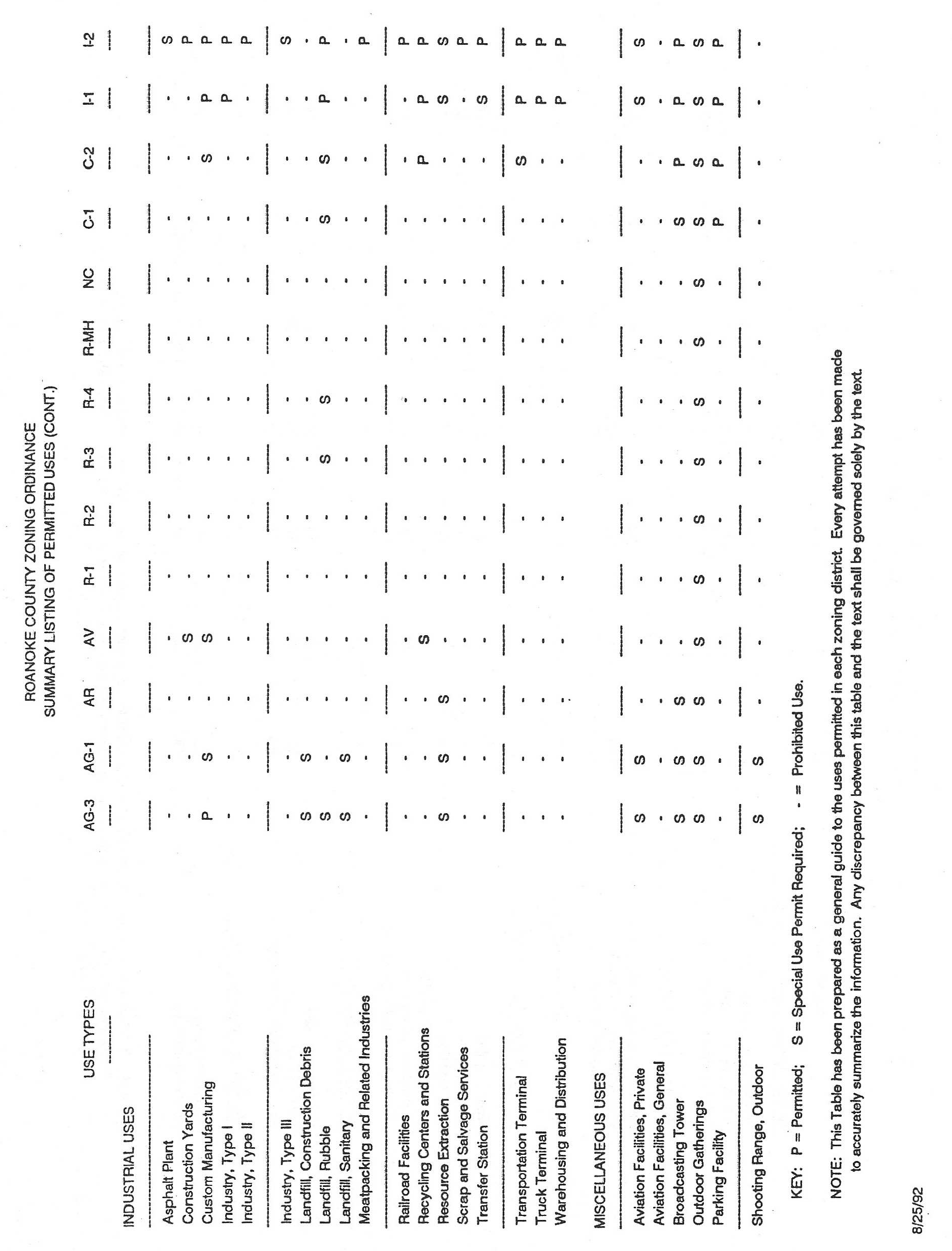
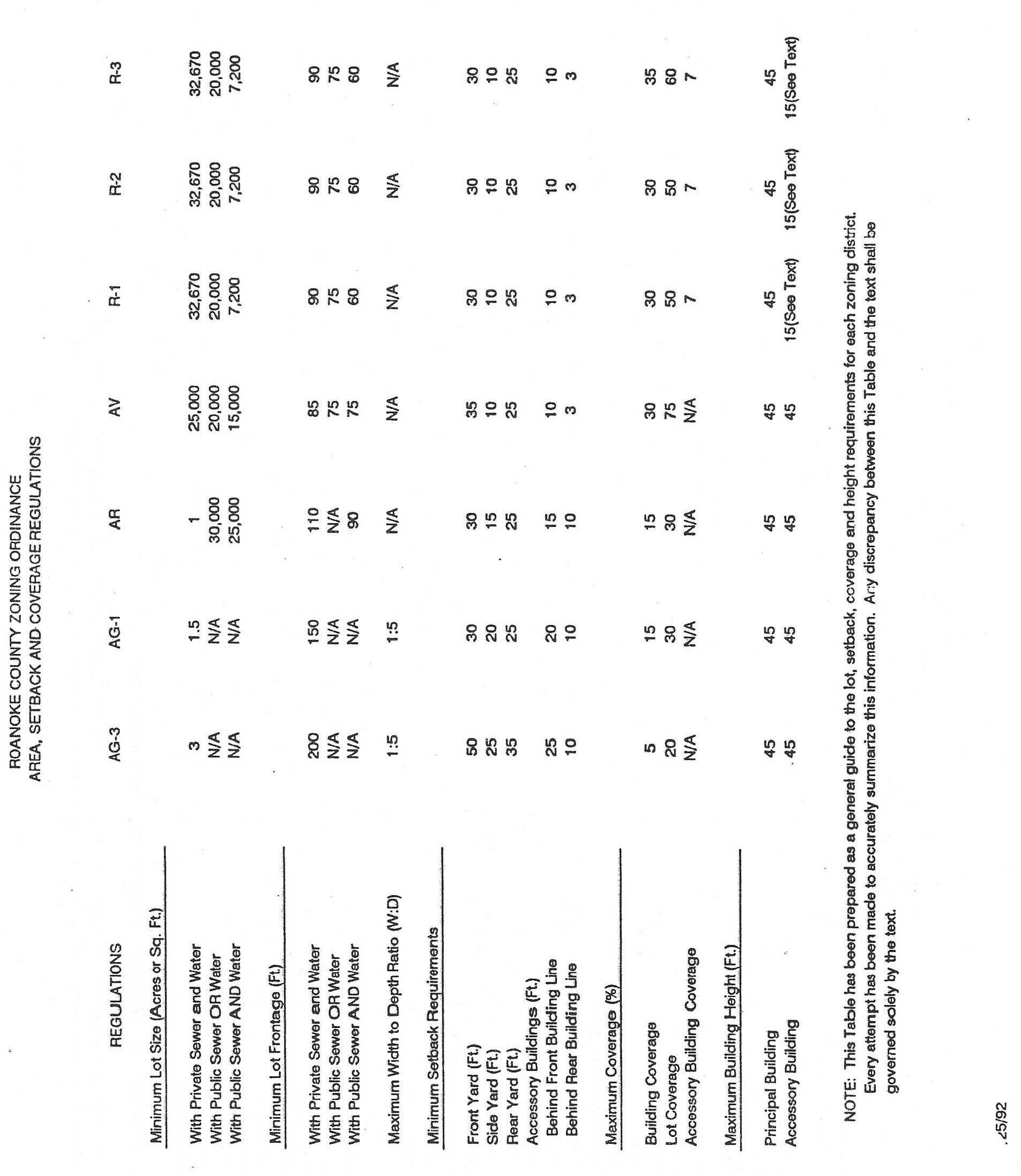
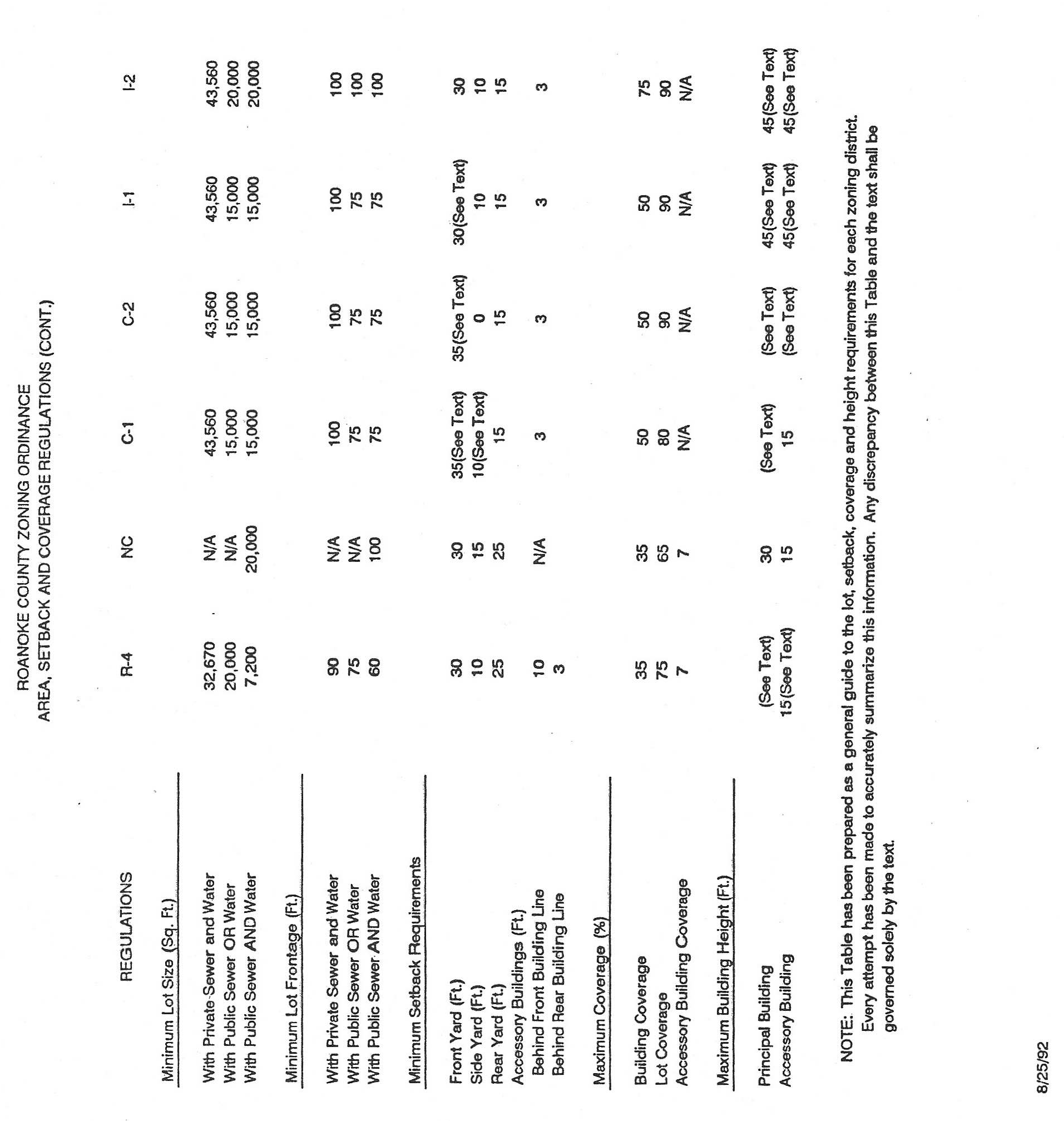
Roanoke County Unincorporated
City Zoning Code
City Zoning Code
ARTICLE V
- DEVELOPMENT STANDARDS
SEC. 30-90.- SITE DEVELOPMENT PLANS.
(A)
A site development plan shall be required and shall be submitted for the following:
1.
New development in every zoning district, including uses approved as special uses, except for single family and two family dwelling units on individual lots.
2.
The conversion of any single family or two family dwelling unit to any other use, or a higher intensity residential use, or the conversion of any building or property to a different use category, (e.g., commercial to industrial).
3.
New public buildings, except for minor utility services.
4.
Uses involving a structure requiring review by the Commission under section 15.2-2232 of the Code of Virginia, as amended.
5.
Additions or modifications to buildings or uses, except single family or two family dwelling units, that result in a five hundred (500) square foot or greater increase in the impervious area of the site.
6.
The conversion of any property from fee-simple ownership to a condominium form of ownership.
7.
The use or development of any parcel conditionally rezoned, where any of the conditions accepted and attached to the parcel apply to the physical arrangement or design of the site.
(B)
Site development plans required by the county shall be prepared by a professional engineer, architect, land surveyor, landscape architect or other licensed professional who is registered by the Commonwealth of Virginia and is conducting their practice in accordance with section 54.1-400 et seq. of the Code of Virginia, as amended. More stringent requirements may be established by the Roanoke County Code or the Code of Virginia. This requirement may be waived by the director of development services if the type, scale and/or location of the proposed development does not necessitate such plans.
(C)
Any use or development permitted by this ordinance for which a site development plan is not required, shall submit a plot plan in accord with the standards contained in Section 30-100-1 of this ordinance.
(Ord. No. 042799-11, §§ 1a., c., 4-27-99; Ord. No. 111213-15, § 1, 11-12-13; Ord. No. 020921-8, § 1, 2-9-21)
Sec. 30-90-1. - Information Required.
(A)
The following information shall be required on site development plans submitted to the county for review:
1.
Location of the lot or parcel by vicinity map. Site development plans shall also contain a north arrow, original date, revision dates and graphical scale.
2.
Property lines of the parcel proposed for development, including the distances and bearings of these lines. If only a portion of a parcel is proposed for development, a limits of development line shall also be shown.
3.
The name and address of the property owner and or developer of the site, if different than the owner. The name and address of the person or firm preparing the plan.
4.
The tax parcel number(s) of parcels proposed for development and depicted on the site development plan.
5.
The name of adjacent property owners and the owners of any property on which any utility or drainage easement may be required in conjunction with the development. Tax parcel numbers for each of these properties shall also be provided.
6.
The nature of the land use(s) proposed for the site.
7.
The zoning district designation of the parcel(s) proposed for development, and the zoning designation and current land use of adjacent parcels.
8.
The names, route numbers and locations of existing and proposed public or private streets, alleys and easements on or adjacent to the site. The center lines or boundary of adjacent rights-of-way shall also be shown.
9.
The location, type, and size of site access points such as driveways, curb openings, and crossovers. Sight distances at these access points shall be provided. If existing median cuts will serve the site they shall be shown. If new median cuts are proposed, their location shall also be shown.
10.
All proffers accepted pursuant to Section 30-15 shall be shown on the plan.
11.
Off-street parking areas and parking spaces including handicapped spaces, loading spaces, shopping cart corrals, and walkways indicating type of surfacing, size, angle of stalls, width of aisles, and a specific schedule showing the number of spaces provided and the number required by this ordinance.
12.
The exact location of buildings or structures existing on or proposed for the site, including their setbacks from property lines, and the distance between buildings or structures. Lot and building coverages shall be provided.
13.
The number of stories, floor area, and building height of each building proposed. If more than one (1) land use is proposed, the floor area of each land use shall be provided. Floor area shall be calculated on the basis of parking required for the use(s).
14.
For residential developments, the type of dwelling unit shall be stated along with the number of units proposed. Where necessary for determining the number of required parking spaces, the number of bedrooms in each unit shall also be provided.
15.
Reserved.
16.
The location of proposed or required fire lanes and signs.
17.
The existing topography of the parcel prior to grading, and the proposed finished contours of the site with a maximum of two-foot contour intervals.
18.
Detailed utility plans and calculations shall be submitted for sites for which public water or sewer will be provided or for sites on which existing utilities will be modified. The director of utilities shall have the authority to set the standards for such plans.
19.
An erosion and sedimentation control plan and detail sheet shall be submitted in accordance with the County's Erosion & Sediment Control Ordinance.
20.
A detailed stormwater management plan and calculations shall be submitted. The director of development services shall determine the requirements for such plans. At a minimum these plans shall contain information that shows:
a.
Spot elevations of proposed building corners, finished floor elevations, entrances, driveway and parking lot limits, and culvert inverts,
b.
The benchmark location and USGS elevation, where available.
21.
The location of existing and proposed freestanding signs on the parcel.
22.
The location and type of proposed exterior site lighting, including height of poles and type of fixtures.
23.
The location of any one hundred-year flood plain and floodway on the site, and the relationship of buildings and structures to this floodplain and floodway. See Section 30-74.
24.
The location of required or proposed buffer yards, screening, fencing, and site landscaping. The type and size of the plant materials and screening to be used shall be provided. In addition, the relationship of these materials to physical site improvements and easements shall be provided.
(B)
The director of development services may waive the requirement that any of this information be shown on a submitted plan, if in his opinion such information is not necessary to ensure conformance with county ordinances or standards.
(Ord. No. 042799-11, § 1a., c., 4-27-99; Ord. No. 052411-9, § 1, 5-24-11; Ord. No. 111213-15, § 1, 11-12-13; Ord. No. 020921-8, § 1, 2-9-21)
Sec. 30-90-2. - Format of Plans.
(A)
Site plans shall be on sheets no greater in size than thirty (30) by forty-two (42) inches. A sheet size of twenty-four (24) by thirty-six (36) inches is preferred. The scale of the plans shall not be greater than one (1) inch equals ten (10) feet (1″=10′), or less than one (1) inch equals fifty (50) feet (1″=50′). Plans shall be designed using an engineering scale. The director of development services may approve a lesser scale such as one (1) inch equals one hundred (100) feet (1″=100′) provided sufficient detail is provided to ensure compliance with all applicable requirements of this ordinance and any other requirement or ordinance of the county or commonwealth. Plans may be submitted in a digital format in accordance with county standards.
(B)
If more than one sheet is used to supply the information required by this ordinance, sheets shall be numbered, and match lines shall be provided, when appropriate, to clearly indicate where the plans join.
(C)
Prior to final approval by the county, site development plans shall be signed by the owner or developer of the parcel(s) proposed for development. The signature shall certify that the owner/developer is aware of the site design requirements imposed by the site development plan and other applicable county codes, and shall further certify that the owner/developer agrees to comply with these requirements, unless modified in accordance with local law.
(Ord. No. 042799-11, § 1a., c., 4-27-99; Ord. No. 111213-15, § 1, 11-12-13; Ord. No. 020921-8, § 1, 2-9-21; Ord. No. 062425-7, § 1, 6-24-25)
Sec. 30-90-3. - Administrative Procedures and Requirements.
(A)
The director of development services shall have the administrative authority to establish county procedures for site development plan review and approval. No procedure so established shall set a lesser standard than is legislated in this ordinance.
(B)
The director of development services shall coordinate the county review of any site development plan submitted in accord with county administrative procedures, and shall have the authority to request opinions or decisions from other county departments, agencies or authorities of the Commonwealth of Virginia, or from other persons as may from time to time be consulted.
(C)
Complete set(s) of site development plans shall be submitted for review in accordance with the Land Development Procedures. A review fee shall be required for any site development plan submitted. The director of development services shall establish procedures for the collection of these fees.
(D)
The county shall review, and approve or disapprove any site development plan submitted for its review within forty-five (45) days of the filing of the plan with the director of development services. If an unapproved site development plan is returned to the applicant or other agent of the property owner, due to lack of required information on the plan, or because the design or standards proposed on the site development plan do not meet the provisions of this ordinance or other applicable county standards, the forty-five-day time period shall begin again with the resubmittal of the plan to the county.
(E)
Reserved.
(F)
Approval of a site development plan pursuant to the provisions of this ordinance shall expire five (5) years from the date of approval in accordance with sections 15.2-2258 through 15.2-2261 of the Code of Virginia, as amended, unless building and/or zoning permits have been obtained for the development.
(G)
No building or zoning permit shall be issued by any county official for any building, structure or use depicted on a required site development plan, until such time as the plan is approved by the county.
(H)
Reserved.
(I)
No change, revision, or erasure shall be made on any pending or approved site development plan, nor on any accompanying data sheet where approval has been endorsed on the plan or sheets, unless authorization for such changes is granted in writing by the director of development services. The director shall consult with all applicable departments or agencies prior to approving the change.
(Ord. No. 042799-11, § 1a., c., 4-27-99; Ord. No. 020921-8, § 1, 2-9-21)
Sec. 30-90-4. - Minimum Standards and Improvements Required.
(A)
Any improvement required by this ordinance, or any other ordinance of Roanoke County shall be installed at the cost of the developer unless other agreements have been reached between the developer, the county, the Virginia Department of Transportation, and/or any other governmental agency.
(B)
Prior to the approval of a site development plan the applicant shall execute an agreement to construct required or proposed improvements located within public rights-of-way or easements or any such improvement connected to any public facility. The applicant shall also file a performance guarantee with surety acceptable to the county in the amount of the estimated cost of the improvements plus ten (10) percent contingency, as determined by the director of development services. The owner's performance guarantee shall not be released until the construction has been inspected and accepted by the county and the Virginia Department of Transportation, as applicable.
(C)
Proposed lot sizes, buildings or uses shown on site development plans shall conform to the provisions of this ordinance. Nonconforming lots of record, buildings or uses may be developed in accordance with section 30-23 of this ordinance.
(D)
Proposed parking areas, travel lanes, access drives and loading spaces shown on site development plans shall be designed, located and constructed in accord with section 30-91 of this ordinance.
(E)
Utilities shown on site development plans shall conform to applicable county ordinances and Western Virginia Water Authority regulations, as determined by the department of development services and the Western Virginia Water Authority.
(F)
Storm drainage and stormwater management facilities shown on site development plans shall conform to applicable county ordinances as determined by the director of development services.
(G)
Erosion and sediment control plans shall be designed and implemented in accord with the provisions of chapter 8 of the County Code.
(H)
Proposed exterior site lighting shall be in accord with section 30-94 of this ordinance.
(I)
Required buffer yards, screening and/or landscaping shown on site development plans shall be designed and located in accord with section 30-92 of this ordinance.
(J)
Provisions must be made for vehicular access and turn around for regularly scheduled public service vehicles such as trash collection.
(K)
Site grading shall conform to the requirements in applicable county ordinances and the Roanoke County Stormwater Management Design Manual
(Ord. No. 042799-11, §§ 1a., c., 2, 4-27-99; Ord. No. 042208-16, § 1, 4-22-08; Ord. No. 020921-8, § 1, 2-9-21; Ord. No. 062425-7, § 1, 6-24-25)
SEC. 30-91. - OFF STREET PARKING, STACKING AND LOADING.[4]
Editor's note— Ord. No. 052609-22, § 1, adopted May 26, 2009, amended the Code by, in effect, repealing former §§ 30-91—30-91-12, and adding new §§ 30-91—30-91-7.1. Former §§ 30-91—30-91-12 pertained to similar subject matter, and derived from Ord. No. 42694-12, adopted April 26, 1994; Ord. No. 62795-10, adopted June 27, 1995; Ord. No. 042799-11, adopted April 27, 1999; Ord. No. 121900-11, adopted December 19, 2000; Ord. No. 072605-7, adopted July 26, 2005; Ord. No. 042208-16, adopted April 22, 2008; and Ord. No. 111108-13 adopted November 11, 2008.
Sec. 30-91-1. - Purpose.
(A)
The purpose of this section is to set forth off-street parking, stacking and loading requirements for permitted land uses in accordance with the intensity of such uses, in a manner that:
1.
Provides for the accommodation of vehicles in a functionally and aesthetically satisfactory manner;
2.
Minimizes external effects on adjacent land uses;
3.
Provides options for the provision of adequate parking and alternative modes of transportation;
4.
Is consistent with environmental goals such as stormwater management, clean air and preservation of open space.
(Ord. No. 052609-22, § 1, 5-26-09)
Sec. 30-91.2.1. - Applicability
(A)
New buildings, change of use, and/or change of occupancy limit: Off-street parking and loading facilities shall be provided for:
1.
Any new building constructed,
2.
Any change of use, or
3.
Any change in occupancy in an existing building that exceeds the minimum parking requirements specified in section 30-91-3-3.
(B)
Change of use: When there is a change in use where the new use has the same or lesser parking requirements than the previous use, no additional parking shall be required.
(C)
Expansions with no change of use: When an existing structure and/or use is expanded, off-street parking shall be provided for the expansion in accordance with the provisions of this section, except for a parking increase of less than ten (10) percent or as provided in section 30-91-3-5, shared parking.
(D)
Mixed-use: Where uses with different parking requirements occupy the same building, the parking spaces shall equal the sum of the requirements of the various uses computed separately, except as provided in section 30-91-3-5, shared parking.
(E)
Site redevelopment: When a structure or building is constructed on a property on which an existing structure has been demolished and the parking area is to remain, the parking area shall meet the requirements of section 30-91 and section 30-92 of the county zoning ordinance.
(Ord. No. 052609-22, § 1, 5-26-09)
Sec. 30-91-2.2 - Recreational Vehicle and Commercial Vehicle Parking.
(A)
In the AR district and in all residential districts:
1.
Except for vehicles parked within multi-family developments all utility trailers and recreational vehicles, shall be parked behind the front building line, unless space is provided in a completely enclosed garage or other building. For the purposes of this section only, a corner lot that fronts on two (2) streets shall have only one (1) front building line in accordance with section 30-100-7. In the case of a unique house configuration the zoning administrator shall determine the parking location for the recreation vehicle, based on having no interference on sight distance in accordance with section 30-100-8.
2.
No truck or commercial vehicle with, or designed to have, more than two (2) rear wheels shall be parked except while loading or unloading on such premises. No construction machinery shall be parked overnight unless the machinery is incidental to improving the premises. These provisions shall not apply to pickup body type trucks, or to vehicles essential for an agricultural use associated with the premises.
(B)
No recreational vehicle shall be used for living or business purposes, or connected to utility services except for maintenance purposes or as otherwise provided for in this ordinance.
(Ord. No. 052609-22, § 1, 5-26-09; Ord. No. 052411-9, § 1, 5-24-11)
Sec. 30-91-2.3. - Location of Parking.
(A)
Off-street parking spaces that are located on the ground and open to the sky may be located in any required yard unless otherwise required for screening, buffering, landscaping or other provisions in the adopted county zoning ordinance.
(B)
Parking structures and carports shall be subject to the minimum yard and setback requirements applicable in the zoning district in which the structure is located.
(C)
All required off-street parking spaces shall be located on the same lot as the structure or use, except under the following conditions:
1.
All required parking spaces are on a contiguous lot under the same ownership or in a permanent parking easement on adjacent property.
2.
Such required spaces are within seven hundred fifty (750) feet from the closest parking space in the parking lot which is to be used and allow for safe, convenient walking for most parkers, including pedestrian crossings, signage, and adequate lighting. The zoning administrator may increase the maximum distance after sufficient evidence is presented that this expansion will not affect public safety or depart from sound engineering and design standards. In making such determinations, the zoning administrator shall consider factors including, but not limited to, (a) the existence of safe and convenient pedestrian routes to building entrances, (b) effective screening of the parking areas with landscape buffers which protect surrounding properties from undesirable views, lighting, noise or other adverse impacts, (c) the expected demand for parking generated by the proposed use, and (d) appropriate traffic engineering and information.
3.
Contiguous lots providing off-street parking for more than one (1) use shall provide sufficient spaces to comply with the parking requirements for all usages, except as provided in section 30-91-3-5, shared parking.
(Ord. No. 052609-22, § 1, 5-26-09; Ord. No. 072721-8, § 1, 7-27-21)
Sec. 30-91-3.1. - Computing Required Spaces.
(A)
Multiple uses: In cases of mixed use or where a combination of uses are developed on a site, the minimum number of off-street parking spaces shall be the cumulative total of the requirements for each of the uses on the site, except as provided in section 30-91-3-5, shared parking.
(B)
Fractional space computation: When the computation of the number of off-street parking spaces required by section 30-91-3-2 results in a fractional parking space requirement, any fraction less than one-half (½) shall be disregarded and any fraction equaling or exceeding one-half (½) shall be construed as requiring one (1) full parking space.
(C)
Number of employees computation: Where parking is based on the number of employees, the number of employees shall mean the maximum number of persons working on any one (1) shift.
(D)
Square footage: All references to square feet (sq. ft.) in the parking requirements shall mean the square footage of net floor area, unless specifically stated otherwise.
(E)
Maximum occupancy: All references to maximum occupancy shall mean the maximum occupancy as determined pursuant to the Virginia Uniform Statewide Building Code.
(F)
All use types not listed within section 30-91-3.3 shall have no minimum parking requirement.
(G)
In the study areas of the 419 Town Center Plan, the Hollins Center Plan, and the Oak Grove Center Plan, the zoning administrator may allow a reduction in the total number of required parking spaces. It shall be the applicant's responsibility to provide documentation in support of such a reduction. The zoning administrator may request additional materials as necessary. In making such determinations, the zoning administrator shall consider factors including, but not limited to, (a) the existence of safe and convenient pedestrian routes to building entrances, (b) the expected demand for parking generated by the proposed use, and (c) appropriate traffic engineering and information.
(Ord. No. 052609-22, § 1, 5-26-09; Ord. No. 072721-8, § 1, 7-27-21)
Sec. 30-91-3.2. - Spaces for Disabled Parking.
(A)
Generally, the number of parking spaces reserved for the disabled, except for single- and two-family dwellings, shall comply with the following table and shall count toward the minimum number of off-street parking spaces required.
(B)
Disabled parking aisle and space dimensions shall comply with the current edition of the Virginia Uniform Statewide Building Code.
(Ord. No. 052609-22, § 1, 5-26-09; Ord. No. 052411-9, § 1, 5-24-11)
Sec. 30-91-3.3. - Minimum Parking Required.
Schedule A
The schedule sets forth minimum parking requirements for uses with elements having different functions or operating characteristics.
Schedule B
Specific requirements shall be determined by the administrator based on requirements for similar uses, location of proposed use, expected demand and traffic generated by the proposed use, and appropriate traffic engineering and planning criteria and information. It shall be the applicant's responsibility to provide the aforementioned information. The zoning administrator may request additional materials as necessary. Determination of requirements may be appealed to the board of zoning appeals.
(Ord. No. 052609-22, § 1, 5-26-09; Ord. No. 052411-9, § 1, 5-24-11; Ord. No. 111213-15, § 1, 11-12-13; Ord. No. 082818-8, § 1, 8-28-18; Ord. No. 072721-8, § 1, 7-27-21)
Sec. 30-91-3.4. - Reserved.
Sec. 30-91-3.5. - Shared Parking.
(A)
Shared parking is encouraged for different structures or uses, or for mixed uses, in any zoning district. At the applicant's request, shared parking may be provided, subject to the following conditions:
1.
A reciprocal deeded agreement has been executed by all the parties concerned that assures the joint use of such common parking, a copy of which has been submitted as part of the Site Plan Review Process. If the conditions for shared parking become null and void and the shared parking arrangement is discontinued, the applicant must then provide written notification of the change to the zoning administrator and, within sixty (60) days of that notice, provide a remedy satisfactory to the zoning administrator to provide adequate parking. In determining whether to approve the proposed remedy, the zoning administrator shall consider current and projected parking demands and trends, and conclude that the proposed remedy is sufficient to meet the needs of the use(s).
2.
Parking spaces to be shared must not be reserved for individuals or groups on a 24-hour basis.
3.
Uses sharing the parking facility do not need to be contained on the same lot, but shall be a maximum of seven hundred fifty (750) feet from the closest parking space in the parking lot which is to be used and allow for safe, convenient walking for most parkers, including safe pedestrian crossings, signage, and adequate lighting. The zoning administrator may increase the maximum distance after sufficient evidence is presented that this expansion will not affect public safety or depart from sound engineering and design principles. In making such determinations, the zoning administrator shall consider factors including, but not limited to, (a) the existence of safe and convenient pedestrian routes to building entrances, (b) effective screening of the parking areas with landscape buffers which protect surrounding properties from undesirable views, lighting, noise or other adverse impacts, (c) the expected demand for parking generated by the proposed use, and (d) appropriate traffic engineering and information.
(B)
Where shared parking is provided among a mix of land uses, the zoning administrator may allow a reduction in the total number of required parking spaces. It shall be the applicant's responsibility to provide documentation in support of such a reduction. The zoning administrator may request additional materials as necessary. In making such determinations, the zoning administrator shall consider factors including, but not limited to, (a) the existence of safe and convenient pedestrian routes to building entrances, (b) the expected demand for parking generated by the proposed use, and (c) appropriate traffic engineering and information.
(Ord. No. 052609-22, § 1, 5-26-09; Ord. No. 052411-9, § 1, 5-24-11; Ord. No. 072721-8, § 1, 7-27-21)
Sec. 30-91-3.6. - Temporary Parking.
(A)
Parking during construction: Temporary parking lots for non-required parking are permitted where new building construction is planned. Temporary lots are permitted for up to two (2) years and shall be removed prior to final zoning compliance.
(B)
Parking for a temporary use: Temporary parking lots are permitted for a period of no more than sixty (60) consecutive or non-consecutive days per calendar year, in accordance with the following criteria:
1.
The parking area shall be located within five hundred (500) feet of and have the same zoning classification as the site which it serves.
2.
The lot shall include adequate land to accommodate parking spaces, drives and a circulation pattern that complies with section 30-91-4, parking area design standards.
3.
Plans for a temporary parking lot shall be submitted for site plan review to the county department of development services and include a timeline and signed documentation of event information to be reviewed by the zoning administrator.
4.
All temporary parking lots shall:
a.
Use an unimproved or gravel surface, with sufficient dust control measures
1.
If a temporary gravel surface is provided, such gravel shall be removed and the off-street parking area shall be returned to its prior condition immediately upon cessation of the temporary use.
(Ord. No. 052609-22, § 1, 5-26-09; Ord. No. 020921-8, § 1, 2-9-21)
Sec. 30-91-4.1. - Access.
(A)
In general all off-street parking areas shall:
1.
Provide safe and convenient access to a street;
2.
Be designed to minimize on-site and off-site traffic hazards and conflicts;
3.
Be designed to reduce or prevent congestion on public streets; and
4.
Facilitate the provision of emergency services.
(B)
Except for spaces serving single family, two-family and townhouse dwellings, no parking space shall be designed that will require backing into a public street.
(C)
Parking maneuvers shall not restrict or impede the ingress and egress flow of traffic from the highway.
(D)
Whenever a development abuts a street which is included in the State System of Primary Highways or a road designated as "Arterial" in the latest State Highway Plan, the following conditions shall be met:
1.
A frontage and/or shared access concept shall be utilized such that no site has exclusive access to the arterial highway at intervals of less than one access point every five hundred (500) feet, measured from the center line of the entrance(s).
2.
If frontage or shared access cannot be provided, the site shall be limited to one exclusive access point, or for shopping centers, one exclusive access point per five hundred (500) feet of road frontage.
(E)
Parking lot access driveways leading to and from the street where no parking is provided on either side shall meet the following width requirements:
1.
For driveways serving thirty (30) or less parking spaces, the minimum width shall be eighteen (18) feet, exclusive of curbs.
2.
For driveways serving more than thirty (30) parking spaces, the minimum width shall be twenty (20) feet, exclusive of curbs.
3.
For one-way drives specifically designed for only one-way use, the minimum width shall be ten (10) feet, exclusive of curbs.
(F)
Whenever parking is proposed adjacent to a structure, an emergency access aisle shall be properly marked in accordance with chapter 9, Code of the County of Roanoke, titled "Fire Prevention and Protection."
(Ord. No. 052609-22, § 1, 5-26-09)
Sec. 30-91-4.2. - Circulation.
(A)
In general, parking areas shall be designed to facilitate unimpeded flow of on-site traffic in circulation patterns readily recognizable and predictable to motorists and pedestrians. Parking areas shall be arranged in a fashion to encourage pedestrian access to buildings, and to minimize internal vehicular movements.
(B)
Sidewalks measuring at least five (5) feet in width shall connect all parking areas to building entrances. Sidewalks shall also be located around buildings.
(C)
Facilities and access routes for deliveries, service and maintenance shall be separated, when practical, from public access routes and parking areas.
(D)
Aisles between rows of parking spaces shall comply with the geometric design standards in the Roanoke County Design Handbook.
(Ord. No. 052609-22, § 1, 5-26-09)
Sec. 30-91-4.3. - Parking Area Surface Standards.
(A)
All off-street parking and stacking areas, except for those required for single family and two (2) family dwellings or agricultural and forestry use types, shall be graded for drainage and surfaced with concrete, asphalt, bituminous pavement, brick or stone pavers, or a permeable or pervious surface in accordance with the Roanoke County Design Handbook. Where permeable or pervious pavers are used, when required by the Virginia Uniform Statewide Building Code ADA-compliant pavers shall be utilized.
1.
Within the Clearbrook village overlay district, any parking areas or parking spaces provided in excess of the minimum requirements of this ordinance, shall be constructed with a permeable or pervious pavement material in accordance with the Roanoke County Stormwater Management Design Manual. Gravel shall not be accepted as an approved permeable or pervious surface.
(Ord. No. 052609-22, § 1, 5-26-09; Ord. No. 082818-8, § 1, 8-28-18)
Sec. 30-91-4.4. - Parking Space Dimensions.
(A)
All off-street parking spaces and areas shall comply with the geometric design standards as specified in the Roanoke County Design Handbook.
(B)
Where parking spaces lie adjacent to a planting island or other physical separation (but not a sidewalk), the paved depth of all stalls may be decreased by two (2) feet to provide for a vehicle overhang area.
(C)
Compact vehicle parking will be permitted under the following criteria:
1.
Compact spaces shall be located in groups of five (5) or more contiguous spaces, be appropriately identified by markings and be located in a manner affording the same convenience as standard spaces.
2.
Dimensions for compact space are set forth in the Roanoke County Design Handbook. 3. The number of compact spaces shall not exceed:
a.
Twenty-five (25) percent of the spaces provided if the total minimum requirement is twenty (20) to one hundred (100) spaces, or
b.
Thirty (30) percent of the spaces provided if the total minimum requirement is greater than one hundred (100) spaces.
(Ord. No. 052609-22, § 1, 5-26-09)
Sec. 30-91-4.5. - Parking Structures.
(A)
General standards:
1.
Parking structures shall be subject to the minimum yard, setback and height requirements applicable in the zoning district in which the structure is located, except for below grade parking structures.
2.
All parking structures with at least one (1) wall façade exceeding one hundred (100) feet in length shall incorporate vertical or horizontal variation in setback, material, or fenestration along the length of facades visible from a public right-of-way.
(B)
Access and Circulation standards:
1.
Parking spaces and aisles shall conform to the standards set forth in the Roanoke County Design Handbook.
2.
Parking spaces, aisles, approach lanes and maneuvering areas shall be clearly marked with directional arrows and signage to ensure the safe and efficient flow of vehicles.
(C)
Lighting:
1.
Parking, access and pedestrian areas shall have adequate illumination for security and safety, and shall comply with section 30-94, exterior lighting.
2.
Exterior lighting fixtures shall be energy efficient with standards and fixtures (poles, vertical supports) not exceeding a height of fifteen (15) feet measured from the surface of the parking area.
(D)
Landscaping:
1.
Landscaping for parking structures shall be provided in all yards pursuant to perimeter landscaping requirements for surface parking areas. However, where the location of such structure with respect to property boundaries and adjacent structures will substantially inhibit the growth of required trees, such trees may be located along another perimeter of the site in a manner approved by the administrator.
2.
Parking structures shall not be required to provide planting islands or landscaped medians within the parking structure.
3.
A minimum of five (5) percent of the area of the top level of a parking structure must be permanently landscaped where the top level of the structure has a four-foot or less vertical distance from street grade or is directly accessible from the street.
4.
Top level landscaping shall consist mainly of evergreen planting material, such as groundcover and small shrubs, and may include large pots that have a minimum diameter of three (3) feet measured from the inside of the planter and a minimum height of three (3) feet.
5.
Parking structures located entirely below grade shall incorporate the required perimeter landscaping into the overall landscaping plan for the site and shall be designed to have adequate soil depth above the parking structure to ensure healthy tree and landscape growth.
(Ord. No. 052411-9, § 1, 5-24-11)
Sec. 30-91-5.1. - Bicycle Parking Standards.
(A)
In lots with greater than fifty (50) spaces, a minimum of one (1) bicycle parking space may be provided on-site for each twenty (20) off-street automobile parking spaces.
(B)
Bicycle parking spaces shall have minimum dimensions of six (6) feet in length and two (2) feet in width.
(C)
Fractional space computation: when the computation of the number of bicycle parking spaces results in a fractional requirement, any fraction less than one-half (½) shall be disregarded and any fraction equaling or exceeding one-half (½) shall be construed as requiring one (1) full parking space.
(D)
When bicycle parking is shown on a parking plan, there shall be a minimum of two (2) spaces provided but not more than twenty (20) bicycle spaces provided at a single site.
(E)
For every four (4) bicycle parking space provided above the minimum requirement, the number of impervious vehicular parking spaces required by Section 30-91-3.3 may be reduced by one (1). The number of impervious vehicular parking spaces shall not be reduced by an amount exceeding five (5) percent.
(F)
If the vehicular parking area is lighted, the bicycle parking shall also be lighted.
(G)
Bicycle parking shall be located in the general proximity of an entrance to the building or within a building if the location is easily accessible for bicycles and shall comply with the design standards set forth in Roanoke County's Design Handbook.
(H)
Bicycle parking shall be accessed by an aisle that is a minimum of five (5) feet wide.
(I)
Areas set aside for required bicycle parking shall be clearly marked and reserved for bicycle parking only.
(J)
Bicycle racks shall be provided for all bicycle parking areas and shall hold bicycles securely by the frame and be securely anchored to the ground or to the building structure to prevent the racks from being removed from the location. See the Roanoke County Design Handbook for bicycle rack recommendations.
(K)
The Zoning Administrator may grant exemptions to bicycle parking requirements in connection with temporary uses or uses that are not likely to generate the need for bicycle parking.
(Ord. No. 052609-22, § 1, 5-26-09; Ord. No. 052411-9, § 1, 5-24-11; Ord. No. 062816-4, § 1, 6-28-16)
Sec. 30-91-5.2. - Motorcycle Parking Standards.
(A)
Motorcycle parking is permitted subject to the following conditions:
1.
A motorcycle parking space shall be no smaller than four (4) feet wide and eight (8) feet deep.
2.
Motorcycle parking spaces shall be located according to the same siting criteria and standards that are applicable to other types of vehicle parking.
(B)
The minimum number of vehicular parking spaces required may be reduced by one (1) space for every three (3) motorcycle spaces provided, up to a maximum reduction of five (5) percent of the total required vehicular spaces.
(Ord. No. 052609-22, § 1, 5-26-09; Ord. No. 052411-9, § 1, 5-24-11)
Sec. 30-91-5.3. - Mass Transit Options.
(A)
The minimum number of parking spaces may be reduced upon the approval of a mass transportation or alternate transportation plan, which details arrangements for the mass or alternate transit of potential visitors to the site, including residents, employees and customers. Such plans shall be subject to the review and approval of the zoning administrator, prior to the reduction of the number of required parking spaces.
(B)
The zoning administrator may allow for a reduction in the number of off-street parking spaces otherwise required by this section if the site is:
1.
In close proximity to an existing or planned mass transit station, or
2.
Along a corridor served by mass transit.
(Ord. No. 052609-22, § 1, 5-26-09; Ord. No. 052411-9, § 1, 5-24-11)
Sec. 30-91-6. - Stacking Spaces and Drive-Through Facilities.
(A)
Stacking spaces shall be provided for any use having a drive-through facility or areas having drop-off and pick-up areas. The following general standards shall apply to all stacking spaces and drive-through facilities:
1.
Stacking spaces and lanes for drive-through stations shall not impede on and off site traffic movements, shall not cross or pass through off street parking areas, and shall not create a potentially unsafe condition where crossed by pedestrian access to a public entrance of a building.
2.
Drive through lanes shall be separated from off-street parking areas. Individual lanes shall be striped, marked or otherwise distinctly delineated.
3.
Alleys or driveways in residentially zoned areas adjacent to drive-through facilities shall not be used for circulation of customer traffic.
4.
Each stacking space shall be a minimum of ten (10) feet by twenty (20) feet.
(B)
Stacking spaces shall be provided as follows:
1.
Financial institutions with drive-through windows: Eight (8) stacking spaces for the first drive-through window and two (2) stacking spaces for each additional window.
2.
Car wash: Four (4) stacking spaces per bay/stall for self-service establishments, and five (5) stacking spaces per bay/stall for an automated establishment.
3.
Drive-In or Fast Food Restaurant: Six (6) stacking spaces per drive-through window measured from the order board or station.
4.
All other uses: Three (3) stacking spaces for each window.
(Ord. No. 052609-22, § 1, 5-26-09; Ord. No. 072721-8, § 1, 7-27-21)
Sec. 30-91-7. - Off-Street Loading, Generally.
(A)
General Provisions.
1.
All required off-street loading spaces shall be located on the same lot as the structure or use.
2.
All off-street loading spaces and their appurtenant aisles and driveways shall not be reduced in any manner except upon approval by the administrator when a change in land use or building size reduces the total number of loading spaces required.
3.
No loading space or berth shall be located within forty (40) feet of the nearest point of intersection of the edge of adjoining travelway or the ultimate right-of-way of adjoining streets.
4.
No loading space or berth shall be located within the front yard setback applicable in any agricultural, residential or commercial district.
5.
No required off-street loading area shall be used to meet the space requirement for off-street parking, and no loading area shall interfere with the free circulation within the off-street parking area.
6.
All off-street loading spaces shall have safe and convenient access to a street. If any such spaces are contiguous to a street, the street side of such space shall be curbed.
7.
All off-street loading areas, including aisles and driveways, shall be constructed and maintained with a dustless surface in accordance with construction standards presented in this ordinance.
8.
All off-street loading spaces shall comply with the geometric standards in this section.
9.
When a building includes a combination of uses as set forth in this section, the required number of loading spaces will be the sum of the required loading spaces for each use. In no case shall the development be required to provide in excess of five (5) loading spaces.
10.
Where the loading requirement for a particular use is not defined in this section, and where no similar use is listed, the administrator shall determine the number of spaces to be provided based on requirements for similar uses, location of proposed use, expected demand generated by the proposed use for loading spaces, and appropriate traffic engineering and planning criteria and information. Determination of requirements may be appealed to the board of zoning appeals.
11.
All references to square feet (sq. ft.) in the off-street loading requirements below shall mean the square feet of gross floor area, unless specifically stated otherwise.
(Ord. No. 052609-22, § 1, 5-26-09)
Sec. 30-91-7.1. - Minimum Loading Spaces Required.
(A)
Minimum off-street loading spaces shall comply with the table below for those uses listed:
REQUIRED NUMBER OF LOADING SPACES
(B)
Loading spaces shall have minimum dimensions of ten (10) feet by twenty (20) feet.
(Ord. No. 052609-22, § 1, 5-26-09)
SEC. 30-92. - SCREENING, LANDSCAPING, AND BUFFER YARDS.[5]
Editor's note— Ord. No. 052609-22, § 1, adopted May 26, 2009, amended the Code by repealing former § 30-92. Former § 30-92 pertained to similar subject matter, and derived from Ord. No. 111301-10, adopted November 13, 2001; and Ord. No. 042208-16, adopted April 22, 2008.
Sec. 30-92-1. - Intent.
(A)
It is the intent of these provisions to:
1.
Set minimum standards that will ease the transition between zoning districts of different intensities.
2.
Provide visual and noise buffers between certain land uses and adjoining activities.
3.
Promote the protection of the natural environment through plantings that absorb gaseous emissions and improve air quality.
4.
Encourage the incorporation of existing vegetation into new developments.
5.
Encourage attractively landscaped areas in new developments.
6.
Improve the quality of the environment within the county and to provide a certain and predictable review and approval process for landscape plans by establishing minimum standards for planting in new developments.
(Ord. No. 111301-10, §§ 1, 2, 11-13-01)
Sec. 30-92-2. - Administration.
(A)
These provisions and requirements shall apply to buildings and developments requiring a site development plan pursuant to section 30-90 of this ordinance. The board shall also have the authority to apply any of these requirements as a condition of a special use permit approved by the board.
(B)
Landscaping required by this ordinance shall be planted during an opportune planting season, and shall be in place and in good condition prior to a final certificate of zoning compliance being issued for the site. The property owner in accordance with the existing landscape ordinance shall immediately replace landscaping which dies. After the issuance of a final certificate of zoning compliance for a site, it shall be the property owner(s) responsibility to maintain required screening, landscaping and buffer yards.
(C)
Temporary irrigation must be provided to insure establishment. A description of the type of irrigation system used to establish the landscape is required to accompany the site plan. Irrigation systems are encouraged with landscape materials, which cannot survive on native precipitation. All plant material must meet American Association of Nurserymen Specifications for no. 1 grade. Native plantings are encouraged when compatible with the surrounding land use. Every effort should be made to incorporate healthy existing trees into the landscaping plan. For native plant listings refer to the department of conservation and recreation(s) publication entitled "Native Plants for Conservation, Restoration, and Landscaping-Western Virginia-Mountain Region."
(D)
These regulations supplement screening, landscaping or buffer yard requirements for specific land uses as may be described in article IV, use and design standards. Where a conflict may exist between standards, the more stringent standard shall apply.
(E)
Written decisions of the administrator regarding these provisions may be appealed to the board of zoning appeals pursuant to section 30-24 of this ordinance. Appeals shall be made within thirty (30) days of the administrator(s written decision. The approval of a site development plan shall constitute a written decision of the administrator.
(F)
Any required vegetation that has died must be replaced within thirty (30) days. If during an inopportune planting season, time will be expanded to within thirty (30) days after the start of the opportune planting season.
(Ord. No. 111301-10, §§ 1, 2, 11-13-01; Ord. No. 111213-15, § 1, 11-12-13)
Sec. 30-92-3. - Modifications.
(A)
Screening, landscaping and buffer yards required by this section shall be applied equally to all similarly situated properties. Modifications to these standards may be granted in writing by the administrator if the administrator finds any of the following circumstances exist on the proposed building site, or surrounding properties:
1.
Natural land characteristics such as topography or existing vegetation on the proposed building site would achieve the same intent of this section;
2.
Innovative landscaping or architectural design is employed on the building site to achieve an equivalent screening or buffering effect.
3.
The required screening would be ineffective at maturity due to the proposed topography of the site, and/or the location of the improvements on the site.
4.
The topography of adjacent and surrounding sites is such as to render required screening ineffective at maturity.
5.
The size or character of the area or equipment to be screened is such that screening may be ineffective in carrying out the intention of this section.
(B)
When the acreage of a site is significantly larger than the area proposed for physical improvements or active usage, buffer yards shall be reserved as required by the section. However, to achieve the intent of this section, the administrator may approve an alternative location and design for required screening and plantings.
(C)
When property lines abut an adjacent jurisdiction, the administrator shall determine the specific screening and buffering requirements along that property line(s) after consideration of the zoning designation and/or land use of the adjacent property. Requirements shall not exceed those that would be required for similarly situated/zoned property within the county.
(D)
When a site plan is submitted to modify or expand an existing building or site improvements, or accommodate a change in land use, buffer yard and screening requirements shall only be applied to those portions of the site that are directly affected by the proposed improvements, or change in land use, as determined by the administrator.
(E)
The areas of any required buffer yard shall not be required to exceed fifteen (15) percent of the site proposed for development. In such cases, the administrator shall allow the width or location of certain buffer yards to be reduced or eliminated. The administrator shall require additional landscaping and/or screening within the remaining buffer yards, or elsewhere on the site.
(F)
No landscaping or screening shall be required which in the opinion of the administrator interferes with traffic safety, or which violates the provisions of section 30-100-8 of this ordinance.
(Ord. No. 111301-10, §§ 1, 2, 11-13-01)
Sec. 30-92-4. - Enforcement Procedures and Penalties.
(A)
All landscaping must be in place prior to issuance of a certificate of zoning compliance. In situations where a building, structure, or property, must be occupied or used prior to completion of landscaping requirements, the county may issue a temporary or partial certificate of zoning compliance. A bond in the amount of forty (40) percent of the total cost of landscaping shall be held until final zoning approval.
(B)
Any violations shall be subject to section 30-22 of Roanoke County Zoning Ordinance.
(Ord. No. 111301-10, §§ 1, 2, 11-13-01)
Sec. 30-92-4.1. - Reserved.
Editor's note— Ord. No. 111213-15, § 1, adopted November 12, 2013, amended the Code by repealing former § 30-92-4.1 in its entirety. Former § 30-92-4.1 pertained to landscaping provisions in the Clearbrook village overlay district, and derived from Ord. No. 121900-11, adopted December 19, 2000. Similar provisions can now be found in § 30-92-5.1.
Sec. 30-92-5. - Standards and Specifications.
(A)
General.
1.
All landscape plans shall be prepared by either a registered landscape architect, certified nurseryman, arborist, or professional engineer. At a minimum, fifty (50) percent of all plantings shall be native and every effort should be made to incorporate healthy existing vegetation into the landscaping plan.
2.
No vegetation greater than thirty (30) inches in height shall be allowed in the clear sight triangle.
3.
For each tree removed from the disturbed area with a trunk diameter of twenty-four (24) inches or greater at five (5) feet above ground level, shall be replaced with one (1) of similar species or characteristics unless otherwise approved by the administrator.
(B)
Buffer Yards.
1.
Buffer yards shall be reserved solely for screening and landscaping. No proposed building, building addition, structure, parking area or any other type of physical land improvement shall be located in a buffer yard. Not withstanding the above, a driveway entrance or a public road may cross a buffer yard if it is necessary for safe and convenient access to the building site. In addition, buffer yards may be used for greenways.
2.
When a proposed buffer yard has a variation in elevation of greater than six (6) vertical feet at any point, the required screening or landscaping within the yard shall be placed to maximize the effectiveness of the screening or landscaping, as determined by the administrator.
3.
The maximum slope of any required buffer yard shall be 3:1 (horizontal:vertical). Sufficient vegetation and ground cover shall be established and maintained on any slope to ensure stabilization and re-vegetation. In areas where extreme slopes exist, retaining walls no greater than four (4) feet in height may be used. If more than one (1) retaining wall is used, a planting area at least six (6) feet wide with a slope no greater than 3:1 must be left between the retaining walls.
4.
Existing vegetation within buffer yards shall be considered as a substitute for otherwise required screening, if in the opinion of the administrator, the type, size, and density of the existing vegetation complies with the following standards and the intent of this section. Any existing trees to be incorporated into the landscape must be adequately protected during construction to insure their survival (fencing around the drip line perimeter).
5.
Where deemed appropriate by the county zoning administrator, buffer yards may be allocated for the present or future use as a greenway.
(C)
Screening.
1.
Screening shall be visually opaque, and constructed of a durable material. It shall be installed within a required buffer yard and shall be continuously maintained so as to meet the intent of this section.
2.
Acceptable screening materials include stockade fences, decorative masonry walls, brick walls, earth berms, and/or a mix of evergreen/deciduous vegetation. See the Roanoke County Design Handbook for examples of these screening materials. Alternative materials may be approved, if in the opinion of the administrator, their characteristics and design meet the intent and standards of this section.
(D)
Berms.
1.
Berm height shall be measured from grade elevation to the top of the berm. (See diagrams in the Roanoke County Design Handbook for more detail.) Where a berm is located between different grades, the berm height shall be measured from the base of the higher grade elevation.
(E)
Landscaping.
1.
Existing vegetation shall be considered as a substitute for otherwise required landscaping, if in the opinion of the administrator, the type, size, and density of the existing vegetation complies with the following standards and the intent of this section. Any existing vegetation to be preserved and incorporated into the landscape must be adequately protected during construction to insure their survival, as specified in the protection and preservation methods section (Section 30-92-4(E)).
2.
All plant material must meet American Association of Nurserymen Specifications for No. 1 grade. Native plantings are encouraged when compatible with the surrounding land use. Every effort should be made to incorporate healthy existing trees into the landscape and avoid the use of highly invasive species. (See Recommended Native/Naturalized Plant List in the Roanoke County Design Handbook.)
3.
All plant species chosen shall be suitable for planting and growth within the proposed environment and shall meet the size requirements in the following table. Plants used for screening purposes shall be planted in accordance with the on-center requirements of the table. If spacing requirements are not specified, required landscaping shall be arranged within a buffer yard to achieve the intent of this section.
Size/Spacing/Number/Minimums
(F)
Protection and preservation methods.
1.
Vegetation designated for protection and/or preservation shall be enclosed in a protection zone which establishes limits of construction disturbance to the root area of designated plant material. All protection zones and measures shall be established to the satisfaction of the zoning administrator. During construction, plastic or wood fencing shall be installed at the perimeter of all protection zones.
Vegetation of specimen quality, historic designation or cultural value: Provide extraordinary measures to ensure complete protection/preservation
*
Type of material specified may vary due to site-specific determinants. Silt, erosion control, or geotechnical fabric materials are not acceptable for use as vegetation protection.
2.
Areas designated for protection and/or preservation shall not be violated throughout the entire construction period by actions including, but not limited to:
a.
Placing, storing, or stockpiling backfill or construction related supplies.
b.
Felling trees into the designated area.
c.
Burning within or in close proximity.
d.
Modifying site topography in a manner which causes damage by collection/ponding or flow characteristics of site drainage.
e.
Trenching or grading operations.
f.
Operating equipment or machinery.
g.
Parking of construction vehicles.
h.
Temporary or permanent paving or impervious surface installation.
i.
Temporary or permanent utility construction installation.
j.
Disposal of construction debris or chemical pollutants.
3.
Work or construction related activities within areas designated for protection and/or preservation of existing vegetation shall be accomplished only with prior approval of the zoning administrator.
(Ord. No. 111301-10, §§ 1, 2, 11-13-01; Ord. No. 042208-16, § 1, 4-22-08; Ord. No. 052609-22, § 1, 5-26-09; Ord. No. 111213-15, § 1, 11-12-13)
Sec. 30-92-5.1. - Landscaping Provisions in the Clearbrook Village Overlay District.
(A)
Applicability.
1.
The following landscaping provisions shall apply to all property within the Clearbrook village overlay district.
2.
These standards shall be deemed to supplement, and be in addition to, standards found in section 30-92 of this ordinance.
(B)
General standards/specifications.
1.
All landscape plans required for uses within the Clearbrook village overlay district shall be prepared by a registered landscape architect, or certified nurseryman.
2.
All landscaping shall be alive and in good condition at the time of planting. All landscaping shall be maintained, and replaced, as necessary to insure continued compliance with these provisions.
3.
Where specified, all deciduous trees shall have a minimum caliper of two and one-half (2.5) inches at the time of planting. Evergreen trees shall have a minimum height of eight (8) feet at time of planting.
4.
Where specified, all shrubs shall have a minimum height of twenty-four (24) inches at time of planting.
5.
Native species shall be used for a minimum of fifty (50) percent of required plantings. A listing of acceptable native species is available in the department of planning.
(C)
Site landscaping.
1.
Landscaped areas shall be provided for the side and rear walls of all buildings. The width of these landscaped areas shall be sufficient to accommodate the required plantings. The following plantings shall be required:
a.
For buildings walls in excess of fifteen (15) feet in height, one (1) tree shall be planted for every twenty (20) lineal feet of building wall.
b.
For building walls 15 feet or less in height, one tree shall be planted for every 30 lineal feet of building wall.
Flexibility in the location of landscaped areas and the placement of the required trees shall be allowed for the purpose of implementing professionally designed landscape plans and for loading, service, or other similar areas.
2.
Landscaping shall be provided along the main entrance facade of all buildings, providing a vegetative area between the building and parking areas. The size of the required front landscaped area shall not be less than twenty (20) percent of the square footage of the front facade of the building. The landscaped area shall be professionally designed and planted with a mixture of trees, shrubs and groundcovers.
Undeveloped areas between a building and a public or private right-of-way shall be landscaped with berms, trees, shrubs and groundcover. Landscaping plans for these areas shall incorporate a minimum of one large tree, three small trees and seven shrubs for every thirty (30) feet of lot frontage.
3.
All above ground stormwater management areas and facilities shall be landscaped with plant materials that are adaptable to being temporarily inundated with water. The facility shall be landscaped in order to create a seventy-five (75) percent screening of the facility. A minimum of one-third (⅓) of all provided plantings shall be evergreen.
4.
Landscaping shall be provided around the base of any freestanding sign proposed. The size of the landscaped area shall not be less than one and one-half (1.5) times the square footage of the sign.
(D)
Landscaping of parking areas.
1.
Where a new, expanded, or reconfigured parking area is proposed adjacent to a public or private street right-of-way, a planting strip shall be established between the parking area and the adjacent right-of-way. The planting strip shall have a minimum width of fifteen (15) feet. An earthen berm, with an average height of two (2) feet shall be constructed within the planting strip. Within this strip, one (1) large tree, (small if overhead utility lines are present) and nineteen (19) shrubs shall be planted for every thirty (30) feet of frontage. In addition, small trees or groundcovers shall be interspersed within the planting area. One-third (⅓) of all plantings shall be evergreen materials.
No uses shall be permitted within the planting strip except underground utility crossings, pedestrian/bike trails, stormwater management facilities which are an integral part of a landscaping plan, and signs as allowed in the district.
2.
All parking areas shall incorporate raised interior landscaped areas for the purpose of visually enhancing parking areas. These areas shall be evenly distributed within the parking area and shall be provided in accordance with the following standards:
a.
One continuous landscaped median, with a minimum width of ten (10) feet, shall be installed between every four or less rows of parking, or,
b.
One landscaped peninsula or island with a minimum width of ten (10) feet shall be located between every ten (10) to fifteen (15) parking spaces.
One large tree shall be planted for every thirty (30) feet of continuous median, and shall be planted within every landscaped peninsula or island provided. However, at a minimum, one large tree shall be planted within the parking area for each ten (10) parking spaces provided. In addition, all parking lot landscaped areas shall include deciduous or evergreen shrubs.
(Ord. No. 111213-15, § 1, 11-12-13; Ord. No. 020921-8, § 1, 2-9-21)
Sec. 30-92-6. - Applicability of Regulations and Requirements.
(A)
Screening, landscaping and buffer yards.
1.
Requirements of screening, landscaping and buffer yards between zoning districts shall be determined by using the following charts. See the buffer yard illustrations in the Roanoke County Design Handbook for more detail.
2.
The zoning administrator shall have final review of all buffer yards and will determine whether more screening is necessary based on site specific information such as terrain.
3.
If the buffer yard area is smaller than the typical buffer yard section denoted in the following illustrations, the landscaping required shall equal a proportion of the typical buffer yard landscaping. Where a fraction is calculated, the number shall be rounded up to the next whole number.
(B)
Adjacent right-of-way/street side plantings.
1.
Where a new or expanded development, or reconfigured parking area is proposed adjacent to a public street right-of-way, a planting strip shall be established between the parking areas and the adjacent right-of-way. The planting strip shall have a minimum width of ten (10) feet.
2.
Within this planting strip a minimum of one (1) large deciduous tree shall be planted every thirty (30) linear feet along the public street right-of-way. Small trees planted every twenty (20) linear feet, may be used where an overhead power line or other obstruction is present. In addition, a minimum of two (2) large shrubs shall be placed in the planting strip for every five (5) linear feet of frontage. This should not be construed as meaning that the plants must be uniformly planted. See the Roanoke County Design Handbook for illustrations.
(C)
Parking areas.
1.
New parking areas shall include planting islands and landscaped medians in combination with low impact design techniques that are planned, designed and located to channel traffic, facilitate storm water management, improve the appearance of parking areas and define and separate parking areas and aisles. In addition to accommodating vehicles, parking areas shall also provide for safe pedestrian and bicycle circulation.
2.
The integration of low impact design alternatives, including but not limited to bioretention areas, infiltration devices, grass swales, vegetated filter strips and permeable or pervious pavers are encouraged to address stormwater quality and quantity and to improve the appearance of the parking area, in accordance with the Roanoke County Stormwater Management Design Manual, as amended.
3.
Islands. (See the Roanoke County Design Handbook for additional detail)
a.
Rows of parking shall be separated by a planting island or bioretention planting island at least every fifteen (15) spaces and islands shall also be placed at the end of each row. Islands shall be spaced throughout the parking area and have a minimum dimension of nine (9) feet in width by nineteen (19) feet in length of planting area. To protect the plant material from vehicular damage, the island must be delineated by a clear physical barrier such as concrete curbs or set landscaping timbers.
b.
A minimum of one (1) small deciduous tree with surrounding turf grass or other ground cover shall be required in all planting islands.
c.
At the intersection of two (2) or more aisles, required trees and shrubs shall be planted and maintained so as to preserve sight distance as determined by the zoning administrator. In making such determinations, the zoning administrator shall consider factors including, but not limited to, (a) seasonal foliage or lack thereof, and (b) maximum and minimum sight distances, taking into consideration different sizes of vehicles, and shall conclude that safety and visibility will not be adversely affected by such trees and shrubs.
4.
Landscaped medians. (See the Roanoke County Design Handbook for additional detail)
a.
Where double rows of parking are planned, large parking areas shall have one landscaped median for every fifty (50) parking spaces to provide visual relief. Each landscaped median shall run the length of a parking aisle and shall measure at least fifteen (15) feet wide. Where possible, landscaped medians shall be designed for every other parking aisle.
b.
Each landscaped median shall be planted with one (1) small deciduous tree and six large shrubs per 30 linear feet with a minimum caliper of two (2) inches at the time of planting.
c.
Landscaped medians shall include sidewalks measuring at least five (5) feet wide to facilitate safe pedestrian circulation to and from destination(s).
d.
Wherever possible, parking area lighting shall be installed in landscaped medians. Lighting shall not conflict with required trees.
5.
Additional landscaping. In addition to the above requirements, three (3) large shrubs for every fifteen (15) parking spaces shall be planted around the perimeter of and/or adjacent to the parking area.
6.
Large paved areas. Paved areas greater than five hundred (500) square feet such as loading areas, that are not necessarily striped parking lots shall place one (1) planting island, as specified above for every seven hundred fifty (750) square feet of area and at least one (1) landscaped median. Landscaped medians and planting islands shall be located to screen the paved area from the public right-of-way or from adjacent properties, to channel traffic, and/or to define separate parking areas. The landscaped median shall not be required to have a sidewalk.
7.
Parking area expansions. Any expansion of a parking area shall require compliance with the requirements above for both the existing parking area and the proposed parking expansion. Exceptions are listed as follows:
a.
Expansions of ten (10) percent or less calculated by existing parking area square footage.
b.
The existing parking area may remain unchanged if all proposed parking spaces meet the landscaping requirements and are constructed of permeable or pervious pavers. See the Roanoke County Stormwater Management Design Manual for standards and specifications.
(D)
Parking structures.
1.
Parking structures located underground shall not be required to provide planting islands or landscaped medians within the parking structure.
2.
Parking structures located above-ground shall not be required to provide planting islands or landscaped medians within the parking structure but shall provide:
a.
Landscaping around all sides of the structure for screening, or
b.
Integrate landscaping into all exposed structure walls.
(E)
Landscaping requirements for new and expanded developments. Adequate minimum landscaping shall be provided as follows:
1.
The area coverage of trees and shrubs to be planted, together with the existing crown area of those retained shall occupy at least thirty-five (35) percent of the total land area of the proposed project. Total land area for purposes of this paragraph shall be the area shown on the site plan as the area of the site plan under consideration.
2.
The approved crown coverage allowances are listed below. They are based upon the anticipated size at maturity when located in a built environment.
3.
Shrub planting which apply toward crown coverage allowance requirements shall not exceed more than twenty-five (25) percent of the total crown coverage allowance requirements. Shrub plantings proposed for use as screen plantings (such as related to refuse service areas, outdoor storage areas, mechanical equipment, etc.) do not apply toward crown coverage allowance requirements.
4.
Groundcovers, perennial plantings, or turf grass do not apply toward crown coverage allowance requirements.
5.
Trees and shrubs used in bioretention areas and in other low impact design alternatives may be used to count towards crown coverage requirements.
6.
Landscaping shall be provided around the base of any freestanding sign proposed. The size of the landscaped area shall not be less than one and one-half (1.5) times the square footage of the sign.
7.
Landscaping shall be provided along the main entrance façade of all buildings, providing a vegetative area between the building and parking areas. The landscaped area shall be professionally designed and planted with a mixture of small trees, shrubs, and groundcover.
(F)
Additional screening requirements.
1.
All refuse service (dumpsters/containers) and outdoor storage areas in all zoning districts shall be screened from surrounding views per section 30-92-5 and as shown in the Roanoke County Design Handbook. Height of screening must be a minimum of six (6) feet.
2.
Ground level and roof top mechanical equipment shall be screened or landscaped per section 30-92-5 and as shown in the Roanoke County Design Handbook.
3.
Commercial and industrial use types shall screen from surrounding views all articles and materials being stored, maintained, repaired, processed, erected, fabricated, dismantled, or salvaged. Articles and materials available for retail sale by a commercial use type shall be exempt from this requirement.
(Ord. No. 111301-10, §§ 1, 2, 11-13-01; Ord. No. 042208-16, § 1, 4-22-08; Ord. No. 052609-22, § 1, 5-26-09; Ord. No. 052411-9, § 1, 5-24-11; Ord. No. 091019-4, § 1, 9-24-20; Ord. No. 072721-8, § 1, 7-27-21)
Sec. 30-93-1. - Finding, purpose and intent; interpretation.
(A)
Signs obstruct views, distract motorists, displace alternative uses for land, and pose other problems that legitimately call for regulation. The purpose of this ordinance is to regulate the size, color, illumination, movement, materials, location, height and condition of all signs placed on private property for exterior observation, thus ensuring the protection of property values, the character of the various neighborhoods, the creation of a convenient, attractive and harmonious community, protection against destruction of or encroachment upon historic areas, and the safety and welfare of pedestrians and wheeled traffic while providing convenience to citizens and encouraging economic development. This ordinance allows adequate communication through signage while encouraging aesthetic quality in the design, location, size and purpose of all signs. This ordinance shall be interpreted in a manner consistent with the First Amendment guarantee of free speech. If any provision of this article is found by a court of competent jurisdiction to be invalid, such finding shall not affect the validity of other provisions of this article which can be given effect without the invalid provision.
(B)
Signs not expressly permitted as being allowed by right or by special use permit under this ordinance, by specific requirements in another portion of this ordinance, or otherwise expressly allowed by the Board of Supervisors are forbidden.
(C)
A sign placed on land or on a building for the purpose of identification, protection or directing persons to a use conducted therein shall be deemed to be an integral but accessory and subordinate part of the principal use of land or building. Therefore, the intent of this ordinance is to establish limitations on signs in order to ensure they are appropriate to the land, building or use to which they are appurtenant and are adequate for their intended purpose while balancing the individual and community interests identified in subsection (A) of this section.
(D)
These regulations are intended to promote signs that are compatible with the use of the property to which they are appurtenant, landscape and architecture of surrounding buildings, are legible and appropriate to the activity to which they pertain, are not distracting to motorists, and are constructed and maintained in a structurally sound and attractive condition.
(E)
These regulations distinguish between portions of the County designed for primarily vehicular access and portions of the County designed for primarily pedestrian access.
(F)
These regulations do not regulate every form and instance of visual speech that may be displayed anywhere within the jurisdictional limits of the County. Rather, they are intended to regulate those forms and instances that are most likely to meaningfully affect one or more of the purposes set forth above.
(G)
These regulations do not entirely eliminate all of the harms that may be created by the installation and display of signs. Rather, they strike an appropriate balance that preserves ample channels of communication by means of visual display while still reducing and mitigating the extent of the harms caused by signs.
(Ord. No. 092303-8, § 1, 9-23-03)
Editor's note— Ord. No. 031219-6, adopted March 12, 2019, in effect, repealed § 30-93-1. Former § 30-93-1 pertained to purpose and derived from Ord. No. 092303-8, adopted September 23, 2003.
Sec. 30-93-2. - Permitted Signs.
(A)
Any sign displayed in the county shall be comply with:
1.
All provisions of the county zoning ordinance; and,
2.
All applicable provisions of the county building code and all amendments thereto; and
3.
All state and federal regulations pertaining to the display of signage.
(B)
If any two (2) or more sections of the above referenced regulations are in conflict, the provision that provides the most restrictive standard shall apply.
(Ord. No. 092303-8, § 1, 9-23-03; Ord. No. 042208-16, § 1, 4-22-08)
Sec. 30-93-3. - Exempted Signs.
(A)
The following signs shall be exempted from regulation, and may be displayed within the county without obtaining a sign permit. However, an electrical permit shall be required for any sign requiring or incorporating electrical service:
1.
Signs erected by a governmental body or required by law.
2.
Street address signs, not exceeding ten (10) square feet in size.
3.
Political campaign signs provided that they are located outside of the public right-of-way; are erected or constructed in accordance with the structural and safety requirements of the building code, if applicable; are not located in the sight distance triangle at a road intersection; do not obstruct vehicular or pedestrian travel; and do not obstruct the view of the property street address and street name.
4.
Signs on the inside of establishments, except those signs specified in sections 30-93-4(A)5. and 7., which shall not be excluded.
5.
Temporary signs as follows:
a.
Any signs no more than ninety-six (96) square feet, located on property where a building permit is active.
b.
On any property for sale, rent or lease in residential and agricultural zoned districts, one or more signs with a total area up to thirty-two (32) square feet in total size. All other zoning districts shall be limited up to sixty (60) square feet in size.
c.
Official notices or advertisements posted or displayed by or under the direction of any public or court officer in the performance of his official or directed duties; provided, that all such signs shall be removed no more than ten (10) days after their purpose has been accomplished.
d.
On residential zoned property, one or more, temporary signs with a total area of no more than sixteen (16) square feet, and which are removed within 30 days of being erected.
6.
Not more than two (2) minor signs per parcel. Additional minor signs are permitted in certain districts with a permit.
(Ord. No. 092303-8, § 1, 9-23-03; Ord. No. 052609-22, § 1, 5-26-09; Ord. No. 031219-6, 3-12-19)
Sec. 30-93-4. - Prohibited Signs.
(A)
The following signs are prohibited within the county:
1.
Signs simulating, or which are likely to be confused with, a traffic control sign or any other sign displayed by a public authority. Any such sign is subject to immediate removal and disposal by an authorized County official as a nuisance.
2.
Any sign that contains or consists of pennants, ribbons, spinners, inflatable or other similar moving devices.
3.
Any sign, except an official public notice, which is nailed, tacked, posted, or in any other manner attached to any utility pole, or structure supporting wire, cable, or pipe; or to public property of any description.
4.
Any sign located within a public right-of-way, except for signs displayed by a duly constituted governmental authority.
5.
Flashing or revolving lights, or beacons intended to direct attention to a location, building or service, or any similar device otherwise displayed that imitates by its design or use, emergency service vehicles or equipment.
6.
Any sign or portion thereof that rotates, or otherwise moves through the use of electrical or wind power. This prohibition does not include the changing of messages on electronic message boards.
7.
Signs advertising activities or products that are illegal under federal, state, or county law.
8.
Any sign that obstructs any building door, window, or other means of egress.
9.
Any electrical sign that does not display the UL, ETL, CSA, or ULC label, unless such sign is constructed, installed, and inspected in accordance with section 30-93-9(B).
10.
Signs or sign structures that are erected on, or extend over, a piece of property without the expressed written permission of the property owner or the owner's agent.
11.
Any sign that due to its size, location or height obstructs the vision of motorists or pedestrians at any intersection, or similarly obstructs the vision of motorists entering a public right-of-way from private property.
12.
Portable signs.
13.
Roof signs.
14.
Any temporary sign(s) displayed on a stationary motor vehicle or trailer when the vehicle or trailer is parked or oriented for the purpose of serving the function of a sign, except when such vehicle or trailer is parked in the operator's driveway or when the vehicle is parked to the side or rear of a commercial building and is not visible from adjacent public roads or is loading or unloading.
(Ord. No. 092303-8, § 1, 9-23-03; Ord. No. 042208-16, § 1, 4-22-08; Ord. No. 052609-22, § 1, 5-26-09; Ord. No. 031219-6, 3-12-19)
Sec. 30-93-5. - Sign Permits.
(A)
Except as provided in section 30-93-3, no sign may be erected or displayed in the county without an approved sign permit. Applications for a sign permit may be obtained from the county department of development services. Signs that are not visible from a public right-of-way do not have to conform to the provisions of section 30-93-13, district regulations, and the square footage of such signs shall not be included when calculating allowable signage on a lot.
(B)
Any owner of a parcel of land upon which a sign is to be displayed, or any authorized agent of such owner may apply for a sign permit.
(C)
Every application for a sign permit shall include a sketch of the property indicating the lot frontage. The application shall also indicate the square footage of all existing signs on the property, and the area, size, structure, design, location, lighting, and materials for the proposed signs. In addition, the administrator may require that the application contain any other information that is necessary to ensure compliance with, or effectively administer, these regulations.
(D)
A non-refundable sign permit fee is due and payable with the filing of a sign permit application. More than one (1) sign on one (1) building or group of buildings located on the same parcel of land may be included on one (1) application provided that all such signs be applied for at one (1) time.
(E)
After the issuance of an approved sign permit, the applicant may install and display any such sign or signs approved. Once installed, the administrator may inspect the sign(s) for conformance with the approved sign permit and this ordinance. If the displayed sign(s), due to size, location, height, or number do not conform to the information on the approved sign permit, or the applicable standards of this ordinance, the administrator shall notify the applicant in accordance with section 30-21.
(F)
Any sign permit issued shall be null and void if any sign for which the permit was issued is not installed in accordance with the permit within six (6) months of the date the permit was approved.
(G)
Maintenance, repair, or restoration of nonconforming signs shall be in accordance with section 30-93-11. If the value of such work exceeds fifty (50) percent of its replacement value, it shall only be authorized after the approval of a sign permit application.
(Ord. No. 042799-11, § 1d., 4-27-99; Ord. No. 092303-8, § 1, 9-23-03; Ord. No. 020921-8, § 1, 2-9-21)
Sec. 30-93-6. - Measurement of Sign Area and Distances.
(A)
Sign area shall be calculated as follows:
1.
The area of a suspended, attached, or projecting sign, where the letters, numerals, or symbols are on a sign surface which is hung or affixed to a structure, shall be the total area of the hung or affixed surfaces.
2.
The area of an attached sign where the sign consists of words, symbols, or numerals painted on or affixed to a wall, fence, or other building element shall be the entire area within a continuous perimeter enclosing the extreme limits of each word, group of words, symbol, numeral, groups of symbols, or groups of numerals, where the symbols or numbers are meant to be read as a unit.
3.
The area of a freestanding sign shall be the total area of all surfaces (excluding poles or other support structures) visible from the public right-of-way. For double or multi-faced signs, only the area of surfaces visible at any one (1) time, at any one (1) point on the public right-of-way shall be measured when calculating sign area.
4.
The area of monument-type freestanding signs shall be determined by (1) the size of the copy area, (2) visual breaks in the structural components of the sign, and/or (3) variation in the monuments color scheme.
(B)
The minimum separation between freestanding signs shall be the shortest distance between two (2) signs, measured in a straight line.
(C)
In situations where these criteria do not provide guidance in determining sign area or minimum separation the administrator shall make the determination.
(Ord. No. 092303-8, § 1, 9-23-03)
Sec. 30-93-7. - Calculation of Allowable Sign Area on Corner Lots.
(A)
On corner lots, the front shall be either (a) the side fronting the street providing major access, or (b) the side which the main entrance of the structure faces. In situations where neither of these methods clearly distinguishes the front, the administrator shall make a determination.
(B)
For commercial or industrial uses, the front shall not be a primarily residential street.
(C)
On corner lots where a building or buildings face more than one (1) street, sign area shall be allowed for front lineal footage as indicated in the district regulations, and for one-half (½) the side street frontage, provided:
1.
The side street does not front on a primarily residential area;
2.
Shopping centers exceeding two hundred fifty thousand (250,000) square feet of gross floor area shall be exempt from this regulation.
(Ord. No. 092303-8, § 1, 9-23-03; Ord. No. 072721-8, § 1, 7-27-21)
Sec. 30-93-8. - Temporary Signs.
(A)
Any person wishing to display a temporary sign must apply for a sign permit pursuant to section 30-93-5 and 30-93-15. Temporary signs shall comply with the following standard:
Each business or non-residential use on a lot shall be allowed to display one temporary sign at any time during a calendar year. Any temporary sign secured to a temporary fixture or post must meet the minimum sign setback, per Section 30-93-15, from the property line, adjacent to the right-of-way. Each business or non-residential use wishing to display a temporary sign must apply for a temporary sign permit. Temporary sign permits shall expire at the end of each calendar year.
(Ord. No. 092303-8, § 1, 9-23-03; Ord. No. 042208-16, § 1, 4-22-08; Ord. No. 052609-22, § 1, 5-26-09; Ord. No. 031219-6, 3-12-19)
Sec. 30-93-9. - Illuminated Signs.
(A)
Unless otherwise prohibited, signs may be illuminated either through the use of backlighting or direct lighting provided the following standards are met:
1.
Any new or refurbished sign containing electrical components shall be required to have electrical permit approval from the development services office.
2.
Information on any illumination proposed as part of a sign must be provided by the applicant on the sign permit application.
3.
No light from any illuminated sign shall cause direct glare into or upon any building other than the building to which the sign is related.
4.
No light from any illuminated sign shall cause direct glare on to any adjoining piece of property, or any adjoining right-of-way.
(B)
Any sign containing electrical components shall conform to current UL, ETL, CSA, or ULC standards and display a label from one (1) of these recognized testing labs; or as an alternative, shall be designed and constructed to standards that would allow one (1) of the above referenced labels to be affixed and thereafter inspected by the county to insure compliance with these standards.
(Ord. No. 092303-8, § 1, 9-23-03; Ord. No. 042208-16, § 1, 4-22-08; Ord. No. 020921-8, § 1, 2-9-21)
Sec. 30-93-10. - Projecting and Suspended Signs.
(A)
No projecting or suspended sign shall extend more than six (6) feet from any wall or other structure to which it is affixed, nor shall any such sign have a setback of less than fifteen (15) feet from the nearest public right-of-way.
(B)
The bottom edge of any projecting or suspended sign must be at least seven (7) feet above the ground if located above any publicly accessible walkway or driveway.
(C)
No projecting or suspended sign shall project or suspend over an adjoining lot, without the expressed written consent of the adjoining property owner.
(Ord. No. 092303-8, § 1, 9-23-03)
Sec. 30-93-11. - Repairs of Nonconforming Signs.
(A)
Any sign which was lawfully in existence at the time of the effective date of this ordinance which does not conform to the provisions herein, and any sign which is accessory to a nonconforming use, shall be deemed a nonconforming sign and may remain except as qualified in subsection (C), below. No nonconforming sign shall be enlarged, extended, structurally reconstructed, or altered in any manner; except a sign head may be changed so long as the new head is equal to, or reduced in height, sign area, and/or projection, and so long as the sign is not changed from an on-premises sign to an off-premises sign.
(B)
The addition of lighting or illumination to a nonconforming sign, shall constitute an expansion of a nonconforming structure, and shall not be permitted under these regulations.
(C)
Off-premises nonconforming signs may remain, provided they are kept in good repair. For purposes of this ordinance, "good repair" of an off-premises sign subject to Chapter 7 of Title 33.1 of the Code of Virginia, means compliance with the "Criteria for Maintenance and Continuance of a Nonconforming Sign," set out in 24VAC30-120-170 of the outdoor advertising sign regulations. Off-premises signs are defined as "outdoor advertising signs" under Chapter 7 of Title 33.1 of the Code of Virginia. Failure of the owner of a nonconforming off premises sign subject to Chapter 7 of Title 33.1 of the Code of Virginia to keep the off-premises sign in "good repair" shall subject the owner to revocation of the state outdoor advertising permit and the county sign permit for the sign structure. However, the provisions of subparagraph (E) of this section shall control in the event of destruction of, or damage to, an off-premises nonconforming sign.
(D)
On-premises nonconforming signs may remain, provided they are kept in good repair but shall be removed if the structure or use to which it is accessory is destroyed or demolished to the extent exceeding fifty (50) percent of the principal structure's value. Whenever a change of zoning occurs by petition of the owner, contract purchaser with the owner's consent, or the owner's agent upon a lot which contains a nonconforming on-premises sign, such sign shall not be permitted without being modified in such a manner as to be in full compliance with these sign regulations.
(E)
On-premises and off-premises nonconforming signs may remain, provided they are kept in good repair, except that an off-premise or on-premise nonconforming sign which is destroyed or damaged to the extent exceeding fifty (50) percent of the current replacement cost new of the entire sign or structure shall not be altered, replaced or reinstalled unless it is in conformance with these sign regulations. If the damage or destruction is fifty (50) percent or less of the current replacement cost new of the entire sign or structure, the sign may be restored within ninety (90) days of the damage or destruction, but shall not be enlarged or extended in any manner. For purposes of this section, "current replacement cost new" means the current replacement cost new of similar building materials as were used in construction of the destroyed or damaged sign structure.
(Ord. No. 092303-8, § 1, 9-23-03)
Sec. 30-93-12. - Damaged or Neglected Signs.
(A)
The building commissioner of county shall have the authority to order the removal, without compensation, of any sign or sign structure that due to neglect or damage poses an immediate and imminent danger to the health, safety and welfare of the public.
(B)
All signs shall be constructed and mounted in compliance with the Virginia Uniform Statewide Building Code.
(C)
All signs and components thereof shall be maintained in good repair and in a safe, neat and clean condition.
(D)
The owner of any advertising sign, other than a permitted off-premises sign, located on commercial property where the use or business has ceased operating shall, within sixty (60) days of the cessation of use or business operation, replace the sign with a blank face until such time as a use or business has resumed operating on the property.
(E)
Any sign which becomes a safety hazard of which is not kept in a reasonably good state of repair shall be put in a safe and good state of repair within thirty (30) days of a written notice to the owner and permit holder.
(F)
Any sign which constitutes a nuisance may be abated by the County of Roanoke under the requirements of Virginia Code §§ 15.2-900, 15.2-906, and/or 15.2-1115.
(Ord. No. 092303-8, § 1, 9-23-03; Ord. No. 031219-6, 3-12-19)
Sec. 30-93-13. - District Regulations.
Generally, signage regulations, including allowable square footage, maximum number of signs, minimum setback and height, based on zoning districts, shall comply with the following table
Maximum total square footage based on road frontage:
(Ord. No. 052300-14, § 1, 5-23-00; Ord. No. 092303-8, § 1, 9-23-03; Ord. No. 031219-6, 3-12-19)
Sec. 30-93-14. - Special Signage Districts and Regulations.
(A)
Off-premises signs. As of September 23, 2003, a cap shall be placed on the total number of off-premises sign structures in the county, including all conforming or nonconforming off-premises signs, as defined in this section.
1.
Consolidation; reconstruction of existing nonconforming sign structures. Existing off-premise sign structures that are nonconforming may be consolidated and reconstructed only in accordance with this section.
a.
Applications to consolidate or reconstruct an existing off-premises sign structure shall be made to the department of development services.
b.
Applications to consolidate and reconstruct an existing nonconforming off-premises sign structure will be approved if approval of the building permit application will result in a reduction of the number of total off-premises sign structures in the county, thereby reducing the cap on the total number of off-premise sign structures in the county by the number of the nonconforming off-premise sign structures being removed.
c.
The applicant for a building permit application may consolidate two (2) single-faced billboard structures into one double-faced structure, which may be a monopole structure.
d.
No building permit application for the consolidation and reconstruction of an off-premises sign that is nonconforming will be approved unless it is accompanied by a demolition permit for an existing nonconforming off-premises sign, or combination of nonconforming off-premises signs, of at least equal sign area.
e.
No permit for a consolidated and reconstructed off-premises sign that is nonconforming shall be issued until the existing off-premises sign(s), on the above mentioned demolition permit, are removed.
f.
The department of planning and the department of development services will review each application submitted under this section to confirm that the square footage of sign area of any consolidated and reconstructed sign structure does not exceed the square footage of the sign area on the sign structure being demolished pursuant to this section, however, the department shall consider the size of the existing sign face on the consolidated and reconstructed sign structure so that the second sign face being added is approximately the same size as the existing sign face on the consolidated and reconstructed sign structure. If the existing sign structure is being converted into a double faced monopole, the sign area of the consolidated and reconstructed sign shall not exceed three hundred seventy-eight (378) square feet, plus ten (10) percent for embellishments, and the height and setback of the sign shall remain the same, or be made more conforming.
g.
A permit issued by the county to consolidate and reconstruct a nonconforming off-premise sign structure in accordance with this section shall expire five (5) years from the date of issuance.
2.
Conforming Off-Premises Signs.
a.
Legally established off-premises signs, located within the C-2, I-1 and I-2 zoning districts, which meet the location and design standards in this section shall be considered conforming off-premises signs. All other off-premises signs shall be considered non-conforming.
b.
Tri-vision changeable messages shall be allowed on existing and replaced off-premises signs, located within the C-2, I-1 and I-2 zoning districts, which meet the location and design standards in this section. The minimum dwell time that an image must remain visible shall be ten (10) seconds. The maximum twirl time between image changes shall be three (3) seconds.
c.
Off-premises signs shall be conforming and be allowed in the C-2, I-1, and I-2 Districts provided the following location and design standards are met:
1.
No off-premises sign shall be located within a five hundred-foot radius of an existing off-premises sign, or an off-premises sign for which a valid permit has been obtained, but has not yet been erected.
2.
No off-premises sign shall be located within two hundred (200) feet of any residential zoning district, public square, park, school, library, or religious assembly property.
3.
No off-premises sign shall be allowed to be installed on any roof structure, nor shall any such sign exceed thirty-five (35) feet in height above the elevation of the nearest edge of the abutting road, from which the sign is visible.
4.
Side by side, double and multi-decker off-premises signs shall not be permitted.
5.
Any off-premises sign must have a minimum sign setback of forty (40) feet from the centerline of any public right-of-way, or fifteen (15) feet from any front property line, whichever is greater. Any off-premises sign shall have a minimum side and/or rear yard setback of fifteen (15) feet.
6.
The maximum size of any off-premises sign on a lot shall be three hundred seventy-eight (378) square feet plus ten (10) percent for embellishments.
d.
No application for construction of a conforming off-premises sign will be approved unless it is accompanied by a demolition permit for an existing conforming or nonconforming off-premises sign, or combination of off-premises signs, of at least equal sign area.
e.
No permit for a conforming off-premises sign will be issued until the existing off-premises sign(s) on the above-mentioned demolition permit, are removed.
(B)
Shopping Centers. Within shopping centers exceeding two hundred fifty thousand (250,000) square feet of gross floor area, businesses that request sign permits for lots that meet or exceed their allowable sign allocation shall be allowed a maximum of one hundred (100) square feet of attached signage. Square footage that existed prior to the adoption of this ordinance, new or existing businesses may modify or replace their existing attached signs provided the area of the modified or new signage is equal to or less than the original displayed signage. Modifications to freestanding signs shall be in accord with the district regulations.
In addition, notwithstanding the provisions of section 30-93-13(E)2., within enclosed shopping centers exceeding two hundred fifty thousand (250,000) gross floor area, businesses that request sign permits for lots that meet or exceed their allowable sign allocation shall be allowed a maximum of one hundred (100) square feet of signage, provided the business has a minimum gross floor area of thirty-two thousand (32,000) square feet, and the sign displayed shall be located a minimum of three hundred (300) feet from the closest public right-of-way.
(C)
Planned Developments. A signage plan shall be submitted as part of any proposal for a planned residential development (PRD), planned commercial development (PCD), or planned technology development (PTD) as authorized elsewhere in this ordinance. The signage plan shall be part of the required preliminary development plan. All signage plans shall be of sufficient detail to allow the commission and board to judge the compatibility of the proposed signage with the character of the proposed PRD, PCD or PTD. At a minimum, all signage plans shall provide information on the general size, location, style, color, and materials of all signs proposed. In evaluating the PRD, PCD or PTD proposal, the commission and board shall consider the appropriateness of the proposed signage plan in relation to the character of the proposed development, and the surrounding area.
(D)
Airport Overlay District. The allowable height of signs within any established airport overlay district shall be governed by the height restriction for that district, or the height restriction imposed by the applicable district regulation, whichever is more restrictive.
(E)
Lots without Public Street Frontage. Lots without public street frontage that existed upon the effective date of this ordinance shall be allowed signage based upon the applicable district regulations as provided for in section 30-93-13 of this ordinance. Permitted signage shall be calculated based upon the frontage width of the lot that parallels the nearest public street.
(F)
Clearbrook village overlay district. Signage within the Clearbrook village overlay district should be planned, designed and installed to complement a buildings architectural style. All signage within the Clearbrook village overlay district shall comply with C-1 office district regulations with the following exceptions:
1.
Lots within the Clearbrook village overlay district shall be allowed a maximum signage allocation not to exceed one (1) square foot of sign area per one (1) lineal foot of lot frontage.
2.
Signage placed on a building wall shall occupy less than five (5) percent of the facade of that wall.
3.
All freestanding signs shall be of a monument design and shall meet the following criteria:
a.
Monument signs, including their structure, shall not exceed seven (7) feet in height, or ten (10) feet in width.
b.
Signs shall be channel lit, ground lit, or top lit with a shielded light source so as not cast light onto the path of traffic or on any adjacent road or property.
4.
No establishment shall be allowed more than three (3) signs.
5.
A maximum of two (2) directional signs shall be allowed per lot, and no directional sign shall exceed two (2) square feet in size.
6.
The following signs shall be prohibited in the Clearbrook village overlay district:
a.
Off-premises signs.
b.
Temporary signs.
c.
Portable signs.
d.
Roof signs.
(Ord. No. 42694-12, § 25, 4-26-94; Ord. No. 72595-9, § 1, 7-25-95; Ord. No. 042799-11, § 1d., 4-27-99; Ord. No. 092303-8, § 1, 9-23-03; Ord. No. 020921-8, § 1, 2-9-21; Ord. No. 072721-8, § 1, 7-27-21)
Sec. 30-93-15. - Variances.
(A)
Requests for variances to these sign regulations shall follow the procedures outlined in section 30-24 of the zoning ordinance. The board of zoning appeals, in considering any variance request, shall follow the guidelines of this section, and section 15.2-2309 of the Code of Virginia, (1950), as amended. The power to grant variances does not extend to an economic hardship related to the cost, size or location of a new sign, or to the convenience of an applicant, nor should it be extended to the convenience of regional or national businesses which propose to use a standard sign when it does not conform to the provisions of this section.
(Ord. No. 042799-11, § 1a., 4-27-99; Ord. No. 092303-8, § 1, 9-23-03)
SEC. 30-94. - EXTERIOR LIGHTING.
(A) The following exterior lighting standards shall apply to all uses and developments requiring a site development plan pursuant to Section 30-90 of this ordinance.
1.
All exterior lighting fixtures shall be designed, located and arranged so as not to direct glare on adjoining streets or residential properties. The intensity at adjoining streets or residential properties shall not exceed 0.5 foot candles.
2.
Within the Clearbrook village overlay district, no freestanding light pole, including fixture, shall be more than eighteen (18) feet above grade. All exterior lights, including security lighting, within the district shall be down-lit or shielded so as not to direct glare onto adjoining streets or residential properties. The intensity at adjoining streets or residential properties shall not exceed 0.5 foot candles.
(B) All exterior lighting fixtures within residential zoning districts shall be designed, located and arranged so as not to direct glare on adjoining streets or residential properties. The lighting intensity at adjoining residential properties shall not exceed 0.5 foot candles.
(Ord. No. 121900-11, § 7, 12-19-00)
Sec. 30-100-1. - Plot Plans.
(A) A plot plan shall be submitted, prior to the approval of a zoning permit, for any new or expanded use or development not requiring a site development plan or a concept plan. Plot plans shall include the requirements contained in the Roanoke County Stormwater Management Design Manual, Chapter 8. Plot plans shall be legibly drawn to an indicated scale, and shall clearly indicate the area, shape and dimensions of the property proposed for development. All existing easements, natural water courses, and existing and proposed improvements shall also be shown on the plot plan. The plot plan shall clearly indicate the minimum distances between existing and proposed uses and all property lines. Proposed access to the property shall also be shown.
(B) Where a plot plan is prepared for an individual parcel that is part of a subdivision that has an approved site development plan, the plot plan shall conform to the approved site development plan.
(C) Plot plans shall indicate existing and proposed topography, with a two-foot maximum contour interval. Existing topography shall be from a field survey depicting current conditions and performed by a land surveyor licensed in the Commonwealth of Virginia, referenced to the North American Vertical Datum of 1988 (NAVD 88) and the North American Datum of 1983 (NAD 83). An adequate survey of surrounding property shall be included such that drainage impact from the proposed development may be adequately addressed. Developments that disturb less than two thousand five hundred (2,500) square feet or disturb ten thousand (10,000) square feet or more on parcels that are one (1) acre or larger are exempt from the requirement to provide field survey, unless required by the Roanoke County Administrator or his designee. Plot plans shall comply with all requirements contained in the Roanoke County Stormwater Management Design Manual, Chapter 8.
(D) Plot plans for development that disturbs five thousand (5,000) square feet or more, shall be prepared by a professional engineer, licensed architect, licensed land surveyor, licensed landscape architect or other licensed professional who is registered by the Commonwealth of Virginia and is conducting their practice in accordance with section 54.1-400 et seq. of the Code of Virginia.
(E) The Roanoke County Administrator or his designee may waive the requirement that any of this information be shown on a submitted plot plan, if he determines that such information is not necessary to ensure conformance with county ordinances or standards.
(Ord. No. 062425-7, § 1, 6-24-25)
Sec. 30-100-2. - Yard, setback, coverage, and height requirements.
(A)
The lot area and yards required for any use or structure shall be permanently maintained, and shall not be counted as the required lot area or yards for any other use or structure.
(B)
Required yards shall remain free of all uses and structures, unless otherwise specified in this section.
(C)
The following uses and structures may be located anywhere within a required yard, provided that sight triangles are maintained per Section 30-100-8.
1.
Fences, walls and landscaping.
2.
Mailboxes.
3.
Patios and stoops shall be allowed within all required setback areas. Decks shall comply with all district setback requirements.
4.
Accessory structures shall be allowed in accord with the regulations for such structures.
5.
Freestanding light fixtures.
6.
Signs provided they conform to the standards set forth in Section 30-93.
7.
Driveways and parking areas.
(D)
The following uses and structures may project into a required yard as specified below:
1.
Eaves, cornices, windowsills, belt courses, awnings, bay windows, chimneys, and similar architectural features may project into a required yard a distance not to exceed two (2) feet.
2.
Roofs and coverings over a patio or stoop may project into a required yard a distance not to exceed five (5) feet.
3.
Ramps and/or other means of handicapped accessibility are permitted in the required setback areas, but must, in the opinion of the Zoning Administrator, be the minimum intrusion necessary to provide access to the subject property.
(E)
Height limitations contained in Article III and IV of this ordinance shall not apply to barns or silos associated with an agricultural use, church spires, belfries, residential chimneys, flag poles, or residential television antennae, except as may apply in the airport overlay district or the emergency communications overlay district.
(F)
A structure built over the common lot line, between two (2) lots under the same ownership, will in effect combine these lots and they will hereafter function as one lot for the purpose of calculating setbacks.
(G)
A structure that is entirely below grade (underground) shall be exempt from the minimum setback requirements of that zoning district. In the case of a unique setback for a partially underground structure, the administrator shall determine the setback for the structure based on having no interference on sight distance with section 30-100-8. Portions of an underground structure which are below grade shall not be counted when calculating lot or building coverage.
(Ord. No. 42694-12, § 26, 4-26-94; Ord. No. 042208-16, § 1, 4-22-08; Ord. No. 052411-9, § 1, 5-24-11; Ord. No. 020921-8, § 1, 2-9-21)
Sec. 30-100-3. - Frontage Requirements on Cul-de-sacs.
(A)
The minimum lot frontage on the arc of a cul-de-sac shall be no less than thirty (30) feet in all zoning districts.
Sec. 30-100-4. - Pipestem Lots; Prohibition of Irregular Lots.
(A) On pipestem lots, as defined in Section 30-28, no building or structure shall be permitted in the stem portion of the lot. In addition, the front lot line of such lots, for the purposes of the front yard setback requirement, shall be that line of the pipe portion of the lot closest to and parallel to the street right-of-way.
(B) The creation of irregular lots, as defined in Section 30-28 of this ordinance, shall be prohibited. No lot shall be platted or modified pursuant to the provisions of the Roanoke County Subdivision Ordinance, that due to its geometric characteristics, results in the creation of an irregular lot.
Sec. 30-100-5. - Single Family Detached Dwellings; Number Permitted on a Single Lot.
(A) Only one single family detached dwelling shall be permitted on any lot. Any existing lot that has two (2) or more single family detached dwellings shall be subdivided in accord with this ordinance, and the subdivision ordinance.
Sec. 30-100-6. - Public Utility Lots.
(A) Well lots, tank lots, stormwater detention area lots, utility pumping station lots, and similar types of public utility lots may be created in compliance with the terms of this ordinance and the Roanoke County Subdivision ordinance, notwithstanding the frontage, width, area, and other design standards for lots found in Article III of this ordinance. Any such lot proposed for platting, shall be clearly designated on a subdivision plat reviewed and approved by Roanoke County. This plat shall contain notations and covenants that clearly restrict the use of the lot for the above cited purposes. Further, the plat shall clearly indicate that no employment shall be allowed at these lots except for the routine and necessary maintenance of the public facilities.
Sec. 30-100-7. - Corner and Double Frontage Lots, Orientation of Yards.
(A) On corner and double frontage lots, the front shall be determined by the administrator. A rear yard shall always be opposite a front yard.
Sec. 30-100-8. - Establishment of Sight Triangles.
(A) To promote visibility for pedestrians and the operators of motor vehicles, a clear sight triangle shall be established at the intersecting rights-of-way of any two (2) public streets. The legs of this sight triangle shall be twenty (20) feet in length. They shall begin at the point of intersection of the two (2) street rights-of-way, and shall extend twenty (20) feet along each right-of-way line. The triangle shall be formed by connecting the endpoints of these two (2) lines.
(B) Within this sight triangle nothing in excess of three (3) feet in height shall be constructed, placed, or permanently parked. In addition, no vegetative plantings within the triangle shall be allowed to grow to a height of greater than three (3) feet.
(C) Nothing in this section shall imply the necessity of removing obstructions within this sight triangle, provided that these obstructions were installed or planted prior to the effective date of this ordinance. Routine trimming of shrubbery violating this height requirement shall be required, if the trimming will not endanger the health of the species.
Sec. 30-100-9. - Location and Design of Fences.
(A) Except as provided for in Sections 30-92 and 30-100-8, fences may be constructed in any location, on any lot.
(B) On any lot occupied by a residential use type, fences located in front of the building line shall not exceed four (4) feet in height.
Sec. 30-100-10. - Standards and Procedures for Review of Condominiums.
(A)
A subdivision plat shall be submitted to Roanoke County for any new residential, commercial or industrial condominium development, including the conversion of any existing development to the condominium form of ownership. This plat shall meet all standards for subdivision plats. Plats shall be reviewed by the director of development services who shall approve the plat provided it meets the provisions of this ordinance and the Roanoke County Subdivision Ordinance.
(B)
An approved owners' association shall be established for all condominium projects having individually owned structures or units, and common areas and facilities. The purpose of this association is for the provision of upkeep and maintenance of the common areas and facilities.
(Ord. No. 042799-11, § 1c., 4-27-99; Ord. No. 042208-16, § 1, 4-22-08; Ord. No. 020921-8, § 1, 2-9-21)
Sec. 30-100-11. - Family Exemption; Permitted Locations and Standards.
(A)
As may be otherwise provided for in the Roanoke County Subdivision Ordinance, family exemption subdivisions pursuant to sections 15.2-2241 through 15.2-2246 of the Code of Virginia, as amended, shall be allowed in all agricultural and residential districts, outside of Planned Residential Subdivisions.
(B)
Such lots shall be exempt from the minimum lot requirements for the district in which it is located, but shall otherwise comply with the following requirements:
1.
The lot shall be approved by the Roanoke County/Vinton Health Department for on-site sewage disposal, in accordance with section 29-5.4(b) of the county subdivision ordinance, prior to recordation of the lot.
2.
The lot shall conform with the floodplain overlay district provisions contained in section 30-74 of this ordinance.
3.
The lot shall be of a size and configuration to allow construction in conformity with minimum setback requirements of the district in which it is located.
(Ord. No. 042799-11, § 1a., 4-27-99; Ord. No. 042208-16, § 1, 4-22-08)
Sec. 30-100-12. - Table of Metric Equivalents.
(A)
The following table shall be used in the calculation of English/Metric equivalents. For standards not contained in this table, extrapolation shall be used.
Sec. 30-100-13. - Solar energy systems.
(A)
The purpose of this regulation is to promote the safe, effective and efficient use of solar energy systems installed to reduce the on-site consumption of utility supplied energy and/or hot water while protecting the health, safety and welfare of adjacent and surrounding land uses.
(B)
Solar energy systems are permitted in any zoning district and may be installed upon receipt of the necessary permit(s) from the County and subject to the following use and design standards:
1.
General standards.
a.
The design of the solar energy system shall conform to applicable industry standards.
b.
A solar energy system shall provide power for the principal use and/or accessory use of the property on which the solar energy system is located and shall not be used for the generation of power for the sale or donation of energy to others, although this provision shall not be interpreted to prohibit net metering.
c.
A solar energy system connected to the utility grid shall provide written authorization from the local utility company acknowledging and approving such connection.
d.
All mechanical equipment associated with the operation of a solar energy system shall be considered ground level equipment and shall be screened from any adjacent property per section 30-92-5.
e.
Solar collectors shall be placed such that concentrated solar radiation or glare shall not be directed onto nearby properties or roadways.
f.
If a solar energy system is abandoned or is in a state of disrepair it shall be the responsibility of the property owner to remove or repair the solar energy system.
2.
Roof-mounted solar energy systems.
a.
A roof-mounted system may be mounted on a principal building or an accessory building.
b.
A roof-mounted system shall not exceed the maximum building height for the type of building (principal or accessory) it is mounted to based on the underlying zoning district; and shall not be more than three (3) feet higher than the finished roof to which it is mounted. In no instance shall any part of the solar energy system extend beyond the edge of the roof.
c.
The minimum roof-mounted system setback shall be equivalent to the principal structure or accessory structure setback requirements of the underlying zoning district.
3.
Ground-mounted and pole-mounted solar energy systems.
a.
A ground- or pole-mounted system shall conform to the accessory structure setbacks of the underlying zoning district; and shall not exceed fifteen (15) feet in total height.
b.
The surface area of a ground- or pole-mounted system, regardless of the mounted angle, shall be calculated as part of the overall lot coverage. The surface area of a ground-mounted system shall be as follows:
One (1) acre or less: 1,000 square feet
Over one (1) acre to five (5) acres: 1,500 square feet
Over five (5) acres: 2,000 square feet
c.
All exterior electrical lines from a ground- or pole-mounted system to any building or other structure shall be located underground.
(Ord. No. 052411-9, § 1, 5-24-11; Ord. No. 072225-9, § 1, 7-22-25)
Sec. 30-100-14. - Temporary Uses.
(A)
Intent. This section allows for the establishment of certain temporary uses and structures of limited duration, provided that such uses and structures do not negatively impact adjacent land, are discontinued upon the expiration of a set time period, and do not involve the construction or alteration of any permanent building or structure. In addition, the use shall not be so recurring in nature as to be classified as a permanent use.
(B)
The following temporary uses shall be permitted in all zoning districts:
1.
Temporary construction yards, provided they meet the following standards:
a.
Location. It is desirable for a temporary construction yard to be located onsite or within five hundred (500) feet of the construction site or project. The zoning administrator may allow a temporary construction yard to be located greater than five hundred (500) feet from the construction site or project if there are constraints or conditions that would prohibit the temporary construction yard from be located onsite or within five hundred (500) feet.
b.
Zoning Permit. A zoning permit shall be obtained prior to the establishment of any temporary construction yard. The zoning permit shall contain a plan showing the general location and extent of the activities of the temporary construction yard, including vehicle and equipment storage, required screening and buffering, and the total area that will be disturbed. Entrances and exits to public roads shall be clearly marked on the plan and shall be located to provide safe access to and from the site. The plan shall also show or describe a restoration plan for the site, setting out how the site will appear sixty (60) days after completion of the construction project. The zoning permit shall be valid for the duration of the construction activity for the permitted activity including the restoration period.
c.
Screening and buffering. The zoning administrator may require appropriate screening and buffering around the temporary construction yard if the temporary construction yard will be located on or adjacent to a residential use type.
d.
Revocation of zoning permit. The zoning administrator may revoke a zoning permit for a temporary construction yard at any time if the owner or operator fails to follow the requirements of the zoning permit.
(C)
General standards for temporary uses.
1.
The zoning administrator may impose additional standards on any temporary use or activity if the zoning administrator determines that the standards are necessary to prevent or reduce any adverse impacts including, but not limited to, noise, hours of operation, exterior lighting, and security measures.
(Ord. No. 020921-8, § 1, 2-9-21)