
Rockdale County Unincorporated
City Zoning Code
City Zoning Code
CHAPTER 222
OFF-STREET PARKING STANDARDS
Sec. 222-1.- General requirements.
(a)
Applicability. Automobile parking space shall be provided for every permitted and conditional use established in accordance with this UDO.
(b)
Time of completion. Parking and loading areas shall be completed, landscaped and ready for use prior to the issuance of a certificate of occupancy.
(c)
Application for additions and renovations.
(1)
Additions or renovations to a building or use, other than an addition to an existing residential dwelling unit that does not increase the number of families or household units, that increases its gross floor area by 500 or more square feet shall provide additional parking and loading space commensurate with the addition.
(2)
When an addition or renovation of an existing building or use increases the gross floor space of a building or use by more than 50 percent, the entire building or use shall meet parking and loading requirements of this UDO, unless an administrative variance is granted in accordance with chapter 238.
(3)
No addition to an existing building shall reduce the number of spaces or usability of an existing parking or loading area unless it conforms to this UDO.
(e)
Prohibited uses.
(1)
No parking areas may be used for the sale, repair, dismantling, servicing or long-term storage of any vehicles or equipment, unless permitted by the zoning district in which the area is located.
(2)
Inoperable vehicles may not be parked in required parking spaces or in any side or front yard, and shall be completely screened from view from all surrounding public streets by a fence or wall as provided in section 328-7.
(Ord. No. 0-2006-32, §§ 1—3, 11-28-2006)
Sec. 222-2. - Parking space requirements.
(a)
Minimum parking space requirements. The minimum number of parking spaces shall be determined from the table of minimum parking requirements, unless the development qualifies for a reduction in minimum parking requirements as provided in section 222-3.
(b)
Maximum parking requirements.
(1)
Maximum parking requirements are established in order to promote efficient use of land, enhance urban form, encourage alternate modes of transportation, provide for better pedestrian movement, reduce the amount of impervious surface and protect air and water quality.
(2)
The maximum number of parking spaces allowed is 125 percent of the number shown in the table of minimum parking requirements in this section 222-2.
(3)
For any surface parking lot that provides more than the minimum required number of spaces, the number of parking spaces that are in excess of the minimum shall be placed on pervious paving surfaces approved by the director. Recommended pervious paving materials include those described in Volume 2 - Technical Handbook of the Georgia Stormwater Management Manual (First Edition, August 2001) as the porous concrete or modular porous paver systems under the limited application stormwater structural controls.
Table of Minimum Parking Requirements
(Ord. No. 0-2006-32, §§ 1—3, 11-28-2006; Ord. No. 0-2020-15, §§ VI, 11-10-2020; Ord. No. O-2021-46, § IV, 10-12-2021)
Sec. 222-3. - Reduction in minimum parking requirements.
(a)
Shared parking may be permitted by the director if the applicant satisfactorily demonstrates that the actual peak parking requirements of the proposed development or use can be satisfied with a lesser number of parking spaces through sharing adjacent parking for two or more proximate uses because peak demand periods for proposed land uses do not occur at the same time periods.
(b)
Developers requesting reductions based on shared parking shall submit the following to the director for review at the time of submitting a preliminary plat or site development plan for the project:
(1)
Site plan indicating the location of uses proposing to share parking requirements and design of shared parking facilities.
(2)
Names and addresses of the owner(s) and uses that share parking.
(3)
Location and number of parking shared spaces.
(4)
If there is more than one owner, submit a cross-access legal agreement between owners to assure the continued availability of adequate parking.
(5)
A shared parking analysis that shall follow the procedures detailed in the paragraph below.
(c)
The procedures for determining parking requirements in a mixed use development are:
(1)
Determine the minimum amount of parking required for each separate use described in the table of minimum parking requirements.
(2)
Multiply the parking requirement for each use by the corresponding percentage for each of the time periods in the table of parking ratios by use and time of day for mixed-use developments.
(3)
Sum the total parking requirements for all uses for each of the five time periods in the table of parking ratios by use and time of day for mixed-use developments.
(4)
The parking requirement for the time period having the largest required total number of parking spaces based on use of table of parking ratios by use and time of day for mixed-use developments shall be the minimum required number of parking spaces for the mixed-use development.
Table of Parking Ratios by Use and Time of Day for Mixed-use Developments
(d)
Any subsequent change in land uses within the participating developments shall require proof that adequate parking will be available. Prior to any change in ownership or use, the owner must apply to the director for an evaluation and confirmation of the reduction. If the director finds that the parking reduction is no longer justified, the director shall notify the owner to construct the number of parking spaces necessary to meet the required level.
(e)
On-street parking. Up to 50 percent of the on-street parking spaces available within 600 feet of a use may be counted towards the minimum off-street parking requirements, provided that the same parking space cannot be used to contribute to the off-street parking requirements of by more than one parcel. No more than 25 percent of the number of required off-street parking spaces may be provided by on-street parking.
(f)
Administrative variance. The director shall have the authority to grant a reduction in the total number of off-street parking spaces by up to 20 percent of the number required by the table of minimum parking requirements through administrative variance. Such administrative variance requires review and approval of the applicant's written documentation and justification that one or more of the following conditions exist:
(1)
Because of unique circumstances including the shape, topography, soils and vegetation of the site, the provision of the minimum number of required spaces would cause the applicant to suffer unique and undue hardship.
(2)
The site is located in an environmentally sensitive area, such as a water supply watershed, where stormwater runoff should be minimized.
(3)
The unique circumstances of the use make the minimum number of parking spaces excessive for actual needs.
(g)
Landscaped reserve. Where it can be demonstrated that a use or establishment will temporarily need a lesser number of parking spaces than is required (such as phased occupancy of large new facilities or eventual succession of a new use), the number of such spaces required may be reduced by not more than 50 percent, subject to the site plan approval, provided that the following requirements are met:
(1)
The applicant shall submit documentary evidence to the planning and development director that the use will temporarily justify a lesser number of spaces for a period of time not less than one year.
(2)
A reserve area provided shall be sufficient to accommodate the difference between the spaces required and the lesser number provided. Said reserve area shall:
a.
Be inclusive of all associated parking spaces, drive aisles, access routes, transition slopes, and infrastructure.
b.
Not encroach upon or directly drain to any water body, wetland, undisturbed buffer, impervious setback, floodplain, or other environmentally sensitive area.
(3)
Said reserved area shall be maintained exclusively as landscaped area and shall be clearly indicated as "Reserve Parking Area" on the site plan.
(4)
The landscaping may either consist of existing natural vegetation or be developed as a new landscaped area, whichever is granted site plan approval.
(5)
No structure, mechanical equipment, material stockpile, or trash may be placed in the landscaped reserve; and no parking shall be allowed within the landscaped reserve until developed as a parking lot.
(6)
Said reserve area shall not be counted toward the minimum open space required by lot coverage provisions of this section.
(7)
When in the opinion of the planning director additional parking is required, said reserve area may be required to be developed as a parking lot.
(8)
A separate land disturbance permit shall be required for any modification to the reserve area regarding its location, size, use, configuration, or impervious coverage.
(Ord. No. 0-2006-32, §§ 1—3, 11-28-2006; Ord. No. 0-2016-14, § 1, 9-27-2016)
Sec. 222-4. - Parking structures.
Parking structures are allowed as an accessory use in the RM, CID, O-I, NC, C-1, C-2, MUR, MxD, OBP, M-1 and M-2 zoning districts.
(Ord. No. 0-2006-32, §§ 1—3, 11-28-2006)
Sec. 222-5. - Handicap-accessible parking.
(a)
Off-street parking for persons with disabilities is to be provided as required by the federal Americans with Disabilities Act and the Georgia Accessibility Code for all multifamily and non-residential uses.
Table of Minimum Number of Handicap-Accessible Parking Spaces Required
(b)
Handicap-accessible parking spaces shall be counted as part of the total number of parking spaces required in section 222-2 of the UDO.
(c)
The number of required handicap-accessible parking spaces is shown in table of minimum number of handicap-accessible parking spaces required in section 222-5.
(d)
One of every eight handicap-accessible spces, but not less than one per parking lot that provides handicap-accessible spaces, shall be designed to be "van accessible" in accordance with the ADA Accessiblity Guidelines. See subsection 222-7(b)(4) for design of "van-accessible" spaces.
(e)
The number of parking spaces required for persons with disabilities is not subject to variance and may not be reduced in number to below the minimum number required by the Federal Americans with Disabilities Act Accessibility Guidelines for Buildings and Facilities, as Amended.
(f)
Design of handicapped spaces shall be as required in subsection 222-7(b)(3).
(Ord. No. 0-2006-32, §§ 1—3, 11-28-2006)
Sec. 222-6. - Bicycle parking.
(a)
Bicycle parking spaces (racks or lockers) must be provided for any use that is required to provide more than 100 parking spaces. At least one bicycle parking space must be provided for each 50 parking spaces.
(b)
Required bicycle parking spaces shall be no more than 100 feet from the main entrance of the principal building or use on a parcel.
(c)
Bicycle racks or lockers shall be permanently and securely attached to the ground.
(Ord. No. 0-2006-32, §§ 1—3, 11-28-2006)
Sec. 222-7. - Construction and dimensional requirements of parking areas.
(a)
Layout.
(1)
Off-street parking areas shall be laid out, constructed, and maintained in accordance with the following requirements (except for single- and two-family residential uses):
a.
All parking areas shall have access to a public street and shall be designed to ensure ease of mobility, ample clearance, and the safety of pedestrians and vehicles.
b.
Adequate interior driveways shall connect each parking space with a public right-of-way.
c.
Parking spaces shall be separated from sidewalks and streets in public right-of-ways by wheel bumpers and by a strip of land at least ten feet wide reserved as open space and planted in grass, shrubs and trees.
d.
All parking areas must be striped in conformance with the parking dimension standards of this UDO.
(2)
Pedestrian movement.
a.
Parking areas shall be designed to facilitate safe and convenient use by pedestrians.
b.
The pathways from the principal building entrance to the adjacent streets shall include a sidewalk at least five ft. wide with marked crosswalks across all interior driveways.
(b)
Parking area dimensions.
(1)
Standard off-street parking stalls and aisles shall conform to the minimum dimensions provided in the table of minimum parking space requirements and dimensions of parking stalls provided in this subsection.
Table of Minimum Parking Space Dimensions
*Depth measured perpendicular to aisle to farthest corner of stall or nearest wall.
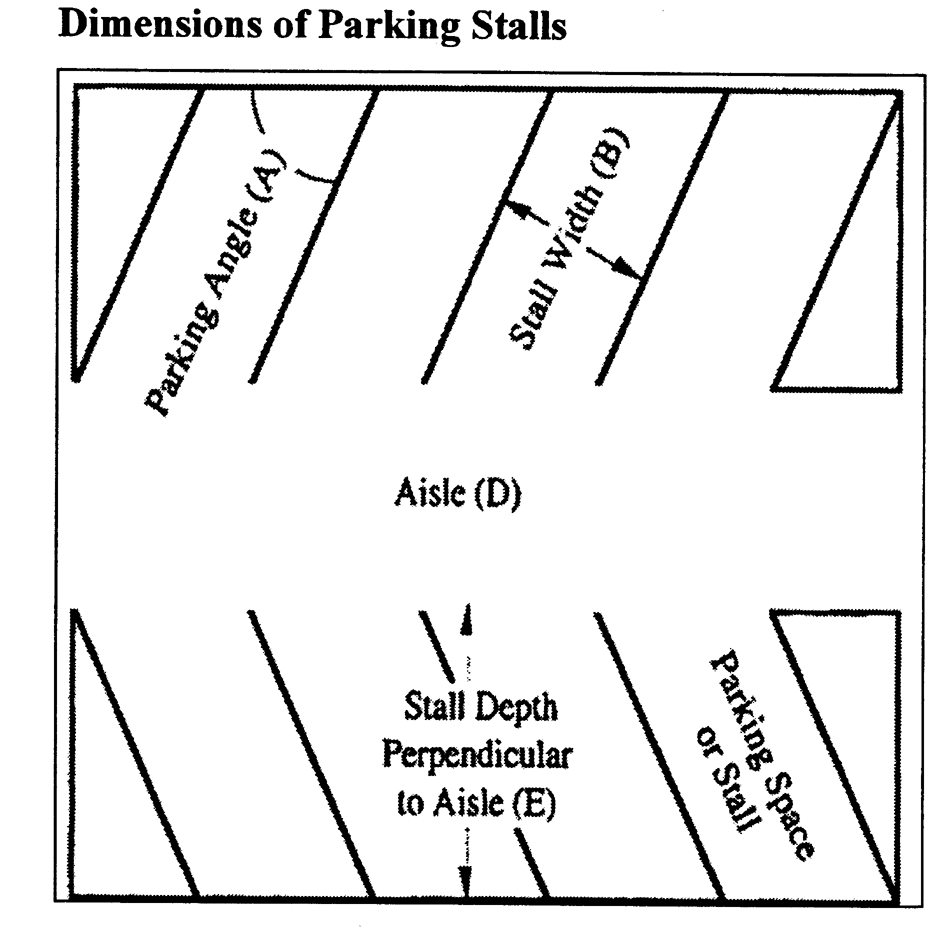
Parking Stalls
(2)
Parallel parking spaces shall be a minimum of eight feet wide and 22 feet and six inches long.
(3)
Handicap-accessible spaces. Handicap-accessible parking spaces shall be a minimum of eight feet in width by 19 feet in length and shall be located adjacent to a paved accessible aisle or walkway at least 60 inches in width. If the accessible walkway is at an elevation different from the elevation of the parking space, a 1:6 slope ramp shall be provided up to the walk. An aisle, having a width of not less than three feet shall be from the handicap-accessible spaces to the building entrance.
(4)
Van-accessible spaces. Van-accessible parking stalls shall have a minimum width of eight feet and a minimum length of 19 feet. Each van-accessible space shall be adjacent to a passenger loading aisle that is a minimum use of eight-foot wide leading to an accessible aisle or walkway at the front of the parking spaces that is a minimum of three feet wide leading to the closest building entrance.
(5)
Signage. Handicap-accessible parking spaces and van-accessible parking spaces shall be identified by signs meeting the requirements of the ADA Accessibility Guidelines and the MUTCD (Manual on Uniform Traffic Control Devices).
(c)
Paving materials for parking lots.
(1)
All parking areas shall be paved with asphalt, concrete or pervious materials approved by the director. Recommended pervious paving materials include those described in Volume 2—Technical Handbook of the Georgia Stormwater Management Manual (First Edition, August 2001) as the Porous Concrete or Modular Porous Paver Systems under the Limited Application Stormwater Structural Controls.
(2)
Paving areas shall be of sufficient size and strength to support the weight of service vehicles.
(Ord. No. 0-2006-32, §§ 1—3, 11-28-2006)
Sec. 222-8. - Driveways.
(a)
Parking areas shall provide an adequate ingress and egress with a minimum vertical clearance of 14 feet and a driveway grade no greater than five percent.
(b)
Driveways entering public streets must be designed as follows:
(1)
No driveway curb cut may be located closer than 75 feet from the extended curb line of an intersecting street.
(2)
Except for driveways that are restricted to right-in/right-out access only, no driveway curb cut may be located opposite an exclusive left turn lane that serves an adjacent intersection.
(3)
Except for driveways that are restricted to right-in/right-out access only, the minimum spacing between driveways along the same side of an arterial or major collector street shall be as follows:
(4)
The centerline of driveway curb cuts located on public streets that are not divided by a raised median should be aligned with the driveways on the opposite side of the street where feasible. Driveways intersecting a public street that are not aligned with an opposing driveway or street shall be offset by a minimum of least 125 feet from a driveway or street on the opposite side of the street.
(Ord. No. 0-2006-32, §§ 1—3, 11-28-2006)
Sec. 222-9. - Landscaping in parking lots.
(a)
Parking lots shall be designed with landscape areas, in accordance with section 328-21.
(b)
Where the parking lot fronts a public street or public right-of-way, trees preserved or planted in the perimeter planting strip may be used to meet the parking lot planting requirement.
(c)
Landscaped median islands in parking lots shall be constructed as stormwater bioretention areas with a grade level that is recessed at least four inches below the grade of the adjacent paved surfaces. Curbs separating recessed landscaped median islands from parking areas shall be either flush with the paved surface or notched at intervals of four feet to allow stormwater runoff to pass through them into the landscaped areas for bioretention.
(d)
Landscape materials in median islands shall be selected to be compatible with the bioretention function of the landscaped areas, and adequate drainage shall be provided for the chosen species. Recommended plant species are listed in this subsection. Additional appropriate species are listed in the Georgia Stormwater Management Manual, Volume 2, Appendix F, Table F.5 on page F-23.
Approved Plant Species for Bioretention Areas in Parking Lots
Source: Georgia Stormwater Manual, Volume 2, Appendix F, Table F-4, page F-20.
(Ord. No. 0-2006-32, §§ 1—3, 11-28-2006)
Sec. 222-10. - Lighting in parking lots.
(a)
If parking and loading areas are to be used at night, they shall be properly illuminated for the safety and security of pedestrians and vehicles.
(b)
Lighting shall be designed to preclude light spillover on to adjacent properties. Parking areas abutting residential uses shall use only cut-off luminary fixtures mounted in such a manner that its cone of light is directed internally and does not cross any property line of the site.
(c)
Only incandescent, florescent, metal halide or color-corrected, high-pressure sodium may be used. The same type of lighting must be used for the same or similar types of lighting on any one site.
(Ord. No. 0-2006-32, §§ 1—3, 11-28-2006)
Sec. 222-11. - Parking vehicles in residential districts.
(a)
In any residential zoning district except as otherwise provided in this section, it shall be unlawful for any person to park or stand any commercial vehicle as defined in section 106-1 unless such vehicle is engaged in loading or unloading. Trailers, mobile homes, motorized homes, boats, boat trailers and utility trailers are exempt from this paragraph. For purposes of this section, trailers are defined as vehicles with or without motive power, designed for carrying persons or property and for being drawn by motor vehicles and so constructed that no part of its weight rests upon the towing vehicle.
(b)
In any residential district, the parking of any vehicle shall be within a garage, driveway, or carport or within a side or rear yard, except for moving vans that are loading and unloading. The parking of any commercial vehicle as defined in section 106-1, shall be prohibited unless otherwise authorized by this section.
(c)
Disposition of commercial vehicles in residential districts. The county is authorized to remove and dispose of any commercial vehicle in a residential district, notwithstanding the fact that such vehicle may be located on private property. No such vehicle shall be disposed of in less than 30 days from the time the commercial vehicle is removed. Prior to the disposal of such vehicle and if such vehicle is affixed with a current license tag, the current owners and lienholders of the motor vehicles shall be identified by a records search in the state department of revenue; and upon the identification of the owners and lienholders, they shall be notified of the pending disposal by registered or certified mail, return receipt requested.
(d)
Enforcement.
(1)
Enforcement of this article shall be the responsibility of the code enforcement officers of the department of planning and development or any Rockdale County Sheriffs deputy.
(2)
When a motor vehicle is deemed to be a commercial vehicle in violation of this Code by an authorized enforcement officer, such officer may issue a written warning notice to the parties owning or in apparent possession of the commercial vehicle, or the owner of the property upon which the motor vehicle is located, to remove the vehicle within five days. If the owner or person in apparent possession of the vehicle is not ascertainable, written notice may be given by attaching such notice to the vehicle. Written notice to the property owner shall be by certified mail to the address listed in Rockdale County property tax records. If the commercial vehicle is not removed within five days, the owner of the motor vehicle or the owner of the land on which it is located shall be issued a citation. If a commercial vehicle is found in violation on the property of an owner who has been cited within the past 12 months for the same offense, then the authorized enforcement officer may immediately issue a citation to the parties owning or in apparent possession of the motor vehicle, or the owner of the property upon which the motor vehicle is located.
(3)
Each and every day that any such violation exists shall be deemed a separate offense.
(4)
The county may tow the vehicles, at the owner's expense, if not removed within five days of the notice.
(Ord. No. 0-2006-32, §§ 1—3, 11-28-2006; Ord. No. 0-2016-13, § 1, 9-27-2016; Ord. No. O-2022-08, § IV, 4-12-2022; Ord. No. O-2024-33, § I, 12-10-2024)

