
Rockingham County Unincorporated
City Zoning Code
City Zoning Code
ARTICLE VII
DEVELOPMENT STANDARDS
Sec. 17-700.- Definition.
The following standards further the intent and basic objectives of the comprehensive plan and protect public health, safety, and general welfare. These standards shall be met unless otherwise excepted. Bonding may be required for any improvements.
(P.C. Ord. No. 14-03, 9-24-14)
Sec. 17-700.01. - Area types.
For purposes of this article, the following area types shall determine the design requirements that apply where stated.
(a)
Compact area type:
(1)
Village Center of the Planned Resort district (R-4);
(2)
Neighborhood Center of the Planned Neighborhood district (R-5);
(3)
Mixed-use Core of the Mixed Use district (MXU);
(4)
The Planned Multifamily district (PMF);
(5)
The Planned Commercial Development district (PCD);
(6)
Any mixed-use area in any planned district.
(b)
Suburban area type:
(1)
Planned Resort district (R-4) not within the Village Center;
(2)
Planned Neighborhood district (R-5) not within the Neighborhood Center;
(3)
Residential Neighborhood of the Mixed Use district (MXU);
(4)
Rural Village district (RV);
(5)
Low-Density Residential district (R-1);
(6)
Medium Density Residential district (R-2);
(7)
General Residential district (R-3);
(8)
General Business district (B-1);
(9)
Neighborhood Business district (B-2);
(10)
Planned Growth district (PG);
(11)
Planned Single-Family district (PSF);
(12)
Planned Manufactured Home Park district (MHP);
(13)
Planned Medical and Research District (PMR);
(14)
Planned Industrial District (PID).
(c)
Rural area type:
(1)
Prime Agricultural district (A-1)
(2)
General Agricultural district (A-2);
(3)
Residential or Recreational district (RR-1);
(4)
Mixed Home district (MH-1);
(5)
Industrial district (I-1);
(6)
Public Service district (S-1).
(7)
Business Interchange district (BX).
(P.C. Ord. No. 14-03, 9-24-14; P.C. Ord. No. 17-27, 9-27-17; P.C. Ord. No. 21-10, 9-22-21)
Sec. 17-700.02. - Common area.
(a)
Common area requirements in planned development zoning districts shall be met with a combination of indoor and outdoor space used for enjoyment by all residents, customers, or employees within the development.
(b)
Indoor space includes, but is not limited to, gyms, weight rooms, indoor swimming pools, indoor athletic courts, roof gardens, enclosed gardens, and other indoor recreational areas.
(c)
At least seventy-five (75) percent of the common area shall be outdoor space, which shall include all utility easements and a combination of any of the following:
(1)
Courtyards, plazas, or greens designed and configured as urban design features with spatially defined edges;
(2)
Grassy areas and trees;
(3)
Landscaped areas and landscaped islands in parking lots;
(4)
Wooded, natural areas;
(5)
Multi-purpose trails, walkways, pedestrian paths through natural areas;
(6)
Benches and gazebos;
(7)
Water features and fountains;
(8)
Playgrounds, swimming pools, and athletic courts.
(9)
sidewalks and easements;
(10)
Terrain with less than twenty-five (25) percent grade.
(d)
A stormwater management area shall be counted as common area if approved by the stormwater management program administrator.
(P.C. Ord. No. 14-03, 9-24-14)
Sec. 17-700.03. - Ownership.
(a)
At the time of rezoning approval, all community property, including common area, private streets, and any undeveloped land, shall be under unitary ownership or under unified control.
(b)
Organization: A property owners' association (POA) shall be established to own, care and maintain all common areas and other common improvements. Projects encompassing a single parcel shall be exempt from this requirement.
(1)
The applicant or a designee shall prepare documents which provide at a minimum that the POA shall accept title to any community property, including common area, private streets, common improvements and undeveloped land.
(2)
The documents shall establish voting and use rights and shall provide for the collection of dues, levies, or assessments to cover expenses including, but not limited to, tax liabilities, maintenance, insurance, and municipal or state assessments. The POA shall have the authority to acquire a lien upon the property of any of its members in order to secure collection of any amounts due. A residential POA and a commercial POA may be established within the same district.
(c)
Ownership and maintenance of common areas and other common improvements; general requirements:
(1)
Ownership: All common areas and common improvements shall be dedicated to the POA. No land within privately owned lots shall be considered common areas.
(2)
Common improvements may include, but are not limited to, any of the following: sidewalks, curbs, gutters, culverts and other drainage facilities, stormwater management facilities and private streets.
(3)
Covenants: All POAs shall be created by covenants and restrictions recorded among the land records of the county. All such covenants shall include provisions for the maintenance of common areas and common improvements.
(d)
If private ownership, including a POA, fails to function as required by the bylaws and covenants, the county is authorized to maintain any of the community property and/or improvements and assess the private ownership accordingly. The costs to maintain any of the common areas and/or improvements maintained by the county shall be recovered from the property owners in the form of a tax lien if not paid by owner.
(P.C. Ord. No. 14-03, 9-24-14; P.C. Ord. No. 19-02, 1-23-19; P.C. Ord. No. 25-00, 12-11-24)
Sec. 17-701. - Streets.
Streets shall be coordinated with the existing or planned streets shown on an approved subdivision plat, approved general development plans, current master plans, and with the major transportation network shown in the comprehensive plan or any other plan adopted by the county.
(P.C. Ord. No. 14-03, 9-24-14; P.C. Ord. No. 19-02, 1-23-19)
Sec. 17-701.01. - Street names.
(a)
Streets shall be named according to the established procedures set forth in the Road/Street and Subdivision Naming Manual, as amended.
(b)
Temporary street identification signs shall be placed at each intersection by the developer prior to any construction beginning in the subdivision. The developer shall contact the agent when temporary signs have been erected. No building permits shall be issued within a subdivision prior to verification by the agent that the signs have been erected. Developer shall be responsible for keeping these signs in place until such time as permanent signs are erected.
(c)
Permanent signs conforming to standard county specifications shall be erected by the county at the developer's expense, and the developer shall pay the county for the cost of the signs prior to the agent signing the final plat. If the cost of signs increases, and the funds paid by the developer to the county are insufficient to cover the cost of the signs, the developer shall pay the additional funds prior to the bond being released by the county.
(P.C. Ord. No. 14-03, 9-24-14; P.C. Ord. No. 19-02, 1-23-19)
Sec. 17-701.02. - Public streets.
(a)
All public streets shall comply with all VDOT regulations and shall become part of the VDOT state-maintained system.
(b)
In the R-1, R-2, and R-3 zoning districts, all streets shall be public streets and parcels must front on a public street, except apartment structures and rowhouses in the R-3 zoning district may front on either a public or private street.
(1)
If an apartment structure or rowhouse lots have frontage on a public street, access from the public street to the parking lot may be by a private access easement meeting the requirements of fire department access roads as outlined in the Rockingham County Fire Prevention Code and comply with VDOT regulations.
(2)
In manufactured home parks in the MH-1 zoning district, no streets shall be public streets. In mixed home subdivisions in the MH-1 zoning district and in all other zoning districts, streets may be public streets or private streets.
(c)
Application to have a street accepted into the state secondary highway system shall be completed by the developer and submitted to the county and VDOT no earlier than after the county has issued a certificate of occupancy for at least three (3) structures addressed on said street and no later than after the county has issued certificates of occupancy for seventy-five (75) percent of the structures addressed on said street. The process shall be the same for each street within the development or subdivision in which the developer seeks acceptance into the state secondary highway system.
(P.C. Ord. No. 14-03, 9-24-14; P.C. Ord. No. 16-06, 1-27-16; P.C. Ord. No. 19-02, 1-23-19)
Sec. 17-701.03. - Private streets.
(a)
In manufactured home parks in the MH-1 zoning district, all streets shall be private streets. In the R-1 and R-2 zoning districts, no streets shall be private streets. In the R-3 zoning district all streets shall be public streets, except that parcels containing apartment structures and rowhouses may front on a either a public or private street. In all other zoning districts, streets may be public streets or private streets.
(1)
All private streets in the RR-1 zoning district shall meet the requirements of article VII, with the exception of those requirements in direct conflict with those requirements under section 17-305. In such case, the requirements of section 17-305 shall control.
(2)
All private streets in the MH-1 zoning district shall meet the requirements of article VII, with the exception of those requirements in direct conflict with those requirements under section 17-309. In such case, the requirements of section 17-309 shall control.
(b)
Private streets shall not exceed the maximum grades for local rural roads as defined in the AASHTO manual. Fire and Rescue shall inspect any private streets with grades greater than fifteen (15) percent grade.
(c)
All private streets shall be paved and constructed according to VDOT standards and specifications.
(d)
Sight distances for all intersections and entrances shall conform to VDOT regulations.
(e)
Private streets shall be constructed to ensure proper drainage and adequate base and surface construction capable of supporting imposed loads or fire apparatus as required in chapter 8, fire and protection.
(f)
Private streets shall be the responsibility of the developer to construct and maintain until such time as maintenance responsibility is legally passed to a property owners' association. Private streets shall be fully constructed at the time maintenance responsibility is transferred.
(g)
For the purpose of this chapter, "maintenance of the road" shall be deemed to mean maintenance of the streets, curb, gutter, ditches, stormwater management facilities, utilities, street signs, or other street improvements, including the correction of defects or damages, so as to keep such road open for public usage.
_____
Table 17-701.03. Minimum Private Street Requirements
*Traffic volumes exceeding 4,000 ADT or serving heavy commercial or industrial traffic shall comply with the appropriate VDOT Geometric Design Width Standard.
**If not designated as a fire lane, and where parking is prohibited on one or both sides of a private street, the developer, property owners' association (POA), or managing entity shall install and maintain clearly visible "No Parking" signs at a maximum separation of seventy-five (75) feet or other intervals as approved by the Zoning Administrator.
_____
(h)
No streets shall be constructed with a curvature radius of less than one hundred (100) feet measured at the center line.
(i)
Shoulders shall be constructed to the same specifications as the street.
(j)
Wherever possible, private streets shall intersect private streets at right angles, Private streets shall intersect private streets at angles of not less than sixty (60) degrees, unless approved by the zoning administrator. Intersection curb radii may be twenty-five (25) feet minimum for minor streets, and thirty-five (35) feet minimum for major streets.
(k)
The intersection of a private street with a public street shall conform to VDOT standards and regulations.
(l)
All alleys shall be private and shall meet the standards for private streets with the following exceptions:
(1)
Alleys may be permitted for residential and service vehicle access only. Alleys shall have a pavement width of no less than ten (10) feet. No on-street parking shall be permitted on the alley.
(2)
Alleys constructed in a development project shall be designed and constructed based on sound engineering principles to be practical and functional and shall be certified as such by an engineer.
(P.C. Ord. No. 14-03, 9-24-14; P.C. Ord. No. 16-23, 6-8-16; P.C. Ord. No. 19-02, 1-23-19; P.C. Ord. No. 25-06, 4-23-25)
Sec. 17-701.04. - Connectivity.
(a)
To facilitate the appropriate movement of pedestrian and automobile traffic, the roads and streets in each development project shall provide sufficient connections in multiple directions, to multiple properties, and, if applicable, to local and higher order roadways.
(b)
Proposed streets shall be constructed to the boundary line of every adjoining property where an existing street terminates at the property line, where a future street is planned to terminate at the property line, and to multiple directions within urban growth areas designated in the comprehensive plan or any other plan adopted by the county.
(c)
In the compact area, streets shall be interconnected in a system of blocks. Not more than twenty (20) percent of the total number of blocks in the project may exceed a total of two thousand (2,000) feet in total perimeter length, measured from the centerline of the street.
(d)
In the suburban area, networks of streets, sidewalks, and multi-use paths shall provide direct pedestrian movement throughout the development and to adjoining property.
(e)
In the rural area, roadways shall provide connections to adjoining properties or streets in varying directions.
(f)
Road construction may be phased, but connectivity requirements shall be met at full build-out.
(g)
Exceptions.
(1)
The connectivity standards may be reduced by the zoning administrator where elements or characteristics such as, but not limited to the following, exist:
a.
Railroad tracks;
b.
Limited access highway;
c.
A navigable waterway or a standing body of water;
d.
Jurisdictional wetlands;
e.
Terrain grades in excess of twenty (20) percent;
f.
Government-owned property with restrictions upon development such as military installations; parks, as defined, and in existence prior to the submission of the development proposal for the network addition; and land under conservation easements recognized by the county; and
g.
Security purposes.
(P.C. Ord. No. 14-03, 9-24-14; P.C. Ord. No. 19-02, 1-23-19; P.C. Ord. No. 24-08, 9-25-24)
Sec. 17-701.05. - Dead-end streets, public and private.
(a)
All dead-end streets shall terminate in a VDOT approved cul-de-sac that meets the standards of the VDOT Road Design Manual and is approved by the fire marshal.
(b)
Dead-end streets shall not be less than two hundred (200) feet in length.
(c)
The length shall be measured from the end of the cul-de-sac to the closest intersection, which provides a means of egress from the development project, either directly or indirectly (see figure 1).
(d)
Dead-end streets shall connect to a through street that provides a direct means of egress (see figure 1).
Figure 1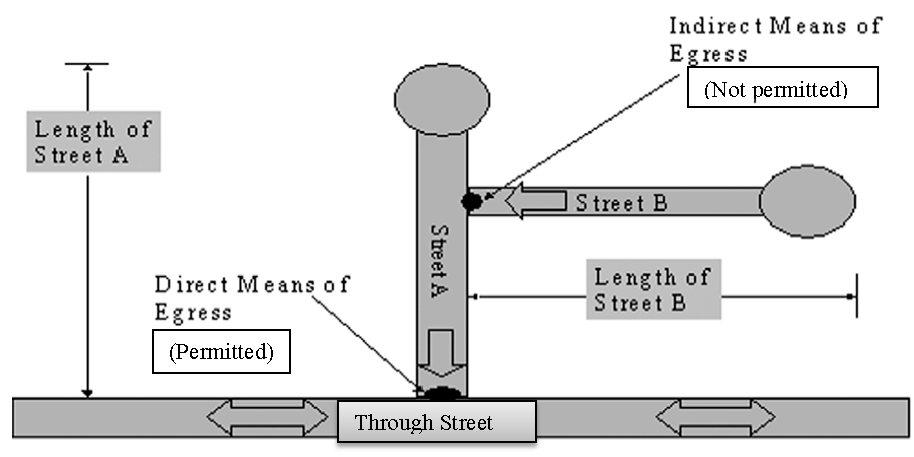
(e)
Dead-end streets greater than eight hundred (800) feet in length shall be allowed if the following conditions are met:
(1)
Approval in writing, by the fire marshal, VDOT, and director of public works;
(2)
An easement from the turnaround to another street to provide a looped water system or the system is otherwise looped, unless otherwise approved by the director of public works.
(P.C. Ord. No. 14-03, 9-24-14; P.C. Ord. No. 17-15, 6-28-17; P.C. Ord. No. 19-02, 1-23-19)
Sec. 17-701.06. - Bicycle and pedestrian accommodations.
(a)
The design and development of the transportation infrastructure shall improve conditions for bicycling and walking. The design of facilities for bicyclists and pedestrians shall follow the current design guidelines and standards that are commonly used, such as the AASHTO Guide for the Development of Bicycle Facilities, AASHTO's A Policy on Geometric Design of Highways and Streets, and the ITE Recommended Practice "Design and Safety of Pedestrian Facilities."
(1)
The design and construction of new facilities should anticipate likely future demand for bicycling and walking facilities and not preclude the provision of future improvements. For example, a bridge that is likely to remain in place for fifty (50) years, might be built with sufficient width for bicycle and pedestrian facilities in anticipation that facilities will be available at either end of the bridge even if that is not currently the case.
(2)
The design of intersections and interchanges shall accommodate bicyclists and pedestrians in a manner that is safe, accessible, and convenient. Even where bicyclists and pedestrians may not commonly use a particular travel corridor that is being improved or constructed, they will likely need to be able to cross that corridor safely and conveniently.
(b)
In new construction and reconstruction projects in all areas inside all urban growth boundaries as designated in the comprehensive plan or any other plan adopted by the county, provision shall be made for sidewalks and other pedestrian facilities which will enable pedestrians to navigate safely and conveniently between the various functional areas of the project. Facilities shall be coordinated to access existing and planned pedestrian facilities on adjoining properties.
(1)
In no case shall the street pavement serve as a pedestrian walkway.
(2)
In compact areas, pedestrian accommodations shall be provided along both sides of the street, or provisions made that provide equivalent pedestrian mobility.
(3)
In suburban areas, pedestrian accommodations shall be provided along at least one (1) side of the street, or provisions made that provide equivalent pedestrian mobility.
(4)
In rural areas within any urban growth area, pedestrian accommodations shall be provided for employees to walk to and from motor vehicle and any bicycle parking areas. The pedestrian accommodations shall be separated from vehicular traffic, and shall create extensions for and connections between adjoining compact or suburban areas.
(5)
Within one-half (½) mile, measured at the centerline of the roadway, of a public school, pedestrian accommodations shall be provided along at least one (1) side of the street, or provisions made that provide equivalent pedestrian mobility, along roadways.
(6)
When connecting to a stub street that has pedestrian accommodations, the new street shall also include pedestrian accommodations.
(7)
Sidewalks and multi-purpose trails shall provide internal connections throughout the development project and external connections to existing sidewalks or multi-purpose trails and to adjacent residential neighborhoods and commercial development projects. At a minimum, sidewalks shall comply with VDOT secondary street acceptance standards.
(8)
All sidewalks shall be comprised of three (3) distinct zones.
a.
Pedestrian zone. All sidewalks shall provide a clear, unencumbered path of no less than five (5) feet in width for the movement of pedestrian traffic.
b.
Frontage zone. All sidewalks shall provide a minimum frontage of two (2) feet in width between the pedestrian zone and any building or structure. Outdoor display and/or outdoor seating may occupy the frontage zone but shall not encroach upon the pedestrian zone.
c.
Buffer zone. All sidewalks shall provide a minimum buffer of three (3) feet in width between the pedestrian zone and vehicle zone when no street tree is planted within the buffer, and a minimum of six (6) feet in width when a street tree is planted within the buffer. Street furniture, signs, and vegetation may occupy the buffer zone but shall not encroach upon the pedestrian zone. Curb width may count toward the minimum buffer zone width, but gutter width shall not.
1.
In the compact area, no less than seventy (70) percent of the buffer zone shall be hardscape.
2.
In the suburban area, no less than seventy (70) percent of the buffer zone shall be vegetative ground cover.
(9)
Sidewalks, multi-purpose trails, street crossings (including over- and under-crossings), pedestrian signals, signs, street furniture, transit stops and facilities, and all connecting pathways shall be designed, constructed, operated, and maintained so that all pedestrians, including people with disabilities, can travel safely and independently.
(10)
All crosswalks for sidewalks and multi-purpose trails shall be distinguished from driving surfaces through the use of durable, low-maintenance, surface materials such as pavers, bricks, or scored concrete.
(c)
In new construction and reconstruction projects in all areas inside all urban growth boundaries as designated in the comprehensive plan or any other plan adopted by the county, provision shall be made for bicycle facilities which will enable non-motorized vehicles to navigate safely and conveniently between the various functional areas of the project. Facilities shall be coordinated to access existing and planned bicycle facilities on adjoining properties.
(1)
Outside of the urban growth areas, paved shoulders shall be included in all new construction and reconstruction projects on roadways used by more than one thousand (1,000) vehicles per day and constructed to current VDOT standards.
(2)
Rumble strips are not recommended where shoulders are used by bicyclists unless there is a minimum clear path of four (4) feet in which a bicycle may operate.
(3)
Where bicyclists and pedestrians are prohibited by law from using the roadway, accommodations shall be placed elsewhere within the right-of-way or within the same transportation corridor.
(4)
Multi-purpose trails shall be no less than ten (10) feet in width.
(5)
A street's vehicular lanes shall not serve as a multi-purpose trail.
(6)
When connecting to a stub street that has bicycle accommodations, the new street shall also include bicycle accommodations.
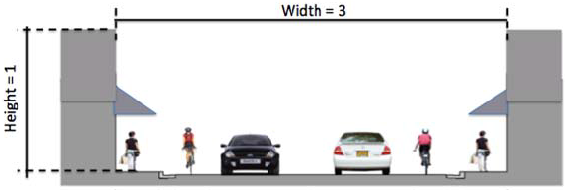
Figure 17-701.07. Street Form.
(d)
The landscaping adjacent to sidewalks and multi-purpose trails shall be planned and maintained so as to allow good, natural surveillance.
(P.C. Ord. No. 14-03, 9-24-14)
Sec. 17-701.07. - Street form.
(a)
Building facades visible from any public or private street and greater than one hundred fifty (150) feet in length, measured horizontally, shall be broken into smaller planes of thirty (30) to fifty (50) feet in width by incorporating landscaping, wall plane projections or recesses, arcades, display windows, entry areas, awnings, and other similar features adding visual interest.
(b)
Roof lines shall be varied through the use of landscaping, overhanging eaves, parapets, pop-outs, entrance features, or height variations.
(c)
Compact area.
(1)
Buildings in the compact area shall be configured so as to create a perception of spatial enclosure between the front facades of buildings facing each other across the street. To achieve this, a minimum of 60% of the total linear street frontage of any given block shall have a height-to-width ratio of at least 1:3. See figure 17-701.07, street form. The width of medians with street trees, in accord with section 17-703.02, street landscaping, may be discounted from the horizontal distance between building facades.
(2)
Buildings in the compact area shall adhere to a pedestrian scale by segmenting building facades into vertical elements, which respect a human scale. This may be accomplished by incorporating street level doors and entrances, shopping gallery windows, awnings, and other such features.
(3)
Non-residential uses in the compact area shall be on the first floor and may be allowed on upper floors. Residential uses shall be allowed on all floors of a commercial building except the first floor. Building entryways to residential units shall be independent of those serving commercial uses.
(d)
Variations to the minimum standards for all elements of street design and any related features such as blocks, alleys, easements, and sidewalks, may be approved by the board of supervisors on a case-by-case basis when:
(1)
The proposed alternative would better achieve the walkable, pedestrian-oriented environment the county desires in areas identified in the comprehensive plan or in appropriate zoning districts,
(2)
The particular conditions of the site and surrounding street network would allow the proposed alternative without causing undue inefficiencies for service vehicles, nor unintended pedestrian safety concerns due to pedestrian-vehicle movement conflicts.
(3)
The proposed alternative would better balance the needs of pedestrians and vehicles, and better achieve the goals of the comprehensive plan.
(4)
Meeting the minimum requirements would be impossible due to extreme topography or other similar existing impediments.
(P.C. Ord. No. 14-03, 9-24-14)
Sec. 17-702.01. - On-street parking.
(a)
Compact areas and suburban areas shall accommodate on-street parking. Street design that anticipates limited or no on-street parking shall require sufficient off-street parking to meet the requirements listed below. On-street parking shall only count once toward the required minimum parking spaces for any adjacent land use.
(b)
Parallel parking. Narrow rights-of-way may utilize parallel parking to provide an additional barrier between pedestrians and vehicular traffic. Parallel parking lanes shall abut curbs, with bicycle lanes adjacent to vehicle travel lanes.
(c)
Reverse-angle parking. Where available, angle parking can provide more parking spaces per centerline mile than parallel parking. However, angle parking usually demands parked cars backing into the flow of traffic. Alternatively, reverse-angle parking requires drivers to back into spaces and pull forward into the flow of traffic.
(d)
Perpendicular parking. Ninety-degree parking shall not be permitted for on-street parking.
(P.C. Ord. No. 14-03, 9-24-14)
Sec. 17-702.02. - Off-street parking.
Off-street motor vehicle parking shall be provided for any permitted or special use established in accordance with this chapter.
(P.C. Ord. No. 14-03, 9-24-14)
Sec. 17-702.03. - General parking requirements.
(a)
For the purpose of this chapter, general requirements are specified in Table 17-702.03.
_____
Table 17-702.03. General Parking Space Requirements.
_____
(b)
Minimum width of traffic aisles in parking lots for two-way traffic shall be twenty-four (24) feet. Additional width may be required for emergency vehicle access, if needed.
(c)
All parking facilities shall be maintained with pavement; concrete; gravel; or dust-proof, pervious surface as approved by the zoning administrator.
(d)
Landscaping shall be provided and maintained in compliance with section 17-703, landscaping.
(e)
Parking spaces shall be set back a minimum of ten (10) feet from roads.
(f)
Parking facilities shall be designed with visible boundaries to prevent vehicles from parking outside the limits of the parking facility.
(P.C. Ord. No. 14-03, 9-24-14; P.C. Ord. No. 15-15, 4-22-15)
Sec. 17-702.04. - Non-standard parking requirements.
(a)
Compact car parking spaces.
(1)
The zoning administrator may allow a maximum of twenty (20) percent of the total number of spaces to be compact car spaces in any parking facility with greater than twenty (20) spaces, if the use of compact car spaces would not substantially reduce the overall safety, ease of ingress and egress, or efficiency of the layout of parking spaces.
(2)
For parallel parking, compact car parking spaces shall be eight (8) feet, six (6) inches wide and sixteen (16) feet long and shall be permanently designated, with appropriate sign(s), for use by compact cars only.
(b)
Motorcycle parking spaces.
(1)
The zoning administrator may allow a five-percent reduction in minimum required parking spaces in any parking facility with greater than twenty (20) spaces if at least two (2) motorcycle parking spaces are provided.
(2)
For parallel parking, motorcycle parking spaces shall be four (4) feet wide by eight (8) feet long and shall be permanently designated, with appropriate sign(s), for use by motorcycles, motor scooters, or other similar licensed vehicles.
(c)
Tractor trailer parking spaces shall be a minimum of twelve (12) feet wide and seventy (70) feet long, with a minimum height clearance of fourteen (14) feet.
(d)
Bicycle parking spaces.
(1)
Parking facilities with fifteen (15) or greater car parking spaces, located within any urban growth area designated in the comprehensive plan or any other plans adopted by the county shall provide parking for one bicycle per twenty-five (25) car parking spaces, with a minimum of four (4) bicycle parking spaces. For example, a fifteen-space parking lot shall have a minimum of four (4) bicycle parking spaces
(2)
Bicycle parking spaces shall be in the form of a suitable bike rack(s) conveniently located, visible, and anchored for security. Bike racks may be located near building entrances, rather than within the parking lot. Protection from the elements is encouraged. Rack design and layout shall be as recommended in the document, "Bicycle Parking Guidelines," as adopted by the Association of Pedestrian and Bicycle Professionals. Rack location and type shall be specified on the site plan.
(e)
Handicapped accessible parking spaces shall comply with current ADA Standards for Accessible Design outlined by the U.S. Department of Justice Civil Rights Division.
(P.C. Ord. No. 14-03, 9-24-14; P.C. Ord. No. 22-04, 2-23-22)
Sec. 17-702.05. - Parking requirements by use.
(a)
In the compact area:
(1)
Parking shall be around the sides and/or rear of buildings in order to reduce expansive parking areas at street view. No more than twenty-five (25) percent of the parking for any building or group of buildings shall be located between the front building façade and its addressed street.
(2)
Alley access to employee and resident parking and trash pick-up is encouraged.
(b)
Parking spaces shall be provided for all dwellings. Where on-street parking on public streets is not provided, off-street parking shall be provided on the same lot as the dwelling.
(1)
Parking for rowhouses shall be located within the rowhouse development and not more than one hundred fifty (150) feet from a rowhouse.
(2)
If off-street parking cannot reasonably be provided on the same lot as the dwelling, such space may be provided on other off-street property, provided such space lies within one hundred fifty (150) feet of the property line of the dwelling.
(c)
In the case of a use not specifically mentioned below, the required parking spaces for a use, which is mentioned and is similar, as determined by the zoning administrator, shall apply. If a similar use is not determined, the applicant shall provide the number of required parking spaces based on national or sound engineering practices.
(d)
In the case of mixed uses, the total requirements of the various uses computed separately from table 17-402.05, parking requirements by use shall be required, unless otherwise shown by a shared parking arrangement, approved by the zoning administrator.
(e)
When a change in use, change in number of employees, an increase in floor area, or a change in any other unit of measurement specified below increases the required number of parking spaces, additional parking spaces shall be provided to meet the new required minimum. If a change increases the required number of parking spaces by less than five (5) parking spaces, no additional parking spaces shall be required.
(f)
Area reserved for off-street parking, in accordance with the requirements of this chapter, shall not be reduced in size, encroached upon, or changed to any other use unless the use which it serves is discontinued or modified.
_____
Table 17-702.05. Parking Requirements by Use.
(P.C. Ord. No. 14-03, 9-24-14; P.C. Ord. No. 15-46, 10-28-15; P.C. Ord. No. 21-15, 10-27-21)
_____
Sec. 17-702.06. - Overflow parking.
Where requested, the applicant may propose that a portion of their required parking, based on the use, be designated as overflow parking. Overflow parking shall not constitute more than fifty (50) percent of the required parking for any use. The overflow parking shall be constructed of an alternative all-weather, permeable surface, such as grass pavers, soundly engineered, and must be constructed and designated in a manner that is easily identifiable to the public.
(P.C. Ord. No. 14-03, 9-24-14)
Sec. 17-702.07. - Shared parking.
For shared parking, supporting documentation and a plan for parking shall be submitted as a part of the site plan. Supporting documentation may include, but is not limited to, such items as use-specific parking needs, pedestrian-and bicycle-use statistics, hours of operation, number of employees, off-site employee parking, alternating hourly- or seasonal-use parking, availability of general-use parking areas, shuttle services provided, and mass transportation availability.
(P.C. Ord. No. 14-03, 9-24-14; P.C. Ord. No. 16-07, 1-27-16)
Sec. 17-702.08. - Off-street loading and unloading space.
(a)
Size of off-street loading spaces. Each off-street loading space shall have minimum dimensions of fourteen (14) feet in height, twelve (12) feet in width, and fifty (50) feet in length.
(b)
Connection to road or street.
(1)
Each required off-street loading space shall have direct access to a road or street or have a driveway which offers satisfactory ingress and egress for trucks.
(2)
Documentation shall be provided to ensure adequacy of ingress and egress from the off-street loading spaces, to include, at a minimum, turning radius overlays.
(c)
For each hospital, hotel, or commercial or industrial building requiring receipt or distribution of materials or merchandise one (1) off-street loading space, which may be shared by other establishments, shall be provided. All required off-street loading spaces shall be located on the same lot as the building for which they are primarily intended to serve.
(d)
Off-street loading spaces shall be appropriately placed so as not to interfere with the safe movement of pedestrians and vehicles over any travel way.
(e)
Space shall be provided to accommodate the maximum number of buses or trucks to be stored or to be loaded at the bus terminal or truck terminal at any one (1) time.
(f)
Documentation showing adequacy in the number and size of spaces, with reference to national standards, shall be submitted with the site plan.
(g)
Area reserved for off-street loading in accordance with the requirements of this chapter shall not be reduced in area or changed to any other use unless:
(1)
The use which is served is discontinued or modified; or
(2)
Equivalent loading space is first provided that meets the requirements herein.
(P.C. Ord. No. 14-03, 9-24-14)
Sec. 17-703.01. - Landscape plan.
(a)
A landscape plan submitted in accordance with the provision of this section and approved by the zoning administrator shall be required for any use or development for which a site plan is required by article X, procedures.
(b)
The landscape plan shall show the following information:
(1)
Location of all property lines, rights-of-way, utility easements, proposed and existing buildings and structures, common areas, sidewalks and trails, parking areas, vehicle circulation areas, loading and unloading spaces, and site ingress and egress, taking into consideration traffic hazards;
(2)
All applicable requirements of this article for tree planting, landscaping, treatment of setbacks, buffers, and screening;
(3)
The general location and character of any landscaping, fences, walls, retaining walls, berms, stormwater retention, and other significant landscaping features;
(4)
Existing topography and final grading in accordance with specifications required for site plan submission in article X, procedures;
(5)
Existing mature tree growth and natural landforms on the site shall be preserved to the maximum extent possible and shall be shown on the plan;
(6)
Any additional information deemed necessary by the zoning administrator to determine compliance with the requirements of this article or other related provisions of this chapter.
(c)
With prior approval of the zoning administrator, the required contents of the landscape plan may be shown on the site plan, and particular information may be omitted from a landscape plan when, due to the nature or limited scope of a development, such information is not necessary for evaluation of the plan or for purposes of maintaining a record.
(P.C. Ord. No. 14-03, 9-24-14; P.C. Ord. No. 16-07, 1-27-16)
Sec. 17-703.02. - Street landscaping.
Street landscaping shall comply with VDOT's "Guidelines for Planting along Virginia's Roadways."
(P.C. Ord. No. 14-03, 9-24-14)
Sec. 17-703.03. - Parking area landscaping.
(a)
The requirements of this section shall be applicable to all off-street parking areas exceeding four thousand five hundred (4,500) square feet in area. For purposes of this section, the area of an off-street parking area shall be that portion of a lot which is paved or otherwise improved for the purpose of parking vehicles, including all parking spaces, access aisles, driveways, loading and unloading spaces, and vehicle stacking areas and maneuvering spaces. The parking area shall be separated from any streets by a minimum of ten (10) feet; this area shall not count toward any parking area landscaping.
(b)
In the case of the expansion of any parking area existing on October 1, 2014, by more than two thousand (2,000) square feet, the landscape requirements of this section shall be determined using only the area of expansion, but may be dispersed throughout the entire parking area.
(c)
When fifteen (15) or more parking spaces are required under section 17-702, not less than three (3) percent of the parking area shall be devoted to landscape islands or other landscaping internal to the parking area.
(1)
No minimum number of landscape islands shall be required to satisfy the three (3) percent of the parking area devoted to landscaping. However, each landscape island shall be at least one hundred forty (140) square feet in area, and shall be placed so that no more than twelve (12) spaces are contiguous. Any additional landscape islands shall be situated in one (1) or more of the following manners:
a.
Within an otherwise continuous row of parking spaces so as to provide separation between such spaces;
b.
At the end of a row of parking spaces so as to provide separation between such spaces and an access aisle or driveway;
c.
Between opposing rows of parking spaces, or between a row of parking spaces and an access aisle or driveway; or
d.
At the end of a row of parking spaces so as to provide a landscaped corner between rows of parking spaces that are arranged at an angle to one another.
(2)
Truck-parking areas shall not be required to include landscape islands. However, the parking area shall be required to have at least three (3) percent of the parking area devoted to other landscaping internal to the parking area.
(3)
For each one hundred fifty (150) square feet of landscaped area, or portion thereof, at least one (1) deciduous tree having a caliper of not less than two (2) inches at the time of planting shall be planted. The minimum pervious area surrounding a planted tree shall have a four and one-half (4½) foot radius when there is no grate. If a grate is installed, the minimum pervious area surrounding a planted tree shall have a two and one-half (2½) foot radius.
(4)
For each one hundred fifty (150) square feet of landscaped area, or portion thereof, at least three (3) shrubs shall be planted in a landscaped area.
(5)
The location of landscape materials and the size of vegetation at maturity shall be coordinated with the location of signs, outdoor lighting, and sight distances at entrances. Landscape materials shall not interfere with public safety, the viewing of signs from travel ways, or the intended effectiveness of outdoor lighting.
(P.C. Ord. No. 14-03, 9-24-14; P.C. Ord. 17-01, 1-25-17)
Sec. 17-703.04—17-703.06 - Reserved.
Editor's note— P.C. Ord. No. 19-14, adopted June 26, 2019, repealed §§ 17-703.04—17-703.06 in their entirety, which pertained to buffer areas, planting requirements and buffer areas against vacant properties, and derived from P.C. Ord. No. 14-03, adopted Sept. 24, 2014; P.C. Ord. No. 17-11, adopted April 26, 2017; and P.C. Ord. No. 17-27, adopted September 27, 2017.
Sec. 17-703.07. - Screening.
On-site functions, such as loading and unloading areas, dumpsters and trash collection, outside storage areas, maintenance areas and equipment, and mechanical equipment, shall be screened by using one (1) or more of the following options in order to effectively screen the on-site function from streets utilized by the public and adjoining residential and agricultural uses:
(a)
A minimum six-foot-high opaque fence or wall, the height of which shall be no lower than the functions/items being screened. An appropriate gate shall be provided, if applicable.
(b)
A three-foot-high berm with plantings of six-foot-high evergreen screening is provided.
(c)
For ground level or rooftop mechanical and similar equipment, any architectural element compatible with the building is acceptable, as long as it screens the view of the equipment.
(d)
Other screening plan as approved by the Zoning Administrator.
(P.C. Ord. No. 14-03, 9-24-14; P.C. Ord. No. 23-05, 4-26-23)
Sec. 17-703.08. - Utility easements.
(a)
In any conventional district, where public water and sewer serve the parcel, all setbacks shall include a ten-foot utility easement.
(b)
In any planned district, utility easements shall be a minimum of twenty (20) feet in width. Location of all utility easements shall be determined and approved as part of the site plan.
(c)
Districts located within urban growth areas designated in the comprehensive plan or any other plan adopted by the county shall require underground installation of utilities wherever possible, subject to the standards and regulations of the controlling utility company or agency.
(d)
No structure shall be placed within a utility easement unless otherwise permitted by the controlling utility company or agency.
(e)
Landscaping or other improvements may be placed within utility easements upon approval by the controlling utility company or agency. If landscaping or other improvement is destroyed or damaged, the landowner shall be responsible for replacement and repair of any required landscaping and users of the easement shall not be held liable.
(P.C. Ord. No. 14-03, 9-24-14; P.C. Ord. No. 16-07, 1-27-16)
Sec. 17-703.09. - Maintenance and replacement of required landscaping.
All required landscaping, trees, buffers, and screening shall be installed, maintained, and replaced or supplemented at no cost to the county as necessary to continue to comply with the standards set forth in this article. All structural features installed to satisfy the requirements of this article shall be maintained, repaired, replaced, painted, or otherwise enhanced as necessary to continue to perform the function for which they are intended.
(P.C. Ord. No. 14-03, 9-24-14)
Sec. 17-704. - Outdoor display.
(a)
Where the outdoor display area is located adjacent to a building, an unoccupied area of not less than five (5) feet in width shall be provided for pedestrian access between any outside display and any adjacent parking lot;
(b)
The outdoor display area shall be a minimum of ten (10) feet from all property lines and if adjacent to a state-maintained road shall meet requirements of VDOT with regard to setback from the road;
(c)
In no instance shall the outdoor display of merchandise be located within, nor encroach upon, a fire lane, access aisle, or a parking space necessary to meet the minimum parking requirements;
(d)
Outdoor displays shall not obstruct visibility within a parking lot. Where an outdoor display is located at the intersection of two (2) or more access aisles within a parking lot, the displayed merchandise shall not exceed thirty (30) inches in height above the grade level of the parking lot;
(e)
Outdoor displays shall not be located at the intersection of a access aisle and any street utilized by the public;
(f)
With the exception of a landscaping service; motor vehicle sales lot; sale of manufactured homes, campers, camper trailers, and recreational vehicles; machinery and equipment center, or any other similar use as determined by the zoning administrator, the area devoted to outdoor display shall not exceed fifty (50) percent of the total floor area of the building occupied by the use to which such outdoor display is accessory.
(g)
An outdoor display plan shall be submitted and approved as part of the site plan or special use permit.
(P.C. Ord. No. 14-03, 9-24-14)
Sec. 17-705. - Outdoor commercial storage.
(a)
An outdoor commercial storage plan shall be submitted and approved as part of the site plan or special use permit.
(b)
Outdoor commercial storage shall:
(1)
Be accessory to the approved main use on the same lot;
(2)
Not occur within any minimum required building setback;
(3)
Be located in the rear yard of the property;
(4)
Be screened from view of the streets utilized by the public and adjacent properties using any combination of fencing and landscaping or other screening plan as approved by the Zoning Administrator;
(5)
Not exceed the height of the screening unless otherwise approved by the Zoning Administrator.
(P.C. Ord. No. 14-03, 9-24-14; P.C. Ord. No. 23-05, 4-26-23)
Sec. 17-706. - Outdoor lighting.
(a)
All outdoor lighting, including the placement, orientation, distribution patterns and fixture types of outdoor lights, shall be installed to protect the adjacent properties from light trespass and light pollution to the fullest extent possible. This includes pole-mounted lights and wall-mounted lights (wall packs). Copies of the manufacturer cut sheet of each type of light used shall be provided at either the site plan or building plan review phase. A photometric plan shall be included with all engineered site plans where these fixtures are proposed and shall include:
(1)
A site plan, drawn to scale, showing property boundaries, buildings, structures, landscaping, parking areas and proposed exterior lighting fixtures;
(2)
Location of all posts, canopies, supports, and light fixtures, including the mounting height of each fixture;
(3)
Specifications of the illuminating devices, lamps, supports, and other devices.. This may include but is not limited to manufacturers catalog cuts and drawings, including sections where required;
(4)
Plan shall show locations of all outdoor lighting fixtures and a numerical twenty-five foot (25') by twenty-five foot (25') (maximum) grid of lighting levels, in footcandles, that the fixtures will produce on the ground (photometric plan). The photometric plan will indicate the footcandle levels within the lighted area of the site. The plan shall include lighting levels at all property boundaries, public streets, etc. where measurable lighting extends.
(b)
All new lighting fixtures shall be approved by the International Dark-Sky Association (IDA), or equivalent. Lighting fixtures not approved by the IDA shall be full cut-off design.
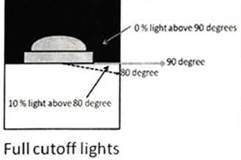
Figure 17-706
(c)
Lighting fixtures shall be installed in a fixed position which orients the light downward. Incidental lighting fixtures, which do not cause glare or any light trespass onto adjacent parcels, are exempted from these requirements.
(d)
Lighting fixtures, except for those required under paragraph (g), shall be so arranged that light is directed away from adjacent properties.
(e)
Lighting fixtures shall provide only 0.5 footcandle maximum at the property line.
(f)
No lighting shall produce illumination or glare on streets detrimental to the safety and convenience of the public.
(g)
Lighting shall be provided for sidewalks and pedestrian facilities adjacent to streets.
(h)
Lighting of the surfaces of pedestrian areas required by paragraph (e) shall provide minimum average maintained illuminance and average to minimum uniformity ratio not exceeding the ratios shown in Table 17-706.
Table 17-706
(g)
At crosswalks, parking lots, and other areas where pedestrians are likely to enter vehicular traffic areas, higher lighting intensity levels should be provided.
(h)
Vegetative screening used to meet the requirements of this section shall be effective year-round.
(i)
All outdoor lighting, including display lighting, shall be turned off after the close of business hours, except that needed for safety and security, in which case lighting shall be reduced to the minimum level necessary.
(j)
Canopy lighting shall be recessed and/or shielded so that all light emitted is projected directly beneath the canopy and not beyond it. All parts of the light fixtures must be recessed into the horizontal ceiling of the canopy, and the vertical edges of the canopy shall be lower than the horizontal ceiling in which the lighting is affixed.
(k)
Lighting posts and fixtures shall be placed such that landscaping, vegetation, and signage not interfere with the effectiveness of the lighting.
(l)
All lighting shall be maintained and replaced or supplemented as necessary to continue to comply with this article. All structural features installed to satisfy the requirements of this article shall be maintained, repaired, replaced, painted, or otherwise enhanced as necessary to continue to perform the function for which they are intended.
(P.C. Ord. No. 14-03, 9-24-14; P.C. Ord. No. 21-01, 1-13-21)
Sec. 17-707.01. - General.
(a)
All signs shall comply with this article. Where these requirements conflict with other requirements or standards in chapter 17, the more restrictive shall govern.
(b)
Sign area shall be measured within a continuous perimeter enclosing the entire display face of the sign, including background, framing, trim, molding, and other borders, but excluding supports and uprights unless such supports or uprights are designed as an integral part of the display for the purpose of illustration or attraction.
(1)
Where a sign consists of two (2) identical parallel faces, which are back to back, and located not more than twenty-four (24) inches from each other, only one (1) side of such sign shall be used in calculating the sign area.
(2)
All faces shall be used to calculate the sign area when structures have non-parallel faces.
(3)
The sign area of a cylindrical sign shall be computed by multiplying one-half (½) the circumference by the height of the sign.
(4)
Where individual letters, characters, or figures are mounted so as to use a building facade as a background, the sign area shall be determined by calculating the sum of the area within the outer perimeter of the letters, characters, or figures comprising the total message, symbol, or advertisement.
(5)
The maximum allowable cumulative sign area permitted on any parcel shall be calculated with respect to the addressed street:
a.
Unless otherwise specified, the maximum allowable cumulative area shall be based on the width of the primary building's façade that is parallel, or nearly so, to the street frontage.
b.
All permanent signs, unless specifically exempted by the terms of this article, shall be counted in the calculation of maximum cumulative sign area.
(c)
The height of signs shall be the vertical distance measured from the average, finished-grade ground elevation, ten (10) feet from where the sign is located, to the highest point of the sign, unless otherwise approved by the zoning administrator.
(1)
The maximum allowable height of signs shall be as specified by the regulations established in table 17-707.04.
(2)
No sign, unless herein exempted, shall be erected, constructed, or altered until a permit has been issued by the zoning administrator.
(d)
Fees for sign permits shall be in accordance with the schedule of fees adopted by the board of supervisors.
(e)
Any existing sign pertaining to a valid nonconforming commercial or industrial use, other than a home occupation as defined by this chapter, which is located within a residential zoning district, shall be deemed a valid nonconforming structure.
(f)
No signs shall be permitted for any business activity not possessing a valid site plan approval issued by the zoning administrator.
(g)
No sign, other than a sign approved or installed by VDOT, shall be located within or over any public right-of-way.
(h)
No sign, whether permanent or temporary, shall be attached to trees, utility poles, or other supporting structures, unless specifically authorized by the zoning administrator.
(i)
Except in the case of shopping centers and corner lots, not more than one (1) permanent freestanding sign shall be permitted for each parcel.
(j)
The minimum setback of any freestanding sign from any property line shall be five (5) feet.
(k)
Corner lots shall be entitled to one (1) freestanding sign for each road frontage provided. However, this provision shall not apply along road frontages where restricted access easements are in place.
(l)
No sign, whether temporary or permanent, excluding freestanding signs, shall be taller than, or extend over or above, the ridgeline of any roof, or the top of any parapet wall of a building.
(m)
The light from any illuminated sign shall be shaded, shielded, or directed so that the light intensity or brightness shall not adversely affect surrounding premises nor adversely affect safe vision of operators of vehicles or non-motorized means of transportation moving on streets or parking areas.
(1)
No light sources shall be used with any sign in such a manner that causes offensive glare or creates a traffic hazard. All VDOT regulations shall be met.
(2)
All exposed conduit and junction boxes should be concealed from public view.
(3)
Illumination from below shall be directed and shielded such that only the sign is illuminated.
(P.C. Ord. No. 14-03, 9-24-14)
Sec. 17-707.02. - Temporary signs.
The zoning administrator may issue approval for the following temporary signs:
(a)
Signs not exceeding thirty-two (32) square feet in area, which promote a special civic, cultural, or religious event such as a fair, exposition, play, concert, or meeting sponsored by a governmental, charitable, or religious organization. The duration of such permit shall not exceed thirty (30) days.
(b)
Temporary signs, not exceeding thirty-two (32) square feet in area and no more than one (1) per parcel, which are intended to identify or display information pertaining to an establishment for which a permanent freestanding signage is on order, as evidenced by providing a copy of an executed order form for such permanent signage to the zoning administrator. Such temporary sign permit shall expire and the portable sign shall be removed upon erection of the permanent sign or thirty (30) days, whichever shall occur first.
(c)
Banners when used in conjunction with the opening of a new business or an establishment going out of business in any business or industrial district. The duration of such temporary sign permit shall not exceed thirty (30) days.
(d)
Banners when used to announce business sales, the grand opening and initiation of sales, or leasing of lots and/or dwelling units within a newly developing residential project having at least ten (10) lots or units.
(1)
The cumulative area of all such banners erected for any single residential project shall not exceed forty (40) square feet.
(2)
Banners shall not be illuminated.
(3)
The duration of such temporary sign permit shall not exceed thirty (30) days.
(e)
Banners when used to announce special events.
(1)
The cumulative area of all such banners erected for any single event shall not exceed forty (40) square feet.
(2)
Banners shall not be illuminated.
(3)
Such signs shall not be erected more than fourteen (14) days prior to the event and shall be removed within seven (7) days following the closing of the event.
(4)
The duration of such temporary sign permit shall not exceed thirty (30) days.
(f)
Temporary sign permits may be renewed prior to expiration. No temporary sign permit may be renewed more than twice.
(P.C. Ord. No. 14-03, 9-24-14)
Sec. 17-707.03. - Exempted signs.
The following signs may be erected, altered, or maintained in any zoning district when in accordance with the general provisions established herein. Permits shall not be required unless specifically noted. Signs listed in this section do not count toward the cumulative total sign area allowed on a parcel.
(a)
Signs erected and maintained pursuant to and in discharge of any federal, state, or county governmental function, or as may be required by law, ordinance, or governmental regulation; including official traffic signs and signals, warning devices, and other similar signs.
(b)
Memorial signs or tablets, cornerstones, or names of buildings when cut into masonry or when constructed of bronze or other noncombustible material; not to exceed six (6) square feet in sign area.
(c)
Non-illuminated development signs, not exceeding thirty-two (32) square feet in area and six (6) feet in height and limited to one (1) sign for each street frontage, when displayed on the premises to which such sign refers.
(1)
No such signs shall be permitted unless a building permit has been issued or unless a site plan for the proposed development project has been submitted to the department of community development for official review.
(2)
Such signs shall be removed at the completion of construction.
(d)
Non-illuminated realty signs, not exceeding six (6) square feet in area and four (4) feet in height in all single family residential districts, and thirty-two (32) square feet and six (6) feet in height in all agricultural, multi-family, business, and industrial zoning districts, and limited to one sign for each street frontage, and only when displayed on the premises to which such sign refers.
(e)
Non-illuminated signs identifying official state automobile inspection stations and the inspection number which is then due, provided that such signs shall not exceed sixteen (16) square feet in area and shall be limited to one (1) sign for each street frontage. A-frame or V-frame designs shall be considered as a single sign for the purposes of this section.
(f)
Bulletin boards for churches or other places of worship, or for public buildings, when located on the same premises as the building to which they refer, and provided that such signs shall not exceed twelve (12) square feet in area and eight (8) feet in height. No freestanding or illuminated sign shall be permitted unless a permit has been issued by the zoning administrator.
(g)
Non-illuminated signs and posters of less than four (4) square feet in area advertising or providing directions to a residential, civic, or community yard sale, or an estate sale or auction, provided they are located on private property with permission of the property owner(s) and are removed promptly at the end of the event.
(h)
Signs attached to machinery or equipment which is necessary or customary to a business including, but not limited to, gasoline islands, vending machines, or ice machines, provided that such signs refer exclusively to products or services offered on the premises.
(i)
On-premises safety and directional signs, not exceeding six (6) square feet in area and eight (8) feet in height and not containing any advertising material or discernible business logo. No on-premises directional signs shall be illuminated unless a permit has been issued by the zoning administrator.
(j)
Signs attached directly to the interior or exterior of the windows of business and industrial uses, provided such signs shall not occupy more than twenty-five (25) percent of the total area of the window in which they are displayed and shall not be legible from any street.
(k)
Menu boards which are either freestanding or wall signs providing information on food and beverages offered for drive-in sales on the premises, provided that such signs and any business logos thereon are not legible from any street and do not exceed twenty-four (24) square feet in area and eight (8) feet in height. No menu boards shall be illuminated unless a permit has been issued by the zoning administrator.
(l)
Flags, emblems, or insignia of the United States, the Commonwealth of Virginia, Rockingham County, other jurisdictions, religious groups, civic organizations, service clubs, and similar organizations, groups, agencies, etc.
(1)
One (1) corporate logo emblem flag per parcel shall be permitted.
(2)
A flagpole shall comply with the building height regulations of the district in which the flagpole is located. However, in the residential districts, flagpole height shall not exceed thirty-five (35) feet.
(m)
Special-notice placards, not to exceed a total of four (4) square feet in area for all such placards of any establishment, attached to a building or to a freestanding sign indicating credit cards which are accepted on the premises, group affiliations of which the business is a member, or clubs or groups which utilize, recommend, inspect, or approve the business for use by its members. No special-notice placard shall be illuminated unless approval has been issued by the zoning administrator.
(n)
Identification and directional boards, which are either freestanding or wall signs, designed as an outdoor means of providing information concerning the location of individual establishments or offices within an office, business, or industrial complex, provided that such signs are not legible from any street and do not exceed twenty-four (24) square feet, and are no taller than nine (9) feet, and provided that only one (1) such sign shall be permitted per lot.
(1)
No identification and directional boards shall be illuminated unless approval has been issued by the zoning administrator.
(2)
No identification and directional boards shall be freestanding unless approval has been issued by the zoning administrator.
(P.C. Ord. No. 14-03, 9-24-14)
Sec. 17-707.04. - Signs as permitted uses.
(a)
The following table indicates the structural class, area, height, and type of illumination of signs permitted in land use areas. Where two (2) or more land use areas apply, the more stringent requirements shall hold.
(1)
Approved commercial uses in the Agricultural, Rural Village, and Residential districts may have internally illuminated signs provided the allowable signage is reduced by twenty (20) percent.
(2)
Maximum cumulative sign area per parcel exclusive of the freestanding sign in the Public Service, Business, or Industrial districts shall be measured per linear foot of primary building width.
(3)
Parcels which front on a Virginia primary highway shall be allowed a twenty-five- percent increase in the allowable freestanding sign area.
(4)
A special use permit shall be obtained for any signage in the Business Interchange district that does not meet the below requirements.
_____
Table 17-707.04. Signs as Permitted Uses.
_____
(b)
Signs in all planned districts shall meet the requirements of the corresponding use chart above and shall submit a comprehensive sign package as part of the master plan to include:
(1)
A general description and discussion of the development project, the purpose and scope of the sign package, and the design theme for the proposed signage. All sign packages shall contain provisions stating that "All tenants, businesses, and owners within the development shall receive a copy of the comprehensive sign package from the owner at the time of lease/sale," and that "All signage within the development shall be in conformance with the comprehensive sign package." this section shall also include one (1) of the following two (2) provisions:
a.
"Any signage not specifically identified in this sign package shall conform to county ordinance standards;" or
b.
"Any signage not specifically identified in this sign package is prohibited."
(2)
Identification of sign design, fabrication and installation standards, owner maintenance and repair requirements, and compliance with state building and electric codes and sign permit requirements.
(3)
Procedures and process for tenants, owners, businesses, and sign contractors to obtain approval for all permanent or temporary signage for the development project through the master plan developer/owner and then through the County of Rockingham. All sign packages shall contain provisions stating that "A copy of the master plan developer/owner's approval of a sign shall be submitted to the county with all requests for sign permits," and that "All signs installed shall have owner or county approval."
(4)
For each sign type sign, detailed information and provisions shall be provided identifying their function, location, permitted sign copy area (maximum individual and aggregate sign areas per business), size and height, color palettes, illumination, directional arrow details, project and business logos, and all other appropriate sign specifications. A detailed list of each type of sign to be permitted in the development, including but not limited to:
a.
Wall;
b.
Monument;
c.
Multi-tenant;
d.
Directory;
e.
Directional;
f.
Freestanding;
g.
Menu board;
h.
Window;
i.
Awning.
(5)
A color graphic of each type of sign, drawn to scale, identifying its design, color palette, font style and letter size, illumination, materials, and sample sign copy area.
(6)
A summary table that briefly lists all proposed signage that deviates from the sign provisions contained within the zoning ordinance; identifying the ordinance standard, the proposed signage, the variance from the standard, and summary reasons why the proposed deviation is proposed and reasonable/appropriate for the development.
(7)
Description of the type, purpose, size, location, content, and allowed duration of use for any allowed temporary signs, banners, etc. (e.g., grand opening, coming soon, special events).
(8)
Identification of the type of signs specifically prohibited, in addition to those already prohibited by the provisions of this ordinance, within the development (e.g., animated, flashing, or rotating signs, roof signs, vehicle signs, portable signs posted beyond business hours).
(c)
The following provisions shall apply to freestanding signs in every zoning district with shopping centers over fifty thousand (50,000) square feet:
(1)
One (1) freestanding sign shall be permitted for each street frontage.
a.
The maximum sign area of any one (1) freestanding sign shall be one hundred fifty (150) square feet.
b.
The maximum cumulative sign area for freestanding signs for each shopping center shall be two hundred (250) square feet.
c.
No individual business shall have signage which exceeds the allowable for the zoning district in which it is located.
(2)
Each individual business within a shopping center shall be permitted one (1) projecting or canopy sign provided that such sign shall not exceed a maximum sign area of six (6) square feet and shall have a minimum ground clearance to the bottom of the sign of not less than eight (8) feet.
(3)
In addition to the projecting or canopy sign, wall signs shall be permitted provided that the cumulative sign area of the projecting, canopy, and wall signs shall not exceed the maximum cumulative sign area allowed in the zoning district.
(4)
Individual freestanding signs for individual shopping center tenants shall not be permitted in excess of the allowable sign area for the zoning district.
(d)
The following provisions shall apply to electronic message centers:
(1)
Each message or image shall remain fixed and unchanged for a minimum period of 30 seconds.
(2)
There shall be no appearance of movement, scrolling, dissolving, or fading in which images or messages "move" or in which part of one message or image appears simultaneously with any part of a second or subsequent one.
(3)
The illumination intensity, contrast or coloration of the message text or image shall remain constant for each display period.
(4)
When such sign is installed on property located in an agricultural zoning district it shall be designed and operated so that between dusk and dawn the background field for any variable text message on the sign shall be black and the lights constituting the message text or any image shall be amber or orange.
(5)
Illuminance intensity of any electronic message center sign, whether with a static or changing message display, shall be measured with an illuminance meter set to measure footcandles and accurate to at least two (2) decimals. The maximum allowable illumination intensity for such signs shall be determined relative to ambient lighting conditions by measuring the difference between an intensity reading of the ambient light taken with the sign illumination turned off or, at the zoning administrator's discretion, screened from the illuminance meter, and an intensity reading of the sign face with the sign displaying a white image for a full color-capable electronic message center, or a solid message for a single-color electronic message center. The difference between the two readings shall not exceed 0.3 footcandle. Illuminance from electronic message centers shall be included in all on-site lighting calculations and shall meet the requirements of section 17-706(e). All measurements shall be taken perpendicular to the face of the sign at the distance determined by the total square footage of the electronic message center sign as set forth in the following table:
SIGN AREA VERSUS MEASUREMENT DISTANCE
For signs with an area other than those specifically listed in the table, the measurement distance shall be calculated using the following formula:

(6)
All electronic message center signs shall be equipped with a sensor or other device that automatically determines the ambient illumination and which is programmed to automatically dim the illumination intensity according to ambient light conditions to ensure compliance with the 0.3 footcandle standard.
(7)
Prior to the County's final inspection and approval of an electronic message center sign, the applicant shall provide written certification from the sign manufacturer/installer that the sensor is working correctly to keep the sign's illumination intensity within the prescribed brightness limitations set by this ordinance.
(P.C. Ord. No. 14-03, 9-24-14; P.C. Ord. No. 23-10, 6-28-23; P.C. Ord. No. 25-07, 5-14-25)
Sec. 17-707.05. - Off-premises signs.
(a)
The zoning administrator may authorize the installation of off-premises directional signs, subject to the following findings and conditions:
(1)
The location of the use, to which the sign pertains, prevents adequate identification by permitted signs on the premises.
(2)
The function of such signs shall be limited to directional or identification purposes.
(3)
The location of such signs shall be consistent with the uses existing or permitted on the site of such sign. A written authorization from the owner of the property on which such sign is proposed to be located or a recorded easement permitting the placement of the sign shall be submitted to the zoning administrator at the time of application for necessary permits.
(4)
Such signs shall be subject to the maximum area and height standards established in [section] 17-707.01, general, and to all other applicable provisions of this chapter. Not more than three (3) such signs shall be permitted for any single use.
(5)
Directional signs shall not exceed four (4) square feet and shall list only the name of the business or establishment.
(b)
A special use permit shall be obtained for off-premises signs that do not meet the requirements listed above. All off-premises signs must meet the requirements of section 17-707, signs.
(P.C. Ord. No. 14-03, 9-24-14)
Sec. 17-707.06. - Prohibited signs.
The following signs are prohibited in all zoning districts:
(a)
Abandoned signs.
(1)
If a business moves or closes, signs advertising such business shall be considered abandoned and shall be removed within thirty (30) days following such relocation or closure.
(2)
If the sign has not been removed, the zoning administrator shall make a reasonable attempt to notify the owner of the property to have the owner remove the sign within thirty (30) days.
(3)
If at the expiration of the allotted time the sign is not removed, Rockingham County, through its agents or employees, may enter the property upon which the sign is located and remove it at the property owner's expense.
(b)
Banners, except as allowed in section 17-707.02, pennants, or inflatables.
(c)
Signs imitating or resembling official traffic or government signs or signals.
(d)
Signs attached to trees, utility poles, public benches, streetlights, or placed on any public property or public right-of-way, unless otherwise specified in this article.
(e)
Signs placed on vehicles or trailers which are parked or located for the primary purpose of displaying said sign. This does not apply to allowed portable signs or signs or letters on buses, taxis, or vehicles operating during the normal course of business.
(f)
Flashing, blinking, revolving, rotating lights, or search lights.
(P.C. Ord. No. 14-03, 9-24-14)
Sec. 17-707.07. - Maintenance, removal, and nonconformance of signs.
(a)
All signs and sign structures shall be maintained.
(1)
All signs shall adhere to the provisions of the building code.
(2)
All signs deemed unsafe by the building official must be removed or brought into compliance with the provisions of the building code.
(b)
An existing sign which does not conform to the specific provisions of this article shall be considered a valid nonconforming sign, provided that:
(1)
The sign was installed in conformance with a valid permit or variance, or complied with all applicable laws prior to October 1, 2014.
(2)
The business advertised is still in legal operation.
(c)
A valid nonconforming sign shall lose this designation if:
(1)
The sign is relocated or replaced under normal conditions.
(2)
The structure or size of the sign is altered in any way except toward compliance with this article. Alteration does not refer to change of copy or normal maintenance.
(P.C. Ord. No. 14-03, 9-24-14)

