
Round Lake Beach City Zoning Code
ARTICLE VI
A.- ORCHARD LANE CONSERVATION AREA OLCA DISTRICT
Sec. 650.0.- Orchard Lane Conservation Area (OLCA) District.
650.1
Findings and purpose: The village benefits from having in the heart of its boundaries a natural area with significant environmental features including wetlands, old growth trees, remnant prairie, and native flora and fauna. As identified by past reviews and studies, this area represents an irreplaceable asset to the village for conservation, passive recreation, and educational opportunities. Development has occurred and is planned to occur around the periphery of this a natural area. As outlined under the village's comprehensive plan, the village has determined that preserving and enhancing this area will significantly benefit the village and greater surrounding community as a whole. For this reason, the village finds it appropriate to establish special rules and regulations to ensure the future development of the approximately 97-acre area in and around this environmental resource area occurs in a manner that is compatible with and enhancing to the area and prevents development from negatively impacting the character and quality of this natural area. The Orchard Lane Conservation Area District is established to protect, preserve, and enhance the area and thereby keep and increase the quality of its impact on the village.
650.2
Designation of Orchard Lane Conservation Area District: The Orchard Lane Conservation Area District appears on the zoning map as an "overlay district," imposed on top of other base (or underlying) zoning districts created by the zoning ordinance. Development of properties in the Orchard Lane Conservation Area District are to comply with both the regulations of the Orchard Lane Conservation Area District and with the regulations of the base underlying district in which they are located. When there is any conflict between the regulations of the Orchard Lane Conservation Area District and the regulations of the base district, the regulations of the more restrictive regulation shall control, except as otherwise provided in this section.
650.3
Applicability of Orchard Lane Conservation Area District: Except as otherwise provided in this section, the Orchard Lane Conservation Area District development review requirements shall apply to the following construction and development activities on any currently platted or proposed zoning lot within the Orchard Lane Conservation Area District:
A.
All new structures and developments;
B.
All new uses of land, including new and modified structures and developments occurring on vacant land;
C.
Except as otherwise provided in this section, all new structures and uses of land on sites of demolished or modified structures; and
D.
Whenever any proposed improvements require any relief provided in article III.
605.4:
Concept plan: The pattern of land use development shall generally conform to the Orchard Lane Conservation Area District concept plan which is published and kept on record at the village with the zoning ordinance. In combination with the existing base zoning district for each property, this concept plan shall govern the locations of permitted and special uses within the district. Departures from the exact land use boundaries shown on this concept plan may be permitted based on the design review process including submittal of detailed documents regarding plats of survey, wetland and natural resource delineation reports, engineering, architectural, and landscape architectural plans, and other such required submittal plans an documents.
650.5
Permitted and special uses: Permitted and special uses allowed in the Orchard Lane Conservation Area District shall be as follows:
A.
Areas Outside the designated Conservation Area on the Orchard Lane Conservation Area District concept plan:
1.
Permitted uses:
i.
Residential base underlying zoning:
1.
Uses lawfully established prior to the effective date of Ordinance No. 16-01-05, provided the use has been continuously operated since the adoption of the ordinance. Any operation of use discontinued for a period time six months or longer shall represent the abandonment of this prior use.
2.
Single-family detached dwellings
3.
Parks and playgrounds
4.
Public open land, refuge or preserve
5.
Accessory uses as permitted in accordance with Article II, section 215.
ii.
Specialty housing concept plan designation:
1.
Uses lawfully established prior to the effective date of Ordinance No. 16-01-05, provided the use has been continuously operated since the adoption of the ordinance. Any operation of use discontinued for a period time six months or longer shall represent the abandonment of this prior use.
2.
Senior housing complex for adults 55 years or older with a gross site being less than 15 dwelling units per acre, including the following dwelling types:
a.
Single-family detached dwellings
b.
Two-family dwellings
c.
Townhome residences
d.
Multiple-family dwellings
3.
Accessory uses as permitted in accordance with Article II, section 215.
iii.
Office/Business park concept plan designation
1.
Uses lawfully established prior to the effective date of Ordinance No. 16-01-05, provided the use has been continuously operated since the adoption of the ordinance. Any operation of use discontinued for a period time six months or longer shall represent the abandonment of this prior use.
2.
Business service establishments:
a.
Accounting, auditing, and/or bookkeeping office
b.
Artist and/or industrial designer
c.
Bank
d.
Currency exchange
e.
Engineering and architectural service
f.
Financial institution
g.
Insurance agency
h.
Laboratory medical and dental
i.
Landscape architect
j.
Land surveyor
k.
Loan company
l.
Medical and dental offices and clinics
m.
Professional consultant
n.
Professional office
o.
Real estate office
p.
Savings and loan
q.
Science research agency
3.
Personal service establishments
a.
Barber shop
b.
Beauty shop
c.
Child care nursery or day care
d.
Computers and electronic sales and repair
e.
Dry cleaner, but not a central plant serving more than one retail outlet
f.
Musical school
g.
Photographic studio
h.
Shoe repair shop
i.
Tailor shop
4.
Restaurants, excluding drive-in service
5.
Accessory uses:
a.
As permitted in accordance with Article II, section 215
b.
Trash and/or compactor enclosures when constructed in compliance with the general development standards and the property maintenance code.
6.
Temporary uses permitted in the C-1 Local Shopping District and shall comply with the provisions of Article II, section 216.
iv.
Commercial concept plan designation:
1.
Uses lawfully established prior to the effective date of this Ordinance No. 16-01-05, provided the use has been continuously operated since the adoption of the ordinance. Any operation of use discontinued for a period time six months or longer shall represent the abandonment of this prior use.
2.
Business service establishments:
a.
Accounting, auditing, and/or bookkeeping office
b.
Artist and/or industrial designer
c.
Bank
d.
Currency exchange
e.
Engineering and architectural service
f.
Financial institution
g.
Insurance agency
h.
Laboratory medical and dental
i.
Landscape architect
j.
Land surveyor
k.
Loan company
l.
Professional consultant
m.
Professional office
n.
Real estate office
o.
Savings and loan
p.
Science research agency
3.
Personal service establishments:
a.
Barber shop
b.
Beauty shop
c.
Child care nursery or day care
d.
Computers and electronic sales and repair
e.
Dry cleaner, but not a central plant serving more than one retail outlet
f.
Laundry and dry cleaner, self-service only
g.
Musical school
h.
Photographic studio
i.
Shoe repair shop
j.
Tailor shop
4.
Professional office establishments:
a.
Attorney and law office
b.
Chiropodist's office
c.
Chiropractor's office
d.
Dentist's office
e.
Doctor's, surgeon's, and/or physician's office
f.
Medical and dental clinics
g.
Optician's office
h.
Osteopath's office
5.
Retail businesses:
a.
Antique stores
b.
Apparel stores
c.
Automobile accessory stores-no services
d.
Automobile dealer, new
e.
Bakery, in which the manufacture of goods is limited to goods retailed on the premises only.
f.
Boat dealer, New
g.
Book and stationary stores
h.
Camera stores
i.
Candy and confectionery stores
j.
Dairy products stores
k.
Delicatessens
l.
Drug stores
m.
Dry goods stores
n.
Floral shops
o.
Grocery and food stores
p.
Hardware and/or building supplies (no exterior storage or display)
q.
Ice cream refreshment stand
r.
Jewelry stores
s.
Meat markets
t.
Package liquor store sale of alcoholic beverages.
u.
Restaurants, excluding drive-in service
v.
Shoe stores
w.
Shopping centers and malls
x.
Sporting goods stores
y.
Tire, battery, and accessory dealer (no installations on premises)
z.
Toy stores
aa.
Variety stores
6.
Accessory uses:
a.
As permitted in accordance with Article II, section 215
b.
Trash and/or compactor enclosures when constructed in compliance with the general development standards and the property maintenance code.
7.
Temporary uses permitted in the C-1 Local Shopping District and shall comply with the provisions of Article II, section 216.
2.
Special uses:
i.
Residential base underlying zoning:
1.
Planned unit development
2.
Cultural facilities
3.
Public buildings and utilities
4.
Church, chapels, temples, synagogues
5.
Convent, monastery, and religious retreats
6.
Non-commercial recreational buildings and community centers
ii.
Specialty housing concept plan designation:
1.
Planned unit development
2.
Senior housing complex for adults 55 years or older with a gross site being 15 dwelling units per acre or more, including the following dwelling types:
a.
Single-family detached dwellings
b.
Two-family dwellings
c.
Townhome residences
d.
Multiple-family dwellings
iii.
Office/Business Park Designation Concept Plan Designation:
1.
Planned unit development
iv.
Commercial concept plan designation:
1.
Automobile body shop
2.
Automobile diagnostic center or clinic
3.
Automobile driving instruction
4.
Automotive filling stations
5.
Automobile laundry
6.
Automobile painting
7.
Automobile rental
8.
Automobile repair shop
9.
Automobile service station
10.
Automobile undercoating service
11.
Bus station
12.
Camper sales, new
13.
Dancing school or studio
14.
Drive-in cleaners
15.
Drive-in banking facilities
16.
Drive-in restaurants
17.
Drive through facilities on the same zoning lot with any other special or permitted usage
18.
Gymnastics studio
19.
Martial arts studio
20.
Health and fitness center Under 10,000 square feet
21.
General repair shop
22.
Mixed occupancy-combined commercial and multiple residential establishments
23.
Mobile home dealer
24.
Motor vehicle dealer
25.
Motorcycle sales
26.
Motorcycle service and repair
27.
Planned unit development
28.
Recreational activity club
29.
Repair service
30.
Residence of the proprietor of a commercial use
31.
Taxicab stand
32.
Tire re-treading and repair shop
33.
Undertaking establishments and funeral parlors
34.
Used car lot
35.
Used furniture and second-hand store
36.
Warehouse and mini-storage facilities
B.
Areas Inside the designated Conservation Area on the Orchard Lane Conservation Area District concept plan:
1.
Permitted uses:
i.
Uses lawfully established prior to the effective date of Ordinance No. 16-01-05, provided the use has been continuously operated since the adoption of the ordinance. Any operation of use discontinued for a period time six months or longer shall represent the abandonment of this prior use.
ii.
Governmental buildings and structures
iii.
Informational kiosks and way finding structures
iv.
Memorials, statues, and public art
v.
Museums, historical centers, cultural centers, and civic centers
vi.
Passive recreation fields, facilities and structures
vii.
Public parking lots
viii.
Public storm water detention basins
ix.
Trails and paths
2.
Special uses:
i.
Active recreation fields, facilities, and structures
ii.
Any encroachment up to ten feet into the boundaries of the designated Conservation Area on the Orchard Lane Conservation Area District concept plan
iii.
Public utility structures and towers
iv.
Wetland mitigation bank
650.6
Lot size requirements: Each permitted or special use lawfully established in the Orchard Lane Conservation Area District shall meet the following minimum lot area and lot width requirements based upon the applicable underlying zoning district as follows:
Special uses may be required to meet more restrictive site and structure provisions if the village board, upon considering a recommendation of the planning and zoning commission, determines that such requirements are necessary for public health, safety and general welfare purposes.
650.7
Yard and bulk standards:
A.
Yard Standards:
1.
Base residential underlying zoning: Developments built with uses under the base residential underlying zoning shall conform to the yard requirements of the R-3 Single Family Residential District except where said yard borders the designated conservation area on the Orchard Lane Conservation Area District concept plan.
2.
Specialty housing concept plan designation: Developments built with uses under the specialty housing concept plan designation use list shall conform to the yard requirements of the C-3 General Business District, except where said yard borders the designated conservation area on the Orchard Lane Conservation Area District concept plan.
3.
Office/business park concept plan designation: Developments built with uses under the office/business park concept plan designation use list shall conform to the yard requirements of the C-3 General Business District, except where said yard borders the designated conservation area on the Orchard Lane Conservation Area District concept plan.
4.
Commercial concept plan designation: Developments built with uses under the commercial concept plan designation use list shall conform to the yard requirements of the C-3 General Business District, except where said yard borders the designated conservation area on the Orchard Lane Conservation Area District concept plan.
5.
Conservation area concept plan designation: Developments built with uses under the conservation area concept plan designation use list shall conform to the yard requirements of the R-3 Single Family Residential District.
6.
Transitional area: With the exception of those areas designated for conservation area on the Orchard Lane Conservation Area District concept plan, any development that borders those said areas designated for conservation area shall provide a fifty (50) feet wide setback in which only those items described under section 650.8 may occur.
B.
Bulk regulations
1.
Base residential underlying zoning: Developments built with uses under the base residential underlying zoning shall conform to the bulk regulations of the R-3 Single Family Residential District.
2.
Specialty housing concept plan designation: Developments built with uses under the specialty housing concept plan designation use list shall conform to the bulk regulations of the C-3 General Business District.
3.
Office/business park concept plan designation: Developments built with uses under the office/business park concept plan designation use list shall conform to the bulk regulations of the C-3 General Business District with the exception that no structure on lots with frontage on Orchard Lane shall exceed a height of 25 feet. A structure exceeding the maximum permitted height shall require a special use permit.
4.
Commercial park concept plan designation: Developments built with uses under the commercial concept plan designation use list shall conform to the bulk regulations of the C-3 General Business District.
5.
Conservation area concept plan designation: Developments built with uses under the conservation area concept plan designation use list shall conform to the bulk regulations of the R-3 Single Family Residential District.
650.8
Transitional Areas:
A.
Purpose: As provided under the yard requirement standards, developments that directly border those areas designated for the conservation area shall provide a 50-foot wide setback area to buffer and blend harmoniously developed areas with the conservation area. This area shall also provide the opportunity to provide access and improvements to limit the impact development will have on the physical and visual quality of the conservation area.
B.
Location: The boundaries of where the transitional areas shall occur will general conform to those area shown on the Orchard Lane Conservation Area District concept plan. Deviations from the exact transitional area boundaries shown on this concept plan shall be permitted based on the design review process submittal of detailed documents regarding plats of survey, wetland and natural resource delineation reports, engineering, architectural, and landscape architectural plans, and other such required submittal plans and documents.
C.
Use restrictions: The following shall be the only permitted uses within a transitional area.
1.
Berms and mounds
2.
Fences and walls
3.
Landscaping plantings and improvements
4.
Paths, trails, and sidewalks
5.
Pedestrian amenities, such as, but not limited to, benches, water fountains, bicycle racks, and restrooms.
6.
Rain gardens, bioswales, and similar stormwater management features.
7.
Any use approved as part of a special use permit.
D.
Landscaping requirements: Landscaping within a transitional area shall be designed and provided as follows:
1.
Three feet tall bermed buffer that may undulate up to six feet tall where appropriate with respect to storm water drainage, rain gardens, and bioswales;
2.
Planted with a mix of coniferous and deciduous trees, one-third of trees must be evergreen;
3.
Deciduous trees will not be less than two and one-half inches in diameter measured at breast height and will be spaced not more than 40 feet apart; and coniferous trees will not be less than six feet in height at not more than 15 feet apart;
4.
Four deciduous shade trees and/or evergreen trees, three ornamental trees, and 50 deciduous and/or evergreen shrubs shall be proposed per 100 lineal feet of setback area perimeter length; and
5.
Required planting quantities may be reduced to up half the stated quantity for each category with the installation of an approved bioswale or bioretention basin (rain garden) within the transitional area.
E.
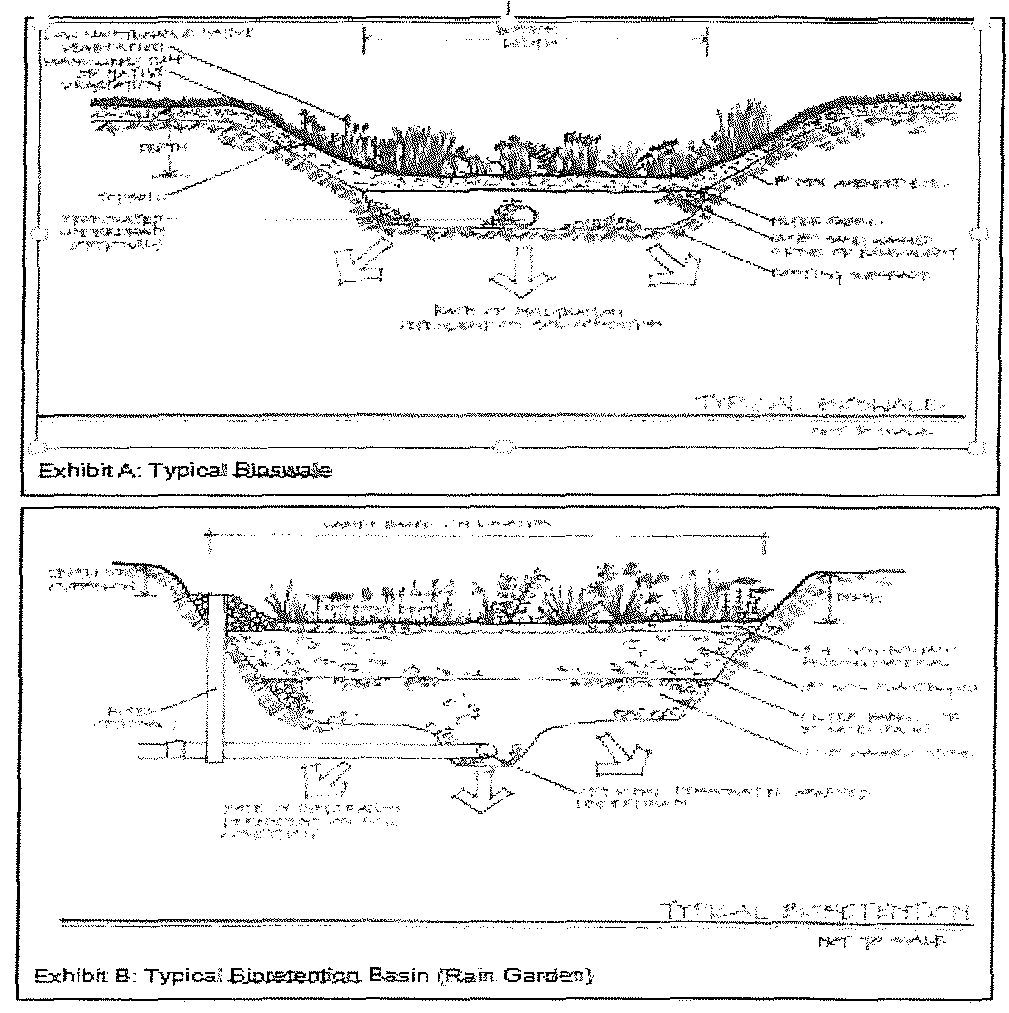
Bioswales and bioretention basins (rain gardens): For on-site storm water management, bioswales and bioretention basins (rain gardens) shall be allowed and generally conform to the design shown in Exhibits A: Typical Bioswale and Exhibit B: Typical Bioretention Basin (Rain Garden) with the final design to be as approved by the village engineer.
F.
Departures: Departures from these standards shall require a special use permit.
650.9
Specific design elements and standards:
A.
Landscaping: Landscaping shall be provided at the following levels
1.
Street frontage property lines: Property lines fronting on a publically dedicated R.O.W. or the proposed Hook Drive extension as depicted on the Orchard Lane Conservation Area District concept plan shall provide a minimum 20 feet wide landscape setback with the following minimum plantings and improvements:
i.
Two-foot tall bermed buffer that may undulate up to four feet tall where appropriate with respect to storm water drainage, rain gardens, and bioswales;
ii.
Planted with a mix of coniferous and deciduous trees, one-third of trees must be evergreen;
iii.
Deciduous trees will not be less than two and one-half inches in diameter measured at breast height and will be spaced not more than 40 feet apart; and
iv.
Coniferous trees will not be less than six feet in height at not more than 15 feet apart.
v.
Two deciduous shade trees or evergreen trees, two ornamental trees, and 20 deciduous and/or evergreen shrubs shall be proposed per 100 lineal feet of setback area perimeter length.
vi.
One shade, right-of-way parkway tree per each 50 lineal feet as approved by the roadway jurisdictional authority.
2.
Transitional areas property lines: Landscaping shall be provided as detailed in section 650.8.D.
3.
All other area property lines: Property lines not addressed under section 650.9.A1 and 650.9.A2 shall provide a minimum ten feet wide landscape setback with the following minimum plantings and improvements:
i.
Two feet tall bermed buffer that may undulate up to four feet tall where appropriate with respect to storm water drainage, rain gardens, and bioswales;
ii.
Planted with a mix of coniferous and deciduous trees, one-third of trees must be evergreen;
iii.
Deciduous trees will not be less than two and one-half inches in diameter measured at breast height and will be spaced not more than forty feet apart; and
iv.
Coniferous trees will not be less than six feet in height at not more than 15 feet apart.
v.
Two deciduous shade trees or evergreen trees, one ornamental tree, and ten deciduous and/or evergreen shrubs shall be proposed per 100 lineal feet of setback area perimeter length.
B.
Architectural design: All new structures will be designed in a manner to complement surrounding properties, including exterior building materials, bulk, and scale, such as incorporating pitched roofs, common brick and stone materials and colors, or cedar façades. In addition, all new structures will be oriented in a manner that provides, where appropriate, access to the conservation area and integration into the passive and active recreational features of the site. The architectural design of all new structures or the significant renovation of existing structures will be subject to the exterior appearance review provisions set forth in section 650.10.
C.
Site signage: Site signage will be designed to complement new buildings, including use of common building materials. In addition, all ground signage should be designed as monument signage, avoiding the use of braces or other single or dual-pole supports. The architectural design of all signage will be subject to the exterior appearance review provisions set forth in section 650.10.
D.
Site and perimeter fences: Internal and perimeter fences may be incorporated to complement landscape and streetscape treatment and, wherever possible, be installed to facilitate pedestrian access and passive and active recreation in the conservation area. All fencing must be constructed with decorative wrought iron or decorative aluminum fencing and will be subject to the exterior appearance review provisions set forth in section 650.10.
E.
Internal circulation: The Orchard Lane Conservation Area District will be designed with new internal circulation roads, sidewalks, pedestrian and bike paths. These internal circulation routes should be designed to complement the natural setting of the Orchard Lane Conservation Area District contemplated in section 650.1. Such connections shall be provided both inside and outside the designated conversation area on the Orchard Lane Conservation Area District concept plan with connections across properties connecting the greater surrounding circulation system.
F.
Site lighting: All site lighting should be designed in accordance with ANSI/IESNA RP-8 standards, as well as relevant village standards, and all lighting should illuminate the internal circulation network, as well as the lagoons, to promote better public safety. Site lighting should be consistent across the site in design and not exceed three-foot-candles at the property line and should in all instances have the following characteristics:
1.
Shielded to reflect the light downward and away from adjoining residential and institutional properties;
2.
Use fully opaque housing with flat lenses; and
3.
Utilize cut-off angle designs.
All site lighting will be subject to the exterior appearance review provisions set forth in section 650.10.
G.
Outdoor storage area: All outdoor storage and service areas must be screened with fencing that is consistent in design with that used elsewhere on the Orchard Lane Conservation Area District in accordance with subsection 650.9.D of this section. In addition, all such area will be landscaped with a mix of 75 percent coniferous and twenty-five (25) percent deciduous plant materials.
H.
Sidewalks and paths: Sidewalks or paths shall be provided along all street frontages and, where appropriate, across sites to connect with sidewalks and paths in the designated conservation area. Designs for shall conform to the following dimensions and materials for sidewalks:
1.
Sidewalks: Five feet wide.
2.
Multi-use paths: Ten feet wide.
3.
Materials: As recommended and approved by the village engineer to meet the physical service demands of the sidewalk or path.
All sidewalks and paths will be subject to the exterior appearance review provisions set forth in section 650.10.
I.
Parking: Parking for us shall provide consistent with provisions set forth in Article 10 of this appendix. Provisions for shared public parking arrangements on developments bordering the designated conservation area should be given as part of plans developed under the review process set forth in section 650.10. Providing shared public parking spaces for automobile, truck, and bus use shall be considered in the granting of any departures of the standards of this section 650.9.
J.
Community facilities: Developments bordering the designated conservation area are encouraged to provide community facilities, such as, but not limited to, restrooms, water fountains, and bicycle racks, that are accessible and useable by the public at large during the general operating hours of those developments. Providing public community facilities shall be considered in the granting of any departures of the standards of this section 650.9.
K.
Wayfinding signage: Developments bordering the designated conservation area should provide wayfinding signage per Village specification clearly indicating the location of access routes to the designated conservation area, shared public parking spaces, accessible public community facilities, and other such items constructed or dedicated in support of the designated conservation area. Such wayfinding signage shall not count against any permitted sign limits for a development.
650.10
Exterior appearance review—General provisions:
A.
Authority: The board of trustees, in accordance with the procedures and standards set out in this section, may grant exterior appearance approval.
B.
Purpose: The exterior appearance review process is intended to protect, preserve, and enhance the character and quality of architectural heritage and to protect, preserve, and enhance property values in the Orchard Lane Conservation Area District.
C.
Parties entitled to seek exterior appearance review: Applications for building permits requiring exterior appearance review and approval pursuant to this section may be filed by the owner, or any person having a contractual interest in, the subject property.
650.11
Exterior appearance review—Procedures:
A.
Applications: Applications for exterior appearance approval shall be filed with the building official. In addition to architectural information regarding the subject building, such application shall include the following materials:
1.
Survey of adjacent properties: A survey of structures within 250 feet of the subject property which evaluates the architectural character of those structures in relation to the standards and considerations set forth in this section.
2.
Statement of proposed improvements: A written statement detailing how the proposed improvements meet the applicable standards and consideration for exterior appearance review.
B.
Other approvals required prior to approval: In any case where the proposed improvements require any relief provided in article III, or any other approval, no exterior appearance approval shall be granted unless and until such relief has been granted by the board of trustees or other required approvals have been obtained. The granting of any such relief or issuance of any other approval shall not establish any right to exterior appearance approval.
C.
Public meeting: After a properly completed application has been filed with the building official, a public meeting shall be set, noticed, and conducted by the planning and zoning commission; provided, however, that such public meeting shall not be commenced later than 60 days following the building official's receipt of a properly completed application.
D.
Action by planning and zoning commission: Within 45 days after the conclusion of the public meeting, the planning and zoning commission shall transmit to the board of trustees its recommendation either granting exterior appearance approval, granting the approval subject to conditions, or denying the approval. In reaching its recommendation, the planning and zoning commission shall be guided by the purposes for which the exterior appearance review process has been created and by the particular standards and considerations set forth in this section.
E.
Action by board of trustees: Within 60 days after receipt of the recommendation of the planning and zoning commission, the board of trustees shall, by ordinance duly adopted, grant exterior appearance approval, grant exterior appearance approval subject to conditions, or shall disapprove the application. The board of trustees may also grant exterior appearance approval with modifications to the proposed improvement design, which the applicant may agree to or reject, in which case such rejection shall serve as a basis, in the sole and absolute discretion of the board of trustees, for denial of the application. Any such conditions or modifications shall be made as necessary to achieve the purposes and objectives of this section. Such conditions and modifications shall be set forth in the ordinance granting approval. In reaching its decision, the board of trustees shall be guided by the purposes for which the exterior appearance review process has been created and by the particular standards and considerations set forth in this section. The failure of the board of trustees to act within such 60 days, or such further time to which the applicant may agree, shall be deemed to be a decision denying the application.
650.12
Exterior appearance review—Standards and considerations: In their consideration of applications for exterior appearance approval, the planning and zoning commission and the board of trustees shall be guided by the purposes of this section and more particularly by the following standards and considerations:
A.
General quality of design and site development: New and existing structures and appurtenances thereof subject to these exterior appearance review provisions shall be evaluated under the following quality of design and site development guidelines:
1.
Open spaces: The quality of the open spaces between structures and in setback spaces between street and facade.
2.
Materials: The quality of materials and their relationship to those in existing adjacent structures.
3.
General design: The quality of the design in general and its relationship to the overall character of neighborhood.
4.
General site development: The quality of the site development in terms of landscaping, recreation, pedestrian access, automobile access, parking, servicing of the property, and impact on vehicular traffic patterns and conditions on site and in the vicinity of the site, and the retention of trees and shrubs to the maximum extent possible.
B.
General standards for visual compatibility: New and existing structures, and appurtenances thereof, subject to these exterior appearance review provisions shall be visually compatible in terms of the following guidelines:
1.
Height: The height of the proposed structure shall be visually compatible with adjacent structures.
2.
Proportion of front facade: The relationship of the width to the height of the front elevation of a proposed structure shall be visually compatible with structures, public ways, and places to which it is visually related.
3.
Proportion of openings: The relationship of the width to height of windows of a proposed structure shall be visually compatible with structures, public ways, and places to which it is visually related.
4.
Rhythm of solids to voids in front façades: The relationship of solids to voids in the front facade of a proposed structure shall be visually compatible with structures, public ways, and places to which it is visually related.
5.
Rhythm of space and building on streets: The relationship of a proposed structure to the open space between it and adjoining structures shall be visually compatible with the structures, public ways, and places to which it is visually related.
6.
Rhythm of entrance, porch, and other projections: The relationship of entrances and other projections of a proposed structure to sidewalks shall be visually compatible with the structures, public ways, and places to which it is visually related.
7.
Relationship of materials and texture: The relationship of the materials and texture of the facade of a proposed structure shall be visually compatible with the predominant materials used in the structures to which it is visually related.
8.
Roof shapes: The roof shape of a proposed structure shall be visually compatible with the structures to which it is visually related.
9.
Walls of continuity: The façades and appurtenances of proposed structures such as walls, fences, and landscape masses shall, when it is a characteristic of the area, form cohesive walls of enclosure along a street to ensure visual compatibility with the structures, public ways, and places to which such elements are visually related.
10.
Scale of building: The size and mass of proposed structures in relation to open spaces, windows, door openings, porches, and balconies shall be visually compatible with the structures, public ways, and places to which they are visually related.
11.
Directional expression of front elevation: A proposed structure shall be visually compatible with the structures, public ways, and places to which it is visually related in its directional character, whether this be vertical character, horizontal character, or non-directional character.
12.
Special considerations for existing buildings: For existing buildings, the planning and zoning commission and the board of trustees shall consider the availability of materials, technology, and craftsmanship to duplicate existing styles, patterns, textures, and overall detailing.
650.13
Exterior appearance review—Limitations on approval: Subject to an extension of time granted by the board of trustees, no exterior appearance approval shall be valid for a period longer than six months unless the work authorized by such permit is commenced within such period. It shall be unlawful for any person to deviate from plans approved at the time of exterior appearance approval without obtaining an amended permit in the same manner as herein provided for obtaining original permits.
650.14
Exterior appearance review—Exemption; administrative review:
A.
Blanket exemptions: Notwithstanding anything to the contrary in this section, the following activities, provided such activities do not exceed 15 percent of the most current assessed valuation of the structure, as determined by the Lake County assessor's office, shall be exempt from the design review requirements of this section:
1.
Like replacement of siding and roofing materials, including gutters and downspouts;
2.
Like replacement of architectural features, including gabling, fascia, and masonry details such as keystones and pilasters;
3.
Routine maintenance and repair, including repainting with like colors, pitching gutters and downspouts, and repair of storm damaged exterior features; or
4.
All uses of land or structures legally existing as of January 25, 2016, which are expanded in floor area, lot coverage, off-street parking, or any other expansion of use; provided, however, that any such expansion complies with all bulk regulations of the applicable zoning district.
In addition to the above noted exempt activities, and subject to the requirements set forth in section 406.0 of this appendix, any structure which is destroyed or damaged by fire or other casualty or act of God, to the extent that the cost of restoration to the condition in which it was before the occurrence shall be less than 50 percent of the cost of the restoration of the entire building when new, shall be exempt from the regulations and requirements of this section.
B.
Administrative review: Notwithstanding anything to the contrary in this section, the activities set forth in subsections 650.14A.1, 650.14A.2, 650.14A.3, and 650.14A.4, provided such activities are between 15.1 percent and 25 percent of the most current assessed valuation of the structure, as determined by the Lake County assessor's office, must be approved pursuant to the administrative review provisions set forth below:
1.
The person or entity seeking administrative review must obtain and submit an application form provided by the economic development department and pay the application fee, as the fee shall be set from time to time by the corporate authorities. The application shall be submitted to the economic development department with a cost analysis prepared by an Illinois-registered architect or engineer showing that the proposed project meets the valuation requirements set forth in this subsection 650.15B, as well as all site plans, landscaping plans, drawings, and other information as may be required by the director of economic development;
2.
The director of economic development shall conduct a review of the application and submitted materials in accordance with the design review standards set forth in subsection 650.12. The director of economic development shall notify the applicant in writing of his or her approval, approval with modifications, or disapproval of the proposed project within 30 business days after submittal of the application. In the event that the director of economic development approves with modifications or disapproves the application, he or she shall specifically provide the reasons for approval with modifications or disapproval.
3.
In the event that the applicant desires to appeal the decision of the director of economic development or his/her designee, the applicant may seek an appeal pursuant to section 307.0 of this appendix.
(Ord. No. 16-01-05, 1-25-2016)
Editor's note— Ord. No. 16-01-05, adopted Jan. 25, 2016, included Exhibit B, a map of the Orchard Lane Conservation Area Zoning District. Because of print quality issues this map has not been included herein but is available at the office of the village clerk.

