
Roxbury City Zoning Code
SECTION 5
- Building Requirements, Residences Zones A, B and C
5.1.- Residence Buildings.
5.1.1.
No building to be used as a principal residence shall have for the principal residence, a total living area of less than 1,000 square feet or a total ground floor area of less than eight hundred (800) square feet exclusive of porches, steps, hatchways and other horizontal projections that are part of the building, garages or other accessories. Greenhouses, used as greenhouses, are excluded.
5.1.2.
No building to be used as a residence shall be erected unless the lot requirements as prescribed on the Master Chart and as defined in Section 3 are met.
5.1.3.
Accessory apartments and guesthouses are permitted under the conditions set forth in Section 14.
5.1.4.
Such apartment shall not be converted to a rental unit unless all requirements as set forth in Section 14 are met.
5.1.5.
Any Electrical Supply Meter Pod and/or Utility Box located within the applicable front setback must be screened from view of any road on which the property fronts or abuts. The screening must be of natural type, i.e. evergreen trees or shrubs that will not lose their effectiveness throughout the year.
5.2. - Accessory Buildings, Zones A, B and C.
5.2.1.
No accessory building shall be built within less than fifty (50) feet of any street or rear property line nor within less than thirty (30) feet of any side boundary line of an adjoining lot. Unless the interior construction is to be in conjunction with Zoning Regulation 3.10.17.
5.2.2.
Height provisions in these regulations shall not apply to church steeples, but in no case shall these structures exceed fifty (50) feet in height.
5.2.3.
The maximum height of a treehouse shall be limited to twenty five (25) feet measured from the lowest ground elevation anywhere under the structure to the highest point of the roof.
5.2.4.
Treehouses must conform to setback regulations.
5.3. - Building Requirements for Business Zone D.
5.3.1.
Site Plan Requirements. In order to promote safety and general welfare of the community and to conserve the physical appearance of the Town, the Zoning commission shall review the site plans of all proposed commercial developments and require that the following standards be met as well as any applicable standard set forth in Section 7 and that any residential or non-business accessory buildings in this Zone shall also meet all requirements for other Residential Zones:
a.
Parking, driveways and access as prescribed in Section 13.
b.
Vehicular entrances on a state highway shall be approved by the State Traffic Commission.
c.
All buildings shall have a minimum of one hundred (100) feet from the street line, fifty (50) feet from rear property line, and thirty (30) feet from the side boundary line.
d.
Each building on a lot shall not exceed five thousand (5,000) square feet in floor area.
e.
Signs as prescribed in Section 12.
f.
Lighting as prescribed in Section 5.5.
g.
All residential buildings shall comply with the same requirements as in Zones A, B, and C.
h.
To assist emergency personnel, the issuance of Building Permits for residential and commercial use are conditional upon the display of the Town approved 9-1-1 street number in a location that is clearly visible from the road.
i.
Any Electrical Supply Meter Pod and/or Utility Boxes as prescribed in Section 5.5.5.
j.
The maximum land coverage for all buildings and structures (principal and accessory uses) including paved, impervious, or traveled surfaces shall not exceed 25 percent of the total area of the lot.
k.
An accessory building or accessory structure attached or connected to the primary structure by walls or roofs shall be considered a part of the primary structure for calculation of floor area and all calculations in these Regulations, unless otherwise specifically stated in these Regulations.
5.4. - Additional Requirements for Driveways in Business Zone D.
a.
There shall be a maximum of one driveway for each lot fronting on a Town road.
b.
Driveways fronting on a Town road shall be maximum of thirty (30) feet wide and clearly defined.
c.
A six (6) inch curb shall separate the front yard planting strip from the traveled portion of the fronting road right-of- way.
d.
Driveways and parking areas where deemed necessary shall be paved and drain into a storm drainage system with catch basins within the site and the driveway shall be subject to approval of the Board of Selectmen as required under the Town ordinances, and where deemed necessary the drainage into town roads rights of way shall be permitted subject to approval of the Board of Selectmen. All parking areas for Zone D special permit applications shall require and engineered plan by a professional engineer with expertise in parking plans, and at no time may any parking lot exceed twenty (20) spaces.
5.4.1.
Standards for Pooled Parking.
In reviewing a pooled parking facility the Commission shall consider whether the proposal will reduce the number of curb cuts, improve vehicular circulation, and generally enhance the appearance of the particular area.
a.
Any two (2) or more contiguous properties may decide to pool or group their parking facilities. The minimum number of parking facilities may equal ten percent (10%) fewer parking spaces than the number specified under Section 13.
5.4.2.
Reserve Parking. There shall be an area reserved for future parking if the pooled parking should cease.
5.4.3.
Procedure for Driveway Approval.
a.
A zoning permit, as specified in Section 18 shall be submitted for review.
b.
At the time of zoning permit review, the applicant shall also submit a survey indicating that parking spaces and curb cuts as required under Section 13 could be provided if pooled parking agreement is discontinued by participating parties.
5.5. - Exterior Lighting in Residences Zones A, B And C, and Business Zone D.
5.5.1.
The purpose of these regulations is to provide specific standards that promote adequate, energy efficient, non-intrusive lighting as required for public safety while reducing and eliminating adverse effects such as light trespass, glare, sky glow, consistent with the goals of the International Dark Sky Association ("DSA") including preferred choices of light fixtures that meet or exceed the designated goals of the DSA. This regulation seeks to permit reasonable illumination of permitted uses while underway while reducing any negative impacts on the rural character of Roxbury.
5.5.2.
General requirements: All exterior lighting shall be shielded and aimed so that the lamps (bulb, filaments) or other light source cannot be visible from beyond the property served. No exterior lighting may be used in a manner that produces a bloom or a direct glare visible beyond the property served. These requirements are can be met by using the "Dark Sky Friendly" exterior fixtures approved by the DSA as referenced in the Lighting Fixture Chart 5.5.10.
5.5.3.
Nighttime outdoor activities if permitted by these Regulations may be illuminated only during periods when the activities are underway.
5.5.4.
No light fixture may be aimed at the sky or toward any area, structure, or surface that is not situated on the property. No light fixture may be mounted in, or attached to a tree or other vegetation.
5.5.5.
All exterior lighting, including flood and spot lighting, shall be designed so that the filaments, light sources or lenses are shielded with opaque material in such a way that they will not be visible at or beyond the property line, except that to the extent that such lighting will not adversely affect any abutting property or public street the following may be used with approval of the Zoning Enforcement Officer: Unshielded lighting if it can be shown that the type of fixture proposed does not produce glare on public highways or neighboring properties because of the light distribution characteristics of the fixture.
5.5.6.
Any type of lighting is prohibited if it is directed upward at such an angle that neither buildings, trees, shrubs, nor site surfaces are lighted.
5.5.7.
Search lights and lights producing varying intensities, changing colors, or moving lights are prohibited.
5.5.8.
Lighting installed for purposes of security of a building or building(s) or surrounding areas shall be directed toward the building (s) or toward the ground when directed at areas surrounding the building(s).
5.5.9.
Residents are encouraged to use lamps (bulbs) of the lowest effective wattage, and to use sensor activated fixtures whenever practical. Studies have shown that most security lighting is self-defeating because it creates deep shadows and blinding glare. Walkway lighting usually works better when it is mounted close to the ground rather than at eye level of pedestrians. Empty parking lots do not need to be illuminated at night. Turning off unnecessary exterior lighting reduces energy consumption and save s money. Keeping exterior lighting to a minimum is neighborly, and it helps preserve the rural charter of our Town. This Section 5.5.9 is added as a guideline only.
5.5.10.
Lighting Fixture Chart:
Example of Accceptable/Unacceptable Lighting Fixtures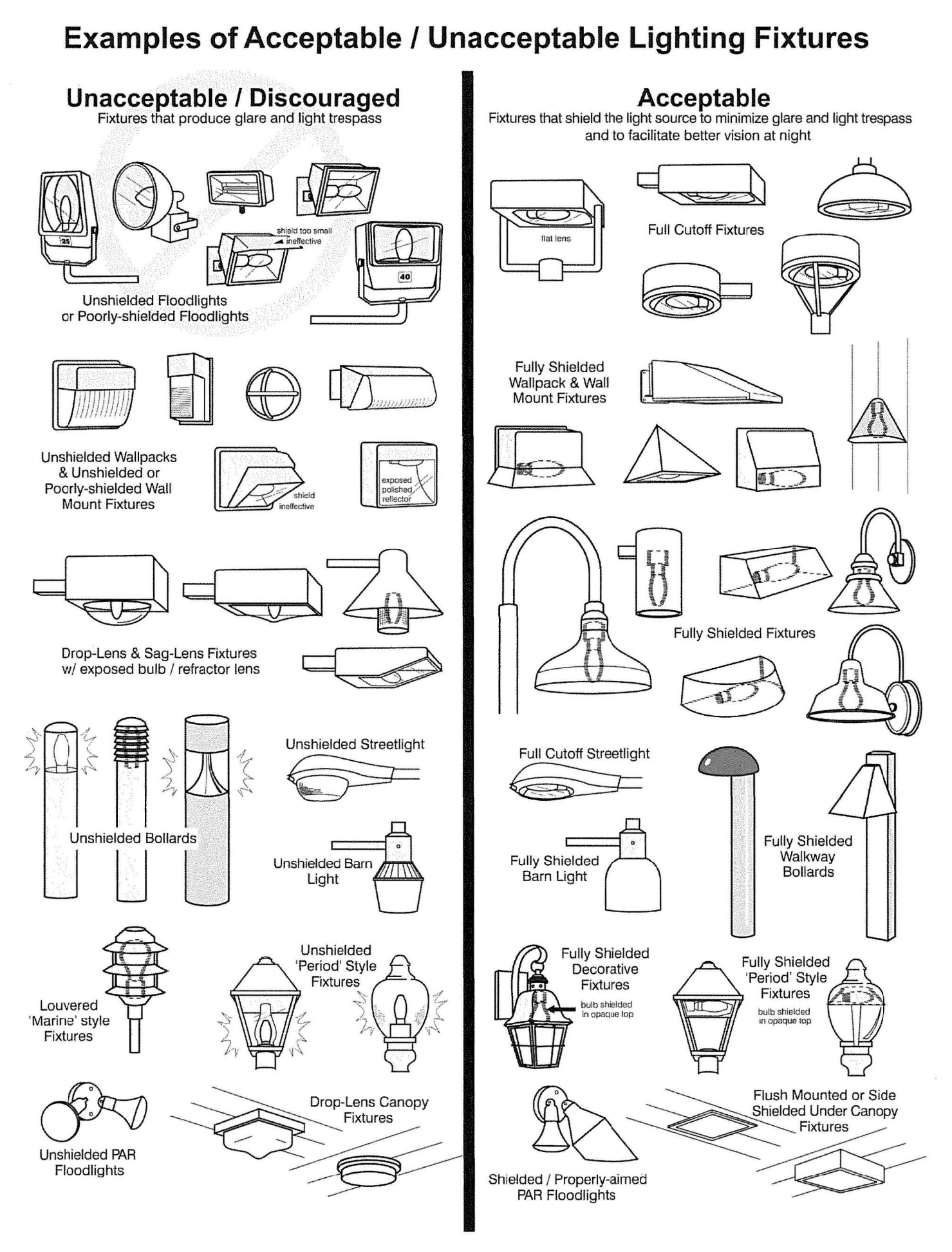
5.6. - Fire ponds.
5.6.1.
Fire ponds and dry hydrants may be required for Special Permit Uses in all zones where deemed necessary by the Commission in consultation with the Town Fire Department to protect the public health and safety.
5.6.2.
A fire pond location shall be:
a.
On poorly and very poorly drained soil areas, within approximately 175 feet of a road.
b.
Such that the pond can provide a minimum of 60,000 gallons usable water with an adequate and reliable recharge.
5.6.3.
The design and construction of a fire pond shall be completed in reference to Fire Hydrant (non-pressure) Detail and Design Sheet, U.S.D.A. Soil Conservation Service, and accomplished with the advisory assistance of the U.S.D.A. Soil Conservation Service, the Litchfield County Conservation District, and the Town of Roxbury Fire Department.
5.6.4.
The location of a fire pond may require review and approval by the Roxbury Inland-Wetlands Commission.
5.7. - Windmills.
Windmills shall be permitted as an accessory structure in all zones subject to the following requirements.
5.7.1.
Height of windmill as measured from grade to center of rotor shall be less than seventy (70) feet.
5.7.2.
Rotor diameter shall be less than thirty-five (35) feet.
5.7.3.
The minimum distance between the ground and any rotor blades used on a windmill shall be fifteen (15) feet as measured at the lowest point of the arc of the blades.
5.7.4.
The minimum setback distance from all property lines and habitable buildings shall equal the height of the machine from grade to the center of the rotor, plus twenty feet or the diameter of the rotor, whichever is greater.
5.7.5.
Climbing access to the windmill tower shall be limited either by:
a.
The installation of a fence with locked gate around tower base or
b.
By limiting tower climbing apparatus to no lower than ten (10) feet from the ground.
5.7.6.
A windmill will be considered abandoned if not properly maintained for a period of two years or if designated a safety hazard by the Building Inspector. The owner of any windmill which is considered to be abandoned or has been designated a safety hazard shall be required to dismantle the installation. All windmills shall be operated and constructed in a safe and reasonable manner.
5.7.7.
System shall be designed with an automatic brake to prevent over-speeding and excessive pressures on the tower structure.
5.8. - Interior lots.
5.8.1.
Authorization. The Zoning Commission may, upon application and in accordance with the provisions of Section 6, and if it finds such use will not, with respect to the future occupants of this property or the general community, significantly impair health, safety, general welfare or future land use and road layouts, grant with regard to interior lots in residential zones A, B and C, a special permit to allow the following:
a.
Construction of one-single-family dwelling with permitted accessory buildings, or
b.
Agriculture or farming activities, as defined elsewhere in these Regulations, provided that any boarding of horses shall not be a commercial enterprise, and the horses are to be cared for by the owner(s) of said horses and/or the owners of the property used for same.
5.8.2.
Interior Lot. An Interior Lot is a lot that does not meet the frontage requirements for the particular zone where it is located and is prohibited except as expressly provided for in these Regulations.
5.8.3.
Requirements.
a.
A special permit for the use of an interior lot shall be approved only if the Zoning Commission determines that there is no logical or feasible alternative for the lot to be properly served by an accepted town road, street or highway in the foreseeable future.
b.
Lots are to be served by an access way (or right-of-way existing prior to January 1, 1983) of not less than fifty (50) feet in width throughout its length to a previously accepted street, road or state highway. There shall be no other access way within five hundred (500) feet, measured along the street line, of the access way for said lot. Rights of way acquired after January 1, 1983, shall not be deemed access ways.
c.
All interior lots are to be served by an access way and/or private road leading to a previously accepted public road. These access ways and private roads shall be not less than fifty (50) feet in width throughout their lengths.
d.
The design and construction of driveways serving interior lots are subject to an ordinance of the Town of Roxbury.
e.
To provide direction for emergency vehicles each interior lot shall be identified by a post or mailbox located at the street line showing the house number.
f.
No building or other structure on an interior lot shall be closer than fifty (50) feet to any lot line.
g.
An interior lot created after the effective date of this change shall contain a minimum of six (6) acres, not including the area of the access way.
h.
There shall be no access way to an interior lot within five hundred (500) feet, measured along the same side of the public road, of another access way to an interior lot.
5.8.4.
Applications and procedures.
a.
Each applicant shall file with the Commission a letter giving the names and addresses of the person, persons, firm or corporation making the application. The letter shall provide the following information:
1.
Brief description of the property and the proposed use.
2.
Location and size of property that is included.
b.
Each applicant shall file with the Commission three copies of an A-2 Survey with the following information:
1.
Name of owner of record, applicant and seal and signature of a Connecticut licensed engineer or land surveyor.
2.
The words "approved by the Roxbury Zoning Commission" with a designated place for the signature of the Chairman and date of signing.
3.
If only a portion of a tract is to be in the plan proposed for approval, the approximate boundaries of the entire tract shall be shown.
4.
Elevations shown by two-foot contour intervals to evaluate and determine the feasibility of the project unless the Commission determines that such information or detail is not required for a particular application.
5.
Names of property owners located within two hundred feet of the proposed plan, adjacent subdivisions where they exist, and the names of any towns other than Roxbury within five hundred (500) feet of the proposed plan.
6.
Indication on the map of provisions made for proposed rights-of-way, private roads or access ways.
c.
Each applicant shall provide a list of adjacent property owners and notice to adjacent property owners as provided at Section 18.9.
d.
The Zoning Commission shall refer the application to the Planning Commission prior to a decision by the Zoning Commission.
e.
The Planning Commission shall certify its decision to the Zoning Commission.
f.
No Special Permit application shall be acted upon by the Zoning Commission until a public hearing has been held by the Zoning Commission on such application and as prescribed in the Connecticut General Statutes.
g.
A Special Permit application shall conform to requirements as prescribed in the Subdivision Regulations when such lot is a part of subdivision or re-subdivision.
h.
A Special Permit becomes effective when filed with the Town Clerk of Roxbury.
5.9. - Large lot interior zone.
5.9.1.
Purpose. The purpose of a Large Lot Interior Zone is to provide:
a.
Some reasonable protection of existing and potential agricultural land or other lands suitable for conservation from excessive residential development, and
b.
To provide owners of agricultural lands an opportunity to make reasonably beneficial use of those portions of land that are best suited for residential use.
5.9.2.
Procedures. The applicant for designation of property as a Large Lot Interior Zone shall apply for a Special Permit in accordance with Section 5.8.4, Section 6, and Section 7. In addition, the applicant shall provide a written statement describing the purpose to be accomplished pursuant to 5.9.1.
5.9.3.
Criteria. The Zoning Commission, in considering an application for a Large Lot Interior Zone shall require, but not be limited to, the following specific criteria:
a.
The minimum area of a Large Lot Interior Zone shall be fifty (50) acres.
b.
The Large Lot Interior Zone shall allow a maximum of three (3) lots containing a minimum often (10) acres each excluding access way.
c.
If the Large Lot Interior Zone is part of a larger subdivision, all lots in such subdivision shall contain a minimum often (10) acres.
d.
Each lot shall be capable of containing a four hundred (400) foot diameter circle.
e.
No structure shall be built within seventy-five (75) feet of any boundary line.
f.
Lots within a Large Lot Interior Zone shall comply with all subdivision regulations.
g.
Lots are to be served by a private road leading to a previously accepted public road.
h.
Private roads shall be designed and constructed to Town Specifications for public roads with the exception of a bituminous surface, and:
1.
All private roads shall be constructed under the supervision of a licensed engineer.
2.
A required road bond shall have the approval of the Town Attorney.
3.
The private road shall be owned in fee simple by a Homeowners' Association.
4.
Access ways to individual lots shall be separated by a minimum of one hundred (100) feet.
5.
No private road shall have a grade more than ten percent (10%) except grades up to fifteen percent (15%) may be allowed for distances up to two hundred (200) feet for unusual conditions, but only if specifically authorized by the Zoning Commission.
6.
The private road shall have a minimum fifty (50) foot right-of-way with the travel way having a minimum width of sixteen (16) feet.
i.
The Large Lot Interior Zone shall be in compliance with applicable requirements of the Master Chart.
5.9.4.
Conservation Easements. Up to two (2) additional lots, having a minimum of ten (10) acres each, may be granted on a private road which serves a Large Lot Interior Zone provided that a conservation easement is granted which would preserve a minimum of twenty (20) acres of agricultural land or other land suitable for conservation, such as fragile stream belts, hardwood forest, scenic areas, and the like. The selection of such a parcel shall be determined by the applicant with the approval of the Zoning commission, and:
a.
Said easements shall be contiguous and shall be in addition to minimum lot acreage requirements of the Large Lot Interior Zone.
b.
The conservation easement for agricultural or other land suitable for conservation shall be in perpetuity.
c.
There shall be a maximum of five (5) lots granted in a Large Lot Interior Zone including the additional lots granted due to conservation easements.
5.10. - Non-commercial earth stations (dish antennas).
For the purpose of these Regulations, Earth Stations, including noncommercial satellite or dish antennas, shall be defined as the outdoor portion of noncommercial radio and television receiving equipment. "Earth Stations" does not mean or include Ham Radio receivers or equipment, which are not regulated by these Regulations. Earth Stations shall be permitted as an accessory structure in all zones subject to the following requirements:
5.10.1.
All Earth Stations must comply with the setbacks as set forth in the Master Chart
5.10.2.
When roof mounted, it must conform to the zone's height limits and its installation be approved by the building official. When not roof mounted, the antenna shall not be installed no higher than required to accomplish its purpose and in no event shall it be more than one hundred (100) feet above existing grade.
5.10.3.
Earth Stations shall be effectively screened from view from adjacent properties and streets as approved by the Commission or its agent.
5.10.4.
One Earth Station shall be allowed per residence or business.
5.10.5.
A zoning permit shall be required.
5.11. - Telecommunication antenna, facilities and antennae towers including personal wireless service facilities and towers.
5.11.1.
The purposes of this regulation are to:
a.
Preserve the character and appearance of the Town while simultaneously allowing adequate Personal Wireless Services to be developed:
b.
Protect the rural, scenic, historic, environmental, and natural or manmade resources of the community and the Town of Roxbury including roads designated as scenic roads by the local, state or federal government:
c.
Provide standards and requirements for regulation, placement, construction, monitoring, design, modification and removal of Personal Wireless Service Facilities;
d.
Provide a procedural basis for action within a reasonable period of time for requests for authorization to place, construct, operate or modify Personal Wireless Service Facilities.
e.
Preserve property values;
f.
Minimize the total number and height of Towers throughout the community;
g.
Locate Towers so that they do not have negative impacts (such as, but not limited to, attractive nuisance, noise and falling objects) on the general safety, welfare and quality of life of the community;
h.
Require owners of Towers and Personal Wireless Service Facilities to configure them so as to minimize and mitigate the adverse visual impact of the Towers and Facilities;
i.
Require Tower sharing and the clustering of Personal Wireless Service Facilities where possible; maximize the use of existing communications towers, water towers, silos and other similar buildings, if available, to accommodate new wireless telecommunication antennas in order to reduce the number of towers needed to serve the community;
j.
Provide consistency with Federal Law: These regulations are intended to be consistent with The Telecommunications Act of 1996 in that: a) they do not prohibit or have the effect of prohibiting the provision of Personal Wireless Services; b) they are not intended to be used to unreasonably discriminate among providers of functionally equivalent Services; c) they do not regulate Personal Wireless Services on the basis of the environmental effects of radio frequency emissions to the extent that the regulated Services and Facilities comply with the FCC's regulations concerning such emissions;
k.
Provide Consistency with Roxbury's Plan Conservation and Development with respect to preserving the rural, historic and agrarian character of the land use including protection of the landscape and scenic views consisting of hills, historic settings, streams, trees, meadows, and other natural features; Facilitate the provision of wireless communication services to residents and businesses in Roxbury; and
l.
Avoid potential damage to adjacent properties from Tower failure through structural standards and setback requirements.
5.11.2.
Definitions and word usage: As used in this Section 5.11, the following terms shall have the meanings indicated. The words "shall" or "will" indicate mandatory requirements; "may" is advisory and indicates recommendations which are not mandatory.
a.
ACT. The Telecommunications Act of 1996.
b.
ADEQUATE COVERAGE. Coverage is considered to be "adequate" within that area surrounding a Base Station where the predicted or measured median field strength of the transmitted signal is greater than -95 dbm. It is acceptable for there to be holes within the area of Adequate Coverage where the signal is less than -95 dbm, as long as the signal regains its strength to greater than -95 dbm further away from the Base Station. For the limited purpose of determining whether the use of a Repeater is necessary or desirable, there shall be deemed not to be Adequate Coverage within said holes. The outer boundary of the area of Adequate Coverage, however, is that location past which the signal does not regain a strength of greater than -95 dbm.
c.
ADEQUATE CAPACITY. Capacity is considered to be "adequate" if the Grade of Service is p.05 or better for at least 50% of the days in a preceding month, prior to the date of Application, as measured using direct traffic measurement of the Personal Wireless Service Facility in question, where the call blocking is due to frequency contention at the antenna(s).
d.
ANTENNA. A device which is attached to a Tower, or other structure for transmitting and receiving electromagnetic waves, telecommunication or radio signals. Examples include panels, microwave dishes (other than Earth Stations as defined herein) and Monopoles.
e.
AVAILABLE SPACE. The space on a Tower or structure to which Antennas of a Personal Wireless Service Provider are both Structurally Able and Electromagnetically Able to be attached.
f.
BASE STATION. The primary sending and receiving site in a wireless telecommunications network. More than one Base Station and/or more than one variety of Personal Wireless Service Provider can be located on a single Tower or structure.
g.
CHANNEL. The segment of the radiation spectrum from an Antenna which carries one signal. An Antenna may radiate on many Channels simultaneously.
h.
COMMUNICATION EQUIPMENT SHELTER. A structure located at a Base Station designed principally to enclose equipment used in connection with Personal Wireless Service transmissions.
i.
DBM. Unit of measure of the power level of an electromagnetic signal expressed in decibels referenced to 1 milliwatt.
j.
ELECTROMAGNETICALLY ABLE. The determination that the new signal from and to the proposed new Antennas will not significantly interfere with the existing signals from and to other Facilities located on the same Tower or structure as determined by a qualified professional telecommunications engineer. The use of available technologies to alleviate such interference shall be considered when making this determination.
k.
EMF. Electromagnetic Frequency Radiation
l.
FACILITY SITE. A property or any part thereof, which is owned or leased by one or more Personal Wireless Service Providers and upon which one or more Personal Wireless Service Facility(s) and required landscaping are located.
m.
FCC. Federal Communications Commission. The Government agency responsible for regulating telecommunications in the United States.
n.
FCC 96-326. A Report and Order which sets national standards for emissions of Radio-Frequency emissions from FCC-regulated transmitters.
o.
GHZ. Gigahertz: One billion hertz.
p.
GRADE OF SERVICE. A measure of the percentage of calls which are able to connect to the Base Station, during the busiest hour of the day. Grade of Service is expressed as a number, such as p.05 - which means that 95% of callers will connect on their first try. A lower number (p.04) indicates a better Grade of Service.
q.
HERTZ. One hertz is the frequency of an electric or magnetic field which reverses polarity once each second, or one cycle per second.
r.
MAJOR MODIFICATION OF AN EXISTING FACILITY. Any change, or proposed change in power input or output, number of Antennas change in Antenna type or model, repositioning of Antenna(s), change in number of Channels per Antenna above the maximum number approved under an existing Special Permit.
s.
MAJOR MODIFICATION OF AN EXISTING TOWER. Any increase, or proposed increase in dimensions of an existing and permitted Tower or other structure designed to support Personal Wireless Service transmission, receiving and/or relaying antennas and/or equipment.
t.
MHZ. Megahertz: One million hertz.
u.
MONITORING. The measurement, by the use of instruments in the field, of the radiation from a Site as a whole, or from individual Personal Wireless Service Facilities, Towers, Antennas or Repeaters.
v.
MONITORING PROTOCOL. The testing protocol, initially the Cobbs Protocol, which is to be used to monitor the emissions from existing and new Personal Wireless Service Facilities upon adoption of this Section 5.11.1 The Commission may, as the technology changes, require, by written regulation, the use of other testing protocols. A copy of the Monitoring Protocol shall be on file with the Commission.
w.
MONOPOLE. A single self-supporting vertical pole with no guy wire anchors, usually consisting of a galvanized or other unpainted metal, or a wooden pole with below grade foundations.
x.
PERSONAL WIRELESS SERVICES. Commercial Mobile Services, unlicensed wireless services, and common carrier wireless exchange access services. These services include: cellular services, personal communications services (PCS), Specialized Mobile Radio Services, and Paging Services.
y.
PERSONAL WIRELESS SERVICE FACILITY. All equipment (including any Repeaters) with which a Personal Wireless Service Provider broadcasts and receives the radio frequency waves which carry their services and all locations of said equipment or any part thereof. This Facility may be sited on one or more Towers or structure(s) owned and permitted by another owner or entity.
z.
PERSONAL WIRELESS SERVICE PROVIDER-An entity, licensed by the FCC to provide Personal Wireless Services to individuals or institutions.
aa.
RADIATION PROPAGATION STUDIES OR RADIAL PLOTS. Computer generated estimates of the radiation emanating from Antennas or Repeaters sited on a specific Tower or structure. The height above ground, power input and output, frequency output, type of antenna, antenna gain, topography of the site and its surroundings are all taken into account to create these simulations. They are the primary tool for determining whether a site will provide Adequate Coverage for the Personal Wireless Telecommunications Service Facility proposed for that Site.
bb.
REPEATER.A small receiver/relay transmitter of not more than 20 watts output designed to provide service to areas, which are not able to receive Adequate Coverage directly from a Base Station.
cc.
STRUCTURALLY ABLE. The determination that a Tower or structure is capable of carrying the load imposed by the proposed new Antennas under all reasonably predictable conditions as determined by professional structural engineering analysis.
dd.
TELEPORT. A facility utilizing satellite dishes of greater than 2.0 meters in diameter designed to uplink to communications satellites for transmitting in the C-Band (4 - 6 GHz) spectrum.
ee.
TOWER-A lattice structure or framework, or Monopole that is free standing or attached to a building or another structure, that is used and designed to support Personal Wireless Service transmission, receiving and/or relaying antennas and/or equipment.
5.11.3.
Exempted Wireless Telecommunications Uses. The following wireless telecommunications facilities uses are specifically exempted from this Section 5.11: police, fire, ambulance and other emergency dispatch; amateur (ham) radio; citizens band radio; any existing commercial radio tower; radio dispatch services for local businesses. No Personal Wireless Service Facility shalt be considered exempt from this regulation for any reason whether or not said Facility is proposed to share a Tower or other structure with such exempt uses.
5.11.4.
Provision of Independent Consultants.
a.
Upon submission of an Application for a Special Permit under this Section 5.11, the applicant shall pay the cost for the Commission to retain an independent consultant to analyze and report on the application including determining areas appropriate for towers and the cost of the town's monitoring of operations of the towers. These Consultants shall each be qualified professionals with a record of service to municipalities in one of the following fields: 1) telecommunications engineering, 2) structural engineering, 3) monitoring of electromagnetic fields, and 4) others as determined necessary by the Commission.
b.
The Commission shall select the Independent Consultant(s).
5.11.5.
Prohibition of Teleports. There shall be no Teleport(s) within the Town of Roxbury.
5.11.6.
General Application Requirements. In addition to the requirements of Section 6, applications pursuant to Section 5.11 shall comply with the following.
a.
Special Permit. No Tower or Personal Wireless Service Facility shall be erected, constructed, or installed without first obtaining a Special Permit from the Commission. One or both of two kinds of Special Permits are required; a) for new Tower construction (or Major Modification of an Existing Tower); b) for Personal Wireless Service Facilities (or Major Modification Of An Existing Facility) to be mounted on an existing, or newly permitted, Tower or structure. If Applicant is applying for both Permits, they shall be submitted and examined concurrently. Applications shall be submitted using an application in accordance with the requirements of Section 6 of these Regulations. The following additional information must also be submitted:
b.
Adequate Coverage, Adequate Capacity, and Justification of Need. Applicant shall provide written documentation of any Facility Sites in Roxbury, and in abutting towns in which it has a legal or equitable interest whether by ownership, leasehold or otherwise. From each such Facility Site it shall demonstrate with written documentation that these Facility Sites are not already providing, or do not have the potential by adjusting the Site, to provide Adequate Coverage and/or Adequate Capacity to the Town of Roxbury. The documentation shall include, for each Facility Site listed, the exact location (in Longitude and latitude, to degrees, minutes and seconds), ground elevation, height of Tower or structure, type of Antennas, Antenna gain, height of Antennas on Tower or structure, output frequency, number of channels, power input and maximum power output per channel. Potential adjustments to these existing Facility Sites, including changes in Antenna type, orientation, gain, height or power output shall be specified. Radial Plots from each of these Facility Sites, as they exist, and with adjustments as above, shall be provided as part of the Application. The applicant shall provide a map showing the extent of coverage through Roxbury.
c.
Applicants shall demonstrate with written documentation that they have examined all Facility Sites located in Roxbury, and in abutting towns in which Applicant has no legal or equitable interest, whether by ownership leasehold or otherwise to determine whether those existing Facility Sites can be used to provide Adequate Coverage and/or Adequate Capacity to the Town of Roxbury The documentation shall include, for each Facility Site examined, the exact location (in Longitude and latitude, to degrees, minutes and seconds), ground elevation, height of Tower or structure, type of Antennas proposed, proposed Antenna gain, height of proposed Antennas on Tower or structure, proposed output frequency, proposed number of channels, proposed power input and proposed maximum power output per channel. Radial Plots from each of these Facility Sites, as proposed, shall be provided as part of the Application.
d.
Applicants shall demonstrate with written documentation that they have analyzed the feasibility of Repeaters in conjunction with all Facility Sites listed in compliance with this section 5.11 to provide Adequate Coverage and/or Adequate Capacity to the Town of Roxbury. Radial Plots of all Repeaters considered for use in conjunction with these Facility Sites shall be provided as part of the Application.
e.
The Tower and Facilities shall be designed to withstand the maximum sustained wind speed for the location proposed. The fall zone shall be determined so that structures are not located within the fall zone.
f.
Required Documentation:
1.
Copies of all submittals and showings pertaining to: FCC licensing; Environmental Impact Statements; FAA Notice of Construction or Alteration; Aeronautical Studies; and, all data, assumptions and calculations relating to service coverage and power levels regardless of whether categorical exemption from Routine Environmental Evaluation under the FCC rules is claimed.
2.
Copies of all information submitted in compliance with requirements of the Connecticut Department of Public Health including without limitation all laws, regulations and requirements relating to facilities which generate electromagnetic fields in the frequency range of 300 KHZ to 100 GHz and Microwave ovens, or any revisions thereof as the Department of Public Health may, by written notice, create.
3.
The exact legal name, address or principal place of business and phone number of the Applicant. If any Applicant is not a natural person, it shall also give the state under which it was created or organized.
4.
The name, title, address, and phone number of the person to whom correspondence or communications in regard to the application are to be sent. Notice, orders and other papers may be served upon the person so named, and such service shall be deemed to be service upon the Applicant.
5.
Name, address, phone number, and written consent to apply for this permit, of the owner of the property on which the proposed Tower shall be located, or of the owner(s) of the Tower or structure on which the proposed Facility shall be located.
6.
Required Plans and engineering plans, prepared, stamped and signed by a Professional Engineer licensed to practice in Connecticut. (Note: survey plans should also be stamped and signed by a Professional Land Surveyor registered in Connecticut. Plans shall be on 24" x 36" sheets, on as many sheets as necessary, and at scales which are no smaller (i.e. no less precise) than listed below, and which show the following information: a. Each plan sheet shall have a title block indicating the project title, sheet title, sheet number, date, revision dates, scale(s), and original seal and signature of the P.E. and other professionals who prepared the plan.
5.11.7.
Special Permit Application Requirements for new Tower construction, or Major Modification of an Existing Tower. A Tower Construction Special Permit is required.
a.
Applicant shall provide a written, irrevocable commitment valid for the duration of the existence of the Tower to rent or lease Available Space for co-location on the Tower at fair-market prices and terms, without discrimination to other Personal Wireless Service Providers.
b.
If Applicant is not simultaneously applying for a Personal Wireless Service Facilities Special Permit, it shall provide a copy of its existing lease/contract with a Personal wireless Service Provider. A Tower Construction Special Permit shall not be granted for a Tower to be built on speculation.
c.
The following site plans and maps:
1.
Location Map: Copy of a portion of the most recent U.S.G.S Quadrangle map, at a scale of 1:25,000 and showing the area within at least two miles from the proposed tower site. Indicate the Tower location and the exact latitude and Longitude (degrees, minutes and seconds).
2.
Vicinity Map at a scale of 1" = 200' (1:2400) with contour intervals no greater than 10 feet (3 meter) showing the entire vicinity within a 2000' radius of the Tower site and including the topography, public and private roads and driveways, buildings and structures, bodies of water, wetlands, landscape features including ridge lines, preserved open space, historic sites, recreational areas, habitats for endangered species. Indicate the property lines of the proposed Tower Site Parcel and of all abutters within 300' of the Tower Site Parcel (from assessors' maps or available surveys). Include the names of all abutters within 300' of the Tower Site Parcel. Indicate any access easement or right of way needed for access from a public way to the Tower, and the names of all abutters or property owners along the access easement or who have deeded rights to the easement. Show all designated scenic roads in the vicinity of the site.
3.
Existing Conditions Plan: A recent survey of the Tower Site at a scale no smaller than 1" = 40' (1:480 or metric equivalent 1:500) with topography drawn with a minimum of 2' (0.6 meter) contour intervals, showing existing utilities, property lines, existing buildings or structures, stone walls or fence lines, wooded areas, individual trees with diameters greater than 12" within a 200' radius from the base of the proposed Tower (labeled with their current heights). Show the boundary of any wetlands or floodplains or watercourses, and of any bodies of water included in the Watershed Protection District within 200' from the Tower or any related facilities or access ways or appurtenances. Show slopes, scenic vistas, stone walls, and other important environmental features of the site. Show any historically designated properties on or adjacent to the site or historic districts to which the site is part or adjacent. All permanently protected lands, such as State parks, forest lands, and land protected by a land trust on or adjacent to the site shall be shown. The survey plan must have been completed, on the ground, by a Professional Land Surveyor within two years prior to the application date.
d.
The Applicant shall also provide the following:
1.
An inventory of all Antennae and Towers not contained within fully enclosed buildings.
2.
A map showing the extent of planned coverage within the Town of Roxbury and the location and service area of the proposed facilities.
3.
A topographic profile showing the proposed tower and its associated equipment.
4.
Effect on bird habitats prepared by qualified wildlife biologist.
5.
Historic, architectural and archaeological sites listed on the National Register or the State Register of Historic places, or eligible for listing on them.
e.
Proposed Facility Site Plans: Proposed Facility Site layout, grading and utilities at the same scale or larger than the Existing Conditions Plan.
1.
Proposed Tower location and any appurtenances, including supports and guy wires, if any, and any accessory building (Communication Equipment Shelter or other). Indicate property boundaries and setback distances to the base(s) of the Tower and to the nearest comers of each of the appurtenant structures to those boundaries, and dimensions of all proposed improvements.
2.
Indicate proposed spot elevations at the base of the proposed Tower and at the base of any guy wires, and the comers of all appurtenant structures.
3.
Proposed utilities, including distance from source of power, sizes of service available and required, locations of any proposed utility or communication lines, and whether underground or above ground.
4.
Limits of areas where vegetation is to be cleared or altered, and justification for any such clearing or alteration.
5.
Any direct or indirect wetlands alteration proposed.
6.
Detailed plans for drainage of surface and/or sub-surface water; plans to control erosion and sedimentation both during construction and as a permanent measure.
7.
Plans indicating locations and specifics of proposed screening, landscaping, ground cover, and fencing; any allowed exterior lighting or signs.
8.
Plans, including length, of proposed access driveway or roadway and parking area at the Tower Site. Include grading drainage, traveled width. Include a cross section of the access drive indicating the width, depth of gravel, paving or surface materials. Provide soil erosion and sedimentation control plans for all site improvements.
f.
Proposed Tower and Appurtenances:
1.
Plans, elevations, sections and details at appropriate scales but no smaller than 1" = 10'.
2.
Two cross sections through proposed Tower drawn at right angles to each other, and showing the ground profile to at least one hundred (100) feet beyond the limit of clearing, and showing any guy wires or supports. The dimension of the proposed height of tower above average grade at Tower Base. Show all proposed antennas, including their location on the Tower.
3.
Details of proposed Tower foundation, including cross sections and details. Show all ground attachments, specifications for anchor bolts and other anchoring hardware.
4.
Detail proposed exterior finish of the Tower. Provide an architectural rendering of the view of the Tower from adjoining properties
5.
Indicate relative height of the Tower to the tops of surrounding trees as they presently exist, and the height to which they are expected to grow in ten years.
6.
Illustration of the modular structure of the proposed Tower indicating the heights of sections which could be removed or added in the future to adapt to changing communications conditions or demands.
7.
A Structural Professional Engineer's written description of the proposed Tower structure and its capacity to support additional Antennas or other communications facilities at different heights and the ability of the Tower to be shortened if future communications facilities no longer require the original height.
8.
A description of Available Space on the Tower, providing illustrations and examples of the type and number of Personal Wireless Service Facilities which could be mounted on the structure.
9.
The power and frequency of all transmissions to be broadcast from the facility.
10.
The location of the fall zone so that structures are not located within the fall zone.
11.
An elevation drawing showing the ridge line on all sides of the proposed tower and showing the tower and facilities on the ridgeline as seen from the town hall.
12.
If known, indicate whether other development is being proposed or considered near the proposed site.
g.
Proposed Communications Equipment Shelter.
1.
Floor Plans, elevations and cross sections at a scale of no smaller than 1/4" = 1 (1:48) of any proposed appurtenant structure.
2.
Representative elevation views, indicating the roof, facades, doors and other exterior appearance and materials.
h.
Sight Lines.
1.
A minimum of eight (8) view lines in a zero (0) to two (2) mile radius from the site, shown beginning at True North and continuing clockwise at forty-five degree intervals.
2.
A plan map of a circle of two (2) miles radius of the Facility Site on which any visibility of the proposed Tower from a public way shall be indicated.
3.
Applicant shall utilize the U.S.G.S. Quadrangle map, at a scale of 1:25,000, and submit profile drawings on a horizontal scale of 1" 500' with a vertical scale of 1"=40'. Trees shall be shown at existing heights and at projected heights in ten years.
i.
Balloon Test: Prior to the public hearing on the Application, Applicant shall arrange to fly, or raise upon a temporary mast, a three foot diameter brightly colored balloon at the maximum height of the proposed Tower. The dates (including a second date, in case of poor visibility on the initial date), times and location of this balloon test shall be advertised, by the Applicant, at 7 and 14 days in advance of the first test date in a newspaper with a general circulation in the Town of Roxbury. The Applicant shall inform the Commission, in writing, of the dates and times of the test, at least 14 days in advance. The balloon shall remain in place as long as practical but not less than four consecutive hours sometime between 9:00 a.m. and 5:00 p.m. of the dates chosen.
j.
Waiver. The Commission may waive any of the application requirements for a Major Modification of An Existing Tower if it finds that the modification or addition will not have a significant impact.
k.
Site justification Statement. Provide a statement containing the description of the sitting criteria employed in the application and the process by which other possible sites were considered and eliminated. Discuss whether alternative sites were exhausted.
l.
Describe the technological alternatives and their costs for the proposed Tower and a statement containing the reasons for the choice of the proposed facility.
m.
Provide a statement of the impact on human health, if any, of signal frequency and power density to be transmitted and/or received at the proposed facility and site.
n.
Provide such other additional information necessary or useful for evaluating the environmental impacts of the proposed site and alternative sites.
5.11.8.
Applications for new Personal Wireless Service Facility, or Major Modification of An Existing Facility, A Personal Wireless Service Facility Special Permit is required and the following plans and maps.
a.
Location Map: Copy of a portion of the most recent U.S.G.S Quadrangle map, at a scale of 1:25,000, and showing the area within at least two miles from the proposed Facility Site. Indicate the location of the proposed Personal Wireless Service Facility, or of the Facility undergoing Major Modification, and the exact Latitude and Longitude (degrees, minutes and seconds).
b.
Proposed Facility Plan: A recent survey of the Facility Site at a scale no smaller than 1"=40' (1:480 or metric equivalent 1:500) showing:
1.
Horizontal and radial distances of Antenna(s) to nearest point on property line.
2.
Horizontal and radial distances of Antenna(s) to nearest dwelling unit.
3.
Proposed utilities, including distance from source of power, sizes of service available and required, locations of any proposed utility or communication lines, and whether underground or above ground.
4.
Any changes to be made to the existing Facility's landscaping, screening, fencing, lighting, drainage, wetlands, grading, driveways or roadways, parking, or other infrastructure as a result of this proposed Modification of the Facility.
c.
Proposed Communications Equipment Shelter.
1.
Floor Plans, elevations and cross sections at a scale of no smaller than 1/4" = 1 foot of any proposed appurtenant structure.
2.
Representative elevation views, indicating the roof, facades, doors and other exterior appearance and materials. Screening shall be shown.
d.
Proposed Equipment Plan.
1.
Plans, elevations, sections and details at appropriate scales but no smaller than 1"=10'.
2.
Number of Antennas and Repeaters, as well as the exact locations, of Antenna(s) and of all Repeaters (if any) located on a map as well as by Degrees, minutes and seconds of Latitude and Longitude.
3.
Mounting locations on Tower or structure, including height above ground.
4.
Antenna type(s), manufacturer(s), model number(s).
5.
For each Antenna, the Antenna gain and Antenna radiation pattern.
6.
Number of channels per Antenna, projected and maximum.
7.
Power input to the Antenna(s).
8.
Power output, in normal use and at maximum output for each Antenna and all Antennas as an aggregate.
9.
Output frequency of the Transmitter(s).
e.
An architectural rendering of the view of the antenna(e) from adjoining properties and roads abutting site.
f.
A description of the technological alternatives and their costs for the proposed antenna(e) and a statement providing the reason for the choice of the proposed location.
g.
A statement of the impact on human health, if any, of signal frequency and power density to be transmitted and/or received by the proposed antenna(e) site.
h.
Waiver. The Commission may waive any of the application requirements for a Major Modification of An Existing Facility if it finds that the modification or addition will not have a significant impact.
5.11.9.
General Requirements.
a.
All New Towers shall be set back at least one (1) time the height of the Tower plus fifty (50) feet from all boundaries of the Site on which the Tower is located. This setback requirement does not apply to Towers on Town property to be used in whole or in part by the Town to provide emergency communication services. However, the application for a Tower to be located and used for Town emergency communications shall include satisfactory evidence that the design and construction of the Tower shall permit it to be placed within said setback without undue danger to lives or property. The setback requirement in this section 5.11.10 supersedes all other setback requirements for the applicable zone.
b.
If the Facility or Tower Site is in a wooded area, a vegetated buffer strip of undisturbed trees shall be retained for at least fifty (50) feet in width around the entire perimeter except where the access drive is located. Further, in addition to the preservation of a buffer, landscaping shall be required around the fence, which shall consist of a row of evergreen trees planted ten (10) feet on center maximum. The evergreen screen shall be a minimum height of six (6) feet at planning and shall be reasonably projected to grow to a minimum height of fifteen (15) feet at maturity. The landscaping shall screen the building and fence from the view of streets and neighboring properties. The screen shall be maintained by the owner of the property to ensure its effectiveness. The Commission may substitute any combination of existing vegetation, topography, walls, or other features in lieu of evergreen screening, providing the substitute plan equals or exceeds the protection provided by the evergreen screen. Applicant shall provide financial surety (letter of credit, surety or cash bond) in a form and content acceptable to the Town Attorney and the Independent Consultant and or the Town's consulting engineer to cover the cost of the remediation of any damage to the landscape which occurs during the clearing of the site and to secure the installation of new landscaping required by the screening plan.
c.
Fencing and Signs: The area around the Tower and Communication Equipment Shelter(s) shall be completely fenced for security to a height of eight feet and gated. Use of razor wire is not permitted. A sign no greater than two (2) square feet indicating the name of the facility owner(s) and a 24-hour emergency telephone number shall be posted adjacent to the entry gate. In addition, No Trespassing or other warning signs may be posted on the fence. If in a residential zone, the fencing and gate shall be designed and made of materials so as to be in keeping with the neighborhood and to appear residential in character rather than commercial. No signs other than as required and approved by the FCC or other state or federal governmental agency having jurisdiction, shall be permitted on the Tower. No advertising shall be permitted from the Tower.
d.
Communication Equipment Shelters and Accessory Buildings shall be designed to be architecturally similar and compatible with each other, and shall be no more than twelve (12) feet high. The buildings shall be used only for the housing of equipment related to this particular site. Manned equipment incidental to the business office, maintenance depot and vehicle storage is prohibited. Whenever possible, the buildings shall be joined or clustered so as to appear as one building. Any building shall be designed to be in harmony with the surrounding neighborhood properties on the site and impact that the tower will have on these resources. If located in a residential zone, the buildings shall be designed to appear residential. The buildings shall be no larger than necessary to accomplish the functions required.
e.
Height and size: New Towers shall not exceed the minimum height necessary to provide Adequate Coverage for the Personal Wireless Service Facilities proposed for use on the Tower. Applicant may submit a request for additional height to accommodate future sharing, and shall provide design information to justify such additional height. Building or roof-top mounted antenna(e) shall be located or screened so as not to be visible from abutting public streets or adjoining residences. If the equipment is located on the roof of a building, the area of the equipment building and other equipment structures shall not occupy more than twenty-five (25) percent of the roof area. Roof located equipment must be set back at least ten (10) feet or ten (10%) percent of the roof depth, whichever is greater.
f.
Tower Finish, Antenna design: The Commission may require the Tower(s) to be painted or otherwise camouflaged to minimize the adverse visual impact. Antenna located on a building shall be compatible with the underlying structure.
g.
Tower(s) must be of a type, which will maximize potential sharing. Lattice type structures are preferred, but where a Monopole is requested, Applicants must demonstrate the future utility of such structure for expansion of service for Applicant and other future Applicants. If possible, each Tower has the capacity to accommodate at lease three Service Providers. The proposed support structure shall be designed for additional facilities including other wireless communications companies, and local police, fire and ambulance need, unless it is determined to be technically unfeasible. The Antenna(e) shall be located on existing communication towers, silos, water towers and the like where available; if no existing Towers are available, antennae may be located on new Towers, where existing topography, vegetation, buildings or other structures provide the greatest amount of screening.
h.
The use of Repeaters to assure Adequate Coverage, or to fill holes within areas of otherwise Adequate Coverage, while minimizing the number of required Towers is permitted and encouraged. An Applicant who has received a Personal Wireless Service Facility Special Permit under this regulation, may, with at least thirty (30) days written notice to the Commission, the Director of Health, Inland Wetlands and Watercourses Commission, Building Inspector and Town Clerk, install one or more additional Repeaters by right. Site Plan Review by the Zoning Commission shall be required. Applicants shall detail the number, location, power output, and coverage of any proposed Repeaters in their systems and provide engineering data to justify their use.
i.
If primary coverage greater than fifty percent (50%) from proposed Personal Wireless Service Facility is outside Roxbury then permit may be denied unless the Applicant can show that they are unable to locate within the Town which is primarily receiving service from the proposed Facility.
j.
Commercial advertising is prohibited on any Antenna Tower, or Accessory Building or Communication Equipment Shelter.
k.
Unless required by the Federal Aviation (Agency) Administration, The FCC or the Connecticut Siting Council, no lighting or illumination of Towers, or the Personal Wireless Service Facility, is permitted, except for manually operated emergency lights for use only when operating personnel are on site.
l.
No Tower or Personal Wireless Service Facility that would be classified as a hazard to air navigation, as defined by the Federal Aviation regulations (Title 14 CFR) is permitted.
m.
No clear cutting of timber, except as approved in connection with construction, is allowed within setback area.
n.
No Tower or Personal Wireless Service Facility, including any guy wires, with the exception of Repeaters shall be located:
1.
Closer than fifteen hundred (1500') feet, on a horizontal plane, to any structure, existing at the time of Application, which is, or is able to be, occupied or habitable, on the property of any school (both public and private).
2.
Closer than seven hundred (750') feet, on a horizontal plane, to an existing Dwelling Unit, or, day-care center, hospital, nursing home, church, synagogue or other place of worship.
o.
No Repeater shall be located closer than fifty (50') feet to an existing Dwelling Unit, nor less than twenty-five (25') feet above ground.
p.
No Tower or Personal Wireless Service Facility, including any guy wires, with the exception of Repeaters shall be located within any of the following prohibited areas:
1.
Local or federally regulated wetland or vernal pool;
2.
The habitat of any State-listed Rare or Endangered Wildlife or Rare Plant Species;
3.
Within the two hundred (200') feet horizontally of the Outer Riparian Zone measured horizontally from any river or watercourse;
4.
Within five hundred (500') feet horizontally from any Historic District or property listed or eligible to be listed on the State or Federal Register of Historic Places;
5.
Within five hundred (500') feet horizontally from any known archaeological site.
6.
Within five hundred (500') feet of a local state or federally designated scenic road.
7.
On property designated as a scenic ridgeline pursuant to the Planning Commission approved Plan of Conservation and Development.
8.
On a lot which is less than the minimum lot size required for the zoning district in which it is located.
5.11.10.
Towers and Personal Wireless Service Facilities shall be located so as to minimize the following potential impacts:
a.
Visual/Aesthetic: Towers shall, when possible, be sited where their visual impact is least detrimental to areas that possess scenic quality of local, regional or state-wide significance such as:
1.
Ridge lines;
2.
Connecticut State Forests, Connecticut Natural Area Preserves, Natural Area Inventory Sites.
3.
Areas permanently preserved by land trusts and similar organizations.
4.
Areas marked as "rural" on the State Plan of Conservation and Development set forth at Conn. Gen. Stat. Section 16a-24 et. seq.
5.
Roads designated as Scenic Roads pursuant to Connecticut Gen. Stat. Section 7-149a and 13b-31b through 13b-31e.
b.
Diminution of residential property values: Siting shall be in as low population density areas as possible.
c.
Structural failure and attractive nuisances.
d.
Safety from excessive electromagnetic radiation: In case the Tower or Personal Wireless Service Facility is found to exceed the FCC guidelines.
5.11.11.
The following locations are ranked in order of preference for Tower sittings:
a.
The use of municipal lands, with the approval of the Town, which comply with other requirements of this Section 5.11 and where visual impact can be minimized and mitigated, shall be encouraged.
b.
Shared use (co-location) of existing Personal Wireless Service Facilities shall be encouraged.
c.
The use of Repeaters to provide Adequate Coverage without requiring new Tower(s) shall be encouraged.
d.
Clustering of Towers: Applications for Towers adjacent to Existing Towers shall be encouraged, providing the location is suitable (based on the criteria of this Regulation) for such an impact.
5.11.12.
Towers and Personal Wireless Service Facilities shall be located so as to provide Adequate Coverage and Adequate Capacity with the least number of Towers and Antennas which is technically and economically feasible.
5.11.13.
The Commission shall request input from the chiefs (or their designees) of Fire, Police, Ambulance and other Emergency services regarding the adequacy for emergency access of the planned driveway or roadway to the site. The Commission shall require the access way, driveway or right of way to the site be constructed and maintained to meet the Town's road standards ordinance unless where it is shown that such standards are unnecessary for safety and traffic use.
5.11.14.
The Commission may impose conditions that foster a compatible design of the Tower with the site and the surrounding neighborhood and to carry out the requirements of these regulations.
5.11.15.
Evaluation by Independent Consultants.
a.
Upon submission of a complete Application for a Special Permit under this Section 5.11, the Commission shall provide its Independent Consultant(s) with the full Application for their analysis and review.
b.
b. Applicants for any Special Permit under this Section 5.11 shall obtain permission from the Owner(s) of the proposed property(s) or Facilities Site(s) for the Town's Independent Consultant(s), to conduct any necessary site visit(s).
5.11.16.
Approval Criteria.
a.
In acting on the Special Permit Application, the Commission shall proceed in accordance with the procedures and timelines established for Special Permits in Section 6 of the Zoning Regulations.
b.
In addition to the requirements of Section 6, the Commission shall make all of the applicable findings before granting the Special Permit, as follows:
1.
That Applicant is not already providing Adequate Coverage and/or Adequate Capacity to the Town of Roxbury; and
2.
That Applicant is not able to use Existing Towers/Facility Sites either with or without the use of Repeaters to provide Adequate Coverage and/or Adequate Capacity to the Town of Roxbury; and
3.
That the Applicant has agreed to rent or lease Available Space on the Tower, under the terms of a fair-market lease, without discrimination to other Personal Wireless Service Providers; and
4.
That proposed Personal Wireless Service Facility or Tower will not have an undue adverse impact on historic resources, wetlands and watercourses, conservation areas and parks, scenic views including ride lines, scenic roads, residential property values, natural or man-made resources; and
5.
That the Applicant has agreed to implement all reasonable measures to mitigate the potential adverse impacts of the facilities; and
6.
That the proposal shall comply with FCC Regulation 96-326 regarding emissions of electromagnetic radiation and that the required Monitoring program is in place and shall be paid for by the Applicant; and
c.
Any decision by the Commission to deny an Application for a Special Permit under this Section 5.11 shall be in conformance with SEC. 332 147 U.S.C. 3321 (7)(B)(iii) of the Act, in that it shall be in writing and supported by substantial evidence contained in a written record.
d.
That each Tower has the capacity to accommodate at least three Service Providers.
5.11.17.
Monitoring and Evaluation of Compliance.
a.
Pre-testing: After the granting of a Special Permit and before Applicant's Personal Wireless Service Facilities begin transmission, the applicant shall pay for an Independent Consultant, hired by the Town, to Monitor the background levels of EMF radiation, around the proposed Facility Site and/or any Repeater locations to be utilized for Applicant's Personal Wireless Service Facilities. The Independent Consultant shall use the Monitoring Protocol. A report of the Monitoring results shall be prepared by the Independent Consultant and submitted to the Zoning Commission, the Director of Health, the town's consulting engineer, and the Building Inspector.
b.
Post-testing: After transmission begins, the owner(s) of any Personal Wireless Service Facility(s) located on any Facility Site shall pay for an Independent Consultant, hired by the Town, to conduct testing and Monitoring of EMF radiation emitted from said Site, and to report results of said Monitoring, as follows:
1.
There shall be routine annual Monitoring of emissions by the Independent Consultant using actual field measurement of radiation, utilizing the Monitoring Protocol. This Monitoring shall measure levels of EMF radiation from the Facility Site's primary Antennas as well as from Repeaters (if any). A report of the Monitoring results shall be prepared by the Independent Consultant and submitted to the Commission, the Director of Health or his successor, the Town consulting engineer, and the Building Inspector.
2.
Any Major Modification of Existing Facility, or the activation of any additional permitted channels, shall require new Monitoring.
c.
Excessive Emissions: Should the Monitoring of a Facility Site reveal that the Site exceeds the FCC 96-326 standard, then the owner(s) of all Facilities utilizing that Site shall be so notified. The owner(s) shall submit to the Commission and the Building Inspector a plan for the reduction of emissions to a level that complies with the FCC 96-326 standard within ten (10) business days of notification of noncompliance. That plan shall reduce emissions to the standard within 15 days of initial notification of non-compliance. Failure to accomplish this reduction of emission within fifteen (15) business days of initial notification of non-compliance shall be a violation of the Special Permit and subject to penalties and fines as specified in these Regulations. Such fines shall be payable by the owner(s) of the Facilities with Antennas on the Facility Site, until compliance is achieved.
d.
Structural Inspection: Tower owner(s) shall pay for an Independent Consultant (a licensed professional structural engineer), hired by the Town, to conduct inspections of the Tower's structural integrity and safety. Guyed towers shall be inspected every three years. Monopoles and non-guyed lattice towers shall be inspected every five years. A report of the inspection results shall be prepared by the Independent Consultant and submitted to the Commission, the Director of Health or his successor, the Town's consulting engineer, and the Building Inspector. Any Major Modification of Existing Facility which includes changes to Tower dimensions or antenna numbers or type shall require new structural inspection.
e.
Unsafe Structure: Should the inspection of any Tower reveal any structural defect(s) which, in the opinion of the Independent Consultant render(s) that Tower unsafe, the following actions must be taken. Within ten (10) business days of notification of unsafe structure, the owner(s) of the Tower shall submit a plan to remediate the structural defect(s). This plan shall be initiated within ten (10) days of the submission of the remediation plan and completed as soon as reasonably possible. Failure to accomplish this remediation of structural defect(s) within ten (10) business days of initial notification shall be a violation of the Special Permit and subject to penalties and fines as specified in Section 18 these regulations.
5.11.18.
Removal and Reporting Requirements: The following shall apply to removal of abandoned Towers and Personal Wireless Service Facilities. Any Personal Wireless Service Facility which ceases to operate for a period of six months shall be removed by the owner. "Cease to operate" is defined as not performing the normal functions associated with the Personal Wireless Service Facility and its equipment on a continuous and ongoing basis for a period of one year. At the time of removal, the Facility Site shall be remediated such that all Personal Wireless Service Facility improvements which have ceased to operate are removed. If all Facilities on a Tower have ceased to operate, the Tower shall also be removed, and the Site shall be revegetated. Existing trees shall only be removed if necessary to complete the required removal. Applicant, upon obtaining a Permit, shall obtain a financial surety to cover the cost of removal of the Personal Wireless Service Facility and the remediation of the landscape, should the Facility cease to operate. The removal required by Section 5.11.12 shall be completed within ninety (90) days of the end of the six-month period. The owner of a Tower and/or Facility shall submit a report every year indicating that the Facility and/or Tower remains in use. Failure to timely provide such a report shall be deemed conclusive evidence that the Tower and/or the facility is no longer used and shall prompt immediate removal. Further, the failure to operate a Tower or Facility for one year shall indicate an intent to abandon the use or uses.
5.11.19.
Fees and Insurance.
a.
Towers and Personal Wireless Service Facilities shall be insured by the owner(s) against damage to persons or property. The owner(s) shall provide a Certificate of Insurance to the Selectmen's Office on an annual basis in which the Town of Roxbury shall be an additional named insured.
b.
A schedule of fees for Towers and Personal Wireless Service Facilities permitting and renewal, any Monitoring of emissions and inspection of structures, and any other fees shall be established by the Commission. This schedule may be amended from time to time.
5.11.20.
Siting Council: If any or all of the Towers and Facilities and related structures regulated by this Section 5.11 become subject to the jurisdiction of the Connecticut Siting Council, this regulation shall remain in effect to the extent it is not pre-empted by the statutory Siting Council jurisdiction and even to the extent pre-empted shall serve as a guide to the siting Council as to the factors important to the Town in the location of Towers and related facilities defined under this Section 5.11.
Further these regulations shall remain effective to the extent that they do not conflict with the laws and regulations of the Connecticut Siting Council.
5.11.21.
Severability Clause: The invalidity of any section or provision of this Section 5.11 shall not invalidate any other section or provision hereof.

