
Royal Palm Beach City Zoning Code
ARTICLE V
- ZONING DISTRICTS
Sec. 26-76. - Establishment of districts.
For the purposes of this chapter, the area of the village is hereby divided into the following types of zoning districts:
Sec. 26-77. CON Conservation District.
Sec. 26-78. RS-1 Single-Family Residential District.
Sec. 26-79. RS-2 Single-Family Residential District.
Sec. 26-80. RS-3 Single-Family Residential District.
Sec. 26-81. RMU Residential Mixed Use District.
Sec. 26-82. RV-6 Villa Residential District.
Sec. 26-83. RT-8 Townhouse Residential District.
Sec. 26-84. RM-9 Multifamily Residential District.
Sec. 26-85. RM-12 Multifamily Residential District.
Sec. 26-86. RM-14 Multifamily Residential District.
Sec. 26-87. CO Office Commercial District.
Sec. 26-88. CN Neighborhood Commercial District.
Sec. 26-89. CG General Commercial District.
Sec. 26-90. PR Private Recreation District.
Sec. 26-91. PO Public Ownership District.
Sec. 26-92. IL Industrial Limited District.
Sec. 26-93. IG Industrial General District.
Sec. 26-94. MXD Mixed Use Development District.
Secs. 26-95—26-100. Reserved.
(Ord. No. 507, § 13, 10-3-96; Ord. No. 606, § 7, 3-15-01; Ord. No. 702, § 2, 3-3-05; Ord. No. 841, § 3, 12-16-10; Ord. No. 923, § 1, 4-7-16)
Sec. 26-77. - CON Conservation District.
(1)
Purpose and intent. The purpose of this section is to preserve and protect the ecological values and functions of the village's natural resources and environmentally significant lands from alterations that would result in the loss or significant degradation of these habitats, thereby increasing the amount and quality of open space; and to ensure the protection and conservation of these natural resources and environmentally significant lands in perpetuity.
(2)
Environmentally significant lands. Environmentally significant lands, as defined in these regulations, shall include, but are not limited to, lands that include any of the following native ecosystems:
(a)
Xeric, temperate or mesic hammock: An upland, nonconifer forest often found as a border between wet and dry ecosystems typically with a canopy of oak species and Cabbage Palm.
(b)
Mixed hardwood swamp or hydric hammock: A seasonally-flooded freshwater wetland dominated by species of nonconifer trees. Typical hardwoods are Red Bay, Red Maple, Willow, Wax Myrtle and Dahoon Holly.
(c)
Freshwater marsh: A wetland composed predominately of herbaceous, aquatic plants and shrubs producing in their flooded environment a layer of peat. Typical plant species include sawgrass, cattails or other mixed emergents.
(d)
Oak forest: A heavily wooded upland ecosystem consisting primarily of various species of oak trees.
Lands that contain other rare or unique ecosystems or listed species may also be designated by the village council as environmentally significant.
(3)
Uses permitted. All uses are prohibited unless specifically listed herein as a permitted use in this district.
(a)
Structures and activities necessary to maintain the existing habitat.
(b)
Educational activities which are conducted through the auspices of a public agency.
(c)
Designated pedestrian trails for nature observation and photography.
(4)
Activities requiring a special events permit.
(a)
Public assemblies and gatherings.
(b)
Public demonstrations and gatherings.
(5)
Prohibited activities.
(a)
The sale, purchase, consumption or possession of alcoholic beverages and illegal substances.
(b)
Use, discharge or possession of fireworks, explosives or substances that could be combined into an explosive mixture.
(c)
Domestic animals and pets.
(d)
Placement of beehives or other apicultural practices.
(e)
Cultivation of plants.
(f)
Vehicle repair.
(g)
Dumping.
(h)
Loud, unnecessary noise that disturbs wildlife and produces physical discomfort or annoyance to other people.
(i)
Camping.
(j)
Collection of plant and animal specimens.
(k)
All other uses not specifically permitted.
(Ord. No. 507, § 14, 10-3-96; Ord. No. 855, § 1, 10-6-11)
Editor's note— Section 14 of Ord. No. 507, adopted Oct. 3, 1996 repealed § 26-77 in its entirety and enacted new provisions as herein set out. Formerly, § 26-77 pertained to the RE Estate Residential District and derived from Ord. No. 220, § 501, adopted May 20, 1986; Ord. No. 260, § 1, adopted April 17, 1989; Ord. No. 331, § 2(Exh. A), adopted Dec. 20, 1989; and Ord. No. 342, § 2, adopted June 21, 1990.
Sec. 26-78. - RS-1 Single-Family Residential District.
(1)
Purpose and intent. The purpose and intent of this district is to provide suitable sites for the development of detached single-family dwellings on relatively large lots in areas consistent with the village's comprehensive plan as adopted and amended from time to time.
(2)
Uses permitted. All uses are prohibited unless specifically listed herein as a permitted use in this district.
(a)
Single-family detached dwelling.
(b)
Public parks, golf courses and other recreational facilities.
(c)
Community residential homes (six (6) or fewer residents; must meet requirements set forth in Chapter 419, F.S.).
(d)
Family child care home.
(3)
Special exception uses.
(a)
Churches or places of worship.
(b)
Public academic institutions.
(c)
Private academic institutions.
(d)
Public utilities. (Minor, such as lift station, etc.; may exceed district height limitations if approved by special exception.)
(4)
Site development standards.
(a)
Minimum lot area: 10,000 square feet.
(b)
Minimum lot width: 80 feet.
(c)
Reserved.
(d)
Minimum yard setbacks:
Setback
Yard
(feet)
Front .....25
Rear .....20
Rear, for screened enclosure .....10
Side (interior) .....10
Side (corner) .....15
(e)
Minimum floor area: 1,700 square feet per unit.
Minimum floor area requirements may be reduced by the village council provided the project is approved pursuant to Florida Statutes Sections 163.3220 through 163.3243, Development Agreement (known as the Florida Local Government Agreement Act), and such development agreement contains acceptable assurances from the developer that such units shall be available to those households demonstrating need based on a standard to be determined by the village.
(f)
Maximum lot coverage: 30 percent.
(g)
Minimum pervious area: 50 percent of total lot area.
(h)
On corner lots, all fences, walls and hedges shall be of the proper height and shall be set back from lot lines abutting rights-of-way to conform to the clear-sight distance requirements as set forth in the Florida Department of Transportation Manual of Uniform Standards for Design, Construction and Maintenance for Streets and Highways, 1986 Edition, as may be amended from time to time; said manual is on file in the office of the director.
(5)
Special regulations.
(a)
Off-street parking: See chapter 23 for off-street parking requirements.
(b)
Landscaping: See section 15-130 (Minimum landscape requirements).
(c)
Signs: See Royal Palm Beach Sign Ordinance, chapter 20.
(d)
Applicants for residential developments, both single-family and multifamily, shall enter into a voluntary developers agreement with the village, wherein the applicant agrees to utilize its best efforts to maintain and enhance a racially balanced public school population residing or anticipated to reside in the subject development. "Racially balanced public school population" shall mean, for the purpose of such an agreement, a public school-aged population of a racial makeup which meets the public school population racial balance guidelines promulgated by the Palm Beach County School District.
(6)
Minimum recreational requirements. Minimum recreational requirements shall be as set forth in the village subdivision code, chapter 22, section 22-55.
(7)
Maximum density: 5 units per gross acre.
(Ord. No. 220, § 502, 5-20-86; Ord. No. 260, § 1, 4-17-89; Ord. No. 331, § 2(Exh. A), 12-20-89; Ord. No. 342, § 2, 6-21-90; Ord. No. 416, § 2, 9-19-91; Ord. No. 507, § 15, 10-3-96; Ord. No. 561, § 2, 12-17-98; Ord. No. 667, § 8, 5-13-03; Ord. No. 754, § 7, 10-19-06)
Sec. 26-79. - RS-2 Single-Family Residential District.
(1)
Purpose and intent. The purpose and intent of this district is to provide suitable sites for the development of detached single-family dwellings on moderately large lots in areas consistent with the village's comprehensive plan as adopted and amended from time to time.
(2)
Uses permitted. All uses are prohibited unless specifically listed herein as a permitted use in this district:
(a)
Single-family detached dwellings.
(b)
Public parks, golf courses and other recreational facilities.
(c)
Community residential homes (six (6) or fewer residents and must meet requirements set forth in Chapter 419, F.S.).
(d)
Family child care home.
(3)
Special exception uses.
(a)
Church or place of worship.
(b)
Public academic institution.
(c)
Private academic institution.
(d)
Public utilities. (Minor, such as lift stations, etc.; may exceed district height limitations if approved by special exception.)
(4)
Site development standards.
(a)
Minimum lot area: 8,000 square feet; lots platted prior to the adoption of this chapter within Tract 007 shall be permitted at their platted size.
(b)
Minimum lot width: 80 feet, lots platted prior to the adoption of this chapter within Tract 007 shall be permitted at their platted width.
(c)
Maximum building height: 30 feet and not more than 2 stories.
(d)
Minimum yard setbacks:
Setback
Yard
(feet)
Front .....25
Rear .....20*
Rear, for screened enclosure .....10
Side (interior) .....10*
Side (corner) .....15
*Except as noted below:
Any development containing structures on parcels identified as follows in this subparagraph shall have a minimum rear yard setback of fifteen (15) feet and a minimum side (interior) yard setback of seven and one-half (7.5) feet:
Parcels affected by the special rear and side (interior) setbacks are contained in the following Plats or portions thereof filed in the Public Records for Palm Beach County, Florida: Section 1, "Palm Beach Colony" as recorded in Plat Book 26, Page 107 Section 2, "Palm Beach Colony" as recorded in Plat Book 26, Pages 108 thru 110 "Re-Plat of Block 1, Lots 11-23 Section 1, Palm Beach Colony" as recorded in Plat Book 28, Pages 209 and 210 "Re-Plat of Blocks 13 thru 16 and Block 11, Lots 54 thru 70 Section 2, Palm Beach Colony" as recorded in Plat Book 28 pages 211 thru 213; and such parcel area boundaries are also described as follows:
The area bounded by the M1 canal to the west, Sandpiper canal to the north, Seminole Estates Town homes and Seminole Palms Park to the east, and Camellia Park and Challenger Park to the South. Containing approximately 133 acres.
(e)
Minimum floor area: 1,500 square feet per unit.
Minimum floor area requirements may be reduced by the village council provided the project is approved pursuant to Florida Statutes Sections 163.3220 through 163.3243, Development Agreement (known as the Florida Local Government Agreement Act), and such development agreement contains acceptable assurances from the developer that such units shall be available to those households demonstrating need based on a standard to be determined by the village.
(f)
Maximum lot coverage: 35 percent.
(g)
Minimum pervious area: 50 percent of total lot area.
(h)
On corner lots, all fences, walls and hedges shall be of the proper height and shall be set back from lot lines abutting rights-of-way to conform to the clear-sight distance requirements as set forth in the Florida Department of Transportation Manual of Uniform Standards for Design, Construction and Maintenance for Streets and Highways, 1986 Edition, as may be amended from time to time; said manual is on file in the office of the director.
(5)
Special regulations.
(a)
Off-street parking: See chapter 23 for off-street parking requirements.
(b)
Landscaping: See section 15-130 (Minimum landscape requirements).
(c)
Signs: See Royal Palm Beach Sign Ordinance, chapter 20.
(d)
Applicants for new multi-unit residential developments shall enter into a voluntary developers agreement with the village, wherein the applicant agrees to utilize its best efforts to maintain and enhance a racially balanced public school population residing or anticipated to reside in the subject development. "Racially balanced public school population" shall mean, for the purpose of such an agreement, a public school-aged population of a racial makeup which meets the public school population racial balance guidelines promulgated by the Palm Beach County School District.
(6)
Minimum recreational requirements. Minimum recreational requirements shall be as set forth in the village subdivision code, chapter 22, section 22-55.
(7)
Maximum density: 5 units per gross acre.
(Ord. No. 220, § 503, 5-20-86; Ord. No. 260, § 1, 4-17-89; Ord. No. 331, § 2(Exh. A), 12-20-89; Ord. No. 342, § 2, 6-21-90; Ord. No. 416, § 2, 9-19-91; Ord. No. 507, § 16, 10-3-96; Ord. No. 561, § 2, 12-17-98; Ord. No. 667, § 9, 5-13-03; Ord. No. 754, § 8, 10-19-06; Ord. No. 795, § 1, 10-18-07)
Sec. 26-80. - RS-3 Single-Family Residential District.
(1)
Purpose and intent. The purpose and intent of this district is to provide suitable sites for the development of detached single-family dwelling units at moderately high densities consistent with the village's comprehensive plan as adopted and amended from time to time.
(2)
Uses permitted. All uses prohibited unless specifically listed herein as a permitted use in this district:
(a)
Single-family detached dwelling.
(b)
Patio homes; in accordance with the supplemental regulations set forth at section 26-63 with the exception that the minimum lot width is fifty-five (55) feet (measured at minimum front setback).
(c)
Public parks, golf courses and other recreational facilities.
(d)
Community residential homes (six (6) or fewer residents and must meet requirements set forth in Chapter 419, F.S.).
(e)
Family day care home.
(3)
Special exception uses.
(a)
Churches or places of worship.
(b)
Public academic institutions.
(c)
Private academic institutions.
(d)
Public utilities. (Minor, such as lift stations, etc.; may exceed district height limitations if approved by special exception.)
(e)
PUD-Planned Unit Development, subject to section 26-74.
(4)
Site development standards.
(a)
Minimum lot area: 7,000 square feet.
(b)
Minimum lot width: 65 feet.
(c)
Minimum lot depth: 100 feet.
(d)
Maximum building height: 30 feet and not more than two (2) stories.
(e)
Minimum yard setbacks:
Setback
Yard
(feet)
Front .....25
Rear .....15
Rear, for screened enclosure .....10
Side (interior) .....7.5
Side (corner) .....15
(f)
Minimum floor area: 1,500 square feet.
Minimum floor area requirements may be reduced by the village council provided the project is approved pursuant to Florida Statutes Sections 163.3220 through 163.3243, Development Agreement (known as the Florida Local Government Agreement Act), and such development agreement contains acceptable assurances from the developer that such units shall be available to those households demonstrating need based on a standard to be determined by the village.
(g)
Maximum lot coverage: 40 percent.
(h)
Minimum pervious area: 20 percent.
(i)
On corner lots, all fences, walls and hedges shall be of the height as required by other sections of this Code and shall be set back from lot lines abutting rights-of-way to conform to the clear-sight distance requirements as set forth in the Florida Department of Transportation Manual of Uniform Standards for Design, Construction and Maintenance for Streets and Highways, 1986 Edition, as may be amended from time to time.
(5)
Special regulations.
(a)
Off-street parking: See chapter 23 for off-street parking requirements.
(b)
Landscaping: See section 15-130 (Minimum landscape requirements).
(c)
Signs: See Royal Palm Beach Sign Ordinance, chapter 20.
(d)
Applicants for new multiunit residential developments shall enter into a voluntary developers agreement with the village, wherein the applicant agrees to utilize its best efforts to maintain and enhance a racially balanced public school population residing or anticipated to reside in the subject development. "Racially balanced public school population" shall mean, for the purposes of such an agreement, a public school-aged population of a racial makeup which meets the public school population racial balance guidelines promulgated by the Palm Beach County School District.
(6)
Maximum density: 5 units per gross acre.
(Ord. No. 342, § 2, 6-21-90; Ord. No. 416, § 2, 9-19-91; Ord. No. 507, § 17, 10-3-96; Ord. No. 561, § 2, 12-17-98; Ord. No. 606, § 9, 3-15-01; Ord. No. 667, § 10, 5-13-03; Ord. No. 754, § 9, 10-19-06; Ord. No. 907, § 1, 11-6-14)
Sec. 26-81. - RMU Residential Mixed Use District.
(1)
Purpose and intent. The purpose and intent of this district is to provide suitable sites for the development of well planned, environmentally compatible, low-density, residential projects with a mix of unit types which may include detached single-family units (subject to RS-2 site development regulations), attached single-family and/or villa units, and multifamily dwellings which are located in such a manner as to serve as an effective transitional land use between lower density detached single-family areas and higher density townhouse and multifamily residential areas in those areas consistent with the comprehensive plan as adopted and amended from time to time.
(2)
Uses permitted. All uses are prohibited unless specifically listed herein as a permitted use in this district:
(a)
Single-family detached dwellings.
(b)
Patio homes/zero lot line homes, subject to section 26-63.
(c)
Duplexes and/or villa dwellings.
(d)
Multifamily dwellings.
(e)
Public parks, golf courses and other recreational facilities.
(f)
Community residential homes (up to fourteen (14) residents and must meet requirements set forth in Chapter 419, F.S.)
(g)
Family child care homes.
(3)
Special exception uses.
(a)
Church or place of worship.
(b)
Public academic institution.
(c)
Private academic institution.
(d)
Public utilities. (Minor, such as lift stations, etc.; may exceed district height limitations if approved by special exception.)
(e)
Community residential homes (more than fourteen (14) residents and must meet requirements set forth in Chapter 419, F.S.)
(f)
PUD-Planned Unit Development, subject to section 26-74.
(g)
Senior housing facility, subject to section 26-60.
(4)
Site development standards.
(a)
Minimum parcel size: 3 acres.
(b)
Maximum building height: Thirty-two (32) feet. Lofts, mezzanines or other elevated floor areas are permitted but cannot be included as livable area.
(c)
Minimum yard setbacks: The following required minimum distances shall be measured from each structure to nearest adjacent structure, street, parking space, water body or perimeter, whichever occurs first:
(d)
Minimum parcel perimeter landscape setback width:
Adjacent to public rights-of-way: 25 feet.
Adjacent to interior lot lines: 10 feet.
Adjacent to public open space: 0 feet.
(e)
Maximum grouping length: 6 dwelling units.
(f)
Minimum floor area:
Minimum floor area requirements may be reduced by the village council provided the project is approved pursuant to Sections 163.3220 through 163.3243, F.S., Development Agreement (known as the Florida Local Government Development Agreement Act), and such development agreement contains acceptable assurances from the developer that such units shall be available to those households demonstrating need based on a standard to be determined by the village.
1.
Attached units:
One-bedroom, minimum: 1,000 square feet.
Two-bedroom, minimum: 1,200 square feet.
Three-bedroom, minimum: 1,350 square feet.
Each building shall average 1,200 square feet per dwelling unit.
2.
Duplexes:
A minimum of 1,500 square feet for a duplex without a garage.
A minimum of 1,450 square feet for a duplex with an attached one-car garage.
A minimum of 1,400 square feet for a duplex with an attached two-car garage.
(g)
Minimum common open space: 30 percent of total site area.
(h)
Minimum pervious are: 50 percent of total site area.
(i)
Attached units: Attached villa clusters shall be designed as a whole but may be permitted for construction or certificates of occupancy as individual units at the discretion of the building official provided that all exterior amenities are completed as approved.
(j)
Street frontage: Each individual dwelling unit shall have a clear, direct access to a public or private street or driveway; and no principal unit entry shall be located further than fifty (50) feet from such street or driveway.
(k)
Utilities and services: Each dwelling unit shall be independently served by separate heating, air-conditioning, wastewater, water, electric power, gas, and other services wherever such utilities and services are provided; and no unit shall be in any way dependent upon such services or utility lines located within another unit or on or in another site except for meter rooms and services extended therefrom and as may be installed in public easements. All units must be connected to public water and wastewater lines and all electrical and telephone lines shall be placed underground.
(l)
Maintenance of common facilities: Nonpublic areas and facilities for the common use of occupants of a villa development, but not in individual ownership of such occupants, shall be maintained in a satisfactory manner without expense to the general taxpayers of the village under entities such as homeowners', condominium or utility associations.
(m)
Zero lot line detached lot frontage (measured at minimum front setback): 55 feet.
Minimum overall width of dwelling unit: 30 feet.
(n)
On corner lots, all fences, walls and hedges shall be of the proper height and shall be set back from lot lines abutting rights-of-way to conform to the clear-sight distance requirements as set forth in the Florida Department of Transportation Manual of Uniform Standards for Design, Construction and Maintenance for Streets and Highways, 1996 Edition, as may be amended from time to time; said manual is on file in the office of the director.
(o)
Minimum recreational requirements shall be as set forth in the Village Subdivision Code, chapter 22, section 22-55.
(5)
Special regulations.
(a)
Off-street parking: See chapter 23 for off-street parking requirements.
(b)
Landscaping: See section 15-130 (Minimum landscape requirements).
(c)
Signs: See Royal Palm Beach Sign Ordinance, chapter 20.
(d)
Applicants for new multi-unit residential developments shall enter into a voluntary developers agreement with the village, wherein the applicant agrees to utilize its best efforts to maintain and enhance a racially balanced public school population residing or anticipated to reside in the subject development. "Racially balanced public school population" shall mean, for the purposes of such an agreement, a public school-aged population or racial makeup which meets the public school population racial balance guidelines promulgated by the Palm Beach County School District.
(6)
Maximum density: 5 units per gross acre.
(Ord. No. 528, § 1, 9-18-97; Ord. No. 561, § 2, 12-17-98; Ord. No. 606, § 10, 3-15-01; Ord. No. 606, § 9, 3-15-01; Ord. No. 612, § 9, 8-16-01; Ord. No. 667, § 11, 5-13-03; Ord. No. 754, § 10, 10-19-06; Ord. No. 962, § 2, 10-5-17)
Sec. 26-82. - RV-6 Villa Residential District.
(1)
Purpose and intent. The purpose and intent of this district is to provide suitable sites for the development of well-planned, environmentally compatible, low-density, attached single-family villa or detached single-family home residential projects, subject to RS-2 site development regulations, which are located in such a manner as to serve as effective transitional land use elements between less intensive detached single-family areas and more intensive townhouse and multifamily residential areas in those areas consistent with the comprehensive plan as adopted and amended from time to time.
(2)
Uses permitted. All uses are prohibited unless specifically listed herein as a permitted use in this district.
(a)
Villa dwellings.
(b)
Single-family detached dwellings, subject to RS-2 District regulations as minimum.
(c)
Duplexes.
(d)
Patio homes/zero-lot-line homes, subject to section 26-63.
(e)
Public parks, golf courses and other recreational facilities.
(f)
Community residential homes up to fourteen (14) residents and must meet requirements set forth in Chapter 419, F.S.).
(g)
Family child care home.
(3)
Special exception uses.
(a)
Church or place of worship.
(b)
Public academic institution.
(c)
Private academic institution.
(d)
Public utilities. (Minor, such as lift stations, etc.; may exceed district height limitations if approved by special exception.)
(e)
Community residential homes (more than fourteen (14) residents and must meet requirements set forth in Chapter 419, F.S.).
(f)
PUD-Planned Unit Development, subject to section 26-74.
(g)
Senior housing facility, subject to section 26-60.
(4)
Site development standards.
(a)
Minimum parcel size: Three (3) acres (except Tract 205 which is already platted).
(b)
Maximum building height: Twenty (20) feet; all required livable space shall be at ground floor level. Lofts, mezzanines or other elevated floor areas are permitted but cannot be included as livable area.
(c)
Minimum yard setbacks: The following required minimum distances shall be measured from each structure to nearest adjacent structure, street, parking space, water body or perimeter, whichever occurs first:
(d)
Minimum parcel setback width to perimeter landscape buffer:
Adjacent interior property lines: 10 feet unless the yard is 10 feet or greater, then the minimum parcel setback width to perimeter landscape buffer requirement does not apply.
(e)
Maximum grouping length: 6 dwelling units.
(f)
Minimum floor area:
Minimum floor area requirements may be reduced by the village council provided the project is approved pursuant to F.S. §§ 163.3220—163.3243, Development Agreement (known as the Florida Local Government Agreement Act), and such development agreement contains acceptable assurances from the developer that such units shall be available to those households demonstrating need based on a standard to be determined by the village.
1.
Attached units:
One-bedroom, minimum: 1,000 square feet.
Two-bedroom, minimum: 1,200 square feet.
Three-bedroom, minimum: 1,350 square feet.
Each building shall average 1,200 square feet per dwelling unit.
2.
Duplexes:
A minimum of 1,500 square feet for a duplex without a garage.
A minimum of 1,450 square feet for duplexes with an attached one-car garage.
A minimum of 1,400 square feet for duplexes with an attached two-car garage.
(g)
Minimum common open space: 30 percent of total site area.
(h)
Minimum pervious area: 50 percent of total site area.
(i)
Attached units: Attached villa clusters shall be designed as a whole but may be permitted for construction or certificates of occupancy as individual units at the discretion of the building official provided that all exterior amenities are completed as approved.
(j)
Street frontage: Each individual dwelling unit shall have a clear, direct access to a public or private street or driveway; and no principal unit entry shall be located further than fifty (50) feet from such street or driveway.
(k)
Utilities and services: Each dwelling unit shall be independently served by separate heating, air-conditioning, wastewater, water, electric power, gas, and other services wherever such utilities and services are provided; and no unit shall be in any way dependent upon such services or utility lines located within another unit or on or in another site except for meter rooms and services extended therefrom and as may be installed in public easements. All units must be connected to public water and wastewater lines and all electrical and telephone lines shall be placed underground.
(l)
Maintenance of common facilities: Nonpublic areas and facilities for the common use of occupants of a villa development, but not in individual ownership of such occupants, shall be maintained in a satisfactory manner without expense to the general taxpayers of the village under entities such as homeowners', condominium or utility associations.
(m)
Zero lot line detached lot frontage (measured at minimum front setback): 55 feet. Minimum overall width of dwelling unit: 30 feet.
(n)
On corner lots, all fences, walls and hedges shall be of the proper height and shall be set back from lot lines abutting rights-of-way to conform to the clear-sight distance requirements as set forth in the Florida Department of Transportation Manual of Uniform Standards for Design, Construction and Maintenance for Streets and Highways, 1986 Edition, as may be amended from time to time; said manual is on file in the office of the director.
(o)
Minimum recreational requirements shall be as set forth in the village subdivision code, chapter 22, section 22-55.
(5)
Special regulations.
(a)
Off-street parking: See chapter 23 for off-street parking requirements.
(b)
Landscaping: See section 15-130 (Minimum landscape requirements).
(c)
Signs: See Royal Palm Beach Sign Ordinance, chapter 20.
(d)
Applicants for new multi-unit residential developments shall enter into a voluntary developers agreement with the village, wherein the applicant agrees to utilize its best efforts to maintain and enhance a racially balanced public school population residing or anticipated to reside in the subject development. "Racially balanced public school population" shall mean, for the purposes of such an agreement, a public school-aged population of a racial makeup which meets the public school population racial balance guidelines promulgated by the Palm Beach County School District.
(6)
Maximum density: 6 units per gross acre.
(Ord. No. 220, § 504, 5-20-86; Ord. No. 260, § 1, 4-17-89; Ord. No. 331, § 2(Exh. A), 12-20-89; Ord. No. 342, § 2, 6-21-90; Ord. No. 416, § 2, 9-19-91; Ord. No. 507, § 18, 10-3-96; Ord. No. 528, § 2, 9-18-97; Ord. No. 561, §§ 2, 4, 12-17-98; Ord. No. 606, § 10, 3-15-01; Ord. 667, § 12, 5-13-03; Ord. No. 754, § 11, 10-19-06; Ord. No. 905, § 3, 7-16-15; Ord. No. 1051, § 1, 1-16-25)
Sec. 26-83. - RT-8 Townhouse Residential District.
(1)
Purpose and intent. The purpose and intent of this district is to provide suitable sites for the development of well-planned, environmentally compatible, low-density, attached single-family townhouse residential projects, which are located in such a manner as to serve as effective transitional land use elements in areas consistent with the comprehensive plan as amended from time to time.
(2)
Uses permitted. All uses are prohibited unless specifically listed herein as a permitted use in this district:
(a)
Townhouse dwellings.
(b)
Villa dwellings subject to RV-6 site development standards as minimum.
(c)
Single-family detached dwellings, subject to RS-2 district regulations as minimum.
(d)
Duplexes, subject to RV-6 site development standards for duplexes as minimum.
(e)
Patio homes/zero-lot-line homes, subject to section 26-63.
(f)
Public parks, golf courses and other recreational facilities.
(g)
Community residential homes (up to fourteen (14) residents and must meet requirements set forth in Chapter 419, F.S.).
(h)
Family child care home.
(3)
Special exception uses.
(a)
Church or place of worship.
(b)
Public academic institution.
(c)
Private academic institution.
(d)
Public utilities. (Minor, such as lift stations, etc.; may exceed district height limitations if approved by special exception.)
(e)
Community residential homes (more than fourteen (14) residents and must meet requirements set forth in Chapter 419, F.S.).
(f)
PUD-Planned Unit Development, subject to section 26-74.
(g)
Senior housing facility, subject to section 26-60.
(4)
Site development standards.
(a)
Minimum parcel size: 3 acres; except for parcels platted within Tracts 107 and 204 prior to the adoption of this chapter, which shall be permitted at their platted size.
(b)
Maximum building height: 30 feet and not more than 2 stories.
(c)
Minimum yard setbacks: The following required minimum distances shall be measured from each structure to nearest adjacent structure, street, parking space, water body or perimeter, whichever occurs first:
(d)
Minimum parcel setback width to perimeter landscape buffer:
Adjacent to interior property lines: Ten (10) feet unless the yard is ten (10) feet or greater, then the minimum parcel setback width to perimeter landscape buffer requirement does not apply.
(e)
Maximum grouping length: Six (6) dwelling units.
(f)
Minimum floor area:
Minimum floor area requirements may be reduced by the village council provided the project is approved pursuant to F.S. §§ 163.3220—163.3243, Development Agreement (known as the Florida Local Government Agreement Act), and such development agreement contains acceptable assurances from the developer that such units shall be available to those households demonstrating need based on a standard to be determined by the village.
1.
Attached units:
One-bedroom, minimum: One thousand (1,000) square feet.
Two-bedroom, minimum: One thousand two hundred (1,200) square feet.
Three-bedroom, minimum: One thousand three hundred fifty (1,350) square feet.
Each building shall average one thousand two hundred (1,200) square feet per dwelling unit.
(g)
Minimum common open space: Thirty (30) percent of total site area.
(h)
Minimum pervious area: Fifty (50) percent of total site area.
(i)
Attached units: Attached townhouse clusters shall be designed as a whole but may be permitted for construction or certificates of occupancy as individual units at the discretion of the building official provided that all exterior amenities are completed as approved.
(j)
Street frontage: Each individual dwelling unit shall have a clear, direct access to a public or private street or driveway and no principal unit entry shall be located further than seventy-five (75) feet from such street or driveway.
(k)
Utilities and services: Each dwelling unit shall be independently served by separate heating, air-conditioning, wastewater, water, electric power, gas, and other services wherever such utilities and services are provided; and no unit shall be in any way dependent upon such services or utility lines located within another unit or on or in another site except for meter rooms and services extended therefrom and as may be installed in public easements. All units must be connected to public water and wastewater lines and all electrical and telephone lines shall be placed underground.
(l)
Maintenance of common facilities: Nonpublic areas and facilities for the common use of occupants of a townhouse development, but not in individual ownership of such occupants, shall be maintained in a satisfactory manner without expense to the general taxpayers of the village under entities such as homeowners', condominium or utility associations.
(m)
On corner lots, all fences, walls and hedges shall be of the proper height and shall be set back from lot lines abutting rights-of-way to conform to the clear-sight distance requirements as set forth in the Florida Department of Transportation Manual of Uniform Standards for Design, Construction and Maintenance for Streets and Highways, 1986 Edition, as may be amended from time to time; said manual is on file in the office of the director.
(n)
Minimum recreational requirements shall be as set forth in the village subdivision code, chapter 22, section 22-55.
(5)
Special regulations.
(a)
Off-street parking: See chapter 23 for off-street parking requirements.
(b)
Landscaping: See section 15-130 (Minimum landscape requirements).
(c)
Signs: See Royal Palm Beach Sign Ordinance, chapter 20.
(d)
Applicants for new multi-unit residential developments shall enter into a voluntary developers agreement with the village, wherein the applicant agrees to utilize its best efforts to maintain and enhance a racially balanced public school population residing or anticipated to reside in the subject development. "Racially balanced public school population" shall mean, for the purposes of such an agreement, a public school-aged population of a racial makeup which meets the public school population racial balance guidelines promulgated by the Palm Beach County School District.
(6)
Maximum density: 8 units per gross acre.
(Ord. No. 220, § 505, 5-20-86; Ord. No. 260, § 1, 4-17-89; Ord. No. 331, § 2(Exh. A), 12-20-89; Ord. No. 342, § 2, 6-21-90; Ord. No. 416, § 2, 9-19-91; Ord. No. 507, § 19, 10-3-96; Ord. No. 528, § 2, 9-18-97; Ord. No. 561, § 2, 12-17-98; Ord. No. 606, § 11, 3-15-01; Ord. No. 667, § 13, 5-13-03; Ord. No. 754, § 12, 10-19-06; Ord. No. 905, § 4, 7-16-15; Ord. No. 1051, § 2, 1-16-25)
Sec. 26-84. - RM-9 Multifamily Residential District.
(1)
Purpose and intent. The purpose and intent of this district is to provide suitable sites for the development of well-planned, environmentally compatible, low density, multifamily residential uses in areas consistent with the village's comprehensive land use plan as adopted and amended from time-to-time.
(2)
Uses permitted. All uses are prohibited unless specifically listed herein as a permitted use in this district:
(a)
Multifamily dwellings.
(b)
Single-family detached dwelling, subject to RS-2 district regulations as minimum.
(c)
Patio homes/zero-lot-line homes, subject to section 26-63.
(d)
Duplexes and/or villa dwellings. Villa dwellings subject to RV-6 site development standards as minimum.
(e)
Townhouse dwellings, subject to RT-8 site development standards as minimum.
(f)
Public parks, golf courses and other recreational facilities.
(g)
Community residential homes (up to fourteen (14) residents and must meet requirements set forth in F.S. Ch. 419).
(h)
Family child care homes.
(i)
Private recreation facilities.
(3)
Special exception uses.
(a)
Church or place of worship.
(b)
Public academic institution.
(c)
Private academic institution.
(d)
Public utilities. (Minor, such as lift stations, etc.; may exceed district height limitations if approved by special exception.)
(e)
Child day care center.
(f)
Community residential homes (more than fourteen (14) residents and must meet requirements set forth in ch. 419, F.S.).
(g)
Lodges, fraternal and service organizations.
(h)
PUD-Planned Unit Development, subject to section 26-74.
(i)
Senior housing facility, subject to section 26-60.
(4)
Site development standards.
(a)
Minimum parcel size: Two and one-half (2.5) acres, except for child care centers which require one (1) acre, and except for parcels platted prior to the adoption of this chapter which shall be permitted at their platted size, subject to the minimum parcel width requirements.
(b)
Minimum parcel width: Two hundred (200) feet, except for parcels platted prior to the adoption of this chapter.
(c)
Maximum building height: Three (3) stories or thirty-two (32) feet.
(d)
Minimum yard setbacks*:
1.
Multifamily attached:
a.
Front yard: Fifty (50) feet;
b.
Side yard interior: Twenty (20) feet;
c.
Side corner or between structures (does not include accessory structures): Forty (40) feet;
d.
Rear setback: Thirty (30) feet.
*
Multifamily buildings shall be set back seventy-five (75) feet from a boundary line of a zoning district of lower density and where such structures are adjacent to single-family residential structures; where the side of the multifamily building is oriented towards a boundary line of a zoning district of lower density but is no more than two (2) stories and no more than twenty-two (22) feet in height with a maximum building width of seventy-five (75) feet, such multifamily building is allowed with a setback of fifty (50) feet. In the case where such building has portions that exceed twenty-two (22) feet or two (2) stories in height, there shall be an additional setback of twenty-five (25) feet of those portions.
*
Balconies may encroach a maximum of four (4) feet into the setbacks.
(e)
Minimum parcel landscape buffer width:
1.
Adjacent to public rights-of-way: Thirty-five (35) feet.
2.
Adjacent to a boundary line of a zoning district of lower density and/or a public or private open space: Twenty-five (25) feet; must meet the requirements set forth in subsections 15-131(e)(2) through (4); and must construct and maintain a six-foot tall masonry wall where it is adjacent to residential structures.
3.
Adjacent to multifamily: Fifteen (15) feet and must meet the requirements set forth in subsections 15-131(e)(2) and (4). However, the berm requirement may be waived when a berm has been constructed on the adjacent multifamily property line.
4.
Adjacent to nonresidential uses: As set forth in subsection 15-131(b).
(f)
Minimum pervious area: Fifty (50) percent of total site area.
(g)
Minimum common open space: Thirty (30) percent of total site area. Does not include vehicle use areas (VUA) or perimeter landscape areas unless the perimeter landscape area has a passive recreational use.
(h)
Height restrictions: Thirty-two (32) feet and not more than three (3) stories.
(i)
Minimum floor area: Minimum floor area requirements may be reduced by the village council provided the project is approved pursuant to F.S. §§ 163.3220 through 163.3243, Development Agreement (known as the Florida Local Government Agreement Act), containing additional development standards acceptable to the village.
One-bedroom, minimum: One thousand (1,000) square feet.
Two-bedroom, minimum: One thousand two hundred (1,200) square feet.
Three-bedroom, minimum: One thousand three hundred fifty (1,350) square feet.
Each building shall average one thousand two hundred (1,200) square feet per dwelling unit. The provisions contained in subsection (1) above, shall only apply to the construction of new units and shall not apply to existing dwellings undergoing alterations or that are altered in the future.
(j)
Maximum grouping length: Eight (8) dwelling units.
(k)
Street frontage: Each individual dwelling unit shall have a clear, direct access to a public or private street or driveway and no principal unit entry shall be located further than seventy-five (75) feet from such street or driveway.
(l)
Utilities and services: Each dwelling unit shall be independently served by separate heating, air-conditioning, wastewater, water, electric power, gas and other services wherever such utilities and services are provided; and no unit shall be in any way dependent upon such services or utility lines located within another unit or on or in another site except for meter rooms and services extended therefrom and as may be installed in public easements. All units must be connected to public water and wastewater lines and all electrical and telephone lines shall be placed underground.
(m)
Maintenance of common facilities: Nonpublic areas and facilities for the common use of occupants of a multifamily development, but not in individual ownership of such occupants, shall be maintained in a satisfactory manner without expense to the general taxpayers of the village under entities such as homeowners', condominium or utility associations.
(n)
Minimum recreational requirements shall be as set forth in the village subdivision code, chapter 22, section 22-55.
(5)
Pedestrian access standards. Pedestrian ways shall be designed to connect dwelling units to parking areas, other dwelling units and common open space. Pedestrian ways shall be encouraged to interact with required perimeter landscape buffers. Shared pedestrian walkways are encouraged between adjacent projects. Pedestrian ways shall be a minimum of five (5) feet wide.
(6)
Special regulations.
(a)
Off-street parking: See chapter 23 of off-street parking requirements. No vehicular use area (VUA) shall occur between a multifamily building and a zoning district of lower density where such structures are adjacent to single-family residential structures unless the vehicular use area (VUA) is set back a minimum of seventy-five (75) feet and the multifamily building is set back a minimum of two hundred (200) feet where it is adjacent to residential structures.
(b)
Landscaping: See section 15-130 (Minimum landscape requirements).
(c)
Vehicle use area (VUA) landscaping: See section 15-133, except where the front or rear of two (2) multifamily buildings face each other a terminal island and a perpendicular divider strip are required regardless of the number of parking spaces. Perpendicular and terminal island's width shall be increased to a minimum of ten (10) feet; and parallel divider strips shall be increased to twenty (20) feet and include a minimum of a five-foot crosswalk.
(d)
Signs: See Royal Palm Beach Sign Ordinances, chapter 20.
(e)
Applicants for new multiunit residential developments shall enter into a voluntary developer's agreement with the village, wherein the applicant agrees to utilize its best efforts to maintain and enhance a racially balanced public school population residing or anticipated to reside in the subject development. "Racially balanced public school population" shall mean, for the purposes of such an agreement, a public school-aged population of a racial makeup which meets the public school population racial balance guidelines promulgated by the Palm Beach County School District.
(7)
Performance standards.
(a)
No storage or placement of any materials, refuse, equipment or accumulated debris shall be permitted behind any structure except in properly designated and screened trash receptacles.
(b)
All trash and dumpster areas shall be screened on all sides by either a wall or landscape treatment of a height equal to the height of the receptacles.
(c)
Trash and dumpster areas shall include areas for recycling bins.
(d)
All lighting shall be directed away from nearby residentially zoned property.
(e)
No parking shall be permitted except in parking spaces and areas designated on an approved site plan. No overnight parking will be allowed.
(f)
The rear of any building constructed within the RM-9 zoning district shall be given architectural treatment comparable with the front.
(g)
Reasonable precautions shall be taken to preserve existing significant vegetation and wildlife wherever possible and such vegetation and wildlife shall be incorporated into the project design, where feasible. The applicant shall submit a vegetation and wildlife analysis and a written plan detailing the proposed program for preservation in accordance with the provisions of section 15-71(c)(2), of the Village Code in any development is proposed to be located within an area designated as environmentally sensitive.
(8)
Building design.
(a)
No horizontal length or uninterrupted curve of a building facade shall exceed fifty (50) linear feet without projections and recesses which shall have a minimum depth of sixteen (16) inches to twenty-four (24) inches with twenty-five (25) percent of these having a varied length with a minimum differential of five (5) feet.
(b)
Stairwells shall be integrated into the building and shall be architecturally consistent with the building facade in order to be a complimentary feature of the building.
(c)
Repeat facade treatments. Building facades shall include a repeating pattern and shall include no less than three (3) of the design elements listed below. At least one (1) of these design elements shall repeat horizontally. All design elements shall repeat at intervals of no more than fifty (50) feet horizontally.
1.
Color change;
2.
Texture change;
3.
Material module change;
4.
Expression of architectural or structural bays, through a change in plane of no less than twelve (12) inches in width, such as a reveal, an offset, or a projecting rib;
5.
Architectural banding;
6.
Building setbacks or projections, a minimum of sixteen (16) inches to twenty-four (24) inches in width on upper level(s); or
7.
Pattern change.
(d)
Roof treatments.
1.
Roof edge and parapet treatment. At a minimum of two (2) locations, the roof edge and/or parapet shall have a vertical change from the dominant roof condition, a minimum of three (3) feet and to provide symmetry.
2.
Roofs shall meet the following requirements:
a.
Parapets shall be used to conceal rooftop equipment and flat roofs.
b.
Where overhanging eaves are used, overhangs shall be no less than two (2) feet beyond the supporting walls. Where overhangs are less than twelve (12) inches, they shall be provided with a band or cornice, a minimum of eight (8) inches under the soffit at the wall.
c.
Fascia shall be a minimum of eight (8) inches.
d.
Tile or metal as the dominant roof material.
3.
Prohibited roof types and materials. The following types of materials are prohibited:
a.
Asphalt shingles;
b.
Mansard roofs and canopies without a minimum vertical distance of eight (8) feet and at an angle not less than twenty-five (25) degrees, and not greater than seventy (70) degrees;
c.
Roofs utilizing less than or equal to a two (2) to twelve (12) pitch unless utilizing full parapet coverage; and
(e)
A minimum of twenty (20) percent of the total number of dwelling units on each floor in a multifamily structure shall have individual balconies and/or patios.
(f)
Bland wall areas shall not exceed ten (10) feet in vertical direction or twenty (20) feet in the horizontal direction on the front or rear facades.
(g)
Foundation plantings. Building perimeters shall include plantings at a ratio of one hundred (100) square feet of planters per one thousand (1,000) square feet of building ground floor area. Planters shall either be raised or at ground level and be a minimum of six (6) feet wide. A minimum of twenty (20) percent of the foundation plantings shall be located on the front facade when adjacent to a vehicle use area (VUA).
(Ord. No. 841, § 4, 12-16-10; Ord. No. 905, § 5, 7-16-15)
Sec. 26-85. - RM-12 Multifamily Residential District (medium density).
(1)
Purpose and intent. The purpose and intent of this district is to provide suitable sites for the development of well-planned, environmentally compatible, medium-density, multifamily residential uses in areas consistent with the village's comprehensive land use plan as adopted and amended from time to time.
(2)
Uses permitted. All uses are prohibited unless specifically listed as a permitted use in this district.
(a)
Multifamily dwellings.
(b)
Townhouse dwellings subject to RT-8 site development standards as minimum.
(c)
Villa dwellings subject to RV-6 site development standards as minimum.
(d)
Single-family detached dwellings, subject to RS-2 district regulations as minimum.
(e)
Duplexes, subject to RV-6 site development standards for duplexes as minimum.
(f)
Patio homes/zero-lot-line homes, subject to section 26-63.
(g)
Public parks, golf courses and other recreational facilities.
(h)
Community residential homes (up to fourteen (14) residents and must meet requirements set forth in Chapter 419, F.S.).
(i)
Family child care home.
(j)
Private recreational facilities.
(3)
Special exception uses.
(a)
Church or place of worship.
(b)
Public academic institution.
(c)
Private academic institution.
(d)
Public utilities. (Minor, such as lift station, etc.; may exceed district height limitations if approved by special exception.)
(e)
Child day care centers.
(f)
Community residential homes (more than fourteen (14) residents and must meet requirements set forth in Chapter 419, F.S.).
(g)
Lodges, fraternal and service organizations.
(h)
PUD-Planned Unit Development, subject to section 26-74.
(i)
Senior housing facility, subject to section 26-60.
(4)
Site development standards.
(a)
Minimum parcel size: 3 acres, except for child-care centers which require one (1) acre, and except for parcels platted prior to the adoption of this chapter which shall be permitted at their platted size, subject to the minimum parcel width requirements.
(b)
Minimum parcel width: 200 feet, except for parcels platted prior to the adoption of this chapter.
(c)
Maximum building height: 3 stories or 32 feet.
(d)
Minimum yard setbacks:
(e)
Minimum parcel landscape buffer width:
Adjacent to public rights-of-way: 35 feet.
Adjacent interior lot lines: 15 feet.
Adjacent to public open space: 0 feet.
(f)
Minimum pervious area:
*Average unit size shall be determined by dividing the total of units into the gross floor area of the entire building.
(g)
Maximum building coverage: 25 percent.
(h)
Minimum floor area:
Minimum floor area requirements may be reduced by the village council provided the project is approved pursuant to Florida Statutes Sections 163.3220 through 163.3243, Development Agreement (known as the Florida Local Government Agreement Act), and such development agreement contains acceptable assurances from the developer that such units shall be available to those households demonstrating need based on a standard to be determined by the village.
One-bedroom, minimum: 1,000 square feet.
Two-bedroom, minimum: 1,200 square feet.
Three-bedroom, minimum: 1,350 square feet.
Each building shall average 1,200 square feet per dwelling unit.
(i)
Minimum common open space: 25 percent of total site area.
(j)
All buildings constructed as multifamily units shall be designed as a whole but may be permitted for construction or certificates of occupancy as individual units at the discretion of the building official, provided that all exterior amenities are completed as approved.
(k)
Maintenance of common facilities: Nonpublic areas and facilities for the common use of occupants of a multifamily development, but not in individual ownership of such occupants, shall be maintained in a satisfactory manner without expense to the general taxpayers of the village under entities such as homeowners', condominium or utility associations.
(l)
Utilities and services: Each dwelling unit shall be independently served by separate heating, air-conditioning, wastewater, water, electric power, gas, and other services wherever such utilities and services are provided; and no unit shall be in any way dependent upon such services or utility lines located within another unit or on or in another site except for meter rooms and services extended therefrom and as may be installed in public easements. All units must be connected to public water and wastewater lines, and all electrical and telephone lines shall be placed underground.
(m)
Street frontage: Each individual unit shall have a clear, direct access to a public or private street or driveway; and no principal unit entry shall be located further than seventy-five (75) feet from such street or driveway.
(n)
Minimum recreational requirements shall be as set forth in the village subdivision code, chapter 22, section 22-55.
(o)
On corner lots, all fences, walls and hedges shall be of the proper height and shall be set back from lot lines abutting rights-of-way to conform to the clear-sight distance requirements as set forth in the Florida Department of Transportation Manual of Uniform Standards for Design, Construction and Maintenance for Streets and Highways, 1986 Edition, as may be amended from time to time; said manual is on file in the office of the director.
(5)
Special regulations.
(a)
Off-street parking: See chapter 23 for off-street parking requirements.
(b)
Landscaping: See section 15-130 (Minimum landscape requirements).
(c)
Signs: See Royal Palm Beach Sign Ordinance, chapter 20.
(d)
Applicants for new multi-unit residential developments shall enter into a voluntary developers agreement with the village, wherein the applicant agrees to utilize its best efforts to maintain and enhance a racially balanced public school population residing or anticipated to reside in the subject development. "Racially balanced public school population" shall mean, for the purposes of such an agreement, a public school-aged population of a racial makeup which meets the public school population racial balance guidelines promulgated by the Palm Beach County School District.
(6)
Maximum density: 12 units per gross acre.
(Ord. No. 220, § 506, 5-20-86; Ord. No. 260, § 1, 4-17-89; Ord. No. 331, § 2(Exh. A), 12-20-89; Ord. No. 342, § 2, 6-21-90; Ord. No. 416, § 2, 9-19-91; Ord. No. 507, § 20, 10-3-96; Ord. No. 528, § 2, 9-18-97; Ord. No. 561, § 2, 12-17-98; Ord. No. 606, § 12, 3-15-01; Ord. No. 667, § 14, 5-13-03; Ord. No. 754, § 13, 10-19-16; Ord. No. 841, § 4, 12-16-10; Ord. No. 905, § 6, 7-16-15)
Editor's note— Section 4 of Ord. No. 841, adopted Dec. 16, 2010, provided for the addition of a new § 26-84, the renumbering of §§ 26-84—26-93 as §§ 26-85—26-94, and repealed former §§ 26-94 (MHP Mobile Home Park District), 26-95 (CR Regional Commercial District).
Sec. 26-86. - RM-14 Multifamily Residential District (high density).
(1)
Purpose and intent. The purpose and intent of this district is to provide suitable sites for the development of well-planned, environmentally compatible, high-density, multifamily residential uses in areas consistent with the village's comprehensive plan as adopted and amended from time to time.
(2)
Uses permitted. All uses are prohibited unless specifically listed herein as a permitted use in this district:
(a)
Multifamily dwellings.
(b)
Townhouse residential dwellings subject to RT-8 site development standards as minimum.
(c)
Villa dwellings subject to RV-6 site development standards as minimum.
(d)
Single-family detached dwellings subject to RS-2 district regulations as minimum.
(e)
Duplexes, subject to RV-6 site development standards for duplexes as minimum.
(f)
Patio homes/zero-lot-line homes, subject to section 26-63.
(g)
Public parks, golf courses and other recreational facilities.
(h)
Community residential homes (up to fourteen (14) residents and must meet requirements set forth in Chapter 419, F.S.).
(i)
Family child care home.
(j)
Private recreational facilities.
(3)
Special exception uses.
(a)
Church or place of worship.
(b)
Public academic institution.
(c)
Private academic institution.
(d)
Public utilities. (Minor, such as lift stations, etc.; may exceed district height limitations if approved by special exception.)
(e)
Child day care centers.
(f)
Community residential homes (more than fourteen (14) residents and must meet requirements set forth in Chapter 419, F.S.).
(g)
Lodges, fraternal and service organizations.
(h)
PUD-Planned Unit Development, subject to section 26-74.
(i)
Senior housing facility, subject to section 26-60.
(4)
Site development standards.
(a)
Minimum parcel size: 3 acres except for child-care centers of one (1) or more acres.
(b)
Minimum parcel width: 200 feet.
(c)
Maximum building height: 32 feet and not more than 3 stories.
(d)
Minimum yard setbacks:
(e)
Minimum parcel landscape buffer width:
Adjacent to public rights-of-way: 35 feet.
Adjacent interior lot lines: 15 feet.
Adjacent to public open space: 0 feet.
(f)
Minimum pervious area:
*Average unit size shall be determined by dividing the total number of units into the gross floor area of the entire building.
(g)
Maximum building coverage: 25 percent.
(h)
Minimum floor area:
Minimum floor area requirements may be reduced by the village council provided the project is approved pursuant to Florida Statutes Sections 163.3220 through 163.3243, Development Agreement (known as the Florida Local Government Agreement Act), and such development agreement contains acceptable assurances from the developer that such units shall be available to those households demonstrating need based on a standard to be determined by the village.
One-bedroom, minimum: 1,000 square feet.
Two-bedroom, minimum: 1,200 square feet.
Three-bedroom, minimum: 1,350 square feet.
Each building shall have average 1,200 square feet per dwelling unit.
(i)
Minimum common open space: 25 percent of total site area.
(j)
All buildings constructed as multifamily units shall be designed as a whole but may be permitted for construction or certificates of occupancy as individual units at the discretion of the building official, provided that all exterior amenities are completed as approved.
(k)
Utilities and services: Each dwelling unit shall be independently served by separate heating, air-conditioning, wastewater, water, electric power, gas, and other services wherever such utilities and services are provided; and no unit shall be in any way dependent upon another unit or on or in another site except for meter rooms and services extended therefrom and as may be installed in public easements. All units must be connected to public water and wastewater lines, and all electrical and telephone lines shall be placed underground.
(l)
Maintenance of common facilities: Nonpublic areas and facilities for the common use of occupants of a multifamily development, but not in individual ownership of such occupants, shall be maintained in a satisfactory manner without expense to the general taxpayers of the village under entities such as homeowners', condominium or utility associations.
(m)
Street frontage: Each individual building shall have a clear, direct access to a public or private street, parking area or driveway; and no principal entrance shall be further than seventy-five (75) feet from such street, parking area or driveway.
(n)
Minimum recreational requirements shall be as set forth in the village subdivision code, chapter 22, section 22-55.
(o)
On corner lots, all fences, walls and hedges shall be of the proper height and shall be set back from lot lines abutting rights-of-way to conform to the clear-sight distance requirements as set forth in the Florida Department of Transportation Manual of Uniform Standards for Design, Construction and Maintenance for Streets and Highways, 1986 Edition, as may be amended from time to time; said manual is on file in the office of the director.
(5)
Special regulations.
(a)
Off-street parking: See chapter 23 for off-street parking requirements.
(b)
Landscaping: See dection 15-130 (Minimum landscape requirements).
(c)
Signs: See Royal Palm Beach Sign Ordinance, chapter 20.
(d)
Applicants for new multi-unit residential developments shall enter into a voluntary developers agreement with the village, wherein the applicant agrees to utilize its best efforts to maintain and enhance a racially balanced public school population residing or anticipated to reside in the subject development. "Racially balanced public school-aged population" shall mean, for the purposes of such an agreement, a public school-aged population of a racial makeup which meets the public school population racial balance guidelines promulgated by the Palm Beach County School District.
(6)
Maximum density: fourteen (14) units per gross acre.
(Ord. No. 220, § 507, 5-20-86; Ord. No. 260, § 1, 4-17-89; Ord. No. 331, § 2(Exh. A), 12-20-89; Ord. No. 342, § 2, 6-21-90; Ord. No. 416, § 2, 9-19-91; Ord. No. 507, § 21, 10-3-96; Ord. No. 528, § 2, 9-18-97; Ord. No. 561, § 2, 12-17-98; Ord. No. 606, § 13, 3-15-01; Ord. No. 667, § 15, 5-13-03; Ord. No. 754, § 14, 10-19-06; Ord. No. 841, § 4, 12-16-10; Ord. No. 905, § 7, 7-16-15; Ord. No. 923, § 2, 4-7-16)
See editor's note following § 26-85.
Editor's note— Ord. No. 923, § 2, adopted April 7, 2016, changed the title of § 26-86 from "RM-18 Multifamily Residential District (high density)" to read as herein set out.
Sec. 26-87. - CO Office Commercial District.
(1)
Purpose and intent. The purpose and intent of this district is to provide suitable sites for the development of well-planned, environmentally compatible office buildings in attractive open-space settings in centralized locations consistent with the village's comprehensive land use plan, as adopted and amended from time to time.
(2)
Uses permitted. All uses are prohibited unless specifically listed herein as a permitted use in this district:
Abstract title and insurers.
Accountants and bookkeepers.
Actuaries.
Advertising/public relations agencies.
Aerial survey and photography.
Appraisers.
Architects.
Attorneys.
Auditors.
Chiropractors.
Contractor's office.
Computer services.
Counseling, child guidance and family services.
Credit reporting.
Dentists.
Drafting and plan services.
Engineers.
Financial counseling.
Financial institution without drive-through.
Funeral home without crematory.
Government offices and facilities.
Government services.
Insurance agencies and adjusters.
Interior designer.
Investigation agency.
Investment/brokerage services.
Laser therapy—Aesthetic and/or therapeutic.
Manufacturers' agents.
Market research.
Messenger and delivery service.
Notary public.
Opticians.
Optometrists.
Personal counseling.
Physicians.
Podiatrists.
Public and private utilities (may exceed district height limitations by variance only).
Real estate agencies.
Real estate management.
Restaurants, without drive-through.
Secretarial services.
Stenographers.
Surgeons.
Tax consultants.
Theater ticket agencies.
Travel agencies.
(3)
Special exception uses.
(a)
Birthing center.
(b)
Church or place of worship.
(c)
Child day care center.
(d)
Financial institution with drive-through.
(e)
Living quarters for a residential employee or caretaker in conjunction with permitted principal use.
(f)
Parking garage.
(g)
Planned commercial development.
(h)
Public or private academic institutions.
(i)
Restaurants, with drive-through.
(j)
State licensed massage therapist establishment.
(k)
Veterinary oncology centers, no overnight stay (see additional requirements at section 26-75.8).
(4)
Site development standards.
(a)
Minimum Parcel Size: 20,000 square feet.
(b)
Minimum Parcel Width: 100 feet.
(c)
Maximum Building Height: 32 feet and not more than three (3) stories.
(d)
Minimum Yard Setbacks: The following setbacks shall apply to all three-story structures or less:
Exception: The front and side (corner)setback may be reduced to thirty (30) feet, provided that front and corner are entirely landscaped with no parking or driveway permitted.
(e)
Minimum Pervious Area: Thirty (30) percent of total parcel area; except that, when site abuts a water retention canal maintained in accordance with water management district regulations, at least twenty (20) percent pervious area is required.
(f)
Maintenance of Common Facilities: Nonpublic areas and facilities for the common use of occupants of a commercial office development not in individual ownership of such occupants shall be maintained in a satisfactory matter, without expense to the general taxpayers of the village under entities such as homeowners', condominium or utility associations.
(5)
Special regulations.
(a)
Off-street parking: See chapter 23 for off-street parking requirements.
(b)
Landscaping: See section 15-130 (Minimum landscape requirements).
(c)
Signs; See Royal Palm Beach Sign Ordinance, chapter 20.
(Ord. No. 220, § 508, 5-20-86; Ord. No. 260, § 1, 4-17-89; Ord. No. 342, § 2, 6-21-90; Ord. No. 431, § 2, 2-20-92; Ord. No. 476, § 2, 7-21-94; Ord. No. 507, § 22, 10-3-96; Ord. No. 528, § 2, 9-18-97; Ord. No. 561, § 2, 12-17-98; Ord. No. 584, § 1, 5-4-00; Ord. No. 667, § 16, 5-13-03; Ord. No. 828, § 3, 11-19-09; Ord. No. 841, § 4, 12-16-10; Ord. No. 1019, § 2, 8-19-21; Ord. No. 1052, § 3, 12-19-24)
See editor's note following § 26-85.
Sec. 26-88. - CN Neighborhood Commercial District.
(1)
Purpose and intent. The purpose and intent of this district is to provide suitable sites for the development of limited commercial activities of an office, retail and personal service nature which serve immediate neighborhood needs in locations consistent with the village's comprehensive plan, as adopted and amended from time to time.
(2)
Uses permitted. All uses are prohibited unless specifically listed herein as a permitted use in this district:
Abstract title and insurers.
Accountants and bookkeepers.
Actuaries.
Advertising/public relations agencies.
Aerial survey and photography.
Appraisers.
Architects.
Attorneys.
Auditors.
Bakery.
Barbershop.
Beauty shop.
Book or stationary store.
Chiropractors.
Convenience store.
Copying services.
Craft shop.
Credit reporting.
Dentists.
Drafting and plan services.
Drugstore and/or pharmacy.
Dry cleaning facility.
Engineers.
Financial counseling.
Financial institution without drive-through.
Florist.
Gift shop.
Government offices and facilities.
Governmental services.
Hardware store.
Health and exercise studio.
Hobby shop.
Ice cream parlor.
Insurance agencies and adjusters.
Interior design.
Investigation agency.
Investment/brokerage services.
Jewelry store.
Laundromat.
Liquor and package store.
Locksmith.
Manufacturers' agents.
Market research.
Music/video shop.
Nail salon.
Newsstand.
Notary public.
Optical store.
Opticians.
Optometrists.
Paint store.
Personal counseling.
Pet grooming.
Pet supply store.
Photographic supply and camera shop.
Physicians.
Podiatrists.
Public and private utilities (may exceed district height limitations by variance only).
Real estate agencies.
Real estate management.
Restaurant, without drive-through.
Secretarial services.
Shoe repair.
Sporting goods store.
Stenographers.
Surgeons.
Tailor, seamstress.
Tanning salons.
Tax consultants.
Theater ticket agencies.
Tobacco shop.
Travel agencies.
Veterinarian's clinic with boarding.
Window treatment store.
(3)
Special exception uses.
(a)
Automobile parts and accessory sales.
(b)
Car wash, self-service or other (only when approved as part of a planned commercial development).
(c)
Child day care center.
(d)
Financial institution with drive-through.
(e)
Green market (see additional requirements at section 26-70).
(f)
Living quarters for a residential employee or caretaker in conjunction with permitted principle use.
(g)
Planned commercial development.
(h)
Restaurants, with drive-through.
(i)
State licensed massage therapist establishment.
(4)
Site development standards.
(a)
Minimum Parcel Size: 24,000 square feet.
(b)
Minimum Parcel Width: 80 feet.
(c)
Minimum Yard Setbacks:
(d)
Maximum Building Height: 32 feet and not more than 2 stories.
(e)
Minimum Pervious Area: 20 percent of total lot area.
(f)
Maintenance of Common Facilities: Nonpublic areas and facilities for the common use of occupants of a neighborhood commercial development, but not in individual ownership of such occupants, shall be maintained in a satisfactory mater without expense to the general taxpayers of the village under entities such as homeowners', condominium or utility associations.
(g)
Special Conditions for Tract 106: In Tact 106, Block L, Lots 1 through 23, and Block K, Lots 2 through 5, The Willows Subdivision, Plat Book 29, pages 102 through 108, Public Records of Palm Beach County, shall be developed in accord with the following conditions:
1.
No site plan shall be approved for any of these lots unless a fifty-foot dedicated easement to the village is granted. The fifty-foot easement shall be used as follows:
a.
Seven (7) feet for landscape buffer from southern boundary of Okeechobee Boulevard.
b.
Thirteen (13) feet of landscape buffer from southern boundary of seven-foot landscape buffer.
c.
Twenty-four (24) feet for frontage road from southern boundary of thirteen-foot landscape buffer.
d.
Six (6) feet for landscape buffer from southern boundary of twenty-four-foot frontage road.
2.
For the service road:
a.
Twenty-four (24) feet for service road from the northern boundary of the twelve-foot utility easement.
b.
Twelve (12) feet for utility easement from the northern boundary of Sparrow Drive.
3.
Building setback shall be one hundred twenty (120) feet from southern boundary of fifty-foot easement.
4.
Access to the frontage road shall be by twenty-four-foot accessways from Okeechobee Road approved by Palm Beach County. Access to the frontage road shall be by a twenty-four-foot accessway from Partridge Lane.
5.
The developer shall construct or cause to be constructed at its cost the twenty-four-foot frontage road which is part of the fifty-foot easement.
6.
All owners or developers of Lots 2 through 5 of Block K of The Willows shall construct or cause to be constructed at their cost the twenty-four-foot frontage road which is part of the fifty-foot easement.
7.
A landscaped shadowbox fence barrier, as established by the beautification committee of the village, and not less than six (6) feet in height from average ground level shall be constructed parallel to the southern boundary of the twelve-foot utility easement. There shall be no vehicular access from Sparrow Drive.
(5)
Special regulations.
(a)
Off-street parking: See chapter 23 for off-street parking requirements.
(b)
Landscaping: See: section 15-130 (Minimum landscape requirements).
(c)
Signs: See Royal Palm Beach Sign Ordinance, chapter 20.
(Ord. No. 220, § 509, 5-20-86; Ord. No. 260, § 1, 4-17-89; Ord. No. 431, § 2, 2-20-92; Ord. No. 476, § 3, 7-21-94; Ord. No. 507, § 23, 10-3-96; Ord. No. 528, § 2, 9-18-97; Ord. No. 561, § 2, 12-17-98; Ord. No. 584, § 2, 5-4-00; Ord. No. 667, § 17, 5-13-03; Ord. No. 715, § 1, 4-21-05; Ord. No. 828, § 4, 11-19-09; Ord. No. 841, § 4, 12-16-10; Ord. No. 976, § 3, 10-4-18)
See editor's note following § 26-85.
Sec. 26-89. - CG General Commercial District.
(1)
Purpose and intent. The purpose and intent of this district is to provide for a variety of general retailing and personal service commercial activities in centrally located or easily accessible areas consistent with the village's comprehensive plan, as adopted and amended from time to time.
(2)
Uses permitted. All uses are prohibited unless specifically listed herein as a permitted use in this district.
Abstract title and insurers.
Accountants and bookkeepers.
Actuaries.
Adult day care center (see additional requirements at section 26-60.1).
Advertising/public relation agencies.
Aerial survey and photography.
Antique shop.
Appliance sales and repair.
Appraisers.
Architects.
Art and graphic supply.
Art gallery.
Attorneys.
Auditors.
Automobile alarm/audio sales and installation.
Automobile parts and accessory sales.
Bakery.
Bar or lounge, without live entertainment.
Barbershop.
Bath shop.
Beauty shop.
Bicycle shop.
Broadcasting studio.
Catalog sales.
Catering service.
Child day care center.
Chiropractors.
Clothing store.
Computer store.
Consignment shop.
Contractor's office.
Convenience store.
Copying service.
Craft shop.
Credit reporting.
Dentists.
Department store.
Drugstore or pharmacy.
Dry cleaning facility.
Electronics sales and facility.
Employment/recruitment services.
Engineers.
Financial counseling.
Financial institution without drive-through.
Florist.
Funeral home, without crematory.
Furniture store.
Gift shop.
Glassware and flatware store.
Government office and facilities.
Governmental services.
Graphics/drafting service.
Grocery store.
Hardware store.
Health and exercise studio.
Hobby shop.
Home improvement center.
Ice cream parlor.
Insurance agencies and adjusters.
Interior designer.
Investigation agency.
Investment/brokerage services.
Jewelry store.
Laser therapy—Aesthetic and/or therapeutic.
Laundromat.
Leather goods store.
Library.
Liquor and package store.
Locksmith.
Lodges, fraternal and service organizations.
Luggage shop.
Manufacturers' agents.
Market research.
Messenger and delivery service.
Movie theater (indoor).
Music/video shop.
Nail salons.
New and used vehicle sales and service (indoor).
Newsstand.
Notary public.
Optical store.
Opticians.
Optometrists.
Paint store.
Personal counseling.
Pet grooming.
Pet sales.
Pet supply store.
Photographic supply and camera shop.
Physicians.
Podiatrists.
Public and private utilities (may exceed district height limitations by variance only).
Real estate agencies.
Real estate management.
Restaurant, without drive-through.
Secretarial services.
Shoe repair.
Shoe store.
Sporting goods store.
Stenographers.
Surgeons.
Tailor, seamstress.
Tanning salons.
Tax consultants.
Theater ticket agencies.
Tobacco shop.
Travel agencies.
Veterinarian's clinic with boarding.
Window treatment store.
(3)
Special exception uses.
Amusement arcade (see additional regulations under definition at section 26-22).
Automobile and/or water craft repair and/or service.
Automobile and/or water craft brokerage.
Automobile rental agencies.
Automobile window tinting sales and/or installation.
Automotive service stations.
Bar, lounge or restaurant, with live entertainment.
Bowling alley.
Brewpub not to exceed six thousand (6,000) square feet of gross floor area, subject to section 26-75.2.
Business, trade or vocational school.
Car wash, self-service or other.
Church or place of worship.
Drugstore or pharmacy, with drive-through
Dry cleaning facility, with drive-through.
Financial institution with drive-through.
Green market (see additional requirements at section 26-70).
Hotel and/or motel.
Integrated care center (see additional requirements at section 26-75.7).
Kennels with or without runs.
Living quarters for a residential employee or caretaker in conjunction with permitted principal use.
Microbrewery not to exceed six thousand (6,000) square feet of gross floor area, subject to section 26-75.2.
New and used vehicle sales (outdoor).
Pet training.
Parking garage.
Public and private academic institution.
Planned commercial development (see additional requirements, section 26-61).
Recreational facilities, commercial (outdoor or indoor).
Resort and convention center.
Restaurant with drive-through.
State licensed massage therapist establishment.
Tire sales and installation.
Vehicle auction sales (see additional requirements at section 26-57).
Veterinarian's clinic with outside run.
(4)
Site development standards.
(a)
Minimum Parcel Size: Forty thousand (40,000) square feet.
(b)
Minimum Parcel Width: One hundred fifty (150) feet.
(c)
Minimum Yard Setbacks:
(d)
Maximum Building Height: Thirty-two (32) feet and not more than two (2) stories.
(e)
Minimum Pervious Area: Twenty-five (25) percent of total lot area, except that, when the lot abuts a water retention canal maintained in accordance with water management district regulations, at least twenty (20) percent pervious area is required.
(f)
Maintenance of Common Facilities: Nonpublic areas and facilities for the common use of occupants of a general commercial development, but not in individual ownership of such occupants, shall be maintained in a satisfactory manner without expense to the general taxpayers of the village under entities such as homeowners', condominium or utility associations.
(5)
Special regulations.
(a)
Off-street parking: See chapter 23 for off-street parking requirements.
(b)
Landscaping: See section 15-130 (Minimum landscape requirements).
(c)
Signs: See Royal Palm Beach Sign Ordinance, chapter 20.
(Ord. No. 220, § 510, 5-20-86; Ord. No. 260, § 1, 4-17-89; Ord. No. 431, § 2, 2-20-92; Ord. No. 455, § 1, 8-20-92; Ord. No. 507, § 24, 10-3-96; Ord. No. 528, § 2, 9-18-97; Ord. No. 561, § 2, 12-17-98; Ord. No. 584, § 3, 5-4-00; Ord. No. 667, § 18, 5-13-03; Ord. No. 715, § 2, 4-21-05; Ord. No. 754, § 15, 10-19-06; Ord. No. 828, § 5, 11-19-09; Ord. No. 830, § 2, 3-18-10; Ord. No. 841, § 4, 12-16-10; Ord. No. 915, § 1, 6-18-15; Ord. No. 930, § 1, 5-19-16; Ord. No. 947, § 3, 2-2-17; Ord. No. 948, § 3, 2-2-17; Ord. No. 959, § 3, 8-17-17; Ord. No. 967, § 3, 5-17-18; Ord. No. 1001, § 2, 8-20-20; Ord. No. 1036, § 2, 9-21-23; Ord. No. 1043, § 3, 3-21-24; Ord. No. 1064, § 3, 10-16-25)
Note— See editor's note following § 26-85.
Sec. 26-90. - PR Private Recreation District.
(1)
Purpose and intent. The purpose and intent of this district is to provide suitable sites for the development of privately owned and operated recreational uses of a primarily outdoor open space nature, together with such other supporting uses and activities as may be appropriate and customary in areas consistent with the village's comprehensive plan, as adopted and amended from time to time.
(2)
Uses permitted. All uses are prohibited unless specifically listed herein as a permitted use in this district:
(a)
Football, soccer, baseball fields.
(b)
Handball and racquetball courts.
(c)
Swimming pools.
(d)
Tennis clubs.
(e)
Lawn equipment repair (indoor).
(f)
Outdoor commercial recreation facilities.
(g)
Private golf courses/driving ranges, clubhouses.
(h)
Private recreation facilities.
(i)
Public and private utilities (may exceed district height limitations by variance only).
(3)
Special exception uses.
(a)
Athletic stadiums.
(b)
Auditorium.
(c)
Bowling alley.
(d)
Cemetery.
(e)
Government office and facilities.
(f)
Governmental services.
(4)
Site development standards.
(a)
Minimum Parcel Size: Five (5) acres.
(b)
Minimum Parcel Width: Two hundred (200) feet.
(c)
Minimum Yard Setback:
(d)
Maximum Building Height: Thirty-two (32) feet and not more than two (2) stories.
(e)
Minimum Pervious Area: Twenty (20) percent of total site area.
(f)
Lighting shall be designed so as not to illuminate adjacent properties. Lighting for recreational purposes shall be extinguished from 11:00 p.m. to 6:00 a.m.
(5)
Special regulations.
(a)
Off-street parking: See chapter 23 for off-street parking requirements.
(b)
Landscaping: See section 15-130 (Minimum landscape requirements).
(c)
Signs: See Royal Palm Beach Sign Ordinance, chapter 20.
(Ord. No. 220, § 511, 5-20-86; Ord. No. 260, § 1, 4-17-89; Ord. No. 342, § 2, 6-21-90; Ord. No. 452, § 1, 6-17-93; Ord. No. 459, § 1, 9-7-93; Ord. No. 507, § 25, 10-3-96; Ord. No. 528, § 2, 9-18-97; Ord. No. 561, § 2, 12-17-98; Ord. No. 667, § 19, 5-13-03; Ord. No. 841, § 4, 12-16-10)
See editor's note following § 26-85.
Sec. 26-91. - PO Public Ownership District.
(1)
Purpose and intent. The purpose and intent of this district is to provide for the suitable planning of parks and recreational areas, public buildings and facilities, other capital improvements of a significant nature, and the coordination of public agency future land-planning efforts with the village's comprehensive land use plan, as adopted and amended from time to time.
(2)
Uses permitted. All uses are prohibited unless specifically listed herein as a permitted use in this district:
(a)
Auditorium.
(b)
Fire station.
(c)
Government office and facilities.
(d)
Library.
(e)
Police station.
(f)
Public parks, golf courses, and other recreational facilities.
(g)
Governmental services.
(h)
Public academic [institution].
(i)
Public and private utilities (may exceed district height limitations by variance only).
(j)
Solid waste transfer stations.
(k)
Swimming pools.
(l)
Tennis clubs.
(m)
Water and wastewater plants.
(3)
Special exception uses.
(a)
Cemetery.
(b)
Athletic stadium.
(c)
Green market (see additional requirements at section 26-70).
(d)
Law enforcement training facilities.
(e)
Telecommunication towers; antenna (may exceed district height limitations if approved by special exception).
(4)
Site development standards. To be determined by village council upon recommendations by staff and the planning and zoning commission.
(5)
Special regulations.
(a)
Off-street parking: See chapter 23 for off-street parking requirements.
(b)
Landscaping: See section 15-130 (Minimum landscape requirements).
(c)
Signs: See Royal Palm Beach Sign Ordinance, chapter 20.
(Ord. No. 220, § 512, 5-20-86; Ord. No. 260, § 1, 4-17-89; Ord. No. 342, § 2, 6-21-90; Ord. No. 452, § 2, 6-17-93; Ord. No. 507, § 26, 10-3-96; Ord. No. 528, § 2, 9-18-97; Ord. No. 561, § 2, 12-17-98; Ord. No. 667, § 20, 5-13-03; Ord. No. 828, § 6, 11-19-09; Ord. No. 841, § 4, 12-16-10)
See editor's note following § 26-85.
Sec. 26-92. - IL Industrial Limited District.
(1)
Purpose and Intent. The purpose and intent of the IL District is to provide for the well regulated development of certain types of business, light manufacturing or processing uses consistent with the comprehensive plan and with the character of surrounding development. The IL District is consistent with the IND-Industrial Land Use designation as set forth in the comprehensive plan future land use element. The nature and type of development permitted in this district shall be governed by the performance standards set forth in section 26-71 of this Code together with any other applicable village, countywide, state and/or federal standards and/or requirements.
(2)
Uses Permitted. All uses are prohibited unless specifically listed herein as a permitted use in this district:
(a)
Assembly, non-profit.
(b)
Automobile brokerage.
(c)
Bakery (wholesale).
(d)
Boat and RV storage facility.
(e)
Broadcasting studio.
(f)
Building supplies facility (retail or wholesale).
(g)
Car wash and/or automobile detailing.
(h)
Catering service and/or food preparation.
(i)
Contractor's office, shop and accessory retail, if applicable.
(j)
Data information processing.
(k)
Dry cleaning/Laundry service (industrial).
(l)
Exterminators.
(m)
Fire/burglar alarm companies.
(n)
Fire extinguisher, sales and service.
(o)
Fitness center.
(p)
Funeral home without crematory.
(q)
Government services.
(r)
Janitorial services.
(s)
Landscape maintenance service.
(t)
Lawn equipment repair (indoor).
(u)
Living quarters for residential employee or care taker in conjunction with permitted principal use.
(v)
Lodges, fraternal and service organizations.
(w)
Machine or welding shop.
(x)
Medical marijuana treatment center, subject to section 26-75.3.
(y)
Medical or dental laboratory.
(z)
Monument sales, retail.
(aa)
Motion picture production studio.
(bb)
Office, business or professional; i.e. dentists, physicians, engineers, accountants, etc.
(cc)
Printing and copying services.
(dd)
Public and private utilities (may exceed district height limitations by variance only).
(ee)
Research/development center.
(ff)
Restaurant (not fast food type).
(gg)
School; business, trade, studio or vocational only.
(hh)
Self service storage facility.
(ii)
Transportation facility.
(jj)
Warehouse and storage building.
(kk)
Water or wastewater treatment plant.
(ll)
Wholesale office-warehouse combination.
(mm)
Wholesale, general.
(3)
Special exception uses.
(a)
Adult entertainment establishments (subject to the requirements and standards as set forth in chapter 4 of the Village Code of Ordinances).
(b)
Asphalt or concrete plant.
(c)
Automobile and/or water craft repair and/or service; service station.
(d)
Automobile paint and/or body shop.
(e)
Automobile/truck rental agencies (indoor or outdoor).
(f)
Brewpub, subject to section 26-75.2.
(g)
Chipping or mulching.
(h)
Communication cell sites on wheels [COWs] (may exceed district height limitations if approved by special exception).
(i)
Convenience store, with gas sales.
(j)
Day labor employment service.
(k)
Electrical power facilities.
(l)
Funeral home with crematory.
(m)
Gas and fuel, wholesale.
(n)
Hotel and/or motel.
(o)
Kennels.
(p)
Manufacturing, limited processing and assembly (i.e., cabinetry, etc.)
(q)
Medical research.
(r)
Memory care facility, subject to section 26-60.
(s)
Microbrewery, subject to section 26-75.2.
(t)
Nursery, retail.
(u)
Planned industrial development.
(v)
Recycling, collection station and/or drop off bin.
(w)
Restaurant, fast food.
(x)
Small engine repair.
(y)
Solid waste transfer station.
(z)
Telecommunication towers, antenna (may exceed district height limitations if approved by special exception).
(aa)
Towing service and/or storage.
(bb)
Warehouse and storage building over four hundred thousand (400,000) square feet (see additional requirements at section 26-75.1).
(cc)
Water craft brokerage.
(dd)
Vehicle sales and/or rental (indoor and outdoor).
(4)
Site development standards.
(a)
Minimum Parcel Size: 2 acres.* See subsection 26-75(c) regarding minimum parcel sizes permitted for a planned industrial development.
(b)
Minimum Parcel Width: 150 feet.*
(c)
Minimum Yard Setbacks: Required front and corner side yards shall be landscaped to provide a park-like appearance:
* Parcels of a lesser size, width, or setback may be platted as part of a larger development which maintains a unity of control through a property owners' association, and provided that all requirements contained herein are applied to the overall perimeter of the project.
(d)
Maximum Building Height: 32 feet and not more than 2 stories except as otherwise set forth in this section.
(e)
Minimum Pervious Area: 20 percent of total site area.
(f)
No outside unenclosed storage of products of materials shall be permitted except as otherwise set forth in this section.
(g)
Any undeveloped parcel(s) zoned IL, or vacant structures thereon, which is adjacent to property zoned residential, shall, prior to issuance of a certificate of occupancy, install an eight-foot high landscaped masonry wall per village standards, along said property line.
(h)
Any developed parcel zoned IL, which is adjacent to property zoned residential, shall, as a condition of approval of a site plan modification and/or special exception, install an eight-foot high landscaped masonry wall per village standards, along said property line.
(5)
Special regulations.
(a)
Off-street parking: See chapter 23 for off-street parking requirements.
(b)
Landscaping: See section 15-130 (Minimum landscape requirements).
(c)
Signs: See Royal Palm Beach Sign Ordinance, chapter 20.
(Ord. No. 220, § 513, 5-20-86; Ord. No. 260, § 1, 4-17-89; Ord. No. 331, § 2(Exh. A), 12-20-89; Ord. No. 342, § 2, 6-21-90; Ord. No. 416, § 2, 9-19-91; Ord. No. 507, § 27, 10-3-96; Ord. No. 528, § 2, 9-18-97; Ord. No. 561, § 2, 12-17-98; Ord. No. 565, § 2, 2-18-99; Ord. No. 606, § 14, 3-15-01; Ord. No. 639, § 6, 6-20-02; Ord. No. 667, § 21, 5-13-03; Ord. No. 679, § 2, 10-16-03; Ord. No. 715, § 3, 4-21-05; Ord. No. 754, § 16, 10-19-06; Ord. No. 841, § 4, 12-16-10; Ord. No. 862, § 2, 6-21-12; Ord. No. 905, § 8, 7-16-15; Ord. No. 930, § 2, 5-19-16; Ord. No. 947, § 4, 2-2-17; Ord. No. 959, § 4, 8-17-17)
Note— See editor's note following § 26-85.
Sec. 26-93. - IG Industrial General District.
(1)
Purpose and intent. The purpose and intent of this district is to provide a park-like development of mutually harmonious industries, research facilities and educational institutions in areas consistent with the village's comprehensive plan as amended from time to time.
The nature and type of industries permitted in this district will be governed by the performance standards set forth in section 26-71 of this Code together with any other applicable state and federal standards and requirements. This district is established so as to provide a healthful operating environment for a combination of industrial research and educational activities; for the protection of these uses from the encroachment of commercial and residential uses adverse to the operation and expansion of such a combination of industrial, research and educational uses; and to protect the land uses within this district from the adverse effects of other incompatible land uses and at the same time to reduce to a minimum the influence of such combination of industrial, research and educational uses on surrounding residential commercial land uses.
(2)
Uses permitted. All uses are prohibited unless specifically listed herein as a permitted use in this district:
(a)
All uses listed as "permitted uses" in the IL zoning district.
(b)
Automobile/truck rental agency (indoor or outdoor).
(c)
Manufacturing, limited processing and assembly (i.e., cabinetry, etc.).
(d)
Medical marijuana treatment center, subject to section 26-75.3.
(e)
Vehicle sales (indoor).
(3)
Special exception uses.
(a)
Asphalt or concrete plant.
(b)
Automobile and/or water craft repair and/or service.
(c)
Brewery, subject to section 26-75.2.
(d)
Fleet vehicle storage and maintenance facility.
(e)
Funeral home with crematory.
(f)
Kennels with outside runs.
(g)
Landscape service and nursery.
(h)
Medical research.
(i)
Memory care facility, subject to section 26-60.
(j)
Microbrewery, subject to section 26-75.2.
(k)
Planned industrial development.
(l)
Senior housing facility (SFH), subject to section 26-60.
(m)
Small engine repair.
(n)
Solid waste transfer stations.
(o)
Telecommunication towers, antenna (may exceed district height limitations if approved by special exception).
(p)
Water craft brokerage.
(q)
Park and ride facility.
(r)
Public or private academic institution.
(4)
Site development standards.
(a)
Minimum Parcel Size: 3 acres.* See subsection 26-75(c) regarding minimum parcel sizes for a planned industrial development.
(b)
Minimum Parcel Width: 200 feet.*
(c)
Minimum Yard Setbacks: Required yards abutting public rights-of-way shall be landscaped to provide a park-like appearance:
* Parcels of a lesser size, width, or setback may be platted as part of a larger development which maintains a unity of control through a property owners' association, and provided that all requirements contained herein are applied to the overall perimeter of the project.
(d)
Maximum Building Height: 32 feet and not more than 2 stories except as otherwise set forth in this section.
(e)
Minimum Pervious Area: 20 percent of total site area.
(f)
Enclosed Storage: The exterior storage of materials shall be enclosed by a solid masonry fence of eight (8) feet in height in such a manner as to be neat in appearance when viewed from any public right-of-way.
(g)
Any undeveloped parcel(s) zoned IG, or vacant structures thereon, which is adjacent to property zoned residential, shall, prior to issuance of a certificate of occupancy, install an eight-foot high landscaped masonry wall per village standards, along said property line.
(h)
Any developed parcel zoned IG, which is adjacent to property zoned residential, shall, as a condition of approval of a site plan modification and/or special exception, install an eight-foot high landscaped masonry wall per village standards, along the property line.
(5)
Special regulations.
(a)
Off-street parking: See chapter 23 for off-street parking requirements.
(b)
Landscaping: See section 15-130 (Minimum landscape requirements).
(c)
Signs: See Royal Palm Beach Sign Ordinance, chapter 20.
(Ord. No. 220, § 514, 5-20-86; Ord. No. 260, § 1 4-17-89; Ord. No. 331, § 2(Exh. A), 12-20-89; Ord. No. 342, § 2, 6-21-90; Ord. No. 416, § 2, 9-19-91; Ord. No. 507, § 28, 10-3-96; Ord. No. 528, § 2, 9-18-97; Ord. No. 561, § 2, 12-17-98; Ord. No. 565, § 3, 2-18-99; Ord. No. 667, § 22, 5-13-03; Ord. No. 679, § 3, 10-16-03; Ord. No. 841, § 4, 12-16-10; Ord. No. 905, § 9, 7-16-15; Ord. No. 930, § 3, 5-19-16; Ord. No. 947, § 5, 2-2-17; Ord. No. 948, § 4, 2-2-17; Ord. No. 959, § 5, 8-17-17; Ord. No. 2026, § 1, 6-16-22)
Note— See editor's note following § 26-85.
Sec. 26-94. - MXD Mixed Use Development District.
(1)
Purpose and intent: The purpose of the mixed use development (MXD) zoning district is to allow for innovative mixed use developments that provide compatible, balanced, and integrated land uses within a single project site. The MXD zoning district must include residential, office, personal services/retail uses and public open space to allow for living, working and recreation in a pedestrian-oriented community. In the MXD zoning district, multipurpose buildings that permit a mixture of compatible uses are required. Land development standards shall require integration of uses within or among buildings, which will be accomplished through the:
(a)
Use of vertical integration such as residential uses over office or retail uses, office uses over retail uses, or other compatible combinations of uses;
(b)
Use of horizontal integration such as buildings placed and oriented to front on well designed, useable public spaces; and/or:
(c)
Use of shared space creating live-work space within a single unit in a building.
(2)
Uses permitted: All uses are prohibited unless specifically listed herein as a permitted use in this district. The following are all uses permitted within the MXD.
(a)
Residential uses.
1.
Single-family detached dwellings, subject to RS-2 site development standards.
2.
Patio/zero lot line homes, subject to section 26-63 regulations.
3.
Villa dwellings, subject to RV-6 site development standards.
4.
Townhouse dwellings, subject to RT-S site development standards.
(b)
Office/institutional uses.
1.
Financial institution without drive-through.
2.
Government offices and facilities.
3.
Office.
4.
Office, medical/dental.
(c)
Retail/personal service uses.
1.
Art gallery.
2.
Assembly, nonprofit.
3.
Bakery (retail).
4.
Barbershop/beauty shop/nail salon.
5.
Book or stationery store.
6.
Catering service.
7.
Dry cleaning facility (retail).
8.
Florist.
9.
Ice cream parlor.
10.
Real estate agencies or management.
11.
Private recreational facilities, (outdoor or indoor).
12.
Restaurant, without drive-through.
13.
Retail sales, MXD.
14.
Veterinarian's clinic, with indoor boarding only.
(3)
Special exception uses: All special exception uses are prohibited unless specifically listed herein as a permitted special exception use in this district. The following are all special exception uses allowed within the MXD if approved by the village council.
(a)
Residential special exception uses.
1.
Multifamily dwellings subject to RM-12 site development standards.
(b)
Office/institutional special exception uses.
1.
Financial institution with drive-through.
2.
Public or private academic institutions.
3.
Child day care center.
4.
Senior housing facility, subject to section 26-60.
(c)
Retail/personal service special exception uses.
1.
Drugstore or pharmacy, with drive-through.
2.
Green market (see additional requirements at section 26-70).
3.
Restaurant, with drive-through.
(4)
Site development standards. MXD projects shall be reviewed to ensure that provisions for transition areas are established with adjacent land uses. MXD projects abutting residential units shall include single-family residential units adjacent to those already existing. Each proposed MXD project unified master site plan shall also specifically delineate the uses allowed along with the specific types of residential units and square footage of office/retail/personal service uses. The MXD unified master site plan is subject to the review and approval of the planning and zoning director through the technical staff review process, the planning and zoning commission and the village council. At a minimum, MXD developments shall meet the following standards:
(a)
Minimum parcel size: Thirty (30) acres for entire project.
(b)
Maximum building height: Maximum building height shall be determined by the location of that individual building as shown below. Notwithstanding the following maximum building heights, all buildings shall be designed so as to be compatible in height with abutting structures and shall provide gradual height transitions between adjacent structures:
(1)
Single-family detached, patio/zero lot line, and villa homes: Thirty-six (36) feet and two (2) stories.
(2)
All other structures excluding those listed in subsection (4)(c)(1): Forty-two (42) feet and three (3) stories, subject to subsection (4)(f)).
Note: Lofts, mezzanines or other elevated floor areas are permitted but cannot be included as livable area.
(c)
Minimum yard setbacks: Setbacks for individual uses within the MXD shall be as follows:
(1)
Single-family detached dwellings, subject to subsection 26-79(4)(d).
(2)
Patio homes/zero lot line homes, subject to section 26-63.
(3)
Villa dwellings, subject to subsection 26-82(4)(d).
(4)
Townhouse dwellings, subject to subsection 26-83(4)(d).
(5)
Multifamily dwellings, subject to subsection 26-84(4)(e).
(6)
Nonresidential uses, subject to subsection 26-89(4)(c).
(d)
Minimum parcel perimeter landscape setback width:
(e)
Minimum housing types and area: The residential portion of this project shall be comprised of no less than two (2) of the following housing types: single family; patio/zero lot-lines: villas; townhouses: or multifamily. A minimum of fifty (50) percent of the total project site shall be dedicated to residential development with a minimum of fifteen (15) percent of the total allowable density required for any one (1) housing type. In addition, the residential uses of the MXD shall mirror the housing types of any existing residential development which directly abuts that part of the MXD perimeter (i.e. new single-family units will be placed adjacent to existing single-family units).
(f)
Maximum commercial floor-area-ratio (FAR): It is the intent of the MXD district to ensure that there is adequate internal capture of trips through the inclusion of nonresidential uses. The following shall be used to determine the amount and location of the non-residential uses:
(1)
Floor-area-ratio shall be based on the gross acreage of the entire project site. Office/institutional, personal services/retail uses are allowed at the following FAR based on the gross acreage of the total project site to determine the minimum and maximum square footage:
(2)
Buildings providing solely nonresidential uses shall be located only along the major frontage road or along primary connecting roadways within the MXD project. The location of multipurpose buildings, which may include both residential units and nonresidential units, will be approved in conformance with subsection (1)(a).
(g)
Minimum common open space: Forty (40) percent of the total site of the entire project.
(h)
Maintenance of common facilities: Nonpublic areas and facilities for the common use of occupants of the MXD development, but not in individual ownership of such occupants, shall be maintained without expense to the general taxpayers of the village through the formation of entities such as homeowners', condominium or property owners' associations. Instruments setting forth the covenants and restrictions for such associations or entities shall be submitted to the village attorney for review and approval prior to the issuance of a development order in order to assure that the MXD project shall be developed in a manner which is consistent with any development order and/or conditions of approval imposed by village council. The development order must contain provisions for joint maintenance responsibilities for the entire MXD project. Regardless of the number of property owners' associations created for any project, there shall be a master association over all others (or a restrictive covenant agreement in lieu thereof which is consistent with the underlying intent or purpose of a master association) in order to ensure that there is only one (1) legal entity responsible for the entire MXD project.
(i)
Utilities and services: Each dwelling unit shall be independently served by separate meters for heating, air conditioning, wastewater, water, electric power, gas, and other applicable services provided. No unit shall be in any way dependent upon such services or utility lines located within another unit or on another site except for meter rooms if applicable and/or as may be installed in public easements. All units must be connected to public water and wastewater lines and all electrical and telephone lines shall be placed underground.
(j)
Minimum recreational requirements: Recreational requirements shall be as set forth in the village's subdivision code as required for residential subdivisions in conformance with section 22-55.
(5)
Special regulations:
(a)
Off-street parking and loading: Parking and loading spaces shall be provided throughout the MXD for all residential and nonresidential uses as provided in chapter 23 (Traffic and Vehicles). Guest parking spaces shall not be required.
(b)
Minimum landscape requirements: The minimum landscaping requirements shall be met for the actual uses permitted within the MXD project. (See section 15-130, Minimum landscape requirements).
(c)
Signs: See Royal Palm Beach Sign Code, Chapter 20; specifically, sections 20-64 and 20-94 shall apply to an MXD project.
(d)
Common architectural theme: In order to emphasize characteristics of the mixed use development, all structures within the project site shall incorporate similar architectural design themes, elements, materials, signage, landscaping, and colors as identified by the master architectural plan.
(e)
Access and traffic circulation: Developments in the MXD zoning district shall have direct access onto at least one (1) major arterial roadway. Access shall be sized and designed to accommodate all of the development potential in the project. Internal roadways shall be designed to accommodate pedestrian movement thru the inclusion of sidewalks and marked street crossings.
(f)
Platting: MXD development will be required to be platted prior to the issuance of a building permit. At a minimum, all single-family detached and patio/zero lot line homes shall be shown on the plat with appropriate property lines.
(g)
Separation requirement for drive-throughs. Drive-throughs shall be separated from the nearest single-family lot by a minimum of four hundred seventy-five (475) feet. This separation shall be measured from the closest point of the drive-through window, menu board, outdoor seating area, or other drive-through related facility to the nearest single-family lot line.
(6)
Submittal requirements. In addition to the application requirements for site plan as set forth at subsection 26-32(f))(5) of the Village Code of Ordinances, the following submittal requirements must be met:
(a)
A written explanation of the character of the proposed MXD development;
(b)
A tabular summary of acres, dwelling units with gross density for each type of residential use and FAR calculations for the nonresidential uses;
(c)
Proposed development schedule and phases;
(d)
Agreements, provisions and covenants which will govern the use, maintenance and protection of proposed common areas and facilities;
(e)
A filing fee for a proposed MXD master site plan application, the amount of which shall be set by resolution of the village council and shall be on file in the office of the village clerk;
(f)
A traffic impact analysis which outlines the impact of the MXD project along with recommendations for roadway improvements to offset this impact. These improvements shall be required to be constructed by the applicant as a condition of the development approval;
(g)
Any additional information must be provided which is reasonably required by the village to evaluate the character and impact of the proposed MXD mixed use development district.
(7)
Subdivision and variances from other codes. It is intended that there be flexibility in the property configuration within an MXD project. Therefore, land within an MXD project may be subdivided into parcels, subject to the requirements set forth in this Code section based upon the building and land use arrangement established in the overall unified master site plan approval for the MXD development. The following additional requirements apply:
(a)
The overall project must meet the minimum standards of the zoning code for the MXD zoning district.
(b)
The village council may vary the regulations found in the subdivision code, the landscape code and/or the sign code for internal parcels so long as conditions of approval are placed upon the approval for the entire MXD project in order to ensure that the MXD makes a substantial contribution to the neighborhood and is developed in accordance with the spirit and intent of all the codes of the Village of Royal Palm Beach.
(8)
Approval criteria. Development and redevelopment in the MXD zoning district shall be reviewed by the technical staff through the technical staff review process, the planning and zoning commission and the village council in accordance with the site plan review process established by the village. The primary factors for consideration in approving a MXD project are the following:
(a)
General impact on the adjacent property;
(b)
Provision of services;
(c)
Use of appropriate technologies;
(d)
The buildings' aesthetic appearance;
(e)
Degree of parking adequacy, cohesiveness and integration of the district;
(f)
Mix of uses to provide for compatible, balanced, and integrated land uses within a single project site;
(g)
Orderly patterns of circulation for both vehicular and pedestrian traffic; and
(h)
Streetscape, and quality of urban design including: design of rights-of-way, medians, street lighting, and landscaping.
(9)
Maximum density. Five (5) units per gross acre.
(Ord. No. 702, § 3, 3-3-05; Ord. No. 754, § 17, 10-19-06; Ord. No. 828, § 7, 11-19-09; Ord. No. 841, § 4, 12-16-10; Ord. No. 940, § 5, 1-19-17; Ord. No. 943, § 1, 8-17-17)
Note— See editor's note following § 26-85.
Sec. 26-95. - MXS mixed use social center district.
(1)
Purpose and intent: The purpose of the mixed use social center (MXS) zoning district is to allow for large-scale, innovative, and urban mixed use developments that provide integrated, vibrant, compatible, and complimentary uses within a single development. This MXS zoning district allows for greater intensities and densities than would otherwise be permissible in typical zoning allowances.
The MXS zoning district must include residential, non-residential and public open space to allow for living, working and entertainment in a pedestrian-oriented community. In the MXS zoning district, multi-purpose buildings that permit a mixture of compatible uses are required. Land use standards shall clearly require an integration of uses within or among buildings, which will be accomplished through the:
(a)
Use of vertical integration such as residential uses over office or retail uses, office uses over retail uses, or other compatible combinations of uses, excluding non-residential uses over residential uses;
(b)
Construction of vertically-integrated buildings within the first phase of development; and
(c)
Use of horizontal integration may be permitted if buildings are placed and oriented to front on well designed, usable public spaces and designed with appropriate pedestrian connectivity.
(2)
Uses permitted. All uses are prohibited unless specifically listed herein as a permitted use in this district. The following are all uses permitted within the MXS:
(a)
Residential.
1.
Multifamily dwellings—Subject to the site development standards in subpart (4) below.
(b)
Office/institutional.
1.
Accounting establishment.
2.
Professional office.
3.
Medical office.
4.
Investment/brokerage services.
(c)
Retail/personal services.
1.
Advertising/public relation agencies.
2.
Amusement arcade (see additional regulations under definition at section 26-22).
3.
Antique shop.
4.
Architects.
5.
Art and graphic supply.
6.
Art gallery.
7.
Bakery.
8.
Barbershop.
9.
Beauty shop.
10.
Bowling alley.
11.
Candy store.
12.
Catering service.
13.
Child day care center.
14.
Cleaners.
15.
Clothing store.
16.
Coffee.
17.
Comedy club.
18.
Convenience store.
19.
Department store.
20.
Drugstore or pharmacy.
21.
Financial institution without drive-through.
22.
Fitness center.
23.
Florist.
24.
Furniture store.
25.
Gallery.
26.
Gift shop.
27.
Graphics/drafting service.
28.
Green market (indoor only) (see additional requirements at section 26-70).
29.
Grocery store.
30.
Health and exercise studio.
31.
Hotel and/or motel.
32.
Ice cream parlor.
33.
Insurance agencies and adjusters.
34.
Interior designer.
35.
Jewelry store.
36.
Messenger and delivery service.
37.
Movie theater (indoor).
38.
Nail salon.
39.
Notary public.
40.
Parking garage.
41.
Personal services.
42.
Pet grooming.
43.
Pet supply store.
44.
Real estate agencies.
45.
Real estate management.
46.
Restaurant, without drive-through.
47.
Retail sales, MXS.
48.
Rooftop amenity.
49.
Sporting goods store.
50.
Tanning salons.
51.
Travel agencies.
(3)
Special exception uses: All special exception uses are prohibited unless specifically listed herein as a permitted special exception use in this district. The following are all special exception uses allowed within the MXS if approved by the village council.
(a)
Office/institutional.
1.
Museum.
2.
Public and private academic institution.
(b)
Retail/personal services.
1.
Retail sales, MXS—Retail sales similar establishments which are specifically set forth at subsections 26-95(2) and (3) and which exceed twenty thousand (20,000) square feet of floor area for any single use, and which do not include a drive-through facility.
2.
Restaurant with bar or lounge with live entertainment.
3.
Brewpub, microbrewery not to exceed six thousand (6,000) square feet of gross floor area, subject to section 26-75.2.
(4)
Site development standards. MXS projects shall be reviewed to ensure that provisions for transition areas are established with adjacent land uses. MXS projects shall be regulated by a series of site plans, landscape plans, regulating plans, and architectural plans. These plans shall outline the development standards along with the specific types of residential units and square footage of office/retail/institutional uses for the MXS with both text and diagrams, and include maps designating the locations where the various standards apply. Unless otherwise noted, all development shall be in compliance with the site development standards, site plans, landscape plans, regulating plans, and architectural plans. At a minimum, MXS developments shall meet the following standards:
(a)
Required building frontage: The building frontage style selected by the landowner determines many of the specific regulations that will apply to the development. All buildings within the MXS zoning district shall be constructed using at least one (1) of the following required building frontage styles:
1.
Storefront style—See Figure 1 below for specific regulations;
2.
Arcade style—See Figure 2 below for specific regulations; or
3.
General style—See section 26-73(c)(1)—(14) for specific regulations.
Figure 1—Storefront Style
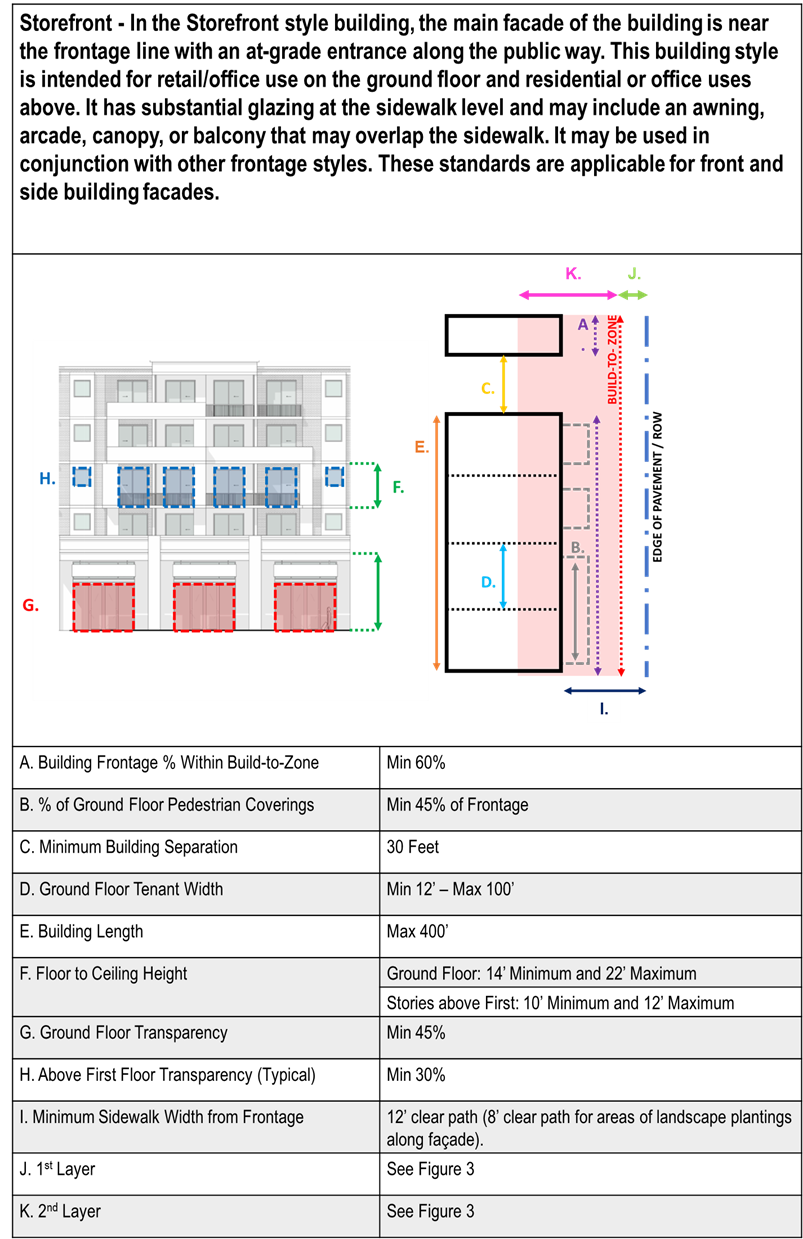
Figure 2—Arcade Style
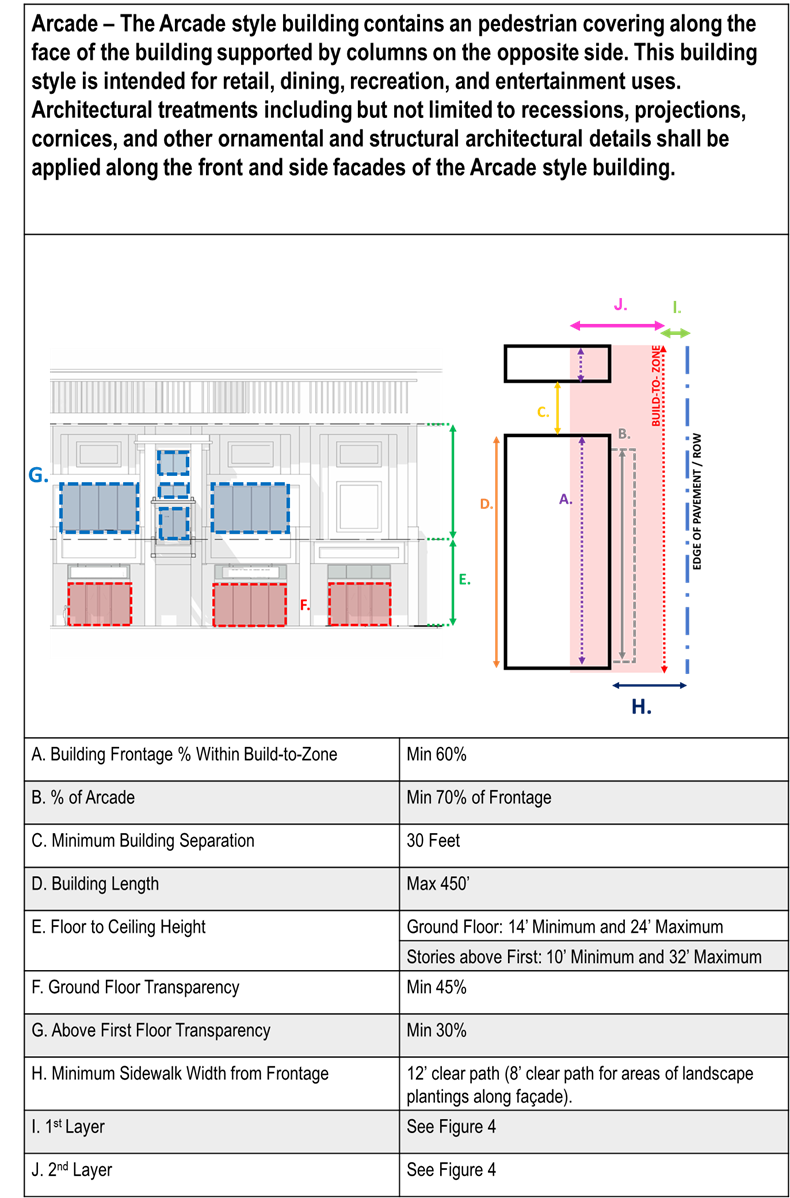
(b)
Maximum building height: Maximum building height shall be determined by the style of individual building as shown below. Notwithstanding the following maximum building heights, all buildings shall be designed so as to be compatible in height with abutting structures and shall provide gradual height transitions between adjacent structures:
1.
The maximum allowed building height for residential, office, and non-residential uses shall be sixty-six (66) feet and a maximum of five (5) stories;
2.
The maximum allowed building height for hotels shall be one hundred (100) feet and a maximum of seven (7) stories, subject to section 26-75.6;
3.
The maximum allowed building height for parking garage shall be sixty-six (66) feet and a maximum of six (6) stories;
4.
Maximum building height exceptions: Restroom structures, pool decks, rooftop amenities excluding landscaping, and other surfaces for recreational activities shall be permitted to extend above the maximum allowable building height for the applicable zoning district by no more than six (6) feet, six (6) inches.
(c)
Minimum yard setbacks: Setbacks within the MXS zoning district shall comply with the MXS layers regulating plans set forth in figures 3 and 4 below. Buildings utilizing the storefront frontage or arcade frontage styles shall comply with the building requirements depicted in figures 3 and 4 below.
1.
Rear setbacks for those facades not located within the build-to-zone for storefront and arcade style buildings shall be a minimum of six (6) feet from edge of pavement. Side setbacks for those facades not located within the build-to-zone for storefront and arcade style buildings shall be a minimum of eight (8) feet from edge of pavement.
2.
Building frontage standards.
i.
The portion of the façade for storefront or arcade style buildings that face any street frontage must be placed within a specified build-to-zone depicted in figures 3 and 4 below.
ii.
The portion of a storefront or arcade style building's front façade that is located in the build-to-zone is called the 'building frontage'. The length of the building frontage must comply with the building frontage percentage standards for each building frontage style provide in figures 1 and 2 above.
iii.
Building frontage percentages shall be calculated by dividing the length of the building situated within the build-to-zone by the length of the depicted build-to-zone along the same street frontage, as shown in figures 1 and 2 above.
iv.
If two (2) building frontage styles are used along the same street frontage, the specified percentages are measured for each building frontage style.
3.
Setback encroachments shall be allowed as follows:
i.
Arcades, awnings or covered areas along the ground floor build-to-zone may encroach up to one hundred (100) percent of the first layer. When an arcade is provided on the ground floor, the remaining space in front of the arcade may either be utilized as a landscape buffer area with installed plant material or additional paved surface for pedestrian circulation provided that eight (8) feet of clear pedestrian path is maintained at all times.
ii.
Landscaping material may be located within the first layer, provided that eight (8) feet of clear pedestrian path remains in areas of the landscape planting along the façade at all times.
iii.
Above the first story, cantilevered balconies, bay windows, roofs and facade components promoting energy efficiency such as shading and screening devices that are non-accessible may encroach a maximum of five (5) feet into the first layer.
iv.
Outdoor seating and patio space may encroach up to twenty (20) percent of the first layer provided that an eight (8) foot minimum clear sidewalk path is maintained between the edge of pavement and the outdoor seating and patio space at all times.
v.
Setbacks from the MXS perimeter boundary line for all buildings within an MXS development shall be as follows:
Figure 3
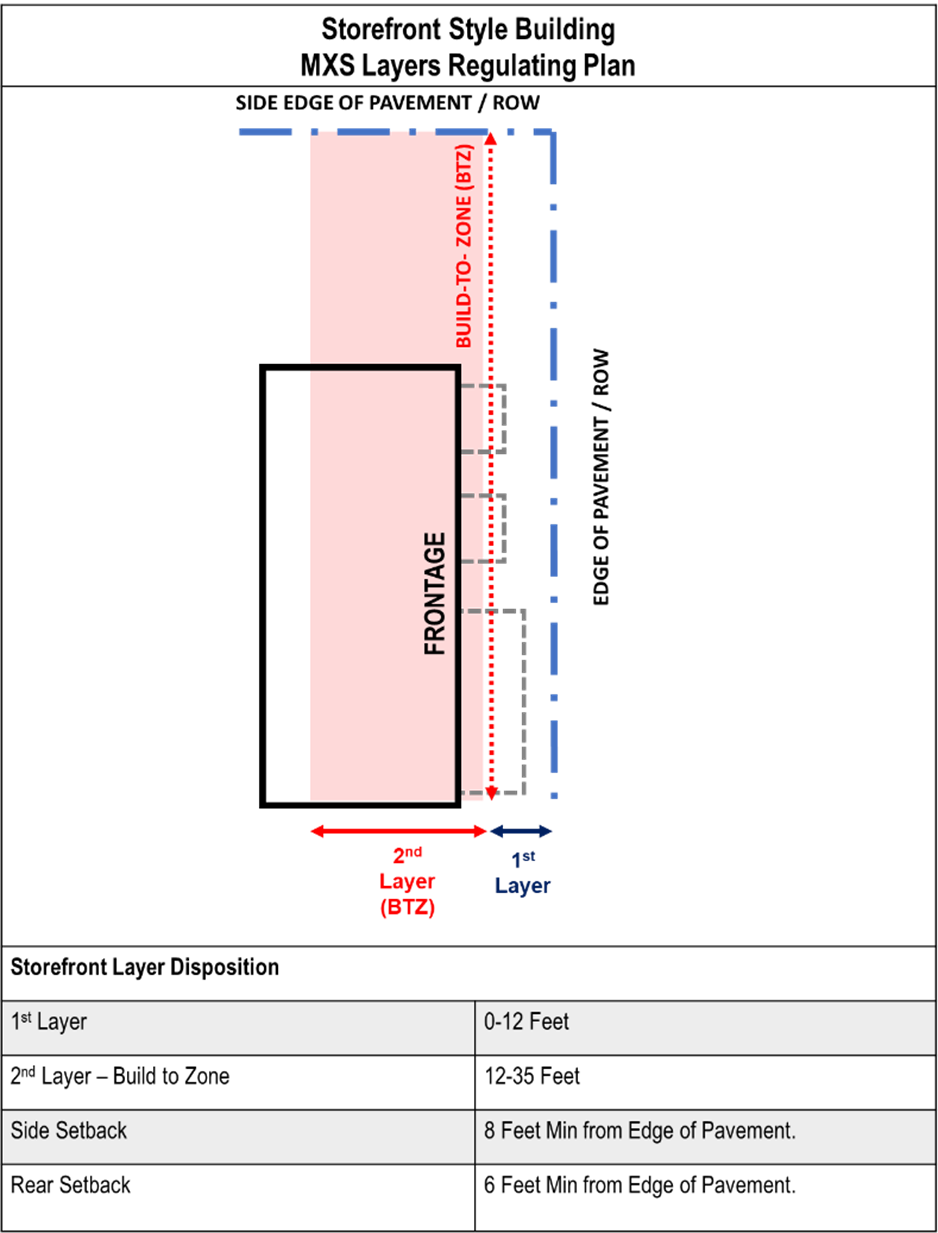
Figure 4
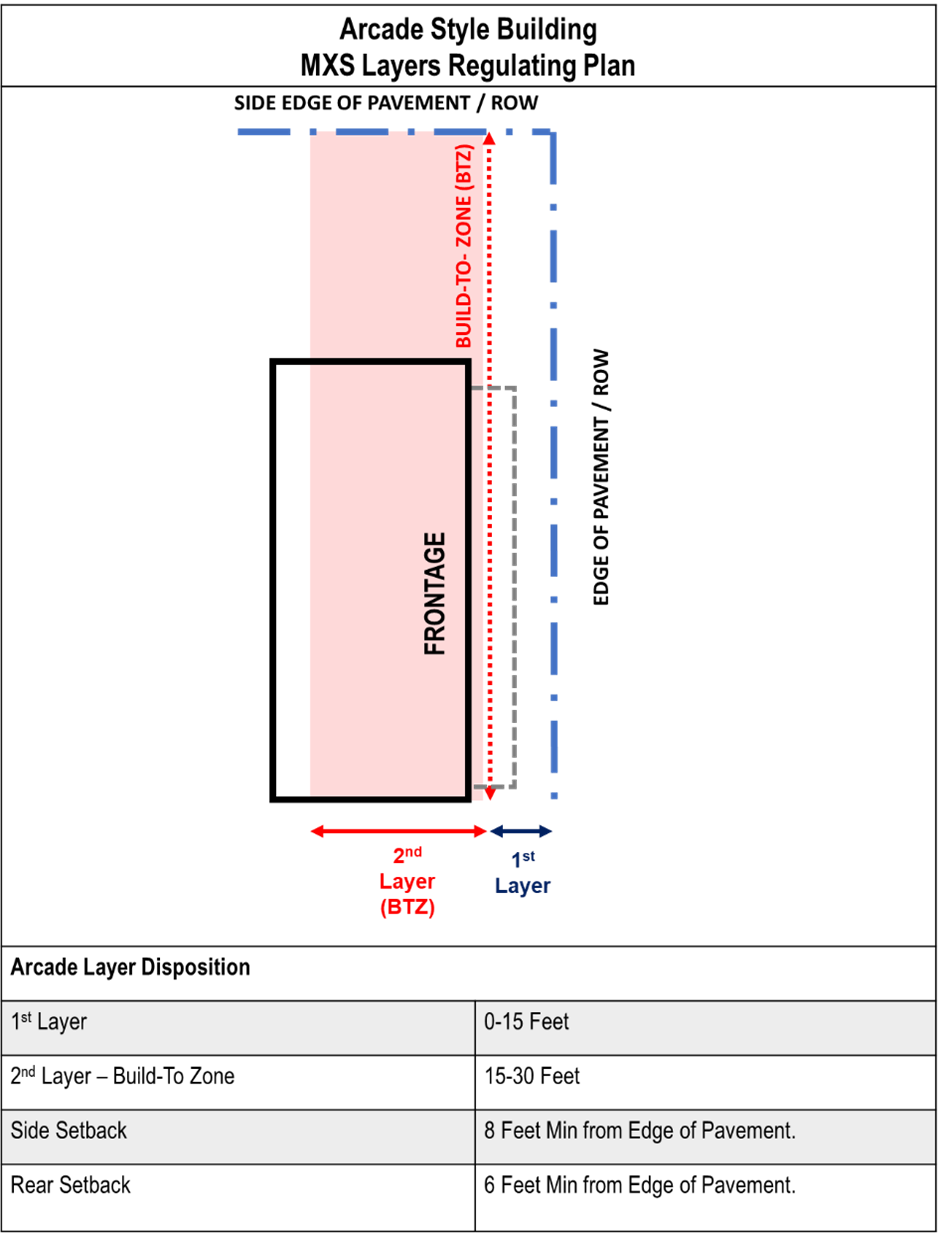
(d)
Minimum Open Space Requirements: Open Space shall be provided at no less than twenty (20) percent of the total site of the entire MXS project.
1.
MXS projects shall include at minimum two (2) of the open space types depicted in Figures 5 through 8 below. The design of civic and open spaces shall meet the standards set forth in the following diagrams:
Figure 5
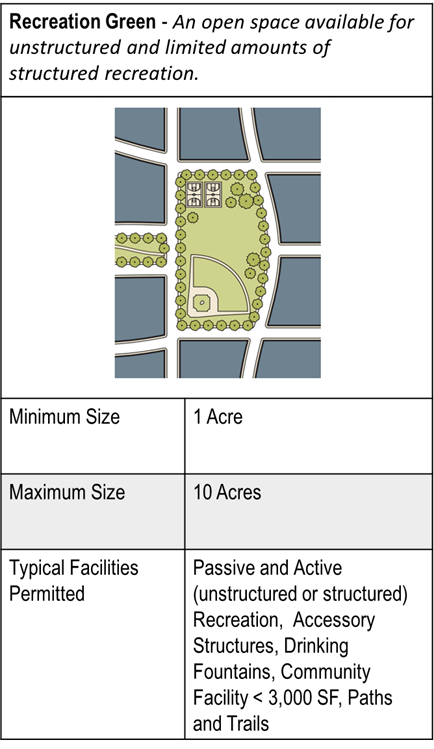
Figure 6
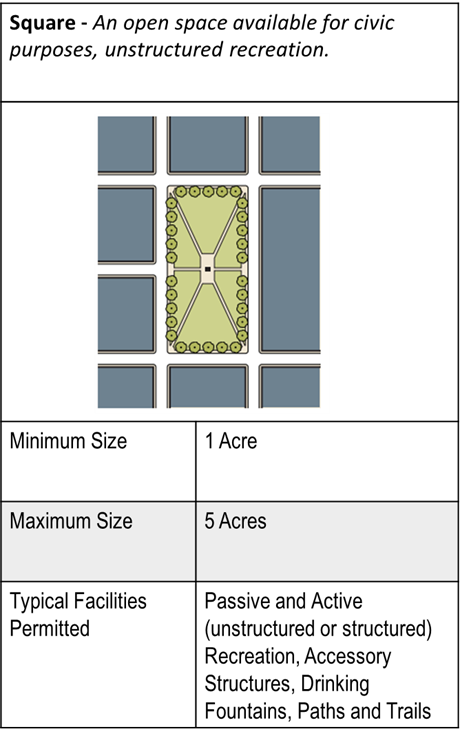
Figure 7
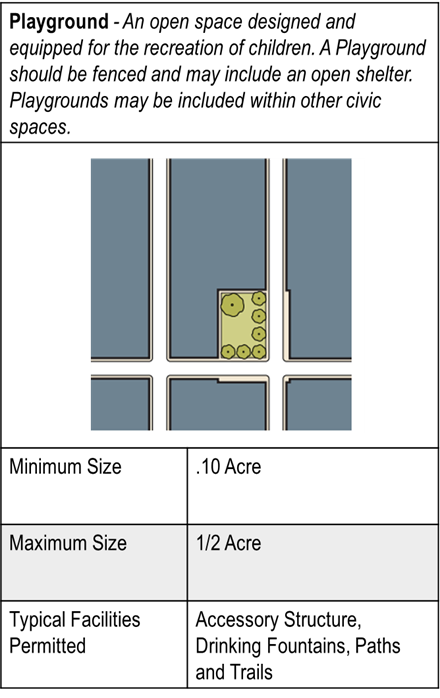
Figure 8
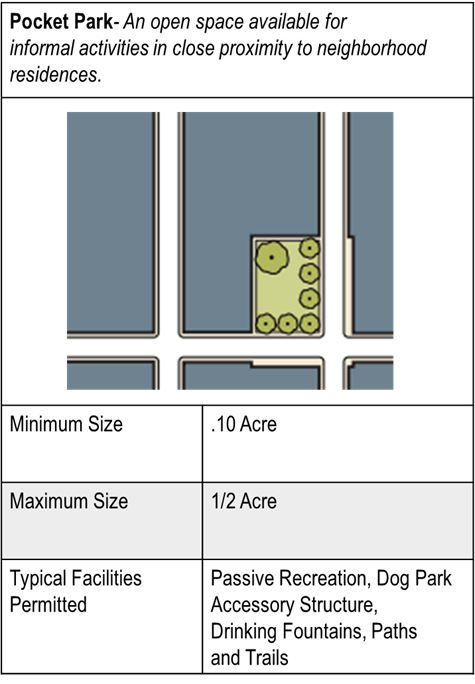
2.
The open space type shall be shown on the site plan and depicted on the regulating plan to illustrate the facilities in greater detail.
3.
One (1) of the open space types selected from figures 5—8 above shall total no less than three (3) percent of the total project site area.
4.
For the purposes of this section, the open space type selected from figures 5—8 shall be measured by calculating the total contiguous green space area. No more than twenty (20) percent of the minimum size requirement in figures 5—8 may be attributed to roadways and sidewalks that intersect the open space type selected.
5.
Public access and visibility along public parks, civic uses, and natural open spaces shall be maintained through the use of:
i.
Building frontage oriented towards the open space;
ii.
Bike and pedestrian paths; or
iii.
Other methods of frontage that provides similar access and visibility to the open space that are appropriate in the MXS project.
(e)
Maximum floor-area-ratio (FAR): It is the intent of the MXS zoning district to ensure that there is adequate internal capture of trips through the inclusion of non-residential uses. A minimum of nineteen (19) percent of the total MXS project site shall be dedicated to residential development. The following shall be used to determine the amount of floor area ratio for the proposed uses:
1.
Floor-area-ratio shall be based on the gross acreage of the total project site.
2.
Non-residential uses are allowed at the following FAR based on the gross acreage of the total project site to determine the minimum and maximum square footage:
3.
Residential uses are allowed at the following FAR based on the gross acreage of the total project site to determine the minimum and maximum square footage:
4.
Structured parking uses are allowed at the following FAR based on the gross acreage of the total project site to determine the minimum and maximum square footage:
5.
The total FAR allowed for the MXS project site shall be:
(5)
Maintenance of common facilities: Nonpublic areas and facilities for the common use of occupants of the MXS development, but not in individual ownership of such occupants, shall be maintained without expense to the general taxpayers of the village through the formation of entities such as homeowners', condominium or property owners' associations. Instruments setting forth the covenants and restrictions for such associations or entities shall be submitted to the village attorney for review and approval prior to the issuance of a development order in order to assure that the MXS project shall be developed in a manner which is consistent with any development order and/or conditions of approval imposed by village council. The development order must contain provisions for joint maintenance responsibilities for the entire MXS project. Regardless of the number of property owners' associations created for any project, there shall be a master association over all others (or a restrictive covenant agreement in lieu thereof which is consistent with the underlying intent or purpose of a master association) in order to ensure that there is only one (1) legal entity responsible for the entire MXS project.
(6)
Minimum recreational requirements: Recreational requirements shall be as set forth in the village's subdivision code as required for residential subdivisions in conformance with section 22-55.
(7)
Minimum MXS project size shall be forty (40) acres.
(8)
Landscape standards - Landscaping shall be required in the MXS zoning district as required by the village's landscaping requirements set forth in chapter 15 landscaping and vegetation management unless otherwise stated herein:
(a)
MXS parcel perimeter landscape buffer width:
(b)
When a portion of the MXS is solely residential and adjacent to a commercial/industrial land use, the minimum perimeter landscape buffer width shall be twenty-five (25) feet.
(c)
Canopy trees shall be planted along the build-to-zones of storefront and arcade frontages at a minimum of one (1) canopy tree for every thirty (30) feet. One (1) Royal Palm tree may be substituted in lieu of one (1) canopy tree.
(d)
Vehicle use areas—See subject section 15-133 for specific regulations.
(e)
Perimeter landscape buffers required:
1.
Berms used in landscaping for the MXS zoning district shall be a minimum of three (3) feet in height above the natural grade with a maximum height of eight (8) feet. The berm surface shall provide for smooth transition in elevation change with the slope, not exceeding a ratio of three to one (3:1). The berm surface shall be covered with a combination of plant material, including grass, ground cover, shrubs and mulch. Undulating berms are preferred. Required landscape buffers shall be installed prior to issuance of the first certificate of occupancy.
2.
Berms within the MXS zoning district may be permitted at a minimum of one (1) foot in height above the natural grade if a ten-foot minimum multipurpose shared-use pathway is provided within the applicable landscape buffer.
3.
A continuous landscape screen shall be incorporated within the berm not less than three (3) feet in height.
4.
The landscape screen shall consist of a continuous hedge of shrubs, at minimum of thirty-six (36) inches in height, and with one (1) canopy tree a minimum of twelve (12) feet tall every twenty (20) linear feet. Three (3) palm trees clustered may be substituted in lieu of one (1) canopy tree.
(9)
Special regulations: MXS project shall be subject to the following special regulations:
(a)
Off-street parking and loading.
1.
Parking and loading spaces shall be provided throughout the MXS project for all residential and nonresidential uses as provided in chapter 23 (traffic and vehicles). Guest parking spaces shall not be required.
2.
Ride share. Ten (10) percent of required parking spaces shall be identified as rideshare spaces.
(b)
Parking garages.
1.
An average of twenty-five (25) percent of the frontage on the first floor of all parking garages shall incorporate retail or office businesses consistent with the transparency and tenant dimensional requirements as designated in the storefront style frontage in figure 1 above;
2.
The openings of the garage shall be designed in a manner that obscures parked vehicles. Decorative architectural elements on the ground floor level shall be designed to accommodate the pedestrian scale. Parking levels above the ground floor shall maintain the same vertical and horizontal articulation or rhythm and incremental appearance established on the ground floor. Ramps shall be visually screened from streets and adjacent residential zoning districts and oriented towards the interior of the lot within a project. Ramp profiles shall be hidden on the exterior elevations.
3.
Roof top parking shall be visually screened with articulated parapet walls or other architectural treatment acceptable to the planning and zoning commission. Exterior lighting shall utilize fixtures provided with cut-off shielding in order to eliminate glare and spillage onto adjacent properties and roadways.
4.
Parking garages shall have pedestrian access to a sidewalk.
5.
Parking garages that service residential uses shall be built simultaneous with construction of buildings with residential uses and shall be fully constructed prior to issuance of certificate of occupancy for any building with residential uses.
(c)
Bike parking. To encourage the use of alternative transportation such as bicycles, a minimum of one (1) bicycle parking space shall be provided for every thirty (30) automobile parking spaces or fraction thereof. Each bicycle rack proposed shall accommodate parking for six (6) or more bicycles. The location of all bicycle racks shall be depicted on the site plan and approved at time of site plan approval.
(d)
Transit—Mass transit or multi-modal facilities shall be provided as follows:
1.
A minimum of one (1) mass transit and multi-modal facility shall be located at the intersection of two (2) collector or local streets within the MXS development; or
2.
An adopted plan shall be submitted in a form deemed acceptable by the planning and zoning director which locates a mass transit and multi-modal facility within a half-mile of the MXS upon buildout.
(e)
Pedestrian crossings. Pedestrian crossings shall comply with the following:
1.
Elevated pedestrian crossings may be permitted for site interconnectivity.
2.
Elevated pedestrian crossings shall be covered throughout the entire passage.
3.
Pedestrian crossings shall not be enclosed and shall be provided as an open-air crossings.
4.
Elevated pedestrian crossings shall provide a three-foot minimum rail along both side of passage.
5.
Elevated pedestrian crossings shall have an unobstructed vertical clearance of not less than thirteen (13) feet six (6) inches.
6.
Non at grade pedestrian crossings shall be designed to be consistent and visually compatible with the architectural style of the MXS development.
(f)
Outdoor seating.
1.
Outdoor seating proposed within MXS projects is subject to section 26-72 outdoor seating standards,
2.
In MXS projects, outdoor seating areas which are not more than ten (10) percent of the enclosed seating area may be approved administratively as a minor site plan amendment pursuant to subsection 26-40(a)(3).
(g)
Signs: See chapter 20; specifically, section 20-63 shall apply to an MXS project.
(h)
Common architectural theme: In order to emphasize characteristics of the MXS development, all structures within the project site shall incorporate similar architectural design themes, elements, materials, signage, and colors as identified by the master architectural plan and section 26-73(c) of the Village Code.
(i)
Lighting.
1.
Consistency. Lighting shall be designed in a consistent and coordinated manner for the entire site. The lighting and lighting fixtures shall be integrated and designed so as to enhance the visual impact of the project on the community and/or blends into the landscape.
2.
Shielding standards. Lighting shall be designed so as to prevent direct glare, light spillage and hazardous interference with automotive and pedestrian traffic on adjacent streets and all adjacent properties.
3.
Fixture height standards. Lighting fixtures shall be a maximum of thirty (30) feet in height within the parking lot and shall be a maximum of fifteen (15) feet in height within non-vehicular pedestrian areas.
4.
Design standards. Lighting shall be used to provide safety while accenting key architectural elements and/or to emphasize landscape features. Light fixtures shall be designed as an integral design element that complements the design of the project. This can be accomplished through style, material or color (excluding fluorescent, primary and/or secondary colors) or be designed to blend into the landscape through the use of dark colors such as bronze. Mill finish is not permitted.
5.
Photometrics for street, parking lot, sidewalk, shared pathway, and on-street bike path lighting shall meet the requirements of the latest edition of the IES Lighting Handbook, published by the Illumination Engineers' Society.
(j)
Service function areas (SFAs) including but not limited to loading, storage, mechanical equipment, and solid waste disposal are permissible subject to:
1.
Buffering and screening standards. Loading areas or docks, trash collection, mechanical equipment, trash compaction, roof top equipment and other service function areas shall be fully screened from view of adjacent properties and roadways at ground view level; subject to section 15-133(h) and section 26-61(g)1., 2.
(k)
Pedestrian connectivity. All uses in an MXS project shall be connected by sidewalks or pedestrian paths, bicycle paths or bicycle lanes, and vehicular streets. A minimum of eighty (80) percent of all streets shall connect at both ends to other streets at an intersection. All paths or trails, including bicycle paths or lanes, shall interconnect to form a continuous network throughout the MXS project and to paths or trails linking adjacent neighborhoods.
(l)
Access and traffic circulation. Developments in the MXS zoning district shall have direct access onto at least one (1) principal arterial roadway. Access shall be sized and designed to accommodate all of the development potential in the MXS project. Internal roadways shall be designed to accommodate pedestrian movement through the inclusion of sidewalks and marked street crossings.
(m)
Hours of operation. All business within MXS developments must adhere to the following hours of operation:
1.
Sunday: Operating hours shall be limited to 12:00 a.m. to 1:00 a.m. and 5:00 a.m. to 11:59 p.m.
2.
Monday—Thursday: Operating hours shall be limited to 5:00 a.m. to 11:59 p.m.
3.
Friday—Saturday: Operating hours shall be limited to 12:00 a.m. to 1:00 a.m. and 5:00 a.m. to 11:59 p.m.
4.
Exception: Fitness centers shall not be subject to the above hour restrictions; twenty-four-hour operation is permitted seven (7) days a week.
(n)
Special events and outdoor uses.
1.
Two (2) types of special events shall be permitted for MXS developments:
i.
Minor special events—Minor special events shall mean those events that occur wholly within designated event areas on the approved site plan for the MXS and which are made part of the regulating plans for the MXS. In addition to identifying these designated event areas on the site plan, a description of the minor special events planned shall be included describing the kinds of events to take place in these designated event areas and any additional security or crowd control measures anticipated to be provided during the minor special events. As part of the MXS site plan approval, a shared parking study shall be provided which demonstrates that there is adequate parking for the minor special events proposed in the designated event areas which shall identify the specific parking areas to be utilized during minor special events and areas that will be designated as additional overflow parking for the minor special events. No special event permit is required for minor special events.
ii.
Major special events—Major special events are those events that occur outside the designated event areas as shown on the approved site plan and regulating plans and any events where private or public roads are to be closed as part of the event. A special event permit shall be required for all major special events, with all major special events subject to sections 16-12(a)(1)—(5) of the Village Code. A shared parking study shall be provided with each special event permit application which demonstrates that there is adequate parking for the major special event and which identifies areas within the MXS that will be utilized during the major special event and areas that will be designated an additional overflow parking for the major special event.
2.
Hours of minor or major special events shall be strictly limited to 7:00 a.m. to 12:00 a.m.
3.
Minor and major special events shall be subject to and conform with the performance standards in section 26-101 of the Village Code.
(10)
Submittal requirements. In addition to the application requirements for site plan approval as set forth at section 26-32(f)(5) of the Village Code, the following submittal requirements must be met:
(a)
A written explanation of the character of the proposed MXS development;
(b)
A tabular summary of acres, dwelling units with gross density for residential uses and FAR calculations for residential and nonresidential uses;
(c)
Proposed development schedule and phases;
(d)
Agreements, provisions and covenants which will govern the use, maintenance and protection of proposed common areas and facilities;
(e)
A filing fee for a proposed MXS master site plan application, the amount of which shall be set by resolution of the village council and shall be on file in the office of the village clerk;
(f)
A traffic impact analysis which outlines the impact of the MXS project along with recommendations for roadway improvements to offset this impact, and a TPSO approval letter. These improvements shall be required to be constructed by the applicant as a condition of the development approval; and
(g)
Any additional information must be provided which is reasonably required by the village to evaluate the character and impact of the proposed MXS project.
(11)
Variances from other codes. It is intended that there be flexibility in the property configuration within an MXS project. The following additional requirements apply:
(a)
The overall project must meet the minimum standards for the MXS zoning district.
(b)
The village council may vary the regulations found in the zoning code, the landscape code and/or the sign code for internal parcels so long as conditions of approval are placed upon the approval for the entire MXS project in order to ensure that the MXS makes a substantial contribution to the neighborhood and is developed in accordance with the spirit and intent of all the codes of the Village of Royal Palm Beach.
(12)
Art in public places. Any new MXS development is subject to the standards in section 26-75.5, art in public places.
(13)
Approval criteria. Development and redevelopment in the MXS zoning district shall be reviewed by the technical staff through the technical staff review process, the planning and zoning commission and the village council in accordance with the site plan review process established by the village. The primary factors for consideration in approving a MXS project are the following:
(a)
General impact on the adjacent property;
(b)
Provision of services;
(c)
Use of appropriate technologies;
(d)
The buildings' aesthetic appearance;
(e)
Degree of parking adequacy, cohesiveness and integration of the district;
(f)
Mix of uses to provide for compatible, balanced, and integrated land uses within a single project site;
(g)
Orderly patterns of circulation for both vehicular and pedestrian traffic; and
(h)
Streetscape, and quality of urban design including: design of rights-of-way, medians, street lighting, and landscaping.
(14)
Maximum density. Ten (10) units per gross acre.
(Ord. No. 1027, § 2, 15-12-22)

