
Rusk City Zoning Code
ARTICLE 153
VIII DEFINITIONS
DIVISION 153-VIII-B MANUFACTURED HOME PARK DEFINITIONS
Act. The Texas Manufactured Housing Standards Act.
Driveway. A minor private way used by vehicles and pedestrians on a manufactured home lot or used for common access to a small group of lots.
Industrialized housing.
- Industrialized housing is a residential structure that is:
- designed for the occupancy of one or more families;
- constructed in one or more modules or constructed using one or more modular components built at a location other than the permanent site; and
- designed to be used as a permanent residential structure when the module or the modular component is transported to the permanent site and erected or installed on a permanent foundation system.
- Industrialized housing includes the structure's plumbing, heating, air conditioning, and electrical systems.
- Industrialized housing does not include:
- a residential structure that exceeds three stories or 49 feet in height;
- housing constructed of a sectional or panelized system that does not use a modular component; or
- a ready-built home constructed in a manner in which the entire living area is contained in a single unit or section at a temporary location for the purpose of selling and moving the home to another location.
License. A written license issued by the Planning Department allowing a person to operate and maintain a manufactured home park under the provisions of this chapter and any regulations issued pursuant to this chapter.
Manufactured home. A factory-built, single-family structure that meets the Federal Manufactured Home Construction Safety Standards Act, commonly known as the HUD (U. S. Department of Housing and Urban Development) Code.
Manufactured home park lot. A parcel of land for the placement of a single manufactured home and the exclusive use of its occupants.
Manufactured home park. A parcel of land, consisting of ten or more acres, which has been developed for the placement of two or more manufactured homes.
Manufactured home park drive. A private way, maintained by the park owner or an established homeowners association, which affords principal means of access to individual manufactured home lots.
Mobile home. A residential dwelling that was fabricated in an off-site manufacturing facility, designed to be a permanent residence, and built prior to enactment of the Federal Manufactured Home Construction and Safety Standards. Mobile Homes are not allowed to be located within the corporate city limits.
Natural or artificial barrier. Any river, pond, canal, railroad, levee, embankment, fence or hedge.
DIVISION 153-VIII-C SIGN DEFINITIONS
Sign Types Exhibit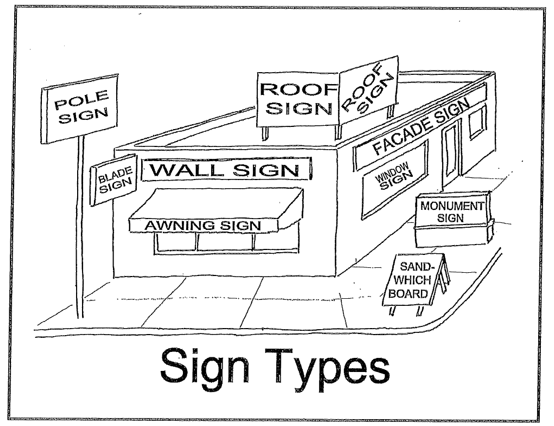
Accessory sign. Any sign which gives directions, instruction, or safety information and is in no way used for the purpose of advertising.
Advertising. To seek the attraction of, or to direct the attention of, the public to any goods, services or merchandise whatsoever.
Area of wall. Shall be determined by multiplying the length of the wall on lease space, between fire walls and the distance between ground level and the roof line, the highest point where the roof attaches to or meets the wall. Cornices extending above the roof or parapet walls shall not be included in calculating the total area of a wall.
Banner. A soft, flexible sign, similar to a flag, made of cloth, plastic, or other material.
Business. The erection or use of any property, building, or structure, permanent or temporary, for the primary purpose of conducting in the building or structure or on the property a legitimate retail or commercial enterprise in compliance with all ordinances and regulations governing such activity; business purpose shall not include any property, building or structure erected or used for the primary purpose of securing a permit or erecting a sign.
Canopy. Any structure, other than an awning attached to a building projecting over a thoroughfare, sidewalk or parking area and not erected so as to permit its being raised to a flat position against the building, and does not permit use of marquee letters, and is commonly supported by poles or uprights set upon the underlying ground. Such structure shall not be permanent, as a roof extended over a sidewalk would be, and is usually of cloth, canvas or similar material construction.
Curbline. The edge of the pavement along either side of a public street.
Directory sign. A freestanding sign shared by two or more tenants
Effective area. The area enclosed by the minimum imaginary rectangles of vertical and horizontal lines which fully contains all extremities of the sign, exclusive of its supports.
Face. The total display area and border of a sign.
Fluorescent or incandescent sign. A sign illuminated with fluorescent or incandescent bulbs.
Frontage. The total length of property fronting along a public street.
Free-standing (pole or ground) sign. A sign which is not affixed to a building or structure, but which is affixed to the ground independent of any other structures.
Ground level. The average elevation of the premises, or the elevation of the centerline of the adjacent public street at the point closest to the sign, whichever is lower.
Manually changeable message. A nonautomatic sign which has tracks for removable lettering, and must be changed by hand.
Marquee. A permanent canopy of metal, porcelain, enamel, glass or plastic, wood or similar materials projecting over a thoroughfare, sidewalk or parking area at an entrance to a building. A marquee is distinguished from a true canopy in that the sign letters, if any, used thereon are removable by sliding or lifting the same from enclosing rails affixed to the marquee, or it is not supported by poles or uprights set upon the underlying ground or sidewalk.
Nameplate. A nonelectrical sign identifying only the name and occupation or profession of the occupant of the premises on which the sign is located.
Neon sign. A sign on which neon tubes are attached to or inserted in a framework to illuminate the sign. A neon sign shall also include neon tubes mounted on a wall or background as a wall sign.
Owner. A person recorded as such on the records of the city tax office, and including a duly authorized agent or attorney, a purchaser, devisee, judiciary, and any person having a vested or contingent interest in the property in question.
Point of primary access or major point of entry. One or more points of public access to a retail business, industry, or office through which all general pedestrian traffic is funneled.
Portable sign. Any sign designed or constructed to be easily moved from one location to another, including but not limited to signs mounted upon or designed to be mounted upon a trailer, wheeled carrier, A-frame, or other nonmotorized mobile structure. A portable sign which has its wheels removed shall still be considered a portable sign. Trailer signs are portable signs.
Premises. An area of land with its appurtenances and buildings which because of its unity of use may be regarded as the smallest conveyable unit.
Private drive. Every way or place in private ownership and used for vehicular travel by the owner and those having express or implied permission from the owner, which shall enter upon a public street.
Public street. The entire width between property lines of any road, street, way, alley, bridge or other similar thoroughfare, when any part thereof is open to the public for vehicular traffic, which is the responsibility of the city or other similar public agency to maintain, and over which the city has legislative jurisdiction via police powers.
Residential use. Property devoted to use as a single-family or multifamily residence. Residential purposes shall include, but not be limited to, property used for houses, mobile homes, duplexes, condominiums, townhouses, townhomes, patio homes and apartments. Property used for hotels, motels and boardinghouses shall not be considered as used for residential purposes, under this chapter only.
Roof. The uppermost part of the building or structure; that part of the building on which rain would normally fall.
Sign. Any structure, part thereof, or device or inscription, which is located upon, attached to, or painted or represented on any land, or on the outside of any building or structure or on an awning, canopy, marquee, or similar appendage, or permanently affixed to the glass of a window or door, so as to be seen from the outside of the building or structure, and which displays or includes any numeral, letter, word, model, banner, emblem, insignia, symbol, device, monogram, heraldry, trademark, light or other representation used as, or in the nature of, an announcement, advertisement, attention-arrester, direction, warning, or designation of any person, firm, group, organization, corporation, association, place, commodity, product, service, business, profession, enterprise, industry, activity, or any combination thereof. Where the word "sign" is used in this chapter without further modification, the same shall be understood to' embrace all regulated signs.
Sign, billboard. A commercial sign that directs attention to a business commodity, service, or entertainment conducted, sold, or offered at a location other than the premises on which the sign is located.
Sign area. The area of surface of one side of a sign including any ornamental features.
Sign, inflatable. Any display capable of being expanded by air or other gas and used on a permanent or temporary basis to advertise a product or event.
Sign structure. Any structure which supports, has supported, or is capable of supporting a sign, including decorative cover.
Sign, political. A temporary sign announcing or supporting political candidates or issues in connection with any national, state, or local election.
Temporary sign. A sign displayed for limited and specific time period for those limited purposes set forth in this chapter.
Temporary window sign. A sign constructed of cloth, canvas, light fabric, cardboard, wallboard or other light materials, displayed in the window, and advertising a sale, special temporary services, etc., the intent of which is for temporary display.
DIVISION 153-VIII-D SUBDIVISION DEFINITIONS
Alley. A public way which affords only a secondary means of access to property abutting thereon.
Building development. The construction or placement on the property of any structure, portable building, or mobile home, to be occupied as a dwelling, office, storage area or other commercial or industrial use, or the improvement of the site by grading and paving.
Building setback line. The building setback line is the line within the property defining the minimum horizontal distance between a building and the adjacent street line.
Contractor. The person actually doing construction work for the developer.
Cul-de-sac. A cul-de-sac is a street having but one vehicular access to another street and terminated by a vehicular turnaround.
Engineer. The engineer designated by the city to act for it.
Extraterritorial jurisdiction. The extraterritorial jurisdiction is the unincorporated area contiguous to the city limits extending to limits set forth in Section 42.21, Texas Local Government Code, to which the city's ordinances establishing rules and regulations governing plats and subdivision of land are applicable.
Final plat. A final plat is a plat prepared by a registered professional engineer or a registered public land surveyor and submitted to the plan commission for final approval in the manner provided for in the ordinance, which is to be filed for record with the county clerk of Cherokee County, Texas.
Flood plain. The flood plain is that area determined by current engineering practice and approved by the city engineer which would be inundated by stream floodwaters resulting from runoff of a storm having a 100-year frequency of recurrence.
Floodway easement. An easement to the limits of the designated flood plain as defined herein along the reach of any stream, natural or manmade.
Lot. A lot is an undivided tract or parcel of land having frontage on a public street which is designated as a distinct and separate tract; and which is identified by a lot or tract number.
Master plan. The master plan is the current comprehensive plan of the city.
Minimum finished floor elevation. That mean sea level elevation above which the lowest occupied floor slab, not including garages, of any building shall be built. This elevation shall exceed the maximum surface elevation of the 100-year flood for nearby creeks and channels at that point on the reach of such water course by at least one foot.
Pavement width. The pavement width is the portion of a street available for vehicular traffic. Where curb exists, it is the distance between the face of curbs.
Plan commission. The Planning and Zoning Commission of the city.
Preliminary plat. A preliminary plat is a tentative plat or drawing made by a registered professional engineer, professional land planner or a registered public land surveyor showing the entire tract, proposed dimensions, adjacent property, streets, and alleys.
Public right-of-way. A public right-of-way is a strip of land used or intended to be used wholly or in part as a public street, thoroughfare, alley or walkway.
Resubdivision. The resubdivision of any subdivision, together with any change of any lot size therein or the relocation of any street lines.
Sewer main, outfall. any pipe or conduit used to carry either raw sewage or treated effluent to a final point of discharge into a body of water.
Sewer main, trunk. A large sewer main that receives wastewater from many tributary branches or sewers and serves a large territory of the population.
Subdivider. A subdivider is any person or agent thereof dividing or proposing to divide land so as to constitute a subdivision as that term is defined in this section.
Subdivision. The division of a tract or parcel or land into two or more lots for the purpose, whether immediate or future, of sale or building development, expressly excluding development for agricultural purposes, and shall include resubdivision.
Note: Definitions not expressly prescribed herein are to be construed in accordance with customary usage in municipal planning and engineering practice.
2202-06 UDC Amendments
153.216 General Land Use Definitions
Certain words in this section are defined for the purpose hereof as follows:
Words in the present tense include the future; words in the singular number include the plural number; words in the plural number include the singular; the word "building" includes the word "structure," the word "lot" includes the word "plot"; the word "shall" is mandatory and directive.
Accessory Structure. A structure detached from a principal building located on the same lot and customarily incidental and subordinate to the principal building or use.
Accessory Use. A use of land or of a building or portion thereof customarily incidental and subordinate to the principal use of the land or building and located on the same lot with the principal use.
Adaptive Reuse. The development of a new use for an older building or for a building originally designed for a special or specific purpose.
Addition. A structure added to the original structure at some time after the completion of the original; an extension or increase in floor area or height of a building or structure.
Aerial Map. A map created from a process involving the taking of photographs from the air with predetermined reference points marked on the ground.
Aesthetic. The perception of artistic elements or elements in the natural or created environment that are pleasing to the eye.
Agricultural Zoning. Regulations that protect agricultural land base by limiting non-agricultural uses, prohibiting high-density development, requiring houses to be clustered on small lots, and restricting subdivision of land into parcels that are too small to farm.
Alley. A service roadway providing a secondary means of access to abutting property and not intended for general traffic circulation.
Amortization. A method of eliminating non-conforming uses by requiring the termination of non-conforming use after a specified period of time.
Amusement Park. A facility, primarily outdoors, that may include structures and building where there are various devices for entertainment, including rides, booths for the conduct of games or sale of items, as well as buildings for shows, entertainment, restaurants, and souvenir sales.
Animal Kennel. Any structure or premises, in which animals are boarded, groomed, bred, or trained for commercial gain.
Animal Shelter. A facility used to house or contain stray, homeless, abandoned, or unwanted animals and that is owned, operated, or maintained by a public body, established humane society, animal welfare society, or other nonprofit organization devoted to the welfare, protection, and humane treatment of animals.
Annexation. The incorporation of a land area into an existing community with a resulting change in the boundaries of that community.
Antenna. A device used to transmit and/or received radio or electromagnetic waves between terrestrially and/or orbitally based structures. See satellite dish antenna; wireless telecommunications towers and facilities.
Apartment. A room or suite of rooms in an apartment house arranged, designed or occupied as the residence by a single family, individual or group of individuals.
Apartment Hotel. Any building larger than an apartment house designed or built to be occupied as a series of separate apartments and by persons living independently of each other.
Apartment House. Any building or portion thereof which is designed, built, rented, leased, let or hired out to be occupied as three or more apartments or which is occupied as the home or residence of three or more families living independently of each other and maintaining separate cooking facilities.
Applicant. A person submitting an application for development.
Appraisal. An estimate or opinion of the value of real or personal property or an interest or estate in that property as determined by a qualified appraiser.
Archery Range. An outdoor facility, which may include buildings or structures, used for target practice with bows and arrows.
Architectural Control. Public regulations of the exterior design of private buildings to preserve, enhance, or develop the character of that particular area.
Architectural Features. A prominent or significant part or element of a building, structure, or site.
Architectural style. The characteristics form and detail of buildings or a particular historic period.
Area of Lot. The net area of the lot but not including portions of streets and alleys.
Artist Studio. A place of work for an artist, artisan, or craftsperson, including persons engaged in the application, teaching, or performance of fine arts such as, but not limited to, drawing, vocal or instrumental music, painting, sculpture, and writing.
Assessed Valuation. The value at which property is appraised for tax purposes.
Assisted Living Facility. Residences for the frail elderly that provide rooms, meals, personal care, and supervision of self administered medication. They may provide other services, such as recreational activities, financial services, and transportation.
Attention-getting Device. A device designed or intended to attract by noise; sudden, intermittent, or rhythmic movement; or physical change or lighting change, such as banners, flags, streamers, balloons, propellers, whirligigs, searchlights, and flashing lights.
Auction House. A place where objects of art, furniture, and other goods are offered for sale to persons who bid on the object in competition with each other.
Automated Teller Machine. An automated device that performs banking financial functions at a location that may be separate from the controlling financial institution.
Automatic Car Wash. A structure containing facilities for washing automobiles or semiautomatic application of cleaner, brushes, rinse water, and heat for drying.
Automobile Repair Service, Major. General repair, rebuilding, or reconditioning of engines, motor vehicles, or trailers, including bodywork, welding, and major painting service.
Automobile Repair Service, Minor. The replacement or repair of any automobile part that does not require removal of the engine head or pan, engine transmission, or differential but may include incidental body and fender work, minor painting, and upholstering service.
Automobile Sales. The use of any building, land area, or other premise principally for the display, sale, rental, or lease of new or used automobiles (but may include light trucks or vans, trailers, or recreational vehicles), and including any vehicle preparation, warranty, or repair work conducted as an accessory use.
Base Map. A map having sufficient points of reference, such as state, county, or municipal boundary lines, streets, easements, and other selected physical features, to allow the plotting of other data.
Basement. That portion of a building between floor and ceiling, which is partly below and partly above grade, but so located that the vertical distance from grade to the floor below is less than the vertical distance from grade to ceiling.
Bed and Breakfast. Tourist or guest lodging services within the rooms of a structure designed and built as a single family residential dwelling that acts as the property owner's principal residence and that offers sleeping accommodations in not more than eight (8) rental units for not more than fourteen (14) consecutive nights to transient guests for compensation and where breakfast may be the only meal served.
Berm. A mound of earth or the act of pushing earth into a mound.
Bike Lane. A corridor expressly reserved for bicycles, located on a street or roadway in addition to any lanes for use by motorized vehicles.
Block. An area within the city enclosed by streets and occupied by or intended for buildings; or, if the word is used as a term of measurement, it shall mean the distance along a side of a street between the nearest two streets which intersect the street on such side.
Board of Adjustment. An officially constituted body whose principal duties are to hear appeals and, where appropriate, grant variances from the strict interpretation of the zoning ordinance.
Boardinghouse. A building other than a hotel, where lodging and means for five or more persons are served for compensation.
Breezeway. A covered passage one story in height connecting a main structure and an accessory building.
Buffer Strip. Open spaces, landscaped areas, fences, walls, berms, or any combination thereof used to physically separate or screen one use or property from another so as to visually shield or block noise, lights, or other nuisances.
Building. Any structure or building for the support, shelter and enclosure of persons, animals, chattels or movable property of any kind.
Building, end of. Those sides of the building having the least dimensions and in which doors or openings are not customarily provided for ingress and egress.
Building Line. A line parallel or approximately parallel to the street line and beyond which buildings may not be erected.
Building Height. The vertical distance from finished grade to the top of the highest roof beams on a flat or shed roof, to the deck level on a mansard roof, and the average distance between the eaves and the ridge level for gable, hip, and gambrel roofs.
Building Official. The individual designated by the appointing authority to enforce the provisions of the building code.
Building Permit. Written permission issued by the proper municipal authority for the construction, repair, alteration, or addition to a structure.
Business. Includes retail, commercial and manufacturing uses and districts as defined in this section.
Caliper. The diameter of a tree trunk.
Campground. A plot of ground on which two or more campsites are located, established, or maintained for occupancy by camping units as temporary living quarters for recreation, education, or vacation purposes.
Campus. The grounds and buildings of a public or private college, university, school, or institution.
Capital Improvements Program. A timetable or schedule of all future capital improvements to be carried out during a specific period, listed in order of priority, together with cost estimates and the anticipated means and sources of financing each project.
Car wash. Any building or premise used for washing motor vehicles.
Carport. A roofed structure providing space for the parking of motor vehicles.
Cellar. That portion of a building between floor and ceiling which is partly below and partly above grade but so located that the vertical distance from grade to the floor below is greater than the vertical distance from grade to ceiling.
Cemetery. Property used for the interment of the dead.
Census. An official periodic enumeration of a designated geographic area's population, housing, and related characteristics.
Census Tract. Small areas into which large cities and adjacent areas have been divided for statistical purposes.
Certificate of Appropriateness. A certificate issued by the approving authority on approval of the exterior architectural features of any new building construction or alterations to an existing building located within a historic zone.
Certificate of Occupancy (CO). A document issued by a governmental authority allowing the occupancy or use of a building and certifying that the structure or use has been constructed and will be used in compliance with all the applicable requirements.
Change of Use. Any use that substantially differs from the previous use of a building or land.
Child-care Center. An establishment providing for the care, supervision, and protection of children.
Clinic, Medical. An institution or station for the examination and treatment of ill and afflicted outpatients.
Club. A group of people organized for a common purpose to pursue common goals, interests, or activities and usually characterized by certain membership qualifications, payment of fees and dues, regular meetings, and a constitution and bylaws.
College. An educational institution authorized by the state to award associate, baccalaureate, or higher degrees.
Commercial Use. Activity involving the sale of goods or services carried out for profit.
Community Center. A facility used for recreational, social, educational, and cultural activities.
Community Health/Welfare Center - community-based and patient-directed organizations that serve populations with limited access to health care.
Complete Application. An application for development completed as specified by ordinance and the rules and regulations of the approving authority and the provisions of all required documents.
Condominium. A building, or group of buildings, in which dwelling units, offices, or floor area are owned individually and the structure, common areas, and facilities are owned by all the owners on a proportional, individual basis.
Contour Line. A line on a map that connects all points of the same ground elevation. Convalescent home shall mean any structure used for or occupied by persons recovering from illness or suffering from the infirmities of old age.
Convalescent Center. A facility that provides short-term, primarily in-patient care, treatment, and/or rehabilitation services for persons recovering from illness or injury who do not required continued hospitalization.
Council of Governments (COG). A regional planning and review authority whose membership includes representation from all communities in the designated region.
Court. An open, unoccupied space bounded on more than two sides by the walls of the building. An inner court is a court entirely surrounded by the exterior walls of a building. An outer court is a court having one side open to a street, alley, yard or other permanently open space.
Crisis Center - a facility, telephone answering system, etc., where individuals going through personal crises can obtain help or advice.
Customary Home Occupation. An occupation customarily carried on in the home by a member of the occupant's family without structural alterations in the building or any of its rooms, without the installation of machinery other than that customary to normal household operation or additional equipment without the employment of additional persons, without the use of a sign to advertise the occupation and which does not cause the generation of additional traffic in the street.
Day-care Center, Adult. A facility providing care for the elderly and/or functionally impaired adults in a protective setting for part of a 24-hour day.
Day Nursery. A place where children are left for care between the hours of 7:00 a.m. and 12:00 midnight.
Words in the present tense include the future; words in the singular number include the plural number; words in the plural number include the singular; the word "building" includes the word "structure," the word "lot" includes the word "plot"; the word "shall" is mandatory and directive.
Demography. The study of population and its characteristics.
Demolition Permit. Official authorization to remove part, or all, of a building or structure.
Density. The number of families, individuals, dwelling units, households, or housing structures per unit of land.
Design Standards. A set of guidelines defining parameters to be followed in site and/or building design and development.
Depth. The mean horizontal distance between the front and rear lot lines.
Depth of Rear Yard. The horizontal distance between the rear line of a building other than an accessory building and the rear lot line.
District. A section of the city for which the regulations governing the area, height or use of the building are uniform.
Dwelling, One-Family. A detached building having accommodations for and occupied by not more than one family, or by one family and not more than four boarders or lodgers.
Dwelling, Two-Family. A detached building having separate accommodations for and occupied by not more than two families, or by two families and not more than four boarders or lodgers, two boarders or lodgers to each unit.
Dwelling Unit. A building or portion of a building which is arranged, occupied or intended to be occupied as living quarters.
Efficiency Apartment. An apartment having a combination living and bedroom with no separate bedroom.
Egress. An exit.
Enlargement. An increase in the size of an existing structure or use, including the physical size of the property, building, parking, and other improvements.
Escrow. A deed, bond, cash, or other security delivered to a third person or agency and delivered by the third person or agency and delivered by the third person to the grantee only upon fulfillment of a condition.
Existing Use. The use of a lot or structure at the time of the enactment of a zoning ordinance.
Facade. The exterior walls of a building exposed to public view or that wall viewed by persons not within the building.
Family. A group of individuals not necessarily related by blood, marriage, adoption, or guardianship living together in a dwelling unit as a single housekeeping unit, in which not more than four individuals are unrelated by blood.. For purposes of this chapter "family" does not include any society, club, fraternity, sorority, association, lodge, federation, or like organizations; or any group of individuals who are in a group living arrangement as a result of criminal offenses.
Farm. An area of two acres or more, which is used for the growing of the usual farm products such as vegetables, fruit trees and grain and their storage on the area as well as the raising thereon of the usual farm poultry and farm animals such as horses, cattle, sheep and swine including dairy farms with the necessary accessory uses and for treating and storing the produce; provided, however, that the operation of such accessory use shall be secondary to that of the normal activities; and provided further that it does not include the commercial feeding of offal or garbage to swine or other animals.
Front Yard. An open unoccupied space on a lot facing a street and extending across the front of the lot between the. side yard lines and being the minimum horizontal distance between the street line and the main building or any projection thereof other than the projection of the usual steps or eave overhang.
Grade. For buildings having walls adjoining one street only, the elevation of the sidewalk at the center of the wall adjoining the street; for buildings having walls adjoining more than one street, the average of the elevation of the sidewalks at the center of all walls adjoining the street; for buildings having no wall adjoining the street, the average level of the finished surface of the ground adjacent to the exterior walls of the building. Any wall approximately parallel to and not more than five feet from a street line is to be considered as adjoining the street. Where no sidewalk has been constructed, the city engineer shall establish such sidewalk level or its equivalent for the purpose of these regulations.
Gross Height (of a building or portion of a building). Shall be measured from the average established grade at the street lot line or from the average natural ground level, if higher or, if no street grade has been established, to the highest point of the roof's surface if a flat surface; to the deck line of mansard roofs; and the mean height level between eaves and following structures shall be excluded; chimneys, cooling towers, elevator bulkheads, penthouses, tanks, water towers, radio and television towers, ornamental cupolas, domes or spires, and parapet walls not exceeding four feet in height.
Historic Area. A district, zone, or area designed by a local, state, or federal authority within which the buildings, structures, appurtenances, and places are of basic and vital importance because of their association with history: or because of their unique architectural style and scale, including color, proportion, form, and architectural detail; or because of their being a part of or related to a square, park, or area, the design or general arrangement of which should be preserved and/or developed according to a fixed plan based on cultural, historical, or architectural motives or purposes.
Hobby Shop. An accessory use housed in a dwelling or in an accessory building in which the residents of the premises engage in recreational activities, none of which shall disturb the neighbors on either side or in the rear thereof, and from which no revenue may be derived, in which no goods may be publicly displayed, offered for sale or advertised for sale, nor may any sign be used in connection therewith.
Home Occupation. Any occupation that is customarily performed at home that does not involve a structural change in the building, require the employment of help, the installation of equipment or the display of a sign, and shall not include beauty culture schools, beauty parlors or doctor's offices for treatment of patients.
Home Workshop. See "Hobby shop."
Homeless Shelter. A community association, other than a condominium association, that is organized in a development in which individual owners share common interests and responsibilities for costs and upkeep of common open space or facilities.
Homeowners Association. A community association, other than a condominium association, that is organized in a development which individual owners share common interest and responsibilities for costs and upkeep of common open space or facilities.
Hospital. An institution or place where sick or injured inpatients are given medical or surgical care either at public (charity) or private expense.
Hotel and Motel. A building or arrangement of buildings designed and occupied as a temporary abiding place of individuals who are lodged with or without meals, in which the rooms are usually occupied singly for hire, in which there are no provisions for cooking in individual rooms or apartments.
Housing Project. An area of three or more acres arranged according to a site plan to be submitted to and to be approved by the city planning and zoning board and the City Council on which is indicated the amount of land to be devoted to housing facilities, their arrangement thereon, together with the arrangement of access streets and alleys, and the entire area is to be zoned as an apartment zone upon the recommendation of the city planning and zoning board and the action of the City Council, and in which it shall not be necessary to subdivide the area into lots and blocks. The site plan shall indicate that all access streets, alleys, sidewalks, storm sewers and storm sewer inlets shall be provided as required by the city and built in accordance with city specifications.
Infill. The development of new housing or other uses on scattered vacant sites in a built-up area.
Ingress. Access or entry.
Junkyard. Any lot, land, parcel, building, or structure, or part thereof, used for the storage, collection, processing, purchase, sale, salvage, or disposal of junk.
Kennel. An establishment in which dogs or domesticated animals are housed, groomed, bred, boarded, trained, or sold, all for a fee or compensation. Kindergarten. A school for children of pre-public school age in which constructive endeavors, object lessons and helpful games are prominent features of the curriculum.
Land Use Plan. A basic element of the community master plan containing proposals for the physical, economic, and social development of the community.
Lot. Land occupied or to be occupied by a building and its accessory buildings, and including such open spaces as are required and having its principal frontage upon a public street or officially approved place.
Lot Lines. A line of record bounding a lot that divides one lot from another lot or from a public or private street from any other public space.
Lot of Record. A lot which is part of a subdivision, the plat of which has been recorded in the office of the county clerk, or a parcel of land, the deed for which was recorded in the office of the county clerk.
Lot Width. The horizontal distance between the side lines of a lot measured at right angles to its depth along a straight line parallel to the front lot line at the minimum required building setback line.
Master Plan. A comprehensive, long-range plan intended to guide the growth and development of a community or region for a set period of time and which typically includes inventory and analytic sections leading to recommendations for the community's land use, future economic development, housing, recreation and open space, transportation, community facilities, and community design, all related to the community's goals and objectives for these elements.
Mixed Use Development. The development of a neighborhood, tract of land, building, or structure with a variety of complementary and integrated uses, such as, but not limited to, residential, office, manufacturing, retail, public, and recreation, in a compact urban form.
Moratorium. The legally authorized delay of new construction or development.
Nonconforming Uses. A use or activity that was lawful prior to the adoption, revision, or amendment of the zoning ordinance but that fails by reason of such adoption, revision, or amendment to conform to the present requirements of the zoning district.
Official Map. An ordinance in map form adopted by the governing body that conclusively shows the location and width of existing and proposed streets, public facilities, public areas, and drainage rights-of-way.
One-Family Dwelling. A detached building having accommodations for and occupied by one family, or by one family and not more than four boarders or lodgers.
Open Space. Any parcel or area of land or water, essentially unimproved and set aside, dedicated, designated, or reserved for public or private use or enjoyment or for the use and enjoyment of owners, occupants, and their guests.
Parking, Shared. Joint utilization of a parking area for more than one use.
Parking Space. A space for the parking of a motor vehicle within a public or private parking area.
Pedestrian Scale. The proportional relationship between an individual and his or her environment.
Permitted Uses. Uses identified with a "P" require site or narrative development plan approval. Development is to be consistent with the approved site or narrative development plan. If the property is undeveloped, and proposed use shall be consistent with design parameters approved with the zone changed.
Planned Development. An area of a minimum contiguous or non contiguous size, planned, developed, operated, and maintained as a single entity and containing one or more structures to accommodate retail, service, commercial, industrial, office, and residential uses or a combination of such uses, and appurtenant common areas and accessory uses, customary and incidental to the predominant uses.
Private Garage. An accessory building or portion thereof in which not more than five privately owned motor-driven vehicles are stored by occupants of the premises, not more than one of which may be a truck of not to exceed one or one and one-half tons capacity.
Private Stable. A stable with a capacity for not more than four horses or mules.
Public Garage. A building or portion of a building used for repair, care or servicing of motor-driven vehicles, or where motor-driven vehicles are equipped for operation, or kept for hire or sale, but not including the open storage of trucks, trailers and vans.
Public Meeting. A meeting announced and advertised in advance and open to the public, with the public given an opportunity to talk and participate.
Rear Yard. The required rear yard is an open space unoccupied and unobstructed to a depth of 20% of the depth of the lot. Accessory buildings may occupy not to exceed 50% of the area of the required rear yard, except that in an apartment district where access to accessory buildings is from a public alley, more than 50% of the required rear yard may be covered by such buildings, provided that the minimum distance between the rear of the main building and the accessory building equals at least 20% of the depth of the lot.
Right-of-Way (ROW). A strip of land required by reservation, dedication, prescription, or condemnation and intended to be occupied by a street, crosswalk, railroad, electric transmission lines, oil or gas pipeline, water line, sanitary storm sewer, or other similar uses.
Setback. The distance between the building and any lot line.
Servants' Quarters. An accessory building or portion of a main building located on the same lot as the main building and used as living quarters for servants employed on the premises and not rented or otherwise used as a separate domicile.
Shopping Center. An area consisting of three acres or more arranged according to a site plan to be submitted to and to be approved by the Planning and Zoning Commission and the City Council, on which is indicated the amount of land to be devoted to the shopping center, the detailed arrangement of the various buildings, parking area, streets, and type of zoning desired. It shall be required that the installation of all utilities, drainage structures, the paving of streets, parking area, alley and sidewalks be in accordance with the city specifications for each type of improvement.
Short Term Rental. A privately owned dwelling , including but not limited to, a single -family dwelling , multifamily attached dwelling, apartment house, condominium, duplex, manufactured home, or any portion of such dwellings, rented by the public for consideration and used for dwelling, lodging, or sleeping purposes for any period less than thirty (30) consecutive days .The following are exempt from the regulations under this Chapter: hotel, motel, dormitory, public or private club, recreational vehicle park, hospital and medical clinic, nursing home or convalescent home, foster home, halfway house, transitional housing facility, any housing operated or used exclusively for educational purposes, and any housing owned by a governmental agency and used to house its employees or for governmental purposes.
Side Yard. An open, unoccupied space on the same lot with a building situated between the building and sideline of the lot and extending through from the front yard to the required rear yard . Any lot line not the rear line or a front line shall be deemed a sideline.
Special Uses. Used identified with an "S" in the use table may be allowed in the designated zoning districts if approved in accordance with the special use approval procedures. Approved special uses are subject to compliance with all other applicable provisions of this chapter.
Stack (queuing) Space. A paved drive leading off a public street, to a point(s) where service is provided while the individual is seated in a motor vehicle, e.g., drive-thru bank teller window or carry-out food service window; or for the purpose of loading and unloading passengers from vehicles.
Storage Garage. A building or portion thereof used for the storage of more than five passenger motor vehicles and trucks of not more than one and one-half tons capacity.
Story, Half. A story having an average height of not more than eight feet, covering a floor area of not more than 75% of the area of the floor of the first story below.
Story, standard. A story having 11 feet six inches between floors.
Street. Any thoroughfare or public driveway, other than an alley, and more than 20 feet in width, which has been dedicated or deemed to the public for public use.
Street Line. A dividing line between a lot, tract or parcel of land and a contiguous street.
Structural Alteration. Any change in the supporting member of a building, such as a bearing wall, column, beams or girders.
Tattoo Parlor. Tattoo Parlor, (shall include Tattoo Shops and Tattoo and Body Piercing Studios) are defined as establishments where the following procedures are performed on the human body; tattooing practices where an indelible mark or figure on the human body is made by scarring or inserting a pigment under the skin using needles, scalpels, or other related equipment, piercing the skin for the application of rings, pins and/or other objects, or any other means wherein the body is permanently marked, scarred or pierced. Facilities offering tattooing services must be licensed by the State of Texas. This definition shall not include ear piercing or minor cosmetic tattooing such as eyeliner or lip liner performed in such places as a jewelry shop, beauty shop or other similar establishment.(Also tattoo shop; tattoo parlor) A place or business where people receive permanent decorative tattoos from a tattoo artist.
Tourist Court. One or more buildings designed or used as temporary living quarters for auto-manufacture transients in which individual cooking facilities may or may not be provided . If facilities are provided for individual cooking so that the units may be occupied as dwelling units, the same area, density and yard regulations as required in an apartment district shall be observed. In all cases one off-street parking space shall be provided for each room or suite of rooms in the tourist court.
Trailer Camp or Park. An area designed, arranged or used for the parking or storing of one or more auto trailers which are occupied or intended for occupancy as temporary living quarters by individuals or families. House trailers, auto trailers or manufactured homes shall not be considered as dwellings, structures or buildings.
Two-Family Dwelling. A detached building having separate accommodations for occupancy by not more than two families, or by two families and not more than four boarders and lodgers.
"Use". Means an activity or function carried out on an area of land, or in a building or structure located thereon. Any use comprising the sole or main use on the site is considered the primary use of the site. Any use subordinate or incidental to the primary use on a site is considered an accessory use.
Used Car Lot. A lot or portion thereof to be used only for the display and sale of auto-manufactured that are in condition to be driven on or off the lot. A used car lot shall not be used for the storage of wrecked auto-manufactured, or the dismantling of auto-manufactured, or the storage of auto-manufactured parts.
Width of Side Yard. The mean horizontal distance between a sidewall of a building and the sideline of the lot.
Yard. An open unoccupied space, other than a court, on the lot in which a building is situated and which is unobstructed from the ground to the sky
Amended by Ord. Amending Chapter 33 Chapter 97 UDC on 9/9/2021
Amended by Ord. 2202-06 UDC Amendments on 9/23/2022

