
Saginaw Charter Township
City Zoning Code
City Zoning Code
PART I
- GENERAL PROVISIONS
CHAPTER 4. - GENERAL OFF-STREET PARKING AND LOADING[2]
Editor's note—Ord. No. 750, adopted Nov. 28, 2016, deleted Ch. 4 and added provisions to be a revised Ch. 4. Former Ch. 4 pertained to the same subject matter, consisted of §§ 401—407, and derived from Ord. No. 630, adopted Mar. 25, 2002; Ord. No. 703, adopted Sept. 8, 2008; and Ord. No. 744, adopted Jan. 11, 2016.
Cross reference— Traffic and vehicles, ch. 74.
Sec. 101. - Short title.
This Ordinance shall be known as the Saginaw Charter Township Zoning Ordinance.
Sec. 102. - Purpose.
It is the general purpose of this Ordinance to promote the public safety, health, morals, convenience, and general welfare, and further to:
1.
Guide the use and development of the community's lands and natural resources in accordance with their character, adaptability and suitability for particular uses as identified in a basic plan of land use and population density.
2.
Protect the character of the community and enhance the social and economic stability of the township and individual zone districts as herein set forth.
3.
Lessen congestion on the public streets and highways and facilitate safe and convenient access appropriate to various uses of land and buildings throughout the community.
4.
Form a stable guide for public action to facilitate the adequate provision of sewerage and drainage, water supply distribution, and educational, recreational, and other public services.
5.
Conserve life, property, and natural resources and the expenditure of funds for public facilities and services by establishing herein standards to guide physical development and to provide for enforcement of said standards.
6.
Adopt provisions for each designated zoning district which shall control the use of land and property; and use, size, and location of buildings; the minimum yard, courts and other open spaces; and the maximum number of families to be housed in buildings or structures.
Sec. 103. - Interpretation.
In interpreting and applying the provisions of this Ordinance they shall be held to be the minimum requirements adopted for the promotion of the public health, safety, comfort, convenience and general welfare. It is not intended by this Ordinance to repeal, abrogate, annul or in any way impair or interfere with any existing provisions of law or ordinance, or any rules, regulations or permits previously adopted or issued pursuant to law, relating to the uses of buildings or premises; nor is it intended by this Ordinance to interfere with, abrogate or annul any easements, covenants or other agreements between parties. However, where this Ordinance imposes a greater restriction upon the use of buildings or premises or upon the height of buildings, or requires larger yards, courts or other open spaces than are imposed or required by such existing provision of law or ordinance, or by such rules, regulations or permits, or by such easements, covenants or agreements, the provisions of this Ordinance shall control.
Sec. 104. - Severability.
It is the legislative intent that this Ordinance be liberally construed and should any provision or section of this Ordinance be held unconstitutional or invalid, such ruling shall not be construed as affecting the validity of remaining portions of the Ordinance, it being the intent that this Ordinance shall stand notwithstanding the invalidity of any provision or section therein.
Sec. 105. - Repeal.
The Saginaw Township Zoning Ordinance No. 168, including zone district classification, enacted on November 19, 1971, as amended, is hereby repealed and all other ordinances or parts of ordinances inconsistent or in conflict herewith are also hereby repealed; provided, however, said repeal shall not abate any action now pending under or by virtue of the ordinance herein repealed, nor shall said repeal discontinue, abate, modify, or alter any penalty accrued or to occur or affect the rights of any person, firm or corporation, or waive any right of this township under any section or provision of the ordinance herein repealed existing at the time of the passage of this Ordinance.
Sec. 106. - Effective date.
This Ordinance shall take effect 30 days from date of publication.
Sec. 201. - Rules applying to the text.
For the purposes of this Ordinance, certain rules of construction apply to the text, as follows:
1.
Words used in the present tense include the future tense, and the singular includes the plural, unless the context clearly indicates the contrary.
2.
The word "person" includes a corporation or firm as well as an individual.
3.
The word "structure" includes the word "building".
4.
The word "lot" includes the word "plot", "tract", or "parcel".
5.
The term "shall" is always mandatory and not discretionary; the word "may" is permissive.
6.
The word "used" or "occupied" as applied to any land or structure shall be construed to include the words "intended, arranged or designed to be used or occupied".
7.
Any word or term not herein defined shall be used with a meaning of common standard use.
Sec. 202. - Definitions.
1.
Accessory use, building or structure. A use, building or structure, except swimming pools, on the same lot and of a nature customarily incidental and subordinate to the principal use, building or structure.
2.
Alley. Any dedicated public way other than a street which provides only a secondary means of access to abutting property and is not intended for general traffic circulation.
3.
Alterations. Any change, addition or modification in construction or type of occupancy; any change in the structural members of a building, such as walls, or partitions, columns, beams, or girders; or any change which may be referred to herein as "altered" or "reconstructed".
4.
Automobile car wash. An establishment being housed in a building or portion thereof together with the necessary mechanical equipment used for washing automobiles and using production line methods.
5.
Automobile repair shop. An establishment being housed in a building or portion thereof together with the necessary equipment used for the general repair of automobiles, engine rebuilding, rebuilding or reconditioning of motor vehicles, collision service and painting or undercoating of automobiles.
6.
Automobile service station. An establishment being housed in a building or portion thereof together with the necessary equipment used for the direct retail sale of gasoline or any other engine fuel, kerosene, or motor oil and lubricants or grease, and including the sale of minor accessories, and the servicing of and minor repair of automobiles.
7.
Basement. A story having part but not more than one-half of its height below finished grade. A basement shall be counted as a story for the purpose of height measurement if the vertical distance between the ceiling and the average level of the adjoining ground is more than five feet or if it is used for business purposes.
8.
Berm. A manmade, formed earthen mound of definite height and width used for obscuring purposes.
9.
Block. The property abutting one side of a street and lying between the two nearest intersecting or intercepting streets or between the nearest intersecting or intercepting street and a physical barrier such as a railroad, right-of-way, park, river channel or unsubdivided acreage.
10.
Blood plasma donation centers. The collection of blood/plasma as a principal use on a property. Accessory blood/plasma collection associated with an emergency relief charity (such as the Red Cross), medical office, medical laboratory, medical clinic, hospital, government agency, nursing home or other medical facility shall not be considered a blood/plasma collection center.
11.
Bufferyard and/or bufferzone. A strip of land, including any specific type and amount of planting or structures which may be required to minimize or eliminate conflicts between different types of land uses.
12.
Building. Any structure used or intended for supporting or sheltering any use or occupancy.
13.
Building, front line of. The line that coincides with the face of the building nearest the front line of the lot. This face includes sun parlors and enclosed porches but does not include steps. Said line shall be parallel to the front lot line and measured as a straight line between the intersecting points. with the side yard.
14.
Building, height of. The vertical distance measured from the mean elevation of the finished grade line of the ground about the front of the building to the highest point of the roof for flat roofs, to the deck line of mansard roofs, and to the mean height level between eaves and ridge for gable, hip, and gambrel roofs.
15.
Building lines. A line defining the minimum front, side or rear yard requirements outside of which no building or structure may be located.
16.
Building, principal. A building in which is conducted main or principal uses of the lot on which said building is located.
17.
Bulk station. A place where crude petroleum, gasoline, naphtha, benzene, benzol, kerosene, or any other liquid except such as will stand a test of 150 degrees Fahrenheit closed cup tester are stored for wholesale purposes only, where the aggregate capacity of all storage tanks is more than 6,000 gallons.
18.
Clinic. An establishment where human or animal patients who are primarily not lodged overnight and are admitted for medical and/or dental examination and treatment by a group of physicians, dentists, veterinarians or similar professionals primarily on an outpatient basis only.
19.
Clubs. An organization catering exclusively to members and their guests, or premises and buildings for recreational, artistic, political, or social purposes, which are not conducted primarily for gain and which do not provide merchandise, vending, or commercial activities except as required incidentally for the membership and purpose of such club.
20.
Commercial recreation establishment. A facility designed and equipped for the conduct of sports, amusement or leisure time activities and other customary recreational activities either within an enclosed building (indoors) or outside of an enclosed building (outdoors) operated as a business and open for use by the public for a fee.
21.
Commercial vehicle or trailer. Any wheeled vehicle that is either available for hire or used as part of or in connection with a nonagricultural business or industry.
22.
Common land. A parcel or parcels of land together with the improvements thereon, the use, maintenance, and enjoyment of which are intended to be shared by the owners and occupants of the individual building units in a planned unit development.
23.
Comprehensive development (master) plan. The statement of policy of the township planning commission relative to the agreed upon and officially adopted guidelines for a desirable physical pattern for future community development. The plan consists of a series of maps, charts, and written materials representing in summary form the soundest concept for community growth to occur in an orderly, attractive, economical, and efficient manner thereby creating the very best community living conditions.
24.
Convalescent or nursing home. A residential placement home for the care of the aged or infirm wherein two or more persons are cared for. Said home shall conform and qualify for [a] license under state law.
25.
Convention center. A facility primarily designed to showcase large national and international conferences, trade shows, business meetings, educational, cultural, social and community events which contains a minimum of 75,000 square feet of exhibit and meeting area.
26.
Courts. Open, unoccupied spaces other than yards on the same lot with a building.
a)
Court, inner. An open, unoccupied space not extending to the street or front, or rear yard.
b)
Court, outer. An open, unoccupied space opening upon a street, alley, yard or setback.
27.
Cul-de-sac. A street with only one outlet having sufficient space at the closed end to provide vehicular turning area.
28.
District. Any section within the community for which the regulations contained within this Ordinance are the same.
29.
Domestic unit. See subsection (1.d) under Family.
30.
Drive-in. A business establishment so developed that its retail or service character is dependent upon providing a paved parking area from which patrons are served by an employee of the business without leaving their motor vehicles. This business requires employees to be outdoors as patrons cannot be served from any structure.
31.
Drive-through. An accessory use to a service or restaurant business where a paved drive area is specifically designated to serve customers in motor vehicles from a permanent building. The customer does not leave the motor vehicle, is served from a window, and customarily leaves the premises shortly after being served. Such uses may include, but are not limited to, the following: financial institutions, fast food establishments, dry cleaners and convenience stores. It does not include car washes.
32.
Dwelling. A building, or portion thereof, designed for occupancy by one family for residential purposes and having cooking facilities.
33.
Dwelling types. For the purposes of this Ordinance, dwellings are separated into the following categories and herewith defined accordingly:
a)
Single-family dwelling is a detached building containing one dwelling only. Townhouses included as defined in chapter 22, section 2207.
b)
Two-family dwelling is a building containing two dwellings.
c)
Multiple dwelling is a building or portion thereof containing three or more dwelling units. Garden apartments are included as defined in chapter 22, section 2207.
34.
Dwelling unit. One or more rooms including a single kitchen in a dwelling designed for occupancy by one family for living and sleeping purposes.
35.
Electronic message board. A video terminal or electronic changeable copy sign in which the copy consists of an array of lights activated and deactivated simultaneously. Electronic message boards do not include animated signs.
36.
Essential services. The phrase "essential services" means the erection, construction, alteration or maintenance by public utilities or municipal departments or commissions of underground, surface or overhead gas, electrical, steam, or water transmission or distribution systems, collections, communication, including mains, drains, sewers, pipes, conduits, wires, cables, fire alarm boxes, police call boxes, traffic signals, hydrants, towers, poles, and other similar equipment and accessories in connection therewith reasonably necessary for the furnishing of adequate service by such public utilities or municipal departments or commissions, or for the public health, safety, and general welfare of the community, but not including buildings other than such buildings as are primarily enclosures or shelters of the above essential service equipment. Personal wireless communication facilities are not considered an essential service.
37.
Family.
(1)
Family means:
a.
One person, two unrelated persons;
b.
Not more than six foster care adults living in a single dwelling unit. This provision is subject to Public Act 218 of 1979 as amended (MCL 400.701 to 400.737); or
c.
Where there are more than two persons residing in a dwelling unit, persons classified constituting a family shall be limited to husband, wife, son, daughter, father, mother, brother, sister, grandfather, grandmother, grandson, granddaughter, aunt, uncle, stepchildren, and legally adopted children, or any combination of the above persons living together in a single dwelling unit.
d.
Domestic unit: As herein defined, a domestic unit shall be given the same rights and privileges and shall have the same duties and responsibilities as a family, as defined herein for purposes of construing and interpreting this chapter. Domestic unit shall mean a collective number of individuals living together in one dwelling unit whose relationship is of a regular and permanent nature and having a distinct domestic character or a demonstrable and recognizable bond where each party is responsible for the basic material needs of the other and all are living and cooking as a single housekeeping unit.
(2)
Anyone seeking the rights and privileges afforded a member of a family by this Code shall have the burden of proof by clear and convincing evidence of their family relationship.
(3)
Any person seeking the rights and privileges afforded a member of a domestic unit by this chapter shall have the burden of proof by clear and convincing evidence of each of the elements of a domestic unit.
(4)
This definition shall not include any society, club, fraternity, sorority, association, lodge, combine, federation, group, coterie, or organization, nor include a group of individuals whose association is temporary or seasonal in character or nature or for the limited duration of their education, nor a group whose sharing of a house is not to function as a family, but merely for convenience and economics.
38.
Family day care facilities. A private home in which one but less than seven minor children are received for care and supervision for periods of less than 24 hours a day unattended by a parent or legal guardian, except children related to an adult member of the resident family by blood, marriage or adoption.
39.
Farm. A tract of land which is directly devoted to agricultural purposes; such as but not limited to greenhouses, nurseries, tree farms, orchards, field crops, chicken hatcheries, and keeping of furbearing animals. Other uses such as dog kennels, riding or boarding stables, livestock auctions, stone quarries, gravel pits, sand pits, or top soil mining shall not constitute a farm thereunder.
40.
Fast food restaurant. An establishment predominantly offering food prepared for and/or packaged as carry out items whether consumed on the premises, in the building, parking lot or elsewhere.
41.
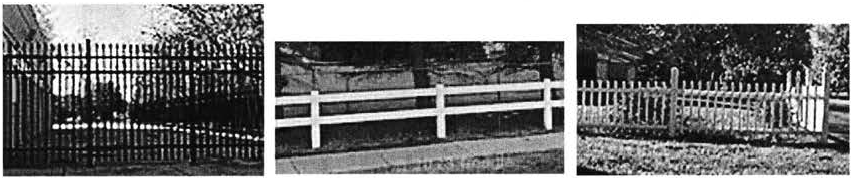
Fence, decorative. A decorative fence is intended to enclose a portion of a parcel in a decorative manner and is not necessarily intended to preclude or inhibit entry or vision into the property. Examples of decorative fences include split rail, wrought iron and similar fences that are visually "transparent" and/or readily breached.
42.
Fence, functional. A functional fence is intended to enclose a parcel or portion of a parcel in order to prevent or make difficult entry by animals, persons or vehicles. Such a fence may also be a visual screen. Chainlink, masonry, stacked, and similar types of fences are examples of functional fences.
43.
Flood or flooding. A general and temporary condition of partial or complete inundation of normally dry land from the overflow of inland waters and/or unusual and rapid accumulation of surface water runoff from any source.
44.
Garage, community. A community garage is a building used for the storage of three or more automobiles of two or more owners and containing no public repair or service facilities.
45.
Home occupation. A home occupation is a lawful activity commonly carried on within a dwelling by a member or members of the family who occupy the dwelling where the occupation is secondary to the use of the dwelling for living purposes and up to one other person, and the residential character of the dwelling is maintained. Auto and/or vehicle repair (painting, sales, and salvage), kennels and other similar uses are not permitted home occupations.
46.
Hospital. An institution for the diagnosis, treatment or care of aged, sick or injured people. The term "hospital" shall include sanitarium, rest home, nursing home and convalescent home, but shall not include any institution for the care of mental disorders or the treatment of alcoholics or drug addicts.
47.
Identity sign. A sign which carries only the name of the firm, the major enterprise, logo, or the principal product offered for sale on the premises, or a combination of these.
48.
Institute for human care. A public or private facility for physical or mental care. A human care institution may include hospitals, convalescent, assisted care facilities and nursing homes. It does not include homes for the mentally disadvantaged, physically impaired or substance abuse rehabilitation facilities and the like.
49.
Kennel, commercial. Any lot or premises used for the commercial sale, boarding, grooming, or training of dogs, cats or similar household pets. This definition shall not include pet stores for sale of household pets in a retail environment.
50.
Kennel, private. Any lot or premises used for the private maintenance of up to six household pets on the premises, not involving commercial activities. The keeping of more than six household pets shall be considered a commercial kennel regardless of ownership or species of animals.
51.
Legislative body. The Saginaw Charter Township Board of Trustees.
52.
Loading space. An offstreet space at least ten feet wide, 25 feet long and 15 feet high, either within a building or outside on the same lot, provided, maintained, and available for the loading or unloading of goods or merchandise and having direct and unobstructed access to a street or alley.
53.
Lot. A parcel of land occupied or intended for occupancy by a main building and accessory buildings thereto, together with such open spaces as are required under the provisions of this Ordinance. Every lot shall abut upon and have permanent access to a public street, except as provided in section 302(1).
54.
Lot area. The total horizontal area within the lot lines of the lot.
55.
Lot; corner, interior and through. Corner lot is a lot which has at least two contiguous sides abutting upon a street for their full length, provided the two sides intersect at an angle of not more than 135 degrees.
a)
Interior lot is a lot other than a corner lot.
b)
Through lot is an interior lot having frontage on two streets which do not intersect at a point contiguous to such lot.
56.
Lot coverage. The percentage of the lot area covered by the ground floor of principal and accessory buildings or structures.
57.
Lot depth. The average distance from the front lot line of the lot to its opposite rear line measured in the general direction of the side lot line.
58.
Lot line, front. In the case of an interior lot, that line separating said lot from the street. In the case of a through lot, that line separating said lot from either street. In the case of a corner lot, the shorter street line shall be considered the front lot line.
59.
Lot line, rear. A lot line which is opposite the front lot line. In the case of a corner lot, the rear lot line may be opposite either front lot line, but there shall only be one rear lot line. In the case of a lot with side lot lines converging at the rear, the, rear lot line shall be an imaginary line parallel to the front lot line, not less than 20 feet long, lying farthest from the front lot line and wholly within the lot.
60.
Lot line, side. Any lot line that is not a front lot line or rear lot line.
61.
Lot lines. The lines bordering a lot as defined herein.
62.
Lot of record. A parcel of land, the dimensions of which are shown on a document or map on file with the county register of deeds or in common use by county and community officials and which actually exists as shown, or any part of such parcel held in a record ownership separate from that of the remainder thereof.
63.
Lot, width of. The width measured along the front lot line or street line.
64.
Marquee. A canopy or covering structure projecting from and attached to a building.
65.
Misconduct in office. Misconduct in office includes misfeasance, malfeasance and nonfeasance.
66.
Mixed use. A two-story or multistory building which includes office, commercial, or otherwise nonresidential uses and also includes residential uses, above the first floor.
67.
Mobile home park. A parcel of land 15 acres or more intended and designed to accommodate 60 or more mobile homes for residential use which is offered to the public for that use along with any structure, facility, area or equipment permitted and incidental to the residential use. Referred to also as "park."
68.
Modular (premanufactured) housing unit. A dwelling unit constructed solely within a factory as a single unit or in various sized modules which are then transported to a site where they are assembled on a permanent foundation to form a single-family dwelling unit and meeting all codes and regulations applicable to conventional site-built construction. A mobile home is considered a type of modular housing unit with all of the following characteristics:
a)
Designed for a longterm occupancy.
b)
Containing sleeping accommodations, a flush toilet, a tub or shower bath, and kitchen facilities, with plumbing and electrical connections provided for attachment to outside systems.
c)
Designed to be transported after fabrication on its own wheels or on flatbed or other trailers or detachable wheels.
d)
Arriving at site to be occupied as a dwelling unit complete and ready for occupancy except for minor and incidental location operations.
69.
Motel. A building or group of buildings, whether detached or in connecting units, used as individual sleeping or dwelling units designed primarily for transient automobile facilities. The term "motel" shall include buildings designed as "auto courts," "tourist courts," "motor courts," "motor hotels," and similar appellations which are designed as integrated units of individual rooms under common ownership.
70.
Multiple dwelling. Any building housing more than two families, unless otherwise defined by this Zoning Ordinance.
71.
Municipal land. Property owned and occupied by Saginaw Charter Township or a Saginaw County governmental agency.
72.
Nonconforming use. A building, structure, or use of land lawfully existing at the time of enactment of this Ordinance and which does not conform to the regulations of the district or zone in which it is situated.
73.
Open space. Any unoccupied space open to the sky on the same lot with a building. See "Courts."
74.
Parking space. An off-street space exclusive of necessary driveways, aisles or maneuvering areas suitable to accommodate one motor vehicle and having direct, unobstructed access to a street or alley.
75.
Personal wireless communication facilities. Transmitters, antenna structures or towers and other types of equipment necessary for providing personal wireless services to the general public. Common examples are personal communications systems (PCS) such as cellular radio telephone service and paging.
76.
Planning commission. The Saginaw Charter Township Planning Commission. Any reference to "zoning commission" or "commission" shall mean the planning commission.
77.
Principal use. The main use to which the premises are devoted and the principal purpose for which the premises exists.
78.
Projection. The distance by which a sign or other structure extends over public property or beyond the building line.
79.
Public utility. Any person, firm, corporation, municipal department or board fully authorized to furnish to the public electricity, gas, steam, telephone, telegraph, cable, transportation or water.
80.
Quarry, sand pit, gravel pit, top soil stripping. A lot of land or part thereof used for the purpose of extracting stone, sand, gravel, or top soil for sale, excluding the process of grading a lot preparatory to the construction of a building [for which a] permit has been issued.
81.
Recreational vehicles. All those small mobile units principally designed for recreational past time such as motor homes, camper trailers, pickup campers, pop-up tent trailers, snowmobiles, motorcycles, dune buggies, and similar camping type vehicles or trailers.
82.
Right-of-way. A street, alley or other thoroughfare or easement permanently established for passage of persons or vehicles.
83.
Roadside stand. A "roadside stand" is a structure for the seasonal display of agricultural produce with no space for customers within the structure itself.
84.
Roofline. This shall mean either the high point of the roof or the top of the parapet, whichever forms the top line of the building silhouette, and, where a building has several roof levels, this roof or parapet shall be the one belonging to that portion of the building on whose wall the sign is located.
85.
Salvage yard. An open area where waste, used or secondhand materials are bought and sold, exchanged, stored, baled, packed, disassembled, or handled, including, but not limited to, scrap iron and other metals, paper, rags, rubber tires, and bottles. A salvage yard includes automobile wrecking yards, and two or more inoperative, unlicensed vehicles located on a single lot shall be construed to be a salvage yard.
86.
Sanitary landfill. A method of disposing of refuse on land without creating nuisances or hazards to public health or safety by utilizing principles of engineering to confine the refuse to the smallest practical area, to reduce it to the smallest practical volume, and to cover it with a suitable cover at the conclusion of each day's operation or at more frequent intervals as necessary.
87.
Setback line. A line established herein from which required yards are measured.
88.
Sexually oriented business. An adult arcade, adult bookstore, adult novelty store, adult video store, adult cabaret, adult motel, adult motion picture theater, adult theater, escort agency, nude model studio, or sexual encounter center. The following definitions shall apply to sexually oriented businesses:
a)
Adult arcade. Any place to which the public is permitted or invited wherein cash-operated, credit-operated, coin-operated or slug-operated or electronically, internet or mechanically controlled still or motion picture machines, projectors or other image producing devices are maintained to show images and where the images so displayed are distinguished or characterized by the depicting or describing of "sexually explicit activities" or "specified anatomical areas".
b)
Adult bookstore or adult video store. An establishment which offers for sale or rental for any form of consideration, as one of its principal business purposes, any one or more of the following:
i)
Books, computer diskettes, tapes or hard drives, magazines, periodicals or other printed matter or photographs, films, motion pictures, video matter or photographs, cassettes or video reproductions, slides or other visual representation and/or items which depict or describe "sexually explicit activities" or "specified anatomical areas" or which are characterized by their emphasis upon exhibition or description of "sexually explicit activities" or "specified anatomical areas"; or
ii)
Instruments, devices or paraphernalia which are characterized by their emphasis upon "sexually explicit activities" or "specified anatomical areas" or designed for use in connection with "sexually explicit activities"; or
iii)
Items, materials or paraphernalia depicting, displaying, advertising or packaged as "sexually explicit activities" or which depict or describe, or are characterized by their emphasis upon, the exhibition or description of "specified anatomical areas".
iv)
For purposes of this Ordinance, "principal business purpose" means:
a)
The devotion of a significant or substantial portion of its stock-in-trade or interior floor space, meaning 30 percent or more of the interior floor area as defined by the applicable building code; or
b)
The receipt of 50 percent of more of its annual revenues from the sale of the items listed above. Revenue is a gross increase in assets or a gross decrease in liabilities recognized and measured in conformity with generally accepted accounting principles; or
c)
The devotion of a significant or substantial portion of its advertising expenditures to the promotion of the sale, rental or viewing of books, magazines, periodicals or other printed matter, or photographs, film, motion pictures, video cassettes, compact discs, slides or other visual representations, items, materials, or paraphernalia which are characterized by the depiction, description, display, advertising or packaging of "sexually explicit activities" or "specified anatomical areas".
d)
An establishment may have other principal business purposes that do not involve the offering for sale, rental or viewing of materials depicting or describing "sexually explicit activities" or "specified anatomical areas", and still be characterized as an adult book store, adult novelty or retail store or adult video store. Such other business purposes will not serve to exempt such establishment from being categorized as an adult bookstore, adult novelty store, adult video store, so long as the establishment falls within the definition of an adult bookstore, adult novelty store or adult video store as set forth above.
c)
Adult cabaret. A nightclub, bar, restaurant or similar commercial establishment, whether or not alcohol is served, which regularly features:
i)
Persons who appear in a state of restricted nudity, and/or other material while opaque does not completely cover the entire buttocks (e.g., g-strings) or all portions of the breast below the topmost portion of the areola; or
ii)
Live performances of an erotic nature which are characterized by the partial exposure of "specified anatomical areas" or "sexually explicit activities" that occur away from the common area of the establishment, such as on a stage, on poles, in booths, cubicles, rooms, compartments or stalls separate from the common areas of the premises wherein an entertainer or waitress provides adult entertainment to members of the public, a patron or a member, when such adult entertainment is held, conducted, operated or maintained for a direct or indirect profit; or
iii)
Films, motion pictures, video cassettes, compact discs, slides or other photographic reproductions which are characterized by the depiction or description of "sexually explicit activities" or "specified anatomical areas".
d)
Adult massage parlor. Any place where, for any form of consideration or gratuity, massage, alcohol rub, administration of fomentations, electric or magnetic treatments, or any other manipulation of the human body which occurs as part of or in connection with specified sexual activities, or where any person providing such treatment, manipulation, or service related thereto, exposes his or her specified anatomical areas. The definition of sexually oriented business shall not include the practice of massage in any licensed hospital, nor by a licensed chiropractor or osteopath, nor by any nurse or technician working under the supervision of a licensed physician, surgeon, chiropractor or osteopath, nor by trainers for any amateur, semi-professional or professional athlete or athletic team or school athletic program nor a therapeutic massage practitioner. An adult massage parlor is considered a sexually oriented business for purposes of this Ordinance.
e)
Adult motel. A hotel, motel or similar establishment which:
i)
Offers accommodations to the public for any form of consideration and provides patrons with closed-circuit television transmission, films, motion pictures, video cassettes, compact discs, slides or other photographic reproductions which are regularly characterized by the depiction or description of "sexually explicit activities" or "specified anatomical areas"; and which advertises the availability of this adult type of material by means of a sign, visible from the public right-of-way, or by means of any off-premises advertising, including, but not limited to, newspapers, magazines, pamphlets or leaflets, radio, internet or television; or
ii)
Permits patrons to be filmed or photographed performing "sexually explicit activities" or displaying "specified anatomical areas" for electric transmission over the World Wide Web; or
iii)
Offers a sleeping room for rent for a period of time that is less than ten hours; or
iv)
Allows a tenant or occupant of a sleeping room to sub-rent the room for a period of time that is less than ten hours.
f)
Adult motion picture theater. An establishment where, for any form of consideration, films, motion pictures, video cassettes, compact discs, slides or similar photographic reproductions are regularly shown which are characterized by the depiction or description of "sexually explicit activities" or "specified anatomical areas".
g)
Adult theater. A theater, concert hall, auditorium or similar establishment which regularly features persons who appear in a state of nudity or live performances which are characterized by the exposure of "specified anatomical areas" or by the performance of "sexually explicit activities". This definition does not include a theater which features occasional live nude performances with serious literary, artistic or political value and which has no adverse secondary effects.
h)
Adult use business. An adult arcade, adult bookstore, adult novelty or retail store, adult video store, adult cabaret, adult motel, adult motion picture theater, adult theater, escort agency, nude modeling studio and/or a sexual encounter establishment or any business determined by the building official, township manager, and/or the chief of police, to be an adult use because of the similarities in the characteristics and activities of the business with regulated adult business uses, such as nudity, semi-nudity, exposure of "sexually explicit activities" and/or "specified anatomical areas". The definition of "adult use business" shall not include an establishment where a medical practitioner, psychologist, psychiatrist or similar professional person licensed by the State engages in medically approved and recognized sexual therapy.
i)
Alcoholic commercial establishment. Any hotel, motel, tavern, restaurant, park, nightclub, cocktail lounge, burlesque house, bar, cabaret, taproom, club or other similar establishment licensed by the State of Michigan Liquor Control Commission, or where alcoholic beverages, including beer, are dispensed and/or consumed. This definition shall exclude a theater or auditorium.
j)
Entertainer. A person who performs some type of activity or pose with the intent of allowing others to witness that activity or pose.
k)
Escort. A person who, for consideration in any form, agrees or offers to act as a companion, guide or date for another person, or who agrees or offers to privately perform as an entertainer, including, but not limited to, the modeling of lingerie, the removal of clothing and the performance of a dance or skit. Under this definition, "privately" shall mean a performance for an individual or that individual's guests.
l)
Escort agency. A person or business association that furnishes, offers to furnish, or advertises to furnish escorts as one of its primary business purposes, for a fee, tip or other consideration.
m)
Establishment. Any of the following:
i)
The opening or commencement of any sexually oriented business as a new business; or
ii)
The conversion of an existing business, whether or not a sexually oriented business, to any sexually oriented business; or
iii)
The location or relocation of any sexually oriented business.
n)
Licensee. The individual listed as an applicant on the application of a sexually oriented business license, or a person whose name appears on a license to operate an adult use business.
o)
Licensing officer. The Clerk of Saginaw Township or his/her designee.
p)
Manager. An operator, other than a licensee, who is employed by a sexually oriented business to act as a manager or supervisor of employees, or is otherwise responsible for the operation of the sexually oriented business.
q)
Massage. The treating of external parts of the body for remedial or hygienic purposes, consisting of stroking, kneading, rubbing, tapping, pounding, vibrating, or stimulating with the hands or with the aid of any mechanical or electrical apparatus or appliances, with or without such supplementary aids as rubbing alcohol, liniments, antiseptics, oils, powder, creams, lotions, ointment or other such similar preparations commonly used in the practice of massage, under such circumstances that it is reasonably expected that the person to whom the treatment is provided shall pay any consideration whatsoever therefore. For purposes of this Ordinance, the term "bodywork" shall mean massage.
r)
Nude model studio. Any place where a person appears in a state of nudity or displays "specific anatomical areas", and is provided money or any form of consideration to be observed, sketched, drawn, painted, sculpted, photographed or similarly depicted by other persons. This includes modeling studios that provide for nude modeling on an occasional basis, but it does not include a modeling studio whose primary function is to provide art classes as part of a college, university or educational institution and which is certified by the State of Michigan.
s)
Nudity or a state of nudity. The appearance of a human bare buttock, anus, male genitals, female genitals or female breasts.
t)
Operator. The owner, licensee, manager or person in charge of any premises.
u)
Peep booth. An adult motion picture theater with a viewing room or cubicle of less than 150 square feet of floor space.
v)
Premises or licensed premises. Any premises that requires a sexually oriented business license and that is classified as a sexually oriented business.
w)
Principal owner. Any person owning, directly or beneficially:
i)
Ten percent or more of a corporation's equity securities; or
ii)
Ten percent or more of the membership interests in a limited liability company; or
iii)
In the case of any other legal entity, ten percent or more of the ownership interests in the entity.
x)
Private room. A room in a hotel/motel that is not a peep booth, has a bed and a bath in the room or adjacent room, and is used primarily for lodging.
y)
Regular or regularly shall mean recurring, attending or functioning at fixed or uniform intervals.
z)
Semi-nude. A state of dress in which clothing covers no more than the genitals, pubic region and areola of the female breast, as well as portions of the body covered by supporting straps or devices.
aa)
Sexual encounter center. A business or enterprise that, as one of its primary business purposes, offers a place where two or more persons may congregate, associate or consort for the purpose of "sexually explicit activities" or the exposure of "specified anatomical areas" for any form of consideration, including, but not limited to:
i)
Physical contact in the form of wrestling or tumbling between persons of the same or opposite sex; or
ii)
Activities when one or more of the persons is in a state of nudity or semi-nudity; or
iii)
Permits patrons to display or be filmed or photographed performing "sexually explicit activities" or displaying "specified anatomical areas" for recording or transmission over the World Wide Web or any other media.
bb)
Sexually explicit activities. Any of the following:
i)
The fondling or other erotic touching of human genitals, pubic region, buttocks, anus or female breasts; or
ii)
Sex acts, normal or perverted, actual or simulated, including, but not limited to, intercourse, oral copulation or sodomy; or
iii)
Masturbation, actual or simulated; or
iv)
Any activity intended to arouse, appeal to or gratify a person's lust, passions or sexual desires; or
v)
The display of human genitals in a state of sexual stimulation, arousal or tumescence; or
vi)
The display of excretory function as part of or in connection with any of the activity set forth in a) through e) above.
cc)
Sexually oriented business. An adult arcade, adult bookstore or adult video store, adult novelty or retail store, adult cabaret, adult motel, adult motion picture theater, adult theater, escort agency, nude model studio, sexual encounter center or similar establishment or any place that permits patrons to be filmed or photographed performing "sexually explicit activities" or displaying "specified anatomical areas" for electronic transmission over the World Wide Web. "Sexually oriented" when used to describe film, motion picture, videocassette, slides, or other photographic reproductions shall mean film, movies, motion picture videocassette, slides or other photographic reproductions that regularly depict material which is distinguished or characterized by an emphasis on matter depicting or describing "sexually explicit activities" or "specified anatomical areas" offered for observation by the patron(s) on the premises of a sexually oriented business. The definition of "sexually oriented business" shall not include an establishment where a medical practitioner, psychologist, psychiatrist or similar professional person licensed by the State engages in medically approved and recognized sexual therapy.
dd)
Specified anatomical areas. Any of the following:
i)
Less than completely and opaquely covered human genitals, pubic region or pubic hair, buttock, or female breast or breasts or any portion thereof that is situated below a point immediately above the top of the areola, or any combination of the foregoing; or
ii)
Human genitals in a state of sexual arousal, even if opaquely and completely covered.
ee)
Specified criminal acts. Sexual crimes against children, sexual abuse, criminal sexual conduct, rape, crimes classified as sexual crimes by the State of Michigan or any other state, or crimes connected with another adult use business, including, but not limited to, the distribution of obscenity, prostitution and/or pandering.
ff)
Significant or substantial portion. Thirty percent or more of the term modified by such phrase. If a business has twenty-nine percent or less of its stock-in-trade or interior floor space devoted to sexually oriented material, the use does not qualify as a regulated use. However, based upon the potential negative secondary impacts which relate to the sale, display and/or exhibition of sexually oriented materials, additional regulations of these materials is required as follows:
i)
Floor space/display restrictions: The sale, display or exhibition of sexually oriented materials shall be limited to no more than 29 percent of the total stock in trade or interior floor space. The sexually oriented materials shall be located in the rear portion of a building away from its main entrance area. The sexually oriented materials shall be separated by racks, walls or other means that would restrict visibility into the area displaying the sexually oriented materials. No sexually explicit materials shall be permitted to be placed on the non-adult side of this separation.
ii)
No sexually explicit materials shall be displayed in any of the business's windows at any time or visible from the exterior of the business or building. Additionally, no portion of the ceiling in a business or building will be permitted to be used to display sexually explicit materials.
iii)
Magazines that contain "sexually explicit activities" or "specified anatomical areas" may be located outside an area specifically devoted to sexually explicit materials. However, the merchandise rack on which the materials are placed must be located immediately adjacent to the separate area that sells the sexually explicit materials, and contain opaque blinders that only allow viewing of the magazine title.
iv)
Height restrictions: The height of the racks and display walls upon which sexually explicit material can be displayed shall be limited to six feet.
89.
[Sign.] A "sign" is a name identification, description, display or illustration which is affixed to or represented directly or indirectly upon a building, structure or piece of land and which is intended to direct attention to an object, product, place, activity, person, institution, organization or business. However, a "sign" shall not include any display of official court or public office notices nor shall it include the flag, [a] political unit or school. A "sign" shall not include a sign located completely within an enclosed building.
For the purpose of this Ordinance, the following sign or sign-related terms are defined:
a)
Sign, area or surface area of. That area per face enclosed by one outline, the sides of which make contact with the extreme points or edges of the sign, excluding the supporting structure which does not form part of the sign proper or of the display.
The area of a sign composed of characters or words attached directly to a large, uniform building wall surface shall be the smallest outline which encloses the whole group.
b)
Sign, electric. Any sign containing electric wiring. This does not include signs illuminated by an exterior floodlight source.
c)
Sign, location. A lot, premises, building, wall or any place whatsoever upon which a sign is located.
d)
Sign, projecting. A sign, other than a wall sign, which projects from and is supported by a wall of a building or structure.
e)
Sign, roof. A sign located on or above the roof of any building.
f)
Sign, temporary. A banner, pennant, poster or advertising display constructed of cloth, canvas, plastic sheet, cardboard, wallboard or other like materials and intended to be displayed for a limited period of time.
g)
Sign, wall—flat. One affixed directly to or painted on or otherwise inscribed on an exterior wall and confined within the limits thereof of any building and which projects from that surface less than 12 inches at all points.
90.
Site, area. The total area within the property lines excluding street rights-of-way.
91.
Special use. The term applied to a use which may be permitted by the application for and issuance of a special use permit by the township planning commission upon approval of the township board. Specified procedures and requirements, as outlined in cited sections, must be complied with prior to final issuance of said permit.
92.
Stable, commercial. A stable in which horses are kept for remuneration, hire, or sale.
93.
Stable, private. An accessory building in which horses are kept for private use and not for hire, remuneration, or sale, and further that no more than three horses are boarded.
94.
Story. That portion of a building included between the surface of any floor and the surface of the next floor above it; or if there is no floor above it, then the space between the floor and the ceiling next above it.
95.
Story, first. The lowest story of a building, the ceiling of which is more than seven feet above the average grade of the ground or sidewalk adjacent to its exterior walls. On a berm house seven feet shall be measured from the lowest floor level.
96.
Story, half. A space under a sloping roof which has the line of intersection of roof decking and wall face not more than three feet above the top floor level and in which space not more than two-thirds of the floor area is finished off for the use. A half-story containing independent apartments of living quarters shall be counted as a full story.
97.
Story, height of. The vertical distance from the top surface of one floor to the top surface of the next above. The height of the top-most story is the distance from the top surface of the floor to the top surface of the ceiling joints [joists].
98.
Street. A public thoroughfare which affords the principal means of access to abutting property.
99.
Street, functional classification. Functional classification is the process by which streets and highways are grouped into classes, or systems, according to the character of service they are intended to provide. Three basic groups include: (1) arterials primarily for mobility, (2) collectors for both mobility and land access, and (3) locals for primarily land access.
a)
Collectors. Collector systems provide for both land access service and local traffic movements within residential neighborhoods, commercial areas and industrial areas.
b)
Locals. Locals serve as direct land access and access to higher systems.
c)
Major arterials. Major arterials serve the major centers of activity of the region, the highest traffic volume corridors, and the longest trip desires.
d)
Minor arterials. Minor arterials interconnect with and augment the principal arterial system and provide service to trips of moderate length at a somewhat lower level of travel mobility than principal arterials.
100.
Street line. The legal line or demarcation between a street or land for service, benefit or enjoyment.
101.
Structure. Anything constructed or erected, the use of which requires a more or less permanent location on the ground or attachment to something having a permanent location on the ground, excepting utility poles, utility manholes or similar items.
102.
Substance abuse rehabilitation center. A public or private facility designed to provide medical treatment and psychological therapy to those individuals who suffer from drug or alcoholic addiction.
103.
Supermarket. A full line comparison grocery, meat and produce retail sales establishment with a gross building area greater than 10,000 square feet.
104.
Township board. The Saginaw Charter Township Board of Trustees.
105.
Use. The employment or occupation of a building, structure or land for service, benefit or enjoyment.
106.
Variance. A modification of the literal provisions of this Ordinance granted when strict enforcement thereof would cause undue hardship owing to circumstances unique to the specific property on which the modification is granted by the board of appeals on zoning.
107.
Yard. An open space on the same lot with a building, unobstructed from the ground upward, except as otherwise provided herein. The measurement of a yard shall be construed as the minimum horizontal distance between the lot line and the building line.
108.
Yard, front. A yard extending across the front of a lot between the side lot lines and measured between the front line of the lot and the nearest point of the main building or land use.
109.
Yard required, how measured. Required yard depth or width shall be measured in a horizontal plane and at right angles from the lot line in question or an extension thereof.
110.
Yard, rear. An open space on the same lot with a main building unoccupied except as herein permitted, extending the full width of the lot and situated between the rear line of the lot and the rear line of the building projected to the side lines of the lot. The depth of the rear yard shall be measured between the rear line of the lot, or the centerline of the alley, if there be an alley, and the rear line of the building.
111.
Yard, side. An open, unoccupied space on the same lot with the building situated between the building and the side line of the lot and extending from the front yard to the rear yard. Any lot line not a front line or a rear line shall be deemed a side line.
112.
Zero lot line. Division of ownership in which no side yard setbacks are imposed upon buildings.
113.
Zoning administrator. An individual appointed by the township board delegated to administer the Saginaw Charter Township Zoning Ordinance.
(Ord. No. 693, 11-27-2006; Ord. No. 718, 1-24-2011; Ord. No. 744, 1-11-2016; Ord. No. 805, 10-27-2025)
Editor's note— At the township's request, the definitions in this section have been alphabetized and renumbered accordingly.
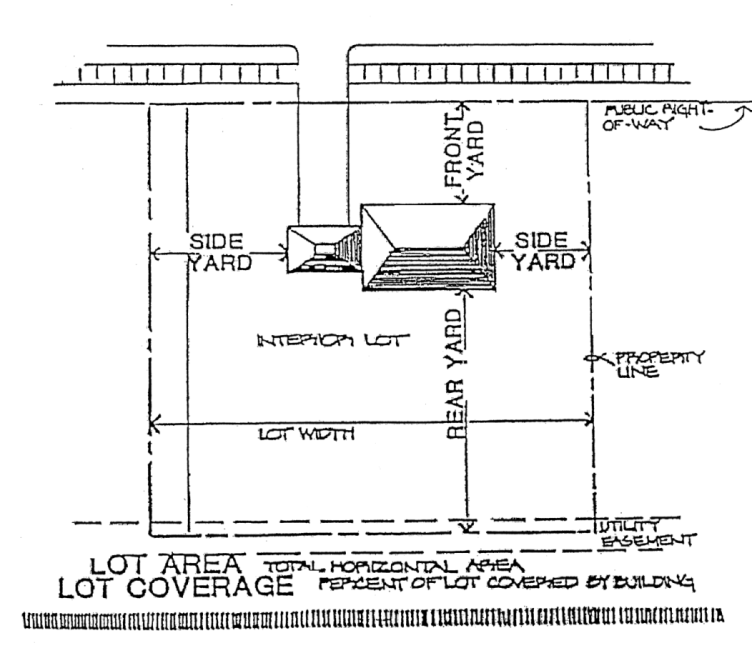
Lot Area/Lot Coverage
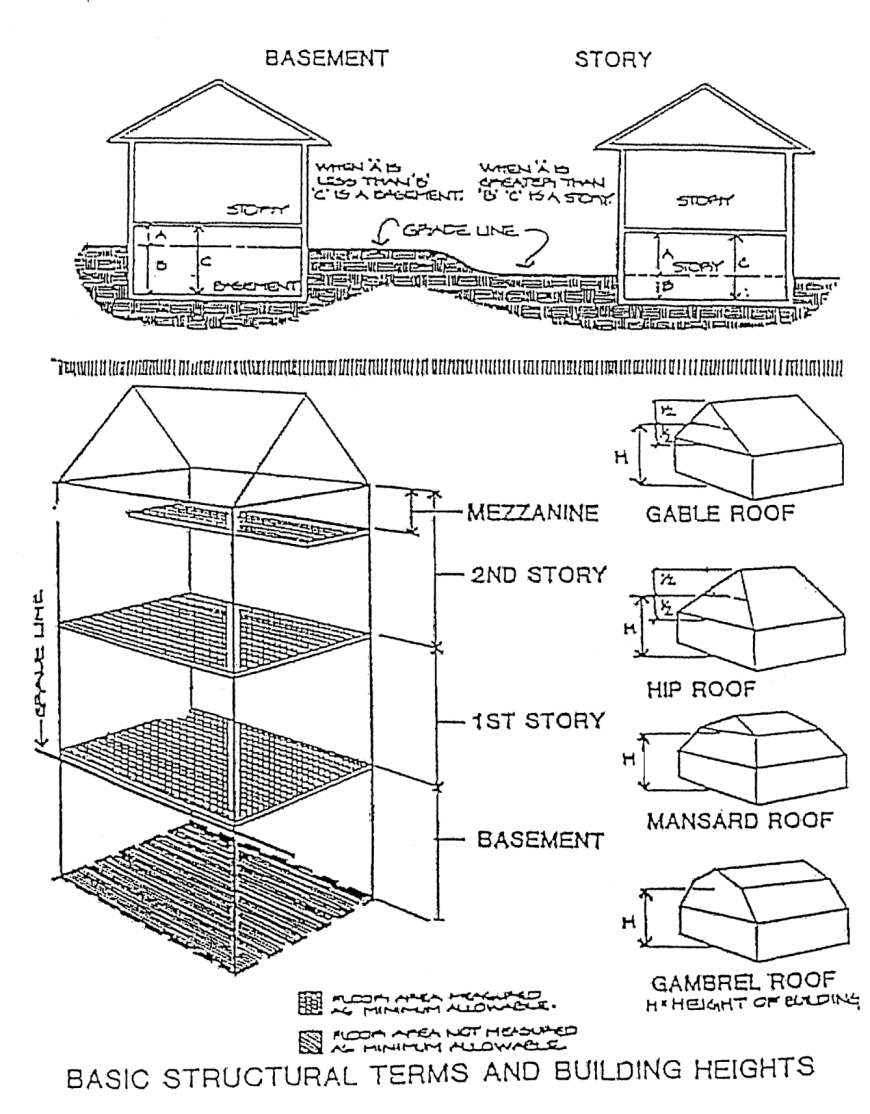
Basic Structural Terms and Building Heights
(Ord. No. 536, 7-10-1995; Ord. No. 544, 10-23-1995; Ord. No. 553, 4-22-1996; Ord. No. 577, 1-26-1998; Ord. No. 578, 1-26-1998; Ord. No. 633, 10-14-2002; Ord. No. 673, 10-25-2004; Ord. No. 703, 9-8-2008; Ord. No. 715, 5-10-2010)
Sec. 301. - Nonconforming uses.
1.
Purpose. It is the intent of this Ordinance to permit the continuance of a lawful use of any building or land existing at the effective date of this Ordinance; however, except as herein provided, no building, structure or use or part thereof shall be used, altered, constructed or reconstructed except in conformity with the provisions of this Ordinance; and further it is hereby declared that the existence of nonconforming uses are contrary to the best interests of the township; and further it is hereby declared to be the policy of the township board as expressed in this Ordinance to discontinue nonconforming uses in the course of time as circumstances permit, having full regard for the rights of all parties concerned.
2.
Nonconforming uses of land. Where, at the effective date of adoption or amendment of this Ordinance, a lawful use of land exists that is no longer permissible under the terms of this Ordinance as enacted or amended, such use may be continued, so long as it remains otherwise lawful, subject to the following provisions:
a)
No such nonconforming use shall be enlarged or increased or extended to occupy a greater area of land than was occupied by such use at the effective date of adoption or amendment of this Ordinance.
b)
No such nonconforming use shall be moved in whole or in part to any other portion of the lot or parcel occupied by such use at the effective date of adoption or amendment of this Ordinance.
c)
Nonconforming uses shall not be changed to another nonconforming use, except after approval of the board of zoning appeals. Before granting such approval, the board shall determine that such change in use will have a less deleterious effect on neighboring properties than the existing nonconforming use.
d)
If such nonconforming use of land ceases for any reason for a period of more than six consecutive months, or for 18 months during any three-year period, such discontinuance shall be considered conclusive evidence of an intention to abandon the nonconforming use. The time limit of discontinuance may be extended beyond the six months for a period of time not to exceed 1½ years upon application to and approval by the board of zoning appeals within the six-month period and upon demonstration that there exists a legitimate intent to continue the nonconforming use within such time extension. At the end of this period of abandonment, the nonconforming use shall be brought into conformity with the provisions of this Ordinance. The zoning administrator shall notify the property owner of such nonconforming use, in writing, by regular mail, 30 days prior to the end of the six-month period to inform the owner of the intent of the zoning administrator to find the use abandoned and the implications of such a finding. Seasonal nonconforming uses, which by their nature operate habitually or customarily during a given period of the year not exceeding 12 consecutive months, shall be exempted from this requirement.
e)
No nonconforming use shall be extended to displace a conforming use.
3.
Nonconforming structures. Where a lawful structure exists at the effective date of adoption or amendment of this Ordinance that could not be built under the terms of this Ordinance by reason of restrictions on area, lot coverage, height, yard, or other characteristics of the structure or its location on the lot, such structure may be continued so long as it remains otherwise lawful, subject to the following provisions:
a)
Nonconforming structures shall not be altered or expanded without the prior approval of the board of zoning appeals, except that the following structural alterations may be permitted without such prior approval:
i)
Structural alterations or extensions adding to the bulk of a structure which is nonconforming only by reason of lot size, lot width or building setback shall be permitted without prior approval of the board of zoning appeals, provided that such structural alteration or extension shall not increase the extent of nonconformity and shall satisfy all other site development regulations which are applicable.
ii)
Structural alterations which do not add to the bulk of the structure or increase the intensity of use of the structure shall not require prior approval of the board of zoning appeals.
b)
Nonconforming buildings or structures may be repaired and maintained so as to prolong the life of the structure.
c)
Nonconforming structures may be reestablished in their nonconforming conditions in any zoning district after damage or destruction of the nonconforming structure, if such structure is nonconforming due only to its having an insufficient side or rear setback or due to its being located on a site having an area, width or both less than prescribed in the applicable sections of this Ordinance.
d)
Existing nonconforming structures shall be deemed to be legal nonconformities if said structure(s):
1.
Was properly permitted for construction or was constructed prior to permitting requirements; and
2.
Was constructed prior to formboard/foundation survey requirements or did not require submission of a formboard survey prior to construction; and
3.
Was issued a certificate of occupancy, or passed a final (last) inspection if a certificate of occupancy was not required or was constructed prior to any applicable final (last) inspection or certificate of occupancy requirement.
4.
Nonconforming signs. Where a lawful sign exists at the effective date of adoption or amendment of this Ordinance that could not be installed under the terms of this Ordinance, the use of such sign may be continued so long as it remains otherwise lawful subject to the following provisions:
a)
The faces, supports, or other parts of any nonconforming sign shall not be structurally changed, altered, substituted or enlarged unless the resultant changed, altered, substituted or enlarged sign conforms to the following provisions:
i)
If dimensional changes or alterations to the message area or sign faces are made, the resultant sign area shall conform with the maximum sign area restriction for the parcel of land upon which the sign is located.
ii)
If structural changes or alterations are made to support members, the resultant sign shall conform to the height and setback restrictions for the zoning district in which it is located.
iii)
Nothing in this section shall prohibit the periodic change of message[s] on a nonconforming sign, provided such change[s] do not necessitate structural change, alteration, substitution or enlargement of such sign.
iv)
No nonconforming sign shall be changed, altered, substituted or enlarged if the cost of resultant change, alteration, substitution or enlargement exceeds 30 percent of the appraised replacement cost of the sign as determined by the township assessor unless prior approval for such change is granted by the board of zoning appeals after a public hearing and finding that such change is in the best interest of Saginaw Charter Township.
b)
Nothing shall prohibit the repair, reinforcement or modernization of a lawful nonconforming sign, provided such repair does not exceed an aggregate cost of 30 percent of the appraised replacement cost as determined by the township assessor, unless the subject sign is changed by repair, reinforcement or modernization to a conforming structure.
c)
Any lawful nonconforming sign damaged by fire, explosion, an act of God, or by other accidental causes may be restored, rebuilt or repaired to its original condition.
d)
The township board may acquire any nonconforming sign, with or without acquiring the property on which such sign is located, by condemnation or other means and may remove such sign.
5.
Repairs and maintenance. Repairs and maintenance may be performed on any building devoted in whole or in part to a lawful nonconforming use, including ordinary repairs or repair or replacement of nonbearing walls, fixtures, wiring or plumbing, to an extent not to exceed 50 percent of the assessed value (25 percent of true cash value) of the building during any period of 24 consecutive months. However, the cubic content of the building as it existed at the time of enactment or amendment of this Ordinance shall not be increased except as otherwise provided in this chapter. Nothing in this section shall be deemed to prevent the strengthening or restoring to a safe condition of any building or part thereof declared unsafe by an official charged with protecting the public safety upon order of such official.
6.
Prior construction approval. Nothing in this Ordinance shall prohibit the completion of construction and use of a nonconforming building for which a building permit has been legally issued prior to the effective date of enactment or amendment of this Ordinance; provided, that construction is commenced within 30 days after the date of issuance of the permit and that the entire building shall have been completed according to plans filed with the permit application within one year of the issuance of the building permit.
7.
Change of tenancy or ownership. There may be a change of tenancy, ownership or arrangement of any existing nonconforming uses of land, structures and premises, provided there is no change in the nature and character of such nonconforming uses.
8.
Elimination of nonconforming uses or structures. The township board may acquire by purchase, condemnation or other means private property or an interest in private property for the removal or elimination of any nonconforming use or structure.
(Ord. No. 809, 2-23-2026)
State Law reference— Nonconforming uses, MCL 125.286.
Sec. 302. - Supplementary use regulations.
1.
Access to a street. Any lot of record created after the effective date of this Ordinance shall have frontage on a public street, except as may be approved as a planned unit development in accordance with the provisions of section 2207.
2.
Rear dwelling prohibited. No building in the rear of and on the same lot with a principal building shall be used for residential purposes except for watchmen, caretakers, and domestic employees whose employment functions are related to the function of the principal building; provided that all other requirements of this Ordinance are satisfied.
3.
Use of structure for temporary dwelling. No structure shall be used for dwelling purposes that does not meet the minimum standards as defined in this Ordinance and the township building code. No temporary structure, whether of a fixed or portable construction, shall be erected or moved onto a lot and used for dwelling purpose for any length of time unless authorized by the issuance by the zoning board of appeals of a temporary permit as provided for by this Ordinance.
4.
Required water supply and sanitary sewerage facilities. After the effective date of this Ordinance, no structure shall be erected, altered or moved upon a lot or premises and used in whole or in part for a dwelling, business, industrial or recreational purpose unless it shall be provided with a safe, sanitary, and potable water supply and with a safe and effective means of collection, treatment, and disposal of human excreta and domestic, commercial and industrial waste. All such installations and facilities shall conform with the minimum requirements of the Saginaw County Health Department and applicable state regulations.
5.
One dwelling per lot. Only one single-family detached dwelling will be allowed to be erected on a lot in a R-1 district.
6.
Fences, walls and screens. This section is intended to provide for the regulation of the height and location of fences, walls, screens and other similar obstructions for the purpose of providing for light, air, and privacy and safeguarding the public welfare by preventing visual obstructions at street and highway intersections. Fence related exceptions listed in other sections of the zoning ordinance may be utilized as otherwise permitted.
a)
Definitions.
i)
Height. For the purposes of this section, "height" shall mean the vertical distance from existing grade to the top of the fence, hedge, or wall.
ii)
Yards. Front, side, and rear yards are as defined in Section 202 Definitions unless otherwise noted in this section.
iii)
Opaque. For this section "opaque" shall mean fencing materials that are not easy to see through or transparent.
iv)
Semi-transparent. For this section "semi-transparent" shall mean fence materials that are at least 50 percent transparent.
v)
Multi-frontage lots. For this section "multi-frontage lots" shall mean a lot with three yards fronting or abutting a street.
b)
General rules.
i)
A fence may only be erected on a property as authorized by the land owner through a valid fence permit or otherwise required by the township through the site plan review process (see permit subsection below).
ii)
No fence, wall or hedge planting shall be permitted in the road right-of-way (proposed or established).
iii)
Plant materials located within 30 feet of the edge of the pavement of a public street shall not obstruct visibility at a level between three feet and eight feet.
iv)
Where a sidewalk is present adjacent to any yard (front, side and/or rear), a fence shall be setback a minimum of four feet behind the sidewalk.
v)
All landscaping around fencing shall be maintained and not affect the structural integrity of the fence.
vi)
Property owners are responsible for compliance with applicable home owners associations and site condo association rules and regulations, deed restrictions, and other legal restrictions.
vii)
Care shall be taken when a fence is proposed to cross an easement. It is the property owner's responsibility to ensure that easement rights are respected and that access is maintained/provided as required. This may involve providing a gate(s) that ensures proper access.
viii)
Maintenance offences. Replacement of fence materials in excess of one panel and/or one post requires a permit.
a.
All fences shall be maintained in their upright condition.
b.
Missing boards, pickets or posts, decaying fence materials (such as wood), and missing privacy slats shall be replaced in a timely manner with material of the same type and quality of the original fence. Fencing that is collapsing and/or leaning shall be repaired. Damaged, torn, and/or disconnected privacy mesh shall be repaired or replaced.
c.
Replacement of fencing which was approved via a site plan shall meet the requirements of the approved site plan.
ix)
Supporting posts and cross-members. All supporting posts and cross-members of all fences shall face toward the interior of the lot of the person erecting the fence. Decorative fence posts/columns/masonry pilasters, and similar may exceed the height limitations by up to one foot. Variations on residential properties may be approved by the zoning administrator or designee. Variations on all other properties may be approved by the planning commission.
x)
Barbed wire, electrified components or similar fencing types. Under no circumstances shall barbed wire, electrified components or similar fencing type that is likely to cause injury to persons be used in any residential district. The use of such materials/components shall only be permitted in non-residential districts by planning commission approval with the planning commission to consider the necessity/need for the materials/components as a primary factor for consideration.
c)
General design guidelines.
i)
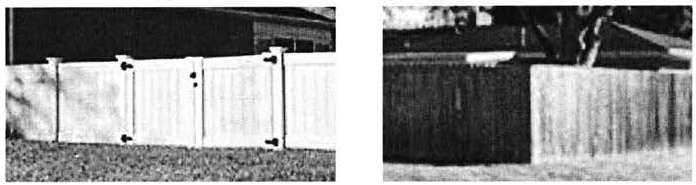
Opaque fences may be constructed of wood, vinyl, or decorative materials as approved by the zoning administrator or designee.
ii)
Decorative fences may be constructed of, but not limited to the following materials: wrought iron, aluminum, picket style (wood or vinyl), or vinyl coated chain-link fencing.
iii)
Decorative fencing shall not include fences constructed with materials such as chain-link, untreated wood, barbed wire, or chicken wire.
iv)
Non-coated chain-link is not permitted in a front yard, regardless of zoning.
v)
Walls may be constructed of brick, concrete block, poured concrete, or similar materials.
d)
Location.
i)
Front yard.
a.
Opaque fences/walls/hedges.
1.
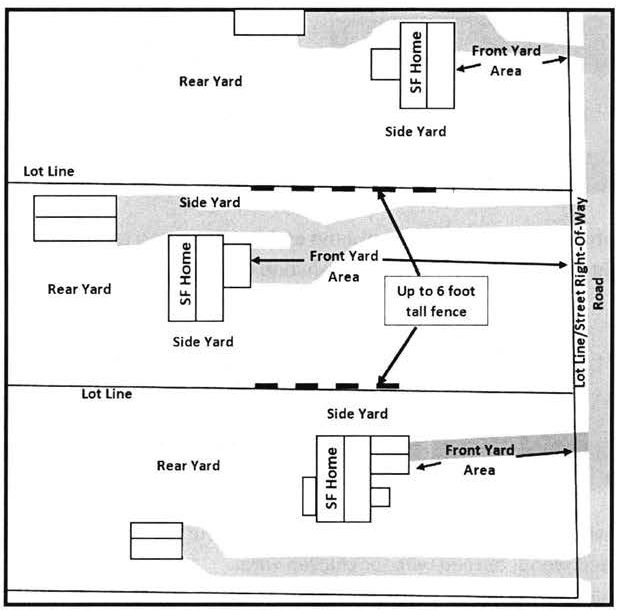
No opaque fence, wall or hedge planting shall exceed a height of three feet within any front yard in any zoning district, except as otherwise allowed in other sections of this ordinance and;
2.
A fence, up to six feet in height, may be erected on or adjacent to the side lot lines within a front yard if the following criteria are met:
A.
The lot shall be zoned for single family residential use.
B.
The primary structure is located behind the established front building line of the properties on either side of the subject property.
C.
The six foot in height fence shall not extend beyond the front of the primary structures of the properties directly adjacent to the subject parcel. (See image below)
b.
Semi transparent fences.
1.
A decorative semi-transparent fence, up to four feet in height, may be erected in the front yard of residentially zoned and/or used properties.
2.
In all zoning districts (except residential zoning districts), decorative semi-transparent fences may be up to six feet in height as approved by the planning commission per site plan review, or by the zoning administrator or designee in cases where a planning commission site plan review is not required.
ii)
Side and rear yard. No fence, hedge or wall greater than six feet in height shall be permitted within any side or rear yard.
Exceptions:
a.
A fence located on a residential parcel which abuts a commercial, manufacturing or institutional use may be eight feet tall, provided the adjoining residential property owners give their consent. Consent shall be in the form of an affidavit signed by the adjoining residential property owners and submitted to the community development department.
b.
Fencing around tennis courts and recreational amenities shall be exempt from the six-foot height limitation.
c.
Fence materials may consist of wood or vinyl privacy fencing, chain link, and decorative fencing as elsewhere described in this section and similar as approved by the Zoning Administrator or designee. For privacy; slats or durable mesh designed for fencing may be incorporated into a chain-link fence (in a rear or side yard only).
d.
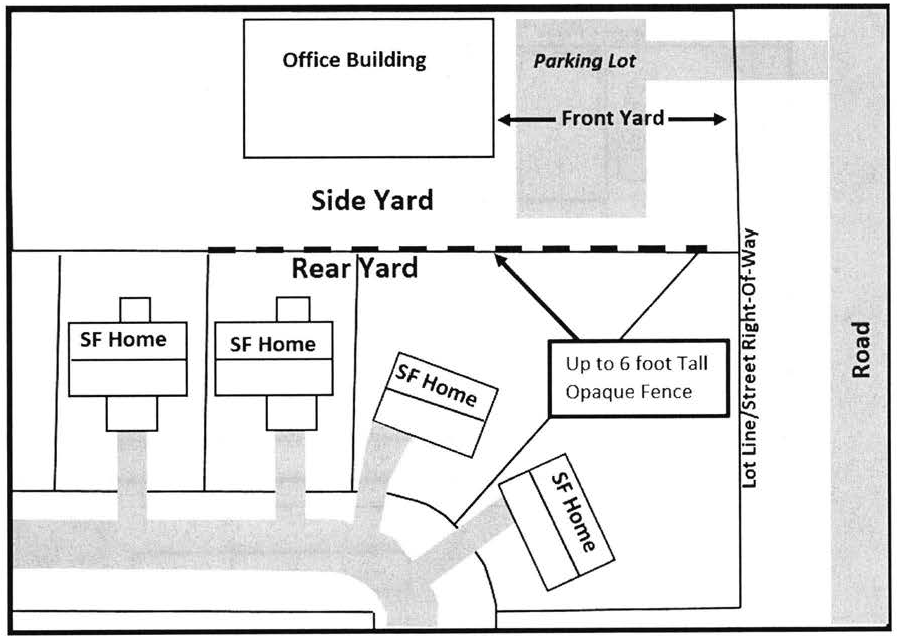
Rear yards abutting a side yard or front yard of another lot may have up to a six-foot tall opaque fence (see image below).
iii)
Corner lots. On a corner lot, a fence, wall or hedge planting shall meet the following criteria:
a.
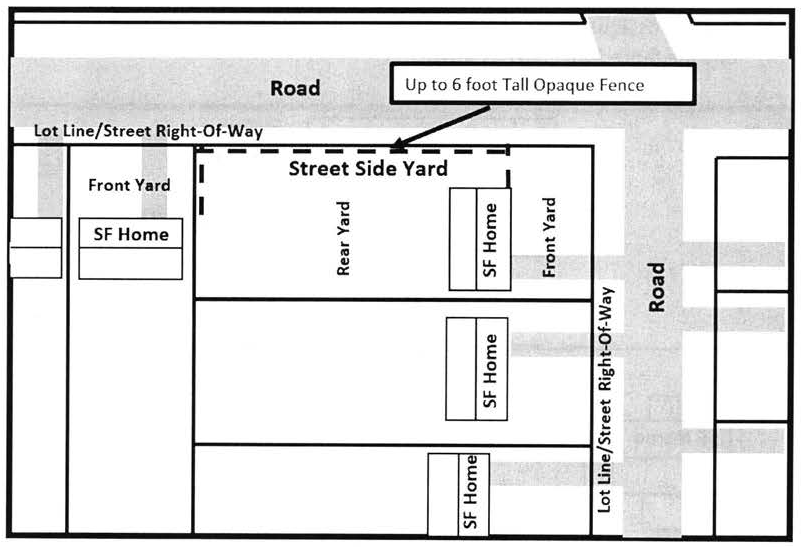
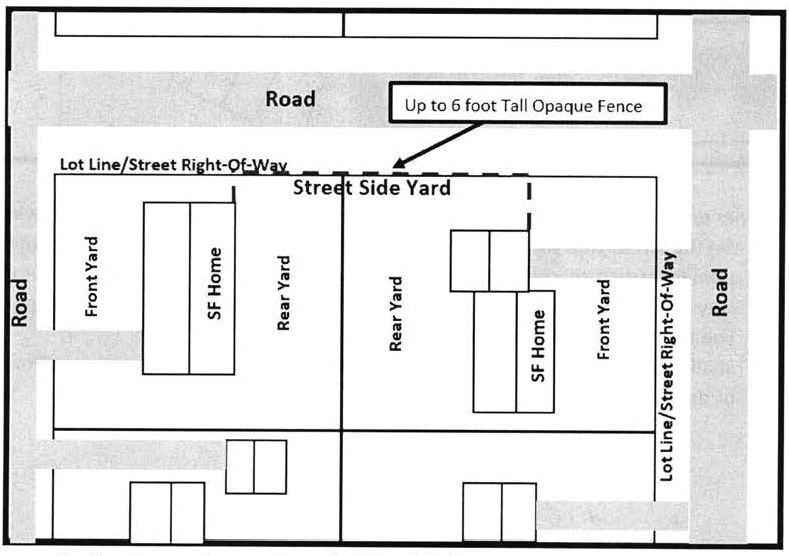
On the street side yard, a fence up to six feet tall may begin at the front corner of the primary structure, connect to the street right-of-way line or proposed street right-of-way line, whichever is more strict, and run parallel to the street along that right-of-way line to the rear property line.
b.
Shall not create any safety or traffic hazard as determined by the zoning administrator or designee.
c.
Shall not exceed a maximum height of six feet.
d.
Shall remain behind any existing or proposed rights-of-way. When sidewalks are present the sidewalk setback rules shall apply.
iv)
Multi-frontage lots. Properties which abut three streets shall adhere to the following regulations:
a.
The front yard and street side yard shall follow the rules previously outlined in this section.
b.
A rear yard of a multi-frontage lot may erect an opaque fence up to six feet in height no closer to the street than the proposed road right-of-way.
c.
When sidewalks are present the sidewalk setback rules shall apply (see image below).
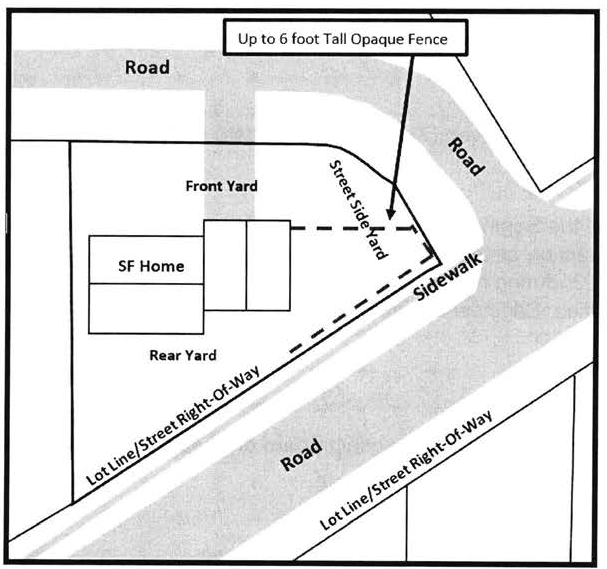
e)
Permit and fee required. Prior to construction, reconstruction or establishment of a fence, wall or screen regulated by this section, a permit shall be obtained from the zoning administrator or designee.
i)
Applications for permits shall be on forms prescribed by the zoning administrator and shall be accompanied by such plans or drawings required by the zoning administrator and by a permit fee.
ii)
Failure to obtain a permit prior to work commencing, may cause Saginaw Charter Township to assess an additional fee or fine to the permit and/or property owner.
iii)
The issuance of a fence permit is not intended, nor should it be construed to abrogate or modify the applicant's duties as contained in covenants and restrictions arising from a deed or other document.
iv)
Permits shall continue until revoked or for such period of time as designated therein at the time of issuance. The issuance or granting of a permit shall not be construed to be a permit for or an approval of any violation of the provisions of this Ordinance. No permit presuming to give authority to violate the provisions of this Ordinance shall be valid.
v)
The zoning administrator may, in writing, suspend or revoke a permit issued under the provisions of this section whenever the permit is issued in error or on the basis of incorrect information supplied or in violation of any ordinance or regulation or any of the provisions of this Ordinance.
f)
Residential development projects. For plats, site condominium projects, condominium projects, and multi-family development projects, the planning commission may require/allow a development perimeter fence. Said fence will become a design element of the overall project.
7.
Personal Ice Rinks.
a)
Personal ice rinks (not commercial) are permitted as an accessory use in any single-family residential or agricultural zoning district.
b)
Personal ice rinks are not permitted in any front or side yard.
c)
A four-foot setback is required from property lines abutting a residential use or residential zoning district when placed in a rear yard.
d)
Ice rink boards shall be no taller than 48 inches in height and must be properly maintained and free from deteriorating conditions such as peeling paint and cracking wood.
e)
Any lighting must be directed away from adjacent properties and the road right-of-way and lights may not be used from 10:00 p.m. to 7:00 a.m.
f)
No ice rinks shall be erected prior to November 1 st and all ice rinks shall be removed no later than April 1 st , or as weather permits.
g)
Netting may be installed/used to protect adjacent property (as needed).
8.
Space used once. Any yard or other open space provided about any building or structure for the purpose of complying with the provisions of this Ordinance shall not again be used as a yard or other required open space for another building or structure existing or intended to exist at the same time as such building or structure.
9.
Use exceptions. Nothing in this Ordinance shall be construed to prohibit the following accessory or incidental uses:
a)
The renting of rooms to not more than two nontransient persons in a dwelling unit which is otherwise occupied in a manner permitted in the district in which it is located.
b)
Customary refreshment and service uses and buildings in any public park or recreational area incidental to the recreational use of such area.
c)
Gardens, garden ornaments and usual landscape features within required yard space.
d)
Retaining walls and public playgrounds.
e)
Off-street parking for motor vehicles as specified in chapter 4.
f)
Home occupations as specified in "R" district regulations and chapter 2, section 202.
g)
Use of a premises as a voting place in connection with local, state, or national elections.
h)
Administrative site plan approval may be conveyed to any personal wireless communication provider wishing to collocate on an existing structure or install an antenna on an existing structure. Examples include communication towers, water towers, utility poles, building and similar structures.
10.
Parking of recreational vehicles and equipment. The parking of recreational vehicles and equipment, including travel trailers, campers, boats and similar recreational equipment, is prohibited within the required yard areas of any "R" district, except recreational, vehicles and equipment are permitted for periods of not to exceed five consecutive days, whereupon said vehicle shall be completely removed from the property for a minimum of eight hours. The vehicle and/or equipment shall be parked on a dust-free, weed-free surface constructed of asphalt, concrete, crushed gravel or paver stones and covering at minimum the entire footprint of the parked equipment. Crushed gravel parking areas must be constructed of a sand or gravel base with weed barrier, and at least four inches depth of crushed stone, and feature a defined edge unless otherwise approved by the zoning administrator or building inspector.
11.
Parking and storage of commercial vehicles. No person shall park or store any vehicle, apparatus, trailer, or machine designed for a specific commercial operation or purpose such as:
a)
Well drilling;
b)
Moving dirt, stone, or other materials;
c)
Removing lumber or stumps;
d)
Trenching;
e)
Planting trees or other vegetation;
f)
Installing poles;
g)
Lifting people or equipment;
h)
Transporting water or other substances;
i)
Vehicles intended to pull trailers;
j)
Storage of construction equipment inside or outside the vehicle or trailer;
k)
Generation of electrical power;
l)
Pumping of water or other substances;
m)
Demolition of materials or buildings and vehicles;
n)
Wreckers;
o)
Vehicles, apparatus, trailers, or machines similar to any of those listed in this regulation, shall be prohibited within any R-1, R-2, or R-3 district.
Exception: The following vehicles, apparatus, trailers, or machines may be parked or stored in a residential district meeting the following guidelines: If a commercial vehicle is used for and in direct connection with a construction project taking place on the parcel where it is parked and the project is currently ongoing; or if the commercial vehicle is owned by a governmental body or utility and is used in the installation and/or maintenance of utilities such as water, sewer, streets, highways, cable television wire, telephone, or electrical wires.
a.
Commercial vehicles on public property. No person shall park or store any commercial vehicle or equipment identified in subsection (a) of this section on public property located in any zoning district, including, but not limited to, public streets, stub streets, rights-of-way, bike paths or pedestrian paths, sidewalks, greenbelts, and planting areas between bike paths and streets unless such parking or storage is limited to vehicles or equipment engaged in the performance of a service on the adjacent or underlying property, for the period of time reasonably necessary to complete the service.
b.
Commercial vehicles in residential and agricultural districts. No person shall park or store any commercial vehicle as defined in [subsection] 302.11 in any residential or agricultural district unless the vehicles or equipment is engaged in the performance of a service on the adjacent or underlying property, for the period of time reasonably necessary to complete the service.
Commercial vehicles such as pickup trucks, passenger/cargo-style vans with seating of up to 15 persons, sport utility vehicles, passenger cars, and similar type vehicles, may be parked or stored in a residential district so long as it is not modified from the original manufacturer's specifications in such a way as it extends its height or length with the exception that a plow on the front and a spreader on the rear of a vehicle may be attached even if the length of the vehicle is extended beyond the manufacturer's specifications.
c.
Commercial vehicles in nonresidential districts. No person shall park or store any commercial vehicle identified as defined in subsection 302.11 or commercial equipment on private property in any nonresidential district except as where such parking or storage is limited to vehicles or equipment engaged in the performance of a service on the adjacent or underlying property, for the period of time reasonably necessary to complete the service or unless such vehicle or equipment is parked or stored in relation to a permitted principal or accessory use of the property. In such event, parking or storage must comply with all other codes and ordinances.
12.
Use of trailers. The use of trailers, trucks, vehicles, modular buildings or similar vehicles or enclosures for sales or storage of materials in connection with a commercial or industrial land use is hereby prohibited. Modular buildings may be used for sales and storage, upon approval by the planning commission, provided said building is attached to a permanent foundation, has all wheels, undercarriage and towing mechanisms removed and is determined to be visually and aesthetically compatible with other structures in the vicinity and the character of the area in general. Trailers used by contractors for office and storage purposes are permitted for a reasonable length of time on a job site, provided there is an active building permit for construction on the site and the trailer's use is directly related to construction on the property upon which it is located.
13.
Lots of record. Any residential lot created or recorded prior to the effective date of this Ordinance may be used for residential purposes even though the lot area and/or dimensions are less than those required for the district in which the lot is located, provided that yard dimensions and other requirements of the district, not involving lot area, width or depth, are met.
14.
Building grades. [Repealed.]
15.
Access to public street. No lot shall hereafter be created or altered unless such lot has direct access and frontage on a public street. The street frontage width of any lot shall not be less than the minimum lot width for the zoning district in which it is located. On a corner lot, this requirement shall apply to one street frontage only as the combined width of two or more street frontages does not satisfy this requirement.
Lots created on curves or cul-de-sacs are exempt from this requirement, provided such lots have a width equal to the minimum lot width for the zoning district in which the lot is located when measured at the building line, and further that such lots have a minimum frontage of 40 lineal feet on a public street. Any other exception to this requirement may only be granted by the township board upon recommendation of the planning commission and if it can be shown that the subject parcel lacks any practical use without an exception.
16.
Temporary dwelling. The intent of this section is to recognize the hardship often resulting from emergencies and acts of God and to provide a reasonable alternative for people displaced by such conditions and in need of temporary housing while permanent housing is arranged. When any single-family detached dwelling unit has been made uninhabitable by fire, flood or similar act of God, the zoning administrator may permit the use of a temporary structure for a period of up to 90 days, provided said structure complies with the requirements of the building code for human occupancy, and further provided said structure is connected to a proper potable water supply and sewage disposal system, and further provided said structure is located on the same property as the original dwelling.
17.
Excavation. The excavation of sand, gravel, topsoil or other earthwork is hereby regulated as follows:
a)
No permit or regulation shall be required if such earthwork or excavation is incidental to the construction of a subdivision, condominium project, or a principal building or structure that is permitted within that district.
b)
No permit shall be required for earthwork, excavation or land reclamation if the total area of the earthwork is less than three acres in size. However, such earthwork is regulated to the extent that the area being excavated or reclaimed shall not exceed 30 percent of the total lot or parcel.
c)
Any excavation project, regardless of size, in which the primary intent is to sell or dispose of the earth, sand, gravel or other feature for commercial gain shall be considered a mining operation and only permitted within the A-2 agriculture zoning district.
d)
Upon receiving an application for a regulated excavation project, a public hearing shall be scheduled before the planning commission for the purpose of approving or denying the permit. Notices shall be sent by first class mail to all property owners within 300 feet of the boundary of the property in question. The notice shall be given at least ten days prior to the hearing and shall:
1)
Describe the nature of the request.
2)
Indicate the property which is the subject of the request.
3)
State when and where the site plan.
4)
Indicate when and where written comments will be received concerning the request.
e)
Excavation projects regulated by this section shall comply with the provisions set forth in section 2213(e) of this Ordinance.
f)
The planning commission may refuse to issue a permit if it determines that the operation would be hazardous or disturbing to existing or intended uses in the area or, by reason of noise, dust or fumes, would be detrimental to any persons or property.
18.
Pennants, ribbons, streamers and other displays or items not meeting the definition of a "sign" in Chapter 86 "Sign Regulations" of Saginaw Township's Code of Ordinances are permitted in all Commercial and Science and Industry zoning districts for a period not to exceed 45 days in any calendar year, so long as said uses comply with the other requirements of this Code and subject to the following conditions:
a.
A zoning permit must be obtained from the Community Development Department. The application for the permit shall set forth a diagram or a detailed drawing showing the exact location, setbacks, height, and characteristics of the devices to be used.
b.
No device(s) shall be more than 24 feet in height or less than ten feet in height except in fire lanes or in areas of vehicular traffic where the height shall be a minimum of 14 feet.
c.
No device(s) shall be located closer than an approved parking lot or building setback from any road right-of-way.
d.
The device(s) shall be securely attached to their supporting structures.
Exception: Pennants, ribbons streamers and other displays may be permanently displayed in any Commercial or Science & Industry district as shown on the zoning district map and are displayed on a single parcel or contiguous parcels of land under single ownership provided the following criteria are met:
i.
The parcel consists of more than four acres;
ii.
The parcel has at least 400 feet of road frontage;
iii.
The parcel has not more than two curb cuts or points of ingress and egress to a public road.
19.
Garage sales. Yard, rummage, garage and similar type sales are permitted providing:
a)
The sale is temporary in nature and shall not continue for a period exceeding four days from the date of commencement with no more than three such sales per year. No items available during sales may be openly displayed when sales are not in progress.
b)
The sale shall not be intended for more than incidental income and shall not be intended to operate as a commercial venture providing regular income.
20.
Medical marihuana related uses. Uses related to the processing and growing of medical marihuana, with the exception of licensed safety compliance facilities, are prohibited. This includes all classes of growers, processors, provisioning centers, secure transporters, and other such uses as may specifically be granted or licensed through the State of Michigan, excluding registered patients and caregivers within a dwelling unit.
21.
Keeping of Animals.
a)
The keeping of household pets, including dogs, cats, rabbits, fish, birds, hamsters, and other animals generally regarded as household pets is permitted as an accessory use in any residential or agricultural district or residentially used property. However, no more than four dogs or cats, four months of age or older, in any combination, nor more than a total of six household pets, shall be kept or housed in or at one dwelling unit.
b)
The keeping of more than six household pets on/at one residentially used premises/dwelling unit, shall be deemed to be a commercial kennel and must follow the commercial kennel regulations set forth in this ordinance.
c)
The keeping of farm related animals, and other animals (e.g. horses) is allowed pursuant to the specific zoning district standards. Raising and keeping of chickens as an accessory use in R-1A and R1 Residential Zoning Districts is allowed pursuant to Subsection 22 below.
d)
The keeping of animals not normally considered domesticated including, but not limited to wild and vicious animals, is prohibited in all zoning districts. Exotic animals may be allowed pursuant to State requirements. The Zoning Administrator shall classify them into the use category they are most similarly related to (e.g. household pet, farm, commercial kennel, stable, etc.).
22.
Chickens. Raising and keeping of chickens as a nonagricultural use. The raising and keeping of chickens shall be a conditional use in R-1A and R1 Residential Zoning Districts subject to the following requirements:
a)
Generally.
i)
Chickens may be kept on a parcel of land five acres or larger as an accessory use to an existing owner-occupied single-family dwelling.
ii)
Prior to the raising and keeping of chickens, the property owner shall obtain a Zoning Permit from the Community Development Department (see permit section below).
iii)
Chickens may be kept for personal use only. The sale of chickens and/or eggs is prohibited.
iv)
Slaughtering of any chickens on the property is prohibited.
v)
A chicken coop (building) of less than 200 square feet shall not count against the number of allowed accessory structures as listed in Section 305. Chicken coops must be removed if no longer being used for chickens.
b)
Standards.
i)
In no case shall the maximum number of chickens exceed 12 hens.
ii)
Roosters or male chickens or any other type or class of fowl or poultry are prohibited.
iii)
Chickens shall be provided a chicken coop (covered structure) and must be kept in the covered structure or an adjoining fenced area at all times. The chicken coop must provide floor area of at least ten square feet per hen. The fenced area must be attached to the chicken coop and be constructed in such a way to keep chickens in and predators out.
iv)
The use of corrugated fiberglass, sheet metal, plastic tarps, scrap lumber, pallets or similar materials are prohibited.
v)
All enclosures shall be kept clean and resistant to predators and rodents.
vi)
All feed shall be stored in containers or otherwise protected so as to prevent access to or contact with rodents or other animals.
c)
Location.
i)
Except as noted below, chicken coops and adjoining fenced area shall be located behind the rear building line of the principal structure on the lot or parcel of land. Coops and fenced areas shall be setback a minimum of 25 feet from the primary residential structure and a minimum of 100 feet from property lines in the side and rear yards.
*Exception. In cases where the principal residence on the subject property is located behind residences on adjacent properties, a chicken coop and adjoining fenced area may be placed in the front yard of the subject property provided it is placed a minimum of 300 feet to the rear of each residence on adjacent properties and provided that there is a minimum setback of 100 feet from the property lines. In no case shall a chicken coop and adjoining fenced area be placed closer than 400 foot to a front property line/ right-of-way line.
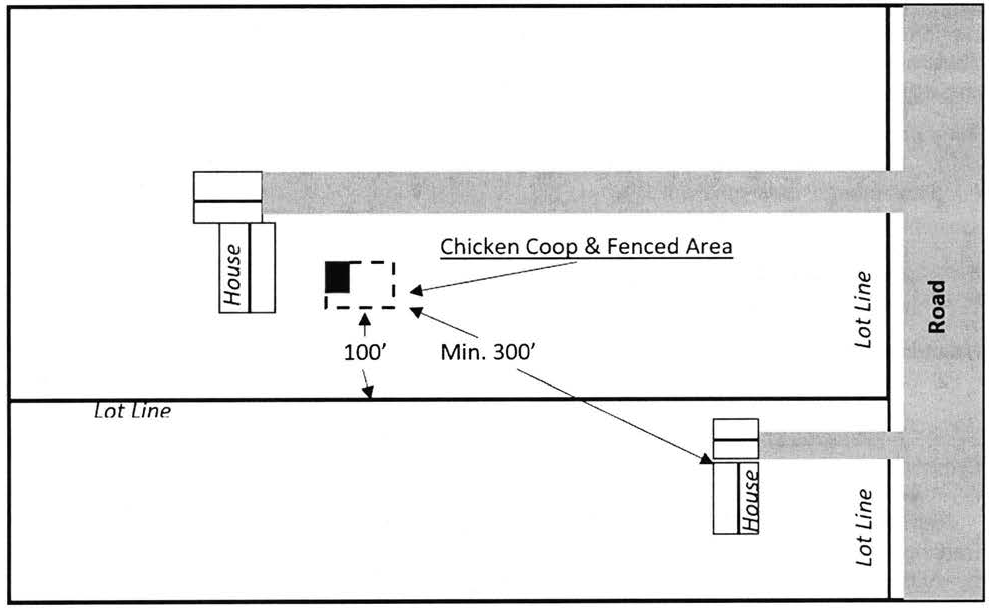
d)
Permit and fee required.
1.
Applications for permits shall be on forms prescribed by the zoning administrator, shall be accompanied by such plans, drawings, and additional supplemental information required by the zoning administrator and by a permit fee as established by the Township Board.
2.
The issuance of a permit is not intended, nor should it be construed to abrogate or modify the applicant's duties as contained in covenants and restrictions arising from a deed or other document.
3.
An initial approved permit shall be valid for the time period of three years, subject to compliance with this ordinance. Community Development may at any time revoke the permit for non-compliance Permits may not be transferred.
4.
If, in the judgement of the Community Development Director or designee, the permittee has abided by all ordinance provisions and permit conditions, the permit may be renewed for an additional three-year period.
5.
If the permittee has recorded or verified violations of the ordinance provisions, but is currently in compliance, the permit may be renewed for an additional one year.
23.
Playscapes, Playground Equipment and Tree Houses.
a)
Playscapes, playground equipment, and tree houses are permitted as accessory uses in any single-family residential or agricultural zoning district.
b)
Playscapes, playground equipment, and tree houses are not permitted in any front yard and shall not exceed 14 feet in height. On street side yards, a minimum setback of 20 feet from the street right-of-way line/property line is required. Minimum setbacks from side and rear property lines shall be the same as for accessory buildings.
c)
No treehouse, playhouse, or play structure platform shall exceed 199 square feet in area (maximum allowed per lot with a single family home).
d)
No more than one treehouse, playhouse, or play structure platform shall be permitted per lot with a single family home.
24.
Seasonal Equipment Storage. In an effort to support swift snow and ice removal action at publicly accessed properties, larger commercial snow removal equipment may be temporarily stored onsite at commercial properties within Saginaw Charter Township with the following conditions:
a)
Time and Location:
i.
Equipment used for snow removal shall be stored on-site only during winter months (November 1 st through April 1 st ).
ii.
Must either be located in the rear of the building or in an inobtrusive area on the property.
iii.
Shall be parked in an approved parking area.
iv.
Shall not interfere with the flow of traffic or create a sight obstruction.
b)
Maintenance and Cleanliness:
i.
All items kept for the removal of snow and ice shall be maintained in working condition, clean and sanitary.
ii.
All vehicles shall be in working order and properly licensed.
c)
Organization:
i.
If materials are necessary to be kept at the property for the purpose of snow and ice removal only, they shall be kept in an orderly fashion as not to be blight.
d)
Parking Requirements:
i.
At no time shall the required number of parking spaces for the use(s) at the property be used for the storage of snow removal machinery or accessories.
25.
Little Free Libraries.
a)
A little free library is a "take a book, return a book" gathering place where neighbors share their favorite literature and stories. In its most basic form, a little free library is a box full of books where anyone may stop by and pick up a book and bring back another book to share.
b)
Little free libraries are permitted to be placed on single-family residential lots, church properties and public or parochial school properties. These are considered an accessory structure and accessory use to the property and shall conform to the following guidelines:
i)
The little free library shall not be located in or overhang the public street right-of-way or any public or utility easement and shall be at least five feet behind the curb.
ii)
The associated structures shall not obstruct vehicular, bicycle or pedestrian traffic, either physically or by a person utilizing the little free library.
iii)
The structures shall not obstruct access aisles or paths utilized by persons in wheelchairs or for ADA accessibility.
iv)
The little free library must be placed the front yard between the face of the house or building and the street right-of-way. At its discretion, the township may make exceptions for churches and schools which may be approved administratively by the Director of Community Development or designee.
v)
The library structure shall be designed to hold books. The overall structure shall be limited to a height not to exceed 66 inches; a width not to exceed 30 inches; a depth not to exceed 18 inches; and the box height shall not exceed 30 inches from the ground on which it is placed.
vi)
The structures shall be anchored to the ground or securely attached to something having a permanent location on the ground.
vii)
The structure shall be maintained and kept in good repair at all times.
viii)
There shall be a limit of one little free library per address.
c)
A little free library meeting the above conditions will not be subject to any permits or special licensing requirements.
26.
Donation Boxes. In all districts except R-1, R-1A and R-2, donation boxes shall be allowed with the following conditions:
a)
Written approval must be obtained from the Director of Community Development or designee.
b)
No more than two may be permitted per occupied parcel.
c)
Reflective tape shall be placed on donation boxes to ensure visibility.
d)
They shall be placed on concrete or asphalt.
e)
They cannot cause the elimination of required parking spaces.
f)
They cannot impede the orderly flow of traffic on the site.
g)
They shall not be placed within 500 feet from another donation box.
h)
They shall only be placed on an improved and occupied parcel.
i)
They shall be locked or otherwise secured.
j)
They shall be maintained in good condition and appearance with no structural damage, holes or visible rust, and shall be free of graffiti.
k)
They shall be emptied as needed, but not less than once per month.
l)
If a nuisance is created by lack of maintenance and/or emptying, the property owner will be subject to standard enforcement action as prescribed by ordinance.
(Ord. No. 517, 2-28-1994; Ord. No. 578, 1-20-1998; Ord. No. 627, 10-22-2001; Ord. No. 645, 9-8-2003; Ord. No. 659, 2-23-2004; Ord. No. 672, 10-25-2004; Ord. No. 715, 5-10-2010; Ord. No. 749, 11-28-2016; Ord. No. 765, § 1, 2-24-2020; Ord. No. 779, 11-8-2021; Ord. No. 796, 3-24-2025; Ord. No. 805, 10-27-2025)
Sec. 303. - Supplementary yard regulations.
1.
Permitted yard encroachments.
a)
Paved terraces, patios, and uncovered porches shall not be subject to yard requirements, provided:
The paved area is unroofed and without walls or other forms of solid, continuous enclosure that links the paved area to the principal building.
The highest finished elevation of the paved area is not over 12 inches above the average surrounding finished grade area.
No portion of any paved area is closer than five feet from any lot line nor projects into any front yard setback area. Such paved areas may have noncontinuous wind breaks or walls not over six feet high and not enclosing more than one-half the perimeter of the paved area.
b)
Unenclosed porches, roofed or unroofed may project into a required side or rear yard area a distance not to exceed eight feet, provided:
The porch is unenclosed and no higher than one story and is erected on supporting piers.
The porch shall not be closer than eight feet to any side or rear lot line.
c)
Enclosed porches shall be considered an integral part of the building and shall be subject to all yard and area dimensional requirements established for principal buildings.
d)
Special structural elements, such as cornices, sills, chimneys, gutters, and similar structural features, may project into any yard up to a maximum of 2½ feet.
e)
Fire escapes, outside stairways, and balconies, if of open construction, may project into yard areas up to a maximum of five feet.
f)
Structures below and covered by the ground.
g)
Lighting devices.
h)
Planters, retaining walls and other similar landscaping structures.
i)
Gatehouse or security stations.
j)
Sculptures, fountains, or other such items proposed as public art or public features.
k)
Passive recreation features, such as walkways, paths, and other such items typically found in open space areas.
l)
Temporary structures designed to protect property during the winter months, including snow fence and temporary structures for mailboxes. Structures shall be temporary and only during winter and shall be removed by April 1. Said structure(s) shall only be as large as necessary to function properly and installed in such a way as to not obstruct view or create a traffic hazard.
2.
[Building setback lines.] Building setback lines shall be measured from a point 33 feet from the center of the adjacent road or from the property line, whichever is greater, except in cases involving the following major arterial and collector streets. The building setback line on any properties abutting the following streets shall be measured from a point the number of feet from the center of the road indicated below:
Proposed Road Rights-of-Way
Barnard .....43′
Bay .....60′
Brockway .....48′
Center .....60′
Fashion Square Boulevard .....48′
Fortune Boulevard .....43′
Gratiot .....75′
Hackett .....48′
Hemmeter .....48′
Hermansau .....43′
Hospital .....60′
Lawndale .....60′
Mackinaw .....60′
Mannion .....43′
McCarty .....48′
Michigan, West (city limits to Center) .....60′
Michigan, West and St. Andrews (Center to Gratiot) .....43′
Midland (south of State) .....50′
Midland (north of State) .....60′
Schust .....43′
Seidel .....43′
Shattuck .....60′
St. Andrews .....43′
State .....60′
Tittabawassee .....60′
Towne Centre .....43′
Weiss .....48′
Wieneke .....60′
3.
Conformance to established setbacks.
a)
Required front yard setbacks shall conform to existing setbacks as established by existing uses in any district.
4.
Bufferyards.
a)
Purpose. The bufferyard is a designated unit of yard or open area, together with any plant materials, barriers or fences required thereon, designed to provide distance and screening in order to minimize negative impacts of adjacent land uses. Both the amount of land and the type and amount of landscaping specified are intended to minimize potential nuisances such as noise, glare, dirt, activity, unsightly parking areas and similar impacts.
The bufferyard requirements are designed to be flexible. A single standard applied to all circumstances may not function as well and might impose unnecessary hardship (cost) on a developer to say nothing of promoting monotony. It is the intent of the following provisions to provide flexibility to the developer or property owner through the manipulation of four basic elements: distance, plant material type, plant material density and structural or land forms.
i)
Location of bufferyard. Bufferyards shall be located on the side and rear lot line of a parcel extending to the lot or parcel boundary line. Bufferyards shall not extend into or be located within any portion of an existing street right-of-way or yard exceptions as provided in section 303(2).
ii)
Bufferyards required. The type of bufferyard required shall be determined based on the proposed land use and existing adjacent land use, as such uses are defined in the comprehensive development plan, as follows:
a)
Commercial land use. When any commercial land use is proposed adjacent to any recreation and open space, residential, agricultural or institutional land use, a type B bufferyard, as defined herein, shall be required. In addition, when the property abuts existing residential development, the developer must, upon request of the residential landowners and/or the Saginaw Charter Township Community Development Department, provide an eight-foot-tall privacy fence or wall along the abutting property line(s). The fence or wall finish and construction materials must be approved by the assistant director of community development and be consistent in design with the project and the adjoining residential area. In instances when a fence is requested, the developer shall follow the guidelines for buffer type B, showing the fence, a ten-foot buffer and a combination of trees and shrubs.
b)
Campus Business land use. When a Campus Business land use, other than a residential or institutional land use, is proposed adjacent to any institutional land use or residentially zoned district, a buffer consisting of an eight-foot tall masonry wall shall be required within ten feet of the property line along with a ten-foot wide bufferyard as depicted in buffer A. When a residential or institutional Campus Business land use is located adjacent to a residentially zoned district, a type B bufferyard is required. In addition, when the property abuts existing residential development, the developer must, upon request of the residential landowners and/or the Saginaw Charter Township Community Development Department, provide an eight-foot-tall privacy fence or wall along the abutting property lines. The fence or wall finish and construction materials must be approved by the department and be consistent in design with the project and the adjoining residential area. In instances when a fence is requested, the developer shall follow the guidelines for a buffer type B, showing the fence, a ten-foot buffer and a combination of trees and shrubs.
c)
Industrial land use. When any industrial land use is proposed adjacent to any recreation and open space, residential, agricultural or institutional land use, a type C bufferyard, as defined herein, shall be required. When any industrial land use is proposed adjacent to any commercial land use a type A bufferyard, as defined herein, shall be required. In addition, when the property abuts existing residential development, the developer must, upon request of the residential landowners and/or the Saginaw Charter Township Community Development Department, provide an eight-foot-tall privacy fence or wall along the abutting property line(s). The fence or wall finish and construction materials must be approved by the assistant director of community development and be consistent in design with the project and the adjoining residential area. In instances when a fence is requested, the developer shall follow the guidelines for buffer type B, showing the fence, a ten-foot buffer and a combination of trees and shrubs.
d)
High density residential land use. When any high density residential land use is proposed adjacent to any recreation and open space, low or medium density residential, agricultural or institutional land use, a type B bufferyard, as defined herein, shall be required. In addition, when the property abuts existing residential development, the developer must, upon request of the residential landowners and/or the Saginaw Charter Township Community Development Department, provide an eight-foot-tall privacy fence or wall along the abutting property line(s). The fence or wall finish and construction materials must be approved by the assistant director of community development and be consistent in design with the project and the adjoining residential area. In instances when a fence is requested, the developer shall follow the guidelines for buffer type B, showing the fence, a ten-foot buffer and a combination of trees and shrubs.
e)
Institutional land use. When any institutional land use is proposed adjacent to any residential land use a type A bufferyard, as defined herein, shall be required. In addition, when the property abuts existing residential development, the developer must, upon request of the residential landowners and/or the Saginaw Charter Township Community Development Department, provide an eight-foot-tall privacy fence or wall along the abutting property line(s). The fence or wall finish and construction materials must be approved by the assistant director of community development and be consistent in design with the project and the adjoining residential area. In instances when a fence is requested, the developer shall follow the guidelines for buffer type B, showing the fence, a ten-foot buffer and a combination of trees and shrubs.
f)
[When inverse bufferyard requirements apply.] When a less intensive land use is proposed to be located adjacent to a more intensive land use, the inverse of the bufferyard requirements herein shall apply; that is, for example, if a residential land use is proposed adjacent to an existing commercial land use, a type B bufferyard shall be required to be installed on the residential parcel.
g)
[Determination of requirements by zoning administrator.] When the parcel to be developed is located adjacent to a vacant parcel of land, the bufferyard requirement shall be determined by the zoning administrator based upon the zoning classification of said vacant parcel; that is, for example, if an industrial land use is proposed adjacent to a residentially zoned vacant parcel of land a type C bufferyard shall be required.
h)
[Existing plant material or fences.] Existing plant material or fences may be counted as contributing to the total bufferyard requirement.
i)
[Determination for additional bufferyard.] Should a developed use increase in intensity, the planning commission shall, during the site plan review process, determine if additional bufferyard is needed, and, if so, to what extent and type.
iii)
Bufferyard types and development standards. Bufferyard requirements are stated in terms of the width of the bufferyard and the number of plant units required per 100 linear feet of bufferyard. The requirements may be satisfied by any of the options indicated for any given bufferyard type.
a)
The following illustrations graphically depict the acceptable bufferyard widths, plant material types, plant material densities and structural or land forms for each bufferyard type.
b)
All plant materials required within a specified bufferyard shall be planted to completion within six months from the date of receipt of a building permit and shall be thereafter properly maintained in a healthy, viable condition. Plant materials which are not in a healthy, viable condition shall be replaced.
c)
Landscaping/plant material used for fulfilling the bufferyard requirements or site plan requirements shall be of the following minimum plant sizes:
i.
Evergreen trees, a minimum of six feet in height;
ii.
Deciduous trees, a mature canopy height of at least 24 feet and a two and one-half inches caliper at time of planting;
iii.
Deciduous shrubs and decorative trees, at least six feet in height; shrubs and perennials, a minimum height of 12 inches in the first season.
d)
Further, when a landscape plan is required, the following materials are specifically prohibited:
i.
Boxelder
ii.
Soft maple (red silver)
iii.
Elm
iv.
Poplar
v.
Willow
vi.
Horse chestnut (nut bearing)
vii.
Tree of heaven
viii.
Catalpa
ix.
Fruit-bearing trees
x.
All thorned trees and shrubs
xi.
Ribes (gooseberry)
xii.
Cottonwood
e)
Where fencing is required in a bufferyard, it may be eliminated on approval of the planning commission when such fencing is considered by the planning commission to be incompatible with the character of an adjacent residential use. The fence shall be replaced with an evergreen hedge, minimum six feet in height, with plant material dense enough to provide opacity. When fencing is requested as outlined in [subsection] 4.a.ii.a, it may not be replaced with landscaping, except if agreed upon in writing by the owner of the residential properties.
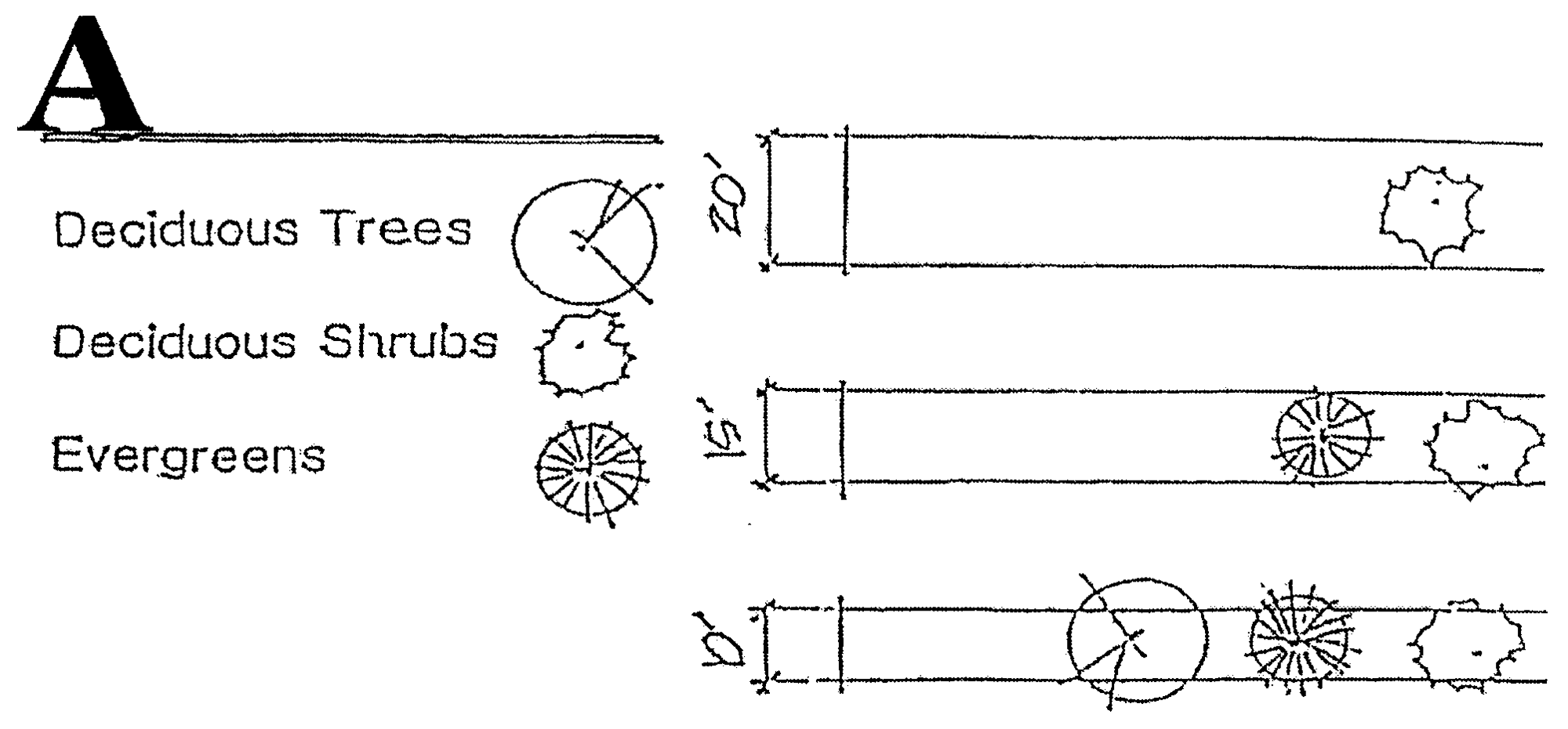
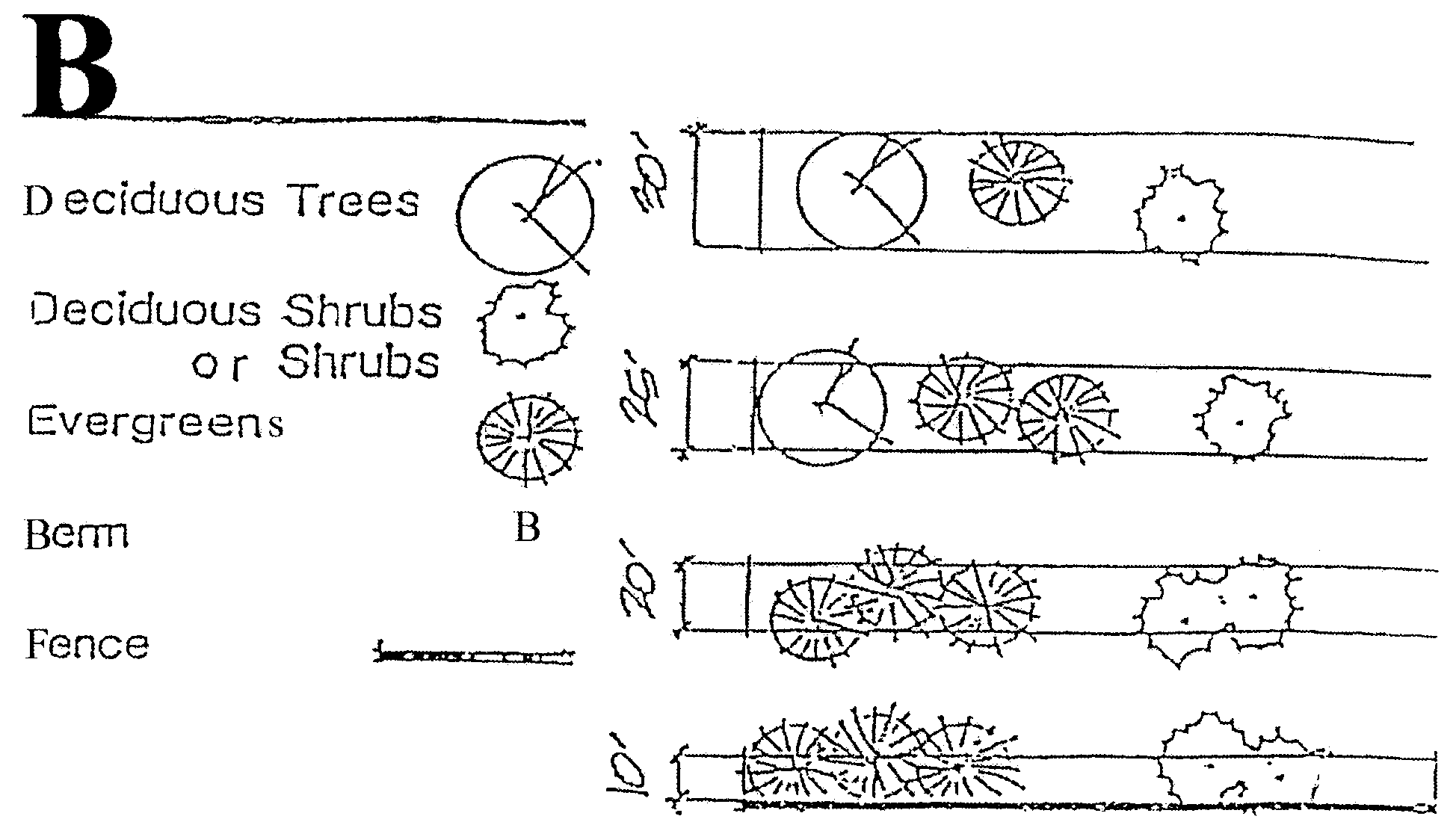
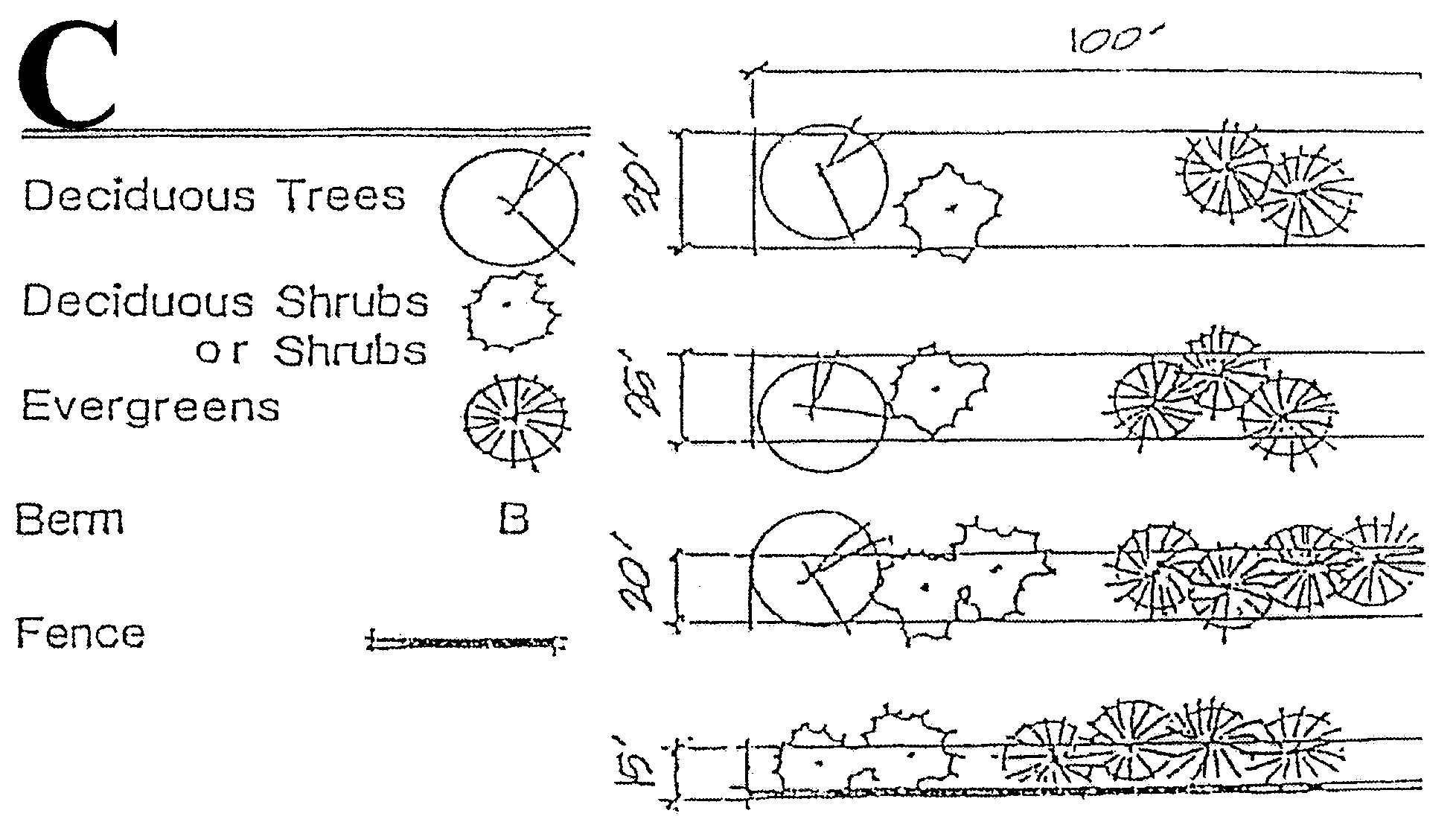
[5.
Reserved]
6.
Swimming pools.
a)
A building permit is required. The application shall include the name of the owner, plot plan and location of adjacent buildings, fencing and gates.
b)
Swimming pools, in-ground or aboveground, are allowed in rear yards only and shall not be located in any street side yard.
c)
No pool shall be located closer to any side lot line than eight feet or closer to any rear lot line than five feet.
d)
No pool shall be closer to any primary structure than ten feet.
e)
Pool houses or structures necessary to the pool shall meet the setback and size requirements for accessory structures as determined in each of the permitted districts.
f)
Concrete slabs or wood decks constructed on grade and located adjacent to any pool may encroach up to two feet from the property line.
(Ord. No. 577, 1-26-1998; Ord. No. 703, 9-8-2008; Ord. No. 715, 5-10-2010)
Editor's note— Ord. No. 577 added a subsection 2 to section 303. It has been redesignated as subsection 6.
Sec. 304. - Supplementary height regulations.
1.
Permitted exceptions for structural appurtenances. The following kinds of structural appurtenances shall be permitted to exceed the height limitations for authorized uses:
a)
Ornamental in purpose, such as church steeples, belfries, cupolas, domes, ornamental towers, and flag poles; provided, that such structural elements do not exceed 20 percent of the gross roof area.
b)
Appurtenances to mechanical or structural functions, such as chimneys and smoke stacks, water tanks, elevator and stairwell penthouses, ventilators, radio or television towers, aerials and fire and base towers, provided the total height of the structure or the building and appurtenance is 150 feet or less from grade and provided that said structures are constructed to be self-supporting.
The foregoing permitted exceptions shall not be for human occupancy or dwelling.
2.
Permitted exceptions, agricultural districts.
a)
No exceptions are permitted for residential structures.
b)
Structures for agricultural operations are permitted up to 75 feet.
c)
Other nonresidential permitted structures may be erected to a height in excess of that specified provided each front, side and rear yard minimum is increased one foot for each one foot of additional height above the district requirement.
3.
Permitted exceptions, residential districts.
a)
No exceptions are permitted for residential structures.
b)
Principal hospital and church structures may be permitted to exceed height limitations with a maximum height limit of 75 feet, provided each front, side and rear yard requirement is increased by one foot for each one foot of height above the district requirement.
c)
Personal wireless communication towers may not exceed a height of 150 feet.
4.
Permitted exceptions, business and industrial districts.
a)
In any business or industrial district, any principal building may be erected to a height in excess of that specified for the district, provided each front, side and rear yard minimum is increased one foot for each one foot of additional height above the district maximum with the exception that hotels shall be permitted to a height of four stories or 50 feet prior to this section applying.
b)
Personal wireless communication towers shall not exceed a height of 150 feet.
5.
Height restrictions. Height limitations shall under no circumstances be less restrictive than those specified by the Tri-City Area Joint Airport Zoning Ordinance.
(Ord. No. 712, 1-11-2010)
Sec. 305. - Accessory structures and uses.
Accessory structures and uses shall comply with the following regulations:
1.
General requirements.
a.
Timing of construction. No accessory structure or use shall be constructed or established on a parcel unless there is a principal building or use being constructed or already established on the same parcel of land. No existing accessory structures shall be occupied or utilized unless the main structure to which it is accessory to is occupied or utilized, except for up to one year for construction staging.
b.
Site plan approval. A site plan is required and shall indicate the location of proposed accessory structures and uses.
c.
Conformance with lot coverage standards. Accessory buildings and structures shall be included in computations to determine compliance with maximum lot coverage standards, where required.
2.
General requirements for detached accessory structures and uses.
a.
Setbacks. Accessory structures or uses (including garages) which are not structurally attached, shall meet the same setback and coverage requirements as set forth for the principal structure, except as otherwise specified for accessory structures in residential and agricultural districts.
b.
Double frontage lots. On double frontage lots, accessory buildings shall comply with the applicable front yard setback regulations on both street frontages.
c.
Height. Detached accessory, buildings and structures shall conform to the height requirement for the principal structure in the district in which it is located, except as may otherwise be specified for accessory buildings and structures in residential and agricultural districts.
3.
Attached accessory structures or uses. Unless otherwise specified in this section, accessory structures or uses (including garages) which are attached to the principal building or structure shall be considered a part of the principal building for the purposes of determining conformance with area, setback and height requirements. For the purposes of this section, buildings or structures that are within ten feet of the principal building or structure shall be considered "attached."
4.
Specific requirements for accessory structures and uses in residential and agricultural districts.
a.
Size and number.
i.
Lots containing less than 10,400 square feet with a dwelling and an attached garage, may have two detached accessory structures. One not exceeding 720 square feet. The other may not exceed 144 square feet. Lots of less than 10,400 square feet on which exists a dwelling without an attached garage, two detached accessory structures may be constructed, each totaling 720 square feet.
ii.
Lots containing 10,400 square feet but less than 43,560 square feet and containing an attached garage, may have two detached accessory structures. One not exceeding 720 square feet. The other may not exceed 400 square feet. An additional 20 square feet may be added to the larger accessory structure for every 1,000 square feet of lot area exceeding 10,400 square feet with a maximum of 1,200 square feet. Lots containing 10,400 square feet but less than 43,560 square feet on which exists a dwelling without an attached garage, two detached accessory structures may be constructed, each totaling 720 square feet. The same square footage bonus provision described above shall apply to one of the two accessory structures.
iii.
Lots exceeding 43,560 square feet but less than 87,120 square feet may have three detached accessory structures. All three combined shall not exceed the ground area coverage of the principal dwelling on the lot, excluding unenclosed porches or patios.
iv.
Residentially used lots/parcels greater than 87,120 square feet (two Acres) may have two detached accessory structures, one not exceeding the ground area coverage of the principal dwelling, and the other not exceeding 75 percent of the ground area coverage of the principal dwelling. A third accessory structure may be approved by the Zoning Administrator upon applicant attesting to the accessory use of the structures. The third accessory structure shall be no greater than 25 percent of the ground area coverage of the principal dwelling.
v.
In the case of agriculturally used lots/parcels, total accessory structures and buildings may not exceed five percent of the total land area, but without restrictions as to the number of accessory building and structures.
b.
Building height. Detached accessory buildings may have a building height of 18 feet as measured from the average grade to the highest roof elevation. Detached accessory buildings may have a building height of up to 30 feet, provided main building setbacks are met.
c.
Setbacks. Detached accessory structures and uses containing 720 square feet or less shall maintain a minimum side yard setback of eight feet and rear yard setback of five feet when located more than ten feet from the rear of the principal structure.
Detached accessory structures or uses exceeding 720 square feet must comply with the side and rear yard setbacks for principal structures or uses in the district in which they are located.
i.
On a corner lot, an accessory structure or use shall comply with the street side yard setbacks of the principal structure on the lot. Where a rear line coincides with the sideline of an adjoining lot, an accessory structure shall not be closer than eight feet to the common lot line.
ii.
All detached accessory structures shall be located behind the front building line of the principal structure on the lot or parcel of land, except in cases of large lots where the principal residence is located behind other smaller lots and the proposal is to place the accessory building behind the principal residences rear building lines on those lots.
iii.
A storage building of no more than 144 square feet may be permitted within two feet of the side or rear property lines.
d.
Use of accessory structures. Attached and detached accessory structures shall not be used as a dwelling unit or for any business, profession, trade, or occupation. The use must be accessory to the principal use.
5.
Accessory buildings in other than residential one- and two-family districts. Accessory buildings, such as buildings for parking attendants, guard shelters, gate houses and transformer buildings, may be located in the front or side yard in nonresidential districts, upon planning commission approval. All such buildings or structures shall be architecturally and aesthetically compatible with the principal building and be located and landscaped to reduce the visual impact from surrounding properties and from public streets.
6.
Wind-driven generating devices. Since the operations of wind-driven generating devices or windmills cause an amount of noise above that normally produced in a residential district and this noise may be produced at any time of the day and for long periods of time, these devices are hereby considered to be a nuisance in residential districts. In other zoning districts, such devices shall not be permitted within 250 feet of a residential unit or any R zoned property.
7.
Radio and television reception devices.
a)
Defined. Radio and television reception devices (RTRD) are herein defined as devices or structures designed to improve the reception of radio or television transmission, including antennas, antenna masts or towers, satellite television reception dishes and other similar devices.
b)
[Additional standards.] Such devices are considered residential accessory structures and shall be regulated under the same requirements with the addition of the following standards:
i)
RTRD's are prohibited in front yards, street side yards on corner lots, or any front or side yard between the principal structure and a public street.
ii)
RTRD's shall not be counted in the determination of maximum allowable lot coverage.
iii)
RTRD's shall be prohibited on that portion of the roof of all residential structures which face toward the street upon which the structure faces.
iv)
No RTRD may contain any written or visual text, pictures, words or design other than on a small metal plate attached to the antenna that identifies the manufacturer, model and serial number of the RTRD, and other specific information as may be required by law or to insure proper identification. If any written or visual text, pictures, words, or designs other than this basic information is included on a RTRD, the antenna will be considered a sign and fall under the requirements of signs in chapter 5 of this Ordinance.
v)
In addition to the yard requirements for accessory structures, no RTRD shall be located closer to any property line than the total height of such a device.
c)
[Building permit required before installation.] A building permit shall be obtained before the installation of the RTRD on any lot, and said RTRD shall be installed in a permanent location on the property.
8.
Firewood. The storage or stockpiling of logs, firewood or similar material is hereby considered to be a residential accessory use and such piles or storage areas shall not be permitted between the principal structure and a public or private street and shall be maintained in a neat and orderly fashion so as to prevent such uses from becoming a blighting influence.
9.
Home occupations. It is the intent of this section to permit residents of the township a broad choice in the use of their residences as places of livelihood and the production or supplementation of personal and family income, while establishing criteria for the conduct of home occupations in dwelling units in residential districts to protect neighboring residential land uses from adverse impacts of activities associated with home occupations, to maintain and protect the character of residential neighborhoods, and to ensure the compatibility of home occupations with other uses permitted in residential districts. The burden of proof shall be upon the applicant to prove that the standards of this section are being met, especially regarding possible nuisances and traffic.
a)
Home occupations, where permitted, shall conform to the following standards:
i)
Any home occupation shall employ not more than one person other than those persons residing on the premises where the home occupation is to be operated.
ii)
Any home occupation shall be operated entirely within the principal dwelling and shall have no separate entrance from outside the building. No home occupation or storage of goods, materials, equipment or products associated with a home occupation shall be permitted in any detached building, structure, detached garage or open area other than within the principal dwelling.
iii)
Shall exclude retail and/or wholesale sales (other than over the phone, electronic means and/or through the mail) nor any industrial use (other than custom crafts and sewing).
iv)
The operation of a home occupation shall not involve alteration or construction not customarily found in a dwelling, nor shall a home occupation use more than 25 percent of the total actual first floor area of the dwelling, exclusive of porches, garages and similar areas.
v)
Home occupations shall generate no noise, odor, vibration or electrical interference beyond that level normally associated with residential land use, nor shall a home occupation require, involve or utilize any mechanical or electrical equipment except that which is normally used for purely domestic or household purposes.
vi)
Home occupations shall not generate traffic in volumes greater than that level normally associated with residential land uses.
vii)
The type and volume of traffic generated by a home occupation shall be consistent with the traffic generation characteristics of other dwellings in the area. In addition, the lot or property on which the home occupation is conducted shall not have any parking spaces added to it during the time the home occupation is being conducted, nor shall any parking space be used that was not customarily or regularly used prior to that time. Not more than two patrons or business related vehicles shall be present at any one time, and the proprietor shall provide adequate off-street parking for such vehicles that is paved or otherwise surfaced as approved by the zoning administrator. Parking of vehicles in the public right-of-way (swale/road edge) is prohibited. Further, utilization of the residence as a place where employees or customers of the home occupation meet regularly or daily for travel to some other destination, and any parking of vehicles associated with this activity is prohibited.
viii)
No home occupation may have deliveries to or from the dwelling, more than once in any one month and such deliveries shall not restrict traffic circulation. This delivery restriction does not apply to step van vehicles such as United Parcel Service or Federal Express vehicles.
ix)
A Saginaw Township Business License shall be required of all home occupations.
x)
There shall be no outdoor operations or outdoor storage of materials, products or equipment including commercial equipment and trailers as defined in subsection 302.11.
xi)
Advertising. The address of the home occupation shall not be advertised in such a way that would encourage customers or salespersons to come to the property without an appointment.
xii)
Commercial vehicles are allowed subject to compliance with subsection 302.11.
10.
In-Home Office. An in-home office is different from a home occupation in that is does not have all of the use characteristics of a home occupation. Often times, a complete occupation is not occurring. For instance, a person may have an employer with business address elsewhere that allows an employee to work from home, or a person may own a business that has its primary operation (such as a retail store, or an automotive repair shop) at another location, but chooses to do some of the office functions at their home. An in-home office is permitted by right in any residential zoning district when in compliance with the following standards:
a)
Clients or customers shall not make visits to the office.
b)
The following conditions shall be met:
i.
Shall be operated entirely within the principal dwelling and shall have no separate entrance from outside the building.
ii.
Shall exclude retail and/or wholesale sales (other than over the phone, electronic means and/or through the mail) nor any industrial use (other than custom crafts and sewing).
iii.
Shall not involve alteration or construction not customarily found in a dwelling, nor shall a home office use more than 25 percent of the total actual first floor area of the dwelling, exclusive of porches, garages and similar areas.
iv.
Home offices shall generate no noise, odor, vibration or electrical interference beyond that level normally associated with residential land use, nor shall a home occupation require, involve or utilize any mechanical or electrical equipment except that which is normally used for purely domestic or household purposes.
11.
Family day care facilities. Where permitted, family day care facilities shall comply with the following standards:
a)
Family day care facilities shall comply with all development requirements of a home occupation.
b)
A family day care facility shall have in attendance no more than six children.
c)
Any family day care facility shall not operate without first obtaining a Saginaw Township Business License and proper license from the State of Michigan Department of Social Services.
d)
Family day care facilities shall only be permitted in owner-occupied, single-family, detached dwellings.
e)
All structures and parcels of land used in connection with any family day care facility operation shall conform to all state laws and local ordinances. A family day care facility shall not be operated in a building or on a parcel of land which does not conform to the requirements of the Township Zoning Ordinance and adopted construction codes.
12.
Group day care home. Where permitted, group day care homes shall comply with the following standards:
a.
Is located not closer than 1,500 feet to any of the following:
i.
Another licensed group day care home.
ii.
Another adult foster care small group home or large group home licensed under the adult foster care facility license act.
iii.
A facility offering substance abuse treatment and rehabilitation service to seven or more people licensed under article 6 of the public health code, 1978 PA 218, MCL 400.701 to 400.737.
iv.
A community correction center, resident home, halfway house, or other similar facility, which houses an inmate population under the jurisdiction of the department of corrections.
b.
Has installed a fence a minimum of five feet in height around the perimeter designated and approved by the state for outdoor play area(s).
c.
The property is maintained in a manner that is consistent with the visible characteristics of the neighborhood.
d.
Does not exceed 16 hours of operation during a 24-hour period.
e.
Shall comply with the provisions of the Township's home occupation provisions.
(Ord. No. 455, 4-22-1999; Ord. No. 677, 11-8-2004; Ord. No. 701, 3-26-2008; Ord. No. 715, 5-10-2010; Ord. No. 794, 8-12-2024; Ord. No. 805, 10-27-2025)
Sec. 306. - Reserved.
Editor's note— Ord. No. 674, adopted Oct. 25, 2004, deleted section 306 in its entirety. Former section 306, pertained to district boundary exceptions. For complete list of derivations, see Code Comparative Table.
Sec. 307. - Approval of plats.
No proposed plat of a new or redesigned subdivision shall hereafter be approved by either the local governing body or its agents unless the lots within the plat equal or exceed the minimum size and width requirements of this Ordinance and all other applicable codes or ordinances.
Sec. 308. - Zoning of plats.
All plats shall be subject to the provisions of the district within which they are located pertinent to allowed uses and further required zoning district change which may be necessary to accommodate proposed use or uses shall be made according to amendment procedures prescribed by this Ordinance.
Sec. 309. - Public sanitary sewer connection.
When public sewer is available or becomes available in the street, connection to the public sewer system shall be made within 90 days.
Sec. 310. - Density computation.
Should density computation be required for a land development project, except as specified for planned unit developments and mobile home parks, the following criteria shall be applied:
1.
Site acreage computation. In arriving at a gross acreage figure, the following lands shall not be considered as part of the gross acreage in computing the maximum number of lots and/or dwelling units that may be created:
a)
Land utilized by public utilities as easements, for major facilities, such as electric transmission lines, sewer lines, water mains, road easements, or other similar lands which are not available to the owner because of such easements.
b)
Lands within floodplains.
2.
Maximum number of lots and/or dwelling units. After the total gross area available for development has been determined by the above procedure, the maximum number of lots and/or dwelling units that may be approved shall be computed by subtracting from the total gross area available a fixed percentage of said total for street right-of-way purposes and dividing the remaining net area available by the minimum lot area requirement of the zoning district in which the planned development is located.
The fixed percentages for street right-of-way purposes to be subtracted from the total gross area available for development shall be determined according to the following schedule:
These percentages shall apply regardless of the amount of land actually required for street right-of-way.
Sec. 311. - Site plan review.
The purpose of site plan review is to determine compliance with the provisions and intent set forth in this section and to promote the orderly development of the township and to prevent the development of or alteration of land without proper attention to setting and appearance.
1.
Site plan review and approval required. Prior to the erection of any building or structure or additions hereto, change in use in any zoning district, any land use requiring special use approval or any planned unit development, a site plan shall be submitted for review and approval. This review and approval shall be performed by the zoning administrator or by the planning commission.
A "building permit" or "certificate of occupancy" shall not be issued prior to final approval of the site plan.
At no time shall a site plan be reviewed when considering a request for rezoning. A decision to rezone property should be based on the long-term goals and the future land use map as determined by the master plan of the township. Also, it is important to consider the timeliness of the development and the long-term use of land.
In authorizing any site plan approval, the township planning commission may require that a bond of ample sum be furnished to insure compliance with requirements and/or specifications imposed by the approved site plan.
2.
Administrative site plan review by the zoning administrator. The zoning administrator may perform a site plan review for:
a.
A residential structure having two or fewer dwelling units therein and accessory structures and uses;
b.
Uses permitted by right or under special conditions in any "A", "R-1A", "R- 1", or "R-2" zoning district.
c.
A change in the use of a structure or land that does not require additional parking and does not involve structural alterations.
d.
A commercial accessory building containing 1,000 square feet or less;
e.
An addition to an existing structure or parking lot if the addition totals 20 percent or less of the existing structure or parking lot, and only if the addition will be surfaced with material or materials which do not differ from materials on the existing structure.
f.
The planning commission reserves the right to delegate responsibility for review to the zoning administrator for other site plans deemed appropriate by size or function.
g.
In order to perform this review, the zoning administrator may require the submission of information set forth in this section.
h.
The zoning administrator will transmit copies of the site plan to the departments as appropriate for review. Upon receiving recommendations from the departments, the zoning administrator shall transmit the recommendations to the applicant. If the applicant concurs with the staff recommendations, the site plan will be approved along with all the recommendations as agreed to by the applicant.
i.
In instances where the applicant does not concur with recommendations or where the zoning administrator deems planning commission review necessary during the administrative site plan review process, the applicant or the zoning administrator may request the site plan be transmitted to the township planning commission. The applicant will be required to pay the appropriate associated fee for site plan review.
3.
Site plan review by the township planning commission. All other structures and uses of land or buildings not covered in section 311.1(a) shall be reviewed by the township planning commission, and the following site plan review procedures shall be followed:
a.
Application deadlines. Application for site plan review shall be made at least 14 days prior to the scheduled planning commission meeting.
b.
Application. The application requesting site plan review must be accompanied by a fee, as established by the township board. The application will not be reviewed until all submission requirements, including the fee, has been paid.
c.
Submission of site plan. A minimum of five copies of the initial site plan map (24" x 36") along with one reduced copy or such additional copies as may be specified by the zoning administrator, and other attachments shall be submitted and shall contain the items listed below:
(1)
Scale. The site plan must be drawn to a consistent scale of not less than one inch equals twenty feet (1" = 20') if the proposed site is less than three acres and not less than one inch equals fifty feet (1" = 50') if the proposed site is three acres or more.
(2)
Identification. The applicant's name, address and telephone number and the name and address of the firm(s) responsible for preparation of the site plan must be included. If the applicant does not own the property, the owner must be identified and must sign a statement certifying that the applicant is acting in the owner's behalf.
(3)
Property information. The site plan must accurately depict the subject property and land adjacent to and across any thoroughfare from, including all existing and proposed easements or rights-of-way. Zoning of the site and the adjacent properties, and the current use of the site and of adjacent properties, must be identified. A legal description, location map and computation of the area of the property must accompany the site plan.
(4)
Site features. The site plan should depict existing environmental conditions, including the location of wooded areas, isolated trees over six inches in diameter, topography, wetlands, any existing structures, including any site contamination, including those proposed for removal, and other significant conditions. The approximate location and use of structures and the location of the nearest driveways on adjacent or opposing parcels should be shown.
(5)
Transportation features. The site plan must show the location and surface type of all existing and proposed public roads, access drives, internal vehicle circulation areas, all turning radii, parking lots (including number and location of handicapped parking spaces), sidewalks, loading areas or docks, truck bays, and refuse pick-up stations.
(6)
Utilities. The site plan must show the location and size of all existing and proposed public utilities. Waterline information shall include location of existing and proposed fire hydrants and valves. Sanitary sewer information shall include location of any pumping station and approximate location of manholes. Storm water drainage information shall include any enclosed drains, flow restrictors and on-site retention/detention. The site plan must also include any existing or proposed private utilities, such as natural gas, electricity, telephone and cable television.
(7)
Site drainage and grading. The site plan must show the location of storm drains, invert elevations, proposed finished grades, drainage ditches, catch basins, manholes, flow restrictors and on-site retention/detention. Allowable discharge and on site storage calculations must also be included.
(8)
Structures. The site plan must show the location and dimensions, including height, of all proposed buildings, accessory structures and related features. Schematic plans and elevations of all structures must be included. The site plan should also show the location, arrangement, dimensions, and type of proposed signs, lighting, landscaping, screening, fences, and decorative walls. For multi-family housing developments, the number of units in each building must be identified.
(9)
Additional information/supplementary materials. The site plan shall be supplemented by any additional information that, in the zoning administrator's discretion, is important for the site plan review process. Applicants shall be responsible for all costs of required supplementary materials. This could include, but not limited to, an assessment of the proposed project's impact on environmental, historical, social or economic conditions; traffic studies; or proposed measures to control or mitigate such impacts as noise, smoke, particulates, vibration, odors, or fire hazards.
4.
Site plan review procedure. The review procedure begins with a pre-design meeting between the applicant's design professional and a representative of the community development department. A preliminary site plan is submitted to the planning commission for consideration. If approved with conditions, a final site plan complying with those conditions must be resubmitted to the community development department for administrative review and approval.
a.
Pre-design meeting. In order for an applicant to have a site plan considered by the planning commission, the applicant and his/her design professional shall be responsible for coordinating a pre-design meeting with a representative of the community development department. The purpose of the meeting is to address various site plan layout alternatives and identify any major obstacles that may need further attention. Once a conceptual design is agreed upon by both parties, or differences of opinion with respect to the site plan have been identified, a preliminary site plan may be submitted for consideration by the planning commission.
b.
Preliminary site plan review by the planning commission. The preliminary site plan shall be reviewed by the township planning commission and shall be approved, disapproved, approved with specific conditions, or tabled as may be deemed necessary to carry out the purpose of this section and other codes and regulations of the township. If, during review, the planning commission finds a site plan not in conformance with the provisions set forth in this section it may, at its discretion, return the site plan to the applicant with a written statement of the modifications necessary to secure approval.
c.
Final site plan approval by the planning commission. If the planning commission or other department imposes conditions on a site plan approval, the applicant is required to resubmit two copies of a final site plan that reflects said conditions. Staff will then review the final site plan for compliance with those conditions. If the site plan complies with the approval conveyed by the planning commission, staff will stamp both copies "approved" and return one to the applicant. One copy will be kept on file with the community development department. If the site plan does not comply with the conditions imposed by the planning commission, staff will stamp both copies "resubmit—not approved." One copy will be returned to the applicant the other will be put into the site plan file.
d.
Approval. Following approval of the site plan, it shall become part of the record, and subsequent actions relating to the activity authorized shall be consistent with the approved site plan unless a change or addition conforming to this section received the mutual agreement of the land owner and the township planning commission or zoning administrator, as appropriate. Incidental and minor variations of the approved site plan with written approval of the zoning administrator, shall not invalidate prior site plan approval.
e.
Denial for specific requirements. In instances where specific dimensional or area requirements mentioned in the zoning ordinance are not satisfied on the site plan, requests for variance(s) may be initiated by the applicant to the township zoning board of appeals. Requirements not met are grounds for denial.
5.
Interdepartmental procedures for site plan review.
a.
Interdepartmental review. Each affected department, including the community development department, department of public services, fire department and planning department reviews the project independently. If any department finds a need to suggest or require revisions, the developer may be called in for further consultation in an effort to accommodate the condition. Each department shall write up its review comments upon completion by using criteria approved by the planning commission. Said review comments will be included in staff's report to the planning commission
b.
Utility capacity analysis. If the general character of the site plan is acceptable to the departments, it is referred to the township engineer, who shall be a practicing, registered civil engineer appointed by the board of trustees. The township engineer shall conduct a utility capacity and design analysis at the request of the director of the department of public service. The utility capacity analysis examines the adequacy of the public sanitary sewer, municipal water, and storm drainage for the project according to design standards established by the board of trustees. It is also to ensure that specific site plans conform to the needs or plans for the total utility system of the township. If problems are encountered at this point, the site plan is referred back to the department of public service for consultation with the developer.
(1)
If, after favorable review by the departments and the utility capacity analysis, there are no significant revisions in the site plan, then it shall be approved by the zoning administrator and the project may be issued a building permit.
(2)
If the site plan is revised during administrative review, utility capacity analysis, or if there are differing administrative perspectives, then the site plan shall be referred again to the Saginaw Township Planning Commission. The planning commission's responsibilities then include:
i.
Reviewing the impact and desirability of any revisions made to the site plan in terms of review criteria.
ii.
Resolving differing viewpoints or interpretations among the administrative officials.
iii.
Review additional data that may be provided in order to make judgments about landscaping, construction materials or appearance.
iv.
Make a determination as to whether the site plan is acceptable as submitted, acceptable with certain revisions, or unacceptable for specific reasons or deficiencies based on the criteria required for approval.
If the planning commission rejects the final site plan, a new site plan shall be required. If it is approved subject to certain revisions required by the planning commission, then final approval is subject to revisions required by the planning commission and upon the submittal of a revised plan to the administrative site plan review committee. If the revised plan meets the conditions specified by the planning commission, then it shall be approved by the administrative site plan review committee. If approved as submitted and the utility capacity is satisfactory, the review process is completed and the zoning administrator may issue a building permit and or certificate of occupancy.
6.
Site plan standards and requirements. In order that buildings, open space and landscaping will be in harmony with other structures and improvements in the area, and to assure that no undesirable health, safety, noise and traffic conditions will result from the development, the township planning commission shall determine whether the site plan meets the following criteria, unless the township planning commission determines that one or more of the criteria are inapplicable:
a.
The proposed site plan shall meet all applicable requirements of the zoning ordinance in terms of intent, use, dimensional, design guidelines and other requirements;
b.
Safe, efficient, and convenient transportation shall be afforded the site including road rights-of-way, vehicular access and circulation, adequate parking, pedestrian and non-motorized facilities (if appropriate), and emergency vehicle access;
c.
Appropriate consideration shall be made as to the impact on adjacent land uses including conformance to the Township Land Use Plan; relationship to the architectural scale, mass, and building materials used in it's surrounding environment; landscaping to provide buffers including fences, walks, or vegetative screens, and site lighting; and limitations and opportunities afforded by major land uses and zoning on adjacent or nearby parcels.
d.
Adequate provisions shall be made for public utilities to, through and on the site including: sanitary sewers or on-site sewage disposal treatment, water supply and fire hydrants, storm drainage including a grading plan, restrictions and detention/retention if necessary, and disposal of solid refuse.
e.
Protection of unique site or environmental conditions shall be ensured including, when appropriate, utilization of natural topography, vegetation, drainage, and other resources; maintenance of established conditions or continuance of established patterns of landscaping; appropriate design and orientation of structures on the site; and control of noise, smoke, vibration, odor, glare, heat, or other environmental intrusions.
f.
Provisions for open space, recreation, storage space, and community facilities shall be required in all multiple-family developments and may be required for other large scale, intensive site uses.
g.
Any site plan approved shall further be consistent with the purpose of the zoning ordinance as identified in Section 102 of the Saginaw Charter Township Zoning Ordinance as amended.
h.
Pedestrian walkways and/or pathways shall be provided as deemed necessary by the township planning commission for separating pedestrian and vehicular traffic.
7.
Appeals. The applicant shall have the right to appeal from the decision of the township planning commission or administrative site plan review to the township board, whose decision will be final.
8.
Expiration. Planning commission approval of a site plan shall expire after one year if earnest construction of an approved structure has not commenced. The zoning administrator, in his discretion, may approve an extension of up to one year.
(Ord. No. 652, 10-27-2003)
Sec. 312. - Supplementary dwelling regulations.
For the protection of the health, safety and general welfare of the citizens of Saginaw Township and to insure that all new dwellings compare favorably with other housing in the township, all dwellings shall comply with the following provisions in addition to any requirements of the applicable construction codes:
1.
The dwelling shall be placed upon and secured to a permanent foundation in accordance with the building code adopted by the township. The vertical area between the grade elevation of the lot and the structure shall have a wall of similar perimeter dimensions of the dwelling and constructed of such materials and type as required in the applicable building code for all dwellings. Such wall shall be of similar construction and appearance as other dwellings in the vicinity. In the event that the dwelling is of a type manufactured off the site (such as a modular housing unit as defined herein) such dwelling shall, in addition thereto, be installed pursuant to the manufacturer's setup instructions and shall be secured to the premises by an anchoring system or device complying with the rules and regulations of the Michigan Mobile Home Commission.
2.
If the dwelling has wheels, towing mechanisms or undercarriages, they shall be removed.
3.
The dwelling shall be connected to an approved potable water supply and sanitary sewerage disposal system as provided for in section 302(4) of this Ordinance and Saginaw Township Ordinance [No.] 72, as amended.
4.
Unless otherwise stated herein, the minimum width-to-depth ratio for any single-story dwelling shall be two feet of width for every one foot of depth.
5.
The dwelling shall comply in all respects with the adopted fire, plumbing, mechanical, electrical and building codes of Saginaw Township. In the case of a dwelling unit manufactured off the site (such as a mobile home), all construction and all plumbing, electrical apparatus, and insulation within and connected to said dwelling shall be of a type and quality conforming to the "Mobile Home Construction and Safety Standards" as promulgated by the United States Department of Housing and Urban Development, being 24 CFR 3280, and as, from time to time, such standards may be amended. Additionally, all dwellings shall meet or exceed all applicable roof snow load requirements.
6.
Any additions shall be constructed with similar quality workmanship as the original structure, including permanent attachment to the principal structure and construction of a foundation as required herein.
7.
The dwelling shall be aesthetically compatible in design and appearance with other residences in the vicinity. The compatibility of design shall be determined in the first instance by the township zoning administrator upon review of the plans submitted for a particular dwelling subject to appeals by an aggrieved party 15 days from the receipt of notice of said zoning administrator's decision. Any determination of compatibility shall be based upon the standards set forth in this section as well as the character, design, and appearance of one or more residential dwellings located within 2,000 feet of the subject dwelling where such an area is developed with dwellings to the extent of not less than 20 percent of the lots situated within said area, or, where said area is not so developed, by the character, design and appearance of one or more residential dwellings located throughout the township. The foregoing shall not be construed to prohibit innovative design concepts involving such matters as solar energy, view, unique land contour, or relief from the common or standard designed home.
8.
The foregoing standards shall not apply to a mobile home located in a licensed mobile home park except to the extent required by state or federal law or otherwise specifically required in any ordinance of Saginaw Township regulating such parks.
Sec. 313. - Condominium projects.
1.
[Subject to pertinent regulations.] All condominium projects shall be subject to any pertinent regulations of the Saginaw Charter Township Zoning Ordinance and any other applicable local ordinances.
2.
Initial information. Concurrently with notice required to be given the Township of Saginaw pursuant to section 71 of Public Act No. 59 of 1978 (MCL 559.171) a person, firm or corporation intending to develop a condominium project shall provide the following information with respect to the project:
a)
The name, address and telephone number of:
All persons, firms, or corporations with an ownership interest in the land on which the condominium project will be located together with a description of the nature of each entity's interest (for example, fee owner, option, or land contract vendee).
All engineers, attorneys, architects, or registered land surveyors associated with the project.
The developer or proprietor of the condominium project.
b)
The legal description of the land on which the condominium project will be developed together with appropriate tax identification numbers.
c)
The acreage content of the land on which the condominium project will be developed.
d)
The purpose of the project (for example, residential, commercial, industrial, etc.)
e)
Approximate number of condominium units to be developed on the subject parcel.
3.
Information to be kept current. The information shall be furnished to the zoning administrator and shall be kept updated until such time as a certificate of occupancy has been issued pursuant to section 2301 hereof.
4.
Site plans—New projects master deed and engineering and inspections. Prior to recording of the master deed required by section 72 of Public Act No. 59 of 1978 (MCL 559.172), the condominium project shall undergo site plan review and approval pursuant to section 311 of this Ordinance. In addition, the township shall require appropriate engineering plans and inspection prior to the issuance of any certificates of occupancy.
5.
Site plans—Expandable or convertible projects. Prior to expansion or conversation of a condominium project to additional land, the new phase of the project shall undergo site plan review and approval pursuant to section 311 of this Ordinance.
6.
Master deed, restrictive covenants, and "as built" survey to be furnished. The condominium project developer or proprietor shall furnish the zoning administrator with the following: one copy of the recorded master deed; one copy of all restrictive covenants; and two copies of an "as built survey". The "as built survey" shall be reviewed by the township engineer for compliance with township ordinances. Fees for this review shall be established by resolution of the township board.
7.
Monuments required—Site condominium projects. All condominium projects shall be surveyed by a registered land surveyor with property lines physically delineated by survey monuments on the site per township engineering standards.
8.
Compliance with federal, state and local law. All condominium projects shall comply with federal and state statutes and local ordinances.
9.
State and county approval. The developer or proprietor of the condominium project shall establish that appropriate state and county approvals have been received with regard to the freshwater system for the proposed project and with regard to the wastewater disposal system for the proposed project.
10.
Temporary occupancy. The zoning administrator may allow occupancy of the condominium project before all improvements required by this Ordinance are installed; provided, that a bond is submitted sufficient in amount and type to provide for the installation of improvements before the expiration of the temporary occupancy permit without expense to the township.
11.
Single-family detached condominiums. Single-family detached condominiums shall be subject to all requirements and standards of the applicable R-1, R-1A, R-2, R-3, and R-4 districts including minimum floor area. The permitted density shall be computed in accordance with section 310.
There shall be maintained a minimum spacing distance of 80 feet with sanitary sewer or 85 feet without sanitary sewer from the center of one residential dwelling unit to the center of any adjacent residential dwelling unit. This spacing requirement shall be computed along the front building line. In addition, building envelopes shall be depicted on the site plan to assure that the minimum 30-foot front yard, 30-foot rear yard and 20-foot distance between adjacent dwelling units can be satisfied.
Rear lot drainage shall be shown on the site plan and installed per Saginaw Charter Township standards.
12.
Streets and roads. All streets and roads in a single-family detached condominium project shall, at a minimum, conform to the standards and specifications promulgated by the Saginaw County Road Commission. Such streets or roads shall be dedicated to the Saginaw County Road Commission and must comply with the township comprehensive plan and major street plan.
13.
[Copy of site plan to be furnished.] After submittal of the condominium plan and bylaws as part of the master deed, the proprietor shall furnish to the township a copy of the site plan on a photographic hard copy, laminated photostatic copy, or mylar sheet of at least 13″ × 16″ with an image not to exceed 10½″ × 14″.
(Ord. No. 437, 10-29-1989)
State Law reference— Condominiums, MCL 559.1d et seq.
Sec. 314. - General design guidelines.
These guidelines are intended to serve as recommendations for all development and redevelopment projects completed by the private sector that require site plan approval. They are designed to enhance and protect Saginaw Charter Township's quality of life and community image as well as protect and promote the township's long-term economic vitality through quality design and architecture.
1.
Architectural design guidelines.
a.
While no specific or particular architectural style is required for any structure, high quality, innovative and imaginative architecture is encouraged. The use of standardized, "corporate" architectural styles associated with franchises is discouraged. Site specific design solutions are encouraged.
b.
All buildings should be compatible in scale, mass, and form with adjacent structures and the pattern of the surrounding area.
c.
Efforts to coordinate the actual and apparent height of adjacent structures are encouraged. This is especially applicable where buildings are located very close to each other. In terms of design, differing heights can often be made more compatible through placement of windows, belt courses and other horizontal elements that reflect similar elements on neighboring properties, including roof lines and roof pitches.
d.
Rear and side facades, if visible from public streets or neighboring properties, should be carefully designed with similar detailing, and should be compatible with the principal facades of the building. All elevations of the building will be evaluated during review.
e.
The incorporation of defined outdoor spaces into the buildings and site designs of all new development in the township is encouraged. Outdoor spaces, which are encouraged, include courtyards, patios, plazas, covered walkways passages, gardens, trellised areas, etc.
f.
Building surfaces more than two stories or 35 feet high or 50 feet in length, should attempt to include a wall plane that provides strong shadow or visual interest.
g.
New building forms and elevations should be detailed and articulated to create interesting roof lines, and strong patterns of shade and shadow.
h.
Building frontages should be active with large non-reflective minimally tinted window openings at ground level.
i.
Large structures should be designed to reduce their perceived height and bulk by dividing the building mass into smaller-scale components.
j.
The rear of existing buildings shall be enhanced, where appropriate, to improve public access from parking lots.
k.
Variations in rooflines should be encouraged to reduce the massive scale of the structure and add visual interest. Roofs should attempt to include two of the following features: parapets concealing flat roofs and roof top equipment, overhanging eaves, sloped roofs, and three or more roof surfaces.
2.
Building equipment and service.
a.
Access for service vehicles should be provided on the street with the least traffic volume.
b.
Building equipment shall be located, designed, and/or screened to minimize visual impact on public streets, large surface parking fields and neighboring properties.
c.
Trash containers and outdoor storage areas shall be screened from public streets, pedestrian areas, and neighboring properties. The screen for both the trash containers and any outdoor storage should be designed to be compatible with the architectural character of the development. It shall be constructed of durable materials similar to those of the building and should have solid (opaque) walls and doors.
d.
When feasible and/or upon recommendation by the planning commission, service and loading areas should be separated from main circulation and parking areas and away from public streets. Loading and unloading activities shall not require circulation onto public streets.
e.
All exterior on-site utilities, including but not limited to, sewers, gas lines, water lines, and electrical, telephone and communications wires and equipment, shall be installed and maintained underground. Drainage systems, when pertaining to retention or detention, may be installed above ground but should be well planned, attractive and integrated into the site.
f.
Developers should work with utility companies to plan the most appropriate and unobtrusive location for utility boxes and other necessary utility installations. All utility installations should be screened by an architectural screen similar to the building. If this is not possible the utility installation shall be mitigated through landscaping, loading docks and outdoor storage areas shall be incorporated into the overall design of the building and the landscaping so that the visual and acoustic impacts of these functions are fully contained and out of view from adjacent properties and public streets. Screening walls consistent with the main structures material is encouraged.
3.
Site design.
a.
The sequence of continuous pedestrian activity shall not be interrupted. Blank walls and other "dead" or dull space at the street level shall be avoided. Visually interesting activities at the sidewalk edge shall be maintained and/or established to engage pedestrian interest.
b.
Frontage design and signage locations shall be coordinated with streetscape landscaping and street trees.
c.
Pedestrian open spaces such as covered walkways; courtyards and plazas are encouraged, as well as the development of open and attractive passageways between buildings and uses.
d.
Outdoor seating and dining areas that face onto the street are encouraged.
e.
The existing scale and rhythm of storefronts shall be preserved. When a parcel is redeveloped, there should be an attempt to design a structure that will positively impact, and not detract, the already built environment. Buildings over two stories high may seek to "scale down" their facades to reduce apparent height. The building wall at the street should be no more than 35 feet tall. The upper story above 35 feet should be stepped back a distance equal to the height of the building story immediately below.
f.
All roof top mechanical equipment; antennas, etc. shall be screened from view. Roof top lighting is strongly discouraged.
g.
Shopping cart storage areas shall be incorporated into the building design as an integral part of the development and shall be harmonious with other aspects of the development.
h.
Stormwater detention and/or retention should be integrated into the site and addressed as a site feature and amenity as opposed to merely an infrastructure necessity. Developers should work to master plan drainage and retention facilities to improve efficiency and create larger usable areas of open space.
i.
Lighting should operate for only the minimum number of hours required and should then be reduced in level or turned off. The design of lighting systems should anticipate lighting levels that will vary depending on building use, hours of operation, occupancy and seasonal changes. The hours of operation of site lighting should be included in the site plan submittal.
j.
Landscape feature lighting and lighting at the pedestrian level is encouraged.
k.
Architectural lighting should be used to highlight special features only and to embellish the lighting levels of ground level pedestrian areas.
l.
Mailboxes and mail delivery. All mailboxes shall be centrally located and internal to the site. Mailbox location shall be off the public roadway and coordinated with the United States Post Office.
4.
Landscaping.
a.
Landscaping should be provided along and against buildings to anchor it to the surrounding environment and soften the structure.
b.
Trees should be used throughout paved areas and along pedestrian pathways. Trees should be so selected and planted to provide a mix of canopy and ornamental trees.
c.
Dense landscaping and/or architectural treatments should be provided to screen unattractive view and features, such as storage areas, trash enclosures, utility cabinets, etc.
d.
Developers are encouraged to retain existing mature and desirable trees on site and to incorporate them into the new development.
5.
Guidelines for the public streetscape. The streetscape environment includes all the elements that can make a pedestrian comfortable such as the sidewalk, street trees, street furniture, and the facade of the building.
a.
All projects must incorporate pedestrian access from the street and parking areas and may be required to install pedestrian amenities as identified below:
i.
All development and redevelopment projects must include sidewalk and sidewalk connections as deemed appropriate by the planning commission. At a minimum, these connections should provide access to, from and in between existing pedestrian hubs, such as to adjacent businesses, public areas and transit stops.
ii.
In order to provide safe and convenient pedestrian access, all crosswalks on streets whether public or private and driveways shall be denoted by a change in surface consistent with the intent of the design guidelines and as approved by the planning commission.
iii.
Benches and waste receptacles in a type and color specified by the Township consistent with the existing or planned streetscape in the area may be required when any of the following conditions are present:
a.
Commercial uses,
b.
Institutional uses,
c.
Commercial recreation, including theaters,
d.
Any mixed use development, or planned unit development,
e.
Residential development at a density greater than 4 dwelling units per acre, and
f.
Developments directly adjacent to a multi-use path, as identified as above, regardless of size.
iv.
A minimum of two bike spaces may be required, in a type and color specified by the township, dependent on the use of the site, the intensity of the development and/or the proximity of pedestrian pathway(s).
v.
A development located along Tittabawassee Road shall install a ten-foot wide path in lieu of installation of a public sidewalk constructed to the design and specification requirements of the Township.
b.
Terminal street views (the point where a street connects perpendicular to a second street) should focus on a significant built or natural feature (a building, landscaping, public space - not a parking lot).
c.
Street trees and landscaping should be designed and maintained to enhance pedestrian access and levels of comfort.
d.
Buildings, not parking lots, should be the primary feature at the entrance to a development.
e.
Facades facing streets or public walkways shall incorporate windows and doors so as to encourage pedestrian activity. Mirrored or smoked glass is discouraged as it acts as a wall and prevents pedestrian interaction.
f.
Street furniture. Street furniture, including benches and trash receptacles, shall be provided at key locations at the discretion of the township, and shall be of a type and standard approved by the township.
g.
Decorative street lights.
i.
Any proposed street lighting that is intended to serve to light a circulation drive, a dedicated private street or intended to be a street dedicated to the county shall be of a type and standard approved by the township. If there is a corridor or streetscape plan for the area, the fixtures shall be consistent with the adopted plan. This is inclusive of residential development for corridor streetscape.
ii.
Any freestanding light fixture (lamp post) at the entry to the building shall be of the same head fixture and color as the township specification for the area.
6.
Cardinal Square. Cardinal Square is a specified geographic area within Saginaw Charter Township, located generally between McCarty Road north to Tittabawassee Road, west to Mackinaw Road and east to I-675.
a.
All developments within Cardinal Square shall install, at key locations, brick pilasters and wrought iron or simulated wrought iron fencing, with the following standards:
i.
Brick columns, two feet by two feet wide, composed of standard brick units. The brick shall be as specified by the township. A four-inch soldier course of brick or two courses of quioining is required at the top of each column. A beveled limestone cap with a two-inch overhang is required to be placed on top of each column.
ii.
Commercial grade ornamental metal fence with finish rail top shall be installed between the columns. The fence shall be wrought iron, aluminum, steel or other similar material. No vinyl fencing is permitted and no exposed sharp points shall project. The fencing shall be between 30 and 36 inches in height. There shall be a minimum of 16 feet and a maximum of 32 feet between each column unless otherwise specifically approved by the planning commission.
iii.
The fencing shall be mounted to a separate post and not the column. There should be a one-inch control joint between the fence and brick column.
iv.
Line posts shall be provided and spaced every eight feet.
v.
Total height of the brick columns including limestone cap shall be a minimum of 41 inches to a maximum of 57 inches tall.
vi.
All fencing and columns shall be located a minimum or four feet but no more than eight feet, behind the existing sidewalk or pathway but not within any road right-of-way or the location of the proposed sidewalk or pathway, as determined by the zoning administrator.
vii.
Low growing landscaping, preferably a mix of ornamental grasses, perennials and low growing shrubs is strongly encouraged between the sidewalk and fence and shall be designed, installed and maintained so as not to obstruct site distance.
viii.
When adjacent to a multi-use path, the developer shall, at the request of the planning commission, construct that portion of the pathway proposed for their property and/or provide a connection to the multi-use path.
7.
The Campus Business district is a zoning district limited to a specific geographic area within Saginaw Charter Township.
a.
The general design guidelines described in Section 314 shall be incorporated in all developments within the Campus Business district.
i.
Furthermore, a minimum of 15 percent of a development's building facade that is visible from the street or adjacent properties shall be windows.
ii.
Buildings shall be constructed to be long-lasting and use natural materials including brick, stone (including cast stone), or other such specifically approved materials as the primary building materials.
b.
When a parking lot of more than five vehicles is located between the building and the road, at least 75 percent of the frontage of the parking area shall be screened through landscaping, bermed areas or a combination of the two. Screening shall be located adjacent to the parking area and have a minimum height of three feet measured from the highest finished grade of the parking area. The screening shall consist of a combination of shrubs, decorative fencing, berm(s) with a minimum of a one to three rise to run, perennial plantings and other such items, with a minimum of one shrub or perennial plant provided for each four lineal feet. The plants shall meet the height and species requirements contained in Section 304.b.
c.
Every building except single-family dwellings, shall be provided with landscaped materials along its perimeter meeting the following criteria:
i.
At least 75 percent of all sides of a building visible from the road or an adjacent property shall be landscaped and such landscaping shall be located within 20 feet of the building.
ii.
The planting area devoted to the building landscaping shall be a minimum of eight feet in width.
iii.
Landscaping materials shall include a combination of deciduous trees, evergreens, hedges, shrubs, annual and perennial flowers and ground cover plantings.
iv.
Deciduous trees shall be planted at a rate of three trees for every 100 lineal feet of the building.
v.
All portions of the planting area not otherwise devoted to trees and shrubs shall be planted with grass, ground cover or other live landscape treatment, excluding paving or gravel except that this planting area may be interrupted by walkways. Decorative stone and/or mulch is permitted.
d.
Deliveries, loading and unloading, dumpster unloading, parking lot cleaning, and similar building or site maintenance when located within 100 feet of a residential (R) district, shall not take place before 7:00 a.m. or after 9:00 p.m.
e.
Compatibility with adjacent residential districts or uses: The proposed location of accessory uses or structures that are of a significantly different scale or character than the adjacent residential districts or uses, such as access drives, parking areas, solid waste pickup points, loading, unloading, and facilities of a similar nature, shall not be located near the boundary of the development.
i.
In no case shall unloading, loading or storage of equipment or materials take place within 100 feet of a residential district.
ii.
If the project abuts a residential district or use or where there is a compatibility issue, a transition area shall be provided. This transition area includes the 100-foot minimum setback required by Section 2004.3.c and 2004.4.c. Altering the grade within the transition area shall be minimal unless needed to provide effective buffering or to accommodate drainage.
iii.
If the grade change abutting a residential district or use is to be varied by more than three feet, the site plan shall include cross sections illustrating existing and proposed grades in relation to existing and proposed building heights. Cross-sections and/or photographs of existing conditions shall be provided to document the effectiveness of the proposed buffer.
f.
Preservation of on-site natural areas: Efforts shall be made to preserve natural features and the integrity of the land. Developments that preserve on-site natural areas shall be permitted to adopt one of the following bonus provisions:
i.
Rear and side yards may be reduced to a minimum of one-half the required distance, except for lots that abut a residential district or use, or
ii.
When a development preserves a wooded area at least two acres in size, the total landscaping required (quantity of plants) shall be reduced by 60 percent, or
iii.
Developments that preserve at least two acres of natural area adjacent to a residential area may forgo installation of the required buffer yard in that area based on the approval of the planning commission.
8.
State Street Corridor. The State Street Corridor is a specified geographic area within Saginaw Charter Township stretching along and around the State Street Corridor and extending north and south on collector roads. The specific geographic area is the same as the State Street Corridor Improvement Authority.
a.
The State Street Corridor Overlay District is recommended in order to meet the following:
i.
Preserve the unique character of the State Street Corridor.
ii.
Complement the existing pattern of buildings. Development should rely on found character, not imported character. Structures should be designed and developed or redeveloped to complement architecture, mass and bulk of the area surrounding it.
iii.
Enhance the pedestrian orientation of the State Street area and the Saginaw Township community and encourage streetscape design that is inviting and on a human scale as well as ensuring consistent pedestrian connections throughout the area.
iv.
Communicate the community's vision for the State Street area.
b.
Scope. The standards outlined apply to all developments excluding single-family and two-family developments including:
i.
All newly constructed buildings.
ii.
All exterior building and improvements which require a building permit (only standards applicable to the changed element apply).
iii.
Renovation of a structure that requires site plan review or administrative site plan review.
c.
Landscaping Standards.
i.
Shredded, hardwood mulch, a minimum of three inches in depth, should be placed in defined beds.
ii.
All beds shall be defined with plastic or metal edging.
iii.
Ground cover used in lieu of turf grasses in whole or in part shall be planted in such a manner as to present a finished appearance and reasonable complete coverage after one complete growing season. A growing season is defined as May—November.
iv.
Annual, plastic, or other non-living plant material shall not be considered acceptable to meet the landscaping requirements of the ordinance.
d.
East State Street (Hemmeter Road to City of Saginaw). The standards for development in this area are designed to preserve and protect the strong residential neighborhoods in Saginaw Charter Township. This business district is intended to provide a visual and physical buffer from more intense commercial activity further west on State Street and to provide complimentary and needed services, office uses and development that is in appearance, cohesive and complimentary to the surrounding residential character. Stone shall be incorporated into the building or incorporated within a site as detailed in the state street corridor design guide.
i.
Building placement.
a.
Front yard setback: The front yard setback shall be 15 feet from the proposed right-of-way as determined by Section 303.2. Parking shall not be the dominant feature of the site.
b.
Side yards shall be a minimum of ten feet inclusive of parking.
c.
Rear yard setback inclusive of parking shall be a minimum of ten feet unless adjacent to a residential district. When adjacent to a residential district, the side and rear yard of a nonresidential use which abuts a residential district shall be landscaped to provide a visual screen between districts. The extent of the screening shall be based on the distance between the parking area and/or the building to the property line, with the exception that the planning commission may require additional screening from parking areas and headlights if trespass by lighting or vehicle headlights is a concern:
i.
Fifty feet or more from building and/or parking area to the nearest residential property line, a buffer of maintained and seeded lawn is required along with one tree or two shrubs for each 30 lineal feet.
ii.
Thirty feet but less than 50 feet from building and/or parking area to the nearest residential property line, a buffer of maintained and seeded lawn or ground cover with three-foot tall berm with a slope no greater than 3:1 with two trees or four shrubs installed within said buffer for each 30 lineal feet.
iii.
Fifteen feet but less than 30 feet from building and/or parking area to the nearest residential property line, an opaque fence six feet in height with one tree or two shrubs shall be planted every 30 lineal feet.
iv.
A minimum of ten feet but less than 15 feet from building and/or parking area to the nearest residential property line, a buffer screen no less than five feet in width and six feet in height shall be established, consisting of tree plantings, hedges, and an opaque fence or wall that is consistent with the materials and colors used on site.
ii.
Building design guidelines. For all new buildings or redevelopments:
a.
Building facades are considered the public faces of buildings. All four sides of the building must be addressed with consistent architecture.
b.
All buildings should have a "porch" or other such entrance that functions as a porch. It shall be a minimum of five feet wide.
c.
Building owners are encouraged to place planters and window boxes with flowers or climbing vines within 12 inches of the building façade and plantings along the private walk leading to their "front door."
d.
All mechanical equipment, including roof top equipment, shall be screened from view.
e.
Accessory structures are permitted however; they must be consistent in architecture and size and mass with the principal building.
iii.
Articulation and fenestration.
a.
Each entry shall be the primary focus of the building.
b.
Windows should be used in such a way as to provide visual interest to the building as a whole as well as to pedestrians. Banding of windows on second floors is encouraged.
iv.
Windows and transparency.
a.
Windows shall be clear, not tinted, mirrored or frosted, except that specialty windows (stained, etched, or other such similar treatments) are permitted at a maximum of one per façade face.
b.
Privacy can be achieved through the use of curtains or screening in appropriate locations, however, each business shall have a minimum of 50 percent of the store front windows "active" with displays, painted signage (limited to 80 percent of the window) or other such similar effect.
v.
Roof type. A minimum 6/12 pitched roof is preferred and structures that provide for two roof elevations (structure and porch) are encouraged.
vi.
Materials. Natural materials, such as natural brick and stone, are encouraged.
vii.
Entry.
a.
Entry ways shall be the primary focus of all buildings.
b.
Functional doorways should be included in the rear of the building so that necessary loading and unloading can take place.
viii.
Height.
a.
All new buildings shall have a minimum height of 18 feet.
b.
No building shall be greater than two stories or 27 feet, except that structural appurtenances shall be permitted to exceed the height limitations when they are ornamental in purpose, such as steeples, belfries, cupolas, ornamental towers provide that such structural elements do not exceed 20 percent of the roof area.
e.
Streetscape design guidelines. All new developments and redevelopments shall require installation of streetscape design elements; either two elements from Option A or one element from Option B. All elements must be maintained in perpetuity and of a type and style specifically approved by the planning commission.
Option A (choose two):
•
Low (12 inches to three feet in height) fence and landscaping
•
Bench
•
Potted plants
Option B (choose one):
•
Stone knee wall (minimum 12 feet in length)
•
Stone columns with minimum ten feet of fencing
•
Stone columns with associated landscaping
f.
West State Street. The standards for this section of State Street are meant to permit a wide variety of more intense commercial and multiple-family housing developments. The township acknowledges that this level of intense development typically requires more parking, flexibility in parking standards and creative ways to screen parking and encourage pedestrians. Stone shall be incorporated into the building or incorporated within a site through the placement of large stones and outcroppings or as otherwise approved by the planning commission.
i.
Building placement.
a.
Front yard setback: The front yard setback shall be 30 feet from the proposed right-of-way as determined by Section 303.2. unless the applicant seeks one of the alternatives detailed below:
i.
For a setback a minimum of 30 feet but more than 20 feet; the applicant may choose one of the following elements:
a.
Stone columns and fencing.
b.
Fencing (no less than 20 lineal feet) and a coordinated approved landscaping plan.
c.
Stone columns at key entrances with coordinated and approved landscaping.
ii.
For a setback less than 20 feet but more than ten feet; the applicant may choose one from each of the following groups:
a.
Group 1:
i.
Stone columns and fencing.
ii.
Fencing (no less than 20 lineal feet) and a coordinated approved landscaping plan.
iii.
Stone columns at key entrances with coordinated and approved landscaping.
b.
Group 2:
i.
Bench as approved by the planning commission.
ii.
Two planters maintained with plantings, as approved by the planning commission.
iii.
Trash can as approved by the planning commission.
iii.
For a setback less than ten feet but at least five feet; the applicant may choose any four elements from the list below:
a.
Stone columns at key locations with an approved associated landscaping plan.
b.
Fencing with associated landscaping as approved by the planning commission.
c.
Street trees planted in grates with an expanded sidewalk.
d.
A knee wall of decorative stone, at key locations, at least 12 feet in length.
e.
A bench and trash can as approved by the planning commission.
f.
Planters (maintained with plantings) at key locations as approved by the planning commission.
g.
Public art, as specifically approved by the planning commission, to be maintained in perpetuity.
h.
A quasi, outdoor/public space, at least 400 square feet in size, as approved by the planning commission.
b.
Parking shall not be the dominant feature of the site.
c.
Side yards are not required unless adjacent to residential development. Parking lots shall provide a minimum five-foot separation unless there is an executed mutual access easement agreement.
d.
Rear yard setback is 30 feet, excluding parking which shall be a minimum of five feet unless adjacent to a residential district. When adjacent to a residential district, the side and rear yard of a nonresidential use which abuts a residential district shall be landscaped to provide a visual screen between districts. The extent of the screening shall be based on the distance between the parking area and/or the building to the property line, with the exception that the planning commission may require additional screening from parking areas and headlights if trespass by lighting or vehicle headlights is a concern:
i.
Fifty feet or more from building and/or parking area to the nearest residential property line, a buffer of maintained and seeded lawn is required along with one tree or two shrubs for each 30 lineal feet.
ii.
Thirty feet but less than 50 feet from building and/or parking area to the nearest residential property line, a buffer of maintained and seeded lawn or ground cover with three-foot tall berm with a slope no greater than 3:1 with two trees or four shrubs installed within said buffer for each 30 lineal feet.
iii.
Fifteen feet but less than 30 feet from building and/or parking area to the nearest residential property line, an opaque fence six feet in height with one tree or two shrubs shall be planted every 30 lineal feet.
iv.
A minimum of ten feet but less than 15 feet from building and/or parking area to the nearest residential property line, a buffer screen no less than five feet in width and six feet in height shall be established, consisting of tree plantings, hedges, and an opaque fence or wall that is consistent with the materials and colors used on site.
ii.
Building design guidelines. For all new buildings or redevelopments:
a.
Building facades are considered the public faces of buildings. All four sides of the building must be addressed with consistent architecture.
b.
Walls greater than 50 feet in length shall be effectively broken down through a change in surface, a change in materials or additional landscaping so as to reduce the perceived scale and mass of the wall.
c.
All mechanical equipment, including roof top equipment, shall be screened from view.
d.
Planters with landscaping are encouraged at key locations at and around the primary entrance to the building.
iii.
Articulation.
a.
Each entry shall be the primary focus of the building.
b.
Windows should be used in such a way as to provide visual interest to the building as a whole as well as to pedestrians.
c.
Large scale developments, such as strip malls and shopping centers are required to provide a façade and design that allows distinctions between individual storefronts.
iv.
Windows and transparency:
a.
The front façade of a structure shall be a minimum of 40 percent transparent, meaning a combination of doors and windows. Windows shall be clear, not tinted, mirrored or frosted, except that specialty windows (stained, etched, or other such similar treatments) are permitted at a maximum of one per façade face.
b.
Care should be taken to place windows around the perimeter of the building unless not feasible due to interior layout or use. If the installation of windows is deemed not feasible by both the developer and the zoning administrator, additional architectural and/or landscaping detail is required along said façade.
v.
Roof type. There is no specific type of required roof type or pitch, except that creativity and quality design is encouraged. Large scale developments, such as strip malls and shopping centers are required to provide a façade and overall design that allows distinction between and among individual storefronts.
vi.
Materials. Natural materials, such as natural brick and stone, are encouraged. Manmade materials are discouraged, especially on the first floors. Color schemes should be selected that enhance and compliment the materials selected.
vii.
Entry:
a.
Entry ways shall be the primary focus of all buildings.
b.
Functional doorways shall be included along storefronts and other developments whenever possible.
viii.
Height. Buildings shall have a minimum height of 18 feet.
g.
Performance standards. In order to permit a wide range of uses and provide for creativity and flexibility for developers and the township, while still preserving the character and identity of Saginaw Charter Township, the following performance standards shall apply to all uses within the state street corridor:
i.
All outdoor lighting shall be limited to 15 feet in height when located 300 feet from a residentially zoned district. Fixtures should be of a "cut off" type and there should be zero foot candles measured at the property lines.
ii.
Dumpster unloading, parking lot cleaning, and similar building or site maintenance shall not take place before 7:00 a.m. nor after 10:00 p.m., excepting that snow plowing is permitted during all hours.
iii.
No use is permitted which creates a noise level greater than which is allowed in by the noise ordinance when measured from the nearest residential property line. The planning commission may require details of operation and a map showing the areas affected by potential noise.
iv.
No use is permitted which emits smoke, soot or noxious fumes or odors excepting smoke or odors which are typically associated with restaurants and food service establishments.
v.
Emergency road and utility repairs, road cleaning, snow plowing and other such similar work conducted by the township, county and/or its agents operated within the road or road right-of-way shall be exempt from these standards. Additionally, sirens used by public safety agencies are exempt as well.
vi.
Any use that evolves into a nuisance, resulting in police, fire or other such calls that exceeds by 50 percent similar uses in the township, the property owner/operator shall be issued a civil infraction as permitted in the township's general ordinance.
9.
Administration of the design guidelines. The design guidelines in this section are to be used as guides for the township planning commission when reviewing site plans and special land use for multiple family, institutional, commercial and manufacturing uses.
a.
Flexibility of the guidelines. Because not every development may be able to meet each specific design guideline, the guidelines were written to be flexible, to expand and contract, to fit the development and achieve the intent of the master plan.
b.
Applicable to all developments. Although not all developments will meet all of the guidelines, each new or redevelopment project in the area should meet most of the design guidelines. Minor changes to existing developments need not comply with the design guidelines. Minor changes are defined as those changes which do not structurally alter the building or site layout. The township encourages all changes in structures, uses and site design, regardless of how minor, to attempt to meet the intent of this Ordinance. All changes in use shall comply with the intent and purpose of these design guidelines. Any addition to a structure, parking area, or other significant site features is required to meet these design guidelines.
(Ord. No. 675, 10-25-2004; Ord. No. 691, 7-10-2006; Ord. No. 703, 9-8-2008; Ord. No. 735, 12-16-2013)
Sec. 315. - Prohibition of (recreational) marihuana establishments.
A.
Marihuana establishments, as authorized by and defined in the Michigan Regulation and Taxation of Marihuana Act (the "Act"), are prohibited in all zoning districts except for marihuana safety compliance facilities as regulated by this section.
B.
No use that constitutes or purports to be a marihuana grower, marihuana safety compliance facility, marihuana processor, marihuana microbusiness, marihuana retailer, marihuana secure transporter or any other type of marihuana related business authorized by the Act, that was engaged in prior to the enactment of the ordinance codified in this section, shall be deemed to have been a legally established use under the provisions of the Saginaw Charter Township Code of Ordinances; that use shall not be entitled to claim legal nonconforming status.
C.
Violations of this section are subject to the violations and penalties pursuant to Section 2301 of Chapter 23 and may be abated as nuisances.
D.
This section does not supersede rights and obligations with respect to the transportation of marihuana by marihuana secure transporters through Saginaw Charter Township to the extent provided by the Act, and does not supersede rights and the regulations with respect to medical marihuana facilities established pursuant to the Michigan Medical Marihuana Act.
(Ord. No. 758, § 1, 2-11-2019; Ord. No. 779, 11-8-2021)
Sec. 401. - Purpose and intent.
It is the purpose and intent of this Ordinance that off-street parking and loading areas be provided and adequately maintained by each property owner in every zoning district for the purposes of promoting safe and efficient off-street storage of motor vehicles; and to provide for sound and stable environmental conditions and the prevention of future blighted areas.
(Ord. No. 750, 11-28-2016)
Sec. 402. - Off-street parking and loading general requirements.
1.
Parking and loading requirements. In all zoning districts, off-street parking and loading requirements shall be provided in amounts not less than specified for the various land uses listed in section 404.
2.
Requirements for a use not mentioned. Requirements for a use not mentioned shall be determined by the zoning administrator based upon those uses which are most similar to the use not listed. The zoning administrator may consider, but is not limited to, the following in establishing parking requirements for a use not mentioned:
A.
Documentation supplied by the applicant regarding actual parking demand for the proposed use; or
B.
Evidence available in planning and technical studies relating to the proposed use; or
C.
Required parking for the proposed uses determined by other comparable jurisdictions.
3.
Increase in floor area, building use capacity, intensity of use or change in use. Additional parking shall be provided and maintained in proper ratio to any increase in floor area, building use capacity or intensity of use.
4.
More than one use on property. In the event a building or parcel of land is occupied by more than one land use, the total requirements for off-street parking and loading shall not be less than the sum of the requirements for the individual buildings or uses computed separately.
Exception: reductions made in conjunction with [sub]section 402.10. of this section.
5.
Use of off-street parking. It shall be unlawful to use any off-street parking and loading area for purposes other than short-term parking of licensed vehicles or the loading or unloading of necessary service trucks. Commercial repair work, servicing, sales, display or storage of merchandise or equipment in any parking area is prohibited except where specifically permitted in this Ordinance. If permitted, such activity may not reduce the number of off-street parking spaces available below the number required by section 404.
6.
No parking on front lawn. No portion of a front yard lawn area shall be used for parking.
7.
Maintenance of off-street parking areas. All off-street parking and loading areas shall be maintained as follows:
A.
Parking and loading areas shall be adequately maintained and kept free of litter, debris and trash.
B.
Parking and loading areas shall be kept entirely clear of snow. Snow may be stored in a parking area provided adequate on-site parking is provided in an amount equal to that required for the use or uses of the parcel. A clear sight area must be maintained from the edge of the adjacent street as defined in section 405.5 herein. Snow may not be piled higher than three feet within the clear sight area.
C.
Parking stalls shall be distinctly marked with painted striping or similar indicators.
D.
The surface of all parking and loading areas shall be maintained in good condition so no holes, depressions or cracks exist greater than three inches in depth and/or six inches in width or length and cracks of a width of one inch shall not interrupt more than ten percent of the surface area of any parking or loading area.
8.
Pedestrian walkways. Where deemed necessary by the planning commission, walkways leading from parking areas, adjacent properties, and public sidewalks shall be installed to the principal building for the purpose of assuring pedestrians safe access to the site. All internal walkways shall conform to the following:
A.
Must be paved with hard-surfaced material such as concrete, asphalt, stone, brick, tile, etc. Only nonskid paving may be used in walkway construction.
B.
Must be curbed and raised at least six inches above the parking lot grade except where they cross driveways or aisles or where necessary to meet barrier free requirements.
C.
Must be a minimum of five feet wide, exclusive of parked car overhangs. Where necessary to ensure five feet of unobstructed walkway, wheel stops are required.
D.
Where pedestrian walks cross parking areas or automobile circulation lanes, the pedestrian walk must be defined by use of a contrasting material or marking, including, but not limited to, white concrete in an asphalt area, visually obvious paint stripes or other clearly defined pattern.
9.
Shared use of drives and/or parking. The planning commission may require an access easement, development of a service drive or shared driveway to adjacent parking areas r7 parcels of land, to minimize the need for driveways and curb cuts to each use and thereby decreasing hazards to persons and vehicular traffic.
A.
Shared parking. The planning commission may approve shared use of parking facilities located on separate properties if all of the following conditions are met:
i)
A convenient pedestrian connection between the properties exists; and
ii)
The properties are within 500 feet of each other; and
iii)
The availability of parking for all affected properties is indicated by directional signs as permitted by the sign ordinance in chapter 5.
iv)
The property owners shall provide parking spaces equal to the combined individual parking requirements stated in section 404, unless otherwise provided in [sub]section 402.10 [of this section] (reductions in parking requirements).
v)
Prior to establishing shared use of parking, the property owner or owners shall file with the Saginaw Charter Township Community Development Department a written agreement providing for the shared parking use. The agreement shall be recorded on the title records of each affected property and shall be binding to future owners. Said agreement shall set forth terms for future maintenance and liability.
B.
Shared or joint driveway. The planning commission may require adjacent property owners to share a driveway when it is determined it is in the best interest of the general public. Each property has a right to reasonable access. Reasonable access may not always be direct access, or may not be the number of access points requested by the developer or owner.
i)
The planning commission, as part of a site plan review, may require the applicant to provide an easement to the township, which allows future access to the adjoining properties.
ii)
The planning commission, as part of a site plan review, may require the applicant to construct a service drive leading to an adjacent property for the purpose of providing reasonable access to said property.
iii)
Prior to establishing a shared or joint drive, the property owner or owners, shall file with the Saginaw Charter Township Community Development Department a written agreement providing for the shared or joint drive. The agreement shall be recorded on the title records of each affected property and shall be binding to future owners. Said agreement shall set forth terms for future maintenance and liability.
10.
Reductions in parking requirements. Parking requirements may be reduced in the following situations:
A.
Establishment of a joint or shared driveway. Where two or more abutting parcels in any B or M zoning district share a driveway complying with [sub]section 402.9 [of this section], each parcel is entitled to a ten-percent reduction in the amount of parking spaces required. This decrease is in addition to reductions allowed by other provisions of this section.
B.
Reductions for further public benefits. In any B or M zoning district, the parking requirement for a parcel fronting on a county primary or state highway, other than an expressway, may be reduced by ten percent, in addition to other reductions allowed by this section, if three of the below-listed conditions are met:
i)
No driveways open onto the major road.
ii)
Installation of a walkway connection between public sidewalks and the buildings main entrance.
iii)
A service drive and sidewalk is constructed between parking areas, allowing travel between parcels without the use of a public street.
iv)
Shared parking is established in conformance with [sub]section 402.9 [of this section].
v)
Acceleration and/or deceleration lanes are provided on the major road for the right turns in and out of any driveway into the parcel, and a separate left turn lane is also provided.
C.
Exceptions. Maximum ten percent cumulative reduction for restaurants.
(Ord. No. 750, 11-28-2016)
Sec. 403. - Site development and construction requirements.
1.
Permit.A zoning permit shall be required for the construction or expansion of any parking or loading area regardless of whether such parking area is in conjunction with the construction of a structure. The applicant shall submit a written plan to the zoning administrator, along with an application for a zoning permit. Such plan shall conform to the following standards:
A.
The plan shall be to scale (1" = 20' no larger than 1" = 40') and contain the following information:
i)
Boundary lines of the property involved.
ii)
Location and size of any existing or proposed structures.
iii)
Number and dimensions of existing and proposed parking spaces, ingress, egress and circulation drives, berms, landscaping and screening structures, drainage features.
iv)
Existing or proposed use of the property.
B.
All parking lot plans shall be reviewed and approved by the township engineer for compliance with the township's storm water management ordinance.
2.
Parking area and circulation design requirements for all uses except one- and two-family residential uses. All ingress, egress and circulation drives shall be paved with concrete, plant mixed asphalt or similar material; and shall be graded and provided with adequate drainage to dispose of all collected surface water within a reasonable period of time.
A.
[Surfacing requirements.] Parking and loading area surfacing shall conform to the following with either:
i)
Six inches of cement concrete; or
ii)
Two inches of asphalt surface lay over a base of stone with a compacted thickness of six inches.
B.
Size of spaces.
i)
Parking stalls shall be a minimum of nine feet wide and 18 feet long.
ii)
Parallel parking spaces must be a minimum of nine feet wide and 22 feet long.
iii)
Barrier free parking stalls must be a minimum of eight feet wide and 18 feet long with an adjacent clear space provided that measures five feet wide and 18 feet long.
iv)
Loading areas shall be a minimum of ten feet wide, 25 [feet] long and 15 feet in height to provide adequate clearance. They must be located either within a building or outside on the same lot and available for the loading or unloading of goods or merchandise and having direct and unobstructed access to a street or alley.
C.
Perimeter edges. Concrete curb and gutter shall be required for parking lots containing more than 50 spaces that serve commercial, industrial or institutional uses. The purpose of the curb and gutter is to control storm water flow from the parking area and to protect landscaped areas such as landscaped islands and other plantings.
i)
Parking areas containing 50 spaces or less shall have bumper guards or wheel stops installed along the perimeter of the parking lot to prevent yard encroachments.
ii)
Concrete curb and gutter shall be a minimum of six inches in height from the grade of the parking area or drive.
iii)
The perimeter of landscaped islands within parking areas shall also be developed with curbs as required above.
iv)
All access driveway openings shall be defined with a six-inch raised curb around the entire radii to the front lot line or proposed right-of-way line as listed under section 303.2, whichever is the greater distance from the centerline of the roads.
D.
Ingress, egress and circulation drives. To provide for the safe ingress, egress and circulation of vehicles and pedestrians within parking areas and on adjacent streets and properties, all ingress, egress and circulation drives shall be developed in conformance with the following:
i)
The location of driveways, entrances and exits shall be subject to the approval of the zoning administrator, or planning commission when site plan review by that body is required, after consideration of the effects on surrounding property, pedestrian and vehicular traffic and the movement of emergency vehicles.
ii)
Drives for ingress or egress shall not be less than 25 feet from any adjacent lot or parcel within a residential district and ten feet from any side or rear property line of other uses.
iii)
Ingress and egress drives shall be limited and clearly marked. Each driveway opening to a public street must be approved by the agency having jurisdiction over the street.
iv)
Drives for ingress, egress and circulation shall not be less than 20 feet in width, except that drives for one way traffic flow may be 15 feet in width with the approval of the fire department.
v)
Every legal parcel of land is entitled to reasonable access to public streets. Where such access is not provided by way of an existing proposed service drive or access drive, cross or access easement or joint drive, one driveway may be permitted directly onto a public street. The planning commission may permit additional access drives consistent with the standards for site review. When necessary for safe ingress and egress of vehicles, the planning commission may require acceleration, deceleration, turn or passing lanes and any other similar improvement to be installed at the expense of the developer or property owner. The standards for driveway development shall be as stated in the rules for driveways promulgated by the Michigan Department of Transportation and the Saginaw County Road Commission. The planning commission may require dedication or reservation of land for future service or access drives, joint driveways or cross or access easements at the time of rezoning of a parcel, or site plan or plat approval.
E.
Driveway spacing. Each parcel shall have no more than one driveway entrance and exit opening to any public street for each 300 feet of frontage, or fraction thereof. Where more than one driveway is allowed, they shall be located at least 150 feet apart. No driveway shall be located within 50 feet of a street intersection. Exceptions may be made by the planning commission if the applicant can demonstrate that one driveway is insufficient for the proposed use.
F.
Service drives. In the interest of public safety, a frontage or service road may be required along major streets as shown on the township's road designation map. The following minimum standards shall be utilized in design and construction of frontage roads:
i)
Minimum width: 24 feet. The planning commission may approve a 20-foot wide service drive if it can be demonstrated that a parcel has physical constraints that make it difficult to establish a 24-foot wide service drive.
ii)
Service drives shall be setback a minimum of 20 feet from the right-of-way or proposed right-of-way, whichever is greater.
Exception: Access management plans adopted by the planning commission may be implemented as approved.
3.
Yard requirements. Parking and loading areas and interior circulation drives shall not be located within any road rights-of-way as described under section 303.2 and, further, parking, loading and drive areas shall conform to the front and street side yard requirements of the zoning district in which the property is located unless otherwise provided herein. Parking lots, loading areas and circulation drives shall be located a minimum of 30 feet or the required setback of the zoning district in which the property is located, whichever is greater, from any road right-of-way as described under section 303.2. However, the setback may be reduced to 20 feet by the planning commission through the site plan review process for commercial B and industrial M districts only if it does not create a safety issue, it does not encroach upon or obstruct the clear sight distance for corner lots as defined by section 405.3 and a three-foot tall landscaped berm is constructed within the front yard between the road right-of-way and the parking lot. The height of said berm shall be measured from the grade of the adjoining parking lot. Furthermore, the slope of the berm shall not exceed one vertical for every three horizontal.
Exception: Access management plans adopted by the planning commission shall be implemented as approved.
A.
Parking lot, loading areas and circulation drives. All parking lots, loading areas, and circulation drives shall comply with all applicable setback and buffer yard requirements stated herein. However, along interior side property lines and rear property lines where no other setback rule is specifically stated, such paved areas must be a minimum of five feet from the property line. An exception may be permitted by the planning commission if two or more parking lots are connected to essentially function as a single parking area. Also, a legally binding agreement must be recorded to ensure continued use of the parking as such (i.e., cross easement). The five-foot separation strip shall consist of natural plantings and grass with curb as a preferable border.
B.
Building perimeter and landscaping. Parking and loading areas and circulation drives shall be no closer than five feet to any building or structure. Within said five feet a raised sidewalk shall be constructed where it is expected that pedestrians may travel. Otherwise, said five-foot requirement may consist of a raised landscaped area. A minimum of 50 percent of this landscaped area, at time of planting, shall be planted with grass, ground cover, shrubs, or other living vegetation.
C.
[Buffer yards.] Where a parking area or circulation drive of three spaces or more is within 40 feet of an adjoining residentially zoned district or lot there shall be installed and maintained a buffer yard along the adjoining property and within said buffer yard shall be developed either of the following:
i)
A planting strip containing approved plant materials as listed in section 405 of this Ordinance at a density of ten plants per 100 lineal feet of buffer yard and at a height of five feet at time of planting. The buffer yard shall be a minimum width of ten feet.
ii)
A masonry wall or uniformly treated wood fence not less than five feet tall. The buffer yard shall be a minimum of five feet in width. Said buffer yard shall be of such length as the width or length of the parking area.
4.
Single-family and two-family parking requirements.
A.
A maximum of a 400 square-foot parking area per dwelling unit may be located in the required front yard of any single- or two-family residential use. Necessary driveways for single- or two-family uses providing access to the dwelling unit from a public street may be permitted within the setback areas and may be used for residential parking purposes. The 400 square-feet is in addition to the square footage occupied by the necessary driveway.
B.
Off-street parking for one- and two-family residential uses shall have a durable, smooth and dustless surface consisting of asphalt, concrete, crushed stone or similar surface as approved by the zoning administrator. Any such area shall be graded so that surface water drains away from adjacent lots.
(Ord. No. 750, 11-28-2016)
Sec. 404. - Off-street parking requirements.
1.
For the purposes of this section, the following shall apply:
A.
Floor area. Unless otherwise specified, where floor area is the unit for determining the required number of parking spaces, the [term] "unit" shall mean gross floor area. [The term] "useable floor area" shall mean the floor area used for service to the public and shall not include floor area used for storage or the processing and packaging of merchandise where it is undertaken in a room in which service to the public is not involved.
B.
Beds. For hospitals, bassinets shall not be counted as beds.
C.
Places of assembly. For churches, sports arenas and other places of assembly in which those in attendance occupy benches, pews or similar facilities, each 20 inches of such seating shall be counted as one seat.
D.
Employees. For requirements stated in terms of employees, the calculation shall be based on the maximum number of employees on the premises during the largest shift.
E.
Fractions. When units of measurement determining the number of required parking spaces result in the requirement of a fractional space, any fraction shall be counted as one additional space.
F.
Outdoor seating. Square footage occupied by outdoor seating areas shall be calculated at 50 percent the typical required amount for that use. Outdoor seating areas that can be enclosed or utilized off-season shall be calculated at the full amount of required parking for that use.
_____
2.
The minimum number of off-street parking spaces shall be determined in accordance with the following schedule:
Minimum Number of Standard Off-Street Parking Spaces per Use
3.
On-street parking. Requests for on-street parking shall be specifically approved by the Saginaw County Road Commission and the Saginaw Charter Township Planning Commission. Any approved on-street parking shall be designed to consider the requirements for snow removal, paid for and constructed by the developer and constructed to the specification of the Saginaw County Road Commission.
(Ord. No. 750, 11-28-2016)
_____
Sec. 405. - Parking area landscaping requirements.
1.
Intent. Landscaping is intended to provide a visual separation of uses from streets, and visual separation of compatible uses so as to soften the appearance of streets, parking areas and building elevations.
Recognizing that the preservation or installation of vegetative cover promotes the health, safety and general welfare by aiding in the stabilization of the environment's ecological balance by contributing to the processes of air purification, oxygen regeneration, groundwater recharge and stormwater runoff retardation while at the same time aiding in noise, glare and heat abatement, the following requirements for the landscaping of parking and outdoor display areas are enacted.
2.
Interior landscaping. Landscaping required or installed within a parking area shall be designed to control traffic, provide shade, screen views into and within vehicular use areas, and separate the parking circulation, and service areas, in accordance with the following provisions.
A.
Required amount.
i)
If the parking area contains no more than 50 parking spaces, at least 16 square feet of planting area must be provided as described in [sub]section 405(B) of this section for each parking stall proposed.
ii)
If the parking area contains more than 50, but less than 100 parking spaces, at least 20 square feet of landscape development must be provided as described in [sub]section 405.B of this section for each parking stall proposed.
iii)
If the parking area contains more than 99 parking spaces, at least 25 square feet of landscape development must be provided as described in [sub]section 405.B of this section for each parking stall proposed.
B.
Design. The landscaping requirements listed in [sub]section 405.2[A.] [of this section] shall be incorporated into the site in the manner described below:
i)
For parking calculations less than or equal to 128 parking spaces, a minimum of one tree and two shrubs or two treelike shrubs and two shrubs for each four parking spaces must be evenly dispersed throughout and around the perimeter of the parking, display or storage area and/or in the setback area as shown on a plan approved by the zoning administrator. When the parking calculation exceeds 128 parking spaces, any additional spaces will be calculated at a minimum of one tree and two shrubs or two treelike shrubs and two shrubs for each 16 parking spaces. All plant materials required by the sections [this subsection] shall conform to the standards of section 303(4)(b), (c), and (d).
ii)
The remaining ground area must be landscaped with plant materials, decorative mulch or unit pavers.
iii)
A landscaped area must be placed at the interior end of each parking row in a multiple lane parking area. This area must be at least four feet wide and must extend the length of the adjacent parking stall.
iv)
For sites that have parking calculations greater than 300 parking spaces, the planning commission may grant approval to deviate from the required landscaping by up to 50 percent.
3.
Clear sight distance.When an ingress or egress drive intersects a public right-of-way or when the subject property abuts the intersection of two or more public streets, all landscaping within the triangular areas described below shall provide unobstructed cross visibility at a level between three feet and eight feet. Landscaping, except grass or ground cover, shall not be located closer than three feet from the edge of any ingress or egress drive pavement. The triangular areas referred to above are:
A.
The areas of property on both sides on an ingress or egress drive formed by the intersection of each side of the drive and the public street with two sides of each triangle being ten feet in length from the point of intersection and the third side being a line connecting the ends of the two ten-foot sides.
B.
The area of property located at a corner formed by the intersection of two or more public road rights-of-way with two sides of the triangular area being 30 feet in length along the abutting public rights-of-way and the third side being a line connecting the ends of the two 30-foot sides.
4.
Maintenance of landscaping. The owner, tenant and their agent, if any, shall be jointly and severally responsible for the maintenance of all landscaping, which shall be maintained in good condition so as to present a healthy, neat and orderly appearance and shall be kept free from refuse and debris. Dead, diseased, or missing vegetation shall be replaced within 30 days, or as soon as weather permits.
(Ord. No. 750, 11-28-2016)
Sec. 406. - Street trees.
Street trees shall be required for all commercial, institutional and high density residential uses. The following minimum standards shall be utilized for street tree plantings:
1.
Location. Street trees shall be placed behind the right-of-way line or proposed right-of-way line, whichever is greater. In no case shall any street tree be placed closer than four feet to a sidewalk or bike path.
A.
Street trees shall be spaced every 30 feet on center.
B.
An approved corridor landscape plan adopted by the planning commission shall take precedence over the spacing requirement stated in [subsection] 406.1.A. [of this section].
2.
Tree size. Street trees shall be at least 2½ inches in diameter and six feet in height at time of planting.
3.
Tree type. Street trees shall conform to the standards listed in section 303.4(b), (c) and (d) of the Zoning Ordinance. Further, street trees shall be selected so that they are hardy to the climate and their location. Street trees, and the trees throughout the site, shall be selected so that there is not an abundance of a certain species.
A.
An approved corridor landscape plan adopted by the planning commission shall take precedence over the standards listed in section 303.4(b), (c) and (d).
4.
Trees required under section 405.2 may be used to satisfy this requirement.
(Ord. No. 750, 11-28-2016)
Sec. 407. - Loading area requirements.
In order to prevent undue interference with public use of streets and alleys, property owners who customarily receive or distribute goods by motor vehicle shall provide on the premises for that number of vehicles that will be at the premises at the same time on an average day of full use.
1.
Every building housing such a use and having over 500 square feet of gross floor area shall be provided with at least one truck standing, loading and unloading space on the premises, not less than ten feet in width, 25 feet in length and 15 feet in height. One additional truck space of these dimensions shall be provided for every additional 120,000 square feet or fraction thereof [of] gross floor area in the building.
2.
Access to a truck standing, loading, and unloading space shall be provided directly from a public street or alley, or from any right-of-way that will not interfere with public convenience, and that will permit orderly and safe movement of truck vehicles.
(Ord. No. 750, 11-28-2016)
Sec. 408. - Flexibility in application.
1.
The township recognizes that, due to the specific requirements of any given development, inflexible application of the parking standards may result in development with inadequate parking or parking far in excess of that which is needed. The former situation may lead to traffic congestion or unauthorized parking on adjacent streets or neighboring sites. The latter situation may result in excessive paving and stormwater runoff and a waste of space which could be left as open space.
2.
The township may grant deviations from off-street parking requirements. These deviations may require more or less parking based upon a finding that such deviations are more likely to provide a sufficient number of parking spaces to accommodate the specific characteristics of the use in question. In the event that a deviation is granted, the following shall apply:
A.
An applicant may request a parking deviation as part of a development application or as a separate and distinct action with no other concurrent request.
B.
The applicant shall provide a parking study with adequate detail and information to assist the township in determining the appropriateness of the request.
C.
The township may attach conditions to the approval of a deviation from the off-street parking requirements that bind such approval to the specific use in question.
(Ord. No. 750, 11-28-2016)
Sec. 409. - Lighting.
1.
Lighting of off-street parking areas.Off-street parking areas shall be lighted in accordance with a plan as approved by the township planning commission.
A.
The maximum height of a base, a pole, and fixtures shall be 25 feet. Exterior lighting shall be designed, constructed, and maintained in a manner that minimizes off-site glare, light trespass on neighboring lots, and traffic hazards to motorists.
B.
The maximum intensity of light within any site shall not exceed the following standards:
*Exception: Automobile service stations and similar uses as approved by the planning commission.
C.
Parking area lighting and other exterior on-site lighting fixtures shall not exceed a height of 15 feet when located within 200 feet of a residential dwelling or district. All exterior and parking lot lighting fixtures shall be so arranged or installed with reflectors so that light is deflected away from adjacent residential land uses and adjacent streets. Further, said exterior lighting within 200 feet of a residential zone/use shall have cutoff light fixtures and shall include the submittal of an acceptable lighting plan that designates zero foot-candles at the property line.
2.
Exceptions:
A.
Single-family and two-family duplexes.
(Ord. No. 750, 11-28-2016)
Sec. 410. - Electric vehicle charging stations.
The Director of Community Development or designee shall review all requests for Electric Vehicle Charging Stations on Commercial, Industrial, and Multi-family zoned and/or used parcels utilizing the below criteria. At a minimum, an Administrative site plan review shall be required with sufficient information to be provided to determine impacts/potential impacts. The Community Development Director reserves the right to require Planning Commission site plan review if in a highly visible location, if adjacent to residential land uses, or if the proposal would result in utilization of more than five percent of a site's total parking spaces. The Planning Commission or Community Development Director or designee may require buffering or increased setbacks from adjacent properties.
1.
Electric vehicle charging stations are permitted in all zoning districts, when the use is accessory to the primary use. Stations located in single-family residential zoning districts, shall be designated as private use only, or in the case of multi-family residential zoning districts, shall be designated for use by residents, guests, or staff of the associated multi-family residential development.
2.
Stations shall use a standard size parking space but designed to accommodate the charging Station elements. Barrier free accessibility may be required in one or more charging locations which may require a larger parking space/area.
3.
Up to five electric vehicle charging stations may be installed in any parking lot. Additional charging stations beyond the first five are permitted if extra parking spaces are available beyond the minimum required parking spaces for the use/uses on the property; exceptions may be granted by the Planning Commission.
4.
Shall not be considered accessory structures, nor shall they be subject to setback requirements beyond the normal parking setback requirements.
5.
The placement of electric vehicle charging stations shall not interfere with the orderly and safe navigation of the parking lot by vehicles and pedestrians and shall not cause parking spaces or drive aisles to be reduced in size below the minimum dimensional requirements.
6.
Stations, other than for private single-family residential use, shall have posted signage or label identifying:
A.
Voltage and amperage levels.
B.
Hours of operations, if applicable to site.
C.
Usage fees are available on screen, on app or posted below.
D.
Safety information.
E.
Contact information for reporting equipment issues.
7.
Proposed electric vehicle charging stations in commercial, industrial, and multi-family zoning districts shall be reviewed by appropriate staff or consultant(s) for Crime Prevention Through Environmental design standards. The Community Development Director may require trimming or removal of vegetation, installation of security lighting, re-location of charging stations or other measures that may be recommended from the Crime Prevention Through Environmental Design review.
8.
Charging equipment shall be protected by bollards, or other approved method. National Electrical Code Requirements shall be met for protection if more stringent.
9.
Electric vehicle charging stations and related protective equipment shall be maintained in all respects, including the functioning of the equipment.
10.
Substations installed to serve the electric vehicle charging systems shall be screened and protected. Screening may include but may not be limited to privacy fencing, decorative walls, vegetative screening such as arborvitae (in sufficient quantity to screen), or other appropriate method approved by the Director of Community Development or designee.
(Ord. No. 805, 10-27-2025)
Secs. 501—511. - Reserved.
Editor's note— Ord. No. 657, adopted Jan. 26, 2004, repealed §§ 501—511. For similar provisions, reader is directed to Ch. 48, §§ 48-1—48-14. See Code Comparative Table for history.
Sec. 512. - Off-premises, outdoor advertising signs.
Off-premises, free-standing signs (advertising an activity, business, product, or service not sold or conducted on the premise upon which the sign is located) may be erected adjoining State Street (M-58) West of Berberovich Street, Midland Road (M-47), Bay Road (M-84), and I-675 in areas zoned B-3 (Commercial - Community Wide), B-3A (Commercial - Highway Service), B-4 (Commercial - General Intensive Business), M-1 (Science and Industry), and M-2 (Manufacturing) but not in areas zoned B-2 (Commercial - Neighborhood), R (Residential), FC-1 (Floodplain Conservation), A (Agriculture), or B-1 (Commercial - Office-Business) subject to the following conditions:
1.
Off-premises signs shall not be located any closer than 5,000 feet to another off-premises sign on either side of the street.
2.
Off-site signs may be double-faced and each side shall be considered as facing traffic flowing in the opposite direction.
3.
At the intersection of two streets, double-or single-faced signs at right angles to and, therefore, facing traffic on said street shall not be closer than 300 feet from the intersecting roads' nearest right-of-way.
4.
In any permitted zones, off-premises signs shall not exceed 300 square feet of total area, per sign face.
5.
Off-premises signs and sign structures shall be designed and constructed to meet the requirements of the state building code and state electrical code.
6.
Off-premises signs and sign structures must be erected on structural or tubular steel supports. Where the back is visible, it shall be suitably painted or otherwise covered to present a neat and clean appearance. All signs shall be on one pole except when multiple poles are required due to adjacent structures. No guy wires are permitted. The area around the off-premises sign structures shall be kept clean, and all scrub brush, tall grass, etc. shall be cleared away to a distance of at least five feet to the rear and side of the structure, as well as to the front property line, and if on a corner site to both property lines.
7.
Upon seven workdays' notice of violation of the above provision, the township may take such action as necessary to bring the premise into compliance with this Ordinance, and the owners of said off-premises sign shall pay the township the costs thus incurred upon receipt of a statement from the township of the cost. Owner of such off-premises signs shall secure a business license and, in connection therewith, shall supply a bond to secure work which the township may perform as provided for above in such amount as determined by the sole discretion of the chief building inspector as shall reasonably cover the cost to maintain such sign during the year covered by the permit. Only one license shall be required although a number of different locations are involved, the township shall not be required to inspect any signs or perform any work referred to above and shall not be liable to any person for violation by the sign owner of this Ordinance.
8.
No part of any off-premises sign structure shall be closer to any proposed right-of-way line than 30 feet.
9.
No off-premises sign shall be less than ten feet or more than 30 feet above the existing grade at the site of the sign.
10.
All off-premises signs shall be located no closer to a street than is provided by the building setback line.
11.
No off-premises, outdoor advertising structure may be erected within 300 feet of any public park, recreation ground, lake, stream, school, church, or residential lot or zone located on the same side of the street.
12.
No off-premises sign shall be located on a parcel on which there exists a violation of a township Ordinance, or an existing non-conforming use or sign. Parcel is defined as that property [on] which the off-premises sign is located, which shall include contiguously owned parcels by the property owner.
(Ord. No. 660, 2-23-2004)

