
Saint Paul City Zoning Code
CHAPTER 63
- Zoning Code—Regulations of General Applicability
Sec. 63.101. - Lots adjoining alleys.
In calculating the area of a lot that adjoins a dedicated public alley, for the purpose of applying lot area, lot coverage, and density requirements of this Code, one-half (½) the width of such alley adjoining the lot is considered as part of such lot.
(Ord 23-43, § 4, 10-18-23)
Sec. 63.102. - Height limit.
The height limitations of this code shall not apply to mechanical service stacks, tanks, ventilation equipment, chimneys, church spires, flag poles, public monuments, and similar equipment; provided, however, that the planning commission may specify a height limit for any such structure when such structure requires authorization as a conditional use.
Sec. 63.103. - Height districts.
In order to protect the economic and aesthetic amenities of the city and in order to implement plans long envisioned, those areas of the city shown on map entitled "Height Districts of The City of Saint Paul" are restricted to the following maximum height for all structures:
Sec. 63.104. - Residential entranceway.
In all residential districts, so-called entranceway structures, including, but not limited to, walls, columns and gates marking entrances to single-family subdivisions or multiple housing projects, may be permitted and may be located in a required yard, provided that such entranceway structures shall comply with all codes of the city, and all state codes, and shall be approved by the zoning administrator.
Sec. 63.105. - Porches and decks.
(a)
An open, uncovered porch or deck up to two (2) feet above the adjacent grade is considered landscaping and is not subject to setback or lot coverage requirements.
(b)
An open, uncovered porch or deck more than two (2) feet above the adjacent grade and attached to a principal building is subject to setback and lot coverage requirements for the principal structure with the following exceptions.
(1)
An open, uncovered porch or deck that is up to thirty (30) inches above the adjacent grade may project up to five (5) feet into a required front yard and is not subject to lot coverage requirements.
(2)
An open, uncovered porch or deck up to eight (8) feet above the adjacent grade may project up to five (5) feet into a required rear yard and is not subject to lot coverage requirements.
(c)
An open, uncovered porch or deck more than two (2) feet above the adjacent grade and attached to an accessory building is subject to all setback requirements for an accessory building and building lot coverage requirements.
(d)
An open, covered porch may project up to five (5) feet into a required front yard and is subject to side setback, rear setback, and lot coverage requirements.
(Ord 23-43, § 4, 10-18-23)
Sec. 63.106. - Projections into yards.
(a)
Attached vestibules, enclosed entrances and greenhouses may project up to twenty (20) square feet into a required front or rear yard and are subject to lot coverage requirements.
(b)
Ramps for the handicapped may project into required yards and are not subject to lot coverage requirements.
(c)
Chimneys and fireplaces may project up to one (1) foot into a required yard and are subject to lot coverage requirements.
(d)
Except as otherwise provided for in Section 63.501(b), overhangs, decorative details and bay windows may project into a required yard sixteen (16) inches plus two (2) inches for each foot of width of the required side yard and are not subject to lot coverage requirements.
(e)
Air conditioning condensers may be permitted in required side and rear yards and nonrequired front yards and are not subject to lot coverage requirements.
(f)
Attached uncovered balconies located on the second story and above may project up to five (5) feet into a required yard along a street or an alley and not closer than two (2) feet from a property line. Attached uncovered balconies are not subject to lot coverage requirements.
(Ord 23-43, § 4, 10-18-23; Ord. No. 25-59, § 2, 11-12-25)
Sec. 63.107. - Reserved.
Editor's note— Ord 23-43, § 4, adopted October 18, 2023, repealed § 60.107, which pertained to multiple dwelling side yard.
Sec. 63.108. - Foundations.
All buildings shall have a permanent foundation to comply with the state building code.
Sec. 63.110. - Building design standards.
(a)
A primary entrance of principal structures must:
(1)
Be located within the front third of the structure unless a pedestrian-oriented courtyard is provided in that area that leads directly to a primary entrance;
(2)
Be delineated with elements such as porches, roof overhangs, pent roofs, hooded front doors, recessed entries, landscaping, or similar design features that relate to the human scale; and
(3)
Have a direct pedestrian connection to the sidewalk along the abutting street. The connection must not require pedestrians to cross drives or other vehicular movements unless the structure is for an industrial use or its closest wall is located more than three hundred (300) feet from the sidewalk.
(b)
One-family, two-family, and multiple-family dwellings with up to six (6) units are also subject to the following standards:
(1)
A primary entrance must either face an improved abutting street or be located off of a front porch, foyer, courtyard, or similar architectural feature, and set back at least eight (8) feet from the side lot line.
(2)
Remodeling, additions or other alterations to the front facade of existing buildings must be done in a manner that is compatible with the original scale, massing, detailing and materials of the original building.
(3)
Front yard areas located between the principal building and the street must be landscaped.
(c)
For principal buildings, above grade window and door openings must comprise at least fifteen (15) percent of the total area of exterior walls facing a public street or sidewalk. In addition, for new principal residential buildings, above grade window and door openings must comprise at least ten (10) percent of the total area of all exterior walls. For principal residential building additions of more than one hundred twenty (120) square feet in floor area, above grade window and door openings must comprise at least ten (10) percent of the wall area, or above grade window and door openings must comprise at least ten (10) percent of the total area of all exterior walls of the building. Windows in garage doors count as openings; otherwise, the area of garage doors do not count as openings. For residential buildings, windows must be clear or translucent. For nonresidential buildings, windows must be clear, translucent, or tinted and allow views into and out of the building interior on the first floor. Industrial, production, processing, storage, public service, and utility buildings are exempt from these requirements.
(d)
Where at least fifty (50) percent of the frontage of any block or corner is built up with existing buildings within fifteen (15) feet of the public sidewalk, a primary entrance must face the primary abutting public street, and on corner lots, buildings must "hold the corner," that is, have facades, frontages, and/or projections within fifteen (15) feet of the lot line along both streets to establish a relationship between the building and the public sidewalk.
(e)
Building materials and architectural treatments used on sides of buildings facing an abutting public street must be similar to those used on principal facades.
(f)
The visual impact of rooftop equipment must be reduced through such means as location, screening, or integration into the roof design. Screening must be of durable, permanent materials that are compatible with the primary building materials. Exterior mechanical equipment such as ductwork must not be located on primary building facades.
(g)
For property with local heritage preservation site or district designation, compliance with applicable historic guidelines is sufficient to meet the requirements of this section.
(C.F. No. 09-1286, § 3, 12-23-09; Ord. No. 11-101, § 1, 10-26-11; Ord 15-33, § 2, 7-22-15; Ord 23-43, § 4, 10-18-23; Ord. No. 25-59, § 2, 11-12-25)
Sec. 63.111. - Residential development on steep slopes.
In reviewing residential development on slopes of greater than twelve (12) percent, the zoning administrator shall, in addition to general site plan standards, consider the following requirements and standards:
(a)
An engineering report on slope stability and hydrology, if the zoning administrator determines that such a report is warranted. The zoning administrator shall establish and maintain written criteria to use in making this determination, which criteria may include the size of the proposed development and any official records of soil instability, groundwater, and erosion in the vicinity. An engineering report must be prepared by a registered hydrological, geotechnical or soils engineer. Before a grading permit will be issued, the following elements of the engineering report must be submitted to the city and approved:
(1)
An evaluation of existing conditions including slope stability, ground water, and surface water. Testing should use techniques that minimize disturbance to existing slopes and vegetation (for example, drilling cores for soil samples rather than digging with a back hoe).
(2)
Site-specific recommendations for construction. Recommendations will depend on site conditions but may include the use of drain tiles, water-proofing walls, poured concrete foundations and sump pumps.
(3)
A schedule of inspections to be attended by city staff, the builder and the engineer who prepared the report. As a minimum, inspections shall be scheduled prior to grading, after grading and during installation of any special measures required to deal with slope stability or water conditions.
Before any additional building permits will be issued, a post-grading report must be submitted and approved by the city. This report must document conditions after grading, note any problems or conditions that were not anticipated or adequately addressed in the pre-grading portion of the engineering report and make recommendations for solutions to any problems found.
(b)
Buildings should be designed to fit into the hillside without significant regrading to protect the stability of the slope and preserve existing trees while preventing excessively tall retaining walls and unattractive trough-shaped yards between buildings and retaining walls. Multi-story buildings are encouraged to reduce the size of the building footprint.
(c)
Existing trees shall be preserved where possible and shall be protected during construction. New trees should be planted to partially obscure new hillside buildings and parking. To accomplish this a tree preservation plan shall be included with the site plan.
(1)
Tree preservation plan: Required information. The tree preservation plan shall include the following:
a.
The location, diameter at breast height (DBH) and species of all existing trees six (6) inches DBH or larger within the limits of disturbance.
b.
The location and dimension of all buildings (existing and proposed); the location of easements, adjacent roadways and vehicular access driveways; existing and proposed grading; site drainage facilities; parking areas; sidewalks and utilities.
c.
The location of all trees that will be preserved and incorporated into the proposed site design. All tree drip lines shall be noted.
d.
A description of how trees will be protected before and during construction.
e.
The location of trees to be removed, replacement trees and areas proposed for additional landscaping, including, but not limited to, the tree name (botanical and common); the quantity of each species; tree caliper, measured six (6) inches aboveground; and a typical planting detail.
(2)
Tree replacement. In areas with slopes steeper than twelve (12) percent, trees to be removed for development or reasonably anticipated to be lost due to development shall be replaced according to the following requirements:
a.
Individual trees of at least twelve (12) inches DBH but less than eighteen (18) inches DBH shall be replaced on the basis of one (1) replacement tree for every one (1) tree removed.
b.
Individual trees of at least eighteen (18) inches DBH but less than twenty-four (24) inches DBH shall be replaced on the basis of two (2) replacement trees for every one (1) tree removed.
c.
Individual trees of twenty-four (24) inches DBH or larger shall be replaced on the basis of three (3) replacement trees for every one (1) tree removed.
d.
Replacement shall not be required for removal of trees in areas to be occupied by buildings, private streets, driveways, areas required for accessory parking or within a distance of fifteen (15) feet of a building foundation or for trees determined by the superintendent of parks to be hazardous, diseased, dying or dead.
e.
Trees designated for removal within the limits of disturbance may be transplanted within the site and counted as replacement trees.
f.
Deciduous replacement trees of nursery stock shall be at least two and one-half (2½) caliper inches and of a species similar to the tree(s) lost or removed. Coniferous replacement trees shall be at least six (6) feet in height and of species similar to the tree(s) lost or removed.
(d)
Retaining walls taller than four feet shall be constructed under city permit with frost footings as required by the state building code and shall be engineered to retain lateral earth pressures consistent with the principles of soils mechanics, and shall be detailed to minimize hydrostatic pressures. On a case by case basis, the zoning administrator may relax these standards for retaining walls that serve minor landscaping purposes.
(e)
On Irvine Avenue and on Pleasant Avenue between Ramsey Street and the Walnut Street public stairway, additional hillside design standards and guidelines apply as listed in the Irvine Avenue Development Plan of 2003.
(Ord. No. 25-34, § 5, 7-16-25)
Sec. 63.112. - Earth-sheltered structures.
In reviewing the site plan for earth-sheltered structures, the zoning administrator shall, in addition the above objectives, consider:
(a)
Type and location of landscaping to ensure maximum compatibility with adjacent above-grade housing.
(b)
Proper safeguards for erosion control, including, but not limited to, landscaping and seeding to topsoil. Slope and bluff locations should be evaluated for their ability to withstand crumbling or sagging.
(c)
Proof of soil conditions which would not cause damage to adjacent users.
(d)
Proper drainage systems to handle stormwater runoff.
(e)
Minimum setbacks of four (4) feet shall be required for all below-grade construction.
Above-grade portions shall meet setback requirements of the district in which located.
Sec. 63.113. - Reserved.
Editor's note— Ord 13-22, § 3, adopted August 21, 2013, amended the Code by repealing former § 63.113 in its entirety. Former § 63.113 pertained to outdoor storage near residential districts and uses, and derived from C.F. No. 06-121, adopted February 22, 2006.
Sec. 63.114. - Visual screens.
(a)
Wherever a visual screen is required by this code, it shall be of sufficient height and density to visually separate the screened activity from adjacent property. The screen may consist of various fence materials, masonry walls, earth berms, plant materials or a combination thereof.
(b)
Whenever visual screens are required, for the uses below, the following standards shall apply.
(1)
Height regulations:
(2)
Visual screens shall be located completely within the lot line.
(3)
Visual screen locations shall conform with front yard setback lines in residential districts.
(4)
When mutually agreeable to all property owners involved, a required visual screen may be located on the opposite side of an alley right-of-way from the nonresidential zone. Maintenance shall be the responsibility of the person required to erect the screen.
(5)
The land between the screen and the property line shall be landscaped and maintained so that all plant materials are healthy and that the area is free from refuse and debris.
(6)
Required visual screens shall have no openings for pedestrians or vehicles except as shown on an approved site plan.
(7)
Visual screens shall be maintained in a good state of repair.
(8)
In all cases where a required visual screen would extend to an alley or street which is an entrance to or exit from an off-street parking facility, it shall be permissible to end the visual screen not more than ten (10) feet from such alley line or street line.
(9)
For multifamily structures with ten (10) or more units, office, commercial and industrial uses, garbage dumpsters and trash containers shall be located to the rear of the principal building and enclosed by a visual screen.
(Ord. No. 11-27, § 1, 4-20-11)
Sec. 63.115. - Landscaping and plant materials.
(a)
Landscape plans shall be based on a comprehensive site and soil inventory, the surrounding landscape, sustainability issues and maintenance requirements. The following guidelines shall be used in developing landscape plans.
(1)
Connect or cluster landscape plantings together wherever possible, as opposed to creating isolated small plantings. Planting areas shall be at least four (4) feet in width.
(2)
Reinforce the urban forest by preserving healthy mature trees where possible and planning for a continuous canopy of trees at maturity in areas adjoining public streets or parking lots. Foundation shrubs should be spaced close enough together to form a solid mass at maturity.
(3)
Stormwater treatment shall employ best management practices and shall be integrated into the landscape design to the extent possible. When stormwater management is integrated into landscaping, the landscaping shall be referred to as stormwater landscaping.
(b)
The species, size, location and spacing of plant materials shall be appropriate for the purpose intended. Plant materials must be hardy in Minnesota and for the conditions in which they will be planted. Plant materials shall meet the following standards:
(1)
Minimum plant sizes (at time of planting):
Medium and large trees*—2½-inch caliper.
Small trees—6 to 8 feet overall height.
Shrubs—15 to 18 inches overall height.
*Shall be balled and burlapped stock.
(2)
Wherever plant materials are used to satisfy a visual screen requirement, planting shall be sufficiently dense to provide an unbroken visual barrier within a maximum of two (2) growing seasons after the time of planting.
(3)
The genus and species of all plant materials must be identified on all plans submitted for permit approval.
(c)
The owners shall be responsible for maintaining all landscaping in a healthy and growing condition and keeping it free from refuse and debris. Dead plant materials shall be removed within a reasonable time and replaced during the normal planting season.
(C.F. No. 10-403, § 4, 6-16-10)
Sec. 63.116. - Exterior lighting.
(a)
All outdoor lighting in all use districts, including off-street parking facilities, shall be shielded to reduce glare and shall be so arranged as to reflect lights away from all adjacent residential districts or adjacent residences in such a way as not to exceed three (3) footcandles measured at the residence district boundary.
(b)
All lighting in all districts used for the external illumination of buildings shall be placed and shielded so as not to interfere with the vision of persons on adjacent highways or adjacent property.
(c)
Illumination of any other outdoor feature shall be maintained stationary and constant in intensity and color at all times when in use.
(d)
Hybrid (wind/solar) light fixtures will be placed so as to minimize any intermittent repetitive, or rhythmic lighting or shadowing effect that is a direct result of rotating wind energy conversion system blades. They shall not exceed twenty-five (25) feet in height, and shall be set back from other principal structures by at least one (1) times the height of the fixture.
(Ord 19-10, § 1, 6-26-19)
Sec. 63.117. - Vibration.
Every use in an IR or I1 district shall be so operated that ground vibration is not perceptible, without instruments, at any point on any boundary line of the lot on which the use is located. Uses in I2 and I3 districts creating intense earth-shaking vibrations, such as are created by heavy drop forges, shall be set back at least three hundred (300) feet from the boundary of a residence or business district and at least one hundred fifty (150) feet from an IR or I1 district unless such operation is controlled in such manner as to prevent transmission, beyond the lot lines, of vibration perceptible without instruments.
Sec. 63.118. - Glare and heat.
Any operation in an IR or I1 district producing intense glare or heat shall be performed within a completely enclosed building in such a manner as not to create a public nuisance or hazard along any boundary line of the lot on which the use is located. Any operation in an I2 and I3 district producing intense glare or heat shall be performed within a completely enclosed building or within an enclosure in such a manner as not to create a public nuisance or hazard along any boundary line of the lot on which the use is located.
Sec. 63.119—63.121. - Reserved.
Editor's note— Ord 15-32, § 4, adopted July 22, 2015, amended the Code by repealing former §§ 63.120 and 63.121. Former § 63.120 pertained to private residential pools and hot tubs, and former § 63.121 pertained to radio and television antennas. Both sections derived from C.F. No. 03-1028, adopted April 7, 2004.
Sec. 63.122. - Travel demand management.
(a)
Purpose. The Travel Demand Management (TDM) provisions of this section are intended to reduce single occupancy vehicle trips and implement comprehensive plan policies calling for balance and choice in transportation options.
(b)
Applicability. A TDM Plan (TDMP) shall be required for development proposals of a scale that meets or surpasses the following thresholds:
New or phased construction greater than or equal to twenty thousand (20,000) GFA of a nonresidential use; or twenty-five (25) or more new dwelling units.
(c)
Program requirements. No building or grading permit shall be issued for any project subject to this section until a TDMP has been prepared which meets the requirements of this section and the Travel Demand Management (TDM) Program Standards Guide. All development, redevelopment, or change in use for which this section is applicable shall be subject to the following requirements.
(1)
Plan submission and approval, TDMP Coordinator. The TDMP must be submitted and approved as part of site plan review under the provision of section 61.402. A Travel Demand Management Plan (TDMP) Coordinator shall be designated by the developer or property owner. Their contact information must be submitted to the zoning administrator with the TDMP. The developer or property owner shall submit updated contact information to the zoning administrator if the TDMP Coordinator or their contact information changes.
(2)
Plan content. All TDMPs shall be subject the standards in the adopted TDM Program Standards Guide in effect at the time application is submitted for site plan review and shall contain, at a minimum, the following.
a.
A description of the proposed TDM measures/strategies specific to the land use category outlined in the travel demand management program guide. The sum of the points assigned to each TDM measure/strategy shall equal the points requirement assigned for each land use category included in the proposal. The point requirement as defined in the adopted the TDM Program Standards Guide may be met with a combination of TDM measures/strategies sufficient to meet the points requirement for the subject development proposal.
b.
Proposed total expenditures to implement the TDMP for at least two (2) years following the issuance of the certificate of occupancy.
c.
A statement that the TDMP implementation date shall be six (6) months after the certificate of occupancy is issued.
d.
A statement that the TDMP final compliance date shall be two (2) calendar years after the initial TDMP implementation date.
(3)
Security agreement. To ensure TDMP implementation, the property owner/developer shall file a security agreement in the form of an irrevocable letter of credit, a performance bond, or cash escrow equal to the development's two-year TDMP budget specified in section 63.122(c)(2)b. Such security agreement shall be filed with the zoning administrator within one (1) year of site plan approval.
(d)
Compliance. The travel demand management plan coordinator must demonstrate that the goals and implementation strategies set forth in the approved TDMP have been met by submitting to the zoning administrator an annual status report within thirty (30) days of the one-year and two-year anniversary dates of the issuance of the certificate of occupancy for the project. The zoning administrator, within sixty (60) days of receipt of the annual status report, will review the report to determine if the goals described in the TDMP have been met. The annual status report must at a minimum include written documentation of the following:
(1)
Results of follow up surveys, in a format approved by the zoning administrator, to determine the progress toward achieving the goals set forth in the approved TDMP;
(2)
Documentation of annual expenditures made to implement the strategies listed in the TDMP; and
(3)
Evidence of implementation of TDM strategies listed in the TDMP on a schedule that would reasonably allow achievement of TDM goals by the target compliance date.
(e)
Final plan evaluation, release, forfeiture of security agreement. If the TDMP coordinator demonstrates that the goals set forth in the approved TDMP have been met by the TDMP compliance date, the TDM security agreement shall be released by the zoning administrator within ten (10) business days of the administrator's determination. Failure to comply with the provisions of an approved TDMP constitutes a violation of this Code. If the travel demand management plan coordinator fails to submit a timely annual status report that demonstrates the goals set forth in the approved TDMP have been met, the zoning administrator may hold the TDMP security agreement for an additional twelve-month period at the end of which period an additional annual status report must be submitted. At the end of the additional period, the zoning administrator shall determine whether there has been a good faith effort to reach the goals of the TDMP The TDM security agreement will either be released or forfeited based upon the administrator's determination. If the zoning administrator determines on the basis of the annual status reports that the failure to implement the strategies set forth in the TDMP or otherwise achieve the TDMP goals is attributable to inexcusable neglect on the part of the TDMP coordinator, the financial guarantee shall be immediately forfeited to the city.
(C.F. No. 10-403, § 2, 6-16-10; Ord. No. 11-27, § 1, 4-20-11; Ord. 21-27, § 1, 8-18-21; Ord 25-34, § 5, 7-16-25)
Sec. 63.201. - Off-street parking.
Accessory off-street parking spaces are permitted subject to the requirements and limitations of this article. There are no requirements for a minimum number of parking spaces. A parking fee may be assessed to users of off-street parking spaces, and accessory parking may be made available to the public as short-term event parking.
(C.F. No. 10-403, § 1, 6-16-10; Ord. 21-27, § 1, 8-18-21)
Sec. 63.202. - Site plan required.
A site plan approved by the planning commission shall be required for the establishment of a new off-street parking facility, for the paving of an unimproved off-street parking facility and for the repaving of an off-street parking facility whose existing paved surface is removed. These facilities shall meet all standards and regulations for parking facilities and site plans contained in this zoning code, and all paving shall require a building permit pursuant to chapter 33 of the Legislative Code. A site plan shall not be required when a new coating is applied over an existing paved surface. Site plans for one- to four-family dwellings may be approved by the zoning administrator.
(C.F. No. 10-403, § 1, 6-16-10; Ord. 21-27, § 1, 8-18-21)
Sec. 63.203. - Reserved.
Editor's note— Ord. No. 25-34, § 5, adopted July 16, 2025, repealed § 63.203. Former § 63.203 pertained to multi-tenant buildings and shared areas and derived from C.F. No. 10-403, § 1, adopted June 16, 2010.
Secs. 63.204, 63-205. - Reserved.
Editor's note— Ord. 21-27, § 1, adopted August 18, 2021, repealed §§ 63.204 and 63.205. Former § 63.204 pertained to changes in use within a structure and former § 63.205 pertained to changes in use of parking areas and both derived from C.F. No. 10-403, § 1, adopted June 16, 2010.
Sec. 63.206. - Rules for computing maximum parking.
(a)
For the purpose of computing the maximum number of parking spaces, the definition of "gross floor area" in section 60.207 shall apply.
(b)
When units or measurements determining the maximum number of parking spaces result in a fractional space, any fraction up to and including one-half (½) shall permit one (1) parking space.
(c)
The maximum parking for each use in a multi-tenant building shall be determined based on the percentage of the gross floor area used by each use in the multi-tenant building including shared areas.
(C.F. No. 07-149, § 35, 3-28-07; C.F. No. 10-403, § 1, 6-16-10; Ord. No. 12-26, § 1, 5-23-12; Ord. 21-27, § 1, 8-18-21; Ord 25-34, § 6, 7-16-25)
Sec. 63.207. - Parking requirements by use.
(a)
Off-street surface parking maximum. Off-street surface parking maximums shall apply to surface parking facilities with more than fifteen (15) spaces. The maximum number of off-street parking spaces by type of use shall be determined in accordance with table 63.207, maximum off-street surface parking by use. Surface parking facilities that exceed the maximum shall not be created unless a conditional use permit is approved based on demonstration of need.
Table 63.207. Maximum Off-Street Surface Parking By Use
(C.F. No. 08-640, § 2, 7-9-08; C.F. No. 10-403, § 1, 6-16-10; Ord No. 11-27, § 1, 4-20-11; Ord No. 12-26, § 1, 5-23-12; Ord 13-57, § 1, 12-4-13; Ord 16-5, § 1, 4-13-16; Ord 17-38, § 1, 10-25-17; Ord 20-28, § 1, 9-9-20; Ord 21-27, § 1, 8-18-21; Ord 24-21, § 1, 9-18-24)
Sec. 63.208. - Parking requirements for other uses.
For those uses not specifically mentioned in section 63.207, the requirements for maximum off-street parking shall be in accordance with a use which the zoning administrator considers as similar in type pursuant to section 61.106, Similar use determination. When the zoning administrator determines that there is no use listed in section 63.207 which is like a petitioning use, the zoning administrator may determine the maximum number of parking spaces required for such use.
(C.F. No. 10-403, § 1, 6-16-10; Ord. 21-27, § 1, 8-18-21)
Sec. 63.209. - Reserved.
Editor's note— Ord. 21-27, § 1, adopted August 18, 2021, repealed § 63.209. Former § 63.209 pertained to legal nonconforming parking deficiency and derived from C.F. No. 10-403, § 1, adopted June 16, 2010.
Sec. 63.210. - Bicycle parking.
(a)
Bicycle parking minimum. The minimum number of bicycle parking spaces by type of use shall be determined in accordance with table 63.210. For those uses not specifically listed in table 63.210 a minimum of one (1) secure bicycle parking space shall be required for every twenty (20) motor vehicle spaces.
Table 63.210. Minimum Required Bicycle Parking By Use
(b)
Location and design. The following standards shall apply to bicycle parking provided to meet the requirements of subsection (a) above:
(1)
The location of bicycle parking facilities shall be at least as convenient to the main entrance of the primary use as the most convenient third of the automobile parking.
(2)
Outdoor bicycle parking shall be visible from the public right-of-way or from inside the building. With a use of right-of-way permit from the city engineer, bicycle parking may be located in the public right-of-way.
(3)
Bicycle parking provided within a building shall be signed for bicycles, and the location shall be approved as easily accessible as part of site plan review. Indoor bicycle parking for commercial uses shall be accessible during regular hours of operation. Indoor bicycle parking for multi-family dwellings shall be accessible to residents at all times.
(4)
Where motor vehicle parking spaces are monitored, covered or weather protected, required bicycle parking spaces shall be provided on the same basis.
(5)
For the purposes of this section, secure bicycle parking is an area and facility used for the securing of bicycles. This term shall include enclosed bicycle storage, covered bicycle racks or fixed bicycle racks which permit the locking of the bicycle frame and one (1) wheel to the rack and support the bicycle in a stable position, anchored to prevent easy removal.
(6)
Bicycle parking facilities shall be maintained in accordance with section 63.315 and kept free from rust and corrosion. Lighting of bicycle parking facilities shall be provided in accordance with section 63.318.
(C.F. No. 10-348, § 1, 5-5-10; Ord. No. 11-27, § 1, 4-20-11; Ord. 21-27, § 1, 8-18-21; Ord 24-21, § 1, 9-18-24)
Sec. 63.211. - Unbundled parking.
Unbundled parking is the practice of selling or leasing parking spaces separate from the purchase or lease of a residential use, such that potential renters or buyers have the option of renting or buying a residential unit at a price lower than would be the case if there were a single price for both the residential unit and the parking space.
(a)
Applicability. Accessory off-street parking shall be unbundled for any development or redevelopment of a structure with twenty-five (25) or more residential dwelling units. Affordable housing dwelling units with financing that requires the cost for parking and housing be bundled together, shall be exempt from this provision.
(b)
Requirements. All accessory off-street parking spaces for residential units in new or rehabilitated residential dwellings shall be unbundled and shall be sold or leased separately for the life of the dwelling units.
(Ord. 21-27, § 1, 8-18-21)
Editor's note— Ord. No. 21-27, § 1, adopted August 18, 2021, repealed § 63.211 and enacted a new § 63.211 as set out herein. Former § 63.211 pertained to shared vehicle parking and derived from C.F. No. 10-403, § 1, adopted June 16, 2010.
Sec. 63.212. - Electric vehicle parking.
For surface parking facilities with more than fifteen (15) parking spaces that require site plan review per section 63.202, electric vehicles shall be accommodated as follows:
(a)
If intended to serve any use that do not include a multifamily dwelling, at least twenty (20) percent of the facility's parking spaces must have an electrical conduit or raceway connection to electrical service with sufficient panel space reserved that is capable of operating at Level 2 (two hundred eight (208) volts) or greater power.
(b)
If intended to serve any use that includes a multifamily dwelling, at least eighty (80) percent of the facility's parking spaces must have an electrical conduit or raceway connection to electrical service with sufficient panel space reserved that is capable of operating at Level 2 (two hundred eight (208) volts) or greater power.
(c)
Additionally, for surface parking facilities with more than thirty (30) spaces that require site plan review per section 63.202, and that are intended to serve any use that includes a multifamily dwelling, at least one (1) of the spaces per each thirty (30) must be served by installed wiring in electrical conduit or raceway, and electrical service sufficient to supply electric vehicle charging at a minimum of two hundred eight (208) volts power level. Such space may or may not include the associated above-ground charging equipment for charging an electric vehicle. Such spaces may or may not include the associated above-ground charging equipment for charging an electric vehicle.
A parking lot reconstruction that is not associated with a larger project may comply with this section only within the surface parking facility footprint, and does not need to comply with this section to the extent it would require work outside the surface parking facility footprint.
Conduit and raceway required above shall be installed in accordance with the Minnesota State Building Code and National Electrical Code, including with regard to sizing and location, and shall be capped. The amounts of electric vehicles parking infrastructure for structured parking shall be as directed by the Minnesota State Building Code.
(Ord 24-5, § 1, 4-17-24; Ord 25-34, § 5, 7-16-25)
Sec. 63.213. - Accessible parking spaces.
If parking spaces are provided for self-parking, accessible spaces shall be provided as required by the Accessibility Guidelines for Buildings and Facilities of the Americans with Disabilities Act (ADA) in conformance with the table below. One (1) in every eight (8) accessible spaces, with a minimum of one (1) space, shall be van accessible. Required spaces need not be provided in the particular lot but may be provided in a different location if equivalent or greater accessibility is ensured. Each space reserved for the exclusive use of persons with mobility impairments shall be designated by a sign with the international wheelchair symbol. Parking facilities for residential uses with fewer than five (5) units are exempt from this standard but shall provide accessible spaces upon request of residents with disabilities.
At facilities providing medical care and other services for persons with mobility impairments, parking spaces shall be provided in accordance with section 63.206 except as follows:
(1)
Outpatient units and facilities: ten (10) percent of the total number of parking spaces provided for each such outpatient unit or facility shall be accessible to persons with disabilities;
(2)
Units and facilities that specialize in treatment or services for persons with mobility impairments: twenty (20) percent of the total number of parking spaces provided for each such unit or facility shall be accessible to persons with disabilities.
(C.F. No. 10-403, § 1, 6-16-10; Ord. 21-27, § 1, 8-18-21)
Sec. 63.214. - Use of required parking facilities.
The storage of trucks or the repair of vehicles is prohibited in off-street parking areas.
(C.F. No. 10-403, § 1, 6-16-10; Ord. 21-27, § 1, 8-18-21)
Sec. 63.301. - Off-street parking facility standards and design.
Off-street parking facilities shall be laid out, constructed and maintained in accordance with the following standards and design.
(Ord. 21-27, § 1, 8-18-21)
Sec. 63.302. - Site plan review.
A site plan shall be submitted for review as outlined in section 61.402. In addition, the following shall be submitted:
(a)
Ownership of all lots or parcels intended for use as parking;
(b)
Indication of all structures or facilities to be served by the off-street parking facility;
(c)
All applications and plans for shared parking facilities;
(d)
Location and direction of drainage for stormwater runoff; and
(e)
Location and design of stormwater management features such as stormwater landscaping, rain gardens, bio-retention areas, swales, infiltration trenches, sand filters, and porous pavement, including construction details where applicable.
Applications for building permits that involve changing any parking space to another use shall include the following information:
(1)
All uses, structures or facilities served by such off-street parking spaces;
(2)
Total number of parking spaces accessory to such uses, structures or facilities; and
(3)
Number of parking spaces proposed to be changed to another use.
(C.F. No. 10-403, § 1, 6-16-10)
Sec. 63.303. - Parking location.
(a)
Parking spaces for one- and two-family dwellings must be located on the same zoning lot that they are intended to serve.
(b)
Off-street parking spaces for uses other than one- and two-family dwellings must be located on the same zoning lot as the building it is intended to serve or within five hundred (500) feet of the building it is intended to serve and in a zoning district where the principal use is an allowed use.
(Ord. 21-27, § 1, 8-18-21; Ord 23-43, § 4, 10-18-23)
Editor's note— Ord. 21-27, § 1, adopted August 18, 2021, repealed § 63.303 and enacted a new § 63.303. Former § 63.303 pertained to parking locations, residential and derived from C.F. No. 10-403, § 1, June 16, 2010.
Sec. 63.304. - Reserved.
Editor's note— Ord. 21-27, § 1, adopted August 18, 2021, repealed § 63.304. Former § 63.304 pertained to parking locations, nonresidential and derived from C.F. No. 10-403, § 1, June 16, 2010 and Ord 15-32, § 4, adopted July 22, 2015.
Sec. 63.305. - Minimum layout dimensions.
The front two (2) feet of the standard parking space may be landscaped (instead of paved) with ground cover plants which the vehicle can overhang. Landscaped portions of parking spaces count toward parking lot interior landscaping requirements and overall site landscaping requirements, but do not count toward perimeter landscaping requirements.
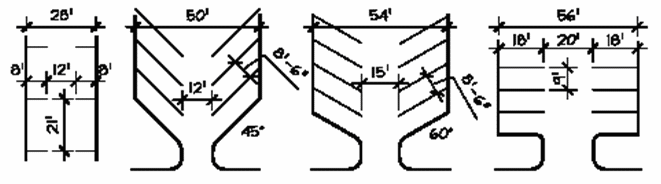
Parking Space Pattern
(C.F. No. 10-403, § 1, 6-16-10)
Sec. 63.306. - Compact spaces.
Accessory parking facilities may designate up to fifty (50) percent of the spaces for compact cars only, in which case, the minimum layout dimensions may be reduced to eight (8) feet in width and sixteen (16) feet in length. Compact spaces shall be designated by signs with a minimum of one (1) sign per every four (4) compact spaces.
Commercial parking facilities may designate any number of compact parking spaces.
Sec. 63.307. - Accessible parking spaces and passenger loading zones.
Parking spaces and passenger loading zones for persons with disabilities shall be designed in accordance with the provisions of the Accessibility Guidelines for Buildings and Facilities of the Americans with Disabilities Act (ADA).
(C.F. No. 10-403, § 1, 6-16-10)
Sec. 63.308. - Maneuvering lanes and driveways.
(a)
Off-street parking facility access. Access to off-street parking facilities for more than four (4) dwelling units on a lot must be provided by a maneuvering lane so that any vehicle leaving or entering the facility from or onto a public street is traveling forward. Except where it is determined impractical, unreasonable, or harmful to the public safety by the zoning administrator, driveways accessing off-street parking facilities should be designed and arranged so as to avoid requiring vehicles to back into traffic on arterial and collector streets.
Stacked parking. Stacked parking is allowed in any off-street parking facility and space for any maneuvering of vehicles must be provided in the parking facility. An attendant must be present for parking facilities with stacked parking for more than six (6) principal dwellings.
(b)
Driveways. For lots with up to four (4) total principal dwelling units, driveways that access a public street in front yards must be no more than twelve (12) feet in width, except that a driveway may be up to four (4) feet wider than the garage door within thirty (30) feet of the garage door. For dwellings in which any portion of the building is more than one-hundred fifty (150) feet from the street, a driveway up to twenty (20) feet in width is permitted to meet fire access requirements. Driveways for one-family, two-family, and multiple-family dwellings on zoning lots with up to four (4) total principal dwelling units must be a minimum of eight (8) feet in width or driveway pavement may be limited to wheel tracks at least two (2) feet wide.
(c)
Alley access and maneuvering. Off-street parking facilities may be permitted access to an alley except where it is determined in the review of a site plan by the zoning administrator that allowance of alley access would create or aggravate an unsafe condition or is impractical, unreasonable, harmful to the public safety, or where maintenance of alley surfaces and/or where erosion control and protection of water quality may be impaired.
For parking facilities of seven (7) or fewer parking spaces, the spaces may be directly off of the alley and the maneuvering lane may include the alley.
For parking facilities of eight (8) or more spaces, the spaces may be directly off of the alley and the maneuvering lane may include the alley, provided notice is sent to adjacent property owners in the manner set forth in section 61.402(b)(5) and there is an opportunity for them to comment. If the spaces are directly off of the alley and the maneuvering lane includes the alley, the spaces must be set back a minimum of ten (10) feet from the centerline of the alley.
Uses prohibited alley access elsewhere in the zoning code must not be permitted alley access by the provisions of this section.
(C.F. No. 10-403, § 1, 6-16-10; Ord. 21-27, § 1, 8-18-21; Ord 23-43, § 4, 10-18-23)
Sec. 63.309. - Reserved.
Editor's note— Ord. 21-27, § 1, adopted August 18, 2021, repealed § 63.309 which pertained to stacked parking.
Sec. 63.310. - Entrances and exits.
Adequate entrances and exits to and from a parking facility must be provided by means of clearly defined and limited drives. When a driveway no longer leads to legal off-street parking, the driveway and curb cut must be removed and landscaping and curbing must be restored.
(a)
The number of curb cuts must be minimized, and shared curb cuts for adjacent parking areas on adjacent lots are encouraged, except where it is determined in the review of a site plan that consolidating curb cuts would create or aggravate an unsafe condition.
(b)
Entrances and exits to and from all parking facilities for commercial or industrial uses located in commercial, industrial, or traditional neighborhood districts must be at least six (6) feet from any adjoining property in RL-H2 zoning districts.
(c)
Entrances and exits to and from a parking facility must be at least thirty (30) feet from the point of intersection of curb lines of two (2) or more intersecting streets.
(d)
Entrances and exits to and from a parking facility must be at least five (5) feet from existing or planned boulevard trees.
(C.F. No. 09-1286, § 3, 12-23-09; C.F. No. 10-403, § 1, 6-16-10; Ord. No. 11-27, § 1, 4-20-11; Ord 15-5, § 1, 2-5-15; Ord. 21-27, § 1, 8-18-21; Ord 23-43, § 4, 10-18-23)
Sec. 63.311. - Wheel stops.
Provisions shall be made to prevent vehicles from damaging or overhanging adjacent property or public rights-of-way, or damaging required landscaping by use of such devices as curbs, wheel stops, or other protective barriers. A two-foot landscaped vehicle overhang is allowed in accordance with section 63.305, minimum layout dimensions.
(C.F. No. 10-403, § 1, 6-16-10)
Sec. 63.312. - Setback.
Except as otherwise provided in section 66.431(b), surface off-street parking spaces shall not be within a required front or side yard and shall be a minimum of four (4) feet from all lot lines, except that parking spaces using an alley for maneuvering shall be a minimum of ten (10) feet from the centerline of the alley.
(C.F. No. 10-403, § 1, 6-16-10; Ord. 21-27, § 1, 8-18-21)
Sec. 63.313. - Visual screening.
For off-street parking facilities that adjoin a residential use or zoning district, a visual screen shall be provided and maintained as required in section 63.114, Visual screens. For off-street parking facilities that abut a residential use or zoning district across an alley, one (1) of the following shall be provided and maintained as determined by the zoning administrator as part of site plan review:
(a)
A visual screen as required in section 63.114, visual screens; or
(b)
An ornamental metal fence or other non-screening, durable fence where security concerns make this preferable to a visual screen.
(Ord. No. 11-27, § 1, 4-20-11)
Sec. 63.314. - Landscaping.
For any parking facility, other than structured parking, landscaping shall be provided to buffer the facility from adjacent properties and from the public right-of-way; reduce the visual glare and heat effects of large expanses of pavement; and provide areas for the retention and absorption of stormwater runoff. All required yards and any underdeveloped space shall be landscaped using materials such as trees, shrubs, sod, groundcover plants, or stormwater landscaping as required in section 63.319, stormwater runoff, and defined in section 60.213.
Any landscaped area shall be planted and maintained in accordance with section 63.115, Landscaping and plant materials. All parking and loading areas (including drive-through facilities, outdoor auto sales and rental, pump island service areas and stacking spaces) adjoining public streets or sidewalks shall provide:
(a)
Perimeter landscape. A landscaped yard at least four (4) feet wide along the public street or sidewalk. If vehicles overhang the yard, an additional three (3) feet of width shall be provided.
(b)
Screening landscape. In all districts except industrial districts, screening shall be provided consisting of a masonry wall or decorative fence (not including chain link) supplemented with landscape material, forming a screen a minimum of three (3) feet in height, a maximum of four and one-half (4½) feet in height not including trees, and not less than fifty (50) percent opaque.
(c)
Interior landscape. Parking facilities with more than twenty (20) parking spaces or six thousand (6,000) square feet of paving, whichever is less, shall provide fifteen (15) square feet of interior landscaped area for every one hundred (100) square feet of paving. Interior landscaping may not substitute for perimeter landscaping, but may join perimeter landscaping as long as it extends at least four (4) feet into the parking area from the perimeter landscape line.
(d)
Tree plantings. A minimum of at least one (1) shade tree shall be planted for every five (5) parking spaces in a surface parking lot. Trees shall be planted within the perimeter landscaping and any required interior landscaping. Each tree shall be planted in landscaped areas or in the center of unpaved tree wells of at least three (3) feet in soil depth and one hundred (100) square feet in area as measured from the interior edge of curbing or paving, with a minimum dimension of four (4) feet wide. A soil volume of greater than five hundred (500) cubic feet per tree with a minimum planting dimension of eight (8) feet is recommended for improved tree health and survival.
(e)
Internal walkways. Parking facilities with more than one hundred twenty-five thousand (125,000) square feet of paved area shall provide internal walkways that divide the parking lot into smaller areas no greater than fifty-five thousand (55,000) square feet. Internal walkways shall be a minimum width of four (4) feet and should connect primary buildings on the site with access to parking areas and the public sidewalk system on adjacent streets. With the exception of walkway/driveway crossings, walkways should be separated from vehicle parking or maneuvering areas by grade, different paving material, or landscaping. Internal sidewalks shall meet the requirements of applicable accessibility standards and other design and construction standards adopted by the city.
(C.F. No. 10-403, § 1, 6-16-10)
Sec. 63.315. - Maintenance.
All areas of all off-street parking facilities shall be kept in a good state of repair and free from refuse and debris. Required parking areas shall be cleared of snow within a reasonable time.
(C.F. No. 10-403, § 1, 6-16-10)
Sec. 63.316. - Paving.
All parking spaces, driveways and off-street parking facilities must be paved with standard or pervious asphalt or concrete, or with brick, concrete or stone pavers, or material comparable to the adjacent street surfacing, in accordance with specifications of the zoning administrator, within one (1) year of the date of the permit except as provided in section 61.402(e).
The total amount of paving for surface parking spaces and driveways for one-family, two-family, and multi-family dwellings on a lot with up to six (6) principal dwelling units, must not exceed ten (10) percent of the lot area for lots adjoining a dedicated public alley and corner lots and fifteen (15) percent of the lot area for all other lots.
(C.F. No. 09-1286, § 3, 12-23-09; Ord 15-32, § 4, 7-22-15; Ord. 21-27, § 1, 8-18-21; Ord 23-43, § 4, 10-18-23)
Sec. 63.317. - Parking structures.
(a)
The ground floor facade abutting any public street or walkway shall be designed and architecturally detailed in a manner consistent with nearby commercial or office buildings.
(b)
The design of upper floors shall ensure that sloped floors do not dominate the appearance of the facade.
(c)
Windows or openings shall be provided that echo those of surrounding buildings.
(d)
Entrance drives to structured parking (including underground parking) shall be located and designed to minimize interference with pedestrian movement. Pedestrian walks shall be continued across driveways.
(e)
The appearance of structured parking entrances shall be minimized so that they do not dominate the street frontage of a building. Possible techniques include recessing the entry; extending portions of the structure over the entry; using screening and landscaping to soften the appearance of the entry; using the smallest curb cut and driveway possible; and subordinating the parking entrance (compared to the pedestrian entrance) in terms of size, prominence, location and design emphasis.
Sec. 63.318. - Lighting.
All parking facilities, including bicycle parking, shall be illuminated to a level to allow safe, secure access to the parking facility and within it. Light fixtures on the top level of parking structures shall be set back from the edge so that they are not visible from the adjoining street. All parking facility illumination shall conform to the provisions of section 63.116, exterior lighting.
(C.F. No. 10-403, § 1, 6-16-10)
Sec. 63.319. - Stormwater runoff.
(a)
For off street parking facilities with greater than one-quarter (¼) of an acre of total disturbed area, the following provisions for stormwater management shall apply:
(1)
Stormwater drainage into public sewers shall be controlled in accordance with best management practices to comply with required local and regional water quality, volume, and rate control standards. These standards include but are not limited to chapter 52, stormwater runoff. Parking lots shall also abide by operation and maintenance regulation as specified by local and regional authorities.
(2)
Stormwater landscaping shall be designed to include an under drain system if stormwater landscaping is located in areas with hydrologic soil type C (Sandy clay loam).
(3)
Stormwater landscaping shall not be required if located in areas with hydrologic soil type D (Clay); groundwater or bedrock within three (3) feet of the bottom of the infiltration area; nearby wells or utilities; or potential contamination.
(b)
For parking facilities with greater than one (1) acre of total disturbed area, other local, state, and regional regulations also apply.
(C.F. No. 10-403, § 1, 6-16-10; Ord. 21-27, § 1, 8-18-21; Ord 23-16, § 2, 4-12-23)
Sec. 63.401. - Off-street loading and unloading.
When a use includes an accessory loading and unloading area for such activities as the receipt and distribution of vehicles, materials, merchandise, supplies or equipment, there shall be provided and maintained on the zoning lot adequate space for maneuvering, standing, loading and unloading in order to avoid undue interference with public use of dedicated rights-of-way. Such space shall be provided as follows:
(a)
All spaces shall be laid out in dimensions that can accommodate the expected delivery vehicle. Loading areas and dock approaches shall be provided with a pavement having a permanent, durable and dustless surface.
(b)
No off-street loading space shall be located in any yard adjoining any residential use or zoning district.
(c)
Off-street loading shall not conflict with required off-street parking or the system of pedestrian flow, and shall not obstruct building ingress and egress.
(d)
Space shall be provided within the off-street loading area so that any maneuvering back into or out of a loading space can be conducted outside of any public right-of-way except where the applicant can establish, in the review of a site plan application, that allowance of such maneuvering would not create or aggravate undue interference with public use of dedicated right-of-way.
(Ord. 21-27, § 1, 8-18-21)
Sec. 63.501. - Accessory buildings and uses.
Accessory buildings, and uses, except as otherwise provided in this Code, are subject to the following regulations:
(a)
When an accessory building is structurally attached to a main building, it is subject to, and must conform to, all regulations of this Code applicable to main buildings. Accessory buildings located less than six (6) feet from any principal building are considered attached for setback and lot coverage purposes.
(b)
Setbacks. Accessory buildings are subject to the setback standards for principal buildings, with the following exceptions.
(1)
Accessory buildings may be erected or established in a required rear yard and must be set back a minimum of one (1) foot from any alley right-of-way. On corner lots, accessory buildings must be set back from the side street lot line a distance equal to that required of principal buildings.
(2)
Garages must be set back from the front lot line at least as far as the principal structure (in the case of attached garages, this refers to the non-garage part of the structure).
(3)
Accessory buildings must be set back at least three (3) feet from all interior lot lines, and overhangs must be set back at least one-third (⅓) the distance of the setback of the garage wall or one (1) foot, whichever is greater. When an accessory building is constructed in a nonrequired front yard or rear yard that adjoins a side yard or front yard, the accessory building must be set back from the interior lot line a distance equal to the minimum side yard required of principal buildings.
(4)
The setback requirement from interior lot lines for accessory buildings in rear yards is waived when a maintenance easement is recorded as to the affected properties, proof of such recorded easement is provided at the time of application for a building permit and the accessory building is located at least three (3) feet from any building on an adjoining lot. The recording of the maintenance easement is interpreted to mean that the following intents and purposes of this setback requirement are met:
a.
Adequate supply of sunlight and air to adjacent property;
b.
Sufficient space for maintenance of the building from the same lot; and
c.
Prevention of damage to adjoining property by fire or runoff from roofs.
A recorded common wall agreement is permitted in lieu of a maintenance easement if the accessory building is attached to an accessory building on an adjoining lot.
(c)
Residential parking is subject to the following standards.
(1)
Access to off-street parking must be from an abutting alley when available, except where it is determined in the review of a site plan application by the zoning administrator that there are circumstances unique to the property that make this impractical, unreasonable, harmful to the public safety; or where maintenance of alley surfaces, erosion control, or protection of water quality may be impaired. On corner lots, access to parking may be from the side street.
(2)
Off-street parking spaces must not be located within the front yard.
(3)
Except in the rear yard, garage doors that face a public street must be no more than nine (9) feet in height and must not exceed sixty (60) percent of the width of the principal structure facing the same street.
(4)
Passenger vehicles may be parked on an approved driveway in front or side yards provided the driveway leads to a legal parking space.
(d)
Accessory building height on a zoning lot with residential use in RL-RM2 districts. The height of accessory buildings that do not contain a dwelling unit may not exceed fifteen (15) feet in the case of a flat or shed roof style and eighteen (18) feet in the case of all other roof styles. The height of an accessory building containing a dwelling unit may not exceed twenty-five (25) feet.
These accessory building height limits do not apply to property within designated heritage preservation sites and districts, where appropriate building heights for accessory structures are determined through the design review process to ensure that heights are acceptable and in keeping with the scale and style of development on the property.
(e)
On zoning lots with up to four (4) principal dwelling units (except for cluster developments), there is a maximum of three (3) non-dwelling accessory buildings, the total of which may occupy a maximum of twelve hundred (1,200) square feet of the lot.
(C.F. No. 09-1286, § 3, 12-23-09; Ord 16-13, § 2, 9-14-16; Ord 22-1, § 1, 1-19-22; Ord 23-43, § 4, 10-18-23)
Sec. 63.601. - Purpose.
The purpose of article VI, wetland conservation, of this chapter is to implement the Wetland Conservation Act of 1991 (Minn. Laws 1991 Chapter 354, as amended), and the accompanying rules of the Minnesota Board of Water and Soil Resources (Minn. Rules Chapter 8420, as amended).
Sec. 63.602. - Incorporation by reference.
Article VI, wetland conservation, of this chapter incorporates by reference the Wetland Conservation Act and the accompanying rules. All words and terms used in this chapter which are defined in the act, rules or elsewhere in the zoning code shall have the meanings given therein.
Sec. 63.603. - Scope.
Article VI, wetland conservation, of this chapter regulates the draining and filling of wetlands and parts of wetlands within the city. It is a part of the zoning code (official controls).
Sec. 63.604. - Exemption and no-loss determinations.
The zoning administrator shall make determinations whether plans to drain or fill wetlands are exempt from the requirements to replace drained or filled wetlands, as set forth in Minn. Rules Part 8420.0420, and whether proposed work will result in a loss of wetlands, as set forth in Minn. Rules Part 8420.0415. The zoning administrator may seek the advice of the technical evaluation panel on questions of wetlands delineation and type. The zoning administrator's decisions are final unless an administrative appeal to the board of zoning appeals is filed as set forth in section 61.700 of the zoning code.
(Ord 23-16, § 3, 4-12-23)
Sec. 63.605. - Sequencing.
The zoning administrator may not consider a wetland replacement plan unless it finds that the applicant has complied with all of the principals of sequencing in Minn. Rules Parts 8420.0520.
(Ord 23-16, § 3, 4-12-23)
Sec. 63.606. - Conditional uses.
Draining or filling wetlands except wetlands determined exempt in section 63.604 shall be conditional uses in all zoning districts.
Sec. 63.607. - Replacement plans.
No draining or filling of wetlands shall take place until plans to replace the drained or filled wetlands have been approved by the zoning administrator. Replacement plans shall conform to all the requirements of Minn. Rules Parts 8420.0530—.0550.
(Ord 23-16, § 3, 4-12-23)
Sec. 63.608. - Monitoring replacement wet- lands.
The zoning administrator shall assure that the wetland replacement plan monitoring and enforcement requirements of Minn. Rules Parts 8420.0600—.0630 are fulfilled.
Sec. 63.609. - Wetland banking.
Wetlands may be restored or created within the city for purposes of deposit in the state wetland bank in accordance with Minn. Rules Parts 8420.0700—.0760. The zoning administrator is responsible for approving plans to restore or create wetlands for deposit in the wetland bank, certifying that the wetlands were constructed as planned, and monitoring of banked wetlands and enforcement under the rules.
Sec. 63.610. - High priority areas.
Decisions regarding sequencing, replacement plans and banking shall particularly favor preservation, restoration and creation of wetlands in high priority areas as identified in water management plans pursuant to Minn. Rules Part 8420.0350.
Sec. 63.611. - Appeals to the board of water and soil resources.
After administrative appeals under the zoning code have been exhausted, decisions made under article VI, wetland banking, of this chapter may be appealed to the board of water and soil resources as set forth in Minn. Rules Part 8420.0250.
Sec. 63.612. - Variances.
The board of zoning appeals may grant variances from Article VI, wetland conservation, of this chapter so long as the variances do not vary requirements of the act or the rules.
Sec. 63.613. - Technical evaluation panel.
(a)
The city council shall appoint a person to serve on the technical evaluation panel. The person must be a technical professional with expertise in water resource management. The city council shall also select one (1) of the members of the panel to act as the contact person and coordinator for the panel.
(b)
The city council, planning commission, zoning administrator, property owner or a member of the technical evaluation panel may request that the technical evaluation panel make a technical determination of the public value, location, size or type of wetlands in plans to drain, fill or replace wetlands. No decision on the plans shall be rendered until the panel makes the determination, as set forth in Minn. Rules Part 8420.0240.

