
San Marcos City Zoning Code
CHAPTER 8
DEFINITIONS
Unless otherwise specifically provided, or unless clearly required by the context, the words and phrases defined in this Chapter shall have the meanings shown when used in this Land Development Code. For all other words, the definition in the latest edition of Webster's Dictionary shall be used. For words used in combination, or where the Webster's Dictionary does not define a word, the book A Planners' Dictionary, published in 2004 by the American Planning Association, shall be used. As a supplemental resource, The New Illustrated Book of Development Definitions, published by Rutgers University in 1993, shall also be consulted.
ARTICLE 1: - GENERAL DEFINITIONS
1.
Abandonment, as related to nonconforming uses and structures, see Section 4.5.3.6 of this Land Development Code.
2.
Accessory means being secondary or subordinate to something else.
3.
Accessory structure means a detached building or other structure enclosing or covering usable space where the use of the building or structure is incidental and subordinate to one or more principal buildings.
4.
Accessway means a paved area intended to provide ingress and egress of vehicular traffic from a public right-of-way to an off-street parking area or loading area.
5.
Addition means an extension or increase in floor area or height of an existing building or structure.
6.
Agent means a person authorized by a property owner to represent the owner in the development or management of property or in a real estate transaction. In the context of a of a mobile home or manufactured housing park, agent means any person authorized by the owner of the park to operate or maintain the park.
7.
Alley means a public access easement, not intended to provide the primary means of access to abutting lots, which is used primarily for vehicular service access to the back or sides of properties otherwise abutting on a street.
8.
Altered or alteration means any change, modification or transformation.
9.
Alternative water means any water from a source on or available to a customer's premises other than directly from the City's water system. Alternative water sources include the following:
(1)
Water from a natural source such as a spring, pond, or river (if permitted).
(2)
Reclaimed water.
(3)
Gray water.
(4)
Rain water.
(5)
Any water supplied by the city water system that has passed through a point of delivery and is no longer controlled by the City's public water system.
The term does not include water from a well.
10.
Antenna, commercial means an antenna or antenna support structure used for the purpose of transmission, retransmission, and/or reception of radio, television, electromagnetic, or microwave signals primarily for the purpose of operating a business and/or for financial gain (e.g., commercial broadcasting, cellular/wireless telecommunications, etc.). A satellite dish antenna that exceeds six feet in diameter shall also be considered as a commercial antenna.
11.
Antenna, non-commercial or amateur means an antenna or antenna support structure used for the purpose of transmission, retransmission, and/or reception of radio, television, electromagnetic, or microwave signals for private or personal use and not for the purpose of operating a business and/or for financial gain. A satellite dish antenna not exceeding six feet in diameter shall also be considered as a non-commercial antenna.
12.
Antenna, satellite dish or direct broadcast, means an apparatus constructed of solid, open mesh, bar-configured, or perforated materials of any shape/configuration that is used to receive and/or transmit radio, television or microwave signals from a terrestrial or orbitally located transmitter or transmitter relay.
13.
Antenna support structure is any tower, mast, pole, tripod, box frame, or other structure utilized for the purpose of supporting one or more antennas or microwave reflectors.
14.
Apartment or multifamily dwelling means a collection of family residences grouped together in one building, each family residence being a section of the building.
15.
Appeal means a request for review of and relief from any decision applying a provision of this Land Development Code and which is authorized under Chapter 1, Article 10.
16.
Approved water system means a public water supply system that meets or exceeds the minimum acceptable standards of the TSDHS for public water supply systems.
17.
Appurtenant features are the physical features which define the design of a building or property. Appurtenant features include porches, railings, columns, shutters, steps, fences, attic vents, sidewalks, driveways, fences, garages, carports, outbuildings, gazebos, arbors, ponds, and pools.
18.
Aquifer means a geologic formation, group of formations, or part of a formation capable of yielding, storing or transmitting groundwater to wells or springs.
19.
Area, for purposes of signs, means the largest area of a sign visible at any one time from any one point and enclosed by a single rectangle, including any framing or trim, but not including any structural parts lying outside the limits of the sign and which do not form an integral part of the display. If the copy of a sign is enclosed by a box, outline or frame, area is the total area of the enclosure. If the sign consists of individual letters, numbers or symbols, on a surface or having no frame, area shall be the sum of the areas of the rectangles which can encompass each portion of the copy. The area of four-side signs is considered the same as two double-faced signs.
20.
Area of shallow flooding means a designated AO, AH or VO zone on the flood insurance rate map (FIRM) with a one percent or greater annual chance of flooding to an average depth of one to three feet where a clearly defined channel does not exist, where the path of flooding is unpredictable and where velocity flow may be evident. The flooding is characterized by ponding or sheet flow.
21.
Area of special flood hazard is the land in the floodplain within the City subject to a one percent or greater chance of flooding in any given year. This area is shown as zones A, AE, AH, AO, A1—99, VO, V1—30, VE or V on the FIRM.
22.
ASTM means American Society of Testing Materials.
23.
Backflow means the reversal of flow of water and/or mixtures of water and other liquids or gases, or other substances from a customer's side of a water service connection into a public water supply system. Backflow may occur under either a backpressure or back siphonage condition.
24.
Backflow prevention assembly means a device or aggregation of devices designed to prevent backflow, including reduced pressure backflow assemblies, double-check valve assemblies, atmospheric vacuum breakers, pressure vacuum breaker assemblies or an air gap.
25.
Bank means the area contiguous to the floodway, where a continuous slope of 35 percent or more ends and becomes less steeply sloped, or the edge of the average annual water line of a waterway, whichever is greater. The location of the bank is determined by the Engineering Director, based on this definition.
26.
Bar means a structure or premises where alcoholic beverages are sold for on-premises consumption.
27.
Base flood means the flood having a one percent chance of being equaled or exceeded in any given year.
28.
Base zoning or base zoning district means the zoning district, or combination of zoning districts, which will be applied to the subject property contained in a PD district.
29.
Best management practices or BMPs means activities, prohibitions of practices, maintenance procedures, and other management practices to prevent or reduce the level of pollutants in surface water runoff. BMPs also include treatment requirements, operating procedures, and practices to control site runoff, spillage or leaks, sludge or waste disposal, or drainage from raw material storage.
30.
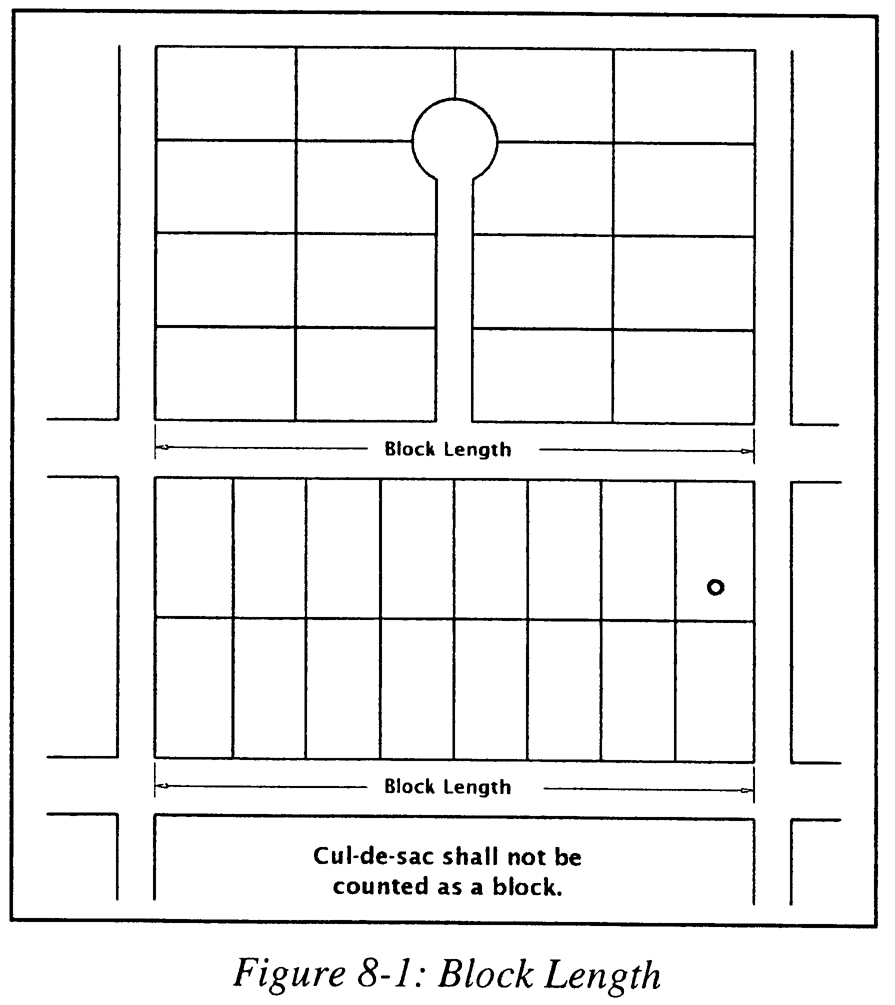
Block length means the distance, as measured along the street centerline, from one end of a row or group of lots to the other end. A block is determined by the streets along its boundary which surround one or more lots. A block adjacent to a cul-de-sac shall not be counted as a block.
31.
Blocking means the foundation for leveling and supporting a mobile home or manufactured home, as required by V.T.C.A., Occupations Code, Chapter 1201.
32.
Boardinghouse means a place where a person obtains food or lodging or both in another's house for a stipulated price.
33.
Building, main or primary means a building in which the principal use of the lot on which it is situated is conducted. In a residential zoning district, any dwelling shall be deemed to be a main building on the lot on which it is situated.
34.
Buffer means a visual screen constructed of wood, masonry and/or landscape material in a manner so that adjacent property will be screened from the use contemplated so noise, solid waste or other objectionable influences will be avoided.
35.
Buffer zone means an area of land adjacent to a water quality zone for a waterway that serves a function of filtering contaminants from water that drains across the area.
36.
Bufferyards means a land area used to visibly separate one use from another or to shield or block noise, lights, or other nuisances. Bufferyards may be required to include fences, walls, berms, as well as shrubs and trees.
37.
Building official means the person designated as the building official in the building code adopted in Chapter 14 of the City Code.
38.
Building permit means a permit issued by the City's building official or building inspection officer under Chapter 1, Article 9, Division 2 of this Land Development Code.
39.
Building setback line means a line defining an area on the building lot between the street right-of-way line and the building line within which no building shall be constructed, encroach or project, except as specifically authorized in an adopted City ordinance.
(a)
Front building setback line means a line parallel to the street right-of-way line which the building faces and takes its primary access from.
(b)
Side building setback line means a line parallel to an adjacent lot or street right-of-way on a corner lot, which the building sides up to.
(c)
Rear building setback line means a line parallel to an adjacent lot, alley or street, for double frontage lots, which the building backs up to and has its rear or secondary access from.
(d)
Build-to lines or maximum setbacks are maximum-distance setbacks; placing a building farther from the right-of-way or property line than the established build-to or maximum setback line is not permitted.
40.
Caliper means the American Association of Nurserymen standard for trunk measurement of nursery stock, as measured six inches above the ground for trees up to and including four inches caliper size, and as measured at 12 inches above the ground for larger sizes. If the tree has been severed at less than 12 inches above the soil line, then the caliper shall be measured across the stump.
41.
Canopy means the outermost branchy layer of a tree or a stand of trees.
42.
CBOA means Construction Board of Adjustments.
43.
CCN means a Certificate of Convenience and Necessity issued by a state agency to a utility service provider authorizing the provision of utility service in a defined geographic area.
44.
Certificate of Appropriateness means a certificate issued under Chapter 1, Article 5, Division 6 of this Land Development Code for the construction, alteration, restoration, relocation, or demolition of a structure, or alterations to the site or appurtenances, in a historic district or at a historic landmark.
45.
Certificate of Occupancy means a certificate issued under Chapter 1, Article 9, Division 3 of this Land Development Code for the use of a building, structure or land, when the building, structure or land complies with all applicable City ordinances and regulations.
46.
Channelization means alteration of the natural cross sectional area or profile of a waterway to increase the hydraulic efficiency or carrying capacity of the waterway.
47.
City means the City of San Marcos, Texas, or any authorized person acting in its behalf.
48.
City standards means all of the the City's standards and specifications that apply to development, together with all tables, drawings and other attachments. All City standards described or referred to in this Land Development Code are adopted by referenced and are a part of this Land Development Code in the same way as if they were set out at length herein. See also TCSS.
49.
City water system means the entire potable water distribution system of the City, including, without limitation, all pipes, facilities, valves, pumps, conduits, tanks, receptacles and fixtures and appurtenances between the water supply sources and the points of delivery, used by the City to produce, convey, deliver, measure, treat or store potable water for public consumption or use.
50.
Cluster development means a method of development for land that permits variation in lot sizes without an increase in the overall density of population or development.
51.
Cluster Development Plan means a plan submitted in conjunction with a proposed cluster development that authorizes such development when approved under Chapter 1, Article 5, Division 8 of this Land Development Code.
52.
Collocation means the use of a single antenna support structure and/or site by more than one communications provider.
53.
Commence construction or commencing construction means the initial disturbance of soils associated with clearing, grading, or excavating activities or other construction or development.
54.
Commission means the City Planning and Zoning Commission.
55.
Common access route means a private way which affords the principal means of access to individual mobile home or manufactured home lots or auxiliary buildings.
56.
Communications operations, commercial means the transmission, retransmission, or reception of radio, television, electromagnetic, or microwave signals primarily for the purpose of operating a business or for financial gain.
57.
Communications operations, non-commercial/amateur means the transmission, retransmission and/or reception of radio, television, electromagnetic, or microwave signals for private or personal use, and not for the purpose of operating a business and/or for financial gain.
58.
Compatibility means the characteristics of different land uses or activities that permit them to be located near each other in harmony and without conflict.
59.
Comprehensive Plan means the Comprehensive Plan, or Vision San Marcos: A River Runs Through Us, of the City and includes any unit or a part of any unit separately adopted and any amendment to the plan or parts thereof.
60.
Concept Plan means a component of the regulations for a) a Planned Development District under Chapter 1, Article 5, Division 3 of this Land Development Code that illustrates the proposed location and arrangement of uses, the relationship of such uses to base zoning districts, development phasing, planned public improvements, open space, proposed amenities and the overall design of the development, and b) the Transfer of Development Rights and Development Agreement processes.
61.
Conditional Use Permit (CUP) means a permit authorizing the establishment of a use that may be suitable only in certain locations in a zoning district, or that is allowed only when subject to standards and conditions that assure compatibility with adjoining uses. See under Chapter 1, Article 5, Division 7 of this Land Development Code.
62.
Condominium means a multifamily dwelling unit, within which title is conveyed to designated units or apartments, with an undivided interest in the building's common elements, such as halls, stairs, elevators, roofs, parking spaces, and the land when the building is not constructed on leased land.
63.
Connection means each and every joining of a wastewater line leading from any building or structure with a part of the City wastewater system, provided that if there are two or more buildings or structures on the same lot or adjoining lots and their respective wastewater lines join on that lot or either adjoining lot and one line joins the City wastewater system, each building or structure is considered as having a separate connection to the City wastewater system.
64.
Construction, with respect to a building, means the assembly of materials into a structure, or the rehabilitation or replacement of a structure which has been damaged, altered or removed or which is proposed to be altered or removed to an extent exceeding 50 percent of the area of the structure at the time of the damage, alteration or removal. For the purposes of this definition, construction includes the installation of a parking lot.
65.
Construction plans means the drawings and technical specifications, including bid documents and contract conditions, where applicable, providing a graphic and written description of the character and scope of the work to be performed in construction of a development.
66.
Contiguous means adjacent property whose property lines are shared or are separated by only a street, alley, easement or right-of-way.
67.
Contributing property is a property 50 years old or older which contributes to a historic district's historical significance through location, setting, design, construction, workmanship, or association with historical persons or events, based on guidelines set forth by the National Park Service in the National Register of Historic Places Criteria for Evaluation.
68.
Copy means the letters, numbers, symbols or geometric shapes, either in permanent or changeable form, on the surface of a sign.
69.
Council means the City Council.
70.
Council of Neighborhood Associations (CONA) means the nonprofit organization with the general purpose of bringing together representatives of the various neighborhoods, and to protect and advance the interest of neighborhoods in the City. CONA is not a City board or commission.
71.
Coverage, building means the lot area that is covered by all buildings located thereon, including the area covered by all overhanging roofs and canopies. See also impervious cover.
72.
Creek means an area where surface waters flow sufficiently to produce a defined channel or bed. A defined channel or bed is indicated by hydraulically sorted sediments or the removal of vegetative litter or loosely rooted vegetation by the action of moving water. The channel or bed need not contain water year-round. This definition is not meant to include storm water runoff devices or other entirely artificial waterways unless they are used to store or convey pass-through stream flows naturally occurring prior to construction of such devices.
73.
Critical feature means an integral and readily identifiable part of a flood protection system, without which the flood protection provided by the entire system would be compromised.
74.
Critical water quality zone means the area along minor, intermediate or major waterways where no development or disturbance of native vegetation is allowed, other than approved road and utility crossings.
75.
Cross connection means any physical connection between the City water system and another water system or source through which backflow may occur.
76.
Crosswalk way means a public right-of-way, six feet or more in width between property lines, which provides pedestrian circulation.
77.
Cul-de-sac means a short, minor street having but one outlet to another street and terminating on the opposite end by a vehicular turnaround.
78.
CUP means Conditional Use Permit.
79.
Dead-end street means a street, other than a cul-de-sac, with only one outlet.
80.
Density means the number of dwelling units per gross acre of a subdivision, excluding any areas that are nonresidential in use.
81.
Developed area means that portion of a plot or parcel upon which a building, structure, pavement or other improvements have been placed.
82.
Developer means an individual, partnership, corporation or governmental entity undertaking the division or improvement of land and other activities covered by this Land Development Code, including the preparation of a subdivision or development plat showing the layout of the land and the public improvements involved therein. The term "developer" is intended to include the term "subdivider," even though personnel in successive stages of a development project may vary.
83.
Development means initiation of any activities related to the platting of land or construction of buildings or structures, the construction of impervious surfaces, the installation of utilities, roadways, drainage facilities or other infrastructure; or any disturbance of the surface or subsurface of the land in preparation for such construction activities, including without limitation removal of vegetation, grading, clearing, filling, or removal of soil.
84.
Development application means either a petition for a legislative decision or an application for a development permit.
85.
Development permit means a decision by the commission, board or responsible official designated by this Land Development Code, acting in an administrative or quasi-judicial capacity, that authorizes the holder of the permit to undertake one or more development activities or to file further applications needed to initiate or continue development activities authorized under the Land Development Code. The filing of a complete application for a development permit may or may not stay the City from adopting new standards applicable to the permit or any subordinate permit, depending on the nature of the standards.
86.
Development standards mean all regulations, design standards, requirements and restrictions that apply to a development.
87.
Director, Engineering means the Director of the City Department of Environment and Engineering, or the Director's designee.
88.
Director of Planning and Development Services or Director means the Director of the City Department of Planning and Development Services, or the Director's designee.
89.
Discharge means to deposit, conduct, drain, emit, throw, run, allow to seep or otherwise release or dispose of or to allow, permit or suffer any of these acts or omissions.
90.
Drainage means bridges, catch basins, channels, conduits, creeks, culverts, detention ponds, ditches, draws, flumes, pipes, pumps, sloughs, treatment works, and appurtenances to those items, whether natural or artificial, or using force or gravity, that are used to draw off surface water from land, carry the water away, collect, store, or treat the water, or divert the water into natural or artificial waterways.
91.
Driveway means a minor private entranceway off the common access route into an off-street parking area.
92.
DT district means a Development Transfer District.
93.
DTG means a Development Transfer Granting site, in relation to a Development Transfer District.
94.
DTR means a Development Transfer Receiving site, in relation to a Development Transfer District.
95.
Dwelling unit means a room or suite or set of rooms occupied and suitable for occupancy as a family residence and having kitchen, bath and sanitary facilities, together with appropriate appurtenances to that occupancy.
(a)
Single-family detached dwelling unit means a building designed for and occupied exclusively by one family which is a structurally separated building on a lot that is unoccupied by any other dwelling unit.
(b)
Single-family attached dwelling unit means a building designed for and occupied exclusively by one family which is attached to one or more other single-family dwelling units along a property boundary.
(c)
Duplex means a building designed for and occupied exclusively by two families living independently of each other. A duplex sharing a lot with another residentially used structure falls under the definition of a multiple-dwelling unit and is not considered a duplex for the purposes of this Land Development Code.
(d)
Multiple-family dwelling unit means a dwelling unit within a building designed for and/or occupied exclusively by two or more dwelling units. Also known as multifamily dwelling unit.
(e)
Dwelling unit equivalent (DUE) means a density value for multiple-family dwelling units based upon the number of bedrooms in the unit. This value shall be applied to the units per acre measurement in order to meet the dwelling unit requirement.
(i)
Three-bedroom unit = one unit;
(ii)
Four-bedroom unit = one and one-half units;
(iii)
Five-bedroom unit = two units;
(iv)
Six-bedroom unit = two units
(v)
Every second bedroom above the fifth bedroom = one additional unit
96.
Easement means an interest in land granted to the City, to the public generally and/or to a private utility corporation.
97.
Edwards Aquifer means the portion of an arcuate belt of porous, waterbearing, predominantly carbonate rocks known as the Edwards (Balcones Fault Zone) Aquifer trending from southwest to northeast in Hays and adjacent counties.
98.
Electric sign means a sign connected to an electric power source for any purpose.
99.
Elevated building means, with respect to flood damage prevention regulations, a nonbasement building (i) built, in the case of a building in zones A1—30, AE, A, A99, AO, AH, B, C, X and D, to have the bottom of the lowest horizontal structure member of the elevated floor elevated above the ground level by means of pilings, columns (posts and piers), or shear walls parallel to the flow of the water; (ii) built to have the finished floor elevation one foot above the floodplain elevation; and (iii) adequately anchored so as not to impair the structural integrity of the building during a flood of up to the magnitude of the base flood. In zones A1—30, AE, A, A99, AO, AH, B, C, X, D, the term "elevated building" also includes a building elevated by means of fill or solid foundation perimeter wells with openings sufficient to facilitate the unimpeded movement of floodwaters. In zones V1—30, VE, or V, the term "elevated building" also includes a building otherwise meeting the definition of "elevated building", even though the lower area is enclosed by means of breakaway walls if the breakaway walls meet the standards of Section 60.3(e)(5) of the National Flood Insurance Program regulations.
100.
Engineer means a person duly licensed under the Texas Engineering Registration Act to practice the profession of engineering.
101.
Environmental Health Department means the City department entrusted with the regulation, control and supervision of matters pertaining to the general health of the citizens and the community.
102.
Environmental Protection Agency or EPA means the U.S. Environmental Protection Agency, or, where appropriate, the administrator or other duly authorized official of that agency.
103.
Erect means to construct, reconstruct, install or build.
104.
ETJ means extraterritorial jurisdiction. See the definition of extraterritorial jurisdiction.
105.
Excavation means any digging, trenching, scraping or other activity that disturbs natural soil or rock to a depth of two feet or more, other than soil disturbance incidental to the removal of trees or vegetation.
106.
Existing construction means, for the purposes of determining flood insurance rates, structures for which the start of construction commenced before the effective date of the FIRM or before January 1, 1975, for FIRMs effective before that date. The term "existing construction" may also be referred to as "existing structures".
107.
Existing manufactured home park or subdivision means, for flood damage prevention purposes, a manufactured home park or subdivision for which the construction of facilities for servicing the lots on which the manufactured homes are to be affixed, including, at a minimum, the installation of utilities, the construction of streets, and either final site grading or the pouring of concrete pads, was completed prior to the adoption of the City's original floodplain ordinance on November 25, 1974.
108.
Expansion to an existing manufactured home park or subdivision means, for flood damage prevention purposes, the preparation of additional sites by the construction of facilities for servicing the lots on which the manufactured homes are to be affixed, including the installation of utilities, the construction of streets, and either final site grading or the pouring of concrete pads.
109.
Exterior features include the architectural style, general design and general arrangement of the exterior of a building or other structure, including, the kind and texture of the building material and the type and style of all windows, doors, walls, roofs, light fixtures, signs, other appurtenant features and significant trees. For signs, the term exterior features means the style, material, size, and location of all signs. For the purposes of this Land Development Code, a change in exterior color is not deemed to be a change in exterior features.
110.
Extraterritorial jurisdiction (E.T.J.) means the unincorporated area, not a part of any other City, which is contiguous to the corporate limits of the City, the outer limits of which are measured from the extremities of the corporate limits of the City outward for the distances as may be stipulated in Chapter 42 of the Texas Local Government Code in accordance with the population of the City, and in which area the City may enjoin violation of certain provisions of this Land Development Code. The ETJ on the Preferred Scenario Map of the Comprehensive Plan, unless otherwise marked as an intensity zone, is considered an Area of Stability.
111.
FAA means the Federal Aviation Administration.
112.
Facade means a side of a building or accessory structure which consists of a separate architectural elevation as viewed horizontally from the ground, street or other nearby location. The area of a facade is defined by the outer limits of all of its visible exterior elements. Separate faces of a building oriented in the same direction or within 45 degrees of each other are considered part of the same facade.
113.
Family means any number of individuals living together as a single housekeeping unit who are related by blood, legal adoption, marriage, or conservatorship.
114.
FCC means the Federal Communications Commission.
115.
FEMA means the Federal Emergency Management Agency.
116.
Final Development Plat means the plat for a development (other than a subdivision) for which platting is required which, when approved under Chapter 1, Article 6, Division 5 of this Land Development Code, will be recorded in the official public records.
117.
Final Subdivision Plat means the plat of a subdivision for which platting is required which, when approved under Chapter 1, Article 6, Division 5 of this Land Development Code, will be recorded in the official public records.
118.
FIRM means "flood insurance rate map". See the definition for flood insurance rate map.
119.
Flood or flooding means a general and temporary condition of partial or complete inundation of normally dry land areas from:
(a)
The overflow of waters; or
(b)
The unusual and rapid accumulation or runoff of surface waters from any source.
120.
Flood insurance rate map (FIRM) means an official map of a community, on which the Federal Emergency Management Agency has delineated both the areas of special flood hazards and the risk premium zones applicable to the community.
121.
Flood insurance study is the official report provided by the Federal Emergency Management Agency. The report contains flood profiles, water surface elevation of the base flood, as well as the flood boundary-floodway map.
122.
Flood protection system means those physical structural works for which funds have been authorized, appropriated and expended and which have been constructed specifically to modify flooding in order to reduce the extent of the areas within a community subject to a special flood hazard and the extent of the depths of associated flooding. The system includes dams, reservoirs, levees or dikes. These specialized flood-modifying works are those constructed in conformance with sound engineering standards.
123.
Floodplain (No. 100) means an area of land that is subject to a one percent or greater chance of flooding in any given year, based on developed conditions existing as of the date a development application is accepted for filing, and not based on projected or anticipated future build-out for a watershed.
124.
Floodplain permit means a permit issued under Chapter 1, Article 9, Division 4 of this Land Development Code that authorizes the construction, location, alteration or change of use for a structure in an area of special flood hazard or in any other 100-year floodplain.
125.
Floodway means the channel of a river, creek, stream or other waterway, and the adjacent land areas that are reserved in order to discharge the base flood without cumulatively increasing the water surface elevation more than one foot. Unless otherwise approved by the Engineering Director, the area of a floodway will be as depicted on official maps of the Federal Emergency Management Agency, subject to site-specific interpretation in a manner approved by the Engineering Director.
126.
Freeway means a divided arterial highway designed with full control of access and grade separation at all intersections. Freeways provide movement of high volumes of traffic at relatively high speeds. This system carries most of the trips entering and leaving the city, as well as most of the through movement by-passing the central city.
127.
Frontage means lineal distance measured along all abutting street rights-of-way.
128.
Functionally dependent use means, for flood damage prevention purposes, a use which cannot perform its intended purpose unless it is located or carried out in close proximity to water. The term includes only docking facilities, port facilities that are necessary for the loading and unloading of cargo or passengers, and shipbuilding and ship repair facilities, but does not include long-term storage or related manufacturing facilities.
129.
Geologic assessment means a report prepared by a qualified geologist describing site-specific geology.
130.
Geologic feature means a feature including, but not limited to, closed depressions, sinkholes, caves, faults, fractures, bedding planes, interconnected vugs, reef deposits and springs.
131.
Glass wall(s) includes glass curtain walls or glass block construction. Glass curtain wall is an exterior wall which carries no structural loads, and which may consist of the combination of metal, glass, or other surfacing material supported in a metal framework.
132.
Granting zones means land from which development rights will be transferred.
133.
Ground cover means low growing plants planted in a manner so as to form a continuous cover over the ground, including liriope, low growing varieties of honeysuckle, confederate jasmine, English ivy or others.
134.
Heavy load vehicle: A self-propelled vehicle having a manufacturer's recommended gross vehicle weight (GVW) of greater than 16,000 pounds (including trailers), such as large recreational vehicles (originally manufactured as RVs, not converted), tractor-trailers, buses, vans, and other similar vehicles. The term "truck" shall be construed to mean "heavy load vehicle" unless specifically stated otherwise.
135.
Height, sign means the vertical distance between the highest part of the sign or its supporting structure, whichever is higher, and the greatest elevation of the ground at the base of or below the sign.
136.
Height, building means the distance measured from the finished grade of the lot/parcel to the highest point on the support structure or other structure, including the base pad and any antennas.
137.
Highest adjacent grade means the highest natural elevation of the ground surface prior to construction next to the proposed walls of a structure.
138.
Highway corridor means, for purposes of off-premise sign regulations, all property located within 350 feet of a right-of-way line of an interstate highway, but not including any property classified by Chapter 4 as a residential district or designated by the adopted Master Plan as future residential land use in the extraterritorial jurisdiction.
139.
Historic District means a zoning overlay district intended to preserve and protect historic structures, streets and neighborhoods that serve as visible reminders of the history and cultural heritage of the City, the State and the United States.
140.
Historic structure means any structure that is:
(a)
Listed individually in the National Register of Historical Places or preliminarily determined by the Secretary of the Interior as meeting the requirements for individual listing on the National Register; and/or
(b)
Certified or preliminarily determined by the Secretary of the Interior as contributing to the historical significance of a registered historic district or a district preliminarily determined by the secretary to qualify as a registered historic district; and/or
(c)
Individually listed on a local or state inventory of historic places.
141.
Holder means the person who applied for and obtained approval of a Watershed Protection Plan for a development, or the successor-in-interest of such person.
142.
HUD-Code manufactured home (see definition of "manufactured housing").
143.
Illuminated or lit sign means a sign exposed to artificial lighting by light sources located on or in the sign or specifically directed toward the sign.
144.
Impervious cover means impermeable surfaces, such as pavement or rooftops, which prevent the infiltration of water into the soil and bedrock.
145.
Improved lot or tract means a lot or tract that has a structure or other improvement on it that causes an impervious coverage of the soil under the structure or improvement.
146.
Industrialized home (single-family, also called modular prefabricated structure or modular home) means a structure or building module, as defined under the jurisdiction and control of the Texas Department of Labor and Standards, that is transportable in one or more sections on a temporary chassis or other conveyance device, and that is designed to be installed and used by a consumer as a fixed residence on a permanent foundation system. The term includes the plumbing, heating, air-conditioning and electrical systems contained in the structure. The term does not include mobile homes or HUD-Code manufactured homes as defined in the Texas Manufactured Housing Standards Act (V.T.C.A., Occupations Code, Chapter 1201), nor does it include a recreational vehicle as that term is defined by this Land Development Code.
147.
Interested person means a person who is impacted by a final decision of the City to the extent that such impact exceeds the impact of the decision on a member of the general public. An interested person includes any officer or agency of the City.
148.
Intermediate waterway means any river, creek, stream, channel, or other waterway that drains a watershed of at least 250 acres and no more than 1,000 acres.
149.
Internal street means the same as common access route.
150.
ITE means Institute of Transportation Engineers.
151.
Land division means:
(1)
The following when done for the purpose of sale or building development:
a.
The division of any tract of land into two or more tracts or lots; or
b.
The assembly of two or more tracts of land into one tract or lot.
(2)
The following changes to a recorded subdivision plat:
a.
A resubdivision of all or part of the subdivision;
b.
Any change of lot size or lot lines; or
c.
The relocation of any street.
152.
Landscape development means trees, shrubs, ground cover, vines or grass installed in planting areas for the purpose of fulfilling the requirements of this Article.
153.
Land Use Intensity Matrix means the tool found in the Comprehensive Plan Figures Appendix which provides guidance on the uses permitted in each intensity zone or area of stability on the Preferred Scenario Map
154.
Land Use Suitability Map means the map of development constraints which indicates land that is suitable for development.
155.
LDC means Land Development Code (this document).
156.
Levee means a manmade structure, usually an earthen embankment, designed and constructed in accordance with sound engineering practices to contain, control or divert the flow of water so as to provide protection from temporary flooding.
157.
Levee system means a flood protection system which consists of a levee and associated structures including closure and drainage devices, which are constructed and operated in accordance with sound engineering practices.
158.
Light load vehicle: A self-propelled vehicle having a manufacturer's recommended gross vehicle weight (GVW) not greater than 16,000 pounds and having no more than two axles, such as pick-up trucks, sport utility vehicles, vans and mini-vans, recreational vehicles (less than 32 feet in length), campers and other similar vehicles but not including automobiles and motorcycles.
159.
Livestock use means cattle, horses, sheep, goats, wild game and other animals.
160.
Lot (also see Section 4.5.2.3 of this Land Development Code) means an undivided tract or parcel of land having frontage on a public street, or an approved open space having direct street access, and which is or may be offered for sale, conveyance, transfer or improvement, which is designated as a distinct and separate tract, and which is identified by a tract, or lot number or symbol in a duly approved subdivision plat that has been properly filed of record.
(a)
Lot depth means the length of a line connecting the midpoints of the front and rear lot lines.
(b)
Lot, double frontage means any lot, not a corner lot, with frontage on two streets that are parallel to each other or within 45 degrees of being parallel to each other.
(c)
Lot, flag shaped means an irregularly shaped lot that takes its sole access via a long, narrow strip of land connecting the principal building site to a public street.
(d)
Lot frontage means the length of street frontage between property lines.
(e)
Lot, irregular means any lot not having equal front and rear lot lines or equal side lot lines; a lot, the opposite lot lines of which vary in dimension and the corners of which have an angle of either more or less than 90 degrees.
(f)
Lot width means the shortest average distance between the side lot lines, which is normally that distance measured along a straight line connecting the midpoint of the two side lot lines.
161.
Lowest floor means, for flood damage prevention purposes, the lowest floor of the lowest enclosed area (including basement). An unfinished or flood-resistant enclosure, usable solely for parking of vehicles, building access or storage in an area other than a basement area, is not considered a building's lowest floor, provided that the enclosure is not built so as to render the structure in violation of the applicable nonelevation design requirement of Section 60.3 of the National Flood Insurance Program regulations.
162.
Major recharge feature means a sensitive geologic feature or manmade feature that, because of its characteristics and setting, is likely to cause a significant quantity of direct recharge of surface water to the Edwards Aquifer, and has a contributing drainage area of greater than ten acres and/or occurs within a floodplain or streambed.
163.
Major waterway means any river, creek, stream, channel or other waterway that drains a watershed of 1,000 acres or more.
164.
Manmade feature means a feature, including but not limited to, closed depressions, wells, borings and excavations.
165.
Manufactured housing means any one of three types of prefabricated housing products which are typically manufactured or assembled at a location other than the end user's permanent site, and which are regulated by the Texas Manufactured Housing Standards Act (V.T.C.A., Occupations Code, Chapter 1201). For the purpose of this Ordinance, there are two types of manufactured homes:
(a)
Mobile home means a structure that was constructed before June 15, 1976, transportable in one or more sections, which, in the traveling mode, is eight body feet or more in width or 40 body feet or more in length, or, when erected on site, is 320 or more square feet, and which is built on a permanent chassis and designed to be used as a dwelling with or without a permanent foundation when connected to the required utilities, and includes the plumbing, heating, air conditioning and electrical systems. The term does not include a recreational vehicle as that term is defined by this Land Development Code.
(b)
HUD-code manufactured home means a structure, constructed on or after June 15, 1976, according to the rules of the United States Department of Housing and Urban Development, and V.T.C.A., Occupations Code, Chapter 1201, transportable in one or more sections, which, in the traveling mode, is eight body feet or more in width or 40 body feet or more in length, or, when erected on site, is 320 or more square feet, and which is built on a permanent chassis and designed to be used as a dwelling with or without a permanent foundation when connected to the required utilities, and includes the plumbing, heating, air conditioning and electrical systems. The term does not include a recreational vehicle as that term is defined by this Land Development Code.
166.
Manufactured home park or subdivision means a parcel or contiguous parcels of land divided into two or more manufactured home lots for rent or sale.
167.
Master Plan means the units of the Comprehensive Plan which address planning for specific topics. Examples of Master Plans are Transportation, Parks, Water and / or Wastewater or any other specific plans meant to guide the City's growth or operations.
168.
Mean sea level means, for flood damage prevention purposes, the National Geodetic Vertical Datum (NGVD) of 1929 or other datum to which base flood elevations shown on the City's flood insurance rate map are referenced.
169.
Minor plat is a plat dividing land into no more than four lots that may be administratively approved under certain circumstances under Chapter 1, Article 6, Division 7 of this Land Development Code.
170.
Minor recharge feature means a sensitive geologic feature or manmade feature that, because of its characteristics and setting, may cause small quantities of surface water to recharge the Edwards Aquifer, and has a contributing drainage area of less than 1.6 acres.
171.
Minor waterway means, with respect to areas other than the Edwards Aquifer Recharge Zone, any river, creek, stream, channel or other waterway that drains a watershed of at least 120 acres and no more than 250 acres.
172.
Minor waterway means, with respect to the Edwards Aquifer Recharge Zone, any river, creek, stream, channel or other waterway that drains a watershed of at least 50 acres and no more than 250 acres.
173.
Mixed Residential Areas is a term used in the Land Use Intensity Matrix of the Comprehensive Plan to categorize areas as Redevelopment or Infill. Mixed residential means any zoning district that may include a residential use but is not single family (SF). Mixed residential areas are D, DR, TH, PH-ZL, MF-12, MF-18, MF-24, MR, MH, MU and VMU.
174.
Mobile home (see "manufactured housing").
175.
Mobile home parking space, off-street means a minimum space, 8½ feet in width by 20 feet in length, located within the boundary of a mobile home or manufactured home space or in a common parking and storage area having unobstructed access to an internal street.
176.
Moderate recharge feature means a sensitive geologic feature or manmade feature that, because of its characteristics and setting, is likely to cause small quantities of surface water to directly recharge the Edwards Aquifer, and has a contributing drainage area between 1.6 acres and 10 inclusive.
177.
Multiple-occupancy means one or more adjacent premises containing two or more occupancies, each having main entrances directly from the exterior of a common building or complex of buildings and utilizing common facilities for vehicular access, parking, landscaping, etc.
178.
Natural drainage means the characteristics of surface drainage where no disturbance of natural features, soils, or vegetation has occurred.
179.
Natural state means substantially the same conditions of the land which existed prior to its development, including but not limited to the same type, quality, quantity and distribution of soils, ground cover, vegetation and topographic features.
180.
Neighborhood Character Study means the analysis of the existing character in a specific neighborhood study area and standards to guide and govern development and redevelopment patterns adopted as amendments to the Comprehensive Plan.
181.
New construction means, for flood damage prevention purposes, a structure for which the start of construction commenced on or after December 19, 1977, and includes any subsequent improvements to the structure. For the purposes of determining insurance rates, new construction means structures for which the start of construction commenced on or after January 1, 1975, and includes any subsequent improvements to the structures.
182.
New manufactured home park or subdivision means, for flood damage prevention purposes, a manufactured home park or subdivision for which the construction of facilities for servicing the lots on which the mobile homes are to be affixed, including, at a minimum, the installation of utilities, the construction of streets and either final site grading or the pouring of concrete pads, is completed on or after adoption of the City's original floodplain ordinance on November 25, 1974.
183.
Nonconforming sign means any sign lawfully existing on the effective date of the ordinance from which the sign regulations in this Land Development Code derive which does not conform to all the standards and requirements of this Land Development Code.
184.
Nonconforming lot means a lot that does not conform to the regulations of Chapter 4 of this Code. See Section 4.5.2.3 for further information.
185.
Nonconforming structure means a structure that does not conform to the regulations of Chapter 4 of this Code. See Section 4.5.2.2 for further information.
186.
Nonconforming use means a use of property that does not conform to the regulations of Chapter 4 of this Code. See Section 4.5.2.1 for further information.
187.
Occupancy means a dwelling unit, nonresidential building or portion of a building, which is designed and intended for a single tenant or use.
188.
Omnibus relief petition means a petition for relief from the application of the standards in this Land Development Code to a Watershed Protection Plan (Phase 1, Phase 2, or Qualified) or Floodplain Permit and related development applications under. See Chapter 1, Article 10, Division 5 for further information.
189.
On-site sewage facility or OSSF means a septic tank, sewage holding tank, or other system, facility or method used for the disposal of sewage on the site on which the sewage originates.
190.
On-site Sewage Facility Rules means the state regulations that apply to on-site sewage facilities, including without limitation the latest edition or supplement to the TCEQ regulations contained in 30 TAC 285.1-285.91 as amended and the design criteria included in these regulations.
191.
Open space means private property under common ownership designated for recreational use, including a private park, play lot, plaza or ornamental area intended for use or enjoyment of property owners within a subdivision. Open space does not include streets, alleys, utility easements, public parks or required setbacks.
192.
Overland flow means stormwater runoff that is not confined by any natural or manmade channel, including but not limited to creeks, drainage ditches and storm sewers.
193.
Overlay zoning district means a zoning district that establishes regulations that combine with the regulations of an underlying (base) zoning district. The purposes of an overlay district shall be to prohibit uses otherwise allowed in the base district, to establish additional or different conditions for such uses, or to authorize special uses, together with standards for such uses, not otherwise allowed in the base district.
194.
Park means land dedicated to or purchased by the City for the purpose of providing public recreational and/or open areas. Also see Open space.
195.
Park Benefit Area. The area that a park, based on it's size, location, and facilities, is intended to serve.
196.
Parkway means a freeway which does not have continuous frontage roads. Parkways have a green space buffer between the roadway and adjacent development. Parkways preserve and enhance the natural landscape as much as possible.
197.
Paved area means any paved ground surface area, excepting public right-of-way, used for the purpose of driving, parking, storing or displaying of vehicles, boats, trailers or mobile homes, including new and used car lots and other open lot uses. Parking structures, covered drive-in parking areas to the drip line of the covering or garages shall not be considered as paved ground surface areas.
198.
Pavement width means the portion of a street available for vehicular traffic; where curbs are laid, it is the portion between the face of curbs.
199.
PD district means planned development district (also referred to as a PDD).
200.
Pennant - A type of temporary signage that is generally constructed of lightweight plastic, fabric or a similar material; that is mounted/tethered to a pole(s), building or other structure by a rope, wire, string or similar device, usually in series (i.e., more than one on a string); and that is designed to move in the wind to attract attention. Pennant signage may exhibit a text message or symbol, and may be a single color or several colors. For the purposes of this Land Development Code, a string of multiple pennants (also commonly referred to as streamers) of any length shall also be considered pennant signage.
201.
Permanent BMPs means best management practices used to prevent and control storm water runoff pollution from development after construction is completed.
202.
Permanent sign means a sign designed to be anchored to the ground, a building or other structure for the duration of the use of the premises.
203.
Petition for development agreement means a request to authorize negotiation of a binding contract incorporating a plan of development for land located in the City's extraterritorial jurisdiction under Chapter 1, Article 2, Division 2 of this Land Development Code.
204.
Petition for development transfer means a request to authorize the simultaneous transfer of residential densities, impervious cover or nonresidential square footage from one development site that is to be limited permanently in whole or in part to open space (the granting site) to another development site that is not subject to such constraints (the receiving site), and that is reviewed and decided under Chapter 1, Article 5, Division 4 of this Land Development Code.
205.
Petition for a legislative decision means a request for approval of an action authorized under this Land Development Code requiring action by the City Council acting in its legislative capacity.
206.
Petition for change in nonconforming status means a request by a property owner to the Zoning Board of Adjustments under Chapter 1, Article 5, Division 10 of this Land Development Code for a change in the status of a nonconforming use or structure to allow for modification to the use or property owned.
207.
Petition for relief from dedication or construction requirement means a request for relief from a requirement imposed under this Land Development Code to dedicate or construct a public improvement based on constitutional standards, and that is reviewed and decided under Chapter 1, Article 10, Division 3 of this Land Development Code.
208.
Petition for Planned Development District (PDD) means a petition for the City to establish a special overlay zoning district in accordance with an approved conceptual plan and development standards under Chapter 1, Article 5, Division 3 of this Land Development Code.
209.
Petition for utility extension means a request to extend water or wastewater facilities to provide services to a development located outside of the City limits and that is reviewed and decided under Chapter 1, Article 4, Division 3 of this Land Development Code.
210.
Plat means a map, drawing, chart or plan showing the exact layout and proposed construction of a proposed development into one or more lots, blocks, streets, parks, school sites, commercial or industrial sites, easements, alleys and/or any other elements as required by this Land Development Code and which a subdivider shall submit for approval in accordance with this Land Development Code.
211.
Plumbing code means the current version of the plumbing code adopted by the City.
212.
Plumbing fixture means a water closet, bathtub, separate shower, lavatory, urinal, kitchen sink, household laundry, drain of any type or other similar receptacle that discharges wastes into the wastewater system.
213.
Plumbing permit means any plumbing permit issued by the City Building Inspection Division.
214.
Pollutant means any gaseous, liquid or solid material capable of causing pollution of surface waters or groundwaters.
215.
Pollution or polluting means the alteration of the physical, thermal, chemical, or biological quality of, or the contamination of the natural environment that renders it harmful, detrimental, or injurious to humans, animal life, vegetation, or property, or to public health, safety or welfare, or impairs the usefulness of the public enjoyment of the natural environment for any lawful or reasonable purpose.
216.
Portable sign means a transportable sign of durable construction, including a trailer used for advertising or promotional purposes, which is not designed to be permanently affixed to a building, other structure or the ground.
217.
Potable water means water that complies with TCEQ rules for drinking water and other domestic uses.
218.
Preferred Scenario Map means the map adopted along with the Comprehensive Plan to guide growth and development in the City.
219.
Preliminary Development Plat means a plat that illustrates and thereby assures the adequacy of public facilities needed to serve the intended development and the overall compliance of such development with applicable requirements of the Land Development Code and that is reviewed and decided prior to approval of a Final Development Plat under Chapter 1, Article 6, Division 4 of this Land Development Code.
220.
Preliminary Subdivision Plat means a plat that illustrates and thereby assures the general layout of a proposed subdivision, the adequacy of public facilities needed to serve the proposed subdivision, and the overall compliance of the land division with applicable requirements of the Land Development Code and that is reviewed and decided prior to approval of a Final Subdivision Plat under Chapter 1, Article 6, Division 3 of this Land Development Code.
221.
Premises means a parcel or tract of land or one or more platted lots under the same ownership and use, together with the buildings and structures located thereon.
222.
Pretreatment requirements means any substantive or procedural requirement, other than a national pretreatment standard, imposed on an industrial user.
223.
Private sewage facilities means septic tanks, pit privies, cesspools, sewage holding tanks, injection wells used to dispose of sewage, chemical toilets, treatment tanks and all other facilities, systems and methods used for the disposal of sewage other than disposal systems operated under a waste discharge permit issued by the state.
224.
Public right-of-way means a strip of land used or intended to be used, wholly or in part, as a public street, alley, crosswalk way, sidewalk or drainageway.
225.
Public view means areas that can be seen from any public street.
226.
Qualified geologist means a person who has received a baccalaureate or graduate degree in the natural science of geology from an accredited university and has training and experience in groundwater hydrology or Edwards Limestone karst geology, or has demonstrated such qualifications by registration or licensing through a state or professional organization that certifies their background of training and experience in groundwater hydrology or Edwards Limestone karst geology.
227.
Qualified Watershed Protection Plan means a watershed protection plan that proposes mitigation, variation from environmental standards or other special development circumstances requiring approval by the Planning and Zoning Commission.
228.
Radio, television or microwave tower. See "Antenna, Microwave Reflector and Antenna Support Structure".
229.
Receiving zones means land to which development rights will be transferred.
230.
Recharge zone means the area where the stratigraphic units constituting the Edwards Aquifer outcrop, including the outcrops of other geologic formations in proximity to the Edwards Aquifer, where caves, sinkholes, faults, fractures, or other geologic features and manmade features would create a potential for recharge of surface waters into the Edwards Aquifer. The recharge zone is identified as such on official TCEQ maps, which are incorporated in this Land Development Code by reference. The recharge zone includes all areas defined as water quality zones for the Edwards Aquifer in this Land Development Code.
231.
Reconstruction means rehabilitation or replacement of a structure which either has been damaged, altered or removed or which is proposed to be altered or removed to an extent exceeding 50 percent of the replacement cost of the structure at the time of the damage, alteration or removal.
232.
Recorded Plat means a development plat or a subdivision plat that has been finally approved by the City and that has been filed with the applicable county after meeting all City requirements for recordation under Chapter 1, Article 6, Division 5 of this Land Development Code.
233.
Recreational vehicle means a vehicle that is:
(a)
Built on a single chassis;
(b)
Four hundred square feet or less when measured at the largest horizontal projection;
(c)
Designed to be self-propelled or permanently towable by a light-duty truck; and
(d)
Designed primarily not for use as a permanent dwelling but as temporary living quarters for recreational, camping, travel or seasonal use.
234.
Recreational vehicle park means any lot, tract or parcel of land upon which accommodation is provided for two or more recreational vehicles used as living or sleeping quarters by the day, week or month where a charge is or is not made.
235.
Remainder tract means land that is part of a larger parcel that is not subject to a Subdivision Concept Plat or Watershed Protection Plan affecting the parcel.
236.
Remodeling means renovation, alteration or repair of an existing structure that is not an addition.
237.
Repair means to restore or mend to sound working condition after damage, decay or failure.
238.
Replacement means the act of moving one structure from its existing location or site and replacing it with another structure.
239.
Reserve strip means a privately owned strip of land, normally one foot in depth, adjacent to the public right-of-way or easement preventing the extension of the right-of-way or easement without the expressed consent of the owner.
240.
Residential Compatibility Site Plan means a plan that must be submitted with a subdivision plat or development plat application in circumstances where the proposed density under the plat is substantially different than the density of abutting subdivisions, and which is reviewed under the standards in Chapter 1, Article 6, Division 1 of this Land Development Code.
241.
Residential unit means a structure, or a portion of a structure, that is designed to house a person or group of persons. A residential unit is deemed occupied when either water or domestic light and power service is being supplied to it. A townhouse, apartment, fourplex, duplex and condominium, whether of single or multilevel construction, and a mobile home or manufactured home, is treated as a residential unit.
242.
Responsible official means the director of the City department who has been designated to accept a type of development application for filing, to review and make recommendations concerning such applications, and where authorized, to initially decide such applications, to initiate enforcement actions, and to take all other actions necessary for administration of the provisions of this Land Development Code with respect to such development applications.
243.
Restaurant means a building or portion of a building where the primary business is the on-premises sale of prepared food, with kitchen facilities for the preparation of the food to be sold.
244.
Restoration means, for water quality regulation purposes, the establishment of plants, grasses and vegetation native to a particular site for the purposes of erosion control and preservation or restoration of biological and physical habitat.
245.
Restructure means, for sign regulation purposes, the replacement of structural members of a sign for the purpose of extending the life of a sign.
246.
Roominghouse means a house or building where there are two or more bedrooms rented to persons for lodging.
247.
ROW means right-of-way.
248.
Satellite. See "Antenna".
249.
Screening/Sceening Wall. See "Buffer".
250.
Sensitive feature means a permeable geologic feature or manmade feature located on the recharge zone or transition zone where:
(a)
A potential for hydrologic connection between the surface and the aquifer exists;
(b)
Rapid infiltration to the subsurface may occur; and
(c)
The feature has a sensitivity rating, according to TCEQ rating criteria, of 25 points or more on a geologic assessment prepared to TCEQ standards by a qualified geologist.
NOTE: Each sensitive feature is categorized as either a minor recharge feature, a moderate recharge feature, or a major recharge feature based on its potential for recharge into the aquifer.
251.
Sensitive feature protection zone means the area surrounding sensitive features where no development or disturbance of native vegetation is allowed.
252.
Service connection means the terminal end of a service connection from the City water system, i.e., where the City loses jurisdiction and sanitary control over the water at the point of delivery to the customer. If a meter is installed at the point of delivery, the service connection means the point at which the terminal end on the discharge side of the water meter connects to the customer's system.
253.
Shrub means any self-supporting woody evergreen and/or deciduous species.
254.
Sidewalk means a paved pedestrian way generally located within public street right-of-way but outside the roadway.
255.
Sight triangle means a triangle-shaped area adjacent to the intersection of two streets, formed by two lines.
256.
Sign shall mean and include every device, structure, frame, letter, figure, character, mark, plane, point, design, picture, stroke, stripe, projection, symbol, logo, trademark, or reading situated outdoors, or indoors affixed to a window, or located within 12 inches from a window facing the exterior, which is used, or intended to be used, to attract attention, convey information, identify or advertise any establishment, product, goods, or service when the same is placed in view of the off-premises general public. The term sign shall not include the flag or pennant or insignia of any state, city or other political unit or of any charitable, educational, philanthropic, civic, or religious organization.
(a)
Sign, animated means any sign that uses flashing lights, movement, changing of lighting, or any other means to depict motion, an illusion of motion, create a special effect or scene through the use of patterns of lights, changes in color or light intensity, computerized special effects, video displays or through any other method, including holographic displays, which create a three dimensional image through projection or television screens and which the message does not include a CEVM sign as defined below in subsection (d) or a community information sign.
(b)
Sign, attached means any sign attached to, applied on or supported by any part of a building or accessory structure or moveable panels.
(c)
Sign, automatic changing means a sign which automatically changes the sign copy on a preprogrammed cycle through the use of illumination.
(d)
Sign, Changeable Electronic Variable Message (CVEM) means a sign that is activated electronically or by other means, whose message, content, or display, either in whole or in part, may be changed by means of electronic, computerized programming, or any other means, and which the message is in text, alpha-numeric characters, symbols, logos, or static image. There shall be no more than one message or static image displayed at any time and the message, image or background shall not change more often than once every 60 seconds. Monument signs on which the sole message is the grade and price of fuel, or time and temperature or a drive through menu board are not considered CEVM signs.
(e)
Sign, community information means any sign which promotes items of community interest including time, temperature, date, atmospheric conditions and upcoming noncommercial events or charitable causes.
(f)
Sign, freestanding means any sign affixed to the ground or mounted on a fence or wall which is not an integral part of a building or accessory structure.
(g)
Sign, ground or monument means a sign which is situated on the ground and not supported by a pole(s) over seven feet in height.
(h)
Sign, identification means a sign containing the name, address and recognized symbol or logo of a subdivision, building or complex of buildings containing multiple occupancies or of any nonprofit, civic, religious, educational or governmental institution. Identification signs for multiple occupancies may also contain the names, addresses and recognized symbol or logo of two or more of the individual tenants or businesses.
(i)
Off-premises means a sign which does not exclusively refer to the name, location, products, persons, services or activities of or on the premises where it is located, except for certain permitted multiple-occupancy business centers.
(j)
Sign, on-premises means any sign which relates exclusively to the name, location, products, persons, services or activities of or on the premises where it is located.
(k)
NIT means Candelas per Square meter used to measure luminance or brightness.
257.
Sign permit means a City-issued permit that authorizes the display, erection, rebuilding, expansion or relocation of any on-premises or off-premises sign.
258.
Site means a tract of property that is the subject of a development application.
259.
Site plan means a detailed plan showing the roads, parking, footprints of all buildings, existing trees, proposed landscaping, parkland, open space, grading and drainage, and similar features needed to verify compliance with the approved land use plan and development standards.
260.
Site Preparation Permit means a permit that is issued under Chapter 1, Article 8 of this Land Development Code, that authorizes site preparatory activities other than construction or placement of a structure on the land under one or more site plans and that, upon approval, authorizes the property owner to apply for a construction permit.
261.
SMRC means the San Marcos River Corridor.
262.
Solid waste means any garbage, refuse, sludge and other discarded materials, including solid, liquid, semisolid or contained gaseous material resulting from industrial, municipal, commercial and agricultural operations and from community and institutional activities.
263.
Space means a plot of ground within a mobile home or manufactured housing park designed for the accommodation of one mobile home or manufactured home, together with the open space as required by this Article. This term also includes the terms "lot", "stand" and "site". Space may also mean any plot or parcel of ground upon which is erected any accommodation for any recreational vehicle or structures of a temporary nature for living and sleeping purposes.
264.
Special exception means a City-authorized modification of zoning standards applicable to particular types of development within any zoning district in a manner consistent with the overall intent of the zoning ordinance and for which express standards are prescribed.
265.
Specimen trees are those which measure 24 caliper inches four feet above the ground, or those which are identified with historic personages or important events in local, State or national history.
266.
Start of construction includes substantial improvement, and means the date the building permit was issued, provided the actual start of construction, repair, reconstruction, rehabilitation, addition, placement or other improvement was within 180 days of the permit date. The actual start means either the first placement of permanent construction of a structure on a site, including the pouring of slab or footings, the installation of piles, the construction of columns or any work beyond the state of excavation; or the placement of a manufactured home on a foundation. Permanent construction does not include land preparation, including clearing, grading and filling; nor does it include the installation of streets and/or walkways; nor does it include excavation for basement, footings, piers or foundations or the erection of temporary forms; nor does it include the installation on the property of accessory buildings including garages or sheds not occupied as dwelling units or not a part of the main structure. For a substantial improvement, the actual start of construction means the first alteration of any wall, ceiling, floor or other structural part of a building, whether or not that alteration affects the external dimensions of the building.
267.
Steep slope means areas that contain slopes over 15 percent grade and that are characterized by increased runoff, erosion and sediment hazards.
268.
Steep slope means a slope of 15 percent or greater.
269.
Storm sewer means any sewer or open drainage channel designed to carry stormwater and surface water, street wash and drainage water.
270.
Story means that portion of a building above grade, other than a basement, that is included between the surface of any floor and the surface of the next floor above it or, if there is no floor above it, then the space between the floor and the ceiling above it. The average height for a story shall be defined as 12 feet. The definition of a story does not include parapets, gables and other normal roof structures. In cases where the site has a significant slope, the number of stories of a building shall be measured from the point representing the average slope from front to back, or side to side, of the building.
271.
Street means a public right-of-way that provides primary vehicular access to adjacent land, whether designated as a street, highway, thoroughfare, parkway, throughway, avenue, lane, boulevard, road, place, drive or however otherwise designated.
(a)
Street, arterial means a major arterial street or a minor arterial street.
(b)
Street, commercial/multifamily collector means a street to serve as principal access to commercial or multifamily developments. Large vehicles such as delivery trucks utilize these streets. Driveway access is limited to accommodate higher traffic volumes and larger vehicles. On-street parking is restricted on these streets. Multifamily developments can front on these roads, provided adequate off-street parking is available. Typically, multifamily developments, schools, local retail developments and public facilities are located adjacent to commercial/multifamily collector streets.
(c)
Street, industrial means a street which serves as the principal access to an industrial development. Large vehicles such as WB-50s utilize these streets, thereby requiring greater area for circulation and movement. Driveway access is limited to accommodate higher traffic volumes and larger vehicles. On-street parking is generally limited or restricted on these streets.
(d)
Street, marginal access means a street parallel and adjacent to an arterial street and which primarily provides vehicular access to abutting properties and protection from through traffic.
(e)
Street, major arterial means a street, including freeway service roads, whose main purpose is to serve as a major route into, out of, or across an urban area. Typically, neither parking nor access to residential uses is permitted.
(f)
Street, minor arterial means a street whose main purpose is to serve as a minor route through and between centers in urban areas. Typically, neither parking nor access to residential uses is permitted.
(g)
Street, neighborhood collector means a street to serve between subdivisions or districts. These streets provide limited access to abutting properties. On-street parking is restricted on these streets.
(h)
Street, private or service drive means a vehicular accessway under private ownership and maintenance that has not been dedicated to the City and accepted by the City.
(i)
Street, residential means a street used primarily for access to abutting residential property and circulation of traffic within residential neighborhoods. It is of a width and design to discourage through traffic, thereby protecting the residential area. A local street serves the same purpose in a commercial or industrial district.
272.
Street-like private drive means a privately maintained driveway built to look like a public street within a public access easement, including drive lanes, a minimum 6′ sidewalk on both sides, and street trees spaced at 30′. Bike lanes and either parallel or angle parking are optional.
273.
Street line means that line limiting the right-of-way of the street and being identical with the property line of persons owning property fronting on the streets.
274.
Structural alteration means, for purposes of sign regulation, any relocation, replacement or enlargement of the structure of a sign or change in the overall height, width, size or orientation of a sign. Routine maintenance of nonstructural parts including removable faces, copy and electrical fixtures shall not be considered structural alterations.
275.
Structural improvement means any repair, reconstruction, rehabilitation, addition or other improvement of a structure, the cost of which equals or exceeds 50 percent of the market value of the structure before the start of construction of the improvement. This term includes structures that have incurred substantial damage, regardless of the actual repair work performed. The term does not, however, include either:
(a)
Any project for improvement of a structure to correct existing violations of state or local health, sanitary or safety code specifications which have been identified by the chief building official and which are the minimum necessary to ensure safe living conditions; or
(b)
Any alteration of a historic structure, provided that the alteration will not preclude the structure's continued designation as a historic structure.
276.
Structure means anything constructed, erected or artificially built up or composed of parts and joined together in a permanent manner. Also refer to Section 4.5.2.2 of this Land Development Code.
277.
Subdivider means any person or any agent of the person dividing or proposing to divide land so as to constitute a subdivision, as that term is defined in this section. In any event, the term "subdivider"' is restricted to include only the owner, equitable owner or authorized agent of the owner or equitable owner of land to be subdivided.
278.
Subdivision - as to land for which a plat has been recorded, subdivision means an area of subdivided lots; as to the act of subdividing land, see the definition of land division.
279.
Subdivision Concept Plat (also referred to as concept plat) means the initial plat for a subdivision to be developed in phases that delineates the sequence and timing of development within the proposed subdivision, and that is reviewed and decided under Chapter 1, Article 6, Division 2 of this Land Development Code.
280.
Submittal date means the date upon which the responsible City staff person makes a determination that a zoning or development application is complete, or when a fee receipt is issued by the City for the required application fee.
281.
Substantial damage means damage of any origin sustained by a structure whereby the cost of restoring the structure to its before-damaged condition would equal or exceed 50 percent of the market value of the structure before the damage occurred.
282.
Superstation means any nonlocal broadcast signal secondarily transmitted by satellite.
283.
Surveyor means a licensed state land surveyor or a registered professional land surveyor, as authorized by state statutes, to practice the profession of surveying.
284.
TABC means the Texas Alcohol and Beverage Commission.
285.
TCEQ means the Texas Commission on Environmental Quality.
286.
TCEQ BMP guidance manual means TCEQ document RG-348, "Complying with the Edwards Aquifer Rules: Technical Guidance on Best Management Practices".
287.
TCEQ Edwards Aquifer rules means the TCEQ rules for the Edwards Aquifer, 30 TAC Chapter 213, Subchapter A, as amended.
288.
TCSS means the City's design and construction standards for the installation and construction of subdivision or public improvements that are associated with developing a piece of property. TCSS is an acronym for Technical Construction Standards and Specifications.
289.
TSDHS means the Texas State Department of Health Services.
290.
Telecommunications Tower or Structure - See "Antenna, Microwave Reflector and Antenna Support Structure".
291.
Temporary BMPs means best management practices used to prevent and control pollution from development during construction.
292.
Temporary sign means a sign which is displayed for a limited period of time only and which is typically associated with an activity or event of limited duration.
293.
Temporary/mobile antenna means an antenna and any associated support structure/equipment (including, but not limited to, a support pole, a vehicle, etc.) that is placed and/or used on a temporary basis only (i.e., not intended to be permanent), usually in conjunction with a special event, news coverage or emergency situation, or in case of equipment failure or temporary augmentation of permanent communications equipment.
294.
Thoroughfare Plan means a street plan that is part of the Comprehensive Plan.
295.
Tiedown means any device designed for the purpose of anchoring a mobile home or manufactured home to ground anchors, as required by V.T.C.A., Occupations Code, Chapter 1201.
296.
Townhouse means a single-family dwelling unit constructed in a series or a group of units, having common walls, each on a separate lot.
297.
Townhouse or row house means one of a group of no less than two nor more than eight adjoining single-family dwelling units sharing a common wall with one or more of the adjoining dwelling units, each dwelling unit located on a separate lot.
298.
Trailer, hauling means a vehicle or device which is pulled behind an automobile or truck and which is designed for hauling animals, produce, goods or commodities, including boats.
299.
Transition zone means the area adjoining the recharge zone where faults, fractures, or other geologic features or manmade features would present a possible avenue for recharge of surface water to the Edwards Aquifer. The transition zone is identified as such on official TCEQ maps, which are incorporated in this Land Development Code by reference.
300.
Tree means any living, self-supporting woody plant species which normally grows to an overall minimum height of 15 feet.
301.
Tributary means any waterway, having a drainage area of 120 acres or more, that drains directly into Purgatory Creek or Sink Creek or the Blanco River. A tributary is measured from its confluence with the creek or river upstream to a point at which the contributing area is less than 64 acres.
302.
Truck. See "Heavy load vehicle".
303.
TXDOT means the Texas Department of Transportation.
304.
Underbrush means low-growing vegetation, brush and trees with a caliper less than three inches.
305.
Upland zone means any area within the recharge zone or the transition zone that is not part of a water quality zone, buffer zone or sensitive feature protection zone.
306.
Use means the classification of the purpose or activity for which land or buildings are designated, arranged, intended, occupied or maintained.
307.
User means the person who owns or occupies a benefitted property.
308.
Variance means authorization to deviate from or vary one or more standards applicable to a development application that is reviewed and decided under Chapter 1, Article 10, Division 2 of this Land Development Code.
309.
Vested Rights Petition means a request for relief from one or more standards of this Land Development Code based on an assertion that the petitioner has acquired a vested right requiring the City to review and decide the application under standards in effect prior to the effective date of the standards of this Land Development Code, under Chapter 1, Article 10, Division 4.
310.
Vines means any of a group of woody or herbaceous plants which may cling by twining, by means of aerial rootlets or by means of tendrils, or which may simply sprawl over the ground or other plants.
311.
Violation means the failure of a structure or other development to fully comply with this Article.
312.
Vision San Marcos: A River Runs Through Us (also referred to as the Comprehensive Plan) is the City's adopted Comprehensive Plan, as amended
313.
VTCA means Vernon's Texas Codes Annotated.
314.
Wastewater means waterborne waste normally discharging from the sanitary conveniences of dwellings, hotels, office buildings, retail establishments, factories, and institutions that is free from storm and surface water.
315.
Wastewater service means the collection of wastewater that requires treatment prior to its return to nature.
316.
Wastewater system means a system of pipes, conduits, lift stations and treatment facilities owned, controlled or subject to the jurisdiction of the City, designed to collect and transport wastewater and industrial waste.
317.
Water facilities means any or all of the individual components of a water system taken together.
318.
Water quality zone means an area of land along a minor waterway, intermediate waterway, major waterway, or along a river, stream or waterway in which development is prohibited or limited.
319.
Water surface elevation means, for flood damage regulation purposes, the height, in relation to the National Geodetic Vertical Datum (NGVD) of 1929 or other datum, where specified, of floods of various magnitudes and frequencies in the floodplain.
320.
Water system or central water system means the water facility infrastructure for the collection, treatment, storage and distribution of potable water from the source of supply to one or more consumers.
321.
Waterway means any natural or artificial channel in which a flow of water, either continuously or intermittently, occurs.
322.
Watershed Protection Plan means a plan that is submitted that establishes terms and conditions for approval of applications for plats and site preparation permits relating to environmental standards in Chapter 5 of this Land Development Code, and that is reviewed and decided in phases under Chapter 1, Article 7 of this Land Development Code.
323.
Yard means a required open space, other than a courtyard, unoccupied and unobstructed by any structure or portion of a structure from the general ground level of the graded lot upward; provided, however, that fences, walls, poles, posts and other customary yard accessories, ornaments and furniture are not deemed to be obstructions if height limitations and requirements limiting obstruction of visibility are observed.
324.
ZBOA means Zoning Board of Adjustment.
(Ord. No. 2008-3, § 3, 3-3-08; Ord. No. 2010-49, § 12, 9-7-10; Ord. No. 2011-55, § 18, 11-1-11; Ord. No. 2013-35, § 1(Exh. A), 8-6-13; Ord. No. 2013-36, § 2, 9-3-13; Ord. No. 2014-35, § 1(Exh. A), 7-1-14; Ord. No. 2014-36, § 4, 7-1-14)
ARTICLE 2: - LAND USE DEFINITIONS FOR ZONING CHAPTER 4
1.
Accessory dwelling: A secondary living space that is on-site with a primary living space and that may be contained within the space structure as the primary, or may be contained in a separate structure. A guest house and a garage loft are examples of accessory dwellings. Occupants of secondary living spaces typically include a caretaker, servant, or farm worker employed by the owner/occupant, or a guest or family member of the owner/occupant.
2.
Accessory use: A use that is customarily incidental, appropriate and subordinate to the principal use of land or building(s) and that is located upon the same lot therewith (i.e., the land/building area that is used for the accessory use must be less than that used for the primary use).
3.
Agricultural activity/use: Farming, including plowing, tillage, cropping, seeding, cultivating, or harvesting for the production of food and fiber products. Accessory uses may include packing, treating, storing, preparing, and/or preserving agricultural goods.
4.
Agricultural building: A structure that is designed, constructed, and used to house farm implements, livestock, or agricultural goods and that is used by the owner, immediate family of the owner, and/or persons engaged in the pick-up or delivery of agricultural goods grown or raised on the premises. This definition shall not include a structure used as a dwelling.
5.
Amusement devices/arcade (Also Video arcade): Any building, room, place or establishment of any nature or kind, and by whatever name called, where more than ten percent of the public floor area is devoted to three or more amusement devices that are operated for a profit, whether the same is operated in conjunction with any other business or not, including but not limited to such amusement devices as coin-operated pinball machines, video games, electronic games, shuffle boards, pool tables or other similar amusement devices. However, the term "amusement device", as used herein, shall not include musical devices, billiard tables which are not coin-operated, machines that are designed exclusively for small children, and devices designed to train persons in athletic skills or golf, tennis, baseball, archery or other similar sports.
6.
Amusement services (indoors): An amusement enterprise that is wholly enclosed within a building which is treated acoustically so that noise generated by the enterprise is not perceptible at the bounding property line, and that provides activities, services and instruction for the entertainment of customers or members, but not including amusement arcades. Uses may include, but are not limited to, the following: bowling alley, ice skating rink, martial arts club, racquetball or handball club, indoor tennis courts or club, indoor swimming pool or scuba diving facility, and other similar types of uses.
7.
Amusement services (outdoors): An amusement enterprise offering entertainment or games of skill to the general public for a fee wherein any portion of the activity takes place outdoors and including, but not limited to, a golf driving range, archery range, miniature golf course, batting cages, go-cart tracks, amusement parks, and other similar types of uses.
8.
Artisans shop: A shop in which goods such as jewelry, sculpture, pottery, and hand-woven articles are custom produced in small quantities, often one of a kind. The use may include the sale or production of such goods or may be a place where a small number of persons are engaged in arts and crafts activities in a class or studio.
9.
Artist/artisan studio: A work space for artists or artisans, including individuals practicing one of the fine arts or skilled in an applied art or craft. This is differentiated from an Artisans Shop due to the fact that there are no retail sales in an artist studio.
10.
Assisted living facility: A congregate residence facility for ten or more handicapped persons or persons over 55 years of age, regardless of legal relationship, who need limited assistance with daily living activities. A limited number of support services such as meals, laundry, housekeeping, transportation, social/recreational activities and hairdressing, may be provided or associated with the assisted living facility. Units may be attached or detached, single- or double-occupancy, and may include limited or full kitchen facilities. Full-time medical or nursing care is not typically provided by the facility, but may be privately arranged for by individual residents on a part-time or temporary basis.
11.
Auto laundry or car wash: Washing, waxing or cleaning of automobiles or light duty trucks.
(a)
Attended auto laundry or car wash - The owner of the vehicle does not actually wash the vehicle. Instead, he either leaves the vehicle and comes back to retrieve it later, or he waits in a designated area while employees of the car wash facility vacuum, wash, dry, wax and/or detail the vehicle for a fee.
(b)
Unattended auto laundry or car wash - The owner of the vehicle causes the vehicle to become washed. One type of unattended car wash facility utilizes automated self-service wash bays and apparatus in which the vehicle owner inserts money or tokens into a machine, drives the vehicle into the wash bay, and waits in the vehicle while it is being washed. The other type of unattended facility is comprised of wand-type self-service wash bays in which the vehicle owner drives the vehicle into the wash bay, gets out of the vehicle, and hand washes the vehicle with a wand-type apparatus by depositing coins or tokens into a machine.
12.
Auto supply store for new and rebuilt parts: The use of any building or other premise for the primary inside display and sale of new or used parts for automobiles, panel trucks or vans, trailers, or recreation vehicles.
13.
Auto sales (new): Retail sales of new automobiles or light load vehicles, including, as a minor part of the business, the sales of used automobiles or light load vehicles and the service of new or used vehicles.
14.
Auto sales (used): Retail sales of, or the offering for sale of, used automobiles or light load vehicles.
15.
Auto storage or auto auction: The storage or impoundment, on a lot or tract which is paved in accordance with parking lot paving requirements set forth in this ordinance, of operable automobiles for the purpose of holding such vehicles for sale, distribution and/or storage. This definition shall not include the storage of wrecked or inoperable vehicles (see "Wrecking Yard").
16.
Automobile accessory installation (minor): Minor installation of minor automobile accessories such as car alarms, radio and stereo equipment, window tinting, pin striping, cellular telephones and similar accessories.
17.
Automobile repair, major: General repair or reconditioning of engines, air-conditioning systems and transmissions for motor vehicles; wrecker service; collision repair services including body, frame or fender straightening or repair; customizing; painting; vehicle steam cleaning; undercoating and rustproofing; those uses listed under "Automobile repair, minor"; and other similar uses.
18.
Automobile repair, minor: Minor repair or replacement of parts, tires, tubes and batteries; diagnostic services; minor maintenance services such as grease, oil, spark plug and filter changing; tune-ups; emergency road service; replacement of starters, alternators, hoses and brake parts; automobile washing and polishing; performing state inspections and making minor repairs necessary to pass said inspection; normal servicing of air-conditioning systems; and other similar minor services for motor vehicles except heavy load vehicles, but not including any operation named under "Automobile repair, major" or any other similar use.
19.
Barn: A structure intended for the purpose of storing farming and ranching related equipment or housing livestock; such a structure shall be no more than 240 square feet in size, and shall conform to all construction and design standards of the district in which it is constructed.
20.
Base zoning or base zoning district means the zoning district, or combination of zoning districts, which will be applied to the subject property contained in a PD district.
21.
Bed and breakfast inn or facility(s): A dwelling or grouping of dwellings at which breakfast is served and sleeping accommodations are provided/offered in not more than 15 rooms or unattached units (e.g., cabins) for transient guests for compensation. For the purpose of this definition, "transient guests" shall mean persons who rent a room for fewer than 30 consecutive days.
22.
Building, dangerous means a building that, due to its condition, poses a threat to the public's health, safety, and welfare.
23.
Building materials sales: Materials, tools, and/or hardware customarily used in the construction of buildings and other structures, including facilities for storage of materials for retail sales. Sometimes referenced as a "home improvement center".
24.
Carport: A structure that is open on a minimum of 2 sides and designed or used to shelter not more than 3 vehicles and not to exceed 24 feet on its longest dimension.
24.1.
Charitable gaming facility: Any building, structure, establishment or facility of which up to 25 percent of the floor area is devoted to the use of any computerized video game machine owned, leased, controlled or operated by an Internal Revenue Service section 501(c)(3) tax-exempt charitable organization or an Internal Revenue Service section 501(c) tax-exempt veterans organization that, upon payment or charitable contribution, is available to play a video game or a sweepstakes authorized by the State of Texas, and which uses a video display and microprocessor in which, by chance, the player may receive, prizes, free games or credits that can be redeemed for cash.
25.
Child day care (business): A commercial institution or place designed for the care or training of seven to 12 unrelated children under 14 years of age for less than 24 hours a day.
26.
Church/place of religious assembly: A building for regular assembly for religious worship which is used primarily and designed for such purpose and those accessory activities which are customarily associated therewith, and the place of residence for ministers, priests, nuns or rabbis on the premises, that is tax exempt as defined by State law. For the purposes of this Article, Bible study and other similar activities which occur in a person's primary residence shall not apply to this definition.
27.
Commercial use: A type of nonresidential land use that has one or more of the following characteristics: 1) the use is service-oriented; 2) the use does not primarily sell retail items; 3) the use sells goods or products on a wholesale basis; or 4) the use has or has the need for open storage areas or warehouses its products. Such uses include motels, auto dealerships, welding shops, manufactured home sales, mini-warehouses, funeral homes, auto body repair shops, and air conditioning and/or heating services.
28.
Community home: A place where not more than six physically or mentally impaired or handicapped persons are provided room and board, as well as supervised care and rehabilitation by not more than two persons as licensed by the Texas Department of Mental Health and Mental Retardation (also see Chapter 123 of the Texas Human Resources Code - Community Homes for Disabled Persons Location Act). The limitation on the number of persons with disabilities applies regardless of the legal relationship of those persons to one another.
29.
Concrete or asphalt batching plant (permanent): A permanent manufacturing facility for the production of concrete or asphalt.
30.
Concrete or asphalt batching plant (temporary): A temporary manufacturing facility for the production of concrete or asphalt during construction of a project, and to be removed when the project is completed.
31.
Conference center: A facility used for service organizations, business and professional conferences, and seminars limited to accommodations for conference attendees.
32.
Continuing care retirement community: A housing development designed to provide a full range of accommodations for adults of age 55 or more, including independent living, assisted living and skilled full-time nursing or medical care. Residents may move from one level to another as their needs change.
33.
Contractor's office/sales (with outside storage): A building, part of a building, or land area for the construction or storage of materials, equipment, tools, products, and vehicles.
34.
Convenience store with (or without) gasoline sales: Retail establishment selling food for off-premises consumption and a limited selection of groceries and sundries, including possibly gasoline, if pumps are provided. Does not include or offer any automobile repair services.
35.
Convention center: A facility designed to accommodate 500 or more persons and used for conventions, conferences, seminars, product displays, sport activities, and entertainment functions.
36.
CUP means a Conditional Use Permit.
37.
DT district means a Development Transfer District.
38.
DTG means a Development Transfer Granting site, in relation to a Development Transfer District.
39.
DTR means a Development Transfer Receiving site, in relation to a Development Transfer District.
39.1.
Efficiency Apartment or Studio Unit means a small apartment consisting of a single room used both as a living room and as a bedroom, together with a kitchen alcove and a bathroom. Some units may use partial partitions, or room dividers including pocket doors and rolling dividers, to separate living, kitchen, and dining area from sleeping quarters, sanitary facilities and storage closets. Efficiencies are typically between 200 and 400 square feet in size.
40.
Family home (adult care in place of residence): A facility that regularly provides care in the caretaker's own residence for not more than six adults at any given time. No outside employment is allowed at the facility. This facility shall conform to Chapter 42 of the Human Resources Code of the State of Texas, as amended, and in accordance with such standards as may be promulgated by the Texas Department of Human Resources.
41.
Family home (child care in place of residence): A facility that regularly provides care in the caretaker's own residence for not more than six children under 14 years of age, excluding the caretaker's own children, and that provides care after school hours for not more than six additional elementary school siblings of the other children given care. However, the number of children, including the caretaker's own, provided care at such facility shall not exceed 12 at any given time. No outside employment is allowed at the facility. This facility shall conform to Chapter 42 of the Texas Human Resources Code, as amended, and in accordance with such standards as may be promulgated by the Texas Department of Human Resources.
42.
Fraternal building: Any building occupied and maintained by a social club, organization or association other than college students, and not including residential facilities or sleeping quarters.
43.
Fraternity or sorority building: Any building occupied and maintained by a social association of college students.
44.
Group home: A specialized lodging house and boarding house which provides longterm supervised housing in a conventional residential setting for no more than six persons who are physically or mentally handicapped, developmentally disabled or are victims of crime, and having no more than two supervisory personnel in residence at the same time.
45.
Heavy machinery sales and storage: A building or open area used for the display, sale, rental or storage of heavy machinery, tractors or similar machines, or a group of machines which function together as a unit.
46.
Home occupation: An occupation carried on in a dwelling unit, or in an accessory building to a dwelling unit, by a resident of the premises, which occupation is clearly incidental and secondary to the use of the premises for residential purposes and does not change the character thereof. A home occupation is carried out by a member of the family who resides on the premises.
47.
Household care facility: A dwelling unit which provides residence and care to not more than nine persons, regardless of legal relationship, who are elderly; disabled; orphaned, abandoned, abused, or neglected children; victims of domestic violence; or rendered temporarily homeless due to fire, natural disaster or financial setbacks, living together with not more than two supervisory personnel as a single housekeeping unit. This definition is subject to V.T.C.A., Health and Safety Code, Chapter 247 (Assisted Living Facility Licensing Act) and V.T.C.A., Human Resources Code, Chapter 123 (Community Homes for Disabled Persons Location Act) as they presently exist or may be amended in the future.
48.
Household care institution: A facility which provides residence and care to ten or more persons, regardless of legal relationship, who are elderly; disabled; orphaned, abandoned, abused, or neglected children; victims of domestic violence; convalescing from illness; or temporarily homeless due to fire, natural disaster, or financial setback together with supervisory personnel.
49.
HUD-Code manufactured home: See Manufactured housing in the previous section of definitions.
50.
Industrial, manufacturing: Establishments engaged in the manufacturing or transformation of materials into new products. These establishments are usually described as plants and factories, and characteristically use power driven machines and materials handling equipment. Manufacturing production is usually carried on for the wholesale market, rather than for direct sale to the domestic consumer.
51.
Industrialized home: See the previous section of definitions.
52.
Institution for alcoholic, narcotic or psychiatric patients: An institution offering out-patient treatment to alcoholic, narcotic or psychiatric patients.
53.
Kennels (indoor pens): An establishment with indoor pens in which more than four (4) dogs or domesticated animals more than one year old are housed, groomed, bred, boarded, trained and/or sold for commercial purposes.
54.
Kennels (outdoor pens): An establishment with outdoor pens in which more than four (4) dogs or domesticated animals more than one year old are housed, groomed, bred, boarded, trained or sold for commercial purposes.
55.
Kiosk (providing a service): A small, free-standing, one-story accessory structure having a maximum floor area of 100 square feet and used for retail purposes, such as automatic teller machines or the posting of temporary information or posters, notices and announcements. If a kiosk is to be occupied, it shall have a minimum floor area of 50 square feet.
56.
Kitchen, residential: Generally, that portion of a residential dwelling that is devoted to the preparation or cooking of food for the purpose of consumption by residents of the dwelling. A kitchen, as referred to within this Ordinance, generally indicates the presence of complete cooking facilities as differentiated from a "kitchenette" which provides limited cooking facilities limited to a single-burner hot plate, under-counter refrigerator and microwave oven.
56.1.
Large Renewable Energy System means any facility or installation which is designed and intended to produce energy from natural forces such as wind, water, sunlight, or geothermal heat, or from biomass, for offsite use.
57.
Light manufacturing or light industrial use: Manufacturing of finished products or parts, predominantly from previously prepared materials, including fabrication, assembly, and packaging of such products, and incidental storage, sales and distribution of such products, but excluding basic industrial processing.
58.
Loft apartments: See Residential loft definition.
59.
Manufactured home display or sales (new): The offering for sale, storage, or display of new manufactured housing units, including mobile homes or trailers, HUD-Code homes and industrialized homes, on a parcel of land, but excluding the use of such facilities as dwellings either on a temporary or permanent basis.
60.
Manufactured home display or sales (Used): The offering for sale, storage, or display of previously owned (used), movable manufactured housing units, including mobile homes or trailers and HUD-Code manufactured homes on a parcel of land, but excluding the use of such facilities as dwellings either on a temporary or permanent basis.
61.
Medical facilities:
(a)
Medical clinic or office - A facility or group of offices for one or more physicians for the examination and treatment of ill and afflicted human outpatients provided that patients are not kept overnight except under emergency conditions.
(b)
Dental office or doctor's office - Same as medical clinic.
(c)
Hospital - An institution providing health services primarily for human inpatient medical or surgical care for the sick or injured and including related facilities such as laboratories, outpatient departments, training facilities, central services facilities, and staff offices which are an integral part of the facilities.
(d)
Massage establishment - Any place of business in which massage therapy is practiced by a massage therapist, as defined and licensed by State law. "Massage therapy", as a health care service, means the manipulation of soft tissue for therapeutic purposes. The term includes, but is not limited to, effleurage, petrissage, tapotement, compression, vibration, friction, nerve strokes, and Swedish gymnastics, either by hand or with mechanical or electrical apparatus for the purpose of body message. Massage therapy may include the use of oil, salt glows, heat lamps, hot and cold packs, tub, shower or cabinet baths. Equivalent terms for "massage therapy" are massage, therapeutic massage. Massage and "therapeutic" do not include diagnosis, the treatment of illness or disease, or any service or procedure for which a license to practice medicine, chiropractic, physical therapy, or podiatry is required by law.
(e)
Public health center - A facility primarily utilized by a health unit for providing public health services including related facilities such as laboratories, clinics and administrative offices operated in connection therewith.
(f)
Sanitarium - An institution providing health facilities for inpatient medical treatment or treatment and recuperation making use of natural therapeutic agents.
(g)
Surgical out-patient facility - An establishment offering any type of surgical procedures and related care which, in the opinion of the attending physician, can be performed safely without requiring inpatient overnight hospital care and exclusive of such surgical and related care as licensed physicians ordinarily may elect to perform in their private offices.
(h)
Medical laboratory - An indoor establishment that includes laboratories and/or experimental equipment for medical testing, prototype design and development, and product testing.
62.
Mezzanine: An intermediate or fractional story between the floor and ceiling of a main story, and usually located just above the ground or main floor and extending over only part of the main floor.
63.
Mini-warehouse/self-storage: Small individual storage units for rent or lease, restricted solely to the storage of items. The conduct of sales, business or any other activity within the individual storage units, other than storage, shall be prohibited.
64.
Model home: A dwelling in a developing subdivision, located on a legal lot of record, that is limited to temporary use as a sales office for the subdivision and to provide an example of the dwellings which have been built or which are proposed to be built within the same subdivision.
65.
Modular home: See definition of Industrialized home in the previous section of definitions.
66.
Motor freight company: A company using trucks or other heavy load vehicles to transport goods, equipment and similar products. Includes companies that move residential or commercial belongings.
67.
Offices, professional and general business: A room or group of rooms used for the provision of executive, management or administrative services. Typical uses include administrative offices and services including real estate, insurance, property management, investment, personnel, travel, secretarial services, telephone answering, and business offices of public utilities, organizations and associations, but excluding medical offices.
68.
Office showroom: An establishment with no more than 25 percent of its total floor area devoted to storage and warehousing, but not accessible to the general public. The remaining area may include retail and wholesale sales areas, sales offices, and display areas for products sold and distributed from the storage and warehousing areas.
69.
Office warehouse: An establishment with more than 25 percent of the total floor area devoted to storage and warehousing, but not generally accessible to the public.
70.
Outside display: Outside temporary display of finished goods that are specifically intended for retail sale.
71.
Open/outside storage: The keeping, displaying or storing, outside a building, of any goods, materials, merchandise or equipment on a lot or tract for more than 24 hours. Also referred to as outside storage.
72.
Overlay zoning district means a zoning district that establishes regulations that combine with the regulations of an underlying (base) zoning district. The purposes of an overlay district shall be to prohibit uses otherwise allowed in the base district, to establish additional or different conditions for such uses, or to authorize special uses, together with standards for such uses, not otherwise allowed in the base district.
73.
Patio home (zero-lot-line dwelling): A single-family dwelling on a separately platted lot which is designed such that one side yard is reduced to zero feet in order to maximize the width and usability of the other side yard, and which permits the construction of a detached single-family dwelling with one side of such dwelling placed on the side property line.
74.
Pawn shop: An establishment where money is loaned on the security of personal property pledged in the keeping of the owners. The retail sale of primarily used items is also allowed, provided that the sale of such items complies with local, State and Federal regulations.
75.
PD district means planned development district (also referred to as a PDD).
76.
Personal service shop or custom personal services: Establishments less than 2,000 square feet in gross floor area, primarily engaged in providing services generally involving the care of the person or his apparel and including, but not limited to, barber and beauty shops, dressmaking, shoe shining and repair, dry-cleaning and laundry pick-up stations, tailor or seamstress services, and other similar types of uses, with no outside storage.
77.
Portable building sales (outdoor display): An establishment which displays and sells structures capable of being carried and transported to another location, but not including mobile homes.
78.
Private club: An establishment providing social or dining facilities which may provide alcoholic beverage service, to an association of persons, and otherwise falling within the definition of, and permitted under the provisions of, that portion of Title 3, Chapter 32, Vernon's Texas Codes Annotated, Alcoholic Beverage Code, as the same may be hereafter amended, and as it pertains to the operation of private clubs.
79.
Propane sales (retail): Retail sales of gaseous substances commonly used for household purposes such as propane or butane; does not include the storage, sale or distribution of other types of combustible substances or alternative fuels such as containerized natural gas, liquid propane, etc.
80.
Rehabilitation care facility (halfway house): A dwelling unit which provides residence and care to not more than nine persons regardless of legal relationship who have demonstrated a tendency towards alcoholism, drug abuse, mental illness, or antisocial or criminal conduct living together with not more than two supervisory personnel as a single housekeeping unit.
81.
Rehabilitation care institution: A facility which provides residence and care to ten or more persons, regardless of legal relationship, who have demonstrated a tendency toward alcoholism, drug abuse, mental illness, or antisocial or criminal conduct together with supervisory personnel.
82.
Residential care facility: A specialized lodging house and boarding house which provides long-term supervised housing for more than six persons who are physically or mentally handicapped, developmentally disabled, or are victims of crime, or any number of persons under supervision as a halfway house providing residence in lieu of institutional sentencing for correctional, mental, or substance abuse problems.
83.
Residential loft: A residential living space that is located on the second floor (or above) of a structure that has a nonresidential use, such as an office or retail shop, operating on the first floor. This definition includes a similarly located space (but may include the first floor) within a structure that has been converted into a residential living area from some other originally intended use.
84.
Restaurant (with drive-through service): An eating establishment where customers are primarily served at tables or are self-served, where food is consumed on the premises, and which may include a drive-through window(s).
85.
Restaurant (with no drive-through service): An eating establishment where customers are primarily served at tables or are self-served, where food is consumed on the premises, and which do not have a drive-through window.
86.
Restaurant (drive-in service): An eating establishment where food or drinks are primarily served to customers in motor vehicles, or where facilities are provided on the premises which encourage the serving and consumption of food in automobiles on or near the restaurant premises.
87.
Sand/gravel/stone sales (storage): The process of extracting and/or storing sand, gravel, stone, topsoil, compost or other products from the earth.
88.
School, business: A for-profit business that offers instruction and training in a profession, service or art such as a secretarial or court reporting school, barber or beauty college or commercial art school, but not including commercial trade schools.
89.
School, commercial trade: A for-profit business that offers vocational instruction and training in trades such as welding, brick laying, machinery operation/repair, and similar trades.
90.
School, private (primary or secondary): A school under the sponsorship of a private agency or corporation, other than a religious agency, which offers a curriculum that is generally equivalent to public elementary and/or secondary schools.
91.
School, public or parochial: A school under the sponsorship of a public or religious agency which provides elementary or secondary curricula, but not including private business or commercial trade schools.
92.
Seasonal uses: Seasonal uses include the sales of items such as Christmas trees, pumpkins, snow cones, fresh produce, and other items that are typically only available at certain times of the year.
92.1.
Senior housing community means a residential complex containing multifamily, townhomes, or fourplex dwellings designated for and occupied by senior adults of ages 55 or greater. Such facilities may include a congregate meals program in a common dining area, but exclude institutional care such as medical or nursing care and are distinguished from an assisted living facility as elsewhere defined. Maximum density shall be as required by the applicable zoning district; or if not designated by the zoning district, maximum density shall be 14 units per acre.
93.
Sexually oriented business: See Section 18.241 of the San Marcos City Code.
93.1.
Small Renewable Energy System means any facility or installation which is designed and intended to produce energy from natural forces such as wind, water, sunlight, or geothermal heat, or from biomass, for onsite use.
94.
Special exception means a City-authorized modification of zoning standards applicable to particular types of development within any zoning district in a manner consistent with the overall intent of the zoning ordinance and for which express standards are prescribed.
95.
Stable, commercial: A stable used for the rental of stall space or for the sale or rental of horses, mules or ponies; such a stable shall meet all provision and requirements of the zoning district in which it is constructed.
96.
Stable, private: An area used solely for the owner's private purposes for the keeping of horses, mules or ponies that are not kept for remuneration, hire or sale.
97.
Studio, tattoo or body piercing: A building or portion of a building used for selling or applying tattoos, by injecting dyes/inks into the skin, and/or for piercing the skin with needles, jewelry or other paraphernalia, primarily for the purpose of ornamentation of the human body.
98.
Temporary field office or construction yard or office: A structure or shelter used in connection with a development or building project for housing on the site of temporary administrative and supervisory functions and for sheltering employees and equipment. Temporary permits that are valid for a period of one year from a specific time and for a specific location may be issued by the City and shall be subject to review and renewal for reasonable cause.
98.1.
Treatment Room means a private or semi-private room in which a medical professional performs a procedure on a patient or patients, including routine examinations such as capturing vital signs.
99.
Truck stop: A facility for the parking, refueling or minor repair of heavy load tractor-trailer trucks. These facilities may also include retail sales of food or other items, restaurant(s), restroom/showers facilities, and/or temporary sleeping quarters.
100.
Truck terminal: An area and building where cargo is stored and where trucks, including tractor and trailer units, load and unload cargo on a regular basis. May include facilities for the temporary storage of loads prior to shipment.
101.
Use, nonconforming: See Section 4.5.2.1 of this Land Development Code.
102.
Wrecking yard (junkyard or auto salvage): Any lot upon which two or more motor vehicles of any kind, which are incapable of being operated due to condition or lack of license, have been placed for the purpose of obtaining parts for recycling or resale.
(Ord. No. 2009-73, § 34, 12-1-09; Ord. No. 2010-72, § 2, 12-14-10; Ord. No. 2011-27, § 9, 6-21-11; Ord. No. 2016-11, § 6, 5-3-16)

