
Schertz City Zoning Code
ARTICLE 8
- SPECIAL USES AND GENERAL REGULATIONS
Sec. 21.8.1.- Secured (Gated Communities).
A.
Purpose. To achieve orderly development of secured (gated) communities, to promote and develop the utilization of land to assure the best possible community environment in accordance with the Comprehensive Land Plan and to protect and promote the health, safety and general welfare of the City.
B.
Establishment of a Secured (Gated) Community.
1.
Minimum Size. The minimum acreage requirement for a secured (gated) community shall be seventy-five (75) acres.
2.
Master Plan Required. A master plan shall be required for all proposed secured (gated) communities and shall be submitted in accordance with section 21.12.5 and shall illustrate the security system to be used, the type of fence, and the type of gate (electric/manual/etc.) to be used. All secured (gated) communities shall be surrounded by a masonry or wrought iron fence with at least two (2) entrances, electronically or manually controlled gates and shall be administered by a Homeowner's Association. Entry and exit ways to secured (gated) communities shall have a minimum width of twenty feet (20') when the gate is fully opened and shall be equipped with a Knox key entry system as approved by the Fire Department.
3.
Conflict with Master Thoroughfare Plan.
a.
A secured (gated) community shall not cross an existing or proposed thoroughfare as shown on the City's Master Thoroughfare Plan.
b.
A secured (gated) community shall not disrupt or cross an existing or proposed public pedestrian pathway, hike and bike trail, park or other public facility as shown on the City's Master Thoroughfare Plan or Parks and Open Space Master Plan.
C.
Homeowners Association (HOA).
1.
A HOA shall be established for a secured (gated) community and creation shall be so noted on the plat. The following "Maintenance Agreement" statement shall appear on the final plat:
"Streets within this subdivision shall be constructed in accordance with the City of Schertz public streets standards. The upkeep and maintenance to include the mowing of shoulders and right-of-way, removal of weeds and unclogging of culverts shall be the responsibility of the Homeowners Association. The City of Schertz is released from any liability of these streets. Periodic inspection by a public official who is authorized to enforce complaints about poor maintenance is permitted."
2.
Subject to the following sentence, the HOA shall provide for operation, repair and maintenance of all common areas, fences, walls and all common facilities including, but not limited to, streets, sidewalks or other infrastructure that are part of the common facilities. If the HOA's rules and regulations or long-standing policy and practice provide that maintenance or repair of fences or walls adjoining a property owner's property shall be the responsibility of the property owner, such rules or practice shall apply.
3.
The City shall be granted permission for and practical access at any time without liability when on official business and further, to permit the City to remove any obstructions including, but not limited to, any gate and guard house, upon noncompliance by the HOA or if necessary for emergency vehicle access. The cost of removal of any obstruction shall be assessed to the owner or if a common facility, to the HOA.
4.
The HOA shall provide access for fire, ambulance, and police services, mail deliveries, school buses, garbage pickup, and utilities. Access must not require drivers to exit their vehicles.
5.
Repair and maintenance of common facilities shall be conducted on a schedule acceptable to the City and shall be undertaken promptly by the HOA. This schedule shall be submitted to the City Engineer for review at the same time as the financials required by subsection 6. below.
6.
Annually, the HOA shall submit to the City Engineer a copy of that year's certified financial statements which shall include a balance sheet showing amounts in maintenance reserve accounts, if any, at the end of the period, income statement showing expenditures during the reporting period and a budget showing projected allocations to the maintenance reserve accounts and projected expenditures for the coming year.
D.
Controlled Access. When there is a controlled access to a subdivision, whether it is a mechanical device or a security guard, the maintenance and upkeep will be the responsibility of the Homeowners Association. Access at all times by public safety personnel must be guaranteed.
E.
Private Streets.
1.
All streets and sidewalks within a secured (gated) community shall be private streets, shall be maintained by the HOA, and shall be constructed in accordance with City standards.
2.
If repairs and maintenance are not performed by the HOA, the City shall have the authority to undertake any necessary repairs or maintenance and shall be reimbursed by the HOA. A statement shall be added to the plat which provides for maintenance of streets by the HOA and authorizes the City to perform such repairs or maintenance at the expense of the HOA.
F.
Converting Private Streets to Public Streets.
1.
Upon a written request signed by HOA officers and submitted to the City Council, dedication of private streets to the public may be accomplished providing that private streets are brought up to the standards for public streets in the City and upon approval by the City Council.
2.
The written request shall be accompanied by a petition containing the signatures of the owners of one hundred percent (100%) of the existing lots in the subdivision.
3.
All repairs, maintenance, or reconstruction of private streets shall be approved and accepted by the City prior to conversion. All conversion dedication costs shall be paid by the HOA.
Sec. 21.8.2. - Accessory Buildings, Uses and Structures.
A.
No accessory building, use or structure shall be permitted without a primary use or structure.
B.
Accessory buildings uses, and structures as permitted herein shall comply with the maximum impervious coverage restrictions contained in zoning regulations, and the number of accessory uses/structures on lots of less than ½ acre is limited to a maximum of three (3).
C.
Accessory buildings, uses or structures shall be set back three feet (3') from common property lines unless the structure is placed in a side yard. If placed in a side yard accessory buildings or structures shall be set back five feet (5') from the side common property line for access during emergencies. No accessory structure may be located within an easement.
D.
No detached accessory building, use or structure shall be allowed in the front yard.
E.
Attached accessory buildings, uses or structures shall comply with the front, side and rear setbacks and height restrictions established for the primary structure and/or this section.
F.
The wall height of the accessory building, use or structure shall be limited to not more than eight feet (8') and total accessory building, use or structure height shall not exceed fifteen feet (15'). This is only applicable to platted subdivisions with a specific lot size e.g. eighty feet (80') by one hundred feet (100') and is not intended to be applicable for one-owner multiple acre residence. In this instance, a variance is not required and the total accessory building, use or structure height cannot exceed thirty-five feet (35').
G.
The minimum separation between the main building and an in-ground or above-ground pool, spa, hot tub, playhouse, sauna or gazebo which does not exceed one story in height may be less than ten feet (10') if the accessory building, use or structure is contiguous with or an integral part of the main building, and/or the accessory building, use or structure is engineered by a professional engineer to ensure the integrity of the existing (main building) foundation.
1.
Such plans indicating the design for any such structure shall be submitted to the Building Inspector for review in connection with the issuance of a building permit; and
2.
Setback distances for in-ground or aboveground pools, spas, hot tubs and saunas shall be measured to the outside edge of the beam (structural edge) of the pool, spa, etc.
H.
Detached equipment and appliances in commercial and manufacturing districts shall be located immediately adjacent to the principal building.
I.
Detached accessory buildings, uses or structures in commercial and manufacturing districts shall be constructed of the same exterior materials as required in Article 9, Site Design Standards, and shall not be located in a manner that decreases the minimum number of parking spaces required.
J.
Accessory buildings, uses or structures located in commercial and manufacturing districts shall be located at the rear of the principal building and property and shall not occupy designated parking spaces.
K.
Reserved.
L.
Accessory buildings, uses, and structures shall conform to applicable provisions of city adopted codes to include residential building code, commercial building code, and fire code.
M.
Reserved.
N.
Automatic teller machine (ATM) drive-thru structures are authorized with or without the associated bank occupying a space on the same property.
(Ord. No. 18-S-36, § 1(Exh. A), 11-27-2018; Ord. No. 19-S-22, § 1(Exh. A), 9-3-2019)
Sec. 21.8.3. - Carports, Porte-Cocheres.
A.
Multifamily/Non-residential Districts.
1.
Carports shall be allowed in multifamily and non-residential districts.
2.
Carports shall be located within all building setbacks.
3.
Carports shall not be located within required landscaping areas.
4.
The minimum height of the carport entry shall be fourteen feet (14').
5.
All parking spaces located under the carport shall be of asphalt or concrete.
6.
Carports shall be structurally sound, as determined by the City Manager or his/her designee.
B.
Manufactured Home Subdivisions and Parks.
1.
A carport may not be constructed in such a way that any part of the structure encroaches into a required setback as set by the underlying zoning district.
2.
The maximum height of the carport entry shall be ten feet (10').
3.
Driveways to the carport and parking spaces under the carport shall be constructed of asphalt or concrete.
4.
Parking spaces shall be a minimum of ten feet (10') by twenty feet (20').
5.
The carport shall be structurally sound as determined by the City Manager or his/her designee.
6.
The carport must not drain directly or indirectly onto neighboring properties.
C.
Single Family and Duplex Districts.
1.
Shall be attached to a residence and shall be an integral part of the primary structure;
2.
Shall be set back from the property line a minimum of five feet (5');
3.
Shall be erected over a driveway constructed of asphalt or concrete;
4.
Shall not exceed one (1) story in height; and
5.
Shall be open on two (2) or more sides.
(Ord. No. 18-S-04, § 1(Exh. A), 1-23-2018; Ord. No. 19-S-22, § 1(Exh. A), 9-3-2019)
Sec. 21.8.4. - Home Occupations.
A.
Purpose and Intent.
1.
Home Occupations are also known as a Home-Based Business or a No-Impact Home-Based Business per Texas Local Government Code (LGC) Section 229.902.
2.
Protect residential areas from adverse impact of activities associated with home occupations.
3.
Permit residents of the community a reasonable choice in the use of their homes as a place of livelihood and the production or supplementing of personal and family income.
4.
Establish criteria and development standards for home occupations conducted in dwelling units.
B.
Home Occupations—Required Conditions. Home occupations shall be allowed as an accessory use in all residential zoning districts provided they comply with the restrictions herein as defined and permitted by Texas LGC Section 229.902.
1.
A home occupation shall be incidental and secondary to the use of the premises for residential purposes.
2.
A home occupation shall be operated by the owner or tenant of the property.
3.
Performance of home occupation activities shall not be visible from the street.
4.
A home occupation shall not generate on-street parking or a substantial increase in traffic.
5.
A home occupation shall not substantially increase noise in the area or violate the City of Schertz noise ordinance, regulations, or rules.
6.
A home occupation operating a sexually oriented business or conducting the sales of alcohol or illegal substances shall be prohibited.
7.
All home occupations shall comply with all federal, state, and municipal law related to all fire and, building code requirements, health and sanitation requirements, transportation and traffic requirements, solid and hazardous waste requirements, and pollution and noise control.
8.
All home occupations shall be subject to inspection by city staff for compliance with the mandates of this section herein.
(Ord. No. 17-S-40, § 1(Exh. A), 10-24-2017; Ord. No. 18-S-04, § 1(Exh. A), 1-23-2018; Ord. No. 23-S-15, § 1(Exh. A), 9-5-2023; Ord. No. 26-S-006, § 1 (Exh. A), 3-3-2026)
Sec. 21.8.6. - Telecommunications Antennas.
A.
Purpose. The purpose of this section is to further an overall plan for the enhancement of public safety, consistent community development, preservation of property values and the general welfare of the City while providing for the communication needs of the residents and businesses in the City. Additional purposes of this section are to:
1.
ensure that their location and use do not compromise the aesthetic quality of the community;
2.
facilitate the provision of wireless telecommunication services to the residents and businesses of the City;
3.
encourage operators of antenna facilities and antennas to locate them in areas where the adverse impact on the community is minimal;
4.
encourage co-location on both new and existing antenna facilities;
5.
encourage operators of antenna facilities and antennas to configure them in a way that minimizes the adverse visual impact through careful design, landscape screening, and innovative stealth techniques; and
6.
enhance the ability of wireless telecommunication providers to provide services to the community effectively and efficiently.
B.
Applicability. Except as specifically provided, all new Telecommunications Towers or Antennas in the City shall be subject to the regulations contained in this section. Preexisting Towers or Antennas lawfully in existence on the effective date of this UDC shall not be required to meet the requirements of this UDC, other than those contained in sections 21.8.6.C.9. and 21.8.6.C.11. below.
C.
General Regulations. The following regulations apply to all antenna facilities and antennas located within any district:
1.
Telecommunications Antennas. Subject to the second sentence of this paragraph, telecommunications antennas shall be placed on City towers or other City facilities designated from time to time by the City if the City determines that an appropriate City tower or other City facility is in the required signal area and that there is available antenna space on such City tower or other City facility. If the City makes such determinations but the applicant prefers to locate its telecommunications antenna(s) on another tower or facility, the applicant must provide an engineering study reasonably acceptable to the City Manager or his/her designee that the City-designated location is not in the appropriate signal location or that there is insufficient antenna space at the City-designated location The City Manager may, in his/her sole discretion, waive the requirements of this section, and this section shall not prohibit an applicant from placing its telecommunications antenna(s) on its own commercial facilities or offices in the City. Telecommunications antenna(s) placed on the applicant's own commercial facilities or offices must be affixed to the building's exterior and may not extend more than six feet (6') above the top roof line of the building, unless the City Manager, in her/her sole discretion, authorizes a higher location. The applicant shall contact the City Manager or his/her designee regarding City leasing requirements.
2.
Equipment Storage Building. An Equipment Storage Building associated with an Antenna Facility or an Antenna shall be screened and landscaped as described in other sections of this UDC, or be incorporated into the stealth treatment so that it is consistent and complementary with the existing structures and uses on the premises. All Equipment Storage Buildings must be constructed of a masonry material or enameled metal. Alternative materials may be permitted upon approval by the City Council and recommendation by the Planning and Zoning Commission. The base of all tower facilities must be screened with a masonry wall that will completely screen the Equipment Storage Building.
3.
Driveway Surfaces. All Telecommunication Tower Facilities must have an access drive that is constructed of asphalt or concrete. At least one (1) off-street parking space must be provided at each telecommunication tower facility.
4.
Lights. No outdoor lighting shall be allowed on any Antenna Facility except lights or lighting that is required by the Federal Aviation Administration (FAA) or the Federal Communications Commission (FCC).
5.
Antenna Facility Capacity. All new antenna facilities must be structurally designed to allow for at least two (2) carriers.
6.
Tower Types. Only monopole, alternative mounting structures or stealth towers are permitted in the City.
7.
Prohibited in Easements. Antenna facilities shall not be placed in easements unless authorized by the easement holder.
8.
Construction Standards. A building permit must be obtained prior to the construction, installation, modification or material alteration of any Antenna Facility.
9.
Building Codes, Zoning and Safety Standards. To ensure the structural integrity of Antenna Facilities, the owner of an Antenna Facility must ensure that it is maintained in compliance with all provisions of the City's building code and zoning regulations. If, upon inspection by the City Engineer or his designee, the City concludes that an Antenna Facility fails to comply with such codes and regulations and/or constitutes a danger to persons or property, then upon written notice to the owner of the Antenna Facility, the owner shall have thirty (30) days to bring such tower into compliance with applicable standards. Failure to bring such tower into compliance shall constitute grounds for the removal of the Antenna Facility by the owner and at the owner's expense. This notice requirement shall not preclude immediate action by the City Manager or his/her designee as allowed by law if public safety requires such action.
10.
Contained on Property. No part of an Antenna Facility, antennas, or other attachment may extend beyond the property lines or required building lines of the lot on which the antenna or Antenna Facility is located.
11.
State or Federal Requirements. All Antenna Facilities must meet or exceed current standards and regulations of the FAA, the FCC, and any other agency of the state or federal government with the authority to regulate towers and antennas. If such standards and regulations are changed, and if the controlling state or federal agency mandates compliance, then the owners of the towers and antennas governed by this section shall bring such towers and antennas into compliance with such revised standards and regulations within six (6) months of the effective date of such standards and regulations, unless a different compliance schedule is mandated by the controlling state or federal agency. A copy of an approval letter from any state or federal controlling agency shall be provided with every application for a telecommunications tower.
12.
Variance Requirement. A variance granted by the BOA, pursuant to section 21.4.12 of this UDC, is required for an Antenna or Antenna Facility which will not comply with the requirements of this section unless otherwise specified herein.
D.
Amateur Radio Antenna and TV Antennas. Amateur Radio Antenna and TV Antennas are allowed as accessory uses in the R-1, R-2, R-3, R-4, GH, R-6, R-7, R-A, MHS, MHP, or any residentially zoned PDD. Amateur Radio Antennas and TV Antennas must comply with the following regulations:
1.
Antenna Location. Amateur Radio Antennas and TV Antennas can only be located on a roof or in the back yard of a residence.
2.
Number of Facilities per Lot. No more than one (1) TV Antenna and one (1) Amateur Radio Antenna are permitted on each lot. Amateur Radio Antennas are only permitted for operators that have an amateur radio operator license from the FCC and the operator must provide the City proof of a current FCC license before an Amateur Radio Antenna is installed or maintained on a lot.
3.
Height Limitations. An Amateur Radio Antenna or TV Antenna can not extend more than eight feet (8') above the maximum height limitation applicable for the zoning district.
4.
Setbacks. Amateur Radio Antennas or TV Antennas are not permitted within any required setback area.
E.
Satellite Receive Only Antennas, Less Than One (1) Meter in Diameter. Satellite dish receiving antennas, one (1) meter or less in diameter shall be permitted as an accessory use in the R-1, R-2, R-3, R-4, GH, R-6, R-7, R-A, MHS, MHP, or any residentially zoned PDD. A Satellite Receive Only Antenna must comply with the following regulations:
1.
Antenna Location. Satellite Receive Only Antenna less than one (1) meter in diameter can only be located on a roof or in the back yard of a residence.
2.
Number of Facilities Per Lot. No more than one (1) Satellite Receive Only Antenna less than one (1) meter in diameter is permitted on each lot.
3.
Height Limitations. A Satellite Receive Only Antenna less than one (1) meter in diameter can not extend more than eight (8) feet above the maximum height limitation applicable for the zoning district.
4.
Setbacks. Satellite Receive Only Antennas less than one (1) meter in diameter are not permitted within any required setback area.
F.
Satellite Antennas Greater Than One Meter in Diameter. A Satellite Antenna greater than one (1) meter in diameter is permitted as an accessory use under the following conditions:
1.
Nonresidential Zoning Districts. Satellite Antennas greater than one (1) meter in diameter is an accessory use permitted by right in nonresidential zoning districts.
2.
Residential Zoning Districts. Satellite Antennas greater than one (1) meter in diameter are only allowed in residential zoning districts upon the approval of an SUP granted by the BOA.
3.
Height. Satellite Antennas greater than one (1) meter in diameter shall not exceed ten feet in height above the base of their mount.
4.
Location. Satellite Antennas greater than one (1) meter in diameter can not be erected in any required setback or in the front of residential structures.
5.
Screening. Satellite Antennas greater than one (1) meter in diameter that are mounted on the ground shall be screened from view from adjoining properties by solid fencing or evergreen plants to a height of a least six feet (6').
G.
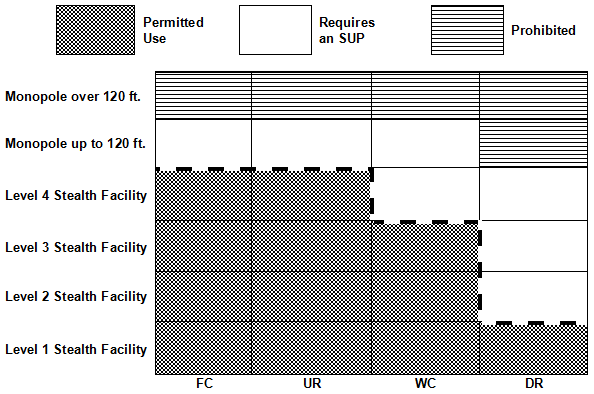
Placement of Antenna Facilities. This section does not apply to amateur radio, TV, and satellite receive-only antennas. For the purpose of determining the appropriate locations for the placement of antenna facilities, the City is divided into land use threshold areas that establish different regulations pertaining to height, location, and type of Antenna Facility. These land use thresholds are defined as follows:
1.
Full Commercial ("FC"). Property within the OP, NS, GB, GB-2, M-1, M-2, or non-residential Planned Development zoning districts.
2.
Undeveloped Residential ("UR"). Property within R-1, R-2, R-3, R-4, GH, R-6, R-7, R-A, MHS, MHP or any residentially zoned PDD, that:
a.
is not a part of a recorded subdivision; or
b.
is a part of a recorded subdivision but has not had a building permit issued for a residential structure and is not located within the calculated limits of the Developed Residential ("DR") threshold.
3.
Wireless Corridors ("WC"). Property within, and 150 feet either side of, the right-of-way of a freeway or a principal arterial roadway, as indicated on the Master Thoroughfare Plan.
4.
Developed Residential ("DR"). Property within the R-1, R-2, R-3, R-4, GH, R-6, R-7, R-A, MHS, MHP, or any residentially zoned PDD, which:
a.
Is a recorded subdivision that has had at least one building permit for a residential structure; or
b.
Is within 600 feet of areas described in Paragraph 4.a.
H.
Antenna Facility Impact Levels. For the purpose of determining appropriate locations for Antenna Facilities, the City recognizes differing levels of impact for antenna facilities depending upon physical location, aesthetics, and land use compatibility. These Antenna Facility Impact Levels are described as follows:
1.
Monopole. A monopole tower requires an SUP. The antenna equipment may not extend more than five feet (5') above the highest point on the monopole.
2.
Level 4 Stealth Facility. The antenna on a Level 4 Stealth Facility is located on an existing structure (other than a telecommunications tower) including, but not limited to, a building, water tower, utility tower, steeple, or light pole. The antenna is neither screened nor hidden. For the purpose of this level, a pole or tower may be reconstructed to structurally hold the antenna but the height of the structure can not be increased.
3.
Level 3 Stealth Facility. The antenna on a Level 3 Stealth Facility is located on an existing structure (other than a telecommunications tower) including, but not limited to, a building, water tower, utility tower, steeple, or light pole. The antenna shall be aesthetically painted, constructed, or applied with material so that it is incorporated into the pattern, style, and material of the structure to effectively render the antenna unnoticeable. A new structure may be constructed to hold or house the antenna or equipment; however, the structure must be consistent with the overall architectural features of the primary buildings
4.
Level 2 Stealth Facility. The antenna on a Level 2 Stealth Facility is attached to the structure in such a manner that if it is seen it appears unrecognizable as an antenna, and the structure in which or on which the antenna is attached is an integral part of an overall development.
5.
Level 1 Stealth Facility. The antenna on a Level 1 Stealth Facility is attached to the structure in such a manner that the antenna is completely unseen and the structure in which or on which the antenna is attached is an integral part of an overall development.
I.
Antenna Facility Siting Matrix. Antenna facilities shall be located in accordance with the following siting matrix. This matrix provides for areas where antenna facilities may be located as permitted uses, areas where they may be located with an SUP, and areas where they are prohibited.
J.
SUP. When an SUP is required by this section for the location of an Antenna Facility or an antenna, the applicant must submit an application in accordance with the procedure established in this UDC. SUPs to this section are granted by the City Council, upon recommendation of the Planning and Zoning Commission in accordance with section 21.5.11 of this UDC.
1.
Application. In order to properly evaluate an application to locate an Antenna Facility or an antenna that requires an SUP, the applicant must provide the following information:
a.
an SUP application and appropriate application fee;
b.
a narrative detailing the proposed Antenna Facility. The narrative must indicate the following:
i.
whether the proposed structure is a co-location, a new monopole tower or a new alternate mounting structure;
ii.
the height of the proposed tower;
iii.
why the Antenna Facility is necessary at the proposed location;
iv.
the name(s) of the telecommunications providers or other users of the antenna or tower and describe the use to be made by each user;
v.
whether the applicant has made an effort to co-locate the facilities proposed for this Antenna Facility on existing antenna facilities in the same general area, identifying the location of these existing sites, and describe in detail these efforts and explain in detail why these existing sites were not feasible;
vi.
all studies or tests performed which demonstrate why the existing sites will not provide sufficient signal coverage;
vii.
written documentation from existing sites' owners and/or operators which confirm the statements provided;
viii.
whether the existing sites allow/promote co-location and, if not, describe why not;
ix.
whether co-location will be allowed to other telecommunications providers at the requested site. If they are not allowed, state every reason and the basis of each reason; and
x.
all state or federal agency approval letters.
c.
Provide a Site Plan of the proposed Antenna Facility at a scale of 1" = 30'. The Site Plan should be on a single 24" x 36" sheet and include:
i.
a survey and legal description of the proposed Antenna Facility;
ii.
a detail on how access to the site is to be achieved;
iii.
a plan view layout of the proposed Antenna Facility clearly showing:
(a)
the location of the facility;
(b)
all equipment and structures in the proposed Antenna Facility;
(c)
the required off street parking space;
(d)
distances to property lines;
(e)
required setbacks;
(f)
adjacent land uses and zoning designations;
(g)
existing structures on the site;
(h)
required landscaping or screening of the base of the tower;
(i)
all recorded and proposed easements; and
(j)
natural features, such as water courses and trees.
d.
Elevation drawings showing:
i.
the design and height of the proposed Antenna Facility;
ii.
detailed drawings of all structures and equipment; and
iii.
screening requirements.
e.
If the requested location is in a residential district the applicant must provide evidence that they have made an effort to locate the facility in a nonresidential district, identify the location of these nonresidential district sites, describe in detail these efforts, and explain in detail why these nonresidential sites were not feasible. Attach all studies or tests performed which demonstrate why the nonresidential sites will not provide sufficient signal coverage.
f.
The applicant must provide a map showing the proposed provider's current coverage area for the City. The map must show the roadway network and be labeled. The applicant must also provide propagation analysis showing the areas the proposed provider's existing antenna currently covers, the areas the applicant's existing sites and the requested site would cover. The propagation analysis must be labeled and have a legend.
g.
The applicant must describe the applicant's master antenna facilities plan for the City. Attach maps and other related documentation. Provide information indicating each phase of the plan.
2.
Consideration of Application. In considering whether to grant an SUP, the City Council and Planning and Zoning Commission shall consider the following:
a.
the appropriateness of the location and design of the Antenna Facility;
b.
the potential for interference with the enjoyment of the use surrounding properties;
c.
aesthetics;
d.
impact, including but not limited to, the surrounding topography, surrounding tree coverage and foliage;
e.
proposed buffering;
f.
the design of the Antenna Facility, with particular reference to design characteristics that have the effect of reducing or eliminating visual obtrusiveness;
g.
the proposed height of the Antenna Facility relative to surrounding structures;
h.
the zoning district and the adjoining zoning districts of the property for which the SUP is sought;
i.
the compliance with the City's regulations; and
j.
the availability of suitable alternative sites. Suitable alternative site(s) shall mean a location or locations that would provide the same or better signal coverage than the proposed site for which an SUP is requested. The applicant shall provide documentation supporting his/her contention that alternative site(s) are not suitable and/or available.
3.
Procedures for Consideration of an SUP. The procedures for consideration of an application for an SUP requested under this section shall be in accordance with section 21.5.11 of this UDC.
K.
Written Report. Denial of an application for an SUP under this section must be documented in writing in accordance with the requirements of the Telecommunications Act of 1996 as amended.
(Ord. No. 18-S-04, § 1(Exh. A), 1-23-2018)
Sec. 21.8.7. - Temporary Structures.
A.
A temporary structure may not be brought on-site until a building permit for the construction or refurbishing of the permanent structure has been issued by the City Manager or his/her designee. All temporary manufactured structures shall be required to comply with the following.
1.
Time Limit. Permits issued for temporary manufactured structures shall be valid for two (2) years or when the permanent structure is completed and occupied, whichever is sooner. Any further extension shall require City Council approval.
2.
Dimensions. Minimum dimensional requirements for temporary uses or structures shall be those established in the district in which the temporary use or structure is located.
3.
Parking. Minimum parking requirements for temporary manufactured structures shall be the number according to the proposed use for the building.
4.
Temporary trailers located in non-residential districts are prohibited in designated parking spaces.
B.
Temporary Construction Buildings: Temporary building and material storage areas to be used for construction purposes may be permitted for a specified period of time in accordance with a permit issued by the City Manager or his/her designee for cause shown. Upon completion or abandonment of construction or expiration of permit, such field offices and buildings shall be removed at the direction of the City Manager or his/her designee.
C.
Temporary portable storage facilities/containers are permitted in residential districts not to exceed sixty (60) days per calendar year. Such storage facilities/containers located in the front yard of residentially zoned property shall be placed on a permanent surface of concrete such as the driveway.
(Ord. No. 18-S-04, § 1(Exh. A), 1-23-2018)
Sec. 21.8.8. - Decks—Attached to Principal Building.
A.
Decks constructed of wood or composite (faux) wood and that are uncovered and open to the sky may extend into the rear yard with a minimum setback from the property line of ten feet (10') and shall comply with the minimum side yard setback established by the zoning district. Decks shall not encroach an easement. Decks that are covered shall be attached to the principal structure and shall comply with the rear and side yard setbacks established by the zoning districts.
Sec. 21.8.9. - Outdoor Display and Storage.
A.
[Generally.] Outdoor display and outdoor storage shall be allowed in Non-residential Districts ancillary to a primary use in accordance with this section. Any merchandise, material or equipment situated outdoors in Non-residential Districts shall be subject to the requirements of this section. For the purpose of this section, outdoor display and outdoor storage shall be classified into two (2) categories enumerated as shown below.
Table 21.8.9
Permitted Outdoor Display and Storage
(P) = Use is permitted in district indicated
(-) = Use is prohibited in district indicated
B.
General Requirements for all Outdoor Display and Outdoor Storage Items.
1.
All areas storing merchandise, equipment, materials, or any other Outdoor Display and Outdoor Storage items shall:
a.
Be paved and painted to distinguish them from required off-street parking areas;
b.
Be clearly shown on the Site Plan submitted for the property additionally any changes to the approved Outdoor Display or Outdoor Storage areas shall require and Amended Site Plan;
c.
Not be located within a required landscape buffer; and
d.
Not be permitted in off-street parking spaces, within the public right-of-way, fire lane, stacking spaces, areas meant for interior vehicle access, to block windows, entrances, exits, or to impede the ability of pedestrians to use the building, including ADA requirements.
C.
Categories of Outdoor Storage and Display.
1.
Outdoor Display. Outdoor Display are items actively for sale or lease that can be perused by the public. Outdoor Display includes items typically seen at home improvement businesses or similar type retail/commercial businesses. Outdoor Display includes items such as pallets of mulch or sod and prefabricated sheds or trailers
a.
Individual items for Outdoor Display cannot exceed fifteen feet (15') in height.
b.
Stacked items for Outdoor Display cannot exceed five feet (5') in height.
c.
The Outdoor Display area shall not exceed twenty-five percent (25%) of the primary building square footage.
2.
Outdoor Storage. Outdoor Storage consists of all remaining forms of Outdoor Storage not classified as Outdoor Display. Outdoor Storage includes, but is not limited to, items of a large size, mass or volume and that are not easily moved or carried such as used tires, railroad ties, discarded inventory, storage pallets, shipping containers, temporary portable storage facilities/containers and semi trailers not attached to a truck. Outdoor Storage also consists of items for sale to include items sold in bulk such as unpackaged dirt, landscape materials, or items associated with a wholesale business. Outdoor Storage items are not considered Outdoor Display and are not permitted in the front yard of the primary structure.
a.
Outdoor Storage is prohibited within public right-of-way or fire lanes.
b.
Outdoor Storage shall not be allowed in off-street parking spaces.
c.
Outdoor Storage items shall not exceed a maximum of 20 feet (20') in height, except for heavy equipment.
d.
Outdoor Storage items shall be enclosed or shall be located at the rear of the structure, but in no event shall general outdoor storage items be visible from public right-of-way.
3.
Exceptions.
a.
Vehicles for sale as part of a properly permitted vehicle sales use (including boats and manufactured housing) shall not be considered merchandise, material or equipment subject to the restrictions of this section.
b.
Such vehicles must be located and displayed on a paved vehicle use area and clearly indicated on the Site Plan.
c.
Flea markets, open air markets, farmer's markets with a permanent Certificate of Occupancy for such use are not subject to the restrictions of this section.
d.
Vehicles awaiting repair, food trucks and trailers associated with a business may apply for a permit to allow parking on an unpaved area for a period not to exceed six months during construction or unique circumstances.
1)
The City Manager or his/her designee shall receive applications, documentation and issue permits for the temporary parking on unpaved areas during construction or other unique circumstances such as parts shortages as the result of a pandemic.
e.
Garden Centers, Lumber Yards, and Outdoor Storage Sales Areas are not considered Outdoor Display or Outdoor Storage if the area:
1)
is attached to and accessible through the primary building;
2)
is enclosed utilizing a metal or steel fence material such as wrought iron with masonry columns, chain link is not permitted; and
3)
is identified on an approved site plan.
f.
Sidewalk Sales are not considered Outdoor Display or Outdoor Storage if:
1)
the items for sale are located in front of or adjacent to the primary building and on the pedestrian walkway; and
2)
all items for sale are stored inside the primary building overnight.
(Ord. No. 22-S-19, § 1(Exh. A), 4-26-2022; Ord. No. 25-S-026, Exh. A, 7-1-2025)

