
Sewalls Point City Zoning Code
ARTICLE IV
DISTRICTS AND DISTRICT REGULATIONS
DIVISION 3. - BUSINESS DISTRICT, B-1[8]
Cross reference— Businesses, ch. 14.
DIVISION 4. - BUSINESS DISTRICT, B-2[9]
Cross reference— Businesses, ch. 14.
Sec. 82-201. - Zoning map; interpretation of district boundaries.
(a)
The zoning districts are described and shown on the map entitled "Zoning Map of Town of Sewall's Point," which, with all explanatory matter thereon, is hereby made a part of this chapter, and which is on file in the town clerk's office.
(b)
Where uncertainty exists with respect to the boundaries of any of the districts as shown on the zoning map, the following rules shall apply:
(1)
Where district boundaries are indicated as approximately following the outside lines of plats which have been recorded in the public records of Martin, Palm Beach or St. Lucie County, such outside lines shall be construed to be such boundaries.
(2)
Where district boundaries are so indicated that they approximately follow the lot lines, such lot lines shall be construed to be the boundaries.
(3)
Where the boundary of a district follows a stream or other body of water, the boundary line shall be deemed to be at the limit of the jurisdiction of the town unless otherwise indicated.
(Ord. No. 95, § IV, 11-17-1976; Ord. No. 111, pt. 1, § 2, 9-13-1978; Ord. No. 188, § 1, 7-25-1990)
Sec. 82-202. - Compliance with district regulations.
Except as provided in this chapter:
(1)
No building or land shall be used or occupied, and no building or part thereof shall be erected, moved or altered, unless in conformation with the regulations specified in this chapter for the district in which it is located.
(2)
No building shall be erected or altered to exceed the height, to accommodate or house a greater number of families, to occupy a greater percentage of lot area, or to have narrower or smaller rear yards, front yards or side yards than specified in this chapter for the district in which such building is located.
(3)
No part of a yard or other open space required adjacent to any building for the purpose of complying with the provisions of this chapter shall be included as part of a yard or other open space required for another building.
Violations of this section shall be a Class D violation, punishable as set forth in chapter 18.
(Ord. No. 95, § V, 11-17-1976; Ord. No. 290, Exh. A, 3-1-2002)
Sec. 82-203. - Lots reduced for public purpose.
When an existing legally created lot is reduced as a result of dedication and/or conveyance to a federal, state or local government for a public purpose, or through eminent domain, then that remaining lot shall be deemed to be in compliance with district lot dimension requirements provided that the remaining lot area is at least 50 percent of the current required minimum, but not less than 15,000 square feet, for property located in the residential (R-1) zoning district, or at least 90 percent of the required minimum for lots in any other district.
(Ord. No. 441, § 2, 4-26-2022)
Subdivision III. - Accessory Dwellings and Guesthouses[7]
Editor's note— Ord. No. 446, § 4, adopted Jan. 10, 2023, repealed subdiv. III, § 86-261, which pertained to residential estate classification and derived from Ord. No. 95, § VI.A.2.b(4), (5), adopted Nov. 17, 1976; Ord. No. 192, § 1, adopted July 25, 1990; Ord. No. 252, § V, adopted Dec. 15, 1998; Ord. No. 290, Exh. A, adopted Jan. 15, 2002; Ord. No. 299, Exh. A, adopted Feb. 17, 2004; Ord. No. 327, § 2, adopted Sept. 12, 2006.
Sec. 82-301. - Generally.
The B-1 district is designated to supply the retail and servicing needs of the community. Wholesale and industrial uses are not permitted uses. The regulations in this division shall apply in all B-1 districts.
Violations of this section shall be a Class D violation, punishable as set forth in chapter 18.
(Ord. No. 95, § VIII, 11-17-1976; Ord. No. 290, Exh. A, 1-15-2002)
Sec. 82-302. - Permitted and prohibited uses.
(a)
Permitted uses. Uses permitted in the B-1 district are as follows:
(1)
All uses permitted in any residential district, subject to all the provisions specified for such residential districts.
(2)
Stores and shops for the conducting of a retail business which do not involve the manufacture of products.
(3)
Personal service shops.
(4)
Professional and business offices.
(5)
Churches, provided that the church building is an independent structure and is not part of an existing shopping center or other building or structure having multiple tenants or businesses operating within the same building or structure.
(6)
Such accessory buildings and uses as are normally incidental to the permitted uses outlined in this subsection.
(7)
Other uses which the town commission decides are of the same general character such as, but not limited to, those listed as permitted uses, and which will not be detrimental to the health, safety, morals and general welfare of the district in which they are located.
(b)
Prohibited uses. Any trade or use that is obnoxious or offensive by the emission of odor, dust, smoke or noise is prohibited.
(c)
Conditional uses. Restaurants and food stores.
(1)
Definitions. The following terms, when used in this section, shall have the meanings ascribed to them in this subsection except where the context clearly indicates a different meaning:
Food store means an establishment where most of the floor area is devoted to the sale of food products for home preparation and consumption. Food store also includes convenience stores.
Restaurant means an establishment where the principal business is the sale of ready-to-consume food and beverage sold to the public primarily for consumption on the premises.
(2)
Conditional use process. Restaurants and food stores, other than convenience stores, will be permitted by the board of zoning adjustment through a conditional use permit application process as set forth in Chapter 82, Article II, Division 3, Subdivision IV Conditional Uses. Food stores, such as convenience stores, specializing in the retail sale of limited family conveniences and necessities, such as but not limited to groceries, drugs, gasoline, and takeout food and drink such as sandwiches and beer, shall not be permitted.
(3)
Existing restaurants and food stores. Restaurants and food stores lawfully established as of the date of this ordinance (May 25, 2021) shall be allowed to continue without submitting an application for the permit described above; however, these existing businesses shall comply with all other applicable ordinances.
(Ord. No. 95, § VIII.A, 11-17-1976; Ord. No. 227, § 1, 3-8-1994; Ord. No. 290, Exh. A, 1-15-2002; Ord. No. 327, § 2, 9-12-2006; Ord. No. 403, § 3, 10-14-2014; Ord. No. 415, § 2, 4-10-2018; Ord. No. 434, § 2, 5-25-2021)
Sec. 82-303. - Building height.
(a)
No building in the B-1 district shall be erected to a height in excess of 30 feet, except as provided by section 82-421.
(b)
Building height shall be measured as the vertical distance from the average natural grade to the highest point of the roof. When a building is located within a special flood hazard area having a designated base flood elevation on the flood insurance rate map (FIRM), the height shall be measured from the required freeboard to the highest point of the roof.
(c)
Violations of this section shall be a Class D violation, punishable as set forth in chapter 18.
(Ord. No. 95, § VIII.B, 11-17-1976; Ord. No. 290, Exh. A, 1-15-2002; Ord. No. 452, § 4, 8-15-2023)
Sec. 82-304. - Lot area.
Lot area in the B-1 district shall be not less than 12,500 square feet.
Violations of this section shall be a Class D violation, punishable as set forth in chapter 18.
(Ord. No. 95, § VIII.C, 11-17-1976; Ord. No. 290, Exh. A, 1-15-2002)
Sec. 82-305. - Lot dimensions.
A lot width of not less than 100 feet is required in the B-1 district. In the case of a corner lot, either of the two street lines may be used to determine the requisite lot width.
Violations of this section shall be a Class D violation, punishable as set forth in chapter 18.
(Ord. No. 95, § VIII.D, 11-17-1976; Ord. No. 290, Exh. A, 1-15-2002)
Sec. 82-306. - Yards.
All buildings erected or constructed in the B-1 business district shall be set back from the Ocean Boulevard (State Road A-1-A) right-of-way 30 feet from the edge of the road right-of-way to provide off-street parking space, as required in article V, division 3 of this chapter. Entrance and exit driveways a minimum of ten feet in width may be provided on each side of the building to provide additional off-street parking in the rear, in a case when the allotted street frontage space is insufficient to meet the requirements of article V, division 3 of this chapter. Before any such entrance and exit driveways shall be constructed, however, a permit for the construction thereof shall be obtained from the town commission. In the case of a corner lot, the setback of 30 feet shall apply on both streets.
Violations of this section shall be a Class D violation, punishable as set forth in chapter 18.
(Ord. No. 95, § VIII.E, 11-17-1976; Ord. No. 290, Exh. A, 1-15-2002)
Sec. 82-321. - Generally.
The regulations in this division shall apply in all B-2 districts.
(Ord. No. 95, § IX, 11-17-1976)
Sec. 82-322. - Permitted uses.
Uses permitted in the B-2 district are as follows:
(1)
All uses permitted in any residential district, subject to all provisions specified for such residential districts.
(2)
Churches, provided that the church building is an independent structure and is not part of an existing office building or other building or structure having multiple tenants or businesses operating within the same building or structure.
(3)
Professional and business offices.
(4)
Other uses which the town commission decides are of the same general character such as, but not limited to, those listed as permitted uses, and which will not be detrimental to the health, safety, morals and general welfare of the district in which they are located.
Violations of this section shall be a Class D violation, punishable as set forth in chapter 18.
(Ord. No. 95, § IX.A, 11-17-1976; Ord. No. 290, Exh. A, 1-15-2002)
Sec. 82-323. - Building height.
(a)
No building in the B-2 district shall be erected to a height in excess of 30 feet, except as provided by section 82-421.
(b)
Building height shall be measured as the vertical distance from the average natural grade to the highest point of the roof. When a building is located within a special flood hazard area having a designated base flood elevation on the flood insurance rate map (FIRM), the height shall be measured from the required freeboard to the highest point of the roof.
(c)
Violations of this section shall be a Class D violation, punishable as set forth in chapter 18.
(Ord. No. 95, § IX.B, 11-17-1976; Ord. No. 290, Exh. A, 1-15-2002; Ord. No. 452, § 5, 8-15-2023)
Sec. 82-324. - Lot area.
The required lot area in the B-2 district shall be the same as for the B-1 business district.
Violations of this section shall be a Class D violation, punishable as set forth in chapter 18.
(Ord. No. 95, § IX.C, 11-17-1976; Ord. No. 290, Exh. A, 1-15-2002)
Sec. 82-325. - Lot dimensions.
The minimum required lot dimensions in the B-2 district shall be the same as for the B-1 business district.
Violations of this section shall be a Class D violation, punishable as set forth in chapter 18.
(Ord. No. 95, § IX.D, 11-17-1976; Ord. No. 290, Exh. A, 1-15-2002)
Sec. 82-326. - Yards.
The required yards in the B-2 district shall be the same as for the B-1 business district.
Violations of this section shall be a Class D violation, punishable as set forth in chapter 18.
(Ord. No. 95, § IX.E, 11-17-1976; Ord. No. 290, Exh. A, 1-15-2002)
Sec. 82-341. - Generally.
The regulations in this division shall apply in all PS-1 districts.
(Ord. No. 95, § X-A, 11-17-1976; Ord. No. 188, § 1, 7-25-1990)
Sec. 82-342. - Permitted uses.
(a)
The PS-1 public service district shall embrace those recreation and open space uses of the town for the general welfare of the residents of the town.
(b)
Public open space, parks, public recreation buildings, playgrounds and other similar uses are permitted in the PS-1 district as may be deemed proper by the town commission.
Violations of this section shall be a Class D violation, punishable as set forth in chapter 18.
(Ord. No. 95, § X-A, 11-17-1976; Ord. No. 188, § 1, 7-25-1990; Ord. No. 290, Exh. A, 1-15-2002)
Sec. 82-361. - Generally.
The regulations in this division shall apply in all PS-2 districts.
(Ord. No. 95, § X-B, 11-17-1976; Ord. No. 188, § 1, 7-25-1990)
Sec. 82-362. - Permitted uses.
(a)
The PS-2 public service district shall embrace those essential services of the town for the servicing and general welfare of the residents of the town.
(b)
Uses permitted are as follows:
(1)
Municipal buildings, including a town hall, fire station and police station.
(2)
Library and post office.
(3)
The installation of water tanks and towers, sewage and water treatment facilities, and the necessary pumps, motors and pipes and accessory buildings by any person holding a utility franchise from the town to furnish water service or sewage facilities to the town.
Violations of this section shall be a Class D violation, punishable as set forth in chapter 18.
(Ord. No. 95, § X-B, 11-17-1976; Ord. No. 188, § 1, 7-25-1990; Ord. No. 290, Exh. A, 1-15-2002; Ord. No. 327, § 2, 9-12-2006)
Sec. 82-241. - Generally.
The regulations in this subdivision shall apply in all R-1 districts.
(Ord. No. 95, § VI, 11-17-1976)
Sec. 82-242. - Permitted and prohibited uses.
Permitted uses in the R-1 district are as follows:
(1)
One single-family dwelling. It shall be unlawful for any person to occupy or to allow the occupancy of a single-family dwelling by any arrangement other than by one family as defined in section 82-1.
(2)
Accessory uses as follows:
a.
Other customary accessory uses and buildings are permitted provided such uses are incidental to the principal use and do not include any activity commonly conducted as a business. Any accessory building shall be located on the same lot with the principal building.
All accessory buildings containing private garages shall: (i) not have any portion of the entryway to the garage facing the front lot line; and (ii) be landscaped with one native tree per 20 feet of building wall, or less, on the side facing the front lot line. Trees shall at maturity exceed the height of the building, be evenly spaced, and be no further than 30 feet from the building. Palm trees may not be used to meet this requirement. (Example: 21 feet of wall would require two trees.)
b.
Accessory dwellings, guesthouses or staff quarters will be permitted only if the following conditions are met:
1.
The lot area shall not be less than 27,500 square feet, exclusive of any private road right-of-way and/or easement to be used for access to or egress from another lot or road.
2.
An accessory dwelling, or, in the alternative, a guesthouse or staff quarters structure, shall be permitted, but not more than one accessory dwelling, guesthouse or staff quarters shall be permitted as to any one residence.
3.
Reserved.
4.
Accessory buildings located less than 100 feet from the front property line shall be limited to one story with a finished ceiling no more than ten feet high.
5.
Home offices. No person shall use any buildings or portion thereof for the purpose of carrying on or practicing any profession, office or calling, and such use is hereby declared to be a violation of this chapter, except for home offices which shall comply with the following requirements:
i.
The home office shall be conducted entirely within a dwelling unit and shall be limited to office uses, unless otherwise permitted by the commission.
ii.
There shall be no change to the exterior of the dwelling unit, including, but not limited to, the provision of parking stalls, signs or lighting, which might indicate there is a business operating upon the property.
iii.
The home office shall not have signage which is visible from the exterior of the property.
iv.
The home office shall generate no more traffic than would be expected from a single-family dwelling in a residential neighborhood.
v.
As part of the home office business, the operator shall not operate any electrical equipment which interferes with any telecommunication services, including, but not limited to, internet, satellite, radio or television reception of neighboring residents.
c.
A greenhouse or slat house shall be permitted, not to exceed 200 square feet; provided, however, that no manure or odor- or dust-producing substance shall be stored within 20 feet of any adjoining lot line; that no greenhouse heating plant shall be operated within 20 feet of any adjoining lot line; that no products, including, but not limited to, flowers or vegetables, shall be produced for commercial purposes; and that at no time shall the plants, vegetables or flowers be grown under artificial lights unless, through the use of some device, such lights are made completely invisible off the immediate premises.
Violations of this section shall be a Class D violation, punishable as set forth in chapter 18.
(Ord. No. 95, § VI.A, 11-17-1976; Ord. No. 111, pt. 1, § 3, 9-13-1978; Ord. No. 145, 2-8-1984; Ord. No. 192, § 1, 7-25-1990; Ord. No. 277, 3-21-2000; Ord. No. 290, Exh. A, 1-15-2002; Ord. No. 299, Exh. A, 2-17-2004; Ord. No. 327, § 2, 9-12-2006; Ord. No. 353, § 3, 9-22-2009)
Sec. 82-243. - Accommodations of persons with disabilities.
(a)
Purpose. The town recognizes that in certain individual circumstances there may be a need to allow reasonable waivers or exceptions to the occupancy limit as provided in this section for a particular single-family dwelling, if requested, to accommodate the special needs of an occupant with disabilities. Such exceptions may include, but are not limited to, allowing an increase in the number of non-related persons allowed to live together in the single-family dwelling provided such modification, waiver or variance does not negatively impact public safety, health, or welfare.
(b)
Procedure.
(1)
Any person claiming to have a disability or any person acting on behalf of a person claiming to have a disability who requests to be excused from an otherwise applicable requirement of this section must provide the town building official with verifiable documentation of a disability legally recognized under the Americans with Disabilities Act, and an explanation of why the need for an accommodation by way of modification, waiver, or variance from the occupancy limit is necessary.
(2)
The applicant shall have the burden of establishing that the proposed accommodation as requested, whether by way of modification, waiver, or variance from the occupancy limit, will not negatively impact the public health, welfare, and safety if allowed.
(3)
If the existence of a disability legally recognized under the Americans with Disabilities Act is established, and the need for a reasonable accommodation is adequately demonstrated, the building official, in consultation with the town manager, is authorized to vary, modify, or waive the occupancy limit as applied to a particular single-family dwelling under such terms and conditions that provide for such accommodation as may be reasonably necessary to afford the disabled person the ability to adequately occupy and use a dwelling, while also preserving the health, safety and welfare of the town.
(4)
The building official's decision on whether to grant or deny the request for accommodation may be appealed to the town commission. Any appeal of the decision of the building official must be made to the town commission no later than 21 days after the applicant's receipt of the building official's decision, which may either be personally delivered to the applicant or sent by certified mail, return receipt requested. All decisions of the town commission shall constitute final action by the town on the applicant's request for an accommodation. Any appeal of the town commission's final action can be made only to a court of competent jurisdiction.
(5)
Any accommodation of the occupancy limit provided for herein by way of modification, waiver, or variance as applied to a particular single-family dwelling shall be the minimum necessary to grant relief to the applicant based on the individual circumstances presented.
(Ord. No. 353, § 4, 9-22-2009)
Sec. 82-244. - Residential district [RI districts.]
Floor elevation and building height limits.
(1)
Survey. Before the appropriate town official may issue a development permit, a development permit applicant must provide the building department with a boundary and topographic survey signed and sealed by an appropriately licensed professional demonstrating that the proposed new construction or substantial improvement meets the requirements of this section. Survey shall be prepared in accordance with chapter 80 of this Code titled, "surveys and drawings".
(2)
Building height is limited to 30 feet and two stories, except as provided by section 82-421.
(3)
Building height shall be measured as the vertical distance from the average natural grade to the highest point of the roof. When a building is located within a special flood hazard area having a designated base flood elevation on the flood insurance rate map (FIRM), the height shall be measured from the required freeboard to the highest point of the roof.
(Ord. No. 263, 8-17-1999; Ord. No. 353, § 5, 9-22-2009; Ord. No. 452, § 3, 8-15-2023)
Editor's note— Ord. No. 353, § 5, adopted Sept. 22, 2009, renumbered § 82-243 as § 82-244. This historical notation has been preserved for reference purposes.
Sec. 82-261. - Setback for accessory dwellings or, guesthouses.
Any owner of a residentially zoned property may obtain permission to construct an accessory dwelling, or guesthouse upon the subdivided land by showing that the lots are comprised of at least 27,500 square feet of land, and the lots have no existing accessory dwelling or guesthouse. The town building department shall be responsible for approving building permits to ensure the structure complies with all local regulations and the Florida Building Code. Violations of this section shall be a Class D violation, punishable as set forth in chapter 18.
(Ord. No. 446, § 4, 1-10-2023)
Sec. 82-271. - Lot area.
Lot areas shall not be less than 15,000 square feet for any lot existing on February 8, 1984, and not less than 18,000 square feet for any lot created after February 8, 1984 until December 21, 1999, and not less than 30,000 square feet for any lot created (or subdivision originally approved) after December 21, 1999. The area of any private road, right-of-way or easement to be used for access to or egress from another lot or a street shall be excluded in the determination of required lot area. For the purposes of this provision, lots within a subdivision shall be deemed to be created on the date that an unterminated concept plan approval was granted by the town for such subdivision.
Violations of this section shall be a Class D violation, punishable as set forth in chapter 18.
(Ord. No. 95, § VI.D, 11-17-1976; Ord. No. 145, 2-8-1984; Ord. No. 275, 12-21-1999; Ord. No. 290, Exh. A, 1-15-2002; Ord. No. 327, § 2, 9-12-2006; Ord. No. 458, § 6, 3-26-2024)
Sec. 82-272. - Lot dimensions.
(a)
The front lot line and rear lot line of each lot in a residential district shall be at least 100 feet in length.
(b)
However, in the case of a cul-de-sac or turnaround area, the street frontage may be less than 100 feet if so approved by the town commission, and if the front setback line meets with the approval of the town commission.
(c)
In the case of a corner lot, either of the two street lines may be used to determine the requisite lot width.
(d)
In the determination of lot dimensions, submerged land is not to be included in the measurement, except where a part of the whole lot as shown on the approved plat is used as a boat slip bounded on three sides by land. In no case, however, shall the submerged portion constitute more than 15 percent of the required lot size.
(e)
Bulkheads or the mean high-water mark (as the case may be) on all waterfront lots and riverfront lots shall be considered the rear lot line of the lot.
Violations of this section shall be a Class D violation, punishable as set forth in chapter 18.
(Ord. No. 95, § VI.E, 11-17-1976; Ord. No. 135, 10-13-1982; Ord. No. 237, § II, 10-9-1996; Ord. No. 290, Exh. A, 1-15-2002)
Sec. 82-273. - Lot coverage.
All buildings, including accessory buildings, shall not cover more than 30 percent of the area of the lot. Nevertheless, in no case shall the percentage of the lot taken up by the impermeable area exceed 45 percent of the lot size.
(Ord. No. 95, § VI.F, 11-17-1976; Ord. No. 191, § 1, 7-25-1990; Ord. No. 274, 12-21-1999; Ord. No. 290, Exh. A, 1-15-2002; Ord. No. 327, § 2, 9-12-2006; Ord. No. 330, § 2, 2-27-2007)
Sec. 82-274. - Setbacks.
Each lot in a residential district shall have front, side and rear setbacks not less than the following:
(1)
Primary residential structure.
a.
Front yard. The front yard depth shall be 35 feet from the platted lot line or property line. The front yard for all lots which border a cul-de-sac shall be on the cul-de-sac.
b.
Side yards. The width of each side yard shall be 20 feet on any lot created after February 8, 1984, or any lot having an area of 18,000 square feet or more and an average width of 120 feet or more, except lots where a single-family dwelling was located on the lot on February 8, 1984. On all other lots, the width of each side yard shall be 15 feet.
c.
Rear yard. The rear yard setback shall be 25 feet.
d.
Corner lots. In the case of a corner lot the front yard may be on either of the street boundaries and the side and rear yards shall be figured in relation to the street boundary on which the front yard is established. Nevertheless, on corner lots, no building or structure shall be erected less than 35 feet from the property line abutting either street right-of-way. Only one rear yard shall be established. At the time a building permit is applied for, the property owner or his agent shall designate the street which the building will front on, and the rear yard for all lots, including corner lots, shall be determined in relation to the street so designated.
e.
Circular lots. On a round circular lot having its perimeter entirely bounded by streets, the setback shall be 35 feet from all perimeter street.
f.
Riverfront lots. On riverfront lots, buildings, as well as garden walls, fences and railings in excess of three feet in height, except those exempted in section 82-276, shall maintain a setback in no case less than 50 feet from the existing mean high water line measured perpendicular from the primary structure to the sea wall or the river.
g.
Waterfront lots developed prior to March 16, 1999. All waterfront lots, as defined in section 82-1, lawfully developed and permitted prior to March 16, 1999, shall maintain a minimum 25-foot setback from the primary or any accessory structure to mean high water line or seawall.
h.
Waterfront lots developed after March 16, 1999. All waterfront lots, as defined in section 82-1, developed after March 16, 1999, or such lots that remain undeveloped, shall meet the setback requirements established herein for riverfront lots.
i.
For purposes of subsection g. and h. herein, "developed" shall mean that a single-family residence was constructed on the lot prior to March 16, 1999, whether that lot currently has a residence thereon or is currently vacant property.
(2)
Accessory dwellings, detached.
a.
Front yard. The front yard depth shall be 50 feet for one-story and 100 feet for two-story structures from the platted lot line or property line.
b.
Side yards. The side yard width shall be 25 feet from the platted lot line or property line.
c.
Rear yard. The rear yard depth shall be 25 feet; provided, however, that in the case of a corner lot the front yard may be on either of the street boundaries and the side and rear yards shall be figured in relation to the street boundary on which the front yard is established. Only one rear yard shall be established. At the time a building permit is applied for, the property owner or his agent shall designate the street which the building will front on, and the rear yard for all lots, including corner lots, shall be determined in relation to the street so designated.
(3)
Accessory structures, detached.
a.
Front yard. The front yard depth shall be 50 feet for one story and 100 feet for two-story structures from the platted lot line or property line.
b.
Side yards. The side yard width shall be 20 feet from the platted lot line or property line.
c.
Rear yard. The rear yard depth shall be 25 feet; provided, however, that in the case of a corner lot the front yard may be on either of the street boundaries and the side and rear yards shall be figured in relation to the street boundary on which the front yard is established. Only one rear yard shall be established. At the time a building permit is applied for, the property owner or his agent shall designate the street which the building will front on, and the rear yard for all lots, including corner lots, shall be determined in relation to the street so designated.
(Ord. No. 95, § VI.G, 11-17-1976; Ord. No. 111, pt. 1, § 5, 9-13-1978; Ord. No. 117, 11-14-1979; Ord. No. 145, 2-8-1984; Ord. No. 237, § IV, 10-19-1996; Ord. No. 249, § I, 11-4-1998; Ord. No. 290, Exh. A, 1-15-2002; Ord. No. 299, Exh. A, 2-17-2004; Ord. No. 327, § 2, 9-12-2006; Ord. No. 330, § 2, 2-27-2007; Ord. No. 363, § 3, 2-22-2011)
Sec. 82-275. - Minimum enclosed living area.
The minimum enclosed living floor space in residential districts shall be 1,500 square feet for all lots on which a dwelling was located (completed or under construction) on April 17, 2001; on all other lots 2,000 square feet. Open porches (covered or not), terraces, patios, courts, breeze ways, carports or garages shall not be included in the computation of minimum enclosed living area. An accessory dwelling or guesthouse shall be exempt from this requirement but shall not be comprised of less than 350 square feet of living space.
Violations of this section shall be a class D violation, punishable as set forth in chapter 18.
(Ord. No. 95, § VI.H, 11-17-1976; Ord. No. 285, § 1, 4-17-2001; Ord. No. 290, Exh. A, 1-15-2002; Ord. No. 446, § 5, 1-10-2023)
Sec. 82-276. - Fences, height, type, and construction standards.
Definitions:
Fence means any freestanding lightweight structure, usually constructed of posts and wire, wood, plastic or aluminum and designed to restrict or prevent movement across a boundary.
Fence, temporary means a fence constructed to temporarily secure a property while it is being developed or redeveloped.
Hedge means a lineal barrier or boundary of plants grown and maintained in such a way that their limbs intertwine and designed to restrict or prevent movement across a boundary.
Wall means a freestanding barrier made from solid brick, stone, concrete or concrete block and designed to restrict or prevent movement across a boundary.
(1)
Fences and walls. The following height, type and construction standards shall apply to fences and walls:
a.
All fences and walls constructed street-ward of the front building setback lines shall be designed so that no more than five feet of its height is a complete solid barrier and not more than seven feet in height overall measured on both sides of the fence, wall or other enclosure from the finished grade of the lot.
b.
Fences, walls and other enclosures adjacent to business zoned property may be ten feet in height.
c.
Where a property line borders on a bay, river, strait or canal the following shall apply: Fence, hedge or other enclosure heights shall be not more than three feet above the finished grade of the lot or bulkhead, to the nearest setback line; with the exception of fences that are required in order to comply with the Florida Building Code and or for insurance purposes when in conjunction with a newly constructed or existing swimming pool/spa.
d.
Fences for swimming pools/spas shall be of a type that does not create an obstruction to any view above three feet in height.
e.
All fences street-ward of the front building setback line or along any side or rear lot line adjacent to the public right-of-way shall be designed and constructed to comply with ASCE 7-02 and withstand wind speeds of 140 m.p.h., three-second gust. Unless designed by rational analysis, wood fences not exceeding six feet in height may be constructed to meet the following minimum requirements:
1.
Vertical post of pressure-treated four inches by four inches spaced as indicated below. Post shall be embedded a minimum of 24 inches into a concrete footing 12 inches in diameter. Horizontal framing shall consist of a minimum of three horizontal rails of pressure-treated two inches by four inches boards for six-foot and five-foot high fences and two horizontal rails of pressure-treated two inches by four inches boards for four-foot high fencing. Rails shall be fastened with two 16D nails or two three-inch deck screws at each post. Three-quarter-inch thick boards (pickets) a maximum of eight-inch width shall be fastened to each rail with two 6D nails or two two-inch deck screws. All lumber shall be a minimum of #2 grade or better. All fasteners shall be corrosion resistant.
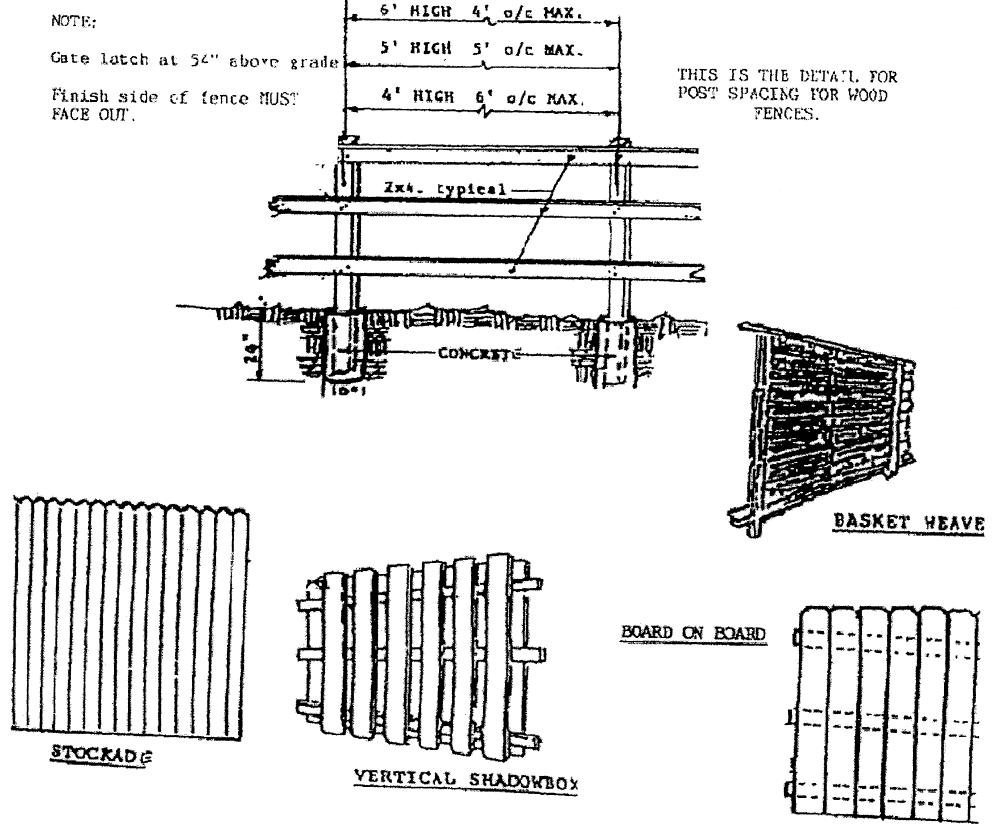
2.
Warning: Pre-manufactured sections may not comply with this code. Product approval may be required.
f.
Chain link fences are not permitted street ward of the front building setback line.
g.
Hog wire, chicken wire, barbed wire, electrified fences, fences with broken glass, spikes or other sharp points are prohibited in all zoning districts.
h.
Fences, walls or other enclosures constructed on side and rear lot lines of non-waterfront properties shall not exceed seven feet in height, expect fences, walls and other enclosures adjacent to business zoned property may be ten feet in height.
i.
Fences or walls located in utility and drainage easements on single-family residential zoned property shall require a written waiver issued by the appropriate authority having jurisdiction over the easement.
j.
Fences with one finished side shall be constructed with the finished side facing out and the support posts and structural members facing inward.
k.
All fences shall be constructed to withstand tropical storm-force winds or greater.
l.
Support posts for all fences shall be set in concrete footers.
m.
Any fence over seven feet in height shall be designed and constructed to comply with the American Society of Civil Engineers (ASCE) 7-02 or the most current version and withstand wind speeds of 140 m.p.h., three-second gust.
n.
A property owner may apply for a temporary fence permit to secure their property while there is active development. Such permit will run concurrently with the building permit(s). The temporary fence may be constructed of materials other than those required for permanent fencing except those listed in g. of this section. The property owner is required to remove temporary fencing when there are no active permits on file with the building official.
(2)
Hedges. Hedges located street-ward of the front building line shall not exceed ten feet in height, hedges located along a side lot line behind the front building line or along a rear lot line may exceed the ten-foot height limitation (and the three-foot limitation for lots bordering bays, rivers, straits or canals), so long as the owners of property adjacent to any such hedge do not file an objection with the town building official. Hedges shall not be composed of exotic or invasive species as defined by the Florida Department of Environmental Protection (FDEP).
Nonconforming hedges of exotic or invasive species in place at the time of the codification of this section shall be allowed to remain, however any replacement, additions or modification made to any existing hedge for any reason, shall be of a plant not listed by FDEP as an exotic or invasive species.
(3)
Corner lots. On a comer lot, no fence, hedge or other enclosure shall be permitted within 40 feet of the intersection of the adjacent right-of-way lines of the two streets, unless such fence, hedge or other enclosure does not exceed three feet in height and is set back no less than ten feet from the edge of the paved surface of the street. In areas on comer lots facing roads where fences, hedges, or other enclosures are allowed higher than three feet, fence, hedge or other enclosure is limited to four feet from the property line abutting a road right-of-way back to the front building line.
(4)
Ornamental entrance gates and gate posts. Ornamental entrance gates and gate posts shall not exceed eight feet in height overall and shall be designed to comply with ASCE 7-02 or the most current version and withstand wind speeds of 140 m.p.h., three-second gust.
(5)
All fences, walls and hedges shall be maintained in a suitable manner. Fences and walls shall be kept clean and free from stains, mold or mildew and in a sound structural condition. Hedges shall be kept trimmed and free any exotic, dead or diseased plants. Hedges shall be maintained by the owner so that they do not extend onto or over any adjacent public or private property or any road right-of-way.
(Ord. No. 95, § VI.C, 11-17-1976; Ord. No. 111, pt. 1, § 4, 9-13-1978; Ord. No. 140, 8-10-1983; Ord. No. 232, 10-12-1994; Ord. No. 246, § 1, 6-16-1998; Ord. No. 290, Exh. A, 1-15-2002; Ord. No. 295, 1-21-2003; Ord. No. 305, 11-16-2004; Ord. No. 337, § 2, 5-22-2007; Ord. No. 356, § 2, 6-22-2010; Ord. No. 446, § 6, 1-10-2023)
Sec. 82-277. - Special regulations for permanently installed generators and accompanying fuel tanks for properties developed prior to the effective date of this ordinance.
(1)
Setbacks. Pads for permanently installed generators shall be located or installed, as far from the property line as possible but in no case less than five feet from any property line and no more than the legal allowable distance from a structure required by the most current version of the National Fire Protection Association (NFPA) standard for "Engines Located Outdoors" (NFPA 37 - 4.1.4). Generators installed in enclosed spaces such as mechanical rooms or garages shall be installed in compliance with the most current version of NFPA 110 & 111. This provision shall not place any additional limitations on generators not located within any required setback.
(2)
Vertical elevation. When a permanently installed generator is located within an "AE" flood zone, the top elevation of the pad shall be no lower than the base flood. In "X" or "X-500" zones, the minimum elevation of the pad shall be set at an elevation no less than eight inches above the roadway crown. The pad shall be a minimum of three and one-half inches thick and comply with all of the standards of the Florida Building Code, established engineering standards and the manufacturer's installation requirements and/or guidelines.
(3)
Fuel tanks for accompanying permanently installed generators. Above-ground fuel tanks are accessory structures subject to the setbacks of the appropriate zoning district.
(4)
Screening. Generators and above-ground fuel tanks shall be screened from public view by landscaping or other material acceptable to the building official.
(5)
Testing. The testing of a permanently installed generator shall be limited to once per week for a period of no more than 30 minutes between 8:00 a.m. and 6:00 p.m., and further limited to Monday through Saturday.
(6)
Permits required. Permits for a residential generator for standby electrical power and accompanying fuel tank permit and any plumbing associated therewith permit shall be obtained from the town building official prior to the installation of the generator and fuel tank.
(Ord. No. 327, § 2, 9-12-2006; Ord. No. 330, § 2, 2-27-2007; Ord. No. 345, § 2, 7-22-2008)
Sec. 82-279. - Accessory structure requirements.
(a)
Purpose. The purpose of this section is to establish minimum appearance standards for detached structures that are permitted accessory uses located on the same residential lot as the principal use. As used herein, the term "accessory structure" shall include accessory dwellings and guesthouses, garages, carports, greenhouses, pool cabanas, gazebos, storage buildings, storage sheds, and other permitted accessory uses.
(b)
All accessory structures in the residential district that are visible from a public roadway shall be consistent with the primary structure in architectural design. Exterior construction materials or facade treatment, roofline and color palette.
(c)
A detached garage shall conform in appearance and design to the principal structure (house). The garage door must be designed to be an integral part of the building's architecture with trim, detailing and fenestrations.
(Ord. No. 465, § 2, 8-27-2024)

