
Shoreview City Zoning Code
CHAPTER 113
SIGNS
Sec. 113-1. - Purpose.
The purpose of this chapter is to regulate the location, size, placement, and certain features of all signs placed on private property for public observation to protect and promote the general welfare, health, safety, and order within the city. The provisions contained within this chapter are meant to encourage creativity and opportunities for effective communication, while ensuring that the public is not distracted or endangered by such communication. This part must be interpreted in a manner consistent with the First Amendment guarantee of free speech.
(Ord. No. 1023, § 208.010, 10-16-2023)
Sec. 113-2. - Definitions.
(a)
The following words, terms and phrases, when used in this chapter, shall have the meanings ascribed to them in this subsection, except where the context clearly indicates a different meaning:
Banner sign means a sign constructed of cloth, flexible plastic, or fabric of any kinds which can be easily folded or rolled (see also Temporary sign and Portable sign).
Base means the supporting structure upon which a sign face is affixed and which must be architecturally compatible with the exterior of the principle structure in the associated development in terms of color, form and exposed material type.
Canopy or awning sign means any sign that is part of or attached to an awning or canopy over a doorway or window. A marquee is not considered a canopy.

Canopy/Awning Sign
Cabinet or canister-style sign means a sign that consists of a translucent sign faces to which the lettering/graphic message is painted onto or molded into.
Changeable copy sign means a sign which is changed manually and not controlled by means of electronic devices.
Comprehensive sign plan means a sign plan for a building and its associated grounds, a multi-building development site or a multi-tenant building indicating the number, types, locations, dimensions, materials, and colors of signs proposed.
Dynamic display billboard means a dynamic display sign is defined as an off-premises sign which is capable of displaying a video signal, including, but not limited to, cathode-ray tubes (CRT), light-emitting diode (LED) displays, plasma displays, liquid-crystal displays (LCD), or other technologies used in commercially available televisions or computer monitors.

Dynamic Display Billboard
Entrance sign means monument sign located at entrance to a development or neighborhood.
Flashing, blinking, or animated sign means an illuminated sign which contains flashing lights or exhibits noticeable changes in color or light intensity.
Flag means a piece of cloth or similar material, typically oblong and square, attached by one edge to a pole and used as a symbol, standard, emblem or insignia, or containing text other than that associated with a commercial, business, or economic interest or activity.
Freestanding sign means any sign structure that is self-supporting, placed in the ground, and not affixed to a building; examples include ground signs and monument signs.
Ground sign means a freestanding sign whose face is mounted upon a base that is 40 to 75 percent of the width of the face and the height of the top of the sign above the ground does not exceed six feet. A ground sign may be externally or internally lighted or unlighted. The face may be individual-letter or cabinet style.

Ground Sign
Ground flag sign means a temporary banner sign which is located upon or affixed to the ground.

Ground Flag Sign
Government sign means a sign erected and maintained by or on behalf of a government entity within the public right-of-way. The term "government sign" includes traffic directional signs.
Freestanding sign height means the vertical distance between the highest part of the sign structure and the average ground level adjacent to and within ten feet of the sign base or the grade of the adjoining street, whichever is less.
Incidental sign means a small sign, emblem or decal, not to exceed three square feet, displayed outside on a premises or displayed in a window or door visible outside of the structure. These signs are distinguished from traffic directional signs.

Incidental Sign
Individual letter-style sign means a sign with a sign faces that is opaque to which the letters/graphics are affixed, cut out of, cut into or resemble such. In the case of wall signs, the buildings elevation constitutes the sign face. The color of the sign face is the same behind each tenant. If lighted from within, only the lettering/graphic area is recognizable as being lighted.

Individual Letter-Style Sign
Marquee sign means any sign attached, or affixed in any manner, or made a part of a marquee.
Message center sign means an on premises sign capable of displaying words, symbols, figures or images that can be electronically or mechanically changed by remote or automatic means.
Monument sign means a freestanding sign whose face is mounted upon a base that is at least 75 percent of the width of the face. A monument sign may be externally or internally lighted or unlighted.

Monument Sign
Multi-vision sign means a sign composed in whole or in part of a series of vertical or horizontal slats or cylinders that are capable of being rotated at intervals so that partial rotation of the group of slats or cylinders produces a different image and when properly functioning allows on a single sign structure the display at any given time one of two or more images.
Obsolete sign means a sign that no longer identifies or advertises a bona fide business, lessor, service, owner, product, or activity and/or for which no legal owner can be found.
Pennant sign means a sign made of flexible materials normally fastened from one or two corners to a stringer which is tethered to allow movement of the sign caused by movement of the atmosphere.
Permanent sign means a sign attached to a building, structure, or the ground which is constructed of durable materials intended for long-term use.
Portable sign means a movable sign that is not permanently attached to a structure or the ground.
Projecting sign means a sign which is affixed to a building and which extends perpendicularly from the building wall more than 12 inches.
Pylon sign means any permanent, freestanding sign whose sign face is mounted upon a sign base that is less than 40 percent of the width of the face and the height exceeds six feet.

Pylon Sign
Roof sign means any sign which is erected, constructed or attached wholly or in part upon or over the roof of a building, unless attached to a parapet or mansard structure that is an architectural component of the building.
Rotating sign means a sign or a portion of a sign which moves in a rotating, oscillating, or similar manner.
Sandwich board sign means a type of moveable pedestrian oriented sign constructed of two independent faces that are attached so its side view resembles a triangle or "T."

Sandwich Board Sign
Shimmering sign means a sign which reflects an oscillating sometimes distorted visual image.
Sign face means the area or display surface used for the sign message.
Sign rider means a smaller sign accompanying a larger sign which is typically fastened above, below, or next to the larger sign.
Sign structure is a term used in conjunction with freestanding signs, meaning the sign face together with the sign base.
Static billboard sign means a freestanding sign which directs attention to a business, commodity, service, or entertainment not related to the premises where such a sign is located.
Temporary sign means any sign which is erected or displayed on a non-permanent basis for a limited period of time.
Traffic directional sign means any on-premises sign used to guide the circulation of motorists or pedestrians on the site.
Transit amenity sign means a sign which is affixed to or painted on a transit amenity, such as a transit bench or shelter.
Video display sign means a sign that changes its message or background in a manner or method of display characterized by motion or pictorial imagery, which may or may not include text and depicts action or special effect to imitate movement, the presentation of pictorials or graphics displayed in a progression of frames which give the illusion of motion, not including electronic changeable copy signs. The term "video display signs" includes projected images or messages with these characteristics onto buildings or other objects but do not include message center signs or dynamic display billboards.
Wall sign means a single-faced sign which is affixed to the exterior wall of a building and which is parallel to the building wall and which does not project more than 12 inches from the wall surface to which it is attached, nor extend beyond the top of a building elevation or parapet wall, whichever is higher.
Window sign means a sign affixed to or inside of a window in view of the general public. Merchandise on display is not considered window signage.
(b)
Except for terms defined in this section and unless otherwise specifically provided in this chapter, the definitions section forth in section 101-2 shall apply to this chapter.
(Ord. No. 1023, § 208.020, 10-16-2023)
Sec. 113-3. - Prohibited signs.
The following signs are prohibited:
(1)
Rotating signs.
(2)
Roof signs.
(3)
Projecting signs.
(4)
Portable signs that do not meet the requirements in section 113-4.
(5)
Ground flag signs.
(6)
Obsolete signs.
(7)
Multi-vision signs.
(8)
Shimmering signs.
(9)
Video display signs.
(10)
Static billboard signs.
(11)
Signs which are attached to trees, fences, utility poles or other similar objects.
(12)
Signs painted directly on buildings, walls or fences.
(13)
Flashing, blinking or animated signs, including, but not limited to, traveling lights or any other means not providing constant illumination, except approved message center signs.
(14)
Pennants, whirling devices, balloons, inflatable devises and/or other apparatus resembling the same.
(15)
Signs that obstruct any window, door, fire escape, stairway, or opening intended to provide light, air, ingress or egress for any structure.
(16)
Signs placed on vehicles or trailers which are parked or located for the primary purpose of displaying the sign, except such signs attached to buses, taxis or other vehicles operating during the normal course of business.
(17)
Signs which constitute public nuisance, as defined by chapter 22, or signs erected without the permission of the property owner.
(18)
Signs located within the public right-of-way unless specifically permitted elsewhere in this section.
(19)
Signs that interfere with the proper functioning of a traffic sign or signal, obstructs the vision of pedestrians, cyclists, or motorists or otherwise constitutes a public hazard.
(Ord. No. 1023, § 208.030, 10-16-2023)
Sec. 113-4. - Exempt signs.
The following signs do not require a permit as long as the following requirements are met:
(1)
Property identification numerals and occupants name are permitted as long as the following are met:
a.
The numerals and letters are clearly visible from the street for each principal structure that has been assigned an address
b.
The numerals and letters shall be no larger than ten square feet for nonresidential or two square feet for residential.
(2)
Flags.
a.
All flagpoles shall be setback at least 20 feet from all property lines.
b.
Flagpoles shall not exceed 35 feet in height, unless associated with a structure at least 30 feet in height, in which case flagpoles up to 50 feet in height may be permitted. On nonresidential properties, the display of up to four flags is permissible. On residential properties, no more than two flags are permitted.
c.
Any other display of flags shall require approval of a comprehensive sign plan.
(3)
Traffic directional signs authorized by a government entity with proper jurisdiction.
(4)
Traffic directional signs within a private development or center permitted the following are met:
a.
All signs have a uniform design on a site.
b.
If located within a right-of-way, the sign shall comply with all applicable roadway authority rules for height, location and size.
c.
The signs are as small and as low to the ground as practical to convey the intended information.
d.
The minimum number of such signs necessary to convey the intended information.
(5)
Official notices authorized by a court, public body, or public safety official.
(6)
"No Trespassing" and "No Hunting" signs and similar warning or restrictive signs, not to exceed two square feet in area.
(7)
One portable sign with a sign face no larger than four square feet.
(8)
One window sign no larger than 8.5 inches by 11 inches.
(9)
Temporary signs in residential zoning districts.
(Ord. No. 1023, § 208.040, 10-16-2023)
Sec. 113-120. - Sign permits.
The procedure for obtaining a sign permit is provided in section 103-97.
(Ord. No. 1023, § 208.091, 10-16-2023)
Sec. 113-121. - Enforcement.
(a)
All signs for which a permit is required shall be subject to inspection by a city official who is hereby authorized to enter upon any property or premises to ascertain whether the provisions of this chapter are being obeyed. Such entrance shall be made during business hours unless an emergency exists.
(b)
Any sign which no longer advertises a bona fide business, or a product sold, shall be taken down and removed by the owner, agent or person having the beneficial use of the building or structure upon which sign may be found within 30 days after written notification from the city official. Upon failure to comply with such notice within the time specified in such order, the city council may declare the sign to be a public nuisance, remove it, and assess the cost of removal to the property owner.
(c)
Illegal or nonconforming temporary signs shall be removed by the property owner within three days of written notification from the city. Failure to comply with such notice shall be a misdemeanor. Upon failure to remove within the time specified in such order, the sign is declared to be a public nuisance and may be removed by the city.
(d)
The city official may order the removal of any sign that is not maintained in accordance with the maintenance provisions of this chapter. Upon failure to comply with such notice within the time specified in such order, the city council may declare the sign to be a public nuisance, remove it, and assess the cost of removal to the property owner.
(e)
Separate violations.
(1)
Each sign installed, erected or maintained in violation of this chapter shall be considered a separate violation.
(2)
Each day a sign is installed, erected or maintained in violation of this chapter shall be considered a separate violation.
(f)
The city may, at any time and without notice, order the impoundment of signs which have been installed on public property, within a public right-of-way or within a public easement. The sign owner may retrieve an impounded sign according to the following rules:
(1)
Payment of an impound release fee. Any subsequent impoundments, within one calendar year, for a particular property or sign owner will require payment of double the initial impoundment release fee.
(2)
Any impounded sign must be retrieved from the impound area within 30 days of the impoundment or the city will dispose of it. Any cost incurred by the city for disposal of an impounded sign shall be assessed to the sign owner or responsible party.
(3)
The city shall have no obligation to notify a property owner that it has impounded a sign.
(4)
The city may not be held liable for any damage to an impounded sign.
(Ord. No. 1023, § 208.093, 10-16-2023)
Sec. 113-27. - Location; setbacks.
Unless stated otherwise in this chapter, signs shall be setback at least five feet from all property lines. The city may require a greater setback because of public safety reasons that may include, but not be limited to, vehicle sight distances, distance from intersections, and function of an adjoining right-of-way
Ord. No. 1023, § 208.061, 10-16-2023)
Sec. 113-28. - Area.
Except as otherwise provided, the area of a sign shall be calculated by means of the smallest rectangle that will encompass the extreme limits of the sign content, together with any material or color forming an integral part of the background of the display or used to differentiate the sign from the backdrop or structure against which it is placed, but not including any supporting framework, base, bracing or decorative fence or wall when such fence or wall otherwise meets the regulations of this chapter and is clearly incidental to the display itself (See Table 113-28 below).
(1)
For a single wall on a single-occupant building, all content and graphics on that wall shall be measured as though part of one sign, encompassed within one rectangle, which may not exceed the maximum permitted sign area.
(2)
If the faces of a double-faced sign are parallel or the interior angle formed by the faces is 45 degrees or less, only one display face shall be measured in computing sign area. If the two sides of a double-faced sign are of an unequal size, the area of the sign shall be the area of the larger face.
(3)
In all other cases, the areas of all faces of a multi-faced sign shall be added together to compute the area of the sign.
Table 113-28. Measuring Sign Area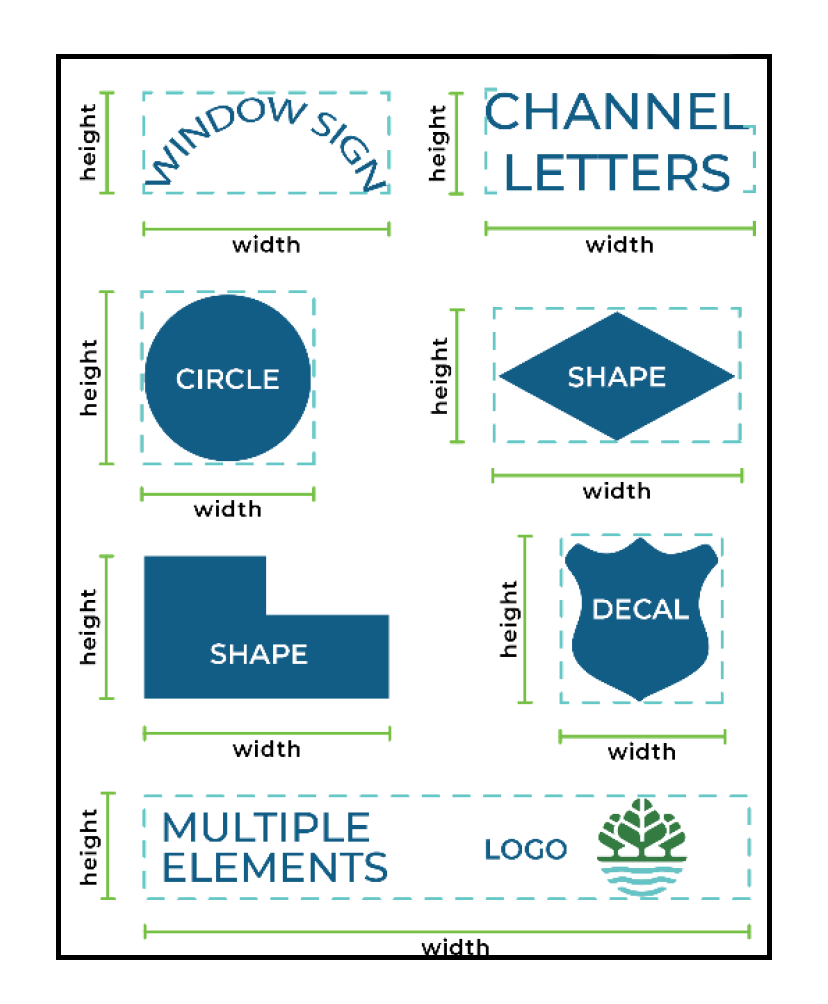
(Ord. No. 1023, § 208.062, 10-16-2023)
Sec. 113-29. - Construction and lighting.
(a)
All signs shall be constructed and maintained in accordance with applicable provisions of the state building code and electrical code. Permanent freestanding signs shall have self-supporting structures erected on and permanently attached to concrete foundations. Walls that are meant to support wall signs shall be designed and constructed with sufficient strength to support the proposed sign.
(b)
All lights aimed at a sign must have all the light hit the sign (or be blocked by a shield/hood) and should shine from above instead of from below when practical. Where wall signs are displayed on the same building elevation or where a freestanding sign is divided into parts, all signs or parts must be lighted if one is lighted, and the lighting type (internal or external) shall be uniform.
(c)
Signs may be internally or externally lighted or be unlighted, unless otherwise stated herein. Signs which are not internally illuminated shall have their light fixtures and light sources screened from view.
(d)
No sign may be brighter than is necessary for clear and adequate visibility.
(e)
No sign may be of such intensity or brilliance that it interferes with the effectiveness of an official traffic sign, device or signal.
(f)
No sign may be of such intensity or brilliance as to impair the vision of a motor vehicle driver with average eyesight or to otherwise interfere with the driver's operation of a motor vehicle.
(g)
All sign that have illumination by a means other than natural light must be equipped with a mechanism that automatically adjusts the brightness in response to ambient conditions. These signs must also be equipped with a means to immediately turn off the display or lighting if it malfunctions, and the sign owner or operator must immediately turn off the sign or lighting when notified by the city that it is not complying with the standards of this section.
(Ord. No. 1023, § 208.063, 10-16-2023)
Sec. 113-30. - Maintenance and repair.
(a)
All sign components shall be kept in a sound structural and attractive condition, which shall constitute, but no limited to: replacement of defective, missing, or broken parts, including lighting; periodic cleaning; maintenance of the display surface to keep it neatly painted or posted at all times; and maintenance by the owner of the landscaping near the sign to keep it free and clear of all obnoxious substances, rubbish and weeds.
(b)
Obsolete messages shall be removed within 14 days of becoming obsolete.
(c)
All legal nonconforming signs are subject to all requirements of this chapter regarding safety, maintenance, and repair. Repair of a legal nonconforming sign is subject to the provisions of chapter 111, article IV.
(Ord. No. 1023, § 208.064, 10-16-2023)
Sec. 113-31. - Permitted signs.
Permanent signs are permitted, subject to area, height and location requirements of this chapter. Provisions of a comprehensive sign plan may deviate from these requirements.
(Ord. No. 1023, § 208.070, 10-16-2023)
Sec. 113-32. - District chart.
The following table pertains to sign types:
Table 113-32
Notes:
1 Wall signs permitted for attached residential uses.
2 All freestanding signs associated with approved institutional uses and residential developments shall be ground or monument-style.
3 Dynamic display billboards may be located in a PUD district with a base district of C2.
(Ord. No. 1023, § 208.071, 10-16-2023)
Sec. 113-33. - Comprehensive sign plan.
An approved plan may vary from the design and dimensional standards set forth in this chapter without approval of a formal variance, provided it meets the criteria set forth in section 103-97.
(1)
Comprehensive sign plans are required when deviations are proposed from the design and dimensional standards set forth in this section. Sign permits shall not be issued for multiple signs of a single type until a comprehensive sign plan has been approved.
(2)
The comprehensive sign plan review shall consider five elements that shall govern all signs within the development: location, materials, size, color and illumination. The comprehensive sign plan application shall include details, specifications, dimensions, and plans showing the proposed locations of signs and how such signs conform to the requirements of this chapter. It shall also show the computations of the maximum total sign area permitted for the site as well as any special computations regarding additional signs proposed.
(3)
The plan should show the allocation of permitted wall sign space among tenants and any general building signs. When such allocation is not specified in the plan, the city may issue permits for wall signs for tenant entrances, in accordance with this chapter, in proportion to the frontage such tenant controls on the applicable wall. The city will cease to issue permits in such cases when all available wall sign area has been committed through permits.
(Ord. No. 1023, § 208.080, 10-16-2023)
Sec. 113-34. - Bonus sign area.
(a)
General provisions. To encourage design excellence, the maximum allowable sign area may be increased by the percentage as provided in this section. A separate bonus may be granted for compliance with each of the criteria, and the area cumulative, to a maximum of 100 percent increase. The percentage increase in based on the original sign area maximum size. The bonus sign area applies to all zoning districts. All bonus sign area allowances are to be reviewed and recommended by the planning commission and the city council.
(b)
Bonus allowed. Sign area may be increased based on the following standards:
(1)
A 25-percent increase from the base sign area when a freestanding sign is installed in a landscaped bed having at least three times the area of the sign face. A bond, in an amount equivalent to 125 percent of the landscaping cost, may be required in order to ensure that the landscaping is planted and survives at least one year after planting.
(2)
If freestanding signage is not installed, the area for any allowable wall sign may be increased by 25 percent of the base sign area.
(3)
If a wall sign is not installed, the area of any allowable freestanding sign may be increased by 25 percent of the base sign area.
(4)
Twenty-five percent increase in the base sign area when the sign is constructed of materials and colors that complement the exterior of the building.
(Ord. No. 1023, § 208.092, 10-16-2023)
Sec. 113-57. - Wall signs.
(a)
Single-tenant buildings.
(1)
One wall sign is permitted per principal structure, unless the structure faces two or more arterial roadways. In such instance, a second wall sign may be permitted provided the signs face different arterial roadways.
(2)
The length of a wall sign shall not exceed 20 percent of the length of the building elevation to which it is affixed.
(3)
Any lighted portion of a mansard, parapet, fascia, building elevation or similar structure shall count toward the allowable signage defined in Table 113-57 below subsection (b) of this section.
(4)
Signs may be affixed to fuel island canopies, or canopy supports, with approval of a comprehensive sign plan, provided:
a.
Their area, together with any other wall and incidental signage on the accompanying structures, does not exceed the permissible amount of area of a single wall sign.
b.
The area shall not exceed ten percent of the canopy fascia area to which it is attached. Any lighted area on the sign fascia shall count as sign area.
(5)
Wall signs may extend above a roofline only when attached to a parapet wall or similar structure that is an approved architectural component of the structure.
(b)
Signs affixed to marquees, mansards, canopies, awnings, etc., and to building elevations shall all be considered wall signs for purposes of the enforcing this section.
Table 113-57. Wall Sign Dimensional Requirements
Notes
1.
The city reserves the right to require a reduction in the maximum permissible area, but not to less than 40 square feet, dependent upon the architectural characteristics of the building, site location, and land use type.
2.
The city reserves the right to require a reduction up to 60 percent in permitted area when the building is determined to be signature architecture.
(c)
Multi-tenant buildings. Multi-tenant buildings with more than one wall sign or more than two wall signs if the building has frontage on two arterial roadways, will require a comprehensive sign plan, per section 113-33.
(Ord. No. 1023, § 208.072(A), 10-16-2023)
Sec. 113-58. - Freestanding signs.
(a)
Each principal structure, excluding individual multifamily residential buildings is entitled to one freestanding sign, unless stated otherwise in this section. Sites that adjoin two or more arterial roadways may have two freestanding signs.
(b)
At least 75 feet of separation shall exist between all freestanding signs.
(c)
Free standing signs shall be located outside of street, utility, drainage, trail/sidewalk easements and be placed at least five feet from any property line.
(d)
The maximum area of a freestanding sign shall be a function of:
(1)
The gross floor area of the principal structures located in the development.
(2)
The style of the sign, according to Table 113-58-1, unless otherwise specified in this section.
(e)
If a freestanding sign will face property planned for residential use, the sign area shall not exceed 40 square feet and the height of the sign face shall not exceed six feet.
(f)
Freestanding signs may be single-faced or double-faced. If single-faced, and the backside will be visible, the backside shall be constructed of a material and/or painted to be a neutral color that is compatible with the principle structure.
Table 113-58-1. Freestanding Sign Dimensional Requirements—Individual Letter Sign
Notes:
1.
Except for the ">100,000 sq. ft." category, the sign area for highway commercial development sites (fuel stations, restaurants) that abut I-694 or I-35W may be increased up to two times and the sign height may be increased up to 50 percent through approval of a conditional use permit or planned unit development.
2.
The stated sign heights and areas in this table are maximums for the three largest floor area categories. Dependent upon architectural characteristics of a particular development, the city may require less than maximum permissible area of height.
3.
The sign structure shall not exceed 75 percent of the permitted maximum sign area.
Table 113-58-2. Freestanding Sign Dimensional Requirements—Cabinet-Style Sign
Notes:
1.
Except for the ">100,000 sq. ft." category, the sign area for highway commercial development sites (fuel stations, restaurants) that abut I-694 or I-35W may be increased up to two times and the sign height may be increased up to 50 percent through approval of a conditional use permit or planned unit development.
2.
The stated sign heights and areas in this table are maximums for the three largest floor area categories. Dependent upon architectural characteristics of a particular development, the city may require less than maximum permissible area of height.
3.
The sign structure shall not exceed 75 percent of the permitted maximum sign area.
(Ord. No. 1023, § 208.072(B), 10-16-2023)
Sec. 113-59. - Entrance signs.
(a)
One entrance sign is permitted per development site, unless the site has access on two or more arterial roadways. In such instances, a second entrance sign may be permitted by comprehensive sign plan approval.
(b)
The area and height of an entrance sign shall be limited as shown in Table 113-58-2, except residential developments of 20 or more units, as below.
(1)
C1, C2, OFC, BPK, and I districts: Gross floor area shall be for the development site.
(2)
Entrance signs in residential developments of 20 or more units shall have a maximum height of 12 feet and area not to exceed 32 square feet.
(c)
Approval of a comprehensive sign plan is required to construct an entrance sign if there will be any other freestanding signs on the site, including a second entrance sign. If another freestanding signs is proposed for a development, it shall be no larger than 50 percent of the area of the primary sign and not taller than ten feet and comply with the sign dimensional requirements as stated in Table 113-58-2.
(Ord. No. 1023, § 208.072(C), 10-16-2023)
Sec. 113-60. - Changeable copy.
(a)
Changeable copy signs shall be integrated into a freestanding sign.
(b)
The maximum area of the changeable copy sign shall not exceed 40 square feet of area in the C1 and C2 districts.
(c)
The electronic copy shall be a static display using a single color and shall not scroll, flash or blink or include animated copy or graphics.
(d)
The level of illumination shall be controlled and limited as specified in section 113-29.
(Ord. No. 1023, § 208.072(D), 10-16-2023)
Sec. 113-61. - Message centers.
(a)
Message center signs shall be integrated into a freestanding sign that is a monument or ground style sign.
(b)
Message center signs may be permitted as part of an incidental sign in accordance with section 113-62.
(c)
Only one message center sign, not including those as part of an incidental sign, is permitted for each principal structure.
(d)
General provisions.
(1)
Display. The sign message shall be displayed to allow passing motorists to read the entire copy with minimal distraction. The minimum display period for any message shall be eight seconds.
(2)
Audio speakers, pyrotechnics. Audio speakers or any form of pyrotechnics are prohibited.
(3)
Lighting.
a.
Lighting shall be set at a minimum level which the billboard is intended to be read and shielded to minimize glare.
b.
The light level shall not exceed 0.3 footcandles above ambient light as measured from a pre-set distance depending on sign size. Measuring distance shall be determined using the following equation: the square root of the product of the message center sign area and 100. Example: 12 square foot sign √(12x100) = 34.6 feet measuring distance.
c.
The sign must have an automatic dimmer control that automatically adjusts the sign's brightness in direct correlation to ambient light conditions. The sign shall be equipped with a photo cell designed to measure the ambient lighting conditions and adjust the sign brightness as needed so as to be in compliance with the ordinance.
d.
No portion of the message may flash, scroll, twirl, fade in or out in any manner to imitate movement.
e.
Display of messages shall be limited to those services offered on the property and time/temperature display.
(e)
C1, C2, OFC, BPK, and I zoning districts. The following applies to the C1, C2, OFC, BPK, and I zoning districts:
(1)
The area of the message center sign shall be included in the maximum sign area permitted for the sign type. Message center signs are permitted, provided the maximum area does not exceed 50 percent of the total sign area on which it is displayed of 50 square feet whichever is less. The maximum sign area may be exceeded to comply with the minimum sign area required.
(2)
Minimum area for message center signs in these zoning districts is 20 square feet.
(3)
A comprehensive sign plan is required for the installation of a message center sign when the property abuts or is adjacent to property that is established with residential land uses.
(4)
The location and orientation of the sign shall be placed on the property in a manner that minimizes the visual impact on adjoining residential properties.
(5)
When the sign is located on a parcel adjacent to residential land use, the sign shall be turned off and shall not display messages between the hours of 11 pm and 6 am.
(Ord. No. 1023, § 208.072(E), 10-16-2023)
Sec. 113-62. - Incidental sign.
(a)
Not to exceed a total of three square feet in area, unless integral to and permanently included within the architectural perimeter of an approved wall or freestanding signs, in which case up to six square feet is permissible.
(b)
Incidental sign area shall count towards the total amount of permitted wall signage area.
(Ord. No. 1023, § 208.072(F), 10-16-2023)
Sec. 113-63. - Dynamic display billboards.
(a)
Where permitted, intent. Dynamic display billboards are permitted along high-volume interstate corridors where the city has land use control on each side of the interstate right-of-way. As such, the signs may only be placed along the I-694 Highway corridor. The intent is to minimize the impact the signs may have on adjoining communities.
(b)
General standards.
(1)
Location and setback requirements.
a.
Dynamic display billboards are permitted within 150 feet of I-694 right-of-way and must be oriented to be read form the interstate.
b.
The minimum linear distance between dynamic display billboards located on the same side of the I-694 shall be 5,250 feet.
c.
The sign structure shall maintain a minimum setback of ten feet from any property line.
d.
The minimum linear distance for the sign structure from any road intersection with I-694 shall be 1,300 feet as measured from the centerline of the road right-of-way.
e.
The minimum setback for the sign structure from any residential use is 500 feet.
f.
Prior to the issuance of the sign permit, a visual impact analysis may be required if the city manager determines the proposed dynamic display billboard could have a detrimental visual impact on a residence, residential neighborhood or obstruct the views of city park or county open space from properties developed with a residential use.
(2)
Permitted on vacant properties. Dynamic display billboards are permitted only on properties that are vacant and not occupied by another structure or building.
(3)
Size.
a.
The maximum gross surface area for each face of a dynamic display billboard shall be 700 square feet.
b.
Signs may be single or double-faced.
c.
The maximum height of the dynamic display billboard structure shall not exceed 50 feet above the grade elevation of I-694 road surface from which the sign is to be read, however, the height may be increased if the sign's visibility is obstructed by vegetation, a structure or other objects. In situations where obstructions are present, the sign height may be increased to 30 feet above the height of obstruction. In no case shall the sign height exceed 70 feet above the grade elevation unless approved by the city manager. If obstructions are present that require a greater sign height, an increase in sign height may be permitted, provided the city manager determines the height is needed to view the sign and practical difficulties are present.
(c)
Design requirements.
(1)
Concealed. All visible sign support columns shall be concealed with an approved architectural treatment primarily consisting of natural stone, brick, approved masonry panels, stucco or architectural metal.
(2)
Screening. Ground equipment and facilities shall be screened from view using landscape materials.
(3)
Message standards.
a.
The images and messages must be static, and the transition from one static display to another must be direct and immediate without special effects.
b.
Each image and message displayed must be complete in itself and may not continue into a subsequent image or message.
c.
Each image and message shall be displayed with minimum time duration of eight seconds before changing to the next image and message.
(4)
Brightness.
a.
Lighting shall be set at a minimum level necessary to provide clear viewing from the roadway in which the billboard is intended to be read and shielded to minimize glare.
b.
The sign shall be equipped with a dimmer control and photo cell designed to measure the ambient lighting conditions and adjust the sign brightness as needed.
c.
The light level shall not exceed 0.3 footcandles above the ambient light conditions as measured a horizontal distance 250 feet from the sign face.
(5)
Agreement. If the city approves a permit to install a dynamic display billboard, the permit holder, property owner and city shall enter into an agreement that identifies the terms, including, but not limited to:
a.
The sign shall display public service announcements allowing the city the ability, if the city chooses to participate, at no cost to the city, to provide public service messages.
b.
The sign shall be part of the state's public safety alert system if the system is operable and incorporates dynamic display billboards.
(Ord. No. 1023, § 208.072(G), 10-16-2023)
Sec. 113-64. - Transit amenity signs.
Transit amenity signs are permitted subject to the licensing provisions of chapter 34, article VI.
(Ord. No. 1023, § 208.072(H), 10-16-2023)
Sec. 113-87. - Residential districts.
The following temporary sign regulations apply to the RE, R1, R2, R3 and R4 zoning districts:
(1)
Permit. Temporary signs in residential zoning districts do not require permit approval.
(2)
Location. Temporary signs must be placed solely on private property and must maintain a minimum two-foot setback from public sidewalks and roadways.
(3)
Illumination. Temporary signs shall not be illuminated.
(4)
Size. Temporary signs shall not exceed 12 square feet and 12 feet in height.
(5)
Number of signs. Up to four temporary signs are allowed per property.
(6)
Additional signs during election periods.
a.
Election period. An election period begins 46 days prior to a state primary and ten days following an election conducted under federal, state, county or city laws or ordinances in which residents of the city are entitled to vote.
b.
Number of signs permitted. An unlimited number of temporary signs are allowed.
c.
Setbacks. Signs must be setback a minimum of six feet from the edge of any roadway and shall not interfere with vehicle or pedestrian visibility. Signs placed on corner lots shall not obstruct views to or from the roadway.
(Ord. No. 1023, § 208.051, 10-16-2023)
Sec. 113-88. - Commercial and industrial districts.
The following temporary sign regulations apply to the C1, C2, C1A, OFC, BPK, and I zoning districts:
(1)
Permits. Temporary signs in commercial and industrial zoning districts require sign permit approval.
(2)
General standards.
a.
Temporary signs may not exceed 32 square feet in area.
b.
No more than two temporary signs per tenant shall be displayed at any one time.
c.
No more than four temporary signs shall be allowed per calendar year, per tenant, and permits for the display of such signs shall be valid for up to 14 days. All such signs shall be removed from the premises no more than one working day following the expiration of the permit.
d.
A minimum period of seven days shall be required between temporary sign permits issued for a tenant.
e.
No temporary signs shall be allowed on property that has a changeable copy sign or message center sign.
(3)
Types. Allowed temporary sign types:
a.
Sandwich board signs:
1.
The sign shall not exceed two feet in width and three feet in height.
2.
The sign may have only two sign faces.
3.
Only one sandwich board sign is allowed per business.
4.
Sandwich board signs shall be located in front of and within 12 feet of the main entrance of the business it is advertising.
5.
The placement of the sandwich board sign must be such that there is a minimum of 36 inches of unobstructed sidewalk clearance between it and any other building or obstruction.
6.
Sandwich board signs cannot interfere with pedestrian or traffic safety.
7.
Sandwich board signs must be brought indoors at or before the close of business for the day.
b.
Banner signs:
1.
A multitenant or single-tenant building less than 50,000 square feet in gross floor area can have one banner sign on the premises not to exceed 32 square feet.
2.
A multitenant or single-tenant building with 50,000 square feet gross floor area or greater may have one banner sign on the premises not to exceed 64 square feet.
3.
Banner signs must be affixed to the principle structure.
c.
Window signs:
1.
A window sign shall not exceed ten percent of the total glass area of the individual window or door in which it is displayed.
2.
Illuminated window signs shall not exceed five percent of the total glass area of the individual window or door area in which it is displayed. Said sign area shall be included in the maximum area permitted as identified in subsection (2)a of this section.
(Ord. No. 1023, § 208.052, 10-16-2023)

