
South Fork City Zoning Code
ARTICLE 8
- SIGN REGULATIONS
Sec. 16-8-10.- Purpose.
The purpose of this Article is to coordinate the use, placement, physical dimensions and design of all signs within the Town, and to:
(1)
Recognize that signs are a necessary means of visual communication for the convenience of the public and provide flexibility within the sign review/approval process to allow for unique circumstances and creativity.
(2)
Recognize and ensure the right of those concerned to identify businesses, services and other activities by the use of signs, and limit signs to those which are accessory and incidental to the use on the premises where such signs are located.
(3)
Provide a reasonable balance between the right of an individual to identify his or her business and the right of the public to be protected against the visual discord and confusion resulting from the unrestricted proliferation of signs (sign pollution) and similar devices that leads to signs being ignored.
(4)
Protect the public from damage or injury caused by signs that are poorly designed or maintained, and from distractions or hazards to pedestrians or motorists caused by the indiscriminate placement or use of signs.
(5)
Ensure that signs are well-designed and contribute in a positive way to the Town's visual environment, express local character and help develop a distinctive image for the Town.
(6)
Encourage signs that are responsive to the aesthetics and character of their particular location, adjacent buildings and uses and the surrounding neighborhood.
(7)
Ensure that signs are appropriate for the type of street and specific location on which they are located.
(8)
Bring nonconforming signs into compliance with these regulations.
(Ord. No. 09-02; Ord. No. 17-08, § 1, 1-23-2018 (2018 Codification))
Sec. 16-8-20. - Permits.
(a)
No person shall erect, move, alter, reconstruct or repair any permanent or temporary advertising device (sign) which is for the purpose of advertising to the public traveling on any Town road in the Town, unless the device is erected and maintained in accordance with the provisions of this Article and a permit is obtained from the Town except as exempted in Section 16-8-30 below. In multiple-tenant buildings, a separate permit shall be required for each business entity's signs. Separate building and electrical permits may be required for signs and will be determined on a case-by-case basis. Changing or replacing the copy on an existing lawful sign shall not require a permit, provided that the copy change does not change the nature of the sign.
(b)
Permit applications shall be made to the Land Use Department on an application form provided. A processing fee in an amount set by the Board of Trustees shall accompany the application.
(c)
Within two (2) weeks of the date of application submission, the Land Use Administrator shall either certify that the application is complete and in compliance with all submittal requirements, or reject it as incomplete and notify the applicant in writing of any deficiencies.
(d)
When the Land Use Administrator has determined the application to be complete, the Land Use Administrator shall review the sign permit in accordance with the established review criteria and has the authority to approve, approve with conditions or deny the sign permit.
(e)
The following review criteria will be used by the Land Use Administrator to evaluate all sign permit applications:
(1)
The sign meets the requirements of this Article;
(2)
The sign conforms to the requirements of the adopted building code;
(3)
The sign conforms to the size, height, material and location requirements of this Article for the zoning district in which it is located;
(4)
The sign would not interfere with pedestrian or vehicular safety;
(5)
The sign would not be located so as to have a negative impact on adjacent property; and
(6)
The sign would not add to an over proliferation of signs on a particular property.
(f)
Any appeal of the Land Use Administrator's denial of a sign permit, or approval with conditions, shall be made to the Board of Adjustments pursuant to Subsection 16-2-30(9) of this Chapter.
(g)
Any request for an increase in the maximum allowable area for a sign, or for signs not expressly permitted in these regulations, must be approved through a waiver granted by the Board of Trustees. Such request shall be made in writing to the Land Use Administrator using the appropriate forms and procedure.
(h)
A permit may be denied or revoked for false or misleading information given in the application, or for the erection or maintenance of the advertising device in violation of the provisions of this Article. Signs for which a permit has been revoked shall be removed as provided in this Article.
(Ord. No. 09-02; Ord. No. 17-08, § 1, 1-23-2018 (2018 Codification))
Sec. 16-8-30. - Sign exemptions.
The following signs shall comply with all provisions of this Article, but may be erected and maintained in all zone districts without a permit.
(1)
Address numerals and other signs required to be maintained by law or governmental order, rule or regulation, provided that the content and size do not exceed the requirements of such law, order, rule or regulation.
(2)
Building identification, historical markers. Non-illuminated signs constructed of metal or masonry which are permanently affixed to buildings or structures for the purpose of identifying the name of a building, date of erection or other historical information as approved by the Land Use Administrator.
(3)
Bulletin boards not over thirty-two (32) square feet for public, charitable or religious institutions, where the same are located on the premises.
(4)
Contractor signs not more than thirty-two (32) square feet in area naming the contractors engaging in the construction on the property.
(5)
Courtesy. Non-illuminated or indirectly illuminated signs which identify, as a courtesy to customers, items such as credit cards accepted, redemption stamps offered, menus or prices; limited to one (1) such sign for each use, not to exceed four (4) square feet per face or eight (8) square feet in total area. Such signs may be attached to the building as projecting or wall signs, or as decals affixed to the front door or entry window, suspended from a canopy or included as an integral part of a freestanding sign.
(6)
On-premises directional and instructional signs not exceeding six (6) square feet in area each.
(7)
Signs affixed to door and window glass which identify the name and/or address and contact information of an establishment.
(8)
Flags and emblems of a government or of a political, civic, philanthropic, educational or other not-for-profit organization displayed on private property.
(9)
Signs which advertise a private garage or yard sale on the lot on which the sign is located; provided that such signs are displayed no more than twice per year per dwelling unit for a period not to exceed three (3) days.
(10)
Temporary or permanent signs erected by the Town, public utility companies, oil and gas companies or construction companies to warn of danger or hazardous conditions, including signs indicating the presence of underground cables, gas lines and similar devices.
(11)
Clear decorative lighting is allowed. Multi-colored, seasonal lights are allowed from October through March.
(12)
Signs in the nature of decorations, clearly incidental and customary and commonly associated with any national, local or religious holiday, provided that such signs shall be displayed for a period of not more than sixty (60) days in any one (1) year; and may be of any type, number, area, height, location, illumination or animation.
(13)
Identification signs not exceeding fifteen (15) square feet in gross surface area accessory to a multi-family dwelling.
(14)
Memorial signs or tablets, names of buildings and dates of erection, when cut into any masonry surface, permanently attached to or inlaid so as to be part of the building, or when constructed of bronze or other noncombustible material.
(15)
Nameplate signs not exceeding two (2) square feet in gross surface area accessory to a one-unit or two-family dwelling.
(16)
Occupant signs limited in content to name of occupant, address or premises and signs of danger or a cautionary nature which are limited to: wall and ground signs; no more than two (2) per street front; no more than four (4) square feet per sign in area; no more than ten (10) feet in height above grade; signs which may be illuminated only from a concealed light source which does not flash, blink or fluctuate; and signs which are not animated.
(17)
On-site information signs commonly associated with, and limited to, information and directions relating to the permitted use on the lot on which the sign is located, provided that each such sign is only for the convenience of the public and is limited to: wall, window and ground signs; not more than five (5) feet in height above grade; may be illuminated only from a concealed light source which does not flash, blink or fluctuate; and shall not be animated except that gauges and dials may be animated to the extent necessary to display correct measurement.
(18)
Professional nameplate signs not more than two (2) square feet in area which are of a wall or window type.
(19)
Public signs required or specifically authorized for a public purpose by any law, statute or ordinance; which may be of any type, number, area, height above grade, location, illumination or animation authorized by the law, statute or ordinance under which the signs are erected.
(20)
Real estate signs not projecting beyond the property line, and not more than thirty-two (32) square feet per face in area, which advertise the sale, rental or lease of the premises upon which said signs are located.
(21)
Election campaign signs may be placed no more than sixty (60) days prior to, and must be removed within fourteen (14) days after, election date.
(22)
Organization symbols located on a building or lot used for conducting the organization's business.
(23)
Score boards in athletic stadiums.
(24)
Signs in the display window of a business use, which are incorporated with a display of merchandise or a display relating to services offered.
(25)
Signs within buildings that comply with state and local building codes.
(26)
Signs displaying time and temperature devices, provided that they are not related to a product.
(27)
Signs for the control of traffic or other regulatory purposes, including signs for the control of parking on private property, and official messages erected by, or on the authority of, a public officer in the performance of his or her duty.
(28)
All "vacancy" and "no vacancy" signs, where they are non-illuminated, internally illuminated, indirectly illuminated or directly illuminated signs; provided that the area of the sign does not exceed two and one-half (2½) square feet per face. Also, signs designed to indicate vacancy such as "yes," "no" or "sorry" shall also be exempt under the provisions of this Subsection if they meet the area requirement.
(29)
Motor vehicle "for sale" signs, provided that there is only two (2) signs per vehicle, the sign does not exceed two (2) square feet each.
(30)
Signs displayed on trucks, buses, trailers not semi-trailers or other vehicles which are being operated or stored in the normal course of a business, such as signs indicating the name of the owner or business which are located on moving vans, delivery trucks, rental trucks and trailers and the like, shall be exempt from the provisions of this Article, provided that the primary purpose of such vehicles is not for the display of signs, and provided that they are parked or stored in areas appropriate to their use as vehicles.
(31)
Vending machine signs, provided that the advertisement upon the vending machine sign is limited to the product vended.
(32)
Special events. Temporary special event signs and banners for charitable, civic, fraternal or similar non-profit or not-for-profit organizations provided that:
a.
Signs shall be erected no sooner than thirty (30) days prior and removed no later than seven (7) days after the event.
b.
No such sign shall exceed thirty-two (32) square feet.
c.
No such sign shall be illuminated.
d.
All such signs shall be located off the street right-of-way, unless otherwise granted permission for such location by the Town of South Fork or the Colorado Department of Transportation (CDOT). In no case may any such sign impede the view or travel of any motorists or pedestrians or be attached to any structure within the right-of-way (government signs, telephone poles, etc.)
(Ord. No. 09-02; Ord. No. 17-08, § 1, 1-23-2018 (2018 Codification))
Sec. 16-8-40. - Nonconforming advertising devices.
(a)
For the purpose of this Section, a nonconforming sign means any legally existing sign which does not conform to the regulations of this Section or any other Section of this Chapter, either at the effective date of the regulation establishing this Section or as result of subsequent amendments which may be incorporated into this Chapter.
(b)
The right to maintain any nonconforming sign shall be terminated by:
(1)
Abandonment of the nonconforming sign for a continuous period of one (1) year.
(2)
Failure to maintain and repair sign or allowing the sign to become in disrepair.
(3)
Increase of any dimensions of the nonconforming sign over its dimensions on the date that the device became nonconforming.
(4)
Damage to, or destruction of, the nonconforming sign from any cause whatsoever, except by willful destruction, where the cost of repairing the damage or destruction exceeds twenty percent (20%) of the replacement cost of such device on the date of damage or destruction. In determining the replacement cost of any nonconforming sign, there shall not be included the cost of the land, the cost of renting land, or any factor other than the device itself.
(5)
Change in business status or type of business use on the property.
(6)
Failure of the nonconforming sign to comply with the existing regulations at the time of construction.
(Ord. No. 17-08, § 1, 1-23-2018 (2018 Codification))
Sec. 16-8-50. - Prohibited signs.
The following signs are inconsistent with the purposes and standards in this Article, and are prohibited in all zoning districts:
(1)
Any sign that is erected in such a location as to cause visual obstruction or interference with motor vehicle traffic, or traffic control devices, including any sign that obstructs clear vision in any direction from any street intersection or driveway.
(2)
Roof signs of any kind, whether erected or painted except those signs located on the facade or gable end of a building not exceeding two feet (2') above the highest point of the building, is of scale appropriate for the building, and attached to the building facade or gable.
(3)
Any sign, other than traffic control signs, erected, constructed or maintained within, over or upon the right-of-way of any road or highway, except in the case of a sign for which a permit has been issued in accordance with the requirements of this Article.
(4)
Off-premises advertising signs or any other sign not pertinent and clearly incidental to the permitted use on the property where located, except for temporary subdivision directional signs and special event signs, and except for signs permitted in Section 16-8-110 of this Article.
a.
Exceptions to this Section include CDOT off-premises signs, business district signs or Town sponsored off-premises signs providing notice of businesses in the immediate area of the sign.
b.
Off-premises signs may be allowed under special and unusual circumstances or on a case-by-case basis if no other viable option for signage exists, such as when a property for a business does not extend to the street or road that under normal circumstances a business sign may be allowed.
(5)
Any sign which interferes with free passage from or obstructs any fire escape, downspout, window, door, stairway, ladder or opening intended as a means of ingress or egress, or providing light or air.
(6)
Any sign located in such a way as to intentionally deny an adjoining property owner visual access to an existing sign.
(7)
Vehicle-mounted signs or signs painted on vehicles, including immobile and/or vehicles regularly parked for thirty (30) cumulative (not sequential) days, including but not limited to, signs painted on or attached to semi-trailers or cargo containers, when exhibited on private property adjacent to public rights-of-way, for the purpose of advertising the business or services offered on the property. Vehicle-mounted signs used in connection with a special event are exempted from the requirements of this Section during the duration of the special event only. Upon the conclusion of the special event, such signs must be dismantled. For the purposes of this Section, the term special event means a parade, circus, fair, carnival, festival, farmers' market or other similar event that is different in character from the customary or usual activities generally associated with the property upon which the special event is to occur.
(8)
Portable signs or signs not permanently affixed or attached to the ground or to any structure, except for real estate signs attached to posts driven into the ground, window signs and temporary barriers.
(9)
Searchlights.
(10)
Signs with the optical illusion of movement by means of a design which presents a pattern capable of reversible perspective, giving the illusion of motion or changing of copy, except as permitted under Section 16-8-110 of this Article.
(11)
Any sign (together with its supporting structure), now or hereafter existing, which, six (6) months or more after the premises have been vacated, advertises an activity, business, product or service no longer produced or conducted upon the premises upon which such sign is located. If the sign or sign structure is covered or the identifying symbols or letters removed, an extension of time may be granted by the Land Use Administrator upon good cause for such extension being shown. This provision shall not apply to permanent signs accessory to businesses which are open only on a seasonal basis, provided that there is clear intent to continue operation of the business.
(12)
Any sign or sign structure which:
a.
Is structurally unsafe;
b.
Constitutes a hazard to safety or health by reason of inadequate maintenance or dilapidation;
c.
Is not kept in good repair; or
d.
Is capable of causing electrical shock to persons likely to come in contact with it.
(13)
Any sign or sign structure which:
a.
In any other way obstructs the view of, may be confused with or purports to be an official traffic sign, signal or device or any other official sign;
b.
Uses any words, phrases, symbols or characters implying the existence of danger or the need for stopping or maneuvering a motor vehicle;
c.
Uses any words, phrases, symbols or characters which constitutes a personal attack or contains obscene language;
d.
Creates in any other way an unsafe distraction for motor vehicle operators; or
e.
Obstructs the view of motor vehicle operators entering a public roadway from any parking area, service drive, private driveway, alley or other thoroughfare.
(14)
Home occupation signs.
(15)
Billboards, defined as a large roadside sign for displaying advertisements or message.
(Ord. No. 09-02; Ord. No. 17-08, § 1, 1-23-2018 (2018 Codification))
Sec. 16-8-60. - Sign regulations specific to zone districts.
(a)
Rural Residential, Residential, Medium Density Residential, Mobile Home and Recreational Vehicle Zone Districts.
(1)
Outdoor general advertising (off-premises) signs are not permitted.
(2)
On-premises signs meeting the requirements of this Article are permitted upon issuance of a sign permit.
(3)
Total permitted sign area shall not exceed thirty-two (32) square feet.
(4)
Permitted maximum height above grade shall not exceed ten (10) feet.
(5)
Freestanding signs placed nearer than thirty (30) feet from an intersection shall conform to a minimum height, measured from the bottom of the sign, of seven (7) feet.
(b)
Commercial Business, Mixed Use, Heavy Industrial and Light Industrial Zone Districts.
(1)
On-premises signs meeting the requirements of this Article are permitted upon issuance of a sign permit.
(2)
Maximum permitted signage is based on the linear length of street/road/highway frontage (frontage) of the lot the business is located on. One (1) square foot of sign area is allowed per linear foot of frontage. On corner lots, both frontage lines will apply to the square footage of sign. Signage needs to be placed proportionally on both frontages to use the total available square footage if considering both sides. No single sign shall exceed two hundred (200) square feet, the total square footage shall not exceed six hundred (600) square feet. If two or more businesses are located on the lot/in a building, the linear footage of frontage shall be divided by the owner of the building proportionately among users. Exempt signs shall not be counted toward total signage.
(3)
Franchise required signs (i.e., gasoline trade mark signs on fuel pumps and/or canopy structures may be allowed a variance on a case-by-case basis as long as the smallest available sign package/size is installed.
(4)
Freestanding signs placed nearer than thirty (30) feet from an intersection shall conform to a minimum height, measured from the bottom of the sign, of seven (7) feet.
(5)
Wall signs may not extend more than two (2) feet from the wall on which they are attached.
(6)
Maximum sign height shall not exceed thirty (30) feet.
(Ord. No. 09-02; Ord. No. 17-08, § 1, 1-23-2018 (2018 Codification))
Sec. 16-8-80. - Measurement of sign area and height.
(a)
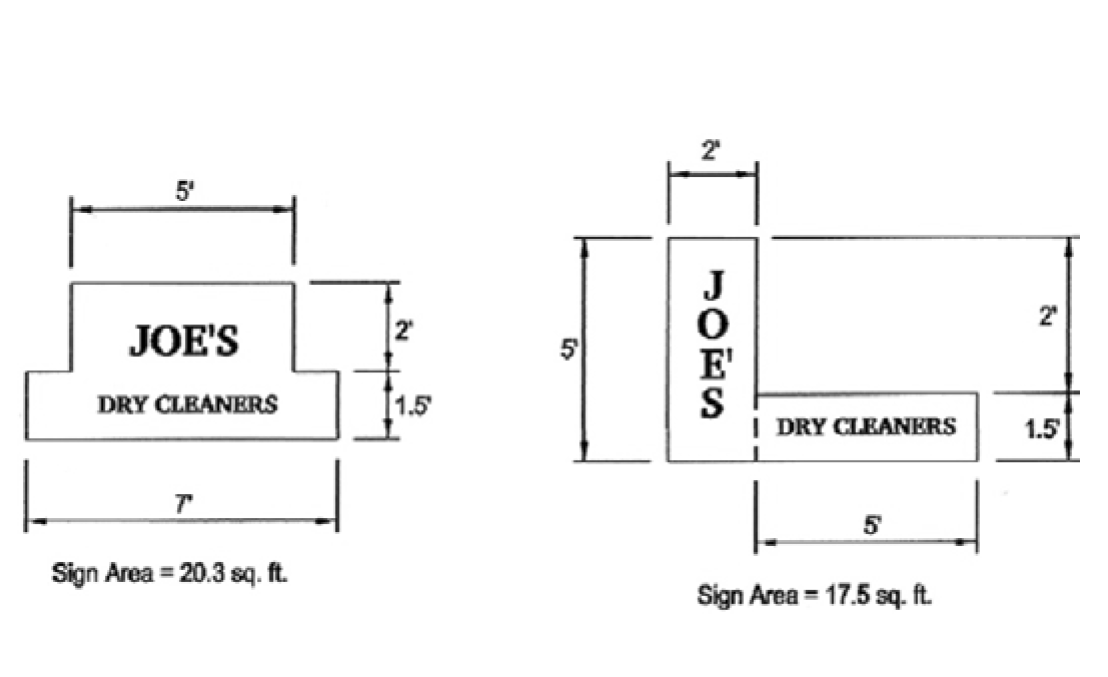
Sign surface area. The area of a geometric shape enclosing any message, logo, symbol, name, photograph or display face shall be measured using standard mathematical formulas. Time and temperature devices shall not be included within the measurement of maximum sign area.
_________________________________
Figure 16-1. Sign Area Measurement
_________________________________
(b)
Sign support. Supporting framework or bracing that is clearly incidental to the display itself shall not be computed as sign area.
(c)
Back to back (double faced signs). Back to back sings shall be regarded as a single sign only if mounted on a single structure and the distance between each sign face does not exceed two (2) feet at any point. "V" signs not to exceed a forty-five (45) degree angle convergence shall be regarded as a single sign.
(d)
Three-dimensional signs. Where a sign consists of one (1) or more three-dimensional objects (i.e., balls, cubes, clusters of objects, sculptures), the sign area shall be measured as their maximum projection upon a vertical plane. Signs with three-dimensional objects shall not exceed a projection of six (6) inches from the sign face.
(e)
Wall signs. If a sign is painted on or affixed to a wall, its areas shall be calculated according to Subsection (a) above; however, only that portion of the wall onto which the sign face or letters, plus a six-inch radius around lettering, shall be calculated in the sign area.
(f)
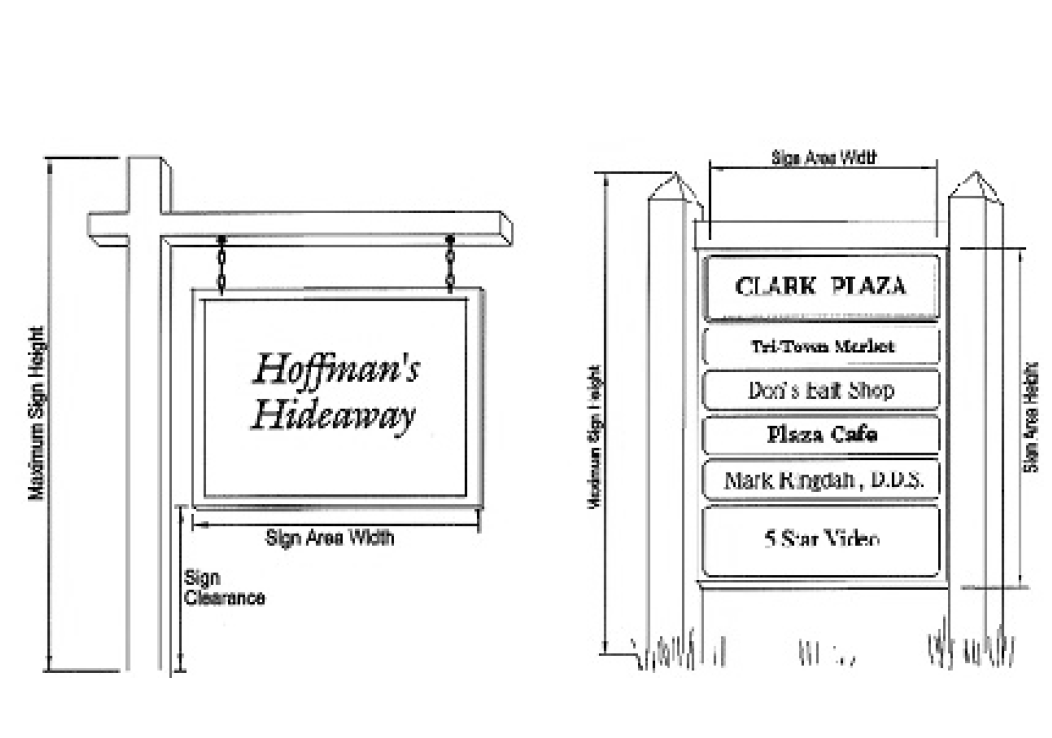
Sign height. The height of a sign shall be measured from the highest point of a sign, which includes the framework portion, to the ground surface beneath it.
_________________________________
Figure 16-2. Sign Measurement Details
(Ord. No. 09-02; Ord. No. 17-08, § 1, 1-23-2018 (2018 Codification))
_________________________________
Sec. 16-8-90. - Sign design.
(a)
Design compatibility.
(1)
Proportionate size and scale. The scale of signs shall be appropriate for the building on which they are placed and the area in which they are located. Building signs shall be harmonious in scale and proportionate with the building facade they are mounted to.
(2)
Road right-of-way. No sign shall be erected within the road right-of-way or near the intersection of any roads or driveways in such a manner as to obstruct the free and clear vision of motorists or pedestrians, or at any location where, by reason of the position, shape or color, it may interfere with, obstruct the view of or be confused with any authorized traffic sign, signal or device. Signs located at an intersection must be outside of the sight distance triangle.
(b)
Sign illumination.
(1)
Down-lit signs are encouraged. The use of individually cut, back-lit letter signs is encouraged.
(2)
All lighted signs shall have their lighting directed in such a manner as to illuminate only the face of the sign. Illuminated signs shall not cause glare onto the street and adjacent properties. Signs shall be lighted only to the minimum level for nighttime readability.
(3)
All lighted signs shall meet all applicable electrical codes, and the electrical components used shall bear the label of an approval agency. Additionally, electrical permits shall be obtained for electric signs.
(4)
Lighting shall focus on the sign and shall not infringe on neighboring property.
(Ord. No. 09-02; Ord. No. 17-08, § 1, 1-23-2018 (2018 Codification))
Sec. 16-8-100. - Sign installation and maintenance.
(a)
Installation.
(1)
All signs shall be mounted so that the method of installation is concealed.
(2)
Projecting signs shall be mounted so that they generally align with others on the block.
(b)
Maintenance.
(1)
The owner of a sign and the owner of the premises on which such sign is located shall be jointly and severally liable to maintain such sign, including any illumination sources, in neat and orderly condition and in good working order at all times, and to prevent the development of any rust, corrosion, rotting or other deterioration in the physical appearance or safety of such sign. The sign must also be in compliance with all building and electrical codes.
(2)
All signs and all components thereof, including sign structures and sign faces, shall be kept neatly painted, in a good state of repair, and in compliance with all building and electrical codes. The Town may inspect any sign governed by this Chapter and shall have the authority to order the painting, repair, alteration or removal of a sign which constitutes a hazard to safety, health or public welfare by reason of inadequate maintenance, dilapidation or obsolescence.
(3)
The owner of any sign regulated by this Article shall be required to keep signs and supporting hardware, including temporary signs and time and temperature signs, structurally safe, clean, free of visible defects and functioning properly at all times. Repairs to signs shall be equal to or better in quality of materials and design than the original sign.
(4)
The Town may inspect any sign governed by this Article and shall have the authority to order the painting, repair, alteration or removal of a sign which constitutes a hazard to safety, health or public welfare by reason of inadequate maintenance, dilapidation or obsolescence.
(5)
The person owning, leasing or controlling any sign for which a permit has been issued shall have the right to change the advertising copy, ornamentation or trim on the structure.
(Ord. No. 09-02; Ord. No. 17-08, § 1, 1-23-2018 (2018 Codification))
Sec. 16-8-110. - Standards for specific types of signs.
The following signs require permit application and approval of permit prior to installation:
(1)
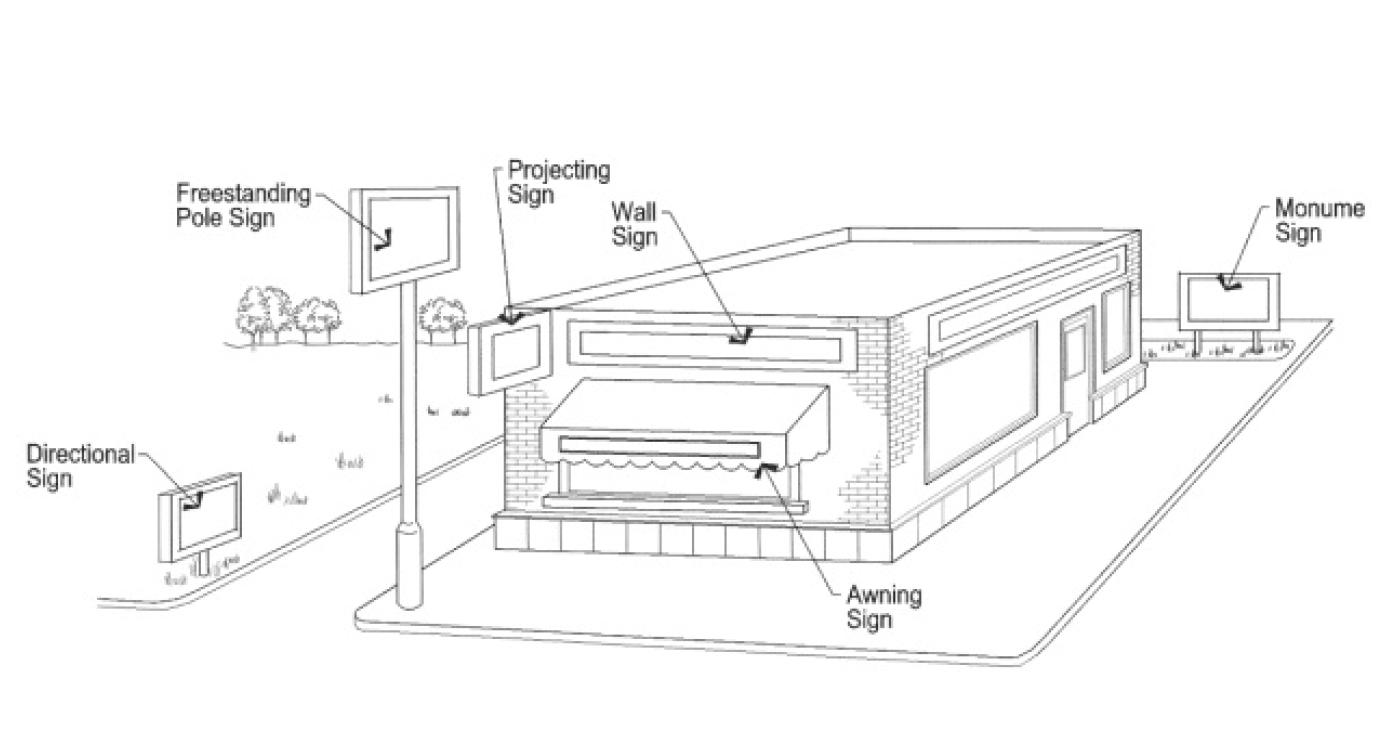
Awning signs.
a.
An awning sign is a wall sign which is painted, stitched, sewn or stained onto the exterior of an awning. For the purpose of this Section, awning means a movable shelter supported entirely from the exterior wall of a building and composed of non-rigid materials except for the supporting framework.
_________________________________
Figure 16-3. Specific Type of Signs
_________________________________
b.
Location. Signs may be placed only on awnings that are located on first- and second-story building frontages, including those fronting a parking lot or pedestrian way. No awning sign shall project beyond, above or below the face of an awning.
(2)
Canopy signs.
a.
A canopy sign is a wall sign that is permanently affixed to a roofed shelter attached to and supported by a building, by columns extending from the ground, or by a combination of a building and columns.
b.
Maximum area and height. The sign area shall comply with the requirements established by Section 16-8-60 of this Article. No canopy, with or without signage, shall extend above the roof line of any building. No canopy sign shall project above the top of the canopy upon which it is mounted. However, such signs may project horizontally from the face of a canopy the distance necessary to accommodate the letter thickness and required electrical equipment, but not more than twelve (12) inches (measured from the bottom of the sign). Under-canopy signs which are perpendicular to the face of the building shall be deemed to be projecting wall signs. Under-canopy signs which are parallel to the face of the building shall be a minimum of eight (8) feet above grade and shall be deemed to be flush wall signs.
(3)
Electrical signs and electronic message center signs.
a.
Illuminated signs shall avoid the concentration of illumination. The intensity of the light source shall not produce glare, the effect of which constitutes a traffic hazard or is otherwise detrimental to the public health, safety or welfare.
b.
Every electric sign shall have affixed thereon and approved Underwriters' Laboratories label, and all wiring connected to such sign shall comply with all provisions of the National Electrical Code.
c.
The maximum allowed size of an electronic message center shall be fifty percent (50%) of the total area of the sign face.
d.
Electronic message centers shall be integrated harmoniously into the design of the larger sign face and structure, shall not be the predominant element of the sign, shall not be allowed on a freestanding pole sign, and if located at the top of the sign, must include a substantial cap feature above the electronic message center which consists of the same material, form, color or texture as is found on the sign face or structure.
e.
An electronic message center located inside a building, but visible from a public sidewalk or public street, is subject to all of the regulations contained in this Subsection.
(4)
Freestanding signs.
a.
A free standing sign is a sign which is supported by one (1) or more columns, uprights, poles or bases extended from the ground or which is erected on the ground and shall also include a monument sign and pole signs, but does not include a sign attached to a structure.
b.
Location. The sign may be located only on a site frontage adjoining a public street, road or highway. No freestanding sign in any zoning district can be erected closer than eight (8) feet from any curb line, nor closer than four (4) feet to any building. No freestanding signs in commercial, mixed use and industrial districts may be located less than twenty five (25) feet from any property line adjacent to a residential zoning district line.
(5)
Monument signs. A monument sign is a permanent sign where the entire bottom of the sign is affixed to the ground, not to a building.
a.
Location. The sign may be located only along a site frontage adjoining a public street.
b.
Maximum area and height. The sign shall comply with the height and area requirements established in Section 16-8-60 of this Article.
c.
Landscaping requirements. Landscaping shall be provided at the base of the supporting structure equal to twice the area of one (1) face of the sign. For example, twenty (20) square feet of sign area equals forty (40) square feet of landscaped area. The Planning Commission may reduce or waive this requirement if it is determined that the additional landscaping would not contribute significantly to the overall aesthetic character of the project.
(6)
Off-premises signs. Off-premises signs, also known as "off-site signs," are generally prohibited, except for those specific types of signs listed below and as defined in Section 16-8-50 of this Article:
a.
Business district identification signs. A business district identification sign is an off-premises sign for the identification of a specific business district or center identified in the Comprehensive Plan or a business improvement or redevelopment area approved by the Board of Trustees. Business district signs shall not:
1.
Interfere with pedestrian or vehicular safety;
2.
Detract from the pedestrian quality of the surrounding area; or
3.
Add to an over-proliferation of signs on one (1) property or in an area.
The owner of the sign shall enter into an agreement with the Town for funding the ongoing cleaning, maintenance and repair of the sign.
b.
Not for profit and civic organizations off-premises signs. A not for profit or civic organizations off-premises sign is an off-premises sign intended to direct people to the not for profit or civic organization and/or state meeting dates and times. Such signs shall not:
1.
Interfere with pedestrian or vehicular safety;
2.
Detract from the pedestrian quality of the surrounding area;
3.
Add to an over-proliferation of signs on one (1) property or in an area;
4.
Be allowed for any organization that has not proven not-for-profit and/or civic organization status;
5.
Measure more than four (4) square feet; or
6.
Number more than five (5) for any organization.
The owner of the sign shall be responsible for repair and maintenance of the sign.
(7)
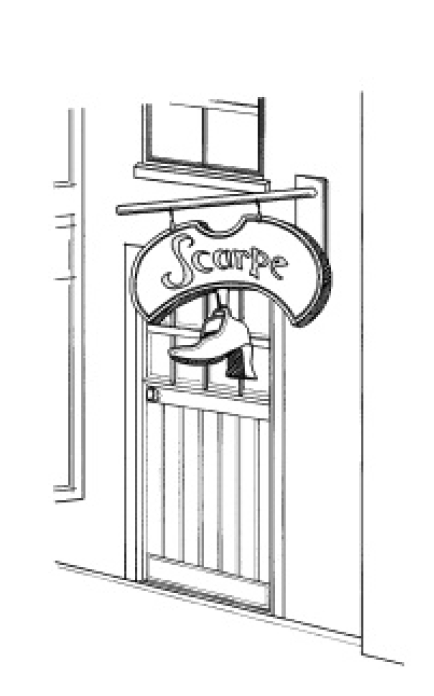
Projecting signs. A projecting sign is any sign supported by a building wall and projecting therefrom at least twelve (12) inches or more horizontally beyond the surface of the building to which the sign is attached.
a.
Location. Projecting signs shall be placed only on a ground floor facade, except for businesses located above the ground level with direct exterior pedestrian access. Projecting signs shall be mounted so they generally align with others on the block. This helps to create a canopy line that gives scale to the sidewalk.
b.
Maximum area and height. Projecting signs shall not be higher than the wall from which the sign projects if attached to a single-story building, or the height of the bottom of any second story window if attached to a multi-story building. Projecting signs must have eight (8) feet of clearance and may not extend more than four (4) feet from the building wall except where the sign is an integral part of an approved canopy or awning. The size of projecting signs is limited to three (3) feet wide and six (6) square feet.
c.
Quantity. The number of projecting signs is limited to one (1) per business. Projecting signs are not permitted in conjunction with wall-mounted or pole signs.
Figure 16-4. Projecting Sign
(8)
Standard brand name signs. A standard brand name sign is any sign devoted to the advertising of any standard brand name commodity or service which is not the principal commodity or service being sold or rendered on the premises, or is not a part of the name or business concern involved. Not more than twenty percent (20%) of the total allowable sign area for any permitted use shall be devoted to the advertising of any standard brand name commodity or service.
(9)
Temporary signs and feather flags. Temporary signs, also known as banners and feather flags, are allowed if the owner has an approved and compliant Temporary Sign Permit. Temporary signs require a Temporary Sign Permit and must also meet the standards and limitations defined below. After the initial Temporary Sign Permit is issued, the owner must complete a renewal of the Temporary Sign Permit on an annual basis to confirm that the temporary sign(s) still meet the requirements.
a.
Banners must be professionally printed on durable waterproof material and mounted properly or tied by all four corners to a fixed structure.
1.
Banners are to be mounted or hung in a manner to be able to stay in place during high winds.
2.
Banners are to be in good repair; specifically not tattered, torn, faded, dirty, or unreadable. Banners not in good repair must be replaced or removed immediately.
3.
Banner limit. Banner size and number is limited to a total of thirty six (36) square feet of surface area on display at any one time per issued and compliant Temporary Sign Permit.
b.
Feather flags must be professionally printed, hung on feather flag poles, and properly affixed to the ground in holders designed for this purpose.
1.
Feather flags shall be mounted at ground level and shall be installed utilizing a compatible weighted base component, or shall be embedded in the ground to a sufficient depth in order to prevent the banner from blowing over. Tripod-type stand bases are not allowed unless they are integrated into a weighted base design. Utilizing sand bags, concrete blocks, big rocks, and guy wires for weighting down the bases of these banners shall not be permitted.
2.
Flags are to be in good repair; specifically not tattered, torn, faded, dirty or unreadable. Flags not in good repair must be replaced or removed immediately.
3.
Flag hardware is to be in good repair; specifically not bent, broken or insufficient to keep flag in an upright position.
4.
Flag limit. No more than two (2) flag patterns allowed per Temporary Sign Permit. The total number of flags are not limited.
c.
In order to maintain intersection sight distances, temporary signs shall not be installed within twenty (20) feet of a public road intersection or the driveway accessing the property.
d.
Temporary signs are prohibited on any sidewalk, bikeway or travel lane and may not be placed in any manner where the sign would create a safety hazard.
e.
If the owner of the temporary sign(s) closes the business for more than two (2) weeks, then all temporary signs must be removed at the time of and during the time of closure.
(10)
Time and/or temperature signs.
a.
A time and/or temperature sign is any sign intended to be displayed for a limited period of time and capable of being viewed from any public right-of-way, parking area or neighboring property.
b.
Maintenance. It shall be the responsibility of the owner of such signs to maintain such signs and ensure that they are kept accurate. If these conditions are not met, the sign shall be repaired or removed.
(11)
Wall signs. A wall sign is any sign painted on, incorporated in or affixed to the building wall, or any sign consisting of cutout letters or devices affixed to the building wall with no background defined on the building wall.
a.
Location. The sign shall not be placed to obstruct any portion of a window, doorway or other architectural detail. No part of a wall sign shall be located more than twenty-five (25) feet above grade level.
b.
Maximum area and height. Wall signs shall not be higher than the eave line of the principal building. The sign shall comply with the height and area requirements established in Section 16-8-60 of this Article.
c.
Projection from wall. No sign part, including cutout letters, may project from the surface upon which it is attached, more than required for construction purposes and in no case more than twelve (12) inches.
(12)
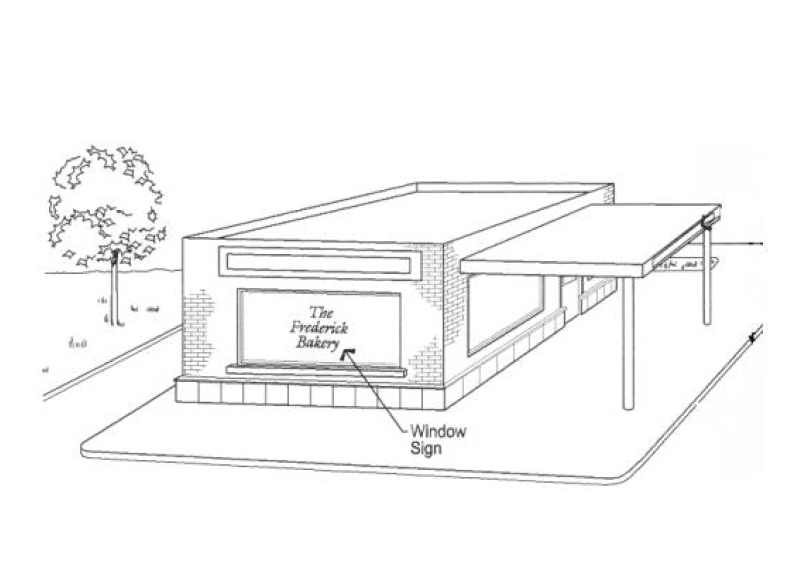
Window signs. A window sign is a sign that is painted on, applied or attached to a window or that can be read through the window from the public right-of-way, placed at or below the second floor level.
a.
Maximum area. When a sign is displayed in a window and is visible beyond the boundaries of the lot upon which the sign is displayed, the total area of such sign shall not exceed:
1.
Twenty-five percent (25%) of the window or door area, not including framework, at the ground floor level; and
2.
Twenty-five percent (25%) of the total allowable sign area for the premises.
b.
Lighting. All illuminated window signs shall be included in the total allowable sign area for the premises. Temporary posters announcing or advertising events sponsored by noncommercial organizations shall be exempt from limitations for window signs.
_________________________________
Figure 16-5. Window Sign
(Ord. No. 09-02; Ord. No. 17-08, § 1, 1-23-2018 (2018 Codification))
_________________________________
Sec. 16-8-120. - Enforcement.
The Board of Trustees have authorized the administration and enforcement of the Sign Regulations to the Town Administrator and/or his or her designated representative. Below are the enforcement steps:
(1)
The Town Administrator or appointed Town representative will meet with the business or property owner or manager to communicate the violation and discuss resolution and the timeframe for resolution. Unless otherwise agree upon, the standard resolution timeframe will be thirty (30) days from the visit. If there is no business or property owner at the site, i.e., the business or site is closed, then the Town representative will send a notification letter to the property owner stating the violation with a thirty (30) day notice to correct the violation.
(2)
If the violation is not corrected after the timeframe in step one, a certified written violation notice will be sent to the business owner/manager, and also to the registered property owner, allowing a thirty (30) day timeframe from the date of the letter to correct the violation.
(3)
If the violation continues after the timeframe specified in step two, the business or property owner will be subject to a citation into the Municipal Court issued by a Town Law Enforcement Officer. The citation fine will carry a minimum fine of one hundred dollars ($100.00), plus any additional court and associated enforcement fees assigned by the court. The court may authorize the Town to utilize Town staff or hire an independent contractor to correct the violation. All costs to the Town associated with correcting the violation will be added to the fines and fees charged to the business or property owner. All unpaid fines, fees and costs outstanding after a period of six (6) months from the date of the court judgement will be assessed against the property and referred to the County Treasurer to be added to the tax roll and collected together with such property taxes.
(Ord. No. 09-02; Ord. No. 17-08, § 1, 1-23-2018 (2018 Codification))

