
South Lyon City Zoning Code
ARTICLE II
GENERAL PROVISIONS
Sec. 102-9.- Accessory buildings, structures, and uses.
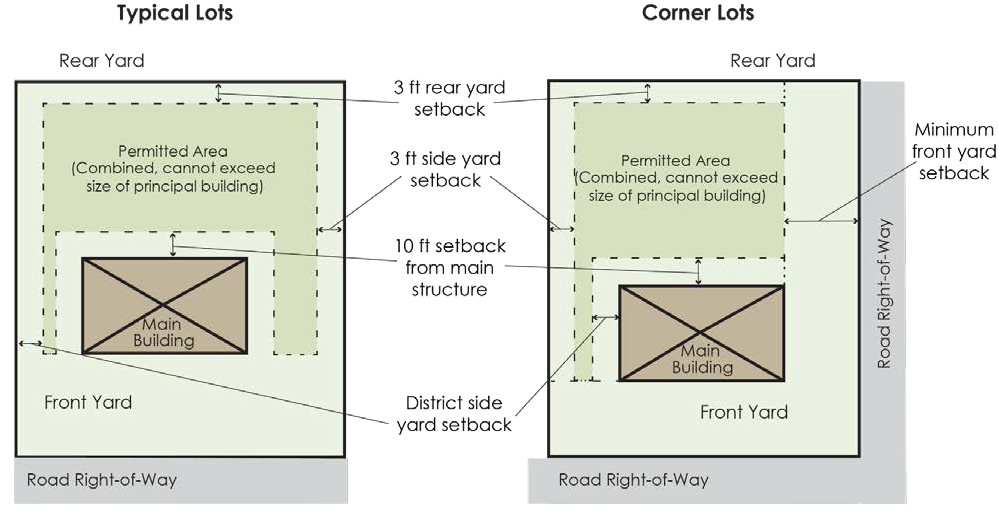
See figure 2.1 accessory buildings and structures location standards.
Accessory buildings and structures are limited to two per residential property. Accessory buildings, except as otherwise permitted in this title, shall be subject to the following regulations.
(1)
Relation to principal building.
a.
Accessory buildings, structures, and uses are permitted only in connection with, incidental to and on the same lot with, a principal building that is occupied by a use permitted in the particular zoning district.
b.
No accessory building, structure, or use shall be occupied or utilized unless the principal structure to which it is accessory is occupied or utilized.
c.
Detached accessory buildings and structures shall be set back a minimum of ten feet from the principal building.
(2)
Locations for detached accessory buildings.
a.
Detached, accessory buildings and structures shall only be located in the yards as shown in table 2.1 and shown in figure 2.1.
b.
Accessory buildings shall not be located within a dedicated easement or right-of-way.
Table 2.1 Accessory Building Locations and Setbacks
1 Exception for inground swimming pool, section 102-47.
Figure 2.1
(3)
Rear yard lot coverage limit. A total of the combined buildings accessory to a residential building shall not exceed the ground floor area of the principal building. The total area of all structures on the lot shall not exceed the lot coverage limits of the district.
(4)
Height limitations. The maximum height of detached accessory buildings shall be one story but not to exceed 14 feet.
(5)
Use. Accessory buildings shall not be occupied for dwelling purposes unless otherwise provided in this chapter. Accessory buildings shall not be used for a home occupation.
(6)
Appearance. The design and building materials of any accessory building shall generally be consistent with the character of the principal building on the property (e.g., material, color), as determined by the planning commission or building official.
(7)
Attached garages. Garages that are structurally attached to a principal building by connection of walls or a roof shall be subject to, and must conform to, all regulations of this chapter applicable to the principal building, including setbacks and lot coverage, and not the regulations of this section. Attached garages shall not exceed the height of the living portion of the dwelling.
(8)
Car canopy and car port. One car canopy, car port, or structure intended to protect a car from the elements, per lot is permitted shall be erected in the side or rear yard only and may not be forward of the front wall/plane of the principal building. A building permit is required to erect a car port, car canopy or similar structure. The car canopy, car port, or structure must be properly secured to the ground. Canopy may not be forward of the front wall/plane of the principal building. Maintenance of the car canopy, car port, or structure is required.
Sec. 102-10. - Adult and childcare facilities.
(a)
Adult and childcare facilities, as defined in article XXV, definitions, are allowed only as provided and in compliance with Michigan Zoning Enabling Act (Excerpt) Act 110 of 2006 125.3206 Residential use of property; adult foster care facilities; family or group childcare homes in the following table. Applicable conditions are listed as footnotes to the table:
Footnotes:
(1) The use shall be registered with the city clerk's office and shall continually have on file with the city documentation of a valid license as required by the state.
(2) Since the state law preempts in this area, the facility shall be brought into compliance with all State building and fire codes pursuant to State Licensing Rules R400.1831-R400.1835. Documentation of such compliance with state requirements shall be provided.
(3) The site shall comply with the sign provisions of chapter 70 signs.
(4) Off-street parking shall be provided for the maximum number of employees on-site at any one time.
(5) The building shall have an appearance which is non-intrusive and consistent in color, materials, roofline, and architecture with the single-family or multiple-family residential district in which it is located, as determined by the planning commission.
(6) Documentation of sufficient indoor classroom, crib, or play area meeting state requirements shall be provided. Documentation of approved areas, as licensed by the state, shall be provided.
(7) There shall be sufficient outdoor play area to meet state regulations. All required outdoor play areas shall be fenced with a four-foot tall fence, provided that no fenced outdoor play area shall be located in a front yard.
(8) There shall be sufficient drop-off parking spaces to allow maneuvers without creating a hazard to traffic flow.
(9) The facility shall operate not more than 16 hours per day.
(b)
A state-licensed residential adult or childcare facility existing prior to the effective date of this chapter (June 17, 2021), that has been operating under a valid state license and is registered with the city no later than 60 days following the effective date of this chapter (June 17, 2021), shall be considered an approved special land use, provided such use conforms with the conditions of this section. Any change in class of the use to a larger care facility shall require approval in accordance with the requirements of this chapter. Any modification to the use shall require approval following the standards of article XV site plan review as applicable.
Sec. 102-11. - Antennas and towers.
Radio or television antennas or towers, or similar devices, including satellite dish antennas and transmission or reception antennas (hereinafter referred to as "regulated reception antenna"), may be erected or installed in any zoning district as an accessory structure to a permitted use, and shall comply with the following requirements. Wireless communication facilities, such as cellular antenna, wireless internet antenna, and commercial broadcasting antenna, shall be subject to the requirements of article XIII, special land uses.
(1)
Ground-mounted antennas. Regulated reception antenna exceeding one meter (3.28 feet) in diameter in residential districts and three meters (9.84 feet) in non-residential districts, are permitted in all zoning districts subject to the following conditions:
a.
Regulated reception antenna shall be located only in a rear yard and shall not be within the required side yard setback. A satellite dish antenna shall be located only in a rear yard.
b.
No portion of an antenna, including a satellite dish antenna, shall be located closer than six feet, measured on a horizontal plane, from any side or rear lot line, or placed on any easement.
c.
The site must be approved by the planning commission, which shall require a sketch plan in accordance with article XV site plan review, indicating the location of the satellite dish and buildings, paved areas and other appropriate site features within 100 feet of the proposed location.
d.
The height of regulated reception antenna, with the exception of a satellite dish antenna, shall not exceed 50 feet above mean grade or ten feet above the peak of the roofline, in any Residential District, and shall not exceed 100 feet above mean grade in any other zoning district.
e.
The height of a satellite dish antenna, including any platform or structure upon which the antenna is mounted, shall not exceed 15 feet in height at its maximum point above mean grade.
f.
The diameter of a regulated reception antenna shall not exceed 12 feet.
(2)
Building-mounted antennas, poles, or towers. Regulated reception antenna having a diameter of one meter (3.28 feet) or less in residential districts and two meters (6.56 feet) in non-residential districts may be attached to the roof of a building, provided that no portion of the satellite dish antenna extends more than 36 inches above the highest point of the roof.
a.
Roof-mounted regulated reception antenna over two meters (6.56 feet) in diameter are permitted in non-residential districts only, provided that the antenna complies with the height requirements of the district in which they are located.
b.
Roof-mounted regulated reception antenna shall not be placed on the front of any primary structure.
(3)
General.
a.
No advertising or identification display shall be placed on any portion of an antenna or tower, including a satellite dish antenna, except for the name of the manufacturer and serial number.
b.
No more than two antennas, including a maximum of one satellite dish antenna, shall be located on the same lot as a principal building. Antennas are permitted only in connection with, incidental to, and on the same lot as a principal building, structure, or use.
c.
The color of the antennas shall be of tones similar to the surroundings.
d.
All electrical and antenna wiring shall be placed underground where applicable.
e.
Antennas shall be securely mounted and anchored in accordance with manufacturer's specifications and building code requirements.
f.
The antenna shall be located and designed to meet the manufacturer's specifications to withstand a wind force of 100 miles per hour.
g.
The installation of an antenna, including a satellite dish antenna, or pole shall require issuance of a building permit by the building official prior to erection.
h.
If a usable signal cannot be obtained by locating the ground-mounted antenna in the rear yard, the antenna may be located in the side yard of the property subject to the submission of a written affidavit and approval of the zoning board of appeals (ZBA) provided the placing of an antenna in a side yard shall remain subject to all other conditions set forth in this section.
Sec. 102-12. - Application procedures in general.
(a)
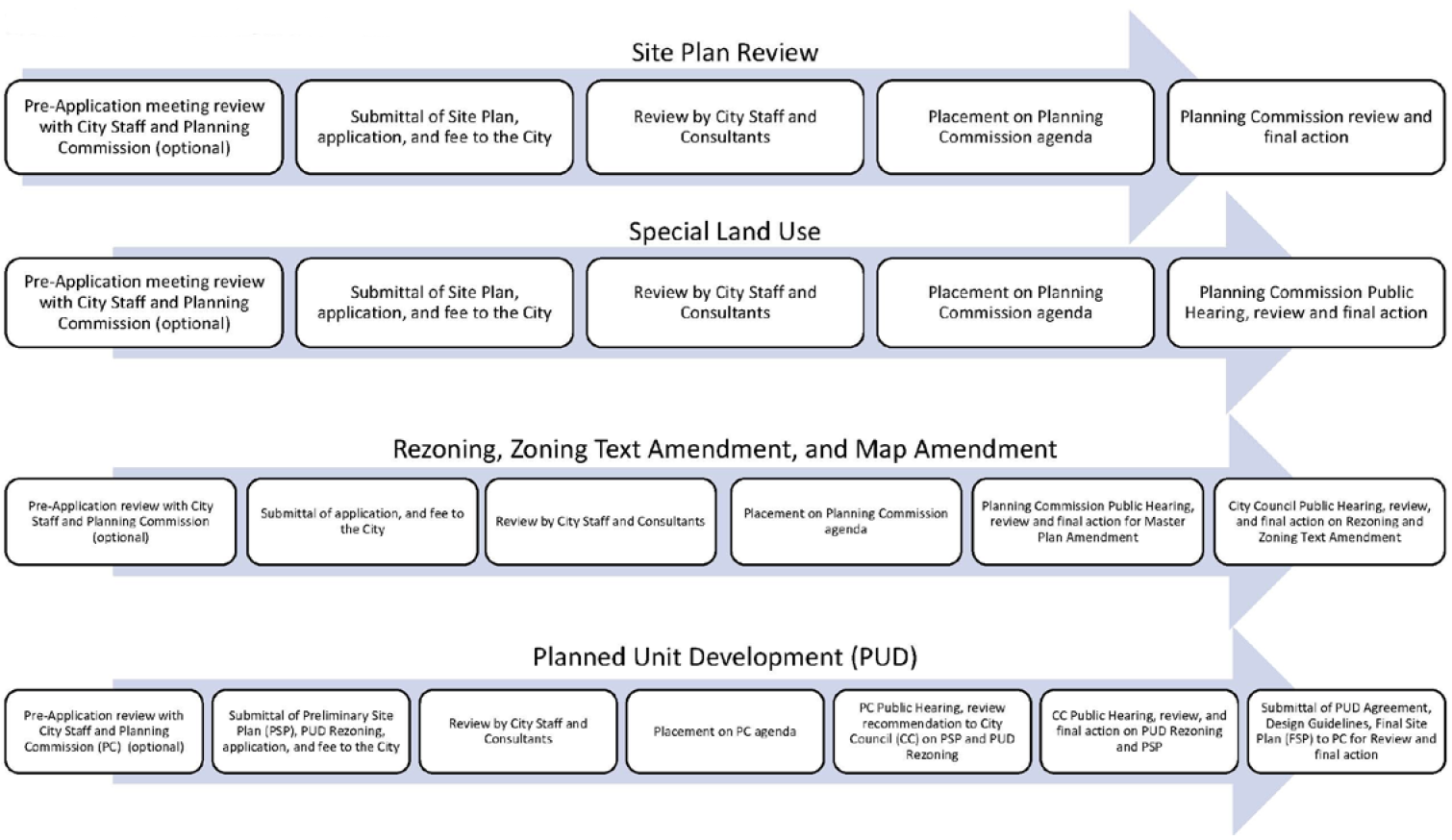
The process for application and review by the city for site plan review, special land use approvals, planned unit developments (PUDs), condominium developments, text amendments to this chapter, and rezonings of land is shown on figure 2.2 development review process. Submittal dates, application forms, and information on fee requirements are available at the city offices.
(b)
The planning commission, ZBA, or city council may withhold granting approval of any use, site plan, PUD plan, or other approval required by this zoning ordinance pending approvals which may be required by county, state, or federal agencies or departments.
Figure 2.2 Development Review Process
Sec. 102-13. - Building grades.
All new buildings and structures constructed on vacant lots adjacent to and in between existing buildings shall be constructed at the elevation of the average grade unless otherwise approved by the planning commission or building official. New grades shall not be established that would permit an increase in the runoff or surface water onto adjacent properties.
Sec. 102-14. - Determination of similar use.
(a)
Since every type of potential use cannot be addressed in this chapter, each district provides for similar uses, referencing this section. All applications for a use not specifically addressed in any zoning district shall be submitted to the zoning administrator for review and decision, based on the following standards:
(1)
A finding is made that the proposed use is not listed as a named permitted or special land use in any zoning district.
(2)
If the use is not addressed in this chapter, the zoning administrator may attempt to select a named use listed in this chapter which most closely resembles the proposed use. Such named use shall be determined using criteria such as potential impact on property values, nature of use, traffic generated, aesthetics, noise, vibration, dust, smoke, odor, glare, and other objectionable impacts on the health, safety, and welfare in the city.
(3)
If a use is determined to be similar to a named use, the proposed use shall comply with any special land use standards or other ordinance requirements that apply to the named use.
(b)
Where the zoning administrator determines a proposed use is not similar to any named use addressed in this chapter, the applicant may apply for interpretation by the ZBA.
(c)
Where the zoning administrator determines a proposed use is not similar to any named use addressed in this chapter, the applicant may petition for an amendment to this chapter.
(d)
The determination as to whether a proposed use is similar in nature and class to another named permitted or special land use within a district shall be considered as an interpretation of the use regulations, and not as a use variance. Any use determined by the zoning administrator to be similar shall thereafter be deemed to be included in the enumeration of the uses.
Sec. 102-15. - Donation boxes.
(a)
Intent. It is the intent of this chapter to support, in a responsible manner, the placement and use of attended and unattended collection bins. These containers are most commonly used to collect for recycling, re-sale or re-use of general household goods such as clothing, shoes, books and similar items. The purpose of these regulations is to promote the health, safety, and/or welfare of the public by providing minimum blight-related performance standards for the operation of unattended collection bins. This includes establishing criteria to ensure that material is not allowed to accumulate outside of such bins, that the bins remain free of graffiti and blight, they are maintained in sanitary conditions, and that the public is fully informed of those who operate the bins so that they may obtain additional information and/or so that such operators can be contacted if there are any blight-related questions or concerns. This chapter is also intended to ensure that collection bins are not placed on property without the express permission of the property owner. Further, it is the intent of this chapter to ensure the safety of pedestrians and motorists through appropriate placement of such containers as well as to ensure the site standards for other on-site uses are met.
(b)
Meaning of terms. The term "collection bin" as used in this section shall have the meaning assigned to it in article XXV, definitions, of this chapter.
(c)
Permitted locations. Collection bins may be placed as an accessory use on properties that are used for non-residential purposes in the following zoning districts: general business district, office district, and industrial district. Collection bins shall not be located within 1,000 feet from another collection bin as measured along a straight line from one box to the other. Collection bins shall not be located on any unimproved parcel or on property on which the principal use has not been operated for more than 30 days.
(d)
Permit required; validity; renewal. No person or entity shall cause or permit the installation or placement of a collection bin upon any real property located within the city, whether public or private, without first obtaining a collection bin permit. A collection bin permit is valid for a one-year period from the date of issuance. Renewal of a collection bin permit may be requested no less than 30 days before the current permit expires.
(e)
Permit application. A collection bin permit application shall be accompanied by the following information for review:
(1)
An affidavit and acknowledgment from the property owner, giving written permission to place a collection bin on the subject property, as well as an acknowledgment of receipt of a copy of this article, and a signed statement agreeing to obey all of its requirements.
(2)
A site plan indicating the placement of the collection bin.
(3)
The name, address, telephone number and e-mail address of the applicant, property owner and collection bin operator who will be responsible for compliance.
(4)
A photograph, rendering, or example image of the collection bin to be installed.
(5)
A nonrefundable fee determined by resolution as set by city council.
(6)
A copy of the license and registration from the State of Michigan under the Michigan Consumer Protection Act and the Charitable Organizations Solicitations Act if statutorily required.
(f)
Standards for collection bins and surrounding areas. Collection bins shall be established in a manner that preserves public safety and welfare by ensuring proper maintenance and placement. The following standards apply:
(1)
Collection bins shall be maintained in good condition and appearance with no structural damage, holes or visible rust and shall be free of graffiti.
(2)
Collection bins are required to be placed on a paved or concrete surface. Collection bins must be level and stable.
(3)
Collection bins shall be locked and be equipped with a secure safety chute so contents cannot be accessed by anyone other than those responsible for the retrieval of the contents.
(4)
The collection bins shall be emptied with such frequency and regularity as to ensure that it does not overflow, and materials do not accumulate outside the collection bin.
(5)
The collection bin operator and property owner shall maintain, or cause to be maintained, the area surrounding the bins free from any overflow collection items, furniture, rubbish, debris, hazardous materials, and noxious odors. To extent provided by law, the collection bin operator and/or property owner shall be jointly and severally responsible for the city's cost to abate any nuisance.
(6)
One collection bin on a single lot of record is allowed.
(7)
The maximum size of a collection bin is limited to five feet by five feet by seven feet.
(8)
Collection bins must be placed:
a.
At least ten feet from a public sidewalk
b.
At least five feet from a private sidewalk;
c.
At least ten feet from a public right-of-way;
d.
At least ten feet from a driveway;
e.
At least ten feet from a side or rear property line that is adjacent to residentially zoned or used property.
(9)
Collection bins shall not be placed in a designated fire lane, in or adjacent to a handicap parking space, or block a building entrance or exit.
(10)
Collection bins shall not be located in any required or preexisting landscaping area.
(g)
Identification of collection bins. Collection bins shall have signage on each bin that identifies the name, mailing address, email address, website and phone number of the collection bin operator. Total sign area on a collection bin shall not exceed four square on no more than two sides of the bin.
Sec. 102-16. - Electric distribution and service lines.
The electric distribution system for new residential developments shall be placed underground in accordance with the rules of the Michigan Public Service Commission (Michigan Administrative Code Rules 460.511—460.512.) Electric lines servicing new office, commercial, and industrial developments shall be located underground in accordance with the rules of the Michigan Public Service Commission (Michigan Administrative Code Rule 460.513) unless the practical difficulty associated with such action shall result in an undue burden to the customer as determined by the city council.
Sec. 102-17. - Essential public services.
The erection, construction, alteration, or maintenance of essential public services and essential public service buildings, as defined in article XXV definitions, authorized under any franchise in effect within the city shall be permitted subject to regulation as provided in any law in the State of Michigan or in this chapter or any city ordinance. It is the intention of this chapter to ensure conformity of all structures and uses to the requirements of this chapter wherever such conformity shall be practical and not in conflict with the specific requirements of such franchise, state legislation, or city ordinance. In absence of such conflict, the standards of this chapter shall prevail.
Sec. 102-18. - Fences and walls.
(a)
All districts.
(1)
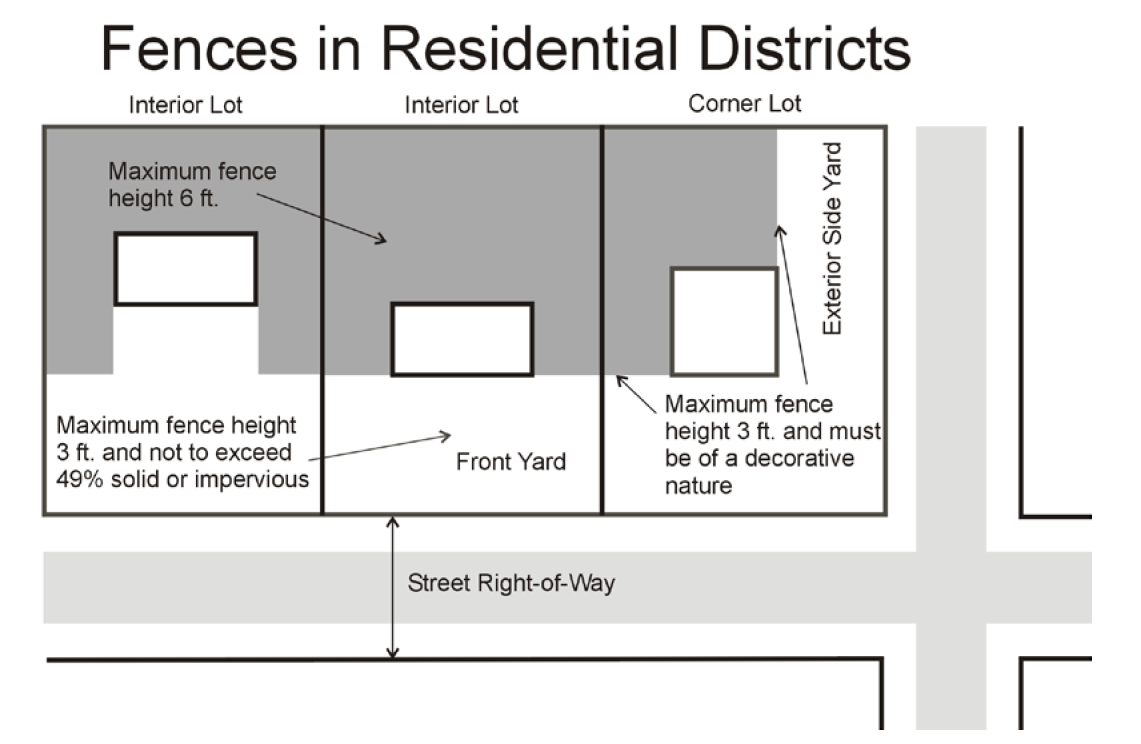
Unless specifically authorized elsewhere in this chapter, fences and walls located within the side yard or rear yard in any district shall not exceed a height of six feet.
(2)
Fences and walls shall not be erected within any public right-of-way or easement.
(3)
Fences or walls shall not be erected or maintained in such a way as to obstruct the vision of motorists exiting driveways.
(4)
Chain link fences shall not be erected in any non-residential front or exterior side yard, except industrial districts, unless enclosing a retention pond approved by the planning commission. The chain link fence must be black vinyl coated.
(5)
Electronic fences buried beneath the ground are permitted in all districts.
(6)
All supporting posts, cross members and protruding bolts, screws and/or hardware of all fences shall be inside the lot and faced toward the interior lot or be centered between the two vertical exterior surfaces of the fence.
(b)
Residential districts.
(1)
Unless specifically authorized elsewhere in this chapter, fences may be located within the required exterior side yard for corner lots but shall not exceed four feet in height. It must also be determined that the fence will not be detrimental to the property or its surroundings including neighboring properties, streetscape, or intersection visibility.
(2)
Any fence in the required front yard shall be:
a.
No more than three feet in height or be in excess of 49 percent solid or impervious;
b.
Constructed of wrought iron (tubular aluminum), wood or vinyl "picket," or similar as determined by the zoning administrator, per the adopted planning commission guidelines.
(c)
Non-residential districts.
(1)
Any fence in a front yard in a non-residential district shall be of a decorative nature as determined by the zoning administrator. The zoning administrator may require landscaping to obscure the visual impact of the fencing in such situations as noted above.
(2)
A security fence for a permitted non-residential use in an industrial district may include a maximum of one additional foot of height to accommodate additional materials.
Editor's note— Landscape standards and tree replacement, § 102-270 et seq.
Sec. 102-19. - Flagpoles.
(a)
The maximum height of flagpoles shall not exceed 40 feet, except in residential district where the maximum height shall not exceed 20 feet, measured from the average surrounding grade.
(b)
A maximum of one flagpole per property is allowed in single-family residential districts and three flagpoles are allowed per site in all other zoning districts.
(c)
Flagpoles shall be set back a minimum of ten feet from any public right-of-way, private road access easement, access drive, or property line.
(d)
A maximum of two flags per flagpole shall be permitted.
(e)
A building permit is required for the installation of a flagpole in a non-residential district.
Sec. 102-20. - Front yard requirements.
(a)
Front yard requirements along rights-of-way shall be measured from the property line, private road access easement line, or the curb of any access road, drive, or internal driveway where no right-of-way or easement exists.
(b)
Front yard setback reductions are permitted as regulated in the district.
(c)
Corner lots and through lots in all zoning districts must provide the required front yard setback on each side of the lot which abuts a public street, private road, or access drive.
(d)
All references to front yard requirements include the exterior side yard of corner lots unless otherwise noted. Exterior side yards may also be known as the "second" front yard.
(e)
On curvilinear streets, the minimum front yard setback is measured along a curve parallel to the front lot line.
(f)
Corner lots on cul-de-sacs must meet the front yard setbacks for both the street and cul-de-sac.
Sec. 102-21. - Grading, excavation, filling, soil removal, creation of ponds, and clearing of trees.
(a)
The grading, excavation, filling, soil removal, creation of ponds, or clearing of trees within an area of less than 100 square feet, shall be permitted activities on any lot provided such activity is incidental to the uses on the lot and in accordance with applicable county and state regulations.
(b)
Grading, excavation, filling, soil removal, creation of ponds, or tree clearing within an area over 100 square feet, on a one-time basis, may be permitted after review and approval of a sketch plan by the planning commission in accordance with article XV site plan review and with applicable county and state regulations.
(c)
Excavation and site preparation for building foundations is excepted from the excavating provisions of this chapter provided that such work is considered incidental to building construction and all necessary permits have been obtained.
(d)
Excavation required for swimming pools is excepted from excavating provisions of this chapter provided that all necessary permits are obtained and the pool is completely constructed within six months of the excavation.
(e)
Any clearing of trees on lots of over 100 square feet prior to site plan approval in accordance with article XV site plan review shall be prohibited.
Sec. 102-22. - Height exceptions and limitations.
The building height restrictions of all zoning districts shall not apply to the following: parapet walls and cornices not exceeding four feet in height, chimneys on a residential dwelling, cooling towers, elevator bulkheads, fire towers, gas tanks, grain elevators, silos, stacks, stage towers and scenery lofts, water tanks, public monuments, historic plaques, church spires, belfries, cupolas, domes, ornamental, non-functioning towers, and penthouses or roof structures housing necessary mechanical appurtenances.
Sec. 102-23. - Home occupations.
All home occupations must comply, and remain in continuous compliance with, the following standards:
(1)
A home occupation permit must be obtained from the city and include a floor plan indicating the area(s) within the house where the home occupation will be conducted.
(2)
No person, other than members of the family residing in the dwelling, shall be engaged in the conduct of the home occupation.
(3)
The use of the dwelling for the home occupation shall be clearly accessory, incidental, and subordinate to its use for residential purposes, and not more than 25 percent of the gross floor area of the dwelling shall be used for the conduct of the home occupation.
(4)
There shall be no change in the outside appearance of the dwelling or any other visible evidence of the conduct of the home occupation.
(5)
There shall be no signs on any structure, in the windows or anywhere on the property.
(6)
Traffic generated by the home occupation shall not be greater than would normally be expected in a residential neighborhood, or no more than an average of ten vehicular trips per day.
(7)
The home occupation shall be conducted entirely within the confines of the dwelling and shall not take place in a garage or accessory structure.
(8)
There shall be no retail, sale of products or service on the premises where the home occupation is located. A retail showroom, sales area, outlet, or similar facility is prohibited as is outdoor display of goods.
(9)
A home occupation shall not include such occupations as adult uses, motor vehicle repairs, motor vehicle rental, motor vehicle sales, tattooing, tea rooms, tourist homes, bed and breakfasts, rooming or boarding houses, animal kennels or hospitals, physicians, dentists or other offices for diagnosis, prevention, alleviation, or cure of disease or disability, retail businesses, firearms dealer, or occupations which have vehicles, other than vehicles as described below, parked or stored at the dwelling.
(10)
Any necessary parking spaces for vehicles generated by the conduct of the home occupation shall be provided on the site in a normal driveway, but not within any required yard.
(11)
No equipment or process shall be used in the home occupation which creates noise, vibration, glare, fumes, or odors detectable to the normal senses off the premises on which the home occupation is located. In addition, no equipment or process shall be used in the home occupation which causes visual or audible interference in any radio or television receivers off the premises or causes fluctuation in the line voltage off the premises.
Sec. 102-24. - Intersection visibility.
(a)
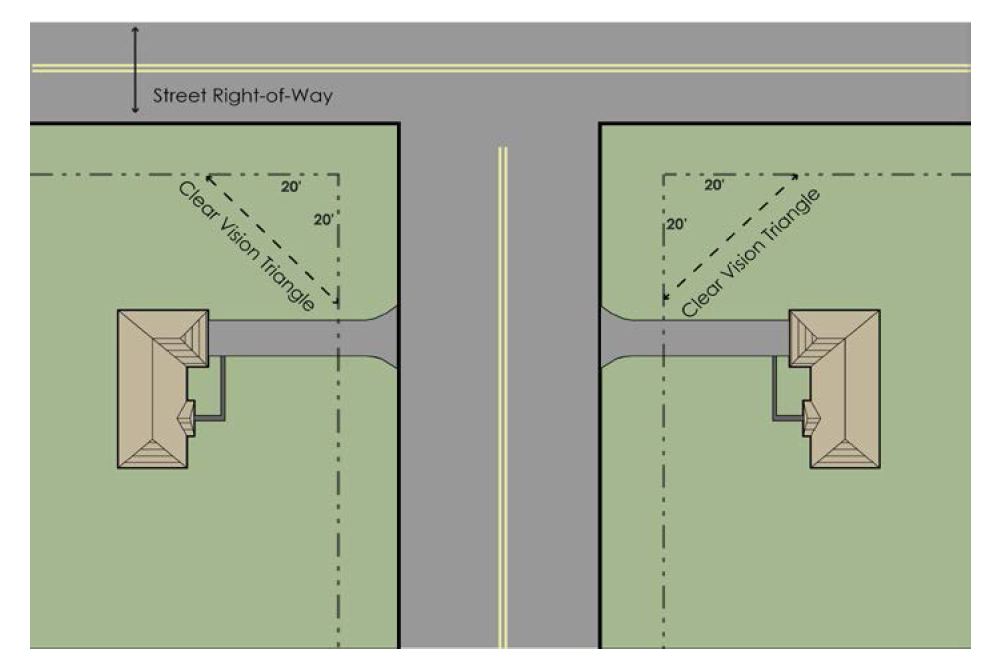
No fence, wall, sign, hedge, screen, or any planting shall be erected or maintained to obstruct vision between a height of three feet and eight feet within the triangular area formed by the intersection of the street right-of-way lines and a line connecting two points which are located on those intersecting right-of-way lines 20 feet from the point of intersection of the right-of-way lines. If the road is an access drive, these dimensions shall be measured from the pavement edge.
(b)
The three-foot and eight-foot height limit shall be measured from the lowest elevation of the segment of the intersecting roads centerline which lies between the point of the intersection of the other centerline and the extension of the line drawn through the points 20 feet from the intersection of the right-of-way lines.
Sec. 102-25. - Keeping of animals.
(a)
The keeping of household pets, including dogs, cats, rabbits, fish, birds, hamsters, small reptiles, and other animals generally regarded as household pets is permitted as an accessory use in any residential district. However, no more than three dogs or three cats, four months of age or older, in any combination, nor more than a total of five animals, shall be kept or housed in or at one dwelling unit.
(b)
The keeping of more than three dogs, over the age of four months, on one premises shall be deemed to be a kennel and must follow the regulations set forth in article XI, site development standards for specific uses, section 102-144(e) kennels.
(c)
The keeping of animals not normally considered domesticated including, but not limited to, pigs, horses, sheep, cattle, poultry, reptiles, and wild, vicious, and exotic animals, is prohibited in all zoning districts.
Sec. 102-26. - Lots.
(a)
Area allocation.
(1)
No portion of a lot can be used more than once for determining compliance with the provisions for lot area and yard dimensions.
(2)
No lot, adjacent lots in common ownership, required yard, parking area, or other required open space shall be created, divided, or reduced in dimensions or area below the minimum requirements of this chapter. If already less than the minimum requirements of this chapter, a lot, adjacent lots in common ownership, required yard, parking area, or other open space shall not be divided or reduced in dimensions or area so as to increase its noncompliance with the minimum requirements of this chapter. Lots or yards created after the effective date of this chapter shall comply with the requirements of this chapter.
(3)
In calculating the area of a lot that adjoins a dedicated alley or lane, for the purpose of applying lot area requirements of this chapter, one-half the width of such alley abutting the lot shall be considered as part of the lot.
(b)
Lot splits.
(1)
Lot splits in the city are regulated by the Michigan Land Division Act 288 of 1967 with the additional provisions:
a.
Lot splits shall not be granted if the resulting lot does not meet the minimum district lot area requirement and the minimum lot width.
b.
Any new lot created through a lot split must have frontage on a public, improved road or right-of-way.
c.
An access easement does not satisfy the public road frontage requirement.
d.
A lot split that creates a nonconforming lot or renders an existing structure nonconforming (doesn't meet the required district setbacks on the proposed lot) is prohibited.
(2)
Application. The applicant/property owner must provide the following information:
a.
A detailed statement of the reasons for the requested partition or division.
b.
A survey or plot plan showing the proposed land split. This item should include the proposed dimensions of the parcels before and after the proposed split and all adjoining lots, streets and parcels of land.
c.
A driveway permit from the road commission of Oakland County if the lot abuts a county road.
d.
All easements for private streets must be a minimum width of 66 feet if they serve two or more parcels.
e.
Any other information required by the Zoning Administrator to assist in reviewing the proposed partition or division.
(3)
Appeal.
a.
The city council may, upon appeal, authorize a variance from the strict application of the provisions of this chapter where such strict application would result in practical difficulties or undue hardship to the applicant. Relief from the strict application of this chapter may be granted in cases where the result is not a substantial detriment to the public good and does not impair the intent and purpose of the chapter. In granting a variance, the city council may attach conditions deemed reasonable to the purpose of this chapter. The relief granted shall, in no instance, be greater than necessary to relieve the practical difficulty or undue hardship to the applicant.
b.
The city council shall grant or deny an appeal within 30 days of the appearance before the city council. City council approval of the variance shall be indicated on the application, which the city clerk shall promptly file with the Oakland County Register of Deeds.
Sec. 102-27. - Lot width/depth ratio.
Lots created after the effective date of this chapter shall have a lot width which is equal to, or greater than, one-fourth the depth of the lot, per the Michigan Land Division Act 288 of 1967. Flag lots or flagpole lots are not permitted in the city.
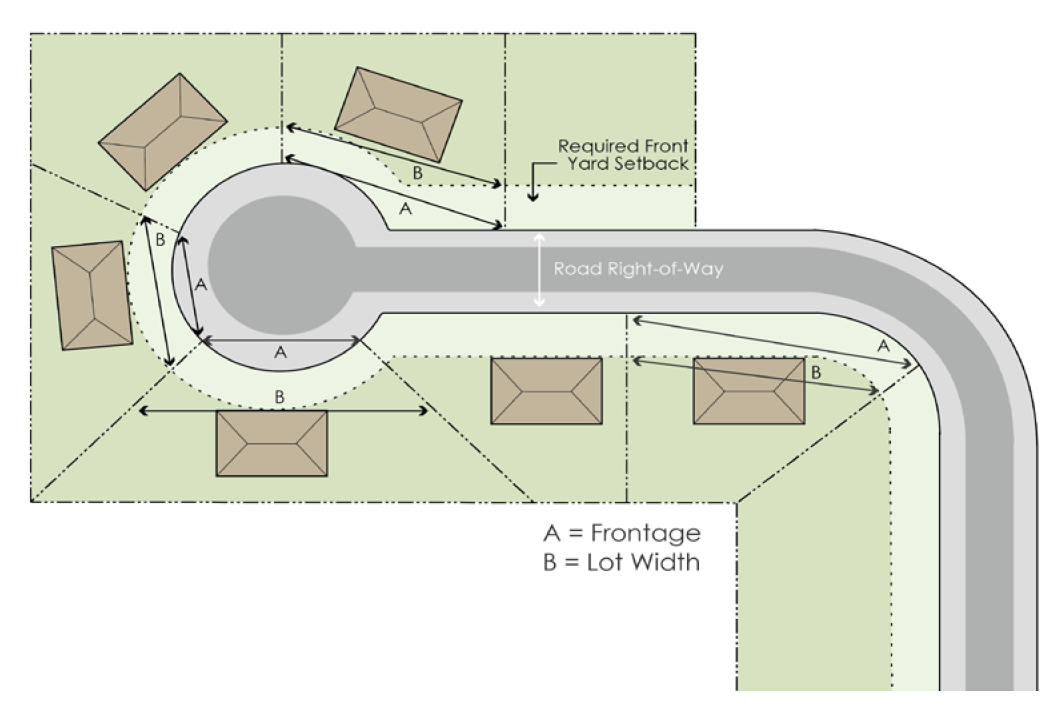
Sec. 102-28. - Mechanical equipment and utilities.
(a)
Ground mounted mechanical equipment, such as blowers, ventilating fans, and air conditioning units are permitted only in non-required side yards and in any rear yard, as determined by the building official.
(b)
Mechanical equipment shall be placed no closer than three feet to any lot line in the central business district (CBD).
(c)
Any ground, building, or roof mounted mechanical equipment or utilities, including water and gas meters, utility boxes, transformers, elevator housings, stairways, tanks, heating, ventilation and air conditioning equipment (HVAC), and other similar equipment, shall comply with the following standards:
(1)
All such equipment shall be screened by a solid wall, fence, landscaping, and/or architectural features that are compatible in appearance with the principal building.
(2)
For all commercial and industrial buildings, roof-mounted equipment shall not exceed a height of ten feet above the surrounding roof surface and shall occupy no more than 15 percent of the total roof area. All roof-mounted mechanical units must be screened so they are not visible from ground level, even if not specifically addressed as part of site plan review.
Sec. 102-29. - Medical marihuana.
(a)
Uses of land or buildings or structures for commercial uses or purposes that are prohibited by or contrary to federal, state or local regulations and ordinances are expressly prohibited in any zoning district within the city. However, the following are exempt from this prohibition in accordance with the Michigan Medical Marihuana Act, PA 2008, Initiated Law No. 1, MCL 333.26423(d), et seq, as may be amended:
(1)
The use, possession, cultivation, or growth of marihuana by a registered qualifying patient as defined in the Michigan Medical Marihuana Act; or
(2)
The possession, cultivation, growth, or transfer of marihuana or provision of services to a qualifying patient by a primary caregiver as defined in the Michigan Medical Marihuana Act.
(b)
Marihuana establishments, authorized pursuant to the Michigan Regulation and Taxation of Marihuana Act, Initiated Law 1 of 2018, MCL 333.27951, et seq., as may be amended, are prohibited within the boundaries of the city.
Sec. 102-30. - Non-residential design requirements/building facade design.
The following design requirements for non-residential buildings shall be applied during site plan review as outlined in article XV site plan review.
(1)
Exterior building design.
a.
Buildings shall possess architectural variety and yet enhance the overall cohesive community character. All buildings shall provide architectural features, details, and ornaments such as archways, colonnades, cornices, recesses, projections, wall insets, arcades, window display areas, peaked roof lines, or towers.
b.
Building walls and roofs over 50 feet in length shall be broken up with varying building lines, windows, gables, and/or architectural accents such as pilasters, columns, dormers, and awnings.
c.
An original, one of a kind image, design or representation that does not contain a promotional or commercial advertising message, that is painted or applied to the exterior wall of a building or structure, and that does not contain changeable or moveable elements or changeable illumination, including flashing or sequential lighting, or any other elements, may be permitted by the planning commission if the commission finds the design to be consistent or complement the building's architecture, façade materials.
d.
Window area shall make up at least 20 percent or more of the exterior wall area facing the principal street(s) from which access is gained.
In addition, a portion of the on-site landscaping shall abut the walls so that the vegetation combined with the architectural features significantly reduce the visual impact of the building mass as viewed from the street. Additional landscaping requirements of this chapter must also be satisfied.
e.
Overhead doors shall not face a public street or residential district. The planning commission can modify this requirement upon a determination that there is no reasonable alternative and the visual impact will be moderated through use of building materials, architectural features and landscaping beyond that required in article XX landscape standards and tree replacement.
f.
Additions to existing buildings must complement the current building design with regard to height, proportions, scale, materials, and rhythm of openings.
(2)
Building materials.
a.
Durable building materials which provide an attractive, quality appearance must be utilized.
b.
For existing buildings, material replacement should closely match the character of the existing or original materials used on the structure.
c.
The predominant building materials should be quality materials that are characteristic of Michigan such as earth-toned brick, architectural panels, wood, native stone, and glass products, as determined by the planning commission.
d.
Other materials such as textured, color-integrated concrete masonry units, EFIS should only be used as accents and not dominate the building exterior of the structure and surrounding buildings.
e.
Prefabricated steel panels and metal roofs may be allowed if deemed by the planning commission to be compatible with the overall architectural design of the building.
(3)
Building colors.
a.
Exterior colors shall be of low reflectance, subtle, neutral, or earth tone colors. The use of high intensity colors such as neon, metallic, or fluorescent for the facade and/or roof of the building or building trim are prohibited except as approved by the planning commission.
b.
The use of trademark colors not meeting this requirement shall be approved by the planning commission.
c.
Mechanical and service features such as gutters, ductwork, service doors, etc. that cannot be screened must be of a color that blends in with the color of the building.
(4)
Roof design.
a.
Roofs should be designed to reduce the apparent exterior mass of a building, add visual interest, and be appropriate to the architectural style of the building.
b.
Variations in architectural style are highly encouraged. Visible roof lines and roofs that project over the exterior wall of a building enough to cast a shadow on the ground are highly encouraged, with a minimum overhang of 12 inches.
c.
Architectural methods shall be used to conceal flat roof tops and mechanical equipment.
d.
Overhanging eaves, peaked roofs, and multiple roof elements are highly encouraged.
(5)
Customer entrances. Clearly defined, highly visible customer entrances shall be included in the design. Features such as canopies, porticos, arcades, arches, wing walls, and integral planters are highly encouraged to identify such entrances. In the CBD, entrances facing the street must be functional.
(6)
Community amenities. Community amenities such as patio/seating areas, water features, art work or sculpture, clock towers, pedestrian plazas with park benches, or other features located adjacent to the primary entrance to the building(s) are highly encouraged and may be calculated as part of the landscaping requirement.
(7)
Signs. Signs shall be in accordance with chapter 70 signs. All sign bases shall be constructed of materials compatible with the architecture of the building(s) located on the premises.
(8)
Natural features. Buildings shall be sited to protect existing natural areas such as steep natural grades, trees, significant groupings of healthy vegetation (shrubs and trees), and rock outcroppings. To the extent practical, these areas shall be incorporated into the overall site plan.
(9)
Building location and orientation. New buildings shall have at least one principal building entrance oriented parallel toward the front lot line.
Sec. 102-31. - One-family cluster housing option.
The intent of this section is to permit the development of one-family residential patterns which, through design innovation, will introduce development flexibility so as to provide for the sound physical development of sites in those instances where the normal subdivision platting process, or single family site condominium procedure, or development under the open space preservation option, as set forth and regulated in this chapter, would otherwise be unreasonably restrictive. This may be accomplished by using the planned unit development (PUD) overlay, article XII.
Sec. 102-32. - Outdoor seating for restaurants and cafes.
Outdoor restaurants and cafes in the central business district or general business district, using the public right-of-way for café or restaurant service, shall be reviewed and approved administratively by the zoning administrator, subject to the following requirements:
(1)
An application, application fee, and site plan drawing detailing the proposed plan of the outdoor restaurant or café shall be administratively approved by the city. The city will review the site plan in order to ensure the following traffic and pedestrian safety measures:
a.
Any sidewalk or open space used for the outdoor restaurant or café is immediately adjacent to the applicant restaurant, provided that the café may be separated from the restaurant by the main pedestrian walkway along the public sidewalk.
b.
The use of a sidewalk or open space for the outdoor restaurant or café allows a minimum pedestrian walkway of four feet.
c.
Any tables, chairs, umbrellas or other equipment shall not extend into or over the four-foot wide pedestrian walkway, and there shall be no barriers to pedestrian visibility. The number, size and location of tables, chairs, and equipment shall be administratively approved by the city.
d.
If alcohol is to be served in conjunction with the proposed outdoor restaurant or café, barriers designating the service area, as required by the Michigan Liquor Control Commission, will be utilized. If no alcohol is to be served, a barrier approved by the city will be utilized between the service area and the pedestrian right-of-way. In either instance, the design of the barrier must be in keeping with the zoning ordinance and any applicable design guidelines.
(2)
The outdoor restaurant or café must be part of a licensed full-service restaurant and it must meet all of the requirements of, and secure all of the necessary permits from, the Oakland County Health Department and the Michigan Liquor Control Commission.
(3)
Liability insurance and property damage coverage, naming the city as an insured party, in an amount approved by the city, must be provided before an outdoor restaurant or café extending into the right-of-way may be set up.
(4)
Final approval by the appropriate city department(s) is required for any seating placed within the public right-of-way.
(5)
The zoning administrator may submit the request to the planning commission for review and action, if deemed necessary.
Sec. 102-33. - Performance standards.
No land use otherwise allowed shall be permitted within a zoning district that does not conform to the following standards of use, occupancy, and operation. These performance standards are hereby established as the minimum requirements to be maintained.
(1)
Smoke.
a.
Generally. It shall be unlawful for any person to permit the emission of any smoke from any source, excepting smoke from a chimney for a fireplace or wood/coal burning stove in a residential structure, to a density greater than that density described as No. 1 of the Ringelmann Chart; provided that the following exceptions shall be permitted: smoke, the shade or appearance of which is equal to, but not darker than No. 2 of the Ringelmann Chart, for a period, or periods, aggregating four minutes in any 30 minute period.
b.
Method of measurement. For the purpose of grading the density of smoke, the Ringelmann Chart, as now published and used by the United States Bureau of Mines, which is hereby made a part of this chapter, shall be the standard. However, the umbra scope readings of smoke densities may be used when correlated with the Ringelmann's Chart.
(2)
Radioactive, toxic and hazardous materials. Radioactive materials and wastes, including electromagnetic radiation such as X-ray machine operation, shall not be emitted in excess of quantities established as safe by the American National Standards Institute, when measured at the property line. All transportation, including by rail, of radioactive materials, hazardous waste, and toxic waste shall be within permissible standards set by the federal government.
(3)
Noise. Operations or activities which exceed the maximum sound intensity levels defined below shall be prohibited. A sound level meter and an octave band analyzer shall be used to measure the intensity and frequency of the sound or noise levels. Sounds with very short duration, which cannot be accurately measured with a sound level meter, shall be measured by an impact noise analyzer; and the maximum levels indicated in the following table may be exceeded by no more than five decibels. Where questions on noise arise, the current standards recognized by the American National Standards Institute shall apply.
Source: American National Standards Institute
a.
The following sources of noise are exempt:
1.
Transportation vehicles not under the control of an on-site use.
2.
Occasionally used safety signals, warning devices and emergency pressure- relief valves.
3.
Temporary construction activity between 7:00 a.m. and 7:00 p.m.
4.
Warning or alarm devices that have the purpose of signaling unsafe or dangerous situations or calling for police.
5.
Noises resulting from authorized public activities such as parades, fireworks displays, sports events, musical productions, and other activities that have the approval of the city council or its designee.
(4)
Dust, dirt, and fly ash.
a.
Generally. No person, firm, or corporation shall operate or maintain any process, furnace, or combustion device for the burning of coal or other fuels, unless such processes or devices are equipped with recognized and approved equipment, methods, or technology to effectively reduce the quantity of gas-borne or airborne solids or fumes emitted into the open air, which is operated in conjunction with the process, furnace, or combustion device so that the quantity of gas-borne or air-borne solids shall not exceed 0.20 grains per cubic foot of carrying medium at a temperature of 500 degrees Fahrenheit. These standards are not intended to apply to residential uses, such as chimneys for a fireplace or wood/coal burning stove.
b.
Method of measurement. For the purpose of determining the adequacy of such devices, these conditions are to be conformed to when the percentage of excess air in the stack does not exceed 50 percent at full load. The foregoing requirement shall be measured by the A.S.M.E. Test Code for dust-separating apparatus. All other forms of dust, dirt, and fly ash shall be completely eliminated insofar as escape or emission into the open air is concerned. The zoning administrator may require such additional data as is deemed necessary to show that adequate and approved provisions for the prevention and elimination of dust, dirt, and fly ash have been made.
(5)
Fire and explosive hazards. The storage, utilization, or manufacture of materials, goods, or products ranging from free or active burning to intense burning, as determined by the fire chief, is permitted subject to compliance with these performance standards and all other standards of this chapter, and providing that the following conditions are met:
a.
Such materials or products shall be stored, utilized, or produced within completely enclosed buildings or structures having incombustible exterior walls, which meet the requirements of the building code.
b.
All such buildings or structures shall be set back at least 40 feet from lot lines and all buildings or structures shall be protected throughout by an automatic sprinkler system complying with installation standards prescribed by NFiPA prevention codes.
c.
The storage and handling of flammable liquids, liquefied petroleum, gases, and explosives shall comply with the state rules and regulations as established by the Michigan Zoning Enabling Act (Public Act 110 of 2006), as amended, and the NFiPA.
Sec. 102-34. - Personal ice rinks.
(a)
Personal ice rinks (not commercial) are permitted as an accessory use in any single-family residential zoning district.
(b)
Personal ice rinks are permitted in the rear yard.
(c)
A four-foot setback is required from adjacent residential property lines.
(d)
The ice rink boards shall be no taller than 24 inches in height and must be properly maintained and free from deteriorating conditions such as peeling paint and cracking wood.
(e)
Any lighting must be directed away from adjacent properties and the road right-of-way. In addition, lights may not be used from 10:00 p.m. to 7:00 a.m.
(f)
No ice rinks shall be erected prior to November 15 and shall be removed no later than March 15, or as weather permits.
Sec. 102-35. - Playscapes, playground equipment, and tree houses.
(a)
Playscapes, playground equipment, and tree houses are permitted in any single-family residential zoning district but shall not be considered an accessory use or structure for the purpose of limiting the number of accessory uses and lot coverage.
(b)
Playscapes and playground equipment are permitted in the rear yard and shall not exceed 14 feet in height.
(c)
A four-foot setback is required from adjacent residential property lines.
(d)
Tree houses are permitted as an accessory use in any single-family residential district, with a maximum height of 14 feet at the peak, a four-foot setback from property lines, and are not permitted in any front yard.
Sec. 102-36. - Principal buildings, structures, and uses.
(a)
No lot may contain more than one principal building, structure, or use.
(b)
No lot may contain an accessory building, structure, or use without an occupied principal building, structure or use.
(c)
Groups of multiple-family dwellings, site condominiums, retail business buildings, or other groups of buildings contained within a single, integrated, planned complex, sharing parking, signs, access, and other similar features which together form a unified function and appearance, may be deemed a principal use collectively by the zoning administrator.
(d)
In cases where at the time of the adoption of this chapter, more than one use exists on the lot, the use comprising the greatest floor area shall generally be considered the principal use, except in cases where a use comprising a secondary amount of floor area is considered to have greater impact in terms of traffic generated, noise levels, disruption of views, and similar impacts, as determined by the zoning administrator.
Sec. 102-37. - Private road standards.
(a)
The city may allow private roads only when meeting the standards of this section. The regulations for private roads contained herein shall not apply to approved private roads within platted subdivisions regulated by the chapter 86 subdivisions of the South Lyon City Code, as amended, or internal access drives to parking within approved site plans for multiple-family developments or commercial access drives.
(b)
Private roads may be approved by the city council after a recommendation from the planning commission. Documentation accepted by the city council, must support that the property possesses unusual configuration and/or topography which would render construction of public streets under city standards for grades, radii, width, and/or materials impractical.
(c)
An easement for private road access shall be provided of not less than 24 feet in width for roads and utilities serving two or fewer lots or single-family residential units and not less than 60 feet in width for roads serving more than two homes. This easement shall be recorded with the Oakland County Register of Deeds office and a copy of the recorded easement provided to the zoning administrator.
(d)
Any lot gaining access from a private road shall have at least the minimum lot frontage required herein for the zoning district in which the lot is located. The frontage for the lot shall be measured at the point between the lot lines designated by the zoning administrator as the side lot lines.
(e)
Any lot, created on a private road, along with accompanying buildings, shall comply with all site development standards applicable to the zoning district in which it is located. The easement for the private road shall not be included in the minimum lot width and lot area requirements.
(f)
The maximum length of any private road cul-de-sac shall not exceed the City standard for public roads.
(g)
The minimum roadway width of any private road shall be at least 18 feet, however if such roadway is within 300 feet of a fire hydrant, such width may be reduced to 16 feet upon approval of the city fire department.
(h)
The surface and base material and construction of any private road shall be approved by the city engineer and city fire department as being sufficient to accommodate emergency vehicles.
(i)
Issuance of a building permit for the placement of buildings/structures on lots and/or parcels on a private road shall not be considered a guarantee or warranty that adequate access exists to the lot for emergency vehicles. The city assumes no responsibility for the maintenance of or improvements to private roads.
(j)
The applicant shall submit a joint maintenance agreement or master deed, reviewed and approved by the city attorney, in recordable form that runs with the land, binds benefiting parcels, and allows the city to make any repairs or conduct any maintenance it deems necessary, and charge the property owners or homeowners association served by the private road for such service.
(k)
The applicant shall provide a recorded statement running with the land informing purchasers of lots accessed by the private road that the access road is private.
Sec. 102-38. - Projections into yards.
(a)
Certain architectural features, such as cornices, eaves, gutters, chimneys, pilasters, and similar features may project no farther than:
(1)
Three feet into a required front yard.
(2)
Five feet into a required rear yard.
(3)
Two feet into a required side yard.
(b)
Projection of building appurtenances such as unenclosed porches, patios, decks, balconies, stoops, window awnings, or similar features which are elevated six inches or more above grade, into a required side yard shall be prohibited. An unenclosed porch, patio, deck, stoop, balcony, or window awning may project no farther than:
(1)
Eight feet into a required front yard.
(2)
Maximum of 33 percent into required rear yard setback.
(3)
Five feet into the right-of-way in the CBD if such feature is located at least eight feet above ground level.
(4)
At-grade patios can extend into required side and rear yards but must meet the accessory structure setback.
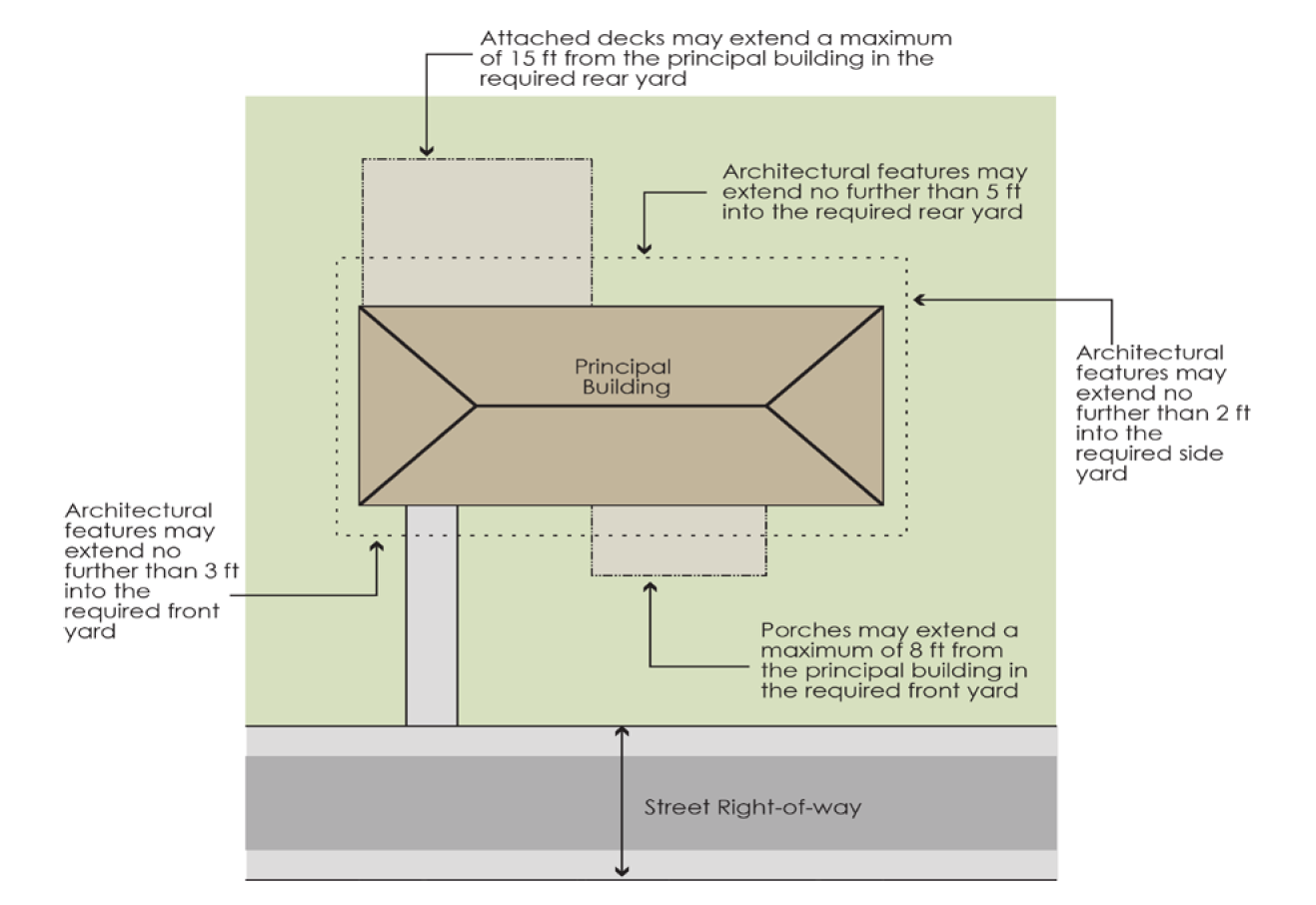
Cross reference— Figure 2.1, accessory buildings and structures location standards, § 102-9.
Sec. 102-39. - Residential development regulations for infill housing for existing neighborhoods.
(a)
Intent. The development regulations contained herein are intended to regulate the character of new infill housing development within a 300-foot defined area of the city which contain traditional and historic exterior design elements. The purpose of these regulations is to promote harmony in neighborhoods between new housing units and the existing buildings by assuring that new construction is of suitable character in terms of site layout, building dimensions, architectural design, and building materials.
(b)
Procedure.
(1)
All building permit applications for new single-family and two-family housing development located in platted subdivisions approved prior to 1967 must be submitted to the zoning administrator.
(2)
The zoning administrator shall have final approval on any applicable infill housing development in accordance with paragraph (c), below. However, the zoning administrator may refer applications to the planning commission for final approval.
(c)
Site design and architectural standards for single and two-family dwellings.
(1)
Lot coverage. The lot coverage of any proposed dwelling unit shall be no less than 90 percent and no more than 135 percent of the lot coverage of other single-family or two-family dwelling units within 300 feet of the subject lot, including dwelling units on both sides of the street of the same block.
(2)
Front yard setbacks. The front and exterior side yard setbacks of any proposed single-family or two-family dwelling unit shall be in accordance with district regulations.
(3)
Building appearance. Building appearance for new single-family and two-family dwelling units shall reflect a continuity of design with surrounding buildings by maintaining the architectural styles, details, building materials, and design themes of dwelling units on both sides of the street within 300 feet of the subject lot. Similarity and compatibility with surrounding dwelling units in terms of the following features may be necessary in order to meet this requirement:
a.
Roof and overhang style (e.g., gable, mansard, hip, A-frame, flat).
b.
Facade appearance (door and window openings).
c.
Building massing and height, one-story vs. two stories.
d.
Exterior building materials.
e.
Porches.
f.
Detached garage style and design.
(4)
Orientation. Proposed infill residential units shall be oriented toward, and be parallel with, the right of way or private road.
Sec. 102-40. - Residential recreational area.
(a)
Any residential subdivision, condominium, or multiple-family development comprising 20 or more lots or dwelling units, either as a single development or as a group of adjacent developments offered by a single proprietor, shall provide an active recreational area, such as play structures or picnic tables and benches, which shall contain an area equal in size to 1,500 square feet for each lot or dwelling unit in the subdivision, condominium project, or multiple-family development. The planning commission may modify this requirement when it is determined that alternate recreation facilities are provided in close proximity, however, a contribution to the maintenance fund for those recreational facilities shall be made.
(b)
The recreational area shall be well-drained, graded, seeded or sodded, safe from hazard, accessible to all dwellings, and the location shall be approved by the planning commission as part of the site plan review.
(c)
Preservation of the recreational area shall be achieved through deed restrictions or dedication to a subdivision homeowner's association.
Sec. 102-41. - Sidewalks, bikepaths, and walkways.
Any development shall provide pedestrian pathways meeting the following requirements:
(1)
Sidewalks.
a.
Sidewalks shall be required on both sides of the street or road in accordance with chapter 82, streets, sidewalks, and other public places, of the South Lyon City Code.
b.
All sidewalks shall be a minimum five feet wide and constructed of concrete to the specifications of the American Society of Highway and Transportation Officials (ASHTO).
c.
Sidewalks abutting parking areas shall be a minimum of seven feet wide to accommodate vehicle overhang.
d.
In lieu of concrete sidewalks, the planning commission may permit asphalt, stone, or wooden boardwalks in open space areas or areas with sensitive environmental features such as wetlands. The path or boardwalk shall provide direct access to all lots where the planning commission waives the requirement for concrete sidewalks.
(2)
Bikepaths. Bikepaths shall be at least eight feet wide and constructed of concrete or asphalt in accordance with the specifications of the ASHTO.
(3)
Walkways from the sidewalk to building entrances.
a.
A continuous pedestrian walkway shall be provided from any adjacent street sidewalk to building entrances.
b.
The walkways shall incorporate a mix of landscaping, benches, drop-off bays, and bicycle facilities for at least 50 percent of the length of the walkways.
c.
Walkways shall be connected to adjacent sites wherever practical and connect to other pedestrian systems.
(4)
Walkways from parking areas to building entrances.
a.
Internal pedestrian walkways shall be developed for persons who need access to the building(s) from internal parking areas. The walkways shall be located within the parking areas and shall be designed to provide safe, guided access from these areas to the entrances of the building(s).
b.
The walkways shall be designed to separate people from moving vehicles as much as possible.
c.
The walkways must be designed for disabled access according to the adopted building code for the city and other applicable laws.
d.
The walkways shall be distinguished from the parking and driving areas by use of any of the following materials: special pavers, bricks, raised elevation, scored concrete, or pavement markings. Other materials may be approved by the planning commission if appropriate to the overall design of the site and building.
(5)
General.
a.
Unless otherwise permitted by this chapter, sidewalks, bike paths, and walkways shall be installed by the developer or property owner within the dedicated street right-of-way or private road access easement. A special easement may be provided where grades or other factors prevent placement within the right-of-way or access easement.
b.
Crosswalk pavement markings and signs may be required in areas of potential vehicular and pedestrian conflict.
Sec. 102-42. - Solar panel energy systems.
Freestanding solar panels shall be considered an accessory building and shall be subject to the following requirements for such, together with all other applicable building codes and ordinances:
(1)
Solar energy systems are a permitted use in all zoning districts except solar energy commercial operations, which are prohibited as a principal use except in the I-2 industrial district. (These are systems whose main purpose is to generate energy for sale back into the energy grid system, rather than being consumed on site.)
(2)
Solar energy systems are subject to the following:
a.
Roof mounted systems on the principal building shall not exceed the height limits in the district, nor be more than three feet higher than the finished roof to which it is mounted, whichever is less. In no instance shall any part of the system extend beyond the edge of the roof.
b.
Ground mounted systems and systems attached to accessory buildings shall adhere to the setback requirements in the district.
c.
Solar energy systems are prohibited in front yards and shall not be located past the front wall of the principal building.
d.
The number of solar panels and supporting equipment shall be considered as one system.
e.
Ground mounted solar energy systems shall not be categorized as accessory buildings.
f.
If solar energy systems are attached to accessory buildings the number of accessory buildings allowed shall be regulated in accordance with the provisions set forth in section 102-9, accessory buildings, structures, and uses.
g.
The height of ground mounted solar energy systems and systems included on accessory buildings shall not exceed ten feet in height.
h.
No more than 20 percent of a lot may be covered with a solar energy system.
i.
Ground mounted systems shall be located on lots of one-half acre or more.
j.
Zoning and construction permits are required.
Sec. 102-43. - Storage of vehicles/recreational vehicles (for repair or parking).
(a)
The parking of commercial vehicles, as defined in article XXV definitions, shall be prohibited in all zoning districts except commercial and industrial districts, unless otherwise permitted.
(b)
All vehicles must be parked on an asphalt or concrete surface. Vehicles may not be parked on grassy areas or crushed gravel or landscape blocks.
(c)
Construction equipment and vehicles are not permitted to be parked in any residential district.
(d)
Commercial vehicles shall not be permitted in a residential district except as permitted below:
(1)
The vehicle shall be used as the principal means of transportation for a resident in the conduct of such resident's employment or profession or is the resident's sole means of motor vehicle transportation.
(2)
The vehicle shall not be a utility trailer, dump truck, stake truck, flat-bed truck, wrecker, or semi-tractor.
(3)
No part of the vehicle may exceed ten feet in overall height, measured from grade.
(4)
The vehicle shall not have more than four rear wheels.
(5)
The vehicle shall not exceed 11,000 pounds gross weight.
(6)
In any multiple-family residential district, the property owner or the controlling association shall provide a designated area, approved by the planning commission, to park or store commercial vehicles. Parking spaces required to meet the parking requirements of this chapter shall not be used for the parking or storage of commercial vehicles.
(7)
The parking or storage of essential public service vehicles where the vehicle is operated by the homeowner or the occupant is exempt from these provisions.
(c)
Commercial vehicles which are employed in conjunction within a non-residential district shall be parked or stored in compliance with the following provisions:
(1)
For sites with a site plan approved subsequent to the effective date of this Section, such vehicles shall be parked or stored in parking or loading spaces designated for that purpose on the site plan and per site plan approval.
(2)
For situations not covered under (1), above, commercial vehicles shall not be parked or stored in the front yard.
(d)
The parking or storage of commercial vehicles for residential, office, or storage purposes shall not be permitted.
(e)
The repair, restoration, and maintenance of vehicles in any residential district, when such work is not conducted entirely within the interior of the vehicle, shall be subject to the following limitations:
(1)
Procedures exceeding 48 hours in duration or which require the vehicle to be immobile or inoperable in excess of 48 hours shall be carried out within an enclosed building.
(2)
Inoperable vehicles and vehicle parts shall be stored inside an enclosed building.
(f)
The outdoor storage of inoperable and/or unregistered vehicles shall be prohibited, as regulated in chapter 42 environment, junk vehicles, of the South Lyon City Code.
(g)
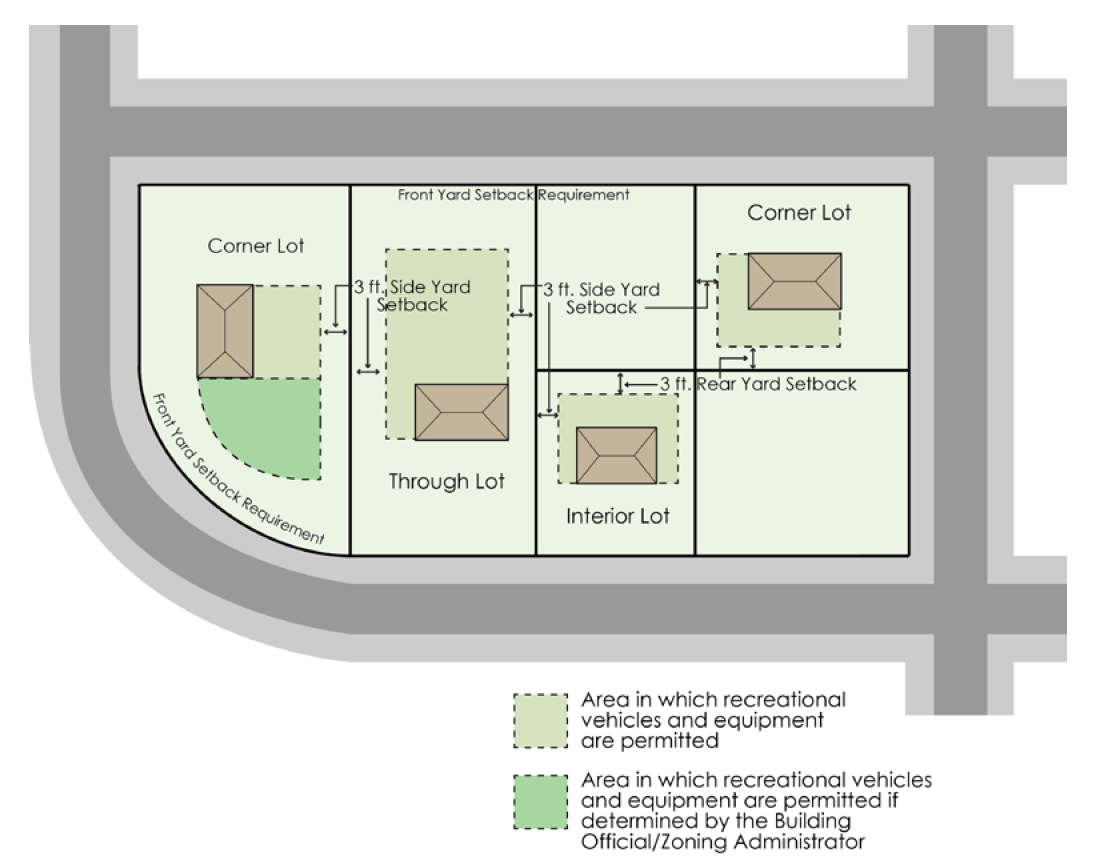
Recreational equipment and vehicle parking and storing. The purpose of these standards is to regulate and control the parking and storage of recreational vehicles, car haulers, snow mobile trailers, boats and boat trailers, and equipment on private property to promote the public health, safety, and welfare and to preserve property values.
(1)
Location standards. (See also accessory buildings and structures location standards, section 102-9.)
a.
Generally. Registered and operable recreational vehicles and/or recreational equipment shall be prohibited in the front yard unless otherwise permitted in this section. Recreational vehicles or equipment shall be placed or parked in the rear yard or side yard behind the front building line, on a hard paved surface not closer than ten feet from any structure and set back a minimum of three feet from any lot line, except as provided in paragraphs b. through f. below.
b.
Placement on lot. Recreational vehicles and equipment are permitted to be parked or stored only on a lot with a principal building, structure, or use unless it is adjacent lot which is under the same ownership.
c.
Time limits. Recreational vehicles or recreational equipment may be stored, parked, or placed within any front yard or within a public right-of-way where on-site parking is permitted for a period not exceeding 72 hours for loading and unloading or for normal maintenance and cleaning.
d.
Corner lots. In the case of corner lots, as defined in this chapter, the regulations of this section shall apply to both the front yard and the exterior side yard.
e.
Through lots. In the case of through lots, as defined in this chapter, parking and storage shall be permitted in the rear yard, as determined by the zoning administrator, provided the parked vehicle meets the front and side yard principal building setback requirements of the zoning district.
f.
Through corner lots. In the case of through lots on a corner (i.e., lots with frontage along three) streets), parking shall be allowed only in the side yard. The zoning administrator may permit parking in the rear yard, as noted in paragraph e. above, upon determination that such parking is allowed on the adjacent lot.
(2)
Owner or legal tenant. The owner of any recreational vehicle or equipment placed or parked on a lot shall be the owner of the lot or the legal tenant.
(3)
Condition and licensing requirements. All recreational vehicles and/or recreational equipment stored or parked in any residential district shall be in an operable condition, as determined by the zoning administrator.
(4)
Detachable camper tops. Detachable camper tops shall not be stored in any residential district except in accordance with above guidelines. Further, camper tops that are not installed on a licensed and operable vehicle must be placed on the ground and stabilized.
(5)
Occupation of stored recreational vehicles. At no time, shall any stored, parked, or placed recreational vehicles and/or recreational equipment be occupied or used for living purposes. At no time shall any such recreational vehicles and/or equipment, other than those granted a temporary use permit in conformance with section 102-46 below, have fixed connections to water, gas, or a sanitary sewer.
(6)
Permanent special exceptions. A recreational vehicle and/or recreational equipment which is officially licensed as a vehicle for a disabled person in accordance with state law and which is used as the regular means of transportation by or for a disabled person may be parked within the required setback area. Appropriate landscaping must be provided to screen the recreational vehicle from adjacent residential structures.
Sec. 102-44. - Street access and design.
(a)
Any lot created after June 14, 2021 shall have frontage upon an improved public street right-of-way, at least 60 feet in width, unless a private road of lesser width, built to public standards, has been approved by the city council.
(b)
A building permit shall not be issued for the construction of any principal building unless said lot has the minimum frontage required on an improved public street, at least 60 feet in width, unless a private road of lesser width has been approved by the city council. An existing lot of record that does not meet frontage requirements may apply for a building permit if the deficit width for the minimum frontage is no more than six feet.
(c)
All public and private roads and access driveways shall be surfaced with a durable pavement having an asphalt or cement binder and be constructed to the city standards.
(d)
All street access shall meet the standards of article XX access management and driveway standards.
(e)
All streets shall be constructed in accordance with chapter 86 subdivisions of the South Lyon City Code.
(f)
All streets shall be constructed with curb and gutter unless waived by the city council.
Sec. 102-45. - Swimming pools.
(a)
Swimming pools, spas, hot tubs, and similar devices shall be built in accordance with the Michigan Building Code.
(b)
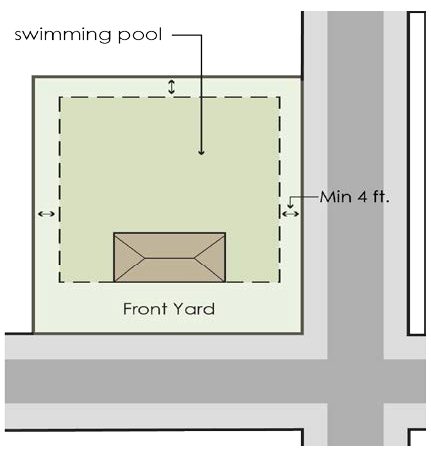
Swimming pools, spas, hot tubs, and similar devices are only permitted in the rear yard and may not be placed in a side or front yard.
(c)
Swimming pools, pool decks, spas, hot tubs, and similar devices shall not be located less than four feet from any lot line.
(d)
Swimming pools and surrounding pool deck (concrete) shall be included in computing impervious surface calculations.
(e)
All swimming pools, spas, hot tubs, and similar devices shall be enclosed by a barrier (i.e., fence or other enclosure) where required by state law and as approved by the building official.
Sec. 102-46. - Temporary buildings, structures, seasonal/special events, and uses.
Temporary principal or accessory buildings, structures, uses and special events may be permitted, subject to the following conditions:
(1)
Temporary construction, buildings, and structures/offices.
a.
With the exception of moving/storage pods, temporary buildings and construction structures, commonly used on constructions sites, may only be used for the storage of construction materials, tools, supplies and equipment for construction management and supervision offices, and for temporary on-site sanitation, solid waste, or fuel facilities, related to construction activity on the same lot.
b.
Moving/storage pods are allowed with an active building permit and ongoing construction activity, as determined by the building official, and must be placed upon a hard surface such as a driveway.
c.
No temporary building or structure shall be used for dwelling purposes.
d.
The placement of temporary buildings and structures shall be in conformance with the requirements of article XV site plan review. A building permit for such building or structure shall be issued by the building official prior to installation.
e.
Temporary buildings and structures shall be removed from the lot within 15 days after an occupancy permit is issued by the building official for the permanent structure on such lot, or within 15 days after the expiration of a building permit issued for construction on such lot.
(2)
Seasonal, and special events. Seasonal or special events may be allowed in any district upon issuance of a permit by the zoning administrator, when meeting the standards listed below:
a.
Seasonal, and special events may be allowed on any lot with a permitted principal building.
b.
Seasonal, and specials events may be allowed on a vacant lot when providing the minimum setback for all buildings, structures, and parking required for the appropriate zoning district.
c.
The seasonal or special event must not prevent the continued use of sidewalks, rights-of- way, fire lanes, etc.
d.
If the petitioner is not the owner of the property, the petitioner shall provide written permission of the owner of the property to allow such an event prior to beginning such seasonal or special event.
e.
A minimum of one parking space shall be provided for each 800 square feet of gross lot area used for the activity (not including storage areas) plus additional parking space for any structure utilized for retail sales computed in accordance with the requirements for retail stores. If parking on site is not provided, public parking must be within 500 feet of the event.
f.
A sketch plan (to scale) shall be provided illustrating:
1.
Property lines.
2.
Adjacent uses and zoning districts.
3.
Existing and proposed buildings and structures.
4.
Location of any areas for storage such as inventory not being displayed.
5.
Fire hydrants.
6.
Layout of parking.
7.
Boundaries of proposed sales areas.
8.
Location and size of any proposed sign (off-premise signs shall also be mapped).
g.
All equipment, materials, goods, poles, wires, signs, and other items associated with the seasonal or special event shall be removed from the premises within five days of the end of the event. Following the five day period, the city shall use the escrow fee to clear such items from the property.
h.
The length of a seasonal or special event shall not exceed four days, except seasonal sales of items such as Christmas trees, pumpkins, and seasonal roadside stands which are permitted for up to 60 days.
i.
Two permits for a seasonal or special event by a single business or property are permitted each calendar year. More than two seasonal or special events per calendar year will be considered a permanent event and must be reviewed by the planning commission and city council.
(3)
Temporary uses. Temporary uses may be allowed in any commercial, office, or industrial district upon approval by the planning commission, when meeting the standards listed below:
a.
Temporary uses may be allowed on any lot with a permitted principal building.
b.
Temporary uses may be allowed on a vacant lot when providing the minimum setback for all buildings, structures, and parking required for the appropriate zoning district.
c.
In no case shall the setbacks for any buildings, structures or parking be less than ten feet except in the CBD.
d.
The temporary use must not prevent the continued use of sidewalks, rights-of-way, fire lanes, etc.
e.
If the petitioner is not the owner of the property, the petitioner shall provide written permission of the owner of the property to allow such an activity prior to beginning such a temporary use.
f.
A minimum of one parking space shall be provided for each 800 square feet of gross lot area used for the activity (not including storage areas) plus additional parking space for any structure utilized for retail sales computed in accordance with the requirements for retail stores.
g.
A sketch plan (to scale) shall be provided illustrating:
1.
Property lines.
2.
Adjacent uses and zoning districts.
3.
Existing and proposed buildings and structures.
4.
Location of any areas for storage such as inventory not being displayed.
5.
Fire hydrants.
6.
Layout of parking.
7.
Boundaries of proposed sales areas.
8.
Location and size of any proposed sign (off-premise signs shall also be mapped).
h.
All equipment, materials, goods, poles, wires, signs, and other items associated with the temporary use shall be removed from the premises within five days of the end of the activity. Following the five day period, the city shall use the escrow fee to clear such items from the property.
i.
The length of a temporary use shall not exceed three months.
j.
One temporary use permit by a single business or property is permitted each year and there must be a minimum three month gap between temporary uses on a property.
k.
Special standards for carnivals, circuses, farmer's markets, flea markets, and similar events shall be as follows:
1.
Such uses shall be approved by the city council. The city council shall consider the intensity of the proposed use in relation to adjacent land uses and sufficiency of parking. The city council may require site improvements, such as fencing, increased setbacks, and restricted hours of operation to help ensure compatibility with surrounding land uses.
2.
The applicant shall provide information establishing that a reasonable amount of liability insurance coverage is carried, as determined by the City's insurance carrier.
3.
The sketch plan for the event shall include a description of traffic flow and parking management to ensure safe and efficient traffic operations without creating unreasonable congestion on city streets.
4.
Farmer's markets which are to occur on a regular schedule shall be permitted only in commercially zoned districts. The city council may extend the time period for the temporary use permit so that a separate permit is not required for each event within any one calendar year, provided the number of dates and a schedule are established at the time of application and that the conditions and requirements of are maintained.
(4)
Review and approval procedures, permit fees, and required escrow for temporary uses and sales events.
a.
Review. Except as otherwise noted above for carnivals, circuses, farmer's markets, and similar events as defined by the zoning administrator, the zoning administrator shall review and approve requests for a temporary use or seasonal event. Where appropriate, the administrator shall consult with the police chief and fire department official. If the request is denied, the zoning administrator shall state the reasons for denial in writing and provide a copy to the applicant.
b.
Use fee. The applicant shall pay a nonrefundable permit fee to the city clerk. The fee shall be established and modified, from time to time, by the city council. The amount of the permit fee may vary depending upon the type of event.
c.
Use escrow. The proprietor of the temporary use or seasonal event shall deposit a cash bond or similar type of escrow, in an amount established by the zoning administrator, prior to the issuance of a permit. The escrow shall be used by the city to pay the cost of returning the property to its state prior to commencement of the event or refunded to the proprietor upon compliance with the requirements of this chapter and any other applicable ordinances.
d.
Sign fee and escrow. The sign standards provided in chapter 70, signs of the South Lyon City Code permit the use of temporary signs, to be reviewed concurrent with use permit.
Sec. 102-47. - Voting place.
The provisions of this chapter shall not be construed as to interfere with the temporary use of any property as a voting place in connection with a municipal or other public election.
Sec. 102-48. - Waste receptacles and enclosures.
(a)
Waste receptacles, including dumpsters or compactors, shall be required for all nonresidential uses unless interior facilities are provided. Waste receptacles shall not be permitted as accessory to any single-family residential use.
(b)
All outdoor waste receptacles shall be enclosed on three sides and screened. The enclosure shall be constructed of brick or decorative concrete block material, consistent with the building materials of the principal building.
(c)
The enclosure shall also include a gate, made of vinyl or other high-quality material, as determined by the planning commission, on the fourth side. Wooden gates are not permitted. The gates shall remain closed when not being emptied and must always be maintained as approved. If the waste receptacle is a dumpster it must have an enclosing lid or cover.
(d)
The enclosure shall have a minimum height of six feet or one foot above the height of the waste receptacle, whichever is greater. The enclosure must be spaced at least three feet from the waste receptacle.
(e)
Waste receptacles and enclosures shall be located in the rear yard, not closer than three feet from the rear lot line, or non-required side yard, unless otherwise approved by the planning commission and shall be as far as practical, but in no case be less than 20 feet, from any residential district. If practical, the back side of the waste receptacle enclosure should be placed against the building. In this circumstance the wall may act as one side of the enclosure.
(f)
Waste receptacles shall be easily accessed by refuse vehicles without potential to damage automobiles parked in designated parking spaces or interfering with the normal movement of vehicles on or off the site. If possible, the opening shall not directly face the driveway.
(g)
The waste receptacle base shall be at least nine feet by six feet in area, constructed of six inches of reinforced concrete pavement. The base shall extend six feet beyond the waste receptacle pad or gate to support the front axle of a refuse vehicle.
(h)
The unloading of waste receptacles shall only occur between the hours of 7:00 a.m. and 11:00 p.m.
(i)
The shared use of receptacles shall be allowed by adjoining businesses where sharing will not create a health or safety concern and where it does not result in the accumulation of visibly excessive quantities of waste. Necessary shared use agreements are required with this standard.

