
Spooner City Zoning Code
ARTICLE X
- EXTERIOR LIGHTING
Sec. 86-901.- Intent of article.
Regulate outdoor lighting that will:
(1)
Permit reasonable uses of outdoor lighting for nighttime safety, utility, security, productivity, enjoyment and commerce.
(2)
Minimize light trespass, glare, obtrusive light, and artificial sky glow caused by misdirected, excessive, or unnecessary outdoor lighting.
(3)
Conserve energy and resources to the greatest extent possible.
(4)
Curtail and reverse the degradation of the nighttime visual environment and the night sky.
(5)
Help protect the natural environment from the damaging effects of night lighting from manmade sources.
(6)
These measures are intended to encourage lighting practices that direct appropriate amounts of light where and when it is needed, increasing the use of energy efficient sources, and decreasing the wastage of light and glare resulting from over-lighting and poorly shielded or inappropriately directed lighting fixtures.
(Amd. of 3-2-2010)
Sec. 86-902. - Definitions.
The following words, phrases and terms as used in this chapter shall have the following meaning:
Abandonment means if such use is discontinued or terminated for a period of 12 months.
Artificial sky glow means the brightening of the night sky attributable to manmade sources of light.
Candela means the unit of luminous intensity of a lighting source emitted into a given direction.
Canopy means a roof-like covering over an area, in or under which a lighting fixture is mounted.
Curfew means a time each night after which certain electric illumination must be turned off or reduced in intensity.
Direct illumination means illumination resulting from light emitted directly from a lamp or luminaire, not light diffused through translucent signs or reflected from other surfaces such as the ground or building faces.
Display lot or area means outdoor areas where active nighttime sales activity occurs, and where accurate color perception of merchandise by customers is required. To qualify as a display lot, one of the following specific uses must occur: automobile sales, boat sales, tractor sales, building supply sales, gardening or nursery sales, assembly lots, swap meets. Uses not on this list must be approved as display lot uses by the plan commission.
Disabling glare means lighting that impairs visibility and creates a potentially hazardous situation for either pedestrians or motorists.
Drip line area means the area on the ground enclosed by vertical planes extending downward from the outer solid edge of a canopy.
Facade means the exterior wall of a building.
Flood light means a specific form of lamp designed to direct its output in a specific direction (a beam) but with a diffusing glass envelope: Such lamps are so designated by the manufacturers and are typically used in residential outdoor area lighting.
Foot-candle means one lumen per square foot. Unit if illuminance. It is the luminous flux per unit area in the imperial system. One foot-candle equals approximately 0.1 (0.093) lux.
Glare means the sensation produced by a bright source within the visual field that is sufficiently brighter than the level to which the eyes are adapted to cause visual discomfort, annoyance or disability, or a loss of visual performance. The magnitude of glare depends on such factors as the size, position, brightness of the source, and on the brightness level to which the eyes are adapted.
Glow bomb means light fixture that produces excessive bright light, creating annoyance for either pedestrians or motorists.
Hardscape lighting means lighting associated with architectural features, such as fountains, sculptures, and the like.
Isofootcandle plan means a site plan of a proposed development showing proposed outdoor luminance with a series of isofootcandle lines that join points on a surface where luminance is the same.
Landscape lighting means luminaires mounted in or at grade (not to exceed three feet overall above the surrounding grade) and used solely for landscape rather than area lighting, or fully shielded luminaries mounted in trees and used solely for landscape or facade lighting.
Light trespass means spill light flowing across the property boundary that because of quantitative, directional, or spectral content causes annoyance, discomfort, or loss in visual performance and visibility.
Lumen means the unit of luminous flux: a measure of the amount of light emitted by a lamp.
Luminaire (light fixture) means a complete lighting unit consisting of one or more electric lamps, the lamp holder or holders, reflector, lens, diffuser, ballast, and/or other components and accessories.
Luminance means the amount of light emitted in a given direction from a surface by the light source or by reflection from a surface. The unit is candela per square meter.
Luminous flux means a measure of the total light output from a source, the unit being the lumen.
Mounting height means the vertical distance between the lowest part of the luminaire and the ground surface directly below the luminaire.
Nadir means the downward direction; exactly vertical, directly below a luminaire.
Nuisance glare means light that creates an annoyance or aggravation but does not create a potentially hazardous situation.
Obtrusive light means glare and light trespass.
Ornamental lighting means outdoor lighting that is installed mainly or entirely for its decorative effect or to accent an object or a feature, rather than as an aid to visibility for illumination.
Photometric test report means a report by an independent testing laboratory or one certified by the National Institute of Standards and Technology (NIST) describing the candela distribution, shielding type, luminance, and other optical characteristics of a specific luminaire.
External point of service means an outdoor service which a business provides to a customer, such as drive up food service, a bank transaction, or the like.
Property line means the boundary line of a property and the vertical plane above the property line.
Shielding means a device or technique for controlling the distribution of light. Four levels of shielding are defined as follows:
(1)
Fully shielded means a luminaire emitting no luminous flux above the horizontal plane.
(2)
Shielded means a luminaire emitting less than 2.0 percent of its luminous flux above the horizontal plane.
(3)
Partly shielded means a luminaire emitting less than ten percent of its luminous flux above the horizontal plane.
(4)
Unshielded means a luminaire that may emit its flux in any direction.
Spill light means lighting from a lighting installation that falls outside of the boundaries of the property on which the installation is sited.
Safety lighting means exterior lighting that involves ensuring proper levels of illumination to provide safe working conditions, safe passage, and the identification of outdoor hazards.
Security lighting means exterior lighting installed solely to enhance the security of people and property.
Temporary lighting means lighting installed with temporary wiring and operated for less than 60 days in any calendar year.
Zoning administrator means the administrator as designated in chapter 14 of this Code.
(Amd. of 3-2-2010)
Sec. 86-903. - Conformance with applicable codes.
All outdoor illuminating devices shall be installed in conformance with all other provisions of this Code, including but not limited to the building code and the electrical code, where applicable.
(Amd. of 3-2-2010)
Sec. 86-904. - Specific requirements and applicability.
(1)
New uses, buildings and major additions or modifications. For all proposed new land uses, developments, buildings, and structures that require any city permit, all outdoor lighting fixtures shall meet the requirements of this article. Whenever any building additions or modifications of 25 percent or more in terms of additional dwelling units, gross floor area, or parking spaces, either with a single addition or with cumulative additions, occurs subsequent to the effective date of this article, the entire property shall be required to comply with the requirements of this article. Cumulative modification or replacement of outdoor lighting constituting 25 percent or more of the permitted lumens for the parcel, no matter the actual amount of lighting already on a nonconforming site, shall constitute a major addition for purposes of this section.
(2)
Minor additions. Additions or modifications of less than 25 percent of the existing uses and that require any permit, shall also require the submission of a complete inventory and site plan detailing all existing and any proposed new outdoor lighting. Any new lighting on the site shall meet the requirements of this article with regard to shielding and lamp type. The total outdoor light output after the modifications are complete shall not exceed that on the site before the modification, or that permitted by this article, whichever is larger.
(3)
Residential fixtures. Lighting for or in conjunction with single-family residential uses shall be exempt from the requirements of this article, except must meet requirements of subsection 86-905(6), 86-905(8) and 86-905(10).
(4)
Resumption of use after abandonment. If a property or use with nonconforming lighting is abandoned, then all outdoor lighting shall be reviewed and brought into compliance with this article before the use is resumed.
(5)
Existing uses and buildings; nonconformance and compliance. Unless otherwise provided in this article any lighting in place prior to the enactment date, shall be brought into full compliance with the requirements of this article by September 30, 2019. If any lighting or light fixture changes use, lamp type, lamps, or bulbs or there is any replacement or structural alteration made to the lighting or light fixture prior to the September 30, 2019 compliance deadline, then such lighting or light fixtures shall immediately be brought into full compliance with the requirements of this article.
(6)
Roadways. Lighting used for street lighting and utility construction and repair shall not be subject to these lighting standards, but shall comply with street lighting policy of the city.
(Amd. of 3-2-2010)
Sec. 86-905. - General outdoor lighting standards.
(1)
All nonexempt outdoor lighting fixtures shall be partly shielded.
(2)
All nonexempt outdoor lighting fixtures shall be placed so as to not cause light trespass or light glare.
Any bright light shining onto adjacent property or streets which would result in a nuisance glare or a disabling glare shall not be permitted. Light trespass beyond property boundaries or emitting more than 2.0 percent of its luminous flux above the horizontal plane shall be considered non-compliant.
All outdoor lighting fixtures shall be designed, installed, located and maintained such that nuisance glare onto adjacent properties or streets shall be minimized and all direct illumination kept within the boundaries of the fixture owner's property.
This section may be enforced on the basis of a formal complaint filed in writing with the planning and zoning department.
Accept lighting, when so approved, shall be directed downward onto the building or object and not toward the sky or onto adjacent properties. Direct light emissions shall not be visible above the roof line or beyond the building edge.
Spotlighting on landscaping and foliage shall be limited to 150 watts (2220 lumens output). The lamp shall be shielded and not create disabling or nuisance glare.
(3)
All nonexempt outdoor lighting fixtures shall be of a type and placed so as to not allow emitting more than 2.0 percent of its luminous flux above the horizontal plane as measured at the luminaire.
(4)
Flood or spot lamps must be aimed no higher than 45 degrees above straight down (halfway between straight down and straight to the side) when the source is visible from any off-site residential property or public roadway.
(5)
All non-security lighting for commercial, industrial and any other nonresidential use, shall be extinguished between 11:00 p.m. (or when the business closes, whichever is later) and sunrise.
(6)
Any lamp installed on a residential property must be shielded such that the lamp is not directly visible from any other residential property.
(7)
All light fixtures that are required to be shielded shall be installed and maintained in such a manner that the shielding is effective as described herein for shielded fixtures.
(8)
Beyond the shielding requirements of this article, all light fixtures shall be located, aimed or shielded so as to minimize stray light trespassing across property boundaries. Particularly, any lamp installed on a residential property and visible from any other residential property must be shielded such that it is not directly visible from that property.
(9)
Multi-use lighting must conform to the shielding and timing restrictions, if any, that apply to the most restrictive included use.
(10)
Luminaries creating glare to be redirected. Any luminarie that is aimed, directed, or focused such as to cause direct light from luminaire to be directed toward residential buildings on adjacent or nearby land, or to create glare perceptible to persons operating motor vehicles on public ways, shall be redirected or its light output controlled as necessary to eliminate such conditions.
(11)
Illuminance levels for outdoor lighting fixtures measured at three feet above the ground or finished grade shall comply with the Wisconsin Administrative Building Codes (2006 International Energy Conservation Code) Section 505.6.2 Exterior Building Lighting Power, all its amendments and all state case law interpreting such, now and any future revisions.
(Amd. of 3-2-2010)
Sec. 86-906. - Outdoor advertising signs.
(1)
Externally illuminated and neon signs. External illumination for signs shall conform to all provisions of this article. All upward-directed sign lighting, meaning lighting directed above the horizontal plan of the luminary, is prohibited.
(2)
Internally illuminated and neon signs.
a.
Outdoor internally-illuminated advertising signs must either be constructed with an opaque background and translucent text and symbols, or with a colored (not white, off-white, light gray, cream or yellow) background and generally lighter text and symbols. Lamps used for internal illumination of such signs shall not be counted toward the lumen cap.
b.
Neon signs shall be treated as internally illuminated signs for the purposes of this article, and shall not have their luminous outputs counted toward the lumen cap. Neon lighting extending beyond the area considered to be the sign area shall conform to all provisions of this article, be treated as decorative lighting, and shall conform to the lumen cap.
c.
Other internally-illuminated panels or decorations not considered to be signage, shall be considered decorative lighting, and shall be subject to the standards applicable for such lighting, including but not limited to the lamp source, shielding standards and lumens per property cap.
[3]
Nonconformance of existing outdoor advertising signs.
a.
Bottom-mounted or unshielded outdoor advertising sign lighting shall not be used by September 30, 2019.
b.
All other outdoor advertising sign light fixtures lawfully installed prior to and operable on the effective date of this article shall be brought into full compliance with the requirements of this article by September 30, 2019.
c.
If any outdoor advertising sign or light fixture thereon changes its use, lamp type, fixtures or there is any replacement or structural alteration made prior to the compliance deadline set forth in subsection (b) above, the advertising sign and light fixtures thereon shall immediately be brought into full compliance with the requirements of this article. Further, if the property is abandoned, or if there is a change in use of the property, the provisions of this article will apply when the abandonment ceases or the new use commences.
(Amd. of 3-2-2010)
Sec. 86-907. - Special uses.
(1)
Recreational facilities. [Reserved for future use]
(2)
Outdoor display lots.
a.
Lumens exemption. Lighting for display lots shall be exempt from the lumens per property limits of this article.
b.
Shielding. All display lot lighting shall utilize partly shielded luminaries that are installed in a fashion that maintains the shielded characteristics.
c.
Illuminance. The display lot shall be designed to achieve no greater than the minimal illuminance levels for the activity as recommended by the Illuminating Engineering Society of North America (IESNA).
d.
Off-site spill. The display lot shall limit off-site spill (off the parcel containing the display lot) to a maximum of 5 lux (0.5 fc) at any location on any nonresidential property, and 0.5 lux (0.05 fc) at any location on any residential property, as measurable from any orientation of the measuring device.
e.
Certification. Every display lot lighting system design and installation shall be certified by a registered engineer or licensed electrician as conforming to all applicable restrictions of this article.
f.
Curfew. Display lot lighting exceeding the lumens per property cap of this article shall be turned off no later than 11:00 p.m., or within 30 minutes after closing of the business, whichever is later. Lighting in the display lot after this time shall conform to all applicable restrictions of this article, including the lumens cap in this article.
(3)
Service station canopies.
a.
Shielding. All luminaries mounted on or recessed into the lower surface of service station canopies shall be fully shielded and utilize flat lenses.
b.
Total under-canopy output. The total light output used for illuminating service station canopies, defined as the sum of all under-canopy initial bare-lamp outputs in lumens, shall not exceed 215 lumens per square meter (20 lumens per square foot). Any luminaries mounted on the lower surface or recessed into the lower surface of the canopy and any lighting within signage or illuminated panels over the pumps, is to be included toward the total at full initial lumen output. Other lighting located under a canopy but not mounted on or within the lower surface is also included toward the lumen caps at full initial lumen output.
c.
Certification. Every service station canopy lighting system design and installation shall be certified by a registered engineer or licensed electrician as conforming to all applicable restrictions of this article.
1.
Canopy lighting and lighting of service stations.
i.
Lighting of such areas shall not be used to attract attention to the business. Signs allowed under the appropriate section of these regulations shall be used for that purpose.
ii.
Lighting levels shall be adequate to facilitate the activities taking place in such locations.
iii.
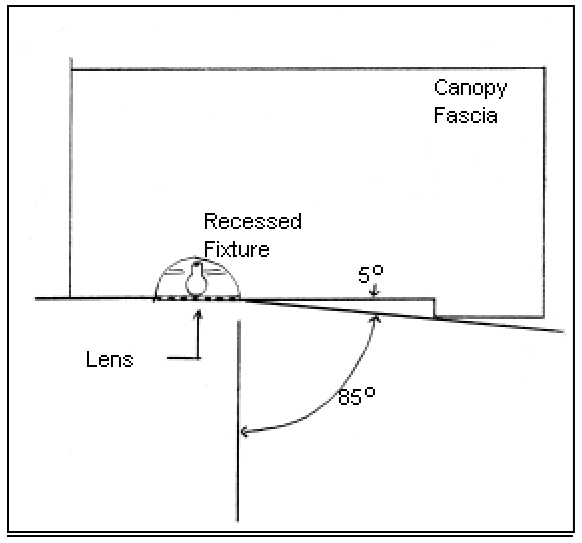
In order to minimize the extent of direct glare, light fixtures mounted on canopies shall be recessed so that the lens cover is recessed or flush with the bottom surface (ceiling) of the canopy or shielded by the fixture or the edge of the canopy so that light is restrained to 85 degrees or less from vertical.
iv.
As an alternative (or supplement) to recessed ceiling lights, indirect lighting may be used where light is beamed upward and then reflected down from the underside of the canopy. When this method is used, light fixtures must be shielded so that direct illumination is focused exclusively on the underside of the canopy.
v.
Lights shall not be mounted on the top or sides (fascias) of the canopy. The sides (fascias of the canopy) shall not be illuminated in a manner.
vi.
Areas around service station pump islands shall be illuminated so that the minimum horizontal luminance at grade level is at least 1.0 foot-candle and no more than 5.0 foot-candles. The uniformity ratio (average illumination to minimum illumination) shall be no greater than 4:1. At the discretion of the director, increased lighting levels may be permitted for enhanced security purposes only.
d.
Off-site spill. [Reserved for future use]
(4)
Generally. All lighting not directly associated with the special use areas above shall conform to the lighting standards described in this article, including but not limited to the lamp type and shielding requirements and the lumens limits.
(Amd. of 3-2-2010)
Sec. 86-908. - Criteria required for application approval.
(1)
Submission contents. The applicant for any building permit required by the city shall submit (as part of the application for permit) evidence that the proposed work will comply with this article. The submission shall contain but shall not necessarily be limited to the following, all or part of which may be part of or in addition to the information required elsewhere in this Code:
a.
Plans indicating the location on the premises of each illuminating device, both proposed and any already existing on the site;
b.
Description of all illuminating devices, fixtures, lamps, supports, reflectors, both proposed and existing. The description may include, but is not limited to catalog cuts and illustrations by manufacturers (including sections where required);
c.
Photometric data, such as that furnished by manufacturers, or similar showing the angle of cut off of light emissions.
(2)
Additional submission. The above required plans, descriptions and data shall be sufficiently complete to enable the building inspector to readily determine whether compliance with the requirements of this article will be secured. If such plans, descriptions and data cannot enable this ready determination, the applicant shall additionally submit as evidence of compliance to enable such determination such certified reports of tests as will do so provided that these tests shall have been performed and certified by a recognized testing laboratory.
(3)
Lighting plan required. A lighting plan shall be required for all commercial and industrial building permit applications as well as residential developments of one acre or more in size. When required, lighting plans shall illustrate proposed lighting. The plan shall show areas of night illumination and the amount of light at various places measured in foot-candles. When required, the lighting plan shall consist of either isofootcandles (connecting points of equal light illumination levels, similar to a topographic contour) or a photometric grid with individual spot readings. No lighting plan shall be approved which will result in direct light that exceeds the requirements or is otherwise inconsistent with this section.
(4)
Subdivision plats. If any subdivision proposes to have installed street or other common or public area outdoor lighting, submission of the information as described herein shall be required for all such lighting.
(5)
Lamp or fixture substitution. Should any outdoor light fixture or the type of light source therein be changed after the permit has been issued, a change request must be submitted to the building inspector for approval, together with adequate information to assure compliance with this article, which must be received prior to substitution.
(6)
Plan review. The plans shall be reviewed by the city designee per sections 86-53 and 86-54. If the city determines that the proposed lighting does not comply with this article, the permit shall not be issued or the plan approved.
(Amd. of 3-2-2010)
Sec. 86-909. - Prohibited uses.
(1)
Laser source light. The use of laser source light or any similar high intensity light for outdoor advertising or entertainment, when projected above the horizontal, is prohibited.
(2)
Searchlights. The operation of searchlights for advertising purposes is prohibited.
(3)
Outdoor advertising off-site signs. Illumination of outdoor advertising off-site signs is prohibited.
(Amd. of 3-2-2010)
Sec. 86-910. - Temporary exemptions.
(1)
Request; renewal; information required. Any person may submit, on a form prepared by the city or letter, to the city clerk, a temporary exemption request. The request shall contain the following information:
a.
Specific ordinance exemption(s) requested;
b.
Duration of requested exemption(s);
c.
Proposed location on premises of the proposed light fixture(s);
d.
Purpose of the proposed lighting;
e.
Information for each luminaire and lamp combination as required herein;
f.
Previous temporary exemptions, if any, and addresses of premises thereunder;
g.
Such other data and information as may be required by the designated official.
(2)
Approval; duration. The designated official shall have five business days from the date of submission of the request for temporary exemption to act, in writing, on the request. If approved, the exemption shall be valid for not more than 30 days from the date of issuance of the approval. The approval shall be renewable upon further written request, at the discretion of the designated official, for a maximum of one additional 30-day period. The designated official is not authorized to grant more than one temporary permit and one renewal for a 30-day period for the same property within one calendar year.
(3)
Disapproval; appeal. If the request for temporary exemption or its extension is disapproved, the person making the request may appeal to the zoning board of appeals under section 86-55 of this chapter.
(Amd. of 3-2-2010)
Sec. 86-911. - Other exemptions.
(1)
County state and federal facilities. Compliance with the intent of this article at all county, state and federal facilities is encouraged, but not required.
(2)
Emergency lighting. Emergency lighting, used by police, firefighting, or medical personnel, or at their direction, is exempt from all requirements of this article for as long as the emergency exists.
(3)
Swimming pool and fountain lighting. Underwater lighting used for the illumination of swimming pools and fountains is exempt from the lamp type and shielding standards provided herein, though it must conform to all other provisions of this article.
(4)
Flags, lighted. United States, and State of Wisconsin flags are exempt from the provisions of this article. All other outdoor lighted flags, such as, but not limited to, decorative and commercial flags shall conform to the provisions of this article.
(5)
Towers. Legally required safety lighting for towers shall be exempt from this article.
(6)
Airfields and airports. These facilities, both commercial and noncommercial, shall be exempt from the provisions of this article where lighting is used for air safety reasons. All other lighting shall conform to this article.
(Amd. of 3-2-2010)
Sec. 86-912. - Violations.
(a)
Violation. It shall be unlawful for any person to violate any provision of this article.
Each and every day or night during which the violation continues shall constitute a separate offense. In case of any violation, the common council, the zoning administrator, the plan commission or any property owner who would be specifically damaged by such violation may cause an appropriate action or proceeding to be instituted to enjoin a violation of this chapter or cause a structure to be vacated or removed.
(b)
Remedial action. Whenever an order of the zoning administrator has not been complied with within 30 days after written notice has been mailed to the owner, the resident agent or occupant of the premises, the common council, the zoning administrator or the city attorney may institute appropriate legal action or proceedings.
(c)
Penalties. Any person who fails to comply with the provisions of this chapter or any order of the zoning administrator issued in accordance with this chapter or resists enforcement shall, upon conviction thereof, be subject to a forfeiture and such additional penalties as provided in section 1-11 of this Code.
(Amd. of 3-2-2010)

