
Spotsylvania County Unincorporated
City Zoning Code
City Zoning Code
ARTICLE 6
- ZONING DISTRICTS
DIVISION 2. - RESERVED[13]
Editor's note— Ord. No. 23-160, adopted January 13, 2015, repealed the former division 2, §§ 23-6.2.1—23-6.2.4 in its entirety, which pertained to the agricultural 1 (A-1) district, and derived from Ord. No. 23-66, adopted October 24, 1995; Ord. No. 23-72, adopted April 22, 1997; Ord. No. 23-73, adopted August 12, 1997; Ord. No. 23-78, adopted February 9, 1999; Ord. No. 23-86, adopted August 22, 2000; Ord. No. 23-91, adopted March 27, 2001; Ord. No. 23-95, adopted September 25, 2001; Ord. No. 23-97, adopted October 23, 2001; Ord. No. 23-99, adopted February 12, 2002; Ord. No. 23-100, adopted April 9, 2002; Ord. No. 23-101, adopted June 25, 2002; Ord. No. 23-104, adopted March 11, 2003; Ord. No. 23-106, adopted November 25, 2003; Ord. No. 23-110, adopted December 14, 2004; Ord. No. 23-114, adopted August 9, 2005; Ord. No. 23-121, adopted October 9, 2007; Ord. No. 23-132, adopted March 10, 2009; Ord. No. 23-152, adopted January 8, 2013; Ord. No. 23-153, adopted February 12, 2013, and Ord. No. 23-155, adopted March 11, 2014.
DIVISION 12. - PLANNED DEVELOPMENT HOUSING DISTRICT (PDH)[14]
Editor's note— Ord. No. 23-160, adopted January 13, 2015, amended division 12 in its entirety to read as herein set out. Formerly, division 12, §§ 23-6.12.1—23-6.12.6, pertained to similar subject matter, and derived from Ord. No. 23-66, adopted October 24, 1995; Ord. No. 23-77A, adopted July 28, 1998; Ord. No. 23-79, adopted April 13, 1999; Ord. No. 23-97, adopted October 23, 2001; Ord. No. 23-104, adopted March 11, 2003; Ord. No. 23-113, adopted February 8, 2005; Ord. No. 23-152, adopted January 8, 2013; Ord. No. 23-153, adopted February 12, 2013, and Ord. No. 23-155, adopted March 11, 2014.
DIVISION 14. - RESERVED[15]
Editor's note— Ord. No. 23-79, adopted April 13, 1999, repealed Div. 14 which pertained to the village (V) district and derived from Ord. No. 23-66, adopted Oct. 24, 1995, and Ord. No. 23-78, adopted Feb. 9, 1999.
DIVISION 23. - PDC PLANNED DEVELOPMENT COMMERCIAL DISTRICT[16]
Editor's note— Ord. No. 23-160, adopted January 13, 2015, amended division 23 in its entirety to read as herein set out. Formerly, division 23, §§ 23-6.23.1—23-6.23.6 pertained to similar subject matter, and derived from Ord. No. 23-66, adopted October 24, 1995; Ord. No. 23-72, adopted April 22, 1997; Ord. No. 23-78, adopted February 9, 1999; Ord. No. 23-79, adopted April 13, 1999; Ord. No. 23-97, adopted October 23, 2001; Ord. No. 23-104, adopted March 11, 2003, and Ord. No. 23-152, adopted January 8, 2013.
DIVISION 25. - VILLAGE (V) DISTRICT[17]
Editor's note— Ord. No. 23-160, adopted January 13, 2015, amended division 25 in its entirety to read as herein set out. Formerly, division 25 pertained to the village commercial (VC) district, and derived from Ord. No. 23-79, adopted April 13, 1999; Ord. No. 23-97, adopted October 23, 2001; Ord. No. 23-101, adopted June 25, 2002; Ord. No. 23-104, adopted March 11, 2003; Ord. No. 23-114, adopted August 9, 2005, and Ord. No. 23-152, adopted January 8, 2013.
DIVISION 26. - RESERVED[18]
Editor's note— Ord. No. 23-160, adopted January 13, 2015, repealed the former division 26, §§ 23-6.26.1—23-6.26.5 in its entirety, which pertained to the village residential (VR) district, and derived from Ord. No. 23-79, adopted April 13, 1999; Ord. No. 23-97, adopted October 23, 2001; Ord. No. 23-101, adopted June 25, 2002; Ord. No. 23-104, adopted March 11, 2003; Ord. No. 23-114, adopted August 9, 2005; Ord. No. 23-152, adopted January 8, 2013; Ord. No. 23-153, adopted February 12, 2013, and Ord. No. 23-155, adopted March 11, 2014.
Sec. 23-6.1.1.- Districts established; boundaries.
(a)
In order to carry out the purposes of this chapter and to allow a variety of uses in different districts which are appropriate to the character of the individual district, the county shall be divided into the following general zoning districts, the boundaries of which shall be shown on the official zoning maps:
(1)
Agricultural 1 (A-1) district.
(2)
Agricultural 2 (A-2) district.
(3)
Agricultural 3 (A-3) district.
(4)
Resort agricultural (R-A) district.
(5)
Residential 1 (R-1) district.
(6)
Residential 2 (R-2) district.
(7)
Residential 3 (R-3) district.
(8)
Residential 8 (R-8) district.
(9)
Residential 12 (R-12) district.
(10)
Residential resort (R-R) district.
(11)
Planned development housing (PDH) district.
(12)
Residential manufactured home park (R-MHP) district.
(13)
Village (V) district.
(14)
Office 1 (O-1) district.
(15)
Office 2 (O-2) district.
(16)
Commercial 1 (C-1) district.
(17)
Commercial 2 (C-2) district.
(18)
Commercial 3 (C-3) highway district.
(19)
Resort commercial (R-C) district.
(20)
Industrial 1 (I-1) district.
(21)
Industrial 2 I-2) district.
(22)
PDC planned development commercial district.
(23)
Rural (Ru) district.
(b)
Lands within the county also may be classified as one or more of the "overlay districts" set forth in article 7 of this chapter. Where the property is classified in an overlay district, the regulations governing development in the overlay district shall apply in addition to the regulations governing development in the underlying general district. In the event of an express conflict between the standards set forth in this article and the standards set forth in article 7 for an overlay district which may apply article 7 shall control.
(Ord. No. 23-66, 10-24-95; Ord. No. 23-72, 4-22-97)
Sec. 23-6.1.2. - Allowable uses.
No use shall be established in any zoning district unless it is expressly designated by this chapter as a "permitted use" or "special use" in the district in which the use is to be located.
(Ord. No. 23-66, 10-24-95; Ord. No. 23-72, 4-22-97; Ord. No. 23-78, 2-9-99; Ord. No. 23-91, 3-27-01; Ord. No. 23-116, 3-14-06)
Sec. 23-6.3.1.- Purpose and intent.
The purpose of the agricultural 2 (A-2) district is to protect and maintain the rural character of the county and to protect and enhance the agricultural economy of the county.
(Ord. No. 23-66, 10-24-95; Ord. No. 23-99, 2-12-02; Ord. No. 23-106, 11-25-03; Ord. No. 23-132, 3-10-09; Ord. No. 23-160, 1-13-15)
Sec. 23-6.3.2. - Permitted uses.
The following uses may be established as permitted uses in the agricultural 2 (A-2) district:
(1)
Accessory uses as permitted by article 5, division 3 of this chapter;
(2)
Agriculture;
(3)
Antique shop, limited to parcels fronting and/or whose chief point of ingress/egress is upon state maintained roads limited to State Route number 1 through State Route number 712;
(4)
Art and craft studio, limited to parcels fronting and/or whose chief point of ingress/egress is upon state maintained roads limited to State Route number 1 through State Route number 712;
(5)
Bed and breakfast I;
(6)
Dwelling, manufactured home on permanent foundations;
(7)
Dwelling, single-family, detached;
(8)
Equestrian facility;
(9)
Expansion of a place of worship, but not expansion of the seating capacity in the sanctuary of such place of worship;
(10)
Expansion of a public school;
(11)
Game preserves, wildlife sanctuaries, fish hatchery;
(12)
Golf driving range;
(13)
Home enterprise in accordance with division 23-5.4A;
(14)
Home occupation in accordance with division 23-5.4;
(15)
Miniature golf;
(16)
Public facility/use;
(17)
Quasi-public park, playground, athletic field and related facility;
(18)
Repair service establishment limited to parcels fronting and/or whose chief point of ingress/egress is upon state maintained roads limited to State Route number 1 through State Route number 712.
(Ord. No. 23-66, 10-24-95; Ord. No. 23-72, 4-22-97; Ord. No. 23-95, 9-25-01; Ord. No. 23-101, 6-25-02; Ord. No. 23-114, 8-9-05; Ord. No. 23-132, 3-10-09; Ord. No. 23-152, 1-8-13; Ord. No. 23-153, 2-12-13; Ord. No. 23-155, 3-11-14; Ord. No. 23-160, 1-13-15; Ord. No. 23-178, § 1, 10-29-19)
Sec. 23-6.3.3. - Special uses.
The following uses may be established as special uses in the agricultural 2 (A-2) district, subject to approval by the board of supervisors in accordance with article 4, division 5 of this chapter:
(1)
Abattoir;
(2)
Adult day care center;
(3)
Airport, public and private;
(4)
Animal shelter;
(5)
Antique shop, inconsistent with the use allowed by-right herein;
(6)
Art and craft studio, inconsistent with the use allowed by-right herein;
(7)
Assisted living facility;
(8)
Bed and breakfast II;
(9)
Camp or recreation ground;
(10)
Cemetery;
(11)
Child care center;
(12)
Civic, social or fraternal facility;
(13)
Civic and sports arena;
(14)
Community center;
(15)
Contractor's offices and shop;
(16)
Convenience store;
(17)
Convent, monastery, seminary and nunnery;
(18)
Country club;
(19)
Cultural center, museum or similar facilities;
(20)
Equestrian event facility;
(21)
Farm equipment supplies sales establishment;
(22)
Feed mill;
(23)
Feed yard;
(24)
Fuel dispensing service;
(25)
Funeral home adjacent to a perpetual care cemetery;
(26)
Garden center;
(27)
Golf course and clubhouse;
(28)
Heavy equipment and specialized vehicle sale, rental and/or service establishment;
(29)
Hospital;
(30)
Indoor commercial recreation/athletic facility;
(31)
Kennel;
(32)
Livestock exchange;
(33)
Lumber yard;
(34)
Nursing home;
(35)
Open air market;
(36)
Outdoor sports and recreation, commercial;
(37)
Place of worship;
(38)
Private school;
(39)
Public school;
(40)
Public utility, light;
(41)
Religious retreat center;
(42)
Repair service establishment, inconsistent with the use allowed by-right herein;
(43)
Sawmill;
(44)
Solar energy facility;
(45)
Summer camp;
(46)
Tannery;
(47)
Telecommunication tower;
(48)
Vehicle, light service establishment;
(49)
Vehicle, major service establishment;
(50)
Veterinary hospital/services;
(51)
Wetland mitigation bank;
(52)
Wood by-products recycling center.
(Ord. No. 23-66, 10-24-95; Ord. No. 23-73, 8-12-97; Ord. No. 23-78, 2-9-99; Ord. No. 23-91, 3-27-01; Ord. No. 23-95, 9-25-01; Ord. No. 23-97, 10-23-01; Ord. No. 23-100, 4-9-02; Ord. No. 23-101, 6-25-02; Ord. No. 23-114, 8-9-05; Ord. No. 23-132, 3-10-09; Ord. No. 23-152, 1-8-13; Ord. No. 23-160, 1-13-15; Ord. No. 23-173, § 3, 11-9-17; Ord. No. 23-178, § 1, 10-29-19)
Sec. 23-6.3.4. - Development standards.
All uses and structures in the agricultural 2 (A-2) district shall meet the following development standards, except as this chapter specifically provides otherwise:
(a)
Density:
(1)
Residential (subdivision): One (1) dwelling unit per five (5) gross acres and the lot yield from any parent parcel existing as of February 12, 2002 shall not exceed ten (10) lots including the parent parcel.
(2)
Non-residential: Floor area ratio of 0.1.
(3)
The board of supervisors may modify the floor area ratio limitations by special use.
(4)
Residential (family division): One (1) dwelling unit per two (2) gross acres.
(5)
Residential (annual division): One (1) dwelling unit per three (3) gross acres, and the residential lot yield from any parent parcel which existed on February 12, 2002 shall not exceed six (6) lots.
(b)
Minimum lot area:
(1)
Agriculture: As defined in section 23-2.1.4.
(2)
Cemeteries: One (1) acre.
(3)
Public utility, light: One (1) acre.
(4)
Recreation trailer camps, campgrounds and summer camps: Ten (10) acres.
(5)
Single-family detached dwelling:
(i)
In a conventional subdivision: Five (5) acres.
(ii)
In a cluster subdivision: Two (2) acres.
(iii)
In a family division: Two (2) acres.
(iv)
In an annual division: Three (3) acres.
(6)
All other uses: Two (2) acres.
(c)
Minimum lot width:
(1)
Conventional subdivision: Two hundred fifty (250) feet.
(2)
Cluster subdivision: One hundred fifty (150) feet.
(3)
Family division: One hundred fifty (150) feet.
(4)
Annual division: One hundred fifty (150) feet.
(d)
Minimum public road frontage:
(1)
Conventional subdivision: Two hundred fifty (250) feet; one hundred (100) feet on a cul-de-sac.
(2)
Cluster subdivision: One hundred fifty (150) feet; eighty (80) feet on a cul-de-sac.
(3)
Family division: One hundred fifty (150) feet if divided off the public road or refer to Section 20-14.1.1.E(4).
(4)
Annual division: One hundred fifty (150) feet if divided off the public road or refer to Section 20-14.1.1.E(4).
(e)
Minimum yards:
(1)
Front: Thirty (30) feet.
(2)
Side: Ten (10) feet.
(3)
Rear: Thirty-five (35) feet.
(f)
Maximum height:
(1)
Agricultural buildings and structures: None.
(2)
All other uses: Thirty-five (35) feet.
(g)
General development standards: Refer to article 5.
(h)
Landscaping and screening: Refer to article 5, division 5.
(i)
Off-street parking: Refer to article 5, division 9.
(j)
Signs: Refer to article 5, division 8.
(k)
Open space:
(1)
Conventional subdivision: No requirement.
(2)
Cluster subdivision: Forty (40) percent.
(3)
Family and annual division: No requirement.
(Ord. No. 23-66, 10-24-95; Ord. No. 23-86, 8-22-00; Ord. No. 23-99, 2-12-02; Ord. No. 23-100, 4-9-02; Ord. No. 23-104, 3-11-03; Ord. No. 23-106, 11-25-03; Ord. No. 23-110, 12-14-04; Ord. No. 23-121, 10-9-07; Ord. No. 23-132, 3-10-09; Ord. No. 23-160, 1-13-15; Ord. No. 23-179, § 1, 4-14-20)
Sec. 23-6.4.1.- Purpose and intent.
The purpose of the agricultural 3 (A-3) district is to promote and protect large lot size parcels to maintain the rural character of the county and to protect, support, and enhance the agricultural economy of the county.
(Ord. No. 23-66, 10-24-95; Ord. No. 23-99, 2-12-02; Ord. No. 23-106, 11-25-03; Ord. No. 23-132, 3-10-09; Ord. No. 23-139, 8-10-10; Ord. No. 23-160, 1-13-15)
Sec. 23-6.4.2. - Permitted uses.
The following uses may be established as permitted uses in the agriculture 3 (A-3) district:
(1)
Accessory uses as permitted by article 5, division 3 of this chapter;
(2)
Agriculture;
(3)
Antique shop, limited to parcels fronting and/or whose chief point of ingress/egress is upon state maintained roads limited to State Route number 1 through State Route number 712;
(4)
Art and craft studio, limited to parcels fronting and/or whose chief point of ingress/egress is upon state maintained roads limited to State Route number 1 through State Route number 712;
(5)
Bed and breakfast I;
(6)
Dwelling, manufactured home, on permanent foundations;
(7)
Dwelling, manufactured home for farm hand;
(8)
Dwelling, single-family, detached;
(9)
Equestrian facility;
(10)
Expansion of a place of worship, but not expansion of the seating capacity in the sanctuary of such place of worship;
(11)
Expansion of a public school;
(12)
Game preserves, wildlife sanctuary, fish hatchery;
(13)
Garden center;
(14)
Golf driving range;
(15)
Home enterprise in accordance with division 23-5.4A;
(16)
Home occupation in accordance with division 23-5.4;
(17)
Miniature golf;
(18)
Public facility/use;
(19)
Quasi-public park, playground, athletic field and related facility;
(20)
Repair service establishment limited to parcels fronting and/or whose chief point of ingress/egress is upon state maintained roads limited to State Route number 1 through State Route number 712.
(Ord. No. 23-66, 10-24-95; Ord. No. 23-72, 4-22-97; Ord. No. 23-88, 9-26-00; Ord. No. 23-95, 9-25-01; Ord. No. 23-101, 6-25-02; Ord. No. 23-114, 8-9-05; Ord. No. 23-132, 3-10-09; Ord. No. 23-139, 8-10-10; Ord. No. 23-152, 1-8-13; Ord. No. 23-153, 2-12-13; Ord. No. 23-155, 3-11-14; Ord. No. 23-160, 1-13-15; Ord. No. 23-178, § 1, 10-29-19)
Sec. 23-6.4.3. - Special uses.
The following uses may be established as special uses in the agricultural 3 (A-3) district, subject to approval by the board of supervisors in accordance with article 4, division 5 of this chapter:
(1)
Abattoir;
(2)
Adult day care center;
(3)
Airport, public or private;
(4)
Animal shelter;
(5)
Antique shop, inconsistent with the use allowed by-right herein;
(6)
Art and craft studio, inconsistent with the use allowed by-right herein;
(7)
Assisted living facility;
(8)
Bed and breakfast II;
(9)
Camp or recreation ground;
(10)
Cemetery;
(11)
Child care center;
(12)
Civic, social or fraternal facility;
(13)
Civic and sports arena;
(14)
Community center;
(15)
Contractor's offices and shop;
(16)
Convent, monastery, seminary, and nunnery;
(17)
Convenience store;
(18)
Country club;
(19)
Cultural center, museum or similar facilities;
(20)
Equestrian event facility;
(21)
Farm equipment and supplies sales establishment;
(22)
Feed mill;
(23)
Feed yard;
(24)
Fuel dispensing service;
(25)
Funeral home adjacent to a perpetual care cemetery;
(26)
Golf course and clubhouse;
(27)
Heavy equipment and specialized vehicle sale, rental and/or service establishment;
(28)
Hospital;
(29)
Indoor commercial recreation/athletic facility;
(30)
Kennel;
(31)
Livestock exchange;
(32)
Lumber yard;
(33)
Nursing home;
(34)
Open air market;
(35)
Outdoor sports and recreation, commercial;
(36)
Place of worship;
(37)
Private school;
(38)
Public school;
(39)
Public utility, light;
(40)
Religious retreat center;
(41)
Repair service establishment, inconsistent with the use allowed by-right herein;
(42)
Sawmill;
(43)
Solar energy facility;
(44)
Summer camp;
(45)
Tannery;
(46)
Telecommunication tower;
(47)
Transportation facilities;
(48)
Vehicle, light service establishment;
(49)
Vehicle, major service establishment;
(50)
Veterinary hospital/services;
(51)
Wetland mitigation bank;
(52)
Wood by-products recycling center.
(Ord. No. 23-66, 10-24-95; Ord. No. 23-73, 8-12-97; Ord. No. 23-78, 2-9-99; Ord. No. 23-95, 9-25-01; Ord. No. 23-97, 10-23-01; Ord. No. 23-100, 4-9-02; Ord. No. 23-101, 6-25-02; Ord. No. 23-114, 8-9-05; Ord. No. 23-132, 3-10-09; Ord. No. 23-139, 8-10-10; Ord. No. 23-152, 1-8-13; Ord. No. 23-160, 1-13-15; Ord. No. 23-173, § 4, 11-9-17; Ord. No. 23-178, § 1, 10-29-19)
Sec. 23-6.4.4. - Development standards.
All uses and structures in the agricultural 3 (A-3) district shall meet the following development standards, except as this chapter specifically provides otherwise:
(a)
Density:
(1)
Residential: One (1) dwelling unit per ten (10) gross acres and the lot yield from any parent parcel existing as of February 12, 2002 shall not exceed ten (10) lots including the parent parcel.
(2)
Non-residential: Floor area ratio of 0.1.
(3)
The board of supervisors may modify the floor area ratio limitations by special use.
(4)
Residential (family division): One (1) dwelling unit per two (2) gross acres.
(5)
Residential (annual division): One (1) dwelling unit per three (3) gross acres, and the residential lot yield from any parent parcel which existed on February 12, 2002 shall not exceed six (6) lots.
(b)
Minimum lot area:
(1)
Agriculture: As defined in 23-2.1.4.
(2)
Cemeteries: One (1) acre.
(3)
Manufactured homes: Five (5) acres.
(4)
Public utility, light: One (1) acre.
(5)
Recreation trailer camps, campgrounds and summer camps: Ten (10) acres.
(6)
Single-family detached dwelling and manufactured homes.
(i)
In a conventional subdivision: Ten (10) acres.
(ii)
In a cluster subdivision: Three (3) acres.
(iii)
In a family division: Two (2) acres.
(iv)
In an annual division: Three (3) acres.
(7)
All other uses: Two (2) acres.
(c)
Minimum lot width:
(1)
Conventional subdivision: Three hundred fifty (350) feet.
(2)
Cluster subdivision: Two hundred (200) feet.
(3)
Family division: One hundred fifty (150) feet.
(4)
Annual division: One hundred fifty (150) feet.
(d)
Minimum public road frontage:
(1)
Conventional subdivision: Three hundred fifty (350) feet; one hundred fifty (150) feet on a cul-de-sac.
(2)
Cluster subdivision: Two hundred (200) feet; one hundred (100) feet on a cul-de-sac.
(3)
Family division: One hundred fifty (150) feet if divided off the public road or refer to Section 20-14.1.1.E(4).
(4)
Annual division: One hundred fifty (150) feet if divided off the public road or refer to Section 20-14.1.1.E(4).
(e)
Minimum yards:
(1)
Front: Thirty (30) feet.
(2)
Side: Ten (10) feet.
(3)
Rear: Thirty-five (35) feet.
(4)
Sawmills, twenty (20) acres or greater:
(i)
Front: Thirty (30) feet.
(ii)
Side: One hundred (100) feet.
(iii)
Rear: One hundred (100) feet.
(f)
Maximum height:
(1)
Agricultural buildings and structures: None.
(2)
All other uses: Thirty-five (35) feet.
(g)
General development standards: Refer to article 5.
(h)
Landscaping and screening: Refer to article 5, division 5.
(i)
Off-street parking: Refer to article 5, division 9.
(j)
Signs: Refer to article 5, division 8.
(k)
Open space:
(1)
Conventional subdivision: None.
(2)
Cluster subdivision: Fifty (50) percent.
(3)
Family and annual division: No requirement.
(Ord. No. 23-66, 10-24-95; Ord. No. 23-86, 8-22-00; Ord. No. 23-99, 2-12-02; Ord. No. 23-100, 4-9-02; Ord. No. 23-104, 3-11-03; Ord. No. 23-106, 11-25-03; Ord. No. 23-110, 12-14-04; Ord. No. 23-121, 10-9-07; Ord. No. 23-132, 3-10-09; Ord. No. 23-139, 8-10-10; Ord. No. 23-160, 1-13-15; Ord. No. 23-179, § 1, 4-14-20)
Sec. 23-6.5.1.- Purpose and intent.
The purpose of the resort agricultural (R-A) district is to provide for low-density, single-family detached residential and agricultural uses in a rural setting on or near a lake.
(Ord. No. 23-66, 10-24-95; Ord. No. 23-99, 2-12-02; Ord. No. 23-106, 11-25-03)
Sec. 23-6.5.2. - Permitted uses.
The following uses may be established as permitted uses in the resort agricultural (R-A) district:
(1)
Accessory uses, subject to the requirements of article 5, division 3 of this chapter;
(2)
Agriculture;
(3)
Antique shop, limited to parcels fronting and/or whose chief point of ingress/egress is upon state maintained roads limited to State Route number 1 through State Route number 712;
(4)
Art and craft studio, limited to parcels fronting and/or whose chief point of ingress/egress is upon state maintained roads limited to State Route number 1 through State Route number 712;
(5)
Bed and breakfast I;
(6)
Dwelling, manufactured home, on permanent foundation;
(7)
Dwelling, single-family detached;
(8)
Equestrian facility;
(9)
Expansion of a place of worship, but not expansion of the seating capacity in the sanctuary of such place of worship;
(10)
Expansion of a public school;
(11)
Golf driving range;
(12)
Home enterprise in accordance with division 23-5.4A;
(13)
Home occupation in accordance with division 23-5.4;
(14)
Miniature golf;
(15)
Public facility/use;
(16)
Quasi-public park, playground, athletic field and related facility;
(17)
Repair service establishment limited to parcels fronting and/or whose chief point of ingress/egress is upon state maintained roads limited to State Route number 1 through State Route number 712.
(Ord. No. 23-66, 10-24-95; Ord. No. 23-72, 4-22-97; Ord. No. 23-95, 9-25-01; Ord. No. 23-101, 6-25-02; Ord. No. 23-114, 8-9-05; Ord. No. 23-152, 1-8-13; Ord. No. 23-153, 2-12-13; Ord. No. 23-155, 3-11-14; Ord. No. 23-160, 1-13-15; Ord. No. 23-178, § 1, 10-29-19; Ord. No. 23-179, § 1, 4-14-20)
Sec. 23-6.5.3. - Special uses.
The following uses may be established as special uses in the resort agricultural (R-A) district, subject to approval by the board of supervisors in accordance with article 4, division 5 of this chapter:
(1)
Antique shop, inconsistent with the use allowed by-right herein;
(2)
Art and craft studio, inconsistent with the use allowed by-right herein;
(3)
Assisted living facility;
(4)
Bed and breakfast II;
(5)
Camp or recreation ground;
(6)
Community center;
(7)
Convenience store;
(8)
Country club;
(9)
Equestrian event facility;
(10)
Fuel dispensing service;
(11)
Garden center;
(12)
Golf course and clubhouse;
(13)
Home enterprise, inconsistent with the use allowed by-right herein;
(14)
Marina, dock and boating facility, commercial;
(15)
Nursing home;
(16)
Outdoor sports and recreation, commercial;
(17)
Places of worship;
(18)
Private school;
(19)
Public school;
(20)
Public utility, light;
(21)
Religious retreat center;
(22)
Repair service establishment, inconsistent with the use allowed by-right herein;
(23)
Summer camp;
(24)
Telecommunication tower;
(25)
Wetland mitigation bank.
(Ord. No. 23-66, 10-24-95; Ord. No. 23-70, 1-14-97; Ord. No. 23-73, 8-12-97; Ord. No. 23-78, 2-9-99; Ord. No. 23-95, 9-25-01; Ord. No. 23-97, 10-23-01; Ord. No. 23-101, 6-25-02; Ord. No. 23-114, 8-9-05; Ord. No. 23-152, 1-8-13; Ord. No. 23-160, 1-13-15; Ord. No. 23-178, § 1, 10-29-19)
Sec. 23-6.5.4. - Development standards.
All uses and structures in the resort agricultural (R-A) district shall meet the following development standards, except as this chapter may specifically provide otherwise:
(a)
Density:
(1)
Residential: Residential subdivisions are not permitted.
(2)
Non-residential: Floor area ratio of 0.20.
(3)
Residential (family division): One (1) dwelling unit per two (2) gross acres.
(4)
Residential (annual division): One (1) dwelling unit per three (3) gross acres, and the residential lot yield from any parent parcel which existed on February 12, 2002 shall not exceed six (6) lots.
(b)
Minimum lot area:
(1)
Residential: Two (2) acres.
(2)
Agriculture: As defined in section 23-2.1.4.
(3)
In a family division: Two (2) acres.
(4)
In an annual division: Three (3) acres.
(5)
Public utility, light: One (1) acre.
(6)
Recreation trailer camps, campgrounds and summer camps: Ten (10) acres.
(7)
All other uses: Two (2) acres.
(c)
Minimum lot width:
(1)
One hundred fifty (150) feet.
(2)
Family division: One hundred fifty (150) feet.
(3)
Annual division: One hundred fifty (150) feet.
(d)
Minimum public road frontage:
(1)
Family division: One hundred fifty (150) feet if divided off the public road or refer to Section 20-14.1.1.E(4).
(2)
Annual division: One hundred fifty (150) feet if divided off the public road or refer to Section 20-14.1.1.E(4).
(e)
Minimum yards:
(1)
Front yard: Thirty (30) feet.
(2)
Side yard: Ten (10) feet.
(3)
Rear yard: Thirty-five (35) feet.
(f)
Maximum height: Thirty-five (35) feet.
(g)
General development standards: Refer to article 5.
(h)
Landscaping and screening: Refer to article 5, division 5.
(i)
Off-street parking: Refer to article 5, division 9.
(j)
Signs: Refer to article 5, division 8.
(k)
Open space:
(1)
Family and annual division: No requirement.
(Ord. No. 23-66, 10-24-95; Ord. No. 23-99, 2-12-02; Ord. No. 23-104, 3-11-03; Ord. No. 23-106, 11-25-03; Ord. No. 23-121, 10-9-07; Ord. No. 23-132, 3-10-09; Ord. No. 23-160, 1-13-15; Ord. No. 23-179, § 1, 4-14-20)
Sec. 23-6.6.1.- Purpose and intent.
The purpose of the residential 1 (R-1) district is to provide for low-density, single-family detached residential uses in a suburban setting.
(Ord. No. 23-66, 10-24-95; Ord. No. 23-99, 2-12-02; Ord. No. 23-106, 11-25-03)
Sec. 23-6.6.2. - Permitted uses.
The following uses may be established as permitted uses in the residential 1 (R-1) district:
(1)
Accessory uses, as permitted by article 5, division 3 of this chapter;
(2)
Dwelling, single-family, detached;
(3)
Expansion of a place of worship, but not expansion of the seating capacity in the sanctuary of such place of worship;
(4)
Expansion of a public school;
(5)
Home enterprise in accordance with division 23-5.4A;
(6)
Home occupation in accordance with division 23-5.4;
(7)
Public facility/use;
(8)
Quasi-public park, playground, athletic field and related facility.
(Ord. No. 23-66, 10-24-95; Ord. No. 23-114, 8-9-05; Ord. No. 23-152, 1-8-13; Ord. No. 23-153, 2-12-13; Ord. No. 23-155, 3-11-14; Ord. No. 23-160, 1-13-15; Ord. No. 23-178, § 1, 10-29-19)
Sec. 23-6.6.3. - Special uses.
The following uses may be established as special uses in the residential 1 (R-1) district, subject to approval by the board of supervisors in accordance with article 4, division 5 of this chapter:
(1)
Adult day care center;
(2)
Assisted living facility;
(3)
Bed and breakfast I;
(4)
Bed and breakfast II;
(5)
Cemetery;
(6)
Child care center;
(7)
Civic, social or fraternal facility;
(8)
Community center;
(9)
Country club;
(10)
Golf course and clubhouse;
(11)
Home enterprise, inconsistent with the use allowed by-right herein;
(12)
Nursing home;
(13)
Place of worship;
(14)
Private school;
(15)
Public school;
(16)
Public utility, light;
(17)
Retail sales establishment, provided the following standards are met:
(i)
The use is within an existing building converted to accommodate the retail use.
(ii)
Ingress and egress is to a road classified as an arterial or urban collector (Virginia Highway Functional Classification).
(18)
Telecommunication tower;
(19)
Wetland mitigation bank.
(Ord. No. 23-66, 10-24-95; Ord. No. 23-73, 8-12-97; Ord. No. 23-78, 2-9-99; Ord. No. 23-79, 4-13-99; Ord. No. 23-97, 10-23-01; Ord. No. 23-101, 6-25-02; Ord. No. 23-114, 8-9-05; Ord. No. 23-152, 1-8-13; Ord. No. 23-158, 1-14-14; Ord. No. 23-160, 1-13-15; Ord. No. 23-178, § 1, 10-29-19)
Sec. 23-6.6.4. - Development standards.
All uses and structures in the residential 1 (R-1) district shall meet the following development standards, except as this chapter may specifically provide otherwise:
(a)
Density:
(1)
Residential:
(i)
With public water and sewer: One (1) dwelling unit per two (2) gross acres and one (1) dwelling unit per one and one-half (1.5) gross acres in cluster subdivisions.
(ii)
Without public water or sewer: One (1) dwelling unit per two (2) gross acres.
(2)
Non-residential: Floor area ratio of 0.2.
(i)
Floor area ratio limitation may be exceeded by means of a special use permit issued by the board of supervisors.
(3)
Residential (family division): One (1) dwelling unit per two (2) gross acres.
(b)
Minimum lot area:
(1)
Residential:
(i)
Single-family detached dwellings with public water and sewer: Two (2) acres.
(ii)
Single-family detached dwellings without public water or sewer: Two (2) acres.
(iii)
Single-family detached dwellings in cluster subdivisions: Twenty thousand (20,000) square feet.
(iv)
In a family division: Two (2) acres.
(2)
Non-residential:
(i)
Cemeteries: One (1) acre.
(ii)
Public utility, light: One (1) acre.
(iii)
All other uses: Two (2) acres.
(iv)
Special use approval is required for any non-residential use on a parcel smaller than the minimum lot area.
(c)
Minimum lot width:
(1)
Conventional subdivision: One hundred (100) feet.
(2)
Cluster subdivision: Eighty (80) feet.
(3)
Family division: One hundred fifty (150) feet.
(d)
Minimum public road frontage:
(1)
Conventional subdivision: One hundred (100) feet, fifty (50) feet on a cul-de-sac.
(2)
Cluster subdivision: Eighty (80) feet, fifty (50) feet on a cul-de-sac.
(3)
Family division: As set out in subsection 20-14.1.1(E)(4).
(e)
Minimum yards:
(1)
Conventional and family subdivision lot:
(i)
Front yard: Thirty (30) feet.
(ii)
Side yard: Ten (10) feet.
(iii)
Rear yard: Thirty-five (35) feet.
(2)
Cluster subdivision lot:
(i)
Front yard: Twenty-five (25) feet.
(ii)
Side yard: Eight (8) feet, but a total minimum of twenty (20) feet.
(iii)
Rear yard: Twenty-five (25) feet.
(f)
Maximum height: Thirty-five (35) feet.
(g)
Open space:
(1)
Conventional subdivision: No requirement.
(2)
Cluster subdivision: Forty (40) percent.
(3)
Family division: No requirement.
(h)
General development standards: Refer to article 5.
(i)
Landscaping and screening: Refer to article 5, division 5.
(j)
Off-street parking: Refer to article 5, division 9.
(k)
Signs: Refer to article 5, division 8.
(l)
Curb, gutter and sidewalks: Refer to article 5 of the Design Standards Manual.
(Ord. No. 23-66, 10-24-95; Ord. No. 23-80, 4-27-99; Ord. No. 23-90, 2-27-01; Ord. No. 23-99, 2-12-02; Ord. No. 23-104, 3-11-03; Ord. No. 23-106, 11-25-03; Ord. No. 23-158, 1-14-14; Ord. No. 23-160, 1-13-15; Ord. No. 23-179, § 1, 4-14-20)
Sec. 23-6.7.1.- Purpose and intent.
The purpose of the residential 2 (R-2) district is to provide for low-medium density, single-family detached residential uses in a suburban setting.
(Ord. No. 23-66, 10-24-95; Ord. No. 23-99, 2-12-02; Ord. No. 23-106, 11-25-03)
Sec. 23-6.7.2. - Permitted uses.
The following uses may be established as permitted uses in the residential 2 (R-2) district:
(1)
Accessory uses, as permitted by article 5, division 3 of this chapter;
(2)
Dwelling, single-family detached;
(3)
Expansion of a place of worship, but not expansion of the seating capacity in the sanctuary of such place of worship;
(4)
Expansion of a public school;
(5)
Home enterprise in accordance with division 23-5.4A;
(6)
Home occupation in accordance with division 23-5.4;
(7)
Public facility/use;
(8)
Quasi-public park, playground, athletic field and related facility.
(Ord. No. 23-66, 10-24-95; Ord. No. 23-114, 8-9-05; Ord. No. 23-152, 1-8-13; Ord. No. 23-153, 2-12-13; Ord. No. 23-155, 3-11-14; Ord. No. 23-160, 1-13-15; Ord. No. 23-178, § 1, 10-29-19)
Sec. 23-6.7.3. - Special uses.
The following uses may be established as special uses in the residential 2 (R-2) district, subject to approval by the board of supervisors in accordance with article 4, division 5 of this chapter:
(1)
Adult day care center;
(2)
Assisted living facility;
(3)
Bed and breakfast I;
(4)
Bed and breakfast II;
(5)
Child care center;
(6)
Civic, social or fraternal facility;
(7)
Community center;
(8)
Home enterprise, inconsistent with the use allowed by-right herein;
(9)
Nursing home;
(10)
Place of worship;
(11)
Private school;
(12)
Public school;
(13)
Public utility, light;
(14)
Telecommunication tower;
(15)
Wetland mitigation bank.
(Ord. No. 23-66, 10-24-95; Ord. No. 23-73, 8-12-97; Ord. No. 23-78, 2-9-99; Ord. No. 23-79, 4-13-99; Ord. No. 23-97, 10-23-01; Ord. No. 23-101, 6-25-02; Ord. No. 23-114, 8-9-05; Ord. No. 23-152, 1-8-13; Ord. No. 23-160, 1-13-15; Ord. No. 23-178, § 1, 10-29-19)
Sec. 23-6.7.4. - Development standards.
All uses and structures in the residential 2 (R-2) district shall meet the following development standards, except as this chapter may specifically provide otherwise:
(a)
Density:
(1)
Residential:
(i)
With public water and sewer: One (1) dwelling unit per one and one-half (1.5) gross acres and one (1) dwelling unit per gross acre in cluster subdivisions.
(ii)
Without public water or sewer: One (1) dwelling unit per two (2) gross acres.
(2)
Non-residential: Floor area ratio of 0.2.
(i)
Floor area ratio limitation may be exceeded by means of a special use permit issued by the board of supervisors.
(3)
Residential (family division): One (1) dwelling unit per two (2) gross acres.
(b)
Minimum lot area:
(1)
Residential:
(a)
Single-family detached dwellings with public water and sewer: One and one-half (1.5) acres.
(b)
Single-family detached dwellings without public water or sewer: Two (2) acres.
(c)
Single-family detached dwellings in cluster subdivisions: Fifteen thousand (15,000) square feet.
(d)
In a family division: Two (2) acres.
(2)
Non-residential:
(a)
Public utility light: One (1) acre.
(b)
All others: Two (2) acres.
(c)
Minimum lot width:
(1)
Conventional subdivision: One hundred (100) feet.
(2)
Cluster subdivision: Eighty (80) feet.
(3)
Family division: One hundred fifty (150) feet.
(d)
Minimum public road frontage:
(1)
Conventional subdivision: One hundred (100) feet, fifty (50) feet on a cul-de-sac.
(2)
Cluster subdivision: Eighty (80) feet, fifty (50) feet on a cul-de-sac.
(3)
Family division: As set out in subsection 20-14.1.1(E)(4).
(e)
Minimum yards:
(1)
Conventional and family subdivision lot:
(a)
Front yard: Thirty (30) feet.
(b)
Side yard: Ten (10) feet.
(c)
Rear yard: Thirty-five (35) feet.
(2)
Cluster subdivision lot:
(a)
Front yard: Twenty-five (25) feet.
(b)
Side yard: Eight (8) feet, but a total minimum of twenty (20) feet.
(c)
Rear yard: Twenty-five (25) feet.
(f)
Maximum height: Thirty-five (35) feet.
(g)
Open space:
(1)
Conventional subdivision: No requirement.
(2)
Cluster subdivision: Thirty (30) percent.
(3)
Family division: No requirement.
(h)
General development standards: Refer to article 5.
(i)
Landscaping and screening: Refer to article 5, division 5.
(j)
Off-street parking: Refer to article 5, division 9.
(k)
Signs: Refer to article 5, division 8.
(Ord. No. 23-66, 10-24-95; Ord. No. 23-90, 2-27-01; Ord. No. 23-99, 2-12-02; Ord. No. 23-104, 3-11-03; Ord. No. 23-106, 11-25-03; Ord. No. 23-160, 1-13-15; Ord. No. 23-179, § 1, 4-14-20)
Sec. 23-6.8.1.- Purpose and intent.
The purpose of the residential 3 (R-3) district is to provide for low-medium density single-family detached residential uses in a suburban setting.
(Ord. No. 23-66, 10-24-95; Ord. No. 23-99, 2-12-02; Ord. No. 23-106, 11-25-03)
Sec. 23-6.8.2. - Permitted uses.
The following uses may be established as permitted uses in the residential 3 (R-3) district:
(1)
Accessory uses as permitted by article 5, division 2 of this chapter;
(2)
Dwelling, single-family, detached;
(3)
Expansion of a place of worship, but not expansion of seating capacity in the sanctuary;
(4)
Expansion of a public school;
(5)
Home enterprise in accordance with division 23-5.4A;
(6)
Home occupation in accordance with division 23-5.4;
(7)
Public facility/use;
(8)
Quasi-public park, playground, athletic field and related facility.
(Ord. No. 23-66, 10-24-95; Ord. No. 23-114, 8-9-05; Ord. No. 23-152, 1-8-13; Ord. No. 23-153, 2-12-13; Ord. No. 23-155, 3-11-14; Ord. No. 23-160, 1-13-15; Ord. No. 23-178, § 1, 10-29-19)
Sec. 23-6.8.3. - Special uses.
The following uses may be established as special uses in the residential 3 (R-3) district, subject to approval by the board of supervisors in accordance with article 4, division 5 of this chapter:
(1)
Adult day care center;
(2)
Assisted living facility;
(3)
Bed and breakfast I;
(4)
Bed and breakfast II;
(5)
Child care center;
(6)
Civic, social or fraternal facility;
(7)
Community center;
(8)
Home enterprise, inconsistent with the use allowed by-right herein;
(9)
Nursing home;
(10)
Place of worship;
(11)
Private school;
(12)
Public school;
(13)
Public utility, light;
(14)
Telecommunication tower;
(15)
Wetland mitigation bank.
(Ord. No. 23-66, 10-24-95; Ord. No. 23-73, 8-12-97; Ord. No. 23-79, 4-13-99; Ord. No. 23-97, 10-23-01; Ord. No. 23-101, 6-25-02; Ord. No. 23-114, 8-9-05; Ord. No. 23-152, 1-8-13; Ord. No. 23-160, 1-13-15; Ord. No. 23-178, § 1, 10-29-19)
Sec. 23-6.8.4. - Development standards.
All uses and structures in the residential 3 (R-3) district shall meet the following development standards, except as this chapter may specifically provide otherwise:
(a)
Density:
(1)
Residential:
(i)
With public water and sewer: One (1) dwelling unit per gross acre.
(ii)
Without public water or sewer: One (1) dwelling unit per two (2) gross acres.
(2)
Non-residential: Floor area ratio of 0.2.
(i)
Floor area ratio limitation may be exceeded by means of a special use permit issued by the board of supervisors.
(3)
Residential (family division): One (1) dwelling unit per two (2) gross acres.
(b)
Minimum lot area:
(1)
Residential:
(i)
Single-family detached dwellings with public water and sewer: One (1) acre.
(ii)
Single-family detached dwellings without public water or sewer: Two (2) acres.
(iii)
In a family division: Two (2) acres.
(2)
Non-residential:
(i)
Public utility, light: One (1) acre.
(ii)
All others: Two (2) acres.
(c)
Minimum lot width:
(1)
Eighty (80) feet with public water and sewer.
(2)
One hundred (100) feet without public water or sewer.
(3)
Family division: One hundred fifty (150) feet.
(d)
Minimum public road frontage:
(1)
Eighty (80) feet with public water and sewer; fifty (50) feet on a cul-de-sac.
(2)
One hundred (100) feet without public water or sewer; fifty (50) feet on a cul-de-sac.
(3)
Family division: As set out in subsection 20-14.1.1(E)(4).
(e)
Minimum yards:
(1)
Front yard: Forty (40) feet.
(2)
Side yard: Ten (10) feet.
(3)
Rear yard: Thirty-five (35) feet.
(f)
Maximum height: Thirty-five (35) feet.
(g)
Open space: No requirement.
(h)
General development standards: Refer to article 5.
(i)
Landscaping and screening: Refer to article 5, division 5.
(j)
Off-street parking: Refer to article 5, division 9.
(k)
Signs: Refer to article 5, division 8.
(Ord. No. 23-66, 10-24-95; Ord. No. 23-90, 2-27-01; Ord. No. 23-99, 2-12-02; Ord. No. 23-104, 3-11-03; Ord. No. 23-106, 11-25-03; Ord. No. 23-160, 1-13-15; Ord. No. 23-179, § 1, 4-14-20)
Sec. 23-6.9.1.- Purpose and intent.
The R-8 district is established to provide for single-family attached residential dwellings at a density not to exceed eight (8) dwelling units per acre.
(Ord. No. 23-66, 10-24-95; Ord. No. 23-147, 4-10-12; Ord. No. 23-160, 1-13-15)
Sec. 23-6.9.2. - Permitted uses.
The following uses may be established as permitted uses in the residential 8 (R-8) district:
(1)
Accessory uses as permitted by article 5, division 2 of this chapter;
(2)
Dwelling, single-family, attached;
(3)
Expansion of a place of worship, but not expansion of the seating capacity in the sanctuary of such place of worship;
(4)
Expansion of a public school;
(5)
Home occupation in accordance with division 23-5.4;
(6)
Public facility/use;
(7)
Quasi-public park, playground, athletic field and related facility.
(Ord. No. 23-66, 10-24-95; Ord. No. 23-114, 8-9-05; Ord. No. 23-152, 1-8-13; Ord. No. 23-160, 1-13-15; Ord. No. 23-178, § 1, 10-29-19)
Sec. 23-6.9.3. - Special uses.
The following uses may be established as special uses in the residential 8 (R-8) district, subject to approval by the board of supervisors in accordance with article 4, division 5 of this chapter:
(1)
Adult day care center;
(2)
Assisted living facility;
(3)
Bed and breakfast I;
(4)
Bed and breakfast II;
(5)
Child care center;
(6)
Civic, social or fraternal facility;
(7)
Community center;
(8)
Convent, monastery, seminary, and nunnery;
(9)
Dormitory, fraternity, sorority house, or other residence halls;
(10)
Home enterprise in accordance with division 23-5.4A;
(11)
Indoor commercial recreation/athletic facility;
(12)
Nursing home;
(13)
Outdoor sports and recreation, commercial;
(14)
Place of worship;
(15)
Private school;
(16)
Public school;
(17)
Public utility, light;
(18)
Rooming/boarding houses;
(19)
Wetland mitigation bank.
(Ord. No. 23-66, 10-24-95; Ord. No. 23-73, 8-12-97; Ord. No. 23-79, 4-13-99; Ord. No. 23-97, 10-23-01; Ord. No. 23-101, 6-25-02; Ord. No. 23-114, 8-9-05; Ord. No. 23-152, 1-8-13; Ord. No. 23-160, 1-13-15; Ord. No. 23-178, § 1, 10-29-19)
Sec. 23-6.9.4. - Lot size requirements.
1.
Minimum lot area:
A.
Single-family attached dwellings: No requirement.
B.
Non-residential uses: Twelve thousand (12,000) square feet.
2.
Minimum lot width:
A.
Single-family attached dwellings: Eighteen (18) feet; this may be waived by the board of supervisors as a special use.
B.
Non-residential uses:
(1)
Interior lot: Seventy-five (75) feet.
(2)
Corner lot: One hundred (100) feet.
(Ord. No. 23-66, 10-24-95; Ord. No. 23-147, 4-10-12; Ord. No. 23-160, 1-13-15)
Sec. 23-6.9.5. - Bulk regulations.
1.
Maximum building height:
A.
Single-family attached dwellings: Thirty-five (35) feet.
B.
All other structures: Sixty-five (65) feet.
2.
Minimum yard requirements:
A.
Single-family attached dwellings:
(1)
Front: Twenty (20) feet.
(2)
Side: Ten (10) feet.
(3)
Rear: Twenty (20) feet.
(4)
A privacy yard, having a minimum area of two hundred (200) square feet, shall be provided on each lot.
B.
All other structures:
(1)
Front yard: Twenty (20) feet.
(2)
Side yard: Ten (10) feet.
(3)
Rear yard: Twenty-five (25) feet.
3.
Maximum floor area ratio: 0.55 for uses other than residential.
(i)
The board of supervisors may modify the floor area ratio limitations by special use permit.
(Ord. No. 23-66, 10-24-95; Ord. No. 23-104, 3-11-03; Ord. No. 23-160, 1-13-15)
Sec. 23-6.9.6. - Maximum density.
Eight (8) dwelling units per gross acre.
(Ord. No. 23-66, 10-24-95)
Sec. 23-6.9.7. - Open space.
A minimum of twenty-five (25) percent of the gross area shall be open space.
(Ord. No. 23-66, 10-24-95)
Sec. 23-6.9.8. - Additional requirements.
1.
General development standards: Refer to article 5.
2.
Landscaping and screening: Refer to article 5, division 5.
3.
Off-street parking: Refer to article 5, division 9.
4.
Signs: Refer to article 5, division 8.
(Ord. No. 23-66, 10-24-95; Ord. No. 23-160, 1-13-15)
Sec. 23-6.10.1.- Purpose and intent.
The R-12 district is established to provide for multifamily dwelling units at a density not to exceed twelve (12) dwelling units per acre.
(Ord. No. 23-66, 10-24-95; Ord. No. 23-114, 8-9-05; Ord. No. 23-160, 1-13-15)
Sec. 23-6.10.2. - Permitted uses.
The following uses may be established as permitted uses in the residential 12 (R-12) district:
(1)
Accessory uses, as permitted by article 5, divisions 3 of this chapter;
(2)
Dwelling, multiple-family;
(3)
Dwelling, single-family attached;
(4)
Expansion of a place of worship, but not expansion of the seating capacity in the sanctuary of such place of worship;
(5)
Expansion of a public school;
(6)
Home occupation in accordance with division 23-5.4;
(7)
Public facility/use;
(8)
Quasi-public park, playground, athletic field and related facility.
(Ord. No. 23-66, 10-24-95; Ord. No. 23-114, 8-9-05; Ord. No. 23-152, 1-8-13; Ord. No. 23-160, 1-13-15; Ord. No. 23-178, § 1, 10-29-19)
Sec. 23-6.10.3. - Special uses.
The following uses may be established as special uses in the residential 12 (R-12) district, subject to approval by the board of supervisors in accordance with article 4, division 5 of this chapter:
(1)
Adult day care center;
(2)
Assisted living facility;
(3)
Child care center;
(4)
Civic, social or fraternal facility;
(5)
Community center;
(6)
Convent, monastery, seminary, and nunnery;
(7)
Dormitory, fraternity, sorority house, or other similar residence halls;
(8)
Home enterprise in accordance with division 23-5.4A;
(9)
Indoor commercial recreation/athletic facility;
(10)
Nursing home;
(11)
Outdoor sports and recreation, commercial;
(12)
Place of worship;
(13)
Private school;
(14)
Public school;
(15)
Public utility, light;
(16)
Rooming/boarding houses;
(17)
Wetland mitigation bank.
(Ord. No. 23-66, 10-24-95; Ord. No. 23-79, 4-13-99; Ord. No. 23-97, 10-23-01; Ord. No. 23-114, 8-9-05; Ord. No. 23-152, 1-8-13; Ord. No. 23-160, 1-13-15; Ord. No. 23-178, § 1, 10-29-19)
Sec. 23-6.10.4. - Lot size requirements.
1.
Minimum district size: Four (4) acres.
2.
Minimum lot area: Non-residential uses: Ten thousand (10,000) square feet.
3.
Minimum lot width: Non-residential uses:
(A)
Interior lot: Seventy-five (75) feet.
(B)
Corner lot: One hundred (100) feet.
4.
The minimum district size requirement presented in subsection 1. above may be waived by the board of supervisors by special use.
5.
The minimum lot width requirement present in subsection 3(B) above may be waived by the board of supervisors by special use.
(Ord. No. 23-66, 10-24-95; Ord. No. 23-160, 1-13-15)
Sec. 23-6.10.5. - Bulk regulations.
1.
Maximum building height: Sixty-five (65) feet.
2.
Minimum yard requirements:
(a)
Front yard: Twenty-five (25) feet.
(b)
Side yard: Fifteen (15) feet.
(c)
Rear yard: Twenty-five (25) feet.
3.
Maximum floor area ratio: 0.70 for uses other than residential.
(i)
The board of supervisors may modify the floor area ratio limitations by special use permit.
(Ord. No. 23-66, 10-24-95; Ord. No. 23-104, 3-11-03; Ord. No. 23-160, 1-13-15)
Sec. 23-6.10.6. - Maximum density.
Twelve (12) dwelling units per gross acre.
(Ord. No. 23-66, 10-24-95)
Sec. 23-6.10.7. - Open space.
A minimum of twenty-five (25) percent of the gross area shall be open space.
(Ord. No. 23-66, 10-24-95)
Sec. 23-6.10.8. - Additional requirements.
1.
General development standards: Refer to article 5.
2.
Landscaping and screening: Refer to article 5, division 5.
3.
Off-street parking: Refer to article 5, division 9.
4.
Signs: Refer to article 5, division 8.
(Ord. No. 23-66, 10-24-95; Ord. No. 23-160, 1-13-15)
Sec. 23-6.11.1.- Purpose and intent.
The purpose of the residential resort (R-R) district is to provide for low-density, single-family detached residential uses in a rural setting on or near a lake.
(Ord. No. 23-66, 10-24-95; Ord. No. 23-99, 2-12-02; Ord. No. 23-106, 11-25-03)
Sec. 23-6.11.2. - Permitted uses.
The following uses may be established as permitted uses in the residential resort (R-R) district:
(1)
Accessory uses, subject to the requirements of article 5, division 3 of this chapter;
(2)
Bed and breakfast I;
(3)
Dwelling, single-family, detached;
(4)
Expansion of a place of worship, but not expansion of the seating capacity in the sanctuary of such place of worship;
(5)
Expansion of a public school;
(6)
Home enterprise in accordance with division 23-5.4A;
(7)
Home occupation in accordance with division 23-5.4;
(8)
Public facility/use;
(9)
Quasi-public park, playground, athletic field and related facility.
(Ord. No. 23-66, 10-24-95; Ord. No. 23-114, 8-9-05; Ord. No. 23-152, 1-8-13; Ord. No. 23-153, 2-12-13; Ord. No. 23-155, 3-11-14; Ord. No. 23-160, 1-13-15; Ord. No. 23-178, § 1, 10-29-19)
Sec. 23-6.11.3. - Special uses.
The following uses may be established as special uses in the residential resort (R-R) district, subject to approval by the board of supervisors in accordance with article 4, division 5 of this chapter:
(1)
Bed and breakfast II;
(2)
Camp or recreation ground;
(3)
Civic, social or fraternal facility;
(4)
Community center;
(5)
Home enterprise, inconsistent with the use allowed by-right herein;
(6)
Marina, dock and boating facility, commercial;
(7)
Places of worship;
(8)
Private school;
(9)
Public school;
(10)
Public utility, light;
(11)
Summer camp;
(12)
Wetland mitigation bank.
(Ord. No. 23-66, 10-24-95; Ord. No. 23-71, 4-8-97; Ord. No. 23-77, 7-28-98; Ord. No. 23-97, 10-23-01; Ord. No. 23-114, 8-9-05; Ord. No. 23-152, 1-8-13; Ord. No. 23-160, 1-13-15; Ord. No. 23-178, § 1, 10-29-19)
Sec. 23-6.11.4. - Development standards of general applicability.
All uses and structures in the residential resort (R-R) district shall meet the following development standards, except as this chapter may specifically provide otherwise:
(a)
Density:
(1)
Residential (subdivision): One (1) dwelling unit per two (2) gross acres and the lot yield from any parent parcel existing as of February 12, 2002 shall not exceed ten (10) lots including the parent parcel.
(2)
Non-residential: Floor area ratio of 0.2.
(3)
Residential (family division): One (1) dwelling unit per two (2) gross acres.
(4)
Residential (annual division): One (1) dwelling unit per three (3) gross acres, and the residential lot yield from any parent parcel which existed on February 12, 2002 shall not exceed six (6) lots.
(b)
Minimum lot area:
(1)
Dwelling, single-family detached:
a.
Conventional subdivision:
(i)
Lakefront: One (1) acre.
(ii)
Non lakefront: Two (2) acres.
b.
Cluster subdivision:
(i)
Lakefront: One (1) acre.
(ii)
Non-lakefront: Two (2) acres.
c.
In a family division: Two (2) acres.
d.
In an annual division: Three (3) acres.
(2)
Public utility, light: One (1) acre.
(3)
Recreation trailer camps, campgrounds and summer camps: Ten (10) acres.
(4)
All other uses: Two (2) acres.
(c)
Minimum lot width:
(1)
Conventional subdivision: One hundred (100) feet.
(2)
Cluster subdivision: Eighty (80) feet.
(3)
Family division: One hundred fifty (150) feet.
(4)
Annual division: One hundred fifty (150) feet.
(d)
Minimum public road frontage:
(1)
Conventional subdivision: One hundred (100) feet; fifty (50) feet on a cul-de-sac.
(2)
Cluster subdivision: Eighty (80) feet; fifty (50) feet on a cul-de-sac.
(3)
Family division: One hundred fifty (150) feet if divided off the public road or refer to Section 20-14.1.1.E(4).
(4)
Annual division: One hundred fifty (150) feet if divided off the public road or refer to Section 20-14.1.1.E(4).
(e)
Minimum yards:
(i)
Front yard: Thirty (30) feet.
(ii)
Side yard: Ten (10) feet.
(iii)
Rear yard: Five (5) feet.
(f)
Maximum height: Thirty-five (35) feet.
(g)
Open space:
(1)
Conventional subdivision: No requirement.
(2)
Cluster subdivision: Fifteen (15) percent.
(3)
Family and annual division: No requirement.
(h)
General development standards: Refer to article 5.
(i)
Landscaping and screening: Refer to article 5, division 5.
(j)
Off-street parking: Refer to article 5, division 9.
(k)
Signs: Refer to article 5, division 8.
(Ord. No. 23-66, 10-24-95; Ord. No. 23-99, 2-12-02; Ord. No. 23-104, 3-11-03; Ord. No. 23-106, 11-25-03; Ord. No. 23-110, 12-14-04; Ord. No. 23-121, 10-9-07; Ord. No. 23-132, 3-10-09; Ord. No. 23-160, 1-13-15; Ord. No. 23-179, § 1, 4-14-20)
Sec. 23-6.12.1.- Purpose and intent.
The PDH district is established to encourage innovative and creative design in the development of land for residential and other selected secondary uses. The district regulations are designed to ensure ample provision and efficient use of open space, to promote high standards in the layout, design and construction of residential development, to promote balanced developments of mixed housing types.
(Ord. No. 23-160, 1-13-15)
Sec. 23-6.12.2. - Principal uses permitted.
The following principal uses shall be permitted, subject to the development standards set forth in section 23-6.12.4:
(1)
Dwelling, multiple-family;
(2)
Dwelling, single-family, attached;
(3)
Dwelling, single-family, detached;
(4)
Personal service establishment;
(5)
Quasi-public park, playground, athletic field and related facility.
(Ord. No. 23-160, 1-13-15)
Sec. 23-6.12.3. - Secondary uses permitted.
The following secondary uses shall be permitted only in a PDH district which contains one or more principal uses, subject to the development standards set forth in section 23-6.12.4:
(1)
Accessory uses as permitted by article 5, division 2;
(2)
Adult day care center;
(3)
Assisted living facility;
(4)
Bed and breakfast I;
(5)
Bus station/depot/terminal;
(6)
Business service and supply service establishment;
(7)
Child care center;
(8)
Civic, social or fraternal facility;
(9)
Community center;
(10)
Country club;
(11)
Eating establishment;
(12)
Financial institution;
(13)
Garden center;
(14)
Golf course and club house;
(15)
Home occupation in accordance with division 23-5.4;
(16)
Indoor commercial recreation/athletic facility;
(17)
Marina, dock and boating facility, commercial;
(18)
Nursing home;
(19)
Office;
(20)
Place of worship;
(21)
Private school;
(22)
Public facility/use;
(23)
Public school;
(24)
Public utility, light;
(25)
Railroad station/depot/terminal;
(26)
Repair service establishment;
(27)
Retail sales establishment;
(28)
Wetland mitigation bank.
(Ord. No. 23-155, 3-11-14)
Sec. 23-6.12.4. - Development standards; use limitations.
1.
Lot size requirements.
A.
Minimum district size: Land shall be classified in the PDH district only on a parcel of five (5) acres or larger.
B.
Minimum lot area: No requirement for each use or building.
C.
Minimum lot width: No requirement for each use or building.
2.
Bulk regulations. The maximum building height, minimum setbacks, and bufferyard shall be established as part of an approved generalized development plan.
3.
Maximum density. For purposes of computing density, the PDH district is divided into sub districts in which the residential density is limited as follows:
4.
Open space.
A.
The following minimum amount of open space shall be provided in each PDH sub district:
5.
Secondary uses of a commercial or office nature shall be permitted only in a PDH district which has a minimum of fifty (50) residential dwelling units.
6.
Secondary uses, including offices, shall be designed so as to maintain and protect the residential character of the planned development and adjacent residential neighborhoods as well. In order to accomplish these purposes:
A.
Commercial and offices uses shall be conducted within a completely enclosed building with no outside display except those uses which by their nature must be conducted outside a building.
B.
When located within the same building as residential uses, commercial and offices uses shall be limited to the lower two (2) floors.
C.
The maximum total land area, including all at-grade off-street parking and loading areas in connection therewith, devoted to commercial and offices uses shall be as follows:
(1)
PDH-1 through PDH-4: Four hundred (400) square feet of commercial/dwelling unit.
(2)
PDH-5 through PDH-16: Three hundred (300) square feet of commercial/dwelling unit.
(Ord. No. 23-160, 1-13-15)
Sec. 23-6.13.1.- Purpose and intent.
The R-MHP district is established to provide for manufactured home parks, and otherwise to implement the stated purpose and intent of this chapter.
(Ord. No. 23-66, 10-24-95; Ord. No. 23-72, 4-22-97)
Sec. 23-6.13.2. - Permitted uses.
The following uses may be established as permitted uses in the residential manufactured home park (R-MHP) district:
(1)
Accessory uses as permitted by article 5, division 3 of this chapter;
(2)
Community center;
(3)
Dwelling, manufactured home;
(4)
Home occupation in accordance with division 23-5.4;
(5)
Public facility/use;
(6)
Quasi-public park, playground, athletic field and related facility.
(Ord. No. 23-66, 10-24-95; Ord. No. 23-72, 4-22-97; Ord. No. 23-152, 1-8-13; Ord. No. 23-160, 1-13-15)
Sec. 23-6.13.3. - Special uses.
The following uses may be established as special uses in the residential manufactured home park (R-MHP) district:
(1)
Adult day care center;
(2)
Child care center;
(3)
Public utility, light;
(4)
Telecommunication tower;
(5)
Wetland mitigation bank.
(Ord. No. 23-66, 10-24-95; Ord. No. 23-72, 4-22-97; Ord. No. 23-78, 2-9-99; Ord. No. 23-97, 10-23-01; Ord. No. 23-152, 1-8-13; Ord. No. 23-160, 1-13-15)
Sec. 23-6.13.4. - Use limitations.
(1)
No space in a manufactured home park shall be rented for residential use except for periods of ninety (90) days or more, and no manufactured home shall be located in any park unless it can be demonstrated that it meets the requirements of the manufactured home manufacturers' association mobile home standards for plumbing, heating and electrical systems.
(2)
All manufactured home parks shall meet the requirements for same as set forth in chapter 5 of the County Code.
(3)
Every manufactured home lot shall be clearly defined on the ground by permanent monuments.
(4)
Every manufactured home lot shall be provided with a manufactured home stand so designed to provide adequate support of the maximum anticipated loads during all seasons; and so located as to provide for the practical placement of a manufactured home and its appurtenant structures in such a manner that such manufactured homes shall comply fully with all requirements of this chapter.
(5)
Every manufactured home shall be provided with storage facilities located on or conveniently near each manufactured home lot. There shall be a minimum of ninety (90) cubic feet of storage space provided for each manufactured home. Required storage facilities shall be located no closer to park boundary lines, public streets, private streets or driveways than is permitted for manufactured home units.
(6)
Every manufactured home lot shall be provided with a paved surface outdoor patio of at least one hundred eighty (180) square feet located to be convenient to the entrance of the manufactured home.
(7)
All manufactured home lots shall abut on a driveway or private street, and each lot shall have unobstructed access to a public street.
(Ord. No. 23-66, 10-24-95; Ord. No. 23-72, 4-22-97; Ord. No. 23-160, 1-13-15)
Sec. 23-6.13.5. - Lot size requirements.
1.
Minimum district size: Fifteen (15) acres.
2.
Average lot area: Three thousand (3,000) square feet.
3.
Minimum lot area: Twenty-five hundred (2,500) square feet.
4.
Minimum lot width:
A.
Manufactured home lot: No dimension shall be less than fifty (50) feet
B.
Non-residential uses:
(1)
Interior lot: Seventy-five (75) feet.
(2)
Corner lot: One hundred (100) feet.
(Ord. No. 23-66, 10-24-95; Ord. No. 23-72, 4-22-97)
Sec. 23-6.13.6. - Bulk regulations.
1.
Maximum building height:
A.
Residential uses: Thirty-five (35) feet.
B.
All other structures: Ninety (90) feet.
2.
Minimum yard requirements:
A.
Front yard.
(1)
Manufactured homes: Thirty-five (35) feet from the front lot line of the park.
(2)
All other structures: Thirty-five (35) feet from the front lot line of the park.
B.
Side yard.
(1)
Manufactured homes: Twenty-five (25) feet from the side lot line of the park.
(2)
All other structures: Twenty-five (25) feet from the side lot line of the park.
C.
Rear yard.
(1)
Manufactured homes: Twenty-five (25) feet from the rear lot line of the park.
(2)
All other structures: Twenty-five (25) feet.
D.
Minimum yard requirements within a manufactured home park:
No manufactured home shall be located closer than:
(1)
Fifteen (15) feet to any other manufactured home or building within the park.
(2)
Thirty-five (35) feet to a public street.
(3)
Ten (10) feet to a private street or a common open space area within the manufactured home park.
3.
Maximum floor area ratio: 0.25 for uses other than residential.
(i)
The board of supervisors may modify the floor area ratio limitations by special use permit.
(Ord. No. 23-66, 10-24-95; Ord. No. 23-72, 4-22-97; Ord. No. 23-104, 3-11-03; Ord. No. 23-160, 1-13-15)
Sec. 23-6.13.7. - Maximum density.
Six (6) manufactured homes per gross acre.
(Ord. No. 23-66, 10-24-95; Ord. No. 23-72, 4-22-97)
Sec. 23-6.13.8. - Open space.
Twenty (20) percent of the gross area shall be open space.
(Ord. No. 23-66, 10-24-95)
Sec. 23-6.13.9. - Additional requirements.
1.
General development standards: Refer to article 5.
2.
Landscaping and screening: Refer to article 5, division 5.
3.
Off-street parking: Refer to article 5, division 9.
4.
Signs: Refer to article 5, division 8.
(Ord. No. 23-66, 10-24-95; Ord. No. 23-160, 1-13-15)
Sec. 23-6.15.1.- Purpose and intent.
The purpose of the offices 1 (O-1) district is to provide for low intensity office complexes which are compatible with moderate density residential uses.
(Ord. No. 23-66, 10-24-95; Ord. No. 23-160(2), 9-22-15)
Sec. 23-6.15.2. - Permitted uses.
The following uses may be established as permitted uses in the offices 1 (O-1) district, subject to site plan approval:
(1)
Accessory uses as permitted by article 5, division 3 of this chapter;
(2)
Adult day care center;
(3)
Art and craft studio;
(4)
Child care centers;
(5)
Civic, social or fraternal facilities;
(6)
Community center;
(7)
Convenience store within an office building;
(8)
Cultural center, museums or similar facilities;
(9)
Eating establishment within an office building;
(10)
Eating establishment, carry out/fast food within an office building;
(11)
Financial institutions;
(12)
Medical care facility;
(13)
Office;
(14)
Personal service establishment within an office building;
(15)
Places of worship;
(16)
Public facility/uses;
(17)
Quasi-public park, playground, athletic field and related facility;
(18)
Retail sales establishment within an office building.
(Ord. No. 23-66, 10-24-95; Ord. No. 23-152, 1-8-13; Ord. No. 23-160(2), 9-22-15)
Sec. 23-6.15.3. - Special uses.
The following uses may be established as special uses in the offices 1 (O-1) district, subject to approval by the board of supervisors in accordance with the procedures established in article 4, division 5 of this chapter:
(1)
Business service and supply establishment;
(2)
Convenience store, inconsistent with the use allowed by-right herein;
(3)
Data Center;
(4)
Eating establishment, inconsistent with the use allowed by-right herein;
(5)
Eating establishment, carry out/fast food, inconsistent with the use allowed by-right herein;
(6)
Fuel dispensing service;
(7)
Hotels, motels;
(8)
Live entertainment, outdoor;
(9)
Parking, commercial off-street as a principle use;
(10)
Personal service establishment, inconsistent with the use allowed by-right herein;
(11)
Public utility, light;
(12)
Repair service establishment;
(13)
Retail sales establishment, inconsistent with the use allowed by-right herein;
(14)
Scientific research and development establishment;
(15)
Telecommunications tower;
(16)
Establishing a permitted use as specified in section 23-6.15.2 or special use as specified in section 23-6.15.3 with a building exceeding the height limitations set out in section 23-6.15.6(1);
(17)
Wetland mitigation bank.
(Ord. No. 23-66, 10-24-95; Ord. No. 23-78, 2-9-99; Ord. No. 23-97, 10-23-01; Ord. No. 23-152, 1-8-13; Ord. No. 23-160(2), 9-22-15; Ord. No. 23-190, § 2, 12-9-25)
Sec. 23-6.15.4. - Development standards: Use limitations.
(1)
The outdoor storage, loading and display of goods shall be limited to the area or areas so designated for those uses on an approved site plan.
(2)
All refuse shall be contained in completely enclosed facilities.
(3)
Personal service establishments, retail sales establishment, convenience store, eating establishments, and eating establishment carry out/fast food uses, or a combination thereof located within an office building shall be limited to no more than thirty (30) percent of the gross floor area of the office building in which located.
(Ord. No. 23-66, 10-24-95; Ord. No. 23-152, 1-8-13; Ord. No. 23-160(2), 9-22-15)
Sec. 23-6.15.5. - Lot size requirements.
(1)
Minimum lot area: Twenty thousand (20,000) square feet.
(2)
Minimum lot width: One hundred (100) feet.
(3)
The lot size requirements do not apply to development in accordance with an approved generalized development plan (GDP). The board of supervisors may waive or modify the lot size requirements by special use.
(Ord. No. 23-66, 10-24-95; Ord. No. 23-105, 6-24-03; Ord. No. 23-160(2), 9-22-15)
Sec. 23-6.15.6. - Bulk regulations.
(1)
Maximum building height: Forty (40) feet, subject to increase as may be permitted by the board of supervisors in accordance with the provisions of section 23-6.15.3.
(2)
Minimum yard requirements:
a.
Front yard: Twenty-five (25) feet
b.
Side yard: No requirement
c.
Rear yard: Twenty-five (25) feet
d.
Development in accordance with an approved generalized development plan (GDP) is subject to these minimum yard requirements only with respect to development along its peripheral lot lines.
(3)
Maximum floor area ratio: 0.70
(Ord. No. 23-66, 10-24-95; Ord. No. 23-104, 3-11-03; Ord. No. 23-105, 6-24-03; Ord. No. 23-160(2), 9-22-15)
Sec. 23-6.15.7. - Open space.
Thirty (30) percent of the gross area shall be landscaped open space. As used herein, "gross area" refers to either the total parcel area or, where applicable, the total aggregate land area subject to an approved generalized development plan.
(Ord. No. 23-66, 10-24-95; Ord. No. 23-105, 6-24-03; Ord. No. 23-160(2), 9-22-15)
Sec. 23-6.15.8. - Additional requirements.
1.
General development standards: Refer to article 5.
2.
Landscaping and screening: Refer to article 5, division 5.
3.
Off-street parking: Refer to article 5, division 9.
4.
Signs: Refer to article 5, division 8.
5.
Curb, gutter and sidewalks: Refer to article 5, Design Standards Manual.
(Ord. No. 23-66, 10-24-95; Ord. No. 23-79, 4-13-99; Ord. No. 23-160(2), 9-22-15)
Sec. 23-6.16.1.- Purpose and intent.
The purpose of the offices 2 (O-2) district is to provide areas for general offices centers and buildings and mixed offices, business and accessory commercial uses.
(Ord. No. 23-66, 10-24-95; Ord. No. 23-160(2), 9-22-15)
Sec. 23-6.16.2 - Permitted uses.
The following uses may be established as permitted uses in the offices 2 (O-2) district, subject to site plan approval:
(1)
Accessory uses as permitted by article 5, division 3 of this chapter;
(2)
Adult day care center;
(3)
Art and craft studio;
(4)
Business service and supply establishments;
(5)
Child care centers;
(6)
Civic, social or fraternal facilities;
(7)
Community center;
(8)
Convenience store within an office building;
(9)
Cultural center, museums, or similar facilities;
(10)
Eating establishment within an office building;
(11)
Eating establishment, carry-out/fast food within an office building;
(12)
Financial institutions;
(13)
Hotels, motels;
(14)
Medical care facility;
(15)
Micro-brewery, winery, cidery, distillery;
(16)
Office;
(17)
Personal service establishment within an office building;
(18)
Places of worship;
(19)
Public facility/uses;
(20)
Quasi-public park, playgrounds, athletic fields and related facilities;
(21)
Repair service establishment within an office building;
(22)
Retail sales establishment within an office building;
(23)
Scientific research and development establishment.
(Ord. No. 23-66, 10-24-95; Ord. No. 23-152, 1-8-13; Ord. No. 23-160(2), 9-22-15)
Sec. 23-6.16.3. - Special uses.
The following uses may be established as special uses in the offices 2 (O-2) district, subject to approval by the board of supervisors in accordance with article 4, division 5 of this chapter:
(1)
Convenience store, inconsistent with the use allowed by-right herein;
(2)
Data Center;
(3)
Eating establishment, inconsistent with the use allowed by-right herein;
(4)
Eating establishment carry out/fast food, inconsistent with the use allowed by-right herein;
(5)
Fuel dispensing service;
(6)
Garden center;
(7)
Heliport;
(8)
Helistop;
(9)
Live entertainment, outdoor;
(10)
Parking, commercial off-street, as a principle use;
(11)
Personal service establishment, inconsistent with the use allowed by-right herein;
(12)
Public utility, light;
(13)
Repair service establishment, inconsistent with the use allowed by-right herein;
(14)
Retail sales establishment, inconsistent with the use allowed by-right herein;
(15)
Telecommunication tower;
(16)
Theaters;
(17)
Establishing a permitted use as specified in section 23-6.16.2 or special use as specified in section 23-6.16.3 with a building exceeding the height limitations set out in section 23-6.16.6(1);
(18)
Wetland mitigation bank.
(Ord. No. 23-66, 10-24-95; Ord. No. 23-78, 2-9-99; Ord. No. 23-97, 10-23-01; Ord. No. 23-152, 1-8-13; Ord. No. 23-160(2), 9-22-15; Ord. No. 23-190, § 2, 12-9-25)
Sec. 23-6.16.4. - Development standards: Use limitations.
(1)
The outdoor storage, loading and display of goods shall be limited to the area or areas so designated for those uses on an approved site plan.
(2)
All refuse shall be contained in completely enclosed facilities.
(3)
Convenience store, eating establishment, eating establishment carry out/fast food, personal service establishment, repair service establishment, retail sales establishment, or a combination thereof located within an office building shall be limited to no more than thirty (30) percent of the gross floor area of the office building in which located.
(Ord. No. 23-66, 10-24-95; Ord. No. 23-152, 1-8-13; Ord. No. 23-160(2), 9-22-15)
Sec. 23-6.16.5. - Lot size requirements.
(1)
Minimum lot area: Twenty-thousand (20,000) square feet.
(2)
Minimum lot width: One hundred (100) feet.
(3)
The lot size requirements do not apply to development in accordance with an approved generalized development plan (GDP). The board of supervisors may waive or modify the lot size requirements by special use.
(Ord. No. 23-66, 10-24-95; Ord. No. 23-105, 6-24-03; Ord. No. 23-160(2), 9-22-15)
Sec. 23-6.16.6. - Bulk regulations.
(1)
Maximum building height: Fifty-five (55) feet, subject to increase as may be permitted by the board of supervisors in accordance with the provisions of section 23-6.16.3.
(2)
Minimum yard requirements:
(a)
Front yard: Forty (40) feet.
(b)
Side yard: No Requirement.
(c)
Rear yard: Twenty-five (25) feet.
(d)
Development in accordance with an approved generalized development plan (GDP) shall be subject to the minimum yard requirements only with respect to development along its peripheral lines and in such cases parking lots shall be located no closer than thirty (30) feet to any public street or highway right-of-way.
(3)
Maximum floor area ratio: 1.00.
(Ord. No. 23-66, 10-24-95; Ord. No. 23-104, 3-11-03; Ord. No. 23-105, 6-24-03; Ord. No. 23-160(2), 9-22-15)
Sec. 23-6.16.7. - Open space.
Fifteen (15) percent of the gross area shall be landscaped open space. As used herein, "gross area" refers to either the total parcel area or, where applicable, the total aggregate land area subject to an approved generalized development plan.
(Ord. No. 23-66, 10-24-95; Ord. No. 23-105, 6-24-03; Ord. No. 23-160(2), 9-22-15)
Sec. 23-6.16.8. - Additional requirements.
1.
General development standards: Refer to article 5.
2.
Landscaping and screening: Refer to article 5, division 5.
3.
Off-street parking: Refer to article 5, division 9.
4.
Signs: Refer to article 5, division 8.
5.
Curb, gutter and sidewalk: Refer to article 5, Design Standards Manual.
(Ord. No. 23-66, 10-24-95; Ord. No. 23-79, 4-13-99; Ord. No. 23-160(2), 9-22-15)
Sec. 23-6.17.1.- Purpose and intent.
The purpose of the commercial 1 (C-1) district is to provide for general retail sales and service to neighborhoods within the county.
(Ord. No. 23-66, 10-24-95; Ord. No. 23-160(2), 9-22-15)
Sec. 23-6.17.2. - Permitted uses.
The following uses may be established as permitted uses in the commercial 1 (C-1) district, subject to site plan approval:
(1)
Accessory uses as permitted by article 5, division 3 of this chapter;
(2)
Adult day care center;
(3)
Amusement arcade;
(4)
Animal shelter;
(5)
Antique shop;
(6)
Art and craft studio;
(7)
Assisted living facility;
(8)
Billiards/pool hall;
(9)
Business service and supply service establishment;
(10)
Child care center;
(11)
Civic, social or fraternal facility;
(12)
Community center;
(13)
Contractor's offices and shop;
(14)
Convenience store;
(15)
Cultural center, museum or similar facilities;
(16)
Eating establishment;
(17)
Eating establishment, carry out/fast food;
(18)
Financial institution;
(19)
Garden center;
(20)
Live entertainment, indoor;
(21)
Medical care facility;
(22)
Miniature golf;
(23)
Nursing home;
(24)
Office;
(25)
Personal service establishment;
(26)
Place of worship.
(27)
Public facility/use;
(28)
Quasi-public park, playground, athletic field and related facility;
(29)
Repair service establishment;
(30)
Retail sales establishment;
(31)
Scientific research and development establishment;
(32)
Veterinary hospitals/services.
(Ord. No. 23-66, 10-24-95; Ord. No. 23-152, 1-8-13; Ord. No. 23-160(2), 9-22-15; Ord. No. 23-178, § 1, 10-29-19)
Sec. 23-6.17.3. - Special uses.
The following uses may be established as special uses in the commercial 1 (C-1) district, subject to approval by the board of supervisors in accordance with article 4, division 5 of this chapter:
(1)
Above ground fuel storage tanks exceeding one-thousand (1,000) gallons;
(2)
Auction establishment;
(3)
Car wash;
(4)
Convent, monastery, seminary, and nunnery;
(5)
Data Center;
(6)
Fuel dispensing service;
(7)
Funeral home;
(8)
Indoor commercial recreational/athletic facilities;
(9)
Live entertainment, outdoor;
(10)
Mini-warehousing establishment;
(11)
Private school;
(12)
Public school;
(13)
Public utility, light;
(14)
Theaters;
(15)
Telecommunications tower;
(16)
Establishing a permitted use as specified in section 23-6.17.2 or special use as specified in section 23-6.17.3 with a building exceeding the height limitations set out in section 23-6.17.6(1);
(17)
Vehicle, light service establishment;
(18)
Wetland mitigation bank.
(Ord. No. 23-66, 10-24-95; Ord. No. 23-78, 2-9-99; Ord. No. 23-97, 10-23-01; Ord. No. 23-152, 1-8-13; Ord. No. 23-160(2), 9-22-15; Ord. No. 23-178, § 1, 10-29-19; Ord. No. 23-190, § 2, 12-9-25)
Sec. 23-6.17.4. - Development standards: Use limitations.
(1)
The outdoor storage, loading and display of goods shall be limited to the area or areas so designated for those uses on an approved site plan.
(2)
All refuse shall be contained in completely enclosed facilities.
(3)
All outdoor storage and loading areas, parking of construction equipment, construction vehicles, tractors and/ or trailers of tractor-trailer trucks shall be screened from the public right-of-way by site design, enclosure, or vegetation.
(4)
Above ground storage tanks for the storage of liquid or pressurized fuel for sale shall not exceed one-thousand (1,000) gallons. Above ground storage tank size may be increased above one-thousand (1,000) gallons if permitted by the board of supervisors in accordance with the provisions of section 23-6.17.3.
(5)
Drive-through facilities shall be located to the rear or side of the building. Stacking lanes for drive-through facilities shall not be located between the building and the street. Drive-through windows and menu boards shall be located a minimum of three hundred (300) feet from a residential zone or use. Drive-through facilities shall be designed to minimize glare on adjacent residential zones or uses by the installation of dense vegetative screening or a masonry wall of no less than four (4) feet in height or a combination of both.
(Ord. No. 23-66, 10-24-95; Ord. No. 23-152, 1-8-13; Ord. No. 23-160(2), 9-22-15)
Sec. 23-6.17.5. - Lot size requirements.
(1)
Minimum lot area: Twenty thousand (20,000) square feet.
(2)
Minimum lot width: One hundred (100) feet.
(3)
The lot size requirements do not apply to development in accordance with an approved generalized development plan (GDP). The board of supervisors may waive or modify the lot size requirements by special use.
(Ord. No. 23-66, 10-24-95; Ord. No. 23-105, 6-24-03; Ord. No. 23-160(2), 9-22-15)
Sec. 23-6.17.6. - Bulk regulations.
(1)
Maximum building height: Thirty (30) feet, subject to increase as may be permitted by the board of supervisors in accordance with the provisions of section 23-6.17.3.
(2)
Minimum yard requirements:
A.
Front yard: Thirty (30) feet.
B.
Side yard: No requirement.
C.
Rear yard: Twenty (20) feet.
D.
Development in accordance with an approved generalized development plan (GDP) shall be subject to the minimum yard requirements only with respect to development along its peripheral lines and in such cases parking lots shall be located no closer than thirty (30) feet to any public street or highway right-of-way.
(3)
Maximum floor area ratio: 0.50
(Ord. No. 23-66, 10-24-95; Ord. No. 23-104, 3-11-03; Ord. No. 23-105, 6-24-03; Ord. No. 23-160(2), 9-22-15)
Sec. 23-6.17.7. - Open space.
Twenty (20) percent of the gross area shall be landscaped open space. As used herein, "gross area" refers to either the total parcel area or, where applicable, the total aggregate land area subject to an approved generalized development plan.
(Ord. No. 23-66, 10-24-95; Ord. No. 23-105, 6-24-03; Ord. No. 23-160(2), 9-22-15)
Sec. 23-6.17.8. - Additional requirements.
1.
General development standards: Refer to article 5.
2.
Landscaping and screening: Refer to article 5, division 5.
3.
Off-street parking: Refer to article 5, division 9.
4.
Signs: Refer to article 5, division 8.
5.
Curb, gutter and sidewalk: Refer to article 5, Design Standards Manual.
(Ord. No. 23-66, 10-24-95; Ord. No. 23-79, 4-13-99; Ord. No. 23-160(2), 9-22-15)
Sec. 23-6.18.1.- Purpose and intent.
The purpose of the commercial 2 (C-2) district is to provide for areas of general commercial activity in the county to meet local and regional commercial needs of the county at medium intensity.
(Ord. No. 23-66, 10-24-95; Ord. No. 23-160(2), 9-22-15)
Sec. 23-6.18.2. - Permitted uses.
The following uses may be established as permitted uses in the commercial 2 (C-2) district, subject to site plan approval:
(1)
Accessory uses as permitted by article 5, division 3 of this chapter;
(2)
Adult day care center;
(3)
Amusement arcade;
(4)
Animal shelter;
(5)
Antique shop;
(6)
Art and craft studio;
(7)
Assisted living facility;
(8)
Auction establishment;
(9)
Billiards/pool hall;
(10)
Business service and supply service establishment;
(11)
Car wash;
(12)
Child care center;
(13)
Civic, social or fraternal facility;
(14)
Community center;
(15)
Contractor's offices and shop;
(16)
Convenience store;
(17)
Convent, monastery, seminary and nunnery;
(18)
Cultural center, museum or similar facilities;
(19)
Eating establishment;
(20)
Eating establishment, carry out/fast food;
(21)
Financial institutions;
(22)
Funeral home;
(23)
Garden center;
(24)
Hospital;
(25)
Hotel, motel;
(26)
Indoor commercial recreation/athletic facilities;
(27)
Live entertainment, indoor;
(28)
Medical care facility;
(29)
Micro-brewery, winery, cidery, distillery;
(30)
Miniature golf;
(31)
Nursing home;
(32)
Offices;
(33)
Personal service establishments;
(34)
Place of worship;
(35)
Private school;
(36)
Public facility/use;
(37)
Public school;
(38)
Quasi-public park, playground, athletic field and related facilities;
(39)
Repair service establishment;
(40)
Retail sales establishment;
(41)
Scientific research and development establishment;
(42)
Shopping center;
(43)
Theater;
(44)
Vehicle light service establishment;
(45)
Veterinary hospitals/services.
(Ord. No. 23-66, 10-24-95; Ord. No. 23-79, 4-13-99; Ord. No. 23-152, 1-8-13; Ord. No. 23-160(2), 9-22-15)
Sec. 23-6.18.3. - Special uses.
The following uses may be established as special uses in the commercial 2 (C-2) district, subject to approval by the board of supervisors in accordance with article 4, division 5 of this chapter:
(1)
Above ground fuel storage tanks exceeding one-thousand (1,000) gallons;
(2)
Building materials yard;
(3)
Bus station/depot/terminal;
(4)
Civic and sports arena;
(5)
College or university;
(6)
Data Center;
(7)
Dormitory, fraternity, sorority houses, or other similar residence halls;
(8)
Fuel dispensing service;
(9)
Heavy equipment and specialized vehicle sale, rental and/ or service establishments;
(10)
Helistops;
(11)
Live entertainment, outdoor;
(12)
Mini-warehousing establishment;
(13)
Outdoor sports and recreation, commercial;
(14)
Parking, commercial off-street, as a principal use;
(15)
Public utility, light;
(16)
Railroad station/depot/terminal;
(17)
Rooming/boarding houses;
(18)
Telecommunications tower;
(19)
Establishing a permitted use as specified in section 23-6.18.2 or special use as specified in section 23-6.18.3 with a building exceeding the height limitations set out in section 23-6.18.6(1);
(20)
Vehicle major service establishment;
(21)
Vehicle sale, rental and ancillary service establishment, small scale;
(22)
Vehicle sale, rental and ancillary service establishment, large scale;
(23)
Wetland mitigation bank;
(24)
Wholesale trade establishments;
(Ord. No. 23-66, 10-24-95; Ord. No. 23-79, 4-13-99; Ord. No. 23-97, 10-23-01; Ord. No. 24-104(Errata), 3-11-03; Ord. No. 23-152, 1-8-13; Ord. No. 23-160(2), 9-22-15; Ord. No. 23-174, § 1, 11-28-17; Ord. No. 23-190, § 2, 12-9-25)
Sec. 23-6.18.4. - Development standards: Use limitations.
1.
The outdoor storage, loading and display of goods shall be limited to the area or areas so designated for those uses on an approved site plan.
2.
All refuse shall be contained in completely enclosed facilities.
3.
All outdoor storage and loading areas, parking of construction equipment, construction vehicles, tractors and/ or trailers of tractor- trailer trucks shall be screened from the public right-of-way view by site design, enclosure, or vegetation.
4.
Above ground storage tanks for the storage of liquid or pressurized fuel for sale shall not exceed one-thousand (1,000) gallons. Above ground storage tank size may be increased above one-thousand (1,000) gallons if permitted by the board of supervisors in accordance with the provisions of section 23-6.18.3.
(Ord. No. 23-66, 10-24-95; Ord. No. 23-152, 1-8-13; Ord. No. 23-160(2), 9-22-15)
Sec. 23-6.18.5. - Lot size requirements.
1.
Minimum lot area: Twenty thousand (20,000) square feet.
2.
Minimum lot width: One hundred (100) feet.
3.
The lot size requirements do not apply to development in accordance with an approved generalized development plan (GDP). The board of supervisors may waive or modify the lot size requirements by special use.
(Ord. No. 23-66, 10-24-95; Ord. No. 23-105, 6-24-03; Ord. No. 23-160(2), 9-22-15)
Sec. 23-6.18.6. - Bulk regulations.
1.
Maximum building height: Fifty-five (55) feet subject to increase as may be permitted by the Board of Supervisors in accordance with the provisions of section 23-6.18.3.
2.
Minimum yard requirements.
A.
Front yard: Thirty (30) feet.
B.
Side yard: No requirement.
C.
Rear yard: Twenty (20) feet.
D.
Development in accordance with an approved generalized development plan (GDP) shall be subject to the minimum yard requirements only with respect to development along its peripheral lines and in such cases parking lots shall be located no closer than thirty (30) feet to any public street or highway right-of-way.
3.
Maximum floor area ratio: 0.70.
4.
The Board of Supervisors may waive or modify the floor area ratio limitations by special use.
(Ord. No. 23-66, 10-24-95; Ord. No. 23-84, 2-22-00; Ord. No. 23-104, 3-11-03; Ord. No. 23-104(Errata), 3-11-03; Ord. No. 23-105, 6-24-03; Ord. No. 23-160(2), 9-22-15)
Sec. 23-6.18.7. - Open space.
(a)
Fifteen (15) percent of the gross area shall be landscaped open space. As used herein, "gross area" refers to either the total parcel area or, where applicable, the total aggregate land area subject to an approved generalized development plan.
(Ord. No. 23-66, 10-24-95; Ord. No. 23-105, 6-24-03; Ord. No. 23-160(2), 9-22-15)
Sec. 23-6.18.8. - Additional requirements.
1.
General development standards: Refer to article 5.
2.
Landscaping and screening: Refer to article 5, division 5.
3.
Off-street parking: Refer to article 5, division 9.
4.
Signs: Refer to article 5, division 8.
5.
Curb, gutter and sidewalk: Refer to article 5, Design Standards Manual.
(Ord. No. 23-66, 10-24-95; Ord. No. 23-79, 4-13-99; Ord. No. 23-160(2), 9-22-15)
Sec. 23-6.19.1.- Purpose and intent.
The purpose of the commercial 3 (C-3) highway district is to provide for areas of general commercial activity in the county to meet the local and regional commercial needs at high intensity.
(Ord. No. 23-66, 10-24-95; Ord. No. 23-160(2), 9-22-15)
Sec. 23-6.19.2. - Permitted uses.
The following uses may be established as permitted uses in the commercial 3 (C-3) highway district, subject to site plan approval:
(1)
Accessory uses as permitted by article 5, division 3 of this chapter;
(2)
Adult day care center;
(3)
Amusement arcades;
(4)
Animal shelter;
(5)
Antique shop;
(6)
Art and craft studio;
(7)
Assisted living facility;
(8)
Auction establishments;
(9)
Billiard and pool hall;
(10)
Building materials yard;
(11)
Business service and supply establishment;
(12)
Car wash;
(13)
Child care center;
(14)
Civic, social or fraternal facility;
(15)
Community center;
(16)
Contractor's offices and shops;
(17)
Convenience store;
(18)
Convents, monasteries, seminaries and nunneries;
(19)
Cultural centers, museums or similar facilities;
(20)
Eating establishment;
(21)
Eating establishment, carry out/fast food;
(22)
Financial institutions;
(23)
Fuel dispensing service;
(24)
Funeral home;
(25)
Garden center;
(26)
Golf driving range;
(27)
Heavy equipment and specialized vehicle sale, rental and service establishment;
(28)
Hospital;
(29)
Hotel, motel;
(30)
Indoor commercial recreation/athletic facility;
(31)
Live entertainment, indoor;
(32)
Medical care facility;
(33)
Micro-brewery, winery, cidery, distillery;
(34)
Miniature golf;
(35)
Mini-warehousing establishments;
(36)
Nursing home;
(37)
Offices;
(38)
Outdoor sports and recreation, commercial;
(39)
Personal service establishment;
(40)
Places of worship;
(41)
Private school;
(42)
Public facility/uses;
(43)
Public school;
(44)
Quasi-public parks, playgrounds, athletic fields and related facilities;
(45)
Repair service establishments;
(46)
Retail sales establishments;
(47)
Scientific research and development establishment;
(48)
Shopping centers;
(49)
Theaters;
(50)
Vehicle light service establishments;
(51)
Vehicle sale, rental, and ancillary service establishment, large scale;
(52)
Vehicle major service establishment;
(53)
Veterinary hospitals/services;
(54)
Wholesale trade establishments.
(Ord. No. 23-66, 10-24-95; Ord. No. 23-81, 6-22-99; Ord. No. 23-98, 2-12-02; Ord. No. 23-105, 6-24-03; Ord. No. 23-152, 1-8-13; Ord. No. 23-160(2), 9-22-15; Ord. No. 23-174, § 1, 11-28-17)
Sec. 23-6.19.3. - Special uses.
The following uses may be established as special uses in the commercial 3 (C-3) highway district, subject to approval by the board of supervisors in accordance with article 4, division 5 of this chapter:
(1)
Above ground fuel storage tanks exceeding one-thousand (1,000) gallons;
(2)
Bus station/depot/terminal;
(3)
Civic and sports arena;
(4)
College or university;
(5)
Crematory or crematorium as part of a funeral home;
(6)
Data Center;
(7)
Dormitory, fraternity/sorority houses, or other residence halls;
(8)
Drive-in motion picture theaters;
(9)
Heliports;
(10)
Helistop;
(11)
Live entertainment, outdoor;
(12)
Open air market;
(13)
Parking, commercial off-street, as a principle use;
(14)
Public utility, light;
(15)
Railroad station/depot/terminal;
(16)
Rooming/boarding houses;
(17)
Telecommunications tower;
(18)
Establishing a permitted use as specified in section 23-6.19.2 or special use as specified in section 23-6.19.3 with a building exceeding the height limitations set out in section 23-6.19.6(1);
(19)
Vehicle sale, rental, and ancillary service establishment, small scale;
(20)
Wetland mitigation bank.
(Ord. No. 23-66, 10-24-95; Ord. No. 23-81, 6-22-99; Ord. No. 23-82, 7-13-99; Ord. No. 23-83, 8-24-99; Ord. No. 23-97, 10-23-01; Ord. No. 23-98, 2-12-02; Ord. No. 23-103, 2-11-03; Ord. No. 23-152, 1-8-13; Ord. No. 23-160(2), 9-22-15; Ord. No. 23-174, § 1, 11-28-17; Ord. No. 23-190, § 2, 12-9-25)
Sec. 23-6.19.4. - Development standards: Use limitations.
1.
The outdoor storage, loading and display of goods shall be limited to the area or areas so designated for those uses on an approved site plan.
2.
All outdoor storage and loading areas, parking of construction equipment, construction vehicles, tractors and/ or trailers of tractor- trailer trucks shall be screened from public right-of-way by site design, enclosure, or vegetation.
3.
Above ground storage tanks for the storage of liquid or pressurized fuel for sale shall not exceed one-thousand (1,000) gallons. Above ground storage tank size may be increased above one-thousand (1,000) gallons if permitted by the board of supervisors in accordance with the provisions of section 23-6.19.3.
4.
All refuse shall be contained in completely enclosed facilities.
(Ord. No. 23-66, 10-24-95; Ord. No. 23-152, 1-8-13; Ord. No. 23-160(2), 9-22-15)
Sec. 23-6.19.5. - Lot size requirements.
1.
Minimum lot area: Twenty thousand (20,000) square feet.
2.
Minimum lot width: One hundred (100) feet.
3.
The lot size requirements do not apply to development in accordance with an approved generalized development plan (GDP). The board of supervisors may waive or modify the lot size requirements by special use.
(Ord. No. 23-66, 10-24-95; Ord. No. 23-105, 6-24-03; Ord. No. 23-160(2), 9-22-15)
Sec. 23-6.19.6. - Bulk Regulations.
1.
Maximum building height: Seventy-five (75) feet, subject to increase as may be permitted by the board of supervisors in accordance with the provisions of section 23-6.19.3.
2.
Minimum yard requirements.
A.
Front yard: Thirty (30) feet.
B.
Side yard: No requirement.
C.
Rear yard: Twenty (20) feet.
D.
Development in accordance with an approved generalized development plan (GDP) shall be subject to the minimum yard requirements only with respect to development along its peripheral lines and in such cases parking lots shall be located no closer than thirty (30) feet to any public street or highway right-of-way.
3.
Maximum floor area ratio: 1.0.
4.
The board of supervisors may waive or modify the floor area ratio limitations by special use.
(Ord. No. 23-66, 10-24-95; Ord. No. 23-83, 8-24-99; Ord. No. 23-84, 2-22-00; Ord. No. 23-104, 3-11-03; Ord. No. 23-105, 6-24-03; Ord. No. 23-122, 10-9-07; Ord. No. 23-160(2), 9-22-15)
Sec. 23-6.19.7. - Open space.
Fifteen (15) percent of the gross area shall be landscaped open space. As used herein, "gross area" refers to either the total parcel area or, where applicable, the total aggregate land area subject to an approved generalized development plan.
(Ord. No. 23-66, 10-24-95; Ord. No. 23-105, 6-24-03; Ord. No. 23-160(2), 9-22-15)
Sec. 23-6.19.8. - Additional requirements.
1.
General development standards: Refer to article 5.
2.
Landscaping and screening: Refer to article 5, division 5.
3.
Off-street parking: Refer to article 5, division 9.
4.
Signs: Refer to article 5, division 8.
5.
Curb, gutter and sidewalk: Refer to article 5, Design Standards Manual.
(Ord. No. 23-66, 10-24-95; Ord. No. 23-79, 4-13-99; Ord. No. 23-160(2), 9-22-15)
Sec. 23-6.20.1.- Purpose and intent.
The purpose of the resort commercial (R-C) district is to provide for areas of general commercial activity in the county on or near a lake to support local and visitor commercial needs at high intensity.
(Ord. No. 23-66, 10-24-95; Ord. No. 23-160, 1-13-15)
Sec. 23-6.20.2. - Permitted uses.
The following uses may be established as permitted uses in the resort commercial district, subject to site plan approval:
(1)
Accessory uses as permitted by article 5, division 3 of this chapter;
(2)
Adult day care center;
(3)
Amusement arcades;
(4)
Animal shelter;
(5)
Antique shop;
(6)
Art and craft studio;
(7)
Assisted living facility;
(8)
Auction establishment;
(9)
Bed and breakfast I;
(10)
Bed and breakfast II;
(11)
Billiard/pool hall;
(12)
Business service and supply service establishments;
(13)
Car wash;
(14)
Child care center;
(15)
Civic, social or fraternal facilities;
(16)
Community center;
(17)
Contractor's offices and shop;
(18)
Convenience store;
(19)
Cultural center, museum or similar facilities;
(20)
Eating establishments, carry out, fast food;
(21)
Eating establishment;
(22)
Financial institution;
(23)
Fuel dispensing service;
(24)
Funeral home;
(25)
Garden center;
(26)
Golf driving range;
(27)
Hotels, motels;
(28)
Indoor commercial recreation/athletic facilities;
(29)
Live entertainment, indoor;
(30)
Marina, docks and boating facilities, commercial;
(31)
Medical care facilities;
(32)
Micro-brewery, winery, cidery, distillery;
(33)
Miniature golf;
(34)
Nursing home;
(35)
Offices;
(36)
Open air market;
(37)
Personal service establishments;
(38)
Places of worship;
(39)
Private schools;
(40)
Public facility/uses;
(41)
Public schools;
(42)
Public utility, light;
(43)
Quasi-public parks, playgrounds, athletic fields and related facilities;
(44)
Religious retreat center;
(45)
Repair service establishment;
(46)
Retail sales establishments;
(47)
Scientific research and development establishment;
(48)
Shopping center;
(49)
Theaters;
(50)
Vehicle light service establishments;
(51)
Veterinary hospitals/services;
(52)
Wholesale trade establishment.
(Ord. No. 23-66, 10-24-95; Ord. No. 23-101, 6-25-02; Ord. No. 23-114, 8-9-05; Ord. No. 23-152, 1-8-13; Ord. No. 23-160, 1-13-15)
Sec. 23-6.20.3. - Special uses.
The following uses may be established as special uses in the resort commercial district, subject to approval by the board of supervisors in accordance with article 4, division 5 of this chapter:
(1)
Civic and sports arenas;
(2)
Data Center;
(3)
Heliport;
(4)
Helistop;
(5)
Live entertainment, outdoor;
(6)
Mini-warehousing establishment;
(7)
Outdoor sports and recreation, commercial;
(8)
Parking, commercial off-street, as a principal use;
(9)
Parking, structure off-street facility;
(10)
Telecommunications tower;
(11)
Warehouse;
(12)
Wetland mitigation bank.
(Ord. No. 23-66, 10-24-95; Ord. No. 23-78, 2-9-99; Ord. No. 23-97, 10-23-01; Ord. No. 23-101, 6-25-02; Ord. No. 23-114, 8-9-05; Ord. No. 23-152, 1-8-13; Ord. No. 23-160, 1-13-15; Ord. No. 23-190, § 2, 12-9-25)
Sec. 23-6.20.4. - Use limitations.
(1)
Outdoor storage and display areas shall be permitted only on the same lot with and ancillary to a permitted or special use.
(2)
All outdoor storage and loading areas, parking of construction equipment, construction vehicles, tractors and/or trailers of tractor-trailer trucks shall be screened from the public view by site design, enclosure, or vegetation.
(3)
Tanks larger than one thousand (1,000) gallons for the storage of fuel for sale shall be permitted only if the fuel is stored underground. In no case shall above ground storage exceed one thousand (1,000) gallons on-site.
(Ord. No. 23-66, 10-24-95; Ord. No. 23-160, 1-13-15)
Sec. 23-6.20.5. - Lot size requirements.
1.
Minimum lot area: Twenty thousand (20,000) square feet.
2.
Minimum lot width: One hundred (100) feet.
(Ord. No. 23-66, 10-24-95)
Sec. 23-6.20.6. - Bulk regulations.
1.
Maximum building height: Thirty-five (35) feet.
2.
Minimum yard requirements.
A.
Front yard: Forty (40) feet.
B.
Side yard: No requirement
C.
Rear yard: Ten (10) feet.
3.
Maximum floor area ratio: 0.50.
(i)
The board of supervisors may waive or modify the floor area ratio limitations by special use permit.
(Ord. No. 23-66, 10-24-95; Ord. No. 23-104, 3-11-03; Ord. No. 23-160, 1-13-15)
Sec. 23-6.20.7. - Open space.
Fifteen (15) percent of the gross area shall be landscaped open space.
(Ord. No. 23-66, 10-24-95)
Sec. 23-6.20.8. - Additional requirements.
1.
General development standards: Refer to article 5.
2.
Landscaping and screening: Refer to article 5, division 5.
3.
Off-street parking: Refer to article 5, division 9.
4.
Signs: Refer to article 5, division 8.
(Ord. No. 23-66, 10-24-95; Ord. No. 23-160, 1-13-15)
Sec. 23-6.21.1.- Purpose and intent.
The primary purpose of the industrial 1 (I-1) district is to provide for areas of light industrial activity.
(Ord. No. 23-66, 10-24-95; Ord. No. 23-160(2), 9-22-15)
Sec. 23-6.21.2. - Principle uses permitted.
The following principle uses may be established as permitted uses in the industrial 1 (I-1) district, subject to site plan approval:
(1)
Accessory uses as permitted by article 5, division 3 of this chapter;
(2)
Animal shelter;
(3)
Art and craft studio;
(4)
Auction establishment;
(5)
Building materials yard;
(6)
Business service and supply establishment;
(7)
Car wash;
(8)
Civic, social, or fraternal facilities;
(9)
Contractor's offices and shops;
(10)
Convenience store;
(11)
Eating establishment;
(12)
Eating establishment, carry out, fast food;
(13)
Fuel dispensing service;
(14)
Greenhouse, commercial;
(15)
Heavy equipment and specialized vehicle sale, rental and/ or service establishments;
(16)
Indoor commercial recreation/athletic facilities;
(17)
Industrial/flex;
(18)
Industry, type I;
(19)
Lumberyard;
(20)
Medical care facilities;
(21)
Mini-warehousing establishments;
(22)
Offices;
(23)
Outdoor sports and recreation, commercial;
(24)
Outdoor storage yard;
(25)
Place of worship;
(26)
Public facility/uses;
(27)
Public utility, light;
(28)
Scientific research and development establishment;
(29)
Transportation facilities;
(30)
Vehicle light service establishment;
(31)
Vehicle major service establishment;
(32)
Vehicle sale, rental, and ancillary service establishment, large scale;
(33)
Veterinary hospitals/services;
(34)
Warehouse;
(35)
Wholesale trade establishments.
(Ord. No. 23-66, 10-24-95; Ord. No. 23-73, 8-12-97; Ord. No. 23-129, 12-9-08; Ord. No. 23-152, 1-8-13; Ord. No. 23-160(2), 9-22-15; Ord. No. 23-174, § 1, 11-28-17; Ord. No. 23-190, § 2, 12-9-25; Ord. No. 23-192, § 1, 2-24-26)
Sec. 23-6.21.3. - Secondary uses permitted.
Secondary uses are primarily intended to provide for the needs and conveniences of employees and businesses within industrial districts. The following secondary uses shall be permitted in an Industrial development that contains one or more principal uses or approved special uses, subject to the development standards; use limitations as set forth in section 23-6.21.5(4):
(1)
Personal service establishment;
(2)
Retail sales establishment.
(Ord. No. 23-160(2), 9-22-15)
Editor's note— Ord. No. 23-160, adopted Sept. 22, 2015, added a new § 23-6.21.3, subsequently renumbering §§ 23-6.21.3—23-6.21.8 as §§ 23-6.21.4—23-6.21.9.
Sec. 23-6.21.4. - Special uses.
The following uses may be established as special uses in the industrial 1 (I-1) district, subject to approval by the board of supervisors in accordance with article 4, division 5 of this chapter:
(1)
Abattoir;
(2)
Adult oriented business;
(3)
Airports, public or private;
(4)
Any other assembly, manufacturing or processing use not otherwise permitted;
(5)
Bus station/depot/terminal;
(6)
Civic and sports arena;
(7)
Correctional facilities;
(8)
Crematory or crematorium;
(9)
Data Center;
(10)
Drive-in motion picture theater;
(11)
Heliport;
(12)
Helistop;
(13)
Industry, type 2;
(14)
Railroad station/depot/terminal;
(15)
Railway yard;
(16)
Recycling collection centers;
(17)
Sawmill;
(18)
Telecommunications tower;
(19)
Truck stop;
(20)
Vehicle sale, rental, and ancillary service establishment, small scale;
(21)
Wetland mitigation bank;
(22)
Wood by-products recycling center.
(Ord. No. 23-66, 10-24-95; Ord. No. 23-78, 2-9-99; Ord. No. 23-81, 6-22-99; Ord. No. 23-82, 7-13-99; Ord. No. 23-97, 10-23-01; Ord. No. 23-100, 4-9-02; Ord. No. 23-103, 2-11-03; Ord. No. 23-120, 10-9-07; Ord. No. 23-152, 1-8-13; Ord. No. 23-160(2), 9-22-15; Ord. No. 23-174, § 1, 11-28-17; Ord. No. 23-190, § 2, 12-9-25; Ord. No. 23-192, § 1, 2-24-26)
Note— Formerly § 23-6.21.3.
Sec. 23-6.21.5. - Development standards; Use limitations.
(1)
Retail sales may be permitted as an accessory use within any permitted or special use in accordance with the provisions of article 5, division 3 of this chapter.
(2)
Except as may be permitted as a principal use or by special use, wholesale sales, storage or trucking operations shall only be permitted as incidental and accessory to a permitted, special permit or special exception use.
(3)
All premises shall be furnished with all-weather, dustless surface walks and driveways.
(4)
The gross floor area devoted to secondary uses as identified in section 23-6.21.3. shall not exceed forty (40) percent of the gross floor area of all principle uses or approved special uses in the development.
(Ord. No. 23-66, 10-24-95; Ord. No. 23-160(2), 9-22-15; Ord. No. 23-190, § 2, 12-9-25; Ord. No. 23-192, § 1, 2-24-26)
Note— Formerly § 23-6.21.4.
Sec. 23-6.21.6. - Lot size requirements.
1.
Minimum lot area: Forty thousand (40,000) square feet.
2.
Minimum lot width: One hundred (100) feet.
3.
Wood by-products recycling center: Ten (10) acres.
4.
The lot size requirements do not apply to development in accordance with an approved generalized development plan (GDP). The board of supervisors may waive or modify the lot size requirements by special use.
(Ord. No. 23-66, 10-24-95; Ord. No. 23-100, 4-9-02; Ord. No. 23-105, 6-24-03; Ord. No. 23-160(2), 9-22-15)
Note— Formerly § 23-6.21.5.
Sec. 23-6.21.7. - Bulk regulations.
1.
Maximum building height: Seventy-five (75) feet.
2.
Minimum yard requirements:
A.
Front yard: Forty (40) feet.
B.
Side yard: Ten (10) feet, except none required when a side yard abuts a railroad right-of-way.
C.
Rear yard: Twenty (20) feet, except none required when the yard abuts a railroad right-of-way.
D.
Development in accordance with an approved generalized development plan (GDP) shall be subject to the minimum yard requirements only with respect to development along its peripheral lines and in such cases parking lots shall be located no closer than thirty (30) feet to any public street or highway right-of-way.
3.
Maximum floor area ratio: 1.0.
A.
Floor area ratio limitation may be exceeded by means of a special use permit issued by the Board of Supervisors.
(Ord. No. 23-66, 10-24-95; Ord. No. 23-90, 2-27-01; Ord. No. 23-104, 3-11-03; Ord. No. 23-105, 6-24-03; Ord. No. 23-160(2), 9-22-15)
Note— Formerly § 23-6.21.6.
Sec. 23-6.21.8. - Open space.
Fifteen (15) percent of the gross area shall be landscaped open space. As used herein, "gross area" refers to either the total parcel area or, where applicable, the total aggregate land area subject to an approved generalized development plan.
(Ord. No. 23-66, 10-24-95; Ord. No. 23-105, 6-24-03; Ord. No. 23-160(2), 9-22-15)
Note— Formerly § 23-6.21.7.
Sec. 23-6.21.9. - Additional requirements.
1.
General development standards: Refer to article 5.
2.
Landscaping and screening: Refer to Article 5, division 5.
3.
Off-street parking: Refer to article 5, division 9.
4.
Signs: Refer to article 5, division 8.
(Ord. No. 23-66, 10-24-95; Ord. No. 23-160(2), 9-22-15)
Note— Formerly § 23-6.21.8.
Sec. 23-6.22.1.- Purpose and intent.
The primary purpose of the industrial 2 (I-2) district is to provide locations for medium and heavy industrial uses.
(Ord. No. 23-66, 10-24-95; Ord. No. 23-160(2), 9-22-15)
Sec. 23-6.22.2. - Principle uses permitted.
The following principle uses may be established as permitted uses in the industrial 2 (I-2) district, subject to site plan approval:
(1)
Accessory uses as permitted by article 5, division 3 of this chapter;
(2)
Animal shelter;
(3)
Art and craft studio;
(4)
Auction establishment;
(5)
Building materials yard;
(6)
Business service and supply establishment;
(7)
Car wash;
(8)
Civic, social, or fraternal facilities;
(9)
Contractor's office and shops;
(10)
Convenience store;
(11)
Eating establishment;
(12)
Eating establishment, carry out/fast food;
(13)
Feed mill;
(14)
Fuel dispensing service;
(15)
Greenhouse, commercial;
(16)
Heavy equipment and specialized vehicle sale, rental and/ or service establishments;
(17)
Indoor commercial recreation/athletic facilities;
(18)
Industrial/flex;
(19)
Industry, type I;
(20)
Industry, type II;
(21)
Lumberyards;
(22)
Medical care facility;
(23)
Mini-warehousing establishments;
(24)
Offices;
(25)
Outdoor sports and recreation, commercial;
(26)
Outdoor storage yard;
(27)
Places of worship;
(28)
Public facility/uses;
(29)
Public utility, light;
(30)
Scientific research and development establishments;
(31)
Transportation facilities;
(32)
Vehicle light service establishment;
(33)
Vehicle major service establishment;
(34)
Vehicle sale, rental and ancillary service establishment, large scale;
(35)
Veterinary hospitals/services;
(36)
Warehouse;
(37)
Wholesale trade establishments.
(Ord. No. 23-66, 10-24-95; Ord. No. 23-152, 1-8-13; Ord. No. 23-160(2), 9-22-15; Ord. No. 23-174, § 1, 11-28-17; Ord. No. 23-190, § 2, 12-9-25; Ord. No. 23-192, § 1, 2-24-26)
Sec. 23-6.22.3. - Secondary uses permitted.
Secondary uses are primarily intended to provide for the needs and conveniences of employees and businesses within industrial districts. The following secondary uses shall be permitted in an industrial development that contains one or more principal uses or approved special uses, subject to the development standards; use limitations as set forth in section 23-6.22.5(3):
(1)
Personal service establishment;
(2)
Retail sales establishment.
(Ord. No. 23-160(2), 9-22-15)
Editor's note— Ord. No. 23-160, adopted Sept. 22, 2015, added a new § 23-6.22.3, subsequently renumbering §§ 23-6.22.3—23-6.22.8 as §§ 23-6.22.4—23-6.22.9.
Sec. 23-6.22.4. - Special uses.
The following uses may be established as special uses in the industrial 2 (I-2) district, subject to approval by the board of supervisors in accordance with the procedures established in article 4, division 5 of this chapter:
(1)
Abattoir;
(2)
Adult oriented business;
(3)
Airport, public or private;
(4)
Automobile graveyard;
(5)
Bus station/depot/terminal;
(6)
Civic and sports arena;
(7)
Correctional facilities;
(8)
Crematory or crematorium;
(9)
Data Center;
(10)
Drive-in motion picture theaters;
(11)
Heliport;
(12)
Helistop;
(13)
Industry, type III;
(14)
Junkyards, to include motor vehicle storage and impoundment yards;
(15)
Landfill;
(16)
Motor freight terminals;
(17)
Public utility, heavy;
(18)
Railroad station/depot/terminal;
(19)
Railway yard;
(20)
Recycling collection centers;
(21)
Recycling plant;
(22)
Sawmill;
(23)
Telecommunications tower;
(24)
Truck stop;
(25)
Any other assembly, manufacturing or processing use not otherwise permitted;
(26)
Vehicle sale, rental, and ancillary service establishment, small scale;
(27)
Wetland mitigation bank;
(28)
Wood by-products recycling center.
(Ord. No. 23-66, 10-24-95; Ord. No. 23-97, 10-23-01; Ord. No. 23-120, 10-9-07; Ord. No. 23-122, 10-9-07; Ord. No. 23-152, 1-8-13; Ord. No. 23-160(2), 9-22-15; Ord. No. 23-174, § 1, 11-28-17; Ord. No. 23-190, § 2, 12-9-25; Ord. No. 23-192, § 1, 2-24-26)
Note— Formerly § 23-6.22.3.
Sec. 23-6.22.5. - Development standards; Use limitations.
(1)
Retail sales may be permitted as an accessory use within any permitted or special use as an accessory use in accordance with the provisions of article 5, division 2 of this chapter.
(2)
All premises shall be furnished with all weather, dustless surface walks and driveways.
(3)
The gross floor area devoted to secondary uses as identified in section 23-6.22.3. shall not exceed forty (40) percent of the gross floor area of all principle uses or approved special uses in the development.
(Ord. No. 23-66, 10-24-95; Ord. No. 23-160(2), 9-22-15; Ord. No. 23-190, § 2, 12-9-25; Ord. No. 23-192, § 1, 2-24-26)
Note— Formerly § 23-6.22.4.
Sec. 23-6.22.6. - Lot size requirements.
1.
Minimum lot area: Twenty thousand (20,000) square feet.
2.
Minimum lot width: One hundred (100) feet.
3.
The lot size requirements do not apply to development in accordance with an approved generalized development plan (GDP). The Board of Supervisors may waive or modify the lot size requirements by special use.
(Ord. No. 23-66, 10-24-95; Ord. No. 23-105, 6-24-03; Ord. No. 23-160(2), 9-22-15)
Note— Formerly § 23-6.22.5.
Sec. 23-6.22.7. - Bulk regulations.
1.
Maximum building height: Seventy-five (75) feet.
2.
Minimum yard requirements:
A.
Front yard: Forty (40) feet.
B.
Side yard: No requirement.
C.
Rear yard: No requirement.
D.
Development in accordance with an approved generalized development plan (GDP) shall be subject to the minimum yard requirements only with respect to development along its peripheral lines and in such cases parking lots shall be located no closer than thirty (30) feet to any public street or highway right-of-way.
3.
Maximum floor area ratio: 1.5.
A.
Floor area ratio limitation may be exceeded by means of a special use permit issued by the board of supervisors.
(Ord. No. 23-66, 10-24-95; Ord. No. 23-90, 2-27-01; Ord. No. 23-104, 3-11-03; Ord. No. 23-105, 6-24-03; Ord. No. 23-160(2), 9-22-15; Ord. No. 23-190, § 2, 12-9-25)
Note— Formerly § 23-6.22.6.
Sec. 23-6.22.8. - Open space.
Ten (10) percent of the gross area shall be landscaped open space. As used herein, "gross area" refers to either the total parcel area or, where applicable, the total aggregate land area subject to an approved generalized development plan.
(Ord. No. 23-66, 10-24-95; Ord. No. 23-105, 6-24-03; Ord. No. 23-160(2), 9-22-15)
Note— Formerly § 23-6.22.7.
Sec. 23-6.22.9. - Additional requirements.
1.
General development standards: Refer to article 5.
2.
Landscaping and screening: Refer to article 5, division 5.
3.
Off-street parking: Refer to article 5, division 9.
4.
Signs: Refer to article 5, division 8.
(Ord. No. 23-66, 10-24-95; Ord. No. 23-160(2), 9-22-15)
Note— Formerly § 23-6.22.8.
Sec. 23-6.23.1.- Purpose and intent.
The PDC district is established to encourage the innovative and creative design of commercial development. The district regulations are designed to accommodate preferred medium to high intensity land uses which could produce detrimental effects on neighboring properties if not strictly controlled as to location and design, to ensure high standards in the lay-out, design and construction of commercial developments.
(Ord. No. 23-160, 1-13-15)
Sec. 23-6.23.2. - Principal uses permitted.
The following principal uses shall be permitted, subject to the development standards set forth in section 23-6.23.4:
(1)
Adult day care center;
(2)
Antique shop;
(3)
Assisted living facility;
(4)
Auction establishment;
(5)
Bus station/depot/terminal;
(6)
Business service and supply establishment;
(7)
Child care center;
(8)
Civic, social or fraternal facility;
(9)
Civic and sports arena;
(10)
College or university;
(11)
Cultural center, museum, or similar facility;
(12)
Eating establishment;
(13)
Eating establishment, carry out, fast food;
(14)
Financial institution;
(15)
Garden center;
(16)
Hospital;
(17)
Hotel, motel;
(18)
Indoor commercial recreation/athletic facilities;
(19)
Industrial/flex;
(20)
Live entertainment, indoor;
(21)
Marina, dock and boating facility, commercial;
(22)
Medical care facility;
(23)
Micro-brewery, winery, cidery, distillery;
(24)
Nursing home;
(25)
Office;
(26)
Personal service establishment;
(27)
Place of worship;
(28)
Private school;
(29)
Public facility/uses;
(30)
Public school;
(31)
Railroad station/depot/terminal;
(32)
Religious retreat center;
(33)
Repair service establishment;
(34)
Retail sales establishment;
(35)
Scientific research and development establishment;
(36)
Theater.
(Ord. No. 23-160, 1-13-15)
Sec. 23-6.23.3. - Secondary uses permitted.
The following secondary uses shall be permitted only in a PDC district which contains one or more principal uses only when such uses, subject to the development standards set forth in section 23-6.23.4:
(1)
Accessory uses as permitted by article 5, division 2;
(2)
Amusement arcade;
(3)
Art and craft studio;
(4)
Bed and breakfast I;
(5)
Bed and breakfast II;
(6)
Billiards/pool hall;
(7)
Car wash;
(8)
Community center;
(9)
Convenience store;
(10)
Country club;
(11)
Dormitory, fraternity/sorority houses, or other residence halls;
(12)
Dwelling, manufactured home;
(13)
Dwelling, two-family;
(14)
Dwelling, multiple-family;
(15)
Dwelling, single-family detached;
(16)
Dwelling, single-family, attached;
(17)
Fuel dispensing service;
(18)
Golf course and clubhouses;
(19)
Heliport;
(20)
Helistop;
(21)
Home enterprise in accordance with division 23-5.4A;
(22)
Home occupation in accordance with division 23-5.4;
(23)
Live entertainment, outdoor;
(24)
Miniature golf;
(25)
Outdoor sports and recreation, commercial;
(26)
Parking, commercial off-street, as a principal use;
(27)
Public utility, light;
(28)
Quasi-public parks, playgrounds, athletic fields and related facilities;
(29)
Telecommunications tower;
(30)
Vehicle, light service establishment;
(31)
Veterinary hospital/service;
(32)
Wetland mitigation bank.
(Ord. No. 23-160, 1-13-15)
Sec. 23-6.23.4. - Development standards; use limitations.
(1)
All development shall conform to the approved generalized development plan prepared in accordance with section 23-4.6.
(2)
Secondary uses shall be permitted only in a PDC district which contains one or more principal uses. The gross floor area devoted to dwellings as a secondary use shall not exceed fifty (50) percent of the gross floor area of all principal uses in the development. The gross floor area of all other secondary uses shall not exceed twenty-five (25) percent of the gross floor area of all principal uses in the development.
The floor area for dwellings shall be determined in accordance with the gross floor area definition except the following features shall not be deemed gross floor area: balconies, porches, decks, breezeways, stoops and stairs which may be roofed but which have at least one open side, or breezeways which may be roofed but which have two (2) open ends. An open side or open end shall have no more than fifty (50) percent of the total area between the side(s), roof and floor enclosed with railings, walls, or architectural features.
(3)
Secondary uses shall be designed to serve primarily the needs of the residents and occupants of the planned development in which they are located. Such uses shall be designed so as to maintain and protect the character of adjacent properties, and shall be conducted entirely within an enclosed building, with no outside display, except those uses which by their nature must be conducted outside a building.
(4)
Vehicle, light service establishments shall be permitted only under the following conditions:
A.
Located in a commercial center consisting of not less than three (3) commercial establishments, such commercial establishments to be other than automobile-related.
B.
In connection with such vehicle, light service establishments, there shall be no vehicle or tool rental; no outside storage or display of goods offered for sale; and no more than two (2) vehicles that are wrecked, inoperable or abandoned may be temporarily stored outdoors for a period in excess of seventy-two (72) hours, and in no event shall any one such vehicle be stored outdoors for a period exceeding seventy-two (72) hours.
(5)
Minimum district size:
A.
The development of a PDC district shall yield a minimum of one hundred thousand (100,000) square feet of gross floor space;
B.
Expansion of an existing PDC District shall have no additional minimum gross floor space requirement.
(6)
Lot size requirements:
A.
Minimum lot area: No requirement for each use or building, provided that a privacy yard, having a minimum area of two hundred (200) square feet, shall be provided on each single-family attached dwelling unit lot.
B.
Minimum lot width: No requirement for each use or building.
(7)
Bulk regulations:
(A)
The maximum building height, minimum setbacks, and bufferyard shall be established as part of an approved generalized development plan.
(B)
Maximum floor area ratio: 1.5.
(1)
The board of supervisors may modify the floor area ratio limitations by special use permit.
(8)
Open space:
(A)
Fifteen (15) percent of the gross area shall be open space.
(Ord. No. 23-160, 1-13-15)
Sec. 23-6.24.1.- Purpose and intent.
The purpose of the rural (Ru) district is to protect and maintain the rural character of the county and to protect and enhance the agricultural economy of the county, while providing for low density residential development in a rural setting.
(Ord. No. 23-72, 4-22-97; Ord. No. 23-99, 2-12-02; Ord. No. 23-106, 11-25-03; Ord. No. 23-160, 1-13-15)
Sec. 23-6.24.2. - Permitted uses.
The following uses may be established as permitted uses in the rural (Ru) district:
(1)
Accessory uses as permitted by article 5, division 3 of this chapter;
(2)
Agriculture;
(3)
Antique shop, limited to parcels fronting and/or whose chief point of ingress/egress is upon state maintained roads limited to State Route number 1 through State Route number 712;
(4)
Art and craft studio, limited to parcels fronting and/or whose chief point of ingress/egress is upon state maintained roads limited to State Route number 1 through State Route number 712;
(5)
Bed and breakfast I;
(6)
Dwelling, single-family detached;
(7)
Equestrian facility;
(8)
Expansion of a place of worship, but not expansion of the seating capacity in the sanctuary of such place of worship;
(9)
Expansion of a public school;
(10)
Game preserves, wildlife sanctuaries and fish hatchery;
(11)
Golf driving range;
(12)
Home enterprise in accordance with division 23-5.4A;
(13)
Home occupation in accordance with division 23-5.4;
(14)
Miniature golf;
(15)
Public facility/use;
(16)
Quasi-public park, playground, athletic field and related facility;
(17)
Repair service establishment limited to parcels fronting and/or whose chief point of ingress/egress is upon state maintained roads limited to State Route number 1 through State Route number 712.
(Ord. No. 23-72, 4-22-97; Ord. No. 23-101, 6-25-02; Ord. No. 23-114, 8-9-05; Ord. No. 23-152, 1-8-13; Ord. No. 23-153, 2-12-13; Ord. No. 23-155, 3-11-14; Ord. No. 23-160, 1-13-15; Ord. No. 23-178, § 1, 10-29-19)
Sec. 23-6.24.3. - Special uses.
The following uses may be established as special uses in the rural (Ru) district, subject to approval by the board of supervisors in accordance with article 4, division 5 of this chapter:
(1)
Adult day care center;
(2)
Airport, public or private;
(3)
Animal shelter;
(4)
Antique shop, inconsistent with the use allowed by-right herein;
(5)
Art and craft studio, inconsistent with the use allowed by-right herein;
(6)
Assisted living facility;
(7)
Bed and breakfast II;
(8)
Camp or recreation ground;
(9)
Cemetery;
(10)
Child care center;
(11)
Civic, social or fraternal facility;
(12)
Civic and sports arena;
(13)
Community center;
(14)
Contractor's office and shop;
(15)
Convenience store;
(16)
Country club;
(17)
Cultural center, museum or similar facilities;
(18)
Equestrian event facility;
(19)
Farm equipment and supplies sales establishment;
(20)
Fuel dispensing service;
(21)
Funeral home adjacent to a perpetual care cemetery;
(22)
Garden center;
(23)
Golf course and clubhouse;
(24)
Hospital;
(25)
Indoor commercial recreation/athletic facilities;
(26)
Kennel;
(27)
Lumber yard;
(28)
Nursing home;
(29)
Outdoor sports and recreation, commercial;
(30)
Place of worship;
(31)
Private school;
(32)
Public school;
(33)
Public utility, light;
(34)
Religious retreat facility;
(35)
Repair service establishment, inconsistent with the use allowed by-right herein;
(36)
Sawmill;
(37)
Solar energy facility;
(38)
Summer camp;
(39)
Telecommunication tower;
(40)
Veterinary hospitals/services;
(41)
Wetland mitigation bank;
(42)
Wood by-products recycling center.
(Ord. No. 23-72, 4-22-97; Ord. No. 23-78, 2-9-99; Ord. No. 23-79, 4-13-99; Ord. No. 23-97, 10-23-01; Ord. No. 23-100, 4-9-02; Ord. No. 23-101, 6-25-02; Ord. No. 23-114, 8-9-05; Ord. No. 23-152, 1-8-13; Ord. No. 23-160, 1-13-15; Ord. No. 23-173, § 5, 11-9-17; Ord. No. 23-178, § 1, 10-29-19)
Sec. 23-6.24.4. - Development standards.
All uses and structures in the rural (RU) district shall meet the following development standards, except as this chapter specifically provides otherwise:
(a)
Density:
(1)
Residential (subdivision): One (1) dwelling unit per three (3) gross acres and the lot yield from any parent parcel existing as of February 12, 2002 shall not exceed ten (10) lots including the parent parcel.
(2)
Non-residential: Floor area ratio of 0.1.
(i)
Floor area ratio limitation may be exceeded by means of a special use permit issued by the board of supervisors.
(3)
Residential (family division): One (1) dwelling unit per two (2) gross acres.
(4)
Residential (annual division): One (1) dwelling unit per three (3) gross acres, and the residential lot yield from any parent parcel which existed on February 12, 2002 shall not exceed six (6) lots.
(b)
Minimum lot area:
(1)
Agriculture: Five (5) acres for the raising of poultry and livestock.
(2)
Cemeteries: One (1) acre.
(3)
Public utility, light: One (1) acre.
(4)
Recreation trailer camps, campgrounds and summer camps: Ten (10) acres.
(5)
Dwelling, single-family detached:
(i)
Conventional subdivision: Three (3) acres.
(ii)
Cluster subdivision: Two (2) acres.
(iii)
In a family division: Two (2) acres.
(iv)
In an annual division: Three (3) acres.
(6)
All other uses: Two (2) acres.
(c)
Minimum lot width:
(1)
Conventional subdivision: Two hundred (200) feet.
(2)
Cluster subdivision: One hundred fifty (150) feet.
(3)
Family division: One hundred fifty (150) feet.
(4)
Annual division: One hundred fifty (150) feet.
(d)
Minimum public road frontage:
(1)
Conventional subdivision: Two hundred (200) feet; one hundred (100) feet on a cul-de-sac.
(2)
Cluster subdivision: One hundred fifty (150) feet; eighty (80) feet on a cul-de-sac.
(3)
Family division: One hundred fifty (150) feet if divided off the public road or refer to section 20-14.1.1.E(4).
(4)
Annual division: One hundred fifty (150) feet if divided off the public road or refer to Section 20-14.1.1.E(4).
(e)
Minimum yards:
(1)
Front yard: Thirty (30) feet.
(2)
Side yard: Ten (10) feet.
(3)
Rear yard: Thirty-five (35) feet.
(f)
Maximum height:
(1)
Agricultural buildings and structures: None.
(2)
All other uses: Thirty-five (35) feet.
(g)
General development standards: Refer to article 5.
(h)
Landscaping and screening: Refer to article 5, division 5.
(i)
Off-street parking: Refer to article 5, division 9.
(j)
Signs: Refer to article 5, division 8.
(k)
Open space:
(1)
Conventional subdivision: No requirement.
(2)
Cluster subdivision: Twenty (20) percent.
(3)
Family and annual division: No requirement.
(Ord. No. 23-72, 4-22-97; Ord. No. 23-90, 2-27-01; Ord. No. 23-99, 2-12-02; Ord. No. 23-100, 4-9-02; Ord. No. 23-104, 3-11-03; Ord. No. 23-106, 11-25-03; Ord. No. 23-110, 12-14-04; Ord. No. 23-121, 10-9-07; Ord. No. 23-132, 3-10-09; Ord. No. 23-160, 1-13-15; Ord. No. 23-179, § 1, 4-14-20; Ord. No. 23-191, § 4, 5-27-25)
Sec. 23-6.25.1.- Purpose and intent.
The purpose of the village (V) district is to provide for a compatible mixture of commercial, cultural, institutional, governmental, and residential uses in a village-like setting. Specific objectives of such districts include:
1.
Open spaces in the form of squares, greens, landscaped streets, and parks woven into the pattern of the town center and dedicated to collective social activity, recreation, and visual enjoyment;
2.
A mixture of residential and non-residential uses, types and densities;
3.
A design that encourages pedestrian movement through a human-scale and pedestrian friendly environment;
4.
Traditional building design and location, with consistent building setbacks close to the street;
5.
Traditional street infrastructure including curb and gutter, street trees, sidewalks, and street lights;
6.
A generally rectilinear pattern of streets and blocks, with an orderly network of streets, sidewalks, paths, and trails;
7.
On-street parking and centralized parking facilities to collectively support principle uses in the village center.
(Ord. No. 23-160, 1-13-15)
Sec. 23-6.25.2. - Permitted uses.
The following uses may be established as permitted uses in the village (V) district, subject to site plan approval:
(1)
Accessory uses as permitted by article 5, division 3 of this chapter;
(2)
Adult day care center;
(3)
Amusement arcade;
(4)
Animal shelter;
(5)
Antique shop;
(6)
Art and craft studio;
(7)
Assisted living facility;
(8)
Auction establishment;
(9)
Bed and breakfast I;
(10)
Bed and breakfast II;
(11)
Billiard/pool hall;
(12)
Business service and supply establishment;
(13)
Car wash;
(14)
Child care center;
(15)
Civic, social or fraternal facility;
(16)
Community center;
(17)
Contractor's offices and shop;
(18)
Convenience store;
(19)
Cultural center, museum or similar facilities;
(20)
Dwelling, multiple-family;
(21)
Dwelling, single-family attached;
(22)
Dwelling, single-family detached;
(23)
Eating establishment;
(24)
Eating establishment, carry out, fast food;
(25)
Financial institution;
(26)
Fuel dispensing service;
(27)
Funeral home;
(28)
Garden center;
(29)
Golf driving range;
(30)
Home enterprise in accordance with division 23-5.4A;
(31)
Home occupation in accordance with division 23-5.4;
(32)
Hotel, motel;
(33)
Indoor commercial recreation/athletic facilities;
(34)
Industrial/flex;
(35)
Live entertainment, indoor;
(36)
Medical care facility;
(37)
Micro-brewery, winery, cidery, distillery;
(38)
Miniature golf;
(39)
Nursing home;
(40)
Office;
(41)
Open air market;
(42)
Outdoor sports and recreation, commercial;
(43)
Parking, commercial off-street (principal use);
(44)
Parking, structure off-street facility;
(45)
Personal service establishment;
(46)
Place of worship;
(47)
Private school;
(48)
Public facility/use;
(49)
Public school;
(50)
Quasi-public parks, playgrounds, athletic fields and related facilities;
(51)
Religious retreat center;
(52)
Repair service establishment;
(53)
Retail sales establishment;
(54)
Scientific research and development establishment;
(55)
Shopping center;
(56)
Vehicle light service establishment;
(57)
Veterinary hospital/services;
(58)
Wholesale trade establishment.
(Ord. No. 23-160, 1-13-15)
Sec. 23-6.25.3. - Special uses.
The following uses may be established as special uses in the village (V) district, subject to approval by the board of supervisors in accordance with article 4, division 5 of this chapter:
(1)
Bus station/depot/terminal;
(2)
Cemetery;
(3)
Civic and sports arena;
(4)
College or university;
(5)
Convent, monastery, seminary and nunnery;
(6)
Data Center;
(7)
Dormitory, fraternity, sorority houses, or other residence halls;
(8)
Hospital;
(9)
Live entertainment, outdoor;
(10)
Mini-warehousing establishment;
(11)
Public utility light;
(12)
Railroad station/depot/terminal;
(13)
Rooming/boarding houses;
(14)
Theater;
(15)
Warehouse;
(16)
Wetland mitigation bank.
(Ord. No. 23-160, 1-13-15; Ord. No. 23-190, § 2, 12-9-25)
Sec. 23-6.25.4. - Lot and yard requirements.
A.
Minimum lot area.
(1)
Non-residential: Two thousand five hundred (2,500) square feet.
(2)
Residential:
a.
Single-family detached: Two thousand five hundred (2,500) square feet.
b.
Single-family attached: One thousand six hundred (1,600) square feet.
c.
Multi-family: Ten thousand (10,000) square feet.
B.
Minimum lot dimensions.
(1)
Lot depth: Eighty (80) feet.
(2)
Lot width: Twenty (20) feet.
C.
Yard requirements.
(1)
Front: Twenty-five (25) feet maximum.
(2)
Side: None, except fifteen (15) feet minimum for any non-residential use abutting a lot used or planned for residential purposes.
(3)
Rear: None, except thirty (30) feet minimum for any non-residential use abutting a lot used or planned for residential purposes.
D.
Building requirements.
(1)
Density: In the case of a planned development, the average gross floor area for the non-residential uses shall not exceed ten thousand (10,000) square feet.
(2)
Height: Sixty (60) feet.
(Ord. No. 23-160, 1-13-15)
Sec. 23-6.25.5. - Development standards.
A.
Density.
(1)
Residential: Six (6) dwelling units per gross acre.
(2)
Non-residential: 1.0 FAR.
(i)
The board of supervisors may modify the floor area ratio limitations by special use permit.
B.
Street design.
(1)
Streets shall be designed to create blocks that are generally rectilinear in shape, a modified rectilinear shape, or another distinct geometric shape. Amorphously shaped blocks are generally discouraged, except where topographic or other conditions necessitate such a configuration.
(2)
Unless approved by the planning director because of topography or other physical features, all roads shall be continued to the property line and provided with temporary turnarounds if required by VDOT.
(3)
Unless approved by the planning director because of topography or other physical features, all intersections shall be designed as four-way intersections.
(4)
Culs-de-sac, if required due to topography or other physical features, shall not exceed six hundred (600) feet in length.
(5)
Blocks shall be designed to have a maximum length of eight hundred (800) feet.
(6)
For non-residential uses, loading areas, service entrances, and service bays shall be oriented and/or screened so as to not be visible from any public street. For residential uses, garages shall be oriented and/or screened so as to not be visible from any public street. For residential uses, garages shall be oriented and/or screened so as to not be visible from any public street. Lanes or alleys shall be permitted to bisect blocks and are encouraged.
C.
Open space.
(1)
Fifteen (15) percent of the gross area shall be landscaped open space.
(2)
For any development or subdivision over ten (10) acres, the landscaped open space shall contain private park space, offering recreational amenities for residents.
(a)
The park shall have a minimum area of five hundred (500) square feet that is of a distinct geometric shape, generally rectilinear or square, bounded by streets with curb side parking on a minimum of fifty (50) percent of its perimeter. The park shall be in a central location to the proposed development.
(b)
The park shall be spatially enclosed by the buildings that front on the area or front upon the streets bounding the area.
(c)
The park shall be landscaped such that a minimum of seventy-five (75) percent of the area is void of impervious surfaces. There shall be at least ten (10) percent tree cover with trees which are capable of providing shade at maturity.
D.
Parking.
(1)
On-street parking: On-street parking may be used to meet all of the required parking.
(2)
Off-street parking:
(a)
Off-street parking shall be provided according to minimum requirements as specified below:
* Additional spaces needed for such uses must be provided by on-street parking. Total on-street and off-street parking for retail and offices shall not exceed one (1) car per four hundred fifty (450) square feet for retail and one (1) space per three hundred (300) square feet for offices.
(b)
No parking lot space may be located closer than ten (10) feet from any street right-of-way line.
(c)
Off-street parking facilities shall have access from alleys or from streets at locations that do not conflict with pedestrian circulation.
(d)
Off-street parking facilities shall be separated from the street and sidewalk by landscaping or a wall three (3) feet in height.
E.
Sidewalks and trails. Sidewalks shall be provided adjacent to all streets. Sidewalk width shall be at least eight (8) feet adjacent to non-residential uses and five (5) feet adjacent to residential uses.
(Ord. No. 23-160, 1-13-15)
Sec. 23-6.27.1.- Purpose and intent.
The planned rural residential district (PRR) is intended to encourage innovative development designs accommodating agricultural and forestry practices and preserving the rural character of the county, while accommodating residential development outside the limits of the primary development boundary. Provisions in this section are designed to support flexibility, economy, and ingenuity in the layout and design of subdivisions.
(Ord. No. 23-99, 2-12-02; Ord. No. 23-106, 11-25-03; Ord. No. 23-160, 1-13-15)
Sec. 23-6.27.2. - Definition of rural preservation area.
For the purpose of this section, rural preservation area shall be defined as that area of land set aside for specified use(s) designed to retain or enhance the rural character of a tract of land otherwise being dedicated to rural cluster or rural planned development. The object of this designation is to encourage continued productive use of rural land areas and complementing the character of the county's countryside. The rural preservation area should encompass all or most of the land that is seen by the public traveling on rural roadways. Absent unusual circumstances, such areas should be dominated by farm fields, pastoral or woodland areas that may be used for agriculture, passive recreation, or a combination of such or similar uses. Wetlands, resource protection areas, floodplains, or slopes greater than fifteen (15) percent shall not comprise more than fifty (50) percent of the rural preservation area unless approved by the board of supervisors as part of a rezoning or special use permit. At crossroads, such areas may include a limited number of minimally sized, free-standing neighborhood commercial businesses. Commercial strip development, or free-standing buildings greater than five thousand (5,000) square feet in size, shall not be allowed in a rural preservation area unless approved by the board of supervisors as part of a rezoning or special use permit. In such areas, only traditional farm structures (if any) or permitted crossroads commercial uses, but no other uses, should be visible from the public roads.
(Ord. No. 23-99, 2-12-02; Ord. No. 23-106, 11-25-03; Ord. No. 23-160, 1-13-15)
Sec. 23-6.27.3. - Principal uses permitted.
The following principal uses shall be permitted in the planned residential rural (PRR) district:
(1)
Accessory uses as permitted by article 5, division 3 of this chapter;
(2)
Agriculture;
(3)
Dwelling, single-family detached;
(4)
Home enterprise in accordance with division 23-5.4A;
(5)
Home occupation in accordance with division 23-5.4.
(Ord. No. 23-99, 2-12-02; Ord. No. 23-101, 6-25-02; Ord. No. 23-106, 11-25-03; Ord. No. 23-114, 8-9-05; Ord. No. 23-160, 1-13-15)
Sec. 23-6.27.4. - Secondary uses permitted within the rural preservation area.
The following secondary uses shall be permitted only within the rural preservation area portions of the planned residential rural (PRR) district:
(1)
Agriculture;
(2)
Bed and breakfast I;
(3)
Cemetery;
(4)
Community center;
(5)
Equestrian facility;
(6)
Garden center;
(7)
Game preserves, wildlife sanctuaries and fish hatchery;
(8)
Public facility/use;
(9)
Playground, playfield;
(10)
One (1) single-family detached home.
(Ord. No. 23-99, 2-12-02; Ord. No. 23-106, 11-25-03; Ord. No. 23-152, 1-8-13; Ord. No. 23-160, 1-13-15)
Sec. 23-6.27.5. - Secondary uses permitted as a special use within the rural preservation area.
The following uses may be established as special uses only within the rural preservation area portions of the planned residential rural (PRR) district, subject to approval by the board of supervisors in accordance with article 4, division 5 of this chapter:
(1)
Adult day care center;
(2)
Airport, public or private;
(3)
Antique shop;
(4)
Bed and breakfast II;
(5)
Child care center;
(6)
Convenience store;
(7)
Convent, monastery, seminary, and nunnery;
(8)
Country club;
(9)
Cultural center, museum or similar facility;
(10)
Eating establishment;
(11)
Equestrian event facility;
(12)
Golf course, and clubhouse;
(13)
Kennel;
(14)
Marina, dock and boating facility, commercial;
(15)
Outdoor sports and recreation, commercial;
(16)
Place of worship;
(17)
Private school;
(18)
Public school;
(19)
Public utility, light;
(20)
Religious retreat center.
(Ord. No. 23-99, 2-12-02; Ord. No. 23-101, 6-25-02; Ord. No. 23-106, 11-25-03; Ord. No. 23-152, 1-8-13; Ord. No. 23-160, 1-13-15)
Sec. 23-6.27.6. - Development standards.
(a)
Lot size requirements.
(1)
Minimum district size: Land shall be classified in the PRR district only on a parcel of twenty (20) acres or larger and only when the purpose and intent of all of the standards and requirements of the PRR district can be satisfied.
(2)
Minimum lot size: Two (2) acres. The minimum lot size may be reduced to one (1) acre consistent with the lake front preservation design identified below.
(3)
Agriculture: Five (5) acres for the raising of poultry and livestock.
(4)
Minimum lot width: One hundred fifty (150) feet. The minimum lot width may be reduced to one hundred (100) feet for lots of less than two (2) acres.
(b)
Bulk regulations. The design, layout, rural preservation area, lot size, maximum building height, minimum setbacks and floor area ratio shall be controlled by the standards set forth below in subsections (c) and (d).
(c)
General standards.
(1)
The planned development shall substantially conform to the adopted comprehensive plan with respect to type, character, intensity of use, density, and public facilities.
(2)
The planned development shall be of such design that it will result in a development achieving the stated purposes of the PRR district more than would development under a conventional zoning district.
(3)
The planned development shall efficiently utilize the available land, and shall protect and preserve to the extent possible all scenic assets and natural features such as trees, streams, and topographic features.
(4)
The planned development shall be designed to prevent substantial injury to the use and value of existing and surrounding properties and uses in accordance with the adopted comprehensive plan.
(5)
The maximum building height for agricultural structures is fifty (50) feet. All other structures shall not exceed thirty-five (35) feet in height.
(6)
A minimum of ten (10) percent of the required rural preservation area shall be reserved for recreational purposes.
(7)
Non-residential floor area ratio of 0.2.
(8)
Minimum setbacks are as follows:
a.
Front yard: Thirty (30) feet.
b.
Side yard: Ten (10) feet.
c.
Rear yard: Thirty-five (35) feet.
(d)
Design alternatives; purpose. The following design alternatives are meant to complement the purpose and intent of the PRR zoning classification. There are four (4) main design alternatives from which to choose, however, if an applicant can develop another design alternative that meets the goals and intent of the comprehensive plan then the board of supervisors may accept, reject or modify the design proposal.
(1)
Agricultural preservation: This alternative is intended for the continued support of agricultural operations within the rural preservation area and on surrounding properties.
i.
Development of all structures shall be located to minimize their impact on existing or future agricultural practices.
ii.
To protect agricultural and forestry uses, a sixty-five (65) foot buffer between the existing agricultural/forestal operation and planned residential uses is required. This buffer shall be composed of significant natural vegetation or landscaped in a manner consistent with transitional screening 3 as referenced in section 23-5.5.4, and detailed in article 6, design standards manual. This buffer may be incorporated as part of the rural preservation area requirement for the site.
(2)
Forestry preservation: This alternative is intended to foster the efficient use and management of forest resources within the rural preservation area and on surrounding properties.
i.
Development of all structures shall be located to minimize their impact on existing or future forestry practices.
ii.
To protect forestal uses, a minimum of a seventy-five (75) foot buffer between existing forestry uses and planned residential uses is required. This buffer shall be composed of significant natural vegetation or landscaped in a manner consistent with transitional screening 3 as referenced in section 23-5.5.4, and detailed in article 6, design standards manual. This buffer may be incorporated as part of the rural preservation area requirement for the site.
(3)
Rural view shed preservation: This alternative is intended to preserve and protect the rural character of the county and its scenic resources.
i.
Development of all structures shall be located on the parcel in such a way to screen them from view of the road. This may be accomplished using any of the following methods:
a.
Locate all new development outside the view shed. A view shed analysis shall be conducted to delineate the rural view shed from the road (distance measured in feet).
b.
If the proposed development is located within the identified view shed, then all structures shall be at least seventy-five (75) feet from the ultimate VDOT right-of-way.
ii.
Except for the driveway, septic requirements, building footprint, and a perimeter of thirty (30) feet around the structure none of the existing vegetation on a residential lot within the view shed shall be removed.
iii.
In cases where the structure becomes visible due to the construction requirements (as cited above), transitional screening 3 shall be required as referenced in section 23-5.5.4, and detailed in article 6, design standards manual.
(4)
Lakefront preservation: This alternative is intended to preserve and protect the water quality and scenic resources of Lake Anna.
i.
Preserve and improve water quality of existing perennial or intermittent streams by providing a fifty (50) foot rural preservation area which is centered along the stream channel as identified on USGS Quad maps.
ii.
Provide a lake-front node of rural preservation area to serve as a focal point and common recreation area for the development. The lake-front node shall be a minimum of two (2) acres in size and shall be adequately sized to meet the needs of the development. This lake-front node shall feature a minimum water frontage on Lake Anna of two hundred (200) feet, shall feature access to Lake Anna and shall be designed to include community gathering area(s) such as a picnic shelter, tot lot, community pier, and similar types of facilities.
iii.
All lake-front development shall be subject to a one hundred (100) foot setback from Lake Anna.
iv.
Lots which have a common boundary line with the lake front may have a lot size of as little as one (1) acre as long as the lot is of sufficient size to accommodate necessary well(s), drain field(s) (including required reserve area), and the house site outside of required setbacks. Overall density within the development shall not exceed one (1) unit per two (2) acres.
v.
Except for the driveway, septic requirements, building footprint, a perimeter of thirty (30) feet around the structure, and vistas/sight lines, none of the existing vegetation on a residential lot shall be removed.
vi.
If there are surface water sources on the property a dry hydrant shall be installed to provide fire protection.
(e)
Maximum density. For purposes of computing density, the PRR district is divided into the following sub districts in which the residential density is limited as follows:
1.
PRR-1: One (1) dwelling unit per ten (10) acres.
2.
PRR-2: One (1) dwelling unit per five (5) acres.
3.
PRR-3: One (1) dwelling unit per three (3) acres.
4.
PRR-4: One (1) dwelling unit per two (2) acres.
(f)
Rural preservation area. The following minimum amount of rural preservation area shall be provided in each PRR sub district unless approved by the board of supervisors as part of a rezoning or special use permit:
(1)
PRR-1: Fifteen (15) percent rural preservation area.
(2)
PRR-2: Twenty (20) percent rural preservation area.
(3)
PRR-3: Forty (40) percent rural preservation area.
(4)
PRR-4: Fifty (50) percent rural preservation area.
(g)
Minimum lot area for permitted uses in rural preservation area. Multiple uses may be provided on a parcel, provided the amount of rural preservation area is equal to or greater than the sum of the amounts required for the separate uses. The board of supervisors may reduce the required lot area as part of a special use or rezoning.
(1)
Airport, private: Twenty-five (25) acres.
(2)
Agriculture: Five (5) acres for the raising of poultry and livestock.
(3)
Antique shop: Two (2) acres.
(4)
Bed and breakfast: Two (2) acres.
(5)
Cemetery: Two (2) acres.
(6)
Child care center: Two (2) acres.
(7)
Convent, monastery, seminary and nunnery: Five (5) acres.
(8)
Country club: Twenty (20) acres.
(9)
Convenience store: Two (2) acres.
(10)
Cultural center, museum, or similar facility: Five (5) acres.
(11)
Eating establishment: Two (2) acres.
(12)
Equestrian facility: Three (3) acres.
(13)
Equestrian event facility: Five (5) acres.
(14)
Garden center: Five (5) acres.
(15)
Golf courses and clubhouse: Twenty (20) acres.
(16)
Kennel: Two (2) acres.
(17)
Marina, dock and boating facility, commercial: Five (5) acres.
(18)
Outdoor sports and recreation, commercial: Two (2) acres.
(19)
Places of worship: Two (2) acres.
(20)
Playground, playfield (public/private): Two (2) acres.
(21)
Private school: Five (5) acres.
(22)
Public facility/use: Five (5) acres.
(23)
Public utility, light: One (1) acre.
(24)
Public school: Twenty-five (25) acres.
(25)
Religious retreat center: Five (5) acres.
(26)
Wildlife refuge: Five (5) acres.
(Ord. No. 23-99, 2-12-02; Ord. No. 23-104, 3-11-03; Ord. No. 23-106, 11-25-03; Ord. No. 23-108, 9-28-04; Ord. No. 23-160, 1-13-15; Ord. No. 23-191, § 4, 5-27-25)
Sec. 23-6.28.1.- Purpose and intent.
The mixed use (MU) district creates a flexible approach to development, to include infill and redevelopment, by allowing a variety of interrelated and compatible commercial, office, residential, civic, recreational, and entertainment uses in a pedestrian-oriented neighborhood setting based on, but not limited to the following principles:
(1)
Connectivity of road networks, including connectivity of new local streets with existing local streets;
(2)
Connected pedestrian networks and pedestrian-friendly road design;
(3)
Reduced front and side yard building setbacks;
(4)
Mixed-use neighborhoods, including mixed housing types; and
(5)
Respects the character of adjacent properties and surrounding neighborhoods.
(Ord. No. 23-150, 9-25-12)
Sec. 23-6.28.2. - Applicability.
Unless expressly provided otherwise, any provision of this division that conflicts with another provision of the zoning ordinance or other applicable ordinance or regulation shall be deemed to control to the extent of such conflict.
(Ord. No. 23-150, 9-25-12)
Sec. 23-6.28.3. - Sub-districts.
(1)
To meet the intent and purpose of the district, the following sub-districts are established:
a.
Residential attached (MU-1). The MU-1 sub-district is a residential district that permits detached and attached houses. The district also includes provision for nonresidential uses that may complement or help provide services to the residences.
b.
Residential townhouse (MU-2). The MU-2 sub-district is a more intensive residential district than the MU-1 sub-district. In addition to detached houses and attached houses, the MU-2 sub-district permits townhouses. The district also includes provision for nonresidential uses that may complement or help provide services to the residences.
c.
Residential mixed use (MU-3). In addition to detached houses, attached houses and townhouses, the MU-3 sub-district permits apartments. The sub-district also includes provisions for limited retail and office uses in addition to provisions for other nonresidential uses established in the lower intensity MU-1 and MU-2 sub-districts.
d.
Mixed use low (MU-4). The MU-4 sub-district is a mixed use district that permits retail, office and residential uses in a variety of building types up to four (4) stories in height. Residential configurations include attached houses, townhouses, and apartments on upper floors of mixed use buildings.
e.
Mixed use high (MU-5). The MU-5 sub-district is the highest intensity mixed use sub-district permitting retail, office and residential uses in a variety of building types. Maximum height in the district shall be established in the generalized development plan (GDP) adopted at the time of rezoning. Residential configurations include townhouses, and apartments on upper floors of mixed use buildings.
(Ord. No. 23-150, 9-25-12; Ord. No. 23-160, 1-13-15)
Sec. 23-6.28.4. - Development standards.
(a)
Building types. This section establishes and defines each building type to ensure that proposed development is consistent with the district goals for building form, physical character, land use and quality.
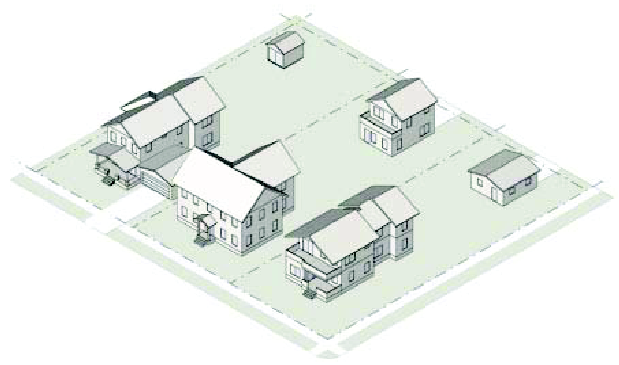 | 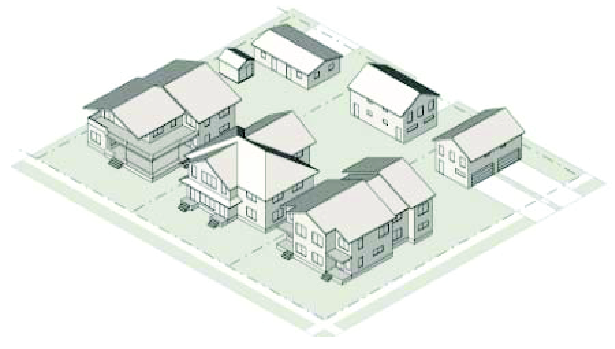 | 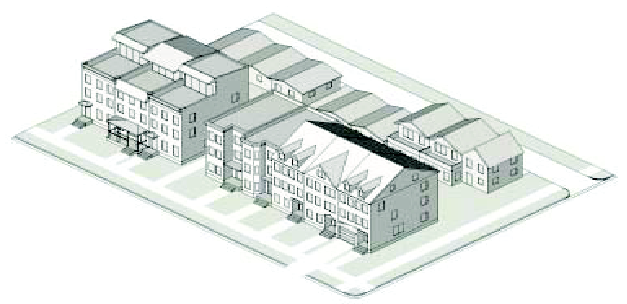 |
|
(1) Detached House
A building type designed primarily to accommodate one dwelling unit on an individual lot. In more intense sub-districts, a detached house may be used for mixed purposes. |
(2) Attached House
A building type designed primarily to accommodate two dwelling units on an individual lot. In more intense sub-districts, an attached house may be used for mixed purposes. |
(3) Townhouse Building
A building type designed primarily to accommodate two or more dwelling units consolidated side-by-side into a single structure, with no more than eight in a single building. In more intense sub-districts, a townhouse may be used for mixed purposes. |
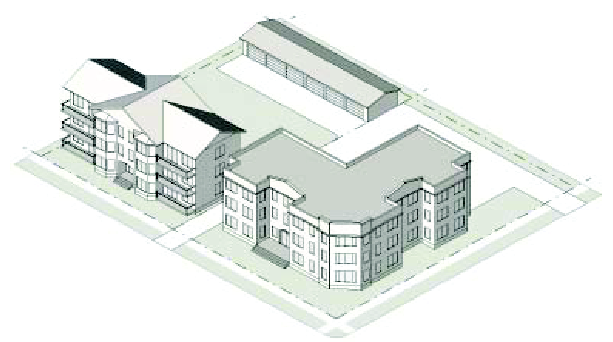 | 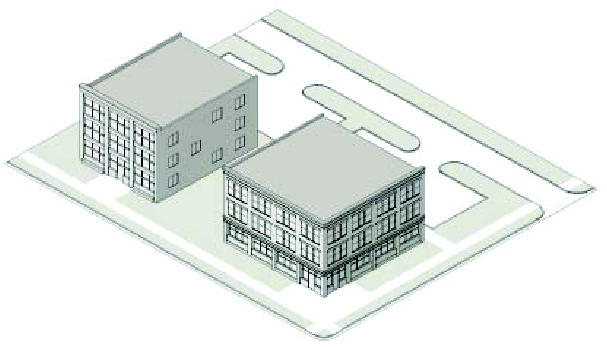 | 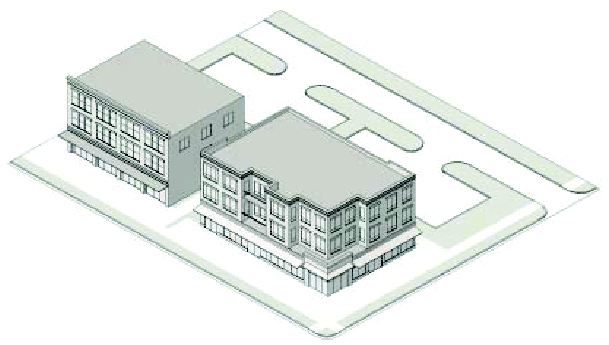 |
|
(4) Apartment Building
A building type containing three or more dwelling units consolidated into a single structure. Units must be either situated wholly or partially over or under other units, or back to back with other units in the same structure. |
(5) General Building
A building type intended primarily for commercial, office, manufacturing and employment uses. |
(6) Mixed Use Building
A building type intended primarily for ground floor commercial uses with upper-story residential or offices uses. |
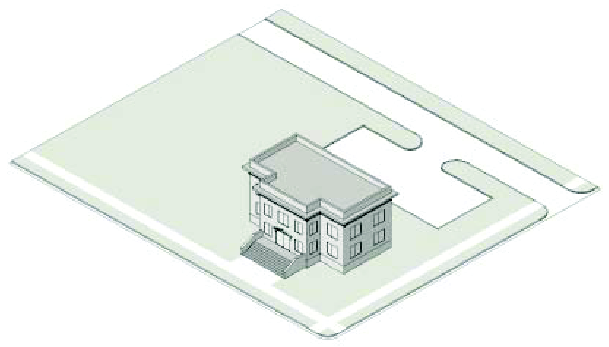 | 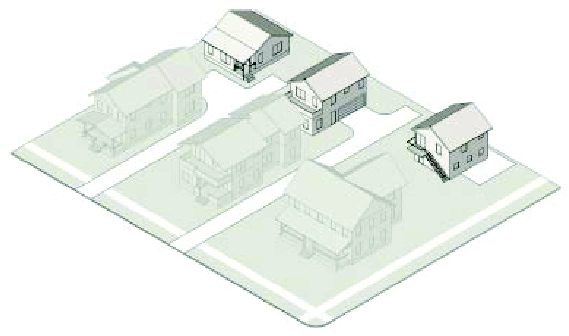 | |
|
(7) Civic Building
A building type intended primarily for civic, institutional or public uses. |
(8) Accessory Apartment
A small dwelling located on the same lot as a detached house, attached house, or townhouse. An accessory apartment may be located above a garage. |
(b)
Building types permitted by sub-district.
a.
Building types are permitted by sub-district as set forth below. Shaded cells indicate allowed building types.
b.
A square footage amount equal to fifteen (15) percent of the land area within a sub-district may be the types of uses allowed in adjacent sub-districts.
(c)
Requirements for all building types.
(1)
Site.
a.
Defined. A site is any lot or group of contiguous lots owned or functionally controlled by the same person or entity, assembled for the purpose of development.
b.
Site area. Site area is the area included within the rear, side and front lot lines of the site. Does not include existing or proposed right-of-way, whether dedicated or not dedicated to public use.
c.
Site width. Site width is the distance between the side lot lines of the site (generally running perpendicular to a street) measured at the primary street property line along a straight line or along the chord of the property line.
(2)
Lot.
a.
Defined.
i.
A parcel of land either vacant or occupied intended as a unit for the purpose, whether immediate or for the future, of transfer of ownership, or possession, or for the purpose of development.
ii.
All lots must front on a street.
b.
Lot standards.
i.
In the MU-1 district only one (1) principal structure is permitted per lot.
c.
Lot area. Lot area is the area included within the rear, side and front lot lines. Lot area does not include existing or proposed right-of-way, whether dedicated or not dedicated to public use.
d.
Lot width. Lot width is the distance between the side lot lines (generally running perpendicular to a street) measured at the primary street property line along a straight line or along the chord of the property line.
e.
Lot depth. Lot depth is the distance between the front and rear property lines measured along a line midway between the side property lines.
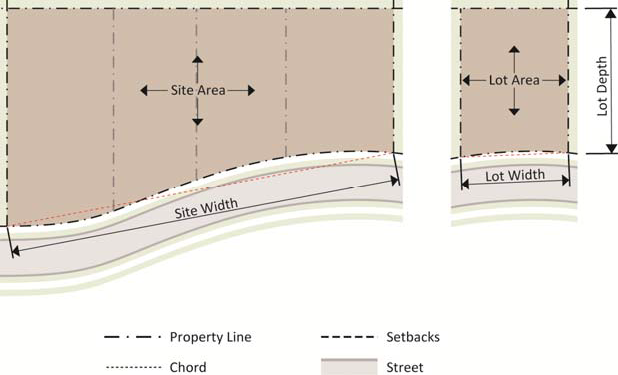
(3)
Building setbacks.
a.
Setback types. There are four (4) types of setbacks—primary street setback, side street setback, side setback and rear setback. Through lots are considered to have two (2) primary street setbacks.
b.
Measurement of building setbacks.
i.
Primary and side street setbacks are measured from the edge of the right-of-way.
ii.
Side setbacks are measured from the side property line.
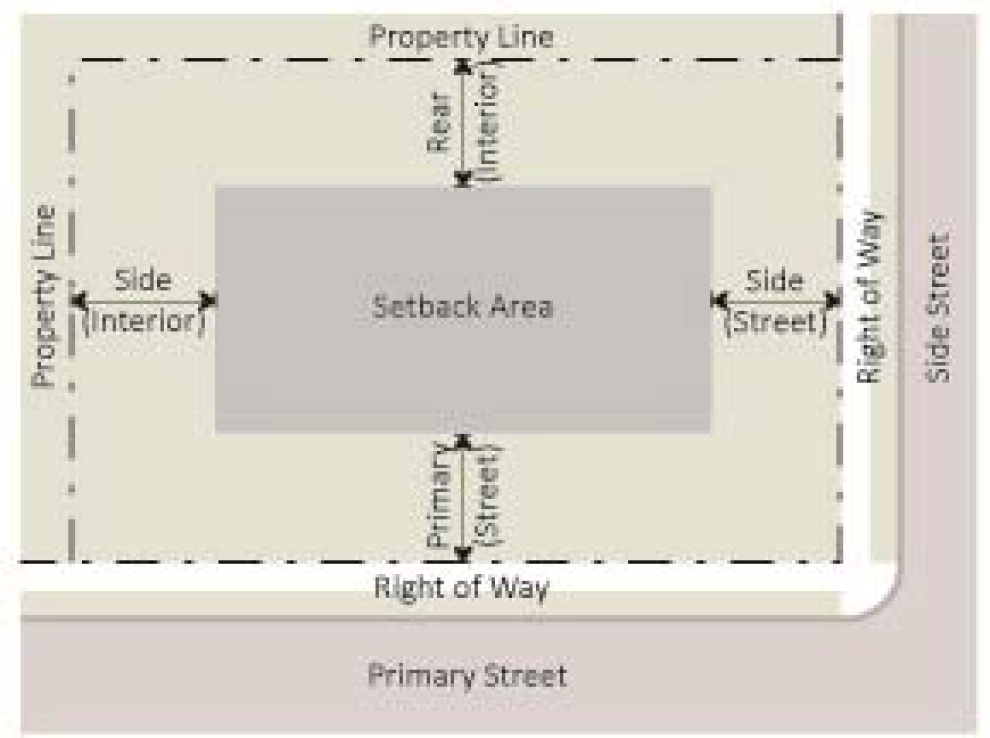
iii.
Rear setbacks are measured from the rear property line or the edge of the right-of-way where there is an alley.
c.
Corner lots. A corner lot shall have one (1) primary street. In determining the primary street, the following conditions must be considered:
i.
The street with the highest street classification;
ii.
The established orientation of the block, if any;
iii.
The street abutting the longest face of the block;
iv.
The street parallel to an alley within the block; and
v.
The street from which the lot takes its address.
d.
Setbacks and utilities. The zoning administrator may approve modified setbacks where necessary to accommodate the easement width for public and private utilities that are not permitted to be under a street or in an alley.
(4)
Setback encroachments. All buildings and structures must be located at or behind required setback lines, except as listed below.
a.
Building features.
i.
Porches, stoops, balconies, galleries and awnings may encroach, provided that such extension is at least two (2) feet from the vertical plane of any lot line.
ii.
Chimneys or flues may encroach up to four (4) feet, provided that such extension is at least two (2) feet from the vertical plane of any lot line.
iii.
Building eaves, roof overhangs and light shelves may encroach up to five (5) feet, provided that such extension is at least two (2) feet from the vertical plane of any lot line.
iv.
Bay windows, entrances and similar features that are less than ten (10) feet wide may encroach up to four (4) feet, provided that such extension is at least two (2) feet from the vertical plane of any lot line.
v.
Unenclosed fire escapes or stairways may encroach up to four (4) feet into a required side or rear setback, provided that such extension is at least five (5) feet from the vertical plane of any lot line.
vi.
Unenclosed patios, decks or terraces may encroach up to four (4) feet into a required side setback, or up to eight (8) feet into a required rear setback, provided that such extension is at least five (5) feet from the vertical plane of any lot line.
vii.
Cornices, eaves, belt courses, sills, buttresses or other similar architectural features may encroach up to one and one-half (1½) feet.
viii.
Handicap ramps may encroach to the extent necessary to perform their proper function.
ix.
Structures below and covered by the ground may encroach into a required setback.
b.
Mechanical equipment and utility lines.
i.
Mechanical equipment associated with residential uses, such as HVAC units and security lighting, may encroach into a required rear or side setback, provided that such extension is at least five (5) feet from the vertical plane of any lot line.
ii.
Sustainable energy systems, including solar panels and wind turbines, may extend into a required rear or side setback, provided that such extension is at least three (3) feet from the vertical plane of any lot line.
iii.
Rainwater collection or harvesting systems may extend into a required rear or side setback, provided that such extension is at least three (3) feet from the vertical plane of any lot line.
iv.
Utility lines located underground and minor structures accessory to utility lines (such as hydrants, manholes, and transformers and other cabinet structures) may extend into a required rear or side setback.
c.
Other permitted encroachments.
i.
Fences and walls.
ii.
Signs.
iii.
Driveways.
(5)
Build-to zone.
a.
Defined.
i.
The build-to zone is the area on the lot where a certain percentage of the front building facade must be located, measured as a minimum and maximum setback range from the edge of the right-of-way.
ii.
The required percentage specifies the amount of the front building facade that must be located in the build-to area, measured based on the width of the building divided by the width of the site or lot.
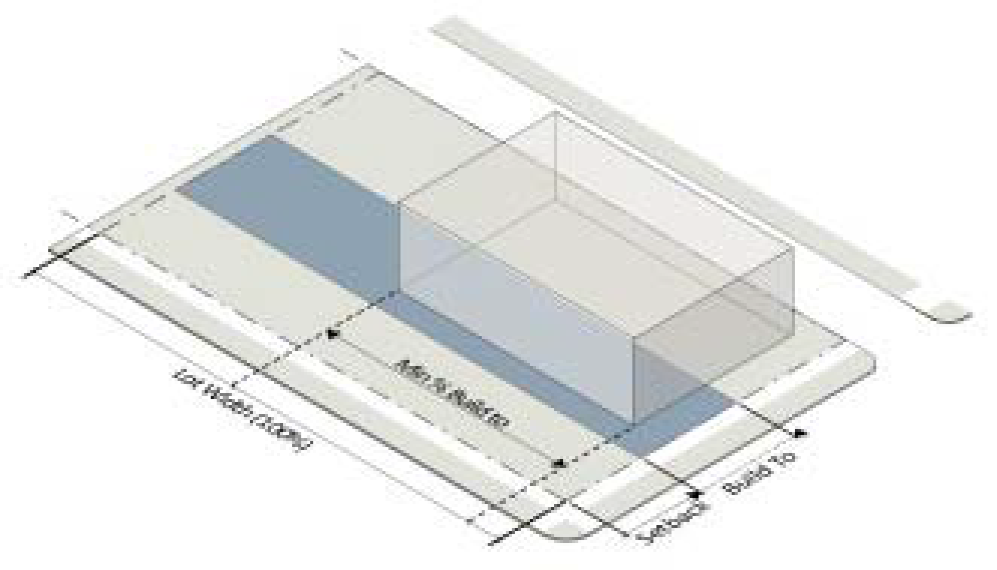
b.
Corner lots. On corner lots, a building facade must be placed within the build-to area for the first thirty (30) feet along the street extending from the block corner. No other build-to zone requirements apply on side streets that are not primary streets.
c.
Encroachments. With the exception of parking areas, all structures and uses customarily allowed on the lot are permitted in the build-to area.
(6)
Parking setbacks.
a.
Parking setback types. There are four (4) types of parking setbacks—primary street setback, side street setback, side setback and rear setback. Through lots are considered to have two (2) primary street setbacks.
b.
Measurement of parking setbacks.
i.
Primary and side street setbacks are measured from the edge of the right-of-way.
ii.
Side setbacks are measured from the side property line.
iii.
Rear setbacks are measured from the rear property line or the edge of the right-of-way if there is an alley.
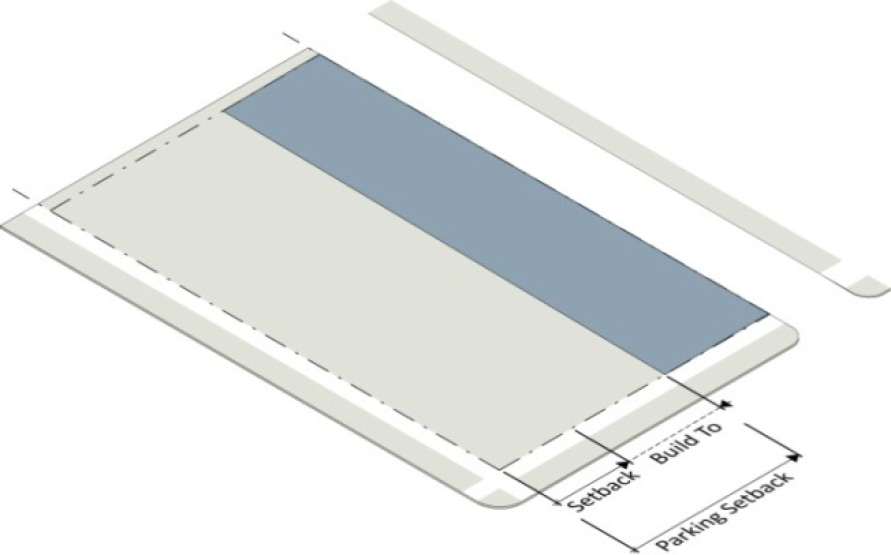
c.
Parking not allowed. On-site surface and structured parking must be located behind the parking setback line. This requirement is not intended to restrict on-street parking.
d.
Parking setback shall not apply to detached, attached, or townhouse lots.
(7)
Open space.
a.
Defined. For the purposes of this division, open space may be met on an average basis of the amount of open space on each lot shown on a final plat.
b.
Standards.
i.
Open space may be met in one (1) contiguous open area or in multiple open areas on the lot; however, to receive credit the area must be at least five (5) feet in width and length. Setback areas that meet this requirement may be counted towards open area provided they meet the other requirements of this section.
ii.
Open space must be located at grade, and cannot be built, parked or driven upon, except for emergency access and permitted temporary events.
iii.
Open space may be provided above ground for a general or mixed use building type. Examples include an outside roof deck, roof top garden, pool area or similar outdoor common area.
(8)
Height.
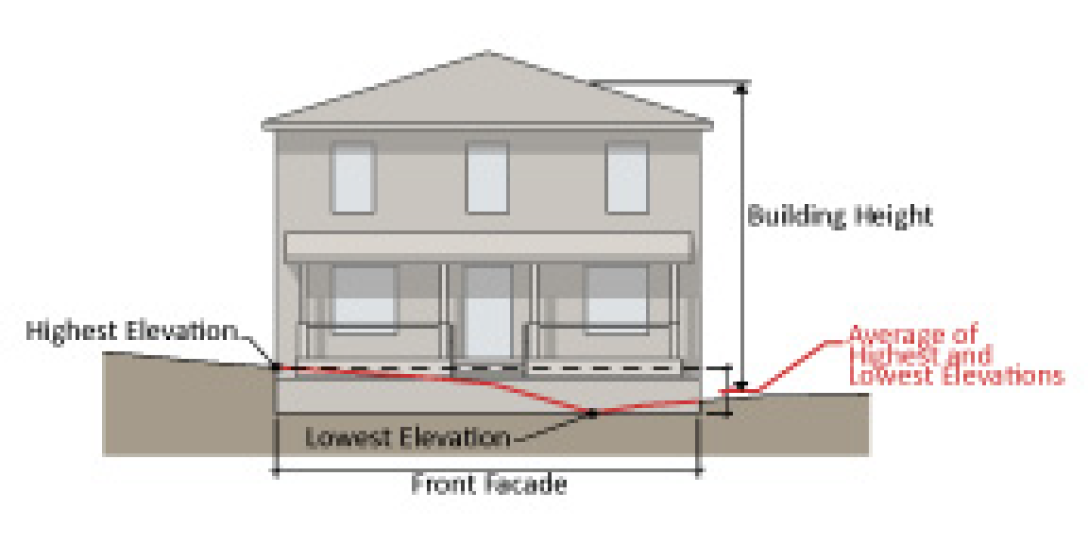
a.
Building height.
i.
Building height is measured in both the number of stories and in feet to the top of the highest point of a flat roof or the midpoint of a pitched roof.
ii.
Average grade is determined by calculating the average of the highest and lowest elevation along natural or improved grade (whichever is more restrictive) along the front of the building parallel to the primary street setback line.
iii.
Where a lot slopes downward from the front property line, one (1) story that is additional to the specified maximum number of stories may be built on the lower, rear portion of the lot.
iv.
An attic does not count as a story where fifty (50) percent or more of the attic floor area has a clear height of less than seven and one-half (7½) feet; measured from the finished floor to the finished ceiling.
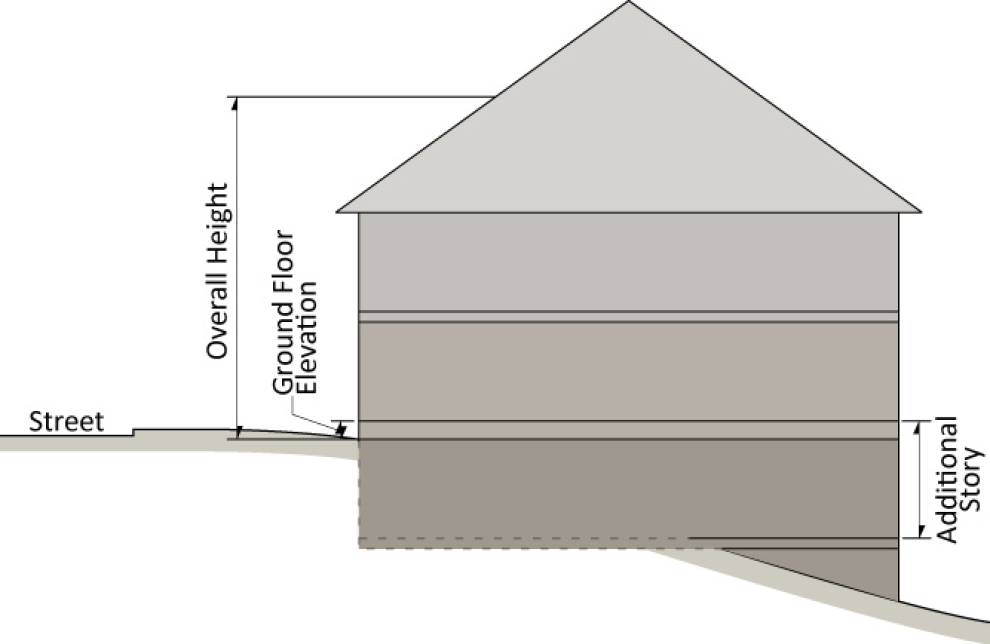
v.
A basement with fifty (50) percent or more of its perimeter wall area surrounded by natural grade is not considered a story.
b.
Ground floor elevation. Ground floor elevation is measured from the average curb level of the adjoining street to the top of the finished ground floor.
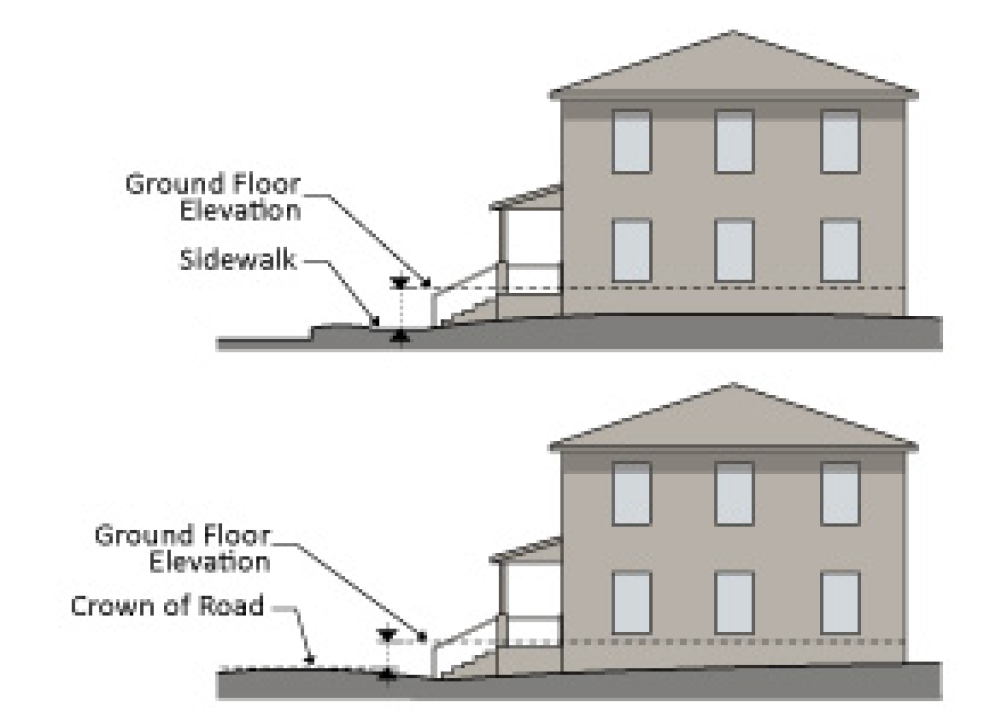
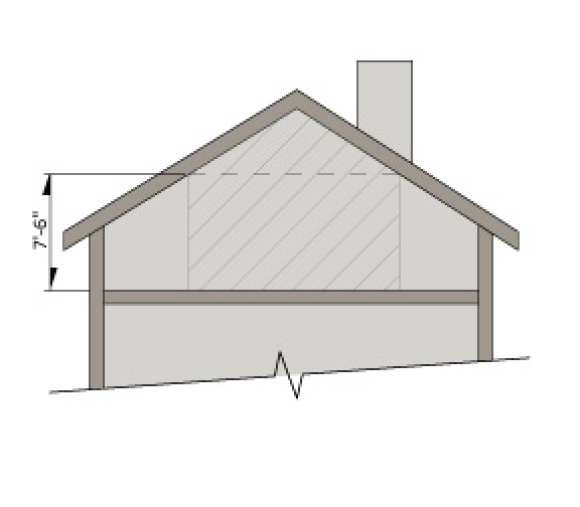
(9)
Height encroachments. Any height encroachment not specifically listed is expressly prohibited except where the zoning administrator determines that the encroachment is similar to a permitted encroachment listed below.
a.
The maximum height limits of the district do not apply to spires, belfries, cupolas, domes not intended for human occupancy; monuments, water tanks, water towers or other similar structures which, by design or function, must exceed the established height limits.
b.
The following accessory structures may exceed the established height limits, provided they do not exceed the maximum building height by more than twelve (12) feet:
i.
Chimney, flue or vent stack;
ii.
Deck, patio, shade structure;
iii.
Flagpole;
iv.
Garden, landscaping;
v.
Parapet wall, limited to a height of four (4) feet;
vi.
Rainwater collection or harvesting systems (rain barrels); and
vii.
Sustainable energy systems, including but not limited to solar panels and wind energy generation systems that generate power primarily to be used on-site.
c.
The following accessory structures may exceed the established height limits, provided they do not exceed the maximum building height by more than twelve (12) feet, do not occupy more than twenty-five (25) percent of the roof area, and are set back at least ten (10) feet from the edge of the roof:
i.
Amateur communications tower;
ii.
Cooling tower;
iii.
Elevator penthouse or bulkhead;
iv.
Greenhouse;
v.
Mechanical equipment;
vi.
Skylights;
vii.
Elevator or stairway access to roof; and
viii.
Tank designed to hold liquids.
d.
An accessory structure located on the roof must not be used for any purpose other than a use incidental to the principal use of the building.
(d)
[Reserved.]
(e)
Detached house.
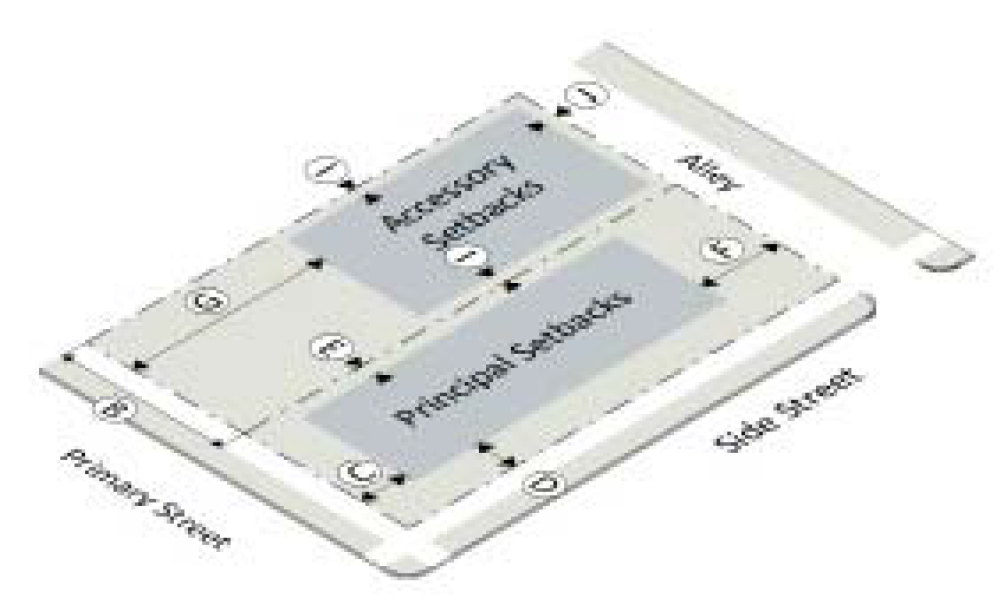 | |||
| (1) Lot Standards | (2) Building Placement | ||
| Lot Dimensions | Build-to Zone (BTZ) | ||
| A Lot Area (min/max) | 3,000 sf/21,780 sf | Primary street (min/max) | 5'/45' |
| B Lot width (min/max) | 30'/110' | % of building in primary street BTZ | 70% |
| Principal Building Setbacks | Open Space | ||
| C Primary street (min) | 10' | % of open area on the lot on average | 25% |
| D Side street (min) | 5' | ||
| E Side, common lot line (min) | 4' | ||
| F Rear, common lot line/alley (min) | 18' | ||
| Accessory Building Setbacks | |||
| G Primary street (min) | 50' | ||
| H Side street (min) | 5' | ||
| I Side, common lot line (min) | 3' | ||
| J Rear, common lot line (min) | 3' | ||
| J Rear, alley (min) | 4' or 18' | ||
| (3) Height | |||
| Building Height | |||
| Principal building (max) | 3 stories | ||
| Accessory building (max) | * | ||
| * Shall not exceed the height of the principal building | |||
(f)
Attached house.
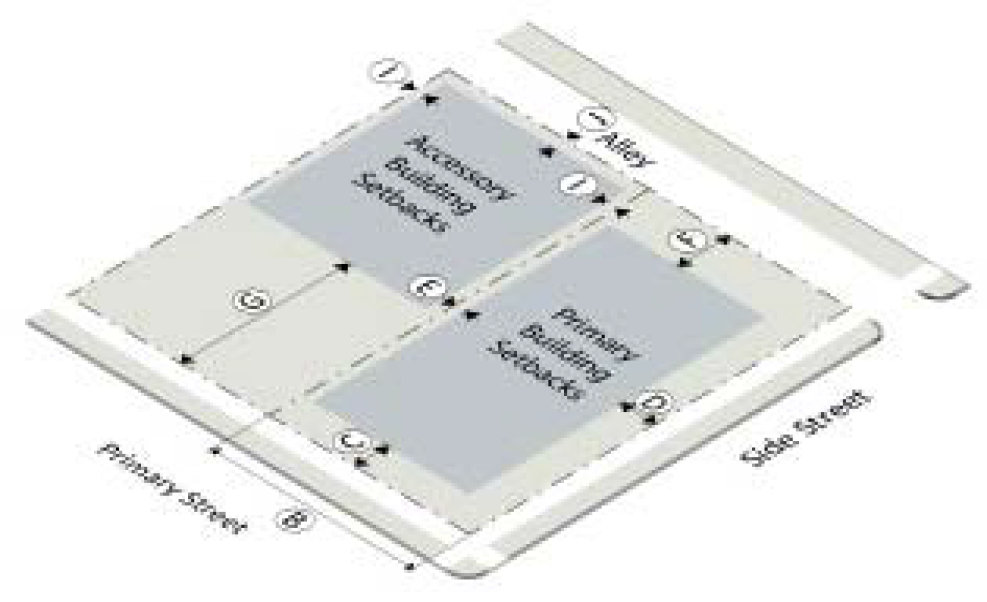 | |||
| (1) Lot Standards | (2) Building Placement | ||
| Lot Dimensions | Build-to Zone (BTZ) | ||
| A Lot Area (min/max) | 7,500 sf/15,000 sf | A Primary street (min/max) | 10'/45' |
| B Lot width (min/max) | 60'/80' | B % of building in primary street BTZ | 70% |
| Principal Building Setbacks | Open Space | ||
| C Primary street (min) | 10' | % of open area on the lot on average | 25% |
| D Side street (min) | 5' | ||
| E Side, common lot line (min) | 4' | ||
| F Rear, common lot line/alley (min) | 20' | ||
| Accessory Building Setbacks | |||
| G Primary street (min) | 50' | ||
| H Side street (min) | 5' | ||
| I Side, common lot line (min) | 3' | ||
| J Rear, common lot line (min) | 3' | ||
| J Rear, alley (min) | 4' or 18' | ||
| (3) Height | |||
| Building Height | |||
| Principal building (max) | 3 stories | ||
| Accessory building (max) | * | ||
| * Shall not exceed the height of the principal building | |||
(g)
Townhouse building.
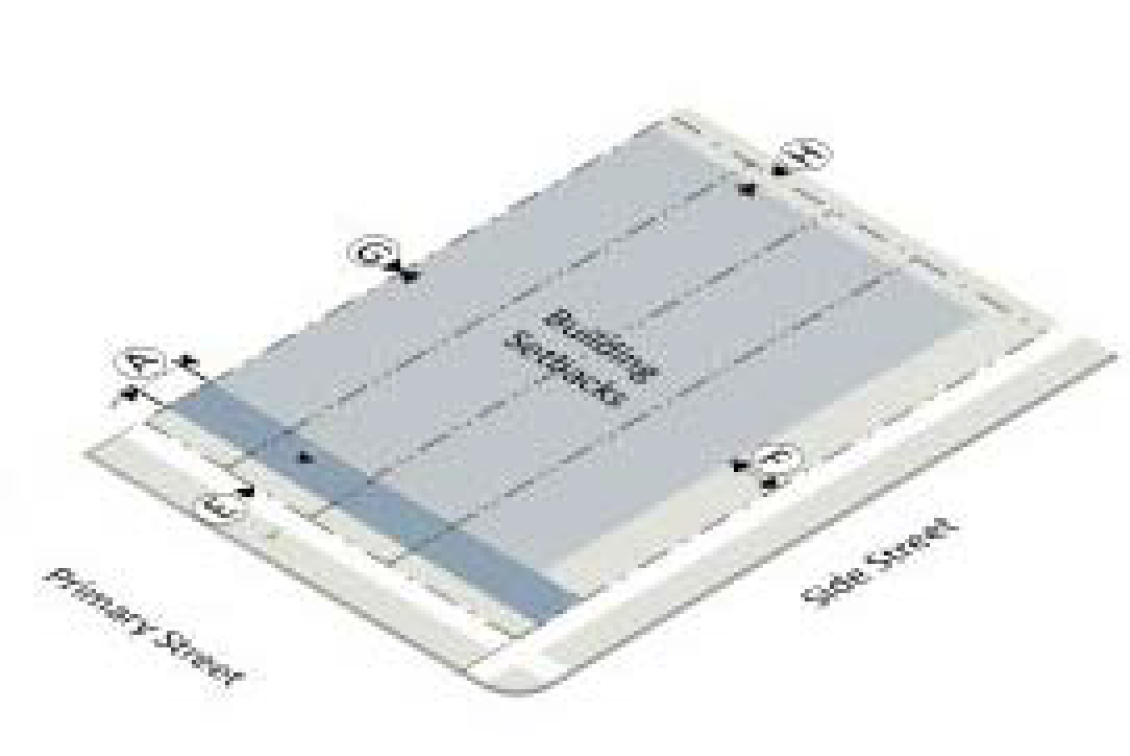 | |||
| (1) Lot Standards | (2) Building Placement | ||
| Lot Dimensions | Build-to Zone (BTZ) | ||
| A Site Area (min) | NA | A Primary street (min/max) | 5'/25' |
| B Site width (min) | NA | B % of building in primary street BTZ (min) | 70% |
| Building Setbacks | Open Space | ||
| E Primary street (min) | 5' | % of open area on the lot on average | 15% |
| F Side street (min) | 5' | ||
| G Side, common lot line (min) | 0' or 5' | ||
| H Rear, common lot line (min) | 15' | ||
| H Rear alley (min) | 4' or 18' | ||
| (3) Height | |||
| Building Height | |||
| Principal building (max) | 3 stories | ||
| Accessory building (max) | * | ||
| * Shall not exceed the height of the principal building | |||
(h)
Apartment building.
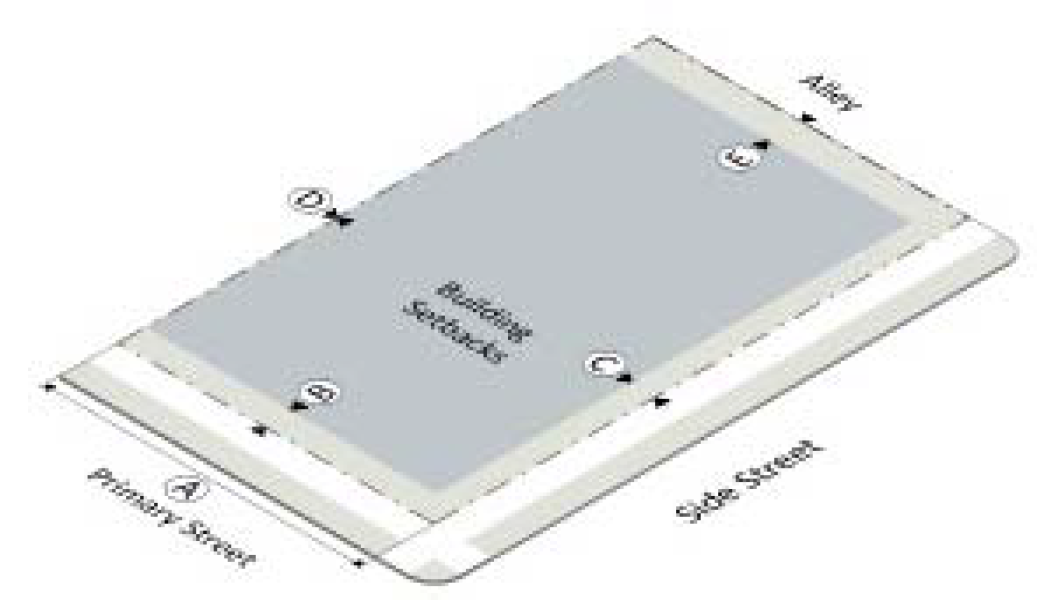 | 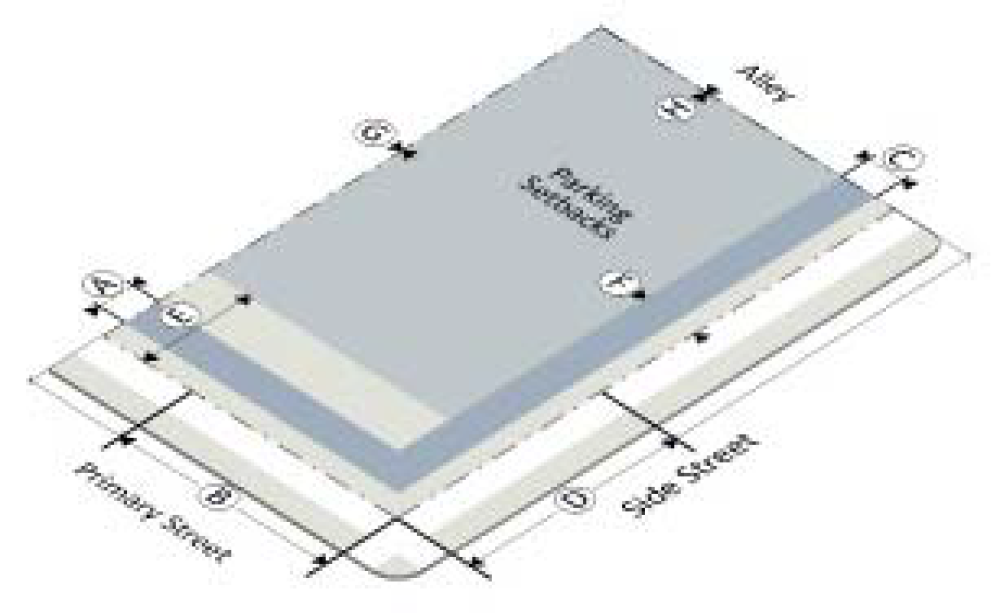 | ||
| (1) Lot Standards | (2) Building Placement | ||
| Lot Dimensions | Build-to Zone (BTZ) | ||
| A Lot width (min) | 20' | A Primary street (min) | 0' |
| Building Setbacks | B Building in primary street BTZ (min) | NA | |
| B Primary street (min) | 0' | C Side street (min) | 0' |
| C Side street (min) | 0' | D % of building in side street BTZ (min) | NA |
| D Side, common lot line (min) | 0' | Parking Setbacks | |
| E Rear, common lot line/alley (min) | 0' | Primary street (min) | 20' |
| Side street (min) | 5' | ||
| Side, common lot line (min) | 0' | ||
| (3) Height | Rear, common lot line (min) | 0' | |
| Building Height | Open Space | ||
| Principal building (max) | % of open area on the lot on average | 10% | |
| MU-4 | 4 stories | ||
| MU-5 | 6 stories | ||
(i)
General building.
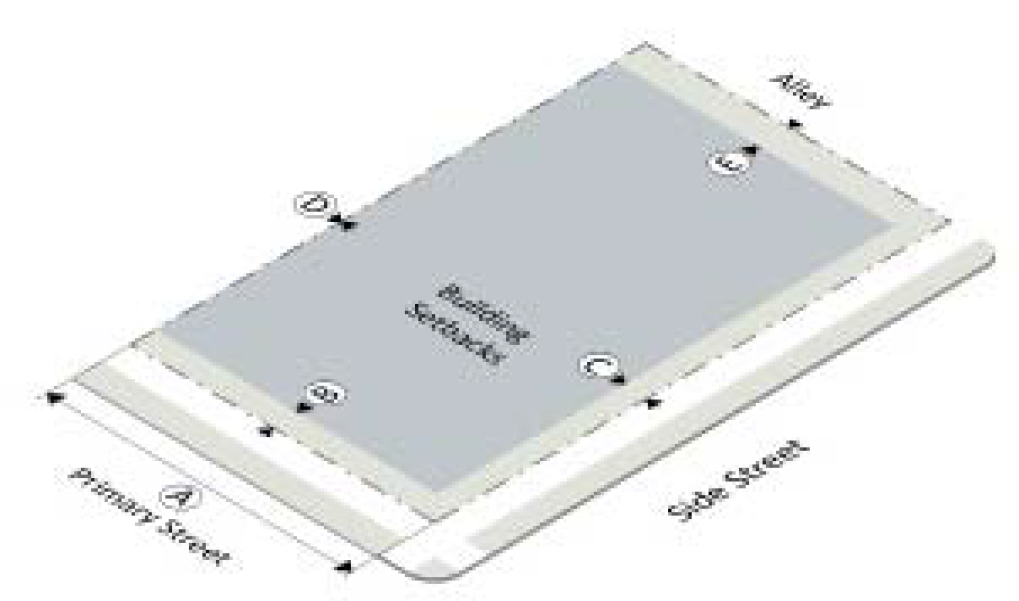 | 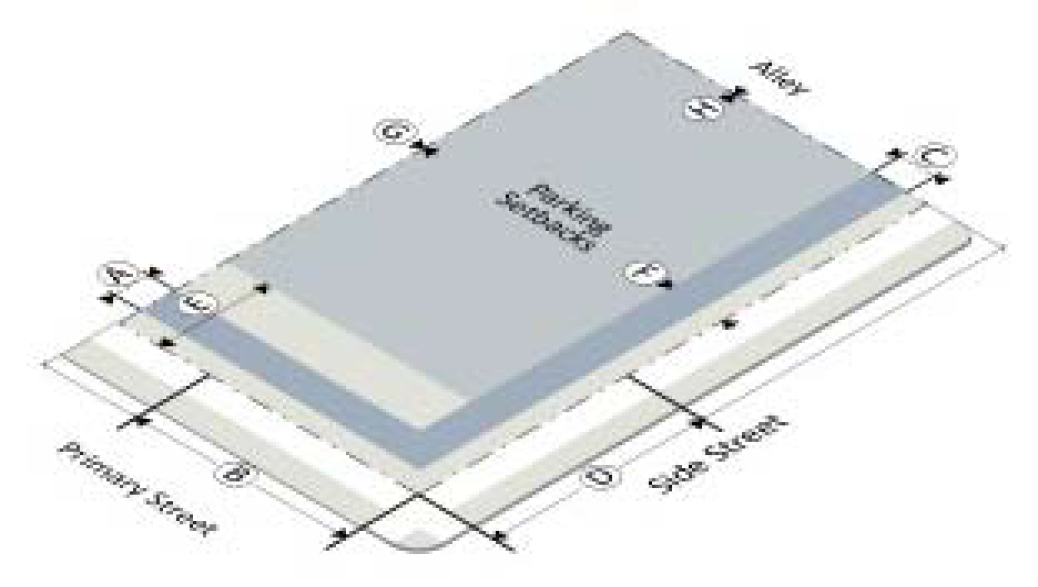 | ||
| (1) Lot Standards | (2) Building Placement | ||
| Lot Dimensions | Build-to Zone (BTZ) | ||
| A Lot width (min) | 20' | A Primary street (min) | 0' |
| Building Setbacks | B % of building in primary street BTZ (min) | NA | |
| B Primary street (min) | 0' | C Side street (min) | 0' |
| C Side street (min) | 0' | D % of building in side street BTZ (min) | NA |
| D Side, common lot line (min) | 0' | Parking Setbacks | |
| E Rear, common lot line/alley (min) | 0' | Primary street (min) | 20' |
| Side street (min) | 5' | ||
| Side, common lot line (min) | 0' | ||
| (3) Height | Rear, common lot line (min) | 0' | |
| Building Height | Open Space | ||
| Principal building (max) | % of open area on the lot on average | 10% | |
| MU-4 | 4 stories | ||
| MU-5 | 6 stories | ||
(j)
Mixed use building.
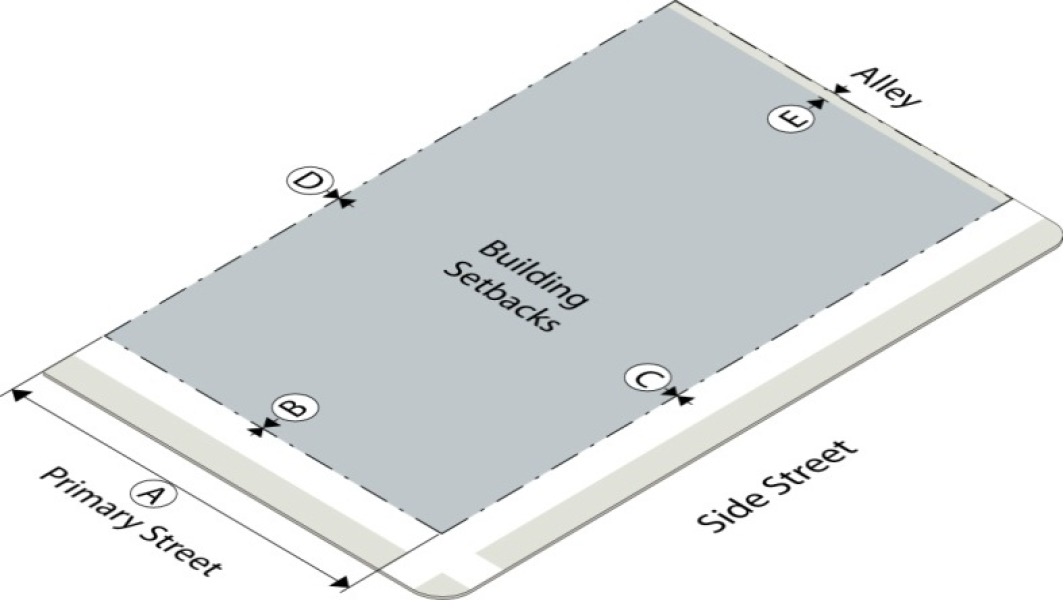 | 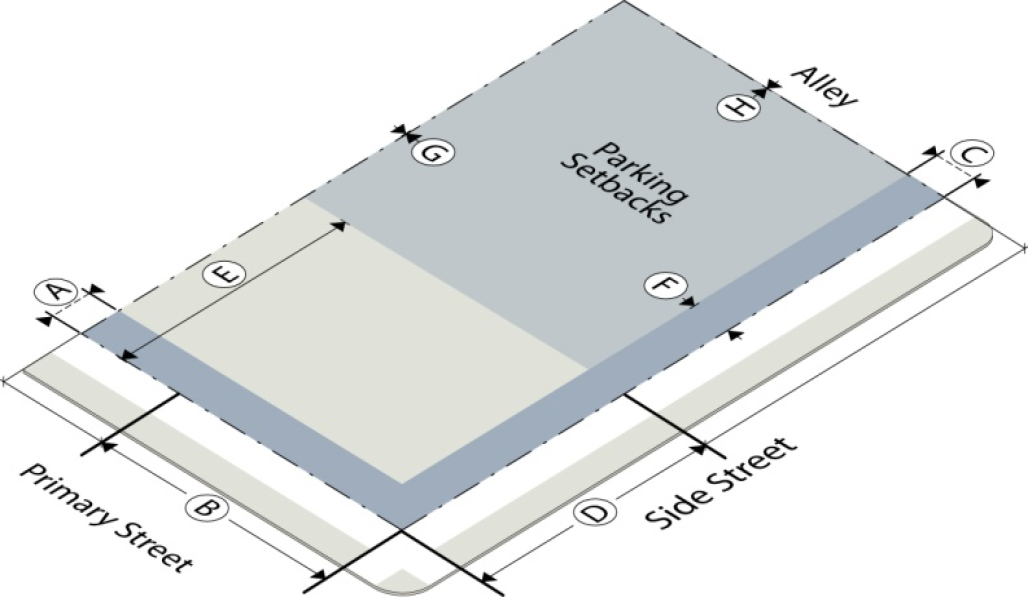 | ||
| (1) Lot Standards | (2) Building Placement | ||
| Lot Dimensions | Build-to Zone (BTZ) | ||
| A Lot width (min) | 20' | A Primary street (min) | 0' |
| Building Setbacks | B % of building in primary street BTZ (min) | NA | |
| B Primary street (min) | 0' | C Side street (min) | 0' |
| C Side street (min) | 0' | D % of building in side street BTZ (min) | NA |
| D Side, common lot line (min) | 0' | Parking Setbacks | |
| E Rear, common lot line/alley (min) | 0' | E Primary street (min) | 20' |
| F Side street (min) | 5' | ||
| G Side, common lot line (min) | 0' | ||
| (3) Height | H Rear, common lot line (min) | 0' | |
| Building Height | Open Space | ||
| Principal building (max) | % of open area on the lot on average | 10% | |
| MU-4 | 4 stories | ||
| MU-5 | 6 stories | ||
(k)
Civic building.
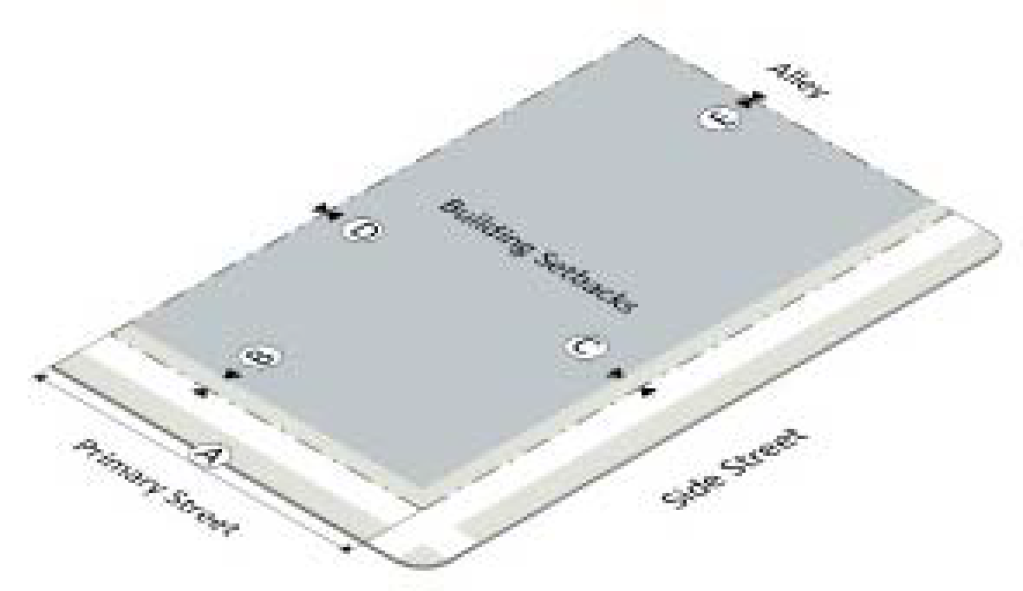 | 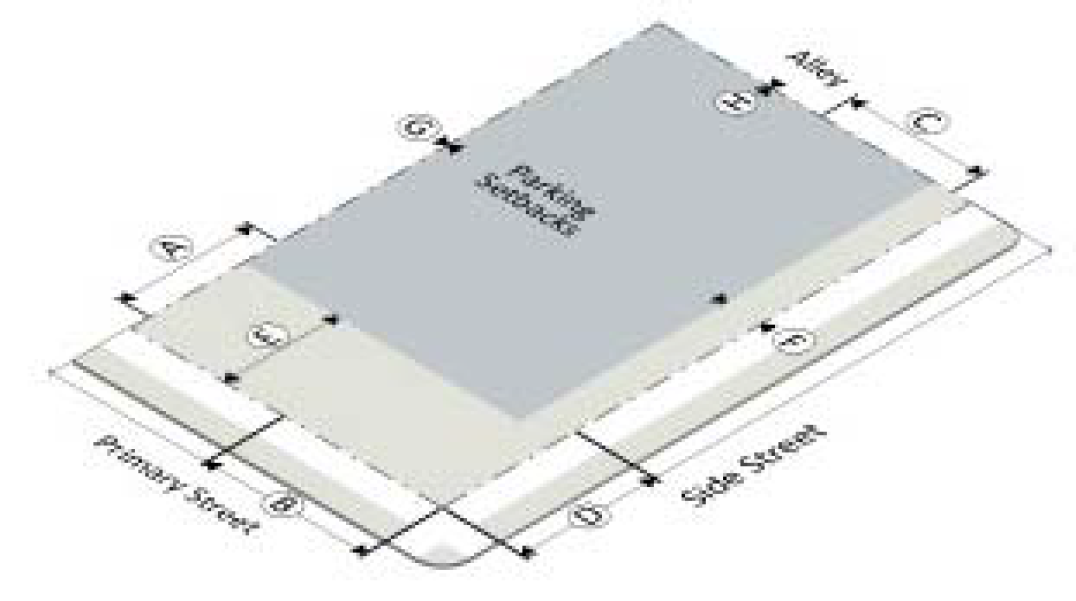 | ||
| (1) Lot Standards | (2) Building Placement | ||
| Lot Dimensions | Build-to Zone (BTZ) | ||
| A Lot width (min/max) | NA | A Primary street (min) | 0' |
| Building Setbacks | B % of building in primary street BTZ (min) | NA | |
| B Primary street (min) | 0' | C Side street (min) | 0' |
| C Side street (min) | 0' | D % of building in side street BTZ (min) | NA |
| D Side, common lot line (min) | 0' | Parking Setbacks | |
| E Rear, common lot line/alley (min) | 0' | E Primary street (min) | 20' |
| F Side street (min) | 5' | ||
| G Side, common lot line (min) | 0' | ||
| (3) Height | H Rear, common lot line (min) | 0' | |
| Building Height | Open Space | ||
| Principal building (max) | % of open area on the lot on average | 10% | |
| MU-1, MU-2 | 3 stories | ||
| MU-3, MU-4 | 4 stories | ||
| MU-5 | 6 stories | ||
(l)
Accessory apartment.
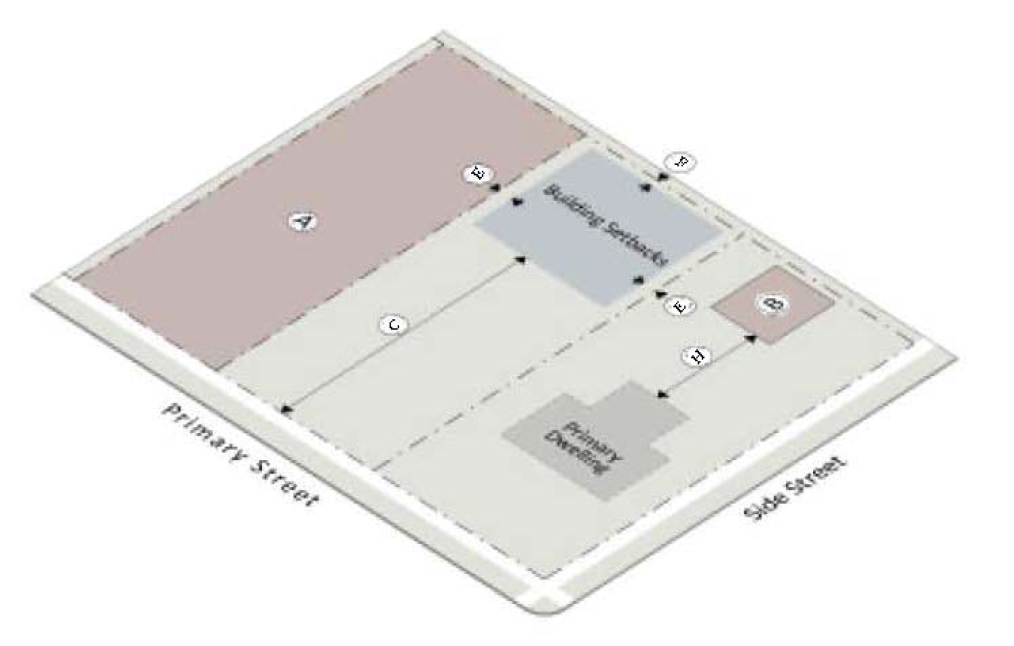 | |||
| (1) Lot Standards | |||
| Lot Dimensions | |||
| A Dwelling units per lot (max) | 2 | ||
| B Building footprint (min) | 200 sf | ||
| Building Setbacks | |||
| C Primary street (min) | 50' | ||
| D Side street (min) | 10' | ||
| E Side, common lot line (min) | 5' | ||
| F Rear, common lot line/alley (min) | 3' | ||
| G Rear, alley (min) | 4' of 18' | ||
| H Building separation(min) | 10'* | ||
| * Buildings connected by a single breezeway are deemed to be separate buildings. | |||
| (2) Access | |||
| Vehicular | |||
| From Alley or from street when no alley is present | |||
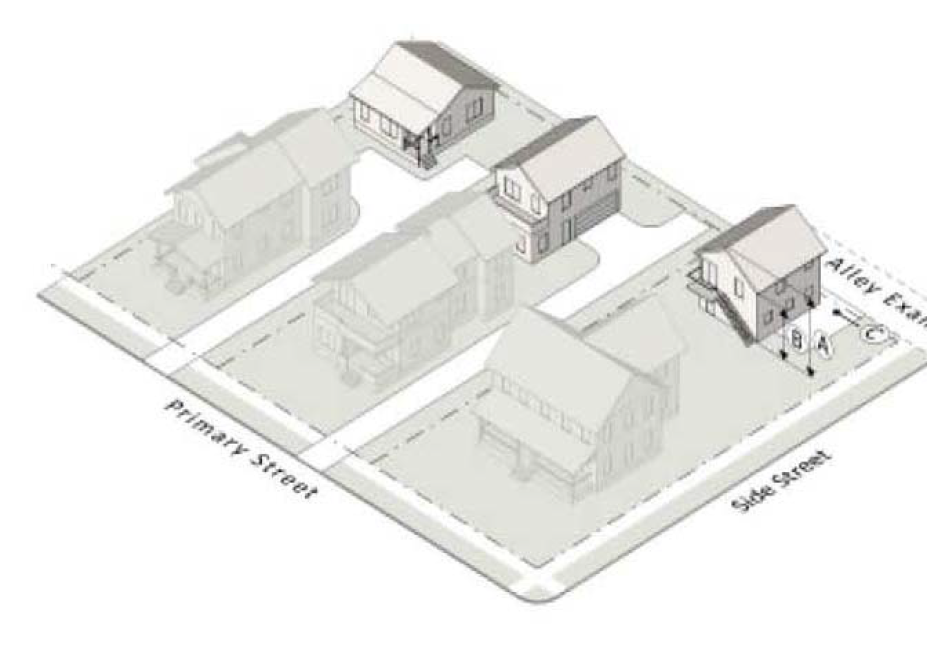 | |||
(m)
The board of supervisors may approve alternative development standards as part of a zoning map amendment.
(Ord. No. 23-150, 9-25-12; Ord. No. 23-160, 1-13-15)
Sec. 23-6.28.5. - Uses.
(a)
Permitted uses.
(1)
This section establishes the uses allowed in each sub-district. A lot or building shall be occupied with only the land uses allowed in subsection 23-6.28.5(c).
(2)
Any one or more uses identified in subsection 23-6.28.5(c) as being allowed within a specific sub-district may be established on any parcel within that sub-district, subject to the use table, and in compliance with all applicable requirements of this district.
(b)
Use standards.
(1)
Ground story uses in all districts.
a.
Allowed ground story uses may extend into upper stories without regard for the upper story allowed uses listed on the use table below.
(2)
Civic buildings.
a.
Only public/institutional uses listed on the use table below are allowed in a civic building type.
(c)
Use table.
(Ord. No. 23-150, 9-25-12; Ord. No. 23-160, 1-13-15; Ord. No. 23-174, § 1, 11-28-17; Ord. No. 23-178, § 1, 10-29-19)
Sec. 23-6.28.6. - Parking.
(a)
Parking in the MU district. The requirements of article 5, division 9, Off-street parking and the design standards manual shall apply in the mixed use (MU) district, except as otherwise specifically modified in this section.
(b)
Parking credits.
(1)
Credit for on-street parking. One (1) legal on-street parking space may be substituted for every required parking space, provided the on-street space is located on a public or private right-of-way immediately abutting the subject property.
(2)
Proximity to transit. A fifteen (15) percent reduction in the number of required parking spaces is allowed for uses with a main entrance within a walking distance of two thousand six hundred forty (2,640) feet of an operating transit stop.
(3)
Valet parking. Valet parking may be permitted where all of the following standards have been met:
a.
An attendant is provided to park vehicles during all business hours of the use utilizing the valet parking.
b.
An equivalent number of valet spaces are available to replace the number required on-site parking spaces.
c.
Valet spaces do not require individual striping, and may take into account the mass parking of vehicles.
(c)
Reserved parking. Parking spaces may be reserved for a specific tenant or unit, provided that the following standards are not exceeded:
(1)
Residential.
a.
One (1) space per efficiency or one-bedroom multi-living dwelling unit.
b.
Two (2) spaces per two-bedroom or greater multi-living dwelling unit.
(2)
Nonresidential. No more than one-third (⅓) of the total provided spaces may be reserved.
(d)
Parking spaces required. The following table defines the minimum number of parking spaces required for each use in the use table.
(e)
The board of supervisors may approve alternative parking standards as part of a zoning map amendment.
(Ord. No. 23-150, 9-25-12; Ord. No. 23-160, 1-13-15; Ord. No. 23-181, § 2, 7-27-21)
Sec. 23-6.28.7. - Streets and blocks.
(a)
Streets and blocks in the MU district. The requirements of the design standards manual apply in the mixed use (MU) district, as specifically modified in this section. Sidewalks, streets, street trees and street lights must be installed and constructed for both new and existing streets.
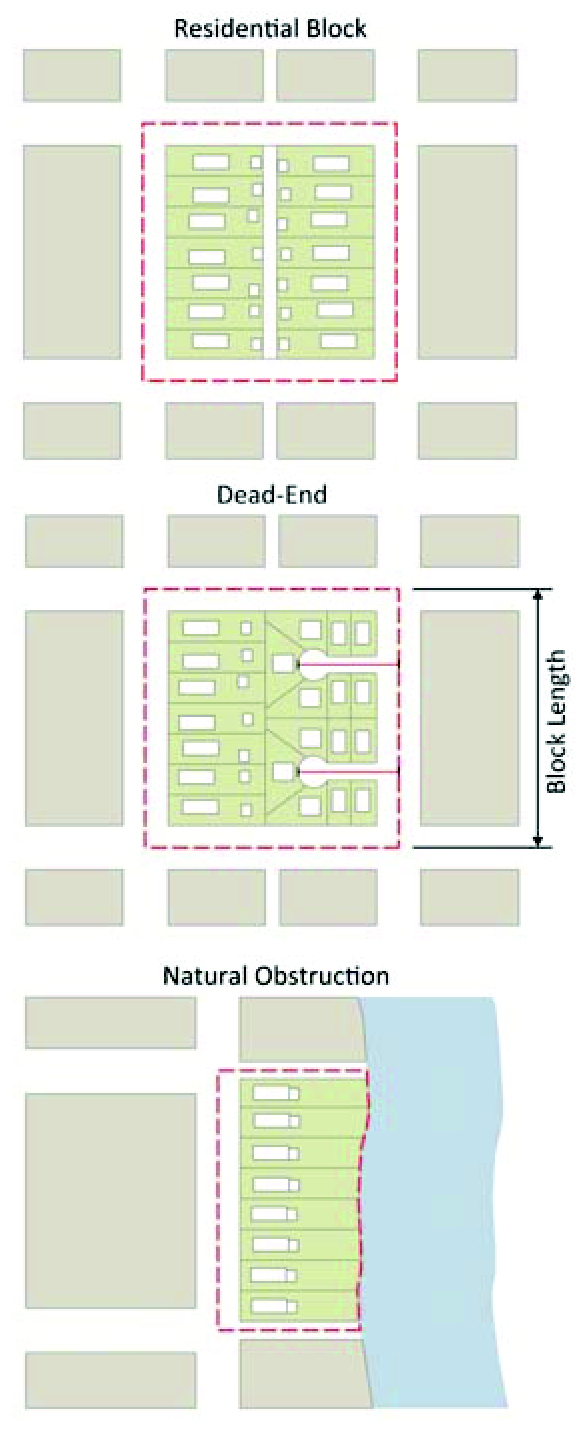
(b)
Blocks.
(1)
Applicability. The block length and perimeter standards apply to preliminary plats, final plats and site plans.
(2)
Block standards in the MU-1, MU-2, MU-3 district.
a.
Residential blocks must have sufficient width to provide for two (2) tiers of residential lots, except where single tier lots are required to accommodate single-loaded streets where across from a public park or open space, to allow for unusual topographical conditions, or when adjacent to the outer perimeter of a subdivision.
b.
The maximum block perimeter shall be four thousand four hundred (4,400) feet.
c.
The maximum block length shall be one thousand five hundred (1,500) feet.
d.
The maximum block length for a dead end street shall be three hundred (300) feet.
(3)
Block standards in the MU-4, MU-5 district.
a.
The maximum block perimeter shall be two thousand four hundred (2,400) feet.
b.
The maximum block length shall be seven hundred (700) feet.
c.
The maximum block length for a dead end street shall be three hundred (300) feet.
(4)
Block measurement.
a.
A block is bounded by a street (not including an alley) that meets the requirements of this section.
b.
Block perimeter is measured along the centerline of intersecting streets that encompass the block.
c.
Block length is measured from centerline to centerline of intersecting streets.
d.
The maximum block length or perimeter may be extended in the event that steep slopes in excess of twenty-five (25) percent, freeways, waterways, railroad lines, preexisting development, tree conservation areas, stream buffers, cemeteries, open space, or easements make the maximum block length or perimeter unfeasible.
e.
The maximum block length and perimeter may be extended by twenty-five (25) percent, if the block includes a pedestrian passage that meets the requirements of this section.
f.
A block may be broken by a civic building, public park, or open lot, provided the lot is at least fifty (50) feet wide and provides a pedestrian passage meeting the requirements this section.
(c)
Street types. This section provides general guidelines for the construction of new streets in the MU district and is intended to provide a catalog of minimum dimensions for travel lane and on-street parking widths subject to review and approval during the site plan review process for use on private streets.
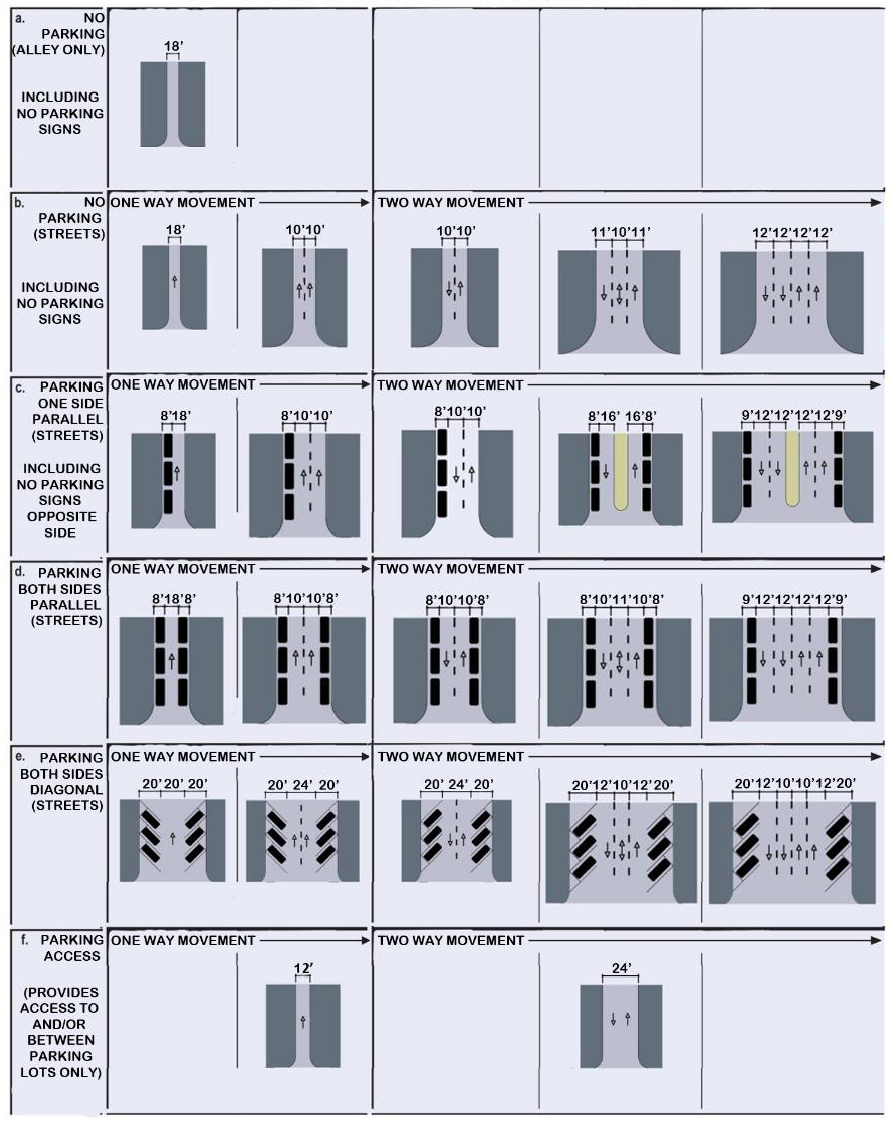
(d)
The board of supervisors may approve alternative streets and blocks standards as part of a zoning map amendment.
(Ord. No. 23-150, 9-25-12; Ord. No. 23-160, 1-13-15; Ord. No. 23-181, § 3, 7-27-21)
Sec. 23-6.28.8. - Administration.
The procedures of article 4, Development review procedures, shall apply in the mixed use (MU) district, except as specifically modified in this section.
(a)
Special uses. Division 5, Special uses, shall apply within the MU districts, except as specifically modified below.
(1)
Height above the district maximum is permitted with special use approval. Where height is proposed above the district maximum, appropriate transitions to nearby development, including stepping down height near adjacent properties, methods to preserve privacy such as limiting balconies, and other design techniques to minimize the impact on the surrounding area shall be considered, and appropriate conditions imposed, where necessary.
(b)
Zoning map amendments. Division 6, Zoning map amendments (rezoning) shall apply to MU districts, except as specifically modified below.
(1)
A generalized development plan (GDP) shall be prepared by a licensed architect, engineer or surveyor. The generalized development plan shall include the following information:
a.
A title block denoting the type of application, name of project, tax map reference and street address;
b.
The name, address and phone number of the applicant;
c.
The name, address, phone number, signature and registration number of the plan preparer, and the preparation date of the plan;
d.
Vicinity map, 1" = 2,000', a north arrow scale, and scale graphic;
e.
The identification of and distance to all major intersections within one-half (½) mile of the proposed development;
f.
The boundary of the entire parcel with courses and distances, with existing or proposed parcel lines, easements or right-of-way within the subject property;
g.
The present zoning, principal use, and boundaries as described in article 6 of this chapter of any overlay zoning districts of the subject parcel and all contiguous properties;
h.
A table (with computations) estimating the lot coverage ratio and impervious surface ratio, the types of proposed uses, the number of residential dwelling units and densities, and the expected square footage of non-residential uses;
i.
The boundaries of any water bodies, USGS perennial streams, floodplain, resource protection areas, watershed, wetlands (if any);
j.
The location and boundaries of all sub-districts;
k.
The conceptual street network, including all points of vehicular and pedestrian access from off-site properties;
l.
Points of connection to public water and sewer;
m.
Topographic contour lines at ten-foot intervals using United States Geologic Survey 7.5 minute quadrangles interpolated to two-foot contours as necessary, for the existing site;
n.
Minimum acreages or statement regarding any common open spaces, recreation areas and recreation facilities, or amenities;
o.
Identification of the projected location and estimated sequence of development of each phase of the development;
p.
Any known historic building or features or any known places of burial;
q.
A general description of the methods proposed to control erosion, sedimentation and stormwater runoff; and
r.
Signature and seal of professional person certifying the plan.
(2)
The generalized development plan (GDP), proffer statement, and/or proffered exhibit(s) shall demonstrate how the development will achieve the stated purpose and intent of the mixed use district (section 23-6.28.1).
(3)
The development shall be phased and located in an area in which transportation, police and fire protection, other public facilities and utilities, including water and sewer, are or will be available and adequate for the uses proposed; provided however, that the applicant shall make provision for such facilities or utilities which are planned but not presently available.
(Ord. No. 23-150, 9-25-12; Ord. No. 23-160, 1-13-15)

