
St Augustine City Zoning Code
ARTICLE IV
SUPPLEMENTARY REGULATIONS
Sec. 28-331. - Fences, walls, and hedges.
(a)
Notwithstanding other provisions of this chapter, fences, walls and hedges may be permitted in any required yard or along the edge of any yard; provided that no fence or wall in excess of eight (8) feet shall be permitted in any residential district except as specifically outlined in section 28-348. No fence or wall in excess of four (4) feet in height shall be permitted to encroach into the required front yard of any lot in a residential district except as provided in section 28-348 or, in the case of a nonconforming front yard setback, a fence may not extend past the front building line of the structure. No fence, wall, hedge or other visual barrier exceeding thirty (30) inches in height shall be permitted within twenty-five (25) feet of any intersection, except in historic preservation districts 1, 2 and 3.
(b)
It shall be unlawful for any person to construct or cause to be constructed barbed wire line fences on any of the streets or along any property lines within the corporate limits of the city, except where the barbed wire lines are placed, erected or affixed on the tops of fences six (6) feet in height or more, measured from ground level, and the barbed wire lines are turned, pointed or directed inward toward the property enclosed by the fence.
(Code 1964, §§ 25-4, 33-87)
Sec. 28-332. - Modification and height regulations.
The height limitations contained in article III, district regulations, do not apply to spires, belfries, cupolas, antennas, water tanks, ventilators, chimneys, elevator shafts or other appurtenances usually required to be placed above the roof level and not intended for human occupancy; provided, however, that notwithstanding the permitted maximum height limitations allowed in the various zoning districts, no structure (including appurtenances and structures normally erected above roof level) shall be erected to a height above adjacent ground level exceeding the most restrictive of the following:
(1)
Fifty-five (55) feet; or
(2)
Elevations as may be prescribed by the Federal Aviation Administration; or
(3)
Elevations as may be prescribed by the State of Florida unless the applicable permit has been issued.
(Code 1964, § 33-88)
Sec. 28-333. - Erection of more than one main use structure on a lot.
More than one (1) main use structure for a permitted or principal use shall not be erected on a single lot except as follows:
(1)
More than one (1) structure may be erected on a single lot provided yard, area and other requirements of this chapter are met for each structure as though it were on an individual and separate lot; or
(2)
More than one (1) structure used for multiple-family residential purposes may be erected on a single lot provided that an open space of not less than ten (10) feet is provided between each structure, required yards are provided between any structure and all lot lines and minimum and maximum lot coverage for all of such buildings taken together complies with district regulations.
(Code 1964, § 33-89)
Sec. 28-334. - Buildings to have access.
Every building erected or moved shall be on a lot adjacent to a public street or private street approved by the St. Augustine Public Works Department, provided that such private street right-of-way shall be not less than forty (40) feet in width and further provided that all structures shall be so located on lots as to provide safe and convenient access for servicing, fire protection and required off-street parking. Existing easements or rights-of-way of record shall be excluded.
(Code 1964, § 33-90)
Sec. 28-335. - Use of residentially zoned property for access.
No land which is residentially zoned shall be used for driveway, walkway or access purposes to any land which is nonresidentially zoned, or used for any purpose not permitted in a residential district except for ingress and egress to an existing use which does not abut on a street.
(Code 1964, § 33-91)
Sec. 28-336. - Parking of heavy commercial vehicles in residential districts.
Heavy commercial vehicles shall not be parked in any residential district except as may be required for normal loading or unloading of such vehicles and during the time normally required for service at dwellings, or at structures or activities permitted or permissible in such residential districts by the terms of this chapter. For purposes of this section, "heavy commercial vehicle" shall be defined as any truck, bus, tractor, trailer or semitrailer having a gross vehicle weight rating (GVWR) in excess of twelve thousand (12,000) pounds, excluding recreational vehicles as defined in § 320.01(1)(b), Florida Statutes.
(Code 1964, § 33-92; Ord. No. 98-33, § 1, 11-9-98)
Sec. 28-337. - Parking, storage or use of major recreational equipment.
No major recreational equipment shall be used for living, sleeping or housekeeping purposes when parked or stored in a residentially zoned lot or in any other location not approved for such use. Major recreational equipment may be parked or stored in a required rear or side yard, but not in required front yards and not within five (5) feet of any property line; provided, however, that such equipment may be parked anywhere on residential premises for not to exceed twenty-four (24) hours during loading and unloading. For purposes of this section the term "major recreational equipment" shall be as listed in section 28-2, to include sand dune buggies, cases or boxes on wheels for transporting recreational equipment, and other similar type trucks or equipment.
Recreational vehicles and travel trailers may be used as temporary emergency residential units on private property or designated areas within the city based on a declared emergency and recovery order issued by the appropriate governmental agency; such as, the City of St. Augustine, St. Johns County, the State of Florida and the federal government in the event of a catastrophic event. This is for temporary emergency purposes only, during recovery and reconstruction phases per an emergency order for a declared emergency. Recreational vehicles and travel trailers on private property can only be used by the property owner as housing after a city building permit has been issued for the repair or (re)construction of the homeowner's storm damaged residence, subsequently the recreational vehicle or travel trailer must be removed upon the issuance of a certificate of completion to repair storm damage or the expiration of the building permit to repair the storm damage to the private property which contains the recreational vehicle or travel trailer or similar vehicle. Tent camping is not permitted as an emergency residential unit.
(Code 1964, § 33-93; Ord. No. 17-11, § 1, 5-22-17)
Sec. 28-338. - Service stations.
The following regulations shall apply to the location, design, construction and operation, and maintenance of service stations:
(1)
Lot dimensions. A service station lot shall be of adequate width and depth to meet all setback requirements; but in no case shall a lot have fewer than two (2) street frontages of at least one hundred (100) feet each and an area of at least twenty-five thousand (25,000) square feet.
(2)
Site development. A raised curb at least six (6) inches in height should be erected along all of the street property lines, except for driveway openings. This barrier helps to define driveway openings and prevents operation of vehicles on the sidewalks except at the designated crossings. The entire service area should be paved with a permanent surface of concrete or asphalt. Any unpaved areas of the site should be landscaped and separated from the paved areas by a curb or another barrier.
(3)
Buildings. The building itself should be set back at least forty (40) feet from all street right-of-way lines to provide adequate area for maneuvering vehicles in the service area and proper visibility, particularly at intersections.
(4)
Access driveways and curb cuts. Each driveway giving access to a gasoline service station creates a potential point of conflict between vehicles entering and leaving the station, pedestrians on the sidewalk, and vehicles forming the main stream of traffic. The driveway itself must be constructed so as to prevent its being widened through usage, frequently to the point where the entire street frontage of the service station is one (1) continuous driveway. No driveway or curb cut for a driveway should be located within ten (10) feet of an adjoining property line, as extended to the curb or pavement, or within twenty (20) feet of any exterior (corner) lot line or street intersection. The number of curb breaks or driveways giving access to a single street shall not exceed two (2) for each one hundred (100) feet of street frontage, each having a width of not more than twenty-five (25) feet or less than twenty (20) feet. Any two (2) driveways giving access to a single street shall be separated by an island with a minimum dimension of twenty (20) feet at both the right-of-way line and the curb or edge of the pavement.
(5)
Lighting. All lights and lighting located on a service station shall be so designed and arranged so that no source of light shall be directly visible from any residential district; this provision shall not be construed to prohibit interior-lighted signs.
(6)
Location of pumps and structures. No main or accessory buildings, no sign of any type, and no gasoline pump shall be located within twenty (20) feet of the lot line of any property that is residentially zoned. No gasoline pump shall be located within twenty (20) feet of any street right-of-way.
(7)
Service stations on King Street, West King Street and Anastasia Boulevard. No service station which accesses or fronts on King Street, West King Street or Anastasia Boulevard shall have more than eight (8) fueling stations or provide for fueling of more than eight (8) cars at any point in time. In addition, such service stations must include an on-site retail store with a minimum of three thousand (3,000) square feet of gross floor area for retail and/or restaurant use.
(8)
No service stations on the entry corridor of San Marco Avenue. Subsequent to the effective date of this section [April 24, 2014], no new service stations shall access or front San Marco Avenue.
(Code 1964, § 33-94; Ord. No. 14-04, § 2, 4-14-14)
Sec. 28-339. - Buffer between districts.
Where an RG-1, RG-2, RGO, MU, RL-1, commercial or industrial district abuts an RS-1 or RS-2 district, without an intervening street or alley, no use which is not permitted or permissible by exception in the RS-1 or RS-2 district shall be permitted within fifteen (15) feet of such residential district. Landscape buffering shall be as required by Chapter 25.
(Code 1964, § 33-95; Ord. No. 96-30, § 1, 7-8-96)
Sec. 28-340. - Travel trailer parks and camp grounds.
(a)
Location and access. A travel trailer park or campground shall be so located that no entrance nor exit from a park shall discharge traffic into any residential district. A travel trailer park or campground fronting on a public street shall have a minimum of one hundred fifty (150) feet of frontage.
(b)
Uses permitted and length of stay. Spaces in the travel trailer parks and campground shall be used exclusively for temporary portable housing. Permanent occupancy for dwelling purposes is prohibited. Spaces shall be rented by the day or week only.
(c)
Accessory uses. Management headquarters, recreational facilities, toilets, showers, coin-operated laundry facilities, and other uses and structures customarily incidental to the operation of a travel trailer park or campground are permitted as accessory uses.
(d)
Site planning and required improvements: general objectives. Site planning and improvements shall provide for:
(1)
Facilities and amenities appropriate to the needs of the occupants.
(2)
Safe, comfortable, convenient and sanitary use by occupants under all weather conditions to be expected during periods of occupancy.
(3)
Protection of occupants from adverse environmental influences and, where appropriate, protection of the neighborhood from potential adverse influences within the park.
(e)
Relation of spaces to exterior streets. No space intended for occupancy shall be so located that any part intended for occupancy for sleeping purposes shall be within fifty (50) feet of the right-of-way line of any arterial street (state or federal highway), or within twenty-five (25) feet of the right-of-way line of any other street.
(f)
Yard requirements. Twenty-five (25) feet front, rear and side yards shall be provided for travel trailer parks or campgrounds.
(g)
Design of access to park. All traffic into or out of the park shall be through entrances and exits designed for the safe and convenient movement of traffic.
(h)
Off-street parking, loading and maneuvering space. Each travel trailer park or campground shall provide adequate off-street parking, loading and maneuvering space. (See division 2) In connection with the use of any travel trailer park or campground, no parking, loading, or maneuvering incidental to parking or loading shall be permitted on any public street, sidewalk or public right-of-way.
(Code 1964, § 33-96)
Sec. 28-341. - Mobile homes, mobile home parks or mobile home subdivisions.
(a)
Temporary office. A mobile home or trailer may be used in any zoning district as a temporary office or shelter for materials or tools incidental to construction or development of the premises upon which the mobile home or trailer is located, provided a permit for such construction or development has been issued. Such use of a mobile home or trailer shall not be permitted for more than one (1) month after the completion of such construction or development.
(b)
Temporary public use. Any agency of local, municipal, state or federal government may utilize a mobile home or trailer for temporary public purposes in any zoning district, provided such use shall not include a residential use.
(c)
Mobile home on individual lot in certain districts. Mobile homes shall not be located in any district which does not specifically allow mobile homes as a permitted or permissible use.
(Code 1964, § 33-97)
Sec. 28-342. - Townhouses.
Each structure containing townhouses or each development of contiguous townhouse units shall comply with all regulations for multiple family dwellings of the districts where permitted (RG-1). In addition to regulations applicable to the entire building or development, the following regulations shall apply to individual single-family townhouse units in such buildings or developments:
(1)
No side yards shall be required for individual interior townhouse units. Exterior units shall have a side yard requirement of ten (10) feet.
(2)
Each townhouse unit shall have access to a public or private street.
(Code 1964, § 33-98)
Sec. 28-343. - Agricultural zoning.
All lands which become classified as "agricultural" for ad valorem tax purposes by the agricultural zoning board of the county, pursuant to Florida Statutes, shall be considered to be an OL district during the time such classification is maintained regardless of the zoning district shown on the zoning map for such lands. All uses, restrictions and regulations provided in an OL district shall apply to such lands during the time such classification is maintained; and conforming buildings or structures erected while such lands are so classified shall not be considered nonconforming under this chapter upon the loss of such classification.
(Code 1964, § 33-99)
Sec. 28-344. - Essential public services.
Essential public services may be permitted in any zoning district, provided the location of such essential services are approved by the zoning board. Essential public services are hereby defined as, and are limited to, certain installations of water, sewer, gas, telephone or electrical systems and similar installations; provided, however:
(1)
This section shall not be deemed to permit the location in a district of such major installations as electrical or gas generating plants, sewage treatment plants, water pumping or aeration facilities and other similar major installation, unless such facilities were constructed or construction was started prior to the adoption of this chapter [April 28, 1975]. This section shall not be deemed to permit the erection of structures for commercial activities such as sales of related merchandise or collection of bills in districts from which such activities would otherwise be prohibited.
(2)
Government uses. High intensity uses, such as fire stations, water pumping facilities, major utility facilities or substations, unless permitted or permitted by exception within a zoning district, must be located on property designated as a government use district as per section 28-266.
a.
Government administrative offices and similar low intensity uses are permitted in any zoning district which allows office uses as permitted uses and are permitted by exception in all other zoning districts.
(3)
Public parks and recreation. Public parks and recreation facilities are permitted uses within all zoning districts.
(4)
Railroads. Railroad tracks and rights-of-way are a permitted use by exception within all zoning districts. Accessory uses, such as offices, storage yards and maintenance facilities, must be located within zoning districts that allow such use as a permitted use or permitted use by exception.
(Code 1964, § 33-100)
Sec. 28-345. - Zoning limitations on signs.
Signs shall conform to chapter 3, article II, of this Code.
(Code 1964, § 33-101)
Sec. 28-346. - Waste disposal.
(a)
On all commercial property and multiple- family housing sites where commercial-type refuse containers are required, an adequate amount of space shall be provided for the placement of the necessary containers. Junk, scrap and waste collection areas shall be located off the street and to the rear of structures, allowing adequate maneuvering space for the servicing of the sites by the sanitation department. These areas shall have improved-surface ingress/egress corridors to accommodate the servicing vehicles. All areas used for the waste collection shall be visually screened from any abutting public or approved private street or public right-of-way.
(b)
Such space shall not be located on publicly owned land and shall provide convenient access from public streets, driveways, parking areas and similar public access with pavement of adequate strength for vehicles normally used to pick up solid waste.
(c)
The size and physical arrangement of such space shall be proportioned to the size of the project served. The location and placing of all containerized refuse-loading facilities (pickup points) shall be approved by the city building inspector.
(Code 1964, § 33-102)
Sec. 28-347. - Supplementary regulations for certain uses.
In addition to the permissible uses by exception listed in the schedule of district regulations, (article III), the following uses shall be permissible by exception in the districts indicated; and, unless specific provision is made otherwise in the grant of exception, such uses, whether permitted or permissible by exception, shall conform to all supplementary regulations listed under such use:
(1)
Home occupations and home office, private. Home occupations and Home office, private shall have the same meaning and comply with the same criteria as home-based businesses pursuant to F.S. § 559.955, as may be amended from time to time.
(2)
Day nurseries. Day nurseries, including kindergartens and child care centers, but excluding child care homes, shall be a permissible use by exception in all residential districts, except RS-1, subject to all of the following conditions:
a.
Indoor usable space shall consist of space available for indoor play, classrooms, activity areas or map areas, and shall not be less than twenty (20) square feet per child.
b.
Outdoor play areas shall be enclosed by a fence or wall of at least four (4) feet in height and such area shall not be less than forty-five (45) square feet per child and shall contain sufficient space for use by fifty (50) percent of the maximum enrollment at one time.
c.
All facilities, operation and maintenance shall meet all applicable city or state regulations for such use.
d.
An application for exception, where required, shall state the maximum number of children to be accommodated; and in no case shall the number of children approved in the grant of exception be exceeded.
e.
A site plan shall be submitted indicating designated indoor and outdoor space, fences or walls, vehicular ingress and egress, off-street parking areas, and loading and unloading areas. The site plan shall be approved with the exception and shall be maintained according to the plan as long as the use exists.
(3)
Parking lots. Off-street parking lots shall be a permissible use by exception in all districts where such lots are within four hundred (400) feet of premises requiring off-street parking; such lots in residential districts shall also conform to the following:
a.
A six-foot solid masonry wall or fence shall be erected along all property lines adjunct to residentially zoned property.
b.
No source of illumination for such lots shall be directly visible from any window in any residence in the residential district.
c.
There shall be no movement of any vehicles on such lots between the hours of 11:00 p.m. and 7:00 a.m.
d.
There shall be no sales or service activity of any kind on such lots.
e.
Vehicles prohibited from being parked in residential districts by section 28-336 shall not be permitted to be parked on such lot.
f.
All parking lots shall be paved with erosion-resistant material in accordance with city specifications (see division 2 of this article).
(4)
Railroads. Railroad right-of-way and trackage (but not switching, loading, freight or storage yards; building and maintenance structures) are permissible uses by exception in all residential districts.
(5)
Schools. Private elementary and high schools with academic curriculum similar to those of public elementary and high schools are permissible uses by exception in all residential districts.
(6)
Churches. Churches (but not temporary revival establishments) are permissible uses by exception in all residential districts.
(7)
Bar, cocktail lounge, saloon, tavern and/or restaurant in connection with hotel or motel. Where such use is a permitted use by exception it shall be subject to all of the following conditions:
a.
The use of the premises for a bar, cocktail lounge, saloon, tavern or restaurant shall be clearly incidental and subordinate to the use of the premises as a hotel or motel and shall under no circumstances change the hotel-motel character thereof.
b.
There shall be no change in the outside appearance of the building or premises, or other visible evidence of the conduct of such bar, cocktail lounge, saloon, tavern or restaurant, except that one (1) sign may be permitted, not exceeding one (1) square foot in area, nonilluminated, mounted flat against the wall of the building.
c.
No traffic shall be generated by such bar, cocktail lounge, saloon, tavern or restaurant in greater volumes than could normally be expected in the zoning district and any need for parking generated by the conduct of such bar, cocktail lounge, saloon, tavern or restaurant shall meet the off-street parking requirements of this Code in other than the required front yard.
d.
No equipment or process shall be used in such bar, cocktail lounge, saloon, tavern or restaurant, which creates noise, vibration, glare, fumes, odors or electrical interference detectable to the normal senses off the lot. In the case of electrical interference, no equipment or process shall be used which creates visual or audible interference in any radio or television receivers off the premises, or causes fluctuations in line voltage off the premises.
e.
The principal use of the bar, cocktail lounge, saloon, tavern or restaurant shall be for the guests of the motel or hotel.
f.
The bar, cocktail lounge, saloon, tavern or restaurant including all beverage licenses, shall be owned and operated by the owner of the hotel or motel.
(8)
Special event venue. All special event venues whether permitted, permitted as a use by exception or as an accessory or ancillary use to other permitted uses maybe subject to conditions reasonably related to minimize negative impacts and achieve compatibility with the neighborhood and protect historic resources. A special event venue shall be subject to the following conditions:
a.
As a use the venue shall be in scale with the surrounding area as determined by code requirements, such as, parking outlined in applicable local codes. If the special event venue is in addition to a primary or principal use as an accessory or ancillary use the use of the premises for a special event venue shall be clearly incidental and subordinate to the primary or principal use, such as, the use of the premises as a hotel or motel or bed and breakfast, restaurant or convention facility and shall under no circumstances change the character of the primary or principal use.
b.
If the special event venue is an accessory or ancillary use there shall be no change in the outside appearance of the building or premises, or other visible evidence of the conduct of the venue, except during the actual event. For any special event venues temporary tents, fencing, seating, catering arrangements or other requirements depending on the nature of the venue may be used during the event only and must be disassembled within forty-eight (48) hours (business days) after the event concludes (Friday thru Monday for weekend events), and the building or premises must be returned to its normal condition. Some events may require certain screening or buffering during the event.
c.
No traffic shall be generated by the special event venue which obstructs the public right-of-way and any need for parking generated by the conduct of such special event venue shall meet the off-street parking requirements of this Code in other than the required front yard.
d.
No equipment or process shall be used in such special event venue, which creates noise, vibration, glare, fumes, odors or electrical interference detectable to the normal senses off the lot. In the case of electrical interference, no equipment or process shall be used which creates visual or audible interference in any radio or television receivers off the premises, or causes fluctuations in line voltage off the premises. Any potential noise generators proposed by the venue shall comply with the requirements of the City of St. Augustine noise ordinance.
e.
Occupancy limitations for indoor and outdoor areas, restroom facility and handicap accessibility requirements may be established by the local official having jurisdiction whether that is the building official and/or the fire marshal.
f.
If a special event venue includes the use of a boat or other nonpermanent or mobile type facility required provision of all applicable local codes, such as, but not limited to parking and restroom facilities shall be provided at the point of gathering or loading of patrons for the event.
g.
If an historic site is used for a special event venue the event cannot negatively impact historic or cultural resources on the site and if the historic site is a public site the event venue cannot impede the ability of others to experience the area or site, such that the special event venue shall be in a defined area indicated by an obvious barrier to maintain separation between it and the historic public area.
h.
In residentially zoned areas, or historic preservation districts special event venues shall operate within normal business hours except until 10:00 p.m. Sunday through Thursday, and 11:00 p.m. Friday, Saturday and recognized holidays.
i.
Pyrotechnics, including fireworks, sparklers and similar devices shall not be permitted as part of a special event venue.
(9)
Mobile food dispensing vehicle. Where such use is permitted or permitted as a use by exception it shall be subject to the following conditions:
a.
Complete a public works mobile food vendor site compliance review application on forms supplied by the public works department as updated from time to time with the following requirements:
1.
All applications shall include the name, address, telephone number, and email address of the applicant and vehicle owner, where applicable;
2.
Attach a copy of the DBPR application submitted to and approved by the state;
3.
Attach a sketch of the proposed site for operation with Parcel ID or address and its zoning.
b.
No vehicle shall be used for the sale of products as provided in this article until it has passed a city fire department safety inspection at a location determined by the fire department. The fire department safety inspection is for the safety of the general public to ensure the mobile food dispensing vehicle complies with all applicable federal, state, and local fire safety statutes, regulations, ordinances, and codes.
c.
Location and separation requirements.
1.
Mobile food dispensing vehicles shall not be operated on unimproved surfaces, vacant lots, and abandoned business locations where public safety is a potential issue, unless otherwise approved by the building official and fire marshal. Any denial of a location may be appealed through the city's planning and zoning board.
2.
Any food truck gatherings or mobile food truck courts of two or more mobile food dispensing vehicles shall consider the estimated public attendees and the maximum number of individual food trucks on site. This will include: general placement of the individual food trucks, location of garbage and recycling receptacles, public bathroom locations, location of onsite and offsite parking areas.
3.
Mobile food dispensary vehicles shall not make use of tables, seats, umbrellas or similar furnishings for customers, with the exception of waste receptacles without paying applicable utility capacity charges, i.e. flow based fees, pursuant to section 26-53 of the Municipal Code of the City of St. Augustine. This requirement may be met through the owner of the property.
4.
Mobile food dispensing vehicles that are present in the same location more than three times per week and/or park on site overnight shall also provide a notarized letter/affidavit from the property owner authorizing the food truck be located on the property.
5.
Mobile food dispensing vehicles that are present in the same location more than three times per week shall not be located in parking spaces required by the primary or accessory use on the property unless the number of spaces exceeds the minimum amount required for other uses on the property.
6.
Individual mobile food dispensing vehicles shall not be required to have a flushable restroom unless outdoor seating is provided pursuant to a site plan provided by the city. All food truck courts shall confirm that employees and patrons have a flushable restroom within one hundred fifty (150) feet of the vending location during hours of operation.
7.
Mobile food dispensing vehicles shall not be located within any city park, city right-of-way, city-owned or controlled public parking lot or facility, or within ten feet of any right-of-way or public sidewalk and may not disrupt vehicular or pedestrian circulation for ingress and egress to the property; create or become a public nuisance; increase traffic congestion; constitute a hazard to life or property; or, obstruct adequate access by fire/medic, police or sanitation vehicles.
8.
Mobile food dispensing vehicles may not enter or park upon any "no parking" area, loading zone, driveway, handicapped parking space, or designated public safety lane (e.g., fire lanes) or within ten (10) feet of a crosswalk or within ten (10) feet of a fire hydrant or storm drainage structure.
9.
No more than one mobile food dispensing vehicle may be operating on any property at any given time unless it is by special event, or at an established mobile food truck court or food truck gathering approved by the city.
10.
Mobile food dispensing vehicle gatherings shall be permitted without the need for a public hearing and by a temporary event permit for food truck gatherings issued by the city manager or his or her designee.
11.
With the exception of allowable outdoor seating areas, all equipment must be contained within, attached to, or within three (3) feet of the mobile food dispensing vehicle.
d.
Hours of operation, signage and noise.
1.
The mobile food vendor or designee must be present at all times during operation of the mobile food dispensing vehicle. Hours of operation are limited to the hours between 7:00 a.m. and 10:00 p.m. in residential zones but may not be in the same location more than twice per calendar month. Mobile food dispensing vehicles may operate on private property in all other listed zones until no later than 10:00 p.m. unless approved as a permitted use by exception.
2.
Mobile food truck courts hours of operations shall be limited to the hours between 7:00 a.m. and 10:00 p.m. unless approved as a permitted use by exception.
3.
Animated signs, flashing signs, balloons, streamers and attention-getting devices are not permitted on MFDVs. Free standing advertisements, A-Frame or sandwich boards are not permitted to be placed on the ground in the zones provided in chapter 3 of the Municipal Code of the City of St. Augustine. All signage must be contained on the vehicle itself.
4.
Audio amplification or bullhorns are not permitted as part of a mobile food dispensing vehicle operation.
5.
Mobile food dispensing vehicles are prohibited from selling, dispensing or distributing alcoholic beverages within the city limits of the City of St. Augustine.
6.
Private caterers and mobile licensed bar tenders for private events not open to the public are not regulated pursuant to this subsection, but must otherwise comply with all other state and local regulations.
e.
Waste management.
1.
Mobile food vendors must keep all areas within twenty-five (25) feet of the vehicles and any associated seating areas clean of grease, trash, paper, cups, or cans associated with the mobile food dispensing operation.
2.
No grease shall be released or disposed of in the city's sanitary or stormwater systems. Each mobile food dispensing vehicle must provide for grease interception by either:
i.
Install a grease interceptor approved by the city within the mobile food dispensing vehicle to receive drainage from fixtures and equipment with grease-laden waste and meet the definition of a self-sufficient mobile food dispensing vehicle as stated in 61C-1.001 of the Florida Administrative Code; or
ii.
Discharge wastewater into an approved commissary grease interceptor on a daily basis with a fully executed commissary agreement verifying the mobile food vendor is operating in conjunction with a licensed commissary in accordance with Florida law and regulations, where applicable.
3.
Provide for recycling of used cooking oil with a rendering company.
4.
Provide a reduced pressure backflow preventer on the potable water service used by the mobile food dispensing vehicle.
5.
Provide solid waste service pursuant to chapter 30 of this Code.
6.
If at any time evidence of the improper disposal of liquid waste or grease is discovered, the responsible mobile food vendor will be required to cease operation immediately, clean up the improperly disposed material to the satisfaction of the city, and shall not resume operation of the mobile food dispensing vehicle until an alternate method of disposal has been approved by the city utility department.
f.
Enforcement.
1.
All mobile food dispensing vehicles shall make the vehicle available for routine inspections by the city fire marshal, building official, environmental compliance inspectors, or code enforcement officer at any time requested and at any frequency deemed appropriate, while at a location or in operation, to ensure compliance with all applicable federal, state, and local fire safety statutes, regulations and codes, and local regulation of this section.
2.
All mobile food dispensing vehicles shall comply with all requirements of the most current edition of the Florida Fire Prevention Code (FFPC) and the National Fire Protection Association (NFPA). Upon inspection, if the fire marshal or his or her designee determines any violations of the FFPC or NFPA exists, the mobile food dispensing vehicle may be required to cease operations immediately.
3.
If at any time, the State of Florida revokes or suspends the issued mobile food dispensing vehicle permit, the City of St. Augustine local business tax receipt will simultaneously be revoked or suspended. A mobile food dispensing vehicle that has its state license or permit declared null and void or revoked for any of the reasons set forth in this section shall not be allowed to reapply for a mobile food dispensing vehicle authorization or a local business tax receipt for a period of ninety (90) days after the effective date of such action.
4.
If at any time evidence is provided that a mobile food dispensing vehicle is being operated in a way that does not comply with these regulations, a notice of violation shall be issued to the lot owner and mobile food vendor and the violation shall be referred to the special magistrate for a hearing and disposition in accordance with the provisions of chapter 2, article VI of this Code of Ordinances.
g.
Non-transferability.
1.
All mobile food dispensing vehicle operation locations approved by the city are non-transferable upon the sale or transfer of ownership of the mobile food dispensing vehicle. All local business tax receipts issued by the city are non-transferable upon the sale or transfer of ownership of the mobile food dispensing vehicle.
(Code 1964, § 33-103; Ord. No. 15-02, § 1, 12-14-15; Ord. No. 22-07, § 1, 3-28-22; Ord. No. 23-16, § 7, 5-22-23; Ord. No. 24-07, § 10, 4-8-24)
Sec. 28-348. - Accessory uses and structures.
Accessory uses and structures are permitted in all districts provided such uses and structures are of a nature customarily incidental and clearly subordinate to a permitted or permissible principal use or structure and, unless otherwise provided, are located on the same lot (or contiguous lot in the same ownership) as such principal use. Where a building or portion thereof is attached to a building or structure containing such principal use, such building or portion shall be considered as a part of a principal building and not an accessory building. Accessory uses shall not involve operations or structures not in keeping with the character of the district where located and shall be subject to the following:
(1)
Accessory uses and structures shall not be located in required front or side yards, or within three (3) feet of rear property lines, in any residential district except as follows:
a.
On multiple-frontage lots, through lots and corner lots, accessory uses and structures may be located in any required side yard but not less than three (3) feet from any side lot line.
b.
Accessory structures for residential purposes such as guesthouses shall not be located in any required yard.
c.
Detached accessory structures (other than as in subsection (2) above or as otherwise specified elsewhere in this section) which are separated from the main structure by not less than ten (10) feet may be located in a required side or rear yard, but not less than three (3) feet from any lot line.
d.
Air conditioning compressors serving central systems (other than window units) or other mechanical equipment designed to serve the main structure may be located in any required rear yards, but not in any required front yard, and not less than ten (10) feet from any side lot line, except in the following instances:
1.
When a compressor is proposed within a yard and is enclosed by a masonry wall at least five (5) feet high, it may be located within two (2) feet of any side lot line.
2.
When a compressor is proposed within a yard and is enclosed by a solid board fence at least five (5) feet high, it may be located within five (5) feet of any side lot line.
e.
Tennis courts may be located in a required side or rear yard but not in any required front yard (see subsection (5)).
(2)
Household pets are a permitted accessory use in all residential districts provided the number of such pets over ten (10) weeks in age shall not exceed four (4).
(3)
Accessory uses and structures in any residential district shall include noncommercial greenhouses and plant nurseries; guest- houses; carports; private garages and boathouses or shelters (provided boathouses or shelters shall not exceed six hundred (600) square feet in area); tool, storage and garden sheds; swimming pools and similar water features; tennis, basketball and similar recreational courts; barbecue pits; facilities for security guards and caretakers; children's playhouses; gazebos; skateboard ramps; compost area; workshops or studios; structures for hot tubs or saunas; satellite dishes and other antennas; aboveground fuel tanks; and similar uses and structures which:
a.
Do not involve the conduct of business of any kind.
b.
Are of a nature not likely to attract visitors in larger numbers than would normally be expected in a residential neighborhood.
c.
Do not involve operations or structures not in keeping with the character of a residential neighborhood.
(4)
Private swimming pools or related water features, as regulated herein, shall be:
a.
That the pool is intended and is to be used solely for the enjoyment of the occupants or bona fide guests.
b.
That the pool may be located no nearer than five (5) feet from any property line. It may be located in any front yard if properly screened with a fence, wall or hedge having a minimum height of six (6) feet, but not over eight (8) feet, which creates a visual barrier.
c.
That the pool shall be enclosed by a retaining wall or fence having a minimum height of four (4) feet, but not over eight (8) feet, and so constructed or installed as to obstruct access thereto by persons other than the owners or occupants of the premises on which such swimming pool is located. All gates installed in such fences shall be self-latching with latches placed at least four (4) feet above the underlying ground. Gates shall be kept securely closed and latched at all times. If the property upon which the pool is located is otherwise adequately fenced and screened with a visual barrier, the requirement of this subsection may be waived.
d.
Related water features over two (2) feet deep shall be fenced or screened to prevent access by children by enclosure of the entire yard or the portion containing the water feature by a fence at least four (4) feet high.
(5)
A private tennis court, basketball court (but not driveway locations), skateboard ramps and related athletic facilities as regulated herein, shall be allowed in a single-family residential district as an accessory use only if it complies with the following conditions:
a.
That the facility is intended and is to be used solely for the enjoyment of the occupants or bona fide guests.
b.
That the facility is not located in any required front yard, and that skateboard ramps are not located within ten (10) feet of any side or rear property line.
c.
That the facility shall not be equipped with lights for nighttime play.
d.
That the fencing be regulated in accordance with section 28-331, except that tennis courts may be enclosed by a chain link or mesh screen up to twelve (12) feet high when located more than five (5) feet from a property line.
(6)
A satellite dish or similar antenna, as regulated herein, shall be allowed in any district as an accessory use only if it complies with the following conditions:
a.
Ground-mounted antennas shall not be located in any required yard and shall not be placed between the front yard setback and the structure.
b.
Roof-mounted antennas shall be as visually unobtrusive as possible and shall be screened by recessing the antennas back from the roof line or by a screen of matching roofing, wall or parapet material.
c.
Any antennas located within a district with architectural guidelines shall be screened according to such guidelines and shall not cause substantial modification of historic structures.
d.
Antennas shall not interfere with the view of or from any public park, historic building, site or district, or natural scenic vista.
(Code 1964, § 33-104)
Sec. 28-349. - Setback line in certain areas.
The front building line shall be set back not less than fifteen (15) feet from the front lot line in the following described areas:
(1)
The area lying between the west line of State Road No. 5, also known as U.S. Highway No. 1, as relocated in the City of St. Augustine, and the east line of the F.E.C. Railroad, extending from Lemon Street to the north city limits of said city, and also in the area lying between the east line of said highway, as relocated, and a line two hundred (200) feet east of and parallel with said east line of said highway, as relocated, extending from Lemon Street to said north city limits.
(2)
The land lying between the west line of State Road No. 5, also known as U.S. Highway No. 1, as relocated, and the east line of the Florida East Coast Railroad, extending from Lemon Street south to the junction of said highway, as relocated, and the east bank of the San Sebastian River, and also the land lying between the east line of said highway, as relocated, and a line two hundred (200) feet east of and parallel with said east line of said highway, as relocated, extending from Lemon Street south to the junction of said highway, as relocated, and the east bank of the San Sebastian River.
(Code 1964, § 33-105)
Sec. 28-350. - Seasonal uses.
In zoning districts where retail sales is a permitted use or a permitted use by exception, such use shall also be a permitted use or a permitted use by exception as a seasonal use, subject to the following conditions:
(1)
The seasonal use shall be limited to a period not to exceed thirty (30) days;
(2)
Seasonal uses shall be allowed on a lot or property not to exceed three (3) times in a calendar year;
(3)
The seasonal use shall not be located in required parking, stacking or loading spaces, in required drive aisles, drainage retention or detention areas, or in required landscape bufferyards;
(4)
Required on-site parking shall be provided for the seasonal use;
(5)
Signs for the seasonal use shall be as regulated by Chapter 3 of the City Code; and
(6)
Structures, such as tents, trailers, carts and displays associated with the seasonal use shall comply with the provisions of this chapter related to setbacks and required yards, to the provisions of Chapter 8 of the City Code, and with all architectural guidelines applicable to the zoning district.
(Ord. No. 97-21, § 2, 8-25-97)
Sec. 28-351. - Temporary uses.
In zoning districts where a principal use or accessory use is a permitted use or a permitted use by exception, such use shall also be a permitted use or a permitted use by exception as a temporary use, subject to the following additional conditions:
(1)
The temporary use shall be limited to a period not to exceed four (4) days;
(2)
Temporary uses shall be allowed on a lot or property not to exceed four (4) in a calendar year;
(3)
The temporary use shall not be located in required parking, stacking or loading spaces, in required drive aisles, drainage retention or detention areas, or in required landscape bufferyards;
(4)
Required on-site parking shall be provided for the temporary use;
(5)
Signs for the temporary use shall be regulated by Chapter 3 of the City Code; and
(6)
Structures, such as tents, trailers, carts and displays associated with the temporary use shall comply with the provisions of this chapter related to setbacks and required yards, to the provisions of Chapter 8 of the City Code, and will all architectural guidelines applicable to the zoning district.
(Ord. No. 97-21, § 3, 8-25-97)
Sec. 28-352. - Boat rack-dry storage facilities.
Notwithstanding any provisions within any of the zoning district regulations, all new boat rack-dry storage facilities shall be within a completely enclosed building.
(Ord. No. 01-04, § 2, 3-26-01)
Sec. 28-353. - Design standards for entry corridors.
The Design Standards for Entry Corridors, as originally prepared by Herbert-Halback, Inc. dated January 24, 2000, and subsequently amended by resolution from time to time ("DSEC standards"), are hereby adopted and incorporated herein by reference. All new construction and site development within the entry corridors, excluding work within right-of-way, shall conform to these standards unless a variance is granted pursuant to the criteria enumerated in the DSEC standards. Any change in the use of a parcel of property shall require that the site, excluding buildings and facilities, be developed to conform to these standards, unless technically infeasible. Each element or space of a building or facility that is altered shall comply with these standards, unless technically infeasible. When an alteration to a building or facility that incorporates exterior renovation constitutes fifty (50) percent or more of the assessed value of the building or facility, the entire building or facility shall be made to conform to these standards. In order to gather data and analysis for its anticipated mobility plan, the City of St. Augustine may implement a pilot program for the 4 th of July, 2016 holiday, of temporary parking sites that do not meet entry corridor guidelines. This pilot program shall be limited to free, public, City managed temporary parking sites that are zoned for commercial or industrial uses only.
(Ord. No. 03-06, § 1, 2-10-03; Ord. No. 13-05, § 1(a), 2-1-13; Ord. No. 14-20, § 1, 11-10-14; Ord. No. 16-18, § 1, 7-2-16; Ord. No. 17-15, § 1, 8-14-17)
Sec. 28-354. - Prohibition of permanently affixed mechanical equipment for vehicle repair.
Except in the industrial and warehousing (IW) and maritime use district (MUD) zoning categories, mechanical, vehicle lift equipment which is permanently affixed to the real property at a business shall be located within an enclosed building. It shall be unlawful after September 23, 2010 to locate any permanent mechanical, vehicle lift equipment used for the repair of vehicles outside an enclosed building, except for when located in the IW and MUD zoning categories.
(Ord. No. 10-25, § 1, 9-13-10)
Editor's note— Ord. No. 10-25, § 1, adopted September 13, 2010, set out provisions intended for use as 28-374. For purposes of clarity, and at the editor's discretion, these provisions have been included as § 28-354.
Sec. 28-355. - Zoning limitation of airports and aircraft.
Other than at lawfully permitted public airports in OL or GU zoning districts, no zoning district in the city allows for the construction, operation, or maintenance of an airport. Take off, landing, or taxiing an aircraft is limited to public airports in the allowable zoning districts. Emergency landings or take offs in support of the military, law enforcement, or medical teams is allowed in all zoning districts. Marinas or dock uses do not include seaplane take off, landing or taxiing in that use.
(Ord. No. 19-12, § 3, 8-12-19)
Sec. 28-356. - Hemp cultivation and retail sale.
(a)
"Hemp" and "hemp extract" are defined by the State of Florida, F.S. § 581.217(3).
(b)
It is unlawful for a person to cultivate hemp without a license issued by the State of Florida, as required by F.S. § 581.217.
(c)
Hemp extract may only be distributed and sold within the city at a retail business at a fixed physical location in a zoning category that allows retail sales as a permissible use and that has a business license issued by the city. The retail business must meet all of the requirements of F.S. § 581.217(7).
(d)
Violation of any provision of this section shall be punishable by code enforcement pursuant to chapter 2, article VI of the Code.
(Ord. No. 19-38, § 1, 10-14-19)
Editor's note— Ord. No. 19-38, § 1, adopted October 14, 2019, amended the Code by adding provisions designated as § 28-355. Inasmuch as there were already provisions so designated, the provisions have been redesignated as § 28-356 at the discretion of the editor.
Sec. 28-357. - Residential lot grading.
Introduction. The City of St. Augustine contains many platted lots that were recorded prior to local and state agencies requiring storm water management. In addition, the platting did not always take into consideration the natural geographic and drainage conditions affecting each lot. Typically, there was no master drainage infrastructure or master grading plan to guide the platting that occurred. As a result, applicants that wish to build homes now must deal with the existing topographic conditions on the lot and the drainage patterns, limitations or constraints that exist in the vicinity of the lot. The City of St. Augustine lot grading section of the code attempts to provide builders with regulatory guidance in dealing with lot grading challenges and issues. More contemporary subdivisions and lots that have been permitted in compliance with current governmental drainage and grading regulations may have more specific considerations based on the specific subdivision plat or development plan.
(1)
Residential lot grading submittal procedure.
Purpose and Intent. The residential lot grading requirements ensure stormwater impact from applicable residential development is respectful of existing development. This requirement is for single-family development excluded by section 29-26, standards and criteria (a.) of chapter 29, stormwater management, of the Land Development Code (LDC).
a.
Residential lot grading plan requirements.To achieve these objectives, a residential lot grading plan shall be required to accompany any application for single-family or duplex residential structures constructed in subdivisions platted on or before July 22, 1991, and containing impervious area in excess of five hundred (500) square feet. The proposed grading plan shall be drawn to a legible conventional engineering scale (one (1) inch = twenty (20) feet, smallest scale accepted) using the site plan and survey as a base map.
Lot grading plans should include the following information:
1.
North arrow and bar scale.
2.
Show proposed lot grading type (A, B, C) as applicable [provided by the Federal Housing Administration (FHA)].
3.
Spot elevations of the existing parcel in question shown on a 25-foot grid.
4.
Spot elevations on all adjacent properties ten (10) feet from the boundaries of the subject property at approximately 25-foot intervals.
5.
Spot elevations at the crown of any roadway abutting the property.
6.
FEMA Flood Zones and BFE.
7.
Limits of impervious surfaces (patios, pool decks, driveways, etc.).
8.
Limits of fill.
9.
Jurisdictional lines (wetlands or conservation easements) and 25-foot buffer as defined in chapter 11 of the City of St. Augustine Land Development Code (LDC).
10.
Mean high water.
11.
Proposed erosion and sediment control measures during construction and proposed weekly maintenance of silt fences and other erosion control measures during construction.
12.
Necessary easements and rights-of-way,
13.
Location and use of existing structure(s) and proposed structure(s) with finish floor elevation (FFE) in NAVD88.
14.
Swale locations with typical cross-sections of all proposed swales and of all significant slopes, including the continuation of such features on adjacent properties or right-of-way (exceeding 4:1).
15.
Bulkhead/retaining wall locations with top of wall (TOW) and bottom of wall (BOW) elevations in NAVD88 including cross-sections stamped and signed by an engineer.
b.
A separate right-of-way use permit is required for any work on city right-of-way or property.
(2)
General lot grading conditions. Each lot located within the city will have existing conditions associated with it. There may be design and permitting activities that would also have an impact on the lot. A drainage hierarchy exists which will determine the extent to which an applicant will be required to gather survey, drainage and design information for a lot. Each applicant should consider this hierarchy and the implications that result from the actual field and permitted conditions for the lot. These guidelines and this hierarchy cannot cover all possible site conditions to be encountered in the city.
Each applicant must determine the condition and situation that a lot is subject to or the closest existing condition to a defined category for the subject lot in the below chart that would apply to the property, which shall be the basis for the lot grading application. This can be determined using the following lot grading conditions chart:
Lot Grading Conditions Chart
(3)
Lot grading and drainage guidelines.
a.
Swales.
Swale Types:
Conveyance swales (those with a positive slope to an outfall or discharge point for drainage) shall be the preferred method for conveying stormwater runoff from residential lots to an appropriate outfall or discharge point such as public rights-of-way or a stormwater management area.
Retention swales (those that are essentially flat and do not provide drainage, they percolate runoff water) are only allowed when onsite storage of water is required.
Protective swales shall be installed on all lots where the existing drainage flow pattern would flow toward the proposed dwelling. The protective swale should encourage water to flow around the new structure. The protective swale should generally function as a "conveyance swale" although some "retention" may be acceptable in limited areas.
Swales shall be constructed using the following guidelines:
1.
The preferred side slopes should be at least 4:1 (horizontal: vertical), however under no circumstances be steeper than 3:1 and only with city approval.
2.
Minimum desired (when feasible) depth of one-foot measured from the swale bottom to the minimum top of bank elevation.
3.
Conveyance swales shall be placed alongside property lines.
4.
Protective swales must be placed between the structure and the drainage flow pattern directed towards the structure.
5.
Sod all swales from top of slope to top of slope. Maintain and water sod until root system is established.
6.
When possible, the lot line will be the centerline of the protective side lot drainage swales.
b.
Retaining walls/bulkheads and related wingwalls/floodwalls.
Definitions:
Bulkheads are structural in nature and their primary purpose is to provide shoreline protection from waves while retaining upland soil.
Wingwalls are structural elements that extend from a retaining wall or bulkhead. Its primary function is to retain earth and prevent erosion and/or to support the main structure.
Retaining walls are structural in nature and their primary purpose is to hold back earth that would otherwise be unstable and prone to failure. There may be a significant risk to public health, safety and welfare if a retaining wall is improperly constructed.
Floodwalls are structural in nature and their primary purpose is to prevent encroachment of floodwaters.
Landscape planters are decorative in nature and its primary purpose is to elevate a small amount of earth for a landscape planting bed. An elevated bed for a home vegetable garden (non-commercial) or a "tree well" is considered a landscape planter. A landscape planter cannot exceed thirty (30) inches or will be considered a retaining wall.
Retaining walls/bulkheads and related wingwalls/floodwalls shall be constructed using the following guidelines:
1.
All bulkheads, retaining walls and flood walls shall be designed, signed and sealed by a registered design professional in the State of Florida.
2.
All bulkheads/retaining walls/flood walls placed within Conservation Overlay Zones 1 or 2 shall be reviewed per section 11-28 to determine if planning and zoning board approval is required.
3.
Retaining walls will be no closer than three (3) feet from any property line and cannot impede the proposed drainage flow pattern.
4.
Retaining walls are limited to a height of three (3) feet which is measured as the distance between the top of wall (TOW) and bottom of wall (BOW) elevations.
5.
Floodwalls must be designed to allow a minimum of thirty (30) percent of the lot outside of the floodwall. Floodwall height and setbacks must meet fence requirements in section 28-331.
6.
Wingwalls are limited in length to what is required to support the function of the retaining wall or bulkhead by a registered design professional in the State of Florida.
c.
Driveways and other impervious materials must be a minimum of three (3) feet from any property line except for points of ingress/egress.
d.
Maintenance of fill and erosion control measures.
Erosion control associated with lot grading plans shall meet the minimum standards mandated by the State of Florida and the National Pollutant Discharge Elimination System within the city. Approved best management practices (BMP) shall be employed during construction. Reference the Florida Department of Environmental Protection's Florida Development Manual, and Florida Erosion and Sediment Control Inspector's Manual or most recent equivalent. The Florida Erosion and Sediment Control Inspector's Manual is available online.
Maintenance of erosion control and fill shall be presumed to be in disrepair if exposed soil or fill are not contained onsite impacting adjacent properties, roadways, or waterways.
e.
Low impact development (LID) stormwater techniques.
Stormwater is recommended to be incorporated into the overall design of the project as amenities. The goal of encouraging the use of these mechanisms is to reduce stormwater runoff, capture contaminants closer to the source and reduce the use of potable water for irrigation and grey water activities. The below list are options other options based on BMP may also be used as demonstrated in the required grading plan:
1.
Raised pier construction for homes (allowing for movement of stormwater and additional infiltration area);
2.
Rainwater harvesting (rain barrels, underground cisterns, and similar to assist in water conservation);
3.
Green roofs (living roof);
4.
Bio-swales;
5.
Rain gardens;
6.
Pervious pavement (pervious concrete, pervious pavers, and/or other pervious pavements).
(4)
Lots with an approved master grading plan.
The proposed lot grading plan shall be submitted for review. The engineering guidelines provide illustrations of the standard Federal Housing Administration (FHA) types A, B, and C drainage. A, B, and C drainage types should match approved stormwater plans in Category 2 of the lot grading conditions chart. The builder shall propose lot grading and a finished floor elevation consistent with the approved master lot grading plan. Variances may be requested for requirements of the lot grading plan according to section 28-29 that are outside of the scope of the master lot grading plan.
(5)
Lots without an approved master grading plan.
a.
Types of lot drainage.
In Categories 3 and 4 of the lot grading conditions chart, FHA A, B, and C drainage types should match the historic or natural drainage pattern except for the below exemption.
1.
FHA Type C drainage is discouraged on lots in Category 3 of the lot grading conditions chart when the rear of the lot does not have sufficient outfall or discharge points. This is because many of these lots trap water and exacerbate existing nuisance conditions. Type "C" lot with no drainage outfall or discharge point will require stem wall, pier, pile, walkout or similar construction, and shall have grading and drainage plans prepared by a registered design professional in the State of Florida, demonstrating no impacts to neighboring properties or can provide a "Modified Type B" as an exemption from keeping the historic or natural drainage pattern.
2.
A "Modified Type B" drainage type with gutters directing roof drainage to the front of the lot, and ultimately to the roadside swale, is the preferred method of dealing with lots that slope away from a street where a standard FHA Type "B" lot is not practical. A modified Type "B" lot with no drainage outfall or discharge point will require stem wall, pier, pile, walkout or similar construction.
(i)
The modified "B" grading shall have at least the impervious roof area of the house, driveway and immediate front yard brought forward to the public right-of-way.
(ii)
The grading transitions by forming a wedge from the foundation of the home to the corners of the lot.
(iii)
In order to ensure that the entire impervious portion of the house drains to the front, roof drains are required over the entire house, manifolded to collection pipes that drain forward with positive outfall to the public right-of-way.
Federal Housing Administration (FHA) Modified "B" Drainage Illustration.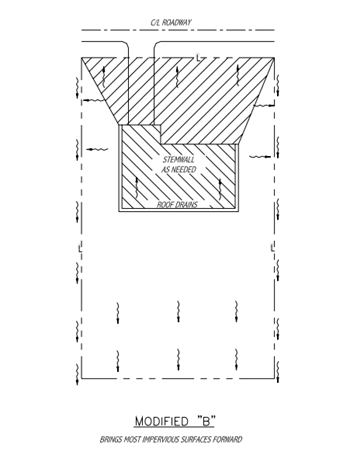
b.
Fill requirements:
1.
The maximum elevation of the fill on any lot shall be the lesser of a maximum of one-foot above the highest adjacent grade or one-half (0.5) feet above the current base flood elevation of the property based on the current FEMA Flood Insurance Rate Map.
2.
Fill within stem-wall foundations shall be allowed to exceed the base flood elevation as necessary.
3.
The grade shall fall to a minimum of six (6) inches above existing or historic grade within the first ten (10) feet. The final grade along the property boundaries shall match that of the adjacent lot.
4.
Lots shall be graded with a minimum slope of one (1) percent (one (1) foot/one hundred (100) feet) in accordance with FHA Type A, B, or C grading pattern.
c.
Maximum impervious surface ratio (ISR):
There shall be a maximum impervious surface ratio (ISR) of seventy (70) percent of the lot size for all single-family residential dwelling and duplex development regardless of the zoning district, except as established within the historic preservation districts and not within any master planned communities.
d.
For development not in an approved master grading plan that does not meet the above a.—c. requirements, engineered plans would need to submitted through the utilities/public works civil site plan review that demonstrates that the use of low impact development (LID) stormwater techniques with a net benefit in stormwater retention.
e.
Variances may be requested according to section 28-29.
Federal Housing Administration (FHA) Drainage Illustrations Types "A," "B," and "C."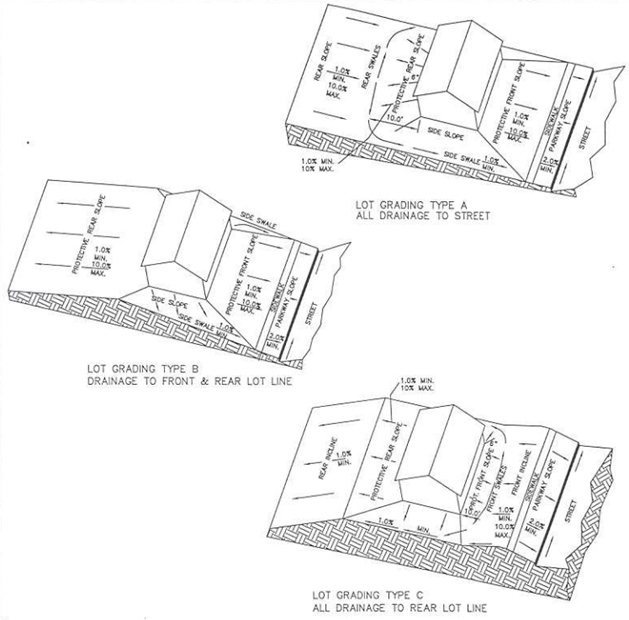
(Ord. No. 2025-21, § 2, 8-11-25)
Sec. 28-366. - In general.
All new and expanded uses and structures as well as all changes in use shall meet all requirements contained in this section for off-street parking and loading. Where fractional spaces result from parking space requirement calculations, the parking space required shall be the nearest whole number.
(Code 1964, § 33-116)
Sec. 28-367. - Historic preservation districts requirements.
Uses and structures located in historic preservation districts 1, 2, 3 and 4 are not required to provide off-street parking and loading. Any parking facilities within these districts shall meet the specific requirements contained in this section. Parking facilities within historic preservation districts 1, 2 and 3 shall not exceed a maximum of twenty (20) spaces and shall not be located within twenty-five (25) feet of another facility. All parking facilities shall have a fence or wall around the perimeter of the facility. Parking facilities located on the premises of a structure shall meet the height requirements for fences or walls established by the architectural guidelines for historic preservation as appropriate to the era of the structure. Parking facilities located off the premises shall meet the height requirements for pre-1821 construction. No parking garages shall be approved within historic preservation districts 1, 2 and 3, and any parking facility located on a corner lot shall be by exception only.
(Code 1964, § 33-117)
Sec. 28-368. - Design standards.
(a)
Approval of plans and specifications. No permits shall be issued for any parking facility until the plans and specifications, including required landscaping, materials and storm drainage, have been submitted to and approved by the planning and building department and the engineering division. These plans and specifications shall include proper drainage and retention, surface materials, curbing and screening as required, clearly marked and dimensioned, with handicap and other special use spaces designated. All entrances, exits and aisles shall be dimensioned, with the traffic pattern indicated.
(b)
Drainage. Off-street parking and loading facilities shall meet city requirements for stormwater retention and drainage to prevent damage to abutting property, the public right-of-way and the adjacent environment. All such facilities shall be paved with erosion-resistant materials in accordance with city specifications. Drainage from parking facilities into the city drainage system (either overground or direct underground) shall require the approval of the engineering division.
(c)
Lighting. Adequate lighting shall be provided if an off-street parking or loading facility is to be used at night. Such lighting shall be provided to insure user safety and security. Lighting shall be designed and installed to minimize glare on adjacent property and streets. No source of illumination shall be directed into the windows of any residential building.
(d)
Landscaping. Landscaping requirements for parking facilities shall be as required by Chapter 25.
(e)
Separation from walkways and streets. Off-street parking and loading facilities shall be separated from walkways, sidewalks, streets or alleys by a wall, fence, curbing, bollards, landscaping or other approved protective device. Such protective devices shall not impair the visibility of pedestrians or vehicles at entrances and exits.
(f)
Entrances and exits. The location and design of entrances and exits shall be in accordance with city specifications. The number of curb cuts shall be the minimum required to allow free and safe use of the facility without impairing traffic flow along the street. The use of shared or common curb cuts is encouraged where practical. Trees and appropriate landscaping may be used to define entrances and exits. Landscaping, curbing or other protective devices may be provided to control access and to separate pedestrian and vehicular traffic.
(g)
Interior driving aisles and maneuverability. The minimum width of interior driving aisles and maneuverability space within parking facilities shall be related to the angle of the parking spaces and the use of one-way or two-way traffic as follows:
(h)
Existing site constraints. For parking facilities to be used in conjunction with existing structures containing physical constraints, such as trees or buildings, making it impractical to provide entrances, exits and interior aisles in accordance with subsections (f) and (g) hereof, the city planning and building manager may grant a variance from such requirements; provided, however, no variance shall be given by the planning and building manager to the required parking space requirements or required interior maneuverability space.
(Code 1964, § 33-118; Ord. No. 94-15, §§ 1, 2, 6-13-94; Ord. No. 96-30, § 2, 7-8-96)
Sec. 28-369. - Compact space standards.
A compact parking space shall be at least eight (8) feet wide by eighteen (18) feet in length. All compact spaces shall be indicated by signs. A maximum of twenty-five (25) percent of required parking spaces may be compact spaces.
(Code 1964, § 33-119)
Sec. 28-370. - Handicap parking space standards.
Handicap parking spaces shall conform to the standards of the most recently adopted Florida Building Code.
(Code 1964, § 33-120; Ord. No. 03-17, § 11, 6-23-03)
Sec. 28-371. - Location.
(a)
A required off-street parking and loading facility shall be located on the same lot or parcel of land it is intended to serve. However, an off-street parking and loading facility within four hundred (400) feet of the premises may be allowed as a permitted use by exception.
(b)
The planning and zoning board may grant an exception when practical difficulties prevent the placing of all or part of the facility on the premises they are designated to serve. The board shall review the proposal for impact upon pedestrian and vehicular traffic patterns and user safety, impact upon surrounding properties from noise, glare, visual quality, nuisance and traffic generation.
(Code 1964, § 33-121)
Sec. 28-372. - Joint use of parking facilities.
Nothing in this chapter shall be construed to prevent the joint contractual use of off-street parking facilities by two (2) or more structures or uses when such facilities provide the number of spaces required for all uses or structures.
(Code 1964, § 33-122)
Sec. 28-373. - Required off-street parking.
(a)
Intent. The purpose of this section is to insure the reasonable provision of off-street, on-site parking facilities. Any use not listed shall provide off-street parking facilities as required of the use listed which is most closely related to it, as determined by the planning and building department.
(b)
Continuation required. Off-street parking or loading facilities shall be maintained and continued as long as the main use continues.
(1)
Repair. Conforming buildings and uses existing at the time of adoption of this chapter (June 27, 1988) may be modernized, altered and/or repaired without providing additional facilities, providing there is no increase in area or capacity.
(2)
Enlargement. When a building or use existing at the time of adoption of this chapter is enlarged or increased in area or capacity by adding floor area, volume or seats, off-street parking and loading as required by this chapter shall be provided for the additional floor area, volume, capacity or seats so created or used.
(3)
Change in use. When the use of a building or portion thereof changes, the new use shall meet the off-street parking requirements of this section.
(c)
Required parking San Marco Avenue Design Standards. Developments within the San Marco Avenue Design Standards entranceway corridor area, utilizing the residential typology development option, shall receive a twenty-five (25) percent reduction for the total calculated required parking based on (d) Minimum spaces required in order to maintain the appearance of a residential in nature front yard consistent with the intent of the design standards.
(d)
Minimum spaces required:
(Code 1964, § 33-123; Ord. No. 98-26, § 2, 9-14-98; Ord. No. 98-35, § 1, 2-22-98; Ord. No. 03-17, § 8, 6-23-03; Ord. No. 06-35, § 1, 2-12-07; Ord. No. 15-02, § 1, 12-14-15; Ord. 16-02, § 1, 1-25-16; 16-06, § 4, 2-8-16; Ord. No. 18-09, § 5, 6-25-18)
Sec. 28-374. - Off-street stacking requirements.
(a)
Whenever a structure or use requires the off-loading of passengers or allows for use without exiting the vehicle, stacking or off-loading lanes and spaces will be required on-site as follows:
(1)
Drive-through uses. Three (3) stacking spaces per window.
(2)
Child care facilities. One (1) stacking space per eight (8) students up to a minimum of five (5) spaces.
(3)
Schools. One (1) stacking space per fifteen (15) students up to a maximum of ten (10) spaces.
(4)
Hotel/motel office. Two (2) stacking spaces.
(5)
Automatic/mechanical car wash. Three (3) stacking spaces per individual unit.
(6)
Hand car wash/auto detailing. Two (2) stacking spaces per individual unit or work station.
(7)
Dumpsters/trash receptacles. One (1) stacking space per dumpster or receptacle location, oriented to allow loading without requiring access or maneuvering through parking spaces.
(b)
A stacking space shall be a minimum of twelve (12) by twenty (20) feet and shall be located so as not to obstruct, endanger or interfere with either on-site or off-site access, maneuvering or traffic patterns. Stacking lanes shall be marked or separated to prevent use as access and to protect users while off-loading or waiting.
(Code 1964, § 33-124)
Sec. 28-375. - Off-street loading requirements.
Whenever a structure or use requires the loading or off-loading of supplies or materials, loading zones or spaces will be required on-site as follows:
(1)
Multiple office building, motel, hotel, hospital, auditorium, theatre or similar use. One (1) space if aggregate floor area is over five thousand (5,000) square feet but not greater than forty thousand (40,000) square feet, plus one (1) space for each additional sixty thousand (60,000) square feet or major fraction thereof.
(2)
Retail or service establishment, wholesale establishment, mini-warehouse and self-storage facilities, industrial uses and restaurant. One (1) space if the gross floor area is not greater than twenty thousand (20,000) square feet; two (2) spaces if the aggregate floor area is more than twenty thousand (20,000) square feet but not greater than sixty thousand (60,000) square feet; plus one (1) space for each additional sixty thousand (60,000) square feet or major fraction thereof.
(3)
In no case shall the required off-street loading space be less than the following:
a.
Auditoriums, theatres, hotels, motels, hospitals, industrial uses, warehouse uses, multiple office buildings or individual offices of greater than four thousand (4,000) square feet; retail stores, restaurants and all other commercial buildings shall have at least one (1) space.
b.
Shopping centers or shopping plazas shall provide at least one (1) space for every two (2) stores or businesses located so as to service both locations.
(4)
In no case shall the required off-street loading space be part of the area used to satisfy the off-street parking requirements of this chapter. The off-street loading space required for the uses mentioned in this section shall in all cases be on the same lot or parcel of land use as the structures or use it is intended to serve.
(5)
A loading space shall be located so as to facilitate loading and off-loading and so as not to obstruct, endanger or interfere with either on-site or off-site access, maneuvering or traffic patterns. Loading spaces or loading zones shall be marked or located to prevent use as access or parking and to protect users while loading or off-loading.
(6)
A loading space or loading zone may be located adjacent to a building to allow parallel parking when use of such space or zone is limited to fifteen (15) minutes or less, when this time limit is clearly indicated, and when other parking is prohibited.
(7)
A loading space or loading zone shall be oriented so as to allow loading and off-loading without requiring access or maneuvering through parking spaces.
(Code 1964, § 33-125; Ord. No. 16-02, § 1, 1-25-16)

