
St Charles City Zoning Code
CHAPTER 17
24 - OFF-STREET PARKING, LOADING AND ACCESS
17.24.010 - Off-street parking and loading general provisions.
The provisions of this chapter shall apply as follows:
A.
Existing facilities. Existing off-street parking and loading facilities shall not be reduced below the requirements of this chapter with respect to the number of spaces provided or the design of such facilities. If an existing facility provides less than the required number of parking or loading spaces, no parking or loading spaces shall be removed. If an existing facility provides less than the dimensions, landscaping, or other characteristics regulated by this chapter, no nonconforming dimension, landscaping or other characteristic regulated by this chapter shall be further decreased. Existing off-street parking and loading facilities which do not conform to the requirements of this title, but were lawfully existing when the parking or loading facilities were established or substantially modified, may be allowed to continue as legal nonconforming uses, subject to the limitations of the provisions of Chapter 17.08, "Nonconformities", except that upon resurfacing or reconstruction, existing non- conforming off street parking and loading facilities shall be subject the following:
1.
For existing off-street parking and loading facilities that do not meet the current yard or set back requirement, a yard or setback shall be provided for the resurfaced or reconstructed parking lot, equal to either a) the existing set back distance or b) fifty percent (50%) of the applicable required yard or set back distance, whichever is greater.
2.
The yard or setback area provided shall be landscaped per Chapter 17.26.020.D "Resurfacing/Reconstruction of Existing Parking Lots."
3.
If complying with items I or 2 above would create a new non-conformity with respect to the required number of spaces provided, then the Director of Community Development may allow for an alternate setback and landscape plan that meets these requirements to the extent possible, which shall include providing other aesthetic improvements to the parking lot and/or landscaping in alternate locations.
B.
Damage or destruction. When a building is reconstructed or repaired after being damaged or destroyed, off-street parking and loading facilities shall be restored or maintained in an amount equivalent to that which existed at the time of such damage or destruction. However, it shall not be necessary to restore or maintain parking and loading facilities in excess of the applicable requirements of this chapter.
C.
Change in use and intensity of use. When the intensity of use of a building, structure or lot is increased, or the use of a building, structure or lot is changed so as to increase the required number of parking or loading spaces, additional parking or loading spaces, as the case may be, shall be provided. The number of additional spaces provided shall be the incremental difference between the required number of parking or loading spaces for the new use(s) and the required number of parking or loading spaces for the previous use(s). In no event, however, shall spaces be required in excess of the number required for the new use. (This condition would occur when the number of existing parking or loading spaces exceeded the number of parking or loading spaces that were required for the previous use.)
When the intensity of use of any building, structure or parcel of land is decreased, the number of parking and loading spaces may be reduced, to the extent that the requirements of this chapter are met for the entire building, structure or parcel of land, as modified.
D.
Provision of additional spaces. Nothing in this chapter shall be deemed to prevent the voluntary establishment of off-street parking or loading facilities, provided that all regulations governing the location, design and control of such facilities shall be in accordance with this chapter.
Intensity of use is defined as square feet of gross floor area, number of dwelling units, number of employees, or other factors used as a basis for requiring parking or loading facilities.
D.
Provision of additional spaces. Nothing in this chapter shall be deemed to prevent the voluntary establishment of off-street parking or loading facilities, provided that all regulations governing the location, design and control of such facilities shall be in accordance with this chapter.
E.
Gravel off-street parking facilities. Existing gravel driveways or parking surfaces shall not be enlarged or expanded in any manner.
(2019-Z-1: § 4; 1; 1991-Z-7: § 1; 1960-16; Ord. No. 2024-Z-18, § 10, 8-19-2024)
17.24.020 - Computation.
The number of required parking and loading spaces shall be based upon the principal use as listed in Table 17.24-3. For principal uses having more than one functional area, such as a manufacturing facility having associated offices, the number of required parking and loading spaces shall be based only upon the principal use. When more than one principal use occupies a building or lot, the number of required spaces shall be the sum of the separate requirements for each principal use. Additional parking spaces shall be required for an accessory use only if it is listed in Table 17.24-3.
In computing the number of off-street parking or loading spaces required by this chapter, the following standards shall apply:
A.
Space allocated to any off-street loading space shall not be used to satisfy the requirement for any off-street parking space or access aisle, or portion thereof. Conversely, the area allocated to any off-street parking space shall not be used to satisfy the requirement for any off-street loading space or access aisle or portion thereof.
B.
For the purpose of determining the number of required off-street parking or loading spaces, Gross Floor Area ("GFA" in Table 17.24-3) shall be as defined in Chapter 17.32, Definitions.
C.
A fraction of less than one-half (½) may be disregarded and a fraction of one-half (½) or more shall be counted as one (1) parking or loading space.
D.
In places of assembly in which patrons or spectators occupy benches, pews or similar seating facilities, each twenty-four (24) inches of seating width shall be counted as one (1) seat for the purpose of determining the requirement for off-street parking facilities.
E.
Except as otherwise specified, parking or loading spaces required on an employee basis shall be based on the maximum number of employees normally present on the premises at any one time. When the determination of the number of parking spaces is based on the number of employees, the owner and/or managers, as well as contractors present on a regular basis shall be counted as employee(s).
17.24.030 - Construction of parking and loading facilities.
A.
Permit required. A Building Permit is required prior to any construction, alteration or addition of any parking facility providing five (5) or more parking spaces, and for any loading facility. For purposes of this section, construction, alteration or addition shall include all paving of previously unpaved surfaces, placement or replacement of pavement, binder and/or surface courses, construction of curbing, installation of new parking lot landscaping, and similar activities. Construction, alteration or addition shall not include maintenance activities such as replacement of existing landscaping, repair of existing curbing, isolated pavement repairs, sealing, re-striping, or other maintenance activities.
B.
Time of completion. The off-street parking and loading facilities required by this chapter shall be completed prior to the issuance of the occupancy permit for the use they serve. If weather conditions do not permit such completion, the Building Commissioner may issue a temporary occupancy permit for a maximum period of eight (8) months. The off-street parking and loading facilities shall be completed prior to the expiration of the temporary occupancy permit.
17.24.040 - Collective provisions.
Off-street parking spaces for separate uses may be provided collectively on the same lot, if the aggregate number of spaces provided is not less than the sum of the spaces required for each separate use. No parking or loading space, or portion thereof, shall serve as the required space for more than one (1) use unless the Director of Community Development has approved shared parking as provided in Section 17.24.050.
17.24.050 - Shared parking.
The same off-street parking spaces may be shared between two (2) or more separate uses on the same lot, but only to the extent that the demand for such spaces by the separate uses will not occur at the same hours during the same days of the week. No shared parking shall be approved unless the Director of Community Development makes a finding that the use of shared parking spaces will not occur at the same hours during the same days of the week, based upon the type of uses and their hours of operation.
17.24.060 - Location of off-street parking.
A.
Location in residential districts. All required parking facilities accessory to uses in residential districts (RE, RS, RT and RM) shall be located on the same lot as the building or use served.
B.
Location in nonresidential districts. Required parking facilities accessory to uses in the BL, BC, BR, OR, M1, M2, PL, and BT Overlay districts shall be located on the same lot as the building or use served, or on a different lot in the same zoning district within three hundred (300) feet walking distance of the use served.
Required parking facilities accessory to uses in the CBD-1 and CBD-2 districts may be located on the same lot, or on a different lot in the CBD-1 or CBD-2 district within five hundred (500) feet walking distance for nonresidential uses, and within two hundred (200) feet walking distance for residential uses.
C.
Where required accessory parking facilities are provided on a separate lot, the owner of the lot containing the building or use shall demonstrate the right to maintain and use such parking by providing the appropriate documentation to the Director of Community Development in accordance with the following:
1.
Change in Use and/or Intensity of Use per Section 17.24.010 — a recorded permanent easement or other recorded instrument demonstrating the right to use the required number of parking spaces on the lot containing the parking.
2.
Construction of a new building or facility — a recorded permanent easement demonstrating the right to use the required number of parking spaces on the lot containing the parking.
17.24.070 - Design of off-street parking facilities.
All off-street parking facilities shall comply with the following standards:
A.
Setbacks and yard coverage.
1.
Single-family, two-family and townhouse dwellings. Off-street parking facilities and access drives may be located in any yard, but shall not cover more than the front or exterior side yard in which it is located than is specified below:
a.
For circular driveways, up to fifty percent (50%) of the front yard, if both access points intersect with the front lot line, b) up to fifty percent (50%) of the exterior side yard, if both access points intersect with the exterior side lot line or c) up to twenty-five percent (25%) of the total area of the front and exterior side yards, if one access intersects the front lot line and the other intersects the exterior side lot line.
b.
For all other driveways, forty percent (40%), except that one (1) driveway of at least eighteen (18) feet wide generally perpendicular to the street is permitted regardless of the percentage of the yard it occupies.
2.
All uses other than single-family, two-family and townhouse dwellings.
a.
Off-street parking facilities shall not be located within the front or exterior side yard applicable to parking facilities as required in the district regulations; where no specific yard requirement for parking facilities is specified in the district regulations, the requirement applicable to buildings in the district shall apply.
b.
An access drive generally perpendicular to a public street may traverse any front or exterior side yard but shall not cover more than twenty-five percent (25%) of the front or exterior side yard in which it is located, except that one (1) driveway of at least twenty-four (24) feet wide generally perpendicular to the street is permitted, regardless of the percentage of the yard it occupies.
3.
Other requirements for all uses.
a.
Off-street parking shall not be located in a Landscape Buffer (Section 17.26.070).
b.
Buildings, parking decks, carports and other structures containing off-street parking shall comply with the front, rear and side yard setback requirements for such structures applicable to the district in which the lot is located.
c.
When any parking lot containing five (5) or more open off-street parking spaces abuts a lot in any RE, RS, RT or RM district, it shall be set back a minimum of five (5) feet from the lot line, and the setback area shall be landscaped in accordance with Chapter 17.26, "Landscaping and Screening."
B.
Dimensions. Off-street parking spaces shall be at least nine (9) feet in width, except required off-street parking spaces in surface parking lots accessory to grocery stores and multiple-family dwellings shall be at least nine and one-half (9½) feet in width. Off-street parking spaces, aisles and driveways shall have a minimum vertical clearance of seven (7) feet. The minimum dimensions of off-street parking spaces, aisles and layout shall be in accordance with the following standards in Table 17.24-1 and Figure 17.24-1:
Figure 17.24-1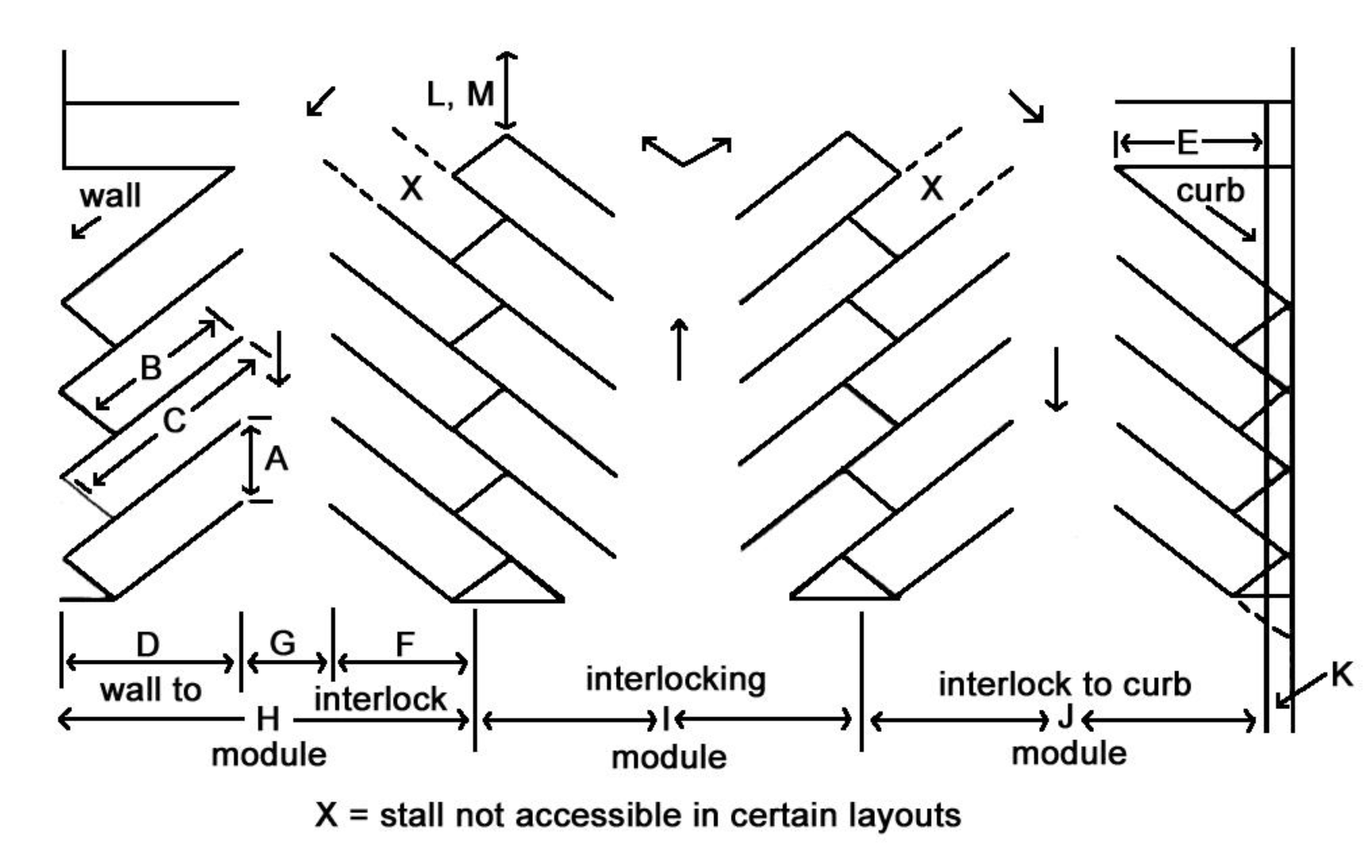
C.
Access.
1.
Adequate access shall be provided for all off-street parking spaces by means of driveways conforming to the dimensions set forth in this title. Off-street parking lots shall not be designed so as to necessitate backing movements for ingress or egress, except for entering or exiting individual parking spaces. Vehicular ingress and egress shall be from minor streets wherever possible, rather than from arterial or collector streets.
2.
One-way driveways shall be clearly marked with appropriate signs or pavement markings. If traffic conditions in the vicinity of the site warrant the restriction of turning movements or access to or from a parking facility, signs and driveway modifications necessary to accomplish said restrictions shall be provided by the property owner. The Director of Public Works may impose such restrictions based upon applicable State and Federal requirements or, if no requirements are applicable, good engineering practice.
3.
Driveway width adjoining public streets, measured parallel to the curb or edge of pavement at the property line, shall be as follows:
a.
For single- and two-family dwellings, a maximum of twenty-four (24) feet in width for a single driveway, or for a lot with two (2) driveways, a maximum of eighteen (18) feet in width per driveway. No more than two (2) driveways shall be permitted per lot.
b.
Two-way driveways shall be limited to a maximum of thirty (30) feet in width, except for high traffic generators, which shall be limited to a maximum of forty-eight (48) feet in width. High traffic generators shall be considered those land uses which typically generate over one hundred (100) trips during their peak hour, as established by the Institute of Traffic Engineers (ITE), or that generate over seven hundred fifty (750) trips in an average day.
c.
Driveways forty-eight (48) feet or more in width shall contain medians of a minimum width of four (4) feet and a minimum length of twenty-five (25) feet and shall be offset from the right-of-way five (5) feet. Driveway medians for driveways that are less than forty-eight (48) feet in width require design approval from the Director of Public Works.
d.
In the M-2 district, driveways designed to be utilized by semi-trucks to access designated loading docks may be expanded to a maximum of forty-eight (48) feet in width when adjoining non-arterial and non-collector streets, and no driveway median shall be required.
4.
Driveways that are designed to prohibit left turns in and out shall have a channelizing island, as shown in Figure 17.24-2 (Channelizing Island), with the exception of driveways entering streets with barrier medians. Limited turn driveways are subject to the following requirements:
a.
Channelizing island width, measured parallel to the street: Forty (40) feet minimum.
b.
Channelizing island length: Twenty-five (25) feet.
c.
Channelizing island offset from right-of-way: Five (5) feet.
d.
Driveway width: Maximum thirty (30) feet.
Figure 17.24-2: Channelizing Island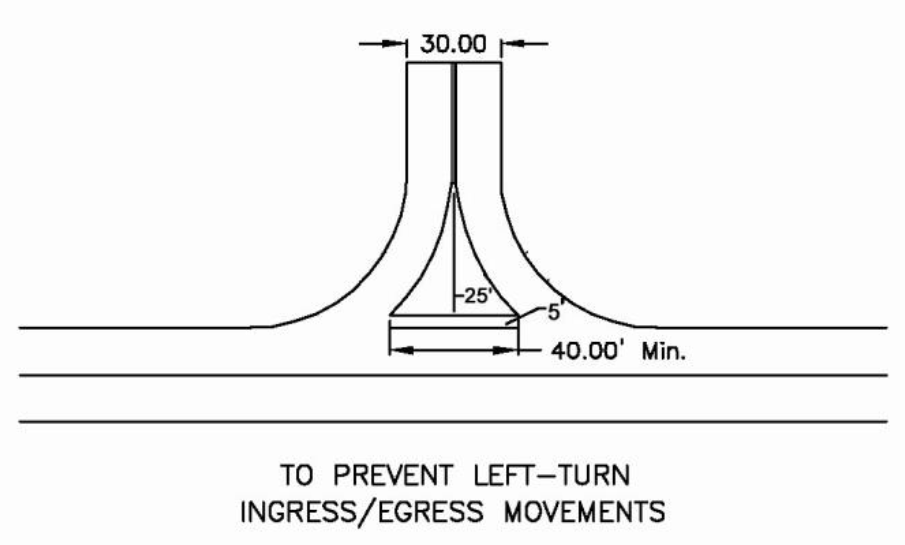
5.
Newly established or expanded driveways shall be located outside of any public street intersection sight distance triangle, as determined by the standards of the American Association of State Highway and Transportation Officials (AASHTO), to the extent practical as to allow access to a lot, subject to a determination by the Director of Public Works that the proposed driveway design follows good engineering practice and will not impede public safety.
D.
Slope. No area of any parking facility shall have a slope of more than five percent (5%). In general, no access ramp shall have a slope of more than eight percent (8%).
E.
Curbing and bumper stops. Bumper stops, wheel stops or curbing shall be provided to prevent vehicles from damaging or encroaching upon any sidewalk, landscaped area or parking lot island, fence, wall or building. Curbing or other methods shall be in provided to protect landscaping in accordance with Chapter 17.26.
F.
Striping. Parking spaces shall be delineated with paint or other permanent materials, which shall be maintained in clearly visible condition.
G.
Surfacing. All parking facilities, loading facilities, Outdoor Motor Vehicle Display, and outdoor storage of commercial vehicles, recreational vehicles, trailers and intermodal containers shall be graded and paved with bituminous concrete, Portland cement concrete, concrete pavers, brick pavers, or pervious pavement material. All pavement for parking areas shall conform to the following, or have an equivalent structural number:
1.
Parking spaces and Outdoor Motor Vehicle Display spaces:
a.
1½ inches Class I bituminous surface course
b.
1½ inches Class I binder Course
c.
8 inches Class I base course (compacted CA-6 or approved equal) or
d.
6-inch Portland cement concrete
e.
4 inches compacted CA-6 or approved equal
2.
Minor access drives (i.e., parking access aisles):
a.
1½ inches Class I bituminous surface course
b.
1½ inches Class I binder course
c.
10 inches Class I base course (compacted CA-6 or approved equal) or
d.
6-inch Portland cement concrete
e.
4 inches compacted CA-6 or approved equal
3.
Main access drives, truck access drives and loading areas:
a.
1½ inches Class I bituminous surface course
b.
2½ inches Class I binder course
c.
10 inches Class I base course (compacted CA-6 or approved equal) or
d.
9-inch Portland cement concrete
e.
4 inches compacted CA-6 or approved equal
H.
Drainage. Open off-street parking facilities shall comply with the drainage requirements of Title 18 of the St. Charles Municipal Code, as amended
I.
Visibility. Parking facilities, sidewalks and landscaping shall be located so that visibility at interior and street intersections is not inhibited. Landscaping and other obstructions at such intersections shall comply with the sight triangle requirements of Chapter 17.22.
J.
Lighting. Lighting shall be provided for parking lots with five (5) or more parking spaces in accordance with Chapter 17.22.
K.
Landscaping and screening. All parking lots shall be landscaped in accordance with Chapter 17.26, Landscaping and Screening.
(Ord. 2014-Z-14 § 1; Ord. 2013-Z-16 §§ 2, 3; Ord. 2009-Z-20 §§ 2, 3; Ord. 2008-Z-24 § 16; Ord. 2006-Z-12 § 3; 2002-Z-2: § 1; Ord. 1999-Z-21 § 1; 1998-Z-15: § 1; 1993-Z-5: § 1; Ord. 1991-Z-7 § 1; Ord. 1960-16)
17.24.080 - Special standards for CBD-1, CBD-2 and BT Overlay districts.
A.
Parking exemption in CBD-1 and CBD-2 Districts. All uses allowed in the CBD-1 and CBD-2 Districts, except for Public Service Facilities, Motor Vehicle Rental, and Drive-through Facilities shall be exempt from the requirement to provide off-street parking spaces, but only when all of the following conditions are satisfied:
1.
The lot is located within a Special Service Area, the purpose of which is to provide and maintain downtown off-street parking (including but not limited to SSA 1-A), and within a Special Service Area, the purpose of which is downtown revitalization (including but not limited to SSA-1B).
2.
Any non-residential use is located within five hundred (500) feet walking distance of a parking lot or structure having spaces available for use by the general public during the business hours of the use served. Any residential use is located within two hundred (200) feet walking distance of a parking lot or structure having spaces available for overnight parking.
3.
Existing off-street parking spaces on the lot shall not be eliminated unless a) the same number of private, off-street spaces are constructed elsewhere by the property owner, within the distance specified in 17.24.080(A)(2) or b) the City Council determines that, based upon a parking study approved by the City Engineer, adequate public parking is available within the required distance to serve the use.
If any of the preceding conditions cannot be satisfied, off-street parking spaces shall be required for the proposed uses in accordance with Section 17.24.130 (Off-street Parking Requirements).
B.
Credit for on-street parking spaces in CBD-1 and CBD-2 Districts. Within the CBD-1 and CBD-2 Districts, on-street parking spaces located within three hundred (300) feet of the use may be credited to meet up to twenty-five percent (25%) of the requirement for off-street parking for non-residential uses.
C.
Additional requirements for off-street parking facilities in the BT Overlay District.
1.
Parking spaces shall be provided to satisfy the minimum requirements for both residential and non-residential uses.
2.
Parking spaces for non-residential uses shall not be located within the front yard or exterior side yard.
3.
Parking lots shall not be illuminated later than 10:00 p.m.
4.
Vehicular ingress-egress shall be from minor streets wherever possible, rather than from main thoroughfares.
5.
The number of curb cuts shall be limited to the existing number of curb cuts on the lot. Additional curb cuts shall not be permitted for residential conversions of existing buildings into non-residential uses.
(2011-Z-1: § 16)
17.24.090 - Accessible parking.
A.
Required spaces. Parking spaces and accessible routes for handicapped persons shall be provided in accordance with applicable State and Federal regulations and laws. The number of accessible parking spaces shall be included in the total number of required parking spaces.
B.
Dimensions and design. Accessible spaces shall comply with the design standards of the Illinois Accessibility Code. Such spaces shall be identified by a sign and pavement markings indicating handicapped parking only. Accessible parking spaces shall be closest to the entrance of the building or structure, and shall be connected by a paved surface designed to provide safe and easy access.
(Ord. No. 2024-Z-18, § 10, 8-19-2024)
17.24.100 - Drive-through facilities.
A.
Design. Drive-Through Facilities and Car Wash establishments shall be designed so that:
1.
The minimum dimension of stacking spaces shall be nine (9) feet in width and twenty (20) feet in length.
2.
Stacking spaces shall be placed in a single line up to the point of service.
3.
Stacking spaces shall be located so that, when in use, they do not obstruct ingress/egress to the site, they do not obstruct access to required parking or loading spaces, and do not otherwise interfere with vehicle circulation on the site.
4.
Vehicle stacking and equipment associated with the Drive-Through or Car Wash shall be concealed from view from public streets and surrounding property to the greatest extent possible by their orientation, design or by screening. This will often involve orienting the Drive-Through or Car Wash to the side or rear of the building, away from the public street.
5.
On a lot in the CBD-1 District, if a Drive-Through Facility adjoins a public street, the building shall be designed to extend over the Drive-Through lanes with windows located on this building extension facing the street, in order to maintain the street wall. In the CBD-1 District, establishments shall be limited to two (2) Drive-Through lanes.
B.
Number of required spaces.
1.
The number of required stacking spaces shall be in accordance with Table 17.24-3 (Required Off-Street Parking).
2.
For a Car Wash, stacking spaces shall begin behind the last vehicle being washed. For all other drive-through uses, stacking spaces shall include the vehicle stopped at a last point of service, such as a window.
C.
Reduction of required spaces. The number of required stacking spaces may be reduced by the City Council, after receiving a recommendation from the Plan Commission, if the petitioner presents a study with quantifiable evidence based on comparable facilities that demonstrates that the number of stacking spaces may be reduced without affecting the ability of the proposed facility to meet the applicable requirements. The approval of a reduced number of stacking spaces shall apply only to the specific business for which the study was conducted.
D.
Maintenance. The operator of the drive-through facility shall provide adequate on-site outdoor waste receptacles and shall provide daily litter clean-up along the rights-of-way abutting the property.
17.24.110 - Required off-street parking for manufacturing, light and heavy, and warehouse/distribution uses.
A.
Required spaces. One (1) space per one thousand (1,000 sq. ft.) square feet of GFA; except for buildings in the M-1 district of five-thousand (5,000) square feet or less of GFA, the requirement may be administratively reduced to two-thirds (0.66) spaces per one-thousand (1,000) square feet GFA.
B.
Reduction of required spaces for buildings over 5,000 square feet GFA in the M-1 District.
1.
Required off-street parking spaces for manufacturing, light and heavy, and warehouse/distribution uses located within buildings over five-thousand (5,000) square feet of GFA in the M-1 district may be reduced by up to thirty-three percent (33%) by the City Council, after receiving a recommendation from the Plan Commission, if the petitioner presents a study with quantifiable evidence based on comparable facilities that demonstrates:
a.
The number of parking spaces may be reduced without affecting the ability to adequately accommodate vehicles for employees, business-owned vehicles, vehicles for visitors, and all other vehicles necessary for the business, and provide adequate spaces during an overlap of employee shifts.
b.
The reduction in parking shall not cause a shortage of parking for other uses or businesses located in the area.
2.
The approval of a reduced number of parking spaces shall apply only to the specific business for which the study was conducted. Should the business change the intensity of the use, expand the facility, or leave the premises, the reduction granted by this provision shall no longer be valid.
C.
Land banking of required spaces in the M-2 District.
1.
Required off-street parking spaces for manufacturing, light and heavy, and warehouse/distribution uses in the M-2 district may be land banked for future construction, for up to twenty-five percent (25%) of the requirement, upon approval by the City Council, after receiving a recommendation from the Plan Commission, if the petitioner presents a study with quantifiable evidence based on comparable facilities that demonstrates:
a.
The number of parking spaces may be reduced without affecting the ability to adequately accommodate vehicles for employees, business-owned vehicles, vehicles for visitors, and all other vehicles necessary for the business, and provide adequate spaces during an overlap of employee shifts.
b.
Land banked parking shall not cause a shortage of parking for other uses located in the area.
2.
The petitioner shall submit a Land Bank Parking Plan to include the following:
a.
Depiction of the full number of parking spaces required for manufacturing, light and heavy, and warehouse/distribution uses.
b.
A detailed floor plan depicting the layout of all proposed and future manufacturing/warehouse areas.
c.
Depiction of the interim use of the land banked area.
d.
Acknowledgement that the land banked parking area shall satisfy all applicable sections of the City Code.
e.
Acknowledgement that the associated stormwater management systems are designed and constructed to accommodate all land banked spaces.
3.
Termination of the Land Bank. The approval of land banked parking spaces shall apply only to the specific business for which the study was conducted. The Director of Community Development or Building and Code Enforcement Division Manager shall have the right to require a property owner or business owner to construct land banked parking facilities if the intensity of use increases, if a new business occupies the building, or if a shortage of parking is identified on the property. The Director of Community Development or the Building and Code Enforcement Division Manager shall notify the property owner or operator of the business, in writing, that the land banked parking facilities shall be constructed within one hundred eighty (180) days from the date of said notice.
(2008-Z-36: § 2)
17.24.120 - Commercial vehicles.
A.
Commercial vehicle parking restricted in residential districts. The parking and storage of semi-trailers, semi-tractors, farm machinery, tractors and intermodal containers and any vehicle that exceeds eight thousand one (8,000) pounds in gross vehicle weight on a lot in an RE, RS, RT, or RM District shall be permitted only within a completely enclosed structure, except as provided by Federal law and regulations.
1.
Commercial vehicles other than semi-trailers, semi-tractors, farm machinery, tractors and intermodal containers and any vehicle of eight thousand (8,000) pounds or less in gross vehicle weight may be parked on a lot in an RE, RS, RT, or RM District, provided they are limited to only one (1) such vehicle at any one time.
2.
Commercial vehicles providing service, and portable pallet or roller type storage containers, may be parked on a lot in an RE, RS RT or RM District, but only for the period of time required to provide the service or to load and unload the container. In no event shall a portable storage container be present on a lot in an RE, RS, RT or RM District for more than fifteen (15) days.
B.
Commercial, office/research and industrial districts.
1.
On property within the BL, BC, BR, CBD-1, CBD-2, and OR districts, semi-trailers and intermodal containers shall only be parked or stored in an approved loading area, and shall not be parked or stored outdoors without a wheel assembly attached.
2.
On property within the M-1, M-2 and PL districts, semi-trailers and intermodal containers may be parked or stored on any paved area that will not interfere with vehicular circulation or emergency access, but if not located within an approved loading area they shall be completely screened from view from public streets and residential districts.
3.
Trailers used for temporary storage during construction may be stored continuously until thirty (30) days after issuance of an occupancy permit for the construction.
(2008-Z-36: § 3; 2005-Z-3: § 1; 2000-Z-26: § 1; 1999-Z-25: § 1; 1991-Z-7: § 1; 1960-16)
17.24.130 - Recreational vehicles.
A.
No recreational vehicle shall be parked on private property in such a manner as to impair the safety of pedestrians or vehicular traffic, for example, by obstructing visibility in such a manner that could impair the safe entrance and exit of any vehicle from and upon adjacent properties, or the safety of pedestrians in the public right-of-way or on private property.
B.
Not more than one recreational vehicle may be parked or stored outdoors on a lot in an RE, RS, or RT district. Between October 15 and April 15, a recreational vehicle parked or stored out of doors on a lot in an RE, RS, or RT district shall not be located within the required front yard or required exterior side yard, except for a period not to exceed forty-eight (48) hours within any one-week period for loading and unloading.
C.
All parking and storing of recreational vehicles shall be on a hard surface such as Portland cement concrete, bituminous concrete, or concrete or clay pavers; parking on gravel or crushed stone shall not be considered a hard surface.
D.
No recreational vehicle shall be used for living, sleeping or housekeeping purposes in any zoning district, except in an RE, RS, RT or RM residential district a recreational vehicle may be so used for a period not to exceed (7) seven consecutive days and no more than three (3) times per calendar year.
(2008-Z-36: § 3; 2005-Z-3: § 1; 2000-Z-26: § 1; 1999-Z-7: § 1; 1960-16)
17.24.140 - Required off-street parking spaces.
The minimum number of required off-street parking spaces shall be as provided in Table 17.24-3. Where there is more than one use of a building or lot, the required parking spaces for the various uses shall be computed separately, and added together to determine the total parking required.
(2021-Z-16: § 6; 2019-Z-19: § 4; 2014-Z-8: § 4; 2014-Z-5: § 4; 2011-Z-1: § 17; 2008-Z-36: § 5; 2008-Z-36: § 3; 2008-Z-24: § 17; 2004-Z-25: § 2; 2004-Z-16: § 1; 2004-Z-12: § 4; 2003-Z-1: § 1; 2001-Z-10: § 1; 1998-Z-7: § 1; 1993-Z-19: § 7; 1993-Z-19: § 6; 1993-Z-14: § 1; 1991-Z-7: § 1; 1960-16; Ord. No. 2024-Z-18, § 2—4, 8-19-2024)
17.24.150 - Design of off-street loading spaces.
A.
Location.
1.
All off-street loading spaces shall be located on the same lot as the building or use served and shall not project into a street or alley.
2.
Off-street loading spaces shall not be located within a required front or exterior side yard.
3.
All off-street loading spaces shall be located a minimum of fifty (50) feet from the lot line of any lot in a residential zoning district.
4.
No permitted or required loading space shall be located within twenty five (25) feet of the nearest point of intersection of any two (2) streets.
B.
Dimensions. All required off-street loading spaces shall be at least ten (10) feet in width and at least fifty (50) feet in length, exclusive of aisle and maneuvering space, and shall have a minimum vertical clearance of at least fourteen (14) feet.
C.
Surfacing. Open off-street loading spaces shall be graded and paved with bituminous concrete, Portland cement concrete, concrete pavers, brick pavers, or pervious pavement material.
D.
Access control and signage. Each required off-street loading space shall be designed with adequate means of vehicular access to a street or alley in a manner that will provide for all truck maneuvering on private property and truck maneuvering shall not be allowed on any public street or alley. Location of off-street loading shall minimize interference with traffic movement, as determined by the City Engineer, based upon good engineering practice.
One-way driveways shall be clearly marked with appropriate entrance and exit signs or pavement marking. If traffic in the vicinity of the site warrants the restriction of turning movements or access to or from a loading facility, as determined by the City Engineer, the property owner shall provide the signs and driveway modifications necessary to accomplish said restrictions.
E.
Pedestrian visibility. Notwithstanding any provision hereof to the contrary, loading facilities, driveways and drive approaches shall be constructed and maintained so that a pedestrian within ten (10) feet of the driveway is visible to the driver of a vehicle using the driveway.
F.
Drainage. Open off-street loading facilities shall comply with the requirements of Chapter 18 of the St. Charles Municipal Code, as amended.
G.
Lighting. Lighting installed for the purpose of illuminating off-street loading facilities shall be in accordance with Section 17.22 (Site Lighting).
H.
Landscaping and screening. All loading facilities shall be screened in accordance with Chapter 17.26, Landscaping and Screening.
(2008-Z-36: § 3; Ord. 2008-Z-24 § 18; 1993-Z-6: § 1,2; 1993-Z-5: § 2; 1991-Z-7: § 1; 1960-16)
17.24.160 - Required off-street loading spaces.
In all zoning districts where a building, structure or use requires receipt and distribution of materials or merchandise by trucks or other vehicles larger than eighteen (18) feet in length, off-street loading facilities shall be provided, based on demand as determined by the Director of Community Development, based on similar facilities and the particular needs of the proposed occupant.
(2008-Z-36: § 3; 1993-Z-19: § 7; 1991-Z-7: § 1; 1960-16)
17.24.170 - Aircraft and rail transport rolling stock.
A.
No aircraft or rail transport rolling stock, or any part thereof, whether operable or inoperable, shall be parked or stored outdoors or within a temporary structure on a lot in any residential, commercial, or office/research zoning district, including RE, RS, RT, RM, BL, BC, BR, CBD-1, CBD-2, and O-R districts.
B.
Aircrafts and rail transport rolling stock may be stored in the M-1, M-2 and PL districts in accordance with Section 17.20.030 "Standards for Specific Uses" pertaining to Outdoor Storage and Section 17.26.130 "Outdoor Storage."
(2020-Z-19: § 2)

