
St Paul City Zoning Code
ARTICLE I
- ZONING
Sec. 1.1. - Statement of general intent.
Whereas, by act of the General Assembly of Virginia as provided in Section 15.2-2280—15.2-2316 Code of Virginia, the governing body of any county or municipality may, by ordinance, divide the territory under its jurisdiction into districts of such number, shape and area as it may deem best suited to carry out the purposes of this chapter, and in each district it may regulate, restrict, permit, prohibit and determine the following:
(1)
The use of land, buildings, structures and other premises for agricultural, business, industrial, residential, flood plain and other specific uses;
(2)
The size, height, area, bulk, location, erection, construction, reconstruction, alteration, repair, maintenance, razing or removal of structures;
(3)
The areas and dimensions of land, water, and air space to be occupied by buildings, structures and uses, and of courts, yards and other open spaces to be left unoccupied by uses and structures, including variations in the sizes of lots based on whether a public or community water supply or sewer system is available and used;
(4)
The excavation or mining of soil or other natural resources.
Therefore, be it ordained by the Town Council of St. Paul, Virginia, for purposes of promoting the health, safety or general welfare of the public and of further accomplishing the objectives of section 15.2-2283 that the following provisions of this chapter be adopted as the Zoning Ordinance of St. Paul, Virginia. This chapter has been designed:
(1)
To provide for adequate light, air, convenience of access, and safety from fire, flood, crime and other dangers;
(2)
To reduce or prevent congestion in the public streets;
(3)
To facilitate the creation of a convenient, attractive and harmonious community;
(4)
To facilitate the provision of adequate police and fire protection, disaster evacuation, civil defense, transportation, water, sewerage, flood protection, schools, parks, forests, playgrounds, recreational facilities, airports and other public requirements;
(5)
To protect against destruction of or encroachment upon historic areas;
(6)
To protect against one or more of the following: overcrowding of land, undue density of population in relation to the community facilities existing or available, obstruction of light and air, danger and congestion in travel and transportation, or loss of life, health or property from fire, flood, panic or other dangers;
(7)
To encourage economic development activities that provide desirable employment and enlarge the tax base; and
(8)
To provide for the preservation of agricultural and forest lands and other lands of significance for the protection of the natural environment.
This chapter shall be known as "The Zoning Ordinance of The Town of St. Paul".
[Sec. 2.0. - Districts.]
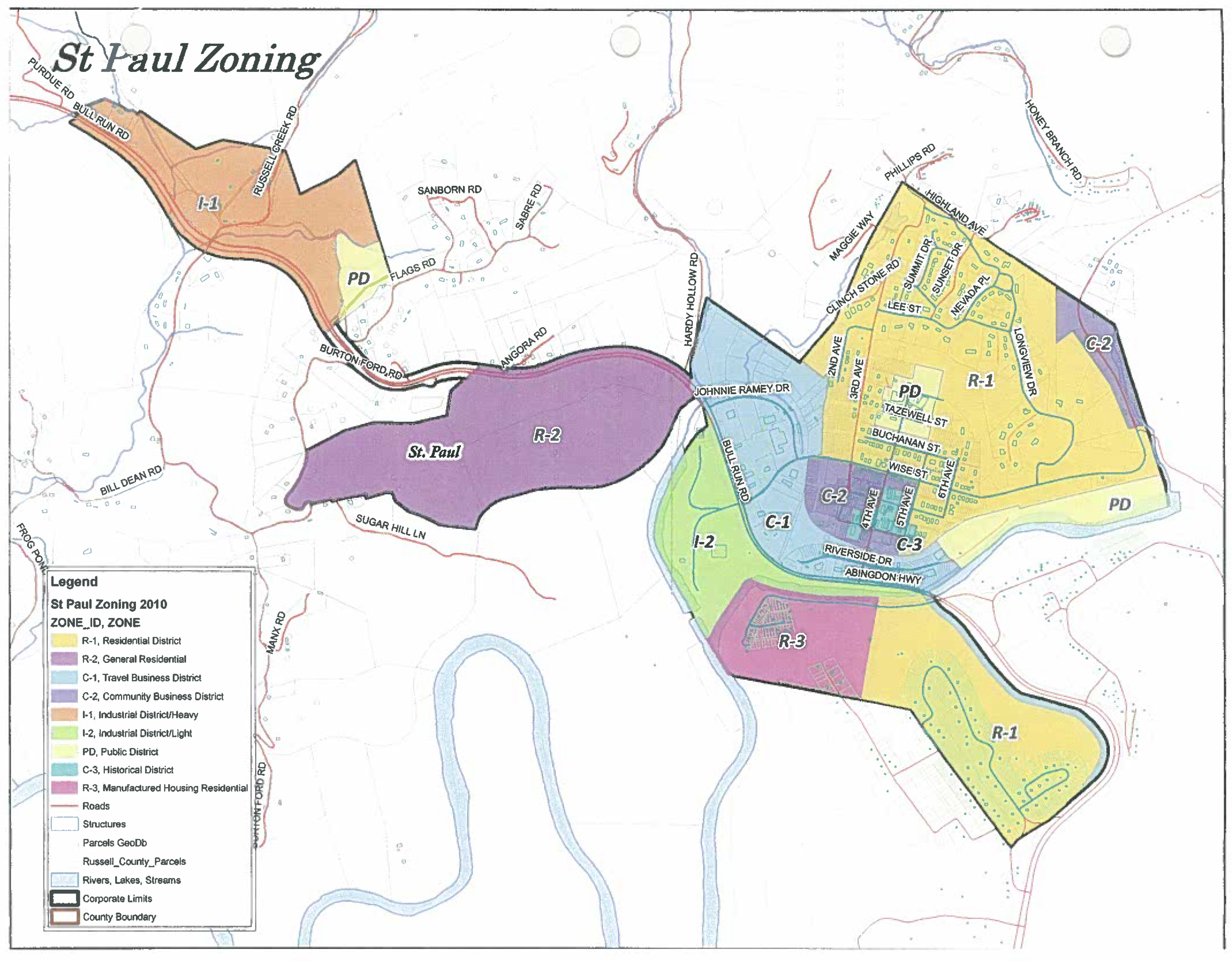
For the purpose of this chapter, the incorporated area of St. Paul, Virginia, is hereby divided into the following districts:
Sec. 2.1. - Zoning map.
ST. PAUL ZONING MAP
[Sec. 3.1. - Definitions.]
For the purpose of this chapter, certain words and terms are defined as follows: Words used in the present tense include the future. Words in the singular include the plural, and the plural includes the singular.
3.1.1. Accessory building means a subordinate structure customarily incidental to and located upon the same lot occupied by the main structure. No such accessory structure shall be used for housekeeping purposes.
3.1.2. Accessory use or structure means a subordinate use or structure customarily incidental to and located upon the same lot occupied by the main use or building.
3.1.3. Adjusted tract area means the gross area of the tract less:
(1)
All areas within public and private road rights-of-way;
(2)
50% of the area of the tract within designated floodplain districts; and
(3)
50% of the area of the tract exhibiting slopes in excess of twenty percent.
3.1.4. Administrator means the official charged with the enforcement of this chapter. He may be any appointed or elected official who is by formal resolution designated to such position by the town council. He may serve with or without compensation as determined by the town council.
3.1.5. Alley means a public way which affords only a secondary means of access to abutting property.
3.1.6. All-weather surface means concrete, asphalt, macadam, brick, cobblestone or similar surface paving for business, industrial, multifamily residences or townhouse uses, and gravel, crushed rock, concrete, asphalt, macadam, brick or similar surface paving for single and two-family residential uses, which shall constitute an all-weather surface in conjunction with the provisions of this chapter related to driveways and off-street parking.
3.1.7. Automobile graveyard means any lot or place which is exposed to the weather, upon which more than five unlicensed, un-inspected and unregistered motor vehicles of any kind are placed.
3.1.8. Automobile service station means a building used or intended to be used for the retail sale of fuels, lubricants, air, water and other operating commodities for motor vehicles, may include the space and facilities for the installation of such commodities and, in addition, the space for facilities for the storage, minor repair and servicing of such vehicles, but not to include body repair, painting, steam cleaning, rust-proofing and refinishing.
3.1.9. Basement means a story having part but not more than one-half of its height below grade. A basement shall be counted as a story for the purpose of height regulations if it is used for business purposes or for dwelling purposes by other than a janitor employed on the premises.
3.1.10. Bed and Breakfast means a dwelling in which lodging and breakfast meals only are provided to travelers and short-term guests for compensation.
3.1.11. Block means the property bounded on all sides by one side of a street or a combination of street line, railroad right-of-way, unsubdivided land, river, live stream or any other barrier to the continuity of development.
3.1.12. Board means the board of zoning appeals of St. Paul, Virginia.
3.1.13. Boardinghouse means a building in which lodging and meals are provided for up to fourteen persons for compensation.
3.1.14. Building means any structure having a roof supported by columns or walls for the housing or enclosure of persons, animals or chattels.
3.1.15. Building, main means the principal structure or one of the principal buildings on a lot, or the building or one of the principal buildings housing the principal use on the lot.
3.1.16. Cash payment in lieu of open space dedication means a cash payment to the Town of St. Paul, specifically accepted and approved by the Town Council, which may be made by a developer in lieu of setting aside required open space in a development. As a condition to acceptance by the Town Council, the Council must find that the in lieu payment is appropriate to the particular circumstances of the development and the payment shall be reasonably related to the alternative cost of the open space. The in lieu payment shall be deposited and kept by the Town in a special escrow account set up especially for open space payments and may only be appropriated on open space and recreation-related projects within the corporate limits of the Town.
3.1.17. Cemetery means any land or structures used for the interment of human remains.
3.1.18. Commission means the Planning Commission of St. Paul, Virginia.
3.1.19. Conservation area means an area of naturally vegetated or landscaped land set aside to serve as a visual and/or recreational amenity within a private development. Such land may include limited paved areas, such as sidewalks, trails, and recreational courts. Such land shall not include streets, parking areas, structures, private yards, or aboveground public facilities, except as may be approved for recreational purposes in a site plan or subdivision plat.
3.1.20. Coverage, building means the percentage of the total lot area which may be occupied by buildings.
3.1.21. Coverage, lot means the percentage of the total lot area which may be occupied by impervious and all-weather surfaces.
3.1.22. Dairy means a commercial establishment for the manufacture and sale of dairy products.
3.1.23. Density means the maximum number of dwelling units permitted per area of land calculated by dividing the total number of dwelling units by the adjusted tract area.
3.1.24. Depth means the average horizontal distance between the front and rear lot lines.
3.1.25. District means districts as referred to in the Code of Virginia, Section 15.2-2280.
3.1.26. Dwelling means any structure which is designed for use for residential purposes, except hotels, boardinghouses, lodging houses, tourist cabins, apartments and automobile trailers.
3.1.27. Dwelling, attached, means a dwelling having any portion of each of two walls above ground, above grade, in common with adjoining dwellings.
3.1.28. Dwelling, detached, means a dwelling which is entirely freestanding on the same lot.
3.1.29. Dwelling, multiple-family, means a structure arranged or designed to be occupied by more than one family.
3.1.30. Dwelling, two-family, means a dwelling having two dwelling units, one above the other or a dwelling having two units side by side, both using a common exterior entrance.
3.1.31. Dwelling, single-family, means a structure arranged or designed to be occupied by one family, the structure having only one dwelling unit.
3.1.32. Duplex means a residential building with two separate dwelling units, attached above ground, each unit with its own outside entrances.
3.1.33. Family means one or more persons occupying a premises and living in a single dwelling unit, as distinguished from an unrelated group occupying a boardinghouse, lodging house, bed and breakfast or hotel.
3.1.34. Fence means a barrier, usually made of posts and wire or boards, intended to prevent escape or intrusion or to mark a boundary. Fences as used in this ordinance may not be made of fragile, readily flammable materials, such as paper, cloth or canvas. Fences as used in this ordinance shall not be constructed into the street right-of-way, and no fence shall be constructed that obstructs motorists' vision at any intersection as determined by the zoning administrator and the state department of highways and transportation. Fences as used in this ordinance shall not exceed a height of eight feet, as measured from the topmost point thereof to the ground or surface along the centerline of the fence in commercial or industrial zones, except fences surrounding public playgrounds, institutions or schools may not exceed a height of fourteen feet.
3.1.35. Flaglot means a lot without required street frontage connected to the street with a strip of land or easement on which a driveway could be located for access.
3.1.36. Flex-Tech means a development concept that accommodates aspects of retail, manufacturing, wholesale and warehousing by an individual user within a single structure. Such development is designed to accommodate users that require flexibility in their square footage allocation. A typical flex-tech user would be small business that initially requires a relatively small square footage but may increase the business' square footage as the strength of the business improves.
3.1.37. Floor area ratio means the ratio of the gross floor area of all buildings, excluding parking structures, to the total area of the lot in square feet.
3.1.38. Floorplate means the horizontal land area occupied by a building at a finished grade including projections and overhangs.
3.1.39. Frontage means the minimum lot width of a lot measured from one side lot line to the other along a straight line on which no point shall be farther away from the street upon which the lot fronts than the building setback line as defined and required herein.
3.1.40. Garage, private means a building designed or used for the storage of not more than three automobiles owned and used by the occupants of the building to which it is accessory. On a lot occupied by a multiple-unit dwelling, the private garage may be designed and used for the storage of one and one half times as many automobiles as there are dwelling units.
3.1.41. Garage, public means a building or portion thereof, other than a private garage, designed or used for servicing, repairing, equipping renting, selling or storing motor-driven vehicles.
3.1.42. Height of building means the vertical distance measured from the level of the curb or the established curb grade opposite the middle of the front of the structure to the highest point of the mean height level between the eaves and ridge of a gable, hip or gambrel roof. For buildings set back from the street line, the height shall be measured from the average elevation of the ground surface along the front of the building.
3.1.43. Home occupation means an occupation carried on by the occupant of a dwelling as a secondary use in connection with which there is no display, and no one is employed other than members of the family residing on the premises, such as professional offices, including medical, dental, legal, engineering and architectural offices, conducted within a dwelling by the occupant.
3.1.44. Hotel means a building in which lodging is provided to travelers and short-term guests for compensation with or without meals, and in which provision is not generally made for cooking in individual rooms or suites.
3.1.45. Impervious surface means ground surface covered by paving, buildings, or other structures such that natural rain water is unable to penetrate and be absorbed into the soil.
3.1.46. Inn means an historic building in which lodging is provided to travelers and short-term guests for compensation, with or without meals, and in which provision is not generally made for cooking in individual rooms or suites.
3.1.47. Junkyard means the use of any area of land lying within 100 feet of a state highway or the use of more than 200 square feet of land area in any location for the storage, keeping or abandonment of junk, including scrap metals or other scrap materials. The term "junkyard" shall include the term "automobile graveyard" as defined in Chapter 304, Acts 1938, Code of Virginia.
3.1.48. Kennel means a place to house, board, feed, handle or otherwise keep or care for dogs and/or cats for sale or in return for compensation.
3.1.49. Lot means a parcel of land occupied or to be occupied by a main structure or group of main structures and accessory structures, together with such yards, open spaces, lot width and lot areas as are required by this chapter, and having frontage upon a street, either shown on a plat of record or considered as a unit of property and described by metes and bounds.
3.1.50. Lot, corner means a lot fronting on two or more intersecting streets.
3.1.51. Manufacture and/or manufacturing means the processing and/or converting of raw, unfinished materials or products, or either of them, into articles or substances of different character or for use for a different purpose.
3.1.52. Motel means a building with separate outdoor entrances in which lodging is provided to travelers and short-term guests for compensation, without meals, and in which provision is not generally made for cooking in individual rooms or suites.
3.1.53. Natural waterway means a creek, stream, run, or other annual or perennial waterway identified on United States Geologic Survey, Commonwealth of Virginia, or Town of St. Paul maps.
3.1.54. Nonconforming lot means an otherwise legally platted lot that does not conform to the minimum area or width requirements of this chapter for the district in which it is located, either at the effective date of this chapter or as a result of subsequent amendments to this chapter.
3.1.55. Nonconforming activity means the otherwise legal use of a building or structure or a tract of land that does not conform to the use regulations of this chapter for the district in which it is located, either at the effective date of this chapter or as a result of subsequent amendments to this chapter.
3.1.56. Nonconforming structure means an otherwise legal building or structure that does not conform with the lot area, yard, height, lot coverage or other area regulations of this chapter for the district in which it is located, either at the effective date of this chapter or as a result of subsequent amendments to this chapter.
3.1.57. Off-street parking means space provided for vehicular parking outside the dedicated street right-of-way.
3.1.58. Open space means lands that are conservation areas, cemeteries, or public parks.
3.1.59. Parking space means a designated area for each automobile or motor vehicle, such space being exclusive of necessary drives, aisles, entrances or exits, and being fully accessible for the storage or parking of permitted vehicles.
3.1.60. Personal service establishment means a shop in which the principal business is the delivery of personal services directly to its customer, such as a barber shop, stylist or hairdresser, beauty shop in which makeup is applied and similar services.
3.1.61. Professional office means a structure designed for use by a person or persons in offering a service which requires specialized knowledge gained by intensive academic preparation such as medicine, law, engineering, dentistry and other like endeavors, which are licensed as professional by the Commonwealth of Virginia.
3.1.62. Public water and sewer systems mean a water or sewer system owned and operated by a municipality or county, or a Sanitation Authority.
3.1.63. Public park means land owned by the Town of St. Paul that is open to the public and is maintained in a natural or wooded condition and/or is developed into public recreational uses, not including streets.
3.1.64. Restaurant means any building in which, for compensation, food or beverages are dispensed for consumption on the premises including, among other establishments, cafes, tea rooms, confectionery shops and refreshment stands which are not temporary (i.e. less than seven days in operation per year).
3.1.65. Restoration, beginning of means the clearing of debris of or from an area, use or structure which has been totally or partially damaged or destroyed.
3.1.66. Retail, stores and shops means buildings for display and sale of merchandise at retail or for the rendering of personal services (but specifically exclusive of coal, wood and lumberyards), such as the following which will serve as illustration: auto parts store, drugstore, newsstand, food store, candy shop, dry goods and notions store, hardware store, household appliance store, furniture store, florist, optician, music and radio store, barber shop and beauty salon, video stores.
3.1.67. Sawmill means a sawmill located on a private property for the processing of timber cut only from that property or from property immediately contiguous and adjacent thereto.
3.1.68. Setback means the minimum distance by which any building or structure must be separated from the front lot line.
3.1.69. Shopping center means any conglomeration of commercial activities sharing a parcel of land which is held in single ownership and sharing parking facilities.
3.1.70. Sign means any display of any letters, words, numerals, figures, devices, emblems, pictures, or any parts or combinations thereof, by any means whereby the same are made visible for the purpose of making anything known, whether such display be made on, attached to or as a part of a structure, surface or any other thing including, but not limited to, the ground, any rock, tree or other natural object, which is visible beyond the boundaries of the parcel of land on which the same is made. This definition specifically does not include structure numbering/street address numbers.
3.1.71. Sign, business means a sign which directs attention to a product, commodity or service available on the premises.
3.1.72. Sign, directional means a sign (one end of which may be pointed or on which an arrow may be painted) indicating the direction to which attention is called, four square feet or less in area, giving the name only of the farm or business responsible for the erection of the same.
3.1.73. Sign, general advertising means a sign which directs attention to a product, commodity or service not necessarily available on the premises.
3.1.74. Sign, home occupation means a sign not exceeding two square feet in area directing attention to a product, commodity or service is clearly a secondary use of the dwelling.
3.1.75. Sign, structure means and includes the supports, uprights, bracing and framework of any structure, be it single-faced, double-faced, v-type or otherwise exhibiting a sign.
3.1.76. Sign, temporary means a sign applying to a seasonal or other brief activity such as, but not limited to, summer camps, horse shows, auctions or sale of land. Temporary signs shall conform in size and type to directional signs.
3.1.77. Special use permit means a permit issued for uses permitted under conditions as required in this chapter or as deemed necessary by the Town Council after consideration of recommendations to the Planning Commission.
3.1.78. Specialty shop means a small shop to serve retail and service needs of the town's residents. Such shops will occupy no more than 2,000 square feet of floor space and will generate a minimum of automobile traffic. Examples of specialty shops include the following: antique shops, artist studios, gallery or frame shops, a small bake shop, special clothing boutiques, gift shops, hobby shops, gourmet or health food shops where merchandise is sold for off-premises use, photo shops and tailor shops. Examples of businesses not intended as specialty shops are those with more regular traffic patterns, such as auto parts stores, newspapers or magazine stores and video stores.
3.1.79. Story means that portion of a building, other than the basement, included between the surface of any floor and the surface of the floor next above it. If there be no floor above it, the space between the floor and the ceiling next above it.
3.1.80. Story, half means a space under a sloping roof, which has the line of intersection of roof decking and wall face not more than three feet above the top floor level, and in which space not more than two-thirds of the top floor area is finished off for use.
3.1.81. Street line means the dividing line between a street or road right-of-way and the contiguous property.
3.1.82. Street in this zoning ordinance also means a public thoroughfare which affords principal means of access to abutting property.
3.1.83. Structural alteration means any change in the supporting members of a building or structure, such as bearing walls, partitions, columns, beams or girders, or any change in the width or number of exits, or any substantial change in the roof.
3.1.84. Structure means any form or arrangement of building materials above or below ground involving the necessity of providing proper support, bracing, tying, anchoring or other protection against the forces of the elements, including but not limited to buildings, sheds, mobile homes, and site improvements such as roads, utilities, towers, and earthworks.
3.1.85. Town means the Town of St. Paul, Virginia.
3.1.86. Town Council means the Town Council of St. Paul, Virginia.
3.1.87. Townhouses means attached dwelling units attached above ground forming a continuous structure, each being separated by a common or party walls of masonry construction void of openings or means of ingress or egress from the basement to the roof, with individual exterior entrances at grade.
3.1.88. Travel trailer means a mobile unit less than 29 feet in length and less than 4,500 pounds in weight and designed for human habitation; this does not include a mobile home.
3.1.89. Use means the specific activity for which land or buildings are designed, arranged, and intended.
3.1.90. Variance means a relaxation of the terms of this chapter where such variance will not be contrary to the public interest and where, owing to conditions peculiar to the property and not the result of the action of the applicant, a literal enforcement of this chapter would result in unnecessary and undue hardship. As used in this chapter, a variance is authorized only for height, area and size of structure or size of yards and open spaces; establishment or expansion of a use otherwise prohibited shall not be allowed by variance, nor shall a variance be granted because of the presence of nonconformities in the zoning division or district or adjoining zoning divisions or districts.
3.1.91. Wetlands means areas that are inundated or saturated by surface or ground water at a frequency or duration sufficient to support, and that under normal conditions, do support a prevalence of vegetation typically adapted for life in saturated soil conditions. Wetlands generally include swamps, marshes, bogs, and similar areas.
3.1.92. Width means the average horizontal distance between side lot lines.
3.1.93. Yard means an open space on a lot other than a court, unoccupied and unobstructed from the ground upward, except as otherwise provided herein and includes space required in front, side or rear.
3.1.94. Yard, front means an open space on the same lot as a building between the front line of the building (excluding steps) and the front lot or street line and extending across the full width of the lot.
3.1.95. Yard area, landscaped means that space on the same zoning lot and contiguous to the principal building or buildings which is either landscaped with shrubs, planted with grass, or developed and maintained for recreational purposes, and excludes that portion of the lot which is utilized for off-street parking purposes.
3.1.96. Yard, rear means an open, unoccupied space on the same lot as a building between the rear line of the building (excluding steps) and the side line of the lot and extending from the front yard line to the rear yard line.
3.1.97. Zoning permit means a permit issued by the zoning administrator to the applicant before the applicant may proceed with any work affected by any provision of this chapter.
Sec. 4.1.A. - [Authority to issue permits, licenses.]
All departments, officials and public employees of this jurisdiction which are vested with the duty or authority to issue permits or licenses shall conform to the provisions of this chapter. They shall issue permits for uses, buildings or purposes only when they are in harmony with the provisions of this chapter.
Sec. 4.1.B. - [Penalty.]
Any person, firm or corporation, whether as principle, agent, employee or otherwise, violating, causing or permitting the violation of any of the provisions of this chapter, shall be guilty of a misdemeanor, and upon conviction thereof, may be fined not less than $10.00 nor more than $1,000.00. If the violation is uncorrected at the time of the conviction, the Court shall order the violator to abate or remedy the violation or abate the Zoning violation within the specified time period shall constitute a separate misdemeanor offense punishable by a fine of not less than $10.00 nor more than $1,000.00, at any such failure during any succeeding thirty day period shall constitute a separate misdemeanor offense for each thirty day period, punishable by a fine of not less than $10.00 nor more than $1,000.00.
Sec. 5.1. - [Process for amendments.]
The regulations, restrictions and boundaries established in this chapter may, from time to time, be amended, supplemented, changed, modified or repealed by a favorable majority of votes of the Town Council provided:
(1)
That a public hearing shall be held at which parties in interest and citizens shall have an opportunity to be heard.
(2)
Notices shall be given of the time and place of such hearings by publication in at last two issues of some newspaper having a general circulation in the jurisdiction. Such notice shall specify the time and place of hearing at which persons affected may appear and present their views, following the standards as amended in the Code of Virginia, Sec. 15.2-2204. After enactment of any such plans, ordinance or amendment, further publication shall not be required.
(3)
Changes shall be made by the Town Council in this chapter or the zoning map only after such changes have been referred to the Planning Commission for a report. Action shall be taken by the Town Council only after a report has been received from the Planning Commission, unless a period of ninety days has elapsed after date of referral to the Commission, after which time the Town Council shall assume the Commission has approved the change or amendment.
(4)
Individual property owners may petition the Town Council to have their property rezoned by submitting their request in writing, accompanied by a certified check for the appropriate fee as set forth in the schedule of fees, to the zoning administrator. After proper public hearing, the Planning Commission shall make its recommendation to the Town Council, which will then act upon the applicant's request. If the Planning Commission makes no recommendation within ninety days from the date of referral, the Town Council shall assume that the Commission concurs with the applicant.
Sec. 6.1. - [Preparation of report.]
A report analyzing the impacts of any rezoning shall be required to be submitted by the applicant with any written petition for rezoning. The Administrator may exempt rezoning petitions from this requirement, if no significant impacts are anticipated. The report shall be prepared as follows:
(1)
The impact analysis shall assume the maximum density or intensity of development allowed under the rezoning classification, unless a lesser density or intensity is proffered in conjunction with a conditional rezoning. The impact analysis may be based on a particular development or site plan only if that plan is proffered as a condition of the rezoning.
(2)
The impact analysis shall include the following:
(a)
A description of the use of surrounding land and the potential economic, physical, visual, nuisance and other impacts of the proposed rezoning/proffered development on those surrounding land uses.
(b)
The anticipated traffic and circulation impacts of the rezoning/proffered development: entrances, trips generated, changes in area traffic patterns and turning movements, impacts on the capacity and efficiency of existing and planned roads, and any other related matters as requested by the Administrator or VDOT.
(c)
The proposed methods by which sewer and water facilities will be provided to the site.
(d)
For residential rezoning, the projected increase in total population.
(e)
The projected additional demand for schools and facilities, emergency services facilities and other public facilities.
(f)
Anticipated stormwater impacts and the methods used to reduce these impacts.
(g)
The location of important environmental features on the site, anticipated environmental impacts, and the methods used to reduce those impacts.
[Sec. 7.1. - Copies on file.]
A certified copy of the Zoning Ordinance of St. Paul, Virginia, shall be on file in the Town Office at St. Paul, and in the Office of the Clerk of the Circuit Court of Wise County, Virginia.
[Sec. 8.1. - Fee Schedule.]
The following fee schedule for zoning matters, permits and other administrative matters regarding zoning in the Town of St. Paul, Virginia is hereby established as follows:

