
Stafford City Zoning Code
ARTICLE VII
DEVELOPMENT STANDARDS
Sec. 102-150.1. - Multifamily and nonresidential standards.
(a)
Standards for all districts other than single-family residential districts:
(1)
Exterior finishes. All multifamily or nonresidential buildings or structures located in all districts, shall comply with the following minimum standards:
a.
Front walls. Eighty percent of any exposed exterior wall forming the front of a building or structure, exclusive of windows, doors, roofs, or sidewalk and walkway covers, shall be constructed with a rectangular smooth or textured split-face block bonding shape pattern or flat textured or dimpled appearance.
b.
Side walls. Not less than 70 percent of any exposed exterior wall forming a side of a building or structure, exclusive of windows, doors, roofs, or sidewalks and walkway covers, shall be constructed with a rectangular smooth or textured split-face block bonding shape pattern or flat textured or dimpled appearance.
c.
Rear walls. Not less than 70 percent of any exposed exterior wall forming the rear of a building or structure, exclusive of windows, doors, roofs, or sidewalks and walkway covers, shall be constructed with a rectangular smooth or textured split-face block bonding shape pattern or flat textured or dimpled appearance.
Common Bond Patter Appearance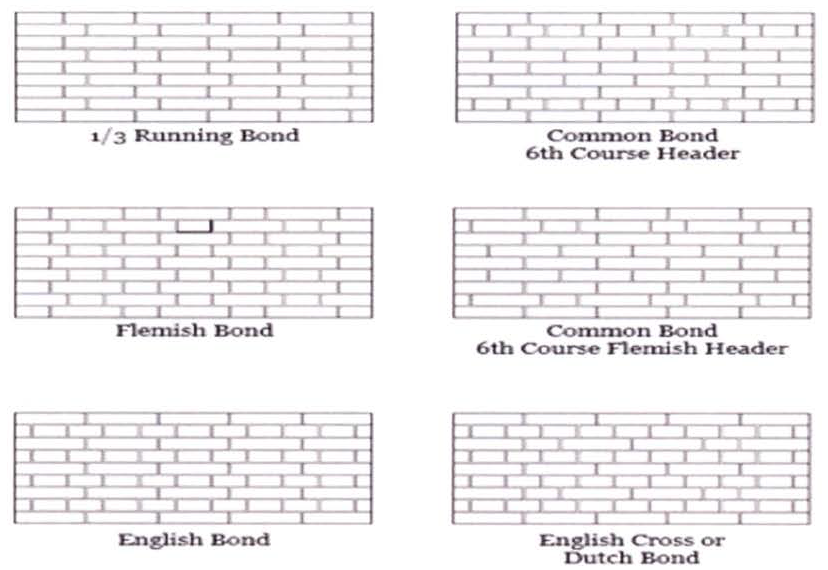
Textured/Dimpled Appearance
(2)
Decorative elements. Decorative elements on buildings and structures such as canopies, wrought iron doors, and trim shall be selected from acceptable colors. Bright and glossy finishes, primary colors, and fluorescent colors on major exterior building elements are prohibited.
(3)
Screening walls. One hundred percent of all screening walls, visible from adjacent property or an adjacent street, shall be constructed to finished grade using acceptable masonry materials compatible in architecture, design, and color with the main building or structure.
(4)
Roof-mounted mechanical or other equipment. Roof-mounted mechanical or other equipment shall be screened from view so that such equipment is not visible from the ground. This provision shall not apply to satellite earth station antennas or any personal communication electronic facilities protected by the Federal Telecommunications Act of 1996 (47 USC 251 et seq.).
(5)
Exterior ground-mounted equipment. Exterior ground-mounted equipment, including, but not limited to, mechanical equipment, utility meter banks, and heating or cooling equipment, shall be sufficiently screened so that no portion of said equipment is visible from an adjacent street. The screening required by this subsection may be accomplished with vegetative landscaping material, which complies with the provisions of section 102-155, or with a solid structure using acceptable masonry materials compatible in architecture, design, and color with the building or structure the equipment serves.
(6)
Exterior ground-mounted equipment. Exterior ground-mounted or building-mounted equipment to serve a building, including mechanical equipment, utility meter banks, and heating or cooling equipment, must be completely screened from public view with an architectural treatment compatible with the building materials and colors. Building mounted equipment shall be painted to match the building color on which it is attached. Vegetation (plant life) may be used in place of fencing to completely screen from public view, year round, ground mounted equipment.
(7)
Rooftop equipment. All rooftop equipment must be completely screened from public view at a vantage point of five feet above the ground elevation with a structural treatment that is compatible with the building architecture. The methods of screening rooftop equipment include the use of parapet walls and the encasement of partition screens. In the case of buildings within view of elevated sections of U.S. 90-A an encasement of partition screens shall be utilized to comply with the intent of these provisions.
(Ord. No. 1089, § 1, 6-28-2017; Ord. No. 1150, § 1, 10-16-2019)
Sec. 102-150.2. - Single-family development standards.
(a)
Standards for single-family residential. Except as provided in subsection (d) below, all single-family residential buildings or structures shall comply with the following minimum standards:
(1)
Exterior finishes. All exposed exterior walls forming a building or structure, exclusive of windows, doors, roofs, or sidewalk and walkway covers, shall be constructed with a rectangular smooth or textured split-faced blocked bonding shape pattern or flat textured or dimpled appearance.
(2)
Decorative elements. Decorative elements on buildings and structures such as canopies, wrought iron doors, and trim. Bright and glossy finishes, primary colors, and fluorescent colors on major exterior building elements are prohibited.
(b)
Exceptions.
(1)
Manufactured housing. Pursuant to V.T.C.A., Occupations Code § 1201.001 et seq., manufactured housing is exempt from the regulations specified in subsection 26-58(a)(1).
(2)
Greenhouses. Commercial greenhouses may be constructed of glass or plastic as specified in the current edition of the building code as adopted by the city (article III of chapter 14).
(3)
Accessory structures in Districts SFR and SFR-5. An accessory structure to a single-family residential dwelling located in districts SFR and SFR-5 is exempt from the regulations specified in subsection (a)(1) of this section, provided the gross floor area of the structure does not exceed 100 square feet, the structure is less than eight feet in height, and the structure is not visible from a public street right-of-way.
(c)
Submission of preliminary elevations. Prior to submission of an application for a building permit, site grading permit, or specific use permit, preliminary elevations of all proposed buildings and structures must be submitted to the zoning administrator. Preliminary elevations shall clearly indicate the proposed exterior wall finishes, exterior colors, and architectural style of all buildings and structures, the proposed location of storage areas, loading docks, delivery areas, and commercial refuse containers, if any, and be consistent with the requirements contained in this section. The zoning administrator shall keep on file and make available upon request samples of acceptable colors. The applicant will be notified of any required changes. A building permit or site grading permit shall not be issued and an application for a specific use permit shall not be processed, until preliminary plans and elevations of all buildings and structures have been approved by the zoning administrator. All buildings and structures shall be constructed only in accordance with final plans and elevations approved by the zoning administrator.
(d)
Newly constructed single-family dwelling required architectural features. All newly constructed single-family dwellings are required to comply with the following architectural features:
(1)
Minimum roof pitch shall be set at 6:12. A modification may be requested to the zoning administrator based on a particular architectural style which shows that the structure is better served by a different roof pitch and the granting of such modification will not be a detriment to the surrounding neighborhood.
(2)
Garage spaces for a minimum of two vehicles shall be attached to the primary structure and shall be located behind the required building setback lines;
(3)
Reserved;
(4)
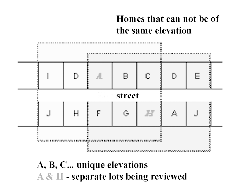
No Façade may be repeated within any adjacent lots or across the street from those lots within groupings of five homes;
(5)
Concealed HVAC units, trash storage and utility meters;
(6)
If brick is used, brick shall be properly detailed. Brick shall be coursed exactly to the top and bottom of all wall openings;
(7)
Windows shall be single hung, double hung, triple hung, or casement;
(8)
Flush mounted windows are prohibited;
(9)
Windows are to be placed on each wall elevation with a wall to window ratio that meets the light and air requirements of the adopted International Building Code as referenced under section 14-55;
(10)
If shutters are used, shutters shall be one-half the width of, and the same height of the associated opening. All shutters shall be louvered, paneled, or constructed of boards as appropriate to the style of the building. Shutters do not need to be operable;
(11)
Reserved;
(12)
Reserved;
(13)
The body of a single-window dormer shall be vertically proportioned or square;
(14)
If chimneys are visible, they shall have a projecting cap;
(15)
If chimneys are located on a street facing wall, they shall extend to the ground;
(16)
If a porch is used, the porch column base shall not protrude beyond the bottom edge of the porch flooring.
(e)
Additional newly constructed single-family dwelling architectural features. All newly constructed single-family dwellings shall contain at least four of the following architectural features:
(1)
Stoop and portico at the front door;
(2)
Front porch;
(3)
Front porch or front stoop steps and railing;
(4)
Front porch roof;
(5)
Decorative or architectural porch railing;
(6)
Second story porch;
(7)
Reserved;
(8)
Trim at gable rake;
(9)
Decorative roof finials or ornamentation;
(10)
Decorative attic or gable feature greater than three SF in size;
(11)
Trim at windows and doors of the street facade;
(12)
Arched window head or heads (depending on architectural style) on street facade;
(13)
Dormer with window;
(14)
Window shutters on street facade;
(15)
Divided light windows;
(16)
Decorative concrete driveway.
(Ord. No. 1089, § 1, 6-28-2017; Ord. No. 1150, § 1, 10-16-2019)
Sec. 102-150.3. - Reserved.
Editor's note— Ord. No. 1150, § 1, adopted October 16, 2019, repealed § 102-150.3, which pertained to use of alternative exterior materials and derived from Ord. No. 1089, adopted June 28, 2017.
Sec. 102-150.4. - Building design guidelines in nonresidential or mixed use districts.
The purpose of the following design guidelines is to facilitate quality building design outcomes within nonresidential and mixed use districts. This is achieved by establishing standards that promote good design and a quality built environment. The graphics corresponding to each guideline illustrate the preferred standard of design (shown on the left) versus an unacceptable standard (shown on the right). Compliance with these guidelines shall be demonstrated by way of a site plan, in accordance with section 102-101 review of site plan.
(1)
Building scale. Larger new buildings and building additions shall respect the scale of adjacent existing buildings by stepping down the height of the new building or building addition, and/or reducing the length of the building facade adjacent to the existing smaller structure. However, no stepping down of the height of the new building or building addition is required if the new building or building addition is less than two stories higher than the adjacent existing building(s).
Building Scale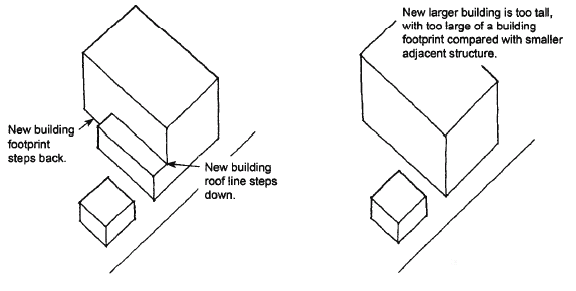
(2)
Cluster buildings to create pedestrian connections. Owners are encouraged to create pedestrian connections. Multiple buildings or tenant spaces within a single project or an integrated business development should create a positive functional relationship to one another and should be clustered to achieve a pedestrian scale. This creates opportunities for plazas and pedestrian precincts while preventing long box-like rows of buildings. A pedestrian link should be established between buildings with the use of an arcade system, trellis, colonnade, enhanced paving, building articulation and detailing, or similar features.
Cluster Buildings to Create Pedestrian Connections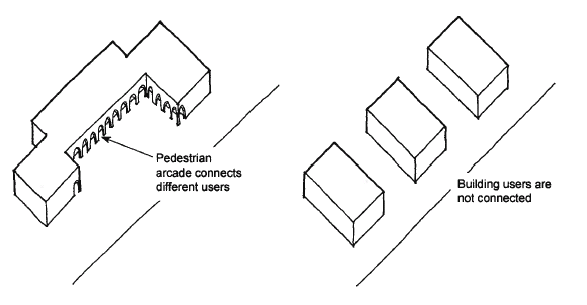
(3)
Architectural composition and articulation. Architectural composition is the art of designing parts of a building to seamlessly fit together into a larger whole. Symmetry is when wings of a building are matched in size and character about a central point (often the primary entrance). Commercial buildings that face arterial streets and other public areas shall be articulated to reduce the apparent mass of the structure. They shall also be articulated to be sensitive to the pedestrian realm at the ground level.
Architectural Composition and Articulation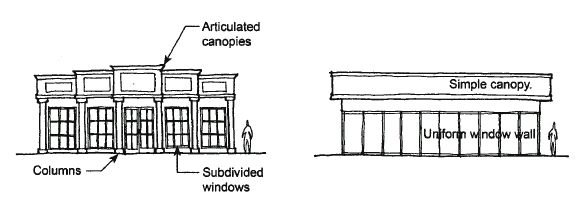
(4)
Building transparency. Buildings that face arterial streets shall have windows at the ground level for product display or other active building uses. Window glazing or tinting shall be light enough to allow good visibility of the window activities from the street.
Building Transparency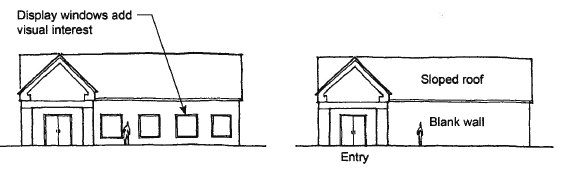
(5)
Building entry identity. The primary building entry shall be easily identifiable for building visitors arriving by car or on foot. The architecture of the building shall reinforce the visual importance of the entry. The entry shall be pedestrian-scale, transparent, and inviting.
Building Entry Identity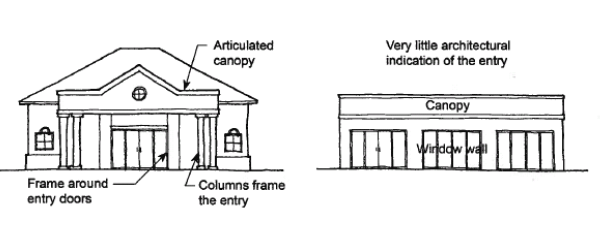
(6)
Pedestrian seating. Pedestrian-friendly spaces shall be promoted by arranging building massing to form outdoor plaza areas for dining or gathering. Elements to increase pedestrian comfort may include, but is not limited to, seating, tables, planters, landscaping, canopies, and low intensity light fixtures.
Pedestrian Seating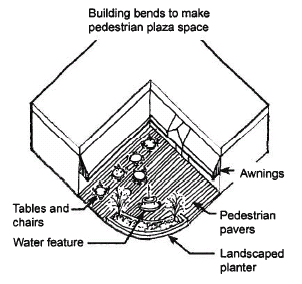
(7)
Awnings and canopies. Exterior weather protection is encouraged for building facades that are adjacent to sidewalks or pedestrian areas. Awnings or canopies should not extend from the building facade more than eight feet so as not to unnecessarily obstruct natural sunlight from the walkway and display windows. Arcades may extend to a greater width but must include artificial lighting. A maximum of one color shall be used for all canopies/awnings on a single building facade (excluding business logos). Alternatively, more than one color may be used provided the same scheme is used consistently along a single building facade. Canopies/awnings shall be integrated into the building's architecture.
Awnings and Canopies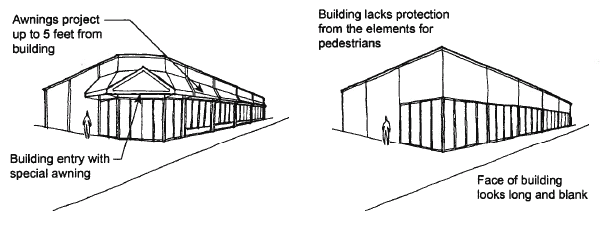
(8)
Overhead door screening. Businesses that have overhead doors shall be oriented on the site such that said overhead doors are perpendicular to the public street right-of-way. If the overhead doors can be oriented away from public view the building shall be oriented in this manner. Overhead doors shall not be transparent and shall be consistent in color with the building wall for which it is attached.
Overhead Door Screening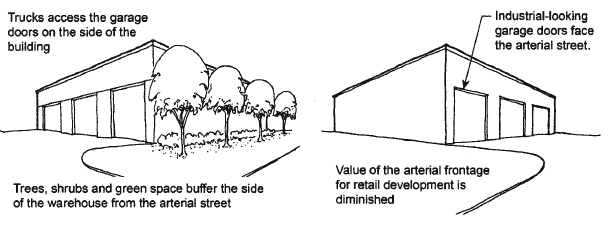
(9)
Service area screening. Service areas including loading spaces and docks and trash enclosures shall be screened from adjacent service drives and adjacent properties, in accordance with section 102-152.
Service Area Screening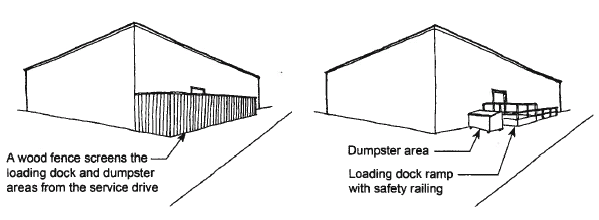
(10)
Secondary building facade treatment and articulation. Secondary building faces (including the side and rear elevations of buildings that are not normally exposed to public view) shall have architectural articulation that relieves the monotony of large blank building walls.
Secondary Building Facade Treatment and Articulation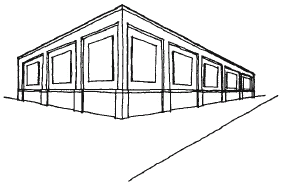
(11)
Reserved.
(12)
Building and site lighting.
a.
Building illumination and architectural lighting shall be indirect (no visible light source) and in such a manner that the projected cone of light does not cross any property line.
b.
Retail parking fields shall maintain a two to five feet average.
c.
Decorative street light standards shall not be greater than 18 feet in height.
d.
Building lighting from soffit overhangs is preferred over light fixtures mounted on the exterior face of buildings.
e.
Only LED, incandescent, florescent, metal halide, mercury vapor, or color corrected high pressure sodium may be used.
f.
Light standards for parking lots shall reflect or be complementary to the style of the building's architecture.
g.
Standards shall not be greater than 20 feet in height.
h.
Canopy lighting for uses that have sheltered outside work or service areas, such as gas stations, shall not exceed 60-foot candles. The luminaires shall be recessed into the canopy so they cannot be viewed from off-site from an eye height of four feet to protect automobile drivers from glare.
i.
Lighting near residential districts. If abutting or nearby properties are used or zoned for residential use, cut-off fixtures shall be used so that the light source cannot be seen from residential property.
j.
All fixtures shall be "cut-off" fixtures that limit lighting that is visible or measurable at the property line. "No cut-off" fixtures may be used only for decorative purposes, provided they:
1.
Have luminaires that produce no more than 1,500 lumens (approximately equal to a 100W incandescent bulb);
2.
Have a maximum height of 15 feet;
3.
Use energy-efficient bulbs, such as compact fluorescent (CF); and
4.
Contiguous parking areas on separate lots can maintain continuous light levels and allow for light trespass across lot lines.
(13)
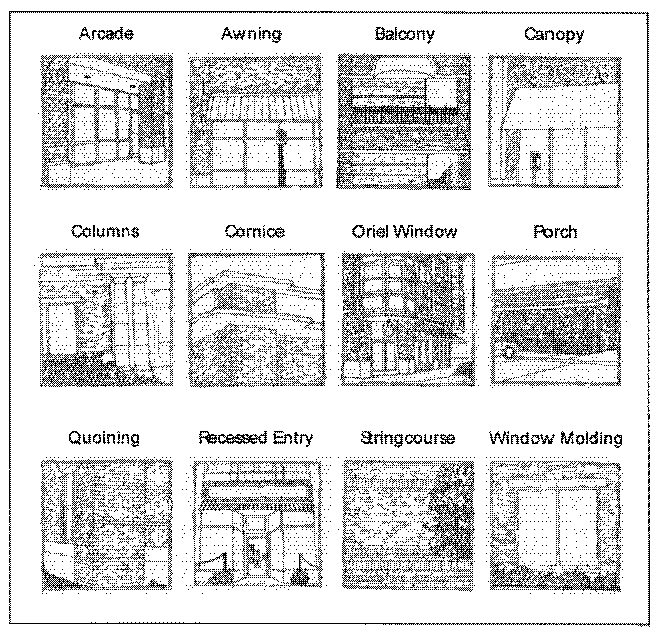
Architectural detailing. Use of interesting architectural detailing that supports the quality and character expressed by these building design guidelines is required. The following are examples of such details.
(Ord. No. 1089, § 1, 6-28-2017; Ord. No. 1150, § 1, 10-16-2019)
Sec. 102-151.1. - Compliance required.
(a)
It shall be unlawful for any person to use or permit the use of any land or structure within the city in a manner which creates any dangerous, injurious, noxious, or other similar condition, including, but not limited to, the emitting of vibration, air pollution, or odorous matter, the storage of explosive, hazardous, toxic, or noxious matter or materials, or the casting of glare at levels which adversely affect surrounding areas or adjoining premises. Permitted uses set forth in this chapter shall be subject to compliance with the applicable performance standards contained in this section.
(b)
The standards set forth in this section shall apply in the various zoning districts within the following sections 102-71 through 102-82.
(Ord. No. 1089, § 1, 6-28-2017)
Sec. 102-151.2. - Exterior noise.
For recurring noise emanating from a lot within the city, the allowable noise level shall not exceed that indicated for the district in which it is located as shown in the table below. It shall be unlawful for any person to cause or permit any sound to be emitted from land in Districts MU, MU-1, AE, RCLM, RCT, PC and IS onto land in District SFR, SFR-5, SFA, District MFR, or onto residential uses, at levels which exceed the allowable levels in the table below for District SFR, SFR-5, or SFA as measured from any point in District SFR, SFR-5, SFA or a residential use. Notwithstanding the foregoing, the noise level limits set forth in the table below shall not apply to:
(1)
Noise emanating from lawful construction activities; and
(2)
Noise emanating from a location in Districts MU, MU-1, AE, LI, RCT, PC or IS for which a festival permit has been issued pursuant to Chapter 18, Section VII, during the period authorized by such permit.
(Ord. No. 1089, § 1, 6-28-2017)
Sec. 102-151.3. - Vibration.
No use within any district shall create earthborn vibration, when measured at any residential property line within any district, which exceeds the limit of displacement set forth in the table below in the frequency ranges specified. Notwithstanding the foregoing, the vibration level limits set forth in the table below shall not apply to vibration emanating from lawful construction activities.
(Ord. No. 1089, § 1, 6-28-2017)
Sec. 102-151.4. - Light and glare.
All exterior lighting shall be shielded so that the light source is not directly visible from adjacent property that is zoned residential or that is in residential use; provided, however, the provisions of this section shall not apply to public buildings or facilities.
(Ord. No. 1089, § 1, 6-28-2017)
Sec. 102-152.1. - Requirements.
(a)
General requirements.
(1)
A permit shall be required for any new fence or screening wall construction or replacement of an existing fence or screening wall unless otherwise provided in this chapter. No permit shall be required to repair a fence as long as the repair keeps the fence in the same location, at the same height, and utilizes the same materials.
(2)
All fences and screening walls shall be kept in good repair and shall not create blight. Dilapidated fences or screening walls shall be repaired or replaced in accordance with provisions of this section. Fences may be painted, but no bright, unnatural colors are allowed. Wood fences shall be painted or stained with natural wood colors.
(3)
Existing chain link fences may be replaced without a permit as long as the repair keeps the fence in the same location, at the same height, and utilizes the same materials.
(4)
Temporary fencing used for construction purposes or special events shall be exempt from the requirements of this section provided that such fencing is approved as part of the applicable building permit or special events permit.
(5)
Any variances to the requirements of this section shall be considered by the board of adjustment unless otherwise provided in this chapter.
(Ord. No. 1089, § 1, 6-28-2017)
Sec. 102-152.2. - Fences.
(a)
Applicability. Where a fence, wall, screen, or enclosure is erected, the following standards apply.
(b)
Site plan and landscape plan required. A site plan must be submitted with the Building Permit application demonstrating compliance with the standards of this section.
(1)
Fence and wall regulations for single- and two-family dwellings.
a.
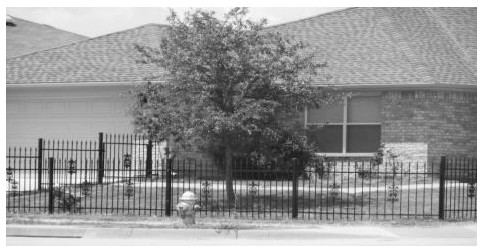
Front yard. A fence, wall, screen, enclosure or similar barrier erected in the front yard setback of a single- or two-family dwelling must not exceed 36 inches in height above the adjacent grade.
36-inch Tubular Steel Fence
b.
Chain linked fencing is prohibited within the front yard area.
c.
Behind front yard setback. A fence, wall, screen enclosure or similar barrier behind the front yard setback of a single- or two-family dwelling must not exceed eight feet in height above the adjacent grade. Wood fences must be designed and built with a bottom rail and a top cap in order to reduce warping of boards.
(Ord. No. 1089, § 1, 6-28-2017)
Sec. 102-152.3. - Screening.
(a)
Location. Continuous screening is required along the common boundary between nonresidential or multiple-family use/district and residential zoning district or use, except where a public street provides buffering. Screening is also required along the perimeter of a nonresidential or multiple-family use/district located across an alley from a residential zoning district or use. Screening must be a minimum of eight feet in height and must be maintained by the property owner of the nonresidential or multi-family use.
(b)
Design. Screening must meet one or a combination of the following design standards:
(1)
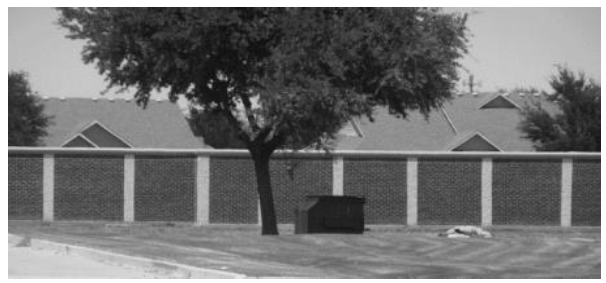
Screening may consist of walls constructed of masonry, stone or pre-cast concrete, with integrated color, texture and pattern. Screening must be eight feet in height above the adjacent grade and must be designed and sealed by a professional engineer for structural integrity. Gates must be equal in height and screening characteristics to the wall in order to create a visual barrier.
Eight-foot Screening Masonry Wall
(2)
Screening may consist of an eight-foot high wooden fence only in conjunction with a ten-foot buffer yard containing evergreen hedges composed of plants purchased in five-gallon or larger containers, with a minimum planted height of six feet, placed on 36-inch centers. Wood fences must be designed and built with a bottom rail and a top cap in order to reduce warping of boards and must contain masonry columns no greater than 12 feet on center. Gates must be equal in height and screening characteristics to the fence in order to create a visual barrier.
(3)
Alternative screening plans may be considered by the city council upon recommendation of the planning and zoning commission. Alternative screening plans must demonstrate the purpose and intent of the regulations by providing materials and design meet or exceed the existing regulations.
(4)
Materials for fences, walls, screens and enclosures.
a.
Allowed materials for fences:
1.
Plain or coated chain link (installed as manufactured, without affixing materials such as slats and tarps);
2.
Fiberglass composite (manufactured for fencing);
3.
Latticework that does not exceed two feet in height and is anchored as a design element at the top of a six-foot tall fence;
4.
Tubular aluminum;
5.
Tubular steel;
6.
Wrought iron or similar decorative metal;
7.
Wood planks;
8.
Support poles made of metal or wood.
b.
Allowed materials for screening walls:
1.
Wood planks in accordance with screening as listed above;
2.
Fired brick;
3.
Natural stone;
4.
Pre-cast concrete;
5.
Split faced block;
6.
Smooth faced block; or,
7.
Stucco.
c.
Prohibited materials. Permits must not be issued for materials not manufactured specifically for fencing, such as fibrous masonry products, landscape timbers, railroad ties, latticework panels, plywood, corrugated steel panels, metal sheets or fiberglass panels.
(c)
Construction. Fence framing and posts on fences visible from a public street must be placed to the interior of the lot so that they are not visible from the street. Unless a continuous masonry beam extends beneath a wooden privacy fence, rot board must be used and attached to the base of wooden privacy fence pickets and a top cap constructed to prevent warping of materials.
(d)
Commercial refuse containers.
(1)
For the purposes of this section, "commercial refuse container" shall mean any receptacle, including but not limited to, roll off containers and dumpsters, used for the collection and disposal of refuse, trash, or garbage which is located on premises that are used for income producing purposes, excluding single-family dwellings and duplexes. Except as provided by subsection (d)(1)a., all commercial refuse containers located in all districts shall comply with the following minimum standards:
a.
Location. No commercial refuse container shall be located within a required front yard. A commercial refuse container located within a required side yard or required rear yard that is adjacent to a street right-of-way shall be located a minimum distance of 20 feet from such street right-of-way. No commercial refuse container shall be located in the street or street right-of-way, nor on or blocking any sidewalk, alley, or driveway except as provided by subsection 102-152.3(d)(1)a.
b.
Foundation. All commercial refuse containers shall be placed on an impervious surface constructed of reinforced concrete not less than five and one-half inches thick.
c.
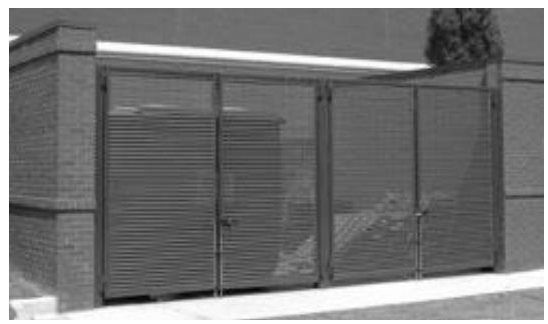
Screening. All commercial refuse containers that are visible from a public street or street right-of-way shall be screened from view with exterior wall finishes compatible in architecture, design, and color with the main building or structure located on the property, or a stockade fence constructed of cedar or redwood with capped galvanized iron posts, set in concrete. The commercial refuse container screening devices herein provided must be firmly fixed together on all sides and be accessible with doors and gates which shall remain closed.
d.
Access driveways. All access driveways to commercial refuse containers shall be constructed of reinforced concrete not less than seven inches thick or of equivalent materials and strength.
e.
Disrepair. A commercial refuse container's screening wall or fence shall not be open, damaged, or in a state of disrepair. Disrepair shall mean a condition which is found to exist as a result of decay, physical damage, destruction, abuse, or unsightliness.
f.
Cleanliness. Commercial refuse containers shall be kept in a clean, sanitary condition and in good mechanical repair. All lids, closure devices, and sleeves for lifting commercial refuse containers shall at all times be repaired and maintained in good order. In addition, the screened area where the commercial refuse container is used, maintained, or operated shall be kept free of debris and rubbish at all times.
g.
Signage. No signage of any kind shall be permitted on a commercial refuse container screening device.
h.
Food service establishments. A hot water supply shall be provided within 100 feet of a commercial refuse container located on the premises of a food service establishment.
i.
Exemption. Temporary placement of a commercial refuse container on a lot during construction on the lot shall be exempt from the requirements of this section upon receiving a permit from the building official. An application for a permit for a commercial refuse container on a lot during construction on the lot must be accompanied by a permit fee, the amount of which shall be as established by the city council. Temporary placement of a commercial refuse container on a lot adjacent to a road construction project shall be exempt from the requirements of this section so long as the road adjacent to such lot is under construction. No permit or fee is required for the temporary placement of a commercial refuse container on a lot adjacent to a road construction project.
j.
Affirmative defenses.
1.
It shall be a defense to prosecution under subsection (d)(1)a. if a commercial refuse container, existing on the date of adoption of this section, is located in a required yard and there is insufficient area on the lot to locate the commercial refuse container in any other area.
2.
It shall be a defense to prosecution under subsection (d)(1)b. if a commercial refuse container, existing on the date of adoption of this chapter, is placed on a concrete surface of any thickness.
3.
It shall be a defense to prosecution under subsection (d)(1)d. if the access drive to a commercial refuse container, existing on the date of adoption of this chapter, is constructed of concrete of any thickness.
(2)
Placement of refuse container storage areas must allow the collection vehicle maneuvering room to avoid backing into a street or other traffic area.
Masonry Refuse Container Screening
(e)
Maintenance easements. Wall/screening maintenance easement at least five feet in width shall be dedicated to the home owners association on the private lot side and adjacent to the entire length of the screening wall or device for maintenance and repair of the screening wall. If there is no active home owners association, the maintenance of the wall shall be the responsibility of the property owner on which the wall is located.
(f)
Installation. The screening/wall shall be installed prior to final acceptance of the subdivision public improvements. Failure to properly install all components of a required screening wall within the prescribed time frame shall constitute a violation of this chapter, and shall authorize the city to refuse acceptance of the subdivision public improvements.
(g)
Design of walls. All wall plans and details must be designed and sealed by a licensed professional engineer, and must be approved by the city. Use of chainlink, chicken-wire, hog-wire fencing, and any other material similar in appearance and quality is expressly prohibited for meeting the requirements of this section.
(h)
Height of screening. The height of required screening devices, including spans between columns, shall be a minimum of eight feet, decorative columns, pilasters, stone caps, sculptural elements, and other similar features may exceed the maximum height by up to two feet for a total maximum height of ten feet for these features.
(i)
Other easements. Screening fences, walls and devices shall not be constructed within any portion of a utility or drainage easement unless specifically authorized by the city and by any other applicable utility provider(s).
(Ord. No. 1089, § 1, 6-28-2017)
Sec. 102-153. - Open storage and open processing.
Open storage shall be prohibited in all zoning districts except District RCT and District RCLM. In District RCT, open storage shall be prohibited in any front or side yard except that portion of a side yard adjacent to a rear yard, or in any location visible from a public right-of-way, public property, or from property in District SFR, District SFR-5, District SFA, District MFR, or in residential use, unless screened from view from said public right-of-way, public property, District SFR, District SFR-5, District SFA or residential use, as provided below. In addition, automobile wrecking, junkyards or salvage yards, where otherwise legally permitted as a main use, shall be screened as provided below:
(1)
A screening wall shall be erected and maintained at all times that open storage is being conducted. Such screening wall shall be of sufficient height to conceal that which is being stored, as viewed from any point on an adjacent property line between natural grade and six feet above natural grade, but in no event shall such screening wall be less than six feet in height.
(2)
The screening wall shall be of masonry construction such as stone, brick, cement block, or other permanent material of equal character, density, and design, and the total surface of said wall shall be opaque.
(3)
Landscaping shall be installed on the side of the required screening wall or fence that is adjacent to and visible from a public right-of-way, public property, or from property in all residential zoning districts or in residential use and shall be installed in accordance with landscaping requirements contained in section 102-155 hereof.
(4)
The prohibition against open storage shall not apply to the temporary storage of construction materials during construction on the lot upon which such construction is occurring, the temporary storage of vegetation or other agricultural products for retail sale, but not including dirt, mulch, or other similar materials, or the display for sale or rent of automobiles, vehicles, water craft, manufactured housing, and/or mobile homes if conducted as a permitted main use in accordance with this chapter. Nothing contained in this section shall be construed as preempting the application of landscape requirements otherwise contained in section 102-155.
a.
Evergreen screening or a screening wall shall be erected and maintained at all times that open processing is being conducted. A screening wall shall be of sufficient height to conceal the open processing, as viewed from any point on an adjacent property line between natural grade and six feet above natural grade, but in no event shall such screening wall be less than six feet in height.
b.
The screening wall shall be of masonry construction on a concrete beam or foundation or a metal frame or base, which supports a permanent type wall material such as stone, brick, cement block, or other permanent material of equal character, density, and design, and the total surface of said wall shall be opaque.
c.
Evergreen screening shall contain a minimum width of 15 feet of green space as measured from the property line. This area shall extend along that portion of the property line or artificial lot line. The area shall be planted in combinations of compatible evergreen trees and shrubs. The arrangement of plantings in buffer areas shall provide maximum protection to adjacent properties and avoid damage to existing plant material. Possible arrangements include planting in parallel, serpentine, or broken rows. Plant materials shall be sufficiently large and planted in such a fashion as to be capable of forming a continuous year round screen of at least six feet in height as measured from the root collar or surrounding soil line within three annual growing seasons. All plantings shall be installed and maintained in accordance with the standards contained within section 102-156. No buildings, structures, storage of materials or parking shall be permitted within the buffer area; buffer areas shall be maintained and kept free of all debris, rubbish, weeds and tall grass. The preservation of existing vegetation within the landscape buffer may be used to meet the requirements of this section; provided the vegetation is preserved in accordance with section 102-156.5.
(Ord. No. 1089, § 1, 6-28-2017)
Sec. 102-154. - Outdoor sales, display and storage.
Outdoor sales display and storage in all nonresidential areas and uses shall be subject to the following standards:
Outdoor display. This is for the purpose of displaying items actively for lease or sale. Outdoor display is allowed adjacent to a principal building wall and extending to a distance no greater than eight feet from the wall. Such display items shall not block windows, entrances, or exits, and shall not impair the ability of pedestrians to use the building or sidewalk. The maximum display height is four feet if items are stacked and six feet total.
(1)
Outdoor sales. This refers to the sale or lease of goods, materials, equipment, and/or merchandise that are subordinate and incidental to a principal use residing within a permanent structure, subject to the following standards:
a.
The display items shall be for sale or lease solely by the business occupying the principal structure.
b.
The sales area shall not reduce the capacity of the area required for parking and loading, in accordance with article VI, Off-Street Parking and Loading.
c.
Any item on display within the sales area, in whole or in part, shall not exceed a display height of six feet; provided, however, that a display item may extend to a maximum height of 12 feet.
d.
The sales area shall be enclosed by a barrier no less than six feet in height provided that:
1.
The barrier shall be no less than 30 percent opaque, which may include:
i.
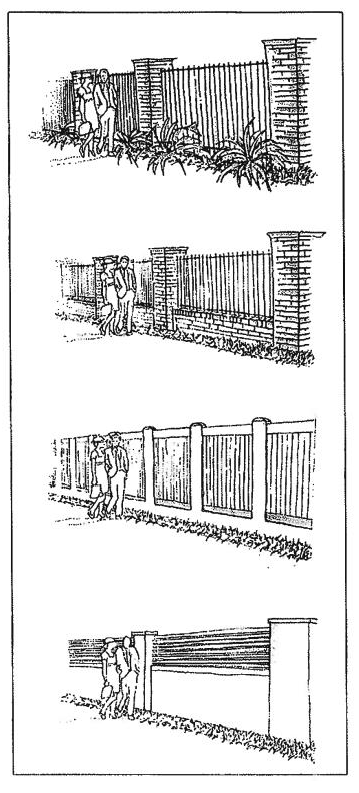
Masonry columns together with wrought iron (tubular steel); or
ii.
Masonry wall to a minimum height of 36 inches above which is wrought iron, tubular steel; or
iii.
Masonry wall to a minimum height of 30 inches with masonry support columns together with a fencing material that is accepted by the building official; or
iv.
A combination of masonry and wood or another sturdy and weather-proof material as approved by the building official provided the barrier shall have a minimum three-foot, continuous planting strip adjacent to the barrier along the public rights-of-way containing as a minimum, shrubbery to a minimum height of 36 inches upon planting within the continuous planting strip adjacent to the barrier along the public rights-of-way.
2.
In instances where the display item(s) extend up to a maximum height of 12 feet the sales area shall be:
i.
Contiguous to the principal building;
ii.
Enclosed on all sides by a barrier no less than 12 feet in height;
iii.
Structurally integrated with the principal building structure.
3.
Temporary outdoor sales and storage are permitted subject to the provisions of the city's Code of Ordinances, chapter 18, Businesses, article IV, Itinerant Vendors, Peddlers and Solicitors, and further provided compliance with the following standards:
i.
The sales area shall not reduce the capacity of the area required for parking and loading, in accordance with article VI.
ii.
Compliance with the setback requirements and standards in this and other city ordinances.
4.
Outdoor storage is subject to the following standards:
i.
Outdoor storage is prohibited in the District IS:
ii.
The storage area shall be enclosed by an eight-foot in height barrier provided that: The barrier shall be no less than 90 percent opaque, which may include:
A.
Masonry wall to a minimum height of 30 inches with masonry support columns together with a fencing material that is deemed acceptable by the building official; or
B.
A combination of masonry and wood or another sturdy and weather-proof material deemed acceptable by the building official.
iii.
The barrier shall have a minimum three-foot, continuous planting strip adjacent to the barrier along the public rights-of-way containing as a minimum, shrubbery to a minimum height of 36 inches upon planting within the continuous planting strip adjacent to the barrier along the public rights-of-way.
(Ord. No. 1089, § 1, 6-28-2017)
Sec. 102-155.1. - Application.
(a)
The requirements of this section shall only apply to a building site where any of the following conditions are present:
(1)
There is new construction of a nonresidential or multifamily residential building for which a building permit is required;
(2)
There is an enlargement exceeding 1,000 square feet in area of the exterior dimensions of an existing nonresidential or multifamily residential building for which a building permit is required;
(3)
There is either a new parking lot for which site plans are required for initial construction under the provisions of this Code, or an existing parking lot which is expanded in area to provide additional parking spaces; or
(4)
There is a change in use of an existing nonresidential building for which an occupancy permit is required.
(b)
The requirements of this section apply to the entirety of the building site if it is completely developed by the new construction of a building (or buildings) and appurtenant surface parking area. In case the entirety of the building site is only partially developed by new construction or enlargement, the requirements of this section shall be applied incrementally, such that trees, shrubs, and landscape buffers are required only with respect to and in proportion to new or increased building area and off-street parking spaces. This section shall control over any other conflicting or inconsistent provision.
(c)
The requirements of this section do not apply to the reconstruction of an existing building of which 50 percent of the existing building floor area or less was physically destroyed or ruined by flooding, fire, windstorm, or act of God. This exemption shall apply only where reconstruction of that building will not result in an increase in the paving area of the parking facilities to be provided.
(d)
Nothing in this section shall be construed to require a landscape plan or landscape plan review for finish work performed by an owner, a tenant or on behalf of a tenant finish, in a portion of a building unless that tenant finish work or remodeling results in an increase in the paving area of the parking facilities to be provided or in an enlargement of the exterior dimensions of an existing building.
(e)
Application in District PC and District IS. The requirements of this section shall apply to a building site located in District PC or District IS where any of the following conditions are present:
(1)
There is construction of a new nonresidential building for which a building permit is required.
(2)
There is an enlargement exceeding ten percent of the exterior dimensions of an existing nonresidential building or 1,000 square feet, whichever is less, for which a building permit is required.
(3)
There is a new parking lot for which a site plan is required for construction under the provisions of this Code.
(4)
There is an expansion of an existing parking lot which exceeds ten percent of the cumulative parking area. The parking area shall be calculated by multiplying the total number of required parking spaces by 300 square feet per space.
(5)
There is a change in use of more than 25 percent of an existing nonresidential building for which an occupancy permit is required.
(6)
There is a change for which a zoning permit (i.e. specific use permit) is required.
(Ord. No. 1089, § 1, 6-28-2017; Ord. No. 1178, § 1, 9-16-2020)
Sec. 102-155.2. - Landscape plan required.
(a)
A landscape plan for the building site shall be submitted to the building official by an applicant for a building permit for approval in accordance with the provisions of this section.
(b)
The landscape plan may be depicted on either the development plans or parking lot site plan, provided the drawing scale is sufficient to properly depict the landscape plan requirements. The landscape plan shall identify and show the locations of existing and proposed utility lines, roadways, sidewalks, streetlights, trees, shrubs, groundcovers, natural features, other landscape elements and planting or construction details. Where credit is being requested for the preservation of existing trees and associated understory, the landscape plan shall also demonstrate the manner in which the requirements for preservation established under section 102-155.11 are to be met. A plant schedule shall be provided which includes quantities, minimum size at time of planting, and botanical and common names keyed to the plan.
(c)
The building official shall review the landscape plan to verify compliance with all requirements of this section prior to the issuance of a building permit. If an artificial lot is delineated, it shall be depicted on the building plans prior to the issuance of the building permit. In the event the landscape plan submitted includes trees and/or shrubs planted in a parkway and/or an esplanade, within seven days of receipt of the plan, the building official shall review such plan, prepare a report and recommendation on same, and forward the plan, along with the report and recommendation as part of the site plan approval process.
(d)
No building permit shall be issued by the building official for the construction or alteration of a building within the city unless the applicant has submitted a landscape plan providing for the planting of trees and shrubs to the extent required in this section.
(e)
Except as provided in subsection (f) below, no final certificate of occupancy shall be issued by the building official for the occupancy of a new or altered building or an existing building, if there has been a change in use, unless the plantings required by this section have been provided. Prior to the issuance of a certificate of occupancy, the building official shall inspect the planting provided to verify compliance with the approved landscape plan.
(f)
A six-month conditional certificate of occupancy may be issued if the owner provides the building official with either the documented assurances as described below:
(1)
Copy of an executed contract for the proper installation of the required landscaping in accordance with the approved landscape plan within a six-month period. The property owner is responsible for notifying the building official when the landscape installation is complete. If the property owner fails to notify the building official within the prescribed six-month period, the building official shall revoke the conditional certificate of occupancy.
(2)
A performance bond executed by the applicant as principal and by a good and sufficient corporate surety company licensed to do business in the state. The bond in the sum of 1.25 times the proposed cost to install the required landscaping improvements and fences, based upon the landscape architects cost estimate, shall be payable to the city and conditioned that the principal and surety will pay all amounts required to install the landscaping and fences required by this section. The bond shall provide that it will remain in full force and effect until released by the building official pursuant to this section.
(g)
No building permit shall be issued by the building official for construction or alteration of a building within the city if the landscape plan includes trees and/or shrubs planted in a parkway and/or an esplanade unless such plan has been approved by city council.
(h)
In the case where new landscape areas are required for a site, stormwater best management practices (BMPs) that utilize vegetation (bioretention, bioswales, planter boxes) can be used to meet the requirements of area, number of trees and/or shrubs. These areas are required to be indicated on any landscape plans.
(Ord. No. 1089, § 1, 6-28-2017)
Sec. 102-155.3. - Total tree planting requirement.
At least 50 percent of the total tree requirement created by this section must be met by planting or causing the planting of trees in compliance with this section.
(Ord. No. 1089, § 1, 6-28-2017)
Sec. 102-155.4. - Tree planting equivalency credits.
The following credits may be claimed for up to 50 percent of the total tree requirement under this section:
(1)
Credit for planting trees exceeding the minimum caliper required. Credit toward the total tree requirement shall be given for the planting of trees that exceed the minimum caliper required by this section at the rate of two trees for each tree planted with a caliper of four inches and greater, as measured 12 inches above the root collar.
(2)
Credit for preserving existing on-site trees.
a.
Credit for the preservation of existing on-site trees (including any to be transplanted) may be granted when requested and depicted on the landscape plan. In order to be eligible for credit, an existing tree to be preserved on the site shall contain a minimum caliper of four inches, shall be in good condition, and shall be true to species habit and form.
b.
Credit for preserving existing trees shall be claimed for up to 100 percent of the total tree requirement under this section and may be applied to satisfy any tree requirements on the parcel, i.e. parking, landscape buffers, street trees. Credits for each tree may be claimed only once, to satisfy one of the following requirements, i.e. parking, landscape buffers, street trees:
(Ord. No. 1089, § 1, 6-28-2017)
Sec. 102-155.5. - Artificial lot delineation.
If the building site is over two acres in size, the applicant may request that the building official designate an artificial lot to satisfy the requirements of this section. If requested, the building official shall designate an artificial lot consistent with the purposes and policies of this section as determined from the criteria established below. No artificial lot may be delineated by the building official unless it:
(1)
Wholly includes the area on which the construction work is to be done;
(2)
Has an area that does not exceed 50 percent of the area of the building site; and
(3)
Depicts and includes all proposed and existing buildings and structures, access drives, appurtenant parking required for the building expansion or new building construction and other areas functionally appurtenant to the buildings or structures.
(Ord. No. 1089, § 1, 6-28-2017)
Sec. 102-155.6. - Review of building permit and certificate of occupancy applications.
(a)
The building official shall review building permit applications for the construction or expansion of a building or parking lot to determine if the proposed landscape plan complies with the provisions of this section.
(b)
When a certificate of occupancy is sought, the building official shall determine whether the applicant has completed all work as identified in the permitted plans.
(c)
The building official shall approve an application for a building permit or certificate of occupancy if it complies with the provisions of this section and all other applicable ordinances.
(d)
The building official shall deny in writing all applications for a building permit or certificate of occupancy which do not comply with the provisions of this section.
(Ord. No. 1089, § 1, 6-28-2017)
Sec. 102-155.7. - Street trees required.
(a)
Street trees shall be planted on private property within 25 feet parallel and adjacent to a major thoroughfare, or, within the public street rights-of-way or in the esplanade pursuant to the requirements of section 102-155.10(b) (see figure E). When the building site abuts a designated state or federal highway or road or any designated county road and street trees are not otherwise required by law, street trees shall be planted on private property in accordance with this section. The number of street trees planted shall equal the total number of trees (T) required under the following formula:
T = (X/30), where X shall represent the length in linear feet measured along all sides of the property line on the public streets. (See figure B at the end of the chapter.)
(b)
Street trees planted in accordance with this section shall be of a species listed in section 102-156.3. If authorized by the city council, trees planted within the public rights-of-way shall be planted in a location which conforms with the requirements of section 102-155.12 and any additional requirements imposed by city council. The trees shall be planted so as not to interfere with existing utilities, roadways, sidewalks or streetlights, or in such a manner as to constitute a hazard to vehicular or pedestrian traffic.
(c)
If trees are planted at specific intervals, spacing intervals shall depend upon the potential mature height of the tree, as follows:
(d)
If a street canopy effect is desired, large trees may be planted at intervals less than 45 feet. When the spacing interval exceeds 40 feet, smaller ornamental trees may be placed between the larger trees in order to meet the requirements of this section; provided, however, the spacing does not exceed the aforementioned intervals for small trees. Trees shall not be required at specific planting intervals, as long as parking lot screening is provided.
(e)
Credit for the preservation of existing trees within the planting area as defined in subsection (b) of this section may be requested in lieu of meeting a portion of the street tree planting requirement pursuant to section 102-155.4(3). If credit is requested under that subsection, the applicant must satisfy the requirements established under section 102-155.11.
(f)
Street trees required within District IS. Within District IS street trees shall be planted within the required ten-foot building setback, which may be within tree wells measuring no less than four feet square. The type of trees planted shall be the same on both sides of the street. The trees planted in a landscaped median may be different in type and shall be different in species from those which are planted in the parkways. If large trees are installed, they shall be of the same general form. Hardscape amenities e.g. pavers may be substituted for street trees upon submission of a landscape plan and approval of such plan by city council.
(Ord. No. 1089, § 1, 6-28-2017)
Sec. 102-155.8. - Parking lot planting of trees and shrubs required.
(a)
The owner of a building site containing less than 40 parking spaces, shall, in addition to any street trees provide one tree for every ten parking spaces, rounding up or down in the case of a fraction to the nearest whole number, and in no case shall be less than one tree. Trees planted in accordance with this subsection must be located in the interior of, or in an area adjacent to the parking lot. In the case of a parking lot which is being expanded, the trees required pursuant to this subsection may be planted in any area within or adjacent to the entire parking lot.
(b)
The owner of a building site containing 40 parking spaces or more, shall, in addition to any street trees, provide landscaped areas totaling a minimum of 162 square feet for the first 40 parking spaces. For each additional 20 parking spaces or fraction thereof, the owner shall provide an additional landscaped area. All such landscaped areas shall be a minimum of six feet in width, measured from the back of the curb, and be dispersed throughout the parking lot. One parking lot tree shall be provided for each landscaped area. The remaining area shall be landscaped with plants not exceeding three feet in height.
(c)
In addition to the street tree and parking lot tree requirements the owner of a building site shall plant or cause shrubs to be planted along the perimeter of all parking surfaces so that the parking lot is screened from all adjacent public streets, exclusive of driveway entrances, pedestrian walkways and visibility triangles. Shrubs shall be installed at no more than 30 inches on center and maintained at a height of no more than 36 inches or less than 18 inches as measured from the surrounding soil line. The number of shrubs required under this subsection shall be equal to the total number of street trees and parking lot trees required under this section multiplied by ten. No less than 75 percent of the shrubs required under this section shall be planted along the perimeter of the parking surface adjacent to the public street unless street trees are planted within the public right-of-way or on private property in accordance with section 102-155.7. In that instance, the shrubs required by this section may be planted anywhere on the property, excluding the landscape buffer or esplanade.
(d)
Parking lot and on-lot planting of trees and shrubs. All parking lots shall be landscaped in accordance with this subsection in addition to landscaping required by any other section.
(1)
The owner of a building site included under subsection 102-155.1(a) shall plant or cause shrubs to be planted along the perimeter of all parking surfaces so that the parking lot is completely screened from all adjacent public streets, exclusive of driveway entrances, pedestrian walkways and visibility triangles. Shrubs shall be planted 30 inches on center and maintained at a height of no less than 18 inches as measured from the surrounding soil line.
(2)
All parking lot landscaping shall be installed within landscape islands that are protected by six-inch high concrete curbs. There shall be one landscape island for every 20 spaces.
(3)
All parking lots that are one acre or greater in size shall show a pedestrian walkway which will be shaded at the time of maturity of the internal tree plantings.
(4)
Distribution. In general, on-lot landscaping may be distributed throughout the lot. Trees must be given adequate room for healthy growth and stability. The landscape plan will indicate a distribution of trees which will provide a 60 percent coverage of the parking lot in shade at tree maturity.
(5)
Front yards. Lots that include buildings that are more than 60 feet in length or two stories in height shall be landscaped with trees that are arranged to break up the appearance of building mass so that the building is perceived to be divided into lengths of no greater than 50 feet when viewed from street-level vantage points.
(6)
Requirements. On-lot landscaping shall be as follows:
a.
One large tree for every 3,000 square feet of paved area and any additional trees needed to accomplish the break up in the appearance of the building required by subsection (d)(4); and
b.
Shrubs in accordance with subsection (d)(1).
(e)
Parking lot and on-lot planting of trees and shrubs in District PC. All parking lots in District PC shall be landscaped in accordance with this subsection in addition to landscaping required by any other section.
(1)
Classifications. There are three classifications of parking lot landscaping:
a.
Small lot applies to parking lots that contain no more than ten spaces.
b.
Standard lot applies when:
1.
Required by specific use standards (see section 102-83 specific use standards); or
2.
Any portion of the parking lot is immediately adjacent, abutting, or within ten feet of public street rights-of-way.
c.
Large lot applies in all other cases.
1.
Parking lot islands and required landscaping. All parking lot landscaping shall be installed within landscape islands that are protected by six-inch high cement curbs, except that small lot landscaping may be installed within five feet of the edge of pavement of the parking lot. Standard lot landscaping islands shall be a minimum of 90 square feet. Large lot landscape islands shall be a minimum of 162 square feet. There shall be one landscape island for every 15 spaces on standard and large lots.
2.
The owner of a building site included under section 102-155.1(a) shall, in addition to the other landscaping requirements of this section, provide on-lot landscaping.
3.
Per acre requirements. Where the number of large trees, small trees, and shrubs are calculated on a per acre basis, each lot must meet the minimum requirement.
4.
Distribution. In general, on-lot landscaping may be distributed around the lot. For example, shrubs may be used as foundation plantings, as hedges, or planted in groups. Trees must be given adequate room for healthy growth and stability.
5.
Front yards. Lots that include buildings that are more than 60 feet in length or two stories in height shall be landscaped with trees that are arranged to break up the appearance of building mass so that the building is perceived to be divided into lengths of no greater than 50 feet when viewed from street-level vantage points.
6.
Requirements. On-lot landscaping shall be as follows:
i.
Nine large trees per acre;
ii.
Eighteen small trees per acre; and
iii.
Two hundred shrubs per acre.
(Ord. No. 1089, § 1, 6-28-2017)
Sec. 102-155.9. - Landscape buffer required.
(a)
Landscaping and buffer yards shall be required to provide a separation between land uses of different categories to eliminate or minimize, to the extent practicable, potential nuisances from litter, noise, glare, signs, unsightly buildings, and parking areas, to provide spacing to reduce adverse impacts from noise or odor, or danger from fire or explosion, and to enhance aesthetics and the visual image of the city. No buffer yard is required for property located within District IS.
(b)
Responsibility for buffer yards. Buffer yards shall be required when:
(1)
The main use of a lot is changed to a different category of use, and the new category of use is different than the category of the main use of an adjacent lot.
(2)
A lot is developed for an industrial use and such lot is adjacent to a lot, developed or undeveloped, that is within all residential districts.
(3)
The owner of the lot upon which the main use is changed shall establish and maintain the buffer yard in accordance with this chapter if the buffer yard does not already exist.
(c)
Screening of buffer yards. A screening wall of not less than eight feet in height shall be erected and continuously maintained at the perimeter of the required buffer yard, and no portion of such buffer yard shall be located outside of such screening wall. Provided, however, no screening wall shall be required in a buffer yard separating the fronts of two front yards, unless the required buffer yard is in the front yard of a multifamily residential use.
(d)
Landscaping of buffer yards. To further minimize noise, drainage hazards, glare, or other potential incompatibilities between the different categories of uses, at least 20 percent of any required buffer yard shall be landscaped, with a pervious surface, which 20 percent landscaped area shall be located immediately adjacent to the required screening wall that is adjacent to the use that is of the lesser intensity of the two uses. The remainder of the buffer yard shall not be developed or constructed upon except for on-site parking, provided the buffer yard and parking facilities within it meet all applicable performance standards.
(e)
Installation and maintenance. The owner and occupant, if the occupant is different than the owner, shall be jointly and severally responsible and liable for the installation and continuous maintenance of all landscaping and screening required by this section.
(f)
The buffer yard area shall extend along that portion of the property line or artificial lot line where proposed nonresidential and multifamily residential projects abut existing single-family residential developments. The area shall be planted in combinations of compatible evergreen trees and shrubs. The arrangement of plantings in buffer areas shall provide maximum protection to adjacent properties and avoid damage to existing plant material. Possible arrangements include planting in parallel, serpentine, or broken rows. Plant materials shall be sufficiently large and planted in such a fashion as to be capable of forming a continuous year-round screen of at least six feet in height as measured from the root collar or surrounding soil line within three annual growing seasons. All plantings shall be installed and maintained in accordance with the standards contained within appendices B and E, sections 102-156.4 and 102-156.7. No buildings, structures, storage of materials or parking shall be permitted within the buffer area; buffer areas shall be maintained and kept free of all debris, rubbish, weeds and tall grass.
(g)
The preservation of existing vegetation within the landscape buffer may be used to meet the requirements of this section; provided the vegetation is preserved in accordance with section 102-155.12 of this section.
(Ord. No. 1089, § 1, 6-28-2017)
Sec. 102-155.10. - General planting standards.
(a)
Trees, shrubs, groundcover and turf shall be planted in accordance with the American Nurserymen Standards and meet all applicable safety requirement and standards required by appendices B and E, sections 102-156.4 and 102-156.7, the following additional limitations, and any additional limitations and restrictions imposed by the city council as a condition of approval of the landscape plan:
(1)
No trees shall be allowed within the visibility triangle.
(2)
Trees shall be planted at least five feet from the back of the existing curb or the city's final approved design line of the curb of any public street, pavement edge and sidewalk.
(b)
In addition to the tree and shrub planting standards contained within appendices B or E, sections 102-156.4 and 102-156.7, and any additional limitations and restrictions imposed by city council as a condition of approval of the landscape plan, trees and shrubs in esplanades shall be planted according to the following requirements as illustrated in figure C (see end of chapter):
(1)
Trees in any major thoroughfare street esplanade shall not be planted closer to the end of the esplanade than 75 feet.
(2)
Trees in any local street esplanade shall not be planted closer to the end of the esplanade than 50 feet.
(3)
Trees planted in any esplanade shall be located not closer than 50 feet from any midblock opening in the esplanade.
(4)
Shrubs planted in any esplanade shall not be planted closer to the end of the esplanade than 25 feet or closer than three feet from the back of the curb or the final approved design line for the curb of any public street. Use of ground covers or annuals and perennials conforming with the height restrictions of a visibility triangle shall not be restricted.
(5)
Trees planted in the esplanade shall not be located closer than five feet from the back of the curb or the final approved design line for the curb. Trees shall not be spaced at intervals of less than 40 feet.
(c)
Any tree located within a parking lot must be planted and maintained within a permeable area which has a radius of not less than three feet. No tree shall be planted closer than three feet from a curb or tire stop.
(d)
On a corner lot, no structure shall be erected or constructed, and no vegetation shall be planted and allowed to grow, in such a manner as to impede vision between a height of two feet and eight feet above the centerline grades of the intersecting streets, in the triangular area bounded by the intersecting street lines and a line joining points along said street lines 20 feet from the point of their intersection.
(Ord. No. 1089, § 1, 6-28-2017)
Sec. 102-155.11. - Planting standards adjacent to overhead utilities.
(a)
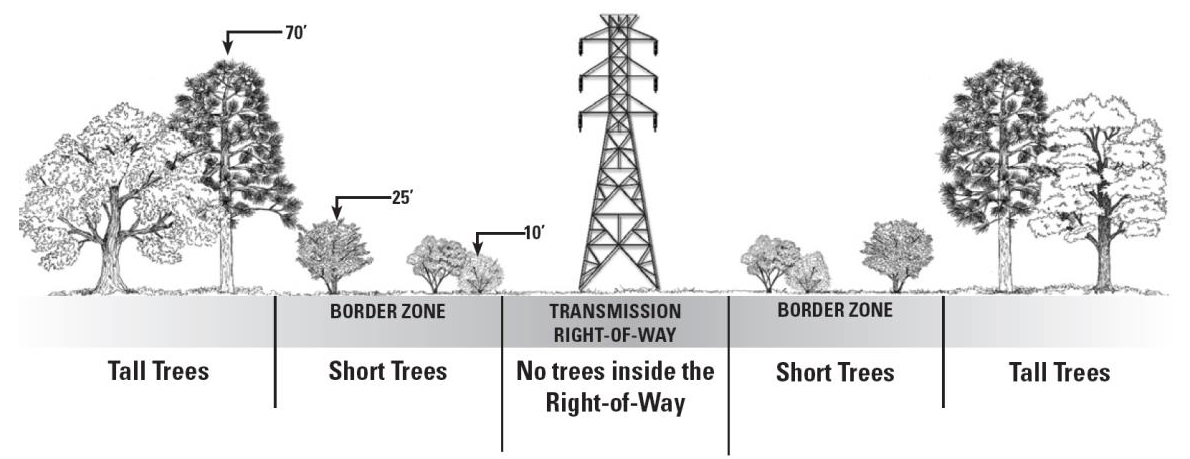
Planting trees adjacent to transmission lines. Trees planted adjacent to transmission lines and rights-of-way shall be planted according to the following graphic:
(b)
No trees, or shrubs that can grow greater than ten feet tall at maturity shall be planted within the defined transmission right-of-way. The area of the right-of-way between the right-of-way edge boundaries or borders. No shrubs shall be planted on rights-of-ways owned directly in fee by CenterPoint Energy without the company's authorization. Border zones are those areas outside of the transmission right-of-way where if a large tree is planted it could become a potential hazard to the transmission tower or wires if that specimen failed, or could grow close enough to the conductors to cause a transmission service outage. Border zones shall be planted with tree species with mature heights between ten feet and 25 feet as listed in appendix A-3(B).
(c)
Planting trees adjacent to distribution lines. Trees shall be planted in zones away from distribution utility lines according to the following graphic:
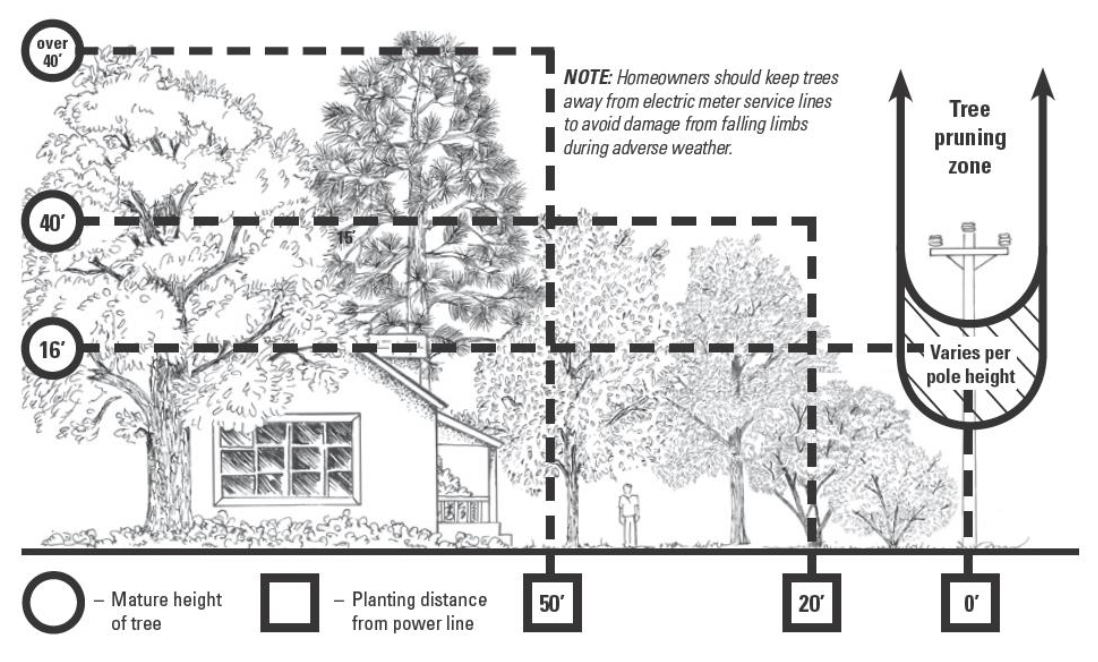
Species types for large trees, small trees and trees which will meet the adjacency criteria may be found within appendices A-1, A-2 and A-3.
(d) Timber bamboo and palm trees shall be prohibited within easements containing distribution lines.
(Ord. No. 1089, § 1, 6-28-2017)
Sec. 102-155.12. - Preservation of existing trees and associated understory.
(a)
The following procedure shall be required where credit for the preservation of existing trees and associated understory is being requested to be applied toward the total tree planting requirement pursuant to section 102-155.4(3). Where such credit is being requested, the applicant shall also supply the following information to the building official for review with the building plans:
(1)
Tree and associated understory preservation plan. This overlay shall be integrated into the proposed landscape plan and shall include:
a.
Delineation of proposed limit of clearance and establishment of tree protection zones which shall extend to just outside the dripline of the tree and understory to be protected, if any.
b.
Proposed soil stabilization practices, i.e., silt fence, hay bales.
c.
Specimen trees to be preserved and for which credit is being requested.
d.
The proposed finished grade and elevation of land within six feet of or within the dripline of any tree to be preserved, whichever is greater, shall not be raised or lowered more than three inches, unless compensated for by welling or retaining methods.
e.
Existing and proposed location of all trees and plant materials to be relocated at the drawing scale.
f.
A landscaping tabulation, and itemized credit requests for existing trees to be preserved which have a minimum of four inches in caliper and greater.
g.
Tree and associated understory preservation details.
h.
Specification of ground plane treatment as either turf or sod. If a combination of both is utilized, the limit of each shall be indicated.
(b)
Within all zoning districts, ten percent of existing trees shall be preserved, where they are six or more inches in diameter as measured 24 inches above ground. Bois D' Arc, Ashe Junipers, Hackberry, Willow, Cottonwood and Mesquite trees on the site trees are exempt from this requirement.
(c)
The following tree relocation information shall be provided on the landscape plan or in a report for the transplantation of existing specimen trees when preservation credit is being requested for them:
(1)
Transplanting techniques;
(2)
Equipment to be utilized;
(3)
Locations of existing trees and proposed locations for transplanted trees;
(4)
Genus, species, caliper, height and general condition of the existing tree;
(5)
Pruning and maintenance schedule and methods to be followed; and
(6)
Which form of assurance of performance will be provided (i.e., executed contract, bond or assigned certificate of deposit).
(d)
If preservation credit is requested, the trees shall be protected and preserved as set forth in appendix C, section 102-156.5.
(Ord. No. 1089, § 1, 6-28-2017)
Sec. 102-155.13. - Duty; affirmative defenses.
(a)
All owners of building sites included under section 102-155.1 shall plant or cause the planting of trees or shrubs required in sections 102-155.7 and 102-155.9 or secure the planting equivalency credits allowed in section 102-155.4.
(b)
All owners and lessees of new or expanded parking lots on building sites included under section 102-155.1 shall additionally plant trees or shrubs in compliance with section 102-155.8.
(c)
No person shall remove or alter any street tree or shrub planted in the public right-of-way without the written permission of the building official.
(d)
It shall be an affirmative defense under this section that:
(1)
The person caused the tree or shrub to be planted or maintained on private property in accordance with this section but the tree or shrub died and the period allowed by this section for replacing the tree or shrub has not yet elapsed;
(2)
The person caused the tree or shrub to be planted and maintained on the public right-of-way in accordance with this section, but the tree or shrub died and was removed by the owner with the written permission of the building official, or the period allowed by this section for replacing the tree or shrub has not yet elapsed;
(3)
The building permit for the person's property is for single-family residential use;
(4)
The person's property has an unexpired conditional certificate of occupancy, and the person has provided an executed contract or a bond or assigned certificate of deposit in accordance with this section; or
(5)
A variance or waiver was secured for the building site in conformity with the requirements of this section.
(Ord. No. 1089, § 1, 6-28-2017)
Sec. 102-155.14. - Alternative landscape plans.
Alternative landscape plans may be considered by the city council upon recommendation of the planning and zoning commission. Alternative landscaping plans must demonstrate the purpose and intent of the regulations by providing materials and design meet or exceed the existing regulations. Alternative landscape plans and low water usage irrigation systems shall be designed by a licensed irrigation designer and/or landscape architect. Alternative landscape plans may differ from the plant lists below, and may include xeriscape landscaping. Xeriscape landscape plants and materials may be considered as an alternative with drought tolerant and native species. If decomposed/crushed granite, river rock or other similar material is used as ground cover, the number of plant materials shall be increased by 15 percent.
(Ord. No. 1089, § 1, 6-28-2017)
Sec. 102-155.15. - Mitigation for loss of installed and preserved vegetation.
(a)
All proposed, existing or relocated vegetation shall be maintained in accordance with this section and appear healthy. Dying, diseased, damaged or removed trees and shrubs shall be replaced at the owner's expense with another living plant that complies with the approved landscape plan. The tree or shrub replacement quantity shall be equal to or greater than the original or credited quantity for the tree or shrub in question.
(b)
The building official shall notify the owner of a building site in writing when a plant is discovered which does not meet the requirements of subsection (a) of this section. The owner shall then replace the plant within 90 days from receipt of the written notice.
(Ord. No. 1089, § 1, 6-28-2017)
Sec. 102-155.16. - Interference with existing utilities, curbs, sidewalks, drainage facilities, roadways, street lights, appeal of denial of waiver.
(a)
The zoning administrator shall grant a waiver when requested in the application if the area in which the planting is required by this section is too small to accommodate the required planting without damage to existing utilities, curbs, sidewalks, roadways, street lights or drainage facilities, and the planting requirements of this section may not be otherwise satisfied pursuant to this section.
(b)
A waiver shall be granted where the zoning administrator finds the following:
(1)
That a literal application of this section will result in damage to existing utilities, roadways, streetlights, curbs, sidewalks or drainage facilities;
(2)
The waiver, if granted, will not be contrary to the public interest;
(3)
The waiver, if granted, will not be detrimental to the public health, safety or welfare; and
(4)
The waiver, if granted, will not result in a violation of any other applicable ordinance, regulation or statute.
(c)
No later than the 13th calendar day following the filing of the required application for a waiver, the zoning administrator shall issue to applicant a written notice that the waiver has been granted or refused. Any notice of refusal of an application for a waiver must be included in a written report explaining in detail the reasons for such refusal. The issuance of a written notice to the applicant shall be completed upon deposit of such notice in the United States mail, first class postage paid, addressed to the applicant at address given on the application of the waiver.
(Ord. No. 1089, § 1, 6-28-2017)
Sec. 102-156.1. - Appendix A-1—Large trees.
*D means deciduous and E means evergreen.
(Ord. No. 1089, § 1, 6-28-2017)
Sec. 102-156.2. - Appendix A-2—Small trees.
*D means deciduous and E means evergreen.
(Ord. No. 1089, § 1, 6-28-2017)
Sec. 102-156.3. - Appendix A-3—Street trees.
(a)
Generally.
(b)
Trees under power lines.
*D means deciduous and E means evergreen.
See appendices A-1 and A-2, sections 102-156.1 and 102-156.2, for comments.
(Ord. No. 1089, § 1, 6-28-2017)
Sec. 102-156.4. - Appendix B—Tree planting.
(a)
Tree selection. Trees planted must be selected from the street trees list (appendix A-3, section 102-156.3). All plant stock shall meet the standard for nursery stock specifications, as established by the American Association of Nurserymen (1986 ed.) on file in the office of the city secretary. The following factors should be considered in the selection of trees from the tree and shrub lists, appendices A-1, A-2, A-3 and D, sections 102-156.1, 102-156.2, 102-156.3 and 102-156.6:
(1)
Hardiness of trees for the specific site (i.e., soil conditions, pH, drainage).
(2)
Mature plant size, form and growth rates (i.e., proximity to overhead utility lines).
(3)
Drought tolerance.
(4)
Pest and insect resistance.
(b)
Planting procedures.
(1)
Holes for the trees should be excavated one and a half to two feet greater in width than the diameter of the soil ball. The sides of the hole should be vertical and the bottom horizontal. Trees should be planted with the top of the root ball two inches above existing grade. No holes should be left uncovered overnight.
(2)
Trees should be set in an upright plumb position at depth two inches higher than grown in the container. Care should be taken so as not to injure the root system, trunk or foliage. The trunk should not be used as a lever in positioning or moving the tree in the planting hole.
(3)
The backfill should consist of topsoil excavated from the planting hole. If there is not enough topsoil, a supplement of similar topsoil should be furnished. Each planting hole should be backfilled and tamped lightly so as not to damage roots. A saucer should be constructed six to eight inches above soil grade around the planting hole and should be a minimum of six feet in diameter, free of weeds and grass.
(4)
Any pruning should be done according to the standards of the National Arborist Association (rev. 1988) (The Meeting Place Mall, Route 101, P.O. box 1094, Amherst, NH 03031), on file in the office of the city secretary. All damaged limbs should be removed. The tree should be maintained in a shape appropriate to its species. Street trees should be pruned in accordance with the standards for hazard pruning contained in class III.
(5)
Trees planted hereunder should be staked with a minimum of two stakes, eight feet long, attached to the tree with plastic tree chain, one inch in size, or equivalent, in a manner that is secure and will not injure the tree. Any 100-gallon trees should be tri-staked (three stakes). Other types of securing ties or devices may be used if designed for that purpose.
(6)
Mulch shall be placed loosely around trees planted hereunder within 24 hours after planting to a uniform depth of three to four inches and to a diameter of six feet. No leaves, branches, roots or other foreign material may be used as a mulch. This area should be maintained free of weeds and grass vegetation with a three- to four-inch mulch cover for a minimum period of one year.
(c)
Watering. The following watering schedule may be utilized and revised during prolonged periods of rain or drought:
(d)
Irrigation system installation. The owner of a building site included under subsection 102-155.1(a) shall install, at the time of planting, adequate irrigation systems in order to provide reasonable assurance that all trees and shrubs planted under the requirements of this section will survive. In lieu of installing an irrigation system, the owner may provide one or more watering sources adequate to provide reasonable assurance that all trees and shrubs planted under the requirements of this section will survive. All plants and shrubs required to be planted under the provisions of this section shall be provided a watering source within a distance of not more than 100 feet.
(Ord. No. 1089, § 1, 6-28-2017)
Sec. 102-156.5. - Appendix C—Tree protection.
(a)
General procedures.
(1)
Trees to be preserved must be clearly tagged in the field with ribbon.
(2)
Tree wells shall be made of a durable material and set a minimum of four feet from any tree they are designed to protect.
(3)
Retaining walls of a durable material (i.e., stone or treated lumber) are to be constructed around each tree immediately after the grade is lowered. A retaining wall must be at least four feet from the tree it is designed to preserve.
(4)
Any understory clearing within six feet of existing tree trunks should be done by hand.
(5)
No building materials are to be stacked or stockpiled within the dripline or within six feet of any tree to be preserved, whichever is greater.
(6)
Topsoil shall not be stockpiled within the dripline or within six feet of any tree to be preserved, whichever is greater.
(7)
Selective thinning of dead or dying vegetation, tree stumps and other undesired growth is required in buffer areas. Supplemental vegetation shall comply with the landscape buffer requirements of this section.
(b)
Tree protection zones. Tree protection zones shall be established prior to construction. During construction, a barrier shall be maintained at all times between the tree and the work areas. The barrier shall be composed of wood, wire, snow fence and braces of similar non-injurious material. These areas shall be clearly marked with signs stating "tree protection zone". In tree protection zones, the following restrictions shall apply:
(1)
No soil compaction from vehicular traffic and material storage.
(2)
No trunk and limb damage from equipment, nailing, bolting and guying.
(3)
No poisoning from pouring of concrete, lime, paint thinner and other soil contaminates.
(4)
No root suffocation or damage to roots from fill soil or grade change.
(5)
No improper pruning or trimming of branches. Pruning should be done in accordance with the standards of the National Arborist Association (rev. 1988) on file in the office of the city secretary. Street trees should be pruned in accordance with the standards for hazard pruning contained in class III of those standards.
(c)
Maintenance in tree protection zones.
(1)
A watering and monitoring schedule for tree protection zones should be implemented to compensate for damage to existing root systems. Trees should be watered at intervals that provide sufficient water during periods of drought, and watering should be suspended during periods of heavy rainfall. Tree root systems should be drenched and allowed to dry.
(2)
Trees shall be fertilized annually. A three to one to one ratio of nitrogen, phosphorus and potassium (NPK) containing a slow-release, non-burning nitrogen should be applied according to manufacturer's instructions.
(d)
Permitted activities in tree protection zones.
(1)
Specially designed sidewalks. Sidewalks are permitted if laid on top of the existing grade with fill placed at the sides. Sidewalks shall not be cut into the ground.
(2)
Utility lines. Utility lines shall be tunneled beneath tree roots in order to protect feeder roots, rather than trenched or open cut.
(3)
Sodding and ground cover. Placement of sod or other ground cover and the preparation of ground surface for such cover is permitted. No tilling of the soil shall be allowed.
(Ord. No. 1089, § 1, 6-28-2017)
Sec. 102-156.6. - Appendix D—Shrub list.
(Ord. No. 1089, § 1, 6-28-2017)
Sec. 102-156.7. - Appendix E—Shrub planting.
(a)
Shrub selection. Shrubs planted in public rights-of-way shall be selected from the parks and recreation department perennial shrub list (appendix D, section 102-156.6). Shrubs planted in other areas may also be selected from that list. The following factors should be considered when making a selection from the shrub list for planting:
(1)
Hardiness for the specific site selected.
(2)
Present and ultimate size, branching habits and growth rate. The plant shall be at least 18 inches in height as measured from the surrounding soil line, shall have a minimum 18-inch width at the widest portion when planted and shall be capable of growth to not less than 30 inches in height as measured from the surrounding soil line within three annual growing seasons.
(3)
Resistance to pests.
(b)
Planting procedures.
(1)
Holes for shrubs should be excavated six inches greater in width than the diameter of the soil ball. The sides of the hole should be vertical and the bottom horizontal. Shrubs should be planted with top of root ball slightly above existing grade. No holes should be left uncovered overnight.
(2)
Shrubs should be set in an upright plumb position at a depth slightly higher than grown in the container. Care should be taken not to injure the root system, trunk or foliage. The trunk should not be used as a lever in positioning or moving the shrub in the planting hole.
(3)
Holes should be backfilled with soil and tamped lightly and carefully so as not to damage roots. The shrub should be watered to settle soil around the roots and remove air pockets.
(4)
All damaged branches shall be removed.
(5)
A minimum three-inch layer of mulch shall be placed loosely at the base to retard weed growth and conserve moisture.
(c)
Watering. The following water schedule may be utilized and revised during prolonged periods of rain or drought:
(Ord. No. 1089, § 1, 6-28-2017)
Sec. 102-156.8. - Appendix F—Example figures.
Figure A.
Sight Visibility Triangles
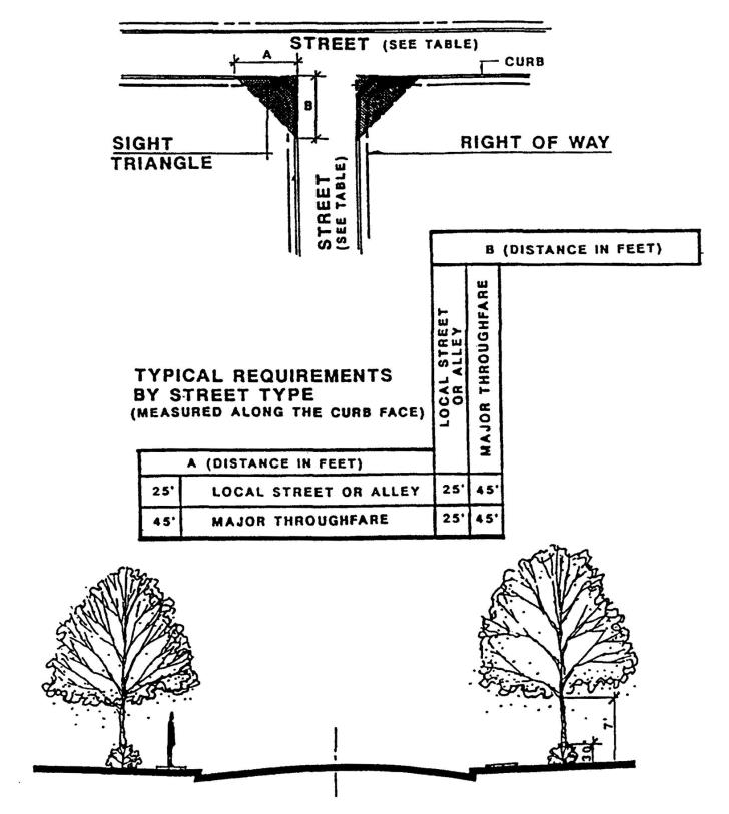
Figure B.
Street Tree Planting
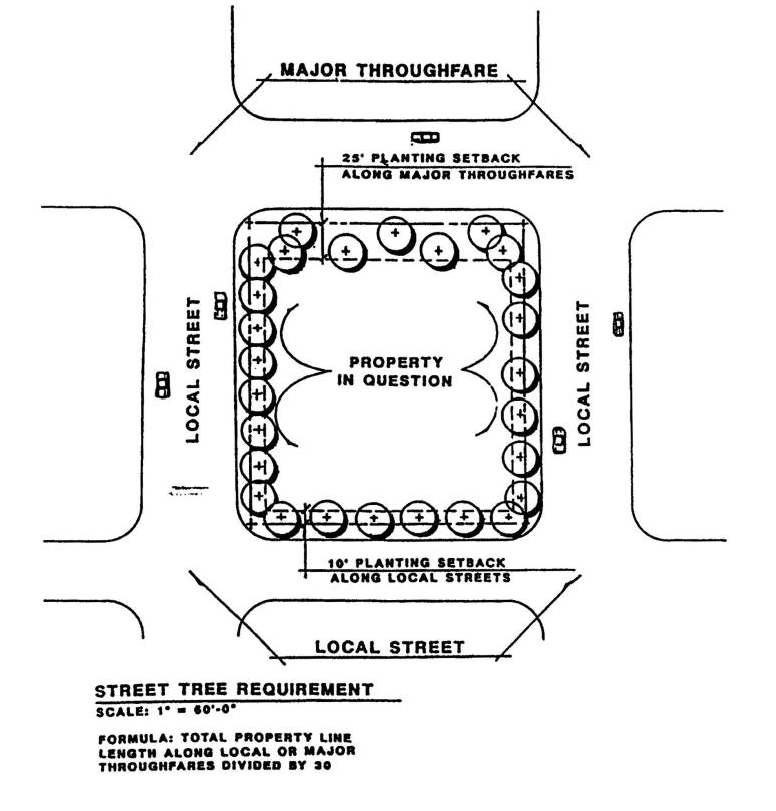
Figure C.
Esplanade Planting
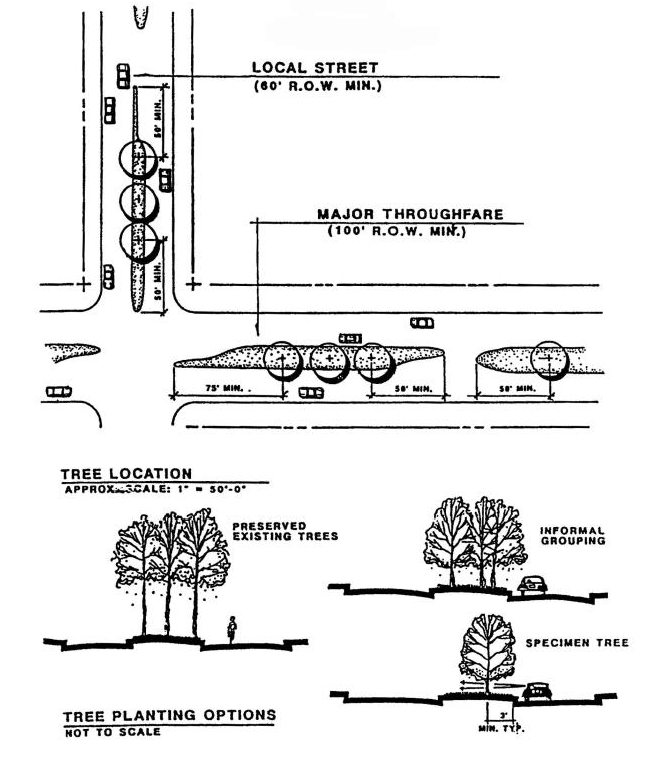
Figure D.
Screening Evergreen and Parking
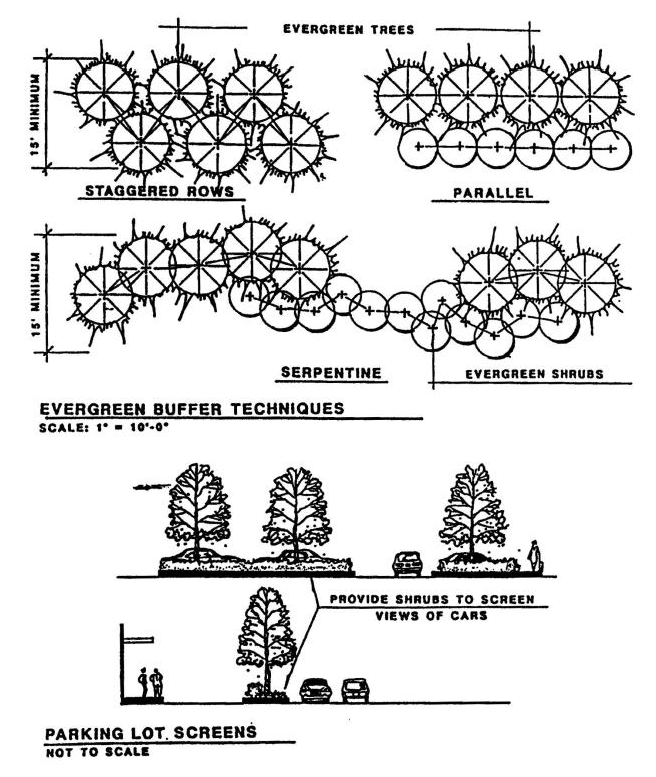
Figure E.
Rights-of-way Profiles
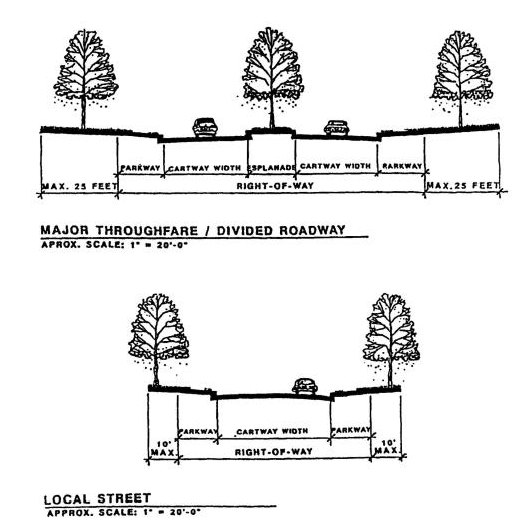
(Ord. No. 1089, § 1, 6-28-2017)

