
Superior City Zoning Code
ARTICLE IV
Supplemental Regulations
Sec. 16-71.- District boundaries.
Unless otherwise specified, district boundaries are lot lines or the centerline of streets, alleys, railroad rights-of-way or such lines extended.
(Ord. 209 Art. IV §1, 1981)
Sec. 16-72. - Accessory buildings and accessory uses.
(a)
Accessory building. An accessory building is a subordinate structure to the principal building that is:
(1)
Located on the same lot as the principal building;
(2)
Cleary incidental to the principal building;
(3)
Subordinate in size to the principal building;
(4)
Used only at the same time as the principal building is active and operational;
(5)
Customary in connection with the principal building; and
(6)
For accessory dwelling units, such accessory buildings must comply with the requirements of Section 16-98.
(b)
Accessory use. An accessory use is a subordinate use to the principal use that is:
(1)
Located on the same lot as the principal use;
(2)
Clearly incidental to the principal use;
(3)
Customary in connection with the principal use; and
(4)
A permitted use within the zone district for the lot.
(Ord. 209 Art. IV §2, 1981; Ord. 804 §4, 2020)
Editor's note— Ord. 804, § 4, adopted Jan. 7, 2020, changed the title of § 16-72 from "Accessory buildings and uses" to read as herein set out.
Sec. 16-73. - Exceptions to yard requirements.
The following exceptions to the front yard requirement for dwellings abutting local streets, not including collector or arterial streets, are authorized for a lot in any district:
(1)
If there are dwellings on both abutting lots with front yards of less than the required depth for the district, the front yard for the lot need not exceed the average front yard of the abutting dwellings.
(2)
If there is a dwelling on one (1) abutting lot with a front yard of less than the required depth for the district, the front yard for the lot need not exceed a depth one-half (½) way between the depth of the abutting lot and the required front yard depth.
(Ord. 209 Art. IV §3, 1981)
Sec. 16-74. - Projections from buildings.
Cornices, eaves, canopies, sunshades, gutters, chimneys, flues, belt courses, leaders, sills, pilasters, lintels, ornamental features and other similar architectural features may project not more than three (3) feet into a required yard or into required open space as established by coverage standards.
(Ord. 209 Art. IV §5, 1981)
Sec. 16-75. - Principal buildings on same lot.
No part of a principal building shall be located closer than ten (10) feet to any other principal building on the same lot.
(Ord. 209 Art. IV §6, 1981)
Sec. 16-76. - Home occupations.
(a)
A home occupation shall be allowed as a permitted accessory use, provided that all of the following conditions are met:
(1)
Such use shall be conducted entirely by members of the family occupying the dwelling and up to one (1) on-site employee.
(2)
Such use shall be clearly incidental and secondary to the use of the dwelling for dwelling purposes and shall not change the character thereof.
(3)
The total area used for such purposes shall not exceed one-half (½) the floor area of the user's dwelling unit; accessory structures and attached garages may not be considered under this provision.
(4)
There shall be no exterior advertising other than identification of the home occupation. Such identification sign shall not exceed six (6) square feet and shall comply with all other requirements of this Code. Any other method of advertising shall not solicit or direct persons to the address.
(5)
There shall be no offensive impacts in violation of this Code, such as noise, vibration, smoke, dust, odors, heat or glare noticeable at or beyond the property line.
(6)
There shall be no exterior storage on the premises of material, customer property or equipment used as a part of the home occupation.
(7)
Off-street parking shall be provided to accommodate the parking needs of the home occupation; home occupations shall not generate traffic which significantly affects the residential character of an area and shall not generate more trips per day (TPD) than the standard for a single-family dwelling unit (SFDU) - ten (10) trips per day is the average TPD for a SFDU.
(8)
The structure with the home occupation is in the F, MR, LDR, MDR or HDR zone.
(9)
The home occupation shall not include:
a.
A use prohibited in the zone district.
b.
An animal hospital.
c.
A restaurant.
d.
A group home.
e.
An auto repair shop.
f.
A nursing home/convalescent home.
g.
A barber shop/salon.
h.
An excavating or heavy equipment rental.
i.
A mortuary.
j.
A use which requires a special review or a conditional use permit in the zone district.
(10)
In the event that there is a requested home occupation that is not clearly permitted or prohibited, the Planning Commission shall review and recommend and the Board of Trustees shall finally determine whether the particular home occupation is consistent with this Section for classification as a home occupation.
(11)
The person operating the home occupation shall comply with the requirements of Chapter 6, Article 1 of this Code.
(b)
Prior to enforcement of this Section through the Municipal Court, the alleged violator shall receive notice as follows:
(1)
A written statement to the Zoning Administrator by a citizen explaining what provisions of this Section the property owner is allegedly violating; and
(2)
If the Zoning Administrator determines that there is a violation of this Section, the Zoning Administrator shall provide a written warning to the property owner and the occupant by certified mail and by posting on the door of the property of the violation and that the violator has thirty (30) days to bring the home occupation into compliance or discontinue the home occupation.
(Ord. 209 Art. IV §7, 1981; Ord. 435 §1, 1996; Ord. 454 §1, 1997; Ord. 645 §14; Ord. 725 §12, 2013; Ord. 804 §5, 2020; Res. 2021-06 §14, 2021)
Sec. 16-77. - Temporary uses.
The following uses of land are permitted in each zoning district (unless restricted to particular zoning districts) subject to the applicable regulations of the district in which the use is permitted, and to the specific regulations and time limits which follow:
(1)
Christmas tree sales in any nonresidential district for a period not to exceed forty-five (45) days. Display of Christmas trees need not comply with the yard and setback requirements of this Chapter, provided that no tree shall be displayed within a vision clearance area.
(2)
Contractors' office quarters and equipment sheds accessory to a construction project, to continue only during the duration of such project, but not exceeding six (6) months and subject to renewal under the discretion of the Zoning Administrator.
(3)
Real estate offices incidental to new housing developments to continue only until the sale or lease of all lots in the development, but not exceeding one (1) year and subject to renewal under the discretion of the Zoning Administrator.
(Ord. 209 Art. IV §8, 1981; Ord. 220 §2, 1982)
Sec. 16-78. - Performance standards.
(a)
Smoke. No use shall be permitted in any district unless it conforms to the standards established by the State Department of Public Health's rules and regulations pertaining to smoke emission.
(b)
Particulate matter. No operation shall be conducted unless it conforms to the standards established by the State Department of Public Health's rules and regulations pertaining to emission of particulate matter.
(c)
Dust, odor, gas, fumes, glare or vibration. No operation shall be conducted unless it conforms to the standards established by the State Department of Public Health's rules and regulations pertaining to emission of dust, odor, gas, fumes, glare or vibration.
(d)
Radiation hazards and electrical disturbances. No operation shall be conducted unless it conforms to the standards established by the State Department of Public Health's rules and regulations pertaining to radiation control.
(e)
Noise. No operation shall be conducted unless it conforms to the standards established by the State Department of Public Health's rules and regulations pertaining to noise.
(f)
Water pollution. No operation shall be conducted unless it conforms to the standards established by the State Department of Public Health's rules and regulations pertaining to water pollution.
(g)
Public nuisance from marijuana establishments. The Town has a zero impact, zero tolerance policy regarding public nuisance from the operations of marijuana establishments. (See Section 7-37 of this Code.)
(Ord. 209 Art. IV §9, 1981; Ord. 720 §3, 2013)
Sec. 16-79. - Exterior lighting.
Any light used for the illumination of parking areas, off-street loading areas or any other purpose must be arranged in such a manner as to meet the following conditions:
(1)
Lights must be shielded and directed downward so that the beams, rays of light or indirect radiance will not shine into surrounding areas or buildings;
(2)
Neither the direct nor the reflected light from any light source may shine onto a roadway or create a traffic hazard to operators of motor vehicles on public thoroughfares;
(3)
No beacon lights or blinking, flashing or fluttering lights or other illuminated device which has a changing light intensity, brightness or color shall be permitted in any district.
(Ord. 209 Art. IV §10, 1981; Ord. 645 §15, 2008; Res. 2021-06 §15, 2021)
Sec. 16-80. - Vision clearance areas.
(a)
A vision clearance area shall contain no plantings, walls, structures or temporary or permanent obstructions exceeding two and one-half (2½) feet in height, measured from the top of the curb or existing grade unless said structure or obstructions are more than eighty percent (80%) open.
(b)
The minimum distance establishing the size of the vision clearance area shall be thirty (30) feet, except that at intersections including an alley, the minimum distance shall be fifteen (15) feet.
(c)
Vision clearance areas shall not be required in a Public district nor in the area designated as the Central Business District.
(Ord. 209 Art. IV §11, 1981; Ord. 650 §3B, 2008)
Sec. 16-81. - Tailing ponds.
(a)
Tailing ponds shall be so located as to leave at least a twenty-five-foot-wide open space area between the base of the containing dam and the edge of the closest stream.
(b)
Tailing ponds shall not be filled higher than the highest level of the adjacent property at the property line.
(c)
Tailing ponds shall conform in design, and construction and operation to all applicable state statutes.
(d)
Upon abandonment, tailing ponds shall be planted with native grasses, shrubs and trees.
(Ord. 209 Art. IV §12, 1981)
Sec. 16-82. - Reserved.
Sec. 16-83. - Swimming pools.
A swimming pool may be permitted in any district as an accessory use subject to the following additional requirements:
(1)
Every swimming pool must be completely surrounded by a fence or wall not less than forty-two (42) inches in height with no openings large enough to permit children to pass through other than gates or doors that can be fastened to protect against entry. A dwelling house or accessory building may be used as part of such required enclosure.
(2)
All gates or doors opening through such enclosures must be equipped with a self-closing and self-latching device for keeping the gate or door securely closed at all times when not in actual use.
(3)
The property owner has entered into an agreement with the Town regarding the discharge of water from the pool to the sewer system of the Town and addressing the volume of water that may be placed in or discharged from the pool during any twenty-four-hour period. The agreement shall provide sufficient protection to the Town so that the pool does not overextend the water or sewer system of the Town.
(Ord. 209 Art. IV §14, 1981; Ord. 435 §1, 1996)
Sec. 16-84. - Drive-in facilities.
(a)
Any use permitted in a zoning district which intends to conduct a portion or all of its business with persons desiring to remain in their automobiles, or which allows products to be consumed on the premises outside the principal building, and which is not subject to the special review provisions of Article III or is not a part of a planned unit development under Article VI must submit a site plan including screening to be reviewed and approved by the Planning Commission.
(b)
In reviewing and approving the site plan for such a use, the Planning Commission must be satisfied that the traffic circulation on and adjacent to the site is arranged so that internal and external pedestrian and vehicular movements are compatible and traffic hazards are minimized.
(Ord. 209 Art. IV §15, 1981)
Sec. 16-85. - Salvage yards.
Salvage yards shall be screened from view by natural terrain, dense foliage and/or adequate fencing that complies with Subsection 16-89(b).
(Ord. 209 Art. IV §17, 1981; Ord. 645 §16, 2008; Res. 2021-06 §16, 2021)
Sec. 16-86. - Recreational vehicles.
The following regulations shall apply in all residential districts to the storage and use of travel trailers, tent trailers, pick-up campers on coaches, motorized dwellings, boats and boat trailers, snow vehicles, cycle trailers, utility trailers and vans, horse trailers and vans, and similar vehicular equipment:
(1)
Such vehicular equipment shall not be stored or parked closer than eighteen (18) inches to any proposed or existing public sidewalk and in no instance shall it project into the public right-of-way.
(2)
Any such vehicular equipment which exceeds thirty (30) inches in height shall not be parked in a vision clearance area.
(3)
Travel trailers, tent trailers, pick-up campers or coaches, motorized dwellings and/or vans shall not be used for living or housekeeping purposes except when located in an approved mobile home park or in a campground providing adequate sanitary facilities, and no business shall be conducted within such equipment parked or stored unless the Zoning Administrator has given approval.
(4)
Travel trailers, tent trailers, detached pick-up campers or coaches, boats and boat trailers, cycle trailers, utility trailers and vans, horse trailers and vans which are parked and stored out-of-doors shall be adequately blocked and/or tied down or otherwise secured so that such vehicles do not roll off the lot and are not otherwise moved about by high winds.
(5)
No vehicular equipment regulated by this Section shall be stored out-of-doors on a residential lot unless it is in condition for safe and effective performance of the functions for which it was intended.
(Ord. 209 Art. IV §17, 1981)
Sec. 16-87. - Mobile homes.
Mobile homes shall be located only in mobile home parks and as otherwise specified in Article V of this Chapter.
(Ord. 209 Art. IV §18, 1981)
Sec. 16-88. - Density increase.
The minimum lot area per dwelling unit stated in Section 16-33 of this Chapter for the NC District may be decreased to two thousand (2,000) square feet upon approval of the Board of Trustees if the applicant has met the following:
(1)
The project has been processed as a planned unit development;
(2)
The project site is at least eight thousand (8,000) square feet in size;
(3)
At least twenty-five percent (25%) of the project site is landscaped open space (excluding parking);
(4)
The Town may require project site planning, including landscaping and building design by certified professionals; and
(5)
The applicant has paid the additional costs incurred by the Town for extraordinary review of the application, including the services of outside contractors.
(Ord. 246 §4, 1983; Ord. 645 §17, 2008; Res. 2021-06 §17, 2021)
Sec. 16-89. - Fences.
(a)
It shall be unlawful for any person to construct or erect any fence within the limits of the Town exceeding seven (7) feet in height except as specifically stated herein.
(b)
A fence exceeding seven (7) feet in height may be constructed or erected only for the purpose of screening legally existing junk yards, outdoor storage yards and other legally existing uses involving the outside storage of machinery, equipment, material and automobiles. Properties which are adjacent to legally existing junk yards, outdoor storage yards and other legally existing uses involving the outside storage of machinery, equipment, material and automobiles may also exceed the seven (7) foot height limitation. However, no such fence shall exceed eight (8) feet in height. Upon approval by the Board of Trustees, municipal facilities and certain public facilities may exceed height restrictions for safety or land use reasons, but in no circumstance should said fences exceed heights allowed in Section 16-33 of this Chapter, under structure criteria.
(c)
It shall be unlawful for any person to construct or erect any fence exceeding four (4) feet in height within fifteen (15) feet of any lot line bordering upon any street or road, or within the Central Business District unless for the purposes outlined in Subsection (b), such as for screening lawful existing uses.
(d)
It shall be unlawful for any person to construct or erect any fence in the Central Business District of a material that is of a combustible, environmentally unsafe or toxic or hazardous material of any kind.
(e)
It shall be unlawful for any person to construct or erect any fence exceeding three (3) feet in height within one hundred (100) feet of the center of any intersection of two (2) or more streets or roads.
(f)
Any fence erected or constructed hereafter which exceeds the heights set forth above shall constitute a public nuisance.
(g)
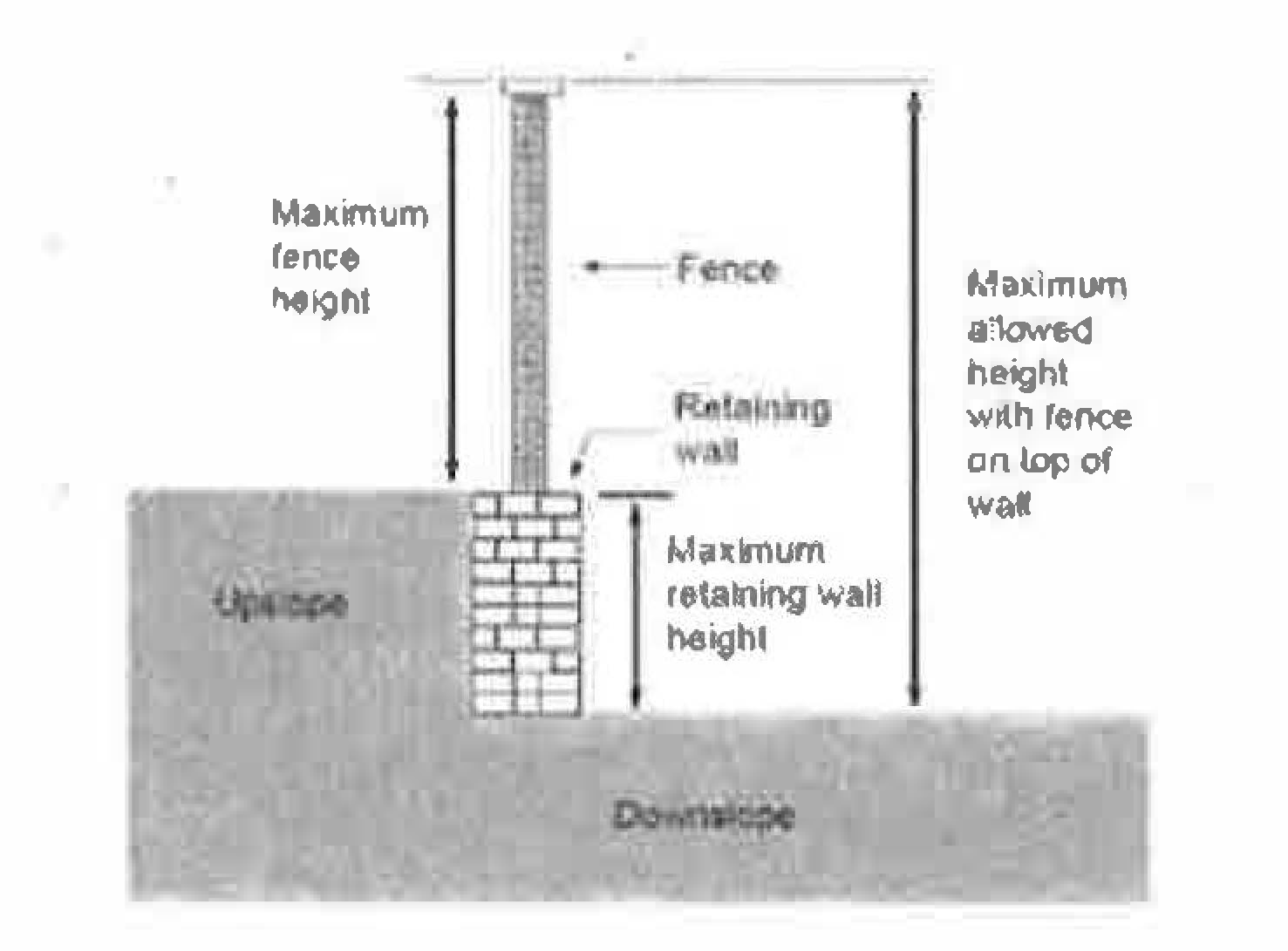
For fences on sloping ground or on retaining walls, solid fence height of seven (7) feet may be permitted as measured from the up-slope property so long as a total height, inclusive of any retaining wall, does not exceed eight (8) feet as measured from the downslope property. See Figure 16-89A.
Figure 16-89A Fence Height Measurement
(h)
Any person violating any provision of this Section shall be charged with a civil infraction and may be punished by a fine up to one thousand dollars ($1,000.00) per day.
(i)
Each 24-hour period during which a violation of this Section occurs shall be a separate violation.
(j)
In addition to other remedies, the Board of Trustees may enforce the provisions of this Section by seeking injunctive relief and abatement in a court of competent jurisdiction to compel removal of any fence erected in violation of this Section.
(Ord. 342, 1992; Ord. 600 §1, 2005; Ord. 795 §2, 2019; Ord. 803 §16, 2019; Ord. 847, §1, 2023)
Sec. 16-90. - Wireless facilities.
Any applicant to erect wireless facilities within the Town shall address the following site selection and design criteria as part of its application. Any such application shall be reviewed by the Town following the same procedure as applicable for a special review use. Small cell CMRS facilities, however, shall be permitted as uses by right in all zone districts, subject to the process and standards described in Section 16-92A.
(Ord. 453 §2, 1997; Ord. 751 §2, 2017)
Sec. 16-91. - Site selection criteria.
Site selection criteria are listed as a means of directing a site applicant to evaluate existing conditions at and adjacent to a subject site. It is the applicant's responsibility to address these criteria in a project description narrative.
(1)
Screening potential of existing vegetation, structures and topographic feature.
(2)
Compatibility with adjacent land uses.
(3)
Opportunities to mitigate visual impact.
(4)
Availability of suitable existing structures for antenna mounting.
(5)
No telecommunications facility owner or lessee or employee thereof shall act to exclude or attempt to exclude any other telecommunications service provider from the same location. A telecommunications facility owner or lessee or employee thereof shall cooperate in good faith to achieve co-location of antennas with other telecommunications service providers.
(6)
Co-location of CMRS facilities with existing facilities structures or buildings is strongly encouraged. If co-location is not proposed, the applicant must present a justification why this is so.
(7)
Availability of utilities and access.
(8)
No antenna owner or lessee shall fail to comply with current applicable Federal Communications Commission regulations prohibiting localized interference with reception of television and radio broadcasts.
(9)
No CMRS facility may be located on a single-family detached, duplex, triplex or fourplex building.
(Ord. 453 §2, 1997)
Sec. 16-92. - Wireless facility design criteria.
All siting must be accompanied by a site development plan (SDP) as required in the Town's zoning ordinance. Landscaping requirements of the Nederland Design Policies in Section III, Commercial, Office, Retail and Industrial uses, will apply to any leasehold site area that contains a CMRS facility and its associated accessory uses. Building- or roof-mounted facilities need not meet the landscaping requirements unless the accessory equipment storage shelter is located external to the building.
(1)
CMRS facilities shall be designed to be compatible with surrounding buildings and/or uses in the area of those planned for the area. This may be accomplished through the use of compatible architectural elements such as color, materials, texture, scale of facilities in relation to the surrounding development and character of the area. CMRS facilities shall be integrated, through their location and design, into the natural setting and structural environment of the area.
(2)
CMRS facilities shall preserve or enhance the existing character of the topography and vegetation. Existing vegetation, if any, and if suitable with natural features should be preserved or improved.
(3)
Roof- and building-mounted antennas shall be completely screened and/or compatibly colored to complement the building to which they are attached.
(4)
Structures or cabinets sheltering accessory equipment on the same site shall be compatible or blend with surrounding built or natural environment.
(5)
A variety of screening techniques should be considered depending on site conditions. Techniques include, but are not limited to: landscaping, berming, screening and fencing where appropriate.
(6)
The height of any support structure for a freestanding, microcell, repeater or antenna CMRS facility shall conform to the height limit of the subject zone district. Support structures for antennas of a CMRS facility needing to exceed the height of the subject zone district must obtain a special exception use permit as part of the SDP approval.
(7)
Whenever an antenna is attached to a building roof, the height of the antenna shall not be more than fifteen (15) feet over the height of the building. If the building is constructed to the height limit of the applicable zone district, an additional fifteen (15) feet of antenna height is permissible.
(8)
Microcell and repeater CMRS facilities may have no more than four (4) whip or panel antennas per facility, one (1) microwave antenna a maximum of three (3) feet in diameter, eighteen (18) square feet of exposed panel antenna surface area and fifteen (15) feet of whip antenna length.
(9)
CMRS facilities shall meet the following minimum setbacks from all property lines, whichever is the greatest:
a.
The setback for a principal building within the applicable zone district;
b.
Twenty-five percent (25%) of the facility height, including antennas; or
c.
The facility height, including antennas, adjacent to residential uses and/or residentially zoned property.
(Ord. 453 §2, 1997)
Sec. 16-92A. - Standards for small cell facilities and networks.
(a)
Applicable requirements: Small cell facilities and small cell networks shall comply in all respects with the requirements of Sections 16-90, 16-91 and 16-92 applicable to all wireless and CMRS facilities, with the following exceptions:
(1)
Setback requirements;
(2)
Design requirements; and
(3)
Location requirements.
(b)
Location: Small cell facilities are permitted in Town rights-of-way, upon facilities in these rights-of-way and on public easements owned by the Town under the following priority:
(1)
First, on a Town-owned utility pole, if any, which shall be removed and replaced with a pole designed to contain all antennae and equipment within the pole to conceal any ground-based support equipment and ownership of which pole is conveyed to the Town.
(2)
Second, a Town-owned utility pole with attachment of the small call facilities in a configuration approved by the Town.
(3)
Third, on a third-party owned utility pole, (with the consent of the owner thereof), with attachment of the small cell facilities in a configuration approved by the Town.
(4)
Fourth, on a traffic signal pole or mast arm in a configuration approved by the Town, or in the case of a CDOT facility, by CDOT.
(5)
Fifth, on a freestanding or ground-mounted facility which meets the definition of and requirements for an alternative tower structure in a location and configuration approved by the Town.
(c)
Height: All small cell facilities shall not exceed two (2) feet above the light pole, traffic signal or other facility or structure to which they are attached, or the maximum height in the relevant zone district, whichever is less. When new utility poles are proposed as an alternative tower, their height shall be similar to existing utility/light poles in the vicinity.
(d)
Spacing: No small cell facility shall be located within one thousand (1,000) feet of any other such facility.
(e)
Design: Small cell facilities shall be designed to blend with and be camouflaged in relation to the structure upon which they are located (e.g.: painted to match the structure or same material and color as adjacent utility poles). to the greatest degree possible, support equipment shall be located underground.
(f)
Relocation and removal: All facilities in Town right-of-way or easements shall be removed and/or relocated at the applicant's expense in the event the Town's use of the right-of-way or easement precludes the continued presence of such facilities.
(g)
Permitting: All small cell CMRS facilities and networks shall be reviewed pursuant to the procedures set forth in the Municipal Code. Networks shall also make application for a permit for work in the right-of-way. The Town may accept applications for a small cell network, provided each small cell facility shall be separately reviewed. The Town may take up to ninety (90) days to process a complete application.
(h)
Indemnification: The operator of a small cell facility which is permitted to locate on a Town right-of-way or easement or on a Town-owned utility pole, traffic signal or other structure owned by the Town, or within a Town-owned right-of-way or easement, shall, as a condition of permit approval, indemnify the Town from and against all liability and claims arising as a result of that location or attachment, including repair and replacement of damaged poles and equipment, in a form approved by the Town Attorney.
(i)
Bonding: All permits for location of small cell facilities on real property not owned by the small cell permittee shall include as a condition of approval a bond, in form approved by the Town Attorney, to guarantee payment for any damages to the real property and removal of the facility upon its abandonment.
(j)
Permit expiration: A permit for a small cell facility shall expire nine (9) months after approval unless construction of the permitted structure has been initiated.
(Ord. 751 §3, 2017)
Sec. 16-93. - Recognition of lot splits created prior to 1972.
Parcels of property meeting all six (6) of the requirements below shall be recognized as legal lots as defined in Sections 16-6 and 17-4 of this Code:
(1)
The parcel to be recognized as a lot was created prior to 1972 from a lot prior to 1972;
(2)
The portions of the lot as originally platted are not owned by the same person or entity at any time after February 10, 1998;
(3)
The size of each portion of the existing lot meets the minimum lot size requirements for the zoning district in which the lot is located;
(4)
There are no improvements constructed over any of the platted lot lines or created division lines;
(5)
The recognition of the divisions of the lot does not deprive any one (1) of the portions of the lot of access to a public street; and
(6)
Any utilities serving any improvements on the lot are in easements for the benefit of the property served by the utilities.
(Ord. 474 §1, 1998)
Sec. 16-94. - Variances for lot splits created prior to 1972 which do not meet minimum lot size requirement for zoning district.
(a)
Upon application of a property owner, the Board of Zoning Adjustment may grant a variance to allow building on a lot that has been illegally split that does not meet all of the criteria of Section 16-93 above only under all of the following circumstances:
(1)
The property owner submits an application on a form provided by the Town that contains at a minimum the information required by Subsection 16-52(a) and the footprint of the building sought to be constructed on the property; and
(2)
The property is to be used only for a single-family dwelling.
(b)
The Board of Zoning Adjustment may issue a variance allowing construction of the single-family dwelling as submitted in the application if it finds all of the following factors exist:
(1)
All of the criteria for a variance contained in Paragraph 16-232(a)(1) are found to exist;
(2)
The parcel that is the subject of the application meets all of the criteria of Section 16-93 of this Code except Paragraph (3); and
(3)
The residence to be constructed and all appurtenances thereto, including the driveway, can be constructed in compliance with all applicable standards of the Town, including, but not limited to, design standards, yard and bulk requirements, accessibility, utility and excavation requirements and driveway standards.
(c)
Any variance granted pursuant to this Section shall expire within one (1) year of the date of issuance, unless the property owner has obtained a building permit within such year period, and diligently pursues issuance of a certificate of occupancy.
(Ord. 482 §1, 1998)
Sec. 16-95. - Reserved.
Editor's note— Res. 2021-06 §18, adopted April 6, 2021, redesignated the provisions of former § 16-95 as a new § 16-34.
Sec. 16-96. - Small wind turbines.
(a)
Small wind turbines are permitted as a special review use in those zone districts designated by the use group table set forth in Subsection 16-32(c) of this Chapter. The requirements set forth in this Section are in addition to, and not in lieu of, those special review use requirements set forth in Article III of this Chapter. Applications for a small wind turbine tower shall be processed in accordance with Article III.
(b)
Setbacks. Small wind turbines shall meet the following minimum setbacks from all property lines, whichever is the greatest:
(1)
The setback for a principal building within the applicable zone district; or
(2)
Twenty-five percent (25%) of the overall wind turbine height, measured at the highest-reaching point of any part of the turbine.
(c)
Exemptions from setbacks. A small wind turbine may be exempt from the setback requirements of Subsection (b) above when the adjacent property upon which also is located a wind turbine that is participating in a unified wind energy project or study with the applicant, as evidenced by a written instrument, such as a lease or access/easement agreement.
(d)
Distance from environmental areas. Small wind turbines shall be located a minimum of two thousand five hundred (2,500) feet from all important bird areas, as identified by the local Audubon Society, and a minimum of one thousand five hundred (1,500) feet from all state-identified wetlands. Distance shall be measured in a straight line, regardless of topographical features, from the base of the small wind turbine to the nearest boundary of such area or wetland. These minimum distances may be altered to be greater or lesser at the discretion of the Board of Trustees, based on topography, land cover, land uses and any other factors that the Board of Trustees reasonably determines influences the flight patterns of resident birds.
(e)
Sound level. A small wind turbine shall not exceed fifty (50) decibels, except during short-term events such as severe wind storms and utility outages. Sound shall be measured in accordance with Section 10-265 of this Code.
(f)
Visual impacts. Small wind turbines will necessarily have visual impact on surrounding properties and the community due to the height necessary for such facilities to access wind resources. The intent of this Subsection is to reduce visual impacts without restricting the applicant's access to wind resources.
(1)
Color and surface treatment of the turbine shall minimize visual disruption to surrounding properties, such as flicker and reflection, through techniques such as using nonreflective colors and colors that blend with the surrounding environment.
(2)
The turbine and any associated structures shall, to the extent reasonably feasible, use materials, colors, textures, screening and landscaping that will blend the structures into the natural setting and existing environment.
(3)
Where wind characteristics permit, small wind turbines shall be set back from the tops of visually prominent ridgelines to minimize the visual contrast apparent from any public access.
(4)
The tower shall not significantly impair a scenic vista or scenic corridor as identified in the Comprehensive Plan.
(5)
A small wind turbine shall not be artificially lit unless such lighting is required by the Federal Aviation Administration (FAA). If lighting is required, the applicant shall provide a copy of the FAA determination to establish the required markings and/or lights for the small wind turbine.
(6)
A small wind turbine shall not significantly obstruct the predominant view of the surrounding neighborhood. For purposes of this Paragraph, predominant view means the scenic view of the landscape as seen from a residence or business, or the accessory area of a residence or business, such as a deck, garden or family gathering area.
(g)
Height restrictions. The overall height of a small wind turbine, as measured at the highest-reaching point of any part of the turbine, shall not exceed sixty (60) feet. The minimum distance from ground level to the lowest-reaching point of any moving part of the small wind turbine shall be fifteen (15) feet.
(h)
Submittal requirements. In addition to the requirements of Section 16-52 of this Chapter, an application to locate a small wind turbine shall include the following:
(1)
Small wind turbine system specifications and drawings, including manufacturer and model, rotor diameter, tower height and tower type: freestanding or guyed, all elevation views or a photo or three-dimensional rendering from a certified engineer or qualified, by recognized agencies, as meeting established standards and recommended business practices, and/or determined by the American Wind Energy Association's (AWEA) Small Wind Turbine Committee as commercially available with multiple publicly accessible operational installations in the U.S.
(2)
Mechanical wind brake required.
(Ord. 680 §4, 2010)
Sec. 16-97. - Chicken hens.
As an accessory use to a residential use in all zone districts, chicken hens are permitted as pet animals, subject to the following standards:
(1)
The chicken hens must be provided with a covered predator-resistant chicken house that is constructed of materials complementary to existing structures on the lot and properly ventilated and designed to be easily accessed, cleaned and maintained. The chicken house must have an attached outdoor enclosure area (chicken run) which, together with the area of the house, provides a minimum of four (4) square feet per chicken. The combined total area of the chicken house and the chicken run may not exceed two hundred (200) square feet. Chicken houses shall be a maximum of seven (7) feet tall, measured to the highest point of the structure.
(2)
Neither a chicken house nor a chicken run may be located less than six (6) feet from any other structure nor less than ten (10) feet from any abutting property line.
(3)
Chicken houses and runs must be regularly maintained in a manner to control dust, odor and waste and to prevent such areas from constituting a public nuisance or health hazard. The accumulation of organic material furnishing food for flies is prohibited. All manure and waste products shall be adequately composted or regularly collected and kept in tightly covered predator-, rodent- and insect-resistant receptacles and disposed of at least once a week in a manner approved by the Town Administrator or his or her designee.
(4)
No person may own or keep a rooster or other type of fowl, other than a chicken hen, in any zone district.
(5)
The breeding, selling and trading of chicken hens and their offspring as a commercial enterprise is prohibited. The keeping of chicken hens permitted by this Section is as an accessory use to a principal residential use, not as a home occupation or other commercial purpose.
(6)
A chicken hen permit is required to keep chicken hens, in accordance with Chapter 6 of this Code.
(Ord. 694 §2, 2011)
Sec. 16-98. - Accessory dwelling unit, residential.
(a)
Accessory dwelling units: Detached and integrated accessory dwelling units are permitted as accessory to a single-family dwelling unit subject to the following requirements and approval of a permit application:
(1)
General accessory dwelling unit standards. The following standards apply to detached and integrated accessory dwelling unit:
a.
Unity of ownership: The fee ownership of the principal dwelling and accessory dwelling unit shall not be separated.
b.
An accessory dwelling unit shall comply with the locally adopted building code and all other applicable local, state and federal regulations.
c.
Short-term rental: Short-term rental of an accessory unit and short-term rental of a principal dwelling unit on a lot or parcel with an accessory unit are prohibited except as specifically authorized in Chapter 6, Article V of this Code.
d.
No more than one (1) accessory dwelling unit shall be located on any lot.
e.
Accessory dwelling units must be served with municipal water and municipal sanitary sewer or septic as is applicable.
(2)
Accessory dwelling unit-detached. In addition to the general accessory dwelling unit standards in paragraph (a)(1) of this Section, the following standards shall apply to detached accessory dwelling units:
a.
Maximum height shall not exceed the maximums as set forth in Section 16-33, and the accessory dwelling unit-detached shall not exceed the height of the principal building.
b.
Maximum total area: The total area of a detached accessory dwelling unit shall not exceed eight hundred (800) gross square feet.
c.
Setbacks: The accessory dwelling unit shall meet the setbacks of an accessory use and all other yard and bulk requirements set forth in Section 16-33 of this Code. Maximum lot coverage and maximum floor area ratios shall not be exceeded.
d.
Maximum number of bedroom: There shall be a maximum of two (2) bedrooms within an accessory dwelling unit.
(3)
Accessory dwelling unit—integrated. In addition to the general accessory dwelling unit standards in paragraph (a)(1) of this Section, the following standards shall apply to the integrated accessory dwelling units:
a.
Maximum total area: There shall be no limitation to gross square footage.
b.
Exterior access: An integrated accessory dwelling unit shall have a separate exterior access. This requirement may be met with one (1) airlock type entry to the principal dwelling structure if separate access to the accessory dwelling exists following the initial outside entry of the principal dwelling structure.
(b)
Accessory dwelling unit permit applications.
(1)
All applicants shall apply on forms provided the Zoning Administrator and shall contain the following information:
a.
A statement of current ownership.
b.
Reserved.
c.
A legal description and survey of the property.
d.
A site plan that depicts the principal dwelling unit and the accessory dwelling unit.
e.
A demonstration of compliance with the criteria of this Subsection.
f.
A parking plan.
g.
A demonstration of compliance with the provisions of Chapter 13 of the Code as it relates to sewer and water utilities and fees.
h.
A demonstration of approved, inspected septic for all bedrooms, if applicable.
i.
Payment of the application fee as set forth in Section 4-151 of this Code.
(2)
Review of application.
a.
Approval: The Zoning Administrator or designee reviews the application for substantial compliance with the requirements in this Section. Upon approval of the application, the Zoning Administrator will issue a permit.
b.
The Zoning Administrator or designee may impose conditions of approval on a permit necessary to protect public health, safety, and welfare and or assure compliance with applicable ADU standards and requirements.
c.
The written decision of the Zoning Administrator or designee shall be issued within thirty (30) days of a complete application.
d.
Denial: The Zoning Administrator or designee shall deny an application for failure to substantially comply with the requirements in this Section.
e.
Review: Any person aggrieved by the final decision of the Zoning Administrator or designee may seek review to the Planning Commission. The issue before the Planning Commission will be whether the Zoning Administrator or designee exceeded his or her authority in denying the permit.
(3)
An owner or the owners of a lot or parcel with an accessory unit and the principal dwelling unit that were legally established and constructed with a certificate of occupancy on or before January 7, 2020, shall register with the Town and submit payment of the registration fee.
(4)
Transfer: An accessory dwelling unit permit may be transferred to the new owner by application to the Zoning Administrator as set forth in Section 16-98(b).
(c)
Administration and enforcement. It shall be the duty of the Zoning Administrator or designee to administer and enforce the provisions of this Section.
(Ord. 804 §7, 2020; Ord. 850, §3, 2023)
Editor's note— Ord. 804, § 7, adopted Jan. 7, 2020, repealed § 16-98 in its entirety and enacted new provisions to read as herein set out. Former § 16-98 pertained to accessory dwelling units, and derived from Ord. 785, §1, adopted in 2018.
Sec. 16-99. - Solar energy systems.
(a)
Solar energy systems are permitted in the Town as provided in this Section. Definitions of terms in this Section may be found in Section 16-6.
(b)
Small-scale solar energy systems are permitted in any district as an accessory use. Medium and large-scale solar energy systems require a special review use pursuant to Article III of this Chapter 16.
(c)
Height.
(1)
Roof-mounted solar energy systems. Roof-mounted solar energy systems must be mounted as flush as possible to the roof. In order to achieve proper solar orientation, panels may exceed the height of the roofline, and consequently, the maximum height permitted in the zoning district by no more five (5) feet as measured from the uppermost point of the roof deck. For buildings that are already above thirty-five (35) feet tall, mounted panels may reach a height of no more than forty (40) feet tall. Solar panels proposed to go above forty (40) feet in height must apply for a variance to exceed height standards.
(2)
Ground-mounted solar energy systems. Ground-mounted solar energy systems shall not exceed the allowed accessory height for the zoning district in which the ground-mounted system is located.
(d)
Lot coverage. Accessory ground-mount solar energy systems in the form of agrivoltaics are exempt from lot coverage standards if such systems have vegetative cover below the panels and if the system is mounted on a concrete pad. The footprint of the pad shall be considered impervious surface and subject to lot coverage standards.
(e)
Setbacks. Front-yard setbacks for ground-mounted solar energy systems shall as set forth in Section 16-33 of Chapter 16. Accessory ground-mounted solar energy systems shall follow the setback requirements for minimum side yard setbacks and minimum rear yard setbacks of the zoning district in which the ground-mounted solar energy system is located.
(f)
Performance standards. Solar energy systems are exempt from performance standards, Section 16-78 of this Chapter 16.
(Ord. 843, §2, 2023)
Sec. 16-100. - Natural medicine.
(a)
Natural medicine businesses are permitted in the Town in certain districts as specified in Section 16-32.
(b)
All natural medicine businesses must be licensed in accordance with the requirements of the State of Colorado and in compliance with applicable Colorado law.
(c)
It shall be unlawful for any person to cultivate natural medicine on private property outside of an enclosed and locked space.
(d)
It shall be unlawful for any person who owns, occupies, or controls private property to permit the cultivation of natural medicine on that property unless it is within an enclosed and locked space.
(e)
It shall be unlawful to cultivate natural medicine for personal use in such a manner as to be perceptible from the exterior of private property by common visual observation or odors or smells generated by the cultivation. Cultivation for personal use shall be in compliance with applicable Colorado law.
(f)
All operations and storage related to a natural medicine business, except for the loading and unloading of natural medicine products, must take place within a lawfully constructed and permitted principal building. No business activities, including storage and clinical sessions, shall occur outside of an enclosed principal building.
(Ord. No. 876, §5, 2025)

