
Syracuse City Zoning Code
ARTICLE 7
- SUPPLEMENTAL REGULATIONS
Sec. 7.01. - Off-street automobile storage.
7.01.01.
Off-street automobile storage or standing space shall be provided on any lot on which any of the following uses are hereafter established; such space shall be provided with vehicular access to a street or an alley. For purposes of computing the number of parking spaces available in a given area, the ratio of 250 square feet per parking space shall be used.
7.01.02.
If vehicle storage space or standing space required in section 7.02 cannot be reasonably provided on the same lot on which the principal use is conducted in the opinion of the planning commission, the planning commission may permit such space to be provided on other off-street property, provided such space lies within 400 feet of an entrance to such principal use. Such vehicle standing space shall be deemed to be required open space associated with the permitted use and shall not thereafter be reduced or encroached upon in any manner.
7.01.03.
All parking spaces and driveways for single-family, rooming houses, convalescent homes, rest homes, nursing homes, assisted living facilities, elderly or retirement house, apartments, townhouses, and two or more unit multi-family dwellings, and mobile homes located in Districts R-1, R-2, R-3, R-4, and C-1, that are located on front or side yards are required to be paved with concrete, except as may be permitted in the C-1 District by conditional use permit.
7.01.04.
Where calculations in accordance with the foregoing list results in requiring a fractional space, any fraction less than one-half shall be disregarded and any fraction of one-half or more shall require one space.
7.01.05.
In Districts R-1, R-2, R-3, and R-4, required off-street parking for residential use shall be provided on the lot on which the use is located In all districts, unless specifically noted, such parking may be provided either on the same lot, on an adjacent, or another lot provided they are not separated by more than 300 feet at closest points.
7.01.06.
Where off-street parking is located on a lot other than the lot occupied by the use, which requires it, site plan approval for both lots is required.
7.01.07.
Some uses may require two different use types to be calculated together in order to determine the total parking requirement. (Example: Primary schools may require a tabulation for classrooms and assembly areas.)
7.01.08.
Off-street parking requirements shall not apply to the C-2 Downtown Commercial District.
(Ord. No. 889, 11-18-2010)
Sec. 7.02. - Schedule of minimum off-street parking and loading requirements.
Sec. 7.03. - Off-street parking; shared parking requirements.
7.03.01.
Notwithstanding the provisions of section 7.02, in cases where parking and building patterns are such that overlapping uses of a majority of the total number of parking spaces in the center is likely to occur, compliance with the standard retail parking ratios may be decreased upon recommendation of the planning commission and approval of the city council.
Sec. 7.04. - Off-Street Parking; Parking for Individuals with Disabilities.
7.04.01.
In conformance with the Americans with Disabilities Act (ADA) and the Nebraska Accessibility Guidelines, if parking spaces are provided for self-parking by employees or visitors, or both, then accessible spaces shall be provided in each parking area in conformance with the table in this section. Spaces required by the table need not be provided in the particular lot. They may be provided in a different, if equivalent or greater accessibility, in terms of distance from an accessible entrance, cost and convenience, is ensured.
7.04.02.
Except as provided to section 7.04.01.01 of this ordinance, access aisles adjacent to accessible spaces shall be 60 inches (1,525 mm) wide minimum.
7.04.02.01.
One in every eight accessible spaces, but not less than one, shall be served by an access aisle 96 inches (2,440 mm) wide minimum and shall be designated "van accessible" as required by section 7.04.04 of this ordinance. The vertical clearance at such spaces shall comply with 7.04.05 of this ordinance. All such spaces may be grouped on one level of a parking structure.
Parking access aisles shall be part of an accessible route to the building or facility entrance. Two accessible parking spaces may share a common access aisle.
Parked vehicle overhangs shall not reduce the clear width of an accessible route. Parking spaces and access aisles shall be level with slopes not exceeding 1:50 (two percent) in all directions.
7.04.02.02.
If passenger-loading zones are provided, then at least one passenger-loading zone shall comply with 7.04.06 of this ordinance.
7.04.02.03.
At facilities providing medical care and other services for persons with mobility impairments, parking spaces complying with 7.04 of this ordinance shall be provided in accordance with 7.04.01 of this ordinance; except as follows:
1.
Outpatient units and facilities: Ten percent of total number of parking spaces provided serving each such outpatient unit or facility;
2.
Units and facilities that specialize in treatment or services for persons with mobility impairments: 20 percent of the total number of parking spaces provided serving each such unit or facility.
7.04.02.04.
Valet parking: valet parking facilities shall provide a passenger-loading zone complying with 7.04.06 of this ordinance located on an accessible route to the entrance of the facility. Sections 7.04.01, 7.04.02.01, and 7.04.02.03 of this ordinance do not apply to valet parking.
7.04.03.
Location of accessible parking spaces serving a particular building shall be located on the shortest accessible route of travel from adjacent parking to an accessible entrance.
7.04.03.01.
In parking facilities that do not serve a particular building, accessible parking shall be located on the shortest accessible route of travel to an accessible pedestrian entrance of the parking facility.
7.04.03.02.
In buildings with multiple accessible entrances with adjacent parking, accessible parking spaces shall be dispersed and located close to the accessible entrances.
7.04.04.
Signage of accessible parking spaces shall be designated as reserved by a sign showing the symbol of accessibility. Spaces complying 7.04.02.01 shall have an additional sign "Van Accessible" mounted below the symbol of accessibility. Such signs shall be located so they cannot be obscured by a vehicle parked in the space.
7.04.05.
Minimum vertical clearance of 114 inches (2,895 mm) at accessible passenger-loading zones and along at least one vehicle access route to such areas from site entrance(s) and exit(s). At parking spaces complying with 7.04.02.01, provide minimum vertical clearance of 98 inches (2,490 mm) at the parking space and along at least one vehicle access route to such spaces from site entrance(s) and exit(s).
7.04.06.
Passenger-loading zones shall provide an access aisle at least 60 inches (1,525 mm) wide and 20 feet (240 inches/6,100 mm) long adjacent and parallel to the vehicle pull-up space. If there are curbs between the access aisle and the vehicle pull-up space, then a curb ramp complying with accessibility standards shall be provided. Vehicle standing spaces and access aisles shall be level with surface slopes not exceeding 1:50 (two percent) in all directions.
Sec. 7.05. - Off-Street parking design criteria.
7.05.01.
Standard parking stall dimensions shall not be less than nine feet by 18 feet, plus the necessary space for maneuvering into and out of the space. Where the end of the parking space abuts a curbed area at least five feet in width (with landscaping or sidewalk), an overhang may be permitted which would reduce the length of the parking space by two feet. Such overhang shall be measured from the face of the curb. For standard parking lots, minimum dimensions shall be as follows:
Parking Configuration
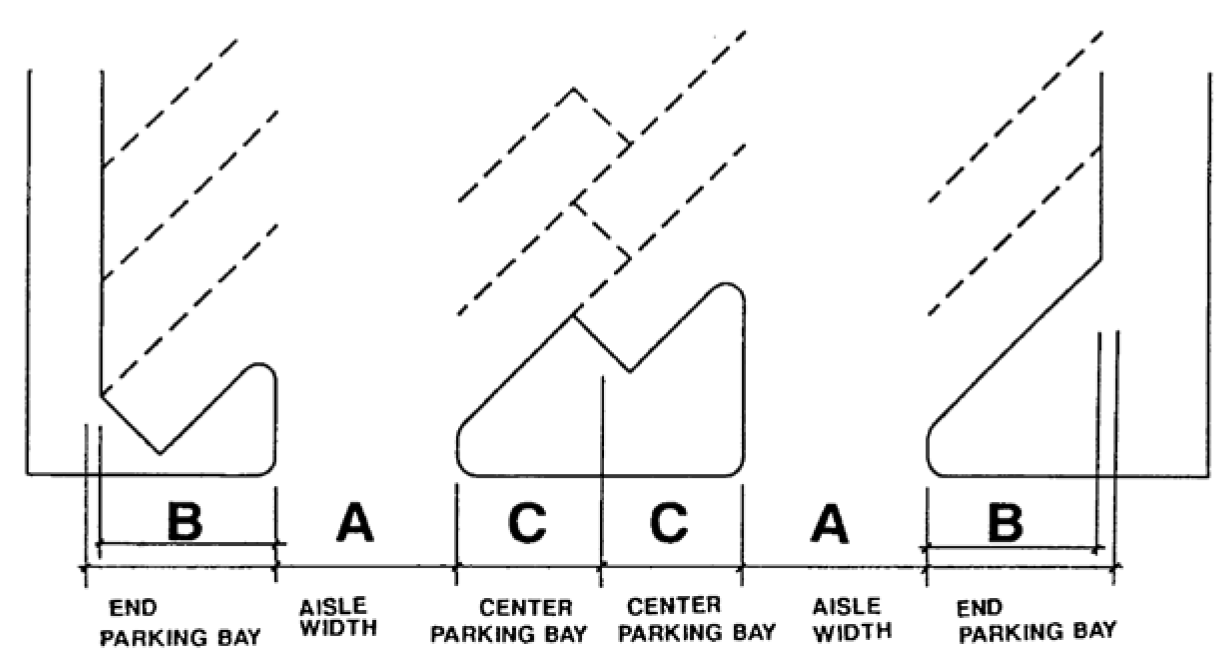
7.05.02.
Minimum dimensions for a parallel parking space shall be nine feet by 23 feet.
7.05.03.
Minimum parking dimensions for other configurations or for parking lots with compact car spaces shall be determined by the planning commission and city council upon recommendation of the city engineer.
Sec. 7.06. - Sign area computation.
7.06.01.
Computation of area of individual signs. The area of a sign face (which is also the sign area of a wall sign or other sign with only one face) shall be computed by means of the smallest square, circle, rectangle, triangle, or combination thereof that will encompass the extreme limits of the writing, representation, emblem, or other display, together with any material or color forming an integral part of the background of the display or used to differentiate the sign from the backdrop or structure against which it is placed, but not including any supporting framework, bracing, or decorative fence or wall when such fence or wall otherwise meets zoning ordinance regulations and is clearly identical to the display itself.
7.06.02.
Computation of area of multi-faced signs. The sign area for a sign with more than one face shall be computed by adding together the area of all sign faces visible from any one point. When two identical sign faces are placed back to back, so that both faces cannot be viewed from any point at the same time, and when such sign faces are part of the same sign structure and are not more than 42 inches apart, the sign area shall be computed by the measurement of one of the faces.
7.06.03.
Computation of height. The height of a sign shall be computed as the distance from the base of the sign at normal grade to the top of the highest attached component of the sign. In cases in which the normal grade cannot reasonably be determined, sign height shall be computed on the assumption that the elevation of the normal grade at the base of the sign is equal to the elevation of the nearest point of the crown of a public street or the grade of the land at the principal entrance to the principal structure on the lot, parcel, or tract of land, whichever is lower.
Sec. 7.07. - Sign schedules.
7.07.01.
Unless otherwise exempted, all signs not expressly permitted in this ordinance are prohibited in the city. The following signs shall be exempt from this ordinance: Signs required by federal, state, or local law, and political signs. The following procedure shall govern the application for, and issuance of, all sign permits under this ordinance. All applications for sign permits of any kind shall be submitted to the city on an application form or in accordance with application specifications on file with the city. Each application for a sign permit shall be accompanied by the applicable fees, which shall be established in the fee schedule. Upon receiving an application for a sign permit, the building and zoning inspector shall review it for completeness. If the building and zoning inspector finds that it is complete, the application shall then be processed. If the building and zoning inspector finds that it is incomplete, the building and zoning inspector shall send to the applicant a notice of the ways in which the application is deficient, and, when possible, references shall be made to the applicable sections of this ordinance. Once the application for a sign permit is completed, the building and zoning inspector shall take action to approve or disapprove the application. Signs shall be permitted in the various districts according to the following schedule:
1 One wall sign for each building or structure shall be permitted. Each additional wall sign on a building or structure shall be a conditional use, not to exceed the total number of signs as set forth in section 7.07.02.
2 One wall sign for each commercial establishment located in a shopping center, commercial strip shall be permitted. Each additional wall sign for each commercial establishment located in a shopping center, commercial strip shall be a conditional use, not to exceed the total number of wall signs as set forth in section 7.07.02.
+ = Permitted.
- = Not permitted.
C = Conditional use.
7.07.02.
Signs shall be permitted in the various districts at the listed square footage and heights according to the following schedule:
1 All wall signs shall not exceed ten percent of the total wall area and shall not exceed the maximum square footage indicated in the table.
2 Ground signs may be increased from 32 square feet in area to 50 square feet in area when all uses/storefronts within a development are included on one sign as opposed to each having an individual ground sign for every use/storefront.
3 Ground signs may be increased from 50 square feet in area to 75 square feet in area when all uses/storefronts within a development are included on one sign as opposed to each having an individual ground sign for every use/storefront.
4 A pole sign or freestanding sign may be increased from 100 square feet in area to 200 square feet in area when all uses/storefronts within a development are included on one sign as opposed to each having an individual pole sign or freestanding sign for every use/storefront.
5 A Pole sign or freestanding sign in the C-1 and I-1 zoning districts may be increased from 200 square feet in area to 300 square feet in area when all uses/storefronts within a development are included on one sign as opposed to each having an individual pole sign or freestanding sign for every use/storefront. One pole sign or freestanding sign in the C-3 zoning district may contain a maximum of 750 square feet in area, and in the C-3 zoning district the pole sign or freestanding sign may be increased from 750 square feet in area to 950 square feet in area when all uses/storefronts within a development are included on one pole sign or one freestanding sign as opposed to each having an individual pole sign or freestanding sign for every use/storefront. Each other pole sign or freestanding sign shall not exceed a maximum of 200 square feet in area.
6 Signs shall meet the criteria of the underlying zoning district.
7 May increase the number of projecting signs to two signs per building if the building is located on the corner lot and more than one use is in same building.
8 One pole sign within a development may be 115 feet in height and each other pole sign shall not exceed 40 feet in height.
9 Two ground signs are permitted within a single development if such development contains a minimum of 20 acres.
7.07.03.
A building or use having frontage on a second street may include 20 percent of the total allowed on one facade.
(Ord. No. 709, 3-11-2002; Ord. No. 761, 6-7-2004; Ord. No. 767, 10-20-2004; Ord. No. 776, 8-1-2005; Ord. No. 834, 5-7-2007; Ord. No. 976, 8-17-2015; Ord. No. 1036, § 1, 4-11-2018; Ord. No. 1041, § 1, 10-10-2018; Ord. No. 1084, § 1, 11-18-2020; Ord. No. 1121, § 1, 1-12-2022)
Sec. 7.08. - Special conditions.
7.08.01.
Real estate. Not more than two signs per lot may be used as a temporary sign. Signs in the TA-1 District shall be set back 20 feet from the road right-of-way or road easement.
7.08.02.
Billboard. Billboards, signboards, and other similar advertising signs subject to the same height and location requirements as other structures in the district and also subject to the following conditions and restrictions.
7.08.02.01.
No billboard, signboard, pole sign or similar advertising signs shall be located at intersections so as to obstruct vision, hearing, or interfere with pedestrian or vehicular safety.
7.08.02.02.
No billboard, signboard, pole sign or similar advertising signs shall be located within 50 feet of any lot in a residential district.
7.08.02.03.
No billboard, signboard, pole sign or similar advertising signs shall be so constructed or located where it will unreasonably interfere with the use and enjoyment of adjoining property.
7.08.03.
Signs hung from canopies and awnings shall be no closer than 80 inches from the bottom edge of the sign to grade below.
7.08.04.
Temporary signs. Temporary signs for which a permit has been issued in accordance with the fee schedule, shall be issued only for temporary signs meeting the following criteria:
7.08.04.01.
Such temporary signs shall not be in place for more than 30 consecutive days.
7.08.04.02.
No more than four temporary sign permits shall be issued to a property owner's use in a calendar year.
7.08.04.03.
Any violation of this section may void any future requested permits.
7.08.04.04.
No temporary sign shall be of such size, message, or character so as to harm the public, health, safety, or general welfare.
7.08.04.05.
No temporary sign shall be placed in the public right-of-way. All temporary signs must conform with section 4.08 of this ordinance.
7.08.04.06.
An electrical cord connection to the temporary sign shall not be placed upon any ground or ground surfacing that is designated to accommodate pedestrian traffic or vehicular traffic. Electric cords shall not be suspended above ground.
7.08.05.
Destination signs. Notwithstanding the definition of billboard sign, as defined in section 2.02.323 of this ordinance, a conditional use permit may be issued authorizing the placement of a destination sign. The following criteria and limitations shall apply:
7.08.05.01.
Only one destination sign may be authorized within the jurisdiction of the city for any entity.
7.08.05.02.
Only one destination sign may be placed on a lot or lots in which a business is located.
7.08.05.03.
A destination sign shall not be directly illuminated by any electrical source, internal or external.
7.08.05.04.
No destination sign shall be placed in the public right-of-way. All destination signs must conform with section 4.08 of this ordinance.
7.08.06.
Projecting signs. A sign permit, accompanied by the applicable fees established by the applicable fee schedule, shall be issued only for a projecting sign meeting the following criteria:
7.08.05.01.
The bottom edge of the sign face shall be ten feet or more above grade.
7.08.06.02.
A projecting sign may be animated (2.02.317), electronic message board (2.02.330), or illuminated (2.02.334). A projecting sign shall not be a flashing sign (2.02.331).
7.08.06.03.
The leading edge of a projecting sign shall not extend more than five feet beyond the surface of the building or wall to which it is attached.
(Ord. No. 762, 6-7-2004; Ord. No. 777, 8-1-2005; Ord. No. 835, 5-7-2007)
Sec. 7.09. - Home occupations.
The following are the minimum standards required for a home occupation:
7.09.01.
One unlit nameplate of not more than two square foot in area attached flat against the building located on local or collector streets. However, four square feet in area attached flat against the building located on arterial streets.
7.09.02.
Advertising displays and advertising devices displayed through a window of the building shall not be permitted.
7.09.03.
No more than 50 percent of the home can be used for the home occupation.
7.09.04.
No more than one employee or co-worker other than the resident(s) can work from that site.
7.09.05.
No retail sales are permitted from the site other than incidental sales related to services provided.
7.09.06.
No exterior storage (including storage within detached buildings/garages) is permitted.
7.09.07.
Additional off-street parking may be required for the business.
7.09.08.
No offensive noise, vibration, smoke, odor, heat, or glare shall be noticeable at or beyond the property line.
All businesses related to child care homes and child care centers shall be licensed in accordance with R.R.S. 1943, § 71-1901 et seq. and R.R.S. 1943, § 71-1908 et seq.
Sec. 7.10. - Wireless communication towers.
7.10.01.
Intent. Based upon the Communications Act of 1934, as amended by the Telecommunications Act of 1996 (the Act) grants the Federal Communications Commission (FCC) exclusive jurisdiction over certain aspects of telecommunication services. This section is intended to regulate towers, telecommunications facilities and antennas in the city in conformance with the Act without prohibiting or tending to prohibit any person from providing wireless telecommunication service. Telecommunication facilities, towers and antennas in the city, to protect residential areas and land uses from potential adverse impact of installation of towers and antennas through careful design, sitting, and camouflaging, to promote and encourage shared use/collocation of towers and other antenna support structures rather than the construction of additional single use towers, to avoid potential damage to property caused by towers, telecommunications facilities and antennas by ensuring such structures are soundly and carefully designed, constructed, modified, maintained, repaired and removed when no longer used or are determined to be structurally unsound and to ensure that towers and antennas are compatible with surrounding land uses.
7.10.02.
Definitions. All terms in this section which are not specifically defined herein shall be construed in accordance with the Communications Act of 1934, the Telecommunications Act of 1996 and the Rules and Regulations of the Federal Communications Commission (FCC). As used in this section, the following terms shall have the following meanings:
7.10.02.01.
Antenna shall mean a device, designed and intended for transmitting or receiving television, radio, or microwave signals, direct satellite service (including direct-to-home satellite service), and/or video programming services via multi-point distribution services.
7.10.02.02.
Antenna support structure shall mean any building or structure other than a tower which can be used for location of telecommunications facilities.
7.10.02.03.
Applicant shall mean any person that applies for a tower development permit.
7.10.02.04.
Application shall mean a process by which the owner of a tract of land within the zoning jurisdiction of the city submits a request to develop, construct, modify, or operate a tower upon such tract of land. The term "application" includes all written documentation, verbal statements, and representations, in whatever, formal forum, made by an applicant to the city concerning such request.
7.10.02.05.
Conforming commercial earth station shall mean a satellite dish which is two meters or less in diameter and is located in an area where commercial or industrial uses are generally permitted under this regulation.
7.10.02.06.
Engineer shall mean any engineer qualified and licensed by any state or territory of the United States of America.
7.10.02.07.
Owner shall mean any person with a fee simple title or a leasehold exceeding ten years in duration to any tract of land within the zoning jurisdiction of the city who desires to develop, construct, modify, or operate a tower upon such tract of land.
7.10.02.08.
Person shall mean any person, firm, partnership, association, corporation, company, or other legal entity, private or public, whether for profit or not for profit.
7.10.02.09.
Satellite dish antenna shall mean an antenna consisting of a radiation element intended for transmitting or receiving television, radio, microwave, or radiation signals and supported by a structure with or without a reflective component to the radiating dish, usually circular in shape.
7.10.02.10.
Stealth shall mean any telecommunications facility, tower, or antenna which is designed to enhance compatibility with adjacent land uses, including, but not limited to, architecturally screened roof-mounted antennas, antennas integrated into architectural elements, and towers designed to look other than a tower, such as light poles, power poles and trees.
7.10.02.11.
Telecommunications facilities shall mean any cables, wires, lines, waive guides, antennas, or any other equipment or facilities associated with the transmission or reception of communications which a person seeks to locate or has installed upon or near a tower or antenna support structure. However, telecommunications facilities shall not include:
1.
Any conforming commercial earth station antenna two meters or less in diameter which is located on real estate zoned TA-1, R-1, R-2, R-3, R-4, C-1, C-2, C-3, I-1 or I-2.
2.
Any earth station antenna or satellite dish antenna of one meter or less in diameter, regardless of zoning applicable to the location of the antenna.
7.10.02.12.
Tower shall mean a self-supporting lattice, guyed, or monopole structure, which supports telecommunications facilities. The term "tower" shall not include non-commercial amateur radio operator's equipment as licensed by the FCC or structure supporting an earth station antenna serving residential premises or dwelling units exclusively.
7.10.02.13.
Tower development permit shall mean a permit issued by the city upon approval by the city council of an application to develop a tower within the zoning jurisdiction of the city; which permit shall continue in full force and effect for so long as the tower to which it applies conforms to this section. Upon issuance, a tower development permit shall be deemed to run with the land during the permits duration and may be transferred, conveyed, and assigned by the applicant to assigns and successors-in-interest.
7.10.02.14.
Tower owner shall mean any person with an ownership interest of any nature in a proposed or existing tower following the issuance of a tower development permit.
7.10.03.
Location of towers and construction standards.
7.10.03.01.
Towers shall be permitted conditional uses of land in only those zoning districts where specifically listed and authorized in this regulation.
7.10.03.02.
No person shall develop, construct, modify or operate a tower upon any tract of land within the zoning jurisdiction of the city prior to approval of its application for a tower development permit by the city council and issuance of the permit by the city. applicants shall submit their application for a tower development permit to the zoning office and shall pay a filing fee in accordance with section 4.21.
7.10.03.03.
All towers, telecommunications facilities and antennas on which construction has commenced within the zoning jurisdiction of the city after the effective date of this regulation shall conform to the building codes and all other construction standards set forth by the city, county, federal, and state law and applicable American National Standards Institute (ANSI). Upon completion of construction of a tower and prior to the commencement of use, an engineer's certification that the tower is structurally sound and in conformance with all of the aforementioned applicable regulatory standards shall be filed in the zoning office.
7.10.04.
Application to develop a tower. Prior to commencement of development or construction of a tower, an application shall be submitted to the zoning office for a tower development permit and shall include the following:
7.10.04.01.
Name, address, and telephone number of the owner and if applicable, the lessee of the tract of land upon which the tower is to be located. Applicants shall include the owner of the tract of land and all persons having an ownership interest in the proposed tower. The application shall be executed by all applicants.
7.10.04.02.
The legal description and address of the tract of land on which the tower is to be located.
7.10.04.03.
The names, addresses and telephone numbers of all owners of other towers or useable antenna support structures within a one-mile radius of the proposed tower, including publicly and privately owned towers and structures.
7.10.04.04.
An affidavit attesting to the fact that the applicant has made diligent but unsuccessful efforts to obtain permission to install or collocate the applicants telecommunications facilities on a tower or useable antenna support or written technical evidence from an engineer that the applicants telecommunications facilities cannot be installed or collocated on another tower or useable antenna support structure.
7.10.04.05.
Written technical evidence from an engineer that the proposed tower will meet the established building code, and all other applicable construction standards set forth by the city council and federal and state and ANSI standards.
7.10.04.06.
Color photo simulations showing the proposed location of the tower with a photo-realistic representation of the proposed tower as it would appear viewed from the nearest residentially used and/or zoned property and nearest roadway, street or highway.
7.10.04.07.
Descriptions and diagrams of the proposed tower, telecommunications facilities and/or antenna, manufacturers literature, appurtenances such as buildings, driveways, parking areas, and fences or other security enclosures with significant detail to allow persons reviewing the application to understand the kind and nature of the proposed facility.
7.10.05.
Tower development permit procedure. After receipt of an application for a tower development permit, the zoning administrator shall schedule a public hearing before the planning commission, following all statutory requirements for publication and notice, to consider such application. The planning commission shall receive testimony on the tower development permit and shall make a recommendation to the city council. Upon the completion of the planning commission public hearing, the zoning administrator shall schedule a public hearing before the city council, following all statutory requirements for publication and notice, to consider such application and the recommendation of the city planning commission. Notice for each public hearing shall be made at least one time and at least ten days prior to such hearing. In addition, the zoning administrator shall cause a notice to be posted in a conspicuous place on the property on which action is pending. Such notice shall conform to article 6, section 6.03 of this regulation. The planning commission and city council may approve the tower development permit as requested in the pending application with any conditions or safeguards it deems reasonable and appropriate based upon the application and/or input received at the public hearings or deny the application. In all zoning districts in which towers are a permitted conditional use of land, the tower development permit shall be deemed a conditional use permit for said tract of land.
7.10.06.
Setbacks and separation or buffer requirements.
7.10.06.01.
All towers up to 50 feet in height shall be setback on all sides a distance equal to the underlying setback requirement in the applicable zoning district. Towers in excess of 50 feet in height shall be set back one additional foot for every two feet in excess of the maximum height requirement for the given zoning district. The height of the tower shall be measured from the grade at the foot of the base pad to the top of any telecommunications facilities or antennas attached thereto. Setback requirements shall be measured from the base of the tower to the property line of the tract of land on which it is located.
7.10.06.02.
Towers exceeding 100 feet in height may not be located in any residentially zoned district and must be separated from all residentially zoned districts and occupied structures other than those utilized by the tower owner, by a minimum of 200 feet or 100 percent of the height of the proposed tower, whichever is greater.
7.10.06.03.
Towers of 100 feet or less in height may be located in residentially zoned districts provided said tower is separated from any residential structure, school, church, and/or occupied structures other than those utilized by the tower owner, by a minimum of 100 percent of the height of the tower.
7.10.06.04.
Towers must meet the following minimum separation requirements from other towers:
A.
Monopole tower structures shall be separated from all other towers, whether monopole, self-supporting lattice, or guyed by a minimum of 750 feet.
B.
Self-supporting lattice or guyed towers shall be separated from all other self-supporting lattice or guyed towers by a minimum of 1,500 feet.
7.10.07.
Structural standards for towers adopted. The Structural Standards for Steel Antenna Towers and Antenna Supporting Structures, 1991 edition (ANSI/EIA/TIA 222-E-1991), is hereby adopted, together with any amendments thereto as may be made from time to time, except such portions as are hereinafter deleted, modified, or amended by regulation and set forth in this article of the zoning regulation.
7.10.08.
Illumination and security fences.
7.10.08.01.
Towers shall not be artificially lighted except as required by the Federal Aviation Administration (FAA). In cases where there are residential uses/zoned properties within a distance of 300 percent of the height of the tower, any tower subject to this section shall be equipped with dual mode lighting.
7.10.08.02.
All self-supporting lattice or guyed towers shall be enclosed within a security fence or other structure designed to preclude unauthorized access. Monopole towers shall be designed and constructed in a manner which will preclude to the extent practical, unauthorized climbing of said structure.
7.10.09.
Exterior finish. Towers not requiring FAA painting or marking shall have an exterior finish which enhances compatibility with adjacent land uses, subject to review and approval by the planning commission and city council as part of the application approval process. All towers which must be approved as a conditional use shall be stealth design unless stealth features are impractical or the cost of such features represents an undue burden on the applicant.
7.10.10.
Landscaping. All tracts of land on which towers, antenna support structures, telecommunications facilities and/or antennas are located shall be subject to the landscaping requirements of the city.
7.10.11.
Maintenance, repair or modification of existing towers. All towers constructed or under construction on the date of approval of this regulation may continue in existence as a non-conforming structure and may be maintained or repaired without complying with any of the requirements of this section. Nonconforming structures or uses may not be enlarged or the degree of nonconformance increased without complying with this section, including applying for and obtaining a tower development permit. Any modification or reconstruction of a tower constructed or under construction on the date of approval of this regulation shall be required to comply with the requirements of this section including applying for and obtaining a tower development permit. Said application shall describe and specify all items which do not comply with this section and may request, subject to final review and approval of the city council, an exemption from compliance as a condition of the tower development permit.
7.10.12.
Inspections. The city reserves the right to conduct inspection of towers, antenna support structures, telecommunications facilities and antenna upon reasonable notice to the tower owner or operator to determine compliance with this section and to prevent structural and equipment failures and accidents which may cause damage, injuries or nuisances to the public. Inspections may be made to determine compliance with the city's building codes and any other construction standards set forth by the city, federal, and state law or applicable ANSI standards. Inspections shall be made by either an employee of the city's zoning office, building and zoning inspector, or a duly appointed independent representative of the city.
7.10.13.
Maintenance. The towers, antenna support structures, telecommunications facilities and antennas shall at all times be kept and maintained in good condition, order and repair so that the same does not constitute a nuisance to or a danger to the life or property of any person or the public.
7.10.14.
Abandonment. If any tower shall cease to be used for a period of one year, the zoning office shall notify the tower owner that the site will be subject to determination by the zoning administrator that the site has been abandoned. Upon issuance of written notice to show cause by the zoning administrator, the tower owner shall have 30 days to show preponderance of evidence that the tower has been in use or under repair during the period of apparent abandonment. In the event the tower owner fails to show that the tower has been in use or under repair during the relevant period, the zoning administrator shall issue a final determination of abandonment of the site and the tower owner shall have 75 days thereafter to dismantle and move the tower. In the event the tower is not dismantled and removed, the tower shall be declared a public nuisance by the zoning administrator, or his/her designee and a written request shall be directed to the city attorney to proceed to abate said public nuisance pursuant to authority of the Revised Nebraska State Statutes and City of Syracuse codes, and charge the costs thereof against the real estate on which the tower is located or the owner of record of the said real estate.
7.10.15.
Satellite dish antennas, regulation. Upon adoption of this regulation, installation of satellite dish antennas shall be permitted within the zoning jurisdiction of Syracuse only upon compliance with the following criteria:
7.10.15.01.
In residentially zoned districts, satellite dish antennas may not exceed a diameter of ten feet.
7.10.15.02.
Single-family residences may not have more than one satellite dish antenna over three feet in diameter.
7.10.15.03.
Multiple-family residences with ten or less dwelling units may have no more than one satellite dish antenna over three feet in diameter. Multiple-family residences with more than ten dwelling units may have no more than two satellite dish antennas over three feet in diameter.
7.10.15.04.
In residential zoning districts, satellite dish antennas shall not be installed in the required front yard setback or side yard setback area.
7.10.15.05.
All satellite dish antennas installed within the zoning jurisdiction of Syracuse, upon adoption of this regulation, shall be of a neutral color such as black, gray, brown, or such color as will blend with the surrounding dominant color in order to camouflage the antenna.
7.10.16.
Severability. If any clause, subsection, or any other part of this section shall be held invalid or unconstitutional by any court of competent jurisdiction, the remainder of this section shall not be affected thereby, but shall remain in full force and effect.
(Ord. No. 967, 3-11-2015)
Sec. 7.11. - Fences.
No fence shall be constructed within the zoning jurisdiction of the City of Syracuse unless a permit therefore is approved and issued by the building and zoning inspector and is constructed in conformance with the following requirements:
7.11.01.
The height limitation for fences shall be six feet above ground level, except as provided herein:
7.11.01.01.
A fence constructed within a front yard of a residential lot and vegetation used as a barrier, screen, or fence along and parallel to the front line of a residential lot, shall not exceed 42 inches in height.
7.11.01.02.
A fence constructed within the portion of a side yard of a residential lot that lies in front of a line extending perpendicularly from the side lot line to the front corner of the structure that is closest to such side lot line, shall not exceed four feet in height, except that if the lot is located on a corner, as defined in article 2 of this ordinance, a fence constructed within a side yard along the side lot line which is adjacent to a street shall not exceed six feet in height.
7.11.01.03.
Where it is demonstrated that for security purposes the perimeter fencing around a plant or building located in an area zoned as an industrial district must be higher than six feet in height may be approved by through a conditional use permit.
7.11.01.04.
Fences constructed along and parallel to lot lines separating a residential lot from property located in a commercial or industrial district shall not exceed eight feet in height.
7.11.01.05.
Fences constructed along and parallel to rear and side lot lines adjoining arterial streets, as designated by the Nebraska Department of Roads, shall not exceed eight feet in height.
7.11.02.
Fences located within a front yard of a residential lot must qualify within the definition of an open fence.
7.11.03.
No fence or vegetation shall be situated or constructed in such a way as to obstruct the vehicular traffic or otherwise create a traffic safety hazard.
7.11.04.
The use of barbed wire in the construction of any fence is prohibited, except:
7.11.04.01.
Perimeter security fencing of buildings constructed in an industrial district. The plans and specifications for any such fencing must be approved by the city before commencement of construction.
7.11.04.02.
Farm fencing constructed for agricultural purposes on parcels of land 12 acres or more in the transitional agricultural district.
7.11.05.
All supporting posts for fence construction shall be set in concrete except for agricultural fencing.
7.11.06.
All fences shall be maintained in good repair.
7.11.07.
All fences shall be located inside the boundaries of the property upon which constructed except where two adjacent property owners pursuant to written agreement filed with the city agree to build one fence on the common lot line of adjacent side yards or back yards.
7.11.08.
Electric fences. No electric fence shall be constructed or maintained within the City of Syracuse or within its extraterritorial zoning jurisdiction except in TA-1-Transitional Agriculture District as hereinafter provided. An owner or lessee of such property may, upon application to the city and approval by the building and zoning inspector, maintain electrified fencing provided same shall not be energized to the extent that it is capable of causing bodily harm to persons, be they children or adults, or to animals. Before the building and zoning inspector shall approve any electrified fencing, it shall be determine that non-electrified fencing will not adequately protect the owner's property and the owner's application for approval of electrified fencing shall set forth in detail the reasons why non-electrified fencing will not adequately protect his property.
7.11.09.
Facing. The finished surface of all fences shall face toward adjoining property or street frontage. However, in the case of two or more property owners wishing to share a common fence line between their properties, said property owners shall jointly determine upon which side of the common fence line the finished face of the fence shall be placed. Such determination shall be consistent for the entire length of the common fence line.
7.11.10.
Fences in existence as of the date of adoption of this ordinance. Any existing fence constructed pursuant to a permit issued and approved by the City of Syracuse which was in conformity with the past provisions and which was in place as of said date, may remain without change in accordance with this section notwithstanding same may be in conflict with one or more provisions of this section as amended; provided, however, and replacement or change of said existing fence or addition of a new fence, must hereby meet the requirements of this section as amended hereby.
(Ord. No. 850, 9-8-2008; Ord. No. 1112, § 1, 9-8-2021)
Sec. 7.12. - Storage or parking of vehicles, boats, campers and trailers.
No lot, parcel or tract of land or part thereof, situated within the zoning jurisdiction of the City of Syracuse shall be used for any of the following:
7.12.01.
The storage or keeping of motor vehicles not having a properly issued current motor vehicle registration and current motor vehicle license plate properly displayed; provided, however, that the following shall not constitute a violation of this subparagraph:
7.12.01.01.
The storage of unlicensed and/or unregistered motor vehicles in a fully enclosed garage.
7.12.01.02.
The storage or keeping of operable off-highway farm or industrial vehicles on tracts zoned Transitional Agricultural Residence (TA-1) or any industrial district and used in agricultural or industrial activity conducted on said premises.
7.12.02.
The storage, keeping or abandonment of parts, including scrap metals, from motor vehicles or machinery, or parts thereof, except in enclosed buildings or garages or where otherwise authorized by the Syracuse zoning regulations.
7.12.03.
Parking, storage, or keeping, other than in a fully enclosed garage, of any non-operable motor vehicle on any lot zoned residential, provided, however, that automobiles that are non-operable solely by reasons of repair work being done thereon may be parked on residential lots within the Syracuse zoning jurisdiction occupied by the owner of said automobile, under the following conditions:
7.12.03.01.
The automobile is owned by the occupier of the premises and registered to him/her at that address;
7.12.03.02.
The period of said repair work does not exceed ten days in duration;
7.12.03.03.
Said repair work is at all times conducted on a hard surface driveway; and
7.12.03.04.
No more than one automobile in need of repair is situated on the premises at the same time.
Before the city removes a vehicle suspected of violation hereof by reason of it being inoperable the city shall give the owner of the premises upon which the offending vehicle is situated a 72-hour warning notice which may be given by either tagging the motor vehicle or by sending notice by regular mail, postage prepaid, to the occupier of the premises upon which the motor vehicle is situated. Any motor vehicle not removed from the premises within such 72-hour period shall be presumed to be inoperable and may thereafter be removed by the city. If he chooses, the owner may demonstrate operability of the vehicle by making special arrangements with the Syracuse police department to demonstrate within said 72-hour period. The operability of the vehicle and, if such operability is satisfactorily demonstrated, the automobile need not be removed.
7.12.04.
No motor vehicle as defined by R.R.S. 1943, § 60-339 (or boat, camper or trailer in excess of 15 feet in length or ten feet in height) shall be parked in the front, side or rear yard of any lot zoned residential except on paved driveways or other hard surfaced areas as designed and provided for in article 2, provided that:
Boats, campers, trailers or any combination thereof not exceeding two may be parked in the side or rear yard of lots zoned residential from October through April of each year without being parked on a hard surface. A camper or boat situated on a trailer shall be considered as one vehicle.
Said boats, campers and trailers together with accessory structures shall not occupy more than 35 percent of the required rear yard.
Notwithstanding the foregoing, it shall be permissible to park motor vehicles in the yards of residential lots on areas which are not paved as driveways or otherwise hard surfaced for a period not to exceed 72 hours, when on-street parking is illegal by reason of city ordinance and as allowed by a special permit to accommodate temporary guests or visitors for no more than 14 days. Any motor vehicle, boat, camper or trailer parked, stored or kept in violation of the provisions hereof may be removed by the city. All towing, storage and other costs of removal pursuant to this section shall be solely at the expense of the owner of the premises from which the vehicle, boat, camper or trailer is situated, and if the owner is different than the occupier of the premises, then both owner and occupier shall be jointly and severally liable. In addition, the city, upon certifying the same to the county treasurer, shall have a lien against the premises in the full amount of such removal costs, together with interest at the highest legal rate that the city is authorized by law to collect on special assessments.
Sec. 7.13. - Performance standards for industrial uses.
7.13.01.
Physical appearance. All operations shall be carried on within an enclosed building except that new materials or equipment in operable condition may be stored in the open. Normal daily wastes of an inorganic nature may be stored in containers not in a building when such containers are not readily visible from a street. The provisions of this paragraph shall not be construed to prohibit the display of merchandise or vehicles for sale or the storage of vehicles, boats, farm machinery, trailers, mobile homes, or similar equipment when in operable condition.
7.13.02.
Fire hazard. No operation shall involve the use of highly flammable gasses, acid, liquids, grinding processes, or other inherent fire hazards. This provision shall not be construed to prohibit the use of normal heating fuels, motor fuels and welding gasses when handled in accordance with other regulations of the City of Syracuse.
7.13.03.
Noise. No operation shall be carried on which involves noise in excess of the normal traffic noise of the adjacent street at the time of the daily peak hour of traffic volume. Noise shall be measured at the property line and when the level of such noise cannot be determined by observation with the natural senses, a suitable instrument may be used and measurement may include breakdowns into a reasonable number of frequency ranges.
7.13.04.
Sewage and liquid wastes. No operation shall be carried on which involves the discharge into a sewer, water course, or the ground, liquid waste of any radioactive or poisonous nature or chemical waste which are detrimental to normal sewage plant operation or corrosive and damaging to sewer pipes and installations.
7.13.05.
Air contaminants.
7.13.05.01.
Air contaminants and smoke shall be less dark than designated Number One on the Ringelmann Chart as published by the United States Bureau of Mines, except that smoke of a density designated as Number One shall be permitted for one four-minute period in each one-half hour. Light colored contaminants of such an capacity as to obscure an observer's view to a degree equal to or greater than the aforesaid shall not be permitted
7.13.05.02.
Particulate matter of dust as measured at the point of emission by any generally accepted method shall not be emitted in excess of two-tenths (0.2) grains per cubic foot as corrected to a temperature of 500 degrees Fahrenheit, except for a period of four minutes in any one-half hour, at which time it may equal but not exceed six-tenths (0.6) grains per cubic foot as corrected to a temperature of 500 degrees Fahrenheit.
7.13.05.03.
Due to the fact that the possibilities of air contamination cannot reasonably be comprehensively covered in this section, there shall be applied the general rule that there shall not be discharged from any sources whatsoever such quantities of air contaminants or other material in such quantity as to cause injury, detriment, nuisance, or annoyance to any considerable number of persons or to the public in general; or to endanger the comfort, repose, health, or safety of any such considerable number of persons or to the public in general, or to cause, or have a natural tendency to cause injury or damage to business, vegetation, or property.
7.13.05.04.
Odor. The emission of odors that are generally agreed to be obnoxious to any considerable numbers of persons, shall be prohibited. Observations of odor shall be made at the property line of the establishment causing the odor. As a guide to classification of odor it shall be deemed that strong odors of putrefaction and fermentation tend to be obnoxious and that such odors as associated with baking or the roasting of nuts and coffee shall not normally be considered obnoxious within the meaning of this regulation.
7.13.05.05.
Gasses. The gasses sulphur dioxide and hydrogen sulphide shall not exceed five parts per million, carbon monoxide shall not exceed five parts per million. All measurements shall be taken at the zoning lot line.
7.13.05.06.
Vibration. All machines including punch presses and stamping machines shall be so mounted as to minimize vibration and in no case shall such vibration exceed a displacement of three-thousands (0.003) of an inch measured at the zoning lot line. The use of steam or broad hammers shall not be permitted in this zone.
7.13.05.07.
Glare and heat. All glare, such as welding arcs and open furnaces shall be shielded so that they shall not be visible from the zoning lot line. No heat from furnaces or processing equipment shall be sensed at the zoning lot line to the extent of raising the temperature of air or materials more than five degrees Fahrenheit.
Sec. 7.14. - Screening.
7.14.01.
Intent. The intent of the screening requirements are to improve the appearance of lot areas; to provide a buffer between differing land uses; to minimize the adverse effect of uses from one another; to minimize the effect of heat, noise and glare; and to conserve the value of property and neighborhoods within the community. Property development shall consider and respect land capabilities and constraints, minimize erosion and destruction of natural amenities and provide a buffer between differing land uses.
7.14.02.
Screening requirements.
7.14.02.01.
All parking areas or vehicular use areas abutting a residential district or public right-of-way shall be screened from grade level to a height not less than three feet.
7.14.02.02.
All commercial and industrial uses that abut residential or office districts shall provide screening not less than six feet in height along the abutting property line(s).
7.14.02.03.
Screening required by this section shall be equivalent to the following:
1.
Solid fences or walls as approved by the planning commission on the final development plan.
2.
Hedges, shrubs, or evergreen trees of 36 inches in height at planting spaced appropriately to provide a solid screen within three years after planting.
3.
Berms of not less than three feet in height and that provide a maximum slope of 3:1 for easy maintenance. Such berms may be used in conjunction with plantings to achieve the solid visual screen as described in 7.14.02.03(1) above.
4.
All projects except one- and two-family dwellings shall include a detailed drawing on the landscape plan indicating the method of enclosure and screening to be used on trash dumpsters. All dumpsters or trash bins shall maintain a solid six-foot enclosure around each unit. Said enclosure shall be of complementary materials suitable to the planning commission.
7.14.03.
Installation and maintenance of screening.
7.14.03.01.
Installation. All landscaping shall be installed in a sound workmanship like manner and according to accepted good planting procedures. Landscaped areas shall require protection from vehicular encroachment. A qualified code enforcement officer or other planning official shall inspect all landscaping and no certificates of occupancy or similar authorization will be issued unless the landscaping meets the requirements herein provided. Temporary occupancy permits may be issued due to weather related conditions upon approval by the building and zoning inspector.
7.14.03.02.
Maintenance. The owner, developer, tenant and/or their agent, if any, shall be jointly and severally responsible for the maintenance of all landscaping. All required landscaping shall be maintained in proper condition. When replacement is necessary all plants and other non-living landscape materials shall be similar to the mature size, density and appearance to those items requiring replacement, if living. Underground sprinkler systems shall be provided to serve all landscaped areas except individual one and two family dwellings unless an equivalent watering system is approved by the planning commission. All required screening and fencing shall be maintained and, whenever necessary, replaced with materials that provide equivalent size, density, and appearance. All landscaping and screening shall be kept free from refuse and debris so as to present a healthy, neat and orderly appearance. Lawn grass shall be maintained on all areas not covered by other landscaping, parking, drives, buildings, or similar structures. Existing yards shall be maintained with grass or other approved ground cover.
7.14.04.
Parking lot plan approval. A final site development plan shall be submitted to the planning commission with the requisite landscaping and screening required herein for each of the following types of parking lot improvements:
7.14.04.01.
New construction.
7.14.04.02.
Expansion of existing facilities.
7.14.04.03.
Maintenance of existing facilities where an overlay is proposed at which time the landscaping and screening shall be required. Modifications to the required parking lot landscaping and screening may be granted by the planning commission after review of submitted plans and in consideration of surrounding uses.
7.14.04.04.
No parking lot shall be exempted from these regulations; unless previously exempted.
Sec. 7.15. - Wind energy systems.
In any zoning district, a conditional use permit may be granted to allow wind energy conversion system, including such devices as wind charger, windmill, or wind turbine; subject to the following condition:
7.15.01.
The distance from any tower support base to any tower support base of another wind energy device under other ownership shall be a minimum of five rotor distances figured by the size of the largest rotor.
7.15.02.
The wind energy system operation shall not cause interference to the radio and television reception on adjoining property.
7.15.03.
To limit climbing access to the tower, a fence six feet high with a locking portal shall be placed around the tower base or the tower climbing apparatus shall be limited to no more than 12 feet from the ground, or the tower may be mounted on a roof top.
7.15.04.
The setback distances from all lot lines to any tower support base shall be determined according to the following setback table.
7.15.05.
Setback table.
1 Where there are several towers under single ownership the minimum lot areas may be adjusted down provided the minimum setback distances are met on all perimeter units. In addition, the landing areas for all internal towers and rotors shall be within the property owned by the operator.
7.15.06.
Data pertaining to the machine's turbine safety and stability shall be filed with the application. Such data shall include turbine safety and acceptance results from tests conducted by a qualified individual or organization based upon standards set by the U.S. Department of Energy (DOE), Electric Power Research Institute (EPRI) Utility Wind Turbine Verification Program.
7.15.07.
The application shall provide covenants, easements, or similar documentation from the abutting owners providing access to wind sufficient for its adequate operation, unless adequate accessibility to the wind is provided on the site.
Sec. 7.16. - Sand and gravel mineral, stone, rock, and soil extraction and quarries.
7.16.01.
The application shall include a grading map showing contours, proposed excavation contours, and proposed final grade contours.
7.16.02.
The applicant shall identify the effect of the extraction on the groundwater table of the adjoining properties.
7.16.03.
The application shall identify proposed vehicle and equipment storage areas.
7.16.04.
Erosion controls, including retention and sediment basins shall be provided during extraction to prevent a change in the character of runoff onto adjacent land.
7.16.05.
The surface shall be maintained in such a manner that surface waters do not collect or pond, unless specifically approved. Underground drainage may be supplied if it connects to an existing drainage facility.
7.16.06.
Topsoil shall be collected and stored for redistribution on the site at the termination of the operation.
7.16.07.
Excavation shall be conducted in such a way as not to constitute a hazard to any persons, nor to the adjoining property. All cuts shall be returned to a slope of less than three to one (3:1) as soon as possible. Safety screening shall be required at the outer boundary of the site; visual screening will also be required where said boundary is adjacent to residential or recreational land.
7.16.08.
Within one year after completion of the excavation on any portion of the site, the topography and soils shall be stabilized, and the land shall be graded, seeded, and sodded so as to prevent erosion and siltation, and to protect the health, safety, and general welfare of the public.
Sec. 7.17. - Waste disposal sites and landfills.
A conditional use permit may be granted for any waste material disposal, garbage disposal, or land fill operations in the designated zoning district; provided the following special conditions shall be considered:
7.17.01.
The effects on the adjacent property, traffic;
7.17.02.
The public necessity and advantage;
7.17.03.
The maintenance of access routes related to all weather conditions and droppings of rubbish and litter;
7.17.04.
The effects on underground water quality;
7.17.05.
The immediate and long term effects on the environment and the public;
7.17.06.
The concerns for public safety;
7.17.07.
The application shall include documents to indicate conformance to all applicable governmental regulations and standards;
7.17.08.
The application shall include affidavits or permits from the Environmental Protection Agency and/or the Nebraska Department of Environmental Quality, in the event an approval is required by these agencies.
Sec. 7.18. - Solar energy systems.
7.18.01.
General requirements effecting all solar energy systems.
7.18.01.01.
The owner, developer or operator of the solar energy system is responsible for notifying the local distribution utility of its intent to install a qualified facility at least twenty days prior to its installation and is responsible for all costs associated with the qualified facility.
7.18.01.02.
All solar energy systems shall require a building permit through the City of Syracuse.
7.18.01.03.
The solar energy system shall meet the requirements of Syracuse, Nebraska Code of Ordinances chapter 32, article V, Electric Utility, division 3, Cogeneration, if connected to the city's electrical system.
7.18.01.04.
The owner, developer or operator of the solar energy system shall file with the building and zoning official an executed interconnection agreement with the electric utility in whose service territory the system is located prior to the city issuing any building permits associated with the solar energy system. Off-grid systems are exempt from this requirement.
7.18.01.05.
The solar energy system shall meet all applicable safety, performance, interconnection, and reliability standards established by the National Electrical Code filed with the Nebraska Secretary of State and adopted by the Nebraska State Electrical Board; the National Electrical Safety Code; the Institute of Electrical and Electronics Engineers; and the Underwriters Laboratories, Inc. An electrical permit through the State Electrical Division shall be required for any electrical work.
7.18.01.06.
Glare.
1.
All solar energy systems shall be located such that concentrated solar radiation or glare does not project onto nearby structures or roadways.
2.
The applicant has the burden of proving that any glare produced does not have significant adverse impact on neighboring or adjacent uses either through siting or mitigation.
7.18.01.07.
Prior to the issuance of a building permit, applicants shall acknowledge in writing that the issuing of said permit for a solar energy system shall not and does not create in the property owner, its, his, her or their successors and assigns in title or, create in the property itself:
1.
The right to remain free of shadows and/or obstructions to solar energy caused by development of adjoining or other property or the growth of any trees or vegetation on such property; or
2.
The right to prohibit the development on or growth of any trees or vegetation on such property.
7.18.01.08.
The owner, developer, or operator of the solar energy system shall, prior to the issuance of a building permit, file with the building and zoning official written decommissioning plans that describe the anticipated life of the solar energy system project, the estimated decommissioning costs in current dollars, the method for ensuring that funds will be available for decommissioning and restoration, and the anticipated manner in which the solar power project will be decommissioned and the site restored.
7.18.02.
Roof mounted installation.
7.18.02.01.
In any zoning district, a solar energy system with a rated capacity at or below 25 kilowatts may be installed on the roof of a residence, commercial building or accessory building subject to the following conditions:
7.18.02.02.
The solar energy system shall meet all requirements of either the International Building Code Section 3111, Solar Energy Systems or International Residential Code Section 324, Solar Energy Systems;
7.18.02.03.
The roof mounted solar energy systems shall not exceed the maximum allowed height in any zoning district;
7.18.02.04.
The collector surface and mounting devices for roof-mounted solar energy system shall not extend beyond the exterior perimeter of the building on which the system is mounted; and
7.18.02.05.
Aesthetic restrictions. Proposed roof mounted solar energy systems shall not be denied for aesthetic reasons if the system is not visible from the closest edge of any public right-of-way other than an alley, or if the system meets one of the following standards.
1.
Roof mounted systems on pitched roofs that are visible from the nearest edge of the front right-of-way shall have the same finished pitch as the roof and be no more than ten inches above the roof.
2.
Roof mounted systems on flat roofs that are visible from the nearest edge of the front right-of-way shall not be more than five feet above the finished roof and are exempt from any rooftop equipment or mechanical system screening.
3.
Roof mounted solar panels may be located on front-facing roofs as viewed from any adjacent street when approved as a conditional use. The applicant shall demonstrate that, due to solar access limitations, no location exists other than the street-facing roof, where the solar energy system can perform effectively.
7.18.03.
Ground mounted/pole mounted installation.
7.18.03.01.
In Transitional Agricultural zoning districts, a conditional use permit may be granted for ground mounted or pole mounted solar systems up to 25 kw.
7.18.03.02.
The top portion of ground mounted or pole mounted solar energy systems shall not exceed 15 feet in height when oriented at maximum tilt.
7.18.03.03.
Ground mounted or pole mounted solar energy systems may not extend into the side-yard or rear-yard setbacks. Ground mounted solar energy systems shall not be installed in a front yard.
7.18.03.04.
Lot coverage. Ground mounted or pole mounted solar energy systems' total collector area shall not exceed one-half of the building footprint of the principal structure. However, ground mounted systems shall be exempt from lot coverage limitations or impervious surface standards if the soil under the collector is maintained in vegetation and not compacted.
1.
Ground mounted or pole mounted systems shall not count toward accessory structure limitations.
2.
Solar carports in non-residential districts are exempt from lot coverage limitations.
7.18.03.05.
Documentation shall be provided to the city that ground mounted or pole mounted solar systems are allowed by and meet any homeowners association's covenants if applicable.
7.18.03.06.
Soils under and extending two feet from the exterior perimeter of the ground mounted or pole mounted system shall be planted and maintained in perennial vegetation for the full operational life of the project, to prevent erosion, manage run off and build soil. Vegetation shall be maintained in compliance with the height restrictions as described in other portions of the City of Syracuse.
7.18.03.07.
Ground mounted or pole mounted solar energy systems are prohibited within any recorded easement, such as but not limited to utility, ditch, conservation, or storm water, unless authorized in writing by the easement holder.
(Ord. No. 1137, § 1, 3-8-2023)
Sec. 7.19. - Use of shipping containers.
It shall be unlawful to place, use, allow, or maintain a shipping container on any lot, parcel, or tract of land or part thereof within the zoning jurisdiction of the City of Syracuse without approval of a permit by the city building inspector. Applications for permits are available at Syracuse City offices. A completed application and application fee, as established by a resolution passed by the city council, shall be submitted to the city clerk. The city building inspector or city administrator may require supplemental information or inspection, prior to the approval of any permit.
The application for a permit shall include: A site plan showing accurate lot lines and setbacks; locations of other buildings on the lot, parcel, or tract of land or part thereof; a description of the purpose for the proposed use; location of proposed placement of shipping container; proposed length of time of use; and copy of deed filed with Otoe County Register of Deeds stating ownership of lot, parcel, or tract of land or part thereof.
7.19.01.
A shipping container is not authorized for use on any lot, parcel, or tract of land or part thereof within Residential Zoning Districts (R-1, R-2, R-3, R-4, R-M, or T-A). However, one temporary shipping container may be permitted within a residential zoning district for a period not to exceed 30 days for the limited purpose of loading or unloading household contents and related items. The size of the approved temporary shipping container shall not exceed the available surface area on which it will be placed, such as a driveway or parking pad. The temporary shipping container shall not encroach upon sidewalks, public right-of-way, or public street.
7.19.02.
A shipping container is not authorized for use on any lot, parcel, or tract of land or part thereof within Transitional Agricultural, General Commercial, or Downtown Commercial Zoning Districts (TA-1, C-1, and C-2). However, one temporary shipping container may be permitted, provided it is limited to the following use: A contractor may use a shipping container for the temporary location of an office or for the storage of equipment or materials during construction which is taking place on the lot, parcel, or tract of land or part thereof where the shipping container is located, provided the underlying construction is authorized pursuant to a building permit. Any temporary shipping container shall be removed within 14 days of completion of construction.
7.19.03.
A shipping container may be authorized for use upon a permit approved by the city building inspector for use on any lot, parcel, or tract of land or part thereof within Highway Commercial, Old Towne Commercial/Industrial, or Light Industrial Zoning Districts.
7.19.04.
Unless specifically waived by permit, the following shall apply to any shipping container placed, allowed, or maintained within the jurisdiction of the City of Syracuse:
1.
A shipping container shall be securely anchored to the ground, except for a temporary shipping container which may be permitted within a Residential Transitional Agricultural, General Commercial or Downtown Commercial Zoning Districts, as described above.
2.
A shipping container shall be placed on a surfaced area, other than soil or grass alone, such as concrete, asphalt, or gravel pad, and shall not exceed the size of the surfaced area.
3.
A shipping container shall comply with all applicable setbacks for permanent structures and shall not be placed in a manner that impedes access or line of sight to public rights-of-way, public or utility drainage, easements, or adjacent structures and buildings.
4.
A shipping container shall not be used for human nor animal habitation.
5.
A shipping container shall not be used to store hazardous materials in violation of any local, state, or federal law.
6.
No signage shall be allowed on any permanent shipping container, and all permanent shipping containers shall be painted a non-reflective neutral color that is compatible with the primary structure located on any lot, parcel, or tract of land or part thereof where a shipping container is proposed to be placed or shall blend in with the surrounding environment.
7.
A shipping container shall not be stacked on top of each other, on another structure, or trailer.
8.
A shipping container shall be structurally sound, operated in a safe manner, and maintained in good repair. No shipping container may contain any holes, pealing paint, rust, damage, or structural modifications.
9.
A shipping container used for long-term storage shall not be visible from the portion of any public or private street that abuts the lot, parcel, or tract of land or part thereof where the proposed shipping container may be placed. Approved screening features for a shipping container may include landscaping, fencing, terrain, existing structure, or combination of these features as is necessary and as may be approved by the city building inspector.
10.
A shipping container used for temporary storage shall be placed at the rear of the lot, parcel, or tract of land or part thereof where and when possible.
(Ord. No. 1145, § 3, 8-16-2023)
Editor's note— Ord. No. 1145, § 3, adopted August 16, 2023, set out provisions intended for use as § 7.18. For purposes of classification, and at the editor's discretion, these provisions have been included as § 7.19.

