
Tomah City Zoning Code
ARTICLE IV
- TRAFFIC, PARKING AND ACCESS
Sec. 52-114. - Traffic visibility.
No obstruction, such as structures, parking or vegetation, shall be permitted in any district between the heights of 2½ feet and ten feet above the plane through the mean curb grades within the triangular space formed by any two existing or proposed intersecting street or alley right-of-way lines and a line joining points on such lines located a minimum of 15 feet from their intersection. In the case of arterial streets intersecting with other arterial streets or railways, the corner cutoff distances establishing the triangular vision clearance space shall be increased to 50 feet.
(Code 1993, § 17.40)
Sec. 52-115. - Loading requirements.
Loading areas shall be provided in all agricultural, business and industrial districts so that as much as possible all vehicles loading, unloading or maneuvering are completely off the public ways and so all vehicles need not back onto any public way.
(Code 1993, § 17.41)
Sec. 52-116. - Parking requirements.
All new nonresidential or multi-family (three dwelling units or greater) land uses associated with parking lots in excess of four stalls and all alterations of existing lots for the land uses state above shall be subject to the approval of the Plan Commission. Request for such parking lots shall be accompanied with detailed plans on landscaping, parking layout, drainage provisions and driveway locations. In all districts and in connection with the land use state above there shall be provided, at the time any use of building is erected, enlarged, extended or increased, off-street parking stalls for all vehicles in accordance with the following:
(1)
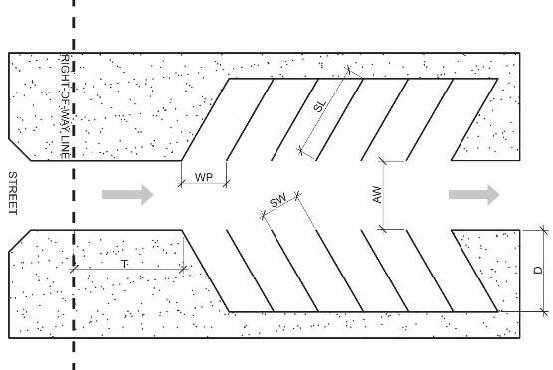
Adequate access to a public street shall be provided for each parking space. Minimum width of aisles providing access to stalls for one-way traffic shall be as follows: 11 feet for 30-degree parking; and 20 feet for 90-degree parking. The minimum width of aisles providing access to stalls for two-way traffic shall be 24 feet. No parking area of more than two spaces shall be designed as to require any vehicle to back into a public street. Driveways shall be at least ten feet wide for one- and two- family dwellings and a minimum of 20 feet for all other uses.
Figure 52-116(1): Parking Layout Dimensions
Notes:
1 Stall Depth (D) may be reduced by two feet, provided vehicle overhang is located over a landscaped area or pedestrian walk if said walk is oversized to provide a minimum of five feet of clear pedestrian access and a concrete curb or wheel stop is provided to protect vegetation and pedestrians.
(2)
Size of each parking space shall not be less than 162 square feet (nine feet by 18 feet), exclusive of the space required for ingress and egress. The Plan Commission may authorize up to ten percent of the required number of parking stalls be sized for compact or electric vehicles (eight feet by 16 feet).
(3)
Location shall be on the same lot as the principal use or not over 400 feet from the principal use. In cases where off-street parking facilities are permitted on land other than the same lot as the principal use (see Section 52- 116(11)), such facilities shall be in the same possession as the lot occupied by the use to which the parking facilities are accessory. Such possession shall be by deed whereby the owner of the land on which the parking facilities are to be located shall be bound by a covenant filed and recorded in the office of the Monroe County Register of Deeds requiring such owner or assignees to maintain the required facilities for the duration of the use served.
(4)
All off-street parking areas shall be an improved surface (see Section 52-14). Any parking area for more than five vehicles shall have the aisles and spaces clearly marked and shall be sufficiently screened in the form of a solid fence or shrubbery to protect adjacent residential uses. Any lighting used to illuminate off-street parking areas shall be fully shielded from residential properties and public streets in such a way as not to create a nuisance. However, in no case shall such lighting exceed half a footcandle measured at the lot line.
(5)
Curbs or barriers shall be installed so as to prevent parked vehicles from extending over any lot lines in all non-residential zoning districts and for any residential land use with three or more dwelling units.
(6)
Number of parking stalls required:
(7)
Uses not listed. In the case of structures or uses not mentioned, the provision for a use which is similar shall apply or the Zoning Administrator may rely on standards and parking ratios that appear in the most recent edition of the Institute of Traffic Engineers Parking Generation Manual.
(8)
Combined uses. Combinations of any of the above uses shall provide a minimum of 80 percent of the sum of the number of stalls required for each individual use. Two or more uses may provide required off-street parking spaces in a common parking facility less than 80 percent of the sum of the spaces required for each use individually, provided such uses are not operated during the same hours. The following conditions must be met for any joint use parking area (for downtown parking standards see Section 52-116(12) below):
a.
The proposed joint parking space is within 1,000 feet of the use it will serve.
b.
The applicant shall show that there is no substantial conflict in the principal operating hours of the two buildings or uses for which joint use of off-street parking facilities is proposed.
c.
A properly drawn legal instrument approved by the common council, executed by the parties concerned, for joint use of off-street parking facilities shall be filed with the city clerk. Said instrument may be a three-party agreement, including the city and all private parties involved. Such instrument shall first be approved by the city attorney.
(9)
In addition to any other requirements relating to parking spaces contained in the Code, the provisions contained in Wis. Stats. §§ 101.13, 346.503 and 346.56, and any Wisconsin Administrative Code sections adopted pursuant thereto, are adopted by reference and made applicable to all parking facilities whenever constructed.
(10)
Changes in buildings or use. Whenever a building or use is changed, structurally altered or enlarged to create a need for an increase of 25 percent or more in the number of existing parking spaces, such spaces shall be provided on the basis of the enlargement or change. Whenever a building or use is enlarged or changed to create a need for an increase to the extent of 50 percent or more in the floor area or required parking spaces, said building or use shall then comply with the parking requirements set forth in Section 52-116(6).
(11)
Parking lots not on the same parcel or lot as the principal use or parking lots which require the moving or demolition of structures. In addition to meeting the other requirements set forth in this section, parking lots in all zoning districts, except the light industrial and heavy industrial districts, for the parking of motor vehicles which are not on the same original parcel or original lot, whether on record or not, as that of the principal use, or which necessitate the moving or demolition of any structure or building, shall require the granting of a conditional use permit by the Plan Commission. The application for such conditional use permit shall state the location, current use of the property, whether any structures or buildings will be demolished and the type of such structures or buildings, the size of the parking lot, the purpose of the parking lot, and such other information as may be required by the Plan Commission. In determining whether to grant such conditional use permit, the Plan Commission shall consider any decrease in neighborhood values by permitting such use, any landscaping, drainage, or site plans of such proposed parking lot and the characteristics of the surrounding neighborhood. An opaque privacy fence of a minimum of five feet and no more than six feet in height may be required in residential zoned districts if requested by an abutting residential property owner. Such fence shall comply with Section 52-209 for fence installation and shall run from the front set back line to the rear property line. All abutting residential property owners shall be notified of this privacy fence provision in the notice from the City Clerk's Office.
(12)
Downtown parking minimum reduction. No off-street parking requirements of this Section are required for uses within the Downtown Design Overlay District (Section 52-42), as identified in the Downtown Master Plan.
(13)
Exceptions.
a.
The Plan Commission may authorize exceptions to the parking standards or other requirements of this section where the applicant can demonstrate that the proposed use will generate less parking demand than the parking standard requirements, or where an exception from the requirements would result in a site plan and development that would benefit the City and be consistent with the intent of this section. An applicant requesting an exception to the parking requirements shall be required to demonstrate and document the projected parking demand based on an analysis of similar or comparable uses;
b.
The Plan Commission may require less parking where it is determined that the number of stalls required by this section will exceed the demand;
c.
In granting exceptions to the parking standards, the Plan Commission shall condition the approval of the Site Plan stating the parking reduction as determined in b. above.
(14)
In residential districts and on lots associated with residential uses, accessory off-street parking facilities shall be solely for the parking of motor vehicles, which shall be regulated as follows:
a.
No front yard of any residential district and no front yard of a lot associated with a residential use shall be used for the parking of a motor vehicle except in approved driveways. Motor vehicles parked on any legal driveway shall not be permitted to encroach on any right-of-way line of a street.
b.
A maximum of one commercial vehicle per dwelling unit may be parked outdoors on residential property provided that the vehicle is used by a resident of the dwelling unit, has a manufacturer's gross vehicle weight rating of 10,000 pounds or less, and is less than 21 feet in length.
c.
No person shall park any motor truck, truck trailer, trailer, semitrailer or any other vehicle or combination of vehicles weighing more than 10,000 pounds, except recreational vehicles or motor homes are permitted if parked in a driveway or other legal off-street parking space.
d.
A recreational vehicle (RV) associated with and customary to residential uses may be parked as if a passenger vehicle but shall not be utilized for the storage of goods, materials, or equipment other than that which is considered part of the RV or essential to its function.
1.
No person shall park or store any recreational equipment within the front yard or corner side yard of any residential zoning district unless the equipment is parked on a driveway which meets all of the requirements in this Section.
2.
Recreational equipment may be stored on any type of surface in the rear yard or the interior side yard areas. If the rear yard of a corner lot abuts the side yard of an adjacent residence, any recreational equipment stored in said rear yard shall not be closer to the street than the required front yard setback distance for said adjacent residence.
3.
Recreational equipment longer than 30 feet shall not be stored anywhere outdoors in any residential zoning district unless the piece of recreational equipment is being loaded, unloaded, cleaned or otherwise prepared for use or extended storage. The time period that recreational equipment longer than 30 feet may be kept outdoors shall not exceed seven days during any 30 day period. For purposes of this subsection, the length of a piece of recreational equipment shall include any portion of a trailer that the equipment is loaded onto.
(Code 1993, § 17.42; Ord. No. 2007-09-08-C, § 8, 9-10-2007; Ord. No. 2017-09-14-D, § 1, 9-12-2017; Ord. No. 2025-03-04-D, § 1, 3-18-2025)
Sec. 52-117. - Driveways.
All driveways installed, altered, changed, replaced or extended after the effective date of this chapter shall meet the following requirements:
(1)
Islands between driveway openings except in R-1, R-2, R-3 and B districts shall be provided with minimum of 12 feet between all driveways and three feet at all lot lines.
(2)
Openings for vehicular ingress and egress shall not exceed 35 feet at the roadway.
(3)
Vehicular entrances and exits to drive-in theaters, banks and restaurants, motels, funeral homes, vehicular sales, service, washing and repair stations; garages; or public parking lots shall be not less than 200 feet from any pedestrian entrance or exit to a school, college, university, church, hospital, park, playground, library, public emergency shelter or other place of public assembly.
(Code 1993, § 17.43)
Sec. 52-118. - Highway access.
No direct private access shall be permitted to the existing or proposed rights-of-way of expressways nor to any controlled access arterial street without permission of the highway agency that has access control jurisdiction.
(1)
No direct public or private access shall be permitted to existing or proposed rights-of-way of the following:
a.
Freeways, interstate highways, interchanges or turning lanes and intersecting or interchanging streets within 1,500 feet of the most remote end of taper of turning lanes.
b.
Arterial streets intersecting another arterial street within 100 feet of the intersection of the right-of-way lines.
c.
Streets intersecting an arterial street within 50 feet of the intersection of the right-of-way lines.
(2)
Access barriers, such as curbing, fencing, ditching, landscaping or other topographic barriers, shall be erected to prevent unauthorized vehicular ingress or egress to the streets or highways specified in subsection (1) of this section.
(3)
Temporary access to the above rights-of-way may be granted by the plan commission after review and recommendation by the highway agencies having jurisdiction. Such permits shall be temporary, revocable, subject to any conditions required, and issued for a period not to exceed 12 months.
(Code 1993, § 17.44)

