


Town Of Century City Zoning Code
CHAPTER 86
SITE DESIGN STANDARDS
ARTICLE V. - OFF-STREET PARKING AND LOADING[4]
Cross reference— Traffic and motor vehicles, ch. 38.
ARTICLE VII.- SUPPLEMENTAL STANDARDS[5]
Cross reference— Supplementary district regulations, ch. 90.
Sec. 86-1.- Purpose and intent.
The purpose of this chapter is to provide site development standards applicable to all development activity in the town. The provisions are intended to ensure functional and attractive development. The standards allow for flexibility in site design, while ensuring compatibility of neighboring uses through design features such as landscaped buffers. All development shall be designed to avoid unnecessary impervious surface coverage and adverse effects of traffic, noise and drainage on surrounding properties.
(Ord. No. 2-91, § 6.00.01, 4-29-1991)
Sec. 86-31.- Generally.
This article contains basic standards applicable to the character and land use districts established in the Land Development Code. These standards regulate the density of residential development, the floor area ratio of nonresidential development, and the impervious surface ratio, open space ratio and maximum height of both residential and nonresidential development. These development standards are designed to encourage innovative design, such as zero lot line and cluster housing. The standards also allow for flexibility in determining lot sizes and building placement.
(Ord. No. 2-91, § 6.01.01, 4-29-1991)
Sec. 86-32. - Density.
The density is the relationship between the number of dwellings on a site and the base site area. The base site area is the gross site area minus the land devoted to public rights-of-way. The density is calculated by adding together all the dwelling units on a site and dividing this total by the base site area.
(Ord. No. 2-91, § 6.01.02, 4-29-1991)
Sec. 86-33. - Floor area ratio.
(a)
Generally. A floor area ratio is a measurement of the intensity of development on a site. For purposes of the Land Development Code, floor area ratio (FAR) is provided only for nonresidential development.
(b)
Calculating floor area ratio. The floor area ratio is the relationship between the total floor area on a site and the gross site area. The FAR is calculated by adding together all floor areas of all floors and dividing this total by the gross site area.
(Ord. No. 2-91, § 6.01.03, 4-29-1991)
Sec. 86-34. - Impervious surface and open space ratios.
(a)
Generally.
(1)
An impervious surface ratio is a measurement of the amount of the site that is covered by any material that substantially reduces or prevents the infiltration of stormwater into previously undeveloped land. Impervious surfaces include, but are not limited to, roofs and streets, sidewalks and parking lots paved with asphalt, concrete, compacted sand, limerock or clay. The impervious surface ratios (ISR) in section 86-35 are applicable to both residential and nonresidential development.
(2)
An open space ratio is a measurement of the amount of the site that is devoted to recreation, resource protection, amenity and/or landscaped buffers. Open space may include, but is not limited to, lawns, decorative planting, walkways, active and passive recreation areas, playgrounds, fountains, swimming pools, wooded areas and watercourses. Open space does not include driveways, parking lots or other surfaces designed or intended for vehicular travel. The open space ratios (OSR) in section 86-35 are applicable to both residential and nonresidential development.
(b)
Calculating impervious surface and open space ratios.
(1)
The ISR is calculated by adding together all the square footage of all impervious surfaces and dividing this total by the gross site area.
(2)
The OSR is calculated by adding together all the square footage of all open space and dividing this total by the gross site area.
(Ord. No. 2-91, § 6.01.04, 4-29-1991)
_____
Sec. 86-35. - Table of development standards.
(Ord. No. 2-91, § 6.01.05, 4-29-1991)
_____
Sec. 86-71.- Purpose.
It is the purpose of this article to encourage new development and redevelopment of exceptionally high quality and design that furthers town policies as established in the town comprehensive plan. The density and intensity bonuses set forth in this article are intended to encourage the provision of affordable housing and recreational facilities. The purpose of the affordable housing density bonus is to expand housing opportunities for low and moderate income persons throughout the town by providing increased residential densities to developers who guarantee that a portion of their housing development will be affordable to persons of low and moderate income. The purpose of the recreational bonus is to expand recreational opportunities in the town and to permanently preserve open space.
(Ord. No. 2-91, § 6.02.01, 4-29-1991)
Sec. 86-72. - Utilization of density and intensity bonuses.
Density and intensity bonuses may be utilized in any land use category except the recreation and open space categories.
(Ord. No. 2-91, § 6.02.02, 4-29-1991)
Sec. 86-73. - Calculation of bonuses.
Density and intensity bonuses shall be based on the following bonus allocation system:
(1)
Provision of affordable housing. Determine the percentage of total housing units in a residential project that are devoted to affordable housing in accordance with section 86-74, and calculate that percentage as a bonus, up to a maximum of 25 percent.
(2)
Provision of active recreational facilities. Determine the percentage of the total acres in the project that are devoted to active recreational use, in accordance with section 86-75, and calculate half that percentage as a bonus, up to a maximum of ten percent. To qualify for a bonus, the recreation facilities may not be used to satisfy the minimum open space requirements of section 86-35.
(Ord. No. 2-91, § 6.02.03, 4-29-1991)
Sec. 86-74. - Affordable housing density bonus.
(a)
Submittals. All proposed development requesting additional density for the provision of affordable housing shall provide the following information on the application for development approval:
(1)
The application for approval of a proposed development shall indicate that the development approval is requested through compliance with the bonus standards.
(2)
The application shall clearly show the units affordable by persons and families of low or moderate income, showing the basis for the requested density bonus.
(b)
Review of density bonus application.
(1)
After a duly noticed public hearing, the town council may grant a density bonus for projects that include units affordable to low or moderate income persons, allowing a greater number of units than the maximum shown in section 86-35. The number of bonus units shall not exceed 25 percent of the maximum number of units permitted in the base district without a density bonus.
(2)
If the density bonus is approved, the developer shall enter into an agreement with the town. The town attorney shall approve all such agreements prior to execution. The agreement shall contain, among other items, the terms and conditions of the deed restrictions to be placed on the units to ensure that the units remain affordable to low and moderate income persons for a period of at least 30 years. The restrictions shall run with the land and shall be enforceable by the town until such restrictions expire.
(c)
Location of affordable units. In order to qualify for a density bonus, the affordable units may be located on site and integrated into the development project or off site, provided that the applicant makes a satisfactory showing to the town council that the units will be located in an area with a demonstrated need for affordable housing units.
(d)
Criteria for affordable housing.
(1)
A housing unit shall be considered affordable housing if it meets, and continues to meet for 30 years, one of the two following conditions:
a.
The housing unit has an annual rental rate that is less than or equal to 33 percent of the median family income of the town; or
b.
The housing unit has an annual cost, including property taxes, after a ten percent down payment, that is less than or equal to 33 percent of the median family income of the town.
(2)
The town median family income shall be that figure published and periodically updated for the town as a whole by the U. S. department of housing and urban development (HUD) or another source determined to be more appropriate by the town council.
(Ord. No. 2-91, § 6.02.04, 4-29-1991)
Sec. 86-75. - Bonus for active recreational facilities.
(a)
Submittal requirements. To qualify for a density or intensity bonus, a proposal for a project that includes active recreational facilities beyond those otherwise required by the town shall be accompanied by an agreement to be recorded with the town clerk, guaranteeing the construction of those facilities in a timely manner acceptable to the town. The documents shall not be accepted until approved by the town attorney.
(b)
Recreational facilities standards. The town shall find that the recreation facilities are provided in addition to the minimum open space requirements contained in the table of development standards in section 86-35, that there exists a demonstrated need for the facilities in the proposed location and that the proposal is consistent with the recreation and open space element of the comprehensive plan. The types of recreational facilities that would qualify a project for a density or intensity bonus include, but are not limited to:
(1)
Pedestrian walking trails, bikeways and equestrian trails;
(2)
Swimming pools;
(3)
Tennis courts;
(4)
Playgrounds equipped with a full complement of playground equipment; and
(5)
Golf courses.
(Ord. No. 2-91, § 6.02.05, 4-29-1991)
DIVISION 3. - LANDSCAPING OF VEHICULAR USE AREAS[2]
Cross reference— Traffic and motor vehicles, ch. 38.
DIVISION 4. - REMOVAL OF TREES AND NATIVE VEGETATION[3]
Cross reference— Trimming of trees and shrubbery, app. A, § 3.5.
DIVISION 2. - MANUFACTURED HOUSING SITED IN RESIDENTIAL LAND USE DISTRICTS[6]
Cross reference— Manufactured housing, § 70-81 et seq.
Sec. 86-101. - Purpose.
The purpose of this article is to protect the quality of water resources from future degradation by maintaining vegetative cover and controlling disturbances to vegetation, to encourage the selection of native plant species for vegetation, to reduce the impact of urban and suburban development on remaining stands of natural vegetation, to provide shade, to reduce heat and glare, to abate noise pollution, to provide habitat for living things and to buffer incompatible uses.
(Ord. No. 2-91, § 6.03.01(A), 4-29-1991)
Sec. 86-102. - Exemptions from provisions.
Lots or parcels of land on which a single family home is used as a residence shall be exempt from the provisions of these landscaping regulations, except that champion, heritage, historic and specimen trees on such parcels shall be protected according to the tree protection regulations. This exemption shall not be construed to apply to residential subdivisions or other residential developments that require site plan approval.
(Ord. No. 2-91, § 6.03.01(B), 4-29-1991)
Sec. 86-103. - Diversity of plantings.
Diversity of plantings should be strived for in all required landscape plantings, and in no case should one species constitute more than 50 percent of a planting.
(Ord. No. 2-91, § 6.03.01(C), 4-29-1991)
Sec. 86-104. - Prohibited plants.
The following plants shall not be installed as landscape material:
(1)
Kudzu (Pueraria lobata); and
(2)
Popcorn or Chinese Tallow Tree (Saptium Sebiferum).
(Ord. No. 2-91, § 6.03.01(D), 4-29-1991)
Sec. 86-121. - Purpose and intent.
This division requires landscaped buffers to be provided and maintained when certain land uses are adjacent to or directly across from each other in order to protect uses from the traffic, noise, glare, trash, vibration and odor likely to be associated with a more intensive land use. Landscaped buffers are also required to consider the values of land and buildings and to provide adequate light and air. The width of the buffer and the required plantings within the buffer vary depending upon the relative intensities of the abutting or adjacent uses. The buffer requirements are intended to be flexible; the developer may choose among a number of combinations of buffer width and buffer plantings to satisfy the requirement.
(Ord. No. 2-91, § 6.03.02(A), 4-29-1991)
Sec. 86-122. - How to determine landscaped buffer requirements.
Landscaped buffers shall be located at the perimeter of the building site for any given use, and shall not be located in any portion of a public right-of-way. The following procedure shall be followed to determine the type of landscaped buffer required:
(1)
Identify the land use category of the proposed use by referring to section 70-3. Identify the land use category of the adjacent adjoining uses by on-site survey.
(2)
Identify whether the proposed and adjacent or adjoining uses are high impact, medium impact, or low impact, residential class I or residential class II uses by referring to section 86-125.
(3)
Determine the landscaped buffer required on each building site boundary, or portion thereof, by referring to section 86-126.
(4)
Select the desired landscaped buffer option from those set forth in section 86-127. Any of the listed options shall satisfy the requirement of buffering between adjacent or adjoining land uses.
(Ord. No. 2-91, § 6.03.02(B), 4-29-1991)
Sec. 86-123. - Landscaped buffer design and materials.
(a)
Existing native plant material. The use of existing native species of plant material is strongly encouraged in landscaped buffers. Existing natural ground cover should be retained where possible by avoiding scraping, grading and sodding within the landscaped buffer. Where the planting requirements of section 86-127 require additional trees or shrubs to be installed in an existing natural area, it should be done in a manner which minimizes disturbance to natural species.
(b)
Planting requirements. Where the planting requirements of section 86-127 require additional trees to be installed in the landscaped buffer, required canopy trees shall be selected from the medium and large trees on the protected tree and tree replant lists in sections 86-182 and 86-186. Understory trees shall be selected from the small trees on the protected tree and tree replant lists in sections 86-182 and 86-186. Required shrubs shall be selected from the following list or other shrubs identified by a landscape architect or biologist and approved by the town:
(1)
Ligustrum (Ligustrum japonicum)
(2)
Azalea (Rhododendron indicum, Rhododendum simsii, Rhodendron obtusum)
(3)
Red top (Photinia glabra and Photinia froseri)
(4)
Cleyera (Cleyera japonica)
(5)
Pampas grass (Cortaderia selloana)
(6)
Thorny elaeagnus (Elaeagnus pungens)
(7)
Silverberry (Elaeagnus macrophylla)
(8)
English holly (Ilex aquifolium)
(9)
Wax myrtle (Myrica cerifera)
(10)
Chinese holly (Ilex cornuta)
(11)
Japanese holly (Ilex crenata)
(12)
Yaupon holly (Ilex vomitoria)
(13)
Oleander (Nerium oleander)
(14)
Chinese juniper (Juniperus chinensis)
(15)
Savin juniper (Juniperus sabina)
(16)
Rocky Mountain juniper (Juniperus scopulorum)
(17)
Southern Red Cedar (Juniperus virginiana)
(c)
Mixed-use development. Where a building site is used for a single mixed-use development, landscaped buffers shall not be required between the various constituent uses. Landscaped buffers required at the perimeter of the development shall be based upon the individual uses on each portion of the property.
(d)
Parking lot landscaping. Perimeter plantings required for parking lot landscaping may be counted toward satisfying buffer requirements.
(Ord. No. 2-91, § 6.03.02(C), 4-29-1991)
Sec. 86-124. - Use of landscaped buffers.
(a)
Open space. Landscaped buffers may be counted toward satisfying open space requirements, and may be used for passive recreation. They may contain pedestrian or bike trails, provided that the total width of the bufferyard is maintained. In no event, however, shall the following uses be permitted in landscaped buffers: playfields, stables, swimming pools, tennis courts, parking lots and vehicular use areas, dumpsters, equipment storage and other open storage, buildings or overhangs.
(b)
Stormwater retention/detention facilities. The town shall be authorized to allow stormwater retention/detention facilities to encroach into landscaped buffers a maximum of 40 percent of buffer width, where it is found that all planting requirements of this division are met and the visual screen provided by the landscaped buffer will be fully achieved.
(Ord. No. 2-91, § 6.03.02(D), 4-29-1991)
Sec. 86-125. - Classification of uses for determining buffer requirements.
(a)
Nonresidential uses. For the purposes of determining landscaped buffer requirements, nonresidential land uses are classified as either high, medium, or low impact uses as follows:
(1)
High impact uses. High impact uses are particular uses of land that, because of their operational and physical characteristics are expected to have a strong effect on abutting or adjacent uses. High impact uses include:
a.
Water and wastewater treatment plants; and
b.
All accessory uses associated with the above uses.
(2)
Medium impact uses. Medium impact uses are particular uses of land that, because of their operational and physical characteristics are expected to have a moderate effect on adjoining or adjacent uses. Medium impact uses include:
a.
General commercial uses, as defined in section 70-56, except for professional and office uses and neighborhood commercial uses;
b.
Public service uses, as defined in section 70-57, except for water and wastewater treatment plants;
c.
Industrial uses, as defined in section 70-60; and
d.
All accessory uses associated with the above uses.
(3)
Low impact uses. Low impact uses are particular uses of land that, because of their operational and physical characteristics are expected to have a limited effect on abutting or adjacent uses. Low impact uses include:
a.
Institutional uses, as defined in section 70-52;
b.
Outdoor recreation uses; as defined in section 70-53;
c.
Professional service and office uses, as defined in section 70-54;
d.
Neighborhood commercial uses, as defined in section 70-55;
e.
Utility uses, as defined in section 70-58, except for public utility rights-of-way; and
f.
All accessory uses associated with the above uses.
(b)
Residential uses. For the purposes of determining landscaped buffer requirements, residential uses are classified as follows:
(1)
Residential class I.
a.
Residential uses, as defined in section 70-51, with a density of less than six units per acre. However, single-family homes that are not part of larger development requiring site plan approval are exempt from all landscaped bufferyard requirements, in accordance with section 86-102; and
b.
All accessory uses associated with the above uses.
(2)
Residential class II.
a.
Residential uses, as defined in section 70-51, with a density greater than or equal to six units per acre; and
b.
All accessory uses associated with the above uses.
(Ord. No. 2-91, § 6.03.02(E), 4-29-1991)
_____
Sec. 86-126. - Table of landscaped buffer requirements.
(Ord. No. 2-91, § 6.03.02(F), 4-29-1991)
_____
Sec. 86-127. - Landscaped buffer options.
(a)
These specifications are to be used to select the desired landscaped buffer option for the building site. These buffer requirements are stated in terms of the width of the linear feet of the buffer. To determine the total number of plants required, the length of each side of the property requiring a buffer shall be divided by 100 and multiplied by the number of plants shown in the illustration in section 86-128.
(b)
The buffer is normally calculated as parallel to the property line. However, design variations, especially when used to incorporate native vegetation into the buffer area, are allowed. The edges of the landscaped buffer may meander provided that:
(1)
The total area of the buffer is equal to or greater than the total area of the required landscaped buffer; and
(2)
The landscaped buffer measures at least five feet in width at all points along the perimeter of the property line of the site requiring a buffer.
(c)
When the requirements of this division result in a fractional number of plantings, the fraction shall be counted as one plant unit.
(Ord. No. 2-91, § 6.03.02(G), 4-29-1991)
Sec. 86-128. - Responsibility for landscaped buffers.
(a)
The desired width of a landscaped buffer between two parcels is the sum of the required landscaped buffers of the parcels.
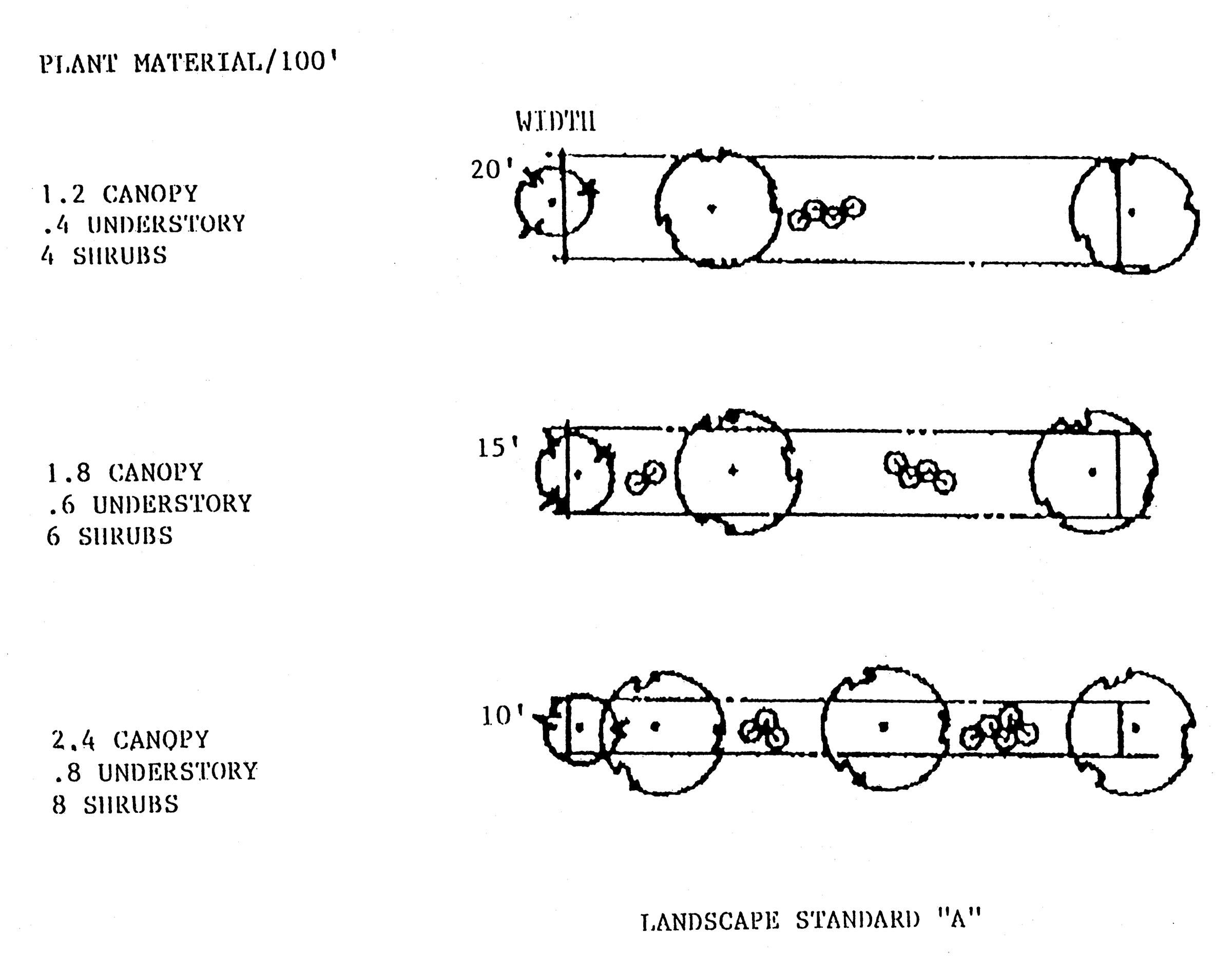
Landscape Standard "A"
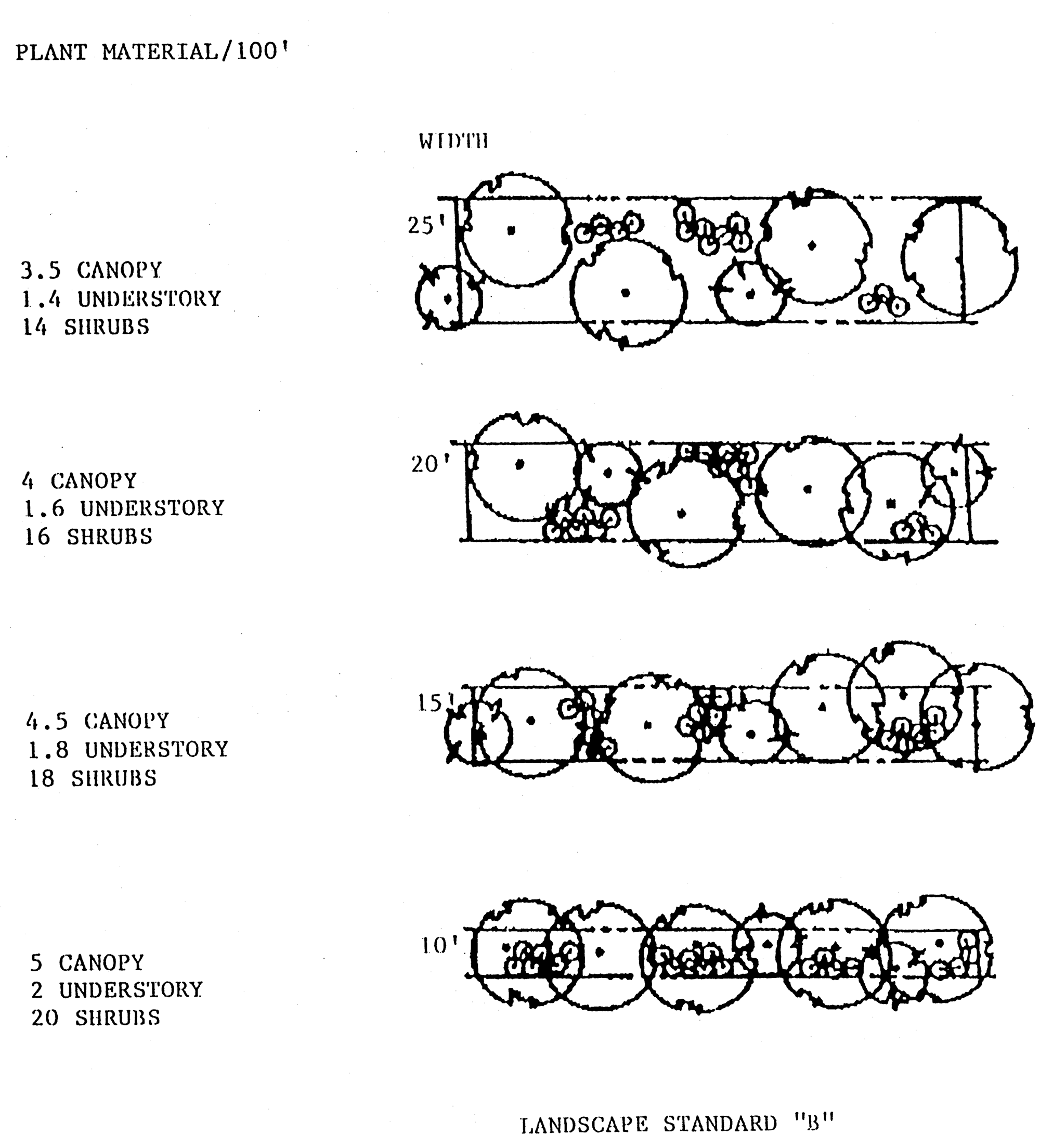
Landscape Standard "B"
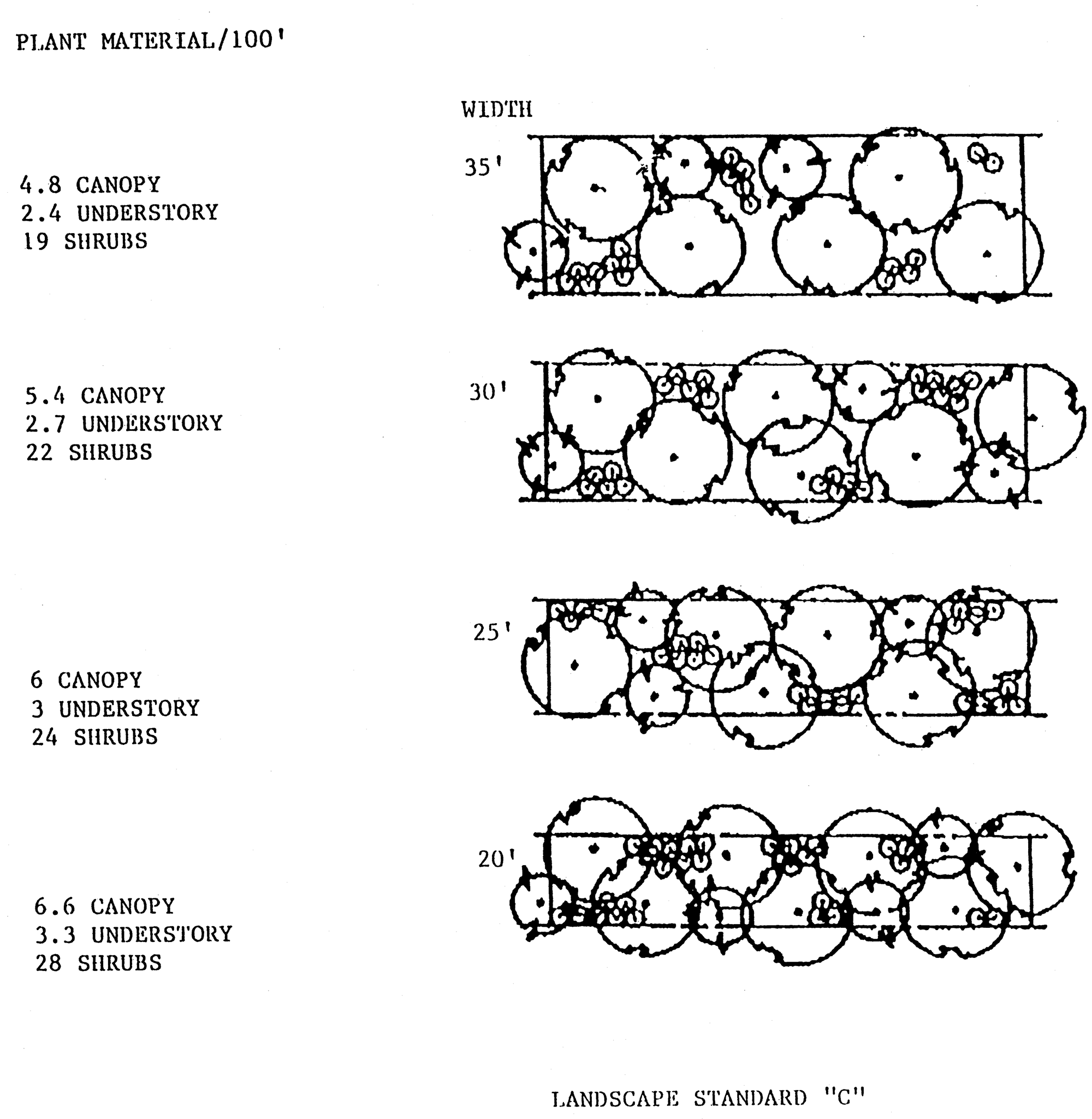
Landscape Standard "C"
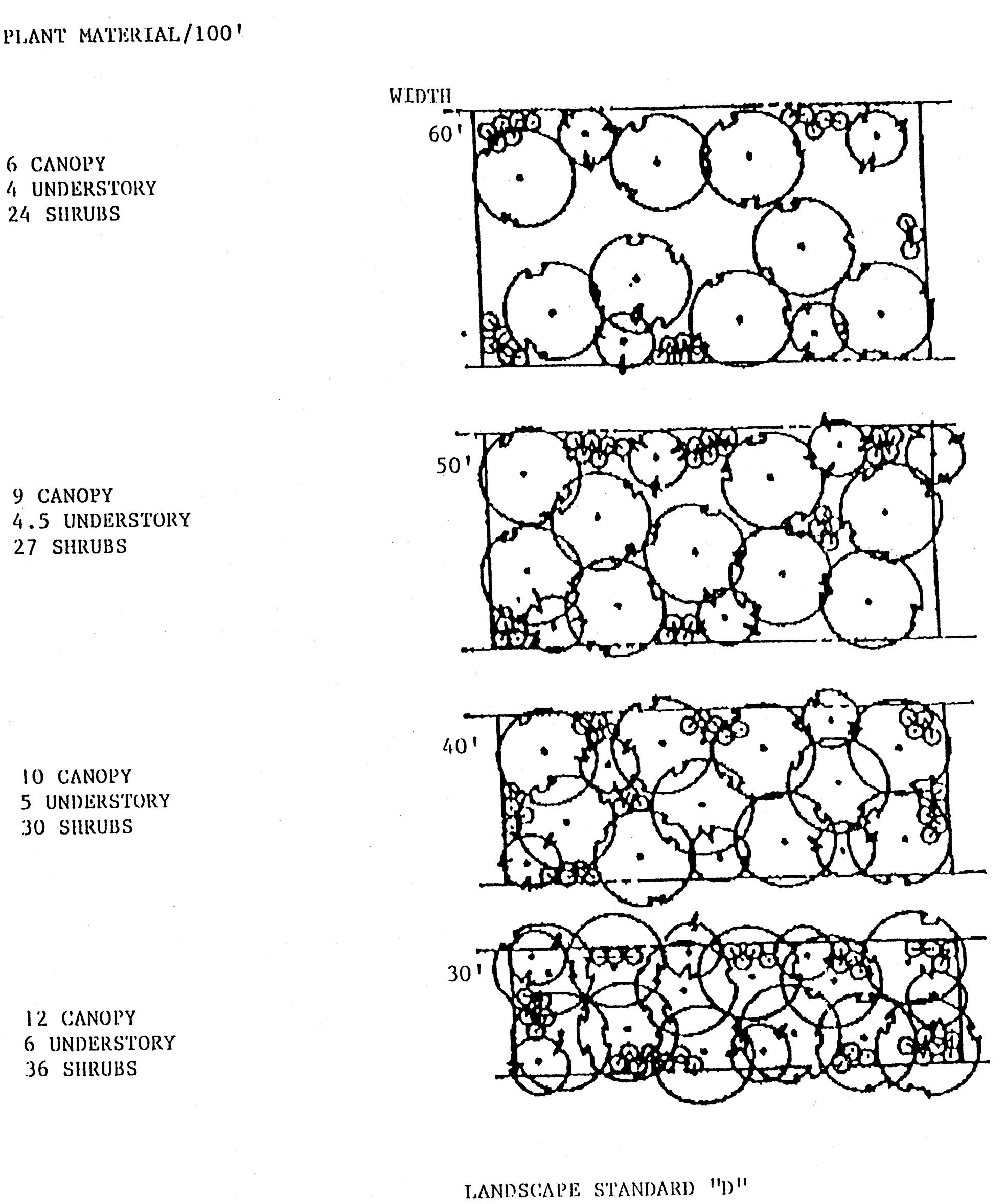
Landscape Standard "D"
Where a new use is proposed next to an existing use that has less than the required buffer for that use, a lesser buffer will be allowed, except as provided below, until the nonconforming parcel is redeveloped and brought into conformity with the buffer requirements of the Land Development Code. The developer of the new adjoining use is encouraged, however, to take into account the inadequacy of the adjoining buffer in designing the site layout of the new development.
(b)
Where a residential use is proposed next to an existing nonresidential use, or a nonresidential use is proposed next to an existing residential use, and the existing use does not have a conforming buffer abutting the property proposed for development, the proposed use shall provide 80 percent of the combined required buffer of the two uses. Where the existing use has a buffer, but such buffer does not meet the requirements of the Land Development Code, the proposed use may provide less than 80 percent of the combined required buffers if the provision of such lesser amount will create a buffer meeting 100 percent of the combined required buffer of the two uses.
(c)
Where a proposed use is adjacent to a vacant parcel, the proposed use shall provide the following buffers:
(d)
The maintenance of all landscaped buffers shall be the responsibility of the property owner. Failure to maintain such landscaped buffers in an attractive and healthy state shall be considered a violation of this chapter subject to enforcement in accordance with chapter 66.
(Ord. No. 2-91, § 6.03.02(H), (I), 4-29-1991)
Sec. 86-151. - Applicability.
The requirements of this division shall apply to off-street parking facilities and other vehicular use areas that:
(1)
Have ten or more parking spaces; or
(2)
Are designed to accommodate vehicles that are larger or smaller than automobiles and are over 3,500 square feet in area.
(Ord. No. 2-91, § 6.03.03(A), 4-29-1991)
Sec. 86-152. - Perimeter requirements.
A ten-foot wide strip of land, located along the front property line adjacent to the street right-of-way shall be landscaped. In no case shall this strip be less than ten feet wide. Width of sidewalks shall not be included within the ten-foot-wide front perimeter landscape area.
(1)
Landscaped material requirements in perimeter area.
a.
One tree for each 50 feet of linear foot frontage along the right-of-way shall be preserved or planted. Trees planted to meet this requirement shall measure a minimum of three inches in diameter at breast height. The remaining area within the perimeter strip shall be landscaped with other landscape materials. However, trees planted under or within a space of 15 feet of either side of overhead or underground utilities shall be selected from the approved tree list for planting near utility lines. Trees planted shall measure a minimum of one-inch in diameter at breast height.
b.
Trees and other landscaping required in the perimeter strip shall be maintained to assure unobstructed visibility between three and nine feet above the average grade of the adjacent street and driveway intersections through the perimeter strip.
(2)
Tree replant list for use near overhead and underground utility lines.
a.
Glossy Privet (Ligustrum lucidum)
b.
Loquat (Eriobotrya japonica)
c.
Red Buckeye (Aesculus pavia)
d.
Hawthorns (Crateagus spp.)
e.
Silverbell (Halesia coroliniana)
f.
Yaupon Holly (Ilex vomitoria)
g.
Ashe Magnolia (Magnolia ashei)
h.
Wax Myrtle (Myrica cerifera)
i.
Flatwoods Plum (Prunus umbellata)
j.
Hoptree (Ptelea trifoliata)
k.
Myrtle Oak (Quercua myrtifolia)
l.
Virginia Stewartia (Stewartia malacodentron)
m.
Rusty Blackhaw (Viburnum rufidulum)
n.
Crape Myrtle (Lagerstroemia indica)
o.
Crab Apple (Malus Angustifolia)
(Ord. No. 2-91, § 6.03.03(B), 4-29-1991)
Sec. 86-153. - Interior planting areas.
(a)
At least ten percent of the gross area of the interior vehicular use area shall be landscaped. Interior planting areas are to be located within or adjacent to the parking area as tree islands, at the end of parking bays, inside seven-foot wide or greater medians, or between rows of cars or as part of continuous street or transitional protective yards. Interior planting areas shall be located to most effectively accommodate stormwater runoff and provide shade in large expanses of paving and contribute to orderly circulation of vehicular and pedestrian traffic.
(1)
No more than 15 parking spaces shall be permitted in a continuous row without being interrupted by an interior planting area.
(2)
Trees shall be required at the minimum rate of one shade tree for every 3,500 square feet of total vehicular use area. All vehicular use areas located within the same block which serve one or more businesses or uses of land or share unified ingress and egress shall be considered as a single vehicular use area for the purpose of computing the required rate of trees, notwithstanding ownership. Required trees shall be selected from the designated shade trees on the protected tree list in section 86-182 or the tree replant list 86-186 and shall be at least eight feet in height and three inches in diameter at breast height.
(b)
The minimum size of interior planting areas is as follows:
(1)
A minimum of 90 square feet of planting area shall be required for each new small shade tree.
(2)
A minimum of 125 square feet of planting area shall be required for each medium or large shade tree.
(c)
A minimum planting area of 50 percent of the dripline area of the tree shall be required for all existing trees. If conditions warrant that an area greater than 50 percent is needed to preserve the tree, additional areas may be negotiated between the applicant and the town.
(d)
In no case shall the minimum planting area be less than 90 square feet.
(Ord. No. 2-91, § 6.03.03(C), 4-29-1991)
Sec. 86-154. - Vehicle overhang.
(a)
Vehicles shall not overhang more than two feet into any interior planting area or perimeter strip.
(b)
Where landscaping is installed in interior or perimeter strip planting areas, a continuous curb or other acceptable means of protection shall be provided to prevent injury to the vegetation. Such curb shall be designed to allow percolation of the water to the root system of the landscape material. Where existing trees are preserved, tree wells, tree islands or a continuous curb shall be utilized to protect the trunk and root system from alterations to surrounding grade elevations and damage from automobiles. A drainage system, sufficient enough to allow percolation into permeable soil, shall be provided in the area defined by the dripline of the tree.
(Ord. No. 2-91, § 6.03.03(D), 4-29-1991)
Sec. 86-181. - Permit required to remove protected trees.
Unless exempt from the provisions of this article, no person shall remove, or in any way damage any protected tree without first obtaining a permit from the town.
(Ord. No. 2-91, § 6.03.04(A), 4-29-1991)
Sec. 86-182. - Protected trees.
The following trees are considered protected trees for the purposes of the Land Development Code:
(1)
All trees with a diameter at breast height of 18 inches or greater.
(2)
Small trees—Diameter at breast height of four inches or greater.
(3)
For the purposes of the Land Development Code, the following is the protected tree list:
a.
Species type A—Small, 4-inch—7-inch diameter trunk:
Dogwood (Cornus florida)
Redbud (Cercis canadensis)
b.
Species type B—Medium, 8-inch—13-inch diameter trunk:
American holly (Ilex opaca)
Southern magnolia (Magnolia grandiflora)*
Eastern red cedar (Juniperus virginiana)*
Southern red cedar (Juniperus silicicola)*
c.
Species type C—Large 14-inch plus diameter trunk:
Live oak (Quercus virginiana)*
Laurel oak (Quercus laurifolia)*
Sweet gum (Liquidambar styraciflua)*
Sycamore (Platanus occidentalis)*
Pecan (Carga illinoensis)*
Water oak (Quercus nigra)*
Red maple (Acer rubrum)*
* Shade trees
(Ord. No. 2-91, § 6.03.04(B), 4-29-1991)
Sec. 86-183. - Exemptions.
In addition to the exemption for single family homes set forth in section 86-102, the following uses shall be exempt from the tree protection requirements:
(1)
Single family dwelling units. Lots or parcels of land on which a single-family home is used as a residence shall be exempt from all provisions of the tree protection regulations, except those residences located within the Alger-Sullivan historic district. This exemption shall not be construed to apply to residential subdivisions or other residential developments that require site plan approval.
(2)
Utility operations. Tree pruning and removals by duly constituted communication, water, sewer, electrical or other utility companies or federal, state, or county agencies, or engineers or surveyors working under a contract with such utility companies or agencies shall be exempt, provided the removal is limited to those areas necessary for maintenance of existing lines or facilities or for construction of new lines or facilities in furtherance of providing utility service to its customers, and provided further that the activity is conducted so as to avoid any unnecessary removal and, in the case of aerial electrical utility lines, is not greater than that specified by the National Electrical Safety Codes as necessary to achieve safe electrical clearances. All pruning and trimming shall be done in accordance with National Arborist Association Standards.
(3)
Rights-of-way/surveyors. The clearing of a path for existing or new roadway rights-of-way, provided that the rights of way are for existing roadways that are built in conformance with town standards or for new roadways that will be built in conformance with town standards. To qualify for the exemption for new roadways, the developer must post a bond, letter of credit, cash, or other security guaranteeing the repair or replacement of the roadways in accordance with section 58-25. The width of the path shall not exceed the right-of-way width standards for each type of roadway established in sections 66-51—66-57. A state licensed land surveyor shall be exempt in the performance of his duties, provided such land alteration is limited to a swath three feet or less in width.
(4)
Commercial growers. All commercial nurseries, botanical gardens, tree farms and grove operations shall be exempt from the provisions of this subsection, but only as to those trees and sites which were planted or managed for silvicultural or agricultural purposes or for the sale or intended sale in the ordinary course of business.
(5)
Emergencies. During emergencies caused by hurricane or other disaster, the town may suspend these tree protection regulations.
(Ord. No. 2-91, § 6.03.04(C), 4-29-1991)
Sec. 86-184. - Conditions for tree removal permit.
(a)
It is the intent of this article to minimize the removal of protected trees and that no permit shall be granted to remove a tree if the developer has failed to take reasonable measures to design and locate the proposed improvements so that the number of protected trees to be removed is minimized. In particular, the design must attempt to preserve specimen and historic trees.
(b)
No permit for the removal of a protected tree shall be granted unless the developer demonstrates one or more of the following conditions:
(1)
A permissible use of the site cannot reasonably be undertaken unless specific trees are removed or relocated.
(2)
The tree is located in such proximity to an existing or proposed structure that the safety, utility or structural integrity of the structure is materially impaired.
(3)
The tree materially interferes with the location, servicing or functioning of existing utility lines or services.
(4)
The tree creates a substantial hazard to motor, bicycle or pedestrian traffic by virtue of physical proximity to traffic or impairment of vision.
(5)
The tree is diseased, insect ridden, or weakened by age, abuse, storm or fire and is likely to cause injury or damage to people, buildings or other improvements.
(6)
Any law or regulation requires the removal.
(c)
The procedures for obtaining a tree removal permit shall be in accordance with section 58-44.
(Ord. No. 2-91, § 6.03.04(D), 4-29-1991)
Sec. 86-185. - Replacement of removed trees.
(a)
Trees removed pursuant to section 86-184 shall be replaced at the expense of the developer. Removed protected trees shall be replaced with a protected tree species or a species identified on the tree replant list.
(b)
Each removed tree shall be replaced with a new tree having a total tree caliper equivalent to that of the removed tree.
(c)
Single-trunk replacement trees shall be a minimum of one-inch caliper and a minimum of six feet in overall height.
(d)
A replacement tree may be a tree moved from one location to another on the site.
(e)
If the applicant demonstrates to the satisfaction of the town that the site cannot accommodate the total number of required replacement trees as a result of insufficient planting area, the applicant shall provide, a monetary contribution to the town for the planting of trees on public property, or other designated sites, within the corporate limits of the town. The amount of such contribution shall be determined as follows: For every two caliper inches, or fraction thereof, of replacement trees which would otherwise be required, the contribution shall be equal to the retail value of a planted two-inch caliper nursery grown shade tree. The retail value shall be calculated by taking the average of the median current wholesale price, published by North Florida nurseries, for a container grown, and a balled and burlaped two-inch caliper laurel oak, multiplied by two. The retail value shall be recalculated and adjusted annually on October 1.
(f)
Any replacement tree, planted for credit, which dies within one year of planting shall be replaced by a tree of a minimum of three inches in diameter at the time of planting.
(Ord. No. 2-91, § 6.03.04(E), 4-29-1991)
Sec. 86-186. - Tree replant list.
(a)
Small trees. The following are the small trees for use as part of the replant list:
(1)
Crabapple (Malus angustifolia)
(2)
Crapemyrtle (Lagerstroemia indica)
(3)
Fringe Tree (Chionanthus virginicus)
(4)
Fringe Tree, Chinese (Chionanthus retusa)
(5)
Goldenrain Tree (Koelreuteria elegans)
(6)
Hawthorn (Crataegus spp.)
(7)
Holly, Dahoon (Ilex cassine)*
(8)
Hop-hornbeam (Ostrya virginiana)
(9)
Hornbeam (Carpinus caroliniana)
(10)
Loquat (Eriobotrya japonica)
(11)
Magnolia, Orienta (Magnolia spp.)*
(12)
Mimosa (Albizia julibrissin)
(13)
Pear, Bradford (Pyrus calleryana Bradford)
(14)
Plum, American (Prunus americana)
(15)
Plum, Wild (Prunus angustifolia)
(16)
Rusty Blackhaw (Viburnum rufidulum)
(17)
Smooth Redbay (Persea borbonia)*
(18)
Sparkleberry Tree (Vaccinium arboreum)
(b)
Medium and large trees. The following are the medium and large trees for use as part of the replant list:
(1)
Ash, White (local) (Fraxinum americana)*
(2)
Birch, River (Betula nigra)*
(3)
Basswood (Tilia caroliniana)
(4)
Catalpa, Southern (Catalpa bignonoides)
(5)
Cedar, Atlantic White (Chamaecyparis thyoides)
(6)
Cedar, Southern Red (Juniperus virginiana)
(7)
Cherry Laurel (Prunus caroliniana)*
(8)
Cottonwood (Populus deltoides)
(9)
Cypress, Pond (Taxodium ascendens)
(10)
Elm, Florida (Ulmus american floridana)*
(11)
Elm, Winged (Ulmus alata)*
(12)
Hickory (Carya spp.)*
(13)
Loblollybay (Gordonia lasianthus)
(14)
Maple, Florida (Acer barbatum floridanum)*
(15)
Mulberry, Red (Morus rubra)
(16)
Oak, Post (Quercus stellata)*
(17)
Oak, Shumard (Quercus shumardii)*
(18)
Oak, Swamp Chestnut (Quercus michauxii)*
(19)
Oak, White (Quercus alba)*
(20)
Palm, Cabbage (Sabal palmetto)
(21)
Palm, Pindo (Butia capitata)
(22)
Persimmon (Diospyros virginiana)
(23)
Pine, Longleaf (Pinus palustris)
(24)
Pine, Slash (Pinus elliottii)
(25)
Pine, Spruce (Pinus glabra)
(26)
Sweetbay (Magnolia virginiana)*
(27)
Tulip Tree (Liriodendron tulipfera)
(28)
Tupelo, Water (Nyssa aquatica)
(29)
Walnut, Black (Juglans nigra)*
(30)
Waxmyrtle (Myrica cerifers)*
* Shade trees
(Ord. No. 2-91, § 6.03.04(F), 4-29-1991)
Sec. 86-187. - Historic, specimen, champion, and heritage trees.
(a)
Historic trees. A historic tree is one that has been designated by the town as one of notable historical interest and value to the town because of its location or historical association with the community. A public hearing shall be held by the town on the designation with due notice to the owner of the tree.
(b)
Specimen trees. A specimen tree is one that has been officially designated by the town to be of high value because of its type, size, age, or other relevant criteria. A public hearing on the designation shall be held by the town with due notice to the owner of the tree.
(c)
Champion trees. A champion tree is one that has been identified by the state division of forestry as being the largest of their species within the state or by the American forestry association as being the largest of their species in the United States. Any tree in the town selected and duly designated a state champion, United States champion or world champion by the American forestry association shall be protected.
(d)
Heritage trees. A heritage tree is any tree with a diameter of at least 30 inches or seven feet ten inches in circumference, whichever dimension is less, measured at a point 54 inches above ground level. Heritage trees shall be considered protected trees.
(e)
Removal. No historic, champion, heritage or specimen tree shall be removed without a finding by the town that tree is a hazard or that it is not economically or practically feasible to develop the parcel without removing the tree.
(Ord. No. 2-91, § 6.03.04(G), 4-29-1991)
Sec. 86-188. - Protection of trees during development activities.
(a)
Generally. To assure the health and survival of protected trees that are not to be removed, the developer shall avoid the following kinds of tree injuries during all development activities:
(1)
Mechanical injuries to roots, trunk and branches;
(2)
Injuries by chemical poisoning;
(3)
Injuries by grade changes;
(4)
Injuries by excavations; and
(5)
Injuries by paving.
(b)
Tree protection zone. A circular tree protection zone shall be established around each protected tree as follows:
(1)
If the dripline in the figure following this subsection is less than six feet from the trunk of the tree, the zone shall be that area within a radius of six feet around the tree.
(2)
If the dripline is more than six feet from the trunk of the tree, but less than 20 feet, the zone shall be that area within a radius of the full dripline around the tree.
(3)
If the dripline is 20 feet or more from the trunk of the tree, the zone shall be that area within a radius of 20 feet around the tree.
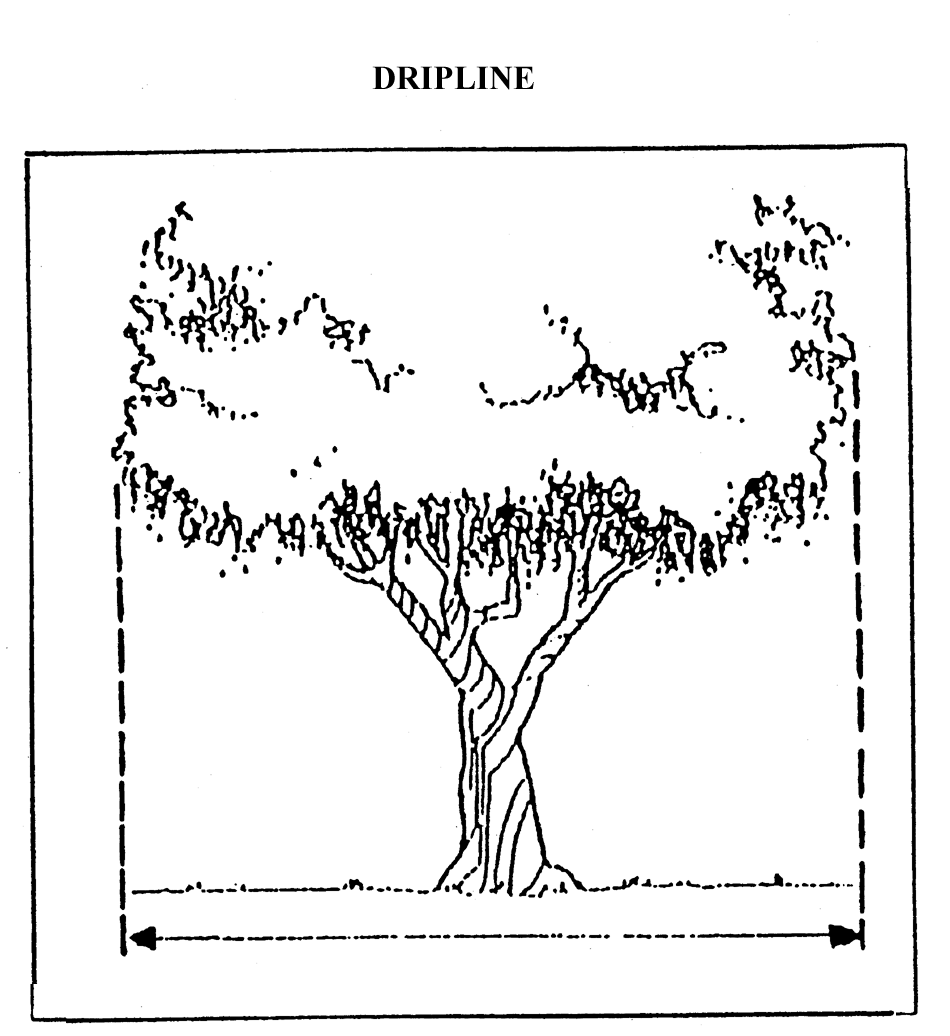
Dripline
(c)
Development prohibited within the tree protection zone. All development activities except those specifically permitted by subsection 86-187(e) shall be prohibited within the tree protection zone provided for any protected trees, including any construction of buildings, structures, paving surfaces, and stormwater retention/detention ponds. All temporary construction activities shall also be prohibited within tree protection areas, including all digging, storage of construction material, and parking of construction vehicles.
(d)
Fencing of tree protection zone. Prior to the commencement of construction, the developer shall enclose the entire tree protection zone within a fence or similar barrier as follows:
(1)
Wooden, or similar, posts at least 1.5 × 3.5 inches shall be implanted in the ground deep enough to be stable and with at least three feet visible above ground.
(2)
The protective posts shall be placed not more than six feet apart, and shall be linked together by a rope or chain.
(e)
Permitted activities within the tree protection zone.
(1)
Excavating or trenching by duly constituted utilities, except where the trees are historic, specimen, champion, or heritage, in which case utility lines shall be tunneled beneath tree roots in order to protect feeder roots.
(2)
Sodding and ground cover placement of sod or other ground covers, and the preparation of the ground surface for such covers.
(Ord. No. 2-91, § 6.03.04(H), 4-29-1991)
Sec. 86-189. - Preservation of native vegetation.
In addition to the tree preservation requirements, development sites shall comply with the following requirements for the preservation of native shrubs and groundcover:
(1)
Within the conservation or open space land use district, a minimum of 25 percent of the total acreage of the site that is populated by native shrubs and/or groundcover shall be preserved.
(2)
Within all other districts, a minimum of ten percent of the total acreage of the site that is populated by native shrubs and/or ground cover shall be preserved.
(3)
The native shrubs and ground cover occurring on the site may be used to satisfy the landscaped buffer and vehicular use landscaping requirements of this chapter.
(Ord. No. 2-91, § 6.03.04(I), 4-29-1991)
Sec. 86-190. - Preservation of protected trees and native vegetation as grounds for reduction in required parking.
(a)
A reduction of required parking spaces may be allowed by the director of community development and planning when the reduction would result in:
(1)
The preservation of a protected tree with a trunk of 12 inches in diameter or greater; or
(2)
The preservation of native shrubs and/or ground cover in a quantity exceeding the minimum requirements of section 86-189.
(b)
The reduction in required parking may be granted only if it will prevent the removal of a protected tree or native vegetation that is located within the area of the site, designated as a vehicular use area. The following reduction schedule shall apply:
Reduction schedule
(Ord. No. 2-91, § 6.03.04(J), 4-29-1991)
Sec. 86-211. - Purpose.
The requirements of this section are intended to ensure that every building, structure, or use erected or instituted, except for agricultural uses and buildings, shall be provided with adequate off-street parking facilities for the use of occupants, employees, visitors, and patrons, and that certain uses be provided with adequate off-street loading facilities, thereby reducing congestion to the public streets and promoting the safety and welfare of the public.
(Ord. No. 2-91, § 6.04.01(A), 4-29-1991)
Sec. 86-212. - Existing structures and uses.
Buildings or structures existing as of the effective date of the Land Development Code may be modernized, altered, or repaired without providing additional off-street parking or loading facilities, provided there is no increase in floor area or capacity and no change of occupancy classification.
(Ord. No. 2-91, § 6.04.01(B), 4-29-1991)
Sec. 86-213. - Expansion of structure.
The proposed expansion in floor area, volume, capacity or space occupied of any structure existing on or before May 1, 1991, shall result in the compliance with all off-street parking and loading requirements contained in the Land Development Code for both existing and new structures.
(Ord. No. 2-91, § 6.04.01(C), 4-29-1991)
Sec. 86-214. - Change in use.
If after the effective date of the Land Development Code, a change in the use of a building or structure would result in a requirement for additional parking over that required for the existing use, then all off-street parking and loading requirements contained in the Land Development Code shall be complied with for the new use.
(Ord. No. 2-91, § 6.04.01(D), 4-29-1991)
Sec. 86-215. - Parking space requirements.
Parking space requirements for a use not specifically listed in the chart shall be derived from the report entitled "Parking Generation" (1989) published by the Institute of Traffic Engineers (ITE).
(Ord. No. 2-91, § 6.04.01(E), 4-29-1991)
Secs. 86-216—86-240. - Reserved.
_____
Sec. 86-241. - Land use.
* Number of seats based on maximum capacity as rated by the Life Safety Code or Standard Building Code.
(Ord. No. 2-91, § 6.04.02, 4-29-1991)
_____
Sec. 86-242. - Joint use and offsite facilities.
Parking spaces must be located and maintained within 300 feet of the building or use served. No parking spaces provided to meet the requirements of one building or use shall be counted as part of the spaces required for another building or use, unless the spaces are jointly provided by uses that are not normally open at the same time. If such a joint parking arrangement is proposed, the applicants must file a written notarized agreement assuring the retention of the joint parking arrangement within the application for a building permit.
(Ord. No. 2-91, § 6.04.03, 4-29-1991)
Sec. 86-261. - Specifications.
(a)
Minimum size.
(1)
Standard parking spaces shall be sized according to the table at the end of this section.
(2)
Spaces for handicapped parking shall be a minimum of 12 feet wide and 20 feet long.
(b)
Paving.
(1)
Acceptable paving material for vehicular parking areas includes asphalt, crushed shells, gravel, dolomite, or other similar material.
(2)
Access drives and aisles for all parking areas shall be paved, but up to 25 percent of the parking spaces may remain unpaved subject to the approval of the town. A place of worship, or other institutional use without daily parking needs may be allowed to leave 50 percent of all parking spaces unpaved. The applicant shall supply evidence that the unpaved parking area will not cause erosion, reduce water quality, or any other degradation of the natural or built environment.
(3)
The unpaved parking area shall not be calculated as part of a minimum required landscaped buffer or open space.
_____
(c)
Parking space standards.
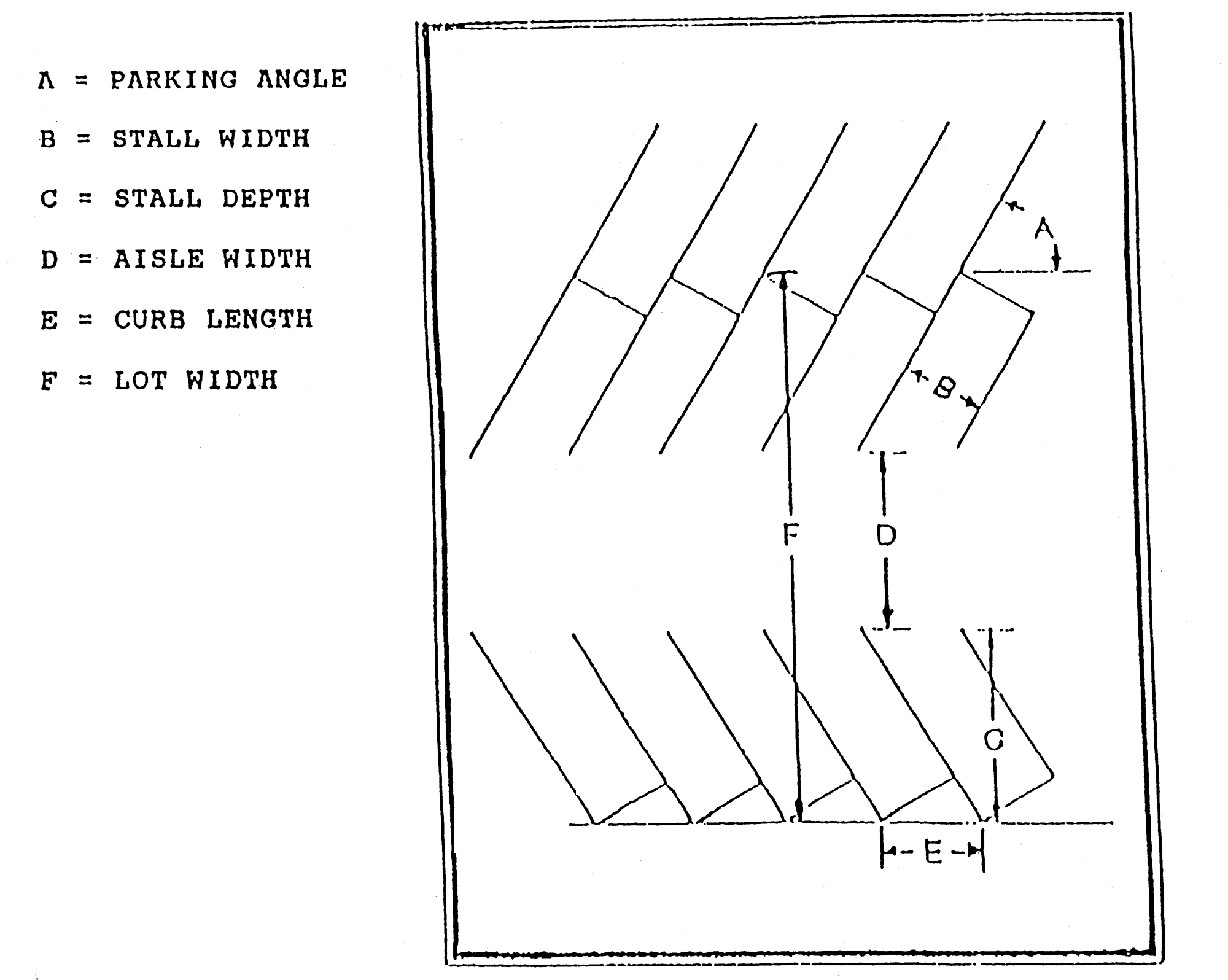
Parking Space Standards
(Ord. No. 2-91, § 6.04.04, 4-29-1991)
_____
Sec. 86-262. - Drainage.
All required off-street parking facilities shall conform to the stormwater management requirements and shall be drained so as not to cause any nuisance to adjacent private or public property.
(Ord. No. 2-91, § 6.04.04(C), 4-29-1991)
Sec. 86-263. - Access.
All parking spaces shall have direct access to public streets only by way of aisles or driveways, constructed in accordance with the provisions of the Land Development Code.
(Ord. No. 2-91, § 6.04.04(D), 4-29-1991)
Sec. 86-264. - Handicapped parking.
Handicapped parking shall be provided as required by the state Uniform Traffic Control Law, F.S. ch. 316. Handicapped parking spaces shall be appropriately marked.
(Ord. No. 2-91, § 6.04.04(E), 4-29-1991)
Sec. 86-265. - Provision of reserved parking areas.
Where, in the determination of the town, the required number of spaces is excessive for a specific use, the owner or agent may substitute landscaping in lieu of paving provided such areas are reserved for future parking should the town find those spaces are needed, and further provided:
(1)
The owner of the land upon which such parking is being reserved shall enter into a written agreement with the town, to be filed with the town clerk, with enforcement running to the town ensuring that the reserved parking area shall never be encroached upon, used, sold, leased, or conveyed, for any purpose except in conjunction with the building or use which the reserved parking area serves as the off-street parking facilities are required.
(2)
The owner of the land upon which such said reserved parking is located agrees to bear the expense of recording the agreement which shall bind his heirs, successors, or assigns.
(3)
The written agreement shall be voided by the town if the reserved parking area is converted to usable parking area or if the reserved parking area is no longer required.
(Ord. No. 2-91, § 6.04.04(F), 4-29-1991)
Sec. 86-291. - Requirements.
(a)
Number of spaces required. The bicycle parking requirements in this section are intended to encourage the use of bicycles as a means of transportation in the town. However, these facilities shall only be required for land uses that are served by a bikeway. The number of bicycle parking spaces required shall be as follows:
_____
_____
(b)
Design of bicycle parking spaces. Required bicycle parking facilities shall be designed and constructed in accordance with the following standards:
(1)
Bicycle parking facilities shall include provision for the secure storage and locking of bicycles.
(2)
Fixed objects that are intended to serve as bicycle parking facilities shall be clearly labeled as available for bicycle parking.
(3)
Individual locker spaces or racks shall be designed so as to provide convenient access to users.
(Ord. No. 2-91, § 6.04.05, 4-29-1991)
Sec. 86-311. - Requirements.
Off-street loading space shall be provided and maintained as follows:
(1)
For all commercial and industrial development:
Plus, for each additional 90,000 square feet over 300,000 square feet or major fraction thereof, one space.
(2)
For each auditorium, convention hall, exhibition hall, museum, motel, hotel, office building, sports arena, stadium, hospital, sanitarium, welfare institution or similar use having an aggregate floor area of:
(3)
For any use not specifically mentioned, the requirements for off-street loading facilities to which the unmentioned use is most similar shall apply. Such determination shall be made by the town.
(Ord. No. 2-91, § 6.04.06(A), 4-29-1991)
Sec. 86-312. - Location of required loading spaces.
Loading spaces shall be located on the same lot as the building or structure to which they are accessory.
(Ord. No. 2-91, § 6.04.06(B), 4-29-1991)
Sec. 86-313. - Designation and use.
Each required loading space shall be designated as such and shall be used only for loading purposes.
(Ord. No. 2-91, § 6.04.06(C), 4-29-1991)
Sec. 86-314. - Design and maintenance.
(a)
An off-street loading space shall be an area at grade level at least 12 feet by 55 feet long with a 14-foot vertical clearance.
(b)
Each loading space shall be accessible without crossing or entering any other required off-street loading space. Such loading spaces shall be accessible from the interior of the building it serves and shall be arranged for convenient and safe ingress and egress by motor truck and trailer.
(Ord. No. 2-91, § 6.04.06(D), 4-29-1991)
Sec. 86-351. - Terminology; method of measurement; maximum permissible sound levels.
(a)
Terminology. Unless otherwise defined, all terminology shall be in conformance with applicable publications of the American National Standards Institute, Incorporated (ANSI) or its successor body.
(b)
Method of noise measurement. Noise shall be measured with a sound level meter that meets the standards of American National Standards Institute (ANSI section 51.4-1979, type I or type 2). Noise levels shall be measured using an A-weighted sound pressure level scale. Impact noises shall be measured using the fast response of the sound level meter, and other noises using the slow response. Measurements shall be taken from the property line of the receiving land use.
_____
(c)
Maximum permissible sound levels by receiving land use.
(1)
No person shall operate or cause to be operated any source of sound in such a manner as to create a sound level which exceeds the limits set forth for the receiving land use district in the following table:
Sound Levels By Receiving Land Use
(Ord. No. 2-91, § 6.05.01(A), (B), 4-29-1991)
_____
Sec. 86-352. - Exemptions.
The following activities or sources are exempt from these noise standards:
(1)
Activities covered by the following: stationary, nonemergency signaling devices, emergency signaling devices, domestic power tools, air-conditioning, air-handling equipment for residential purposes, operating motor vehicles, refuse collection vehicles.
(2)
Railway locomotives and cars.
(3)
Construction or routine maintenance of public service utilities.
(4)
Houses of worship bells or chimes.
(5)
The emission of sound for the purpose of alerting persons to the existence of an emergency, or the emission of sound in the performance of emergency work.
(Ord. No. 2-91, § 6.05.01(C), 4-29-1991)
Sec. 86-353. - Notice of violations.
Except where a person is acting in good faith to comply with an abatement order, violation of any provision of the Land Development Code shall be cause for a notice of violation to be issued by the town.
(Ord. No. 2-91, § 6.05.01(D), 4-29-1991)
Sec. 86-354. - Preexisting uses not in conformance.
Where an industry or commercial business has established its use away from other incompatible uses and subsequently, through the encroachment of development, now finds itself adjoining a receiving land category which would require a reduction in noise generation, such industry or commercial business shall not emit a noise which exceeds the maximum noise limitation for the receiving land use category by more than ten decibels.
(Ord. No. 2-91, § 6.05.01(E), 4-29-1991)
Sec. 86-361. - Standards and requirements.
(a)
Standards. To protect and enhance the air quality of the town, all sources of air pollution shall comply with rules set forth by the Environmental Protection Agency (Code of Federal Regulations, Title 40) and the state department of environmental regulation (F.A.C. ch. 17-2). No person shall operate a regulated source of air pollution without a valid operation permit issued by the department of environmental regulation.
(b)
Testing. Air pollution emissions shall be tested and results reported in accordance with techniques and methods adopted by the state department of environmental regulation and submitted to the state. These tests shall be carried out under the supervision of the state and at the expense of the person responsible for the source of pollution.
(Ord. No. 2-91, § 6.05.02, 4-29-1991)
Sec. 86-362. - Glare.
Any operation or activity producing glare shall be conducted so that direct light or indirect light from the source shall not cause illumination in excess of .5 footcandle when measured from the property line of a residential property.
(Ord. No. 2-91, § 6.05.03, 4-29-1991)
Sec. 86-363. - Odor.
Every use shall be operated to prevent the emission of objectionable or offensive odors in such a concentration as to be readily perceptible at or beyond property lines on which the use is located, as required in F.A.C. ch. 17.2, "Rules of the Department of Environmental Regulation: Air Pollution," as revised.
(Ord. No. 2-91, § 6.05.04, 4-29-1991)
Sec. 86-364. - Electromagnetic radiation emissions.
No location for placement, construction, or modification of a communication tower or communication antenna shall be regulated on the basis of the environmental effects of radio frequency emissions to the extent that the commercial communication towers and antennas comply with FCC regulations concerning such emissions.
(Ord. No. 3-97, § 4, 12-1-1997)
Sec. 86-391. - Additional development standards for certain uses.
Certain uses have unique characteristics that require the imposition of development standards in addition to those minimum standards set forth in other sections of the Land Development Code. These uses are listed in this article together with the specific standards that apply to the specified use or activity. These standards shall be met in addition to all other standards of the Land Development Code, unless specifically exempted.
(Ord. No. 2-91, § 6.06.01, 4-29-1991)
Sec. 86-411. - Compliance with division standards.
Any person desiring to site a manufactured housing unit in a residential land use district shall comply with the standards set out in this division:
(Ord. No. 2-91, § 6.06.02 (intro. par.), 4-29-1991)
Sec. 86-412. - Standards for siting manufactured housing units in residential districts.
Manufactured housing units proposed to be located in residential districts shall meet the following requirements:
(1)
The unit shall comply with the U.S. Department of Housing and Urban Development Mobile Home Construction and Safety Standards or the state manufactured building act; and
(2)
The minimum horizontal dimension of the main body, as assembled on the site, shall not be less than 14 feet, as measured across the narrowest portion.
(Ord. No. 2-91, § 6.06.02(A)(1), 4-29-1991; Ord. No. 2-93, § I, 8-16-1993)
Sec. 86-413. - Preservation of character; additional design standards for designated neighborhoods.
The town council may designate neighborhoods where, in order to preserve the character of the neighborhood, manufactured housing must comply with additional design standards. A public hearing on the designation shall be held by the town with due notice to the homeowners within the boundaries of the neighborhood. Manufactured housing units proposed to be located in these neighborhoods shall meet the following requirements:
(1)
The unit shall comply with the U.S. Department of Housing and Urban Development Mobile Home Construction and Safety Standards or the state manufactured building act;
(2)
The minimum horizontal dimension of the main body, as assembled on the site, shall not be less than 20 feet, as measured across the narrowest portion;
(3)
The pitch of the main roof shall not be less than one foot of rise for each four feet of horizontal run and the minimum distance from eave to ridge is one-half the minimum horizontal dimension;
(4)
The roofing material used shall be similar in texture, color and appearance as that of detached single-family dwelling units in the same character district in which it is to be located; and
(5)
The materials used for the exterior finish and skirting shall be similar in texture, color and materials to detached single-family dwelling units in the same character district in which it is to be located, and are applied in such a manner as to make the manufactured housing unit similar in appearance with the surrounding detached single-family dwelling units. Reflection from the exterior shall not be greater than from siding coated with clear, white, gloss exterior enamel.
(Ord. No. 2-91, § 6.06.02(A)(2), 4-29-1991)
Sec. 86-414. - Exemptions.
Manufactured housing units located within a mobile home park designed exclusively for manufactured housing are exempt from the requirements of this section.
(Ord. No. 2-91, § 6.06.02(B), 4-29-1991)
Sec. 86-415. - Application contents.
(a)
Any person proposing to site a manufactured housing unit in a residential land use district, unless exempted by section 86-414, shall submit the following application information to the town:
(1)
The applicant's name and address.
(2)
Legal description, street address, lot number and subdivision name, if any, of the property upon which the manufactured housing unit is to be located.
(3)
State of ownership.
(4)
Size of subject property in square feet and acres.
(5)
Proof that the manufactured housing unit has met the requirements of either the U.S. Department of Housing and Urban Development Mobile Home Construction and Safety Standards or the state manufactured building act.
(6)
Statement describing the type and dimensions of the manufactured housing unit proposed to be located on the property.
(b)
In addition to the application requirements in subsection (a) of this section, applicants proposing to site a manufactured housing unit in neighborhoods designated by the town council pursuant to section 86-413, unless located in a mobile home park designed exclusively for manufactured housing, shall submit the following information to the town:
(1)
Elevations and photographs of all sides of the manufactured housing unit proposed to be located on the property.
(2)
A statement describing the exterior dimensions and roof slope of the manufactured housing unit proposed to be located on the property.
(3)
A description of the exterior finish of the manufactured housing unit, including exterior walls and roof.
(4)
A description of the skirting materials to be used.
(5)
A schematic design of the manufactured housing unit showing the roof, skirtings, and other improvements.
(Ord. No. 2-91, § 6.06.02(C), 4-29-1991)
Sec. 86-416. - Procedure for review of applications.
(a)
Within 20 days after an application has been submitted, the town planner shall determine whether the application is complete. If the town planner determines the application is not complete, he/she shall send a written statement specifying the application's deficiencies to the applicant by mail. The town shall take no further action on the application unless the deficiencies are remedied.
(b)
When the town planner determines the application is complete, it shall review the application, and shall decide whether the proposal complies with the standards for manufactured housing units sited in residential districts. Notification of the decision shall be filed with the town planner and shall be mailed to the applicant.
(Ord. No. 2-91, § 6.06.02(D), 4-29-1991)
Sec. 86-441. - Conditions for siting in residential districts, review of application.
(a)
Institutional residential homes shall be allowed in residential districts subject to the following conditions:
(1)
When a site for an institutional residential home has been selected by a sponsoring agency in a residential land use district, the agency shall notify the town in writing and include in the notice the specific address of the site, the residential licensing category, the number of residents, and the community support requirements of the program. Such notice shall also contain a statement from the district administrator of the department of health and rehabilitative services indicating the need for the licensing status of the proposed institutional residential home and specifying how the home meets applicable licensing criteria for the safe care and supervision of clients in the home. The district administrator shall also provide to the town the most recently published data compiled that identifies all institutional residential homes in the district in which the proposed site is to be located. The town shall review the notification of the sponsoring agency in accordance with applicable requirements of the Land Development Code.
(2)
Pursuant to such review, the town may:
a.
Determine that the siting of the institutional residential home is in accordance with applicable requirements and approve the siting. If the siting is approved, the sponsoring agency may establish the home at the site selected.
b.
Fail to respond within 60 days. If the town fails to respond within such time, the sponsoring agency may establish the home at the site selected.
c.
Deny the siting of the home.
(3)
The town shall not deny the siting of a institutional residential home unless the town establishes that the siting of the home at the site selected:
a.
Does not otherwise conform to existing regulations applicable to other institutional uses in the area;
b.
Does not meet applicable licensing criteria established by the department of health and rehabilitative services, including requirements that the home be located to assure the safe care and supervision of all clients in the home; or
c.
Would result in such a concentration of institutional residential homes in the area in proximity to the site selected, such that the nature and character of the area would be substantially altered. A home that is located within a radius of 1,200 feet of another existing institutional residential home shall be overconcentration of such homes that substantially alters the nature and character of the area.
(4)
All distance requirements shall be measured from the nearest point of the existing home to the nearest point of the proposed home via path of travel.
(b)
The town shall, within 20 days of the receipt of the application provided for in section 86-415, review the application and provide the applicant with a written decision outlining reasons for the decision. The applicant may appeal the decision of the town by notifying the town planner within ten days from the date of the town's decision. Appeals of the decision of the town shall be in accordance with sections 58-60—58-64.
(Ord. No. 2-91, § 6.06.03, 4-29-1991)
Sec. 86-461. - General requirements.
A recreational vehicle park shall meet the following general requirements:
(1)
It shall be primarily for recreational use by persons with transportable recreational housing, with appropriate accessory uses and structures.
(2)
The land on which it is developed shall be under unified control and shall be planned and developed as a whole in a single development operation or programmed series of development operations for recreational vehicles and related uses and facilities. Subsequent subdivision of lots or conveyance of sites to individual owners by any means is prohibited.
(3)
The principal and accessory uses and structures shall be substantially related to the character of the development in the context of the district of which it is a part.
(4)
The park shall be developed according to comprehensive and detailed plans that include streets, utilities, lots and building sites.
(5)
The park shall have a program for provision, maintenance and operation of all areas, improvements, and facilities for the common use of all or some of the occupants of the park, but will not be provided, operated or maintained at general public expense.
(Ord. No. 2-91, § 6.06.04(A), 4-29-1991)
Sec. 86-462. - Allowable uses.
The allowable uses in a recreational vehicle park include the following:
(1)
Recreational vehicles.
(2)
Park trailers (park models) as defined by F.S. ch. 320, provided they are placed in an area designated exclusively for that use on an approved final site plan. Park models are not to be set up for more than 90 consecutive days.
(3)
Convenience establishments for the sale or rental of supplies or for provision of services, for the satisfaction of daily or frequent needs of campers, within the park may be permitted. These establishments may provide groceries, ice, sundries, bait, fishing equipment, self-service laundry equipment, bottled gas and other similar items needed by users of the park. These establishments shall be designed to serve only the needs of the campers within the park and shall not, including their parking area, occupy more than five percent of the area of the park, and shall not be so located so as to attract patronage from outside the grounds, nor have adverse effects on surrounding land uses.
(Ord. No. 2-91, § 6.06.04(B), 4-29-1991)
Sec. 86-463. - Site design requirements.
The following site design requirements shall be met:
(1)
The minimum land area for a recreational vehicle park shall be eight acres.
(2)
The maximum density for a recreational vehicle park shall be 18 spaces per gross acre. Storage spaces shall be included in the density calculation.
(3)
Individual spaces shall take access to internal streets and shall not take direct access to adjoining public rights-of-way.
(4)
Access to the recreational vehicle park shall be from a collector or arterial roadway.
(5)
Internal streets shall provide safe and convenient access to spaces and appropriate park facilities. Alignment and gradient shall be properly adapted to topography. Construction and maintenance shall provide a well-drained and dust-free surface that is of adequate width to accommodate anticipated traffic.
(6)
Camping spaces shall be so located in relation to internal streets so as to provide for convenient vehicular ingress and egress if the space is intended for use by wheeled units. Where back-in or back-out spaces are used, appropriate maneuvering room shall be provided in the adjacent internal street and within the space.
(7)
Where spaces are to be used exclusively for erection of tents on the ground, provision for vehicular access onto such spaces shall not be required, but parking areas shall be located within 100 feet, except in circumstances in which providing such vehicular accessibility would result in excessive destruction of trees or other vegetation, or where it would be impractical to provide such parking areas within such distances for particularly desirable campsites.
(8)
Spaces shall be so related to pedestrian ways and principal destinations within the park as to provide for convenient pedestrian access to such destinations by the pedestrian systems.
(9)
No minimum dimensions are specified for spaces, but each shall provide the clearances specified herein, and the boundaries of each space shall be clearly indicated.
(10)
Spaces for dependent units shall be located within 200 feet by normal pedestrian routes of toilet, washroom and bath facilities.
(11)
Spaces for self-contained units, operating as such, may not be located more than 400 feet by normal pedestrian routes from toilet, washroom and bath facilities.
(12)
Stands shall be so located that when used, clearance from units, including attached awnings and the like, shall be as follows:
a.
From units on adjoining stands, ten feet.
b.
From internal streets of common parking area, ten feet.
c.
From portions of building not containing uses likely to disturb stand occupants, or constructed or oriented so that noise and lights will not be disturbing to occupants of space, 25 feet.
d.
From any other use or fueling facility, 50 feet.
(13)
Where fireplaces, cooking shelters or similar facilities for open fires or outdoor cooking are provided within spaces or elsewhere, they shall be so located, constructed, maintained and used as to minimize fire hazards and smoke nuisance within the park and in adjoining areas.
(Ord. No. 2-91, § 6.06.04(C), 4-29-1991)
Sec. 86-481. - Restrictions as to location.
No junkyard, junk or automobile graveyard shall be kept, operated or maintained in the incorporated areas of the town within 300 feet of the right-of-way of any public street or highway, except the following:
(1)
Junkyards which are entirely enclosed by a solid wall or wood fence at least six feet in height, but in no case lower than the material contained in the junkyard. The fence or wall enclosing the junkyard shall not be used for bill postings or other advertising purposes, except that a space not larger than 6 feet by 12 feet may be used for the advertisement of the business of the owner thereof. The fence or wall shall have no more than one opening for each 300 feet of street frontage. The opening shall not exceed 20 feet in width and shall be provided with a solid gate or door which must be kept closed except for the passage of vehicles.
(2)
Junkyards or scrap metal processing facilities which are located in areas which are within industrial land use districts designated on the town's future land use map.
(3)
Two or fewer unlicensed motor vehicles which are located on the private property of the owner or owners of such unlicensed motor vehicles.
(Ord. No. 2-91, § 6.06.04, 4-29-1991)