
Traverse City City Zoning Code
TITLE TWO
ZONING CODE
Chapter 1320 - General Provisions and Definitions[1]
State Law reference— Zoning and planning in home rules cities, M.C.L.A. § 117.4i; Regulation of location of trades, building and uses by local authorities, MCL § 125.3101—125.3702; Regulation of buildings, MCL § 125.3201; Authority to zone, MCL § 125.3301; Regulation of congested areas, MCL § 125.3201, MCL § 125.3807; Uses of land or structures not conforming to ordinances, MCL § 125.3201, § 125.3208, MCL § 125.3502, MCL § 125.3503, MCL § 125.3504; Powers of legislative bodies, MCL 125.3301, MCL § 125.3603; Acquisition of property, MCL § 125.3507; Use of Land and Development as Conditioning to Rezoning, MCL § 125.3405
Cross reference— Application of Zoning Code to signs, § 1476.15
Chapter 1322 - Administration, Enforcement and Penalty[2]
State Law reference— City zoning ordinances; public hearing, notice; report of Planning Commission; amendment; vote required, MCL § 125.3401; Board of Zoning Appeals, MCL § 125.3601 et seq.; Violations; nuisance per se; abatement, MCL § 125.3407
Cross reference— Board of Zoning Appeals, Ch. 1324; Amendments, § 1320.04; Appeals, §§ 1324.04; 1324.05(b); Variances, § 1324.05(d)
Chapter 1324 - Board of Zoning Appeals[3]
State Law reference— Board of Zoning Appeals, MCL § 125.3601 et seq.; Meetings of the Board; freedom of information, MCL § 125.3304, MCL § 125.3701; Review by Circuit Courts; appeals to Supreme Court; procedure, MCL § 125.3604—125.3607; Actions for review; proper and necessary parties; notice; failure to appear, MCL § 125.3307, MCL § 125.3402, MCL §§ 125.3501—125.3503, MCL §§ 125.3603, 125.3604
Cross reference— Authority re nonconforming uses, § 1370.03; Construction Board of Appeals, Ch. 1442
Chapter 1326 - Districts, Boundaries and Zoning Map[4]
State Law reference— Zoning and planning in home rules cities, M.C.L.A. § 117.4i; Regulation of location of trades, building and uses by local authorities, MCL § 125.3101—125.3702; Regulation of buildings, MCL § 125.3201; Authority to zone, MCL § 125.3301; Regulation of congested areas, MCL § 125.3201, MCL § 125.3807; Uses of land or structures not conforming to ordinances, MCL § 125.3201, § 125.3208, MCL § 125.3502, MCL § 125.3503, MCL § 125.3504; Powers of legislative bodies, MCL 125.3301, MCL § 125.3603; Acquisition of property, MCL § 125.3507
Chapter 1328 - OS - Open Space District[5]
The Open Space (OS) District is for the purpose of accommodating natural or park-like settings including parks, playgrounds, athletic fields, wetlands, floodplains, natural areas and cultural buildings, often linked with pedestrian and bicycle paths.
State Law reference— Zoning and planning in home rules cities, M.C.L.A. § 117.4i; Regulation of location of trades, building and uses by local authorities, MCL § 125.3101—125.3702; Regulation of buildings, MCL § 125.3201; Authority to zone, MCL § 125.3301; Regulation of congested areas, MCL § 125.3201, MCL § 125.3807; Uses of land or structures not conforming to ordinances, MCL § 125.3201, § 125.3208, MCL § 125.3502, MCL § 125.3503, MCL § 125.3504; Powers of legislative bodies, MCL 125.3301, MCL § 125.3603; Acquisition of property, MCL § 125.3507
Cross reference— Signs in residential districts, §§ 1476.06, 1476.10 and 1476.27
Chapter 1330 - RC - Residential Conservation District[6]
The Residential Conservation (RC) District is for the purpose of classifying property susceptible to erosion or flooding for clustered, low density development in the least sensitive portions of such property.
State Law reference— Zoning and planning in home rules cities, M.C.L.A. § 117.4i; Regulation of location of trades, building and uses by local authorities, MCL § 125.3101—125.3702; Regulation of buildings, MCL § 125.3201; Authority to zone, MCL § 125.3301; Regulation of congested areas, MCL § 125.3201, MCL § 125.3807; Uses of land or structures not conforming to ordinances, MCL § 125.3201, § 125.3208, MCL § 125.3502, MCL § 125.3503, MCL § 125.3504; Powers of legislative bodies, MCL 125.3301, MCL § 125.3603; Acquisition of property, MCL § 125.3507
Cross reference— Signs in residential districts, ch. 1476
Chapter 1332 - R-1a and R-1b - Low Density Residential Districts[7]
The Low Density Residential District (R-1a and R-1b) is for the purpose of preserving and maintaining the character of predominately single-family residential neighborhoods while broadening housing choices to include context- and scale-appropriate opportunities in the districts that have been established for residential use.
(Ord. No. 1207, Passed 10-16-23)
Editor's note—Ord. No. 1207, passed Oct. 16, 2023, amended Chapter 1332 in its entirety to read as set out herein. Former Chapter 1332 pertained to similar subject matter. Historical notations have been retained for reference purposes.
State Law reference— Zoning and planning in home rules cities, M.C.L.A. § 117.4i; Regulation of location of trades, building and uses by local authorities, MCL §§ 125.3101—125.3702; Regulation of buildings, MCL § 125.3201; Authority to zone, MCL § 125.3301; Regulation of congested areas, MCL § 125.3201, MCL § 125.3807; Uses of land or structures not conforming to ordinances, MCL § 125.3201, § 125.3208, MCL § 125.3502, MCL § 125.3503, MCL § 125.3504; Powers of legislative bodies, MCL § 125.3301, MCL § 125.3603; Acquisition of property, MCL § 125.3507
Cross reference— Signs in residential districts, Ch. 1476
Chapter 1334 - R-2 - Mixed Density Residential District[8]
The Mixed Density Residential (R-2) District is for the purpose of allowing up to 4 dwelling units per parcel, through a variety of housing typologies that maintain the scale of development in the neighborhoods.
(Ord. No. 1209, Passed 10-16-23; Ord. No. 1225, Passed 6-2-25)
Editor's note—Ord. No. 1209, passed Oct. 16, 2023, amended Chapter 1334 in its entirerty to read as set out herein. Former Chapter 1334 pertained to similar subject matter. Historical notations have been retained for reference purposes.
State Law reference— Zoning and planning in home rules cities, M.C.L.A. § 117.4i; Regulation of location of trades, building and uses by local authorities, MCL §§ 125.3101—125.3702; Regulation of buildings, MCL § 125.3201; Authority to zone, MCL § 125.3301; Regulation of congested areas, MCL § 125.3201, MCL § 125.3807; Uses of land or structures not conforming to ordinances, MCL § 125.3201, § 125.3208, MCL § 125.3502, MCL § 125.3503, MCL § 125.3504; Powers of legislative bodies, MCL § 125.3301, MCL § 125.3603; Acquisition of property, MCL § 125.3507
State Law reference— Signs in residential districts, §§ 1476.06, 1476.10 and 1476.27
Chapter 1336 - R-3 Multiple-Family Dwelling Districts[9]
The Multiple-Family Dwelling districts allow for multiple family uses in varying densities, have pedestrian scale and are located in close proximity to major activity and employment centers, on transit routes, or in transitional areas.
State Law reference— Zoning and planning in home rules cities, M.C.L.A. § 117.4i; Regulation of location of trades, building and uses by local authorities, MCL § 125.3101—125.3702; Regulation of buildings, MCL § 125.3201; Authority to zone, MCL § 125.3301; Regulation of congested areas, MCL § 125.3201, MCL § 125.3807; Uses of land or structures not conforming to ordinances, MCL § 125.3201, § 125.3208, MCL § 125.3502, MCL § 125.3503, MCL § 125.3504; Powers of legislative bodies, MCL 125.3301, MCL § 125.3603; Acquisition of property, MCL § 125.3507
State Law reference— Signs in residential districts, §§ 1476.06, 1476.10 and 1476.27
Chapter 1338 - HR - Hotel Resort District[10]
The Hotel Resort (HR) District is for the purpose of accommodating tourist-related land uses along the major routes near tourist attractions. It is important that motor vehicle access be limited and land uses are compatible with peak traffic flows. Uses for these zones include multi-family housing, lodging facilities, accessory offices, and limited uses that are functionally integrated as part of the development.
(Ord. 782. Passed 2-4-08.)
State Law reference— Zoning and planning in home rules cities, M.C.L.A. § 117.4i; Regulation of location of trades, building and uses by local authorities, MCL § 125.3101—125.3702; Regulation of buildings, MCL § 125.3201; Authority to zone, MCL § 125.3301; Regulation of congested areas, MCL § 125.3201, MCL § 125.3807; Uses of land or structures not conforming to ordinances, MCL § 125.3201, § 125.3208, MCL § 125.3502, MCL § 125.3503, MCL § 125.3504; Powers of legislative bodies, MCL § 125.3301, MCL § 125.3603; Acquisition of property, MCL § 125.3507
Cross reference— Motels, Ch. 836
Chapter 1340 - C-1 Office Service District[11]
The Office Service (C-1) District is for the purpose of accommodating residentially scaled commercial buildings. A variety of low intensity uses designed to integrate with adjacent residential areas. Uses permitted generally generate low to moderate trips. Existing residential structures are intended to be preserved and adaptively reused without substantially altering the appearance of building exteriors. New structures, signs and lighting should be sensitive and respectful to adjacent residential properties.
State Law reference— Zoning and planning in home rules cities, M.C.L.A. § 117.4i; Regulation of location of trades, building and uses by local authorities, MCL § 125.3101—125.3702; Regulation of buildings, MCL § 125.3201; Authority to zone, MCL § 125.3301; Regulation of congested areas, MCL § 125.3201, MCL § 125.3807; Uses of land or structures not conforming to ordinances, MCL § 125.3201, § 125.3208, MCL § 125.3502, MCL § 125.3503, MCL § 125.3504; Powers of legislative bodies, MCL § 125.3301, MCL § 125.3603; Acquisition of property, MCL § 125.3507
Cross reference— Signs, Ch. 1476
Chapter 1342 - C-2 Neighborhood Center District[12]
The Neighborhood Center district is for the purpose of accommodating small businesses primarily serving adjacent neighborhoods with day-to-day retail goods and services. These small centers are comprised of residentially-scaled buildings with limited parking areas and a strong pedestrian orientation. Existing buildings and quality vegetation should be retained. New buildings are to be designed to reflect a residential flavor and minimize impacts (e.g., noise, light, traffic) on neighborhood residences.
(Ord. No. 1162, Passed 7-6-21)
State Law reference— Zoning and planning in home rules cities, M.C.L.A. § 117.4i; Regulation of location of trades, building and uses by local authorities, MCL § 125.3101—125.3702; Regulation of buildings, MCL § 125.3201; Authority to zone, MCL § 125.3301; Regulation of congested areas, MCL § 125.3201, MCL § 125.3807; Uses of land or structures not conforming to ordinances, MCL § 125.3201, § 125.3208, MCL § 125.3502, MCL § 125.3503, MCL § 125.3504; Powers of legislative bodies, MCL § 125.3301, MCL § 125.3603; Acquisition of property, MCL § 125.3507
Cross reference— Signs, Ch. 1476
Chapter 1344 - C-3 Community Center District
The Community Center (C-3) District is for the purpose of accommodating a wide range of retail goods and services available to the community. These uses are intended to be developed compactly and have coordinated access, preferably with limited driveways and shared parking facilities. More intense uses such as 24-hour stores and drive-through establishments are appropriate.
Chapter 1346 - C-4 Regional Center Districts[13]
The Regional Center Districts are for the purpose of accommodating a broad variety of retail, office and residential uses integrated with hotels, convention centers, and integrated common parking facilities. Internal linkage between stores is encouraged. It is extremely important that new development be integrated with historically significant buildings. The first floors of buildings are primarily for retail, financial services and restaurants. Dominant and striking visual features of the central area of the City should be maintained and enhanced. The upper stories of buildings are generally to be occupied by offices, services and residences. High density housing is also appropriate.
It is the intent of these districts to create streets which encourage pedestrian activity. Buildings along Boardman River should be designed to integrate with both the sidewalk and riverwalk systems. Driveways crossing sidewalks should be limited to public parking areas.
State Law reference— Zoning and planning in home rules cities, M.C.L.A. § 117.4i; Regulation of location of trades, building and uses by local authorities, MCL § 125.3101—125.3702; Regulation of buildings, MCL § 125.3201; Authority to zone, MCL § 125.3301; Regulation of congested areas, MCL § 125.3201, MCL § 125.3807; Uses of land or structures not conforming to ordinances, MCL § 125.3201, § 125.3208, MCL § 125.3502, MCL § 125.3503, MCL § 125.3504; Powers of legislative bodies, MCL 125.3301, MCL § 125.3603; Acquisition of property, MCL § 125.3507
Cross reference— Signs, Ch. 1476
Chapter 1347 - Development Districts[14]
The Development Districts are for the purpose of accommodating a mixture of land uses in areas traditionally known as the "Traverse City Ironworks" area, the "Depot" area and the "Red Mill" area. Residential uses are to be combined with shopping, restaurant, office and entertainment uses to create a village-like atmosphere. Compact, pedestrian-friendly developments which integrate well with adjacent properties are characteristic of these projects.
State Law reference— Zoning and planning in home rules cities, M.C.L.A. § 117.4i; Regulation of location of trades, building and uses by local authorities, MCL § 125.3101—125.3702; Regulation of buildings, MCL § 125.3201; Authority to zone, MCL § 125.3301; Regulation of congested areas, MCL § 125.3201, MCL § 125.3807; Uses of land or structures not conforming to ordinances, MCL § 125.3201, § 125.3208, MCL § 125.3502, MCL § 125.3503, MCL § 125.3504; Powers of legislative bodies, MCL 125.3301, MCL § 125.3603; Acquisition of property, MCL § 125.3507
Cross reference— Signs, Ch. 1476
Chapter 1348 - T - Transportation District[15]
The Transportation (T) District is for the purpose of accommodating special areas for the moving of goods and people and supporting aeronautical and non-aeronautical uses that benefit the operation of the Cherry Capital Airport as approved by the Northwestern Regional Airport Commission and in compliance with the Airport Zoning Act, Act No. 23 of the Public Acts of 1950.
State Law reference— Zoning and planning in home rules cities, M.C.L.A. § 117.4i; Regulation of location of trades, building and uses by local authorities, MCL § 125.3101—125.3702; Regulation of buildings, MCL § 125.3201; Authority to zone, MCL § 125.3301; Regulation of congested areas, MCL § 125.3201, MCL § 125.3807; Uses of land or structures not conforming to ordinances, MCL § 125.3201, § 125.3208, MCL § 125.3502, MCL § 125.3503, MCL § 125.3504; Powers of legislative bodies, MCL 125.3301, MCL § 125.3603; Acquisition of property, MCL § 125.3507, Airport Zoning Act, M.C.L.A. § 259.431 et seq.
Cross reference— Signs, § 1476.06
Chapter 1350 - GP - Government/Public District[16]
The Government/Public (GP) District is for the purpose of accommodating specialized public buildings while encouraging that the public properties reflect the community's values in the design and maintenance of the buildings and grounds.
State Law reference— Zoning and planning in home rules cities, M.C.L.A. § 117.4i; Regulation of location of trades, building and uses by local authorities, MCL § 125.3101—125.3702; Regulation of buildings, MCL § 125.3201; Authority to zone, MCL § 125.3301; Regulation of congested areas, MCL § 125.3201, MCL § 125.3807; Uses of land or structures not conforming to ordinances, MCL § 125.3201, § 125.3208, MCL § 125.3502, MCL § 125.3503, MCL § 125.3504; Powers of legislative bodies, MCL 125.3301, MCL § 125.3603; Acquisition of property, MCL § 125.3507
Chapter 1352 - Grand Traverse Commons (GTC) Districts[17]
Editor's note— Ord. 1063, passed February 2, 2018 repealed Ch. 1352, in its entirety and reenacted a new Chapter as set out herein. Former Ch. 1352 pertained to the Planned Redevelopment Districts and derived from Ord. 383. Passed 5-17-94; Ord. 476. Passed 7-6-99; Ord. 666. Passed 3-21-05; and Ord. 771. Passed 9-4-07.
State Law reference— Zoning and planning in home rules cities, M.C.L.A. § 117.4i; Regulation of location of trades, building and uses by local authorities, MCL § 125.3101—125.3702; Regulation of buildings, MCL § 125.3201; Authority to zone, MCL § 125.3301; Regulation of congested areas, MCL § 125.3201, MCL § 125.3807; Uses of land or structures not conforming to ordinances, MCL § 125.3201, § 125.3208, MCL § 125.3502, MCL § 125.3503, MCL § 125.3504; Powers of legislative bodies, MCL 125.3301, MCL § 125.3603; Acquisition of property, MCL § 125.3507
Chapter 1354 - I - Industrial District
The Industrial (I) District is for the purpose of accommodating light manufacturing, research and development plants, warehousing, and similar clean industries. Industrial areas are envisioned to be attractively developed and landscaped with emphasis placed on maintaining and enhancing existing vegetation. Linkages with pedestrian walkways and recreational trails is also important.
Chapter 1356 - NMC - Northwestern Michigan College Districts[18]
The Northwestern Michigan College (NMC) Districts are for the purpose of accommodating universities, colleges and other advanced learning institutions. Such uses often incorporate residential, office, recreational, and cultural activities.
State Law reference— Zoning and planning in home rules cities, M.C.L.A. § 117.4i; Regulation of location of trades, building and uses by local authorities, MCL § 125.3101—125.3702; Regulation of buildings; authority to zone, MCL § 125.3201; Regulation of congested areas, MCL § 125.3201, MCL § 125.3807; Uses of land or structures not conforming to ordinances; powers of legislative bodies; acquisition of property, MCL § 125.3208, MCL § 125.3502, MCL § 125.3502, MCL § 125.3504, MCL § 125.3201
Cross reference— Signs, Ch. 1476
Chapter 1358 - H - Hospital Districts[19]
The H-1 and H-2, Hospital Districts are for the purpose of accommodating medical centers, hospitals and all their normally related functions, if properly sited in relation to each other and pursuant to an approved plan for that district. The difference between the H-1 and H-2 districts are fewer uses but greater size allowed in the H-2 district. Developments in the H-2 district shall be functionally integrated with other buildings and parking areas and be in substantial conformity with the Hospital Master Site and Facilities Plan.
(Ord. No. 1216, Passed 9-3-2024.)
State Law reference— Zoning and planning in home rules cities, M.C.L.A. § 117.4i; Regulation of location of trades, building and uses by local authorities, MCL § 125.3101—125.3702; Regulation of buildings, MCL § 125.3201; Authority to zone, MCL § 125.3301; Regulation of congested areas, MCL § 125.3201, MCL § 125.3807; Uses of land or structures not conforming to ordinances, MCL § 125.3201, § 125.3208, MCL § 125.3502, MCL § 125.3503, MCL § 125.3504; Powers of legislative bodies, MCL 125.3301, MCL § 125.3603; Acquisition of property, MCL § 125.3507
Cross reference— Signs, Ch. 1476
Chapter 1360 - Sexually Oriented Businesses[20]
State Law reference— Zoning and planning in home rules cities, M.C.L.A. § 117.4i; Regulation of location of trades, building and uses by local authorities, MCL § 125.3101—125.3702; Regulation of buildings, MCL § 125.3201; Authority to zone, MCL § 125.3301; Regulation of congested areas, MCL § 125.3201, MCL § 125.3807; Uses of land or structures not conforming to ordinances, MCL § 125.3201, § 125.3208, MCL § 125.3502, MCL § 125.3503, MCL § 125.3504; Powers of legislative bodies, MCL 125.3301, MCL § 125.3603; Acquisition of property, MCL § 125.3507
Cross reference— Signs, Ch. 1476
Chapter 1362 - Planned Unit Developments[21]
The purpose of planned unit developments is to permit flexibility in zoning regulations so that developments conserve environmental resources, economic investment and the community's social fabric while reclaiming marginal and abandoned areas. Where appropriate, new development contiguous to urban boundaries should be organized as compact, pedestrian-friendly, mixed-use neighborhoods characteristic of Traverse City's historic areas.
Approval of a planned unit development shall not be considered an ordinance amendment.
State Law reference— Zoning and planning in home rules cities, M.C.L.A. § 117.4i; Regulation of location of trades, building and uses by local authorities, MCL § 125.3101—125.3702; Regulation of buildings, MCL § 125.3201; Authority to zone, MCL § 125.3301; Regulation of congested areas, MCL § 125.3201, MCL § 125.3807; Uses of land or structures not conforming to ordinances, MCL § 125.3201, § 125.3208, MCL § 125.3502, MCL § 125.3503, MCL § 125.3504; Powers of legislative bodies, MCL 125.3301, MCL § 125.3603; Acquisition of property, MCL § 125.3507
Cross reference— Signs in planned unit developments, § 1476.13
Chapter 1364 - Special Land Use Regulations[22]
The purpose of this chapter is to permit and provide for a special review process for unique uses and activities in zoning districts where they would not otherwise be permitted, provided these uses and activities are made compatible with permitted uses in these districts by following the standards in this chapter.
(Ord. No. 1211, Passed 10-16-23)
State Law reference— Zoning and planning in home rules cities, M.C.L.A. § 117.4i; Regulation of location of trades, building and uses by local authorities, MCL § 125.3101—125.3702; Regulation of buildings, MCL § 125.3201; Authority to zone, MCL § 125.3301; Regulation of congested areas, MCL § 125.3201, MCL § 125.3807; Uses of land or structures not conforming to ordinances, MCL § 125.3201, § 125.3208, MCL § 125.3502, MCL § 125.3503, MCL § 125.3504; Powers of legislative bodies, MCL 125.3301, MCL § 125.3603; Acquisition of property, MCL § 125.3507
Cross reference— Signs, Ch. 1476
Chapter 1366 - Site Plans and Site Development Standards[23]
Site plan review is intended to ensure developments are designed to integrate well with adjacent developments, minimize nuisance impacts on adjoining parcels, insure safe and functional traffic access and parking and minimize impacts on sensitive environmental resources.
State Law reference— Zoning authority, M.C.L.A. § 117.4i
Cross reference— Duties of Zoning Administrator re: flood plains, § 1458.04; Signs, Ch. 1476
Chapter 1370 - Nonconforming Uses[24]
The intent of this Zoning Code is to allow to continue a lawful use of any building or land existing on the effective date of this Zoning Code, or any amendment thereto, although it may not conform with this Zoning Code or amendment, but to encourage their improvement if it enhances the neighborhood.
State Law reference— Zoning and planning in home rules cities, M.C.L.A. § 117.4i; Regulation of location of trades, building and uses by local authorities, MCL § 125.3101—125.3702; Regulation of buildings, MCL § 125.3201; Authority to zone, MCL § 125.3301; Regulation of congested areas, MCL § 125.3201, MCL § 125.3807; Uses of land or structures not conforming to ordinances, MCL § 125.3201, § 125.3208, MCL § 125.3502, MCL § 125.3503, MCL § 125.3504; Powers of legislative bodies, MCL 125.3301, MCL § 125.3603; Acquisition of property, MCL § 125.3507
Cross reference— Signs, Ch. 1476
Chapter 1372 - Landscaping[25]
The process of development may require the alteration of existing topography and soil structure, the disruption of native vegetation and the expansion of impervious surface area over the development site. The cumulative effects of the land altering process extend far beyond the property lines of an individual development site and if development is not undertaken within the context of the broader community, it will not only degrade the individual development, but also the community of which it is a part. It is, therefore, the intent of this chapter to protect and manage vegetation to:
(1)
Aid in the stabilization of the environmental balance through air purification, oxygen regeneration, groundwater protection and recharge and the control of stormwater runoff.
(2)
Safeguard and enhance private and public property values and encourage continued investment and stewardship in the community.
(3)
Enhance community appearance, identify unique natural beauty, and promote quality development at a suitable scale.
(4)
Provide visual screens between land uses of differing character and use intensities.
(5)
Prevent reductions in the City's urban forest.
(6)
Provide for the preservation of larger native trees which are valuable amenities to the urban environment that, once destroyed, can only be replaced after generations; and
(7)
Ensure that the local stock of native trees and vegetation is replaced.
It is recognized that alternative design concepts exist which, if adopted, could exceed the results envisioned using these development standards. It is intended that the requirements of this chapter be flexible and permit latitude in site design and the use of plant materials when it can be shown that variation from the requirements will provide a development substantially better than that achievable using the minimum standards of this chapter. The provisions of this chapter shall be considered the minimum development standards and not a design goal.
(Ord. No. 1108, Passed 11-4-19.)
Editor's note— Ord. No. 1108, passed November 4, 2019, repealed and reenacted Ch. 1372. Former Ch. 1372 pertained to similar subject matter and derived from Ord. No. 476, passed July 6, 1999; Ord. No. 494, passed May 1, 2000; and Ord. No. 593, passed January 6, 2003.
Chapter 1374 - Circulation and Parking[26]
The purpose of chapter is:
• To make Traverse City safe and accessible by pedestrians, cyclists, drivers and passengers.
• To give equal consideration to the pedestrian in the design of all public and private parking areas.
• To promote site designs that help to reduce crashes and conflicts between pedestrians and vehicles.
• To maintain the utility of the public rights-of-way to move goods and people safely and adequately.
• To promote interesting street edges that invite people to walk.
• To encourage a healthier transportation mix.
State Law reference— Handicapped parking restrictions, M.C.L.A. § 257.942a
Cross reference— Parking generally, § 410.03, Ch. 480
Chapter 1375 - Outdoor Lighting
It is the intent of Outdoor Lighting regulations to:
•
Minimize light trespass and light straying from artificial light sources;
•
Eliminate intrusive artificial lighting that contributes to the "sky glow" phenomenon and disrupts the natural quality of nighttime;
•
Minimize harshly lighted surfaces and direct glare in order to enhance nighttime vision;
•
Encourage lighting practices and lighting systems that are designed to conserve energy; and
•
Provide for adequate nighttime safety, utility, security, and productivity.
(Ord. No. 1052. Passed 6-5-17)
Chapter 1376 - Affordable Housing Standards[27]
Because the remaining land appropriate for new residential development in the City is limited, and because there is a documented shortage of affordable housing that is available to low-income and very low-income households in the City, it is essential that a reasonable proportion of such land be developed into housing units affordable to the City's workforce. The affordable housing section is for the purpose of accommodating and encouraging diverse and balanced neighborhoods with quality, well-designed housing that is affordable to the City's low-income and very low-income residents.
State Law reference— Zoning and planning in home rule cities, M.C.L.A. § 117.4i; Regulation of land development and establishment of districts; provisions; uniformity of regulations; limitations, MCL § 125.3201
Chapter 1377 - Accessory Dwelling Units Overlay Districts[28]
The purpose of the Accessory Dwelling Units Overlay Districts in certain areas of the City is to permit small secondary dwellings on single-family zoned parcels to help owners pay expenses, making the house itself more affordable, increase the efficiency of developed land and provide additional housing options.
Editor's note— Nothing in this ordinance of the repeal of any inconsistent ordinances shall be construed to affect any suit or proceeding impending in any court, or any rights acquired or liability incurred, or any cause of action required or existing, under any act or ordinance hereby repealed, nor shall any just or legal right or remedy of any charter be lost, impaired or affected by this ordinance.
Chapter 1378 - Renewable Energy
The purpose of this chapter is to provide regulations governing renewable energy systems such as wind and solar, to provide for appropriate locations for wind and solar energy systems, to ensure compatibility with surrounding uses, and to promote safe, effective and efficient use of renewable energy systems to increase opportunities for generation of renewable energy.
(Ord. No. 1208, Passed 10-16-23)
Chapter 1399 - Transition[29]
The purpose of this transistion chapter is to apply the revisted Zoning Code to applications and approvals which may be in progress as of the effective date of this new code.
State Law reference— Zoning and planning in home rules cities, M.C.L.A. § 117.4i; Regulation of location of trades, building and uses by local authorities, MCL § 125.3101—125.3702; Regulation of buildings, MCL § 125.3201; Authority to zone, MCL § 125.3301; Regulation of congested areas, MCL § 125.3201, MCL § 125.3807; Uses of land or structures not conforming to ordinances, MCL § 125.3201, § 125.3208, MCL § 125.3502, MCL § 125.3503, MCL § 125.3504; Powers of legislative bodies, MCL 125.3301, MCL § 125.3603; Acquisition of property, MCL § 125.3507
1320.01 - Title.
This Title Two of Part Thirteen—The Planning and Zoning Code, shall be known and may be cited as the "Zoning Ordinance" or the "Zoning Code."
(Ord. No. 1169, Passed 10-18-21)
1320.02 - Purpose.
This Zoning Code is enacted for the public health, safety and welfare.
(Ord. No. 1169, Passed 10-18-21)
1320.03 - Interpretation; conflict of laws.
This Zoning Code is the minimum requirement for promoting the public health, safety and general welfare. If it imposes more restrictions than state law or other City ordinances, the provisions of this Zoning Code shall govern. If the State Housing Law (MCL 124.401 et seq; MSA 5.2771, et seq) or the Airport Zoning Act (MCL 259.431, et seq; MSA 5.3475) or other statutes or ordinances have stricter regulations, the provisions of the statute or other ordinance shall govern. This Zoning Code is not intended to interfere with or annul any easement, covenant or other agreement between parties. Section titles or headings and any entire section entitled "Purpose" shall be interpretive aids only and shall not be construed to impose any substantive or procedural requirement.
(Ord. No. 1169, Passed 10-18-21)
1320.04 - Changes and amendments.
(a)
Procedure. The City Commission, on its own motion or on petition, may amend or repeal zoning boundaries or regulations after submitting them to the Planning Commission for its recommendation, report and public hearing. The City Commission may also hold a public hearing with the notice it deems advisable. A hearing before the Planning Commission shall be granted a person interested at the time of its public hearing. The procedure for the Planning Commission public hearing shall be as follows:
(1)
At least 15 days notice of the public hearing shall be given in an official newspaper of general circulation in the City.
(2)
At least 15 days notice of the time and place of the public hearing shall be mailed to each airport manager, electric, gas, pipeline, telephone, telecommunications provider, public utility company and to each railroad company owning or operating any public utility or railroad within the districts affected that registers its name and mailing address with the City Clerk for the purpose of receiving the notice. An affidavit of mailing shall be maintained.
(3)
After the ordinance and maps have first been approved by the City Commission, if an individual property or several adjacent properties are proposed for rezoning, notice of the proposed rezoning and hearing shall be given at least 15 days before the hearing to:
a.
The owners of the property in question, unless 11 or more adjacent properties are proposed for rezoning: and all persons to whom real property is assessed within 300 feet of the boundary of the property in question, unless 11 or more adjacent properties are proposed for rezoning; and
b.
All persons to whom real property is assessed within 300 feet of the boundary of the property in question, unless 11 or more adjacent properties are proposed for rezoning; and
c.
At least 1 occupant of each dwelling unit or spatial area owned or leased by different persons within 300 feet of the boundary of the property in question. Where a single structure contains more than 4 dwelling units or distinct spatial areas, notice may be given to the manager or owner of the structure with a request to post the notice at the primary entrance to the structure. The occupants of all structures within 300 feet of the boundary of the property in question. Where the name of the occupant is not known, the term "occupant" may be used in making notification unless 11 or more adjacent properties are proposed for rezoning.
(b)
Notice. The notice shall contain the following:
(1)
A description of the proposed zoning;
(2)
A description of the subject property including a listing of all existing street addresses within the property where they exist, unless 11 or more adjacent properties are proposed for rezoning;
(3)
The time and place of the public hearing; and
(4)
When and where written comments will be received.
(c)
Protest. If a protest of the proposed amendment is presented to the City Commission at or before final action on the amendment and it is properly signed by the owners of at least 20 percent of the area of land included in the proposed change, excluding publicly owned land, or by the owners of at least 20 percent of the area of and included within an area extending out 100 feet from any point on the boundary of land included in the proposed change, excluding publicly owned land, then such amendment shall be passed only upon 5 affirmative votes of the City Commission.
(d)
Hearing request. The City Commission shall grant a hearing on a proposed ordinance provision to a property owner who requests a hearing by certified mail, addressed to the City Clerk.
(e)
Publication. Following the adoption of a zoning ordinance or amendment by the City Commission, a notice of adoption shall be published in a newspaper of general circulation in the City within 15 days after adoption. The notice shall include the following information:
(1)
In the case of a newly adopted zoning ordinance, the following statement: "A zoning ordinance regulating the development and use of land has been adopted by the City Commission of the City of Traverse City;"
(2)
In the case of an amendment to an existing ordinance, either a summary of the regulatory effect of the amendment, including the geographic area affected, or the text of the amendment;
(3)
The effective date of the ordinance;
(4)
The place and time where a copy of the ordinance may be purchased or inspected.
(f)
Court decree. An amendment for the purpose of conforming a provision of the Zoning Ordinance to a decree of a court of competent jurisdiction may be adopted by the City Commission and the notice of the adopted amendment published without referring the amendment to the Planning Commission.
(Ord. 718, Passed 2-5-07; Ord. 749, Passed 5-21-07; Ord. No. 1169, Passed 10-18-21)
1320.05 - Application of code; compliance required.
Except as otherwise allowed by this Zoning Code:
(1)
No building or structure shall be built, rebuilt, converted, enlarged, moved or structurally altered, and no building or land shall be used, except for a use allowed in that district.
(2)
No building or structure shall be built, rebuilt, converted, enlarged, or structurally altered except in conformity with the height, setback, bulk and other dimensional limits for that district.
(3)
No land shall be cleared, no building or structure shall be built or rebuilt, converted, enlarged or structurally altered, and no parking area built or enlarged except after applying for and receiving a land use permit.
(4)
No building shall be built or increased in area except in conformity with the off-street parking and loading regulations of the district in which such building is located unless it receives a special land use permit or planned unit development permit or parking waiver that changes these regulations.
(5)
The minimum setbacks, parking spaces and other open spaces, including lot area per dwelling, required by this Zoning Code for any building hereafter built or structurally altered, shall not be encroached upon or considered as parking, setback, open space or lot area requirement for any other building, nor shall any lot area be reduced beyond the district requirements of this Zoning Code.
(6)
No setback or lot shall be reduced in dimensions or area below the minimum requirements set forth herein except as a result of governmental action. Lots created after the effective date of this Zoning Code shall meet at least the minimum requirements of this Code.
(7)
No lot, once established or improved with a building or structure shall be divided unless each lot resulting from the division conforms with all of the requirements of this Code.
(8)
Conditional rezoning.
a.
Purpose. It is the intent of this Section to provide a process by which an applicant seeking a rezoning of land may propose a Conditional Zoning Offer, with conditions and commitments attached thereto, as part of the application for a requested rezoning pursuant to MCL 125.3405. These provisions shall be in accord with the provisions of the Zoning Act.
b.
Zoning district. An applicant requesting a rezoning may offer a Conditional Zoning Offer, as defined in this section. The required application and process shall be the same as for rezoning requests, except as modified by the requirements of this section.
c.
Definitions. The following definitions shall apply to this section.
1.
Conditional rezoning offer means conditions voluntarily proposed by a landowner for the use and development of land in exchange for the rezoning of the land. These conditions shall constitute requirements for, and in connection with, the development or use of the property approved under a Zoning Agreement.
2.
Zoning agreement means a written agreement offered by the landowner and approved and executed by the landowner and the City and recorded with the Register of Deeds in the county where the property covered by the Zoning Agreement is located, incorporating the Conditional Rezoning Offer along with any requirements necessary to implement the Conditional Rezoning Offer. When necessary, the Zoning Agreement shall also include and incorporate, by reference, a Site Plan that illustrates the implementation of the Conditional Rezoning Offer. This Site Plan and Zoning Agreement shall not replace the requirement for a Site Plan as provided by the Zoning Ordinance.
d.
Eligibility.
1.
A landowner may submit a proposed Conditional Rezoning Offer and Zoning Agreement with an application for a rezoning or at any time during the rezoning process.
2.
To be eligible, an applicant shall propose a Zoning District for the parcel at issue to be rezoned to and voluntarily offer use and development conditions for the affected parcel to be set forth in a Zoning Agreement, which are equally or more restrictive than the regulations that would otherwise apply under the proposed Zoning District.
e.
Conditional zoning offer.
1.
The Conditional Rezoning Offer shall bear a reasonable and rational relationship or benefit to the property in question.
2.
The Conditional Rezoning Offer may not offer uses or developments of greater intensity or density, or that are not permitted in the proposed rezoned Zoning District.
3.
Any use or development proposed that would require a variance from height, area, setback or similar dimensional requirements in the Zoning Chapter will not be allowed unless and until a variance is granted by the Board of Zoning Appeals pursuant to the requirements of Chapter 1324.
4.
Any use or development proposed that would require approval of a Special Land Use or Site Plan Review will not be allowed unless approved as required by the Zoning Ordinance prior to establishment or commencement of development of the use.
5.
The Conditional Rezoning Offer may be amended during the process of rezoning consideration provided that any amended or additional conditions are offered voluntarily by the landowner. A landowner may withdraw part of or amend its Conditional Zoning Offer any time prior to the final rezoning action of the City Commission by amendment of the application and Zoning Agreement. If such withdrawal or amendment occurs following the Planning Commission's public hearing on the original rezoning request, the amended application shall be referred to the Planning Commission for a new public hearing.
6.
A landowner may entirely withdraw its Conditional Rezoning Offer at any time prior to the adoption of the rezoning and Zoning Agreement by the City Commission.
f.
Zoning agreement. The Zoning Agreement shall incorporate the Conditional Rezoning Offer and shall include additional terms as necessary to implement the Zoning Agreement. In addition, the Zoning Agreement shall include the following:
1.
That the Zoning Agreement and the Conditional Rezoning Offer were proposed voluntarily by the landowner, and that the City relied upon and granted the rezoning request in consideration of the Zoning Agreement and the Conditional Rezoning Offer.
2.
That the Zoning Agreement and its terms and conditions are authorized by all applicable state and federal law and that the Zoning Agreement is valid.
3.
That the property shall be developed or used in a manner that conforms to the requirements of the rezoned Zoning District and the Zoning Agreement.
4.
That the Zoning Agreement shall be binding upon and inure to the benefit of the landowner and the City, and their respective heirs, successors, assigns, receivers or transferees.
5.
That, if the rezoning becomes void under this section, no development shall take place and no permits shall be issued unless and until a new Zoning District classification for the property has been established or a new rezoning been approved.
6.
That each of the requirements and conditions in the Zoning Agreement are necessary and reasonably related and roughly proportional in nature and extent to the impact created by the uses or activities authorized in the Zoning Agreement.
7.
That no part of the Zoning Agreement shall permit any activity, use, or condition that would otherwise be prohibited in the Zoning District to which the property is rezoned.
8.
The Zoning Agreement shall also contain a provision authorizing and providing a fund for the City to maintain proposed privately owned common areas within the development in the event that the property owner(s) fail(s) to timely perform necessary maintenance.
g.
Application procedure.
1.
An application for Conditional Rezoning shall include a Conditional Rezoning Offer, the proposed Zoning Agreement in a recordable format acceptable to the City, and any plans necessary to illustrate the Conditional Rezoning Offer. The Planning Director shall determine the adequacy of any submitted plan and may request additional detail if deemed necessary to properly demonstrate the extent of the proposed offer(s).
2.
The application may be amended during the process of consideration, provided that any amended or additional Conditional Rezoning Offers are proposed and entered voluntarily by the applicant.
3.
The Zoning Agreement shall be reviewed by the City Attorney prior to the required Planning Commission public hearing to confirm that the Zoning Agreement is in a form acceptable for recording with the Register of Deeds in the county in which the property covered by the Zoning Agreement is located.
h.
Review procedures.
1.
Application completeness. Upon submittal of a completed application in the proper form, the Planning Director shall assign the application a public hearing date and time.
2.
Official review. The Planning Director shall circulate site plans to the relevant agencies or officials for comments as to the proposed development's conformance to all applicable standards and requirements and whether approval of the application is recommended.
3.
Planning commission review. The Planning Commission shall undertake a study of the proposed rezoning and set the matter for a public hearing in accordance with the requirements of the Zoning Act and the Planning Commission Rules of Procedure for consideration of any rezoning request.
4.
Review standards. The Planning Commission shall consider whether the proposed Zoning Agreement and Conditional Rezoning offer meet the standards in MCL 125.3201(1).
5.
Recommendation to city commission. The Planning Commission may recommend approval or denial of the Conditional Rezoning and Zoning Agreement.
6.
City commission decision. Upon receipt of the Planning Commission's recommendations, the City Commission shall approve or deny the Conditional Rezoning and Zoning Agreement.
i.
Implementation and effective date.
1.
Upon adoption of a rezoning and Zoning Agreement, notice of adoption shall be published in accordance with the requirements of the Zoning Act.
2.
The Zoning Map shall be amended to specify the Zoning District to which the property is rezoned, plus the letter "A" to indicate that the property is subject to a Zoning Agreement. The City Clerk shall maintain a listing of all properties subject to Zoning Agreements and shall provide copies of the Agreements upon request.
3.
The applicant shall record the approved Zoning Agreement with the Register of Deeds in the county in which the property covered by the Zoning Agreement lies within 30 business days following approval by the City Commission. Evidence of recording shall be provided to the City Clerk within 45 business days of approval by the City Commission.
4.
The rezoning and Zoning Agreement shall commence and be in full force 31 calendar days after the date the City Commission adopted the amendment and authorized the Agreement, unless otherwise provided by the City Commission.
5.
The use and development of the property(ies) shall conform to all of the requirements regulating use and development within the new Zoning District and the requirements of the Zoning Agreement. In the event of a conflict, the Zoning Agreement's requirements shall prevail.
6.
Prior to development, any other applicable zoning approval or other approval requirement imposed by this chapter or other City ordinances shall be met.
j.
Duration of approval.
1.
Unless extended by the City Commission for good cause, the Rezoning and Zoning Agreement shall expire and be void and of no effect 2 years after adoption of the Conditional Rezoning and Zoning Agreement, unless the development set forth in the Zoning Agreement is at least 75 percent completed, and after 36 months if not 100 percent completed. Completion percentages shall be determined in the sole discretion of the Planning Director, subject to appeal to the Board of Zoning Appeals.
2.
Should the Rezoning and Zoning Agreement expire, all development on the subject property shall cease, and no further development shall be permitted. Until action satisfactory to the City is taken to bring the property into compliance with the Zoning Agreement, the City may withhold or, following notice and an opportunity to be heard, revoke permits and certificates, in addition to or in lieu of any other lawful action to achieve compliance.
3.
Notwithstanding the above, if the property owner applies in writing for an extension of the Zoning Agreement at least 60 days prior to the expiration date, the City Commission may, after recommendation by the Planning Commission, grant an extension of up to 1 year. The extension may be granted if the property owner is able to demonstrate that the reasons for the extension were reasonably beyond his or her control and that the project has a reasonable expectation of proceeding. No further extensions shall be granted.
4.
Nothing in the Zoning Agreement, nor any statement or other provision shall prohibit the City from rezoning all or any portion of the property that is part of the Agreement to another Zoning District. Any rezoning shall be conducted in compliance with the Zoning Ordinance and the Zoning Act.
k.
Continuation of approval.
1.
Provided that all development or use of the property in question is in compliance with the Zoning Agreement, a use or development authorized thereunder may continue indefinitely.
2.
Failure to comply with the Zoning Agreement at any time after approval shall constitute a violation of this Zoning Ordinance and may constitute a breach of the Zoning Agreement, and further use of the property may be subject to legal remedies available to the City, including the Zoning Agreement becoming void.
l.
Reversion or rezoning.
1.
If the Zoning Agreement becomes void as provided in this Section, then the land shall revert to the former Zoning District, as required by the Zoning Act. The reversion process shall be initiated by the Planning Commission pursuant to the rezoning procedure set forth in the Zoning Ordinance and the Michigan Zoning Enabling Act.
2.
Upon reversion, the City Clerk shall record with the Register of Deeds in the county in which the property covered by the Zoning Agreement lies a notice that the Zoning Agreement is no longer in effect.
(Ord. 905, Passed 2-7-11; Ord. 922. Passed 8-15-11; Ord. No. 1169, Passed 10-18-21)
1320.06 - Severability.
If any provision of this Zoning Code is declared invalid by a court, such decision shall not affect the validity of this Zoning Code or any part other than the part declared to be invalid.
(Ord. No. 1169, Passed 10-18-21)
1320.07 - Definitions.
As used in this chapter:
Abutting means a lot or parcel which shares a common border with the subject lot or parcel.
Accessory building means a building or structure customarily incidental and subordinate to the principal building and located on the same lot as and spatially separated from the principal building.
Accessory dwelling unit means a smaller, secondary home on the same lot as a principal dwelling. Accessory dwelling units are independently habitable and provide the basic requirements of shelter, heating, cooking and sanitation. There are 2 types of accessory dwelling units:
(1)
Accessory dwelling in an accessory building (examples include converted garages or new construction).
(2)
Accessory dwelling that is attached or part of the principal dwelling (examples include converted living space, attached garages, basements or attics; additions; or a combination thereof).
Accessory use means a use customarily incidental and subordinate to the principal use of the land or building and located on the same lot as the principal use.
Adult foster care family home means a private residence with the approved capacity to receive not more than 6 adults who shall be provided foster care for 5 or more days a week and for 2 or more consecutive weeks. The adult foster care family home state licensee shall be a member of the household and an occupant of the residence.
Adult foster care small group home means a state licensed adult foster care facility with the approved capacity for not more than 12 adult residents to be provided foster care.
Adult-use marihuana event organizer means a person licensed to apply for a temporary marihuana event license under the MRTMA and a marihuana permit under the applicable Codified Ordinances of the City of Traverse City to the extent permitted by State law and rules.
Adult-use marihuana establishment means a marihuana grower, marihuana safety compliance facility, marihuana processor, marihuana microbusiness, marihuana retailer, marihuana secure transporter, or any other type of marihuana-related business licensed by the state to operate under the Michigan Regulation and Taxation of Marihuana Act, Initiated Law 1 of 2018 MCL 333.27951 et seq., as amended and permitted by the City pursuant to this Code of Ordinances.
Adult-use marihuana retailer means a use where a person holding a state operating license under the MRTMA and a marihuana permit under the Codified Ordinances of the City of Traverse City obtains marihuana from marihuana establishments and sells or otherwise transfers marihuana to marihuana establishments and to individuals who are 21 years of age or older to the extent permitted by State law and rules..
Affordable housing means housing units for eligible low-income households where the occupant is paying no more than 30 percent of gross income for housing costs.
Aggrieved person means a person who has suffered a substantial damage from a zoning decision not in common to other property owners similarly situated, and who has actively opposed the decision in question.
Airport terminal means the main passenger location of an airport and includes all office, hotel and retail uses commonly occurring at such locations.
Alley means a way which functions primarily as a service corridor and provides access to properties abutting thereon. "Alley" does not mean "street."
Alteration means any change, addition or modification in construction or type of occupancy; any change in the structural members of a building, such as walls or partitions, columns, beams or girders.
Basement means that portion of a building which is partly or wholly below finished grade, but so located that the vertical distance from the average grade to the floor is greater than the vertical distance from the average grade to the ceiling. A basement, as defined herein, shall not be counted as a story (see Figure 1-1). A cellar is a basement.
Berm means a constructed mound of earth rising to an elevation above the adjacent ground level of the site where located which contributes to the visual screening of the area behind the berm.
Block means a unit of land bounded by streets or by a combination of streets and public land, railroad rights-of-way, waterways or any other barrier to the continuity of development.
Block, face. "Face block" means that portion of a block or tract of land facing the same side of a single street and lying between the closest intersecting streets.
Boat house means an enclosed or partially enclosed structure designed for the use and storage of private watercraft and marine equipment.
Boat livery means any structure, site or tract of land utilized for the storage, servicing, docking or rental of watercraft for a fee.
Brew pub means a facility as defined such by the State of Michigan.
Building means any structure designed or built for the enclosure, shelter or protection of persons, animals, chattels or property of any kind.
Building, height of. See "height of building."
Building, principal. "Principal building" means a building within which is conducted the main or principal use of the lot upon which it is located. More than one principal building is allowed on a lot.
Cemetery means property, including crematories, mausoleums, and/or columbariums, used or intended to be used solely for the perpetual interment of deceased human beings or household pets.
Clinic means an establishment where human patients who are not lodged overnight are admitted for examination and treatment by a group of physicians or dentists or similar professions.
Club means an organization of persons for special purposes or for the promulgation of sports, arts, science, literature, politics, agriculture or similar activities, but not operated for profit and open only to members and not the public.
Cluster means a development design technique that concentrates building on a portion of the site to allow the remaining land to be used for recreation, common open space and preservation of environmentally sensitive features.
Communication antenna means a device, dish or array used to transmit or receive telecommunications signals mounted on a communication tower, building or structure that is greater than 1 square meter in a residential district or 2 square meters in a non-residential district. Antenna does not include federally-licensed amateur radio station, television or radio receive-only antennas or antennas used solely for personal use. Communication antennas are not "essential services," public utilities or private utilities.
Communication tower or tower means any structure that is primarily designed and constructed for the purpose of supporting 1 or more antennas for telecommunications, radio and similar communication purposes, including self-supporting lattice towers, guyed towers, or monopole towers. The term includes radio and television transmission towers, microwave towers, common-carrier towers, cellular telephone towers, alternative tower structures, and the like. Communication towers are not "essential services," public utilities or private utilities.
Community garden means a parcel gardened collectively by a group of people.
Convenience store means a retail establishment offering for sale prepackaged food products, household items and other goods commonly associated with the same and having a gross floor area of less than 5,000 square feet.
Country club. See "golf course."
Crematories means a building or structure, or room or space in a building or structure, for the cremation of deceased persons or deceased household pets.
Critical root zone means a circular area surrounding a tree, the radius of which is measured outward from the trunk of a tree 1 foot for each 1 inch of diameter at breast height. The critical root zone shall also extend to a depth of 4 feet below the natural surface ground level.
Cultural facilities means facilities for activities for the preservation and enhancement for the cultural well-being of the community.
Development means all structures and other modifications of the natural landscape above and below ground or water on a particular site.
Diameter at breast height means the diameter of a tree trunk in inches measured by diameter at 4.5 feet above the ground.
District means a section of the City for which the zoning regulations governing the use of buildings and premises, the height of buildings, setbacks and the intensity of use are uniform.
Drive-in means an establishment which by design, physical facilities, service, or by packaging procedures encourages or permits customers to receive services or obtain goods while remaining in their motor vehicles.
Drive-through means an establishment which by design, physical facilities, service, or by packaging procedures encourages or permits customers to receive service or obtain goods intended to be consumed off-premises.
Dripline means an imaginary vertical line extending downward from the outermost tips of the tree branches to the ground.
Driveway means a means of access for vehicles from a street, approved alley, across a lot or parcel to a parking or loading area, garage, dwelling or other structure or area on the same lot.
Driveway, service means a point of access solely for the use of vehicles designed to load and unload trash receptacles 3 cubic yards or more in size.
Dwelling means any building or portion thereof which is designed for or used exclusively for residential purposes and containing 1 or more dwelling units.
Dwelling, duplex. "Duplex dwelling" means a single building designed for the occupancy of 2 family units living independently of each other in 2 separate dwellings.
Dwelling, multiple family. "Multiple family dwelling" means a building, a portion thereof, or buildings containing 3 or more dwelling units and designed for or occupied as the home of 3 or more family units living independently of each other.
Dwelling, quadplex. "Quadplex dwelling" means a single building designed for the occupancy of 4 family units living independently of each other in 4 separate dwellings.
Dwelling, single-family. "Single-family dwelling" means a detached building containing 1 dwelling unit and designed for or occupied by only 1 family unit.
Dwelling, triplex. "Triplex dwelling" means a single building designed for the occupancy of 3 family units living independently of each other in 3 separate dwellings.
Dwelling, two-family. "Two-family dwelling" means a building or buildings designed for or occupied exclusively by 2 family units living independently of each other.
Dwelling unit means 1 or more rooms with bathroom and principal kitchen facilities designed as a self-contained unit for occupancy by 1 family for living, cooking and sleeping purposes. The existence of a food preparation area (such as a sink and appliances to heat and refrigerate food) within a room or rooms shall be evidence of the existence of a dwelling unit.
Eligible household means a household meeting the income criteria included in Chapter 1376, with income determined in a manner consistent with determinations of lower-income households and area median income under Section 8 of the U.S. Housing Act of 1937, as amended (Section 8 Housing Program).
Eligible housing nonprofit means a 501(c)3 nonprofit housing organization with the means and capacity to guarantee and enforce long-term affordability of affordable housing units meeting the requirements of Chapter 1376.
Emergency shelter means a facility operated by a governmental or nonprofit agency where supportive services and shelter are offered to homeless persons.
Erected means built, constructed, reconstructed, moved upon, or any physical operations on the premises required for the building. Excavations, fill, drainage and the like, shall be considered a part of erection when done in conjunction with a structure.
Essential services means the installation, construction, alteration or maintenance by public utilities or governmental agencies of underground, surface or overhead telephone, electrical, gas, steam, fuel, or water distribution systems, collections, supply or disposal systems, streets, alleys, sidewalks, or trails, including pavement, traffic control devices, signs, poles, wires, mains, drains, sewers, pipes, conduits, cables, padmount transformers, fire alarm and police call boxes, traffic signals, hydrants and similar accessories in connection therewith which are necessary for the furnishing of adequate service by such utilities or governmental agencies for the general public health, safety, convenience or welfare. "Essential services" do not include communication antennas and communication towers.
Essential service-structures. The erection, construction, alteration or maintenance by public utilities or governmental agencies of structures not in the right-of-way over 800 cubic feet in area including, but not limited to, towers, transmission and subtransmission facilities, or buildings related to essential services in all districts.
Facade means the exterior wall of a building exposed to public view.
Family unit means 1 or more persons occupying a dwelling unit and living as a single housekeeping unit, whether or not related to each other by birth or marriage, as distinguished from persons occupying a boarding house, lodging house or hotel.
Fence means a constructed barrier made of wood, metal, stone, brick or any manufactured materials erected for the enclosure of yard areas.
Flood plain, 100-year. "100-year flood plain" means the lowland areas adjoining inland and coastal waters which are identified on Floodway Maps produced by FEMA (Federal Emergency Management Agency) and which are estimated to have a 1 percent chance of flooding in a given year.
Floor area. See "a gross floor area."
Frontage means the total continuous width of the front lot line.
Golf course/country club means any golf course, public or private, where the game of golf is played, including accessory uses and buildings customary thereto, but excluding golf driving ranges and miniature golf courses as a principal use.
Grade means:
(1)
For buildings having walls adjoining 1 street only: the elevation of the public sidewalk, top of curb, or centerline of the street right-of-way, whichever is closest to the building, where a building wall adjoins a street.
(2)
For buildings having walls adjoining more than 1 street: the average elevation of the sidewalks, curbs or centerlines of streets, whichever is closest to the building walls adjoining the streets.
(3)
For buildings having no wall adjoining the street: the average of the lowest and highest ground surface elevations in an area within 6 feet of the foundation line of a building or structure. Any building or structure wall within 35 feet of a public or private street shall be considered as adjoining the street. (See Figure 1-2.)
Greenbelt means a strip of land of definite width and location upon which existing vegetation is preserved or an area is reserved for the planting of living plant materials to serve as an obscuring screen or buffer strip in carrying out the requirements of this Code.
Grocery store means a retail establishment primarily selling prepackaged and perishable food as well as other convenience and household goods.
Gross floor area (GFA) means the sum of the gross horizontal areas of the several floors of a building or structure from the exterior face of exterior walls, or from the centerline of a wall separating 2 buildings, but excluding any space where the floor-to-ceiling height is less than 6 feet.
Guest night means an adult who occupies a room in a tourist home overnight. (i.e. An adult guest occupying a room in a tourist home for 4 nights has stayed for 4 guest nights.)
Height of building means the vertical distance from the grade to the highest point on a mansard or flat roof or to the median height between the eaves and the ridge for gable, hip and gambrel roofs. (See Figure 1-3).
Home occupation means an accessory use of a dwelling unit for business purposes.
Hospitality house means a facility that provides lodging to patients, family members or caretakers and medical workers while away from their home communities. The facility will typically have shared kitchens, common living areas and private bedrooms.
Host, tourist home, means the owner resides in the tourist home overnight.
Invasive Species means:
(1)
Non-native (or alien) to the ecosystem under consideration; and,
(2)
Whose introduction causes or is likely to cause economic or environmental harm or harm to human health.
Impervious surface means any material which prevents, impedes or slows infiltration or absorption of storm water directly into the ground at the rate of absorption of vegetation bearing soils, including building, asphalt, concrete, gravel and other surfaces.
Impervious surface ratio means the area of impervious surface less those areas used exclusively for pedestrian circulation or outdoor recreational facilities divided by the gross site area.
Kennel means any lot or premises used for the sale, boarding, or breeding of dogs, cats or other household pets or the keeping of 5 or more dogs or cats in any combination over the age of 6 months.
Land clearing means:
(1)
The removal of over 4,000 square feet of woody vegetation from any site, or
(2)
The removal of more than 10 trees more than 6 inches in diameter at breast height or 2 trees more than 24 inches in diameter at breast height from any parcel.
Mowing, trimming or pruning of vegetation to maintain it in a healthy, viable condition is not considered land clearing, nor is the removal of woody plants in connection with the installation or maintenance of any essential service not including an essential service building.
Landing area means a landing pad, area, strip, deck or building roof used to launch or receive aircraft, including, but not limited to, power-driven winged or delta-winged aircraft, gliders, balloons and helicopters.
Landscaping means some combination of planted canopy trees, vines, ground cover, flowers or turf so long as a minimum of 80 percent of the landscape area is covered by living plant material. Planted trees shall be a least 2½ inches caliper and shall comply with the species requirements set forth in the City's approved Tree List. In addition, the combination or design may include rock ground cover, earth mounds, and such structural features as fountains, pools, art works, screens, walls, fences and benches.
Laundromat means a business that provides home-type washing, drying and/or ironing machines for hire to be used by customers on the premises or operated for the benefit of retail customers who bring in and call for laundry.
Lodging facility means a commercial establishment with 1 or more buildings whose primary use is to provide temporary overnight accommodations within individual guest rooms or suites to the general public for compensation. Accessory uses may include eating places, meeting rooms and other similar uses.
Lot means a parcel of land occupied or intended for occupancy by a use permitted in this Zoning Code, including 1 principal building together with accessory buildings, open spaces and parking areas required by this Zoning Code, and having its principal frontage upon a street or upon an officially approved private street. The word "lot includes the words "plot," "tract" or "parcel."
Lot, corner. "Corner lot" means a lot which has at least 2 contiguous sides abutting on and at the intersection of 2 or more streets.
Lot of record means a lot whose existence, location and dimensions have been legally recorded or registered in a deed or on a plat.
Lot, through. "Through lot" means an interior lot having frontage on 2 more or less parallel streets.
Lot width means the horizontal distance between side lot lines measured parallel to the front lot line at the minimum required front setback line.
Manufacturing, artisan means production of goods by the use of hand tools or small-scale, light mechanical equipment. Typical uses include apparel and jewelry making, limited production of alcohol, or food processing, woodworking and cabinet shops, ceramic studios, and similar types of arts and crafts.
Market, municipal. "Municipal market" means a publicly owned and operated building or space where vendors offer a wide range of different products from open stalls.
Marina means a commercial mooring, berthing, or docking facility for watercraft with or without provisions for launching, haulout, servicing, fueling or sales of accessory supplies.
Marihuana microbusiness means a use where a person holding a state operating license under the MRTMA and a permit under the Codified Ordinances of the City of Traverse City cultivates not more than 150 marihuana plants; processes and packages marihuana; and sells or otherwise transfers marihuana to individuals who are 21 years of age or older or to a marihuana safety compliance facility, but not to other marihuana establishments, to the extent permitted by State law and rules.
Medical marihuana facility means a location at which a person is licensed to operate under the Michigan Medical Marihuana Facilities Licensing Act, MCL 333.27101 et seq., and holds a marihuana facility permit under Chapter 845 of the Codified Ordinances of the City of Traverse City and operates as a medical marihuana grower, medical marihuana processor, medical marihuana secure transporter, medical marihuana provisioning center, or a medical marihuana safety compliance facility.
Marihuana grower or Medical marihuana grower means a use where a person holding a state operating license under the MMFLA or MRTMA, and a marihuana permit under the Codified Ordinances of the City of Traverse City cultivates, dries, trims, or cures and packages marihuana for sale to the extent permitted by State law and rules.
Medical marihuana provisioning center means a use where a person holding a state license under the Michigan Medical Marihuana Facilities Licensing Act, MCL 333.27101 et seq., and a marihuana facility permit under Chapter 845 of the Codified Ordinances of the City of Traverse City purchases medical marihuana from a medical marihuana grower or medical marihuana processor and commercially sells, supplies, or provides medical marihuana to registered qualifying patients as defined in the Michigan Medical Marihuana Act, MCL 333.26241 et seq., directly or through the registered qualifying patients' registered primary caregiver. Medical marihuana provisioning center includes any property where medical marihuana is sold at retail to registered qualifying patients or registered primary caregivers. A residential location used by a primary caregiver to assist a qualifying patient connected to the caregiver through the Michigan Medical Marihuana Act, MCL 333.26241 et seq., is not a medical marihuana provisioning center.
Marihuana processor or Medical marihuana processor means a use where a person holding a state license under the MMFLA or MRTMA, and a marihuana permit under the Codified Ordinances of the City of Traverse City purchases marihuana from a marihuana grower and extracts resin from the marihuana or creates a marihuana-infused product for sale and transfer in packaged form to the extent permitted by State law and rules.
Marihuana safety compliance facility or Medical marihuana safety compliance facility means a use where a person holding a state operating license under the MMFLA or MRTMA, and a marihuana permit under the Codified Ordinances of the City of Traverse City tests marihuana, including certification for potency, the presence of contaminants, and tetrahydrocannabinol and other cannabinoids to the extent permitted by State law and rules.
Marihuana secure transporter or Medical marihuana secure transporter means a use where a person holding a state license under the MMFLA or MRTMA, and a marihuana permit under the Codified Ordinances of the City of Traverse City stores medical marihuana and transports marihuana for a fee to the extent permitted by State law and rules.
Microbrewery means a facility as defined as such by the State of Michigan.
MMFLA means the Medical Marihuana Facilities Licensing Act, MCL 333.2701 et seq. as amended from time to time.
MMMA means the Michigan Medical Marihuana Act, MCL 333.26421 et seq. as amended from time to time.
MRTMA means the Michigan Regulation and Taxation of Marihuana Act, MCL 333.27951 et seq., as amended from time to time.
MTA means the Marihuana Tracking Act, MCL 333.27901 et seq., as amended from time to time.
Non-conforming use means a lawful use of land that does not comply with the use regulations for its zoning district but which complied with applicable regulations at the time the use was established.
Nursing home. See "residential care and treatment facility."
Open space, common. "Common open space" means land within or related to a development, not individually owned that is designed and intended for the common use or enjoyment of the residents and their guests of the development and may include such complementary structures and improvements as are necessary and appropriate.
Ordinary high water mark means the line between upland and bottomland which persists through successive changes in water levels, below which the presence and action of the water is so common or recurrent that the character of the land is marked distinctly from the upland and is identified along Grand Traverse Bay and Boardman Lake at an elevation defined by the US Army Corps of Engineers. The Boardman River ordinary high water mark is identified as the line between upland and bottomland that persists through successive changes in water levels, below which the presence and action of the water is so common or recurrent that the character of the land is marked distinctly from the upland and is apparent in the soil itself, the configuration of the surface of the soil, and the vegetation.
Owner means any person having an ownership interest in a premises as shown on the latest Traverse City tax records.
Parcel. See a "lot."
Parking area means any public or private area, under or outside of a building or structure, designed and used for parking motor vehicles, including parking lots, driveways and legally designated areas of public streets.
Parking area, commercial. "Commercial parking area" means a tract of land which is used for the storage of motor vehicles, which is not accessory to any other use on the same or any other lot and which contains parking space rented to the general public or reserved for individuals by the hour, day, week or month.
Parking area, off-street. "Off-street parking area" means a land surface or facility providing vehicular parking spaces off of a street together with drives and maneuvering lanes so as to provide access for entrance and exit for the parking of motor vehicles.
Parking area, private. "Private parking area" means a parking area for the exclusive use of the owners, tenants, lessees, or occupants of the lot on which the parking area is located or their customers, employees, or whomever else they permit to use the parking area.
Parking area, public. "Public parking area" means a publicly owned or controlled parking area available to the public, with or without payment of a fee.
Parking space means an area of land provided for vehicles exclusive of drives, aisles, or entrances giving access thereto, which is fully accessible for parking of permitted vehicles.
Parking structure means a building or structure consisting of more than 1 level and used to store motor vehicles.
Pavement. "Pavement" and "paved" mean permanent and completely covered with concrete, a bituminous surface, brick or other surface approved by the Planning Director.
Pedestrian scale means design and construction considerations based upon the scale of a human being which imbue occupants and users of the built environment with a sense of comfort and security.
Person means a corporation, association, partnership, trust, firm or similar activity as well as an individual.
Place of worship means a building wherein persons regularly assemble for religious worship and which is maintained and controlled by a religious body organized to sustain public worship, together with all accessory buildings and uses customarily associated with such primary purpose.
Planning director means the head of the City Planning and Zoning Department or the designee of that person.
Plat means a map of a subdivision of and recorded with the Register of Deeds pursuant to state statute
Primary residence means a housing unit in which an owner or lessee resides for the majority of the year and provides proof of primary residence evidence acceptable to the City Clerk.
Principal use means the main use of land or structures as distinguished from a secondary or accessory use.
Public utility means any person, firm or corporation, municipal department, board or commission duly authorized to furnish and furnishing under federal, state or municipal regulations to the public; gas, steam, electricity, sewage disposal, communication, telephone, telegraph, transportation or water.
R-District means a residence district, namely an RC, R-1a, R-1b, R-2, and R-3 district.
Recreational facilities means buildings, or grounds, excluding amusement parks, where a variety of sport or exercise activities are offered.
Recreational vehicle means a vehicle primarily designed and used as a temporary living quarters for recreational, camping, or travel purposes including a vehicle having its own motor power or a vehicle mounted on or drawn by another vehicle.
Residential care and treatment facility means a facility providing:
(1)
Services, programs and temporary shelter for residents who are undergoing alcohol or substance abuse rehabilitation;
(2)
Temporary emergency shelter and services for battered individuals and their children in a residential structure.
Restaurant, family means an establishment where food and drink are prepared and served to seated customers. Customer turnover rates are typically less than 1 hour. Generally, these establishments serve breakfast, lunch, and dinner and sometimes are open 24 hours a day. It may include cafeteria-style facilities.
Restaurant, fast food means an establishment where food and drink are served to customers at a counter. Such establishments may or may not have seating facilities. Generally, food and drink is ordered and taken to be consumed outside the restaurant building.
Restaurant, fine means an establishment where food and drink are prepared and served. Customer turnover rates are typically 1 hour or longer. Such establishments serve dinner but generally do not serve breakfast and may or may not serve lunch or brunch.
Right-of-way means a public or private street, alley or easement permanently established for the passage of persons or vehicles.
Rooming house means a residential building where rooms or suites of rooms are rented where the renters use common facilities, such as hallways and bathrooms. A rooming house shall not include lodging facilities, apartment houses, 2 and multi-family dwellings or fraternity and sorority houses.
School means an educational institution under the sponsorship of a private or public agency providing elementary or secondary curriculum, and accredited or licensed by the State of Michigan; but excluding profit-making private trade or commercial schools.
Screen means a structure providing enclosure and a visual barrier between the area enclosed and the adjacent property. A screen may also be non-structured, consisting of shrubs or other growing materials.
Screen, opaque means a masonry wall, fence sections, earthen berm, evergreen hedge or a combination of these elements which completely interrupt visual contact and provide spatial separation.
Setback means the distance required between a lot line and a building wall.
Setback, front. A front setback means the minimum required distance, extending the full lot width, between the principal building and the front lot line. If there is more than one principal building on a lot, at least one of the principal buildings must meet the front setback.
Setback, rear. A rear setback means the minimum required distance, extending the full lot width, between the principal and accessory buildings and the lot line opposite the front line.
Setback, side. A side setback means the minimum required distance, extending from the front setback to the rear setback, between the principal and accessory building and the side lot line.
Site diagram means a drawing, drawn to scale, showing the location of buildings and structures on a lot, as well as driveways, curb cuts, alleys, streets, easements and utilities. See Appendix 1, Figure 1-4.
Site plan means a plan showing all salient features of a proposed development, so that it may be evaluated in order to determine whether it meets the provisions of this Code.
Stop work order means an administrative order which directs a person not to continue, or not to allow the continuation of an activity which is in violation of this Code.
Street means any public way, such as a public street, avenue or boulevard, at least 16 feet wide. Street does not mean "alley." See also "Private street."
Street, access. "Access street" means a street or alley designed primarily to provide access to properties.
Street, arterial. "Arterial street" means a street designed to carry high traffic volumes through the community.
Street, collector. "Collector street" means a street designed to carry moderately high traffic volumes from arterial and access streets.
Street, private. "Private street" means an officially approved thoroughfare, other than a public street or alley, permanently reserved as the principal means of access to abutting property.
Structural alterations means any change in a building requiring a building permit.
Structure means anything constructed or erected, the use of which requires a more or less permanent location on the ground or an attachment to something having a permanent location on the ground, including, but not limited to, freestanding signs, billboards, back stops for tennis courts and pergolas.
Tree Canopy Cover means:
(1)
The cover provided by tree crowns over the ground surface, either individually or as a group; also, a measure of the percent of a lot covered by all tree canopy, calculated by dividing the total area of tree canopy cover by the total area of the lot, and multiplying by 100.
Tourist home, high intensity means a single-family dwelling that is a primary residence which is owned and hosted in residence by the owner renting out not more than 3 rooms for compensation, limited to not more than 2 adults per room, to persons who do not stay for more than 14 consecutive days for 85 or greater guest nights per year.
Tourist home, low intensity means a single-family dwelling that is a primary residence which is owned and hosted in residence by the owner renting out not more than 2 rooms for compensation, limited to not more than 2 adults per room, to persons who do not stay for more than 14 consecutive days for no greater than 84 guest nights per year.
Townhouse means a multiple dwelling in which each dwelling unit shares a common wall with at least 1 other dwelling unit and in which each dwelling unit has living space on the ground floor and has a separate ground-floor entrance.
Trailer means any enclosure used for living, sleeping, business or storage purposes, having no foundation other than wheels, blocks, skids, jacks, horses or skirtings, and which has been or reasonably may be equipped with wheels or devices for transporting the enclosure from place to place. "Trailer" includes motor homes, travel trailers and camper vans.
Transit center means a fixed location where passengers interchange from 1 route or vehicle to another that has significant infrastructure such as a waiting room, benches, restrooms, sales outlet, ticket or pass vending machines and other services.
Transitional housing means a facility which is operated by a government or a nonprofit agency providing interim sleeping and bath accommodations; interim eating and cooking facilities; and professional services to assist individuals or families in locating permanent housing.
Tree protection area means the soil around and under a tree. The radius of the tree protection area measures 1 foot per 1 inch of diameter at breast (DBH) from the trunk outwards and 24 inches in depth. For example, for a 10 inch DBH tree, the Tree Protection area is located at least 10 feet out from the trunk and 24 inches deep.
Treelawn means the area of public right-of-way lying between the curb line of a curbed street or developed travelway of a noncurbed street and the nearest private property line substantially parallel to said street.
Trip end means the total of all motor vehicle trips entering plus all motor vehicle trips leaving a designated land use or building over a given period of time.
Vacation home rental means a commercial use of a dwelling where the dwelling is rented or sold for any term less than 30 consecutive days.
Woody plant means:
(1)
Vegetation that produces wood as its structural tissue. Woody plants include trees, bushes, shrubs, vines and woody perennial flowering plants.
Yard means an open space at grade between a building and the adjoining lot lines, unoccupied and unobstructed by any portion of a structure from the ground upward, except as otherwise provided in this Zoning Code.
Yard, front. "Front yard" means all land extending across the width of a property and lying between the building line and the front lot line.
Yard, rear. "Rear yard" means all land extending across the width of the property and lying between the building and the rear lot line.
Yard, side. "Side yard" means all land lying between a principal building and the side lot lines and extending from the front to the rear of the principal building.
Zoning Code means Part 13, Title One of the Code of Ordinances of the City of Traverse City and includes the text of this Zoning Code as well as all maps, tables, graphics, schedules as included or attached as enacted or subsequently amended.
(Ord. 476, Passed 7-6-99; Ord. 557, Passed 2-4-02; Ord. 565, Passed 6-3-02; Ord. 630, Passed 3-15-04; Ord. 672, Passed 03-21-05; Ord. 723, Passed 3-19-07; Ord. 781, Passed 2-4-08; Ord. 773, Passed 3-17-08; Ord. 787, Passed 3-17-08; Ord. 820, Passed 1-05-09; Ord. 827, Passed 2-02-09; Ord. 843, Passed 8-3-09; Ord. 873, Passed 8-16-10; Ord. 892, Passed 12-6-10; Ord. 902, Passed 2-7-11; Ord. 998, Passed 7-7-14; Ord. 1010, Passed 9-2-14; Ord. 1021, Passed 4-6-15; Ord. 1025, Passed 9-8-15; Ord. No. 1058, Passed 8-7-17; Ord. 1065, Passed 2-5-18; Ord. No. 1070, Passed 4-2-18; Ord. 1081, Passed 9-4-18; Ord. 1084, Passed 12-3-18; Ord No. 1087, Passed 1-22-19; Ord. No. 1089, Passed 2-19-19; Ord. No. 1093, Passed 6-3-19; Ord. No. 1107, Passed 11-4-19; Ord. No. 1111, Passed 11-4-19; Ord. No. 1133, Passed 8-17-20; Ord. No. 1153, Passed 2-26-21; Ord. No. 1169, Passed 10-18-21)
1320.08 - Standard industrial classification.
The Standard Industrial Classification Manual 1987, Office of Management and Budget, United States Government, has been relied upon by the drafters of this Code for identification of and classification of economic activities. When questions of interpretation arise the Standard Industrial Classification Manual 1987 may be relied upon as an aid.
(Ord. 476, Passed 7-6-99; Ord. No. 1169, Passed 10-18-21)
1320.09 - Rules of construction.
This chapter should be liberally construed to give effect to its purpose and the purposes of the Zoning Enabling Act. If a definition is not provided, common dictionary definitions may be referred to as interpretive aids. Words used in the present tense include the future tense and the singular includes the plural unless the context clearly indicated the contrary. The term "shall" is always mandatory and not discretionary; the word "may" is permissive.
(Ord. 476, Passed 7-6-99; Ord. No. 1169, Passed 10-18-21)
1320.10 - Uses not mentioned.
When a use is not expressly mentioned in this Zoning Code, the Planning Director shall make an interpretation as to what district or districts should accommodate the use. The decision shall be based on the intent of each district, similar uses mentioned in a district, and recognized rules of interpretation. The Planning Directors decision shall be appealable to the Board of Zoning Appeals.
(Ord. 476, Passed 7-6-99; Ord. No. 1169, Passed 10-18-21)
1320.11 - Temporary buildings.
Temporary buildings used in conjunction with construction work only may be permitted in any district during the period that the construction work is in progress, but such temporary buildings shall be removed upon the completion of the construction work.
(Ord. 476, Passed 7-6-99; Ord. No. 1169, Passed 10-18-21)
1320.12 - Recreational vehicles, houseboats and trailers.
Recreational vehicles, houseboats and trailers shall not be used for living purposes in any district other than in a licensed trailer park.
(Ord. 476, Passed 7-6-99; Ord. No. 1169, Passed 10-18-21)
1320.13 - Tents or portable buildings.
The use and occupancy of a tent or portable building for the purpose of general living quarters is not permitted in any zoning district.
(Ord. 476, Passed 7-6-99; Ord. No. 1169, Passed 10-18-21)
1320.14 - Excavation.
The extraction of sand, gravel, or other raw materials at or below grade and the processing of raw materials extracted upon the premises in all districts is allowed subject to the following:
(1)
The land to be excavated shall consist of not less than 10 contiguous acres.
(2)
Mining operations are not likely to create a nuisance or interfere with the reasonable enjoyment of surrounding land.
(3)
It shall be demonstrated by independent professional affidavit that all operations will comply with City noise ordinances.
(4)
Dust, smoke or similar airborne particles shall not leave the property in amounts or degrees greater than from allowable uses in the same district.
(5)
All operations and excavations shall be protected against trespass by fences and other suitable means. Truck traffic to and from the site shall be limited to Monday through Friday and shall not be earlier than 9:00 a.m. or later than 5:00 p.m.
(6)
All operations and excavations shall be set back at least 100 feet from the property line and 200 feet from any abutting body of water or R-district.
(Ord. 476, Passed 7-6-99; Ord. No. 1169, Passed 10-18-21)
1322.01 - Land use permits.
(a)
Permit required. A land use permit is required in the following circumstances:
(1)
Before a building or structure is built, rebuilt, converted, enlarged, demolished or structurally altered when such activity requires a building permit.
(2)
Before land clearing (as defined in this Code).
(3)
Before a parking area is constructed, reconstructed or enlarged.
(4)
Exception. Interior structural alterations for one- or two-family dwellings that do not result in a change in use or an expansion of a non-conforming use do not require land use permits.
(b)
Foundation only approval prohibited. In no case shall a land use permit be issued for the construction of foundations only.
(c)
Application forms. The Planning Director shall have application forms for a land use permits available at the office of the Planning Director.
(d)
Site plans. All land use permit applications shall be accompanied by an accurate site plan or diagram complying with the requirements of this Code.
(e)
Survey. When requested by the Planning Director, all dimensions shown on the site plan relating to the locations and size of the lot shall be based on an actual survey and the lot shall be staked out on the ground before construction is started.
(f)
Records. The original copy of such applications and site plans shall be kept by the Planning Director and a copy shall be kept at the site at all times during construction.
(g)
Fees. Land use permit application fees shall be established by resolution of the City Commission. A special fee may be required for any project which may, in the discretion of the Planning Director or Planning Commission, create an identifiable and potentially negative impact on public infrastructure or services or upon adjacent properties and because of which, professional input is desired before a decision to approve, deny or approve with conditions is made. The Planning Director may require and hold such fee in escrow to be used when the professional services must be paid.
(h)
Expiration of permit. Unless the land use permit states differently, a permit expires after 24 months from the date of granting such permit if the activity is not at least 75 percent completed, and after 36 months if not 100 percent completed. Completion percentages shall be determined in the sole discretion of the Planning Director, subject to appeal to the Board of Zoning Appeals.
(i)
Revocation. The Planning Director may revoke any land use permit for failure to comply with any provisions of this Code, the application or permit or for a material error, false statement or misrepresentation made in the application. The owner or owner's agent shall be notified of such revocation in writing. Upon such revocation, all further construction activities and new use of the site shall cease, other than for the purpose of correcting the violation. The Planning Director may suspend any land use permit if there are reasonable grounds for revocation and may issue a stop work order to halt all construction activities and land use pending a decision on revoking the permit.
(j)
Relation to non-conforming uses. It is not necessary for an owner of a legal nonconforming structure or use to obtain a land use permit in order to maintain its legal, nonconforming status. However, no Class I non-conforming use shall be changed or extended until a land use permit has been issued by the Planning Director. In such cases the permit shall state specifically how the nonconforming use differs from the provisions of this Code.
(Ord. 476. Passed 7-6-99. Ord. 594. Passed 1-06-03. Ord. 810. Passed 9-2-08. Ord. 812. Passed 10-6-08; Ord. No. 1097, Passed 7-1-19.)
1322.02 - Improvement guarantees.
(a)
Required. To ensure compliance with this Zoning Code and any condition imposed hereunder, the City Commission, the Planning Commission, the Board of Zoning Appeals or the Planning Director may require that a guarantee covering the estimated cost of improvements associated with a project for which zoning approval is sought be deposited with the City Treasurer to ensure faithful completion of the improvements.
(b)
Definitions. As used in this section:
(1)
Guarantee or improvement guarantee means a cash deposit, certified check, irrevocable bank letter of credit or surety bond in such form as determined by the City Attorney.
(2)
Improvements means those features and actions associated with a project, that are considered necessary by the body or official granting zoning approval to protect natural resources or the health, safety and welfare of the residents of the City and future users or inhabitants of the proposed project or project area, including roadways, lighting, utilities, sidewalks, parking, screening and drainage. "Improvements" does not include the entire project which is the subject of zoning approval.
(c)
Deposit. The guarantee shall be deposited at the time of the issuance of the permit authorizing the activity or project. The City may not require deposit of the guarantee before the date upon which the City is prepared to issue the permit.
(d)
Rebate. The Planning Director shall establish written procedures under which a cash deposit, in reasonable proportion to the ratio of work completed on the required improvements, is rebated as work progresses. Such procedures shall be on file in the office of the Planning Director. The Planning Director may amend such procedures, but such amendments shall not affect any guarantee previously deposited with the City, except upon mutual agreement of the Planning Director, the person obtaining the permit to which the guarantee applies and the person making the guarantee.
1322.03 - Certificates of occupancy.
(a)
Required. Certificates of occupancy shall be required for any of the following:
(1)
Occupancy and use of a new building or of a structurally altered building;
(2)
Change in the use of an existing building to a use of a different zoning classification;
(3)
Occupancy and use of vacant land;
(4)
Change in the use of land to a use of a different zoning classification; and
(5)
Change in the use of a nonconforming use.
No such occupancy, use or change of use shall take place until a certificate of occupancy therefor has been issued.
(b)
Temporary certificates. Pending the issuance of a final certificate, a temporary certificate of occupancy may be issued by the Building Inspector. Temporary certificates shall be effective no more than 6 months during the completion of construction or alterations. A temporary certificate shall not be construed as altering the respective rights, duties or obligations of the owner or the City relating to the use or occupancy of the premises or any other matter covered by this Zoning Code. Temporary certificates shall not be issued except under such restrictions and provisions as will adequately ensure the safety of occupants. If a temporary certificate expires and a final certificate is not issued, the building or land shall not be occupied.
(c)
Final certificates. Final certificates of occupancy shall be issued if there has been compliance with all provisions of this Zoning Code and all other applicable health, safety and welfare requirements.
(d)
Land. Certificates of occupancy for the use of vacant land or for a change in the character of the use of land shall be applied for before such land is occupied or used.
(e)
Statement and record. A certificate of occupancy shall state that the building or the proposed use of the building or land complies with this Zoning Code. A record of all certificates shall be kept on file.
1322.04 - Zoning administrator.
(a)
Administration. The Planning Director shall designate an individual to act as Zoning Administrator. The administration and enforcement of this Code shall be the responsibility of the Zoning Administrator.
(b)
Appearance tickets. The Zoning Administrator or such other officials as are designated by the City Manager, are hereby authorized to issue and serve appearance tickets with respect to a violation of this Zoning Code pursuant to Section 1 of Act 147 of the Public Acts of 1968, as amended (MCL 764.9c(2); MSA 28.868(3)(2). Appearance tickets shall be in such form as determined by the City Attorney and shall be in conformity with all statutory requirements.
1322.05 - Fees and deposits.
At the time of a request for any zoning approval, an applicant shall pay to the City Treasurer a fee as determined by resolution of the City Commission. The fee shall cover the approximate cost of the procedure. In addition to any established fees, the applicant shall deposit such sum as is determined necessary by the Planning Director to cover any extraordinary costs in processing the application.
1322.06 - Municipal civil infraction.
A person who violates any provision of the Zoning Code is responsible for a municipal civil infraction.
1322.07 - Declaration of nuisances.
Buildings and structures built, altered, razed or converted, or uses carried on, in violation of this Zoning Code, are hereby declared to be a nuisance per se. Any court of competent jurisdiction may order such nuisance abated, and the owner or agent in charge of the building or land may be adjudged guilty of maintaining a nuisance per se. A person may not assert that a use is a nonconforming use or vested right, by way of defense to any Code enforcement action or otherwise until that person has exhausted all administrative remedies for determination of a non-conforming use.
1322.99 - Penalty.
Whoever violates or fails to comply with any of the provisions of this Zoning Code shall be subject to the civil infraction sanctions, injunctive relief, nuisance abatement, surcharges and equitable remedies as provided in the Traverse City Code of Ordinances or as otherwise available under the law, as well as any damages resulting from such violation. A separate offense shall be deemed committed each day during or on which a violation or noncompliance occurs or continues.
(Ord. 476. Passed 7-6-99)
1324.01 - Establishment.
The Board of Zoning Appeals is established in accordance with Article VI of Act 110 of the Public Acts of 2006. The Board shall perform its duties and exercise its powers as provided by state law and this Zoning Code such that the intent of this Zoning Code is observed and the health, safety and welfare of the public is secured.
(Ord. 719. Passed 2 5 07.)
1324.02 - Composition; terms of office.
(a)
The Board of Zoning Appeals shall consist of 9 members appointed by the City Commission for terms of 3 years. Terms shall be overlapping to provide for the appointment of an equal number of members each year. A successor member must be appointed within 1 month following the expiration of the previous term. At least 1 member shall also be a member of the Planning Commission.
(b)
The City Commission shall also appoint 2 alternate members for terms of 3 years each. An alternate member may be called by the Chairperson of the Board, the Planning Director or the Zoning Administrator to sit as a regular member of the Board in the absence of a regular member if:
(1)
A regular member is unable to attend a regularly scheduled meeting; or
(2)
A regular member has abstained from a decision for reason of conflict of interest.
(3)
The alternate member having been appointed shall serve on an appeal until a final decision has been made. Such alternate member shall have the same voting rights as a regular member of the Board. Absence, inability to attend or abstention because of a conflict of interest may be established by communication of a Board member at least 24 hours prior to the regularly scheduled Board meeting.
(Ord. 719. Passed 2 5 07.)
1324.03 - Meetings.
Meetings of the Board of Zoning Appeals shall be held at the call of the Chairperson and at such other times as the Board may determine. There shall be a fixed place of meeting and all meetings shall be open to the public. The Board shall adopt its own rules of procedure and shall keep a public record of its proceedings showing the action of the Board and the vote of each member upon each question considered. The presence of 5 members shall be necessary to constitute a quorum and a majority vote of the members of the Board shall be necessary to reverse an order, requirement, decision or determination of an administrative official or to decide in favor of the applicant in the case of a variance, exception or interpretation, except that the concurring vote of ⅔ of the members shall be necessary to grant a variance from uses of land permitted by this Zoning Code.
1324.04 - Rules of procedure.
The Board of Zoning Appeals shall follow such procedures as are established by statute, ordinance and resolution of the Board.
(Ord. 719. Passed 2 5 07. Ord. 811. Passed 9-2-08. Ord. 989. Passed 2-18-14)
1324.05 - Powers and duties.
(a)
Generally. The Board of Zoning Appeals shall not have the power to alter or change the zoning district classification of any property or make any change in the terms of intent of this Zoning Code. The Board shall have the power to act on those matters where this Zoning Code provides for an appeal, interpretation, variance or exception. The Board of Zoning Appeals shall not have the power to vary a standard for a Planned Unit Development or a Special Land Use Permit.
(b)
Appeals. The Board shall hear and decide appeals where it is alleged by the applicant that there is an error in any order, requirement, decision or determination made by the administrative official or body charged with the enforcement of this Zoning Code.
(c)
Interpretations. Upon application by a City official or person interested in a specific affected parcel of land, when other administrative appeals have been exhausted, the Board shall have the power to:
(1)
Interpret this Zoning Code in such a way as to carry out its intent and purpose;
(2)
Determine the precise location of a zoning district and special area boundaries;
(3)
Classify a use which is not specifically mentioned, determine the district within which the use is permitted and determine the necessary parking to support the use; and
(4)
Determine the off street parking and loading space requirements of this Zoning Code.
(d)
Variances. The Board shall have the power to authorize specific variances or departures from this Zoning Code, if all of the basic conditions are satisfied, and if there are practical difficulties or unnecessary hardships in the way of carrying out the strict letter of this Zoning Code. A variance from the dimensional requirements of this Zoning Code may only be granted if it is determined that all basic conditions have been satisfied and that there is a practical difficulty in carrying out the requirement. A variance from the use requirements of this Zoning Code may only be granted if it is determined that all basic conditions have been satisfied and that there is an unnecessary hardship created by those use restrictions.
(1)
Basic conditions. Any variance granted from this Zoning Code shall meet the following basic conditions:
a.
The spirit of this Zoning Code shall be observed, public safety secured and substantial justice done.
b.
There is no substantial adverse effect upon property values in the immediate vicinity or in the district in which the property of the applicant is located.
c.
The difficulty or hardship relating to the property is not so general or recurrent in nature that the formulation of a general regulation for such conditions is preferable.
d.
The practical difficulties or unnecessary hardships are unique to the property under consideration and not to the general neighborhood, and shall apply only to property that is under the control of the applicant.
e.
It shall be necessary for the preservation of a substantial property right possessed by other properties in the same zoning district.
f.
There is a clear showing of an unnecessary hardship in that the property as a whole cannot reasonably be put to a use authorized by this Zoning Code.
g.
The alleged hardship or difficulty is not solely economic, and is based on the reasonable use of a particular parcel of land.
h.
It may be denied where the alleged practical difficulties or unnecessary hardships resulted from an act of the applicant, or a person in privity or concert with the applicant.
(2)
Practical difficulties and unnecessary hardships. In order to determine if there are practical difficulties or unnecessary hardships which prevent carrying out the strict letter of this Zoning Code the following shall apply:
a.
Dimensional variance. A practical difficulty shall exist where there are exceptional or extraordinary circumstances or physical conditions, such as narrowness, shallowness, shape or topography of the property involved, that do not generally apply to other property or uses in the same zoning district.
b.
Use variance. An unnecessary hardship shall exist where the lot considered in combination with other land owned by the applicant adjacent thereto has no reasonable value as zoned.
(e)
Exceptions. The Board shall have the power to grant the following exceptions:
(1)
Extend a district where the boundary line of a district divides a lot of record in single ownership at the time of adoption of this Zoning Code (July 6, 1999);
(2)
Interpret or apply this Zoning Code where the street layout actually on the ground varies from the street layout as shown on the District Map.
(3)
Permit the alteration or enlargement of an existing building associated with a Class 1 nonconforming use, or permit the increase in intensity of use of a Class nonconforming use, where:
a.
The change will not unreasonably delay future probability of compliance with this Zoning Code.
b.
There will be greater compliance with this Zoning Code or, in the alternative, with the Building Code or other applicable ordinances if the change is permitted, and such compliance is the maximum which can be reasonably expected. The change will not detract from any historical or unique architectural qualities of the building.
c.
The change will not be detrimental to or tend to alter the character of the neighborhood.
(4)
Permit a change in use of a Class 1 nonconforming use to another nonconforming use which is more nearly conforming to the use restrictions of this Zoning Code. After a change in use has been permitted, the use shall not be changed back to the former nonconforming use or to any less conforming use. Such a change in use may be permitted only where:
a.
The change in use will not unreasonably delay future probability of compliance with this Zoning Code.
b.
There will be greater compliance with this Zoning Code if the change is permitted, and such compliance is the maximum which can reasonably be expected.
c.
The change will not be detrimental to the neighborhood or tend to alter the character of the neighborhood.
1324.06 - Time limitations of orders.
(a)
Building alterations. An order of the Board of Zoning Appeals permitting the erection or alteration of a building is valid for no longer than 1 year, unless a building permit for such erection or alteration is obtained within such period and such erection or alteration is started and proceeds to completion in accordance with the terms of such permit.
(b)
Uses. An order of the Board permitting the use of a building or premises is valid for no longer than 1 year unless such use is established within such period. However, where such permitted use is dependent upon the erection or alteration of a building, such order shall continue in force and effect if a building permit for such erection or alteration is obtained within such period and if such erection or alteration is started and proceeds to completion in accordance with the terms of such permit.
(c)
Modification. Time limits established by this section may be lengthened or shortened by the Board as a condition imposed under the standards for conditions set forth in this Zoning Code.
(d)
Expiration. In addition to any expiration provision contained in an order itself, an order of the Board of Zoning Appeals may be declared by the Zoning Administrator to be expired where there has been a change in a material circumstance or fact upon which the order was issued, such as, but not limited to, destruction of a building or natural feature, vacation of a street or a change in topography. Before so declaring an order expired, the Zoning Administrator shall notify the landowner and if requested shall conduct a hearing with notice and procedures as practical.
1324.07 - Court review.
(a)
Circuit court review. A decision of the Board of Zoning Appeals shall be final. However, any party having a substantial interest affected by an order, determination or decision of the Board of Zoning Appeals may appeal to the Circuit Court if made to the Court within 30 days after the Zoning Board of Appeals certifies its decision in writing signed by the Chairperson or within 21 days after the Board of Zoning Appeals approves the minutes of its decision, or upon grant by the Court of leave to appeal.
(b)
Standards for review. The Circuit Court shall review the record and decision of the Board of Zoning Appeals to insure that the decision:
(1)
Complies with the constitution and the laws of the state;
(2)
Is based upon proper procedure;
(3)
Is supported by competent, material, and substantial evidence on the record;
(4)
Represents the reasonable exercise of discretion granted by law to the Board of Zoning Appeals.
(c)
Inadequate record. If the Court finds the record of the Board of Zoning Appeals inadequate to make the review required, or that additional evidence exists which is material and with good reason was not presented to the Board of Zoning Appeals, the Court shall order further proceedings before the Board of Zoning Appeals on conditions which the Court considered proper. The Board of Zoning Appeals may modify its findings and decision as a result of the new proceedings, or may affirm its original decision. The supplementary record and decision shall be filed with the court. The court may affirm, reverse or modify the decision.
(Ord. 476. Passed 7 6 99. Ord. 655. Passed 11/1/04. Ord. 717. Passed 2-5-07. Ord. 808. Passed 8-4-08.)
1326.01 - Designation of districts.
The City is divided into the following zoning districts:
OS - Open Space District
RC - Residential Conservation District
R-1a & R-1b - Low Density Residential Districts
R-2 - Mixed Density Residential District
R-3 - Multiple Family Dwelling Districts
HR - Hotel Resort District
C-1 - Office Service District
C-2 - Neighborhood Center District
C-3 - Community Center District
C-4 - Regional Center District
D - Development Districts
T - Transportation District
GP - Government/Public District
PR - Planned Redevelopment District
I - Industrial District
NMC-1 & NMC-2 - Northwestern Michigan College Districts
H-1 & H-2 - Hospital Districts
(Ord. No. 1171, Passed 10-18-21; Ord. No. 1206, Passed 10-16-23)
1326.02 - Zoning map.
The boundaries of the districts are shown upon the map adopted by the City Commission designated as the Zoning Map. Such Map is filed in the office of the City Clerk. The Zoning Map and all notations, references and other information shown thereon are hereby declared to be a part of this Zoning Code and shall have the same force and effect as if the Zoning Map and all notations, references and other information shown thereon were fully set forth and described herein.
(Ord. No. 1206, Passed 10-16-23)
1326.03 - Interpretation of district boundaries.
Where uncertainty exists with respect to the boundaries of the various districts, as shown on the Zoning Map, the following rules apply:
(1)
If districts are bounded approximately by street, private street or alley lines, the centerline of the street, private street or alley shall be construed to be the boundary of the district.
(2)
If the district boundaries are not indicated and if the property is now or later divided into blocks and lots, the district boundaries shall be construed to be the nearest lot lines.
(3)
In unsubdivided property, the district boundary lines shall be determined by use of the scale appearing on the Zoning Map.
(Ord. No. 1206, Passed 10-16-23)
1326.04 - Zoning of streets, alleys and railroad corridors.
Streets, alleys and railroad corridors shall be zoned the same as the adjacent land is zoned to the centerline. In addition, they may be used for customary and incidental transportation purposes including commercial transportation such as taxicabs.
(Ord. No. 1206, Passed 10-16-23)
1326.05 - Zoning of vacated streets.
Whenever any street, alley or other public way is vacated by official action, the zoning district adjoining the side of such street, alley or public way shall be automatically extended to the new property line resulting from such vacation. All area included in the vacation shall thereafter be subject to all appropriate regulations of the extended district.
(Ord. No. 1206, Passed 10-16-23)
1326.06 - Zoning of water areas.
All areas in the City which are under water and not shown as included within any district shall be subject to all of the regulations of the district which immediately adjoins the water area. If the water area adjoins 2 or more districts, the boundaries of each district shall be construed to extend to the center of the water area.
(Ord. No. 1206, Passed 10-16-23)
1326.07 - Zoning of annexed land.
The zoning of annexed land is governed by state statute. MCL 117.4(i)(3); MSA 5.2082.
(Ord. No. 1206, Passed 10-16-23)
1326.08 - Categories within zoning districts.
Any building or structure built, rebuilt, converted, enlarged, moved or structurally altered shall be used only for a use allowed in the district in which the building or structure is located. In order to insure all possible benefits and protection for the zoning districts in this Code, the land uses have been classified into 3 categories:
(1)
Uses permitted by right. The primary uses and structures specified for which the zoning district has been established.
(2)
Uses permitted by special use permit. Uses and structures which have been generally accepted as reasonably compatible with the primary uses and structures within the zoning district, but could present potential injurious effects upon the primary uses and structures within the zoning district and therefore require special consideration in relation to the welfare of adjacent properties and to the community as a whole.
(3)
Uses permitted by planned unit development. Uses and structures, compatible with the primary uses and structures within the zoning district, and which are provided a heightened degree of flexibility in site development standards to encourage mixed uses, open space preservation, and preservation of natural resources or energy conservation.
(Ord. No. 1206, Passed 10-16-23)
1326.09 - Incorporating uses allowed.
When the regulations of a zoning district incorporate the uses allowed in a different zoning district, only those uses listed in the section entitled "Uses Allowed" are incorporated and not any of those uses allowed by special land use permit or any other special zoning permission.
(Ord. No. 1206, Passed 10-16-23)
1328.01 - Uses allowed.
The following uses of land and buildings, together with accessory uses, are allowed in the Open Space District, with buildings less than 3,000 square feet in gross floor area:
•
Airport clear zones;
•
Athletic fields;
•
Boat houses;
•
Boat liveries;
•
Cultural facilities;
•
Community Gardens;
•
Essential services without buildings;
•
Golf Courses;
•
Marinas;
•
Outdoor public swimming pools;
•
Parks;
•
Playgrounds;
•
Recreational Facilities; and
•
Theaters in municipality owned buildings built prior to 2013.
(Ord. 476. Passed 7-6-99. Ord. 842. Passed 8-3-09. Ord. 972. Passed 6-3-13)
1328.02 - Uses allowed by special land use permit.
The following uses of land and buildings, together with accessory uses, are allowed in the Open Space District if a special land use permit is issued according to the standards of this Code:
•
New buildings 3,000 square feet or larger in gross floor area for allowed uses;
•
Essential services buildings.
(Ord. 476. Passed 7-6-99. Ord. 972. Passed 6-3-13)
1328.03 - Lot, density and impervious surface provisions.
(Ord. 476. Passed 7-6-99)
1328.04 - Setbacks.
(a)
Front setbacks:
Building: No new building or building addition shall be erected closer to the street than average setback of the buildings within 200 feet on either side. Where there are no buildings, the minimum setback is 30 feet.
Parking area: Behind or to the side of the principal building and set back a distance equal to the setback of the principal building or 25 feet, whichever is greater. For through lots, parking may be provided streetward of the principal building on the street that carries less traffic, but in no case closer than 25 feet from the front property line.
(b)
Side setbacks (minimum):
Building:
One side: 10 feet
Aggregate: 20 feet
Parking area: If contiguous to an R-district, a minimum of 10 feet. Otherwise, 5 feet. If shared parking is developed, these setbacks would affect only the perimeter of the combined parcels.
(c)
Rear setbacks:
Building: 30 feet
Parking area: 5 feet
(d)
Corner lots and through lots shall have a front setback on each street.
(e)
Water setbacks: Except for bathhouses and buildings which need to be on or in close proximity to the water (such as harbormaster offices, marina fueling facilities and boathouses), building shall be set back 50 feet inland from the ordinary high water mark of Grand Traverse Bay and Boardman Lake and 25 feet from ordinary high water mark of the Boardman River.
(Ord. 476, Passed 7-6-99: Ord. 502, Passed 5-15-00; Ord. No. 1094, Passed 6-3-19.)
1328.05 - Encroachments into the setbacks.
No encroachments into the required setbacks are allowed.
(Ord. 476. Passed 7-6-99)
1328.06 - Building height.
(a)
Building height: Maximum 45 feet
(b)
Exceptions:
Steeples and clock towers may be erected to a height not exceeding twice the height of the attached building.
Parapet walls may be erected as necessary to screen rooftop equipment if the wall extends around the perimeter of the building and incorporates exterior building materials similar to those of the main building.
(Ord. 476. Passed 7-6-99. Ord 724. Passed 3-19-07.)
1328.07 - Accessory buildings.
Accessory buildings shall be located no closer than 5 feet from any side or rear property line. A boat house up to 250 feet in gross floor area may be built to the water's edge.
(Ord. 476. Passed 7-6-99)
1328.08 - Parking, loading and driveways.
Requirements for parking, loading and driveways are contained in Chapter 1374. In addition, athletic fields may provide up to 50 percent of the required number of organized parking on an area developed in turf grasses. Grassed parking areas shall be considered as providing 1 parking space for every 350 square feet of continuous turf-covered area. All grassed parking areas shall be maintained in a healthy, vigorous growing condition and shall not be used more than 12 times per calendar year. When use requires more frequent parking, an impervious surface or approved pervious hard surface parking area shall be developed.
(Ord. 476. Passed 7-6-99)
1330.01 - Uses allowed.
The following uses of land and buildings, together with accessory uses, are allowed in the Residential Conservation District:
•
OS district uses, with buildings less than 3,000 square feet gross floor area;
•
R-1a and R-1b district uses;
•
Clustered single-family dwellings;
•
Home occupations subject to the following conditions:
(1)
A home occupation shall be conducted within the dwelling which is the bona fide residence of the principal practitioner of the occupation, or in a building accessory to such dwelling.
(2)
All business activity and storage shall take place within the interior of the dwelling and/or accessory building.
(3)
No alteration to the exterior of the residential dwelling, accessory building or yard that alters the residential character of the premises is permissible.
(4)
The home occupation shall not generate vehicular traffic beyond 8 trip ends per day.
(5)
Only off street parking facilities customary for a residential use and located on the premises may be used.
(6)
No vehicles used in the conduct of the occupation may be parked, kept or otherwise be present on the premises, other than such as are customarily used for domestic or household purposes.
(7)
Home occupations shall be conducted solely by persons residing at the residence, and no more than 2 such persons shall be employed in the home occupation.
(8)
Any sign identifying the occupation must conform to the regulations of Traverse City Code Chapter 1476, Signs.
(9)
No sale or rental of goods is allowed on the premises, except as secondary and incidental to the furnishing of a service.
(10)
Instruction in crafts and fine arts are recognized as allowable home occupations if they meet the above conditions.
(11)
The use shall not generate noise, vibration or odors detectible beyond the property line.
(Ord. 476. Passed 7-6-99; Ord. 650. Passed 8-16-04; Ord. 874. Passed 8-16-10; Ord. No. 1089, Passed 2-19-19.)
1330.02 - Uses allowed by special land use permit.
The following uses of land and buildings, together with accessory uses, are allowed in the Residential Conservation District if a special land use permit is issued according to the standards of this Code:
•
Adult foster care small group home;
•
Buildings 3,000 square feet or larger gross floor area for OS District uses;
•
Essential services buildings;
•
Temporary accessory dwelling units.
(Ord. 476. Passed 7 6 99. Ord. 893. Passed 12-6-10.)
1330.03 - Lot, density and impervious surface provisions.
(Ord. 476. Passed 7-6-99.)
1330.04 - Setbacks.
(a)
Front setbacks:
Building: No new building or building addition shall be erected closer to the street than the average setback of the buildings within 200 feet on either side. Where there are no buildings, minimum setback is 25 feet.
Parking area: Behind or to the side of the principal building and set back a distance equal to the setback of the principal building or 25 feet, whichever is greater. For through lots, parking may be provided streetward of the principal building on the street that carries less traffic, but in no case closer than 25 feet from the front property line.
(b)
Side setbacks (minimum):
Building:
One side: 10 feet. (No setback if adjacent to RC district).
Aggregate: 20 feet. (No setback if adjacent to RC district).
Parking area: The setback is minimum of 10 feet if contiguous to an R district. Otherwise, the setbacks is 5 feet. If shared parking is developed, these setbacks would affect only the perimeter of the combined parcels.
(c)
Rear setbacks:
Building: 30 feet
Parking area: 5 feet
(d)
Corner lots and through lots shall have a front setback on each street.
(e)
Water setbacks: 50 feet inland from the ordinary high water mark of Grand Traverse Bay and Boardman Lake and 25 feet from the ordinary high water mark of Boardman River.
(f)
Storage of a boat, motor home, camper, utility trailer or other recreational vehicle or equipment shall be limited to the rear yard only. Storage shall mean parking the vehicle or equipment in an area unused for the purpose for which it was designed for a period of 30 consecutive days or more.
(Ord. 476, Passed 7-6-99; Ord. No. 1094, Passed 6-3-19.)
1330.05 - Encroachments into the setbacks.
No encroachments into the required setbacks are allowed except:
(1)
Eaves, chimneys, sills, belt courses, cornices and ornamental features not to exceed 18 inches are permitted to extend within the setbacks.
(2)
Terraces, patios, decks, uncovered and unenclosed porches and other ornamental features which do not extend more than 30 inches above grade at the nearest side property line may project into a required side setback provided these projections are no closer than 2 feet from the subject side property line.
(3)
An unenclosed balcony, porch or deck may project into a front or rear setback for a distance not exceeding 10 feet.
(Ord. 476. Passed 7-6-99.)
1330.06 - Building height.
(a)
Building height: Maximum 45 feet
(b)
Exceptions:
Steeples and clock towers may be erected to a height not exceeding twice the height of the attached building.
Parapet walls may be erected as necessary to screen rooftop equipment if the wall extends around the perimeter of the building and incorporates exterior building materials similar to those of the main building.
(Ord. 476. Passed 7 6 99. Ord 725. Passed 3-19-07.)
1330.07 - Accessory buildings.
Accessory buildings shall:
(1)
Only be permitted in the rear yard.
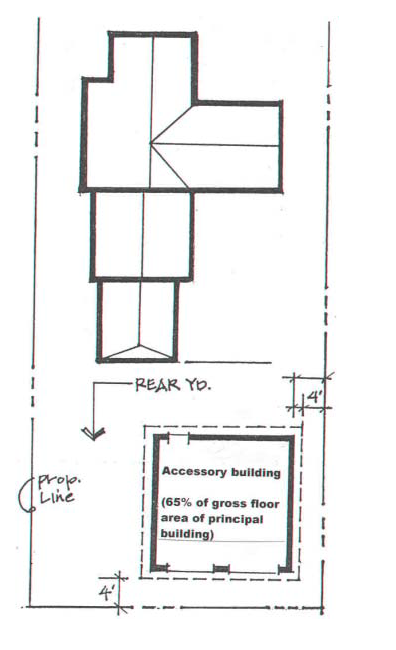
(2)
Not exceed 25 feet or the height of the principal building(s), whichever is less.
(3)
Not be closer than 4 feet to any side or rear property line. A boat house up to 250 square feet in gross floor area may be built to the waters edge.
(4)
Have a total gross floor area of all accessory buildings on the lot no greater than 65 percent of the gross floor area of the principal building(s).
(5)
Be constructed using materials and features similar to the principal building(s) if the accessory building exceeds 200 square feet in gross floor area.
(Ord. 476. Passed 7-6-99. Ord. 542. Passed 8-20-01. Ord. 637. Passed 4-5-04.)
1330.08 - Parking, loading and driveways.
Driveways for residential lots must access from a publicly maintained alley if available. Other requirements for parking, loading and driveways are contained in Chapter 1374. In addition, athletic fields may provide up to 50 percent of the required number of organized parking on an area developed in turf grasses. Grassed parking areas are considered as providing 1 parking space for every 350 square feet of continuous turf covered area. All grassed parking areas shall be maintained in a healthy, vigorous growing condition and shall not be used more than 12 times per calendar year. When use requires more frequent parking, an impervious surface or approved pervious hard surface parking area shall be developed.
(Ord. 476. Passed 7-6-99)
1332.01 - Uses allowed.
The following uses of land and buildings, together with accessory uses, are allowed in the Single-Family districts:
•
Accessory Dwelling Units.
(1)
Accessory dwelling units are an allowed use provided they meet the following requirements:
(a)
The existing site and use are substantially in compliance with this Zoning Code.
(b)
Only 1 accessory dwelling unit per parcel is allowed with a maximum of 2 dwellings per parcel.
(c)
The accessory dwelling unit is clearly incidental to the principal dwelling unit and the structures exterior appears to be single-family.
(d)
Location of entrances. Only 1 entrance may be located on the façade of the primary dwelling facing the street, unless the primary dwelling contained additional entrances before the accessory dwelling unit was created. An exception to this regulation is entrances that do not have access from the ground such as entrances from balconies or decks.
(e)
Exterior stairs. Fire escapes for access to an upper-level accessory dwelling shall not be located on the front of the primary dwelling. Interior stair floor area will not count in the size calculation of the accessory dwelling unit.
(f)
Individual site plans, floor plans, elevation drawings, building plans for the proposed accessory dwelling unit shall be submitted with the application for a land use permit. If exterior modifications are made after a land use permit is issued, revisions must be reviewed and approved by the Zoning Administrator.
(g)
The accessory dwelling unit incorporated in the principal dwelling may be no more than 800 square feet or the size of the principal dwelling, whichever is less. A unit in an accessory building may not exceed 800 square feet and must meet all the requirements of Section 1332.07.
(h)
At least 1 owner of record shall occupy either the primary dwelling unit or the accessory dwelling unit. The owner occupant shall meet the requirements for a principal residence tax exemption.
(i)
The accessory dwelling unit shall obtain a registration from the City Clerk annually.
i.
An owner desiring an accessory dwelling unit on their property is required to make written application to register with the City Clerk. The City Clerk shall provide forms for applications.
The applicant shall truthfully state, in full, the information requested on the application, including:
(1)
The applicant's name, telephone number, address of present place of residence, length of residence at such address;
(2)
Affidavit verifying applicant applies consent and understands that accessory dwelling units are subject to the conditions contained in this Ordinance section, in addition to conditions contained elsewhere in these Codified Ordinances.
ii.
A registration obtained under this section shall not relieve any person of the responsibility for obtaining any other permit, license or authorization required by another ordinance, statute or administrative rule.
iii.
Administration and enforcement shall be the responsibility of the Zoning Administrator per Section 1322.04.
iv.
Complaints. If a written complaint is made alleging that an accessory dwelling unit has violated any provisions of this chapter, the Zoning Administrator shall promptly forward the written complaint to the accessory dwelling unit owner together with a notice that an investigation will be made as to the truth of the complaint. The accessory dwelling unit owner may respond to the complaint and present evidence and respond to evidence produced by the investigation. If the Zoning Administrator determines that the accessory dwelling unit is in violation, the City may enforce these provisions by any means available under the law.
v.
Penalty per Section 202.99.
vi.
Fee. A non-refundable registration fee shall be established by the City Commission.
(j)
The accessory dwelling unit shall not be leased for a period of less than 3 months at a time. Upon request of the City, the owner of record shall provide a lease agreement evidencing the length of the lease.
(k)
Each registered accessory dwelling unit is subject to annual administrative review by the City. Registrant shall provide additional information as requested by the City.
(l)
An accessory dwelling unit shall be prohibited if the parcel has a licensed Tourist Home.
•
Adult foster care family home;
•
Athletic fields;
•
Boat houses if they are an accessory use, if they are designed for housing a boat, if provisions are made for routing of any boardwalk, and if proper state and federal permits are obtained;
•
Child care organization, as defined by MCL 722.111 et seq., as amended, associated with a school or place of worship;
•
Community gardens;
•
Dwellings, single-family;
•
Dwellings, duplex;
•
Essential services;
•
Family child care home, as defined by MCL 722.111 et seq., as amended;
•
Golf courses;
•
Group child care home, as defined by MCL 722.111 et seq., as amended, subject to the following conditions:
(1)
All necessary licenses are obtained and maintained. Expiration or revocation of a license automatically terminates the land use permit and a change in the licensee requires a land use permit renewal.
(2)
The lot is not located within 150 feet of another lot devoted to such use. The distances required shall be measured along any private or public street.
(3)
A fenced outside recreation area shall be located on premise where it will most effectively shield neighboring properties from noise and visual disruptions. Play equipment shall not be placed streetward of the principal structure unless specifically allowed by the Planning Commission for unique circumstance.
(4)
The use does not exceed 16 hours of operation during a 24-hour period.
(5)
No additional parking is required for the group child care home provided on-street parking is allowed adjacent to the property. If on-street parking is not allowed, 2 parking spaces shall be provided on premise.
(6)
A Group child care home requires the issuance of a Land Use Permit. As part of the application, a site plan shall be submitted showing the designated outside play area, primary drop-off/pick-up entrance and parking spaces.
•
Home occupations subject to the following conditions:
(1)
A home occupation shall be conducted within the dwelling which is the bona fide residence of the principal practitioner of the occupation, or in a building accessory to such dwelling.
(2)
All business activity and storage shall take place within the interior of the dwelling and/or accessory building.
(3)
No alteration to the exterior of the residential dwelling, accessory building or yard that alters the residential character of the premises is permissible.
(4)
The home occupation shall not generate vehicular traffic beyond 8 trip-ends per day.
(5)
Only off-street parking facilities customary for a residential use and located on the premises may be used.
(7)
No vehicles used in the conduct of the occupation may be parked, kept or otherwise be present on the premises, other than such as are customarily used for domestic or household purposes.
(8)
Home occupations shall be conducted solely by persons residing at the residence, and no more than 2 such persons shall be employed in the home occupation.
(9)
Any sign identifying the occupation must conform to the regulations of Traverse City Code Chapter 1476, Signs.
(10)
No sale or rental of goods is allowed on the premises, except as secondary and incidental to the furnishing of a service.
(11)
Instruction in crafts and fine arts are recognized as allowable home occupations if they meet the above conditions.
(12)
The use shall not generate noise, vibration or odors detectible beyond the property line.
•
Playgrounds;
•
Tourist homes meeting the following requirements:
(1)
Rooms utilized for sleeping shall be part of the primary residential structure and shall not be specifically constructed or remodeled for rental purposes.
(2)
There are two levels of tourist homes and are separated based on intensity:
(a)
A high intensity tourist home may rent up to 3 rooms for compensation, limited to not more than 2 adults per room, to persons who do not stay for more than 14 consecutive days for 85 or greater guest nights per year. A high intensity tourist home shall not be closer than 1,000 feet to another licensed high intensity tourist home or another tourist home licensed before January 22, 2019.
(b)
A low intensity tourist home may rent not more than 2 rooms for compensation, limited to not more than 2 adults per room, to persons who do not stay for more than 14 consecutive days for no greater than 84 guest nights per year.
(3)
The exterior appearance of the structure shall not be altered from its single-family character.
(4)
There shall be no separate or additional kitchen facility for the guests.
(5)
Off-street parking shall be provided as required by this Zoning Code and shall be developed in such a manner that the residential character of the property is preserved. For each tourist home bedroom, 1 off-street parking space is required.
(6)
A site plan is approved according to the Zoning Code. Certain site plan information may be waived at the discretion of the Planning Director.
(7)
A City tourist home license is maintained.
(8)
A tourist home shall be an incidental and secondary use of a dwelling unit for business purposes. The intent of this provision is to ensure compatibility of such business use with other permitted uses of the residential districts and with the residential character of the neighborhoods involved, and to ensure that tourist homes are clearly secondary and incidental uses of residential buildings.
(9)
A tourist home shall be prohibited if the parcel is a registered accessory dwelling unit.
(10)
A person who violates any provision of this use is responsible for a municipal civil infraction. The fine for any unlawful tourist home violation shall be no less than $500.00, plus costs. Each day on which any violation of the use continues constitutes a separate offense and shall be subject to penalties or sanctions as a separate offense.
(Ord. 476. Passed 7-6-99. Ord. 649. Passed 8-16-04. Ord. 842. Passed 8-3-09. Ord. 875. Passed 8-16-10. Ord. 895. Passed 12-6-10. Ord. 1020. Passed 4-6-15; Ord. 1065. Passed 2-5-18; Ord. 1076, Passed 7-2-18; Ord No. 1087, Passed 1-22-19; Ord. No. 1089, Passed 2-19-19; Ord. No. 1207, Passed 10-16-23)
1332.02 - Uses allowed by special land use permit.
The following uses of land and buildings, together with accessory uses, are allowed in the single-family districts if a special land use permit is issued according to the standards of this chapter:
•
Adult foster care small group home;
•
Clustered single-family dwellings;
•
Essential services buildings;
•
Places of worship;
•
Schools;
•
Temporary accessory dwelling units.
(Ord. 895. Passed 12-6-10; Ord. 1076. Passed 7-2-18; Ord. No. 1207, Passed 10-16-23)
1332.03 - Lot, density and impervious surface provisions.
1 The maximum density of 2 dwelling units in the R-1a and R-1b districts may be achieved through either a single-family home with an accessory dwelling unit or a duplex.
2 Properties may increase the maximum impervious surface by up to 5% provided that the site satisfies all storm-water management requirements in Chapter 1068.
(Ord. 476, Passed 7-6-99; Ord. 621, Passed 2-2-04; Ord. 916, Passed 6-6-11; Ord. 956, Passed 1-7-13; Ord. No. 1095, Passed 6-3-19; Ord. No. 1207, Passed 10-16-23)
1332.04 - Setbacks.
(a)
Front setbacks:
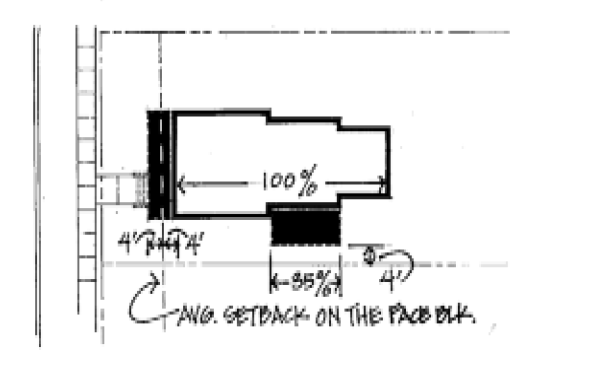
Building:
R-1a: 25 feet minimum.
R-1b: Within 4 feet of the average setback of principal buildings on the same face block, but no closer than 6 feet from the front property line.
Parking area:
R-1a: 3 feet minimum.
R-1b: 3 feet minimum.
(b)
Side setbacks (minimum):
*35% of a building side wall may be located no closer than 4 feet from the side property line.
Parking area: 2 feet
(c)
Rear setbacks (minimum):
Building: R-1a: 30 feet R-1b: 25 feet
Parking area: None.
(d)
Through lots and corner lots having a frontage on 2 streets shall provide the required front setback on both streets.
(e)
Water setbacks: 50 feet inland from the ordinary high water mark of Grand Traverse Bay and Boardman Lake and 25 feet from the ordinary high water mark of Boardman River. 25 feet from the ordinary high water mark of Kids Creek, or the centerline of the creek when buried or below grade. The Planning Director may reduce the Kids Creek setback up to a minimum of 10 feet if it is determined that the site is otherwise unbuildable.
(f)
Storage of a boat, motor home, camper, utility trailer or other recreational vehicle or equipment is limited to the rear yard only. Storage shall mean parking the vehicle or equipment in an area unused for the purpose for which it was designed for a period of 30 consecutive days or more.
(Ord. 476, Passed 7-6-99; Ord. 757, Passed 7-2-07; Ord. No. 1094, Passed 6-3-19; Ord. No. 1207, Passed 10-16-23)
1332.05 - Encroachments into the setbacks.
No encroachments into the required setbacks are allowed except:
(1)
Eaves, chimneys, sills, belt courses, cornices and ornamental features not to exceed 18 inches are permitted to extend within the setbacks.
(2)
Terraces, patios, decks, uncovered and unenclosed porches and other ornamental features which do not extend more than 30 inches above grade at the nearest side property line may project into a required side setback provided these projections are no closer than 2 feet from the subject side property line.
(3)
An unenclosed balcony, porch or deck may project into a rear setback for a distance not exceeding 10 feet.
(4)
An unenclosed balcony or porch may project into a front setback not more than 8 feet from the exterior building line, but not closer than 6 feet from the front property line.
(5)
If there is no feasible alternative, the Planning Director may approve a setback variation up to 50 percent of the requirement for the front and rear setback when a required setback would necessitate the removal of an existing tree greater than or equal to 6 inches diameter at breast height. Any existing tree that is preserved by the approved variation must be protected and remain for at least five years from the date of the variation.
(Ord. 476, Passed 7-6-99; Ord. No. 1097, Passed 7-1-19; Ord. No. 1207, Passed 10-16-23)
1332.06 - Building height.
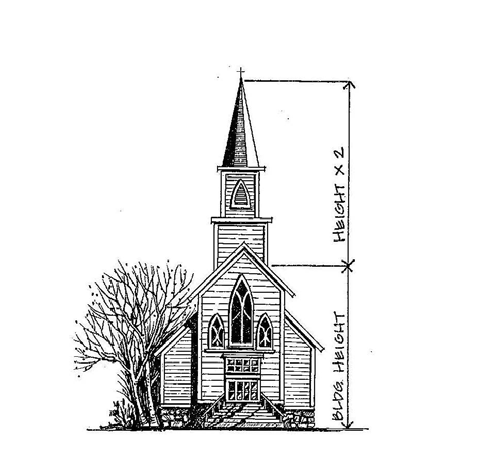
(a)
Building height (both districts):
Maximum 35 feet.
(b)
Exceptions:
Steeples and clock towers may be erected to a height not exceeding twice the height of the attached building.
Parapet walls may be used to screen existing equipment may be erected if the wall extends around the perimeter of the building and incorporates exterior building materials similar to those of the main building.
(Ord. 476, Passed 7-6-99; Ord. 726, Passed 3-19-07; Ord. No. 1207, Passed 10-16-23)
1332.07 - Accessory buildings.
Accessory buildings shall:
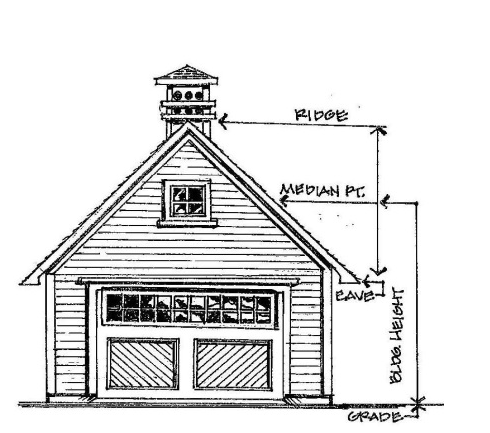
(1)
Only be permitted in the rear yard except accessory buildings may be located streetward on lots on navigable water and may be located streetward of the principal building on the less traveled street on through lots.
(2)
Not exceed 25 feet or the height of the principal building, whichever is less.
(3)
Not be closer than 4 feet to any side or rear property line. A boat house up to 250 square feet in gross floor area may be built to the water's edge.
(4)
Have a total gross floor area of all accessory buildings on the lot shall not exceed the greater than of 75 percent of the gross floor area of the principal building or 484 square feet.
(5)
Accessory buildings over 200 square feet in gross floor area, shall be constructed using building materials, design elements and roof pitches substantially similar to the exterior of the principal building.
(6)
For parcels on corner lots, except in the Boardman and Central Neighborhood Historic Districts, an accessory building can be connected to the principal building provided the connector is no longer than 10 feet in length, no taller than 15 feet in height, and the area of the connector does not exceed 100 square feet. The connector area shall be applied to the gross floor area of the accessory building.
(Ord. 476, Passed 7-6-99; Ord. 542, Passed 8-20-01; Ord. 554, Passed 2-4-02; Ord. 637, Passed 4-5-04; Ord. 1020, Passed 4-6-15; Ord. No. 1053, Passed 6-5-17; Ord. 1065, Passed 2-5-18; Ord. 1082, Passed 9-4-18; Ord. No. 1207, Passed 10-16-23)
1332.08 - Parking, loading and driveways.
(a)
Additional requirements for parking, loading and driveways are contained in Chapter 1374.
(b)
Any residential building or driveway constructed after the effective date of this zoning code which has access to a maintained alley shall not have access to a street nor shall a parking area be located in the front yard.
(c)
For parcels having alley access, the parking of a boat, motor home, camper, utility trailer or other recreational vehicle is limited to the rear yard.
(d)
Parking for motor vehicles shall occur only on a surface permitted by this code.
(e)
In addition, athletic fields may provide up to 50 percent of the required number of organized parking on an area developed in turf grasses. Grassed parking areas are considered as providing 1 parking space for every 350 square feet of continuous turf-covered area. All grassed parking areas shall be maintained in a healthy, vigorous growing condition and shall not be used more than 12 times per calendar year. When use requires more frequent parking, an impervious surface or approved pervious hard surface parking area shall be developed.
(Ord. 476, Passed 7-6-99; Ord. 758, Passed 7-2-07; Ord. No. 1207, Passed 10-16-23)
1332.09 - Special requirements.
To preserve and reinforce the development patterns of the single-family dwelling district the following special requirements shall apply:
(1)
In the Boardman and Central Neighborhood Historic Districts, attached garages for parcels with alley access shall be prohibited.
(2)
In the Boardman and Central Neighborhood Historic Districts, the distance between dwellings and accessory buildings greater than 200 square feet that have alley access shall not be less than 30 feet. The 30-foot separation between dwellings and accessory buildings can be reduced to 20 feet if it is determined to be impractical by the Planning Director.
(Ord. 974, Passed 7-1-13; Ord. No. 1207, Passed 10-16-23)
1332.10 - Two principal dwelling requirements.
Two separate single-family dwelling structures may be allowed on parcels that are twice the minimum lot size for their district without requiring the parcel to be split provided the following requirements are met:
(1)
Side setbacks shall be maintained between adjacent principal dwellings as required by the district if sited adjacent to each other.
(2)
All rear setbacks applicable to principal dwelling structures shall be met.
(Ord. No. 1207, Passed 10-16-23)
1334.01 - Uses allowed.
The following uses of land and buildings, together with accessory uses, are allowed in the Mixed Density Residential District:
•
R-1 District Uses;
•
Accessory Dwelling Units, accessory to a single-family, duplex, or triplex dwelling;
•
Art galleries in non-residential buildings built prior to 1950, provided they are located on an arterial or collector street and provided the building is not expanded other than for barrier-free access requirements;
•
Dwellings, two-family;
•
Dwellings, triplex;
•
Dwellings, quadplex;
•
Dwellings, multiple family, in non-residential buildings built prior to 1950, provided they are located on an arterial or collector street and provided the building is not expanded other than for barrier-free access requirements;
•
Offices in nonresidential buildings built prior to 1950, provided they are located on an arterial or collector street and provided the building is not expanded except as necessary to meet barrier-free access requirements.
•
Other similar uses as approved by the Planning Commission provided:
(1)
The uses are located on an arterial or collector street.
(2)
The uses are in a non-residential building built prior to 1950 and the building is not expanded except as necessary to meet barrier-free access requirements.
(3)
The uses will not generate excessive noise, lighting, fumes or other nuisances.
(Ord. 693, Passed 12-19-05; Ord. 746, Passed 5-21-07; Ord. 842, Passed 8-3-09; Ord. 876; Passed 8-16-10; Ord. 894, Passed 12-6-10; Ord. 1066. Passed 2-5-18; Ord. 1076. Passed 7-2-18; Ord No. 1087, Passed 1-22-19; Ord. No. 1089, Passed 2-19-19; Ord. No. 1209, Passed 10-16-23; Ord. No. 1225, Passed 6-2-25)
1334.02 - Uses allowed by special land use permit.
The following uses of land and buildings, together with accessory uses, are allowed in the Mixed Density Residential District if a special land use permit is issued according to the standards of this chapter:
•
Adult foster care small group home;
•
Clustered single-family dwellings;
•
Essential services buildings;
•
Places of worship;
•
Schools.
(Ord. 894, Passed 12-6-10; Ord. 1076, Passed 7-2-18; Ord. No. 1209, Passed 10-16-23; Ord. No. 1225, Passed 6-2-25)
1334.03 - Lot, density and impervious surface provisions.
1 The maximum density of 4 dwelling units in the R-2 shall only be achieved through 2 duplexes, a triplex with an accessory dwelling unit, or a quadplex. There shall be a limit of 2 structures per parcel that can be used for residential purposes.
2 Properties may increase the maximum impervious surface limit by up to 5% provided that the site satisfies all stormwater management requirements in Chapter 1068.
(Ord. 476, Passed 7-6-99; Ord. 555, Passed 2-4-02; Ord. 621, Passed 2-2-04; Ord. 750, Passed 5-21-07; Ord. 884, Passed 11-1-10; Ord. No. 1095, Passed 6-3-19; Ord. No. 1209, Passed 10-16-23; Ord. No. 1225, Passed 6-2-25)
1334.04 - Setbacks.
(a)
Front setbacks:
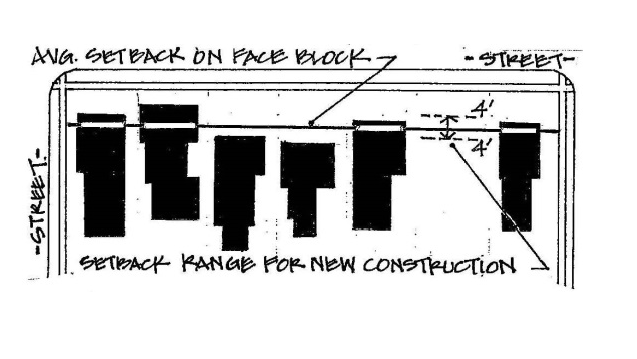
Building: Within 4 feet of the average setback of principal buildings on the same face block but no closer than 6 feet from the front property line.
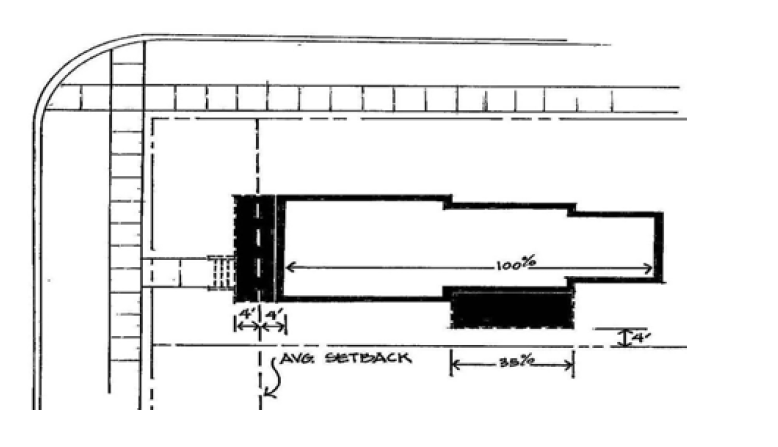
Parking area: 3 feet minimum.
(b)
Side setbacks (minimum):
Building:
One Side: 6 feet
Aggregate: 14 feet, 35 percent of a side building wall may be located no closer than 4 feet from the side property line.
Parking area: 2 feet
(c)
Rear setbacks:
Building: 25 feet
Parking area: None
(d)
Corner and through lots shall have a front setback on each street.
(e)
Water setbacks: 50 feet inland from the ordinary high water mark of Grand Traverse Bay and Boardman Lake and 25 feet from the ordinary high water mark of the Boardman River, 25 feet from the ordinary high water mark of Kids Creek, or the centerline of the creek when buried or below grade. The Planning Director may reduce the Kids Creek setback up to a minimum of 10 feet if it is determined that the site is otherwise unbuildable.
(f)
Storage of a boat, motor home, camper, utility trailer or other recreational vehicle or equipment is limited to the rear yard only. Storage means parking the vehicle or equipment in an area unused for the purpose for which it was designed for a period of 30 consecutive days or more.
(Ord. 759, Passed 7-2-07; Ord. No. 1094, Passed 6-3-19; Ord. No. 1209, Passed 10-16-23; Ord. No. 1225, Passed 6-2-25)
1334.05 - Encroachments into the setbacks.
No encroachments into required setbacks are allowed except:
(1)
Eaves, chimneys, sills, belt courses, cornices and ornamental features not to exceed 18 inches are permitted to extend within the setback.
(2)
Terraces, patios, decks, uncovered and unenclosed porches and other ornamental features which do not extend more than 30 inches above grade at the nearest side property line may project into a required side setback provided these projections are no closer than 2 feet from the subject side property line.
(3)
An unenclosed balcony or porch may project into a front setback not more than 8 feet from the exterior building line, but not closer than 6 feet from the front right-of-way line.
(4)
If there is no feasible alternative, the Planning Director may approve a setback variation up to 50 percent of the requirement for the front and rear setback when a required setback would necessitate the removal of an existing tree greater than or equal to 6 inches diameter at breast height. Any existing tree that is preserved by an approved variation must be protected and remain for at least 5 years from the date of the variation.
(Ord. No. 1097, Passed 7-1-19; Ord. No. 1209, Passed 10-16-23; Ord. No. 1225, Passed 6-2-25)
1334.06 - Building height.
(a)
Building height: Maximum 35 feet.
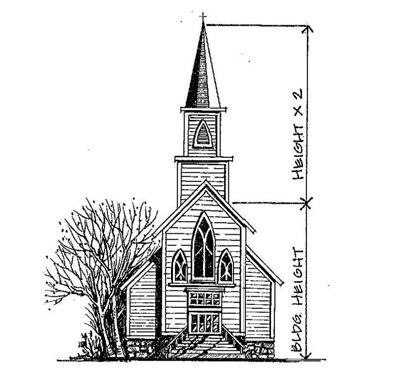
(b)
Exceptions:
Steeples and clock towers may be erected to a height not exceeding twice the height of the attached building.
Parapet walls may be erected as necessary to screen rooftop equipment if the wall extends around the perimeter of the building and incorporates exterior building materials similar to those of the main building.
(Ord. 727, Passed 3-19-07; Ord. No. 1209, Passed 10-16-23; Ord. No. 1225, Passed 6-2-25)
1334.07 - Accessory buildings.
Accessory buildings shall:
(1)
Only be permitted in the rear yard, except accessory buildings may be located streetward on lots on navigable water and may be located streetward of the principal building on the less traveled street on through lots.
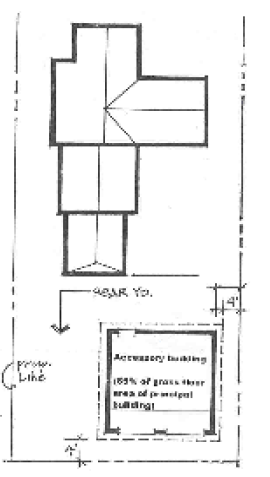
(2)
Not exceed 25 feet or the height of the principal building(s) at the median point, whichever is less.
(3)
Not be closer than 4 feet to any side or rear property line. A boat house up to 250 square feet in gross floor area may be built to the water's edge.
(4)
Have a total gross floor area of all accessory buildings on the lot shall not exceed the greater of 75 percent of the gross floor area of the principal building(s) or 484 square feet.
(5)
Accessory buildings over 200 square feet in gross floor area, shall be constructed using building materials, design elements and roof pitches substantially similar to the exterior of the principal building.
(6)
For parcels on corner lots, except in the Boardman and Central Neighborhood Historic Districts, an accessory building can be connected to the principal building provided the connector is no longer than 10 feet in length, no taller than 15 feet in height, and the area of the connector does not exceed 100 square feet. The connector area shall be applied to the gross floor area of the accessory building.
(Ord. 542, Passed 8-20-01; Ord. 554, Passed 2-4-02; Ord. 637, Passed 4-5-04; Ord. No. 1053, Passed 6-5-17; Ord. 1066, Passed 2-5-18; Ord. 1082, Passed 9-4-18; Ord. No. 1209, Passed 10-16-23; Ord. No. 1225, Passed 6-2-25)
1334.08 - Parking, loading and driveways.
(a)
Additional requirements for parking, loading and driveways are contained in Chapter 1374.
(b)
Any residential building or driveway constructed after the effective date of this zoning code which has access to a maintained alley shall not have access to a street nor shall a parking area be located in the front yard.
(c)
For parcels having alley access, the parking of a boat, motor home, camper, utility trailer or other recreational vehicle is limited to the rear yard.
(d)
Parking for motor vehicles shall occur only on a surface permitted by this code.
(e)
Athletic fields may provide up to 50 percent of the required number of organized parking on an area developed in turf grasses. Grassed parking areas shall be considered as providing 1 parking space for every 350 square feet of continuous turf-covered area. All grassed parking areas shall be maintained in a healthy, vigorous growing condition and shall not be used more than 12 times per calendar year. When use requires more frequent parking, an impervious surface or approved pervious hard surface parking area shall be developed.
(Ord. 476, Passed 7-6-99; Ord. 760, Passed 7-2-07; Ord. No. 1209, Passed 10-16-23; Ord. No. 1225, Passed 6-2-25)
1334.09 - Special requirements.
To preserve and reinforce the development patterns of the Mixed Density Residential District the following special requirements shall apply:
(1)
In the Boardman and Central Neighborhood Historic Districts, attached garages for parcels with alley access shall be prohibited.
(2)
In the Boardman and Central Neighborhood Historic Districts, the distance between dwellings and accessory buildings greater than 200 square feet that have alley access shall not be less than 30 feet. The 30-foot separation between dwellings and accessory buildings can be reduced to 20 feet if it is determined to be impractical by the Planning Director.
(Ord. 975, Passed 7-1-13; Ord. No. 1209, Passed 10-16-23; Ord. No. 1225, Passed 6-2-25)
1336.01 - Uses allowed.
The following uses of land and buildings, together with accessory uses, are allowed in the multiple-family districts:
•
Accessory dwelling units are an allowed use provided they meet the following requirements:
(a)
The existing site and use are substantially in compliance with this Zoning Code.
(b)
Only 1 accessory dwelling unit per parcel is allowed with a maximum of 2 dwellings per parcel.
(c)
The accessory dwelling unit is clearly incidental to the principal dwelling unit and the structures' exterior appear to be single-family.
(d)
Location of entrances. Only 1 entrance may be located on the facade of the primary dwelling facing the street, unless the primary dwelling contained additional entrances before the accessory dwelling unit was created. An exception to this regulation is entrances that do not have access from the ground such as entrances from balconies or decks.
(e)
Exterior stairs. Fire escapes for access to an upper level accessory dwelling shall not be located on the front of the primary dwelling. Interior stair floor area will not count in the size calculation of the accessory dwelling unit.
(f)
Individual site plans, floor plans, elevation drawings, building plans for the proposed accessory dwelling unit shall be submitted with the application for a land use permit. If exterior modifications are made after a land use permit is issued, revisions must be reviewed and approved by the Zoning Administrator.
(g)
The accessory dwelling unit incorporated in the principal dwelling may be no more than 800 square feet or the size of the principal dwelling, whichever is less. A unit in an accessory building may not exceed 800 square feet and must meet all the requirements of Section 1334.07.
(h)
At least 1 owner of record shall occupy either the primary dwelling unit or the accessory dwelling unit. The owner occupant shall meet the requirements for a principal residence tax exemption.
(i)
The accessory dwelling unit shall obtain a registration from the City Clerk annually.
i.
An owner desiring an accessory dwelling unit on their property is required to make written application to register with the City Clerk. The City Clerk shall provide forms for applications.
The applicant shall truthfully state, in full, the information requested on the application, including:
(1)
The applicant's name, telephone number, address of present place of residence, length of residence at such address;
(2)
Affidavit verifying applicant applies consent and understands that accessory dwelling units are subject to the conditions contained in this Ordinance section, in addition to conditions contained elsewhere in these Codified Ordinances.
ii.
A registration obtained under this section shall not relieve any person of the responsibility for obtaining any other permit, license or authorization required by another ordinance, statute or administrative rule.
iii.
Administration and enforcement shall be the responsibility of the Zoning Administrator per Section 1322.04.
iv.
Complaints. If a written complaint is made alleging that an accessory dwelling unit has violated any provisions of this chapter, the Zoning Administrator shall promptly forward the written complaint to the accessory dwelling unit owner together with a notice that an investigation will be made as to the truth of the complaint. The accessory dwelling unit owner may respond to the complaint and present evidence and respond to evidence produced by the investigation. If the Zoning Administrator determines that the accessory dwelling unit is in violation, the City may enforce these provisions by any means available under the law.
v.
Penalty per Section 202.99.
vi.
Fee. A non-refundable registration fee shall be established by the City Commission.
(j)
The accessory dwelling unit shall not be leased for a period of less than 3 months at a time. Upon request of the City, the owner of record shall provide a lease agreement evidencing the length of the lease.
(k)
Each registered Accessory Dwelling Unit is subject to annual administrative review by the City. Registrant shall provide additional information as requested by the City.
(l)
An accessory dwelling unit shall be prohibited if the parcel has a licensed Tourist Home.
•
Adult foster care family home and small group home;
•
Art galleries in non-residential buildings built prior to October 16, 2003, provided they are located on an arterial or collector street and provided the building is not expanded other than for barrier-free access requirements;
•
Boat houses if they are an accessory use, if they are designed for housing a boat, if provisions are made for routing of any boardwalk, and if proper state and federal permits are obtained;
•
Coffee houses and family or fine food restaurants in non-residential buildings built prior to October 16, 2003, provided they are located on an arterial or collector street and provided the building is not expanded other than for barrier-free access requirements;
•
Child care organization, as defined by MCL 722.111 et seq., as amended, associated with a school or place of worship;
•
Community Gardens;
•
Dwellings, single-family;
•
Dwellings, two-family;
•
Dwellings, duplex
•
Dwellings, triplex
•
Dwellings, quadplex
•
Dwellings, multiple family;
•
Essential services;
•
Family child care home, as defined by MCL 722.111 et seq., as amended;
•
Group child care home, as defined by MCL 722.111 et seq., as amended, subject to the following conditions:
(1)
All necessary licenses are obtained and maintained. Expiration or revocation of a license automatically terminates the land use permit and a change in the licensee requires a land use permit renewal.
(2)
The lot is not located within 150 feet of another lot devoted to such use. The distances required shall be measured along any private or public street.
(3)
A fenced outside recreation area shall be located on premise where it will most effectively shield neighboring properties from noise and visual disruptions. Play equipment shall not be placed streetward of the principal structure unless specifically allowed by the Planning Commission for unique circumstance.
(4)
The use does not exceed 16 hours of operation during a 24-hour period.
(5)
No additional parking is required for the Group Day Care Home provided on-street parking is allowed adjacent to the property. If on-street parking is not allowed, 2 parking spaces shall be provided on premise.
(6)
A Group child care home requires the issuance of a Land Use Permit. As part of the application, a site plan shall be submitted showing the designated outside play area, primary drop off/pick up entrance and parking spaces.
•
Home occupations subject to the following conditions:
(1)
A home occupation shall be conducted within the dwelling which is the bona fide residence of the principal practitioner of the occupation, or in a building accessory to such dwelling.
(2)
All business activity and storage shall take place within the interior of the dwelling and/or accessory building.
(3)
No alteration to the exterior of the residential dwelling, accessory building or yard that alters the residential character of the premises is permissible.
(4)
The home occupation shall not generate vehicular traffic beyond 8 trip-ends per day.
(5)
Only off-street parking facilities customary for a residential use and located on the premises may be used.
(6)
No vehicles used in the conduct of the occupation may be parked, kept or otherwise be present on the premises, other than such as are customarily used for domestic or household purposes.
(7)
Home occupations shall be conducted solely by persons residing at the residence and no more than 2 such persons shall be employed in the home occupation. If the residence is located on an arterial or collector street, 1 non-resident employee at 1 time is also allowed in addition to 2 resident employees.
(8)
Any sign identifying the occupation must conform to the regulations of the Traverse City Code Chapter 1476, Signs.
(9)
No sale or rental of goods is allowed on the premises, except as secondary and incidental to the furnishing of a service.
(10)
Instruction in crafts and fine arts are recognized as allowable home occupations if they meet the above conditions.
(11)
The use shall not generate noise, vibration or odors detectible beyond the property line.
•
Offices in nonresidential buildings built prior to (the date of this ordinance) provided they are located on an arterial or collector street and provided the building is not expanded except as necessary to meet barrier-free access requirements;
•
Parks;
•
Playgrounds;
•
Private clubs, lodges, fraternities or sororities, if located on an arterial or collector street;
•
Rooming houses;
•
Tourist homes maintaining a City tourist home license;
•
Other similar uses as approved by the Planning Commission if such uses will generate similar traffic and parking, are compatible with adjacent land uses, and will not generate excessive noise, lighting, fumes or other nuisances.
(Ord. 476, Passed 7-6-99; Ord. 611, Passed 10-6-03; Ord. 693, Passed 12-19-05; Ord. 842, Passed 8-3-09; Ord. 877, Passed 8-16-10; Ord. 896, Passed 12-6-10; Ord. 1064, Passed 2-5-18; Ord. 1076, Passed 7-2-18; Ord. No. 1089, Passed 2-19-19; Ord. No. 1172, Passed 10-18-21)
1336.02 - Uses allowed by special land use permit.
The following uses of land and buildings, together with accessory uses, are allowed in the multiple family district if a special land use permit is issued according to the standards of this Code:
•
Essential services buildings;
•
Places of worship;
•
Residential care and treatment facilities;
•
Schools;
•
Theaters, live, and performance art centers.
(Ord. 476, Passed 7-6-99; Ord. 676, Passed 05-02-05; Ord. 1076, Passed 7-2-18; Ord. No. 1172, Passed 10-18-21)
1336.03 - Lot, density and impervious surface provisions.
(Ord. No. 1172, Passed 10-18-21)
1336.04 - Setbacks.
(a)
Front setbacks:
Building: Within 4 feet of the average setback of principal buildings on the same side of the street in the same face block, but not less than 19 feet from the edge of the street curb or edge of the pavement if there is no curb.
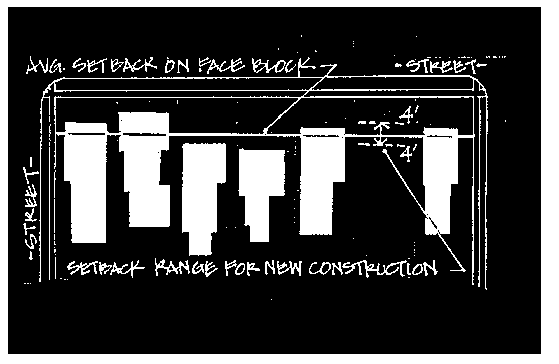
Parking area: To the side or rear of the principal building and set back a distance at least equal to the principal building or 25 feet, whichever is greater. For through lots, parking may be provided streetward of the principal building on the street that carries less traffic, but in no case closer than 25 feet from the front property line.
(b)
Side setbacks (minimum):
Building:
One side: 6 feet
Aggregate: 14 feet; for structures above grade on lots or tracts of land on Grand Traverse Bay, the side setback is the greater of 30 percent of the lot width or 14 feet.
Parking area: If contiguous to an R-district, a minimum of 10 feet. Otherwise, 5 feet. If shared parking is developed, these setbacks would affect only the perimeter of the combined parcels.
(c)
Rear setbacks:
Building: 25 feet
Parking area: 5 feet, except 20 feet if abutting, adjacent to or across an alley from an R-District.
(d)
Corner lots and through lots shall have a front setback on each street.
(e)
Water setbacks: 50 feet inland from the ordinary high water mark of Grand Traverse Bay and Boardman Lake and 25 feet from the ordinary high water mark of Boardman River. 25 feet from the ordinary high water mark of Kids Creek, or the center line of the creek when buried below grade. If the lot is determined to be unbuildable due to the setback, then the Planning Director may reduce the Kids Creek setback the minimum amount necessary to allow the lot to be buildable. Notwithstanding the foregoing, the Planning Director shall not reduce the setback to less than 10 feet.
(f)
Storage of a boat, motor home, camper, utility trailer or other recreational vehicle or equipment is limited to the rear yard only. Storage means parking the vehicle or equipment in an area unused for the purpose for which it was designed for a period of 30 consecutive days or more.
(Ord. 476, Passed 7-6-99; Ord. No. 1094, Passed 6-3-19; Ord. No. 1172, Passed 10-18-21)
1336.05 - Encroachments into the setbacks.
No encroachments into required setbacks are allowed except:
(1)
Eaves, chimneys, sills, belt courses, cornices and ornamental features not to exceed 18 inches are permitted to extend within the setbacks.
(2)
Terraces, patios, decks, uncovered and unenclosed porches and other ornamental features which do not extend more than 30 inches above grade at the nearest side property line may project into a required side setback provided these projections are no closer than 2 feet from the subject side property line.
(3)
An unenclosed balcony, porch or deck may project into a rear setback for a distance not exceeding 10 feet.
(4)
An unenclosed balcony or porch may project into a front setback not more than 8 feet from the exterior building line, but not closer than 6 feet from the front right-of-way line.
(Ord. 476, Passed 7-6-99; Ord. No. 1172, Passed 10-18-21)
1336.06 - Building height.
(a)
Building height: Maximum 45 feet. When abutting or across the alley from an R-1a, R-1b, or R-2 District, that portion of the building within 30 feet of the property line or right-of-way shall not exceed 35 feet in height.
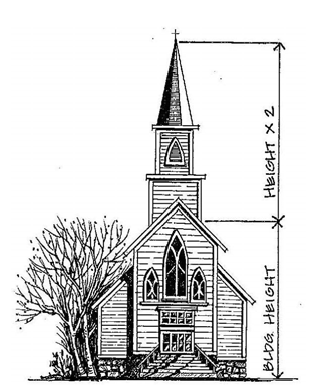
(b)
Exceptions:
Steeples and towers may be erected to a height not exceeding twice the height of the attached building.
Parapet walls may be erected as necessary to screen rooftop equipment if the wall extends around the perimeter of the building and incorporates the exterior building materials similar to those of the main building.
Rooftop amenities may be erected to accommodate, occupiable enclosed space for rooftop amenities may exceed the height limit of the district by a maximum of 15 feet, provided:
(1)
The use shall be limited to restrooms, storage areas, community rooms for the occupants of the building, and food and beverage service, provided that:
a.
Outdoor food and beverage service shall cease between the hours of 10:30 p.m. and 6:00 a.m. when abutting or across an alley from an R-District.
b.
Outdoor performances and any other form of amplified sound shall cease between 10:00 p.m. and 7:00 a.m. when abutting or across the alley from an R-District.
(2)
Shall be setback a minimum of 20 feet from any street facing facade and rear property line if abutting or across an alley from an R-District.
(3)
Not exceed a total of 1,650 square feet or 20% of the rooftop area, whichever is less.
(Ord. 476, Passed 7-6-99; Ord. 728, Passed 3-19-07; Ord. No. 1172, Passed 10-18-21; Ord. No. 1191, Passed 10-3-22)
1336.07 - Accessory buildings.
The following are requirements for accessory buildings in the multiple family district:
(1)
In order to minimize visibility from public or private street, accessory buildings shall be screened by the principal building(s), the site topography or other natural features of the property.
(2)
Accessory buildings shall not exceed 20 feet in height.
(3)
Accessory buildings shall be located no closer than 5 feet to any side or rear property line, except a boat house up to 250 square feet gross floor area may be built to the water's edge.
(4)
Accessory buildings over 200 square feet in gross floor area, shall be constructed using building materials, design elements and roof pitches substantially similar to the principal building(s).
(Ord. 476, Passed 7-6-99; Ord. 526, Passed 3-19-01; Ord. 637, Passed 4-5-04; Ord. No. 1172, Passed 10-18-21)
1336.08 - Parking, loading and driveways.
(a)
Additional requirements for parking, loading and driveways are contained in Chapter 1374.
(b)
Any residential building or driveway constructed after the effective date of this zoning code which has access to a maintained alley shall not have access to a street nor shall a parking area be located in the front yard.
(c)
For parcels having alley access, the parking of a boat, motor home, camper, utility trailer or other recreational vehicle is limited to the rear yard.
(d)
Parking for motor vehicles shall occur only on a surface permitted by this Code.
(Ord. 476, Passed 7-6-99; Ord. 761, Passed 7-2-07; Ord. No. 1172, Passed 10-18-21)
1336.09 - Special requirements.
To preserve and reinforce the development patterns of the Multiple Family Dwelling District the following special requirements shall apply:
(1)
In the Boardman and Central Neighborhood Historic Districts, attached garages for parcels with alley access shall be prohibited.
(2)
In the Boardman and Central Neighborhood Historic Districts, the distance between dwellings and accessory buildings greater than 200 square feet that have alley access shall not be less than 30 feet. The 30 foot separation between dwellings and accessory buildings can be reduced to 20 feet if it is determined to be impractical by the Planning Director.
(3)
The street-facing facade shall include at least one pedestrian entrance for common use of the residents and shall provide a direct connection to the street sidewalk. If no common pedestrian entrance is provided for on the street-facing facade, then each ground floor dwelling unit on the street-facing facade shall provide a private pedestrian entrance with a direct connection to the street sidewalk. At a minimum, pedestrian entrances shall be provided for every 90 feet of linear building frontage along the street right-of-way.
(4)
The street-facing façade shall provide windows to the dwelling units on each floor.
(5)
For buildings with 5 or more dwelling units, vertical building modulation shall be used to add variety and interest and to make a large building appear to be an aggregation of smaller units. Relief from a continuous street facing wall may be achieved with wall offsets in combination with pilasters, corbeling or other permanent architectural elements; however, offsets in any wall shall not be less than 8 inches from the subject plane.
(6)
For buildings with 5 or more dwelling units, horizontal building modulation like awnings, balconies and roof features shall be used to reduce the perceived mass of a large building.
(7)
Buildings on corner lots or on lots with a front loaded driveway shall have a clipped or recessed corner for the height of the first floor level if the building facade is within 20 feet of the street or driveway/street intersection. These building corners shall be recessed at least 5 feet from the planes of the building if such building is located less than 20 feet from the edge of street or driveway intersection. See diagram below.
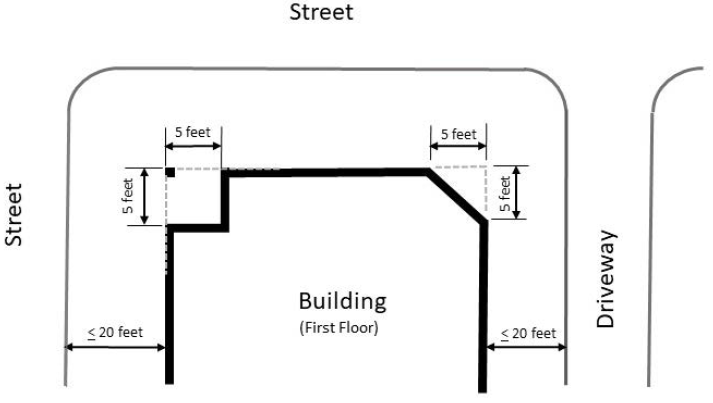
(8)
Any rooftop equipment shall be enclosed or screened from street level view using the same materials used for the building walls or a material which is approved by the Planning Director as visually compatible with the building.
(Ord. 976, Passed 7-1-13; Ord. No. 1172, Passed 10-18-21)
1338.01 - Uses allowed.
The following uses of land and buildings, together with accessory uses, are allowed in the Hotel Resort District:
•
R-3 District uses;
•
Adult use marihuana event organizer;
•
Adult use marihuana retailers;
(1)
The Adult Use Marihuana Retailer and use shall comply at all times with the Michigan Regulation and Taxation of Marihuana Act, Initiated Law 1 of 2018 MCL 333.27951 et seq., as amended, the Codified Ordinances of the City of Traverse City, and the rules promulgated pursuant to the Michigan Regulation and Taxation of Marihuana Act, Initiated Law 1 of 2018 MCL 333.27951 et seq., as amended, as they may be amended from time to time;
(2)
The Adult Use Marihuana Retailer shall not be in operation between the hours of 10:00 p.m. and 7:00 a.m.
(3)
Co-location with other marihuana Adult-Use Marihuana Establishments or Medical Marihuana Facilities may occur only as specifically permitted by the Medical Marihuana Facilities Licensing Act and the Michigan Regulation and Taxation of Marihuana Act and any corresponding administrative rules, regulations and ordinances.
(4)
No use or consumption of marihuana shall be allowed at the Adult Use Marihuana Retailer.
(5)
An Adult Use Marihuana Retailer shall not be located within a 1,000-foot radius from any existing school.
(6)
The Adult Use Marihuana Retailer shall have at all times a valid and current operating license issued by the State and permit from the City of Traverse City under the applicable Codified Ordinances of the City of Traverse City.
(7)
All activities of an Adult Use Marihuana Retailer shall be conducted within the building.
(8)
The smell of marihuana shall not be detectable outside of the portion of any structure where marihuana is present.
•
Child care organizations, as defined by MCL 722.111 et seq., as amended;
•
Lodging facilities;
•
Medical marihuana provisioning center meeting the following requirements:
(1)
The medical marihuana facility and use shall comply at all times with the Michigan Medical Marihuana Facilities Licensing Act, Chapter 845 of the Codified Ordinances of the City of Traverse City, and the rules promulgated pursuant to the Michigan Medical Marihuana Facilities Licensing Act, as they may be amended from time to time;
(2)
The Medical Marihuana Provisioning Center shall not be in operation between the hours of 10:00 p.m. and 7:00 a.m.;
(3)
Except for Medical Marihuana Processors as set forth in this section, no other medical marihuana facilities use shall occur on the parcel;
(4)
Except for parents or guardians of a qualifying patient and the person holding a license under the Michigan Medical Marihuana Facilities Licensing Act and Chapter 845 of the Codified Ordinances of the City of Traverse City or staff of the medical marihuana facility, persons other than a qualifying patient or primary caregiver shall be not permitted within the medical marihuana provisioning center when medical marihuana is being transferred;
(5)
No use or consumption of marihuana shall be allowed at the medical marihuana facility;
(6)
The medical marihuana facility shall not be used by a physician to conduct a medical examination or issue a medical certification document for the purpose of obtaining a qualifying patient registry identification card under the Michigan Medical Marihuana Act;
(7)
A qualifying patient under the age of 18 shall be accompanied by a parent or guardian and notice of such shall be conspicuously posted;
(8)
A medical marihuana provisioning center shall not be located within a 1,000-foot radius from any existing school;
(9)
An owner or operator of a medical marihuana provisioning center shall not have been convicted of a felony involving controlled substances within the last 10 years;
(10)
The medical marihuana provisioning center shall have at all times a valid and current operating license issued by the State and the City of Traverse City under Chapter 845 of the Codified Ordinances of the City of Traverse City;
(11)
All activities of a medical marihuana provisioning center shall be conducted within the building;
(12)
The smell of marihuana shall not be detectable outside of the portion of any structure where marihuana is present.
•
Offices, and retail shops provided the total floor area of the business or business within a building does not exceed 6,000 square feet in gross floor area on 1 level;
•
Restaurants, family or fine, banquet or meeting rooms, but not drive-ins or drive-throughs and not exceeding 6,000 square feet in gross floor area.
•
Drinking places without entertainment, up to 6,000 square feet gross floor area;
•
Drinking places with entertainment if not adjacent to, abutting or across an alley from a residential district.
•
Vacation home rentals maintaining a City Vacation Home Rental license.
•
Veterinary services, without outdoor runs.
•
Recreational facilities.
(Ord. 476, Passed 7-6-99; Ord. 492, Passed 4-17-00; Ord. 623, Passed 3-15-04; Ord. 782, Passed 2-4-08; Ord. 788, Passed 3-17-08; Ord. 844, Passed 8-3-09; Ord. 1010, Passed 9-2-14; Ord. 1076. Passed 7-2-18; Ord. 1084, Passed 12-3-18; Ord. No. 1135, Passed 8-17-20; Ord. No. 1170, Passed 10-18-21)
1338.02 - Uses allowed by special land use permit.
The following uses of land and buildings, together with accessory uses, are allowed in the Hotel Resort District if a special land use permit is issued according to the standards of this Code:
•
Essential services buildings.
•
Residential care and treatment facilities.
•
Transitional housing.
•
Communication towers and emergency shelters.
•
Wind Energy Building-Mount.
(Ord. 476. Passed 7-6-99. Ord. 709 . Passed 10-2-06. Ord. 938. Passed 4-2-12. Ord. 1001. Passed 7-7-14)
1338.03 - Lot, density and impervious surface provisions.
(Ord. 476. Passed 7-6-99. Ord. 489. Passed 4-17-00. Ord. 624. Passed 3-15-04. Ord. 885. Passed 11-1-10; Ord. No. 1231, Passed 12-15-25.)
1338.04 - Setbacks.
(a)
Front setbacks:
Building: The minimum setback is the lesser of 8 feet or the average setback of principal buildings on the same face block on the same side of the street. The maximum setback is 25 feet.
Parking area: To the side or rear of the principal building and set back a distance at least equal to the principal building or 25 feet, whichever is greater. For through lots, parking may be provided streetward of the principal building on the street that carries less traffic, but in no case closer than 25 feet from the front property line.
(b)
Side setbacks (minimum):
Building: None, except a minimum ten-foot side setback is required on the side adjoining a residential district. For structures above grade on lots or tracts of land on Grand Traverse Bay, the setback is the greater of 30 percent of the lot width or the number listed above.
Parking area: Minimum of 10 feet if adjacent to an R-district. Otherwise, 5 feet. If shared parking is developed, these setbacks would affect only the perimeter of the combined parcels.
(c)
Rear setbacks:
Building: 5 feet, except a minimum 20-foot rear setback is required if adjacent to or across an alley from a residential district.
Parking area: 5 feet; 20 feet if abutting, adjacent to or across an alley from an R-District.
(d)
Corner lots and through lots shall have a front setback on both streets.
(e)
Water setbacks: 50 feet inland from the ordinary high water mark of Grand Traverse Bay and Boardman Lake and 25 feet from the ordinary high water mark of Boardman River.
(Ord. 476. Passed 7-6-99. Ord 490. Passed 4-17-00. Ord. 625. Passed 3-15-04. Ord. 716. Passed 1-2-07; Ord. No. 1094, Passed 6-3-19.)
1338.05 - Encroachments into the setbacks.
No encroachments into the required setbacks are allowed except:
(1)
Eaves, chimneys, sills, belt courses, cornices and ornamental features not to exceed 18 inches are permitted to extend within the setbacks.
(2)
Terraces, patios, decks, uncovered and unenclosed porches and other ornamental features which do not extend more than 30 inches above grade at the nearest side property line may project into a required side setback provided these projections are no closer than 2 feet from the subject side property line.
(Ord. 476. Passed 7-6-99. Ord. 626. Passed 3-15-04.)
1338.06 - Building height.
(a)
Building height: Maximum 45 feet.
(b)
Exceptions:
Steeples and clock towers may be erected to a height not exceeding twice the height of the attached building.
Parapet walls may be erected as necessary to screen rooftop equipment if the wall extends around the perimeter of the building and incorporates exterior building materials similar to those of the main building.
Rooftop amenities may be erected to accommodate occupiable, enclosed space for rooftop amenities and may exceed the height limit of the district by a maximum of 15 feet, provided:
(1)
The use shall be limited to restrooms, storage areas, community rooms for the occupants of the building, and food and beverage service, provided that:
a.
Outdoor food and beverage service shall cease between the hours of 10:30 p.m. and 6:00 a.m. when abutting or across an alley from an R-District.
b.
Outdoor performances and any other form of amplified sound shall cease between 10:00 p.m. and 7:00 a.m. when abutting or across the alley from an R-District.
(2)
Shall be setback a minimum of 20 feet from any street facing facade and rear property line if abutting or across an alley from an R-District.
(3)
Not exceed a total of 1,650 square feet or 20% of the rooftop area, whichever is less.
(Ord. 476. Passed 7-6-99. Ord. 491. Passed 4-17-00. Ord. 628. Passed 3-15-04. Ord. 729. Passed 3-19-07. Ord. 993. Passed 6-2-14; Ord. No. 1192, Passed 10-3-22)
1338.07 - Accessory buildings.
Accessory buildings shall:
(1)
Only be permitted in the rear yard, except a pool equipment structure may be located in a front or side yard, and except accessory buildings may be located streetward on lots on navigable water and may be located streetward of the principal building on the less traveled street on through lots;
(2)
Be located no closer than 5 feet to any side or rear property line. A boat house up to 250 square feet gross floor area may be built to the water's edge.
(Ord. 476. Passed 7-6-99. Ord. 554. Passed 2-4-02.)
1338.08 - Parking, loading and driveways.
Requirements for parking, loading and driveways are contained in Chapter 1374. In addition, athletic fields may provide up to 50 percent of the required number of organized parking on an area developed in turf grasses. Grassed parking areas are considered as providing 1 parking space for every 350 square feet of continuous turf-covered area. All grassed parking areas shall be maintained in a healthy, vigorous growing condition and shall not be used more than 12 times per calendar year. When use requires more frequent parking, an impervious surface or approved pervious hard surface parking area shall be developed.
Any residential building or driveway constructed after the effective date of this zoning code which has access to a maintained alley shall not have access to a street nor shall a parking area be located in the front yard.
For parcels having alley access, the parking of a boat, motor home, camper, utility trailer or other recreational vehicle is limited to the rear yard.
(Ord. 476. Passed 7-6-99. Ord. 762. Passed 7-2-07.)
1338.09 - Special requirements.
The following are additional requirements for hotel, motel and restaurant uses:
(1)
Mechanical equipment shall be screened from public view using the same materials used for the building walls or material which is approved by the Planning Director as visually compatible with the building.
(2)
The main entry door of the principal building must face the street.
(3)
Window openings in the principal building must constitute a minimum of 40 percent of the area of the first story street wall facing any public street unless the building is solely for residential use.
(4)
Window glazing shall be recessed from the outside of all walls.
(5)
Vertical building modulation shall be used to add variety and interest and to make a large building appear to be an aggregation of smaller units. Relief from a continuous street-facing wall may be achieved with wall offsets in combination with pilasters, corbeling or other permanent architectural elements, however, offsets in any wall shall not be less than 8 inches from the subject plane.
(6)
All buildings that front the street, except for parking structures, accessory and utility buildings and buildings that are intended and designed to be exclusively developed for residential use shall have a minimum height of 15 feet measured from the street level entrance level to the next finished level or roof structure. The Planning Director may grant a first floor building height exception if it has been clearly demonstrated that such provision is unnecessary or that such requirements would create a practical difficulty, as contrasted merely granting an advantage or convenience.
(Ord. 476. Passed 7-6-99. Ord. 627. Passed 3-15-04. Ord. 993. Passed 6-2-14)
1340.01 - Uses allowed.
The following uses of land and buildings, together with accessory uses, are allowed in the Office Service District:
•
R-3 District uses;
•
Adult use marihuana event organizer;
•
Art galleries;
•
Business services;
•
Child care organizations, as defined by MCL 722.111 et seq., as amended;
•
Educational services, except schools;
•
Engineering, accounting, research, management and related services except testing and laboratory services;
•
Finance, insurance and real estate services;
•
Funeral services, excepting crematories;
•
Health services except hospitals;
•
Legal services;
•
Mailing services;
•
Medical equipment sales and rentals;
•
Membership organizations;
•
Offices;
•
Personal services, including walk-in laundry and dry cleaning pick-up stations, but laundry cleaning and garment services are not allowed and without drive-throughs;
•
Places of worship;
•
Public administration, except correctional institutions;
•
Repair services - watch, clock and jewelry;
•
Repair services - reupholstery and furniture;
•
Security services exclusive of sales and installation;
•
Social services;
•
Vacation home rentals meeting the following requirements:
(1)
The vacation home rental is located on a parcel with two or more dwellings.
(2)
The maximum number of vacation home rentals on the parcel shall be the greater of 1 or 25 percent of the total number of dwellings on the parcel.
(3)
A City vacation home rental license is maintained.
•
Veterinary services, without outdoor runs.
(Ord. 788, Passed 3-17-08; Ord. 844, Passed 8-3-09; Ord. 954, Passed 10-1-12; Ord. No. 1059, Passed 8-7-17; Ord. 1076, Passed 7-2-18; Ord. No. 1127, Passed 7-27-20 ; Ord. No. 1134, Passed 8-17-20; Ord. No. 1173, Passed 10-18-21)
1340.02 - Uses allowed by special land use permit.
The following uses of land and buildings, together with accessory uses, are allowed in the Office Service District if a Special Land Use Permit is issued according to the standards of this Code:
•
Communication towers.
•
Essential services buildings.
•
Residential care and treatment facilities.
•
Schools.
•
Transitional housing and emergency shelters.
•
Wind Energy Building-Mount.
(Ord. 938. Passed 4-2-12. Ord. 1002. Passed 7-7-14)
1340.03 - Lot, density and impervious surface provisions.
(Ord. 886. Passed 11-1-10.)
1340.04 - Setbacks.
(a)
Front setbacks:
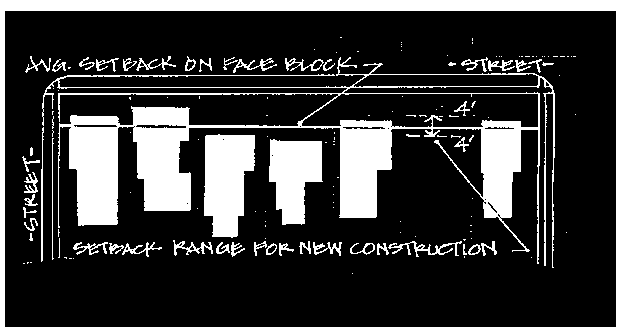
Building: The lesser of 8 feet or the average setback of principal buildings on the same face block.
Parking area: Behind or to the side of the principal building and set back a distance equal to the setback of the principal building or 25 feet, whichever is greater. For through lots, parking may be provided streetward of the principal building on the street that carries less traffic, but in no case closer than 25 feet from the front property line.
(b)
Side setbacks:
Building:
Each side: None, except a minimum 10-foot side setback is required on any side abutting or across a public alley from an R-District.
Parking area: 5 feet, except a 10-foot side setback is required on any side abutting or across a public alley from an R-District.
(c)
Rear setbacks:
Building: 5 feet, except a 20-foot rear setback is required on portion abutting or across a public alley from an R-district.
Parking area: 5 feet, except a 20-foot rear setback is required for any parking area abutting or across a public alley from an R-district.
(d)
Corner lots and through lots shall have a front setback on each street.
(e)
Water setbacks: 50 feet inland from the ordinary high water mark of Grand Traverse Bay and Boardman Lake and 25 feet from the ordinary high water mark of Boardman River.
(Ord. No. 1094, Passed 6-3-19; Ord. No. 1161, Passed 7-6-21)
1340.05 - Encroachments into the setbacks.
No encroachments into the required setbacks are allowed except:
(1)
Eaves, chimneys, sills, belt courses, cornices and ornamental features not to exceed 18 inches are permitted to extend within the setbacks.
(2)
An unenclosed balcony, porch or deck may project into a rear setback for a distance not exceeding 10 feet.
1340.06 - Building height.
(a)
Building height:
Maximum 30 feet or with a floor designed and used for residential purposes: maximum 45 feet.
(b)
Exceptions:
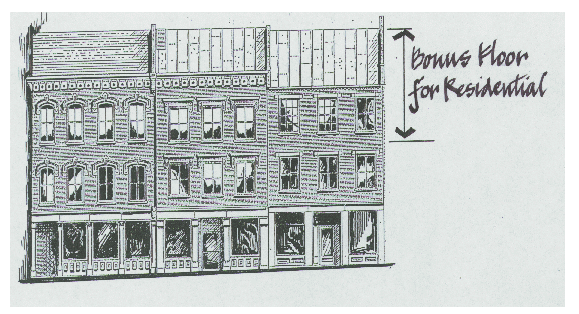
Steeples and clock towers may be erected to a height not exceeding twice the height of the attached building.
Parapet walls may be erected as necessary to screen a building's rooftop mechanical equipment if the wall extends around the perimeter of the building and incorporates exterior building materials similar to those of the main building.
Rooftop amenities may be erected to accommodate occupiable, enclosed space for rooftop amenities and may exceed the height limit of the district by a maximum of 15 feet, provided:
(1)
The use shall be limited to restrooms, storage areas, community rooms for the occupants of the building, and food and beverage service, provided that:
a.
Outdoor food and beverage service shall cease between the hours of 10:30 p.m. and 6:00 a.m. when abutting or across an alley from an R-District.
b.
Outdoor performances and any other form of amplified sound shall cease between 10:00 p.m. and 7:00 a.m. when abutting or across the alley from an R-District.
(2)
Shall be setback a minimum of 20 feet from any street facing facade and rear property line if abutting or across an alley from an R-District.
(3)
Not exceed a total of 1,650 square feet or 20% of the rooftop area, whichever is less.
(Ord. 730, Passed 3-19-07; Ord. 994, Passed 6-2-14; Ord. No. 1193, Passed 10-3-22)
1340.07 - Accessory buildings.
An accessory building shall:
(1)
Only be permitted in the rear yard, except accessory buildings may be located streetward of the principal building on the less traveled street on through lots.
(2)
Be located no closer than 4 feet to any side or rear property line. A boat house up to 250 square feet gross floor area may be built to the water's edge.
(3)
Be constructed using materials and features similar to the principal building if the accessory building exceeds 500 square feet in gross floor area.
(Ord. 476, Passed 7-6-99; Ord. 554, Passed 2-4-02.)
1340.08 - Parking, loading and driveways.
Requirements for parking, loading and driveways are contained in Chapter 1374. In addition, athletic fields may provide up to 50 percent of the required number of organized parking on an area developed in turf grasses. Grassed parking areas are considered as providing 1 parking space for every 350 square feet of continuous turf-covered area. All grassed parking areas shall be maintained in a healthy, vigorous growing condition and shall not be used more than 12 times per calendar year. When use requires more frequent parking, an impervious surface or approved pervious hard surface parking area shall be developed. Additional parking is not required for upper story dwellings above a first floor commercial or office use if the commercial or office us is in compliance with the parking requirements of this Code. Any residential building or driveway constructed after the effective date of this zoning code which has access to a maintained alley shall not have access to a street nor shall a parking area be located in the front yard. For parcels having alley access, the parking of a boat, motor home, camper, utility trailer or other recreational vehicle is limited to the rear yard.
(Ord. 763, Passed 7-2-07.)
1340.09 - Special requirements.
To preserve and reinforce the context of historic buildings and land to establish development patterns of the Office Service district, all new buildings and additions to existing buildings are to be designed, constructed and used in accordance with the following standards:
(1)
Building size limits:
a.
A building shall not exceed 4,500 square feet in gross floor area per floor.
b.
A building may exceed the building size limits in this subsection in the following circumstances only:
1.
The building is located on Garfield Avenue, or
2.
The building is used solely for residential purposes, provided the building is not used for a vacation home rental.
(2)
No use shall be open to the public between the hours of 10:00 p.m. and 6:00 a.m.
(3)
The predominant building wall and entryway shall face the street.
(4)
Unless determined to be impractical by the Planning Director, the building width shall not be less than 80 percent of the property width at the street.
(5)
Vertical building modulation shall be used to add variety and interest and to make a large building appear to be an aggregation of smaller units. Relief from a continuous street facing wall may be achieved with wall offsets in combination with pilasters, corbeling or other permanent architectural elements, however, offsets in any wall shall not be less than 8 inches from the subject plane.
(6)
Window glazing shall be recessed from the outside of all building walls.
(7)
Clear or lightly tinted transparent glass shall be used for all windows facing a public street. Decorative stained glass may be used for accents. Mirrored, smoked and darkly tinted glass is prohibited.
(8)
Street-facing building facades shall incorporate permanent architectural elements which create shadow patterns and surface textures which, in turn, enhance visual interest.
(9)
Except for buildings that are solely residential, windows or street level activities are required on 50 percent of the first story street wall facing any public street. Street level activities include public display space, public atriums, pedestrian entrances and interior circulation and windows with views into any designated street level use.
(10)
For each 90 feet of linear building frontage, pedestrian entrances will be required. Pedestrian entrances may open onto the sidewalk or mid-block passages or walkways leading to the public right-of-way. Entries must be prominently identified and must not interfere with safe pedestrian passage along walkways. Primary entries must set back a minimum 4 feet from the facade, however the Planning Director may reduce or waive this requirement if no pedestrian zone conflicts are identified by the placement of the building.
(11)
The spacing and shape of windows and openings on the building shall closely reflect the fenestration of any adjacent historic buildings. Brick, stone, wood or a combination thereof, compatible with adjacent historic buildings, shall be used.
(12)
Fenestration, cornices and other primarily horizontal architectural elements incorporated in new buildings or additions to existing buildings shall be in context with historic buildings in the area.
(13)
Any rooftop equipment shall be enclosed or screened from street level view using the same materials used for the building walls or a material which is approved by the Planning Director as visually compatible with the building.
(14)
All buildings that front the street, except for parking structures, accessory and utility buildings and buildings that are intended and designed to be exclusively developed for residential use shall have a minimum height of 14 feet measured from the street level entrance level to the next finished level or roof structure. The Planning Director may grant a first floor building height exception if it has been clearly demonstrated that such provision is unnecessary or that such requirements would create a practical difficulty, as contrasted merely granting an advantage or convenience.
(15)
Buildings on corner lots or on lots with a front loaded driveway shall have a clipped or recessed corner for the height of the first floor level if the building facade is within 20 feet of the street or driveway/street intersection. These building corners shall be recessed at least 5 feet from the planes of the building if such building is located less than 20 feet from the edge of street or driveway intersection. See diagram below.
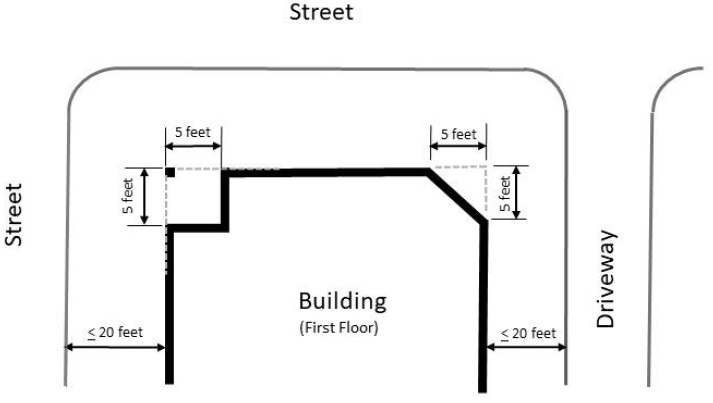
(Ord. 476, Passed 7-6-99; Ord 503, Passed 5-15-00; Ord. 547, Passed 10-15-01; Ord. 559, Passed 3-18-02; Ord. 955, Passed 10-1-12; Ord. 994, Passed 6-2-14; Ord. 1118, Passed 3-23-20; Ord. No. 1161, Passed 7-6-21)
1342.01 - Uses allowed.
The following uses of land and buildings, together with accessory uses, are allowed in the Neighborhood Center District (C-2).
•
C-1 District uses except drive-throughs;
•
Adult Use Marihuana Retailer:
(1)
The Adult Use Marihuana Retailer and use shall comply at all times with the Michigan Regulation and Taxation of Marihuana Act, Initiated Law 1 of 2018 MCL 333.27951 et seq., as amended, the Codified Ordinances of the City of Traverse City, and the rules promulgated pursuant to the Michigan Regulation and Taxation of Marihuana Act, Initiated Law 1 of 2018 MCL 333.27951 et seq., as amended, as they may be amended from time to time;
(2)
The Adult Use Marihuana Retailer shall not be in operation between the hours of 10:00 p.m. and 7:00 a.m.
(3)
Co-location with other marihuana Adult-Use Marihuana Establishments or Medical Marihuana Facilities may occur only as specifically permitted by the Medical Marihuana Facilities Licensing Act and the Michigan Regulation and Taxation of Marihuana Act and any corresponding administrative rules, regulations and ordinances.
(4)
No use or consumption of marihuana shall be allowed at the Adult Use Marihuana Retailer.
(5)
An Adult Use Marihuana Retailer shall not be located within a 1,000-foot radius from any existing school.
(6)
The Adult Use Marihuana Retailer shall have at all times a valid and current operating license issued by the State and permit from the City of Traverse City pursuant to the applicable Codified Ordinances of the City of Traverse City.
(7)
All activities of an Adult Use Marihuana Retailer shall be conducted within the building.
(8)
The smell of marihuana shall not be detectable outside of the portion of any structure where marihuana is present.
•
Boat liveries;
•
Brew pubs;
•
Convenience stores;
•
Drinking places without entertainment;
•
Drinking places with entertainment if the use is not likely to create a noise disturbance under City ordinances and if the building is provided with a central air conditioning system.
•
Florists;
•
Fruit and vegetable markets, but not public or municipal markets;
•
Grocery stores;
•
Hardware stores;
•
Laundromats;
•
Marinas;
•
Medical Marihuana Provisioning Center meeting the following requirements:
(1)
The medical marihuana facility and use shall comply at all times with the Michigan Medical Marihuana Facilities Licensing Act, Chapter 845 of the Codified Ordinances of the City of Traverse City, and the rules promulgated pursuant to the Michigan Medical Marihuana Facilities Licensing Act, as they may be amended from time to time;
(2)
The Medical Marihuana Provisioning Center shall not be in operation between the hours of 10:00 p.m. and 7:00 a.m.
(3)
Except for Medical Marihuana Processors as set forth in this section, no other medical marihuana facilities use shall occur on the parcel.
(4)
Except for parents or guardians of a qualifying patient and the person holding a license under the Michigan Medical Marihuana Facilities Licensing Act and Chapter 845 of the Codified Ordinances of the City of Traverse City or staff of the medical marihuana facility, persons other than a qualifying patient or primary caregiver shall be not permitted within the Medical Marihuana Provisioning Center when Medical Marihuana is being transferred.
(5)
No use or consumption of marihuana shall be allowed at the medical marihuana facility.
(6)
The medical marihuana facility shall not be used by a physician to conduct a medical examination or issue a medical certification document for the purpose of obtaining a qualifying patient registry identification card under the Michigan Medical Marihuana Act.
(7)
A qualifying patient under the age of 18 shall be accompanied by a parent or guardian and notice of such shall be conspicuously posted.
(8)
A Medical Marihuana Provisioning Center shall not be located within a 1,000-foot radius from any existing school.
(9)
An owner or operator of a Medical Marihuana Provisioning Center shall not have been convicted of a felony involving controlled substances within the last 10 years.
(10)
The Medical Marihuana Provisioning Center shall have at all times a valid and current operating license issued by the State and the City of Traverse City under Chapter 845 of the Codified Ordinances of the City of Traverse City.
(11)
All activities of a Medical Marihuana Provisioning Center shall be conducted within the building.
(12)
The smell of marihuana shall not be detectable outside of the portion of any structure where marihuana is present.
•
Movie rental stores;
•
News dealers and news stands;
•
Parcel packing services;
•
Pet grooming services without outdoor runs or kennels;
•
Radio, television and consumer electronics stores;
•
Restaurants, family, fine and fast (except drive-through and drive-ins);
•
Service stations and repair stations with no more than 2 bays; with or without fuel dispensing;
•
Stores, retail, miscellaneous;
•
Theatrical producers, entertainers, bands and orchestras;
•
Parking areas, public, subject to the following standards:
(1)
Access shall be limited to 1 driveway per public street or 2 driveways per site, whichever is less.
(2)
All parking areas which abut a public street shall be set back a minimum distance of 8 feet from the property line along said street and shall provide in this setback area appropriate screening with plant materials or a combination of plant materials, berming and decorative screenwalls to a minimum height of 3 feet.
(3)
Pedestrian travel routes within the parking area shall be provided, clearly defined and approved by the Planning Director.
(4)
Unless herein varied, the Landscaping and Site Development Chapter shall apply.
(Ord. 747, Passed 5-21-07; Ord. 867, Passed 6-7-10; Ord. 1076, Passed 7-2-18; Ord. 1084, Passed 12-3-18; Ord. No. 1130, Passed 8-17-20.)
1342.02 - Uses allowed by special land use permit.
The following uses of land and buildings, together with accessory uses, are allowed in the Neighborhood Center District if a special land use permit is issued according to the standards of this Code:
•
Residential care and treatment facilities;
•
Schools;
•
Transitional housing and emergency shelters;
•
Wind Energy Building-Mount.
(Ord. 938. Passed 4-2-12. Ord. 1003. Passed 7-7-14)
1342.03 - Lot, density and impervious surface provisions.
(Ord. 887, Passed 11-1-10.)
1342.04 - Setbacks.
(a)
Front setbacks:
(1)
Building: The minimum setback is the lesser of 8 feet or the average setback of principal buildings on the same face block on the same side of the street. The maximum setback is 25 feet.
(2)
Parking area: Behind or to the side of the principal building and set back a distance equal to the setback of the principal building or 25 feet, whichever is greater. For through lots, parking may be provided streetward of the principal building on the street that carries less traffic, but in no case closer than 25 feet from the front property line.
(b)
Side setbacks:
(1)
Building:
(2)
One side/aggregate: None, except a minimum 10-foot side setback is required on a side abutting or across a public alley from an R-District.
(3)
Parking area: 5 feet, except a minimum 10-foot side setback is required on any side abutting or across a public alley from an R District
(c)
Rear setbacks:
(1)
Building: 5 feet, except a 20-foot rear setback is required on portion abutting or across a public alley from an R-District.
(2)
Parking area: 5 feet, except a 20-foot rear setback is required for any parking area abutting or across a public alley from an R-District.
(d)
Corner lots and through lots shall have a front setback on each street.
(e)
Water setbacks: 50 feet inland from the ordinary high water mark of Grand Traverse Bay and Boardman Lake and 25 feet from the ordinary high water mark of Boardman River.
(Ord. No. 1094, Passed 6-3-19; Ord. No. 1162, Passed 7-6-21)
1342.05 - Encroachments into the setbacks.
No encroachments into the required setbacks are allowed except:
(1)
Eaves, chimneys, sills, belt courses, cornices and ornamental features not to exceed 18 inches are permitted to extend within the setbacks.
(2)
An unenclosed balcony, porch or deck may project into a rear setback for a distance not exceeding 10 feet.
1342.06 - Building height.
(a)
Building height: Maximum 30 feet or with a floor designed and used for residential uses: maximum 45 feet.
(b)
Exceptions:
Steeples and clock towers may be erected to a height not exceeding twice the height of the attached building.
Parapet walls may be erected as necessary to screen rooftop equipment if the wall extends around the perimeter of the building and incorporates the exterior building materials similar to those of the main building.
Rooftop amenities may be erected to accommodate occupiable, enclosed space for rooftop amenities and may exceed the height limit of the district by a maximum of 15 feet, provided:
(1)
The use shall be limited to restrooms, storage areas, community rooms for the occupants of the building, and food and beverage service, provided that:
a.
Outdoor food and beverage service shall cease between the hours of 10:30 p.m. and 6:00 a.m. when abutting or across an alley from an R-District.
b.
Outdoor performances and any other form of amplified sound shall cease between 10:00 p.m. and 7:00 a.m. when abutting or across the alley from an R-District.
(2)
Shall be setback a minimum of 20 feet from any street facing facade and rear property line if abutting or across an alley from an R-District.
(3)
Not exceed a total of 1,650 square feet or 20% of the rooftop area, whichever is less.
(Ord. 731, Passed 3-19-07; Ord. 995, Passed 6-2-14; Ord. No. 1194, Passed 10-3-22)
1342.07 - Accessory buildings.
An accessory building shall:
(1)
Only be permitted in the rear yard, except accessory buildings may be located streetward of the principal building on the less traveled street on through lots.
(2)
Be located no closer than 4 feet to any side or rear property line. A boat house up to 242 square feet gross floor area may be built to the water's edge.
(3)
Be constructed using materials and features similar to the principal building if the accessory building exceeds 500 square feet in gross floor area.
(Ord. 476. Passed 7-6-99. Ord. 554. Passed 2-4-02.)
1342.08 - Parking, loading and driveways.
Requirements for parking, loading and driveways are contained in Chapter 1374. In addition, athletic fields may provide up to 50 percent of the required number of organized parking on an area developed in turf grasses. Grassed parking areas are considered as providing 1 parking space for every 350 square feet of continuous turf-covered area. All grassed parking areas shall be maintained in a healthy, vigorous growing condition and shall not be used more than 12 times per calendar year. When use requires more frequent parking, an impervious surface or approved pervious hard surface parking area shall be developed.
Parking is not required for upper story dwellings above a first floor commercial or office use.
Any residential building or driveway constructed after the effective date of this zoning code which has access to a maintained alley shall not have access to a street nor shall a parking area be located in the front yard.
For parcels having alley access, the parking of a boat, motor home, camper, utility trailer or other recreational vehicle is limited to the rear yard.
(Ord. 764, Passed 7-2-07.)
1342.09 - Special requirements.
To preserve and reinforce the context of historic buildings and to establish land development patterns of the Neighborhood Center District, all new buildings and additions to existing buildings are to be designed, constructed and used in accordance with the following standards:
(1)
A building shall not exceed 6,000 square feet in gross floor area per floor.
(2)
No use shall be open to the public between the hours of 2:00 a.m. and 6:00 a.m.
(3)
The predominant building wall and entryway shall face the street.
(4)
Unless determine to be impractical by the Planning Director, the building width shall not be less than 80 percent of the property width at the street.
(5)
Vertical building modulation shall be used to add variety and interest and to make a large building appear to be an aggregation of smaller units relief from a continuous street facing wall may be achieved with wall offsets in combination with pilasters, corbeling or other permanent architectural elements, however, offsets in any wall shall not be less than 8 inches from the subject plane.
(6)
Window glazing shall be recessed from the outside of all building walls.
(7)
Clear or lightly tinted transparent glass shall be used for all windows facing a public street. Decorative stained glass may be used for accents. Mirrored, smoked and darkly tinted glass is prohibited.
(8)
Street-facing building facades shall incorporate permanent architectural elements which create shadow patterns and surface textures which, in turn, enhance visual interest.
(9)
Except for buildings that are solely residential, windows or street level activities are required on 50 percent of the first story street wall facing any public street. Street level activities include public display space, public atriums, pedestrian entrances and interior circulation and windows with views into any designated street level use.
(10)
For each 90 feet of linear building frontage, pedestrian entrances will be required. Pedestrian entrances may open onto the sidewalk or mid-block passages or walkways leading to the public right-of-way. Entries must be prominently identified and must not interfere with safe pedestrian passage along walkways. Primary entries must set back a minimum 4 feet from the facade, however the Planning Director may reduce or waive this requirement if no pedestrian zone conflicts are identified by the placement of the building.
(11)
The spacing and shape of windows and openings on the building shall closely reflect the fenestration of any adjacent historic buildings. Brick, stone, wood or a combination thereof, compatible with adjacent historic buildings, shall be used.
(12)
Fenestration, cornices and other primarily horizontal architectural elements incorporated in new buildings or additions to existing buildings shall be in context with historic buildings in the area.
(13)
Any rooftop equipment shall be enclosed or screened from street level view using the same materials used for the building walls or a material which is approved by the Planning Director as visually compatible with the building.
(14)
All buildings that front the street, except for parking structures, accessory and utility buildings and buildings that are intended and designed to be exclusively developed for residential use shall have a minimum height of 14 feet measured from the street level entrance level to the next finished level or roof structure. The Planning Director may grant a first floor building height exception if it has been clearly demonstrated that such provision is unnecessary or that such requirements would create a practical difficulty, as contrasted merely granting an advantage or convenience.
(15)
Buildings on corner lots or on lots with a front loaded driveway shall have clipped or recessed corners for the heights of the first floor level if the building facade is within 20 feet of the street or driveway/street intersection. These building corners shall be recessed at least 5 feet from the planes of the building if such building is located not less than 20 feet from the edge of street or driveway intersection. See diagram below.
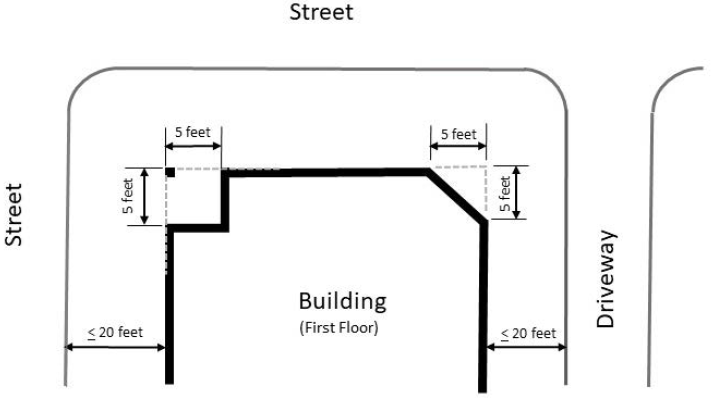
(Ord. 476, Passed 7-6-99; Ord. 546, Passed 10-15-01; Ord. 957, Passed 1-7-13; Ord. 995, Passed 6-2-14; Ord. No. 1162, Passed 7-6-21)
1344.01 - Uses allowed.
The following uses of land and buildings, together with accessory uses, are allowed in the Community Center District:
•
HR District uses;
•
C-2 District uses;
•
Amusement and recreation services (see mechanical amusement arcades below);
•
Communication establishments;
•
Contractors, with no outside storage;
•
Drinking places with entertainment;
•
Equipment rental and leasing;
•
Finance services, including those having drive throughs subject to the standards of Section 1374.06, drive-throughs;
•
Kennels, provided no that no building, open kennel or exercise runway is closer than 200 feet from a Residential District;
•
Mechanical amusement arcades subject to the following:
(1)
All necessary licenses are obtained and maintained.
(2)
There is in physical attendance at all times of operation a minimum of 1 adult employee whose sole responsibility is to supervise the conduct of patrons on or near the premises.
(3)
Suitable ventilation, fire protection measures and adequate lighting inside and outside the premises are provided for the safety of patrons and the public as required by the Fire Marshal.
(4)
One bicycle rack per mechanical amusement device is provided on-site and located subject to the approval of the Planning Director.
(5)
There is not more than 1 arcade in a face block, and in no case shall an arcade be located closer than 600 feet to any existing arcade or amusement park.
•
Medical marihuana collective meeting the following requirements:
(1)
Use and transfer of Medical Marihuana shall comply at all times with the Michigan Medical Marihuana Act and the General Rules of the Michigan Department of Community Health, as they may be amended from time to time;
(2)
Transfer of medical marihuana shall be only allowed to a qualifying patient directly in person by his or her registered primary caregiver or by another qualifying patient as allowed by the Michigan Medical Marihuana Act and the General Rules of the Michigan Department of Community Health, as they may be amended from time to time.
(3)
The collective shall not be in operation between the hours of 10:00 p.m. and 7:00 a.m.
(4)
No medical marihuana cultivation shall occur on the parcel.
(5)
Except for parents or guardians of a qualifying patient and the owner or staff of the facility, persons other than a qualifying patient or primary caregiver shall be not permitted within the collective when medical marihuana is being transferred or used.
(6)
A qualifying patient under the age of 18 shall be accompanied by a parent or guardian and notice of such shall be conspicuously posted.
(7)
A medical marihuana collective shall not be located within a 1,000-foot radius from any existing school.
(8)
A medical marihuana collective shall not be located within 1,000 feet from another existing collective.
(9)
An owner or operator of a medical marihuana collective shall not have been convicted of a felony involving controlled substances.
(10)
The name and address of all persons with an ownership interest in the medical marihuana collective and all operators of the medical marihuana collective shall be provided to the Zoning Administrator at least 10 business days prior to opening the medical marihuana collective and least 10 business days prior to when a new person owns or operates the medical marihuana collective.
•
Microbrewery;
•
Motorized vehicle dealers, mobile home dealers, watercraft dealers and recreational vehicle dealers subject to the following conditions:
(1)
All outdoor display and storage in front or on the side of a building shall meet landscape requirements for parking areas.
(2)
Outdoor display areas shall be differentiated from parking areas using contrasting surface material and shall be designated on a site plan.
(3)
Any display platforms shall not be elevated more than 3 feet higher than the adjacent public right-of-way.
•
Personal services, including those having drive-throughs subject to the standards of Section 1374.06, drive-throughs;
•
Pet boarding or pet grooming services, provided that no building, open kennel or exercise runway is closer than 200 feet from an R-District.
•
Printing (commercial);
•
Repair services, miscellaneous;
•
Restaurants, family, fine and fast, including drive-ins and drive-throughs accessory to an on-site, indoor, full service restaurant and including the parking requirements of Chapter 1372, landscaping and Section 1374.06, drive-throughs;
•
Retail trade;
•
Service stations and repair shops (except tire retreading) with or without fuel dispensing;
•
Theaters, except outdoor;
•
Vehicle wash facilities subject to the following standards:
(1)
Customer stacking space shall be provided at a rate of 3 spaces per bay or wash area for a stationary-type (coin-operated) system, and 8 spaces per bay for an automatic system.
(2)
Customer stacking spaces shall be located and arranged to preclude obstruction of traffic flow on the public right-of-way or overhang and the public sidewalk.
(3)
Grates the full width of the driveway shall be provided at the exits to intercept and collect excess water and prevent its spread onto the public right-of-way.
(4)
A 35-foot setback is required from the property line where the primary exit for the vehicle was facility is made. All other setbacks shall conform to the district requirements.
(5)
All operations connected with this facility shall be conducted within the buildings, except for vacuuming, so as to minimize the effect of noise and moisture on surrounding areas.
(6)
Where an auto wash is adjoining residential property or is separated from such property by a public alley, there shall be provided a continuous decorative screenwall of not less than 5 feet or more than 6 feet in height.
(7)
Ingress and egress shall be on an arterial or collector street, except where the Planning Commission determines public welfare or safety would be best served by allowing other means of ingress or egress.
•
Veterinary services, provided that no building, open kennel or exercise runway is closer than 200 feet from a R-District;
•
Warehousing.
(Ord. 778. Passed 1-7-08. Ord. 878. Passed 8-16-10. Ord. 903. Passed 2-7-11.)
1344.02 - Uses allowed by special land use permit.
The following uses of land and buildings, together with accessory uses, are allowed in the Community Center District if a special land use permit is issued according to the standards of this Code:
•
Communication towers;
•
Essential services buildings;
•
Residential care and treatment facilities;
•
Schools;
•
Transitional housing and emergency shelters;
•
Wind Energy Pole/Tower-Mount;
•
Wind Energy Building-Mount.
(Ord. 476. Passed 7-6-99. Ord. 938. Passed 4-2-12. Ord. 1004. Passed 7-7-14)
1344.03 - Lot, density and impervious surface provisions.
(Ord. 476, Passed 7-6-99; Ord. 888, Passed 11-1-10.)
1344.04 - Setbacks.
(a)
Front setbacks:
Building: 25 feet maximum; 8 feet minimum.
Parking area: Behind or to the side of the principal building and set back a distance equal to the setback of the principal building or 25 feet, whichever is greater. For through lots, parking may be provided streetward of the principal building on the street that carries less traffic, but in no case closer than 25 feet from the front property line.
(b)
Side setbacks (minimum):
Building:
One side/aggregate: None, except a 10-foot side setback is required on the side abutting or across a public alley from an R-District.
Parking area: 5 feet, except a 10-foot setback is required on any portion abutting or across a public alley from an R-District.
(c)
Rear setbacks:
Building: 5 feet, except 20 feet is required on any portion abutting or across a public alley from an R-District.
Parking area: 5 feet, except 20 feet is required on any portion abutting or across a public alley from an R-district.
(d)
Corner lots and through lots shall have a front setback on each street.
(e)
Water setbacks: 50 feet inland from the ordinary high water mark of Grand Traverse Bay and Boardman Lake and 25 feet from the ordinary high water mark of the Boardman River.
(Ord. 476, Passed 7-6-99; Ord. No. 1094, Passed 6-3-19; Ord. No. 1163, Passed 7-6-21.)
1344.05 - Encroachments into the setback.
No encroachments into the required setbacks are allowed except:
(1)
Eaves, chimneys, sills, belt courses, cornices and ornamental features not to exceed 18 inches are permitted to extend within the setbacks.
(2)
An unenclosed balcony, porch or deck may project into a rear setback for a distance not exceeding 10 feet.
(Ord. 476, Passed 7-6-99.)
1344.06 - Building height.
(a)
Building height:
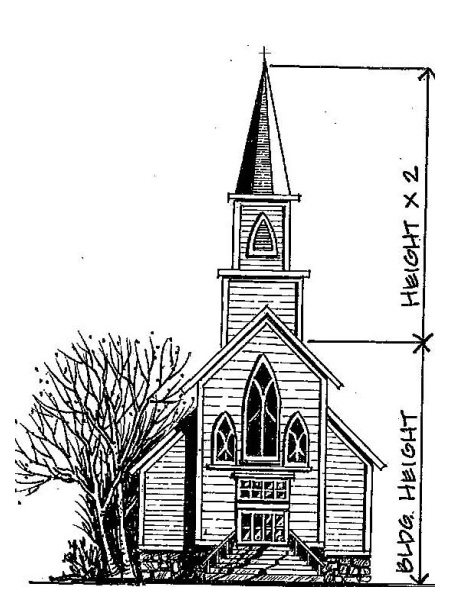
Maximum 45 feet.
(b)
Exceptions:
Steeples and clock towers may be erected to a height not exceeding twice the height of the attached building.
Parapet walls may be erected as necessary to screen rooftop equipment if the wall extends around the perimeter of the building and incorporates exterior building materials similar to those of the main building.
Rooftop amenities may be erected to accommodate occupiable, enclosed space for rooftop amenities and may exceed the height limit of the district by a maximum of 15 feet, provided:
(1)
The use shall be limited to restrooms, storage areas, community rooms for the occupants of the building, and food and beverage service, provided that:
a.
Outdoor food and beverage service shall cease between the hours of 10:30 p.m. and 6:00 a.m. when abutting or across an alley from an R-District.
b.
Outdoor performances and any other form of amplified sound shall cease between 10:00 p.m. and 7:00 a.m. when abutting or across the alley from an R-District.
(2)
Shall be setback a minimum of 20 feet from any street facing facade and rear property line if abutting or across an alley from an R-District.
(3)
Not exceed a total of 1,650 square feet or 20% of the rooftop area, whichever is less.
(Ord. 476, Passed 7-6-99; Ord. 732, Passed 3-19-07; Ord. No. 1195, Passed 10-3-22)
1344.07 - Accessory buildings.
An accessory building shall:
(1)
Only be permitted in the rear yard, except accessory buildings may be located streetward of the principal building on the less traveled street on through lots.
(2)
Be located no closer than 5 feet to any side or rear property line. A boat house, up to 250 square feet gross floor area, may be built to the water's edge.
(3)
Be constructed using materials and features similar to the principal building if the accessory building exceeds 500 square feet in gross floor area.
(Ord. 476, Passed 7-6-99; Ord. 554, Passed 2-4-02.)
1344.08 - Parking, loading and driveways.
Requirements for parking, loading and driveways are contained in Chapter 1374. In addition, athletic fields may provide up to 50 percent of the required number of organized parking on an area developed in turf grasses. Grassed parking areas are considered as providing 1 parking space for every 350 square feet of continuous turf-covered area. All grassed parking areas shall be maintained in a healthy, vigorous growing condition and shall not be used more than 12 times per calendar year. When use requires more frequent parking, an impervious surface or approved pervious hard surface parking area shall be developed.
Parking is not required for upper story dwellings above a first floor commercial or office use.
Any residential building or driveway constructed after the effective date of this zoning code which has access to a maintained alley shall not have access to a street nor shall a parking area be located in the front yard. For parcels having alley access, the parking of a boat, motor home, camper, utility trailer or other recreational vehicle is limited to the rear yard.
(Ord. 476, Passed 7-6-99; Ord. 765, Passed 7-2-07.)
1344.09 - Special requirements.
To establish land development patterns of the district, all new buildings and additions to existing buildings are to be designed and constructed in accordance with the following standards:
(1)
The predominant building wall and entryway shall face the public or private street.
(2)
Unless determined to be impractical, by the Planning Director, the building width shall not be less than 60 percent of the property width at the street.
(3)
Vertical building modulation shall be used to add variety and interest and to make a large building appear to be an aggregation of smaller units. Relief from a continuous street facing wall may be achieved with wall offsets in combination with pilasters, corbeling or other permanent architectural elements; however, offsets in any wall shall not be less than 8 inches from the subject plane.
(4)
Horizontal building modulation shall be used to reduce the perceived mass of a large building. Horizontal awnings, balconies, and roof features should be incorporated into new developments provided that their appearance varies through the use of color, materials, size and location.
(5)
Except for buildings that are solely residential, windows or street level activities are required on 40 percent of the first story street wall facing any public street. Street level activities include public display space, public atriums, pedestrian entrances and interior circulation and windows with views into any designated street level use.
(6)
Clear or lightly tinted transparent glass shall be used for all windows facing a public street. Decorative stained glass may be used for accents. Mirrored, smoked and darkly tinted glass is prohibited.
(7)
Street-facing building facades shall incorporate permanent architectural elements which create shadow patterns and surface textures which, in turn, enhance visual interest.
(8)
Any rooftop equipment shall be enclosed or screened from street level view using the same materials used for the building walls or a material which is approved by the Planning Director as visually compatible with the building.
(9)
All buildings that front the street, except for parking structures, accessory and utility buildings and buildings that are intended and designed to be exclusively developed for residential use shall have a minimum height of 14 feet measured from the street level entrance level to the next finished level or roof structure. The Planning Director may grant a first floor building height exception if it has been clearly demonstrated that such provision is unnecessary or that such requirements would create a practical difficulty, as contrasted merely granting an advantage or convenience.
(10)
Buildings on corner lots or on lots with a front loaded driveway shall have a clipped or recessed corner for the height of the first floor level if the building facade is within 20 feet of the street or driveway/street intersection. These building corners shall be recessed 5 feet from the planes of the building if such building is located less than 20 feet from the edge of the street driveway intersection. See diagram below.
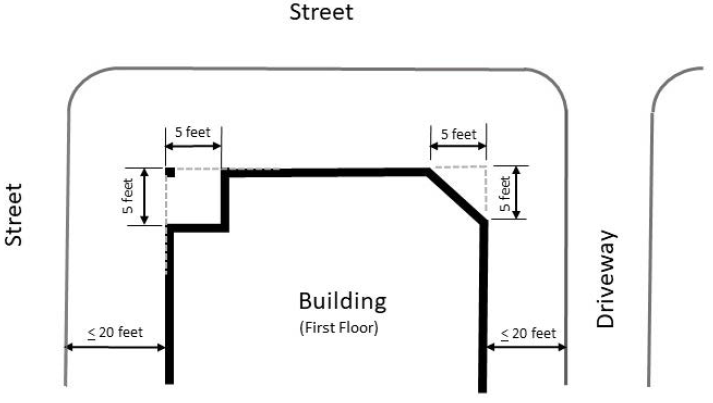
(Ord. 619, Passed 2-2-04; Ord. 996, Passed 6-2-14; Ord. No. 1163, Passed 7-6-21.)
1346.01 - Uses allowed.
The following uses of land and buildings, together with accessory uses, are allowed in these districts:
•
GP district uses;
•
C-3 district uses, except the following: drive-ins, drive-throughs, Medical Marihuana Provisioning Centers, sexually-oriented businesses, vehicle wash facilities, veterinary services and kennels, vacation home rentals on the first floor;
•
Boat liveries;
•
Convention centers;
•
Drinking places with or without entertainment;
•
Markets, public or municipal;
•
Adult use marihuana retailers, subject to the following standards:
(1)
Shall not be located in the C-4b District;
(2)
A 1,500 foot buffer must exist between adult use marihuana retail establishments;
(3)
The Adult Use Marihuana Retailer and use shall comply at all times with the Michigan Regulation and Taxation of Marihuana Act, Initiated Law 1 of 2018 MCL 333.27951 et seq., as amended, the Codified Ordinances of the City of Traverse City, and the rules promulgated pursuant to the Michigan Regulation and Taxation of Marihuana Act, Initiated Law 1 of 2018 MCL 333.27951 et seq., as amended, as they may be amended from time to time;
(4)
The Adult Use Marihuana Retailer shall not be in operation between the hours of 10:00 p.m. and 7:00 a.m.
(5)
Co-location with other marihuana Adult-Use Marihuana Establishments or Medical Marihuana Facilities may occur only as specifically permitted by the Medical Marihuana Facilities Licensing Act and the Michigan Regulation and Taxation of Marihuana Act and any corresponding administrative rules, regulations and ordinances.
(6)
No use or consumption of marihuana shall be allowed at the Adult Use Marihuana Retailer.
(7)
An Adult Use Marihuana Retailer shall not be located within a 1,000-foot radius from any existing school.
(8)
The Adult Use Marihuana Retailer shall have at all times a valid and current operating license issued by the State and permit from the City of Traverse City under the applicable Codified Ordinances of the City of Traverse City.
(9)
All activities of an Adult Use Marihuana Retailer shall be conducted within the building.
(10)
The smell of marihuana shall not be detectable outside of the portion of any structure where marihuana is present.
•
Parking areas, private, for dwelling units (limited to 1 per dwelling unit); subject to Chapter 1374.
•
Parking areas, private, interior, subject to the following standards:
(1)
Parking area is accessed from the alley,
(2)
Parking area is fully enclosed within a building,
(3)
Parking surface is on average, at least 4 feet below the street elevation or is fronted with habitable space.
•
Parking areas, private, subject to the following standards:
(1)
Access shall be limited to 1 driveway per public street or 2 driveways per site, whichever is less.
(2)
The parking is accessory to an allowed use.
(3)
There can be demonstrated a need for private parking which will not be satisfied by existing public parking within 500 feet of the proposed use, except for private parking areas for dwelling units or interior private parking areas;
(4)
All requirements of Chapter 1374, circulation and parking, are met, except Section 1374.03(d), parking space requirements.
(5)
All requirements of Sections 1372.04, screening requirements for parking areas, and 1372.05, landscape development internal to a parking area are met.
(6)
Pedestrian travel routes within the parking area shall be provided, clearly defined and approved by the Planning Director.
•
Parking areas, public, subject to the following standards:
(1)
Access shall be limited to 1 driveway per public street or 2 driveways per site, whichever is less.
(2)
All parking areas which abut a public street shall be set back a minimum distance of 8 feet from the property line along said street and shall provide in this setback area appropriate screening with plant materials or a combination of plant materials, berming and decorative screenwalls to a minimum height of 3 feet.
(3)
Pedestrian travel routes within the parking area shall be provided, clearly defined and approved by the Planning Director.
(4)
Unless herein varied, the landscaping and site development chapter shall apply.
•
Parking structures, public or private, subject to the following standards:
(1)
Parking structures shall be designed to have horizontal versus stepped or sloping levels at areas of public view. Ramping shall be concealed from public view to the greatest degree possible.
(2)
Openings shall not exceed 60 percent of the total wall surface. Openings shall be vertical or square.
(3)
Sloped roofs are not required for parking decks, however:
a.
The upper and lowest level of parking shall incorporate sufficient screening to shield cars from public view.
b.
Parapet treatment is required to terminate the deck and give proper architectural finish to the structure. Cornices, overhangs and other devices which are consistent with the language of historical buildings may be employed.
(4)
The design of parking decks shall be consistent with the design of historical buildings in the area.
•
Theaters, live and performance art centers.
(Ord. 476, Passed 7-6-99; Ord. 677, Passed 5-2-05; Ord. 782, Passed 2-4-08; Ord. 825, Passed 2-2-09; Ord. 1084, Passed 12-3-18; Ord. No. 1131, Passed 8-17-20; Ord. No. 1187, Passed 7-5-22.)
1346.02 - Uses allowed by special land use permit.
The following uses of land and buildings, together with accessory uses, are allowed in these districts if a special land use permit is issued according to the standards of this Code:
•
Communication towers;
•
Drive-throughs for finance services;
•
Essential services buildings;
•
Parking areas, private, if public parking is available within 500 feet of the allowed use;
•
Taller buildings in the C4-b or C4-c district;
•
Transit centers.
(Ord. 476, Passed 7-6-99; Ord. 610, Passed 9-2-03; Ord. 677, Passed 05-02-05; Ord. 779, Passed 1-7-08; Ord. No. 1187, Passed 7-5-22.)
1346.03 - Lot, density and impervious surface provisions.
The surface parking area shall not exceed the total floor area of all buildings on the lot.
(Ord. 476, Passed 7-6-99; Ord. 684, Passed 10-03-05; Ord. No. 1187, Passed 7-5-22.)
1346.04 - Setbacks.
(a)
Front setbacks:
Building: 2.5 feet minimum, except existing buildings that have been damaged by fire, explosion, act of God or similar causes and located closer than 2.5 feet may be restored or rebuilt at the same location using the same foundation unless the foundation is located in the right-of-way. 8 feet maximum.
Private parking area: Behind or to the side of the principal building and set back a distance equal to the setback of the principal building or 25 feet, whichever is greater. For through lots, parking may be provided streetward of the principal building on the street that carries less traffic, but in no case closer than 25 feet from the front property line.
(b)
Side setbacks (minimum):
Building:
One side/aggregate: None, except 10-foot side setback is required on any side abutting or across a public alley from an R-district.
Private parking area: 5 feet, except a 10-foot setback is required on any side abutting or across a public alley from an R-district.
(c)
Rear setbacks: None. A 20-foot setback is required if abutting or across a public alley from an R-district.
(d)
Corner lots and through lots: shall have a front setback on each street.
(e)
Water setbacks: May build to the edge of a public easement; if no public easement, then 10 feet inland from the ordinary high water mark.
(f)
Bridge setbacks: Buildings shall be set back a distance of 25 feet from any bridge abutment unless otherwise approved by the City Engineer if he or she determines that the building will not interfere with the maintenance or reconstruction of the bridge and that utilities will not be adversely impacted.
(Ord. 476, Passed 7-6-99; Ord. 512, Passed 9-18-00; Ord. 576, Passed 10-7-02; Ord. 685, Passed 10-03-05; Ord. 818, Passed 1-5-09; Ord. No. 1054, Passed 7-3-17; Ord. No. 1094, Passed 6-3-19; Ord. No. 1164, Passed 7-6-21; Ord. No. 1187, Passed 7-5-22.)
1346.05 - Encroachments into the setbacks.
No encroachments into setbacks are allowed except a balcony no longer than 50 percent of the length of a building, may project 3 feet into the water setback and shall adhere to Chapter 1372, Section 1372 (b)(1) Existing Vegetation, provided these projections are not less than 15 feet above grade and provided they do not project into any public right-of-way and except eaves, chimneys, sills, belt courses, cornices and ornamental features not to exceed 2.5 feet are permitted to extend within the front or rear setbacks.
(Ord. 476, Passed 7-6-99; Ord. 511, Passed 9-18-00; Ord. 577, Passed 10-7-02; Ord. No. 1115, Passed 2-3-20; Ord. No. 1187, Passed 7-5-22.)
1346.06 - Building height.
(a)
Building Height: Buildings in the C-4 District shall have a minimum height of 30 feet and a maximum building height as listed below. An existing building may have a one-story addition of no larger than the area of the first floor of that building as it existed on the effective date of Ordinance No. 467, which is July 16, 1999. More than 60 feet in height may be allowed only by special land use permit or as part of a planned unit development and subject to the requirements listed below.
C-4a: 45 feet maximum.
C-4b: 60 feet maximum. 68 feet in height is allowed if at least 20 percent of the building is designed and used for dwellings.
C-4c: 85 feet maximum. An additional 15 feet shall be allowed for permitted uses that are designed and positioned in a manner that will effectively shield rooftop mechanical equipment or elevator shafts, but not to exceed an overall height of 100 feet. Buildings over 60 feet tall shall have at least 20 percent of the building designed and used for dwellings. That portion of the building with a finish floor elevation of 45 feet or greater must be recessed at least 10 feet from the first floor building facade.
(b)
Exceptions: The following are exceptions to the above height restrictions:
(1)
Steeples and clock towers may be erected in a C-4a district up to a height not exceeding 60 feet.
(2)
Parapet walls may be erected as necessary to screen rooftop equipment if the wall extends around the perimeter of the building and incorporates exterior building materials similar to those of the main building.
(3)
Rooftop amenities may be erected to accommodate occupiable, enclosed space for rooftop amenities and may exceed the height limit of the district by a maximum of 15 feet, provided:
a.
The use shall be limited to restrooms, storage areas, community rooms for the occupants of the building, and food and beverage service, provided that:
1.
Outdoor food and beverage service shall cease between the hours of 10:30 p.m. and 6:00 a.m. when abutting or across an alley from an R-District.
2.
Outdoor performances and any other form of amplified sound shall cease between 10:00 p.m. and 7:00 a.m. when abutting or across the alley from an R-District.
b.
Shall be setback a minimum of 20 feet from any street facing facade and rear property line if abutting or across an alley from an R-District.
c.
Not exceed a total of 1,650 square feet or 20% of the rooftop area, whichever is less.
(Ord. 476, Passed 7-6-99; Ord. 528, Passed 3-19-01; Ord. 548, Passed 12-17-01; Ord. 561, Passed 4-1-02; Ord. 631, Passed 4-19-04; Ord. 686, Passed 10-03-05; Ord. 692, Passed 12-05-05; Ord. 733, Passed 3-19-07; Ord. No. 1187, Passed 7-5-22; Ord. No. 1196, Passed 10-3-22)
1346.07 - Accessory buildings.
An accessory building shall:
(1)
Only be permitted in the rear yard, except accessory buildings may be located streetward of the principal building on the less traveled street on through lots.
(2)
Be located no closer than 4 feet to any side or rear property line. A boat house up to 250 square feet gross floor area may be built to the water's edge.
(Ord. 476, Passed 7-6-99; Ord. 554, Passed 2-4-02; Ord. No. 1187, Passed 7-5-22.)
1346.08 - Parking, loading and driveways.
No parking is required in this district, however, if parking is provided, it must meet the standards contained in Chapter 1374, circulation and parking and restrictions of this chapter.
(Ord. 476, Passed 7-6-99; Ord. No. 1187, Passed 7-5-22.)
1346.09 - Special requirements.
To preserve and reinforce the context of historic buildings and land to establish development patterns of the Regional Center District, all new buildings and additions to existing buildings are to be designed and constructed in accordance with the following standards:
(1)
The predominant building wall and entryway shall face the public or private street.
(2)
Unless determined to be impractical by the Planning Director, the building width shall not be less than 90 percent of the property width at the street.
(3)
Vertical building modulation shall be used to add variety and interest and to make a large building appear to be an aggregation of smaller units. Relief from a continuous street facing wall may be achieved with wall offsets in combination with pilasters, corbeling or other permanent architectural elements; however, offsets in any wall shall not be less than 8 inches from the subject plane.
(4)
Horizontal building modulation, like awnings, balconies and roof features shall be used to reduce the perceived mass of a large building.
(5)
Fenestration, cornices and other architectural elements incorporated in new buildings or additions to existing buildings shall be in context with historic buildings in the area.
(6)
Window glass planes shall be recessed at least 4 inches from the outside of all building walls to create a shadow line except in bay windows and to other projecting window elements.
(7)
Clear or lightly tinted transparent glass shall be used for all windows facing a public street. Decorative stained glass may be used for accents. Mirrored, smoked and darkly tinted glass is prohibited.
(8)
New buildings and additions to existing buildings, including parking structures, shall be constructed of durable materials utilizing the predominant building materials of traditional brick and stone used in the Regional Center District or constructed of materials of comparable aesthetic value.
(9)
Any rooftop equipment shall be enclosed or screened from street level view using the same materials used for the building walls or a material which is approved by the Planning Director as visually compatible with the building. All utility meters and wall or ground mounted mechanical equipment, such as HVAC systems, shall be limited to the rear third of the parcel, unless determined impractical by the Planning Director.
(10)
Windows or street level activities are required on 50 percent of the first story street wall facing any public street. Street level activities include public display space, public atriums, pedestrian entrances and exterior circulation.
(11)
For each 90 feet of linear building frontage, pedestrian entrances are required. Pedestrian entrances may open onto the sidewalk or mid-block passages or walkways leading to the public right-of-way. Entries must be prominently identified and must not interfere with safe pedestrian passage along walkways. Primary entries must set back a minimum 4 feet from the property line.
(12)
All buildings that front the street, except for public parking structures, accessory and utility buildings, shall have a minimum height of 14 feet measured from the street level entrance level to the next finished level or roof structure. The Planning Director may grant a first floor building height exception if it has been clearly demonstrated that such provision is unnecessary or that such requirements would create a practical difficulty, as contrasted merely granting an advantage or convenience.
(13)
Dumpsters or trash receptacles exterior to a building shall be placed in the rear yard, on private property, screened with a wall not less than the height of the dumpster or trash receptacle and be constructed of similar materials used for the exterior of the building.
(14)
The first 30 feet of the building's interior first floor space facing a public street shall not be used for parking, storage, or utilities. For corner lots and through lots, this requirement shall be measured from the street with the higher traffic volume. For through lots with frontage on Garland Street and Grandview Parkway, this requirement shall be measured from Garland Street.
(15)
Buildings on corner lots or on lots with a front loaded driveway shall have a clipped or recessed corner for the height of the first floor level if the building facade is within 20 feet of the street or driveway/street intersection. These building corners shall be recessed at least 5 feet from the planes of the building if such building is located less than 20 feet from the edge of street or driveway intersection. See diagram below.
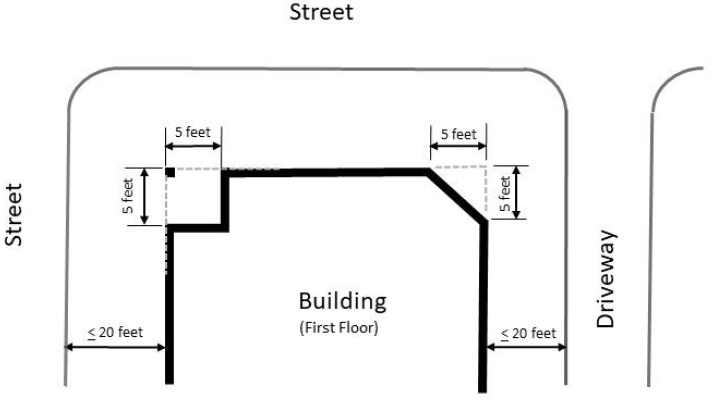
(Ord. 476, Passed 7-6-99; Ord. 545, Passed 10-15-01; Ord. 631, Passed 4-19-04; but with no changes to existing ordinance; Ord. 684; Passed 10-03-05; Ord. 687, Passed 10-03-05; Ord. 996, Passed 6-2-14; Ord. No. 1054, Passed 7-3-17; Ord. No. 1164 , Passed 7-6-21; Ord. No. 1187, Passed 7-5-22.)
1347.01 - Uses allowed.
The following uses of land and buildings, together with accessory uses, are allowed:
Ironworks (D-1), Depot (D-2) and Red Mill (D-3) areas:
•
C-2 uses;
•
Adult use marihuana retailers:
(1)
The Adult Use Marihuana Retailer and use shall comply at all times with the Michigan Regulation and Taxation of Marihuana Act, Initiated Law 1 of 2018 MCL 333.27951 et seq., as amended, the Codified Ordinances of the City of Traverse City, and the rules promulgated pursuant to the Michigan Regulation and Taxation of Marihuana Act, Initiated Law 1 of 2018 MCL 333.27951 et seq., as amended, as they may be amended from time to time;
(2)
The Adult Use Marihuana Retailer shall not be in operation between the hours of 10:00 p.m. and 7:00 a.m.;
(3)
Co-location with other marihuana Adult-Use Marihuana Establishments or Medical Marihuana Facilities may occur only as specifically permitted by the Medical Marihuana Facilities Licensing Act and the Michigan Regulation and Taxation of Marihuana Act and any corresponding administrative rules, regulations and ordinances;
(4)
No use or consumption of marihuana shall be allowed at the Adult Use Marihuana Retailer;
(5)
An Adult Use Marihuana Retailer shall not be located within a 1,000-foot radius from any existing school;
(6)
The Adult Use Marihuana Retailer shall have at all times a valid and current operating license issued by the State and permit from the City of Traverse City under the applicable Codified Ordinances of the City of Traverse City;
(7)
All activities of an Adult Use Marihuana Retailer shall be conducted within the building;
(8)
The smell of marihuana shall not be detectable outside of the portion of any structure where marihuana is present;
•
Banquet halls or conference rooms limited to a capacity of 500 people;
•
Broadcasting studios;
•
Contractors' offices with no outside storage;
•
Lodging facilities in the D-1 and D-3 District. Lodging facilities in the D-2 District are limited to 20 units or suites and are not allowed on the North side of the 400, 500 and 600 blocks of East Eighth Street.
•
Markets, public or municipal;
•
Manufacturing, artisan meeting the following requirements: :
(1)
Production occurs solely within an enclosed building;
(2)
; There is no outdoor storage of goods;
(3)
The production, operations and storage of materials related to production shall not occupy more than 8,000 square feet of gross floor area;
(4)
The operation produces no detectable noise, fumes or other nuisances at the parcel boundary.
•
Medical marihuana provisioning center meeting the following requirements:
(1)
The medical marihuana facility and use shall comply at all times with the Michigan Medical Marihuana Facilities Licensing Act, Chapter 845 of the Codified Ordinances of the City of Traverse City, and the rules promulgated pursuant to the Michigan Medical Marihuana Facilities Licensing Act, as they may be amended from time to time;
(2)
The medical marihuana provisioning center shall not be in operation between the hours of 10:00 p.m. and 7:00 a.m.;
(3)
Except for medical marihuana processors as set forth in this section, no other medical marihuana facilities use shall occur on the parcel;
(4)
Except for parents or guardians of a qualifying patient and the person holding a license under the Michigan Medical Marihuana Facilities Licensing Act and Chapter 845 of the Codified Ordinances of the City of Traverse City or staff of the medical marihuana facility, persons other than a qualifying patient or primary caregiver shall be not permitted within the medical marihuana provisioning center when medical marihuana is being transferred;
(5)
No use or consumption of marihuana shall be allowed at the medical marihuana facility;
(6)
The medical marihuana facility shall not be used by a physician to conduct a medical examination or issue a medical certification document for the purpose of obtaining a qualifying patient registry identification card under the Michigan Medical Marihuana Act;
(7)
A qualifying patient under the age of 18 shall be accompanied by a parent or guardian and notice of such shall be conspicuously posted;
(8)
A medical marihuana provisioning center shall not be located within a 1,000-foot radius from any existing school;
(9)
An owner or operator of a medical marihuana provisioning center shall not have been convicted of a felony involving controlled substances within the last 10 years;
(10)
The medical marihuana provisioning center shall have at all times a valid and current operating license issued by the State and the City of Traverse City under Chapter 845 of the Codified Ordinances of the City of Traverse City;
(11)
All activities of a medical marihuana provisioning center shall be conducted within the building;
(12)
The smell of marihuana shall not be detectable outside of the portion of any structure where marihuana is present;
•
Parking structures, public or private, subject to the following standards:
(1)
Parking structures shall be designed to have horizontal versus stepped or sloping levels at areas of public view. Ramping shall be concealed from public view to the greatest degree possible.
(2)
Openings shall not exceed 60 percent of the total wall surface. Openings shall be vertical or square.
(3)
Sloped roofs are not required for parking decks, however:
a.
The upper and lowest level of parking shall incorporate sufficient screening to shield cars from public view.
b.
Parapet treatment is required to terminate the deck and give proper architectural finish to the structure. Cornices, overhangs and other devices which are consistent with the language of historical buildings may be employed.
(4)
The design of parking decks shall be consistent with the design of historical buildings in the area.
•
Stores, retail, no larger than 8,000 square feet per floor per single retailer;
•
Theaters, except outdoor theaters;
•
Vacation home rentals maintaining a City vacation home rental license. Within the D-2 District, vacation home rentals must also meet the following requirements:
1.
The vacation home rental is located on a parcel with two or more dwellings;
2.
The maximum number of vacation home rentals on the parcel shall be the greater of 1 or 25 percent of the total number of dwellings on the parcel; and,
3.
A City vacation home rental license is maintained.
(Ord. 496., Passed 7-6-99; Ord. 748, Passed 5-21-07; Ord. 782, Passed 2-4-08; Ord. 803, Passed 6-16-08; Ord. 936, Passed 4-2-2012; Ord. 1042, Passed 12-19-16; Ord. 1084, Passed 12-3-18; Ord. No. 1126, Passed 7-27-20; Ord. No. 1132, Passed 8-17-20; Ord. No. 1152, Passed 2-16-21.)
1347.02 - Uses allowed by special land use permit.
The following uses of land and buildings, together with accessory uses, are allowed if a special land use permit is issued according to the standards of this Code:
•
Convention centers;
•
Essential services buildings;
•
Stores, retail, over 8,000 square feet per floor;
•
Taller buildings in the D-1 and D-3 District (buildings taller than 60);
•
Transit centers in the D-2 and D-3 District;
•
Transitional housing and emergency shelters;
•
Wind Energy Building-Mount.
(Ord. 476, Passed 7-6-99; Ord. 610, Passed 9-2-03; Ord. 938, Passed 4-2-12; Ord. 1005, Passed 7-7-14; Ord. No. 1152, Passed 2-16-21.)
1347.03 - Lot, density and impervious surface provisions.
(Ord. 476, Passed 7-6-99; Ord. 889, Passed 11-1-10; Ord. 1081, Passed 9-4-18.)
1347.04 - Setbacks.
(a)
Front setbacks:
Building:
D-1 Ironworks: 5 feet minimum, 10 feet maximum. (See Section 1368.02(i) if the parcel has frontage on East Eighth Street.)
D-2 Depot: 5 feet minimum, 10 feet maximum. (See Section 1368.02(i) if the parcel has frontage on East Eighth Street.)
D-3 Red Mill: 3 feet minimum, 10 feet maximum; except 8 feet minimum from Grandview Parkway and 8 feet minimum from Gillis Street. (See Section 1368.02(i) if the parcel has frontage on Grandview Parkway.)
Parking areas: Behind or to the side of the principal building and set back a distance equal to the setback of the principal building or 25 feet, whichever is greater. For through lots, parking may be provided streetward of the principal building on the street that carries less traffic, but in no case closer than 25 feet from the front property line.
(b)
Side setbacks (minimum):
Building:
D-1 Ironworks: 0 or 5 feet minimum
D-2 Depot: 0 or 5 feet minimum
D-3 Red Mill: 0 or 5 feet minimum
Parking areas: 5 feet, except a minimum 10-foot side setback is required on any side adjoining an R-district.
(c)
Rear setbacks:
Building:
D-1 Ironworks: None
D-2 Depot: None, except a 20 foot setback is required if abutting or across the alley from an R-District.
D-3 Red Mill: None
Parking areas: 5 feet, except a 20-foot setback is required for any parking area abutting, adjacent to or across a public alley from an R-District
(d)
Corner and through lots shall have a front setback on each street.
(e)
Water setbacks:
Building: 25 feet from the ordinary high water mark.
(f)
Bridge setbacks: Buildings shall be set back a distance of 25 feet from any bridge abutment.
(Ord. 1081, Passed 9-4-18; Ord. No. 1152, Passed 2-16-21.)
1347.05 - Encroachments into the setbacks.
No encroachments into required setbacks are allowed except eaves, chimneys, sills, belt course, cornices and ornamental features not to exceed 18 inches are permitted to extend within the setbacks.
1347.06 - Building height.
(a)
Building height:
(1)
D-1 Ironworks:
That portion of a building along 8th Street within 100 feet of the right-of-way: 60 feet and five-story maximum.
Remaining area: 45 feet maximum. An additional 15 feet is allowed if 25 percent of the project is designed and used for residential uses and the building is no taller than 60 feet. Another 15 feet is allowed by a special land use permit or planned unit development if 25 percent of the project is designed and used for residential uses and 75 feet is not exceeded.
That portion of a building above 45 feet shall be recessed a minimum of 20 feet from the facade facing a public street.
(2)
D-2 Depot:
That portion of a building taller than 45 feet shall be recessed a minimum of 20 feet from the facade facing the public street.
South of East Eighth Street: Minimum of two stories and 25 feet. Maximum of four stories and 45 feet. An additional floor and 15 feet in height is allowed if 25 percent of the project is designed and used for residential uses. That portion of a building taller than 45 feet shall be recessed a minimum of 20 feet from the facade facing the public street.
North of East Eighth Street: Minimum of two stories and 25 feet. Maximum of three stories and 35 feet. An additional floor and 10 feet in height is allowed if 25 percent of the project is designed and used for residential dwellings.
That portion of a building within 30 feet from the alley right-of-way shall have a maximum of 35 feet.
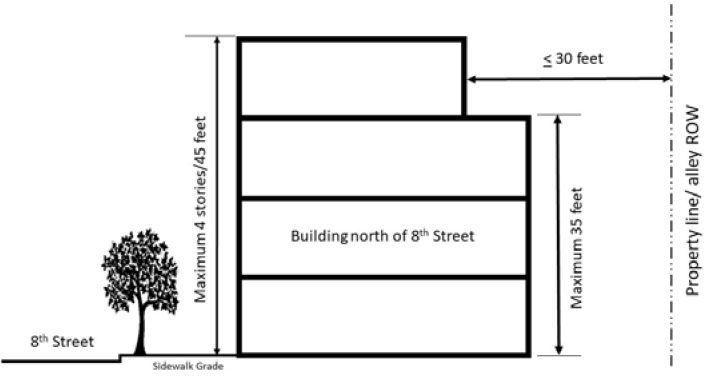
(3)
D-3 Red Mill:
That portion of a building within 100 feet from the property line along east Gillis Street right-of-way (extended to Grandview Parkway) is limited to 45 feet maximum.
That portion of a building within 100 feet of Grandview Parkway right-of-way shall not exceed a building height of 45 feet maximum.
Remaining Area: 45 feet maximum. An additional 15 feet is allowed if 25 percent of the project is designed and used for residential uses and the building is no taller than 60 feet. Another 15 feet is allowed by a special land use permit or planned unit development if 25 percent of the project is designed and used for residential uses and 75 feet is not exceeded.
That portion of a building taller than 45 feet shall be recessed a minimum of 20 feet from the facade facing the public street.
Any existing 5 story building in the D-3 District, constructed prior to 2005 within 30 feet from the right-of-way line of Grandview Parkway, is exempt from minimum residential requirements, provided that it shall comply with all other underlying zoning requirements.
(b)
Exceptions:
Steeples and clock towers may be erected to a height not exceeding twice the height of the attached building.
Parapet walls may be erected as necessary to screen rooftop equipment if the wall extends around the perimeter of the building and incorporates exterior building materials similar to those of the main building.
An existing one-story building may have a first floor addition the greater of 500 square feet or 10% of the floor area of the building that existed on the effective date of Ordinance No. ________, which is ___________.
Rooftop amenities may be erected to accommodate occupiable, enclosed space for rooftop amenities and may exceed the height limit of the district by a maximum of 15 feet, provided
(1)
The use shall be limited to restrooms, storage areas, community rooms for the occupants of the building, and food and beverage service, provided that:
a.
Outdoor food and beverage service shall cease between the hours of 10:30 p.m. and 6:00 a.m. when abutting or across an alley from an R-District.
b.
Outdoor performances and any other form of amplified sound shall cease between 10:00 p.m. and 7:00 a.m. when abutting or across the alley from an R-District.
(2)
Shall be setback a minimum of 20 feet from any street facing facade and rear property line if abutting or across an alley from an R-District.
(3)
Not exceed a total of 1,650 square feet or 20% of the rooftop area, whichever is less.
(Ord. 699. Passed 3-20-06. Ord. 734. Passed 3-19-07. Ord. 940. Passed 4-7-12; Ord. 1083, Passed 11-5-18; Ord. No. 1152, Passed 2-16-21; Ord. No. 1197, Passed 10-3-22)
1347.07 - Accessory buildings.
An accessory building shall be constructed using materials and features similar to the principal building if the accessory building exceeds 500 square feet in gross floor area.
1347.08 - Parking, loading and driveways.
Requirements for parking, loading and driveways are contained in Chapter 1372.
1347.09 - Special requirements.
No use shall be open to the public between the hours of 2:00 a.m. and 6:00 a.m.
In the D-2 District the following shall be required:
(1)
The north side of East Eighth Street between Franklin and Railroad Avenue shall not be open to the public between 10:00 p.m. and 6:00 a.m.
(2)
Outdoor food and drink service shall cease between the hours of 10:30 p.m. and 6:00 a.m.
(3)
Outdoor performances and any other form of outdoor amplified sound will cease between the hours of 10:00 p.m. and 7:00 a.m.
Ironworks (D-1), Depot (D-2) and Red Mill (D-3) areas. To preserve and reinforce the context of historic buildings and to establish land development patterns of the development districts, all new buildings and additions to existing buildings are to be designed and constructed in accordance with the following standards:
(1)
The predominant building wall and entryway shall face the public or private street.
(2)
For lots less than 50 feet in width, the building width measured at the front yard setback must be a minimum of 90 percent of the lot width. For lots 50 feet or wider, the building width shall not be less than 35 feet or 70 percent of the property width at the front yard setback for buildings.
(3)
Vertical building modulation shall be used to add variety and interest and to make a large building appear to be an aggregation of smaller units. Relief from a continuous street facing wall may be achieved with wall offsets in combination with pilasters, corbeling or other permanent architectural elements; however, offsets in any wall shall not be less than 8 inches from the subject plane.
(4)
Horizontal building modulation like awnings, balconies and roof features shall be used to reduce the perceived mass of a large building.
(5)
Fenestration, cornices and other primarily horizontal architectural elements incorporated in new buildings or additions to existing buildings shall be in context with historic buildings in the area.
(6)
Window glass planes shall be recessed at least 4 inches from the outside of all building walls to create a shadow line except in bay windows and to other projecting window elements.
(7)
For ground story glazing and upper story glazing facing the public street, the glazing must have a minimum 65 percent Visible Light Transmittance (VLT) and no more than 15 percent Visible Light Reflectance (VLR). The ground story glazing must remain unobstructed up to a minimum depth of 5 feet, with the exception of obstructions, such as window signs or product displays, shall not cover more than 10 percent of the total window-door areas. Except for buildings that are solely residential, street facing ground floor glazing, including doors, shall be a minimum of 60 percent of the total building elevation as vertically measured between 1 and 10 feet from the adjacent sidewalk grade.
(8)
New buildings and additions to existing buildings, including parking structures, shall be constructed of durable materials utilizing the predominant building materials used in the district and every building facade shall be constructed of materials comparable in aesthetic value.
(9)
Any rooftop equipment shall be enclosed or screened from street level view using the same materials used for the building walls or a material which is approved by the Planning Director as visually compatible with the building.
(10)
The first 30 feet of the building's interior space facing a public street shall be designed and used as occupied space for the users of the building. With the exception of basements, this space shall not be used for parking, storage or utilities.
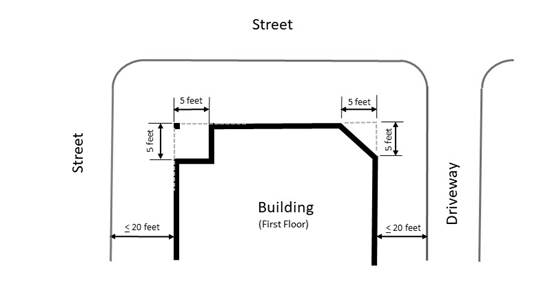
(11)
Buildings on corner lots or on lots with a front loaded driveway shall have a clipped or recessed corner for the height of the first floor level if the building façade is within 20 feet of the street or driveway/street intersection. These building corners shall be recessed at least 5 feet from the planes of the building if such building is located less than 20 feet from the edge of street or driveway intersection. See diagram below.
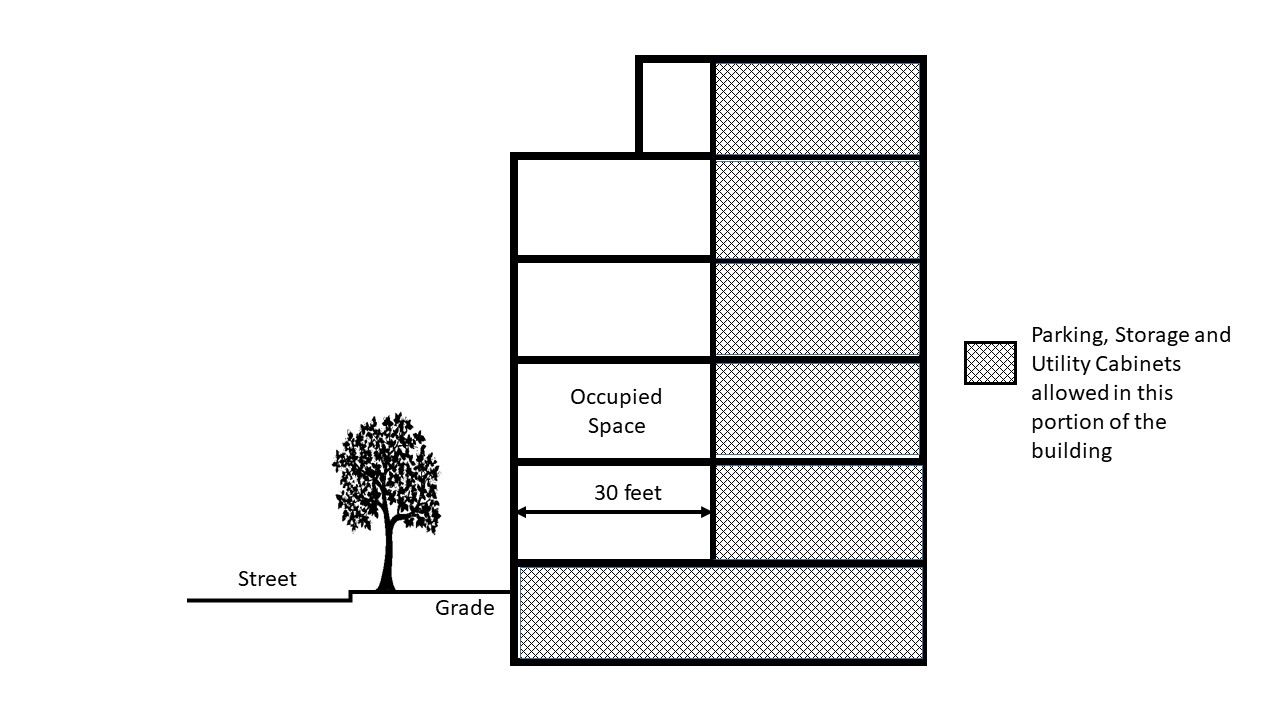
(12)
For each 90 feet of linear building frontage, pedestrian entrances are required. Pedestrian entrances may open onto the sidewalk or mid-block passages or walkways leading to the public right-of-way. Entries must be prominently identified and must not interfere with safe pedestrian passage along walkways. Primary entries must be set back a minimum of 4 feet from the property line.
(13)
All buildings that front the street, except for parking structures, accessory and utility buildings and buildings that are intended and designed to be exclusively developed for residential use shall have a minimum height of 14 feet measured from the street level entrance level to the next finished level or roof structure.
(Ord. 698, Passed 3-20-06; Ord. 996, Passed 6-2-14; Ord. 1081, Passed 9-4-18; Ord. No. 1152, Passed 2-16-21; Ord. No. 1165, Passed 7-6-21)
1348.01 - Uses allowed.
The following uses of land and buildings, together with accessory uses, are allowed in the Transportation Zone:
•
OS District uses, including buildings 3,000 square feet or larger in gross floor area;
•
GP District uses;
•
I District uses, except C-2 District Uses and medical marihuana facilities;
•
Air transportation, including airports and airport terminals;
•
Amusement and recreation services (indoor only);
•
Automobile gasoline/convenience stores;
•
Automobile, motorcycle, trailer, recreational vehicle or boat showrooms;
•
Brew pubs;
•
Business services;
•
Drugstore;
•
Engineering, accounting, research, management and related services;
•
Finance, insurance and real estate services;
•
Finance services without drive-throughs;
•
Indoor fruit and vegetable markets;
•
Landing areas;
•
Laundromats;
•
Legal services;
•
Lodging facilities;
•
Microbrewery;
•
Motorized vehicle dealers, mobile home dealers, watercraft dealers and recreational vehicle dealers subject to the following conditions:
(1)
All outdoor display and storage in front or on the side of a building shall meet landscape requirements for parking areas.
(2)
Outdoor display areas shall be differentiated from parking areas using contrasting surface material and shall be designated on a site plan.
(3)
Any display platforms shall not be elevated more than 3 feet higher than the adjacent public right-of-way.
•
Parcel packing services;
•
Parking areas, public or private,
•
Passenger transportation services;
•
Personal services;
•
Pet grooming services without outdoor runs or kennels;
•
Repair services;
•
Restaurants, family, fine and fast without drive-throughs;
•
Retail use of 10,000 square feet or more;
•
Security services;
•
Services stations and repair stations;
•
Theaters;
•
Theatrical producers, entertainers, bands and orchestras;
•
Transportation service;
•
Vacation home rentals maintaining a City vacation home rental license;
•
Vehicle wash facilities as permitted in the C-3 District;
•
Veterinary services, without outdoor runs;
•
Water transportation.
(Ord. 938, Passed 4-2-12; Ord. 1033, Passed 5-2-16; Ord. No. 1089, Passed 2-19-19; Ord. No. 1125, Passed 7-27-20.)
1348.02 - Uses allowed by special land use permit.
The following uses of land and buildings, together with accessory uses, are allowed in the Transportation District if a special land use permit is issued according to the standards of this Code:
•
Communication towers.
•
Wind Energy Pole/Tower-Mount.
•
Wind Energy Building Mount.
(Ord. 938. Passed 4-2-12)
1348.03 - Lot, density and impervious surface provisions.
1348.04 - Setbacks.
(a)
Front setbacks.
Building: Minimum setbacks are 25 feet.
Parking area: Behind or to the side of the principal building and set back a distance equal to the setback of the principal building or 25 feet, whichever is greater. For through lots, parking may be provided streetward of the principal building on the street that carries less traffic, but in no case closer than 25 feet from the front property line. Parking may be provided streetward of the building along South Airport Road provided a minimum 25 foot vegetative buffer area that will effectively screen the parking area from public view as set forth in Section 1372.04 is maintained where a vegetative buffer exits or, if no other vegetative buffer exists, other screening is provided as set forth in Section 1372.04 within the 25 foot buffer area.
(b)
Side setbacks (minimum):
Building: None except as follows:
(1)
25 feet if abutting or adjacent to an R-District.
(2)
50 feet if a loading dock is abutting or adjacent to an R-District.
Parking area: If contiguous to an R-District, a minimum of 10 feet. Otherwise, 5 feet. If shared parking is developed, these setbacks would affect only the perimeter of the combined parcels.
(c)
Rear setbacks:
Building: 5 feet, except as follows:
(1)
25 feet if abutting or adjacent to an R-District.
Parking area: 5 feet, except 20 feet if abutting, adjacent to or across a public alley from an R-District.
(d)
Corner lots and through lots having a frontage on 2 streets shall provide the required front setback on both streets.
(Ord. 1033. Passed 5-2-16)
1348.05 - Encroachments into the setbacks.
No encroachments into the setbacks are allowed.
1348.06 - Building height.
Building height: The lesser of 45 feet or the approach, transitional, conical and inner horizontal surfaces which establish the height limitation under this Chapter are denoted on the Airport Zoning Plan, and are established in conformance with approach standards or regulations of the Michigan Aeronautics Commission or the Federal Aviation Administration. In acting upon applications for permits, the Zoning Administrator will arrive at proper height limitations by insuring FAA Form 7460-1 is completed with Federal Aviation Administration determination of no hazard to aviation. Air traffic control towers are exempt from this height requirement.
(Ord. 735. Passed 3-19-07; Ord. 1033. Passed 5-2-16)
1348.07 - Accessory buildings.
Accessory buildings shall:
(a)
Not exceed the Building Height limitation as set forth in Section 1348.06.
(b)
Not be closer than 5 feet to any side or rear property line or 25 feet if abutting or adjacent to an R-District.
(Ord. 1033. Passed 5-2-16)
1348.08 - Parking, loading and driveways.
Requirements for parking, loading and driveways are contained in Chapter 1374. In addition, athletic fields may provide up to 50 percent of the required number of organized parking on an area developed in turf grasses. Grassed parking areas are considered as providing 1 parking space for every 350 square feet of continuous turf-covered area. All grassed parking areas shall be maintained in a healthy, vigorous growing condition and shall not be used more than 12 times per calendar year. When use requires more frequent parking, an impervious surface or approved pervious hard surface parking area shall be developed.
(Ord. 476. Passed 7-6-99)
1348.09 - Special requirements.
To preserve and reinforce the development patterns of the Transportation District, the following special requirements shall apply.
(1)
The predominant building wall and entryway shall face the public or private street.
(2)
Street-facing building facades shall incorporate permanent architectural elements which create shadow patterns and surface textures which, in turn, enhance visual interest.
(3)
Any rooftop equipment shall be enclosed or screened from street level view using the same materials used for the building walls or a material which is approved by the Planning Director as visually compatible with the building.
(4)
Commercial and industrial outdoor lighting shall not exceed 1 foot candle or cause glare onto neighboring properties.
(5)
Driveways on South Airport Road shall be limited to 1 per parcel and shall be no closer than 400 feet to the nearest driveway on the same side of the street or 150 feet from the nearest intersection.
(6)
All properties developed shall allow for internal access to other abutting industrial or commercial properties.
(7)
All utilities shall be placed underground and shall follow private or public streets or the primary maneuvering lanes within a parking area.
(Ord. 1033. Passed 5-2-16)
1348.10 - Federal laws.
Notice of construction or alteration shall be provided to the Federal Aviation Administration on Form 7460-1 for the following:
(1)
Any construction or alteration exceeding 200 feet above ground level.
(2)
Any construction or alteration:
•
Within 20,000 feet of the Cherry Capital Airport which exceeds a 100:1 surface from any point on the runway of the Cherry Capital Airport with at least one runway more than 3,200 feet.
•
Within 10,000 feet of the Cherry Capital Airport which exceeds a 50:1 surface from any point on the runway of the Cherry Capital Airport with its longest runway no more than 3,200 feet.
•
Within 5,000 feet of the Cherry Capital Airport which exceeds a 25:1 surface.
(3)
Any highway, railroad or other traverse way whose prescribed adjusted height would exceed that above noted standards.
(4)
When requested by the FAA.
(5)
Any construction or alteration located on the Cherry Capital Airport regardless of height or location.
(Ord. 1033. Passed 5-2-16)
1348.11 - Unlawful land use.
Notwithstanding any other provisions of this Zoning Ordinance, no person may use any lands within any area of land or water, or both, lying within a 10 mile radius from the established center of the Cherry Capital Airport which:
(1)
Would create electrical interference with radio communications between the airport and aircraft or create interference with navigational aids employed by aircraft;
(2)
Would make it difficult for flyers to distinguish between airport lights and others or result in glare to the eyes of flyers using the airport;
(3)
Would create air pollution in such amounts as to impair the visibility of flyers in the use of the airport;
(4)
Would locate or permit the operation of a dump, waste disposal site, sanitary landfill, hazardous waste facility, solid waste transfer station or recycling facility within 10,000 feet of any runway at the airport, unless the construction, location and operation of the site is approved or authorized by the Federal Aviation Administration as not being in violation of its orders, rules or regulations applicable to the airport, or unless a waiver is issued by the Federal Aviation Administration;
(5)
Would otherwise endanger the landing, taking off, or maneuvering of aircraft;
(6)
Would attract birds;
(7)
Would raise the descent minimums of any instrument approach procedure to the airport, or otherwise limit operations at the airport, as determined by an airspace study conducted by the Federal Aviation Administration;
(8)
Would violate the rules of the Federal Aviation Administration or the Michigan Department of Transportation Aeronautics Division.
(Ord. 1033. Passed 5-2-16)
1350.01 - Uses allowed.
(a)
Master site and facilities plan. When applying for a land use permit, the governmental unit shall present a Master Site and Facilities Plan for the current uses on all contiguous property owned by that governmental unit and all anticipated uses within a minimum of the next 5 years. This plan shall show adjacent properties sufficiently to identify surrounding uses and potential impacts on them by the applicant's plan and shall conform to the requirements of Traverse City Code Section 1366.08.
(b)
Uses allowed in the GP district. The following uses of land and buildings, together with accessory uses, are allowed in the Government/Public District:
•
Administration of economic programs;
•
Administration of human resource programs;
•
Athletic fields;
•
Auditoriums;
•
Cemeteries;
•
Child care organizations, as defined by MCL 722.111 et seq., as amended;
•
Community Gardens;
•
Cultural facilities;
•
Electrical, combination electric and gas and other utility services, water supply, sewage systems (except gas storage and refuse);
•
Environmental quality and housing program administration
•
Essential services and essential services with buildings;
•
Executive, legislative and general government uses except correctional institutions;
•
Finance, taxation and monetary services, public;
•
Health services except hospitals, sales and rentals;
•
Libraries;
•
National security and international affairs;
•
Parking structures, public or private, subject to the following standards:
(1)
Parking structures shall be designed to have horizontal versus stepped or sloping levels at areas of public view. All ramping shall be concealed from public view.
(2)
Openings shall not exceed 60 percent of the total wall surface. The shape of openings shall be vertical or square.
(3)
Materials for parking structures shall follow the same restrictions as buildings;
(4)
Sloped roofs are not required for parking decks, however:
a.
The upper and lowest level of parking shall incorporate sufficient screening to shield cars from public view.
b.
Parapet treatment is required to terminate the deck and give proper architectural finish to the structure. Cornices, overhangs and other devices which are consistent with the language of historical buildings may be employed.
(5)
The design of parking decks shall be consistent with the design of historical buildings in the area.
•
Parks;
•
Places of Worship;
•
Playgrounds;
•
Public works facilities;
•
Recreational facilities;
•
Social services;
•
Transitional housing;
•
United States Postal Service.
(Ord. 476. Passed 7-6-99. Ord. 589. Passed 1-06-03. Ord. 614. Passed 11-3-03. Ord. 665. Passed 03-21-05. Ord. 775. Passed. 11-5-07. Ord. 842. Passed 8-3-09; Ord. 1076. Passed 7-2-18)
1350.02 - Uses allowed by special land use permit.
The following uses of land and buildings, together with accessory uses, are allowed in the Government/Public District if a special land use permit is issued according to the standards of this Code:
•
Communication towers;
•
Correctional institutions;
•
Landing areas;
•
Schools;
•
Taller buildings;
•
Transit centers;
•
Wind Energy Pole/Tower Mount.
(Ord. 476. Passed 7-6-99. Ord. 610. Passed 9-2-03. Ord. 938. Passed 4-2-12)
1350.03 - Lot, density and impervious surface provisions.
The surface parking area shall not exceed the total floor area of all buildings on the lot.
(Ord. 476. Passed 7-6-99.)
1350.04 - Setbacks.
(a)
Front setbacks:
Building: 25 feet minimum, or as shown on the approved Master Site and Facilities Plan allowing a lessor setback.
Parking area: Behind or to the side of the principal building and set back a distance equal to the setback of the principal building or 25 feet, whichever is greater, or as shown on the approved Master Site and Facilities Plan allowing a lesser setback.
(b)
Side setbacks (minimum):
Building: None, except 25 feet if abutting or adjacent to an R-district.
Parking area: 5 feet, except a 10-foot setback is required for any parking area abutting, adjacent to or across an alley from an R-District.
(c)
Rear setbacks (minimum):
Building: 25 feet.
Parking area: 5 feet, except a 20-foot setback is required for any parking area abutting, adjacent to or across a public alley from an R-District.
(d)
Water setback: 25 feet inland from the ordinary high water mark.
(e)
Corner lots and through lots having a frontage on 2 streets shall provide the required setback yard on both streets.
(f)
An additional setback from of 1 foot for each foot of building height above 40 feet is required for any portion of a building above 40 feet.
(Ord. 476, Passed 7-6-99; Ord. 607, Passed 7-21-03; Ord. No. 1094, Passed 6-3-19.)
1350.05 - Encroachments into the setbacks.
None are allowed.
(Ord. 476. Passed 7-6-99.)
1350.06 - Building height.
(a)
Building height: 25 to 90 feet, except all existing buildings may double their existing first floor area.
(b)
Exceptions:
Parapet walls may be erected as necessary to screen rooftop equipment if the wall extends around the perimeter of the building and incorporates exterior building materials similar to those of the main building.
(Ord. 476. Passed 7-6-99. Ord. 548. Passed 12-17-01. Ord. 736. Passed 3-19-07)
1350.07 - Accessory buildings.
Accessory buildings shall:
(1)
Not be located in the front yard.
(2)
Shall not exceed 30 feet in height.
(3)
Shall not be closer than 25 feet to any side or rear property line. Boat houses up to 250 square feet gross floor area, may be built up to the water's edge.
(Ord. 476. Passed 7-6-99.)
1350.08 - Parking, loading and driveways.
Requirements for parking, loading and driveways are contained in Chapter 1374. In addition, athletic fields may provide up to 50 percent of the required number of organized parking on an area developed in turf grasses. Grassed parking areas are considered as providing 1 parking space for every 350 square feet of continuous turf-covered area. All grassed parking areas shall be maintained in a healthy, vigorous growing condition and shall not be used more than 12 times per calendar year. When use requires more frequent parking, an impervious surface or approved pervious hard surface parking area shall be developed.
(Ord. 476. Passed 7-6-99.)
1352.01 - Purpose.
The Grand Traverse Commons District is a jointly planned jurisdictional area established pursuant to the Michigan Joint Municipal Planning Act 226 of 2003, as amended.
(Ord. 1063. Passed 2-5-18)
1352.02 - Jurisdictional authority.
The jurisdictional authority for the Grand Traverse Commons District shall be the Grand Traverse Commons Planning Commission, established pursuant to the Joint Municipal Planning Act, MCL 125.131, et. seq., and by agreement between the City of Traverse City and the Charter Township of Garfield Township with an effective date of May 14, 2007 and approved by Chapter 1224 of the Codified Ordinances for the City of Traverse City and Section 1 of Ordinance No. 48 for the Charter Township of Garfield.
(Ord. 1063. Passed 2-5-18)
1352.03 - Jurisdictional zoning.
The Zoning Ordinance for the Grand Traverse Commons Districts shall be the Grand Traverse Commons Development Regulations, an ordinance intended to implement the concepts outlined in the Grand Traverse Commons Master Plan of 2010 as adopted per P.A. 33 of 2008, as amended, being, the Michigan Planning Enabling Act (M.C.L. 124.3801 et seq.).
(Ord. 1063. Passed 2-5-18)
Cross reference— Grand Traverse Commons Development Regulations, located on the City of Traverse City official website, Grand Traverse Commons Joint Planning Commission page.
1354.01 - Uses allowed.
The following uses of land and buildings together with accessory uses are allowed in the Industrial District:
•
GP District uses;
•
C-2 District uses meeting the setbacks (§1342.02), building height (§1342.06) and special requirements (§1342.09) of the C-2 District, with the exception of Section 1342.09(1) limiting building size;
•
C-2 District uses in the Airport Industrial Park and Traversefield Enterprise Place is limited to existing buildings more than 5 years old, based upon the date of the initial certificate of occupancy issued. Minor additions are allowed provided the addition is for barrier-free access, fire safety or to improve the energy efficiency of the building;
•
Adult use marihuana retailer:
(1)
The Adult Use Marihuana Retailer and use shall comply at all times with the Michigan Regulation and Taxation of Marihuana Act, Initiated Law 1 of 2018 MCL 333.27951 et seq., as amended, the Codified Ordinances of the City of Traverse City, and the rules promulgated pursuant to the Michigan Regulation and Taxation of Marihuana Act, Initiated Law 1 of 2018 MCL 333.27951 et seq., as amended, as they may be amended from time to time.
(2)
The Adult Use Marihuana Retailer shall not be in operation between the hours of 10:00 p.m. and 7:00 a.m.
(3)
Co-location with other marihuana Adult-Use Marihuana Establishments or Medical Marihuana Facilities may occur only as specifically permitted by the Medical Marihuana Facilities Licensing Act and the Michigan Regulation and Taxation of Marihuana Act and any corresponding administrative rules, regulations and ordinances.
(4)
No use or consumption of marihuana shall be allowed at the Adult Use Marihuana Retailer.
(5)
An Adult Use Marihuana Retailer shall not be located within a 1,000-foot radius from any existing school.
(6)
The Adult Use Marihuana Retailer shall have at all times a valid and current operating license issued by the State and permit from the City of Traverse City under the applicable Codified Ordinances of the City of Traverse City.
(7)
All activities of an Adult Use Marihuana Retailer shall be conducted within the building.
(8)
The smell of marihuana shall not be detectable outside of the portion of any structure where marihuana is present.
•
Auto repair;
•
Communications establishments;
•
Construction, special trades;
•
Contractors;
•
Contractors, heavy construction;
•
Crematories provided the use is at least 500 feet from a Residential Zoning District, public park or school as defined by the Zoning Code;
•
Cutting plastics, leather, etc.;
•
Equipment rental and leasing, miscellaneous;
•
Fuel dealers;
•
Funeral services;
•
Gas systems;
•
Kennels for boarding provided that no building, open kennel or exercise runway shall be located closer than 200 feet from any R District;
•
Lumber yards—Retail;
•
Manufacturing or processing of:
(1)
Apparel and other finished products made from fabrics and similar materials;
(2)
Bakery products;
(3)
Beverages;
(4)
Canned, frozen and preserved fruits, vegetable and food specialties;
(5)
Dairy products;
(6)
Electronic and other electrical equipment and components;
(7)
Fabricated metal products, except machinery and transportation equipment and except ordnance and accessories;
(8)
Food preparations and kindred products—miscellaneous;
(9)
Furniture and fixtures;
(10)
Grain mill products;
(11)
Industrial and commercial machinery and computer equipment;
(12)
Leather and leather products (finished), except leather tanning and finishing;
(13)
Lumber and wood products, except furniture, wood preserving and reconstituted wood products;
(14)
Manufacturing industries—miscellaneous;
(15)
Measuring, analyzing and controlling instruments, photographic, medical and optical goods, matches and clocks;
(16)
Printing, publishing and allied industries;
(17)
Stone, clay, glass and concrete products, except asbestos products;
(18)
Sugar and confectionery products;
•
Marihuana grower or Medical marihuana grower meeting the following requirements:
(1)
The marihuana facility and use shall comply at all times with the Michigan Medical Facilities Licensing Act, Michigan Regulation and Taxation of Marihuana Act, rules promulgated pursuant to the Michigan Medical Marihuana Facilities Licensing Act, Michigan Regulation and Taxation of Marihuana Act and the Codified Ordinances of the City of Traverse City as they may be amended from time to time;
(2)
All marihuana plants cultivated shall be contained within a fully enclosed locked facility inaccessible on all sides and equipped with locks or other security devices that permit access only by the person holding a license under the Michigan Medical Marihuana Facilities Licensing Act, Michigan Regulation and Taxation of Marihuana Act and a permit under the applicable Codified Ordinances of the City of Traverse City or staff of the marihuana facility;
(3)
Cultivation shall be conducted so as not to create dust, glare, noise, or light spillage beyond the parcel and shall not be visible from an adjoining public way. Lighting shall not be visible outside of the building from sunset to sunrise;
(4)
The smell of marihuana shall not be detectable beyond the parcel;
(5)
A marihuana grower shall not be located within a 1,000-foot radius from any existing school;
(6)
The marihuana grower shall have at all times a valid and current operating license issued by the State and permit issued by the City of Traverse City under the applicable Codified Ordinances of the City of Traverse City;
(7)
Except for a marihuana processor use as set forth in this section, no other marihuana facilities use shall occur on the parcel;
(8)
No use or consumption of marihuana shall be allowed at the marihuana facility;
•
Marihuana microbusiness meeting all of the requirements for marihuana or medical marihuana growers and processors as well as all of the requirements for adult use marihuana retail establishments under this chapter;
•
Marihuana processor or medical marihuana processor meeting the following requirements:
(1)
The facility and use shall comply at all times with the Michigan Medical Marihuana Facilities Licensing Act, Michigan Regulation and Taxation of Marihuana Act, the Codified Ordinances of the City of Traverse City, and the rules promulgated pursuant to the Michigan Medical Marihuana Facilities Licensing Act and Michigan Regulation and Taxation of Marihuana Act and the Codified Ordinances of the City of Traverse City, as they may be amended from time to time;
(2)
A partition wall shall separate the marihuana processor space from the marihuana grower space that must include a door, capable of being closed and locked between the marihuana grower and marihuana processor spaces;
(3)
Except for marihuana growers as set forth in this section, no other marihuana facilities use shall occur on the parcel;
(4)
Except for regulatory authorities, no persons other than the person holding a license under the Michigan Medical Marihuana Facilities Licensing Act, Michigan Regulation and Taxation of Marihuana Act, and a permit under the applicable Codified Ordinances of the City of Traverse City or staff of the facility, shall be permitted within the marihuana processor portion of the facility when marihuana is being processed;
(5)
No use or consumption of marihuana shall be allowed at the marihuana facility;
(6)
A marihuana processor shall not be located within a 1,000-foot radius from any existing school;
(7)
An owner or operator of a marihuana processor shall not have been convicted of a felony involving controlled substances within the last 10 years;
(8)
The marihuana processor shall have at all times a valid and current operating license issued by the State and permit issued by the City of Traverse City under the applicable Codified Ordinances of the City of Traverse City;
(9)
All activities of a marihuana processor shall be conducted within the building and out of public view;
(10)
The smell of marihuana shall not be detectable outside of the portion of any structure where marihuana is present;
•
Medical marihuana provisioning center meeting the following requirements:
(1)
The medical marihuana facility and use shall comply at all times with the Michigan Medical Marihuana Facilities Licensing Act, Chapter 845 of the Codified Ordinances of the City of Traverse City, and the rules promulgated pursuant to the Michigan Medical Marihuana Facilities Licensing Act as they may be amended from time to time;
(2)
The medical marihuana provisioning center shall not be in operation between the hours of 10:00 p.m. and 7:00 a.m.;
(3)
Except for medical marihuana processors as set forth in this section, no other medical marihuana facilities use shall occur on the parcel;
(4)
Except for parents or guardians of a qualifying patient and the person holding a license under the Michigan Medical Marihuana Facilities Licensing Act and Chapter 845 of the Codified Ordinances of the City of Traverse City or staff of the medical marihuana facility, persons other than a qualifying patient or primary caregiver shall be not permitted within the medical marihuana provisioning center when medical marihuana is being transferred;
(5)
No use or consumption of marihuana shall be allowed at the medical marihuana facility;
(6)
The medical marihuana facility shall not be used by a physician to conduct a medical examination or issue a medical certification document for the purpose of obtaining a qualifying patient registry identification card under the Michigan Medical Marihuana Act;
(7)
A qualifying patient under the age of 18 shall be accompanied by a parent or guardian and notice of such shall be conspicuously posted;
(8)
A medical marihuana provisioning center shall not be located within a 1,000-foot radius from any existing school;
(9)
An owner or operator of a medical marihuana provisioning center shall not have been convicted of a felony involving controlled substances within the last 10 years;
(10)
The medical marihuana provisioning center shall have at all times a valid and current operating license issued by the State and the City of Traverse City under Chapter 845 of the Codified Ordinances of the City of Traverse City;
(11)
All activities of a Medical marihuana provisioning center shall be conducted within the building;
(12)
The smell of marihuana shall not be detectable outside of the portion of any structure where marihuana is present;
•
Marihuana safety compliance facility or medical marihuana safety compliance facility meeting the following requirements:
(1)
The facility and use shall comply at all times with the Michigan Medical Marihuana Facilities Licensing Act, Michigan Regulation and Taxation of Marihuana Act, the Codified Ordinances of the City of Traverse City, and the rules promulgated pursuant to the Michigan Medical Marihuana Facilities Licensing Act, Michigan Regulation and Taxation of Marihuana Act and the Codified Ordinances of the City of Traverse City, as they may be amended from time to time;
(2)
Except for regulatory authorities, no persons other than the person holding a license under the Michigan Medical Marihuana Facilities Licensing Act, Michigan Regulation and Taxation of Marihuana Act, and a permit under the applicable Codified Ordinances of the City of Traverse City or staff of the facility, shall be permitted within the marihuana safety compliance facility when marihuana is being processed;
(3)
No use or consumption of marihuana shall be allowed at the marihuana facility;
(4)
A marihuana safety compliance facility shall not be located within a 1,000-foot radius from any existing school;
(5)
An owner or operator of a marihuana safety compliance facility shall not have been convicted of a felony involving controlled substances within the last 10 years;
(6)
The marihuana safety compliance facility shall have at all times a valid and current operating license issued by the State and permit issued by the City of Traverse City under the applicable Codified Ordinances of the City of Traverse City;
(7)
All activities of a marihuana safety compliance facility shall be conducted within the building and out of public view;
(8)
The smell of marihuana shall not be detectable outside of the portion of any structure where marihuana is present;
•
Marihuana or medical marihuana secure transporter meeting the following requirements:
(1)
The marihuana facility and use shall comply at all times with the Michigan Medical Marihuana Facilities Licensing Act, Michigan Regulation and Taxation Act, the Codified Ordinances of the City of Traverse City, and the rules promulgated pursuant to the Michigan Medical Marihuana Facilities Licensing Act and Michigan Regulation and Taxation of Marihuana Act, and the Codified Ordinances of the City of Traverse City as they may be amended from time to time;
(2)
No other marihuana facilities use shall occur on the parcel;
(3)
No use or consumption of marihuana shall be allowed at the facility;
(4)
A marihuana secure transporter shall not be located within a 1,000-foot radius from any existing school. This provision shall not apply while engaged in the operation of transporting as authorized by the Michigan Medical Facilities Licensing Act, or Michigan Regulation and Taxation of Marihuana Act;
(5)
An owner or operator of a marihuana secure transporter shall not have been convicted of a felony involving controlled substances within the last 10 years;
(6)
The marihuana secure transporter shall have at all times a valid and current operating license issued by the State and permit issued by the City of Traverse City under the applicable Codified Ordinances of the City of Traverse City;
•
Metal slitting and shearing;
•
Motor freight transportation and warehousing;
•
Nurseries, retail;
•
Offices, general, up to 5,000 square feet gross floor area on any site and/or building;
•
Offices primarily serving industry in the district which clearly establish support services for permitted industries in the district;
•
Parcel packing services;
•
Pet boarding or pet grooming services, provided that no building, open kennel or exercise runway is closer than 200 feet from an R-District;
•
Places of Worship;
•
Postal and delivery services;
•
Pressure container filling;
•
Primary metal industries, including smelting, forging and similar operations, subject to the following conditions:
(1)
The maximum lot size is 14 acres.
(2)
No odors, smoke or noise from the use are likely to create a disturbance on neighboring public or private property.
•
Retail outlets, if accessory to manufacturing use;
•
Salvaging damaged merchandise not engaged in sales;
•
Scrap steel cutting;
•
Sign painting and lettering shops;
•
Solvents recovery services;
•
Tape slitting for trade;
•
Testing and laboratory services;
•
Veterinary services for animal specialties provided that no building, open kennel or exercise runway shall be no closer than 200 feet from any R district;
•
Vocational schools;
•
Warehousing;
•
Weighing foods and other commodities;
•
Wholesale trade durable goods;
•
Wholesale trade non-durable goods except livestock and wholesale live animals.
(Ord. 674, Passed 04-04-05; Ord. 776, Passed 11-05-07; Ord. 841, Passed 8-3-09; Ord. 878, Passed 8-16-10, Ord. 929, Passed 11-7-11; Ord. 982, Passed 10-7-13; Ord 1024, Passed 09-08-15; Ord. 1084, Passed 12-3-18; Ord. No. 1089, Passed 2-19-19; Ord. No. 1136, Passed 8-17-20; Ord. No. 1200, Passed 2-21-23.)
1354.02 - Uses allowed by special land use permit.
The following uses of land and buildings, together with accessory uses, are allowed in the Industrial District if a special land use permit is issued according to the standards of this Code:
•
Communication towers.
•
Wind Energy Pole/Tower-Mount
•
Wind Energy Building Mount
(Ord. 938. Passed 4-2-12)
1354.03 - Lot, density and impervious surface provisions.
1354.04 - Setbacks.
(a)
Front setbacks:
Building: 25 feet minimum.
Parking area: Behind or to the side of the principal building and set back a distance equal to the setback of the principal building or 25 feet, whichever is greater. For through lots, parking may be provided streetward of the principal building on the street that carries less traffic, but no closer than 25 feet from the front property line.
(b)
Side setbacks (minimum):
Building: One side/aggregate: Zero.
Parking: 5 feet, except a minimum of 10 feet if contiguous to an R-district.
(c)
Rear setback:
Building: 15 feet minimum.
Parking: 5 feet, except 20 feet if abutting, adjacent to or across a public alley from an R-district.
(d)
Through lots and corner lots having a frontage on 2 streets shall provide the required front setback on both streets.
1354.05 - Encroachments into the setbacks.
No encroachments into the setbacks are allowed.
1354.06 - Building height.
Building height: Maximum 60 feet.
Public utility buildings may be erected to a height not exceeding 100 feet.
(Ord. 737 Passed 3-19-07.)
1354.07 - Accessory buildings.
Accessory buildings shall:
(1)
Not be located in the front yard except accessory buildings may be located streetward of the principal building on the less traveled street on through lots.
(2)
Be no closer than 15 feet to any side or rear property line. Boat houses up to 250 square feet gross floor area, may be built up to the water's edge.
(Ord. 476. Passed 7-6-99. Ord. 554. Passed 2-4-02.)
1354.08 - Special requirements.
Curbing is required only for that portion of a parking area including the approach driveways and parking lot facing the street.
(Ord. 476. Passed 7-6-99.)
1356.01 - Uses allowed.
(a)
Master site facilities plan. When applying for a land use permit, NMC shall present a Master Site and Facilities Plan for the current uses on all contiguous property owned by NMC and all anticipated uses within a minimum of the next 5 years. This plan shall show adjacent properties sufficiently to identify surrounding uses and potential impacts on them by the applicant's plan and conform to the requirements of Traverse City Code Section 1366.08.
(b)
Uses allowed in the NMC-1 district. The following uses of land and buildings, together with accessory uses, are allowed in the NMC-1 district:
•
OS district uses;
•
R-3 district uses;
•
Clustered single-family dwellings.
•
Child care organizations, as defined by MCL 722.111 et seq., as amended;
•
The following, provided buildings are no larger than 10,000 square feet gross floor area: Universities, colleges and theological schools including the buildings used for administrative and faculty offices, classrooms, laboratories, chapels, auditoriums, museums, lecture halls, libraries, student and faculty centers, athletic facilities, dormitories, fraternities and sororities, but not including colleges or trade schools operated for profit and not including the use of any building, stadium or other facility for primarily commercial purposes.
(c)
NMC-2 District uses. Uses permitted in the NMC-2 district:
•
OS district uses;
•
R-3 district uses;
•
NMC-1 district uses, without the gross square foot limitations;
•
Bookstores;
•
Cultural facilities if parking facilities are not visible from a residential district;
•
Essential services and essential services with buildings;
•
Institutional headquarters;
•
Marinas and maritime operations associated with the college and its partners;
•
Meeting facilities and convention centers;
•
Places of worship;
•
Public administration;
•
Schools;
•
Theatrical producers, bands, orchestras and entertainers.
(Ord. 475, Passed 7-6-99; Ord. 524, Passed 2-20-01; Ord. 590, Passed 1-06-03; Ord. 667, Passed 03-21-05; Ord. 1076, Passed 7-2-18; Ord. No. 1174, Passed 10-18-21)
1356.02 - Uses allowed by special land use permit.
When applying for a land use permit NMC shall present a Master Site and Facilities Plan for the current uses on all the campus property and all anticipated uses within a minimum of the next 5 years. The following uses of land and buildings, together with accessory uses, are allowed in the NMC Districts, if a special land use permit is issued according to the standards of this Code:
•
Communication towers,
•
Essential services buildings in a NMC-1 District,
•
Taller buildings in an NMC-2 district except buildings located on Grand Traverse Bay are limited to 3 stories and 50 feet,
•
Transitional housing and emergency shelters,
•
Wind Energy Pole/Tower-Mount,
•
Wind Energy Building-Mount.
(Ord. 475. Passed 7-6-99. Ord. 524. Passed 2-20-01. Ord. 938. Passed 4-2-12. Ord. 1006. Passed 7-7-14)
1356.03 - Lot, density and impervious surface provisions.
(1) The surface parking area shall not exceed 15 percent of the total area of any lot over 10 acres. Hard surface recreational areas shall not be included as impervious surface for determining the percentage of allowable impervious surface.
(Ord. 475. Passed 7-6-99. Ord. 533. Passed 6-4-01; Ord. No. 1231, Passed 12-15-25.)
1356.04 - Setbacks.
(a)
Front setbacks:
Buildings: 100 feet or as shown on the approved Master Site and Facilities Plan allowing a lesser setback.
Parking area: Behind or to the side of the principal building and set back a distance equal to the setback of the principal building or 25 feet, whichever is greater, except in the NMC-2 District on Grand Traverse Bay, parking in front of the building is allowed provided:
(1)
At least 40 percent of Area "A" located on the major street (the area directly in front of the building and of the required front setback line) shall be maintained with landscaping, pedestrian walks or plazas in order to provide a strong visual and physical connection between the building and the public street. (See diagram below).
(2)
Occasional overflow parking may occur within the landscaped portion of area "A" consisting of a parking surface of grass or brick pavers provided a strong pedestrian connection between the public walk and the building's principal entrance(s) is retained.
(3)
Area "A" may be traversed by 1 two-way drive and a drop-off area for vehicles. This area and any crossing drive shall be designed to encourage only slow-moving vehicles. The drive shall be designed to conform to a uniform pedestrian walkway elevation.
(4)
On corner lots, the frontage along the minor street shall meet the requirements for setbacks for side yards.
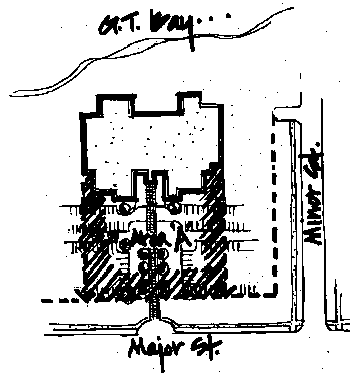
Parking on Grand Traverse Bay in NMC-2 District
For through lots, parking may be provided streetward of the principal building on the street that carries less traffic, but no closer than 25 feet from the front property line.
(b)
Side setbacks (minimum):
Building: One side/Aggregate: Zero
Parking area: 5 feet minimum, except 10 feet if abutting or adjacent to an R-District. If shared parking is developed, these setbacks would affect only the perimeter of the combined parcels.
(c)
Rear setbacks:
Building: 5 feet, except 20 feet if abutting or across an alley from an R-District.
Parking area: 5 feet, except 20 feet if abutting or across an alley from an R-District.
(d)
Corner lots and through lots having a frontage on 2 streets shall provide the required front setback on both streets.
(e)
Water setbacks: 50 feet inland from the ordinary high water mark of Grand Traverse Bay except marina buildings up to 3,000 square feet gross floor area may be located at the water's edge.
(Ord. 475. Passed 7-6-99.)
1356.05 - Encroachments into the setbacks.
No encroachments into the setbacks are allowed.
(Ord. 475. Passed 7-6-99.)
1356.06 - Building height.
(a)
Building height:
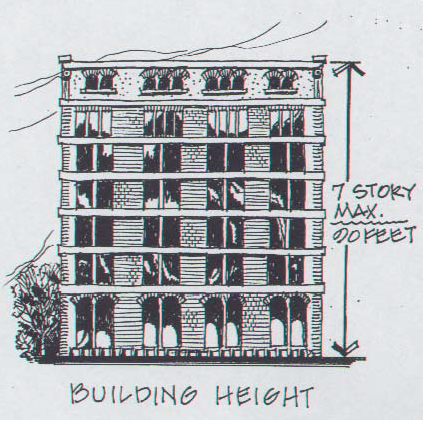
NMC-1: Maximum 45 feet
NMC-2: Maximum 90 feet. More than 60 feet may be allowed by SLUP or PUD, except buildings on Grand Traverse Bay are limited to 50 feet.
(b)
Exceptions:
Steeples and towers may be erected to a height the lessor of twice the height of the attached building or 90 feet.
Parapet walls may be erected as necessary to screen existing rooftop equipment if the wall extends around the perimeter of the building and incorporates exterior building materials similar to those of the main building.
(Ord. 475. Passed 7-6-99. Ord. 524. Passed 2-20-01. Ord. 738 Passed 3-19-07.)
1356.07 - Accessory buildings.
Accessory buildings shall:
(1)
Not be located in the front yard, except accessory buildings may be located streetward of the principal building on the less traveled street on through lots.
(2)
Not exceed 30 feet in height.
(3)
Not be closer than 10 feet to any side or rear property line. Boat houses up to 3,000 square feet gross floor area may be built up to the water's edge.
(Ord. 475. Passed 7-6-99. Ord. 524. Passed 2-20-01. Ord. 554. Passed 2-4-02.)
1356.08 - Parking, loading and driveways.
Requirements for parking, loading and driveways are contained in Chapter 1374. In addition, athletic fields may provide up to 50 percent of the required number of organized parking on an area developed in turf grasses. Grassed parking areas are considered as providing 1 parking space for every 350 square feet of continuous turf-covered area. All grassed parking areas shall be maintained in a healthy, vigorous growing condition and shall not be used more than 12 times per calendar year. When use requires more frequent parking, an impervious surface or approved pervious hard surface parking area shall be developed.
(Ord. 475. Passed 7-6-99.)
1358.01 - Uses allowed.
(a)
Master site facilities plan. When applying for a land use permit for H-2 District properties, the applicant shall present a Master Site and Facilities Plan for the current uses on all contiguous property owned by applicant and all anticipated uses within a minimum of the next 5 years. This plan shall show adjacent properties sufficiently to identify surrounding uses and potential impacts on them by the applicant's plan and shall conform to the requirements of Traverse City Code Section 1366.08.
(b)
H-1 District. The following uses of land and buildings, together with accessory uses, are allowed in the H-1 Hospital District:
•
Child care organizations, as defined by MCL 722.111 et seq., as amended;
•
Community Gardens;
•
Dormitories;
•
Dwellings, multiple family;
•
Florists;
•
Health services, including clinics of doctors and dentists;
•
Hospitality houses;
•
Marihuana safety compliance facility or medical marihuana safety compliance facility meeting the following requirements:
(1)
The facility and use shall comply at all times with the Michigan Medical Marihuana Facilities Licensing Act, Michigan Regulation and Taxation of Marihuana Act, the Codified Ordinances of the City of Traverse City, and the rules promulgated pursuant to the Michigan Medical Marihuana Facilities Licensing Act and Michigan Regulation and Taxation of Marihuana Act, as they may be amended from time to time;
(2)
Except for regulatory authorities, no persons other than the person holding a license under the Michigan Medical Marihuana Facilities Licensing Act, Michigan Regulation and Taxation of Marihuana Act, and a permit under the applicable Codified Ordinances of the City of Traverse City or staff of the facility, shall be permitted within the marihuana safety compliance facility when marijuana is being processed;
(3)
No use or consumption of marihuana shall be allowed at the marihuana facility;
(4)
A marihuana safety compliance facility shall not be located within a 1,000-foot radius from any existing school;
(5)
An owner or operator of a marihuana safety compliance facility shall not have been convicted of a felony involving controlled substances within the last 10 years;
(6)
The marihuana safety compliance facility shall have at all times a valid and current operating license issued by the State and permit issued by the City of Traverse City under the applicable Codified Ordinances of the City of Traverse City;
(7)
All activities of a marihuana safety compliance facility shall be conducted within the building and out of public view;
(8)
The smell of marihuana shall not be detectable outside of the portion of any structure where marihuana is present.
•
Offices, legal services, business services, insurance and real estate services;
•
Residential care and treatment facilities.
The following uses, if they meet the requirements of an accessory use, except that they need not be in the same building or on the same lot:
•
Duplicating, mailing, stenographic and office services no larger than 2,000 square feet gross floor area;
•
Schools for the handicapped;
•
Educational services to the public related to health care;
•
Financial institutions with no drive-throughs;
•
Gift shops no larger than 2,000 square feet gross floor area;
•
Orthopedic stores;
•
Pharmacies no larger than 2,000 square feet gross floor area;
•
Places of worship;
•
Recreational facilities;
•
Restaurants, family, fine and fast, under 2,000 square feet in gross floor area;
•
Area without drive-throughs or drive-ins;
•
Social services;
•
Veterinary services, without outdoor runs.
(c)
H-2 District. The following uses of land and buildings, together with accessory uses, are allowed in the H-2 District:
•
H-1 District uses;
•
Health services;
•
Hospitality houses;
•
Hospitals and medical centers;
•
Medical care facilities;
•
Parking structures, public or private, subject to the following standards:
(1)
Parking structures shall be designed to have horizontal versus stepped or sloping levels at areas of public view. All ramping shall be concealed from public view.
(2)
Openings shall not exceed 60 percent of the total wall surface. Openings shall be vertical or square.
(3)
Sloped roofs are not required for parking structures, however:
a.
The upper and lowest level of parking shall incorporate sufficient screening to shield cars from public view.
b.
Parapet treatment is required to terminate the deck and give proper architectural finish to the structure. Cornices, overhangs and other devices which are consistent with the design of historical buildings may be employed.
(4)
The design of parking decks shall be complementary to the design of historical buildings in the area.
•
Residential care and treatment facilities.
(Ord. No. 476, Passed 7-6-99; Ord. No. 550, Passed 12-3-01; Ord. 591, Passed 1-06-03; Ord. 602, 6-2-03; Ord. 668, Passed 03-21-05; Ord. 842, Passed 8-3-09; Ord. 844, Passed 8-3-09; Ord. 880, Passed 8-16-10; Ord. 904, Passed 2-7-11; Ord. 1076, Passed 7-2-18; Ord. 1084, Passed 12-3-18; Ord. No. 1129, Passed 8-17-20; Ord. No. 1175, Passed 10-4-21; Ord. No. 1216, Passed 9-3-2024.)
1358.02 - Uses allowed by special land use permit.
The following uses of land and buildings, together with accessory uses, are allowed if a special land use permit is issued according to the standards of this Zoning Code:
•
Communication towers;
•
Essential services buildings;
•
Landing areas;
•
Taller buildings for H-2 district uses;
•
Transitional housing and emergency shelters;
•
Wind Energy Pole/Tower-Mount;
•
Wind Energy Building-Mount.
(Ord. No. 476. Passed 7-6-99. Ord. No. 550. Passed 12-3-01. Ord. 938. Passed 4-2-12. Ord. 1007. Passed 7-7-14. Ord. 1010. Passed 9-2-14)
1358.03 - Lot, density and impervious surface provisions.
(Ord. No. 476. Passed 7-6-99. Ord. No. 551. Passed 12-3-01. Ord. No. 568. Passed 7-1-02; Ord. No. 1231, Passed 12-15-25.)
1358.04 - Setbacks.
(a)
Front setbacks:
Buildings: H-1: The lessor of 8 feet or the average setback of principal buildings on the same face block. H-2: 25 feet or as shown on the approved Master Site and Facilities Plan allowing a lesser setback.
Parking areas: H-1: Behind or to the side of the principal building and set back a distance equal to the setback of the principal building or 25 feet, whichever is greater. For through lots, parking may be provided streetward of the principal building on the street that carries less traffic, but no closer than 25 feet from the front property line. H-2: Behind or to the side of the principal building and set back a distance equal to the setback of the principal building or 25 feet, whichever is greater, or as shown on the approved Master Site and Facilities Plan allowing a lesser setback.
(b)
Side setbacks (minimum):
Building: 5 feet, except a ten-foot side setback is required on the side abutting an R-District.
Parking areas: If contiguous to an R-district, a minimum of 10 feet. Otherwise, 5 feet. If shared parking is developed, these setbacks would affect only the perimeter of the combined parcels.
(c)
Rear setbacks:
Building: 5 feet, except 20 feet if abutting or adjacent to an R-district.
Parking areas: 5 feet, except 20 feet if abutting, adjacent to or across an alley from an R-District.
(d)
Corner lots and through lots having a frontage on 2 streets shall provide the required front setback on both streets.
(e)
An additional setback of 1 foot for each foot of building height above 45 feet is required for any portion of a building above 45 feet.
(Ord. 476. Passed 7-6-99. Ord. 608. Passed 7-21-03.)
1358.05 - Encroachments into the setbacks.
No encroachments into the setbacks are allowed.
(Ord. 476. Passed 7-6-99.)
1358.06 - Building height.
(a)
Building height:
H-1: Maximum 45 feet.
H-2: West of Elmwood Avenue (within 100 feet of the right-of-way) 110 feet maximum.
Remaining area: 90 feet maximum
More than 60 feet may be allowed by SLUP or PUD.
(b)
Exceptions:
Steeples and clock towers may be erected to a height the lessor of twice the height of the attached building or 110 feet.
Parapet walls may be erected as necessary to screen rooftop equipment if the wall extends around the perimeter of the building and incorporates exterior building materials similar to those of the main building.
(Ord. 476. Passed 7-6-99. Ord. 704. Passed 7-17-06. Ord. 739. Passed 3-19-07.)
1358.07 - Accessory buildings.
Accessory buildings shall:
(1)
Not be permitted in the front yard, except accessory buildings may be located streetward of the principal building on the less traveled street on through lots.
(2)
Not be closer than 5 feet to any side or rear property line.
(Ord 476. Passed 7-6-99. Ord. 554. Passed 2-4-02.)
1358.08 - Parking, loading and driveways.
(a)
Requirements for parking, loading and driveways are contained in Chapter 1374. In addition, athletic fields may provide up to 50 percent of the required number of organized parking on an area developed in turf grasses. Grassed parking areas are considered as providing 1 parking space for every 350 square feet of continuous turf-covered area. All grassed parking areas shall be maintained in a healthy, vigorous growing condition and shall not be used more than 12 times per calendar year. When use requires more frequent parking, an impervious surface or approved pervious hard surface parking area shall be developed.
(b)
Parking is not required for upper story dwellings above a first floor commercial or office use.
(c)
All parking areas within the same block shall be designed to allow interconnection to neighboring parking areas.
(Ord. 476. Passed 7-6-99.)
1358.09 - Special requirements.
The following requirements apply:
(1)
All roof-mounted equipment, including satellite dishes and other communication equipment, shall be screened from view by a parapet or similar architectural feature. The equipment shall not be visible from recreation trails or from public sidewalks adjacent to the site.
(2)
All equipment and activities shall be screened and placed so as to create no noise disturbance on any neighboring property.
(3)
No material, equipment, or goods of any kind shall be stored on the roof of any building or outside unless otherwise allowed by ordinance.
(Ord 476. Passed 7-6-99.)
1359.01 - Intent and purpose.
The Michigan Zoning Enabling Act, PA 110 of 2006 as amended, allows for the creation of special land development regulations to address problems and needs in specific areas. The overlay district established under this Chapter has been created to permit and regulate Adult Use Cannabis Retailers through specific standards designed to implement the goals and objectives of the City of Traverse City Master Plan or other planning documents, and to further protect the health, safety, and welfare of the community. In addition to the standards of the base zoning districts applicable to a particular site, the standards of the established special district shall also apply. To the extent there is a conflict between the standards with the applicable base zoning district, the standard of the special district shall apply.
(Ord. No. 1186, 5-16-22)
1359.02 - Adult Use Cannabis Retailers Overlay District Map.
The locations where Adult Use Cannabis Retailers may operate shall be depicted on the Adult Use Cannabis Retailers Overlay District Map, which has been divided into separate subareas. The Adult Use Cannabis Retailers Overlay District Map shall be considered as part of the Zoning Map for the City of Traverse City.
An amendment to the Zoning Map for the City of Traverse City that results in a parcel being rezoned to a district where Adult Use Cannabis Retailers are an allowed use shall not automatically result in that parcel being eligible for the use. A separate amendment shall be required to include the parcel in an eligible subarea of the Adult Use Cannabis Retailers Overlay District Map.
(Ord. No. 1186, 5-16-22)
1359.03 - General Standards.
The following standards shall apply to all Adult Use Cannabis Retailers:
(1)
The Adult Use Cannabis Retailer and use shall comply at all times with the Michigan Regulation and Taxation of Cannabis Act, Initiated Law 1 of 2018 MCL 333.27951 et seq., as amended, the Codified Ordinances of the City of Traverse City, and the rules promulgated pursuant to the Michigan Regulation and Taxation of Cannabis Act, Initiated Law 1 of 2018 MCL 333.27951 et seq., as amended, as they may be amended from time to time;
(2)
All dimensional and special requirements of the underlying base zoning district shall be applicable;
(3)
The Adult Use Cannabis Retailer shall be listed as a permitted use in the underlying base zoning district in order to operate;
(4)
The Adult Use Cannabis Retailer shall not be in operation between the hours of 10:00 p.m. and 7:00 a.m.;
(5)
Co-location with other Cannabis Adult-Use Cannabis Establishments or Medical Cannabis Facilities may occur only as specifically permitted by the Medical Cannabis Facilities Licensing Act and the Michigan Regulation and Taxation of Cannabis Act and any corresponding administrative rules, regulations and ordinances;
(6)
No use or consumption of cannabis shall be allowed at the Adult Use Cannabis Retailer;
(7)
An Adult Use Cannabis Retailer shall not be located within a 1,000-foot radius from any existing school;
(8)
The Adult Use Cannabis Retailer shall have at all times a valid and current operating license issued by the State and permit from the City of Traverse City pursuant to the applicable Codified Ordinances of the City of Traverse City;
(9)
All activities of an Adult Use Cannabis Retailer shall be conducted within the building;
(10)
The smell of cannabis shall not be detectable outside of the portion of any structure where cannabis is present.
(Ord. No. 1186, 5-16-22)
1359.04 - Subarea A Standards.
The following additional standards shall apply to Adult Use Cannabis Retailers is in Subarea A as designated on the Adult Use Cannabis Retailers Overlay District Map:
(1)
No more than 2 Adult Use Cannabis Retailer may be licensed and any given time, and that no more than 2 license may be issued.
(Ord. No. 1186, 5-16-22)
1359.05 - Subarea B Standards.
The following additional standards shall apply to Adult Use Cannabis Retailers in Subarea B as designated on the Adult Use Cannabis Retailers Overlay District Map:
(1)
No more than 2 Adult Use Cannabis Retailer may be licensed and any given time, and that no more than 2 license may be issued.
(2)
An Adult Use Cannabis Retailer shall not occupy the first floor of any structure located on the 100 block of East Front Street.
(Ord. No. 1186, 5-16-22)
1359.06 - Subarea C Standards.
The following additional standards shall apply to Adult Use Cannabis Retailers in Subarea C as designated on the Adult Use Cannabis Retailers Overlay District Map:
(1)
No more than 2 Adult Use Cannabis Retailer may be licensed and any given time, and that no more than 2 license may be issued.
(2)
An Adult Use Cannabis Retailer shall not occupy the first floor of any structure located on the 200 block of East Front Street.
(Ord. No. 1186, 5-16-22)
1359.07 - Subarea D Standards.
The following additional standards shall apply to Adult Use Cannabis Retailers in Subarea D as designated on the Adult Use Cannabis Retailers Overlay District Map:
(1)
No more than 2 Adult Use Cannabis Retailer may be licensed and any given time, and that no more than 2 license may be issued.
(Ord. No. 1186, 5-16-22)
1359.08 - Subarea E Standards.
The following additional standards shall apply to Adult Use Cannabis Retailers in Subarea E as designated on the Adult Use Cannabis Retailers Overlay District Map:
(1)
No more than 5 Adult Use Cannabis Retailer may be licensed and any given time, and that no more than 5 license may be issued.
(Ord. No. 1186, 5-16-22)
1359.09 - Subarea F Standards.
The following additional standards shall apply to Adult Use Cannabis Retailers in Subarea F as designated on the Adult Use Cannabis Retailers Overlay District Map:
(1)
No more than 2 Adult Use Cannabis Retailer may be licensed and any given time, and that no more than 2 license may be issued.
(Ord. No. 1186, 5-16-22)
1359.10 - Subarea G Standards.
The following additional standards shall apply to Adult Use Cannabis Retailers in Subarea G as designated on the Adult Use Cannabis Retailers Overlay District Map:
(1)
No more than 2 Adult Use Cannabis Retailer may be licensed and any given time, and that no more than 2 license may be issued.
(Ord. No. 1186, 5-16-22)
1359.11 - Subarea H Standards.
The following additional standards shall apply to Adult Use Cannabis Retailers in Subarea H as designated on the Adult Use Cannabis Retailers Overlay District Map:
(1)
No more than 3 Adult Use Cannabis Retailer may be licensed and any given time, and that no more than 3 license may be issued.
(Ord. No. 1186, 5-16-22)
1359.12 - Subarea I Standards.
The following additional standards shall apply to Adult Use Cannabis Retailers in Subarea I as designated on the Adult Use Cannabis Retailers Overlay District Map:
(1)
No more than 4 Adult Use Cannabis Retailer may be licensed and any given time, and that no more than 4 license may be issued.
(Ord. No. 1186, 5-16-22)
1359.13 - Subarea J Standards.
The following additional standards shall apply to Adult Use Cannabis Retailers in Subarea J as designated on the Adult Use Cannabis Retailers Overlay District Map:
(1)
No Adult Use Cannabis Retailer may be licensed and any given time and that no licenses may be issued.
(Ord. No. 1186, 5-16-22)
1360.01 - Purpose.
(a)
In the development and execution of this chapter, it is recognized that there are some uses which, because of their very nature, have serious objectionable operational characteristics, particularly when several of them are concentrated under certain circumstances or when 1 or more of them are located in near proximity to a residential zone, church, school, daycare center, or dedicated park, thereby having a deleterious effect upon the adjacent areas. Special regulation of these uses is necessary to ensure that these adverse effects shall not contribute to the blighting or downgrading of the surrounding neighborhood. These special regulations are itemized in this chapter. These controls are for the purpose of preventing a concentration of these uses within any 1 area, or to prevent deterioration or blighting of nearby neighborhoods. These controls do not legitimatize activities, which are prohibited in other chapters of the City's Ordinances.
(b)
In regulating sexually oriented businesses, it is the purpose of this chapter to promote the health, safety, and general welfare of the citizens of the City, and to establish reasonable and uniform regulations to prevent the deleterious secondary effects of sexually oriented businesses within the City. The provisions of this chapter have neither the purpose nor effect of imposing a limitation or restriction on the content or reasonable access to any communicative materials, including sexually oriented materials. Similarly, it is neither the intent nor effect of this chapter to restrict or deny access by adults to sexually oriented materials protected by the First Amendment, or to deny access by the distributors and exhibitors of sexually oriented entertainment to their intended market. Neither is it the intent nor effect of this chapter to condone or legitimize the distribution of obscene material.
(c)
Based on evidence of the adverse secondary effects of adult uses presented in hearings and in reports made available to the City, and on findings incorporated in the cases of Pap's A.M. v. City of Erie, 529 U.S. 277 (2000); Thomas v. Chicago Park District, 122 S. Ct. 775 (2002), City of Renton v. Playtime Theatres, Inc., 475 U.S. 41 (1986), Young v. American Mini Theatres, 426 U.S. 50 (1976), Barnes v. Glen Theatre, Inc., 501 U.S. 560 (1991); California v. LaRue, 409 U.S. 109 (1972); DLS, Inc. v. City of Chattanooga, 107 F.3d 403 (6th Cir. 1997); East Brooks Books, Inc. v. City of Memphis, 48 F.3d 220 (6th Cir. 1995); Broadway Books v. Roberts, 642 F.Supp. 486 (E.D. Tenn. 1986); Bright Lights, Inc. v. City of Newport, 830 F.Supp. 378 (E.D. Ky. 1993); Richland Bookmart v. Nichols, 137 F.3d 435 (6th Cir. 1998); Dèjá vu v. Metro Government, 1999 U.S. App. LEXIS 535 (6th Cir. 1999); Bamon Corp. v. City of Dayton, 7923 F.2d 470 (6th Cir. 1991); Threesome Entertainment v. Strittmather, 4 F.Supp.2d 710 (N.D. Ohio 1998); J.L. Spoons, Inc. v. City of Brunswick, 49 F.Supp.2d 1032 (N.D. Ohio 1999); Triplett Grille, Inc. v. City of Akron, 40 F.3d 129 (6th Cir. 1994); Nightclubs, Inc. v. City of Paducah, 202 F.3d 884 (6th Cir. 2000); O'Connor v. City and County of Denver, 894 F.2d 1210 (10th Cir. 1990); Dèjá vu of Nashville, Inc., et al. v. Metropolitan Government of Nashville and Davidson County, 2001 U.S. App. LEXIS 26007 (6th Cir. Dec. 6, 2001); Z.J. Gifts D-2, L.L.C. v. City of Aurora, 136 F.3d 683 (10th Cir. 1998); Connection Distrib. Co. v. Reno, 154 F.3d 281 (6th Cir. 1998); Sundance Assocs. v. Reno, 139 F.3d 804 (10th Cir. 1998); American Library Association v.Reno, 33 F.3d 78 (D.C. Cir. 1994); American Target Advertising, Inc. v. Giani, 199 F.3d 1241 (10th Cir. 2000); Z.J. Gifts D-2, L.L.C. v. City of Aurora, 136 F.3d 683 (10th Cir. 1998); ILQ Investments, Inc. v. City of Rochester, 25 F.3d 1413 (8th Cir. 1994); Bigg Wolf Discount Video Movie Sales, Inc. v. Montgomery County, 2002 U.S. Dist. LEXIS 1896 (D.Md., Feb. 6, 2002); Currence v. Cincinnati, 2002 U.S. App. LEXIS 1258 (6th Cir., Jan. 24, 2002); and City of Grand Rapids, Michigan - 137 - November 5, 2007 Chapter 61 Zoning Ordinance Article 9 -Use Regulations other cases; and on testimony to Congress in 136 Cong. Rec. S 8987; 135 Cong. Rec. S. 14519; 135 Cong. Rec. S 5636; 134 Cong. Rec. E 3750; and reports of secondary effects occurring in and around sexually oriented businesses, including, but not limited to, Phoenix, Arizona - 1979; Minneapolis, Minnesota - 1980; Houston, Texas - 1997; Amarillo, Texas; Garden Grove, California - 1991; Los Angeles, California - 1977; Whittier, California - 1978; Austin, Texas - 1986; Seattle, Washington - 1989; Oklahoma City, Oklahoma - 1986; Cleveland, Ohio - and Dallas, Texas - 1997; St. Croix County, Wisconsin - 1993; Bellevue, Washington, - 1998; Newport News, Virginia - 1996; New York Times Square study - 1994; Phoenix, Arizona - 1995-98; and also on findings from the paper entitled "Stripclubs According to trippers: Exposing Workplace Sexual Violence," by Kelly Holsopple, Program Director, Freedom and Justice Center for Prostitution Resources, Minneapolis, Minnesota, and from "Sexually Oriented Businesses: An Insider's View," by David Sherman, presented to the Michigan House Committee on Ethics and Constitutional Law, Jan. 12, 2000, and the Report of the Attorney General's Working Group On The Regulation Of Sexually Oriented Businesses, (June 6, 1989, State of Minnesota), the City finds that sexually oriented businesses as a category of establishments are correlated with harmful secondary effects, and that the foregoing reports are reasonably believed to be relevant to the problems that the City of Traverse City is seeking to abate and prevent in the future.
(Ord. 814. Passed 11-03-08.)
1360.02 - Regulated uses.
Uses subject to these controls and referred to herein as Regulated Uses are as follows:
•
Adult book or video stores.
•
Adult cabarets.
•
Adult motion picture theaters.
•
Adult novelty stores.
•
Adult panorams.
•
Burlesque halls.
(Ord. 814. Passed 11-03-08.)
1360.03 - Definitions.
As used in this chapter:
Adult book or video store means an establishment having a substantial or significant portion of its business devoted to books, magazines, periodicals, films or video tapes which are distinguished or characterized by their emphasis on matter depicting, describing or relating to "specified sexual activities" or "specified anatomical areas," as defined herein.
Adult cabaret means a cabaret which regularly features go-go dancers, strippers, or similar entertainers; or waiters, waitresses or other employees showing specified anatomical areas or specified sexual activities.
Adult motion picture theater means an establishment regularly used for presenting motion pictures distinguished or characterized by an emphasis on matter depicting, describing, or relating to "specified sexual activities" or "specified anatomical areas," as defined herein, for observation by patrons therein.
Adult novelty store means an establishment that has a substantial or significant portion of its business devoted to the sale of devices which stimulate human genitals or devices designed for sexual stimulation.
Adult panoram means an establishment having a substantial or significant portion of its business devoted to an entertainment use where patrons view in individual viewing booths, films, tapes, or live entertainment showing specified sexual activities or specified anatomical areas.
Burlesque hall means an establishment which regularly features live performances which are characterized by entertainers showing specified anatomical areas or specified sexual activities.
Cabaret means a cafe, restaurant, bar, or similar establishment where patrons are entertained by performers who dance or sing or play musical instruments.
Specified anatomical areas are defined as:
(1)
Less than completely and opaquely covered:
a.
Human genitals, pubic region,
b.
Buttock,
c.
Female breast below a point immediately above the top of the areola; and
(2)
Human male genitals in a discernible turgid state, even if completely and opaquely covered.
Specified sexual activities are defined as:
(1)
Human genitals in a state or simulated state of sexual stimulation or arousal;
(2)
Acts or simulated acts of human masturbation, sexual intercourse or sodomy;
(3)
Fondling or other erotic touching or simulated fondling or others erotic touching of human genitals, pubic region, buttock or female breast.
Substantial or significant portion. A business will be deemed to have a substantial or significant portion of its stock in trade or services if it meets at least 1 of the following criteria:
(1)
Thirty-five percent or more of the stock, materials, or services provided are distinguished or characterized by their emphasis on matter depicting, describing or relating to specified sexual activities, specified anatomical areas, or both.
(2)
Thirty-five percent or more of the usual floor area of the building is used for the sale, display, or provision of services distinguished or characterized by their emphasis on matter depicting, describing or relating to specified sexual activities, specified anatomical areas, or both.
(3)
The advertising (on signs, in publications, on television or radio and/or other media forms) associated with the business, describes or relates to specified sexual activities, specified anatomical areas, or both.
(Ord. 814. Passed 11-03-08. Ord. 913. Passed 05-02-11.)
1360.04 - Regulations.
The Regulated Uses listed in Section 1360.02 are allowed subject to the following:
(1)
District. The use is located within a C-3 zoning district. A Regulated Use is not allowed in any other zoning district even if it incorporates C-3 zoning district uses.
(2)
Location. The use is located outside a 300-foot radius of a residential district, a church, school, or day care center and outside a 200-foot radius of an officially dedicated park and the Regulated Use is not located within a 1,000-foot radius of another Regulated Use. All measurements under this section shall be made in a straight line, without regard to intervening structures or objects, from the closest exterior wall of the Regulated Use or building containing a Regulated Use to the nearest property line of the residential district, church, school, day care center or park.
(3)
Minors on premises. Persons operating a Regulated Use shall not permit any person under the age of 18 to be on the premises of said Regulated Use either as an employee or as a customer.
(4)
Hours. The maximum hours of operation of the Regulated Use shall be from to 8:00 a.m. to 10:00 p.m.
(5)
Displays. Sexually oriented products or services or any picture or other representation thereof, shall not be displayed so as to be visible from the street or neighboring property.
(6)
Off-street parking. Off-street parking shall be provided the same as other businesses of a similar nature that are not sexually oriented (e.g., movie theaters, retail sales and eating and drinking establishments), except that all parts of the parking area shall be illuminated from dusk until 1 hour after the business closes.
(7)
Expansion. Once established, a Regulated Use shall not be expanded in any manner without first applying for and receiving a waiver of the Board of Zoning Appeals.
(8)
Discontinuance. If a Regulated Use is discontinued and events cause the areas to not be available for the location of a Regulated Use, the use may not be re-established without applying for and receiving a waiver of the Board of Zoning Appeals.
(Ord. 814. Passed 11-03-08.)
1360.05 - Waivers, conditions and limitations.
(a)
Waivers. Prior to the granting of any waiver as herein provided, the Board of Zoning Appeals may impose any such conditions or limitations upon the establishment, location, construction, maintenance, or operation of the Regulated Use as may in its judgment be necessary for the protection of the public interest. Any evidence and any guarantee may be required as proof that the conditions stipulated in connection therewith will be fulfilled.
(b)
Procedures. The Board of Zoning Appeals may waive the minimum distance restrictions, allow an expansion, or allow re-establishment after discontinuance, pursuant to the standards provided in sub-section (c) of this section and pursuant to the following procedures:
(1)
The Planning Director will serve notice on all owners and occupiers of all property within 300 feet of the proposed use.
(2)
Said notice will give a minimum of 30 days from the mailing of the notice until the Board of Zoning Appeals hearing on the matter.
(3)
Said notice will include a postcard addressed to the City, containing spaces for stating approval or disapproval of the proposed Regulated Use and including space for commentary.
(4)
The total number of postcards or other written responses returned prior to the hearing will be tallied. The votes yea and nay will also be tallied. These votes will be considered as evidence, in the Board of Zoning Appeals' decision as to whether to grant the waiver.
(c)
Standards. The Board of Zoning Appeals may grant a waiver if the following findings are made:
(1)
That the proposed use will not be contrary to the public interest or injurious to nearby properties and that the spirit and intent of this Chapter will be observed.
(2)
That the proposed use will not enlarge or encourage the development of a blighted or deteriorating area in its immediate surrounds.
(3)
That the establishment in the area of a Regulated Use or an additional Regulated Use will not be contrary to any neighborhood conservation, nor will it interfere with any urban renewal.
(4)
That all applicable State laws and local ordinances will be observed.
(Ord. 476. Passed 7-6-99. Ord. 814. Passed 11-3-08.)
1362.01 - Standards for approval.
Approval will not be granted when the planned unit development is sought primarily to avoid the imposition of standards and requirements of existing zoning classifications. A planned unit development shall be approved if it is shown that the land use and development meet all of the following standards:
(1)
The planned unit development (PUD) is intended to accommodate developments with mixed uses, having sites with unusual topography or unique settings within the community, or on land which exhibits difficult and costly development challenges.
(2)
The use is compatible with adjacent land use, the natural environment and the capacities of affected public services and facilities. The use is consistent with the public health, safety and welfare of City residents.
(3)
The area of development is at least 3 contiguous acres. Where there are exceptional topographic, physical conditions, environmental factors, or other unusual or unique circumstances associated with a parcel which limits the parcel's ability to be reasonably developed, the minimum acreage requirement may be varied by the City Commission following a recommendation by the Planning Commission that the proposed PUD would allow development of land in such a manner as to be compatible with the surrounding land uses and the development would not be contrary to the spirit and purpose of the Zoning Ordinance.
(4)
Any size area of development contiguous to an existing PUD may be added to that PUD under the major amendment provisions of this chapter.
(5)
The uses as designed are compatible with adjacent land uses and consistent with all City ordinances.
(6)
Historic buildings that physically express the history of Traverse City will be preserved or restored and maintained unless it is shown that the building's condition prohibits preservation, restoration or renovation. New buildings and additions to existing buildings shall be compatible with historic buildings adjacent to them.
(7)
New developments shall be based on traditional forms in terms of placement, design and quality of materials, so that they share a common identity and express their common heritage with Traverse City.
(8)
The project emphasizes pedestrian circulation and access. The circulation system is composed of short blocks, narrow streets, sidewalks and alleys, where appropriate and practical. The vehicular and pedestrian circulation shall be well-defined and safe.
(9)
The outside storage of motor vehicles shall either occur on-street or behind or below buildings.
(10)
The natural landscape features will be preserved and integrated as an integral part of the overall design. Building placement and design represents thoughtful responses to the specific site features and the climate to create interesting and desirable outdoor spaces.
(11)
There shall be adequate public services and facilities to serve the development.
(12)
The site plan submitted with the PUD application satisfies all the standards for granting site plan approval.
(13)
If all or part of the land is in a Mixed Use PUD area as shown on the Zoning Map, then all requirements for that MX-PUD must be met.
(14)
The parcel, including any non-contiguous parcels, must be capable of being planned and developed as 1 integral land use unit.
(Ord. 669. Passed 03-21-05. Ord. 743. Passed 5-7-07.)
1362.02 - Procedure for approval.
(a)
Pre-application conference. Before submitting an application, the applicant shall meet with the Planning Director to review the proposed project, the Traverse City Code of Ordinances, and planning documents that relate to the property.
(b)
Application. A planned unit development application shall be submitted to the Planning Commission for review and recommendation and then to the City Commission for decision. The Planning Commission may hold a public hearing with such notice as it deems advisable.
(c)
Public hearing. A public hearing before the City Commission shall be held on each planned unit development request properly filed under this Zoning Code. Notice of the public hearing shall be given not less than 15 days before the date of the public hearing. Notice shall be published in a newspaper of general circulation in Traverse City and shall be mailed or personally delivered to:
(1)
The owners of the property for which approval is being considered;
(2)
All persons to whom real property is assessed within 300 feet of the boundary of the property in question; and
(3)
At least 1 occupant of each dwelling unit or area owned or leased by different persons within 300 feet of the boundary of the property in question. Where a single structure contains more than 4 dwelling units or other distinct owned or leased areas, notice may be given to the manager or owner of the structure to post the notice at the primary entrance to the structure. The occupants of all structures within 300 feet of the boundary of the property in question. Where the name of the occupant is not known, the term "occupant" may be used in making notification.
(d)
Notice. The notice of the public hearing shall contain:
(1)
A description of the nature of the planned unit development request;
(2)
A description of the property which is the subject of the planned unit development, including a listing of all street addresses within the property where they exist;
(3)
The time and place of the public hearing for consideration of the planned unit development request; and
(4)
When and where written comments will be received concerning the request.
(e)
Decision. The application for planned unit development may be denied, approved or approved with conditions after conducting a public hearing with such notification as provided herein. The decision shall be in the form of an order which shall incorporate a statement of conclusions and shall specify the basis for the decision and any conditions imposed. Unless otherwise mutually agreed, an application for a PUD shall be decided by the City Commission within 45 days of the public hearing on the application, and if no such decision is rendered, the application shall be deemed approved. A decision of the City Commission shall be final. There shall be no appeal of the City Commission's decision to the Board of Zoning Appeals.
(f)
Compliance. After approval of a planned unit development, the land to which it pertains shall be developed and used in its entirety only as authorized and described in the order approving the planned unit development.
(Ord. 669. Passed 03-21-05. Ord. 720. Passed 2-5-07.)
1362.03 - Planned unit development application.
(a)
Required information. A planned unit development application shall be submitted to the Planning Director. An application shall not be deemed accepted by or filed with the City until it is certified as complete by the Planning Director. The application must be signed by the applicant and by the owner or a person with the owner's written consent and must contain:
(1)
A land use permit application with a site plan;
(2)
A boundary survey of the property prepared by a registered surveyor;
(3)
A non-refundable application fee established by City Commission resolution.
(b)
Additional information. Upon the request of the Planning Director within 35 days of accepting the application, the applicant shall provide such additional information and items pertinent to the development or use:
(1)
A description of the developer's intent and objectives (physical, social and environmental);
(2)
The method of the proposed financing;
(3)
A market and economic feasibility statement;
(4)
A description of the proposed development staging and timing;
(5)
A description of the impact of development on local streets, natural features, schools and utilities;
(6)
Identification of any waste emissions and methods of handling smoke, dust, noise, odors, liquids, solids and vibrations;
(7)
A facade drawing showing all sides of new building(s) in the proposed development. All exterior building materials shall be labeled on the drawing.
(8)
Such other information and items pertinent to the development or use.
(c)
Failure to provide in a timely manner. Failure of the applicant to provide such requested information in a timely manner may be grounds for denial of the application.
1362.04 - PUD order.
If it is determined that the application is consistent with the intent of this Zoning Code and with the other standards and requirements herein contained, an order authorizing development and use in accordance with the application and material submitted shall be issued. The PUD order may contain any lawful conditions or restrictions which the City Commission may consider necessary to carry out the purposes of this Zoning Code and to protect the public health, safety and welfare. The PUD order shall recite the findings of fact and the reasons upon which it is based and may specify the following:
(1)
Dimensional and parking restrictions. The PUD order may alter and establish lot size limits, required facilities, buffers, open space areas, density limits, set-back requirements, height limits, building size limits, off-street parking regulations, landscaping rules, miscellaneous regulations and density and intensity limits where such regulations or changes are consistent with the intent of this chapter and the standards set forth herein. Dimensional, parking and use restrictions of the underlying zoning shall not apply to the area within an approved planned unit development unless expressly retained in the PUD order.
(2)
Use restrictions. The PUD order may also authorize principal and other uses not permitted in the district where the land is located, provided that such uses are consistent with the intent of this Zoning Code and the standards set forth herein.
(3)
Date. A PUD order shall be dated as of the date of approval by the authorizing official or body.
(4)
Recording. PUD orders shall be recorded with the City Clerk and the Register of Deeds of the county in which the land is located.
1362.05 - Phased developments.
Each phase of a planned unit development (PUD) shall be planned, developed and approved to exist as an independent PUD. Each phase of a PUD shall be applied for and considered as a separate PUD. An applicant may elect to incorporate an existing PUD and a proposed phase of that PUD as a PUD amendment.
1362.06 - Amendments.
A PUD order may be amended as follows:
(1)
Minor amendment. Minor amendments are those which will have no foreseeable effect beyond the property boundary, such as minor changes in the siting of buildings, the alignment of utilities and the alignment of interior roadways and parking areas. Minor amendments for good cause may be authorized by the Planning Director without notice or hearing, provided no such changes shall significantly increase the size or height of structures, significantly reduce the efficiency or number of public facilities serving the PUD, significantly reduce usable open space, significantly reduce or increase parking areas, or significantly encroach on natural features proposed by the plan to be protected.
(2)
Major amendment. Any amendment not qualifying as a minor amendment is considered to be a major amendment and must be approved by the authority granting the PUD to be amended according to the procedures authorized by this chapter for approval of a PUD.
1362.07 - Termination.
The PUD order shall automatically expire 2 years from the date of final approval if the applicant has not commenced substantial construction and is not diligently proceeding to completion. Upon written request stating the reasons therefor, the Planning Director may extend an order for 1 additional year. An order may be terminated upon application by the owners of record of the land subject to a granting order. It shall be submitted and considered under the same process as is then established for granting or amending such order. The applicant shall demonstrate that if the order is terminated, the property shall comply with all current requirements for the zoning district(s) of that property. The order may be rescinded at any time by the authority granting it for a material misrepresentation in the application, or for a violation of the order by the applicant or his or her successors, agents or assigns after notice to the current owners and occupiers of the PUD area and after a hearing on the violation. Upon termination of an order, the zoning requirements shall revert to the current requirements for the zoning district designated for the property.
(Ord. 707. Passed 10-2-06.)
1362.08 - Mixed use PUD—Morgan Farm.
A mixed use PUD is for the purpose of accommodating a mixture of land uses in the area traditionally known as the "Morgan Farm area" as that area is shown on the Zoning Map.
It is available to permit a single development or series of development phases that encourage diversity of complimentary land uses mixing primarily residential uses with office, retail, recreational and other related uses. Upon issuance of a PUD order, the following uses are allowed and the following standards apply in addition to the standards of Section 1362.01 (4) through (14):
(a)
Requirements if no PUD is granted. If a PUD is not in effect, the use and dimensional requirements shall be the same as for the R-1b zoning district.
(b)
Uses allowed under a PUD. If a PUD is granted, R-1b uses, together with accessory uses, are allowed and up to 15 percent of the gross floor area of a project may allow C-2 uses or up to 50 percent of the gross floor area of the project may allow lodging facilities where at least 20 percent of the project's housing units for the balance of the project meet the Affordable Housing Standards in Section 1376.02.
(c)
Dimensional requirements under a PUD. If a PUD is granted, dimensional requirements are as follows:
(1)
Parcel size. The minimum land area required shall be 10 adjacent acres under single ownership and control. For the purpose of this requirement, streets shall not be deemed to divide acreage.
(2)
Size and area. The size and area requirements shall be as follows:
a.
The maximum density is 7 dwelling units per acre.
b.
The maximum impervious surface ratio is .35.
(3)
Open space. 30 percent of the land area of a project shall be used for common open space.
(d)
Additional requirements under a PUD. If a PUD is granted, the following requirements pertaining to impervious surface ratio, setbacks, mix of uses, building height and bulk are as follows:
(1)
The minimum setback of any building shall be at least 20 feet from boundary lines or public streets and 60 feet from a state highway.
(2)
Office or retail floor area shall be limited to 15 percent of the total residential floor area. Lodging facilities up to 50 percent of the gross floor area of the project may be allowed where at least 20 percent of the project's housing units for the balance of the project meet the Affordable Housing Standards in Section 1376.02.
(3)
Maximum building height shall be 60 feet. That portion of a building taller than 45 feet must be set back an additional 10 feet from the above minimum setback for each foot of building height that exceeds that height. An additional 10 feet in building height shall be allowed to permit parking level(s) under the building.
(e)
Access requirements under a PUD. If a PUD is granted, the following access requirements shall apply:
(1)
Site access to the public rights-of-way shall be provided by a common driveway or driveways which are intended to service the entire development.
(2)
Access to individual uses within the development shall be provided by a private road which shall be adequately sized to accommodate emergency vehicle access and projected traffic loads but not excessively large.
(Ord. 476. Passed 7-6-99. Ord. 824. Passed 2-2-09.)
1364.01 - Types of special land use permit review.
(a)
Types of procedure. Special land use permits (SLUPs) are reviewed and approved through either a City Commission procedure or an administrative procedure depending upon the potential impact the proposed use or activity may have upon the adjacent land uses and the broader community.
(b)
City commission SLUPs. Applications for special land use permits for the following uses shall be reviewed by the City Commission according to the procedures and standards contained in this chapter:
(1)
New buildings 3,000 square feet or larger in gross floor area for allowed uses in an OS or RC district.
(2)
Communication towers allowed in a T, GP, I, C-3, NMC-2 (except on Grand Traverse Bay) and H-2 District or properties owned by governmental agencies.
(3)
Convention centers in a D district.
(4)
Conversions of one-family to two-family dwellings in an R-1a or R-1b district.
(5)
Correctional institutions allowed in a GP district.
(6)
Drive-throughs for finance services in C-4 and D districts.
(7)
Essential services structures.
(8)
Reserved.
(9)
Residential care and treatment facilities allowed in an R-3, HR, C-1, C-2, C-3 or H-1 or H-2 district.
(10)
Schools allowed in an R-1a, R-1b, R-2, R-3, C-1, C-2, C-3 or GP district.
(11)
Stores, retail, over 8,000 square feet per floor in a D district.
(12)
Taller buildings allowed in a C-4b, C-4c, D, GP, NMC-2 or H-2 district.
(13)
Temporary accessory dwelling units in an RC, R-1a or R-1b district.
(14)
Theaters, live, and performance art centers allowed in an R-3, Multiple Family Dwelling District.
(15)
Transitional housing and emergency shelters allowed in an HR, C-1, C-2, C-3, D-1, D-2, D-3, H-1, H-2, I, NMC-1 or NMC-2 district.
(16)
Wind energy system, pole or tower-mounted, allowed in T, GP, C-3, NMC-1, NMC-2, H-1, H-2 or I district and properties owned by governmental agencies.
(17)
Wind energy system, building-mounted, allowed in NMC-1, NMC-2, I, T, H-1, H-2, C-1, C-2, C-3, C-4, D and HR districts.
(c)
Administrative special land use permits. Applications for special land use permits for the following uses shall be reviewed by the Planning Director according to the procedures and standards contained in this chapter:
(1)
Adult foster care small group home in an RC, R-1a, R-1b and R-2 district.
(2)
Clustered single-family dwellings allowed in an R-1a, R-1b or R-2 district.
(3)
Communication antennas in all districts.
(4)
Group day care homes, including adult daycare in an R-1a, R-1b, R-2 and R-3 district.
(5)
Landing areas in an H or GP district.
(6)
Parking area, private, in a C-4 district if public parking is available within 500 feet of an allowed use;
(7)
Parking area construction deferral.
(8)
Places of worship in an R-1a, R-1b, R-2, and R-3 district.
(Ord. 496, Passed 7-6-99; Ord. 676, Passed 5-02-05; Ord. 710, Passed 10-2-06; Ord. 780, Passed 1-7-08; Ord. 784, Passed 3-17-08; Ord. 871, Passed 7-19-10; Ord. 897, Passed 12-6-10; Ord. 939, Passed 4-2-12; Ord. 971, Passed 6-3-13; Ord. 999, Passed 7-7-14; Ord. No. 1176, Passed 10-18-21; Ord. No. 1211, Passed 10-16-23)
1364.02 - General standards for approval.
Each application for a special land use shall be reviewed for the purpose of determining that the proposed use meets all of the following standards:
(1)
The use shall be designed, constructed, operated and maintained so as to be harmonious and compatible in appearance with the intended character of vicinity.
(2)
The use shall not be hazardous nor disturbing to existing or planned uses in the vicinity.
(3)
The use shall be served adequately by existing or proposed public infrastructure and services, including but not limited to, streets and highways, police and fire protection, refuse disposal; water, waste-water, and storm sewer facilities; electrical service, and schools.
(4)
The use shall not create excessive additional requirements for infrastructure, facilities, and services provided at public expense.
(5)
The use shall not involve any activities, processes, materials, equipment or conditions of operation that would be detrimental to any person or property or to the general welfare by reason of excessive production of traffic, noise, smoke, fumes, glare, odors or water runoff.
(6)
Where possible, the use shall preserve, renovate and restore historic buildings or landmarks affected by the development. If the historic structure must be moved from the site, the relocation shall be subject to the standards of this section.
(7)
Elements shall relate the design characteristics of an individual structure or development to existing or planned developments in a harmonious manner, resulting in a coherent overall development pattern and streetscape.
(8)
The use shall be consistent with the intent and purposes of the zoning district in which it is proposed.
(Ord. 476, Passed 7-6-99; Ord. 670, Passed 03-21-05; Ord. 831, Passed 5-4-09; Ord. No. 1211, Passed 10-16-23)
1364.03 - Special land use applications.
All land for which an application for a special land use permit is made shall be owned by the applicant or by a person who has consented, in writing, to the application. The parcel must be capable of being planned and developed as 1 integral land use unit. Noncontiguous parcels may be considered. The application must be signed by the applicant and by the owner or a person with the owner's written consent and must contain:
(1)
A site plan as described by this Zoning Code;
(2)
A statement of present ownership of all land which is the subject of the request;
(3)
An application fee. This application fee shall be non-refundable. The City Commission shall, by resolution, establish the amount of the application fee.
(4)
Upon the request of the Planning Director or the Planning Commission, the applicant shall provide such other information pertinent to the special land use application. Failure of the applicant to provide such requested information within a reasonable time may be grounds for denial of the application.
(5)
If the application is approved, the applicants shall pay all Register of Deeds recording fees to record the special land use permit.
(Ord. 476, Passed 7-6-99; Ord. No. 1211, Passed 10-16-23)
1364.04 - City commission procedure for approval.
The following procedures shall be followed for special land use permits to be granted by the City Commission:
(1)
Pre-application conference. Before submitting an application, the applicant shall meet with the Planning Director to review the proposed project, the Traverse City Code of Ordinances, and any planning documents that relate to the property.
(2)
Application. A special land use permit application shall be submitted to the Planning Commission for review and recommendation.
(3)
Public hearings.
a.
The Planning Commission shall hold a public hearing with such notice as it deems advisable. After review, the Planning Commission shall submit a written recommendation to the City Commission based upon the standards of this Zoning Code.
b.
A public hearing shall be held by the City Commission on each special land use application properly filed under this Zoning Code. Notice of the public hearing shall be given not less than 15 days before the date of the public hearing. Notice shall be published in a newspaper of general circulation in the City and shall be mailed or personally delivered to:
1.
The owners of the property for which approval is being considered;
2.
All persons to whom real property is assessed within 300 feet of the boundary of the property in question;
3.
At least 1 occupant of each dwelling unit or spatial area owned or leased by different persons within 300 feet of the boundary of the property in question. Where a single structure contains more than 4 dwelling units or other distinct spatial areas, notice may be given to the manager or owner of the structure with a request to post the notice at the primary entrance of the structure. The occupants of all structures within 300 feet of the boundary of the property in question. Where the name of the occupant is not known, structures within 300 feet of the boundary of the property in question. Where the name of the occupant is not known, the term "occupant" may be used in making notification.
(4)
Notice. The notice of the City Commission public hearing shall contain:
a.
A description of the nature of the special land use request;
b.
A description of the property which is the subject of the special land use request, including a listing of all existing street addresses within the property where they exist; and
c.
The time and place of consideration of and public hearing on the special land use request; and
d.
When and where written comments will be received concerning the request.
(5)
Decision. The City Commission may deny, approve or approve with conditions requests for special land use approval after a hearing and notification as provided herein. Its decision shall be in the form of an order which shall incorporate a statement of conclusions and shall specify the basis for the decision and any conditions imposed. An order denying a special land use shall state the standards which have not been met. A decision of the City Commission shall be final. There shall be no appeal of the City Commission's decision to the Board of Zoning Appeals.
(6)
Order. If the City Commission determines that the application is consistent with the intent of this Zoning Code as expressed in this chapter and with the other standards and requirements herein contained, it shall issue an order authorizing the special land use in accordance with the application and material submitted, modified as it may consider necessary to carry out the intent and standards of this Zoning Code, and containing any lawful conditions or restrictions which it may consider necessary to carry out the purposes of this Zoning Code and to protect the public health, safety and welfare. The order shall recite the findings of fact and the reasons upon which it is based.
(7)
Compliance. After approval of a special land use, the land to which it pertains shall be developed and used in its entirety only as authorized and described in the order approving the special land use or only as authorized by the provisions of this Zoning Code which would apply if the special land use order had not been issued.
(Ord. 476, Passed 7-6-99; Ord. 670, Passed 03-21-05; Ord. 721, Passed 2-5-07; Ord. No. 1211, Passed 10-16-23)
Editor's note— For "taller buildings," which are those buildings greater than sixty (60) feet in height, see City Charter § 28 for additional requirements.
1364.05 - Administrative procedure for approval.
The following procedure shall be followed for special land use permits to be granted by the Planning Director:
(1)
Pre-application conference. Before submitting an application, the applicant shall meet with the Planning Director to review the proposed project, the Traverse City Code of Ordinances, and any planning documents that relate to the property.
(2)
Application. A special land use application shall be submitted to the Planning Director for review and decision.
(3)
Notice. If the applicant or the Planning Director requests a public hearing, only notification of the public hearing need be made. If not so requested, upon receipt of an application, the Planning Director shall publish in a newspaper of general circulation in the City 1 notice that the request has been received and shall send by mail or personal delivery such notice to the owners of property for which approval is being considered, to all persons to whom real property is assessed within 300 feet of the boundary of the property in question, and to the occupants of all structures within 300 feet. Such notice shall be given not less than 15 days before the application will be considered. If the name of the occupant is not known, the term "occupant" may be used in notification. Notification need not be given to more than 1 occupant of a structure unless there is more than 1 dwelling unit, in which case 1 occupant of each unit shall be given notice. Such notice shall do the following:
a.
Describe the nature of the special land use request;
b.
Indicate the property which is the subject of the special land use request;
c.
State when and where the special land use request will be considered;
d.
Indicate when and where comments will be received concerning the request; and
e.
Indicate that a public hearing on a special land use request may be requested by a property owner or occupant of a structure located within 300 feet of the boundary of property being considered for a special use.
(4)
Public hearing. At the initiative of the Planning Director, upon the request of the applicant, or upon request of a property owner or the occupant of a structure located within 300 feet of the boundary of the property being considered for a special land use, a public hearing with notification as required herein shall be held by the Planning Director before rendering a decision.
(5)
Decision; order. The Planning Director may deny, approve or approve with conditions, requests for special land use approval after notification as provided in this section. The decision shall be in the form of an order which shall incorporate a statement of conclusions and shall specify the basis for the decision and any conditions imposed. An order denying a special land use shall state the standards which have not been met.
(6)
Appeals to the planning commission. Any person aggrieved by a final decision of the Planning Director may appeal the decision within 14 days to the Planning Commission. In order to file such an appeal, a person must complete and sign an application for appeal and submit it to the Planning Director on the form provided by that office. In addition, the person appealing must pay the fee established by resolution of the City Commission for such appeals. All reasons and facts in support of the appeal shall be submitted in writing by the person appealing. The Planning Director shall transmit to the Planning Commission all materials submitted in connection with the application including the written decision being appealed and a summary of public comments. Notice of the Planning Commission hearing shall be given in the same manner as notice of a hearing on a special land use granted by the Planning Commission. After a hearing de novo, the Planning Commission shall decide the appeal de novo within a reasonable time and shall submit its decision in writing to the applicant. A decision of the Planning Commission shall be final. There shall be no appeal of the Planning Commission's decision to the City Commission or Board of Zoning Appeals.
(7)
Compliance. After approval of a special land use, the land to which it pertains shall be developed and used in its entirety only as authorized and described in the order approving the special land use or only as authorized by the provisions of this Zoning Code which would apply if the special land use order had not been issued.
(8)
Planning director referral to planning commission. At the discretion of the Planning Director, a special land use requiring administrative approval of the Planning Director may be submitted to the Planning Commission under procedures described in Section 1364.04.
(Ord. 701, Passed 5-1-06; Ord. 777, Passed 12-3-07; Ord. No. 1211, Passed 10-16-23)
1364.06 - Amendments.
A SLUP order may be amended as follows:
(1)
Minor amendment. Minor amendments are those which will have no foreseeable effect beyond the property boundary, such as minor changes in the siting of buildings, the alignment of utilities and the alignment of interior roadways and parking areas. Minor amendments for good cause may be authorized by the Planning Director without notice or hearing, provided no such changes shall significantly increase the size or height of structures, significantly reduce the efficiency or number of public facilities serving the site, significantly reduce the usable open space or significantly encroach on natural features proposed by the plan to be protected.
(2)
Major amendment. Any amendment not qualifying as a minor amendment is considered to be a major amendment and must be approved by the authority granting the SLUP to be amended according to the procedures authorized by this chapter for approval of a SLUP.
Unless otherwise provided by this chapter or the granting order, an order approving a special land use may be amended by the granting authority according to the procedures authorized by this chapter for approval of a special land use.
(Ord. 476, Passed 7-6-99; Ord. No. 1211, Passed 10-16-23)
1364.07 - Termination of orders.
A special land use order shall expire 2 years from the date of final approval if the applicant has not commenced substantial construction and is not diligently proceeding to completion or, where no construction is necessary, if the use authorized has not been commenced. Upon written request stating the reasons therefor, the granting authority may extend the order for 1 additional year. An order may be terminated upon application by the owners of record of the land subject to a granting order. It shall be submitted and considered under the same process as is then established for granting or amending such order. The applicant shall demonstrate that if the order is terminated the property shall comply with all current requirements for the zoning district(s) of that property. The order may be rescinded at any time by the granting authority for a violation of the order by the applicant, its successors, agents or assigns after notice to the current owners and occupiers of the property and after a hearing on the violation. Upon termination of an order, the zoning requirements shall be the current requirements for the zoning district designated for the property. Any use authorized by a special land use order shall be continuously maintained once the same is commenced, and if not so continuously maintained, the special land use permit shall expire.
(Ord. 476, Passed 7-6-99; Ord. 708, Passed 10-2-06; Ord. No. 1211, Passed 10-16-23)
1364.08 - Special land use permits granted by the city commission.
The City Commission may grant a special land use permit for the following uses in any district, except as herein qualified:
(1)
New buildings 3,000 square feet or larger in gross floor area for allowed uses in an OS or RC District subject to the following:
a.
The building is for an allowed use;
b.
The minimum yard requirements may be changed by the Planning Commission based upon topography and existing site limitations (i.e., water, roads, neighboring buildings).
c.
Traffic related to the use shall not substantially increase congestion on surrounding streets and intersections.
d.
The use is not likely to create excessive noise across the real property boundary.
(2)
Communication towers. The intent of this section is to ensure communication towers are constructed and placed in a manner which will protect the public health, safety and welfare and where visual impact will be minimized. Communication towers are permitted if all of the following requirements are met:
a.
The communication tower is located in a T, GP, C-3, NMC-2 (except on Grand Traverse Bay), H-2 or I district and properties owned by governmental agencies.
b.
The communication tower complies with all applicable FCC and FAA regulations and all applicable building codes.
c.
The tower is no higher than 20 feet above the height restrictions of the district in which it is located unless it can be demonstrated that additional height is necessary for the tower's intended purpose, but in no case shall the tower exceed 50 feet above the height restrictions of the district. Height is measured from the finished grade of the parcel to the highest point on the tower or other structure, including the base pad and any antenna.
d.
Communication towers must be set back a distance equal to at least 75 percent of the height of the tower from any adjoining lot line. Guys and accessory buildings must satisfy the minimum zoning district setback requirements. The City Commission may reduce the standard setback requirements if the goals of this chapter would be better served thereby.
e.
The design of the buildings and structures related to communication towers shall, to the extent possible, use materials, colors, textures, screening and landscaping that will blend them into the natural setting and surrounding buildings.
f.
The tower shall not use blinking or flashing lights, unless required by the FAA or other applicable authority. If lighting is required, the lighting and design chosen must cause the least disturbance to the surrounding views.
g.
Cabinets housing operating equipment shall be architecturally screened from adjacent properties and street level views.
h.
Existing mature trees and natural land forms on the site are preserved to the maximum extent possible.
i.
The communications tower and operating equipment shall comply with the general standards for approval contained in this chapter. Any tower that is not in operation for a continuous period of 12 months is considered abandoned, and the owner shall remove the same within 90 days of receipt of notice from the City. Failure to remove an abandoned tower within said 90 days may be removed by the City at the owner's expense.
(3)
Convention centers in a D district, subject to the following:
a.
The building is limited to 30,000 square feet;
b.
Thirty-five percent of the building facade shall be windows or other street level activity;
c.
A traffic and economic impact analysis to assess impacts on neighboring streets is provided by the applicant.
(4)
Conversions of one-family dwellings to two-family dwellings in a R-1a or R-1b district, subject to the following:
a.
The dwelling and lot existed prior to December 10, 1958, substantially as they exist at the time of the request for a special land use permit for purposes of complying or determining compliance with these requirements. Any change made after 1958 may not be used to demonstrate compliance with these requirements.
b.
The dwelling is a minimum of 20 percent larger than the average area of those neighboring single-family dwellings within 300 feet to each side of the subject property, including those dwellings along the opposite side of the street.
c.
The lot area is not less than 4,000 square feet per proposed dwelling unit.
d.
A minimum of 800 square feet of interior living area is required for a 1 bedroom dwelling unit and 1,200 square feet of living area is required for a 2 bedroom dwelling unit. In no case shall any secondary dwelling unit provide more than 2 bedrooms.
e.
The dwelling has a minimum of 2,800 square feet of living area exclusive of any basement or third story area.
f.
A dwelling unit or portion of a dwelling unit is not provided in the basement, and the basement area shall not be considered to fulfill any requirement of this Zoning Code.
g.
No part of a dwelling unit, other than storage, exists above the second story.
h.
Access to a second floor dwelling unit is provided from the interior of the structure.
i.
The exterior appearance of the structure is not altered from its single-family character.
j.
Off-street parking is provided as required by this Zoning Code.
(5)
Correctional institutions subject to the following:
a.
The use is located in a GP district.
b.
All open recreational areas shall be in completely enclosed courtyards.
c.
Cell windows and openings shall be screened from the public street view.
d.
A master site and facilities plan shall be submitted.
(6)
Drive-throughs for finance services in C-4 and D districts subject to the following:
a.
The drive-through meets all of the standards of Section 1374.06, unless a more restrictive standard is imposed by this section.
b.
The drive-through shall be accessed from an alley, not a street. However, a single-lane driveway may exit onto a street if such driveway existed and was utilized prior to July 16, 1999, and it can be clearly demonstrated that alley egress for the drive-through is not practical.
c.
The drive-through shall be limited to 2 service lanes.
d.
The building associated with the drive-through shall be streetward of the approach lanes to screen the vehicle service lanes.
(7)
Essential service structures. Are subject to the following:
a.
The structure and use are reasonably necessary for the public convenience or welfare and, where applicable, a certificate of public convenience and necessity has been obtained from the appropriate regulating agency.
b.
Noise, lights, glare and odor will not disturb the surrounding land uses or members of the public.
c.
Fencing or other adequate security is constructed to adequately protect the public.
d.
If potential adverse effects have been identified, alternative sites have been examined and the proposed site is reasonably necessary to provide the essential service to residents and visitors of the City.
e.
Evidence of the appropriate franchise, license or other required governmental permission is demonstrated.
f.
Setbacks of the district shall apply unless varied by the Planning Commission for good cause. Communication towers shall be regulated pursuant to Traverse City Code Section 1364.09.
(8)
Reserved.
(9)
Residential care and treatment facilities subject to the following:
a.
The use is located in an R-3, HR, C-1, C-2, C-3 or H-1 or H-2 district.
b.
The facility shall be located on an arterial or collector street as shown on the Zoning Map if such facility has more than 12 residents.
c.
Off-street parking is provided as required by this Zoning Code, except that the Planning Commission may vary the number of parking spaces required.
d.
The design of the structure is approved by the Fire Marshall prior to the issuance of the special land use permit and at least annually thereafter to maintain the permit.
e.
The structure is not used as a medical clinic or for outpatient treatment unless located in a C-1, C-2 or C-3 District.
f.
The structure is not used primarily for office, administrative or regular meetings if located in a multiple family dwelling district, although occasional meetings may be allowed upon approval of the Planning Commission.
g.
All necessary licenses are obtained and maintained.
h.
The operators of the facility maintain a list of all persons residing at the facility and record their length of stay. State licensed residential facilities (e.g., adult foster care homes) with under 7 residents are considered by State law to be single-family residences, and state law preempts this Code. MCL 125.583(b); MSA 5.2933(2).
(10)
Schools subject to the following:
a.
The use is located in an R-1a, R-1b, R-2, R-3, C-1, C-2 C-3 or GP district.
b.
A Master Site and Facilities Plan is submitted to and approved by the Planning Commission showing:
1.
Existing facilities and planned facilities for the ensuing 5 years.
2.
Adequate street crossing facilities, pedestrian routes and projected number of pedestrians.
3.
Sufficient areas for motor vehicle and bus circulation routes, together with areas for pick-up and drop-off of students.
4.
If child care use is provided, the facilities for such use shall be designated in the plan, together with the child care hours of operation.
5.
The building and parking area shall not exceed 70 percent of the lot area.
c.
A traffic study must be submitted to the Planning Commission.
(11)
Stores, retail, over 8,000 square feet per floor in a D district, subject to the following:
a.
The building is limited to 30,000 square feet;
b.
Thirty-five percent of the building facade shall be windows or other street level activity;
c.
A traffic and economic impact analysis to assess impacts on neighboring streets is provided by the applicant.
(12)
Taller buildings. "Taller buildings" mean those buildings greater than 60 feet in height. The purpose of this section is to encourage sensitive design for taller buildings. Since there are very few buildings taller than 60 feet in the City, it is of public interest that prominent buildings, simply by order of their height, are designed in a manner which will maintain the pedestrian scale at the street level. At the same time, the physical, visual and spatial characteristics of the City are encouraged to be promoted by consistent use, compatible urban design and architectural design elements. Taller buildings are allowed in a C-4b, C-4c, D, GP, NMC-2 or H-2 district subject to the following:
a.
The building's height is consistent with Section 1368.01.
b.
Rooftop mechanical equipment and penthouse space that are an integral part of the architectural design are permitted. All mechanical equipment, appurtenances and access areas shall be completely architecturally screened from view and enclosed.
c.
Extended heights for steeples and other architectural embellishments less than 400 square feet each shall not be used to determine the height of the building.
d.
The applicant shall prepare and deliver to the Planning Director a scale model, video image or other similar depiction of the taller building in relation to surrounding land and buildings.
(13)
Temporary accessory dwelling units (TAD) in an RC, R-1a or R-1b district, subject to the following:
a.
The existing site and use are substantially in compliance with this Zoning Code.
b.
The floor area of the TAD unit is not larger than 676 square feet.
c.
The applicant shall present sufficient evidence to the Planning Commission to establish a substantial need for the TAD unit. The TAD shall be discontinued when the person or persons with the substantial need permanently moves to a different domicile or when there is a change in the circumstances where the substantial need no longer exists.
d.
A TAD unit is developed within an existing single-family and/or usual accessory use under this Zoning Code.
e.
A special land use permit for a TAD unit is not assignable or transferable and will expire automatically unless the applicant submits written evidence that a substantial need continues to exist 3 years from the date of approval and thereafter every 5 years.
f.
Upon the expiration of the special land use permit the TAD unit shall be discontinued and the property shall be brought into full compliance with the use requirements of this Zoning Code.
g.
Individual site plans, floor plans, elevation drawings and building plans for both the proposed TAD unit and the subsequent reconversion to conventional single-family residence and/or accessory use shall be submitted with the application for a special land use permit and shall be prepared by a registered architect or engineer licensed to practice in the state.
(14)
Transit centers, subject to the following:
a.
The center is located in a C-4, D-2, D-3 or GP district.
b.
Buses can directly access the center without being dependent upon an access or sub-collector street in a residential district.
c.
Existing streets in the area accommodate the projected bus traffic.
d.
The location of the center lends itself to an integrated transportation system (i.e., walk, bus, bike, rail).
e.
The center is within ¼ mile to a high concentration of job sites or dwellings.
f.
Noise, lights, glare and odor will not unreasonably disturb the surrounding land uses or members of the public.
g.
If potential adverse effects have been identified, alternative sites have been examined and determined by the applicant not to be feasible.
h.
No transit vehicle fueling, repair or storage is allowed.
(15)
Theaters, live, and performance art centers in an R-3 Multiple-Family Dwelling District, subject to the following conditions:
a.
The use must have existed prior to 2005.
b.
Minor additions are allowed provided the addition is for barrier-free access, fire safety or space that will not increase the seating capacity of the facility.
c.
Additions are architecturally compatible with the existing structure and the character of the neighborhood.
d.
The applicant submits a parking plan that demonstrates there is sufficient parking within 500 feet to meet the theater's parking demand.
e.
On-site exterior lighting is directed to minimize impacts on adjacent residential areas.
f.
Performances are not allowed between the hours of 12:00 midnight and 8:00 a.m.
(16)
Transitional housing and emergency shelters, subject to the following:
a.
The facility is fully enclosed in a building located in an HR, C-1, C-2, C-3, D-1, D-2, D-3, H-1, H-2, or I District.
b.
The site is located within a ½ mile of a bus stop connected by sidewalks or bike trails.
c.
The lot is not located within 1,500 feet of another lot devoted to transitional housing or emergency shelter.
d.
The facility shall have a maximum of 100 beds and/or sleeping pads.
e.
The building provides 50 square feet of heated building space per person staying overnight at the facility.
f.
The operator of the Emergency shelter shall provide continuous, on-site supervision by an employee or volunteer during all hours of operation.
g.
The operator of the facility shall have a written management plan including, as applicable, staffing levels, provisions for staff and volunteer training, neighborhood outreach, length of stay of residents, hours of operation, crime prevention, security, screening of residents to insure compatibility and the mission of service provided at the facility. The management plan shall establish a maximum length of time which clients may be accommodated.
h.
The operator shall have an ongoing housing assistance program on the premises to place the residents into permanent housing and maintain a list of all persons residing at the facility.
i.
Parking requirements would be determined by the Planning Director based on the intensity of the operation described in the management plan.
(17)
Wind energy system, pole or tower-mounted structures. The intent of this section is to ensure that free-standing wind energy systems are constructed and placed in a manner which will protect the public health, safety and welfare and where visual impact is minimized. Free-standing wind energy systems are permitted if all of the following requirements are met:
a.
The free-standing wind energy system is located in a T, GP, C-3, NMC-1, NMC-2, H-1, H-2 or I district and properties owned by governmental agencies.
b.
Guy wires are only permitted to be used in the I and T districts.
c.
The free-standing wind energy system complies with all applicable FCC and FAA regulations and all applicable building codes.
d.
The pole or tower is no higher than 20 feet above the height restrictions of the district in which it is located unless it can be demonstrated that additional height is necessary for the wind energy system's intended purpose, but in no case shall the wind energy system exceed 40 feet above the height restrictions of the district.
e.
Wind energy systems must be set back a distance equal to at least 75 percent of the height of the tower from any adjoining lot line. The setback can be reduced by up to 50 percent or a minimum of 20 feet from the lot line if it can be demonstrated through a registered architect or professional engineer that the tower is designed to collapse, fall, curl or bend within a distance or zone shorter than the height of the wind turbine. Accessory buildings must satisfy the minimum zoning district setback requirements. The City Commission may reduce the standard setback requirements if the goals of this chapter would be better served thereby.
f.
The design of the wind energy system or buildings and structures related to the wind energy systems shall, to the extent possible, use materials, colors, textures, screening and landscaping that will blend them into the natural setting and surrounding buildings.
g.
The wind energy system shall not use blinking or flashing lights, unless required by the FAA or other applicable authority. If lighting is required, the lighting and design chosen must cause the least disturbance to the surrounding views.
h.
Wind energy system cabinets housing operating equipment shall be architecturally screened from adjacent properties and street level views.
i.
Existing mature trees and natural land forms on the site are preserved to the maximum extent possible.
j.
The wind energy pole or tower-mounted system and operating equipment shall comply with the general standards for approval contained in this chapter. Any wind energy system that is not in operation for a continuous period of 12 months is considered abandoned, and the owner shall remove the same within 90 days of receipt of notice from the City. Failure to remove an abandoned wind energy system within said 90 days may be removed by the City at the owner's expense.
k.
The wind energy system will meet the standards set in the City of Traverse City Code of Ordinances, Chapter 652, Noise Control, specifically section 652.04 (h). A wind energy system emits a pure tone and would be subject to a reduction of 5 dBA.
(18)
Wind energy system, building-mounted structures. The intent of this section is to ensure that building-mounted wind energy systems are constructed and placed in a manner which will protect the public health, safety and welfare and where visual impact is minimized. Building-mounted wind energy systems may exceed the 20 feet above the height limitation of the district if all of the following requirements are met:
a.
Height exceptions to what is allowed by right will not be allowed in the GP, PR, RC, R-1a, R-1b, R-2, and R-3 Districts.
b.
A taller building-mounted wind energy system may be located in NMC-1, NMC-2, I, T, H-1, H-2, C-1, C-2, C-3, C-4, D and HR Districts.
c.
Guy wires are only permitted to be used in the I and T Districts.
d.
The building-mounted wind energy system complies with all applicable FCC and FAA regulations and all applicable building codes.
e.
A building-mounted wind energy system is no higher than 20 feet above the height of the roof deck in which it is located unless it can be demonstrated that additional height is necessary for the wind energy system's intended purpose, but in no case shall the wind energy system exceed 40 feet above the height of the roof.
f.
The setback can be reduced by up to 50 percent or a minimum of 20 feet from the lot line if it can be demonstrated through a registered architect or professional engineer that the tower is designed to collapse, fall, curl or bend within a distance or zone shorter than the height of the wind turbine. Accessory buildings must satisfy the minimum zoning district setback requirements. The City Commission may reduce the standard setback requirements if the goals of this chapter would be better served thereby.
g.
The design of the wind energy system or buildings and structures related to the wind energy systems shall, to the extent possible, use materials, colors, textures, screening and landscaping that will blend them into the natural setting and surrounding buildings.
h.
The wind energy system shall not use blinking or flashing lights, unless required by the FAA or other applicable authority. If lighting is required, the lighting and design chosen must cause the least disturbance to the surrounding views.
i.
Wind energy system cabinets housing operating equipment shall be architecturally screened from adjacent properties and street level views.
j.
Existing mature trees and natural land forms on the site are preserved to the maximum extent possible.
k.
The wind energy pole or tower-mounted system and operating equipment shall comply with the general standards for approval contained in this chapter. Any wind energy system that is not in operation for a continuous period of 12 months is considered abandoned, and the owner shall remove the same within 90 days of receipt of notice from the City. Failure to remove an abandoned wind energy system within said 90 days may be removed by the City at the owner's expense.
l.
The wind energy system will meet the standards set in the City of Traverse City Code of Ordinances, Chapter 652, Noise Control, specifically section 652.04(h). A wind energy system emits a pure tone and would be subject to a reduction of 5 dBA.
(Ord. 476, Passed 7-6-99; Ord. 527, Passed 3-19-01; Ord. 556, Passed 2-4-02; Ord. 592, Passed 1-06-03; Ord. 620, Passed 2-2-04; Ord. 676; Passed 05-02-05; Ord 688, Passed 10-03-05; Ord. 740, Passed 3-19-07; Ord. 780, Passed 1-7-08; Ord. 785, Passed 3-17-08; Ord. 871, Passed 7-19-10; Ord. 932 Passed 2-6-12; Ord. 938, Passed 4-2-12; Ord. 971, Passed 6-3-13; Ord. 1000, Passed 7-7-14; Ord. 1029, Passed 1-4-16; Ord. No. 1176, Passed 10-18-21; Ord. No. 1211, Passed 10-16-23)
Editor's note— For "taller buildings," which are those buildings greater than sixty (60) feet in height, see City Charter § 28 for additional requirements.
1364.09 - Administrative special land use permits.
The Planning Director may grant an Administrative Special Land Use Permit for the following uses in any district except as herein qualified:
(1)
Adult foster care small group home in an R-C, R-1a, R-1b and R-2 subject to the following specific requirements:
a.
All necessary licenses are obtained and maintained. Expiration or revocation of a license automatically terminates the special land use permit and a change in the licensee requires a special land use permit renewal.
b.
The adult foster care licensee shall be a member of the household and an occupant of the residence.
c.
The lot is not located within 500 feet of another lot devoted to such use.
d.
The use is not allowed in an apartment.
e.
No additional parking is required for the Adult Foster Care Home provided on-street parking is allowed adjacent to the property. If on-street parking is not allowed, 2 parking spaces shall be provided on premise.
(2)
Clustered single-family dwellings. The purpose of clustered housing is to provide owners of large parcels of single- or two-family residential property the alternative to develop their properties in an environmentally sensitive and cost-effective manner by clustering single-family homes or townhouses rather than spreading development over the entire site. By clustering development, sensitive and attractive environmental features can be preserved as common open space to be enjoyed by future residents. Clustered housing is subject to the following:
a.
The use is located in an R-1a, R-1b or R-2 district.
b.
The property is of at least 1 contiguous acre under single ownership and control.
c.
The development must meet the front, side and rear-yard setback requirements of the district on the periphery of the parcel. More than 1 building may be located on a single lot, but setback requirements for the district shall apply to each building based on hypothetical lot lines approved by the Planning Director as proposed by the applicant.
d.
The overall density of the development shall not exceed the allowable density of the district (6.2 dwelling units per acre in an R-1a district, 10.9 dwelling units per acre in an R-1b and R-2 districts).
e.
Townhouses are permitted, provided there are no more than 4 dwelling units per detached structure. The front building wall plane is interrupted and off-set in order to project the character and appearance of individual dwelling units.
f.
A parking area shall be provided only at the side or the rear of the building for which it is designed to service. That portion of the parking area which is exposed to the street shall be screened to minimize the visual impact of the parking area from the public street. Parking areas must also be screened along lot lines bordering residential uses or zones on the periphery of the parcel. Screening shall create an effective visual barrier consisting of a screenwall or a landscaped area at least 6 feet wide, densely planted with a mixture of deciduous and evergreen trees and shrubs, and shall create an effective visual barrier. All trees shall be a minimum of 2-inch caliper when planted. Native trees and shrubs shall be planted whenever possible. In instances where healthy plant material exists on the site prior to development, in part or in whole, for purposes of off-street parking, the Planning Commission may adjust the application of the above-stated standard to allow credit for such plant material.
g.
Trash containers shall be properly screened.
h.
All other standards not specifically altered in the zoning district shall apply to clustered housing.
(3)
Communication antennas. The intent of this section is to ensure that communication antennas are constructed and placed in a manner which will protect the public health, safety and welfare and where visual impact will be minimized. Co-location of communication antennas are permitted, subject to the following:
a.
Communications antennas and cabinets housing operating equipment are not permitted for residential buildings or structures in an R District. When associated with a building, the antenna(s) and cabinet(s) housing operating equipment shall be located inside the building.
b.
The antenna(s) is no taller than 8 feet above a building or structure.
c.
The antenna(s) shall be screened, located or designed in a manner which minimizes views from adjacent properties and street level views or blends with the architecture so as not to be noticed.
d.
Cabinets housing operating equipment located on a building roof shall be enclosed or screened from street level view using the same materials used for the building walls or a material which is approved by the Planning Director as visually compatible with the building.
e.
Cabinets housing operations equipment not located in a building or on a building roof shall be architecturally screened from adjacent properties and street level views.
f.
All necessary licenses shall be obtained and maintained.
g.
The antenna(s) and operating equipment shall comply with the general standards for approval contained in this chapter.
(4)
Landing areas. A landing pad, area, strip, deck or building roof used to launch or receive aircraft, including, but not limited to power-driven winged or delta winged aircraft, gliders, balloons, and helicopters, subject to the following:
a.
The use is located in an H-1, H-2, or GP district.
b.
A noise contour map shall be constructed and overlaid on a land use map.
c.
The noise contours shall be based on the noise exposure forecasts.
d.
Noise loads shall not exceed maximum recommended FAA noise standards for residentially developed areas.
(5)
Parking area, private, in a C-4 district if public parking is available within 500 feet of an allowed use, subject to the following standards:
a.
No buildings may be removed or demolished to provide the private parking area.
b.
Access shall be from an alley or adjacent property only, not from a public street.
c.
All requirements of Chapter 1374, Circulation and Parking, are met, except Section 1374.03(d).
d.
All requirements of Sections 1372.06, Screening requirements for parking areas, and 1372.08, Landscape development internal to a parking area are met.
e.
Pedestrian travel routes within the parking area shall be provided, clearly defined and approved by the Planning Director.
(6)
Parking area construction deferral. It is the intent of this section to provide a mechanism whereby a portion of the off-street parking otherwise required by this Code may be deferred to a future time if it can be demonstrated by the applicant that the number of required parking spaces is excessive of the actual need of a specific use.
a.
Standards. The following standards shall be met for the approval of any parking deferral:
1.
The property must be located in a GP or I district.
2.
No more than 50 percent of the parking otherwise required by this Code shall be deferred.
3.
The area of the site where parking has been deferred shall remain clear of any new structure.
4.
This clear area shall not be used for parking, the location of a new building, an area to satisfy storm-water management requirements, open space requirements, or screening requirements of this Code.
5.
A land banked area shall be maintained in its natural condition or landscaped depending upon which is most appropriate for the development in the vicinity as determined by the Planning Director.
b.
Process. In addition to other special land use application requirements, the following shall be submitted for review and approval:
1.
A completed application for parking deferral signed by the landowner and business owner as applicants.
2.
A project site plan showing the off-street parking area proposed to be developed and the treatment of the area of the site where parking is to be deferred.
3.
A written narrative, signed by the applicant(s), describing in detail the current use of the property, the working shifts, the number of full- and part-time employees on each shift, the expected customer counts per day based upon past experience, and records of any operational characteristics which are unique to the subject use which would impact the demand for parking.
(7)
Places of worship in an R-1a, R-1b, R-2, and R-3 district, subject to the following:
a.
The building shall be designed and used primarily for worship.
b.
The use and related parking shall not necessitate the removal of any historically significant structure as determined by the Historic Districts Commission.
c.
The maximum lot size shall be 15,000 square feet if located in an R-1a, R-1b or R-2 district and having frontage only on an access street.
d.
On-street parking within 600 feet from the site may account for up to 50 percent of the required parking. All off-street parking shall be located to the rear of the primary building.
e.
The building and parking area shall not exceed 70 percent of the lot area.
f.
Parking is allowed in an R-District if associated with a building located in an R-District.
(Ord. 476, Passed 7-6-99; Ord. 586, Passed 11-04-02; Ord. 629, Passed 3-15-04; Ord 711, Passed 10-2-06; Ord. 786, Passed 3-17-08; Ord. 871, Passed 7-19-10; Ord. 897, Passed 12-6-10; Ord. 1076, Passed 7-2-18; Ord. No. 1176, Passed 10-18-21; Ord. No. 1176, Passed 10-18-21; Ord. No. 1211, Passed 10-16-23)
1366.01 - Site plans required; site diagrams; waiver.
(a)
Site plans. Site plans are required as follows:
(1)
Any request for a land use permit, land clearing (see definition), an administrative special land use permit or building permit (other than for single or two-family dwellings) shall be accompanied by 3 copies of a site plan complying with the requirements of this chapter.
(2)
Any request for a Planning Commission-special land use permit, planned unit development, or request for a land use permit for a use that generates more than 500 trip ends per day shall be accompanied by 14 copies of a site plan complying with the requirements of this chapter. The generation of trip ends is determined by reference to the latest edition of the Trip Generation manual promulgated by the Institute of Transportation Engineers.
(b)
Site diagrams. Any request for a land use permit or building permit for a single-family or two-family dwelling or accessory structure shall be accompanied by 3 copies of a diagram drawn to scale showing the proposed use of the site, buildings and structures on the site, lot lines and their relationship to existing property lines and to neighboring sites. The Planning Director shall circulate site diagrams to the relevant officials for comments as to conformance to state and federal laws and the Traverse City Code. A sample site diagram is shown as Figure 1-4 in Appendix 2.
(c)
Waiver. The Planning Director may waive site plan requirements in any of the following cases when he or she determines that the submission of a site plan would serve no useful purpose:
(1)
Accessory structures;
(2)
Any enlargement of a principal building by less than 20 percent of its existing gross floor area of provided such enlargement will not result in a requirement for additional parking;
(3)
A change in principal use where such change would not result in a increase in impervious surface, additional off-street parking, access or other external site characteristics or a violation of this Code.
(Ord 476. Passed 7-6-99.)
1366.02 - Site plan review.
(a)
Procedure for all site plans.
(1)
Pre-application conference. Before submitting an application, an applicant may meet with the Planning Director to review the proposed project, the Traverse City Code of Ordinances, and planning documents that relate to the property.
(2)
Application. An applicant shall apply for site plan consideration not less than 21 calendar days before the date on which such site plan shall be reviewed by the Planning Commission. All site plans shall be submitted to the Planning Director for review according to the standards and requirements of this Code and as follows:
(3)
Official review. The Planning Director shall circulate site plans to the relevant agencies or officials for comments as to the proposed development's conformance to all applicable standards and requirements and whether approval of the site plan is recommended.
(4)
Approval; referral. Once the Planning Director deems the site plans or site diagram to be complete, a land use permit may be issued, or, if the site plan accompanies a request for Planning Commission special land use permit, planned unit development or change of use that generates more than 500 trip ends per day, or request for a land use permit for more than 20,000 square feet of land clearing from any site, the plan shall be referred to the Planning Commission for review with a recommendation to approve, deny or modify the site plan. If modifications are recommended, the applicant shall be notified in advance of the Planning Commission meeting so that adjustments can be made prior to such meeting. A site plan shall be deemed approved only upon the signature of the Planning Director on a land use permit. No land use permit or building permit shall be issued without an approved site plan.
(5)
Time limits. 14 days are allowed for departmental review of all site plans and site diagrams (7 days for site plans which have been approved by the Planning Commission). If, for any reason, the Planning Director cannot process the plan within these time limits, he or she shall so notify the applicant and shall set a date for finalizing the review.
(b)
Planning commission review. Once a site plan is forwarded to the Planning Commission, the Planning Commission shall review the site plan according to the standards and requirements of this chapter. The Planning Commission shall approve or deny the site plan (not the use) according to the standards and requirements of this Code.
(Ord 476. Passed 7-6-99. Ord. 671. Passed 03-21-05; Ord. No. 1109, Passed 11-4-19.)
1366.03 - Site plan requirements.
(a)
Requirements. A land use permit application shall be accompanied by a filing fee established by resolution of the City Commission. Site plans shall be sealed by a registered architect or engineer, except site plans to be referred to the Planning Commission for approval may defer this requirement until receiving Planning Commission approval. Site plans shall be drawn to scale, rendered on a minimum sheet size of 24 inches by 36 inches and shall include the following:
(1)
A legal description, property lines, lot lines and property dimensions;
(2)
The scale, north arrow, date and vicinity map;
(3)
The property owner's and applicant's name and address;
(4)
The preparer's name and address;
(5)
Street names, existing street and alley widths, the location and width of utility easements, the size and location of existing and proposed public utilities and building service lines;
(6)
The zoning classification of the site and surrounding properties and, where applicable, the zoning request;
(7)
Required setback lines, lot size, lot coverage and any variance to be requested;
(8)
The size and location of existing buildings and improvements on and adjacent to the subject parcel;
(9)
The existing building use and proposed building use, location, shape, building height, elevations, floor area and unit computations and dimensions and a description of all exterior building materials;
(10)
A land use tabulation summary provided in the margin of the plan indicating types of uses, acreage for each land use, number of units, densities and land use intensities;
(11)
The proposed number and location of parking spaces, maneuvering lanes, sidewalks, driveways, dumpster placements, HVAC units and utility meter placements and loading areas, and their dimensions and proposed points of access to the site from public streets and alleys;
(12)
The proposed location and dimensions of site drainage areas, walkways, landscaped areas, recreation areas, open space and screen walls;
(13)
Natural features, such as unique topographic features, wetlands, 100-year flood plain elevations, creeks, springs and others, with an indication as to which are proposed to be maintained, altered or removed during site development; and
(14)
Any other information necessary to establish compliance with City ordinances.
(15)
The following additional information if requested by the Planning Director:
a.
A report describing the soil types and the ability of soils to accommodate the proposed development;
b.
A tree location survey signed by an engineer, surveyor, landscape architect, showing all existing trees having a diameter at breast height of 6 inches or greater, the common and/or scientific names and the diameter at breast height of these trees, plus an indication of trees to be preserved, to be transplanted, or to be removed during site development. Closely grouped trees shall be designated by the predominate species represented, the number present and the diameter at breast height range of the group or clump;
c.
The existing and proposed topography at 2 foot contours.
(b)
Waiver. The Planning Director may waive any or all site plan requirements if the construction or alteration does not affect existing traffic circulation, drainage, grading, relationship of buildings to each other, landscaping, buffering, lighting, parking and other considerations of site plan review. Any of these requirements may be waived by the Planning Director where, in his or her judgment, such data will not bear on his or her decision or the decision of the Planning Commission.
(c)
Appeals. The property owner may appeal a decision of the Planning Director or Planning Commission to the Board of Zoning Appeals.
(Ord 476. Passed 7-6-99; Ord. No. 1054. Passed 7-3-17)
1366.04 - Standards for granting site plan approval.
A site plan shall conform to all applicable requirements of the City Fire Marshall, state and federal laws and local ordinances and approval may be conditioned upon the applicant receiving necessary local, state and federal permits before final site plan approval or an occupancy permit is granted. In addition, a development shall conform to the following site development standards which shall be reflected on the site plan:
(1)
Primary structures shall be oriented so that their main entrance faces the street upon which the lot fronts. If the development is on a corner lot, the main entrance may be oriented to either street or to the corner.
(2)
All roof-mounted equipment, including satellite dishes and other communication equipment, must be screened from recreation trails or from a public sidewalk adjacent to the site by a parapet wall or similar architectural feature.
(3)
Reasonable visual and sound mitigation for all dwelling units shall be provided. Fences, walks, barriers and landscaping shall be used appropriately for the protection and enhancement of property and for the privacy of its occupants.
(4)
Every principal building or groups of buildings shall be so arranged as to permit emergency access by some practical means to all sides.
(5)
Every development shall have legal access to a public or private street.
(6)
The development, where possible, shall provide vehicular and pedestrian circulation systems which reflect and extend the pattern of streets, pedestrian and bicycle ways in the area. Travelways which connect and serve adjacent development shall be designed appropriately to carry the projected traffic.
(7)
A pedestrian circulation system shall be provided which is physically separated and insulated as reasonably possible from the vehicular circulation system.
(8)
All parking areas shall be designed to facilitate safe and efficient vehicular and pedestrian circulation, minimize congestion at points of access and egress to intersecting roads, to encourage the appropriate use of alleys and minimize the negative visual impact of such parking areas.
(9)
Where the opportunity exists, developments shall use shared drives. Unnecessary curb cuts shall not be permitted.
(10)
All loading and unloading areas and outside storage areas, including areas for the storage of trash, which are visible from residential districts or public rights-of-way shall be screened by a vertical screen consisting of structural and/or plant materials not less than 6 feet in height.
(11)
Exterior light sources shall be deflected downward and away from adjacent properties and rights-of-way and shall not violate night sky provisions of the Traverse City Code of Ordinances.
(12)
Adequate utilities shall be provided to properly serve the development. All utilities shall be placed underground.
(13)
Sites at which hazardous substances and potential pollutants are stored, used or generated shall be designed to prevent spills and discharges to the air, surface of the ground, groundwater, lakes, streams, rivers or wetlands.
(Ord 476. Passed 7-6-99.)
1366.05 - Conditional approvals.
(a)
The Planning Commission or Planning Director may attach conditions to the approval of a site plan when such conditions:
(1)
Would insure that public services and facilities affected by a proposed land use or activity are capable of accommodating increased service and service facilities loads caused by the land use or activity.
(2)
Would protect the built and natural environment.
(3)
Would insure compatibility with adjacent uses of land.
(b)
The Planning Commission or Planning Director may conditionally approve a site plan on conformance with fencing, screening, buffering or landscaping requirements of this Code and may collect a performance guarantee consistent with these requirements to insure conformance. When so doing, the following finding shall be made and documented as part of the review process:
(1)
That such fencing, screening, buffering or landscaping would mitigate negative effects of noise, dust, lighting, vehicular or pedestrian traffic, loading or unloading, parking or other similar impact on adjoining parcels;
(2)
That absent such conditions, the development would adversely affect the reasonable use, enjoyment and value of adjoining lands in light of similar benefits enjoyed by other properties in the area.
(Ord 476. Passed 7-6-99.)
1366.06 - Site plan amendments.
No change shall be made to an approved site plan prior to or during construction except upon application to the Planning Director and according to the following procedures:
(1)
Minor change. A change to a site plan or site plan involving minor changes in the siting of buildings, the adjustment of utilities, walkways, traffic ways and parking areas and similar minor changes may be approved by the Planning Director.
(2)
Major change. A change or amendment to a Planning Commission-approved site plan, involving a change in the number and location of accesses to public streets and alleys, an increase or decrease over 10 percent in the number of parking spaces, a major relocation or re-siting of a building, an increase in the gross floor area or height of a building, a reduction in open space and similar major changes shall require the approval of the Planning Commission. A major change to a site plan before or during construction where a Planning Commission-approved site plan was required shall be approved by the Planning Commission.
(Ord 476. Passed 7-6-99.)
1366.07 - Expiration.
Site plan approval shall automatically expire with the expiration of the land use permit.
(Ord 476. Passed 7-6-99.)
1366.08 - Master site and facilities plans.
(a)
Procedure for all master site and facilities plans.
(1)
Pre-application conference. Before submitting a Master Site and Facilities Plan, an applicant may meet with the Planning Director to review the proposed plan, the Traverse City Code of Ordinances, and the City Plan.
(2)
Application. An applicant shall apply for master site and facilities plan consideration not less than 21 calendar days before the date on which such plan shall be reviewed by the Planning Commission. The plan shall be submitted to the Planning Director for review according to the standards and requirements of this Code and as follows:
(3)
Official review. The Planning Director shall circulate the Master Site and Facilities Plan to the relevant agencies or officials for comments as to the proposed development.
(4)
Approval; referral. Once the Planning Director deems the requirements for the Master Site and Facility Plan have been met, the plan shall be referred to the Planning Commission for review with a recommendation to approve, deny or modify the plan. If modifications are recommended, the applicant shall be notified in advance of the Planning Commission meeting so that adjustments can be made prior to such meeting. The Planning Commission shall review the Master Site and Facilities Plan according to the standards and requirements of this chapter. The Planning Commission shall approve or deny the plan (not the use) according to the standards and requirements of this Code.
(5)
Compliance. After approval of a Master Site and Facility Plan, the land to which it pertains shall be developed and used in its entirety only as authorized and described in this plan. Where there is insufficient information on the plan to determine building and parking locations and alike, the zoning code requirements for the district shall prevail.
(b)
Planning commission review and approval. A Master Site and Facilities Plan shall be deemed approved only upon the signature of the Secretary for the Planning Commission on the plan. No land use permit or building permit shall be issued without an approved master site and facilities plan and approved site plan in accordance with the provisions of this chapter.
(c)
Master site and facilities plan requirements.
(1)
Requirements. A Master Site and Facilities Plan shall be accompanied by a filing fee established by resolution of the City Commission. Plans shall be drawn to scale, rendered on a minimum sheet size of 11 inches by 17 inches and shall include the following:
a.
A legal description and property lines;
b.
The scale, north arrow, date and vicinity map;
c.
The property owner's name and address;
d.
The contact person's name and address;
e.
Street names, existing street and alley widths, the location and width of utility easements within and on adjacent public rights of way.(use separate sheet for clarity);
f.
The zoning classification of the surrounding properties;
g.
The size and location of existing buildings and improvements adjacent to the subject parcel;
h.
Natural features, such as unique topographic features, boundaries of regulated wetlands, 100-year flood plain elevations, creeks, springs and others.
i.
The building code use groups of existing and proposed buildings;
j.
Location of building envelopes and the maximum height of buildings allowed by the zoning district within these areas;
k.
The percentage of property allocated for buildings, parking areas and streets;
l.
A general circulation plan for pedestrians and motorists and general location of parking areas.
m.
A conceptual plan in a narrative or graphic plan that describes the central storm-water features, if any.
(2)
Waiver. Any of these requirements may be waived by the Planning Director where, in his or her judgment, such data will not bear on the decision of the Planning Commission.
(3)
Appeals. The property owner may appeal a decision of the Commission to the Board of Zoning Appeals.
(d)
Standards for granting master site and facilities plan approval. A master site and facilities plan shall conform to the following site development standards which shall be reflected on the plan:
(1)
Whenever practical, the primary structures shall be oriented so that their main entrance faces a street upon which the lot fronts. If the development is on a corner lot, the main entrance may be oriented to either street or to the corner.
(2)
Every principal building or groups of buildings shall be so arranged as to permit emergency access.
(3)
Every development shall have legal access to a public or private street.
(4)
The plan, where possible, shall provide vehicular and pedestrian circulation systems which reflect and extend the pattern of streets, pedestrian and bicycle ways in the area.
(5)
A pedestrian circulation system shall be provided which is physically separated and insulated as reasonably possible from the vehicular circulation system.
(6)
All parking areas shall be located in a manner which will reduce the visual impact of such parking areas from adjacent public streets.
(7)
Where the opportunity exists, developments shall use shared drives and interconnect with adjacent properties to reduce travel distance. Unnecessary curb cuts shall not be permitted.
(e)
Master site and facility plan amendments. No change shall be made to an approved site plan prior to or during construction except upon application to the Planning Director and according to the following procedures:
(1)
Minor change. A slight modification to a Master Site and Facilities Plan involving the siting of buildings, the adjustment or extension of utilities, walkways, traffic ways and parking areas and similar modifications may be approved by the Planning Director.
(2)
Major change. A change or amendment to a Master Site and Facility Plan, involving a significant change in the number and location of accesses to public streets, alleys and parking areas, a major relocation or re-siting of buildings, a significant increase in the building footprint or height of a building, a significant reduction in open space and similar major changes shall require the approval of the Planning Commission.
(Ord 476. Passed 7-6-99. Ord 588. Passed 1-06-03. Ord. 741. Passed 3-19-07.)
1368.01 - Building height.
(a)
Purpose. The height standards serve several purposes:
(1)
They promote a reasonable building scale and relationship of 1 building to another;
(2)
They promote options for privacy for neighboring properties; and
(3)
They reflect the general building scale and placement of buildings in the area.
(b)
All maximum heights below may be further limited to ensure the maximum safety in the use of the Cherry Capital Airport.
(c)
Height requirements. The maximum and minimum height requirements are indicated in the following chart:
1 Buildings in the C-4 District shall have a minimum height of 30 feet, except an existing building may have an addition of no larger than the area of the first floor of that building as it existed on the effective date of Ordinance No. 467, which is July 16, 1999.
2 Over 60 feet in height may be allowed only by special land use permit or as part of a planned unit development and subject to the requirements listed above.
3 45 feet in height is allowed if at least 1 floor is designed and used for residential uses.
4 68 feet in height is allowed if at least 20 percent of the building is designed and used for dwellings.
5 An additional 15 feet is allowed for rooftop mechanical equipment or elevator shafts, but not to exceed an overall height of 100 feet. Buildings over 60 feet tall shall have at least 20 percent of the building designed and used for dwellings.
6 Air traffic control towers are exempt from this height requirement.
7 All existing buildings may double their existing first floor area.
8 All buildings that front the street, except for parking structures, accessory and utility buildings and buildings that are intended and designed to be exclusively developed for residential use shall have a minimum height of 15 feet measured from the street entrance level to the next finished level or roof structure. The Planning Director may grant a first floor building height exception if it has been clearly demonstrated that such provision is unnecessary or that such requirements would create a practical difficulty, as contrasted merely granting an advantage or convenience.
(Ord. 476, Passed 7-6-99; Ord. 491, Passed 4-17-00; Ord. 552, Passed 12-17-01; Ord. 628;, Passed 3-15-04; Ord. 652, Passed 8-16-04; Ord. 705, Passed 7-17-06, Ord. 742, Passed 3-19-07; Ord. 992, Passed 6-2-14; Ord. No. 1177, Passed 10-18-21; Ord. No. 1210, Passed 10-16-23; Ord. No. 1226, Passed 6-2-25)
1368.02 - Setbacks; yards.
(a)
Purpose. The setback regulations for buildings serve several purposes:
(1)
They maintain light, air, separation for fire protection, and access for firefighting;
(2)
They reflect the general building scale and placement of buildings in the City's neighborhoods;
(3)
They promote a reasonable physical relationship between buildings; and
(4)
They provide adequate flexibility to site a building so that it may be compatible with the neighborhood, fit the topography of the site, allow for required outdoor areas, and allow for architectural diversity.
(b)
Setbacks required. Unless a stated specific setback is established by this Code, the minimum setbacks, the distance between a property line and a building wall, are required as indicated in each district's chapter in this Code and on the following chart:
1 For structures above grade on lots or tracts of land on Grand Traverse Bay, the setback is the greater of 30 percent of the lot width or the number listed on the chart above.
2 35 percent of a building wall may be located no closer than 4' from the property line.
3 Existing buildings closer than 2.5 feet that have been damaged by fire, explosion, act of God or similar causes and located closer than 2.5 feet may be restored or rebuilt at the same location using the same foundation unless located in the right-of-way.
4 The setback for Kids Creek shall be measured from the ordinary high water mark, or the centerline of the creek when buried or below grade. The Planning Director may reduce the Kids Creek setback up to a minimum of 10 feet if it is determined that the site is otherwise unbuildable.
(c)
Encroachments into the setbacks. No encroachments into the setbacks are allowed except those indicated in each district chapter and except barrier-free ramps as approved by the Planning Director and except in the C-4 district, a building, balcony, porch or deck may project no more than 5 feet into a rear setback provided these projections are not less than 15 feet above grade and provided they do not project into any public right-of-way and except eaves, chimneys, sills, belt courses, cornices and ornamental features not to exceed 2.5 feet are permitted to extend within the front or rear setbacks.
(d)
Storage in an R-district yard. In an R-district, no yard, except the rear yard, shall be used for the location of a swimming pool or for the storage of a boat, motor home, camper, utility trailer or other recreational vehicle or equipment. For the purposes of this Code, storage shall mean parking the vehicle or equipment in an area unused for the purpose for which it was designed for a period of 30 consecutive days or more.
(e)
Contiguous lots. 2 or more parcels, lots of record or platted lots, when contiguous and when held in common ownership, shall be treated together as a single lot for the purposes of this Zoning Code, provided such lots are located in the same zoning district.
(f)
Corner lots. On corner lots, the location of the required rear setback will be determined by the Planning Director, who will use the following guidelines in reaching a decision:
(1)
The required rear setback is commonly located opposite the street frontage having the lessor dimension.
(2)
The required rear setback is opposite the street upon which the address has been assigned.
(3)
The required rear setback commonly abuts a public alley.
(4)
The required rear setback is commonly located to conform to the established development pattern of adjacent properties on the face block.
(g)
Nonconforming lots.
(1)
When a lot of record as of the effective date of this ordinance has less area or width than herein required in the district in which it is located, and the owner of such lot does not own any other parcel adjacent thereto, such lot may nonetheless be used for the construction of a dwelling and for normal accessory uses subject to the standards of this Code.
(2)
Where 2 or more abutting lots of record, which individually provide less area or width than herein required, are owned by the same party and such lots together create a parcel which complies with the area or width standards of this Zoning Code, such lots shall not thereafter be divided for the purpose of creating another buildable lot or parcel, except in accordance with the requirements of this Code.
(h)
Compliance required. No setback area or lot existing at the time of adoption of this Zoning Code shall be reduced in dimensions or area below the minimum requirements set forth herein except as a result of government action. Setbacks or lots created after the effective date of this Zoning Code shall meet at least the minimum requirements established herein.
(i)
Street-specific setbacks. The following setbacks are specific to the streets indicated are as follows:
US 31, M-37, M-72, M-22, Garfield Avenue, 14 th Street from Division Street to Cass Street, and Eighth Street from Union Street to Munson Avenue, where the right-of-way is less than 100 feet in width, the minimum setback is the greater of the established setback of the zoning district or 19 feet from the back of curb. If there is no curb, the setback is measured from the edge of the pavement.
(Ord. 476, Passed 7-6-99; Ord. 490, Passed 4-17-00; Ord. 510, Passed 9-18-00; Ord. 576, Passed 10-7-02; Ord. 625, Passed 3-15-04; Ord. 653, Passed 8-16-04; Ord. No. 1094, Passed 6-3-19; Ord. No. 1114, passed 1-21-20; Ord. No. 1177, Passed 10-18-21; Ord. No. 1210, Passed 10-16-23; Ord. No. 1226, Passed 6-2-25)
1368.03 - Lot width, lot area, impervious surface and density requirements.
(a)
Density. Density standards serve several purposes. They match housing density with the availability of public services and with the carrying capacity of the land. For example, more housing can be allowed on flat areas than on steep, slide-prone zones. At the same time, density standards promote development opportunities for housing and promote urban densities in less developed areas. The density regulations are a tool to judge equivalent density when comparing standard and nonstandard land divisions (such as Planned Unit Developments).
(b)
Lot size. In standard land divisions, lot size limits help to preserve the overall character of developed neighborhoods by assuring that new houses will generally have the same size lots as the surrounding built-up area. They also assure that development on a lot will, in most cases, be able to comply with all applicable development standards.
(c)
Compliance required. Every single-family dwelling and every two-family dwelling erected or structurally altered after the effective date of this Zoning Code in the R-1a, R-1b, and R-2 districts shall be located on a lot.
(d)
Impervious surface. Surface parking areas shall not exceed the total floor areas of all buildings on the lot in the C-4 and GP districts. In the NMC-1 and NMC-2 districts, the surface parking area shall not exceed 15 percent of the total area of any lot over 10 acres.
(e)
Table. The lot width, lot area and impervious surface and density requirements for each district shall be as indicated in each district and as on the following chart:
1 See access control restrictions, Traverse City Code, Section 1374.04.
2 The surface parking area shall not exceed 15 percent of the total area of any lot over 10 acres.
3 The surface parking area shall not exceed the total floor area of all buildings on the lot.
5 A maximum density of two dwelling units in the R-1a, R-1b, and R-2 districts shall only be achieved by either a single-family home with an accessory dwelling unit or a duplex.
6 Properties may increase the maximum impervious surface by up to 5 percent provided that the site satisfies all storm-water management requirements of Chapter 1068.
(Ord. 476, Passed 7-6-99; Ord. 489, Passed 4-17-00; Ord. 534, Passed 6-4-01; Ord. 551, Passed 12-3-01; Ord. 555, Passed 2-4-02; Ord. 568, Passed 7-11-02; Ord. 624, Passed 3-15-04; Ord. 654, Passed 8-16-04; Ord. 829, Passed 3-16-09; Ord. 832, Passed 5-4-09; Ord. 890, Passed 11-1-10; Ord. 917, Passed 6-6-11; Ord. 956, Passed 1-7-13; Ord. No. 1095, Passed 6-3-19; Ord. No. 1177, Passed 10-18-21; Ord. No. 1210, Passed 10-16-23; Ord. No. 1226, Passed 6-2-25; Ord. No. 1231, Passed 12-15-25)
1368.04 - Condominiums.
Dimensional requirements for commercial and multi-family condominiums shall be computed on the basis of the entire condominium project land. dimensional requirements for residential, single- and two-family condominiums shall be computed based on the lot lines as established in the condominium documents, or, if none, based on each separate structure and a hypothetical lot line as approved by the Planning Director after considering common elements, limited common elements, and private elements. The area of streets to be used by more than 1 separate condominium building shall not be included in lot area computations.
(Ord. 476, Passed 7-6-99; Ord. No. 1210, Passed 10-16-23; Ord. No. 1226, Passed 6-2-25)
1368.05 - Compliance required.
Any building or structure erected, converted, enlarged, reconstructed or structurally altered shall conform with the height, yard, bulk and other dimensional limits herein established for the district in which located. No portion of 1 lot, once established and/or improved with a building or structure shall be created unless each lot resulting from each such reduction, division or sale shall conform with all of the requirements established herein.
(Ord. 476, Passed 7-6-99; Ord. No. 1210, Passed 10-16-23; Ord. No. 1226, Passed 6-2-25)
1370.01 - Classifications.
There shall be the following classes of nonconforming uses:
(a)
Class 1. Those where the use of the building or land does not conform to the zoning district use regulations; and
(b)
Class 2. Those where the use of the building or land does comply with the zoning district use regulations, but such use does not meet the dimensional or parking regulations of this Code. Where the only reason for a nonconforming use being Class 2 is noncompliance with current off-street parking regulations, the provisions of this Zoning Code regarding off-street parking and powers of the Board of Zoning Appeals shall take precedence over this section to the extent they are inconsistent. (See Chapters 1324, Board of Zoning Appeals and 1374, Circulation and Parking.)
(c)
Class 3. Those where the use of the building or land was a use as of right or a legal non-conforming use, but is later allowed only by special land use permit in the zone in which located.
(Ord. 476. Passed 7-6-99.)
1370.02 - General regulations.
(a)
Enlargement or structural alterations. Nonconforming uses of property shall be subject to the following regulations:
(1)
A Class 1 nonconforming use shall not be enlarged or structurally altered when such alteration requires a building permit, nor shall they be expanded or increased in intensity of use, unless the Board of Zoning Appeals or Planning Director grants an exception as described in this Zoning Code.
(2)
A Class 2 nonconforming use shall not be enlarged or structurally altered when such alteration requires a building permit, unless the resultant building creates no further violation of this Zoning Code than lawfully existed at the time of the enlargement or alteration. However, upon approval of the Planning Director, a Class 2 nonconforming use may be expanded to add floor space above the first floor level to the extent of the first floor encroachment, and a porch or other architectural feature which once existed and encroached in the required setback may be reconstructed, subject to the following conditions:
a.
Prior to the issuance of a building permit, the building plans for the addition shall be approved by the Planning Director, who will consider the relationship of the addition with the scale, materials and architectural style of the existing structure.
b.
The addition shall not substantially degrade the light and air available to the neighboring properties.
c.
The addition shall not include or utilize window or wall air conditioning units or other appliances or devices which may unnecessarily disturb neighbors due to their proximity to adjacent structures.
d.
Ice, snow and stormwater from the addition shall be maintained within the boundaries of the subject property and shall not present a safety hazard to residents, guests or neighbors.
(3)
A Class 3 nonconforming use shall not be enlarged or structurally altered without first obtaining a special land use permit for the existing use and the alteration, if enlargement or alteration would result in any of the following:
a.
An increase or decrease in the square footage of the building by more than 10 percent,
b.
Introduction of a new use on the site which is anticipated to increase daily motor vehicle trip-ends,
c.
Addition of a separate building or structure occupied on a regular basis,
d.
Addition or deletion of parking spaces, or
e.
Significant alteration of traffic patterns adjacent to the site.
(4)
A Class 2 nonconforming use shall not be enlarged or structurally altered when such alteration requires a building permit, unless the resultant building creates no further violation of this Zoning Code than lawfully existed at the time of the enlargement or alteration. However, a Class 2 nonconforming use may be expanded to extend an existing sidewall of a one- or two-family dwelling that encroaches in the required side setback, subject to the conditions listed in subsection (a)(2) above and the notice and appeal provisions of subsection (c) below, subject to front and rear setback requirements and impervious surface restrictions and providing such expansion or extension meets all applicable building codes.
(b)
Repair or improvement of nonconforming buildings. A nonconforming use may be repaired or improved provided that such repair or improvement to a Class 1 nonconforming use is approved by the Planning Director and will do 1 or more of the following:
(1)
Improve the structure only to add an unenclosed porch or another similar architectural feature that is in keeping with the surrounding architectural style.
(2)
Improve the structure only to provide barrier-free access or accommodation.
(3)
Improve the structure only to accomplish changes recommended by the Historic Districts Commission.
(4)
Clearly and convincingly improve the health, safety or welfare of the neighborhood.
(c)
Notice. Before deciding on the request for enlargement of a Class 2 nonconforming use or for repair or improvement of a Class 1 nonconforming use, the Planning Director shall notify all persons to whom real property is assessed within 300 feet of the boundary of the property in question. Notice shall be mailed and shall describe the request and indicate the deadline for written comments to be received by the Planning Director. The Planning Director's decision may be appealed to the Board of Zoning Appeals by an aggrieved person.
(d)
Reconstruction and restoration. A nonconforming use damaged by fire, explosion, act of God or other similar causes may be restored or rebuilt, provided that such restoration for a Class 1 nonconforming use does not exceed 50 percent of its true cash value, exclusive of land and foundations, as determined for property tax assessment purposes.
(e)
Change of use. A Class 1 nonconforming use shall not be changed to other than a permitted use unless the Board of Zoning Appeals grants an exception as described earlier in this Zoning Code.
(f)
Prior construction approval. Nothing in this Zoning Code shall prohibit the completion of construction and use of a nonconforming building for which a building permit has been properly issued and substantial construction commenced prior to the effective date of this Zoning Code, provided that the entire building shall have been completed according to plans filed with the permit application within 1 year after the issuance of the building permit.
(g)
Conconforming land uses. The nonconforming uses of land, where no building is located, may be continued, provided that the nonconforming land use shall not in any way be expanded or extended either on the same property or adjoining property.
(h)
Nonconforming use certificate. A nonconforming use certificate may be issued by the Zoning Administrator for a nonconforming use. The certificate shall specify the nature of the nonconformity and such other pertinent matters as may be deemed appropriate by the Zoning Administrator. Upon application for a nonconforming use certificate by all owners of record of the land in question, the Zoning Administrator shall issue or deny such certificate within 30 days or such greater time as may be mutually agreed upon. The application shall be in writing upon a form prepared by the Zoning Administrator and shall be accompanied by such information as the applicant deems pertinent or as the Zoning Administrator may request. An applicant may appeal the denial of a certificate to the Board of Zoning Appeals. This administrative remedy shall be exhausted before a person alleges the existence of a nonconforming use by defense to a zoning enforcement action or otherwise.
(Ord. 476. Passed 7-6-99. Ord. 494. Passed 5-1-00. Ord. 593. Passed 1-06-03.)
1370.03 - Loss of nonconforming use status.
(a)
Loss. Status as a nonconforming use shall be lost and the nonconformity shall be deemed a violation of this Zoning Code if any of the following occur:
(1)
Increasing the non-conformity. Unless otherwise allowed or except where permitted by the Board of Zoning Appeals, expansion or change of the use or structure in such a way so as to increase the size, degree or intensity of the nonconformity;
(2)
Zoning violation. Except for the initial nonconformity, any violation of the Zoning Code; or
(3)
Abandonment of the use. Intent to abandon a nonconforming use may be presumed where the use ceases for more than a year and the owner has not expressed in writing an intent to maintain the use within 30 days after being requested in writing to do so. If nonconforming use status is lost, all future use shall be in conformity with this Zoning Code and the initial nonconforming use may not be continued or re-established.
(4)
Reduction. If a nonconforming use or structure is reduced or changed in such a way so as to decrease the size, degree or intensity of the nonconformity, the use or structure may not thereafter be expanded or changed to cause an increase in the nonconformity.
(Ord. 476. Passed 7-6-99.)
1370.04 - Illegal uses.
Nonconforming uses of buildings or land established without a required building permit or land use permit, or those nonconforming uses which cannot be proven conclusively as existing prior to the effective date of the section upon which the nonconformity is based, are declared illegal uses and shall be discontinued.
(Ord. 476. Passed 7-6-99.)
1370.05 - District boundary changes.
Whenever the boundaries of a district are changed so as to transfer an area from 1 district to another district of another classification, this chapter shall also apply to any existing uses or structures that become nonconforming as a result of the boundary changes.
(Ord. 476. Passed 7-6-99.)
1370.06 - Elimination.
In accordance with Act 207 of the Public Acts of 1921, as amended (M.C.L. 125.581 et seq.), the City may acquire properties on which nonconforming uses or structures are located, by condemnation or other means, and may remove such uses and structures. The resultant property may be leased or sold for a conforming use or may be used for a public use. The net cost of such acquisition may be assessed against a benefit district, may be paid from other sources of revenue, or may be paid by a combination of special assessments and other revenue.
(Ord. 476. Passed 7-6-99)
1372.01 - Compliance required.
(a)
For parcels exclusively with a total of one or two dwellings and for vacant parcels less than 10,000 square feet, the following compliance is required:
(1)
Whenever a new building or expansion of a building is constructed, at least 1 canopy tree 1.5" caliper or greater, per 4,000 square feet of parcel area is required if the number of existing trees does not meet that requirement.
(2)
Any request for a land use permit or building permit for a single-family or two-family dwelling or accessory structure shall be accompanied by 3 copies of a site diagram drawn to scale showing the proposed use of the site, buildings and structures on the site, lot lines and their relationship to existing property lines and to neighboring sites. A sample site diagram is shown as Figure 1-4 in appendix 2.
(3)
All new utility lines such as electric, telephone, cable television and other similar lines shall be installed underground. All trees planted within 40 feet of overhead powerlines shall be coordinated with the utility owner. Ground mounted utility junction boxes and access boxes shall be screened with landscape materials or architectural screens, with coordination with the utility owner.
(4)
Existing healthy trees located within required water setbacks shall be preserved. Any tree listed on the State of Michigan invasive species list that has been identified by a Certified Arborist may be removed provided the stump and roots are treated and left in place. For each invasive tree removed a replacement tree within the water setback area shall be planted.
(b)
For vacant parcels 10,000 square feet and greater, and for parcels with 3 or more dwellings, and all other uses, compliance with this chapter shall be required for:
(1)
Whenever a new building or expansion of a building is constructed, and has a value of $20,000.00 or more;
(2)
Land clearing as described in this Zoning Code; or
(3)
Parking areas that are required to comply with Section 1374.03, Motor Vehicle Parking.
(c)
Compliance is not required for trees which are removed for:
(1)
Aeronautical use;
(2)
Obstruct the airspace for safe flight of aircraft landing, or taking off at Cherry Capital airport or helicopter landing pads;
(3)
For an essential service building, and
(4)
Section 1348.11, Unlawful uses.
(Ord. No. 1108, Passed 11-4-19; Ord. No. 1138, Passed 8-3-20.)
1372.02 - Landscape plan.
A landscape plan shall be required for any development requiring a site plan and no building or land use permit shall be issued until a landscape plan has been submitted to and approved by the Planning Director or his or her designee. All landscape plans shall utilize the required site plan as a base sheet and shall include the following additional information:
(1)
A tree survey, sealed by a landscape architect, surveyor, engineer or architect licensed to practice in the State of Michigan. The survey shall establish the location, species and assessment of the general health and condition of all trees with a 6 inch or greater diameter at breast height, their approximate height and spread or crown diameter in the disturbed area of the site.
(2)
A calculation verifying the minimum percentage of landscape area has been met and the percentage of landscape area dedicated to pedestrian ways and inorganic mulches.
(3)
A detailed description of either written or graphic form, indicating the applicant's plans to shield the existing trees to be protected from damage during site development and construction.
(4)
Contour lines at minimum 2 foot intervals shall be shown for sites with grades in excess of 6 percent slopes; otherwise, proposed and existing elevations at sufficient locations on the site to clearly show drainage patterns.
(5)
Description of the type of equipment and methods to be used to irrigate the required landscape areas.
(6)
Location, height, elevation/section and material of proposed screening walls, fencing, retaining walls and berms. Berms are to be delineated by 1 foot contours and designed with slopes not to exceed 1:3 gradients and protected with sod, shrubs, or other types of natural ground covers.
(7)
Complete description of proposed and existing plant materials shown on the plan, including common and botanical names, quantities, container or caliper sizes, heights, spread and spacing at installation.
(Ord. No. 1108, Passed 11-4-19.)
1372.03 - Standards and materials.
(a)
General performance standards. The following general performance standards shall apply whenever compliance is required:
(1)
All areas not covered by buildings, parking areas, driveways, walkways, pedestrian plazas or other pedestrian oriented impervious surfaces or water surfaces shall be planted with living vegetation, including canopy trees, shrubbery and ground covers. The combination of plant materials selected shall be placed in harmonious and natural associations and represent the approved indigenous landscape materials and their cultivars listed in the Tree Species Guidelines document adopted by the Parks and Recreation Commission and found on the City's website on the Parks and Recreation Division page.
(2)
Landscape Plan shall provide a variety of tree genera. At least 50 percent of tree plantings shall be species native to Michigan.
(3)
The general site topography and any natural landforms unique to the property shall be maintained and made part of the development whenever possible.
(4)
All trees shall be located where there is sufficient amount of soil and room for growth.
(5)
Landscape materials shall not obstruct access to or view of fire hydrants or other fire connections.
(b)
Existing vegetation. The following standards shall apply to existing site vegetation whenever compliance is required:
(1)
Existing healthy trees located within required water setbacks shall be preserved. Any tree listed on the State of Michigan Invasive Species list that has been identified by a Certified Arborist may be removed provided the stump and roots are treated and left in place. For each invasive tree removed a replacement tree within the water setback area shall be planted.
(2)
Trees to be preserved can be pruned to remove dead, diseased or irregular branching, but the crown form characteristic of the respective species shall be maintained.
(3)
Preserved trees shall be protected with sturdy, highly visible barriers around the tree or group of trees and the delineated tree protection area must be included in the site plan.
(4)
The tree protection area shall remain undisturbed by cutting, filling or storage of materials and equipment during the development process.
(c)
Minimum tree canopy. Except for parcels exclusively with a total of 1 or 2 dwellings, all parcels must meet the minimum tree canopy cover listed in the chart below whenever a new building or an expansion of an existing building is constructed. For the purposes of this ordinance any newly planted canopy tree 2.5 inch in caliper will be credited as having a canopy of 500 square feet. Newly planted trees are recommended to be selected from the Tree Species Guidelines document adopted by the Parks and Recreation Commission and found on the City's website on the Parks and Recreation Division page.
Minimum Tree Canopy Cover Chart:
Exceptions to the Minimum Tree Canopy Coverage Chart:
(1)
If physical constraints or existing buildings make it impractical to meet the minimum tree canopy requirement, a property owner shall contribute $300.00 to the City of Traverse City Tree Planting Fund. For each $300.00 contributed, the property owner will receive a tree canopy credit of 500 square feet.
(2)
In NMC-1 and NMC-2, 40 percent or the percentage required as part of the approved Master Site and Facility Plan.
(3)
For those lots that have 60 percent or more tree canopy, 35 percent of the existing tree canopy shall be preserved.
(d)
Landscape materials. The following landscape material requirements shall apply whenever compliance is required:
(1)
All landscape plant materials preserved or used pursuant to the provisions of this Code shall be healthy and compatible with local climate, site soils characteristics, drainage and available water supply.
(2)
Deciduous canopy trees required by this Code shall not be less than 2.5 inches caliper.
(3)
Coniferous trees required by this Code shall be at least 6 feet in height when planted.
(4)
All shrubs required shall be of a size generally known in the nursery industry as requiring a 5 gallon container.
(e)
Maintenance standards. The following maintenance standards shall apply whenever compliance is required:
(1)
All landscape plant materials required by this Code shall be supplied with a watering system sufficient to maintain the plants in a healthy condition.
(2)
All plant materials shall be maintained in a healthy growing condition for a minimum of 3 years. Dead and unsalvageable plant materials shall be replaced with the same size and variety of plant materials originally required on the site development plan within 30 days of the "Notice to Replace" issued by the City. Replacement may be delayed if the Planning Director determines that circumstances beyond the control of the property owner prevent timely replacement.
(3)
To protect oak trees and help prevent oak wilt disease, pruning oaks from April through November is prohibited.
(4)
Planting of trees that will grow above the height limits established in the airspace of the Cherry Capital Airport set forth in the Airport Layout Plan (ALP) and the Airport Approach Plan (AAP) or creates hazards to aviation shall be prohibited.
(f)
Utilities. All new utility lines such as electric, telephone, cable television and other similar lines shall be installed underground. All trees planted within 20 feet of overhead powerlines, 20 feet of distribution lines, and 40 feet of transmission lines, shall be coordinated with the utility owner. Ground mounted utility junction boxes and access boxes shall be screened with landscape materials or architectural screens, with coordination with the utility owner.
(Ord. No. 1108, Passed 11-4-19; Ord. No. 1178, Passed 10-18-2021)
1372.04 - Landscape development internal to a surface parking area.
(a)
Any use providing fewer than 20 parking spaces or less than 6,000 square feet of parking and maneuvering area shall comply with Section 1372.03 (Standards and Materials), Section 1372.05 (Screening Requirements for Parking Areas), and Section 1372.06 (Landscape Requirements for Street Rights-of-Way), as otherwise applicable. Where the parking area is part of a development that requires a site plan, then the provisions of Section 1372.02 (Landscape Plan) also apply.
(b)
Any use providing or requiring 20 or more parking spaces or 6,000 square feet or more of parking and maneuvering area shall comply with the following standards in Section 1372.03 (Standards and Materials), Section 1372.05 (Screening Requirements for Parking Areas), and Section 1372.06 (Landscape Requirements for Street Rights-of-Way), as otherwise applicable. Where the parking area is part of a development that requires a site plan, then the provisions of Section 1372.02 (Landscape Plan) also apply. In addition, the applicant:
(1)
Shall supply internal landscaping not less than 8 percent of the off street parking area, including access and egress drives and such landscape areas.
(2)
Within the boundaries of the parking area, the applicant shall provide not less than 1 deciduous canopy tree for every 10 parking spaces. The trees shall meet the size and species requirements for Internal Parking Lot Trees in the Tree Species Guidelines document found on the City's website on the Parks and Recreation Division page.
(3)
The required trees shall be planted within landscape islands that meet the following standards:
a.
No required landscape area shall contain less than 175 square feet or provide any dimension of less than 8 feet and minimum of 3 times the root ball of amended soil volume that is non-compacted.
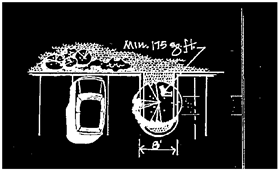
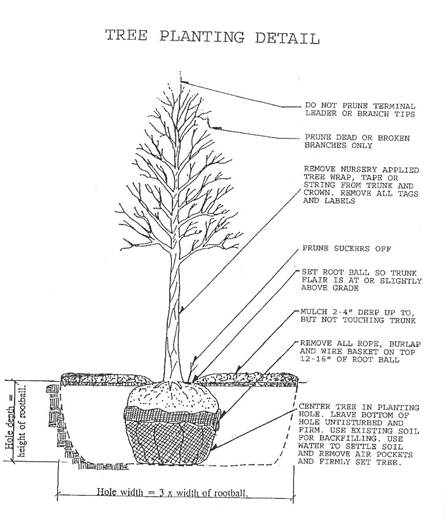
b.
Landscaping within the landscape island shall meet the Landscaping definition in Section 1370.03.
c.
All perimeter and interior landscaped areas must have protective curbs along the edges. Curbs separating landscaped areas from parking areas may allow stormwater runoff to pass through them. Bollards or other protective barriers may be used at the front ends of parking spaces. Curbs may be perforated or have gaps or breaks. Trees must have adequate protection from car doors as well as car bumpers.
d.
Trees and landscape islands shall be distributed throughout the parking lot and shall be situated and designed to provide tree canopy throughout the parking lot.
e.
For the purpose of calculating the amount of required internal landscaping in any parking area, pedestrian walks are excluded if the walks are constructed using a separate and contrasting paving material which provides a durable surface.
(Ord. No. 1108, Passed 11-4-19.)
1372.05 - Screening requirements for parking areas.
Except for parcels exclusively with a total of 1 or 2 dwellings, parking areas shall be screened from streets, the alley and from neighboring properties whenever parking is developed according to the following:
(1)
Screening shall be provided within a required setback area and the screening shall establish an opaque screen at least 5 feet in height as measured from the finished parking area grade where it adjoins the setback.
(2)
Required screening of parking areas shall be achieved through the use of a decorative masonry screen wall, earth berms, trees and landscape plant materials, either in combination or independently.
(3)
Specific screening elements may be relocated, redesigned or partially eliminated at the direction of the City Engineer to correct clear vision or other safety considerations.
(4)
Required screening may be interrupted to provide reasonable pedestrian or bicycle access to a property from a public right-of-way.
(Ord. No. 1108, Passed 11-4-19.)
1372.06 - Landscape requirements for street rights-of-way.
The following landscape requirements for street rights-of-way shall apply when compliance is required:
(1)
With the approval of the City Manager or his or her designee, canopy trees shall be provided along the public street in a planting area provided in the treelawn with an average maximum distance of 40 feet for the streets with formal urban and 30 feet in all other areas between trees. The trees shall be planted so as not to interfere with utilities, streets, sidewalks, street lights, sight distances, clear vision areas, and shall not be planted closer than 8 feet to fire hydrants.
(2)
All trees shall have a minimum size of 2.5 inches caliper.
(3)
Subsequent or replacement trees shall be planted only with the permission of the City Manager or his or her designee.
(4)
Trees shall be of sufficient size to be pruned to a 7 foot branching height with 1 main stem upon planting.
(5)
Existing trees shall be preserved within the tree lawn.
(6)
For each existing tree in the street right-of way, a 500 square feet tree canopy will be credited.
(Ord. No. 1108, Passed 11-4-19.)
1372.07 - Alternative compliance.
The Planning Director may approve variations from strict compliance with this chapter, including up to a 50 percent reduction for the front and rear setback, when there is no feasible alternative and an applicant can demonstrate that at least 1 of the following apply to a specific development site:
(1)
When topography, shape, size or other natural features make full compliance impractical or impossible.
(2)
When safety considerations warrant alternative compliance.
(3)
When there is not a practical alternative in the siting of a building or changing the shape or size of the footprint of the building or the location of site access or the location of underground utilities to service the site.
(4)
When the alternative compliance plan is equal to or superior in its ability to fulfill the intent of this chapter.
(5)
When a required setback would necessitate the removal of an existing tree greater than or equal to 6 inches diameter at breast height. Any existing tree greater than or equal to 6 inches diameter at breast height that is preserved by an approved variation must be protected and remain for at least 5 years from the date of the variation.
(Ord. No. 1108, Passed 11-4-19.)
1374.01 - Pedestrian travel ways.
(a)
Compliance required. All developments except for one and two-family dwellings, shall provide clearly defined pedestrian travelways from the public sidewalk to main entrances of the buildings or uses of the land.
(b)
Requirements. A sidewalk a minimum of 5 feet wide free from obstructions shall be constructed from the public walk to main entries of buildings. On lots where there are multiple principal buildings or main entries, sidewalks meeting the requirements above shall be provided.
(c)
Construction standards. Pedestrian travelways shall be physically separate from the parking area except where they cross a vehicle maneuvering lane, in which case the travelway shall be defined with a separate and contrasting material such as the use of a textured concrete or brick paver.
1374.02 - Bicycle parking.
(a)
Compliance required. Whenever full off-street parking compliance is required, a minimum of 1 bicycle rack or locker is required and shall be located within 50 feet of the main entrance of a building or inside a building in a location that is easily accessible by bicyclists. For sites that require more than 25 motor vehicle spaces, the ratio is 1 rack for every 25 motor vehicle spaces. When units of measurement determining the number of required parking spaces result in a fractional space, any fraction up to and including ½ shall be disregarded and fractions over ½ shall require 1 parking space.
(b)
Exception. The requirements of this section do not apply to residential uses in the RC, R-1a, R-1b and R-2 districts or uses in the C-4 district.
(c)
Standards.
(1)
Bicycle lockers. Where required bicycle parking is provided in lockers, the lockers must be securely anchored.
(2)
Bicycle racks. Where required bicycle parking is provided in racks, the racks must meet the following standards:
a.
The bicycle frame and 1 wheel can be locked to the rack with a high security, U-shaped shackle lock if both wheels are left on the bicycle.
b.
A bicycle 6 feet long can be securely held with its frame supported so that the bicycle cannot be pushed or fall in a manner that will damage the wheels or components; and
c.
The rack must be securely anchored.
(3)
Maneuvering areas.
a.
Each required bicycle parking space must be accessible without moving another bicycle; and
b.
There must be an aisle at least 5 feet wide behind all required bicycle parking to allow room for bicycle maneuvering.
(Ord. 774. Passed. 11-5-07.)
1374.03 - Motor vehicle parking.
(a)
Compliance required. In all districts, except the C-4 districts (where the provision of off-street parking is not required) and those properties located within 500 feet of a public parking structure or transit center, off-street parking shall be provided as required by this chapter unless otherwise provided by parking waiver pursuant to this Zoning Code. In the C-4 district and those properties located within 500 feet of a public parking structure or transit center, when private parking is provided, it shall meet all requirements of this chapter with the exception of the parking space requirements of subsection (d). Full off-street parking compliance is required as follows:
(1)
New construction. For all newly constructed buildings.
(2)
Enlargement. Whenever a building is expanded to increase its gross floor area.
(3)
Change in use. Whenever the use of a building or portion of a building is changed to accommodate a use requiring more parking pursuant to this Zoning Code than the former use.
(4)
Parking area construction and expansion. For all new parking areas and whenever existing parking areas are expanded. Normal maintenance, such as regrading of legal nonconforming gravel parking areas or the addition of top coat or sealer to existing paved parking areas, will not trigger full off-street parking compliance; however, pulverizing an existing asphalt, concrete or other paved parking surface, the outright removal or substantial modification of the paved surface in preparation for paving and demolition by neglect which serves to return a parking area substantially to gravel or other aggregate surface, shall, for the purposes of this code, be considered a new parking area.
(b)
Land use permits; plans; improvement guarantees. Land use permits shall be required for parking area construction or expansion in all districts. In addition, the following shall be submitted:
(1)
Plans. For any parking construction or expansion a plan shall be submitted to and approved by the City Engineer prior to the commencement of construction. Such plan shall include:
a.
Setbacks, spacing and size of spaces,
b.
Landscaping and lighting (where applicable),
c.
Ingress and egress,
d.
Surfacing and drainage,
e.
Proposed and existing grades,
f.
General specifications, and
g.
Parking details and any other information as shall be deemed necessary by the Planning Director or City Engineer prior to the issuance of a land use permit.
Except for parking areas and driveways for one and two-family dwellings, such plans shall be sealed by a registered professional engineer or architect who is licensed to do business in the state. Specific plan requirements may be waived by the Planning Director or City Engineer when, in their opinion, the proposed changes do not warrant full compliance. In such cases, a written opinion by the Planning Director must be filed with the application for the permit.
(2)
Improvement guarantees. For any parking construction, screening or other site development for which a land use permit is required, a certificate of surety, performance bond, or other financial guarantee, as approved by the Planning Director, in the amount of 110 percent of the estimated construction costs, shall be submitted prior to the issuance of a land use permit or building permit and shall be retained until such site development is completed and found to be in full compliance with the site plan approved by the Planning Director. Where landscape materials are required to be provided or mature trees are required to be saved in any development, the financial guarantee shall include the cost of plant materials and the total appraised value of individual trees to be saved and shall remain in effect for not less than 1 growing season after planting or completion of project site work, whichever is last.
(3)
Leased parking. The owner or occupier of the property to be served shall own or lease all property utilized to meet minimum parking requirements. The lease shall include a provision that the lease may not be canceled without the permission of the Planning Director. The Planning Director may allow cancellation of all or part of a lease where parking compliance is achieved in some other way or a parking exception is granted.
(c)
Location of parking areas. Off-street parking areas shall be located in the same district as the use they are intended to serve, in a district that allows the use, or as provided by a special land use permit or the granting order of a planned unit development. In addition, parking areas are to meet the following requirements:
(1)
Front setbacks. Except as otherwise contained in this Zoning Code or as indicated below, parking shall be provided behind or to the side of a principal building as follows:
a.
R-1a: 3 feet minimum.
b.
R-1b: 3 feet minimum.
All other districts: Other than in the R-1a, R-1b and R-2 Districts, a parking area shall be set back a distance equal to the setback of the principal building or 25 feet, whichever is greater. For through lots, parking may be provided streetward of the principal building on the street that carries less traffic, but in no case closer than 25 feet from the front property line.
(2)
Side setbacks. In the R-1a, R-1b and R-2 districts, the side setback shall be 2 feet. In all other districts, any parking area which is contiguous to the side property line of an R-District shall provide a minimum side setback of 10 feet from the side contiguous to the R-District. All other parking areas shall maintain a minimum 5-foot side setback. If shared parking is developed, these setbacks would affect only the perimeter of the combined parcels. See Appendix 2, Figure 1-5.
(3)
Rear setbacks. In the R-1a, R-1b and R-2 districts, no rear setback is required. In all other districts, a rear setback of 20 feet shall be required for any parking area abutting, adjacent to or across a public alley from an R-District and a 5-foot rear setback shall be required otherwise with the exception of the following:
a.
A rear setback requirement may be waived by the Planning Director to allow parking designed to back directly into a public alley when it can be demonstrated that the property exhibits site constraints which preclude or render permitted parking configurations impractical. Whenever such parking is approved, an area no less than 10 feet in depth shall be provided immediately in front of the parking and the provided area shall be developed according to the landscaping requirements of Section 1372.05(a) and (b). See Appendix 2, Figure 1-6.
b.
A required 20 foot rear setback may be reduced in depth by up to 50 percent when a decorative masonry screenwall at least 5 feet in height is constructed along the 10 foot setback line and the area between the wall and the rear property line is landscaped according to the requirements for front yards in Section 1372.05, Landscape Development Internal to a Parking Area.
(4)
Off-site locations.
a.
All off-street parking areas, except in R-districts, shall be located on the immediate premises or within 500 feet as measured from the nearest point of the parking area to the nearest point of the building intended to be served.
b.
The required number of parking spaces may be reduced on a 1/1 ratio for permit parking spaces and leased spaces in a public parking area within 500 feet of the building to be served. The termination of such a permit or lease shall require replacement of the parking spaces so reduced.
(5)
Use of public right-of-way.
a.
The required number of off-street parking spaces for a specific use may be reduced in recognition of the number of available on-street parking spaces on a curbed street abutting the property.
b.
Parking is prohibited on the treelawn portion of the right-of-way except where permitted by sign.
(d)
Requirements. The number of required off-street parking spaces shall be provided by a property owner according to the following schedule. All requirements are minimum unless otherwise noted.
•
Uses not listed. Any use not specifically addressed or referred to in this list shall have parking requirements determined by the Planning Director.
•
Fractional spaces. When units of measurement determining the number of required parking spaces result in a fractional space, any fraction up to and including ½ shall be disregarded and fractions over ½ shall require 1 parking space.
•
Bicycle rack. 1 on-site bicycle rack accommodating 4 bicycles may replace no more than 1 motor vehicle parking space.
•
Multiple uses. Where a building has a multiple use occupancy of any 2 or more residential, commercial, office or industrial uses, the parking required shall be computed on the basis of the gross floor area in each use.
•
Parking space deduction. For calculation of parking space requirements 2,000 square feet of the building and 15 seats of a restaurant are exempt from parking space requirements.
(e)
Parking exception. The Planning Director may grant a parking exception which reduces parking space requirements or location requirements of this Zoning Code, if it has been clearly demonstrated that the provisions of full parking or location requirements are unnecessary or that such requirements would create a practical difficulty with the use of the lot, as contrasted with merely granting an advantage or convenience. Storage areas, other than warehousing space, deemed by the Planning Director to be impractical for the other occupancies, shall require no off-street parking.
(f)
Limitations on use of parking areas.
(1)
The required parking area shall be used solely for the parking of private passenger vehicles or vehicles used in the business operation.
(2)
No commercial repair work or service of any kind, and no sale, display or storage of new or used vehicles which are not for the use of the occupant, employees and patrons, shall be conducted in such required parking area.
(3)
A parking area in an R-district for a residential use shall be restricted to the use of its owner or lessee and under no circumstances shall such facility be used for a non-residential use or in conjunction with any non-residential use, including the provision of access to a non-residential use or the storage of snow removed from non-residential property or use.
(4)
No truck, trailer or other vehicle having an auxiliary refrigeration unit shall be parked overnight within 150 feet of any residence district while the refrigeration unit is in operation.
(g)
Design and construction standards. The following standards for off-street parking areas apply to all uses in all districts except as specifically noted:
(1)
Layout. Off-street parking areas shall be designed, constructed, and maintained as follows and in accordance with the standards set forth in the table and drawing at the end of this section.
a.
All maneuvering lanes shall permit only one-way traffic movements, with the exception of the 90 degree pattern where two-way traffic may be permitted.
b.
Each parking space shall have direct unimpeded access to a maneuvering lane and dead-end maneuvering lanes shall be permitted only with the 90 degree pattern where the maneuvering lane has been extended by a minimum of 4 feet beyond the last parking space to create a back-up area for exiting vehicles.
c.
Maneuvering lanes shall not be located within a required setback. A driveway may cross a setback from the street to the parking area.
d.
Stacking of parking spaces may be allowed by the Planning Director for employee parking only.
(2)
Surfacing.
a.
All parking areas, other than for a single or two-family residential use, shall be paved with concrete, bituminous asphalt, perforated concrete, brick or other permanent equal as approved by the City Engineer.
b.
Any parking area for single or two-family residential use shall, at a minimum, be surfaced and the area clearly defined with gravel, crushed stone, concrete, asphalt, brick or equal material, and be maintained substantially free of dust, mud and standing water.
c.
All parking spaces other than for single and two-family residential use shall be striped with suitable paint, reflective tape or other approved contrasting material which is applied upon or as an integral part of the pavement.
(3)
Curb types. All parking areas except those for single and two-family dwellings shall have permanent 4 inch minimum high granite, concrete curb or concrete curb and gutter to channel the flow of vehicular traffic, define and contain parking, protect landscaped areas and individual trees and to define and separate pedestrian travelways in the interest of safety and efficient parking area utilization. In the Industrial District, curbing is required only for that portion of a parking area including the approach driveways and parking lot facing the street. See Appendix 2, Figure 1-7. All landscaped islands shall be protected from vehicular encroachment by curbing, however limited areas of the curb may be lowered to parking area grade, as approved by the City Engineer to accommodate the secondary use of landscape areas for the retention of storm-water runoff and snow storage. The Planning Director may approve variations from strict compliance with the curbing requirements when the applicant can provide an alternative design that is equal to or superior in its ability to channel the flow of vehicular traffic, define and contain parking, protect landscaped areas and individual trees and to define and separate pedestrian travelways.
(4)
Storm-water management. All parking areas shall provide for storm-water management pursuant to Traverse City Code Chapter 1068, Groundwater Protection and Stormwater Runoff Control.
(5)
Screening. Screening shall be provided pursuant to Traverse City Code Chapter 1372, Landscaping.
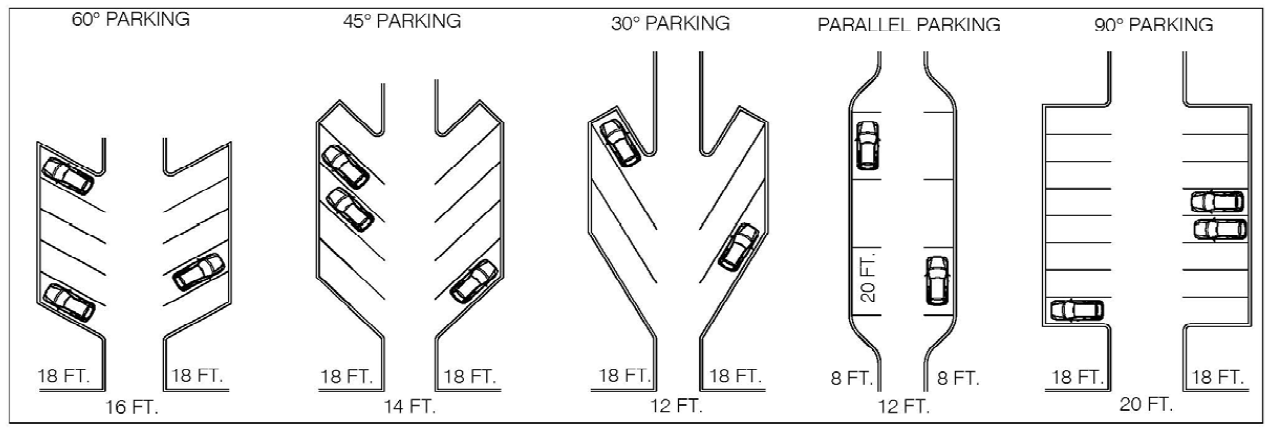
(Ord. 476, Passed 7-6-99; Ord. 537, Passed 6-4-01; Ord. 540, Passed 7-16-01; Ord. 536, Passed 6-4-01; Ord. 569, Passed 7-1-02; Ord. 575, Passed 8-19-02; Ord. 766, Passed 7-2-07; Ord. 923, Passed 10-3-11; Ord. 967, Passed 6-3-13; Ord. 1018, Passed 4-6-15; Ord. 1065, Passed 2-5-18; Ord. 1081, Passed 9-4-18; Ord. No. 1141, Passed 10-5-20; Ord. No. 1151, Passed 2-16-21.)
1374.04 - Driveways and access requirements.
(a)
Intent. It is the intent of this section to regulate the number, location and spacing of driveway entrances to public streets from private property and to encourage the joint use of driveways and alternative access ways wherever possible so as to minimize the frequency of traffic conflict points, increase safety and protect the traffic carrying capacity of arterial and collector streets.
(b)
Restrictions:
(1)
No new driveways are permitted on a new primary arterial or new collector street.
(2)
No new driveways are permitted from streets in the C-4 District, except to service parking areas on properties that do not have access to an alley provided the standards in Section 1346.01 are met.
(3)
No new driveways are permitted on 8 th Street between Woodmere Avenue and Union Street except to service parking areas on properties that do not have access to an alley or access street.
(4)
A service driveway for a dumpster(s) in the C-4 District with a minimum capacity of 3 cubic yards is allowed provided the property does not have access to an alley. The driveway width shall not exceed 10 feet.
(5)
For a single or two-family residential use, parcels without alley access are limited to 1 driveway opening per parcel.
(c)
Minimum spacing regulations. The following minimum driveway spacing requirements shall apply to arterial and collector streets in all districts. Driveways located in proximity to another driveway on the same side of the street shall not be closer than the linear footage established by the following:
(d)
Minimum distance from street intersections. Driveways shall not be located nearer to street intersections than established by the following. Minimum spacing is measured along the street curbline and is determined by the linear footage from the end of the intersection curb radius to the end of the driveway curb radius.
(e)
Exceptions. In all districts:
(1)
Improvement and enlargement of existing buildings and sites.
a.
A building or site existing at the time of adoption of this Zoning Code having driveway access which does not meet the requirements set forth in subsection (c) hereof may be improved, enlarged or structurally altered, provided no additional driveways are constructed.
b.
A building that is replaced or enlarged or a site which is altered to an extent more than 20 percent of its value, as determined for tax assessment purposes, must comply fully with these public street access regulations.
(2)
Residential lots. Any residential building or driveway constructed after the effective date of this zoning code which has access to a maintained alley shall not have access to a street nor shall a parking area be located in the front yard. For parcels having alley access, the parking of a boat, motor home, camper, utility trailer or other recreational vehicle is limited to the rear yard.
(3)
Further exceptions. Further exceptions to driveway minimum spacing regulations in paragraphs (c) and (d) hereof may be granted upon approval of the City Engineer. The distance requirement may be reduced by no more than 50 percent if the City Engineer determines that the requested exception, along with possible additional exceptions in the same area, will meet the following findings:
a.
The character of the street or neighborhood shall not be diminished or negatively impacted.
b.
It is necessary for reasonable use of the lot.
c.
It shall not contravene the intent and purpose of this Zoning Code.
d.
It meets other conditions the City Engineer may specify regarding the health and safety aspects of the exception.
(f)
Design standards for single or two-family uses. The minimum width of a driveway measured at the throat is 8 feet and the maximum width is 16 feet on all streets or private streets for single or two-family uses. A parking area and driveway width in the front yard shall be the lessor of 40 percent of the lot width or 32 feet.
(g)
Design standards for all other uses. For all other uses:
(1)
Minimum angle to street. The minimum angle of the driveway to the street shall be 60 degrees.
(2)
Maximum width at throat.
a.
The maximum width of a driveway measured at the throat shall be 24 feet on arterial and collector streets.
b.
The maximum width of a drive measured at the throat on all other streets shall be 20 feet.
c.
Such width may be increased upon approval of the City Engineer to a maximum of 32 feet on major streets so designated under the Major streets Plan pursuant to 1951 Public Act 51.
(h)
Backing into streets or alleys. Except for one and two-family dwellings located in districts other than the C-4 District, backing from a private parking area directly into a street or private street is prohibited. Under certain circumstances described in this chapter backing into an alley is permitted for all uses.
(Ord. 766. Passed 7-2-07. Ord. 794. Passed 4-7-08. Ord. 826. Passed 2-2-09; Ord. 1081, Passed 9-4-18.)
1374.05 - Delivery truck loading requirements.
(a)
Purpose. It is the intent of these regulations that the necessary loading and unloading of motor vehicles shall not unduly interfere with the use of public streets and alleys, and that every use which customarily receives or distributes goods by motor vehicles shall provide for the on-site storage and handling of such motor vehicles.
(b)
Parking spaces for carriers. Except in the C-4 districts where the provisions of this section would be impractical, uses which customarily receive or distribute goods by motor vehicle shall provide, on the premises, in addition to the off-street parking required, sufficient space for that number of carrier vehicles that will be at the premises at the same time on an average day.
(c)
Design and construction requirements. Except in the C-4 districts where the provisions of this section would be impractical, there shall be provided off-street, on-site space adequate for the standing, docking, loading, maneuvering and unloading of motor vehicles. This area shall not substantially interfere with required off-street parking areas, and shall be designed as follows:
(1)
Access and maneuvering. Access to a truck standing, loading and unloading space or berth shall be arranged as to provide sufficient off-street maneuvering space without utilizing such street and alley for this purpose.
(2)
Loading docks and berths; location and screening. Loading docks shall be located so as not to be visible from a public street or from any R-district. Where any loading space or berth adjoins or is visible from a public street or R-District, there shall be provided a masonry wall not less than 6 feet in height and a landscape area providing at least 1 canopy tree to provide screening to a height of 14 feet within 5 years of installation, between such street or R-district and the loading space.
(3)
Development requirements. Off-street loading spaces and access drives shall be paved and shall conform to all drainage and lighting requirements of this Code.
(d)
Exception. The Planning Director may grant an exception which changes the loading requirements of this Zoning Code if it has been clearly demonstrated that the provision of loading facilities is unnecessary or that such requirements would create a practical difficulty with the use of the lot, as contrasted with merely granting an advantage or convenience.
(Ord. 987. Passed 1-6-14)
1374.06 - Drive-through standards.
Purpose: The regulations of this chapter are intended to allow for drive-through facilities by reducing the negative impacts they may create. Of special concern are noise from idling cars and voice amplification equipment, and queued traffic interfering with off-site traffic and pedestrian flow. The specific purposes of this chapter are to:
•
Reduce noise and visual impacts on abutting uses, particularly residential uses.
•
Promote safer and more efficient on-site vehicular and pedestrian circulation.
•
Reduce conflicts between queued vehicles and traffic on adjacent streets.
Standards for all drive-through facilities are as follows:
(1)
The service lanes shall provide sufficient space so that motor vehicles will not impede the circulation of pedestrians, cyclists, and motorists.
(2)
Provisions shall be made to safely accommodate customers without motor vehicles at any time the drive-through operation is in service.
(3)
The drive-through facility shall be accessory to a full-service, indoor, on-site use.
(4)
The service lanes shall meet the landscape requirement of section 1372.04.
(5)
The service lanes shall not be located between the associated building and public street.
(6)
Regardless of the street classification, all driveways must be at least 50 feet from a street intersection.
(7)
When abutting R zoned land, drive-through facilities with outdoor speakers must document in advance the facility will meet the requirements of the noise control chapter.
(Ord. 476. Passed 7-6-99. Ord 529. Passed 4-2-01. Ord. 860. Passed 2-16-10.)
1375.01 - Application of chapter; conflict of laws.
(a)
All outdoor lighting shall be installed in conformance with the requirements of this chapter. If any of the provisions of this chapter are inconsistent with the provisions of any other law presently existing or enacted in the future, the more restrictive requirement shall apply. If any of the provisions of any other chapter of these Codified Ordinances is clearly in conflict with this chapter, this chapter shall apply.
(b)
This section does not prevent the use of any material or method of installation not specifically addressed. In considering any deviation from the provisions of this section, the Zoning Administrator shall take into consideration any state-of-the-art technology that is consistent with the intent of this section, as new lighting technology develops, that is useful in reducing light above the horizontal plane.
(Ord. No. 1052. Passed 6-5-17)
1375.02 - Definitions.
As used in this section:
Bulb or lamp means the source of electrical light as distinguished from the whole assembly (see Luminaire). Lamp is used to denote the bulb and its housing.
Cut-off shielding means a technique or method of construction which causes light emitted from an outdoor light fixture to be projected only below and imaginary horizontal plane passing through the fixture below the light source.
Direct glare means the visual discomfort resulting from insufficiently shielded light sources in the field of view.
Fixture means the assembly that holds the lamp in a lighting system. It includes the elements designed to give light output control, such as a reflector (mirror) or refractor (lens), the ballast, housing, and the attached parts.
Footcandle means the luminance produced on a surface 1 foot from a uniform point source of 1 candela.
Full-cutoff fixture means zero intensity at or above a horizontal plane (90° above nadir) and limited to a value not exceeding 10 percent of the lamp lumens at or above 80°.
IESNA is the acronym for the Illuminating Engineering Society of North America.
Illuminance means the density of luminous flux incident on the surface measured in units of footcandles.
Light source means the bulb which creates the light onto adjacent areas that may affect residential properties.
Lumen means a unit of luminous flux, the flux emitted within a solid angle by a point source with a uniform luminous intensity of 1 candela. One footcandle is 1 lumen per square foot. One lux is 1 lumen per square meter.
Luminaire means the complete lighting unit, including the lamp, the fixture, and other parts.
Nadir means a point on the imaginary celestial sphere directly below the observer, diametrically opposite the zenith.
Outdoor light fixture means an illuminating device which is permanently installed outdoors, including, but not limited to, devices used to illuminate signs.
Shielding means in general, a permanently installed, non-translucent shade, cowl, hood, baffle or other construction which limits, restricts or directs light or the visibility of a light source to meet the standards of this chapter.
Zenith means an imaginary point directly "above" a particular location (latitude and longitude on Earth) that extends on the imaginary celestial sphere.
(Ord. No. 1052. Passed 6-5-17)
1375.03 - Exceptions.
The following outdoor lighting types shall be exempt from the provisions of this section:
(1)
Emergency lighting.
(2)
Any lighting required by the FCC or FAA or any security lighting directly related to the operations of the airport.
(3)
Correctional facilities.
(4)
Decorative porch and wall lights, low voltage paths, landscaping and exterior building lighting that emit no more 500 lumens per fixture provided that if any such light is directed toward adjacent residential buildings or nearby land, or creates direct glare perceptible to persons operating motor vehicles on public ways, the luminaire shall be redirected or its light output controlled as necessary to mitigate such conditions.
(5)
Underwater lighting in swimming pools and other water features that emit no more than 1,000 lumens.
(6)
Temporary lighting for theatrical, television, performance areas, construction sites and community festivals.
(7)
Seasonal and holiday lighting provided that the lighting does not create direct glare onto other properties or upon the public rights-of-way.
(8)
Lighted signs, which are regulated by Chapter 1476, Signs.
(9)
Neon lighting.
(10)
Fossil fuel light produced directly or indirectly by the combustion of natural gas or other utility-type fuels.
(11)
Luminaires used to illuminate the flag of the United States of America provided the lighting of the flag or pole shall not create a direct glare beyond the property boundary.
(12)
Beacon lights that direct mariners into the opening of the Boardman River, marinas and boat launches.
(13)
Ornamental and architectural lighting for bridges, public art or statuary.
(14)
Outdoor light fixtures legally installed prior to June 15, 2017 and repairs to existing luminaires not exceeding 25 percent of the total luminaires.
(Ord. No. 1052. Passed 6-5-17)
1375.04 - Prohibited lighting.
No person shall install, maintain or use outdoor lighting for which an electrical permit is required and has not been issued for the following types of lighting:
(1)
Floodlights or swivel luminaires designed to light a scene or object to a level greater than its surroundings unless aimed downward. No fixtures may be positioned at an angle to permit light to be emitted horizontally or above the horizontal plane.
(2)
Unshielded lights that are more intense than 2,250 lumens or a 150 watt incandescent bulb.
(3)
Search lights and any other device designed solely to light the night sky except those used by law enforcement authorities and civil authorities.
(4)
Laser source light or any similar high intensity light when projected above the horizontal plane.
(5)
Mercury vapor lights.
(6)
Metal halide lights, unless used for outdoor sport facilities.
(7)
Quartz lights.
(Ord. No. 1052. Passed 6-5-17)
1375.05 - Design and construction standards for all outdoor lighting except for public street lighting.
All outdoor lighting shall be designed and constructed to meet or exceed the following minimum requirements; all measures to be taken at the ground surface level.
(1)
Direct or reflected outdoor lighting shall be designed and located to be confined to the site for which it is accessory. The maximum lighting levels at the property lines of any other property shall not exceed 0.2 footcandles.
(2)
Lighting of building facades shall be from the top and directed downward with full cut-off shielding.
(3)
All lamps and luminaries shall be hooded, louvered or a combination thereof in order to assure the areas beyond the development site boundary including public rights-of-way are protected from direct glare.
(4)
All outdoor lighting fixtures shall provide a 100 percent cut off above the horizontal plane at the lowest point of the light source.
(5)
Outdoor public and commercial recreation area and amusement area lighting fixtures shall be equipped with baffling or glare guards so the lighting fixtures' beams fall within the primary playing area, immediate surroundings, or other site amenities. The footcandles at the site boundary shall not exceed 0.80 footcandles on average and 0.01 footcandles on average within 15 feet of the boundary.
(6)
The average lighting values for areas intended to be lit on commercial, industrial and institutional parcels shall not exceed 1.0 footcandles on average. The uniformity ratio (maximum to minimum) for all parking lots shall not exceed the current IESNA RP-20 uniformity ratio guideline. (Note: Current guideline is 15:1)
(7)
With the exception of public recreation facilities, the average lighting values intended to be lit in a R-District shall not exceed 1.0 footcandles on average. The uniformity ratio (maximum to minimum) for parking lots shall not exceed the current IESNA RP-20 uniformity ratio guideline. (Note: Current guideline is 15:1)
(8)
Gas station service areas for filling fuel shall not exceed 12.5 footcandles on average.
(9)
Outdoor display areas including, but not limited to automobile or equipment dealer displays or storage lots shall not exceed 15 footcandles on average during the hours the business is open to the public or until 12:00 a.m.
(10)
Site lighting for non-residential uses shall not exceed 1.0 footcandles on average when a use is not open for business.
(11)
All lamps and luminaries within 200 feet from Grand Traverse Bay, Boardman Lake or Boardman River shall be located, mounted and shielded to direct illumination away from the water surface with the exception that full cutoff fixture dock lights, directed downward with less than 250 lumens are permitted.
(Ord. No. 1052. Passed 6-5-17)
1375.06 - Design and construction standards for public street lighting.
(a)
Streetlights in the public rights-of-way shall be the minimum necessary to provide adequate illumination for public safety and be designed to direct lighting downward onto the public rights-of-way
(b)
Luminaries installed up to the edge of any bordering property are permitted.
(c)
Public street illumination shall use the most current American National Standard Practice for Roadway Lighting ANSI/IESNA RP-08 for all public street lighting.
(Ord. No. 1052. Passed 6-5-17)
1375.07 - Submission requirements.
Except for one and two-family dwellings, a site plan shall contain a photometric layout for the exterior lighting. The Planning Director may waive this requirement if there is no parking area.
(Ord. No. 1052. Passed 6-5-17)
1376.01 - Compliance required.
Any project receiving a density bonus or dimensional modification incentive must meet the requirements of this chapter.
(Ord. 822. Passed 1-5-09.)
1376.02 - Standards.
Prior to approval of any site plan including a density bonus, applicants must submit documentation indicating compliance with the following:
(1)
Integration: Affordable dwelling units shall be constructed on-site dispersed throughout the project.
(2)
Design: Affordable units shall be comparable in bedroom mix, design, and overall quality of construction to the market-rate units in the development. The exterior appearance of affordable units shall be visually compatible with the market rate units in the development, and exterior building materials and finishes shall be substantially the same in type and quality for affordable and market-rate units.
(3)
Phasing. Affordable housing units shall be constructed concurrently with the market-rate units. If a project is constructed in phases, affordable housing units shall be integrated proportionately in each phase of the project.
(4)
Long-term affordability: Affordable housing units shall remain affordable for a period of at least 30 years.
(5)
Affordability level and pricing: Maximum rental rates and sale prices shall be established annually by the City based on unit size and household income, as follows:
a.
Sale prices for owner-occupied units shall be calculated based on monthly payment including an available fixed rate 30-year mortgage, a down-payment not exceeding 5 percent of the purchase price, property tax estimates, homeowner's insurance, and any applicable condominium association fees. The monthly payment that is used to calculate the sale price shall be no more than 30 percent of the monthly income of a household earning at or below 80 percent of the area median income, as determined by HUD and adjusted for household size and corresponding number of bedroom units.
b.
Monthly rental rates shall be calculated on the basis of 30 percent of the gross monthly income of households earning 60 percent of the area median income, as determined by HUD and adjusted for household size and corresponding number of bedroom units.
c.
In calculating the rental and sales prices of affordable housing units, the following relationship between unit size and household size shall apply.
1.
Efficiency units: 1-person household.
2.
One-bedroom units: 2-person household.
3.
Two-bedroom units: 3-person household.
4.
Three-bedroom units: 4-person household.
5.
Four-bedroom and larger units: 5-person household.
(6)
Sale or rent to eligible households. Affordable housing units shall be sold or rented only to qualified households or eligible nonprofits.
(7)
Sale of affordable housing units: Affordable housing units for sale as owner-occupied units shall be sold to eligible nonprofits or qualified households as follows:
a.
Eligible housing nonprofit purchase: An eligible housing nonprofit agency may purchase the affordable housing units for subsequent sale to qualified households. If the affordable housing unit is purchased by an eligible housing nonprofit, the agency shall submit any documents deemed necessary by the City Attorney, including restrictive covenants and other legal documents, to ensure the continued affordability of the units in accordance with this section.
b.
Private party purchases: In all other sales of affordable housing units, the parties to the transaction shall execute and record such documentation as necessary to ensure the continued affordability of the affordable housing units in accordance with this section.
(8)
Rental of affordable housing units: Rental units shall be rented to and occupied by eligible very-low income households at an affordable cost in keeping with the requirements of this section. If the owner of affordable rental units regulated by this section converts the development to condominiums, the development shall be subject to the for-sale affordable housing requirements of this section.
(9)
Affordability agreement. Prior to issuing approval, an agreement in a form acceptable to the City Attorney that addresses price and resale restrictions, homebuyer or tenant qualifications, procedures for determining eligibility, long-term affordability, and any other applicable topics of the affordable housing units shall be submitted to the Planning Department. This agreement shall be a covenant running with the land and shall be binding on the assigns, heirs and successors of the applicant.
(10)
Failure to rent or sell affordable housing units. For affordable housing units constructed under the terms of this chapter, marketing begins on the date when the affordable housing unit is completed and available for viewing.
a.
If, after 365 days of marketing, an affordable owner-occupied housing unit is not sold to an eligible housing nonprofit or household at or below 80 percent AMI, the unit may be marketed as an affordable housing unit for an eligible household with income at or below 100 percent of the area median income.
b.
If, after 365 days of marketing, an affordable rental housing unit is not rented to a household at or below 60 percent AMI, the unit may be marketed to a household at or below 80 percent of the area median income.
c.
Any of the affordable housing units that are marketed under this provision remain subject to the long-term affordability and eligibility criteria included in this chapter.
(Ord. 822. Passed 1-5-09.)
1376.03 - Affordable housing incentives.
(a)
Density bonus. A density bonus shall be provided equal to 1 market-rate unit for each affordable housing unit that meets the standards defined in Section 1376.02. Density shall not exceed the maximum density specified in Chapter 1368, Size and Area Requirements.
(b)
Dimensional standards modification. The maximum impervious surface percentage, as specified in Chapter 1368, Size and Area Requirements, may be increased by up to 10 percentage points over that percentage permitted without an affordable housing incentive, if necessary to accommodate the density bonus units on-site.
(c)
Property tax exemption. A property providing affordable housing maybe eligible for a property tax exemption as established in the City Code of Ordinances, Chapter 881, Low Income Housing Tax Exemption.
(Ord. 822. Passed 1-5-09.)
Chapter 1377 - Acessory dwelling units overalay districts.
Repealed.
(Ord. 1019. Passed 4-6-15.)
1378.01 - Definitions.
Guy wire means a cable, wire, or rope that is used to brace something.
Rotor diameter means the cross-sectional dimension of the circle swept by the rotating blades of a wind energy turbine.
Solar energy system means any solar collection system device (i.e., solar photovoltaic cell, panel, or array, or solar hot air or water collector device) where the primary purpose of which is to provide for the collection, inversion, storage, and distribution of solar energy for electricity generation or transfer of stored heat.
Solar energy system, freestanding-mount means any solar collection system device mounted on a pole(s).
Solar energy system, structure-mount means any solar collection system device mounted on a structure or accessory building.
Wind energy system means any device that converts the kinetic energy of wind into mechanical or electrical energy that is either pole-mounted, tower-mounted or building-mounted through the use of equipment [which] includes any base, blade, foundation, generator, nacelle, rotor, tower, transformer, vane, wire, inverter, batteries or other components used in this system.
Wind energy system, height of means the vertical distance to the uppermost vertical extension of any blade, or the maximum height reached by any part of the wind energy system. For tower/pole-mounted wind energy system, height is measured from the ground level at the base of the tower/pole. For building-mounted wind energy systems, height is measured from the highest point of the roof or roof deck, excluding chimneys, antennae and other similar protuberances.
Wind energy system, building-mount means a wind energy system mounted on a roof of a building or accessory building.
Wind energy system, pole-mount means a wind energy system ground-mounted on a long, cylindrical, often slender piece of wood, metal, etc., and does not include guy wires.
Wind energy system, tower-mount means a wind energy system ground-mounted on steel lattice or tubular steel and may include guy wires.
(Ord. 938. Passed 4-2-12; Ord. No. 1208, Passed 10-16-23)
1378.02 - Wind energy systems will be allowed in the following districts with restrictions.
(a)
Residential Conservation (RC), Low Density Residential (R-1a and R-1b), Mixed Density Residential (R-2), Multiple Family Dwelling (R-3) subject to the following:
(1)
Wind energy systems mounted on a building or an accessory building may be erected to a height not exceeding 10 feet above the highest point of the roof, excluding chimneys, antennae and other similar protuberances. Wind energy systems must be spaced at least 10 feet apart and quantity is limited to 2 per parcel. Guy wires are not allowed.
(2)
Wind energy systems mounted on a pole may be erected to a height not exceeding 10 feet above the height limit of the district and will only be permitted in the rear yard, except can be located streetward on lots on navigable water and be located streetward of the principal building on the less traveled street on through lots. Pole-mounted wind energy systems shall be set back a distance equal to the height of the wind energy system from any adjoining lot line. The setback can be reduced by up to 50 percent or a minimum of 20 feet from the lot line if it can be demonstrated through a registered architect or professional engineer that the pole is designed to collapse, fall, curl or bend within a distance or zone shorter than the height of the wind energy system. Pole-mounted wind energy systems are limited to 1 per parcel. Guy wires are not allowed.
(3)
The wind energy pole or tower-mounted system and operating equipment shall comply with the general standards for approval contained in this chapter. Any wind energy system that is not in operation for a continuous period of 12 months is considered abandoned, and the owner shall remove the same within 90 days of receipt of notice from the City. Failure to remove an abandoned wind energy system within said 90 days may be removed by the City at the owner's expense.
(4)
The wind energy system will meet the standards set in the City of Traverse City Code of Ordinances, Chapter 652, Noise Control, specifically section 652.04(h). A wind energy system emits a pure tone and would be subject to a reduction of 5 dBA.
(b)
Hotel Resort (HR), Office Service (C-1), Neighborhood Center (C-2), Community Center (C-3), Regional Center (C-4), Hospital (H-1 and H-2), Development (D), Government/Public (GP), Northwestern Michigan College (NMC-1 and NMC-2) and Transportation (T) subject to the following:
(1)
Wind energy systems mounted on a building or an accessory building may be erected to a height not exceeding 20 feet above the highest point of the roof deck, excluding chimneys, antennae, rooftop mechanical equipment and other similar protuberances. Wind energy systems must be spaced at least 20 feet apart and quantity is limited to 3 per building. Guy wires are allowed.
(2)
Wind energy systems mounted on a pole or tower are not allowed in C-1, C-2, C-4, D or HR.
(3)
Wind energy systems mounted on a pole or tower are allowed in C-3, H-1, H-2, GP, NMC-1, NMC-2 and T. Wind energy systems mounted on a pole or tower may be erected to a height not exceeding 20 feet above the height limit of the district and will only be permitted in the rear yard except can be located streetward on lots on navigable water and be located streetward of the principal building on the less traveled street on through lots. Tower-mounted wind energy systems shall be set back a distance equal to the height of the wind energy system from any adjoining lot line. The setback can be reduced by up to 50 percent or a minimum of 20 feet from the lot line if it can be demonstrated through a registered architect or professional engineer that the tower is designed to collapse, fall, curl or bend within a distance or zone shorter than the height of the wind energy system. Pole/Tower-mount wind energy systems must be spaced 1 per parcel if less than 1 acre and 1 per acre on parcels larger than 1 acre. Guy wires are not allowed.
(4)
Wind energy systems mounted on a building will not be considered rooftop equipment.
(5)
The wind energy pole or tower-mounted system and operating equipment shall comply with the general standards for approval contained in this chapter. Any wind energy system that is not in operation for a continuous period of 12 months is considered abandoned, and the owner shall remove the same within 90 days of receipt of notice from the City. Failure to remove an abandoned wind energy system within said 90 days may be removed by the City at the owner's expense.
(6)
The wind energy system will meet the standards set in the City of Traverse City Code of Ordinances, Chapter 652, Noise Control, specifically section 652.04(h). A wind energy system emits a pure tone and would be subject to a reduction of 5 dBA.
(c)
Industrial District (I) subject to the following:
(1)
Wind energy systems mounted on a building or an accessory building may be erected to a height not exceeding 20 feet above the highest point of the roof deck, excluding chimneys, antennae and other similar protuberances. Wind energy systems must be spaced at least 20 feet apart. Guy wires are allowed.
(2)
Wind energy systems mounted on a pole or tower may be erected to a height not exceeding 120 feet pending FAA review and will only be permitted in the rear yard except can be located streetward on lots on navigable water and be located streetward of the principal building on the less traveled street on through lots. Tower-mounted wind energy systems shall be setback a distance equal to the height of the wind energy system from any adjoining lot line. The setback can be reduced by up to 50 percent or a minimum of 20 feet from the lot line if it can be demonstrated through a registered architect or professional engineer that the tower is designed to collapse, fall, curl or bend within a distance or zone shorter than the height of the wind energy system. Pole/Tower-mount wind energy systems must be spaced 1 per 120 feet radius. Guy wires are allowed.
(3)
Wind energy systems mounted on a building will not be considered rooftop equipment.
(4)
The wind energy pole or tower-mounted system and operating equipment shall comply with the general standards for approval contained in this chapter. Any wind energy system that is not in operation for a continuous period of 12 months is considered abandoned, and the owner shall remove the same within 90 days of receipt of notice from the City. Failure to remove an abandoned wind energy system within said 90 days may be removed by the City at the owner's expense.
(5)
The wind energy system will meet the standards set in the City of Traverse City Code of Ordinances, Chapter 652, Noise Control, specifically section 652.04(h). A wind energy system emits a pure tone and would be subject to a reduction of 5 dBA.
(d)
Open Space (OS) District subject to the following:
(1)
Wind energy systems shall be subject to review from the Parks and Recreation Commission with final approval from the City Commission.
(Ord. 938, Passed 4-2-12; Ord. 953, Passed 10-1-12; 1179, Passed 10-18-2021; Ord. No. 1208, Passed 10-16-23)
1378.03 - Solar energy systems will be allowed in the following districts with restrictions.
(a)
Residential Conservation (RC), Low Density Residential (R-1a and R-1b), Mixed Density Residential (R-2), Multiple Family Dwelling (R-3) subject to the following:
(1)
Solar energy systems, structure-mounted on a building or an accessory building are allowed by right subject to the following:
a.
With a flat or mansard style roof may be erected to a height not exceeding 10 feet above the highest point of the roof, excluding chimneys, antennae and other similar protuberances.
b.
With a pitched roof style shall not exceed the peak height of the roof.
c.
Will not be considered rooftop equipment.
d.
Shall be designed and located in order to prevent reflective glare toward any inhabited structure on adjacent properties as well as adjacent street rights-of-way.
(2)
Solar energy systems, freestanding-mount are allowed by right subject to the following:
a.
Be erected to a height not exceeding 15 feet and area of 150 square feet per unit and will only be permitted in the rear yard except can be located streetward on lots on navigable water and be located streetward of the principal building on the less traveled street on through lots unless deemed impractical by the Planning Director.
b.
Must be setback 20 feet from side and rear property lines and are limited to 2 per parcel. Guy wires are not allowed.
c.
Shall be designed and located in order to prevent reflective glare toward any inhabited structure on adjacent properties as well as adjacent street rights-of-way.
d.
Shall meet the impervious surface requirements of the district.
(b)
Industrial District (I), Hotel Resort (HR), Office Service (C-1), Neighborhood Center (C-2), Community Center (C-3), Regional Center (C-4), Hospital (H-1 and H-2), Development (D), Government/Public (GP), Northwestern Michigan College (NMC-1 and NMC-2), Open Space (OS) and Transportation (T) subject to the following:
(1)
Solar energy systems, structure-mounted on a building or an accessory building are allowed by right subject to the following:
a.
With a flat or mansard style roof may be erected to a height not exceeding 10 feet above the highest point of the roof, excluding chimneys, antennae and other similar protuberances.
b.
With a pitched roof style shall not exceed the peak height of the roof.
c.
Will not be considered rooftop equipment.
d.
Shall be designed and located in order to prevent reflective glare toward any inhabited structure on adjacent properties as well as adjacent street rights-of-way.
(2)
Solar energy systems, freestanding-mount are allowed by right subject to the following:
a.
Be erected to a height not exceeding 20 feet and area of 200 square feet per unit.
b.
Must be setback 10 feet from side and rear property lines and shall have no quantity limit. Guy wires are not allowed.
c.
Shall be designed and located in order to prevent reflective glare toward any inhabited structure on adjacent properties as well as adjacent street rights-of-way.
d.
Shall meet the impervious surface requirements of the district.
(Ord. 953, Passed 10-1-12; 1179 Passed 10-18-2021; Ord. No. 1208, Passed 10-16-23)
1378.04 - Exceptions.
(a)
For wind energy systems that exceed what is allowed by right, the City Commission Special Land Use Permit, Section 1364.08, would apply.
(b)
Historic Districts. Historic District Commission requires that roof-mounted solar and wind energy systems be located on the rear portion of the roof or an accessory building in the rear yard for designated Historic Districts. Also, structure-mounted solar energy systems must receive aesthetic approval from the Historic District Commission.
(Ord. 938. Passed 4-2-12. Ord. 953. Passed 10-1-12; Ord. No. 1208, Passed 10-16-23)
1379.01.- General.
The co-location of a small cell wireless facility and associated support structure within a public right-of-way ("ROW") is not subject to zoning reviews or approvals under this ordinance to the extent exempt from such reviews under Act 365 of 2018, as amended ("Act 365"). In such case, a utility pole in the ROW may not exceed 40 feet above ground level without site plan approval and a small cell wireless facility in the ROW shall not extend more than 5 feet above a utility pole or wireless support structure on which the small cell wireless facility is co-located.
Co-location of a small cell wireless facility or installation of an associated support structure shall require that the wireless provider apply for and obtain a permit from the City consistent with the Code.
Small cell wireless facilities and associated support structures not exempt from zoning reviews are only permitted in accordance with the provisions of this zoning ordinance and Act 365, and upon application for and receipt from the City of a permit consistent with the Code.
(Ord. No. 1099, Passed 8-19-19)
1379.02. - Definitions.
Wireless communication equipment: The set of equipment and network components used in the provision of wireless communication services, including, but not limited to, antennas, transmitters, receivers, base stations, equipment shelters, cabinets, emergency generators, power supply cables, coaxial and fiber optic cables, but excluding wireless communications support structures.
Wireless communication support structure: A structure that is designed to support, or is capable of supporting, wireless communication equipment. A wireless communication support structure may include a monopole, lattice tower, guyed tower, water tower, utility pole or building.
Small cell wireless facility: A wireless facility that meets both of the following requirements:
(1)
Each antenna is located inside an enclosure of not more than 6 cubic feet in volume or, in the case of an antenna that has exposed elements, the antenna and all of its exposed elements would fit within an imaginary enclosure of not more than 6 cubic feet.
(2)
All other wireless equipment associated with the facility is cumulatively not more than 25 cubic feet in volume. The following types of associated ancillary equipment are not included in the calculation of equipment volume: electric meters, concealment elements, telecommunications demarcation boxes, grounding equipment, power transfer switches, cut-off switches, and vertical cable runs for the connection of power and other services.
(Ord. No. 1099, Passed 8-19-19)
1379.03. - Wireless communications equipment.
Wireless communication equipment (but not a wireless communication support structure) is a permitted use and allowed in all zoning districts. Wireless communication equipment does not have to be related to the principal use of the site. Wireless communications equipment is not subject to zoning review and approval if all of the following requirements are met:
(1)
The wireless communications equipment will be co-located on an existing wireless communications support structure or in an existing equipment compound.
(2)
The existing wireless communications support structure or existing equipment compound is in compliance with the City's zoning ordinance or was approved by the appropriate zoning body or official for the City.
(3)
The proposed collocation will not do any of the following:
a.
Increase the overall height of the wireless communications support structure by more than 20 feet or 10 percent of its original height, whichever is greater.
b.
Increase the width of the wireless communications support structure by more than the minimum necessary to permit co-location.
c.
Increase the area of the existing equipment compound to greater than 2,500 square feet.
(4)
The proposed co-location complies with the terms and conditions of any previous final approval of the wireless communications support structure or equipment compound by the appropriate zoning body or official of the City.
Notwithstanding the foregoing, wireless communications equipment otherwise exempt must still comply with all other applicable codes including a requirement that the building inspector determines that the co-location will not adversely impact the structure to which it is attached.
A co-location that meets the requirements of subsections (a) and (b), above, but which does not meet subsections (c) or (d), is subject to site plan review by the Planning Commission in accordance with 1366.01 of the zoning ordinance and Section 514(2-6) of Act 366 of 2018, as amended ("Act 366"). Any equipment placed in a residential district shall not be erected at a height that requires lighting. Any equipment placed adjacent to a residential district or use that requires lighting shall be a continuous red beacon at night.
Wireless communications equipment that is not attached to an existing structure or becomes unattached due to abandonment, removal, or relocation of an existing structure (thus requiring the installation of a new wireless communications support structure), is subject to site plan review consistent with the zoning ordinance and consistent with the Master Plan.
(Ord. No. 1099, Passed 8-19-19)
1379.04. - Standards for wireless communication facilities.
Wireless communications support structures must be installed on a lawful lot for the zoning district in which it is located, either as a principal use, or as an accessory use related to the principal use.
(Ord. No. 1099, Passed 8-19-19)
1379.05. - Standards for non-exempt small cell wireless facilities.
The modification of existing or installation of new small cell wireless facilities or the modification of existing or installation of new wireless support structures used for such small cell wireless facilities that are not exempt from zoning review in accordance with Act 365 shall be subject to site plan review and approval by the Planning Commission in accordance with the following procedures and standards:
(1)
The processing of an application is subject to all of the following requirements:
a.
Within 30 days after receiving an application under this section, the City shall notify the applicant in writing whether the application is complete. The notice tolls the running of the 30-day period.
b.
The running of the time period tolled under subdivision (a) resumes when the applicant makes a supplemental submission in response to the City's notice of incompleteness.
c.
The City shall approve or deny the application and notify the applicant in writing within 90 days after an application for a modification of a wireless support structure or installation of a small cell wireless facility is received or 150 days after an application for a new wireless support structure is received. The time period for approval may be extended by mutual agreement between the applicant and City.
(2)
The Planning Commission shall base its site plan review of the request on the standards contained in Section 1366.01; provided, however that a denial shall comply with all of the following:
a.
The denial is supported by substantial evidence contained in a written record that is publicly released contemporaneously.
b.
There is a reasonable basis for the denial.
c.
The denial would not discriminate against the applicant with respect to the placement of the facilities of other wireless providers.
(3)
In addition to the provisions set forth in Section 2, in the Planning Commission's site plan review:
a.
An applicant's business decision on the type and location of small cell wireless facilities, wireless support structures, or technology to be used is presumed to be reasonable. This presumption does not apply with respect to the height of wireless facilities or wireless support structures.
b.
An applicant shall not be required to submit information about its business decisions with respect to any of the following:
1.
The need for a wireless support structure or small cell wireless facilities.
2.
The applicant's service, customer demand for the service, or the quality of service.
c.
The Planning Commission may impose reasonable requirements regarding the appearance of facilities, including those relating to materials used or arranging, screening, pruning and landscaping.
d.
The Planning Commission may impose spacing, setback, and fall zone requirements substantially similar to spacing, setback, and fall zone requirements imposed on other types of commercial structures of a similar height in a similar location.
(4)
The fee for site plan review shall be as established by the City Commission by resolution from time to time.
(5)
Within 1 year after a zoning approval is granted, a small cell wireless provider shall commence construction of the approved structure or facilities that are to be operational for use by a wireless services provider, unless the City and the applicant agree to extend this period or the delay is caused by a lack of commercial power or communications facilities at the site. If the wireless provider fails to commence the construction of the approved structure or facilities within the time required the zoning approval is void.
(Ord. No. 1099, Passed 8-19-19)
1399.01 - General transition.
The intent of this chapter is to make the Zoning Code fully effective as soon as possible, but to allow for the continuation of all vested rights and approved special land use permits and planned unit developments.
1399.02 - Zoning permits and building permits.
All zoning permits and building permits which have been previously issued, but which have not been acted upon by the permit holder by starting substantial construction, are hereby revoked. Other such permits may be continued if construction is diligently pursued and timely completed.
1399.03 - Site plans.
All site plans, preliminary and final, which have been authorized, but which have not been acted upon by the owner of the site through initiation of substantial construction, are revoked. If substantial construction has been initiated, construction may continue as authorized by the site plan if work is prosecuted diligently and continuously within 1 year from the date hereof or within 1 year from the date of the site plan, unless the site plan approval has authorized a greater time for completion. No further extensions of any previously authorized site plans shall be given.
1399.04 - Special land use permits.
All pending applications for special land use permits which have not been finally approved by the City Commission as of the effective date of this Zoning Ordinance shall be returned to the applicant and the applicant shall proceed under this Zoning ordinance. The fee shall be returned to the applicant. All special land use permits which have been finally granted by the City Commission, but which have not been acted upon by the permit-holder through the commencement of substantial construction may timely proceed to completion pursuant to the terms of the permit. All special land use permits which have been finally granted by the City Commission as of the effective date of this ordinance and for which substantial construction has been commenced may proceed to completion pursuant to the terms of the special land use permit. Full construction and use under the terms of the previously issued special land use permit, even if not fully constructed or used at the time of adoption of this ordinance, shall be considered a legal nonconforming use of the appropriate class as outlined in this ordinance.
1399.05 - Planned unit developments.
All pending applications for planned unit developments which have not been finally approved by the City Commission as of the effective date of this ordinance shall be returned to the applicant and the applicant shall proceed under this Zoning Code. The fee shall be returned to the applicant. All planned unit development permits and orders which have been finally granted by the City Commission, but which have not been acted upon by the owner through the commencement of substantial construction, may timely proceed to completion pursuant to the terms of the granting order. All planned unit development permits and orders which have been finally granted by the City Commission as of the effective date of this Code, and for which substantial construction has commenced, may proceed to completion pursuant to the terms of the planned unit development granting order. Full construction and use under the terms of the planned unit development granting order, even if not fully constructed or used at the time of the adoption of this Code, shall be considered a legal nonconforming use of the appropriate class as outlined by this Code.
1399.06 - Prosecution and litigation.
All lawsuits currently filed for enforcement or violation of the prior Zoning Code may continue under the terms of that Code and all right to the City to enforce the prior Zoning Code are hereby preserved and continued.
1399.07 - Variances and board of zoning appeals matters.
Except as may be specifically contrary to this Zoning Code, all previous actions of the Board of Zoning Appeals, including nonconforming use permits, variances and exceptions, are hereby preserved and continued.
(Ord. 476. Passed 7-6-99)

