
Trussville City Zoning Code
ARTICLE VII
SUPPLEMENTAL REGULATIONS
Sec. 1.0.- Regulations supplemental.
The regulations set forth in this article supplement or modify the district regulations appearing elsewhere in this appendix.
(Ord. No. 2023-004-PZ, 4-25-23)
Sec. 2.0. - Use modifications.
1.
Building material or temporary structures for construction purposes shall not be placed or stored on any lot or parcel of land before appropriate building permits have been approved by the building official and issued by the city clerk's office. Such building materials and temporary structures shall be removed upon completion before a certificate of occupancy will be issued, or upon abandonment of the construction work.
2.
Railroad facilities, including main line tracks, switching spurs, control signals, poles, and wires or similar facilities (but not yards or service facilities, or passenger or freight stations) needed for operating railroad trains may be constructed, repaired, maintained or replaced in any zoning district.
(Ord. No. 2023-004-PZ, 4-25-23)
Sec. 3.0. - Special exception uses.
Except for the provisions of article IV, sections 6.0 and 7.0, no other use other than the types specified as "permitted" or "special exception uses", shall be allowed. Uses specified as "special exception uses" are exceptions and no permit shall be issued for such uses except with the written approval of the board of zoning adjustment and subject to such conditions as said board may require to preserve and protect the character of the district.
(Ord. No. 2023-004-PZ, 4-25-23)
Sec. 4.0. - Height restrictions.
In each district, each structure hereafter erected or altered shall not exceed the heights specified in the district requirements.
(Ord. No. 2023-004-PZ, 4-25-23)
Sec. 5.0. - Building lots, yards and open spaces.
In each district each structure hereafter erected or altered shall be provided with the yards specified, and shall be on a lot of the area and width specified herein. No open space or lot required for a building or structure shall during its life be occupied by or counted as open space for another building or structure.
(Ord. No. 2023-004-PZ, 4-25-23)
Sec. 6.0. - Accessory structures.
There shall be only one main structure plus any permitted accessory structures on any lot used for residential purposes. Except as otherwise provided in article VI, section 19B.0 Downtown Overlay district, the following regulations shall apply to accessory structures. Where there is any conflict between these regulations and those contained in article VI, section 19B, the regulations in article VI, section 19B.0 shall govern.
A.
Accessory structures may be built in a rear yard only. In all residential districts such accessory structures shall not occupy more than 15 percent of the required rear yard and shall not be located closer than ten feet from any rear lot line nor closer than eight feet from any side lot line. In the case of corner lots or double fronted lots in all districts, accessory structures shall not encroach on either front yard setback.
B.
Accessory structures in all residential areas shall not involve an activity connected with any business or manufacturing use, nor shall such accessory structure be used as living quarters. Such accessory structures shall be erected and maintained only as accessory to the main building or dwelling situated on the same lot or premises.
C.
Accessory structures shall be constructed of materials which are compatible with other buildings in the district in which they are located in order to ensure that the aesthetic value and appearance of the neighborhood is retained. Accessory structures shall be built in a manner which will compliment the main structure, and similar shape, roof lope, and building materials shall be used.
D.
Accessory structures shall not be built prior to construction of the primary residence.
(Ord. No. 2016-004-PZ, § 8, 2-9-16; Ord. No. 2023-004-PZ, 4-25-23)
Sec. 7.0. - Buffers/screening.
A.
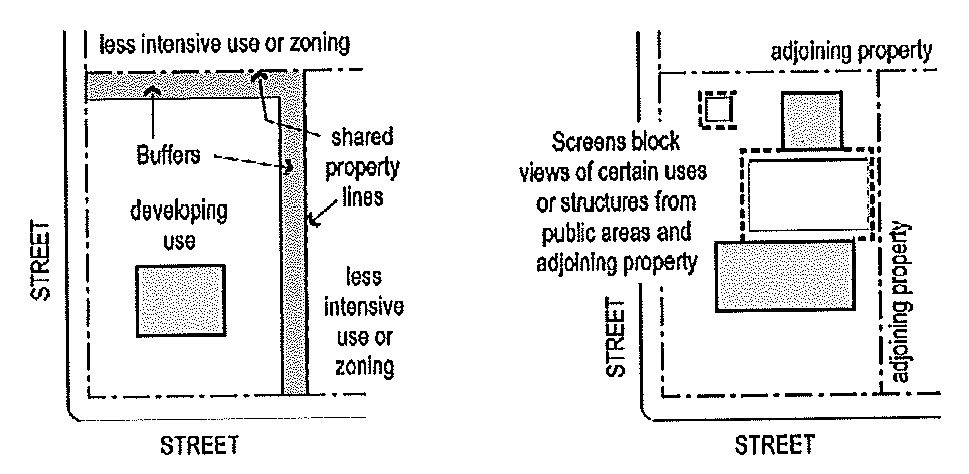
Buffers. Buffers may be required on the site of a developing use to provide separation and mitigate potential negative impacts on adjacent uses of lesser intensity and may exceed, in depth, any required setback.
B.
Screening. Screening shall be provided in all non-residential districts to form visual separation of certain uses and activities from public areas and adjoining properties. In addition to the screening regulations otherwise in this ordinance, the following shall require screening:
1.
Garbage collection, recycling and refuse handling areas.
2.
Maintenance areas or utility structures associated with a building or development.
3.
Nonresidential water meters, gas meters, electric meters and air conditioners/mechanical units.
4.
Loading areas.
5.
Outside runs for veterinary clinics, animal shelters, and kennels.
6.
Outdoor storage of materials, stock, equipment, and vehicles (such as those stored for repair).
(Ord. No. 2016-004-PZ, § 8, 2-9-16; Ord. No. 2023-004-PZ, 4-25-23)
Sec. 7.1. - General requirements for buffers/screening.
A.
Buffers and screens shall consist of one or more of the following:
1.
A visual barrier consisting of trees or shrubs.
2.
An opaque fence or masonry wall.
3.
An earth berm.
B.
Criteria for buffers and screening shall be determined during the review of site development plans where not otherwise specified. At a minimum, buffers and screening shall meet the following criteria:
1.
Any combination of evergreen or deciduous trees or shrubs may be used, including in combination with a wall or fence, as long as the visual barrier will be uniformly dense from the ground to the minimum height required throughout its entire length, and will attain a year-round, visually impervious, uniform density.
2.
Buffers and screening shall not obstruct visibility at traffic intersections and shall not obstruct traffic circulation and planted or natural materials shall not exceed 30 inches in height within the sight triangle. Buffers and screening shall not impede or divert the flow of water in any drainage way and shall not block access to any aboveground, pad-mounted transformer and shall provide the minimum clear distance required by the utility company.
3.
Fencing, where installed as part of a buffer or screen, shall be constructed prior to the issuance of a certificate of occupancy and shall comply with the following:
a.
Fences shall be of finished masonry, durable wood, or a combination thereof. Untreated wood, chain-link, plastic or wire shall not be permitted. No more than 25 percent of the fence surface shall be left open. The finished side of the fence shall face abutting property.
b.
If a fence is longer than 100 feet in one direction, it shall have columns of wood or masonry, which project outward from the fence surface, and that are spaced no greater than 50 feet on center.
4.
All screening and buffer plantings shall be permanently maintained in good growing condition by the party or landowner required to provide such plantings and, when necessary, replaced with new plantings. Nothing herein shall be construed as preventing removal of junk, debris, dead trees or limbs, abandoned structures, fences, and the like from the buffer area. All fencing shall be permanently maintained in good condition and, whenever necessary, repaired or replaced by the party or landowner required to provide such fence.
5.
Any existing fences/walls or vegetation and any fences/walls or landscaping used for other purposes, but that are proposed as part of a required buffer or screen, that meet the minimum standards of this section may count toward buffer or screening requirements.
(Ord. No. 2016-004-PZ, § 8, 2-9-16; Ord. No. 2023-004-PZ, 4-25-23)
Sec. 7.2. - Screening design requirements.
A.
Where required, the design of screening shall be in accord with the following and as approved by the reviewing authority:
1.
Location on site should be the first consideration in screening. Activities that produce objectionable noise or odors shall be located so as to minimize such impacts to the public and abutting properties. The reviewing authority may lessen screening requirements when the location of the activity to be screened reduces its visibility or other impact to the public and neighboring properties. Activities requiring screening, when co-located, may be screened together.
2.
The method of screening, including height and materials, shall be that which is sufficient to visually screen the use.
3.
Shrubs shall be evergreen and spaced no more than five feet on center. If used in combination with a fence, shrubs may be deciduous and may be spaced up to eight feet on center.
4.
Trees shall be evergreen and, when used in the absence of a fence, should have a low understory and/or be used together with shrubs to provide a continuous, opaque screen.
B.
Screening requirements for specific activities.
1.
Refuse and recycling containers shall not be located forward of the front building line. Such containers shall be screened by an opaque fence or wall on all sides. Opaque gates, designed to complement the screen, shall be installed for access. The fence or wall shall be at least as tall as the container.
2.
Mechanical equipment shall be screened so as to not be visible from public streets or adjacent properties. The screening of building- mounted mechanical equipment shall be integral to the building design. Ground level mechanical equipment shall be adequately screened by plant materials and/or fences to blend in with site landscaping.
3.
Outdoor storage, where permitted, shall be screened to a minimum height of six feet or two feet taller than the material or equipment to be screened, whichever is greater.
4.
Service areas, loading docks, work yards, and similar areas must be located so as to minimize their visibility to the public. Where their location is insufficient to appropriately minimize such visibility screening shall be at least six feet in height.
(Ord. No. 2016-004-PZ, § 8, 2-9-16; Ord. No. 2023-004-PZ, 4-25-23)
Sec. 7.3. - Modification or waiver of buffer/screening requirements.
The buffer requirements of this article shall be applied equally to all similarly classified and situated properties but may be modified or waived in certain cases where a building site is subject to any of the following circumstances, as determined by the building official:
A.
Where natural vegetation (trees and/or shrubs) exists on a piece of property at the time application is made for a building permit, a strip of natural vegetation shall be left undisturbed until the building official or his designee has inspected such area and evaluated it with regard to the width requirements set forth in the zoning ordinance for that specific use and zone, as well as its suitability. The building official or his designee may require that the developer retain a portion of the natural vegetation as a buffer, rather than require a man-made planting strip or other methods of buffering. However, such buffer must be sufficient in both height and density to achieve the desired purpose as a natural barrier. Additional plant materials may be added to existing natural vegetation to achieve this density.
B.
Where impending development of adjacent property would make these standards unreasonable or impractical.
C.
Where, after inspection by the building official, it is found that two different and incompatible zone districts abut each other but are already separated by a street or alley, or where the view from the adjoining district is blocked by a change in grade or other natural or manmade features.
D.
Where a vegetative buffer cannot, in the professional opinion of an expert, be expected to thrive due to soil conditions, intense shade, rock outcroppings, or similar conditions.
E.
In special cases where a lot was created prior to the adoption of this ordinance in which the side and/or rear yards are inadequate to meet the yard requirements and the buffer strip width requirements as set forth in each respective district, the board of zoning adjustment shall determine, based on site plan review or other pertinent information requested, alternative methods of separation. The board may in appropriate cases, require some form of natural or manmade buffering be provided in lieu of a greenbelt as a means of separation.
(Ord. No. 2016-004-PZ, § 8, 2-9-16; Ord. No. 2023-004-PZ, 4-25-23)
Editor's note— Ord. No. 2016-004-PZ, § 8, adopted Feb. 9, 2016, amended and renumbered former § 7.2 as § 7.3.
Sec. 7.4. - Landscaping plan for buffer/screening.
A landscaping plan shall be required as part of every building permit application for new construction, additions or expansions, which require screening and/or buffers. The landscape plan shall be drawn to a scale no larger than one inch equals 50 feet and shall contain the following information:
A.
The location and dimension of all areas proposed for buffers and/or screening, including a description of existing and/or proposed plant materials, proposed walls or fences, and proposed berms, as applicable.
B.
All dimensions and distances, property lines, easements, and rights-of-way.
C.
Existing and proposed buildings and structures, including signs, trash and garbage/refuse containers and utility structures.
D.
Existing buildings and structures on adjacent property.
E.
Bodies of water and stormwater management and drainage facilities.
F.
Driveways, existing and proposed parking, access aisles and other vehicular areas.
G.
Sufficient information and detail to demonstrate compliance with applicable requirements.
(Ord. No. 2016-004-PZ, § 8, 2-9-16; Ord. No. 2023-004-PZ, 4-25-23)
Sec. 8.0. - Fences and walls.
Walls or fences may be located within the yards of a lot as provided herein. No fence, wall or hedge shall be erected or installed upon the right-of-way forward of the front property line. Specific approval may be requested from the city through the planning and zoning board for development entrance features located on or along roadway medians and in similar situations.
The following regulations shall apply:
A.
The finished side of a fence or wall shall be directed toward adjoining property or a double-faced fence may be used.
B.
No fence, including a decorative fence, brick or masonry wall, or hedge shall be placed or constructed in any location that would hinder access to fire hydrants.
C.
Decorative wood fences, decorative masonry or brick walls, and hedges may be permitted in a residential district within or along the edge of all front yards up to the front property line, so long as such do not exceed a height of three feet. Chain link fences are not allowed forward of the front wall of the building. See illustration appendix.
D.
Fences, walls and hedges of six and one-half feet or less in height may be permitted within or along the edge of side and rear yards on interior lots in residential districts, but in no instance, forward of the front wall of the building. No fence utilizing razor wire or barbed wire will be allowed in a residential district. See illustration appendix.
Fences for residential tennis courts may be individually approved by the board of zoning adjustment upon application and submittal of information including, but not limited to, a plot plan showing location in relation to other structures on the lot and any easements, setbacks, fence height, lighting, and screening. All chain link fencing materials must be vinyl-coated. Any fence that falls into disrepair must be removed or replaced in accordance with these provisions.
E.
In the case of a residential lot with more than one front yard such as a corner or double frontage lot, decorative wood fences, decorative masonry or brick walls and hedges of six and one-half feet or less in height shall conform with the front yard set back requirement on all sides abutting rights-of-way, but in no instance, forward of the front wall of the building. See illustration appendix.
In areas having double fronted lots in which access is restricted to only one front by covenant or requirement, a decorative wood fence, decorative masonry or brick wall or hedge may be placed along the rear property line for screening purposes. See illustration appendix.
F.
In any commercial district, decorative fences, decorative masonry or brick walls and hedges are permitted, subject to the following restrictions.
1.
Any decorative fence, hedge, decorative masonry or other screen, either forward of the front wall of any building or forward of the front building set back line, shall be limited to a height of three feet. This limitation shall not apply to screen walls located within the required frontage area in the Downtown Overlay district.
2.
Any opaque decorative fence, decorative masonry, hedge or other screen located behind the front set back line and behind the front wall of any building shall be limited to six and one-half feet in height.
3.
Non-opaque security fences, including but not limited to chain link security fences, are not permitted in the Preferred Commercial district (CP), and are not permitted forward of the front building wall in any commercial district. Said fences may be allowed, subject to the above, in a C-1 Commercial district to a maximum height of six and one-half feet. In C-2, C-3, C-4 and C-5 districts, there shall be no limitation on the height of said fences except that the fence may not exceed the height of the principal commercial structure on the lot. All non-opaque security fences, where allowed, shall be screened from any adjacent residential or preferred commercial property. See illustration appendix, f-ii.
4.
On a double frontage lot, no fence located behind the primary building may encroach on the designated front yard setback on the street to the rear. On corner lots, front yard setbacks must be observed on all sides abutting street rights-of-way, and fencing will be allowed as set out in subsections 1. and 2. above. See illustration appendix, f-ii.
G.
In any industrial district, fences, walls, and hedges shall be constructed in a manner which does not obstruct sight distances at road or right-of-way intersections. There shall be no height requirement on non-opaque security fences. Some industrial parks may have specific covenants pertaining to fences which differ from and take precedence over the above. See illustration appendix.
H.
In any institutional district, decorative fences, decorative masonry or brick walls and hedges are permitted, subject to the following restrictions:
1.
Any decorative fence, hedge, decorative masonry or other screen, either forward of the front wall of any building or forward of the front building setback line, shall be limited to a height of three feet. See illustration appendix.
2.
Any opaque decorative fence, decorative masonry, hedge or other screen located behind the front setback line and behind the front wall of any building shall be limited to six and one-half feet in height. See illustration appendix.
3.
Non-opaque security fences, including but not limited to chain link security fences, are not permitted forward of the front building wall in any institutional district. Said fences may be allowed, subject to the above, in an IN-1 or IN-2 Institutional district to a maximum height of six and one-half feet. All nonopaque security fences, where allowed, shall be screened from public view and from any adjacent residential or preferred commercial property. See illustration appendix.
4.
In an IN-3 Institutional district appropriate fencing to the use shall be submitted and approved as a part of the site plan approval.
5.
On a double frontage lot, no fence located behind the primary building may encroach on the designated front yard set back on the street to the rear. On corner lots front yard setbacks must be observed on all sides abutting street rights-of-way, and fencing will be allowed as set out in 1 and 2 above. See illustration appendix.
I.
In any agricultural district, decorative fences, decorative masonry or brick walls, and hedges and opaque fences shall conform to the same fence specifications as residential fences. Notwithstanding the above, non-opaque fences may be erected to any property line not to exceed four and one-half feet in height. See illustration appendix.
J.
The requirement to set back a fence or hedge from the lot line does not relieve the property owner/occupant of maintenance responsibilities for that portion of the property lying outside of the enclosure.
(Ord. No. 2007-028-PZ, § 2, 8-14-07; Ord. No. 2016-004-PZ, § 8, 2-9-16; Ord. No. 2023-004-PZ, 4-25-23)
Sec. 16.0. - Regulation of small cell technology facilities.
1.
Definitions. The terms below have the following meanings for purposes of this section.
Abandonment or abandon(s) means that, following the placement of small cell technologies facilities (and associated accessory equipment) or support structures in the city pursuant to a permit issued to a provider or an applicant, any of the following has occurred: (a) for any reason the facilities cease to be used to transmit signals, data or messages or otherwise be used for their intended purposes for a period of 90 days; (b) the city revokes the permit for placement and use of those facilities due to nonpayment of applicable fees, the failure of the provider or applicant to comply with conditions in the permit or in this section concerning them, or other valid reason; or (c) the provider or applicant fails to perform any of its responsibilities, obligations and requirements in this section or in a permit that relates to the installation, construction, maintenance, use or operation of the facilities, accessory equipment or support structures, and that breach remains uncured for a period of 60 days after the city provides written notice of the breach to the provider or applicant.
Accessory equipment means any equipment other than an antenna that is used in conjunction with small cell technology facility arrangements. This equipment may be attached to or detached from a small cell technology wireless support structure, and includes, but, is not limited to, cabinets, optical converters, power amplifiers, radios, DWDM and CWDM multiplexers, microcells, radio units, fiber optic and coaxial cables, wires, meters, pedestals, power switches, and related equipment on or in the immediate vicinity of a support structure.
Antenna means communications equipment that transmits and receives electromagnetic radio signals, is attached to a small cell technology wireless support structure and is used to communicate wireless service.
Applicant, whether singular or plural, means a personal wireless service provider, an entity that is authorized by a personal wireless service provider to apply for or receive a permit to install, construct, modify or maintain a small cell technology facility and related accessory equipment or support structure in the city, or an entity certificated by the Alabama Public Service Commission to provide telecommunication service.
Application means a formal request submitted to the city for a permit to install, construct, modify or maintain a small cell technology facility and related accessory equipment or support structure.
City means the City of Trussville, Alabama.
City council means the city council of the City of Trussville, Alabama.
City official means the city building official or any other person designated by the mayor of the city to perform the responsibilities in this section.
Collocation means the placement or installation of a new small cell wireless technology facility or related accessory equipment on an existing pole or other support structure that is owned, controlled or leased by a utility, the city, or other person or entity.
Personal wireless service provider or provider means an entity that provides personal wireless communication services to the public or citizens of the city on a commercial basis and is authorized by the FCC to provide those services.
Private property means real property located in the city that does not lie within the right-of-way.
Right-of-way, whether singular or plural, means the surface and space in, upon, above, along, across, over and below any public streets, avenues, highways, roads, courts, lanes, alleys, boulevards, ways, sidewalks, and bicycle lanes, including all public utility easements and public service easements within those places, as the same now or may hereafter exist, that are within the city's corporate boundaries and under the jurisdiction of the city. This term shall not include county, state or federal rights-of-way or any property owned by any person or entity other than the city.
Small cell technology facility or facilities, whether singular or plural, means and includes the following types of structures: (a) antenna; and (b) associated accessory equipment. Photographs and illustrations of the types, relative dimensions and scale of these facilities that are currently contemplated by this section are attached as Attachment A to the permanent record of this ordinance that is maintained by the city clerk.
Small cell technology wireless support structure or support structure, whether singular or plural, means a freestanding structure designed or used to support, or capable of supporting, small cell technology facilities, including, but not limited to, utility poles, street light poles, traffic signal structures, rooftops, attics, or other enclosed or open areas of a building or accessory structure, a sign, or a flagpole. These terms may include decorative street light poles owned by the city; provided that, before being authorized to attach any small cell technology facilities to any decorative poles, any applicant or provider must demonstrate that it will incur an extraordinary hardship if the attachment is not permitted.
Stealth technology means a method(s) of concealing or minimizing the visual impact of a small cell technology facility (and associated accessory equipment) and support structure by incorporating features or design elements which either totally or partially conceal such facilities or equipment. The use of these design elements is intended to produce the result of having said facilities and associated structures blend into the surrounding environment and/or disguise, shield, hide or create the appearance that the facilities are an architectural component of the support structure. Photographs and illustrations of examples of the types of stealth technology that may be used when buildings are utilized as support structures and other applications of stealth technology that are currently contemplated are attached as Attachment B to the permanent record of this ordinance that is maintained by the city clerk.
2.
Permit required to place small cell technology facilities in right-of-way.
(a)
A provider or applicant must obtain a permit from the city before placing, installing, or constructing any small cell technology facility (and associated accessory equipment) on any support structure that is located on the right-of-way, or substantially modifying the position or characteristics of any such existing facility thereon.
(b)
The city official will review and administratively process any request for a permit to determine whether, in the exercise of the city official's reasonable discretion, it should be issued for the location and in the manner requested by the applicant. In this process, the burden is on the provider or applicant to demonstrate that the placement of the proposed small cell technology facility and associated accessory equipment or support structure on the right-of-way is the minimal physical installation which will achieve the goal of enhancing the provision of personal wireless services when considering all pertinent factors discussed in the provision immediately below. Except as set forth in this subsection, this permitting process will be administrative and not require the approval of any city board or body other than the city official.
The factors, requirements and guidelines that the city official may consider and will apply when determining whether to issue a permit for placement of small cell technology facilities and associated structures on the right-of-way include, but are not limited to, the following:
(i)
The demonstrated need for placing the structures at the requested location and geographic area in order to deliver or enhance personal wireless service;
(ii)
The visual impact of placing the support structures or facilities in the subject area;
(iii)
The character of the area in which the structures are requested, including surrounding buildings, properties and uses;
(iv)
Whether the appearance and placement of the requested structures is aesthetically consistent with the immediate area;
(v)
Whether the structures are consistent with the historic nature and characteristics of the requested location;
(vi)
The applicant's or provider's network coverage objective and whether the applicant or provider should use available or previously unconsidered alternative locations to place the support structures or facilities;
(vii)
Co-location. To the extent practical, all facilities and associated accessory equipment that are placed in the city shall be attached to a pre-existing support structure that is owned, controlled or leased by a utility, franchisee, the city or other entity. If the applicant demonstrates that no co-location opportunities exist in the area where a technologically documented need for a facility exists, the applicant may request that a new pole or other support structure be installed in that area for purposes of constructing the facilities. Before any new support structure is permitted, each of the following must occur:
(1)
The applicant must have provided the city written evidence that no practical co-location opportunity exists. This evidence shall include, but not be limited to, affidavits, correspondence, or other written information that demonstrates that the applicant has taken all commercially reasonable actions to achieve co-location in the requested location or area, that the applicant has pursued but been denied access to all potential co-location sites in the subject area (and the reasons any such denial(s)), and otherwise show that the applicant is unable to co-locate on an existing support structure;
(2)
The city official must recommend the placement of a new support structure in the right-of-way; and
(3)
The city council must approve the recommendation of the city official to issue a permit that includes the placement of a new support structure in the right-of-way. The city council will consider whether to approve any such new structure at a regular council meeting that will be conducted as soon as practical after the city official's recommendation is made.
(viii)
If a facility is attached to a utility pole or other support structure in the right-of-way, no antenna or other part of the facility shall extend more than five feet above the height of that structure; provided that, in the event that the applicant demonstrates that National Electric Safety Code regulations or other factors create an undue hardship in complying with this height requirement, the city official may permit a facility to extend up to ten feet above the height of such support structure;
(ix)
The accessory equipment shall, if reasonably possible, be placed at least ten feet above the ground;
(x)
The color of antenna and accessory equipment shall be compatible with that of the support structure;
(xi)
The facility (including the accessory equipment) shall not be illuminated;
(xii)
Whether the proposed installation could cause harm to the public or pose any undue risk to public safety;
(xiii)
Reserved;
(xiv)
Whether the proposed installation may interfere with vehicular traffic, passage of pedestrians, or other use of the right-of-way by the public; and
(xv)
If the proposed installation will disturb conditions on the right-of-way, whether the applicant can demonstrate its ability and financial resources to restore the subject area to its pre-existing condition following installation.
(c)
Application process.
(i)
At a minimum, each application for a permit shall contain all of the following:
(1)
Engineering drawings depicting the type of facilities, support structure, and means and points at which such facilities and associated accessory equipment will be attached to a support structure;
(2)
Map(s) designating with specificity the location(s) of the requested facilities;
(3)
The geographic coordinates of all antenna and other proposed facilities;
(4)
If the facilities will be located on a support structure on the right-of-way that is owned by any entity other than the city or the applicant, a copy of any license, lease, agreement or other documentation evidencing that the owner of that support structure authorizes the facilities to be attached thereto or agrees in principle to authorize that attachment; provided that, if a representation is made to the city that the attachment has been authorized in principle by the owner of the support structure but the applicant subsequently fails to furnish the city documentation that finalizes any such agreement, the city may refuse to issue the requested permit until that documentation is provided, or, if the city issues the requested permit before receiving such final documentation, the subject permit may be revoked and any license to use that part of the right-of-way be rescinded.
(5)
If the applicant requests permission to place facilities on a new support structure, the substantiation therefor required by subsection 2(b)(vii) in this section.
An application shall not be deemed complete until the applicant has submitted all documents, information, forms and fees specifically enumerated in this section that pertain to the location, construction, or configuration of the facilities or support structures at the requested location(s). Within 30 calendar days after an application for permit is submitted, the city shall notify the applicant in writing if any additional information is needed to complete that application or supplemental information is required to process the request. If the city does not notify the applicant in writing that the application is incomplete within 30 days following its receipt, the application is deemed complete.
(ii)
Time for processing application. Unless another date is specified in a written agreement between the city and the applicant, the city, will have the following time periods to make its final decision to approve or disapprove an application for a permit contemplated in this ordinance and advise the applicant in writing of that determination:
(1)
Sixty calendar days from the date an application for a permit is filed with respect to a request to co-locate facilities on an existing support structure; and
(2)
Ninety calendar days from the date an application for a permit is filed with respect to a request to attach facilities to a new support structure.
To the extent additional information is required to complete the application after it is filed, the applicable calendar day review period set forth in this subsection shall be tolled and not continue to run until the applicant has provided any missing or requested supplemental information; provided that tolling shall not occur if the city does not advise the applicant in writing of the incompleteness of a submitted application within 30 days after that submission.
(iii)
Reconsideration/appeal. Any applicant that desires reconsideration of an administrative decision by the city official to deny a request for a permit to place a facility or support structure on the right-of-way may seek review, modification or reversal of that decision by the city council by submitting a request for reconsideration with the city clerk within 21 calendar days following the city official's decision. That request for reconsideration will be considered by the city council at a regular council meeting that will be conducted as soon as practical after the request for reconsideration is made. If no request for reconsideration is submitted, the decision of the city official will be final.
Additionally, the applicant, within 30 days following a decision by the city council to deny either (a) a request for reconsideration or (b) a decision by the city council to not approve the placement of a new support structure on the right-of-way, may appeal either of those decisions by the city council to the circuit court of Jefferson County, Alabama. If no appeal of those decisions of the city council is made, those will be deemed final.
(d)
Additional requirements. Any provider or applicant to whom a permit is issued and that places facilities and associated support structures on the right-of-way also shall comply with the following requirements as long as those facilities and support structures are on or under the right-of-way:
(i)
Prior to installing the facilities or support structures, the applicant shall provide the city a certificate(s) of insurance evidencing that it has obtained and will maintain the following types of insurance in connection with its operations on or use of the right-of-way: (1) general liability coverage insuring the risk of claims for damages to persons or property arising from or related to the installation, construction, maintenance, operation or any use of facility or support structure placed on or along the right-of-way by the applicant (or any of their contractors) with minimum limits of $1,000,000.00 per occurrence; and (2) workers compensation insurance as required by statute. The general liability coverage shall list the city as an additional insured, and may be provided through a combination of a primary and umbrella policies. All insurance policies shall be furnished by insurers who are reasonable acceptable to the city and authorized to transact business in the State of Alabama. On an annual basis following initial installation, the applicant also shall furnish the city a certificate indicating that the above-noted coverage remains and will remain in effect.
(ii)
All facilities and associated support structures shall be installed, erected, maintained and operated in compliance with applicable federal and state laws and regulations, including, but not limited to, regulations of the FCC.
(iii)
Following the installation of any facilities and associated support structures, the provider or applicant, upon reasonable request and for good cause, shall furnish the city official a written certification from a licensed professional engineer in the state stating that those structures have been inspected and are being maintained, operated and used in compliance with all applicable laws and regulations, including those of the FCC that pertain to the transmission of wireless communication signals. For purposes of this provision, "good cause" shall mean circumstances have arisen that indicate the facilities and associated support structures have been damaged, are not functioning in compliance with applicable laws and regulations, or otherwise pose a hazard to the public. If those support structures should fail at any time to comply with applicable laws and regulations, the provider or applicant, at either of their expense, shall cause those structures to be brought into compliance with said laws and regulations within 15 days of the date of any written notice to them from the city official of noncompliance, or cease all personal wireless service operations related to those structures until the applicant or provider comes into full compliance with said laws and regulations.
(iv)
The facilities and associated support structures must at all times be maintained in good and safe condition. On no more frequent than a triennial basis, the city official may request that the provider or applicant, at either of their expense, furnish certification from a professional engineer who is licensed in the state that the facilities and support structures are in sound condition. Should that engineer deem those structures unsound, the provider or applicant shall furnish to the city official a plan to remedy any unsafe conditions or structural defect(s) and take that remedial action at the provider or applicant's expense.
(v)
Each applicant or provider that applies for a permit to place facilities (including the accessory equipment) and support structures on the right-of-way and installs and utilizes those structures shall defend, indemnity and hold the city and its employees or officials, harmless from all demands, losses, expenses (including attorney's fees and court costs), claims for personal injury or property damage, judgments or liabilities of any type that may be asserted or claimed against the city (or its employees or officials) by any third person, firm or entity that arise out of or relate in any manner to the following: (1) the installation, construction, maintenance, use or operation of the permitted Facilities, accessory equipment or any support structure on or about the right-of-way; and (2) the failure of the provider or applicant to perform any of their respective responsibilities, obligations and permit requirements in this section. Notwithstanding the foregoing, the provider or applicant shall not be obligated to indemnify the city for city claims resulting from the sole negligence or willful acts of the city (or its representatives).
(e)
Permit and license fees. The applicant for a permit to place facilities and associated support structures on the right-of-way shall pay the following types of fees that are enumerated in this section of the City Code, as amended:
(i)
A permit application and review fee to be paid when an application is submitted;
(ii)
A permit issuance fee per each support structure on the right-of-way contemplated for attachment; and
(iii)
An annual license fee per each support structure on the right-of-way pertaining to the ongoing use of public property.
(f)
Franchise agreements for other uses of right-of-way. This subsection 2. regulates the placement of small cell technology facilities (and associated accessory equipment) on or in the immediate vicinity of support structures that are located or proposed to be located on the right-of-way. No provision in this subsection 2. or elsewhere in this section is intended to permit, regulate or authorize the placement by a provider or applicant of fiber optic lines, coaxial cable, switches, pedestals or networking equipment of any type that is used to transport telecommunication signals, data or messages between support structures or between any other points on the right-of-way. In the event any such provider or applicant desires to place telecommunications equipment or facilities along the right-of-way at points not regulated by this section, the city may enter into franchise or similar agreement that authorize, govern and apply to such use of other locations on or along the right-of-way.
3.
Placement of small cell technology facilities on private property.
(a)
A provider or applicant must obtain a permit from the city before placing, installing, or constructing any small cell technology facility (and associated accessory equipment) on any support structure that is located on private property, or substantially modifying the position or characteristics of any such existing facility thereon.
(b)
The city official will review and administratively process any request for a permit to determine whether, in the exercise of the city official's reasonable discretion, it should be issued for the location and in the manner requested. In this process, the burden is on the applicant to demonstrate that the placement of the proposed small cell technology facility and associated accessory equipment or support structure on private property is the minimal physical installation which will achieve the technological goal of enhancing the provision of personal wireless services. Except as set forth in this subsection, this permitting process will be administrative and not require the approval of any city board or body other than the city official.
The factors, guidelines and requirements that the city official may consider and will apply when determining whether to issue a permit for placement of facilities and any associated accessory equipment or support structure on private property include, but are not limited to, the following:
(i)
The factors and requirements set forth in subsection 2(b)(i)—(xi);
(ii)
Co-location. The guidelines in subsection 2(b)(vii) to utilize existing poles and support structures for the placement of facilities and accessory equipment are also applicable when considering whether to permit the installation of those facilities and support structures on private property, provided that city council approval is not required before a permit is issued to place a new pole or other support structure on private property if that action is appropriate.
(iii)
The provider or applicant shall use stealth technology when installing the facilities and associated accessory equipment on any building or accessory to that building that is located on private property. Further, stealth technology should be used when placing facilities on other types of support structures on private property unless the applicant can reasonably demonstrate that, given the nature of the requested application, the use of such technology is (a) unnecessary; or (b) impractical.
(iv)
If facilities are placed on an existing or new building or accessory to that building, the following dimensional regulations shall apply:
(1)
Facade-mounted antennas shall not extend above the face of any wall or exterior surface of the building.
(2)
Roof-mounted antennas and accessory equipment may be permitted on buildings in accordance with the following table:
(3)
The antenna component of the facilities shall be limited to a maximum height of three feet and a maximum width of two feet; provided that authorization to install antenna up to six feet in height may be permitted if a showing of the technological need for such equipment is made and other requirements of this subsection are met.
(4)
Accessory equipment must be located in an equipment cabinet, equipment room in an existing building or in an unmanned equipment building. If the equipment building is freestanding, it shall conform to the requirements of the zoning ordinance of the city. Further, if an equipment building or cabinet is located in a residential zone, or the nearest adjoining property is in a residential zone, that building or cabinet shall be surrounded by landscaping to provide a screen of the same height as the building or cabinet.
(v)
Application process. Except as provided in subparts (1) and (2) immediately below, the same application process that is set forth in subsection 2(c) will be utilized when processing any request for a permit to place facilities or support structures on private property, except that:
(1)
City council approval to install a new support structure on private property is not a condition for a permit to place facilities thereon; and
(2)
If the facilities are located on private property that is not owned or exclusively used by the applicant, instead of providing the documentation contemplated in subsection 2(c)(i)(4), the applicant shall present a license, lease, agreement or other documentation indicating that owner of said property authorizes the applicant the rights to place the facilities thereon and access thereto, or that such owner agrees in principle to grant the applicant those rights; provided that, if a representation is made to the city that the owner of private property has agreed in principle to grant those rights but the applicant subsequently fails to furnish the city documentation that finalizes any such agreement, the city may refuse to issue the requested permit until that documentation is provided, or, if the city issues the requested permit before receiving such final documentation, the subject permit and license may be revoked.
(vi)
Additional requirements. Any provider or applicant to whom a permit is issued and that places facilities and associated support structures on private property also shall comply with the following requirements as long as those facilities and support structures are located thereon:
(1)
All facilities and support structures shall be installed, erected, and maintained in compliance with applicable federal and state laws and regulations, including, but not limited to, regulations of the FCC.
(2)
At least triennially following the installation of the facilities or associated support structures, upon reasonable request and for good cause, the applicant shall furnish the city official a written certification from a professional engineer licensed in the state indicating that those structures have been inspected and are being maintained, operated and used in compliance with all applicable laws and regulations, including those of the FCC that pertain to the transmission of wireless communication signals. For purposes of this provision, "good cause" shall mean circumstances have arisen that indicate the facilities and associated support structures have been damaged, are not functioning in compliance with applicable laws and regulations, or otherwise pose a hazard to the public. If those structures fail at any time to comply with said laws and regulations, the provider or applicant shall cause those structures to be brought into compliance with said laws and regulations within 15 days of the date of any written notice to either of them of such noncompliance, or cease all personal wireless communications operations related to those structures until the provider or applicant comes into full compliance with applicable laws and regulations.
(3)
The facilities and associated support structures on private property must at all times be maintained in good and safe condition.
(c)
Permit and license fees. The provider or applicant for a permit to place facilities and associated support structures on private property shall pay the following types of fees that are enumerated in this section of the City Code, as amended:
(i)
A permit application and review fee to be paid when an application is submitted; and
(ii)
A permit issuance fee per each support structure on private property contemplated for attachment.
4.
Abandonment of facilities on right-of-way. If a provider or applicant abandons any facility (including the accessory equipment) or an associated support structure (collectively "facilities" for purposes of this subsection) that is located on the right-of-way, the following rights and obligations shall exist. The city may require the provider or applicant, at their expense, to remove and reclaim the abandoned facilities within 60 days from the date of written notice of abandonment given by the city to them and to reasonably restore the condition of the property at which the facilities are located to that existing before they were installed. If the provider or applicant fails to remove and reclaim its abandoned facilities within such 60-day period and the facilities are located on the right-of-way, the city shall have the rights to (a) remove them and charge its expense of any such removal operation to the account of the provider or applicant, (b) purchase all abandoned facilities at the subject location from the provider or applicant in consideration for $1.00, (c) at the city's discretion, either resell the abandoned facilities to a third party or dispose and salvage them; provided that the proceeds of any resale of abandoned facilities by the city to a third party shall be credited to the account of the applicant or provider that used those facilities before the abandonment, and (d) charge any expense incurred by the city to restore the right-of-way to the account of the provider or applicant.
5.
Co-location. To promote the public interest that is served by co-locating facilities and associated accessory equipment on existing support structures and thereby mitigating the installation of additional support structures throughout the city, no person or entity (including any provider, applicant, utility, or franchisee) that utilizes an existing support structure that is located on right-of-way or on private property in the city and has space available thereon may deny a provider or applicant the right to use or access an existing support structure for purposes of attaching facilities permitted by this section without sound operational, technological or other good reason.
6.
Non-applicability. The placement of an antenna(s), facilities or equipment related to the following types of wireless communication services are exempt from regulation under this section: (a) amateur radio service that is licensed by the FCC if the facilities related thereto are not used or licensed for any commercial purpose; and (b) facilities used by any federal, state or local government or agency to provide safety or emergency services. Further, the provisions in this section are supplemental to, and not intended to alter, affect or modify the provisions in appendix A, article VII, section 15[sic] pertaining to the placement or use of macro telecommunications antennas and towers.
(Ord. No. 2016-006-PZ, § 1, 4-12-16; Ord. No. 2023-004-PZ, 4-25-23)

