
Tucker City Zoning Code
ARTICLE III
SPECIAL AND OVERLAY DISTRICT REGULATIONS4
Editor's note— Ord. No. O2019-04-15, adopted June 26, 2019, amended Art. III in its entirety, in effect repealing and replacing said chapter to read as herein set out. Former Art. III, §§ 46-950—46-954, 46-983—46-1006, 46-1026—46-1055, 46-1066—46-1068, 46-1085—46-1092, pertained to overlay district regulations, and derived from Ord. No. 2016-06-07, att. (3.1.1—3.1.5, 3.34.2—3.34.25, 3.35.1—3.35.27, 3.40.1—3.40.8, art. 3, div. 35, app.), adopted July 11, 2016; Ord. No. 2016-07-16, att. (3.1.1, 3.34.6,3.34.9, 3.35.5, 3.35.8, 3.35.9), adopted Sept. 1, 2016; Ord. No. 2016-10-37, att. (3.35.6, 3.35.8), adopted Nov. 14, 2016; Ord. No. 2017-06-69, exh. A(3.34.9, 3.34.13, 3.35.8, 3.35.13, 3.35.14, 3.35.16, 3.35.17, 3.35.24—3.35.30, 3.40.5), adopted June 28, 2017; Ord. No. O2018-03-7, exh. A(3.34.9), adopted April 9, 2018
Sec. 46-951. - Special districts generally.
(a)
Special districts are zoning district classifications other than those established in article 11 of this chapter that are intended to apply to specific areas of the city in accordance with the Comprehensive Plan and other officially adopted city plans.
(b)
If special district regulations conflict with other regulations contained in this chapter, the special district regulations shall prevail.
(c)
Where special district regulations do not address specific standards, the remainder of the instance shall apply.
(Ord. No. O2019-04-15, exh. A(3.1.1), 6-26-2019; Ord. No. O2023-08-13 Exh. A, 9-11-2023)
Sec. 46-952. - Overlay districts generally.
Overlay districts are supplemental to the zoning district classifications established as special districts or in article II of this chapter. The following shall supersede the applicability statements in each overlay district, and are applicable as follows:
(a)
All development and building permits for lots located, in whole or in part, within an overlay district must meet all of the regulations of the underlying zoning district in which they are located as well as all of the regulations of the applicable overlay district.
(b)
For new development after the effective date of this chapter, when no complete application for a land disturbance or building permit has been filed with respect to a property located within an overlay district and the property has conditions of zoning that were approved prior to, and in conflict with the overlay district regulations contained in this article, the overlay district regulations shall prevail. If a condition of zoning does not conflict with the overlay district regulations, the condition of zoning shall remain applicable to the property.
(c)
For existing development, if overlay district regulations conflict with the conditions of zoning applicable to property within in an overlay district, the existing zoning conditions remain applicable to the property.
(d)
If a use is permitted in the overlay district, but the underlying zoning requires a special land use permit for the same use, the overlay shall govern, and no special land use permit is required.
(e)
If overlay district regulations conflict with other regulations contained in this chapter, the overlay district regulations shall prevail.
(f)
The use of property may be permitted without rezoning if listed as allowed by the overlay. Uses allowed by the underlying zoning in article IV, may also be permitted in the overlay district unless it is listed as prohibited.
(g)
Each application for a land disturbance permit, building permit or sign permit, which involves the development, use, exterior alteration, exterior modification or addition of any structure, must demonstrate compliance with all overlay district regulations, subject to article VIII, Nonconforming uses, structures and buildings.
(h)
The overlay districts include some uses which require a special land use permit.
(Ord. No. O2019-04-15, exh. A(3.1.2), 6-26-2019; Ord. No. O2024-07-12, Exh. A, 8-12-2024)
Sec. 46-953. - Review requirements.
(a)
Applicability. The following review requirements apply to:
(1)
Land disturbance permits: and
(2)
Building permits, except for those limited to interior work or in-kind exterior maintenance and repair.
(b)
Pre-submittal conference. Prior to applicable permit submittal, the applicant and city must meet to discuss the special district or overlay requirements.
(c)
Submittal format. All submittal requirements must be submitted in paper and digital format. Digital format must be a ".pdf" copy e-mailed to the community development director.
(d)
Submittal requirements. The applicant must submit the following with the applicable permit, in addition to the standard permit requirements:
(1)
Project data, including:
a.
Number of dwelling units by type and gross residential density;
b.
Non-residential floor area (in square feet);
c.
Open space area and lot coverage (in acres and square feet);
d.
Type and size of recreational facilities or other amenities; and
e.
The legal mechanism for protecting and maintaining open space, as required in article V.
(2)
Landscape planting and irrigation plans must be prepared by a landscape architect registered in the State of Georgia for each application for a land disturbance permit. Plans must be at a scale not less than one inch equals 100 feet and must show the following on the site and in the adjacent right-of-way:
a.
Irrigation;
b.
Existing trees to remain;
c.
Proposed tree species and caliper;
d.
Existing landscaping to remain;
e.
Proposed landscaping species;
f.
Hardscape design, including materials;
g.
Transitional buffer zones, if required; and
h.
Other items requested by the community development director.
(3)
A multimodal access plan at a scale not less than one inch equals 100 feet, showing the location of the following for the site and the adjacent right-of-way:
a.
New streets, driveways, and inter-parcel access;
b.
Sections of any new streets;
c.
Streetscapes;
d.
Building entrances;
e.
Walkways and other internal site pedestrian access;
f.
The amount and location of off-street vehicular parking and bicycle parking;
g.
Shared parking analysis, if shared parking is proposed.
h.
Adjacent public transit stops; and
i.
Other items requested by the community development director.
The multi-modal access plan may be incorporated into the plan identified in "4" immediately below.
(4)
Two copies of a plan drawn to a designated scale of not less than one inch equals 100 feet, certified by a professional engineer or land surveyor licensed by the state, presented on a sheet having a maximum size of 24 by 36 inches, and one 11 by 17-inch reduction of the plan. The plan must contain the following:
a.
Boundaries of the entire property proposed to be included in the development, with bearings and distances of the perimeter property lines;
b.
Scale and north arrow, with north, to the extent feasible, oriented to the top of the plat and on all supporting graphics;
c.
Location and approximate dimensions in length and width, for landscape strips and required transitional buffers, if any;
d.
Existing topography with a maximum contour interval of five feet and a statement indicating whether it is an air survey or field run;
e.
Delineation of any floodplain designated by the Federal Emergency Management Agency, United States Geological Survey, or the City of Tucker;
f.
Delineation of any jurisdictional wetlands as defined by Section 404 of the Federal Clean Water Act;
g.
Approximate delineation of any significant historic or archaeological feature, grave, object or structure marking a place of burial if known, and a statement indicating how the proposed development will impact it;
h.
Delineation of all existing structures and whether they will be retained or demolished;
i.
General location, in conceptual form, of proposed uses, lots, buildings, building types, and building entrances;
j.
Height and setback of all existing and proposed buildings and structures;
k.
Conceptual plans for drainage with approximate location and estimated size of all proposed stormwater management facilities and a statement as to the type of facility proposed;
l.
Development density and lot sizes for each type of use;
m.
Areas to be held in joint ownership, common ownership or control;
n.
Location of proposed sidewalks and bicycle facilities, trails, recreation areas, parks, and other open spaces or community uses, facilities, or structures on the site;
o.
Conceptual layout of utilities and location of all existing and proposed utility easements having a width of ten feet or more;
p.
Standard details of signs, streetlights, fencing, street furniture, and other public improvements; and
q.
Seal and signature of the professional preparing the plan.
(5)
Two copies of the conceptual building designs including elevation drawings drawn to a scale of not less than one-sixteenth ( 1/16 ) inch equals one-foot showing architectural details of the proposed building, exterior materials, all of which demonstrate that the proposed design is in compliance with the district in which it is located. Drawings must be presented on a sheet having a maximum size of 24 by 36 inches along with one 11 by 17-inch reduction of each sheet. If the drawings are presented on more than one sheet, match lines must clearly indicate where the several sheets join.
(e)
Review by staff. Staff will review the submitted materials for compliance with specifications contained in special and overlay districts as part of the usual review process for the applicable permit.
(Ord. No. O2019-04-15, exh. A(3.1.3), 6-26-2019)
Sec. 46-981. - Downtown zoning districts established.
(a)
The following "Downtown Tucker Zoning Districts" are established:
(1)
DT-1 (Downtown Neighborhood)
(2)
DT-2 (Downtown Corridor)
(3)
DT-3 (Downtown Village)
(b)
References in this zoning ordinance to "Downtown Tucker Zoning Districts or "DT" districts are references to these districts.
(Ord. No. O2019-04-15, exh. A(3.2.1), 6-26-2019)
Sec. 46-982. - Purpose and intent.
(a)
General. The intents of all DT districts are:
(1)
To promote the development of a more dynamic, mixed-use district of appropriate scale and magnitude in downtown Tucker;
(2)
To ensure that new structures and developments are consistent with the vision and recommendations of the downtown Tucker LCI plan with significant community involvement and input;
(3)
To provide a variety of housing types and promote mixed-income residential opportunities;
(4)
To design and arrange structures, buildings, streets, and open spaces to create an inviting, walkable, human-scale environment;
(5)
To provide for connectivity of streets and communities and reduce the dependence on automobile use by increasing the ease of movement and opportunities for alternative modes of travel;
(6)
To ensure a compatible relationship between building placement, building mass and scale, and street by using techniques such as:
a.
Use of additional facade detail; proportion of facade elements, doorways, projections and insets; window design; and creation of strong shadow lines as decorative elements;
b.
Use of consistent setbacks from property lines;
c.
Development of quality sidewalks and a more active, interesting pedestrian environment;
d.
Use of landscaping, lighting, and street furniture to unify district buildings and define space;
e.
Use of compatible materials to promote a design and aesthetic compatible with the desired character; and
(7)
To implement the policies and objectives of the Comprehensive Plan, the Zoning Ordinance, and other official policies and plans within the DT districts.
(b)
DT-1 (Downtown Neighborhood). The intent of the DT-1 district is to preserve the existing residential neighborhood character and uses while allowing compatible mixed-use and commercial uses. This neighborhood character is guided by residential architecture such as pitched roofs, smaller scale, fenestration, cornices, columns, etc.
(c)
DT-2 (Downtown Corridor). The intent of the DT-2 district is to encourage mixed-use development along Lawrenceville Highway that creates an aesthetically pleasing and pedestrian-friendly environment. Commercial, residential, and mixed-use developments are desired. Although a mixture of uses is allowed, multi-family and townhouses are preferred. The orientation of any development must be toward Lawrenceville Highway and Lavista Road but access may be from the rear.
(d)
DT-3 (Downtown Village). The intent of the DT-3 district is to revitalize Main Street and create a well-defined core area for Tucker. Mixed-use development with commercial and office uses is encouraged to create the downtown, "Main Street" atmosphere. Additionally, the intent of the district is to incorporate the varying institutional uses such as places of worship, schools, squares and plazas, and government uses into the character of the district. The urban character of this district is guided by shallow or no setbacks, compatible architectural themes, and building materials and massing.
(Ord. No. O2019-04-15, exh. A(3.2.2), 6-26-2019)
Sec. 46-983. - Definitions.
The following terms have the meanings indicated below:
Outdoor dining. A seating area for the consumption of food or drink, typically associated with a restaurant, and which is either: (1) located entirely outside the walls of building, or (2) enclosed on two or fewer sides by walls, with or without a solid roof cover, or (3) enclosed on three sides by walls without a solid roof cover.
Primary street. Lawrenceville Highway, Main Street, Lavista Road, Hugh Howell Road, Fellowship Road, and 1st Avenue.
ROW. An abbreviation for "right-of-way."
Sec. An abbreviation for "section."
Secondary street. A street other than a primary street.
(Ord. No. O2019-04-15, exh. A(3.2.3), 6-26-2019)
Sec. 46-984. - Use of graphics.
Illustrations, photos, and graphics are included in this division to illustrate the intent and requirements of the text. In the case of a conflict between the text and any illustrations, photos, or graphics, the text governs.
(Ord. No. O2019-04-15, exh. A(3.2.4), 6-26-2019)
Sec. 46-985. - Use regulations.
(a)
Table 3.1 indicates the permitted uses within DT districts.
(b)
The uses listed in table 3.1 are only permitted in the district identified, and no use may be established and no structure associated with such use may be erected, structurally altered or enlarged unless the use is permitted as:
(1)
A permitted use (P);
(2)
A special use (SP) subject to the special land use permit application procedures specified in article VII;
(3)
An administratively approved use (SA) subject to the special administrative permit procedures specified in article VII;
(4)
An accessory use (Pa) as regulated by article IV or the applicable DT district. Table 3.1 does not list all accessory uses but clarifies uses acceptable as accessory, though not typically considered principal uses for the zoning classification.
(5)
Uses lawfully established prior to the effective date of this Division or this Zoning Ordinance, as applicable.
(c)
Multiple uses are allowed in a single building and on a single site.
(d)
Any use not listed in table 3.1 or interpreted to not be allowed by the community development director by section 46-1124 is not allowed. Any applicant denied a permit to allow a use of property in a DT district other than as provided in this section may file an appeal before the zoning board of appeals as provided in article VII.
(e)
Uses subject to additional regulations in article IV, division 2 of this chapter are indicated. Unless otherwise expressly stated, compliance with these regulations is required regardless of whether the use is permitted as-of-right, as an accessory use, by special administrative permit, or by special land use permit.
Table 3.1 Notes:
[1]
Only allowed on lots used for a single-family detached dwelling that meet the applicable minimum lot size requirements of article IV, division 2 of this chapter.
[2]
Not to exceed 5,000 square feet per use.
[3]
Permitted uses include all office uses, tutorial/educational services, retail, fine arts studios and/or galleries, and photographic studios. The minimum size of the live-work unit is 1,200 square feet with at least one-third of the unit must be designated for residential space.
[4]
A special land use permit is required when a multi-family use abuts a residential zoning district.
[5]
Uses along Main Street shall not exceed 10,000 square feet per use. Uses not along Main Street may not exceed 10,000 square feet per use unless approved by a special land use permit, however, special land use permits can only be requested for up to 15,000 square feet per use.
[6]
Telecommunications antennas must be incorporated in architectural features such as steeples, clock towers, water towers and attached to the top of high-rise buildings subject to the requirements of section 46-1194.
(Ord. No. O2019-04-15, exh. A(3.2.5), 6-26-2019; Ord. No. O2020-03-07, exh. A, 3-23-2020; Ord. No. O2021-10-21, Exh. A, 11-8-2021; Ord. No. O2022-06-45, Exh. A, 7-11-2022; Ord. No. O2022-10-52, Exh. A, 11-14-2022; Ord. No. O2023-09-16, Exh. A, 10-10-2023; Ord. No. O2024-09-17, Exh. A, 10-15-2024; Ord. No. O2025-03-06, § 1, 3-24-2025; Ord. No. O2025-06-12, 8-11-2025; Ord. No. O2025-06-13, Exh. A, 8-11-2025)
Sec. 46-986. - Dimensional requirements.
(a)
Dimensional requirements are as shown in table 3.2, Downtown District dimensional requirements.
(b)
Compatibility rules and transitional buffers per article V and section 46-993(b) also apply.
(c)
Additional setback requirements.
(1)
Street orientation. If a lot is bound by more than one public street, the front of the lot along the primary street will be considered the front. When a building sits on a lot at the intersection of two primary streets, it must be located on the portion of the lot closest to such intersection.
(2)
Increased setbacks. When a maximum front setback applies it may be increased when an open space, such as a park or plaza, is provided between the respective building and the adjacent street.
(3)
Setback averaging. The following setback averaging applies as shown in table 3.2:
a.
Along Lavista Road, Hugh Howell Road, Lawrenceville Highway, and other streets, the minimum front setback is the average front setback of the existing buildings along the same block face, except for those containing institutional/public uses. When no buildings exist on the block face, the minimum setback will be five feet.
b.
Along Main Street, on block faces with one or more buildings built before 1950, the maximum front setback is the average setback of the buildings built before 1950 on the same block face.
(d)
Height. The following height standards apply in addition to those of table 3.2 or otherwise allowed in this zoning ordinance.
(1)
DT-3 district maximum height. The following main and accessory building height standards apply in the DT-3 district:
a.
North of Railroad Avenue and west of Burns Avenue (when both are met): max. three stories or 52 feet, whichever is less.
b.
All other areas: max. four stories or 60 feet, whichever is less.
(2)
Relief limitations.
a.
In the DT-2 and DT-3 zoning districts, a special land use permit may be requested to increase the maximum permitted building height up to one additional story or ten feet.
b.
Height transitions, such as step backs, transitional height planes, urban street walls, incorporation of natural topography, shall be used to ensure appropriate scale and massing with adjacent and nearby parcels, buildings, green spaces, and trails.
(Ord. No. O2019-04-15, exh. A(3.2.6), 6-26-2019; Ord. No. O2020-03-07, exh. A, 3-23-2020; Ord. No. O2024-09-17, Exh. A, 10-15-2024)
Sec. 46-987. - Block and lots.
(a)
Applicability. The following applies in addition to article V, division 1 of this chapter.
(b)
New developments over four acres in size in the DT-2 and DT-3 districts must incorporate existing or new streets that result in the following block sizes:
(1)
Along Lawrenceville Highway and Lavista Road, a maximum block length of 700 feet.
(2)
Along all other streets, a maximum block length of 300 feet.
(c)
Streets may not be gated.
(d)
Blocks must form an interconnected system of streets.
(e)
The maximum radius at any street intersection is 30 feet.
(f)
Stub-out streets in new development must be installed to allow future development on adjacent properties to meet the block standards of subsection (a) above. Depending on the nature of the adjacent property, the stub-out street pavement and curbing must extend to the boundary of the abutting parcel to the point where the connection to the anticipated street is expected.
(g)
If a stub-out street exists on an abutting parcel, the street system of any new development must connect to the stub-out street to form a through street.
(h)
The director of community development may modify or eliminate the block size and stub street requirements when steep slopes in excess of 18 percent, pre-existing development, railroads, tree protection areas, stream buffers, cemeteries, open space, or easements would make the provision of a new street infeasible.
(Ord. No. O2019-04-15, exh. A(3.2.7), 6-26-2019)
Sec. 46-988. - Vehicle access.
(a)
All parking must be accessed via shared alleys, private drives, or inter-parcel access.
(b)
Shared driveways between two parcels along a common property line may be required by the community development director during the land disturbance permitting process. In such cases, each property owner must grant an access easement to facilitate the movement of motor vehicles and pedestrians across the site. The property owner's obligation to comply with this requirement will be limited to the extent of legal permission to construct and utilize the required shared drive can be obtained from the neighboring property owner.
(c)
No driveway curb cuts are allowed on primary streets if the development can be accessed from another street. If an existing block face on a primary street exceeds 700 linear feet, then one driveway curb cut per 700 linear feet is allowed. If a development is accessible from more than one secondary street, the development is limited to one driveway curb cut per block face. If a development is only accessible from one street, the development is limited to two driveway curb cuts on that street. New streets are not considered curb cuts.
(d)
Driveway curb cuts may not exceed 24 feet in width. When a curb cut includes a median or one left turn lane, neither are included in the curb cut width.
(e)
Driveway curb cut intersection radii may not exceed 30 feet.
(f)
Driveways must be perpendicular to the adjacent street.
(g)
Circular driveways are not allowed.
(Ord. No. O2019-04-15, exh. A(3.2.8), 6-26-2019)
Sec. 46-989. - Inter-parcel access.
(a)
Applicability. The following applies to all new development, except the construction of detached single-family dwellings when no street is proposed.
(b)
Inter-parcel access requirements. Inter-parcel access for vehicles between abutting and nearby properties must be provided so that access to individual properties can be achieved between abutting and nearby developments as an alternative to forcing all movement onto highways and public roads, unless the community development director during the land disturbance permitting process determines that it is unnecessary to provide inter-parcel access due to the unlikelihood of patrons traveling among abutting or nearby sites, or due to inability after reasonable efforts by the property owner to obtain legal permission.
(Ord. No. O2019-04-15, exh. A(3.2.9), 6-26-2019)
Sec. 46-990. - Building form and design.
(a)
Applicability. The following applies to all buildings, including parking decks, and are in addition to those building form and configuration standards contained in article V, division 7 of this chapter.
(b)
Pedestrian entrances.
(1)
All buildings adjacent to a public street must provide a direct pedestrian entrance from it.
(2)
All commercial tenant spaces adjacent to a public street must provide a direct entrance from it, except when a common lobby is provided for office uses.
(3)
The required pedestrian entrance must provide ingress and egress and must be operable to residents or customers at all times.
(4)
The required pedestrian entrance must face the public street.
(5)
Additional entrances off another street, pedestrian areas, open space, or parking areas are allowed.
(c)
Pedestrian access.
(1)
Pathways must be provided from the closest public sidewalks to all required pedestrian entrances.
(2)
Pathways must be provided from a public sidewalk to all parking areas, parking decks, and required open spaces.
(3)
Pathways must be provided between all parking areas, parking decks, buildings, and required open spaces on a site.
(4)
Required pathways must have a minimum width of five feet unless it serves an individual ground floor dwelling unit, where a four-foot wide pathway is allowed.
(5)
Required pathways must be continuous (except at vehicular crossings) and constructed of concrete, brick, stone, or similar durable paver materials. Asphalt is not allowed.
Fig. 3.1. Inter-Parcel and Pedestrian Access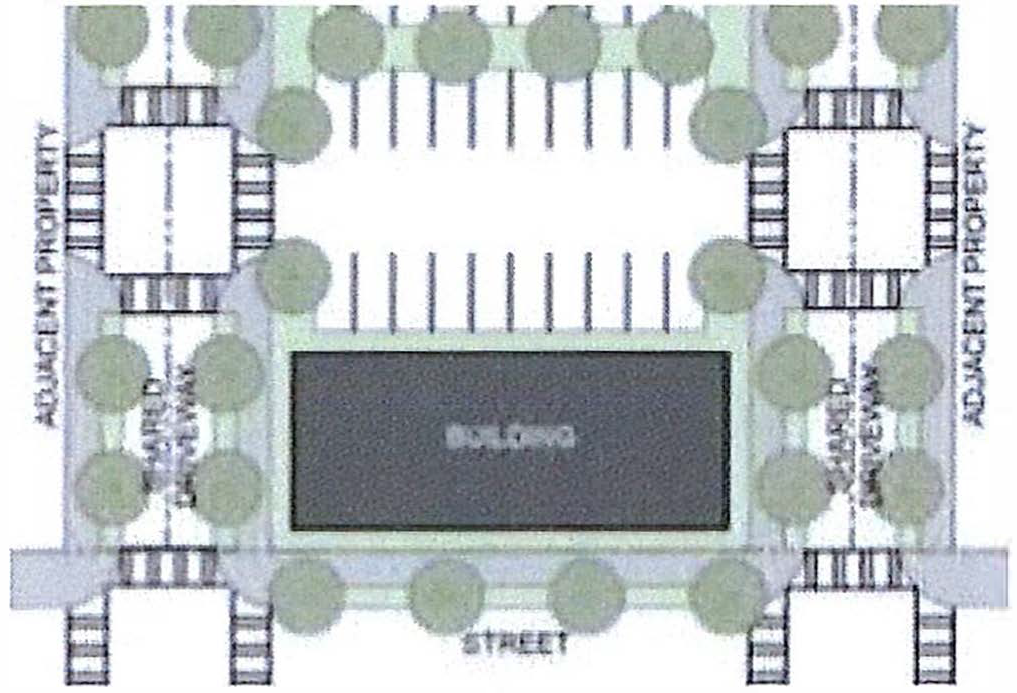
(d)
Development and architectural controls. Buildings and parking decks must comply with the following:
(1)
Exterior materials. The following applies to facades:
a.
Facades must be faced in brick, natural or synthetic stone, or painted wood/cementitious clapboard, subject to subsections (1)c. and d. below.
b.
Facades may not be faced in aluminum, metal, corrugated steel, vinyl or plastic, plywood, pressed wood, imitation wood, EIFS, true or synthetic stucco, or concrete masonry units.
c.
Exterior materials of street-facing facades along Main Street may only be faced in unpainted brick, unpainted natural stone, or unpainted synthetic stone.
d.
No unpainted brick on a building or portion of building built before 1950 may be painted within the DT-3 district.
e.
Exterior finish materials may only be combined horizontally, with the visually heavier material below the lighter material as shown in table 3.3, general visual weight table. This does not apply to architectural accents.
Table 3.3 General Visual Weight Table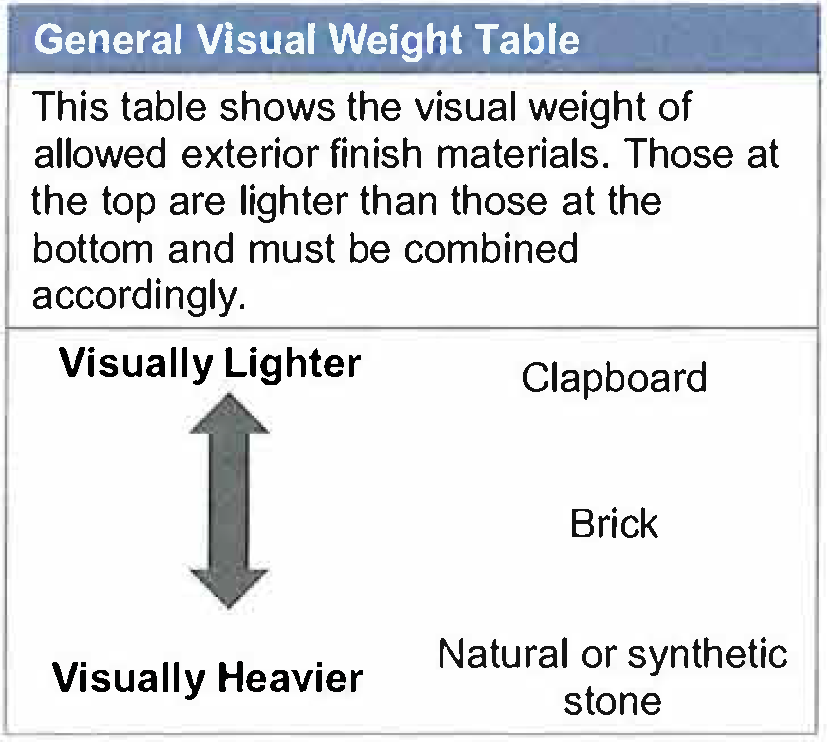
(2)
Architectural accents, if used, must consist of non-reflective glass, glass block, natural or synthetic stone, precast concrete, brick, terra cotta, true hard coat stucco, wood, cast stone, cast-iron, or decorative architectural grade steel or other equivalents subject to review and approval by the community development director.
(3)
Dumpsters must be screened on three sides by a wall at least eight feet high and on the fourth side by a solid gate at least eight feet high.
(4)
Awnings must be designed to last for at least five years, per manufacturer's warranty. Tom, faded, damaged, or otherwise degraded awnings are not allowed.
(5)
Linear lighting around windows, rooflines, doors, signs or building structures is prohibited. Linear lighting may include, but is not limited to, neon tubes, rope lighting, and other similar lighting devices. Linear lighting devices that form letters or words are considered signs.
(e)
Active ground floor uses. The ground floor of all buildings, including parking decks, adjacent to a public street, or as required around open spaces, must incorporate one or more of the following along the entire street-facing or open space-facing facade:
(1)
Storefront active ground floor uses.
a.
The space must contain retail, restaurant/food establishment, or service uses for a minimum depth of 20 feet, except at breaks for pedestrian pathways or parking access.
b.
The minimum floor to ceiling height is 14 feet.
c.
The space must be equipped with utilities.
d.
The space's primary use may not be storage, vehicular uses, equipment, coolers, computer servers, or computer/telecommunication exchanges.
e.
The space must conform to section 46-990(g).
(2)
Non-residential active ground floor uses.
a.
The space must contain other non-residential uses not included in subsection (1) above for a minimum depth of 30 feet, except at breaks for pedestrian pathways or parking access.
b.
The minimum floor to ceiling height is 14 feet.
c.
The space must be equipped with utilities.
d.
The space's primary use may not be storage, vehicular uses, equipment, coolers, computer servers or exchanges.
e.
The space must have at least 50 percent fenestration and may not provide more than 30 linear feet without fenestration.
(3)
Residential active ground floor uses.
a.
The space must contain residential uses for a minimum depth of 20 feet, except at breaks for pedestrian pathways or parking access.
b.
The minimum floor to ceiling height is ten feet.
c.
The space must be equipped with utilities.
d.
The space must have at least 20 percent fenestration and may not provide more than 30 linear feet without fenestration.
(f)
Fenestration.
(1)
Defined. Fenestration is the minimum percentage of window and door glass area that must cover a facade.
(2)
Glass standards. Glass used to satisfy fenestration requirements must be unpainted, must have a transparency (visible light transmission) higher than 70 percent, and must have an external reflectance of less than 15 percent. Transparency and external light reflectance must be established using the manufacturer's specifications.
(3)
Measurement. Fenestration is measured from the top of the finished floor to the top of the finished floor above. When there is no floor above, fenestration is measured from the top of the finished floor to the top of the wall plate.
(4)
Minimum standards. All buildings, including parking decks, must conform to the following along public streets or as required along certain open spaces:
a.
All ground floors must incorporate fenestration as required by the active use standards of section 46-990(e).
b.
All other floors must provide a minimum 20 percent fenestration for residential uses and a minimum of 30 percent fenestration for non-residential uses.
(g)
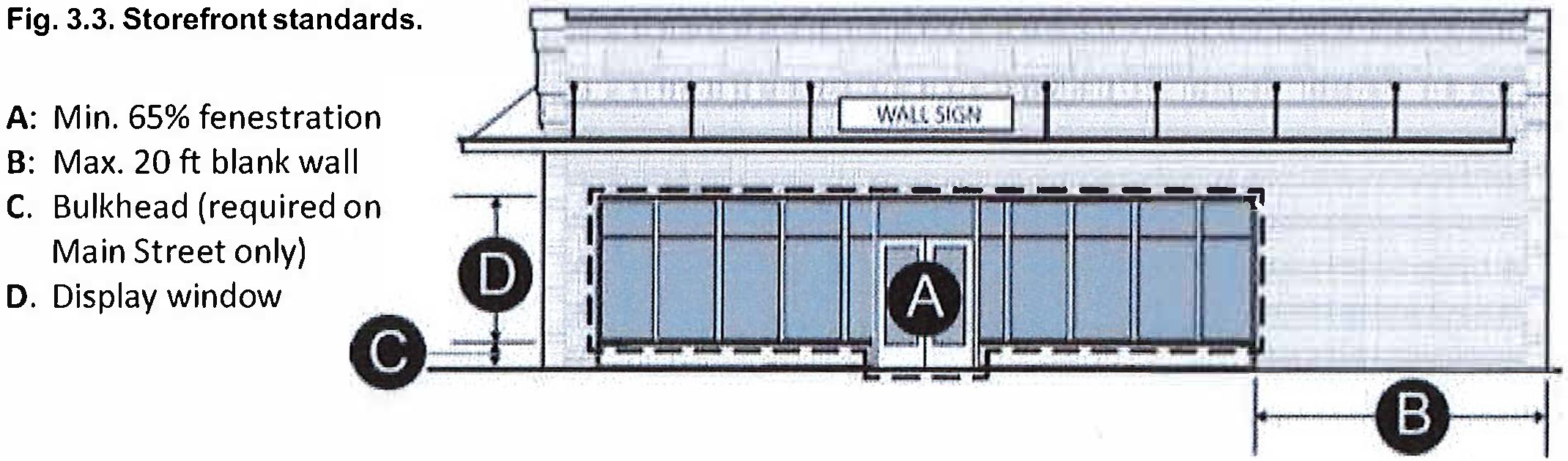
Storefront.
(1)
Ground floor storefronts along a public street, or as required along an open space, must:
a.
Provide fenestration for at least 65 percent of the exterior facade area, with each facade calculated separately.
b.
Provide no more than 20 linear feet without fenestration.
c.
Allow views into the building interior for a depth of at least five feet.
(2)
Along Main Street, storefronts must also include:
a.
A non-glass bulkhead of 12 to 24 inches in height directly above the finished floor;
b.
A glass display window directly above the bulkhead and extending to at least ten feet above the finished floor;
c.
An awning or canopy installed directly above the storefront window that is at least as wide as the display window; and
d.
Non-glass portions of storefront systems faced in painted or unpainted wood, or in metal that is painted on-site. On-site painted synthetic materials may also be approved by the community development director when they are visually indistinguishable from an otherwise allowed painted material to normal human senses.
(h)
Buildings massing.
(1)
Street-facing facades greater than 100 feet in length must be modulated with breaks in wall surfaces, materials, and rooflines at intervals not to exceed 100 feet (measured parallel to the street).
(2)
Stories on street-facing building facades must be delineated through the use of windows, belt courses, cornice lines, or similar architectural detailing.
(3)
Parking decks along a public street must comply with subsection (2) above, except that the number of stories used will be based on standard building story heights, not the actual height of the parking levels.
(i)
Roofs.
(1)
Roof-mounted mechanical equipment and appurtenances must be located or screened so that they are not visible from the ground level.
(2)
Screening must be of a material and design that match the building.
(3)
Rooftop appurtenances must be painted to be compatible with the color of the roof.
(4)
Roof structures visible from the public right-of-way may only be sloped or flat.
(5)
Sloped roofs must be hip roofs less than 45 degrees in pitch or gable roofs at least 30 degrees in pitch.
(6)
Sloped roofs must overhang at least 12 inches on all sides and may not exceed 100 feet in length without a change in plane.
(7)
Roofing materials for sloped roofs may only be architectural grade asphalt or fiberglass shingles, solar shingles used with asphalt or fiberglass shingles, standing seam metal roof, ceramic tile, and slate or synthetic slate.
(8)
Roofing materials for sloped roofs must have a minimum 25-year roof life (per manufacturer's warranty) and must have no visible roll roofing.
(9)
Flat roofs must have decorative and/or corbelled parapets on all sides visible from public rights-of-way and drain to internal roof drains and/or to the rear of the structure, limiting downspouts on facades along primary and secondary streets.
(10)
Simple barrel vaults or roofs are allowed.
(11)
Mansard, gambrel, and shed roof forms are not allowed.
(j)
Additional live-work unit standards.
(1)
Garages may not face a public street.
(2)
The front entrance to each unit must be at grade opening directly onto the public sidewalk or an open space adjacent to the public sidewalk.
(k)
Additional commercial and mixed-use buildings standards.
(1)
Commercial or mixed-use buildings are required along Main Street. No other building type may front Main Street.
(2)
Buildings must provide a ground level storefront and active ground floor uses that conform to section 46-990(e)(1).
(l)
Additional townhouse and multi-family development standards.
(1)
Mechanical equipment and other building service items may not be located between the public sidewalk and building facade.
(2)
Individual townhouse units and ground floor multi-family units adjacent to a public street must provide a direct pedestrian entrance from it. They must also provide a front porch or a front stoop facing said street.
(3)
The pedestrian entrance required by subsection (2) above may be raised above the average grade of the sidewalk directly in front of it a maximum of three feet.
(4)
Access to parking is only allowed via an alley or private drive located behind the units. Garages may not face a public street.
(Ord. No. O2019-04-15, exh. A(3.2.10), 6-26-2019)
Sec. 46-991. - Fences.
(a)
Fencing may only be faced in unpainted brick, unpainted natural stone or unpainted synthetic stone, painted metal, painted wood, or a painted synthetic material having the appearance or wood that is painted on-site.
(b)
Fencing in front of a building may not exceed four feet high.
(c)
Fencing to the rear or side of a building may not exceed six feet high.
(d)
Barbed wire, razor wire, chain-link fence, and similar elements are not allowed.
(Ord. No. O2019-04-15, exh. A(3.2.11), 6-26-2019)
Sec. 46-992. - Open space.
(a)
Open space required. New developments must incorporate open space as required in table 3.2 and this section.
(b)
Enhanced open space. Open spaces used to satisfy open space requirements must conform to enhanced open spaces types established in article V, division 5 of this chapter, except as otherwise allowed by subsection (c) below. Enhanced open space must also:
(1)
Adjoin buildings with active ground floor uses conforming to section 46-990(e) on at least one side and for not less than 25 percent of the open space's perimeter; and
(2)
Be directly accessible from a public sidewalk.
(c)
Amenity open space. Amenity open space may also be used to satisfy open space requirements. Amenity open space is small covered or uncovered, unenclosed, outdoor areas. It is limited to at-grade hardscape or landscape areas improved for pedestrian enjoyment; rooftop decks; patios and porches; balconies; or yards, lawns, and gardens. Interior or exterior stairs or elevators may be used to provide access to rooftop decks, patios, porches, and balconies.
(d)
Landscaping. In addition to the requirements referenced in subsection (b) above, required open spaces must include at least one tree within or directly adjacent to the open space for every 2,000 square feet of open space. The tree must conform to section 46-997(d).
(e)
Maintenance. Covenants or other legal arrangements must specify ownership of all open spaces, the method of and responsibility for maintenance, taxes, and insurance, compulsory membership and assessment provisions, and must be incorporated into legal instruments sufficient to ensure that the open space requirements of this section are maintained.
(Ord. No. O2019-04-15, exh. A(3.2.12), 6-26-2019)
Sec. 46-993. - Neighborhood compatibility.
(a)
Across from single-family detached dwellings. Where development is on a primary or secondary street and also across the street from existing single-family homes which face said street, the development must contain buildings along the primary or secondary street and the existing single-family development.
(b)
Transitional buffer zones. DT districts must conform to the transitional buffer requirements in section 46-1338 except as follows:
(1)
There is no transitional buffer requirement between lots that are both within a DT district.
(2)
When a DT district adjoins an RE, RLG, R-100, R-85, R-75, or R-60 district, a buffer class C is required.
(Ord. No. O2019-04-15, exh. A(3.2.13), 6-26-2019)
Sec. 46-994. - Streets and streetscapes.
(a)
Street design.
(1)
Applicability. Public and private streets must comply with the requirements for public streets found in chapter 22, except as specifically otherwise provided for in this section.
(2)
Travel lane width exception. Eleven feet wide travel lanes are required on all streets except alleys and designated truck routes. Further lane reductions may also be approved by the community development director when the proposed width conforms to the published best practices of American Association of State Highway Transportation Officials (AASHTO) and/or the Institute of Transportation Engineers (ITE).
(3)
Street dimensions. All new or extended public or private streets must conform to table 3.4, new street dimensions, unless modified by the community development director for the following public purposes:
a.
To provide alternative bicycle facilities;
b.
To provide wider streetscapes;
c.
To provide turn lanes;
d.
To provide traffic calming or pedestrian safety measures;
e.
To serve truck routes; or
f.
To increase lane width and right-of-way along state and federal facilities.
(4)
Bicycle facilities must be incorporated in conformance with any plan that has been adopted by the City of Tucker or the Georgia Department of Transportation.
(5)
Bicycle lanes may not be less than five feet in width. Gutters may not be counted towards this requirement.
(6)
Multi-use trails may not be less than ten feet in width.
(7)
Bicycle facilities must incorporate signs and pavement markings as required by the latest version of the Manual for Uniform Traffic Control Devices.
(b)
Streetscape elements and dimensions.
(1)
Streetscapes must be installed on existing and new streets as required by section 46-1336 and in conformance with table 3.5, except when subsection (2) or subsection (3) below applies.
(2)
A multi-use trail may be required instead of a sidewalk along any new or existing street when the location has been identified as a multi-use trail in any plan that has been adopted by the City of Tucker or the Georgia Department of Transportation.
(3)
Streetscapes must match any ongoing or completed publicly-funded streetscape designs.
Table 3.3 Notes:
[1]
Main Street right-of-way variations and the current conditions cannot provide for a uniform application of this requirement. As such, the community development director, in consultation with the director of public works, will determine the requirements along Main Street on a case by case basis.
[2]
Benches, trash receptacles, and bike racks may only be placed within the landscape strip.
[3]
This requirement applies to street light poles only. Additional pedestrian light requirements apply.
(c)
Landscape strip design.
(1)
Landscape strips must be planted with trees, grass, ground cover or flowering plants, or consist of brick pavers, concrete pavers, or granite pavers where on-street parking is provided or where pedestrian crossing and/or congregation is likely.
(2)
Street trees are required and must conform to section 46-997(d).
(3)
Street trees must have a minimum planting area of four feet by eight feet. Tree-planting areas must provide porous drainage systems that allow for drainage of the planting area.
(4)
Street tree species or planting patterns of varied species must be consistent for an entire block length. Similarly-shaped species may be changed on an individual block face due to: limited supply or concerns regarding disease or the health of existing and proposed trees with approval from the community development director and consultation from a certified arborist.
(d)
Sidewalk design.
(1)
Sidewalk paving materials must continue across driveways at the same prevailing grade and cross slope as the adjacent sidewalk area.
(2)
Sidewalks must be broom finished poured-in-place concrete or pavers of brick, concrete, or stone. Other materials may be allowed by approval of the community development director.
(3)
When new sidewalks abut existing sidewalks the new sidewalks must provide safe facilitation of pedestrian traffic flow to adjacent sidewalks. Any development that disturbs existing sidewalks on the adjacent property must replace disturbed areas to their pre-disturbance state and condition.
(e)
Underground utilities required. All utilities, except major electric transmission lines and sub-stations, must be buried unless the community development director determines that underground utilities are not feasible due to existing physical conditions, such as conflicting underground structures or utilities, shallow rock, high water table, or other similar geologic or hydrologic conditions.
(f)
Street lights and street furnishings.
(1)
Light poles are required and must be spaced at a maximum of 80 feet on-center and of a type identified in section 46-999(e).
(2)
Pedestrian lights are required and must be spaced at a maximum of 90 feet on-center and of a type identified in section 46-999(e).
(3)
Street and pedestrian lights must alternate.
(4)
Street furnishing may only be placed in the landscape strip or between the sidewalk and the building.
(5)
Street furnishings are required and must be of a type identified in table 3.6, which includes specific products by specific brands. The use of specific products and brands is not required and similar designs may be used.
(6)
Street furnishings must be comfortable, damage and vandalism resistant, and easy to maintain.
(g)
Crosswalks. The use of approved brick, concrete, or stone paving materials to identify crosswalk areas is encouraged.
(Ord. No. O2019-04-15, exh. A(3.2.14), 6-26-2019)
Sec. 46-995. - Drive-thru facilities.
The following applies in addition to any applicable standards of article IV:
(a)
All drive-thru areas, including but not limited to menu boards, stacking lanes, trash receptacles, ordering box, drive up windows, and other objects associated with the drive-thru, must be located to the side or rear of the building. Drive-thru windows and lanes may not be placed between a public street (not including an alley) and the associated building.
(b)
Drive-thru windows and lanes must be screened by a continuous compact evergreen hedge. At the time of installation, the screening must be at least three feet high and reach a height of four feet within three years of planting.
(c)
In lieu of the compact evergreen hedge, a screening wall with a minimum height of four feet may be installed. The wall must be compatible with the principal building in terms of texture, quality, material, and color.
(Ord. No. O2019-04-15, exh. A(3.2.15), 6-26-2019)
Sec. 46-996. - Parking.
(a)
Off-street parking ratios. DT districts must conform to the maximum off-street parking ratios contained in table 6.2, off-street parking ratios, and the following off-street parking ratio requirements, except when a lower minimum is allowed by table 6.2 said lower ratio will apply:
(1)
Non-residential uses must provide at least one space per 500 square feet of floor area.
(2)
Residential uses must provide a minimum of one space per dwelling unit and a maximum ratio as identified in table 6.2, off-street parking ratios.
(b)
Shared parking.
(1)
Shared parking is allowed in accordance with section 46-1453 or in accordance with subsections (2) through (5) below.
(2)
Instead using the steps identified in section 46-1453, applicants may submit a shared parking analysis using the Urban Land Institute (ULI) Shared Parking Model (latest edition).
(3)
The study must be provided in a form established by the community development director.
(4)
Reductions in the total number of required spaces for shared parking are not allowed unless the community development director determines a reduction is appropriate on a case-by-case basis through the use of the ULI Shared Parking Model (latest edition).
(5)
Uses using shared parking must have either mutually exclusive or compatibly overlapping normal hours of operation. The community development director will determine whether hours of operation are compatibly overlapping on a case-by-case basis through the use of the ULI Shared Parking Model (latest edition).
(c)
Off-street parking location and design.
(1)
All off-street parking, including surface lots and parking decks, may only be located behind or beside a street-fronting building, except as allowed for individual townhouse units by section 46-990(l).
(2)
Parking lot screening. Parking lots must be screened from view of public streets using one of the following:
a.
Shrubs. Plant a minimum of ten shrubs per 35 linear feet of street frontage, excluding driveway openings. Shrubs must be 18 inches tall at the time of planting. They must be planted two rows deep, and provide a screen within three years of planting.
b.
Walls. Install a minimum 30 inches high wall as close to the parking lot as possible. Wall must be opaque and compatible with the principal building material.
(3)
Parking deck screening. Parking decks must provide screening on all stories by providing a facade designed to resemble an office or residential building and conform to the applicable building form and design requirements of section 46-990.
(4)
Landscape strips. The following applies around parking lots and parking decks:
a.
Adjacent to a street. A landscape strip with a minimum width of ten feet is required adjacent to public or private streets. Evergreen shrubbery at least 18 inches high is required.
b.
Not adjacent to a public or private street. A landscape strip with a minimum width of six feet is required along all sides of the facility that are not adjacent to public or privates streets.
c.
Exceptions. Landscape strips are not required at driveways, walkways, pedestrian plazas, or where adjacent active ground floor uses are provided.
d.
Planting. The landscape strips may contain no less than one understory or overstory tree per 50 linear feet, ten shrubs per 50 linear feet, and a minimum of 90 percent living groundcover, sod, and/or annual or perennial color in the landscape strip surface area. Landscaping must conform to section 46-997.
(5)
Restrictions. No parking area may be used for the sale, repair, dismantling, servicing, or long-term storage of any products, vehicles, or equipment.
(Ord. No. O2019-04-15, exh. A(3.2.16), 6-26-2019)
Sec. 46-997. - Landscaping.
(a)
Plans required. Landscape planting and irrigation plans must be prepared by a landscape architect registered in the State of Georgia for each application for a land disturbance permit.
(b)
Maintenance. When a private property owner provides landscaping within the public right-of-way and the landscaping dies within one year of installation, it must be replaced within the earliest possible planting season.
(c)
Ground cover.
(1)
Ground cover must be provided around all trees to protect tree roots, to prevent erosion, and as otherwise required by this division.
(2)
Ground cover must consist of evergreen shrubs or groundcover plant material mulched with pine bark mulch or other similar landscaping material.
(3)
Evergreen groundcover planting must be used on all slopes steeper than 2.5:1 to aid in erosion control.
(d)
Trees.
(1)
Newly planted trees must be a minimum of 3.5 inches in caliper measured 12 inches above the ground, must be at least 16 feet high, and must have a minimum mature height of 30 feet.
(2)
No tree may be planted closer than 30 inches from the street or sidewalk, and no closer than eight feet from a fire hydrant, signpost, street light, utility pole, or similar structure.
(e)
Irrigation. All newly planted landscape areas (including parking lot islands) shall be irrigated by a fully automatic, commercial, underground irrigation system in accordance with the following:
(1)
All irrigation systems must be provided with backflow preventers approved by DeKalb County. Such devices shall be located or screened so that they are not visible or accessible to the public from adjacent sidewalks, streets, alleys, or parking lots.
(2)
Spray heads must be located to provide 100 percent overlapping coverage. Overspray onto sidewalks and other paved areas should be minimized.
(3)
Control boxes and panels shall be located inside buildings or where they will not be visible or subject to vandalism.
(4)
All main and lateral lines shall be commercial grade PVC pipe.
(5)
Irrigation systems are not required in undisturbed buffers or in areas where they would disrupt existing native vegetation.
(f)
Plant materials. Plant materials required or installed along or adjacent to streets must be selected from the species and minimum sizes shown in table 3.7. Plant materials provided in other locations may be any species appropriate to the design and location, subject to the approval of the plan reviewer, provided that all trees must be native or adaptive to Tucker.
(Ord. No. O2019-04-15, exh. A(3.2.17), 6-26-2019)
Sec. 46-998. - Outdoor dining.
(a)
General standards. The following applies to all outdoor dining, including on-site and when authorized within a public right-of-way:
(1)
All tables and chairs must be metal.
(2)
Each umbrella canopy must be a single solid color. Different umbrellas may have a different colored canopies.
(3)
No signage may be placed on tables, chairs, or umbrellas.
(4)
The hours of operation for the outdoor dining area may be no greater than that of the principal use.
(5)
Outdoor dining shall not be located in required parking spaces.
(b)
Outdoor dining in the right-of-way.
(1)
It is unlawful to place outdoor dining in the public right-of-way without first obtaining a sidewalk café license.
(2)
A sidewalk café license is required to be renewed annually and is subject to an application process set by the planning and zoning director.
(3)
Conditions of approval may be placed on the license by the planning and zoning director to insure the protection of the public right-of-way and the rights of all adjoining property owners and the health, safety, and general welfare of the public.
(4)
The outdoor dining area shall not extend beyond the width of the façade of the business.
(5)
A five feet minimum pedestrian passageway shall be provided and maintained at all times.
(6)
The outdoor dining area, including furnishings, shall be maintained in a clean, neat, and orderly condition. All debris and litter shall be removed daily.
(7)
Only tables, chairs, and umbrellas are permitted in the outdoor dining area.
(Ord. No. O2019-04-15, exh. A(3.2.18), 6-26-2019; Ord. No. O2021-10-20, Exh. A, 11-8-2021)
Sec. 46-999. - Outdoor lighting.
(a)
Light levels of 1.5 foot-candles are recommended for parking lots and four foot-candles at vehicular drives, entrances, and pedestrian and bicycle facilities.
(b)
Ground-mounted floodlights must be screened with planting or other means so that the light source is not visible.
(c)
The use of flashing, rotating, or oscillating lighting is not allowed in any manner that may be visible from the exterior of buildings.
(d)
After-hours security lighting must equal at least 25 percent of the normal parking lot lighting level for security.
(e)
Outdoor lighting must be of a type identified in table 3.8, which includes specific products. The use of specific products is not required when similar designs from other manufacturers are available.
Fig. 3.3. Pedestrian Light Fixture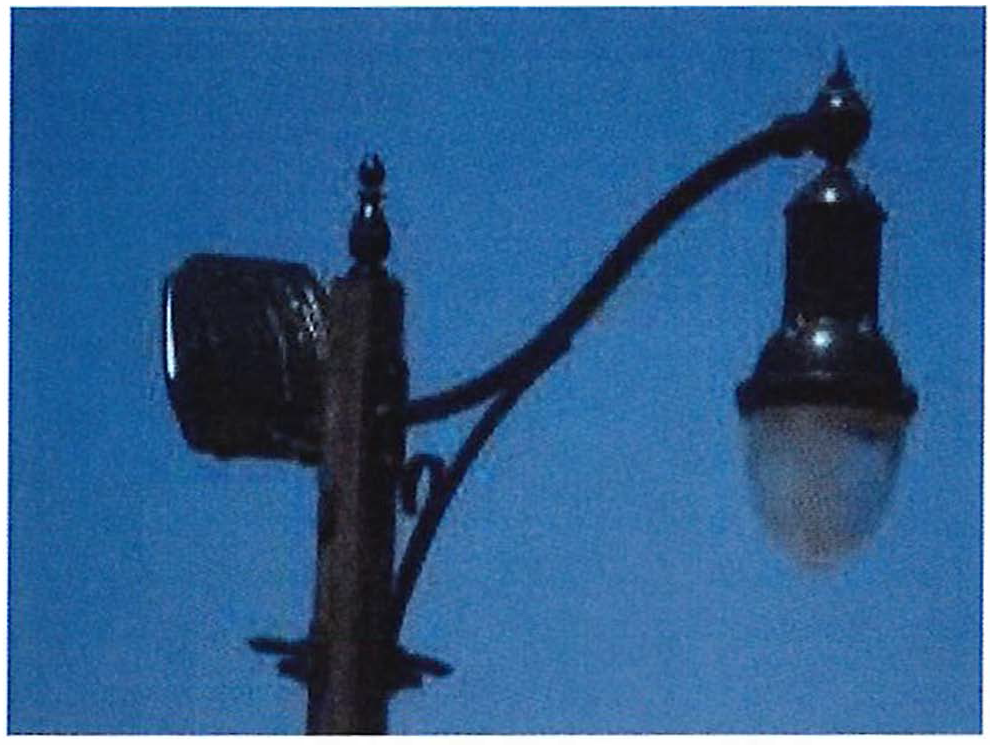
Fig. 3.4 Parking Lot Light Fixture and Pole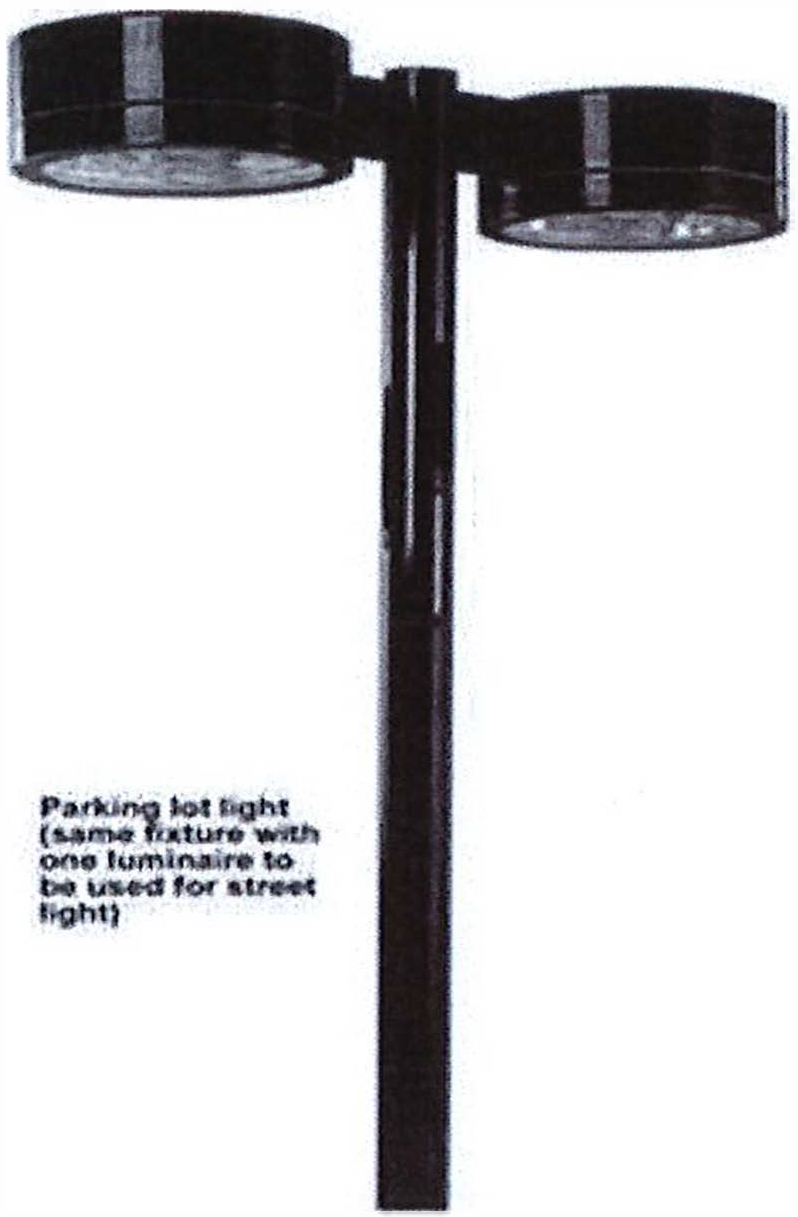
(Ord. No. O2019-04-15, exh. A(3.2.19), 6-26-2019)
Sec. 46-1000. - Administrative variations.
(a)
The community development director may grant administrative variances in addition to those allowed by article VII, division 6 of this chapter when the variance is used to permit a practice that is not consistent with a specific provision but is justified by the division's purpose and intent.
(b)
Administrative variances may not be used to:
(1)
Provide relief from minimum or maximum parking ratios;
(2)
Increase the allowed site density;
(3)
Increase the allowed number of stories in a building; or
(4)
Permit a use that is not allowed by district regulations.
(Ord. No. O2019-04-15, exh. A(3.2.20), 6-26-2019)
Sec. 46-1001. - Downtown entertainment district.
Outside consumption of alcoholic beverages shall be permitted in the following area per the regulations listed below:
(1)
Definition of downtown district.
a.
The area of the city right-of-way bounded on the north by the northern right-of-way line of Lynburn Drive (between Lavista and Main), then traveling south along the eastern right-of-way line of Main Street, then traveling east along the northern right-of-way line of 1 st Avenue, and then traveling south along the eastern right-of-way line of 4 th Street, then traveling west along the southern right-of-way line of Railroad Avenue, then traveling north along the western side of 2 nd Street, then traveling east along the northern right-of-way line of 1 st Avenue, then traveling north along the western right-of-way line along the alley towards Lynburh to complete the entertainment district boundary.
b.
The city owned green space at 4236 Railroad Avenue, which is within the entertainment district boundary listed above, shall also be subject to the provisions of this code section.
(2)
One drink on-street limit. Any establishment licensed to sell alcoholic beverages by the drink for consumption on the premises or as a manufacturer is authorized to dispense an alcoholic beverage in a paper or plastic cup, or other container other than a can, bottle, or glass, for removal from the premises; provided, however, that no establishment shall dispense to any person more than one such alcoholic beverage at a time for removal from the premises, and no person shall remove at one time more than one such alcoholic beverage from the licensed premises.
(3)
Size limited to a maximum of 16 ounces. No container in which an alcoholic beverage is dispensed and removed from the licensed premises shall exceed 16 fluid ounces in size. No person shall hold in possession on the streets and sidewalks, in parks and squares, or in other public places within the defined area any open alcoholic beverage container which exceeds 16 fluid ounces in size. Nothing set forth in this subsection shall be construed to permit the possession of open alcoholic beverages in any public place within the downtown district except as otherwise expressly authorized under this section.
(4)
Drinking from can, bottle, or glass prohibited. It shall be unlawful for any person to drink or attempt to drink any alcoholic beverage from a can, bottle, or glass, or to possess in an open can, bottle, or glass any alcoholic beverage on the streets, sidewalks, rights-of-way, and parking lots, whether public or private.
(5)
Purchase from licensed premises within downtown district. Alcoholic beverages consumed pursuant to this provision must be purchased from a licensed premises within the downtown district.
(6)
Consumption limited to certain areas in downtown district. No alcoholic beverage purchased pursuant to this provision may be consumed outside of the downtown district or upon any private property without the express written consent of the property owners.
(7)
Consumption hours. No alcoholic beverage purchased pursuant to this provision shall be consumed after 10:00 p.m. any night of the week, except when authorized by a special event permit issued by the city.
(8)
Festivals; special events. Unless otherwise specified by this article or the terms of a special event permit issued by the city, the provisions of this article shall also apply to special events and festivals.
(Ord. No. O2021-10-20, Exh. A, 11-8-2021; Ord. No. O2025-09-17, 10-14-2025)
Sec. 46-1031. - Northlake zoning districts established.
(a)
The following "Northlake Zoning Districts" are established:
(1)
NL-1 (Northlake High-Intensity Commercial)
(2)
NL-2 (Northlake Office Park)
(3)
NL-3 (Northlake Employment Center)
(4)
NL-4 (Northlake Residential)
(5)
NL-PUD (Northlake Planned Unit Development)
(b)
References in this zoning ordinance to "Northlake Zoning Districts or "NL" districts are references to these districts.
(Ord. No. O2019-04-15, exh. A(3.3.1), 6-26-2019; Ord. No. O2023-05-06, exh. A, 6-12-2023; Ord. No. O2024-02-02, Exh. A, 3-11-2024)
Sec. 46-1032. - Purpose and intent.
(a)
The intents of all NL districts are:
(1)
To encourage development and redevelopment of properties in order to achieve a mixed-use community;
(2)
To provide for the development of sidewalks and walkways in order to promote safe and convenient pedestrian access and to reduce dependence on automobile travel;
(3)
To promote a physically attractive, environmentally safe and economically sound mixed-use community;
(4)
To permit and to encourage mixed-use developments containing commercial and residential uses in order to create a pedestrian-oriented community where people can live, work, and play;
(5)
To improve the visual appearance and increase property values;
(6)
To implement the policies and objectives of the Comprehensive Plan, the Zoning Ordinance, and other official policies and plans within the NL districts;
(7)
To enhance the long-term economic viability of the Northlake area by encouraging new commercial and residential developments that increase the tax base and provide jobs to the citizens of the City of Tucker;
(8)
To establish and maintain a balanced relationship between industrial, commercial, and residential development to ensure a stable and healthy tax base;
(9)
To provide a balanced distribution of regional and community-focused commercial and mixed-use office centers;
(10)
To support higher-density housing, office, and mixed-use centers which have appropriate access and infrastructure;
(11)
To create regulations that meet the goals and objectives of the Atlanta Regional Commission's Livable Centers Initiatives program;
(12)
To allow design flexibility in order to encourage innovative development projects that set high standards for landscaping, green space, urban design, and public amenities;
(13)
To encourage an efficient land use and development plan by forming a live-work-play environment that offers employees and residents the opportunity to fulfill their daily activities with minimal use of single-occupant automobiles;
(14)
To allow and encourage development densities and land use intensities that are capable of making productive use of alternative transportation modes such as transit, ridesharing, bicycling, and walking;
(15)
To encourage the formation of a well-designed, pedestrian-friendly activity center with high-density commercial and residential development that increases vitality and choices in living environments for the citizens of the City of Tucker;
(16)
To protect nearby established single-family residential areas from the encroachment of commercial, retail, office, and industrial uses by providing for increased density of development within the NL districts;
(17)
To protect the health, safety, and welfare of the citizens of the City of Tucker; and
(18)
To promote uniform and visually aesthetic architectural features which serve to unify the distinctive visual quality of the Northlake area.
(b)
NL-1 (Northlake High-Intensity Commercial). The intent of the NL-1 district is to allow for the most intense mixed-use development in Tucker. It encourages the redevelopment of parking lots into a mix of retail, office, and residential uses in the same development.
(c)
NL-2 (Northlake Office Park). The intent of the NL-2 district is to reflect established office, retail, and multifamily areas. It allows residents to live close to employment and to provides accessibility to shopping areas.
(d)
NL-3 (Northlake Employment Center). The intent of the NL-3 district is to recognize and protect the existing employment base. It encourages light manufacturing, distribution, showroom and small supporting retail uses.
(e)
NL-4 (Northlake Residential). Formerly Northlake Vista Dale Court. The intent of the NL-4 district is to provide low to medium density residential development opportunities and a mix of housing types. This district also serves as a type of transitional zoning along with the perimeter of the Northlake Zoning Districts. Along Vista Dale Court, this district preserves the existing scale and character of the street by encouraging compatible new development and provides a transition between the more intense development to the west and neighborhoods to the east.
(f)
NL-PUD (Northlake Planned Unit Development). The intent of the NL-PUD district is to encourage creative mixed-use developments on large scale development sites within the existing Northlake zoning districts. Each area of NL-PUD zoning will be unique with its own set of development standards and conceptual site plan.
(Ord. No. O2019-04-15, exh. A(3.3.2), 6-26-2019; Ord. No. O2023-05-06, exh. A, 6-12-2023; Ord. No. O2024-02-02, Exh. A, 3-11-2024)
Sec. 46-1033. - Definitions.
The following terms have the meanings indicated below:
Sec. An abbreviation for "section."
(Ord. No. O2019-04-15, exh. A(3.3.3), 6-26-2019)
Sec. 46-1034. - Use of graphics.
Illustrations, photos, and graphics are included in this division to illustrate the intent and requirements of the text. In the case of a conflict between the text and any illustrations, photos, or graphics, the text governs.
(Ord. No. O2019-04-15, exh. A(3.3.4), 6-26-2019)
Sec. 46-1035. - Use regulations.
(a)
Table 3.9 indicates the permitted uses within the NL districts.
(b)
The uses listed in table 3.9 are only permitted in the district identified, and no use may be established and no structure associated with such use may be erected, structurally altered or enlarged unless the use is permitted as:
(1)
A permitted use (P);
(2)
A special use (SP) subject to the special land use permit application procedures specified in article VII;
(3)
An administratively approved use (SA) subject to the special administrative permit procedures specified in article VII;
(4)
An accessory use (Pa) as regulated by article IV or the applicable NL district. Table 3.9 does not list all accessory uses but clarifies uses acceptable as accessory, though not typically considered principal uses for the zoning classification.
(5)
Uses lawfully established prior to the effective date of this Division or this Zoning Ordinance, as applicable.
(c)
Multiple uses are allowed in a single building and on a single site.
(d)
Any use not listed in table 3.9 or interpreted to not be allowed by the community development director by section 46-1124 is not allowed. Any applicant denied a permit to allow a use of property in an NL district other than as provided in this section may file an appeal before the zoning board of appeals as provided in article VII.
(e)
Uses subject to additional regulations in article IV, division 2 of this chapter are indicated. Unless otherwise expressly stated, compliance with these regulations is required regardless of whether the use is permitted as-of-right, as an accessory use, by special administrative permit, or by special land use permit.
(f)
Permitted uses for each NL-PUD zoning district and development shall be project specific and shall be set by the Master Development Plan as part of the rezoning process.
(1)
The permitted uses in NL-PUD shall generally follow the list of permitted uses under the NL-1 zoning district.
(2)
Uses that are allowed by SLUP in NL-1, NL-2, NL-3, and NL-4 may be approved by right through the NL- PUD rezoning process.
(3)
No use that is prohibited in all four traditional NL zoning districts (NL-1, NL-2, NL-3, and NL-4) can be permitted in NL-PUD.
(4)
See section 46-1050 for additional use regulations.
Table 3.9 Notes:
[1]
Only allowed on lots used for a single-family detached dwelling that meet the requirements of article IV, division 2 of this chapter.
[2]
Not to exceed 5,000 square feet per use unless approved by special land use permit. Not to exceed 10,000 square feet by special land use permit.
(Ord. No. O2019-04-15, exh. A(3.3.5), 6-26-2019; Ord. No. O2020-03-07, exh. A, 3-23-2020; Ord. No. O2021-07-12, Exh. A, 8-9-2021; Ord. No. O2021-10-21, Exh. A, 11-8-2021; Ord. No. O2022-06-45, Exh. A, 7-11-2022; Ord. No. O2022-10-52, Exh. A, 11-14-2022; Ord. No. O2023-09-16, Exh. A, 10-10-2023; Ord. No. O2024-02-02, Exh. A, 3-11-2024; Ord. No. O2025-03-06, § 1, 3-24-2025; Ord. No. O2025-06-12, 8-11-2025; Ord. No. O2025-06-13, Exh. A, 8-11-2025)
Sec. 46-1036. - Dimensional requirements.
(a)
Dimensional requirements are as shown in table 3.10, Northlake District dimensional requirements.
(b)
Compatibility rules and transitional buffers per article V and section 46-1043 also apply.
Table 3.10 Note:
[1]
Parking deck height limit applies to both freestanding decks and those incorporated into buildings.
(c)
Additional setback requirements.
(1)
Buildings may exceed the maximum setback to allow for stoops, front porches, balconies, canopies, or steps, a public space or park, and or outdoor dining.
(2)
Parking is not allowed in the front yard or any other yard along public streets (not including 1-285).
(d)
Dimensional requirements for each NL-PUD district and development shall be project specific, with the exception of open space requirements, and shall be set by the Master Development Plan as part of the rezoning process.
(Ord. No. O2019-04-15, exh. A(3.3.6), 6-26-2019; Ord. No. O2020-03-07, exh. A, 3-23-2020; Ord. No. O2024-02-02, Exh. A, 3-11-2024; Ord. No. O2026-04-04, Exh. A, 5-11-2026)
Sec. 46-1037. - Blocks and lots.
(a)
The following applies in addition to article V, division 1 of this chapter.
(b)
New developments over four acres in size in the NL-1 and NL-2 districts must incorporate existing or new streets that result in the following block sizes:
(1)
Along Lavista Road, a maximum block length allowed of 700 feet.
(2)
Along all other streets, a maximum block length allowed of 300 feet.
(c)
Streets may not be gated.
(d)
Blocks must form an interconnected system of streets.
(e)
The maximum radius at any street intersection is 20 feet.
(f)
Stub-out streets in new development must be installed to allow future development on adjacent properties to meet the block standards of subsection (a) above. Depending on the nature of the adjacent property, the stub-out street pavement, and curbing must extend to the boundary of the abutting parcel to the point where the connection to the anticipated street is expected.
(g)
If a stub-out street exists on an abutting parcel, the street system of any new development must connect to the stub-out street to form a through street.
(h)
The director of community development may modify or eliminate the block size and stub street requirements when steep slopes in excess of 18 percent, pre-existing development, railroads, interstates, tree protection areas, stream buffers, cemeteries, open space, or easements would make the provision of a new street infeasible.
(Ord. No. O2019-04-15, exh. A(3.3.7), 6-26-2019)
Sec. 46-1038. - Vehicle access.
(a)
All parking must be accessed via shared alleys, private drives, or inter-parcel access.
(b)
Shared driveways between two parcels along a common property line may be required by the community development director during the land disturbance permitting process. In such cases, each property owner must grant an access easement to facilitate the movement of motor vehicles and pedestrians across the site. The property owner's obligation to comply with this requirement will be limited to the extent of legal permission to construct and utilize the required shared drive can be obtained from the neighboring property owner.
(c)
Driveway curb cuts may not exceed 24 feet in width. When a curb cut includes a median or one left tum lane, neither are included in the curb cut width.
(d)
Driveway curb cut intersection radii may not exceed 30 feet.
(e)
Driveways must be perpendicular to the adjacent street.
(Ord. No. O2019-04-15, exh. A(3.3.8), 6-26-2019)
Sec. 46-1039. - Inter-parcel access.
(a)
Applicability. The following applies to all new development, except the construction of detached single-family dwellings when no street is proposed.
(b)
Inter-parcel access requirements. Inter-parcel access for vehicles between abutting and nearby properties must be provided so that access to individual properties can be achieved between abutting and nearby developments as an alternative to forcing all movement onto highways and public roads, unless the community development director during the land disturbance permitting process determines that it is unnecessary to provide inter-parcel access due to the unlikelihood of patrons traveling among abutting or nearby sites, or due to inability after reasonable efforts by the property owner to obtain legal permission.
(Ord. No. O2019-04-15, exh. A(3.3.9), 6-26-2019)
Sec. 46-1040. - Building form and design.
(a)
Applicability. The following applies to all buildings, including parking decks, and is in addition to those building form and configuration standards contained in article V, division 7 of this chapter.
(b)
Pedestrian entrances.
(1)
All buildings adjacent to a public street must provide a direct pedestrian entrance from it.
(2)
All commercial tenant spaces adjacent to a public street must provide a direct entrance from it, except when a common lobby is provided for office uses.
(3)
The required pedestrian entrance must provide ingress and egress and must be operable to residents or customers at all times.
(4)
The required pedestrian entrance must face the public street.
(5)
Additional entrances off another street, pedestrian areas, open space, or parking areas are allowed.
(c)
Pedestrian access.
(1)
Pathways must be provided from the closest public sidewalks to all required pedestrian entrances.
(2)
Pathways must be provided from a public sidewalk to all parking areas, parking decks, and required open spaces.
(3)
Pathways must be provided between all parking areas, parking decks, buildings, and required open spaces on a site.
(4)
Required pathways must have a minimum width of five feet unless it serves an individual ground floor dwelling unit, where a four-foot wide pathway is allowed.
(5)
Required pathways must be continuous (except at vehicular crossings) and constructed of concrete, brick, stone, or similar durable paver materials. Asphalt is not allowed.
Fig. 3.5 Inter-Parcel and Pedestrian Access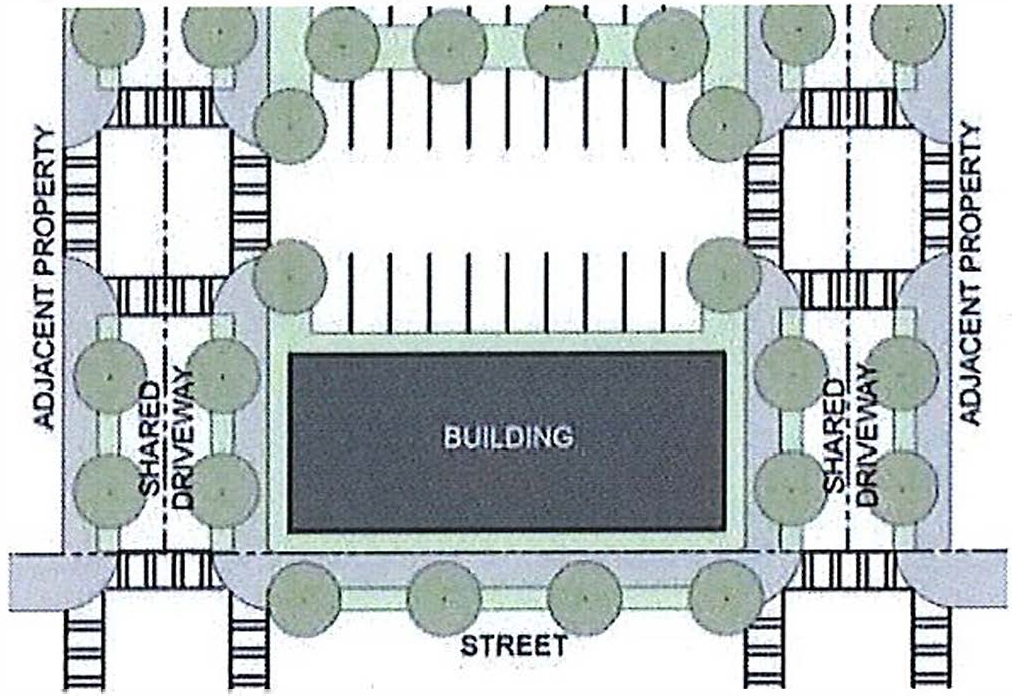
(d)
Development and architectural controls. Buildings and parking decks must comply with the following:
(1)
Exterior materials. The following applies to building facades:
a.
Buildings facades must be faced in brick, natural or synthetic stone, true hard coat stucco, ceramics or tile, or pre-cast concrete, except as provided for in subsection (1)c. below.
b.
Building facades may not be faced in aluminum, metal, corrugated steel, vinyl or plastic, plywood, pressed wood, imitation wood, EIFS, synthetic stucco, or concrete masonry units (except ribbed or rusticated units).
c.
Buildings with five or more stories may incorporate a glass curtain wall above the third floor, in place of the materials identified in subsection (1)a. above.
d.
Exterior finish materials may only be combined horizontally, with the visually heavier material below the lighter material as shown in table 3.11, general visual weight table. This does not apply to architectural accents.
Table 3.11 General Visual Weight Table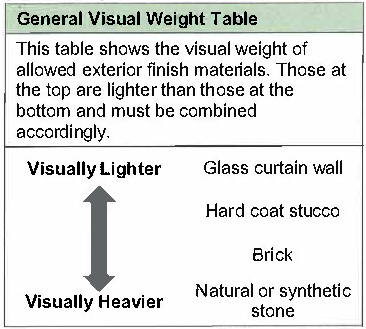
(2)
Architectural accents, if used, must consist of non-reflective glass, glass block, natural or synthetic stone, precast concrete, brick, terra cotta, true hard coat stucco, wood, cast stone, cast-iron, or decorative architectural grade steel or other equivalents subject to review and approval by the community development director.
(3)
Service bays for automobile service and repair uses must be designed so that the openings of service bays are not visible from a public street.
(4)
Corrugated Metal or temporary awnings are not allowed.
(5)
Dumpsters must be screened on three sides by a wall at least eight feet high and on the fourth side by a solid gate at least eight feet high.
(6)
Awnings must be designed to last for at least five years, per manufacturer's warranty. Torn, faded, damaged, or otherwise degraded awnings are not allowed.
(7)
Mansard roofs are not allowed.
(8)
Reflective roof finishes are allowed only on roofs sloped less than one inch per foot.
(9)
Ground floor commercial uses must provide one canopy directly above each ground floor entrance that is at least as wide as the ground floor entrance;
(10)
Linear lighting around windows, rooflines, doors, signs, or building structures is prohibited. Linear lighting may include, but is not limited to, neon tubes, rope lighting, and other similar lighting devices. Linear lighting devices that form letters or words are considered signs.
(e)
Active ground floor uses. The ground floor of all buildings, including parking decks, adjacent to a public street or as required around open spaces, must incorporate one or more of the following along the entire street-facing or open space-facing facade:
(1)
Storefront active ground floor uses.
a.
The space must contain retail, restaurant/food establishment, or service uses for a minimum depth of 20 feet, except at breaks for pedestrian pathways or parking access.
b.
The minimum floor to ceiling height is 14 feet.
c.
The space must be equipped with utilities.
d.
The space's primary use may not be storage, vehicular uses, equipment, coolers, computer servers, or computer/telecommunication exchanges.
e.
The space must conform to section 46-1040(g).
(2)
Non-residential active ground floor uses.
a.
Provide other non-residential uses not included in subsection (1) above for a minimum depth of 30 feet, except at breaks for pedestrian pathways or parking access.
b.
The minimum floor to ceiling height is 14 feet.
c.
The space must be equipped with utilities.
d.
The space's primary use may not be storage, vehicular uses, equipment, coolers, computer servers or exchanges.
e.
The space must have at least 30 percent fenestration and may not provide more than 30 linear feet without fenestration.
(3)
Residential active ground floor uses.
a.
The space must contain residential uses for a minimum depth of 20 feet, except at breaks for pedestrian pathways or parking access.
b.
The minimum floor to ceiling height is ten feet.
c.
The space must be equipped with utilities.
d.
The space must have at least 20 percent fenestration.
(f)
Fenestration.
(1)
Defined. Fenestration is the minimum percentage of window and door glass area that must cover a facade.
(2)
Glass standards. Glass used to satisfy fenestration requirements must be unpainted, must have a transparency (visible light transmission) higher than 70 percent, and must have an external reflectance of less than 15 percent. Transparency and external light reflectance must be established using the manufacturer's specifications.
(3)
Measurement. Fenestration is measured from the top of the finished floor to the top of the finished floor above. When there is no floor above, fenestration is measured from the top of the finished floor to the top of the wall plate.
(4)
Minimum standards. All buildings, including parking decks, must conform to the following along public streets or as required along certain open spaces:
a.
All ground floors must incorporate fenestration as required by the active use standards of section 46-1040(e).
b.
All other floors must provide a minimum 20 percent fenestration for residential uses and a minimum of 30 percent fenestration for non-residential uses.
(g)
Storefront. Ground floor storefront along a public street, or as required along an open space, must:
(1)
Provide fenestration for at least 65 percent of the exterior facade area, with each facade calculated separately.
(2)
Provide no more than 30 linear feet without fenestration.
(3)
Allow views into the building interior for a depth of at least five feet.
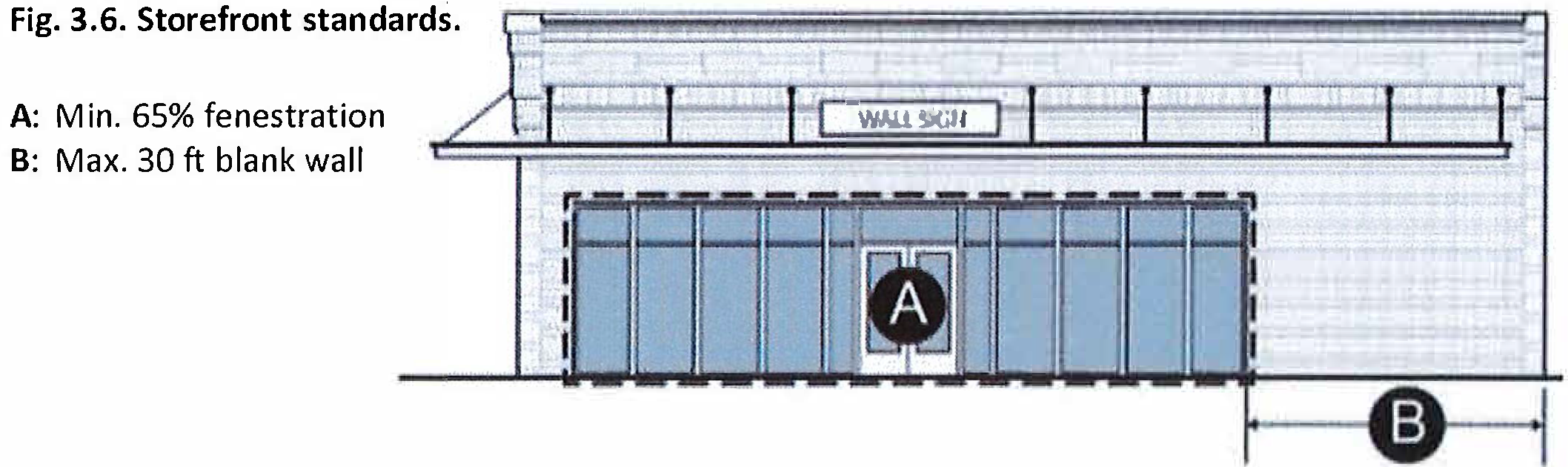
(h)
Building massing.
(1)
Street-facing building facades greater than 150 feet in length must be modulated with breaks in wall surfaces, materials, and rooflines at intervals not to exceed 150 feet (measured parallel to the street).
(2)
Stories on street-facing building facades must be delineated up to and including the third story through the use of windows, belt courses, cornice lines, or similar architectural detailing.
(3)
Parking decks along a public street must comply with subsection (2) above, except that the number of stories used will be based on standard building story heights, not the actual height of the parking levels.
(i)
Roofs.
(1)
Roof-mounted mechanical equipment and appurtenances must be located or screened so that they are not visible from the ground level.
(2)
Screening must be of a material and design that match the building.
(3)
Rooftop appurtenances must be painted to be compatible with the colors of the roof.
(4)
Roofing materials for sloped roofs must have a minimum 25-year roof life (per manufacturer's warranty) and must have no visible roll roofing.
(j)
Additional townhouse and multi-family development standards.
(1)
Mechanical equipment and other building service items may not be located between the public sidewalk and building facade.
(2)
Individual townhouse units and ground floor multi-family units adjacent to a public street must provide a direct pedestrian entrance from it. They must also provide a front porch or a front stoop facing said street.
(3)
The pedestrian entrance required by subsection (2) above may be raised above the average grade of the sidewalk directly in front of it a maximum of three feet.
(4)
Access to parking is only allowed via an alley or private drive located behind the units. Garages may not face a public street.
(Ord. No. O2019-04-15, exh. A(3.3.10), 6-26-2019)
Sec. 46-1041. - Fences.
Barbed wire, razor wire, chain-link fence, and similar elements are not allowed.
(Ord. No. O2019-04-15, exh. A(3.3.11), 6-26-2019)
Sec. 46-1042. - Open space.
(a)
Open space required. New developments must incorporate open space as required in table 3.5 and this section.
(b)
Enhanced open space. Open spaces used to satisfy open space requirements must conform to enhanced open spaces types established in article V, division 5 of this chapter, except as otherwise allowed by subsection (c) below. Enhanced open space must also:
(1)
Adjoin buildings with active ground floor uses conforming to section 46-1040(e) on at least one side and for not less than 25 percent of the open space's perimeter; and
(2)
Be directly accessible from a public sidewalk.
(c)
Amenity open space. Amenity open space may also be used to satisfy open space requirements. Amenity open space is small covered or uncovered, unenclosed, outdoor areas. It is limited to at-grade hardscape or landscape areas improved for pedestrian enjoyment; rooftop decks; patios and porches; balconies; or yards, lawns, and gardens. Interior or exterior stairs or elevators may be used to provide access to rooftop decks, patios, porches, and balconies.
(d)
Maintenance. Each applicant must present, as a part of the application for a building permit, a legal mechanism under which all land to be used for open space purposes will be maintained and protected. Such legal mechanism may include deed restrictions, property owner associations, common areas held in common ownership or control, maintenance easements, or other legal mechanisms, provided that said legal mechanism must be approved by the city attorney as assuring each of the following mandatory requirements:
(1)
That all subsequent property owners be placed on notice of this development restriction through the deed records of DeKalb County Superior Court;
(2)
That all open space held in common will be properly maintained and insured with no liability or maintenance responsibilities accruing to the city;
(3)
That a legal mechanism exists for notice of deficiencies in the maintenance of the open space held in common, correction of these deficiencies, and assessment and liens against the properties for the cost of the correction of these deficiencies by a third party or the city; and
(4)
When an applicant chooses to utilize a property owners' association in order to comply with the requirements of subsection (d) above, the applicant, in addition to meeting all of said requirements, must provide for all of the following:
a.
Mandatory and automatic membership in the property owners' association as a requirement of property ownership;
b.
A fair and uniform method of assessment for dues, maintenance, and related costs;
c.
Where appropriate, party wall maintenance and restoration in the event of damage or destruction; and
d.
Continued maintenance of open space held in common and liability through the use of liens or other means in the case of default.
(Ord. No. O2019-04-15, exh. A(3.3.12), 6-26-2019)
Sec. 46-1043. - Neighborhood compatibility.
Transitional buffer zones. NL districts must conform to the transitional buffer requirements in section 46-1338, except as follows:
(a)
There is no transitional buffer requirement between lots that are both within an NL district.
(b)
When an NL district adjoins an RE, RLG, R-100, R-85, R-75, or R-60 district, a Buffer Class C is required.
(Ord. No. O2019-04-15, exh. A(3.3.13), 6-26-2019)
Sec. 46-1044. - Streets and streetscapes.
(a)
Street design.
(1)
Applicability. Public and private streets must comply with the requirements for public streets found in chapter 22, except as specifically otherwise provided for in this section.
(2)
Travel lane width exception. Eleven feet wide travel lanes are required on all streets except alleys and designated truck routes. Further lane reductions may also be approved by the community development director when the proposed width conforms to the published best practices of American Association of State Highway Transportation Officials (AASHTO) and/or the Institute of Transportation Engineers (ITE).
(3)
Street dimensions. All new or extended public or private streets must conform to table 3.12, new street dimensions, unless modified by the community development director for the following public purposes:
a.
To provide alternative bicycle facilities;
b.
To provide wider streetscapes;
c.
To provide turn lanes;
d.
To provide traffic calming or pedestrian safety measures;
e.
To serve truck routes; or
f.
To increase lane width and right-of-way along state and federal routes.
(4)
Medians.
a.
Medians must be designed to provide for safe and convenient crossings for persons with disabilities and must provide refuge for pedestrians at crosswalks.
b.
Medians must be landscaped with trees, shrubbery, landscaping, and other approved groundcover materials.
(b)
Bicycle facilities.
(1)
Bicycle facilities must be incorporated in conformance with any plan that has been adopted by the City of Tucker or the Georgia Department of Transportation.
(2)
Bicycle lanes may not be less than five feet in width. Gutters may not be counted towards this requirement.
(3)
Multi-use trails may not be less than ten feet in width.
(4)
Bicycle facilities must incorporate signs and pavement markings as required by the latest version of the Manual for Uniform Traffic Control Devices.
Fig. 3.7 New Boulevard, Avenues, and Major Collector Streets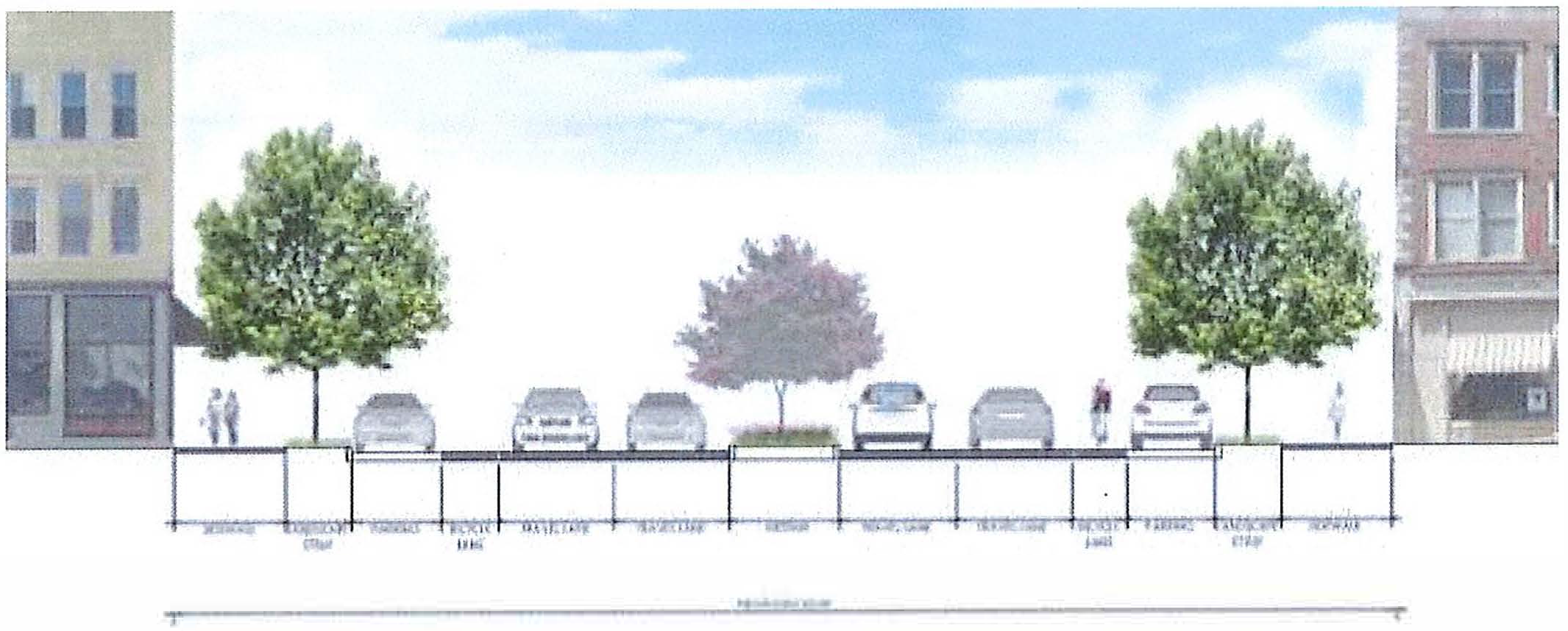
Fig. 3.8 New Minor Collector Streets and Local Streets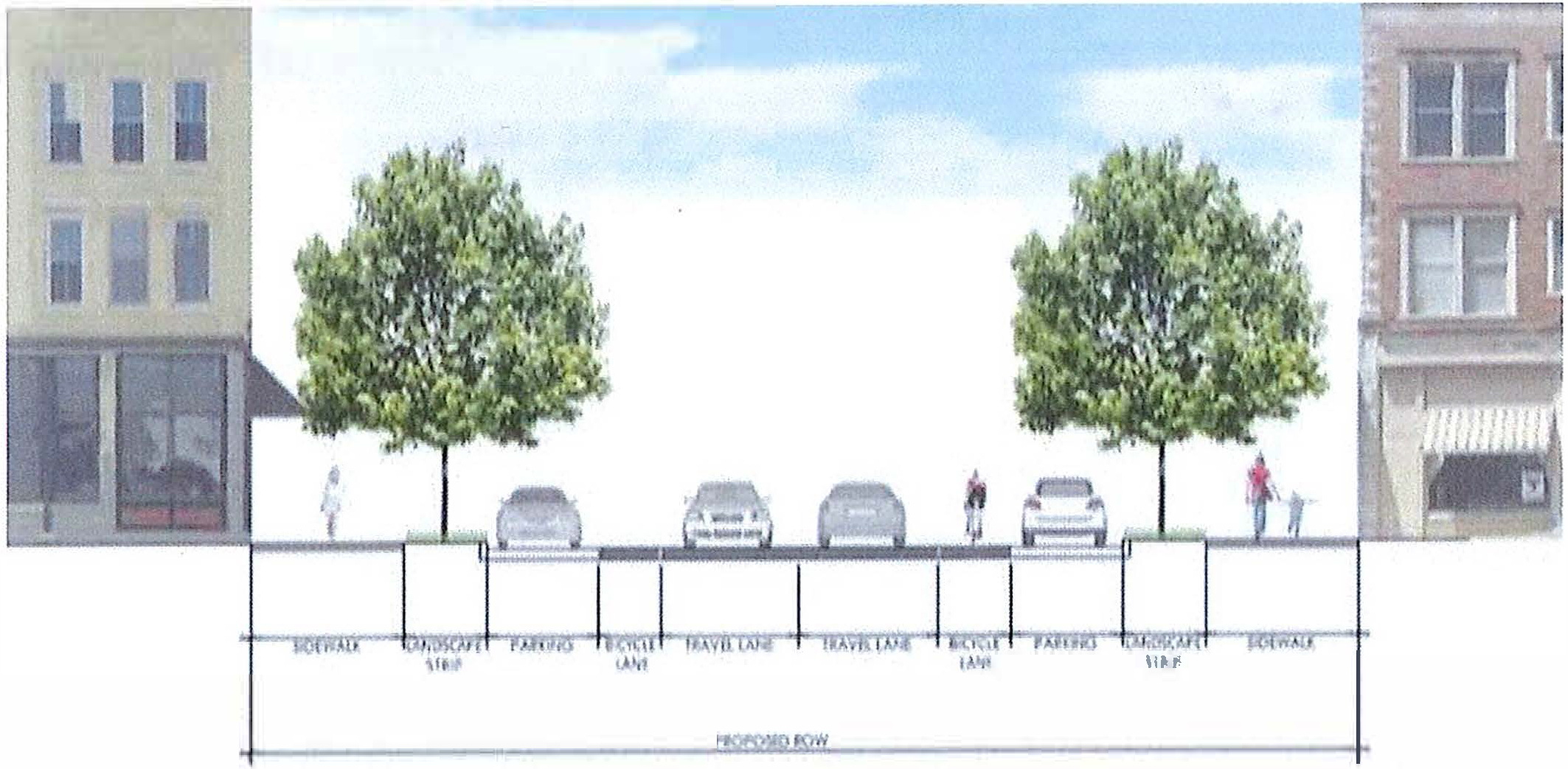
(c)
Streetscape elements and dimension.
(1)
Streetscapes must be installed on existing and new streets as required by section 46-1336 and in conformance with table 3.14, except when subsection (2) or subsection (3) below applies.
(2)
A multi-use trail may be required instead of a sidewalk along any new or existing street when the location has been identified as a multi-use trail in any plan that has been adopted by the City of Tucker or the Georgia Department of Transportation.
(3)
Streetscapes must match any ongoing or completed publicly-funded streetscape designs.
(d)
Landscape strip design.
(1)
Street trees are required and must conform to section 46-1047(d).
(2)
Street trees must have a minimum unpaved planting area of four feet by eight feet. Tree planting areas must provide porous drainage systems that allow for drainage of the planting area. Tree grates are prohibited.
(3)
Street tree species or planting patterns of varied species must be consistent for an entire block length. Similarly-shaped species may be changed on an individual block face due to: limited supply or concerns regarding disease or the health of existing and proposed trees with approval from the community development director and consultation from a certified arborist.
(e)
Sidewalk design.
(1)
Sidewalk paving materials must continue across driveways at the same prevailing grade and cross slope as the adjacent sidewalk area.
(2)
Sidewalks must be broom finished poured-in-place concrete or pavers of brick, concrete, or stone. Other materials may be allowed by approval of the community development director.
(3)
When new sidewalks abut existing sidewalks the new sidewalk must provide safe facilitation of pedestrian traffic flow to adjacent sidewalks. A minimum ten feet long taper must be provided in cases where an existing sidewalk is a different width than the new sidewalk. Any development that disturbs existing sidewalks on an adjacent property must replace disturbed areas to their original state and condition.
(f)
Underground utilities required. All utilities, except major electric transmission lines and sub-stations, must be buried unless the community development director determines that underground utilities are not feasible due to existing physical conditions, such as conflicting underground structures or utilities, shallow rock, high water table, or other similar geologic or hydrologic conditions.
(g)
Street lights and street furnishings.
(1)
Light poles are required and must be spaced at a maximum of 80 feet on-center and of a type identified in section 46-1048.
(2)
Pedestrian lights are required and must be spaced at a maximum of 60 feet on-center and of a type identified in section 46-1048.
(3)
Street and pedestrian lights must alternate.
(4)
Street furnishings may only be placed in the landscape strip or between the sidewalk and the building.
(5)
Street furnishings are required and must be of a type identified in table 3.13, which includes specific products by specific brands. The use of specific products and brands is not required and similar designs may be used.
(6)
Street furnishings must be comfortable, damage and vandalism resistant, and be easy to maintain.
Table [3.14] Note
[1]
This requirement applies to street light poles only. Additional pedestrian light requirements apply.
(Ord. No. O2019-04-15, exh. A(3.3.14), 6-26-2019)
Sec. 46-1045. - Drive-thru facilities.
The following applies in addition to any applicable standards of article IV:
(a)
Drive-thru windows and lanes must be screened by a continuous compact evergreen hedge. At the time of installation, the screening must be at least three feet high and reach a height of four feet within three years of planting.
(b)
In lieu of the compact evergreen hedge, a screening wall with a minimum height of four feet may be installed. The wall must be compatible with the principal building in terms of texture, quality, material, and color.
(Ord. No. O2019-04-15, exh. A(3.3.15), 6-26-2019)
Sec. 46-1046. - Parking.
(a)
Off-street parking ratios.
(1)
NL districts must conform to the off-street parking requirements contained in table 6.2, off street parking ratios, except as indicated in subsections (2) and (3) below.
(2)
Office uses may provide a maximum ratio of six spaces per 1,000 square feet of floor area when at least 50 percent of the total number of provided office parking spaces are located underground (on all sides) and/or are within parking decks having two or more parking levels.
(3)
Residential uses must provide a minimum of one space per dwelling unit and a maximum ratio as identified in table 6.2, off-street parking ratios.
(b)
Shared parking.
(1)
Shared parking is allowed in accordance with section 46-1453 or in accordance with subsections (2) through (5) below.
(2)
Instead using the steps identified in section 46-1453, applicants may submit a shared parking analysis using the Urban Land Institute (ULI) Shared Parking Model (latest edition).
(3)
The study must be provided in a form established by the community development director.
(4)
Reductions in the total number of required spaces for shared parking are not allowed unless the community development director determines a reduction is appropriate on a case-by-case basis through the use of the ULI Shared Parking Model (latest edition).
(5)
Uses using shared parking must have either mutually exclusive or compatibly overlapping normal hours of operation. The community development director will determine whether hours of operation are compatibly overlapping on a case-by-case basis through the use of the ULI Shared Parking Model (latest edition).
(c)
Off-street parking location and design.
(1)
Location. All off-street parking including surface lots and parking decks may only be located behind or beside a street-fronting building, except as allowed for individual townhouse units by section 46-1040(j).
(2)
Parking lot screening. Parking lots must be screened from view of public streets using one of the following:
a.
Shrubs. Plant a minimum of ten shrubs per 35 linear feet of street frontage, excluding driveway openings. Shrubs must be 18 inches tall at the time of planting. They must be planted two rows deep, and provide a screen within three years of planting.
b.
Walls. Install a minimum 30 inches high wall as close to the parking lot as possible. Wall must be opaque and compatible with the principal building material.
(3)
Parking deck screening. Parking decks must provide screening on all stories by providing a facade designed to resemble an office or residential building and conform to the applicable building form and design requirements of section 46-1040.
(4)
Landscape strips. The following applies around parking lots and parking decks:
a.
Adjacent to a street. A landscape strip with a minimum width of six feet is required adjacent to public streets. Evergreen shrubbery at least 18 inches high is required.
b.
Not adjacent to a public or private street. A landscape strip with a minimum width of six feet is required along all sides of the facility that are not adjacent to public or privates streets.
c.
Exceptions. Landscape strips are not required at driveways, walkways, pedestrian plazas, or where adjacent active ground floor uses are provided.
d.
Planting. The landscape strips may contain no less than one understory or over story tree per 50 linear feet, ten shrubs per 50 linear feet, and a minimum of 90 percent living groundcover, sod, and/or annual or perennial color in the landscape strip surface area. Landscaping must conform to section 46-1047.
(5)
Restrictions. No parking area may be used for the sale, repair, dismantling, servicing, or long-term storage of any products, vehicles, or equipment.
(Ord. No. O2019-04-15, exh. A(3.3.16), 6-26-2019)
Sec. 46-1047. - Landscaping.
(a)
Plans required. Landscape planting and irrigation plans must be prepared by a landscape architect registered in the State of Georgia for each application for a land disturbance permit.
(b)
Maintenance. When a private property owner provides landscaping within the public right-of-way and the landscaping dies within one year of installation, it must be replaced within the earliest possible planting season.
(c)
Ground cover.
(1)
Ground cover must be provided around all trees to protect tree roots, to prevent erosion, and as otherwise required by this division.
(2)
Ground cover must consist of evergreen shrubs or groundcover plant material mulched with pine bark mulch or other similar landscaping material.
(3)
Evergreen groundcover planting must be used on all slopes steeper than 2.5:1 to aid in erosion control.
(d)
Trees.
(1)
Newly planted trees must be a minimum of 3.5 inches in caliper measured 12 inches above the ground, must be at least 16 feet high and must have a minimum mature height of 30 feet.
(2)
No tree may be planted closer than 30 inches from the street or sidewalk, and no closer than eight feet from a fire hydrant, signpost, streetlight standard, utility pole, or similar structure.
(e)
Irrigation. All newly planted landscape areas (including parking lot islands) shall be irrigated by a fully automatic, commercial, underground irrigation system in accordance with the following standards:
(1)
All irrigation systems must be provided with backflow preventers approved by DeKalb County. Such devices shall be located or screened so that they are not visible or accessible to the public from adjacent sidewalks, streets, alleys, or parking lots.
(2)
Spray heads must be located to provide 100 percent overlapping coverage. Overspray onto sidewalks and other paved areas should be minimized.
(3)
Control boxes and panels shall be located inside buildings or where they will not be visible or subject to vandalism.
(4)
All main and lateral lines shall be commercial grade PVC pipe.
(5)
Irrigation systems are not required in undisturbed buffers or in areas where they would disrupt existing native vegetation.
(f)
Plant materials. Plant materials required or installed along or adjacent to streets must be selected from the following list of species in the minimum sizes shown. Plant materials provided in other locations may be any species appropriate to the design and location, subject to the approval of the plan reviewer, provided that all trees must be native or adaptive to Tucker.
(1)
Flowering shrubs.
a.
Abelia X Grandiflora, three-gallon;
b.
Jasminum Nudiflorum, three-gallon;
c.
Coreopsis Auriculata, one-gallon;
d.
Narcissus.
(2)
Ground cover.
a.
Liriope Muscari, one-gallon;
b.
Rubus Caleinoides, one-gallon;
(3)
Trees along Lavista Road.
a.
Cercis Canadensis (single-trunk only), two-inch caliper;
b.
Chionanthus Virginicus (single-trunk only), one-and-one-half-inch caliper;
c.
Prunus "Okame", one-and-one-half-inch caliper;
d.
Quercus Shumardii, three-and-one-half-inch caliper.
e.
Lagerstroemia Indica, ten feet high;
(4)
Trees along remaining streets.
a.
Any tree listed in subsection (3) above;
b.
Crape Myrtle, standard trunk;
c.
October Glory Red Maple;
d.
Sunset Maple;
e.
Nuttal Oak (Quercus Nattalli);
f.
Shumard Oak (Quercus Shumardii);
g.
Willow Oak;
h.
Zelkova Serrata;
i.
Ginkgo Biloba (fruitless only);
j.
Trident Maple (Acer Buergeranum);
k.
Allee Laechark Elm (Ulmus Parvifolia Emer II).
(Ord. No. O2019-04-15, exh. A(3.3.17), 6-26-2019)
Sec. 46-1048. - Outdoor lighting.
(a)
Light levels of 1.5 foot-candles are recommended for parking lots and four foot-candles at vehicular drives, entrances, and pedestrian and bicycle facilities.
(b)
Ground-mounted floodlights must be screened with planting or other means so that the light source is not visible.
(c)
The use of flashing, rotating, or oscillating lighting is not allowed in any manner that may be visible from the exterior of buildings.
(d)
After-hours security lighting must equal at least 25 percent of the normal parking lot lighting level for security.
(e)
Outdoor lighting must be of a type identified in table 3.15, which includes specific products. The use of specific products is not required when similar designs from other manufacturers are available.
Fig. 3.9 Parking Lot Light Fixture and Pole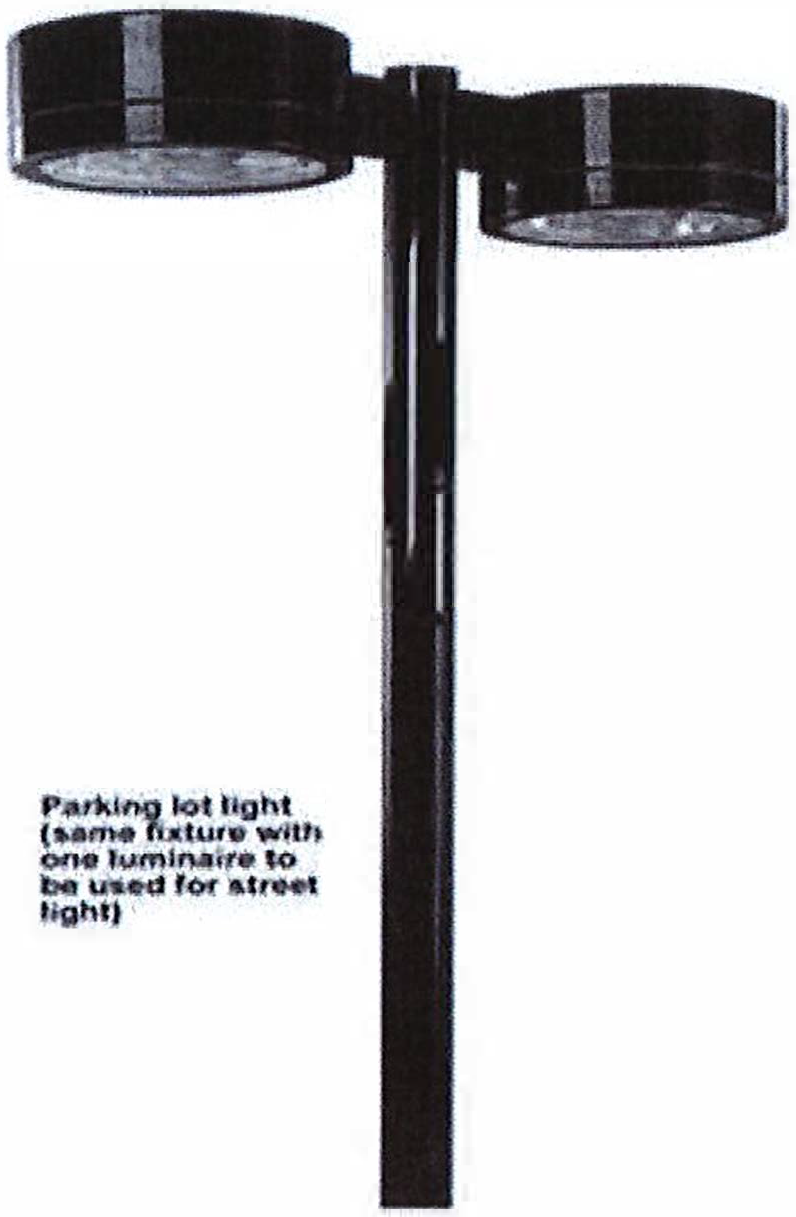
(Ord. No. O2019-04-15, exh. A(3.3.18), 6-26-2019)
Sec. 46-1049. - Administrative variations.
(a)
The community development director may grant administrative variances in addition to those allowed by article VII, division 6 when the variance is used to permit a practice that is not consistent with a specific provision but is justified by the division's purpose and intent.
(b)
Administrative variances may not be used to:
(1)
Provide relief from minimum or maximum parking ratios;
(2)
Increase the allowed site density;
(3)
Increase the allowed number of stories in a building; or
(4)
Permit a use that is not allowed by district regulations.
(Ord. No. O2019-04-15, exh. A(3.3.19), 6-26-2019)
Sec. 46-1050. - NL-PUD standards.
(a)
Minimum standards.
(1)
The area proposed for a NL-PUD zoning district shall be a minimum of 30 contiguous acres. If the 30 acres are divided by an existing public road, the proposed site plan shall incorporate land use planning and design features to connect the separate areas so that they function and appear as one common development.
(2)
Each NL-PUD zoning district and development shall incorporate at least two of the following uses:
a.
Residential multifamily units and/or townhomes;
b.
Commercial offices;
c.
Retail;
d.
Hotel.
(3)
The minimum open space requirements of the underlying zoning district shall be met, and at least one open space area shall be a minimum of one acre and serve as a focal point of the development that includes active uses.
(4)
Any variations to the regulations in division 3 shall be outlined in the Master Development Plan. If the Master Development Plan is silent of any standard in division 3, the main provisions shall prevail.
(5)
Streetscape standards along the right-of-way, including trail standards, cannot be waived as part of the NL-PUD process.
(6)
Due to the mixed-use nature of NL-PUD proposals, designs shall be determined based upon the context and guidance of the comprehensive plan.
(b)
Application requirements. In addition to the application requirements in section 46-1525, the following are required to be submitted when requesting to rezone to NL-PUD.
(1)
Conceptual site plan.
(2)
Master development plan. The Master Development Plan shall serve as a unique code for each NL-PUD development. Regulations should address permitted and prohibited uses, dimensional requirements, building design and materials, parking requirements, pedestrian and vehicular access, building massing, open space and landscaping standards, fencing, and other specific elements as required by the planning and zoning director.
(3)
Phasing plan. Should a NL-PUD development be expected to require five years or longer to complete, a phasing plan shall be provided by the applicant that indicates the timeframe for construction and development of different aspects of the project. The phasing plan shall meet the following standards.
a.
Each phase must maintain or exceed the required percentage of commercial development proposed.
b.
Certificates of Occupancy for any multifamily residential unit may only be issued after the issuance of certificates of occupancy of the required percentage of commercial development associated with the multifamily residential units.
(4)
Architectural pattern book. An architectural pattern book demonstrating approved building forms, materials, features, exterior finishes, windows, doors, colors, and other items. The pattern book shall include conceptual renderings of proposed buildings.
(Ord. No. O2024-02-02, Exh. A, 3-11-2024)
Sec. 46-1071. - Mountain Industrial Boulevard Overlay established.
(a)
This division establishes standards and procedures that apply to any development, use, or redevelopment on any lot or portion thereof which is, in whole or in part, contained within the boundaries of the Mountain Industrial Boulevard Overlay District, hereinafter referred to as the "District."
(b)
The boundaries of the District are as shown on the official overlay district maps.
(Ord. No. O2019-04-15, exh. A(3.4.1), 6-26-2019)
Sec. 46-1072. - Purpose and intent.
The intents of this District are:
(a)
To preserve and enhance the long-term economic viability of the Mountain Industrial Boulevard corridor by encouraging investment that increases the tax base and provides employment opportunities to the citizens of the City of Tucker;
(b)
To improve the visual appearance and increase property values within the corridor;
(c)
To allow flexibility in development standards in order to encourage the design of innovative development projects that set high standards for landscaping, green space, urban design, and public amenities; and
(d)
To promote uniform and visually aesthetic architectural features which serve to unify the distinctive visual quality of the corridor.
(Ord. No. O2019-04-15, exh. A(3.4.2), 6-26-2019)
Sec. 46-1073. - Principal uses and structures.
The uses of land and structures allowed as principal, accessory, or by special permit or special land use permit are as provided by the applicable underlying zoning district regulations, subject to the requirements, limitations, and standards contained within this division, except as follows:
(a)
Special Permits. The following uses and structures require a special land use permit from the mayor and city council.
(1)
Health spa.
(2)
Massage establishment.
(Ord. No. O2019-04-15, exh. A(3.4.3), 6-26-2019)
Sec. 46-1074. - Prohibited uses.
The following principal uses of land are prohibited:
(a)
Storage yard for damaged automobiles or confiscated automobiles;
(b)
Tire retreading and recapping;
(c)
Adult entertainment establishments;
(d)
Adult service facility;
(e)
Late night establishments;
(f)
Extended stay motels;
(g)
Title and pawn shops;
(h)
Salvage yards/junkyards and automobile wrecking yards, not including recovered material or recycling yards;
(i)
Self-service car wash and self-service detailing;
(j)
Temporary and portable sawmills;
(k)
Mines and mining operations, quarries, gravel pits, and sand pits;
(l)
Sewage treatment plants;
(m)
Asphalt plants;
(n)
Fat rendering and fertilizer manufacture;
(o)
Distillation of bones and glue manufacture;
(p)
Parking or storing of trucks and trailers between the hours of 11:00 p.m. to 5:00 a.m., unless such truck or trailer is parked or stored pursuant to an accessory use incidental to the permitted principal use of the land;
(q)
Mobile homes;
(r)
Vape shops; and
(s)
CBD shops.
(Ord. No. O2019-04-15, exh. A(3.4.4), 6-26-2019; Ord. No. O2020-03-07, exh. A, 3-23-2020)
Sec. 46-1075. - Exterior materials.
(a)
Buildings facades must be faced in:
(1)
Brick or brick veneers;
(2)
Stone or stone veneers of natural stone such as granite, limestone, and marble. Terra Cotta and/or cast stone, which simulate natural stone, are also allowed. Painted stone is not allowed;
(3)
Pre-cast concrete or tilt-up panel;
(4)
Painted concrete block, which may only be used on a side or rear facade that does not face a public right-of-way;
(5)
Split-face block/concrete masonry unit;
(6)
Hard coat stucco and synthetic stucco;
(7)
Glass curtain walls;
(8)
Architectural ceramic panels; or
(9)
Metal exterior wall cladding panels but not corrugated metal.
(b)
Architectural accents, if used, must consist of metal, non-reflective glass, glass block, natural stone, pre-cast concrete, brick, or terra cotta. Architectural accents may only cover ten percent of the surface area of each exterior wall. When calculating the ten percent limitation on architectural accents, the surface area covered by a window(s) may not be included in the calculation.
(Ord. No. O2019-04-15, exh. A(3.4.5), 6-26-2019)
Sec. 46-1076. - Outdoor storage of materials, supplies, equipment or vehicles.
(a)
Outdoor storage of materials, supplies, equipment or vehicles is not allowed in a front yard or a corner side yard.
(b)
Outdoor storage of materials, supplies, equipment, or vehicles in a side interior yard or rear yard must conform to the applicable requirements of section 46-1339 and section 46-1182.
(Ord. No. O2019-04-15, exh. A(3.4.6), 6-26-2019)
Sec. 46-1077. - Screening, fences, and walls.
(a)
Screening must meet the requirements of section 46-1339.
(b)
Wire fences are not allowed.
(c)
Chain link fences are not allowed in front or side corner yards.
(d)
Any service bay must be designed so that the openings of service bays are not visible from a public street.
(e)
Loading bays and truck courts must be screened from the public right-of-way.
(f)
Chain-link fences must be galvanized or vinyl coated. Uncoated chain-link is not allowed.
(g)
Fences and walls used to satisfy screening requirements must meet the requirements of section 46-1339 and must be constructed of brick, stone, wrought iron, or aluminum that looks like wrought iron.
(Ord. No. O2019-04-15, exh. A(3.4.7), 6-26-2019; Ord. No. O2020-03-07, exh. A, 3-23-2020)
Sec. 46-1083. - Lawrenceville Highway Zoning Districts established.
(a)
The following "Lawrenceville Highway Zoning Districts" are established:
(1)
LH-1 (Lawrenceville Highway Residential).
(2)
LH-2 (Lawrenceville Highway Neighborhood).
(3)
LH-3 (Lawrenceville Highway Core).
(4)
LH-4 (Lawrenceville Highway Industry).
(b)
References in this zoning ordinance to "Lawrenceville Highway Zoning Districts or "LH" districts are references to these districts.
(Ord. No. O2023-08-13 Exh. A, 9-11-2023)
Sec. 46-1084. - Purpose and intent.
(a)
The intents of all LH districts are:
(1)
To encourage the development of appropriately scaled commercial and service uses along the Lawrenceville Highway corridor;
(2)
To offer a variety of housing types and promote mixed-income residential opportunities;
(3)
To provide a variety of innovative uses that create destinations along the Lawrenceville Highway corridor, while maintaining access to the existing service industries;
(4)
To promote building and site design that improves the community's usage of the corridor, with a focus on improving the pedestrian experience;
(5)
To improve the aesthetics and pedestrian experience of the corridor through streetscape standards and landscape screening;
(6)
To ensure a compatible relationship between building placement, building mass and scale, and street;
(7)
To implement the policies and objectives of the Comprehensive Plan, the Zoning Ordinance, and other official policies and plans within the LH districts.
(b)
LH-1 (Lawrenceville Highway Residential). The intent of the LH-1 district is to preserve existing residential character while allowing a wider variety of housing types for new development.
(c)
LH-2 (Lawrenceville Highway Neighborhood). The intent of the LH-2 district is to create a human-scale built environment that includes a variety of housing types, including cottage homes, townhomes, two-family developments and three-family developments. This tier also permits neighborhood-scale commercial uses that serve the existing and future residents. In this tier, consideration should be given to those more intense uses and how they interact with the existing single-family homes.
(d)
LH-3 (Lawrenceville Highway Core). The intent of the LH-3 district is to allow high density housing options and innovative uses that may be compatible with adaptive reuse. Mixed use development is encouraged where Lawrenceville Highway intersects with Brockett Road to the east and Cooledge Road to the west.
(e)
LH-4 (Industry). The intent of the LH-4 district is to preserve the light industrial uses that serve as economic assets to the community, as well as those services uses that have been historically located along Lawrenceville Highway.
(Ord. No. O2023-08-13, Exh. A, 9-11-2023)
Sec. 46-1085. - Definitions.
Coworking space means a facilitated environment which contains desks or other workspaces and is used by a recognized membership who share the site in order to interact and collaborate with each other as part of a community.
Coworking spaces may host classes or networking events which are open either to the public or to current and prospective members.
Makers Space means a building that supports the development of products and works of art as well as space for hobbyists and inventors. Makers Space can include a workshop with woodworking tools, hand tools, glass studio, large format prints, design studio space, training, exhibition, performance and practice spaces, and similar areas and uses wholly within the building.
(Ord. No. O2023-08-13, Exh. A, 9-11-2023)
Sec. 46-1086. - Use of graphics.
Illustrations, photos, and graphics are included in this division to illustrate the intent and requirements of the text. In the case of a conflict between the text and any illustrations, photos, or graphics, the text governs.
(Ord. No. O2023-08-13, Exh. A, 9-11-2023)
Sec. 46-1087. - Use regulations.
Table 3.16 indicates the permitted uses within LH districts.
(a)
The uses listed in Table 3.16 are only permitted in the district identified, and no use may be established and no structure associated with such use may be erected, structurally altered or enlarged unless the use is permitted as:
(1)
A permitted use (P);
(2)
A special use (SP) subject to the special land use permit application procedures specified in article VII;
(3)
An administratively approved use (SA) subject to the special administrative permit procedures specified in article VII;
(4)
An accessory use (Pa) as regulated by article IV or the applicable LH district. Table 3.16 does not list all accessory uses but clarifies uses acceptable as accessory, though not typically considered principal uses for the zoning classification.
(5)
Uses lawfully established prior to the effective date of this division or this zoning ordinance, as applicable.
(b)
Multiple uses are allowed in a single building and on a single site.
(c)
Any use not listed in Table 3.16 or interpreted to not be allowed by the community development director by section 46-1124 is not allowed. Any applicant denied a permit to allow a use of property in a LH district other than as provided in this section may file an appeal before the zoning board of appeals as provided in article VII.
(d)
Uses subject to additional regulations in article IV, division 2 of this chapter are indicated. Unless otherwise expressly stated, compliance with these regulations is required regardless of whether the use is permitted as-of-right, as an accessory use, by special administrative permit, or by special land use permit.
Table 3.16 Notes:
[1] Only allowed on lots used for a single-family detached dwelling that meet the applicable minimum lot size requirements of article IV, division 2 of this chapter.
[2] Not to exceed 5,000 square feet per use.
[3] Telecommunications antennas must be incorporated in architectural features such as steeples, clock towers, water towers and attached to the top of high-rise buildings subject to the requirements of section 46-1194.
[4] Permitted uses include all office uses, tutorial/educational services, retail, fine arts studios and/or galleries, and photographic studios. The minimum size of the live-work unit is 1,200 square feet with at least one-third of the unit must be designated for residential space.
[5] See Sec. 46-1088(a) for supplemental regulations.
[6] See Sec. 46-1091(k) for building form standards.
(Ord. No. O2023-08-13, Exh. A, 9-11-2023; Ord. No. O2025-06-12, 8-11-2025; Ord. No. O2025-06-13, Exh. A, 8-11-2025)
Sec. 46-1088. - Supplemental use regulations.
(a)
Food truck park.
(1)
Food truck pads and associated facilities may be constructed with alternatives to asphalt and cement as approved by staff if the applicant demonstrates that the site will meet acceptable stormwater management practices and will not accumulate mud or debris on public right-of-way.
(2)
Food truck parks must provide connections to electric utility services.
(3)
Food truck parks must provide restroom facilities that are connected to water and sewer utility services in accordance with this chapter and the State of Georgia.
(4)
Food truck parks must provide one handwashing station, meeting any applicable state standards, per two food trucks or food truck pads.
(5)
Food trucks operating within a food truck park must not operate a generator at the site, except when necessary in the case of an emergency.
(6)
Food truck parks must provide central solid waste disposal areas and recycling facilities, in accordance with applicable standards. Where applicable, food truck parks must have grease interceptors in accordance with applicable regulations.
(7)
Alcoholic beverages. Food truck parks may include the sale or consumption of alcoholic beverages on premises if a license is obtained in accordance with chapter 4 of this Code.
(8)
Accessory activity areas. Site plan must clearly designate all areas that will be used as accessory activity areas. The operation of such areas must comply with all applicable regulations, such as noise regulations.
(9)
Designated agent. Each food truck park must have, and register with the city, a designated agent or team with management responsibility and authority to address and resolve issues of permitting, code compliance, operations, and site maintenance.
(Ord. No. O2023-08-13, Exh. A, 9-11-2023)
Sec. 46-1089. - Dimensional requirements.
Table 3.17 Notes:
[1] Cottage homes shall be developed in clusters of a minimum of four (4) homes to a maximum of fifteen (15) homes.
(Ord. No. O2023-08-13, Exh. A, 9-11-2023)
Sec. 46-1090. - Site design.
(a)
Vehicle access.
(1)
All parking must be accessed via shared alleys, private drives, or inter-parcel access.
(2)
Shared driveways between two parcels along a common property line is encouraged and may be required by the community development director during the land disturbance permitting process. In such cases, each property owner must grant an access easement to facilitate the movement of motor vehicles and pedestrians across the site. The property owner's obligation to comply with this requirement will be limited to the extent of legal permission to construct and utilize the required shared drive can be obtained from the neighboring property owner.
(3)
Driveway curb cuts may not exceed 24 feet in width. When a curb cut includes a median or one left turn lane, neither are included in the curb cut width.
(4)
Driveway curb cut intersection radii may not exceed 30 feet.
(5)
Driveways must be perpendicular to the adjacent street.
(6)
Circular driveways are not allowed.
(b)
Inter-parcel access.
(1)
Applicability. The following applies to all new development, except the construction of detached single-family dwellings, two-family dwelling, and three-family dwellings when no street is proposed.
(2)
Inter-parcel access required. Inter-parcel access for vehicles between abutting and nearby properties must be provided so that access to individual properties can be achieved between abutting and nearby developments as an alternative to forcing all movement onto public roads, unless the community development director during the land disturbance permitting process determines that it is unnecessary to provide inter-parcel access due to the unlikelihood of patrons traveling among abutting or nearby sites, or due to inability after reasonable efforts by the property owner to obtain legal permission.
(c)
Pedestrian access.
(1)
All commercial tenant spaces adjacent to a public street must provide a direct entrance from it, except when a common lobby is provided for office uses. The required pedestrian entrance must provide ingress and egress and must be operable to residents or customers at all times.
(2)
Additional entrances off another street, pedestrian areas, open space, or parking areas are allowed.
(3)
Pathways with a minimum width of five feet must be provided from a public sidewalk to all required pedestrian entrances, parking areas, parking decks, and required open spaces.
(4)
Required pathways must be continuous (except at vehicular crossings) and constructed of concrete, brick, stone, or similar durable paver materials.
(d)
Fences.
(1)
Barbed wire, razor wire, uncoated chain link fence and similar elements are not allowed.
(2)
Chain link fence shall not be permitted in the front or side corner yard.
(3)
Maximum height for fences not used to screen outdoor storage shall be six feet.
(4)
Parcels in the LH-4 District shall be exempt from (2) and (3) above, and may include a maximum fence height of 10 feet if the following requirements are met:
a.
The fence shall be setback 10 feet from the right-of-way;
b.
The 10-foot setback shall be planted with a mix of evergreen shrubs and groundcover plant material;
c.
Plant materials required or installed in the required 10-foot setback must be selected from the species and minimum sizes shown in Table 3.24.
(e)
Open space.
(1)
Open space required. New developments must incorporate open space as required in Table 3.17 and this section.
(2)
Open spaces used to satisfy open space requirements in LH-1, LH-2, and LH-3 districts must conform to enhanced open spaces types established in article V, division 5 of this chapter. Enhanced open space must also be directly accessible from a public sidewalk.
(3)
Amenity open space. Amenity open space may also be used to satisfy open space requirements in LH-1 and LH-2 districts. Amenity open space is small covered or uncovered, unenclosed, outdoor areas. It is limited to at-grade hardscape or landscape areas improved for pedestrian enjoyment; rooftop decks; patios and porches; balconies; or yards, lawns, and gardens. Interior or exterior stairs or elevators may be used to provide access to rooftop decks, patios, porches, and balconies.
(4)
Maintenance. Covenants or other legal arrangements must specify ownership of all open spaces, the method of and responsibility for maintenance, taxes, and insurance, compulsory membership and assessment provisions, and must be incorporated into legal instruments sufficient to ensure that the open space requirements of this section are maintained.
(5)
Landscaping. In addition to the requirements referenced in subsection (e) above, required open spaces must include at least one tree within or directly adjacent to the open space for every 2,000 square feet of open space. The tree must conform to section 46-1097(d).
(6)
Additional requirements for cottage homes:
a.
A minimum of 400 square feet per unit of common open space is required.
b.
At least 50 percent of the cottage units shall abut the common open space.
c.
All of the cottage units shall be located within 100 feet walking distance of the common open space.
d.
The common open space shall have cottages abutting at least two sides.
e.
At least 50 percent of the cottage home units shall be oriented around the common open space with their covered porches or main entry facing the common open space.
(f)
Neighborhood Compatibility.
(1)
LH districts must conform to the transitional buffer requirements in section 46-1338 except as follows:
a.
There is no transitional buffer requirement between lots that are both within a LH district.
b.
When a LH district abuts an RE, RLG, R-100, R-85, R-75, or R-60 district, a buffer class C (50 feet) is required.
c.
When multi-family development within the LH Districts abuts parcels zoned for detached single- family homes, a buffer of (75 feet) is required.
(Ord. No. O2023-08-13, Exh. A, 9-11-2023)
Sec. 46-1091. - Building form and design.
(a)
Applicability. The following applies to all buildings, including parking decks, and is in addition to those building form and configuration standards contained in article V, division 7 of this chapter.
(b)
Exterior materials. Exterior walls of permitted buildings shall consist of a mix of the following materials based on building type. An x indicates a permitted material.
(1)
Exterior finish materials may only be combined horizontally, with the visually heavier material below the lighter material. This does not apply to architectural accents.
(2)
Awnings must be designed to last for at least five years, per manufacturer's warranty.
(3)
Reflective roof finishes are allowed only on roofs sloped less than one inch per foot.
(c)
Active ground floor uses. The ground floor of all new buildings, including parking decks visible from the right- of-way, adjacent to a public street or as required around open spaces, must incorporate the following uses along a minimum of 50 percent of the street-facing or open space-facing facade:
(1)
The space must contain retail, restaurant/food establishment, service uses, or a residential use for a minimum depth of ten feet, except at breaks for pedestrian pathways or parking access.
a.
The minimum floor to ceiling height is ten feet for all uses.
b.
The space's primary use may not be storage, vehicular uses, equipment, coolers, computer servers, or computer/telecommunication exchanges.
c.
The space must conform to fenestration requirements of this section.
d.
Resident-only fitness centers and leasing centers shall not be used to meet this requirement.
(d)
Fenestration.
(1)
Glass standards. Glass used to satisfy fenestration requirements must be unpainted, must have a transparency (visible light transmission) higher than 70 percent, and must have an external reflectance of less than 15 percent. Transparency and external light reflectance must be established using the manufacturer's specifications.
(2)
Measurement. Fenestration is measured from the top of the finished floor to the top of the finished floor above. When there is no floor above, fenestration is measured from the top of the finished floor to the top of the wall plate.
(3)
Minimum standards. All new buildings must conform to the following along public streets or as required along certain open spaces:
a.
Ground floors of all new commercial and mixed-use buildings must provide fenestration for at least 50 percent of the exterior façade area.
b.
Ground floors of all new industrial buildings must provide fenestration for at least 30 percent of the exterior façade area.
c.
All other floors for all new buildings must provide a minimum 20 percent fenestration.
(e)
Building massing.
(1)
Street-facing building facades greater than 150 feet in length must be modulated with breaks in wall surfaces, materials, and rooflines at intervals not to exceed 150 feet (measured parallel to the street).
(2)
Provide no more than 30 linear feet without fenestration or architectural detailing.
(3)
Stories on street-facing building facades must be delineated up to and including the third story through the use of windows, belt courses, cornice lines, or similar architectural detailing.
(4)
Parking decks visible from the right-of-way must comply with subsections (c) and (d) above, except that the number of stories used will be based on standard building story heights, not the actual height of the parking levels.
(f)
Roofs.
(1)
Roof-mounted mechanical equipment and appurtenances must be located or screened so that they are not visible from the ground level.
(2)
Screening must be of a material and design that match the building.
(3)
Rooftop appurtenances must be painted to be compatible with the colors of the roof.
(4)
Roofing materials for sloped roofs must have a minimum 25-year roof life (per manufacturer's warranty) and must have no visible roll roofing.
(g)
Additional two-family dwelling standards.
(1)
Garages
a.
A two-car garage is required for each unit within a two-family dwelling.
b.
Garages shall be setback at least three feet from the facade of the dwelling unit.
(2)
Front porches or stoops shall extend at least five feet past the front façade of the dwelling unit.
(3)
At least one unit shall have a main entrance with a door visible from the street. The main entrance of each unit shall include a covered porch. If one or more units have an entrance facing the street, the entrances of the adjacent units shall be offset from each other by a minimum of four feet.
(4)
Two-family dwelling units shall not be shall not be arranged in two rows oriented perpendicular to the street with ground floor or second floor unit entry doors facing towards an unenclosed passageway or hallway:
c.
If dwelling units are arranged in two rows oriented perpendicular to the street, the primary pedestrian entrances of the ground floor units closest to the street must face the street; and
d.
Any passageway giving access to units located behind the street-facing ground floor units shall be fully enclosed.
(h)
Additional residential standards.
(1)
Mechanical equipment and other building service items may not be located between the public sidewalk and building facade.
(2)
Individual townhouse units and ground floor multi-family units adjacent to a public street must provide a direct pedestrian entrance from it. They must also provide a front porch or a front stoop facing said street.
(3)
Access to parking is only allowed via an alley or private drive located behind the units. Garages may not face a public street.
(4)
Residential structures shall meet the architectural variability standards in section. 46-1417.
(i)
Additional cottage home standards.
(1)
Cottage homes shall be developed in clusters of a minimum of four homes to a maximum of 15 Homes.
(2)
Cottage homes shall have a covered porch at least 60 square feet in size.
(3)
Cottage homes shall meet the dimensional requirements in section 46-1089.
(4)
All units must be detached dwelling units. Units shall not be vertically mixed.
(j)
Additional commercial standards.
(1)
Dumpsters must be screened on three sides by a wall at least eight feet high and on the fourth side by a solid gate at least eight feet high.
(2)
New and improved buildings in the LH-3 district that are within ¼ mile of the City's proposed trail system shall incorporate entrances, windows, outdoor seating, and other active design features so they are accessible from the trail.
(k)
Additional auto use standards.
(1)
Auto repair and sales shall not be permitted on less than three acres.
(2)
New buildings used for auto repair shall utilize those exterior materials permitted for industrial buildings in Table 3.18 and shall meet the fenestration requirements in section 46-1091(d).
(3)
Service bays for automobile service and repair uses must be designed so that the openings of service bays are not visible from a public street.
(4)
Parking shall be located behind the building and will not be permitted between the building and the public street.
(5)
Designated and separate customer and employee parking spaces shall be provided and clearly marked.
(6)
Cars for sale on site shall not be parked in the designated customer and employee parking spaces and shall be subject to parking lot screening requirements in this section.
(7)
No parking area may be used for the sale, repair, dismantling, servicing, or long-term storage of any products, vehicles, or equipment.
(8)
All parking areas shall be landscaped in the following manner:
a.
A minimum of ten percent of the total lot area of the parking lot shall be landscaped.
b.
A continuous hedge or berm, not to exceed three feet in height, shall be required between surface parking and an adjacent public street right-of-way.
c.
Landscape islands.
1.
A minimum of one island per eight parking spaces shall be provided.
2.
One tree shall be planted in each island. Newly planted trees in parking area landscaping shall be a minimum of two-inch caliper as measured at a height of six inches above ground level, shall be a minimum of ten feet in height at planting, shall have a 30-foot minimum mature height, and shall be drought tolerant. Trees shall be planted at least 30 inches from any barrier curb, so as to prevent injury to trees from vehicle bumpers. A minimum of 75 percent of the trees planted pursuant to these requirements shall be deciduous hardwood shade trees.
3.
Ground cover shall also be provided in order to protect tree roots and to prevent erosion. Ground cover shall consist of shrubs, ivy, liriope, pine bark mulch, or other similar landscaping material.
4.
All landscaped areas shall be properly maintained in accordance with landscape plans approved as part of the land-disturbance permit. In the event that a tree or any plant material dies, it shall be replaced within 12 months so as to meet all requirements of this section and to allow for planting in the appropriate planting season.
(l)
Additional multi-family standards.
(1)
When a multi-family development abuts Lawrenceville Highway, the buildings fronting Lawrenceville Highway must provide a mix of uses on the first floor. This can include office, commercial, or retail uses as permitted in Table 3.16.
(Ord. No. O2023-08-13, Exh. A, 9-11-2023)
Sec. 46-1092. - Adaptive reuse projects.
(a)
Applicability.
(1)
To be considered an adaptive reuse project the proposed use shall be retail, restaurant/food establishment, services, co-working space, or makers space and a minimum of 75 percent of the floor area of the entire project shall not consist of new construction or additions. This percentage does not preclude interior alterations within those areas. The retention of a minimum of 75 percent of each previously existing exterior wall is required to include a structure in the previously existing floor area calculation.
(2)
Exclusions. Any buildings or structures not considered to be a part of a defined adaptive reuse project are required to comply with all the regulations of this zoning ordinance and may not follow the flexible provisions of adaptive reuse projects.
(3)
In no case shall any existing characteristics be made more deficient than previously existed prior to the redevelopment.
(b)
Dimensional Standards.
(1)
Applicable standards. The following outlines the regulations that apply to adaptive reuse projects as stated or amended herein.
(2)
The following dimensions of Table 3.19 states the required dimensions for adaptive reuse projects, as opposed to those identified by the zoning district:
1 Or not to exceed existing.
(c)
Site and building standards.
(1)
All developments shall comply with the streetscape requirements as outlined in section 46-1095, with the exception of the landscape strip if the applicant is able to verify that there is not enough room between the existing building and back of curb to accommodate it. To the extent practicable, walkways shall be constructed on the site to tie building entrances and/or pedestrian pathway systems into existing or proposed public sidewalk systems.
(2)
Any new construction or additions shall comply with the building material requirements of Table 3.18. Unaltered portions of the existing structure are exempt from finish material requirements.
(3)
The applicable use regulations of section 1087 and Table 3.16 shall apply.
(4)
Parking shall comply with section 46-1096.
a.
If the minimum number of parking spaces required in section 46-1096 is more than feasible for the site, the existing quantity of spaces shall be maintained, but the configuration may be altered as necessary.
(5)
All new fences shall comply with section 46-1090(d).
(6)
All new dumpsters shall comply with section 46-1091(i).
(7)
All new lighting shall comply with section 46-1098.
(8)
Procedures. Adaptive reuse projects shall comply with article VII of this chapter.
(9)
Signs. All signs shall conform to chapter 34.
(10)
Adaptive reuse projects are exempt from section 46-1093.
(Ord. No. O2023-08-13, Exh. A, 9-11-2023)
Sec. 46-1093. - Redevelopment thresholds.
(a)
Applicability.
(1)
Renovations, alterations, adaptations, additions, restorations, repairs, or other redevelopment of a structure, or portions of a structure or site, that was in existence prior to the adoption of this zoning ordinance, shall be subject to the requirements of this section.
(2)
Redevelopment projects require compliance with standards for new construction in the zoning ordinance when the value of the proposed improvements exceeds the thresholds in Table 3.20.
(3)
Notwithstanding the above applicability, the added cost to construct the improvements shall not exceed 125 percent of the fair market value of the structure immediately prior to such redevelopment, or $20,000.00, whichever is greater. In such cases, the provisions requiring completion shall be applied in the order listed in the table below until the 125 percent cap is met.
(b)
Exemptions.
(1)
This section shall not apply to single-family attached or detached uses or projects developed in accordance with the standards in section 46-1092.
(c)
Method of calculating thresholds.
(1)
Fair market value shall be determined by the DeKalb County Tax Assessor.
(2)
The phrase "construction costs" in this section shall encompass all costs, including phased project costs, for a cumulative period of 36 months after the date of the initial redevelopment application.
(3)
Construction costs shall be calculated based on uses listed in the ICC Building Valuation Data Construction Cost Table (latest published edition).
(Ord. No. O2023-08-13, Exh. A, 9-11-2023)
Sec. 46-1094. - Incentives within the Lawrenceville highway districts.
(a)
Applicability.
(1)
When an applicant agrees to design a site and/or building in a manner that enhances and promotes the overall vision for the Lawrenceville Highway, the City shall grant an incentive based upon Table 3.21.
(Ord. No. O2023-08-13, Exh. A, 9-11-2023)
Sec. 46-1095. - Streets and streetscapes.
(a)
Street design.
(1)
Applicability. Public and private streets must comply with the requirements for public streets found in chapter 22, except as specifically otherwise provided for in this section.
(2)
Travel lane width exception. Eleven feet wide travel lanes are required on all streets except alleys and designated truck routes. Further lane reductions may also be approved by the community development director when the proposed width conforms to the published best practices of American Association of State Highway Transportation Officials (AASHTO) and/or the Institute of Transportation Engineers (ITE).
(3)
Street dimensions. All new or extended public or private streets must conform to Table 3.22, new street dimensions, unless modified by the community development director for the following public purposes:
a.
To provide alternative bicycle facilities;
b.
To provide wider streetscapes;
c.
To provide turn lanes;
d.
To provide traffic calming or pedestrian safety measures;
e.
To serve truck routes; or
f.
To increase lane width and right-of-way along state and federal facilities.
(4)
Medians.
a.
Medians must be designed to provide for safe and convenient crossings for persons with disabilities and must provide refuge for pedestrians at crosswalks.
b.
Medians must be landscaped with trees, shrubbery, landscaping, and other approved groundcover materials.
(5)
Bicycle facilities must be incorporated in conformance with any plan that has been adopted by the City of Tucker or the Georgia Department of Transportation.
(6)
Bicycle lanes may not be less than five feet in width. Gutters may not be counted towards this requirement.
(7)
Multi-use trails may not be less than ten feet in width.
(8)
Bicycle facilities must incorporate signs and pavement markings as required by the latest version of the Manual for Uniform Traffic Control Devices.
(b)
Streetscape elements and dimensions.
(1)
Streetscapes must be installed on existing and new streets as required by section 46-1336 and in conformance with Table 3.23, except when subsection (2) or subsection (3) below applies.
(2)
A multi-use trail may be required instead of a sidewalk along any new or existing street when the location has been identified as a multi-use trail in any plan that has been adopted by the City of Tucker or the Georgia Department of Transportation.
(3)
Streetscapes must match any ongoing or completed publicly-funded streetscape designs.
Table 3.23 Notes:
[1] Benches, trash receptacles, and bike racks may only be placed within the landscape strip.
[2] This requirement applies to street light poles only. Additional pedestrian light requirements apply.
(c)
Landscape strip design.
(1)
Street trees are required and must conform to section 46-1097(d).
(2)
Street trees must have a minimum planting area of four feet by eight feet. Tree-planting areas must provide porous drainage systems that allow for drainage of the planting area.
(3)
Street tree species or planting patterns of varied species must be consistent for an entire block length. Similarly-shaped species may be changed on an individual block face due to: limited supply or concerns regarding disease or the health of existing and proposed trees with approval from the community development director and consultation from a certified arborist.
(d)
Sidewalk design.
(1)
Sidewalk paving materials must continue across driveways at the same prevailing grade and cross slope as the adjacent sidewalk area.
(2)
Sidewalks must be broom finished poured-in-place concrete or pavers of brick, concrete, or stone. Other materials may be allowed by approval of the community development director.
(3)
When new sidewalks abut existing sidewalks the new sidewalks must provide safe facilitation of pedestrian traffic flow to adjacent sidewalks. Any development that disturbs existing sidewalks on the adjacent property must replace disturbed areas to their pre-disturbance state and condition.
(e)
Underground utilities required. All utilities, except major electric transmission lines and sub-stations, must be buried unless the community development director determines that underground utilities are not feasible due to existing physical conditions, such as conflicting underground structures or utilities, shallow rock, high water table, or other similar geologic or hydrologic conditions.
(f)
Street lights and street furnishings.
(1)
Street furnishings are required and must be reviewed and approved by the community development director during the permitting process.
(Ord. No. O2023-08-13, Exh. A, 9-11-2023)
Sec. 46-1096. - Parking.
(a)
Off-street parking ratios.
(1)
LH districts must conform to the off-street parking requirements contained in table 6.2, off street parking ratios unless otherwise reduced in this section.
(2)
Cottage home developments that exceed 650 square feet on main floor shall provide two spaces. Units that do not exceed 650 square feet on main floor: one and one half (1.5) spaces.
(b)
Shared parking.
(1)
Shared parking is encouraged in accordance with section 46-1453 or in accordance with subsections (2) through (5) below.
(2)
Instead of using the steps identified in section 46-1453, applicants may submit a shared parking analysis using the Urban Land Institute (ULI) Shared Parking Model (latest edition).
(3)
The study must be provided in a form established by the community development director.
(4)
Reductions in the total number of required spaces for shared parking are not allowed unless the community development director determines a reduction is appropriate on a case-by-case basis through the use of the ULI Shared Parking Model (latest edition).
(5)
Uses using shared parking must have either mutually exclusive or compatibly overlapping normal hours of operation. The community development director will determine whether hours of operation are compatibly overlapping on a case-by-case basis through the use of the ULI Shared Parking Model (latest edition).
(c)
Off-street parking location and design.
(1)
Location. All off-street parking including surface lots and parking decks may only be located behind a street-fronting building, except as allowed for in this section.
(2)
Parking deck screening. Parking decks visible from the right-of-way must provide screening on all stories by providing a facade designed to resemble an office or residential building and conform to the applicable building form and design requirements of section 46-1091.
(3)
Landscape strips. The following applies around parking lots and parking decks:
a.
Adjacent to a street. A six-foot-wide landscape strip with a minimum of ten shrubs per 35 linear feet, excluding driveway openings, is required. Shrubs must be 18 inches tall at the time of planting.
b.
Not adjacent to a public or private street. A three-foot-wide landscape strip is required along all sides of the facility that are not adjacent to public or privates streets.
c.
Exceptions. Landscape strips are not required at driveways, walkways, pedestrian plazas, or where adjacent active ground floor uses are provided.
d.
Planting. The landscape strips may contain no less than one understory or over story tree per 50 linear feet, ten shrubs per 50 linear feet, and a minimum of 90 percent living groundcover, sod, and/or annual or perennial color in the landscape strip surface area. Landscaping must conform to section 46-1097.
(Ord. No. O2023-08-13, Exh. A, 9-11-2023)
Sec. 46-1097. - Landscaping.
(a)
Plans required. Landscape planting and irrigation plans must be prepared by a landscape architect registered in the State of Georgia for each application for a land disturbance permit.
(b)
Maintenance. When a private property owner provides landscaping within the public right-of-way and the landscaping dies within one year of installation, it must be replaced within the earliest possible planting season.
(c)
Ground cover.
(1)
Ground cover must be provided around all trees to protect tree roots, to prevent erosion, and as otherwise required by this division.
(2)
Ground cover must consist of evergreen shrubs or groundcover plant material mulched with pine bark mulch or other similar landscaping material.
(3)
Evergreen groundcover planting must be used on all slopes steeper than 2.5:1 to aid in erosion control.
(d)
Trees.
(1)
Newly planted trees must be a minimum of 3.5 inches in caliper measured 12 inches above the ground, must be at least 16 feet high, and must have a minimum mature height of 30 feet.
(2)
No tree may be planted closer than 30 inches from the street or sidewalk, and no closer than eight feet from a fire hydrant, signpost, street light, utility pole, or similar structure.
(e)
Irrigation. All newly planted landscape areas (including parking lot islands) shall be irrigated by a fully automatic, commercial, underground irrigation system in accordance with the following:
(1)
All irrigation systems must be provided with backflow preventers approved by DeKalb County. Such devices shall be located or screened so that they are not visible or accessible to the public from adjacent sidewalks, streets, alleys, or parking lots.
(2)
Spray heads must be located to provide 100 percent overlapping coverage. Overspray onto sidewalks and other paved areas should be minimized.
(3)
Control boxes and panels shall be located inside buildings or where they will not be visible or subject to vandalism.
(4)
All main and lateral lines shall be commercial grade PVC pipe.
(5)
Irrigation systems are not required in undisturbed buffers or in areas where they would disrupt existing native vegetation.
(f)
Plant materials. Plant materials required or installed along or adjacent to streets must be selected from the species and minimum sizes shown in Table 3.24. Plant materials provided in other locations may be any species appropriate to the design and location, subject to the approval of the plan reviewer, provided that all trees must be native or adaptive to Tucker.
(Ord. No. O2023-08-13, Exh. A, 9-11-2023)
Sec. 46-1098. - Outdoor lighting.
(a)
Linear lighting around windows, rooflines, doors, signs, or building structures is prohibited. Linear lighting may include, but is not limited to, neon tubes, rope lighting, and other similar lighting devices. Linear lighting devices that form letters or words are considered signs.
(b)
Light levels of 1.5 foot-candles are recommended for parking lots and four foot-candles at vehicular drives, entrances, and pedestrian and bicycle facilities.
(c)
Ground-mounted floodlights must be screened with planting or other means so that the light source is not visible.
(d)
The use of flashing, rotating, or oscillating lighting is not allowed in any manner that may be visible from the exterior of buildings.
(e)
After-hours security lighting must equal at least 25 percent of the normal parking lot lighting level for security.
(f)
Outdoor lighting must be of a type identified in Table 3.25, which includes specific products. The use of specific products is not required when similar designs from other manufacturers are available.
(Ord. No. O2023-08-13, Exh. A, 9-11-2023)
Sec. 46-1099. - Administrative variations.
(a)
The community development director may grant administrative variances in addition to those allowed by article VII, division 6 of this chapter when the variance is used to permit a practice that is not consistent with a specific provision but is justified by the division's purpose and intent.
(b)
Administrative variances may not be used to:
(1)
Provide relief from minimum or maximum parking ratios;
(2)
Increase the allowed site density;
(3)
Increase the allowed number of stories in a building; or
(4)
Permit a use that is not allowed by district regulations.
(Ord. No. O2023-08-13, Exh. A, 9-11-2023)

