
Tupelo City Zoning Code
CHAPTER 5
- OVERLAY DISTRICTS This content was amended in this version of the code. amended
5.6. - Park Hill Business Overlay District.[1]
Editor's note—Ord. of 10-4-2022(21), repealed the former §§ 5.6—5.6.4; Ord. of 10-4-2022(22), § 2, enacted a new §§ 5.6—5.6.4 as set out herein. The former §§ 5.6—5.6.4 pertained to Sharon Hills Neighborhood Conservation Overlay District.
5.7. - Mill Village Historic Preservation Conservation.[2]
Editor's note—Ord. of 10-4-2022(23), repealed the former §§ 5.7—5.7.4; Ord. of 10-4-2022(24), § 2, enacted a new §§ 5.7—5.7.4 as set out herein. The former §§ 5.7—5.7.4 pertained to Bel Air Neighborhood Conservation Overlay District.
5.11. - Belledeer Neighborhood Conservation District.[4]
Editor's note—Ord. of 12-20-2022(1), § 2, repealed the former §§ 5.11.1—5.11.4, and enacted a new §§ 5.11.1—5.11.6 as set out herein. The former §§ 5.11.1—5.11.4 pertained to similar subject matter.
5.1.1. - Purpose.
The City of Tupelo has provided for the adoption of overlay districts to establish alternative land development requirements within specific areas of our community. Each overlay district is superimposed over the base zoning district. It consists of a physical area with mapped boundaries and written text spelling out standards that are in addition to those of the base zoning district.
5.1.2. - Designation of districts.
Districts may be adopted by the City Council under procedures for development code amendments, Section 12.7, based on recommendations of the Director of Development Services and Planning Committee and adherence to the following standards for establishment.
(Ord. of 10-4-2022(4), § 3)
5.1.2.1. - Establishment of an Overlay District.
(1)
A Neighborhood Association or, other current property owners/and or residents may, on behalf of a neighborhood or other geographically designated area submit the following to the Department of Development Services for initial review and subsequent Planning Committee and City Council consideration for recognition as an Overlay District with all the benefits and privileges therein:
a.
Written request for establishment of Overlay District.
b.
Geographical boundary map designating street boundaries of proposed Overlay District for which the area internal to such boundaries would be subject to design review and approval by the Overlay District's Design Review Committee and the Overlay District's standards of approved design guidelines
c.
Design Review Guidelines and Standards for Development
d.
Design Review Committee Bylaws of proposed Overlay District.
(Ord. of 10-4-2022(4), § 4)
5.1.3. - Applicability.
The provisions of an Overlay District shall apply to the development of all land therein whether publicly or privately held.
5.1.4. - Design Review Committee.
A Design Review Committee, and associated Bylaws, shall be presented to the Department of Development Services to govern the oversight of alternative land development requirements of the approved Overlay District according to procedures and standards set forth as follows:
(Ord. of 10-4-2022(4), § 5)
Editor's note— Ord. of 10-4-2022(4), § 5, renumbered the former § 5.1.4 as § 5.1.5 and enacted a new § 5.1.4 as set out herein.
5.1.4.1. - Design Review Committee Bylaws.
The Design Review Committee shall be governed by Bylaws submitted to the Department of Development Services that include the following as set forth in this Section: Guidelines governing the performance and procedures of the Design Review Committee will include:
(1)
Elections and Membership of Electors - Election procedures for leadership roles internal to the Design Review Committee.
a.
Committee shall include a minimum of five voting members, maximum 11 voting members. Membership may include residents, property owners, or design professionals.
b.
The proposed appointment of Design Review Committee members may occur in one or more of the following ways, as established by Overlay District's Design Review Committee Bylaws, and shall require subsequent confirmation by the Mayor and City Council:
i.
Election by impacted Neighborhood Association's membership;
ii.
Appointment by City Councilperson for Ward in which the Overlay District resides;
iii.
Mayoral appointment.
c.
Termination of Member. A committee member shall be removed from membership in the Design Review Committee in the case of:
i.
Death, resignation or incapacity;
ii.
Failure to respond within one week of receiving review plans for committee vote three consecutive times;
iii.
In the case of findings of impropriety or criminal behavior, the Design Review Committee may request termination of a member by submitting written request to the Department of Development Services for subsequent review and decision by the Planning Committee;
iv.
Termination of a Design Review Committee member, as determined by this Code, in an Overlay District including election by a Neighborhood Association must be approved by the voting membership of the Neighborhood Association prior to Planning Committee consideration.
d.
Design Review Committee Leadership Roles. Leadership roles shall be determined by internal committee vote as established in Design Review Committee Bylaws. Internal voting of Design Review Committee leadership roles must be conducted on an annual basis within the month of October. Updated membership shall be returned to the Department of Development Services by November 1st of each year.
The following leadership roles must be filled by voting members of a Design Review Committee:
i.
Chairperson - Responsible for communication with the Department of Development Services and, when necessary, communication with the applicant and is responsible for the Committee's adherence to established bylaws and Overlay Design Review Committee procedures as determined by this Code;
ii.
Vice Chairperson - Serves in lieu of and in collaboration with the Chairperson when necessary;
iii.
Secretary - Documents committee review processes related to each permit application for Design Committee Review.
(2)
Methods governing amendment to Overlay District Bylaws and Design Review Standards and Guidelines.
(Ord. of 10-4-2022(4), § 5)
5.1.4.2. - Design Review Standards and Guidelines for Development.
Design Review Standards and Guidelines for Development shall include, in detail, measurable and precise standards, in addition to base zoning standards, for determining approval or disapproval of all proposed development in the proposed Overlay District subject to permitting by the City of Tupelo and governed by the following procedures:
a.
Each approved Overlay District shall have established and publicly available design standards and guidelines establishing clear and measurable review processes for land development standards in addition to those of the base zoning district which are approved according to Section 12.7 of this Code. Base zoning district standards shall apply where additional requirements as set forth in this Chapter are not specified.
b.
Procedures for voting on approval of permit applications, whether by digital, in person, or other means, shall be conducted according to procedures established within the Design Review Committee's Bylaws.
c.
The Department of Development Services shall submit the permit application packet and Overlay Permit request to the Chairperson of the Design Review Committee within three days of receiving a completed permit application packet, including a description of characteristics of the neighborhood in the immediate vicinity of the subject property
d.
Response from the Design Review Committee shall be submitted to the Department of Development Services via Overlay Permit completion by the Chairperson within ten days of receiving the application from the Department of Development Services. Lack of response will result in a permitting decision by the Department of Development Services.
Appeals. Decisions of the design review committee may be appealed to the Planning Committee. Decisions of the Planning Committee may be appealed to the City Council.
(Ord. of 10-4-2022(4), § 5)
5.1.5. - Standards conflict.
In case of conflicts between the standards of an Overlay District and standards of the underlying base district, other requirements of the Development Code or other rules, regulations, covenants and agreements applicable, the standard of the Overlay District shall prevail.
(Ord. of 10-4-2022(4), § 5)
Editor's note— Ord. of 10-4-2022(4), § 5, renumbered the former § 5.1.4 as § 5.1.5 and enacted a new § 5.1.4 as set out herein.
5.1.6. - Relationship to subdivision regulations.
The character of proposed development within an Overlay District may require that standards for lot size, shape and frontage be subject to modification from standards established in adopted subdivision regulations. An application for a final development plan for a site within an Overlay District shall be deemed to be an application for preliminary subdivision approval, with no separate filing required.
(Ord. of 10-4-2022(4), § 6)
Editor's note— Ord. of 10-4-2022(4), § 6, renumbered the former § 5.1.5 as § 5.1.6 and enacted a new § 5.1.5 as set out herein.
5.2.1. - Primary use.
(1)
Within an Overlay District, no buildings, structure, land or premises shall be used and no buildings or structure shall be hereafter erected, constructed, reconstructed or moved, unless the use shall be one or more of the uses permitted listed within each Overlay District. Uses are permitted by right or with conditions. There are two types of conditional uses. A "compatible use," indicated on the table by the symbol C, may be approved by the Development Services Director in accordance with the terms of this Code. A "flexible use," indicated by the symbol F, may be approved by the Planning Committee in accordance with the terms of this Code.
(2)
No permit for new construction or external renovation shall be issued for any residential property within a Overlay District without approval of the Design Review Committee. See Section 5.1.4.2(d).
(3)
Applications for construction or renovation within an Overlay District shall be accompanied by complete drawings of the proposed work, including a site plan, floor plan, full elevation drawings, and exterior materials list.
(Ord. of 10-4-2022(4), § 7)
5.2.2. - Accessory use.
Accessory uses pursuant to Chapter 7 are permitted in an Overlay District subject to compliance with all other applicable standards of the Development Code.
5.2.3. - Tree protection.
No protected tree, shall be removed from any Overlay District without tree protection and mitigation procedures adherent to Section 9.11, exempting the following "Each removed tree shall be replaced with a new tree(s) having a total tree caliper equivalent to that of the removed tree" from Section 9.11.7(1) and replacing with "Each removed tree shall be replaced with a new tree(s) in the same species and number of a removed tree".
(Ord. of 10-4-2022(4), § 8)
5.3.1. - Purpose and intent.
The City hereby establishes a Mixed Use Downtown Overlay District, or District, for the general purpose of implementing the Tupelo 2025 Comprehensive Plan, hereinafter referred to as the Comprehensive Plan.
The Mixed Use Downtown Overlay District is further established for the following specific purposes:
(1)
Attract economic development and employment opportunities that are supportive of and compatible with the existing character of the area within the Mixed Use Downtown Overlay District and those private and public uses contemplated within the Downtown Tupelo Master Plan;
(2)
Enhance the visual image of the Mixed Use Downtown Overlay District which is associated with a major gateway to Tupelo, by:
(a)
Ensuring the architectural compatibility of new and existing buildings and structures;
(b)
Reducing visual clutter related to signs, utilities transmission lines, unkept facades of buildings and structures, storage of materials and visibility of parked vehicles;
(c)
Providing and maintaining landscaping and associated furnishings along streets, at buildings and structures and in vehicular parking areas; and,
(d)
Protecting visual vistas identified in the Downtown Tupelo Master Plan;
(3)
Protect and provide for specific sites for development and redevelopment as identified in the Downtown Tupelo Master Plan;
(4)
Prohibit land uses that have adverse impacts on the Mixed Use Downtown Overlay District and, through their incompatibility with proposed uses identified in the Downtown Tupelo Master Plan, deter new development;
(5)
Encourage the preservation of buildings and structures with significant historical or architectural character and prohibit the removal or major alteration of any building or structure without permit approval by the City;
(6)
Divide the Mixed Use Downtown Overlay District into sub-districts to implement the purposes cited herein; and,
(7)
Amend the specific uses of the existing base zoning within the Mixed Use Downtown Overlay District to comply with those permitted uses identified in the Downtown Tupelo Master Plan.
5.3.2. - Base zoning district.
The base zoning of the area included within the Mixed Use Downtown Overlay District is Mixed Use Downtown (MUD).
5.3.3. - Sub-districts.
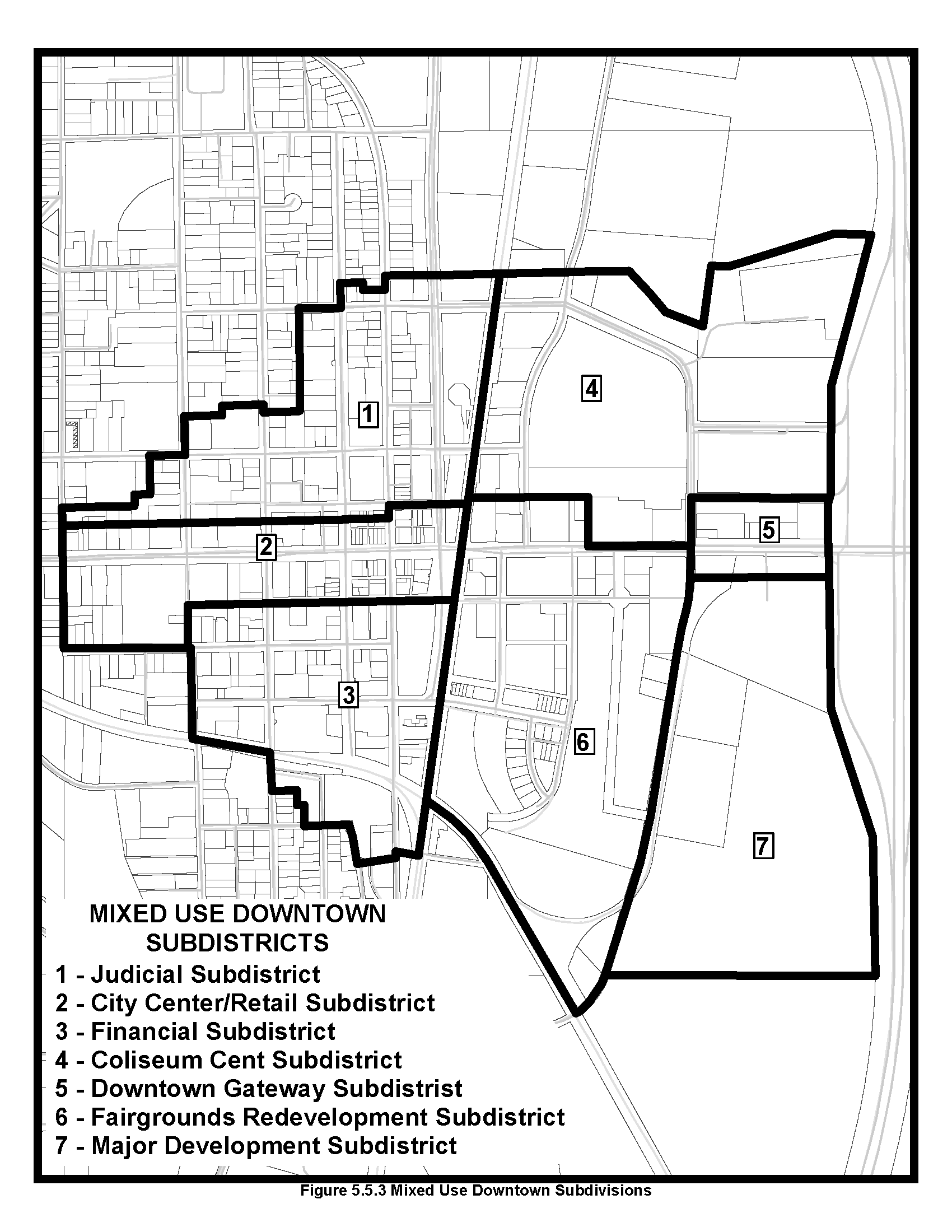
The Mixed Use Downtown Overlay District includes the following Sub-districts:
(1)
Judicial Sub-district: Concentrated development of government facilities, professional offices, and housing facilities with growth oriented toward continued professional service operations and lodging establishments with a limited degree of retail services;
(2)
City Center Retail Sub-district: Major daytime and evening pedestrian circulation route intended to draw retail, restaurant, and entertainment clustering and upper story residential development to gain additional pedestrian activity alongside artistically and historically significant structures and communities;
(3)
Financial Sub-district: Concentrated financial and professional services;
(4)
Coliseum Sub-district: Development around the coliseum complex to support pedestrian connection to tourism resources, event spaces, and unique professional services, convenience, lodging, educational establishments;
(5)
Gateway East Sub-district: Pedestrian oriented gateway following the Birthplace Trail from the Elvis Presley Birthplace and Veterans Park through vibrant outdoor recreational resources, professional services, retail, and dining to the downtown center;
(6)
Gateway West Sub-district: Entry corridor from historic Crosstown to the downtown center supporting diverse social experiences, support services, and retail establishments;
(7)
Fairground Redevelopment Sub-district: Redevelopment district providing unique single family and upper story residential opportunities alongside government, professional, retail, restaurant, and pedestrian centric services;
(8)
Major Development Sub-district: Transitional buffer area around public works utilities, existing light manufacturing, and flood prone areas for agricultural and passive recreational use.
* Location of each Sub-district is delineated in Figure 5.3.3, MUD Overlay and Sub-district Map.
(Ord. of 10-4-2022(5), § 3)
Editor's note— Ord. of 10-4-2022(5), § 3, set out provisions intended for use as § 5.3.3.1. For purposes of classification, and at the editor's discretion, these provisions have been included as § 5.3.3.
Figure 5.3.3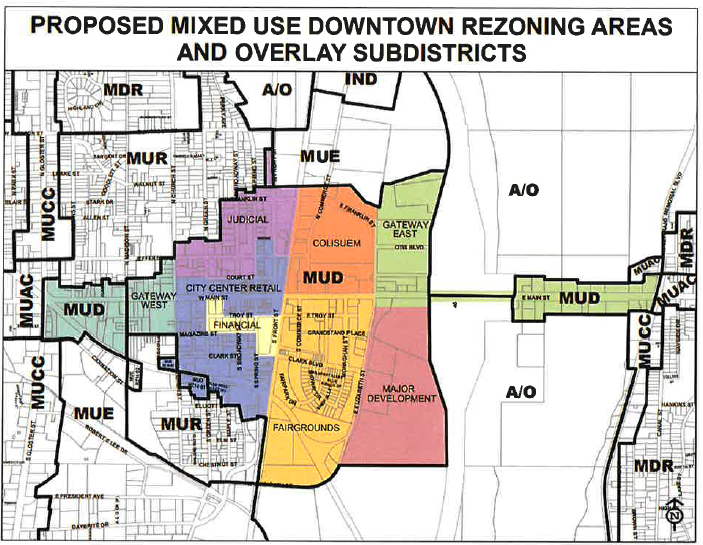
(Ord. of 10-4-2022(6), § 6)
Figure 5.3.3.1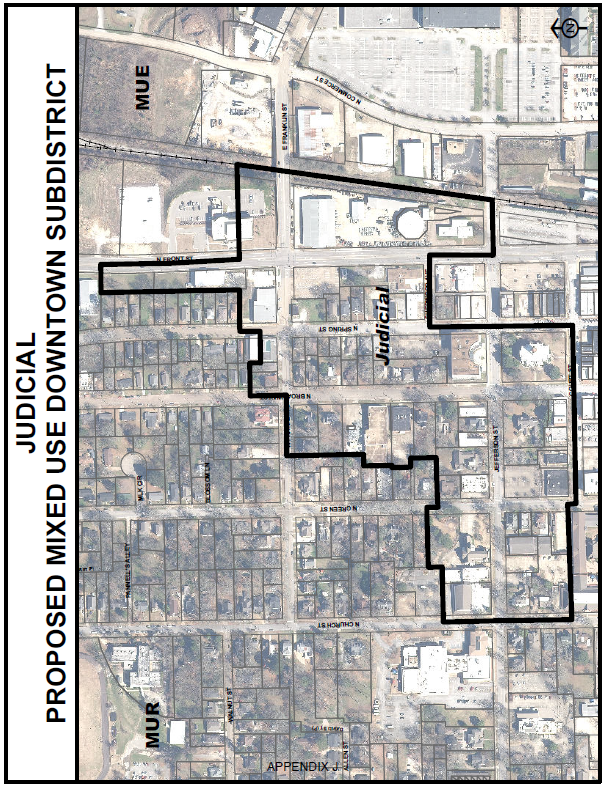
(Ord. of 10-4-2022(8), § 6(Exh. A))
Figure 5.3.3.2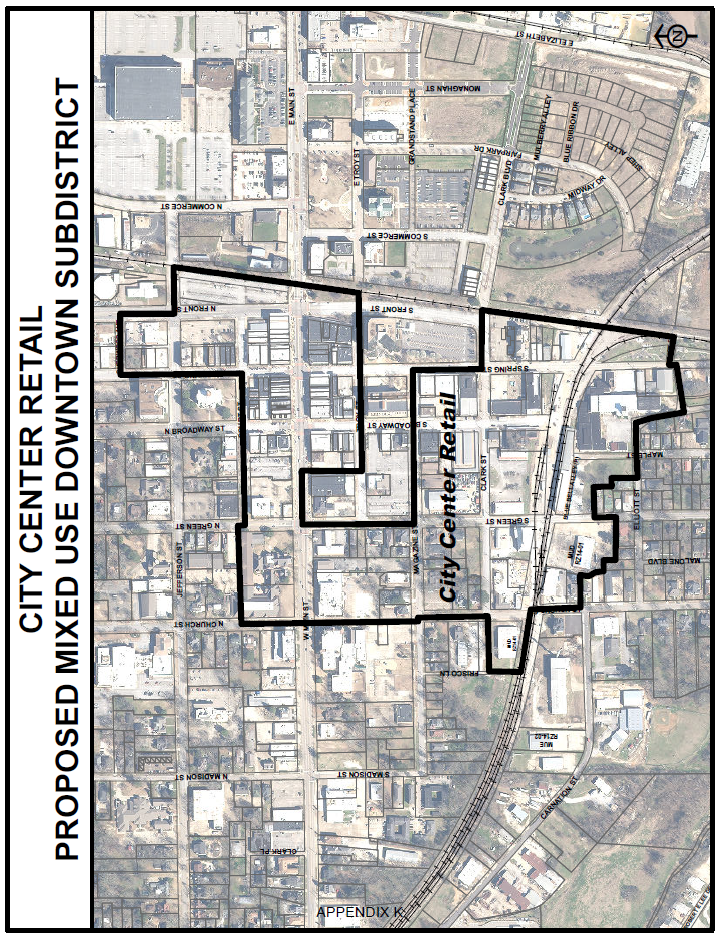
(Ord. of 10-4-2022(9), § 6(Exh. A))
Figure 5.3.3.3.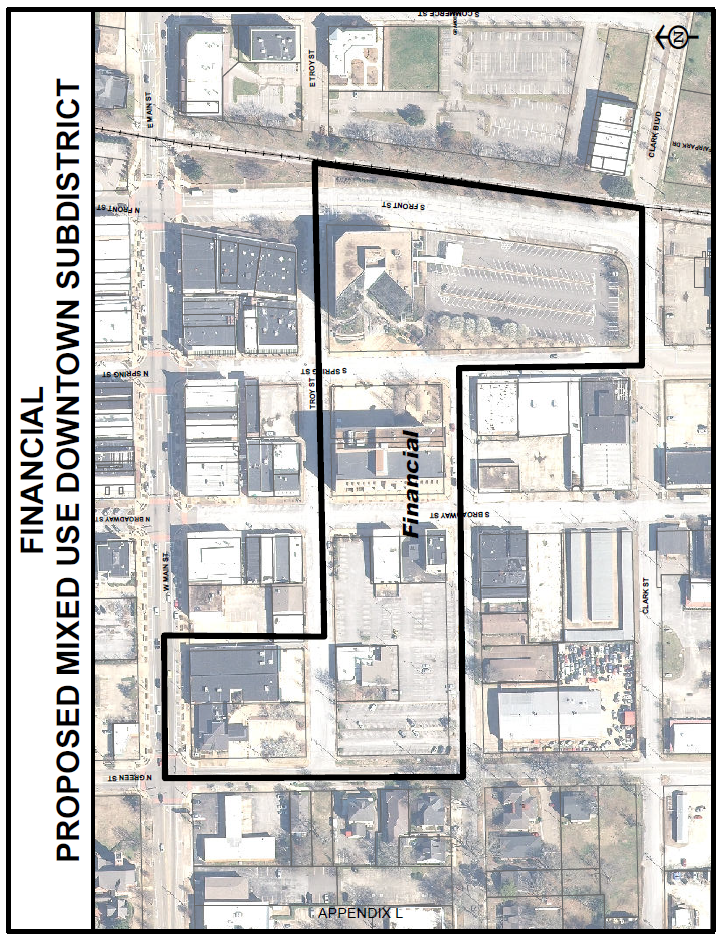
(Ord. of 10-4-2022(10), § 6(Exh. A))
Figure 5.3.3.4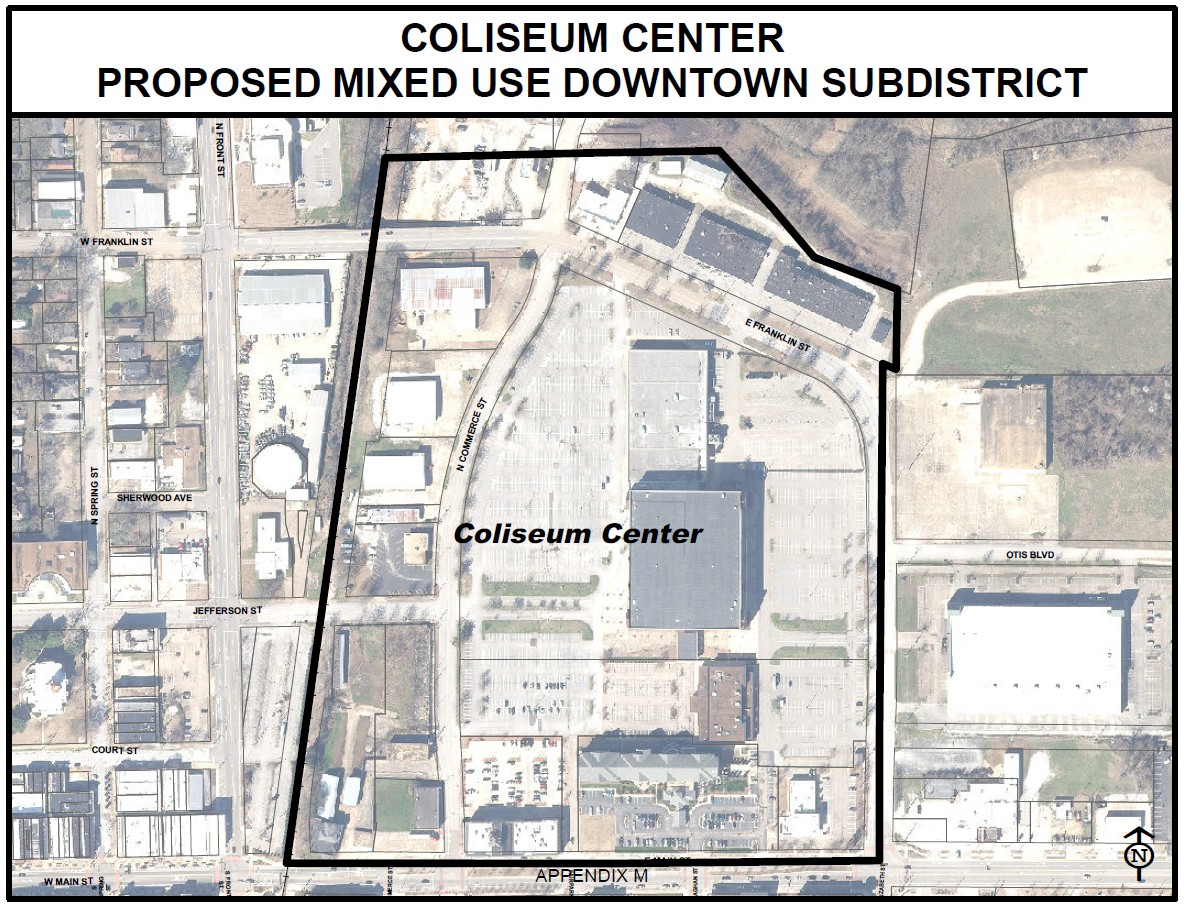
(Ord. of 10-4-2022(11), § 6(Exh. A))
Figure 5.3.3.5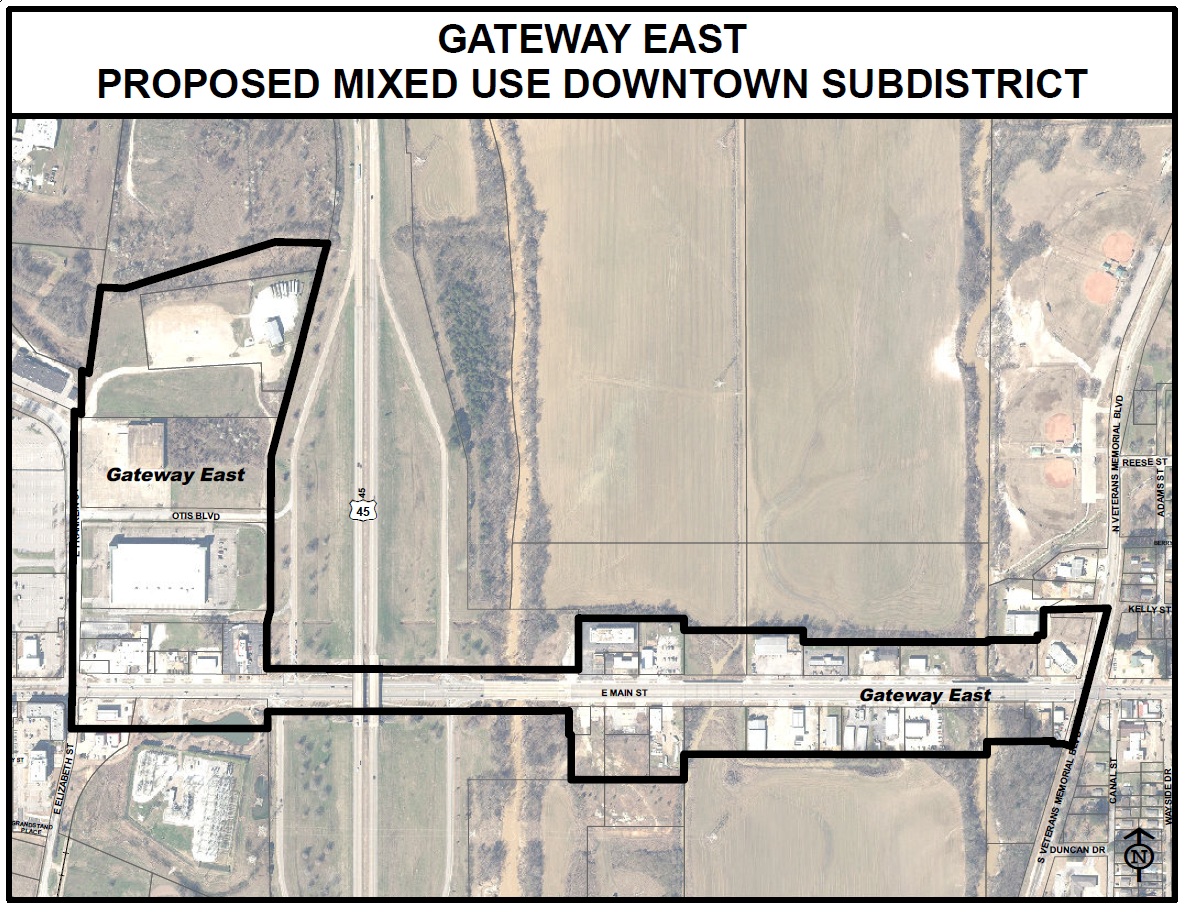
(Ord. of 10-4-2022(12), § 6(Exh. A))
Figure 5.3.3.6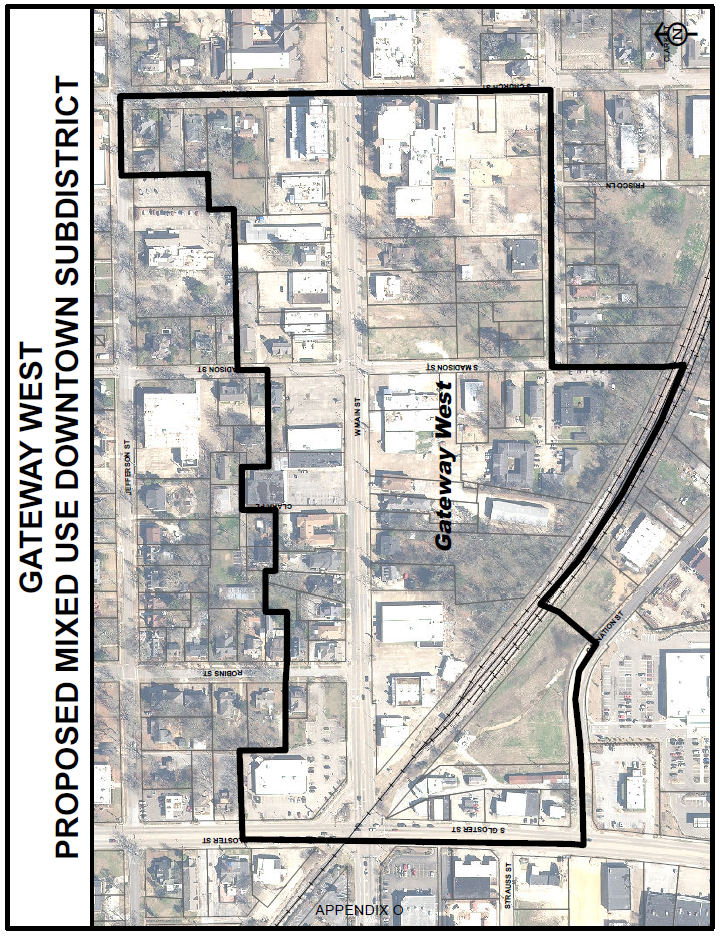
(Ord. of 10-4-2022(13), § 6(Exh. A))
Figure 5.3.3.7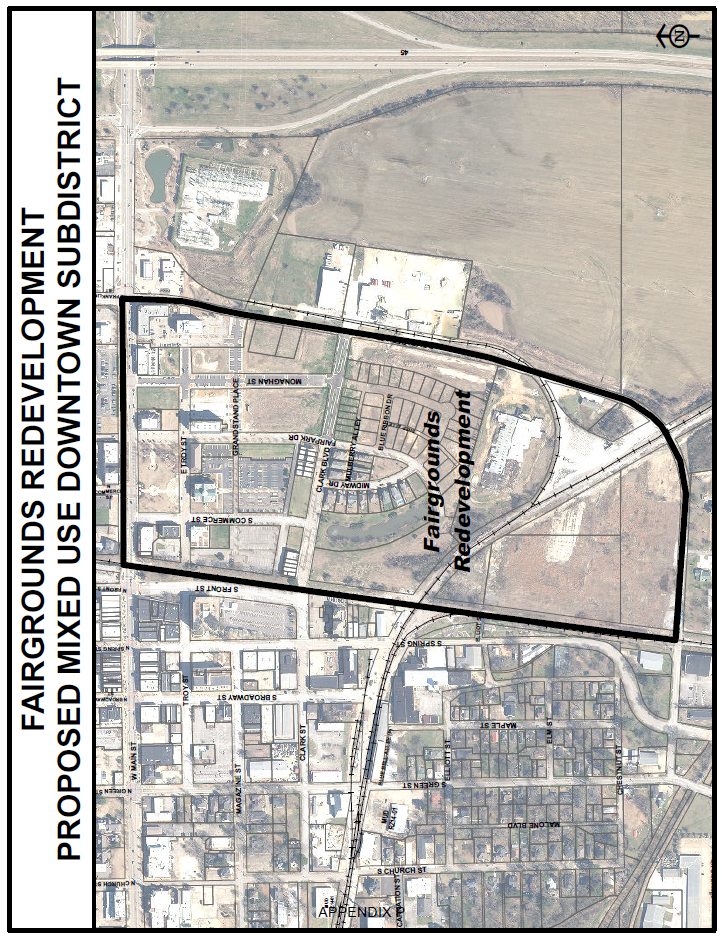
(Ord. of 10-4-2022(14), § 6(Exh. A))
Figure 5.3.3.8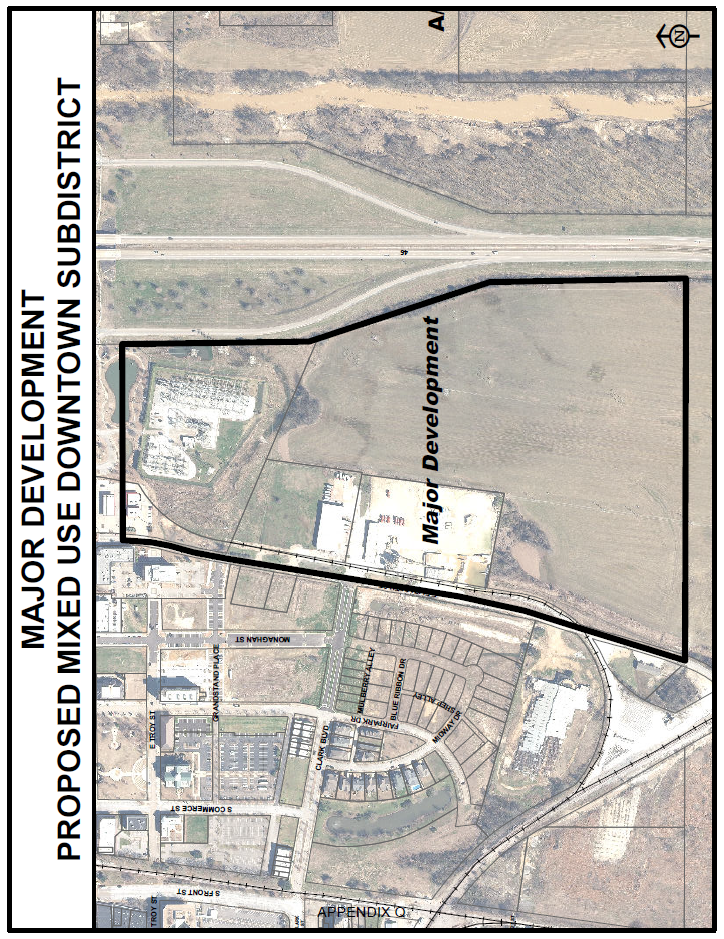
(Ord. of 10-4-2022(15), § 6(Exh. A))
5.3.4. - Use regulations.
(1)
Primary Use: Within the Mixed Use Downtown Overlay District, no buildings, structure, land or premises shall be used and no buildings or structure shall be hereafter erected, constructed, reconstructed or moved, except for one or more of the uses in Table 5.3.4.
(2)
Use Types: Three types of uses are provided for in Chapters 4 and 12 of the Development Code: Uses by right may be approved by Development Services staff. Compatible uses as identified in Table 5.3.4. may be approved by the Director of Development Services Department or designee in accordance with the terms of Chapter 12, Section 12. Flexible uses as identified on Table 5.3.4 may be approved by the City Council after recommendation by the Planning Committee in accordance with the terms of Chapter 12, Section 12.
(3)
Accessory Use: Accessory uses pursuant to Chapter 7 are permitted in the Mixed Use Downtown Overlay District subject to compliance with the Height and Area Regulations and the Design Standards of the Chapter and other applicable requirements of the Development Code.
Table 5.3.4.3(1) ALLOWED USES, RESIDENTIAL USES IN THE MIXED USE DOWNTOWN DISTRICT
(Ord. of 10-4-2022(16), § 6)
Table 5.3.4.3(2) - ALLOWED USES, NON-RESIDENTIAL USES IN THE (MUD) MIXED USE DOWNTOWN OVERLAY
*
Allowed by Right if establishment closes after 5:00 p.m. and is located on the first
floor, OR is located on the first floor of a development, AND is not located in a
parcel where use is by Compatibility per Section 5.3.4.
+ Allowed if part of a Multi-Occupant Non-residential development, allowed by flexibility
if standard not met.
(Ord. of 6-19-2018(1), § 2; Ord. of 4-5-2022(1), § 3; Ord. of 10-4-2022(17), § 6)
5.3.4.1. - Allowed Use Standards, Mixed Use Downtown Zoning District.
(1)
Primary Use: Within the Mixed Use Downtown Overlay District, no buildings, structure, land or premises shall be used and no buildings or structure shall be hereafter erected, constructed, reconstructed or moved, except for one or more of the uses in Table 5.3.4.
(2)
Use Types: Three types of uses are provided for in Chapters 4 and 12 of the Development Code: Uses by right may be approved by Development Services staff. Compatible uses as identified in Table 5.3.4. may be approved by the Director of Development Services Department or designee in accordance with the terms of Chapter 12, Section 12. Flexible uses as identified on Table 5.3.4 may be approved by the City Council after recommendation by the Planning Committee in accordance with the terms of Chapter 12, Section 12.
(3)
Accessory Use: Accessory uses pursuant to Chapter 7 are permitted in the Mixed Use Downtown Overlay District subject to compliance with the Height and Area Regulations and the Design Standards of the Chapter and other applicable requirements of the Development Code.
(4)
Structures fronting the following streets in which the proposed use includes an establishment closing at or before 5:00 p.m. shall be Use by Compatibility. See Figure 5.3.4 below.
a.
Main Street, bounded by Veterans Boulevard on the East and Gloster Street on the West
b.
Spring Street, bounded by Troy Street on the South and Sherwood Avenue on the North
c.
North Broadway Street, bounded by Troy Street on the South and Court Street on the North Green Street, bounded by Court Street on the North and Troy Street on the South.
(5)
Parking Garages shall require first floor retail, restaurant, office, or other non-parking uses. Uses not conforming to this standard shall be use by flexibility.
(6)
Off-street parking shall be located in the rear throughout the Mixed Use Downtown Overlay District. Uses not conforming to this standard shall be determined by Compatible Use.
(Ord. of 10-4-2022(7), § 6)
5.3.4.2. - Allowed Use Standards, Sub-Districts.
(1)
Allowed Uses in the City Center Retail Sub-district shall conform to the following standards:
a.
Approved infill development shall be permitted only for the following allowed uses: event center, park and/or open space,
b.
Revenue producing establishments, with preference for establishments open after 5:00 p.m., are required on the first floor of all City Center Retail Sub-district structures.
c.
Landscaping shall make up 25 percent of square feet between the front point of the structure and the Right-of-Way or public easement.
(2)
Allowed Uses in the Coliseum Sub-district shall conform to the following standards:
a.
Revenue producing establishments, with preference for establishments open after 5:00 p.m., are required on the first floor of all approved uses along Commerce Street.
b.
Allowed uses North of Franklin Street shall be by Compatibility if proposed use remains open after 5:00 p.m.
c.
Off street parking requirements shall not be exempt in the Coliseum Sub-district except where shared parking and operating hours coincide to provide for required parking as evidenced by a development plan and shared parking plan with an adjacent property not divided by a street.
(3)
Allowed Uses in the Gateway East Sub-district shall act as a transition from the Mixed Use Downtown core to the Elvis Presley Birthplace through the use of Mid-Century Modern design architectural elements.
(Ord. of 10-4-2022(7), § 7)
Figure 5.3.4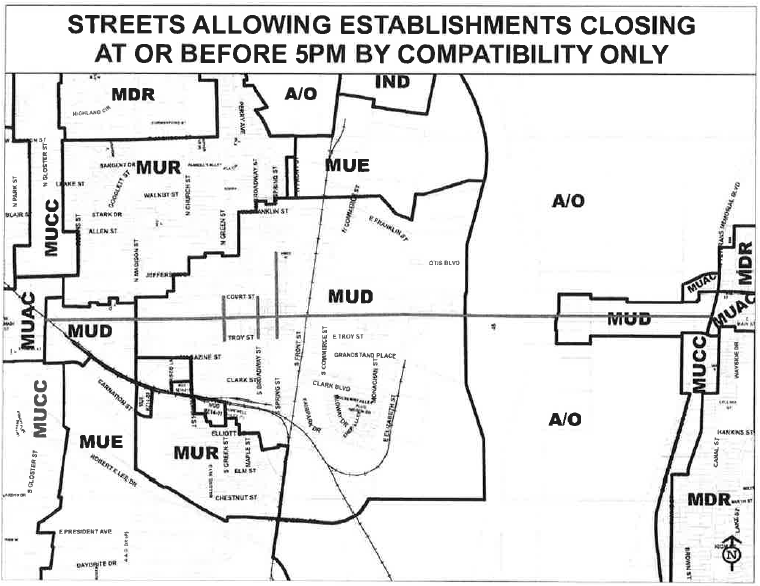
(Ord. of 10-4-2022(7), § 8)
5.3.4.4. - Compatible Uses.
(1)
Compatibility shall be determined by adherence to six of the eight following standards, as demonstrated by the applicant.
a.
Demonstrated cost prohibition of changing an existing use that is not disallowed by Section 5.3.4.
b.
Demonstrated revenue potential.
c.
At least 75 percent of adjacent property is like use or comparable.
d.
Demonstrated draw to tourism and/or pedestrian traffic.
e.
Servicing of customers for family oriented activities or services.
f.
Design compatibility as defined by Chapter 2 of this Code.
g.
Amenity contribution by the applicant to the walkability, aesthetic, or other quality of life measures, with approval of the Downtown Tupelo Design Review Committee.
h.
Evidence that the use will not have adverse impact on the revenue, tourism opportunities, pedestrian access, or aesthetic of adjacent properties or uses.
(Ord. of 10-4-2022(18), § 3)
5.3.5. - Height and area regulations.
(1)
Conforming Use: Within the Mixed Use Downtown Overlay District, the minimum parcel area, minimum parcel dimension (width and depth), minimum yard dimensions (front, side and rear), maximum building height and maximum building coverage applicable to building and structures hereafter erected, constructed or moved shall be determined by reference to adjacent properties as described in the Mixed Use Downtown Overlay District Design Guidelines and in Section 6.10, Infill Development. Where adjacent properties are undeveloped or otherwise do not supply a reference for a lot development or building dimension, the building or structure shall conform to the standards for the Mixed Use Downtown District in Section 4.9 and in Table 4.17, General Development Standards.
(2)
Nonconforming Use-Improvement: Nonconforming uses and/or nonconforming buildings and structures shall not be enlarged, extended, or reconstructed subject, except as provided in Section 5.3.5.(3) below for replacement due to damage. Such buildings and structures may be renovated provided they comply with the Mixed Use Downtown Overlay District Design Standards.
(3)
Nonconforming Use - Replacement Due to Damage: If a nonconforming use and/or building or structure, taken collectively as a business entity, is damaged or destroyed by fire, explosion, act of nature or other casualty to the extent of less than 50 percent of its appraised value by the County Tax Assessor, exclusive of foundations, it may be restored to its original size provided that all new work conforms with Mixed Use Downtown Overlay District Design Standards. Such restoration must be completed within 12 months of date damaged.
TABLE 5.3.5 A
HEIGHT AND AREA REGULATIONS FOR NON-RESIDENTIAL USES
MIXED USE DOWNTOWN DISTRICT
1. Measured from the average finish grade elevation of the building line to the top
of the fascia or coping of the primary building roof or parapet wall; mechanical penthouses
are not included in this dimension, but should be enclosed or screened in a manner
that blends with the exterior material and color of the primary structure.
2. Percentage of the total Parcel Area coverage by the cumulative "footprint" floor
areas of all primary and accessory buildings located on parcel.
3. New construction will be set back to equal the existing building line of adjoining
properties. If there are no buildings within 50 feet of the side property line of
the property to be developed, the required front setback is zero.
4. New construction along Main Street will have a setback of zero feet. In other parts
of the subdistrict, the front setback shall be ten feet except where buildings within
50 feet of the side property line of the property to be developed are built to a different
setback. In this case, the required front setback is determined by averaging the setback
of the adjoining buildings as provided in Section 10.1.3(4).
5. Front setback is 10 feet between the railroad tracks and Franklin Street, and 40
feet between Franklin and Martin Luther King, Jr. Drive.
(Ord. of 10-4-2022(19), § 3)
TABLE 5.3.5 B
HEIGHT AND AREA REGULATIONS FOR RESIDENTIAL USES
MIXED USE DOWNTOWN DISTRICT
1. Minimum parcel area denotes minimum for any development under single ownership
as defined for zoning purposes.
2. Minimum yard dimensions for single-family attached and multi-family apply to groups
of units that involve one structure. Minimum distance between structures is 20 feet.
Zero lot lines at side yards may be permitted when each unit of a townhouse or single-floor
apartment complex is sold to separate individual owners.
3. Percentage of total Parcel Area covered by the cumulative "footprint" floor areas
of all primary and accessory buildings located on the parcel.
4. Front yard ranges are to the minimum permitted but the required range. Commercial
buildings must adhere to a "built-to-line" consistent with the front property line.
Exceptions will be made for facade setbacks to accommodate outside dining or similar
use so long as the street wall is reflected through some architectural treatment.
5. In order to accommodate driveways the average of a lot's two side yards shall be
five feet, but the side yard featuring a driveway may be as shallow as three feet.
6. Garages or accessory structures may extend to within five feet of rear alley in
the Fairgrounds subdistrict.
(Ord. of 10-4-2022(19), § 3)
5.3.6. - Design standards.
(1)
Conforming Use: Within the Mixed Use Downtown Overlay District, no building or structure shall be hereafter erected, constructed or moved unless such use conforms to the Mixed Use Downtown Overlay District Design Standards. Where the Mixed Use Downtown Overlay District Design Standards do not provide a standard, provisions of Chapter 6 and other Chapters of the Development Code shall apply.
(2)
Nonconforming Use; Improvement: Nonconforming uses and/or buildings or structures may be renovated provided they comply with the Mixed Use Downtown Overlay District Design Standards.
(3)
Nonconforming Use - Replacement Due to Damage: If a nonconforming use and/or building, taken collectively as a business entity, is damaged or destroyed by fire, explosion, act of nature or other casualty to the extent of less than 50 percent of its appraised value by the County Tax Assessor, exclusive of foundations, it may be restored to its original size provided that the new work conforms with the Mixed Use Downtown Overlay District Design Standards. Such restoration must be completed within 12 months of the date damaged.
(4)
Pedestrian crosswalks within the Mixed Use Downtown Overlay District shall consist of brick pavers or brick-style stamped asphalt.
(Ord. of 10-4-2022(18), § 4)
5.3.7. - Review process.
(1)
Within the Mixed Use Downtown Overlay District, the Director of Development Services shall not issue any building permit for construction, alteration, repair, demolition or relocation of a building or structure without first submitting the application of such permit, together with all plans, elevations, and other information as may be required to determine the appropriateness of the design, per Section 5.3.6.(1) of this Code, to the Downtown Tupelo Main Street Association Design Review Committee for approval. Review by the Committee shall be based on the Mixed Use Downtown Overlay District Design Guidelines, and, for projects located in the Fairgrounds Redevelopment Sub-district, on the Fairpark Design Guidelines. Overlay and Design Guidelines in addition to and in expansion of those standards set forth in Chapter 5 of this Code may be found in Appendix A of this Code.
(2)
Within the Mixed Use Downtown Overlay District, all new permitted, compatible and flexible uses and all expansions and changes in use shall comply with the standards of the Mixed Use Downtown Overlay District Design Guidelines, and, for projects located in the Fairgrounds Redevelopment Sub-district, of the Fairpark Design Guidelines.
(Ord. of 10-4-2022(18), § 5)
5.4.1. - Purpose.
(a)
Watershed or Drainage Basin Overlay Districts are established:
(b)
To preserve and enhance the quality of the water in rivers, streams, and ponds that flow into and out of Tupelo;
(c)
To minimize future flooding problems by restricting development in flood prone areas or areas of inadequate drainage system capacity;
(d)
To preserve the water carrying capacity of watercourses, the natural water storage capacity of the floodplain, and the water carrying capacity of the man-made drainage system;
(e)
To protect land and watercourses from pollutants, sedimentation and erosion;
(f)
To retain open spaces in order to protect their environmentally-sensitive character;
(g)
To protect and conserve significant natural resources from degradation due to inappropriate development. Such natural resources include wildlife and plant life habitats, wetland areas and riparian areas;
(h)
To minimize the impact of development by controlling the location, intensity, pattern and design of development and construction activities, while recognizing the legitimate expectations of property owners and Tupelo's economic development goals.
5.4.2. - Development standards in Watershed or Drainage Basin Overlay Districts.
Designation of watershed or drainage basin overlay districts shall include adjustments to development standards within the districts. Standards which may be adjusted include minimum lot size, floor area ratio, lot coverage, parking requirements, street construction standards, tree preservation standards, and stormwater management standards. Development in designated watershed or drainage basin overlay districts may also be subject to additional restrictions such as impervious surface coverage. Specific standards shall be adopted based on recommendations of the city engineer, and incorporated as part of the ordinance designating the overlay district.
5.5.1. - Purpose and applicability.
(1)
Purpose. It is the purpose and intent of the Joyner Neighborhood Conservation Overlay District to protect the value of property, to enhance the attractiveness of neighborhoods, to prevent development which would be incompatible with the established characteristics of the neighborhood, and to support improvement and investment in the neighborhood housing stock by:
(a)
Ensuring the architectural compatibility of new and existing buildings and structures;
(b)
Prohibit land uses that could through their incompatibility result in adverse impacts on the Joyner Neighborhood Conservation Overlay District.
(2)
Applicability. The requirements of this section shall apply to all property within the Joyner Neighborhood Conservation Overlay District as shown in Figure 5.5.1.
(Ord. of 10-4-2022(20), § 2)
5.5.2. - Use regulations.
Section 4.8.5, Uses in Medium Density Residential districts, shall apply with the following changes:
Patio homes/zero lot line homes are allowed by compatibility.
Townhouse dwellings are allowed by compatibility.
Congregate Living 1 facilities are not allowed.
5.5.3. - Review procedures.
(1)
A Design Review Committee shall be established consisting of five members. Three members shall be residents of the Joyner Neighborhood Conservation Overlay District, designated by vote of the Joyner Neighborhood Association. One member shall be designated by the Mayor. One member shall be designated by the City Council representative(s) for the majority of the Joyner Neighborhood Conservation Overlay District. Committee members shall be residents or property owners within the Joyner Neighborhood Conservation Overlay District. The members shall be confirmed by the City Council. The committee positions will be for a period of 12 months from the date of confirmation.
(2)
Within the Joyner Neighborhood Conservation Overlay District, the Director of Development Services shall not issue any new construction or external building permit for construction, alteration, repair, demolition or relocation of a building or structure without first submitting the application of such permit, together with all plans, elevations, and other information as may be required to determine the appropriateness of the design, per Section 5.3.6., of this Code, to the Joyner Neighborhood Design Review Committee for approval. Review by the Committee shall be based on the Joyner Neighborhood Conservation Overlay District Design Guidelines.
(3)
Within the Joyner Neighborhood Conservation Overlay District, all new permitted, compatible and flexible uses and all external expansions and changes in use shall comply with the standards of the Joyner Neighborhood Conservation Overlay District Design Guidelines.
(4)
The Design Review Committee shall meet to consider permit applications no later than seven days after the complete application is received by Joyner Neighborhood Design Review Committee from the Department of Development Services Department.
(5)
The Development Services Department shall provide a report to the design review committee describing the characteristics of the neighborhood in the immediate vicinity of the subject property.
(6)
Appeals. Decisions of the design review committee may be appealed to the Planning Committee.
(Ord. of 10-4-2022(20), § 4)
5.5.4. - Design standards.
(1)
The Design Review Committee shall be guided by the standards for traditional housing construction (Section 6.4.3) as modified below, by the standards for infill construction (Section 6.10), and by reference to existing architectural features of the immediate vicinity and of the Joyner neighborhood generally. The Design Review Committee may apply more or less restrictive standards as appropriate for the context area. The Design Review Committee may prepare and propose written standards for adoption through amendments of this section.
(2)
Traditional housing standards modifications
(a)
Roofs.
Architectural features: The roof of a principal structure shall include at least one of the following architectural details:
(i)
A gable end, or gabled end of a roof projection, facing the street; or (ii) An offset section either set back from the front facade or with a lower roof line than the main section of the structure.
Roof Materials:
(i)
Roofs of principle structure shall be asphalt shingle and may not be metal.
(ii)
Roofs for dormers, porches and porticos maybe of decorative metal with approval
(b)
Exterior finish materials: Vinyl siding must meet the following specifications: Minimum 40 mil thickness Color throughout, UV rated coating with lifetime fade protection Wood grain pattern on clapboard or shiplap siding, smooth surface on beaded board siding Meet ASTM 5206 wind load testing 50 year warranty from time of installation to new buyer.
(c)
Windows and entryways: At least 25 percent of the area of a street facing facade must include windows or main entryways.
(d)
Porches. Porch columns shall be a minimum of six inches wide, and may not be wrought iron or other material that is not solidly opaque. Other standards for porches are not modified.
(e)
Garages.
i.
Garages may be permitted if attached to side or rear of house.
ii.
If visible from the street, carport columns must be of similar size and material to porch columns.
iii.
Front, side or rear of house is permitted.
iv.
If visible from the street, carport columns must be of similar size and material to porch columns. Other standards for garages are not modified.
v.
If front facing, cannot be more than 30 percent of the front-facing linear dimension.
vi.
Roofs shall be the same material of the principal structure.
(f)
Driveways and parking areas are limited to 25 percent front of lot, rock/gravel as landscape may not be used to cover more than 1/3 of front yard.
(g)
Fences. Chain link fences are not allowed. Fencing for front yards are limited to three feet and must be see-through in design. Picket, split rail, wrought iron or other like designed fences may be considered.
(Ord. of 10-4-2022(20), § 5)
Figure 5.5.1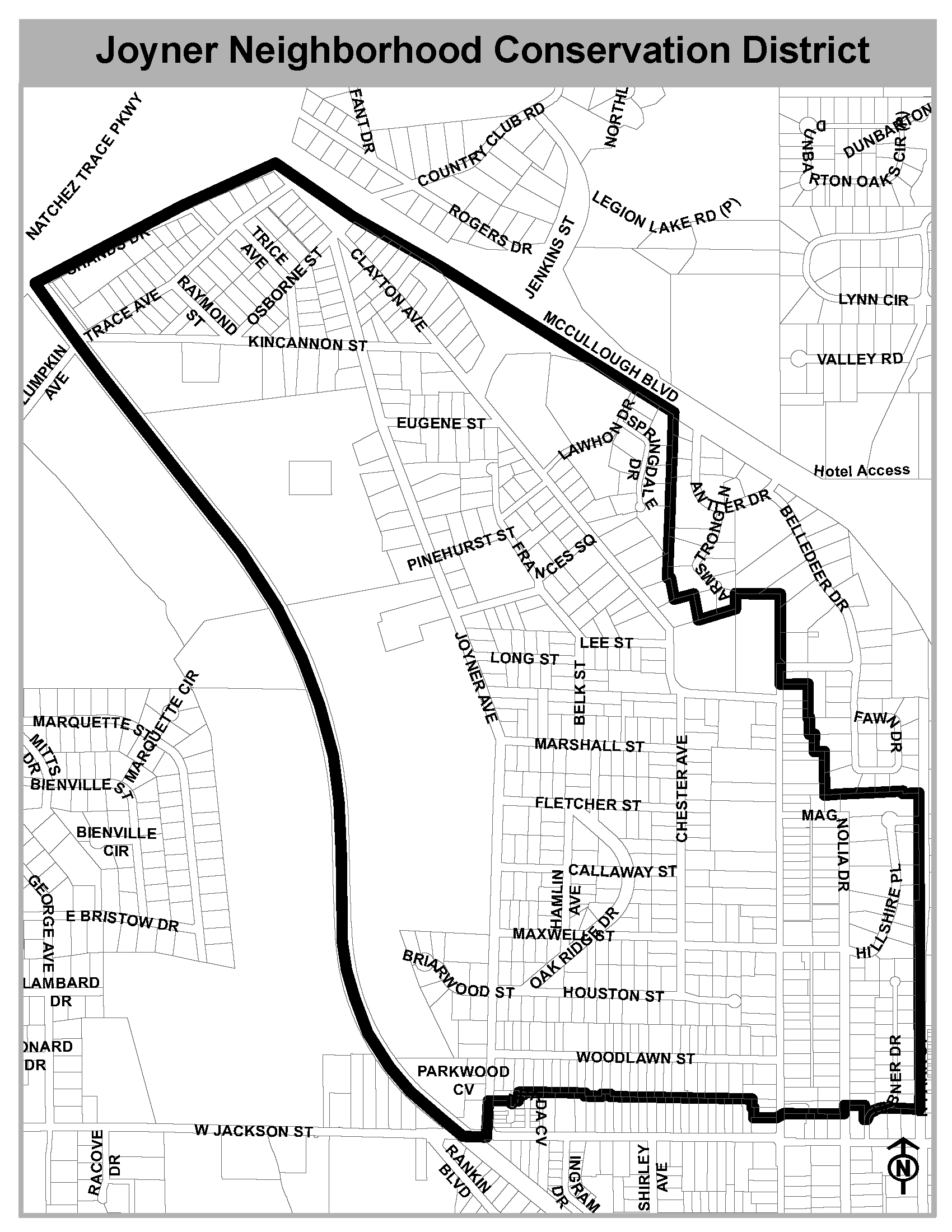
(Ord. of 01-02-2019(1), § 2; Ord. of 10-4-2022(20), § 3)
5.6.1. - Purpose and Applicability.
(1)
Purpose. To reestablish the business corridor of the Park Hill Neighborhood by providing strategic planning for the uses of the Overlay District to provide non-residential services along Tolbert Street and Green Street.
(2)
Applicability. The requirements of this section shall apply to all property within the Park Hill Business Redevelopment Overlay District as shown in Figure 5.8.1 below.
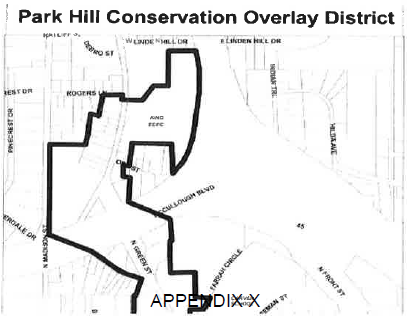
(Ord. of 10-4-2022(22), § 2)
5.6.2. - Use Regulations.
Medium Density Residential (MDR) and Mixed Use Residential (MUR) Zoning District standards shall apply, per Sections 4.8 and 4.9 of this Code, respectively by in accordance with the existing zones with the exception of:
(1)
Residential uses, except than upper story residential, shall be allowed by Compatibility only.
(Ord. of 10-4-2022(22), § 2)
5.6.3. - Design Standards.
The Design Review Committee shall be guided by the infill standards in Section 6.10 of this Code, and by reference to existing architectural features of the immediate vicinity and of the Park Hill neighborhood generally.
(Ord. of 10-4-2022(22), § 2)
5.6.4. - Review Procedures.
(1)
A Design Review Committee shall be established consisting of five members. Three members shall be residents of the Park Hill Neighborhood, designated by vote of the Park Hill Neighborhood Association. One member shall be designated by the Mayor. One member shall be designated by the City Council representative(s) for the Park Hill Neighborhood. Associate members may be nominated by either the Park Hill Neighborhood, the Mayor, or the City Council representative to serve in the absence of a member. The members shall be confirmed by the City Council. The committee positions will be for a period of 12 months from the date of confirmation.
(2)
No permit for new construction or external renovation shall be issued for any commercial property within the Park Hill Business Overlay District without approval of the Design Review Committee. Residential construction and renovation are exempt from this review requirement.
(3)
Applications for construction or renovation within the Park Hill Business Overlay District shall be accompanied by complete drawings of the proposed work, including a site plan, floor plan, full elevation drawings, and exterior materials list.
(Ord. of 10-4-2022(22), § 2)
5.7.1. - Purpose and Applicability.
(1)
Purpose. To acknowledge the historic significance of local resources and to protect, enhance and perpetuate resources that represent distinctive and significant elements of the City's historical, cultural, social, economic, political, archaeological, and architectural identity; Ensure the harmonious, orderly, and efficient growth and development of the City; Strengthen civic pride and cultural stability through neighborhood conservation; Stabilize the economy of the City through the continued use, preservation, and revitalization of its resources; Protect and enhance the City's attractions to tourists and visitors and the support and stimulus to business and industry thereby provided; Promote the use of resources for the education, pleasure and welfare of the people of the City of Tupelo; Provide a review process for the preservation and appropriate development of City resources.
(2)
Applicability. A certified local district designation has been assigned to the Mill Village Historic District, as pictured in Figure 5.7.1 below.
Figure 5.7.1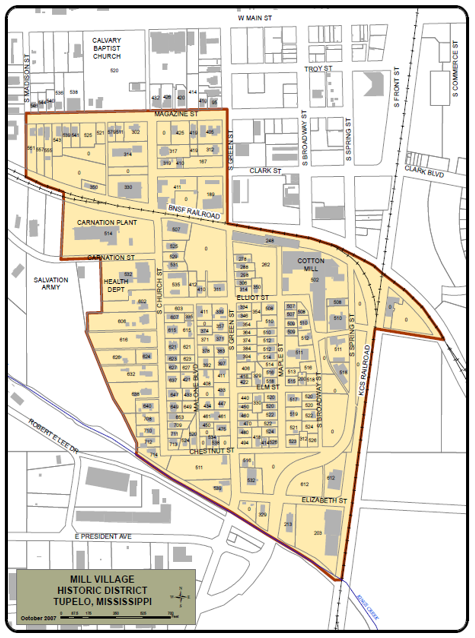
(Ord. of 10-4-2022(24), § 2)
5.7.2. - Use regulations.
Section 4.9.5, Uses in Mixed Use Residential districts, shall apply.
(Ord. of 10-4-2022(24), § 2)
5.7.3. - Design Standards.
The Design Review Committee shall be guided by the infill standards in Section 6.10 of this Code and design criteria and guidelines represented in the Tupelo Historic Preservation Commission Design Guidelines for Local Historic Districts, as represented in Appendix A of this Code.
(Ord. of 10-4-2022(24), § 2)
5.7.4. - Review Procedures.
The Tupelo Historic Preservation Commission, as defined in Chapter 2 of this Code, is designated as the Overlay authority regulating design review decisions for Mill Village. A Certificate of Appropriateness must be granted by the City prior to the conveyance of a permit for construction or renovation within the District.
(Ord. of 10-4-2022(24), § 2)
5.8. - Jackson West Neighborhood Redevelopment Overlay District.[3]
Editor's note—Ord. of 10-4-2022(25), § 2, repealed the former §§ 5.8—5.8.6, and enacted a new §§ 5.8—5.8.6 as set out herein. The former §§ 5.8—5.8.6 pertained to West Jackson Neighborhood Redevelopment Overlay District.
5.8.1. - Purpose and Applicability.
(1)
Purpose. It is the purpose and intent of the Jackson West Neighborhood Redevelopment Overlay District to protect the value of property, to enhance the attractiveness of neighborhoods, to prevent development which would be incompatible with the established characteristics of the neighborhood, and to support improvement and investment in the neighborhood housing stock.
(2)
Applicability. The requirements of this section shall apply to all property within the Jackson West Neighborhood Redevelopment Overlay District as shown in Figure 5.8.1.
Figure 5.8.1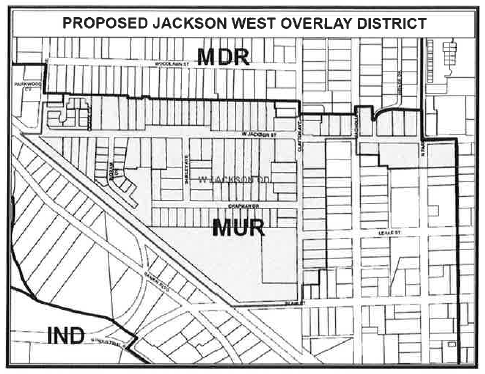
(Ord. of 10-4-2022(25), § 2)
5.8.2. - Membership.
(1)
A Design Review Committee shall be established consisting of five members. Three members shall be representatives of the Neighborhood Development Corporation (NDC), designated by vote of NDC. One member shall be a resident of the Jackson West Neighborhood as designated by vote of the Jackson West Neighborhood Association. One member shall be a resident of the Joyner Neighborhood as designated by vote of the Joyner Neighborhood Association. If any Neighborhood Association becomes inactive, this member shall be determined by selection by the Mayor. All committee members are subject to Mayor and City Council approval.
(2)
The designated electing/appointing entities shall submit their committee recommendations to the Department of Development Services in September of each year and the City Council shall consider their confirmation at the first meeting in October.
(3)
Termination of Member. A committee member shall be removed from membership in the Design Review Committee in the case of:
a.
Death, resignation or incapacity;
b.
Failure to respond within one week of receiving review plans for committee vote three consecutive times;
c.
In the case of findings of impropriety or criminal behavior, the Overlay Design Review Committee may request termination of a member by submitting written request to the Department of Development Services for subsequent review and decision by the Planning Committee;
d.
Termination of an Overlay a Design Review Committee member, as determined by this Code, in an Overlay District impacting the elected by a Neighborhood Association must be approved by the voting membership of the Neighborhood Association prior to Planning Committee consideration.
(Ord. of 10-4-2022(25), § 2)
5.8.3. - Review Procedures.
(1)
No permit for new construction or external renovation shall be issued for any property within the Jackson West Neighborhood Redevelopment Overlay District without approval of the Design Review Committee.
(2)
Applications for construction, exterior renovation, fences, accessory structures, or other exterior changes within the West Jackson Neighborhood Redevelopment Overlay District shall be accompanied by complete Permit package including scaled drawings of the proposed work, including a site plan, floor plan, full elevation drawings, and exterior materials list, as applicable.
(3)
The Design Review Committee shall receive the Application for Construction or Permit with all permit documents either electronically or by hardcopy. The committee shall meet, in person or electronically, to consider and review the documents, returning the review comments to Development Services Department within seven days of receiving documents. If additional document/s are requested the 7-day review period resets to the date the additional documents are received by the committee.
(4)
The Development Services Department shall provide a report to the Design Review Committee relative to the application for review of the permit application.
(Ord. of 10-4-2022(25), § 2)
5.8.4. - Appeals.
Decisions of the Design Review Committee may be appealed to the Planning Committee.
(Ord. of 10-4-2022(25), § 2)
5.8.5. - Design standards.
(1)
The Design Review Committee shall be guided by the standards for traditional housing construction (Section 6.4.3) as modified below, by the standards for infill construction (Section 6.10), by the compatibility checklist procedure (Section 12.4.5), and by reference to existing architectural features of the immediate vicinity and of the overlay district generally.
(2)
Traditional housing standards modifications.
(a)
Size limitations. Minimum square foot requirements for each residence shall be at a minimum 1,000 square feet heated and cooled living area.
(b)
Main entrance. This standard is not modified.
(c)
Porches. A porch shall be provided for each dwelling unit of at least seven feet six inches in depth and 12 feet in length. Variances may be approved if the overall square footage exceeds 90 square feet. Porch columns shall be a minimum of six inches wide, shall be square or rectangular in section, and may not be wrought iron or other material that is not solidly opaque. Other standards for porches are not modified.
(d)
Covered balconies. This standard is not modified. Alternative roof materials may be considered.
(e)
Garages and Carports:
a.
Front, side or rear of house is permitted.
b.
If visible from the street, carport columns must be of similar size and material to porch columns. Other standards for garages are not modified.
c.
If front facing, cannot be more than 30 percent of the front-facing linear dimension.
d.
Roofs shall be the same material of the principal structure.
(f)
Roofs.
a.
Slope. Principal structures must have a roof that is sloped, with at least four units of vertical rise to 12 units of horizontal run, and not exceeding 12 units of vertical rise to 12 units of vertical run.
b.
Architectural features. The roof of a principal structure shall include at least one of the following architectural details:
i.
A gable end, or gabled end of a roof projection, facing the street; or
ii.
An offset section either set back from the front facade or with a lower roof line than the main section of the structure.
iii.
Roof eaves must project from the building wall on at least the front and side elevations, and such projections may not exceed 12 inches.
iv.
No hip roof on front or sides.
c.
Materials. Roofs shall be asphalt shingle. No metal roofs are permitted for the principal structure.
d.
Decorative metal covers may be permitted as awnings, over porches or decks. These must be submitted for approval by Design Review Committee.
e.
Other standards for roofs are not modified.
(g)
Foundation.
a.
Height. Finished floor height, or ground level of the first floor, shall be elevated a minimum of 14 inches and a maximum of 18 inches above finished grade, or pad height, to allow for a minimum of two steps front entry onto the first floor. Finished floor height requirements do not apply to elevations at the structures side or rear.
b.
Fill to achieve pad height should not be utilized without drainage review and should not exceed more than 12 inches above center line or the point of storm water discharge from the lot.
c.
Finish material must be brick, stone or other finished surface material.
d.
Other standards for foundation are not modified.
(h)
Exterior finish materials.
a.
Allowable materials are stone, brick, plaster, EIFS, cedar shakes, wood siding such as Hardie board six inches or less ship lap or equivalent,
b.
Other standards for Exterior Finish Materials are not modified.
(i)
Windows and entryways. At least 25 percent of the area of a street-facing facade must include windows or main entryways. Each window must be square or vertical and muntins must be in a vertical proportion. A horizontal window opening may be created by grouping two or more vertical windows. Other standards for windows and entryways are not modified.
a.
Garage, storage building, pool house, or accessory structure of any type: Must have the same roofing and outside wall materials as those used in the principal structure.
b.
Fences: All fences and/or screen walls are to be made of wood, masonry, stucco or ornamental metal material or landscape material. No chain link fences visible from the street or adjacent properties shall be permitted.
i.
Fences located in the front yard shall be no more than 36 inches high and must be able to see thru 50 percent of the height.
ii.
Location:
1.
No fences shall be erected nearer to a street than ten feet. Variances may be considered.
(3)
All properties and the dwellings constructed thereon shall be used for single-family residential purposes.
(4)
No lot can be subdivided and sold in part except as located on the plat of said subdivision previously filed in the Office of Lee County Chancery Clerk. Any combination of platted lots must be approved by the Designed Review Committee.
(5)
The Design Review Committee may prepare and propose additional written standards for adoption through amendment of this section.
(Ord. of 10-4-2022(25), § 2)
5.8.6. - Use Regulations.
(1)
Congregate Living Facility 1 and Congregate Living Facility 2 are allowed by Compatibility only in the Jackson West Neighborhood Redevelopment Overlay District and are disallowed on any property with deed restrictions preventing rental occupancy.
(Ord. of 10-4-2022(25), § 2)
5.9.1. - Purpose and applicability.
(1)
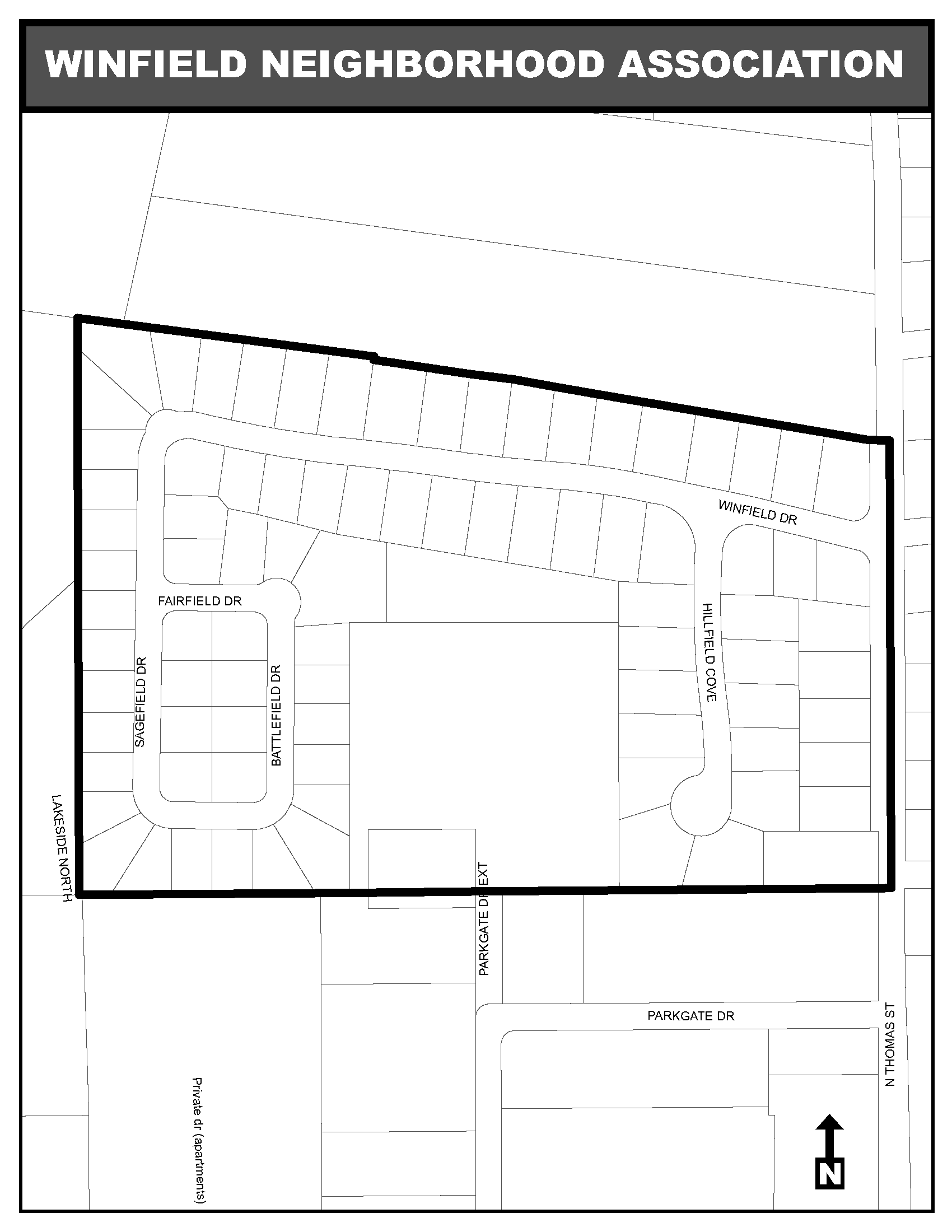
Purpose. It is the purpose and intent of the Winfield Neighborhood Conservation Overlay District to protect the value of property, to enhance the attractiveness of the neighborhood, to prevent development which would be incompatible with the established characteristics of the neighborhood, and to support improvement and investment in the neighborhood housing stock.
(2)
Applicability. The requirements of this section shall apply to all property within the Winfield Neighborhood conservation Overlay District as shown in Figure 5.9.1 below.
Figure 5.9.1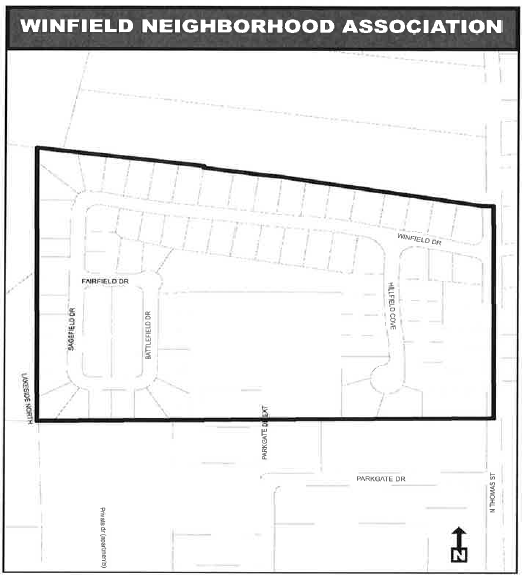
(Ord. of 10-4-2022(26), § 2)
5.9.2. - Use regulations.
5.9.2.1. Section 4.8.5, Uses in Medium Density Residential districts, shall apply with the following modification:
(1)
Park and/or open space are allowed by right.
(2)
Patio homes/zero lot line homes are disallowed.
(3)
Townhouse dwellings are disallowed.
(4)
No accessory dwellings will be allowed.
(5)
No agricultural uses, including the keeping of livestock, will be permitted.
(6)
No subdivision of lots will be permitted.
(7)
No well, privy, cesspool, septic tank field or other disposal area shall be erected or maintained.
(Ord. of 10-4-2022(26), § 2)
5.9.3. - Standards.
5.9.3.1. Infill Standards:
Section 6.10, Infill standards, shall apply with the following changes:
(1)
To Section 6.10.5 (1), add: The width of new construction shall not be less than the average width for existing structures in the context area.
(2)
Add Section 6.10.5 (3). Exterior Materials.
a.
New or renovated dwellings shall provide masonry on building sides facing the street that is equivalent to the highest percentage of masonry on building sides facing the street in the context area. Exterior facade must be comprised of a minimum of ¾ masonry on the street facing side of any residential structure.
b.
All new residential structures shall be no less than 1,700 square feet total, or, if two story, the first floor shall be no less than 1,300 square feet and second floor no less than 400 square feet.
5.9.3.2. Design Standards:
(1)
The Design Review Committee shall be guided by the standards for infill construction (Section 6.10, as modified above), and by reference to existing architectural features of the immediate vicinity and of the Winfield neighborhood generally.
(2)
The Design Review Committee may prepare and propose written standards for adoption through amendment of this section.
(3)
Metal roofs may not be placed on residential buildings.
(4)
Chain link fences are not allowed.
(5)
No garage or accessory structure shall be erected with exterior materials not substantially similar to that of the principal structure.
(6)
Landscaping shall be completed by the lot owner within 12 months after said land owner moves into the residence, and shall meet minimum growth standards as follows: Understory trees: 7 ½ feet at time of planting, shrubs: 30 inches height in five years.
(7)
Setbacks standards shall be as follows: Front setback - 30 feet; rear setback - 25 feet; Side setback - 12 feet; Side Street setback (distance from the corner of the structure closes to a street located on the side of the house) - 30 feet.
(8)
Only one single family residence shall be constructed or permitted on each lot and it shall be used for residential purposes only at a rate of one dwelling per lot maximum.
(9)
Accessory structures shall be no more than 180 square feet and shall be located in the side or back yard of the principal structure.
(10)
Exterior color of new construction and renovations should remain neutral and consistent with the character of the Overlay Design Review District.
(11)
Fence height requirements are as follows: Front yard: 3 ½ ft maximum height, Side and back yard: 6 ½ ft maximum height.
(12)
No window units will be permitted.
(13)
No solar panels may be visible from the street face or visible from adjacent properties.
(14)
All land development and related drainage treatments must be approved by a Licensed Engineer and within compliance of the existing City maintained drainage treatments present within the Overlay Design Review District.
(Ord. of 10-4-2022(26), § 2)
5.9.4. - Review procedures.
(1)
A Design Review Committee shall be established consisting of five members. Three members shall be residents of the Winfield Neighborhood Conservation Overlay District, designated by vote of the Winfield Neighborhood Association. One member shall be designated by the Mayor. One member shall be designated by the City Council representative(s) for the Winfield Neighborhood Conservation Overlay District. The members shall be confirmed by the City Council. The committee positions will be for a period of 12 months from the date of confirmation.
(2)
No permit for new construction or external renovation shall be issued for any property within the Winfield Neighborhood Conservation Overlay District without approval of the Design Review Committee.
(3)
Applications for construction or renovation within the Winfield Neighborhood Conservation Overlay District shall be accompanied by complete drawings of the proposed work, including a site plan, floor plan, full elevation drawings, and exterior materials list.
(Ord. of 10-4-2022(26), § 2)
5.10.1. - Purpose and applicability.
(1)
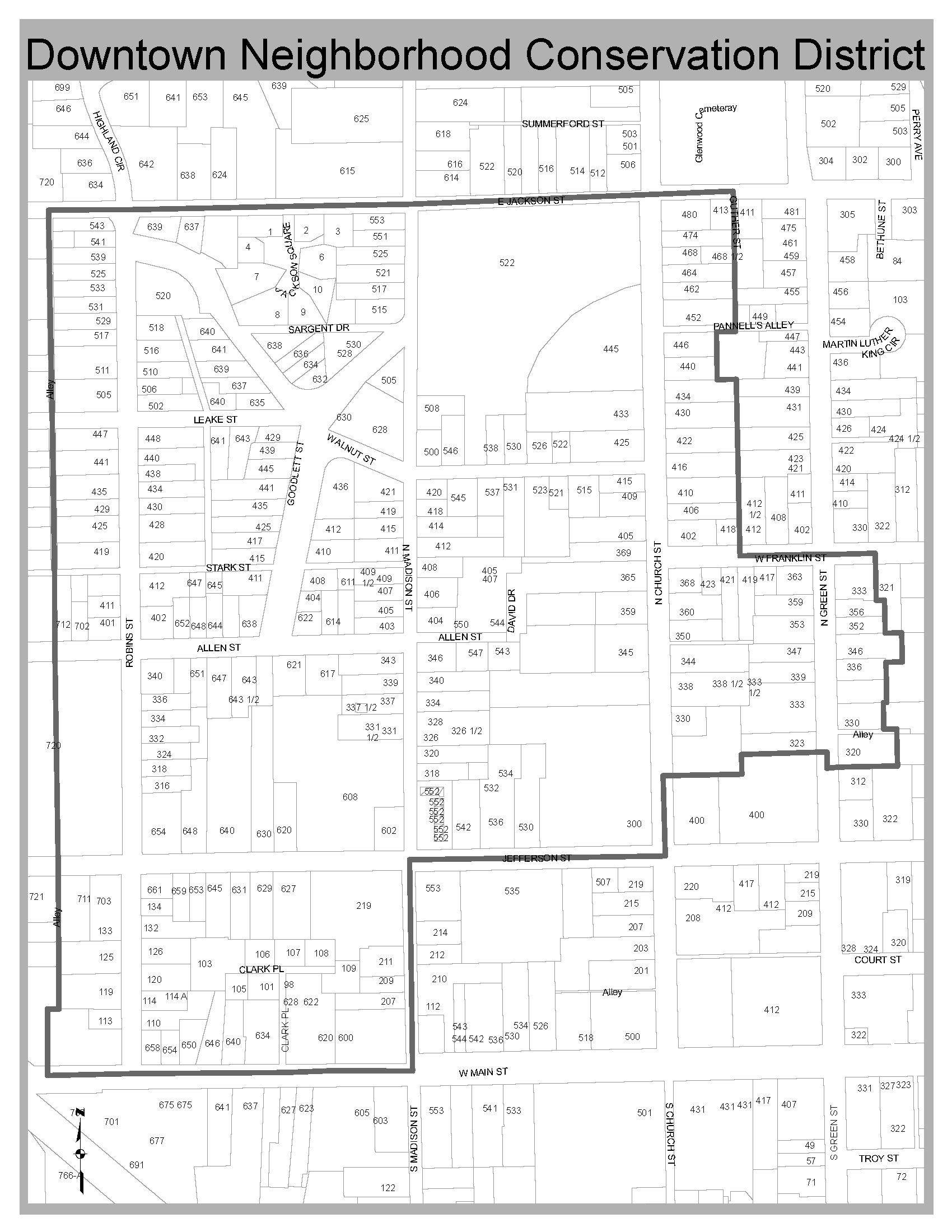
Purpose. It is the purpose and intent of the Historic Downtown Neighborhood Conservation Overlay District to protect the value of property, to enhance the attractiveness of the neighborhood, to prevent development which would be incompatible with the established characteristics of the neighborhood, and to support improvement and investment in the neighborhood housing stock.
(2)
Applicability. The requirements of this section shall apply to all residential property within the Historic Downtown Neighborhood Conservation Overlay District as shown in Figure 5.10.1.
(Ord. of 6-19-2018(1), § 2)
5.10.2. - Use regulations.
5.10.2.1. Section 4.9.5, Uses in Mixed Use Residential districts, shall apply with the deletion of Section 4.9.5.2, Other Uses by Right.
(Ord. of 6-19-2018(1), § 2)
5.10.3. - Design standards.
The design review committee shall be guided by the Design Standards for the Historic Downtown Neighborhood drafted by the Mississippi State University School of Architecture, as adopted by reference in this section, and by the infill standards in Section 6.10 of this Code.
(Ord. of 6-19-2018(1), § 2)
5.10.4. - Review procedures.
(1)
A design review committee shall be established consisting of five members. Three members shall be residents of the Historic Downtown Neighborhood, designated by vote of the Historic Downtown Neighborhood Association. One member shall be designated by the Mayor. One member shall be designated by the City Council representative(s) for the Historic Downtown Neighborhood. Associate members may be nominated by either the Historic Downtown Neighborhood, the Mayor, or the City Council representative to serve in the absence of a member. The members shall be confirmed by the City Council. The committee positions will be for a period of 12 months from the date of confirmation.
(2)
No permit for new construction or external renovation shall be issued for any residential property within the Historic Downtown Neighborhood Conservation Overlay District without approval of the design review committee. Commercial construction and renovation are exempt from this review requirement.
(3)
Applications for construction or renovation within the Historic Downtown Neighborhood Conservation Overlay District shall be accompanied by complete drawings of the proposed work, including a site plan, floor plan, full elevation drawings, and exterior materials list.
(4)
The design review committee shall meet to consider permit applications no later than 30 days after the complete application is received by the Development Services Department.
(5)
The Development Services Department shall provide a report to the design review committee describing the characteristics of the neighborhood in the immediate vicinity of the subject property.
(6)
Appeals. Decisions of the design review committee may be appealed to the Planning Committee.
(Ord. of 6-19-2018(1), § 2)
5.11.1. - Purpose and Applicability.
(1)
Purpose. It is the purpose and intent of the Belledeer Neighborhood Redevelopment Overlay District to protect the value of property, to enhance the attractiveness of neighborhoods, to prevent development which would be incompatible with the established characteristics of the neighborhood, and to support improvement and investment in the neighborhood housing stock.
(2)
Applicability. The requirements of this section shall apply to all property within the Belledeer Neighborhood Redevelopment Overlay District as shown in Figure 5.11.1, below:
Figure 5.11.1
Membership:
(1)
A Design Review Committee shall be established consisting of seven members. Design Review Committee members shall be replaced at the time of their resignation or termination in one of the following methods, as determined by the Design Review Committee: 1) By collaborative nomination from the Councilperson from Ward 1 and the Councilperson from Ward 2; or 2) Nomination by the Belledeer Neighborhood Association. All persons 18 years of age and older owning property or residing within the designated Belledeer Overlay District are eligible to submit a vote. All committee members are subject to Mayor and City Council approval.
(2)
The designated electing/appointing entities shall submit their committee recommendations to the Department of Development Services in September of each year and the City Council shall consider their confirmation at the first meeting in October.
(3)
Elected members do not have term limit restrictions and may be reelected annually.
(4)
Termination of Member.
A committee member shall be removed from membership in the Design Review Committee in the case of:
a.
Death, resignation or incapacity;
b.
Failure to respond within one week of receiving review plans for committee vote three consecutive times;
c.
In the case of findings of impropriety, unethical criminal or civil activity, or other behavior unbecoming of a member of a City of Tupelo committee, the Overlay Design Review Committee may request termination of a member by submitting written request to the Department of Development Services for subsequent review and decision by the Planning Committee. A decision by the Planning Committee to terminate a member of the Design Review Committee may be appealed to the City Council.
d.
The termination of an Overlay Design Review Committee member must be approved by a 2/3 majority of the voting membership of the Neighborhood Association prior to Planning Committee consideration.
(Ord. of 12-20-2022(1), § 2)
5.11.3. - Review Procedures.
(1)
No permit for new construction or external renovation shall be issued for any property within the Belledeer Neighborhood Redevelopment Overlay District without approval of the Design Review Committee.
(2)
Applications for construction, exterior renovation, fences, accessory structures, or other exterior changes within the Belledeer Neighborhood Redevelopment Overlay District shall be accompanied by complete Permit package including scaled drawings of the proposed work, including a site plan, floor plan, full elevation drawings, and exterior materials list, as applicable.
(3)
The Design Review Committee shall receive the Application for Construction or Permit with all permit documents either electronically or by hardcopy. The committee shall meet, in person or electronically, to consider and review the documents, returning the review comments to Development Services Department within seven days of receiving documents. If additional documents are requested the 7-day review period resets to the date the additional documents are received by the committee.
(4)
The Development Services Department shall provide a report to the Design Review Committee relative to the application for review of the permit application.
(5)
All structures established or approved prior to the effective date of this sub-section are considered nonconforming. The repair and/or replacement of non-conforming structures, if damaged by disaster, are exempt from the provisions of this section provided that of the repaired or replaced structure(s) consists of the same or substantially similar, design, building materials, footprint and/or layout of that which existed prior to its damage.
(Ord. of 12-20-2022(1), § 2)
5.11.4. - Appeals.
Decisions of the Design Review Committee may be appealed to the Planning Committee.
(Ord. of 12-20-2022(1), § 2)
5.11.5. - Design standards.
(1)
The Design Review Committee shall be guided by the standards for traditional housing construction (Section 6.4.3) as modified below, by the standards for infill construction (Section 6.10), by the compatibility checklist procedure (Section 12.4.5), and by reference to existing architectural features of the immediate vicinity and of the overlay district generally.
(2)
Traditional housing standards modifications.
a.
Size limitations. Minimum square foot requirements for each residence shall be at a minimum 2,000 square feet heated and cooled living area.
b.
Main entrance. See Section 6.4.3.
c.
Covered balconies. See Section 6.4.3. Alternative roof materials that meet the design and appearance characteristics of the neighborhood may be considered.
d.
Garages and Carports:
i.
If visible from the street, carport columns must be of similar size and material to porch columns. Other standards for garages are not modified.
ii.
Roofs shall be the same material of the principal structure.
e.
Roofs: In cases of renovation of the principal structure or construction of accessory dwellings or accessory structures, the slope, architectural features, materials, and decorative covers involved in roofs shall complement or mimic the existing structure and shall conform to the character of the neighborhood.
f.
Foundation:
i.
Fill to achieve pad height should not be utilized without drainage review and should not exceed more than 12 inches above center line or the point of storm water discharge from the lot.
ii.
Finish material must be brick, stone or other finished surface material.
iii.
All other foundation standards pursuant to this Code shall apply.
g.
Exterior finish materials:
i.
Allowable materials include, but are not limited to, stone, brick, plaster, EIFS, cedar shakes, and wood siding. The use of any such exterior finish material is subject to the review and approval of the Belledeer Overlay Committee relative to conformity with the neighborhood and existing structures.
ii.
All accessory structures and dwellings exterior finish materials must complement and be compatible with the principal structure and character of the neighborhood.
iii.
All other standards concerning Exterior Finish Materials pursuant to this Code shall apply.
h.
Windows and entryways: At least 25 percent of the area of a street-facing facade must include windows or main entryways. Each window must be square or vertical and muntins must be in a vertical proportion. A horizontal window opening may be created by grouping two or more vertical windows. All other standards for windows and entryways pursuant to this Code shall apply.
i.
Garage, Storage Building, Pool House, or Accessory Structure of any type: Must have the same roofing and outside wall materials as those used in the principal structure.
j.
Fences: All fences and/or screen walls are to be made of wood, masonry, stucco or ornamental metal material or landscape material. No chain link fences visible from the street or adjacent properties shall be permitted.
i.
Fences located in the front yard shall be no more than 36 inches high and must be able to see thru 50 percent of the height.
ii.
Location:
1.
No fences shall be erected nearer to a street than ten feet. Variances may be considered.
(3)
All new construction, including driveways or introduction of non-pervious surfaces, must include a site plan with the following items relative to drainage:
a.
Point of storm water discharge from the property.
b.
Method of ensuring flow of storm water discharge is directed toward the naturally occurring point of discharge and is directed toward a street providing curb and gutter drainage.
c.
10-year pre-development flow rate and 25 post development flow rates may be requested by the City Engineer. All development should discharge storm water at a 10-year pre development flow rate.
(4)
The Design Review Committee may prepare and propose additional written standards for adoption through amendment of this section.
(Ord. of 12-20-2022(1), § 2)
5.11.6. - Use Regulations.
(1)
Satellite dish antennae may not be located where visible from the street or frontage of the property. An exception to this restriction may be made by the Design Review Committee upon a showing of impracticability.
(2)
Day Care Home, Small are disallowed.
(3)
Day Care Home, Large are disallowed.
(Ord. of 12-20-2022(1), § 2)
FIGURE 5.11.1.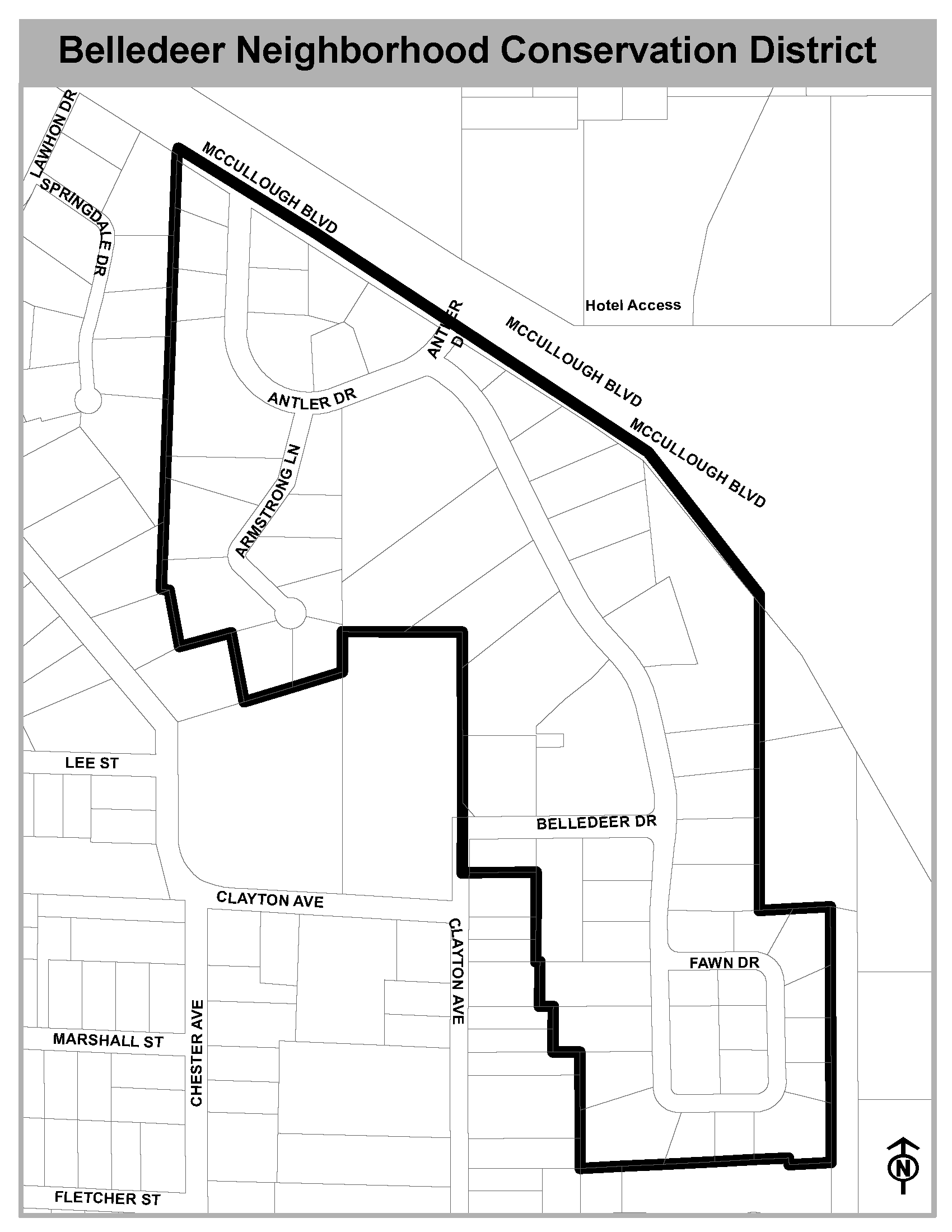
(Ord. of 1-2-2019(1), § 2)

