
Tusayan City Zoning Code
SECTION 17
LIGHTING
§ 17.0 PURPOSE AND INTENT.
(A) (1) It is hereby found that the topography and atmospheric conditions of the Town of Tusayan, Arizona, and the surrounding area are uniquely suited for astronomical observation.
(2) It is further recognized that naturally dark landscapes and star-filled skies are valued by many residents and visitors, and that poor lighting practices in outdoor lighting not only unnecessarily impede views of the starry night sky but also waste energy, hamper the use and enjoyment of property and can endanger the public welfare by producing unnecessary glare.
(B) (1) Accordingly, it is the intent of this zoning code to encourage lighting practices and
systems which will minimize light pollution, light trespass, and conserve energy while maintaining night-time safety, utility, security and productivity.
(2) To conserve energy, the Tusayan Town Council encourages the users of outdoor lighting to transition from high energy consumptive lighting to more energy efficient, low wattage lighting.
(Ord. 2012-04, passed 12-5-2012)
§ 17.1 CONFLICTING REGULATIONS.
In the event of conflict between the regulations set forth in this zoning code and any other regulations the more stringent limitation and requirement shall govern.
(Ord. 2012-04, passed 12-5-2012)
§ 17.2 APPROVED MATERIALS AND METHODS OF CONSTRUCTION OR INSTALLATION/OPERATION.
(A) The provisions of this zoning code are not intended to prevent the use of any design, material or method of installation or operation not specifically prescribed by this code; provided, any such alternate has been approved by the Town Manager.
(B) The Town Manager may approve such proposed alternate; provided, he or she finds that it:
(1) Provides at least approximate equivalence to the applicable specific requirements of this zoning code; and
(2) Is otherwise satisfactory and complies with the intent of this zoning code.
(Ord. 2012-04, passed 12-5-2012)
§ 17.3 DEFINITIONS.
As used in this zoning code, unless the context clearly indicates otherwise, certain words and phrases shall mean the following.
ABANDONMENT. The discontinuation of use for a period of 12 months.
ACREAGE, NET. The remaining ground area in acres after deleting all portions for proposed and existing public streets and roadways within a development project or subdivision.
AIRPORT NAVIGATION LIGHTING SYSTEMS. The airport tower beacon, runway lights, guidance lights for landings, taxiway lighting and any other lighting on airport property required by the state or the Federal Aviation Administration.
CLASS 1 LIGHTING. All outdoor lighting used for, but not limited to, outdoor sales or eating areas, principal public entryways, assembly or repair areas, advertising and other signs, recreational facilities and other similar applications where color rendition is important to preserve the effectiveness of the activity.
CLASS 2 LIGHTING. All outdoor lighting used for, but not limited to, illumination for walkways, roadways, equipment yards, parking lots, emergency exits and outdoor security where general illumination of the grounds is the primary concern.
CLASS 3 LIGHTING. Any outdoor lighting used for decorative effects, including, but not limited to, architectural illumination, flag and monument lighting, and illumination of trees, bushes, landscape features and the like.
CORRELATED COLOR TEMPERATURE (CCT). A measure, expressed in Kelvins (abbreviated as K) of the apparent hue of white light sources such as metal halide, fluorescent and white LED. Higher CCT sources appear bluer or cooler; lower CCT sources appear yellower or warmer.
DEVELOPMENT PROJECT. Any residential, commercial, industrial or mixed use subdivision plan or development plan which is submitted to the town for approval.
DIRECT ILLUMINATION. Illumination resulting from light emitted directly from a lamp or luminaire, not light diffused through translucent signs or reflected from other surfaces such as the ground or building faces.
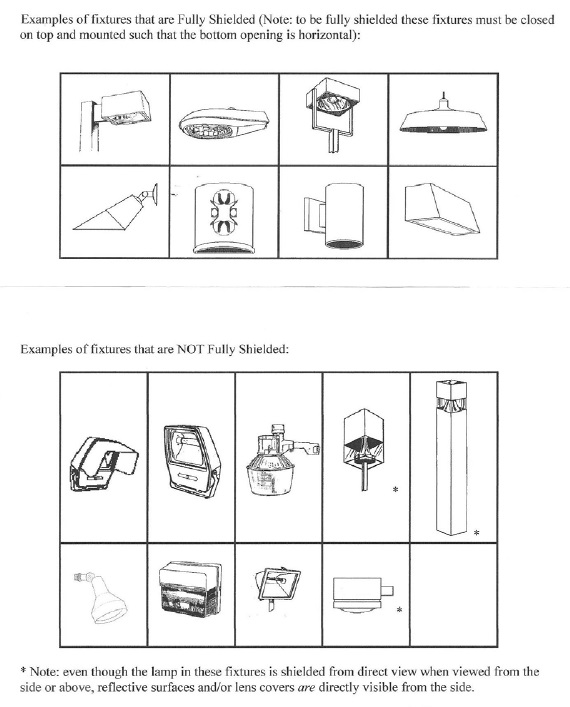
FULLY-SHIELDED FIXTURE.
(1) A light fixture or luminous tube constructed and mounted such that all light emitted by the fixture or tube, either directly from the lamp, tube, or a diffusing element, or indirectly by reflection or refraction from any part of the luminaire, is projected below the horizontal.
(2) A practical working way to determine if a fixture or tube is fully shielded: if the lamp or tube, any reflective surface, or lens cover (clear or prismatic) is visible when viewed from above or directly from the side, from any angle around the fixture or tube, the fixture or tube is not fully shielded.
(3) Note for luminous (neon) tubes: when such lighting is installed under or behind a roof overhang, if the roof-line or eave is not horizontal the tubing may be visible from above when viewed from the side and therefore be unshielded.
HIGH-PRESSURE SODIUM (HPS). A type of lamp using sodium and mercury vapor at high pressure to produce a yellow or golden-hued light.
INSTALLED. Attached, or fixed in place, whether or not connected to a power source.
LED. A light emitting diode.
LIGHT POLLUTION. Any adverse effect of human-made lighting, light where it is not needed or wanted or wasted light.
LOW-PRESSURE SODIUM (LPS). A type of lamp using sodium vapor at low pressure to produce a yellow or amber hued light.
LUMEN. The unit used to measure the actual amount of visible light that is produced by a lamp.
LUMINAIRE. The complete lighting assembly, including the lamp, housing, shields, lenses and associated electronics, less the support hardware or brackets; a light fixture.
LUMINOUS TUBE. A glass tube filled with a gas or gas mixture (including neon, argon, mercury or other gasses), usually of small diameter (ten to 15 millimeter), caused to emit light by the passage of an electric current, and commonly bent into various forms for use as decoration or signs; a “neon” tube. A LUMINOUS TUBE does not include common fluorescent tubes.
METAL HALIDE (MH). A type of lamp using mercury and metal halide(s) to produce light.
NARROW-SPECTRUM AMBER LED. An LED light source that emits only yellow light at and near a wavelength of 590 nanometers (nm); the intensity at 580 and 600 nm must be no higher than 50% of the peak intensity.
NEON TUBE. See LUMINOUS TUBE.
OUTDOOR LIGHT FIXTURE. An outdoor electrically-powered illuminating device, lamp, luminous tube or and similar devices, either permanently installed or portable, which is used for illumination or advertisement. Such devices shall include, but are not limited to, searchlights, spotlights and floodlights for:
(1) Buildings and structures;
(2) Recreational areas;
(3) Parking lot lighting;
(4) Landscape and architectural lighting;
(5) Billboards and other signs (advertising or other);
(6) Street lighting;
(7) Product display area lighting;
(8) Building overhangs and open canopies;
(9) Pedestrian walkways or areas; and
(10) Building or landscape decoration.
OUTDOOR RECREATION FACILITY. An area designed for active recreation, whether publicly or privately owned, including, but not limited to, baseball diamonds, soccer and football fields, golf courses, tennis courts and swimming pools.
PERSON. Any individual, lessee, owner or any commercial entity including, but not limited to, firm, business, partnership, joint venture or corporation.
TEMPORARY LIGHTING. Lighting which does not conform to the provisions of this zoning code and which will not be used for more than one 30-day period within a calendar year. TEMPORARY LIGHTING is intended for uses which, by their nature, are of limited duration (e.g., civic events or construction projects).
TOTAL OUTDOOR LIGHT OUTPUT. The maximum total amount of light, measured in lumens, from all outdoor lighting installed on a development project. Includes all lights and luminous tubing used for Class 1, Class 2, Class 3 lighting and lights used for external illumination of signs, but does not include lights used to illuminate internally illuminated signs or luminous tubing used in neon signs. For lamp types that vary in their output as they age (such as metalhalide), the initial output, as defined by the manufacturer, is the value to be considered. For determining compliance with § 17.5(C) of this zoning code, the light emitted from outdoor light fixtures is to be included in the total output as follows.
(1) Outdoor light fixtures installed in the open such as on poles or on the sides of buildings or other structures, when not shielded from above by the structure itself, as defined in divisions (2) and (3) of this definition, are to be included in the total outdoor light output by simply adding the lumen outputs of the lamps used.
(2) Outdoor light fixtures installed under canopies, building overhangs or roof eaves where the center of the lamp or luminaire is located at least five feet, but less than ten feet, from the nearest edge of the canopy or overhang are to be included in the total outdoor light output as though they produced only one-quarter of the lamp’s rated lumen output.
(3) Outdoor light fixtures under the canopy and ten or more feet from the nearest edge of a canopy, building overhang or eave are to be included in the total outdoor light output as though they produced only one-tenth of the lamp’s rated lumen output.
(Ord. 2012-04, passed 12-5-2012)
§ 17.4 PREFERRED SOURCES.
Due to their reduced dark sky impacts, low-pressure sodium (LPS) lamps and narrow spectrum amber LED are the preferred lighting sources; their use is to be encouraged, when not required, for outdoor illumination whenever their use would not be detrimental to the use of the property.
(Ord. 2012-04, passed 12-5-2012)
§ 17.5 GENERAL REQUIREMENTS.
(A) Upward-directed floodlighting. Outdoor floodlighting by floodlight projection above the horizontal plane is prohibited.
(B) Lamp source and shielding. The requirements for lamp source and shielding of light emissions for outdoor light fixtures are as follows.
(1) Class 1 lighting.
Low-pressure sodium | Allowed, fully shielded |
Narrow-spectrum amber LED | Allowed, fully shielded |
Others above 2,000 lumens | Allowed, fully shielded* |
Others below 2,000 lumens | Allowed, fully shielded |
(2) Class 2 lighting.
Low-pressure sodium | Allowed, fully shielded |
Narrow-spectrum amber LED | Allowed, fully shielded |
Others above 2,000 lumens | Prohibited |
Others below 2,000 lumens | Prohibited |
(3) Class 3 lighting.
Low-pressure sodium | Allowed, fully shielded |
Narrow-spectrum amber LED | Allowed, fully shielded |
Others above 2,000 lumens | Prohibited |
Others below 2,000 lumens | Allow, fully shielded |
(4) Residential lighting (all classes).
All types | Allowed, fully shielded |
(5) Examples. Examples of lamp types of 2,000 lumens and below. The acceptability of a particular light is decided by its lumen output, not wattage; values listed are approximate; check manufacturer’s specifications:
(a) One-hundred watt standard incandescent and less;
(b) One-hundred watt tungsten-halogen (quartz) and less;
(c) No available high-pressure sodium of metal halide;
(d) Twenty-five watt fluorescent and less; and
(e) Twenty-six watt compact fluorescent and less.
*Metal Halide, fluorescent, LED or other white light sources must have CCT of 3,200K or less
(C) Total outdoor light output. Total outdoor light output, excluding streetlights used to illuminate public rights-of-way, shall not exceed the following limits averaged over the entire project (values listed are total initial lamp lumens per acre and per residence):
(1) Commercial, industrial and multi-family land use (lumens per net acre):
Non-LPS/narrow-spectrum amber LED | 5,000 |
Total | 50,000 |
Unshielded | 0 |
(2) Single-family residential (lumens per residence):
Total | 10,000 |
Unshielded | 0 |
(D) Effective shielding. All light fixtures which are required to be shielded shall be installed in such a manner that the shielding is effective, as defined in § 17.3, under fully-shielded fixture and partially- shielded fixture.
(E) Direct lighting on site. All light fixtures, except street lamps, shall be aimed or shielded so that the direct illumination shall be confined to the property boundaries of the source as much as is feasible.
(F) Direct lighting off roadways. All light fixtures, except streetlamps, shall be installed in such a manner that the direct illumination does not fall onto any public or private street or road as much as is feasible.
(G) Curfew.
(1) Class 1 and Class 3 lighting and lighted signs must be extinguished at 11:00 p.m., or no later than 30 minutes after the business closes, whichever is later. (For holiday decoration exemption, see § 17.8(B).)
(2) Class 2 lighting located 75 feet or more from a building or outdoor sales or merchandise storage area must be extinguished at 11:00 p.m., or no later than 30 minutes after the business closes, whichever is later.
(H) High-intensity lights. Searchlights, laser source lights or any similar high-intensity light shall not be permitted, except in emergencies by police and fire personnel or at their direction.
(I) Mercury vapor sales. The installation, sale, offering for sale, lease or purchase of any mercury vapor light fixture or lamp for use as outdoor lighting is prohibited.
(J) Ornamental luminaries. Ornamental luminaries with exposed light sources are not permitted.
(Ord. 2012-04, passed 12-5-2012)
§ 17.6 SPECIAL REQUIREMENTS, OUTDOOR ADVERTISING SIGNS.
(A) Externally illuminated sign standards. External illumination for signs shall be limited to signs constructed of natural materials and shall conform to all provisions of this zoning code. In particular, such lighting shall be treated as Class 1 lighting and shall conform to the lamp source, shielding restrictions andlumen caps of § 17.5. All upward-directed sign lighting is prohibited.
(B) Internally illuminated sign and neon sign standards.
(1) Illumination of copy and background; colors. The sign face of an outdoor internally illuminated advertising sign must be composed of illuminated text and symbols against an opaque (not illuminated) background. The colors of these elements are not restricted.
(2) Exclusion of lamp outputs. Lamps used for internal illumination of signs shall not be counted toward the lumen caps in § 17.5(C).
(3) Neon signs. Neon signs shall be treated as internally illuminated signs for the purposes of thiszoning code, and shall not have their luminous outputs counted toward the lumen caps in § 17.5(C). Neon lighting extending beyond the area considered to be the sign area (as defined in the Sign Code of this jurisdiction) shall conform to all provisions of this zoning code. In particular, such lighting shall be treated as Class 3 (decorative) lighting and shall conform to the lumen caps and shielding standards of § 17.5.
(4) Non-sign lighting. Other internally- illuminated panels or decorations not considered to be signage according to the sign code of this jurisdiction (such as illuminated canopy margins or building faces), shall be considered decorative (Class 3) lighting, and shall be subject to the standards applicable for such lighting, including, but not limited to, the lamp source, shielding standards and lumens per acre caps of § 17.5.
(C) Curfews. Illumination for all advertising signs, both externally and internally illuminated, shall be turned off no later than the curfew times listed in § 17.5(G). Signs subject to curfews are required to have functioning and properly adjusted automatic shut-off timers.
(D) Curfews for pre-existing signs. Light background (white, off-white, light gray, cream or yellow) internally illuminated signs, installed legally before enactment of this code may continue to be used and illuminated, but must conform to the curfews of § 17.5(G).
(Ord. 2012-04, passed 12-5-2012)
§ 17.7 SPECIAL REQUIREMENTS, SPECIAL USES.
(A) Service station canopies.
(1) Lighting class. Lighting for service station canopies shall be considered Class 1 lighting.
(2) Shielding. All luminaires mounted on or recessed into the lower surface of service station canopies shall be fully shielded and utilize flat lenses.
(3) Total under-canopy output. In addition to the standards for total outdoor light output in § 17.5(C), the total light output used for illuminating service station canopies, defined as the sum of all under-canopy initial bare-lamp outputs in lumens, shall not exceed 40 lumens per square foot of canopy. All lighting mounted under the canopy, including, but not limited to, luminaires mounted on the lower surface or recessed into the lower surface of the canopy and any lighting within signage or illuminated panels over the pumps, is to be included toward the total at full lumen output.
(a) Fixtures installed such that all parts of the fixture are located at least five feet, but less than ten feet, from the nearest edge of the canopy are to be included in the total outdoor light output as though they produced only one-quarter of the lamp’s rated lumen output.
(b) Fixtures installed such that all parts of the fixture are located ten or more feet from the nearest edge of a canopy are to be included in the total outdoor light output as though they produced only one-tenth of the lamp’s rated lumen output.
(B) Outdoor recreational facilities.
(1) Lighting class. Lighting for field/track/arena areas only shall be considered Class 1.
(2) Lumen cap exemption. Lighting for field/track/arena areas only is not subject to the lumens per acre limit set in § 17.5(C).
(3) Shielding. Fixtures used for field/track/ arena areas must be fully shielded.
(4) Curfew. No such facility shall be illuminated after the curfew times listed here except to conclude a scheduled recreational or sporting event in progress prior to the curfew, and prevented from concluding before the curfew by unforeseeable circumstances.
(Ord. 2012-04, passed 12-5-2012)
§ 17.8 EXEMPTIONS.
(A) Airports. Airport navigation lighting systems and other airport lighting required by the Federal Aviation Administration and/or the state are exempt from the provisions of this zoning code. All other lighting at airports, including that used for loading areas, hangars, terminal aprons, parking areas and the like shall conform to all applicable standards of this zoning code.
(B) Holiday decorations. Low-wattage holiday decorations are exempt from the provisions of this zoning code from November 11 through February 8 and for a period of two weeks before and after any national holiday. Such lighting and all associated wiring used outdoors must be certified for outdoor use by Underwriters Laboratories.
(Ord. 2012-04, passed 12-5-2012)
§ 17.9 TEMPORARY LIGHTING PERMITS.
(A) Findings. The Town Manager may grant a permit for temporary lighting if he or she finds the following:
(1) The purpose for which the lighting is proposed is not intended to extend beyond 30 days;
(2) The proposed lighting is designed in such a manner as to minimize light pollution as much as is feasible;
(3) The proposed lighting will comply with the general intent of this zoning code; and
(4) The permit will be in the public interest.
(B) Application contents. The application for the temporary lighting permit shall include the following information:
(1) Name and address of applicant and property owner;
(2) Location of proposed fixtures;
(3) Type, wattage and lumen output of lamp(s);
(4) Type, shielding and use of proposed fixtures;
(5) Intended use of the lighting;
(6) Duration of time for requested exemption;
(7) The nature of the exemption; and
(8) Such other information as the Town Manager may request.
(C) Ruling. The Town Manager shall endeavor to rule on the application within five business days from the date of submission of the request and notify the applicant in writing of his or her decision. TheTown Manager may grant one renewal of the permit for an additional 30 days if he or she finds that, because of an unanticipated change in circumstances, a renewal would be in the public interest. The Town Manager is not authorized to grant more than one temporary permit and one renewal for the same property within one calendar year. A denial by the Town Manager may be appealed to the Planning and Zoning Commission within 30 days.
(Ord. 2012-04, passed 12-5-2012)
§ 17.10 NON-CONFORMING USES.
(A) Mercury vapor. Mercury vapor lamps are not allowed in use for outdoor lighting after the effective date of this zoning code.
(B) Bottom-mounted sign lighting. Bottom- mounted outdoor advertising sign lighting shall not be used after the effective date of this zoning code.
(C) Pre-existing non-conforming lighting. No outdoor lighting fixture which was lawfully installed prior to the enactment of this zoning code shall be required to be removed or modified, except as expressly provided herein; however, no modification or replacement shall be made to a non-conforming fixture unless the fixture thereafter conforms to the provisions of this zoning code.
(D) Conformance after abandonment/damage. In the event that an outdoor lighting fixture is abandoned or is damaged to the point of requiring repairs for safe operation, the repaired or replacement fixture shall comply with the provisions of this zoning code.
(Ord. 2012-04, passed 12-5-2012)
§ 17.11 VARIANCES.
Any person desiring to install an outdoor lighting fixture in violation of this zoning code may apply to the Hearing Officer for a variance from the regulation in question. Such variances shall be allowed due to special circumstances applicable to the subject property and where a literal application or
enforcement of the regulations would result in practical difficulty or unnecessary hardship and the relief granted would not be contrary to the public interest but do substantial justice and be in accordance with the spirit of the regulations and this zoning code; provided that, any variance may be allowed, subject to any reasonable conditions that the Hearing Officer may deem necessary to effectuate the purpose of this section.
(Ord. 2012-04, passed 12-5-2012)
§ 17.12 PERMITS AND DEVELOPMENT PLAN REVIEWS.
(A) Non-single or two-family residential lighting.
(1) Permit required. Whenever a person plans to install outdoor lighting, an outdoor lighting permit must be applied for and granted. The applicant shall, as a part of said application, submit sufficient information to enable a determination as to whether the proposed lighting will comply with this zoning code.
(2) Application contents. The application shall include the following:
(a) A site plan indicating any existing lighting fixtures and the proposed location of all new outdoor lighting fixtures, indicating which of the existing fixtures, if any, are to be retained and which, if any, removed;
(b) A description of each illuminating device, fixture, lamp, support and shield. This description may include, but is not limited to, manufacturer’s catalog cuts and drawings (including sections where required), lamp types and lumen outputs. For existing lighting, photographs of the fixtures will be accepted if original manufacturer’s information is not available; and
(c) Such other information as may be necessary to determine compliance with this zoning code.
(3) Permit issuance. If the Town Manager or representative of the Town Manager acting on behalf of the town determines that the proposed lighting does not comply with this zoning code, the permit shall not be issued or the plan approved.
(B) Single- and two-family residential lighting. Lighting on single-family and two-family residential sites will be reviewed on-site, and compliance with this zoning code verified before issuance of the certificate of occupancy. A lighting permit separate from the building permit is not required.
(Ord. 2012-04, passed 12-5-2012)

