
Tybee Island City Zoning Code
ARTICLE 3
- GENERAL PROVISIONS
Sec. 3-010.- Zoning affects every structure and use.
Except as otherwise provided, no structure or land shall be used and no structures or part thereof shall be erected, altered or moved unless in conformity with the regulations herein specified for the district to which that structure or land is located.
(Ord. Correction to dates, amended 4-14-2005)
Sec. 3-020. - Continuance of nonconforming uses/structures.
(A)
Any structure or use existing at the time of the enactment of the ordinance, March 24, 1971, from which this Land Development Code is derived or an amendment to this Land Development Code, although that structure or use does not conform to the provisions hereof, may be continued as a nonconforming use or structure and structural repairs may be made to any such nonconforming structure, provided however, no such nonconforming use or structure shall in any way be expanded or extended and all work meets all applicable building, state, and federal, regulations including those set forth by FEMA. Whenever a nonconforming structure or use of structure becomes vacant or remains unoccupied owing to abandonment or discontinuance for a period of six months, such structure or use shall thereafter be made to conform to the provisions of this Land Development Code. Any nonconforming structure or use which is damaged by fire, flood, hurricane, explosion, earthquake, war, riot, or any act of God, may be restored, reconstructed and continued as the same nonconforming use and structure as existed before such damage, provided however, that a building permit to initiate restoration must be obtained within six months of the occurrence of damage, and if no such permit is obtained then only a conforming use or structure will be allowed upon the property. Provided further, however, that the mayor and council may grant an extension of this six-month period in their discretion.
(B)
(1)
A nonconforming residentially used structure which is only nonconforming as a result of a setback encroachment on some portion of the property, may be expanded and enlarged beyond its ground footprint without a variance as long as no further encroachments into any setbacks are to be created and so long as all other provisions of the ordinances are complied with, such as all applicable building, state and federal regulations including those set forth by FEMA and all green space requirements are met.
(2)
Any residentially used nonconforming structure may be demolished and rebuilt only if the rebuilt structure will be contained within the same nonconforming ground footprint as existed before demolition; such new structure will maintain the historic character and substance of the preexisting structure; and the new structure will not exceed the square footage of the prior structure by more than 50 percent.
(C)
A nonconforming commercially used structure in a residential zone may not be extended or expanded physically and the nonconforming use may not be expanded or increased. No variance may be granted to the terms of this subsection.
(Ord. Correction to dates, amended 4-14-2005; Ord. No. 2005-04, amended 4-14-2005; Ord. No. 10-2011, 4-14-2011; Ord. No. 18-2014, § 1, 2-27-2014)
Sec. 3-030. - Reduction in lot area.
No lot shall be reduced in area so as to result in less than the minimum lot area required under this Land Development Code; however, lots may be reduced in area upon approval of mayor and council provided:
(A)
That the lot or lots as reduced will be consistent with the existing density and development pattern.
(B)
That the lot or lots as reduced permits and maintains, without any variance, the required front, side, and rear yard setbacks.
(C)
That the lot or lots as reduced is/are, or will be, connected to city water and sewer.
(Ord. Correction to dates, amended 4-14-2005; Ord. No. 30-2010, 10-28-2010; Ord. No. 18-2014, § 1, 2-27-2014)
Sec. 3-040. - Substandard lots of record.
Any lot of record existing at the time of the adoption of the ordinance from which this section is derived, March 24,1971, which has a lot area which is less than that required by this Land Development Code shall be subject to the following:
(A)
No substandard lot may be developed unless it is to be served by public water and sewer and all minimum front, side, and rear yard setbacks as required by this Land Development Code are met or a variance is granted pursuant to section 5-090.
(B)
A single lot which has an area less than that required by these regulations may only be developed as a building site for a single-family dwelling.
(Ord. No. 2002-26, 12-12-2002; Ord. Correction to dates, amended 4-14-2005; Ord. No. 2002-26 Substandard lots of records, amended 2-5-2003; Ord. No. 01-2011, 1-13-2011; Ord. No. 18-2014, § 1, 2-27-2014)
Sec. 3-050. - Obstruction to visions at street intersections.
Intersection requirements are intended to provide better vehicle safety on the public roads. A clear sight triangle gives motorists a view of other oncoming motorists when approaching a road intersection.
On all corner lots, no fence, shrubbery or other obstruction to traffic sight vision, except utility poles or light or sign standards, shall encroach into an area as measured from three feet above the level of the adjacent driving surface to ten feet above the level of the adjacent driving surface, within a triangular area formed by the intersection of the right-of-way lines of two streets and a diagonal line which intersects the right-of-way lines at two points, each 25 feet distance from the intersection of the right-of-way lines or, in the case of a rounded corner, from the point of intersection of their tangents except where site conditions require greater or lesser setbacks as determined by a traffic engineer. See Illustration 1 for visual clarification.
Illustration 1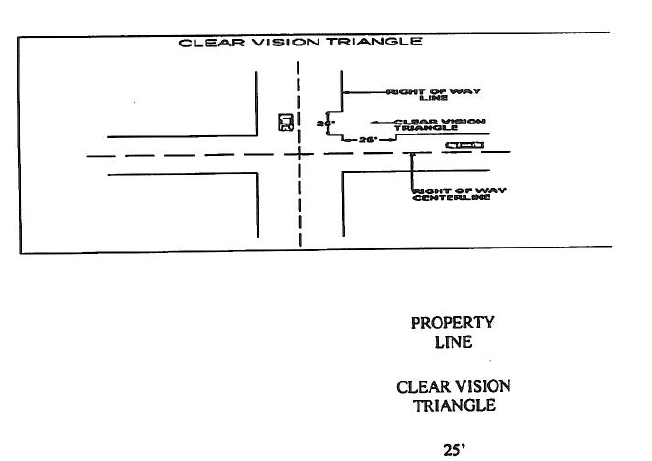
(Ord. No. 1999-35, 10-28-1999; Ord. Correction to dates, amended 4-14-2005; Ord. No. 1999-35, amended 11-10-1999; Manual, amended 11-10-1999; Ord. No. 38-2010, 11-18-2010)
Sec. 3-060. - Bed and breakfast regulations.
There are two types of bed and breakfast uses defined in this Land Development Code, a bed and breakfast and a bed and breakfast inn. A bed and breakfast is permitted in certain residential areas and intended to be residential in nature. Any slight diversion from the bed and breakfast parameters will change a residential use to a commercial use. A bed and breakfast inn is intended for commercial districts only. Therefore, there can be no variance from the regulations specific to a bed and breakfast. Such a variance will alter the use of the property and thus require a change in the zoning district. The regulations that list requirements for both types of bed and breakfast uses are as follows:
(A)
Bed and breakfast (residential).
(1)
Limited to no more than seven rental units consisting of sleeping and sanitary accommodations, and one dwelling unit to be owner occupied.
(2)
The owner is required to live on premises and agree to make available proof of residency.
(3)
Food service limited to breakfast for guests only and to be served between the hours of 5:00 a.m. to 12:00 noon and an afternoon snack.
(4)
Under no circumstances will an alcoholic beverage license be issued.
(5)
No less than one vehicle parking space per rental unit, and a minimum of two vehicle parking spaces for the owner are required on the property. Handicapped parking shall be provided as required by the O.C.G.A. Tit. 30, Accessibility Code.
(6)
A buffer is required with a minimum height of six feet within each of the side and rear yard setbacks.
(7)
One on-premises sign, not to exceed 12 square feet, may either be posted on the structure or on a post. A post sign may not exceed a height of six feet from the highest point of the sign. A post sign is to be located no nearer than ten feet of the right-of-way. No signs are to be allowed that are illuminated from within. Post signs may be downlit with no more than two spotlights with a maximum wattage of 75 watts per bulb located on each side of the sign. Signs posted on structure may be lit with no more than one spotlight with wattage not to exceed 75 watts. All sign designs must be submitted as a part of the conditional use permit drawn.
(8)
A limited site plan approval is required to show the number and location of guest rooms, the parking plan, and the proposed design for the buffer. All site plans must be submitted on or along with a valid survey of the property.
(9)
Small special events are permitted not to exceed 20 guests upon completion of a special review to include standards and restrictions to hours of operation, and requirements with respect to lighting, parking, signage, and buffering so as not to unreasonably interfere with the residential uses of abutting properties. During a special event the total number of guests on the property shall not exceed 20 people, including all occupants of rental units and all non-occupants attending a special event. Regardless of intent to shuttle people to the property, additional parking spaces on the property for four vehicles are required for special events. These four spaces are in addition to the off-street parking spaces required by subsection (5). Handicapped parking shall be provided as required by the O.C.G.A. Tit. 30, Accessibility Code.
(10)
A public hearing before the mayor and council is required. This permit is only valid as long as all conditions specified are met. Any permitted use must adhere to the approved standards, restrictions and parking plans and any other conditions imposed by the mayor and council.
(B)
Bed and breakfast inns (commercial). These land uses are subject to an approved site development plan as required for all commercial development under section 5-080.
(Ord. Correction to dates, amended 4-14-2005; Ord. of 12-11-2008(5); Ord. No. 35-2010, 11-18-2010; Ord. No. 17A-2014, § 1, 2-27-2014)
Sec. 3-070. - Permissible structures per lot; accessory structures.
(A)
Principle structure on a lot. Only one principle structure and its customary accessory structure are permissible per lot. Single-family residential lots shall be limited to one electrical meter. The one electrical meter standard shall not apply to solar power. Notwithstanding anything herein to the contrary, in C-1 zoning districts, the property owner may petition the mayor and council for permission to allow an additional principle use structure per lot, provided the following conditions are met:
(1)
The property is one lot of 4,200 square feet or larger;
(2)
The proposed use of the additional structure is permitted in the C-1 zone and is compatible with the existing or proposed principle structure use;
(3)
The proposed use of the additional structure will further the needs of the owners or residents of the principle structure of the general population;
(4)
All other requirements of the Land Development Code are met, including but not limited to, setback, greenspace, drainage, height limits, etc.; and
(5)
The permitted additional structure must be restricted to the use approved by the mayor and council and may not be changed without approval by the mayor and council.
(B)
Detached accessory structures on commercial lots. A detached accessory structure in a commercial district is exempted from the schedule of regulations in section 3-090, but shall conform to the following regulations:
(1)
No detached accessory structure shall extend beyond the front building line of the principle structure except tents, umbrellas and enclosures.
(2)
No detached accessory structure shall be more than one story in height.
(3)
No detached accessory structure shall be located nearer than five feet to any lot line.
(4)
No detached accessory structure will reduce the amount of parking required for commercial sites as required in section 3-080.
(5)
No detached accessory structure will materially affect an approved drainage plan on an already improved site or increase the amount of run-off leaving the site in the event the site was improved without an approved drainage plan. Existing drainage for the principal structure will not be reviewed or required to be changed unless the approved drainage plan is not being followed.
(6)
No detached accessory structure shall be erected or installed without the proper approval from the designated city department.
(7)
Temporary enclosures. Temporary enclosures are permitted in commercial areas only. This includes any moveable, tent-like shelter intended to provide or actually providing protection from the elements for stored materials, vehicles, or other items, for which a building permit is not required and which a maximum size is 120 square feet. This would include temporary garages of tent-like construction, as well as tarpaulins of plastic or similar type materials supported by wooden or metal frameworks. Such temporary enclosures are to be considered structures under this section and, as such, are governed by the same setback requirements as other structures under this Land Development Code. Tents set up for special occasions, screenhouses, and other such seasonal, recreational enclosures are specifically exempted from this section unless they are used for storage as stated above after written approval from the designated city department prior to placement. However, if this temporary enclosure becomes permanently anchored, it will be treated as a permanent structure and subject to all permitting requirements.
(8)
No temporary detached structure will be allowed on the residential use side(s) of a commercial lot where commercial and residential uses are adjacent.
(C)
Location of detached accessory structures on residential lots. A detached accessory structure in either a residential district or on any lot containing a principle structure whose first floor is used for residential purposes is exempted from the schedule of regulations in section 3-090, but shall conform to the following regulations:
(1)
No detached structure except a carport shall extend beyond the front building line of the principle structure.
(2)
No detached accessory structure shall be more than one story in height.
(3)
No detached accessory structure shall be located nearer than five feet to any lot line. A caretaker's cottage or guest cottage must meet the same front, side and rear setback requirements as required for a principle structure.
(D)
Location of attached accessory structures on residential lots. An attached accessory structure in either a residential district or on any lot containing a principle structure, the ground floor of which is used for residential purposes, shall be considered as an integral part of the principle structure and shall be constructed, altered or otherwise be developed in accordance with the regulations governing flood damage prevention (article 8) and side yard, rear yard and front yard setbacks for principle structures in the district.
(E)
Kiosks. A kiosk is considered a permanent structure for interpretation of the Land Development Code and ordinances of the city. A kiosk may be a principle structure or an accessory structure depending upon the circumstances existing on the property. A kiosk that is intended to operate as an independent business not associated with a principle structure or use shall require site plan approval.
(F)
Principle structures in the Maritime-District. Within the Maritime-District (M-D) more than one principle structure shall be allowed for permitted uses with site plan approval and special review by the mayor and council.
(Ord. No. 2002-11, 6-13-2002; Ord. Correction to dates, amended 4-14-2005; Ord. No. 2002-11 Accessory, amended 8-29-2002; Ord. No. 2010-01, 2-25-2010; Ord. No. 11-2011, 4-14-2011; Ord. No. 54-2014, § 1, 10-23-2014)
Sec. 3-080. - Off-street parking requirements.
(A)
In all zoning districts, handicapped parking shall be provided as required by the O.C.G.A. tit. 30, Accessibility Code.
(B)
Residential district parking requirements and residential off-street parking requirements. Off-street parking facilities shall be provided and maintained on site for all buildings, structures or premises being used in whole or in part for residential purposes, or for any other use permitted in residential districts.
(1)
Residential dwelling units. For every dwelling unit, there shall be provided at least two off-street parking spaces. A caretaker's cottage is a separate dwelling unit and shall be provided at least two off-street parking spaces.
(2)
Nursing homes, hospitals. One parking space for each five patient beds, plus one space for each staff doctor, plus one space for each employee on the largest shift.
(3)
Theaters, auditoriums, gymnasiums and other places of assembly. One parking space for each four seats provided in the main auditorium or for each 50 square feet of floor area available for the accommodation of movable seats in the largest assembly room or area.
(4)
Public and private elementary and secondary schools (except assembly halls, auditoriums and gymnasium used in conjunction therewith). One parking space for each 200 square feet of gross floor area devoted to such use.
(5)
Private docks. At least two off-street parking spaces must be provided for any private dock proposed for construction on a lot that has not been otherwise improved. In the event that a private dock is proposed on a lot that has not been improved, the parking must be off-street (not on city right-of-way) and pervious.
(C)
Control of access to structures used for residential purposes including but not limited to single family, duplex, triplex, two family, multifamily, townhomes, apartments, time shares, and condominiums whether owner occupied or held for rental. In order to promote the safety of motorists and pedestrians, the following regulations shall apply to all newly constructed driveways:
(1)
A driveway opening which connects a lot with a public street shall not be greater than 25 feet in width at the property line. Driveways that serve duplex lots shall not have a width greater than 15 feet per unit measured at the property line. This section is not intended to prevent the installation of flared driveway ends. These flared ends, when constructed in accordance with adopted standards and specifications, shall not count towards the width of the driveway.
(2)
There shall be no more than two driveway openings on any lot of any width. The total of the widths at the property line of two driveway openings shall not be greater than 25 feet.
(3)
No driveway opening shall be constructed within 25 feet of an intersection, measuring from the nearest improved portion of the right-of-way. However, in any instance where there is not adequate space available and other access is not feasible, staff may permit a reduction in the distance to an intersection from a driveway in order to permit safe access to the property provided the speed limit on abutting or adjacent roads is 30 miles per hour or less.
(4)
No curb on any city street or right-of-way shall be cut or otherwise altered without prior written approval of the designated city official. Driveway requirements specified in this section, notwithstanding, staff may issue a permit to a residential property owner to place approved materials in the city right of way, provided the owner is informed and acknowledges that the city will maintain the right to initiate any required action within the right of way and that permitting materials in the right of way shall not create any vested rights in the property owner and such permission may be terminated at any time. In addition, such permit by staff may only be made in the event the improvement does not create a safety issue or interfere with city metered parking and does not violate any city ordinance including, but not limited to, the requirements of section 3-165 to maintain 65 percent of the property setback area as greenspace. If the staff of the building and zoning department finds that a request under this section needs or should have additional review for any reason, it may request review by the mayor and council or, if the staff of the building and zoning department declines the applicant's request, the applicant may apply for the granting of the permit which will result in the application going to the mayor and council. However, before the mayor and council, a public hearing is not required but action may only be taken at a public meeting of the mayor and council.
(5)
For water quality purposes, all newly-constructed driveways and replacements of more than 50 percent of existing driveways serving residential uses shall be constructed of materials designed to allow retention of the first one inch of stormwater. A new driveway includes the initial placement of any material on bare soil. Such new driveways and replacements of more than 50 percent of an existing driveway are subject to permitting and inspection(s). A permit and inspection(s) are also required for repair of less than 50 percent of an improved driveway. The retention requirement is based on a 24-hour, 25-year Tybee III SCS storm. A permit is required for installation of a new or replacement driveway. An inspection is required of each layer prior to the next layer being installed. The permit applicant shall be responsible for all engineering fees incurred by the city for review of materials, even when a material is not approved. Acceptable materials include:
a.
Stone must be either AASHTO #57, #67, #78, or #89 open graded with no fines, or pea gravel with no fines, or a combination of two or more. Graded aggregate base (also known as "crusher run" or "crush and run") is not allowed.
b.
Standard brick pavers are four-inch by eight-inch with minimum five-sixty-fourths-inch average continuous joints/borders with eight one-eighth-inch wide spacers per paver filled with masonry sand. See item (c) for base and header requirements. If larger bricks are used, thereby creating less linear joint and surface area joint, calculations by a state licensed design professional must be reviewed and approved by the city. See engineering fee information in subsection (1).
c.
Permeable interlocking concrete pavers (PICP) are solid structural units installed with openings as described in the coastal stormwater supplement (CSS) through which stormwater runoff can rapidly pass into the underlying reservoir of a four-inch minimum depth open-graded stone, no fines. Openings may be filled only with pea gravel or larger stone, or with masonry sand. A concrete header curb or paver/concrete block ribbon with a maximum width of eight inches must be installed around the perimeter of the pavers. Building foundations and garage floors may serve as a portion of the perimeter. The edge of a paved road may not serve as a perimeter. Flush headers and ribbons are included in the driveway measurements. To not be included in the driveway measurements a header or ribbon must be installed lower than the driveway pavers, covered with adequate top soil, and seeded or sodded to facilitate vegetation.
d.
Ribbon driveway designs are normally constructed of concrete but other materials may be considered. The ribbons are to be a maximum of 18 inches wide with a one to two percent cross slope to route runoff to adjacent pervious areas rather than down the strips to the street. The area between the strips may be either grass or stone as described in subsection (a). The area between the drive strips is to be flush or one-eighth-inch below the driving strip to encourage the percolation of stormwater runoff between the driving strips.
e.
Concrete grid pavers (CGP) are precast concrete units that allow rainfall and stormwater runoff to pass through large openings that are filled with pea gravel, sand or topsoil and turf. A concrete header curb or brick/concrete block ribbon with a maximum width of 12 inches (flush or one-eighth-inch higher than the contained permeable pavement) must be installed around the perimeter of the permeable pavement. Building foundations and garage floors may serve as a portion of the perimeter. The edge of a paved road may not serve as a perimeter. Header and ribbons are included in the driveway measurements. To not be included in the driveway measurements a header or ribbon must be installed lower than the driveway pavers, covered with adequate top soil, and seeded or sodded to facilitate vegetation.
f.
Plastic grid pavers (PGP) consist of flexible, interlocking plastic units that allow rainfall and stormwater runoff to pass through large openings that are filled with gravel, sand or topsoil and turf. A header curb is required and is included in the driveway measurement.
g.
Pervious concrete (also known as porous concrete) is similar to conventional concrete in structure and form, but consists of a special open-graded surface course, typically four to eight inches thick, that is bound together with Portland cement.
h.
Porous asphalt is similar to pervious concrete, and consists of a special open-graded surface course bound together by asphalt cement.
For all other proposed materials, calculations are required from a state licensed design professional demonstrating compliance with the retention requirement of this section.
(D)
Commercial off-street parking. Off-street parking facilities shall be provided and maintained for all structures or premises being occupied or used in whole or in part for commercial activity as follows:
(1)
With the submission of an application for a business license for either a new business or a business that has expanded the occupancy load of the principle structure, changed use, or created additional occupant loads through other structures where permitting has been required by the city, a parking plan must be submitted with the application for approval by the designated city official. If the plan represents significant changes in parking, the plan may be determined to require site plan approval by the mayor and council.
(2)
For all uses, a rack able to accommodate eight bicycles may be substituted for one required standard parking space based on the schedule below. The calculation to meet the handicap parking requirement of subsection (A) shall be based on the number of required parking spaces prior to any rack substitution.
(3)
Maritime district.
a.
Parking shall be in conformance with the off-street requirements of the uses referenced in this section and the required dimensions of section 3-090.
b.
Dock operators must provide one parking space for every 20 linear feet of each side of dock designated for recreational boaters. Docks leased to commercial boats must allow for one space per boat, plus one space per crew member and one space per each four seats for charter passengers.
c.
All changes to parking in the maritime district that involve loading, unloading and transporting of boats will require a parking plan submitted to the city detailing the turn radii of drive aisles.
(E)
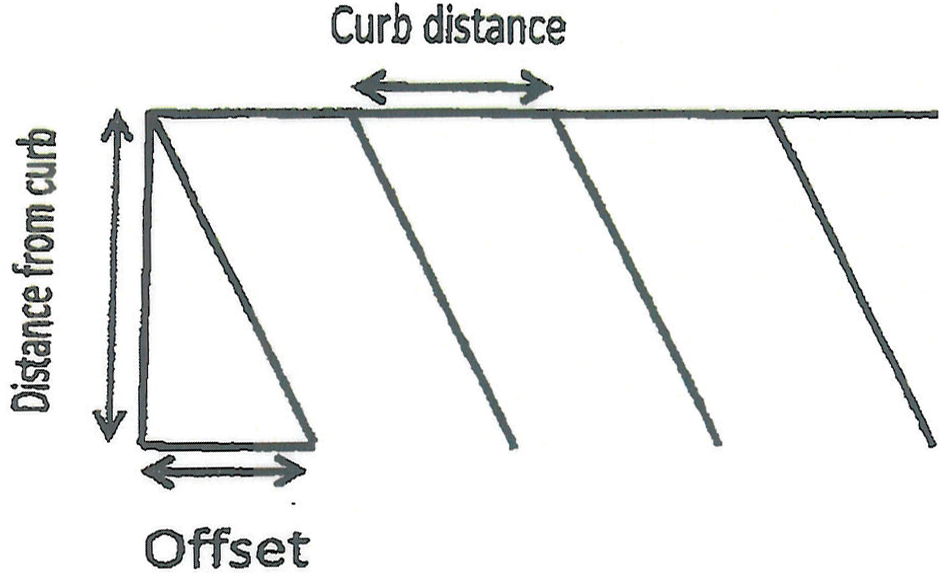
Off-street parking dimensions.
Dimensions of angle parking spaces:
(F)
Exemptions from off-street parking requirements.
(1)
Existing structures with 2,000 square feet or less of floor area that exist in a C-1 zoning district may expand the floor area up to 4,000 square feet without having to meet the off-street parking requirements as long as the structure is completely located within 1,000 feet of a municipal parking lot.
(2)
A structure whose primary use is a church or place of religious worship shall be exempt from all off-street parking requirements.
(Ord. No. 2000-08, 2-11-2000; Ord. No. 1995-17, 12-7-1995; Ord. Correction to dates, amended 4-14-2005; Ord. No. 2004-12, amended 1-31-2005; Ord. No. 2004-10, amended 10-12-2004; Ord. No. 2004-10, amended 6-10-2004; Ord. No. 2000-08, 5-24-2000; Manual, amended 11-10-1999; Ord. of 1-12-2006; Ord. No. 13-2011, 4-14-2011; Ord. No. 04A-2013, 2-14-2013; Ord. No. 18-2013, § 1, 5-23-2013; Ord. No. 03-2014, § 1, 1-9-2014; Ord. No. 28-2014, § 1, 4-10-2014; Ord. No. 13B-2014, § 1, 8-14-2014; Ord. No. 07-A-2015, § 1, 4-23-2015; Ord. No. 02-2017, § 1, 1-12-2017)
Sec. 3-090. - Schedule of development regulations.
(A)
Schedule of residential district dimensional requirements.
(1)
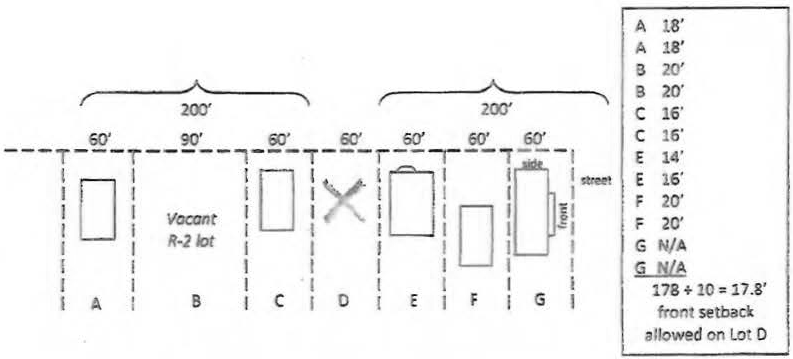
In any residential district (R-I, R-I-B, R-2 and RT) where the average front setback distance for existing buildings on all lots located wholly or partly within 200 feet to each side of any lot, and within the same zoning district and fronting on the same side of the same street and on the same block as such lot, is less than the minimum setback required in such zoning district, the front setback on such lot may be less than the required setback but not less than the existing average setback distance for all lots within 200 feet to each side, provided that in no case shall the front setback on new construction be less than ten feet. When lots within 200 feet on each side are vacant such vacant lots shall be considered as having the minimum required setback for the purpose of computing an average setback distance. When existing structures on lots within 200 feet on each side exceed minimum front setback required in such zoning district, the required setback shall be used for the purpose of computing an average setback distance.
See illustration and table for visual clarification.
(2)
A second set of stairs from an existing elevated home or existing home to be elevated in the future may encroach into the setback upon approval of the zoning administrator. The stairs shall encroach as little as possible into the setback.
(3)
An encroachment to permit one elevator is permissible on an existing elevated home to accommodate an elevator into a side or rear setback but only to the extent necessary to accommodate the elevator and the appropriate shaft and the encroachment shall be no larger than six feet by six feet within the setback and no component or part shall protrude more than six feet into the setback upon approval of the building official.
(B)
Schedule of other than residential districts (commercial, maritime and transitional business-residential) dimensional requirements*.
* When abutting public streets, any principal structure shall be located no nearer than five feet to that lot line.
** Where a commercial establishment abuts a residential zoning, a suitable screen will be required. See section 3-160. This screen shall be either natural (planting) or manmade and shall be maintained in good order and approved by the zoning administrator. Minimum height is six feet.
***
C-1(A) Retail uses and food/beverage service uses.
C-1(B) Hotel and motel uses, with 80 percent maximum lot coverage.
C-1(C) Residential uses, including single-family, two-family, and multi-family (triplexes,
quadraplexes, townhomes, apartments, tourist homes, condominiums, timeshares, and
similar uses), bed and breakfast uses, and public structures.
(C)
Structures above 35 feet. If a variance is granted by the mayor and council for a building with a height in excess of 35 feet, in no event shall a building permit be granted without the following restrictions:
(1)
Structures greater than 35 feet in height shall be fully equipped with fire safe guards consisting of sprinkler systems, smoke detectors and any other fire protection measures deemed necessary at the time by the mayor and council.
(2)
Before a permit can be granted on said request, an affidavit of the builder and owner must be executed agreeing to same to be completed within an agreed upon reasonable time.
(D)
Calculating maximum height for development on existing structures or slabs. In any situation, including specifically but not limited to, the batteries that were formerly part of Fort Screven, where new construction or remodeling of existing improvements is proposed, the elevation for purposes of calculating the finished height of the proposed structure shall be determined by the following rules:
(a)
The finished height of any new construction or remodeling shall not exceed 35 feet from the lower of the existing elevation as determined from either of the following:
(1)
The elevation of the top of the lowest floor's slab of the existing improvement or structure, or
(2)
The elevation of the crown of an existing improved street, public or private, that abuts or is nearest to the property on which the proposed structure is planned.
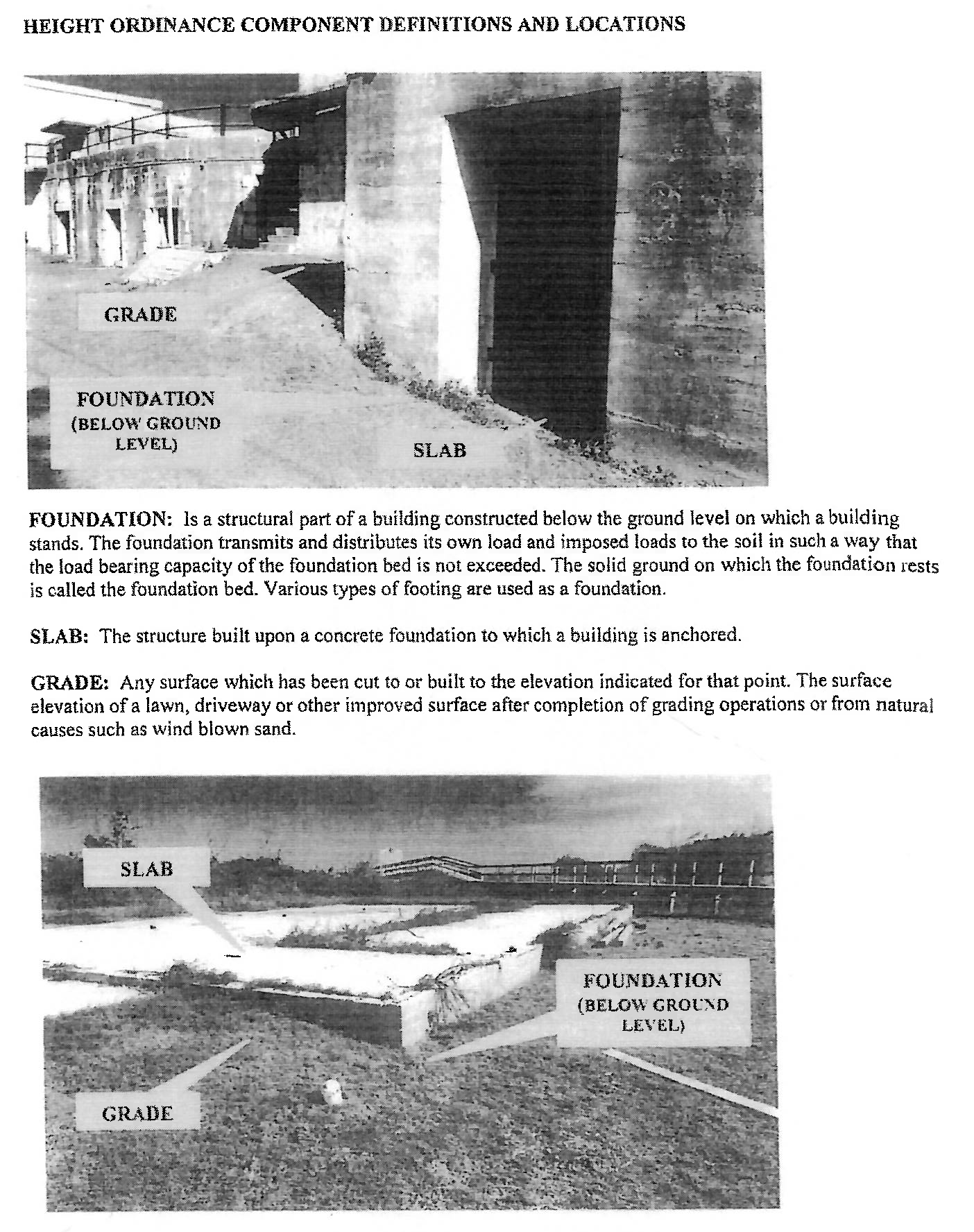
This section is applicable in circumstances where the existing structure, improvement, or slab is to be continued in use or in place, incorporated into the proposed improvement. If an improvement, slab and/or foundation is to be removed entirely, the elevation for new construction will be measured from the lower of the average adjacent grade of the lot or the elevation of the crown of an existing improved street, public or private, that abuts or is nearest to the property on which the proposed structure is planned.
As used in this article, the phrase "is nearest to" is to be determined by a measurement in any direction and without regard to property lines, easements, etc. but rather is to be determined "as the crow flies," beginning with the closest point on the property to be developed to the nearest improved public or private street.
As used in this article, the words "grade," "foundation" and "slab" shall be defined as demonstrated and depicted on the attached Exhibit "A" and this article is to be applied and interpreted consistently therewith.
Editor's note— Exhibit A referenced in this section is not set out at length in this code, but may be found in the offices of the city.
(Ord. No. 1995, 12-7-1995; Ord. No. 2002-6, 4-11-2002; Ord. No. 1995-17, 12-7-1995; Ord. No. 2003-01, 1-9-2003; Ord. No. 1990-09, 4-22-1999; Ord. No. 2000-12, amended 2-11-2000; Ord. Correction to dates, amended 4-14-2005; Ord. No. 2002-01 JOY, amended 2-5-2003; Ord. No. 2002-06, amended 5-15-2002; 3-090, amended 3-20-2001, RT-deleted in error and is re-instated by Jackie Brown 3-20-2001; Ord. No. 2000-12, amended 5-24-2000; Ord. No. 1999-, amended 12-17-1999; Manual, amended 11-10-1999; Manual, amended 10-20-1999, Corrected prior update errors; Ord. No. 1999-09, amended 5-24-1999; Ord. of 1-26-2006(2); Ord. No. 14-2011, 4-14-2011; Ord. No. 24-2013, § 1, 8-8-2013; Ord. No. 18-2014, § 1, 2-27-2014; Ord. No. 40-2014, § 1, 8-14-2014; Ord. No. 23-2016, § 1, 8-25-2016; Ord. No. 01-2017-C, § 1, 4-27-2017; Ord. No. 02-2018, § 1, 3-22-2018; Ord. No. 2023-09, § 1, 5-11-2023)
Sec. 3-090.1. - Streams, lakes, coastal marshlands and freshwater wetlands buffer/setback.
(A)
Intent and purpose.
(1)
The rivers, streams, wetlands, and coastal marshlands constituting the riparian lands of the city are a significant natural resource and are essentially linked to the city's economy. The city council recognizes that these lands provide numerous benefits and are vital to the health, safety, and economic welfare of its citizens. The city council finds that buffers adjacent to these lands provide substantial benefits including:
a.
Minimizing activities that degrade, destroy, or otherwise negatively impact the value and function of coastal marshlands;
b.
Maintaining stream and river water quality;
c.
Trapping sediment and other pollutants found in surface runoff;
d.
Promoting bank stabilization and reducing erosion;
e.
Protecting terrestrial coastal habitat for nesting and feeding wildlife;
f.
Reducing the impact of flooding by increasing floodwater storage areas;
g.
Enhancing the marshlands' scenic value and recreational opportunities;
h.
Protecting property values of individual landowners;
i.
Protecting and restoring greenspace and the natural character of the coastal region; and
j.
Protecting important nursery areas for fisheries, which provide food and habitat to numerous species of fish and shellfish, including commercially important species.
(2)
It is therefore the purpose and intent of this section to establish a coastal riparian buffer zone of restricted development and limited land use adjacent to coastal streams, rivers, marshes, and wetlands. The purposes of this coastal riparian buffer zone are to:
a.
Protect the public health, safety, environment, and general welfare of the citizens of the city;
b.
Minimize public and private land loss due to erosion, sedimentation, and water pollution;
c.
Maintain water quality for human use and for protecting the important nursery areas for fisheries, which provide food and habitat to numerous species of fish and shellfish, including commercially important species;
d.
Protect terrestrial coastal habitat for nesting and feeding wildlife;
e.
Reduce the impact of flooding by increasing floodwater storage areas;
f.
Protect the natural and native vegetation in the zone;
g.
Protect the coastal region's visual character and unique natural resources; and
h.
Avoid land development within such buffers by establishing buffer zone requirements and by requiring authorization for any land disturbing activities.
(3)
The standards and regulations set forth in this section are created under the authority of the city's home rule and zoning powers defined in Article IX, Section 2 of the Georgia Constitution.
(B)
Definitions.
Access path means a pervious path designed, constructed, and maintained pursuant to applicable best management practices that provides for access to water-dependent uses through the buffer and takes the route that impacts the natural vegetation of the buffer to the least extent possible.
Buffer encroachment permit means the permit issued by the city and required to undertake certain buffer encroaching activities as described in subsection (D).
Coastal marshland or marshland means any marshland intertidal area, mud flat, tidal water bottom, or salt marsh within the estuarine area of the city whether or not the tidewaters reach the littoral areas through natural or artificial watercourses. "Vegetated marshlands" shall include those areas upon which grow one, but not necessarily all, of the following: salt marsh grass (Spartina alterniflora), black needlerush (Juncus roemerianus), saltmeadow cordgrass (Spartina patens), big cordgrass (Spartina cynosuroides), saltgrass (Distichlis spicata), coast dropseed (Sporobolus virginicus), bigelow glasswort (Salicornia bigelovii), woody glasswort (Salicornia virginica), saltwort (Batis maritima), sea lavender (Limonium nashii), sea oxeye (Borrichia frutescens), silverling (Baccharis halimifolia), false willow (Baccharis angustifolia), and high-tide bush (Iva frutescens). The occurrence and extent of salt marsh peat at the undisturbed surface shall be deemed to be conclusive evidence of the extent of a salt marsh or a part thereof. Coastal Marshlands Protection Act, O.C.G.A. § 12-5-282.
Coastal riparian buffer or buffer means, on any given parcel of land, a natural or enhanced vegetated area of riparian land lying adjacent to a stream, pond, impoundment, wetland, or coastal marshland.
Estuarine area means all tidally influenced waters, marshes, and marshlands lying within a tide-elevation range from five and six-tenths feet above mean tide level and below. Coastal Marshlands Protection Act, O.C.G.A. § 12-5-282.
Impervious cover means a surface composed of any material that greatly impedes or prevents the natural infiltration of water into soil. Impervious surfaces include, but are not limited to, rooftops, buildings, streets and roads, except those designed specifically to allow infiltration.
Impoundment means any lake, pond, or other body of freshwater.
Land disturbing activity means:
(1)
Any installation of impervious cover; or
(2)
Any grading, scraping, excavating or filling of land.
Land disturbance permit means the permit issued by the city pursuant to the Georgia Erosion and Sedimentation Control Act and required for undertaking any land disturbing activity.
Littoral area means the tidal area between the high water and low water marks.
Minor land disturbing means activities such as home gardens and individual home landscaping, repairs, maintenance work, fences, and other related activities which do not result in any soil erosion as defined in the current version of the minor land disturbing guidelines issued by the state department of natural resources. Such minor land disturbing activities may not result in total disturbance of more than 100 square feet.
Native vegetation means vegetation that is naturally found in the area.
Person means any individual, partnership, firm, association, joint venture, public or private corporation, trust, estate, commission, board, public or private institution, utility, cooperative, state agency, municipality or other political subdivision of this state, any interstate body or any other legal entity.
Riparian land means any land along the edge of a lake, stream, river, marsh, wetland, coastal marshland, pond or impoundment.
Wetland means those areas that are inundated or saturated by surface or groundwater at a frequency and duration sufficient to support, and that under normal circumstances do support, a prevalence of vegetation typically adapted for life in saturated soil. Ga. Comp. R. & Regs. r.391-3-16-.03 (2006).
(C)
Applicability. This section shall apply to all land disturbing activity on property containing or adjacent to coastal marshland or wetlands. These requirements are in addition to, and do not replace or supersede, any other applicable buffer requirements established under state law. Approval or exemption from these requirements does not constitute approval or exemption from buffer requirements established under state law or from other applicable local, state or federal regulations.
Best management practices shall be required for all land disturbing activities. Proper design, installation, and maintenance of best management practices shall follow the design specifications contained in the "Manual for Erosion and Sediment Control in Georgia" published by the state soil and water conservation commission as of January 1 of the year in which the land disturbing activity was permitted.
(1)
Grandfather provisions. This section shall not apply to the following activities:
a.
Existing development and land disturbance activities as of August 14, 2014, except that new development or new land disturbing activities on such properties will be subject to all applicable buffer requirements.
b.
Any land disturbing activity that is scheduled for permit approval or has been submitted for approval as of August 14, 2014.
c.
Land disturbing activity that has not been submitted for approval, but that is part of a larger master development plan, such as for an office park or other phased development and that has been previously approved within one year of August 14, 2014.
After August 14, 2014, this section shall apply to all new subdividing and platting activities.
(2)
Exemptions. The following specific activities are exempt from this section:
a.
Public sewer line easements paralleling the stream, lake, impoundment, wetland, and/or coastal marshlands, except that all easements (permanent and construction) and land disturbance should be at least 25 feet from the mean high water line in coastal marshlands and wetlands or the top of the bank for streams, lakes, and impoundments. This includes such impervious cover as is necessary for the operation and maintenance of the utility, including but not limited to manholes, vents and valve structures. This exemption shall not be construed to allow the construction of roads, bike paths, or other transportation routes in such easements, regardless of the type of paving material used.
b.
Land disturbing activities by governments within a road right-of-way existing at the time the ordinance from which this section is derived takes effect, or approved under the terms of this section. Development activities are only allowed if they cannot reasonably be located outside the buffer.
c.
Land disturbing activities within utility easements existing as of the effective date of the ordinance from which this section is derived or approved under the terms of this section when necessary for the operation and maintenance of the utility, including but not limited to manholes, vents and valve structures.
d.
Emergency maintenance and repairs necessary to preserve life and/or property. However, when emergency work is performed under this section, the person performing it shall report such work to the city as soon as possible and within 24 hours of the commencement of the work. Within ten days thereafter, the person shall apply for a variance and perform such work within such time period as may be determined by the city to be reasonably necessary to correct any impairment such emergency work may have caused to the water conveyance capacity, stability or water quality of the protection area.
e.
Forestry and silviculture activities on land that is zoned for forestry, silvicultural or agricultural uses, provided these activities are not incidental to other land disturbing activity and are conducted using applicable best management practices. If such activity results in land disturbance in the buffer that would otherwise be prohibited, no land disturbing activity other than normal forest management practices will be allowed on the entire property for three years after the end of the activities that intruded on the buffer.
f.
Stream crossings for water lines or stream crossings for sewer lines, provided that they occur at an angle, as measured from the point of crossing, within 25 degrees of perpendicular to the stream; cause a width of disturbance of not more than 50 feet within the buffer; and adequate erosion control measures are incorporated into the project plans and specifications and are implemented.
g.
Such minor land disturbing activities as home gardens and individual home landscaping, repairs, maintenance work, fences, and other related activities which do not result in any soil erosion as defined in the current version of the minor land disturbing guidelines issued by the state department of natural resources. Such minor land disturbing activities may not result in total disturbance of more than cumulative 100 square feet per parcel.
h.
Pruning and selective clearing is permissible to maintain a viewshed provided such activities do not disturb more than 30 percent of the buffer's length as measured along the landward edge of the marshlands, and no trees above six inches in diameter are removed.
i.
Activities for the purpose of constructing public water supply intake or public wastewater outfall structures, when designed, constructed, and maintained using applicable best management practices.
j.
Activities to restore and enhance stream bank stability, vegetation, water quality, and/or aquatic habitat, when designed, constructed, and maintained pursuant to applicable best management practices.
k.
Any trimming or pruning of vegetation for the purpose of creating a keyhole view corridor and/or access path and conducted in accordance with applicable best management practices. This exemption shall not allow for the removal of trees.
l.
Creation of an access path to water-dependent uses through the buffer when designed, constructed, and maintained pursuant to applicable best management practices.
m.
Structural maintenance and repair (not replacement or enlargement) of any damaged structure that existed in the buffer as of the effective date of the ordinance from which this section is derived, provided the repair is less than 50 percent of the value of the structure, as determined by a local building inspector and is constructed and designed pursuant to applicable best management practices.
(D)
Standards and regulations. All land disturbing activity that is not exempt from this section pursuant to subsection (C)(2) shall meet the following requirements:
(1)
A buffer shall be maintained for a minimum of 25 feet along both banks of streams and along all impoundments, as measured from the top of the bank of the stream or impoundment. All land disturbing activity is prohibited within the 25-foot buffer unless a variance or buffer encroachment permit is granted.
(2)
A buffer shall be maintained for a minimum of 25 feet along all coastal marshlands, measured horizontally from the estuarine area. All land disturbing activity is prohibited within the 25-foot buffer unless a variance or buffer encroachment permit is granted.
(3)
A buffer shall be maintained for a minimum of 25 feet along all wetlands as measured from the inland edge of the wetland. All land disturbing activity is prohibited within the 25-foot buffer unless a variance or buffer encroachment permit is granted pursuant to subsection (E) or subsection (G).
(4)
No septic tanks or septic tank drain fields shall be permitted within the buffer.
(5)
The application of pesticides shall not be permitted in the buffer.
(E)
Buffer encroachment permit.
(1)
General.
a.
No person shall conduct any land disturbing activity within the coastal riparian buffer without first obtaining a buffer encroachment permit from the city to perform such activity.
b.
Buffer encroachment permits may be issued by the city if the land disturbing activity constitutes construction of a porch, deck, boardwalk, or similar structure that is an accessory use to a residential dwelling, constructed and designed in accordance with applicable best management practices. In the case of construction of a structure to be located outside the buffer, an encroachment permit of no more than ten feet may be granted for construction purposes. All disturbed areas must be restored to a natural state.
c.
The following factors will be considered in determining whether to issue a permit:
1.
Whether the buffer encroachment will result in a reduction of the quality of the water exiting the parcel, or a diminishment of a uniform coastal marshland scenic vista;
2.
Whether the proposed development in the buffer will be conducted in accordance with all design guidelines, low impact development techniques, and other applicable best management practices;
3.
Whether the proposed intrusion into the buffer is the minimum intrusion necessary to accomplish the purpose of the intrusion;
4.
Whether a feasible alternative design exists that would result in no intrusion into the buffer.
(2)
Application requirements and procedures.
a.
The application for a buffer encroachment permit shall be submitted to the city and must include the following:
1.
A site plan showing:
(i)
The location of all riparian lands on or immediately adjacent to the property;
(ii)
Identification of any streams found on the Clean Water Act § 303(d) list that are adjacent to the property;
(iii)
Boundaries of the riparian buffer, as described by subsection (D), on the property;
(iv)
Buffer zone topography with contour lines at no greater than five-foot contour intervals;
(v)
Delineation of forested and open areas in the buffer zone; and
(vi)
Detailed plans of all proposed land development and land disturbing activity on the site;
2.
A description of any potential development impact on the buffer and how it will be avoided;
3.
Any other documentation that the city may reasonably deem necessary for review of the application and to insure that the coastal riparian buffer ordinance is addressed in the approval process; and
4.
Payment of the fee of $250.00. This fee will be forfeited if the project is subsequently abandoned.
b.
The coastal riparian buffer shall be clearly delineated on all development plans and plats submitted for buffer encroachment permit approval, and buffer limits must be staked in the field in a manner approved by the city before and during construction with posted signs that describe allowable activities. Buffer boundaries shall be printed on all development and construction plans, plats, and official maps.
c.
The applicant must pay the appropriate permit fee as provided in the fee schedule as adopted by the mayor and council and on file with the clerk of council.
d.
In the event the designated city official(s) determines that all requirements for approval have not been met, it shall promptly notify the applicant of such fact and shall automatically deny the permit.
e.
An individual whose permit application has been denied or a permittee whose permit has been revoked may appeal the decision of the designated city official(s) to the city council provided that they file written notice of an appeal with the city clerk within 15 business days of the city's decision. Such appeal shall be considered by the city council at the next regular meeting held after the city's receipt of the written notice of appeal, provided that notice of appeal is received by the city council a minimum of ten full business days before the meeting. In the event an individual whose permit has been denied or revoked is dissatisfied with the decision of the city council, they may petition for writ of certiorari to the superior court as provided by law.
f.
The designated city official(s) shall inspect each lot for which a permit for a new land disturbing activity or for modification of an existing land disturbing activity is issued. This inspection shall occur on or before six months from the date of issuance of such permit.
1.
If the land disturbing activity is not complete within six months from the date of issuance, the permit shall lapse and become void. No refunds will be made for permit fees paid for permits that expired due to failure to engage in the land disturbing activity. If later, an individual desires to continue land disturbing activities at the same location, a new application must be processed and another fee paid in accordance with the fee schedule applicable at such time.
2.
If the land disturbing activity is substantially complete, but not in full compliance with this section the designated city official(s) shall give the applicant notice of the deficiencies and shall allow an additional 30 days from the date of inspection for the deficiencies to be corrected. If the deficiencies are not corrected by such date, the permit shall lapse and become void.
(F)
Inspection. The designated city official(s) or its authorized representative may inspect ongoing work in the buffer to be made periodically during the course thereof and shall make a final inspection following completion of the work. The landowner shall assist the designated city official(s) or authorized representative in making such inspections. The designated city official(s) shall have the authority to conduct such investigations as it may reasonably deem necessary to carry out its duties as prescribed in this section, and to enter at a reasonable time upon any property, public or private, for the purpose of investigating and inspecting the sites of any land disturbing activities within the buffer protection area.
No person shall refuse entry or access to any authorized representative or agent who requests entry for purposes of inspection, and who presents appropriate credentials, nor shall any person obstruct, hamper or interfere with any such representative while in the process of carrying out official duties.
(G)
Variance procedure. Variances from the above buffer requirements may be granted in accordance with the following provisions:
(1)
Where a parcel was platted prior to the effective date of the ordinance from which this section is derived, and its shape, topography, or other existing physical condition prevents land disturbing activity consistent with this section, and such land disturbing activity cannot be authorized through issuance of a buffer encroachment permit, the city may grant a variance that shall allow a reduction in buffer width only to the extent necessary to provide relief from the conditions which prevented land disturbing activity on the parcel, provided adequate mitigation measures are implemented by the landowner to offset the effects of such variance.
(2)
Variances shall not be considered when:
a.
Following adoption of the ordinance from which this section is derived, actions of any property owner of a given property have created conditions of a hardship on that property; or
b.
The owner previously applied for a buffer encroachment permit that was denied by the city.
(3)
Except as provided above, the city shall grant no variance from any provision of this section.
(4)
When a public hearing on the application for a variance is conducted, the city shall give public notice of each such public hearing in a newspaper of general circulation within the city. The city shall post a sign giving notice of the proposed variance and the public hearing. The sign shall be of a size and posted in such a location on the property as to be clearly visible from the primary adjacent road right-of-way.
(5)
At a minimum, a variance request shall include the following information:
a.
A site map that includes locations of all streams, wetlands, coastal marshlands, floodplain boundaries, and other natural features, as determined by field survey;
b.
A description of the shape, size, topography, slope, soils, vegetation, and other physical characteristics of the property;
c.
A detailed site plan that shows the locations of all existing and proposed structures and other impervious cover, the limits of all existing and proposed land disturbance both inside and outside the buffer;
d.
The exact area of the buffer to be affected shall be accurately and clearly indicated;
e.
Documentation of the inability to develop the property without a variance;
f.
Documentation that shows how buffer encroachment will be minimized to the greatest extent possible;
g.
Documentation that shows how the buffer encroachment will not result in reduction of water quality or diminishment of a uniform coastal marshland scenic vista;
h.
At least one alternative plan or an explanation of why such a plan is not possible;
i.
A calculation of the total area and length of the proposed encroachment;
j.
A stormwater management site plan, if applicable; and
k.
A proposed mitigation plan designed pursuant to applicable best management practices that offsets the effects of the proposed encroachment. If no mitigation is proposed, the application must include an explanation of why none is being proposed.
• Acceptable mitigation might include restoration and/or enhancement and protection of a degraded area of coastal riparian buffer on an adjacent or nearby property.
l.
Payment of the variance fee of $200.00 for a residential project or $500.00 for a commercial project.
(6)
The following factors will be considered in determining whether to issue a variance:
a.
Whether the requirements of the riparian buffer represent an extreme hardship for the landowner, such that little or no reasonable economic use of the land is available without the reduction of the width of the riparian buffer;
b.
Whether actions of the landowner of a given property have created conditions of a hardship on that property;
c.
The size, shape, topography, soils, vegetation and other physical characteristics of the property that may prevent land development;
d.
The location and extent of the proposed buffer encroachment;
e.
Whether alternative designs are possible which require less or no intrusion;
f.
The long-term water quality impacts of the proposed variance;
g.
The water quality impacts of any construction that the granting of the variance would allow in the buffer;
h.
Whether the issuance of a variance and the completion of the applicant's proposal will unreasonably interfere with the conservation of fish, shrimp, oysters, crabs, clams, or other marine life, wildlife, or other resources, including but not limited to water and oxygen supply; and
i.
Whether the proposed development in the buffer will be conducted in accordance with all design guidelines, low impact development techniques, and applicable best management practices.
(H)
Compatibility with other regulations and requirements. This section is not intended to interfere with, abrogate, or annul any other ordinance, rule or regulation, statute or other provision of law. The requirements of this section should be considered minimum requirements. Where any provision of this section imposes restrictions or protective standards different from those imposed by any other ordinance, rule, regulation, or other provision of law, the more restrictive provision applies.
The requirements of this section shall in no case be interpreted to preempt the need for other relevant local, state and federal permits and approvals.
• All land disturbing activities must comply with the requirements of the Erosion and Sedimentation Act of 1975 and all applicable best management practices therein.
(1)
Setback area. In addition to the restrictions identified above, there is a setback area established within 25 feet from the edge of state waters and coastal marshlands as defined in subsection (B) and no land disturbing activities are permissible in the setback area except as provided by the exemptions stated in subsection (C)(2) and subject to the right of an applicant to seek an encroachment permit and/or variance under subsection (G) or section 5-090 or other applicable ordinance. The setback from such area is to be measured from the estuarine, wetland, or marsh area horizontally from the edge of such area.
(I)
Violations, enforcement and penalties. Any action, or inaction, which violates the provisions of this section or the requirements of an approved site plan may be subject to the enforcement actions outlined in this section. Any such action, or inaction, which is continuous with respect to time, is deemed to be a public nuisance and may be abated by injunctive or other equitable relief. The imposition of any of the penalties described below shall not prevent such equitable relief.
(1)
Notice of violation. If the city determines that a permittee or other responsible person has failed to comply with the terms and conditions of a permit, an approved stormwater management plan or the provisions of this section, it shall issue a written notice of violation to such permittee or other responsible person. Where a person is engaged in activity covered by this section without having first secured a permit therefore, the notice of violation shall be served on the owner or the responsible person in charge of the activity being conducted on the site.
The notice of violation shall contain:
a.
The name and address of the owner or the applicant or the responsible person;
b.
The address or other description of the site upon which the violation is occurring;
c.
A statement specifying the nature of the violation;
d.
A description of the remedial measures necessary to bring the action or inaction into compliance with the permit, the stormwater management plan or this section and the date for the completion of such remedial action;
e.
A statement of the penalty or penalties that may be assessed against the person to whom the notice of violation is directed; and
f.
A statement that the determination of violation may be appealed to the city by filing a written notice of appeal within 30 days after the notice of violation (except, that in the event the violation constitutes an immediate danger to public health or public safety, 24-hour notice shall be sufficient).
(2)
Penalties. In the event the remedial measures described in the notice of violation have not been completed by the date set forth for such completion in the notice of violation, any one or more of the following actions or penalties may be taken or assessed against the person to whom the notice of violation was directed. Before taking any of the following actions or imposing any of the following penalties, the city shall first notify the permittee or other responsible person in writing of its intended action and shall provide a reasonable opportunity, of not less than 72 hours (except, that in the event the violation constitutes an immediate danger to public health or public safety, 24-hour notice shall be sufficient) to cure such violation. In the event the permittee or other responsible person fails to cure such violation after such notice and cure period, the city may take any one or more of the following actions or impose any one or more of the following penalties.
a.
Stop work order. The city may issue a stop work order which shall be served on the permittee or other responsible person. The stop work order shall remain in effect until the permittee or other responsible person has taken the remedial measures set forth in the notice of violation or has otherwise cured the violation or violations described therein, provided the stop work order may be withdrawn or modified to enable the permittee or other responsible person to take the necessary remedial measures to cure such violation or violations.
b.
Withhold certificate of occupancy. The city may refuse to issue a certificate of occupancy for the building or other improvements constructed or being constructed on the site until the permittee or other responsible person has taken the remedial measures set forth in the notice of violation or has otherwise cured the violations described therein.
c.
Suspension, revocation or modification of permit. The city may suspend, revoke, or modify the permit authorizing the land development project. A suspended, revoked, or modified permit may be reinstated after the permittee or other responsible person has taken the remedial measures set forth in the notice of violation or has otherwise cured the violations described therein, provided such permit may be reinstated (upon such conditions as the city may deem necessary) to enable the permittee or other responsible person to take the necessary remedial measures to cure such violations.
d.
Civil penalties. In the event the permittee or other responsible person fails to take the remedial measures set forth in the notice of violation or otherwise fails to cure the violations described therein within 72 hours, or such lesser period as the city shall deem appropriate (except that in the event the violation constitutes an immediate danger to public health or public safety, 24-hour notice shall be sufficient) after the city has taken one or more of the actions described above, the city may impose a penalty on the permittee or other responsible person not to exceed $1,000.00 (depending on the severity of the violation) for each day the violation remains un-remedied after receipt of the notice of violation.
e.
Criminal penalties. For intentional and flagrant violations of this section, the city may issue a citation to the permittee or other responsible person, requiring such person to appear in municipal court to answer charges for such violation. Upon conviction, such person shall be punished by a fine not to exceed $1,000.00 or imprisonment for 60 days or both. Each act of violation and each day upon which any violation shall occur shall constitute a separate offense.
(Ord. No. 39-C-2014, § 1, 8-14-2014)
Sec. 3-100. - Beach, dune, or vegetation disturbance/crossover maintenance and construction.
It shall be unlawful for any person in any manner to damage, destroy, remove or alter in any way the beach, dunes or vegetation thereon without having first obtained the proper federal, state and local permits. Special review shall be required for any alteration, construction or disturbance of beach, dunes or vegetation thereon including the alteration or construction of dune crossovers; provided, however city projects, approved special events or the maintenance of existing dune crossovers, including the replacement of supports, decking boards, pilings and or handrails, for placement in the same location as then currently exist, shall not require special review.
There shall be a ten-foot setback measured from the landward toe of the landward-most dune as delineated by the state department of natural resources.
(Ord. Correction to dates, amended 4-14-2005; Ord. of 4-23-2009; Ord. No. 23-2011, 4-14-2011; Ord. No. 23-2011(A), 8-11-2011; Ord. No. 27-2013, 8-22-2013; Ord. No. 43-2014, § 1, 8-28-2014)
Sec. 3-110. - Single-family residential standards/manufactured home standards/recreational vehicle standards.
All single-family residences, whether site built or manufactured housing, must meet the following standards:
(A)
Structure and design standards.
(1)
Corrugated metal or plastic panels are prohibited as roofing materials.
(2)
The exterior wall shall be material similar to traditional site-built housing. These materials may include clapboards, simulated clapboards such as conventional vinyl or metal siding over a minimum covering of one-half inch exterior wood sheathing, wood shingles, shakes, stucco, brick, brick veneer, concrete block, or similar materials, but shall not include smooth, ribbed or corrugated metal or plastic panels.
(3)
The minimum horizontal dimension of the unit as installed on the site shall be 24 feet.
(4)
All structures must meet wind-loading requirements of federal emergency management administrator and the SBCCI Codes.
(B)
Manufactured home safety standards. For the purposes of public safety, all manufactured homes or other such forms of modular or manufactured housing are subject to the following requirements.
(1)
Manufactured home stand requirement. Prior to the issuance of a manufactured home relocation permit the owner of the parcel or lot for which the manufactured home is to be placed must have an approved manufactured home stand. Such stand must have the following:
a.
Street access. Each manufactured home stand shall be provided with access frontage to a width of at least 30 feet to a public or private street or road.
b.
Electric power supply. Each manufactured home stand shall be provided with an adequate, properly grounded, waterproofed electrical receptacle with a minimum rated capacity of 100 amps. A properly sized over current device shall be installed as a part of each power outlet.
c.
Sewage disposal. Each manufactured home stand shall be provided with the means of disposing of kitchen, bath, and putrescible waste directly into a properly installed and inspected septic tank system or an approved community sewerage collection system.
d.
Water service connection. Each manufactured home stand shall be provided with the means of connecting and being serviced by municipal water service.
(2)
Manufactured home development in flood hazard areas. Due to the danger of placing a manufactured home in a flood hazard area, the following anchor requirements are required if a manufactured home is placed on a lot which is located in or adjacent to a flood hazard area as described by the federal emergency management association.
This table is based on a minimum working load per tie of 3,150 pounds with a 50 percent overload (4,725 pounds total).
a.
Multiple-wide manufactured homes shall only be required to have diagonal ties and anchors in accordance with the chart above unless the manufacturers installation instructions require more.
b.
Single section manufactured homes shall have diagonal and vertical ties and anchors in accordance with the chart above unless manufacturer's instructions require more.
(3)
All principal structures shall be placed on a permanent foundation. For the purposes of this section, a permanent foundation shall mean a concrete slab, concrete footers, foundation wall, pilings or post construction which complies with the city building code.
(4)
Manufactured home siding, stairs, and foundation requirements:
a.
All manufactured homes shall have siding materials consisting of wood, masonry, concrete, stucco, masonite, or metal lap. The exterior siding material shall extend to ground level except that when a solid concrete or masonry perimeter foundation is used, the siding material need not extend below the top of the foundation.
b.
Skirting and/or siding must be in place within 45 days from the date the relocation permit is issued.
c.
Stairs and landings shall comply with section 112 — stairway construction of the state building code and must adhere to the following:
1.
The height of the riser shall not exceed seven and three-fourths; inches, and treads, exclusive of nosing shall not be less than nine inches wide.
2.
Every tread less than ten inches wide shall have a nosing, or effective protection, of approximately one-inch over the level immediately below that tread.
3.
The width of the landing shall not be less than the width of the stairways they serve.
4.
Every landing shall have a minimum dimension measured in the direction of travel equal to the width of the stairway. Such dimension need not exceed four feet when the stair has a straight run.
5.
All stairways having treads located more than three risers above a floor or grade shall be equipped with a handrail not less than 30 nor more than 34 inches above the leading edge of the tread.
6.
The minimum width of any stair serving as a means of egress shall be a minimum of 36 inches.
7.
If handicapped ramps are added they must be at least three feet wide and the slope of the ramp shall not exceed one foot for every 12 feet.
(5)
Foundation requirements on all manufactured homes are as follows:
a.
Supports or piers shall not be more than two feet from the exterior end wall.
b.
All grass and organic material shall be removed and the foundation must be placed on stable soil.
c.
Crossover wires must be placed between the two halves.
d.
All nails or staples shall be removed or sealed.
e.
Reserved.
f.
Dryer vents must be vented to the exterior of the manufactured home; not underneath.
g.
In no case shall wheels, any undercarriage or transporter unit be left on any structure.
(6)
Manufactured home additions and auxiliary structures. Any significant feature added to a manufactured home that was not part of the manufacturer's original design is considered to be either an addition or an auxiliary structure.
a.
All habitable spaces added to the manufactured home shall be constructed in accordance with the National Manufactured Housing Construction and Safety Standards Act or within the provisions of the state building codes.
b.
All auxiliary structures (such as porches, decks, awnings, cabanas. stairs, etc., unless provided and approved by the manufacturer) shall be entirely self-supporting, unless designed and approved by a professional engineer or registered architect. All such structures shall be constructed in accordance with the state building codes.
(C)
Temporary use of recreational vehicles on private property for dwelling purposes. No recreational vehicle shall be used for dwelling purposes on any lot in a residential district unless a temporary permit is acquired. Such permit shall be valid for up to seven days and the lot is only eligible for a permit three times per calendar year except as set forth below. Only one vehicle may be granted a permit for a lot during the duration of the permit. The temporary permit may be obtained from the zoning administrator during normal hours of operation at the city hall. There is no fee for this permit. However, violation of this clause will be subject to the same enforcement as all other regulations of this Land Development Code.
"Dwelling purposes" means to "use for living space" and shall include, but not be limited to, acts of sleeping, cooking, bathing, occupying as a dwelling, or any stay within the recreational vehicle not directly related to its driving. The following factors may constitute acts to be considered indicative of "dwelling purposes:"
(1)
Evidence of a person entering and exiting the vehicle;
(2)
Connection of the vehicle to sewer, water, or electrical systems;
(3)
Use of a power generator;
(4)
Accessory structures about the vehicle;
(5)
Illumination of the interior of the vehicle;
(6)
Window masking;
(7)
Expanded bays "pop-outs."
"Recreational vehicle" or "RV" means a vehicular-type unit primarily designed as temporary living quarters for recreational, camping, travel or seasonal use that either has its own motive power or is mounted on, or towed by, another vehicle. An RV should comply with all applicable laws as to size.
(D)
For purposes of facilitating the work associated with elevating homes a part of the FEMA sponsored Hazard Mitigation Grant, the restrictions contained in subsection (C) above shall not apply to a homeowner who needs to reside in a recreational vehicle while they are actively engaged in construction under the grant. This special exemption shall be permitted for a period of no longer than one year. However, if construction is not completed within one year from issuance of the initial permit, a person may apply for a renewal of the permit for up to an additional 12 months provided they continue active construction to complete the project. Placement of the recreational vehicle must meet all setback requirements and be approved by the city's planning and zoning department.
(Ord. Correction to dates, amended 4-14-2005; Ord. No. Ord. No. 25-2011, 6-9-2011; Ord. No. 18-2014, § 1, 2-27-2014; Ord. No. 2024-06, § 1, 6-27-2024)
Sec. 3-120. - Access to public street required.
No structure shall be constructed or erected upon a lot, or parcel of land, which does not abut upon an open public street or permanent easement of access to an open public street. Such easement shall have a minimum width of 20 feet unless an easement of lesser width was of record prior to the adoption of the ordinance from which this section is derived.
(Ord. Correction to dates, amended 4-14-2005; Ord. No. 26-2011, 7-28-2011; Ord. No. 18-2014, § 1, 2-27-2014)
Sec. 3-130. - Structures to be moved.
(A)
Existing structure to be moved. Any structure which has been wholly or partially erected on any premises located within the city shall not be moved to any other premises in the city until a permit for such removal is secured from the building and zoning department. Any such building or structure shall conform to all provisions of this Land Development Code in the same manner as a new building or structure. Structures that are determined to be historic and are contributing to the historic character of the neighborhood or are eligible for listing on the National Register of Historic Places may be exempt from having to come into compliance with current building codes as determined by the State Historic Preservation office.
(B)
Modular structures to be moved. No structure shall be moved into the city from outside the city until such compliance has been shown and such permit has been secured. Before a permit may be issued for moving a structure, the building official shall inspect the same and shall determine if it is in compliance with all city and state regulations. In addition, all modular units wishing to be located within the city limits must first provide to the community development office the appropriate state certification for the construction of such a structure from the department of community affairs.
(Ord. Correction to dates, amended 4-14-2005; Ord. No. 36-2010, 11-18-2010; Ord. No. 18-2014, § 1, 2-27-2014)
Sec. 3-140. - Unsafe structures.
Nothing in this Land Development Code shall prevent the temporary strengthening to a safe condition of any structure declared to be unsafe by the building official.
(Ord. Correction to dates, amended 4-14-2005; Ord. No. 37-2010, 11-18-2010; Ord. No. 18-2014, § 1, 2-27-2014)
Sec. 3-150. - Prohibited uses in residential districts.
Under no circumstances shall the following be permitted in any residential zoning district:
(A)
The parking or storing of unoccupied house trailers or converted buses in excess of 24 feet shall not be permitted.
(B)
Commercial tractor trailers or rigs shall not be parked or stored on residentially zoned property at any time with the exception of trailers used for supply and equipment storage of a properly permitted construction site.
(C)
It shall be a prohibited use in all residentially zoned districts to park or store power driven construction equipment, used lumber or metal, or any other miscellaneous scrap or salvageable material in quantity.
(Ord. Correction to dates, amended 4-14-2005; Ord. No. 09-2011, 4-14-11; Ord. No. 18-2014, § 1, 2-27-2014)
Sec. 3-160. - Protective screening of adjacent property where commercial use and residential use abut.
No buffer is required for a commercial use adjacent to a commercial use. In cases where a commercial and residential use abut or will abut and where:
(A)
New construction is proposed; or
(B)
Existing improvements are to be expanded by enlarging the footprint of existing occupied or usable improved space by 25 percent or more; or
(C)
A change in the kind, character or degree of use of improved property is proposed, and there is no existing buffer in place on the property that is to be improved or any existing buffer on such property would not meet the requirements below, the owner or applicant shall be required to seek special review unless a buffer satisfying the following requirements is met:
(1)
Basic requirements.
a.
An arboreal landscaped buffer not less than five feet wide with a well maintained masonry wall or privacy fence no less than eight feet in height above grade shall be provided and properly maintained along its entire length by the users of the property to be built upon or expanded. Such buffer shall be planted with deciduous trees, evergreens, flowering trees, ornamental trees, or any combination of the same not set further than ten feet apart at any given point along the buffer. The buffer shall be measured from the property line of the property to be improved. A street, sidewalk or other like improvement may be permissible as a buffer under subsections (C)(2) and (3). In no instance will a dumpster or mechanical unit be permitted in a buffer.
b.
The area beneath and between the planted trees shall be kept free of foreign debris and unmanaged undergrowth. All landscaping shall be maintained in a healthy growing condition, neat and orderly in appearance.
c.
All planting plans shall be first submitted to the city zoning department during the review process for approval of the planting materials and arrangement thereof in accordance with the provisions of this Land Development Code.
(2)
Special review. In any case of any plans or proposed plans which do not meet the requirements of subsection (C)(1), council may treat the proposed plan as requesting special review which shall be required in connection therewith. The mayor and council may impose conditions or buffers designed to protect the properties including adding or reducing buffer requirements, restricting or expanding uses within the buffer area, additional or reduced fencing, vegetation and/or any other restrictions or conditions reasonably designed to protect the abutting property as well as the property sought to be improved.
(3)
For the special review referred to above, such review shall be combined with the site plan application filed with any proposed application for site plan review in connection with improvements, changes, or additions to any commercial use to abut a residential use. No separate public hearing shall be required for the special review nor any additional filing fee required of the applicant. It is the intention hereof that council conduct special review of the landscaping application if it differs from those conditions specified by subsection (C)(1) in every case in connection with the site plan application.
(Ord. No. 1999-24, 8-12-1999; Ord. No. 2000-09, 2-11-2000; Ord. Correction to dates, amended 4-14-2005; Ord. No. 2000-09, amended 5-24-2000; Ord. No. 1999-24, amended 10-7-1999; Ord. No. 15-2011, 9-22-2011; Ord. No. 12-2014-A, § 1, 2-27-2014)
Sec. 3-165. - Greenspace.
In all zoning districts, 65 percent of the designated setback area of a lot shall remain in a vegetative state. This greenspace requirement shall require that at least 65 percent of the required setback area for a parcel remain in a natural vegetative state, and is not to be reduced by setback area averaging or variances granted so that the square footage required is calculated without regard to the averaging or a variance granted.
(Ord. No. 1999-24, 8-12-1999; Ord. No. 2000-10, 2-11-2000; Ord. Correction to dates, amended 4-14-2005; Ord. No. 2000-10, add 5-24-2000; Ord. No. 16-2011, 6-9-2011; Ord. No. 18-2014, § 1, 2-27-2014)
Sec. 3-170. - Home occupations and home business offices.
Profit-making activities conducted in homes fall into two classes: home occupations and home business offices.
(A)
Home occupation. If permitted in a land use district, it must comply with the following requirements. It shall be allowed, provided that it:
(1)
Is carried on by a member(s) of the family residing in the dwelling unit only. One employee who is not part of the family is permitted;
(2)
Is conducted entirely within the principle structure;
(3)
Utilizes not more than 25 percent of the total floor area of the principle structure;
(4)
Produces no alteration or change in the character or exterior or change in the principle structure from that of a dwelling;
(5)
Involves no sale or offering for sale of any article not produced or assembled by members of the family, or any service not entirely performed by members of the family, residing on the premises;
(6)
Creates no disturbing or offensive noise, vibration, smoke, dust, odor, heat, glare, traffic hazard, unhealthy or unsightly condition;
(7)
There shall be no sign or external indication of the business.
(B)
Home business office. If permitted in a land use district, it must comply with the following requirements:
(1)
There shall be no sign or external indication of the business office.
(2)
No more than two vehicles and/or trailers used in the conduction of the business may be parked at the home location.
(3)
The office may occupy no more than 25 percent of the floor area of the principle structure.
(4)
The office must be located in the principle structure.
(5)
Only residents of the dwelling may engage in work at the office.
(Ord. Correction to dates, amended 4-14-2005; Ord. No. 17-2011, 6-9-2011; Ord. No. 18-2014, § 1, 2-27-2014)
Sec. 3-180. - Satellite receiving dish antenna.
A satellite dish shall be allowed in all zones; however, in all residential zones the following requirements shall apply:
(A)
Dish shall not extend more than three feet above the highest point of the roof nor be greater than 18 inches in diameter. Satellite receiving antennas placed upon the ground shall not exceed 18 inches in diameter.
(B)
Location of the antenna must be approved by the building official prior to installation.
(C)
A property owner who has in place a nonconforming antenna at the effective date of the ordinance from which this section is derived may continue to maintain the antenna.
In all zoning districts, antenna will be placed so as not to create a hazard to traffic or public utilities.
(Ord. Correction to dates, amended 4-14-2005)
Sec. 3-190. - Swimming pool requirements and placement.
All swimming pools, spas, and saunas shall comply with the following requirements:
(A)
Application for a permit to construct a swimming pool, spa, or sauna must be submitted to the building official. The structural plans must be approved by the building official prior to the issuance of a permit and the beginning of construction and/or excavation. A drainage plan prepared by a registered professional engineer will be required unless the city staff determines that due to the size, method of construction, location, or other characteristics of the proposed swimming pool, spa, or sauna, a drainage plan is unnecessary under the circumstances.
(B)
Swimming pools, spas, and saunas and supporting electrical and mechanical equipment may be located in either the side or rear yard and shall be at least five feet from the property line.
(C)
Swimming pool, spa, and sauna construction must meet all requirements of the codes adopted by the City of Tybee Island.
(D)
Once a swimming pool, spa, or sauna and its accessories have passed a final inspection it shall be a violation of this section to remove or alter any of the equipment that is required by: the International Residential Code — Appendix G, the International Building Code — Section 3109, the National Electrical Code, and the Georgia State Amendments. Failure to maintain the safety related and/or electrical equipment in good and working order shall constitute a violation of this section.
(E)
No swimming pools, spas, or saunas shall be placed across, on, or beneath any utility easements nor shall any utility easement be granted which bisects a swimming pool, nor be located within five feet of any marsh buffers as delineated by the state department of natural resources.
(F)
When a swimming pool, its deck, or other accessory to a swimming pool is proposed for construction on a site that has already been improved, the swimming pool plans and permit application will be reviewed by the city engineer.
(1)
if there is an approved drainage plan for the site the city engineer will review the plans for the swimming pool, deck and accessory structure to ensure that the proposed improvements will not materially affect the drainage of the site. If they will materially affect the drainage of the site the applicant will have to have a drainage plan prepared by a design professional before a permit for the swimming pool, deck or accessory will be issued.
(2)
If the site was improved without a drainage plan, the city engineer will review the pool plans and permit application to ensure that the swimming pool, deck or accessory structure will not increase the amount of run-off leaving the site.
(G)
Any permit for a swimming pool is required to contain a soil and erosion plan for the proposed site prior to the issuance of a permit and commencement of any construction related activity.
(H)
Water restriction. For the initial filling of a newly constructed swimming pool, the water to fill the pool shall be from an outside source and not from the city's municipal water system.
(Ord. Correction to dates, amended 4-14-2005; Ord. No. 28-2010, 10-28-2010; Ord. No. 18-2014, § 1, 2-27-2014; Ord. No. 2020-24, § I, 12-10-2020)
Sec. 3-200. - Decks, walkways and patios.
Decks and patios, as defined in Article 2, and walkways no higher than one foot above the nearest adjacent grade may be placed anywhere within the property boundaries. Decks and patios, as defined in Article 2, and walkways that extend beyond one-foot of the nearest adjacent grade shall be required to meet all front, side and rear setback requirements.
(Ord. Correction to dates, amended 4-14-2005; Ord. No. 29-2010, 10-28-2010; Ord. No. 33A-1-2012, 12-13-2012)
Editor's note— Ord. No. 33A-1-2012, adopted December 13, 2012, amended App. A, § 3-200 to read as set out herein. Former App. A, § 3-200 pertained to decks and patios.
Sec. 3-210. - Child day care facilities.
Child day care facilities, when located in a district as a permitted use shall have a minimum of 100 square feet of outdoor play area [and] shall be provided for each child. Such outdoor play area shall be enclosed by a fence not less than four feet in height.
(Ord. Correction to dates, amended 4-14-2005)
Sec. 3-220. - Amusement parks and areas of amusement.
Whether an area is owned, leased or rented, the sale and/or consumption of alcoholic beverages is not permitted on the property of any amusement park or within any area of commercial amusements, including but not limited to a merry-go-round, ferris wheel, bounce house, water slide, pony ride and/or any other such commercial entertainments, whether or not located on the property of any amusement park. Such area of amusement shall at a minimum be confined within secure fencing posted with prominent signage at each entrance stating:
No Alcohol Beyond this Point.
Additional regulation of an amusement may be imposed by city council during consideration of a special event application. See chapter 54, article III — Special events.
(Ord. Correction to dates, amended 4-14-2005; Ord. No. 20-2011, 4-28-2011; Ord. No. 05-2014, § 1, 1-9-2014)
Editor's note— Ord. No. 05-2014, § 1, adopted January 9, 2014, amended § 3-220 to read as set out herein. Previously § 3-220 was titled amusement parks.
Sec. 3-230. - Turtle nesting protection.
The beaches of the city serve as a prime nesting site for sea turtles, an endangered species. Coastal development threatens the survival of sea turtles because artificial lighting discourages nesting females and causes disorientation of hatchlings during the nesting season, which runs from May 1 through October 31 each year. It is the intention of the city to offer protection to these endangered sea turtles by providing standards for lighting in the shore protection area adjacent to the city's beaches. For the purposes of this section, the protected nesting area shall be the sand beaches of the city.
(A)
Exceptions. The following point sources of artificial light are exempt from the provisions of this section:
(1)
All lights necessary for the safe navigation of vessels utilizing the waters surrounding the city;
(2)
All lights necessary to mark obstructions to the safe use of airspace over, above and around the city;
(3)
All lights necessary for regulating the safe passage and movement of vehicular and pedestrian traffic within the city;
(4)
Any light that has been specifically designated by the fire and/or police commissioner(s) as necessary for the security and safety of the human inhabitants of the city.
(B)
New development. Building and electrical plans for new construction including parking lots, dune crossovers, and all other outdoor lighting that can be seen from the beach shall comply as follows:
(1)
Floodlights shall be shielded and mounted so that no light illuminates the beach and the point source of light is not visible from the beach.
(2)
Pole lighting shall be shielded and mounted so that light is directed away from the seaward side of the pole and the point source of light is not visible from the beach.
(3)
Low profile luminaries shall be positioned so that no light shines directly onto the beach.
(4)
Dune crossovers shall utilize low profile shielded lighting so that no light illuminates the beach and the point source of the light is not visible from the beach.
(5)
Lights illuminating structures and grounds shall be shielded or screened so that they do not illuminate the beach and the point source of light is not visible from the beach, or they shall be turned off from sunset to sunrise during the period of May 1 through October 31 of each year.
(6)
Temporary security lights at construction sites shall not be mounted higher than 15 feet above ground and shall be positioned not to illuminate the beach.
(C)
Existing development. All lighting shall come into compliance with the following standards:
(1)
Lights illuminating structures and grounds shall be shielded or screened so that they do not illuminate the beach and the point source of light is not visible from the beach, or they shall be turned off from sunset to sunrise during the period of May 1 through October 31 of each year.
(2)
Lights illuminating crossovers shall be shielded or screened so that they do not illuminate the beach and the point source of light is not visible from the beach, or they shall be turned off during the period of May 1 through October 31 of each year.
(3)
Security lighting shall be shielded or screened so that the beach is not illuminated and the point source of light is not visible from the beach, or low profile luminaries may be used.
(D)
Publicly owned lighting. Streetlights and lighting of publicly owned beach access areas must be in compliance with the following:
(1)
Streetlights shall be located, shielded or shaded so that they will not directly illuminate the beach and the point source of light is not visible from the beach.
(2)
Lights at parks or other public beach access points shall be shielded or shaded so that they will not directly illuminate the beach and the point source of light is not visible from the beach or, if not necessary for security or public safety, utilization may be discontinued during the nesting season.
(Ord. Correction to dates, amended 4-14-2005; Ord. No. 21-2011, 6-9-2011; Ord. No. 18-2014, § 1, 2-27-2014)
Sec. 3-240. - Wetlands protection.
U.S. Army Corps of Engineers determination shall be required prior to the issuance of a permit for any regulated activity within the wetland protection district. If the corps determines that wetlands are present and that a Section 404 permit or letter of permission is required, no permit for the regulated activity will be issued until the corps has issued the Section 404 permit or letter of permission. If the corps determines that there are no wetlands present on the proposed development site, the city may proceed with its normal permitting procedures.
(Ord. No. 2000-11, 2-11-2000; Ord. No. Correction to dates, amended 4-14-2005; Ord. No. 2000-11 Wetlands Protection, add 5-24-2000; Ord. No. 22-2011, 4-28-2011; Ord. No. 18-2014, § 1, 2-27-2014)
Sec. 3-250. - Private parking lots.
Notwithstanding any other ordinances or provisions to the contrary, individuals and entities owning commercially zoned property, including C-1 and/or C-2, and for the R-2 properties currently licensed, a list of which is attached hereto, and a currently permitted lot in the North End Cultural Overlay District, suitable for vehicular parking may apply to the city for a business license so as to be authorized to charge for parking on their property so long as the property abuts a public road. The business license shall authorize the holder thereof to rent parking spaces solely on the holder's property between the hours of 10:00 a.m. to dusk or one-hour before and one-hour after a city approved special event. Trash and recycling containers must be provided on site. Property markers/corners must be marked in orange on the property during hours of operation. It shall be unlawful to rent spaces in any district without a valid business license issued by the city. All spaces must be full sized parking spaces. It shall be unlawful to park vehicles that are not wholly on the private property of the approved location. Where a person conducts business at more than one fixed location, each location or place shall be considered a separate business for the purpose of licensing.
With submittal of the application for business license, each applicant must provide the city with a valid professional survey of the lot which is to be used along with the site plan showing the parking spaces and structure(s). These submittals are required to have a scaled drawing of the parking spaces to be located upon the proposed location to the standards of the required off-street parking dimensions of subsection 3-080(e) including drive aisles widths. All spaces must be sized to accommodate full sized vehicles. If the applicant for a private parking lot is not the property owner, a notarized affidavit authorizing the applicant to operate a private parking lot is required.
After the submittal of the application, staff shall have the authority to recommend to council a maximum number of spaces allowed to be utilized at the requested parking lot. Upon submittal of the application with all pertinent application materials and following proper notification to adjacent property owners of the application, the mayor and council will consider the request for application at a scheduled meeting of the city council. Public comments, if any, will be allowed to be made at these meetings.
Council may reject any such application or may approve the application with conditions designed to protect neighboring properties and households and customers including, but not limited to, restricting the number of vehicles allowed to be parked on site, the location of vehicle parking, the type of vehicles permissible for the location, the hours of operation, the requirement of security measures, buffers, noise control methods and any other conditions or requirements reasonably designed to lessen the impact of activity upon other properties or citizens.
All private parking lot properties shall be marked with a maximum of one sign not to exceed two square feet in area located at a minimum of five feet off the improved portion of the public right-of-way and not attached or placed on any sign, utility pole, bench, rock or any form of vegetation. The sign shall contain the name of the contact person or company and a telephone number.
Any and all vehicles owned by the property owner(s), the parking lot attendant(s) and by friends or family of the property owner(s) and/or attendants(s) or otherwise parked on the property shall count toward the maximum number of spaces that are to be rented.
Application for renewal of a license to operate a private parking lot shall be due by December 15 for the upcoming calendar year. The applicant shall provide with submittal for renewal all the items that had been required with the initial application. Each application for renewal of a license to operate a private parking lot on Tybee Island will be subject to an annual review during the month of January for compliance. Any and all incident reports and citations shall be considered during the annual review. If compliance has not been met the license may be revoked by city council upon a hearing that will take place during a regularly scheduled city council meeting or an application for renewal may be rejected.
Nothing in this article shall be construed as giving any person a right to provide or to continue private parking facilities but, rather, the authorization to provide such is a privilege and not a right. Following notice and hearing, the mayor and council may revoke, suspend, or refuse to renew any license previously granted upon a finding that the license-holder, his agent, representative, or employee has failed to comply with all terms and conditions of the license or has failed to comply with other relevant ordinances of the city or other applicable law(s).
Amended site plans excluding the annual review will cost an additional $50.00 to cover administrative cost. Each license is subject to the base annual business license fee and regulatory fee upon approval of the application. The owner shall provide proof of insurance coverage prior to licensing.
(Ord. No. 02-2010, 2-25-2010; Ord. No. 09-2010, 5-27-2010; Ord. No. 19B-2012, 9-27-2012; Ord. No. 14-2013-A, § 1, 4-25-2013)

