
Uintah County Unincorporated
City Zoning Code
City Zoning Code
CHAPTER 17
28 - OFF-STREET PARKING AND LOADING STANDARDS
17.28.010 - Purpose.
The purpose of off-street parking requirements is to promote traffic safety, convenience and efficiency and to minimize hard surfaced areas to reduce stormwater runoff and visual impacts while providing adequate parking sufficient to support the associated use or activity.
(Ord. No. 12-18-2017, O1, § 3, 12-18-2017)
17.28.020 - General provisions.
A.
Off-street parking spaces shall be provided, meeting the requirements of this title, for all new buildings, all additions, or enlargements to an existing building, the establishment of any new use, or the expansion of any existing use.
B.
If an existing, legally established use or building is expanded by more than thirty (30) percent of the existing site or gross floor area, all off-street parking spaces and areas shall comply with the requirements of this title, as applicable.
C.
Required off-street parking spaces shall not be used for the repair of motor vehicles, or the display or sale of goods and services of any kind, unless authorized by a land use application approval.
D.
Oil separators and other pollution control devices may be required as part of land use application approval.
E.
Off-street parking is prohibited in all access ways, fire lanes or similar areas not designated for parking purposes. These areas shall be posted with "No Parking" signs and/or other means as required.
F.
No off-street parking area shall be used for the overnight occupancy of any vehicle including motor homes, campers, or trailers, unless authorized by a land use application approval.
G.
The required off-street parking facilities shall be a continuing obligation of the property owner, so long as the use requiring vehicle parking or vehicle loading facilities continues. It is unlawful for any owner of any building or use to discontinue or dispense with the required vehicle parking facilities without providing some other vehicle parking area which meets the requirements of this chapter.
(Ord. No. 12-18-2017, O1, § 3, 12-18-2017)
17.28.030 - Size and layout of off-street parking.
The following table and diagram provide the minimum dimensions for parking spaces. All parking areas shall be designed to allow vehicles to enter, exit, and travel the aisles in a forward motion. Dead end parking isles must have a hammerhead type turn-around to allow vehicles to back out of the parking space and travel the aisle in a forward motion. The layout and parking and aisles shall be subject to approval from the land use authority. Backing space from parking stalls shall be provided so that cars need not back onto a public street, alley, or right-of-way.
Tandem parking (front to rear) shall not be permitted, except for dwelling units when both the front and back spaces are both designated to serve the same dwelling unit.
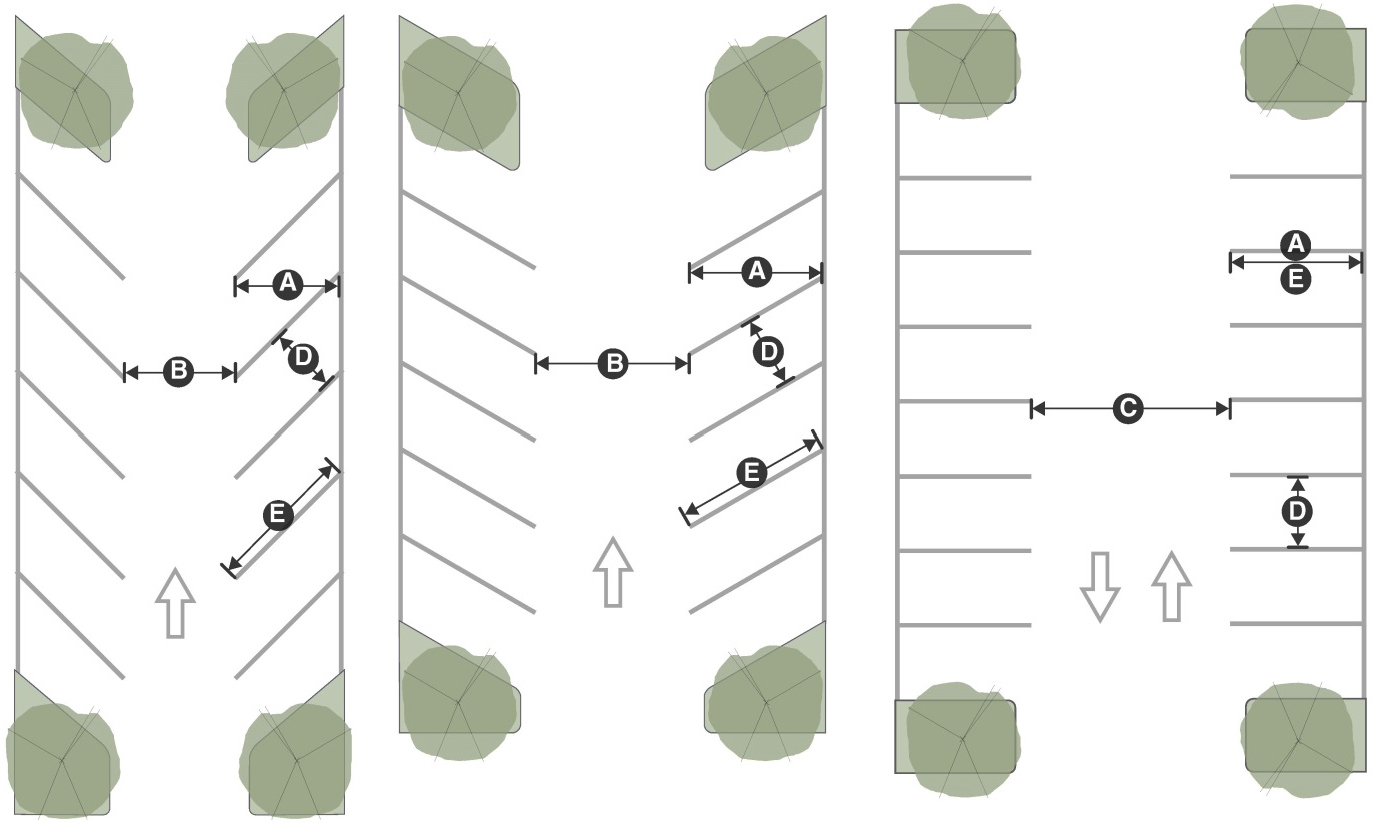
(Ord. No. 12-18-2017, O1, § 3, 12-18-2017)
17.28.050 - Access requirements.
A.
All ingress and egress locations from an adjacent road or street to any off-street parking areas, including curb cuts, drive approaches, or other accesses, shall be approved by the county or the Utah Department of Transportation, as applicable.
B.
The minimum size of the access strip to any parking area shall be twenty-four (24) feet wide for a two-way access or two fourteen-foot-wide one-way accesses. A greater size access strip may be required by the land use authority.
(Ord. No. 12-18-2017, O1, § 3, 12-18-2017)
17.28.060 - Location of off-street parking.
All required off-street parking spaces shall be located on the same lot as the use or building it serves unless otherwise approved by the land use authority. If the required parking for a building, structure, improvement or use is located upon a separately recorded lot from that upon which the required parking is provided, whether in the same or separate ownership, there shall be recorded in the office of the county recorder a covenant by such owner(s) for the benefit of the county that such owner(s) will continue to maintain such parking space as long as the building, structure, improvement or use is maintained.
Parking facilities shall be located not less than three hundred (300) feet from the building they are required to serve.
(Ord. No. 12-18-2017, O1, § 3, 12-18-2017)
17.28.070 - Maintenance of parking areas and spaces.
Every parcel of land used as a public or private off-street parking area shall be constructed and maintained in compliance with the following requirements:
A.
All off-street parking areas shall have appropriate bumper guards or curbs where needed, as determined by the land use authority, to protect adjacent property owners or persons using a sidewalk.
B.
Traffic Control. Traffic control signs and/or striping shall be provided, as adopted by the county and required by the land use authority necessary to minimize any vehicular and pedestrian conflicts.
(Ord. No. 12-18-2017, O1, § 3, 12-18-2017)
17.28.080 - Number of required off-street parking spaces.
The number of required off-street parking spaces shall be provided as required by table 17.28.010, "Minimum Off-Street parking Requirements", of this section and complying with the following:
A.
Fractional Amount: In calculating the total number of required off-street parking spaces, fractional amounts shall be rounded to the nearest whole number.
B.
Unspecified Uses: The land use authority shall determine the off-street parking requirements for any use not specifically listed in table 17.28.010 of this section, but identified as an allowed use in Section 17.33.010 in this title.
Table 17.28.010—Minimum Off-Street Parking Requirements
(Ord. No. 12-18-2017, O1, § 3, 12-18-2017)
17.28.090 - Disabled persons parking.
Designated parking for persons with a disability shall be provided for all uses, meeting the requirements and specifications of the Americans with Disabilities Act.
(Ord. No. 12-18-2017, O1, § 3, 12-18-2017)
17.28.100 - Reduction of off-street parking requirements.
Requests to reduce off-street parking requirement(s) may be granted by the land use authority if the applicant shows, by the presentation of information and materials, that a reduced number of off-street parking spaces will meet the demands of the proposed use without increasing traffic or on-street parking problems in adjacent areas.
(Ord. No. 12-18-2017, O1, § 3, 12-18-2017)
17.28.110 - Parking requirements for uses not specified.
The parking requirements for land uses which are not specified in this chapter shall be determined by the land use authority. The determination shall be based upon the requirements for the most comparable use specified in this chapter.
(Ord. No. 12-18-2017, O1, § 3, 12-18-2017)
17.28.120 - Mixed occupancies.
In the case of mixed occupancies in a building or on a lot, the requirement for off-street parking facilities shall be the sum of the requirements for the various uses computed separately. Off-street parking facilities for one use shall not be considered as providing required parking facilities for any other use, except as specified in Section 17.28.130 for joint use.
(Ord. No. 12-18-2017, O1, § 3, 12-18-2017)
17.28.130 - Joint uses.
The land use authority may approve up to fifty (50) percent of the parking facilities required by this chapter for a use considered to be primarily a daytime use may be provided by the parking facilities of a use considered to be primarily a nighttime use or vice versa; provided such reciprocal parking area are continuous, and the joint use of such facilities is assured by the recording of a written agreement by the property owner(s).
(Ord. No. 12-18-2017, O1, § 3, 12-18-2017)
17.28.140 - Submission of plans.
The plans for any proposed parking area shall be submitted to the land use authority. The plan shall clearly indicate the proposed development, including location, size, shape, design, curb cuts, lighting, landscaping and other features and appurtenances of the proposed parking area.
(Ord. No. 12-18-2017, O1, § 3, 12-18-2017)
17.28.150 - Exemptions from parking requirements.
None of the requirements of this chapter for off-street parking spaces shall apply to a building in existence at the time of the effective date of the ordinance codified in this title. No building, as it exists at the time of said effective date, shall be deemed to be nonconforming solely by reason of the lack of off-street parking spaces, provided that any portion of the premises being used for off-street parking in connection with any such building shall not be reduced below existing parking levels or the requirements of this chapter.
(Ord. No. 12-18-2017, O1, § 3, 12-18-2017)
17.28.160 - Stacking and loading.
Stacking lanes shall be provided for drive-up services and loading spaces shall be provided for the loading and unloading of goods. The amount and dimensions of stacking and loading spaces shall be determined by the land use authority and shall be provided on site.
(Ord. No. 12-18-2017, O1, § 3, 12-18-2017)
17.28.170 - Off-street loading requirements.
Every building or use receiving or distributing materials or merchandise by truck shall provide and maintain on the same lot as the building or use the following number of off street loading spaces:
A.
One off-street loading space for buildings with less than thirty thousand (30,000) square feet of gross floor area.
B.
Two off-street loading spaces for buildings with more than thirty thousand (30,000) square feet of gross floor area.
No loading space(s) shall be considered as meeting any of the off-street parking requirements of this chapter.
(Ord. No. 12-18-2017, O1, § 3, 12-18-2017)
17.28.180 - Location of loading spaces.
The location of off-street loading spaces shall be approved by the land use authority. The location of all loading areas shall not interfere with off-street parking area circulation patterns.
(Ord. No. 12-18-2017, O1, § 3, 12-18-2017)

