
Vader City Zoning Code
CHAPTER 27
12.- COMMERCIAL/MIXED USE DISTRICT
Sec. 27.12.010.- Purpose.
The CM district is a business zone classification providing for a wide range of retail and service businesses comparable to the central business district hereby providing a focal point for the city's commerce. All activities, except minor merchandise display, shall be conducted within enclosed buildings, except that off-street loading, parking, and servicing incidental to the operation of the business. In addition, the district provides for a mix of uses, including residential, to ensure that the small town character of the city is protected and allow for creative use of properties for both commercial and residential purposes.
(Ord. No. 2006-09, Exh. A, § 4.010, 12-20-2006)
Sec. 27.12.020. - Permitted uses.
The following uses are permitted in any CM district provided the community's unique character is retained:
(1)
Retail stores and personal service shops; studios; shops for custom work for the making of custom articles where such manufacture does not produce off-site noise, odor or chemical waste; micro-breweries producing not more than 5,000 gallons of beer per week; office buildings, banks and government buildings; hotels and motels, bed-and-breakfast facilities; recreational vehicle parks; newspaper offices and printing works; upholstery shops, laundry, cleaning and pressing agencies, buildings for the rental of frozen food lockers; eating and drinking establishments; bus depots; undertaking establishments, theaters and bowling alleys; motor vehicle sales and service, and service stations; sales, service and storage of boats, storage of passenger automobiles and pickup trucks; and storage and sales of unoccupied travel trailers or recreational vehicles. Automobile parking lots and storage areas must provide either a wall, sight-obscuring fence, or evergreen vegetative planting that effectively screens the lots and stored objects from view from adjacent streets;
(2)
Art galleries, libraries, museums, churches, clubs and fraternal societies, memorial buildings, public parks, essential public facilities of statewide significance and public utilities;
(3)
Single-family and two-family dwellings subject to the standards of the R-2 district, and multifamily dwellings subject to the standards of the R-3 district.
(Ord. No. 2006-09, Exh. A, § 4.020, 12-20-2006; Ord. No. 2020-16, § 4, 12-10-2020)
Sec. 27.12.025. - Conditional uses.
(a)
The following uses are conditionally permitted in the CM district after review and approval by the city hearing examiner under the conditional use permit (chapter 27.50 VMC) to establish conditions necessary to ensure compatibility:
(1)
Transitional housing;
(2)
Permanent supportive housing;
(3)
Indoor emergency shelters; and
(4)
Indoor emergency housing.
(b)
None of the uses listed in subsection (a) of this section may be located within 1,000 feet of another property with one or more of the uses listed herein.
(Ord. No. 2021-07, § 8, 9-23-2021)
Sec. 27.12.030. - Secondary uses.
A secondary use is permitted in any CM district in conjunction with, but subordinate to, any of the uses permitted in section 27.12.020.
(1)
A secondary use is permitted in any CM district in conjunction with, but subordinate to, any of the uses permitted in section 27.12.020. Secondary uses may include a dwelling unit in conjunction with and accessory to an essential or primary use and located within the same building as said use. Dwelling units shall be permitted on any floors above the ground floor of a building used as a commercial establishment.
(2)
Single-family, two-family, and multi-family residences are allowed as a secondary use, subject to meeting all other development standards of this title.
(Ord. No. 2006-09, Exh. A, § 4.030, 12-20-2006; Ord. No. 2020-16, § 5, 12-10-2020)
Sec. 27.12.040. - Prohibited uses.
The following uses are specifically prohibited in a CM district: Any uses not expressly listed in sections 27.12.020 or 27.12.030.
(Ord. No. 2006-09, Exh. A, § 4.040, 12-20-2006)
Sec. 27.12.050. - Off-street parking.
Off-street parking shall be provided in and CM district in accordance with the standards in chapter 27.36 of this title.
(Ord. No. 2006-09, Exh. A, § 4.050, 12-20-2006; Ord. No. 2020-16, § 6, 12-10-2020)
Sec. 27.12.060. - Design and use standards for "A" Street between 6th and 7th Streets.
Both sides of that portion of A Street located between 6th and 7th Streets is considered an historic commercial district with the following requirements:
(1)
New buildings fronting that portion of A Street are subject to additional design standards as enumerated in VMC 27.12.070.
(2)
Commercial development within this district shall be the primary use.
(3)
Residential development within this district shall be allowed only as a secondary or subordinate use and shall not be located on the ground floor unless:
a.
The residential area is no greater than 49 percent of the entire area for the building; and
b.
The residential use is located in the rear of the building, behind the primary commercial use.
(4)
Minimum density.
a.
Residential density is eight units per acre.
(5)
Minimum lot area.
a.
Four thousand square feet.
(6)
Minimum lot dimensions.
a.
None.
(7)
Minimum yard requirements.
a.
Front yards: No minimum setback.
b.
Side yard: No minimum side yard.
c.
Rear yards shall meet the following standards:
1.
Each lot shall have a rear yard containing a minimum depth of 15 feet from any structure to the rear property line.
2.
Exception allowing rear yard setback averaging. If the block where an applicant or owner is seeking to add a rear yard structure contains lots that are improved with rear yard structures and those rear yard structures are located closer than 15 feet to the rear property line, then an owner may be eligible to have a reduced rear yard setback that is an average of the actual setback on that block under the following conditions:
A.
At least 50 percent of the lots on the block where the property owner or applicant desires to add a rear yard structure are improved with rear yard structures;
B.
At least 50 percent of the lots on the blocks have rear yard structures that are located closer than 15 feet to the rear property line;
C.
The property owner or applicant seeking to reduce the rear setback provides the city with calculations demonstrating the average rear yard setback on the block where the owner or applicant intends to develop a rear yard structure; and
D.
Such calculations shall not consider any vacant lot to have a reduced setback.
If all of the conditions above are satisfied, then an averaged rear yard setback for locating a new rear yard structure may be applied. For the purposes of this subsection, "rear yard structures" are limited to structures which require a building permit and do not include structures that may be exempt from permitting requirements.
3.
All building setbacks and yard depths shall be measured from the property line, or the edge of the critical areas buffer if that buffer should lie within the development parcel.
(8)
Building heights and parking.
a.
Maximum building height: 50 feet.
b.
Parking: Parking shall be in compliance with VMC chapter 27.36.
(Ord. No. 2006-09, Exh. A, § 4.060, 12-20-2006; Ord. No. 2020-16, § 7, 12-10-2020)
Sec. 27.12.070. - Purpose and intent.
The general purpose and intent of the mixed-use development design standards are as follows:
(1)
To help implement the vision of the City of Vader's comprehensive plan;
(2)
To promote development within the city's mixed-use district that is compatible with the historic character and pedestrian orientation of Vader, encouraging and requiring commercial development that enables the safe circulation of pedestrians with minimal vehicle/pedestrian conflicts, and provides a design that invites the pedestrian into ground floor commercial establishments;
(3)
To promote a distinct community and sense of place that strengthens the mixed-use district as a commercial service destination for Vader's residents and visitors;
(4)
To provide clear directions to public and private decision makers regarding the city's property development expectations;
(5)
To require building design that is compatible with adopted requirements, while allowing design professionals guidance that is flexible and encourages creative solutions; and
(6)
To implement the recommendations of the city's community action plan.
(Ord. No. 2020-16, § 8, 12-10-2020)
Sec. 27.12.080. - Applicability.
The requirements of the mixed-use guidelines and design standards shall apply to all exterior remodeling of, or additions to, existing structures.
(Ord. No. 2020-16, § 9, 12-10-2020)
Sec. 27.12.090. - Application process and review.
(a)
Formal application process. Formal applications for review shall be submitted to the Vader City Clerk and shall consist of a completed application and the appropriate fee established by the city council. The application shall also include:
(1)
Preliminary architectural renderings (elevations required with details of architectural features, but not construction documents);
(2)
The materials and colors of exterior siding, windows, trim, detailing, and roofing to be used;
(3)
All signage for the project, including scaled drawings, mounting details, color, and material samples;
(4)
Site plan including building setbacks, landscaping plant material details, parking, and overall project design layout.
(b)
Notice requirements. There are no specific noticing requirements associated with mixed use development review, however, noticing may be required if required by another applicable city approval process such as a conditional use permit.
(c)
Design review. The planning committee shall serve as the design review board and shall convene during a scheduled meeting to review the project with the applicant, his/her representative, and city planning staff. The design review board meeting shall consist of a presentation of the project that focuses on how the proposed design meets the criteria of the Vader Municipal Code. The board shall review the proposed project and shall make a determination whether to recommend approval, approval with conditions, or denial.
(d)
The proponent may request additional meetings with staff and/or the board, for instance, in circumstances where a design has not been favorably received, and the applicant has subsequently made extensive revision and desires reconsideration of their request. Should the proposed project be found to have one or more code references that have not been successfully addressed, the board or staff will work with the applicant to remedy, if possible, the identified circumstance.
(e)
Final recommendations of the design review board shall be sent to the Vader City Council for a final decision.
(f)
Any decision of the council may be appealed in writing within 15 days to the city's hearings examiner.
(Ord. No. 2020-16, § 10, 12-10-2020)
Sec. 27.12.100. - Relationship of new to existing development.
(a)
All development proposals shall show evidence of harmony with the site plan, arrangement of building forms and landscape design of neighboring properties. The degree to which neighboring sites and buildings must be considered in the design of a new project will depend upon the value, architectural quality and estimated tenure of improvements on the neighboring property, as well as the particular requirements of the new project. While a firm rule for design is not possible, every new proposal shall demonstrate that it has considered the contextual influences of neighboring properties and has made a diligent effort to orchestrate careful relationships between old and new.
(b)
Site planning.
(1)
The site organization shall respect the arrangement of buildings, open spaces and landscape elements of adjacent sites. When possible, buildings and open spaces should be located for mutual advantage of sunlight, circulation, and views.
(2)
When feasible, new commercial projects should be linked to adjacent projects to encourage internal circulation by pedestrians and automobiles. This will reduce traffic loads on adjacent streets by reducing ingress and egress traffic. The method of linkage will depend on specific conditions of each site and project. The linkage could be as simple as a connecting sidewalk, or as extensive as shared driveways, access drives, and parking. When no development exists on the adjacent property, give consideration to its future disposition and how the two sites may develop a circulation linkage.
(c)
Architectural design. Efforts to coordinate the actual and apparent height of adjacent structures are encouraged. This is especially applicable where buildings are located very close to each other. It is often possible to adjust the height of a wall, cornice or parapet line to match that of an adjacent building. Similar design linkages can be achieved to adjust the apparent height by placing window lines, belt courses or other horizontal elements in a pattern that reflects the same elements on neighboring buildings.
(Ord. No. 2020-16, § 11, 12-10-2020)
Sec. 27.12.110. - Building design, materials, and colors.
(a)
Objective. New development shall preserve and be compatible with the city's historic architectural heritage. Particular emphasis shall be placed on achieving an intimate scale and a concern for craftsmanship. New developments, which are near or adjacent to older buildings of substantial historic character, shall be respectful of the historic building. While not mimicking the older structure, the development shall consider the compatibility of size, shape, scale, materials, details, textures, colors, and landscape features.
(1)
Roof design shall reduce the mass and scale of buildings, add visual interest and prevent reflective glare. Flat roofs shall have parapets to conceal the roof and mechanical equipment from ground level views.
(2)
Overhanging eaves are encouraged on sloped roofs.
(3)
Exterior siding consisting of wood, brick, and/or other materials with natural textures is encouraged. The use of recycled and ecologically friendly materials is also encouraged.
(4)
Exterior building materials shall be of similar type (e.g., wood or masonry) on all sides of a building, except that embellishments and details proposed for the street side frontage(s) of the building need not be carried through on other sides.
(5)
Building colors should be compatible with other buildings as well as natural features in the vicinity. The use of colors that emphasize earth tones typical of the Vader area are encouraged. Bright colors should be minimized or used for minor architectural accents rather than on major portions of the building.
(6)
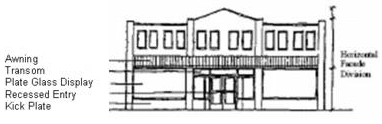
Composition. A traditional principle, which is often helpful in reducing building bulk and improving pedestrian scale, is to divide the mass of the structure into distinct horizontal parts. The parts should express a sense of base, midsection and top. This is especially helpful for three-story buildings and can achieve a more sculptured building form.
a.
The base may be a shaded element that establishes a strong visual relationship to the ground plane. A covered walkway or arcade set in shadow and carefully integrated with the total building form is one desirable method. Architectural detailing may also be used when a covered walkway is not appropriate.
b.
The midsection is the "body" of the building. The preferred architectural character of the midsection is to treat it as an articulated surface with recessed windows or groupings of windows. Long or large wall surfaces with flush-mounted windows should be avoided.
c.
The top story of the building should develop a lighter character. As a general principle, the upper story of the building should reduce its floor area and building mass.
(7)
Proportion and scale. Proportion is defined as the relationship between parts of a building or building element. Scale is the relationship of the building to human size. Varied proportions are desired in the design of building elevations. The scale of building elements, especially at the pedestrian level, should be kept intimate and close to human size with relatively small parts.
(8)
Multistory buildings (three or four stories) are strongly encouraged. Residential development is permitted outright on upper floors and is encouraged.
(9)
When buildings include residences on upper floors, rooftop gardens and upper floor terraces and decks are encouraged.
(10)
Walls shall appear to be composed of relatively small increments. Walls may be articulated in two or more of the following ways:
a.
Reveals;
b.
Recesses of at least two feet in depth or five percent of wall length, whichever is larger;
c.
Offsets;
d.
Overhangs, porches and covered walkways;
e.
Providing window and door openings with substantial trim elements;
f.
Projecting bays;
g.
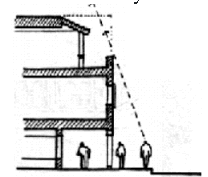
Stepped-back upper floors. Buildings over two stories high may step back their upper story street-facing facades to reduce apparent height and bulk. The step-back should normally be at least six feet in depth;
Stepped-Back
Upper Floors
h.
Changes in roof form;
i.
Changes in materials;
j.
Permanently installed and maintained trellises or vegetation.
(11)
New development should locate windows, skylights, open spaces, and decks to take advantage of southern exposure. Buildings and canopies should be designed to utilize natural light to reduce energy costs.
(12)
Building placement and design shall consider shadow impacts to adjacent properties and minimize these impacts to the extent reasonable and practicable. For example, where building features are nonfunctional or decorative (parapets, unused attic space) such features should be reduced in scale where shadowing of adjacent properties would occur.
(13)
All signage shall conform to the provisions of chapter 27.28.090, Signs.
(Ord. No. 2020-16, § 12, 12-10-2020)
Sec. 27.12.120. - Pedestrian and bicycle standards.
(a)
Objective. Provide safe, bicycle- and pedestrian-friendly development.
(1)
Walkways shall be provided between the primary abutting street and the main pedestrian entrances to buildings.
(2)
The interruption of sidewalks by driveways should be minimized.
(3)
Pedestrian access shall be provided between commercial sites and adjacent areas.
(5)
Bicycle locking racks may be provided. Bicycle racks shall be located as closely as possible to primary building entrances.
(b)
Objective. Provide safe walkways for pedestrians through off-street parking lots and from adjacent streets and properties.
(1)
Pedestrian walkways in off-street parking lots shall be physically separated from vehicle travel lanes.
(2)
Pedestrian crossings should be short and well-marked.
(3)
In large parking lots with multiple parallel rows of parking, direct primary vehicle traffic away from the building entrance; any traffic lanes adjacent to the building should be preserved primarily for emergency vehicle and pedestrian access to the building.
(Ord. No. 2020-16, § 12[13], 12-10-2020)
Sec. 27.12.130. - Affordable housing incentive.
(a)
This section offers dimensional standard flexibility and economic incentives to encourage construction of affordable housing units in the CM zone. For the purposes of this section, "affordable housing units" shall be defined as units that are affordable to 80 percent of median income as established in the City of Vader comprehensive plan.
(b)
The provisions of this section are available, at the sole discretion of the property owner, as incentives to encourage the construction of affordable housing units. There is a demonstrated need in the city for housing which is affordable to persons of moderate income. Therefore, this section provides development incentives in exchange for the public benefit of providing affordable housing units in the CM zone.
(c)
Density bonus. Developments that include at least one unit of affordable housing may realize an increase in allowable density of up to 12 units per acre.
(d)
Approval of affordable housing units. Prior to the issuance of any permit(s), the city shall review and approve the location and unit mix of the affordable housing units consistent with the following standards:
(1)
The affordable housing units shall be intermingled with all other dwelling units in the development.
(2)
The type of ownership of the affordable housing units shall be the same as the type of ownership for the rest of the housing units in the development.
(3)
The affordable housing units shall consist of a range of number of bedrooms that are comparable to units in the overall development.
(4)
The size of the affordable housing units, if smaller than the other units with the same number of bedrooms in the development, must be approved by the planning director. In no case shall the affordable housing units be more than ten percent smaller than the comparable dwelling units in the development, based on number of bedrooms, or less than 600 square feet for a one-bedroom unit, 800 square feet for a two-bedroom unit, or 1,000 square feet for a three-bedroom unit, whichever is greater.
(5)
The affordable housing units shall be available for occupancy in a time frame comparable to the availability of the rest of the dwelling units in the development.
(6)
The exterior design of the affordable housing units must be compatible and comparable with the rest of the dwelling units in the development.
(7)
The interior finish and quality of construction of the affordable housing units shall at a minimum be comparable to entry-level rental or ownership housing in the City of Vader.
(e)
Affordability agreement. Prior to issuing a certificate of occupancy, an agreement in a form acceptable to the city attorney that addresses price restrictions, homebuyer or tenant qualifications, long-term affordability, and any other applicable topics of the affordable housing units shall be recorded with the Lewis County Auditor. This agreement shall be a covenant running with the land and shall be binding on the assigns, heirs and successors of the applicant.
(f)
Affordable housing units that are provided under this article shall remain as affordable housing for a minimum of 30 years from the date of initial owner occupancy for ownership affordable housing units and for the life of the project for rental affordable housing units.
(Ord. No. 2020-16, § 14, 12-10-2020)

