
Van Alstyne City Zoning Code
ARTICLE II
ZONING DISTRICTS AND REGULATIONS1
Editor's note— Ord. No. 907, § 3, adopted June 8, 2021, repealed the former Art. II, §§ 46-37—46-40, 46-69—46-81, 46-83—46-94, 46-96—46-98, and enacted a new Art. II as set out herein. The former Art. II pertained to similar subject matter and derived from Compiled Ords. 2008, §§ 3—5, 8—14, 15C, 16A, 16B, 17B, 17C, 18—21, 26, 27, 30; Ord. No. 619, § 4, adopted Dec. 9, 2008; Ord. No. 664, §§ 2, 3, adopted Feb. 28, 2012; Ord. No. 778, §§ 2.03—2.06, adopted Aug. 9, 2016; Ord. No. 794, § 2.06, adopted Feb. 14, 2017; Ord. No. 803, § 2.02, adopted Aug. 29, 2017; Ord. No. 856, § 2(exh. A), adopted Nov. 12, 2019; Ord. No. 857, § 3, adopted Nov. 12, 2019; and Ord. No. 895, § 3, adopted March 17, 2021.
Sec. 46-37. - Districts established and identified.
The city is hereby divided into two sets zoning districts: those that may be applied to newly annexed property or property that is to be rezoned, listed in Table 1, Current Zoning Districts and those that were used in the past and are only applicable in established zoning districts, as listed in Table 2, Obsolete Zoning District. The city will, from time to time, add or subtract zoning districts so that they may reflect the growth and character of the city.
(Ord. No. 907, § 3, 6-8-2021)
Sec. 46-38. - Description and purpose of districts.
(a)
A—Agricultural District. This district provides for the continuance of farming, ranching, and gardening activities on land being utilized for these purposes. When land in an agricultural district is needed for urban purposes, it is anticipated the zoning will be changed to the appropriate zoning districts to provide for orderly growth and development in accordance with the comprehensive plan.
(b)
SF-E—Single-Family Residential District-Estate. The SF-E district provides for residential development on large lots, with a minimum building site of 35,000 square feet. Density in this district will usually be no greater than one unit per gross acre.
(c)
SF-84—Single-Family Residential District-84. The SF-84 district provides for residential development on ample lots, with a minimum building site of 9,900 square feet. Density in this district will usually be no greater than 3.5 units per gross acre. See section 46-71 for SF-84—Single-Family Residential District regulations.
(d)
SF-72—Single-Family Residential District-72. The SF-72 district provides for residential development on standard urban lots, with a minimum building site of 8,700 square feet. Density in this district will usually be no greater than 4.0 units per gross acre. See section 46-72 for SF-72—Single-Family Residential District regulations.
(e)
SF-1—Single-Family Residential District-1. The SF-1 district provides for a minimum residential building site of 7,500 square feet. Density in this district will usually be no greater than four units per gross acre.
(f)
SF-60—Single-Family Residential District-60. The SF-60 district provides for residential development on standard urban lots, with a minimum building site of 7,500 square feet. Density in this district will usually be no greater than 4.25 units per gross acre. See section 46-74 for SF-60—Single-Family Residential District regulations.
(g)
SF-2—Single-Family Residential District-2. The SF-2 district provides for a minimum residential building site of 6,000 square feet and permits residential development of densities ranging from four to 4.25 units per gross acre.
(h)
SF-P—Single-Family Residential District-Patio Homes. The SF-P district provides for residential development on smaller urban lots, with a minimum building site of 6,000 square feet. Density in this district will usually be no greater than six units per gross acre. See section 46-76 for SF-Z—Single-Family Residential District regulations.
(i)
SF-TH—Single-Family Residential District-Townhomes. The SF-TH district provides for residential development on smaller urban lots, with a minimum building site of 2,700 square feet. Density in this district will usually be no greater than six units per gross acre. See section 46-77 for SF-TH—Single-Family Residential District regulations.
(j)
TF—Two-family Residential (Duplex) District. The TF district provides for stable, quality residential development, including duplex, garden (patio) home, and similar residential development with densities ranging from four to 12 units per gross acre.
(k)
MH-1—Manufactured Home District. The MH-l district provides an area for the placement of manufactured home and modular home units in subdivisions in which most lots and housing units are owner-occupied. Densities in this district will be comparable to that of the SF-2 district.
(l)
MH-2—Manufactured Home Park District. The MH-2 district establishes a category in which manufactured home park development with a maximum density of approximately five to six units per gross acre can occur.
(m)
MF—Multifamily District. The MF district permits multifamily developments of maximum densities of 18 units per acre. See section 46-81 for MF—Multiple-Family Dwelling District regulations.
(n)
NC—Neighborhood Convenience District. This district is to provide for a limited range of service and light retail land uses in small districts up to two acres in size that are appropriately located at intersections of thoroughfares to serve the immediately adjacent residential neighborhood area. Uses developed under the standards of the NC district are designed to provide a compatible relationship between the NC development and adjacent residential areas. See section 46-84 for NC—Commercial District regulations.
(o)
C-1—Commercial District-Office, Light Retail, and Neighborhood Services. Retail, commercial, and office uses developed under the standards of the C-l district are designed to provide a compatible relationship between the C-l development and adjacent residential areas.
(p)
C-2—Commercial District-General. Uses which require considerable space for display, sales, or open storage, or by the nature of the use are generally not compatible with residential uses are located in the C-2—Commercial District.
(q)
CBD—Central Business District. The Central Business District is established to accommodate the unique characteristics of the historical center of the city and to ensure that future development in the CBD is compatible with maintaining the economic and historic integrity of the area. The Central Business District is designed to provide an area for shopping, dining, working, and entertainment which will remain active during evenings and weekends as well as standard work hours
(r)
C-3—Planned Center District-General. This district is designed to provide for a wide range of retail and service establishments, particularly appropriate for shopping centers. C-3 districts are generally separated from residential uses. See section 46-88 for C-3—Planned Center District regulations.
(s)
O—Office District-General. This district is designed to provide for office buildings with attendant retail and service uses intended primarily for occupants of such office buildings. See section 46-89 for O—Office District regulations.
(t)
MI-1—Manufacturing/Industrial District-Light. The Light Manufacturing/Industrial District is established to accommodate uses of a non-nuisance type located in relative proximity to residential and C-l business areas. Development in the MI-l district is limited primarily to certain wholesale, jobbing, and warehouse uses and certain specialized manufacturing and research uses of a type which will not create nuisances.
(u)
MI-2—Manufacturing/Industrial District-Heavy. The Heavy Manufacturing/Industrial District is established to accommodate industrial uses not appropriate for inclusion in the MI-l district and likely to create noise, traffic, odor and/or other conditions incompatible with most residential and commercial uses.
(v)
PD—Planned Development District. The Planned Development District provides a zoning category for the planning and development of larger tracts of land or tracts of land with unique characteristics for a single use or combination of uses requiring flexibility and variety in design to achieve orderly development with due respect to the protection of surrounding property.
(w)
OTRD-Old Town Residential District Overlay. This district is designed specifically for the section of the city as described in section 46-83(b). The Original Town Residential District Overlay standards will provide for a suitable residential environment for family life on small parcels of land. Platted lots within this area were originally in 25-foot widths. Therefore, standards are set forth in this Original Town Residential District Overlay which accommodate the original platting, as well as the preferable standard for a minimum 50-foot lot width, or two platted lots constituting a building site.
(x)
THOR-Thoroughfare Overlay District. This district is designed to provide for greater safety, larger development sites, and enhanced aesthetics in high traffic volume areas adjacent and/or in close proximity to major thoroughfares. See section 46-93 for THOR—Thoroughfare Overlay District regulations.
(y)
HD-Historic Downtown Overlay District. This district is designed to provide for enhanced architectural standards in the historic downtown, to encourage walkability, and welcome visitors and residents alike to the area. See section 46-93(b) for HD-Historic Downtown Overlay District regulations. Single-family or multifamily units are only allowed on the 2 nd story or above in the Overlay District.
(z)
FP—Floodplain District. Zoning districts located in flood hazard areas which are subject to periodic inundation shall be preceded by the prefix FP, indicating a sub-district. Areas designated FP may be used only for those uses listed in the provisions of section 46-94 until a use in any area or any portion thereof located in FP sub-district has been approved by the city council. Approval shall only be given after engineering studies determine that the area, or any portion thereof, is suitable for uses in the district, and building construction or development would not create an obstruction to drainage nor a hazard to life or property, and that such construction is not contrary to the public interest. See section 46-94 for FP—Floodplain District regulations.
(Ord. No. 907, § 3, 6-8-2021)
Sec. 46-38(A). - Current zoning districts.
Description and purpose of current districts. Current districts include all the zoning districts and overlay districts that are in common use at the present time in the City of Van Alstyne.
(1)
SF-65—Single-Family Residential District-65. The SF-65 district provides for residential development on medium sized lots, with a minimum lot width of 65 feet and minimum lot area of 7,800 square feet. Density in this district will be no greater than 4.0 units per gross acre. See section 46-61 for SF-65—Single-Family Residential District regulations.
(2)
SF-75—Single-Family Residential District-75. The SF-75 district provides for residential development on standard urban lots, with a minimum lot width of 75 feet and with a minimum lot area of 9,000 square feet. Density in this district will usually be no greater than 3.5 units per gross acre. See section 46-62 for SF-75—Single-Family Residential District regulations.
(3)
SF-85—Single-Family Residential District-85. The SF-85 district provides for residential development on generous, nearly 1/4-acre suburban lots, with a minimum lot width of 85 feet and with a minimum lot area of 10,200 square feet. Density in this district will be no greater than 3.0 units per gross acre. See section 46-63 for SF-85—Single-Family Residential District regulations.
(4)
SF-E—Single-Family Residential District-Estate. The SF-E district provides for residential development on large lots, with a minimum lot area of 35,000 square feet. Density in this district will usually be no greater than one unit per gross acre. See section 46-64 for SF-E—Single-Family Estate Residential District regulations.
(5)
SF-TH—Single-Family Residential District (Townhomes). The SF-TH district provides for residential development on smaller urban lots, with a minimum building lot area of 6,000 square feet. Density in this district will be no greater than six units per gross acre. See section 46-65 for SF-TH—Single-Family Residential District regulations.
(6)
TF—Two-Family Residential District (Duplex). The TF district provides for stable, quality residential development, including duplex, garden (patio) home, and similar residential development with densities at four units per gross acre. See section 46-71 for TF—Two-Family Residential District regulations.
(7)
MH-1—Manufactured Home District. The MH-l district provides an area for the placement of manufactured home and modular home units in subdivisions in which most lots and housing units are owner-occupied with a maximum density of five units per gross acre. See section 46-72 for MH-1—Manufactured Home District regulations.
(8)
MH-2—Manufactured Home Park District. The MH-2 district establishes a category in which manufactured home park development with a maximum density of five units per gross acre. See section 46-73 for MH-1—Manufactured Home Park District regulations.
(9)
MF—Multifamily District. The MF district permits multifamily developments of maximum densities of 18 units per acre. See section 46-74 for MF—Multiple-Family Dwelling District regulations.
(10)
A—Agricultural District. This district provides for the continuance of farming, ranching, and gardening activities on land being utilized for these purposes. When land in an agricultural district is needed for urban purposes, it is anticipated the zoning will be changed to the appropriate zoning districts to provide for orderly growth and development in accordance with the comprehensive plan. See section 46-81 for A—Agricultural District regulations.
(11)
NC—Neighborhood Convenience District. This district is to provide for a limited range of service and light retail land uses in small districts up to two acres in size that are appropriately located at intersections of thoroughfares to serve the immediately adjacent residential neighborhood area. Uses developed under the standards of the NC district are designed to provide a compatible relationship between the NC development and adjacent residential areas. See section 46-82 for NC—Neighborhood Convenience District regulations.
(12)
C-1—Commercial District-Office, Light Retail, and Neighborhood Services. Retail, commercial, and office uses developed under the standards of the C-l district are designed to provide a compatible relationship between the C-l development and adjacent residential areas. See section 46-83 for C-1—Commercial District-Office, Light Retail, and Neighborhood Services District regulations.
(13)
C-2—Commercial District-General. Uses which require considerable space for display, sales, or open storage, or by the nature of the use are generally not compatible with residential uses are located in the C-2—Commercial District. See section 46-84 for C-2—Commercial District General regulations.
(14)
C-3—Planned Center District-General. This district is designed to provide for a wide range of retail and service establishments, particularly appropriate for shopping centers. C-3 districts are generally separated from residential uses. See section 46-85 for C-3—Planned Center District regulations.
(15)
CBD—Central Business District. The Central Business District is established to accommodate the unique characteristics of the historical center of the city and to ensure that future development in the CBD is compatible with maintaining the economic and historic integrity of the area. The Central Business District is designed to provide an area for shopping, dining, working, and entertainment which will remain active during evenings and weekends as well as standard work hours. See section 46-86 for CBD—Central Business District regulations.
(16)
O—Office District-General. This district is designed to provide for office buildings with attendant retail and service uses intended primarily for occupants of such office buildings. See section 46-87 for O—Office District regulations.
(17)
MI-1—Manufacturing/Industrial District-Light. The Light Manufacturing/Industrial District is established to accommodate uses of a non-nuisance type located in relative proximity to residential and C-l business areas. Development in the MI-l district is limited primarily to certain wholesale, jobbing, and warehouse uses and certain specialized manufacturing and research uses of a type which will not create nuisances. See section 46-88 for MI-1—Light Manufacturing/Industrial District regulations.
(18)
MI-2—Manufacturing/Industrial District-Heavy. The Heavy Manufacturing/Industrial District is established to accommodate industrial uses not appropriate for inclusion in the MI-l district and likely to create noise, traffic, odor and/or other conditions incompatible with most residential and commercial uses. See section 46-89 for MI-2—Heavy Manufacturing/Industrial District regulations.
(19)
CF—Community Facilities District. The Community Facilities district is established to apply to those lands where Federal, State, or local government activities are conducted, where governments hold title to such lands, for public and private educational facilities, and hospitals. In addition, certain non-governmental and non-institutional uses may be permitted in this district to provide necessary services to governmental and institutional uses. See section 46-90 for CF—Community Facilities District regulations.
(20)
PD—Planned Development District. The Planned Development District provides a zoning category for the planning and development of larger tracts of land or tracts of land with unique characteristics for a single use or combination of uses requiring flexibility and variety in design to achieve orderly development with due respect to the protection of surrounding property. See section 46-91 for PD—Planned Development District regulations.
(21)
THOR—Thoroughfare Overlay District. This district is designed to provide for greater safety, larger development sites, and enhanced aesthetics in high traffic volume areas adjacent and/or in close proximity to major thoroughfares. See section 46-92 for THOR—Thoroughfare Overlay District regulations.
(22)
HD—Historic Downtown Overlay District. This district is designed to provide for enhanced architectural standards in the historic downtown, to encourage walkability, and welcome visitors and residents alike to the area. Single-family or multifamily units are only allowed on the 2 nd story or above in this Overlay District. See section 46-93 for other HD—Historic Downtown Overlay District regulations.
(23)
FP—Floodplain District. Zoning districts located in flood hazard areas which are subject to periodic inundation shall be preceded by the prefix FP, indicating a sub-district. Areas designated FP may be used only for those uses listed in the provisions of section 46-94 until a use in any area or any portion thereof located in FP sub-district has been approved by the city council. Approval shall only be given after engineering studies determine that the area, or any portion thereof, is suitable for uses in the district, and building construction or development would not create an obstruction to drainage nor a hazard to life or property, and that such construction is not contrary to the public interest. See section 46-94 for FP—Floodplain District regulations.
(Ord. No. 907, § 3, 6-8-2021)
Sec. 46-38(B). - Obsolete zoning districts.
Description and purpose of obsolete districts. Districts that are defined as "obsolete" shall not be applied to newly annexed land or to any rezoning request. These districts and their area regulations are retained so as to govern the parts of town already designated with these districts.
(1)
SF-1—Single-Family Residential District-1. The SF-1 district provides for a minimum residential building site of 7,500 square feet. Density in this district will usually be no greater than four units per gross acre.
(2)
SF-2—Single-Family Residential District-2. The SF-2 district provides for a minimum residential building site of 6,000 square feet and permits residential development of densities ranging from four to 4.25 units per gross acre.
(3)
SF-60—Single-Family Residential District-60. The SF-60 district provides for residential development on standard urban lots, with a minimum building site of 7,500 square feet. Density in this district will usually be no greater than 4.25 units per gross acre. See section 46-74 for SF-60—Single-Family Residential District regulations.
(4)
SF-72—Single-Family Residential District-72. The SF-72 district provides for residential development on standard urban lots, with a minimum building site of 8,700 square feet. Density in this district will usually be no greater than 4.0 units per gross acre. See section 46-72 for SF-72—Single-Family Residential District regulations.
(5)
SF-84—Single-Family Residential District-84. The SF-84 district provides for residential development on ample lots, with a minimum building site of 9,900 square feet. Density in this district will usually be no greater than 3.5 units per gross acre. See section 46-71 for SF-84—Single-Family Residential District regulations.
(6)
SF-P—Single-Family Residential District—Patio Homes. The SF-P district provides for residential development on smaller urban lots, with a minimum building site of 6,000 square feet. Density in this district will usually be no greater than six units per gross acre. See section 46-76 for SF-P—Single-Family Residential District regulations.
(7)
OTRD—Original Town Residential District Overlay. This district is designed specifically for the section of the city as described in section 46-83(b). The Original Town Residential District Overlay standards will provide for a suitable residential environment for family life on small parcels of land. Platted lots within this area were originally in 25-foot widths. Therefore, standards are set forth in this Original Town Residential District Overlay which accommodate the original platting, as well as the preferable standard for a minimum 50-foot lot width, or two platted lots constituting a building site. Conditions for the Original Town Residential District Overlay to apply: The property under consideration must be an existing platted substandard lot as of 1992, or as recorded by metes and bounds.
(Ord. No. 907, § 3, 6-8-2021)
Sec. 46-39. - Zoning district map.
(a)
Delineation of zoning district boundaries. The boundaries of the zoning districts set out herein are delineated upon the zoning district map of the city, said map being hereby adopted as part of this chapter as fully as if the same were set forth herein in detail.
(b)
Regulations for filing and maintaining zoning district map. Two original, official, and identical copies of the zoning district map are hereby adopted bearing the signature of the mayor and attestation of the city clerk and shall be filed and maintained as follows:
(1)
One copy shall be filed with the city clerk, to be retained as the original record and shall not be changed in any manner.
(2)
One copy shall be filed with the building official and shall be maintained up-to-date by posting thereon all changes and subsequent amendments for observation in issuing building permits and for enforcing this chapter. A written record (logbook) shall be kept by the building official of all changes made to the zoning district map.
(3)
Reproductions of the official zoning district map may be made for information purposes.
(Ord. No. 907, § 3, 6-8-2021)
Sec. 46-40. - Rules for determining zoning district boundaries.
The district boundary lines shown on the zoning district map are usually along streets, alleys, property lines, or extensions thereof. Where uncertainty exists as to the boundaries of districts as shown on the official zoning map, the following rules shall apply:
(1)
Boundaries indicated as approximately following streets, highways, or alleys shall be construed to follow the centerline of such street, highway, or alley;
(2)
Boundaries indicated as approximately following platted lot lines shall be construed as following such lines;
(3)
Boundaries indicated as approximately following city limits shall be construed as following city limits;
(4)
Boundaries indicated as following railroad or utility lines shall be construed to be the centerline of the right-of-way; if no centerline is established, the boundary shall be interpreted to be midway between the right-of-way lines;
(5)
Boundaries indicated as approximately following the centerlines of streams, drainageways, or other bodies of water shall be construed to follow such centerlines;
(6)
Boundaries indicated as parallel to or extensions of features indicated in subsections (1) through (5) of this section shall be so construed. Distances not specifically indicated on the original zoning map shall be determined from the graphic scale on the map;
(7)
Whenever a street, alley or other public way is vacated by official action of the city council, or whenever a street or alley area is franchised for building purposes, the zoning district line adjoining each side of such street, alley, or other public way shall be automatically extended to the centerline of such vacated street, alley, or way, and all areas so involved shall then and henceforth be subject to all regulations of the extended districts;
(8)
Where physical features of the ground are at variance with information shown on the official zoning district map, or if there arises a question as to how a parcel of property is zoned and such question cannot be resolved by the application of subsections (1) through (7) of this section, or the zoning of property is invalidated by a final judgment of a court of competent jurisdiction, the property shall be considered as classified A—Agricultural District, temporarily. In an area determined to be temporarily classified as A—Agricultural District, no person shall construct, add to or alter any building or structure or cause the same to be done, nor shall any use be located therein or on the land which is not permitted in an A—Agricultural District, unless and until such territory has been zoned to permit such use by the city council. It shall be the duty of the city council to determine a permanent zoning for such area as soon as practicable.
(Ord. No. 907, § 3, 6-8-2021)
Sec. 46-51. - General residential regulations—All residential districts.
(a)
Purpose. The overall purpose of the single-family residential districts is to create a mix of home ownership opportunities within the city.
(b)
Permitted uses. No building, structure, land, or premises will be used, and no building or structure shall hereafter be erected, constructed, reconstructed, or altered, except for one or more of the uses specified in section 46-125, Table of Uses, Table 1, Residential Uses.
(c)
Pedestrian connectivity. All residential developments shall provide pedestrian connections within the subdivision and stub out these trails or sidewalks to the edge of the property for future connections.
(d)
Foundations required. All residential units shall be constructed on a permanent foundation that complies with the currently adopted International Building Codes, with the exception of single-family manufactured homes.
(e)
Plat requirements. Every single-family home shall be platted on an individual lot. This lotting requirement applies to single-family attached and detached dwelling units with the exception of duplexes, which allows both units to be platted on a single lot.
(f)
Residential RV use and parking. Recreational vehicles, manufactured homes, travel trailers, or motor homes may not be used for on-site dwelling purposes.
(g)
Accessory dwellings. Accessory dwelling units shall adhere to the regulations listed in section 46-135.
(h)
Open storage. Open storage is prohibited except for materials for the resident's personal use or consumption such as firewood, garden materials, etc. Open storage on one's property must be maintained in a proper manner and is subject to code enforcement for any nuisance violation.
(i)
Nonresidential uses. Site plan approval shall be required for any nonresidential use (such as an amenity center, school, church, etc.) other than a single-family residence or accessory structure within any single-family zoning district. Any nonresidential land use that may be permitted in a residential district shall conform to the C-1, >Commercial District—Office, Light Retail and Neighborhood Services district standards for setbacks and exterior materials as shown in Appendix 1-B, Nonresidential Zoning Districts and Area Regulations, as they exist or may be amended.
(j)
Gated communities. Private, gated communities are discouraged since this concept limits connectivity to other residential communities as well as to goods and services provided nearby, including access to public schools.
(Ord. No. 907, § 3, 6-8-2021; Ord. No. 1005, § 3, 2-13-2024)
Sec. 46-52. - Residential open space regulations—All residential districts.
(a)
Purpose. Given that the City of Van Alstyne is an area designated with historical, cultural, and architectural significance, the preservation and enhancement of valuable open space reflects the city's historic and rural character and will enhance development and maintain property values.
(b)
Application. These provisions apply to all residential districts unless otherwise specified within their respective descriptions.
(c)
Minimum open space requirement. All residential districts are subject to 20 percent open space with a minimum of 50 percent of that open space being "usable open space," as defined in section 46-3, Definitions.
(1)
Areas of "non-usable open space" may be allowed to be counted as a portion of the "usable open space" if the area is sufficiently amenitized and usable in most circumstances, per city manager approval.
(2)
Ownership and maintenance. Any open space area shall be platted as a common area lot, be owned and maintained by the homeowners' association (HOA), and be designated with an "X" on the plat.
(3)
Open space should be located to preserve existing trees and other desirable physical features.
(Ord. No. 907, § 3, 6-8-2021)
Sec. 46-53. - Residential exterior regulations—all residential districts.
(a)
Purpose. The overall purpose of these regulations is to create residential neighborhoods that are unique and add not only to the city's tax base, but also to the long-term enjoyment of the citizens. If any of these regulations are in discord with state regulations, the state regulations will be employed.
(b)
Elevations.
(1)
Elevation repetition. Any house elevation shall not be repeated on the lot most directly across the street, nor shall it be repeated on two lots in either direction on the same side of the street. A wide variety of elevations is desired as it strengthens the character of the subdivision and reduces monotony of design. When stucco homes are the predominant exterior material used on a particular street, variations of color and design are required to minimize visual monotony.
(2)
Elevation masonry mix and pattern. Front elevations shall use more than one type of masonry product in a variety of patterns to vary the architectural appeal of the streetscape. Regardless of the minimum Category A masonry requirements, every front façade shall be a mixture of materials and colors.
(c)
Roofs.
(1)
Roof pitch. Minimum roof pitch of residential structures is 8:12.
(2)
Roof materials. All roof materials shall meet the minimum standards as listed in the adopted International Building Code, which includes the use of solid solar shingles and panels.
(3)
Screening of utility units. HVAC units shall be screened from view from streets with shrubs or a stained wood fence.
(d)
Mailboxes.
(1)
Mailboxes on individual lots. The subdivision will determine whether individual mailboxes shall be brick or stone to match the residence or decorative metal containers on posts. Where practical, mailboxes should be paired for ease of delivery.
(2)
Mailboxes that are clustered. When mailboxes are clustered in single-family or two-family residential districts, the exterior of the clustered mailboxes shall be decorative metal on a matching support poles and shall be maintained by the homeowners association (HOA).
(e)
Architectural features. All primary residential structures (i.e. the home) must include at least four of the following design features on the front façade or visible from the front or side street. The size and scale of the architectural feature is subject to city approval.
(1)
Garage doors not facing the street (J-swing garage style);
(2)
Carriage style garage doors with decorative hardware;
(3)
Decorative brick patterning;
(4)
Architectural pillars or posts;
(5)
Bay window facing street;
(6)
Brick or stone chimney on exterior wall;
(7)
Stone accents;
(8)
Covered front porches (minimum of 60 square feet covered by main roof or an architectural extension);
(9)
Cupulas or turrets;
(10)
Dormers or gables;
(11)
Roof accent upgrades (e.g. metal, tile, slate, solar tiles);
(12)
Recessed entries a minimum of three feet deeper than main front façade;
(13)
Greater than 8:12 primary roof pitch, or variable roof pitches;
(14)
Transom windows;
(15)
Shutters;
(16)
Masonry arches;
(17)
Mixed masonry patterns;
(18)
Coach lights at entrances;
(19)
Decorative attic or gable feature, minimum two square feet in size (e.g. vent, window, brick detail);
(20)
Decorative driveway paving (e.g. salt finish, exposed aggregate, or other treatments approved by the city building official).
(f)
Residential garage placement.
(1)
Front façades and front-facing garage placement—one-story homes. The face of garage doors shall not extend beyond the front façade of any residential structure unless one or both of the following conditions apply; and in that case, the face of the garage door may extend up to a maximum of eight feet beyond the main front façade:
a.
A front porch extending a minimum of 50 percent of the front façade is provided; or
b.
A bay window is provided on the longest wall face of the front façade.
(2)
Front façades and front-facing garage placement—two-story homes. The face of garage doors may extend beyond the front façade of any residential structure up to a maximum of eight feet beyond the main front façade.
(3)
Front façades with J-swing garage placement. When the doors of garages are designed to be perpendicular to the street access (as in J-swing garages), the garage façade may extend in front of the main front façade of the residential structure.
(4)
Side façades with J-swing garages. J-swing garages shall have a minimum of 20 feet from the door face of the garage to the side property line for maneuvering and tandem parking.
(5)
Small lot residential development should consider using detached garages placed at the rear of the lot instead of street-facing garages. The design shall include a single car driveway leading from the street and flaring out at the entrance of the garage to accommodate two-car garages. Privacy gates may be placed across the driveway at or behind the front façade of the home.
(6)
Garage doors. Front entry doors shall consist of lightweight but durable materials, such as painted metal, and include materials that have a wood appearance and are approved by the director. Garage doors windows are permitted.
(7)
Driveways. All driveways shall be concrete and have a minimum width of ten feet and may match the width at the garage door at the property line.
(Ord. No. 907, § 3, 6-8-2021)
Sec. 46-54. - Residential street and alley regulations—All residential districts.
(a)
Purpose. The placement and order of streets within residential subdivisions can enhance the safety of the residents and create a sense of place. To this end, the following regulations have been added to those already adopted by the subdivision ordinance, the zoning ordinance, and the city design manual.
(b)
Streets.
(1)
Visitor parking. Those developments in which over 50 percent of the garages are front-loading, must provide adequate visitor parking so as not to overcrowd the traffic lanes. For every ten homes, two additional off-street parking spaces must be shown on the concept plan and associated plat.
(2)
Entrances.
a.
Primary roadway entrance. All residential subdivisions shall be required to provide a primary entrance, as follows. The location of the primary entrance shall be approved by the city engineer. The minimum right-of-way for the primary entrance shall be 80 feet. This will include two 12-foot wide inbound lanes and two 12-foot wide outbound lanes divided by a minimum ten-foot wide landscaped median. The main entrance sign to the subdivision may be placed within this median. The side landscaped parkways shall make up the remainder of the 80-foot right-of-way width.
b.
Secondary roadway entrance. For those subdivisions with more than 75 homes, a second divided entry is required. The location of the secondary and additional entrances shall be approved by the city engineer. The minimum right-of-way for the secondary entrance shall be 60 feet. This will include one 12-foot wide inbound lane and two 12-foot wide outbound lanes divided by a minimum eight-foot wide landscaped median. A secondary entrance sign to the subdivision may be placed within this median. The side landscaped parkways shall make up the remainder of the 60-foot right-of-way width.
c.
In both cases, the length of the entrance drive shall be no less than 120 feet before any intersection.
d.
No lots may face the primary or secondary entrance.
(c)
Alleys.
(1)
Alleys discouraged. Alley-loaded garages in residential developments are discouraged due to the increased propensity for theft and criminal activity. However, alleys may be utilized in certain circumstances, as approved by city council.
a.
Alleys may be used for single-family residential lots where front-loaded or J-swing garages are not practical.
b.
Alleys may be used for townhome or duplex development where front-loaded or J-swing garages are not practical.
(2)
Alley design. Permanent dead end and "hammerhead" alleys are prohibited. All alleys shall have adequate turnouts and street entrances such that vehicular traffic flow is continuous and efficient. Where a temporary dead end alley situation is unavoidable (such as due to project phasing), a temporary, paved turn-around bulb or turnout onto a street, either of which will require a temporary alley easement, shall be shown on the plat.
(3)
Street access when alleys are present. No driveway shall access a street when an alley is available unless specifically allowed in writing by the city engineer.
(d)
Street signs and lighting.
(1)
Purpose. The City of Van Alstyne is establishing minimum street signage criteria and minimum street lighting criteria in order to provide a safe and attractive community to our citizens.
(2)
Street lighting. (Refer to the city design manual.)
(3)
Street signs. (Refer to the city design manual.)
(Ord. No. 907, § 3, 6-8-2021)
Sec. 46-61. - SF-65—Single-Family Residential District.
(a)
General purpose and description. The SF-65 Single-Family Residential District is designed to accommodate single-family residential development on a minimum lot widths of 65 feet. The district can be appropriately located in proximity to agricultural and single-family residential uses.
(b)
Permitted uses. A building or premises in a SF-65 district shall be used only for the following purposes: Uses as listed in section 46-125, Table of Uses.
(c)
Permitted specific uses. The following specific uses shall be permitted in a SF-65 district, when granted in accordance with section 46-133, Specific Use Permits:
(1)
Public, parochial, and private schools and colleges offering courses of general instruction, including convents, monasteries, dormitories, and other related living structures when located on the same site as the school or college.
(2)
Churches, synagogues, chapels, and similar places of religious worship and instruction.
(3)
Utility substations necessary to the functioning of the utility, but not including general business offices, maintenance facilities and other general system facilities, when located according to the yard space rules set forth in this section for dwellings and have a landscaped or masonry barrier on all sides. Buildings shall conform to all space limits of this zone and shall be of such exterior design as to harmonize with nearby properties.
(4)
Public and quasi-public buildings for cultural use.
(5)
Country clubs as defined herein.
(d)
Height and area regulations. See Appendix 1-A, Area Regulations for Current Zoning Districts.
(e)
Parking regulations. Two enclosed spaces behind the front yard line for single-family dwelling units. Other off-street parking regulations are set forth in section 46-161, Parking Regulations.
(f)
Permitted accessory uses.
(1)
Home occupations.
(2)
Private garages and parking areas.
(3)
Private swimming pools exclusively for the use of residents of the premises and their nonpaying guests.
(g)
Signs. Signs in this district shall comply with the requirements of chapter 32 of this Code (as it exists or may be amended).
(Ord. No. 907, § 3, 6-8-2021)
Sec. 46-62. - SF-75—Single-Family Residential District.
(a)
General purpose and description. The SF-75 Single-Family Residential District is designed to accommodate single-family residential development on a minimum lot widths of 75 feet. The district can be appropriately located in proximity to agricultural and single-family residential uses.
(b)
Permitted uses. A building or premises in a SF-75 district shall be used only for the following purposes: Uses as listed in section 46-125, Table of Uses.
(c)
Permitted specific uses. The following specific uses shall be permitted in a SF-75 district, when granted in accordance with 46-133, Specific Use Permits:
(1)
Public, parochial, and private schools and colleges offering courses of general instruction, including convents, monasteries, dormitories, and other related living structures when located on the same site as the school or college.
(2)
Churches, synagogues, chapels, and similar places of religious worship and instruction.
(3)
Utility substations necessary to the functioning of the utility, but not including general business offices, maintenance facilities and other general system facilities, when located according to the yard space rules set forth in this section for dwellings and have a landscaped or masonry barrier on all sides. Buildings shall conform to all space limits of this zone and shall be of such exterior design as to harmonize with nearby properties.
(4)
Public and quasi-public buildings for cultural use.
(5)
Country clubs as defined herein.
(6)
Uses as listed in section 46-125, Table of Uses.
(d)
Height and area regulations. See Appendix 1-A, Area Regulations for Current Zoning Districts.
(e)
Parking regulations. Two enclosed spaces behind the front yard line for single-family dwelling units. Other off-street parking regulations are set forth in section 46-161, Parking Regulations.
(f)
Permitted accessory uses.
(1)
Home occupations.
(2)
Private garages and parking areas.
(3)
Private swimming pools exclusively for the use of residents of the premises and their nonpaying guests.
(g)
Signs. Signs in this district shall comply with the requirements of chapter 32 of this Code (as it exists or may be amended).
(Ord. No. 907, § 3, 6-8-2021)
Sec. 46-63. - SF-85—Single-Family Residential District.
(a)
General purpose and description. The SF-85 Single-Family Residential District is designed to accommodate single-family residential development on a minimum lot widths of 85 feet. The district can be appropriately located in proximity to agricultural and single-family residential uses.
(b)
Permitted uses. A building or premises in a SF-85 district shall be used only for the following purposes: Uses as listed in section 46-125, Table of Uses.
(c)
Permitted specific uses. The following specific uses shall be permitted in a SF-85 district, when granted in accordance with section 46-133, Specific Use Permits:
(1)
Public, parochial, and private schools and colleges offering courses of general instruction, including convents, monasteries, dormitories, and other related living structures when located on the same site as the school or college.
(2)
Churches, synagogues, chapels, and similar places of religious worship and instruction.
(3)
Utility substations necessary to the functioning of the utility, but not including general business offices, maintenance facilities and other general system facilities, when located according to the yard space rules set forth in this section for dwellings and have a landscaped or masonry barrier on all sides. Buildings shall conform to all space limits of this zone and shall be of such exterior design as to harmonize with nearby properties.
(4)
Public and quasi-public buildings for cultural use.
(5)
Country clubs as defined herein.
(6)
Uses as listed in section 46-125, Table of Uses.
(d)
Height and area regulations. See Appendix 1-A, Area Regulations for Current Zoning Districts.
(e)
Parking regulations. Two enclosed spaces behind the front yard line for single-family dwelling units. Other off-street parking regulations are set forth in section 46-161, Parking Regulations.
(f)
Permitted accessory uses.
(1)
Home occupations.
(2)
Private garages and parking areas.
(3)
Private swimming pools exclusively for the use of residents of the premises and their nonpaying guests.
(g)
Signs. Signs in this district shall comply with the requirements of chapter 32 of this Code (as it exists or may be amended).
(Ord. No. 907, § 3, 6-8-2021)
Sec. 46-64. - SF-E—Single-Family Residential District-Estate.
(a)
General purpose and description. The single-family residential district; estate is designed to accommodate single-family residential development on large lots. The district can be appropriately located in proximity to agricultural and standard single-family residential uses. Densities in this district will not usually exceed one unit per gross acre.
(b)
Permitted uses. A building or premises in a SF-E district shall be used only for the following purposes: Uses as listed in section 46-125, Table of Uses.
(c)
Permitted specific uses. The following specific uses shall be permitted in a SF-E district when granted in accordance with section 46-133, Specific Use Permits:
(d)
Height and area regulations. See Appendix 1-A, Area Regulations for Current Zoning Districts.
(e)
Parking regulations. Two enclosed covered spaces behind the front yard line for single-family dwelling units. Other off-street parking spaces regulations are set forth in section 46-161, Parking Regulations.
(f)
Permitted accessory uses.
(1)
Living quarters for persons regularly employed on the premises, but not including accommodations for transient labor.
(2)
Guest houses, not rented or otherwise conducted as a business when located in a portion of the site other than required yard space.
(3)
Home occupations.
(4)
Private garages and parking areas.
(5)
Private swimming pools exclusively for the use of residents of the premises and their nonpaying guests.
(6)
Private stables, corrals, and paddocks when located no closer than 20 feet from any property line, no closer than 50 feet from a street line and no closer than 150 feet from any dwelling on adjoining property.
(g)
Signs. Signs in this district shall comply with the requirements of chapter 32 of this Code (as it exists or may be amended).
(Ord. No. 907, § 3, 6-8-2021)
Sec. 46-65. - SF-TH—Single-Family Residential District (Townhome).
(a)
General purpose and description. The SF-TH district is designed to provide for a medium density residential environment of attached townhome units.
(b)
Permitted uses.
(1)
Residential buildings containing townhome units.
(2)
Other uses as allowed in the TF zone.
(c)
Permitted specific uses. The following specific uses shall be permitted in a SF-TH district, when granted in accordance with section 46-133, Specific Use Permits.
(d)
Height and area regulations. See Appendix 1-A, Area Regulations for Current Zoning Districts. Minimum lot sizes for townhouses and patio homes shall be 6,000 square feet per dwelling unit.
(e)
Parking regulations. Two enclosed spaces behind the front yard line. Other off-street parking regulations are set forth in section 46-161, Parking Regulations.
(f)
Permitted accessory uses. Other uses as allowed in the SF-TF zone.
(g)
Miscellaneous provisions.
(1)
Rear entry off-street parking shall be provided for all uses established in this zone.
(2)
Site plan approval shall be required prior to development.
(h)
Signs. Signs in this district shall comply with the requirements of chapter 32 of this Code (as it exists or may be amended).
(Ord. No. 907, § 3, 6-8-2021)
Sec. 46-71. - TF—Two-Family Residential District (Duplex).
(a)
General purpose and description. The purpose of the TF district is to promote stable, quality residential development of slightly increased densities. Consistent with the city's comprehensive plan, this district may be used as a "buffer" district between low density and high-density districts or between residential and nonresidential districts.
(b)
Permitted uses. A building or premises shall be used only for the following purposes: Uses as listed in section 46-125.
(c)
Permitted specific uses. The following specific uses shall be permitted in the TF District, when granted in accordance with 46-133, Specific Use Permits.
(d)
Height and area regulations. See Appendix 1-A, Area Regulations for Current Zoning Districts.
(e)
Parking requirements. A minimum of two off-street enclosed parking spaces shall be provided for each unit. Other off-street parking space regulations are set forth in section 46-161, Parking Regulations.
(f)
Permitted accessory uses.
(1)
Home occupations.
(2)
Private garages and parking areas.
(3)
Private swimming pools exclusively for the use of residents of the premises and their nonpaying guests.
(4)
Rental of sleeping rooms to two individuals not members of the family of the occupant of the dwelling.
(g)
Signs. Signs in this district shall comply with the requirements of chapter 32 of this Code (as it exists or may be amended).
(Ord. No. 907, § 3, 6-8-2021)
Sec. 46-72. - MH-1—Manufactured Home District.
(a)
General purpose and description. The MH-1 district is intended to provide for quality manufactured home subdivision development containing many of the characteristics and the atmosphere of a standard single-family subdivision. The minimum lot size in this zoning category will be 6,000 square feet.
(b)
Permitted uses. A building or premises shall be used only for the following purposes: Uses as listed in section 46-125, Table of Uses.
(c)
Permitted specific uses. The following specific uses shall be permitted in the MH-l district, when granted in accordance with 46-133, Specific Use Permits.
(d)
Height and area regulations. See Appendix 1-A, Area Regulations for Current Zoning Districts.
(e)
Parking requirements. A minimum of two covered, parking spaces shall be provided per unit behind the front yard line. Other off-street parking regulations are set forth in section 46-161, Parking Regulations.
(f)
Additional restrictions applicable to MH-1 district.
(1)
Manufactured housing design and construction will comply with construction and safety standards published by the department of housing and urban development pursuant to the requirements of the National Manufactured Housing Construction and Safety Standards Act of 1974 and all manufactured homes will be subject to inspection by the building official.
(2)
All manufactured homes shall be set on solid concrete slab structure and/or 18-inch to 20-inch runners. Additional rooms and enclosed porches shall be constructed on a solid slab.
(3)
Tie-downs will be required and will be secured prior to occupancy.
(4)
Underpinning and skirting will be required and will be installed prior to occupancy.
(5)
Accessory buildings will be either manufactured or constructed in accordance with city codes.
(6)
All manufactured homes and modular homes shall comply with all regulations of the state and such regulations are hereby incorporated into this section.
(g)
Signs. Signs in this district shall comply with the requirements of chapter 32 of this Code (as it exists or may be amended).
(Ord. No. 907, § 3, 6-8-2021)
Sec. 46-73. - MH-2—Manufactured Home Park District.
(a)
General purpose and description. The MH-2 district is intended to provide for quality manufactured housing park development and maintenance. Manufactured home parks are defined as tracts or units of land under sole ownership where lots are rented or leased as space to be used for placement of a manufactured home. The minimum lot size in this zoning category will be 6,000 square feet.
(b)
Permitted uses. A building or lot shall be used only for the following purposes:
(1)
Manufactured-home park of not less than two nor more than ten acres in size.
(2)
Uses normally accessory to a manufactured home park, including office or maintenance buildings for management and maintenance of the park only, recreation buildings and swimming pools, private clubs, laundry facilities, storage facilities, and recreation areas for use by the residents of the park.
(3)
Other uses as listed in section 46-125, Table of Uses.
(c)
Permitted specific uses. The following specific uses shall be permitted in the MH-2 district when granted in accordance with 46-133, Specific Use Permits:
(1)
Boat, recreational vehicle, or travel trailer storage yard.
(2)
Travel trailer and commercial overnight camping park.
(3)
Other uses as listed in section 46-125, Table of Uses.
(d)
Height and area regulations. See Appendix 1-A, Area Regulations for Current Zoning Districts.
(e)
Parking requirements. Two spaces shall be provided per unit located on the lot plus additional spaces for accessory uses as required in section 46-161, Parking Regulations.
(f)
Additional restrictions applicable to manufactured home park district.
(1)
Manufactured housing design and construction will comply with construction and safety standards published by the department of housing and urban development pursuant to the requirements of the National Manufactured Housing Construction Act of 1974 and all manufactured homes will be subject to inspection by the building official.
(2)
All manufactured homes shall be set on a solid slab structure or 18-inch to 20-inch runners, or both. Additional rooms and enclosed porches shall be constructed on a solid slab.
(3)
Tie-downs will be required and will be secured prior to occupancy.
(4)
Underpinning and skirting will be required and will be installed prior to occupancy.
(5)
Accessory buildings will be either manufactured or constructed in accordance with city codes.
(6)
All manufactured homes and modular homes shall comply with all state regulations and such regulations are hereby incorporated into this section.
(g)
Signs. Signs in this district shall comply with the requirements of chapter 32 of this Code (as it exists or may be amended).
(Ord. No. 907, § 3, 6-8-2021)
Sec. 46-74. - MF—Multifamily Residential District.
(a)
General purpose and description. This purpose of this district is to provide for low density multiple-family residential development characterized by smaller scale buildings and extensive open space and landscaping. This district should not be located with frontage or direct access on major thoroughfares or with principal access to local residential streets. This district permits two story apartments, fourplexes, and duplexes.
(b)
Permitted uses. Uses as listed in section 46-125, Table of Uses.
(c)
Permitted specific uses. The following specific uses shall be permitted when granted in accordance with section 46-133, Specific Use Permits.
(d)
Height and area regulations. See Appendix 1-A, Area Regulations for Current Zoning Districts.
(e)
Parking regulations. Two and one-half off-street parking spaces shall be provided per unit. Required parking may not be provided within the required front yard. Other off-street parking spaces regulations are set forth in section 46-161, Parking Regulations.
(f)
Signs. Signs in this district shall comply with the requirements of chapter 32 of this Code (as it exists or may be amended).
(g)
Refuse facilities. Every dwelling unit in a multifamily complex shall be located within 250 feet of a refuse facility, measured along the designated pedestrian and vehicular travel way. There shall be available at all times at least six cubic yards of refuse container per 30 multifamily dwelling units. For complexes with less than 30 units, no less than four cubic yards of refuse container shall be provided. Each refuse facility shall be screened from view on three sides from persons standing at ground level on the site or immediately adjoining property, by an opaque fence or wall of wood or masonry not less than six feet nor more than eight feet in height or by an enclosure within a building. Refuse containers shall be provided and maintained in a manner to satisfy city public health and sanitary regulations. Each refuse facility shall be located so as to provide safe and convenient pickup by refuse collection agencies.
(h)
Screening fence. Border fencing of wood or masonry of not less than six feet in height nor more than eight feet in height shall be installed by the builder at the time of construction of any multifamily complex, along the property line on any perimeter not abutting a public street or right-of-way. This fence shall be maintained throughout the existence of the multifamily complex by the owner of the complex.
(i)
Permitted accessory uses. Accessory uses customarily appurtenant to a permitted use, and accessory uses as permitted in the table of uses, section 46-125, Table of Uses.
(j)
Miscellaneous provisions.
(1)
The maximum density in this district shall be 18 units per acre.
(2)
The minimum separation of buildings shall conform to the distance requirements as specified in Appendix 1, Area Regulations.
(3)
If a side yard or rear yard is adjacent to a single-family residential district, there shall be a 25-foot setback and a 60-foot setback from the adjacent property line for buildings in excess of one story in height.
(4)
Single-family construction in this district shall comply with the SF-65 area requirements.
(5)
Duplex construction in this district shall comply with the TF district requirements.
(6)
A portion of the building that is no more than one story tall shall observe a minimum setback from the rear property line of 15 feet. Any portion of the building that is more than one story tall shall observe a minimum setback from the rear property line of 25 feet.
(7)
A one bedroom or studio apartment must be a minimum of 750 square feet Each additional bedroom requires a minimum of 150 additional square feet.
(Ord. No. 907, § 3, 6-8-2021)
Sec. 46-75. - General design standards for multi-family structures.
(a)
Purpose. The overall purpose of these regulations is to create multi-family residential developments that are unique and add not only to the City's tax base, but also to the long-term benefit to the citizens. If any of these regulations are in discord with State Regulations, the State Regulations will be employed.
(b)
Exterior materials for multi-family construction. The following tables of materials and percentages of materials per façade reflect the minimum suggested materials and percentages that fit with the City of Van Alstyne's character and development pattern. Although these materials and percentages are not mandatory at this time, this is the standard by which proposed development will be considered.
Note 1. Treated engineered wood or EIFS may be used for trim or soffit construction - the percentage of treated engineered wood or EIFS must be subtracted from the percentage of the Category B materials so that the total percentage of any given façade remains as stated above.
Note 2. Tilt wall is prohibited as an exterior material for multi-family structures.
(c)
Design standards for multi-family construction.
(1)
Primary façades. Exterior façades that face a public street, parking lot, or fire lane should be constructed of a minimum of eighty percent (80 percent) masonry Category A products.
(2)
Secondary façades. Façades that do not face a public street or parking lot (such as an interior courtyard) should be constructed of a minimum of 50 percent masonry Category A products with the remainder being one or more Category B materials.
(3)
Two masonry materials required. At least two masonry materials shall be used on all exterior façades for multi-family construction.
(4)
Uniform architectural style. All buildings within a common development, as shown on a development plan, conceptual plan, or site plan, shall have similar architectural styles, materials, colors, and detailing; however, sufficient variations should be incorporated to discourage the monotony of exact duplicate buildings.
(5)
Façades adjacent to streets. Façades shall generally be built parallel to the street frontage.
(6)
Façades adjacent to single-family development or districts. Façades shall generally be built perpendicular when adjacent to single- family districts unless set back a minimum of 100 feet from single-family property lines.
(7)
Accessory building materials. Amenity centers, covered garages, and other accessory buildings should meet the exterior material requirements of the primary façades. Carports should meet the exterior material requirements of the primary façades with the exception of the support poles, which may be constructed of painted metal.
(8)
Amenities & hardscape. All streetscape elements and site amenities, such as bike racks, trash receptacles, lampposts, and tree grates shall be metal, rust and flake/chip resistant, and generally be black in color. Bollards may be concrete or cast metal and shall be of decorative design.
(9)
Roof design. Roofs shall be peaked with either hip, gable, or mansard design with a minimum one-to-four (1:4) pitch, or a parapet wall or false mansard design with a minimum one-to- two (1:2) pitch is acceptable only if constructed around the entire perimeter of a building so that no flat roof shall be visible from a public street.
(10)
Roof materials. Any accessory structure (such as a garage, carport, or amenity center) within a multi-family development shall have a decorative metal roof or a parapet wall to shield roof-mounted equipment from view.
(d)
Architectural Features. All multi-family primary buildings shall be designed to incorporate no less than four of the architectural features from the list below.
(1)
Canopies, awnings, or porticos with colonnade or arcades.
(2)
Raised pilaster cornices (end columns at corners), or quoined corners (any of various bricks of standard shape for forming corners of brick walls or a wedge-shaped piece of wood, stone, or other material, used for various ornamental purposes at corners).
(3)
Vertical elements (tower, cupola, lighthouse, turret, arches, etc.).
(4)
Accented windows and doors framed with smooth cobblestone, cast stone, limestone, or other decorative masonry headers and sills, or dormer windows.
(5)
Outdoor patios and/or courtyards (landscaped and furnished) integrated into a site's layout that creates a sense of place for informal and experiential gathering.
(6)
Decorative and repetitive ornamentation (non-signage) integrated into the building façade, such as corbels, medallions, functioning clocks, niches, wrought iron, balconettes, gargoyles, or rhythm patterned brickwork.
(7)
Other similar architectural features, as approved by the Director.
(e)
Alternate design options. The Planning & Zoning Commission and the City Council may entertain other design options that represent new or creative multi-family development through the PD, Planned Development Zoning District option. These variations include, but are not limited to, higher density, mixed-use options, reduced setbacks to create a more "urban" streetscape, rooftop amenities, usable common areas in lieu of open space, and other concepts so long as the overall quality of design intended by this ordinance is maintained.
(Ord. No. 931, § 3, 2-8-2022)
Editor's note— Ord. No 931, § 3, adopted February 8, 2022, renumbered the former § 46-75 as § 46-76 and enacted a new § 46-75 as set out herein. The historical notation has been retained with the amended provisions for reference purposes.
Sec. 46-76. - General non-residential design regulations.
(a)
Purpose. The City of Van Alstyne recognizes that building design is a major component of making a place unique. The purpose of these requirements is to avoid the creation of inappropriate or inharmonious façades which do not distinguish the city's non-residential areas from those in other cities. The standards are intended to foster the continuity of retail stores and display windows, provide weather protection and shade for pedestrians, and maintain a healthy retail environment. It is also the intent to encourage proposals that will contribute to the established or planned architectural character of a specific area.
(b)
Applicability. This section shall apply to all non-residential districts with the exception of A, MI-1, and MI-2 (regulations for buildings in these zoning districts, see section 46-78, Design standards for industrial buildings).
(c)
Conflicts. Where the regulations of this section conflict with other sections of this article, the regulations of section 46-75 shall apply. Where the regulations of this section conflict with the regulations of an overlay district, the regulations of the overlay district shall apply.
(d)
Definitions related to non-residential development.
Architectural concrete masonry units (CMU) includes highly textured finish, such as split faced, indented, hammered, fluted, ribbed, burnished, or similar decorative finish; coloration shall be integral to the masonry material and shall not be painted on; minimum thickness of one inch when applied as a veneer; and shall include light weight and featherweight decorative masonry units.
Big box shall mean a building, usually with a single tenant, which comprises more than 50,000 square feet.
Brick includes severe weather rated kiln-fired clay or slate material, can include concrete brick if it is to the same ASTM C216 or C652 standard and severe weather rated as typical fired clay brick; minimum thickness of one inch when applied as a veneer, and shall not include underfired clay, sand, or shale.
Director shall mean the director of planning, or his designee. EIFS means exterior insulation and finish systems.
Engineered wood shall mean a wood-based product that has been treated to be stronger and more weather/wear resistant than natural wood.
Façades:
Front façade shall mean the exterior walls of any enclosed space that are parallel or roughly parallel to the street.
Rear façade shall mean the exterior walls of any enclosed space that are parallel or roughly parallel to the rear property line.
Primary façade shall mean the exterior walls of any enclosed space that face directly on a public street of any size, back to a public street that is designated as a collector or larger, along any active storefront regardless of orientation, or may be so defined at the discretion of the director.
Secondary façade shall mean the exterior walls of any enclosed space that do not directly face a public street or back to a public street that is designated as a collector or larger (i.e. any wall other than a primary façade).
Masonry materials shall mean and include that form of construction defined below and composed of brick, stone, granite, marble, stucco (three-step hard coat), decorative concrete masonry unit, tilt wall concrete panels, sealed and painted concrete block, and exterior insulation finish systems (EIFS), and rock or other materials of equal characteristics laid up unit upon unit set and bonded to one another in mortar.
Non-residential building shall mean those buildings utilized for use other than single-family, duplex, and townhome dwelling, to specifically include commercial, retail, medical, office, institutional, industrial, and multi-family structures and associated accessory structures.
Stone includes naturally occurring granite, marble, limestone, slate, river rock, and other similar hard and durable all- weather stone that is customarily used in exterior building construction; may also include cast or manufactured stone product, provided that such product yields a highly textured stone-like appearance, its coloration is integral to the masonry material and shall not be painted on, and it is demonstrated to be highly durable and maintenance free; natural or manmade stone shall have a minimum thickness of one inch when applied as a veneer.
Shake shingles mean a non-combustible, fire-rated product that is used as a decorative element on residences.
Stucco means the three-step stucco process that is applied in three separate layers: ⅜-inch-thick scratch coat, ⅜-inch thick brown coat, and approximate ⅛-inch thick finish coat. The approximately ⅞-inch three-coat system is applied over an approved weather-resistive barrier and metal lath either by hand using a trowel or by machine application. Any stucco product that does not meet the stated requirements is not allowed.
(e)
Categories of exterior materials (to be utilized on a voluntary basis by developers or through a negotiated development agreement):
(1)
Category A materials are defined as the superior masonry products from which the city prefers to be the predominant construction material. Unless otherwise provided for in this chapter, Category A masonry finishing materials are kiln-fired brick, natural stone, and manufactured stone.
(2)
Category B materials are the secondary products that the city recognizes as suitable materials for exterior use; however, these products should not be the predominant material for a building and are considered as somewhat less desirable than those materials listed in Category A. Unless otherwise provided for in this chapter, Category B masonry finishing materials include three-step stucco, architectural concrete block with integrated color (i.e. split-face CMU), concrete tilt wall (colored or stamped), treated engineered wood, and cementitious fiberboard with integrated color (in the form of lap siding or board and batten).
(3)
Category C materials are accent products to be used in limited application for architectural accents and for walls on upper stories of multi-story buildings. Unless otherwise provided for in this chapter, acceptable Category C materials include metal, tile, glass block, exterior insulation and finish systems (EIFS), and natural wood products.
(4)
Prohibited exterior surface materials include cinder block, plain-sided concrete block, vinyl, plastic, and aggregate pea-gravel finished surfaces.
(5)
In some specific uses, such as industrial uses, the materials listed above in subsection (4) may include addition materials that can be suitable for industrial use.
(f)
Colors of exterior materials.
(1)
The dominant color of all buildings shall be muted shades of color that are subtle, neutral, or earth tone. Black and stark white shall not be used except as accent colors or as found within brick and stone. The color of secondary façades shall match or compliment the primary façade.
(2)
There are no restrictions on accent colors that comprise less than one percent of the building face, except that no high intensity colors, neon colors, or fluorescent colors shall be used.
(3)
Bright, reflective, pure tone primary or secondary colors are permissible in limited application as accent colors on canopies, awnings, or other decorative features. Proportions should be consistent with trim or accentuation only. Such building trim and accent areas shall not exceed five percent of any single exterior wall area. Specifically excluded are door and window frames, moldings, cornices, and other such features. This provision shall not be construed as a license to employ corporate imaging or branding on the primary building façade.
(4)
The use of tube lighting, string lights, or other similar high-intensity neon materials shall not be installed on non-residential buildings.
(5)
No more than one color shall be used for visible roof surfaces; however, if more than one type of roofing material is used, the materials shall be varying hues of the same color or complimentary in nature.
(g)
Solar power. Solar panels and other forms of solar energy capture are encouraged.
(h)
Tripartite design. All non-residential buildings shall be designed and constructed using tri-partite architectural design so that they have a distinct base, middle, and top, separated by horizontal elements, as illustrated below.
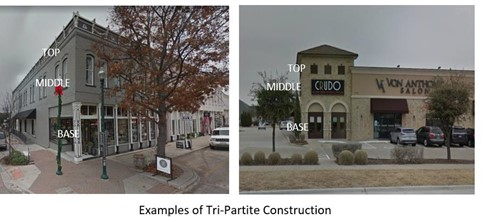
(Ord. No. 926, § 3, 11-9-2021)
Editor's note— See editor's note at § 46-75.
Sec. 46-77. - Specific design standards for commercial buildings (includes office, retail, commercial, mixed-use, restaurant, hotel, and service uses, but not industrial uses).
(a)
Exterior standards for commercial structures (listed above).
(1)
Two exterior materials required. At least two materials, preferably masonry, shall be used on all exterior façades.
(2)
Windows. Windows and glazing shall be limited to a minimum of ten percent and maximum of 70 percent of each building elevation facing a street, major access drive, or side yard greater than ten feet. Faux windows (i.e. non-transparent architectural features meant to appear as a window opening) are allowed along secondary façades, and big boxes may utilize other rhythmic material options to achieve the window appearance.
(3)
Roof designs and materials. For buildings with a visible hip, gable, or mansard roof, allowed materials include metal (standing seam), slate or tile (clay or cement, barrel, or Roman-shaped).
(4)
Prohibited materials. Prohibited exterior surface materials include plain cinder block, vinyl, plastic, and aggregate pea-gravel finished surfaces.
(5)
Murals. Murals, if used, are intended to be decorative, cannot display or connote a commercial message, and shall abide with the sign regulations, as found within this Code.
(6)
Roof design. Roofs shall be peaked with either hip, gable, or mansard design with a minimum one- to-four pitch, or a parapet wall or false mansard design with a minimum one-to-two pitch is acceptable only if constructed around the entire perimeter of a building so that no flat roof shall be visible from a public street or along an active storefront.
(b)
Additional architectural features for commercial structures. All non-residential structures shall be designed to incorporate no less than four of the architectural features from the list below. Buildings over 50,000 square feet must include a minimum of five of the referenced architectural features.
(1)
Canopies, awnings, porticos with colonnade or arcades.
(2)
Raised pilaster cornices (end columns at corners), or quoined corners (any of various bricks of standard shape for forming corners of brick walls or a wedge-shaped piece of wood, stone, or other material, used for various ornamental purposes at corners).
(3)
Vertical elements (tower, cupola, lighthouse, turret, arches, etc.).
(4)
Accented windows and doors framed with smooth cobble, cast stone, limestone or other decorative masonry headers and sills, or dormer windows.
(5)
Outdoor patios and/or courtyards (landscaped and furnished) integrated into a site's layout that creates a sense of place for informal and experiential gathering.
(6)
Decorative and repetitive ornamentation (non-signage) integrated into the building façade, such as corbels, medallions, functioning clocks, niches, wrought iron, balconettes, gargoyles, or horizontal and rhythm patterned brickwork.
(7)
Other similar architectural features, as approved by the director.
(c)
Additional articulation standards for commercial structures. Primary façades clearly visible from a public street or along an active storefront shall meet the following minimum standards for articulation:
(1)
Horizontal articulation. No building wall shall extend for a distance equal to three times the wall's height without providing an offset equal to 15 percent of the wall's height, and that new plane shall extend for a distance equal to at least 25 percent of the maximum length of the first plane.
(2)
Vertical articulation. No wall length shall extend for a distance greater than three times the height of the wall without changing height by a minimum of 15 percent of the wall's height, and that new plane shall extend for a distance equal to at least 25 percent of the maximum length of the first plane. Pitched roofs shall count toward achieving vertical articulation, provided they are 65 degrees or less from horizontal.
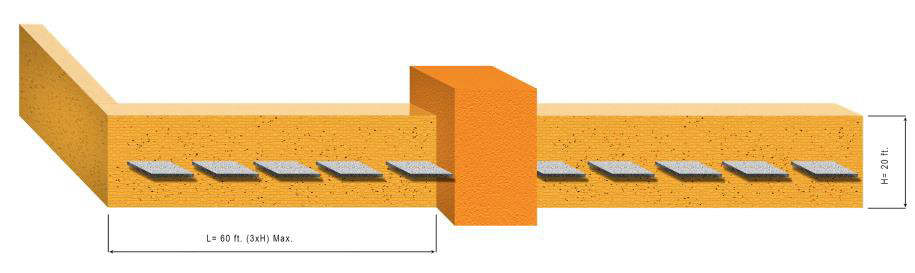
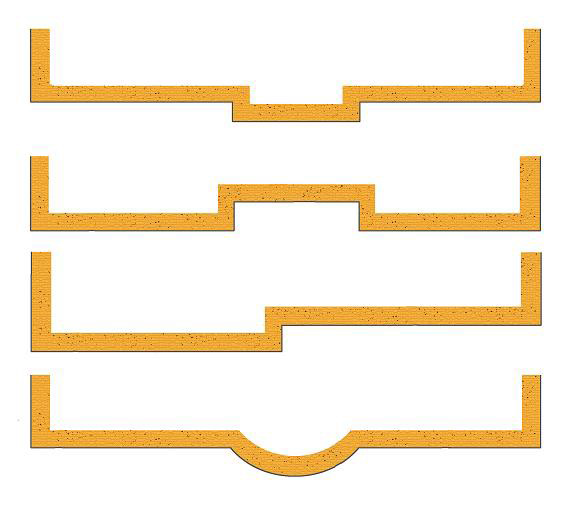
Examples of horizontal articulation
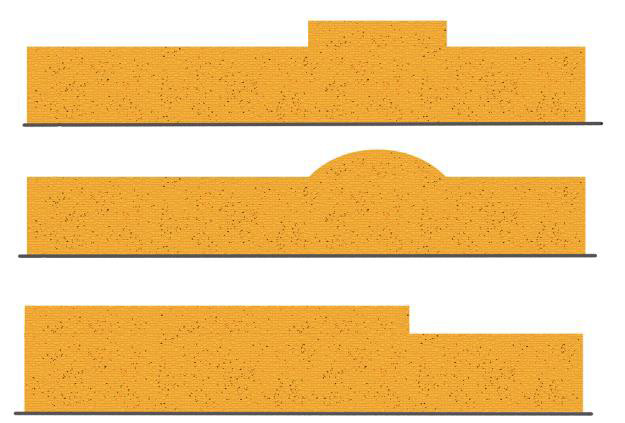
Examples of vertical articulation
(d)
Commercial building façade composition shall include the following elements:
(1)
Tripartite composition (distinct base, middle, and top elements) is required.
(2)
Coordinated materials, colors, architecture. Retail centers shall use materials similar to or exceeding those in the surrounding neighborhood. The first building to apply for a building permit establishes the building materials and color palette for the entire retail center. The primary exterior building material established shall be used on at least ten percent of the exterior façades of other buildings in the block and surrounding development, including pad sites. Where non-masonry materials are permitted, the use of Exterior Insulation and Finish Systems (EIFS) shall be limited to a maximum of ten percent of the total façade and in no instances shall EIFS be permitted within nine feet of the grade of the first floor.
(3)
Multiple materials. No single material shall exceed 80 percent of an elevation area. A minimum of 20 percent of the front façade and all façades facing public right-of-way are encouraged to be natural or manufactured stone. A minimum of ten percent of all other façades are encouraged to be natural or manufactured stone.
(4)
Building size/roof design.
a.
All buildings with a footprint of less than 10,000 square feet and located 100 feet or less from a residential zoning district shall incorporate a pitched, gabled, mansard, hipped, or otherwise sloped roof. All sloped roofs shall have a 6:12 ratio minimum slope.
b.
All buildings with a footprint of less than 10,000 square feet and located 100 feet or greater from a residential zoning district shall incorporate a pitched, gabled, mansard, hipped, or otherwise sloped roof, or a flat roof with an articulated parapet wall or cornice. Wood shingles are prohibited. Composition shingles are allowed provided they have architectural detail and a minimum 30-year life.
c.
All buildings with a footprint of 10,000 square feet and greater shall incorporate sloped roof elements including, but not limited to pitched roofs on towers or arcades, sloped awnings, sloped parapets. Flat roofs are permitted with an articulated parapet wall or cornice in place of the required sloped roof elements. The sloped elements shall be provided along a minimum of 60 percent of each wall's length. All sloped roof elements shall have a 6:12 ratio minimum slope. Wood shingles are prohibited.
d.
Composition shingles are allowed provided they have architectural detail and a minimum 30-year life.
e.
A well-defined cornice of fascia shall be located at the top of the storefront and at the roofline.
(5)
Articulation details. All buildings shall be designed to incorporate a form of architectural articulation every 30 feet or as approved by the director. Acceptable articulation includes the following:
a.
Canopies, awnings, or porticos;
b.
Recesses/projections;
c.
Arcades;
d.
Arches;
e.
Display windows, including a minimum sill height of 30 inches;
f.
Architectural details (such as tile work and moldings) integrated into the building façade; articulated ground floor levels or base;
g.
Articulated cornice line;
h.
Integrated planters or wing walls that incorporate landscape and sitting areas; offsets, reveals or projecting rib used to express architectural or structural bays; or
i.
Varied roof heights.
(6)
Four-sided finishing. All buildings shall be architecturally finished on all four sides with same materials, detailing, and features except the rear if two rows of trees are planted on the perimeter behind the building. In this case, the architectural finish must match the remainder of the building in color only. A double row of trees on offset 50-foot centers in a 15-foot landscape edge, where 50 percent of the trees are canopy evergreen trees. This is for façades that are not visible from public streets and apply to anchor buildings and attached in line spaces only. This provision does not apply to "out" buildings or pad sites.
(7)
Reflective materials prohibited. Mirrored or opaque façades shall be avoided.
(8)
Unclassified non-residential uses. Unclassified non-residential uses (e.g churches, amenity centers, day care centers) which are permitted in residential districts shall develop in accordance with the office, retail, restaurant, service, automobile, and commercial development standards.
(9)
Additional or new use. When a new use or an addition will be adjacent to an existing development, the newly constructed portion of the building shall appear as part of the original design to the greatest extent possible. Where new construction must consist of a different height or bulk than that of the original structures, the change should not occur abruptly.
(e)
Windows/fenestration for commercial buildings.
(1)
Reflectivity. Windows shall have a maximum exterior visible reflectivity of ten percent. The intent of this provision is to prevent the safety hazard of light reflecting from the windows on to adjacent roadways.
(2)
Percent of façade. Fenestration (window) patterns and percent of façade devoted to fenestration shall be consistent within the retail center. Fenestrations shall cover 50 to 75 percent of the storefront and 15 to 35 percent of the upper façade. Storefront fenestrations shall be vertically oriented.
(3)
Setback or brought forward. Fenestrations shall be set back a minimum of six inches from the exterior wall surface creating a reveal. Wall surfaces shall predominate; fenestration openings shall appear to be cut into the wall surface.
(4)
Watercourse. An 18-inch watercourse shall be provided under the fenestrations.
(f)
Additional requirements for big box retail structures.
(1)
Façade plans will be evaluated for their architectural concept, proportions, composition, details, decorative features, artfulness, and quality.
(2)
Buildings shall incorporate tripartite building composition (base, middle, top). The tripartite shall be proportioned to the other elements of the tripartite and the overall structure.
(3)
Buildings shall provide a sheltered entry.
(4)
All retail/commercial buildings with façades greater than 200 feet in length shall incorporate wall plane projections or recesses that are at least six feet deep. Projections/recesses must be at least 25 percent of the length of the façade. No uninterrupted length of façade may exceed 100 feet in length.
(5)
Areas adjacent to the buildings shall incorporate features to promote a walkable environment such as seats, benches, outdoor cafes, shade trees, awnings, and arcades. Where awnings are used, they should be metal or an equivalent durable material.
(6)
The city encourages creative freedom to enrich façade design; the architectural decision may be to include the following:
a.
Placement of windows or transparency subtracted or extended from the façade wall.
b.
Variations in roof form.
c.
Enhancements of long, unadorned walls with the following: light and shade elements, recesses and projections, vertical accents or focal points, masonry texture features, or additional landscaping.
(7)
Any loading and service areas shall be located at the side or rear of buildings. Horizontal articulation described above is not required on the façade of buildings containing a loading dock and/or service area, provided that such area is located in such a manner as to not be readily visible from any roadway.
(g)
Additional requirements for landmark buildings.
(1)
Buildings that are in and of themselves an important city building (such as city hall), or located at the end of a terminating street or major access lane or at the intersection of streets and/or major access lane shall be considered a landmark building.
(2)
Such buildings shall be designed with landmark features that take advantage of that location, such as an accentuated entry and a unique building articulation that is offset from the front wall planes and extends above the main building eave or parapet line.
(3)
Landmark features shall be in proportion to the building, subject to review and approval by the director.
(h)
Additional requirements for pad sites.
(1)
A pad site is defined as a non-residential building of 6,000 square feet or more that is located within the parking area of a larger retail center.
(2)
Pad sites are limited to one for every five acres of gross retail development.
(3)
Buildings situated on pad sites shall share similar design characteristics of the main structure(s). The intent should not be the precise replication of the design of the main structure(s), but rather the use of similar colors, materials, and textures, including the repeating patterns, rhythms, and proportions of the architecture of the other buildings.
(i)
Additional requirements for commercial structures four stories in height or taller.
(1)
Façades shall generally be built parallel to the street frontage, except at street intersections, where a façade containing a primary building entrance should be curved or angled toward the intersection.
(2)
All buildings within a common development, as shown on a development plan, concept plan, or site plan, shall have similar architectural styles, materials, colors, and detailing.
(3)
All structures shall be architecturally finished on all sides that can be seen from a public right-of-way with similar styles, materials, colors, and detailing.
a.
Masonry. Every elevation of each building is encouraged to be finished with masonry as specified below. The director may approve deviations from a strict interpretation of the exterior standards to accommodate specific "signature design aesthetic."
b.
No single building material shall be used for more than 85 percent of any façade unless approved by writing by the director.
c.
Windows shall not be glazed or reglazed with mirrored or reflective glass.
(4)
All commercial buildings shall be architecturally finished with similar exterior materials on all four sides with a higher level of finish and articulation on the primary façade (at the primary entrance or front door).
(5)
The entrance or entrances on all buildings shall be articulated and defined with strong architectural features.
(6)
Ground floor façades facing major thoroughfares and any intersecting thoroughfare must incorporate articulated entry areas, arcades, display windows, awnings, or other architectural variety features along no less than 60 percent of the façade.
(7)
Any loading and service areas shall be located at the side or rear of buildings. Horizontal articulation described above is not required on the façade of buildings containing a loading dock and/or service area, provided that such area is located in such a manner as to not be readily visible from any roadway.
(j)
Additional requirements for hotels.
(1)
All hotels shall provide a covered entrance (port cochere), an indoor lobby, and room access from an interior hallway.
(2)
All hotels shall provide a pool for guests.
(k)
Additional requirements for gas pumps and fueling stations.
(1)
Materials for the main building shall follow section 46-75(e), (f) and (g).
(2)
Canopies shall not exceed 20 feet in total height, measured from the pavement to the top of the canopy.
(3)
The roofs of convenience store buildings and fueling station canopies shall be pitched, include a parapet to shield roof-mounted equipment, or otherwise distinguished, subject to approval by the director.
(4)
Canopies and their supporting structures should be architecturally integrated with the primary building and all other accessory structures on the site by using the same or complementary materials, design motif, and colors.
(5)
Canopy support columns shall be fully encased with city-preferred products, preferably masonry, and shall not include any non-structural additions to the columns.
(6)
Canopy band faces shall be a color consistent with the main structure or an accent color. The canopy band face shall be flat with no projections, shall not be of plastic materials, shall be generally a metal or masonry-based material, not be greater than four feet in height, and may not be backlit or used as signage; except as follows:
i.
The canopy band face may utilize one small button logo on each face that can be internally illuminated, as long as each button logo does not exceed 15 square feet for bands three feet in height and 20 square feet for bands four feet in height, is generally as tall as it is wide, and does not protrude more than 18 inches from the canopy in any direction.
ii.
The canopy band face may utilize an external LED halo type light, if properly shielded/recessed and oriented downward so that only the "wash" is visible.
iii.
The canopy band face may utilize internally illuminated rings, as long as the source is LED, it is flush with the band face and only protrudes nominally (up to a maximum of six inches), and the size of the ring does not exceed more than 25 percent for single rings and 50 percent for multiple rings of the thickness of the canopy band face.
(7)
Lighting fixtures (LED only) or sources of light that are a part of the underside of the canopy should be recessed into the underside of the canopy. Lighting shall be set up so that there is minimal spill-over outside the fueling or service areas.
(8)
The materials and color used on the underside of the canopy should not be highly reflective, with the intent of minimizing the amount and intensity of light, which reaches beyond the site boundaries.
(9)
Materials and colors used on both structural and architectural surfaces shall be subdued, earth- tone colors, with the intent of promoting a harmonious appearance of the structures and the natural surroundings, as well as with appearance themes or guidelines of surrounding development. Brick, stone, and other high-quality masonry type elements are encouraged as a major component of the exterior of all façades.
(10)
Bright accent colors, intended to express corporate or business logos, may be used only on a limited basis. These accent color areas should not be internally illuminated, except as allowed by the city's sign regulations.
(11)
Exhaust valves for underground fuel storage tanks shall be designed to be located against a building, dumpster screening wall, or other structure to mitigate their visual impact and should be an earth-tone color. If impractical, the exhaust valves may be located in an interior landscape area, if properly screened, but should not be located in the exterior landscape buffer adjacent to the public right-of-way.
(12)
Screening of fueling stations shall follow Section 9, Landscape Requirements, of the City Design Manual. However, use of berms to further screen the pump area is encouraged.
(l)
Exceptions.
(1)
The city council, after recommendation by the planning and zoning commission, may grant an exception to the foregoing exterior façade and design requirements, based upon consideration of the criteria listed in subsection (2), below.
(2)
In considering an exception to the exterior façade requirements, the planning and zoning commission and city council may consider whether a proposed alternate material:
a.
Is a unique architectural expression;
b.
Includes unique building styles and materials;
c.
Is consistent with high quality development;
d.
Is or would be visually harmonious with existing or proposed nearby buildings;
e.
Has obvious merit based upon the quality and durability of the materials; or
f.
Represents an exterior building material that is in keeping with the intent of this chapter to balance the abovementioned objectives.
(3)
Corporate identities (brands and logos) that conflict with the building design criteria shall be reviewed on a case-by-case basis and approved by the director.
(Ord. No. 926, § 3, 11-9-2021)
Sec. 46-78. - Specific design standards for industrial buildings (industrial and manufacturing uses, including mini-warehouse, storage, and agricultural buildings).
(a)
Design standards for industrial structures. The following design standards apply to structures constructed in an industrial zoning district and proposing an industrial and/or manufacturing use, per the use chart of the zoning ordinance:
(1)
The main entry or office area of the building shall be articulated both horizontally and vertically by at least five feet or ten percent of the adjacent wall height, whichever is greater. Building corners shall also be articulated, as approved by the director.
(2)
Primary exterior façades, which are clearly visible from a public street, shall be constructed with materials that contrast and compliment the remainder of the building.
(b)
Architectural features for industrial structures. All industrial buildings shall incorporate two of the additional architectural features listed below:
(1)
Canopies (not drive-through canopies), awnings, valances, or porticos;
(2)
Overhangs (three feet minimum);
(3)
Recesses or projections (three feet minimum);
(4)
Architectural arcades;
(5)
Peaked roof forms;
(6)
Arches;
(7)
Outdoor patios;
(8)
Recessed or " popped-out" display windows (two feet minimum);
(9)
Visible and noticeable architectural details, such as tile work or moldings, integrated into building façade;
(10)
Integrated planters or wing walls that incorporate landscape and sitting areas; or
(11)
Other architectural features with similar visual impact.
(c)
Façade composition shall include the following elements:
(1)
Front façade. At least two materials shall be used on the front façades.
(2)
Side façade. Sides of this class of building may be up to 80 percent metal, with the lower portion of the façade (i.e. wainscot) encouraged to being another material, preferably a masonry material.
(3)
Rear façade. The rear of the building may be entirely metal if it is not visible from a public roadway.
(d)
Windows/fenestration. Windows and glazing shall be limited to a minimum of ten percent and maximum of 70 percent of each building elevation facing a street, major access drive, or side yard greater than ten feet. Faux windows (i.e. non-transparent architectural features meant to appear as a window opening) are allowed along secondary façades to achieve the window appearance.
(e)
Loading bays. No loading bays or docks may be located on the façade that faces a public street. If located on the side of a building that is partially visible from a public street, appropriate screening approved by the director shall be provided.
(f)
Roof designs and materials.
(1)
For buildings with a visible hip, gable, or mansard roof, allowed materials include metal (standing seam), slate or tile (clay or cement, barrel, or Roman-shaped).
(2)
Roofs shall be peaked with either hip, gable, or mansard design with a minimum one-to-four pitch ratio, or a parapet wall or false mansard design with a minimum one-to-two pitch ratio is acceptable only if constructed around the entire perimeter of a building so that no flat roof shall be visible from a public street or along an active storefront.
(g)
Prohibited materials. Prohibited exterior surface materials include cinder block, vinyl, plastic, and aggregate pea-gravel finished surfaces.
(h)
Murals. Murals, if used, shall be decorative and abide by the sign ordinance regulations, as found within this Code.
(i)
Solar power. Solar panels and other forms of solar energy capture are encouraged.
(j)
Exceptions. In considering an exception to the exterior façade requirements, the planning and zoning commission and city council may consider during the site plan process whether a proposed alternate material:
(1)
Is a unique architectural expression;
(2)
Includes unique building styles and materials;
(3)
Is consistent with high quality development;
(4)
Is or would be visually harmonious with existing or proposed nearby buildings;
(5)
Has obvious merit based upon the quality and durability of the materials; and
(6)
Represents an exterior building material that is in keeping with the intent of this chapter to balance the abovementioned objectives.
(Ord. No. 926, § 3, 11-9-2021)
Sec. 46-81. - A—Agricultural District.
(a)
General purpose and description. The agricultural district is intended to apply to land situated on the fringe of an urban area, used for agricultural purposes, and which may become an urban area in the future. Therefore, the agricultural activities conducted in the agricultural district should not be detrimental to urban land uses; intensity of use permitted in this district is intended to encourage and protect agricultural uses until urbanization is warranted and the appropriate change in district classification is made.
(b)
Permitted uses. A building or premises shall be used only for the following purposes:
(1)
Single-family dwellings on building lots of two acres or more in areas where the dwellings can be adequately served by city utilities or septic tanks located on the building lot.
(2)
Telephone exchange provided no public business and no repair or outside storage facilities are maintained; gas lines; and gas regulating stations.
(3)
Accessory buildings and structures clearly incidental to agricultural operations, including, but not limited to, barns, stables, equipment sheds, granaries, private garages, pump houses, and servants' quarters not for rent, provided that the total area of buildings and structures shall be limited to ten percent of the gross land area of the tract.
(4)
Temporary metal buildings of less than 600 square feet which are used for tool and supply storage.
(5)
Riding academy or other equestrian related activities.
(6)
Other uses as listed in section 46-125, Table of Uses.
(c)
Permitted specific uses. The following specific uses shall be permitted in the agricultural district when granted in accordance with 46-133, Specific Use Permits.
(d)
Height and area regulations. See Appendix 1-B, Nonresidential Area Regulations.
(e)
Parking regulations. Two covered spaces behind the front yard line for single-family dwelling units and HUD code manufactured homes. Other off-street parking space regulations are set forth in section 46-161, Parking Regulations.
(Ord. No. 907, § 3, 6-8-2021)
Sec. 46-82. - NC—Neighborhood Convenience District.
(a)
General purpose and description. The NC district is to provide for a limited range of service and light retail land uses in small districts up to two acres in size that are appropriately located at intersections of thoroughfares to serve the immediately adjacent residential neighborhood area.
(1)
Permitted uses. A building or premises shall be used only for the following purposes: Uses as listed in section 46-125.
(2)
Permitted specific uses. The following specific uses shall be permitted when granted in accordance with 46-133, Specific Use Permits.
(3)
Uses as listed in section 46-125, Table of Uses.
(b)
Height and area regulations. See Appendix 1-B, Nonresidential Area Regulations. When a nonresidentially zoned lot or tract abuts upon a zoning district boundary line dividing that lot or tract from a residentially zoned lot or tract, an opaque wood fence or masonry fence having a minimum height of six feet above the average grade of the residential property shall be constructed on nonresidential property adjacent to the common side or rear property line.
(c)
Parking regulations. Off-street parking and loading shall be provided as set forth in section 46-161, Parking Regulations.
(d)
Permitted accessory uses. Accessory uses customarily appurtenant to a permitted use, and accessory uses as permitted in the table of uses, section 46-125, Table of Uses.
(e)
Miscellaneous provisions.
(1)
Signs and illumination.
a.
Signs in this district shall comply with the requirements of chapter 32 of this Code (as it exists or may be amended).
b.
The number of signs shall be limited to two.
c.
No free-standing signs (ground or pole signs) shall be permitted.
d.
All signs shall be flat against the wall of the building, with all parts of the sign within 18 inches of the face of the building.
e.
All signs shall be oriented so as to face a public street.
f.
No sign shall be illuminated so as to shine on nearby residential properties.
g.
Any illumination shall be non-flashing and shall not contain a rotating, oscillating or revolving beam or beacon of light.
h.
To the extent of any conflict between this subsection and chapter 32 of this Code (as it exists or may be amended), the stricter provision shall apply.
(2)
Prior to any subdivision of an NC district, a conceptual site plan, which shall include all the land then existing in single ownership at the time of initial zoning as an NC district, or at the time this provision became effective, whichever is later, shall be submitted for approval, according to article III, division 3 of this chapter, with consideration being given to this statement of intended development. Thenceforth, any development or subdivision of the property shall be consistent with an approved conceptual site plan, as originally approved or as may be subsequently amended and approved.
(Ord. No. 907, § 3, 6-8-2021)
Sec. 46-83. - C-l—Commercial District-Office, Light Retail and Neighborhood Services.
(a)
General purpose and description. The C-1 district is intended for office facilities, neighborhood shopping facilities, and retail and commercial facilities of a service character. The C-l district is established to accommodate the daily and frequent needs of the community. The following regulations shall be applicable to all uses in the district:
(1)
The business shall be conducted wholly within an enclosed building;
(2)
Required yards shall not be used for display, sale, or storage of merchandise or for the storage of vehicles, equipment, containers, or waste material;
(3)
All merchandise shall be sold at retail on the premises; and
(4)
Such use shall not be objectionable because of odor, excessive light, smoke, dust, noise, vibration, or similar nuisance.
(b)
Permitted uses. A building or premises shall be used only for the following purposes:
(1)
Discount, variety, or department store with floor space not greater than 20,000 square feet.
(2)
Food store with floor space not greater than 20,000 square feet.
(3)
Automobile service station (no garage or automobile repair facilities).
(4)
Other uses as listed in section 46-125, Table of Uses.
(c)
Permitted specific uses. The following specific uses shall be permitted in the C-l district when granted in accordance with section 46-133, Specific Use Permits:
(1)
Broadcasting facilities, radios, television, or microwave tower.
(2)
Automobile service station with associated minor automobile repair facility with floor space not greater than 2,500 square feet.
(3)
Other uses as listed in section 46-125, Table of Uses.
(d)
Height and area regulations. See Appendix 1-B, Nonresidential Area Regulations. When a nonresidentially zoned lot or tract abuts upon a zoning district boundary line dividing that lot or tract from a residentially zoned lot or tract, an opaque wood fence or masonry fence having a minimum height of six feet above the average grade of the residential property shall be constructed on nonresidential property adjacent to the common side or rear property line.
(e)
Parking regulations. Off-street parking and loading shall be provided as set forth in section 46-161, Parking Regulations.
(f)
Permitted accessory uses. Accessory uses customarily appurtenant to a permitted use, and accessory uses as permitted in section 46-125, Table of Uses.
(g)
Miscellaneous provisions.
(1)
Signs and illumination.
a.
Signs in this district shall comply with the requirements of chapter 32 of this Code (as it exists or may be amended).
b.
The number of signs shall be limited to one per business plus one common sign for every eight businesses.
c.
No pole signs shall be permitted.
d.
All signs for individual businesses shall be flat against the wall of the building, with all parts of the sign within 18 inches of the face of the building.
e.
No sign shall be illuminated so as to shine on nearby residential properties
f.
Any illumination shall be non-flashing and shall not contain a rotating, oscillating or revolving beam or beacon of light.
g.
To the extent of any conflict between this subsection and chapter 32 of this Code (as it exists or may be amended), the stricter provision shall apply.
(2)
Only one building for living purposes shall be permitted on one zoning lot except as otherwise provided herein. No business shall be constructed on a zoning lot occupied by a residence.
(3)
This district is intended to permit the development of unified shopping centers, whether in single or multiple ownership. Prior to any subdivision of a C-1 district, a conceptual site plan, which shall include all the land that existing in single ownership at the time of initial zoning as a C-1 district, or at the time this provision became effective, whichever is later, shall be submitted for approval, according to article III, division 3 of this chapter, with consideration being given to this statement of intended development. Thenceforth, any development or subdivision of the property shall be consistent with an approved conceptual site plan, as originally approved or as may be subsequently amended and approved.
(Ord. No. 907, § 3, 6-8-2021)
Sec. 46-84. - C-2—Commercial District-General.
(a)
General purpose and description. The C-2 district is intended to provide a zoning category similar to the C-l district, except that additional uses are permitted which are not generally carried on completely within a building or structure and an expanded range of service and repair uses is permitted.
(b)
Permitted uses. A building or premises shall be used only for the following purposes: Uses as listed in section 46-125, Table of Uses.
(c)
Permitted specific uses. The following specific uses shall be permitted in a C-2 district when granted in accordance with 46-133, Specific Use Permits. Other uses as listed in section 46-125.
(d)
Height and area regulations. See Appendix 1-B, Nonresidential Area Regulations.
(e)
Parking requirements. Off-street parking requirements shall be provided in accordance with section 46-161, Parking Regulations.
(f)
Miscellaneous provisions. This district is intended to permit the development of unified shopping centers, whether in single or multiple ownership. It is not intended for extensive parceling-off of tracts or creation of pad sites, especially along the frontage of an arterial street, not extending the full depth of the district. Prior to any subdivision of a C-2 district, a conceptual site plan for development of the center, which shall include all the land that existing in single ownership at the time of initial zoning as a C-2 district, or at the time this provision became effective, whichever is later, shall be submitted for approval, according to article III, division 3 of this chapter, with consideration being given to this statement of intended development. Thenceforth, any development or subdivision of the property shall be consistent with an approved conceptual site plan, as originally approved or as may be subsequently amended and approved.
(g)
Signs. Signs in this district shall comply with the requirements of chapter 32 of this Code (as it exists or may be amended).
(Ord. No. 907, § 3, 6-8-2021)
Sec. 46-85. - C-3—Planned Center District.
(a)
General purpose and description. The C-3 district is designed to provide for a wide range of retail and service establishments.
(b)
Permitted uses. Uses as permitted in the table of uses, section 46-125, Table of Uses.
(c)
Permitted specific uses. Uses as permitted by specific use permit in the table of uses, section 46-125, Table of Uses
(d)
Height and area regulations. See Appendix 1-B, Nonresidential Area Regulations. When a nonresidentially zoned lot or tract abuts upon a zoning district boundary line dividing that lot or tract from a residentially zoned lot or tract, an opaque wood fence or masonry fence having a minimum height of six feet above the average grade of the residential property shall be constructed on nonresidential property adjacent to the common side or rear property line.
(e)
Parking regulations. Off-street parking and loading shall be provided as set forth in section 46-161, Parking Regulations.
(f)
Permitted accessory uses. Accessory uses customarily appurtenant to a permitted use, and accessory uses as permitted in the table of uses, section 46-125, Table of Uses.
(g)
Miscellaneous provisions.
(1)
The entire parcel of land in the C-3 district shall be considered as one zoning lot in arranging buildings and other facilities.
(2)
The commission and/or the city council may request a market analysis to substantiate the necessity, size, and location of the proposed development.
(3)
Applications for C-3 zoning shall submit a site plan of the proposed development as an exhibit accompanying the request for a change of zone. Such site plan shall be filed of record with the zoning ordinance, if passed.
(4)
The commission and city council may zone an area for C-3 planned center zone in advance of plans for development if it is determined that said center is contemplated in the planning practices of the city. Prior to any subdivision of a C-3 district, a site plan for development of the center, which shall include all the land that existing in single ownership at the time of initial zoning as a C-3 district, or at the time this provision became effective, whichever is later, shall be submitted for approval, according to article III, division 3 of this chapter, with consideration being given to this statement of intended development. Thenceforth, any development or subdivision of the property shall be consistent with an approved conceptual site plan, as originally approved or as may be subsequently amended and approved.
(h)
Signs. Signs in this district shall comply with the requirements of chapter 32 of this Code (as it exists or may be amended).
(Ord. No. 907, § 3, 6-8-2021)
Sec. 46-86. - CBD—Central Business District.
(a)
General purpose and description. The CBD is established to accommodate the unique characteristics of the historical center of the city and to ensure that future development in the CDB is compatible with maintaining the economic and historic integrity of the area. The central business district is designed to provide an area for shopping, dining, working, and entertainment that will remain active during the evening and weekends as well as standard work hours.
(b)
Permitted uses. A building or premises shall be used only for the following purposes:
(1)
Apartments are allowed in the CBD, but not in the front portion of a building used for a business.
(2)
Other uses as listed in section 46-125, Table of Uses.
(c)
Permitted specific uses. The following specific uses shall be permitted in the CBD when granted in accordance with 46-133, Specific Use Permits:
(1)
Broadcasting facilities, radio, television, or microwave towers.
(2)
Automobile service station with associated minor automobile repair facility with floor space not greater than 2,500 square feet.
(3)
Other uses as listed in section 46-125, Table of Uses.
(d)
Height and area regulations.
(1)
See Appendix 1-B, Nonresidential Area Regulations.
(2)
In keeping with the historically mixed nature of the CBD, the requirement for a nonresidentially zoned lot or tract which abuts upon a zoning district boundary line dividing that lot or tract from a residentially zoned lot or tract to have an opaque wood fence or masonry fence may be set aside at the discretion of the city council.
(3)
The minimum front yard setback shall be 42 feet from the center of the road to the building line. This setback shall apply on all sides of the property that faces a roadway in use by the public.
(4)
A sidewalk of at least 12 feet wide shall be required from the building line outward towards the street.
(5)
A curb shall be required at a distance of 30 feet (minimum) from the center of the road.
(6)
Fronts of buildings shall be considered to be any surface of the building facing a street.
(7)
Fronts of contiguous buildings shall be in alignment.
(8)
If there is space between the sides of adjacent buildings, such space shall be wide enough to accommodate emergency vehicles.
(9)
The following requirements shall be met for new construction within an area of the CBD defined as follows:
a.
Preston Street on the west including lots on the west side of Preston Street;
b.
The centerline of Fulton Street on the south;
c.
The centerline of Stephens Street on the north;
d.
The railroad tracks on the east:
1.
Fronts of buildings shall be of a Victorian style constructed of masonry with a minimum height of 30 feet.
2.
A minimum of 50 percent of the linear width of the first floor of the façade shall be glass windows or doors.
3.
Bottoms of windows shall be no more than 30 inches above the first interior floor.
4.
The second story of the façade shall have or give the appearance of having windows.
(e)
Parking regulations. Off-street parking and loading shall be provided as set forth in section 46-161, Parking Regulations.
(f)
Construction materials of commercial buildings. Commercial buildings in the CBD shall use only stone, brick, stucco, wood or glass in the construction of the exterior façade that is visible to the public. No more than 20 percent of the façade shall be composed of wood or wood products, excluding doors, door frames, windows and window frames.
(g)
Signs. Signs in this district shall comply with the requirements of chapter 32 of this Code (as it exists or may be amended).
(Ord. No. 907, § 3, 6-8-2021)
Sec. 46-87. - O—Office District.
(a)
General purpose and description. The O district is designed to provide for office buildings with attendant retail and service uses intended primarily for occupants of such office buildings.
(b)
Permitted uses. Uses as permitted in the table of uses, section 46-125, Table of Uses.
(c)
Permitted specific uses. Uses as permitted by specific use permit in section 46-133, Specific Use Permits.
(d)
Height and area regulations. See Appendix 1-B, Nonresidential Area Regulations. When a nonresidentially zoned lot or tract abuts upon a zoning district boundary line dividing that lot or tract from a residentially zoned lot or tract, an opaque wood fence or masonry fence having a minimum height of six feet above the average grade of the residential property shall be constructed on nonresidential property adjacent to the common side or rear property line.
(e)
Parking regulations. Off-street parking and loading shall be provided as set forth in section 46-161, Parking Regulations.
(f)
Permitted accessory uses.
(1)
Accessory uses customarily appurtenant to a permitted use, and accessory uses as permitted in the table of uses, section 46-125, Table of Uses.
(2)
The incidental retail sale of food, beverages, and other convenience items or services is permitted to the occupants, employees, and guests, as long as these items are not advertised with outside signage.
(3)
Drive-in facilities for banks or financial institutions.
(4)
Accessory buildings and uses customarily incident to any of the above uses, provided that such be not objectionable because of odor, smoke dust, noise, vibration, or similar nuisance.
(g)
Signs. Signs in this district shall comply with the requirements of chapter 32 of this Code (as it exists or may be amended).
(Ord. No. 907, § 3, 6-8-2021)
Sec. 46-88. - MI-1—Manufacturing/Industrial District-Light.
(a)
General purpose and description. The light manufacturing/industrial district is established to accommodate those uses which are of a non-nuisance type located in relative proximity to residential areas, and to preserve and protect lands designated on the comprehensive plan for industrial development and use from the intrusion of certain incompatible uses which might impede the development and use of lands for industrial purposes. Development in the MI-1 district is limited primarily to certain storage, wholesale, and industrial uses, such as the fabrication of materials, and specialized manufacturing and research institutions, all of a non-nuisance type. No use or types of uses specifically limited to the MI-2 district may be permitted in the MI-1 district uses permitted in the MI-1 district are subject to the following conditions:
(1)
All business, servicing, or processing, except for off-street parking, off-street loading, display of merchandise for sale to the public, and establishments of the drive-in type, shall be conducted within completely enclosed areas.
(2)
All storage within 100 feet of a residential district, except for motor vehicles in operable condition, shall be within completely enclosed buildings or effectively screened with screening not less than six feet nor more than eight feet in height, provided no storage located within 50 feet of such screening shall exceed the maximum height of such screening.
(3)
Permitted uses in the MI-1 district shall not disseminate dust, fumes, gas, noxious odor, smoke, glare, or other atmospheric influence.
(4)
Permitted uses in the MI-1 district shall produce no noise exceeding in intensity, at the boundary of the property, the average intensity of noise of street traffic.
(5)
Permitted uses in the MI-1 district shall not create fire hazards on surrounding property.
(b)
Permitted uses. A building or premises shall be used only for the following purposes: Uses as listed in section 46-125, Table of Uses.
(c)
Permitted specific uses. The following specific uses shall be permitted in the MI-1 district when granted in accordance with 46-133, Specific Use Permits:
(1)
Machine shops and fabrication of metal not more than ten gauge in thickness.
(2)
Accessory uses, including, but not limited to, temporary buildings for construction purpose for a period not to exceed the duration of such construction.
(3)
Factory outlet retail or wholesale store for the sales and servicing of goods or materials on the same premises as the manufacturing company to which they are related, including sales and service in a separate building or buildings.
(4)
Railroad freight terminals, railroad switching and classification yards, repair shops, and roundhouses.
(5)
Other uses as listed in section 46-125, Table of Uses.
(d)
Height and area regulations. See Appendix 1-B, Nonresidential Area Regulations.
(e)
Parking regulations. Off-street parking requirements shall be provided in accordance with the specific uses set forth in section 46-161, Parking Regulations.
(f)
Signs. Signs in this district shall comply with the requirements of chapter 32 of this Code (as it exists or may be amended).
(Ord. No. 907, § 3, 6-8-2021)
Sec. 46-89. - MI-2—Manufacturing/Industrial District-Heavy.
(a)
General purpose and description. The heavy manufacturing/industrial district is established to accommodate most industrial uses and protect such areas from the intrusion of certain incompatible uses which might impede the development and use of lands for industrial purposes uses permitted in the MI-2 district are subject to the following conditions:
(1)
Uses within enclosed buildings. All business, servicing, or processing, except for off-street parking, off-street loading, display of merchandise for sale to the public, and establishments of the drive-in type, shall be conducted within completely enclosed buildings unless otherwise indicated.
(2)
Screening of storage. All storage within 100 feet of a residential district, except for motor vehicles in operable condition, shall be within completely enclosed buildings. Alternatively, all storage within 100 feet of a residential district may be effectively screened with a masonry wall having a minimum height of six feet and a maximum height of eight feet above the grade of the residential property, provided no storage located within 50 feet of such masonry screening wall shall exceed the maximum height of such screening.
(3)
Performance standards. All uses permitted in the MI-2 district must meet the following performance standards and any appropriate city ordinances:
a.
Smoke. No operation shall be conducted unless it conforms to the standards established by any applicable state and federal health rules and regulations pertaining to smoke emission;
b.
Particulate matter. No operation shall be conducted unless it conforms to the standards established by applicable state and federal health rules and regulations pertaining to emission of particulate matter;
c.
Dust, odor, gas, fumes, glare, or vibration. No emission of these matters shall result in a concentration at or beyond the property line which is detrimental to the public health, safety or general welfare or which causes injury or damage to property; the emissions shall in all cases conform to the standards established by applicable state and federal health rules and regulations pertaining to the emissions;
d.
Radiation hazards and electrical disturbances. No operation shall be conducted unless it conforms to the standards established by applicable state and federal health rules and regulations pertaining to radiation control;
e.
Noise. No operation shall be conducted in a manner so that any noise produced is objectionable due to intermittence, beat frequency, or shrillness. Sound levels of noise at the property line shall not exceed 75 dB(A) permitted for a maximum of 15 minutes in any one hour; the operation shall in all cases conform to the standards established by applicable state and federal health rules and regulations and to other city ordinances pertaining to noise; and
f.
Water pollution. No water pollution shall be emitted by manufacturing or other processing. In a case in which potential hazards exist, it shall be necessary to install safeguards acceptable to the appropriate state and national health and environmental protection agencies prior to issuance of a certificate of occupancy. The applicant shall have the burden of establishing that the safeguards are acceptable to the agency or agencies.
(b)
Permitted uses. The following uses shall be permitted: Uses as listed in section 46-125, Table of Uses.
(c)
Permitted specific uses.
(1)
The following specific uses shall be permitted in the MI-2 district when granted in accordance with section 46-133, Specific Use Permits. Uses as listed in section 46-125, Table of Uses.
(2)
Other manufacturing and industrial uses which do not meet the general definition for manufacturing processes may be permitted by the city council after public hearing and review of the particular operational characteristics of each such use, and other pertinent data affecting the community's general welfare.
(3)
Approval of uses under this section shall be made in accordance with section 46-235, the Zoning Board of Adjustment.
(d)
Height and area regulations. See Appendix 1-B, Nonresidential Area Regulations. When a nonresidentially zoned lot or tract abuts upon a zoning district boundary line dividing that lot or tract from a residentially zoned lot or tract, an opaque wood fence or masonry fence having a minimum height of six feet above the average grade of the residential property shall be constructed on nonresidential property adjacent to the common side or rear property line.
(e)
Parking regulations. Required off-street parking shall be provided in accordance with the specific uses set forth in section 46-161, Parking Regulations.
(f)
Signs. Signs in this district shall comply with the requirements of chapter 32 of this Code (as it exists or may be amended).
(Ord. No. 907, § 3, 6-8-2021)
Sec. 46-90. - CF—Community Facilities Zoning District.
(a)
Purpose. The Community Facilities district is established to apply to those lands where federal, state, or local government activities are conducted, where governments hold title to such lands, for public and private educational facilities, and hospitals. In addition, certain non-governmental and non-institutional uses may be permitted in this district to provide necessary services to governmental and institutional uses.
(b)
Height and area regulations. The height of buildings, the minimum dimensions of lots and yards, and the minimum lot area permitted on any lot in CF district shall be as follows:
(1)
Maximum height: 80 feet. This height limitation may be waived by action of the city council.
(2)
Minimum front yard setback: 20 feet.
(3)
Minimum rear yard setback: 20 feet.
(4)
Minimum side yard setback: 20 feet.
(c)
Parking. Parking for this zoning district shall be as follows:
(1)
Commercial buildings: One space for every two employees at maximum usage.
(2)
High schools or colleges: One space for every four students plus every two employees at maximum usage.
(3)
Middle schools, elementary schools, or private schools: One space for every ten students plus every two employees at maximum usage.
(4)
Athletic fields: One space for every four seats.
(5)
Shared or reduced parking: May be considered by the planning and zoning commission and city council during the site plan process, based on the recommendation of the city manager or his designee.
(d)
Landscaping.
(1)
Parking lot islands: May be composed of crushed granite or some other permeable material to allow absorption of some of the natural rainfall.
(2)
Parking lot trees: The number and location of parking lot trees may be reduced or waived by the city manager if deemed to be excessive for maintenance purposes.
(3)
All other landscaping required by the Van Alstyne City Design Manual shall be provided.
(Ord. No. 907, § 3, 6-8-2021)
Sec. 46-91. - PD—Planned Development District.
(a)
General purpose and description. The PD district is intended to provide for the combining and mixing of uses allowed in various districts with appropriate regulations and to permit flexibility in the use and design of land and buildings in situations where modification of specific provisions of this chapter is not contrary to its intent and purpose or significantly inconsistent with the planning on which it is based and will not be harmful to the community. A PD district may be used to permit new and innovative concepts in land utilization. While great flexibility is given to provide special restrictions which will allow development not otherwise permitted, procedures are established herein to ensure against misuse of the increased flexibility.
(b)
Permitted uses. Any use specified in the ordinance granting a planned development district shall be permitted in that district. The size, location, appearance, and method of operation may be specified to the extent necessary to ensure compliance with the purpose of this chapter.
(c)
Development standards.
(1)
Development standards for each separate PD district shall be set forth in the ordinance granting the PD district and may include, but shall not be limited to, uses, density, lot area, lot width, lot depth, yard depths and widths, building height, building elevations, coverage, floor area ratio, parking, access, screening, landscaping, accessory buildings, signs, lighting, management associations, and other requirements as the city council may deem appropriate.
(2)
In the PD district, the particular districts to which uses specified in the PD are most similar shall be stated in the granting ordinance. All PD applications shall list all requested variances from the standard requirements set forth throughout this chapter. (Applications without this list will be considered incomplete.)
(3)
The ordinance granting a PD district shall include a statement as to the purpose and intent of the PD granted therein. A specific list is required of variances in each district or districts and a general statement citing the reason for the PD request.
(4)
The planned development district shall conform to all other sections of the ordinance unless specifically exempted in the granting ordinance.
(d)
Conceptual and development plans. In establishing a planned development district, the city council shall approve and file as part of the amending ordinance appropriate plans and standards for each planned development district. During the review and public hearing process, the city council shall require a conceptual plan and a development plan (or detailed site plan).
(1)
Conceptual plan.
a.
The applicant shall submit this plan. The plan shall show the applicant's intent for the use of the land within the proposed planned development district in a graphic manner and shall be supported by written documentation of proposals and standards for development.
b.
Changes of detail which do not alter the basic relationship of the proposed development to adjacent property and which do not alter the uses permitted or increase the density, building height, or coverage of the site and which do not decrease the off-street parking ratio, reduce the yards provided at the boundary of the site, or significantly alter the landscape plans as indicated on the approved conceptual plan may be authorized by the building official or his designated representative. If an agreement cannot be reached regarding whether or not a detailed site plan conforms to the original concept plan, the city council shall determine the conformity.
(2)
Development plan or detailed site plan. This plan shall set forth the final plans for development of the planned development district and shall conform to the data presented and approved on the conceptual plan. Approval of the development plan shall be the basis for issuance of a building permit. The development plan may be submitted for the total area of the PD or for any section or part as approved on the conceptual plan. The development plan must be approved by the city council. A public hearing on approval of the development plan shall be required at the council level, unless such a hearing is waived pursuant to subsection (d)(3)a. of this section at the time of conceptual plan approval in the original amending ordinance. The development plan shall include:
a.
A site inventory analysis including a scale drawing showing existing vegetation, natural watercourses, creeks or bodies of water, and an analysis of planned changes in such natural features as a result of the development. This should include a delineation of any floodprone areas.
b.
A scale drawing showing any proposed public or private streets and alleys; building sites or lots; and areas reserved as parks, parkways, playgrounds, utility easements, school sites, street widening and street changes; the points of ingress and egress from existing streets; general location and description of existing and proposed utility services, including size of water and sewer mains; the location and width for all curb cuts and the land area of all abutting sites and the zoning classification thereof on an accurate survey of the tract with the topographical contour interval of not more than five feet.
c.
A site plan for proposed building complexes showing the location of separate buildings, and between buildings and property lines, street lines, and alley lines. Also to be included on the site plan is a plan showing the arrangement and provision of off-street parking.
d.
A landscape plan showing screening walls, ornamental planting, wooded areas, and trees to be planted.
e.
An architectural plan showing elevations and signage style to be used throughout the development in all districts except single-family and two-family may be required by the city council if deemed appropriate. Any or all of the required information may be incorporated on a single drawing if such drawing is clear and can be evaluated by the building official or his designated representative.
(3)
Procedure for establishment. The procedure for establishing a planned development district shall follow the procedure for zoning amendments as set forth in section 46-238. This procedure is expanded as follows for approval of conceptual and development plans:
a.
Separate public hearings shall be held by the city council for the approval of the conceptual plan and the development plan or any section of the development plan, unless such requirement is waived by the city council upon a determination that a single public hearing is adequate. A single public hearing is adequate when:
1.
The applicant submits adequate data with the request for the planned development district to fulfill the requirements for both plans; or
2.
Information on the concept plan is sufficient to determine the appropriate use of the land and the detailed site plan will not deviate substantially from it; and
3.
The requirement is waived at the time the amending ordinance is approved. If the requirement is waived, the conditions shall be specifically stated in the amending ordinance.
b.
The ordinance establishing the planned development district shall not be approved until the conceptual plan is approved.
c.
The development plan may be approved in sections. When the plan is approved in sections, the separate approvals by the city council for the initial and subsequent sections will be required.
d.
An initial development plan shall be submitted for approval within six months from the approval of the conceptual plan or some portion of the conceptual plan. If the development plan is not submitted within six months, the conceptual plan is subject to reapproval by the city council. If the entire project is not completed within two years, the city council may review the original conceptual plan to ensure its continued validity.
e.
Regardless of whether the public hearing is waived for the development plan, approval by the city council is still required.
(e)
Written report may be required. When a PD is being considered, a written report may be requested of the applicant discussing the impact on planning, engineering, water utilities, electric, sanitation, building inspection, tax, police, fire, and traffic. Written comments from the applicable public school district and from private utilities may be submitted to the city council.
(f)
Planned developments to be recorded. All planned development districts approved in accordance with the provisions of this chapter in its original form, or by subsequent amendment thereto, shall be referenced on the zoning district map, and a list of such planned development districts, together with the category of uses permitted therein, shall be maintained on file in the office of the clerk.
(g)
Screening fencing. When a nonresidentially zoned lot or tract abuts upon a zoning district boundary line dividing that lot or tract from a residentially zoned lot or tract, an opaque wood fence or masonry fence having a minimum height of six feet above the average grade of the residential property shall be constructed on nonresidential property adjacent to the common side or rear property line.
(h)
Signs. Signs in this district shall comply with the requirements of chapter 32 of this Code (as it exists or may be amended).
(Ord. No. 907, § 3, 6-8-2021)
Sec. 46-92. - THOR—Thoroughfare Overlay District.
(a)
General purpose and description.
(1)
City entrance gateways should take advantage of natural areas crossing major highway corridors. These entryways should express the natural beauty that is found in Van Alstyne's wooded streams and rivers while creating a sense of arrival. They should help delineate one community from another as the traveler passes from a neighboring city into Van Alstyne.
(2)
Urban design aspects to be addressed include:
a.
Location. As previously mentioned, city gateways should be located at the confluence of natural streams and rivers with major highways. These crossings provide several natural amenities which signify the quality of life in Van Alstyne, while serving as functional elements of the open space and trails systems. Already distinguishable by prevalent mature tree cover, these entry portals have an inherent natural beauty which can be highlighted with strategically placed manmade focal points. Along highway properties the city will need to acquire/reserve land for these features.
b.
Description/character. A single focal point placed within city gateways can be aesthetically pleasing as well as functional. The functional aspect includes features such as: pedestrian overlooks, trail place or event markers, or even a signature art piece. Design grading may be used to enhance the feel of the landscape, especially near the entry portal's focal point. This focal point should be constructed of brick or native stone and should reflect its purpose and be carefully integrated into its surroundings. Vernacular or regional architecture should inform the focal point's design character, which should result in an architectural element which is sensitive to its context, rather than overpowering.
(3)
City gateways offer natural opportunities for trails and other recreational opportunities. The inclusion of the human element to activate these spaces brings another dimension to the gateways, further reflecting Van Alstyne's quality of life attributes. Programming the space for meaningful human use is an integral part of establishing a desirable character.
(b)
Corridors.
(1)
US 75 Corridor.
a.
The subject property shall develop in accordance with the regulations of the zoning ordinance, and encompass all property and any property contiguous to said property, within 300 feet of the US 75 right-of-way (ROW), and as amended, except as follows:
1.
All buildings within 300 feet along U.S. Highway 75 (Henry Hynds Expressway) and/or FM 121 (Van Alstyne Pkwy) shall be restricted to commercial and/or vertical mixed-uses.
2.
Multifamily/mixed-use standards. Multifamily residential will be allowed for buildings in mixed-use planned developments above any ground floor and shall be developed in accordance with the MF-2—Multifamily Residential-Low Density District of the zoning ordinance, and as amended except as follows.
b.
Space limits.
1.
Setbacks. At least 50 percent of a building's façade shall be pulled forward to address the street, fire lane, or esplanade in an urban, pedestrian-oriented manner and designed to accommodate public and private utilities under drive lanes and/or sidewalks where possible. The following build-to lines shall be applicable:
i.
Adjacent to a public ROW: 20 feet to the property line.
ii.
Adjacent to a fire lane or mutual access easement: 18 feet to the back of the curb behind on-street parking.
iii.
Deviations from these standards up to and including ten percent may be approved by the city manager or their designee as approved by the planning and zoning commission as part of the site plan approval process.
c.
Building zones: All façade articulation (projections and/or recesses) shall occur in the area specified below:
1.
Adjacent to a public ROW: between 20 feet and 50 feet of the property line.
2.
Adjacent to a fire lane or mutual access easement: between 18 feet and 60 feet of the drive aisle's curb.
3.
Deviations from these standards up to and including ten percent may be approved by the city manager or their designee as approved by the planning and zoning commission as part of the site plan approval process.
d.
Maximum lot coverage. The maximum lot coverage shall be 50 percent however, if a structured parking facility is constructed, an additional 40 percent of the lot can be impervious surface, the maximum lot coverage shall be 90 percent.
1.
Maximum density: 25 dwelling units per acre. The maximum density may be increased in order to achieve a dense, urban character with the planning and zoning commission's approval of a site plan if the development proposal reflects a high-quality, urban development.
2.
Minimum parking requirement: One parking space per unit, plus one-half space per bedroom, (rounded up). No less than 70 percent of such parking to occur within parking conditions including structured garages, tuck-under garages, and/or interior parking courts generally screened by buildings from primary street and public rights-of-way views. Perimeter parking (streetscape parking screens provided within the city design manual) shall be permitted, provided that no more than 30 percent of the overall required parking for residential uses shall be located within such conditions.
3.
Maximum building height: Three stories. This height may be increased to four stories if the first floor of each multifamily residential building is built to nonresidential standards and can accommodate future nonresidential uses.
e.
Architectural standards. All multifamily residential buildings shall satisfy the requirements for multifamily residential (MF-2) uses as specified in the zoning ordinance, except as modified herein:
1.
The architectural character of all multifamily residential buildings shall generally conform to the building elevation concepts approved by the commission during site plan review.
2.
Windows in multifamily residential buildings must be oriented away from single-family uses. Maximum of one story within 50 feet of residential zoning, 75 feet for two story and 150 feet for three or more stories.
f.
Screening devices. No screening devices shall be required along multifamily property lines as they hinder the ability to achieve an urban character throughout the development, except adjacent to single-family districts. In this case a minimum six feet masonry screening wall will be required.
g.
Building orientation. Multifamily and commercial land uses should be oriented toward arterial roadways with secondary access on major collector roadways, not residential streets. The land use transition, including building height, architecture, landscaping, and site plan elements, is a significant element that can define the appropriateness of the site planning on the more intensive land uses when adjacent to single-family uses.
1.
Transitions are a design feature that includes: stepping building height away from residential, window orientation limits for second floor buildings, landscape buffers, living screens, and others. A minimum of one four-inch caliper tree, spaced 30 feet apart, will be required adjacent to any residential zoning.
2.
No three- or four-story structures will be allowed adjacent to single-family uses.
3.
Exterior environments for dining and relaxing are vital for some land uses. These "outdoor rooms" can be designed with landscape or plaza hardscape materials and must comply with setbacks.
4.
Service areas need to be located away from adjacent front door access points. Service courts can be defined on u-shaped buildings to contain trash and delivery products in accordance with zoning ordinance section 46-96(m).
h.
Parking lot requirements. Parking lot layouts shall comply with the following:
1.
Parking lots shall be divided into smaller parking "gardens" separated by green landscaped corridors a minimum of 15 feet in width. The corridors may include pedestrian walkways leading to building entries.
2.
Parking and pedestrian walkways shall be designed to serve as "visual compasses" directing pedestrians toward the primary entry of buildings.
3.
Parking lots shall utilize landscaped walkways to provide safe pathways for those going from their cars to the buildings; and to allow pedestrians to go from building to building safely.
i.
Architectural control approval. Plans for proposed construction of any building, fence, wall, sign, landscaping or other structure or any proposed exterior addition, change or alteration in any building, fence, wall landscaping or other structure shall be submitted in writing to city for consideration by the commission prior to beginning of such activities. Development review submittals shall include, as a minimum, site plan, building elevations showing details of building materials, landscape plan, and general signing plan for both monument signs and building signs. Approval or disapproval of the plans (including height, location, appearance and texture) is within city's sole and absolute discretion.
j.
Signage. Planning and zoning commission shall consider location, size, materials and placement of signs shall be reviewed by the commission during the site plan process. Façade and landscape additions will be considered during site plan review.
(2)
FM 121 Corridor (West Van Alstyne Parkway). FM 121 is an east/west corridor through Van Alstyne from SH 5 to White's Creek, west of Jim Jones Road. As these properties develop or redevelop in accordance [with the] city's master land use plan, the following criteria apply:
a.
East of US 75. The corridor is envisioned to remain residential on the north side with a mix of commercial, residential and multifamily south of FM 121. Any commercial tracts along this corridor shall comply with the current zoning and subdivision regulations at the time of development. This includes density, setbacks, screening and landscape requirements.
1.
Elevation concepts. East of US 75. Sites for the nonresidential areas shall have building materials that comply with the existing zoning and complement adjacent properties to create a distinct sense of neighborhood, where the commercial uses blend in with the residential character.
2.
Building relationships. Special consideration of existing historic buildings along FM 121 shall be preserved. The north side shall remain residential in character, while the south side includes multifamily and commercial uses. Setbacks on the north side shall comply with residential standards (SF 1) of the area. Setbacks on the south side shall comply with the current zoning requirements for the intended use.
3.
Intersections. The intersection of State Highway 5 and FM 121 (W. Van Alstyne Pkwy) connects Historic Downtown Van Alstyne with US 75. Design treatments, entry signs and similar features shall complement the existing architectural style of downtown by being of similar material. Monument signs in lieu of pole signs shall be required.
b.
West of US 75. All properties and properties contiguous to these properties within 200 feet of the FM 121 right-of-way are envisioned to be commercial. Specific requirements for this corridor are listed below:
1.
Conceptual architectural approach. All buildings and other improvements to be located on the property shall be designed, constructed or installed in compliance with the following architectural and development standards:
A.
Development requirements:
i.
The site plan shall show not only the building footprint, on-site parking spaces, and traffic circulation (including fire lanes), but shall include the location of proposed dumpsters, ground mounted equipment (HVAC, transformers, switch gear, etc.) and monument signs. Cross-access with adjacent properties shall also be shown.
ii.
A ten-foot (minimum) landscape setback from proposed right-of way shall be provided along all public streets.
iii.
Parking lots shall be curbed, and there shall be a ten-foot (minimum) landscape setback along property lines.
iv.
Street trees, as identified in [the] city design manual, shall be provided at the density of one tree per each 40 feet of street frontage. Such trees may be clustered in lieu of uniform spacing.
v.
All parking spaces adjacent to public right-of-way shall be screened from street view by low shrubs and/or berms.
vi.
All dumpsters shall be screened by six foot masonry walls with opaque lockable gates. Screen wall material shall material shall match building exterior materials.
vii.
Pole signs shall not be permitted. Monument signs using materials compatible with the building exterior materials are permitted, with a maximum height of eight feet for commercial, retail, office and pad sites. Community and regional shopping centers may be allowed one primary sign along each primary roadway frontage with a maximum height of 12 feet. No sign shall exceed ten feet in width. No more than four names will be allowed on shopping center signs.
B.
Utilities. All utilities shall be underground.
C.
Exterior materials. All structures shall be constructed of materials equal or consistent with existing properties in the area.
D.
Roof screens. All roof mounted mechanical equipment shall be screened from view from street level on all sides.
E.
Architectural control approval. Plans for proposed construction of any building, fence, wall, sign, landscaping or other structure or any proposed exterior addition, change or alteration in any building, fence, wall, landscaping or other structure shall be submitted in writing to [the] city for approval prior to beginning of such activities. Development review submittals shall include, as a minimum, site plan, building elevations showing details of building materials, landscape plan, and general signing plan for both monument signs and building signs. Approval or disapproval of the plans (including height, location, appearance and texture) is within [the] city's sole and absolute discretion based on the criteria provided in this section.
(3)
SH 5 (Waco Street).
a.
State Highway 5 (Waco Street) is a north/south corridor in Van Alstyne. The criteria listed in this section apply to the area along SH 5 between FM 3133 (Village Pkwy) to Williams Way. The development along this corridor typically pre-dated Van Alstyne's master zoning ordinance (2003), so many of the landscaping, parking, and building set back standards typical of contemporary development were not provided. Some of the lots fronting onto State Highway 5 are shallow by current standards, further challenging the redevelopment opportunities along the corridor.
Existing land uses along the corridor include residential, commercial, and light industrial. The city's current master land use plan reflects these existing land uses. For this reason, the corridor is divided into at four districts:
1.
Southern Commercial (Hynds Street to south city limit),
2.
Southern Historical Residential (Hynds Street to Fulton Street),
3.
Downtown (CBD) (Fulton Street to Wade/Texana Street),
4.
Northern Commercial (Texana/Wade to northern city limits).
There are several sites available for infill development along the corridor. To a certain degree, some of the unique character from the area results from these pre-zoning standards, and it may be to the city's advantage to play off this unique development pattern and preserve a snapshot of Van Alstyne's history.
b.
Intersections. The intersection of State Highway 5 and FM 121 (Jefferson St.) and Van Alstyne Pkwy connects Historic Downtown Van Alstyne with US 75. Design treatments should complement the existing architectural style of downtown.
c.
Streetscape. Pedestrian scale street environment shall be included along the corridor. Due to the unique constraints of the corridor, traditional methods of creating pedestrian scale street environment may have limited applicability. However, in some areas it may be possible to provide landscape plantings to create pockets of separation from motor vehicles for pedestrians. Sidewalks with a minimum width of five feet shall be required.
d.
Building relationships. Special consideration of existing structures along State Highway 5 will be considered along this corridor by maintaining the characteristic and façades of existing buildings. As revitalization occurs, improvements shall be consistent in material and elevation to the existing structures and façades, with the commission having final approval.
e.
SH 5 Corridor requirements.
1.
Southern Commercial. Shall comply with requirements as described in FM 121 West of US 75 Commercial District.
2.
Southern Historical Residential.
A.
Remain residential in character.
B.
Require specific use permit for any nonresidential use.
C.
Parking for nonresidential required to meet current zoning requirements.
i.
Number of spaces required for proposed use.
ii.
Concrete surface per [the] city design manual.
D.
Screening required between residential and nonresidential uses.
i.
Allow wood board-on-board six feet minimum wood fence (eight feet maximum)
ii.
Combination screen/landscape per [the] city design manual.
3.
Downtown/CBD.
A.
East of Waco Street. All land uses and requirements comply with CBD guidelines and uses.
B.
West of Waco Street. Use and requirements similar to FM 121—East of US 75 mixed use requirements.
4.
Northern Commercial. Shall comply with requirements as described in FM 121 West of US 75 Commercial District.
(Ord. No. 907, § 3, 6-8-2021)
Sec. 46-93. - HD—Historic Downtown Overlay District.
(a)
General purpose and description. The City Council of Van Alstyne hereby declares that as a matter of public policy the protection, enhancement, and perpetuation of landmarks and districts of historical and cultural importance and significance is necessary to promote the economic, cultural, educational, and general welfare of the public. This act is intended to:
(1)
Preserve the historic character which represent distinctive elements of Van Alstyne's historic, architectural, and cultural heritage in keeping with its small-town character;
(2)
Revitalize investment interest in the historic district, encouraging greater retail, service, and commercial activity on the street;
(3)
Protect and enhance Van Alstyne's attractiveness to visitors and the support and stimulus to the economy thereby provided;
(4)
Ensure the harmonious, orderly, and efficient growth and development of the city that is sensitive to its historic resources; and
(5)
Infill the remaining vacant properties and encourage adaptive re-use of existing buildings while perpetuating the historic character of the downtown core.
(b)
Applicability. The provisions of this chapter shall apply to all properties located within the Historic Downtown District, as shown in Appendix A.
(c)
Definitions.
Alteration shall mean any act or process that changes one of more historic, architectural, or physical features of an area, site, place, and/or structure including, but not limited to, the erection, construction, reconstruction or removal of any structure.
Applicant means a person seeking a designation or authorization under this chapter or the person's designated and duly authorized agent or representative. This term may include the property owner or the occupant of the site.
Arcade shall mean an outdoor area of the first floor of a building that is protected by projecting the upper floor or roof.
Architectural details shall mean the building details like moldings, carved woodwork, historic color palates etc. that add character to a building and that are consistent with an architectural style or period.
Architectural review panel (ARP) shall mean the five-member review panel consisting of three regular members and two alternate members established under this section and appointed by city council. One of the members of the ARP shall be a current member of the planning and zoning commission.
Awning shall mean a projected cover that extends from the building façade, usually over a portion of the public sidewalk. Awnings are to provide sun protection for display windows and/or residential windows, shelter for pedestrians, and a sign panel for businesses. For the purposes of this section, an awning shall be considered to be the same as a canopy.
Building shall mean a structure for the support or shelter of any use or occupancy.
Certificate of appropriateness shall mean an order issued by the ARP indicating approval of plans for alteration, construction, demolition, or removal affecting a designated landmark or property within a designated district.
Design guidelines shall mean guidelines of appropriateness or compatibility of building design within a community or historic district. Often in the form of a handbook, design guidelines may contain written standards and or permissible and prohibited design details for the district. The ARP has authority to administer design guidelines.
Façade shall mean the entire building front including the parapet.
Historic districts shall mean any neighborhood or region designated by city council as a historic district.
Historic preservation shall mean the protection, reconstruction, rehabilitation, repair and restoration of places and structures of historic, architectural, or archeological significance.
Mural shall mean a painting affixed to the exterior wall of a building that is not intended primarily for commercial promotion.
Occupancy means the purpose for which a building or land is used.
Opening means any penetration of a building wall for windows, doors, or storefront.
Ordinary maintenance shall mean repair of any exterior or architectural feature of a landmark or property within a historic district which does not involve a change to the architectural or historic value, style or general design. In-kind replacement or repair is included in this definition of ordinary maintenance.
Overlay district shall mean zoning, applied over one or more other districts, creates a second, mapped zone that is superimposed over the conventional zoning districts. Overlay district typically provide for a higher level of regulations in certain areas such as transit station areas, downtown areas, and historic districts, but may also be used to permit exceptions or less restrictive standards.
Owner shall mean the individual, corporation, partnership, or other legal entity in whom is vested the ownership, dominion, or title of property and who is responsible for payment of ad valorem taxes on that property; including a lessor or lessee if responsible for payment of ad valorem taxes.
Preservation shall mean the stabilization of an historic building, its materials and features in their present condition to prevent future deterioration. Preservation focuses on the maintenance and repair of existing historic materials and retention of a property's form as it has evolved over time.
Reconstruction shall mean the act or process of reproducing by new construction the exact form and detail of a vanished building as it appeared at a specific time period.
Rehabilitation shall mean the act or process of returning a property to a state of utility through repair or alteration that makes possible an efficient contemporary use while preserving those portions or features of the property that are significant to its historical, architectural, and cultural values.
Restoration shall mean returning a property to a state indicative of a particular time period in its history, while removing evidence of other periods.
(d)
Architectural review panel. There is hereby created an architectural review panel hereafter referred to as the "ARP."
(1)
The ARP shall consist of five members, consisting of three regular members and two alternate members to be appointed, upon application and demonstration of their qualifications to the extent available among the residents of the community, by the city council with primary consideration given to professional members from the disciplines of architecture, history, urban planning, building; real estate, legal, archeology, or other disciplines related to historic preservation as deemed by the city council.
a.
Regardless of professional background, a minimum of three ARP members shall be residents of the city and a maximum of two members may reside in the city's extraterritorial jurisdiction (ETJ).
b.
At least one member of the ARP shall be a current member of the planning and zoning commission.
c.
All ARP members must have demonstrated interest, competence, or knowledge in historic preservation; particular weight is given to historic preservation activities within the city and/or the county.
d.
The regular ARP members shall be identified by place numbers one through three and will serve at the will of the city council. Any regular or alternate ARP member may be removed from the panel upon majority vote of the city council with or without cause.
e.
Any member may resign by submitting a letter of intent to the city manager that has been read into the official APR minutes.
f.
The chairperson and vice chairperson of the ARP shall be elected by and from its regular membership.
g.
A quorum for the transaction of business shall consist of not less than three members of the ARP. If a regular member is absent, an alternate member may sit in place of the absent regular member.
h.
The ARP shall meet as needed and special meetings may be called at any time by the ARP chairperson, vice chairperson or at the written request of at least three ARP members. All meetings shall be held in conformance with the Texas Open Meetings Act, V.T.C.A., Government Code Ch. 552, as Annotated.
(2)
The ARP shall be empowered to:
a.
Take action on all applications for certificates of appropriateness and certificates of appropriateness for demolition or removal pursuant to this chapter.
b.
Review and recommend to city manager and other applicable city boards, commissions, and city council all proposed changes to the zoning ordinance, building code, general plan or other adopted policies of the city that may affect the purpose of the article.
(e)
Ordinary maintenance. Nothing in this section shall be construed to prevent the ordinary maintenance and repair of any exterior architectural feature of a landmark or property within a historic district which does not involve a change in design, material, or outward appearance that require the issuance of a building permit. In-kind repair/replacement and repainting is included in this definition of ordinary maintenance unless painting involves an exterior masonry surface that was not previously painted. Decorative and/or functional canopies or awnings shall be maintained in good condition, with no rips, tears, or excessive fading. The ARP shall determine as to what is "ordinary maintenance."
(f)
Architectural design guidelines.
(1)
Awnings and arcades. Every building fronting the street in the Historic Downtown District is encouraged to provide one of the following:
a.
Awnings:
1.
Awnings or canopies are not permitted to extend across multiple store fronts and/or multiple buildings.
2.
Awnings or canopies must be constructed of durable, protective, and water-repellent material and project a maximum of 36 inches from a building façade, with a preference of at least six feet from the building to provide sufficient sidewalk coverage. Plastic or fiberglass awnings are not permitted.
3.
Fabric/material should be consistent with the District's color palette.
b.
An arcade that dedicates a portion of the first-floor space to sidewalk use and that is greater than five feet deep.
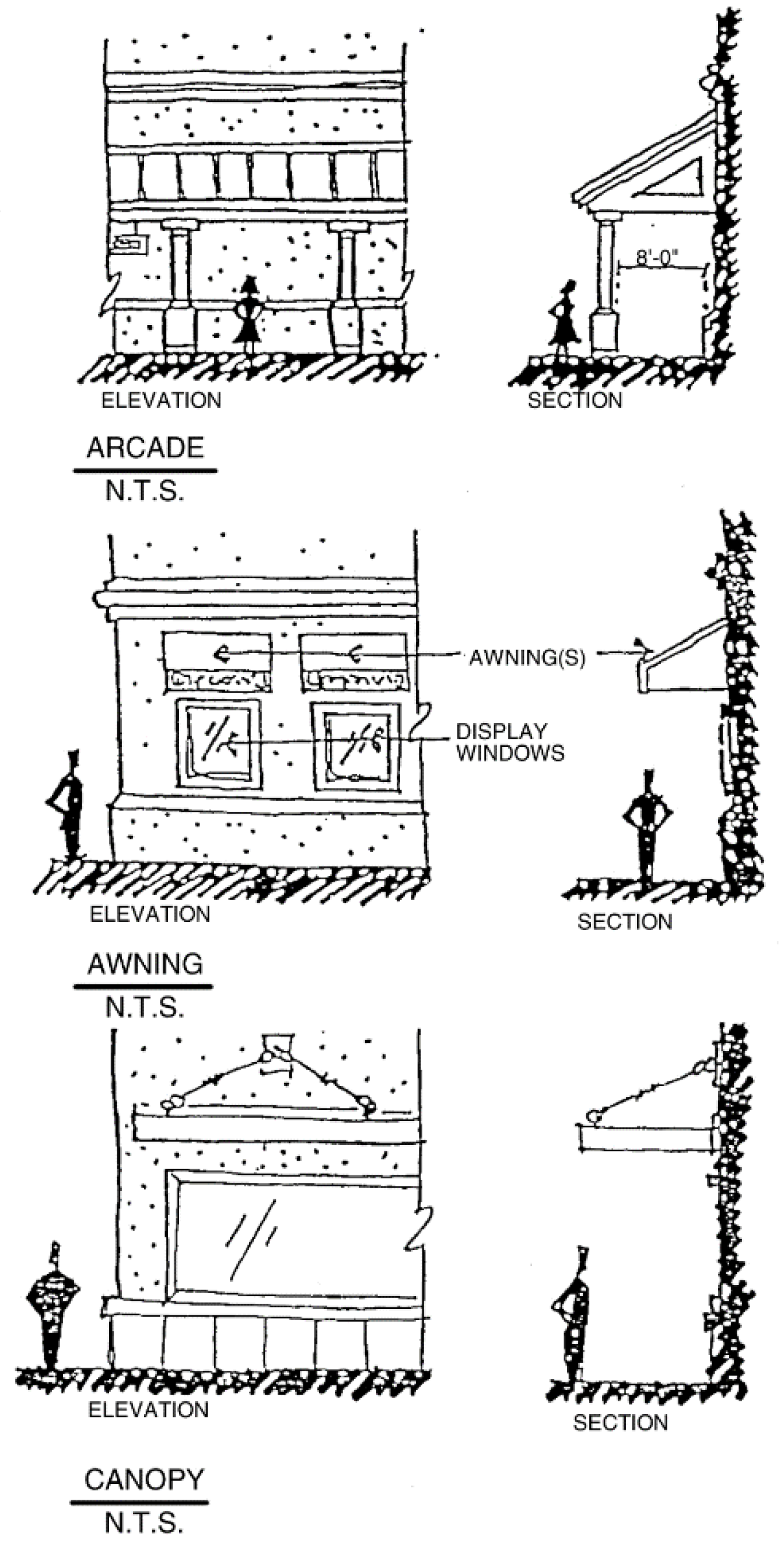
(2)
Lighting.
a.
Storefronts within the Historic Downtown District are strongly encouraged to illuminate the interior side of the storefront system to facilitate window shopping and for security purposes at night.
b.
The use of shaded gooseneck style lantern and other style lighting fixtures relative to the particular architectural character of the building are recommended.
c.
The backlighting of semitransparent awnings, colored lighting, and neon lighting are not permitted, unless deemed to be in the best interest of the Overlay District by the ARP.
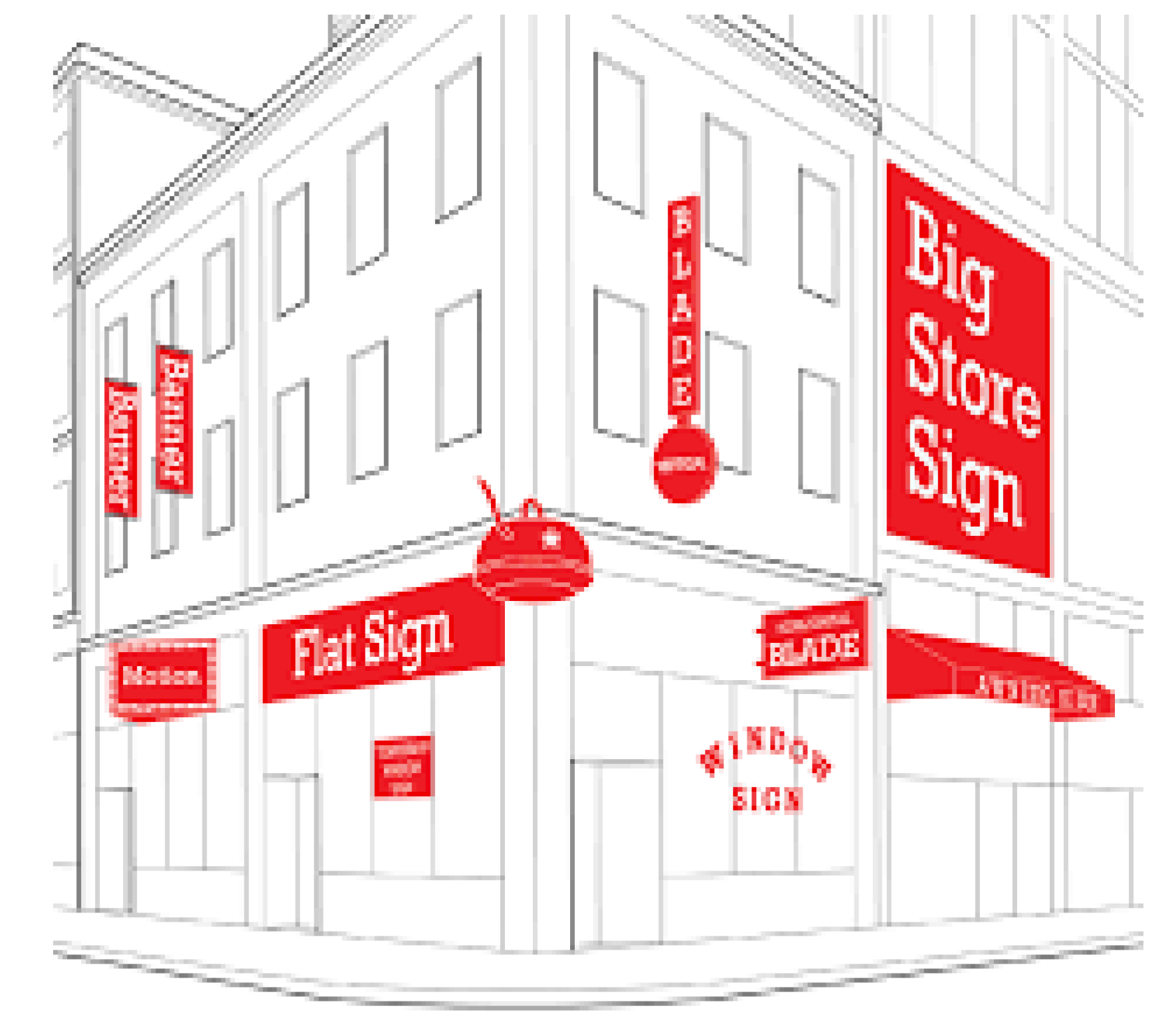
(3)
Signage.
a.
Signs attached to a storefront should be architecturally compatible with the style, material, color, and detail of the building and other signs on nearby buildings.
b.
Permanently painted window or awning signs are encouraged if compatible with the architectural style of the building.
c.
Projecting signs cannot block or obliterate intricate façade detailing, windows, or cornices of the building upon which they are attached. Franchise signage will be moderated to comply with the design intents of the district.
d.
Marquee signs, lighted sign structures mounted and projected vertically from the building façade, are allowed where suitable. If an historic marquee or evidence thereof exists, that sign should be preserved and maintained.
e.
Sandwich boards may be used during regular store business hours and must be moved inside at the close of each business day. Sandwich signs may not exceed the dimensions of 30 inches by 48 inches and must maintain four-feet of pedestrian walkway.
f.
Neon signs mounted on the interior or exterior of storefront windows and doors are prohibited.
(4)
Color palette.
a.
The Architectural Review Panel (ARP) shall approve the color palette for all projects.
b.
Brick color should be selected from the historic architectural style of the buildings found in existing downtown Van Alstyne (typically rich dark reds and lighter tan bricks) and storefront colors should be chosen in a contrasting shade lighter or darker than the primary building color.
c.
Paint colors should pull together all building elements, including the cornice, upper façade, windows, storefront, and doors.
d.
A property's color palette should not be more than three colors: one base color, one trim color, and one accent color.
e.
Paint colors should be chosen from paint manufacturer's heritage or historical collections such as Sherwin-Williams' America's Heritage collection, Valspar's Traditional Heritage collection, or Benjamin Moore's Historical collection.
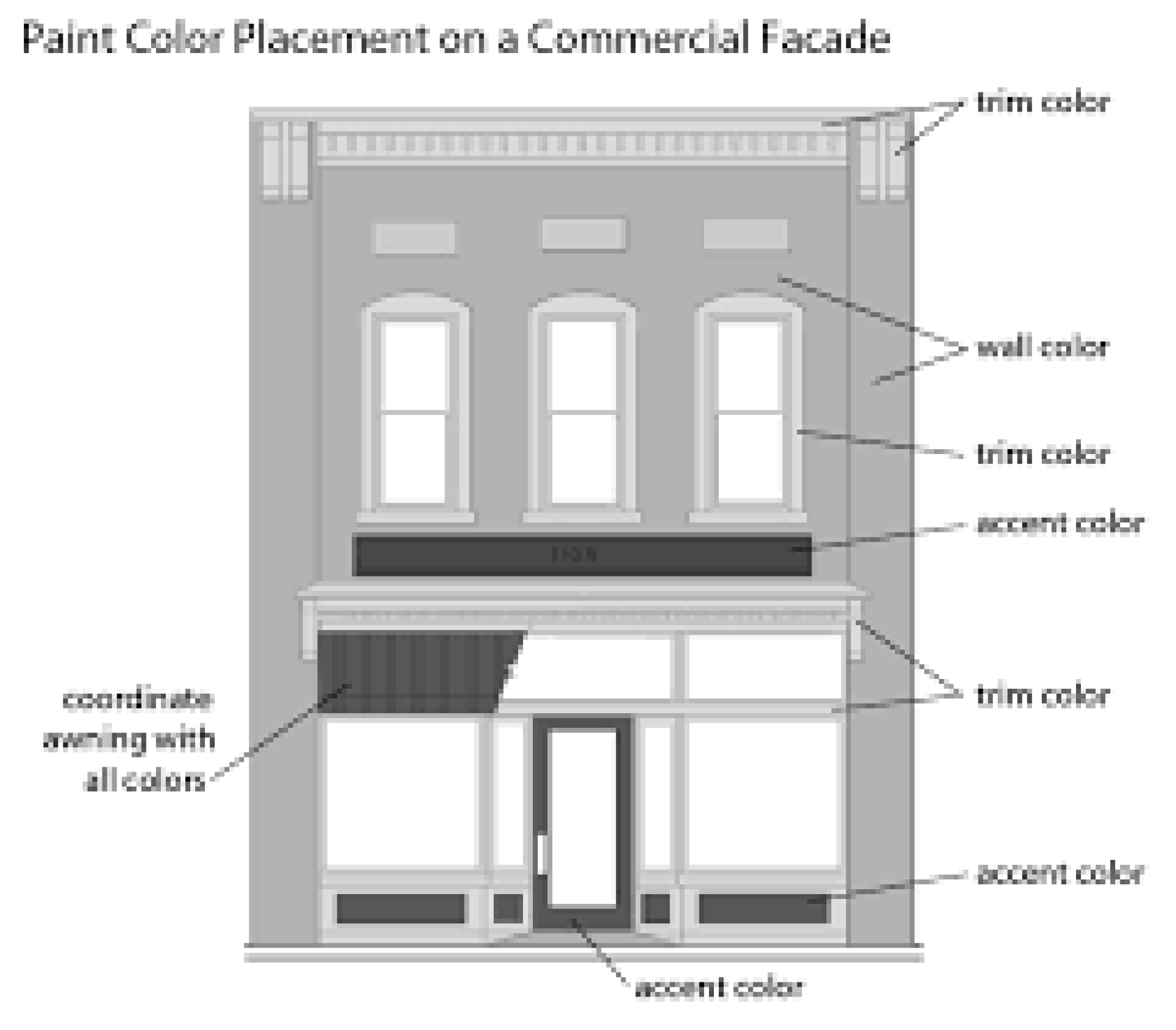
(5)
Murals are allowed on exterior walls, as approved by the ARP. Murals must be considered to be in the character of the Historic Downtown and not primarily used as signage. No phone numbers or websites are allowed on the murals.
(g)
Architectural design guidelines—additions, alterations, and reuse. The Historic Downtown District contains a significant number of structures that are important to the original fabric of the community. Special consideration should be given to preserve these buildings. Utilization of historic buildings often requires additions and alterations to adapt the structure to a current use. Alterations, additions, and reuse should be done carefully so not to visually impact the significant nature of the original building and shall be subject to review by the ARP prior to work commencing; therefore, any exterior construction, reconstruction, alteration, restoration, or relocation requires a "certificate of appropriateness" approved by the Van Alstyne ARP.
(1)
Additions. Additions to existing buildings should generally be made on the side or rear elevation with minimal impact on existing features, and should be made in such a manner that, if removed in the future, existing material would not be irreparably damaged. Additions should use materials compatible with the existing building and should incorporate massing, scale, window, and door proportions, etc.
(2)
Storefronts. Windows and doors are important character-defining features of the historic commercial building. They give scale to the building and provide visual interest to pedestrians by providing views to goods and activities inside the building. Original entries, doors, transoms, and display windows should be maintained where they are found. Original materials of construction should be maintained when possible, such as; employing wood mullions rather than aluminum.
(3)
Openings (windows and doors).
a.
Parts of replacement windows, such as exterior molding and/or casing, exterior fames, and exterior sash windows shall match those of the historic windows whenever reasonably feasible.
b.
The ARP shall review and may approve on a case-by-case basis all proposed new window openings in the external walls of an historic building or structure to ensure that they are consistent with historically accurate window arrangements.
c.
Replacement doors shall not incorporate leaded or stained glass except when replicating the original appearance of the historic building or structure.
d.
If part of a replacement door is glazed or has a window insert, such glazing or inserts shall include true or simulated divided lights.
e.
Mirrored, tinted or heat-reflective glass or coatings, as well as interior applied or removable muntin bars, shall be prohibited, otherwise, the ARP shall review and may approve on a case-by-case basis proposed new door openings in the external walls of an historic building or structure to ensure that they are consistent with historically accurate door arrangements.
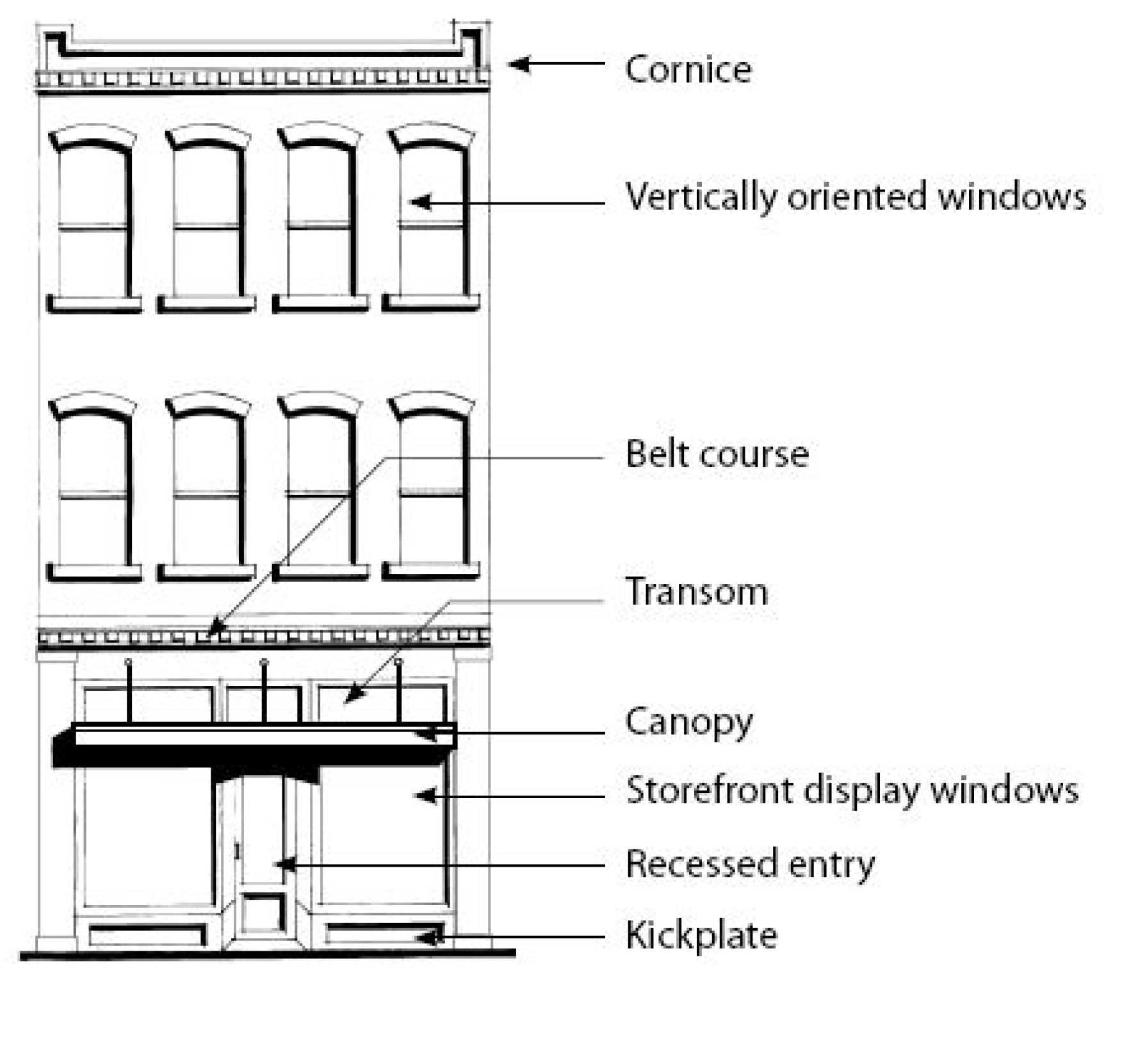
(h)
Architectural design guidelines—New commercial development. New commercial development and new infill construction should relate to existing historic buildings found in the Historic Downtown District. The use of traditional building materials, architectural elements, and building size and mass should be continued and evident in all new construction. All new commercial development, new construction, and storefront reconstruction shall require design approval by the ARP. An approved "certificate of appropriateness" is required before construction may commence. These guidelines shall apply to all work not commenced before the effective date of the ordinance from which this section is derived. It shall apply to all exterior work done on an existing building, or a new commercial development, respectively, which is located within the Historic Downtown District.
(1)
Storefronts. Newly constructed storefront systems used within the Historic Downtown District must sit on a masonry curb at least 12-inches tall and no greater than 18-inches tall. The glass must be modulated so that glass panels between vertical supports are not greater than four-feet wide. Where possible, construction of a historically appropriate storefront system is required, employing wood mullions rather than aluminum.
(2)
Elements of style. The prevalent architectural style in the Historic Downtown District is commercial style renaissance, predominantly evidencing turn-of-the-century Neoclassical and Colonial Revival detailing. This style is expressed through the elements that follow, and all restoration, reconstruction, and new development must therefore embody these design guidelines. Buildings should not be branded using an architectural style of a company. Franchise architecture (building design that is trademarked or identified with a particular chain or corporation and is generic in nature) is not allowed.
(3)
Materials. 80 percent of any street-facing façade shall be brick, excluding windows, doors, and storefronts, consistent with all respective guidelines contained herein. The architecturally enclosed portion of any arcade or recessed entry is except from the use of brick if it is veneered in a decorative tile.
(4)
Openings (windows and doors).
a.
Mirrored, tinted or heat-reflective glass or coatings, as well as interior applied or removable muntin bars, shall be prohibited, otherwise, the ARP, shall review and may approve on a case-by-case basis alternatives to historic window materials.
b.
Muntins, whether structural or applied, shall have an exterior, three-dimensional profile, and a width appropriate to the architectural style of the historic building or structure.
c.
All openings, including building entries (but excluding storefronts), must align vertically and horizontally.
d.
The doors used for entries must be compatible with the storefront system, be an actual historic commercial door restored for re-use, or be a reconstruction of a door that likely existed on the premises.
e.
The glazing of all street-fronting openings (excluding storefronts) provided in accordance with this standard shall be primed wood frame, double-hung windows.
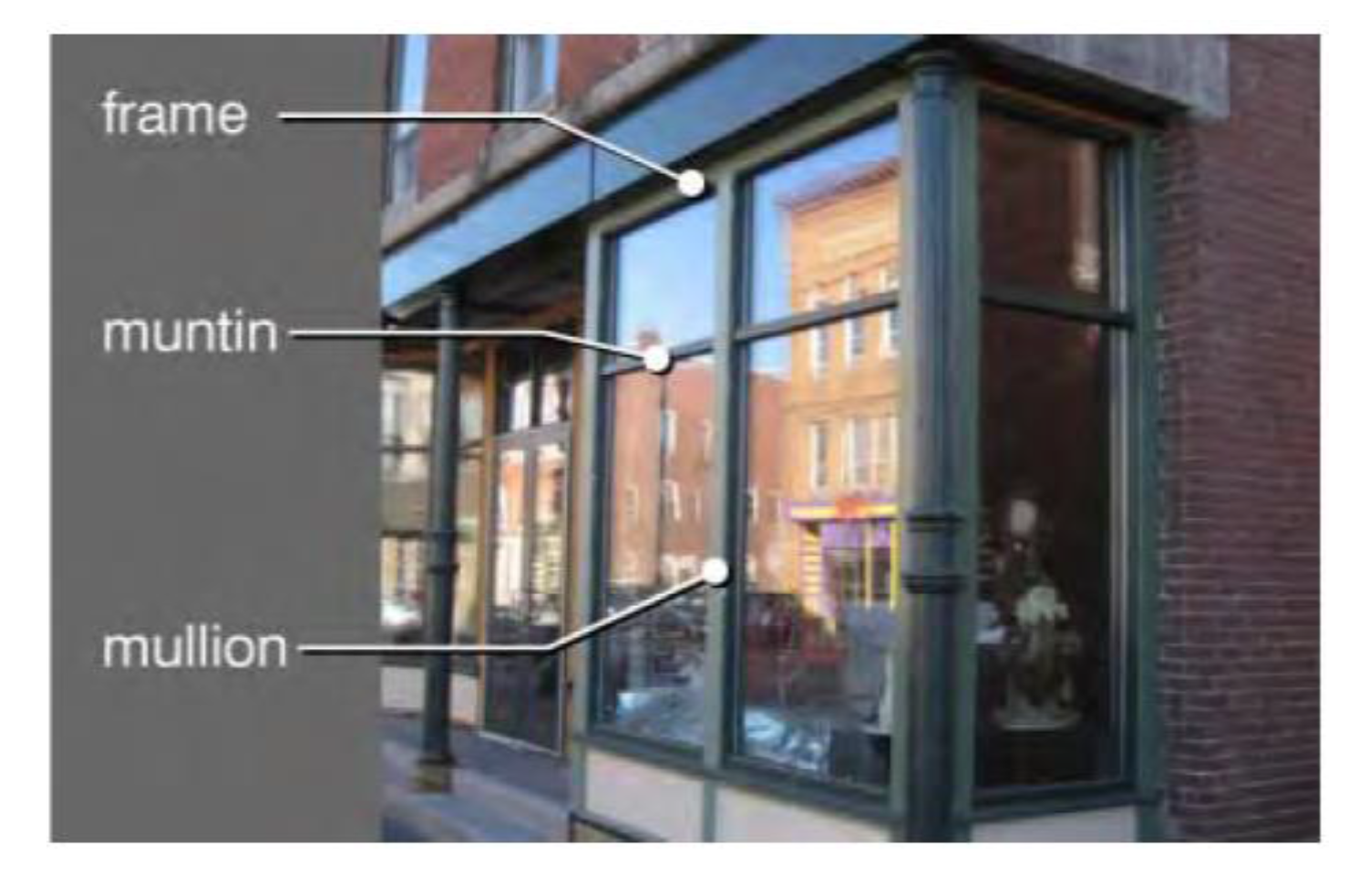
(5)
Parapets and cornices.
a.
All flat roofs shall be concealed behind a standing parapet that is at least 18 inches above the roof membrane.
b.
The top of all parapets must be capped by a decorative mold or brick detail that projects out from the exterior wall plane at a minimum of one inch.
c.
When a pitched roof is provided for one-story structures and/or residential structures over one story, the cornice shall include at least one inch of decorative relief and meet a closed soffit.
(6)
Roofs.
a.
All roofs for any structure over one story that is not a residential structure shall be flat with 1:12 pitch to alley (when applicable).
b.
One-story stand-alone residential structures may have a pitched roof.
c.
The use of architectural features, such as three-dimensional cornice treatments, enclosed parapet wall form and details, overhanging eaves, etc., are encouraged to enhance the architectural character of the roof.
d.
Roof-top plumbing, vents, ducts, and air-conditioning and heating equipment, communication antennae, and other mechanical or electrical equipment must be located away from public view and screened in such a manner so as not to be visible from any angle or any height outside of the building. Other exposed mechanicals. Exposed mechanical equipment added, such as through-wall and window air conditioners, vent pipes, electrical conduit and boxes, is not permitted on the street face or on any side elevation that is visible from the street.
(7)
Streetscaping.
a.
Landscaping treatments should be used to enhance the pedestrian and vehicular experience, complement architectural features, and/or screen utility areas.
b.
Some plantings should be located on private property, with the permission of the owners, to give continuity to the whole streetscape.
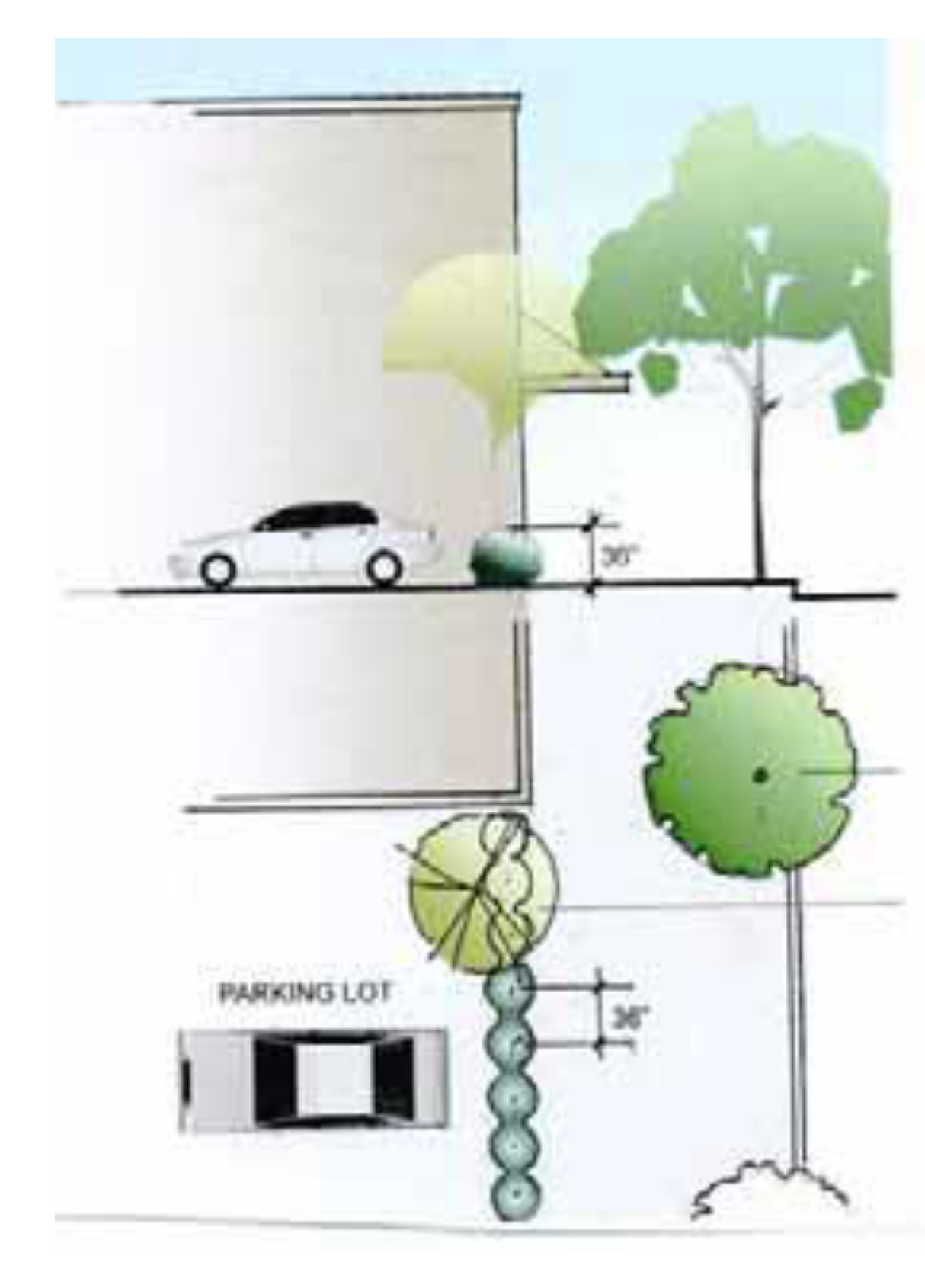
(i)
Certificate of appropriateness application procedure. Prior to the commencement of any work requiring a certificate of appropriateness, the owner shall file an application for the certificate with the ARP. The application shall be filed on the forms provided by the city and contain:
(1)
Name, address, telephone number of applicants, detailed description of proposed work.
(2)
Site plans for new construction.
(3)
Location and photograph of the property and adjacent properties and historical photographs (should any be available).
(4)
Elevation drawings and descriptions of the proposed changes.
(5)
Samples of materials to be used on all surfaces, with finishes shown. In particular; samples and information on materials should clearly detail where materials used differ from existing or original materials.
(6)
Recommendations of a structural engineer regarding the feasibility and impact of the work if the property has common walls, along with documentation that the adjoining owner of a party wall has been notified of the proposed work and the request for a certificate of appropriateness.
(7)
If the proposal includes signs or lettering, a scaled drawing (at a scale of one inch:20 feet or larger) showing the type of lettering to be used, all dimensions and colors, construction materials, a description of materials to be used, method of illumination (if any), and a plan showing the sign's location on the property.
(8)
In the cases of requests for either a certificate of appropriateness for demolition or removal and/or certificate of appropriateness for demolition or removal of a structure to replace with a new structure the application must include the following:
a.
Any conditions proposed to be placed voluntarily on the new structure proposed for the property; complete architectural drawings of the new structure.
b.
A guarantee agreement between the owner and the city that demonstrates the owner's intent and financial ability to construct the new structure. The guarantee agreement must: contain a covenant to construct the proposed structure by a specific date in accordance with architectural drawings approved by the city through the certificate of appropriateness process.
c.
Require the owner to provide proof of financial capability for, and plans of, construction for a new structure acceptable to the ARP to ensure construction of the new structure and that the agreement be approved as to form by the city attorney.
d.
Additionally, the certificate of appropriateness for demolition or removal and/or certificate of appropriateness for demolition or removal of a structure to replace with a new structure will only be issued with an approved building permit for a replacement structure (or a site plan noting the future configuration for the site if there is no replacement structure).
(9)
No building permit may be issued for such proposed work until a certificate of appropriateness has first been issued by the ARP. The certificate of appropriateness required by this act shall be in addition to and not in lieu of any building permit that may be required by any other ordinance of the City of Van Alstyne.
(10)
The ARP shall review the application at a meeting held within 30 days from the date the application is received, at which time an opportunity will be provided for the applicant and any interested parties to be heard. It is strongly suggested that the applicant submit any written materials he or she wishes the APR to consider at least one week prior to the meeting. The ARP may: approve, deny or approve with modifications the application, and a written decision shall be provided to the applicant within 15 days after the review meeting. In the event the panel does not act within 60 days of the receipt of the application, a building permit shall be granted; however, if the ARP has initiated the review and hearing process at a meeting and continued it to a subsequent meeting, no building permit may be granted until the ARP has acted.
(11)
All decisions of the ARP shall be in writing. The panel's decision shall state in writing its findings pertaining to the approval, denial, or modification of the application. A copy shall be sent to the applicant. Additional copies shall be filed as part of the public record for that property and dispersed to appropriate departments.
(12)
An applicant for a certificate of appropriateness dissatisfied with the action of the ARP relating to the issuance or denial of a certificate of appropriateness shall have the right to appeal to the city council within 60 days after receipt of notification of such action. In considering the appeal, the city council shall give notice, follow publication procedure, hold hearings, and make its decision in the same manner as provided in the general zoning ordinance of the city.
(j)
Certificate of appropriateness for demolition or removal requirements.
(1)
A permit for the demolition or removal of a historic landmark or property within a historic district, including secondary buildings, shall not be granted without the ARP's review of a completed application for a certificate of appropriateness for demolition or removal, as provided for in this section and in the above sections titled certificate of appropriateness application procedure in this chapter.
(2)
In the case of a request for a certificate of appropriateness for demolition or removal to replace with a new structure, the ARP shall deny the application unless it finds that the new structure is more appropriate and compatible with the historic overlay district than the structure to be demolished or removed and that the owner has the financial ability to build the new structure. The panel must first approve the proposed replacement plans for a certificate of appropriateness and the guarantee agreement to construct any proposed new structure before the ARP may consider the application for a new certificate of appropriateness for demolition or removal.
(3)
In the case of a request for a certificate for appropriateness for demolition or removal of a structure of no economically viable use, the ARP shall deny the application unless it finds that the structure is incapable of earning a reasonable economic return unless the demolition or removal is allowed (a reasonable economic return does not have to be the most profitable return possible), that the structure cannot be adapted for any other use (whether by the owner or by a purchaser) which would result in a reasonable economic return and that the owner has failed during the last two years to find an entity (whether developer, financier, purchasers, tenant, preservation entity or foundation) that would be interested in acquiring the property and preserving it while enabling the owner to realize a situation whereby a reasonable economic return resulted.
(Ord. No. 907, § 3, 6-8-2021)
Sec. 46-94. - FP—Floodplain District.
(a)
General purpose and description. The floodplain district is designed to provide for the appropriate use of land, which has a history of inundation or is determined to be subject to flood hazard, and to promote the general welfare and provide protection from flooding portions of certain districts. Such areas are designated with a floodplain prefix, FP.
(b)
Permitted uses. The permitted uses in that portion of any district having a floodplain (FP) prefix shall be limited to the following:
(1)
Agricultural activities, including the ordinary cultivation or grazing of land and legal types of animal husbandry, but excluding construction of barns or other outbuildings.
(2)
Off-street parking incidental to any adjacent main use permitted in the district.
(3)
Electrical substation.
(4)
All types of local utilities including those requiring specific use permits.
(5)
Parks, playgrounds, public golf courses (no structures), and other recreational areas.
(6)
Private open space as part of a planned residential development.
(7)
Structures, installations, and facilities installed, operated, and maintained by public agencies for flood control purposes.
(8)
Bridle trail, bicycle, or nature trail.
(c)
City council approval required. No structure shall be erected in that portion of any district designated with a floodplain, FP, prefix until and unless such structure has been approved by the city council after engineering studies have been made and it is ascertained that such building or structure is not subject to damage by flooding and would not constitute an encroachment, hazard, or obstacle to the movement of floodwaters and that such construction would not endanger the value and safety of other property or public health and welfare.
(d)
Signs. Signs in this district shall comply with the requirements of chapter 32 of this Code (as it exists or may be amended).
(Ord. No. 907, § 3, 6-8-2021)
Sec. 46-101. - SF-1—Single-Family Residential District-1.
(a)
General purpose and description. The Single-Family Residential District-1 is designed to accommodate the standard single-family residential development. The district can be appropriately located in proximity to multifamily residential areas and certain neighborhood local retail and office uses. Densities in this district will not usually exceed four units per gross acre. This zoning district is not intended to be used in the designation of any new zoning after November 9, 2004.
(b)
Permitted uses. A building or premises in an SF-1 district shall be used only for the following purposes: Uses as listed in section 46-125, Table of Uses.
(c)
Permitted specific uses. Specific uses shall be permitted in an SF-1 district, when granted in accordance with section 46-133, Specific Use Permits.
(d)
Height and area regulations. See Appendix 1-C, Obsolete Residential Zoning Districts and Area Regulations.
(e)
Parking regulations. A minimum of two covered, enclosed parking spaces shall be provided per unit behind the building line. Other off-street parking space regulations are set forth in section 46-161, Parking Regulations.
(f)
Permitted accessory uses.
(1)
Home occupations.
(2)
Private garages and parking areas.
(3)
Private swimming pools exclusively for the use of residents of the premises and their nonpaying guests.
(g)
Signs. Signs in this district shall comply with the requirements of chapter 32 of this Code (as it exists or may be amended).
(Ord. No. 907, § 3, 6-8-2021)
Sec. 46-102. - SF-2—Single-Family Residential District-2.
(a)
General purpose and description. The SF-2 district is intended to provide for medium density single-family residential development. This district functions as a buffer or transition between major streets, nonresidential areas and lower density residential areas. Density in this district will range between four and six units per gross acre. This zoning district is not intended to be used in the designation of any new zoning after November 9, 2004.
(b)
Permitted uses. A building or premises shall be used only for the following purposes: Uses as listed in section 46-125, Table of Uses.
(c)
Permitted specific uses. The following specific uses shall be permitted in an SF-2 district when granted in accordance with section 46-133, Specific Use Permits:
(1)
Public, parochial, and private schools and colleges offering courses of general instruction, including convents, monasteries, dormitories, and other related living structures when located on the same site as the school or college.
(2)
Churches, synagogues, chapels, and similar places of religious worship and instruction.
(3)
Utility substations necessary to the functioning of the utility, but not including general business offices, maintenance facilities and other general system facilities, when located according to the yard space rules set forth in this section for dwellings and have a landscaped or masonry barrier on all sides. Buildings shall conform to all space limits of this zone and shall be of such exterior design as to harmonize with nearby properties.
(4)
Public and quasi-public buildings for cultural use.
(5)
Country clubs as defined herein.
(6)
Uses as listed in section 46-125, Table of Uses.
(d)
Height and area regulations. See Appendix 1-C, Obsolete Residential Zoning Districts and Area Regulations.
(e)
Parking regulations. A minimum of two covered, enclosed parking spaces shall be provided per unit behind the front yard line. Other off-street parking space regulations are set forth in section 46-161, Parking Regulations.
(f)
Permitted accessory uses.
(1)
Home occupations.
(2)
Private garages and parking areas.
(3)
Private swimming pools exclusively for the use of residents of the premises and their nonpaying guests.
(g)
Signs. Signs in this district shall comply with the requirements of chapter 32 of this Code (as it exists or may be amended).
(Ord. No. 907, § 3, 6-8-2021)
Sec. 46-103. - SF-60—Single-Family Residential District.
(a)
General purpose and description. The SF-60 Single-Family Residential District is designed to accommodate single-family residential development on relatively ample lots. The district can be appropriately located in proximity to agricultural and single-family residential uses. This zoning district is not to be used in the designation of any new zoning after January 1, 2020.
(b)
Permitted uses. A building or premises in a SF-60 district shall be used only for the following purposes: Uses as listed in section 46-125, Table of Uses.
(c)
Permitted specific uses. The following specific uses shall be permitted in a SF-60 district, when granted in accordance with section 46-133, Specific Use Permits:
(1)
Public, parochial, and private schools and colleges offering courses of general instruction, including convents, monasteries, dormitories, and other related living structures when located on the same site as the school or college.
(2)
Churches, synagogues, chapels, and similar places of religious worship and instruction.
(3)
Utility substations necessary to the functioning of the utility, but not including general business offices, maintenance facilities and other general system facilities, when located according to the yard space rules set forth in this section for dwellings and have a landscaped or masonry barrier on all sides. Buildings shall conform to all space limits of this zone and shall be of such exterior design as to harmonize with nearby properties.
(4)
Public and quasi-public buildings for cultural use.
(5)
Country clubs as defined herein.
(6)
Uses as listed in section 46-125, Table of Uses.
(d)
Height and area regulations. See Appendix 1-C, Obsolete Residential Zoning Districts and Area Regulations.
(e)
Parking regulations. Two enclosed spaces behind the front yard line for single-family dwelling units. Other off-street parking regulations are set forth in section 46-161, Parking Regulations.
(f)
Permitted accessory uses.
(1)
Home occupations.
(2)
Private garages and parking areas.
(3)
Private swimming pools exclusively for the use of residents of the premises and their nonpaying guests.
(g)
Signs. Signs in this district shall comply with the requirements of chapter 32 of this Code (as it exists or may be amended).
(h)
This zoning district is not intended to be used in the designation of any new zoning after June 8, 2021.
(Ord. No. 907, § 3, 6-8-2021)
Sec. 46-104. - SF-72—Single-Family Residential District.
(a)
General purpose and description. The SF-72—Single-Family Residential District is designed to accommodate single-family residential development on relatively ample lots. The district can be appropriately located in proximity to agricultural and single-family residential uses.
(b)
Permitted uses. A building or premises in an SF-72 district shall be used only for the following purposes: Uses as listed in section 46-125, Table of Uses.
(c)
Permitted specific uses. The following specific uses shall be permitted in a SF-72 district, when granted in accordance with section 46-133, Specific Use Permits:
(1)
Public, parochial, and private schools and colleges offering courses of general instruction, including convents, monasteries, dormitories, and other related living structures when located on the same site as the school or college.
(2)
Churches, synagogues, chapels, and similar places of religious worship and instruction.
(3)
Utility substations necessary to the functioning of the utility, but not including general business offices, maintenance facilities and other general system facilities, when located according to the yard space rules set forth in this section for dwellings and have a landscaped or masonry barrier on all sides. Buildings shall conform to all space limits of this zone and shall be of such exterior design as to harmonize with nearby properties.
(4)
Public and quasi-public buildings for cultural use.
(5)
Country clubs as defined herein.
(6)
Uses as listed in section 46-125, Table of Uses.
(d)
Height and area regulations. See Appendix 1-C, Obsolete Residential Zoning Districts and Area Regulations.
(e)
Parking regulations. Two enclosed spaces behind the front yard line for single-family dwelling units. Other off-street parking regulations are set forth in section 46-161, Parking Regulations.
(f)
Permitted accessory uses.
(1)
Home occupations.
(2)
Private garages and parking areas.
(3)
Private swimming pools exclusively for the use of residents of the premises and their nonpaying guests.
(g)
Signs. Signs in this district shall comply with the requirements of chapter 32 of this Code (as it exists or may be amended).
(h)
This zoning district is not intended to be used in the designation of any new zoning after June 8, 2021.
(Ord. No. 907, § 3, 6-8-2021)
Sec. 46-105. - SF-84—Single-Family Residential District.
(a)
General purpose and description. The SF-84 Single-Family Residential District is designed to accommodate single-family residential development on relatively ample lots. The district can be appropriately located in proximity to agricultural and single-family residential uses.
(b)
Permitted uses. A building or premises in a SF-84 district shall be used only for the following purposes: Uses as listed in section 46-125, Table of Uses.
(c)
Permitted specific uses. The following specific uses shall be permitted in a SF-84 district, when granted in accordance with section 46-133, Specific Use Permits:
(1)
Public, parochial, and private schools and colleges offering courses of general instruction, including convents, monasteries, dormitories, and other related living structures when located on the same site as the school or college.
(2)
Churches, synagogues, chapels, and similar places of religious worship and instruction.
(3)
Utility substations necessary to the functioning of the utility, but not including general business offices, maintenance facilities and other general system facilities, when located according to the yard space rules set forth in this section for dwellings and have a landscaped or masonry barrier on all sides. Buildings shall conform to all space limits of this zone and shall be of such exterior design as to harmonize with nearby properties.
(4)
Public and quasi-public buildings for cultural use.
(5)
Country clubs as defined herein.
(6)
Uses as listed in section 46-125, Table of Uses.
(d)
Height and area regulations. See Appendix 1-C, Obsolete Residential Zoning Districts and Area Regulations.
(e)
Parking regulations. Two enclosed spaces behind the front yard line for single-family dwelling units. Other off-street parking regulations are set forth in section 46-161, Parking Regulations.
(f)
Permitted accessory uses.
(1)
Home occupations.
(2)
Private garages and parking areas.
(3)
Private swimming pools exclusively for the use of residents of the premises and their nonpaying guests.
(g)
Signs. Signs in this district shall comply with the requirements of chapter 32 of this Code (as it exists or may be amended).
(h)
This zoning district is not intended to be used in the designation of any new zoning after June 8, 2021.
(Ord. No. 907, § 3, 6-8-2021)
Sec. 46-106. - SF-P—Single-Family Residential District Regulations—Patio Homes.
(a)
General purpose and description. The purpose of the SF-P (Patio home) district is to provide single-family homes on lots of moderate size.
(b)
Permitted uses.
(1)
Single-family detached dwellings.
(2)
Other uses as described in section 46-161(e), patio homes.
(c)
Permitted specific uses. The following specific uses shall be permitted in a SF-P district, when granted in accordance with section 46-133, Specific Use Permits:
(1)
Public, parochial, and private schools and colleges offering courses of general instruction, including convents, monasteries, dormitories, and other related living structures when located on the same site as the school or college.
(2)
Churches, synagogues, chapels, and similar places of religious worship and instruction.
(3)
Utility substations necessary to the functioning of the utility, but not including general business offices, maintenance facilities and other general system facilities, when located according to the yard space rules set forth in this section for dwellings and have a landscaped or masonry barrier on all sides. Buildings shall conform to all space limits of this zone and shall be of such exterior design as to harmonize with nearby properties.
(4)
Public and quasi-public buildings for cultural use.
(5)
Country clubs as defined herein.
(6)
Uses as listed in section 46-125, Table of Uses.
(d)
Height and area regulations. See Appendix 1-C, Obsolete Residential Zoning Districts and Area Regulations. Minimum lot sizes for townhouses and patio lot line houses shall be 6,000 square feet per dwelling unit.
(e)
Parking regulations. Two enclosed spaces behind the front yard line for single-family dwelling units. Other off-street parking regulations are set forth in section 46-161, Parking Regulations.
(f)
Permitted accessory uses.
(1)
Home occupations.
(2)
Private garages and parking areas.
(3)
Private swimming pools exclusively for the use of residents of the premises and their nonpaying guests.
(g)
Signs. Signs in this district shall comply with the requirements of chapter 32 of this Code (as it exists or may be amended).
(h)
This zoning district is not intended to be used in the designation of any new zoning after June 8, 2021.
(Ord. No. 907, § 3, 6-8-2021)
Sec. 46-107. - OTRD—Original Town Residential District Overlay.
(a)
General purpose and description. The Original Town Residential District Overlay is designed specifically for the section of the city as described in subsection (b) of this section. The Original Town Residential District Overlay standards will provide for a suitable residential environment for family life on small parcels of land. Platted lots within this area were originally in 25-foot lengths and a minimum lot depth of 100 feet, with a preponderance of ownerships in multiples of this typical 25-foot by 100 feet. Therefore, standards are set forth in this Original Town Residential District Overlay which accommodate the original platting, as well as the preferable standard for a minimum 50-foot lot width, or two platted lots constituting a building site.
(b)
Description of the boundaries of the Original Town Residential District Overlay. The boundaries of the Original Town Residential District Overlay are as follows:
Beginning on Highway 5, at the intersection with Spence Road, east on Spence Road to N.E. Main Street, south on N.E. Main Street to Tooley, east on Tooley to Hill Street, south on Hill Street to Tolson, east on Tolson to Pearl, south on Pearl to Nash, east on Wayne to Moody Lane, south On Moody Lane to FM 121, east on FM 121 to Park Road, south on Park Road to 1224 East Bowen, then south on the east property line of said church to the north property line of the cemetery property, then west on Fulton to Sherman Street, south on Sherman Street to Ballard Road, west on Ballard Road to S.E. Main, then south on S.E. Main to Oil Mill Road, west on Oil Mill Road to S.W. Main, south on S.W. Main to the end of the street, then down the west property line of the Union Pacific or Dart Railway property to FM 3133, west of FM 3133 to Highway 5, north on Highway 5 including the east side of Highway 5 only to 1311 S Waco or Highway 5, north to Houston including everything between Highway 5 and S. Dallas, then west on Houston to Kelly Lane, north on Kelly Lane to S. Dallas, north on S. Dallas to W. Fulton, west on Fulton to Wilkins, north on Wilkins to W. Jefferson, west on Jefferson to FM 121, east on FM 121 to La Salle (including properties on south side of FM 121 only), north on La Salle to Windsor (including properties on side of Windsor only) to North Sixth Street, north on Sixth Street to College Avenue North, East on North College to North Fifth, east on North Fifth to Highway 5 or N. Waco, north on Waco to Spence Road. This area includes parcels facing above said streets on both sides unless otherwise noted. These boundaries pertain to residential areas only. A diagram of said boundaries is set forth in appendix 2 of this chapter.
(c)
Conditions for the Original Town Residential District Overlay to apply.
(1)
The property under consideration must fall within the boundaries stated in subsection (b) of this section.
(2)
The property under consideration must be platted or recorded in the county land records by metes and bounds.
(3)
If two or more contiguous lots are under common ownership, then a minimum 50-foot lot width must be used as a building site.
(d)
Superseding regulations for properties within the original town residential overlay. All existing zoning standards shall apply within the stated original town residential overlay, with the following exceptions:
(1)
The minimum front yard shall be 20 feet or in alignment with structures on the same side of the street within the same block as the property, whichever is less.
(2)
The minimum side yard shall be five feet; ten feet on corner lot adjacent to side street.
(3)
The minimum rear yard shall be ten feet for property zoned TF and 20 feet for property zoned SF-1.
(4)
The maximum lot coverage shall be 55 percent including accessory buildings.
(5)
The minimum lot size in areas zoned SF-1 that fall within the OTRD shall be 5,000 square feet.
(6)
The minimum lot size in areas zoned TF that fall within the OTRD shall be 5,000 square feet.
(e)
Parking regulations. One off-street parking space on the same lot as the main structure shall be provided. Carports and garages are not required.
(f)
Signs. Signs in this district shall comply with the requirements of chapter 32 of this Code (as it exists or may be amended).
(h)
This zoning district is not intended to be used in the designation of any new zoning after June 8, 2021, unless the area of the district is expanded by an ordinance of the city council.
(Ord. No. 907, § 3, 6-8-2021)

