
Vinton City Zoning Code
ARTICLE VI
DEVELOPMENT STANDARDS
DIVISION 6. - OFF-STREET PARKING REQUIREMENTS[2]
Cross reference— Parking generally, § 90-101 et seq.
Sec. 6-1. - Applicability of article.
The regulations set forth in this article are additions or exceptions to and shall be construed to qualify, supplement or modify, as the case may be, the regulations and requirements set forth in the district regulations contained in article IV of this appendix.
Sec. 6-2. - Location on a lot required.
Every building or structure hereafter erected, constructed, reconstructed or moved and every use hereafter established shall be located on a lot of record as defined herein.
Sec. 6-3. - More than one main building on a lot.
More than one main building containing a permitted principal use may be located on a single lot when all lot area, yard, open space, yard between buildings and other applicable requirements of the district in which such lot is situated are met, provided that no main building containing a single-family dwelling or a two-family dwelling shall be located on a lot with any other main building.
Sec. 6-4. - Public street frontage and access required.
Every building or structure hereafter erected, constructed, reconstructed or moved and every use hereafter established shall be located on a lot having frontage on and access to an improved public street, except as permitted in a townhouse development or specifically approved by the town council in a PD district. In any case where public street frontage and a minimum lot width are required for a use, other than a townhouse, such lot shall also be provided with at least 30 feet of frontage on a public street.
Sec. 6-5. - Exceptions to yard requirements.
Except for required visibility at intersections as provided in this division, the following may be located within required yards:
(a)
Fences and walls standards in residentially zoned districts (R-LD, R-1, R-2, R-3, R-B). Fences and walls not exceeding four feet in height may be located within required front and street side yards. Fences and walls not exceeding 6.5 feet in height may be located within required side and rear yards. An additional one foot of fence or wall height shall be permitted for posts, columns or gates. All other fences and walls shall be subject to all yard requirements applicable to buildings and structures.
(b)
Fences and walls standards in CB districts. Fences and walls on a lot may be located in any required yard with a maximum height of eight feet, except that fences and walls located between a street and front building line shall not exceed four feet in height.
(c)
Fences and walls standards in GB districts. Fences and walls on a lot may be located in any required yard with a maximum height of eight feet.
(d)
Fences and walls standards in M-1 and M-2 districts. Fences and walls may be located in any required yard with a maximum height of ten feet.
(e)
Yard accessories. Poles, posts, similar customary yard accessories and ornaments, and permitted signs for which no specific yard requirement is specified elsewhere in this appendix, may be located within required yards.
Sec. 6-6. - Permitted projections into required yards.
(a)
Certain architectural features. Sills, belt courses, bay windows, cornices, eaves, roof overhangs, chimneys, pilasters and similar architectural features of a building may project into required yards not more than two feet.
(b)
Uncovered porches, steps, and decks. Uncovered porches, steps, landings, patios, decks and other similar building features may project into required yards, provided that such features do not exceed a height of 30 inches above the adjacent natural ground level, and provided that no such projection shall extend closer than two feet from any lot line. Covered building projections and projections exceeding 30 inches in height shall be subject to all yard requirements.
Sec. 6-7. - Yards on corner lots and through lots.
(a)
Front and street yards on corner lots. On a corner lot, a front yard as required in the district shall be provided along one street frontage and a second front yard of not less than 15 feet shall be provided on the street frontage.
(b)
Rear yards on corner lot. On a corner lot, a rear yard as required in the district shall be provided. The zoning administrator shall have the authority to determine the rear yard that best suits the development of the property.
(c)
Front yards on through lots. On through lots, there shall be a front yard as required in the district along each street frontage, and no rear yard shall be required.
(d)
Front yard requirements for infill developments. On a vacant lot that adjoins other lots containing buildings, the required depth of the front yard shall be equal to the depth of the adjoining front yards. No front yard shall have a depth of less than 15 feet and no greater than the front yard depth normally required in the district.
Sec. 6-8. - Yards for accessory structures.
(a)
Yards for structures accessory to a residential dwelling use.
(1)
An accessory structure shall be located behind the front building line of the principal structure and comply with the minimum front yard setback for the underlying zoning district.
(2)
Minimum side and rear yards for structures accessory to a residential dwelling use shall be five feet.
(b)
Structures considered part of the main building. Garages, porches and other structures attached to a main building shall be considered part of the main building for purposes of applying required yards.
Sec. 6-9. - Yards along streets less than 50 feet in width or streets to be widened.
(a)
Streets less than 50 feet in width. The required front yards and street side yards set forth in this appendix are applicable adjacent to public streets having a right-of-way width of 50 feet or greater. The required depth of any front yard or street side yard along a public street having a right-of-way of less than 50 feet in width shall be increased by 25 feet from that which is stated in this appendix, and shall be measured from the centerline of the street right-of-way instead of from the street line.
(b)
Streets to be widened. In any case where there are plans approved by the Virginia Department of Transportation or the town council for the widening of any public street or highway, the zoning administrator may recommend that the required front yard set forth in this appendix be measured from the future street line.
Sec. 6-10. - Yards and screening for swimming pools and tennis or pickleball courts.
Swimming pools, pool deck areas and tennis or pickleball courts shall be located behind the front building line of the principal structure and comply with the minimum front and side yard setbacks for the underlying zoning district. The minimum rear yard for swimming pools, pool deck areas, and tennis or pickleball courts shall be five feet. Swimming pools, pool deck areas or tennis or pickleball courts accessory to any use other than a single-family dwelling and situated within 50 feet of adjacent property in a residential district shall be screened from such property by solid walls, fences or evergreen vegetative material not less than six feet in height. Structural and vegetative screening shall follow the standards for buffer yard planting and screening set forth in article VI, division 5.
(Ord. No. 1058, 7-16-2024)
Editor's note— Ord. No. 1058, adopted July 16, 2024, amended the title of § 6-10 to read as herein set out. The former § 6-10 title pertained to yards and screening for swimming pools and tennis courts.
Sec. 6-11. - Visibility at intersections.
(a)
Purpose. The purpose of this provision is to prohibit the planting of shrubbery or low trees or the construction of solid fences, walls, signs or other structures that would block the visibility of oncoming vehicles to motorists at a street intersection. This provision shall not be applicable to public utility poles, official street signs, fire hydrants and other appurtenances installed by a governmental agency for public safety purposes, or to tree trunks which do not materially impair visibility and shall not be construed to require the removal of any mature trees existing at the effective date of this provision.
(b)
Visibility triangle. On a corner lot in any district other than a CB central business district, nothing that would materially obstruct the vision of operators of motor vehicles shall be erected, placed, planted or allowed to grow between the heights of three feet and eight feet above the grade of the intersection of the centerlines of the adjacent intersecting streets within the following described area:
A triangular shaped area on the ground bounded on two sides by the street lines abutting the lot, and bounded on the third side by a line joining points on said street lines 20 feet from the point of their intersection.
Cross reference— Traffic and vehicles, ch. 90.
Sec. 6-12. - Zero lot line option.
(a)
Applicability. In an approved subdivision of five or more lots located in an R-1, R-2, or R-3 district, one interior side yard on a lot devoted to single-family dwelling use may be equal to zero, provided that the requirements of this section are met.
(b)
Standards.
(1)
The minimum lot area, front yard and rear yard requirements of the district in which the property is located shall be met.
(2)
The minimum lot width shall be 50 feet.
(3)
The zero side yard shall not be located along a street or adjacent to any property not designated for the zero lot line option.
(4)
The minimum width of the side yard opposite the zero yard shall be 15 feet for all structures, and in no case shall the distance between two main buildings be less than 15 feet.
(5)
Not less than 50 percent of the overall depth of the dwelling unit shall be provided along the designated zero lot line. No doors, windows or other similar openings shall be permitted in the building wall facing the designated zero lot line within five feet of the property line.
(6)
A perpetual easement of not less than five feet in width shall be provided on the adjacent lot to permit maintenance of structures abutting a zero lot line. Such easement and the buildable area of the lot shall be shown on the subdivision plat and described in the deed for each property.
Sec. 6-13. - Exceptions to height regulations.
The height regulations set forth in this appendix shall not apply to church spires, belfries, cupolas, barns or silos used for agriculture or feed storage or mixing, water or cooling towers, accessory antennas, ventilators, chimneys, flues, solar energy equipment or similar appurtenances or mechanical structures attached to a building and not intended for human occupancy and containing no signs or other advertising. Parapet walls may exceed the height limit applicable in a district by not more than four feet.
Sec. 6-14. - Height limits.
(a)
Applicability. This section shall apply to any accessory building permitted by this appendix.
(b)
Standards in all districts.
(1)
No accessory building shall exceed the height of the main building on the lot.
(c)
Additional standards in the R-LD, R-1, R-2, R-3, and RB districts.
(1)
No accessory building located within 25 feet of a property line shall exceed 15 feet in height.
Sec. 6-15. - Dwelling use prohibited.
No accessory building shall be used for dwelling purposes except by domestic employees or caretakers whose principal occupation is rendering services on the premises for benefit of persons who occupy or use the main building on the lot, with the exception that:
(a)
Dwelling use shall not be prohibited for temporary family health care structures, subject to the provisions of section 6-17.2.
(b)
Dwelling use shall not be prohibited for accessory dwelling units, subject to the provisions of section 5-3.
Sec. 6-16. - Permits and relation to main building.
No accessory building for which a building permit is required shall be constructed or located on a lot until a building permit has been issued, and no permanent accessory building shall be constructed until a permit for construction of the main building has been issued. No permanent accessory building shall be used, except related to construction on the site, until a certificate of use and occupancy is issued for the main building.
Sec. 6-17.1. - Temporary buildings and construction trailers.
When used in conjunction with construction work taking place on the site, temporary buildings and construction trailers are permitted in any district during the period when construction work is in progress as evidenced by a valid building permit. Such buildings and trailers shall be removed immediately upon completion of the construction work.
Sec. 6-17.2. - Temporary family health care structures.
(a)
In all residential districts, temporary family health care structures shall be allowed to be placed on a lot, provided that:
(1)
The primary use of the property is a single-family detached dwelling;
(2)
The occupant of the temporary family health care structure meets the qualifications of a mentally or physically impaired person as defined in subsection (b) below, and a letter of certification, written by a physician licensed in Virginia, has been provided to the zoning administrator;
(3)
The property is occupied by the caregiver as his/her residence;
(4)
The temporary family health care structure shall comply with all setback requirements that apply to the primary structure, and with any maximum floor area ratio limitations that may apply to the primary structure;
(5)
Only one temporary family health care structure shall be allowed on a lot or parcel of land;
(6)
The proper permits shall be obtained before a temporary family health care structure may be placed on a lot or parcel of land. Required permits may include, but are not limited to, zoning permit, building permit, electrical permit, mechanical permit, and plumbing permit.
(b)
For purposes of this section:
(1)
Activities of daily living or ADLs means bathing, dressing, toileting, transferring, bowel control, bladder control, and eating/feeding.
(2)
Assistance means aid that is required to be provided by another person in order to safely complete the activity.
(3)
Caregiver means an adult who provides care for a mentally or physically impaired person within the commonwealth. A caregiver shall be related either by blood, marriage, or adoption to, or be the legally appointed guardian of the mentally or physically impaired person for whom he/she is caring.
(4)
Mentally or physically impaired person means a person who is a resident of Virginia and who requires assistance with two or more activities of daily living, as defined in [Code of Virginia,] § 63.2-2200, as certified in a writing provided by a physician licensed by the commonwealth.
(5)
Temporary family health care structure means a transportable residential structure, providing an environment facilitating a caregiver's provision of care for a mentally or physically impaired person, that:
a.
Is primarily assembled at a location other than its site of installation;
b.
Is limited to one occupant who shall be the mentally or physically impaired person or, in the case of a married couple, two occupants, one of whom is a mentally or physically impaired person, and the other requires assistance with one or more activities of daily living as defined in Code of Virginia, § 63.2-2200, as certified in writing by a physician licensed in the commonwealth;
c.
Has no more than 300 gross square feet; and
d.
Complies with applicable provisions of the Industrialized Building Safety Law (Code of Virginia, § 36-70 et seq.) and the Uniform Statewide Building Code (Code of Virginia, § 36-97 et seq.).
Placing the temporary family health care structure on a permanent foundation shall not be required or allowed.
(c)
Any temporary family health structure installed pursuant to this section may be required to connect to any water, sewer, and electric utilities that are serving the primary residence on the property and shall comply with all applicable codes and requirements, including permits, for such connection.
(d)
Any temporary family health care structure installed pursuant to this section shall be removed within 60 days in which the mentally or physically impaired person is no longer receiving or is no longer in need of the assistance provided for in this section.
(e)
A letter of certification, written by a licensed physician, shall be provided to the zoning administrator on an annual basis to ensure continued compliance with this section. The zoning administrator may inspect the temporary family health care structure at reasonable times convenient to the caregiver, not limited to any annual compliance inspection.
(f)
No signage advertising or otherwise promoting the existence of the temporary family health care structure shall be permitted either on the exterior of the structure or elsewhere on the property.
Sec. 6-18. - Purpose.
(a)
Purpose. The purpose of this section is to provide for landscape planting. Landscaping standards are intended to:
(1)
Promote public health, safety and resilience;
(2)
Prevent soil erosion;
(3)
Provide shade;
(4)
Conserve natural resources;
(5)
Enhance the overall appearance of development sites;
(6)
Mitigate potential negative impacts from development on adjoining lands;
(7)
Provide a transition between private lands and the public realm;
(8)
Create an attractive edge along the street for motorists and pedestrians; and
(9)
Improve stormwater infiltration in certain locations.
Sec. 6-19. - Applicability.
Applicability. All of the following types of development shall comply with the standards in this section:
(1)
The requirements of this division apply to any development for which a site plan review is required by article VIII, division 3, "Site Plan Review."
(2)
The town council shall also have the authority to apply any of these requirements as a condition of a special use permit approved by the council.
Sec. 6-20. - Enforcement procedures and penalties.
(a)
All landscaping, buffering, and screening materials must be in place prior to issuance of a certificate of zoning compliance. In situations where a building, structure, or property, must be occupied or used prior to completion of landscaping requirements, the town may issue a temporary or partial certificate of zoning compliance. A bond in the amount of 40 percent of the total cost of landscaping shall be held until final zoning approval.
(b)
Any violations shall be subject to article VIII, division 5 of the Town of Vinton Zoning Ordinance.
Sec. 6-21. - Landscaping plan.
(a)
Landscaping plan. A landscaping plan shall be submitted with an application for any development subject to the requirements of this section. The plan shall depict how the proposed development complies with the standards of this section.
(b)
Landscaping plan preparation. A landscaping plan, when required through site plan review, shall be prepared by a Virginia licensed landscape architect, Virginia certified landscape designer, certified horticulturist or arborist, or professional engineer.
(c)
Proposed planting chart shall be indicated on the landscaping plan. A landscape planting chart showing the planting schedule, minimum size at planting, total canopy percentage, species, and total canopy coverage for the site.
Sec. 6-22. - General standards for landscaping and screening.
(a)
General requirements.
(1)
Acceptable vegetative ground cover consists of shrubs and ground cover including grass. Using standards from recognized texts on the subject, the zoning administrator shall decide the appropriateness of any such trees and ground cover.
(2)
Species of trees shall not be planted if the roots cause damage to public utilities, the branches are subject to a high incidence of breakage, or the fruit is considered a nuisance or high maintenance, as determined by the zoning administrator.
(3)
Landscaping within a sight distance triangle shall not include any evergreen tree and, furthermore, shall not include shrubs or ground cover exceeding 30 inches in height above the graded ground level.
(4)
When a determination of the number of required trees or shrubs, as set forth in this division, results in a fraction, any fraction shall be counted as one tree or shrub.
(5)
If the development of any portion of a lot includes the creation of a slope of two to one, horizontal to vertical, or greater, such slope shall be planted with vegetative cover, subject to determination of the zoning administrator that the methods of planting will hold the soil in place and that the proposed vegetative cover and rate of planting will ensure stabilization of the slope.
(6)
Trees planted to meet any of the requirements below may also be used to meet any other screening or landscaping requirement within this article.
(b)
Planting materials. Where landscaping is required by this division, the following standards shall apply:
(1)
Trees used to meet the requirements of this division shall be selected from the current list of landscape trees approved and published by the zoning administrator. Such list shall specify minimum height or minimum caliper at planting, the 20-year canopy of trees in square feet, and the suitability of each species for parking areas, site canopy, or buffer yards.
(2)
Existing vegetation which meets the standards prescribed by this division, as determined by the zoning administrator, may be preserved and may be used to meet some or all of the landscaping requirements. Any existing vegetation to be preserved and incorporated into the landscape must be adequately protected during construction to insure their survival, as specified in the protection and preservation methods section below (section 6-23).
(3)
All required landscaping materials shall meet the specifications and standards of the AmericanHort, previously the American Nursery and Landscape Association. Native plantings are encouraged when compatible with the surrounding land use. Every effort should be made to incorporate healthy existing trees into the landscape and avoid the use of highly invasive species.
(4)
Where the planting of trees which have a height at 20-year maturity which would interfere with overhead utility lines, the zoning administrator may, as a part of development plan approval, permit the substitution of trees with a lesser height at maturity, provided the substitute trees shall be provided at a rate that will result in the same amount of total tree canopy.
(c)
Installation. The installation of required tree canopies, landscaping, buffering, and screening shall meet the following requirements:
(1)
Landscaping required by this ordinance shall be planted during an opportune planting season, and shall be in place and in good condition prior to a final certificate of zoning compliance being issued for the site.
(2)
The planting of trees shall be done in accordance with either the standardized landscape specifications jointly adopted by the Virginia Nursery and Landscape Association, the Virginia Society of Landscape Designers, and the Virginia Chapter of the American Society of Landscape Architects, or the road and bridge specifications of the Virginia Department of Transportation.
(3)
Minimum tree and shrub size. New and existing tree and shrub types shall be defined by the height, caliper, and diameter at breast height per the table below, Minimum Tree and Shrub Size.
Table 1. Minimum Size and Spacing Requirements
(4)
Maintenance. After approval by the zoning administrator that all landscaping required by this appendix is complete and in healthy condition, the property owner shall be responsible for the ongoing protection and maintenance of all required landscaping in a manner that complies with the requirements of this appendix and in conformance with the approved development plan. Where necessary to comply with the requirements of this appendix and the approved development plan, dead or damaged landscaping materials shall be replaced by the property owner within six months of notification by the town.
Sec. 6-23. - Protection and preservation methods.
(a)
Vegetation designated for protection and/or preservation shall be enclosed in a protection zone which establishes limits of construction disturbance to the root area of designated plant material. All protection zones and measures shall be established to the satisfaction of the zoning administrator. During construction, plastic or wood fencing shall be installed at the perimeter of all protection zones.
(1)
Vegetation of specimen quality, historic designation or cultural value: Provide extraordinary measures to ensure complete protection/preservation.
(2)
Type of material specified may vary due to site-specific determinants. Silt, erosion control, or geotechnical fabric materials are not acceptable for use as vegetation protection.
(b)
Areas designated for protection and/or preservation shall not be violated throughout the entire construction period by actions including, but not limited to, the following:
(1)
Placing, storing, or stockpiling backfill or construction related supplies.
(2)
Felling trees into the designated area.
(3)
Burning within or in close proximity.
(4)
Modifying site topography in a manner which causes damage by collection/ponding or flow characteristics of site drainage.
(5)
Trenching or grading operations.
(6)
Operating equipment or machinery.
(7)
Parking of construction vehicles.
(8)
Temporary or permanent paving or impervious surface installation.
(9)
Temporary or permanent utility construction installation.
(10)
Disposal of construction debris or chemical pollutants.
(c)
Work or construction related activities within areas designated for protection and/or preservation of existing vegetation shall be accomplished only with prior approval of the zoning administrator.
Sec. 6-24. - Canopy coverage requirements.
(a)
Definition of tree canopy. For purposes of this section, "tree canopy" shall include all areas of coverage by existing plant materials exceeding five feet in height, and the extent of planted tree canopy at maturity shall be based on the "canopy at 20 years" as set forth in the current list of landscape trees referenced above in section 6-22.
(b)
Definition of limits of construction. For purposes of this section, the "limits of construction" shall be the limits of disturbance established for a development project.
(c)
Trees shall be provided within the limits of construction to the extent that at 20 years from the date of planting, tree canopies or covers will provide at least the following minimums:
Table 2. Canopy Coverage Requirements by District
(d)
Existing trees or wooded areas which are to be preserved, at the applicants option may be included to meet all or part of the canopy requirements, provided the site plan identifies such trees and the trees meet the standards of size, health, placement, etc. set out in this section. The zoning administrator shall evaluate the use of existing trees to ensure they have adequate health and strength to allow such use.
(e)
Existing trees designated to be included as part of these requirements shall be protected during construction by fencing placed at a distance in feet equal to or greater than the diameter of the tree in inches at the height of 4½ feet.
(f)
This section does not replace, or negate full compliance with, the requirements of any other section of this appendix. However, if the trees provided to satisfy the requirements of street yard trees (section 6-26), buffer yards (section 6-28), and parking areas (section 6-25) equal or exceed the tree canopy required by this section, no further planting of trees or tree replacement is required in order to comply with the requirements of this section.
(Ord. No. 1058, 7-16-2024)
Sec. 6-25. - Parking lot landscaping.
(a)
The following provisions are intended to require that five percent of the entire parking lot, excluding the access drive, be landscaped with trees and vegetative ground cover. The area of the parking lot is the square foot area of the parking spaces and aisles and interior parking lot islands, excluding access drives that do not contain either parallel or perpendicular parking spaces.
(b)
Within the parking lot, there shall be planted one tree per ten spaces, rounded down to the closest whole number.
(c)
Planter islands or peninsulas containing trees shall be located within the parking lot, such that each island or planter is surrounded on at least three sides by parking lot or an access road to the parking lot. Their minimum size shall be 162 square feet in area, or equal total area in irregular shapes such that adequate space is provided for adequate tree canopy maturation and protection of the landscaping materials planted therein.
(d)
Planter islands may be combined or placed together such that more than one tree may be provided in the combined planter island, so long as the total space equals a multiple of the requirements above.
(e)
Perimeter plantings may be used to satisfy this requirement in parking facilities less than 42 feet in width.
(f)
Perimeter planting beds at least ten feet in width shall be provided whenever a parking area is immediately adjacent to a public right-of-way. If a question arises as to whether or not a parking area is immediately adjacent to a public right-of-way, the zoning administrator shall make the determination.
(1)
Plantings within this area shall include trees and vegetative ground cover.
(2)
Berms may be used in addition to, but not instead of, plantings.
Sec. 6-26. - Adjacent right-of-way/street side plantings.
(a)
Where a new or expanded development or reconfigured parking area is proposed adjacent to a public street right-of-way, a planting strip shall be established between the site development area or areas devoted to the parking or circulation of vehicles and the adjacent right-of-way. The planting strip shall have a minimum width of ten feet.
(1)
In the CB central business district, the required minimum width of this planting strip shall be reduced to five feet.
(b)
Within this planting strip, a minimum of one large deciduous tree shall be planted every 30 linear feet along the public street right-of-way. Small trees planted every 20 linear feet, may be used where an overhead power line or other obstruction is present.
(c)
The trees shall be planted adjacent to the public right-of-way on the site being developed, or with the concurrence of the developer and the zoning administrator, in the public right-of-way.
(d)
The zoning administrator may reduce or eliminate this standard based on the size, street frontage, existing vegetation, and specific conditions of the site.
(Ord. No. 1058, 7-16-2024)
Sec. 6-27. - Applicability of buffering and screening requirements.
(a)
A buffer yard shall be required of any lot in any zoning district when the lot in that district abuts a zoning district of lower intensity, as shown on the table in section 6-28.
(b)
Screening shall be provided within a buffer yard to ease the transition of one land use or activity to another, to achieve the purposes of the buffer yard. Screening may be accomplished through architectural or vegetative materials by following the requirements and standards set forth in section 6-29.
(c)
Screening shall be provided using the standards set forth in section 6-29, in addition to the requirements listed above, for:
(1)
All articles or materials being stored, maintained, repaired, processed, erected, fabricated, dismantled, or salvaged, such that the activity is not visible from surrounding properties or roads.
(2)
The storage, dismantling, or salvaging of any impounded or inoperable motor vehicles associated with a permitted use such that these activities are not visible from surrounding properties or roads.
(3)
Refuse storage and loading areas such that these activities are not visible from surrounding properties or roads.
(4)
Rooftop and ground level mechanical equipment such that it is not visible from surrounding properties or roads.
(5)
All trash dumpsters or containers used for recycling shall be screened so that it is not visible from surrounding properties or roads. At minimum, the dumpster or container shall be screened on three sides with architectural screening. Screening shall be based upon the standards above and subject to the approval of the administrator.
a.
Four foot tall architectural screening is acceptable when household style trash containers are used in place of dumpsters.
(d)
Changes in use that require site plan approval, or a change in use of an existing development where an existing use is replaced with a new more intense use (e.g., from a residential use to an institutional use, or from a commercial use to an industrial use), shall be subject to these buffering and screening requirements to the maximum extent practicable.
Sec. 6-28. - Perimeter buffer yard standards.
(a)
Buffer yard standards.
(1)
Location and depth. A buffer yard shall be provided in any case where a side or rear lot line of a lot abuts or is situated across an alley from property located in a district of lower intensity, as shown on the following table. The buffer yard shall be provided on the lot in the higher intensity district.
(2)
Buffer yards containing specified screening and plantings shall be required between zoning districts of different intensities as shown in table 3. For each required buffer yard type, the developer of the site shall choose which option to install based on the requirements shown in table 4. Buffer yards shall be installed in the higher intensity zoning district.
(3)
Required buffer yards shall be located such that they provide a visual and physical barrier between abutting zoning districts of different intensities and shall buffer and screen all exterior storage, service, refuse, maintenance, repair, processing, salvage, and other similar areas. No use of the site may be extended beyond the required buffer yard.
(4)
Required buffer yards shall not be located on any portion of any existing or dedicated public or private street or right-of-way, shall not obstruct the visibility of traffic circulation, and shall not interfere with the use of adjoining properties.
Table 3. Type of Required Buffer Yard
Table 4. Buffer Yard Requirements
(5)
The buffer yard shall be reserved solely for screening and plantings, except for required pedestrian or vehicular access driveways to the property, passive recreation areas, or pedestrian or bicycle trails, which can be accommodated in a manner that preserve the intended screening function between abutting zoning districts of different intensities. In no case shall any portion of a required buffer yard be used for parking, service, refuse, storage, maintenance, or any other use that impairs the intended buffer function.
(6)
The property owner or lessee shall have the continuing responsibility to maintain the required buffer yards, screening and plantings such that they continue to meet the specified standards and intent of this section. All materials shall be properly installed and of durable construction.
Sec. 6-29. - Standards for buffer yard planting and screening.
(a)
Planting required by this section for vegetative screening purposes shall be provided in accordance with the following standards:
(1)
Vegetative material shall consist of evergreen shrubs or evergreen trees of such species, size, shape and spacing as will provide effective visual screening in accordance with the requirements of this section.
(2)
Where necessary to provide the required screening effect, the planting pattern shall be staggered.
(3)
Where required, all evergreen shrubs shall have a height of at least 24 inches at the time of planting and an ultimate height of six feet or more. Some evergreen shrubs that meet these standards are various types of hollies and junipers.
(4)
Where required, each small evergreen tree shall have a height of at least five feet at time of planting and an ultimate height of 15 feet or greater. Some small evergreen trees that meet these standards are various types of pines, hollies, upright arborvitae and junipers.
(5)
Where required, each large evergreen tree shall have a height of at least six to eight feet at the time of planting and an ultimate height of 50 feet or greater. Some large evergreen trees that meet these standards are various types of pines and hemlocks.
(6)
Existing evergreen trees and shrubs which meet the requirements of this section may be counted as contributing to total planting requirements.
(7)
All portions of buffer yard areas not containing plantings shall be seeded with lawn grass of other approved vegetative ground cover.
(b)
Architectural screening required by this section shall be provided in accordance with the following standards:
(1)
Screening shall be visually opaque and shall be constructed of a durable material. It shall be installed within the required buffer yard, and shall be continuously maintained.
(2)
Acceptable screening materials shall include stockade fences, decorative masonry walls, brick walls, and/or earth berms. Chainlink, wire mesh or similar fence material shall not be permitted for required screening purposes.
(3)
Alternate materials may be approved, if in the opinion of the zoning administrator, their characteristic and design meet the intent and standards of this section.
Sec. 6-30. - Modifications.
(a)
Screening, landscaping, and buffer yards required by this section shall be applied equally to all similarly situated properties. The zoning administrator may grant modifications to these standards in writing if the administrator finds any of the following circumstances exist on the proposed building site, or surrounding properties:
(1)
Natural land characteristics such as topography or existing vegetation on the proposed building site would achieve the same intent of this section.
(2)
Innovative landscaping or architectural design is employed on the building site to achieve an equivalent screening or buffering effect.
(3)
The required screening would be ineffective at maturity due to the proposed topography of the site, and/or the location of the improvements on the site.
(4)
The topography of adjacent and surrounding sites is such as to render required screening ineffective at maturity.
(5)
The size or character of the area or equipment to be screened is such that screening may be ineffective in carrying out the intention of this section.
(b)
When the acreage of a site or the established limits of construction is significantly larger than the area proposed for physical improvements or active usage, buffer yards and canopy coverage shall be reserved as required by the section. However, to achieve the intent of this section, the administrator may approve an alternative location and design for required screening and plantings. Additionally, the zoning administrator may approve altering the size and location of the limits of construction to be used in meeting the minimum canopy coverage requirements.
(c)
When property lines abut an adjacent jurisdiction, the administrator shall determine the specific screening and buffering requirements along that property line(s) after consideration of the zoning designation and/or land use of the adjacent property. Requirements shall not exceed those that would be required for similarly situated/zoned property within the town.
(d)
When a site plan is submitted to modify or expand an existing building or site improvements, or accommodate a change in land use, buffer yard and screening requirements shall only be applied to those portions of the site that are directly affected by the proposed improvements, or change in land use, as determined by the administrator.
(e)
The areas of any required buffer yard shall not be required to exceed 15 percent of the site proposed for development. In such cases, the administrator shall allow the width or location of certain buffer yards to be reduced or eliminated. The administrator shall require additional landscaping and/or screening within the remaining buffer yards, or elsewhere on the site.
(f)
No landscaping or screening shall be required which in the opinion of the administrator interferes with traffic safety, or which violates the provisions that govern the establishment of sight triangles.
(Ord. No. 1058, 7-16-2024)
Sec. 6-31. - Credit toward other standards.
(a)
Buffer yard areas and associated vegetation within such areas may be credited toward compliance with the canopy coverage requirements in section 6-24, above.
Sec. 6-32. - Number of spaces required.
(a)
Generally. The minimum number of off-street parking spaces required for particular uses shall be as set forth in the following schedule. The requirements shall apply to any new building constructed, any enlargement of an existing building, any new use established or any conversion of or change in an existing use.
(b)
Existing buildings and uses. In the case of any enlargement, expansion or change in an existing building or use that is nonconforming with regard to these requirements, the required number of spaces shall be the sum of the spaces provided prior to the enlargement, expansion or change and any additional spaces required by the schedule as a result of the enlargement, expansion or change.
(c)
Requirements in the central business district. Off-street parking shall not be required for uses in the CB central business district, except hotels, motels, tourist homes and bed and breakfast establishments, and dwelling units in a building with nonresidential use.
(d)
Reduction for on-street parking. The total number of required off-street parking spaces as set forth in schedule of parking requirements in subsection (f) may be reduced by one space for every 20 feet of lot frontage on a street to the extent that on-street is permitted along the same frontage. The Vinton Public Works Department shall determine if on-street parking is permitted along the said frontage used for this reduction.
(e)
Reduction for proximity to public transit. Where a use is located within 1,200 feet of a public transit route, the total number of required off-street parking spaces, unassigned to specific persons, may be reduced to 80 percent of that otherwise required as set forth in the schedule of parking requirements in subsection (f). For the purpose of this provision, the distance shall be measured from the public transit route to the property line of the use via a normal pedestrian route of travel.
_____
(f)
Schedule of parking requirements.
Table 6-32.1. Schedule of Parking Requirements
(Ord. No. 1058, 7-16-2024)
_____
Sec. 6-33. - Method of determining number of spaces.
For purposes of determining the number of off-street parking spaces required for a particular use, the following rules shall apply:
(a)
Floor area shall include the area of the floor space devoted to the use, including space used for related incidental purposes, and shall be measured along exterior faces of enclosing walls or, in the case of different uses in attached buildings or in the same buildings, shall be measured along the center lines of shared walls.
(b)
Number of employees or staff shall be construed as the maximum number of persons employed on any working shift.
(c)
When computation of required number of spaces results in a fractional number, the required number of spaces shall be the next whole number.
(d)
When a building or premises is devoted to more than one use, the total number of spaces required shall be the sum of the spaces required for each use.
(e)
Required off-street parking spaces may be provided within garages, carports or enclosed building space when the provisions of this article pertaining to dimensions and accessibility of spaces are met.
(f)
The minimum number of off-street parking spaces required for a use not specifically listed on the schedule shall be as required for the most similar use listed as determined by the zoning administrator.
Sec. 6-34. - Location of required parking spaces.
Required off-street parking spaces shall be located on the same lot or on a contiguous lot under the same ownership as the use for which they are required, provided that spaces for any use in the CB, GB, MUD, M-1, or M-2 district, where applicable, may be located off the premises in the form of off-site, off-street parking, when all of the following conditions are met:
(a)
The parking area within which such parking spaces are provided shall comply with the use regulations and all other requirements of the district in which it is located;
(b)
All such parking spaces shall be located within 500 feet by normal pedestrian route of a principal entrance to the building they serve. For the purpose of this requirement, the distance from off-street parking spaces to the lot served shall be measured from the nearest parking space to the principal entrance to the building on the lot of the use served;
(c)
Off-site, off-street parking shall be designated for the purpose of the off-site use it serves and shall not be used to meet the minimum off-street parking requirements of another use, unless the zoning administrator determines that the uses for which the off-street parking spaces are designated do not constitute simultaneous use of the parking spaces;
(d)
The off-site, off-street parking area shall either be owned by the owner of one of the uses or leased for at least a 20-year term or through a permanent easement by the owner of the uses being served;
(e)
No changes shall be made to the shared parking area which would reduce the parking provided for the uses, unless the owner of one of the uses makes other arrangements to provide parking. No such changes shall be made without zoning administrator approval;
(f)
Handicap parking spaces cannot be shared, unless the uses that are to share the spaces are adjacent to the handicap spaces and no inconvenience to the users of such spaces would be created;
(g)
Any proposed change in the use of a structure that shares a parking area will require proof that adequate parking is available. Should ownership or lease agreement terminate, the use for which off-site parking was provided shall be considered nonconforming and any and all approvals, including a special use permit, shall be subject to revocation. Continuation or expansion of the use shall be prohibited unless the use is brought into compliance with the parking regulations of this appendix.
Sec. 6-35. - Parking space dimensions.
(a)
Minimum dimensions. Required off-street parking spaces shall be not less than nine feet in width and 18 feet in length, except that spaces arranged parallel to their means of access shall be not less than eight feet in width and 22 feet in length. The width and length of parking spaces shall be measured perpendicular to one another so as to form a rectangle with dimensions as required herein. Parking spaces required to be accessible to persons with disabilities by the provisions of the Virginia Uniform Statewide Building Code shall comply with the requirements of that code.
(b)
Allowance for vehicle overhang area. Up to 30 inches of the required length of off-street parking spaces may be provided as vehicle overhang area and need not be paved, provided that wheel stops are installed. Such overhang area shall be clear of any obstruction to vehicles utilizing the parking space and shall not encroach into any other parking space, access aisle, public right-of-way, adjacent property, pedestrian walkway or required yard within which parking is not permitted.
Sec. 6-36. - Criteria for access and maneuvering space.
All required off-street parking spaces shall be provided with access and maneuvering space meeting the following criteria:
(a)
Driveway or access aisle. Each required off-street parking space shall be provided with a driveway or common access aisle directly serving such space and of sufficient dimensions to enable vehicles to maneuver into and out of such space without encroaching into another parking space or extending beyond the designated driveway or access aisle area.
(b)
Obstruction of streets prohibited. No area devoted to parking or access thereto shall be designed, operated or maintained so as to cause any public street, alley or sidewalk area to be obstructed by vehicles entering, leaving or maneuvering within the parking area. Maneuvering space of sufficient arrangement and dimensions shall be provided within parking areas in order to avoid such obstruction.
(c)
Access aisle dimensions. The minimum dimensions of access aisles serving off-street parking spaces for uses other than single-family and two-family dwellings shall be as set forth in the following schedule, provided that greater widths may be required where necessary for purposes of fire access to buildings. Aisle widths for parking arrangements not listed shall be determined by the zoning administrator based on the nearest arrangement listed.
Sec. 6-37. - Parking spaces accessible to persons with disabilities.
Off-street parking spaces accessible to persons with disabilities shall be provided in accordance with the requirements of the Virginia Uniform Statewide Building Code. Such spaces shall be included in the calculation of total number of spaces required by this article.
Sec. 6-38. - Driveways and curb cuts.
The location and design of all curb cuts and entrance and exit driveways connecting with public streets shall conform to the standards of the Virginia Department of Transportation and shall be approved by the town engineer.
Sec. 6-39. - Paving, drainage and delineation of spaces.
(a)
Paving required. Parking areas containing five or more spaces and all related entrances, exits and driveways shall be paved with dust free, all-weather hard surface material such as asphalt, asphalt and gravel seal coat, concrete, unit pavers or similar material approved by the zoning administrator.
(b)
Exemption for certain parking areas. The requirements of paragraph subsection (a) of this section shall not apply to parking areas serving the following:
(1)
Places of worship and other public and semipublic uses which, in the judgment of the zoning administrator, involve intermittent, infrequent or nondaily parking use, provided that sufficient improvements are made to ensure that the parking area is usable and that proper access and drainage are provided.
(2)
Areas dedicated solely to the storage of impounded or inoperable vehicles on lots where such a permitted use is allowed to occur shall not be considered parking spaces for the purposes of this section. However, off-street parking spaces utilized by employees, staff, customers, and for the storage of service and towing vehicles used for the operation of such permitted establishments shall be considered parking spaces for the purposes of this section.
(c)
Pervious or semi-pervious surfacing. The use of pervious or semi-pervious parking lot surfacing materials—including, but not limited to—pervious asphalt and concrete, open joint pavers, and reinforced grass/gravel/shell grids may be approved for off street parking and loading areas except on industrial and other sites where there is reasonable expectation that petroleum and other chemical products will be spilled, and provided such surfacing is subject to an on-going maintenance program (e.g., sweeping, annual vacuuming). Any pervious or semi-pervious surfacing used for aisles within or driveways to parking and loading areas shall be certified by a design professional as capable of accommodating anticipated traffic loading stresses and maintenance impacts or as approved by the director of public works. Where possible, such materials should be used in areas proximate to and in combination with onsite stormwater control devices.
(d)
Drainage and grades. All parking areas shall be designed and constructed with respect to drainage so as to prevent damage to abutting properties and public streets. No finished grade within any parking area shall exceed ten percent.
(e)
Delineation of parking spaces. Parking spaces shall be delineated by markings on the pavement surface. Wheel stops, curbs, walls, fences, shrubbery or other means shall be provided along the edges of parking areas where necessary to prevent parked vehicles from encroaching onto adjacent properties or into public streets and alleys, required yards or public walkways.
Sec. 6-40. - Supplemental parking area requirements in certain districts.
In addition the applicable general requirements for areas devoted the parking or circulation of vehicles included in this article, additional requirements shall apply in the following zoning districts:
(a)
Additional requirements in the R-B residential-business district.
(1)
Off-street parking spaces and access aisles serving uses other than single-family and two-family dwellings shall not be located within any required front yard or required side yard along a street in a residential or R-B district. This restriction shall not be construed to prohibit driveways from the street when approved by the appropriate authority.
(b)
Additional requirements in the CB central business district.
(1)
Location of parking and circulation areas. Areas devoted to the parking or circulation of vehicles shall not be located between the main building on a lot and the street line, nor shall such areas be located closer to the street than the main building on the lot. On a lot having more than one street frontage, the provisions of this paragraph shall apply only along the principal street frontage of the lot as defined in article XI of this appendix.
(2)
Driveways from streets. No driveway intersecting a street which constitutes the principal street frontage of a lot shall be permitted when other street frontage or alley access is available to serve such lot. For purposes of this provision, principal street frontage shall be as defined in article XI of this appendix.
(3)
Lighting. Parking areas and parking lots containing five or more spaces and available for use by the general public shall be provided with lighting during the non-daylight hours when such parking areas and parking lots are in use. Such lighting shall be designed and installed so as to concentrate illumination within the parking area or parking lot and to prevent glare on adjoining properties and streets. The level of illumination and means of providing such lighting shall be in accordance with policies established by the zoning administrator and applied in conjunction with the site plan review process.
(4)
Modifications. Modifications to the provisions of this section may be permitted by the zoning administrator, when strict adherence to such provisions would result in substantial injustice or hardship. An appeal from the decision of the zoning administrator may be taken to the board of zoning appeals in accordance with section 10-7 of this appendix.
Sec. 6-41. - Off-street loading areas.
Space for the loading and unloading of trucks and other vehicles shall be provided on sites developed for commercial and industrial uses. Loading areas shall be so located on the site and shall be of such dimensions as not to occupy or obstruct required off-street parking spaces or to obstruct any public street or any fire lane or emergency access route during the loading or unloading of vehicles. When necessary to meet the criteria, designated loading areas with adequate maneuvering space shall be shown on each site plan submitted for approval for commercial or industrial use and, subject to approval of such site plan, shall be provided and maintained on the site.
Sec. 6-42. - Maintenance of parking.
All parking and off-street loading areas, including those areas with pervious or semi-pervious parking lot surfacing materials shall be subject to an on-going maintenance program, and maintained in safe condition and good repair at all times so as not to constitute a hazard to public safety or a visual or aesthetic nuisance to surrounding land. All signage and pavement markings shall also be maintained.
Sec. 6-43. - Reserved.
Editor's note— Ord. No. 1058, adopted July 16, 2024, repealed § 6-43, which pertained to maximum motor vehicle parking, and derived from the original Code.
Sec. 6-44. - Purpose, applicability and definitions.
(a)
Purpose. The purpose of this division is to provide comprehensive sign regulations, which will promote and carry out the following objectives of the town:
(1)
To regulate the type, placement, and size of signs and other graphic devices within the town;
(2)
To ensure equity in the distribution of the privilege of using the public environment to communicate private information;
(3)
To emphasize assets of community appearance and high environmental quality in promoting business, industry and economic development;
(4)
To promote the public health, safety, and welfare of the public by prohibiting improperly designed or located signs which could distract, confuse, mislead, obstruct vision or create traffic hazards or other hazards to the community;
(5)
To protect property values by improving the quality of the environment;
(6)
To promote the economic growth of the town by creating a community image that is conducive to attracting new business and industrial development;
(7)
To permit reasonable legibility and effectiveness of signs and to prevent their overconcentration, improper placement and excessive height, bulk, density, and area; and
(8)
To provide for the reasonable advertising of business and civic products and services, with recognition of the effects of signage on the character of the community.
(9)
These regulations are not intended to and do not restrict, limit or control the content of any sign message.
(b)
Applicability. The regulations contained in this division shall be applicable to signs in all districts. No sign shall be erected, constructed, installed or attached except in conformity with all of the provisions set forth in this division for the particular sign in the district in which it is located.
(c)
Definitions. Definitions of a sign, the various types of signs and the method of measuring the area of signs.
(1)
A-frame sign. A sign consisting of two sign faces placed together at an angle of 90 degrees or less to form an "A" shape structure that are connected at the top and separated at the base.
(2)
Awning. A structure made of cloth, metal, or other material affixed to a building in such a manner that the structure may be raised or retracted to a flat position against the building, but not including a canopy.
(3)
Awning sign. A sign that is mounted or painted on or attached to an awning
(4)
Banner. A sign applied to cloth, paper, flexible plastic, nylon, canvas or similar material, and generally intended to be displayed on a temporary basis. No banner sign may be converted to a permanent sign.
(5)
Beacon or searchlight sign. A beacon or searchlight that utilizes stationary or revolving light that flashes or projects illumination, single color or multicolored, to announce, attract attention, or advertise a use, activity, or event.
(6)
Billboard. See "outdoor advertising sign."
(7)
Building frontage. The portion of the principal building of an establishment which faces a public street. If a principal building is arranged on the lot so that the main entrance faces a parking area, then the zoning administrator may make a determination that the portion facing the parking area may be considered the building frontage.
(8)
Canopy. A structure, other than an awning, made of cloth, metal, or other material which may be totally or partially attached to a building for the purpose of providing shelter to patrons or automobiles, or as a decorative feature on a building wall. A canopy is not a completely enclosed structure and cannot be raised or retracted.
(9)
Canopy sign. A sign that is painted on, printed on, or attached to a canopy.
(10)
Changeable copy sign. A sign, or part of a sign, that is designed so that letters or numbers attached to the sign can be changed manually, or mechanically, to display a different copy or message.
(11)
Directional sign, on-premises. An on-premises sign designed to guide pedestrian or vehicular traffic on the site by using words such as "Entrance," "Exit," "Parking," "One-Way," or other similar directional language and which sign may contain the name of the establishment or its commercial logo in addition to the directional language.
(12)
Electronic message board sign. A computer-generated sign, which is permitted as part of any freestanding sign, that displays messages with letters, pictographic, or symbolic informational content and which can be changed or altered on a fixed display screen by electrically illuminated segments. Such sign displays information on an electronic message board for a use which is located on the same premises as the sign, on which the intensity of illumination is maintained at a constant level, and shall have the frequency of the change of copy established so that each display of copy remains static with no animation for at least six seconds before changing to new copy. Textual messages may scroll no more than ten words in a sequence. The message shall not flash.
(13)
Feather sign. A lightweight, freestanding, temporary sign mounted along one edge on a single, vertical, flexible pole the shape of which may resemble a sail, bow, or teardrop. In order to avoid being categorized as a "moving or windblown sign," a feather sign's fabric or material must remain taut in order to prevent any sagging or flapping and the pole shall be designed and installed to prevent rotating.
(14)
Flag. Any generally rectangular or triangular single piece of fabric or other pliant material, regardless of content, attached to a flagpole only along one straight side.
(15)
Flashing sign. A sign with either flashing, running, or laser-generated lights or with lights that flash, blink pulse, strobe, scroll, or create an illusion of movement or that have a conspicuous and intermittent variation in illumination, appearance, color, or pattern.
(16)
Freestanding sign. Any affixed sign which is a monument sign or which is supported by upright poles, posts or braces at least three inches in diameter, or five inches if measured diagonally. A freestanding sign shall be considered a structure within the meaning of this appendix.
(17)
Fuel pump sign. A sign affixed to the top of a fuel dispenser.
(18)
Ground sign. A freestanding sign, other than a pole sign, placed upon or supported by the ground independently of any other structure.
(19)
Historic site sign. See section 6-50 for information on this sign type.
(20)
Illuminated sign. A sign with artificial light projecting through the face or portions of the face or directly shining on the face from an external light source. A neon sign shall be considered an illuminated sign.
(21)
Inflatable sign. An inflated, nonporous sign filled with air or other gas that does not move, flutter, or undulate and is mounted to a structure, cord, cable or rod or staked to the ground.
(22)
Lot frontage. The portion of a property boundary or a lot line which abuts a public right-of-way.
(23)
Marquee. Any fixed hood, other than a canopy or awning, supported solely by the building to which it is attached that projects from the building and extends beyond the building wall. The location of any marquee shall be restricted to the main entrance to a building.
(24)
Marquee sign. A sign attached to or hung from a marquee.
(25)
Monument sign. A freestanding sign mounted or affixed to a freestanding base or pedestal secured permanently to the ground and not attached to a building or any other structure.
(26)
Moving or windblown sign. Any sign of which all or any part is in motion by natural or artificial means (including fluttering, rotating, undulating, swinging, oscillating, digital display animations) or by movement of the atmosphere including pennants, streamers, and balloons. For purposes of this appendix, the hands of a clock, feather signs as defined by this article, flags displayed in compliance with the provisions of article V, section 5-12, the changing of messages on electronic message boards so that each display of copy remains static with no animation for at least six seconds before changing to new copy, and rotating barber poles not exceeding six feet in height and one foot in width shall not be considered a moving or windblown sign.
(27)
Nonconforming sign. A sign which was lawfully existing at the effective date of this appendix or subsequent amendment thereto, and which does not conform with the area, height, location, placement, type, number, lighting or other regulation pertaining to signs set forth in this appendix or an amendment thereto.
(28)
Off-premises sign. Any sign which directs attention to a message, or business, commodity, activity, service or product not conducted, sold, or offered upon the premises where the sign is located. These signs may also be known as location signs, billboards, outdoor advertising signs, or general advertising signs.
(29)
Outdoor advertising sign. An off-premises sign or sign structure, commonly referred to as a "billboard," with display space available for lease and designed so that the copy or poster on the sign can be changed frequently.
(30)
Pennant. Any generally rectangular or triangular sign attached only along one side, not affixed to a flagpole, and designed to flap in the wind.
(31)
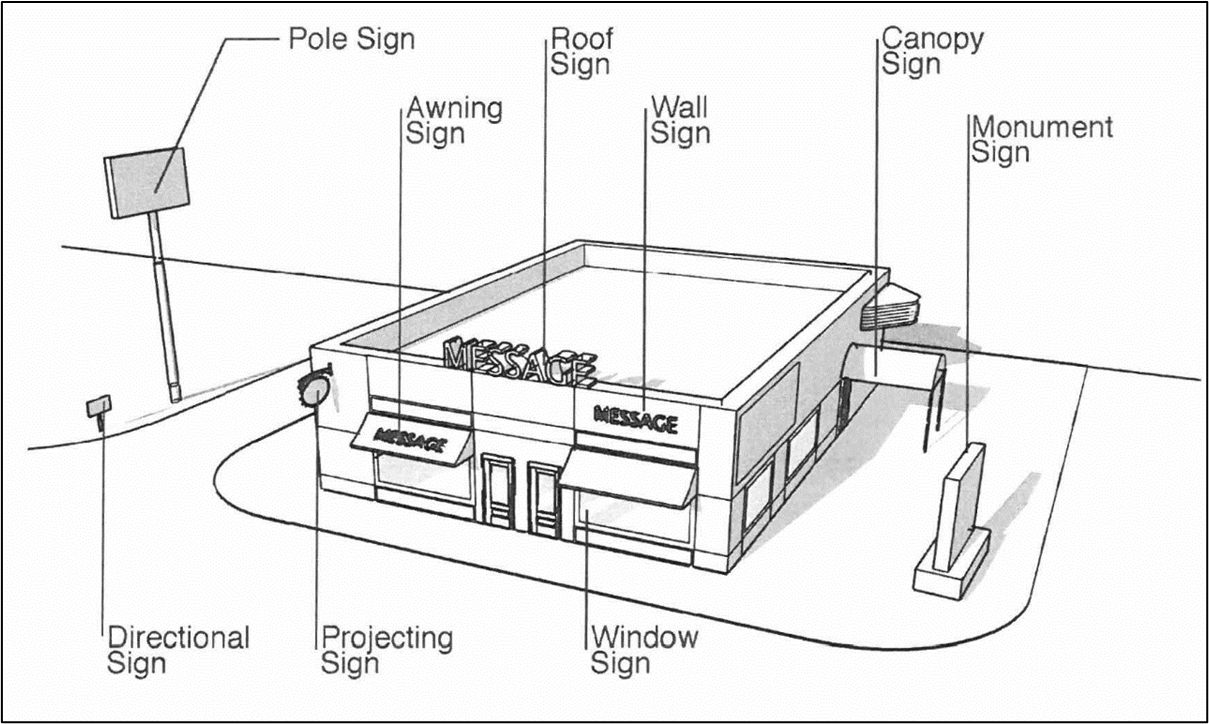
Permanent sign. A sign that is intended to be permanently in place for the duration of the permit use. Examples of permanent signs may include, but are not limited to wall signs, projecting signs, freestanding or monument signs, awning and canopy signs, and on-site directional signs (see Figure 6-44(A): Permanent Sign Type Diagram).
Figure 6-44(A): Permanent Sign Type Diagram
(32)
Pole sign. A freestanding sign erected and maintained on a freestanding mast or pole secured permanently to the ground and not attached to a building or any other structure, but not including a ground sign.
(33)
Portable sign. Any sign designed and intended to be transported or movable. Such signs are not attached to a building or anchored within the ground and are capable of being moved easily from one location to another on its own chassis or by other means. Portable signs may not be illuminated or include audio equipment. No portable sign may be converted to a permanent sign. Examples of common features include, but are not limited to:
a.
Signs with wheels or with wheels removed.
b.
Signs with chassis or support constructed without wheels, including portable changeable message cabinets.
c.
Signs designed to be transported by trailer, wheels or motorized vehicle.
d.
Signs mounted on a motor vehicle for advertising purposes parked off the public right-of-way, except when the motor vehicle is being used in the normal, routine operations of the business.
(34)
Premises. A contiguous parcel of land with its appurtenances and buildings that functions as a unit. For the purpose of this appendix, an outparcel along the perimeter of a shopping center or similar multitenant use that contains a freestanding building and a parking area separate from the shopping center as indicated on an approved site plan shall be considered a premises separate from the premises of the shopping center.
(35)
Projecting sign. A sign which is attached to and projects from a wall of a building so that the face of the sign is perpendicular or nearly perpendicular to the face of such wall and projects more than 15 inches from such building.
(36)
Public service message board. Any sign having a conspicuous and intermittent variation in illumination, message, color, or pattern powered by electricity and which displays different copy changes on the same lamp bank or message facility and installed on land owned by the town or any other governmental entity established by the Commonwealth of Virginia.
(37)
Roof sign. A sign that is mounted or painted on the roof of a building, or that is wholly dependent upon a building for support and that projects above the highest point of a building with a flat roof, the lowest eave line of a building with gambrel, gable or hip roof or the deck line of a building with a mansard roof.
(38)
Sign. A presentation of letters, numbers, figures, pictures, emblems, insignia, lines of colors, or any combination thereof which can be viewed from a public place, a public right-of-way, any parking area or right-of-way open to use by the general public, and which is displayed for the purpose of information, direction or identification or to advertise or promote a business, service, activity, interest or product, or any otherwise lawful message that does not attract attention to a business operated for profit or to a commodity or service offered for sale. For nonresidential developments, this definition is not intended to include private streets or other privately maintained access ways that do not directly connect to a public street and which are not visible in the spaces described above.
(39)
Sign area. That area of the sign which is or can be used for visual representation or communication. The term includes any background or surrounding material, panel, trim or ornamentation, color, and direct or self-illumination that differentiates the sign from the building, structure, backdrop surface, or object upon or against which it is placed. A pole, post or similar structural support for a freestanding sign, including pole covers, shall be considered as part of the sign area if such pole, post, structural support or pole cover contains or forms an integral part of the sign display, as determined by the zoning administrator.
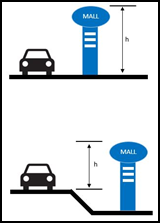
(40)
Sign height. The distance from the highest point of a sign to the finished elevation of the road providing principal access to the site on which the sign is located as measured from the bottom of the curb or edge of pavement (see Figure 6-44(B): Sign Height).
Figure 6-44(B): Sign Height
(41)
Sign structure. Any portion of a sign, including the area devoted to message or display, and all poles, posts, supports, uprights, bracing, framework, border, background and structural trim.
(42)
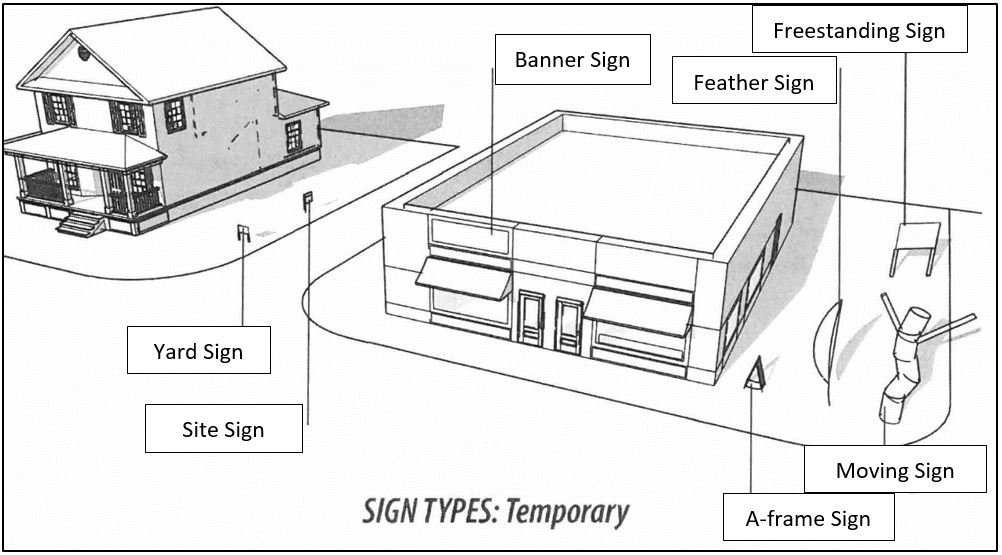
Temporary sign. A sign constructed of cloth, canvas, vinyl, paper, plywood, fabric, or other lightweight material not well suited to provide a durable substrate or, if made of some other material, is neither permanently installed in the ground nor permanently affixed to a building or structure which is permanently installed in the ground. Temporary signs are designed to be easily moved and are not illuminated. Examples include, but are not limited to, A-frame signs, banners, posters, temporary window signs, site signs, and yard signs (see Figure 6-44(C): Temporary Sign Type Diagram).
Figure 6-44(C): Temporary Sign Type Diagram
(43)
Wall sign. A sign painted or etched directly on the outside wall or window of a building, or attached to and erected parallel to the face of a building and supported throughout its length by such wall or window of the building, and which extends no more than 15 inches from the building, and the message portion of which is parallel or nearly parallel to the surface to which the sign is attached. For purposes of this article, window and glass door signs defined herein are not wall signs.
(44)
Window and glass door sign. A sign that is applied or attached directly to the interior or exterior of a window or door, or that is suspended from or located within one foot of a window or door, so that it is visible from any street, sidewalk, or public or private outdoor common space. This term shall not include merchandise located in a window.
(45)
Window and glass door sign, permanent. Any window sign designed to withstand fading, chipping or peeling over time that is not constructed of cloth, canvas, vinyl, paper, plywood, fabric, or other lightweight material.
(46)
Window and glass door sign, temporary. Any window sign that is composed of ink, paint or other applied product which is not designed to withstand fading, chipping or peeling over time or that is constructed of cloth, canvas, vinyl, paper, plywood, fabric, or other lightweight material not well suited to provide a durable substrate.
(47)
Yard sign. A freestanding temporary sign placed upon or supported by the ground independently of any other structure, but not including any A-frame sign.
Sec. 6-45. - Standards and general provisions.
(a)
Any sign displayed in the Town of Vinton, shall comply with the following:
(1)
All provisions of this article;
(2)
All applicable provisions of the Uniform Statewide Building Code (USBC) and all amendments thereto; and
(3)
All state and federal regulations pertaining to the display of signage.
(b)
If any two or more sections of the above referenced regulations are in conflict, the provision that provides the most restrictive standard shall apply.
Sec. 6-45.1. - Signs in all districts
(a)
All signs shall conform to applicable provisions of the Uniform Statewide Building Code (USBC) and all amendments thereto.
(b)
Moving or windblown signs, including pennants, streamers, and balloons, and inflatable signs shall be permitted as special event signs in the R-B, CB, GB, M-1, or M-2 districts, provided such signs meet the following requirements:
(1)
A special event sign permit shall be required to allow for the display of any signs included in this subsection. Every application for a special event sign permit shall be submitted to the zoning administrator by the owner or tenant of the property involved or by an agent of the owner or tenant of the property.
(2)
Permits for such signs shall be limited to 12 days per calendar year per lot.
(3)
Such signs shall not be located within 15 feet of any street line or other property line.
(4)
Signs permitted in this subsection shall not be illuminated or utilize lighting in any form.
(c)
No sign shall be permitted to be nailed or otherwise affixed to any existing sign structure or light pole unless it is to become an integral part of such existing sign structure.
(d)
No sign shall be located, arranged or designed so that it interferes with traffic by any of the following means: glare; blocking of reasonable sight lines for streets, sidewalks or driveways; confusion with a traffic control device because of its color, location, shape, or other characteristic; or any other means. If sign is to be placed on a corner lot, it shall be located outside of the visibility triangle, as described in article VI, section 6-11, visibility at intersections, of this appendix.
(e)
Except as specifically permitted in the CB district, no portion of any sign or its supporting structure shall extend beyond the property lines of the lot on which it is located or extend into or project over the right-of-way of a public street or alley.
(f)
No wall sign or other sign shall be attached to or obstruct any window, door, stairway or other opening intended for ingress or egress or for needed ventilation and light.
(g)
No person except a public officer or employee in performance of a public duty shall paste, paint, print, nail, tack, erect, place or fasten any sign, pennant, banner or notice of any kind within, facing or visible to any public street or public open space, except as provided for in this appendix.
(h)
A sign permit shall be required for each permanent sign or for any changes or additions to existing permanent signs.
(i)
Window or glass door signs. The total window and glass door, both permanent and temporary, sign display area at a given establishment shall not cover more than 25 percent of the total window and glass door area on the lot. Window signs are not permitted in any window of a space used for residential use. Window signs are prohibited on a floor above the first floor of a building unless the business advertised is only on the floor where the window sign is displayed. For the purpose of calculating the total maximum permitted sign area for permanent or temporary signs as provided in this division, temporary or permanent window signs shall not be included.
Sec. 6-45.2. - Exempted signs, displays and devices.
Notwithstanding the general rules set forth in section 6-45.1, the following signs and sign-related activities shall be exempt from the sign permit requirement to the extent indicated. Except where indicated in this subsection, such signs shall also not be counted towards the maximum sign allotment allowed for the applicable use or premises.
(a)
On-premises directional signs not exceeding four square feet in sign area, and four feet in height for freestanding directional signs. Directional signs shall be located at least three feet from a street line or other property line, with no more than one sign per one-way curb cut and two directional signs per two-way curb cut;
(b)
Permanent signs not exceeding two square feet in area and required to be placed by governmental authority, or identifying owner or occupant of the property;
(c)
Temporary signs erected or required by governing bodies;
(d)
Integral decorative or architectural features of a building, except for moving parts or moving lights;
(e)
Signs erected by governmental agencies that do not to exceed 32 square feet in area.
(f)
Historic signs as permitted by section 6-50;
(g)
Signs, not exceeding four square feet, that provide directions to a public use that are erected and maintained by a public agency or not-for-profit organization;
(h)
Signs placed by a public utility at or near the location of underground facilities;
(i)
Signs on the inside of establishments, except those specified in subsections 6-45.3(d), (f), and (g) or if such signs meet the definition of window or glass door signs by this division;
(j)
Street address signs, not exceeding four square feet in area;
(k)
Clocks;
(l)
Signs displayed on a truck, bus, or other vehicle while in use in the normal conduct of business. This section shall not be interpreted to permit the parking for display purposes a vehicle to which a sign is attached or the use of such a vehicle as a portable sign;
(m)
All signs placed within public right-of-way, including the Virginia Department of Transportation's Integrated Directional Signage Program, shall fall under the authority of the town manager or his authorized agent;
(n)
Routine sign maintenance or changing of lettering or parts of signs designed to be regularly changed, including sign face changes;
(o)
Uniform road signage, including any sign erected in compliance with the provisions and standards of the Manual of Uniform Traffic Control Devices (MUTCD);
(p)
Wall graphics;
(q)
Window covers placed on the inside of a window(s) of a vacant storefront, or unit under construction as evidenced by an active building permit, to shield the interior of the building from view. Window covers shall not be subject to the maximum window and glass door coverage requirements of section 6-45.1 of this article;
(r)
Signs displaying only the word "open" or "closed," or the hours of operation, illuminated or otherwise, provided such signs do not exceed one per individual tenant per lot and do not exceed four square feet in sign area;
(s)
Bulletin boards on a lot containing a permitted public or civic use. Not more than two bulletin boards with an aggregate area not exceeding 32 square feet shall be mounted on a wall. Bulletin boards shall be excluded only for public uses or permitted civic uses if placed by a governmental agency or a civic organization;
(t)
Flags, subject to the regulations in article V, section 5-12.
Sec. 6-45.3. - Prohibited signs.
Except where specifically permitted by the regulations of the applicable zoning district or overlay district, all of the following signs are prohibited in all zoning districts.
(a)
Any sign that due to its size, location, color, or illumination obscures a sign displayed by a public agency for the purpose of giving traffic or safety instructions or directions.
(b)
Any sign, except an official public notice, which is nailed, tacked, posted, or in any other manner attached to any utility pole, or structure supporting wire, cable, or pipe; or to public property of any description.
(c)
Any sign located within a public right-of-way, except for signs displayed by a duly constituted governmental authority, or those signs for which written authorization has been obtained from the town manager or his authorized agent.
(d)
Flashing or revolving lights, beacon or searchlight signs, or any similar device otherwise displayed that imitates by its design or use, emergency service vehicles or equipment.
(e)
A sign which is false or misleading such that it creates a threat to vehicular, bicycle, or pedestrian safety, and which contains the words "STOP," "GO," "SLOW," "CAUTION," "DANGER," "WARNING," or similar words.
(f)
Any sign displaying flashing or intermittent lights, or lights of changing degrees of intensity of color, or that is not in accordance with section 6-45.1.
(g)
Moving or windblown signs, not including the hands of a clock, feather signs as defined by this article, flags displayed in compliance with the provisions of article V, section 5-12, the changing of messages on electronic message boards so that each display of copy remains static with no animation for at least six seconds before changing to new copy, and rotating barber poles not exceeding six feet in height and one foot in width shall not be considered a moving or windblown sign. Moving or windblown signs may be permitted as a special event sign under the provisions of section 6-45.1(b).
(h)
Signs advertising activities or products that are illegal under federal, state, or town law.
(i)
A portable sign, but not including an A-frame sign or freestanding temporary sign (e.g. yard sign) displayed in compliance with the provisions of this article.
(j)
An awning sign or canopy sign that projects vertically above or below or horizontally beyond the physical dimensions of the awning or canopy upon which it is affixed.
(k)
Roof signs, except for signs permitted in section 6-51 below.
(l)
A sign located on a zoning lot where no principal use exists, except for a temporary sign located on a lot being offered for sale or lease at the time of application for the sign permit.
(m)
Inflatable signs, except when permitted as a special event sign under the provisions of section 6-45.1(b).
(n)
Signs placed on mannequins, costumed characters, or similar objects, except in the interior of a building or a window display.
(o)
A sign which is structurally unsafe and hazardous.
Sec. 6-46. - Temporary signs.
The following temporary signs are allowed but cannot be illuminated, and, unless otherwise stated, do not require a sign permit:
(a)
Temporary signs are permitted provided they meet the standards of this section. The area of any temporary sign maintained per this section shall not count for the allowable permanent sign area for any lot or structure.
(1)
Unless otherwise noted, all temporary signs shall be located no closer than five feet from any street line or other property line.
(b)
Signs posted by or under the direction of any public or court officer in the performance of official duties, or by trustees under deeds of trust, deeds of assignment or other similar instruments. These signs must be removed no later than ten days after the last day of the period for which they are displayed.
(c)
Signs that are displayed on a lot or property that is actively marketed for sale, rent or lease, as follows:
(1)
A single building-mounted or freestanding sign is allowed, except that two signs are permitted on a corner lot when each sign faces a different street frontage. Such sign(s) must be removed within seven days of the settlement, rental or lease of the property.
(2)
Sign(s) located on a property developed with, or planned for development of, a single-family detached or attached dwelling unit, cannot exceed six square feet in area and a height of six feet.
(3)
Sign(s) located on a property developed with, or planned for development of, a multiple family dwelling unit cannot exceed 12 square feet in area and a height of eight feet.
(4)
Sign(s) located on a property developed with, or planned for development of, any nonresidential use, cannot exceed 32 square feet in area and a height of eight feet.
(d)
Signs during active construction or alterations to residential, commercial, and industrial buildings are permitted, as follows:
(1)
For a new residential, commercial or industrial development, one sign per development, not to exceed 60 square feet in area and a height of ten feet. For lots containing multiple road frontages, one additional sign per street frontage is allowed, limited to 32 square feet in area and a height of eight feet. All signs must be removed within 14 days following completion of the construction of the development, as determined by the zoning administrator, and no sign may be displayed for more than two years from the date of the issuance of the first building permit for the development. If construction has not been completed within this timeframe and building permits are active for the development, a sign permit is required to allow the continued display of any sign.
(2)
For an individual single-family dwelling unit undergoing construction, improvement or renovation, one sign, not to exceed four square feet in area or a height of four feet is allowed. No sign can be displayed before commencement of the improvement or renovation work, and the sign must be removed within seven days after the improvement or renovation is completed with all necessary inspections approved, or within six months, whichever is less.
(e)
Signs on any lot developed with a residential use cannot exceed 12 square feet in total area and a height of four feet.
(1)
Signs do not promote commercial products or services.
(2)
Signs that do not comply with the requirements of this section shall be subject to the permit requirements, sign area, setback and other provisions of this division. All signs shall comply with the general sign regulations per section 6-45.
(f)
For nonresidential uses, temporary signs are permitted as follows:
(1)
For nonresidential uses located on a lot with frontage on a public right-of-way, building-mounted and freestanding temporary signs are allowed, not to exceed 24 square feet in total sign area per lot. If freestanding, no more than two such signs are allowed per lot with a maximum height of four feet, except for feather signs, as defined by this article which may exceed this height limit. Feather signs shall only be displayed during business hours.
(g)
For nonresidential uses where permitted, window and glass door signs are permitted as follows:
(1)
The total sign display area at a given establishment, including both permanent and temporary window signs, does not cover more than 25 percent of the total window and glass door area on the lot.
(2)
Temporary window and glass door signs are not included in the total permanent or temporary sign area calculation.
(h)
For nonresidential uses, a single A-frame sign not to exceed 16 square feet in area and a height of four feet is allowed. The sign must also conform to the following regulations:
(1)
Signs shall be located within 25 feet of a building or designated site entrance that provides access to the use, and cannot impede pedestrian or vehicular traffic.
(2)
Such signs shall not project over any portion of a street nor shall they obstruct the sidewalk to less than four feet in width.
(3)
All such signs shall be of durable construction, and when displayed shall be anchored in a manner approved by the zoning administrator.
(4)
Such signs shall only be displayed during business hours.
(5)
One sandwich board sign is permitted for each business and for shopping centers are not to exceed a total of 12 sandwich board signs.
(i)
Each temporary sign shall be maintained in good, safe condition, and securely affixed to a building or the ground.
Sec. 6-47. - Sign permits required for signs.
(a)
No sign, unless specifically exempted by the provisions of this division, shall be erected or installed unless a sign permit for such sign has been issued by the zoning administrator after determination that such sign conforms to all applicable provisions of this appendix.
(b)
No sign containing electrical components shall be erected or installed unless an electrical permit for such sign has been issued by the Roanoke County Office of Building Safety after determination that such sign conforms to all applicable provisions of this appendix.
(c)
Other permits may be required, as applicable.
(d)
Applications for sign permits, as well as other applicable permits, shall be submitted and considered in accordance with the provisions of article VIII of this appendix. Failure to obtain the required permits shall constitute a violation of this appendix.
(e)
No sign permit shall be required for signs placed within public right-of-way. However, written authorization must be obtained from the town manager prior to any sign being placed within a right-of-way.
Sec. 6-48. - Sign measurement rules.
(a)
When building frontage is used to calculate allowable sign area, the following applies:
(1)
Building frontage is the linear width of the wall taken at a height no greater than ten feet above grade.
(2)
On buildings with a single tenant or with multiple tenants that access the building via a common outside entrance(s), building frontage is the face or wall that is architecturally designed as the front of the building and that contains the main public entrance, as determined by the zoning administrator.
(3)
On buildings with more than a single tenant where each tenant has its own outside entrance(s), building frontage for each tenant is the wall that contains that tenant's main public entrance, as determined by the zoning administrator.
(b)
When calculating any building and/or wall-mounted sign area, the following applies:
(1)
Building and/or wall-mounted sign area is that area within a single continuous rectilinear perimeter of not more than eight straight lines intersecting at right angles, which encloses the outer limits of all words, representations, symbols, and/or pictorial elements, together with all material, color and/or lighting forming an integral part of the display or used to differentiate the sign form the background against which it placed (see Figure 6-48 below).
(2)
The area of building-mounted signs composed of individual letters and/or symbols is calculated by one of the following methods:
a.
If the space between the proposed individual letters or symbols is less in dimension than the width of the largest letter or symbol, sign area is calculated in accordance with subsection 6-48(b)(1) above.
b.
If the space between the proposed individual letters or symbols is greater than the width of the largest letter or symbol, sign area is calculated as the total combined area of rectangular enclosures surrounding each individual letter or symbol.
Figure 6-48: Eight-Line Measurement Methodology Example
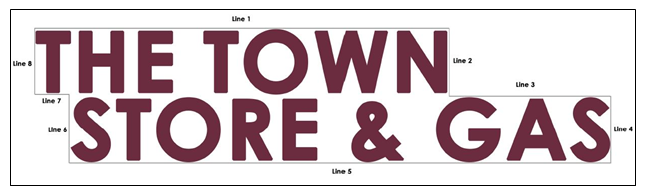
(c)
The following provisions apply to calculating the sign area of any freestanding signs:
(1)
The supports, uprights or structure on which any freestanding sign is supported are not included in calculating sign area unless they contain or form an integral part of the sign display, as determined by the zoning administrator.
(2)
The area of a freestanding sign designed with more than one sign face is calculated as follows:
a.
If the sign faces are separated by an interior angle of 30 degrees or more, all sign faces are calculated in the sign area.
b.
If the sign faces are separated by an interior angle that is less than 30 degrees, sign area is calculated based on the area of the largest single face.
c.
Signs shall be located facing the street, lot line, or building frontage from which the allotment is computed.
(3)
The height of a freestanding sign is calculated as the distance from the highest point of a sign to the finished elevation of the road providing principal access to the site on which the sign is located as measured from the bottom of the curb or edge of pavement (see Figure 6-44(A): Sign Height).
Sec. 6-49. - Illuminated signs.
(a)
Permanent signs may be illuminated either through the use of internal illumination, backlighting, neon lighting, or direct lighting from an external light source provided the following standards are met:
(1)
Information on any illumination proposed as part of a sign must be provided by the applicant on the sign permit application.
(2)
No light from any illuminated sign shall cause direct glare into or upon any building other than the building to which the sign is related.
(3)
No light from any illuminated sign shall cause direct glare onto any adjoining piece of property or any adjoining right-of-way.
(4)
Arrows or other directional indicators on a sign may not be illuminated.
(5)
No receptacle or device housing a permitted light source which is attached to the sign itself shall protrude more than 15 inches from the face of the sign or building to which it is attached (no more than 60 inches for outdoor advertising signs). If ground lighting is used to illuminate a sign, the receptacle or device should not protrude more than 12 inches.
(6)
In no event shall the illumination of any sign resulting from any internal or external artificial light source exceed 100 lumens.
(b)
Any sign containing electrical components shall conform to current UL, ETL, CSA, or ULC standards and display a label from one of these recognized testing labs; or as an alternative, shall be designed and constructed to standards that would allow one of the above-referenced labels to be affixed and thereafter inspected to insure compliance with these standards.
Sec. 6-50. - Historic signs.
(a)
Intent. Identify the architectural, cultural, and historic significance to the town and encourage their preservation, enhancement, and maintenance.
(b)
Designation. A sign may be designated historically significant if it was installed prior to January 1, 1960, and meets at least three or more of the following criteria:
(1)
The sign exemplifies, symbolizes, or manifests elements of the cultural, social, economic, political or historic heritage of the town;
(2)
The sign identifies with a person or persons or groups who significantly contributed to the history and development of the town, regional, state or national culture and history;
(3)
The sign exemplifies one of the best remaining architectural type in a community; or contains outstanding or exemplary elements of attention to architectural design, detail, materials, or artisanship of a particular historic period;
(4)
The sign is in a unique location or singular physical characteristic(s) represents an established and familiar visual feature of the neighborhood, community or the town;
(5)
The sign has been in existence for more than 40 years and it possesses integrity of location, design, setting, materials, workmanship, feeling and association;
(6)
The sign has been continually displayed for more than 40 years, with the exception of routine maintenance, repair or restoration.
(c)
Designation of historic sign(s) shall be subject to approval by the zoning administrator.
(d)
A sign permit will be required for a historic sign and any historic sign displayed shall comply with all applicable provisions of the IBC and all amendments thereto.
(e)
A historic sign shall be restored to its original condition.
(f)
A historic sign shall only be allowed in the following zoning districts: CB, GB, RB, M-1, and M-2 and shall be exempted from being included in the maximum permitted sign area and the maximum number of signs allowed in the designated districts.
Sec. 6-51. - Rooftop screening wall signs.
(a)
Intent. Allow for signs to be mounted onto rooftop screening walls of establishments in the CB central business district in a way that does not distract, confuse, mislead, obstruct vision or create traffic hazards or other hazards to the community.
(b)
Applicability. This sign type shall only be allowed in the CB central business district. The supplemental regulations of this section shall apply to any rooftop screening wall sign permitted by this appendix.
(c)
General standards.
(1)
Only one rooftop screening wall sign shall be allowed per lot;
(2)
Such sign shall be counted towards the maximum sign allotment allowed for the applicable use or premises;
(3)
The sign must be mounted flat against the wall, and no part of the sign can extend above or beyond the perimeter of the wall;
(4)
The sign cannot be installed more than eight feet above the building roof supporting the screening wall measured from the top of the sign;
(5)
Such sign shall not be illuminated through any means.
(d)
Zoning district where permitted.
(1)
This sign type shall be permitted by right in the CB central business district.
Sec. 6-52. - Other permitted signs.
The following signs shall be permitted in all districts, and the area of such signs shall not be included in calculating the maximum permitted area of signs on any lot.
(a)
Fuel pump signs. Gasoline service stations, self-service gasoline stations and auto service centers are permitted two additional square foot of sign area for fuel pump signs to be displayed on top of each fuel dispenser.
(b)
Signs relating to public or civic uses. The following signs shall be permitted for any public-owned property to identify schools, parks, playgrounds, community centers and other public or permitted civic uses, subject to approval by the zoning administrator.
(1)
In any case, where the provisions of this section are less restrictive or permit a sign of greater area, height or dimension than permitted in any other zoning district where public or permitted civic uses are permitted, the provisions of this section shall govern.
(2)
Signs not exceeding in the aggregate 32 square feet in area along each street frontage. Such signs shall be attached flat against a main building or may include one freestanding sign along each street frontage.
(3)
Not more than two bulletin or notice boards with an aggregate area not exceeding 32 square feet. Such bulletin or notice boards shall be mounted on a wall or on a freestanding structure.
Sec. 6-53. - Signs regulations in residential districts.
In addition to the regulations generally applicable to signs in all districts, the signs shall be permitted, unless otherwise noted as prohibited, and the following regulations shall apply in the R-LD, R-1, R-2 and R-3 residential districts.
(a)
Illuminated signs and electronic message board signs. Illuminated signs and electronic message board signs shall not be permitted in the R-LD, R-1, R-2, and R-3 residential districts.
(b)
Signs identifying residential neighborhoods. One freestanding sign identifying the name of the residential neighborhood is permitted at each principle entrance to a residential development within a residential zoning district.
(1)
A maximum of two freestanding identification signs per neighborhood.
(2)
The maximum area per sign face shall be 32 square feet.
(c)
In addition to the signs in the table, the following signs may be erected:
(1)
Temporary signs. Temporary signs are permitted as set forth in section 6-46 of this division.
Sec. 6-54. - Signs regulations in the R-B district.
In addition to the regulations generally applicable to signs in all districts, the following signs shall be permitted and the following regulations shall apply for a lot containing a nonresidential use in the R-B residential-business district. For a lot containing a residential use in the R-B residential-business district, the regulations set forth in section 6-53 shall apply.
(a)
Signs permitted in residential districts. Any sign permitted in residential districts as set forth in section 6-53 of this article shall be permitted. In any case, where the provisions of this section are less restrictive or permit a sign of greater area, height or dimension than permitted in a residential district, the provisions of this section shall govern.
(b)
Maximum number of signs. Not more than four permanent signs shall be provided on a lot.
(c)
Maximum permitted sign area. The aggregate area of all permanent signs located on a lot shall not exceed 76 square feet.
(d)
Installation requirements. Any projecting, wall, or window and glass door sign (whether permanent or temporary), shall not be installed on any surface above the first floor of a building in this zoning district.
(e)
The following apply to the corresponding sign types and standards for which superscript numbers are in the table above:
(1)
Projecting signs. Signs, including poles or other support structures, shall not project greater than three feet from the face of the building, shall not be closer than two feet from any curb line, and shall provide a minimum under-clearance of seven feet. Signs that extend less than six inches from the surface of the building shall be considered wall signs.
(f)
In addition to the signs in the table, the following signs may be erected:
(1)
Temporary signs. Temporary signs are permitted as set forth in section 6-46 of this division.
(2)
Window and glass door signs. The total sign display area at a given establishment does not cover more than 25 percent of the total window and glass door area on the lot.
Sec. 6-55. - Signs regulations in the GB and M-1 district.
In addition to the regulations generally applicable to signs in all districts, the following signs shall be permitted and the following regulations shall apply in GB general business and M-1 limited industrial districts.
(a)
Maximum permitted sign area. For lots with a combined width of 33 feet or less along their principal street frontage, the combined surface area of all signs for the lot shall not exceed 50 square feet. For all other lots the aggregate area of all permanent signs located on a lot shall not exceed one and one-half square feet for each linear foot of lot frontage along the street, nor in any case 500 square feet, provided that:
(1)
In the case of a lot having frontage on more than one street, permitted sign area shall apply along each street frontage;
(2)
In the case of a shopping center, the maximum area of signs attached to any portion of a building devoted to a particular tenant shall not exceed one and one-half square feet for each linear foot of building frontage devoted to such tenant, nor in any case 500 square feet. In addition thereto, each shopping center shall be permitted freestanding signs subject to the restrictions set forth in paragraph subsection (c)(2) of this section.
(b)
Maximum number of signs. Not more than five permanent signs shall be provided on a lot except a shopping center as defined in article XI of this appendix.
(1)
In the case of a lot having frontage on more than one street, and the main building having multiple tenants, not more than six permanent signs shall be allowed on the lot. In no such case shall more than four permanent signs be displayed on a single lot frontage.
(c)
The following apply to the corresponding sign types and standards for which superscript numbers are in the table above:
(1)
Awning and canopy signs.
a.
One awning or canopy containing a sign shall be permitted to be attached to each building frontage, provided that no projecting sign shall be attached to the same building frontage.
b.
Awnings and canopies with less than 15 feet clearance above the sidewalk shall not extend into or occupy more than two-thirds the width of the sidewalk measured from the building. In no case will an awning or canopy be allowed to have an under-clearance of less than seven feet.
c.
Stanchions or columns that support awnings and canopies shall be located not less than two feet in from the curb line.
d.
Any awning or canopy which is not securely fastened or becomes torn or damaged, as determined by the zoning administrator, shall constitute a violation of this article and shall be removed or repaired upon written order by the zoning administrator.
(2)
Freestanding signs.
a.
No freestanding sign shall be located within 50 feet of any lot in a residential district, or within five feet of any street right-of-way line, other property line or driveway intersecting a street.
b.
Where more than one freestanding sign is permitted on a lot as a result of the lot having multiple street frontages, the distance between freestanding signs on the same lot shall be not less than 100 feet.
c.
In the case of a shopping center, one freestanding sign not exceeding 200 square feet in area or 35 feet in height shall be permitted when no other freestanding signs are located on the shopping center site or any adjacent out-parcel or pad site.
(3)
Projecting signs.
a.
Signs, including poles or other support structures, shall not project greater than four feet from the face of the building and shall not be closer than two feet from any curb line.
b.
Projecting signs with less than 15 feet clearance above the sidewalk shall not extend into or occupy more than two-thirds the width of the sidewalk measured from the building. In no case will a projecting sign be allowed to have an under-clearance of less than seven feet.
c.
Projecting signs that extend less than six inches from the surface of the building shall be considered wall signs.
(d)
In addition to the signs in the table, the following signs may be erected:
(1)
Temporary signs. Temporary signs are permitted as set forth in section 6-46 of this division.
(2)
Window and glass door signs. The total sign display area at a given establishment does not cover more than 25 percent of the total window and glass door area on the lot.
Sec. 6-56. - Signs regulations in the CB district.
In addition to the regulations generally applicable to signs in all districts, the following signs shall be permitted and the following regulations shall apply in the CB central business district.
(a)
Maximum permitted sign area. For lots with a combined width of 33 feet or less along their principal street frontage, the combined surface area of all signs for the lot shall not exceed 50 square feet. For all other lots the aggregate area of all permanent signs located on a lot shall not exceed one and one-half square feet for each linear foot of building frontage along the street, nor in any case 50 square feet, provided that:
(1)
In the case of a building having frontage on more than one street, permitted sign area shall apply along each street frontage;
(2)
Where more than one main building is located on a lot, the aggregate area of all signs attached to each building shall not exceed one and one-half square feet for each linear foot of building frontage along the street, nor in any case 50 square feet.
(b)
The following apply to the corresponding sign types and standards for which superscript numbers are in the table above:
(1)
Awning and canopy signs.
a.
One awning or canopy containing a sign shall be permitted to be attached to each building frontage, provided that no projecting sign shall be attached to the same building frontage.
b.
Awnings and canopies with less than 15 feet clearance above the sidewalk shall not extend into or occupy more than two-thirds the width of the sidewalk measured from the building. In no case will an awning or canopy be allowed to have an under-clearance of less than seven feet.
c.
Stanchions or columns that support awnings and canopies shall be located not less than two feet in from the curb line.
d.
* Awnings or canopies containing signs conforming with the provisions of this section shall be permitted to extend over the sidewalk portion of a right-of-way of a public street when authorized by the town council.
e.
Any awning or canopy which is not securely fastened or becomes torn or damaged as determined by the zoning administrator, shall constitute a violation of this article and shall be removed or repaired upon written order by the zoning administrator.
(2)
Freestanding signs.
a.
Where more than one freestanding sign is permitted on a lot as a result of the lot having multiple street frontages, the distance between freestanding signs on the same lot shall be not less than 100 feet.
(3)
Projecting signs.
a.
Signs, including poles or other support structures, shall not project greater than four feet from the face of the building and shall not be closer than two feet from any curb line.
b.
Projecting signs with less than 15 feet clearance above the sidewalk shall not extend into or occupy more than two-thirds the width of the sidewalk measured from the building. In no case will a projecting sign be allowed to have an under-clearance of less than seven feet.
c.
Projecting signs that extend less than six inches from the surface of the building shall be considered wall signs.
(d)
In addition to the signs in the table, the following signs may be erected:
(1)
Temporary signs. Temporary signs are permitted as set forth in section 6-46 of this division.
(2)
Window and glass door signs. The total sign display area at a given establishment does not cover more than 25 percent of the total window and glass door area on the lot.
Sec. 6-57. - Signs regulations in the M-2 district.
In addition to the regulations generally applicable to signs in all districts, the following signs shall be permitted and the following regulations shall apply in the M-2 general industrial district.
(a)
Signs permitted in GB and M-1 districts. Any sign permitted in GB and M-1 districts as set forth in section 6-55 of this appendix shall be permitted.
(b)
Billboard signs. Billboard signs shall be permitted provided that:
(1)
No billboard sign shall exceed 378 square feet in area;
(2)
There shall be no more than one billboard sign attached to or painted on a sign structure, except that two billboard signs may be attached back-to-back on a single structure, in which case such arrangement shall be considered double-faced sign for purposes of calculating permitted area;
(3)
No billboard sign or sign structure shall exceed a height of 35 feet, nor shall any billboard sign be installed on the roof of any structure;
(4)
No billboard sign shall be located within 500 feet of another billboard sign;
(5)
No billboard sign shall be located within 15 feet of any street line or other property line, or within 200 feet of any residential or R-B district.
Sec. 6-58. - Signs regulations in the planned development district.
In addition to the regulations generally applicable to signs in all districts, the following signs shall be permitted in the planned development district:
(a)
Signs permitted in residential districts. Any sign permitted in residential districts as set forth in section 6-53 of this appendix shall be permitted.
(b)
Signs permitted in the CB district. Any sign permitted in the CB district as set forth in section 6-56 of this appendix shall be permitted for commercial uses.
Sec. 6-59. - Signs regulations in the public/open space district.
In addition to the regulations generally applicable to signs in all districts, the following signs shall be permitted and the following regulations shall apply in the public/open space district.
(a)
The following apply to the corresponding sign types and standards for which superscript numbers are in the table above:
(1)
Temporary signs. Temporary signs are permitted as set forth in section 6-46 of this division.
Sec. 6-60. - Sign maintenance, repair, and removal.
(a)
It shall be unlawful for any person to maintain or permit to be maintained on any premises owned or controlled by said person any sign which is in a damaged or deteriorated condition and constitutes a danger or hazard to public safety.
(b)
Sign components and materials shall be kept in good repair which shall include the sign being free of holes, chipping, cracking, peeling, fading, rusting or nonfunctional components that are detectable from beyond the property line. Any sign in violation of this section shall be removed or repaired by the owner of the sign or the owner of the premises. A permit may be required for maintenance work.
(c)
Temporary signs showing evidence of deterioration, such as rips, tears, color fading, frayed edges or otherwise showing need of general maintenance that can be seen from the property line shall be removed, repaired or replaced promptly (provided the replacement complies with all other portions of this appendix).
(d)
The zoning administrator shall have the authority to order the removal, without compensation, of any sign or sign structure that due to neglect or damage poses a clear danger to the health, safety, and welfare of the public.
(e)
The town may collect the cost of such removal, obliteration or abatement from the person erecting, using, operating, posting or displaying such signs.
Sec. 6-61. - Signs identifying nonconforming uses.
One sign identifying a nonconforming use located in a residential district shall be permitted; provided that such sign shall be attached flat against the building occupied by the use and shall not exceed eight square feet in area. Signs identifying nonconforming uses located in districts other than residential districts shall conform to the sign regulations applicable in the district in which the use is located.
Sec. 6-62. - Nonconforming signs.
A nonconforming sign shall be permitted to remain subject to the restrictions and limitations set forth in this section.
(a)
Maintenance and alteration. A nonconforming sign may be maintained and repaired, provided that such sign shall not be moved, replaced, structurally altered, or modified as to size, shape or height except in conformity with the provisions of this article. Lighting or illumination shall not be added to a nonconforming sign. The face of a nonconforming sign or the copy thereon may be changed when all other provisions of this paragraph are met.
(b)
Restoration or removal of damaged signs. Any nonconforming sign damaged to the extent that it represents a public hazard as determined by the building official or zoning administrator or any nonconforming sign damaged by any casualty to an extent exceeding 50 percent of its replacement cost, shall be removed or made to conform to the provisions of this article. In the case of damage of 50 percent or less of the replacement cost of a nonconforming sign damaged by any casualty, such sign may be restored as before the damage, if such restoration is completed within six months of the damage.
(c)
Removal of abandoned nonconforming signs. The zoning administrator may order the removal of any nonconforming sign that has been abandoned. For purposes of this section, a sign shall be considered abandoned if the business or use for which the sign was erected has not been in operation for a period of at least two years. Such nonconforming sign(s) and its supporting structure shall be removed by the owner of the property on which the sign is located, or the agent for the property owner, or tenant or lessee of the property having beneficial use of the property upon which the sign(s) is located, within 30 days of written notice by the zoning administrator.
(d)
Signs nonconforming due to lighting or animation. Any sign that is nonconforming due to lighting or animation shall be eliminated or made to conform to the regulations pertaining to lighting and animation within 90 days from the effective date of this provision.
(e)
Nonconforming portable or temporary signs. Any nonconforming portable sign or nonconforming temporary sign shall be eliminated or made to conform to the regulations set forth in this article within 90 days from the effective date of this appendix.
Sec. 6-63. - Obsolete signs.
(a)
Obsolete signs. In the event that a use or activity has ceased operating on the site for a period of two years, all related sign faces shall be painted out or otherwise removed or made to comply with this article by the owner, agent, or person having the beneficial use of the building, structure or lot upon which such sign is located within 30 days of such cessation.
(b)
Upon failure to comply within the time specified, the zoning administrator is hereby authorized to order painting over or removal of such sign within 30 days of written notification, and any incidental expenses thereto shall be paid by the owner of the building, structure or lot on which such sign is located.
Sec. 6-64. - Purpose and short title.
This division may be referred to as the "Town of Vinton Telecommunications Zoning Ordinance." The Virginia Zoning Enabling Act, Code of Virginia, § 15.2-2280 et seq., to ensure the orderly development of land within the town and to protect the public health, safety, general welfare, and as good zoning practice, and to further those public purposes set forth in Code of Virginia, 1950, § 15.2-2283, as amended.
State Law reference— Code of Virginia, § 15.2-2280 et seq., 15.2-2316.3 et seq.
Sec. 6-65. - Applicability.
(a)
The requirements set forth in this division shall govern the location of all telecommunications towers, monopoles, antennas, small wireless facilities, and amateur radio antennas, constructed to a height greater than 16 feet six inches in height from ground level, as well as all base stations.
(b)
This division applies to all wireless facilities located or to be located on all property located within the incorporated limits of the Town of Vinton, regardless of the use, ownership, or dedication of such property to public use or the use of a certificated public service company.
State Law reference— Code of Virginia, § 15.2-2281; cross-ref.: § 15.2-2030.
Sec. 6-66. - Development standards for small wireless facilities attached to existing structures.
(a)
Emissions from small wireless facilities attached to existing structures shall not materially interfere with existing communications facilities or facilities planned for future public safety communications.
(b)
If, during the site plan, plot plan, or scaled elevation approval process, a public safety agency identifies a public safety concern or a critical public safety need, the small wireless facility shall be disapproved.
(c)
For small wireless facilities in the public rights-of-way or other publicly-owned or publicly-controlled property, such facilities must be painted or otherwise be designed to match the color and texture of the structure upon which they are affixed.
(d)
No small wireless facility shall fail to have and provide all required approvals from all departments, authorities, and agencies with jurisdiction over the property, provided that the zoning administrator may grant preliminary approval prior to other approvals being granted, but such preliminary approval shall not be a final approval authorizing establishment of any use or structure and must be followed with a final plot plan and scaled elevation for approval based on the final permits, and shall not be construed as an approval that would vest a right.
(e)
No small wireless facility may collocate on a structure that is illegally nonconforming until and unless such nonconforming structure is brought into compliance with the provisions of this appendix.
Sec. 6-67. - Development standards for new support structures for small wireless facilities.
(a)
Small wireless facility support structures may be considered either principal or accessory uses. A different existing use of an existing structure on the same lot shall not preclude the installation of a small wireless facility support structure on such lot.
(b)
When a new small wireless facility support structure is a replacement for an existing structure or is in the line of existing structures of similar height and bulk, e.g., a replacement for an electric pole or a new faux streetlight, the structure shall be designed so as to resemble, as closely as practical, the form and type of the existing structure or the structures in the same line.
(c)
Wiring, cable, and conduit requirements:
(1)
All wiring and cables must be firmly secured to the utility distribution or transmission pole or other support structure.
(2)
All mounting brackets and wiring, cables, and conduits that are not located in a fully enclosed structure must be same color as, or otherwise demonstrated to match or blend with, the new structure on which they are mounted.
(3)
Spools or coils of excess fiber optic or cables or any other wires may not be stored on the new structure except completely within approved enclosures or cabinets.
(d)
Equipment and facilities standards:
(1)
All equipment and support structures located on the new structure:
a.
Must be the same color or material as the new structure and covered by rustproof treatment or material.
b.
Must be flush-mounted to the new structure or supported by mounting brackets.
c.
The support brackets may not extend beyond the new structure by more than eight inches.
d.
Must not exceed 32 cubic feet in volume.
(2)
Ground-mounted equipment (or base stations associated with a small wireless facility) must:
a.
In public rights-of-way abutting single-family residential districts or areas in which attached or detached single-family dwellings are the predominant use or development pattern, each small cell facility is limited to one cabinet or structure that does not exceed five feet in height and a total of 70 cubic feet in volume. Ground-mounted equipment cabinets must be located adjacent to the support structure.
b.
When the related equipment is not located on property that meets subsection a., each provider is limited to a cabinet or structure which does not exceed 12 feet in height and a total of 500 square feet in gross area. The cabinet or structure must be adjacent to the pole. The cabinets or equipment must be secured by a wall, berm, or evergreen hedge sufficient to screen it from view from the street, or with an eight-foot fence, wall, berm, or landscaping combination.
(e)
The minimum horizontal distance between poles is:
(1)
When located in zoning districts that are zoned for single-family dwellings and are or areas in which attached or detached single-family dwellings are the predominant use or development pattern, not less than 300 feet.
(2)
When located in all other areas, not less than 100 feet.
Sec. 6-68. - Application requirements for legislative process projects.
Each applicant for a monopole or tower shall submit six copies of a scaled concept plan and a scaled elevation view and other supporting drawings, calculations, and other documentation, signed and sealed by appropriate licensed professionals, showing the location and dimensions of all improvements, including information concerning topography, radio frequency coverage, height and antenna location requirements, setbacks, ingress/egress, parking, fencing, landscaping, easements, adjacent uses, and other information deemed necessary to assess compliance with the regulations of this ordinance. Additionally, the applicant shall provide actual photographs of the site from designated relevant views that include a simulated photographic image of the proposed monopole or tower. The photograph with the simulated image shall include the foreground, the midground, and the background of the site. An engineering report, certifying that the proposed monopole or tower is compatible for collocation with a minimum of three compatible users including the primary user, must accompany the application.
Sec. 6-68.1. - Provisions for legislative process projects.
(a)
A wireless support structure for a wireless facility that is not a small wireless facility, a small wireless facility support structure, a small wireless facility collocation, or an eligible facilities request, shall be permitted only upon approval of a special use permit by the town council as set forth in article VIII of the zoning ordinance and in accordance with the following provisions:
(1)
No advertising or signs shall be allowed on an antenna.
(2)
No signals, lights, or illumination shall be permitted on an antenna unless required by the FCC, FAA, or the Town of Vinton.
(3)
A base station shall not contain more than 750 square feet of gross floor area or be more than 12 feet in height.
(4)
A base station or wireless support structure shall meet all zoning and building code requirements including, but not limited to, minimum yard requirements for primary structures.
(5)
A base station shall be landscaped with a buffer of plant materials that effectively screens the view of the base station from adjacent property. The standard buffer shall consist of a landscaping strip of at least four feet wide outside the perimeter of the enclosure. Existing mature tree growth and natural land form on the site shall be preserved to the maximum extent possible. In locations where the visual impact of the unmanned equipment building would be minimal, the landscaping requirement may be reduced or waived by the council as part of the special use permit approval.
(b)
Wireless support structures and base stations subject to the legislative process shall be subject to the following provisions:
(1)
The height of wireless support structures shall not exceed 199 feet, including antennas.
(2)
Monopoles or towers either shall maintain a galvanized steel finish or, subject to any applicable standards of the FCC or FAA, be painted a neutral color, unless an alternative camouflage is approved by the town council as part of the special use permit process.
(3)
The design of base stations and other related structures shall use materials, colors, textures, screening, and landscaping that will blend the facilities to the natural setting and the built environment. Dish antennas and covers will be of a neutral, non-reflective color with no logos or markings not required for identification or safety markings required by applicable codes.
(4)
Base stations shall not contain more than 750 square feet of gross floor area or be more than 12 feet in height, and shall be located in accordance with the minimum yard requirements of the zoning district in which they are located.
(5)
Transitional yard and screening shall be provided on accordance with the provisions of article V of the zoning ordinance. Monopole or tower facilities shall be landscaped with a buffer of plant materials that effectively screens the view of the support buildings from adjacent property. Existing mature tree growth and natural land form on the site shall be preserved to the maximum extent possible.
(6)
Monopoles and towers shall not be artificially lighted, unless required by the FCC or FAA. If lighting is required, the council may review the available lighting alternatives and approve the design that would cause the least disturbance to surrounding views.
(7)
Signs shall only be permitted on a wireless support structure as may be provided in article V, division 7 of this appendix.
(8)
All monopoles or towers must meet or exceed current standards and regulations of the FAA, the FCC, and any other agency of the federal government with the authority to regulate towers and antennas and their construction methods. If such standards and regulations are changed, then the owners of the towers and antennas governed by this ordinance shall bring such towers and antennas into compliance with such revised standards as required. To ensure the structural integrity of monopoles and towers, the owner of such shall ensure that it is constructed and maintained in compliance with standards contained in applicable federal, state, and local building codes and regulations.
(9)
Wireless support structures must satisfy the minimum zoning district setback requirements for primary structures. For wireless support structures in the public rights-of-way that are subject to the legislative process, the setback shall be 40 feet from the edge of the existing pavement or sidewalk, whichever is closer, and one-half the height of the support structure, including antennas if they extend beyond the top of the structure, from the nearest existing structure.
(10)
Monopoles or towers shall be enclosed by security fencing not less than six feet in height and shall be equipped with appropriate anticlimbing device.
(11)
No new legislative process facility shall be permitted unless the applicant demonstrates to the reasonable satisfaction of the council that no existing monopole, tower, or other structure can accommodate the proposed antenna.
Sec. 6-69. - Special provisions on disapproval of a legislative process facility.
(a)
The town council shall provide an applicant a written statement of the reasons for disapproval within three business days following the disapproval. The council may delegate the preparation of the statement to the zoning administrator and the town attorney.
(b)
Upon request, town Freedom of Information Act officer shall provide a copy of the written record of the application in accordance with the provisions of the Virginia Freedom of Information Act, Code of Virginia, 1950, Chapter 37 of Title 2.2, as amended.
Sec. 6-70. - Abandoned wireless support structures on private property.
Abandoned wireless support structures and wireless facilities are hereby declared to be public nuisances and shall be abated as provided in section 14-144 of this Code. If the use of a wireless support structure or wireless facility is discontinued for a continuous period of 24 months or more, such wireless support structure or wireless facility shall be presumed abandoned. In the event the owner wishes to extend the time for removal, he or she shall provide an application, accompanied by an application fee of $250.00, giving a statement of the reasons for the extension. For good cause shown, the zoning administrator may grant the owner up to a 60-day grace period before taking action to abate the nuisance.
State Law reference— Code of Virginia, §§ 15.2-900, 15.2-230.

