
Watertown City Zoning Code
ARTICLE V
- SUPPLEMENTARY DISTRICT REGULATIONS
Sec. 62-471. - Performance standards.
Every use permitted by this chapter shall be so established and maintained as to comply with the provisions of the following performance standards:
(1)
Residual features. No activity or operation shall be established or maintained which by reason of its nature or manner of operation will cause the emission of noise, odor, toxic or noxious fumes, gases, smoke, dust and particulate matter in such concentrations as to be detrimental to or endanger the public health, welfare, comfort and safety or cause injury to property or business.
(2)
Glare. Direct or reflected glare, such as from floodlights, spotlights or high temperature processes, and as differentiated from general illumination, shall not be visible beyond the site of origin at any property line. Any lighting used for exterior illumination (including off-street parking areas) shall be directed away from adjacent properties.
(3)
Vibration. No activity shall at any time cause earth vibrations perceptible beyond the limits of the site on which the use is located. Vibrations created during the process of construction are exempt from this standard.
(4)
Explosives. Any use requiring the storage, utilization or manufacturing of products which should decompose by detonation shall be located not less than 400 feet from any residential or planned residential district. This standard shall not apply to the storage or usage of liquefied petroleum or natural gas for normal residential or commercial purposes.
(5)
Waste material. In commercial or industrial districts, without first having received a permit to do so from the city, liquid wastes containing any organic or toxic matter shall not be washed into the public sanitary sewer system or storm sewer system. If such a permit is not granted, a method of disposal shall be devised which will not require continuous land acquisition for permanent operation and will not cause a detrimental effect to adjacent land. Should the waste be of solid form rather than fluid, it shall be stored within a completely enclosed structure or contained in a closed container designed for such purposes. Such a waste storage structure or container shall be so located and fenced as to be removed from public view. In all districts, all wastes material, debris, refuse, garbage, materials not currently in use for construction or otherwise regulated herein shall be kept in an enclosed building or property and contained in a closed container designed for such purposes. The owner of vacant land shall be responsible for keeping such vacant land free of waste material and noxious weeds. Existing uses shall comply with this provision within six months following enactment of this chapter.
(6)
Radiation and electrical emissions. No activities shall be permitted that emit dangerous radioactivity beyond enclosed areas. There shall be no electrical disturbance (except from domestic household appliances) adversely affecting the operation at any point of any equipment, including but not limited to radio and television reception other than that of the creator of the disturbance.
(7)
Traffic control. The traffic generated by any use shall be channelized and controlled in a manner that will avoid congestion on public streets, safety hazards and excessive traffic through residential areas. Traffic into and out of all commercial and industrial uses and areas shall in all cases be forward moving with no backing onto streets or pedestrian ways. No access drive to any lot shall be located within 30 feet of any two intersecting street right-of-way lines.
(8)
Land slope. No building or structure shall be constructed on slopes of 18 percent or more in grade.
(9)
Outdoor display of product. The city council recognizes the display of product outside of the confines of a building beneficial to the business and community at large, provided displays continue to promote the health, safety, general welfare, and aesthetic quality of the community. To further those goals, outdoor display of product shall be permitted, provided the following standards are met:
a.
Outdoor display area shall not utilize any required parking spaces.
b.
Outdoor display on sidewalks shall preserve a minimum five-foot sidewalk width.
c.
Where the outdoor display involves the stacking of material, the height of the material shall not exceed five feet.
d.
Outdoor display shall not encroach onto adjacent right-of-way or city property.
e.
The footprint of the outdoor display area shall not exceed one square foot per one lineal foot of principal building frontage.
(Ord. No. 193, § E(1.1—1.9), 12-28-93; Ord. No. 244, § 2, 3-11-03)
Sec. 62-472. - Outside storage.
(a)
All material and equipment shall be stored within a building or fully screened (see section 62-473) so as to not be visible from adjoining properties, except for the following:
(1)
Construction and landscaping materials and equipment temporarily being used on the premises.
(2)
Agricultural equipment and materials if these are being used or intended for use on the premises.
(3)
Public and private recreational vehicles, boats, equipment, etc., or public facilities.
(4)
Off-street parking facilities, except as otherwise regulated in this chapter and except in residential districts where any off-street parking area containing over six spaces may be required to be screened.
(Ord. No. 193, § E(1.10), 12-28-93; Ord. No. 226, § 1, 8-14-01)
Sec. 62-473. - Reserved.
Editor's note— Ord. No. 244, § 3, adopted Mar. 11, 2003, repealed § 62-473, which pertained to screening and derived from Ord. No. 193, § E(1.11), adopted Dec. 28, 1993.
Sec. 62-474. - Reserved.
Editor's note— Ord. No. 232, adopted June 11, 2002, repealed the former § 62-474 and enacted a new chapter 28, landscaping, as set out in this Code. The former § 62-474 pertained to landscaping and derived from Ord. No. 193, § E(1.10), adopted Dec. 28, 1993 and Ord. No. 226, § 2, adopted Aug. 14, 2001.
Sec. 62-475. - Reserved.
Editor's note— Ord. No. 244, § 4, adopted Mar. 11, 2003, repealed § 62-475, which pertained to fences and derived from Ord. No. 193, § E(1.13), adopted Dec. 28, 1993.
Sec. 62-476. - Construction standards.
(a)
All principal structures permitted in all zoning districts except A-1 and P-1 shall be constructed in accordance with the Minnesota State Building Code. All structures in the zoning districts set forth shall possess wall and ceiling joist construction consisting of framing materials of at least 1½ inch by 3½ inch dimensions. All principal and accessory buildings shall employ the standards as outlined in the Watertown Subdivision Ordinance, Article VI, Building Design Guidelines. The exterior of accessory buildings in all districts except the A-1 and P-1 zoning districts shall be compatible with other buildings on the lot in keeping with the character of the neighborhood. The use of metal for greater than 50 percent of the exposed building surface area shall be prohibited. For the purposes of this section, the calculation shall not include glazed (glass) or roof surfaces.
(b)
Structures to be utilized for single- family inhabitation in allowable districts, as set forth by the Watertown Zoning Ordinance, shall have a minimum overall building width of 24 feet and shall have a roof slope ratio of 4:12 (four-inch rise to 12-inch run).
(c)
All other structures to be built in zoning districts not set forth in this section shall comply with all requirements as described in the Watertown Zoning Ordinance, Watertown Subdivision Ordinance and the Minnesota State Building Code.
(Ord. No. 193, § E(1.14), 12-28-93; Ord. No. 244, 5, 3-11-03)
Sec. 62-477. - Accessory structures.
The intent of this section is to establish the minimum regulations for accessory structures in order to protect the public health, safety and welfare; to protect use areas; to promote orderly development; to provide adequate light, air, and convenience of access to property; to provide for compatibility of different uses; to prevent overcrowding of land and undue concentration of structures.
(Ord. No. 193, § E(1.15), 12-28-93; Ord. No. 244, § 6, 3-11-03; Ord. No. 248, § 1, 8-26-03; Ord. No. 283, § 1, 3-28-06; Ord. No. 336, § 1, 6-23-09; Ord. No. 355, § 2, 12-14-10; Ord. No. 383, § 1, 12-9-14; Ord. No. 387, § 1, 7-14-15)
Editor's note— Ord. No. 387, § 1, adopted July 14, 2015, changed the title of § 62-477 from "Accessory buildings and structures" to read as set out herein.
Sec. 62-478. - Timing.
No detached accessory structure shall be constructed on any lot prior the time of construction of the principal building to which it is accessory. A building or zoning permit is required for all accessory structures as determined by the city.
(Ord. No. 387, § 1, 7-14-15)
Sec. 62-479. - Setback and other requirements for all zoning districts.
Accessory buildings and structures in residential districts shall be subject to the following regulations:
(a)
Accessory structure standards and requirements:
(1)
Setbacks shall be in accordance with Table 1.
Table 1
1 Five percent of buildable lot area
(2)
Accessory structures shall comply with the following standards:
a.
Two detached accessory structures may be permitted on a property if there is not an attached accessory structure.
b.
The maximum number of accessory structures on any property shall be in accordance with Table 1.
c.
The maximum combined square footage allowed for types 1, 2, 5 and 7 shall be 1,000 SF or 5% of the buildable lot area (lot area total shall exclude wetlands, lakes or other similar natural features), whichever is greater.
d.
In the case of a corner or double frontage lot, accessory structures shall be restricted to the building setback lines for the principal structure.
e.
Accessory buildings shall not be permitted within any easement unless expressly permitted. No accessory structure shall be constructed in such a way to impede drainage ways or interfere with overland flow easements.
f.
If a garage is attached to the principal structure, finished living space above or adjacent to the garage including but not limited to bonus rooms, workshops and other similar living spaces shall not be counted towards the total square footage or height of the accessory building.
g.
The height of the accessory structure shall be measured as prescribed in section 62-1, Building height.
h.
Maximum permitted height of a garage door shall be eight feet.
i.
The requirements of this section do not apply to domesticated animal enclosures (doghouses), provided such structure is less than 15 square feet in area and five feet in height.
(3)
Driveways. Driveways shall be permitted in all yards. Driveways of houses with three or more garage [stalls] shall have a maximum width of 30 feet at the property line and curb. Driveways of houses with two or fewer garage stalls shall have a maximum width of 24 feet at the property line and curb. Homes in a cul-de-sac, regardless of garage size, shall have a maximum driveway width of 24 feet at the property line and curb, unless otherwise specified as part of the subdivision approval. Each unit or home shall have one driveway in accordance with the maximum width stated above, and shall not be shared with other adjacent units or lots. The driveways shall be separated by landscaping, grass, or other similar applications. An individual lot may be permitted a second driveway access provided:
a.
The minimum distance between the drives, as measured at the property line, shall not be less than 75 feet.
b.
Maximum amount of hard, semi-permeable or permeable surface shall not exceed 45 percent of the required front yard.
Table 2.
(4)
Decks.
a.
Decks are not permitted in required side or corner side yards.
b.
Decks shall be subject to the setback requirements of the principal structure, and shall meet the rear yard setback requirements of the principal structure or be permitted to extend up to ten feet from the principal structure, whichever allows the greater deck. In no case shall the deck be closer than five feet from the side or rear property lines.
c.
Decks and patios at or below grade are permitted in all yards.
(5)
Fences.
a.
Permit required. No fence, except temporary fencing, shall be constructed without a permit. The application shall be accompanied by a plot plan clearly describing the type, location and method of anchoring the fence. Boundary line fences shall be located entirely upon the private property of the party constructing the fence unless the owner of the property of the adjoining property agrees, in writing, that such fence may be erected on the division line of the respective properties. The persons, firms, or corporations constructing or causing the construction of such fence shall be responsible for maintaining that part of their property between fence and property line. City staff will require any application for a fence permit to establish boundary lines of the property by a survey thereof to be made by any registered land surveyor. At the discretion of the city, the property owner may establish boundary lines by showing the stake markers of the surveyed lot. Applicant shall be required to physically identify the property corners for city inspection.
b.
Location. Fences not exceeding three feet in height are permitted within the limits of any yard in all districts. However, no fence or wall may be constructed which interferes with the sight triangle. A fence may be located along the rear lot line and side lot lines to a maximum height of six feet up to the point where it is parallel with the front edge of the house except in corner and double frontage lots, as permitted below. From the front edge of the house to the right-of-way the height of the fence shall not exceed three feet in height.
i.
Double frontage lots: In the case of double frontage lots with an arterial street forming the rear property line, fences may be permitted up to the property line in the secondary front yard, provided no landscaping buffer exists as part of the plat improvements. Such fences may be up to six feet in height. For double frontage lots backing to a street other than an arterial street, fences up to six feet in height may be permitted, provided a 20-foot setback is preserved in the secondary front yard, and no landscape buffer exists as part of the plat improvement. For the purposes of this subdivision, arterial streets within the city shall be defined in the city's Comprehensive Plan as shown on the "Future Functional Class" map.
ii.
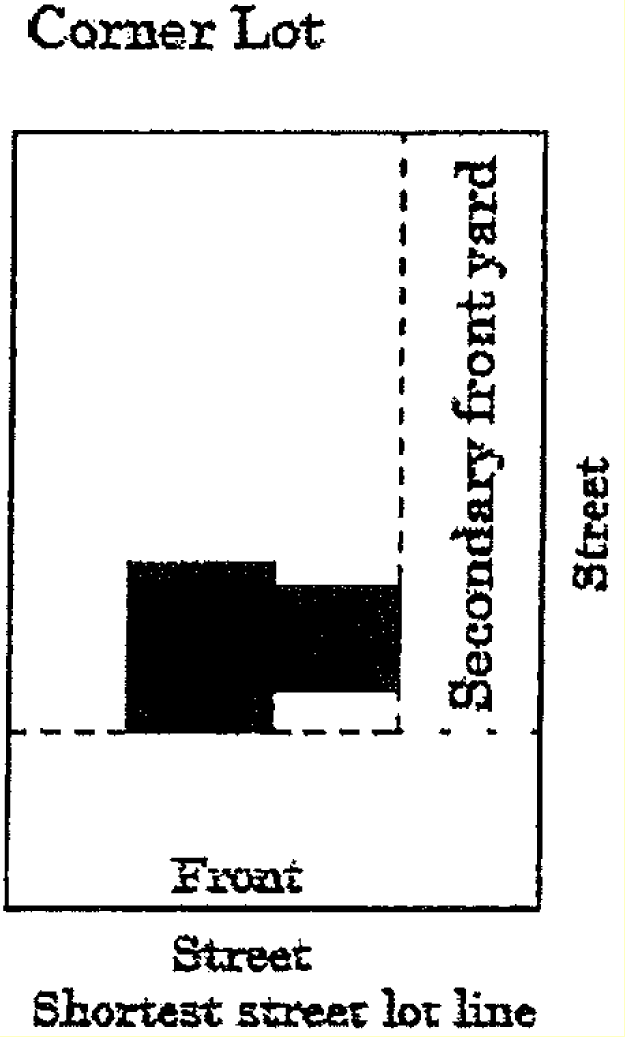
Corner lots: In the case of fences on corner lots, fences exceeding three feet in height to a maximum of six feet in height are permitted in the secondary front yard provided a minimum setback equal to the principal structure or 30 feet is maintained, whichever is closer to the corner side property line.
1.
No fence or wall shall be permitted on public rights-of-way or boulevard area.
2.
No fence or wall shall obstruct natural drainage or extend within a wetland, drainage ditch, or river.
3.
No fence shall be erected on a corner lot that will obstruct or impede the clear view of an intersection by approaching traffic.
4.
Fences may be constructed within public and private utility and drainage easements provided that:
a.
No fence or wall shall be located within a drainage or utility easement if there is a utility, either public or private, located within the easement.
b.
Removal of a fence or wall or a portion thereof for the purpose of utilizing the easement shall be at the property owner's expense.
5.
Fences in excess of four feet in height shall be located a minimum of ten feet from the right-of-way of any alley.
c.
Fencing conformity. Fencing in all districts shall conform to the following:
1.
Design. The side of the fence considered to be the face (finished side as opposed to structural supports) shall face abutting property. Every fence shall be constructed in a professional and substantial manner and of substantial material reasonably suitable for the purpose for which the fence is proposed to be used. The materials and design shall also be compatible with other structures in the area in which the fence is located and shall not cause blight or a negative impact. Fences shall be at least five percent open to provide space for the passage of air. All fencing shall be constructing straight, true, and plum.
2.
Materials.
a.
Any fence which is dangerous to the public safety or general welfare and health is a public nuisance and the city may commence proceedings for the abatement thereof. Electric fences may not be used. Materials such as standing seem metal, hog wire, chicken wire, or sheep wire fencing, barbed wire fencing, snow fencing and other similar types of non-standard fencing, as determined by the zoning administrator, shall not be allowed as permanent fencing. This requirement shall not be construed to prohibit the use of underground electric pet fencing or similar use.
b.
The use of slats of any kind is prohibited in or upon chain link fences.
c.
Wire fence other than chain link shall not be permitted as boundary line fences within ten feet of the property line in residential zoning districts.
3.
Maintenance. Fences in all districts shall be maintained so that the exposed outer surface shall be uniformly painted or stained in a neat and aesthetically acceptable condition.
4.
Temporary fencing. All snow-stop fencing may be used from November 1 to April 1 on private property. Temporary fencing shall not be installed in the right-of-way. Temporary fences such as garden fences not exceeding four feet in height which are not up for more than seven months may be permitted within the interior yard. No permit shall be required for temporary fencing.
5.
No existing fence in violation of this subdivision will be allowed to be replaced or rebuilt. Should an existing fence be replaced or rebuilt, it must come under the regulation of this subdivision.
d.
Residential and agricultural districts.
1.
Setback and design. A fence may be located within the rear yard and side yard to a maximum height of six feet up to the point where it is parallel with the front edge of the building. Fences located within the front yard or side-street yard to the right-of-way shall be ornamental in design and the height of the fence shall not exceed three and one-half feet as measured from grade.
2.
Fences around dog kennels not exceeding 50 square feet in size, fences around garbage cans, and garden fences located in the interior of the lot will not require fence permits but shall adhere to the other regulations of this subdivision.
3.
All garbage can areas in multi-family developments shall be protected by privacy fence not less than six feet in height. The privacy fence shall be constructed of wood, vinyl or similar, but shall not include chain link with slats. All gates shall have a self-closing and self-latching latch installed on the outside of the fence.
4.
Residential fences height exceptions.
a.
Fences for sport courts may be up to eight feet in height with ten-foot setback.
e.
Commercial, business, and industrial districts. Fences not exceeding eight feet in height are permitted within the limits of any side or rear yard. Fences over six feet in height shall require a building permit.
f.
Required fences for swimming pools. Regulations for fences surrounding swimming pools shall be in accordance with chapter 62, article V, division 2 of the City Code.
(6)
Temporary structures.
a.
Pursuant to authority granted by Minn. Stat. § 462.3593, Subd. 9, the City of Watertown opts out of the requirements of Minn. Stat. § 462.3593, which defines and regulates temporary family health care dwellings.
b.
Temporary structures shall be required to obtain an annual building permit and have a maximum use of 180 days from the date of permit.
c.
Event tents shall be limited to a maximum of three consecutive days.
d.
The temporary structure shall be removed following the expiration of the building permit or use of the structure.
e.
Attached and detached accessible ramps shall be subject to a building and zoning permit. Permanent ramps shall be subject to all applicable accessory structure requirements and setbacks. Temporary ramps shall be permitted in all residential districts for a period of two years. Accessible ramps shall not be located within any applicable easements or right-of-way. Temporary ramps shall meet all applicable building codes, shall be located no closer than five feet to any property line, and shall be removed following use or at the end of the two year permit issuance.
(7)
Swimming pools/spas. No swimming pools or spa shall be constructed within any required front or corner side yard, buffer area, or easement. Hot tubs shall incorporate a hard carver when not in use. Swimming pools shall be surrounded on all sides by a six-foot high, non-climbable fence. Height shall be measured from grade on the side of the fence which faces away from the pool. However, the fencing requirement may be waived, in lieu of a mechanical cover so as to prohibit access to the pool water when the cover is deployed. Such fence shall be setback from the edge of the water a minimum of six feet. All gates into the area shall include a self-closing, self-latching mechanism installed as meeting the requirements set forth in the state building code. For the purposes of this section, chain link style fencing shall be considered a climbable fence. This regulation shall not apply to swimming pools owned by the public for public use.
(8)
Animal runs. In residential districts, animal runs are permitted within the limits of interior side and rear yards. A five-foot setback is required from all lot lines and screening (landscaping and/or opaque fencing) shall be provided to reduce visibility to the adjoining properties.
(9)
Refuse or waste containers. See Chapter 28 Landscaping.
(Ord. No. 387, § 1, 7-14-15; Ord. No. 398, § 1, 8-23-16)
Sec. 62-480. - Accessory structure standards for business, commercial and industrial uses.
Accessory buildings and structures in business, commercial and industrial districts shall be subject to the following regulations:
(a)
Accessory structure standards and requirements:
(1)
Setbacks shall be in accordance with Table 3.
Table 3
(b)
All accessory structures larger than 150 square feet for business, commercial and industrial uses shall require site plan approval.
(1)
Commercial fuel island canopies. Where permitted, commercial fuel island canopies shall maintain a minimum front yard setback of fifteen feet and minimum rear yard and interior side yard setback of 20 feet.
(2)
Cart corrals. Shall be significantly landscaped and/or screened to minimize the visual impact on the area. Cart corrals require site plan approval. A low screening wall, constructed of materials of a like or similar nature to the principal structure to completely screen carts is encouraged, provided such wall does not disrupt pedestrian and motor vehicle movements.
(Ord. No. 387, § 1, 7-14-15)
Sec. 62-481. - Home occupations.
(a)
All home occupations permitted by this chapter, except those located within the rural conservation or agricultural/open space districts shall be so established and maintained as to comply with the provisions of the following standards:
(1)
Conduct of the home occupation does not result in any alterations to the exterior of the residence.
(2)
Signage consists of no more than one single or double faced unlighted sign with a maximum area of two square feet not located on a public right-of-way.
(3)
Conduct of the home occupation does not generate more noise, vibration, glare, fumes, odors, or electrical interference than normally associated with residential occupancy in the neighborhood.
(4)
The home occupation is not of a scale requiring the use of a commercial vehicle for the delivery of materials to or from the premises.
(5)
The use shall not generate sewage of a nature or rate greater than that normally associated with residential occupancy, nor shall it generate hazardous waste or solid waste as a rate greater than that normally associated with residential occupancy.
(6)
Except for articles produced on the premises, no stock-in-trade shall be displayed or sold on the premises.
(7)
The home occupation shall not increase vehicular traffic flow and parking by more than one additional vehicle at a time and any need for parking generated by the conduct of a home occupation shall be met off the street and other than in a required front yard, or in a driveway in such a manner that access to the garage is not eliminated.
(8)
No more than one person other than those living in the residence may be employed in the home occupation.
(9)
No outdoor display of goods or outside storage of equipment or materials is permitted.
(10)
No accessory building may be used for operations, display of goods or the storage of equipment or materials used in the home occupation.
(11)
No home occupation will be allowed that jeopardizes the health and safety of residents of the city.
(12)
There shall be no renting of space in a residence for nonresidential purposes.
(b)
Home occupations located within the rural conservation or agricultural/open space district shall be permitted, subject to the following conditions:
(1)
Conduct of the home occupation does not result in any alternations to the exterior of the residence.
(2)
Signage consists of no more than one single or double faced unlighted sign with a maximum area of 12 square feet not located on a public right-of-way. Such signage shall be located no closer than five feet from all property lines.
Temporary promotional signs for agricultural sales may be permitted for 90 days per calendar year, provided such signage shall not exceed 16 square feet in area.
(3)
The use shall not generate sewage of a nature, rate, or type that cannot be treated by a permitted on-site sewage system.
(4)
Except for articles produced on the premises, no stock-in-trade shall be displayed or sold on the premises.
(5)
If the home occupation is a professional service, including hair salon and dog grooming, then customers or clients shall not exceed three at any one time and related incidental supplies (e.g. hair care products) shall not be considered stock-in-trade.
(6)
Any additional need for parking generated by the home occupation shall be met by off-street parking. Such parking shall be limited to three spaces and shall be located no closer than 30 feet from the front or corner side yard property lines and five feet from the side and rear property lines.
(7)
No more than one person other than those living in the residence may be employed in the home occupation. Employees shall not report to the premises in order to travel to work off site.
(8)
No outdoor display of goods or outside storage of equipment or materials is permitted.
(9)
If the home occupation is a repair business the items to be repaired shall be of a size or nature that the repair can occur within the home.
(10)
No home occupation will be allowed that jeopardizes the health and safety of residence of the city.
(11)
There shall be no renting of space in a residence for nonresidential purposes.
(12)
No more than one vehicle used in the home occupation shall be stored on site. The vehicle may be stored outside provided an adequate off-street location is available on site.
(13)
Notwithstanding the requirements above, a seasonal roadside stand less than 120 square feet for the sale of horticultural products may be permitted, provided sufficient off-street parking is available. Maximum sale duration shall not exceed 90 days.
(14)
Home occupations not meeting the requirements enumerated above may be permitted pursuant to the conditional use permit procedures of this Code.
(Ord. No. 193, § E(2.1), 12-28-93; Ord. No. 240, § 1, 12-10-02)
Editor's note— Ord. No. 387, § 1, adopted July 14, 2015, supplied provisions for new §§ 62-478 and 62-479. At the instruction of the city, current §§ 62-478 and 62-479 have therefor been redesignated as §§ 62-481 and 62-482 to read as set out herein.
Sec. 62-482. - Sexually oriented uses.
(a)
Intent. The purpose of this section is to establish provisions for the opportunity as well as controls of sexually oriented uses within the city.
(b)
Generally. Sexually oriented uses, as defined in this chapter, shall be subject to the following general provisions:
(1)
Activities classified as obscene under state law are not permitted and are strictly prohibited.
(2)
Sexually oriented uses, either principal or accessory, shall be prohibited from locating in any building which is also utilized for residential purposes.
(3)
Sexually oriented uses, either principal or accessory, shall be prohibited from locating in any place which is also used to dispense or consume alcoholic beverages.
(4)
Sexually oriented uses, principal, as defined in this chapter, which deal solely in the retail sales of sexually oriented materials only for off-premises consumption shall be exempt from the requirements of section 62-479(c).
(5)
A sexually oriented use which does not qualify as an accessory use shall be classified as an sexually oriented use, principal.
(c)
Principal.
(1)
Sexually oriented uses, principal, shall be located at least 150 feet from the property line of any zoning district in which residential uses are allowed, either as permitted or conditional uses, and at least 150 feet as measured in a straight line from the closest point of the property line of the building upon which the sexually oriented use, principal, is located from any sensitive use provided below:
a.
Public or private school facility;
b.
Public park or recreational trail;
c.
Licensed day care facility;
d.
On-sale or off-sale liquor facilities;
e.
Another existing sexually oriented use, principal.
(2)
Sexually oriented use, principal, activities, as defined by this chapter, shall be classified as one use. No two sexually oriented uses, principal, shall be located in the same building or upon the same property and each use shall be subject to section 62-479(c)(1).
(d)
Accessory
(1)
Sexually oriented uses, accessory, shall:
a.
Comprise no more than ten percent of the floor area of the establishment in which they are located; and
b.
Comprise no more than 2,000 square feet of floor area in total; and
c.
Comprise no more than 20 percent of the gross receipts of the entire business operation; and
d.
Not involve or include any activity except the sale or rental of merchandise.
(2)
Sexually oriented business, accessory, shall be restricted from and prohibit access to minors by the physical separation of such items from areas of general public access:
a.
Movie rentals. Display areas shall be restricted from general view and shall be located within a separate room, the access of which is in clear view and under the control of the persons responsible for the operation or shall be in catalogs under the direct control and distribution of the operator.
b.
Magazines. Publications classified or qualifying as sexually oriented shall not be physically accessible to minors and shall be covered with a wrapper or other means to prevent display of any material other than the publication title.
(3)
Sexually oriented business, accessory, activities shall be prohibited at any public show, movie, caravan, circus, carnival, theatrical or other performance or exhibition presented to the general public where minors are admitted.
(e)
Violation. Any person violating any provision of this section shall be punished as prescribed in section 1-13 of this Code.
(Ord. No. 206, § 2, 4-22-97)
Editor's note— See editor's note following § 62-481.
Sec. 62-483. - Definitions.
The following words, terms, and phrases, when used in this article, shall have the meanings ascribed to them in this section, except where the context clearly indicates a different meaning:
Permanent swimming pool. Any body of water contained by steel, concrete, fiberglass vessel or similar permanent material, whether in ground or above ground.
Residential swimming pool. Any constructed pool, permanent or portable, which is intended for non-commercial use as a swimming pool by the owner's family and their guests.
Spa. A unit primarily designed for therapeutic use which is not drained, cleaned or refilled for each individual. It may be included but not limited to hydrojet circulation, hot water, cold water mineral baths, air induction bubbles or any combination thereof. Industry terminology for a space includes, but is not limited to, therapeutic pool, hydrotherapy pool, whirlpool, hot spa, hot tub, etc.
Temporary swimming pool. Any body of water contained in a rubber, plastic, or inflatable vessel which can be erected without permanent support that is put up and taken down on an annual basis.
(Ord. No. 354, § 1, 12-14-10)
Sec. 62-484. - Permit required.
(a)
Temporary swimming pool. All temporary swimming pools, whether submerged or elevated are deemed to be a structure under the Zoning Ordinance. Temporary swimming pools greater than 24 inches in depth and more than 5,000 gallons shall require a one time lifetime permit. The temporary swimming pool, if dismantled or removed, shall be put up in the same location annually. A new permit shall be required if the location of the temporary swimming pool changes or the size or dimensions of the pool changes. The applicant shall pay the respective fees established by council resolution for such permit. Temporary swimming pools less than 24 inches in depth and less than 5,000 gallons are exempt from a permit.
(b)
Permanent swimming pool and spas. Permanent swimming pools and spas over 24 inches in depth at any point and 5,000 gallons or larger require a building permit. The construction, plumbing and electrical work connected with any pool or spa to be constructed shall be subject to inspection and shall conform to all applicable building codes of the city and state. Permanent swimming pools that do not exceed 24 inches in depth at any point and less than 5,000 gallons require a zoning permit.
The permit shall include the following information:
(1)
Two sets of plans drawn to scale that show in sufficient detail the following:
a.
The proposed location and its relationship to the other principal buildings on the lot and on adjacent properties.
b.
The size of the pool or spa.
c.
Fencing and other fixtures existing on the lot, such as utility location and trees.
d.
The location, size, and statement as to the types of equipment to be used in connection with the pool or spa including but not limited to the filter unit, pump, wiring, heating unit, fencing and the pool or spa itself.
(Ord. No. 354, § 1, 12-14-10)
Sec. 62-485. - Compliance.
It is unlawful for any person to own or maintain a swimming pool or spa that does not comply with this division. Failure to prevent access into an above ground pool when unoccupied or the removal of the required fencing either attached or detached is a misdemeanor.
(Ord. No. 354, § 1, 12-14-10)
Sec. 62-486. - Construction to be in accordance with approved plan.
All swimming pools, spas, appurtenances, water supply and drainage systems and other features shall be constructed in conformity with the approved plans. If any deviations from such plans are desired, a supplementary plan covering that portion of the work involved shall be filed for approval and shall conform to the provision of this division.
(Ord. No. 354, § 1, 12-14-10)
Sec. 62-487. - General standards.
(a)
Fences. Requirements for permanent swimming pools. Permanent swimming pools shall be surrounded on all sides by a four-foot high, nonclimbable fence, which shall be so constructed as not to have openings, holes, or gaps larger than four inches in either vertical or horizontal direction.
(b)
In general.
(1)
Fences shall be at least four [feet] but not more than six feet high and located at least four feet from the edge of the pool. The bottom of the fence shall not be more than four inches from the ground. Height shall be measured from grade on the side of the fence which faces away from the pool.
(2)
Fences shall be of non-corrosive material.
(3)
The fence shall be completely installed and inspected before filling the pool.
(4)
All such fences shall be constructed so as not to be easily climbable, and generally to prevent children from gaining uncontrolled access. All fence openings points of entry onto the pool are shall be equipped with gates or doors. All gates or doors shall be equipped with self-closing and self-latching devices placed at a sufficient height so as to be non-accessible to small children.
(c)
Exceptions.
(1)
Those property owners with temporary swimming pools shall have the discretion to construct a fence. The city does not require a fence.
(2)
Spas which incorporate a hard cover when not in use.
(3)
The fencing requirement may be waived, in lieu of a mechanical cover so as to prohibit access to the pool water when the cover is deployed.
(4)
The fencing requirement does not apply to above ground outdoor swimming pools having at least four-foot high vertical or outward inclined sidewalls, provided that the pool has all of the following:
a.
The ladder ramp, stairs or similar access to pool is removable and removed when the pool is not in use and the wall cannot be readily climbed by children. Above ground permanent swimming pools shall be protected in such a way that access ways, other than those afforded by the dwelling house or accessory buildings, shall be equipped with self-closing and self-latching gates or doors so these gates or doors are kept securely closed at all times when not in actual use.
b.
If the wall of the pool is less than four feet high, a railing/fence may be installed on the top of the pool wall to create a height of four feet or greater. If the wall of the pool is less than four feet in height and no railing or fence has been installed to increase the height to four feet or greater, a separate four-foot high fence shall be required to surround the pool in accordance with section 62-484.
(d)
Drainage. To the extent feasible, back flush water or water from the pool or spa drainage shall be directed onto the owner's property or onto approved public drainage ways. In no case may the water be drained into the sanitary sewer.
(e)
Lighting. Any pool or spa lighting above the ground shall be directed toward the pool and not the adjacent property.
(Ord. No. 354, § 1, 12-14-10)
Sec. 62-488. - Setback requirements; location generally.
(a)
All swimming pools and spas shall be at least ten feet from underground or overhead utility lines, walkway, or other easements, both public and private.
(b)
The filter unit, pump, heat unit, any other noise making mechanical equipment shall be located at least 25 feet from any residential structure on adjacent property.
(c)
All swimming pools and spas shall be at least six feet from any side or rear lot line, and five feet from any principal building.
(d)
No swimming pool or spa shall be constructed within any required front or corner side yard setback, buffer area, or easement.
(e)
Private swimming pools located on the site of multiple-family dwellings shall have no part of the water surface, any pumps, filters, or other apparatus located less than 50 feet from any lot line or easement.
(Ord. No. 354, § 1, 12-14-10)
Sec. 62-489. - Operation and maintenance.
No swimming pool, whether temporary or permanent, or spa shall be used, kept, maintained or operated if such use, keeping, maintaining or operating shall be the occasion of any nuisance or shall be dangerous to life or detrimental to health.
(Ord. No. 354, § 1, 12-14-10)
Sec. 62-490. - Inspection.
(a)
The city's building official and/or zoning administrator or his or her designee shall have authority to inspect any residential swimming pool or spa whether considered permanent or temporary, at any reasonable time during the construction and thereafter to determine whether or not the provisions of this division regarding health, sanitation, operation, and safety applicable thereto are complied with.
(b)
The building official shall have the authority to enter upon any premises as may be deemed necessary to inspect work done and installations made under permits issued by the city.
(c)
No swimming pool or spa shall be occupied or used at any time prior to complying with the provisions of this division and the final inspection and approval of the pool or spa and permanent fence by the building official even though containing water for construction purpose.
(Ord. No. 354, § 1, 12-14-10)

