
Waukesha City Zoning Code
22.53 Traffic
Loading, Parking And Access
- TRAFFIC VISIBILITY. (Am. #38-02) In all districts no structures, fences, or vegetation shall be permitted on a corner lot within twenty (20) feet of the point of intersection of the right-of-way lines (the "corner") which obstructs or interferes with traffic visibility.
- OFF STREET LOADING REQUIREMENTS. Every lot on which a business trade or industrial use is established, space with access to a public street or alley shall be provided as specified below for the loading and unloading of vehicles off the public right-of-way.
- Number of Spaces Required.
-
Gross Floor Area of Building in Square Feet Number of Spaces 5,000 - 24,999 1 25,000 - 49,999 2 50,000 - 99,999 3 100,000 - 174,999 4 175,000 - 249,999 5 - For each additional seventy-five thousand (75,000) square feet or fraction thereof of gross floor area, one additional loading and unloading space shall be provided.
-
- Access. Each loading and unloading space shall have access to a public dedicated street or alley.
- Area. The minimum area for each loading and unloading space, excluding the area needed to maneuver, shall be two hundred fifty (250) square feet.
- Extension into Public Right-of-Way. At no time shall any part of a vehicle be allowed to extend into the right-of-way of a public thoroughfare while the vehicle is being loaded or unloaded.
- Number of Spaces Required.
- PARKING REQUIREMENTS. (Am. #38-02) In all districts and in connection with every use, there shall be provided, at the time any building or structure is erected, or any building, structure or use is enlarged, extended, or increased, off-street parking stalls for all vehicles in accordance with the following provision and with subsections (4), (5), (6), (7), and (8):
- Access. Adequate access to a public street shall be provided for each parking space, and driveways shall be at least ten (10) feet wide for one- and two-family dwellings; and a minimum of twelve (12) feet for one-way driveways, and twenty-four (24) feet for two-way driveways, for all other uses. Unless an easement of access or access drive is provided in connection with a use permitted in a particular R-District, such easement of access or access drive shall not be located in that particular R-District.
- Minimum Dimensions. The minimum dimensions of each parking space shall be nine (9) feet by eighteen (18) feet, except for spaces provided for motor vehicles used by physically disabled persons.
- Parking Spaces For Use By Physically Disabled Persons. The owner or lessee of any public building or place of employment and the owner or lessee of any parking facility which offers parking to the public shall provide spaces for motor vehicles used by physically disabled persons in accordance with Section 346.503, Wisconsin Statutes.
- Location of Parking Spaces. (Am. #38-02) Off-street parking spaces are to be not more than four hundred (400) feet from the principal use in the same zoning district. If parking is provided off-site, the developer shall submit a copy of an irrevocable easement or parking agreement as part of the development's parking plan.
- Parking Lot Setbacks. (Am. #3-03) Parking lots shall be located in such a manner to provide buffering from street rights-of-way and adjacent uses.
- (Am. #26-03) Parking areas, including aisles, in single-family and two-family residential districts shall be set back a minimum of five (5) feet from the street right-of-way and a minimum of five feet from all other lot lines.
- Parking areas, including aisles, in multi-family residential districts shall be set back a minimum of twenty-five (25) feet from the street right-of-way and a minimum of five (5) feet from all other lot lines except the setbacks shall be twenty-five (25) feet from any single-family or two-family residential district lot lines.
- Parking areas, including aisles, in business, park and institutional districts shall be set back a minimum of fifteen (15) feet from the street right-of-way and a minimum of five (5) feet from all other lot lines, except that the setbacks shall be a minimum of twenty-five (25) feet from any single-family, two-family or multi-family district lot line. The street setback may be reduced to ten (10) feet when a landscaped berm is employed as a parking buffer.
- Parking areas, including aisles, in manufacturing districts shall be set back a minimum of forty (40) feet from the street right-of-way and a minimum of five (5) feet from all other lot lines, except that the setback will be twenty-five (25) feet from any single-family, two-family or multi-family district lot line. The street setback may be reduced to twenty (20) feet when a landscaped berm is employed as a parking buffer.
- Additional parking setbacks may be required to address the need for snow storage, preservation of existing vegetation, slopes, drainage, visibility, or utility location.
- PARKING LOT SCREENING.
- Except in the T-1 Temporary District, all parking areas for five or more vehicles, adjoining a residential use or public right-of-way shall be screened from such use or right-of-way by an earth berm, a solid wall, fence, evergreen planting of equivalent visual density or other effective means. A landscaped berm between a parking lot and a street right-of-way shall be a minimum of two (2) feet in height and a maximum of three (3) feet in height at the time of planting. Fences between the parking lot and a street right-of-way shall not exceed three (3) feet in height. Fences between the parking lot and any other abutting residential property line shall be a minimum of six (6) feet in height. The Plan Commission may require additional screening requirements for parking of large trucks, semi-trailers, large equipment, and for screening overhead doors, and truck loading areas and docks.
- All fencing shall be placed on the property or properties being screened and shall not project into a public right-of-way, shall not obstruct the vision clearance triangle, and shall not extend over side or rear property lines. Landscaped berms shall be placed back from the street right-of-way and property lines in a manner where natural growth will not extend or be maintained over these lines.
- SURFACING. Off-street parking for any number of vehicles shall be surfaced with an asphaltic or portland cement pavement so as to provide a durable and dustless surface, shall be so graded and drained as to dispose of all surface water accumulated within the area. Parking lots in multi-family residential, business, industrial and institutional districts shall be provided with catch basins designed to adequately convey storm waters to a storm sewer or approved detention/retention basin. The foregoing requirements with respect to surfacing shall not apply to a parking area in a M-1 or M-2 district if more than two hundred (200) feet distant from any residential district except that a dustless surface shall be provided in any case. Any parking area for more than five vehicles shall have aisles and spaces clearly marked.
- LANDSCAPE ISLANDS. All off-street parking areas which serve thirty (30) vehicles or more shall be provided with landscape islands or peninsulas within the parking lot totaling not less than five percent of the surfaced area. The minimum size of each landscape island shall be one hundred seventy (170) square feet. Landscape islands and peninsulas shall consist of shrubs, trees, flowers, and similar plantings. Location of landscape areas, type and size of plant materials, protection affording the plantings, including curbing and provision for maintenance shall be subject to approval by the Plan Commission. Landscape islands shall be disbursed throughout the off-street parking area. Islands and peninsulas should be located at the ends of parking rows and aisles; around light poles; signs; existing trees; hydrants; and along entryways. Landscape islands and peninsulas should also be used to break up long aisles of parking. Any island or peninsula that is less than one hundred seventy (170) square feet in area shall not be counted toward the five percent required landscaping. All plans for such proposed parking areas shall include a topographic survey or grading plan which shows existing and proposed grades and location of improvements. The preservation of existing trees, shrubs, and other natural vegetation in the parking area may be included in the calculation of the required minimum landscaped area.
- CURBS AND BARRIERS. Curbs or barriers shall be installed at least four (4) feet from a property line so as to prevent parked vehicles from extending over any lot line.
- NUMBER OF PARKING SPACES REQUIRED.
- Residential Uses.
- Single-family and Two-family Dwellings. Two (2) spaces per dwelling unit.
- Multiple-Family Dwellings. (Am. #16-14) (Am. #13-15) For residential buildings having more than two dwelling units: Efficiency or studio dwelling unit motor-vehicle parking spaces – 1 space per each efficiency or studio unit in the building; One-bedroom dwelling unit motor-vehicle parking spaces – divide number of one-bedroom dwelling units in the building by 2, multiply the result by 3, round the result up to the next whole number; Two-or-more-bedroom dwelling unit motor-vehicle parking spaces – 2 spaces per each two-or-more-bedroom unit in the building; Plus: Guest motor vehicle parking spaces – divide number of dwelling units in the building by 10, round up to the nearest whole number; Short-term bicycle parking spaces – divide number of bedrooms in the building by 20, round up to the nearest whole number; and Long-term bicycle parking spaces – divide number of bedrooms in the building by two, round up to the nearest whole number; except that bedrooms in dwelling units having private garage space do not count towards the number of bedrooms in the building for long-term bicycle parking space calculation.
- Mobile Homes and Manufactured Homes. Two (2) spaces per dwelling unit.
- (Am. #16-14) Housing for the Elderly. Two (2) spaces per dwelling unit, plus 1/10 space per dwelling unit for guest parking, and 0.05 short-term bicycle parking spaces per bedroom, plus 0.5 long-term bicycle parking spaces per bedroom for units without a private garage. However, only fifty percent (50%) of the required parking must be improved at the time of occupancy. The improvement of the remaining parking is waived until such time that the elderly housing is converted to another use, or until the Plan Commission has made a finding that additional parking is needed for the project.
- (Am. #16-14) Boarding or Rooming Houses. One (1) space per bedroom, and 0.05 short-term bicycle parking spaces per bedroom, plus 0.5 long-term bicycle parking spaces per bedroom for units without a private garage.
- Retail Sales and Customer Service Uses, and Places of Entertainment.
- (Am. #16-14) Animal Hospitals. Three (3) patron parking spaces per doctor/technician, plus one (1) space per employee for the work shift with the largest number of employees, and one (1) short-term bicycle parking space per 20,000 square feet of gross floor area, plus 1 long-term bicycle parking space per 20 employees.
- (Am. #16-14) Auto Body Repair, Motor Vehicle Repair, Maintenance, and Service Stations. Three (3) spaces per indoor service bay plus one (1) space per employee for the shift with the largest number of employees, and one (1) short-term bicycle parking space per 20,000 square feet of gross floor area, plus 1 long-term bicycle parking space per 12,000 square feet of gross floor area.
- (Am. #16-14) Barber and Beauty Shops. One (1) space per one hundred fifty (150) square feet of gross floor area, plus one (1) space per employee for the work shift with the largest number of employees, and one (1) short-term bicycle parking space per 5,000 sq. ft, plus 1 long-term bicycle parking space per 12,000 square feet of gross floor area.
- (Am. #16-14) Bed and Breakfast Establishments. One (1) space per bedroom, and one (1) bicycle parking space per 2 bedrooms.
- (Am. #61-02) (Am. #16-14) Convenience Grocery Stores. One (1) space per one hundred fifty (150) square feet of floor area, and one (1) short-term bicycle parking space per 2,000 sq. ft, plus 1 long-term bicycle parking space per 12,000 square feet of gross floor area.
- Drive-through Facilities Stacking Space. Four (4) stacking spaces per drive-through service lane for a financial institution; four (4) spaces per drive-through service lane for a drive-through restaurant; seven (7) spaces per drive-through service lane for a full-service car wash; and two (2) spaces per service bay for a self-service car wash. The number of drive-through facility stacking spaces for uses not listed shall be based on need demonstrated to the Plan Commission.
- (Am. #16-14) Financial Institutions. One (1) space per one hundred fifty (150) square feet of customer floor area, plus one (1) space per employee for the work shift with the largest number of employees, and one (1) short-term bicycle parking space per 2,000 sq. ft, plus 1 long-term bicycle parking space per twenty (20) employees.
- (Am. #16-14) Fitness Center. One (1) space per one hundred (100) square feet of gross floor area, plus one (1) space per employee for the work shift with the largest number of employees, and one (1) short-term bicycle parking space per 2,000 sq. ft, plus 1 long-term bicycle parking space per 12,000 square feet of gross floor area.
- (Am. #16-14) Funeral Homes. One (1) space per four (4) patron seats of maximum capacity, or thirty-five (35) spaces per chapel unit, whichever is greater, and short-term bicycle parking spaces for 2% of the maximum capacity, plus 1 long-term bicycle parking space per 12,000 square feet of gross floor area.
- (Am. #16-14) Grocery Stores, Supermarkets, and Retail Stores. One (1) space per one hundred fifty (150) square feet of gross floor area of customer sales and service, plus one (1) space per employee for the work shift with the largest number of employees, and one (1) short-term bicycle parking space per 2,000 sq. ft, plus 1 long-term bicycle parking space per 12,000 square feet of gross floor area.
- (Am. #16-14) Hotels and Motels. One (1) space per room or suite, plus one (1) space per every two (2) employees for the work shift with the largest number of employees, plus one (1) space per three (3) persons of maximum capacity of each public meeting and/or banquet room, and one (1) bicycle parking space per 10 bedrooms.
- (Am. #16-14) Fraternities and Clubs. One (1) space per two (2) persons based on the maximum capacity of the facility, and short-term bicycle parking spaces for 2% of the maximum capacity, and one 0.5 long-term bicycle parking space per bedroom.
- (Am. #16-14) Motor Vehicle Sales Establishments. Two (2) customer parking spaces per salesperson, plus one (1) employee parking space per employee (including salespersons) for the work shift with the largest number of employees, and one (1) short-term bicycle parking space per 20,000 square feet of gross floor area, plus 1 long-term bicycle parking space per 12,000 square feet of gross floor area.
- (Am. #16-14) Plant Nurseries and Garden and Lawn Supply Sales Establishments. One (1) space per one hundred fifty (150) square feet of gross floor area of inside sales or display, plus one (1) space per five hundred (500) square feet of gross outside sales or display area, plus one (1) space per employee for the work shift with the largest number of employees, and one (1) short-term bicycle parking space per 5,000 square feet of gross floor area, plus 1 long-term bicycle parking space per 12,000 square feet of gross floor area.
- (Am. #16-14) Repair Services, Other than Auto Repair. One (1) space per three hundred (300) square feet of gross floor area, plus one (1) space per employee for the work shift with the largest number of employees, and one (1) short-term bicycle parking space per 5,000 square feet of gross floor area, plus 1 long-term bicycle parking space per 12,000 square feet of gross floor area.
- (Am. #16-14) Restaurants. One (1) space per one hundred (100) square feet of gross floor area, or one (1) per two (2) seats at maximum capacity, whichever is greater, plus one (1) space per employee for the work shift with the largest number of employees. Restaurants with little or no seating capacity, such as takeout sandwich shop or pizza parlor, shall provide one (1) space per fifty (50) square feet of service area, plus one (1) space per employee for the work shift with the largest number of employees, and one (1) short-term bicycle parking space per 2,000 square feet of gross floor area, plus 1 long-term bicycle parking space per 20 employees. No fewer than eight (8) parking spaces shall be provided at a restaurant with little or no seating capacity.
- (Am. #16-14) Drive-In Restaurants. One space per fifty (50) square feet of gross floor area, plus one (1) space per employee for the work shift with the largest number of employees. No fewer than fifty (50) parking spaces shall be provided at a drive-in restaurant, and one (1) short-term bicycle parking space per 2,000 square feet of gross floor area, plus 1 long-term bicycle parking space per 20 employees.
- (Am. #16-14) Taverns, Dance Halls, Night Clubs and Lounges. One (1) space per 50 square feet of gross floor area, plus one (1) space per employee for the work shift with the largest number of employees, and one (1) short-term bicycle parking space per 2,000 square feet of gross floor area, plus 1 long-term bicycle parking space per 20 employees.
- (Am. #16-14) Theaters, Auditoriums and Assembly Halls. One (1) space per (2) patrons based on the maximum capacity of the facility, and short-term bicycle parking spaces for 2% of the maximum capacity, plus 1 long-term bicycle parking space per 20 employees.
- (Am. #16-14) Shopping Centers with a Gross Leasable Area of at least fifty thousand (50,000) Square Feet. Five and one half (5½) spaces per 1,000 square feet of gross leasable area, and one (1) short-term bicycle parking space per 5,000 square feet of gross floor area, plus 1 long-term bicycle parking space per 12,000 square feet of gross floor area.
- Offices.
- (Am. #16-14) Medical, Dental and Similar Professional Health Service Offices. Five (5) patron spaces per doctor, plus one (1) space per employee for the work shift with the largest number of employees, and one (1) short-term bicycle parking space per 20,000 square feet of gross floor area, plus 1 long-term bicycle parking space per 10,000 square feet of gross floor area.
- (Am. #16-14) Government, Professional and Business Offices. One (1) space per two hundred fifty (250) square feet of gross floor area, plus one (1) space per employee for the work shift with the largest number of employees, and one (1) short-term bicycle parking space per 12,000 square feet of gross floor area, plus 1 long-term bicycle parking space per 10 employees.
- Commercial Recreational Uses.
- (Am. #16-14) Bowling Alleys. Five (5) spaces for each lane, plus one (1) space per employee for the work shift with the largest number of employees, and short-term bicycle parking spaces for 2% of the maximum capacity, plus 1 long-term bicycle parking space per 20 employees.
- (Am. #16-14) Golf Courses. Ninety (90) spaces per nine (9) holes, plus one (1) space per employee for the work shift with the largest number of employees, and a minimum of four (4) bicycle parking spaces.
- (Am. #16-14) Golf Driving Ranges. One (1) space per tee, plus one (1) space per employee for the work shift with the largest number of employees, and a minimum of four (4) bicycle parking spaces.
- (Am. #16-14) Miniature Golf Course. One and one-half (1 1/2) spaces per hole, plus one (1) space per employee for the work shift with the largest number of employees, and a minimum of four (4) bicycle parking spaces.
- (Am. #16-14) Indoor Tennis, Racquetball and Handball Courts. Three (3) spaces per court, plus one (1) space per employee for the work shift with the largest number of employees, and short-term bicycle parking spaces for 2% of the maximum capacity, plus 1 long-term bicycle parking space per 20 employees.
- (Am. #16-14) Skating Rinks, Ice or Roller. One (1) space per two hundred (200) square feet of gross floor area, and short-term bicycle parking spaces for 2% of the maximum capacity, plus 1 long-term bicycle parking space per 20 employees.
- (Am. #16-14) Volleyball Courts. Fifteen (15) spaces per court plus one (1) space per employee for the work shift with the largest number of employees, and short-term bicycle parking spaces for 2% of the maximum capacity, plus 1 long-term bicycle parking space per 20 employees.
- (Am. #16-14) For uses other than those specifically set forth herein, one space per four (4) patrons based on the maximum capacity of the facility, plus one (1) space per employee for the work shift with the largest number of employees shall be provided, and short-term bicycle parking spaces for 2% of the maximum capacity, plus 1 long-term bicycle parking space per 20 employees.
- Industrial and Related Uses.
- (Am. #16-14) Manufacturing, Processing, and Fabrication Operations. One (1) space per employee for the work shift with the largest number of employees, and one (1) short-term bicycle parking space per 30,000 square feet of gross floor area, plus 1 long-term bicycle parking space per 15,000 square feet of gross floor area.
- (Am. #16-14) Wholesale Business. One (1) space per employee for the work shift with the largest number of employees, plus one (1) space per two thousand five hundred (2,500) square feet of gross floor area, and one (1) short-term bicycle parking space per 30,000 square feet of gross floor area, plus 1 long-term bicycle parking space per 15,000 square feet of gross floor area.
- (Am. #16-14) Warehousing. One (1) space per employee for the work shift with the largest number of employees, plus one (1) space per five thousand (5,000) square feet of gross floor area, and one (1) short-term bicycle parking space per 30,000 square feet of gross floor area, plus 1 long-term bicycle parking space per 15,000 square feet of gross floor area.
- (Am. #16-14) Mini-Warehousing. One (1) space per ten (10) storage cubicles, plus one (1) space per employee for the work shift with the largest number of employees, and one (1) short-term bicycle parking space per 30,000 square feet of gross floor area, plus 1 long-term bicycle parking space per 15,000 square feet of gross floor area.
- (Am. #16-14) Mining and Related Operations. One (1) space per employee for the work shift with the largest number of employees, and one (1) short-term bicycle parking space per 30,000 square feet of gross floor area, plus 1 long-term bicycle parking space per 15,000 square feet of gross floor area.
- Institutional and Related Uses.
- (Am. #16-14) Churches. One (1) space per three (3) seats based on the maximum capacity of the facility, and short-term bicycle parking spaces for 2% of the maximum capacity, plus 1 long-term bicycle parking space per 20 employees.
- (Am. #16-14) Libraries. One (1) space per two hundred fifty (250) square feet of gross floor area, plus one (1) space per employee for the work shift with the largest number of employees, and one (1) short-term bicycle parking space per 12,000 square feet of gross floor area, plus 1 long-term bicycle parking space per 10 employees.
- (Am. #16-14) Museums. One (1) space per two hundred fifty (250) square feet of gross floor area, plus one (1) space per employee for the work shift with the largest number of employees, and one (1) short-term bicycle parking space per 12,000 square feet of gross floor area, plus 1 long-term bicycle parking space per 10 employees.
- (Am. #16-14) Rooming and Boarding Houses, Fraternity and Sorority Houses, Dormitories and Rectories. One (1) space per bed, and 0.05 short-term bicycle parking spaces per bedroom, plus 0.5 long-term bicycle parking spaces per bedroom for units without a private garage.
- (Am. #16-14) Convents and Monasteries. One (1) space per three (3) residents, plus one (1) space per employee for the work shift with the largest number of employees, plus one (1) space per five (5) chapel seats if the public may attend, and 0.05 short-term bicycle parking spaces per bedroom, plus 0.5 long-term bicycle parking spaces per bedroom for units without a private garage.
- (Am. #16-14) Nursing Homes. One (1) space per three (3) patient beds, plus one (1) space per employee for the work shift with the largest number of employees and one (1) short-term bicycle parking space per 20,000 square feet of gross floor area, plus 1 long-term bicycle parking space per 20 employees.
- (Am. #16-14) Hospitals. Two (2) spaces per three (3) patient beds, plus one (1) space per staff doctor, plus one (1) space per employee, excluding doctors, for the work shift with the largest number of employees, and one (1) short-term bicycle parking space per 20,000 square feet of gross floor area, plus 1 long-term bicycle parking space per 20 employees.
- Schools.
- (Am. #16-14) Elementary Schools, Middle Schools and High Schools. One (1) space for each teacher and staff member, plus one (1) space for each five (5) students sixteen (16) years of age or older, and one (1) short-term bicycle parking space per 20 students, plus 1 long-term bicycle parking space per 10 employees.
- (Am. #16-14) Colleges, Universities and Trade Schools. One (1) space for each teacher and staff member, plus one (1) space for each two (2) students during the highest attendance period, and one (1) short-term bicycle parking space per 20 students, plus 1 long-term bicycle parking space per 10 employees.
- (Am. #16-14) Children's Nursery Schools and Commercial Child Care Centers. One (1) space per employee for the work shift with the largest number of employees, plus one (1) space per six (6) students at the highest class attendance period, and one (1) short-term bicycle parking space per 20 students, plus 1 long-term bicycle parking space per 10 employees.
- Residential Uses.
- MODIFICATIONS TO REQUIRED PARKING.
- The Plan Commission may authorize a modification, reduction or waiver of the minimum parking requirements set forth therein if it should find in a particular case, the peculiar nature of the use or other exceptional shape or size of the property, or other factors would justify such action.
- When the use of a building, structure or land is changed to another use that requires more parking spaces than required for the use existing prior to such change, the intensity of use thereof has been increased by addition of employees, gross floor area, seating capacity or other relevant units of measurement, additional parking spaces shall be constructed in the amount necessary to conform with this section.
- EXCEPTIONS IN THE DOWNTOWN PARKING DISTRICT. (Rep. & recr. #12-16)
- Downtown Parking District Defined. As used in this subsection, Downtown Parking District means the area within the following boundary: Beginning at the Wisconsin Avenue bridge over the Fox River, east on Wisconsin Avenue to East Avenue, then north on East Avenue to Main Street, then northwesterly on Buckley Street to Corrina Boulevard, then southwesterly on Corrina Boulevard to Barstow Street, then northwesterly on Barstow Street to St. Paul Avenue, then southwesterly on St. Paul Avenue to Madison Street, then southeasterly on Madison Street to the Fox River, then southwesterly along the Fox River to the Wisconsin Avenue bridge.
- Exemptions from Rules. The rules regarding parking and loading space requirements in subsections (2), (3), and (8) shall not apply within the Downtown Parking District. However, nothing in this subsection shall prohibit the Plan Commission from imposing any parking or loading space requirements in connection with the approval of new residential construction, any institutional uses, or new commercial construction over 6,000 square feet. If any parking or loading facilities are installed voluntarily in the Downtown Parking District, they shall comply with the requirements of subsections (2)(b)-(d), and (3)-(7).
- CENTRAL BUSINESS DISTRICT DEFINED. (Rep. #12-16)
- (Cr. #61-02) (Ren. #12-16) SIDE ENTRY GARAGES. When a garage is proposed with an entry facing an interior lot line, the garage shall be set back a minimum of thirty (30) feet from the lot line opposite the garage door to provide for adequate maneuvering space. The setback shall be measured perpendicular from the edge closest to the street of each garage door opening. (See Illustration No. 3). This is to ensure a twenty-four (24) foot access radius in and out of the garage door. The side entry driveway shall be located no less than five (5) feet from the side lot line.
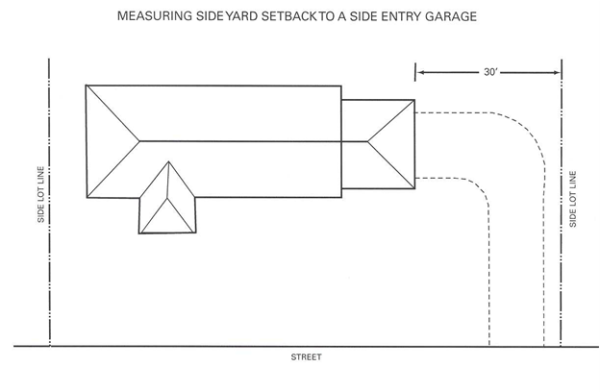 DRIVEWAYS. (Cr. #61-02) (Ren. #12-16) All driveways created after the effective date of this ordinance shall meet the following requirements:
- (Am. #31-04) Driveways shall be set back at least five (5) feet from all side or rear lot lines. For lots narrower than sixty-five (65) feet, as measured along the front lot line, the driveway setback shall be no less than seven percent (7%) of the lot width. This requirement shall not apply where adjoining lots shall be sharing a driveway, as evidenced by an access easement recorded by the Waukesha County Register of Deeds. Such shared driveways shall not exceed twenty-four (24) feet in width.
- No driveway shall have a grade exceeding twelve percent (12%).
- All driveways shall be surfaced with a bituminous paving over a base course, Portland cement concrete, brick or block designed for this use and laid over a sand base, an oiled base course or crushed rock, which provides a stable, hard-driving surface which resists rutting, is impervious to erosion, does not result in blowing dirt or dust and the ponding of water, which eliminates the accumulation of dust, dirt and mud.
(Rep. & recr. #66-01)

